SALT WIND, RISING WATER
To Hannah and Tom
SALT WIND, RISING WATER
Planting a Wood on Ireland’s
Wild Atlantic Coast
John S. Doyle

First published in 2026 by Merrion Press
10 George’s Street
Newbridge Co. Kildare
Ireland
www.merrionpress.ie
© John S. Doyle, 2026
978 1 78537 592 7 (Paper)
978 1 78537 596 5 (eBook)
A CIP catalogue record for this book is available from the British Library.
All rights reserved. No part of this publication may be reproduced, stored in a retrieval system, or transmitted, in any form or by any means (electronic, mechanical, photocopying, recording or otherwise), without the prior written permission of both the copyright owner and the publisher of this book.
Typeset in Minion Pro 11.5/17 pt
Cover design by Paula McGloin
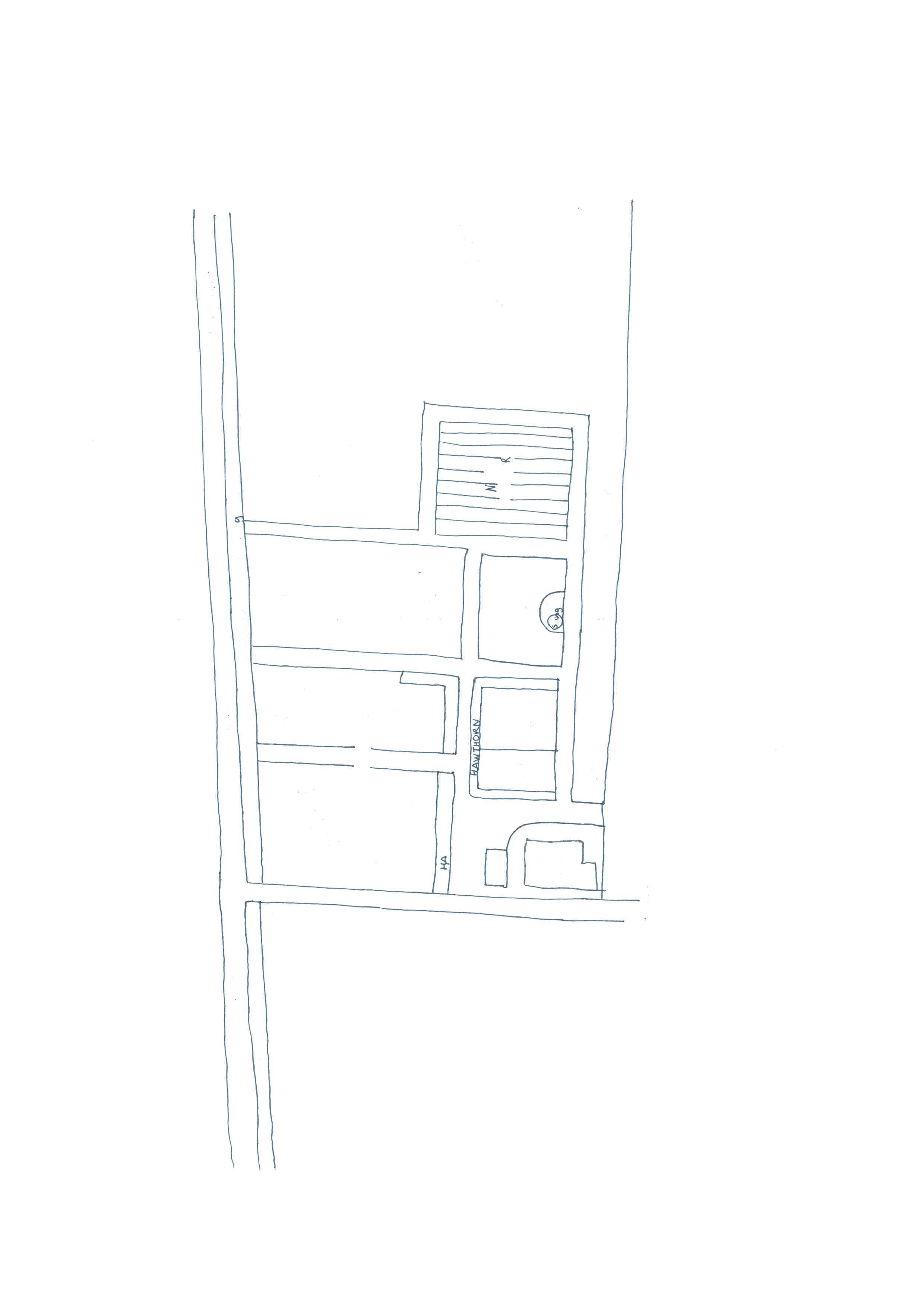
Map by Hannah Doyle
Photographs by John S. Doyle and Anne Ryder
Merrion Press is a member of Publishing Ireland.
If some counties can compare with Sligo in particular points; if, for example, Wicklow and Antrim can rival it in picturesqueness; Kerry and Donegal – though this is hardly the case – in monuments of primitive times; the counties on the south and south-east coasts, in stirring events, mediaeval and modern; not one of them all, strong as the assertion may seem, can compare with it in the combination of these and the other attributes which impart to a region the interest which enlarges the mind and stirs the heart.
Terence O’Rorke, History of Sligo: Town and County
The planting of a tree, especially one of the long-living hardwood trees, is a gift which you can make to posterity at almost no cost and with almost no trouble, and if the tree takes root it will far outlive the visible effect of any of your other actions, good or evil.
George Orwell
Aucune machine n’est aussi efficace qu’un arbre. [No machine is as efficient as a tree.]
from information board on newly planted roundabout in the French town of Céret, 2025
Take life in instalments. This day now, at least let this be a good day.
Blessed John Sullivan S.J.
Introduction
Windis the main problem, and then the salt that comes in on the wind. On this peninsula in north Sligo, where you can hear the sea rattle and rumble on three sides, there is not much in the way of bushes and trees growing, and our plans for a shelter belt were generally greeted with scepticism.
This is a book about how two people living in Dublin made a small wood and a garden on the north coast of Sligo. It aims, incidentally, to show anyone else who is thinking of such a thing how it can be done with not much money but a lot of work and time. There had been some upheavals in our lives, for different reasons, and this new enterprise offered a change of direction, a kind of therapy. Therapy, too, for the planet, though that was not a consideration then. Climate change can be too big a notion to comprehend, but the planting of trees is a practical way to do something about it, or at least not contribute to it.
Ireland is under-forested, and growing a patch of trees is something almost everyone can do, whether as individuals or as a community. There is no reason why the front garden of every house, in city and country, should not have one tree in it, even with a car. And besides, ‘leafy neighbourhoods’ are very popular with estate agents; everyone with a front garden can live in one.
We started off in 1992, my wife Anne and I and our children, with a big field, bare except for grass and rushes and, along one ditch, a couple of old elder trees; at the bottom a big willow bush, probably marking a division of land. Thirty years later the field has become a wood, a garden and an orchard of apples and soft fruit, and it is full of birdsong. The work of many hands has gone into making it; a great many other people provided inspiration.
The raw materials for what we did are readily available. Many parts of Ireland still have old cottages lying vacant, with an acre or two attached, and there are now good grants for doing up such houses. A hunt in the ads of local newspapers or the windows of auctioneers would yield many possibilities. The price of a hectare will vary, obviously, between the Golden Vale and the drumlins of Leitrim, but what you want is a marginal piece of land. Good land will produce better trees, but for the purposes of this project, good land is a luxury. And the cottage is a secondary consideration. The pleasure is found in what you do with a bare field; a caravan will suffice for living quarters, the wood will take off on its own.
The cottage we found had its roof but no windows, walls
a good two feet thick, and earth floors in two of the three rooms. There were two hectares of land with it, about four acres; one hectare was usable, the other was a cutaway bog, for looking at. The land, and the garden we might make in it, was the attraction; the house was a bonus.
It must be said that much of the charm of the place lies in its very bareness. A few kilometres back from us there are some big woods and fine trees, then as you move down along the coast the trees thin out to the occasional sycamore and alder and scrub willow. You emerge into the bog, a low-lying plain which stops at the sea. The sky is big.
Ben Bulben, the great table mountain of myth, closes the view at the end of our field, off in the distance to the east. Closer, to the southwest, Knocklane, an impressive hill above a long strip of land ending in a promontory fort, divides the sheltered beach near us from the long and open Yellow Strand of which W.B. Yeats spoke.
When we first came here, from the field of scutch grass you looked to the north across a half mile of bog to a cottage on a headland; a bit nearer there was a row of three cottages. If somebody passed along the road on the far side of the stream that ran the length of our field, on foot or bike or in a tractor, they seemed to be floating through the bog. One interfered with this landscape at one’s peril. But the Atlantic wind was wild and would persuade you not to venture out of doors for much of the autumn and winter. Making a garden, and tending it, would be difficult. We were not, we felt, as hardy as the people who lived there before us. So we set about planting some trees for shelter.
The water table is high. The soil is poor and mostly shallow, with a layer of dab near the surface. Dab, or daub, is a gluey, grey substance which is nearly impossible to dig. We consulted books to find which species of trees might deal with 1. strong wind, 2. sea salt, 3. poor soil, 4. wet soil. Common alder was the main candidate; it seemed to tolerate all of these difficulties, and it would also improve the soil, soaking up moisture and setting nitrogen.
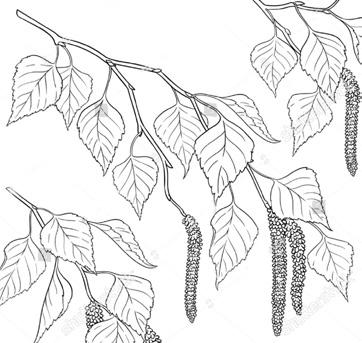
A man from the Forestry Service came out to have a look; his advice was minimal but useful, and the following spring we planted 200 trees: birch, alder, sycamore, pine, hawthorn. Another couple of hundred the next year, and so on. The alder turned out to be hardy; not so the sycamore and pine; some birch grew once there was a little shelter; the hawthorn were slow but steady. The shelter belt took about ten years before you could call it a plantation; after fifteen years or so the trees suddenly achieved critical mass, forming a canopy. It had become a place you could take a walk in: a wood.
This was not an abandonment of city life for a simpler existence in the country, something which Michael Viney described well in his Irish Times column. At various points, Anne and I thought of moving to live in Sligo permanently, but that never happened: most of my work was in Dublin, and the money was earned there and spent in Sligo. And later our children made their lives in Dublin.
Since 1992 the climate has changed noticeably. Rain is as frequent as ever but the amount that falls is greater. The ground was always boggy, and it improved as the alders
grew – they don’t mind sitting in water for a long time; alder has been used for the piles under bridges and houses; much of Venice was built on alder – but we are barely above sea level, if at all, and when the soil is sodden the roots can be disturbed in strong wind, and some trees start to rock. We are conscious that sea levels are rising, and it would not take much of an increase for our whole field, wood and house to be inundated and blown away. We were told that in a storm not many years before we arrived the sea came up to what the children called the Y sign, the yield-right-of-way at the T-junction, where left brings you to the sea along the flat bog road and right, along by the stream and our stretch of land, leads to the crossroads and on towards Ben Bulben. We have seen the force of the sea make, for a time, an island of a neighbour’s house a little to the north, so that he had to leave his car at the gate and walk through the water on the short road in to get to the house.
But the project continues. Thirty years on, we are still planting – oak, beech, hazel, alder buckthorn and swamp cypress have joined the original trees – though running out of space for it. There are a few thousand trees; what was an empty field is nearly full. Underplanting of the wood with other species, such as holly, is coming on well. Some of the original trees have succumbed to storms and rising water levels, but their place is taken by others. And other ventures become possible. We introduced a beehive now that there was something for bees to feed on, and shelter for them; this is a work in progress. There is apple juice being made from the orchard.
Our young ones, who spent many months of their childhood here each year, now come back with their children, for whom the place is a fine playground, and there is plenty of work for the adults to do. The weather is often overcast and rainy, but they don’t mind that; and the sun, when it shines on the golden bog, is, as a neighbour put it, like a visit from an old friend.
This is not a work of ecology – I am not a scientist – but it describes a process which can, on a small scale, make a difference to the state of the earth. There is plenty of practical information here, but the thrust of the book is the pleasure of making a piece of landscape, and appreciation of the friends, family and neighbours who helped to make it.
The book is written from memory, of recent events, and events of more than thirty years ago, and everything in between. It offers glimpses, not the full story – and besides, the full story of others would be different. Memories are unreliable, and what one person remembers as clear as the air the lark sings in can be contradicted by another who recalls something else entirely. A place you remember as big turns out to have been small; the turn in the road you swore was here was in fact there. The clinching argument for one memory over another is to produce a contemporary note. (There, you see, I was right!) There was a lot of notetaking by me in notebooks and diaries and on scraps of paper about the project, and about life in general, which was
carrying on anyway. (This book itself is intended as a kind of notebook.) There were many photographs taken in the days when I still used film, and they are some help in working out what happened when, though they are bundled together in packets that had not been looked at, in many cases, since the photos were developed. The digital camera, with the date helpfully inscribed on its pictures, was a step forward. The photos taken on a smartphone make it easier again to find something, with everything filed by year, month and day, but the tens of thousands of photos a phone holds are another corner of one’s life that requires decluttering.
I was surprised, looking through the diaries for information about what was done when, to see how much was stuffed into a week, or even a day; looking back from a relatively sedentary age, I’m exhausted even just reading about it. Trips to Sligo were sometimes very short and the work was usually intense. There were also jobs done on the house, some by professionals. A friend installed a socket for a cooker, and being an old merchant seaman said he would have a Pimm’s with us the next time as payment; we added a loaf of Anne’s white bread, which he particularly liked. There were dinners in one another’s houses – many fine meals and much wine, many good nights of talk and fun.
Some notes are quoted verbatim here. The note-keeping is not consistent: some pages in the diary – starting with Filofax, then moving to a spiral-bound desk diary from Redstone Press, an idiosyncratic assembly of pictures and/or words on the left-hand side, the week to view on the right – are stuffed with events; some weeks have no entries at all. There are
notebooks of various sizes. Weeks, months, even years went by sometimes without any long notes being taken. There are many, many pages of notes scribbled at botanic gardens and other gardens, here and abroad, about plants seen in places we visited, trees we admired and might try ourselves; about seeds gathered, some of them successfully germinated, others that were put in pots and never heard of again.
I kept a planting notebook for the first five years or so; planting details after that have to be dug out of diaries or other notebooks. Some of the entries are cryptic and no longer understandable or refer to people whose names are no longer familiar; sometimes a name brings back – a joyful resurrection – a person I’d forgotten; some entries are illegible; some throw light immediately on a half-remembered detail. When two memories conflicted (for example, Anne’s and my own), mine prevailed, unless I had a serious doubt about being right. On certain matters I give way; Anne is more dogmatic, possibly because she more often turns out to be right. Bear in mind the advice of Pope Francis – who was elected while we were out in the field planting our orchard and died while I was writing this book – about three words that can help in married life: permesso, grazie, scusa – may I?, thank you, I’m sorry.
Friends come and go. Some years you see lots of somebody; at other times you don’t see them for months. There have been losses; with a project begun in (our) midlife and carried out for over thirty years, that should not be surprising. Many of the people who helped us, sometimes just by encouragement, and who gave the area a special character, have gone, ar shlí na fírinne. The place is diminished without them.
1 ‘This strange and beautiful place’
I’m a city rat. I have lived in Dublin all my life. My father, on his father’s side, was third-generation Dublin; my mother grew up on Lower Mount Street, where the family lived over her father’s place of work, and because they were near Merrion Square, which was not then open to the public, the family had a key to the park. She remembered the 1916 Rising and was brought in her pram to see the fighting at Mount Street Bridge. My father’s mother grew up over the family pub on Parkgate Street. She was a piano teacher as a young woman and attended musical evenings in a house on the opposite side of the river, on Usher’s Island. I like city streets and walking about looking at things, looking at people – buildings and things being built; the chance of encountering someone you know; wandering around shops and galleries. The poet Frank O’Hara put it well: ‘One need never leave the confines of New York to get all the greenery
one wishes – I can’t enjoy a blade of grass unless I know there’s a subway handy, or a record store or some other sign that people do not totally regret life.’
For preference I would live in the city centre, and did once, on Bachelor’s Walk by the River Liffey, at a time, the 1980s, when there was nobody around on a Saturday or Sunday and you could see out to the Dublin mountains on a bright morning. If I go on holiday, on the whole I prefer a city. I have not had much contact with country living, apart from holidays as a child: Donabate, Dunmore East (though that was more of a rambling village where you saw green fields at the edges); later the islands of Achill and Aran. These were magical places, but for me real life was back in the city.
My wife, on the other hand, grew up in a small town by a big river and was more at home in rural parts (though I would not go so far as to extend the analogy of the La Fontaine fable and call her a country rat). When deciding on a place to live together, after the quayside house with many stairs to haul a pram up became impractical, we settled, as our daughter Hannah turned one, for something in between, where you could see the mountains from an upstairs window but could walk into town.
Anne is a gardener, and ran out of space at our house before long; also she wanted somewhere to escape from Dublin to. She had come into a small amount of money and thought of getting a piece of land in Wicklow, an acre or two where you could plant away, and maybe put a cabin or caravan that didn’t need planning permission; a refuge near the city to go to at weekends, like the extended family of a
‘This strange and beautiful place’
friend of ours, who lived in a fine old house on Fishamble Street in the centre of Dublin, almost the last standing there, and had a place out in Kilmacanogue, a weekend retreat ‘in the country’ (it was about twenty-five kilometres away), from which they would return on a Sunday evening.
But Wicklow was easier said than done. Some years before that – before we bought our place in Dublin – we had set our hearts on a house on the far side of Blessington, tiny but in a beautiful spot by the lake, down at the bottom of a field; remote but with a bus stop on the road outside from which you could travel to Dublin. Despite being introduced by a mutual friend, we were told by the owner that she was not interested in selling. We asked her to get in touch if she ever changed her mind. A year or two later we saw smoke coming out of the chimney; the house was sold.
A less formal introduction was to two brothers who lived at the foot of Mullaghcleevaun and might, we had heard, be willing to sell an acre. They were mountainy men who only came down to Blessington now and again. We made various attempts to meet them, without success. I remember a long trudge through fields to visit their cottage. One brother lived in a caravan but was never there when we called. When we finally made contact, again there was no keenness to sell land.
There were a few other unsuccessful attempts to find somewhere around Wicklow, or the Dublin mountains. It was serendipity that brought Anne to Sligo. A friend of hers, Cathy Carman, a sculptor living in Dublin, was looking for a place to make a studio; her requirements were quiet and
space. Anne joined her on a scouting trip, and they stayed with the painter Seán McSweeney and his wife Sheila in their house in Maugherow, in the country north of Sligo town. Seán conducted the pair on a tour of the area, to show them houses that were for sale, or that might be for sale. He knew who owned what, who might be approachable, and also which house was damp or might not have a good title. Cathy did not see anything she liked, but Anne was very taken with the area, and in particular a long and narrow corner plot of land by the sea, with a derelict cottage in front facing a small road.
Her enthusiastic description to me when she got home, of the house near the shore, and the view of Ben Bulben from the back door, was enough to make me want to take a look. I imagined scattered trees along a road, with traces of sand on either side by grass verges; hebe bushes with their purple flowers and leaves that popped to disclose other leaves within; buckets and spades; fishing nets – an amalgamate view, I suppose, of places where I had holidayed as a child. The flat, sparsely inhabited country I visited shortly afterwards, with its bogs and rushes, and a mist that covered everything so that you could not see more than 100 metres ahead of you, never mind Ben Bulben, was unpromising, not the dream I had had.
It was Easter Sunday when I first set eyes on the place: 19 April 1992. Anne, Hannah, her younger brother Tom and I had travelled down from Dublin in a Nissan Micra borrowed
‘This strange and beautiful place’
from my mother. A wet mist hung low over the countryside as we drove through the midlands – Mullingar, Longford, eventually the Shannon – on to Sligo town and out the far side. Another twenty kilometres or so and down towards the coast. There was a great deal of dreary-looking bog, very flat land with nothing vertical except for a telegraph pole here and there. At a certain point Anne said, ‘Left here.’ We turned on to a narrow road with grass growing up the centre and stopped at the first house on the left; a matching one faced it, with its byre. No sign of the sea.
This was, as I say, not promising. I had imagined from Anne’s enthusiastic description of the place that the sea was more or less on the doorstep, a cottage on a sandy road, like the idyllic sunny seaside holiday homes of one’s memory, or perhaps one’s dreams. There was none of that. There was a lot of wet grass everywhere and the house looked as if it was about to fall down. We walked in at the gate, which was secured by a bit of nylon rope. No hedges or ditches, some yellow rapeseed here and there; otherwise there was nothing except tussocky rough grass, and stony ground near the house. We went down the field to a point where the bog began. Off in the mist Anne pointed out where Ben Bulben would be if you could see it. It was cheerless, though the very bareness of the house had something rather lovely about it. The back wall, facing the field, had only one window, a small one. The house had the look of an old farm building you would see in one of those neo-realist Italian films, in a bleak, bare countryside. It was quiet; there was nobody around.
The back door of the house was open and we looked inside. Nothing in there either. No glass in the windows, the timbers rotten. The kitchen was very black – black walls, black ceiling boards. There was a small room on either side; a simple arrangement. One of the rooms had a floor of bare earth on which sat a heap of seed potatoes, still good; the other a thin cement floor. The pitched ceiling in the upper room (behind the hearth) was panelled and gave the space the appearance of a little church. The room on the other side of the kitchen had no ceiling, just bare timbers topped with chicken wire and above that a corrugated asbestos roof. A large open fireplace dominated the kitchen, and it still had its crane – a high, hinged metal arm to hold a cooking pot over the fire and swing it into the kitchen when needed. A recess in the wall on the left of the fireplace was where a settle bed would have been. It all felt quite dry and was clean and intact.
We got back into the car and went off to find the McSweeneys’ house. Anne had an idea of where it was, but they had driven around so many different roads the last time she was there that one road now looked much like another. You might arrive at a junction and think that since you had come in a straight line the direction to go was left. But it had not been a straight road, it was a wide loop, so left was not actually where you wanted to go. Instead of the expected crossroads you came to a T-junction. We were lost. Eventually, however, starting off again from a recognisable landmark – a shop called Dunleavy’s – we headed down a completely different road, and after a couple of turns off that
‘This strange and beautiful place’
found ourselves in McSweeney’s, what had been the master’s house, around the corner from the old Ballyconnell school, where Seán’s mother had been a pupil, and which was now his studio.
The house was warm and bright and full of people –Seán and Sheila, their five children, a sister of Seán’s and her husband, and his aunt Sarah, who, we learned later, was ninety-four and lived up the road from the cottage we had been looking at. And even though they were just finishing what looked like a very nice Sunday lunch, a leg of lamb, and they had met none of us before except Anne, they asked us to sit down and join them and have a glass of wine and some dessert. Talking to them around the table in this cosy room with terracotta tiles on the floor, white walls hung with paintings, a fire in the stove and lively conversation going on across three generations, being made much of while we drank their fine Côtes du Rhône, I thought: Perhaps country life is not so bad.
Later, Seán and Sheila brought us down to the sea, and through a field to a high point called Roskeeragh, from which, even though it was not particularly high, there was a grand wide view all around – Knocknarea off to the south, Ben Bulben to the east, and nearby the small hill Knocklane, at the end of the beach below us known as the Pound. Seán explained that the steep road rising to the left of Knocklane was known as the Bent, because of the bent grass, or marram, grown on the far side of it to prevent erosion. In the nineteenth century the houses there had been covered in blowing sands and, being made of clay, had eventually disappeared. Lord
Palmerston, the owner of much of the freehold along this stretch of the coast as far as Mullaghmore, had introduced the planting of bent, which forms roots that hold the sand; when again covered by sand the grass forms more roots and holds the sand again, eventually creating dunes. Other local landowners followed his example.
We talked of Dublin and the friends we had in common. The McSweeneys had both grown up in the centre of the city, but Seán’s mother was from Ballyconnell and she had brought her children to spend their summers there. He pointed out the house we had inspected, and further up the narrow road his aunt Sarah’s cottage. The sun came out. To the north we could see the hills of Donegal and the cliffs at Slieve League, and nearer, on another raised point, the house of Dermot Healy, the writer, with its back to a cliff. Off to the west, on the other side of Sligo Bay you could see the great cone of Nephin in County Mayo, and they said on clear days Croagh Patrick was visible. It was like a vision of the whole world being laid out before us, and I felt as if Seán and Sheila were trying to tempt us with the idea of coming to live and work here – we should get a phone line and a modem and plug in the computer. (The internet at that time consisted mostly of a squawking box which was desperately slow but did, just about, allow you to send an email, and receive one.)
It was flattering to be invited into this strange and beautiful place. They brought us down to the rocks behind Dermot’s and showed us the extraordinary range of fossils – stalks of coral hundreds of millions of years old, from the
‘This strange and beautiful place’
time that Ireland was at the level of the Equator or further south – spread out there at sea level.
Seán explained the ownership of the cottage we were considering, and how it was part of a Land Registry folio that contained two parcels of land: the portion the owners wanted to keep was up on the Bent, with good drainage; our piece was low-lying and wet, and not much good for farming. It was below the road and possibly below sea level. Seán asked if we would like to meet the owner. Anne said yes, and he brought us up to the woman’s house nearby and introduced us. We talked briefly about the cottage and said we might be interested if the price was right. Seán left us to it; we talked with her for another while and then exchanged phone numbers.
Over the weeks that followed we talked to the owner and her son by phone. The price rose a little as the negotiations proceeded, but eventually we agreed on a sum of £7,000. We justified it to ourselves as being the price of a small second-hand car – not that we had a car, and if we were going to be travelling up and down to Sligo we would need one. It was a bit more than the money we had available, but this cottage and the land attached would be much more fun than a car and would give us and the children a new dimension, a slice of the country, a piece of the seaside, a place to dream about.
A solicitor in Sligo town handled the deal, and the transfer of ownership was entered in the Land Registry. It was then that we discovered that the land covered two hectares, about four acres, a substantial area for someone
who has only known an urban back garden, and more than we had thought we were buying, even if one of the hectares was a bog. The plot was a long sliver of land running beside a drain, or mearing as Seán McSweeney called it, which itself ran along the road, from the crossroads east of us down to the sea. At the far end of our land, running at right angles to the mearing and the road, was a green road, paved only in grass; this proceeded from the mearing along past another bog, Kelly’s, to another green road, which ran at right angles, east and west. Turning right took you back to an opening on the road near our house; to the left it took you to the well (which, incidentally, is mentioned in Máire MacNeill’s The Festival of Lughnasa (1962) as Tobar Columcille, one of the places where visits were made on the eve of Garland Sunday, a feast day derived from celebration of the god Lugh; she provides a map reference to the 1913 Six Inch Ordnance Survey, which names it St Columbkille’s Well), with a fork to the home of the McSweeneys, and another to the Bent and a spot overlooking the field where the Barnacle geese feed in winter. Martin Enright, in The Book of Sligo, states that ‘Sligo’s Barnacle geese flock at over 6,000 individuals (winter 2020–2021) is Ireland’s largest flock’. Leo Leydon, a farmer at nearby Cloghboley with a great knowledge of the local history and archaeology, places St Colmcille’s well elsewhere, near the shore, and says this well is St Patrick’s.
The well, in a secluded spot by the road, is no longer used for drinking water. It is neglected now, but a visit in 2003 inspired my cousin Peter Bradley, over from London, to write:
‘This strange and beautiful place’
A buttercup path
To rectangle pool, moss-lined Holy well, bird-loud
Our bog was full of reedmace, what people also call bulrushes, perhaps in deference to Moses, who was found by Pharaoh’s daughter in among the ones growing along the River Nile, as the Dublin balladeer Zozimus sang:
She tripped upon a bulrush, whereupon she saw A smiling babby wrapped in a wad of straw.
The bog had rectangular pools here and there, where turf had been cut. Such pools around here, with their flowers –bog bean, marestail, yellow flag irises and marsh marigold – recur in the paintings of Seán McSweeney. At the edge of our bog, by the mearing, there was a ridge with a kind of path, and on one of our first visits to the place I took Hannah and Tom for a walk along this to explore. When we came to a patch that looked dry and solid we stepped down and walked carefully into the bog. Before long we noticed that the ground beneath our feet was moving slightly. A little bounce without lifting my feet, and I could see that it all was moving, and was not ground at all, but a thin layer of heavy grass, watercress, reedmace and other things which had woven itself across the water – a green carpet. A bird could land on it, or perhaps a light-footed fox, but I realised with
alarm that it would not hold us up for very long. Gingerly we walked back the way we had come and stepped up on to the safety of the ridge again. We later heard that people had drowned in the bog.
We decided for the future that our cutaway bog was something to look at but not venture into. In the spring it turns from a greeny-brown colour to the yellow of the irises, the pink of Ragged Robin and the white puffs of bog cotton; it is most beautiful when the Ragged Robin and bog cotton come into flower at the same time, which does not always happen. The heron favours the bog, and so does the snipe. Often, when down at the edge of our field where the bog starts, you might surprise a snipe, who would fly up fast in a flutter of wings –a dainty bird with a long, straight bill and a jerky flight. The heron is recognisable by the screech he gives as he passes, and by the leisurely working of his enormous wings.
Sometimes at night a strange bleating could be heard, a mysterious sound, like a goat. The mystery is that you look around to find the source of this mehhhheheheheheheheh, which seems to come from nowhere. There is nothing to be seen, and the sound can be right beside you one moment and the next moment far away. We learned that the mystery sound is made by the vibration of the snipe’s wings as he swoops down from a height. He is known locally as the goat, and he lent his name to Dermot Healy’s great novel A Goat’s Song; also, the word ‘tragedy’ in English derives from the Greek words for goat, tragos, and singer, oidos.
Other birds that abound: in the garden the wren and sometimes the equally tiny goldcrest; flocks of lapwing,
‘This strange and beautiful place’
here known as the pilibín; the golden plover, seen down at the beach; likewise the oystercatcher and the sanderling; the curlew; the sand martin nesting in the sandbanks at Knocklane; swans nesting in the bog; the little egret masquerading as a swan; various ducks, such as widgeon; the kestrel and the sparrowhawk, occasionally the buzzard, a large bird with what John Kilbracken, a Labour lord who had a large wooded estate in County Leitrim, called an ‘eagle-like build’; and the Barnacle geese, which fly in great strings, in their thousands, over the house in winter twice a day – in the morning on their way from Inishmurray off the coast, where they roost at night, to the Bent, where they feed; in the evening they head back to the island. Sometimes there are stragglers: you might hear what you think is a dog barking, or a few dogs, a high-pitched noise far away. But then you look up and it is a small number of geese flying overhead, no more than ten, conversing with one another. In their thousands the sound of their chat is spectacular. When the geese have departed, to return again to Greenland, the swallows announce the spring.
Starlings roost in the reeds along the bog road, invisible, although you would sometimes hear them chuckling and murmuring if you were out walking at dusk. A clap of the hands raises them in a whoosh of air, hundreds flying off in a cloud that swoops and dives over the bog to land elsewhere, narrowing down as into a funnel. Small pipistrelle bats are also seen at dusk, flitting around the back of the house.
Later, the shed brought more delights: the pleasure as I sat on its steps one evening of hearing, faint, off in the
distance to the east, the call of a cuckoo, its up-down ‘oo-oo’ unmistakable but rarely heard by me, and only once before here. Another evening, in the dusk, looking west from the window in the shed, we saw a large, ghostly white creature flying towards us from the sea: an owl! Probably a barn owl, a small bird but with an unusually broad span of wing and a big, round, pale face. In the wood in the last couple of years we’ve sometimes heard, but not seen, a woodpecker, lesser spotted or great spotted – his drumming picked up on the Merlin Bird ID phone app (which uses artificial intelligence to identify birds) and heard, just about, by me. We are still waiting for the scratchy call of the corncrake. One time when my son-in-law John Healy and I were clearing the drain that runs off our land into the main stream, we could hear this terrible squealing and grunting coming from the wood beside us. But it was not a person or a pig: it was the rarely heard, and almost never seen, relation of the corncrake, a water rail. These are the things I think about when I’m in Dublin wishing I was in Sligo. (For balance, there were times also, working in the dark and the rain and the wind, when I longed for a warm bed in Dublin and the bright lights of the city. It is a fortunate existence.)
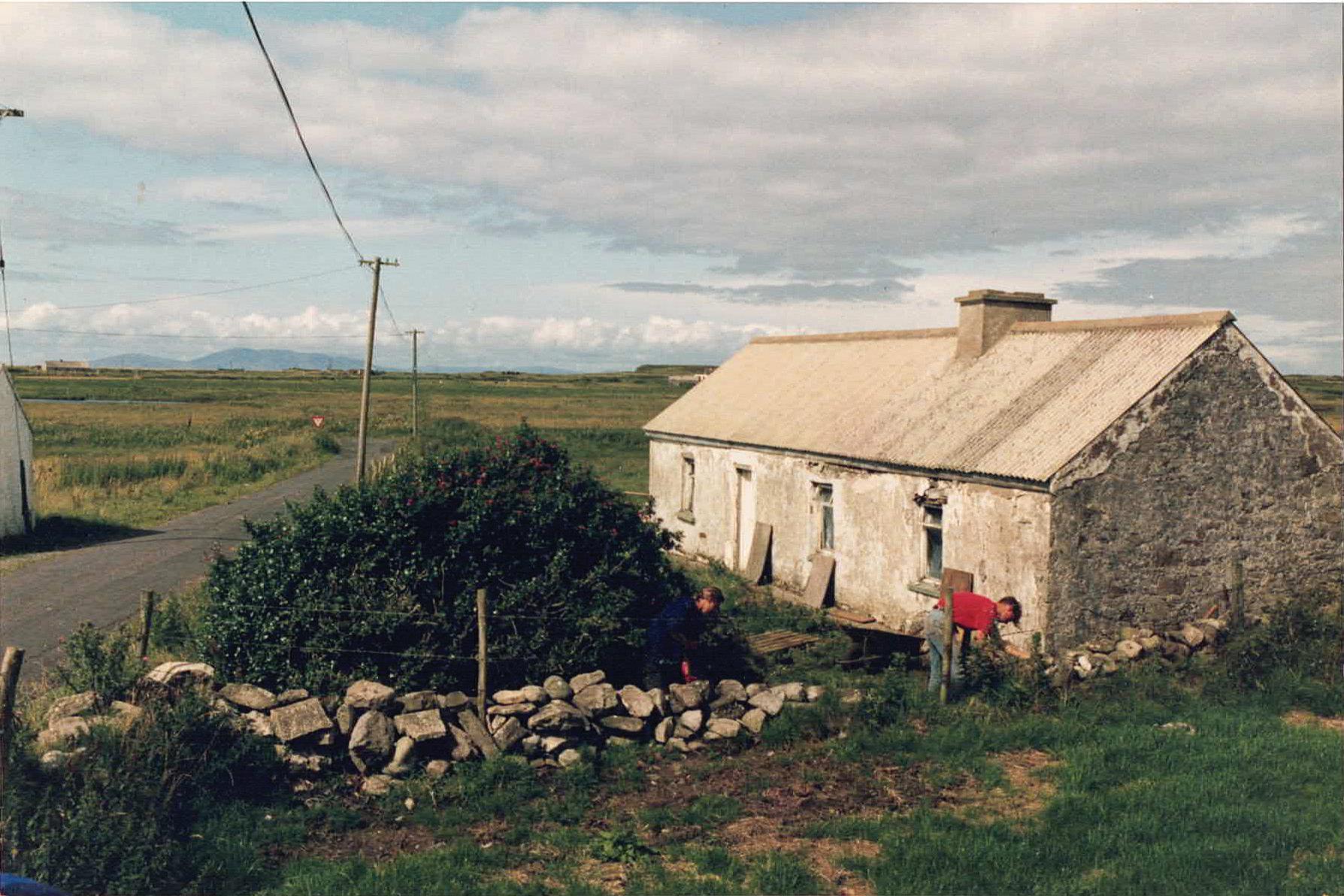
Above: The house as it looked in 1992 when we bought it. Anne and Cóilín at work.
Right: Interior
the house, 1992.
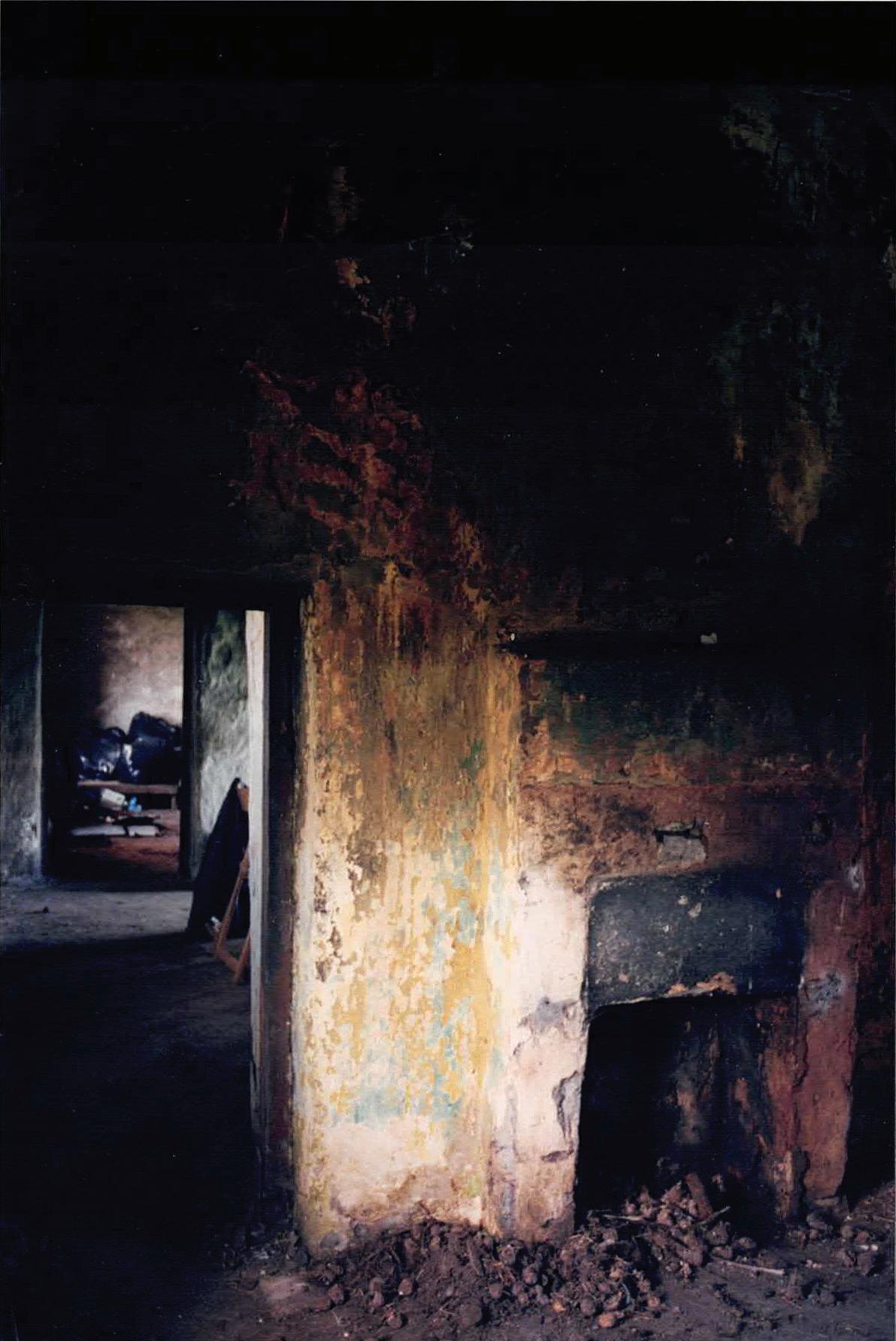
of
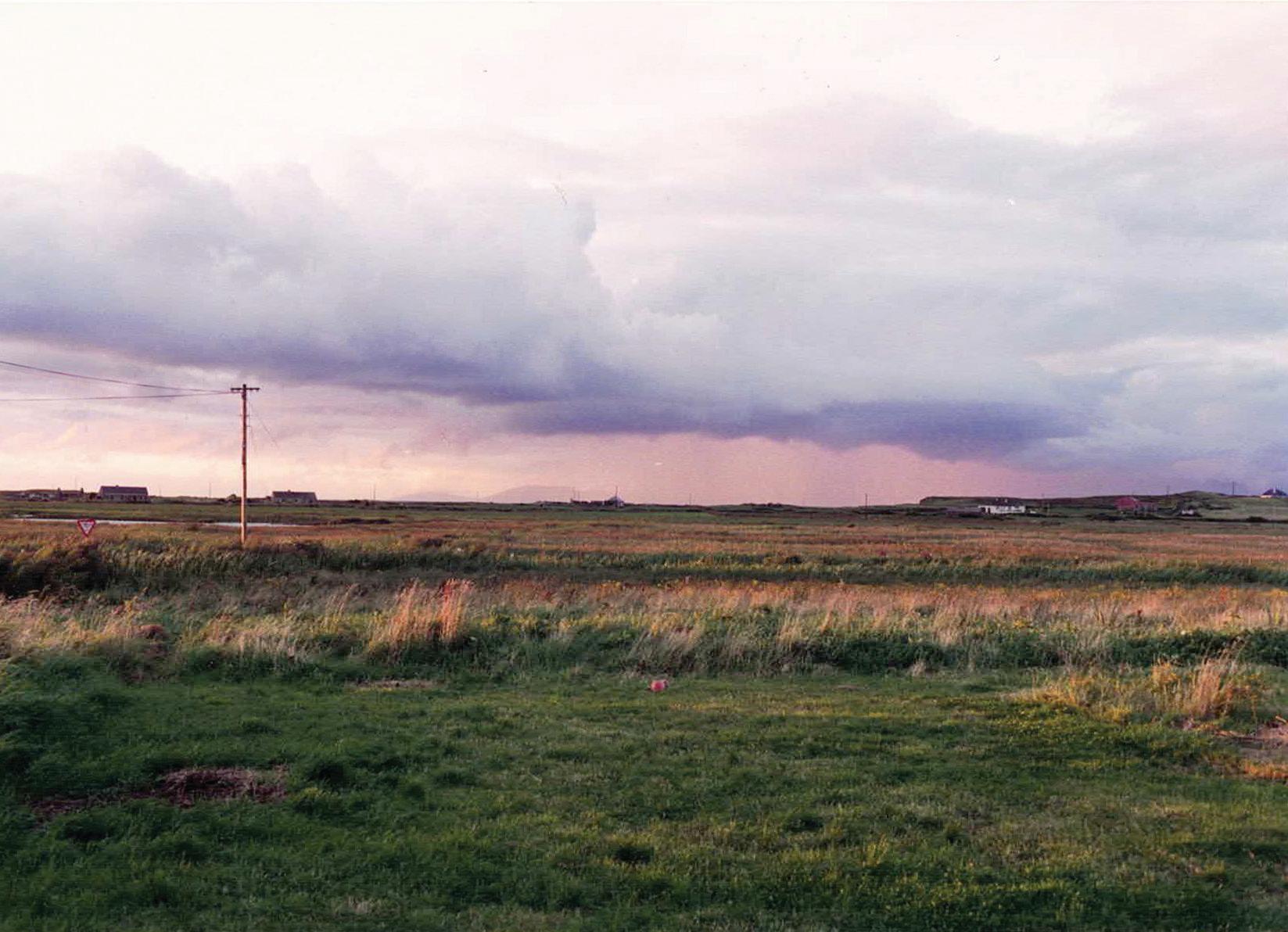
The view across the field and the bog as it was, looking north, which inspired the man from the Forestry Commission to advise us not to plant too many trees.
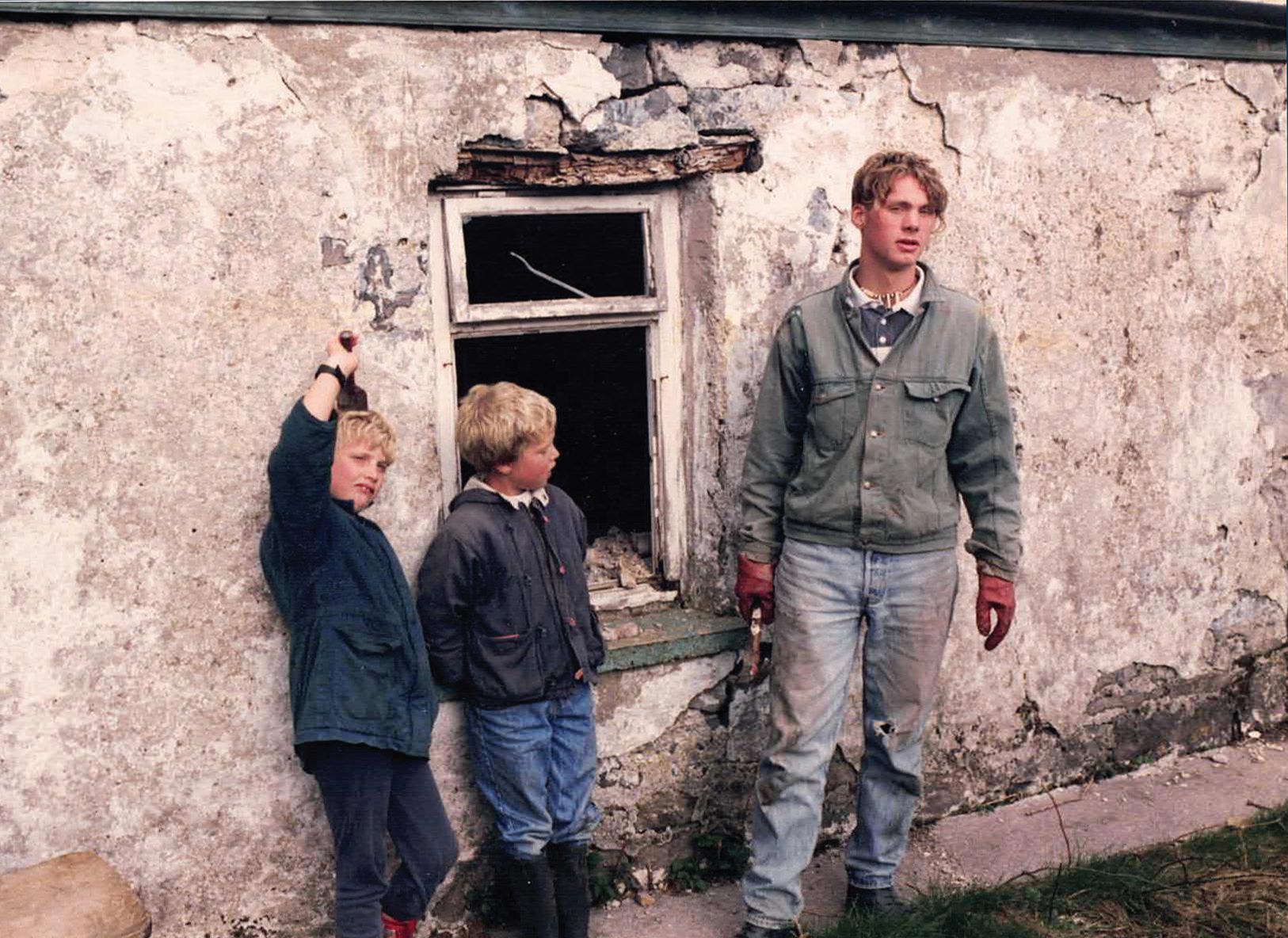
Hannah, Tom and Cóilín fixing a front window, 1992.
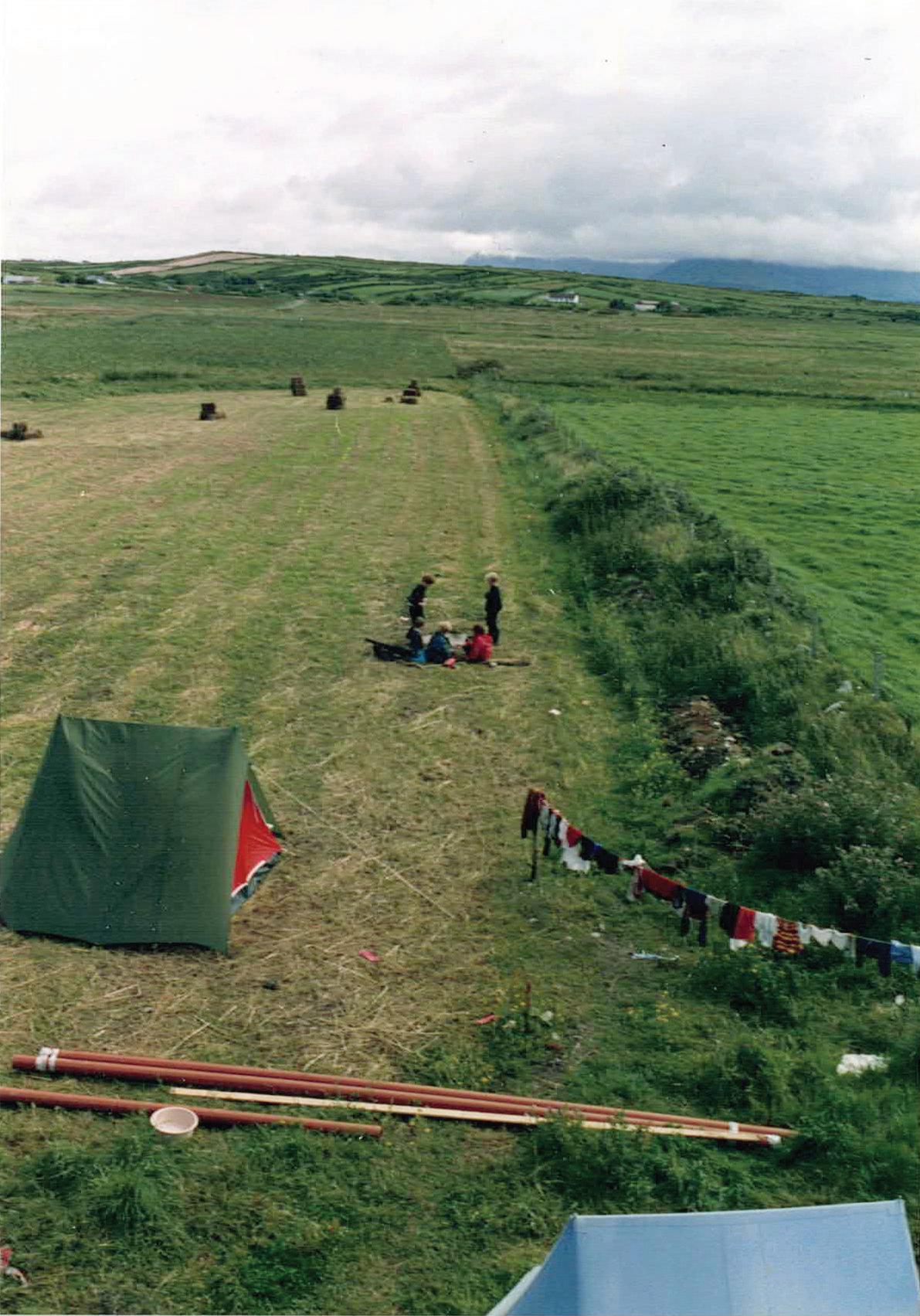
Hannah, Tom and friends in the empty field, looking east; in the distance Ben Bulben. Photo taken from the roof of the house, 1992.
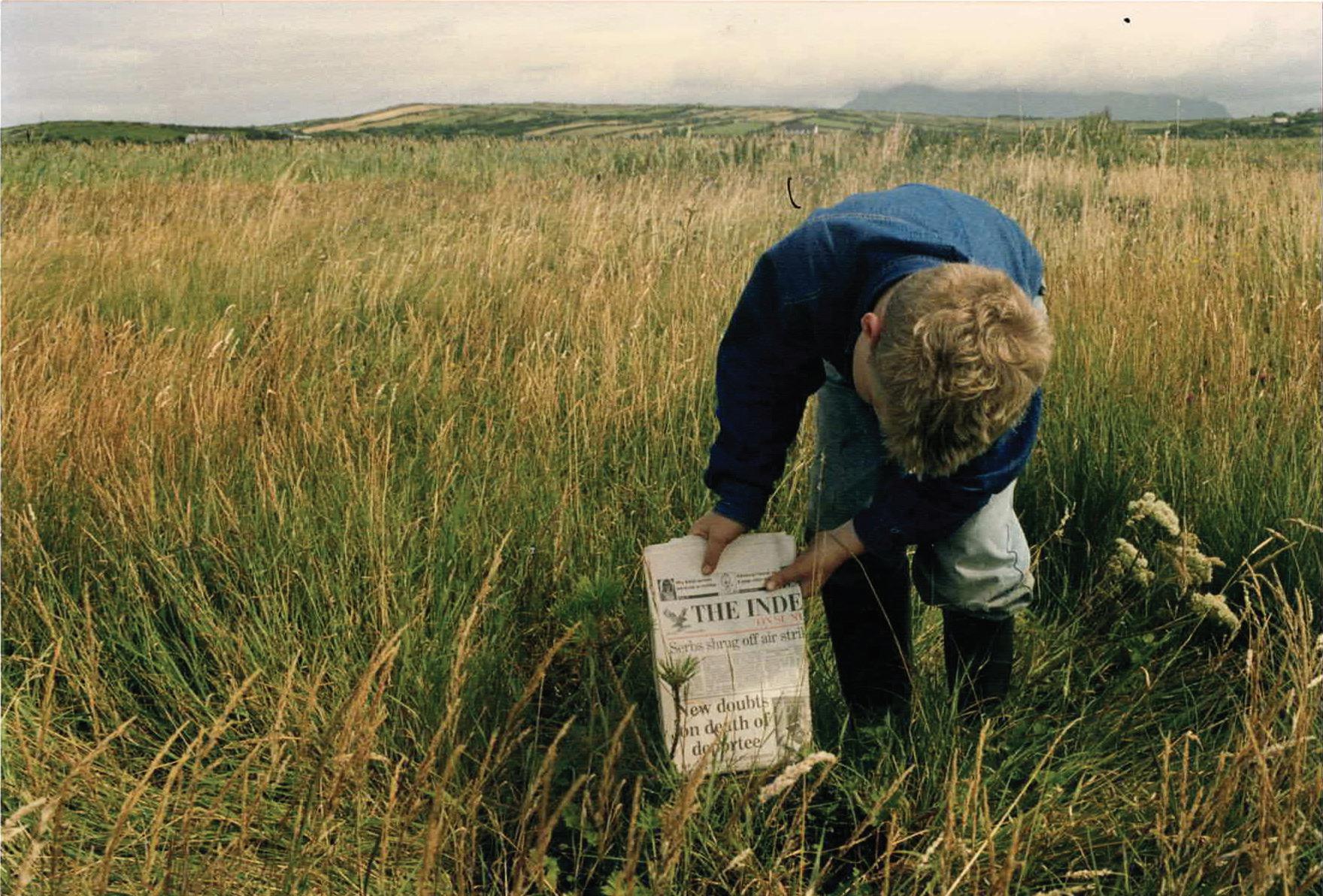
Tom shows the height of a young pine, 1993.
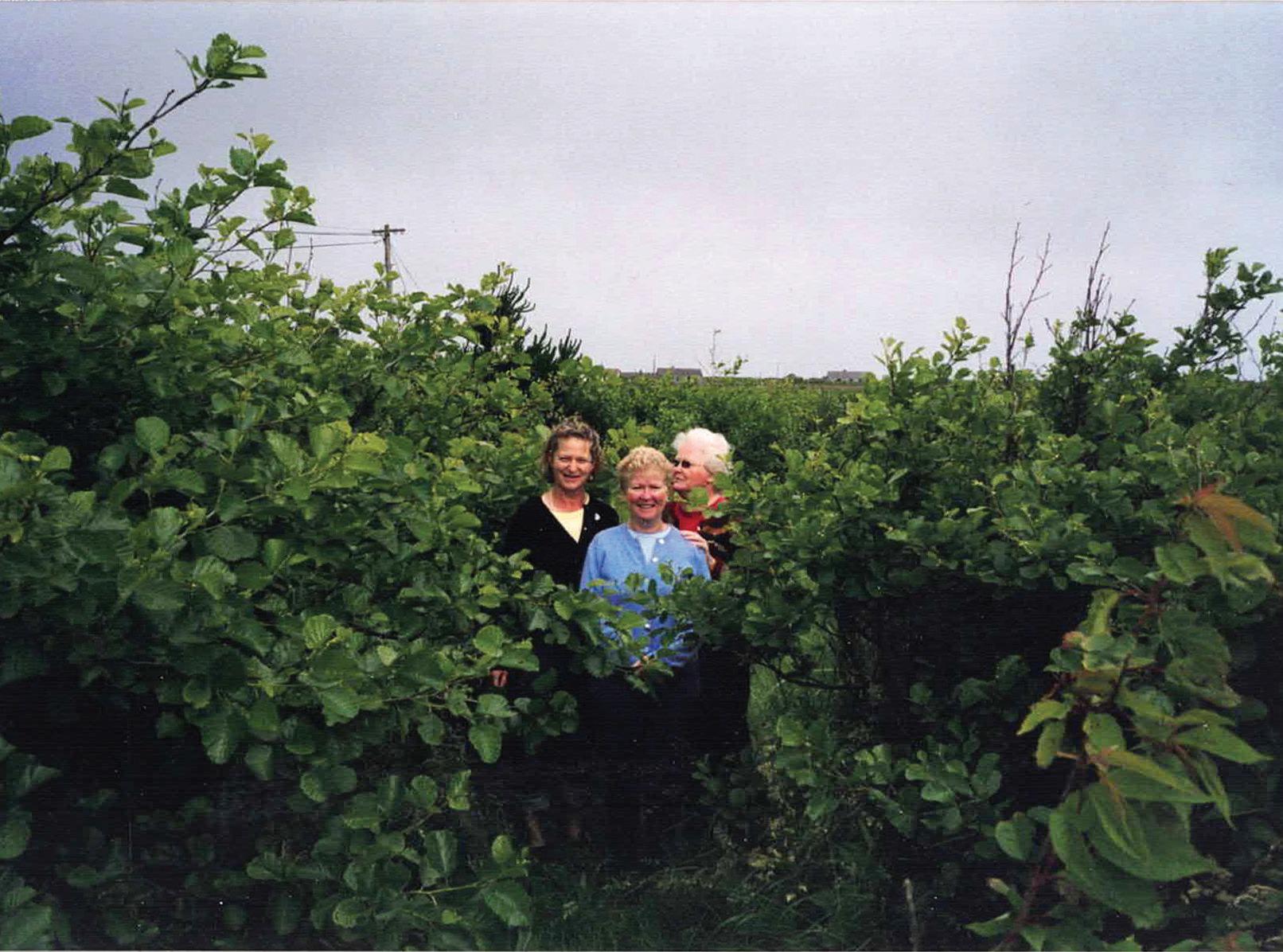
Anne, left, and her sisters Joan and Helen on a path through the first plantation of alder, looking north, c. 2004.
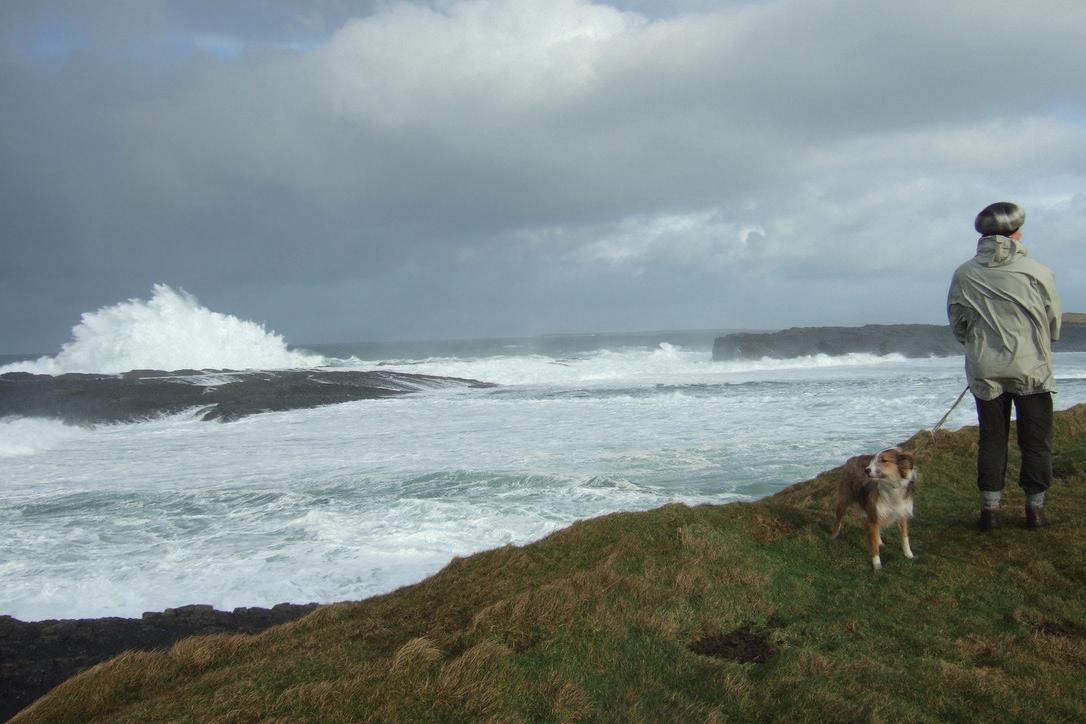
Anne and Charlie the dog on the heights at Roskeeragh to see the stormy sea.