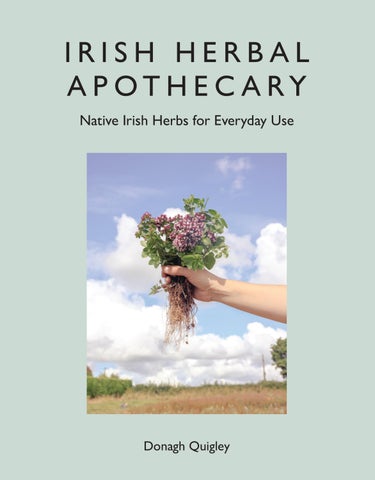
IRISH HERBAL APOTHECARY
irishherbalapothecary.ie
Donagh Quigley founded The Handmade Soap Company with his wife, Gemma, in 2010. Since then, they have grown the business so that it is now one of Ireland’s bestknown brands. All the while, they have been avid growers of herbs and vegetables at home, and three years ago they expanded to a 20-acre organic farm at Newgrange, Co. Meath. Donagh has a passionate interest in growing medicinal herbs on a commercial scale, and Gemma is a qualified kinesiologist.
IRISH HERBAL APOTHECARY Native Irish Herbs for Everyday Use
DONAGH QUIGLEY
DISCLAIMER This book is a collection of information, recipes and remedies compiled by Donagh Quigley. This book should not be used as a medical guide. The author is not a trained doctor. Before using these recipes and remedies the reader must ensure all plants mentioned are correctly identified and processed as described. If illness is suspected, medical help should be sought immediately. The publisher can accept no responsibility for any consequences of advice given here or any illness caused in the practice of the techniques or remedies described, nor of any prosecution relating to the treatment of people which may adhere directly or indirectly to the techniques or remedies described in this book. The reader should assume full responsibility for any practical use of any of the techniques and remedies described. If in doubt, consult a medical practitioner or qualified herbalist.
First published in 2026 by Merrion Press 10 George’s Street Newbridge Co. Kildare Ireland www.merrionpress.ie © Donagh Quigley, 2026 978 178537 616 0 (Paper) 978 178537 617 7 (eBook) A CIP catalogue record for this book is available from the British Library. All rights reserved. No part of this publication may be reproduced, stored in a retrieval system, or transmitted, in any form or by any means (electronic, mechanical, photocopying, recording or otherwise), without the prior written permission of both the copyright owner and the publisher of this book. Design by Aisling Redmond Front and back cover images: Derek Doyle Snowdrop image p. 84 © iStock/mtreasure
For Gemma, always
CO NTENTS My story
1
Why this book was written and how to use it
10
A brief history of Irish herbal medicine
16
A brief history of Western herbalism
26
The body systems
44
The energetic qualities of herbs
50
Common native Irish herbs and their functions
58
How to prepare and use herbs
68
How to make your own formulae
76
Through the seasons
82
Some of the best Irish herbs and medicinal plants with recipes
105
Cleavers
106
Nettle
110
Dandelion
120
Plantain
128
Hawthorn
134
Elder
140
Mugwort
146
Meadowsweet
152
Mullein
156
Mint
160
Yarrow
164
Chamomile
170
Burdock
174
Marsh mallow
178
Vervain
184
Wild pansy
188
Valerian
190
Primrose
192
Rosehip/Dogrose
196
St John’s wort
202
Comfrey
208
Further reading and references
214
Acknowledgements
216
M Y S TORY I grew up in Dowth, Co. Meath – a beautiful part of the county that feels a lot more rural than its proximity to Drogheda would suggest. We lived right beside the monument of Dowth, which is very close to Newgrange. Back then it was nowhere near as developed as it is now from a visitor point of view, but it still attracted busloads of (mostly) American tourists during the summer months. My childhood memories are idyllic – of long, hot summer days off with my friends on bikes and only home when either dusk or hunger got the better of us. I do really feel lucky with the childhood I had; I think those carefree times are gone and I see my own children having quite a different experience growing up. We did have a lot more freedom back then. I would swim with friends in the River Boyne at the age of ten, with not an adult in sight. I like to think I am relaxed with my children, but I wouldn’t let them do that! We also always had a pony out in the front paddock. My parents’ attitude was that if I could get a saddle on it, I could ride it. I don’t feel any of us have that level of freedom anymore. It did feel like paradise. It wasn’t perfect – life never is – but when I look back, it had all the elements a good childhood should have: stability, freedom to roam, friends and family. I do remember never enjoying school though. I always got good results but never felt like I fitted in. I have very clear memories of feeling terrorised by a few of my primary school teachers. While I loved life outside of school, 1 September always brought a black swirling pit to the bottom of my stomach. Dad was a tailor by trade and had a workshop in Drogheda, employing twenty seamstresses, making clothes for third parties and designing his own line of clothes 1
I R I S H H ER B A L A POTH EC A RY
that he sold in his boutique in the town. Mam worked as a laboratory scientist in Navan hospital. I remember feeling like money was never a problem. Once, Dad drove home a brand-new car. Apparently, at the age of five, I thought it could do with a bit of a makeover with a hammer. Once I’d sorted out one side, I had to even it up by doing the other. The next day there was another new car in the driveway. I couldn’t find the hammer anywhere. I do recall there always being tailor’s chalk and patterns around the house, and I must have soaked up some of that manufacturing ethos and the notion that you could just imagine something, then make it, bring it to life and sell it. One night Dad got a phone call from his biggest customer, who was in Germany. It wasn’t good news. He had gone bust and owed my dad a lot of money. I believe this customer accounted for about 80 per cent of the business. Dad’s business went bust as a result. This was in late-1980s Ireland – a very different country in every way to what it is today. There wasn’t the same kind of support and encouragement as there is now around business and starting over, so my parents decided to emigrate. At the age of twelve I went from paradise to Australia.
2
M Y STO RY
Mam, Dad, myself and my three siblings (one brothers and two sisters) had never been out of Ireland before, and now we were in an unknown land where it seemed anything that moved was out to get you. It was an adventure. Starting our new life in Brisbane, we moved around quite a lot. Australia has a very transient society and people don’t think twice about packing up and moving halfway across the country (and it’s a big country) for a new job opportunity. It felt like the last frontier, the Wild West, where people who were on the run stopped because there was nowhere further to go. I didn’t enjoy school there any more than I had in Ireland. Hindsight often brings clarity, and a diagnosis of autism at the ripe old age of forty-seven certainly helps explain my school experience. When I finished school I went to university in Darwin and lasted all of six weeks. Following this, I spent time in Byron Bay, surfing and playing a few gigs. (I have always played music, from guitar to uilleann pipes, and I still manage to get out to a session every now and then.) From Byron Bay, I travelled to Melbourne, where I crashed on the couch of a musician friend. I then spent some time not doing anything constructive, until, one day, I got a tap on the shoulder from my mate, who suggested it was time I got a job. I applied to an advertisement for a ‘salesperson with opportunity to earn good money for the right candidate’. This was the start of three years of selling $3,000 vacuum cleaners door to door. It was an invaluable experience, one that helped me to pitch and sell products many years later. When I was twenty-two, my sister decided to go back to Ireland for a six-week holiday. It was her first trip back since we had left eleven years previously, and she asked me if I would be interested in joining her. I jumped at the chance. Within the first two weeks of returning to Ireland, I had settled back in with childhood friends who had become musicians. And after a summer of gigging, I was hooked again. I was here to stay. I hadn’t realised that I had never settled in Australia until I moved back to Ireland, where I immediately felt at home. I continued to play a lot of music throughout my twenties, including six months in the back of a Ford Transit van, gigging around France, Germany, Denmark and Sweden, 3
I R I S H H ER B A L A POTH EC A RY
4
M Y STO RY
and six months in Ibiza playing with a different band. It was a pretty crazy time, totally living up to the Ibiza stereotype. On the side, I did a number of different jobs – stints on prawn trawlers, working in mines and then settling back down in Ireland, trying to make a base for myself. I bought a barge (houseboat) and kept it at the 12th Lock Hotel in Blanchardstown, Dublin. It was a very serene, slow-paced way of life with its own gentle rhythm. It was around this time that I met Gemma, who has been my partner in crime and life for twenty years now. There wasn’t enough room for the two of us, so the barge went and Gemma stayed! I knew it was time to get serious about finding long-term work and building a career. I was offered a thatching traineeship, which I accepted and loved. I quickly developed a desire to go out thatching for myself. I used the proceeds from the sale of the barge to set myself up and get to work. This was my first stint of self-employment and then employing someone. I loved every bit of it; the work was so satisfying – and creative. I enjoyed working with my hands, using natural materials and helping to keep alive a dying traditional craft. I thought I’d be doing it forever, but then came the big financial crash in 2008. Suddenly the work dried up. Around this time, a friend of mine had built his own boat, with a dream of sailing it to America. He asked three of his friends, all of whom were out of work, to set sail across the Atlantic with him, heading for Boston, Massachusetts. Wanting an adventure, we decided against the more usual southern route down by the Canary Islands with the trade winds following. Instead, we took the route across the more northerly half of the North Atlantic. This was where you could expect stronger seas and more extreme weather. And we definitely found the adventure we were looking for. The ideal time to leave for optimum weather was May/June, but we were late with our preparations and didn’t leave until the end of July. We hit our first major storm about 1,500km west of Cork. In terms of storms, it wasn’t the worst, but the damage meant we had no steering after it had passed. After two days of trying to repair the steering system, all we could do was to tie two ropes from the steering wheel to the tiller and use this system for the rest of the crossing. By this stage, we were halfway there and it seemed easier to keep going than to turn back. 5
I R I S H H ER B A L A POTH EC A RY
The next storm gave us a much heavier pounding. When huge ten-metre waves started crashing over us, two of us were attached to the cockpit with safety lines. I really felt that this could be it: the end. With acceptance came serenity. I did not want things to be over, but if this was going to be the end, I felt I had given a good account of myself up to that point. We encountered two more big storms before we made it to Boston and had to stop in Halifax, Nova Scotia, for repairs; we’d arrived with almost no sails left intact. Eventually, we reached Gloucester, Massachusetts – our final destination – six weeks after we’d set off from Ireland – all a little battered and storm weary, but alive and very well. The trip was a real punctuation point in my life, as I don’t think any of us can know how we will behave and react in a situation like that until we are faced with it. And when you are in that situation, you very quickly know if you come up short or are happy with what you see in the mirror. I finished the trip a contented man. 6
M Y STO RY
It was immediately after returning from that trip that Gemma and I set up The Handmade Soap Company. This was a manifestation of the values we were building our life around – making things ourselves, out of wholesome natural ingredients, using essential oils, which are the real essence of plants. We have always been very passionate about food and what we put into our bodies, and also what we put on our biggest organ, the skin. It was a business that we started in the kitchen, selling at farmers’ markets. Now our products are stocked in most suitable shops nationwide and we have a team of thirty-five people. On that journey, we always tried to do the right thing in terms of our business decisions, very often to the detriment of the bottom line. We were never really motivated by profit, but more by the idea of proving the model of a sustainable business with a positive impact – although after a few years of losing money, we quickly learnt that being profitable is actually the first part of being a sustainable business. We went over and above with the certification we gained for our products. We probably made life unnecessarily hard for ourselves, particularly when the customer really didn’t know the extra burden faced by the business in order to do this. We were the eleventh company in Ireland to gain B Corp certification, which is one of the most rigorous certifications for social and environmental performance, transparency and accountability. This is something we are proud of, and we continue to work according to these principles. At the same time, we grew our own food at home. We always wanted to deliver on the idea of farm-to-fork, but because of the type of products we made in The Handmade Soap Company, we could never grow the raw ingredients we use in our products in Ireland. A lot of them come from coconuts and essential oils from herbs and flowers that only grow in much warmer climates, and so these have to be sourced from foreign shores. Never having been quite able to square the circle on the farm-to-fork concept for handmade soap, and also wanting to use some more therapeutic ingredients in our products, in 2022 we bought a small farm, located one field behind Newgrange. We have recently had it certified as organic. The first thing we did when we bought the 7
I R I S H H ER B A L A POTH EC A RY
farm was plant 5,000 trees on the land: a native Irish mix of oak, alder, willow, scots pine, rowan, hazel, birch, hawthorn, guelder rose, crab apple and wild cherry. We are living about 500m from where I grew up in Dowth – funny the way life can come full circle. If you had asked me ten years ago where I saw myself settling, that never would have been the plan. But sometimes you just go with the flow, and we feel incredibly lucky to be where we are today. Buying the farm really opened the door for us to live out the farm-to-fork vision. We had always used our own herbal blends at home, making balms for topical use, and tinctures, teas and infusions for internal use. It just feels completely natural and aligned to be using plants grown in our own back garden, and now, with the farm, that has become so much easier. While we were building our business and doing up the farm, we decided to return to education. Gemma became a qualified kinesiologist and then studied organic gardening with Jim Cronin for a year. Jim is widely considered to be Ireland’s foremost authority on growing vegetables. Gemma has learnt a lot and now grows magnificent plants and vegetables. At the same time, I completed a diploma in growing organic medicinal herbs. So we have been studying organic horticulture and have completed diplomas in organic market gardening and the cultivation of organic medicinal herbs. All this training and experimenting with growing herbs on a field scale has been a joyful experience, and has really benefited how we think and relate to the herbs written about in this book. It is a continuation of a life journey that feels like it was always meant to be this way. And so that brings me to a place where we are now organic farmers, growing medicinal herbs, working the land with our little family and making the best organic medicinal herb products ourselves, with our own hands, in Newgrange, Co. Meath. I would love to share with you some of my knowledge of using plants and herbs, and the joy of growing or foraging for some of these plants.
8
9
W H Y TH I S BOOK WA S W R IT TEN and how to use it This book is intended as a demonstration of simple and practical ways to use native Irish herbs as everyday health aids, to demystify some of the mysticism surrounding common folk medicine, and to highlight that these uses are for everyone. The aim is also to reawaken knowledge that would have been widely held in the past. As people have become removed from the land, for many reasons, we have gradually drifted away from a way of life that was more connected with nature and the rhythm of the seasons, and this practice and skill with plants has faded from the collective consciousness. I once heard someone say, ‘You don’t need to have a PhD to be able to recognise and use herbs. The good medicine is where you are from.’ Nature has a way of providing what we need close by. Because things are familiar, they can sometimes be taken for granted, or deemed not to be as worthy as exotic imports. Up until relatively recent times (about 200–300 years ago in this country), all we had was plant-based medicine and the plants we used were local. This book will focus on twenty-one of those common native Irish herbs, sharing some of the folklore and stories about them, as well as providing some simple uses and basic recipes. These recipes will include and describe the different methods of taking and using herbs, from eating them, to drinking herbal infusions, to making syrups (oxymels) and tinctures, balms and poultices. All of the herbs featured grow in the wild in Ireland, generally all over the country, and they are considered native. Many of them can be foraged and most of them are easy to grow at home in a pot or plot. Most also self-seed, making it easy to share them. 10
WHY THIS BOOK WAS WRIT TEN
Please note that the recipes are intended for general maintenance of health; they are not intended to treat acute illness. Please see a professional for that. There are a number of herbalism schools and practices in Ireland. Some of these are based on American herbalism, which really developed in the nineteenth and twentieth centuries and was spearheaded by a movement driven by a group known as the Eclectic Physicians. Some of these schools of herbalism use a lot of non-Irish herbs. Others use a blend of sources with an emphasis on native Irish herbs. We believe all of these to be great forms of herbalism. However, this book focuses on the history of Irish indigenous herbalism and native Irish herbs. 11
I R I S H H ER B A L A POTH EC A RY
12
WHY THIS BOOK WAS WRIT TEN
Since buying our farm, we have been studying organic horticulture, but like most types of study, the real learning is in the doing. And since we established a kitchen garden a few years ago, we have been doing and learning every day. Last year we planted half an acre of medicinal herbs (with over 6,000 plants) and we are taking a similar approach this year. During this process, we have met some of the best growers in Ireland. It might sound a bit out there, but gardeners, herbalists, botanists and people who have been around plants their whole lives will often say that the plants speak to them, or tell them where they want to be situated or who they want to live next to. I believe there is a real energetic exchange between the plant and the grower, and people who can communicate with plants have just learned to be open and receptive to this. I am sure that in the future it will be possible to scientifically prove this communication. Monica Gagliano describes it in her book Thus Spoke the Plant (2018) and details how plants think and learn and must therefore be sentient to some degree. Even though I am someone who is quite sceptical, I believe in the power of observation and that a form of communication can take place, if we know how to spot it. Just as horse whisperers have learned the (mostly body) language of horses, we all know people who seem to have ‘green fingers’, or certain farmers who just seem to feel the land and understand crops better than others. I believe that these are skills which are developed over time. Yes, some of us are genetically predisposed to be better at some things than others, but there are definitely skills that we can all learn with just a bit of desire, time and a sprinkling of openness. To help reduce the symptoms of allergic rhinitis (hay fever), people say that locally produced honey is the best cure, because it is a product of the environmental situation, stressors and flora that trigger the hay fever. While this is often considered to be a folk tale, research is being conducted into honey’s ability to act as a form of immunotherapy, as described in one of RTÉ’s Brainstorm articles in 2024. This is basically exposing the body to controlled doses of allergens, in this case pollen. Honey has anti-inflammatory properties, and the scientific evidence for this local-honey theory is growing. 13
I R I S H H ER B A L A POTH EC A RY
Gemma and I keep bees, and I believe that a few bee stings early in the season primes my immune system. This scientific validation of folk medicines is becoming more prominent and widespread. Herbal-based cures we used to know, or at least believe to work, are slowly but surely now being proven to be scientifically sound. Herbalism focuses on using the whole plant as opposed to isolating certain chemicals. The sum is greater than the parts. Even now, with modern science at our disposal, we don’t know for sure why and how certain herbs work, but the results prove that they do. I love that there is still a leap of faith involved in this approach. We all need a bit more mystery in our lives. As far as herbal medicine is concerned, I believe that nature provides the tools and medicine in our local vicinity that we need to maintain our general health. By and large, the answer can be found very close at hand (like in the nearest hedgerow or woodland) rather than being shipped in from the other side of the world. Right now, a lot of us seem to be aching and searching for agency, knowledge and a reconnection with nature and the best of the older forgotten wisdoms to maintain our general health. This seems to be underpinned by an awareness that the new, modern ways of doing things are not necessarily better than the older systems. The intention is that this book may help to open the door for curious minds. Please note that this is not a scientific reference book (scientific reference books for herbs are called herbals) but rather a user-friendly, accessible guide with simple recipes, formulae and information in words and images. The book includes a quick history of Irish herbs and touches on how we used to be European leaders in medicinal knowledge and how a lot of that knowledge and practice faded for a number of reasons. However, the same herbs and medicinal plants still grow prolifically in our countryside, and there is a revival happening, particularly in the last twenty to thirty years. The book provides an overview of the different classifications of herbs and their functions, as well as details on how to treat the herbs, from eating the raw plant, 14
WHY THIS BOOK WAS WRIT TEN
to making tinctures and oxymels (syrups), drying the herbs for teas (infusions) and storage, and making poultices, including basic recipes. Then it takes a look at the Celtic seasons and what herbs are in season when, with accompanying recipes and some general advice about which herbs to use for general maintenance of health.
15
A B R I EF H I S TORY O F I R I SH H ER B A L M ED ICI N E As the founder of The Handmade Soap Company, I am fortunate to have travelled to many countries, developing new markets and sourcing new suppliers. And additionally, I lived in Australia for eleven years. Living abroad and travelling has made me appreciate Ireland all the more. A huge part of that appreciation is for Ireland’s colour palette, which is made up of our unique flora (plant medley) and, in particular, our hedgerows. There is a wildness about Ireland that I love – a crackle in the air, a fizz that comes from the ground we walk on and from the incredible collection of colourful plants. We are still a nation of farmers, and most of us are not too far removed from the land. I believe we still feel a very strong connection to the land and enjoy the idea of being its custodians. There has always been a strong history of herbal medicine in Ireland – medicine from plants was all we had until at least the 1800s. Dating back to the first century ce, the Brehon Laws mention medicinal herbs, including the punishment for trespassing and removing herbs and plants from someone else’s land. We have also always had a strong faith-based or ritual flavour to our herbal medicine, particularly around folk medicine, cures and sympathetic magic. In fact, for most of our history, magic (‘cures’) and medicine were intertwined, though our reliance on plants and the trust in the land was definitely broken during the Great Famine of 1845–51. Whilst we have gradually lost a lot of our herbal knowledge, interestingly, we still have a strong faith-based culture of ‘cures’ in this country. We have all heard of someone who has the ‘cure’ for a particular condition or maybe we have been to see someone ourselves. In Cures of Ireland (2025), Cecily Gilligan outlines that around 80 to 90 per cent of remaining cures, of which there are many, are now faith-based and only 10 to 20 per cent include a herbal component. 16
A B R I EF H I STO RY O F I R I S H H ER B A L M ED IC I N E
However, some elements of folk herbal medicine have endured. Nettles and dock leaves are a simple example. We all knew as young children that rubbing dock leaves on nettle stings helped to take some of the sting out of them. Nettle stings contain formic acid, but also histamine and other chemicals. It is the histamine that causes the initial reaction when you are stung. Dock-leaf sap contains a natural antihistamine that helps to ease the stinging sensation. Throughout Irish mythology and folklore, it is clear that the importance of herbs for healing went far beyond simply their medicinal value. Certain herbs and plants were often believed to hold magical properties, especially in the form of protection, and rituals were required in their usage if they were to be effective as cures. It is hard for us not to look back on those ways of thinking without our modern lens and conditioning. We now tend to see a divide between science and faith, whereas up until very recent times no such divide existed. There are many references to the healing properties of herbs in some of our ancient texts, including the earliest Irish myth cycles (the Mythological Cycle, the Ulster Cycle, the Fianna Cycle and Cycles of the Kings). Some of the best-known examples are stories 17
I R I S H H ER B A L A POTH EC A RY
about the god and druid Dian Cécht. As the healer of the Tuatha Dé Danann, he used herbs to heal warriors’ wounds. However, according to the text of Cath Maige Tuired (the Second Battle of Moytura), Dian Cécht’s son Miach restored King Nuada’s arm so perfectly that Dian Cécht, consumed by envy, struck him down. From Miach’s grave sprang 365 herbs – one for every joint and sinew in his body. His sister, Airmed, tried to gather and organise them according to their properties, but Dian Cécht scattered them, ensuring that no mortal would ever master them all. The Táin Bó Cúailnge describes the end of the first day of the great battle between Cú Chulainn and Ferdia: ‘Then came healing and curing folk to heal and cure them, and they laid healing herbs and grasses and a curing charm on their cuts and stabs, their gashes and many wounds.’ Cú Chulainn sent a portion of his healing herbs across the river to Ferdia, so that it could not be said that he kept all the good healing herbs to himself and so that Ferdia was not at an unfair disadvantage. From the fourth and fifth centuries onwards, monks and monastic gardens played a key role in the use of medicinal herbs in Ireland. Even then, Irish culture was an oral culture, with stories and myths and knowledge and education all passed down from mouth to mouth. They say history is written by the victors, and there is a suggestion that the monks, when transcribing the old myths, might have been tempted to put their own Christian twist on them; however, there is no reason to doubt that they are part of a much, much older mythical lineage. Healing was never just physical in early Irish thought: it was spiritual, poetic and often wrapped in mystery. Some of this has survived in our practice of the folk cures of rural Ireland, the reverence we still have for holy wells and holy places, and our respect for the fairy folk. Folk medicine had none of our modern hang-ups relating to scientific vs magical thinking; these were completely interlinked as there were no distinctions at the time. But the idea of sympathetic magic lasted so long in herbal medicine because it appeared to have some basis in fact. Folk medicine often incorporated many elements, including restoring the mind, body and spirit, as well as the use of sympathetic magic, which is quite simply based on the idea that like attracts like. For example, attractive-smelling plants were often used in love charms; plants with yellow flowers were used to treat 18
A B R I EF H I STO RY O F I R I S H H ER B A L M ED IC I N E
yellow-presenting diseases such as jaundice; the sting of the nettle has been used since ancient times as a treatment for rheumatism. And as more research is being conducted on herbal medicine, a lot of what we now consider folk cures and herbal remedies are being proven as scientifically effective. One such example is that elderberries have been proven to contain antioxidant compounds, and clinical evidence shows that they can help reduce the length and severity of flu-like symptoms. This all has to be mapped alongside what we know of the histories of horticulture and gardening in Ireland. Horticulture in prehistory is rarely mentioned and not a lot is known about the types of edible green plants that were cultivated. Grains such as barley, rye and early wheat types, including emmer and einkorn, are known to have been farmed, as remnants of these grains have been found charred or cooked for consumption, occasionally leaving enough evidence for us to identify them. In contrast, green leafy vegetables leave no trace in the archaeological record. 19
I R I S H H ER B A L A POTH EC A RY
There is now good evidence of middens in Ireland – areas where piles of food waste then get planted with some harvestable crop. This would explain why sites were used over long periods of time. Obviously, the food waste accumulated over generations produces an amazingly fertile topsoil and if, in the context of a hunter-gatherer nomadic lifestyle, an edible crop could be planted then left and returned to the following year, it would make sense to keep returning to these places. There are documented examples of fertiliser being used in Neolithic times – horse and cow manure and kitchen waste – that suggest a more intensive farming system than previously thought. Although we can only currently guess, because there are no remains of green leafy plants, it intuitively makes sense that people who farmed both livestock and grains would also grow a wider variety of plants and have a wide knowledge of plants. We know plants were grown to create dyes for clothes – some of the clothing fragments have been excavated – so it is not a big leap of imagination to think they also had a wide knowledge of plants that were beneficial to human health.
20
A B R I EF H I STO RY O F I R I S H H ER B A L M ED IC I N E
Although Ireland escaped the Roman conquest, it still benefited from the advanced horticultural techniques and new plants that the Romans brought to Britain. This knowledge and these new plant species would have travelled across the Irish Sea with whatever other trade was taking place. Horticultural expertise grew exponentially from the fifth century onwards with the arrival of Christian missionaries. The Church brought Ireland into direct contact with the Romanised world, introducing, amongst other things, literacy and a knowledge of continental lifestyles and values. Plant knowledge was also brought by inbound European students and by Irish monks returning from their European travels. The monasteries brought this horticultural learning into practice, building walled gardens, with the most productive areas being in the inner enclosure. One ‘out there’ theory suggests that round towers were built not as defensive structures but rather as energetic beacons or pillars to help increase the fertility of the soil. A lot of monastic sites were syncretised, meaning they were built on sites that were already considered sacred. Most were built on earlier pagan sites, and, given the evidence of farming on midden sites and sites of human population, it is easy to see why the monasteries became the model of the times for medicinal and market gardening. A lot of these practices had been used on these sites for many, many generations. We also know now that Irish Christianity syncretised a lot of existing pagan beliefs, so it would be safe to assume it also subsumed food, diet and agricultural practices. This was a time when the idea of food as medicine predominated, with written evidence of the use of onion, garlic, celery, leek, cabbage, watercress and mustard. Plants we consider weeds today but which have strong nutritional value as well as medicinal qualities, such as fat-hen (Chenopodium album, praiseach fhiáin), were regularly grown and consumed at the time. Nettles, sorrel, mallow and dock were all considered vegetables, and they are now recognised as being medicinal herbs. There is also evidence of the use of elder, hemlock, woundwort, chickweed, dogrose, coriander and dill, all of which show up in the modern herbalist pantry. Such was the importance of growing plants that the ‘gardener’ was one of the seven officers of the Church, and as well as ‘food plants’, particular attention was also paid to plants with medicinal qualities.
21
I R I S H H ER B A L A POTH EC A RY
Part of the Seanchas Már (which translates as the Great Collection/Tradition), the law tract ‘Bretha Crólige’ states that ‘no person on sick maintenance is entitled in Irish law to any condiment except garden herbs (lus lubgort) for it is for this purpose that gardens (lubgort) have been made’. Terence Reeves-Smyth expands on this in Irish Gardens and Gardening before Cromwell. One plant often mentioned as a condiment for invalids, and apparently much cultivated, was leafy celery (Apium graveolens secalinum), believed to prevent sickness and also to help fight infections. From prehistoric times and right up to the industrial age, plants were the raw material resource that built a lot of the fabric of society – pun intended. They were the main food source, most likely augmented by animal products, not the other way round. They were the main source of clothing material: flax or linen for shirts and tunics, hemp for rope. Most common dyes of the time were made from plants – woad for blue, true madder (Rubia tinctorum) for red, and onion for yellow. So, given the reliance of the culture on plants and the knowledge to cultivate them, in this context it only makes sense that plants’ healing properties were widely used. The next development in plant types and usage came with the invasion of the Normans in the twelfth century. The monasteries still had a central role in developing and spreading horticultural practices across Europe in the Middle Ages. With their emphasis on self-sustainability and a disciplined lifestyle, they developed a highly efficient system of agricultural, water and woodland management, and understood the importance of land drainage, soil enrichment, coppicing and crop rotation. An exchange network of seeds and cuttings flourished, particularly amongst the Cistercians. Herbs were grown for medicine and food, flowers for church and monastery decoration, and fruit and vegetables to feed both themselves and the wider community. There is evidence that the monks’ diet at times had little or no meat. Culinary and medical plants dominated the planting schemes, but gardens were also seen as places of leisure, designed for recreation as well as utility. The idea of the garden as an art form only came to prominence in Tudor or Jacobean times, when they began to be designed for amusement, pleasure and to signify social status.
22
A B R I EF H I STO RY O F I R I S H H ER B A L M ED IC I N E
In the plantation era, with the rise of the big house and bawn structures, gardens become formal, more structured and are given geometric designs. However, the fruit, vegetable and medicinal aspects of plants remained important. Cures and faith healers have always had a place in Irish society. Because we were predominantly an oral culture up until the arrival of Christianity and the emergence of the monasteries, the earliest written medical histories and texts were compiled by the monks. They had a religious agenda and a lot of the herbal cures involved prayer and ritual, but if we take into account the syncretism between the old Irish pagan culture and the new Christianity, we might assume these ritualistic healing practices were older than the arrival of the new religion. There are still people with the ‘cure’ for all sorts of ailments. These are still passed down orally, sometimes only just before the death of the person with the cure; the seventh son of a seventh son still holds a mystical place in family lineages. I think it’s not too much of a leap of imagination to think that what remains of this culture today are the remnants of a much wider body of healing knowledge in times past. As well as peasant-based folk medicine, there was also a class of medical practitioners. As Rosarie Kingston describes in Ireland’s Hidden Medicine (2021): ‘The pinnacle of care, education and professionalism lay within the hereditary medical families. In Munster these families were, Ó Callanáin (Callanan), Ó hÍceadha (Hickey), Ó Leighin (Lane), Ó Nialláin (Nealon) [...] long-lasting dynasties of medical professionals.’ She describes how these families ran medical schools that were known and recognised in Europe. There were a few established medical schools, probably the best-known being Aghmacart Medical School in Co. Laois. There are a few manuscripts that describe in significant detail the school, the life within and the knowledge taught. At this time, physicians appointed to the native Irish nobility were held in high regard, being extremely learned professionals of high societal standing. Their position in society was well documented right up until Cromwell and the destruction of the Gaelic Order and the Irish noble class.
23
I R I S H H ER B A L A POTH EC A RY
However, the biggest catastrophe was the Great Famine 1845–51, or An Gorta Mór. Throughout the Famine, exports to the UK of grain, butter, pork, cabbage, peas, beans, salmon, herrings and mackerel were huge. The ruling class and landlords chose to sell these for the higher prices they could get in England instead of feeding the starving native Irish. So, the Famine was largely a political and economic genocide rather than a failure of food within the country. Only one crop, the potato, failed – but it was the crop on which the peasant class of Ireland were reliant. Plenty of sources, such as Manchán Magan’s Listen to the Land Speak (2022), now include the devastating figures on death and emigration during the Famine. The population of Ireland had swelled quite considerably, from approximately 5.5 million in 1800 to 8.5 million in 1845, largely because of how easy it was to cultivate the recently imported staple crop of the peasant class, the potato. By 1851 the population had dropped to about 6 million, so 2.5–3 million people were lost to the Great Hunger. More than 1 million people died of starvation and related disease, while the rest emigrated. As a result, and understandably, people became disillusioned and distrustful of the land. As a nation, it is said that we still haven’t dealt with the trauma of the Famine. The years after continued to be marked by severe poverty and emigration, which had a huge cultural impact and laid the foundation for the stranglehold of the Catholic Church. While some folk memory of our herbal knowledge has endured (the National Folklore Collection is an amazing archive and resource for this), it is no wonder that our relationship with the land and how it nourished us, and all that grew on it, was hugely altered. Our palates have also changed; they have become more complex but mostly they prefer sweeter foods these days. A lot of medicinal herbs are bitter and not as desirable as the new wave of artificially sweetened, mass-produced pharmaceutical offerings. But nature still provides what we need and it is generally close by, if we just know where to look. Plant identification and knowledge of their uses is worth relearning.
24
A B R I EF H I STO RY O F I R I S H H ER B A L M ED IC I N E
25