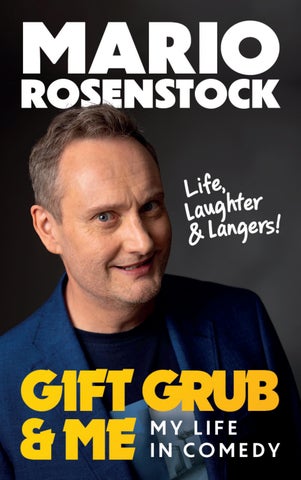
Gift Grub & Me My Life in Comedy
Mario Rosenstock
First published in 2026 by Merrion Press 10 George’s Street Newbridge Co. Kildare Ireland www.merrionpress.ie © Mario Rosenstock, 2026 978 1 78537 606 1 (Hardback) 978 1 78537 608 5 (eBook) A CIP catalogue record for this book is available from the British Library. All rights reserved. No part of this publication may be reproduced, stored in a retrieval system, or transmitted, in any form or by any means (electronic, mechanical, photocopying, recording or otherwise), without the prior written permission of both the copyright owner and the publisher of this book. Text typeset in Sabon LT Pro 12/18 Cover design by Padraig McCormack Front cover image: Back cover image:
Merrion Press is a member of Publishing Ireland.
For Bláthnaid, Dash and Bellamie. With all my love.
Contents Prologue: 3Arena
9
1
Cowshite
13
2
The Art Of War
23
3
Newpark
35
4
How I Became A ‘Rebel’
42
5
Trinity Players
51
6
Well Holy God, It’s Glenroe
59
7
You’re Some Langer
66
8
Look Who We Poached For Breakfast!
79
9
‘Where Do You Come Up With This Stuff?’
88
10
Howye Taoiseach #1
101
11
Howye Taoiseach #2
123
12
The Special One
139
13
When Roy Met Roy
155
14
How The Celebrities Reacted
175
15
Francis Brennan On Cocaine
189
16
The Dude (Tony Fenton)
204
17
Vincent Browne
224
18
Saying Whatever The Fuck You Want
236
19
Modern Times
249
Acknowledgements
255
PROLOGUE
3Arena
Adrenaline is a powerful drug. It’s the fight or flight hormone that prepares our body for an emergency. Our pupils dilate, enabling us to see better. Alertness and reaction speeds are improved. Blood flow to the muscles increases, making us feel stronger in preparation for a fight. I could feel my body filling up with adrenaline in the back of the taxi as I headed over the East Link bridge. But I wasn’t getting ready to fight. I was getting ready to give a performance. The biggest performance of my life. Going over the bridge, my heart skips a beat and my stomach knots up as I see a huge twenty-foot billboard with a giant face all over it peering down at me high above the car. My face. ‘MARIO ROSENSTOCK GIFT GRUB LIVE 25 3ARENA – SOLD OUT!’ I feel suddenly sick. Jesus! What have I done? What if we crash and I don’t turn up? It’s just me and the taxi driver and, based on our banter, so far he hasn’t a clue who I am anyway. What would everybody do? Just go home? Cancel thousands of babysitters? Maybe they’ll think I chickened out. Christ! It’ll be 9
Gift Grub & Me
on Joe Duffy tomorrow: ‘Good afternoon to you, Noreen.’ ‘Howye, Joe.’ ‘You were at the Mario Rosenstock no-show fiasco last night in de Tree Arena! Dis is terrible! Sure, sure, sure!!’ I tell myself to calm down. This is normal. You always feel physically sick about five o’clock on the night of a performance. Breathe. It’ll be grand. I finally make it to the iconic giant stone building in Dublin at which I’d seen so many gigs in the past. The Point, the O2 and now the 3Arena. I’d seen U2 there. Brought my son Dash to his first WWE smackdown when he was seven. ‘Who’s on tonight?’ says the taxi man, taking in the building. Then he turns around and smiles. ‘Only messin’, have a good one, Mario.’ I stand outside in the cold and ring Liam, the manager, to let me in. He comes out to meet me with a smile that suggests, ‘No turning back now, buddy. Rather you than me.’ Inside, the thousands of blue seats are all empty. Nothing is more intimidating than empty seats. What if people don’t turn up? There’s no virus going around is there? Then a familiar warm voice from behind me. ‘Howye, Mario, all set?’ It’s a smiling Ian Dempsey, friend and ‘work wife’ for over twentyfive years. We exchange a big hug. He’s giddy. Excited. That immediately calms me down. Ian’s not worried, so why should I be? He’s been to practically every live show I’ve done over the last sixteen years, and we’ve worked hard to put this one together. ‘It’s gonna be great, they’re gonna love it!’ he says. 10
3arena
And he means it. ‘Which dressing room do you want?’ asks Liam. I point at a random door. ‘Good choice, that’s Van the man’s room. He likes the one nearest the exit. In an’ out. That’s Van!’ Van Morrison’s room, eh? Sure, of course it is. I remember that I know Van’s birthday. I know all their birthdays, in case I’m stuck for a Gift Grub idea some morning. But I know Van’s birthday because it’s 31 August. My birthday. It’s a good sign. I get my sound checks done as usual at 6.30 p.m. The sound quality in the 3Arena is amazing, and the LED screens are spectacular, projecting forty-foot versions of yourself out into the arena. My wife, Bláthnaid, my twelve-year old daughter, Bellamie, and my son, Dash, then seventeen, arrive an hour before the show is due to start. They’ve been to a million shows, but they know this one is different. There are free jellies in the green room, so Bellamie’s in heaven. She tells me, ‘Dada, I want to send you onto the stage.’ Denis Desmond, my promoter, and his wife, Caroline Downey, are here. Denis has been a supporter since the start, and MCD, the promotions company he heads up, say they’re pretty sure I’m the first Irish comedian to sell out the 3Arena. No pressure so. Fifteen minutes to go and I’m pacing. I can hear a swell of noise building outside in the arena. It’s filling up, but I don’t want to look. The final pre-show song begins to play. The Buggles, ‘Video Killed the Radio Star’, 1979. As Trevor Horn sings, ‘I heard you on the wireless back in ’52’, 11
Gift Grub & Me
the thump of the beat is irresistible and every hair on my body is standing up. The lights go down and there’s an expectant whoop from the arena. It’s time. A high-five with Ian. The Killers ‘Mr Brightside’ begins and my boxing promoter-type voiceover announces: ‘Ladies and gentlemen, introducing in the blue corner, weighing in at 187 pounds, with over twenty-five years of experience, including 8,000 sketches, over 400 characters, aaaaaaand still undefeated … the Master of Mimicry … Mario Rosssseeeeeennnnsttttooooooccckkkk!’ Bellamie is with me side stage. She’s got her phone out, ‘Okay, GO DADA!’ I bound out onto the stage, but it’s so wide I have to break into a jog to make it to the middle. The noise is deafening. I thought the audience would be a blur, but I can see everybody. The arena’s seating has recently been transformed into an amphitheatre, so I can clearly see familiar faces, even the whites of their eyes. It sounds strange to say, but all the nerves are gone. I am completely relaxed. I look around at the huge crowd and I see colleagues from years ago, friends and family. For a second everything is still. And I think, Wow! How did I get here?
12
1
Cowshite
I love the smell of cowshite. You might think that sounds odd, but it reminds me of where I was brought up. I grew up on a farm in County Waterford, on the old back road on the way out to Tramore. My mum and dad had what you might call a difficult relationship. They were constantly arguing, breaking up and then getting back together again. They fought often, frequently physically. Dramatic meltdowns were commonplace and so home life was edgy and unpredictable, to say the least. My younger brother, René, and I were stuck in the middle, so we spent some time living with my parents in Waterford city and some with my maternal grandparents on the farm. My earliest memory of making someone laugh was when my parents were arguing with each other. I was trying to get their attention and for some reason I started doing an imitation of my father. When my mother, Sami, saw it, she said, ‘Look Pascal … it’s you! He’s doing you!’ Not for the last time in my life, I heard the immortal words, ‘That sounds nothing like me.’ 13
Gift Grub & Me
However, at the time, I noticed two things had been achieved. It had stopped them fighting while, simultaneously, it had turned their attention to me. I’ve been told that when I was even younger, maybe three, I used to steal the car keys, then stand in front of the television and ask, ‘Where de keys? Where de keys?’, which would trigger a frantic household search. When I was five, my parents made the decision to move to Germany. Ireland in the mid-1970s was a fairly grim place, and my father, who is half German (his father, my grandfather, was living in Hamburg), probably felt there were more opportunities there. For reasons that I still don’t fully understand, my parents left it to me to decide if I wanted to go with them or not. It was a bizarre decision for a five-year-old to have to make. I had just started in Waterpark Junior School, run by the Christian Brothers, and was getting on well there. I was also doted upon by my grandparents. So, the decision was made that my parents would go to Germany with René and I would stay in Waterford with my grandparents, Sean and Dorothy, on the farm. A psychologist might posit that my urge to make people laugh stems from an ‘abandonment complex’. I do hope to get some therapy about this matter at some stage. I called my grandfather ‘Dadat’ and my grandmother ‘Gamma’. They also fought constantly, more bickering and badgering each other than anything else, and, looking back, they were probably never cut out for each other. But I adored them both and they poured time and love into me. Dadat was a simple dairy farmer who hailed from Glenmore in County Kilkenny. Like a lot of people from around there, his 14
Cowshite
family claimed to share ancestry with John F. Kennedy’s family in New Ross. Who knows? Funnily enough, in any of the early pictures I’ve seen of him, he bears a certain resemblance to many of the Kennedys. He was stocky and physically strong, and he liked to sing, possessing a strong baritone bellow. He would sing Perry Como’s ‘And I Love You So’ or ‘Ol’ Man River’ as we walked up the lane to the farm. Gamma, on the other hand, couldn’t have been more different. She loved listening to BBC Radio 4 – Desert Island Discs and Alistair Cooke’s Letter from America – and admired British Hollywood stars like John Gielgud and Dirk Bogarde. Nowadays, you might say she had ‘notions’. She must have felt like a lost soul living in rural Waterford. Physically she was small and wiry but buzzing with an eccentric energy. She never went near the farm and when she spoke, she sounded a bit like Michael D. Higgins. Actually, my impression of him is based a little on her. She referred to Dadat as ‘himself’ and would describe him variously as ‘uncouth’ and ‘a barbarian’. Dadat’s vocabulary wasn’t as developed, so he simply referred to ‘herself’ by saying, ‘She’s soft in the head, boi, don’t mind her,’ or ‘She’s away wit’ de fairies, boi.’ I’ve never seen more eye rolls in one household. They seemed happy to exist in a permanent state of mutual distrust and of giving out to each other, and they often reminded me of Statler and Waldorf from The Muppet Show. Living on a farm meant that we were surrounded by animals, and particularly stray dogs. All mongrels. At any given time, there might be twelve or thirteen dogs on the farm. I still 15
Gift Grub & Me
remember many of their names – Sandy, Max and my favourite, Dusky. Gamma had a curious habit of not calling animals (or sometimes even people) by their given name. Instead, she would make up a name herself. One day she announced that she didn’t like the name Max and informed ‘himself’ that Max was ‘common’. So Gamma started calling the dog ‘Twilight’. She had toyed with ‘Wistful’, but I think that was too much, even for her. Poor Max still thought his name was Max, but many an evening I witnessed the bizarre ritual of Gamma and Dadat standing at the front door calling the dog in, with Dadat shouting, ‘Here, Max! Here, boi! Max! Max! Come in, boi!’ and Gamma beside him roaring, ‘Twilight! Twilight! Don’t mind him, Twilight! Come in, love.’ The poor dog must have been driven demented with identity issues. Actually, I’ve just remembered that my grandmother hadn’t originally liked my brother’s name, René, and actively campaigned to have him renamed ‘Sasha’ or, even more bizarrely, ‘Nigel’. Where she got Nigel from, I have no idea – presumably some period drama on BBC Radio 4. I remember one of our dogs, Sandy, had a litter of pups and, of course, I was besotted and visited them every day under the tree out the back. Imagine my shock when Dadat came out to the tree one evening with a black plastic bag. ‘Come on, boi, we’ll have to bring them down to the stream.’ You know the rest. It seemed horribly cruel, and it was, but for many farmers this was a part of agricultural life. Dusky was a small, brown mongrel who resembled a 16
Cowshite
Scottish terrier. When he died, I was so obviously devastated that Dadat went to the effort of digging him a little grave in order to give him some semblance of a dignified burial. When the hole was dug, we attempted to place Dusky in it but discovered he was slightly too big for the hole. So, for a brief moment, his body was resting as a kind of a canine bridge over the grave. Just as I was wondering how this mechanical problem could be overcome, Dadat’s wellington boot came thundering down onto Dusky, ramming him into his final resting place. Even worse, the thud of boot on ribcage meant a small but audible gasp of air was emitted from Dusky’s tiny body. His last breath, so to speak. Don’t worry, I’ve taken a note to include this in my therapy session, along with the ‘abandonment complex’ issues! Farm life is tough and unrelenting. My grandfather would have had to milk the cows every morning and evening of his life, seven days a week, no matter the weather. For fifty-plus years. I would often help him herd the cows in the evening. I’m still amazed that a six- or seven-year-old child with a stick can make an entire herd of eighty cows turn on their hooves and go in the direction you want them to. Eventually, you even find a favourite cow. Mine was called Val. She was tamer than the others and allowed me to rub her nose. If I mooed, she would respond with a moo of her own. Since then, I’ve always enjoyed making the sound of a cow, and it actually helped me form the beginnings of my Gerry Adams impression: ‘How are you mooooooo.’ The fields of the farm were surrounded by electric fences, which Dadat told me never to touch. Of course, when you’re 17
Gift Grub & Me
a child, this makes you curiously obsessed with touching the fence. How bad could the shock be? To satisfy my curiosity, Dadat showed me, by holding my hand while he picked up a blade of grass in his other hand. By touching the blade of grass off the electric fence, he effectively conducted the electric current through his body into mine. It gave me enough of a shock to deter me. Farms are dangerous places. You’re surrounded by powerful machines, tractors, combine harvesters and toxic chemicals, such as potash, caustic soda and bleaches, lying around everywhere. Farm life means you get used to hearing words like Brucellosis, a disease you can pick up from unpasteurised dairy products, mastitis or Rhynchosporium, a fungus that causes crop disease. And in the 1970s, ‘Health and Safety’ was still an optional extra in all areas of Irish life. There was the odd scary ad on RTÉ television warning children to be aware of electric pylons, where you’d see a little kid flying his kite directly into the pylon and incinerating himself, but that was about it. Dadat was always filthy dirty. On one occasion he had to get into the bank before closing time to lodge a lump of cash with AIB in Waterford city. He was covered head to toe in hot, steaming cowshite. Nowadays, you would practically be arrested for disturbing the peace, but the bank managers back then were always delighted to see the cash – sorry, I mean him. Or at least they pretended they were. ‘Come this way, Mr O’Donovan,’ they’d say, as they ushered him in the door while discreetly holding their noses. I love foxes, but farmers hate them. I remember one day 18
Cowshite
Dadat spotted one mooching around in the field behind the bungalow. He produced a double-barrel shotgun, loaded it up with two orange cartridges and beckoned me to come with him. Out in the field he took aim and let off a shot. I saw the fox spinning around like a top, whereupon my grandfather burst out laughing. ‘I clipped him,’ he announced giddily before the fox collapsed in a heap. Back in the bungalow, I would listen to the radio with Gamma. As I said, she loved BBC and I grew up to the sound of Listen with Mother on Radio 4. ‘Are you sitting comfortably? Then I’ll begin.’ Children’s stories. But I also listened to all the adult stuff, like the daily soap opera, The Archers, as well as Kaleidoscope and Letter from America. Like nearly every home in Ireland, the soundtrack to our mornings was The Gay Byrne Show on RTÉ Radio 1, with its unmistakable signature tune called ‘Tico’s tune’, which always ended with those four notes slashed out by violins: doo doo, doo doo. Gamma was determined that I should ‘speak properly’, although I think she took it a little too far. On one of the rare occasions I ventured out of the farm to have dinner at one of my friend’s houses, I turned to his mother and asked, ‘Mrs Browne, may I use the lavatory, please?’ Cue embarrassed sniggers all round. Growing up in Waterford in the 1970s, there wasn’t much to do – you made your own fun. I would recreate the RDS horse show in the bungalow by building fences out of chairs and sofas. Basins of water became water jumps. Then as both horse and jockey (and commentator) I would attempt 19
Gift Grub & Me
a clear round, pretending to be Eddie Macken on Carroll’s Boomerang (everything in the 1970s was sponsored by cigarette companies, even the horses) by jumping all the fences. To make it interesting, I would sometimes do a refusal, with my horse (me) suddenly pulling up at a fence (sofa) and refusing to jump, thereby incurring three faults. I watched TV voraciously. Dadat loved soccer and boxing, and I still remember being woken by him at 3 a.m., much to the fury of Gamma, to watch Mohammed Ali fight. ‘Mario, love. C’mon, boi, Ali’s fightin’ Spinks.’ I also loved listening to comedy albums I found lying around near the record player in the ‘good room’. Everything from Billy Connolly to Bob Newhart (brilliant) and Irishman Hal Roach ‘live from Jury’s cabaret’. Then there was Pete and Dud, off-the-wall banter with Peter Cook and Dudley Moore. Not exactly to my grandparents’ taste, these were brought into the house by their son, my Uncle Hugo, who was ten years older than me and lived with them on the farm. I also consumed whatever book or magazine was in the house. One book that fascinated me was called Manwatching, by biologist and naturalist Desmond Morris, which I read from cover to cover. It was basically a field guide to human behaviour; in other words, why humans act the way they do in certain situations. I still remember many of the chapters. For example, why do humans generally eat facing each other? So that they can keep a lookout for predators over their partner’s shoulder and vice versa. That’s why if you ever go into McDonald’s on your own, have you ever noticed that when you take the first 20
Cowshite
bite out of your burger, your first instinct is to look around? Predators are everywhere. On television, I adored Sesame Street. I’ve always loved puppets, and Sesame Street was where I discovered them. The comedy sketches were ingenious. Ostensibly designed for children, they also made sense to adults. ‘Muppet Newsflash’ with Kermit the Frog might feature a famous nursery rhyme re-enacted live, as though it were a breaking news story. ‘This is Kermit the Frog. I’m live here with Jack be Nimble. Jack, they tell me you are about to jump over a candlestick.’ Then there was the double act of Bert and Ernie, where the neurotic and paranoid Bert played off against the more relaxed and conciliatory Ernie. Or Big Bird and his imaginary friend, Mr Snuffleupagus, who nobody else ever saw. Irish TV also had its brilliant moments. The bizarre and psychedelic Wanderly Wagon, starring puppeteer Eugene Lambert, Nora O’Mahoney (Godmother) and the great Irish actor Bill Golding (Rory and his magic ring) was mesmerising in its own way. It also featured puppets such as Judge the dog, Mr Crow and sneaky snake, that last one played by the man who became Father Jack in Father Ted, Frank Kelly. In fact, Kelly popped up frequently in my youth. He was also one of the stars of Hall’s Pictorial Weekly, the sometimes brilliant RTÉ television satire which lampooned government and local politics. Presented by Frank Hall, it was set in the office of a regional newspaper in the fictional town of Ballymagash. Hall would sometimes set up a story and then look to his left, where there was a door into a room where the sketch would 21
Gift Grub & Me
take place. It could be a town meeting or an address by a government minister, like minister for finance ‘Richie Ruin’, or simply a load of men dressed as women at a meeting of the Irish Countrywomen’s Association. There were parody songs, spoof TV formats and cartoons. I can’t say I fully understood it but, whatever it was, I liked it. Long, sometimes boring hours spent around the farm meant I absorbed every bit of entertainment I was exposed to. If there was none available, I had to create it myself. And with Gamma, I had a readymade and devoted audience.
22
My grandfather, Sean (‘Dadat’), and grandmother, Dorothy (‘Gamma’), courting in the 1940s.
With my brother, René (left), in Tramore in the early 1970s.
Looking saintly for my First Holy Communion, sporting Gamma’s signature bowl haircut.
My school photo from Waterpark Junior School, 1979, still sporting the same haircut – I would have this until my early teens!
With my mum, Sami, in 1989.
The dishy doctor of Glenroe, Dr David Hanlon, was my first major television role.
With Dadat on my wedding day in 2001.