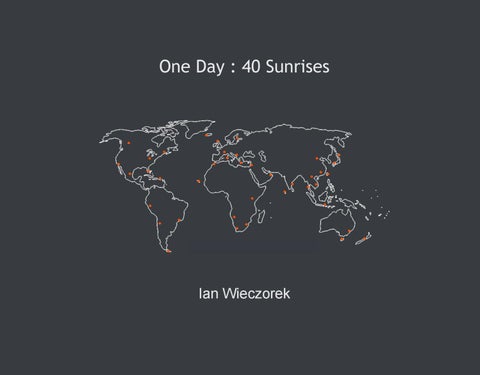
One Day : 40 Sunrises
•
• •
•
• •
•
• •
•
• • • •
•
•
• •
• •
•
• •
• • •
•
• • •
• •
•
•
•
• •
•
Ian Wieczorek
•
•
Published online to coincide with the exhibition
One Day : 40 Sunrises Ian Wieczorek December 2020
Copyright the artist All rights reserved
One Day : 40 Sunrises an exhibition of paintings by
Ian Wieczorek
Funded through a Covid-19 Crisis Response Award from The Arts Council / An Chomhairle EalaĂon
Introduction “Sunrise: day’s great progenitor.” - Emily Dickinson Sunrise is a phenomenon we are all familiar with, and regardless of geographic location or setting, it is an event that is infused with optimism and the possibility of new beginning. In the face of natural majesty (the Sublime), it can also serve as a reminder of our own fragility. ‘Live’ webcams linked directly to the internet have become increasingly available to access online, and it is now possible for the viewer to be remotely ‘present’ in many locations around the world. We can watch beaches at holiday destinations, take in cityscapes, or observe traffic, weather conditions or even volcanic activity throughout the day and night unscripted, and experienced in real time. We can ‘be’ there, travel the world through the screen of our laptop, tablet or mobile phone. Particularly in this Time of Covid, it might be regarded as a rather poignant ‘freedom’. However, while we can access these webcams and their streamed output, we have no control over their positioning or viewpoint, or the quality or technical nature of the equipment used. The viewer is not in control, other than to choose which webcam to access. Based on this freely available online opportunity, One Day: 40 Sunrises presents the experience of sunrise on a particular day in various locations throughout the world, as experienced live through these webcams. The locations were chosen to reflect as broad a geographical spread as possible. The paintings are based on real-time screenshots grabbed from online streaming, harvested from the internet on a randomly selected day, 15 July 2020, tracking sunrise around the globe. Numerically, the 40 paintings also acknowledge the phenomenon of ‘quarantine’, a word deriving from the Italian 'quaranta giorni' ('forty days'), the period that ships were required to remain in isolation before passengers and crew could disembark in the time of an earlier pandemic, the Black Death. The result is a record of this transient experience over the course of one day, paintings of digitally mediated images rendered in the ‘traditional’ medium of oil on canvas. It celebrates the possibility of shared experience, and reminds us that, wherever we are in the world, we are all connected. Ian Wieczorek
Ian Wieczorek’s 40 Sunrises A slash of Blue – A sweep of Gray – Some scarlet patches on the way, Compose an Evening Sky – A little purple – slipped between – Some Ruby Trousers hurried on – A Wave of Gold – A Bank of Day – This just makes out the Morning Sky.1
One aspect that the COVID-19 epidemic, or more precisely, the lockdown, has reminded us of, is the separation of work spaces from domestic spaces. This began to happen, on a mass scale, in the 18th-century at the very beginnings of Modernism, with the creation of the modern factory system. Before then, most production happened locally in the workshop, for silversmiths, farriers, carpenters, barrel-makers, cartwrights, drapers and the myriad other guilds, including the artists’ guild, which developed through the middle ages onwards. There were exceptions: foresters, drovers, and
stonemasons, whose work required travel away from home. The notion that one occupies at least two spaces: one for work and one for private life, is only as modern as this, and it has been engineered this way so as to facilitate hierarchical surveillance and control in a competitive, product-oriented social formation2. The division has additionally been gendered to make it appear ‘natural’ that the domestic space/the home is predominantly a feminine space, whilst the workplace is masculinised, albeit that there have been exceptions: the War effort in both World Wars and the albeit uneven
1 2
Emily Dickinson, Poem 130, in “Poems”, London, Everyman/David Cameron Press, p. 164, 1993. Michel Foucault, “Discipline and Punish”, Harmondsworth, Penguin, 2019.
development of female work opportunities from the 19th-century onwards. In the current pandemic, artists, like foresters, share the status of the world’s safest occupations (because social isolation is their norm). 3 Since the 1750s when Turner and others began to paint what Rousseau had described in “Julie, ou La Nouvelle Héloïse” (1761), namely the enforced drift of the rural cottage-industry workers into the new urban metropolises to seek work in the modern factories, the modern workforce has been used to having to travel or commute to work. 4 This has resulted in a generalised loss of peasant know-how and culture (‘art’ in the original sense) particularly in those countries that
industrialised early, such as Britain. As industrialisation progressed, the drive to standardise and quantify predominated, and with this process came some surprises. When the Great Western Railway tried to standardise its timetables for the new service operating between London and Bristol in November 1840, it discovered that there was a ten-minute time difference between the two locations. Up until then nobody had remarked – or been able to remark- that Bristol and London were in different timezones. Between 1840 and 1880 the twenty different UK time-zones were standardized to ‘Train time’ (synonymous with GMT) but the effort was often met with local resistance, and station clocks, such as the multifaceted clock at Paddington Station, continued to show local and London times for the benefit of commuters. As exploration and science progressed the world was conceptually divided longitudinally into time zones, with each hour
difference roughly 15 degrees apart.5 Due to some countries having half hour time zones, there are more than 24 times zones in the world.6 https://news.artnet.com/art-world/artist-second-safest-profession-from-coronavirus-1805757 J.M.W. Turner, “Leeds”, (1816) watercolour, Yale University Collection of British Art, Connecticut. The painting shows the rural peasantry walking towards the spreading industrial city of Leeds with its new factory chimneys crowding the horizon. 5 Coordinated Universal Time (UTC); 24 x 15 = 360 degrees. 6 A few zones are offset by 30 or 45 minutes: Newfoundland Standard Time is UTC−03:30, Nepal Standard Time is UTC+05:45, Indian Standard Time is UTC+05:30 and Myanmar Standard Time is UTC+6:30. 3 4
The anomaly noticed in trying to standardised time between Bristol and London was further developed in 1914 and 1915 by Einstein’s ‘thought experiment’ which imagined what would occur if a clock, synchronised with another at the time of departure, would be placed on an aeroplane which then circumnavigated the world. He postulated that when the plane returned to its starting point, the two clocks would show different times and thus envisaged what he termed ‘the Relativity of simultaneity’.7 The hypothesis was proved in 1971.8 In 1998, Swiss watch manufacturer Swatch, invented “Swatch Time” or ‘Internet Time’ to get round this relativity by dividing the 24 hour day into 1000 ‘beats’ which would be the same everywhere around the globe 9. This is particularly useful for military or other operations that need to synchronise activities from multiple discrete locations.10
Einstein identified the relativity of simultaneity as the most important consequence of the theory of relativity even referring to it as the relativity of time. Einstein, A. (1997 [1914]). On the principle of relativity. In, The collected papers of Albert Einstein (English translation), Vol. 6, pp. 3-5. Princeton: Princeton University Press. Einstein, A. (1996 [1915]). Theory of relativity. In, The collected papers of Albert Einstein (English translation), Vol. 4, pp. 246-263. Princeton: Princeton University Press. A popular proof of this is discussed here: https://www.nature.com/news/2010/100923/full/news.2010.487.html 8 Proof of the asymmetrical time dilation effect in the Haefele-Keating experiment: https://www.semanticscholar.org/paper/The-Hafele-Keating-experiment-and-internalof/9ec65ae347c46610c2bbf74898d3bf2bfc188647 9 It uses Biel Meridian Time (BMT – the Swatch Headquarters is located in Biel, Switzerland, equivalent to Central European Time) as the starting point of its 1000 beat/24 hour day, annotated thus: @.000 In fact equal to one decimal minute in the French Revolutionary decimal time system. One ‘beat’ lasts 1 minute and 26.4 seconds (86.4 seconds) in standard time. 10 An on-line ‘convertor’ translates your local time into an equivalent number of ‘beats’ so that whether it is lunch time locally or 5 am in Amherst Massachusetts, the ‘beat’ number will be the same: http://www.swatchclock.com/ cf the exhibition/project "@708 Beats" (Moorland Productions/Frozen Academy), Larroque/London 2009: http://www.frozenacademy.org/1901.html 7
Live television and now the internet permit us to be remotely ‘present’ at events such as sunrises despite being geographically distant from them. The medium though which we experience them however, as Marshall McLuhan observed, is not neutral. It adds its own distorting filter of stripes or pixels.11 So when Emily Dickinson is regarding a sunrise in Massachusetts, she attempts to ‘translate’ the fleeting visual phenomena before her eyes into a verbal structure based on the occasionally rhyming, four to eight iambic syllable structure of the hymnal that she studied so assiduously. Writing a poem was a way of praising God and trying to
understand His creation and her own infinitely small part in it. There is a kind of existential relativity in her writing that confronts her own self-perceived insignificance in relation to the “Bigger Picture”. What Ian Wieczorek is concerned with in the current series of forty small paintings, ostensibly of ‘Sunrises’, weaves in and out of these themes. Like Dickinson’s poems, the paintings are diminutive: their scale is modest – it is not a grand statement, but rather a deeply personal, domestic-scaled meditation on something whose importance does not seem momentous. But like Philip Larkin’s reflections on the purpose of Days”: “What are Days for?/Days are where we live. /They come, they wake us/Time and time over...”12 the hardly–noticed is to be understood synecdochically. As with McLuhan, the medium too has its say: the viscous, semi-transparent oil-medium used by Wieczorek imparts its own imprint to the image – ‘between’ the image and the eye, blending the edges of forms, softening the focus, melting
definition into the material surface of the canvas. Technically, this aspect of the paintings approximates to the Marshall McLuhan originally used the phrase “the medium is the message’ in “Understanding Media: the Extensions of Mankind” (Mentor, NY, 1964), but later adopted a misprint “The Medium is the Massage” for the title of a later book (1967), explaining why: “And so the title is intended to draw attention to the fact that a medium is not something neutral—it does something to people. It takes hold of them. It rubs them off, it massages them and bumps them around, chiropractically, as it were, and the general roughing up that any new society gets from a medium, especially a new medium, is what is intended in that title". (McLuhan, Marshall, New York Times. (19/03/1967)) 12 Philip Larkin, “Days”, in “Collected Poems”, Faber & Faber, London, (1988) p.67. 11
‘interference’ and subsequent degradation of quality caused by pixelation, (lossy compression 13) but it is also used metaphorically to heighten the emotional and psychological distance between the physical experience of the original sunrise event, and the mediated version of it presented to us by the artist. Just as the artist can never ‘know’ the original, or control in only a limited fashion, the positioning or viewpoint of the remote lenses producing it, so too, we, as spectators, are reliant on and limited by the sparse information that is left to us after the artistic medium has intervened. The fact that the artistic inspiration is vicarious is partly a result of the lockdown. Artists, like everyone else are obliged
to remain within the four walls of their house, apartment or studio and watch the world from a safe social distance. For artists, as for Pascal14, this is not so much of a problem, as we are used to solitary labour, but for many people this has put a strain on their relationships and necessarily on their interaction with the world. In compensation, we can now travel virtually on Google Earth, zooming in on ‘Street view’ to find an old address or Gauguin’s landscape in Tahiti. The modernist division of work and home has been collapsed once more into a uni-dimensional space. But for Wieczorek, vicarious inspiration is also an aesthetic choice. Previous paintings explored the mediated images of hostages or refugees – both at the margins of perception and ‘known’ to us only through their pixelated or surveillance-camera images. The repetition is also important, as if to reinforce the banality of the event: The old cliché, “When you’ve seen one you’ve seen them all,” is of course never exactly true. Each one of Wieczorek’s sunrises inflects differently the subtle variations Lossy Compression is the result of using a compression algorithm to reduce the size of digital images for streaming or digital storage. The most widely used lossy compression algorithm is the discrete cosine transform (DCT), first published by Nasir Ahmed, T. Natarajan and K.R.Rao in 1974. For a fascinating analysis of lossy compression in art and perception, cf Milos Rankovic, “Frozen Complexity”, in “Thinking Through Art: Reflections on art as research”, (ed) Katy McLeod and Lin Holdridge, London, Routledge, 2006, pp.156-167. 14 Blaise Pascal, “I have discovered that all the unhappiness of men arises from one single fact, that they cannot stay quietly in their own chamber.” “Pensées”, 1671, ed. L. Brunschweig, sect 2, no 139. Paris, (1909). 13
of a theme: city-scapes, seaside views, open vistas or views interrupted by buildings or shrubbery. Every day is the same and absolutely not. Dickinson, in her poems, repeatedly treats of the same themes, metaphors and images. Even the characters – the bee, the flower, the frog, that she uses as her interlocutors make frequent appearances, to reiterate more or less the same message. And the meaning of clichÊ in French is precisely: a view, a snap, a picture postcard, such as perhaps, that of a sunrise.
Kenneth G. Hay, Larroque, France, 2020. Kenneth G. Hay is Emeritus Professor of Contemporary Art Practice at the University of Leeds, and Visiting Professor of Aesthetics at Masaryk University, Brno, Czech Republic. He is an artist and writer living in France, where he directs the annual Larroque Arts Festival.
Key to Locations 1. Alès, France
21. Mexico City, Mexico
2. Bali, Indonesia
22. Miami, USA
3. Ballito, South Africa
23. Nha Trang, Vietnam
4. Calichi, US Virgin Islands
24. Otaru, Japan
5. Cape Town, South Africa
25. Peaks Island, USA
6. Sal Island, Cape Verde
26. Penstock Lagoon, Australia
7. Chania, Crete
27. Picton, New Zealand
8. Chennai, India
28. Qurum Muscat, Oman
9. Danxia Shan, China
29. Rio de Janeiro, Brazil
10. Dinnet, Scotland
30. San Diego, USA
11. Gautavík, Iceland
31. Santiago de Chile, Chile
12. Hanoi, Vietnam
32. Sardinia, Italy
13. Helsinki, Finland
33. Tangier, Morocco
14. Hinton, Canada
34. Tel Aviv, Israel
15. Hua Hin, Thailand
35. Tirana, Albania
16. Huang Hua Cheng Cun, China
36. Tsavo, Kenya
17. Huaraz, Peru
37. Ushuaia, Argentina
18. Indianapolis, USA
38. Windhoek, Namibia
19. Kobe, Japan
39. Wollongong, Australia
20. Kuredu, Maldives
40. Xiao Wulai, Taiwan
1.
2.
3.
4.
5.
6.
7.
8.
9.
10.
11.
12.
13.
14.
15.
16.
17.
18.
19.
20.
21.
22.
23.
24.
25.
26.
27.
28.
29.
31.
30.
32.
33.
34.
35.
36.
37.
38.
39.
40.
About the Artist Ian Wieczorek is a visual artist working primarily in painting, video and installation. He has exhibited widely in Ireland (including EVA International 2018; RHA Annual Exhibitions 2013/15/16/18/19/20; RUA Royal Ulster Academy Annual Exhibition 2020; COE Claremorris Open Exhibitions 2009/14/15/17; CCA:RDS Collective Contemporary Art 2010) and internationally, with participation in group/curated shows in N. Ireland, Germany, France, Portugal, Sweden, Austria, Switzerland, USA and China, and solo exhibitions (15 to date) in Ireland, N. Ireland, UK and Czech Republic. Public art works include Sepulchre and Everything That Rises Must Converge (Ireland 2012, 2014), and IUXTA and 00040 (France 2015, 2016). He has also devised and curated a number of shows in Ireland, and has undertaken residencies in Ireland, UK, France and Austria. Much of his work has explored the increasing influence of digital technology in locating social and cultural identity, and the interconnectivities that underpin our everyday existence.
Acknowledgement: One Day : 40 Sunrises is funded through a Covid-19 Crisis Response Award from The Arts Council / An Chomhairle EalaĂon
•
• •
•
• •
•
• •
•
• • • •
•
•
• •
• •
•
• •
• • •
•
• • •
• •
•
•
•
• •
•
IAN WIECZOREK visual artist
w: www.ianwieczorek.com e: mail@ianwieczorek.com t: 0(0353) 86 8200886
•
•