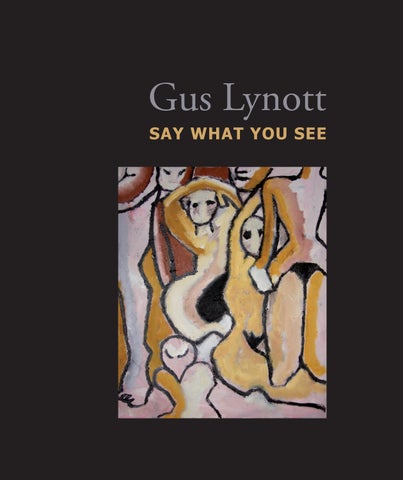
Gus Lynott SAY WHAT YOU SEE
Gus Lynott SAY WHAT YOU SEE
Published in conjuction with the solo exhibition Gus Lynott: Say What You See on 22 July - 26 August 2023 at Ballina Civic Offices Arran Place, Ballina, Co. Mayo Presented in association with Ballina Arts Centre, Barrett Street, Ballina, Co. Mayo T: 096 73593 E: info@ballinaartscentre.com W: https://ballinaartscentre.com/ Exhibition curated by Catherine Marshall, Patrick T Murphy and Ian Wieczorek Publication Editor: Ian Wieczorek Catalogue design: Ian Wieczorek Photography: Michael Gannon Interview videography: Louise Wallace Printing: Berrys Stationery, Westport, Co. Mayo Images courtesy of the artist. All rights reserved. © 2023 This project is supported by Mayo County Council, Creative Ireland Mayo, and Mental Health Ireland.
Contents
INTRODUCTION Ian Wieczorek
5
GUS LYNOTT: DIVESTMENT Catherine Marshall
9
SKINNING THE CAT Patrick T Murphy
13
GUS LYNOTT: AN APPRECIATION Martin Rogan
17
GUS LYNOTT: IN HIS OWN WORDS In conversation with Ian Wieczorek
21
ACKNOWLEDGEMENTS
48
3
Untitled, woodcut print on canvas, 50x40cm 4
Introduction IAN WIECZOREK This catalogue accompanies the first major solo exhibition by visual artist Gus Lynott. My first encounter with Gus’s work was in 1992, when I relocated to County Mayo from the UK. I was immediately struck by its authenticity and individuality, its sense of integrity and intention, and its compelling and sometimes uncomfortable directness. His subject matter is the stuff of our world; whether it relates to sex, the internet, the environment, or society and social mores, his view is both personal and upfront. Displaying a surety of line and a certainty of vision, his expressionistic responses are raw, yet nuanced and eloquent, his imagery sophisticated yet essential. Over the past 35 years, Gus Lynott has created an impressive and substantial continuum of work, primarily through painting and printmaking. However, over that time he has rarely exhibited, aside from in group shows in Mayo and its surrounds. It is my belief that his work deserves more widespread exposure. When I first came up with the idea of curating a retrospective of Gus’s oeuvre, I approached Sean Walsh, then Director of Ballina Arts Centre, about the possibility of hosting a show in the Ballina Civic Offices. Sean had long recognised the quality of Gus’s work and gave his full support to the proposal. I had been aware that Gus lives with bipolar disorder. With this in mind, I initially approached his cousin, fellow Ballina artist Val McLoughlin, as a family representative to ensure that any approach would be appropriate. It was only once I had confirmation that all parties were agreeable that dialogue with Gus ensued, a dialogue that has been rich and enlightening. While I have had some curatorial experience as a visual artist, the scale and intention of the project warranted the addition of more professional heft. Approaches were made to RHA 5
Director Patrick T Murphy, and eminent art historian and curator Catherine Marshall, who have both responded with enthusiasm and generosity as co-curators of the project. I would also like to acknowledge the commitment of Ballina Arts Centre and its new Director Paul Cunningham in realising this exhibition, the cooperation of Ballina Civic Offices, and also to Mayo County Council, Creative Ireland Mayo and Mental Health Ireland for their support. Finally, it has been a pleasure and a privilege working with Gus, who has been generous with his time and engagement, both in the course of selecting the works for the exhibition, and in our background conversations about his artistic process and motivations, and the realities of living with bipolar disorder. The title of the exhibition, Say What You See, comes from the long-running British television game show Catchphrase, and Gus often uses the phrase when responding to questions about his paintings and their meaning. A response tinged with typical quiet humour, he invites viewers to draw their own conclusions. This exhibition, comprising some seventy curated works in a variety of media, represents just a small part of Gus’s substantial oeuvre. However, it showcases the breadth of his creative practice and the richness and imagination of his artistic vision. The results are here for your consideration. Say what you see. Ian Wieczorek project lead Ian Wieczorek is a visual artist and curator based in County Mayo.
6
Flower Ballerina, mixed media on canvas, 45x35cm 7
Untitled, screenprint, 50x42cm 8
Gus Lynott: Divestment CATHERINE MARSHALL In her poem about ageing, the American poet Dorianne Laux refers to being older, downsizing, giving away the things we have cluttered our lives with as ‘the age of divestment’.1 Gus Lynott does not fit this scenario in terms of ageing, but like all true artists he knows about essentials. Gus has lived and made his art in the same place and among the same community in County Mayo that he was born into, but the certainties that go with knowing everyone around you don’t necessarily answer the deeper, darker questions that, combined with his bi-polar condition, frequently plunge him into depression. If anything they make those challenges seem greater. On those occasions, painting and music are the tools that help him to climb from darkness back to light. To find answers to the fundamental issues that disturb him, he makes paintings that explore the essentials of his very existence. Grappling with similar problems, Shakespeare’s King Lear divests himself of all the regalia of royalty and power, giving away his kingdom and stripping himself of his clothes in the face of a gathering storm. What he discovers in that process, as he tells his faithful friend Edgar, is that ‘[u]naccommodated man is no more but such a poor, bare, fork’d animal as thou art’.2 Gus Lynott begins his art with that ‘poor, bare fork’d animal’ and builds a structure for survival around it - the self-portrait, the body, his portraits of other people and ultimately the earth, at least as revealed along the Mayo coastline. It is much easier to follow those actions on a Shakespearian stage than among your own community. Lynott’s nudes or as he refers to them, his ‘rude’ pictures, make for challenging viewing in a community where religious values and behavioural patterns relating to sexuality and bodily functions were developed around concealment rather than exposure. We do well to remember that old joke that there was no sex in Ireland before The Late Late Show in the 1960s. Certainly there was virtually no representation of the nude in Irish art until Patrick Collins and Barrie Cooke produced theirs around the same decade. Even then, they were shown at a remove from their local communities in elite, white-cube art 1
Dorianne Laux, I Dare You, https://poets.org/poem/i-dare-you Laux was elected a Chancellor of the Academy of American Poets in 2020. 2 William Shakespeare, King Lear, (Act III, Scene iv.) 9
galleries. Collins and Cooke had critical support and international reputations for what they did. Gus Lynott had neither, but his concern for truth and knowledge drives him to follow his instinct without censorship or concealment. This exhibition includes just some of the hundreds of paintings, prints and drawings that Gus has produced over the years since he finished his studies at Sligo Regional Technical College (now ATU Sligo) in 1988. As he tends not to date them it’s hard to work out a chronology or even a sequence for them – but the major part of the work is concerned with the human body, male and female, alone or in large groups, spreading out across the picture plane as if there is no other element to be faced in the world. He was not self-taught although his reclusive life style has led to assumptions that he was. He not only attended art school, he got considerable encouragement from his tutors and has fed his own vision since then by looking at the work of others – even if only in books, on the internet and as exhibited in County Mayo. Similarities in his work to Picasso, German Expressionists such as Ernst Ludwig Kirchner and Otto Mueller, and also more recent artists like Keith Haring and A R Penck, suggest that he is quite familiar with their achievements. What is extraordinary is the ease with which he absorbs their influence without being overwhelmed by them. Instead, he selects those aspects of their work that he finds useful: making composite portraits that fuse full-face and profile images in his mysterious and lively portraits as Picasso did, creating figure groups and body types, reminiscent of paintings by Penck and Haring, but deriving ultimately from Kirchner and Mueller. He even incorporates helmeted soldiers and the odd surreal cat or dog with human body in some of his figurative compositions as George Grosz was wont to do. There is a pagan, hedonist quality to the work, especially the nudes, that defies years of programming by the Catholic Church. Indeed Lynott told Ian Wieczorek that the Church needs more women in it, especially in relation to power.3 Some people have been disturbed by the explicit images of sexuality in his work, but when you actually look, it is immediately clear that there is something mechanical about the practices that are represented and repeated over a sequence of paintings, as if the artist is putting together an operations manual, softened from time to time by glimpses of tropes from classical ballet. This has nothing to do with sexual gratification and a lot to do with truth and loneliness. ‘Look at us with our clothes off’, he says, ‘this is us, laugh if you like. (…) We all need a sense of elation’. The purpose of these nudes is to tell us about ourselves, to allow us to at least know our physical selves and, sometimes to find beauty and pleasure in that knowledge, but knowledge is not sufficient. In all the various couplings imagined into being in his paintings, there is a sense that each individual remains separated from those closest to them; there is little emotional exchange. Ultimately we are here alone. 3
Ian Wieczorek. All quotations from the artist come from an interview conducted between Wieczorek and Gus Lynott, and reproduced in this publication. 10
Yet his is a gentler and more positive discovery than that of Shakespeare’s Lear and it even allows room for humour. For example, a standing female nude is connected or perhaps controlled by a set of traffic lights wittily topped by Manet’s Le Déjeuner sur l’herbe, one of the paintings that exploded late nineteenth-century hypocrisies about gender politics. Is it signalling a green light for more a liberal lifestyle? The dancer allusions are linked to the swan which he has both painted and printed. Both are the stuff of dreams and many of the paintings have a dreamlike quality that may derive from Lynott’s need to meditate, to still his racing thoughts, which also lead him to write about his work and fuel his love of music. The most beautiful and moving of his paintings however may well be his many portraits. Two very frank self-portraits show Lynott’s skill at line-drawing, composition and capturing a likeness but they do not prepare us for the vitality and joy of his children’s faces - local children who are well-known to him and who clearly enjoy the experience of having themselves painted, a quite conventional but haunting blue face or a mysterious glimpse of someone more exotic - only a cheek and an eye, but powerful enough to grab your attention and not release it. A set of portraits on canvas panels, featureless, but intersected by a livid, red line, remind us of how frightening the Covid 19 pandemic was and how masks deprived us of identity. In yet another group, the oval of the face above a single stick-like neck could almost be a flower on a stalk but eyes and facial lines metamorphose as we look into strange figures that clamber or fight under our gaze, only to dissolve again into a single face, the expected features of which disappear into the Mayo landscape. Unusually, for an artist who never dates his work, that one is signed ‘Gus 00’. It speaks of the indissoluble connection between the artist, the man, his place and his community. Gus Lynott suffers from depression and speaks frankly about how painting helps him to overcome it and to face each day. He talked to Ian Wieczorek about how he works repeatedly at the same subject until he gets it right, although since he doesn’t date the work it’s not always clear which is the first attempt and which is the final resolution of a train of thought. Perhaps that doesn’t matter. What does matter is that the process keeps him going, keeps him painting. Renaissance artists were concerned with decorum by which they meant making the work appropriate for the task in hand, neither too grandiose or too understated. Gus’s expression for that is revealingly modest. You should wear the right garb for the day ahead. His question to himself is, should he be a jumper or an overcoat? Catherine Marshall, exhibition co-curator Catherine Marshall is an art historian, curator and founder member of Na Cailleacha.
11
Untitled, oil on canvas, 61x46cm 12
Skinning the Cat PATRICK T MURPHY Let’s begin with an awkward question: into what category can we place the art of Gus Lynott? Superficially one reaches for ‘Outsider’ art, the kind of art that stems from the obsessive practice of the maker without an iota of regard for having or acquiring a public. But this term ‘outsider’ has its issues, and some see it as pejorative. The US Museum of Visionary Art (Baltimore) pitches its mission, “to art produced by self-taught individuals, usually without formal training, whose works arise from an innate personal vision that revels foremost in the creative act itself. In short, visionary art begins by listening to the inner voices of the soul, and often may not even be thought of as ‘art’ by its creator.” But here we are, reading the catalogue of an art exhibition of the work of Gus Lynott. A Fine Art graduate of Sligo RTC, he is both trained and regularly exhibits, so perhaps what he shares with the definitions posited above is the ‘listening to the inner voices of the soul’. He certainly hones a range of skills, from lino cuts to drawing to painting, and pairs that with an obsessive work ethic and a vision that can be both prosaic, sexual and mythical. Lynott runs the gamut of genres from still lives through to the figure and portraiture, to abstraction and landscape. Let’s start with the portraits, a series of five faces of young and adolescent individuals. The crooked-faced boy is mostly drawn with a fine charcoal and then given dimension with a couple of strokes of a mustardy yellow. This shading of the face shares the same pigment as the background of this little painting. This economy of effort spares no abundance of character. The use of defining line is also used in the portrait of the older girl rendered in black with some grey shades - a sulking adolescent. Each of these portraits uses a non-naturalistic and restricted palette to embellish the drawing and extract the character of the subject. This confidence in drawing becomes more evident in the linocuts. No room for mistakes here, the cutting tool is unforgiving to the tentative. Lynott’s mute swans, a single and a trio, are captured deftly in the line and ink. The same assertiveness is applied with his 13
Stanley knife on Formica in a pair of seated nudes, the incisions inked to accentuate the drawing and emphasize anatomy of his subject. Again monochrome shading is employed to draw out the form of the body. On another Formica surface he conflates a number of scenes, from what seems like First World War soldiers to melancholic figures and female forms crouched and prone. These figures do not occupy any logical physical space, but rather appear as a phantasmagorical manifestation within the picture plain (a similar strategy is adopted in the large canvas featuring the nurse in the top left corner). This is the most direct hint yet of historical influences in Lynott’s work, stemming from the art of 20th Century Germany. The styles of George Grosz, Max Beckman, and latterly A R Penck are all evoked in his work. Lynott’s familiarity with European painting tradition erupts into a number of paintings, most notably his quotation of Manet’s Le Déjeuner sur l’herbe (1863). In a tall vertical canvas depicting a female nude from whose crotch protrudes an upending traffic light, confined within the lamp itself is a silhouetted reference to the figures from the Manet. It is a strange uncanny image, armless, hairless with red highlighted nipples, set in a perspectival ground. The other tall nude, half turned away from the viewer is reminiscent of the format of Marlene Dumas’ Magdelena series, where elongated female nudes tower over the viewer from the narrow canvas. Lynott’s nude similarly occupies most of the picture plane and obscures what is happening behind her. Also within these two paintings, we can examine Lynott’s robust application of paint. We are left in no doubt of his skills as a draughtsman and we can read here, literally between the lines, the cut and thrust of his painting style. Again, confidence abounds in the choice of pigment and brushwork. This exhibition was conceived to put right a perceived wrong, that Gus Lynott’s skill and vision as an artist has not had the exposure it deserves, and following on from that, a fair critical examination. While Lynott’s personal trials and challenges can add to our knowledge of the artist, the art itself - its iconography and methods of execution - can stand within the tradition of painting and its contemporary expression with an assured confidence. We can all hope that this exhibition is the threshold of the exploration of his talent and his visual complexity. Patrick T Murphy, exhibition co-curator Patrick T Murphy is Director at Royal Hibernian Academy.
14
Untitled, oilpaint on incised formica, 90x60cm 15
Untitled, oil on canvas, 61x46cm 16
Gus Lynott: An Appreciation MARTIN ROGAN Gus Lynott is a remarkable artist whose powerful exhibition addresses you in an urgent and immediate way. His work invites the viewer to take a moment to reflect and see another, fresh perspective. Working across a number of distinctive styles, he explores big social topics as well as more personal themes with great honesty, dignity and directness. This, his first major solo exhibition, extends across four decades of extraordinary and accomplished material. Working on canvas, board and timber, Gus captures the human condition with both texture and tenderness. His portraits of local children are playful and full of life, energy and curiosity. His work is multi-layered in theme and execution, with images being reworked to achieve the necessary hues and finish. Gus brings imagination and intuition to his art as graceful swans merge with kitchen utensils and beagles dance with abandon. The beauty and fragility of the human form is a frequent motif and Gus gives a unique perspective on how our emotions can be visualised and appreciated. Interwoven are themes including the role of media, social beliefs, isolation, faith and healthcare. His work brings new insights, observations and humour. Gus’s subjects are both local and global, centred on the experience of life in its fullest form showing great strength as well as moments of vulnerability. His work is thought provoking and challenging without ever being unsettling. His subjects are treated with respect, truth and trust. Larger works extend over three canvases and make clear choices on the use of colour, raw and earthy and perfectly selected. Gus’s wood block etchings are skilfully carved to create beautiful nature studies and thoughtful portraits drawn with great care, craftmanship and purpose. Gus invites us to share his perspective, to learn from his own life experience, and to feel at 17
one with his art. His exhibition clearly demonstrates how art extends far beyond language, allowing the viewer step into the complexities of the image while conveying a sense of the familiar. Mental Health Ireland is a national voluntary organisation promoting mental health and recovery by engaging with local communities across Ireland. We work with a wide variety of partners in across many sectors including the arts, sport, culture and nature-based initiatives. Our aim is to promote a new understanding and appreciation of mental health issues and to adopt an inclusive approach which values the talents of all members of our community. Mental Health Ireland is proud to support Ian Wieczorek and the Ballina Arts Centre in helping to bring Gus’s art to a wider audience. We are delighted to see Gus’s amazing talent being shown and being recognised for his extraordinary skill and insights. Martin Rogan Martin Rogan is CEO of Mental Health Ireland.
18
Untitled, oil on canvas, 150x100cm 19
20
Gus Lynott: In His Own Words IN CONVERSATION WITH IAN WIECZOREK IW: Your art practice is very much part of your everyday life. GL: It’s a matter of life and death. It gets me up in the morning. If I don’t think about my work, I’ll never get out of the bed. Once I’m out of the bed, I’m thinking about my work the whole time, even when I’m doing my breakfast, putting on my clothes, going to the shop, looking at the people there in the shop, waiting for their reaction. Sometimes I feel it’s not pleasant - and that has an effect on me too, it’s totally inspiring. Even though it’s negative it brings out a positive, it brings out inspiration, and I go back to the house with my food, I eat the food, and then I become inspired. That’s my day’s work. (Smiles.) How do you decide what your subject matter is going to be. Do you work on a theme for a while, or is it a day-to-day decision? If I feel strongly about something, if I feel something is not done enough, I do it again and again and again, until I’m satisfied I have enough. And if I haven’t, I start again. Sometimes I get help from the internet, from people who see what I’m doing and say ‘this is good’, sometimes I heed that, because sometimes I’m not the best judge, and I take it that they are being genuine. (Laughs.) Sometimes I paint over paintings too quick, and then, when I get a lot of reaction towards what I painted over, I go back and I paint them again. So the inspiration, sometimes it’s literally as you wake up in the morning, what comes to you and what calls to you. Do you work from photographs, from your imagination, from the internet? Yes, when there’s nothing there. Sometimes in the negativity, there’s nothing to take from. You need a way of going to the negative and pulling out something; getting something that you can handle, and put it down, make something of it. Sometimes you go to the internet, it’s great, it’s too easy. You have to be very careful because it’s very negative there, but if you just take a moment of it, you find something. 21
You work in a variety of media. What determines which medium you’re going to use? It depends. I’m having to move smaller and smaller because there is no room [here] for anything. The medium that you mostly use is oil, because oil is very strong. It’s just great to paint with. Your prints are very strong as well. Well, you have to have a good painting to use for the print. You have to be working in a good painting format so your print can be strong. It’s no good going to the print if your painting is weak. You also write about your work every day. Is that an important part of your practice? Well, you make the work, and then you have all these thoughts racing through your head about what should be done. You write them down fast and you hope you get everything down. It only takes about a page, sometimes the writing is large, sometimes there’s a lot to be said, sometimes unfortunately it can be closer to home. I say unfortunately because you’re trying to get a negative, and [if] it’s an artificial negative, it’s not natural. It has to be the truth, because once it’s the truth you can show it to people and say, look, I’ve got something here, you have to see this, and people look and say ‘you didn’t do that, did you?’, and then you’re happy that you’ve got something very close to what needs to be seen, I suppose. You talk about ‘finding the negative’. What you mean by that? Is it like working against yourself? It’s something that you are uncomfortable with; like ‘you’ll never amount to anything’, something like that - ‘what are you doing here, you don’t belong here’, things of that nature. I suppose what you could call discrimination. When people find out - ‘oh, is that the kind of work you are doing?’ - [they] don’t want to be associated with you. You’re only doing this work to get over your depression. But they don’t see that, what they see is a pervert. But even when your work is thematically difficult, it’s not there for gratification, it seems to be something very different. Well, it’s a healing. You need time to say what you’re going to say, and the work has to speak for itself.
22
So you see the work you make as a way of dealing with the everyday and your bipolar experience. It’s like when I’m going for a walk. I look down at the ground. I used to look at the cars at one time, foolishly thinking that someone might wave. (Laughs.) Some do, some cars I’d know, but I look down at the ground and I’m walking about a mile up the road and a mile back and I keep looking at the ground, and my head is down. My head should be up, looking at people, but it’s down. Why am I looking down? Looking at the ground and all those textures. But you cannot make people look at that, you cannot make people look down. So you have to look at the rude stuff - look at this, this is us, with our clothes off. Look at it, and laugh if you want. It’s not depression we should be focusing on. We should be focusing on the laughter, the singing, the playing. I just wrote that the Church needs a woman’s voice, and it needs a woman in power, and how are we going to do that? The only way you are going to do that is to change from depression to elation, and work [towards] that direction, to look down if you want to but look up eventually to see how far you have to go. Over the years you have exhibited locally in group shows, but you have a bigger conversation through social media. You show finished paintings, also videos of yourself in the process of making a painting or a print, and also playing music on the keyboard. Do you see that as a way of having a conversation outside of yourself? Well, I rather think of that [in the same way] as the children around here looking at my murals, the way they might look at me with wariness. They’re growing up, they’re not being stupid and silly, they’re taking command of their life, and they’re saying to themselves ‘that fella is weird’. (Laughs.) You know, ‘he shouldn’t be going on this way, he should be less loud, he should be painting milder, not wilder’. I remember when I came [to live in this house] first, I was bullied by the children. It all worked out OK because they gave up eventually after two years of shouting [at me] in the street. That was what prompted me to do the murals [along the inner garden walls]. How am I gonna paint in the long strip of wall around the garden, what am I gonna do, and I thought of ladies lying down. The police came to my door and asked me to paint over the paintings [in the front garden], I could leave the ones at the back alone. So I painted over the paintings but eventually over a year or so the marks on the wall came through the emulsion because of the bad weather, so what I did was painted them again but I put clothes on them. They haven’t come to me yet, I’m just waiting for them to come to knock at the door. (Smiles.) And that is wonderful, if you know what’s happening. You never kill art, never. You’re waiting for it to be stopped, you’re waiting for it to be betrayed, but it cannot be, and that’s a great feeling of hope for a depressed person, that your world will never crumble. You can look up from looking down.
23
Your subject matter encompasses portraiture, landscape, abstraction and the ‘rude stuff’, as you call it, from the internet. How do you decide what you’re going to paint? Well, the stuff from the internet is very exciting, you know, it’s not just difficult. It wouldn’t get anybody bothered into paying the internet money if it wasn’t exciting, and if we think that we have our children looking at Lassie, we have another thing coming. They have to grow up. When someone is trying to change things, you have to look up, I suppose. You have to look up at painting when you’re painting, you cannot be looking at the ground and thinking ‘I have to change’ all the time. There comes a time when [there’s] enough negative, you feel that something can be achieved. It’s like, am I putting on a jumper or putting on an overcoat to feel warm? Am I saying enough, am I painting enough to show people that something has to be done? Am I an influence enough, am I being a jumper or am I being an overcoat? So you see what you’re doing as a very positive thing? Oh yeah. It’s so positive it’s dangerous. Someone said to me once that depression can take your legs, can literally put you in a wheelchair. The effect of madness is less serious. You can live with madness but you cannot live with depression. We’ve come a long way since [the Famine], but depression is still a thing here, people are still killing themselves through suicide, people who cannot speak for themselves, who feel that depression must win all the time. It’s just like Captain Kirk coming down on his spacecraft and seeing a load of people doing the same things over and over again, not responding, [not saying] ‘look at this spacecraft, isn’t it great?’, and no-one says anything much, only ‘go away and don’t annoy us, we have it solved, we don’t need intervention, we don’t need to change, look at us, we’re great.’ But they need changing because people have cancers and depressions and what have you. Is cancer a type of depression, is it a growth that doesn’t want to be part of the person? I go on and on about the Church and how it must change, because I care and awful lot about the Church even though nearly all my stuff now is difficult to show. People go into an exhibition and say ‘oh my God, this is so rude, it’s nothing to do with the Church’. But it has everything to do the Church. It’s so fleshy that the flesh has gone into the spirit and the spirit is saying ‘eeks, please help me, let me out of here’. I have got to show this to people. I was wondering what I was going to say to you. There’s so much to think about. When you’re painting you’re putting [everything] into it. But it’s nice to come out of it once in a while, just like now, and be able to talk about it. Like, it’s one thing playing the fiddle, but you have to pass it on. That’s how things last. You have to pass it down. What lasts is the flesh, you pass it down from person to person. When you have Churches that don’t change their opinion, that’s dangerous.
24
Do you see what you do as having an element of bravery? Yeah, well, there’s not a lot of places you can go. You have to be truthful, and once you’re truthful, you have to be brave with it. Even if you’re wrong. Whether you’re wrong or right, once you say what’s in your heart, you can get away with anything, literally anything. And it’s good for people to get something that you feel strongly about, just to tell the truth and not to be afraid. The interview took place in Ballina on 21st January 2023.
Untitled, woodcut print on canvas, 40x40cm 25
Untitled, oil on canvas, 70x50cm 26
Untitled, oil on canvas, 61x51cm 27
Untitled, oil on canvas, 61x46cm 28
Untitled, oil on canvas, 51x41cm 29
Untitled, oil on canvas, 76x51cm 30
Untitled, oil on canvas, 25x20cm each 31
Untitled, oilpaint on incised formica, 90x60cm 32
Untitled, oilpaint on incised formica, 120x90cm 33
Untitled, oilpaint on incised formica, 90x60cm 34
Untitled, oilpaint on incised formica, 90x60cm 35
Untitled, oil on canvas, 220x90cm 36
Untitled, oil on canvas, 228x61cm
Untitled, oil on canvas, 213x102cm 37
Untitled, oil on canvas, 76x102cm 38
Untitled, oil on canvas, 45x35cm 39
Untitled, oil on canvas, 50x76cm each 40
Untitled, oil on canvas, 120x100cm 41
Untitled, woodcut print on canvas, 40x40cm 42
Untitled, woodcut print on canvas, 45x35cm 43
Untitled, oil on canvas, 45x35cm 44
Untitled, oil on canvas, 30x61cm (above), Untitled, woodcut print on canvas, 30x61cm (below) 45
Untitled, oil on canvas, 61x46cm 46
Untitled, oil on canvas, 50x50cm 47
ACKNOWLEDGEMENTS With sincere thanks to the following for their support in the realisation of this project: Gus Lynott Mayo County Council Creative Ireland Mayo Mental Health Ireland CEO Martin Rogan and Development Officer Teresa Keane Ballina Arts Centre Director Paul Cunningham Ballina Municipal District Ian Wieczorek Catherine Marshall Patrick T Murphy Sean Walsh Val McLoughlin Louise Wallace Michael Gannon
48