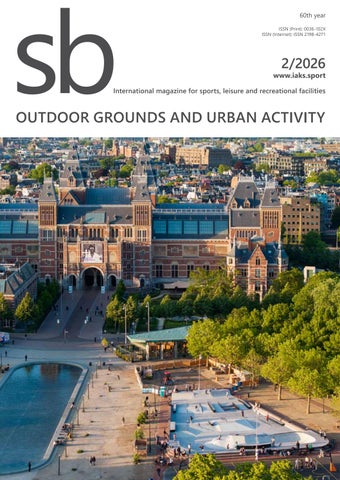
sb 2/2026 (english)

Page 1


EDITORIAL

Dear IAKS members, dear friends of ‘sb’

The urban environment is changing rapidly. Densification, climate change and new forms of mobility are presenting new challenges for the design of urban spaces worldwide. At the same time, there is a growing need for physical exercise in everyday life – not just in organised sport, but as a natural part of public life. Sports facilities have therefore long become more than just functional infrastructure and have evolved into social hubs, platforms for socialising, and places where health, community and the urban environment come together. Particularly in an urban context, we are seeing the emergence of new forms of exercise spaces that go far beyond traditional sports facilities.

As the Chief Commercial Officer at CONICA and a member of the IAKS Executive Board, I see on a daily basis how the requirements for sports and exercise facilities are changing worldwide – through talks with local governments, planners, architects and sports facility operators. What is becoming increasingly obvious is that the demand today is no longer for isolated sports facilities, but for integrated urban spaces that combine sport, leisure and urban use. Planning, design and materials must harmonise – just as sustainability, inclusion and long-term quality of use. The projects featured in this issue of ‚sb‘ demonstrate impressively just how varied these new urban sports environments can be.

The skatepark in Mińsk Mazowiecki, Poland and the Oelde Activity Park in Germany, illustrate how action sports facilities can become vibrant venues where young people can meet. Skateparks have long become more than just sports facilities – they are social spaces where exercise, creativity and community converge. The Yichang Development Avenue Basketball Park in Yichang, in the west of China’s province of Hubei, shows how thoughtfully designed sports facilities can breathe new life into even challenging urban spaces. Today, basketball courts are among the most easy-access and universally understood opportunities for physical exercise in public urban spaces. Exercise is also becoming increasingly appreciated in the school environment. Projects such as Väsjöskolan in Sweden underline how school playgrounds and educational spaces are being conceived increasingly as versatile activity areas.

The Plaine des Sports in Le Petit-Quevilly, France, clearly illustrates how sports facilities can breathe new life into entire neighbourhoods. Such facilities are not just sports facilities, but also public parks and social hubs for the local community. The Museumplein skatepark in Amsterdam, the Netherlands, located in the immediate vicinity of three museums, and the AVENUE & SON North Coast skatepark in Qinhuangdao, China, combine sporting activity with lifestyle. The current white paper in this issue shows the role skateparks can play in reorientation in response to climate change. Finally, the modernisation of the sports facility on Möllner Landstraße in Hamburg, Germany demonstrates how existing sports areas can be successfully transformed into climate-friendly blue-green infrastructure. There will be growing emphasis on the further development of existing facilities in the coming years.

The approach that all these projects have in common is sports facilities are no longer designed exclusively for athletes. Instead, they are aimed at entire communities – serving as open spaces for exercise, socialising and relaxation. Material technologies, sustainable construction methods and intelligently designed surfaces are essential for this. They affect not only performance and safety, but also the long-term usability and environmental footprint of such facilities – and thus the quality of urban spaces for exercise over many years. The design of such spaces is therefore always also a task for society, calling for interdisciplinary collaboration between urban planners, landscape architects, sports scientists and future users. The projects featured in this issue show impressively just how varied the treatment of these issues can be – and just how much potential lies in the interlinking of sport, the urban environment and the community. This is where the IAKS comes in: bringing together international experience, sharing expertise and providing impetus for the ongoing development of our sports and recreational facilities.

I hope you find this an inspiring read and a source of many new ideas for your own work – and perhaps also new perspectives on how physical exercise can become an integral part of our urban environments and our daily lives.

Lara Guillod

OUTDOOR GROUNDS AND URBAN ACTIVITY

Title: Skatepark Museumplein in Amsterdam

Photo: Mathijs Tromp, Nine Yards

Glasgow 2026 venues –building on a legacy

IAKS UK & Ireland conference and facility tour in Glasgow, 14 May 2026

Facilities, opportunities and challenges on the road to the 2026 Commonwealth Games: the inspiring conference will explore how Glasgow continues to build on its world-renowned sporting legacy. The event will take place at the Emirates Arena in Glasgow, Scotland. This landmark venue, home to the Commonwealth Arena and the Sir Chris Hoy Velodrome, was originally built for the 2014 Commonwealth Games and will again play a central role by host ing key events in the 2026 edition. Its blend of legacy, innovation and community engagement make it an ideal setting for this gathering.

Glasgow has found a way to create world class venues for mega events, then turn them into community sports assets. Not only that but they’re repurposing them again for the next Commonwealth Games this summer.

How have they done this? What’s the magic formula? When many cities around the world have a build from scratch approach, how does Glasgow repeatedly get such great value from their venues? Attendees will explore how Glasgow continues to build on its well -deserved sporting profile, featuring local and internationally renowned thought leaders, expert talks, venue tours and networking opportunities.

Two clear focuses

The event’s focus will be twofold. Firstly, the conference will trace the evolution of the facilities originally developed for the Glasgow 2014 Commonwealth Games, examining what was built, how these venues have sustained a lasting legacy through ongoing community use, and the ways in which they are now being prepared to host events for the 2026 Commonwealth Games.

Secondly, it will assess the opportunities and challenges facing the city and wider region as they prepare to host the upcoming Games, with discussion on how the planning and delivery approach is being shaped to address these factors effectively.

Attendees will explore how Glasgow has managed its venues between the 2014 and 2026 Commonwealth Games, highlighting both strategic continuity and changing demands. They will look at the story behind Glasgow 2026, the challenges of hosting the Games in a very different context from 2014, and the practical approach being taken to deliver a viable and sustainable event. A central theme will be Glasgow’s model of designing and op erating venues such as the Emirates Arena and Tollcross International Swimming Centre primarily as community sports facilities, while enabling them to scale up successfully for major international events.

The programme will also examine the role of the SEC campus, including the Hydro, Armadillo and SEC Centre, in hosting Commonwealth Games events and supporting a wider long-term vision for the site. Further contributions will address the implications of Martyn’s Law and the Protect Duty for venue operation and future facility design, as well as measuring the social and economic impact of venues and events. A concluding panel discussion will focus on current challenges and responses in the development of sport and leisure facilities in Scotland.

The programme will feature presentations from facility developers, operators and event organizers. Speakers and organisations such as Glasgow Life, Glasgow City Council, Glasgow 2026 Organising Committee, The Sports Consultancy, Trivandi, Populous, Holmes Miller, and Alliance Leisure will share their experiences and knowledge.

Venue tour and networking

If you’re in architecture, consultancy, design, local authorities, construction, venue operations, sport and leisure planning, community sport, university sport provision or events you’ll leave with heaps of insights, lessons, takeaways and new thinking that you can apply to your own work. The event will be complemented by a venue tour to the stunning Emirates Arena and opportunities for networking throughout the day. For those staying in Glasgow, there’s an informal dinner and drinks on the evening of Wednesday 13 May.

iaks.sport/event/glasgow2026

Author: IAKS UK & Ireland

Photos: IAKS UK & Ireland, Glasgowlife, JSHpix

Event partners

Visit contemporary sports facilities in Québec

IAKS Canada hosts facility tour on 15 May 2026

This exclusive tour of some of Québec City’s most significant contemporary sports facilities will showcase major projects that combine architectural innovation, sustainability, and highperformance sports infrastructure. Participants will discover how these facilities support both elite athletes and community users while responding to complex operational, structural, and urban challenges.

The tour will highlight key design strategies, including large-span timber structures, integrated sports programming, and the creation of vibrant public spaces within major sports complexes. Through guided discussions and site exploration, attendees will gain valuable insight into the planning, design, and construction of large-scale sports venues. The event will also provide an opportunity to connect with fellow professionals and exchange ideas about the future of sports and recreation facilities.

Super PEPS

The expansion of the Physical Education and Sports Pavilion (PEPS) at Université Laval includes the construction and enlargement of several major sports facilities designed to serve both the university community and high-performance athletes. The project introduces a new sports gymnasium with a capacity of approximately 3,500 spectators, an Olympic-size swimming pool with seating for about 1,000 spectators, a recreational pool for children, new training rooms, and additional support and service spaces.

These facilities support a wide range of uses, from varsity and high-performance training to recreational and community programming. The integration of these new functions required a complete reorganization of circulation within the complex.

Closely connected to the existing PEPS building, the project establishes a new northern entrance to Université Laval’s campus through an interior pedestrian street that extends the main campus axis. Activated by public gathering spaces, this covered street becomes the building’s central spine, creating a vibrant environment that brings together athletes, students, and the broader community.

TELUS Stadium

TELUS Stadium at Université Laval is part of the major regional expansion of the PEPS sports complex. The facility includes a 100 m x 60 m indoor synthetic field that can be subdivided into three smaller playing areas, allowing multiple training sessions and activities to occur simultaneously. The stadium accommodates soccer training and matches as well as football and rugby practices. Seating for approximately 450 spectators overlooks the field.

Located adjacent to the existing outdoor football stadium, the complex creates a strong functional relationship between the two facilities, which share several support services. The building also includes hospitality suites overlooking the outdoor football field.

The building’s primary structure consists of glued laminated timber (glulam) arches. This structural approach reflects Université Laval’s commitment to sustainable construction while providing strong architectural, acoustic, and aesthetic qualities.

Videotron Centre

Located on the site of the former racetrack of the Hippodrome, the main volume of the Videotron Centre clearly expresses the building’s civic and cultural role at the scale of the city. Its bright white facade and fluid openings evoke drifting snow and the northern climate that shapes Québec City’s landscape.

The Videotron Centre features a hybrid structure combining steel and glued laminated timber. Wood was chosen as the primary supporting structure for the building envelope in order to elegantly follow the curve of the exterior volume and create a distinctive architectural character for the surrounding concourses. Extending from the main concourse to the low roof over a total height of more than 25 m, this structure has only one intermediate support point. Composite glulam arches, spaced five meters apart, form the 92 facets of the oval geometry of the arena. A metal deck spans between the arches, serving both as the interior finish and as the support for the building envelope’s waterproofing and insulation.

The arena accommodates a wide variety of sports and cultural events, with a capacity of up to 20,396 spectators for concerts and 18,310 for hockey. Designed to meet National Hockey League standards and targeting LEED Silver certification, the Videotron Centre represents a contemporary and iconic facility strongly connected to the community.

iaks.sport/event/quebec-may-2026

Author: Michel Veilleux

Photos: Stephane Groleau

IAKS Germany launches new ‘urban sports‘ division

A culture of physical exercise is changing sports facility development

Author: Dirk Scheumann, Executive Board member of IAKS Germany and head of the ‘urban sports‘ division

The culture of sport and exercise is undergoing transformation. Alongside traditional club sports, we are witnessing the evolution of a distinct culture of exercise, often referred to as ‘urban sports’ or ‘action sports’. Skateboarding, BMX, calisthenics and parkour are increasingly making their mark on modern exercise spaces. This trend presents new challenges for municipalities and design agencies, as urban sports follow their own unique logic.

To respond to this shift, IAKS Germany established its own ‘urban sports‘ division in November 2025. As an internationally active action sports expert and a member of the IAKS Germany Executive Board, I was delighted to accept the role of head of the new division.

‚Demand for such activity spaces has been growing significantly for years,‘ says Susanne Mossel Wagner, Managing Director of IAKS Germany. ‘This new division enables us to pool our expertise and create a platform for an issue that is attracting growing attention from municipalities.‘

Urban sports have long ceased to be a trend sport

Urban sports are often described as a sporting trend, but I don’t think this is accurate. A trend refers to a temporary phenomenon that enjoys popularity for a while but lacks staying power in the long term. Urban sports, on the other hand, are an expression of a distinct and long-established culture of physical exercise. Anyone designing such facilities must, above all, understand their users’ needs.

I distinguish between action sports as an umbrella term and urban sports as its urban subset. This culture is noted for its focus on individualism, creativity, social interaction and self-fulfilment.

Unlike traditional sport geared to competition, the emphasis here is on the experience of movement: it’s not about winning or losing, but about flow, trying things out and that special ‘wow’ factor.

New spaces for exercise and interaction

These differences have a direct impact on design. Urban sports facilities are more open, less rigidly structured and are used by different groups of people at the same time. A facility only works if it is embraced by the user community. It is not just its technical features that matter, but also its social function.

Many facilities are evolving into multifunctional activity spaces that combine sport, leisure and social interaction. Examples range from skateparks and parkour facilities to pump tracks and specialised facilities such as surf parks. Such projects today compare favourably with traditional sports venues to a growing degree.

New opportunities are emerging for municipalities: lowthreshold exercise activities, meeting places in public spaces, health promotion and a boost to tourism. Many towns and cities are looking for ways to get young people moving again – and urban sports can play a key role in this.

Urban sports are spreading increasingly into rural and tourist regions as well. Bike parks, roller sports facilities and parkour venues are becoming part of modern leisure and tourism offerings. There is great potential here – also for regional added value.

A platform for knowledge and exchange

IAKS Germany’s new urban sports division aims to provide a platform for knowledge transfer, networking and consultancy. Many municipalities still lack the necessary know-how: Which facilities are suitable for which locations? And how do we involve the local community? This is precisely where we take our cue. The division sees itself as an interface between municipalities, developers, manufacturers, academics and the user community.

By creating its urban sports division, IAKS Germany is strategically expanding its sphere of influence. New stakeholders such as trend-sport communities, specialist design firms and young industry players are being brought on board. This area of focus has enormous appeal and is injecting new vitality into our network.

Exercise culture of the future

For IAKS Germany, the new division is more than just an organisational expansion – it is a clear commitment to the transformation taking place in sports facility development. ‘Our aim is to actively participate in shaping the exercise spaces of the future,‘ Andreas Kernig, Chairman of IAKS Germany, stresses.

As an action sports expert with years of involvement in urban sports, this appointment also means a lot to me personally. I look forward to passing on this knowledge.

GRANDSTANDS THAT MEAN THE WORLD

INDOOR AND OUTDOOR AT UNIVERSAL SPORT

Professional equipment for ball sports and sports facilities: tennis, pickleball, basketball, football, volleyball...

Photos: BLOACS, Klaas Riemay Leipzig; Schneestern

NEW TO THE IAKS NETWORK

AtkinsRéalis

Dubai (UAE)

AtkinsRéalis is a world leading, fully integrated professional services and project management company delivering sustainable, high performance sports, leisure and community facilities across the globe. Connecting people, data and technology, their 30,000+ consultants, designers, engineers and project managers deliver complex, future ready destinations that enrich lives. From digitally enabled design and advanced engineering to full lifecycle asset management, they help clients transform visionary ideas into resilient, inclusive and vibrant places for people and communities worldwide.

www.atkinsrealis.com

DRIV

Frankfurt (Germany)

The German Roller Sports and Inline Federation (DRIV) brings together under its roof the recognized sports of skateboarding, artistic roller skating, roller hockey, inline speed skating, inline hockey, inline skater hockey, inline alpine and downhill, as well as roller derby. The federation currently counts around 41,200 members registered in clubs across its 18 state associations. Also registered and listed are about 1,900 licensed coaches with A, B, or C licenses in the DOSB‘s (German Olympic Sports Confederation) license management system. The sport of skateboarding, which has been Olympic since 2020, is represented by the Skateboard Sports Commission. Besides promoting recreational and competitive sports, supporting youth development, organizing competitions, and training coaches and referees, the commission is also committed to improving sporting infrastructure in Germany. This includes consultation, committee work, and guidelines for contemporary skate facilities.

www.driv.de

FLEXDEX

Bonn (Germany)

Mobile innovation for sport & activity: FLEXDEX revolutionizes public spaces with mobile, modular sports solutions. The key advantage for planners: as the ground remains untouchedrequiring no foundations or excavation – previously unusable sites can be developed quickly and cost-effectively. Whether high-efficiency training circuits or cooling Sprayspot climate modules for heat-resilient exercise, the systems are fully relocatable. The digital INFODEX option provides smart training guides and valuable usage data. The perfect synergy of sport, climate, and digitalization.

www.flex-dex.de

MTEX Management

Astana City (Kazakhstan)

MTEX Management is a leading Kazakh company specializing in the management, development and modernization of multifunctional sports and leisure facilities. Based in Astana, the company professionally operates iconic venues such as the Barys Arena, Alau Ice Palace and the Astana Arena.

Meeting the highest international standards, the projects focus on innovation, sustainability and community engagement. By providing comprehensive services ranging from technical maintenance to event organization, MTEX is dedicated to promoting an active lifestyle through well-designed and efficiently managed infrastructure.

www.mtexm.com

Alliance Leisure Bristol (UK)

Alliance Leisure is the UK’s leading leisure development specialist. Working in partnership with local authorities and leisure operators, they develop engaging place-based active environments that cater for everyone.

Over the last 25 years, Alliance Leisure has delivered more than 300 projects, ranging from multi-site regeneration projects, involving new build or significant remodelling of leisure sites, through to outdoor spaces, 3G pitches and leisure centre modernisations. These projects represent an investment value over GBP 530 million.

www.allianceleisure.co.uk

Sportfachstelle Kanton Solothurn (Switzerland)

The cantonal sports office is the competence and service centre for public-sector sport in the Canton of Solothurn and the central point of contact for all questions relating to sport and physical activity for schools, clubs, associations, municipalities, and committed individuals.

Its work is based on the newly developed ‘Sports Policy Framework of the Canton of Solothurn‘ with its seven fields of action.

Its core mandate is to implement ‘Youth+Sport (Y+S)‘, the federal government’s largest sports promotion programme for children and young people. In addition, the office initiates, coordinates, supports, and oversees a wide range of sport and physical-activity projects across the entire canton.

www.so.ch

Year-round sports & entertainment hub

International cricket stadium in Coimbatore, India

The Sports Development Authority of Tamil Nadu has embarked on an ambitious project to develop a state-of-the-art 30,000-capacity international cricket stadium at Coimbatore. This new stadium will comply with ICC & BCCI guidelines to host international cricket matches, Indian Premier League and other major cultural events.

The consortium led by Collage Design as the lead design consultants and Knight Frank India as the financial consultants have worked closely with the state to create a financially viable and sustainable development strategy, to place Coimbatore on the world map as a destination for global sporting events, showcasing Tamil Nadu‘s rich heritage and commitment to excellence.

This international cricket stadium will be developed at Ondipudur in Coimbatore across two land parcels with a combined area of around 30 acres and near major road networks for ease of access. The stadium will be another benchmark for stadia design in India for cricket, offering one of the finest spectator experiences. The oval bowl has been derived to create a unique spectator experience with clear sightlines from every seat to the boundary. The fully accessible stadium with dedicated accessible seating has been designed to ensure safe egress, meeting the highest standard of safety in sports stadia. This ICC compliant stadium features corporate

boxes, press and media areas, VIP lounges and players amenities for seamless match day experience. Public amenities including concession stands are planned and distributed across the stadium with minimal travel distances from each seat.

The stadium complex has been carefully planned integrating sports, recreation and commercial activities to create a financially viable and self-sustaining precinct with amenities including retail stores, restaurants, members club, banquet halls, cricket practice pitches, swimming pool, jogging track, public parks and spectator plazas to boost community engagement and making this facility a year-round sports and entertainment hub.

Tamil Nadu International Development Corporation (TIDCO) has recently invited Public Private Partnership (PPP) bids to bring this vision to reality.

Author and renderings: Collage Design, www.collagedesign.com

Skateparks in the face of climate change

Areas of action in urban planning, design and construction

Veith Kilberth (Dr. phil.), a former professional skateboarder and managing co-owner of the Landskate GmbH design firm in Cologne, Germany, he conducts research and advises municipalities on skateparks and urban exercise areas.

Email: kilberth@lndskt.de

Laszlo Ziehmann (M.Sc.) is a research assistant at the Institute of Outdoor Sports and Environmental Science at the German Sport University Cologne, Germany. His research and project work focuses on climate change, sport and physical exercise in urban and seminatural recreation areas.

Email: j.ziehmann@dshs-koeln.de

When it comes to climate change and sports facility development, there is a growing focus on a type of facility that has received little attention to date, i.e. on the skatepark as an urban space for physical exercise and social interaction. Over the past two decades, skateparks have evolved from niche facilities associated with a specific youth culture into established features of public sports and open-space infrastructure. At the same time, skateparks are particularly sensitive to climatic change. The authors Dr Veith Kilberth and Laszlo Ziehmann provide an initial systematic analysis of the climate-related aspects of skateparks and identify key areas for action in planning and construction.

Skateparks come in a wide variety of forms – from smaller neighbourhood facilities to large-scale regional parks, from street plazas to complex bowl terrains and hybrid layouts. In terms of their intended uses, too, the spectrum ranges from informal leisure activities to facilities capable of hosting international competitions. What the various skatepark projects have in common, however, is their basic structural design. They are predominantly highly sealed open spaces with sculpted concrete surfaces, often situated in exposed locations within the urban environment.

It is precisely these properties that make skateparks particularly vulnerable to climate change. Rising average temperatures, longer heatwaves and more intense heavy rainfall events have a direct impact on materials, surface properties, drainage systems, usability and the quality of the experience. The heat island effect, glare from light-coloured concrete surfaces, thermal stresses in materials and insufficient drainage areas affect not only structural requirements but also usage times, safety considerations and social interaction.

Climate change therefore affects not only the design and substructure of skateparks, but also their role as low-threshold spaces for social interaction, venues for informal sporting activities and the expression of youth culture dynamics.

At the same time, skateparks take up much less space than many other outdoor sports facilities, although, as man-made urban spaces, they intrude into existing environmental structures. The various roller sports require particularly hard and smooth surfaces. Modern skateparks are therefore predominantly constructed using in-situ concrete, a method in which the various elements of the facility – such as quarter pipes, bowls, banks and flat sections – are shaped on site in reinforced concrete and joined together to form a continuous skating surface.

This in-situ concrete construction method ensures a high quality of ride and durability, but at the same time results in extensive surface sealing. This is compounded by the characteristic noise emissions from rolling and landing, which call for design measures to mitigate noise pollution, particularly in densely populated urban areas.

Sustainability and the ‘wedding cake model’

To put this into the context of climate change, we are drawing on the so-called ‘SDG (Sustainable Development Goals) wedding cake model’ of sustainable development. It depicts ecological, social and economic sustainability as hierarchical levels that build upon one another. The ecological dimension, as the basis of life, forms the foundation; within these ecological boundaries, social structures develop; within these social contexts, economic processes are in turn embedded.

Applied to skateparks, this means that their social and functional quality depends directly on stable environmental conditions. This article‘s ecological focus is thus grounded in the wedding cake model. Climate resilience lends substance to this focus by addressing the question of how skateparks can remain

functional and usable in the long term, even under changing climatic conditions. Climate resilience should therefore be understood not as a supplementary consideration, but as the starting point for design, planning and construction.

Placing the emphasis on ecology also makes sense because skateparks already demonstrate numerous positive attributes in terms of social and economic sustainability. Modern skateparks are generally operated as freely accessible public facilities permitting a particularly high level of usage. When considering investment costs per hour of use, they demonstrate high spatial efficiency and thus significantly outperform many other sports facilities. Added to this are comparatively long periods of use by participants and relatively low maintenance costs for in-situ concrete.

17. Partnerships for the goals

Social characteristics

Skateparks also offer special qualities in terms of social sustainability. They enable informal sporting activities without membership or access restrictions, while also serving as venues for urban youth culture. Participatory formats have become established in the planning of modern skateparks, with local user groups being actively involved in the design process.

Furthermore, many facilities exhibit three structural social qualities: (1) a high degree of diversity among user groups, as different roller sports can be practised at a single location; (2) design that offers suitable usage options for all levels of proficiency, from beginners to the advanced; and (3) intergenerational use by children, adolescents, and adults. Increasingly, skateparks are also being designed to be inclusive for wheelchair skating (WCMX).

When considering the ecological aspects of skateparks in the following, we distinguish between two levels: the municipal level of governance and urban planning, and the project-specific level of skatepark planning and construction. The latter is divided into the fields of planning and design, and construction and technical systems.

Municipal planning level – multifunctionality and choice of site

At the municipal level, there are various ways to incorporate climate considerations into the planning of skateparks at an early stage.

A promising approach lies in the multifunctional use of surfaces that are already sealed. Rather than taking up additional space, existing urban areas – such as plazas, paths or parks – can be opened up for roller sports or designed to serve multiple purposes. Such ‘shared spots’ permit multiple uses of public spaces and improve spatial efficiency.

Furthermore, when it comes to site selection, the creative use of infrastructural interstices offers additional potential. Areas under bridges, transit spaces or derelict residual spaces – so-called ‘non-places’ – can be revitalised through skatepark facilities and transformed into vibrant urban spaces. It is precisely such locations that are often favourable in terms of noise and emission tolerance.

Another approach concerns the strategic coordination of sites. In rural areas, inter-municipal cooperation can help to establish high-quality facilities at strategic locations that are shared by several communities. Conversely, in densely populated cities, a decentralised infrastructure strategy may be a sensible approach. As part of a comprehensive municipal plan, several smaller skateparks spread across different neighbourhoods can reduce travel distances and enhance both the everyday usability and diversity of the facilities.

Kaunas, Lietuva Plaza

Governance and hybrid use

New opportunities are also emerging in the governance sector. Public-private partnerships between local authorities, sports associations and event organisers can help ensure that high-quality competition venues remain available for public use in the long term. Facilities originally built for international competitions can be designed from the outset to operate post-event as freely accessible skateparks. Conversely, leisure facilities can be designed to accommodate competitions on a temporary basis. Such hybrid skateparks combine recreational and elite sport within a single infrastructure. One example of this is the design of the skatepark in Monheim am Rhein, which was conceived as a publicly accessible facility whilst also meeting the requirements of international competitions at the highest level.

Skatepark Mohnheim am Rhein - leisure mode
Skatepark Mohnheim am Rhein - competition mode

Skatepark-specific planning level –climate-resilient design

When it comes to the practical planning of skateparks, factors like microclimate and topography call for consideration. Large, contiguous concrete surfaces can be disrupted by green spaces, infiltration areas or evaporation basins serving as design elements. This helps to reduce heat islands and improve microclimatic conditions.

Existing vegetation can also be incorporated into the design. Existing trees can provide shade and enhance the quality of the experience. Terrain modelling opens up additional design potential. Ramps and riding surfaces can be integrated into the existing topography so as to reduce the need for additional retaining areas. At the same time, embankments or mounds can act as noise barriers or create water retention areas.

Another factor is the visual impact of concrete surfaces. Lightcoloured concrete surfaces can cause glare when exposed to intense sunlight. The use of colour pigments can reduce this effect without exacerbating the heat-absorbing properties of darker surfaces.

Furthermore, the topographical features of skateparks open up new scope for integration into urban water infrastructure. Basin shapes or sunken areas can be designed to temporarily collect rainwater and serve as retention basins. An early example of this is Rabalder Park in Roskilde, Denmark, created by architect and skateboarder Søren Nordal Enevoldsen in collaboration with NORD Architects in 2012. The park combines a rainwater retention basin with a skatepark, and its topographical design also serves as an exercise environment.

Construction and technical systems

There is also scope for improving sustainability and resource efficiency at the structural and technical level. One approach involves reducing the amount of material used. In practice, skateparks are often constructed with concrete approximately 15 cm thick. In general, and in specific cases, it is possible to check whether optimising the design would permit reduced material thicknesses. Alternative reinforcement systems, such as fibre reinforcement, can also help to reduce the use of steel. In addition, there is growing use of recycled concrete and other building materials.

Finishing layer, shotcrete

0/32 crushed stone/gravel base course, graded 0/45 crushed stone/gravel base course, graded

Compacted subgrade

Press joint

Substructure design offers further opportunities for resource conservation. For example, cavities beneath ramps and other skate park features can be filled with less resource-intensive materials such as gravel, rather than concrete. In groundworks, principles of the so-called ‘sponge city’ can also be incorporated. Wherever possible, rainwater can be allowed to infiltrate via adjacent green spaces rather than being channelled away via complex technical drainage systems. By incorporating green spaces or infiltration basins, the need for groundworks can be reduced whilst improving the local water balance.

In addition, there is growing debate about permeable skate surfaces. These must be able to withstand the specific demands of roller sports, particularly the ride characteristics of the small, hard polyurethane wheels on skateboards. Whether used as a design feature in parts of the main traffic areas or in specific zones – such as on less heavily used peripheral areas or the runups to ramps – paving or open-pored surfaces can be employed to permit rainwater seepage.

Concrete slab, reinforced shotcrete
Press joint
Rabalder Park in Roskilde

In addition to structural features, technical systems also warrant consideration. Lighting solutions ‘on demand’, where lighting is only activated when the skatepark is actually in use, can significantly reduce energy consumption and light pollution. Professional skatepark lighting contributes to climate resilience by permitting a shift of skatepark usage to the cooler evening hours in response to changing climatic conditions.

Land use strategy and choice of site

Microclimate and quality of experience

Design and long-term usability

Water management and topography

Construction and technical systems

Conclusion

Like any built sports infrastructure, skateparks have a variety of environmental impacts that must be weighed up against one another in the planning process. At the same time, however, it is evident that skateparks, in particular, have considerable potential for the development of innovative solutions for climate-adapted open-space infrastructure, thanks to their design flexibility and topographical formal language. Particular potential can be found in the multifunctional use of spaces, the integration of skate parks into existing urban areas, and the combination of sporting activities with ecological functions in urban locations such as rainwater retention, shading or microclimate improvement. Similarly, hybrid usage concepts that combine recreational with competitive use can contribute to a more efficient use of resources.

Social/ ecological Making use of existing sealed surfaces, activating ‘shared spots’ and interstitial spaces, and improving accessibility and spatial efficiency

Social/ ecological Enhancing usability and quality of experience through shading, vegetation and climate-responsive design

Social/ ecological Designing facilities so they remain attractive, accessible and suitable for different user groups in the long term

Technical/ ecological Retaining rainwater, enhancing infiltration, and combining retention areas with exercise features

Technical/ ecological Reducing the input of materials, exploring resource-efficient designs, and implementing climate-adapted lighting and drainage systems

Outlook

When it comes to addressing climate change and the question of how skateparks can be made fitter for the future, a number of questions remain unanswered. Only time will tell which of the planning and technical measures under discussion will prove to be viable in the long term under real-life conditions. There is also the question of how to quantify climate adaptation measures at skateparks – for example, through microclimate parameters, usage times in hot weather, or the life-cycle analyses of materials.

Issues concerning implementation also need to be clarified. What investment in research, materials development and pilot projects is required for the further development of climate-adapted solutions? And what policy frameworks or funding mechanisms can help to embed such approaches more widely in design and construction?

Precisely because of their open design, skateparks offer considerable potential as testing grounds for climate-resilient and sustainable sports and exercise facilities, and can provide valuable impetus for the future design of urban open spaces.

Photos: Landskate; ©3deluxe 2020 Fotograf Norbert Tukaj; Rune Johansen and The Danish Foundation for Culture and Sports Facilities; UNIFIED STUDIOS Chamier Graphics and renderings: Landskate; Azote for Stockholm Resilience Centre, Stockholm University CC BY-ND 3.0

Summing up, we can see the following key areas of action for skateparks in response to climate change
Urban Sports Park Braunschweig

Climate adaptation in the sports sector

Möllner Landstrasse Sports Facility in Hamburg, Germany

The modernisation of the Möllner Landstrasse Sports Facility in Hamburg shows how sports infrastructure can also become climate resilient at the same time. As part of the Active City Strategy, the facility was designed to absorb up to 500 cubic metres of water during heavy rainfall and allow it to seep away into the ground. The project is regarded as an example of multi-purpose sports facilities that offer far more than just sport. Torge Hauschild from the Department of District Sports Facility Development of the Free and Hanseatic City of Hamburg explains why this practical example serves as a model for sustainable urban development.

Flooded Möllner Landstraße Sports Facility after heavy rain occurence on 7 August 2024
Photo: Joachim Schirmer, SVGG Billstedt-Horn

The modernisation of urban sports infrastructure has become a major priority in recent years, and not just in Hamburg (1). Many factors are driving this need for modernisation. Foremost among these is undoubtedly the competition for available space, coupled with a steadily rising number of users. Furthermore, through its Active City Strategy, Hamburg aims to encourage the city’s population as a whole – and not just sports club members – to become more active (2).

Other factors, such as the quantity and quality of open space, the shift towards multifunctional sports infrastructure (rather than highly specialised facilities), and improvements in efficiency in terms of both sports-related and land-use functions, also have a powerful effect on the modernisation approach and its specific manifestation.

In recent years, however, a new aspect has emerged that has so far received (too) little attention within the established framework of sports infrastructure: multi-purposing – and, with it, the potential for climate adaptation inherent in it. The ‘multi-purposing’ of public spaces also raises the need to incorporate other urban interests and guidelines beyond the basic sporting function – in line with the principle that sports infrastructure ‘can do more’ – or indeed must do more – than just sport.

All these approaches were on the table when Hamburg’s Department for District Sports Facility Development began work on the modernisation plan for the Möllner Landstrasse Sports Facility in 2017. In terms of multi-purposing and climate adaptation in particular, this opened up new and promising avenues.

Möllner Landstraße Sports Facility, Hein Klink Stadium Comparison of old and new.
Photo: Bezirklicher Sportstättenbau Hamburg

Multi-purposing

The Möllner Landstrasse Sports Facility is located in an area where the drainage systems are already overloaded. Due to the increase in heavy rainfall events, the current capacity of these systems is no longer adequate, and the rainwater infrastructure must be adapted to cope with the heavy rainfall events caused by climate change. Thanks to its favourable (elevated) location, the sports facility offered almost perfect conditions for performing the functions and services required in the interests of the city.

In cooperation with the responsible state-owned utility Hamburg Wasser and the competent regulatory authority, the facility was modernised as part of the ‘Rainwater Infrastructure Adaptation – RISA’ programme (3).

The basic idea was to divert rainwater from a severely overloaded storm drain to the sports facility as part of an emergency drainage system. Once rainfall reaches a certain intensity, the rainwater arising flows into the sports facility and is allowed to seep away via appropriate installations – in addition to the rainwater that naturally accumulates on the sports ground itself.

Based on a ‘ten-year rainfall event’, a volume of 500 cubic metres was calculated and implemented at the sports facility. A supplementary worst-case scenario also factored in a temporary accumulation of rainwater in the vicinity of the stadium.

For those involved, this is a textbook example of cooperation between municipal decision-makers and administrative bodies in the field of climate change adaptation, as embodied in the ‘sponge city’ principle. Surprisingly, since its completion, this pragmatic approach has attracted considerable interest at both national and even international level (4).

In total, around four million euros of public funds was invested in modernising the outdoor sports facilities on Möllner Landstrasse. The redevelopment of the Hein Klink Stadium was made possible by RISE funding to the tune of around 1.4 million euros. In addition, around 615,000 euros was provided under the Federal Programme for the Upgrade of Municipal Facilities. The remainder of the funding came from the district’s sports facilities development budget, the Senate Chancellery, the Authority for Environment, Climate, Energy and Agriculture, and the Hamburg Wasser water utility. The sports facility was officially opened on 30 June 2021.

Prospects for the multi-purposing of urban sports infrastructure

Of course, the almost ideal conditions at Möllner Landstrasse cannot be easily replicated at other sports facilities. The existing drainage infrastructure, the topography of the site and, above all, the permeability of the subsoil simply impose certain limitations here.

Nevertheless, the approach of avoiding, where possible, the discharge of rainwater into public drainage systems when modernising sports facilities is already a major step in the right direction. Furthermore, options that may seem minor at first glance can, when taken together, make a decisive difference. The Department for District Sports Facility Development is currently examining the option of pipefree drainage as part of the site investigation for almost every sports facility on its agenda, drawing on the research project by Tom Kisten of the Saxon State Office for the Environment, Agriculture and Geology (5).

Möllner Landstraße emergency drainage - sunny Rendering: Naumann Landschaft
Möllner Landstraße Sports Facility – Scheme of drainage system

Apart from these drainage options, there are of course other areas where multi-purposing can be applied, for some of which implementation is already at the planning stage. For example, in the previously mentioned new Active City district of Oberbillwerder, ground probes are being installed beneath the large sports pitches to generate heat and energy. The HamburgMitte District Office is undertaking a similar initiative as part of the above-mentioned model project.

Author: Torge Hauschild, Department for District Sports Facility Development, Free and Hanseatic City of Hamburg, HamburgMitte District Office

Sources

1. ‘Der Sportraum in der wachsenden Stadt’, Torge Hauschild, Stadt + Grün, October 2018 issue.

2. ‘Senat beschliesst neue Active City Strategie’www.hamburg-activecity.de/ueber-die-active-city

3. ‘Regenwasserinfrastruktur-Anpassung’ – www.risa-hamburg.de

4. ‘Wasser-Sorgen und Wasser-Lösungen – Hamburg auf dem Weg’, NDR report on the ‘sponge city‘ of 15 March 2023.

5. ‘Wassersensible Planung – Regenwassermanagement und Bio diversität sollten zusammen gedacht werden’ by Tom Kirsten, www.galabau-blog.de/wassersensible-planung/

Möllner Landstraße emergency drainage - cloudy

Rendering: Naumann Landschaft

Möllner Landstraße emergency drainage - heavy rain

Rendering: Naumann Landschaft

Questions to the practice

Department of District Sports Facility Construction, Free and Hanseatic City of Hamburg, Hamburg-Mitte District Office

Why is it becoming increasingly important in urban planning to set aside space for water storage?

Preparing ourselves for heavy rainfall and flooding events and the related aspects of climate adaptation are, of course, nothing new for cities. In Hamburg, the Rainwater Infrastructure Adaptation Programme (RISA, Start – RISA Hamburg) has been in op eration since 2009, ensuring at an early stage that many stakeholders involved in urban planning and construction take these issues into account.

Forward-looking rainwater management – which takes into account such factors as climate change forecasts and the increase in heavy rainfall events – provides the basis for effectively preventing or at least minimising damage. The task facing cities with their high proportion of built-up and sealed surfaces is certainly challenging, but it is by no means new. After all, the principle of the ’sponge city’ has been on everyone’s lips for years. In my view, we need to go beyond the implementation of isolated flagship projects and make such approaches the norm.

An important aspect of this is not only the collection and storage of water as protection from flooding, but also making use of the collected rainwater. There are already many good examples of this, but they will only realise their full potential when implemented on a regular basis.

What does a ‘water-conscious‘ sports space look like?

In my view, it is first and foremost essential not to focus on a specific, recurring image of a ’water-conscious sports facility ’, but rather to integrate the task into one’s own sphere of responsibility or the specific planning process. It should not be limited to isolated cases.

This is because spectacular and effective approaches are often not easily transferable. A major advantage of the Möllner Landstrasse project was the topography of the sports facility and its elevation relative to the adjacent road. Since then, we haven’t encountered similarly favourable conditions again. Nevertheless, there is a whole raft of measures that can or must also be taken into account. In this respect, a ’water-conscious sports facility ’ will generally have to emerge from a case-by-case assessment.

The potential of large urban open spaces is undoubtedly huge. This applies to sports facilities just as much as to school playgrounds and parks. In terms of sports facilities, an initial, relatively low-threshold objective could, for example, be to stop discharging rainwater into public drainage systems and thus help to take the strain off them.

The nature of the ground is certainly of crucial importance here – also in terms of the anticipated costs. It may facilitate or prevent infiltration, for example. When planning new sports facilities, it could also be assessed to what extent the accumulation of rain-

water on the sports playing surfaces is basically possible and desirable – and the elevation planning and choice of materials could be adapted accordingly.

In my view, however, what is most important in this context is that many stakeholders (including the sports clubs using the facilities) work together and tackle problems jointly across property boundaries. Apart from the purely physical implementation, what I remember most positively is the commitment of all those involved in the ‘Möllner Landstrasse’ project to preparation for heavy rainfall events.

What obstacles are encountered when implementing water-conscious strategies? And what benefits can arise for sport to make the effort worthwhile?

Even though our experience with the ‘Möllner Landstrasse’ project has been overwhelmingly positive, there are of course some obstacles one might encounter – which, fortunately, I don’t have first-hand experience of.

For example, there are probably still mental barriers when it comes to cross-departmental cooperation. Thinking and acting within strictly defined areas of responsibility is incompatible with more complex objectives and is therefore difficult to reconcile with the interdisciplinary tasks we face.

The ’rules of the game’ for collective action should also be more flexible. If, for example, a financial commitment on a third-party site is later viewed in a negative light under the applicable accounting guidelines, this is simply not an attractive proposition for third parties to invest their own funds in.

When it comes to budgeting, funding programmes are certainly very helpful in paving the way for the ’sponge city’ approach and preparedness for heavy rainfall. At the same time, the landowners of municipal sports facilities should also develop an awareness that they may, under certain circumstances, benefit very directly from the investments, for example by potentially saving on charges for the use of public drainage systems. The realisation that the expenditure may be offset by savings and that an investment based on this will pay for itself will certainly help any decision-maker to explore new avenues.

Questions to the BISp

Dr Jutta Katthage

Federal Institute of Sports Science (BISp), Department III – Research and Development: Sport and Society, Head of the Sports Ecology Section

Why is it becoming increasingly important in urban planning to set aside space for water storage?

Heat and heavy rainfall cause damage, i.e. when there is too much or too little water. Permeable surfaces play a central role in mitigating the effects of climate change and in climate protection, as they can absorb and retain water. Outdoor sports surfaces, in particular, are exposed to climatic changes.

’NiKlas – Sustainability and Climate Adaptation in Competitive Sport’ is the current focus at the Federal Institute for Sports Science (BISp). In the BISp-funded project ’ Climate-Adapted Sports Facilities’ , Prof. Dr Schmidt noted on this: ‘Sports facilities are affected by the direct climate impacts of increasing heat and more frequent extreme weather events, and sustain damage.’

What does a ‘water-conscious‘ sports space look like?

Outdoor sports facilities can be broadly divided into sports areas and ancillary areas. Ancillary areas in particular can contrib ute to climate adaptation and climate protection depending on their design, size and structure, as areas of vegetation generate evaporative cooling and thus bring cool air currents into the city. Furthermore, the perceived temperature can be reduced by up to 10 degrees Celsius through evaporation and shading.

In my doctoral thesis, I examined, among other things, the propor tion of vegetation areas at sports grounds within urban areas and metropolitan regions. A striking feature was that this proportion is often very low and that the biodiversity of flora and fauna is also poor. The reasons for this are manifold and include, for example, a scarcity of available land, the encroachment of building development onto sports ground sites, as well as an increase in the number of sports practised and the associated demand for specialised sports facilities.

In addition to supplementary areas, sports areas also contribute to climate adaptation. In principle, individual solutions must be developed for each specific location. The various specialist planners from the fields of sports facilities, urban planning, water management, climate and further players must be brought together around the table. Organised and non-organised sports must also be involved, as well as spectators and local residents.

In summary, climate-related and sport-functional requirements have to be identified. From a functional point of view, planning must determine which sports can be practised on which sports surfaces, as this affects the choice of the appropriate sports surfaces. When selecting sports surfaces, particular attention must

be paid from a climate perspective to the building materials and construction methods used. Certain sports surfaces can generate high surface temperatures or cause drought stress. Water is often required to address both these effects – either for cooling or for watering the sports surfaces.

What obstacles are encountered when implement ing water-conscious strategies? And what benefits can arise for sport to make the effort worthwhile?

Overall, water is a key component of climate-adapted planning and the climate-adapted operation of outdoor sports facilities. To create a holistic, forward-looking vision for people who play sport, spectate, hang out or work at a sports facility, an analysis must be carried out addressing issues of climate adaptation, sustainability, sports activity and maintenance.

Sports surfaces are primarily intended for sport. This means that sports surfaces must meet the standard requirements for sporting, protective and technical functions. To ensure they benefit as many people as possible, a sports surface should at least be suitable for multiple uses, e.g. for different sports. For example, sports with similar functional, safety and technical requirements can be combined, such as football (soccer) and American football in relation to artificial turf systems.

Furthermore, multi-purpose sports areas can take on additional functions, e.g. as a day-care location, for senior citizens’ sports or as a recreational space. Multi-purpose sports areas are therefore available to other groups outside the sporting community.

Contributions to climate adaptation are provided by multipurpose approaches, as demonstrated in Torge Hauschild’s project on Möllner Landstrasse in Hamburg. Here, in the event of heavy rainfall, the running track and pitch serve as retention areas to protect vulnerable urban areas. Consequently, these multi-purpose sports areas benefit many people, including those in the surrounding neighbourhood.

From museum visit to kickflip

Skatepark Museumplein in Amsterdam

Between the Rijksmuseum, Van Gogh Museum and Stedelijk Museum, a new city icon was unveiled in May 2025: the skatepark at Museumplein. Designed and built by Nine Yards Skateparks, in close collaboration with the City of Amsterdam’s Engineering Office and Project Management Bureau, this park is much more than a place to skate. It is a cultural stage, a community hub and a physical translation of the city as a meeting place.

From informal use to a permanent skatepark

Skating at Museumplein started informally. The growing popularity of the square among skaters made one thing clear: this location deserved a full-fledged skate facility. What started as a temporary initiative has become a permanent feature in the cityscape. The City of Amsterdam embraced this signal and decided to make the square future-proof. Inspired by the architecture of the Rijksmuseum and the Amsterdam School, the park offers a bold new stage for urban sports in the city centre. The result is a skatepark that fits seamlessly with the location, its users and the ambitions of the city.

Inspired by Rijksmuseum and Amsterdam School

In close collaboration with Amsterdam’s skate scene and the City of Amsterdam, Nine Yards designed a compact, versatile skatepark that combines flow, detail and adaptability. Rails were inspired by the windows of the Rijksmuseum, while the brickwork references the Amsterdam School.

What makes this place special is how seamlessly it blends into the square and its surroundings. The park isn’t dominant, but naturally integrated: both aesthetically and spatially. The skatepark is compact in design and multifunctional in use.

That sense of flow is exactly what the design team envisioned: intuitive lines, features that invite play, and a structure that fits the complexity of this location; right in the city centre, surrounded by museums, tourists and everyday use. The result is unmistakably Amsterdam: a skatepark that shares the same pride and presence as its cultural neighbours.

Vibrant hub for sport, social interaction and community

The skatepark is a space for everyone – from professionals and beginners to residents and tourists. With this skatepark, Museumplein has gained a lively, athletic function. Not as an exception, but as an integral part of an inclusive, movement-friendly city.

Within just two months of its official opening, it became clear that the skatepark is more than a physical addition to the square: it has turned into a vibrant hub for sport, social interaction and community. The park is alive – and not just in summer. Even on drizzly days, skaters find their way onto the course. Every day, dozens of skaters use the space; from local kids to well-known skate figures like Diego Broest, Candy Jacobs and Douwe Macaré. But the park is just as much for anyone who wants to watch, learn, connect or simply hang out at the edge of the square.

Author: Nine Yards

Photos: Mathijs Tromp, Nine Yards

Hilly terrain shaping a terraced schoolyard

Schoolyard at Väsjöskolan school in Sollentuna

The Väsjöskolan schoolyard, shared by the school and preschool, is arranged on several levels, where a six-metre change in elevation has been transformed into a challenging and varied play environment. Spaces for play, learning, ball games, and gatherings sit side by side – closely integrated with the surrounding nature. From the outset, the ambition was to create a robust and long-term sustainable outdoor environment adapted to both the site’s topographical challenges and the Nordic climate, while maintaining a strong visual and ecological connection to the surrounding landscape.

OPENING: 2025

Location Sollentuna, Sweden

Client / Operator

SSEA, SKAB Sollentuna kommunfastigheter AB

Architects

Nivå Lanskapsarkitektur, www.nivaland.se

Göran Lindberg, Ludvig Bratt, Erik Ståhlbom, Christiaan Smits

Appell Arkitektkontor, www.appellarkitektkontor.se

Schoolyard builder

MEMA AB

The Väsjöskolan school is located in the expanding area of Väsjön in Sollentuna. The identity of the place is strongly shaped by its proximity to Rörsjöskogen nature reserve, Väsjöbacken ski slope, and Lake Väsjön. The hilly terrain and the immediate connection to surrounding natural landscapes form the foundation for the project’s design.

The project was commissioned by SSEA and SKAB Sollentuna kommunfastigheter AB and officially opened in 2025. The landscape design was developed by Nivå Landskapsarkitektur, in close collaboration with Appell Arkitektkontor, who designed the school building and mobility hub.

The school is built on a site with challenging topography. The northern part of the schoolyard, where the preschool is located, lies approximately six meters higher than the southern part. Rather than leveling the site, the height differences have been deliberately utilized through a system of terracing. This approach allows for optimized, usable play surfaces with durable materials and good accessibility, creating an active and functional schoolyard throughout the year. Terracing also avoids large, continuous slopes, which often become difficult to use due to mud in spring and autumn or icy conditions in winter.

Rich sequence of environments

The schoolyard is developed in several terraced levels, each offering different spatial qualities and activities. The height variations create a rich sequence of environments – from smaller, more intimate areas for study, rest, and informal play to larger open spaces for ball games, movement, and communal activities.

In the slopes between the terraces, smaller stepped seating elements are integrated, providing places for social interaction and informal gatherings. At the lowest level of the schoolyard, integrated seating on the slope forms a flexible space that can be used for school assemblies, performances, spectators during activities, or moments of contemplation.

Plantings are incorporated throughout the terraced landscape and carefully connected to the adjacent natural land, creating a smooth transition between the designed schoolyard and the forest beyond. The outdoor environment is structured around three main zones: a safe and social zone close to the school building – often referred to as the “schoolyard square” – with seating, storage, and proximity to indoor functions; a more expansive and open zone on the lower terraces that accommodates swings, movement-based play, ball sports, and dance near the integrated seating; and a wild zone consisting of preserved natural land.

Schoolyard in harmony with natural landscape

Reuse is a recurring theme throughout the project – both in terms of materials and character. Stone blocks found on site have been preserved and integrated into slopes and retaining structures, serving as defining elements in the landscape. Felled trees have been repurposed as borders and play elements within the adjacent landscape, reinforcing the close relationship between the schoolyard and its natural context.

The technical execution combines these custom-built landscape elements with selected, high-quality equipment from established Scandinavian manufacturers. Prefabricated furniture is integrated into terraces and gathering spaces, while sports equipment supports organized physical activity. Play elements include swings and table tennis units, as well as a playground house, balancing structured play with nature-based experiences. Lighting supplied ensures safety and usability during the darker months while being carefully positioned to minimize impact on adjacent natural areas. Together, these components contribute to a cohesive and durable schoolyard environment rooted in both technical precision and landscape sensitivity.

Outdoor

learning and pedagogical activities

A significant asset of the project is the retained natural landscape with its character of rocky pine forest and exposed bedrock. This area, called Lilla Väsjöskogen, provides informal play environments, supports biological diversity, and offers opportunities for outdoor learning and pedagogical activities. Preserving as much of the natural land as possible is important not only for the school but also for the wider area, as it contributes to ecological connections between surrounding green spaces and nearby residential areas.

More to discover Väsjöskolan also benefits from its strategic location with easy access to surrounding destinations for excursions, including the nature reserves of Rörsjöskogen to the south and Södra Törnskogen to the north, Lake Väsjön, Edsberg sports fields, and the nearby ski slope. Rörsjöskogen is directly connected to the school via an adjacent forest area with a prepared running trail, offering shelters and barbecue facilities. These surroundings provide valuable extensions of the school’s learning and activity environments, complementing the schoolyard where open spaces are more limited.

Authors: Ludvig Bratt & Christiaan Smits

Photos: Robin Hayes

Plans: Nivå Lanskapsarkitektur

Activation of a neglected urban space

Development Avenue Basketball Park in Yichang

Yichang is a city in the west of the Chinese province of Hubei with a population of over four million. Over many years, Yichang has undergone renewal and development, with some areas becoming derelict or brownfield sites. Urban renewal aims to give these places new functions while promoting future urban development. The Yichang Development Avenue Basketball Park (formerly JU•Basketball Park) is one example of this.

OPENING: JANUARY 2024

Location Yichang, China

Client / Operaton

Yichang

The project is located on Development Avenue, a major thoroughfare for the eastern expansion of the city of Yichang. Buildings and trees line both sides of the street, making it the liveliest main road in Yiling District, if not in all of Yichang. 2022 saw the launch of a comprehensive urban renewal project on Development Avenue that envisages the planning of eight parks along the entire length of the avenue.

A transitional space between a pedestrian subway under the main road and Ouyang Xiu Cultural Park was originally designed as an urban stage for gatherings, but was hardly ever used. Although the Wanda shopping centre draws crowds of people from across the road, many residents tended to use the nearby pedestrian crossing or even cross the road when the lights were red instead of using the underpass because there was no ramp and the stairs had too many steps. This resulted in a neglected space, despite its location in a bustling area.

Clear objective: increasing attractiveness

Originally, the twelve steps were designed as a curved spectator stand. The centripetal flower bed provided additional space for further planting; there were only steps, but no flat surfaces at a height of 6 metres, which proved impractical. The entire site was built on solid lithosphere rock that prevented deep soil excavation.

The requirement for the redesign was very simple: young residents from the Development Avenue area should enjoy spending time here. With the stipulation that the original design should be retained, the space was to be remodelled with a new function and appearance that would meet the needs of all age groups, taking into account its current condition.

Redefinition of the space

In the first step, the space was conceptually separated from the street axis in order to view it as an entity in its own right. Only by removing it from its conventional context could it gain new capabilities, an inclusive orientation and spaces that were more open. For this semi-circular, sunken space with a radius of 43 metres in the bustling eastern part of the city, a streetball basketball court is the most effective, dynamic and attractive urban activity. This changed the question from ‘How do you activate a neglected space?’ to ‘How do you use the original location to create a fun and exciting basketball-themed park?’.

The Yiling district is known as ‘Mandarin Country’. Against this backdrop, mandarins and other colourful fruit became a key element in bringing the design to life. The colours and textures of these fruits blend seamlessly with the functional lines of the basketball court.

Integration of the difference in levels

Before defining the functions, it was necessary in this redevelopment project to strip back the basic structure of access and seating steps and integrate them into the functions.

During the remodelling, the 6-metre difference in levels opened up many opportunities. Spectator stands, various types of seating niches, wheelchair ramps, a climbing area for children, rapid access stairs, a refreshment bar – all of this was integrated bit by bit, creating a place for all age groups with the multifunctional basketball court at its heart.

Attracting people in their droves, the revitalised basketball court has quickly become a potential business environment. As a result, the sunken passageway has been converted into a commercial space offering residents merchandise, light refreshments and a place to relax.

Diversified space design

Following appropriate vertical and spatial organisation, the site was divided into several areas, including a standard basketball half court, a freestyle basketball court, a seating area with steps, an area with seating niches, a climbing ramp for children and an outdoor catering area. Various seating steps resulting from the difference in levels offer ample relaxation space beneath trees, while the basketball court serves as a sports area for all age groups.

The former neglected space has undergone transformation: children enjoy playing in the centre of the mandarin pattern and drop baskets; teenagers organise impromptu half-court basketball games and sometimes play until late in the evening, when the steps become viewing areas. In the afternoons, children come to play on the steep ramp and the exciting slide, while their parents take a break. Passers-by coming on foot from the east to the shopping centre opposite prefer to cross the space and enjoy walking alongside the Lakers colours (purple and gold); couples who love basketball or follow fashion use the space as a setting for their stylish photos.

Photos: IAM Photography

Accessible ramp
Crawling area
Featured basketball hoops Team bench
Bar counter Plant pools
Grandstand

Integrative sports and community hub

Oelde Activity Park

The newly developed Oelde Activity Park (Bewegungspark Oelde) represents a modern intersection of physical activity and social interaction. This innovative facility provides an inspiring environment designed to promote physical exercise and community engagement across all demographics. From children and adolescents to adults, the park invites all citizens to engage in sports and explore a diverse range of outdoor activities.

OPENING: OCTOBER 2024

Location Oelde, Germany

Client Stadt Oelde

The facility is partitioned into several specialized zones designed to accommodate a wide array of athletic interests. In addition to a parkour course, a bouldering rock, a calisthenics area, and two streetball courts, the pump track serves as a further highlight of the facility.

Integrated into a landscaped green space with new plantings, the site utilizes a drainage system optimized for maximum localized natural infiltration. The selection of activities and the contemporary architectural language ensure the long-term viability and attractiveness of the site. To enhance the sustainability of the construction, natural materials – including robinia wood and locally sourced natural stone – were used.

All communal areas have been designed with a strict commitment to accessibility, ensuring that the facility is reachable for all visitors. Pathways and access points were strategically planned to accommodate individuals with mobility impairments, thereby fostering equitable participation. The result is an inclusive space that encourages interaction and dwell time for people with and without disabilities alike.

Comprehensive range of activity zones

• Parkour facility: Spanning approximately 750 m², this area presents physical challenges for users seeking to test their skills on diverse obstacles. The use of natural robinia wood, custom-engineered steel frameworks, and raw stone blocks weighing up to 16 tons from a nearby quarry provides a unique aesthetic and multifaceted training opportunity. Seamless safety surfacing and paving in lower-impact zones ensure operational safety.

• Calisthenics area: A 100-m² zone dedicated to bodyweight training. A robust frame made of hot-dip galvanized steel features equipment such as parallel bars, monkey bars, and pull-up stations. A seamless impact-protection surface is also utilized here to ensure safety during workouts.

• Streetball courts: The 340-m² streetball area consists of two courts with specialized surfacing. One asphalt court provides optimal conditions for fast-paced, dynamic play, while a second court features an elastic EPDM top layer to dampen impact and increase player comfort. A ball-stop fence separates the courts to ensure uninterrupted play.

• Pump track: At 450 m in length, this asphalt pump track is among the largest in the region, suitable for all wheeled equipment from mountain bikes to inline skates. The circuit is colourcoded into three difficulty levels: a blue track with gentle rollers for beginners; a yellow route with a more demanding profile for intermediate users; and a red pro-track featuring additional jump ramps for maximum challenge. A sheltered rest area with wooden benches serves as a hub for spectators and breaks.

Financing and funding

Due to the financing structure, the activity park was built in two phases. The first phase included the pump track and the bouldering rocks, at a total cost of approximately 500,000 EUR. The project was funded by the City of Oelde’s own resources, as well as a grant of 150,000 EUR from the former state programme VITAL.NRW.

The second construction phase included the parkour, calisthenics, and streetball areas. The total cost of approximately 800,000 EUR was supported by the maximum amount of 250,000 EUR from the EU LEADER pro gramme, through which the region specifically recognized the importance of strengthening social cohesion and regional identity.

A new hub for the community

The Oelde Activity Park stands as a modern, integrative sports and social facility that bridges generations and backgrounds. The facility enriches urban life and promotes the collective experience of physical activity. Through its diversity and accessibility, the project serves as a benchmark for how versatile recreational offerings can sustainably enhance a city‘s quality of life.

Author: DSGN CONCEPTS

Photos: DSGN CONCEPTS & Thomas Gentsch

Where professional arenas meet everyday life

AVENUE & SON Skatepark North Coast in Qinhuangdao

The AVENUE & SON Skatepark North Coast is located in Riverain, the ninth-phase development of Aranya, spanning 15,000 m² beside the Undefeated Sports Center. Taking root in a pioneering seaside neighbourhood defined by art, culture, and creativity, it has become a popular destination for both residents and visitors. The skatepark stands at the heart of Riverain’s vision, weaving sports culture and commercial vitality into public environments to foster a thriving, symbiotic community.

The park is operated by China’s homegrown skateboard brand AVENUE & SON, dedicated to promoting skate culture and professional training. It is also the venue for the annual GRAND MASTERS, China’s largest street sports event, which has drawn over 300 pro skaters from across the globe.

OPENING: MAY 2025

Location

Qinhuangdao, China

Client ARANYA

Brand & Operator

AVENUE & SON

Design Various Associates, www.various-associates.com

Lead Designers

Lin Qianyi, Yang Dongzi

Design Team

Hou Jinwang, Huang Yongliang, Zhang Junbiao, Li Min, Fang Ying

Park to chill

The project redefines the boundary between professional sports facilities and public community spaces, serving as a world-class competition venue as well as an engaging community destination, seamlessly integrating into everyday life.

Rooted in the concept of ‘vitality, imagination, belonging, and community’, the design weaves street culture into the landscape, creating an atmosphere that inspires skaters and captivates visitors alike. Beyond professional skateboarding facilities, it incorporates inclusive leisure areas, green spaces, indoor skate areas, a dance studio, dining, retail, and a neighbourhood park, cultivating a vibrant, symbiotic community.

To accommodate everyday use, the skatepark’s boundaries are softened into a park landscape. Through carefully sculpted terrain and fluid contours, professional facilities blend seamlessly with pathways and lawns, transforming skate ramps and bowls into sculptures that seem to grow from the land. As sunlight filters through the trees and casts dappled shadows across the concrete ramps, sport and nature converge in harmony.

The master plan opens the central zone as a relaxing green space, enhancing ecological value in the urban context. Concrete seating flows organically around the ‘green heart’, encouraging spontaneous interaction and community engagement. Interspersed planting further softens the hardscape, injecting vitality into the site. Through a coherent design language, the landscape and supporting amenities merge into a harmonious, fluid experience.

Radial layout connects diverse activities

All functional areas are organized around the ‘green heart’, forming a radial, highly connected layout that guides users seamlessly through diverse experiences. Pro and beginner skateboarding zones are positioned on either side, catering to different skill levels. An indoor skatepark and a training club occupy one corner, offering all-weather activity spaces. The children’s play area is set beside leisure zones for convenient parent-child interaction, while community leisure spaces are scattered around the perimeter, providing a variety of options for relaxation and social engagement. This radial layout fosters a strong sense of community, allowing diverse activities to coexist while remaining subtly connected.

A major goal of the project is to create Asia’s largest and most comprehensive professional skatepark, integrating an international-standard street course, bowl zones, and beginner practice areas. The landscape colour scheme echoes both the coastal setting and street culture. Artist Lin Zinan grounds the palette in soft grays and earthy tones, with lowsaturation coral accents adding a sense of dynamism. The resulting visual identity is fresh, energetic, and artistic, yet suited for everyday use.

Lightweight structures for indoor skatepark

The main building embraces uncertainty with a flexible framework. Potential uses – from student accommodation to retail or exhibition – can be inserted within it, with walls and interiors configured as needed. This open-ended strategy keeps the architecture primed for infinite future possibilities.

During the GRAND MASTERS 2024, the building became a stage for live graffiti by artists, serving as a public showcase of street culture. In 2025, it was transformed into a dining venue.

The architects used a modern, lightweight steel structural system for construction efficiency and cost-effectiveness. A large-span cantilevered roof, transparent facades, and contemporary materials such as composite panels and polycarbonate sheets create a clean, serene atmosphere with a touch of Zen.

The second building houses the indoor skatepark. Together with a training club, the indoor skatepark aspires to nurture China’s next generation of skaters with all weather facilities. A skateboard retail store brings street culture into everyday life, offering a welcoming touchpoint for new skaters and the broader community.

To reduce environmental impact and operational costs, the indoor skatepark also employs a lightweight steel structure. The curtain walls feature roll-up fireproof shutters that can be opened in favourable weather, allowing natural airflow and seamless connection with the outdoor skatepark. Large ceiling fans provide thermal comfort in the hot summer. Additional facilities include a dance studio, storage areas, and indoor and outdoor spectator stands, supporting training and community engagement.

The AVENUE & SON skatepark’s success lies in creating more than a sports facility – it is a cultural hub where creativity, community, and youth energy thrive. Its design artfully weaves professionalism with inclusivity, nature with urban life, and competition with everyday rhythms, setting a new benchmark for community-based sports spaces in China.

Author: Various Associates

Photos: SFAP

Looping into physical activity and community life

Plaine des Sports in Le Petit-Quevilly

Located on a former industrial site in the Rouen metropolitan area, the project offers dedicated spaces for sport and community life. It includes an outdoor multi-sports court, a skatepark, three pétanque courts, a 3x3 half basketball court, and two slides. The site also features room for inclusion, socializing for everyone from children to families, and improved access via a footbridge linking the swimming pool and town hall districts.

The project is located in the Quartier de la Piscine in Le Petit- Quevilly, south of the Rouen metropolitan area. Situated on a former industrial site, the plot lies at the heart of a fragmented territory, divided by the Sud III expressway, which has long disrupted the urban continuity between the historic centre and the eastern neighbourhoods.

Until recently, the site read as a disparate assemblage: parking areas to the north, an urban boiler house at the centre, dispersed public facilities to the south, all enclosed by a series of physical barriers – fences and ball-stops – which accentuated the fragmentation of the space. An earth embankment, built to shield the site from the nuisances of the expressway, paradoxically reinforced this visual and physical rupture.

OPENING: 2025

Location

Le Petit-Quevilly, France

Client City of Le Petit-Quevilly

Architects OLGGA ARCHITECTES, www.olgga.fr

Landscape architects A+R PAYSAGES

The project was born from a simple desire: to reconnect Reconnect residents with their city, reconnect neighbourhoods divided by infrastructure, reconnect sporting and cultural practices with the surrounding landscape. As part of the National Urban Renewal Program, the project offered a major opportunity to reunify the municipality around a large, federating public park.

On this three-hectare former industrial site, once fragmented and enclosed, the project now forms a vast public space where architecture and nature converge. At the heart of the scheme, a 365-m-long belvedere promenade traces a clear line across the landscape. Sometimes at ground level, sometimes elevated, this linear spine acts as an interface connecting all programme elements – the multisport gymnasium, social facilities, leisure centre, skatepark, and city stadium – while offering new perspectives over the city. Beyond the initial program, the design team proposed a uniformly concrete skatepark, a half basketball court on the gymnasium rooftop, and the playful integration of slides into the site’s natural slopes.

The urban walkway becomes the backbone of the project: a simple yet powerful gesture that connects and reveals. Around it, the park unfolds as a living, evolving landscape. Slopes are sculpted, rainwater is channeled through landscaped swales, and meadows and groves succeed each other in natural sequences. The whole forms a welcoming setting, conducive to everyday uses, leisure, and social life – an open space accessible to all, where sport, nature, and the city come together.

Continuous dialogue between architecture and landscape

The structural system of the urban figure, entirely realized in concrete, asserts a unitary approach that meets the requirements of cost control, durability, and architectural coherence. Anchored into the slope, the gymnasium and social facilities open generously onto the exterior spaces, establishing a continuous dialogue between architecture and landscape.

Beneath the circular ramp that structures the heart of the project, the adolescents’ leisure centre naturally finds its place. Here, architecture defines the boundaries of the inner courtyard and the skatepark to the west, articulating uses and fostering interaction within a shared space.

Extending outward from this central point, and in direct continuity with the circular ramp, the metropolitan footbridge provides a direct connec tion to the Town Hall district, bridging the Sud III and the railway lines.

Renewed sense of openness

The design acts as an urban clasp, reconnecting the fragmented parts of the territory and giving the neighbourhood new breathing room. Today, the project reads as a landscape to inhabit, to traverse, and to share – a project at the crossroads of architecture, urban design, civil engineering, and landscape architecture, offering the district a renewed sense of openness.

Author and sections: OLGGA ARCHITECTES

Photos: Stéphane Aboudaram | WE ARE CONTENT(S)

Flow, inclusivity and progression

The skatepark in Mińsk is a concrete urban sports facility, created as an inclusive space for users with different skill levels and for a wide range of disciplines. With a total area of 2,119 m², the project combines a concrete pumptrack with complementary park and street sec tions, allowing riders to move smoothly between zones without breaking rhythm. The core design intention was to deliver a coherent layout where progression – from first sessions to advanced lines – happens naturally within a single connected environment.

The facility was designed for skaters, inline skaters, BMX riders, scooter users and also parkour practitioners. Its spatial organisation supports dynamic, continuous training: users can link features across sections, create longer runs and adapt lines depending on speed and ability. This flow-based approach makes the skatepark functional in everyday recreational use while also enabling structured training sessions.

OPENING: SEPTEMBER 2024

Location Mińsk Mazowiecki, Poland

Client / Operator

Mińsk Mazowiecki

Intuitive transitions

The skatepark’s main programme is built around a concrete pumptrack concept, supported by a set of key features that broaden the range of riding styles. The feature list includes a concrete pumptrack, a ‘full pipe’ and a ‘cradle’, plus a dedicated park section and a street section. Each zone has a distinct character, but the transitions between them were planned to be intuitive, so that beginners can stay within safer, lower-risk lines, while advanced users can connect higher-speed elements and more demanding obstacles.

A notable highlight of the project is the cradle. This element is rarely found in Poland and, according to the project description, has been installed only once before in another Polish skatepark. Its installation significantly raises the technical profile of the facility, giving advanced riders an opportunity to train on a feature that is uncommon locally. Together with the full pipe, it adds a high-impact focal point to the park, creating a destination feature for experienced users while still remaining part of a broader, well-balanced programme.

Multi-discipline training ground

In addition to the riding-focused areas, the project integrates a dedicated parkour zone. This section was planned as an integral part of the overall facility rather than as a separate, isolated addon. The parkour area includes a range of obstacles intended for calisthenics and parkour training and is arranged so that it links smoothly with the rest of the site. This expands the skatepark’s role: it becomes a multi-discipline training ground that reflects contemporary urban sports culture and better serves a larger cross-section of local users.

From a technical perspective, the project was engineered in concrete, including the riding surface and key riding elements. The decision to execute the skatepark in concrete supports the facility’s intended performance characteristics: consistent rolling quality, stable geometry and a continuous riding experience across the entire layout. The concrete construction also enables the creation of complex, sculpted forms – such as the full pipe and cradle – while keeping the overall surface coherent and durable for intensive daily use.

Designed for extended stay

User comfort and practical operation were considered as part of the facility’s equipment package. The site includes basic amenities that support longer visits and everyday functionality: benches, lighting, toilets and water fountains. Lighting extends the usable hours beyond daylight, enabling training and recreational riding after dark. Benches and rest areas provide space for recovery and spectating, which is particularly important in a facility intended for mixed user groups and varied skill levels.

The skatepark immediately positioned itself as one of the largest and most modern facilities of its kind in Poland, based on the combination of scale and programme complexity. The project was planned not only as a response to local demand, but also with the ambition to become a recognisable point on the national map of urban sports. The presence of uncommon features and the facility’s multi-zone, multi-discipline layout give it potential to attract riders from outside the local area and to serve as a platform for events, including competitions with a broader reach.

Embracing a wide variety of users and training styles

The authorship and delivery structure reflect a group-based collaboration model. The skatepark design was developed by Slo Concept, a brand specialising in the design and construction of skateparks and sports and recreational facilities. Construction was delivered by Techramps, a company with extensive experience and a large portfolio of completed projects. The parkour park component was executed by Flowparks, a specialist in Poland’s street workout and parkour sector. All three brands belong to the Techramps Group, enabling the project to be delivered as a coordinated, end-to-end process – from design through construction and specialised discipline-specific elements.

Overall, the skatepark in Mińsk Mazowiecki is defined by its clear focus on flow, inclusivity and progression. By combining a concrete pumptrack foundation with a park section, a street section and landmark features such as the ‘full pipe’ and ‘cradle’ – while also integrating a dedicated parkour area – the facility supports a wide variety of users and training styles in a single connected environment. It functions both as a local sports hub and as a destination-level venue with features that set it apart within Poland.

Author: Bartosz Wetula

Photos: Jakub Klusek, Piotr Godzina

Urban spaces for living and experiencing

PlayFountain – Where summer meets fun

When temperatures rise, cities need places that offer both refreshment and opportunities to connect. The PlayFountain transforms public squares into vibrant meeting points: children run through sparkling jets of water, families stay longer, and the city gains a new summer atmosphere. The interactive water attraction brings movement, joy and people together –effortlessly and right in the heart of the urban environment. In no time, an ordinary square becomes a place where people truly enjoy spending time.

Bringing life to every place

Imagine a hot summer day: children laughing, adults relaxing, the city buzzing with life – and it all starts with a spray of water.

The PlayFountain turns any urban space into a lively gathering place. Whether in city centres, public squares or leisure parks such as ‘Walibi’ or ‘Center-Parks’, the PlayFountain can be installed and ready for use within a single day. It cools the surroundings, encourages social interaction and creates movement and pure enjoyment for all generations. Visitors stay longer, discover new corners of the city and share memorable moments together.

The possibilities are almost limitless. The PlayFountain is perfect for events, city festivals, summer campaigns or as a permanent attraction in public spaces. It draws people in, energises the surroundings and transforms any location into a vibrant place filled with positive energy.

‘The PlayFountain truly brought our city centre to life during the summer. People stayed longer, returned again and again, and experienced the city in a completely new way,’ says Fabian El Cheikh, from the Public Affairs Office at City of Offenbach am Main.

Unique innovation

The PlayFountain is a mobile water attraction featuring a 100 m² play area and over 1,042 individually software-controlled water jets. It offers interactive games with light and sound effects that run like a varied playlist.

Rent the PlayFountain now!

PlayFountain – during the day it delights visitors with refreshing play and lively interaction; by night it transforms into a captivating light sculpture that enhances the atmosphere of the city and turns public spaces into vibrant places full of energy and ambience. Set-up and take-down within one day.

Turn your city into a favourite destination for people of all ages and bring life, movement and unforgettable moments into the urban space with the PlayFountain. Find out now about available dates and customised opportunities for your city.

There are still dates available for rental in summer 2026. Simply reach out to:

PlayFountain International B.V.

Weteringpad 7, 3762 EN Soest, The Netherlands

info@playfountain.com

+31 (0)85 30 333 50

Author: PlayFountain, www.playfountain.com

Photos: PlayFountain

Focus on safety, functionality and international use

Modernization of Ahorn Ballpark Baseball Stadium in Paderborn

With the modernization of Ahorn Ballpark in Paderborn, a baseball facility has been created that sets new standards in athletic performance, functionality, and infrastructure. The historic home stadium of the Untouchables Paderborn has undergone extensive redevelopment and has been specifically upgraded to meet the demands of a modern high-performance and event venue. Bänfer Sportmanufaktur made an important contribution to this process by designing and manufacturing a custom protective padding solution for key areas of the stadium.

Covering approximately 32,200 m², the overall complex is one of the most significant baseball venues in Germany. The renovated main field features a new synthetic turf baseball field, LED floodlighting, a cantilevered backstop net system, permanent dugouts, an LED scoreboard, new bullpen and batting cage areas, as well as modernized grandstand and functional spaces. As a result, the facility has not only been enhanced from a sporting perspective but has also been prepared for the future in terms of organization, media use, and spectator comfort.

The goal: create a safe, durable, and long-lasting solution

As part of this modernization, Bänfer Sportmanufaktur was commissioned by the Untouchables Paderborn to develop and implement a precisely fitted protective padding system. The project was preceded by an inquiry from the club, followed by an on-site visit including product sampling and technical coordination. The goal was to create a safe, durable, and long-lasting solution for the various situations encountered during stadium operations, while also ensuring that the padding integrated cleanly into the overall appearance of the facility.

In total, around 780 m² of protective padding in various designs and dimensions were manufactured and installed. These were not standard components, but individually planned elements developed and produced based on the specific requirements and unique wall and gate structures involved. The entire project was carried out in several coordinated production stages. All padding elements were developed at Bänfer’s facility in Bad Wildungen, prepared during pre-production, cut to size, high-frequency welded, fitted, and then manually sealed to ensure waterproof closure.

Customized protective padding

The protective padding was custom-made and specifically tailored to the requirements of the project. It consists of 90 mm PU foam, density 30, bonded to a 9 mm wooden backing board. The outer cover is made of green tarpaulin fabric with a weight of 900 g/m². Some padding elements were additionally equipped with hook-and-loop fastening strips, allowing advertising banners to be attached flexibly. These details illustrate that in modern sports facilities, safety is not the only priority; flexibility of use and design requirements also play an important role in the final product.

One of the most demanding aspects of the project was adapting the padding to the existing stadium structure. The elements were mounted using curved hooks attached to the existing railing structures, with threaded inserts integrated into the wooden backing boards for this purpose. Corner pads and elements with cutouts were adjusted directly on-site to match the actual structural conditions. This is a particularly important factor in renovation projects, as protective systems must not only be manufactured with precision in the workshop, but also professionally adapted on-site to real installation conditions.

Installation was completed within 14 days by the Bänfer construction and installation team together with additional support staff. In this way, Bänfer Sportmanufaktur was responsible not only for manufacturing, but also for the complete practical implementation on-site. The result is a protective solution that is technically convincing and visually integrated into the renovated stadium.

Bänfer Sportmanufaktur as experienced and highly capable project partner

The project in Paderborn clearly demonstrates what matters in contemporary sports facilities. Today, safety elements are far more than purely functional components. They must be mechanically durable, weather-resistant, suitable for long-term use, and architecturally consistent. At the same time, they should integrate into existing structures and reflect the operator’s individual requirements. This combination of technical precision, skilled craftsmanship, and project-specific customization is exactly where Bänfer Sportmanufaktur’s strength lies.

For the Untouchables Paderborn, this has resulted in a modernized baseball facility that offers ideal conditions for training, competition, and events. With an eye toward both national and international use, the venue is gaining additional importance. Paderborn has already demonstrated its suitability as a host location for high-level baseball events in the past. The modernized facility now provides the right infrastructure to continue along that path consistently.

Where standard solutions reach their limits, custom planning and precise execution create lasting results that bring together functionality, safety, and design. In this field, Bänfer Sportmanufaktur is an experienced and highly capable project partner for individualized protective and safety solutions in sports facilities with demanding requirements.

Author: Bänfer, www.baenfer.de

Photos: Bänfer

2026 Olympic Winter Games: Slopestyle and Big Air

Schneestern builds infrastructure for ski freestyle discipline

With the opening of the freestyle competitions as part of the 2026 Olympic Winter Games, the Allgäu-based company Schneestern reinforces its position as a market leader in the construction of high-end snowpark infrastructure. In Livigno, Italy the expert team led by Dirk Scheumann delivered both the slopestyle course and the big air jump.

Following an approximately twelve-month preparation phase and an intensive seven-week construction period on site, the facilities were completed on schedule. A total of twelve Schneestern experts worked directly as part of the project team in Livigno.

A central element of the 2026 Olympic venues is the design philosophy of “clean features.” In contrast to earlier projects, the focus in Livigno is on large, visually minimalistic modules. These were

specifically developed to highlight the technical complexity of athletes’ tricks while ensuring maximum clarity and safety.

To guarantee this level of quality from the initial design to the finished snow module, Dirk Scheumann – who was already responsible for the Olympic courses in Pyeongchang 2018 and Beijing 2022 – once again combines several roles in one: course supervisor, course designer, and course builder.

“We will continue to contribute to the development of freestyle sports in the future – balancing innovation, safety, and progression,” says Dirk Scheumann, CEO of Schneestern and head of construction.

Beyond the major sporting event itself, Schneestern considers these facilities as a sustainable investment in the Livigno location. The goal is to create a world-class freestyle ecosystem that will continue to serve as a professional training center for future generations after the Olympic Games, leaving a lasting sporting legacy for freestyle.

For Dirk, however, such projects represent more than just technical perfection in facility construction. As both an athlete and an entrepreneur, he is particularly pleased that the significance of action sports has evolved considerably in recent years.

Looking at his new role within sports facility development, Scheumann also sees this as an important task for the future. Since autumn 2025, he has been an Executive Board member of IAKS Germany and leader of the Urban Sports department. His aim is to make the culture of action sports more visible and accessible, while further advancing the development of modern spaces for movement.

Action sports have now become firmly established in society – not only in winter sports. Especially in summer, what was once a trend is increasingly becoming a tradition. Skateboarding, biking, parkour, and other urban sports are shaping a new culture of movement.

For Dirk, as a technician, it remains a highlight to take responsibility for top-level projects directly on site “on the ground, hands-on.”

Schneestern in numbers: The company was founded in 1999 by Dirk Scheumann in the Allgäu region, has delivered projects in 36 countries worldwide, and completed over 510 snowpark projects. More than 16,500 obstacles have been built, along with 135 bike projects and 66 skateparks. Schneestern currently employs around 80 people.

Schneestern develops and delivers projects worldwide in the fields of snowparks, pump tracks, bike parks, urban sports parks, and action sports infrastructure.

Author: Dirk Scheumann

Photos: Schneestern

Urban sports and leisure facilities

Development, planning, production and construction

X-MOVE realises high-quality urban sports facilities throughout Europe and supports the design of worlds of movement. A network of specialists guarantees the optimal user-oriented implementation of individual ideas.

Open space planning is often about the design of places that are intended to focus on connection and relaxation. Equipped with design-appealing concepts, such places can expand their purpose and motivate people to take part in sporting activity seemingly by chance or directly. Therefore, both the construction and arrangement of current projects of X-MOVE as well as the purpose-related orientation of a facility go beyond the claim of simply creating a sporty, functional place without further connection to the structural and social environment.

Participation creates unique units

Each facility implemented by X-MOVE is designed as a unique project, consisting of proven structures and projectrelated developed elements. Based on a targeted location analysis, systems can be implemented on large or even small areas and remain attractive in compliance with sporting principles. To this end, the expertise of experienced athletes, strong co operations and project-related contacts flows into every planning.

Meeting, inspiration and development

Within a running track facility, a multi-sports facility was built in Waiblingen, Germany, which offers athletes from the fields of parkour / free running, fitness / calisthenics and bouldering an attractive training location on a total area of approx. 340 m².

There is often a long way from the initial idea to the completion of a facility, on which a wide range of interests meet and need to be considered. In all phases – from the first workshop to implementation planning and production in the company‘s own manufacturing to health and safety inspection – X-MOVE accompanies a project step by step.

This creates facilities that not only enable experienced athletes to train creatively but also always offer beginners a safe environment in which elementary types of movement can be learned

Author: X- MOVE , www.x-move.net

Photos: X- MOVE

FUNPAD – the water playground for anywhere

The new FUNPADs are mobile water play attractions that are highly appealing to children and families, bringing refreshing water play fun full of joie de vivre and physical activity exactly where it is needed – flexibly, quickly, and without a lot of planning. Developed in close partnership between ROIGK, the specialist for innovative water attractions, and PLAYPARC, the expert for high-quality play and fitness areas, FUNPADs combine state-of-the-art water technology with proven play area expertise.

FUNPADs offer water play areas with maritime themes, such as islands, tropical forests, or underwater worlds, which let kids dive into exciting worlds of adventure. Each variant is equipped with imaginatively designed water play sculptures. Palm trees, sharks, frogs, crabs, algae, and other motifs, combined with the floor design, inspire ever new role-play ideas. When FUNPADs are combined, emerging from the underwater world becomes a playful path to the island or the tropical forest.

The FUNPADs are delivered, set up, and connected to a standard water connection – that‘s it. In no time at all, an attractive, refreshing meeting place with a high quality of stay for families and children is created. Thanks to robust materials, sustainable construction and easy maintenance, FUNPADs are suitable for both temporary use and longer-term installations.

Whether in city centers, pedestrian zones, parks, swimming pools, camping and holiday parks, or at events and festivals: a FUNPAD transforms any location into a lively space full of fun, refreshment, exercise, and children‘s laughter for unforgettable summer moments.

We give ideas a playing field

TOP-SPORT GmbH stands for expertise, innovation and quality in the field of complete sports hall interior construction. With over 25 years of experience in research and development, construction management, sales and installation, we are now one of the leading providers in our market segment – and we are constantly evolving.

The perfect sports floor for every requirement

Together with our customers, partners and athletes, we have set standards, particularly in the field of innovative sports flooring systems. Our numerous systems offer you the optimal solution for your needs.

Acoustic and impact wall solutions for undisturbed and safe sporting enjoyment

With the acoustic and impact wall systems of our polysport® brand, we create optimal conditions for sports halls and multipurpose rooms. Already in the planning phase, wooden impact wall modules, built-in elements and acoustic panels are considered as a unit in order to perfectly combine design, function and acoustic and safety-related specifications.

Our goal is to transform innovative ideas into practical and sustainable solutions. We focus on the customer: from the initial needs analysis to the holistic concept, we offer everything from a single source. Our full-service approach enables a trusting, cooperative partnership.

Through our involvement in professional associations, standards committees and close cooperation with our suppliers, we ensure the highest quality standards in the long term and always stay one step ahead technologically.

TOP-SPORT GmbH

www.topsport-gmbh.de

© PLAYPARK

Mental and physical peak performance at Leiden University

Herculan sports floors set the standard Leiden University is ready for the future with its new Sports and Examination Centre. This 9,000 m² building is completely energy-neutral and uses high-quality Herculan sports floors.

Multifunctional and sustainable

The two spacious sports halls feature the mix-elastic Herculan Blue One floor. This floor not only delivers optimal sports performance for a wide range of sports but is also used as a comfortable exam hall.

In the three dance studios and the Body & Mind Hall, the choice was made for Herculan MF 9+2, with a soothing finish in pastel violet. The various storage rooms are fitted with Herculan Topsport in matching colours. With these floors, the University Sports Centre has 3,200 m² of sports floors that can be used in a variety of ways.

Sustainability according to the highest standards

The building complies with the European Energy Performance of Buildings Directive (EPBD) and is designed in accordance with the BREEAM Excellent label. To this end, the floors are equipped with underfloor heating, something that Herculan sports floors can handle very well. They also meet the high requirements set for the indoor climate due to their low emissions and minimal amount of volatile organic compounds.

The results of the efforts to build sustainably are certainly impressive. Not only can top physical performances be delivered here, but the wide range of uses seamlessly meets the highest quality requirements. By choosing Herculan Sports Floors, Leiden University has invested in proven comfort and a futureproof solution.

TatamSport in 2026

At TatamSport, we kicked-off 2026 with a clear growth strategy, new technical projects and a continued commitment to delivering high-quality solutions for the sports and leisure infrastructure sector.

Building on the progress achieved in 2025, the year ahead is set for consolidation and international expansion.

We will participate in key industry trade fairs:

France - Mountain Planet (Grenoble) – April, focused on mountain, snow and winter sports infrastructure. Saudi Arabia - FSB Sports Show Riyadh – June, exhibiting our solutions for sports facilities and active urban spaces.

Spain - SPORTCITIES Expo (Valladolid) – October, Spain’s main forum for sports infrastructure and urban development.

United Arab Emirates - The BIG5 (Dubai) – November, a leading international exhibition for construction and sportsrelated projects.

These events, alongside our new projects, reinforce TatamSport’s international positioning and long-term technical and commercial strategy.

Herculan BV www.herculan.com

We continue in 2026 with confidence, focus, and commitment to sustainable growth. TatamSport

© Herculan
©
TatamSport
Small areas. Big impact. And with approved safety.

Sometimes it needs very little to achieve a lot: when a simple school playground is transformed into a lively adventure playground, ELTECPUR® Impact Protection Tiles and ELTECPUR® Ball Sports Tiles are often used. Whether for swings, seesaws or other play equipment, the right safety surface including matching edging is available for every requirement and every fall height.

Installation is quick and easy, without the need for heavy equipment. At the same time, the tiles impress with their high loadbearing capacity, durability and suitability for everyday use.

With ELTECPUR® Ball Sports Tiles, small playing fields can be created very fast, inviting children to romp, play and move around. The newly designed surfaces encourage natural movement and offer a safe, robust and comfortable surface.

Fall protection areas around play equipment can also be easily created: ELTECPUR® Impact Protection Tiles are quick to install and can be neatly and securely embedded with the matching edging.

In addition to functionality and flexibility, our tiles score particularly highly in terms of sustainability. Made from recycled rubber granules, they actively contribute to conserving resources and protecting the environment.

Whether in parks, schools or club facilities – wherever areas are used for a variety of purposes, ELTECPUR® tiles impress with their properties. Thanks to their easy installation, they are also ideal adapted for temporary use.

This allows existing areas in urban spaces to be specifically upgraded and turned into places for exercise, socializing and activity, like it is in Markneukirchen for example. We would be happy to assist you with your project.

WA-certified track & field equipment

In today’s evolving landscape of outdoor sports grounds and urban activity spaces, quality infrastructure plays a crucial role in promoting performance, safety, and long-term durability. Our aluminium track kerbing for athletics tracks is designed to provide a precise and robust lane definition, ensuring compliance with competition standards whilst enhancing the overall finish of the facility.

At Lausin y Vicente, we complement this solution with a comprehensive range of general athletics equipment certified by World Athletics, supporting the development of modern, fully equipped outdoor sports facilities. From grassroots community tracks to international-standard stadiums, our expertise contributes to dynamic urban environments where sport and public activity thrive side by side.

LAUSIN Y VICENTE S.L. www.lausinyvicente.com

© HET

COMPANY INDEX FROM A TO Z

IAKS member companies go one step ahead with „Professionals & Profiles“. And position themselves prominently – in print and online. Report on your innovations and references in sb magazine and the IAKS newsletter and on our website. It goes without saying that your architect or supplier logo appears in every issue – and is sure to catch the eye of your business partners.

ACO GmbH 24782 Büdelsdorf, Germany tief-galabau@aco.com www.aco-sport.de

» Drainage systems

» Sports ground construction

» Sports ground equipment

Sekisui Alveo AG 6043 Adligenswil, Switzerland info@alveosport.com www.alveosport.com

» Artifical turf

» Elastic layers; protecting surfaces

» Indoor sports floorings

» Outdoor sports floorings

» Sports ground construction

ASB GlassFloor Systembau Horst Babinsky GmbH 83371 Stein, Germany info@asbglassfloor.com www.asbglassfloor.com

» Indoor sports floorings

» Mobile floorings, cover systems

» Multi-sport courts

ADT Informationssysteme GmbH 82229 Seefeld, Germany info@isyline.eu www.adt-infosystems.com

» Ice rinks, arenas, sports grounds

» Display and signage systems

» Lighting systems

» Perimeter boards, nettings

» Stands, seating

ANRIN GmbH 59609 Anröchte, Germany info@anrin.com www.anrin.com

» Drainage systems

» Sports ground construction

» Sports ground equipment

AST Eissport und Solaranlagenbau GmbH 87629 Füssen, Germany hannes.schretter@ast.at www.ast.at

» Aquatic equipment

» Ice hockey boards

» Ice resurfacers

» Ice rink construction

» Ice sports equipment

AGROB BUCHTAL

Solar Ceramics GmbH 92521 Schwarzenfeld, Germany info@agrob-buchtal.de www.agrob-buchtal.de

» Aquatic construction

» Pool construction; ceramics

Arbeitskreis Trennvorhänge e.V. 42327 Wuppertal, Germany info@arbeitskreis-trennvorhaenge.de www.arbeitskreis-trennvorhaenge.de

» Indoor equipment

» Sports hall dividers

Avant Sports Industrial Co.,Ltd 518108 Shenzhen, China sales@avant.com.cn www.avantseating.com

» Artificial turf

» Multi-sport courts

» Stands, seating

Bänfer GmbH Sportmanufaktur 34537 Bad Wildungen, Germany info@baenfer.de www.baenfer.de

» Elastic layers, protecting surfaces

» Indoor equipment

» Mobile floorings; cover systems

» Temporary and modular constructions

BLOACS 50935 Cologne, Germany info@bloacs.de www.bloacs.de

» Multi-sport courts

» Outdoor equipment

» Sports ground equipment

» Playground equipment

Carl Stahl ARC GmbH 73079 Süßen, Germany xtend@carlstahl-arc.com www.carlstahl-architektur.com

» Facades and building envelopes

» Perimeter boards, nettings

» Playground equipment

» Security systems, fencing

» Sports ground equipment

DSGN CONCEPTS GmbH 48145 Münster, Germany info@dsgn-concepts.de www.dsgn-concepts.de

» Landscape design

Gotthilf Benz Turngerätefabrik GmbH+Co KG 71364 Winnenden, Germany info@benz-sport.de www.benz-sport.de

» Aquatic equipment

» Fitness equipment

» Indoor equipment

» Outdoor equipment

» Sports ground equipment

BERNDORF

Metall- und Bäderbau GmbH 2560 Berndorf, Austria office@berndorf-baederbau.com www.berndorf-baederbau.com

» Aquatic construction

» Aquatic equipment

» Pool construction, stainless steel

BPM Sports GmbH 3011 Bern, Switzerland rainer.gilg@bpm-sports.ch www.bpm-sports.ch

» Multipurpose arenas, stadiums

» Climbing facilities, sports halls

» Public spaces and parks

» Pools and aquatic facilities

» Specialized sports facilities

Conica AG 8207 Schaffhausen, Switzerland info@conica.com www.conica.com

» Indoor sports floorings

» Outdoor sports floorings

» Sports ground construction

Brinkmann + Deppen Architekten / Landschaftsarchitekten 48336 Sassenberg, Germany info@brinkmann-deppen.de www.brinkmann-deppen.de

» Architecture and design

» Landscape design

CustomBars GmbH 26723 Emden, Germany info@custombars.de www.custombars.de

» Elastic layers, protecting surfaces

» Fitness equipment

» Outdoor equipment

» Multi-sport courts

» Playground equipment

eccos pro gmbh 42553 Velbert, Germany info@eccos-pro.com www.eccos-pro.com

» Aquatic equipment

» Changing rooms and equipment

» Fitness equipment

» Ice sports equipment

» Ticketing, access systems

ENGO GmbH Srl 39040 Vahrn (BZ), Italy info@engo-ice.com www.engo-ice.com

» Ice hockey boards

» Ice rink construction

» Ice resurfacers

» Ice sports equipment

» Mobile floorings, cover systems

Eurotramp-Trampoline Kurt Hack GmbH 73235 Weilheim / Teck, Germany eurotramp@eurotramp.com www.eurotramp.com

» Aquatic equipment

» Indoor equipment

» Playground equipment

» Sports ground equipment

geo3 GmbH 47551 Bedburg-Hau, Germany kontakt@geo3.de www.geo3.de

» Architecture and design

» Landscape design

» Feasibility studies

GEZOLAN AG 6252 Dagmersellen, Switzerland customer-service@gezolan.com www.gezolan.com

» Artificial turf

» Elastic layers, protecting surfaces

» Multi-sport courts

» Outdoor sports floorings

» Sports ground construction

Hamberger Flooring GmbH & Co. KG 83071 Stephanskirchen, Germany info@haro-sports.com www.haro-sports.com

» Indoor sports floorings

» Protecting surfaces

» Mobile floorings

» Cover systems

Herculan BV 4231 DJ Meerkerk, Netherlands info@herculan.com www.herculan.com

» Indoor sports floorings

» Multi-sport courts

» Outdoor sports floorings

GfKK – Gesellschaft für Kältetechnik- Klimatechnik mbH 50859 Köln, Germany info@gfkk.de www.gfkk.de

» Ice rink construction

» Ice sports equipment

» Sanitary, heating, air conditioning, energy recovery

Join us

HET Elastomertechnik 65203 Wiesbaden, Germany info@het-group.com www.het-group.com

» Elastic layers, protecting surfaces

» Fitness equipment

» Playground equipment

» Outdoor sports floorings

Gerflor Mipolam GmbH 53824 Troisdorf, Germany gerflormipolam@gerflor.com www.gerflor.de

» Indoor sports floorings

» Mobile floorings, cover systems

Gütegemeinschaft Sportgeräte 53113 Bonn, Germany info@sichere-sporthalle.de www.sichere-sporthalle.de

» Indoor equipment

» Sports ground equipment

» Testing, quality assurance

Hauraton GmbH & Co. KG 76437 Rastatt, Germany info@hauraton.com www.hauraton.com

» Drainage systems

» Sports ground construction

Intercom Dr. Leitner 39040 Freienfeld, Italy intercom@leitner.it www.realice.info

» Ice hockey boards

» Ice rink construction

» Ice resurfacers

INTERGREEN AG 60433 Frankfurt, Germany info@intergreen.de www.intergreen.de

» Artificial turf

» Cleaning and maintenance

» Hybrid turf

» Natural turf

» Sports ground construction

Jakob Rope Systems 3555 Trubschachen, Switzerland info@jakob.com www.jakob.com

» Facades and building envelopes

» Security systems, fencing

» Perimeter boards and nettings

» Play- and sports ground equipment

Hermann Kutter LandschaftsbauSportplatzbau GmbH & Co. KG 87700 Memmingen, Germany info@kutter-galabau.de www.kutter-galabau.de

» Artificial turf

» Cleaning and maintenance

» Hybrid turf

» Natural turf

» Sports ground construction

ISP GmbH 48167 Münster, Germany info@isp-germany.com www.isp-germany.com

» Testing, quality assurance

JUNCKERS INDUSTRIER A/S 4600 Køge, Denmark info-exp@junckers.com www.junckers.com

» Indoor sports floorings

» Multi-sport courts

» Sports hall construction

» Stadium and arena construction

» Temporary and modular constructions

Herbert Labarre GmbH & Co. KG 22337 Hamburg, Germany info@labarre-galabau.de www.labarre-galabau.de

» Artificial turf

» Cleaning and maintenance

» Hybrid turf

» Natural turf

» Sports ground construction

ISS GmbH 63263 Neu-Isenburg, Germany info@iss4u.de www.iss4u.de

» Aquatic equipment

» Ice hockey boards

» Ice rink construction

» Ice resurfacers

» Ice sports equipment

Kernig Consulting GmbH 48155 Münster, Germany info@andreaskernig.de www.kernig-consulting.de

» Consulting

» Fitness centres

» Pools and aquatic facilities

» Architecture & design

Labor Lehmacher | Schneider GmbH & Co. KG 49076 Osnabrück, Germany info@labor-lehmacher.de www.l-l-s.de

» Testing, quality assurance

Your product and company information on a half page, newsletter feature, plus your logo in the company index –for just EUR 980 per year.

PROFESSIONALS & PROFILES

Landskate GmbH

50823 Köln, Germany info@lndskt.de www.lndskt.de

» Landscape design

LAUSIN Y VICENTE S.L.

50420 Cadrete, Spain export@lausinyvicente.com www.lausinyvicente.com

» Indoor equipment

» Playground equipment

» Sports ground equipment

» Sports hall dividers

» Stadium and arena equipment

Ready to assist:

Max Rosenau, Marketing rosenau@iaks.sport

Jannis Krampen, Marketing krampen@iaks.sport

McArena GmbH 71522 Backnang, Germany info@mcarena.de www.mcarena.de

» Multi-sport courts

» Sports hall construction

» Turnkey construction

Melos GmbH 49324 Melle, Germany info@melos-gmbh.com www.melos-gmbh.com

» Elastic layers, protecting surfaces

» Multi-sport courts

» Outdoor sports floorings

» Sports ground construction

NUSSLI Group 8536 Hüttwilen, Switzerland information@nussli.com www.nussli.com

» Sports hall construction

» Stadium and arena construction

» Stands, seating

» Temporary and modular constructions

» Turnkey construction

Pellikaan Bauunternehmen Deutschland GmbH 40880 Ratingen, Germany info@pellikaan.de www.pellikaan.de

» Aquatic construction

» Aquatic equipment

» Sports hall construction

» Turnkey construction

M3 Architectes 2737 Luxembourg, Luxembourg mail@m3archi.lu www.m3archi.lu

» Architecture and design

maier landschaftsarchitektur / Betonlandschaften 51107 Köln, Germany info@maierlandschaftsarchitektur.de www.maierlandschaftsarchitektur.de

» Landscape design

MYRTHA POOLS A&T Europe SPA 46043 Castiglione d/Stiviere (MN), Italy info@myrthapools.com www.myrthapools.com

» Aquatic construction

» Pool construction, other systems

» Pool construction, stainless steel

PERROT-Regnerbau Calw GmbH 75382 Althengstett, Germany perrot@perrot.de www.perrot.de

» Irrigation systems

Play-Parc

Allwetter-Freizeitanlagenbau GmbH 33014 Bad Driburg, Germany info@playparc.de www.playparc.de

» Fitness equipment

» Indoor equipment

» Multi-sport courts

» Outdoor equipment

» Sports ground equipment

Proludic GmbH 73037 Göppingen, Germany info@proludic.de www.proludic.de

» Multi-sports facilities

» Playground equipment

» Sports ground equipment

» Outdoor equipment

Rasenplan GmbH 4125 Riehen, Switzerland info@rasenplan.com www.rasenplan.com

» Turf heating and cooling systems

» Landscape design

» Consulting

» Project management

» Feasibility studies

Robbins Sports Surfaces OH 45226 Cincinnati, USA info@robbinsfloor.com www.robbinsfloor.com

» Indoor sports floorings

» Mobile floorings, cover systems

» Multi-sport courts

Polytan GmbH 86666 Burgheim, Germany info@polytan.com www.polytan.de

» Artificial turf

» Cleaning and maintenance

» Elastic layers, protecting surfaces

» Outdoor sports floorings

» Sports ground construction

VIACOR Polymer GmbH 72108 Rottenburg a. N., Germany info@viacor.de www.viacor.de

» Artificial turf

» Elastic layers, protecting surfaces

» Indoor sports floorings

» Outdoor sports floorings

» Sports ground construction

PS+ Planung von Sportstätten 49078 Osnabrück, Germany info@ps-planung.de www.ps-planung.de

» Architecture and design

» Landscape design

REGUPOL Germany GmbH & Co. KG 57319 Bad Berleburg, Germany info@regupol.de www.regupol.com

» Elastic layers, protecting surfaces

» Indoor sports floorings

» Mobile floorings, cover systems

» Outdoor sports floorings

» Playground equipment

Schmitz B.V. 6045 JC Roermond, Netherlands sales@schmitzfoam.com www.schmitzfoam.com

» Artifical turf

» Elastic layers; protecting surfaces

» Outdoor sports floorings

» Sports ground construction

Sika Nederland B.V. (Pulastic sports flooring) 7400 AK Deventer, Netherlands export@nl.sika.com www.pulastic.com

» Ceilings, windows, walls

» Indoor sports floorings

» Multi-sport courts

» Outdoor sports floorings

RICHTER Sportstättenkonzepte GmbH 07629 Hermsdorf, Germany info@sportstaettenkonzepte.de www.sportstaettenkonzepte.de

» Architecture and design

» Landscape design

Signgrass® NIK-Tufting BV 5571 TJ Bergeijk, Netherlands info@signgrass.com www.signgrass.com

» Artifical turf

» Multi-sport courts

» Outdoor sports floorings

» Sports ground construction

» Sports ground equipment

PROFESSIONALS & PROFILES

Silidur AG 8450 Andelfingen, Switzerland info@silidur.ch www.silidur.ch

» Public spaces and parks

» Multi-sport courts

» Sports ground equipment

» Stadium and arena equipment

» Elastic layers, protecting surfaces

SMG Sportplatzmaschinenbau GmbH 89269 Vöhringen, Germany info@smg-machines.com www.smg-machines.com

» Cleaning and maintenance

» Sports ground construction

» Sports ground equipment

Siteco Beleuchtungstechnik GmbH 83301 Traunreut, Germany info@siteco.de www.siteco.de

» Lighting systems

SMC2 S.A.S. 69440 Mornant, France contact@smc2-construction.com www.smc2-construction.com

» Ceilings, windows, walls

» Facades and building envelopes

» Fixed and retractable roofing systems

» Temporary and modular constructions

» Turnkey construction

Holz-Speckmann GmbH & Co. KG 33790 Halle/ Westfalen, Germany info@speed-lock.com www.speed-lock.com

» Indoor sports floorings

» Mobile floorings, cover systems

SpOrt concept GmbH 70199 Stuttgart, Germany eisenbraun@sportconcept.de www.sportconcept.de

» Architecture and design

» Feasibility studies

Tatamsport 50014 Zaragoza, Spain tatamsport@toldosserrano.com www.tatamsport.com

» Indoor equipment

» Sports hall dividers

STARGUM Stankiewicz Sp.j. 73-110 Stargard, Poland sales@stargum.pl www.stargum.pl

» Artificial turf

» Elastic layers, protecting surfaces

» Indoor sports floorings

» Multi-sport courts

» Outdoor sports floorings

TOP-SPORT GmbH

Sporthalleninnenausbau 33378 Rheda-Wiedenbrück, Germany info@topsport-gmbh.de www.topsport-gmbh.de

» Sports hall floors

» Impact walls

» Acoustic elements

» Built-in elements

» Ceilings

Spieth Gymnastics GmbH 73776 Altbach, Germany info@spieth-gymnastics.com www.spieth-gymnastics.com

» Elastic layers, protecting surfaces

» Indoor equipment

» Mobile floorings, cover systems

» Sports ground equipment

STOCKMEIER URETHANES GmbH & Co.KG 32657 Lemgo, Germany urethanes.ger@stockmeier.com www.stockmeier-urethanes.de

» Elastic layers, protecting surfaces

» Indoor sports floorings

» Outdoor sports floorings

Trenomat GmbH & Co. KG

42327 Wuppertal, Germany info@trenomat.de www.trenomat.de

» Indoor equipment

» Mobile floorings, cover systems

» Perimeter boards, nettings

» Sports hall dividers

Troldtekt A/S 8310 Tranbjerg J., Denmark info@troldtekt.com www.troldtekt.com

» Ceilings, windows, walls

WM technics GmbH 39053 Blumau, Italy info@wm-technics.com www.wm-on-ice.com

» Ice resurfacers

Vindico Sport GmbH 73432 Aalen-Ebnat, Germany info@vindico-sport.de www.vindico-sport.com

» Outdoor equipment

» Multi-sport courts

» Stadium and arena equipment

» Sports ground construction

» Sports ground equipment

ZELLER bäderbau GmbH 89520 Heidenheim, Germany info@zeller-baederbau.com www.zeller-baederbau.com

» Aquatic construction

» Aquatic equipment

» Pool construction, stainless steel

Professionals & Profiles

Your additional benefits

 Your feature in ‘sb’, on IAKS website and through IAKS newsletter

Hans-Joachim Weitzel GmbH & Co. KG 25436 Tornesch, Germany schult@hjweitzel.de www.hjweitzel.de

» Artificial turf

» Elastic layers, protecting surfaces

» Multi-sport courts

» Outdoor sports floorings

» Sports ground construction

Züko Deutschland GmbH 78176 Blumberg, Germany deutschland@zueko.com www.zueko.com

» Changing rooms and equipment

» Ice hockey boards

» Ice resurfacers

» Ice rink construction

» Ice sports equipment

Present your company, your products and reference projects in up to three half-page features per year in ‘sb‘.

Share your innovations through impactful visuals and compelling content. Your features will also be presented on the IAKS website and through the IAKS newsletter, at no extra cost.

 Company index listing in ‘sb’

Gain visibility in every issue of sb with your full company address and logo featured in the A–Z company index and service directory.

 Premium database entry on IAKS website

Stand out in our online directory with your detailed company profile, including:

• Up to 10 core business activities (regular 3 activities)

• A detailed company description (profile, history, innovations, and references)

International magazine for sports, leisure and recreational facilities

SECRETARY GENERAL WITH OVERALL RESPONSIBILITY

Klaus Meinel meinel@iaks.sport

EDITORIAL BOARD

Silke Baltzer baltzer@iaks.sport +49(0)221 168023-11

GRAPHIC DESIGN

Victoria Page page@iaks.sport +49(0)221 168023-12

ACCOUNTING

Cathrin Völlmecke voellmecke@iaks.sport +49(0)221 168023-14

MARKETING

Maximilian Rosenau rosenau@iaks.sport

+49(0)221 168023-13

MARKETING

Jannis Krampen krampen@iaks.sport

+49(0)221 168023-17

MARKETING

Christoph Lieck lieck@iaks.sport

+49(0)221 168023-18

EDITORIAL BOARD AND PUBLISHER

IAKS

International Association for Sports and Leisure Facilities

Eupener Straße 70 50933 Cologne, Germany

+49(0)221 16 80 23-0 sb@iaks.sport www.iaks.sport

TRANSLATION/EDITORIAL REPORT

Tim Chafer, ExperTeam Otto-Hahn-Str. 57, 40591 Düsseldorf, Germany

Euro-Sprachendienst Jellen Rheinaustr. 125, 53225 Bonn, Germany www.euro-sprachendienst.de

SUBSCRIPTION PRICE 2026

65 EUR Germany

85 EUR Other countries 15 EUR Single issue

ISSN (Print): 0036-102X ISSN (Internet): ISSN 2198-4271

Jurisdiction and place of performance: Cologne, Germany For advertisement prices, see 2026 Media Data.

PRINT

Limberg-Druck Industriestr. 17 41564 Kaarst, Germany www.limberg.de

The publisher has unlimited rights to work accepted for printing. Reprint or duplication, even of extracts, is only permitted with the publisher‘s written consent.

WE MAKE SPORT. SUSTAINABLE.

The PolyPlay Arena GT combines sustainable materials with innovative pitch technology. This modular mini pitch, with a noise-reducing barrier system made from 100 % recycled artificial turf, is durable, sturdy, and easy to configure. It’s perfect for local councils, clubs, and urban spaces – turning even small areas into inviting spots for play and activity.

More info: www.polytan.com/ courts/polyplay-arena-gt

Turn static files into dynamic content formats.

Create a flipbook