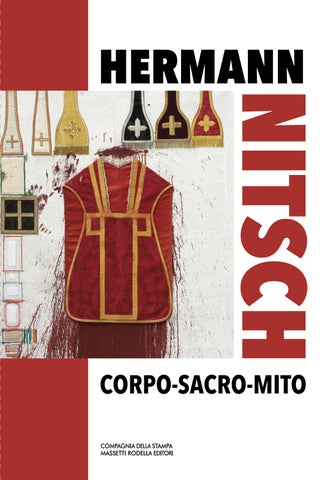
HERMANN NITSCH
BIGNOTTI, Ilaria (a cura di / curated by)
HERMANN NITSCH
Corpo - Sacro - Mito / Body - Sacred - Myth
72 p.; cm 24, ill.
ISBN: 979-12-5671-037-9

CATALOGO / CATALOG TESTI TEXTS
HERMANN NITSCH. Corpo - Sacro - Mito / Body - Sacred - Myth a cura di / curated by Ilaria Bignotti in collaborazione con / in collaboration with Nitsch Foundation, Vienna e / and IAGA Contemporary Art, Cluj-Napoca Museo Diocesano Brescia 11 settembre / September - 30 novembre / November 2025
Ilaria Bignotti, Nicoletta Bontempi, Hermann Nitsch, Mauro Salvatore
COORDINAMENTO EDITORIALE EDITORIAL SUPERVISION
Bianca Martinelli, Camilla Remondina
IMPAGINAZIONE E STAMPA LAYOUT AND PRINTING
La Compagnia della Stampa
Massetti Rodella Editori
MUSEO DIOCESANO BRESCIA
PRESIDENTE PRESIDENT
Nicoletta Bontempi
VICE PRESIDENTE VICE-PRESIDENT
Barbara Chiodi
DIRETTORE E CONSIGLIERE DELEGATO DIRECTOR AND CHIEF DIRECTOR
Mauro Salvatore
CONSERVATORE E CONSIGLIERE REGISTRAR AND COUNSELOR
Federico Troletti
CONSIGLIERE COUNSELOR
Andrea Pedezzi
TESORIERE TRESEURER
Paolo Sandri
Tutti i diritti riservati. Nessuna parte del presente volume può essere riprodotta o trasmessa in qualsiasi forma senza l’autorizzazione dei proprietari dei diritti e dell’editore.
REVISORE DEI CONTI AUDITOR
Angelo Martinelli
SEGRETERIA ORGANIZZATIVA ORGANIZATION
Licia Airoldi
UFFICIO STAMPA PRESS OFFICE
Bianca Martinelli | Bianca etc Operaie della comunicazione
COMUNICAZIONE MEDIA MANAGER
Nicolò Fiammetti
GRAFICA GRAPHIC
Roberto Covre
DIDATTICA EDUCATIONAL
Annamaria Lombardi
ALLESTIMENTO SETTING UP
Guy Magri
BIGLIETTERIA E BOOKSHOP TICKET AND BOOKSHOP
Angela Zani
ARCHIVIO FOTOGRAFICO PHOTO ARCHIVE
Martina Loda, Valentina Rigamonti
Catalogo realizzato con il contributo di
All rights reserved. No part of this volume may be reproduced or transmitted in any form without the permission of the rights owners and the publisher.

© Luglio / July 2025
La Compagnia della Stampa Massetti Rodella Editori
Viale Industria, 19 - 25030 Roccafranca (Brescia) Italy
Telefono / Phone +39 0307090600 - info@lacompagniamassetti.it www.lacompagniamassetti.it
HERMANN NITSCH
A cura di / Curated by Ilaria Bignotti in collaborazione con in collaboration with Nitsch Foundation, Vienna e IAGA Contemporary Art Cluj-Napoca

HERMANN NITSCH. Corpo - Sacro - Mito
Hermann Nitsch, IAGA Contemporary Art, Cluj-Napoca, 2017
Fotografia / Photo Stefan Badulescu
Mito e speranza

Corpo, Sacro, Mito: sono questi i tre cardini attorno ai quali si sviluppa il progetto espositivo dedicato a Hermann Nitsch, maestro indiscusso dell’Azionismo viennese, al quale è dedicato il presente catalogo.
Il Museo Diocesano di Brescia prosegue così la propria indagine sul tema del sacro, non in chiave nostalgica o retrospettiva, ma per interrogarne l’urgenza e la presenza nel nostro tempo. Dopo la mostra Paolo Scheggi. L’Apocalisse, la morte, il sacro, in cui il sacro si configurava come sguardo capace di andare oltre e attraverso, questa nuova esposizione — Hermann Nitsch. Corpo, Sacro, Mito — mette in luce un aspetto meno noto della poetica dell’artista: la sua tensione verso una spiritualità profonda e radicale. Celebre e controverso, Nitsch ha saputo trasformare la violenza dei suoi gesti e la materia delle sue tele in un linguaggio rituale, capace di evocare i grandi archetipi della religione e del mito. Le sue opere interrogano: perché il sacro continua a parlarci? Quale bisogno collettivo si cela dietro il rito, dietro l’espiazione simbolica del peccato?
Quella di Nitsch è una violenza necessaria: un atto sacrificale che non distrugge, ma rivela. Attraverso il corpo, il dolore, il sangue e la scena, egli richiama l’uomo a una consapevolezza nuova, dove il sacro è tutt’altro che evasione, bensì si fa responsabilità.
Il Museo Diocesano quindi si conferma ancora come un’agorà: uno spazio di confronto, aperto alle risposte di ciascuno. Un luogo in cui l’arte sollecita riflessioni autentiche, radicate nella realtà, consapevole del ruolo sociale del museo e della sua impossibilità di restare indifferente di fronte alla complessità del presente. Attraverso il rito che passa per il corpo e si fa sacro, prende forma anche il mito, anelando ad essere speranza di un’umanità rinnovata.
Un particolare ringraziamento va a Ilaria Bignotti, curatrice della mostra, per la sua attenta e qualificata professionalità, nonché a Bianca Martinelli, che ne ha coordinato sapientemente la comunicazione e la redazione di questo catalogo. Un grazie più che sentito ai collaboratori del Museo Diocesano che, come sempre, hanno supportato e promosso anche questa attività.
Nicoletta Bontempi
Presidente Museo Diocesano di Brescia
Mauro Salvatore
Direttore Museo Diocesano di Brescia

NITSCH. Corpo - Sacro - Mito
Veduta della mostra di / Exhibition view Hermann Nitsch Kiscell Museum, Budapest, 1999
Ilaria Bignotti

Hermann Nitsch.
Liturgie dipinte, corpi esposti
_Corpi e Azioni
Aktion n. 50, Prinzendorf, 1975. Numerata come cinquantesima, cinquant’anni corrono oggi dall’azione diretta da Hermann Nitsch nel suo castello di Prinzendorf nel 1975.
Cinquant’anni dopo il Museo Diocesano di Brescia apre una grande mostra dedicata a uno degli artisti o forse sarebbe meglio dire all’artista più scomodo e scandaloso della nostra epoca.
Da ricordare, innanzitutto, tra i fondatori dell’Azionismo viennese, sorto all’inizio degli anni Sessanta da un moto di rabbia e di coraggio di artisti austriaci che non potevano accettare il modo in cui la politica del loro tempo avesse rimosso la violenza perpetrata dalle dittature, colpevoli poco più di quindici anni prima di aver trascinato il mondo in un conflitto internazionale di efferata vergogna.
Un movimento artistico, allora, animato dalla volontà di risvegliare le assopite coscienze borghesi da quel lavacro moralista che, sull’onda del boom economico e massmediatico appena sorto, era riuscito a far dimenticare – o sedare – le responsabilità civili e politiche di un popolo che doveva sentirsi ancora, tragicamente, responsabile dell’odio razziale e dell’ipocrita silenzio nel quale erano stati sterminati milioni di persone.
Era necessario rispondere in modo forte, anzi, assoluto: rivendicando il diritto di guardare nell’abisso, di riaprire i coperchi che nascondevano le fosse dei morti.
Hermann Nitsch, con gli altri esponenti dell’Azionismo viennese, ovvero Günter Brus, Otto Muehl, Rudolf Schwarzkogler, doveva farlo, rimettendo in scena proprio ciò che più era stato vessato e negato: il corpo. Quel corpo al quale solo un anno prima Lea Vergine, critica d’arte militante e sentinella attenta e coraggiosa dei nuovi linguaggi artistici, aveva dedicato all’avanguardia conosciuta come Body Art un volume ancora oggi considerato sua pietra miliare: Il corpo come Linguaggio. La “Body-art” e storie simili. Sin
dal titolo, il principio animatore dell’opera è esplicito e non lascia spazio a fraintendimenti: il corpo è l’opera.
Corpo come membra e carne, corpo come sensi ed emozioni, corpo come identità e alterità, corpo come psiche e coscienza della corporeità; corpo come schermo e contenitore, superficie e teatro di azioni e rituali che ne sperimentano i limiti e le potenzialità; corpo come memoria e materia, corpo come pagina della storia e indice di un racconto da scrivere ogni volta.
Hermann Nitsch è ovviamente tra gli artisti pionieri che Lea Vergine qui descrive, con poche parole e un largo uso di immagini.
“Vi sono attimi nella vita, attimi tremendi, nei quali una creatura emerge dalla propria nicchia, guarda fuori ed è uno spavento”1
Tra le poche parole scolpite in pagine di capitale importanza per la storia dell’arte contemporanea, il volume si apre con una citazione di Katherine Mansfield dal senso inequivocabile.
Come ad anticipare che nel libro troveremo artisti che ci costringono a guardare “fuori”: a non limitarci a guardare ciò che ci viene somministrato, ma a guardare ciò che potrebbe, anche, spaventarci. Guardare fuori significa, anche, guardarsi dentro. Senza la paura di poter soffrire e scavare, di poter ricordare e tornare a vedere quanto è stato nascosto, represso, rimosso.
L’opera di Hermann Nitsch fa qualcosa del genere: agisce sul nostro inconscio, fa emergere ciò che non pensavamo di ricordare o forse neppure sapevamo di possedere: il nostro senso del tragico, il dramma del dolore, la percezione dell’assoluto, il mistero della vita e della morte.
1 Katherine Mansfield, citazione in apertura di Lea Vergine, Il corpo come linguaggio: Body Art e storie simili, Prearo Editore, Milano 1974, p. 7.
Nella pagina accanto / On the next page Veduta della mostra di / Exhibition view Hermann Nitsch Kiscell Museum Budapest, 1999


Per poter arrivare a vivere e comprendere l’opera di Hermann Nitsch è necessario avere fede: affidarsi ai suoi rituali, penetrare nella sua pittura, non distogliere lo sguardo dal sangue rappreso sui camici e sulle tele. Non bisogna avere paura di vedere, bisogna avere paura di non vedere.
1975-2025: la mostra al Museo Diocesano di Brescia parte (anche) da questo, dal ricordo di un’azione a Prinzendorf dove un uomo, nudo, crocifisso, accoglie sangue e altri liquidi organici sulla sua pelle, rivive bendato il sacrificio, si espone al dolore che è il dolore del mondo, che è il dolore di Dio fattosi Uomo per salvare il mondo dalla negazione e dalla dimenticanza. Per farlo, Dio fattosi Uomo ha dovuto affrontare la carne, versare sangue, soffrire per tutti noi.
Veduta della mostra di / Exhibition view
Hermann Nitsch Liechtenstein Palace Bruxelles, 1999
_Origini e Memorie
Facciamo qualche passo indietro da quel 1975.
Vienna, fine anni Cinquanta: come nel resto di un’Europa appena ripresasi dal secondo conflitto mondiale, gli artisti e gli intellettuali si chiedono cosa, come fare per poter affrontare la memoria e la complessità di una violenza inaudita, di una lacerazione etica profonda, di una situazione geopolitica continuamente sul punto di deflagrare, e la necessità di un rinnovamento profondo non solo sociale ed economico, ma anche estetico.
La scelta più forte è quella dell’azzeramento dei linguaggi della tradizione, la radicalità di gesti, segni, azioni destinati a scardinare le arti in modo viscerale.
In Germania il Gruppo Zero di Düsseldorf inventa performance che minano qualsiasi paradigma di ordine e consequenzialità, in Italia Lucio Fontana prende bisturi e punteruoli e si scaraventa contro la tela e la terracotta, Alberto Burri fa piangere ed essudare la materia – sacchi, gessi, legni, poi plastiche… –, Emilio Vedova aggredisce la pittura con gestualità di rabbia e concentrazione, in Francia la tela rimane in vita per essere scenario di danze e rituali dove la pittura è tache, macchia dilagante, corpo impregnato di colore e traccia di un passaggio.
Nessuno si può salvare, nessuno può scampare al nuovo e al dolore, alla storia e all’impegno, dichiarano intanto intellettuali del calibro di Albert Camus e Jean-Paul Sartre.
La volontà di coinvolgimento del pubblico è altrettanto radicale e le opere iniziano a tradursi in azioni travolgenti e totalizzanti: è l’atto di nascita di Fluxus, degli happening e delle performance.
A Vienna le cose si complicano: l’Austria aveva stretto il suo patto mortale con il nazionalsocialismo.
Gli artisti e gli intellettuali non possono dimenticarlo.
Alla fine degli anni Cinquanta Hermann Nitsch è un giovane artista – nasce nel 1938 – che si è appena diplomato all’Istituto grafico sperimentale.
Guarda a Michelangelo e Caravaggio, a Rembrandt ed El Greco, ma anche a Van Gogh e Eduard Munch, a Gustav Klimt ed Egon Schiele, al primo Kandinskij e a Oskar Kokoschka.
Dipinge soggetti biblici e temi religiosi, prevalentemente.

NITSCH. Corpo - Sacro - Mito

Poi, è stato raccontato, la madre apre un giorno la porta del suo piccolo atelier e sul cavalletto non trova nulla di tutto questo, “ma un groviglio di colore rosso misto a sangue”2.
“La pittura è questione di colore, la brace del colore negli antichi maestri, soprattutto in El Greco e Rembrandt riusciva a entusiasmarmi, così come i colori chiari e luminosi come il sole degli impressionisti fino al presente. In musica il colore si esprime attraverso l’armonia. Un’arte sonora del colore nasce dalla prima polifonia, attraverso Bach, la cromatica di Tristano e il bollente suono della scuola di Schönberg, fino al presente. Le mie primissime e prime pitture si occupavano dei colori dell’intero insieme di scale. Nell’evoluzione che porta la mia pittura a diventare azione il colore assumeva un nuovo compito, veniva dispensato dalla sua molteplice tonalità, utilizzato come sostanza”, ha dichiarato Nitsch.
A quel grumo originario della sua nuova pittura, alla fine degli anni Cinquanta, si affiancavano le sue prime esperienze teatrali, sentendo “in linea con la lezione di Artaud […] la necessità di abbandonare ogni tentazione rappresentativa, passando dall’azione verbale all’azione reale”3 e cercando così di “sviluppare un’arte che fosse una riproduzione estetica di quanto realmente vissuto”4
Nel 1960, al Museo della Tecnica della capitale austriaca, interviene direttamente su alcuni pannelli, spargendo a facendo colare pigmenti con mani e spugne; tre anni dopo, l’ambiente dove si svolge l’azione viene trasformato in una vera e propria cappella: le pareti sono spruzzate di sangue, un agnello è il corpo sacrificale, il pavimento accoglie sangue e interiora.
Riferimenti iconografici ai linguaggi dell’Informale si uniscono a temi mistici e religiosi: questi primi atti prefigurano il Teatro delle Orge e dei Misteri – in tedesco, Orgen Mysterien Theater – un vero e proprio modo di scrivere, mettere in scena e vivere il teatro attraverso una precisa scrittura registica, un’attenta preparazione dei performers, uno stretto coinvolgimento del pubblico. Anche gli ele-
2 Vincenzo Trione, Estasi Nitsch. Das Orgien Mysterien Theater, 1962-2020, in L’opera interminabile. Arte e XXI secolo, Einaudi, Torino 2019, p. 373.
3 Idem, p. 375.
4 Ibidem.
Nelle pagine precedenti / On the previous pages Veduta della mostra / Exhibition view Hermann Nitsch. Farbenwelt Sammlung Werner Trenker, Vienna Museum St. Peter an der Sperr Wiener Neustadt, 2023
menti utilizzati sono ricorrenti: corpi di animali sacrificati, sangue e liquidi organici e pittorici, musica e parola, gestualità e percorsi, tele e camici che accolgono la traccia dell’accaduto e diventano monumento – letteralmente, luogo del monito e della memoria – di quanto è stato compiuto come rituale collettivo, purificatore e profondo.
“1. La pittura può svilupparsi fino a diventare una liturgia dipinta, una via di meditazione liturgica che richiede l’affermazione della vita;
2. attraverso l’om theater si deve creare una festa centrale di resurrezione per l’esistenza”.
Così scrive Hermann Nitsch nel suo manifesto, firmato nel marzo 1963.
A partire dal 1971 trova, acquista e sceglie il castello di Prinzendorf, in Bassa Austria, quale luogo di queste azioni – senza ovviamente eludere la possibilità di compierne alcune esternamente, in occasione di mostre dedicategli in musei e centri internazionali – tra le quali le più estese avvengono nel 1998 – l’Aktion numero 100, dal 3 al 9 agosto – e tra il 2022 e il 2025, un’azione di sei giorni in tre anni, la numero 160, tenutasi il 30 e 31 luglio 2022, il 28 maggio 2023 e dal 7 al 9 giugno 2025.
_Echi e Relitti
Quel che resta di queste azioni sono camici, tele, frammenti che accolgono liquidi riversati, tracce di gesti e rituali, oggetti e materie: Nitsch li chiama Relikt, relitto: sono quadri a forma di tonaca o di croce, sono i camici dell’artista-sacerdote e pittore, ma anche paramenti della liturgia cattolica, garze, cerotti, lacci, insomma resti di una tragedia che deve essere testimoniata nel tempo, relitti come testimoni di un accadimento sacro, sineddochi di un fatto trascendentale che è transitato attraverso il sacrificio e la violenza, l’estasi e la lacerazione.
L’artista “non si limita a esibire questi reperti. Lasciando affiorare la sua vocazione formalistica, li compone con precisione quasi chirurgica, senza lasciare nulla al caso”5. Si osservi la grande opera in mostra del 2008 che sulla tela accoglie una pianeta rossa con croce dorata e stole
5 Vincenzo Trione, Estasi Nitsch cit., p. 407.
nere, bianche, oro e rosse: dall’orlo della pianeta cola sangue, attorno ad essa sono visibili impronte di mani insanguinate e sul lato sinistro un’ordinata scacchiera di colori diversi incornicia garze e bende mediche. È del 1977 invece la stola liturgica bianca che campeggia su un velluto viola scuro, attraversata da una linea rossa che seca la croce mentre alla base corre da lato a lato una garza bianca con un cerotto beige: si intitola Santa Lucia 77. Blut. Opfer. Operation, ovvero Sangue, Vittima, Operazione Jackson Pollock sperimentava la potenza espansiva e drammatica del suo dripping, danzando carponi sulla tela che accoglieva la materia grondante dai pennelli e dagli altri strumenti del dipingere. Nitsch, che con Pollock condivide la spiccata intromissione della corporeità nell’azione pittorica e l’estasi di fronte all’alea gocciolatoria della pittura, espone grandi tele impregnate di campi allargati di sangue e materia cromatica: in mostra esempi importanti di azioni storiche sono i Reliktbilder – i quadrirelitto – del 1983 e del 1984, la Tela-azione del 2004 e il piccolo e intenso Relikttusch – relitto inchiostro – del 1998, l’anno dell’azione più estesa nel tempo, come si è detto, la numero 100.
Opere di grandissima valenza storica e di forte impatto estetico, realizzate da un artista che dalla pittura si avvia alla ricerca di un’azione per tornare alla pittura, alla quale si dedica con grande felicità compositiva e con una intensificazione dell’intervento grafico nell’ultima fase: è interessante osservare che all’inizio di quest’anno, la mostra al Museo Diocesano dedicata all’ultima fase della breve ma intensa ricerca di Paolo Scheggi proponeva la sua indagine sul sacro e sulla morte attraverso l’esposizione di cinque grandi disegni progettuali della stesura registica dell’Apocalisse, una performance che l’artista italiano non poté mettere in scena in vita, a causa della sua morte prematura, ma in morte, durante il suo funerale, puntualmente orchestrato seguendo le sue indicazioni registiche. Avviatosi anch’egli dalla pittura informale, Scheggi estende e fa scendere la sua opera in una pubblica arena, con le azioni performative alla fine degli anni Sessanta, e poi torna alla pittura solo alla fine della sua vita, per immaginare l’ultima azione.
Nitsch compie un medesimo percorso: con esiti estetici diversi, entrambi gli artisti sono però accomunati dalla
necessità di scuotere le coscienze dell’umanità del loro tempo e per farlo trovano nel sacro e nel linguaggio religioso cattolico forme e contenuti da riattivare, con la licenza dell’arte.
Due artisti che in un’epoca quale quella attuale sono quanto mai contemporanei, e necessari, nella loro capacità – nel loro coraggio – di intervenire sulla nostra etica attraverso una operazione estetica ad alto tasso di coinvolgimento.
La pittura rimane viva traccia, gesto iniziale o finale di premessa e raccolta del senso dell’opera: come la pagina scritta per l’intellettuale e il filosofo.
“La messa in scena pittorica di Hermann Nitsch costituisce uno dei grandi eventi artistici della contemporaneità – ha scritto di lui Danilo Eccher, sul catalogo di una grande mostra tenutasi a Trento tra il 1991 e il 1992 – determinando un nuovo approccio artistico alla realtà e restituendo una dimensione evocativa, mistica, teoretica, profonda e spirituale alla contemplazione poetica”6
_Liturgie e Cromie
Se nell’antica Grecia il termine liturgia derivava dalla fusione tra il concetto di λαός «popolo» e dal derivato λήιτον che stava a indicare «il luogo degli affari pubblici» e di ἔργον «opera», indicando quel servizio di utilità pubblica imposto dallo stato ai cittadini più facoltosi chiamati a finanziare iniziative di carattere vario, successivamente il termine è andato designando il complesso delle cerimonie di un culto: nell’opera di Nitsch, entrambi i significati si incontrano. L’artista infatti intende mettere a disposizione, con la propria opera, una serie di azioni pubbliche, aperte agli spettatori, che abbiano una funzione di “utilità”, ovvero di risveglio delle coscienze, e per farlo utilizza consapevolmente le forme e gli strumenti del culto, mescolando echi di matrice arcaica e primigenia, come quello dionisiaco, con la religione cattolica cui Nitsch profondamente appartiene e che ne informa l’approccio alle arti visuali.
6 Danilo Eccher, La gnosi e l’estasi, in Hermann Nitsch, a cura di Danilo Eccher, Galleria Civica d’Arte Contemporanea, Trento, 23 novembre 1991-19 gennaio 1992, Mazzotta, Milano 1991, p. 12.
La sua liturgia ha bisogno della sua pittura. La sua pittura ha bisogno della sua liturgia.
Provenienti da un’unica collezione privata che ha nei decenni seguito, approfondito e raccolto le opere di Hermann Nitsch, in mostra campeggiano alcune opere di notevoli dimensioni realizzate a partire ancora da Reliktbilder, ovvero tele che portano la traccia delle azioni avvenute, sulle quali l’artista ha poi disegnato: ecco allora L’ultima cena, una serigrafia edita in ottanta esemplari nel 1983 sulla base di un dipinto del maestro del 1976-1979, dove al centro della composizione, di oltre trecentottanta centimetri di larghezza, formata da corpi anatomicamente descritti, campeggia in piedi un corpo dilaniato e aperto, eco delle azioni viennesi.
Una crocifissione è invece il soggetto di un’opera del 1983, ancora una serigrafia su un relitto originale edita in venticinque esemplari.
Di notevole complessità tecnica è anche la Deposizione di tre metri di larghezza del 2006-2007, dove la scena del Cristo deposto si staglia su un intrico di forme rievocanti interiora corporee. Affascinante è la storia compositiva della Conquista di Israele, una serigrafia di quasi tre metri di larghezza su relitto originale del 1971 che Nitsch ha poi ridipinto nel 2017, durante un’azione performativa appositamente ospitata dal collezionista nella sua galleria in Transilvania.
Ogni opera reca con sé il filo rosso di un racconto, una storia in filigrana che emerge e si dipana tra le macchie rosse che il campo visuale ha accolto: è il rosso, il rosso del sangue a predominare, sempre. Un sangue memore del sacrificio e del martirio, il sangue di Cristo e il sangue della storia. Nitsch ha dedicato numerosi testi progettuali e teorici alla sua sinfonia cromatica, attentamente studiata colore per colore: se le sue Malaktionen, ovvero azioni pittoriche, assumono ogni volta una “forma quasi liturgica, ripetitiva e cerimoniale, come un inno”7, il rosso esalta la valenza liturgica dell’atto del dipingere e diventa esplicito omaggio a Gustav Klimt: anche il maestro del secessionismo viennese spesso indossava un camice sacerdotale mentre dipingeva. “La mia grande venerazione per Stefan George

7 Vincenzo Trione, Estasi Nitsch cit., p. 406.

Veduta della mostra / Exhibition view Hermann Nitsch. Farbenwelt
Sammlung Werner Trenker, Vienna Museum St. Peter an der Sperr Wiener Neustadt, 2023
e Gustav Klimt e la mia convinzione che l’esercizio artistico possa essere paragonato all’attività del sacerdote, già dal 1960 mi hanno spinto a portare un camice bianco semplice tagliato a forma di tonaca durante le mie azioni pittoriche”, ha dichiarato Nitsch nel testo Il camice del pittore, ricordando che “spesso ancora più spontaneamente di quanto non riesca a fare sulla superficie del dipinto, l’intensità si stende sul camice”8.
Un grumo di colore rosso espande la sua forza propulsiva, si rifrangono onde verdi e macchie blu, il giallo risuona: un
8 Idem, p. 387.

HERMANN NITSCH. Corpo - Sacro - Mito
Veduta della mostra / Exhibition view
Hermann Nitsch. Celebrating Life
IAGA Contemporary Art, Cluj-Napoca, 2017
Fotografia / Photo Stefan Badulescu

dipinto del 2007 pare la traduzione vitalistica di queste parole, mentre i due disegni architetturali del 1994 compongono una croce che si irradia in organi viscerali, come una vetrata dipinta dalla quale traspare luce cromatica.
Ogni cosa si rigenera, come atto estremo di salvazione, nell’opera di Nitsch: un’opera sulla quale risuona e si intona “il canto della voce umana”9.
Per farlo, siamo costretti a ridiscendere nel fondo dell’abisso, tenuti per mano dalla forza dell’arte.
“Il furore della creazione fa risplendere tutto, porta i colori alla propria nascita, le cose verso la propria manifestazione, verso la propria vitalità cromatica respirante – ha scritto Nitsch – accanto ai colori nascono le essenze odorose dei fiori, la dolcezza del polline, soltanto quando tutto, le galassie, i sistemi solari, gli innumerevoli soli e mondi, si sono risvegliati all’ebbrezza della luce e del colore, si mostra la forma suprema del vivente, la figura luminosa del redentore nelle vesti bianche, il già desto alla luce, il volto raggiante del salvatore ridente, risorto”.
9 Rudi Fuchs, Hermann Nitsch, in Hermann Nitsch, a cura di Danilo Eccher cit., p. 27.

| HERMANN NITSCH. Corpo - Sacro - Mito
Veduta della mostra / Exhibition view
Hermann Nitsch. Celebrating Life
IAGA Contemporary Art, Cluj-Napoca, 2017
Fotografia / Photo Stefan Badulescu
Sulla Cristianità
Hermann Nitsch

Ho una comprensione diversa della morte di Cristo. Egli incarna emblematicamente la morte di tutti gli esseri viventi, i quali, secondo un principio universale, devono morire.
Cristo fornisce una dimostrazione allegorica del superamento e della trascendenza del mondo, del fallimento tragico, del superamento stesso della morte. Alla morte succede la resurrezione, evento che è destinato, nel dominio dell’eternità e dell’infinito, a ripetersi un numero infinito di volte, affinché il mondo possa essere trasformato e trasmutato nella sua essenza. La morte di Cristo si configura come una dimostrazione vivente, quasi parabolica, di tale accadimento tragico che nondimeno culmina in un esito di vittoria e trionfo. Ci dimostra il coraggio imprescindibile per affrontare il tragico.
Esorta a liberarci dall’indolenza spirituale e a intraprendere il nostro percorso esistenziale con un atteggiamento eroico. Cristo assume la figura di un Dio-distruttore in quanto assume e si fa carico della tragedia (della propria morte), diventa il Dio poiché realizza il trionfo della resurrezione. Egli rappresenta una parabola dell’incessante alternanza tra distruzione e rigenerazione. Nel suo atto di devozione, tale processo di trasformazione viene rivelato come il mistero più intimo. Egli sacrifica il Suo corpo per noi. Lui offre il Suo corpo per noi, in oblazione, ci dona la sua carne e il suo sangue affinché, mediante la fruizione della sua sostanza essenziale, possiamo accedere alla vita eterna. Mi sembra insostenibile, da una prospettiva razionale, che Dio consenta all’umanità di divenire colpevole a causa di un compito che l’umanità non è in grado di portare a termine e che una riconciliazione avvenga soltanto dopo che Egli ha permesso la strage di Suo Figlio, accettandone il sacrificio. Tale dinamica manifesta evidenti analogie con le modalità di negoziazione e scambio di beni attestate nell’Antico Testamento. Mi sono altresì interrogato sul motivo per cui nella settimana pasquale e nei contesti
commemorativi associati a miti non cristiani, gli uomini si dolgano come se qualcuno fosse realmente morto. Il mito ci conduce nelle profondità, nell’essenza della vita, nelle radici dell’essere. Il mito è sempre un richiamo essenziale agli accadimenti che si verificano nell’eternità e nell’infinito.
Esso tenta di interpretare il mondo nella sua totalità, un mondo racchiuso dall’eterno e dall’infinito; si narra una vicenda di inizio e fine, di fine del mondo, di redenzione del mondo. Plasmato dai bisogni e dalle condizioni del mondo esterno, il mito scaturisce dal linguaggio simbolico dell’inconscio collettivo.
Il mito non può essere interpretato razionalmente; ad esso si applica in seguito un secondo livello interpretativo. Tale trattamento, basato sul lavoro dei teologi e degli architetti del dogma, non deve essere in alcun modo valutato negativamente. Nel caso del cristianesimo furono i padri della chiesa a tentare di delimitare e disciplinare i fatti irrazionali (all’emozione numinosa) mediante dogmi e formulazioni linguistiche. Attraverso la propria conglomerazione irrazionale di enunciati razionali, il mito è in grado di esprimere più di quanto il linguaggio possa effettivamente trasmettere.
Hermann Nitsch IAGA Contemporary Art Cluj-Napoca, 2017 Fotografia / Photo Stefan Badulescu

Apprendiamo più di ciò che il linguaggio può comunicare, e quanto apprendiamo è di natura più profonda. Dietro le formulazioni del linguaggio resta l’irrazionale, il segreto, ciò che sfugge alla presa del linguaggio, e tuttavia si coglie ugualmente. In questo senso, il mito è affine alla poesia, proprio come lo è il sogno. Se visto in tal modo, il mito dei popoli è una forma primordiale di finzione poetica. I miti vanno considerati come le prime grandi epiche che interpretano il mondo; i riti cultuali e le liturgie generati dai miti devono essere intesi come drammi che mettono in scena la trama della narrazione mitica. Il mito ci conduce nell’essenza della vita, nelle profondità dell’essere. È sempre una visualizzazione essenziale dell’evento che avviene in modo infinito ed eterno.
La morte sulla croce costituisce un’esperienza concentrata della morte in quanto tale. Ogni morire, il morire di tutti gli esseri che sono mai vissuti e che mai vivranno, e il ritorno e la resurrezione di tali esseri nella pienezza dei tempi, nel regno dell’eternità e dell’infinità, viene esperito e dimostrato in forma concentrata dal Dio redentore. Senza l’essere umano, il mito non è concepibile; in ultima istanza, è l’uomo che deve adempiere il mito, secondo le indicazioni delle figure redentrici. Il discorso ci riporta alla colpevolezza e alla nozione di sacrificio connessa alla morte di Gesù. Non bisogna dimenticare che il Cristianesimo, nonostante le molteplici interpretazioni contemporanee, è una religione che nega la vita. Cristo è morto sulla croce per i nostri peccati. Il nostro peccato era il corpo, la riproduzione, la sessualità. Secondo San Paolo, il corpo viene crocifisso, ucciso, affinché l’anima, lo spirito possa essere liberato e divenire maturo per il cielo, per la trascendenza. I culti misterici, nei loro estremi, negavano totalmente il corpo, arrivando perfino a castrare i propri adepti. La filosofia antica ha aperto la strada all’ostilità verso il corpo (in particolare nell’ambito dell’idealismo platonico).
Il corpo e la vita terrena sono colpevoli e vengono sacrificati, annullati, mediante la morte sulla croce, affinché lo spirito, o anima, possa essere liberato dai vincoli della corporeità. Non dovrebbe sfuggire a nessuno che queste riflessioni sui miti e sul mito cristiano costituiscono una analisi fenomenologica, che non ha nulla a che vedere con una professione di fede. Sono sempre rimasto sbalordito
dall’assenza di umorismo in rapporto alle cose più alte, dalla mancanza di umorismo di tutte le religioni, e in particolare del cristianesimo. Anche nel caso della più alta gioia promessa dalle religioni, vi è sempre una serietà sacrale, una sorta di inaccessibilità, una distanza che deriva da questa gioia santa. Qualsiasi gioia di natura profondamente personale è sempre in parte esclusa. Certamente, esistono eccezioni. Vorrei potermi dedicare alle gioie più alte con tutta la giubilazione personale e fervente di cui sono capace, con tutto l’ardore, tutta la disinibizione.
Tratto da: Hermann Nitsch, Zur Theorie des Orgien Mysterien Theaters [Sulla Teoria del Teatro delle Orge e dei Misteri], Zweiter Versuch, 1995, pp. 17-19.
Opere / Works
1_LA SINFONIA DEI COLORI
Diplomatosi nel 1958 all’Istituto grafico sperimentale di Vienna, i primi lavori pittorici di Nitsch dialogano con echi espressionisti e immagini di carattere biblico e religioso. Già dalla fine degli anni Cinquanta le sue opere virano nel territorio dell’Informale, accogliendo sul campo pittorico grumi e colate, macchie e coaguli di materia cromatica prevalentemente intonata alle cromie del rosso. Le opere qui raccolte rappresentano la materia cromatica liberata sulla tela, come nell’opera Senza titolo (pittura colata) del 2007, e il segno cromatico che con straordinaria maestria Nitsch impiega per disegnare architetture e volti, orchestrando sapientemente i colori e innestando, sempre, l’elemento del corpo, come nei Disegni architettonici del 1994 e nell’opera Senza titolo del 1981. “La pittura è una questione di colore, la brace del colore negli antichi maestri, soprattutto in El Greco e Rembrandt riusciva a entusiasmarmi, così come i colori chiari e luminosi come il sole degli impressionisti fino al presente. In musica il colore si esprime attraverso l’armonia. Un’arte sonora del colore nasce dalla prima polifonia, attraverso Bach, la cromatica di Tristano e il bollente suono della scuola di Schönberg, fino al presente. Le mie pitture si occupavano dei colori dell’intero insieme di scale. Nell’evoluzione che porta la mia pittura a diventare azione il colore assumeva un nuovo compito, veniva dispensato dalla sua molteplice tonalità, utilizzato come sostanza”, ha dichiarato Nitsch.

Hermann Nitsch, Senza titolo / Untitled, 1981-2006 Stampa serigrafica su tela, es. 3/8 / Silkscreen print on canvas, ex no. 3/8
154 x 99,5 cm

Hermann Nitsch, Senza titolo (disegno architettonico) / Untitled (architectural drawing), 1994
Pastello su carta / Crayon on paper
70 x 50 cm

Hermann Nitsch, Senza titolo (disegno architettonico) / Untitled (architectural drawing), 1994 Pastello su carta / Crayon on paper
70 x 50 cm

Hermann Nitsch, Senza titolo (pittura colata) / Untitled (Poured Painting), 2007
Acrilico su tela / Acrylic on canvas
100 x 100 cm
2_LA MEMORIA DEL SANGUE
I riferimenti iconografici ai linguaggi dell’Informale si uniscono a temi mistici e religiosi. A partire dai primi anni Sessanta, Nitsch scrive e mette in scena le cosiddette Aktionen, azioni a carattere performativo di fortissimo impatto scenico che, attraverso la rievocazione di forme ed elementi di carattere sacro e liturgico, conducono lo spettatore in un processo di catarsi spirituale, dopo essere passato in mezzo al dolore e allo smarrimento, alla paura e allo sconvolgimento sensoriale provocati dalla visione di corpi di animali sacrificati, sangue e liquidi organici e pittorici, alla fusione di musica e parola, una sorta di Gesamtkunstwerk (opera d’arte totale) tra il teatro dionisiaco e la liturgia cristiana, Wagner e la Body Art. Quel che resta di queste azioni sono camici, tele, frammenti che accolgono liquidi riversati, tracce di gesti e rituali, oggetti e materie: Nitsch li definisce Relikttuch, ovvero testimonianze di qualcosa che è accaduto. In questa sala, grandi e piccole tele sono sudari di performance instrisi di liquidi organici: “sulle mie superfici è stato scaraventato il colore della carne, della passione, dell’eccesso dionisiaco e della croce”, ha scritto l’artista.
Per poter arrivare a vivere e comprendere la sua opera, è allora necessario affidarsi ai suoi rituali, penetrare nella sua pittura, non distogliere lo sguardo, anche, dal sangue rappreso che diventa scenario di un rito sacro e profondo.

Hermann Nitsch, Senza titolo / Untitled, 1983
Sangue su tela / Blood on canvas
74 x 86 cm

Hermann Nitsch, Reliktbild (Quadro Relitto) / Reliktbild (Relict painting), 1984 Sangue su tessuto / Blood on fabric
209 x 153 cm

Hermann Nitsch, Relikttuch (Relitto tessuto) / Relikttuch (Relict cloth), 1998
Sangue su tela di lino / Blood on linen
28,5 x 23,5 cm
3_LA LITURGIA DEL SACRIFICIO
Corpo come membra e carne, corpo come sensi ed emozioni, corpo come identità e alterità, corpo come psiche e coscienza della corporeità; corpo come schermo e contenitore, superficie e teatro di azioni e rituali che ne sperimentano i limiti e le potenzialità; corpo come memoria e materia, corpo come pagina della storia e indice di un racconto da scrivere ogni volta.
L’opera di Hermann Nitsch agisce sul nostro inconscio, fa emergere ciò che non pensavamo di ricordare o forse neppure sapevamo di possedere: il nostro senso del tragico, il dramma del dolore, la percezione dell’assoluto, il mistero della vita e della morte. Il suo intento principale era, ed è, quello di non far dimenticare al suo Paese, pienamente compromesso con il Nazismo e con il genocidio perpetrato da Hitler, la tragedia di quanto accaduto: per farlo, Nitsch continua a metterla in scena, come in un processo di riattivazione psichica profonda. Questo il senso delle sue Azioni, qui in sala eccezionalmente rappresentate da una fotografia vintage del 1975 che rappresenta l’Aktion n. 50 tenutasi, esattamente cinquant’anni fa, nel Castello di Prinzendorf, in Bassa Austria, appositamente acquistato dall’artista quale teatro delle sue performance; da notare anche il grande camice-tela del 2004 che dialoga, formalmente, con la crocifissione dipinta da Nitsch su un relitto dell’epoca.

Hermann Nitsch, Aktion n. 50 (Azione n. 50) / Aktion n. 50 (Action no 50), Prinzendorf, 1975 Stampa vintage su carta fotografica / Vintage print on photographic paper
50 x 64,5 cm

Hermann Nitsch, Senza titolo / Untitled, 1983 Stampa serigrafica su relitto originale e intervento dell’artista, es. 19/25 / Silkscreen print on original relict and artist’s intervention, ex. no 19/25 94 x 78 cm

Hermann Nitsch, Senza titolo / Untitled, 2004
Camice dell’azione / Action shirt
200 x 180 cm
4_LA CERIMONIA DEL SACRO
- “La pittura può svilupparsi fino a diventare una liturgia dipinta, una via di meditazione liturgica che richiede l’affermazione della vita.
- Attraverso l’om theater si deve creare una festa centrale di resurrezione per l’esistenza”.
Così scrive Hermann Nitsch nel manifesto delle sue azioni, firmato nel marzo 1963.
Durante queste performance, l’artista indossa spesso un camice che assieme a tele bianche appositamente preparate accoglie le tracce dell’accaduto e diventa monumento – letteralmente, luogo del monito e della memoria – di quanto è stato compiuto come rituale collettivo, purificatore e profondo. Sono qui riunite opere che accolgono paramenti della liturgia cattolica, ma anche garze, cerotti, lacci: resti di una tragedia che deve essere testimoniata nel tempo, relitti come testimoni di un accadimento sacro, sineddochi di un fatto trascendentale che è transitato attraverso il sacrificio e la violenza, l’estasi e la lacerazione.
Come nella grande opera del 2008 che sulla tela accoglie una pianeta rossa con croce dorata e stole nere, bianche, oro e rosse: dall’orlo della pianeta cola sangue, attorno ad essa sono visibili impronte di mani insanguinate e sul lato sinistro un’ordinata scacchiera di colori diversi incornicia garze e bende mediche.

Hermann Nitsch, Relitto con applicazioni / Relict with applications, 2008 Tecnica mista e collage su tela / Mixed media and collage on canvas
200 x 150 cm

Hermann Nitsch, Santa Lucia 77. Blut. Opfer. Operation (Santa Lucia 77. Sangue. Vittima. Operazione) / Santa Lucia 77. Blut. Opfer. Operation (Saint Lucia 77. Blood. Victim. Operation), 1977
Collage, stola, garza e acrilico su cartone ricoperto di velluto / Collage, stole, gauze and acrylic on velvet-covered cardboard
32 x 21 cm
5_I GRANDI TELERI
Sono qui riunite tre opere di notevoli dimensioni realizzate da Hermann Nitsch a partire ancora da Reliktbilder, ovvero dalle tele-relitto che portano la traccia delle azioni avvenute, sulle quali l’artista ha poi disegnato: L’Ultima Cena è una serigrafia del 1983 tirata sulla base di un dipinto del 19761979, dove al centro della composizione, di oltre trecentottanta centimetri di larghezza, formata da corpi anatomicamente descritti, campeggia in piedi un corpo dilaniato e aperto, eco delle azioni viennesi. Di notevole complessità tecnica è anche la Deposizione di tre metri di larghezza del 2006-2007, dove la scena del Cristo deposto si staglia su un intrico di forme rievocanti interiora corporee. Affascinante è la storia compositiva della Conquista di Gerusalemme, una serigrafia di quasi tre metri di larghezza su relitto originale del 1971 che Nitsch ha poi rieditato nel 2017, durante un’azione performativa appositamente ospitata dal prestatore, un collezionista privato, nella sede della sua galleria d’arte contemporanea a Cluj-Napoca, in Romania.


Hermann Nitsch, Das letze Abendmahl (L’Ultima Cena) / Das letze Abendmahl (The Last Supper), 1976-1979 Stampato nel / Printed in 1983 Stampa serigrafica su relitto originale, es. 1/80 / Silkscreen print on original relict, ex. no 1/80 162 x 386 cm

Hermann Nitsch, Grablegung (Deposizione) / Grablegung (Deposition), 2006-2007
Acquaforte, puntasecca su rame, vernice su alluminio, litografia - alluminografia su relitto originale / Etching, drypoint on copper, varnish on aluminium, lithograph - aluminograph on original relict Edizione in 8 esemplari / Edition in 8 exemplares 196 x 299 cm

Hermann Nitsch, Die Eroberung von Jerusalem (La conquista di Gerusalemme) / Die Eroberung von Jerusalem (The Conquest of Jerusalem) Stampa serigrafica su relitto originale del 1971 con intervento d’artista, es. 74/80 / Silkscreen print on original 1971 relict with artist’s intervention, ex. no 74/80 175 x 290 cm

HERMANN NITSCH. Corpo - Sacro - Mito
Hermann Nitsch, IAGA Contemporary Art, Cluj-Napoca, 2017
Fotografia / Photo Stefan Badulescu

Biografia
(1938 - 2022)
Hermann Nitsch è nato il 29 agosto 1938 a Vienna. Tra i fondatori dell’Azionismo viennese, è considerato uno degli artisti contemporanei più complessi e provocatori: performer di azioni, pittore, compositore e scenografo. La sua sintesi delle arti, chiamata il Teatro delle Orge e dei Misteri, riesce ad abbracciare tutti i linguaggi della sua ricerca e coinvolge intensamente la sensorialità attraverso un’interpretazione contemporanea del concetto di tragico e di sacro.
Diplomatosi nel 1958 all’Istituto grafico sperimentale di Vienna, i primi lavori pittorici di Nitsch dialogano con echi espressionisti e immagini di carattere biblico e religioso. Già dalla fine degli anni Cinquanta le sue opere virano nel territorio dell’Informale, accogliendo sul campo pittorico grumi e colate, macchie e coaguli di materia cromatica prevalentemente intonata alle cromie del rosso; parallelamente Nitsch avvia la sua personale idea di teatro, ispirandosi al concetto wagneriano di Gesamtkunstwerk – opera d’arte totale – con la volontà di coinvolgere in modo profondo lo spettatore. Forte delle letture in ambito psicanalitico infatti, sin dall’inizio del decennio successivo, elabora le prime azioni pittoriche – Malaktionen – che anticipano gli esiti formali del Teatro delle Orge e dei Misteri: ruotando attorno all’esperienza sensoriale intensiva di varie sostanze e fluidi, le azioni di Nitsch diventano sempre più dinamiche e violente negli anni a venire, con una intensa e drammatica rievocazione di antichi rituali dionisiaci che includono, anche, la presenza di sangue, di corpi di animali smembrati e di corpi di attori crocifissi e portati processionalmente in performance di carattere iniziatico e con una mirata gestualità che rievoca cerimoniali sacri e liturgie religiose. Un vero e proprio progetto di arte e vita totale che viene continuamente perfezionato ed ecoizzato dall’artista-sacerdote di questi rituali ancestrali e teatralizzati: nel 1971 Nitsch acquista dalla Chiesa cattolica il castello di Hermann
Prinzendorf in Bassa Austria, disponendo così di uno spazio fondamentale per le sue azioni capaci di coinvolgere un larghissimo numero di spettatori e performers.
Tra le principali e più impegnative performance si ricordino quella del 1984 della durata di tre giorni, quella destinata a realizzare un ciclo di dipinti a colata nel 1987 alla Secessione viennese e l’azione di sei giorni del 1998.
A partire dagli anni Novanta, l’opera di Nitsch è consacrata a livello internazionale in mostre antologiche, spesso accompagnate da performance appositamente ideate: tra queste sono da ricordare le due grandi retrospettive all’Essl Museum e successivamente al Martin Gropius Bau di Berlino e l’omaggio a Nitsch con la mostra del 2019 all’Albertina di Vienna.
Tra le pubblicazioni, fondamentale è la monografia di quasi mille pagine dal titolo: Hermann Nitsch - Das Gesamtkunstwerk des Orgien Mysterien Theaters
Nell’ultimo periodo della sua ricerca, Nitsch si è concentrato sul tema della resurrezione nella sua pittura e, su invito, ha potuto realizzare un’azione pittorica al Wagner Festival 2021 di Bayreuth.
Mancato all’età di 83 anni, nel 2022, due sono i musei monografici dedicati alla sua opera, a Mistelbach e a Napoli, dove ha sede la Fondazione Morra.
Fondata nel 2009 in stretta collaborazione con la moglie dell’artista, Rita Nitsch, la Nitsch Foundation, con sede a Vienna, tutela, storicizza e divulga la sua intera opera.
Realizzata in stretta collaborazione e con la supervisione costante della medesima Fondazione viennese, la mostra al Museo Diocesano di Brescia è la prima esposizione monografica dedicata all’artista in città: attraverso opere di dimensioni notevoli e di fondamentale valenza storica, dal punto di vista dei contenuti è la prima mostra a focalizzarsi in modo così rigoroso sulla relazione tra Nitsch e il Sacro, ponendosi quale necessario paradigma di analisi della sua ricerca, dopo la mostra Katharsis a Palazzo Ducale a Mantova nel 2019.
English texts
Myth and Hope
Body, Sacred, Myth: These are the cardinal pillars around which unfolds the exhibition project dedicated to Hermann Nitsch, the preeminent figure and unrivaled visionary of the Viennese Actionism, to whom this catalogue is consecrated.
The Diocesan Museum of Brescia thus continues its inquiry into the theme of the sacred, not as a gesture of nostalgia or retrospective veneration, but rather as an exploration of its pressing urgency and resonant presence within the contours of our contemporary moment. In the wake of the exhibition Paolo Scheggi. The Apocalypse, Death, the Sacred, wherein the sacred emerged as a gaze capable of transcending and traversing reality, this new exhibition — Hermann Nitsch. Body, Sacred, Myth — highlights a lesser-known facet of the artist’s poetic vision: his unrelenting striving and unremitting quest toward a profound and radical spirituality.
Famous and controversial in equal measure, Nitsch achieved the alchemical transmutation of the violence of his gestures and the raw materiality of his canvases into a ritualistic language, one able to summon forth the primordial archetypes of religion and myth. His works compel us toward urgent questioning: Why does the sacred continue to speak to us? What collective necessity slumbers beneath ritual, behind the symbolic expiation of sin?
For Nitsch, violence assumes the gravity of necessity: A sacrificial act not of annihilation, but of revelation. Through body, pain, blood, and the orchestrated dramaturgy of his enactments, he summons humanity toward a heightened awareness, wherein the sacred is not an escape from reality but its radical transfiguration into responsibility.
The Diocesan Museum thus reasserts itself as an agora: A civic and communal space of dialogue, open to the resonances of each individual’s response. A locus wherein art prompts authentic reflection, anchored in reality, attuned to the museum’s social role, and incapable of indifference before the intricate complexities of the present. Through ritual, inscribed upon the body and transfigured into the sacred, the myth itself is incarnated, yearning to
become the very hope of a humanity renewed.
Particular gratitude is extended to Ilaria Bignotti, curator of the exhibition, for the rigor and distinction of her curatorial vision, and to Bianca Martinelli, whose skillful coordination of communications and editorial work has shaped the present catalogue. Our heartfelt gratitude is likewise extended to the collaborators of the Diocesan Museum whose steadfast support and commitment have, as ever, nurtured and sustained this undertaking.
President Museo Diocesano Brescia
Mauro Salvatore
Director Museo Diocesano Brescia
Nicoletta Bontempi
Hermann Nitsch. Painted Liturgies, Exposed Bodies
_Bodies and Actions
Action No. 50, Prinzendorf, 1975.
Numbered as the fiftieth, fifty years have now elapsed since the performance directed by Hermann Nitsch in 1975 at his castle in Prinzendorf.
Half a century later, the Diocesan Museum of Brescia inaugurates a major exhibition dedicated to one of the most controversial and unsettling artists of our time.
It is worth recalling, first and foremost, that Nitsch was one of the founding figures of Viennese Actionism, a movement that emerged in the early 1960s, born out of a surge of anger and moral courage by Austrian artists who could no longer tolerate how the political mechanisms of the time had repressed and erased the memory of atrocities perpetrated under dictatorial regimes which, scarcely fifteen years earlier, had plunged the world into a conflict of appalling shame: World War II.
An artistic movement animated by the imperative to awaken the dormant and complacent bourgeois conscience, numbed by a moralistic purification, fueled by the emergent forces of economic prosperity and mass-media proliferation, which had managed to obliterate or suppress the civil and political responsibilities of a society who, even then, was tragically confronted with the enduring reality of its complicity in racial hatred and in the hypocritical silence that had enabled the extermination of millions.
A forceful, indeed absolute, response was imperative: a reclamation of the right to look into the abyss, to unseal the veiled recesses that concealed the mass graves of the dead. Hermann Nitsch, alongside his fellow exponents of Viennese Actionism, namely Günter Brus, Otto Muehl, Rudolf Schwarzkogler, was compelled to undertake precisely this act of reclamation, to restage, to render visible once again, that which had been most systematically repressed and persecuted: the Body.
That same body which, only a year earlier, had been the subject of a foundational work by Lea Vergine, a militantly engaged art critic and vigilant, courageous sentinel of emergent artistic
Ilaria Bignotti
languages, who had dedicated a volume to the avant-garde practice known as Body Art, a volume still considered a cornerstone of the field: The Body as Language. “Body Art” and Similar Stories. The title alone signals the animating principle of the work, leaving no room for misinterpretation: the body is the artwork.
The body as limbs and flesh, the body as the locus of sensory perception and emotional affect, the body as identity and otherness, the body as psyche and consciousness of corporeality; the body as screen and container, surface and stage for actions and rituals that test its limits and potentialities; the body as memory and matter, as page of history and palimpsest of a narrative to be written again and again.
Hermann Nitsch is, unquestionably, among the pioneering artists and pivotal figures that Lea Vergine describes here, with few words but a rich array of images.
“There are moments in life, terrible moments, in which a creature emerges from its niche, looks out, and is a terror”1 Among the few words carved into the pages of foundational importance to the history of contemporary art, the volume opens with an unequivocally charged citation from Katherine Mansfield.
As if to anticipate that, in the book, we will encounter artists who compel us to look “outward”: not merely to passively observe what is offered to us, but to behold that which might, indeed, frighten us. To look outward also means to look inward. To look without fear of suffering, of digging deeply; without fear of remembering and seeing once more all that has been long concealed, repressed, suppressed.
This is, in essence, what the work of Hermann Nitsch compels us to do: it acts upon our unconscious, brings out what we did not think we remembered, or perhaps did not even know we carried within us: our innate sense of the tragic, a deepseated awareness of suffering, the perception of the absolute, the mystery of life and death.
In order to fully experience and comprehend the work of Hermann Nitsch, one must have faith: one must surrender to his rituals, immerse in his painting-as-action, and refuse to avert one’s gaze from the coagulated blood that marks his garments and canvases.
1 Katherine Mansfield, citation in opening by Lea Vergine, The Body as Language. Body Art and Like Stories, published by Prearo Editore, Milan 1974, p. 7.
One must not fear seeing, rather, one must fear not seeing. 1975-2025: the exhibition at the Diocesan Museum of Brescia is grounded (among other things) in this premise, from the recollection of an action in Prinzendorf where a naked, crucified man welcomes blood and other organic fluids upon his skin, relives the sacrifice blindfolded, exposes himself to a suffering that is the suffering of the world, the suffering of God made Man to redeem the world from denial and oblivion. To accomplish this redemptive act, God made Man was compelled to enter the realm of corporeality and to assume flesh, to shed blood, to suffer on behalf of all of us.
_Origins and Memories
Let us now take several steps back from that year 1975. Vienna, in the late 1950s: as across much of a Europe still reeling from the Second World War, artists and intellectuals are grappling with fundamental questions, How to confront the memory and the complex legacy of unspeakable violence, How to come to terms with a profound ethical rupture and a geopolitical landscape constantly on the verge of explosive collapse, and How to pursue a renewal not merely social and economic, but also aesthetic.
The most radical response lay in the complete dismantling of traditional artistic languages, a return to zero, a shift toward gestures, signs, and actions intended to rupture and subvert the established aesthetic frameworks.
In Germany, the Zero Group of Düsseldorf orchestrated performances that destabilized conventional paradigms of order and linearity, in Italy Lucio Fontana turned to scalpels and awls, slashing and perforating canvases and terracotta surfaces, Alberto Burri made materials weep and sweat –sacks, plasters, woods, and later, plastic… –, Emilio Vedova assaulted painting with gestures of rage and concentration, in France the canvas remained alive becoming the scenario for dances and rituals where the painting became stain, diffuse blot, a body imbued with pigment, the trace of a passage. No one can be saved, no one can escape the new and the suffering it entails, the weight of history and its demands, a conviction echoed by intellectuals such as Albert Camus and Jean-Paul Sartre.
The drive to engage the public was equally radical, prompting artworks to manifest as overwhelming and all-encompassing actions: it is the birth of Fluxus, of happening and performance art.
In Vienna things became more complex: Austria had sealed its deadly pact with National Socialism. Artists and intellectuals cannot forget this.
At the end of the 1950s, Hermann Nitsch was a young artist – born in 1938 – who had just graduated from the Graphic Teaching and Experimental Institute.
He drew inspiration from the masters, Michelangelo and Caravaggio, Rembrandt and El Greco, but also to Van Gogh and Eduard Munch, Gustav Klimt and Egon Schiele, early Kandinsky and Oskar Kokoschka.
His early work focused predominantly on biblical themes and religious subjects.
Then, as recounted, one day his mother opened the door to his modest studio and, upon the easel, found none of these canonical figures, but instead “a tangle of red color mixed with blood”2.
“Painting is fundamentally a question of color, the glowing embers of color in the old masters, above all in El Greco and Rembrandt, have long captivated me, just as the luminous, sundrenched palettes of the Impressionists and continue to do. In music, color is expressed through harmony. An evocative art of color unfolds from the early polyphony, through Bach, the chromaticism of Tristan, and the incandescent sonorities of the Schoenberg school, extending its influence into contemporary artistic practice. My earliest paintings, the very first, explored the spectrum of tonal gradations, with a particular emphasis on the nuanced interplay of color. As my painting evolved into action, color was assigned a new task, it was liberated from its tonal multiplicity and reconceived as a tangible substance”, said Nitsch.
At the close of the 1950s, alongside the seminal clot that signaled the inception of his novel painterly language, Hermann Nitsch concurrently embarked on his earliest theatrical experiments, feeling “in line with the teachings of Antonin Artaud [...] the necessity to abandon any representational temptation, and to move from verbal action to real action”3 thereby endeavoring to “develop an art that could constitute an aesthetic reproduction of that which has been truly lived”4.
2 Vincenzo Trione, Ecstasy Nitsch. Das Orgien Mysterien Theater, 1962-2020, in L‘opera interminable. Arte e XXI secolo, Einaudi, Turin 2019, p. 373.
3 Idem, p. 375.
4 Ibidem.
In 1960, at the Vienna’s Museum of Technology, he intervened directly upon certain panels, smearing and allowing pigments to drip using his hands and sponges; three years later, the setting in which one of his actions unfolded was transformed into a veritable chapel: the walls were saturated with blood, a lamb assumed the role of sacrificial offering, and the floor became permeated with blood and viscera.
Iconographic references to the languages of the Informalism were interwoven with mystical and religious themes: these early acts anticipated the development of what would become known as The Orgies Mysteries Theatre - a fullfledged dramaturgical practice, staging and living the theater through meticulous directorial planning, careful preparation of the performers, a close engagement of the audience. Recurring elements were established: the corpses of sacrificed animals, blood and organic and painterly fluids, music and spoken word, gesturality and trajectories, canvases and gowns saturated with the trace of the event and become a monument – literally sites of remembrance and admonition –embodying what was enacted as a collective, purificatory, and deeply cathartic ritual of profound significance.
“1. Painting can develop into a painted liturgy, to a liturgical path of meditation which prompts an affirmation of life; 2. through the o.m. theater a pivotal resurrection feast of existence is to be created.”
So writes Hermann Nitsch in his Manifesto, signed in March 1963.
Beginning in 1971, Nitsch identified, acquired, and consecrated Prinzendorf Castle, in Lower Austria, as the primary locus for these actions – although he did not exclude the possibility of staging some actions in external venues, particularly during retrospectives or exhibitions curated by museums and international cultural institutions – among which the most extensive took place in 1998 – Action number 100, from August 3-9, – and between 2022 and 2025, an action of six days across three years, number 160, held on July 30-31, 2022, May 28, 2023, and June 7-9, 2025.
_Echoes and Relics
What endures from these actions are garments, canvases, and fragments imbued with poured fluids, bearing the traces of ritual gestures, and comprising objects and materials: Nitsch referred to these as Relikt, relics or remnants: they are
paintings shaped like chasubles or crosses, they are the coats of the artist-priest turned painter, but also Catholic liturgical garments, adhesive bandages, tourniquets, in short the detritus of a tragedy that must be witnessed over time, serving as tangible vestiges of a sacred event, synecdoches of a transcendental phenomenon having traversed the dimensions of sacrifice and violence, ecstasy and laceration.
The artist “does not merely display these artefacts. Revealing his formalistic vocation, he composes them with near-surgical precision, leaving nothing to chance”5.
Consider, for instance, the large-scale work from 2008, the canvas depicts the image of a red planet with a golden cross adorned with stoles of black, white, gold, and red: from the rim of the planet blood trickles downward, while the surrounding surface is visible bloody handprints, and on the left side a chromatic chessboard of orderly colored fields frames gauzes and medical bandages. Dating from 1977, the white liturgical stole that stands out on a dark purple velvet, crossed by a red line that bisects the cross while a white gauze with a beige plaster runs across its base from side to side: it is called Santa Lucia 77. Blut. Opfer. Operation, i.e. Blood, Victim, Operation. Jackson Pollock explored the expansive and dramatic potentialities of dripping, dancing on all fours over canvases that absorbed the matter streaming from his brushes and performative act. Nitsch, who shares with Pollock the pronounced intrusion of corporeality into the pictorial act and an ecstatic responsiveness to dripping pigment, produces large-scale canvases saturated with enlarged fields of blood and chromatic matter: important examples of historical actions are the Reliktbilder – the relic paintings – from 1983 and 1984, the Tela-action of 2004 and the small and emotionally charged Relikttusch – relic ink – from 1998, the year of his longest performance action, as mentioned above, Action number 100. These are works of immense historical significance and powerful aesthetic impact, made by an artist who, having departed from painting to embrace performative action, ultimately returned to painting, to which he dedicated himself with great compositional exuberance and intensified graphic intervention during his final phase: it is interesting to note that at the beginning of this year, the exhibition at the Diocesan Museum dedicated to the final phase of the brief yet intense
5 Vincenzo Trione, Ecstasy Nitsch cit., p. 407.
career of Paolo Scheggi, who showcased his reflections on sacredness and death through five large project drawings conceived for the directorial staging of the Apocalypse, a performance that the Italian artist was unable to stage in life due to his premature death, but which was posthumously enacted at his funeral, following the very scenic instructions he had meticulously devised. Scheggi, who initially emerged from an Informel painterly tradition, extended his practice into the public sphere in the form of performance art at the end of the 1960s, and returned to painting only at the very end of his life, to conceive what he envisioned as the ultimate artistic act.
Nitsch undertakes a parallel trajectory: despite divergent aesthetic outcomes, both artists are united by a shared imperative to shake the consciences of contemporary humanity, and in order to do so, they discover in the sacred and in the religious language of Catholicism a set of forms and contents to be reactivated, harnessing the creative liberties afforded by the artistic domain.
These are two artists who, in an era such as the present one, are more relevant than ever, and indeed indispensable, for their capacity and audacity to intervene within our ethical framework through aesthetic Get imbued with a high degree of emotional and existential involvement.
Painting endures as a vital trace, an initiatory or conclusive gesture, both the prologue and the summation of meaning within the artwork: just as the written page functions for the intellectual or philosopher.
“The pictorial staging of Hermann Nitsch constitutes one of the great artistic events of our contemporaneity – wrote Danilo Eccher in the catalogue of a major exhibition held in Trento between 1991 and 1992 – establishing a new artistic approach to reality, and reinstating in poetic contemplation an evocative, mystical, theoretical, profound, and spiritual dimension”6
_Liturgies and Chromaticities
In Ancient Greece, the term liturgy derived from the fusion of λαός meaning “the people”, and λήιτον, specifically indicating “the place of public affairs” combined with ἔργον meaning
6 Danilo Eccher, La gnosi e l’estasi, in Hermann Nitsch, edited by Danilo Eccher, Galleria Civica d’Arte Contemporanea, Trento, November 23, 1991 - January 19, 1992, Mazzotta, Milan 1991, p. 12.
“work”, denoting a public service obligation imposed by the State upon its wealthiest citizens called to finance various communal initiatives; over time, the term evolved to encompass the entirety of ceremonial rites within a religious cult: in Nitsch’s work, both semantic dimensions of the term coexist and converge. Indeed, the artist endeavors to offer, through his body of work, a series of public actions, open to the spectators, actions that serve a function of “utility”, that is, catalyst for the awakening of human consciousness, and to do so he deliberately appropriates the forms and instruments of religious cult, blending archaic and primordial echoes, such as the Dionysian rites, with the Catholic religion to which Nitsch is profoundly connected and which informs his approach to the visual arts.
His liturgy needs his painting. His painting needs his liturgy. Originating from a singular private collection that has, over the decades, meticulously followed, studied, and assembled Hermann Nitsch’s works, the exhibition features several largescale pieces executed from the ongoing series of Reliktbilder, or canvases that bear the trace of the actions that took place, later intervened upon pictorially by the artist: one of this is The Last Supper, a serigraph published in eighty copies created in 1983 based on a painting from 1976-1979; at the center of the composition, which spans over three hundred and eighty centimeters in width, formed by anatomically delineated human bodies, stands upright a lacerated and eviscerated figure, an echo of the Viennese actions.
A crucifixion is the subject of another work from 1983, again, a serigraph printed on an original relic-painting, in an edition of twenty-five.
Noteworthy for its technical complexity is the Deposition measuring three meters in width, completed between 2006 and 2007, where the scene of the deposed Christ stands out an intricate entanglement of forms evocative of bodily viscera and innards. Of particular fascination is the compositional history of The Conquest of Israel, a nearly three-meter-wide serigraph print on original 1971 relic canvas that Nitsch later repainted in 2017, during a performative action expressly hosted by the collector in his gallery in Transylvania.
Each work carries embodies a continuous narrative thread, a filigree of storylines that surfaces and unfolds among the red stains inhabiting the visual field: it is the color red, the red of blood that always predominates. This blood commemorates
sacrifice and martyrdom, the blood of Christ, and the blood of history. Nitsch has dedicated numerous programmatic and theoretical texts to his chromatic symphony, meticulously studied color by color: his Malaktionen, or painting actions, assume with every iteration a “quasi-liturgical, repetitive, and ceremonial form, like a hymn”7, red amplifies the liturgical valence of the act of painting and becomes an explicit homage to Gustav Klimt: even the master of Viennese Secession frequently donned sacerdotal robes during his creative process. “My profound veneration for Stefan George and Gustav Klimt, alongside my conviction that the artistic practice can be likened to priestly activity, have already led me in 1960 to wear a simple white robe, tailored in the shape of a tunic, during my pictorial actions”, said Nitsch in the text The Paining Shirt, recalling that “Often, even more spontaneously than what I am able to achieve on the surface of the canvas, intensity spreads across the robe itself”8.
A coagulation of red pigment unfolds with propulsive energy, while undulating waves of green and diffuse blotches of blue refract across the surface; yellow resonates: a painting from 2007 seems to embody these words into vitalistic expression, while the two architectural drawings from 1994 make up a cross radiating into visceral organs, reminiscent of a stainedglass window suffused with chromatic light.
In Nitsch’s œuvre, all elements undergo a process of regeneration, as an ultimate act of salvation: an opus wherein one can hear and harmonize “the song of the human voice”.9
To attain this, one must descend again into the profound depths of the abyss, held by the hand of art’s power.
“The fury of creation causes everything to radiate, bringing colors into being, enabling things to manifest and breathe with chromatic vitality – wrote Nitsch – alongside colors, the fragrant essences of flowers, the sweetness of pollen, only when everything, the galaxies, the solar systems, the innumerable suns and worlds, have awakened to the ecstasy of light and color, does the supreme form of the living being emerge, the luminous figure of the Redeemer clad in white garments, the one already awakened to light, the radiant visage of the smiling, resurrected Savior”.
7 Vincenzo Trione, Ecstasy Nitsch cit., p. 406.
8 Idem, p. 387.
9 Rudi Fuchs, Hermann Nitsch, in Hermann Nitsch, edited by Danilo Eccher cit., p. 27.
About Christianity
Hermann Nitsch
I have a different understanding of the death of Christ. He demonstrates the death of all living beings, who must, as a general principle, die.
He provides an allegorical demonstration of the worldovercoming, tragic failure, the overcoming of death. Death is succeeded by resurrection, something which is bound, in the realm of eternity and infinity, to occur an infinite number of times, so that the world may be transformed and changed. Christ’s death is a living and parable-like demonstration of this tragic occurrence that nevertheless ends in victory and triumph. It demonstrates to us the courage required to overcome the tragic.
It calls upon us to shrug off half-heartedness, to go our way heroically.
He becomes a destroyer-God because He accepts, takes upon himself, the tragedy (of his death), He becomes the God of because He effects the triumph of resurrection. He is a parable for the incessant occurrence of destruction and construction.
In His devotion this transformational process is demonstrated as the innermost mystery. He sacrifices His body for us. He offers up His body for us, He gives us to eat His flesh and His blood so that we may partake of eternal life by enjoyment of His essential substance. It seems to me unsustainable, in rational terms, that God allows humanity to become culpable by means of a task that humanity does not accomplish, and that a reconciliation takes place only after He has permitted the slaughter of His Son, and accepts His sacrifice. The whole thing bears some resemblance to the bartering of wares in the Old Testament. I have further asked myself, in the case of Easter week and in situations of mourning related to other, non-christian myths, why people mourn as much as if somebody really had died. The myth leads us into the depths, into the essence of life, into the depths of being. The myth is always an essential reminder of the occurrences taking place in eternity and in infinity. An attempt is made to interpret the total world enclosed
by eternity and infinity, a tale is told of beginning and end, of the end of the world, redemption of the world. Molded by needs and by conditions of the external world, the myth comes forth from the language of symbols of the collective unconsciousness.
The myth cannot be interpreted rationally; the myth then finds a second treatment. By no means should the latter, being based on the theologians and architects of the dogmas, be viewed negatively. In the case of Christianity it was the fathers of the church who tried to circumscribe and control irrational facts (of numinous emotion) by means of dogmas and linguistic formulations.
Through its irrational conglomerations of rational statements the myth is capable of expressing more than language is actually capable of expressing. We learn more than language can convey, and what we learn is deeper.
Behind the formulations of language remains the irrational, the secret, that one fails to get hold of with language, yet grasps all the same. In this sense, the myth is related to poetry in the same way as the dream. Seen in this way, the myths of the peoples are early poetic fiction. Myths should be viewed as the first great epics that interpreted the world, the cult rites and liturgies brought forth by myths should be viewed as dramas that demonstrate the plots of the mythical narrative. The myth leads us into the essence of life, into the depths of being. It is always essential visualization of the occurrence taking place infinitely and eternally.
The death on the cross is a concentrated experience of death per se. All dying, the dying of all beings that ever lived and will ever live, and the return and resurrection of these beings in the fullness of the times, in the realm of eternity and infinity, is experienced, demonstrated, in concentrated form by the redeemer God.
Without human beings the myth is not conceivable; ultimately it is they who must fulfil the myth on the instructions of the redeemer figures.
Which takes us back to the culpability and the notion of sacrifice connected with the death of Jesus. One should not forget that Christianity, in spite of many different contemporary interpretations, is a life-negating religion. Christ died on the Cross for our sins. Our sin was the body, reproduction, sexuality. According to Paul, the body is crucified, killed in order that the soul, the spirit, may be liberated and be ripe for heaven, for
transcendence. Cults of the mysteries even totally denied the body by castrating their members. Ancient philosophy paved the way for hostility to the body (for the idealistic).
The body, earthly life, is culpable and is sacrificed, annulled, by death on the Cross, so that the spirit, or soul, is liberated from the shackles of the body.
It should escape nobody’s attention that these reflections on myths and on the myth of Christianity amount to a phenomenological analysis that has nothing to do with professions of faith. I have always been astonished by the lack of humor in connection with the highest things, by the humorlessness of all religions, and of Christianity in particular. Even in the case of the highest joy promised by the religions there is always a sacred earnestness, a certain unapproachability, a distance triggered by holy joy. Any joy of a profoundly personal nature is always somewhat excluded. Certainly, there are exceptions. I would like to dedicate myself to the highest joys with all the heartfelt personal exuberance of which I am capable, with all the fervor, all the abandon.
From: Hermann Nitsch, Zur Theorie des Orgien Mysterien Theaters [About the Theory of the Orgies Mysteries Theatre], Zweiter Versuch, 1995, pp. 17-19.
THE SYMPHONY OF COLOURS
After graduating from the Vienna Experimental Graphic Design Institute in 1958, Nitsch’s first pictorial works dialogue between expressionist echoes and biblical and religious images. As early as the end of the 1950s, his works turn into Informal painting and welcome lumps and drips, stains and clots of chromatic material predominantly in red tones onto the pictorial field. These works tell about two directions of Nitsch’s artistic research are presented: the chromatic material freed on the canvas, as in the work Untitled (Poured Painting) of 2007, and the chromatic sign that Nitsch uses with extraordinary skill in drawing architectures and faces, masterfully orchestrating the colours and always grafting the element of the body, as in the Architectural Drawings of 1994 and the work Untitled of 1981.
“Painting is a matter of colour, the blaze of colour in the old masters, especially in El Greco and Rembrandt was able to excite me, as well as the clear, sun-bright colours of the Impressionists to the Present. In music, colour is expressed through harmony. A sound art of colour was born from early polyphony, through Bach, the chromatics of Tristan and the hot sound of the Schoenberg school, to the present. My paintings engaged with the colours of the whole set of scales. In the evolution that leads my painting to become action, colour took on a new task, was dispensed from its multiple tones, used as substance,’ Nitsch said.
THE MEMORY OF THE BLOOD
The iconographic references to the languages of the Informal are in these works combined with mystical and religious themes: from the early 1960s onwards, Nitsch wrote and staged the so-called Aktionen, actions of a performative nature with a strong scenic impact which, through the evocation of forms and elements of a sacred and liturgical nature, lead the viewer into a process of spiritual catharsis, after passing through pain and disorientation, fear and sensory shock provoked by the vision of sacrificed animal bodies, blood and organic and pictorial liquids, to the fusion of music and word: a kind of Gesamtkunstwerk (total artwork) between Dionysian theatre and Christian liturgy, Wagner and Body Art. What remains of these actions are shirts, canvases, fragments that receive poured liquids, traces of gestures and rituals,
objects and materials: Nitsch defined them Relikttuch, that is testimonies of something that has happened. Large and small canvases are performance sudars imbued with organic liquids: “on my surfaces the colour of flesh, of passion, of Dionysian excess and of the Cross has been thrown”, wrote the artist.
In order to be able to experience and understand his work, it is then necessary to trust in his rituals, to immerse oneself in his painting, not to look away, even, from the congealed blood that becomes the scene of a sacred and profound ritual.
THE LITURGY OF THE SACRIFICE
Body as limbs and flesh, body as senses and emotions, body as identity and alterity, body as psyche and conscience of the corporeity; body as screen and container, surface and theatre of actions and rituals that experience its limits and potentialities; body as memory and matter, body as page of history and index of a story to be written each time. Hermann Nitsch’s work deals with our unconscious, bringing out what we did not think we remembered, or perhaps did not even know we were in possession of: our sense of the tragic, the drama of pain, the perception of the absolute, the mystery of life and death. His main intention was, and is, not to make his Country, fully compromised with Nazism and the genocide perpetrated by Hitler, forget the tragedy of what happened: to do this, Nitsch continues to stage it, as in a process of profound psychic reactivation.
This is the meaning of his Actions, here in the room exceptionally represented by a vintage photograph from 1975 representing Aktion no. 50 held, exactly fifty years ago, in Prinzendorf Castle, in Lower Austria, specially acquired by the artist as a theatre for his performances; also to be noted is the large shirt-canvas from 2004 that dialogues, formally, with the Crucifixion painted by Nitsch on a relict of the time.
_ THE CEREMONY OF THE SACRED
- “Painting can develop into a painted liturgy, a way of liturgical meditation that requires the affirmation of life.
- Through om-theatre, a central resurrection feast for existence must be created’.
So wrote Hermann Nitsch in the manifesto of his actions, signed in March 1963. 3 4
During these performances, the artist often wears a gown, which, together with specially prepared white canvases, receive the traces of what has happened and become a monument - literally, a place of remembrance and memory - of what has been performed as a collective, purifying and profound ritual. These works include vestments from the Catholic liturgy, but also gauze, plasters, laces: the remains of a tragedy that must be witnessed in time, relicts as testimonies of a sacred event, synecdochs of a transcendental fact that has passed through sacrifice and violence, ecstasy and laceration. Take a look at the large work of 2008 that on the canvas holds a red chasuble with a golden cross and black, white, gold and red stoles: blood drips from the edge of the chasuble, bloody handprints are visible around it, and on the left side an orderly chequerboard of different colours frames gauze and medical bandages.
_ THE LARGE CANVAS
Here are three works of considerable size created by Hermann Nitsch from Reliktbilder, i.e. from the canvases bearing the trace of the actions that took place, on which the artist then drew: The Last Supper is a silkscreen print from 1983 stretched on the basis of a 1976-1979 painting, where in the centre of the composition, over three hundred and eighty centimetres wide, made up of anatomically described bodies, stands a torn open body, an echo of the Viennese actions. Also of considerable technical complexity is the three-metrewide Sepultura from 2006-2007, where the scene of the Deposed Christ stands out against a tangle of forms evoking bodily entrails. Fascinating is the compositional history of the Conquest of Jerusalem, a nearly three-metre-wide silkscreen print on an original 1971 relict, which Nitsch then re-edited in 2017, during a performance action specially hosted by the lender, a private collector, in the location of his contemporary art gallery in Cluj-Napoca, Romania.
Hermann Nitsch
(1938 - 2022)
Biography
Hermann Nitsch was born on August 29, 1938, in Vienna. Regarded as one of the most complex and provocative artists of the contemporary era, Nitsch is one of the founding figures of Viennese Actionism: as a performance artist, painter, composer, and scenographer, he synthesized the arts in the Orgien Mysterien Theater, i.e. The Orgies Mysteries Theatre, which manages to integrate all the expressive forms serving as a comprehensive vehicle for his artistic inquiry, and through a visceral and multisensory engagement, it offers a contemporary reinterpretation of the tragic and the sacred.
After graduating in 1958 from the Graphic Teaching and Experimental Institute in Vienna, Nitsch’s early pictorial works revealed a dynamic interplay between expressionist echoes and biblical or religious imagery. By the late 1950s, Nitsch’s works had already begun to transition toward the realm of the Informalism, as evidenced by the incorporation of dense impastos, flowing pigments, stains, and coagulations of chromatic matter, predominantly in hues of red, onto the pictorial surface; concurrently, Nitsch began formulating his personal vision of theater, drawing inspiration from the Wagnerian concept of Gesamtkunstwerk – a total work of art – seeking to engage the spectator not merely as a viewer. With a robust foundation and significant influence from psychoanalytic literature, Nitsch began, at the outset of the 1960s, to develop his initial painterly actions – Malaktionen – which served as precursors to the formal and conceptual framework of The Orgies Mysteries Theatre: These revolved around the intensive sensory experience of various substances and fluids, and, over time, evolved into increasingly dynamic and visceral performances; Nitsch’s actions evocatively recalled ancient Dionysian rituals, featuring elements such as blood, dismembered animal bodies, and human bodies crucified and carried in processional performances of an initiatory nature, accompanied by gestural expressiveness, reminiscent of sacred ceremonies and religious liturgies. This constituted a genuine project of total art and life, continually refined and echoed by the artist who assumed the role of a
priest-like figure, presiding over these ancestral theatrical rituals: in 1971, Nitsch purchased Prinzendorf Castle in Lower Austria from the Catholic Church, securing a pivotal site for his actions, enabling the participation of numerous performers and the immersive engagement of sizable audiences.
Among his most significant and demanding performances are the three-day 1984, the 1987 action at the Vienna Secession, intended to generate a series of pour paintings, and the six-day action in 1998.
From the 1990s onward, Nitsch’s work gained widespread international recognition, being featured in numerous retrospective exhibitions, often accompanied by site-specific performances: among these are the two major retrospectives at the Essl Museum and subsequently at the Martin Gropius Bau in Berlin, and the tribute exhibition to Nitsch in 2019 at the Albertina Museum in Vienna.
Among the publications dedicated to his work, the most comprehensive and authoritative is the nearly 1,000-page monograph entitled: Hermann Nitsch - Das Gesamtkunstwerk des Orgien Mysterien Theaters
In the final phase of his artistic inquiry, Nitsch increasingly turned his attention to the theme of resurrection in his painting, and, at the invitation of the organizers, he was able to carry out a painterly action at the 2021 Wagner Festival in Bayreuth.
Following his death in 2022 at the age of 83, Nitsch’s legacy continues to be preserved through two monographic institutions dedicated to his oeuvre, one in Mistelbach and the other in Naples, which also hosts the Morra Foundation.
Established in 2009 in close collaboration with the artist’s wife, Rita Nitsch, the Nitsch Foundation, based in Vienna, is tasked with the preservation, historicization, and dissemination of the entirety of his work.
Conceived in close collaboration with, and under the ongoing supervision of the same Viennese Foundation, the exhibition at the Diocesan Museum of Brescia marks the city’s first monographic exhibition dedicated to the artist: featuring large-format works of fundamental historical significance, this exhibition represents the first to focus with such analytical rigor on the relationship between Nitsch and the Sacred, posing as a necessary paradigm for interpreting his artistic inquiry; this exhibition follows the 2019 show Katharsis held at the Ducal Palace in Mantua.
Indice / Index
5 Mito e speranza
Nicoletta Bontempi - Mauro Salvatore
7 Hermann Nitsch. Liturgie dipinte, corpi esposti
Ilaria Bignotti
23 Sulla Cristianità
Hermann Nitsch
27 Opere / Works
28 1 La sinfonia dei colori
33 2 La memoria del sangue
37 3 La liturgia del sacrificio
41 4 La cerimonia del sacro
44 5 I grandi teleri
49 Hermann Nitsch - Biografia 51 English texts
52 Myth and Hope
Nicoletta Bontempi - Mauro Salvatore
54 Hermann Nitsch. Painted Liturgies, Exposed Bodies
Ilaria Bignotti
63 About Christianity
Hermann Nitsch
66 1 The symphony of colours
66 2 The memory of the blood
67 3 The liturgy of the sacrifice
67 4 The ceremony of the sacred
68 5 The large canvas
69 Hermann Nitsch - Biography
Agli effetti della Legge N. 106 del 15 aprile 2004, il libro è stato depositato presso:
Biblioteca Civica Queriniana Ufficio Deposito Legale - Via Mazzini, 1 25121 Brescia
Biblioteca Nazionale Centrale di Firenze Ufficio Deposito Legale - Piazza Cavalleggeri, 1 50122 Firenze
BEIC
Biblioteca Nazionale Braidense Via dei Fiori Oscuri, 2 20121 Milano
Biblioteca Nazionale Centrale di Roma Ufficio Deposito Legale - Via Castro Pretorio, 105 00185 Roma
Luglio / July 2025
Impaginazione e stampa a cura di / Layout and printing by La Compagnia della Stampa srl Roccafranca (Brescia) Italy
Hermann Nitsch (1938-2022), pioniere della Body Art e fondatore in Austria dell’Azionismo viennese, è tra gli artisti contemporanei più complessi e provocatori. Performer di azioni, pittore, compositore e scenografo, la sua sintesi delle arti, chiamata il Teatro delle Orge e dei Misteri, abbraccia tutti i linguaggi della sua ricerca e coinvolge intensamente la sensorialità attraverso un’interpretazione contemporanea dei concetti di tragico, mito e sacro.
L’importanza di questo percorso espositivo, il primo in assoluto nella Città di Brescia, è data sia dalla stretta collaborazione con la Nitsch Foundation - sorta a Vienna nel 2009 per tutelare, storicizzare e divulgare la sua opera - sia dalla presenza di un corpus di lavori realizzati dal 1975 al 2017.
La mostra antologica, pensata come un viaggio “a tappe” destinato a scendere nei livelli più profondi della ricerca dell’artista, accoglie tele e opere che raccontano episodi biblici e cristiani, sino ai Relitti, operetestimonianza delle sue performance e azioni di carattere teatrale e sacrale, dove il sangue versato è il principale elemento pittorico.
Fondamentale è l’attenzione sull’immagine della Croce e sul significato del sacrificio del corpo, oltre che sull’uso simbolico degli elementi e strumenti liturgici usati nelle azioni.
Hermann Nitsch (1938-2022), pioneer of Body Art and founder of Viennese Actionism in Austria, is still considered one of the most complex and provocative contemporary artists.
Performer of actions, painter, composer and set designer, his synthesis of the arts, called the Theatre of Orgies and Mysteries, manages to embrace all the languages of his research and intensely involves the senses through a contemporary interpretation of the con - cepts of tragedy, myth and the sacred.
The importance of this project, the first ever in the City of Brescia, is due both to the close collaboration with the Nitsch Foundation, founded in Vienna in 2009 to preserve, historicise and disseminate his work, and to the presence of a body of works created between 1975 and 2017.
The anthological exhibition that guides the visitor by the hand, through four rooms and the path in the loggia, as in a journey ‘in stages’ destined to descend into the deepest and most genuine layers of Nitsch’s research. From the canvases made with skilfully orchestrated colours, to the large works recounting Biblical and Christian episodes, to the actions with a theatrical and sacred character where the poured blood is the main painted material that makes up the Relicts, works that testify to his performances. Fundamental is the attention on the image of the Cross and the sacrifice of the body and on liturgical elements and instruments used in the actions.