
for the Students
Culture of Exhaustion
By Grace Ruble ’21 News EditorA few weeks ago, I was having a conversation with a friend in the library and she looked over at me and said “You know what the Herald should cover? The culture of exhaustion on this cam pus.” She continued to explain to me that she felt a good number of students at HWS faced pressure from a myriad of directions in their lives to “Do more!” and “Be the best!” to the point of it tak ing a toll on their mental health, and no one was talking about it .
I think I might have heard actual an gels sing when my friend suggested this to me. It felt like someone had finally put the phenomenon I experienced in my own social circles into words. I saw my friends pushing themselves to the limit day after day and had no idea what to do about it. So, within a few seconds of my friend mentioning the idea to me, I had made it my personal project.
Perhaps my immediate enthusiasm for this topic should’ve been my first clue that I was ignoring my own role as someone who was part of the problem. Until a few weeks ago I don’t think I’d ever said no to anything a professor, peer or administrator asked me to do. No commitment was too large. No club too much time. Whether it was by skip ping meals or hours of sleep or socializ ing I was always taking on more because I knew I could “make it work.”
Armed with my own definition of the “culture of exhaustion” as “the college culture which encourages and rewards students for being overcommitted, overtired and overachievers,” I did a few interviews with people I knew to be very involved on campus. I heard stories about people who joined ten extracur riculars because they were told that people
Chief Diversity Officer Search
By Ryan Skinner ‘19 Herald StaffLast spring, amid a flurry of emerging va cancies at the colleges, it was announced that Interim Chief Diversity Officer Solomé Rose would be leaving the position she had held since March of 2016 to join Planned Parent hood of Central and Western New York. Her exit prompted a series of emails from more than a dozen faculty members congratulating Rose for the changes she implemented dur ing her short tenure as Interim Chief Diversity Officer and bemoaning that the Colleges was losing her talents. During her time at the col leges Rose reportedly helped to create the very position of Chief Diversity Officer, established the Office of Diversity and Inclusion, and laid out the first Strategic Diversity Plan issued by the Colleges.
The Office of Diversity and Inclusion has become a fixture of campus life, promoting diversity on faculty hiring committees, con ducting diversity training and workshops on implicit biases, encouraging underrepresented students to enter STEM fields and to attend graduate school, and working with other offic es on campus to address bias-related incidents. In the time since the vacancy emerged, Presi dential Fellow Sydney Gomez ‘17, who is assist ing the search committee, wrote that the Office of Diversity and Inclusion “has been working behind the scenes to explore initiatives from the Strategic Diversity Plan, assess program ming currently on hold, and create feedback for the new CDO [Chief Diversity Officer].”
Voting on Campus
From US Congress to William Smith Congress
By Olivia Rowland ‘21 Copy EditorAlmost a month after the midterm elections, students had the opportunity to vote in another election, this time for the executive board of William Smith Congress. But the atmosphere surround ing both opportunities for civic participa tion was unmistakably different.
The HWS community put a lot of effort into mobilizing for the midterm elections. By Nov. 6, HWS Votes and the Center for Community Engagement and Service Learning (CCESL) had gotten 702 students registered to vote via Tur boVote, compared to the 244 students who were registered on TurboVote for the 2014 midterms.
HWS Votes continued to hold events to promote voting right up until election night. They hosted a fifteenth anniver sary dinner and panel about civic engage ment and the reasons why voting mat ters. On Nov. 6, they organized a fairly well-attended election night party for students and community members, who watched the returns come in live.
Additional voter registration efforts were carried out by other political or ganizations on campus, including the College Democrats and Young Americans for Freedom.

The midterm election ended up being significant in terms of voter turnout, spe cifically the voter turnout of the youngest demographic. According to NPR, around 47 percent of the electorate voted on or before Nov. 6, which represents a large increase from 2014’s 37 percent turnout. The same increase applied to the turnout of 18 to 29 year olds, which, according to Tufts University’s Center for Information and Research on Civic Engagement, was 31 percent, up from 21 percent in 2014.
Of course, there were still many students at HWS who did not vote. Even those who did not vote, however, could not be unaware of the election, and were undoubtedly encouraged to vote by the campus community. The same cannot be said for the William Smith Congress elec tions held on Dec. 4. This is certainly one factor that affected the low turnout of William Smith student voters. Around
The kind of qualities that the search com mittee is looking for, according to Gomez, in clude the ability to “build relationships across campus to insure that diversity and inclusion is an institutional priority. The CDO is tasked with working with faculty, students, and staff, but the work of diversity and inclusion has to been done by all members of HWS commu nity.” When asked how the search was going so far, Gomez replied, “The search is going. We have great candidates, some are current Chief Diversity Officers, with diverse back grounds, expertise in diversity and inclusion, and experience working with faculty, staff and students.”
In November, while speaking before a joint meeting of Hobart Student Government and William Smith Congress, President Pat Mc Guire indicated his regret that the search had been slow to produce a Chief Diversity Officer and assured the quorum that the search was a priority for him. McGuire attributed the delay to disagreements with some members of the search committee over whether or not to re cruit a Chief Diversity Officer from outside the Colleges. McGuire and others within the ad ministration favored looking for recruits from outside the institution while many within the search committee favored selecting from inter nal candidates. President McGuire confirmed that there were currently forty-six applicants, several of whom they plan to bring to campus next semester.
A student serving on the search committee informed the Herald that they will narrow the number of candidates to ten or twelve and con duct phone interviews over winter break. The student indicated that a hiring decision for the next Chief Diversity Officer may come as soon as late January or early February if the admin istration meets its current timetable.
Arts & Entertainment
Senior Art Show p. 2
Drag Show p. 5
Music Scene
First-Year Hobart Class President p. 3 Deans p. 3 HWS-Technos p. 4
p. 6 No Exit p. 6
183
Photo Credit: Office of Communications Established 1879
Voice
FRIDAY, DECEMBER 7, 2018 HOBART AND WILLIAM SMITH COLLEGES VOLUME CXXXX-III
Culture… continued page 5
News
Congress… continued page 5
The Herald
Established 1879
By and for the Students of Hobart and William Smith Colleges www.HWSHerald.com
Alex Kerai, Editor-in-Chief
Wren Andrews, Arts & Entertainment Editor
Wren Andrews, Social Media
Albright Dwarka & Alex Kerai, Podcast Editors
Abigail Frederick, Design Editor
Ani Freedman, Photography Editor
Alex Kerai, Web Editor
Olivia Rowland, Copy Editor
Grace Ruble, News Editor
Contributors
Wren Andrews
Elise Donovan
Will Fletcher
Ani Freedman
Alex Kerai
Layout
Alex Kerai
Abbey Frederick Henry Duerr
Copy Editing
Olivia Rowland
Alex Kerai
Charlie Wilson
Grace Ruble
Olivia Rowland
Ryan Skinner
Reed Herter
Distribution
Alex Kerai Reed Herter Grace Ruble
Abbey Frederick
Submission Guidelines
The Herald is currently accepting submissions for our upcom ing issue. The deadline is Monday at 5 p.m.
Must include the:
1. Name and Class Year
2. Individual phone number or e-mail E-mail submissions must be made via file attachment.
If criteria are not met , The Herald may not be able to print the submission.
Dear Readers of the Herald,
This is our last issue of the semester and what a semester it has been! From updates on the Presidential Search and Title IX to our full issue covering the Coordinate System with viewpoints from transgender, genderqueer, non-binary, and questioning students and alums, it has been a semester full of interesting developments and stories on the Hobart and William Smith campus. (And we are already prepping for next semester!) There is change afoot in many ways, and it has been quite exciting to see renewed student interest in what is going on across campus, and to see initiative being taken as we chart a course forward for the Colleges.
I have also been very impressed with the new student leaders of the Herald who continue to do incredible work. Our list at the left of this page is quite impressive, and represents the range and depth each of these talented writers brings to the Herald from photgraphy to design. For all the students on campus, I hope that you will consider writing for the Herald next semester as well.
This is, as I have emphasized with each issue of the Herald, a time of great change at the Colleges; it is a time when the voice of the students needs to be heard. We have worked hard at the Herald to try and tell as many student stories as possible this semester, but I know that we have missed many. There are people on campus who feel silent and forgotten, but they are not. It is important that each voice is recgonized as HWS plots a new course forward. This is not the time for apathy or apprehension, it is the time for action and change.
I also want to take this moment to highlight The Seneca Scene, which is the podcast from The Herald and has been working all semester to highlight new voices on campus. It was launched in May with an inaugural episode looking back on the past academic year, but has continued this semester with guests coming in each week to discuss various topics. The guests – or the topics – are related to the campus community and provide insight into various research or interests of Professors and students.

So far we have a State of the Colleges series with President Patrick McGuire, Dean Khuram Hussain, and Dean Lisa Kaenzig, along with pieces higlighting the Fribolin Farm, Gravitational Wave research, and mental health awareness. These topics are integralling connected to the HWS experience, and it allows for us at the Herald to cover more ground, tell more stories, and amplify more voices.
Over the holiday break, please consider listening to the episodes on our website, iTunes, or Stitcher – they are all incredibly interesting and show the vast array of talent and interests on the HWS campus.
I hope that you all have a successful finals period and a restful break; the great work continues next semester. Until then…
Sincerely, Alex Kerai Editor-in-Chief of the HeraldArt Now
The students in the Studio Art senior seminar completed a major part of their capstone experience with artist talks and a gallery opening on Thursday, November 29. The students – Niki Russell ‘19, Caroline Mackin ‘19, Bradley Grayson ‘19, Rachel Geiogamah ‘19, and Katherine Dymes ‘19 – collected pieces that were representative of their artistic journeys. In a short presen tation, they each discussed their evolution as artists and show cased some of their own work.
In the gallery itself, titled Art Now, the students examined their art through different lenses. Geiogamah looked at pop art – specifically memes – while Mackin focused on a new way of displaying drawings, which were strung up in the corner of the gallery. Each area represented the artist’s unique take on the function and purpose of art in the world, but they were all dif ferent in how they explored that from the pop art and drawings to landscapes and abstract photographs. The work represents an array of talent in the senior class and the varied artistic sensibili ties that the students possess.

When asked about the gallery, Niki Russell responded that “Art now, what our show was supposed to be about, is hard to make when it’s for a grade. It makes it hard to care about. But even if we each did just what was necessary for the grade, I think
we each came up with some good art.”
This gallery represents only a part of the incredible work the students have been doing throughout the semester as many of them are attempting new forms like sculpture and design as well as they continue to explore what it means to create art now.
FRIDAY, DECEMBER 7, 20182
Niki Russell and Professor Ted Aub in the gallery Photo Credit: Office of Communications
Gib Shea: First-Year Class President
By Elise Donovan ‘22 Herald StaffThrough correspondence with Gib Shea ‘22, the newly elect ed Hobart class president as of October 2018, I was able to gain a greater perspective about his background, as well as his outline for the future of the class.

As a student and active community member, Gib talked about the different roles he plays on campus, as well as his past roles that encouraged his current involvement. Coming from Danbury, Conn., which is also where he attended school, he was involved with volunteer firefighting and the EMS program. With goals of working in emergency management, public health, or public safety, he is planning on studying geoscience and other healthcare-related fields. He also works as a student worker for HWS sports medicine, to supplement his passion for healthcare. In terms of his reasoning for initially running for Hobart Class of 2022 president, as well as his decision to run once the position was up for re-election, he shared his thoughts.
“I initially decided to run because of the passion I gained for student government during my time at Wooster School in Danbury, … where I served as Senior Prefect (aka, student body president) for my senior year. It was this life-changing experi ence that made me want to continue to pursue and serve in im portant positions that student government offer. In fact, Hobart offering student government in the capacity that it does was one of the deciding factors in my matriculation to the colleges.”
With regards to his philosophy on campaigning and peer out reach, Gib shares a rather direct and grassroots approach.
“Class presidents have traditionally used emails to convey updates and gather information. I plan on doing this too, but also talking person to person, as I did with campaigning. Hear ing what the student body wants is a joint effort, as learning from those who are affected by the change and want change is essen tial for positive advancement.”
Through this person-to-person approach, Gib has heard from students and plans to combat many of these challenges
in his new position. Such challenges include the development of more appealing parking for first-years, class merchandise, holiday gifts, and food delivery services to residence halls. “All of which is actively in the works,” he added.
Gib also made sure to plug the upcoming winter-themed party hosted by all class presidents happening this Friday, Dec. 7. This party, coined FROZONE, will be hosted in the Barn and have free food, hot chocolate, apple cider, and the much antici pated “Stuff-a-plush” activity.
In closing, Gib made sure to stress that anyone can reach out to him at fclasspresidents@hws.edu or gib.shea@hws.edu for more information on projects, or to talk about an idea you have to make HWS better for all.
Hobart Deans Envisioning Change
By Ani Freedman ‘22 Photography EditorOver the past year or so, HWS has had some noticeable administrative changes across various offices and departments, including a new interim president, profes sors joining and retiring within various departments, and of course new additions in the Dean’s Office.

A notable aspect of these changes for Hobart College students is the appoint ment of Interim Dean Khuram Hussain and Interim Assistant Dean Joseph Mink, as well as the addition of a new admin istrative associate. With these changes come many questions—where are the old deans? Why did these changes occur?
Dean Hussain was able to answer many of the Herald’s questions, while also raising new questions about the Dean’s Office and providing information about new projects and goals that have been established this year.
Throughout the interview, multiple topics regarding the changes and transi tion that the office has undergone and still is undergoing were discussed. Many may have been wondering, “Were the previous deans fired? Why is his position interim?”
To answer this, Dean Hussain stated that Dean Baer had simply retired, while Dean Caprero went back to teaching.
As for the interim title on his position, he said that there is a sense of uncertainty
as to if he will want to remain in this posi tion, with both teaching and his family holding strong importance in his life. In regards to the specifics of this transition process, or why it all happened so fast, he was also uncertain of this—in fact, when asked if he was involved with the pro cess at all, Dean Hussain simply told the Herald, “Nope, not at all.” It seemed as though Dean Hussain had no more infor mation to give about the specifics of the changes—he said the decisions were made before he was brought in as dean. Mostly, he was focused on what he could do for the students, and how he was doing so as a new dean.
The phrase that Dean Hussain con tinually referenced back to while talking with the Herald was “team-based ap proach.” The main principles behind this involve collaboration with other offices (the William Smith Dean’s Office, Finan cial Aid, Academic Affairs, and Admis sions, to name a few) and a strong focus on the necessities of the students. When describing his new position, Dean Hus sain described it as, “A different perch on the same tree,” moving the core val ues he developed as a professor over to the Dean’s Office with him. These ideals include a stronger sense of collaboration and communication amongst all students, with more coordinate conversations and discussions regarding those students who
may feel as though they do not have much of a voice on campus. This led to the es tablishment of the Hobart Deans Council, a group collaborating with Honor Societ ies, the Hobart Student Government and William Smith Congress, and the general HWS populace to build a greater feeling of community and spark discussions with students that feel marginalized on cam pus. Specifically, Dean Hussain spoke of “engaging in dialogue with students that utilize the LGBTQ+ Center,” and ensur ing that their needs are addressed. When Hobart College and William Smith Col lege were initially founded, a multitude of minority groups were not remotely consid ered in the development of the Colleges. Dean Hussain referred what he aims to do with this focus on LGBTQ+ students as a method of “interrogating traditions” and forming new ones. It was only natu ral for a shift of focus to occur within the Dean’s Office after a substantial change in its members took place with new ideals, and as Dean Hussain put it, “support[ing] student development” and “connecting students to the resources they need.”
Although many upperclassmen Hobart students had formed strong connections with the past occupants of the Dean’s Of fice, Dean Hussain affirmed that these stu dents are engaging with the new dynamic of the office and forming those bonds and relationships with those new to the office. A point of emphasis for Dean Hussain and the office in general was the idea that the students’ voices are important, whether it be the LGBTQ+ students or anyone else who interacts with the deans. As the interview came to a close, Dean Hussain provided his message to the students as a new dean: “to make sure that students know that we are going to receive what they have to say,” both positive and nega tive, regarding the changes to the office itself as well as any other issues that come about on campus.
Despite the lack of information be hind the significant changes to the Hobart Dean’s Office, it seems as though both the students and staff associated with the office are adjusting well. As for the past deans, there lies an air of mystery as to how the decisions behind the Dean’s Office transition came about, and the logistics of the process. There is only the hope that progress will be made at the Colleges with Dean Hussain’s and the rest of the Dean’s Office’s efforts.
3 FRIDAY, DECEMBER 7, 2018 News
Gib Shea Photo Credit: Facebook
Photo Credit: Office of Communications
News
HWS-Technos Exchange Program
 By Will Fletcher ’20
For two weeks this past June, Profes sor Gabriella D’Angelo, William Smith sophomore Carly Shiever, and I were able to travel to Japan free of charge to partici pate in an international exchange program. The trip included interactive workshops at Technos College, which is outside of Tokyo, a three day stay at a traditional Japanese onsen (a hot spring with baths), a visit to Mount Fuji, much more sightseeing and many day trips in between, and lots of free time to explore Tokyo. As my travel com panion, Carly, said, the trip was, “simply put, unforgettable.”
The Tanaka Ikueikai Educational Foundation supports the exchange pro gram, with the aim to encourage cross-cul tural friendship and learning. It also gives students who might not otherwise be able to travel the opportunity to learn about and travel to other places. Interaction with other cultures, especially those vastly different from our own, while traveling abroad gives us the opportunity to gain new insights and experiences that can inform and improve our own lives.
In return, Hobart and William Smith Colleges host two Japanese students from Technos College each September for a week or so. This year Ms. Takumi Yoda and Ms. Yuri Sonobe were able to visit HWS and other places in Western New York. It was the first time that either student had visited the U.S. At Technos, Takumi studies English and Yuri studies Hotel Management.
When I talked with them in September, both Takumi and Yuri each had a mental list of places to see and new foods to try should they ever return to the U.S., just as Professor D’Angelo, Carly and I each have our own list of things we want to see and do should we ever return to Japan. Takumi wants to see the Bellagio in Las Vegas and the Statue of Liberty in New York City. Yuri wants to go to Disneyland in California, see the Grand Canyon, and eat Chicago deep-dish pizza. It’s funny in a way how travelling abroad, and
being in new places away from home, can spur a yearning to return to those places and to explore again and again.
Both students enjoyed eating at Saga. Takumi liked the apple pie and Yuri liked the pasta. When I was in Japan, I remember everyone in our group enjoyed going to the Technos cafeteria and eating the very good ramen. To some of the Japanese, this may have seemed odd, but to us, the visitors, it was a welcome opportunity to eat good ra men, among other new foods. Likewise, it might seem odd to us that Takumi and Yuri were so enthralled with staples of American daily cuisine, but to them it was outside of the norm and a chance to experiment and explore.
Some of the most interesting things Ta kumi and Yuri said they learned were about the differences between U.S. and Japanese culture. And both noted that they especially enjoyed observing a Japanese language class here at HWS. They thought it was interest ing to see how Japanese is taught in the U.S. because they grew up with the language rather than learning it largely in a classroom. Likewise, I found witnessing how English is taught in Japan to be intriguing while I was there. For instance, one difference is that there is a lot of speaking in Japanese in
Come and visit our Quaker community
What do Quakers believe?
We believe all people can have a direct experience of the Divine, individually and in shared worship. We believe everyone is equal. We look for the Divine in every person we meet. Our guiding principle is love
the Japanese language classes here, while Yuri noted that the English class in Japan is largely taught out of an English textbook.
One of the special things about Tech nos International Week was that while there we developed relationships not only with the Japanese students hosting us, but also with other students from the U.S., the United Kingdom, Taiwan, and New Zealand. As Carly noted, “Together, we not only discov ered the boundless differences between our home countries and Japan, but also between each other’s own backgrounds and upbring ings.”
Professor D’Angelo, Carly, and I all found the Japanese we met to be some of the kindest, most helpful people we had ever met. As Carly noted, “A cultural cus tom prevalent in Japan is the importance of instilling respect and politeness in relation ships, something that can be traced back to Shintoism, a traditional life philosophy found in many aspects of Japanese life even to this day. When asking for directions in public places, strangers often took me by hand to the destination I was seeking … The open-minded, kind way in which I was treated has inspired me to instill this method of communicating in my future intercultural interactions.”
What makes travel abroad and meeting new people from new cultures so much fun is not just seeing the major landmarks and sights, but also learning about new cultures and ways of life. Yuri and Takumi’s experiences here, as well as my own experi ences in Japan, are quite clearly testaments to this. Norms and ways of life that might seem rather mundane to Americans be came rather humorous to Yuri and Takumi. We had quite a few chuckles over things I had never thought of as funny.
Experiential learning is often far more powerful, informative, and memorable than any class, book, or documentary movie. Travel abroad and cultural exchange help the engager acquire and use new perspectives and be able to look at a problem or solution from multiple angles, making that person more flexible, more open, and more versatile. There are far more opportunities for cultural exchange on campus and chances to learn from one another than most students suspect. Often, it merely takes a bit of curiosity and willingness to put a foot forward, and opportuni ties and knowledge will present themselves.
Early next semester there will be a call for applicants from this year’s freshman and sophomore classes. The trip, usually in mid-June, is fully paid for and even includes a stipend. I highly recommend that eligible students apply, or at the very least
What happens in a Quaker meeting?
We come together in a circle for worship and sit quietly. We listen to the small still voice of the Divine within us. We speak only if we feel led to do so. We join hands when worship ends and greet those around us.
Come join us: Sundays at 10:30am in the Fisher Center 2nd Floor of Demarest Hall
For further information contact: John (607) 243-7077
Cherry (315) 789-8792
Chester (315) 781-1251 www.quakerwny.com
inquire about the program. The two weeks I spent in Japan were two of the mostly relaxing, fun, and informative weeks I have had in many years. Applicants need not be able to speak Japa nese (I can’t), nor have travelled abroad before (my roommate for the trip had never left the state of Michigan), nor be majoring in something related to Japan (there were a number of biochem istry and math majors on the trip, as well as an American history major and an economics major). The trip is much more about learning from other people, experiencing an amazing new cul ture, and pushing yourself outside of your boundaries. This trip is truly an experience to open yourself up, experience an amaz ing culture on the other side of the world, and meet some of the kindest, most incredible people from around the world. At least give the application a shot; it can’t hurt.
I knew very little about Japan when I hopped on the plane for my flight over. I’ve been planning my return to the country ever since I landed.
4 FRIDAY, DECEMBER 7, 2018
Herald Contributor
Students in the HWS-Technos Program Photo Credit: Office of Communications
“There are far more opportunities for cultural exchange on campus and chances to learn from one another than most students suspect.”
News & Opinions
Culture of Exhaustion
who aren’t involved on campus “don’t mat ter.” People for whom doing homework un til 1 a.m. every night is the new normal. RAs who’ve decided to be vulnerable enough to show their residents that they don’t have it all together either. Many of those individu als had also found or were on the journey to finding balance and listening to them I knew that that was something I was lacking.
My lack of balance came back to bite me, during a particularly difficult weekend. Knowing that I had no time, but ignoring that fact, I accepted an on campus job on a Friday and panicked about how I knew I had no time to actually do that job all weekend. Monday morning, the day I was supposed to start the job, I burst into stressed out tears the moment my boyfriend asked me why I was so moody when I saw him at the gym.
“Just quit” he said. “You clearly can’t take on any more.”
As we walked in circles around the gym track trying to talk out my problem, my thoughts ran in circles around my brain looking for any scenario in which I didn’t have to admit to myself the thing I’d been avoiding acknowledging since the idea of this article was first proposed to me: that I was part of the problem. I was “overcom mitted.” I was “overtired.” I was an “over achiever” and I was at my breaking point.
By the end of that conversation at the gym, I had made a decision. I wasn’t will ing to sacrifice my mental health in order to have a few more bullet points on my re sume. From here on out I wanted to priori tize mental health and encourage my peers to do the same.
It’s easier said than done, however. The culture of exhaustion at HWS continually rewards students who push themselves to the breaking point trying to be as involved as they can. I don’t think anyone is doing this purposely. Professors and administra tion encourage us to take opportunities that
they think will benefit us either as people or professionally because they want our time at HWS to put us on the best track for the rest of our lives. Friends never question when we take on more things because we’re supposed to support our friends’ achievements. This is something that’s more complicated than quitting a few clubs or reevaluating what’s important to you, it’s about changing the culture of our campus. Though reevaluat ing is an important thing to do if you feel the need, know that, because of how deeply engrained this practice is in our campus culture, the journey to breaking the cycle of exhaustion will not be a linear one.
For the people who are reading this and think that I’m advocating for laziness, let me reassure you, I am not. I still want to be surrounded by students who are driven, passionate and hardworking. But I know students who never get the recommended seven hours of sleep because of the amount of time they spend on homework, and our school culture convinces us that that’s some sort of a point of pride. We’ve all done that strange and terrible thing where we start a competition over how tired we are. “Oh, you only got five hours of sleep last night? I’ve only gotten five hours this week!” I’ve held my friends while they cried for the hun dredth time in the library because of how stressed out they are. I’ve barely had a sec ond to myself since the minute I stepped on campus and still there are people who create an environment that makes me feel like I am not doing enough for my education, my resume and my community. I am not advo cating for laziness, but I am advocating for knowing when the things we take on fatigue us rather than fulfill us.
I think it’s time for this to change. It’s time to stop allowing ourselves to be crushed under the color-coded blocks of business that fill our schedules. Time to choose the quality of our extracurriculars rather than the quantity. Time to start making healthier choices for ourselves and
encouraging our friends to do the same.
If you have spent any time on the HWS campus you have likely heard the about the idea that HWS is place where we are com mitted to “cultures of respect.” I’d like to challenge everyone on the HWS campus to think about this phrase in a new way. What if the respect that we strive for is respect for the mental health of ourselves and our peers? What if we respected our mental health enough to know when we need to leave the library instead of pulling yet another all-nighter? What if we respected the mental health of our peers enough to tell them when we think they’re doing too much instead of encouraging them to take on another extracurricular, class or project that we’re worried they can’t handle? What if we respected what balance looks like for everyone instead of judging people based on how involved they are on campus? What if we respected and congratulated our friends just as much for taking care of themselves as much as we currently congratulate them for taking on another extracurricular?
HWS is supposed to have the 18th happiest students in the nation, but many people I’ve talked to here have scoffed at that statistic, citing the pressure like the kind I experienced as a reason why they’re not as happy as they could be. So today, as a small first step towards changing the culture, acknowledge and affirm when someone around you makes a choice to put themselves before the culture of exhaustion. Thank the professor that gave you that ex tension. Or gently tell someone who is suc cumbing to the culture to think about what’s really most beneficial for them. I believe if we make a commitment to respecting the mental health of ourselves and others, we can work towards making a culture of bal ance, rather than exhaustion a reality and be better prepared to lead “lives of conse quence” as balanced, healthy individuals.
Drag Show: A New Tradition
By Reed Herder ‘22 Herald StaffThis year was the second time that a drag show has taken place on campus. This year, it was hosted and headlined by The Vixen, from Rupaul’s Drag Race, and was in the Bartlet Theater. It was headed by the LGBTQ+Resource Center.

Drag shows are often seen as a part of queer culture. The performances consist of people dressed as exaggerated genders, often of the opposite sex or gender. Many drag artists are making comments on the gender binary, which is especially important to think about in our current political climate, after the actions taken by political leaders in redefining gender and attempting to erase certain individuals. While many people see drag as a fun event, which it can be, others see it in a more negative view, as
Congress
continued from page 1
William Smith students voted in the WSC election, representing a turnout rate of about 15 percent.
These rates are not surprising; as the Herald noted in its first issue of the semes ter, campus elections are known for low voter turnout, and most students appear to be apathetic when it comes to voting for student government positions. The results of this election are a little bit higher than other student government elections this year, but not significantly so.
Sophie Ritter ’20, President of WSC, identified two main reasons why most stu dents are not completing their online bal lots. “I think that the first reason is that all of the elections go out over email, and a lot of our advertisements are over email as well. Students don’t tend to check their email, so they aren’t getting the message that there is an election and then also aren’t getting the ballot that’s sent to them.”
“Another reason students aren’t voting is because a lot of students are running unop posed for positions,” Ritter says. “Students aren’t voting because they think their vote doesn’t matter.”
Indeed, many will argue that campus elections are not nearly as important as
an appropriation of transgender individuals; but this is not what I hope to comment on. The importance of drag is its ability to make us have discussions, as one of the main parts of drag is challenging traditional codes. We were able to experience this in a small section of our campus.
The show consisted of four performers: Casanova King, Dizzy Discretion, Natasha Champagne, and The Vixen. The first three did three songs each, with The Vixen closing the show. After the show, Casanova, Dizzy and Natasha all stayed to take pictures with audience members and talk to students. They said that the audience was a “good one, full of enthusiasm.”
national elections, but students’ votes in student government elections matter simply because what student government does on campus matters. WSC and its counterpart, Hobart Student Government, occupy an increasingly important role in students’ daily lives on campus.
In the past, most students viewed stu dent government as “the place to go to get funding for events and clubs.” However, Ritter says that WSC is moving in a different direction this year. “We’ve really tried to re shape that narrative and make it more about advocating for students and what they need and want on campus.”
“We do have the ability to advocate for students, to reach out to the people who need to know about certain things that are happening on campus,” says Ritter, “but it’s hard to know what students want if they’re not engaged in student government.”
Although WSC has the ability to advocate for students and get the campus to change on their behalf, it can only do so if students communicate their wants and needs. One way to do so easily is to vote in student government elections. But civic engage ment goes beyond voting once a year, and, unlike the U.S. government, WSC and HSG provide all HWS students with an oppor tunity to participate in government almost year-round. This opportunity comes through weekly WSC and HSG meetings, which
For both the discussions and the fun of this event, the drag show seems to be becoming a tradition for HWS.
students who truly want to have their voices heard should attend.
WSC and HSG usually meet Tuesdays at 8:00 pm in Coxe 7 or 8. Students who are unavailable to go to those meetings also have the option of submitting ideas and concerns to the student government suggestion box located in Scandling.
This semester, WSC has focused its ef forts on updating the blue light system on campus. WSC worked with Marty Corbett, Director of Campus Safety, on this proj ect, which takes direction from students’ expressed concerns with the current blue lights.
“One thing we’ve really had a big say in is telling them what we think is most important to change and where we think there needed to be new lights,” Ritter revealed. Thanks to WSC, Campus Safety is working to add new blue lights, fix current ones, and make all more visible to students as they walk across campus.
“It is actually happening,” Ritter empha sized. “Slowly but surely, that’s something that’s actually happening.”
This initiative is a powerful example of what students can accomplish when they work with student government. Engagement of this kind can and should go beyond vot ing—but voting is a good place to start.
5FRIDAY, DECEMBER 7, 2018
continued from page 1
Photo Credit: Office of Communications
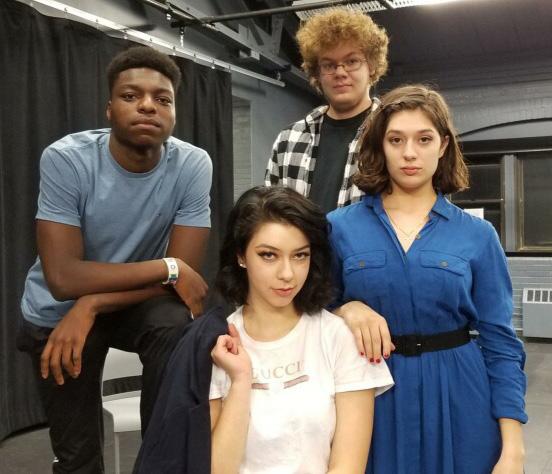
No Exit Comes to HWS
By Alex Kerai ‘19 Editor-in-ChiefWhat do three random strangers, locked together in a room for eternity, have in common? In Jean-Paul Sartre’s 1944 classic No Exit they are there to torture each other in the afterlife. On Sunday, December 9, at 2 p.m. the play will be performed in Williams Studio (located in Williams Hall) with allstudent actors and a student production team. It is being directed by Austin Jennings ‘19 as part of his Honors project and produced in association with the Phoenix Players, the student theatre group on campus.
When asked why he chose No Exit, Jennings said: “I personally love it. It’s like Twilight Zone, and I love those kind of stories which are kind of creepy but have morals and teach us about human nature, and that is very much what this play is.”
The show has been a fun experience for Jennings and his cast – which includes Israel Oyedapo ‘20 as Joseph Garcin, Tayah Payne ‘22 as Inès Serrano, Eva Catanzariti ‘20 as Estelle Rigault, and Troy Tedeschi ‘19 as the Valet. Throughout the process they have all been able to develop their work as actors and directors, with Catanzariti and Tedeschi making their debut as actors at HWS. The production team is also made up of students, continuing with the Phoenix Players’ mission to provide theatre opportunities for students regardless of their prior experience. Jennings has been collaborating with Set Designer Niki Russell ‘19, Assistant Set Designer
Wren Andrews ‘21, Costume Designer Claire Abelson ‘20, Lighting Designer / Producer Alex Kerai ‘19, and Stage Manager Daphna Bendull ‘21 since the end of October.
In fact, the Phoenix Players hope that students will try something new, just as the two Assistant Stage Managers, Dominique Marshall ‘22 and Sarim Karim ‘22, did after their acting debuts with the Mainstage production of Love/Sick in October. This production also allowed Abelson to take on full design duties after working on costumes for Boeing Boeing and 5 Lesbians Eating a Quiche and is preparing Catanzariti for her Mainstage debut with A Servant of Two Masters in the spring. This is what the Phoenix Players does best: providing opportunities for students to hone their skills in all areas of theatre.
Austin Jennings, director of the production, said: “I think it’s important to keep theatre alive at HWS –
it’s not dying but in an educational institution like this, it is important to include new people and give them opportunities to try and learn new things.”
The production of No Exit is very exciting as it is the first Phoenix Players production since Spring 2017 – and the entire cast is new to the group! Come see their incredible performances and the hard work they have put into the production on Sunday, December 9 at 2p.m. in the Williams Studio. If you have any questions about the production, please contact Austin Jennings (austin. jennings@hws.edu) for more information.
The Music Scene
munity is suffering from a lack of loyal and reliable audiences. From a production stand point, this is disappointing, considering the time, resources, and money necessary in put ting a show together – and while students and other patrons complain about an appar ent “lack of good music,” or overall nonexis tence of a music scene here, absence and com plaint are fruitless remedies to the situation.
By Wren Andrews ’21 Arts and Entertainment EditorGeneva overtly touts itself as “The Lake Trout Capital of the World,” home to the Geneva Panthers, the quintessential col lege town surrounding Hobart and William Smith Colleges.
As students, we are exposed to Geneva in a more intimate view than most ordinary onlookers, but many may be surprised to find out that Geneva is also a city with a “weirdly active and diverse music community,” in the words of Kelly Walker, Morn ing Edition Host of Finger Lakes Public Radio and general ad vocate for and contributor to Geneva’s music scene. [Walker is also the Herald’s partner at WEOS for The Seneca Scene, our weekly podcast available on our website, iTunes, and Stitcher.] That is, for its location and size, there are a lot of musical oppor tunities nearby – the band Gym Class Heroes started in Geneva!
While FLX Live, Lake Drum, and Monaco’s first come to mind when thinking of local venues, plac es like Club 86, The Cracker Fac tory, Rylie J’s and Kashong Creek are places generally un-talkedabout within the gated community of the Colleges – yet they offer the same caliber and frequency of live music and entertainment available as widely attended venues. While attendees could definitely expand their musical palettes in explora tion of different places around the city, the larger issue, even at plac es like FLX Live, is that the com


As Kelly Walker says, “patrons have the responsibility to create the scene they want to experience.” This means not only branching out to new literal physical places, and not only branching out to new musi cal “places,” but returning to venues that of fer preferential musical acts and choices. Participation and presence are the feedback necessary in desirably honing and generally increasing live music opportunities in our community.
Stay tuned throughout next semester’s issues of the Her ald, where different venues, artists, and histories will be cov ered in a new music series in the Arts and Entertainment section, in an effort to educate readers about Geneva’s mu sic scene, encourage participation, and end the lazy and ig norant assumption that there is “no good music in Geneva.”
6FRIDAY, DECEMBER 7, 2018 Arts & Entertainment
At right: the cast of No Exit: Israel Oyedapo, Tayah Payne, Troy Tedeschi & Eva Catanzariti Photo Credit: Austin Jennings
Above: Geneva Band Gym Class Heroes
Below: Brad Stewart ‘19 , Austin Kennie ‘19, Rob George ‘19, and Jordan Levi ‘20 perform at FLX Live Photo Credits: Substream Magazine & Dan Bristol/Herald