Small First-Year Class: Changes for Budget and Admissions
By Hrithik Biswas ‘23 Herald Staff
“What does it mean to lead a life of consequence?” This was one of the questions that were asked to applicants in HWS’s admission application, and it has been identified as the cause of last year’s decrease in students applying to and attending HWS.
The administration anticipated 470 students to make up the Classes of 2023, but only 458 new first-year students came to campus this semester. The Herald sat down with Dean John Young, Vice President and Dean of Admissions, and Carolee White, the Vice President for Finance and Administration and Chief Financial Officer, to discuss the small first-year class, the reasons behind it, and what it means for the Colleges in the future.
According to Dean Young, the application question mentioned above “was hard to understand and confusing.”
He explained that this question was one of the reasons why many students did not apply to HWS in the first place, and it will not be asked again this year.
With 150 fewer first-year students than usual, the Colleges have not only taken a hit in their student population but also in their budget. The operating budget of the Colleges is $100 million, and the small first-year class creates a $4 million loss, if the students received the same rate of financial aid. The lack of first-year students ultimately led to a decrease of gross tuition revenue, although the rate in which financial aid is distributed has not changed and remains around 51-53%. This tightened budget is being felt this semester all around campus, impacting everything from student activities to the hiring of new faculty.
As a certified public accountant at the Colleges, Carolee White looks over its budget and finances. She describes her role as one part in “managing a city.” Since there has been no increase in gross
Haudenosaunee Observe 225th Anniversary of Canandaigua
By Gabriel Pietrorazio ‘20 Herald Staff
As the City of Canandaigua was cloaked in powdered snow, the Haudenosaunee and their nonIndigenous allies convened in celebration and observance of the 225th anniversary signing of the Canandaigua Treaty of 1794. Representatives from the Colleges stood in solidarity among them amid freezing temperatures and pelting snowfall.
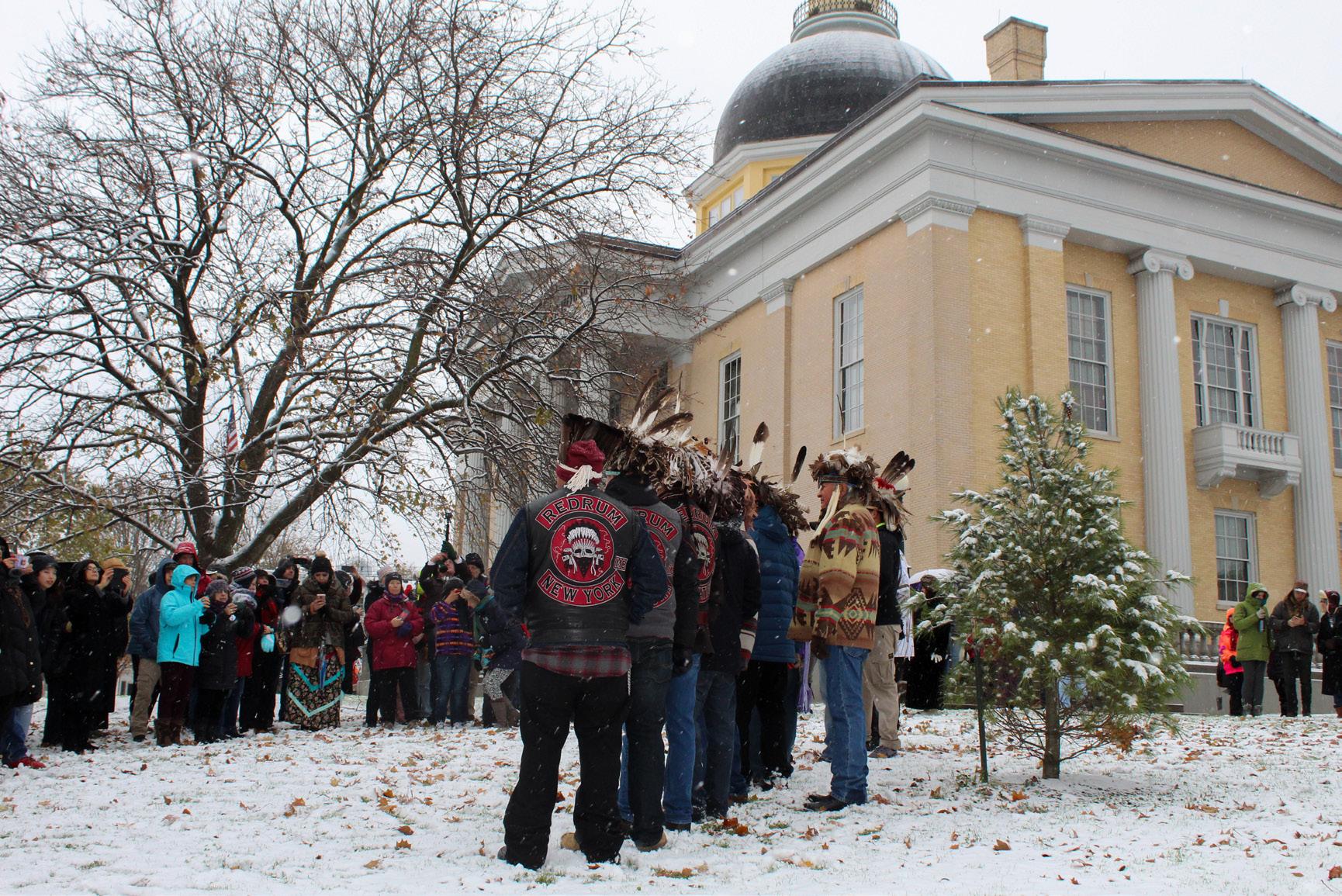
With members present from the Six Nations, also known as the Iroquois Confederacy, leaders of the Seneca,
Cayuga, Oneida, Onondaga, Tuscarora and Mohawk led a coordinated march along the city’s streets. They were followed by members of their fellow nations and then the general public.
Alejandra Molina, director of the Intercultural Affairs Center, has been coordinating annual visits to each Canandaigua Treaty signing anniversary for the last five or six years. She was joined this year by William Smith College student Yichen Lin ’21.
Signed 225 years ago on Nov. 11, 1794, the Canandaigua Treaty was a document meant to promote peace and friendship between the United States of America and the Haudenosaunee.
revenue, HWS has cut back on many costs. This has manifested in part as the Colleges’ not filling up vacant positions, as salaries of HWS faculty and staff make up a large portion of the Colleges’ budget.
White hopes that the Colleges will be able to bring in a first-year class next year more in line with the typical size of 570 to 620 students. Part of its renewed efforts to do so include its investment in a branding study, fully funded by an anonymous donor. According to a recent email from President Joyce Jacobsen, the branding firm SiegelVision has been hired to “conduct qualitative and quantitative research to inform the way HWS represents itself.” The results of this study will play a significant role in the Colleges’ efforts to attract more students.
Another factor in the Colleges’ admissions efforts is diversity, which they aim to increase. “It is easier to
Continued
This historic document affirmed the Haudenosaunee’s land rights, restored the custody of ceded lands from the Fort Stanwix Treaty to the Six Nations, and formally recognized their rights to self-govern and set laws as separate tribal nations through the bestowment of sovereignty.
Although violations of the treaty have historically transpired, the Treaty of Canandaigua has never been broken and remains intact between the Haudenosaunee and United States federal government.
While this treaty may seem out of date or simply obsolete to some, this text is a living and breathing promise: a pact between two sovereigns. This ceremonial observance signifies their continued commitment to the Treaty of Canandaigua 225 years later, even among the likes of Molina and Lin.
“I really see it as very rewarding and humbling in a way, and out of historical respect, that we can’t change history, but at least we can, in a very respectful way, enter into the current history or the current moment of communities such as the Seneca and Haudenosaunee,” Molina stated.
Molina insists that students and faculty alike have a “historical obligation or historical responsibility” for them to learn about and acknowledge the cultural significance of the Haudenosaunee while belonging to the campus community.
Academic Day Schedule, p. 4 Student Trustee Readout, p. 4 Laundry Costs, p. 5 On-Campus Overdoses, p. 6 Established 1879 A Voice for the Students News
Attendees at the Canandaigua
Treaty Signing Photo: Gabriel Pietrorazio
‘20 Continued on page 3
on page 2
The Herald
Established 1879
By and for the Students of Hobart and William Smith Colleges
www.HWSHerald.com
Russell Payne, Arts & Entertainment Editor and Design Editor
Reed Herter, News Editor
Olivia Rowland, Copy Editor
Albright Dwarka, Podcast Editor & Web Editor
Gianna Gonzalez, Marketing Coordinator
Audrey Platt, Social Media Coordinator
Contributors
Hrithik Biswas
Elise Donovan
Gabriel Pietrorazio
Layout Russell Payne
Olivia Rowland
Copy Editing Olivia Rowland
Charlie Wilson
Emily Rich
Olivia Rowland
Maya Striuli Submission Guidelines
Distribution Olivia Rowland
Dear Readers,
Welcome to this semester’s final issue of the Herald!
As always, we appreciate your taking time to support our reporting, especially during the end of the semester.
This issue contains a number of stories on serious issues of significance to the HWS community. First among these is our story on the recent overdoses that occurred on campus in late November, in which we consider Campus Safety’s response to the incident and substance abuse on campus generally. We also explain why the Colleges’ first-year class is so small this year and explore what it means for the Colleges’ budget and admissions procedures.
Our article on the new academic day schedule implemented this semester reveals students’ perceptions of the changes and highlights recent efforts to reconsider the schedule, while encouraging students to make their voices heard in this process. One way for students to do this is through the Student Trustees, who are covered in our article about their recent readout on Board of Trustees meetings. This article also contains an update about the progress the Colleges have made on updating the coordinate system based on the guidelines for change identified last semester.
Another issue of importance to students covered in this issue is the increase in laundry machine prices that took place this semester. Illustrating the effect of making your voice heard, staff writer Gabriel Pietrorazio ’20 found out that the administration was unaware of the price increase and has since promised to revert it by the spring semester. (So you can thank Gabe when you do your laundry!)
Two articles in this issue also consider the importance of students’ voices in creating change on campus. We focus on two student-led projects, HWS Gain InSite and No More HWS, that are using art to create conversations about sexual assault and violence on campus. They show that students’ actions, especially as a collective, can have a large impact.
Though all of our articles are created to be of relevance to the HWS community in particular, this issue, like others, extends beyond campus and considers the connections the HWS community has in the local region. Our article about student attendance at the 225th anniversary of the Canandaigua Treaty explores the evolving relationship between HWS and the Seneca people, who owned this land.
The Herald is currently accepting submissions for our upcom ing issue. The deadline is Monday at 5 p.m.
Must include the:
1. Name and Class Year
2. Individual phone number or e-mail E-mail submissions must be made via file attachment.
If criteria are not met ,
The Herald may not be able to print the submission.
Finally, this issue also includes another profile of one of HWS’s newest faculty members, Joyita Chowdhury in the Economics department. In this article, Chowdhury explains her research and teaching background and talks about her time at HWS so far.
If you enjoy this issue of the paper and want to see more, or if you prefer to listen to your news, check out our podcasts on our website, www.hwsherald.com! In addition to new podcasts, you’ll also find all of our print news and our contact information online.

Additionally, we are always in need of more student participation in the Herald! If you want to write articles, take photos, edit copy, do layout and design, manage our website, conduct interviews, or produce podcasts, please contact us at herald@hws.edu or look out for information about our meetings next semester. If you want to write an opinions piece, please see our guidelines for submission to the right and contact us with any questions. Until next semester!
Sincerely,
Herter
Payne
Rowland
say, but is hard to do,” says Young. With more diversity, the Colleges will provide an interesting place to learn from different backgrounds and understand people’s stories. The collective environment is what allows it to be a thriving place to gain a liberal arts degree.
Young summed up the Colleges’ admission goals, saying, “In my perspective, I believe in recruiting, admitting, enrolling, attending students who will benefit from what HWS has to offer and contribute to the campus.” The success with which the Colleges are able to do so will determine what the campus—and budget—looks like in years to come.
Activism or Graffiti? Project Causes Controversy on Campus
By Olivia Rowland ’21 Copy Editor
This is not the first semester that the HWS campus has been decorated with chalk paint, an easily removable and environmentally friendly spray paint, as part of student projects. One student group’s use of chalk paint to communicate their message, however, has raised questions about the use and limits of this medium for activism.
The group, called No More HWS, aims to promote “sexual assault awareness and sexual harassment awareness.” It was formed as part of a project for an Architecture class focusing on the social construction of space. Other groups coming from this class have worked to address sustainability, addiction, and social
power on campus.
While these groups have sprayed chalk paint on the sidewalk, the students in No More HWS decided to spray their message on buildings across campus at the end of October. They tagged the Title IX Office’s sign, several fraternity houses, and some athletic facilities, in addition to some spots on the sidewalk.
This decision was met with immediate backlash from the affected fraternities. In an online statement, the presidents of the Hobart chapters of Chi Phi, Kappa Sigma, Delta Chi, and Kappa Alpha condemned the paint as “an act of vandalism targeted at fellow student run organizations.” According
FRIDAY, DECEMBER 6, 20192
Reed
‘22 Russell
‘21 Olivia
‘21
Continued on page 3
Continued from page 1
News
Continued from page 1
Throughout the years, Molina mentioned that only a handful of students have joined her on each year’s trip, but she still does not define levels of enthusiasm based on turnout.
“It’s always small groups, right, but there are always very solid consequences,” Molina said.
Those consequences seem to translate on campus for Molina as she sees a shift in how student groups and organizations recognize the converging complicated histories of the Colleges and Seneca Nation.
“When you go to events now that people will host, there’s almost a statement that everybody’s in agreement with, but it’s a statement recognizing the land,” Molina expressed.
But beyond recognition, Molina concedes that the Colleges have taken steps to honor this past and history by sharing the responsibility among students, faculty and administrators.
Despite the Colleges’ current efforts, Molina claims that “we’re not there yet to have a better sense of this area,” which is essential for any student to understand when deciding to call Geneva and the Finger Lakes their home for four years.
“I think that having that sense of place to be able to say after your four years here, that as a student, you can say, I lived in Geneva, New York for four years and wow, so many social movements started here,” Molina continued.
Consequently, the way that students can gather a grounded sense of local and regional Indigenous history has been primarily through limited coursework opportunities on campus.
“Knowledge will always, I think, by nature be fragmented,” Molina said.
While the institution has taken strides with Professor Jeffrey Anderson of Anthropology and Assistant Professor Whitney Mauer of Environmental Studies by offering courses focused on Indigenous histories and cultures, Molina still begs the question: is there an institutional connection that bridges siloed and segmented structures of scholarship together?
“So, you see different pockets of where social justice or at least the message on Native American issues happen, but it may be unavoidable,” Molina added.
In spite of perceived institutional segmentation and disparities of knowledge among academic
settings, attending the Canandaigua Treaty celebration functions as an impressionable and impactful experience for whoever participates.
Lin admits to discovering a great deal about the Haudenosaunee, including learning about the significance of headdresses and how feather arrangements dictate tribal alliances. “The directions of the feather on the headwear also matter. The wrong direction might represent another tribe,” Lin shared.
While in Canandaigua, Lin also found out that the Haudenosaunee functions as a matriarchal society.
“The women had more political power compared to men. The woman elder is called clan mother. She is the one who decides who can be the leader for the tribes and could dismiss them whenever she wants,” she stated.
Peter Jemison of the Seneca Nation, also the Ganandogan Historic Site manager, emceed the commemoration ceremony. For Molina, his verbal reflections sounded as if “it is our nation speaking to members of another nation.”
“I always get that sense of, I’m entering in Canandaigua, and so, there is a sense of almost an existential dimension. I’ve been to the lectures to go to the festivals and it’s that sense of literally, I’m stepping into their history and their land. So, it’s important for us to continue having that sense as we stand on the land of the Colleges as well,” Molina continued.
This year, Jemison invited two descendants of Colonel Pickering, the U.S. government agent who signed the treaty, as distinguished guests:
Timothy Pickering and Ambassador Thomas Pickering, a distinguished fellow in foreign policy at the Brookings Institution who has served as a diplomat for the United States for more than four decades.
Following the march, Jemison recited the Haudenosaunee’s Thanksgiving Address in his native language and then recalled the preceding history that premised the treaty agreement’s ratification.
The ceremonial observance culminated when Jemison expressed that his ancestors from the Six Nations were “very impressed” with Colonel Pickering and his sincere intentions when it came to the treaty-making process.
“Timothy Pickering was not trying to get land. That was not his goal; his goal was to try and find a peaceful way to resolve the differences and the difficulties that persisted even after the end of the Revolutionary War, leading up to the negotiations for the Canandaigua Treaty. And so they began to trust him for that very reason that there was not another ulterior motive to the work that he was doing,” Jemison concluded.
Despite intrinsic differences, a communal culture of respect and solidarity was created among the Haudenosaunee on this date of great significance for sovereign tribal nations throughout the United States. The Colleges and their close proximity to Canandaigua allowed Molina and Lin to be appointed as the Colleges’ proverbial ambassadors to watch and participate in the celebration and observance of this historic treaty anniversary.
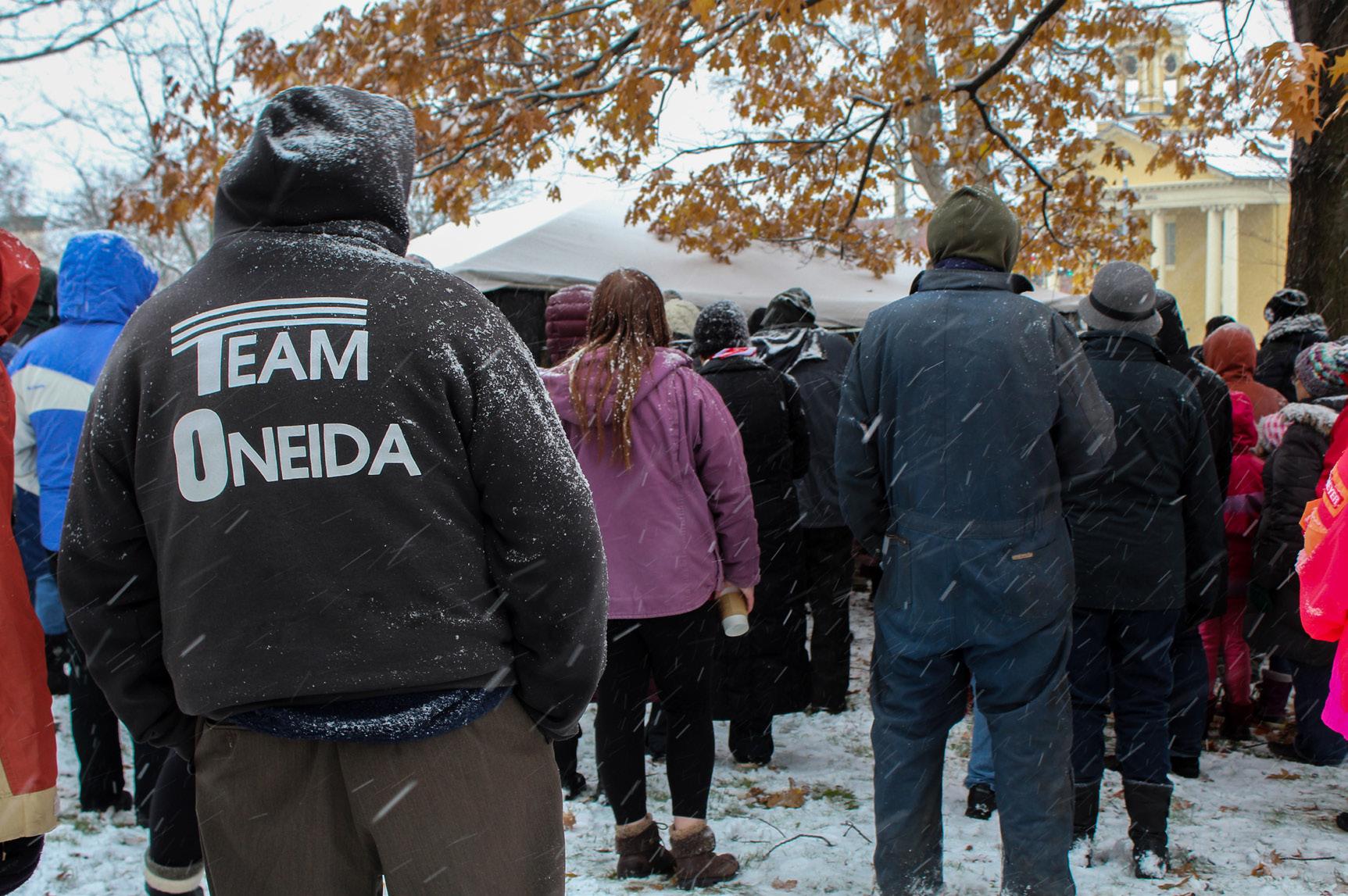
Attendees at the Candandaigua Treaty Signing Photo: Gabriel Pietrorazio ‘20 to the statement, the fraternities reported the chalk paint as such to Campus Safety.
The four fraternities argued that they “are in lockstep when it comes to supporting sexual assault awareness and our actions this year prove just that.” They cited their trainings with the Title IX Office and HWS One Love and their engagement in conversations about these issues with the administration.
“We encourage everyone to engage in this discussion in a cordial manner,” the statement said. “However, this discussion must exclude vandalizing our chapter houses, front porches, and private property.”
Other students disagreed and supported No More HWS online, where most of this controversy took place.
Boss Bitch Theory, a feminist Instagram account run by women’s studies students, argued in a post that the “harm” of the chalk is nothing compared to the harm of sexual violence.
“I am tired of only hearing the voices of so many privileged and powerful groups on campus only when actions are being done against them (chalk)
but not when their voices could actually make some sort of difference. Why are you coming into the conversation so adamantly and seriously now, gathering to brainstorm and type out such a formal letter, but not when we are discussing the ways we can change the culture on our campus?” Boss Bitch Theory asked.
The post concluded by expressing a desire for the fraternities to take sexual violence “as seriously as you took the chalk on your frat houses.”
According to the students in No More HWS, the entire situation was a misunderstanding.
Emma Lubrano ’20, the group member who physically tagged the fraternity houses, says that she asked for and received permission from the fraternities to tag their houses. “It was a miscommunication between us and the fraternity brothers,” she says.
Lubrano and the other group members hold that the purpose of tagging the fraternity houses was to raise awareness about sexual violence, not to vandalize anyone’s property. They had no intention to specifically target fraternities or “perpetuate stereotypes about
fraternity brothers,” says Lubrano. Instead, the group wanted to draw attention to the fact that sexual violence does occur in and around the fraternity houses, particularly considering the instance of sexual assault covered in 2014 by The New York Times, which took place in part at Kappa Sigma.
The group also points out that the chalk paint on the other buildings they tagged was not received as negatively, as they got “no response [and] no offense” from the athletic facilities included in the tagging.
Since this incident during the group’s first round of tagging, they have shifted their strategy to focus on campus in general instead of the fraternities, and they have not tagged any more buildings, sticking to sidewalks instead.
Their message, however, has not changed. “It is time to have a serious discussion about sexual violence on our campus,” the group said in a recent Instagram post. “Have the conversation now.”
3 FRIDAY, DECEMBER 6, 2019
Continued from page 2
New Faculty Profile: Joyita Chowdhury, Economics
 By Hrithik Biswas ‘23 Herald Staff
Professor Joyita R. Chowdhury joined the Colleges this fall as a Visiting Assistant Professor of Economics. She is originally from West Bengal, India, where she received her BSc and MSc in Economics and her M.Phil in Development Studies and Economics from the University of Calcutta, India. After moving to the United States, Chowdhury received her Ph.D in Economics from the Universtiy of Utah.
Her research takes place in the field of economic and human development, with particular attention to poverty and inequality. Chowdhury has conducted much research back home in India and here in the United States in this field, focusing on women’s empowerment and employment, child labor, and how farmers cope with environmental crises.
These projects have cemented her professional interests in poverty alleviation and collective action, which she plans to continue to pursue during her time at HWS and beyond. “I aim to focus on contributing to human development studies and look forward to the possibility of collaborative research with faculty and students at Hobart and William Smith Colleges,” Chowdhury says.
Chowdhury’s research interests and accomplishments are also important for her teaching role. “I love to weave my development economics research in my teaching to provide my students with real-world applications of theories,” Chowdhury reveals.
Outside of academia, she enjoys listening to classical music, singing, and cooking. Chowdury has enjoyed living in the Finger Lakes region so far, as she enjoys “the beauty of Seneca Lake and historic houses” and is looking forward to further exploring the Geneva area.
Too Much Class, Not Enough Time: Students on the Academic Day Schedule
By Emily Rich ‘21 Herald Contributor
For full-time students here at Hobart and William Smith, it can be an overwhelming task to balance academic and social lives while making sure to be involved on campus. In the hopes of easing these tensions, the Colleges have implemented a new academic schedule, which went into effect for the first time this semester.
The previous schedule had 10-minute breaks in between classes, which were 55 and 85 minutes long. Under this schedule, classes began at 8:00 a.m. at the earliest and ended by 4:30 p.m.
The new schedule gives students 15 minutes to get to class, something students with classes on the arts campus had long requested, and rounds class times up to 60 and 90 minutes. Classes now begin at 8:30 a.m. and end much later—for most students, the regular academic day ends around 5:00 p.m., but for students taking optional night classes, the end of class can be as late as 10:00 p.m.
Upperclassmen who have experienced both schedules seem to
have a varying love-hate perception of this change. For some, not waking up early for morning classes is a plus, but this also means that many of the midday and afternoon classes are on the same days or conflict with other activities.
Tuesdays and Thursdays seem to be worst of all. A number of required upper-level or seminar-style classes are only offered on these days, often back to back, which means that a lot of students are having trouble finding time to grab a bite to eat during the day.
Besides the workload that comes with having unevenly distributed classes, students are finding themselves even more exhausted from taking in so much information in such a short amount of time. Although students being tired does not come as a shock, students are finding that is affecting their ability to concentrate after class.
While some are struggling to maintain an optimum daily schedule amid the changes, others have free time in the afternoons that allows them to have a meal with friends and meet with professors. Those who have these advantages are actually experiencing the intentional benefits of the schedule change, as having time to replenish and
meet with faculty and organizations is vital to all college careers.
The administration is aware that the change has not been beneficial for some students and has come with some unanticipated drawbacks. Despite administrators’ efforts to receive student and faculty input during the design of the new academic day schedule last semester, the new schedule does not seem to have widespread support. As such, the Office of Academic and Faculty Affairs is currently running a survey to review and refine the current schedule. Emails containing the survey were sent to all sophomores, juniors, and seniors on Dec. 2, and the survey will be available until Dec. 9.
Students with any opinions about the academic day schedule are encouraged to take the survey to provide their feedback. The Office of Academic and Faculty Affairs is particularly interested in hearing from students about how much time they prefer to have in between classes, how long class periods should be, and how the schedules affect student-athletes.
Our time at HWS is important, so make the most of it and voice your opinions.
Student Trustees Hold Board Readout and Update on Coordinate
By Elise Donovan ‘22 Herald Staff
On Oct. 29, the oldest and newest Student Trustee inductees held an open board readout to provide updates to the student body on the goings on of the Board of Trustees and, more specifically, the latest decisions reached at the first of three annual meetings. In the readout, Student Trustees Gianna Gonzalez ’20, Audrey G. R. Platt ‘21, and Albright R. Dwarka ‘21 showed a detailed slide show of updates, as well as provided a time for questions and answers from the crowd.
For those unaware of the role of the Student Trustees, a defining slide was posted that addressed the students’ roles as liaisons between the administration and the student body, as well as just a louder voice for students.
All Student Trustees also made sure to
emphasize that within their roles, they have not been shy in expressing student issues, even if some of those issues act in contestation to the Board’s wishes.
In continuation of the presentation and discussion, the Student Trustees focused the rest of their time talking to their work on the Student Experience Committee, as well as other topics of significance that have been or will be brought up to the trustees at a future meeting.
In terms of the work on the Student Experience Committee, which is the one board all four students sit on together, trustees first spoke to the things they have already accomplished during their tenure. The first subset of changes revolved around efforts made by the Board to redefine and reconstruct outdated ritual coordinate practices that do not advance the
Colleges’ goals surrounding inclusivity and opportunity for all students.
The first of these changes, in regard to new student Orientation, was the consolidation of separate Hobart and William Smith matriculation tents to one singular comprehensive tent. Moreover, the trustees also worked to establish the Blackwell Hale-Dinner, which mirrors the long-standing Hobart Hale Dinner, as a place to celebrate all Hobart and William Smith students receiving academic awards given by HWS departments and programs, as opposed to just Hobart students.
In continuation, the Student Trustees talked to the elimination of gender-specific pronouns on all administrative and regulatory forms. Lastly, within the category of specific coordinate structural change, the trustees presented the most anticipated
4 FRIDAY, DECEMBER 6, 2019 News
Professor Joyita Chowdhury
Continued on page 6
News
Laundering Laundry Costs: Colleges Promise to Revert Washer Cost
By Gabriel Pietrorazio ‘20 Herald Staff
At the beginning of August, students across campus unexpectedly discovered a trivial but palpable cost increase for washer machine services from the previous rate of $1.50 to $1.75 per cycle, a raise of 25 cents.
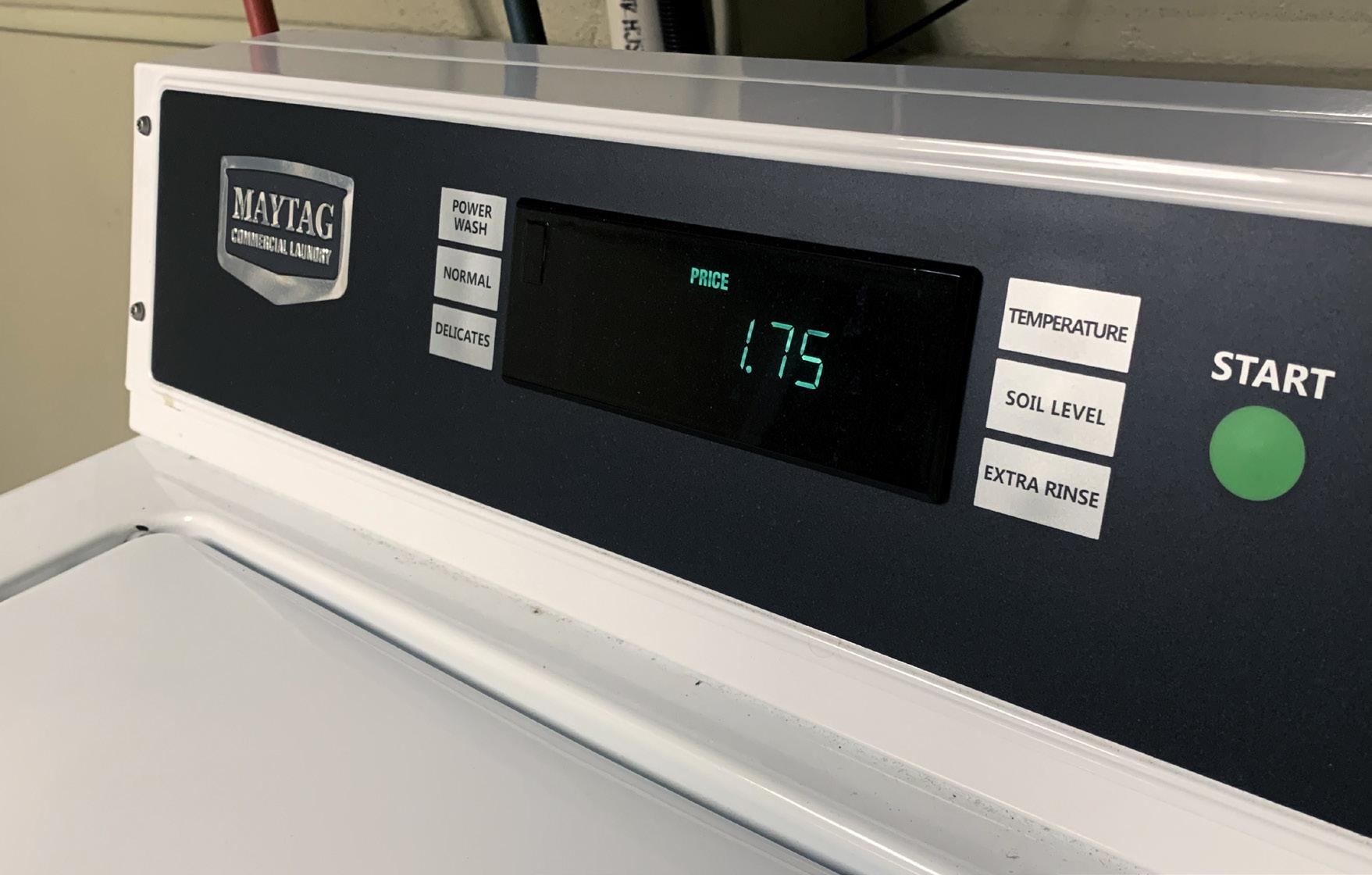
This sudden price shift was not primed with any formal communication or correspondence from the Office of Residential Education, and administrative officials have confirmed with the Herald that they were in fact unaware of the fee inflation and will bring the price back down by next semester.
In an article published in 2016 by the Office of Communications titled “Laundry Changes to Boost Energy Efficiency,” the Office of Residential Education noted that prices “will remain fixed for the next 10 years,” from 2016 until 2026 at $1.50 for
each machine as an agreement with the Colleges’ unnamed laundry service vendor.
Robert Flowers, vice president for campus life, informed the Herald that administrators were not aware of the current situation and since contacted the vendor, who later confirmed that they increased the washer service costs, not the Colleges.
Chief Financial Officer Carolee White directly contacted the vendor, who immediately admitted to raising the washer fees without relaying that information to the institution.
Flowers noted that the vendor accepted fault and full responsibility for the incident.
Following these findings, this information was flown up the flagpole to President Joyce P. Jacobsen, who swiftly determined that the clear course of action was to “roll it [washer costs] back.”
Since then, Flowers was briefed by the vendor that the OneCard system will be reprogrammed during the winter break.
“So, their idea will be to do this over the winter break and roll the price back,” Flowers said.
As for who picks up the tab, Flowers concedes that 25 cents per wash is an inconsequential cost for the Colleges to incur in comparison its overall budget, but he aims for the vendor to cover the cost difference in honor of their ten-year fixed rate agreement.
“Our goal would be to push that on the vendor, but one way or another our goal would be to have the vendor bear most of the burden for that,” Flowers stated.
At one point, students used to count and bundle their quarters together to check off the laundry chore each week. Eventually this process was automated amid the advent of the OneCard.
But looking beyond swiping OneCards, Flowers has revealed that he has been exploring the possibilities of a future where the Colleges can provide a financial package that offers free washing and drying on campus in collaboration with the current vendor.
“That would be the ideal, but we have to work through that; because as you know, we can't ask students for more money,” Flowers said.
“We're in a place where our goal will be to, if we can do that and find a way forward that makes sense and maintains our commitment to try to provide the most affordable education that we can, then we'll do that, but we want to look through that as we go forward,” he concluded.
HWS Gain InSITE Maps Violence on Campus
By Maya Striuli ‘22 Herald Staff
Recently, there has been a lot of buzz surrounding the appearance of chalk around various locations around campus. Many have wondered what it was meant to represent and the stories behind it. These all came from Professor Kirin Makker’s Arch 412: Social Constructions of Space class, where the students were split up into groups to focus on a specific topic of their choosing. The Herald spoke with @hws_gain_inSITE, one of the groups, about their journey and mission.
@hws_gain_inSITE was born when a group of four students wondered how they could use space as a tool for advocacy and a reclamation of space. As they decided to focus on sexual assault, harassment, and violence, they realized how there is a lot more to these complex issues than what is typically considered. For instance, there’s a lot of different types of violence, such as gendered and racial violence.
Though they recognize the resourcefulness of Title IX, the students behind @hws_gain_inSITE also know that there are a lot of “students who are fearful of reporting for a variety of reasons,” which “prevents people from telling their stories and reclaiming spaces.” The anonymity of their project, which relies on the stories of students and alumni from HWS from a form that was sent out to the community, offered them the chance to simply share their
stories without any fears—“creating space for people to heal was the goal.”
The form took into account the following types of violence: sexual assault, sexual harassment, racebased violence, gender-based violence, LGBTQ+ violence, and hazing. It also asked for the location of the instance of violence. The orange glasses around campus mark the locations where violence occurred.
As people shared their stories, @hws_gain_inSITE found that over 50% of the responses were instances of sexual assault, and that the majority were personally experienced, rather than witnessed. Something unexpected, however, was that the “majority of submissions were within residential halls, not fraternities,” which led to another question as to “if there is a bias for people who feel comfortable reporting based off location.”
@hws_gain_inSITE used the form to create a digital map where everyone can go and see the marked locations, what instance of violence took place there, and some of the stories of the affected individuals. They also created an installation reflecting the experiences of the survivors inside the Scandling Center, which had cutout glasses representing the type of violence and a quote from the survivor.
The glasses represent clarity and vision in regard to the situations faced by many people. This installation wasn’t originally planned, but it was
an emotional project where they were able to use “art as a coping mechanism” and actually do something with the submissions.
Regarding potential room for change on campus, @hws_gain_ inSITE acknowledged that the project happened at a good point in time. There was a shift in Title IX leadership, with Bill Boerner as the new coordinator who is striving to be “more transparent while retaining confidentiality with more preventing programming rather than reactionary measures.”
However, the issue goes beyond HWS, and the stigma surrounding violence is all around the world. It’s about continuing the conversation for survivors and “what it means to reclaim your body and the space.” It also means “continuing the conversation with fraternities because of the culture behind it,” although @hws_gain_ inSITE would like to acknowledge that there has been a shift in fraternity leadership and that the fraternities have “been doing a lot of work with OneLove to become better.”
Reclaiming space and being able to feel comfortable sharing stories are critical steps in the healing process for many survivors. What started as a group project for class has turned into an emotional, important, and much needed space for the HWS community. This space allows for the community to partake in this healing process, empathize with others’ experiences, and force others to acknowledge the violence that occurs on this campus.
5FRIDAY, DECEMBER 6, 2019
A laundry machine showing the raised price Photo: Gabriel Pietrorazio ‘20
Continued from page 4 announcement of the readout in regard to coordinate structures. In effect, starting with the Classes of 2020, all current and past HWS students and alumni have the ability to decide what college their diploma will read.
In the past, students had the opportunity to choose for their diploma to read either Hobart College or William Smith College; however, now students will have the ability to choose between Hobart College, William Smith College, Hobart and William Smith Colleges, Hobart College of Hobart and William Smith Colleges, or William Smith College of Hobart and William Smith Colleges. As aforementioned, alumni, if they choose, have the ability to be reissued a new diploma within any of these categories as well.
While this development seems to be a large win on behalf of students and Board members, all of the Student Trustees continued to stress that since the reaffirmation of the coordinate structure in Oct. 2018, the students and Board are continually working to address and work toward longterm structural change in regard to
coordinate issues. To better and more specifically deal with these issues, the Board of Trustees instituted a Coordinate Task Force. The trustees also provided a shout out to Sydney Gomez ‘17, who started a lot of the conversations surrounding coordinate at HWS.
Within the second part of the meeting, the Student Trustees continued to address some of the important issues of the Student Experience Committee, and they opened up the meeting for any questions or concerns from students.
The first issue addressed revolved around some of the faculty shortages, as well as missing department leader positions such as the new Provost and Chief Diversity and Inclusion Officer. Since the readout, Mary Coffey has been chosen as the new Provost and Dean of Faculty, while the search for the Chief Diversity Officer is still underway.
In response to a question posed by a student about overall department faculty shortages, Platt responded by urging students to reach out to the chair heads of the Committee on Faculty and the Committee on Academic Affairs to
push concerns regarding shortages and urge chairs to address the issues.
Toward the end of the meeting, the trustees asked for the crowd’s input on the structuring of the new class day in order to have some insight to bring back to the Board. While pretty detailed, the discussion primarily revolved around the misalignment of the new class day with other schedules on campus such as the Counseling Center hours, Saga times, and club meetings.
In conclusion, the Student Trustees addressed the importance of an academic day schedule survey that would be put out, and has been put out as of Dec. 2, that encompasses a lot of student concerns as well as provides a way for students to express these concerns. This survey can be found in students’ emails.
More than this, the trustees made it apparent that any student concern can always be voiced to any of them in person or through email at studenttrustees@hws.edu. The next Board readout will occur in February after the next major Board of Trustees meeting.
‘Snowbart’ Sunday: The Aftermath of Three On-Campus Powder Fetanyl-Laced Cocaine Overdoses
By Gabriel Pietrorazio ‘20 Herald Staff
Within a span of four hours, seven lives were saved between the cities of Geneva and Canandaigua from opioid overdoses early Sunday morning on Nov. 17th.
From 1:35 a.m. until 3:46 a.m., the Geneva Police Department received five overdose calls, all of whom were male and ranging in ages from 19 to 44 years old.
Three of the five separate cases in Geneva were identified as male Hobart College students. Those overdoses happened on campus, while the other two incidents resulted from non-college residents, but all five overdoses were all related to the consumption of powder cocaine that was laced with fetanyl.
The Geneva Police Department responded to all five calls, and the majority of overdoses necessitated three doses of naloxone, a drug that is used to treat opioid overdoses, for each patient.
Vice President for Campus Life Robert Flowers praises and accredits Campus Safety’s swift actions and responsiveness, which helped save the lives of those students who overdosed that weekend and narrowly escaped death.
“I’m really pleased with our Campus Safety staff, and our on-call staff. They could not have acted more professionally, and quite honestly, in this case, they saved people’s lives, and we can’t ask for more than that,” Flowers said.
Flowers even admits that Campus Safety officers went above and beyond the call of duty by surveying the surrounding area to see if any other potential students needed medical attention.
“Not only did they save the lives of three people whom we identified, they went and cast a net as wide as we possibly could to try to say is there anyone else who needs our help right now,” he continued.
As of last May, Director of Campus Safety Marty Corbett announced that naloxone became accessible across the campus. Every AED station and Stop the Bleed kit has Narcan, the brand name for naloxone, available. Additionally, each Campus Safety officer carries naloxone on hand to treat others and even themselves due to the looming threat of accidental exposure, which has cost the lives of responding law enforcement officers nationwide.
In the aftermath of these unprecedented overdosing outbursts, Flowers aims to evaluate and implement new precautionary measures to ensure greater public safety and preparedness on campus.
“The other thing I’m thinking about is more training and possibly connecting more of our staff to have first aid and CPR training, perhaps Narcan training,” Flowers stated.
Some among the Colleges mockingly refer to Hobart as “Snowbart,” not only because of Geneva’s high snowfall percentages, but more prominently because of its reputation as a college where cocaine consumption seems to run rampant among the student population.
Despite its fiercly contested reputation both on and off campus, Flowers defends the Colleges’ substance abuse track record, which he claims is on par with similar liberal arts institutions.
“Our data is normative with other northeast private liberal arts colleges,” Flowers stated.
Dismissing Hobart’s unofficial nickname as “Snowbart” and characterizing it as a “misnomer,” Flowers claims that less students have been hospitalized for drug- and alcohol-related reasons within the last few years.
“It was a result of alcohol overdoses that were lower than others, and we’ve seen a significant decrease,” he added.
But most of all, Flowers emphasizes the importance of the Colleges’ Amnesty Policy that protects any students who seek medical assistance from the fear recourse or punishment in the form of “disciplinary actions for violations of alcohol and/or drug use policies based on ingestion occurring at or near the time of the incident.”
Students who claim amnesty are essentially exempt from disciplinary action, and this includes bystanders who aid students by calling Campus Safety.
The amnesty policy is also applicable in situations involving sexual or gender-based harassment, sexual assault, sexual exploitation, intimate partner violence, physical assault, stalking, or retaliation.
For future reference, those who seek to claim amnesty may contact the Campus Safety office by calling 315781-3333.
News FRIDAY, DECEMBER 6, 20196
