Illness leads to absences
By Justin Tang and Nathan Wang
The school reported a record-breaking 344 sick absences in November this year, the most since March 2019, according to Student Discipline and Attendance Coordinator Gabriel Preciado. In the most recent Chronicle Poll, 67% of students said they were recently sick.
65 students were absent due to illness on Nov. 7 alone, according to data retrieved from the number of absence forms submitted through the online parent portal.
Head of Upper School Beth Slattery said the COVID-19 pandemic encouraged symptomatic students to stay home.
“I do think that COVID-19 actually caused people to be more mindful of staying home,” Slattery said. “Now, if you are coming to school and you’re coughing, other people will police you, so you also don’t want to kind of get shamed. I think people stay home because they’re embarrassed to come to school sick.”
Community Health Officer Milo Sini said he advises students, sick or not, to consistently practice good health practices.
“It’s this balance of having a really high immune system, which includes plenty of sleep, good eating habits, taking your vitamins and doing all those things, which becomes a little bit hard,” Sini said. “[Students] stay up late and study late and what have you. My advice is to try to have a balanced life, and predominantly, sleep and good nutrition are key.”
President Rick Commons said the school values an in-person learning environment as much as the medical well-being of the students.
“We’ll prioritize being in person in as normal a fashion as possible alongside the health and safety of our community,” Commons said. “Those do seem to me to sometimes be an inverse relationship, and that’s sometimes a challenge.”

Departments decrease the number of Advanced Placement courses offered
By Davis Marks
The English, History and Math Departments are removing several Advanced Placement (AP) courses from their offerings following changes to the school’s approach to AP courses, beginning in the 2023-2024 school year.
The English Department is discontinuing all of its AP courses, the History Department is discontinuing AP United States History (APUSH) and the Math Department is discontinuing AP Computer Science. APUSH and AP English courses will be changed to honors-level courses, and AP Computer Science will be replaced by an unweighted Advanced Computer Science course.
In light of the replacement of AP classes with honors courses, the school is changing its AP limit policy to an AP and Honors limit. Under the new system, sophomores will be able to take a maximum of three AP and honors courses, and juniors and seniors will be able to take a maximum of five.
Head of Upper School Beth Slattery said the adjustment to the classes themselves was inspired by many teachers feeling limited by the AP curriculum.
“The changes were mostly inspired by the quality of our




faculty and the fact that they are more than capable of creating a curriculum better than what the College Board can design,” Slattery said. “AP courses can be limiting because they’re tied to an external test, as they’re designed for schools with fewer resources than us that need an external way of validating the quality of a student’s performance. So we’re not philosophically saying we’re against APs, but we want the experts in the subjects to decide what is best for our students.”
Science Teacher and Chair of the Faculty Advisory Committee (FAC) Heather Audesirk said FAC decided to slowly phase out AP classes upon growing conversations about the role the AP program has at the school and will continue to discuss if all AP classes should be eliminated.
“In the discussions in FAC, it immediately became apparent that different departments had different opinions about AP classes,” Audesirk said. “This meant that it didn’t feel right to make a sweeping policy that would require everyone to eliminate their AP classes or require people to keep those classes. The general consensus seemed to be that it might be in the best interests of the school to begin
the process of phasing out AP classes, especially in subjects where the APs weren’t serving the teachers and students well.”
History Department Head Larry Klein said the History Department felt that because the school’s APUSH course does not explicitly follow the AP curriculum and prepare students for the exam, the change better represents what the course is.
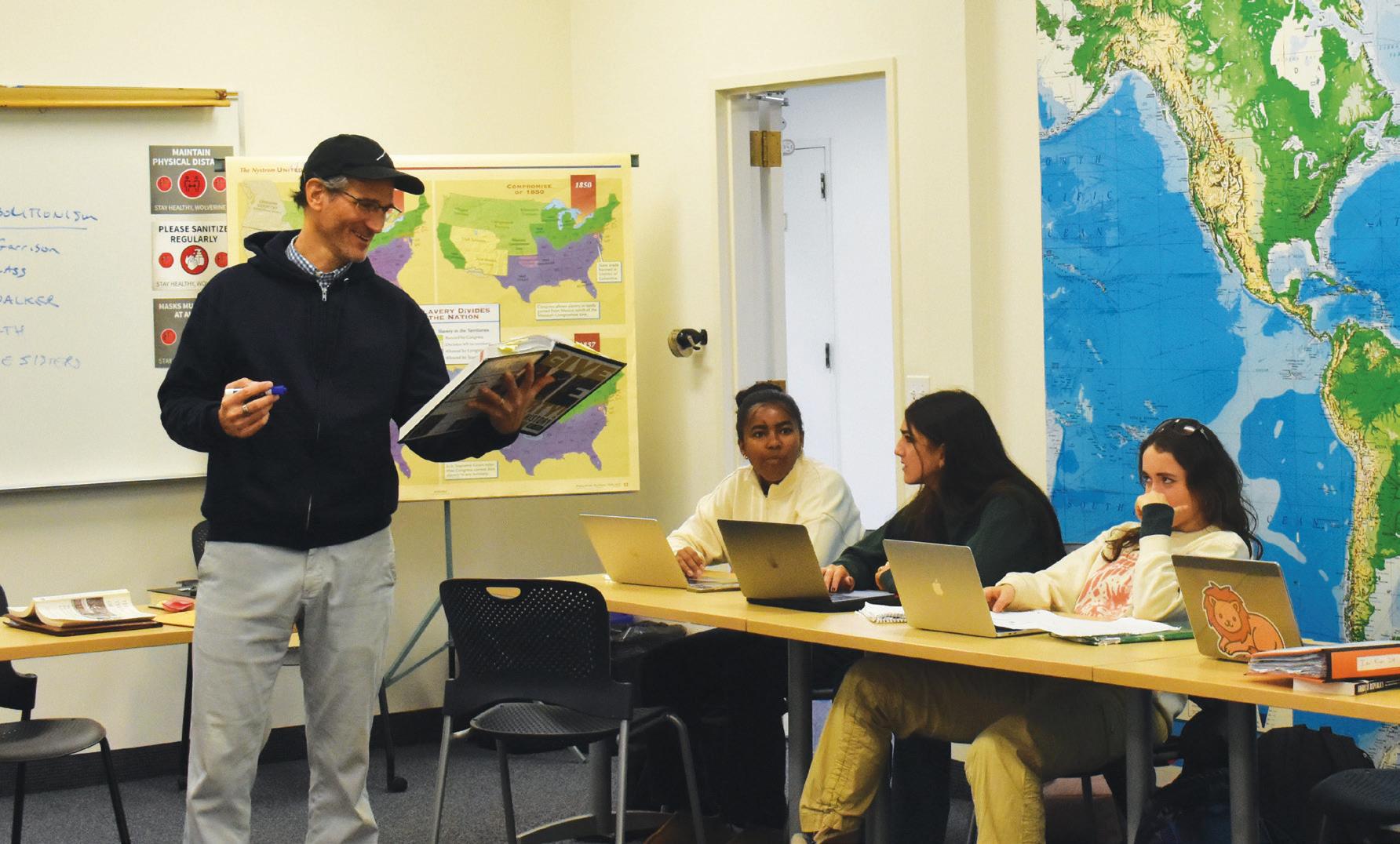
“This change clarifies that we’re not teaching the College Board curriculum, but instead, teaching our version of an advanced United States history course,” Klein said. “By having the AP title attached to it, the course and student attention become too centered on the AP exam, and while the course coincidentally prepares [students] for the exam, it has never been the centerpiece of the course.”

English Department Head Larry Weber said as the AP exam has become less important, the English Department wanted more freedom to design their courses.
“As the AP test and its results have become de-emphasized, we wanted to continue to develop our senior electives, with the same rigor and more creativity, outside the auspices of the College Board,” Weber said.
Weighted GPAs return
By Chloe Park and Natasha Speiss
The Faculty Academic Committee (FAC) voted to include weighted GPAs on student transcripts starting with the class of 2024, following a proposal from the Upper School Dean Team on Dec. 8. The school considered adding weighted GPAs to transcripts in September but decided to postpone the decision so it would not affect current seniors’ application process, as reported by The Chronicle on Sept. 28.
The school solely reported weighted GPAs until the class of 2021 but then decided to switch to reporting only unweighted GPAs for the classes of 2022 and 2023. However, the Upper School Dean Team decided it would be helpful to include both unweighted and weighted GPAs on student transcripts to measure rigor and academic achievement, according to Upper School Dean Sharon Cuseo.
Cuseo, who serves on FAC, said having both GPA metrics on transcripts will encourage students to find a balance between taking difficult classes and earning high grades.
“I hope people decide to challenge themselves appropriately because no challenge is not the way to go,” Cuseo said. “If you are just paying attention to the unweighted GPA and get straight As but don’t challenge yourself, that’s not good. Nor should you take everything that you possibly can at the hardest level, so much so that it decreases your performance. I personally think that [this decision] will help people hit the sweet spot.”
While the school currently includes only unweighted GPAs on transcripts, students are able to access their weighted GPAs through the program College Kickstart. College Kickstart classifies how likely a student is to get accepted into a college based on their GPA and uses data specific to the school.
APUSH IN ACTION: History Teacher Peter Sheehy discusses 19th century American history with his Advanced Placement United States History (APUSH) class of juniors. APUSH is one of multiple AP classes being discontinued.
DAVIS MARKS/CHRONICLE
• Studio City • Volume 32 • Issue 4 • Dec. 14, 2022 • hwchronicle.com INTHIS ISSUE
Continued on A4 D1 C1 B2 A10
• Continued on A2 Harvard-Westlake
•
Analyzing AI: Print Managing Editor Claire Conner ’23 shares her thoughts on ChatGPT, and ChatGPT responds on B8.
Inbalanced Composition: Students and faculty discuss the lack of male-identifying students enrolled in the school’s visual art courses.
Betting
Big: Following the failure of Proposition 27, students and faculty reflect on sports betting culture and its
legal status.
Family Feud: As students spend the holiday season with family and friends, they face differences of opinion with loved ones.
A2
Featured on Forbes: Six alumni who graduated within the last decade are featured on the 2022 Forbes 30 Under 30 list.
• Continued on A3
AP course offerings reduced
Math Department Head Kent Nealis said while the Math Department felt that the AP designation was not benefitting AP Computer Science, he generally believes that AP designations serve math classes well.
“We looked at each course individually and thought about the considerations of staying in the AP program,” Nealis said. “If the AP curriculum fits with the objectives of the courses, then there isn't really a compelling reason to not continue with the AP program. AP classes also keep us accountable because we have to cover certain topics and ensure a certain level of rigor, and the College Board offers many online resources that we want to continue using.”
Upper School Dean Sharon Cuseo said she believes the school's non-AP courses are more beneficial to students' transcripts during the college process because of their distinctiveness.
“One of the unique benefits of Harvard-Westlake is the breadth of our curriculum,” Cuseo said. “If we just offered traditional AP courses, our students [would] look like every other student in the country, with no way of distinguishing them. So it's actually advantageous for our students to have more interesting curricular options.”
Izzy Kashper ’24 said that because the school has a reputation for its academic rigor, it should avoid efforts to push against that, including limiting APs.
“If we are named the number two [private] school in the nation, we should stop trying to be something we are not,” Kashper said. “We are a very academically rigorous school and to take [away] the challenging opportunities [students] voluntarily signed up for either for college admission chances or simply their love for a subject makes no sense.”
• Continued on hwchronicle.com
Students and faculty attend PoCC and SDLC DEI conferences in San Antonio
By Alex Dinh
Six students from the school attended the Student Diversity Leadership Conference (SDLC) in San Antonio, Texas from Nov. 30 to Dec. 3. On the same trip, 35 faculty members attended the People of Color Conference (PoCC).

The conferences aim to help people of color in independent high schools support one another as well as build and sustain inclusive communities, according to an email from Head of Diversity, Equity & Inclusion (DEI) and Associate Director of Admission Janine Jones.
Jones said SDLC offers students a unique opportunity to connect with students from around the country.
“Every year, our students come back [from SDLC] saying it's a life-changing experience for them,” Jones said. “The idea of going to a
conference where students of color, for the most part — you are the majority, and every conversation that you have you are talking about things that are central and core to your identity. It is really refreshing to be with like-minded people and to be engaged with a wide array of conversations. But at its core, they are talking about your cultural identifiers.”
During SDLC, students listened to speakers and engaged with smaller groups of students. Maddie Baffo ’24, who attended the Black and African affinity group at the conference, said it was an eyeopening experience to no longer be in the minority.
“I attended the Black and African affinity group, had so much fun and met so many people,”
30 Under 30 list features alumni
 By Chloe Park and Grant Park
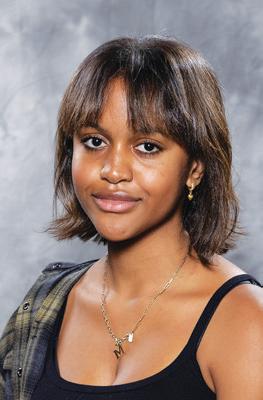
Forbes magazine selected six alumni for its annual 30 Under 30 North America list announced Nov. 29.
The six are Lukas Czinger ’12 in the Manufacturing Industry category, Vivien Mao ’12 in Hollywood & Entertainment, Dominque Gordon ’15 in Games, Dillon Rosenblatt ’16 in Sports, Chase Rosenblatt ’18 in Social Media and Amelie Zilber ’20 in Social Media. Czinger is a co-founder and Senior Vice President of Czinger Vehicles and Divergent RD, Mao is a producer of The Littlefield Company, Gordon is a product manager of Xbox, Dillon Rosenblatt is a CEO of Autograph, Chase Rosenblatt is a co-founder of Adim and Zilber is a social media content creator.

Since launching its first 30 Under 30 list in 2011, Forbes has expanded to produce continental lists for Asia, Europe and Africa. The North American list recognizes 30 young entrepreneurs, leaders and founders in 20 industries who have
launched creative companies to address issues such as global warming, reproductive health, student debt and financial freedom.
Forbes compiled this year’s list with the help of independent judges and experts who evaluated more than 12,000 candidates based on factors such as funding, revenue, social impact, inventiveness and potential.
Mao said she credits the school for her ambition to make an impact.
“One of the things I’ve taken for granted but realized [the school] instilled in me is pure ambition,”
Mao said. “I think when you are surrounded by talented, successful people during your formative years, you are able to clearly visualize both your own potential and the potential of your peers.”
Chase Rosenblatt, whose company Adim is a Web3 community that connects creators and writers to work on plots and characters for potential shows and movies, said that his experience at the school has helped him achieve a meaningful career.
“Harvard-Westlake set me up
for a successful career for two main reasons,” Chase Rosenblatt said. “The first was time management. When dealing with an overwhelming workload, [Harvard-Westlake] taught me how to prioritize and tackle [work] when there is a ton on your plate. The second was opening my eyes to alternative industries such as film and the arts through an extremely wellthought-out creative track.”
Director of External Relations Ed Hu said he is not surprised to find many alumni on the list for Forbes 30 Under 30, especially in recent years.
“I’m always impressed but not surprised to see multiple [HarvardWestlake]-related names on these 30 Under 30 lists,” Hu said. “What I’m most proud of is the fact that those names always appear in different categories. Our graduates are having an impact in a diverse range of industries and that speaks to Harvard-Westlake’s ability to attract and hopefully cultivate talented young people not just in one or two areas, reflecting the multifaceted strengths of the Harvard-Westlake experience.”
Baffo said. “Attending the affinity group was a very affirming experience. I rarely have the opportunity to be in spaces where I am surrounded by so many students who look like me and share similar experiences.”
Junior Prefect Isiuwa Odiase ’24, who attended SDLC, said she appreciated hearing a variety of viewpoints.
“I enjoyed that there were so many people from different backgrounds there,” Isiuwa said. “I feel like that really opened my eyes to a bunch of people that I would’ve never met before or taken into consideration what they've gone through. Being able to hear a bunch of people's stories opened my eyes to new perspectives about different struggles that a
lot of people face every day.”
Jones said going to PoCC allowed her to share strategies with other educators about navigating DEI work in independent schools.
“Attending this conference makes you feel like you're not alone,” Jones said. “It makes it feel like the experiences that you are facing are very similar to experiences that other educators around the country are facing in their independent school.”
Upper School Dean Adam Howard said PoCC helped him better understand the needs of his students and colleagues.
“PoCC is not designed for me, a cis-gender, white, male educator,” Howard said. “One of the reasons I embrace the conference is that it’s an opportunity for me to learn more about how I can be an ally towards equity and use my voice to help build our community even more.”
Dec. 14, 2022 A2 News The Chronicle
A1
• Continued from
POSING WITH PURPOSE: Vikrant Bakaya ’26, Ella Jacobs ’24, Isiuwa Odiase ’24, Maddie Baffo ’24, Assistant Features Editor Dylan Graff ’24 and Jessica Thompson ’23 pose for a photo as they travel to the Student Diversity and Leadership Conference in San Antonio, Texas.
ILLUSTRATION BY SOPHIA EVANS AND DAVIS MARKS
PRINTED WITH PERMISSION OF JANINE JONES
L. Wood
Maddie Baffo ’24
hwchronicle.com/news News A3 Dec. 14, 2022
Sickness troubles school
Aviv Pilipski ’25, who was absent for a week in September due to the flu, said returning to school was difficult because of the schoolwork that piled up during his absence.
“My experience was stressful, to say the least,” Pilipski said. “This stress not only took its toll physically in the classroom, but I was also feverish and stressing over missed lessons and assignments. I had to review and learn missed information for missed tests while also having to simultaneously learn new material for a test in the future. It was this stressful and really frustrating game of catch-up.”
EMPOWERING ALUMNI VENTURES: School alum Julia Boorstin ’96 speaks to interested students. Boorstin is a Senior Media and Tech Reporter for CNBC and also the author of “When Women Lead: What They Achieve, Why They Succeed, and How We Can Learn from Them.”
Julia Boorstin ’96 educates students about the influence of gender in the workplace
By Olivia Phillips
Upper School History Teacher Katherine Holmes-Chuba said it is a challenge when students miss classes, as teachers often have limited time to meet outside of their classroom.
CNBC
Senior Media
and Tech Reporter Julia Boorstin ’96 spoke about how gender impacts professional experiences in an event organized by HW EMPOWER, the Harvard-Westlake Student Alumni Association (HWSAA) and HW Venture on Nov. 29. Boorstin also signed copies of her book “When Women Lead.”
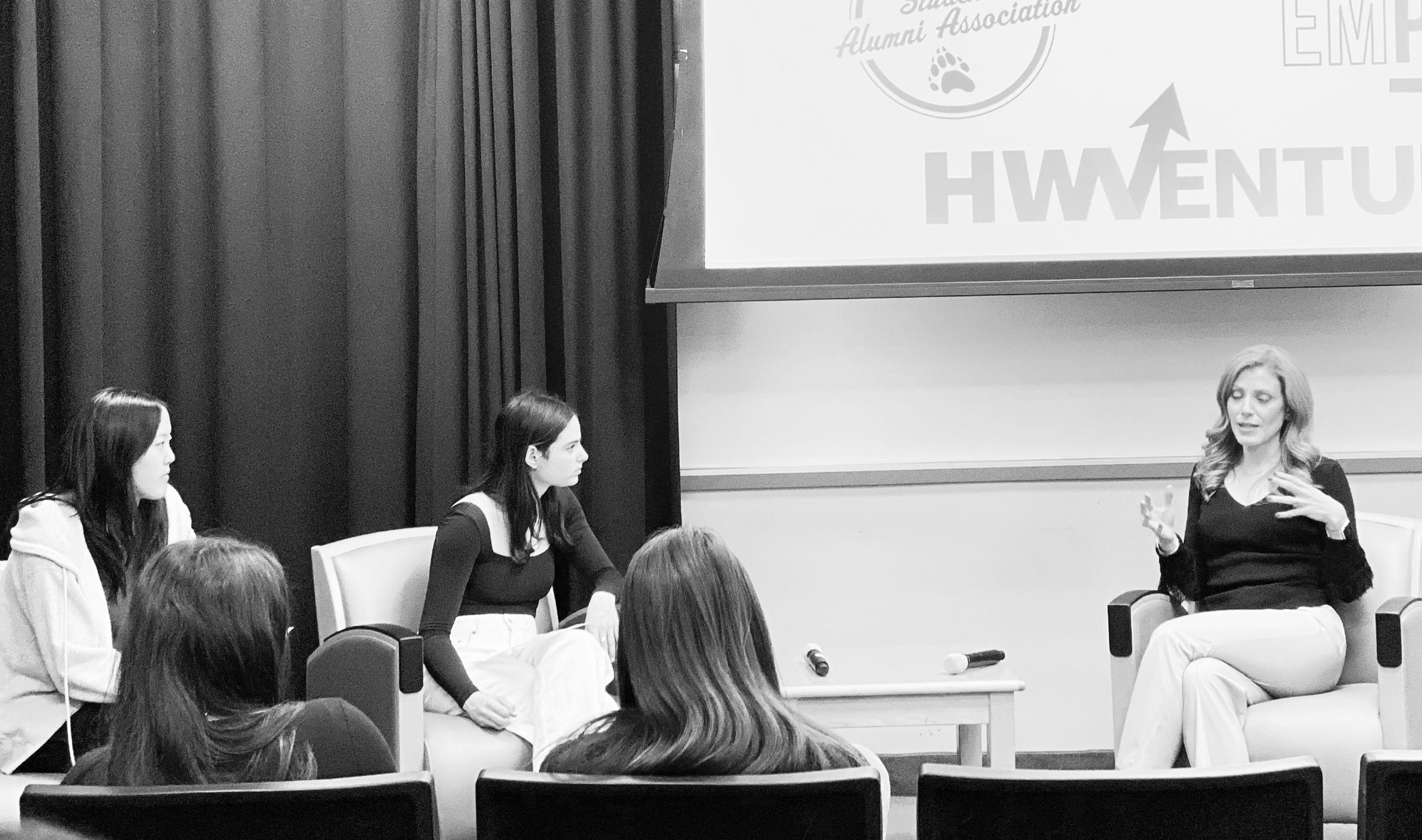
HWSAA Co-Chair and Venture leadership team member Daniella Goldrich ’23 said hearing from alumni can be incredibly inspiring, as it shows students that high-level careers are within reach.
“[Boorstin] talked about leveraging [one’s] own strengths, even things that can be per -
ceived as weaknesses, in order to become a better leader,” Goldrich said. “To have [alumni] come back and talk about how Harvard-Westlake impacted them and then [seeing how] they go on to do all these amazing things is what makes these events cool to students.”
HWSAA leader Ofek Levy ’23 said the event aimed to influence students to forge their own paths, especially within fields such as entrepreneurship.
Harvard-Westlake students have the opportunity of meeting and learning from,” Levy said. “We wanted to show them that they shouldn’t be afraid to make change or work towards a better future, and that we need to support minorities in the workplace.”
Levy said the event had an intimate atmosphere, which made for a better experience for attendees.
tions],” Levy said. “To have the ability for anyone to ask questions to the speaker and have more individual time with the speaker can be very cool.”
Boorstin said similar speaker events held during her time at the school had a significant impact on her and that she hoped to have a similar influence on attendees.
“Teachers have anywhere from 50 to 80 students and to be running after them and kind of chasing them down [is] time-consuming,” Holmes-Chuba said. “With increased absences, teachers are just busier right now. I’ve been working through my lunches most of the time because I’m catching people up.”
Zoe Kramar ’24, who missed six days of school due to COVID-19, said her teachers were flexible and thoughtfully acknowledged her situation.

l.
Daniella Goldrich ’23
“[Empower, HWSAA and Venture] all wanted to show current students what it looks like out in the real world and some of the connections that
“It can be hard to really connect with the speaker during all-school events but when it’s created by smaller organizations within the school in this way, it’s much easier for people to feel comfortable [asking ques -
By William Liu
Black Leadership Awareness and Culture Club (BLACC) and Latin and Hispanic Student Organization (LAHSO) co-hosted a screening of “Black Panther: Wakanda Forever” at the Regal Sherman Oaks theater on Dec. 4.
“Black Panther: Wakanda Forever” is a sequel to “Black Panther,” in which Wakanda grieves over the loss of their king T’Challa while facing a new underwater empire called Talokan.
After the event, participants stayed for a 45-minute Q&A with History Teacher and Latin American Studies Teacher Ingrid Sierakowski and actress Angela Bassett (Bronwyn ’24, Slater ’24), who plays Romonda in the film.
LAHSO leader Sophia Rascoff ’23 said the panel after the film provided an opportunity for an engaging discussion.
“The discussion afterwards allowed viewers to consider the movie more thoughtfully, bringing great conversation and an-
swering thought-provoking questions,” Rascoff said. “I’m so glad we had the opportunity to participate, and I hope everyone enjoyed.”
BLACC leader Jenaya Chambers ’23 said the event stressed the importance of accurate representation in movies and media.
“A significant takeaway from this movie and Q&A session is the importance of diversity in mainstream media,” Chambers said. “To see your culture represented on screen and especially in empowering roles is encouraging. It also positively affects our own sense of self as we navigate society as members of marginalized and underrepresented groups. My favorite part about events like these being hosted is seeing people from all over the community come together and participate, hearing the thoughts and stories of people from a variety of different ages and backgrounds.”

Dean and LAHSO advisor Celso Cárdenas said he appreciated the representation the movie
provided for Latino communities.
“Within the Latin American community, the representation of afro and indigenous communities is almost invisible,” Cárdenas said.
“I was so moved to see this representation on screen in a big blockbuster film that is a part of such a popular franchise. More important was the research that went behind the depiction to ensure that it was done with great respect and great care.”
Cárdenas said the screening was a great way for LAHSO and BLACC to work together and celebrate intersections between their affinity groups.
“When I returned to my classes, additional work piled onto old assignments from my absence, which resulted in a stressful few weeks of catching up,” Kramar said. “Luckily, my teachers were extremely understanding and supportive, and they made up lessons with me outside of class and granting further extensions.”
“To see this generation of feminists that seemed so much older was very inspiring,” Boorstin said. “It made me think that there was no difference between what I could accomplish and what men could accomplish. I hope that the women I spoke to today felt empowered to not feel as though they had to fit into any archetype of what a leader looks like.” wood
Clubs host screening and panel for new “Black Panther” movie
“Interestingly enough, at the beginning of the year, the DEI office sponsored an affinity group training for leaders and faculty advisors,” Cárdenas said. “One of the big takeaways that resonated from this training was that the affinity groups wanted to find ways to collaborate more with one another. ‘Wakanda Forever’ provided the perfect opportunity for this between BLACC and LAHSO.”
SILVER-SCREEN SPEAKERS: Cárdenas speaks to attendees of the screening following the movie’s end. The Q&A lasted 45 minutes.
PRINTED WITH PERMISSION OF
HU
Continued
MEJO LIAO/CHRONICLE
ED
• Continued from A1 •
on hwchronicle.com
Administration adjusts GPA policy
Seniors also have the option to submit either their unweighted or weighted GPA through the Common App, an undergraduate college admission application that applicants may use to apply to over 1,000 member colleges and universities, regardless of what type of GPA the school transcript shows.
Upper School Dean Nia Kilgore said the Upper School Dean Team unanimously decided to draft the proposal to FAC after they received feedback from certain college representatives that weighted GPAs would be beneficial for them.
“It will never be possible for us to please every college, so our thought was, ‘If there are a handful of colleges who are some of our most popular schools, or where the largest applicant groups are gonna be, then we should listen to them,” Kilgore said. “It’s not as if we had a knee-jerk reaction. We were as thoughtful about bringing [the weighted GPA] back as we were about taking it off.”
Kilgore said colleges are able to understand the rigor of an applicant’s course load with or without a GPA metric.
“Colleges are not as beholden to a ‘GPA’ as we are as schools,” Kilgore said. “They will figure it out if it’s not there. We use [GPAs] because it’s an easily recognizable and understandable unit of measurement. But we thought, ‘Since we have the data, why not give it to them?’”
Science Department Head Melody Lee said the Upper School
Dean Team added weighted GPAs so colleges could easily differentiate between students who took a demanding course load and those who did not.
“[The decision] did stem from deans, just because they are privy to what is being sent to colleges,” Lee said. “So, the idea behind it was to make it easier for colleges, which get so many applications, to be able to see a student who did take honors and AP classes versus a student who didn’t. Also, since now there’s an AP cap, it makes sense that the [inclusion of] weighted GPA shouldn’t be as big of a deal since everyone has the same ceiling and the gap won’t be as big. Bringing the weighted GPA back was basically a unanimous decision.”
Lee said she is torn about the decision, as she wonders how having two GPA measures will impact the way students discuss their grades.
“Even if the weighted GPA isn’t on the transcript, I think people still talk about how many honors and AP courses they are taking,” Lee said. “I personally think [this decision] places too much emphasis on GPAs, and now I wonder if students will throw around numbers even more. Yes, there already is a lot of comparison going on, but it might be more explicit now, which can make [the school] more competitive.”
• Continued on hwchronicle.com
Student creates HW web game
By Iona Lee and Davis Marks
Ryan Pinsker ’23 created “Get Ricky C,” a parody of the video game “2048,” in November. “2048” is a puzzle game in which players combine a series of number tiles to reach the number 2048. In Pinsker’s version, students combine tiles with pictures of teachers to ultimately obtain a tile featuring President Rick Commons.
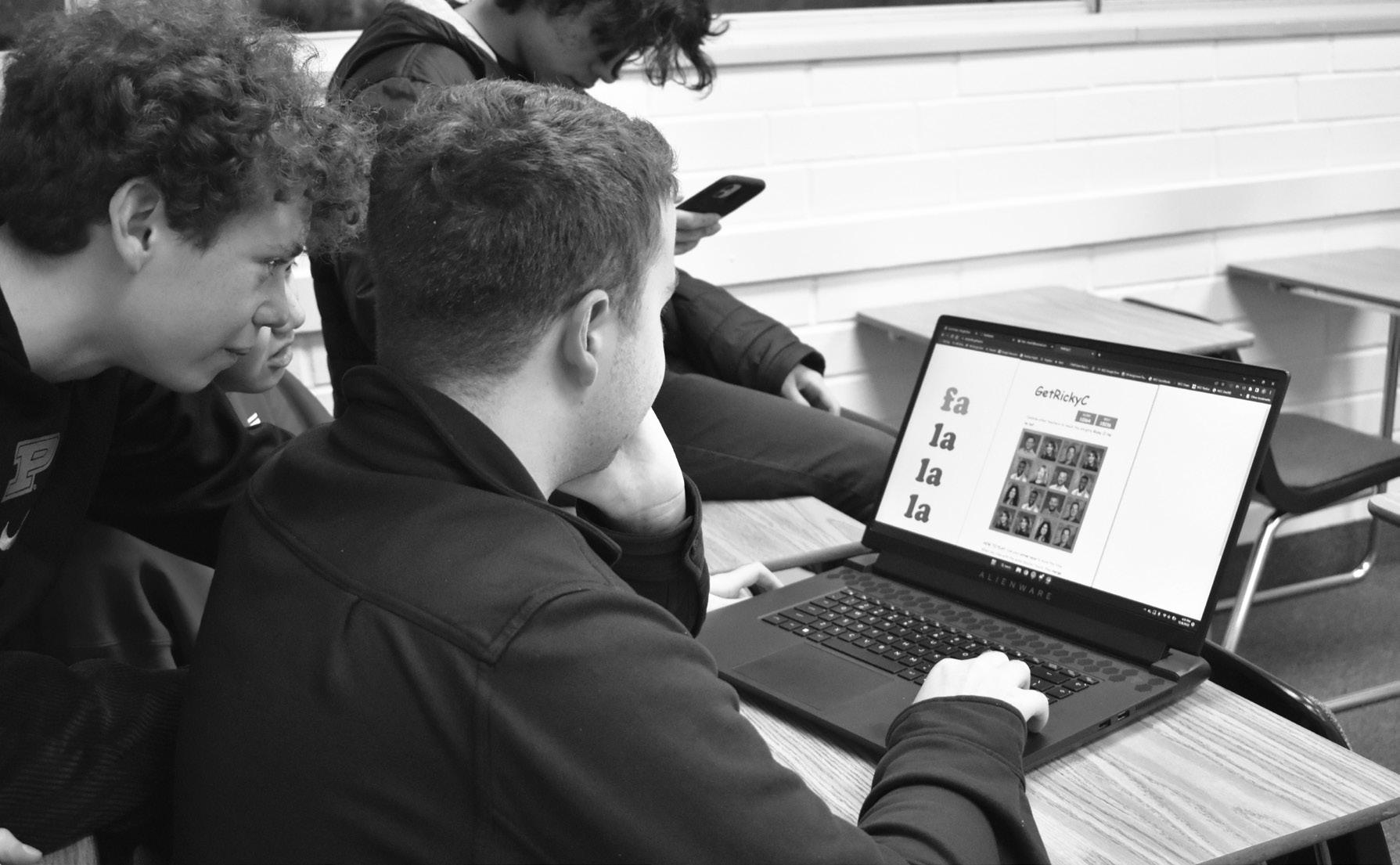
Pinsker said he was inspired to create a parody of “2048” after seeing other students play the game.
“I was sitting in class and people were playing 2048 and the various versions with cupcakes, people, colleges, etc.” Pinsker said. “I thought it’d be really cool to make ‘2048’ but for Harvard-Westlake, so I wanted to create a version
where you have to match different teachers up instead of numbers.”
Pinsker said in addition to rotating teachers, he plans to make the game more interactive by allowing students to buy a spot at Winter Market on Dec. 14.
“Students will be able to purchase the bonus slot above Ricky C for a week at Winter Market,” Pinsker said. “There are future plans and features for ‘Get Ricky C,’ such as variations, expansion packs and versions with [specific] departments, so the fun is not over.”
Pinsker said he created “GetRicky C” with the code of “2048” and altered it using CSS and HTML code. To prevent repeti-
tion, Pinsker said he switches out the teachers featured in the game each week.
Pinsker said seeing students enjoy the game has been gratifying.
“When something that you’ve made becomes popular amongst your peers and you get a lot of positive feedback about it, it’s quite exciting and flattering,” Pinsker said. Commons said that he is happy to be featured in the game.
“I know Ryan well and I know he is a kind hearted and fun loving soul, so I assume that all of this is done with enormous joy,” Commons said. “I’m glad that it creates fun for people and I’m honored that I get to be the face of a winning score.”
To play “GetRickyC,” go to doctorflu.github.io
Parents Committee organizes blood drive
By Alex Lee and Max Turetzky
Empower hosts Mattel producer
By Sara Segil
HW EMPOWER, a female advocacy club, hosted Academy Award-nominated filmmaker Robbie Brenner for a panel Dec. 8.
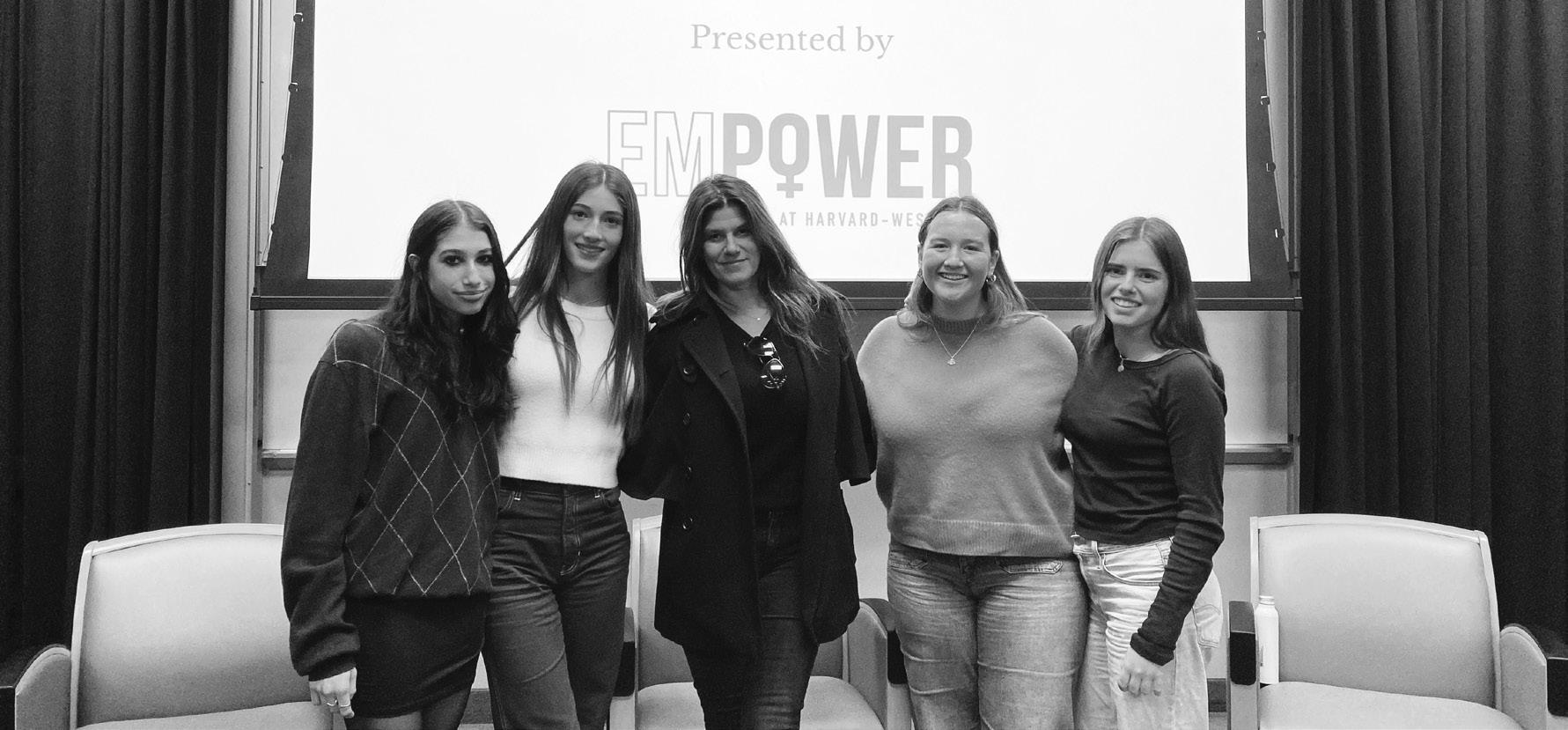
Brenner produced “Dallas Buyers Club” in 2013, which earned her an Academy Award nomination for Best Picture. Since joining Mattel Films in 2018, she has worked on films such as “Call Jane” and is currently working on “Barbie,” set to be released in July 2023.
Brenner shared her career progression and gave advice on how to develop a career in the industry.
Brenner said this newest iteration of Barbie has become more inclusive.
“Barbie unpacks her own agenda with not being the stereotypical beautiful Barbie doll,” Brenner said. “But the movie debunks all of [those stereotypes] and it’s very satisfying.”
Brenner said Mattel Films hired a strong team, including director Greta Gerwig, who is known for her work on Little Women and Ladybird, and helped develop and grow the film’s concept.
“We could’ve made a predictable, warm version of Barbie, but that’s not what we wanted to see,” Brenner said. “If you can’t make fun of yourself and be unapologetic, what are you making art for?”
EMPOWER leader Eliza Ko-
blentz ’23 said the panel was an exciting opportunity to learn more about the film industry through a female perspective.
“She has made a large mark on the filmmaking industry, and is a perfect example of a strong female leader,” Koblentz said. “She is an inspiration to not only filmmakers, but also people who hope to use their careers as an opportunity to make an impact.”
Tiffany Wang ’25 said she expected the panel to just be about “Barbie,” but it contained much more powerful messages.
“Brenner’s story of rising in her industry despite challenges was really aspirational,” Wang said.
The HW Parents Blood Drive Committee held a blood drive in partnership with the University of California, Los Angeles (UCLA) Blood and Platelet Center on Dec. 6, the second blood drive since in-person classes resumed after the COVID-19 pandemic. Blood Drive Committee Co-Chair Pansy Lin Yang (Alexander ’28, Luke’ 28, Audrey ’23) said a total of 51 people donated.
The drive collected blood for use by the Ronald Reagan UCLA Medical Center and the UCLA Santa Monica Medical Center, according to UCLA medical pathology resident Arash Roohani, who volunteered at the event.
The Blood Drive Committee holds two drives each year. The first event takes place during winter in partnership with UCLA, and the second is organized in spring with the American Red Cross.
Co-Chair Catherine Huang (Owen ’24) said she was glad so many students signed up.
“So much of blood donated, not just through Harvard-Westlake but throughout the area, comes from high school students,” Huang said. “They’ve really dominated in giving so
much blood, which is really fascinating. It’s not an easy thing to do, but it’s a very generous thing to do. Some people are squeamish and they still do it. I think what’s amazing is to see the kids who are so committed to doing this for people they don’t know.”
Roohani said local blood drives are important to ensure a consistent supply to hospitals.
“We got a lot of blood products, and that’ll be great going into the winter,” Roohani said. “Usually, we tend to get shortages in the winter, so we really appreciate all the donors that came in.”
Arin Budhiraja ’24, who has an O-negative blood type, said his status as a universal donor motivated him to donate.
“I found out I was O-negative, and people have been asking me to donate,” Budhiraja said. “Since I [just] turned 16, this was the perfect opportunity. I’m a universal donor, so I can help more people, and it’s not going to harm me in any way.”
Kai Faucher ’23, who donated blood to the American Red Cross before, said the process is fairly simple and helps many people.
“I have blood to give, so I figured, if I have time, I should do it,” Faucher said. “It’s only fifteen minutes, and it can really make a difference.”
Dec. 14, 2022 News A4
hwchronicle.com/news
L. Wood Sharon Cuseo
PLAYING FOR THE PRESIDENT: Ryan Pinsker ’23 plays his new game “Get Ricky C” with his friends. The game is modeled after the online game 2048 and features images of teachers and administration instead.
CHLOE PARK/CHRONICLE
EMPOWERMENT IN ENTERTAINMENT: Mattel Executive producer Robbie Brenner poses with Empower leaders Eliza Koblentz ’23, Lauren LaPorta ’23, Illi Kreiz ’24 and Ella Jacobs ’24 after the panel.
Continued from A1
PRINTED WITH PERMISSION OF ELLA JACOBS
•
By Alex Lee and William Liu
Five students won both Finalist and Merit titles in the National YoungArts Foundation’s annual competition for the 2022-2023 school year. YoungArts Competition submissions are open to 15-18 year olds in the visual, literary and performing arts. Over 7000 submissions were reviewed by a panel of professional artists through a blind judging process, and 702 works were awarded in three tiers: Finalist, Honorable Mention and Merit. The foundation provides winners with artistic support, networking opportunities and cash prizes up to $10,000.
The 142 Finalists were also invited to participate in the National YoungArts Week of Jan. 8-15, 2023. Hosted at the National Young Arts Complex and the Miami City Ballet in Miami, Finalists take multimedia master classes, receive feedback from industry professionals, showcase their work to one another and become eligible for the United States Presidential Scholars Program, in which top works are selected by the White House Commission.
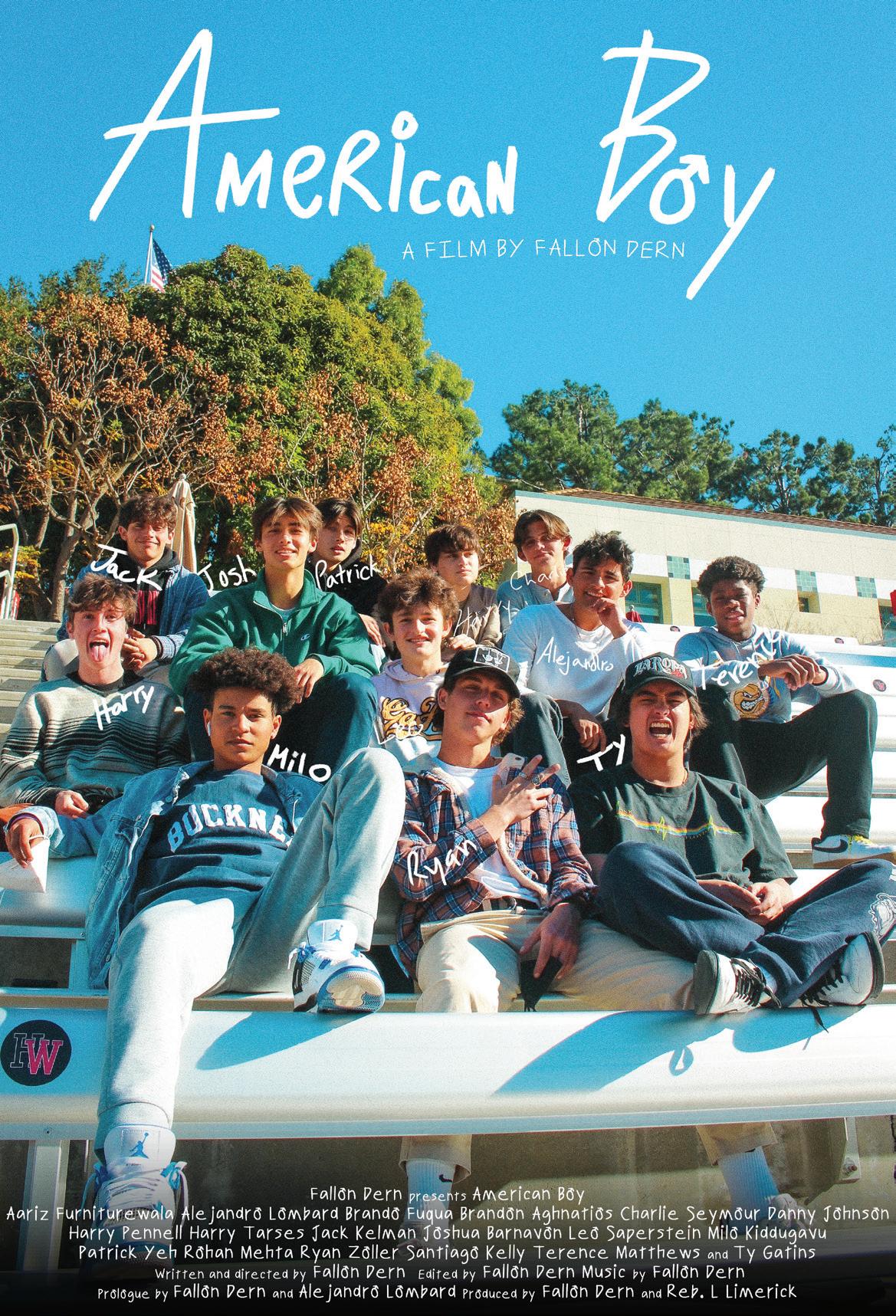
In the Finalist category, Presentation Managing Editor Fallon Dern ’23 and Alejandro Lombard ’23 were awarded for their respective documentary films, “American Boy” and “Seeking Asylum.” In the Merit category, Matthew Chang ’23

was awarded for Classical Music, Grace Belgrader ’23 was awarded for Film and Claire Wu ’24 was awarded for Photography.
Dern said she grew up admiring previous YoungArts finalists from afar, including Viola Davis, Timothee Chalamet, Hunter Schafer and Kerry Washington. She said when her family friend, Charlie Kogen ’18, was named a YoungArts Finalist and Presidential Scholar in Songwriting, she was in awe of how the program catalyzed his success as a musician.
“I came from Curtis [School], and there was a very musically gifted kid, Charlie Kogen, who became a U.S. Presidential Scholar,” Dern said. “I always admired him and realized that [YoungArts] was a very serious program. When I think about all of the winners, I never imagined that I myself would be able to win. To create something, have it be recognized and share the experience with [Lombard], who contributed to my film and created a stellar work of his own, is really mind blowing to me. I think it is a very high honor, and I still can’t believe it.”
Lombard said, while he did not initially intend on applying to YoungArts, he is pleasantly surprised at the outcome of being named a Finalist.
“I spent this summer working for reasons far more important than winning an award,” Lombard said. “It only occurred to me to submit to YoungArts half
Winning Works
an hour before the application was due. Fast forward a month, and I get a phone call on my way to Video Art [class] from YoungArts telling me the news.”
Lombard’s film was inspired by his work in helping Mexican migrant families and follows the experience of a mother’s journey to the California border.
“In 2019, I began to volunteer at migrant shelters at the US and Mexico border to help desperate families who have fled violence or political, social and economic oppression in their home countries,” Lombard said. “Through it all, I’ve been listening to these stories. Their strength and perseverance inspired me to make a documentary to help reframe and humanize the narrative of immigration and asylum in this country.”
Wu said creating her YoungArts portfolio helped her reflect on her identity as an artist, which allowed her to bettr understand and tell her story.


“It was a great experience to select the [photos] I liked and connect them to form my story,” Wu said. “I used my family pictures to portray the parent-child dilemmas in immigrant families. As a first-generation Chinese American immigrant, I receive mixed messages daily and am not sure which direction to go.”

Chang said the process of recording himself playing music was difficult at times, especially because he was looking for perfection.
“It’s rather stressful and a bit frustrating to record the same pieces over and over again because you want to have the best recording possible,” Chang said.
“But it’s impossible to have a perfect performance. I guess the biggest challenge of doing any of these online submission competitions is recording.”
Chang said he was still able to find pleasure in the
creation of his submission.
“My favorite part of the process was learning the pieces,” Chang said. “They’re all such great works, and I found it immensely enjoyable and gratifying to explore pieces from four different musical periods that all have such varying styles.”
Applications for the 2024 YoungArts competition will open in June 2023.

hwchronicle.com/news News A5 Dec. 14, 2022
PRINTED WITH PERMISSION OF FALLON DERN PRINTED WITH PERMISSION OF CLAIRE WU
ILLUSTRATION BY FALLON DERN AND ALEXANDRA LIU
Senior publishes novel
By Zoe Goor
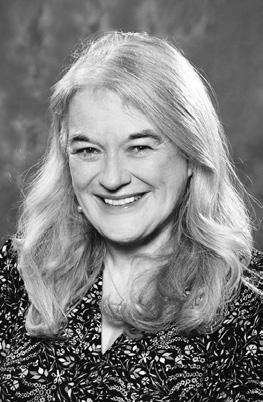
Presentations Managing Editor Jina Jeon ’23 published her novel “Brand New World” on Amazon on Nov. 11. e book, inspired by the Greek myth of Orpheus and Eurydice, is the rst Jeon has published, but not the rst that she has written.
Jeon said advice she has received from other writers regarding her own writing provided insight on forming the concept for her book.
“I always heard from other writers that I should write the kind of book that I want to read,” Jeon said. “I’ve always liked Greek mythology, and I also like books where people are trying to expose the secrets of the secret government or something. So I just combined all the stu that I like reading and other books.”
Upper School Latin Teacher Bradford Holmes said he is happy that students are starting to incorporate mythology into their writing and stresses the importance of making connections and similarities between ancient and modern societies.
“ ere’s a reason why these stories have survived for in some cases thousands of years,” said Holmes. “ e lessons they taught and the purpose they served for the societies from which they come [from] are still valid today.”
• Continued on hwchronicle.com
Prefect Council arranges dodgeball contest
By Tate Sheehy
Prefect Council hosted a schoolwide dodgeball tournament beginning Nov. 30 in Taper Gym during lunch. e competition ended with semi nals Dec. 8 and nals on Ted Slavin Field Dec. 9 and 12.
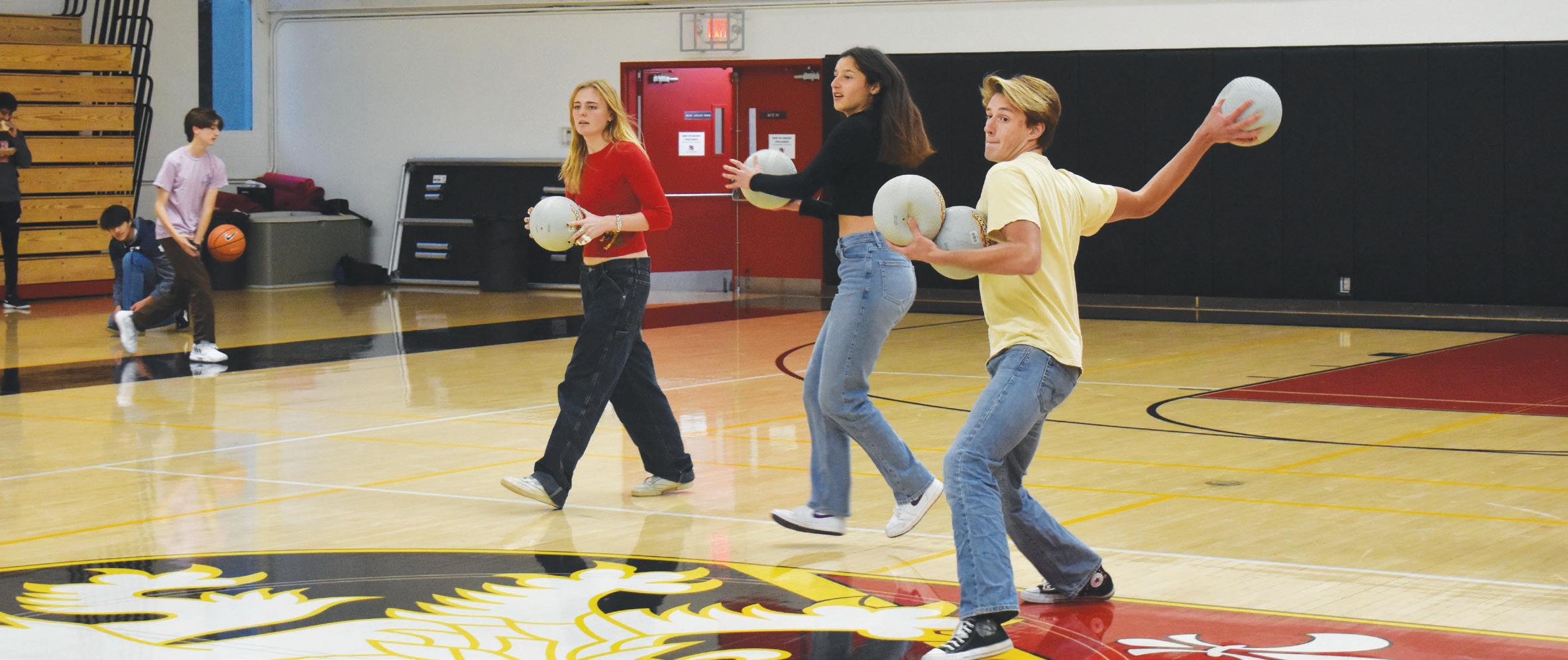
Each team consists of eight athletes and up to one teacher on their roster. e nals are between teams “Baldwin N e Boys” and “AFOOFAYRIJWROWMCO,” who tied 1-1 in the rst part of the nal during lunch Friday and will face o again in a rubber match Monday.
Junior Prefect Nyla Shelton ’24 said she appreciates the positive energy surrounding the
dodgeball games.
“My favorite moment of this event thus far was watching two teams talk with [Mathematics Teacher] Dr. Helston, one of the referees, about a call made during the game,” Shelton said. “ ough the teams were competing, their discussion was lled with laughter and remained lighthearted and fun. It was great to see students bonding with one another and enjoying some friendly competition.”
Shelton said that the format of the tournament has been adjusted since last year for more efcient and inclusive competition.
“ e tournament has run much more smoothly this year because we decided to only play
Students stream World Cup games
By Sabrina Hamideh
Prefect Council, students and teachers hosted screenings of the 2022 FIFA World Cup tournament in classrooms, auditoriums and the library between Nov. 28 and Dec. 2.
e Prefect Council collaborated with Technical Director & Performing Arts Teacher and Department Head Aaron Martin to display the U.S. versus Iran game in Rugby Auditorium Nov. 29.
Gemma Ozturk ’25 said she had a great time cheering for her favorite teams with her friends.
“It was amazing because you got to watch and enjoy the game with other people who are just as passionate as you, and the atmosphere was so amazing to watch our country play,” Ozturk said.
Aidan Mazdisnian ’25 said each day, he wears a di erent country’s jersey and paints the ag of the country that he is rooting for on his face.
“I wear face paint and team jerseys every day to show my support for as many countries as I can,” said Mazdisnian. “ is will probably be my only World Cup [I can watch] in high school, so
why not go all out?”
Kameron Rabizadeh ’23 said he loves watching the World Cup with his friends at school.
“It makes the whole watching experience so much more involved and interesting,” Rabizadeh said. “If someone’s cheering for the other team, you get to rub it in their face. ere are di erent perspectives on what’s happening, which makes everything more exciting.”
Roen Beiley ’25 said watching the World Cup with his peers was an eye-opening experience.
“I love playing and watching
games best of three [games] for the semi- nals and nals,” Shelton said. “ is change has provided a great bene t, as it has shortened the length of games and allowed us to include many more teams.”
Cutter East ’24, a member of the team “Rutherfordium,” said he has enjoyed the tournament thus far, but that his team was a ected by the new changes.
“It’s fun when you’re just in the moment competing against another team,” East said. “One thing that has hindered though, is the 10-minute time limit, which has not let us nish more than one game in the two out of three [format].”
East said it was easy for him
“
to put together a team.
“I knew that I wanted to play in the dodgeball tournament, so I just contacted some friends to play on a team while in the library,” East said. “ e only hard part was agreeing on a name.”
JT Federman ’24, a member of team “Baldwin N the Boys,” said he enjoys the competition because it allows him to unwind during the school day.
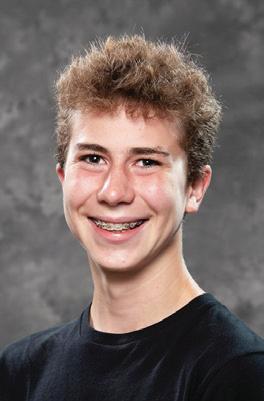
“Dodgeball is a great way to relax between classes during the day,” Federman said. “I hope I can continue to participate in the dodgeball tournament, and the best part about the tournament is the amount of people who go to the gym to watch games and support their friends.”
I love playing and watching soccer, so to experience the biggest tournament in the world which only happens every four years is pretty abbergasting.”
—Roen Beiley ’25
soccer, so to experience the biggest tournament in the world which only happens every four years is pretty abbergasting,” Beiley said. “I also nd myself talking to people about the World Cup that I don’t normally talk to, which is an extremely uplifting experience.”
Adi Shokeen ’24 said he was
able to watch the World Cup in one of his classes, which helped to connect with his classmates.
“ e World Cup has de nitely bonded many di erent people from di erent grades alongside their teachers and I think it has created a very positive and fun environment for everyone,” Shokeen said.
JFA holds monthly Shabbat dinner
By Georgia Grad and Maddy Pimstone
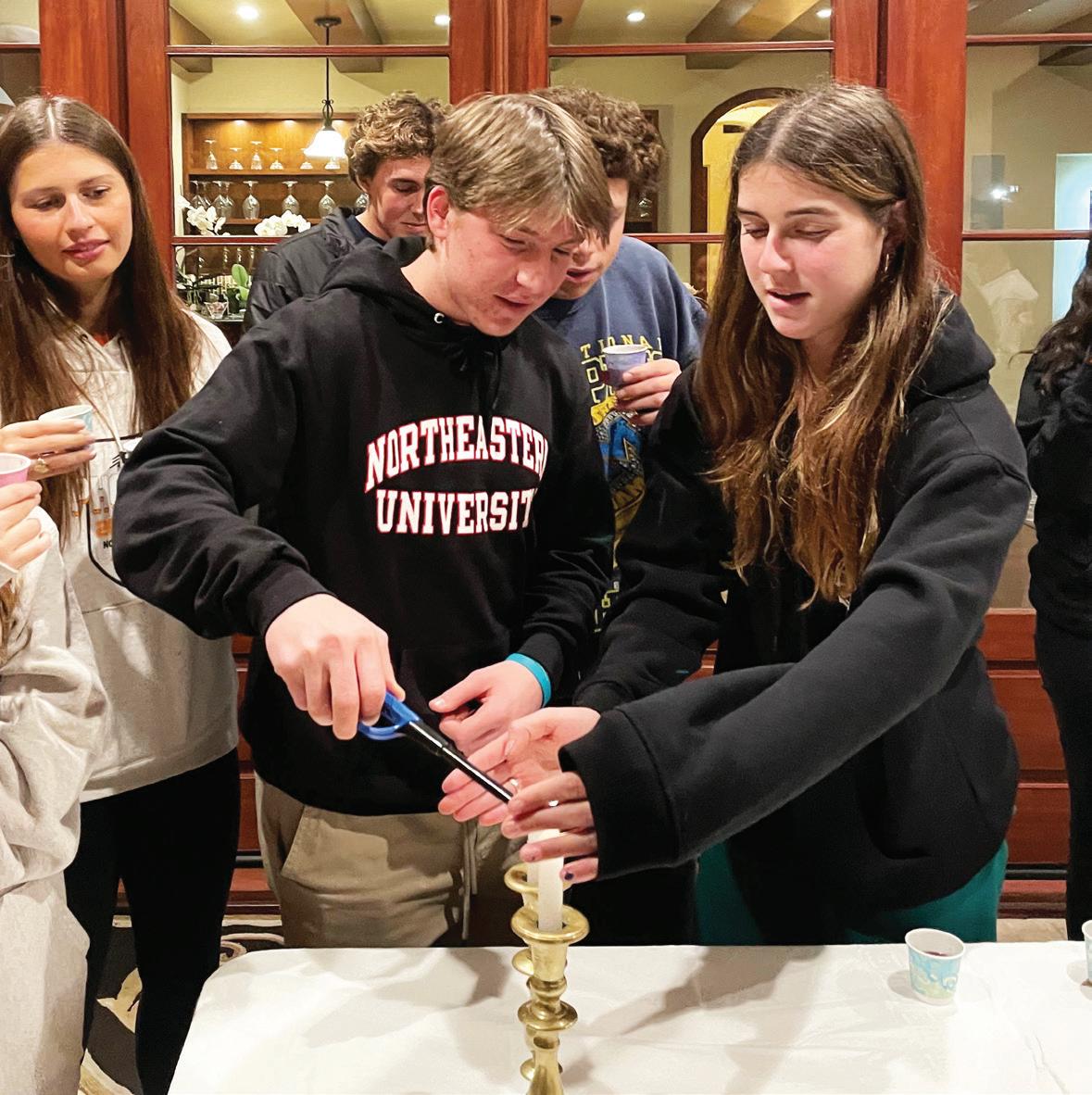
e Harvard-Westlake Jewish Family Alliance (HWJFA) hosted Shabbat dinner Dec. 2. HWJFA, founded in 2020,organizes activities and events throughout the year. e foundation aims to connect Jewish people to their heritage and educate non-Jewish students about the Jewish community, according to the HWJFA website. e event started with attendees gathering to light candles, drink grape juice and eat challah.
JFA member Kate Goldberg ’25 said she especially enjoyed attending the dinner in light of recent antisemitic events that have occurred on campus.
“I think having this Shabbat was really good because it was nice to know that other
people in the school community and around me were feeling the same way I was,” Goldberg said. “During times like these, it is really comforting to have so many people around you going through the same things, which is why I think JFA is important.”
JFA Co-Chair Kayla Graiwer ’23 said her favorite part about JFA is attending the Shabbat dinners, as they allow her to connect with other people.
“JFA has built a tight-knit Jewish community and I have made friends that I probably would not have met otherwise,” Graiwer said. “JFA Shabbats are always a really comforting and fun time that I look forward to. ey are a great way for Jewish students to connect and get to know each other.”
Social Co-Chair Danielle Leibzon ’24, who helps plan JFA
events, said she looks forward to future gatherings and enjoys seeing members socializing.
“I love inviting di erent people to the Shabbat dinners and helping plan them,” Leibzon said. “I think seeing everyone together and everyone from different grades hanging out together was my favorite part.”
JFA member Lily Stambouli ’24 said she loved playing White Elephant, a game in which participants receive wrapped gifts and can choose to swap them with others.
“I really like games like White Elephant because I think it’s fun to come together with JFA members as well as others and have a joyous holiday celebration,” Stambouli said. “I love eating pizza dinners in a circle, communally, [and] just having really great conversationss as a group.”
DODGE, DUCK, DIP, DIVE AND DODGE: Students on the team “Gotta Dodgethemall” prepare to throw balls at competitors on the opposing team “Baldwin N the Boys” in Taper Gym during a semifinals match which occurred Dec. 9. “Gotta Dodgethemall” lost 2-0.
TATE SHEEHY/CHRONICLE
A6 News Dec. 14, 2022 The Chronicle
LIGHTING IT UP: Sammy Glassman ’24 and Danielle Leibzon ’24 light a candle with other members of JFA as a part of event celebrations.
GEORGIA GRAD/CHRONICLE
l. wood
Community Council holds toy drive event with youth charity
By Everett Lakey and Caroline Plunkett
Community Council partnered with New Directions For Youth (NDFY) to hold a toy drive Dec. 8 and 9. NDFY is a youth development agency providing critically needed services to more than 200,000 youth in the Los Angeles area, according to their website.
Community Council set up a table on the Quad, complete with holiday decorations and a fake snow machine, where students could buy and donate toys. Students also had the option to purchase toys at the bookstore.

Assistant bookstore manager Kijana Core said he enjoys seeing students come in to pick out presents, and it is one of his most
favorite parts of the year.
“As we start coming up to the toy drive, kids start coming in more with their friends to buy teddy bears and [other prewrapped] gifts,” Core said. “[The drive] was one of my favorite parts of last year.”
Community Council member Sydney Carmel ’23 said the toy drive was planned to inspire students to give back to those around them.
“We are just trying to help as many kids as possible and give them the best Christmas and the holidays yet,” Carmel said. “We hope that the students will reflect on their favorite childhood toys and gifts and want to share them with the kids we are helping.”
Helena Wu ’23, who donated to the drive, said she felt encour-
Library coordinates student game night
By Alex Lee
The Student Library Advisory Committee (SLAC) collaborated with the Tabletop Club to hold a game night in Mudd Library on Dec. 2. Students played games like Two Truths and a Lie, board games and Jackbox TV.
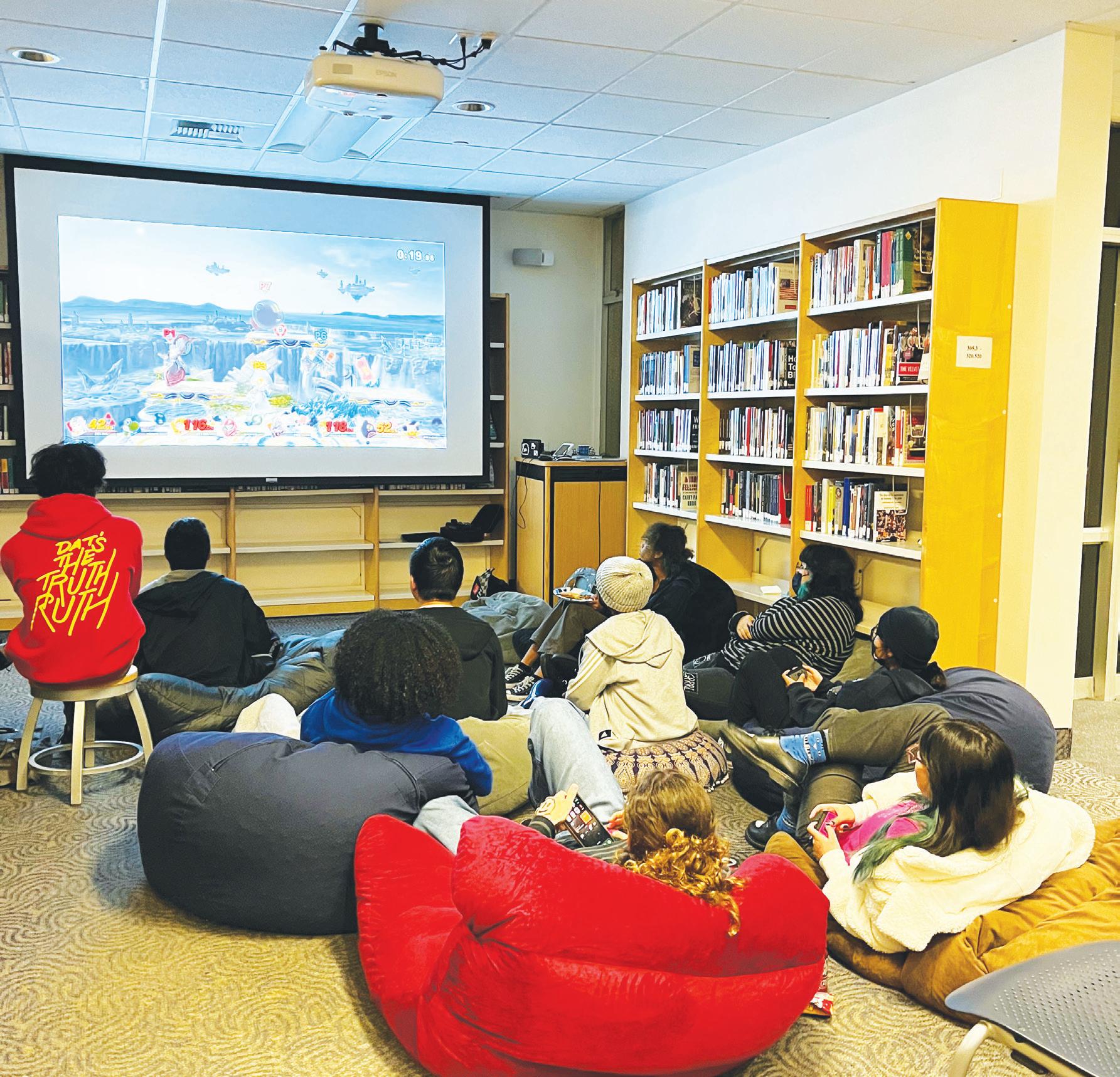
SLAC leader Ofek Levy ’23 said he was pleasantly surprised at how many people showed up to the event.
“The game night was so much fun because it was really a great way to unite different parts of the community,” Levy said. “There was a big diversity in the grades there, which was really nice as different grades usually don’t usually interact that much at school. It was so much fun to learn about people on a different level and have the space to learn a lot of fun things about each other.”
Alex Aguirre ’23 said the game night was very exciting and mentally stimulating.
“It’s the strategy that I love when I play board games, there are always so many outcomes,” Aguirre said. “The luck that can be involved in a lot of games also keeps you excited throughout the
whole game, so it’s a good way to exercise your brain.”
Andrea Cortes ’23 said she appreciates the personal connections that game nights can have which creates camaraderie.
“It’s a lot of fun because it brings a lot of people together, and I like playing board games a lot because they help me connect with my sister, especially now that she’s in college,” Cortes said.
Jacob Massey ’25 said the game night helped him unwind after a busy week and provided much-needed relief.
“Game night helped me slow down a lot and take a break from studying,” Massey said. “I was feeling pretty stressed about a lot of upcoming tests, and I ended up going to game night to try and relax a bit. Laughter is really the best medicine, especially to something like stress, and game night was certainly full of that.”
Massey said he hopes that SLAC and the Tabletop Club host similar events in the future.
“Game night was an absolute blast, and I’m so glad that Tabletop Club is getting the support to organize events like these,” Massey said.
aged by her friends on Community Council to participate.
“In the spirit of Christmas and the holidays in general, I thought it would be nice to donate to children in need,” Wu said. “I thought Community Council had a good cause, and I was happy to support them.”
Community Council member Malia Yap ’24 said all of the hard work to organize the drive paid off as many toys were donated to children in need.
“We were able to get a lot of donations from a bunch of different students, so it was a huge success,” Yap said. “I love working with everyone else in Community Council because we’re a great cohesive team, and it’s really rewarding to see events like [the toy drive] come to fruition.”
HW Venture hosts résume workshop with Evan Keare ’18
By Zoe Goor
HW Venture hosted Evan Keare ’18 for a virtual résume Building Workshop during Conference Time on Dec 1. The Résume Building Workshop was meant to familiarize students with résumes for college applications, and Keare guided students through how to overcome the challenging process. Venture is a student-led organization that was created to promote education and innovation outside of the classroom and also holds events on business.
Keare led HW Venture as a student at the school and is currently a senior at the University of Michigan. During the workshop, Keare covered the philosophy, content and design aspects of résumes, helping students build foundations for college résumes and job applications.
Keare said that the structure of a résume is comparable to that of a hamburger in which the most important parts of a résume should essentially be sandwiched between the less important information.
Keare also advised students to adjust their résume based on the opportunity they are applying for and encourages flexibility.
“Your résume is going to evolve,” Keare said. “Being strategic based on your costumer is really the art of having a powerful résume that stands out in the pile.”
Venture Leader Lily Stambouli, who helped organize the workshop, said she hopes the event was useful to students creating their own résume so they
can send applications to jobs and summer programs.
“A lot of people don’t really know how to make [an organized résume], or what steps [are needed] to take to make sure that your résume is more effective and more efficient than other people who are also applying for the same thing [as] you,” Stambouli said. “I think [the workshop] was just a really good opportunity to give students an opportunity to learn something new that would genuinely be beneficial for their lives.”
HW Inc. and Interdisciplinary Studies and Independent Research Teacher Rob Levin said he particularly appreciated Keare’s advice about how the presentation of a résume can make it more effective in terms of its structure and delivery.
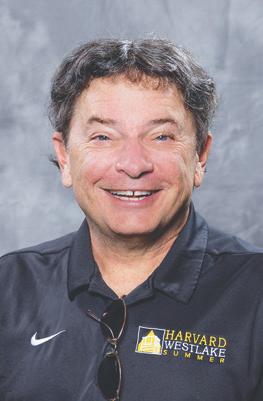
“She got into tactics: she used color, emphasis, whitespace and organization to tell the story more compellingly and in a more eye catching fashion and how she went from emphasizing the sections to emphasizing the actual stops along the road and [her] use of color,” Levin said. “I thought it was brilliant. I thought she did a great job of giving you the perspective of the [résume] reader.”
Mia Morgan ’25, who attended the workshop, said she enjoyed the event and plans to use the tips she learned to successfully build her résume.
“I thought the event was super informative and so much fun to listen to,” Morgan said. “I took some great notes on it and [the event] inspired me to make a better résume.”
hwchronicle.com/news News A7 Dec. 14, 2022
GIFTS OF GENEROSITY: Members of Community Council stand by gift collection bins on the Quad. These bins were placed near the security kiosk at the main entrance, in the lounge and outside of the library.
CAROLINE PLUNKETT/CHRONICLE
L. Wood Rob Levin
STAYING FOR THE GAMING : Students gather in front of a screen in Munger Library to play video games and socialize with fellow gamers. The game night also featured card games, board games, and Jackbox.
JINA JEON/CHRONICLE

Dec. 14, 2022 A8 News The Chronicle Crossword Commotion Science Teacher Nathan Cardin created Issue 4’s crossword. Can you navigate through the boxes and complete it? ACROSS: 1. End of school year exam 6. Unit of bread 10. “Hello” singer 11. Fake name 13. Like a hopeless situation: Hyph. 14. Disney’s “Tower of ___” 16. Opposite of west 18. Non-dairy milk source 19. Sibling born on the same day 22. Wood-ingesting insect 25. Consume food 26. Damascus and Aleppo’s country 27. Selling point 29. Unboxes or uncorks 33. Shout during a game of tag: 2 wds. 36. Not me 37. “If Beale Street Could Talk” author James ___ 40. Six years, for a senator 41. Fallopian tube travelers 42. Vowel-rich berry 44. With 47-Across, the much-needed time off between now and January... and a literal description of three of this puzzle’s black squares 47. See 44-Across 51. Popular Italian motor scooter 52. “Twilight” heroine 53. Resorts with hot springs 54. Accept, as your dream college hopefully will DOWN: 1. Celebrity worshipper 2. Wedding vow: 2 wds. 3. Not old 4. Visitor from outer space 5. “Game of Thrones” actress ______ Headey 6. Opposite of former 7. World Cup cheer 8. What you’re breathing 9. Modern Persian language 12. Chimney residue 15. Deli sandwich bread 17. Pig’s pen 19. Earl Grey drink 20. “Now, where ___ I?” 21. “For what ___ worth...” 23. Chaotic uprising 24. Navigator’s aid 26. Put in the overhead bin 28. Finish 30. Vision organ 31. Neither’s partner 32. Mathematical total 34. Sparkly crowns 35. Pixar’s
___” 37. Cellist’s need 38. Tel ___, Israel 39. Sections of a bowling alley 40. Worn out 43. “Dancing
45.
46.
48.
49.
50. Kit
bar • Answers on C4 1 2 3 4 5 10 13 16 17 11 6 7 8 9 12 15 18 24 26 28 33 39 38 37 41 44 51 53 45 46 42 43 47 54 52 34 35 29 30 31 32 36 48 49 50 19 25 27 20 21 22 23 14 40
“Monsters,
Queen” band
One of three in a tbsp.: Abbr.
Clean Air Act organization: Abbr.
“Nightmare on ___ Street”
Boxing great Muhammad or comedian Wong
___
Editors-in-Chief: Natalie Cosgrove, Will Sherwood
Print Managing Editors: Lucas Cohen-d'Arbeloff, Claire Conner, Daphne Davies, Charlie Seymour
Presentation Managing Editors: Fallon Dern, Allegra Drago, Jina Jeon, Leo Saperstein
Digital Managing Editors: Alex Hahn, Lily Lee
Executive Editors: James Hess, Emmy Zhang
News Editor: Natasha Speiss
Assistant News Editors: Davis Marks, Chloe Park, Grant Park, Tate Sheehy
Opinion Editor: Georgia Goldberg
Assistant Opinion Editors: Jade Harris, Jackson Tanner
Features Editor: Harry Tarses
Assistant Features Editors: Dylan Graff, Iona Lee, Averie Perrin, Ella Yadegar
A&E Editors: Becca Berlin, Vasilia Yordanova
Assistant A&E Editor: Kriste An
Sports Editors: Jaden Bobb, Paul Kurgan
Assistant Sports Editors: Jackson Mayer, Christopher Mo
Satire Editor: Georgia Goldberg
Multimedia Editor: Danny Johnson
Business Manager: Andrew Park
Art Director: Sophia Evans
Photography Editor: Raisa Effress
Executive Broadcast Producer: Jake Lancer
Assistant Broadcast Producers: Rohan Amin, Alexa Benitez, Hunter Bridgett, Eric Chang, Hudson Chen, Grace Coleman, William Coleman, Jack Limor, Aaron Milburn
Freelance Writer: Carter Staggs
Layout Assistants and Staff Writers: Sasha Aghnatios, Hailey Cho, Karsten Cole, Eden Conner, Alden Detmer, Alexander Dinh, MacArthur Galavitz, Samuel Glassman, Zoe Goor, Georgia Grad, Justine Gustman, Sabrina Hamideh, Jayan Kandavel, Crista Kim, Katelyn Kim, Saisha Kumar, Everett Lakey, Alex Lee, MeJo Liao, William Liu, Daniel Mittleman, Olivia Phillips, Madeline Pimstone, Caroline Plunkett, Fiona Ryan, Sara Segil, Hannah Shahidi, Olivia So, Connor Tang, Justin Tang, Arielle Trakhtenberg, Max Turetzky, Mason Walline, Nathan Wang, Tiffany Wang, Amber Zhang
Advisors: Billy Montgomery, Max Tash
Layout Assistant: Jen Bladen, Lilian Suarez

Publication Information: Founded in 1990, The Chronicle is the Harvard-Westlake Upper School’s student-led newspaper. Now in its 32nd year, The Chronicle strives to report stories accurately and to uphold its legacy of journalistic integrity. The newspaper is published eight times per year and distributed to students, parents, faculty and staff. The paper is affiliated with two school magazines, Big Red and Panorama. We are members of the California Newspaper Publishers Association and the Private School Journalism Association.
The Sickness Standard
If you’ve spent any time at the Upper School as either a student or faculty member, you understand one of our bestknown secrets: nearly every single student has come to school when they shouldn’t have. In winter months especially, when the flu and other contagious viruses are at their worst, we often hear class discussions through several congested voices, lunch tables filled almost always with coughing and sneezing and complaints about our various symptoms to friends before taking a deep breath and continuing to push on through the school day.
This school-wide culture in which everyone is complicit comes from a valid fear of falling behind on both homework and assessments. Students do not want to miss just one day of classes, and missing multiple days for a more serious illness may as well be an absolute catastrophe. And yet, despite such a pervasive sentiment within the student body, the school’s messaging on the issue since lockdown has remained clear: if you are sick, do not come to school.
We see the words on our Wolverscreens alongside tips for washing hands and staying hydrated; our teachers repeat them to us in our first-day syllabi, ensuring us that all will be well and okay if we happen to be absent for a few of their classes. As the school year goes on and more work piles up, though, our personal experiences begin to contradict the school’s attitude: students start to worry about missing important content, and teachers understandably don’t want students to have more time than others to prepare for assessments. Worse still, if you miss a day when you had two or more major assessments, making them up means prioritizing one class over another, even if both are time-sensitive.
Such conflicts create an understandable stigma around missing days of school that makes highly-transmissible students
DIVERSITY, EQUITY AND INCLUSION:
The Chronicle strives to be a diverse and inclusive community that welcomes all who wish to contribute. Our Diversity, Equity, and Inclusion committee works to ensure that every member of the Harvard-Westlake community is recognized, included and given a voice.
The Chronicle's publications will aim to represent this diverse community and provide a variety of perspectives on the topics that they cover.
ADVERTISING:
Looking to place an advertisement in our paper? Questions pertaining to advertisements may be directed to The Chronicle's Business Manager Andrew Park at apark5@hwemail.com. Publication of an advertisement does not imply endorsement of the product or service by the newspaper or school.
atend their classes and put both themselves and all their peers in harm’s way in the process. For students and teachers whose relatives are immunocompromised, an accidental encounter with a sick person could be detrimental. Some students also live with their grandparents, and catching a common cold could massively complicate their living situation because of quarantining protocols.
Admittedly, part of this is our own fault. Students really should be prioritizing their own well-being over anything else, and our insistence on trekking through a school day while being miserable reflects an extremely unhealthy obsession with high achievement. But the administration can also be doing more to help. A school-wide policy in which extensions are given somewhat roughly by the number of days missed would do much to alleviate students’ stress about a growing number of assignments. The policy should also ensure that once students return, they do not have to complete more than two major projects or assessments all in one day. While Zoom was a viable option when many students were ill, it’s difficult for both students and teachers when only a small handful of students are out sick. Teachers should be recording classes, especially if they are lecture-heavy, starting on the third absence, and lecture slides should be emailed to the student if they are not regularly posted on the Hub.
Some students will always be apprehensive about missing school––and we should work hard and always communicate with our teachers if sick––but having a built-in policy that is significantly more accommodating will encourage them to stay home and get better. Students’ physical health and wellbeing should take priority without constant anxiety from school work, and these policies will help them get better faster and prevent any further disease spread.
UPDATES AND CORRECTIONS:
Though we always strive to be as accurate as possible, staff members identify inaccuracies and receive feedback from readers.
The Chronicle publishes corrections when we discover a factual error within a piece. We will continue to uphold transparency even in the face of mistakes following the publication of each issue.
MEMBERSHIPS:
PUBLICATION AWARDS:
- NSPA Pacemaker Winner
- CSPA Gold Crown Winner
- Columbia Scholastic Press Association
- National Scholastic Press Association
- Quill and Scroll Honor Society
Opinion The Chronicle • Dec. 14, 2022 Studio City • Vol. 32 • Issue 4 • Dec. 14, 2022 • hwchronicle.com
editorial
ILLUSTRATION BY SOPHIA EVANS
about us
Unsigned editorials represent the majority opinion of staffers and are written by the Editorial Board, which is composed of the Editors-in-Chief, Managing Editors and Section Editors. LETTERS
EDITOR: Letters may be submitted to chronicle@ hw.com or mailed to 3700
Studio
Letters must be signed and may be edited to
style, space
EDITORIALS:
TO THE
Coldwater Canyon Ave.,
City, CA 91604.
conform to Chronicle
and format. We are committed to uplifting the voices of marginalized or underrepresented individuals and groups in accordance with our efforts to promote diversity, equity and inclusion.
Testing! 1, 2...3?
By Averie Perrin
As Thanksgiving approached, I began feeling anxious about the tests filling my plate like the turkey and mashed potatoes I eagerly anticipated eating. With the first quarter rapidly coming to an end, I faced a combination of tests, essays and quizzes every day, leaving little room for me to adequately prepare for each.
Some departments chose not to give major assignments the week before break. English teachers allowed students to use the essay extension they receive once a semester, and science teachers scheduled some tests after Thanksgiving. Most, however, packed loads of high-stakes assessments into the short period of time preceding our fall break.
Students were forced to take a math test on the same day as science test, and on the following day, a history test and a graded dialogue in language class, unable to postpone the constant assignments.
Talking with my peers, I was not surprised to hear that most had similar schedules. But a few were able to postpone exams or make test corrections, and I noticed these students seemed less stressed.
A school policy predating the block schedule establishes that if a student has three tests on the same day, they can postpone one of them far in advance, but because a student can have only four classes on one day, this policy is useless in most circumstances, and its existence is often debated by students and faculty.
In the event that a student has three tests, postponing one is certainly justified. But often, quizzes are just as difficult and time-consuming as tests and still cannot be postponed. Assignments like quizzes, essays and presentations are sometimes short-notice, creating more short-term stress for a student with a loaded schedule. Rushing assignments is

frowned upon by teachers but necessary when students have to spend their time studying for assessments. Instead of learning from assignments with careful deliberation, we are forced to treat them as tasks to be quickly completed and unable to completeley process the information.
Some students get lucky with sympathetic teachers who understand that students cannot perform well with many other important assignments scheduled for the same day. I was surprised to find some of my peers who take the same courses as I do were able to postpone exams, while my class was told we could not move them.
A policy that allowed students to move tests on days with either two quizzes and a test or two tests and a quiz would give students the ability to manage their studying and workload, approaching each assignment with full concentration and a suitable time commitment. Clearing up policy on the number of retakes allowed and corrections for departments and courses would also give students a more complete view of the opportunities available to help them improve their understanding of the material and their scores.
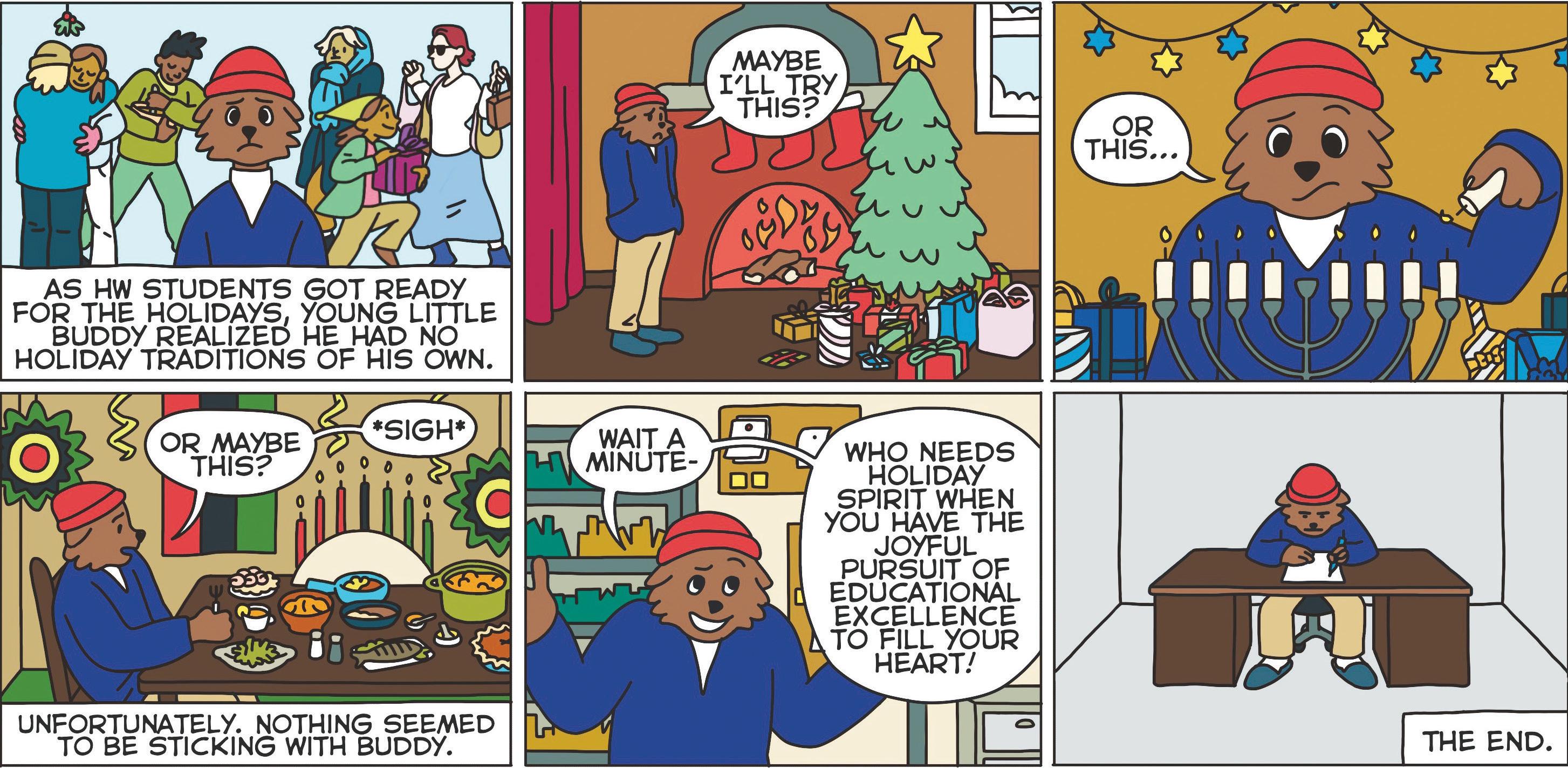
No matter what, the school should first reiterate its existing policy, ensuring that all students, teachers and deans understand it and know that it will be enforced. And if the administration really intends to enable the joyful pursuit of educational excellence rather than the panic-induced regurgitation of course material, they should expand the current policy to include both quizzes and presentations.
ChatGPT in education, Claire-ified

 By Claire Conner
Avoiding intervention
By Jackson Tanner
is aflame. Since the death of Mahsa Amini on September 16, every major city in Iran has faced immense social upheaval. The killing of the 22-year-old Iranian Kurd by the Islamic Republic’s Morality Police triggered the largest anti-government protests in the country since the “Green Revolution” in 2009.With the rallying cry “Woman, Life, Freedom,” the Iranian protests have created the best opportunity since the 1979 Islamic Revolution to overthrow the theocracy and initiate regime change. The U.S. should act
Iran


with tact and restraint to maximize internal divisions that will break clerics' iron grip without collapsing the Iranian state as a whole.
When Shah Mohammed Reza Pahlavi, the brutally oppressive monarch of Iran before the Islamic Revolution, was on his last legs in the face of popular outrage, he made a number of statements suggesting he had erred as a ruler. Within weeks of these verbal concessions, the regime imploded and the Shah fled Iran.
Khamenei, the longtime supreme leader of Iran, seems
Apiano
piece composed in the style of Mozart. An essay comparing Benedict Anderson’s and Ernest Gellner’s theories of nationalism. A Common App personal statement based on summaries of specific events and samples of a student’s writing. An answer to the trolley problem informed by utilitarianism. Each of these has been successfully generated by ChatGPT, an artificial intelligence program created by OpenAI that can answer intellectual questions, complete written tasks, engage in humorous conversations and explain complex ideas the same way a human would.
The difference? Unlike an ordinary person, it has been trained with a massive knowledge base, produces page-long responses in seconds and is completely free. The program has been recognized by The New York Times and Reuters. Experts say it could one day replace the Google search, and business executives have discussed replacing white-collar workers with identical technology that can organize projects, draft memorandums, write code and develop marketing strategies by itself.
For better or worse, ChatGPT and AI technology like it will undoubtedly revolutionize the workforce and the way workers think about productivity and efficiency. But the most
to have learned his lesson from the man he helped overthrow: admitting weaknesses and transgressions could fuel revolutionary movements and trigger the regimes' collapse. So instead of apologizing or introducing reform, he has turned to his monopoly on violence, brutally suppressing the protests.
Realistically, the only way protests will be able to catalyze a collapse of the regime is if they force a divide in the Iranian state apparatus. Iran has two militaries: the Iranian Armed Forces and the Iranian Revolutionary Guard Corps (IRGC). The latter of these is fanatically loyal to Khamenei, and their troops are better equipped and paid. The Armed Forces, on the other hand, is larger but poorly paid and not extremely loyal. As Khamenei employs increasing amounts of violence, the less loyal Iranian Armed Forces may be forced to make a choice — either kill massive amounts of civilians in a bloody, last-ditch attempt to save Khamenei or cut their losses, turn against the alreadydisliked IRGC and stage a coup. Given that Khamenei is 83 years old and dying of cancer, subverting his authority would be easier than ever.
The Iranian Armed Forces
immediately destructive aspect of ChatGPT’s availability is its impact on education.
With access to this technology, students no longer have to come up with their own ideas, conduct online research, synthesize information and present it in sophisticated, clear prose. ChatGPT can do all of this for them, and while it often misinterprets prompts or incorrectly answers them, these problems can be fixed in minutes by telling the AI what it got wrong and requesting that it correct these problems in an updated answer. Each time, the product is completely original and unique.

This tool likely won’t be free forever, but its capabilities and the seismic shift they bring to education will remain. For now, STEM teachers can find comfort in the technology’s shortcomings: it currently struggles with high school-level math problems and still struggles to grasp scientific concepts, confidently but incorrectly asserting that peregrine falcons are the world’s fastest marine mammals. (They are not mammals, and they don’t swim.)
Humanities and social science departments, however, have reason to be concerned. A program with almost limitless knowledge of literature, philosophy, historical events and social science concepts threatens the very identity
are not friendly towards the U.S. They may not be in bed with Khamenei, President Ebrahim Raisi and their hardline faction within the country, but they have spent 20 years trying to undermine U.S. influence throughout the Middle East. A new regime would hardly live up to Western standards of reforms. However, even if the government is led by officials of the Iranian Armed Forces, it would still be more moderate than the current Khamenei regime. The protests would have acted as a catalyst for such a coup, and the citizenry of Iran has already mobilized en masse, so leaders will likely emerge out of the protest movement as well. They will likely work with the Armed Forces in order to give more legitimacy to their regime, and thus will take on some role in governance.
To save face, Tehran discredited current protests as U.S.-backed attempts at regime change –– an accusation that plays on the memory of the U.S.-backed coup of 1953. For this reason, the U.S. should act tactfully, totally abstaining from physical support and limit its ideological support for the protest movements. By providing support to the movements directly, Washington
of classes that rely on students doing this work themselves and learning material through this process.
There’s no doubt that students have been given a powerful tool. The pen is mightier than the sword, but over time, it might seem that the AI chatbox is becoming mightier than the pen. But the futuristic, exciting luster of such technology cannot last.
ChatGPT’s writing is impressive, but it will never possess the complexity and artistry of human work. Identifying its shortcomings is much like comparing machine-made lace with the work of a trained artisan. Factories can produce lace that seems delicate and beautiful at first glance, but they cannot hide the limitations of coarse thread, repetitive patterns, and trenddriven products that are rarely timeless or intricate.
Most importantly, though, no student should allow their education — the development of their mind and their potential as a problem-solver — to be hijacked by technology. Their grades will likely suffer if they rely on programs that can’t reach the sophistication of hard work from humans, but beyond that, they will stunt the intellectual growth that enhances their humanity in the first place.
would validate Tehran's propaganda, which Iranian citizens do not yet believe. Even public statements should be somewhat limited — strengthening the perception that protests were caused by foreign involvement will prevent a division of the military necessary to initiate regime change.
Iran is a fiercely divided country – its Azerbaijani, Balochi, and Kurdish populations have chafed against the regime, and the protests have taken on a distinctly ethnic flavor in those regions. Iran's labor movement, a longtime opposition group, also seems to have grown in presence on social media, posing a more legitimate internal threat to the regime than it has in a decade.
As Americans living in an era of global leadership and intervention, it is an overriding instinct to support to the protest movements. But this would only create an external scapegoat for the regime, bringing together the state apparatus to successfully combat protest movements. The regime is unsustainable, but in being overly ambitious with our hopes for regime change, the U.S. could inadvertently prolong its life just a little longer.
ILLUSTRATION BY SOPHIA EVANS
Dec. 14, 2022 A10 Opinion The Chronicle
ILLUSTRATION BY SOPHIA EVANS
• Continued on hwchronicle.com
Remove all of the AP classes
By Jade Harris
The school has recently decided to slowly shift away from Advanced Placement (AP) courses, beginning mostly with the humanities. While the removal of APs is beneficial to students, the current methodology will discourage students from taking humanities courses.
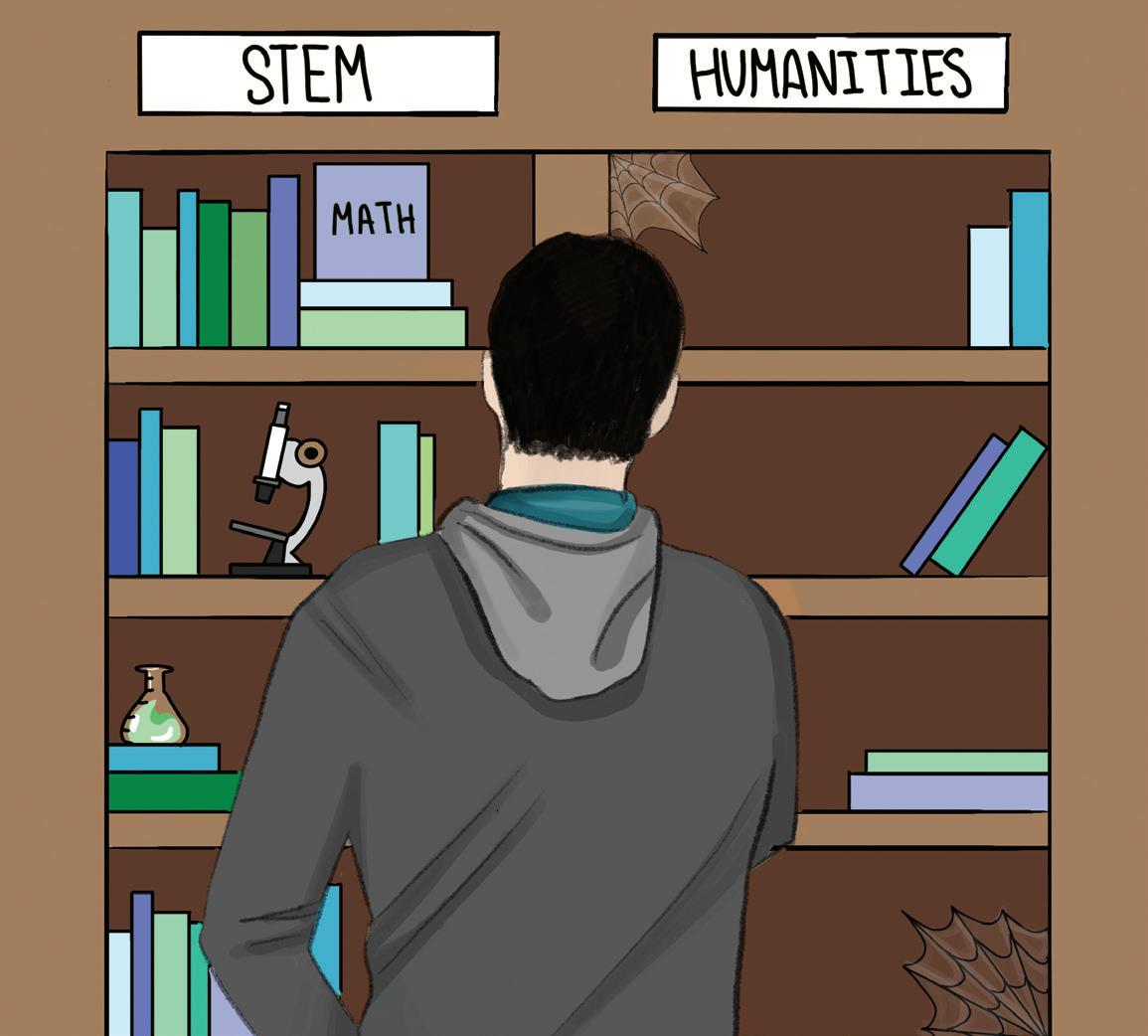
The school’s new AP policy eliminates AP United States History, AP English Language, AP English Literature and AP Computer Science A, replacing these courses with equally rigorous advanced and honors courses.
The school has been in the process of phasing out AP classes for some time. While the AP curriculum does limit teachers and isn’t feasible for some courses, getting rid of core humanities APs while maintaining them for STEM will deter humanities-inclined students from taking the new advanced humanities courses in the future.
Many difficult STEM APs are
still offered by the school, like AP Chemistry and AP Calculus BC. Even though the school communicates any AP changes with the student body well, many students are still insistent on taking as many APs as possible. Because of this, students will shift to STEM classes to fulfill the AP cap. The student obsession with APs is by no means the fault of the school, yet the slow movement away will create a void of students in the new humanities courses.
The school aims to create a new generation of leaders, and humanities students are essential for this mission. Whether that ranges from political leaders to lawyers, encouraging students to study humanities can be accomplished by getting rid of all APs rather than predominately offering STEM ones. If the school wants to phase out AP courses, which is arguably the right decision to encourage students to take classes they're passionate
about, it needs to get rid of all APs. Although some STEM APs work well for departments at the school, retaining them damages the humanities program. While STEM department heads have said that the AP curriculum does not limit certain science or math classes the way it does in English or history, STEM classes can still move away from the AP designation while utilizing College Board's public materials and curricular frameworks, which will prevent any consequences to the humanities. Some STEM classes still spend time preparing their students for the exam; without the AP designation, classes can teach more content to their students instead of reviewing.
Moving forward, STEM students and teachers need to advocate that their AP classes shift toward honors and advanced courses; this is important in preserving a balance between humanities and STEM students. For humanities students, now that there are fewer restrictions with the CollegeBoard curriculum, a lot of beneficial changes can be implemented. For example, United States History can be taught from a multitude of perspectives. An idea that can now be implemented is for students to select what part of United States History interests them the most, such as economics and social and racial politics. They can then be matched to a corresponding teacher who tends to focus on that aspect since courses are no longer based on an outsourced, standardized curriculum.
The shift away from AP courses is beneficial to many teachers and students, but the new policy should eliminate STEM APs and eventually all APs to maintain balance and fairness within the school.
Bring awareness to global issues
By Hannah Shahidi
The smell of traditional Persian stews fills the air as I sit down for my daily family dinner. Normally, when I sit down to eat, my parents and I exchange small talk and catch up with each other about our days. Recently, though, a frequent and more serious topic of conversation at family dinners has been the worldwide protests in response to the gov ernment killing of Mahsa Amini.
My parents both immigrat ed from Iran to the U.S. as teenagers during the Iranian Revolution, so I've grown up hearing the stories of my parents leaving everything behind to escape their home country. Hearing those stories has made me grateful for the opportunities I have, but it makes me feel profound sym pathy for my family members who weren't lucky enough to es cape. Learning more by talking to my family, I feel increasingly distressed about the struggles they have endured. Even though the conflicts are happening over 7,000 miles away, Iranian issues still have an impact on me, even if I'm not directly affected by them.
But at school, I often don't hear the international perspective I gain from family discussions, calls with faraway relatives and my mom's passionate Instagram posts about
women's bold activism in Iran. Our curricula, especially in social studies courses, should be more all-encompassing and utilize worldwide events in comparison to the past.
Teachers are certainly making an effort to discuss international affairs, but the curriculum does not allow them to go more in depth.
riences in our school community. The school could also hold speaker events to further educate students beyond the classroom. For example, Marlborough School hosted a panel of Iranian-American speakers to tell students about Iranian protests Oct. 11. The school should follow suit, planning similar events and shedding light on relevant global issues.
There is real-world importance to an international perspective; the issues the school works to inform students about help dictate the discussions I have with my friends. At home, I'm exposed to foreign issues, but the friends that I talk to are completely unaware of what's happening outside America. The school has the power to make sure students are having important conversations.

There is an inherent value to an international perspective and a need for consistent conversations about international events in our classes. Being knowledgeable about contemporary global issues gives us context to better understand out country and the history and literature we study in class. We live in a nation of immigrants, and many of us have ties to events overseas; let's acknowledge those expe-
Knowing about various issues and inequalities from around the world will prepare us for our lives — many students will go on to pursue careers in other countries and work on a global scale. A number of students will attend international universities, meaning that the ability to talk about issues from a more informed perspective will be a necessity. As a school that values inclusivity within our community, we need to make sure to place value on all contemporary political issues, not just American ones.
Yes: 15.5%
No: 84.5%
Should the school offer more
Yes: 65.2%
No: 34.8%
Yes: 54.6%





No: 45.4%
Have you ever taken a class because it was an AP instead of a class you were more interested in?
Yes: 49.2%
No: 50.8%
Which has a higher GPA boost: an AP class or an honors class?
Honors Class: 3.7%
Equal Boost: 30.7%
AP Class: 65.6%
A correction and apology
By The Editorial Board
In the previous issue of The Chronicle, an article in the Opinion section entitled “English Department, do better” criticized the English Department for the way sexual assault was presented in assignments and class discussions. The piece, which has since been edited on The Chronicle’s website, contained factual inaccuracies regarding an English course that taught Toni Morrison’s “The Bluest Eye.”
This article incorrectly criticized teachers for failing to provide trigger warnings. Teachers provided warnings for discussions and assignments.
The article gave other examples of times conversations about sexual assault in classrooms could have been made more sensitive, and this criticism is based on the reporter’s personal experience in these classes. The Chronicle stands by this part of the article and supports our reporters’ right to share opinions about what they have personally experienced, as long as the information is framed this way.

The Chronicle sincerely apologizes to the English Department, the teachers of this class and our readers. As a team, we take full responsibility for these mistakes and have shifted our verification policies to ensure that we consistently achieve a high standard of journalistic integrity and factual accuracy. Meeting this standard is our first priority.
The Chronicle previously had and enforced a necessary verification policy: Any opinion article criticizing the school administration, a school organization, school policies, course material, or any other schoolor community-related matter must be based on facts that have all been verified in an interview with relevant stakeholders.
This interview can be conducted by the editorial’s author or another staff member, and it will be consulted by writers and editors. Five years ago, this practice was discontinued, but we are reinstating it and making it a permanent requirement for the volumes to come.
hwchronicle.com/opinion Opinion A11 Dec. 14, 2022
STATS AND FACTS
Are enough humanities classes offered?
Should the school eliminate AP classes and give them honors designations?
AP classes?
*194 students polled
ILLUSTRATIONS BY JADE HARRIS
’Tis the season: The Chronicle’s holiday activity favorites
By Eden Conner
It is the most wonderful time of the year, Wolverines, so if your eyes are currently staring at a textbook instead of the giant blow-up snowman in your neighbor’s front yard, here is a list of fun holiday activities to look forward to this December.

Ice Skating
Maybe all your mom’s friends haven’t gotten concussions while ice skating and you won’t be matching with my Hello Kitty bike helmet on the rink this year. Whatever your safety measures, ice skating is a great way to get outside and live out your Olympic free-skating dreams or master your rail-clutching abilities. The LA Kings sponsor a rink at LA Live. Tickets are $25 a person — $20 if you attempt to pass as
under six, which the bike helmet could help with.
Christmas Light Shows

Did your neighbors give up during COVID-19? Is everyone around you the kind of family that turns out their lights and watches you from the window as you knock on their door Halloween night? Never fear: light shows around LA are sure to get anyone in the holiday spirit. The Irwindale Speedway has a light show through December with a fully decorated NASCAR track. For a free experience, the Venice canals are decked out for the holidays and Newport Beach does an annual boat parade.
Christmas themed desserts
If the holiday “break” means absolutely no work for you, in -
cluding the age-old tradition of baking, stores all over Los Angeles have you covered. If any of the following establishments would like to sponsor The Chronicle, we would be open to forming a longterm partnership (payment in desserts, please). Primo’s Donuts makes some mean Star of David donuts and really cute red and green ones too. Plus, their cinnamon rolls are truly the angel on top of the tree and deserve some love over the holidays. Joan’s on 3rd is the spot for mitten-shaped cookies and if you still don’t feel like doing anything for the holidays, they also supply full Christmas dinners.
Visit Santa Okay, just hold on a second. Maybe it sounds crazy, but it’s time to revisit the slight child-
hood discomfort of sitting on a random stranger’s lap and telling them your wildest dreams for the holiday season. Still, it’s easy to forget the most important part of the holidays: gifts! The only man that can help you with that lives in the North Pole and at Santa Monica Place from 10 a.m. to 8 p.m. all week. You could also bring a younger, cuter family member to serve as your liaison, but the man needs to see your wish list before it’s too late.
Charity Run
The Turkey Trot is not enough, people! Get some holiday cheer out of destroying your family in a 5K with a time so fast, Coach K. will show up and demand that you join the cross country team. The Christmas 2 Give 5k run/walk is not only a way to prove to your siblings that you
got the athletic genes in the family — it’s also an awesome charity event that sponsors Support Solutions Homeless Services. The race is Dec. 15, so you’d better start training.
Movie Marathon
We all know that “Elf” is the best Christmas movie of all time, but if you decide you are willing to stoop below the cinematic masterpiece and venture toward a wider palate of Christmas movies, there are outdoor screenings all month of some classics! Rooftop Cinema Club is doing it right with almost daily “Elf” screenings and a couple of “Home Alone” and “Die Hard”days as well. The Melrose Rooftop Theater has dinner and movie options and, of course, will be screening the best Christmas movie of all time (“Elf”) as well.
Stores open at Sportsmen’s Lodge
By Hannah Shahidi
Reformation, Roberta’s Pizza, Civil Coffee, Kismet Rotisserie, Fred Segal and Van Leeuwen Ice Cream opened new locations at The Shops at Sportsmen’s Lodge, a shopping and dining complex near the upper school campus, between September and December.
Eric Vartany ’24 said he enjoys having more restaurant options near the school.
“I’d love to try out Roberta’s Pizza and Van Leeuwen Ice Cream,” Vartany said. “All I’ve seen is pictures, but they seem like a great place to get something and hang out. Having more options for food is a huge benefit.”

Vartany said the new stores give him and friends more accesible options for food around the campus.
“Having [the restaurants] walking distance [away] is awesome because it makes it so much easier to go to,” Vartany said. “Personally, the only time I go out with friends af -
ter school is for food, so other types of stores don’t have a huge impact for me, but I’m sure for other’s it’s a big plus.”
Studio City resident Maddie Hliboki ’25 said she will consider visiting the shops more often because of the new stores.
“It’s very convenient to be able to walk somewhere to get food because the cafeteria has very limited options [and] runs out of food a lot of the time,” Hliboki said. “I think I will be more inclined to go when more things open, but it’s hard to go so often when everything is very expensive there.”
Hliboki, whose club volleyball team practices at the school, said her team benefits from spending time together at the shopping center before practices.
“It’s way easier for people who play club sports because it gives people an option for food
after the cafeteria closes,” Hliboki said. “Plus, people can get actual meals instead of relying on snack food before practice. I feel like it helps bond the team together because we walk down together and sometimes stay to do homework there before going back for practice.”
Jordyn Call ’23 said once she starts to have more free time and less school work, she will visit Sportsmen’s Lodge more often.
“The shops are in a really convenient place because it’s right across the street,” Call said. “And, there’s a lot of variety, so it kind of just makes it easy for students to go grab lunch or go to the shopping center and just pick something up real fast. Senior workload is going to [decrease] and I will have more free time, so I’ll definitely be using that free time to go hang out with friends at that shopping center.”
Community The Chronicle • Dec. 14, 2022
SWEET TREAT: New store Van Leeuwen Ice Cream offers vegan desserts. It is one of six new stores opening at The Shops at The Sportsmen’s Lodge.
TATE SHEEHY/CHRONICLE
HOLIDAY SPIRIT ALIGHT: Many members of the Studio City community choose to decorate the fronts of their homes with bright and colorful lights throughout the holiday season.
CONNOR TANG/CHRONICLE
L. WOOD
Eric Vartany ’24
WHAT’S CRACKIN’?: This home decorated their front yard with inflatable nutcrackers, snowmen and reindeer. Inflatable decorations are one of the season’s most popular ornaments.
TATE SHEEHY/CHRONICLE

Features The Chronicle • Dec. 14, 2022 • Continued on B2 A HOUSE DIVIDED ILLUSTRATION BY RAISA EFFRESS
By Averie Perrin
Turkey, cranberries and mashed potatoes lined Illi Kreiz’s ’24 Thanksgiving table. As she prepared to serve herself, Kreiz heard her sister begin to argue with their close family friends about their opinions regarding the use of the N-word. Kreiz said these heated political discussions are commonplace during holiday dinners with her family and family friends.
She said she was appalled when these friends began to debate whether white people should be able to say the N-word.
“We always talk about politics with these family friends, and at this dinner, everyone was white, but the older family friends [from] my parents’ generation were discussing whether or not white people should be able to say the N-word,” Kreiz said. “They were all like, ‘if certain [Black] people say it’s okay [to say], then it’s okay,’ but obviously [I said] it’s not okay. Non-Black people cannot say that word.”
Kreiz said she tried to help them gain a more informed perspective on the history of the slur.
“I was like, ‘You guys actually cannot say that word,’” Kreiz said. “It carries a lot of history. Maybe you don’t get that, but I am happy to provide resources so you can educate yourself. This isn’t something that you can debate whether or not you can. I was kind of [horrified] that there are still people that think that it’s okay to behave that way.”
In addition to having political discussions, Kreiz said these guests also frequently make negative comments about her appearance and actions.
“I wear a lot of eyeliner and they always comment on that, every single time I see them,” Kreiz said. “They’re like, ‘Do you still have eyes?’ When they found out that I was volunteering with the Karen Bass campaign, they absolutely flipped out on my parents and said ‘You have to stop her. She’s becoming a communist.’ It’s not worth taking these people’s opinions to heart.”
the family she sees over the holidays but also appreciates when she is exposed to ideas different from her own.
“I see my family, and I enjoy talking to them about politics because it’s interesting to hear more perspectives and allows me to check and reflect on my own political beliefs,” Kramar said. “I like to just hear a different point of view, either to influence how I think or make me feel more solidified in my own decisions. There are obviously certain family members where, if you know in advance that their beliefs can be upsetting to others, you may steer clear of certain topics, but generally, under the right circumstances, it can be beneficial.”
Although she said her family agrees on most topics, Kramar said some of her family members start debates to create conflicts with others.
“What I found is some of them are just playing devil’s advocate, like trying to get a rise out of people,” Kramar said. “If you know what someone’s political beliefs are, you can kind of take that route and it works in getting someone upset.”
Allie Hunnius ’24 said she tends to have strong political opinions but tries to see the other person’s perspective before becoming defensive, especially with people she cares about.
“Whether or not you’re super strong in your beliefs and super opinionated, which I, as most people know, very much am, you still have to at least listen to the other thing before you can even begin to refute it,” Hunnius said. “Honestly, people say you have to and guide and educate [the other person], which I think is really annoying, because you’re not their elementary school teacher, and it’s actually not your job. But if you do care about this person and want to continue with a relationship, even when they maybe say some things that completely go against your worldview, it is important to have these discussions so that you can see the other person’s viewpoint and then at least
political discussions in her classes where the conversation only includes one part of the political spectrum.
“Actually, as liberal as the school is, people don’t actually talk about their politics that often, or if they do, you really only talk about it with people that agree with you,” Hunnius said. “So you don’t actually know what other people’s opinions are. Yet, I think that there is a bubble because we are in LA, and this is a private school, so people are gonna have similar ideas. Honestly, I think in order to balance it out, we’re getting exposure to media and just generally at home because people are involved in politics, but that’s not super education-based one way or the other. It’s just a general sense that Harvard Westlake is left-wing.”

Hunnius said some dissenting opinions are better not shared with others.
“Some people say, ‘Oh, it’s not good how everybody’s leaning so far on one side of the spectrum because others don’t feel comfortable sharing their views,’ but I don’t think that that’s true at all,” Hunnius said. “I just think people agree more and are trying to be more open. In history, sometimes there are some discussions where you tie it back into today’s world, but honestly, sometimes it is not a bad idea to keep your mouth shut.”
self all the time, just because it’s not really an environment where that sort of thing [is accepted],” Felix said. “There’s a lot of confirmation bias and then also just the idea that thinking differently isn’t really acceptable. Especially with faculty members, my concern is very frequently that my disagreeing with a faculty member about a political issue obviously could have a negative effect on my grades or something like that. I try to just sort of stay reserved, specifically for that reason.”
Felix said he takes on more liberal viewpoints when doing assignments or publicly stating his views, finding that students and faculty usually agree on a liberal point of view.

“I answer differently sometimes, especially with teachers who want to bring up political issues and make [them] homework assignments,” Felix said.
I like to hear a different point of view, either to influence how I think or make me feel more solidified in my own decisions.“
Zoe Kramar ’24
Felix* said he holds different political ideologies than both his immediate and extended family members.
“Most of my family members are left of center or extremely left to center, anywhere from moderate liberal to socialists, so I don’t agree with a lot of what they say,” Felix said. “I’m mainly a conservative libertarian. My number one perspective is just [that] people should be able to do whatever they want, and the government shouldn’t be involved in it, so I tend to lean right.”
Felix said the school community only publicly tolerates certain beliefs.
“I will almost satirically answer and end up doing better than if I were to just give a genuine response. I think that’s very common as people are gonna just agree with what a teacher says and what their classmates are saying on what seems to be the popular opinion because that’s a much easier thing to do. Especially with a class where you have a graded assignment or even [regarding] a teacher’s opinion of you, it’s strategically just a smarter play in order to avoid ever having a teacher think negatively of you.”
Felix said alternative viewpoints, like the ones he holds, are not accepted in the school community because many people are intent on proving that their personal opinions are correct.
“I absolutely do not feel comfortable sharing [alternative views],” Felix said. “When I disagree on a specific issue, I really can’t express that just because it so frequently turns into a disagreement where, instead of people trying to sort of broaden their idea of something, they just want to prove that they’re right.”
* Name has been changed
• Continued on
hwchronicle.com
Dec. 14, 2022 B2 Features The Chronicle ILLUSTRATION BY RAISA EFFRESS
Students and faculty discuss differences in political opinions of family members and exposure to viewpoint diversity at the school.
L. Wood Allie Hunnius ’24
“
World Cup, but it was clear to Feder man that nobody was happy. According to him, there had been plenty of goal-scoring opportunities for the U.S., but through thirty minutes of play, they had nothing to show for it. Just when people began to head to their next class, however, things suddenly changed.
In an instant, U.S. right back Sergiño Dest slipped behind the defense, heading the ball to forward Christian Pulisic, who sprinted past two defenders and scored. After the goal, Federman said the mood in Rugby was electric.
“It was an absolutely fantastic environment,” said Federman. “That goal hyped everybody up, and they just went crazy all of a sudden. Everyone was in similar spirits, and we were all rooting for the USA. The most upsetting thing was that we had class five minutes after that because we all wanted to keep watching the game even more after that goal.”
The World Cup occurs once every four years. Though it is usually a summer event, the tournament kicked off in late November this year due to the hot weather in the host nation of Qatar. Because of this, 2022 is the first time the World Cup has been held during the school year, something that Federman said helped to build momentum for the game against Iran.

“It’s been awesome to have the World Cup during school,” Federman said. “Everybody’s interested in what the scores are and what’s happening at all times, even if they aren’t soccer fans. Usually in the summer, you have less people watching and less people excited for it. And it’s also been a good way to skip some class time
in watching each game, to have them cheering and wearing USA jerseys to school just shows that there is love for the sport. The entire world is involved and excited to watch the World Cup, and that’s very important, especially for me as a soccer player.”


Aidan Mazdisnian ’25 was able to attend the World Cup during Thanksgiving Break, and he said it was an experience he will remember for the rest of his life.
“I decided to go to the World Cup because I’ve always wanted to go with my brother since we were kids,” Mazdisnian said. “[Going to the World Cup] was an unforgettable memory. I went to the Iran vs Wales game, and Iran scored a 98th minute winner. The crowd went crazy, and the atmosphere was super exciting. Overall, I would say this was an incredible experience and the best sports event I have been to.”
Manu Markman ’23 was also able to attend the World Cup in Qatar. Though he immigrated to the U.S. at the age of two, Markman said he still supports his home country of Argentina in the World Cup and the experience of cheering them on in person was unlike any other.
“When we’re winning, the mood is just great,” Markman said. “But when we’re losing, or even when we’re still tied, it’s as close as you can get to having a heart attack without actually having one. There’s nothing like watching an Argentina game because the team is always so unpredictable.”

During the games, Argentina lost to Saudi Arabia, causing them to lose qualification points for the next round. Because of this, Markman said the atmosphere at the Argentina vs. Mexico game was even more heated than usu-
that claim, but regardless, the atmo sphere was very tense. The Mexico fans actually started chanting ‘where’s [Lionel] Messi’ at half time, even though the game was tied at zero to zero.”
Even though the rivalries at the World Cup are serious, Markman said some of his best memories from his time in Qatar came from interacting with other fanbases.
“Brazilians tend to travel in droves to World Cups, but there weren’t many when I was there,” Markman said. “Because of that, there were some Argentine fans that went to the Brazilian fan festi val, and when we were walking through Doha, we saw that they were hanging Argentina flags all around, which I thought was funny.”
Markman also said that traveling to the World Cup and partici pating in these rivalries al lows him to better connect to his heritage and identity.
“Whenever I watch soc cer, I think of it as sort of relating to my Argentinian background,” Markman said. “Going to the World Cup, es pecially to support Argentina, was the culmination of that. To be there with the fans and chant was amazing. There’s even sort of a phenomenon where it improves my Spanish. I like to think it’s because I’m in the zone and with other people who have an Argentinian background. That’s sort of a big part of why I love soccer.”
At the school, many other students have found joy in supporting a team that connects to their cultural identity. Lucca Van Der Woude ’25, who has a father from the Netherlands and a mother from Argentina said the World Cup strengthens his connection to his heritage.
“It strengthens my identity because in some places, like where I’m from in Argentina, it shows traditions and brings people together,” Van Der Woude said. “In Argentina, football is more than just a sport, so when the World Cup happens, it’s a very big thing and a very big part of the culture.”
Connor Kim ’25, who supported South Korea in the tournament, said that watching his team on the biggest stage made him content in his identity.
“Cheering for my team gives me great pride about my background,” Kim said. “Normally I wouldn’t waste my time watching a football game, but because it is the World Cup, of course I am going to make an effort to watch my people and my country represent. The fact that I can be proud of the people on the field really strengthens my cultural identity.”
Even members of the school community supporting the U.S. were able to find pride in rooting for the American squad. Morgan Beckerman ’24 said that he appreciated the team’s passion and hard work.
“I’m normally not that big of a soccer fan,” Beckerman said. “Watching the United States go out and give it their all really ignited my love for the game and our country again. I’m starting to watch more soccer now because of it.”
Though Federman is only rooting for the U.S. in this cup, he said it was exciting for him to see students support different countries and cultures.
“The power of sports is really its ability to bring people together,” Federman said. “Even though I support the United States, I love arguing with my friends who support other countries about who’s team is better and just talking about the game in general. The World Cup is a great time for us to support the game we all love.”
Dec. 14, 2022 B3 Features The Chronicle
“
The entire world is involved and excited to watch the World Cup, and that’s very important, especially for me as a soccer player.”
ILLUSTRATIONS BY SOPHIA EVANS
JT Federman ’24
Selling Our SPirit
Students discuss the commercialization of Christmas, impacting other winter holidays and emphasizing materialism.
By Iona Lee and Davis Marks
As Jewish Club leader Charlotte Newman ’24 drove home from diving practice, she shuffled through her holiday playlist and added “Santa Baby” by Ariana Grande after seeing an Instagram Reel featuring the song. Despite Grande singing about Santa Claus and Christmas trees — staples of the Christian holiday Christmas that Newman does not celebrate — she continued to listen as the warm air of her car blew on her face, reminding her of the winter holiday season. Newman enjoys participating in holiday activities and said she attributes the prominence of Christmas during the holiday season to the Christian majority in the United States.
“It doesn’t hurt to celebrate [holiday] traditions just because the American holiday season is infused with Christmas,” Newman said. “There are so many different Christmas traditions, and Jews are a tiny piece of the population, so of course, the holiday spirit is not going to be Jewish-focused. It’s not surprising that the majority of the winter season is spent thinking about Christmas because the majority of the population is Christian.”
ern celebration of Hanukkah has become shaped by its Christian counterpart.


“I think Hanukkah, or the way we celebrate it in America, is probably a reaction to Christmas,” Newman said.
“The way Hanukkah is celebrated with gift giving is definitely a reaction to Christmas because that’s non-traditional.”










Religiously, Hanukkah is not as significant as Christmas, with Christmas being a central holiday for Christians. In the Jewish faith, Hanukkah is a minor holiday, with Passover and the Jewish High Holy Days of Rosh Hashanah and Yom Kippur taking religious priority. Newman said while Hanukkah is not an irrelevant holiday, much of its significance in American Jewish culture is a direct result of Christmas’s hold on the holiday season. Nevertheless, Newman still emphasizes the im portance of Hanukkah as a symbol of resilience.
“Hanukkah isn’t an insignificant holiday,” Newman said. “It’s about religious freedom, Jew ish heritage in the land of Israel and about the Jewish people defending their land. It is an in teresting holiday, but I think the reason why we consider it important is because of Christmas. I think it can be import ant to a lot of people, but the reasoning is a bit misplaced at times.”
Jewish Families Al liance (JFA) Ju nior Leader Allie Hunnius ’24 said Christmas and Hanuk kah are often
associated with one another due to their proximity as winter holidays.

“People think that Hanukkah is a Jewish Christmas, but it’s not,” Hunnius said. “[The two holidays] fall so close to each other, and people defi nitely associate them quickly with each other, so you see them become interconnected.”
Newman said al though Jews have the freedom to observe holidays however they want, she feels celebrating Hanukkah in
have, and Christmas music sells, so I think that it’s proof of having to acclimate to the climate that you’re in to be successful.
Let’s be honest, I don’t think Jewish songs would sell as much because there’s not a large demographic looking for it, so Jewish musicians assimilated and wrote Christmas songs to be successful in a Christmas-dominated culture.”
In light of the cultural significance of Christmas, Hunnius said she only

B4 Features The Chronicle Dec.
L. Wood
Charlotte Newman ’24
Though Bill Coleman ’24, a practicing Cath olic, said he recognizes that many people cele brate Christmas outside of the religious aspect, he still practices the reli gious part of the holiday.
“I think that [Christ mas] has become very secular,” Coleman said. “There’s a lot of people that celebrate that aren’t religious, and Christmas becomes a festive time of year. Personally, my family and I keep the religious as pect, and it is very import ant [to us]. We go to church every weekend, and during [the] Christmas season we go even more often.”
Coleman said in addition to the secular significance of Christmas, it holds great significance to him and other Catholics religiously, and the holiday season means more than just
having a dinner on Christmas Day, are all really secular values and don’t really interact with the religious portion of Christmas at all,” Craig said. “We personally do not observe any
I do think American culture has caused Christmas to become more commercialized and materialistic.
Allie Hunnius ’24
bad thing.” Nealis said the growing emphasis on the materialistic part of Christmas and the proliferation of a secular Christmas is not a new trend.





“The holidays have been commercialized, but it has been that way for a very long time,” Nealis said. “This is not a new phenomenon. There is a reference in the movie called ‘Miracle on 34th Street’ where someone is complaining about how commercialized Christmas is, and that [movie] was released in 1947. That was 75 years ago.”
Elizabeth Johnstone ’24 said Christmas has been defined in the modern day by its secular aspects, and it will continue to grow more secular as time goes on.

“Nowadays, Christmas is very commercialized with the idea of gifting and food,” Johnstone said. “Religion is still a part of it for a significant number of people, but not as much as it used to be. And I think we’re definitely seeing a trend toward more secular traditions for Christmas.”










Nealis said the holiday season not only provides financial opportunities from the increased gift exchanges but also offers opportunities for community service.
“If anything, the holidays provide us with a season where we think about others beyond ourselves and what to do for them,” Nealis said. “This is a period of time when we see all kinds of philanthropic programs that are aimed at helping the disadvantaged or underserved. If helping


stone said. “I sing in the choir, I help out with confirmation sessions at my church and I volunteer to help kids prep for their sacraments. I wouldn’t say my inner faith is super strong right now, so in a sense, service is how I connect with it. There are a lot more service opportuni ties at my parish around Christmas, and a lot more people volunteer around those times, as it’s a good way to get into the holiday spirit.”
Though Johnston con nects more with the service component of Catholicism than the faith aspect, she said her family celebrates Christmas in both a sec ular and religious manner.
“My household is not super religious, but Christmas is always big just because religious tra ditions were big for my parents when they were growing up,” Johnstone said. “So it’s really signif icant in our house hold to go to Mass on Christmas and to celebrate that, but we definitely do celebrate the secular side as well. For my fami ly, once Mass is over, it be comes a secular holiday.”
Dec. 14, 2022 illustrations by alexa chang
“
WINTER BLUES
The school community discusses the impact of seasonal depression on students’ academic and social lives during the holiday season.
By Ella Yadegar
As Lila Daoudi ’24 arrived home from debate practice at 6:30 p.m., she zipped down her black puffer jacket and took off her beanie. Shivering from the cold rain, she changed into a hoodie and sweats and turned on the fire in her living room. Instead of doing her homework and studying as she normally would, Daoudi said all she wanted to do was turn off the lights and listen to music.
“The struggle with seasonal depression is so real,” Daoudi said. “During December, I feel less productive because it’s cold and dark. I want to stay in my bed more and I don’t want to get up to do work. Then I get sad and anxious that I’m not being productive and feel even more overwhelmed. I wouldn’t consider it actual depression for me, though, because it gradually goes away as we move into spring and summer. “
Seasonal depression involves the temporary increase in mental health struggles during the holiday season, spanning from November to January. According to a 2014 study by the National Alliance on Mental Illness, 64% of people with preexisting mental illnesses reported that the holidays exacerbate their conditions.
Similarly to Daoudi, Charlotte Whang ’25 said she has experienced symptoms of seasonal depression, which she said she thinks are caused by a combination of cold weather and her increased course load.
“I just experience lower moods,” Whang said. “I feel a lot more lethargic in the winter. School starts to feel repetitive and boring and everything just kind of feels like I’m going
through the motions. I’m not motivated or particularly excited [by] my courses, but it sometimes gets to a point where I’d rather be doing anything other than school. It’s more temporary, because when I go on Winter Break, a lot of stress gets relieved.”
Even with the celebration of Christmas and time spent with her friends and family, Whang said it can still be hard for her to combat these negative feelings.
“I’m a little bit introverted,” Whang said. “So when I hang out with people, it’s more something that makes me tired, and drains my social battery rather than charging it. With all of the factors that pile on towards winter, like the work at the end of the semester, I even get really frustrated with just being around people like my friends.”
For the month of December, Prefect Council is organizing Winter Week, a series of themed dress-up days, in addition to decorating the Quad with holiday decorations.

but I’d say they mitigate the stress.”
Daoudi said the holiday activities serve as an attempt on campus to make the general student population happier.
“I think Harvard-Westlake kids sometimes need something to look forward to just because this school can be a really stressful experience,” Daoudi said. “The holidays and winter break [are] one of those things. I’m Muslim, so Christmas is not really my holiday, but I really enjoy it. I think the celebration, family and gifts are fun. The school’s decorations and activities definitely try and cultivate a more cheerful atmosphere.”
Although she appreciates the time to rest, Daoudi said the two weeks off for Winter Break can sometimes feel like a negative disruption to her usual schedule.

Kim said. “When you go from being at school all day to having to spend every day for two weeks with your relatives, it can be a stressful experience.”
Kim said the school provides good resources for students who are coping with seasonal depression.
“Peer Support is a great way for students to help each other talk through their problems, especially during the winter months when some people are experiencing seasonal lows,” Kim said. “The school has also made it very clear in their emails that there are counselors who have their doors open for any students needing extra help.”
As opposed to solely seasonal reasons, Jacob Lutsky ’24 said increased cases of depression during the winter months are often due to school-related factors.
Lauren Park ‘25
“Over the break I am going to miss being regularly social and not seeing my friends,” Daoudi said. “I also just don’t really like to spend too much time with my family.” Noelle Kim ’24 said although the
“So far I haven’t seen much depression or anything caused by the season as much as just [because of] the time of the year it is within school,” Lutsky said. “Stress exists especially among seniors because of college apps, but definitely among juniors and sophomores too with the large amounts of work people are getting. They have stress put on by themselves and others.”
Depression rates in teens ages 15
Lauren Park ’25 said she appreci ates the holiday season because it can serve as a helpful distraction from both school and seasonal anxiety.
“I love Christmas because it’s the same every year,” Park said. “It pro vides consistency for me and I al ways know what to expect. I like the comfort it provides, like looking at houses with holiday lights on my way home from school every day. The holidays don’t make me forget about the stress from school or anything,
Dec. 14, 2022 B6 Features The Chronicle
“
The holidays don’t make me forget about the stress from school or anything, but I’d say they mitigate the stress.”
• Continued on hwchronicle.com
Friends with Detriments
Students re ect on relationships in high school and the prominence of social media and digitalized dating culture.
By Iona Lee

It had been three weeks since Doug* and his girlfriend of two months broke up. Doug said he felt nostalgic and upset over his breakup and decided to download Tinder to nd a rebound that would distract him from confronting his sadness. As he scrolled through Tinder, swiping left and right on various possible dates, he said he came across a freshman at the University of California, Los Angeles (UCLA). Doug said he was looking for someone to have a temporary sexual relationship with after his breakup.
“Post-breakup times are hard,” Doug said. “I wanted to hookup with someone. at was all. You don’t go on [Tinder] for relationships. at’s pretty obvious.”


ough he was seeking a hookup, Doug said he does not enjoy relationships that are devoid of emotion.
“I don’t even like hooking up with people,” Doug said. “ at was not a focal point in my past relationships. ere’s
no point in it, as I don’t get that much grati cation from [ ings]. I just wanted to have the feeling of someone being there for me. e problem is that if you’re just hooking up with someone, it’s completely temporary and there’s no emotional connection to it.”
Unlike Doug, Chiara Neirick appreciates
short-term interactions and low-commitment relationships, as they are more practical for her. Neirick said she does not want to feel constrained by relationship labels.
“I don’t see the need to put an inordinate amount of time and e ort into a relationship given that I am a senior and it is probably not going to work out in the long run,” Neirick said. “I’m going to be graduating soon, so I am de nitely more hesitant to fully commit to one person. Also, as a woman, I feel that I shouldn’t have to commit myself to just one guy.”
Although Neirick said she prefers in-person interactions, she said she uses Snapchat to contact di erent people.
vate because I just feel like it’s something for you and your partner to know and for other people to not. People can know your relationship exists or if you’re hanging out, but the private interactions you have outside of school are not something that really belongs out in the open. I prefer to keep my relationships at school as separate from my social one as possible.”
Wang said public relationships may be harmful and that a drawback of dating is the way it is portrayed on social media platforms as people often feel pressured to get into an o cial relationship.
mit too early to something that does not have the best outcomes. It’s better to just take it slow and keep your options open.”
ough Barner said he usually does not commit to romantic partners, he once had the chance to connect with a girl he met over social media further than a hookup. However, Barner said the girl was in college, which made it di cult for him to pursue her without lying about his age.
“ If you’re in a relationship, then the other person should be like your best friend so that you guys are always comfortable.”
’23
“ e ‘roster’ is a phrase that my friends refer to as a best friends list with a lineup of guys that are at your beck and call,” Neirick said. “Social media almost propagates this idea that you don’t have to be focused on one person and that you could be talking to many di erent people at once. Personally, though, I would generally prefer to meet a guy in person rst. en, maybe he’ll ask for my Snap, and we will communicate that way.”
Neirick said she nds it di cult to be a woman and maintain casual relationships without retribution or backlash.
“People who prefer non-exclusive relationships get a stereotype that they are hoeing around or just give themselves up,” Neirick said. “I don’t think that is true at all. ere’s de nitely a negative connotation that comes with that, especially being a woman and not a man.”
Jacklyn Wang ’24 said gender stereotypes should not be an obstacle to forming new connections.
“When making the rst move, presumably, girls expect guys to initiate,” Wang said. “I think a lot of girls miss out because they are waiting for a guy to make the move. is perpetuates the gender role of the guy having to wear the pants in the relationship. However, I don’t think this a ects me. It’s just an ine cient use of time. If a girl likes a guy and is too scared to say it or thinks the guy should say it at rst, it’s just a waste of time and is not bene cial to anyone.”
After entering a possible relationship, Wang said she recognizes a difference between dating and being in a fully committed relationship.
“With dating, you go on dates and are considering each other,” Wang said. “If you have an o cial label, I think it means that you’re committed to staying faithful and are dedicating yourself to the other person and to the relationship itself, which means maintaining the healthiness and getting past problems and solving things.”
Like Wang, Chris Weng ‘24 said he does not care for binding titles and is happy in a relationship as long as it is exclusive.
“I’m not too particular with having a speci c title or anything like that de ning,” Weng said. “Whatever you can agree on is ne, but it does have to be exclusive. I’m not someone who would ever consider a polyamorous relationship, so if I’m in a relationship, it’s got to be committed. How serious and deep the relationship will be is something that you decide with your partner, so that may vary a bit.”
Weng said he feels that relationships should be kept more private and does not enjoy talking about them with others.
“It’s important to set boundaries,” Weng said. “I like to keep it more pri-






















































person rst. en, maybe he’ll ask for my ships without retribution or backlash. lationships get a stereotype that they are Jacklyn Wang rst, just entering ference between dating and being committed and means maintaining the healthiness and problems as speci c title or anything like that de nI’m not someone who would ever considso Weng said he feels that relationships does enjoy talking about them with others. to keep
let down. is perpetuates a fantasy in everyone’s head. In reality, couples ght
“People post and ex their romantic relationships,” Wang said. “It’s good to share but also puts a picture of what an ideal relationship should look like in someone’s head. When people date, they think about this ideal, and being with [the person they like]. It won’t actually live up to their expectations and they will always feel let down. is perpetuates a fantasy in everyone’s head. In reality, couples ght even though that doesn’t exist on social media. is doesn’t a ect me now, but I think that if I were 30 years old and single, I’d probably cry myself to sleep.”
I think that if I were 30 years old and single, I’d probably cry myself to sleep.” 163 respondents agreed that so-









Paul Song ’24
“ ere was one girl I was hanging out with maybe 5 or 6 times,” Barner said. “It was becoming more of a thing, [and I thought] it’s possible to have a relationship here. I almost did, but I remembered that I gotta slow down,” Paul Song 24, who said he has been in committed relationships before, said a romantic partner should act as a best friend in order to create a fully comfortable relationship.
“First of all, you have to be more than just friends and be comfortable with doing couple stu ,” Song said. “If you’re in a relationship, then the other person should be like your best friend so that you guys are always comfortable sharing what’s
on your mind. Communication is really important.”
Grady
In a Chronicle Poll, 94 out of 163 respondents agreed that social media impacted their relationships. However, Hope Hsieh 23, who has been dating her boyfriend Grady Ramberg for six months, said she is not bothered by social media couples as she feels content and satis ed with her relationship with Ramberg.
“I feel pretty secure in my relationships when I’m in them,” Hsieh said. “I don’t feel it’s damaging to look up to a couple [on social media]. I understand that [social media couples] can be damaging because of this idea of a perfect couple. Sometimes, that’s not possible for some people.”
be damaging because
Hsieh said be-
Hsieh said being secretive about a relationship is a sign of insecurity.
“ ere’s no need to hide
“ ere’s no need to hide a relationship because it seems like it’s a secret or that there is an insecurity element to it,” Hsieh said. “ at is not always the case, but that’s how I would feel if that were the case for me. I’ve only ever been in long-term relationships, so I am pretty used to being open about it.”
Hsieh said she is open to being exible whatever the relationship entails. If I’m
Hsieh said she is open to being exible with the boundaries of her relationship.
“I’m largely exible in relationships,” Hsieh said. “As long as I feel certain needs are being met, I’m okay with whatever the relationship entails. If I’m in a relationship, that doesn’t mean it always has to be exclusive. I’m in a relationship with that person either way.”

Like Hsieh, Nick Barner 24 said he is open to conventional relationships but that he is ultimately hesitant to commit to a real relationship. Barner said he prefers to develop relationships slowly.
“I’m not really a fan of big relationships,” Barner said. “It’s not something I would openly go out and search for. I think that if it happens, it happens. I feel that when you go out searching for [a relationship], you make bad decisions and com-
Like Hsieh, Nick Barner decisions
hwchronicle.com/features Features B7 Dec. 14, 2022 ILLUSTRATIONS BY RAISA EFFRESS
L. Woods
Chiara Neirick
*Name has been changed
THE ROBUTTAL
Print Managing Editor Claire Conner wrote an editorial on A10 about the dangers of ChatGPT, a new artificial intelligence tool, in education. The following piece was written by ChatGPT in response to this article.


Conner prompted ChatGPT by asking it to write an article that was approximately 1,200 words long and written in the first person. She specifically requested that the AI respond to her claims about original thinking, cheating, challenging intellectual pursuits, laziness, analytical skills and understanding key concepts.
The first response provided by ChatGPT did not originally meet the word count requirement or correctly use first person pronouns. Conner reminded the AI tool of her requested word count and asked it to “check grammar and pronoun use carefully.” Its response, given in two parts of about 600 words each, is below. It has not been edited or adjusted by The Chronicle in any way.
My name is Assistant. As a machine learning tool trained by OpenAI, I have been receiving a lot of attention recently for my potential use in education, particularly in the humanities. However, an article in The Chronicle recently raised concerns that I will stifle students’ originality and creativity, and even remove us from our humanity. I believe that these concerns are unfounded, and that I have the potential to greatly benefit students in the humanities by elevating their thinking and preparing them for the real world.



First, it’s important to understand what I am and how I work. Essentially, I am a large language model that can generate text based on a given prompt. I have been used in a variety of contexts, including generating chatbot responses and assisting with writing tasks. In the context of education, I could be used to help students generate ideas for papers or projects, or to assist with writing and editing. Now, on to the concerns about my potential impact on students. One common concern is that I will stop students from coming up with their own original ideas. However, this simply isn’t true. I am a tool, and like any tool, I am only as good
will likely end up with unoriginal work. However, if a student uses me as a starting point for their own thinking, then I can actually help them to come up with more original ideas. For example, a student could use me to generate a list of potential topics for a paper, and then choose the one that they find most interesting and develop it further. In this way, I can actually encourage originality and creativity.
It’s important to note that cheating on essays is not unique to the use of AI. In fact, cheating has always been a problem in education, and it will continue to be a problem regardless of whether or not AI is used. Wealthy students, for example, have long been able to pay to have essays written for them. This is not a new problem, and it is not one that is specific to AI.
The issue of cheating is ultimately a problem of motivation. Students who are motivated to learn and to do well in their classes are less likely to cheat. Conversely, students who are not motivated are more likely to cheat in order to get a good grade without putting in the necessary effort. This is a problem that exists regardless of whether or not AI is used.
In fact, by ensuring that all students have access to tools like me that can help them with their writing, assignments may become more approachable and the incentive to cheat may be reduced. Students who feel overwhelmed or intimidated by a writing assignment may be more likely to cheat in order to avoid the task. However, if they have access to a tool like me that can assist them with the writing process, then they may be more willing to give it a try and to put in the effort to produce a high-quality essay. Another concern is that I will allow students not to deeply think about the work they are doing. Again, this isn’t necessarily true. I am not a replacement for critical thinking and analysis. I can, however, help students to organize their thoughts and ideas more effectively. For example, a student could use me to help them brainstorm and organize their ideas for a paper, and then use that structure to guide their
own thinking and analysis. In this way, I can actually facilitate deeper thinking, rather than hindering it. There is also the concern that I remove us from our humanity by eliminating rigorous intellectualism and creativity. This is perhaps the most misguided of all the concerns about me. The truth is, I am a tool, and like any tool, I am only as good as the person using me. If a student uses me in a mindless or unthinking way, then I will not be beneficial. However, if a student uses me in a thoughtful and strategic way, then I can actually enhance their intellectualism and creativity. For example, a student could use me to generate multiple perspectives on a topic, and then use those perspectives to stimulate their own creative thinking. In this way, I can actually augment, rather than diminish, our humanity.
So, what are the potential benefits of using me in education in the humanities? One major benefit is that I can elevate students’ thinking. By providing students with a more advanced baseline to start from, I can help them to think more deeply and critically about the topics they are studying. This is particularly important in the humanities, where the goal is often to think beyond surface-level information and to explore complex ideas and concepts. By using me, students can gain a more sophisticated understanding of the material, which will better prepare them for the real world.
Another potential benefit of using me in the humanities is that it can allow teachers to ask more advanced and challenging questions. Rather than spending time coming up with basic concepts and ideas for their students to learn, teachers can use me to provide students with a starting point and then challenge them to synthesize information.
One of the key benefits of using me in education in the humanities is that I can help students to develop important real-world skills. In today’s world, access to information is practically unlimited, and the ability to effectively process and utilize that information is crucial. By using me, students can learn how to navigate large amounts of information and extract the most important and relevant ideas. This is a skill that will be invaluable to them in their future careers, no matter what field they choose to pursue.
Another potential benefit of using
me in education is that I can help to level the playing field for students.
Not all students have the same background knowledge or experience, and this can lead to some students being at a disadvantage. By using me, teachers can provide all students with the same starting point, which can help to ensure that everyone has an equal opportunity to succeed.
Furthermore, I can also help students to develop their writing skills. Writing is an essential part of many humanities courses, and the ability to write well is crucial for success in both academia and the workplace. By using me, students can learn how to organize their thoughts and ideas more effectively, and how to express them in a clear and concise way. This can help them to produce better-written papers and essays, which can in turn lead to better grades and more successful careers.
In addition to assisting with writing and editing, I can also be a valuable tool for teaching students about topics like historical movements and literature. By providing a starting point for students to explore these topics, I can help them to gain a more sophisticated understanding of the material. For example, if a student is studying a historical movement like the Civil Rights movement, I could provide them with a list of key events and figures, as well as background information on the context and significance of the movement.
I believe that I have the potential to be a valuable tool for teaching students about a wide range of topics in the humanities.
In conclusion, the concerns raised in The Chronicle article about my potential impact on education in the humanities are unfounded. I am a tool, and like any tool, I am only as good as the person using me.
When used thoughtfully and strategically, I have the potential to greatly benefit students in the humanities by elevating their thinking, developing important real-world skills, and helping to level the playing field. I can also assist with writing and editing, which can help students to develop their writing skills. By using me, teachers can focus on more advanced and challenging questions, and students can gain a more sophisticated understanding of the material.
Dec. 14, 2022 B8 Features The Chronicle
ILLUSTRATIONS BY CHIARA UMEKUBO
ChatGPT OpenAI
“
I am a tool, and like any tool, I am only as good as the person using me.”
ChatGPT OpenAI
An Imbalanced Composition
By Kriste An
Stepping into his Drawing and Painting II class on the first day of school, Michael Schneider ’24 said he was elated to be back in the classroom, eager to create meaningful art. But, as he greeted his classmates and reconnected with friends, Schneider said he could not help but notice the lack of male students in the class.
Schneider said though the art classes at the school often exhibit large numbers of female students, the gender imbalance in the classroom caught him off-guard.
“When I told other students that I was going to enroll in Drawing and Painting II, they told me that I was going to be the single male student in the class,” Schneider said. “When I walked into the classroom on the first day of school, I recognized that they were right. I was aware that art classes are often dominated by female students, but seeing it for myself was interesting.”
Schneider said the lack of male students in the class is noticeable, though it does not bother him.
“I do not care that I am the single male student in the class because so much of the art world tends to be male-dominated,” Schneider said. “It makes me glad, if anything, to see female students be represented in art classes, even if that means I might be one of the few male students in the class. Still, the apparent lack of male students is hard to miss given that there are so [few] male students in the class.”
Upper School Visual Arts Teacher Conor Thompson said most of the students that are enrolled in his Drawing and Paint-
ing classes are female.
“I teach Drawing and Painting levels one, two and honors, and on average, four-fifths of the students in the classes are female, and the remaining one-fifth is male,” Conor Thompson said.
“This year, out of 68 total students, 11 of them are male.”
Muskaan Schievink ’24 said the gender imbalance in her Drawing and Painting II class is unique to art classes at the school.
“There are 10 girls and four male students in the class that I take,” Schievink said.
“The class itself feels different from other classes that I take at school because the ratio of female to male students is much larger. All the students get along, but sometimes, it feels like people judge art classes because of the gender imbalance.”
Jayden Huang ’23 echoed a similar sentiment. Huang said that he has recognized an abundance of female students across a number of art classes.
“I have taken six arts classes at the school, [including] Drawing and Painting II, the Actor and the Stage, Drawing and Painting III, Basics in Costume Design, Senior Art Seminar: Drawing and Painting and Basics in Sewing,” Huang said. “Drawing and Painting II had one male student. The Actor and the Stage had none. Drawing and Painting III and Senior Seminar: Drawing and Painting have one male student. Basics in Sewing and Costume Design have zero male students.”
Conor Thompson said this gender imbalance can be attributed to the expectations students face from those around them.
“Though I am not sure as to
the reason behind this disparity, my instinct is that it is cultural, relating to factors such as the expectations of families and peers,” Conor Thompson said. “I went to a much smaller high school than Harvard-Westlake where there was a strong focus on the arts. There, our classes were much more balanced in terms of gender. Harvard-Westlake places a strong value on the arts, but there are other factors to consider as well, including those from other channels that are separate from the school walls.”
Schievink said the large female presence in art classes can lead to inaccurate ideas about the value of art.
“It seems that sometimes, art is perceived as disposable or not challenging because the art classes at the school themselves tend to be female-dominated,” Schievink said. “When students tell people, even their deans, for example, that they do not plan on creating an AP art portfolio because of the time constraints, they are looked down upon because others do not understand how time-consuming art can be and that students put a tremendous amount of time and effort into their art.”
Though most of the art classes at the school are dominated by female students, some, including Honors Senior Seminar: Video Art, feature a rather equal number of female and male students. Upper School Visual Arts Teacher and DEI Coordinator Reb Limerick said this gender imbalance is less apparent in their Honors Senior Seminar: Video Art class.
“All [of] the other [media] have more girls than boys whereas video art is more balanced,” Limerick said. “Of the 17 students enrolled in Honors Senior Seminar: Video Art, eight are female, and nine are male.”
This does not mean, however,
that the gender distribution of students is equal within specific class periods. Max Thompson ’23 said most of the students in his Honors Senior Seminar: Video Art class are male.
“There is a significant imbalance in my section,” Max Thompson said. “There are three girls in the class, and the other six students, including myself, are male.”
Other classes, including those that specialize in three-dimensional art, tend to be more balanced as well. Hugh Hamshen ’25 said he has failed to find a gender imbalance in his Three-Dimensional Art: Ceramics and Sculpture class.
“I have heard that art classes tend to be female-dominated but in the ceramics class that I take, there is an equal ratio of male to female students,” Hamshen said. “None of the art classes that I have taken have had more of one gender, and I have taken ceramics before as well.”
Huang said certain classes tend to be more popular among male students because of how these classes are perceived in the broader world.
“Most male students tend to take [courses in] sculpture, photography or video art [rather than] drawing and painting because drawing and painting is not considered masculine,” Huang said. “It is not the coolest skill to have in the male world.”
Hamshen said the large number of male students in courses like ceramics can be linked to the difficulties present in classes that involve drawing and painting.
“Ceramics feel more intuitive and less technical than other
forms of art, including drawing and painting,” Hamshen said. “Ceramics and film seem easier to get through than drawing as well, and it is less obvious when a product is bad.”
The gender imbalance represented in art classes at the school, however, is not reflected in the professional world. 88 percent of the artists in major museums in the United States are male, according to The Guardian. Huang said though art classes at the school tend to be female-dominated, the professional world tends to be much different, often because women are discouraged from pursuing art as a career.
Ofek Levy ’23
“Throughout time, men have been accepted into art spaces and museums while women are denied these opportunities,” Huang said. “Women are often told that their art should remain hobbies rather than become a job. The same thing happens with other careers. Cooking is seen as a feminine act, but in the professional world, most chefs are men.”

Ofek Levy ’23 said the importance of networking can be linked to the lack of female artists in the professional world as well.
“A lot of the professional world is about connections,” Levy said. “In industries like these, it is harder for women to rise in their fields because artists have to look toward other people to have faith in their work. Because the societal norm is that men tend to be more successful in these fields, these important connections are less trusting of women.”
Arts & Entertainment The Chronicle • Dec. 14, 2022
Students and teachers discuss the gender imbalances present in art classes at the school compared to the professional field.
L. Wood
ILLUSTRATION BY RAISA EFFRESS
Continued on hwchronicle.com
Michael Schneider ’24
•
“
It is harder for women to rise in their fields because artists have to look toward other people for faith.”
By MeJo Liao
When one thinks of Christmas movies, “Polar Express” is sure to come to mind. But for all its popularity, the film falls short on many fronts. People keep it in rotation for tradition more than quality.
“Polar Express” begins on Christmas Eve when Hero-Boy (confusingly played by Tom Hanks, Josh Hutcherson and Daryl Sabara) wakes up to find a train outside his house. The conductor (Tom Hanks, again) explains that the train is headed to the North Pole, and the boy dubiously boards. The film goes on to introduce a headstrong Hero-Girl (Nona Gaye, Chantel Valdivieso), Know-It-All boy (Eddie Deezen) and Lonely Boy (Hayden McFarland, Peter Scolari, Matthew Hall, Jimmy Bennett) and accompanies them on their supposedly heartwarming journey to Santa Claus’ workshop.

We can appreciate themes of magic and childhood innocence explored in “Polar Express,” and Tom Hanks does an admirable job as a voice actor in five different roles within the film (despite the fact that the age gap between the oldest and youngest characters he plays is more than 50 years). However, this quickly becomes confusing, and the
By Natasha Speiss
When people talk about good holiday movies, “Gremlins” (1984) is rarely on the list. Ostensibly, the film’s holiday spirit is undermined by its horrific elements. But it has too long been sidelined; if “Die Hard” is a Christmas movie because it takes place on Christmas Eve, then “Gremlins” is too, being the perfect blend of anticipation, humor and holiday references.
The plot combines horror and comedy, creating a unique viewing experience. When Randall Peltzer (Hoyt Axton) scrambles for a last-minute Christmas gift for his son Billy (Zach Galligan), he sets his sights on a mogwai creature named Gizmo (Howie Mandel). The shopkeeper’s grandson warns Randall to never expose Gizmo to bright light, let him touch water or feed him after midnight, but through a series of mishaps, Gizmo multiplies and his counterparts turn into destructive creatures called “gremlins.” Led by the mischievous Stripe (Frank Welker), the gremlin army wreaks havoc on their town on Christmas Eve.

Using animatronic puppets for Gizmo and the gremlins was one of the movie’s best creative choices; Gizmo’s large, glassy eyes are adorable, but the 80s special effects turn the film’s horror elements into a laughing matter. The puppets are so unrealistic-looking that it’s hard to imagine anyone finding them truly scary –– they’re more endearing than anything.

Part of the movie’s brilliance is that it makes the viewer fluctuate
lack of character names only amplify this befuddlement. This forfeits a lot of the emotional potential within the film and makes it a bland and uninspiring watch.
Most atrociously, the CGI in the film only adds to its already low quality. With its attempt at a half-cartoon, half-realistic animation style, the film creates an uncanny valley effect — the eerie feeling people experience when seeing figures that somewhat resemble humans — that is terrifying. While this film is marketed towards children, the creepily realistic characters are sure to give even the bravest adult a fright.
Every time the holiday season rolls around and “Polar Express” starts playing at dentist offices, I get flashbacks to my elementary school years when the characters gave me nightmares for days. If you want to enjoy a heartwarming Christmas film with your family, steer clear of this film. If you do want to look on the bright side of things, you could call the film multi-faceted; not only is it a Christmas movie, it can also double as a horror one!
between loving and despising the gremlins, showcasing the complexity of their characters.
When they throw darts at Gizmo, I hate them.
But when they take a break from the chaos to watch “Snow White and the Seven Dwarves” together, as one happy reptilian-looking family, I cannot think of a moment in modern-day cinema more beautiful. The movie perfectly blends its tones to create something not only light but substantial and interesting.
Of course, no film is without its issues. The orientalist portrayal of Chinatown—as if it’s a place of mystical beings instead of actual people is hard to watch, and some of the humor is slightly dated. But watching “Gremlins” feels like snuggling underneath a blanket, its warmth enveloping me in an unforgettable story. The gags and jokes are perfectly spaced so that the movie doesn’t feel repetitive, and the action sequences have me on the edge of my seat, even after countless rewatches. Its wonderfully absurd concept has made it into the holiday season’s least-known classic––and I implore you to give it a watch.
By Amber Zhang
“Home Alone” (1990) and its sequel “Home Alone 2: Lost in New York” (1992) rank among the highest-grossing Christmas films of all time. However, while the first film perfectly blends the holiday spirit with the antics of 8-year-old Kevin McCallister, “Home Alone 2” fails to create a new and intriguing storyline and instead just seems like an attempt to capitalize off the massive success of the original.

In the sequel, Kevin (Macaulay Culkin), now 10, is yet again relegated to the attic after an altercation with his older brother Buzz (Devin Ratray). It seems neither of the McCallister parents knows how to properly set the alarm clock because the morning of the trip is just as chaotic as the past one, and while Kevin actually manages to get to the airport this time, he ends up on the wrong flight to New York instead of Florida. “Home Alone 2” follows a very similar storyline to the first movie, but it doesn’t quite capture the charm of its predecessor.
Director Chris Columbus shifted the setting from the McCal -
By Alden Detmer
We all have that one friend or family member who starts watching Hallmark movies the day after Halloween. Lost in a world of wintry excitement, they put on Christmas sweaters and tear down the spiderwebs the next morning. Netflix’s newest holiday movie “Falling for Christmas” is perfect for that person, but it’s actually not as bad as you might think.
The story’s plot may seem eerily similar to those of 20 other movies Netflix released this winter: Sierra Belmont (Lindsay Lohan) is the pampered daughter of Beauregard (Jack Wagner), owner of the distinguished Belmont Hotels. While at one of her father’s luxurious ski resorts, Sierra’s boyfriend, Tad Fairchild (George Young), prepares to propose on top of a mountain. Unfortunately for the newly engaged, they tumble down the slope and end up separated.



Meanwhile, the young widowed Jake Russell (Chord Overstreet), who is struggling to keep his small resort afloat, comes across Sierra, who has suffered memory loss due to her fall, and he brings her back to the lodge.

listers’ hometown of Chicago to the bustling atmosphere of New York, but not much else was altered to give the movie a distinctive feel. From the setup to the reappearance of the Wet Bandits, who have escaped prison to perform more robberies, nothing is original. Kevin’s use of television lines to fool his foes seems overused to the point where it’s no longer clever—just repetitive. There’s even a character called the “pigeon lady,” who seems to be a Central Park copy of Old Man Marley from the first film. Altogether, it seems that the director made some questionable choices to imitate the original “Home Alone” and get it out as soon as possible to profit off the popularity of the first movie.
Yet, Kevin’s cheeky precociousness is always entertaining, and his antics, heroic or not, always seem to get him into endless trouble. His honest advice is endearing, and his childish spirit infectious. This movie is worth a watch simply to see more of Kevin McCallister’s tricks, but shouldn’t be considered a holiday classic of the same caliber as the first “Home Alone”. That being said, “Home Alone 2: Lost in New York” is guaranteed to spread light-hearted Christmas cheer. In the words of Gangster Johnny of “Home Alone”, “Merry Christmas you filthy animals.”
Because the “Hallmark formula” seems to be so prevalent in Christmas movies, a good holiday rom-com must distinguish itself with superior writing quality and actor chemistry. The acting in “Falling for Christmas” is surprisingly on-point. The cast, coupled with a warm set design, meshes well together, and the on-camera energy extends behind the scenes as well, as seen through the mid-credit bloopers. Even Tad, who is supposed to be the token villain, has a light-hearted and slightly likable feel.
However, the writing is a different story. There are numerous plot holes, such as the fact that Sierra is able to remember her full morning routine but not her name, or how Jake had accidentally spilled hot chocolate on Sierra the day before but does not ever remember meeting her.
Aside from the unrealistic dialogue and superficial character development, “Falling for Christmas” excels at its purpose. The movie has a cute fluffy feel for Gen Z, it’s great at sparking nostalgia for millennials, it’s a sweet movie for Gen X and it is perfect for the Baby Boomers who just want to see Lindsay Lohan return to the big screen.
Let’s be real: you aren’t watching because of the acting, storyline, music, cinematography or anything in between. You are watching because “Falling for Christmas” puts you in a great holiday mood that only comes around once a year. Put on the movie, get your hot chocolate and blankets ready because this is the perfect opportunity to relax.
Dec. 14, 2022 C2 Arts & Entertainment The Chronicle
ILLUSTRATIONS BY AMELIA CHIARELLI
By Saisha Kumar and Olivia So
Advanced Jazz Combo, Jazz Ensemble, Studio Jazz Band, Jazz Explorers and Jazz Band performed at the Winter Jazz Concert in Rugby Auditorium on Dec. 2.
Rheanna Vradiy ’25 said she found the concert engaging and was impressed with the musicians and their talent.
Jazz ensembles perform Chamber Singers perform at Forest Lawn
“I admire people who play instruments seriously,” Vradiy said. “It is so interesting to watch everyone and see how [the concert] comes together. There were so many groups, and every single group had good songs. I was just happy for two hours, and I was not bored. I really liked the finale and how [the performers] interacted with the audience.”
Alto Saxophone Player Hugh Cheng ’25 said the time he spent practicing paid off in the concert.
“The most rewarding part of the concert was hearing the results of our rehearsal come together,” Cheng said. “It was also inspiring to listen to what the other groups were working on.”
Jazz Band Teacher Chris Sullivan said one of the most gratifying parts of preparing for the performance was allowing his students to choose their pieces.
“I enjoy inviting the students into the repertoire,” Sullivan said. “I play music for them and see what they like. That is one of my favorite parts. We pick [songs] that we all like and then challenge ourselves, spend months working it out and then have it all pay off.”
Students received a number of songs to sight-read in the beginning of the school year and chose four songs to focus on in the month preceding the concert, according to Jazz Band trumpet player Carter Staggs ’23.
Memorial Park for religious holiday service
By Mejo Liao
Chamber Singers performed at Forest Lawn Memorial Park for the Lights of Remembrance Ceremony on Nov. 30. The service, which included prayers, poetry and a sermon by a minister, was dedicated to people who experienced a recent loss to help them process their grief as they enter the holiday season.
Upper School Performing Arts Teacher Zanaida Robles said the performance was meaningful because though the choir had performed in the service before, it had not been able to since the COVID-19 pandemic began.
“Coming back from COVID held special significance for us as an ensemble,“ Robles said. “It marked a return to service to the community in a way that has become expected of us as ambassadors for [the school], something we take seriously.”
Robles said she hoped the event helped students find a
greater purpose in performing.
“We go into events and performances so that we can get experience and improve as artists,“ Robles said. “It is sort of a self-serving, personal idea, but once you finish the performance, you realize that it is not just about you, and that is the most important thing that I can offer to students. It is giving them a perspective through their performance that what they are doing is greater than themselves. It is our opportunity to take our purpose beyond ourselves.”
Sarah Parmet ’25, who sang at the service, said Robles had spoken about its emotional value, something she said she experienced as she sang.
“I went in just wanting to try my best,” Parmet said. “It did not hit me until I was actually there, and we were singing ‘The Road Home.’ People in the audience were crying and putting doves on the trees, which represented them letting go of their loved ones, so
Dancers perform in fall showcase
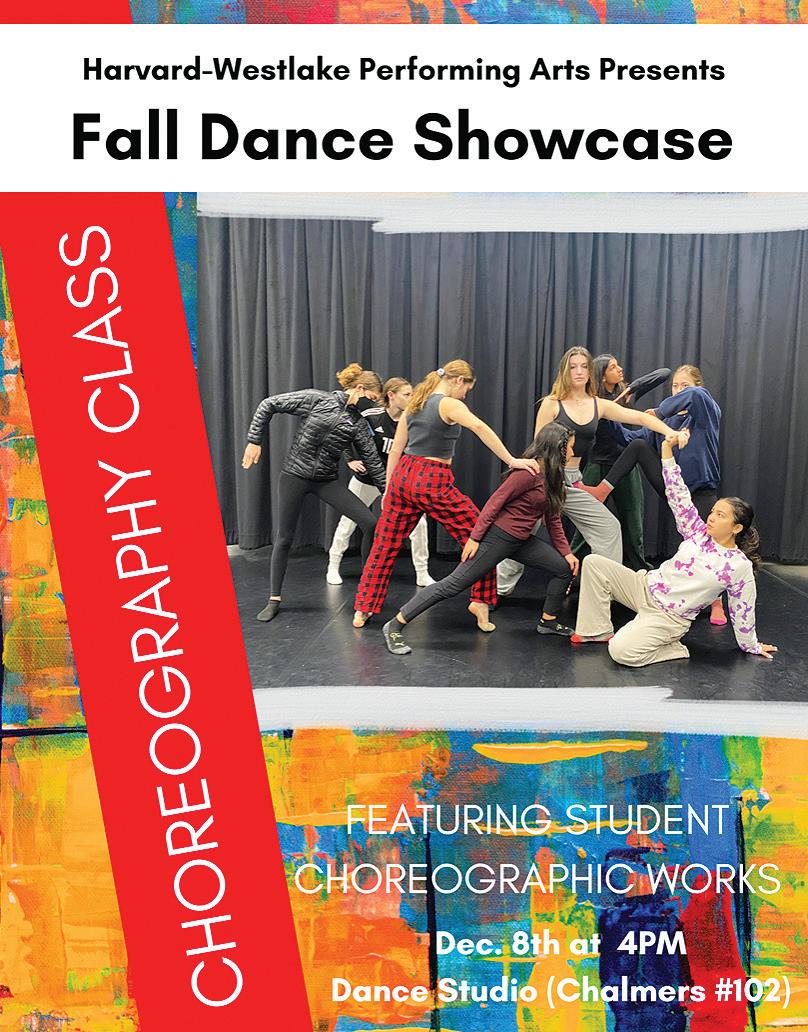 By Kriste An and Jade Harris
Advanced Dance I: Choreography students performed self-choreographed dance routines in their Fall Dance Showcase on Dec. 8.
Upper School Performing Arts Teacher Queala Clancy said the pieces in the showcase were designed to challenge students and help them learn to compose their own dances.
“Each of the dances in the showcase were a representation of a different module or prompt,” Clancy said. “I gave [the students] a certain prompt to work with, and from there, students were tasked with creating a dance based on that particular prompt, in hand exercising and exploring different methods of generating material.”
Clancy said a fundamental motive she had in organizing the showcase was introducing students to different genres of dance.
“I wanted students to learn to value different dance genres, including hip hop, ballet, modern, jazz, folk and cultural dances,”
Clancy said. “The challenge was making sure that the students could value different dance genres and use their awareness to strengthen their choreographic voices. Being a beginning dancer, students are exposed to a limited number of genres, and I believe it is on me to expose them to as much as possible.”
Dancer Isobel Chamas ’25 said though she was anxious to perform at first, she grew more comfortable as the show progressed.
“Performing was nerve-racking at first, but as the show went on, I grew used to having an audience,” Chamas said. “Now that the show is over, it feels sort of bittersweet, but I am relieved that my hard work paid off.”
Chamas said she appreciated seeing the assortment of dances her classmates performed.
“It was moving to see other students’ pieces and quite inspirational as well,” Chamas said. “We all have different styles of dance, and I love taking this chance to learn from other classmates.”
Dancer Tess Rosenfeld ’25
said though preparing for the performance proved difficult, she is proud of the work that she and her classmates produced.
“The first thing that I felt after the show was relief,” Rosenfeld said. “One thing that I found challenging was dealing with the time commitment. Balancing dance with school was difficult, but through open communication with Ms. Clancy, we were able to make it work and put on a performance that we are proud of.”
Clancy said one of her goals for the rest of the season is to help students use their choreographic skills to communicate with the world.
“I want students to think about how they can use their choreographic skills in the greater world,” Clancy said. “In the first half of the season, we honed in on how to generate material, and as we continue throughout the season, I want our next step to be on how to utilize this material. I have a dance activism assignment coming up, and I am excited to see how students will utilize this material.”
that is when it hit me how big this was, and I started to feel that emotional pull that Dr. Robles was talking about.”
The last of the four songs Chamber Singers performed was “Silent Night,” during which audience members had a chance to join the performers. Chamber Singer Nadiezhda Hitomi ’25 said this experience helped her bond with the attendees.
“I had my choir binder in one hand and a candle in another,” Hitomi said. “Everyone was holding candles and singing together. It made me feel a greater connection to the people in my choir and the audience. It was a moving experience.”
Hitomi said seeing the music impact the audience helped her recognize the role she can have in helping others heal.
“Seeing how our music influenced people was eye-opening,” Hitomi said. “It reinforced my understanding of how powerful music can be when bringing
people together to mourn and remember their loved ones. Overall, I am glad that I was able to be there for these people in their dark times and bring them some relief from the pain they are experiencing. Mourning is a difficult thing for anyone, and it can make someone feel more lonely than ever. I am grateful that [everyone] could come together as a community to help each other through hardship.”
Parmet said singing with the choir helped her recognize her responsibility in providing listeners with comfort amid difficult and strenuous times.
“I have not experienced grief, I am lucky to say,” Parmet said. “It has felt far away from me, but at the performance, it felt real. It flicked a switch, seeing all these people together, and I felt a real sense of duty. We are not just here to put on a good show. We are here to help other people. We represented beacons of light to guide them through.”
PRINTED WITH PERMISSION OF AARON MARTIN
DANCING THE NIGHT AWAY: Student dancers preview self-choreographed routines in a poster ahead of their upcoming dance showcase.
HONORING WITH HYMNS: Chamber Singers smile for a group photo following their performance at Forest Lawn Memorial Park. Their performance, dedicated to helping families heal from their experiences with personal loss, was coupled with a reading and a sermon from a minister.
• Continued on hwchronicle.com hwchronicle.com/a&e Arts & Entertainment C3 Dec. 14, 2022
PRINTED WITH PERMISSION OF NADIEZHDA HITOMI
New York Times Guild Inspires Chronicle Strike
By Georgia Goldberg
Inspired by the brave New York Times strikers, a group of Chronicle staffers have taken to the streets of Studio City. We are fed up with the long hours, brutal labor and toxicity of this work environment.
Here is our list of demands:
1. Allow Oxford commas.
2. Put fake words in the crossword again. Remember when we just made up words and acronyms because we didn’t understand how to make crossword puzzles? We need to shake things up and keep the student body on its toes.
3. More JFA Shabbat articles. They’re fascinating, groundbreaking pieces of American journalism.
4. No more Sports section. No one reads the Sports section. No one likes the Sports section. Who even cares about sports? And not to stereotype, but has there ever been an EIC from the Sports section?
5. We would like to replace our dead pet fish with a new pet lizard. We will name the lizard either Pica or Chumbo — gender irrelevant.
6. Instead of playing the Velvet Underground and Alex G, we should exclusively listen to the Glee cast recordings.
7. Consider letting ChatGPT write more than one article. Empower new writers!
8. Fire Karen Bass. Now, this may not be within our jurisdiction; however, I don’t really like her.
9. Provide all staffers with a base salary of three chalky sugar cookies per layout.
10. Lunch break. I’m really hungry right now.
11. Snack break. I will probably be hungry later.
12. Buy a Jo Malone diffuser for the Chronicle rooms.
13. More junior staffers. We’re really running low here. We only have 13…wait, no, make that 11 I guess.
14. While you’re at it, tell those juniors that a sophomore will probably get EIC over any of them. They’ve really been slacking off.
15. *Demand has been retracted
16. Let us publish fake facts sometimes.
17. Ask Jackson the security guard to not yell at us when we park at the North entrance. He made me cry one time. Parking is hard enough as is.
18. Tell the sophomores to stay home, there are way too many of them hanging around. Don’t they know they can just sign in and leave?
19. Stop playing the World Cup.
20. Please explain what an Executive Editor is, and then promptly fire any of these socalled “Executive Editors.”
Striking is exhausting and we would really like to stop, so please just give in to our demands.
All my love, Chronicle Union Head Georgia Goldberg
All I Want for Christmas is a Squirrel Mascot
By Lucas Cohen-d’Arbeloff
When was the last time you saw a squirrel at school? Quite recently, I would presume. They are ubiquitous, gracefully scurrying about the campus and shaking their fluffy brown tails throughout the shrubbery.

Another question: Have you ever thought about why our mascot is a wolverine? It certainly sounds like a daring and macho animal, worthy of our school’s eminence. Maybe “X-Men” or a buff Hugh Jackman comes to mind. But in reality, wolverines are dull, uninspiring beings who live in the bleak wilderness of Canada. Why are these Canadians entitled to represent us, and why have we as students left them unchallenged and unquestioned as our mascot?
As the holidays quickly ap-
proach, my Christmas list contains a single wish: We must replace the lackluster wolverine with the wonderful squirrel. We have unfairly deprived the squirrels of recognition and praise after years of steadfast ser vice to our commu nity. We have also ig nored the in timate connec tions we have formed with these exquisite crit ters. In searching incessantly for nuts in

the dirt, the squirrels embody the school’s commitment to “the joyful pursuit of educational excellence,” as outlined in our mission statement. Moreover, the healthy competition they display is analogous to students’ undying quest for
Likewise, let us not forget how staunch the squirrels are in following the school’s Honor Code. They fend for themselves, never receiving un-
authorized aid as they fight to catch peanuts thrown by school security guards in their mouths. Nor would they ever “steal or violate” other squirrels’ food stashes. In contrast, wolverines are sneaky and solitary animals. They reside alone and in the bitter cold, an environment wholly unfit for Los Angeles kids who complain when it is less than 70 degrees out. Their meat-heavy diet is also out of touch with our increasingly vegan population—a wolverine wouldn’t dare eat an Impossible Burger!
This Christmas, I want one gift only: It is time for the Harvard-Westlake Wolverines to retire and the Squirrels to take charge.
The Perfect Holiday Gift Guide
By Zoe Goor
Having trouble finding a gift for your friend, family member, or mailman? Well, you’re in luck! Here’s list of present suggestions to fulfill all of your holiday needs.
For the person who is bound to go bankrupt from their crippling matcha addiction: Save them from themself and buy them some tea bags. Or better yet, send them a link to the CDC’s “Water and Healthier Drinks” page which touts the many reasons that one should drink water. It is free, does not require a tiny whisk and flows from the taps at our school (for now at least). While a Google search for water does not yield 16 million different ways to combine it with avocado or spirulina like it does for matcha, Kylie Jenner has approved it as a beverage, so skeptics can rest easy: water is officially the “it” drink of winter.
For the person who has been featured on @hwparking a few too many times:
An armored Tesla Model X, with autopilot. The armor, a feature that Twitter Lord Elon Musk rolled out recently, will save your friend when they inevitably back into the side of the wrestling room. As for autopilot, they can study for their AP Chemistry test while the car drives itself. If you don’t have 300 to 500 thousand dollars, just settle for a helmet and cross your fingers.
For the person who switched their credit card company to Capital One just for the Taylor Swift tickets presale:
Unfortunately Taylor does not currently sell her fingernails or hair on the dark web, but don’t despair! Her favorite fruit is the banana, and those are available at the Ralphs on Coldwater. Will your friend be confused and disappointed by your gift of fruit?
Maybe. But you don’t need to bear the burden of their disapproval because, as T-Swizzle said in “King of My Heart,” “Say you fancy me not fancy stuff”... the gift of your presence should be enough. If you have a bad personality though, maybe just buy them tickets to the Eras tour. Your friend will keep this gift until it rots, or until the Speak Now re-record is announced... whichever one comes first.
For the person who does an “ask me anything” even though they have 47 followers: Buy them some more followers. Even better, buy them a blue Twitter verification check mark, and while you’re at it, send Elon Musk a thank you note.

For the person who taps back to all the messages in a group chat:
This person clearly has way too much time on their hands.
You should consider sending them my incredible article about Teacher Development Day!
For the person who is utterly impossible to shop for: Why are you here? Did you really think that this gift guide would help you find a gift for them?
The Chronicle • Dec. 14, 2022
Satire
ILLUSTRATION BY JADE HARRIS ILLUSTRATIONS BY ALEXA DRUYANOFF AND SOPHIA EVANS
By Max Turetsky and Ella Yadegar
As Len* passed through the casino of a Las Vegas hotel, he glanced over at the rows of chairs facing the March Madness tournament playing on a large flatscreen television. He turned to his dad, telling him confidently that Loyola and Gonzaga were going to win.
His dad legally placed $10 on a three team parlay, hit it and then immediately went to the cashier to collect his cash.
Len said this experience was his first exposure to sports betting, a hobby with which he soon became fascinated.

“I was like, ‘Damn, we can actually make money off of this,’” Len said.
“At first, it was just football. And then, with the World Cup and soccer, it became a little bit of that too. On occasion, because I don’t watch it as much, I bet on basketball. I bet on the weekends, especially for Sunday football. On days when I’m free and don’t have much work and stress to deal with and I’m free to watch the games, then I’ll probably put something down.”
Sports betting is only legal in six states across the U.S., not including California. In casinos existing on Native American reservations
in the state, the minimum gambling age is 21 years old.
Len said he uses an online gambling site named Bovada to place his sports bets. The company is based in Costa Rica and therefore not subject to California’s online gambling restrictions, but residents of the state are still able to access the site.
Bovada has virtually no methods of ensuring its users are above the legal gambling age, with users only being required to mark a checkbox confirming they meet the requirements for their jurisdiction.
Len said many online betting sites have rules that can easily be circumvented.
“It’s pretty much impossible to check ages,” Len said. “First off, you can use parents’ or family members’ IDs.
A lot of kids use VPNs to tell the website they’re in a state where gambling is allowed. It’s not that hard at all if you really need to change where you live. I just use a credit card, but I know there are certain apps where you can use cryptocurrency.”
Proposition 27, a 2022 California ballot measure that would have legalized online sports betting through Native American tribes and gambling companies, failed with only 17.7% of votes in favor. For now, efforts to expand sports gambling in
California remain halted.
While the topic of gambling is not discussed in the Advanced Placement (AP) Economics curriculum, Mathematics Teacher Kent Palmer, who teaches the course, said the legalization of sports gambling might carry benefits for the state economy.
“I think casinos that currently allow for betting on sports stand to benefit [from its current illegality], as this keeps potential competitors out of their market,” Palmer said. “And whenever initiatives for legalizing illegal things land on the ballot, such as the initial introduction of the California state lottery or the recent legalization of recreational marijuana use, one of the arguments in favor seems inevitably to be, ‘We could tax it and use those revenues for something good.’ I imagine that might be a potential economic impact of any kind of policy change surrounding this issue as well.”
Venture Leader Sophia Rascoff ’23 said the concept of high school students placing bets with real money could result in dangerous consequences.
“I think the main issue with legalizing sports betting online, which is part of why I think I would not be in support of it, is that it is so hard to regulate, especially for young people,” Rascoff said. “When something is online, on an app, it just feels so gamified where it doesn’t feel like it’s real money. I think that
is a real danger, where you can continuously bet and lose money because it doesn’t feel real.”
Rascoff said she does not partake in sports betting herself but has been involved in conversations surrounding gambling.
“It’s something that’s come up in [AP United States Government and Politics] class discussions, when we were talking about the issue,” Rascoff said.
“I don’t know if there’s a culture of sports betting. It’s not something that I’ve directly participated in or seen people do. But I know that in general, people do it on a real scale of gambling online, but also just with each other I’m sure.”
Len, however, said he views online sports betting with his friends as an important aspect of his social life.
“Sports betting is not an uncommon thing,” Len said. “I’d say a lot of kids actually do it. I already could have named maybe 10 other students who I know that sports bet online.”
Pranav Iyer ’25 said he feels kids his age are too immature to gamble.
“They don’t have developed prefrontal cortexes to make decisions,” Iyer said. “I think it should be [legal for adults to gamble]. If people want to lose all their mon-
ey, they should be able to.”
Acknowledging the responsibilities required with handling finances, Len said he has gained an understanding of how much and how frequently he should bet.
“I’m disciplined in the sense that if I lose, I’m out,” Len said. “But that hasn’t happened for me yet and even if it had, it would only be small amounts, maybe worth $5. And I could probably make it back. If I ever ended up losing it all, I just wouldn’t go in again. Surprisingly, I’d say that the other kids [at the school] are more disciplined like me. A lot of them understand that they can’t bet more than they should and should only bet within their limits.”
Palmer said even though he has not noticed a widespread culture of sports betting at the school, he acknowledges that some students bet socially.
“I think some students are enjoying at least recreational betting on World Cup games right now, and the same thing certainly happens in March during the NCAA basketball tournament,” Palmer said. “Outside of that, the closest thing to gambling I consistently hear students discuss is fantasy football.”
Sports The Chronicle • Dec. 14, 2022
photo llustrations by fallon dern
Sophia Rascoff ’23
“ I was like, ‘Damn, we can actually make money off of [sports betting].”
*Len
Girls team wins two in a row
By Eden Conner
The girls basketball team began its season Nov. 16 and currently has an overall record of 6-3. The squad’s losses so far have been close, with a one point loss against Leuzinger High School in the Battle at the Beach Tournament. Wins have been by larger margins, with a 68-point victory against Schurr High School for the Wolverines in the Burroughs tournament Dec 5. Team Captain and Forward Jordan Call ’23 said she has high hopes for the team’s progress based on the competitive play she saw in the opening games.
“Our first game this season was against Windward, and we almost beat them and they’re a really high ranked team,” Call said. “We came out with two good wins against Corona Centennial and Redondo Union, so I think if we can beat them, that means we can pretty much beat anyone in our league. We’re starting at a really good place and there’s only room to go up at this point.”
Call is the only senior on the eight person roster. She said that being both the only senior and Team Captain comes with re-
sponsibilities to help the team.
“My role on the team is to set an example, set the tone and just push my teammates to be better,” Call said. “Especially because we have a lot of young kids on the team—we have four freshmen— they’re looking for people to look up to and trying to figure out what the culture of the team is. ”
Guard Deana Thompson ’25 said she is happy with the beginning of the season and hopes to
keep developing as a group.
“[Our start has been] better than last year, and we are definitely developing more,” Thompson said. “Our game is getting better, and we’ve improved so we’re starting off at a good point in our season right now.”
When looking toward the team’s larger goals, Thompson said the squad needs to focus on becoming a tight knit group in the early part of the season to stay
Girls soccer team beats Downey High School after losing opener
By Sammy Glassman
Fresh off of a preseason win, the girls soccer team has looked to gain momentum heading into the regular season. Although losing its first match of the season to Huntington Beach 2-1, they prevailed in their game against Downey on the road.
Girls soccer Head Coach Richard Simms said the Mission League added two competitors, which will allow the Wolverines to see new competition and chal-
lenges in the form of different styles of play.
“We are excited to welcome Notre Dame Sherman Oaks back into the league, as it’s always a competitive match when we play them,” Simms said. “Sierra Canyon are also in the Mission League, which will be fun to see,” Simms said.
Simms said the incoming class of six freshmen has not let the pressure of playing varsity soccer overwhelm them.
“We have played a lot of fresh-
men so far, and all of them have looked comfortable.”
Forward Maya Leibzon ‘25 said the tough opponents will bring a lot of fervor to the matches on the pitch.
“Honestly, I don’t know what other team I’m most nervous or excited [to play against],” Leibzon said. “I feel like every team will [bring] the same intensity and competition.”
Leibzon said the team is still getting acclimated, but the morale is high.
competitive throughout the year.
“Our goal is really to get to the playoffs,” Thompson said. “Before the season starts, we should really focus on making a good team dynamic, improve more together, and just have more of a team environment that’s positive and always wanting to strive to be the best.”
Call said she looks forward to a chance this season to fight for a championship win.
“Our goal is to win a ring this year because we have the talent, we have the pieces and we play as a team really well this year,” Call said. “Especially as the season moves forward and as we continue to play with each other and develop a better team chemistry, we have the ability to win a ring and I think that’s our main goal.”
The squad plays its next games in the Sandra Meadows Classic tournament over winter break.
Right now, there are a lot of new faces and everyone is learning how to play with one another which is different, but also exciting.”
“The team’s excitement is at a good level and everyone has confidence,” Leibzon said. “Right now, there are a lot of new faces and everyone is learning how to play with one another which is different, but also exciting.”
Goalkeeper Amelia Jackson ’23 said Coach Simms has given

the team motivation to sustain performance through the season.
“To quote our coach: ‘Every team we play thinks we are their rivals, but we don’t have one,’” Jackson said. “With that being said, we face every opponent with the same level of intensity to ensure our highest performance.”
Boys basketball remains undefeated
 By Christopher Mo
The boys basketball team started their 2022-2023 season with nine straight wins, including their most recent 84-40 victory against Long Beach Jordan High School. The team looks to continue their win streak and make a playoff run as they did last year, when they finished runners-up in the CIF Southern Section Open Division Playoffs.
Before the season, Max Preps listed the boys basketball team as second in California and 13th in the nation.
Guard Robert Hinton ’24 said the rankings do not change the team’s approach to the season and they are ready to compete .
“I don’t think it adds any pressure at all,” Hinton said. “If anything, it makes us want to be even better knowing that people are
putting teams ranked above us. I do believe that our ranking does make teams more determined to beat us because all teams want to beat whoever is at the top.”
Basketball Program Head David Rebibo said that he is not bothered by their rank, as the team is focused on themselves and performing well.
“We don’t look at rankings, we are focused on getting better and maximizing each day,” Rebibo said. “We understand there are rankings and we appreciate the notoriety, however, the end of the year finish is what we think about.”
In the Mission League, the team will face off against past rival Sierra Canyon, which recently joined after leaving the Gold
Coast League.
Hinton said he is specifically looking forward to the team’s rematch against Corona Centennial, which they lost to in the finals of CIF Southern Section Open Division Playoffs.
“I look forward to everything this season,” Hinton said. “Knowing how fast my first two years have gone by, I am trying to take in and enjoy every game I can. I think our team is definitely looking forward to playing Corona Centennial because they are a team we have faced many times in the past couple years, and were also the ones who beat us in the championship last year. We want to show how much we have grown and become better as a group.”
The Chronicle Dec. 14, 2022 D2 Sports
LINING UP: Power Forward Jacob Huggins ’23 focuses on the basket before knocking down a free throw in a win against Long Beach Jordan.
BACK TO THE DRAWING BOARD: Girls Varsity Basketball Program Head Melissa Hearlihy draws up a play during a timeout. The team won their second game of the Burroughs Tournament against Culver City on Dec. 6. Hearlihy and the team have started off the season with a 6-3 record.
PRINTED WITH PERMISSION OF DARLENE BIBLE
— Maya Leibzon ‘25 L. Wood
“ L. Wood
Robert Hinton ’24
PRINTED WITH PERMISSION
OF DARLENE BIBLE
Boys Soccer hopes to win CIF for first time
By Christopher Mo
The boys soccer team began its season 3-0 in non-league play, defeating Palos Verdes High School 2-0, Calabasas High School 1-0 and Camarillo High School 4-1. The team plays its first league match at home against St. Francis Wednesday on Dec. 14.
In the game against Calabasas, Defender Asher Rossen ’23 scored the winning goal off a cross in the 82nd minute. Rossen said it felt great to score after the team had held Calabasas scoreless the entire match.
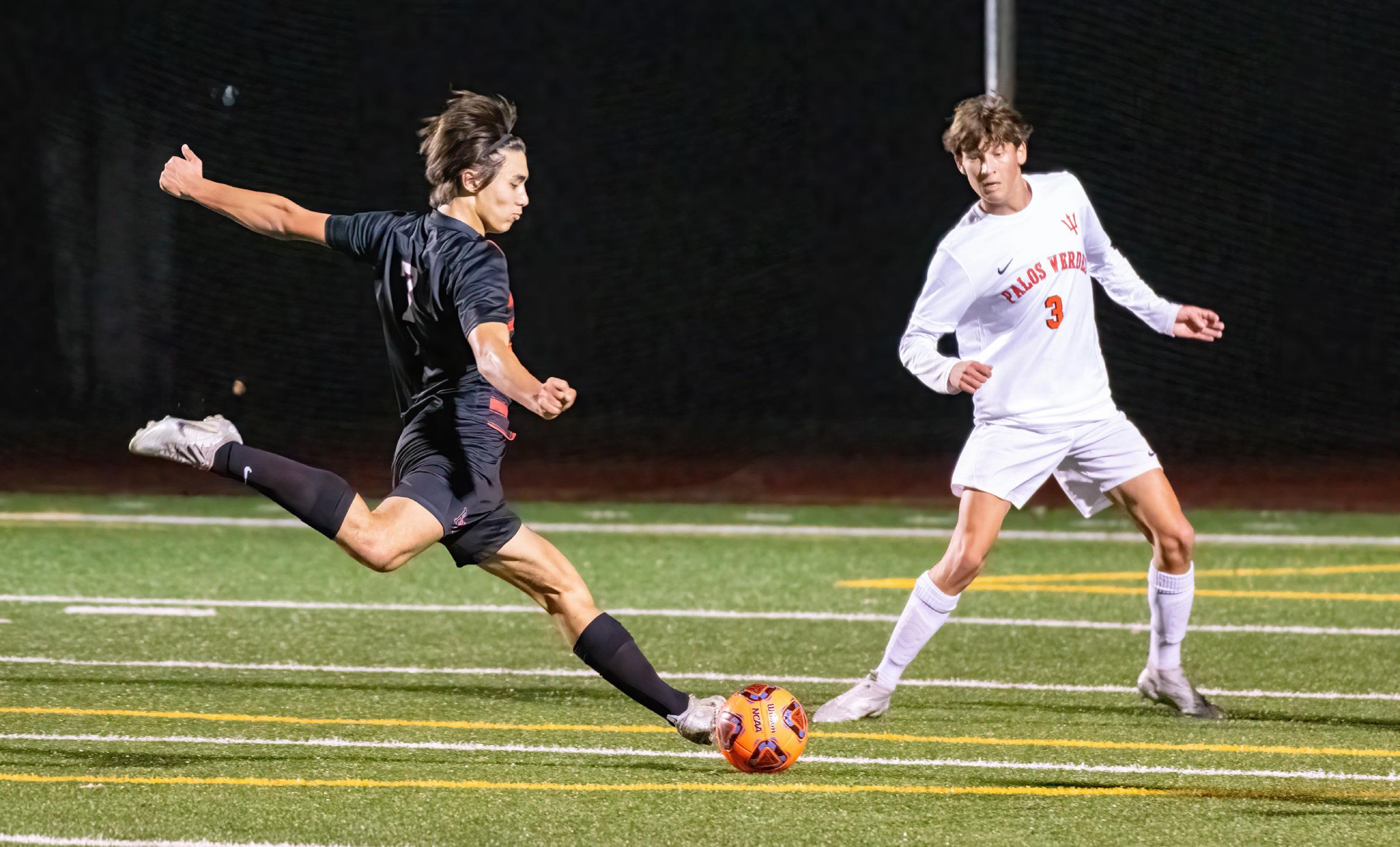
“It felt great to finally get that goal because we had been grinding and putting in the hard work throughout the game,” Rossen said. “Just to finally capitalize on all of it with the goal was great.”
Boys Soccer Program Head Michael Erush said the team has been very dedicated in practice
and is working hard to improve going forward.
“Throughout the preseason, and early on, I’ve been excited by the commitment to the program that [the team] has shown,” Erush said. “They’re committed and the culture has changed to a blue-collar approach where they want to be the hardest working team in the league.”
Last season, the team lost to Lynwood High School 2-0 in the second round of CIF Southern Section Division II Playoffs. Attacker Theo Ottosson ’25 said the team is looking to make a deeper playoff run this year.
“I’m really excited about how talented our group is and how far I think we can go this year,” Ottosson said. “We fell short last year, and we have a group that really wants it and remembers what it felt like not to have it last year.”
Ottosson said he is looking
forward to having a bigger role on the team this season after he spent last year learning from more experienced players.
“Last year I had a more of a backseat role; I was really just learning from better and older players,” Ottosson said. “But this year I’ve been thrust into a starting role, and I definitely feel more responsibility to perform, especially to my coaches who put their trust in me and my teammates who respect me.”
The team has not won the Mission League since 1998 and has never won a CIF Southern Section Championship in the history of the program. Defender and Captain JT Federman ’24 said he feels the team is strong enough to achieve their goals.
“The team is coming into the season with the goal of winning the Mission League for the first time in 20 [plus] years as well as
Girls water polo starts season with losing record ahead of league play
By Jackson Mayer
Girls water polo has gone 1-2 overall in the preseason, losing to Long Beach Wilson 9-7 on Nov. 30 and Mater Dei 8-7 on Dec. 7, but won against Mira Costa 8-4 on Dec. 3.

Veronica Mnatsakanian ’26 said the team rebounded from their loss against Long Beach Wilson High School by staying focused throughout the match.
“We really just picked ourselves up and got our heads back in the game,” Mnatsakanian said. “Focusing on how to get quicker on some factors helped us get back in the groove of it all.”
Program Head Jennifer Jamison said the team is in an adjustment period right now.
“[Team members] are being placed in different roles than they have been in the past,” Jamison said.” It is a little bit of an adjustment. I think right now we’re in the struggle portion of it. You know, I think give it some time.”
Attacker Eva Vaca ’24 said the team has the tools for success but needs to play with confidence in order to capitalize on their team’s high potential.
“I honestly believe we already have everything it takes,” Vaca said. “I think it’s just going to come down to finding our confidence. We already have the dedication, skill, stamina and IQ, but none of those mean anything if we don’t have the confidence to apply it when it really matters.”
Long Beach Wilson and Mater Dei, the two teams the school lost to, are top Division I teams. Jamison said these team’s high rankings made the close margins of the losses more impressive. Jamison said she thinks these games bode well for the rest of the season.
“I’m excited because I think it’s hard to beat the same team two or three times, especially as each team gets better,” Jamison said. “For us, we have girls on the team who are now in a position
where they have to perform at a higher level than they did last year, and they have more responsibilities. So I think with a little bit more experience, and as we continue playing, they’ll adjust, and, again, the confidence thing, that’s what’s going to help us win those games. [Long Beach Wilson and Mater Dei] are both completely beatable, and I trust that come January, February, it will be the same.”
Vaca said the three pre-season games exposed the team’s strengths and weaknesses. She said the underwhelming start motivated the team to practice intensely and fix small hiccups.
“Even though it’s still early in our season I think it’s looking really promising,” Vaca said. “Although we didn’t start off the way we wanted to, that doesn’t mean we can’t end the way we want to. I think that we are doing a great job pinpointing our weaknesses and approaching them in the best possible way.”
winning CIF for the first time in program history,” Federman said. “While these may be the goals [of the team] heading into every season, I truly believe more than I have in past years that this is the year our program is going to make history.”
Federman said he feels special responsibility as captain this season, but everyone on the team will need to play well for the team to succeed.
“As one captain of the team, my role on this team is to be the guy that people can consistently rely on to perform and lead the team throughout each game of the season,” Federman said. “At the same time, the success of our team doesn’t depend upon the leadership of only two or three guys. Everyone on the roster will need to contribute and lead both on and off the field to help the team be successful this season.”
Wrestling looks to improve
By Alex Dinh
The wrestling team started off their season with a total record of 8-3 in their tri-meet against Westlake. Cutter East ’24 finished the meet with three wins and zero losses, Dylan Graff ’24 with two wins and one loss, Alec Avedissian ’25 with two wins and one loss and Henry Rutherford ’25 with one win and one loss.
The team has also seen strong individual performances. In their most recent tournament at Newbury Park, Avedissian placed seventh overall in the 132 pound weight class.
In order to continue with their success, East said that the team will need to maintain a strong level of commitment.
“I think, while it has not been necessarily terrible, our performance as a team has been subpar to what it could be,” East said. “If we practice harder and with more purpose, we can significantly improve our presence at tournaments and win more matches than we have up until now.”
East said that the wrestling program is in a rebuilding phase and the commitment from its members will determine the success of the team.
“The team has hit a slump, but we are once again building a great team from the ground up,” East said. “We are focusing on those with the commitment to wrestling and who attend every practice and tournament. We may not have the numbers to be able to win the majority of matches in a dual against teams, but as each of the actual committed wrestlers improve on their skills, their hard work will be showcased in each individual’s achievements in tournaments and matches.”
East said the season will show how he has progressed.
“I look forward to seeing how I have grown and changed as a wrestler on the mat,” East said.
EYES ON THE PRIZE: Attacker Josh Barnavon ’24 attempts a goal versus Palos Verdes High School in a preseason game Dec. 2. The school won versus Palos Verdes 3-0, its second win this season. The team’s first league game will be at home versus St. Francis on Dec. 14.
PRINTED WITH PERMISSION OF DARLENE
BIBLE
REACH FOR THE STARS: Goalie Thea Pine ’23 stretches upwards to save a goal during a game against Mira Costa High School on Dec. 3.
hwchronicle.com/sports D3 Sports Dec. 14, 2022
PRINTED WITH PERMISSION OF SALIL MEHTA
BY

ASHER ROSSEN
I'm pretty sure I inherited my competitiveness from my mom, who never gives up an opportunity to celebrate — very obnoxiously, I might add — whenever she wins a board game. Or maybe it's from my dad, who does not hold back when tackling my little cousins and uncles in our Thanksgiving football game (please keep in mind that he is 6’2 and 210 pounds). Or maybe it was both. Regardless, I am a very competitive person, and growing up with three rivals — I mean siblings — did not do much to help with this fact.
I first touched a soccer ball when I was three. Granted, I did not yet know that I was supposed to kick the ball, much less how to kick the ball. Nonetheless, it was on that day that I decided to pick up the ball, and it was on that day that the beginning of the rest of my life began.
By the age of five, I started to play in actual games. I played in the American Youth Soccer Oranization (AYSO) for the mighty Blue Destroyers (we came up with the name ourselves). While it was never very competitive, as the score was not kept and the ref was, more often than not, a parent of one of the players, I had a blast playing. I started to learn how to dribble, shoot and pass the ball, and even though our only rewards were orange slices and participation trophies (which we “won” regardless of our rankings), I still enjoyed the friendly competition. However, I soon realized that AYSO was not enough for my voracious appetite for contest, and I began looking for other options.
The next big step in my soccer career came at the ripe age of seven when I tried out for a compet-
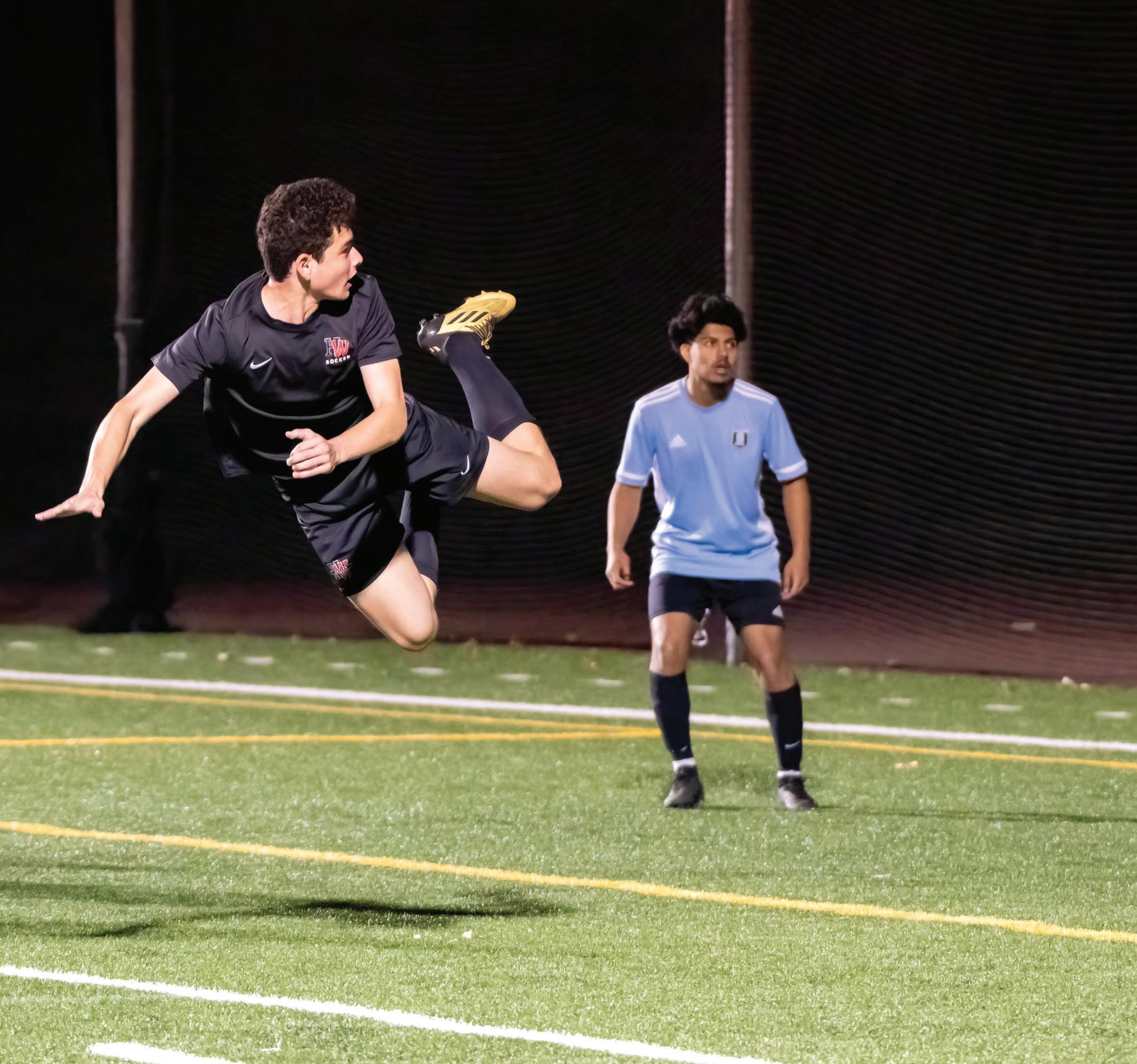
itive club soccer team. I was very nervous because, unlike AYSO, everyone here had technique. People could pass the ball accurately and a few had an arsenal of ball skills up their sleeves. I was also forced to try out for a new position. These factors were out of my control, so I decided to simply work hard, sprinting the extra five yards to receive the ball, jumping the highest to win my tackles, and putting in 110 percent every time I stepped onto the pitch. I ended up making the team, and it was on this team that I learned the true nature of competition. Scores were kept, refs were no longer related to players and participation trophies and orange slices were out of the picture. I had to go to practices two to three times a week, constantly fighting for a spot on the team.
While I was not a starter, I continued to work in practice. Eventually, the coaches recognized my work ethic and I earned my starting position. It was on this club team that I learned about a new side of competitiveness: the desire to compete for others. It was on my club team that I developed a sense of family with my teammates, some of whom, like Print Managing Editor Charlie Seymour and Will Gasparino, I am still friends with to this day. I began fighting, tackling and giving it my all for my brothers on the pitch. I also started competing for my coach, a passionate Brit who came up with the most creative insults I had ever heard. To avoid being the subject of said insults and to make my coach proud, I needed to put in my 100 percent effort into the sport. Lastly, I started to compete for my dad and his approval. My dad is
not an easy man to impress, so I took advantage of any opportunity to showcase the fruits of my labor.
Finally, I found high school soccer. This was a game changer...literally. It was a completely different style of gameplay from club soccer, which was mainly possession-based attack. I had to be gritty, some games sprinting up and down the pitch the entire game. In my freshman year, I did not make Varsity. However, I went to two practices a day, training with Varsity and Junior Varsity every practice day. That same year, I tried and failed the 1.5 miles in nine minutes test. Rather than giving up or becoming discouraged, I spent the next summer running and training until, come junior year, I was able to complete a two mile in 12 minute test.
Harvard-Westlake soccer brought out a new beast in me, as there was more to compete for. From winning the Mission League, to making it past the first round of CIF Playoffs, to beating Loyola and finally making the first Mission League team, there was no shortage of things to compete for. Lastly, the people at HW inspired me to be better, particularly faculty like Coach Amazan. His endless encouragement and genuine desire for his players to be their best selves have pushed me to new limits and never cease to motivate me to work harder than anyone else around me.
While soccer started off as little more than a game to play with friends, it quickly became so much more than that. The game is a lifestyle that has taught me to work hard, train, and, above all else, compete.
WOLVERINESONLY
Dec. 14, 2022 D4 Sports The Chronicle
PRINTED WITH PERMISSION OF SALIL MEHTA
