Tuition for the 2023-2024 school year has risen to $49,700, a 6% increase from $46,900 last year. Adjusted for inflation, this is an increase of around $1,200. Chief Financial Officer David Weil ’93 said the higher tuition is used to cover rising operating expenses and to give faculty and staff raises in pay.
“Insurance, utilities and supply costs all naturally go up over time, not to mention the need to ensure our employees receive wages commensurate with their professional talents,” Weil said. “Teacher salaries were increased this year, reflecting the hard work that our colleagues undertake but also in recognition of increased costs of living in Los Angeles.”
With the 2024-2025 Annual Giving campaign reaching a new high of $10.2 million raised, breaking the record of $10 million reached in the 2023-2024 campaign, Weil said he felt that the past year was a financial success for the school.
“We always need to make choices [and] prioritize where we devote attention, but in that regard I do feel that our financial operations last year supported the school well,” Weil said. “I consider a fiscal year to be successful if we have correctly focused our resources in the areas that make this school special, like our programs, employees and the broader community of families. The Annual Giving campaign was also successful, having fantastic participation among our families and yet another year of 100% giving from faculty and staff.”
Director of Financial Aid Greg Gonzalez said tuition money and the school’s endowment are used to grant financial aid to students in need. 20% of students receive financial aid, which on average covers 72% of the cost of tuition. Additionally, financial aid grants include the costs of retreats, required textbooks and technology stipends.
Security implements new policy
By Yuna Jeon
The Upper School security team will enforce a new visitor screening system starting Jan. 6 after initial testing in the weeks leading up to winter break.
The visitor screening process will require all guests on campus to provide identification, which will then be cross-referenced with the National Sex Offender Registry and FBI databases to look for any possible matches. Once guests are cleared and entered into the system, they will then be given a visitor pass, and all future visits will only require a photo taken by security because the system automatically recognizes the guest. Faculty and staff will have access to a website where they can pre-register their guests and notify security in advance of any expected visitors.
By Ella Jeon and Alex Reisner
The school is beginning to consider ways they can refine the daily schedule to improve student time efficiency and limit academic overcommitment, according to Head of Upper School Beth Slattery. Slattery said a new committee led by Assistant Head of School for Community and Belonging Janine Jones was made to discuss and brainstorm possible adjustments to the schedule.
These proposed changes — not yet approved — include moving the Community Time block earlier in the day, planning more community-focused events, limiting the number of classes sophomores can enroll in and adding a junior advisory to the schedule.
Slattery said the committee is considering rotating the Community Time block with the rest of the seven class blocks in the schedule so students feel that they are not being deprived of leaving school early on certain days.
“There are two days out of the cycle where the day ends with stuff that doesn’t feel like an obligation,
community time and Directed Study,” Slattery said. “I wish that we could incentivize people wanting to be on campus and do things during the day. So, we are thinking of having Community Time sometimes meet earlier in the day.”
Slattery said the administration is looking to use the hourlong period to plan more activities that promote community connection and bonding.
“We also don’t necessarily use Community Time to do things that build community,” Slattery said. “So my argument is, for things like the Multicultural Fair, the Activities Fair and field days, because those are things that help to build community, I’d like to figure out how we can do more things that bring people together, as opposed to having people resentful that they have to be done.”
Slattery said while she understands why students want to leave school once their scheduled classes are over, it negatively affects teacher schedules since they are forced to meet primarily during lunch blocks.
“A lot of people, especially juniors and seniors, want to
leave after their last obligation of the day,” Slattery said. “And so they’re telling their teachers that the only time they can meet is during lunch, even though they really could meet later in the day. They just don’t want to, which I totally get. But now I have teachers who don’t get to eat lunch and people not necessarily using time wisely, or people monopolizing teachers’ time.”
Hannah Fong ’26 said she thinks changing the school schedule will not necessarily balance students’ time-consuming schedules.
“I think people generally make use of Community Time when they need to,” Fong said. “Even though there may be people that aren’t being efficient about managing work and teacher meetings, I don’t know if rotating the Community Time block would cause people to be more productive.”
Although not recommended, current school policy allows sophomores to take seven blocks and a Directed Study. Slattery said the administration is considering prohibiting this full schedule for sophomores to alleviate academic pressure and prevent overcommitment.
In addition, faculty and staff will be required to display rearview mirror placards on their vehicles which will replace the smaller stickers previously used for faculty and staff vehicle identification.
Head of Communications and Strategic Initiatives Ari Engelberg ’89 said the updates were not initiated by security concerns, but by the high volume of guests on both campuses and shifting priorities of campus security.
“Given the number of visitors to our campuses, we felt it appropriate to upgrade our systems to better track and screen guests,” Engelberg said. “We recognize that the security environment around schools has changed quite a bit in the last 20 years, and we occasionally make our own changes based on evolving needs.”
Engelberg said the new placards for vehicles will help security quickly identify which guests must be screened.
“One advantage of the placards beyond parking enforcement is that when they are hanging from the rearview mirror, our security guards can recognize who belongs on campus or a guest that needs to be stopped.”
after new Interim Head Coach Alex Nailes
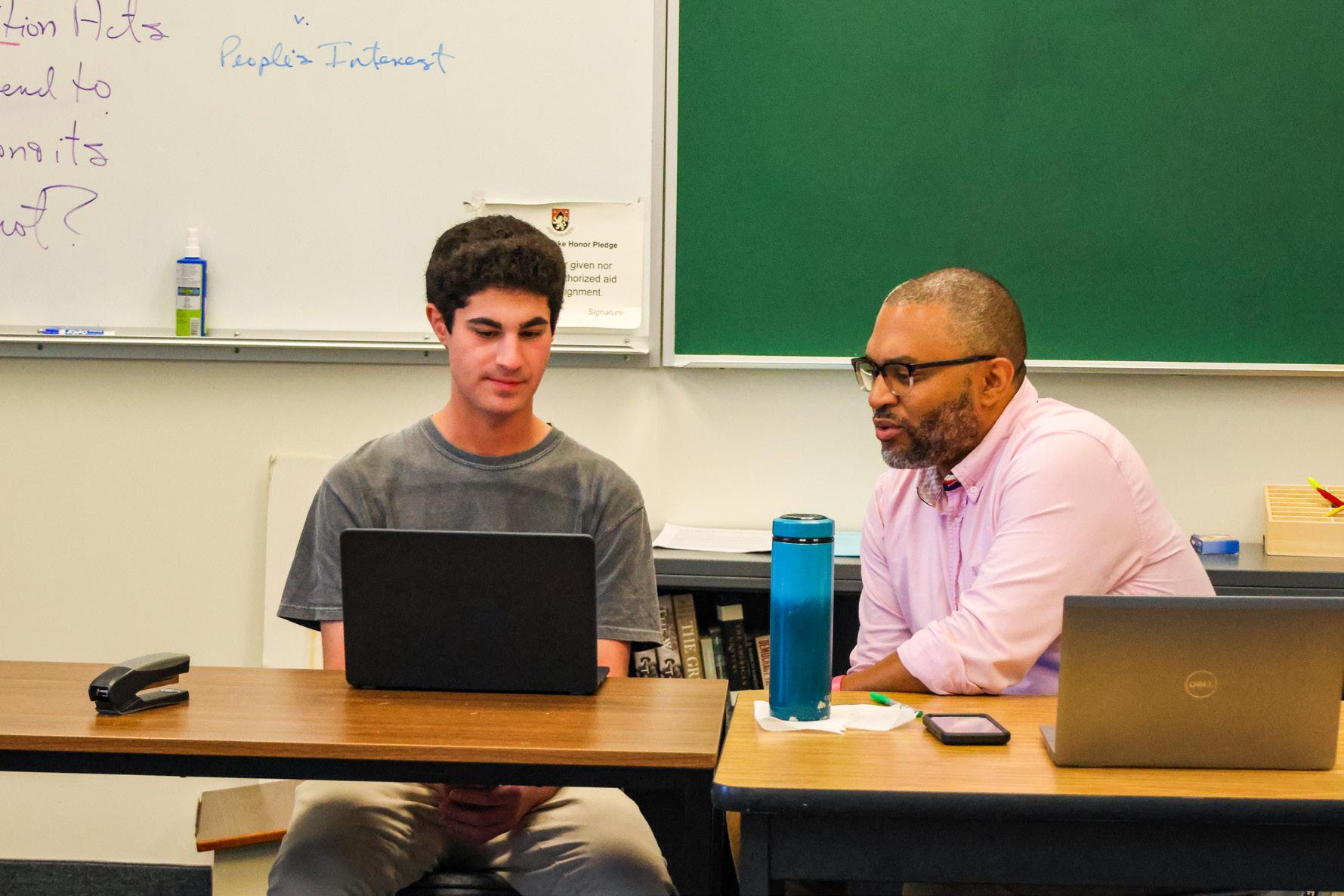
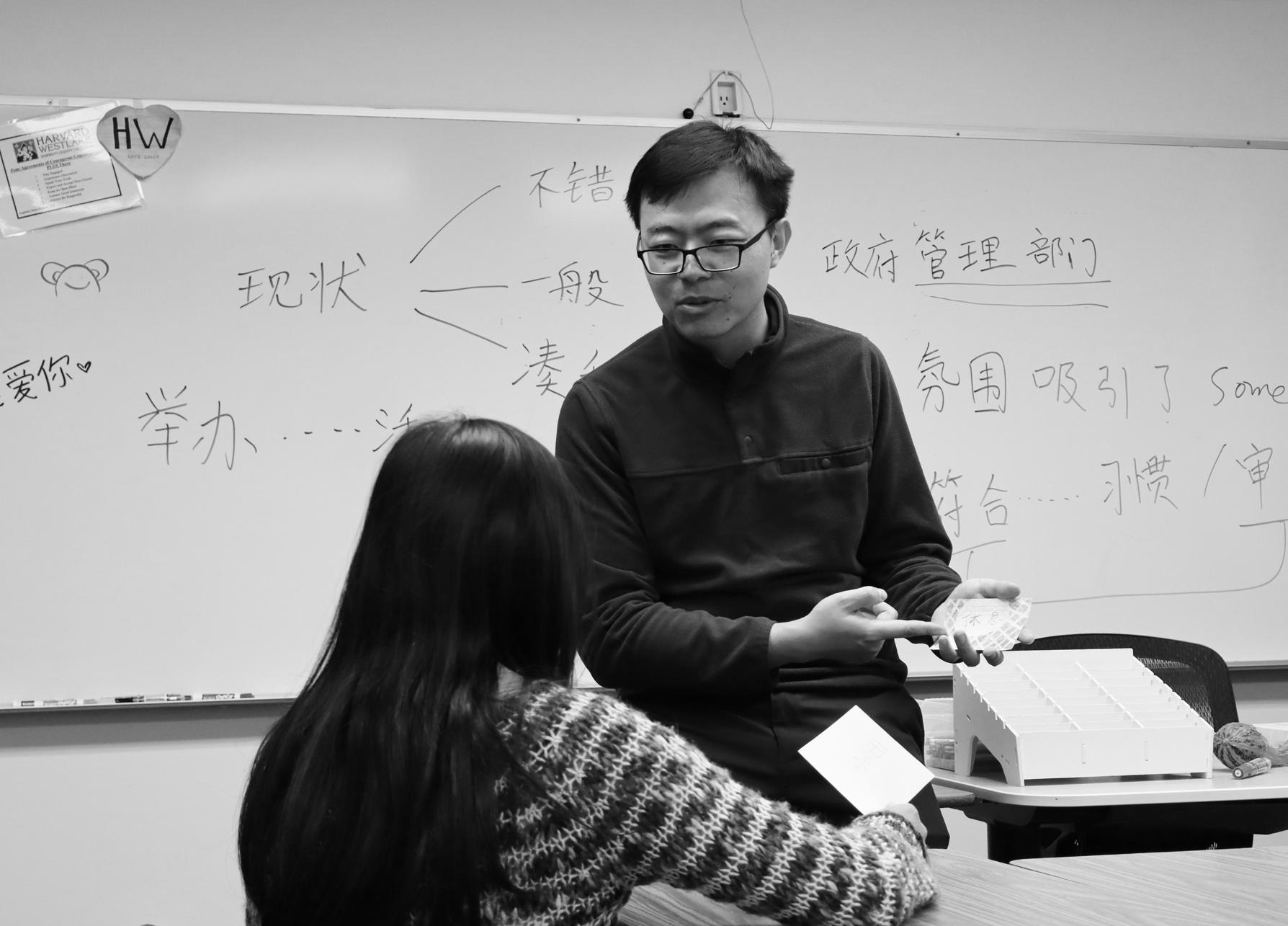
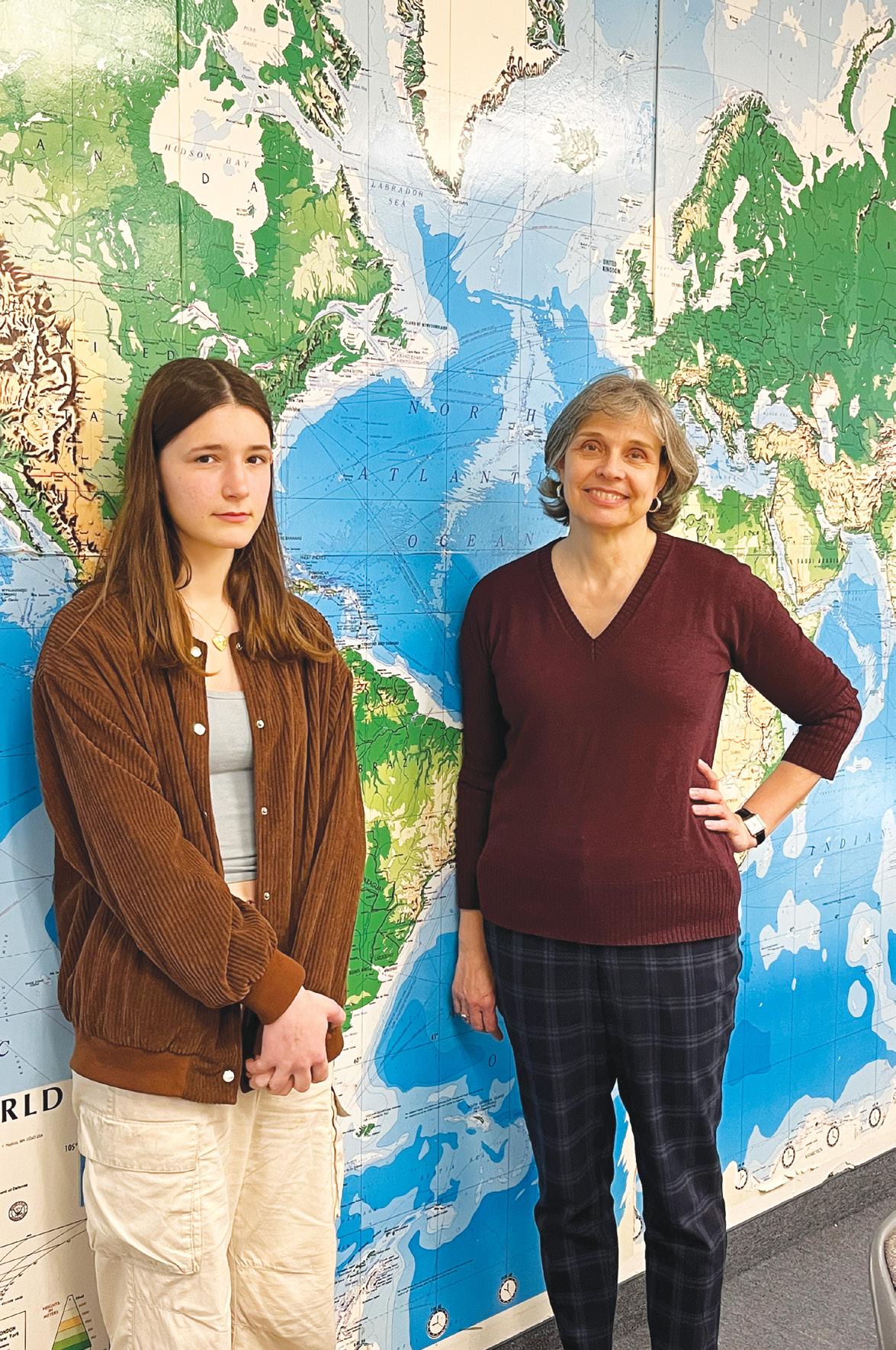
USING TIME WISELY: History Teacher Erik Wade works with a student during a meeting. The administration is discussing possible revisions to the school day to free up teacher schedules and plan more community-bonding events.
PRINTED
Tuition raised to $49,700
While the number of students receiving financial aid is not planned to be increased for the 2025-2026 school year, Gonzalez said the amount of individual aid given to each student is increased each year along with increases in tuition.
“Every student who receives financial aid receives an increased grant, but they also likely pay more tuition,” Gonzalez said. “Tuition increases, and aid grants increase, but the tuition that families pay increases. Our grants range from 99% tuition covered to 5% tuition covered. So everybody contributes, and no one receives a 100% grant.”
Gonzalez said the school only gives need-based aid in order to fairly distribute funds.
“[When considering an applicant] for financial aid, we take into account their family’s assets and income versus the tuition,” Gonzalez said. “If there is a gap between what we determine to be their ability to pay full tuition, then they apply for financial aid. All of the aid is need-based, not merit-based. We believe all of our students have merit, so the fairest way to distribute financial aid is through need.”
Maylie Macias ’26, who is on 99.6% financial aid, said she is extremely grateful for the school experiences that financial aid has made possible for her.
“I personally think that the school’s financial aid program has been an incredibly beneficial resource during my time here,” Macias said. “If not for the program, opportunities like summer programs, participation in school trips and sports would not have been accessible for me. Because of financial aid, tuition does not have a large impact on my family’s finances. However, there are other factors that do impact our finances, such as transportation to and from school.”
Alumnus director presents 2014 time capsule documentary ’Harvard-Westlake High’
By Colin Ho
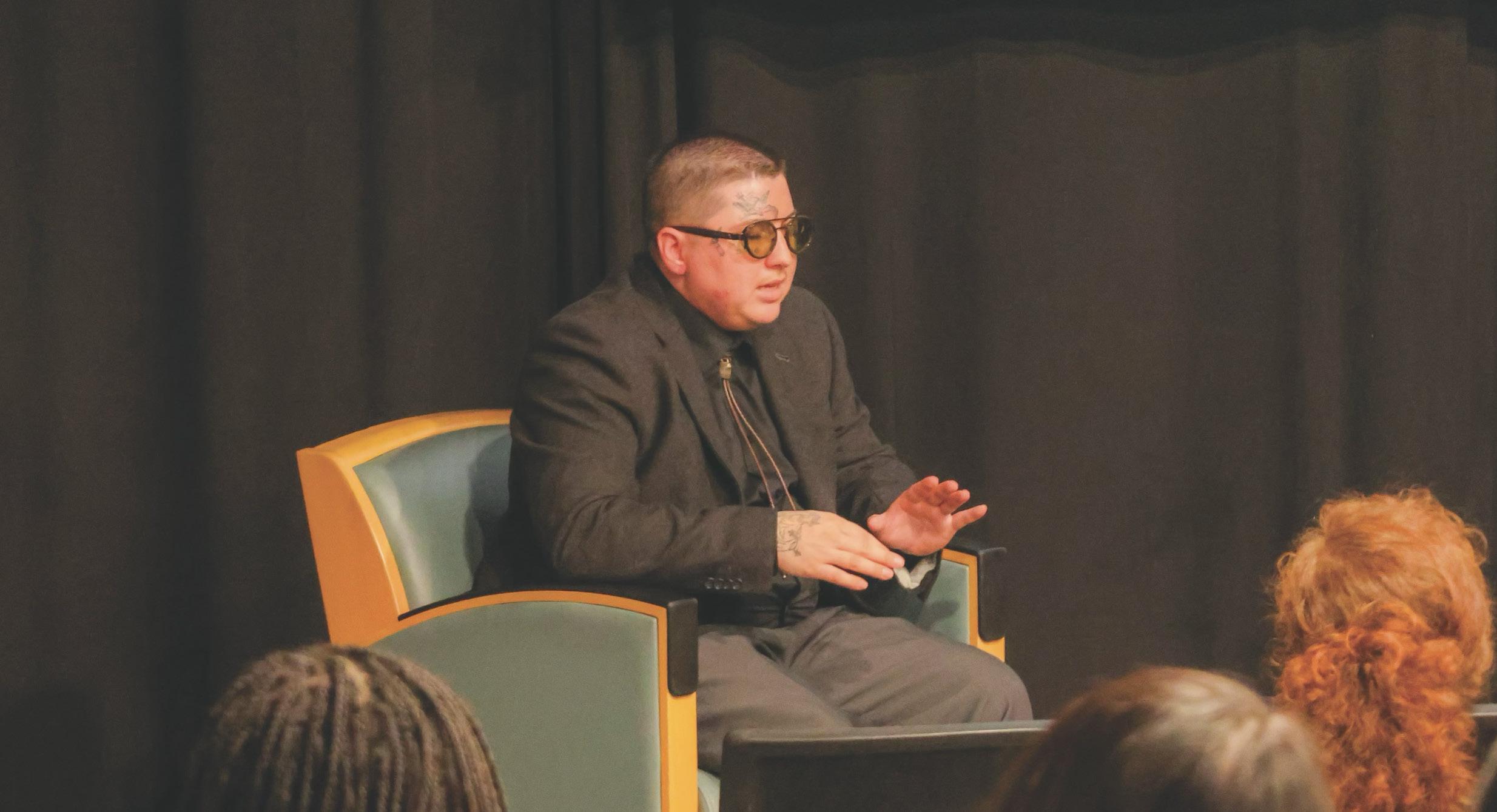
The documentary “HarvardWestlake High,” created and produced by Líto Knight ’14 in his senior year at the school, was screened in Ahmanson Lecture Hall on Dec. 9. The documentary consists of a series of interviews with students who graduated in 2014, and is described as a “time capsule to be opened and examined in 2024.” After undergoing major life changes, Knight decided to finally share the stories he documented in the film.
The film was released nearly a decade after it was first filmed and deals with themes of “institutional and internal difficulties, competition, drive, reputation, personal representation, identity, belonging and pride,” according to the film’s description. Knight said he interviewed students from a wide variety of
backgrounds, which taught him about the school community as a whole.
“Some interviews were 10 minutes, and some were an hour and a half,” Knight said. “Some people would just run with it. I wasn’t doing this for school either. I only took one video art class in tenth grade, and then I borrowed all the equipment. It wasn’t just a selection of friends. It was people from all across the board.”
Ellie Borris ’25 said he was able to draw parallels between problems the school community faced in 2014 and problems it faces in the present.
“It was interesting to see people 10 years ago talking about a lot of stuff that we still talk about today,” Borris said. “It’s also interesting to see what’s changed since 2014. One thing that seems like it improved quite a bit is diversity in the teaching
Admin responds to increase in trash
By Erin Ryu and Ella Jeon
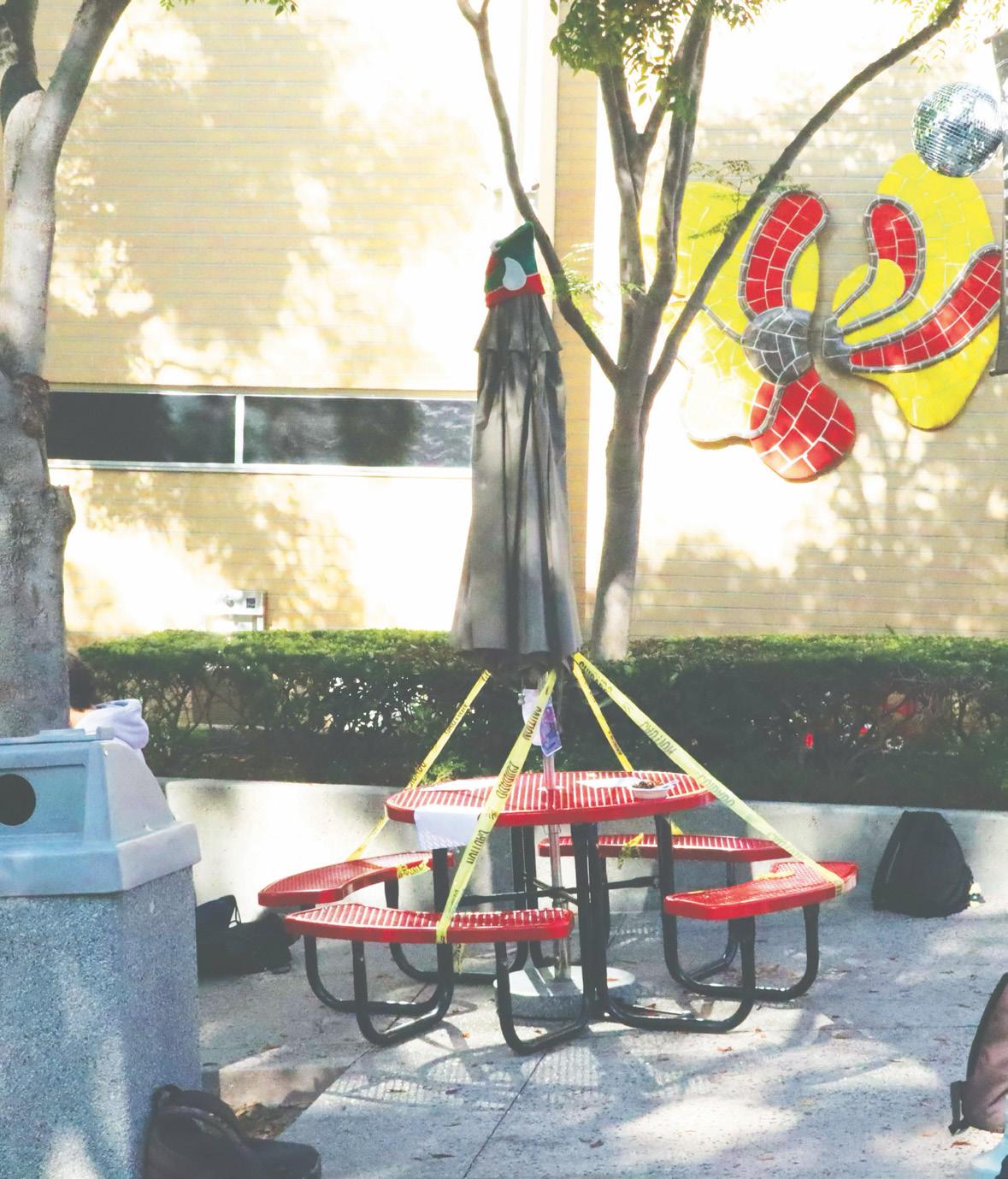
The school has seen a growing trend in the lack of trash disposal and campus cleanliness among students, according to Student Discipline and Attendance Coordinator Gabriel Preciado. Preciado sent out an email on Dec. 4 addressing the student body after the student lounge was closed for a day and a lunch table on the Quad was restricted for a week.
Preciado said the school is worried about the lack of student care in upholding the tidiness of the campus.
“There is a growing concern for the cleanliness of our campus following breaks and lunch periods,” Preciado said . “Our facilities team’s mission is to provide an organized, orderly and pristine academic environment for all of us so that we may all excel at our calling and future endeavors. We expect that you perform what is not only required but also act upon what is a sensible
and honorable character for mature Upper School students.”
Preciado said he will assess the school environment and ban other areas with a constant accumulation of waste, following the ban of a lunch table on the Quad.
“I will monitor the campus for tidiness to ensure we keep to task,” Preciado said. “Areas left unkept may be sectioned off for a time, and students who are neglectful in fulfilling this responsibility may be given tasks to help maintain the campus in good shape.”
Pearl Gatins ’25, who often sits at the table on the Quad that was banned, said she is ambivalent towards the limitation Preciado placed because she did not see much change after the table’s restriction was lifted, but understands his intention.
“I think it’s a bit unnecessary,” Gatins said. “We still hang out around that area so I feel the issue that Preciado is trying to address doesn’t necessarily correspond with where we eat our food, but
how we clean up after ourselves. But, I will give him credit, because I also don’t know how to fix this ongoing issue as it’s not specific to just that one table.”
Nola Foran ’26 said she agrees with Preciado’s decision to limit access to areas on campus because she believes students should take responsibility for keeping the school clean.
“[Preciado’s] measures are justified because the state of those tables were disgusting,” Foran said. “It’s not just about the negative effect it has on our school environment, but it also speaks to the character of the students who don’t clean up after themselves.”
Maggie Koo ’26 said she does not appreciate the trash at the school and wishes the situation was taken under control.
“It’s troubling to look around and notice how much trash is on the Quad, so I understand where Preciado is coming from,” Koo said. “I hope it improves because a clean campus is nicer for everyone.”
staff. I think that we have a lot of teachers of color, and it seems like that is way less of an issue. But the lack of community is definitely still an issue, so that has not changed, though people are working on it.”
Many of the student interviews in the documentary touched on the school ’s rigorous and competitive approach to academics. Borris said he sees both benefits and drawbacks to this unique culture.
“I think it’s both good and bad,” Borris said. “A lot of it depends on what kind of pressure your parents are putting on you and you put on yourself. It’s been really beneficial for me. I went to a middle school where I was not challenged at all, so I wasn’t really motivated to do anything. Coming here and being surrounded by incredible people has made me feel empowered. But I can also see how
it can be really overwhelming for others and make them feel like they’re not good enough.”
After watching the documentary, Sarah Anschell ’26 said she feels that the school environment has changed for the better since 2014, but that it still has its issues.
“It’s really interesting to see people in the film talk about things that are present in the school culture today,” Anschell said. “There was one line from a student interviewee who shared that it felt like the school valued ’students who do great things more than students who are great people.’ I thought was super impactful and relatable. I think one of the positive ways that the school has changed is that now, people discuss many issues out in the open. I’ve bonded with so many people over talking about how competitive the school is.”
CAPSULE CINEMA: Released nearly a decade after the original takes were made, Knight’s documentary serves as an eye-opening time capsule perspective into the life of a high schooler at the school in 2014, providing a comparison to the present-day state of the school’s academic, social and cultural communities.
CAMPUS CLUTTER: Spurred by the uptick of trash on the quad, the school restricted access to a table to encourage student responsibility for litter.
Speaker incites controversy at the annual People of Color Conference in Denver, CO
By Kara Jazaeri and Max Turetzky
Students attended the Student Diversity Leadership Conference (SDLC) and the National Association of Independent Schools’ (NAIS) People of Color Conference (POCC) in Denver, CO, from Dec. 4-7 to work on communication skills, develop social justice strategies and learn about the principles of networking.
However, during the POCC, a speaker event drew sharp criticism from Jewish advocacy groups including the Anti-Defamation League (ADL), as well as the school’s Jewish Family Alliance (JFA), for featuring several anti-Israel speakers. JFA said it had
expressed its concerns to the administration, including President Rick Commons.
“Given the conference’s stated purpose, the evident lack of inclusion, the propagation of false historical facts and the overt presence of antisemitism and anti-Zionism, coupled with the glaring absence of critical thinking and genuine diversity of thought, it is profoundly troubling,” JFA said in a statement released Thursday.
JFA said the administration was in communication with the NAIS over the controversy and suggested the school reconsider its membership in the NAIS, which includes over 2000 private schools in the United States and abroad.
“Harvard-Westlake is actively engaged in discussions with NAIS to express its deep disappointment and concern,” the statement said. “The school is currently awaiting a response and will carefully assess how to proceed with its affiliation with NAIS.”
Coordinator of Jewish Life and Community Engagement Sarah Rapaport said she took issue with keynote speaker Dr. Suzanne Barakat, whose brother and sistersin-law were killed in an anti-Muslim hate crime in 2015, who she said presented a one-sided framing of the Israeli-Palestinian conflict.
“Unfortunately, Dr. Suzanne Barakat used her platform to traffic in biased and false narratives, both antisemitic and anti-Zionist in na-
Alumnus author speaks to students
By Holden Kim
The school hosted author Steph Cha ’03 on Dec. 13 to Ahmanson Lecture Hall, where she delivered a talk about her 2019 novel, “Your House Will Pay.” The book was inspired by real-world events and explores the lasting impacts of violence and racial injustice — topics Cha explored in depth during her presentation.
“
“Your House Will Pay” draws upon the tragic death of Latasha Harlins, a 15-year-old Black girl fatally shot by a Korean store owner in 1991 during the lead up to the Los Angeles riots. Cha reimagines this history through the fictional story of Jung Ja Han, a Korean liquor store owner who kills an unarmed Black teenager, Ava Matthews. Matthews’ death emerges as a symbol of racial injustice, a central theme that drives the novel’s exploration of generational trauma and the complexity of societal divisions. Cha said one of her primary objectives in writing the novel was to offer readers a more layered and nuanced under-
standing of both the characters and the circumstances that gave rise to tragic events.
On the day of the presentation, students from all grade levels gathered to engage with Cha and learn from her experience. After the talk, students inquired about her writing process, creative influence and the broader social issues that informed her work.
Cha said her personal connection to the Los Angeles community played a significant role in shaping her book.
I felt implicated because when you’re part of a small community like that, everything feels like it reflects on you.”
Steph Cha ’03
“I grew up going to the Korean market in these [San Fernando] valley strip malls and knew that community pretty well, so I drew on all of that in writing the book,” Cha said.
Cha said she took inspiration from a radio show discussing Latasha Harlin’s tragic death, which helped her structure her novel’s plot.
“I heard an interview on KCRW with the author Brenda Stevenson about Latasha Harlins and Joyce Carlin, the judge who sentenced the woman,” Cha said. “That helped me conceive the
plot of the novel.”
Cha said hearing the Korean store owner’s personal account of taking the life of an innocent Black individual evoked her own feelings of guilt over the complex racial tensions within her own community.
“I felt shame hearing about something this Korean woman I had never met had done,” Cha said. “I felt implicated because when you’re part of a small community like that, everything feels like it reflects on you.”
Cha’s talk also highlighted the intersection of identity, history and community as a central throughline in her storytelling, emphasizing how these elements shape and influence her characters’ experiences within the novel. Cha said the different aspects of one’s identity are not separate, but that they are deeply interconnected.
“One of the main things that I was concerned about when writing this novel was the intersection of the personal and the political, the way that our lives collide with the lives of other people and the lives of other communities and the broader world,” Cha said. “I was writing in my first three books in the first person, and they’re entirely in a colloquial voice. It’s almost like [the character] is narrating, so you’re tied to that voice.”
Security to be made stricter
• Continued from A1
“It makes it easier for security to see who belongs on campus and who doesn’t.”
Director of Operations Dave Mintz ’87, who collaborated with Engelberg to create the changes, said the purpose of the added security measures is to ensure the safety of everyone on campus during the school day.
“Many of our peer schools have also instituted similar policies and systems in recent years,” Mintz said. “It’s to everyone’s benefit that we know that visitors to campus have legitimate business here and that people are not just stopping by.”
Raya Soper ’26 said she appreciates the safety considerations of the school but finds the new system to be an added complication.
ture,” Rapaport said. “It contributed to a hostile atmosphere for any Jewish community members, people of color (POC) or not.”
Rapaport said she nevertheless recognizes the importance of conferences like POCC that aim to foster diversity.
“The POCC is an incredible opportunity for people to gather, both POCs and allies, and it’s a space that is meant to elevate equity and justice for people of color,” Rapaport said. “Everything else was an amazing and important experience that our community is a part of. But it’s also unacceptable to sit by and allow this kind of rhetoric to be broadcast without any sort of balance or nuance offered.”
• Continued on hwchronicle.com
“The new changes like the mandatory background check for all visitors will make me feel safe on campus,” Soper said. “However, I feel like the new process would add an extra layer of stress to check in a visitor onto campus, although I do appreciate the school’s dedication to safety.”
Campus Ambassador Juan Valdivia said that facial recognition systems will be used for all campus visitors.
“We will take a picture of the visitor, and then take a picture of their ID and then check their record,” Valdivia said. “Campus Ambassador Bryttani Ford and I will be the taking the pictures with an iPad and keeping track of the people that come in, especially the people [who come often], like parents, vendors and nannies.”
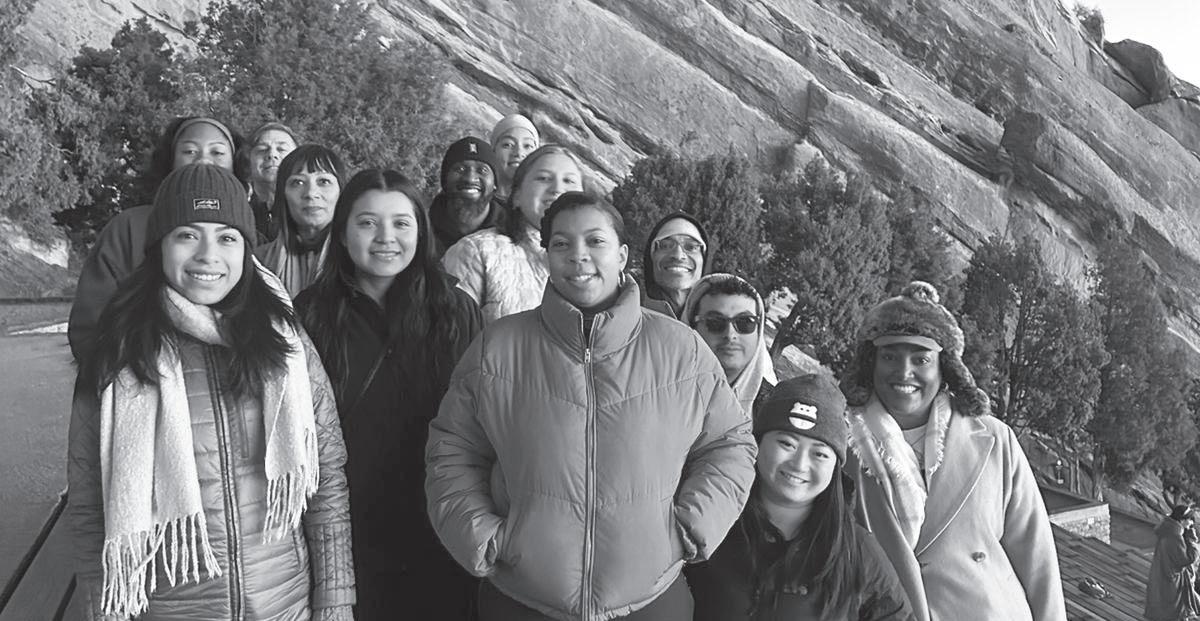
IN THE ROCKIES: Faculty pose for a picture at Denver’s famous Red Rocks Ampitheater while visiting the city for the annual People of Color Conference. Students and teachers from around the nation convene yearly at this conference to discuss topics of diversity, equity and inclusion.
PRINTED WITH PERMISSION OF BRITTANY BRONSON
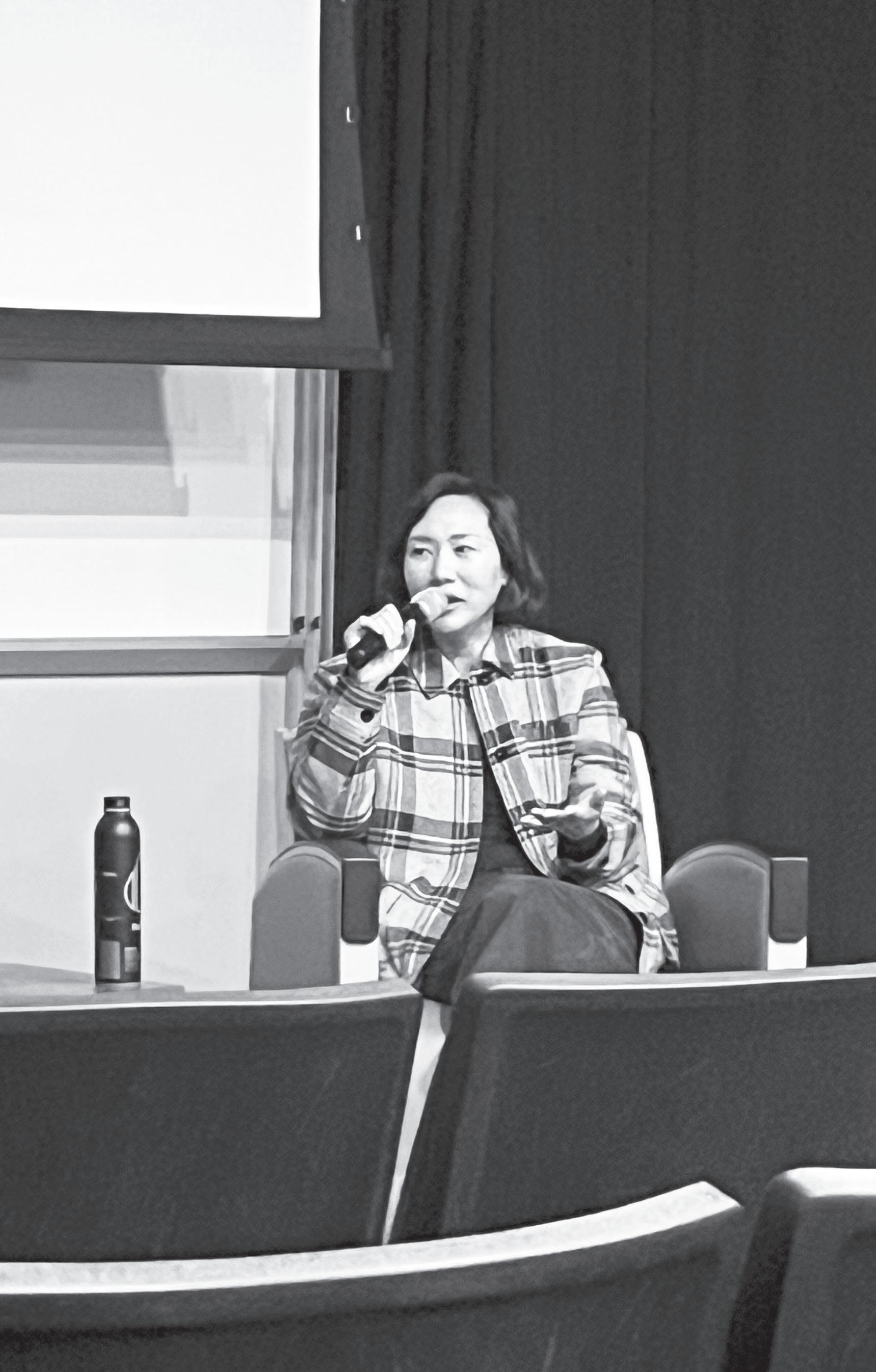
ASKING THE AUTHOR: Author Steph Cha’s novel “Your House Will Pay” is currently read in Honors English IV: Same House, Different Worlds.
World languages teacher Bin He elected President of CLTA-SC
By Luca Gonzalez
World Languages Teacher
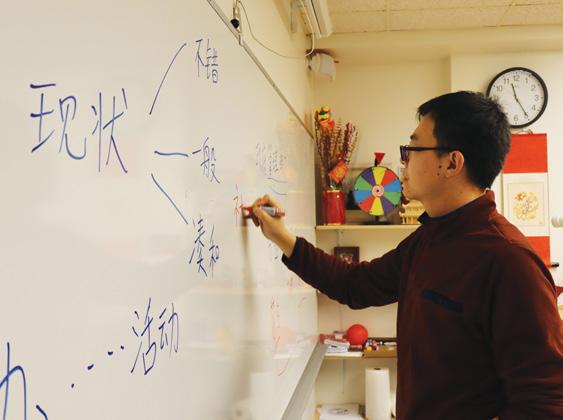
Bin He was elected as the President of the Chinese Language Teachers’ Association of Southern California (CLTA-SC) Nov. 19. CLTA-SC is a non-profit organization that helps connect students and teachers who are passionate or interested in the Chinese language. According to the CLTA-SC website, its mission is to establish common goals for Chinese language and cultural education.
He said he aims to both give teachers a voice to express themselves and strengthen relations within CLTA-SC.
“On a personal level, I aspire to empower teachers to take pride
in their work and feel confident showcasing their expertise on both regional and national platforms,” He said. “By helping educators find their voices and share their stories, I hope to inspire more students to embrace Chinese language and culture, thereby contributing to a richer, more interconnected, global community.”
He said on a professional level he hopes to work alongside teachers to continue to promote conversations about Chinese culture and education.
“As the President of CLTA-SC, I am most excited about the opportunity to connect and collaborate with educators across diverse backgrounds and institutions,” He said. “I deeply value the sense of com-
ASiA club gathers for annual karaoke night
By Kayla Graff
Asian Students in Action (ASiA) held their annual karaoke night Dec. 10, coming together to sing karaoke and eat pizza at ASiA leader Maggie Koo ’26’s home in Studio City.
ASiA leader Lauren Park ’25 said the purpose of the event was to foster connection between club members.
“We really wanted to create a stronger sense of community within the Asian American students on campus and other allies,” Park said. “ASiA strives to enhance the sense of community and the celebration of all cultures and heritages on campus, and karaoke night aligned with those values. We sang songs from all different cultures, not just Asian cultures, and we brought together a group of students and built a new kind of community.”
Christian Indelicato ’27, who attended, said the music selections spanned many genres.
“We sang a lot of different songs from every genre from rap to musical theater,” Indelicato said. “The food was also really good.”
ASiA member Hansen Liao ’27, who attended the karaoke night, said he enjoyed the bond between event attendees.
“Something I really liked about [karaoke night] was how people came together,” Liao said. “This group activity really helped the club bond, and I think everyone got a lot closer.”
Abby Juarez ’26 said she enjoyed the welcoming atmosphere at the event.
“Even though I’ m not Asian, I got to come, and everyone was really nice,” Juarez said. “The music was really fun, and people were really good at singing. I felt a strong sense of community because we were all having fun together.”
Park said she enjoyed seeing a diverse group of people attend the karaoke night.
“The best part was [seeing] people who don’ t usually come to ASiA,” Park said. “It was great to see new faces and grow the ASiA community on campus since it’s an open affinity group, meaning you don’ t have to identify as an Asian to attend meetings and events.”
Innocence Project club hosts executive lawyer guest speaker
By Ella Jeon
The Innocence Project Club invited Joseph Trigilio, the executive director of Loyola Law School’s Project for the Innocent (LPI), to speak to students about his work for the organization on Dec. 3. The Innocence Project is a national nonprofit that works to exonerate wrongly convicted and advocate for criminal justice reform. Club Leader and Assistant News Editor Alex Reisner ’26 started the club at school this year to garner student interest in the organization and its mission after completing a summer internship with the nonprofit earlier this year.
“munity within CLTA-SC, and I look forward to fostering meaningful conversations that inspire innovative ideas and elevate the field of Chinese language education.”
He also said he applies what he learns from his role at CLTA-SC to his teachings at the school and vice versa.
“My experiences as a World Languages teacher and my involvement with CLTA-SC have always informed and enriched each other,” He said. “At Harvard-Westlake, I’ve had the privilege of developing various courses, many of which were shaped by the timely feedback and encouragement from my students. Their input has motivated me to continue innovating and designing interdisciplinary curricula.”
• Continued on hwchronicle.com
During the event, Trigilio introduced the mission of the legal organization before diving into an in-depth discussion of various cases throughout the course of his work for the Innocence Project, highlighting how oversights in the legal process can lead to severe injustice. Trigilio shared how the nonprofit remains empathetic to the convicts they work with and their families, while utilizing DNA testing and other scientific advancements to improve evidence.
tice system makes mistakes.”
Club advisor and Criminal Law Teacher Alan Croll said he appreciates when students involve themselves in work for marginalized groups.
“It’s important that if people are wrongfully convicted, we ought to do something about that,” Croll said. “There is that balance in the administration of justice of whether we should let guilty people go just to be careful not to convict the innocent. If you are interested in this work and lend yourself to it, you are doing something extra, which is representing the unrepresented. You’ re giving a voice to the voiceless, and that’s really a wonderful thing to do.”
It’ s important that we are all aware that sometimes our criminal justice system makes mistakes.”
Joseph Trigilio
Trigilio said he enjoys speaking to students and to instill a sense of responsibility and passion for justice.
“I love seeing students’ enthusiasm because it fills me with inspiration,” Trigilio said. “[Students] are going to be the next lawyers, and if not then at least jurors, so it’s important that we are all aware that sometimes our criminal jus-
Ivy Wang ’26 said she was surprised at the psychological side of criminal legal work.
“I wasn’t expecting the cases the professor shared to be so emotional, and it made me realize how cruel the justice system can be at times,” Wang said. “Sometimes families are torn apart over wrongful convictions, and it was insightful to hear about how it’s not always obvious who is guilty or innocent.”
Trigilio said he is optimistic about the Innocence Project’s connection to the school and the opportunity to garner interest in criminal law and legal justice.
“It would be amazing to create partnerships with the members so that opportunity is there if they end up going into college or law school and want to do this work at a deeper level,” Trigilio said.
SINGING STUDENTS : ASiA leader Lauren Park '25 and Noa Blackman '25 sing a karaoke song together at the annual ASiA karaoke night. Club members and attendees bonded together through singing and enjoyed pizza.
KAYLA GRAFF/CHRONICLE
LAUDABLE LEADERSHIP: World Languages Teacher Bin He was chosen to be President of the Chinese Language Teachers’ Association of Southern California (CLTA-SC) to establish goals for Chinese language and culture.
COLIN HO/CHRONICLE
SPREADING AWARENESS: The
Student Mental Health Alliance (SMHA) offers hot chocolate day for all students on the Quad
By Erin Ryu
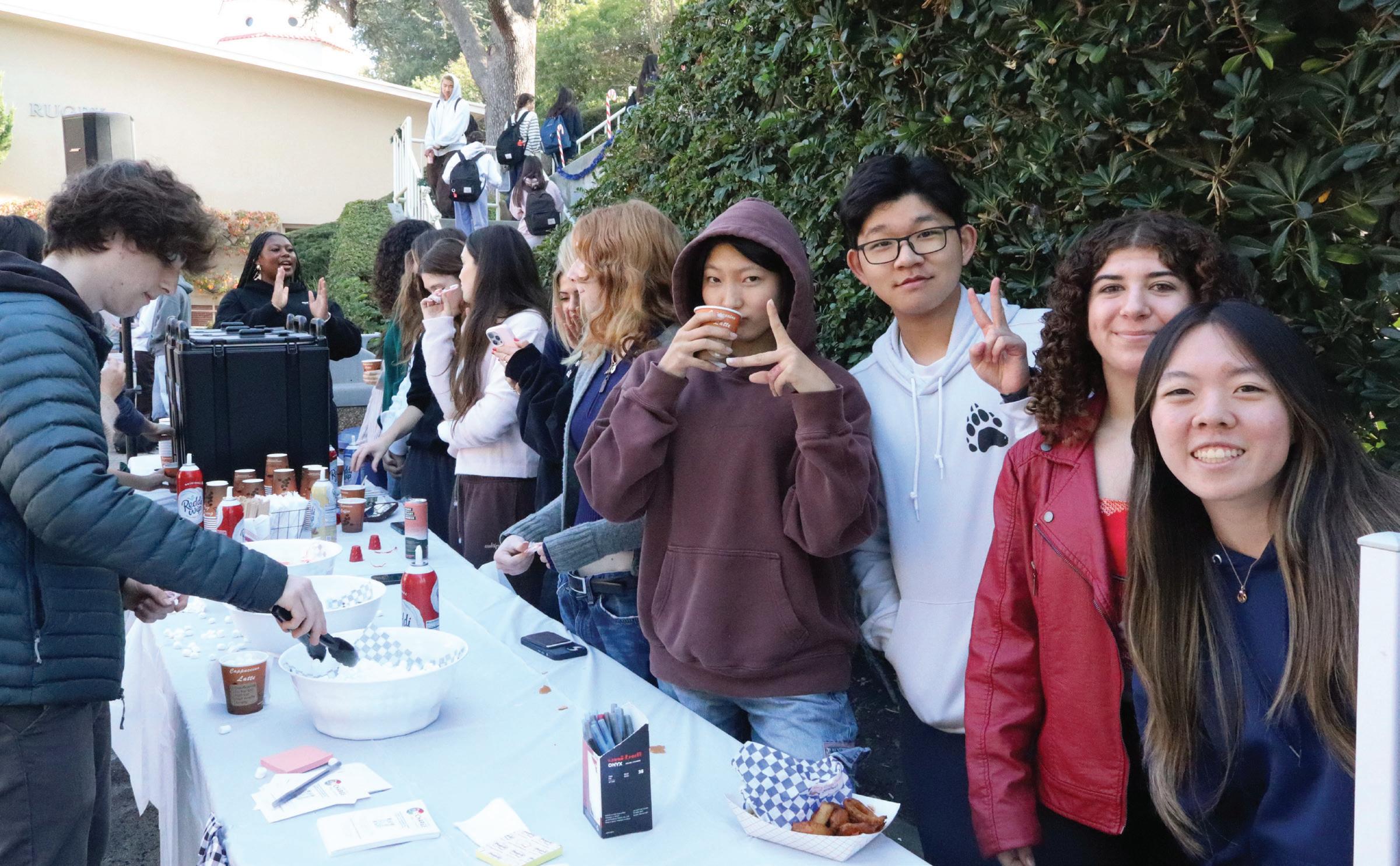
The Student Mental Health Alliance (SMHA) hosted “How Full is Your Cup?” on the Quad Dec. 5. Students received free hot chocolate, provided by the cafeteria, and shared advice for coping with stress on Post-it notes with peers.
School counselor and club advisor Michelle Bracken said the activity’s goal was to raise awareness of mental health and to offer a chance to spread support.
“It is important for students to see that everyone could use a check-in with themselves to see where they are with their mental health,” Bracken said. “When we can recognize that everyone is at a different place, it does two things. One, it normalizes that it is okay to be where we are, and, two, it promotes empathy. Sev-
eral students answered the question, ‘What do you do to fill your cup?’ Students could see the ideas and maybe apply them.”
SMHA co-leader Micah Parr ’25 said the activity helped him bond with other students as well as the community.
“Since the wintertime can bring about feelings of seasonal depression, it was important to hold an event in which we could discuss mental health,” Parr said. “Given that Harvard-Westlake can be a very isolating community, it always feels nice to make people smile by giving them some hot cocoa or engaging in a friendly conversation with someone
“ It always feels nice to make people smile by giving them some hot cocoa or engaging in a friendly conversation”
I didn’t really know before. With all the competitiveness of Harvard-Westlake sometimes blinding us from the wonderful people here, events like these have helped me see just how beautiful our community really is.”
Micah Parr ’25
Co-leader Ellie Liou ’26 said the event, especially the Post-it notes, allowed students to bond during a time of anxiety and busy schedules.
“We understand the stress that many students may feel during this time, and wanted to provide a sweet treat to encourage them,” Liou said. “The goal of the booth was to give everyone some free hot chocolate while encouraging them
HW Media sponsors alumni podcast screening Uncharted Paths at school
By Angel Song
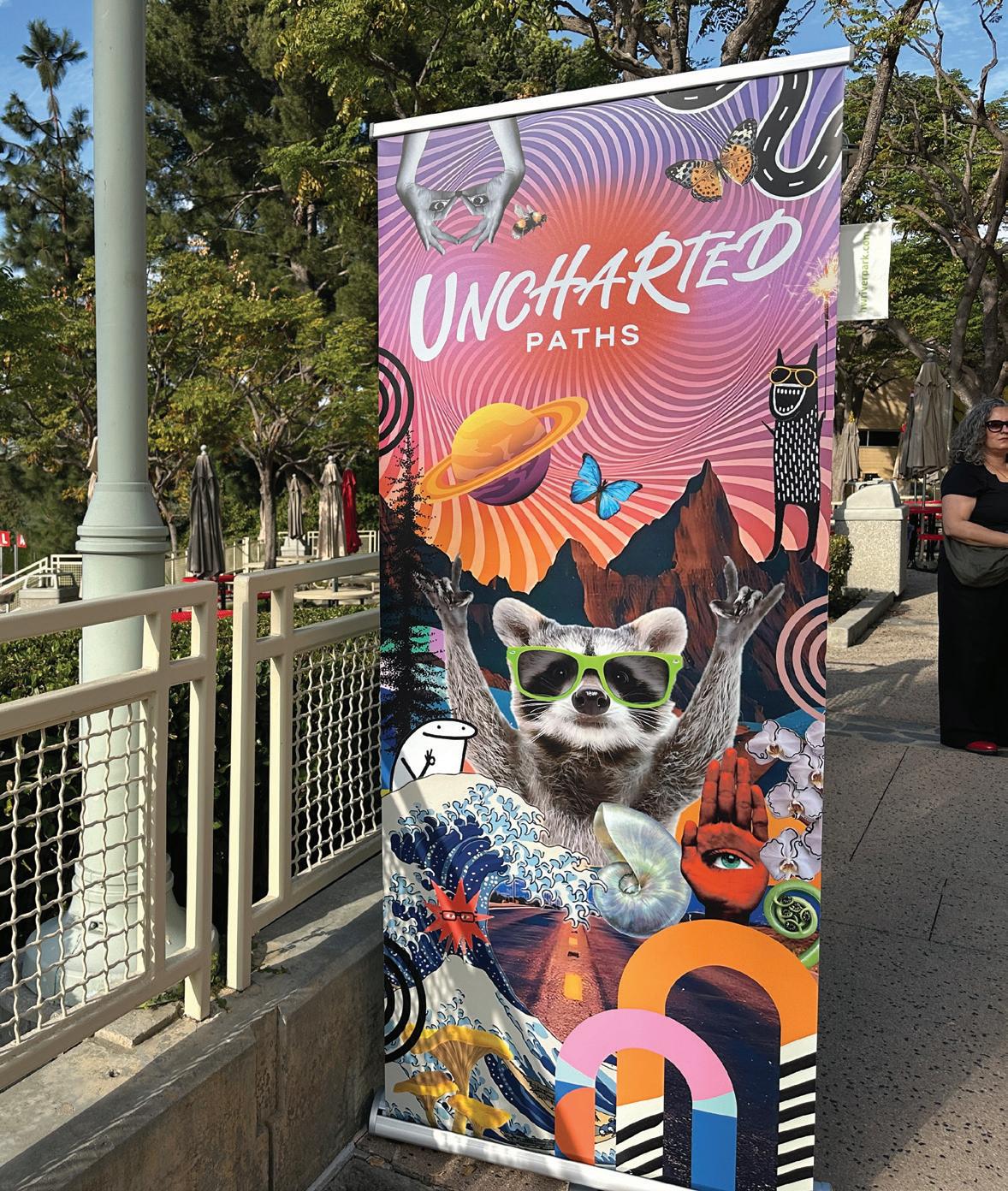
Three alumni held a screening and launch party for Uncharted Paths, a podcast created by three alumni in partnership with HW Media, in Ahmanson Lecture Hall on Dec. 8. The event included a documentary about creating the first season of the Uncharted Paths podcast and a brief question and answer session with a panel consisting of guests featured in the first season.
Created by Missy Fine Lafrance ’02, Kristin Wald ’02 and Lindsey Kimura ’03, the podcast aims to highlight alumni who chose to follow their dreams rather than conforming to a more conventional career track after graduation.
Lafrance runs a company named “Missy Fine Inc.” which is known for their event styling and decorations for corporate events, weddings and intimate soirees.
Wald is a life, career and relationship coach who encourages individuals to achieve a balanced work and personal life. Kimura is a personal guide and a business consultant. She helps leaders connect with themselves and founders grow their businesses.
Kimura said the podcast was made to explore the diverse career paths taken by alumni.
“We’ve each listened to the whispers of our intuition charting our own unique pasts, and, through our vision, we built a platform to amplify voices that inspire challenge and uplift,” Kimura said. “Our guests this season have taken the road less traveled, sharing stories of triumph and vulnerability.”
After a documentary screening of clips from the first season of the podcast, the podcast guests and hosts were given an opportunity to answer questions from the audience and share their insights.
When asked about the mo-
ments that made him keep working for his dream, entertainer, producer and designer Matthew Krumpe ’08, one of the guests featured in the podcast, said that the small interactions with others were the most motivating for him.
“I think the connections we have in life, like your friends, or that one teacher that talks to you or a stranger at the supermarket that acknowledged your presence actually matter a lot more than people give credit for,” Krumpe said.
Wald said she is looking forward to expanding the podcast’s outreach to more people.
“We want to get this message to as many students and most importantly parents,” Wald said. “We’d also love to take this to other private high schools around Los Angeles and eventually to universities, but the goal is to have as many people hear that your path matters, even if it doesn’t follow convention.”
Language classes plan trips to Asia
By Sophie Lee
The Language Department will host spring break trips to China March 22-29 and to Singapore and Indonesia March 21-April 2.
On the culture-focused trip to China, which is being run by Middle School World Languages teacher Minhua Gu, students will have the opportunity to visit cities Shanghai, Hangzhou and Zhujiajiao. While there, students will interact with peer groups and volunteer in the senior community. The trip’s emphasis is understanding and exploring the different aspects of Chinese culture as well as modern Chinese society and history. The trip is open to 20 students from 8th to 12th grade, and knowing or taking Chinese is not a requirement.
Angela Ren ’26 said she is interested in going on the China trip because of the variety of places that the trip will cover.
to share ways they relax or ‘fill their cup.’ I hope students got to reflect and read about how they can reduce their stress and unwind. The Post-it notes students wrote on are now displayed on the bulletin outside the cafeteria.”
SMHA member Maya Namba ’26 said she enjoyed being able to help students and faculty in reducing the stress of the school year.
“Aside from the free hot chocolate and the smiles that we received from our peers and teachers, what I loved about the ‘Fill Your Cup Stand’ that SMHA hosted at the quad was being able to spread joy and kindness throughout our community, especially in such a stressful time of the year,” Namba said.
“I want to go to China because I have only been to Shanghai to visit family and I would like to sightsee in other parts of the country,” Ren said. “I’m also interested in the opportunity to volunteer with the senior community because I think engaging with them will give me a greater appreciation for my youth.”
In addition to the China Tour, there is the Career Exploration Trip to Southeast Asia which will explore various industries in Singapore and Indonesia. This opportunity is open to only nine students from 10th, 11th and 12th grade.
The Southeast Asia trip will give students an insight into Southeast Asia’s work and recreational scene. Students will take part in cultural activities such as visiting Gardens by the Bay, a public garden in Singapore, as well as various neighborhoods like Little India and the Orchard Rd. shopping district. While in Bali, students will visit the beach and potentially swim in the ocean.
Senior Independent Studies
Nine seniors were selected to work on Independent Study projects with the help of a faculty adviser this semester.
Nate Arnold
By Donna Enayati
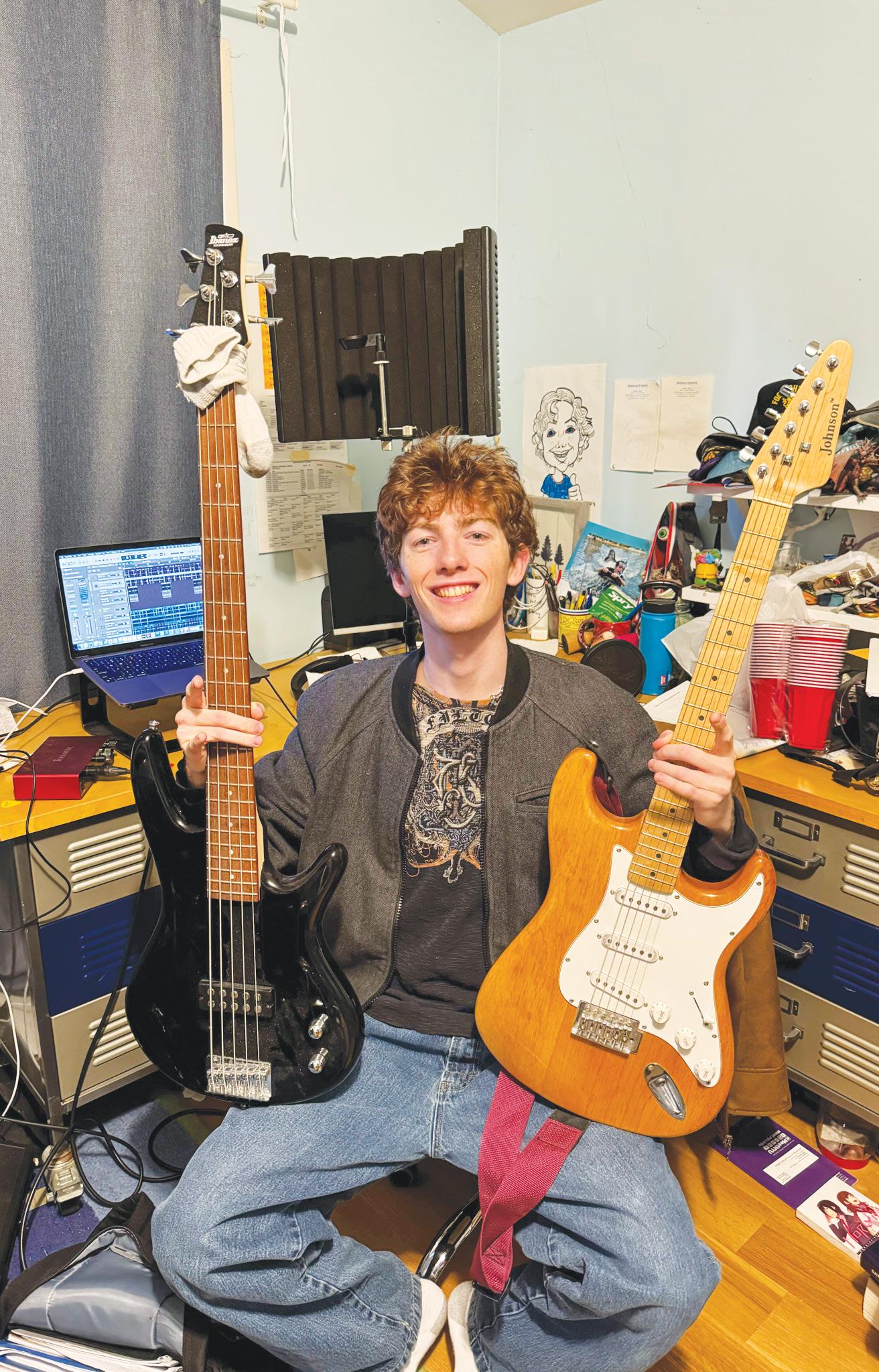
Nathaniel Arnold ’25 is writing, producing and creating three songs in the style of three different bands he enjoys for his Senior Independent Study.
Arnold said he aims to make music in the future and is using his Senior Independent Study to further his interest.
“Music is my passion and what I see [myself] doing for the rest of my life,” Arnold said. “I wanted to be able to show colleges the type of motivation
Will Putzer
By Emmeline Chan
Will Putzer ’25 is working on a methodology for organic chemistry synthetic pathways for his Senior Independent Study. Putzer is collaborating with Upper School Science Teacher Richard Vo to find a more efficient and healthy way to perform electrophilic aromatic substitution (EAS), which are organic reactions wherein an electrophile replaces an atom.
Putzer said he chose his topic due to his fascination with and interest in chemistry.
“I love chemistry, and I was thrilled to learn that through
and dedication that I have towards music by doing this [Senior Independent Study].”
Arnold said he wants to be a versatile musician and views his Senior Independent Study as an opportunity to draw influence from a variety of music.
“As a musician, it’s really important to be versatile, meaning being able to draw influence from many different places, genres and styles.” Arnold said.
Rhythm Section Workshop Teacher Greg Goddu is Arnold’s advisor. Goddu said he
the [Science and Innovators in Schools] SIS program I could do research in the subject,” Putzer said. “My project stems from this passion, but also allows me to hone my abilities as both a theoretical and practicing chemist before I go off to college. My study reveals that a different approach to induce EAS can be more cost-effective and safer than the classic and non-chemist-friendly way.”
Due to Vo's lasting role in his education, Putzer said he chose Vo as his adviser.
“Vo was my organic chemistry teacher last year and his class has been my favorite at Har-
followed Arnold’s musical journey since his time at the middle school and was thrilled by the evolution of his music.
“I first heard Nate perform when he was in 8th grade and taught him in music technology when he was in 9th grade,” Goddu said. “I was impressed with his musicianship and songwriting even then, but getting to hear how far he had come as an artist has definitely been the most exciting aspect of this entire process.”
• Continued on hwchronicle.com
vard-Westlake,” Putzer said. “It has really been amazing to work with him.”
Vo said he accepted the role of advisor because of his similar interest in organic chemistry.
“I’m glad Will shares the same fascination, and I am happy to nurture his interests,” Vo said. “It’s gratifying to watch his personal growth, right before my eyes.”
Despite some challenges in his research, Putzer said he has been celebrating numerous achievements in the lab following his lengthy efforts.
• Continued on hwchronicle.com
Arielle Trakhtenberg
By Holden Kim
Arielle Trakhtenberg ’25 is writing a paper on the former Chelsea Football Club owner and Russian oligarch Roman Abramovich. The paper details Abramovich’s influence on Vladimir Putin’s decision to invade Ukraine for her Senior Independent Study.
She is one of six selected students in this year’s Senior Independent Study group, with each student exploring a unique topic that she chose across various subjects.
Aiden Ahuja
By Riya Iyer
Aiden Ahuja ’25 is producing and recording a self-composed arrangement that narrates the transition from childhood to adulthood for his Senior Independent Study. Performing Arts Teacher and Jazz Director Chris Sullivan is acting as Ahuja’s adviser for the project.
Ahuja said his love for music but the limited curriculum offered at the school led him to pursue an independent study instead of a normal class.
Trakhtenberg said that she chose this topic to offer a new perspective on the ongoing conflict in Ukraine.
“The war in Ukraine was something I already knew about, but I wanted to gain more knowledge on it,” Trakhtenberg said. “I want to shed new light on this topic.”
In addition, Trakhtenberg said she was able to refine the focus of her topic because of help from her mentor, History Teacher and Department Head Celia Goedde.
“I wanted to pursue a Senior Independent Study because I want to pursue music in its entirety,” Ahuja said. “Since I’m not an instrumentalist, I can’t take any more classes other than music theory, which is why I wanted to do an Independent Study.”
Sullivan said he agreed to advise Ahuja because he was impressed with Ahuja’s composing and felt that his experience in jazz could lend a different perspective to the project.
“Aiden has never been in my class because he’s coming more
Goedde said her role as an adviser is to guide and support her student’s efforts, and also to ensure that the project is completed successfully.
“The mentor’s job is to keep the student on track,” Goedde said. “We make sure that the student doesn’t fall behind and has a successful outcome. We also serve as a sounding board for students to get ideas for their topics.”
“I proposed my topic to Goedde and she was supportive, but also gave me some suggestions on how to improve it,” Trakhtenberg said.
from the classical side, whereas I teach jazz,” Sullivan said. “We’ve had a couple of sessions where it blossoms into sharing music because of that, and he’ll tell me more about some of the composers that influence him. His language is a more classical screen scoring lane, and I’m coming from more of a jazz world so that intersection is really unique.”
Ahuja said he is greatly passionate about music and is hoping to convey a story through his independent study.
• Continued on hwchronicle.com
Daisy Pritzker
By Tali Gurule
Daisy Pritzker ’25 is researching the impact of diet culture on American society for her Senior Independent Study.
In the past, Pritzker has worked with the National Association of Anorexia Nervosa and Associated Disorders (ANAD), a nonprofit organization that provides peer support services to people struggling with an eating disorder. She also founded One Bite at a Time, an organization that raises money for ANAD by selling cookies at multiple farmers’ mar-
kets throughout Los Angeles.
Pritzker was diagnosed with anorexia in the past and saw a friend hospitalized with an eating disorder. She said she chose to research eating disorders because of the subject’s relevance to people in her community.
“I honestly do not know a lot of people who have not had some sort of struggle about body satisfaction or disordered eating,” Pritzker said. “It is such a prevalent issue that it is what I’m planning to study.”
Pritzker said her paper examines aspects of diet culture that are
By Abby Ryan
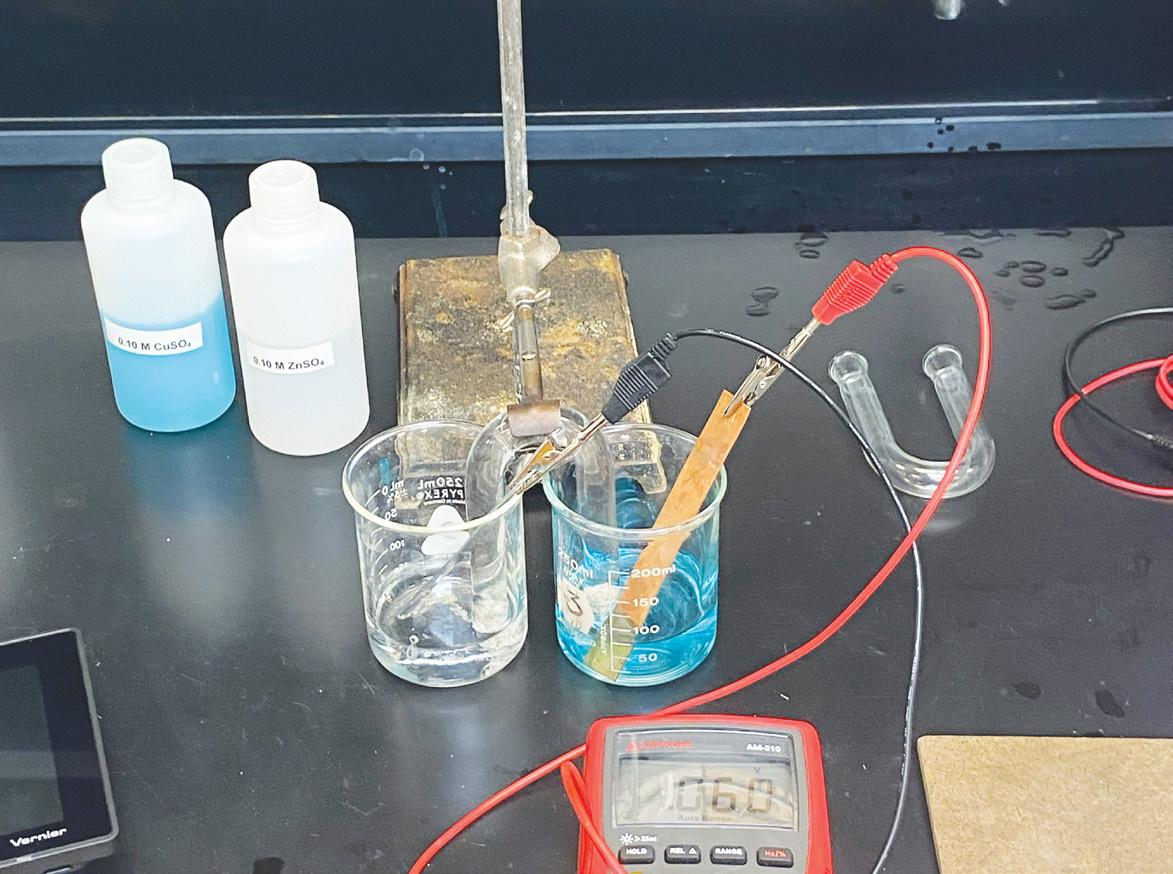
Pranav Iyer ’25 is studying electrochemistry in correlation with batteries for his Senior Independent Study project.
Iyer said his study focuses on creating two types of batteries and making models based on them.
“I’m focusing on two types of batteries: the Daniell cell, which uses copper and zinc electrodes, and an alkaline battery, which uses zinc and manganese dioxide,” Iyer said. “The main parts of my project are building these batteries, measuring how their voltage changes
over time and creating computer models to predict these changes.”
Iyer said he chose to study this topic because he can combine his love for computer science and math while having a relevant impact on society.
“It felt manageable with my two years of chemistry experience,” Iyer said. “Plus, it lets me bring in my interests in math and computer science. It’s also cool that electrochemistry is a popular topic in modern science developments because of how important batteries are for renewable energy.”
Iyer said he is proud of how this
Hugh Cheng
By Hailey Kramar
Hugh Cheng ’25 is studying game theory and attempting to create an interactive website to explain game theory, a concept in economics, to the masses for his Senior Independent Study.
Cheng said game theory is heavily related to a certain multitude of topics.
“Unlike more abstract fields, game theory lends itself to very tangible applications,” Cheng said. “I’ve been pleasantly surprised by how game theory has a
often neglected.
“There are so many important topics in my paper that are not common knowledge but have a big effect on mental health,” Pritzker said. “Fatphobia, the fact that dieting does not work and the racist and sexist origins of diet culture are very overlooked.”
Under the guidance of Upper School Counselor Dr. Tina McGraw, Pritzker is compiling her research into a 50-page research paper. At the end of the semester, Pritzker said she aims to publish her findings.
• Continued on hwchronicle.com
John Xu
By Angel Song
John Xu ’25 is programming and flying drones that can analyze agricultural data for his Senior Independent Study. Upper School Math Teacher Andy Stout is the adviser for Xu’s project. Xu said he chose this topic due to his interest in aviation, which led him to connect it to aspects of agriculture. He is using an autonomous drone to take photos of crops and sort them based on differences in color composition. His goal is to help farmers differentiate between healthy and unhealthy crops with-
project has helped him grow and deepen his grasp of the topic.
“I wanted to grow as both a scientist and a person,” Iyer said. “Learning to handle the challenges of a long-term project like this and deepening my understanding of an interesting topic. Now that the project is wrapping up, I think I’ve achieved both.”
Iyer chose Upper School Chemistry Teacher Nathan Cardin as his advisor. Iyer said Cardin helped build his interest in chemistry, thus making him the ideal advisor for this project.
• Continued on hwchronicle.com
By Chloe Kim
Sasha
Gadalov
’25 is studying Russian emigres’ influence, impact, assimilation and diffusion of culture in Hollywood for her Senior Independent Study project. Gadalov’s advisor is History Teacher and Interdisciplinary Studies Department Head Laurence Klein.
Gadalov said she was inspired to begin this study after she listened to a speaker session about the Romanoffs.
“I was sitting in Russophone LA’s basement and there was a speaker session [talking about] the Romanoffs and their impact
relationship with economics, biology and ethics.”
Mathematics Teacher Kevin Weis is serving as Cheng’s faculty advisor. Weis said that he enjoys when Cheng lectures him.
“Hugh proceeds to give me a lesson [and] I do my best to follow,” Weis said. “I am learning from a student who, we both know, is much smarter than I am. It’s especially enjoyable.”
This semester, Cheng said the weekly meetings with Mr. Weis have helped him further grasp the material deeper.
“I’ve worked my way through an introductory game theory textbook,” Cheng said. “In my weekly meetings with Weis, I prepare mini-lessons and I’m forced to understand the material on a deeper level.”
Cheng said he decided to do his study on game theory because of the chance of further developing mathematical strategies.
“I wanted to learn about something I was interested in, but not too knowledgeable about,” Cheng said.
• Continued on hwchronicle.com
out having to survey the entire field.
“This project has three parts to it,” Xu said. “One part is making an autonomously flying drone, the next is making a platform that interfaces with the drones and the last part is making a report summarizing the data gathered.”
Xu said he often enjoys challenging himself by working independently and combining software with physical equipment.
“I learned a lot about the hardware of drones in particular, such as the connection of the drones to an external computer, which involves intricate wiring I was not familiar
with before,” Xu said. “There’s definitely some more self-guidance with these harder concepts, but there is also the assistance from my advisor.”
Stout said he accepted the role of advising Xu’s project because he was impressed by his previous work and wanted to support it further.
“I had him for two years as a student in my classes, and I’ve also known him from his extracurricular activities,” Stout said. “From all these experiences, I was convinced that John could do anything he said he could do. It’s been really fun seeing John accomplish new things each week.”
on Hollywood,” Gadalov said.
“Turns out that same church I was sitting at is part of this theme I’m doing right now.”
In her research so far, Gadalov said she learned about the two waves of immigrants coming into Hollywood.
“I learned that half of Hollywood is involved with [Russian] immigrants,” Gadalov said. “Hollywood was built on emigres and immigrants because I’m focusing on the first [wave], where Hollywood shifts from the East Coast to the West Coast [with] the Jewish immigrants. And also the second wave, which is called the white
immigration. Overall, I learned a lot about who made Hollywood, how Hollywood happened, the perceptions of these people and how it ties to the current present which I think is really cool.”
Gadalov said she chose Klein as her advisor since he is well-informed on subjects regarding her topic.
“He was the academic teacher that would be the best for this because he's so knowledgeable about Los Angeles and the film industry,” Gadalov said. “He's been really helpful in everything and helping me keep on track.”
PRINTED
PRINTED
Sasha Gadalov
Pranav Iyer
A Singsong Rhythm
Science Teacher Nate Cardin has crafted up The Chronicle’s crossword puzzle for this issue. See if you can find the singsong pattern.
ACROSS:
1. Anna’s “Frozen” sister
5. Compute 2 + 3, for example
8. Rounded, natural hairstyle
12. Tilt to one side, like a certain tower in Pisa
13. Also
14. “Good Luck, Babe!” singer Chappell
15. Fictional gorilla that climbed the Empire State Building
17. No longer here
18. Green citrus fruit
19. Minigolf strokes
20. Despised
23. “Now I’ve ___ everything!”
24. Playing cards often worth 1 or 11
25. Doorbell sound
29. Singer Carly ___ Jepsen or Corinne Bailey
30. Sometimes congested passage connecting to nasal cavities
31. Cause for overtime in sports
32. Table tennis
34. Monthly payment to a landlord
35. “Such a shame!”
36. Desert watering holes
37. Start
39. “Mary Had a Little ___”
Chron-nections
41. Newspaper think piece
42. Riley’s imaginary friend in Pixar’s “Inside Out”
46. “What ___ you thinking?”
47. Consume
48. Light bulb moment
49. More’s opposite
50. Prefix meaning “three”
51. Complete collections
DOWN :
1. Antlered animal
2. Floral Hawaiian garland
3. ___ Francisco, CA
4. They can be acute, right or obtuse
5. Molecule component
6. “Been there, ___ that”
7. Corgi or poodle
8. Took part in a debate
9. Page-bottom references in a term paper
10. Angrily run off at the mouth
11. Change for a $5 bill
16. Youngster
19. Scoring pieces in cribbage
20. Angelic stringed instrument
21. Trendy antioxidant berry found hiding in “Maracaibo”
22. Adolescents
23. As ___ as a bug in a rug
25. Spanish for “God”
26. Quaint hotel
27. Three squared
28. “The early bird ___ the worm”
30. Stretch across
33. Travels smoothly through the air, like a flying squirrel
34. Synagogue figures
36. Texter’s “Wow!”
37. Word after Super or Rose
38. Vowel-heavy fencing weapon
39. One whose pants are on fire?
40. Not pro-
42. Word of enthusiastic agreement, in modern slang
43. Poem of praise
44. Tennis court divider
45. Energy source not needed for a fully electric vehicle
Colin Ho ’26 designed this issue’s Chron-nections. Find four groups of four words that share a common category. Each word belongs to only one category. Have fun and puzzle away!
Presentation Managing Editors: Georgia Grad, MeJo Liao, William Liu, Nathan Wang
Executive Editors: Alex Dinh, Everett Lakey, Max Turetzky
News Editor: Jack Ryan
Assistant News Editors: Luca Gonzalez, Colin Ho, Yuna Jeon, Ella Jeon, Alex Reisner, Erin Ryu
Opinion Editors: Sabrina Hamideh, Olivia Phillips
Assistant Opinion Editors: Audrey Kim, Ellika LeSage, Eila Shrokavi
Features Editor: Saisha Kumar
Assistant Features Editors: Sienna Dall’Olmo, Kayla Graff, Lydia Gugsa, Lyla Kavanagh, Andrea Ricabal, Celine Wang
A&E Editors: Crista Kim, Katelyn Kim
Assistant A&E Editors: Annabelle Cheung, Analeigh Nava
Sports Editor: Hana Mehdi Williams
Assistant Sports Editors: Wynne Davis, Connor Merrihew, David Rothbart, Max Nam
Satire Editor: Hannah Shahidi
Digital Managing Editor: Alex Lee
Business Manager: Hailey Cho
Advertising Director: Mia Morgan
Art Director: Amelia Chiarelli
Illustrators: Annabelle Cheung, Juana Markman, Anika Norton, Eva Park, Zara Groves, Tehmina Malhotra, Alexa Liu, Sabrina Simek, Abby Juarez
Freelance Writer: Calla Fox
Layout Assistants and Staff Writers: Gideon Ames, Alex Bakhtiari, Hudson Barber, Beau Cartwright, Emmeline Chan, Sophia Chang, James Corman, Mila Detmer, Aidan Elson, Donna Enayati, Jack Fener, Charlotte Fowkes, Jackson Friedman, Evalina Gerencher, Darya Ghassemieh, Zara Groves, Tali Gurule, Audrey Herrera, Jackson Hubbard, Téa Hunnius, Riya Iyer, Kara Jazaeri, Chloe Kim, Holden Kim, Hailey Kramar, Tess Latham, Sophie Lee, Jean Park, Mattea Pisani, Luke Rascoff, Andrew Rindone, Abby Ryan, Maddie Saada, Oona Sawyer, August Sone, Angel Song, Nicole Um, Jacob Waxman, Jake Yoon
CEO of HW Media: Max Turetzky
Chronicle Adviser:
Billy Montgomery
Director of HW Media: Jen Bladen
HWTV and Broadcast Adviser: Max Tash
Assistant Adviser:
Publication Information:
Founded in 1990, The Chronicle is the Harvard-Westlake Upper School’s student-led newspaper. Now in its 34th year, The Chronicle strives to report stories accurately and to uphold its legacy of journalistic integrity. The newspaper is published eight times per year and distributed to students, parents, faculty and staff. We are members of the California Newspaper Publishers Association and the Private School Journalism Association. Be sure to check out the HWMedia+ app for more content from our publications.
editorial
Celebrating Our Setbacks
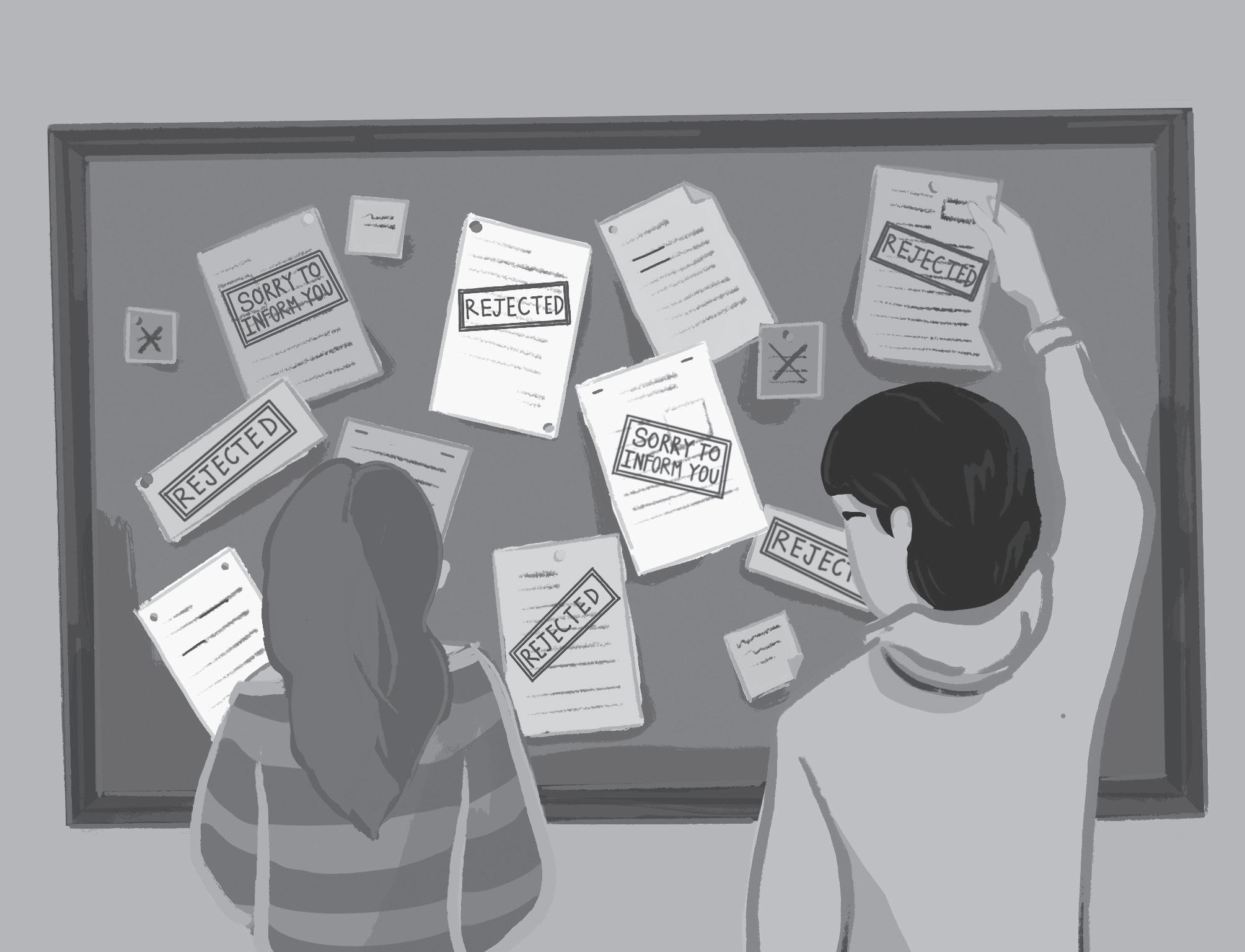
After careful consideration of your application, we regret to inform you that we are unable to offer you a spot in our Class of 2029 because you’re not good enough. This year’s application pool was all better than you, and we hope that this decision will ruin your life.
To seniors, this subtext of a college rejection feels glaringly obvious. A rejection letter from your dream school does not simply feel like a denial for admission — it feels like a rejection of everything you’ve ever worked for and of who you are as a person.
The devastation of rejection has intensified with the rise of Early Decision (ED), a binding choice released within two months. More often than not at the highly selective institutions favored by many students at this school, you are faced with rejection from the school that you had already emotionally committed to. As much as the school tries to warn us that colleges often spend less than 10 minutes reading the application that you poured months into, many students harbor the idea that we will be the exception to the ever-declining acceptance rate.
This can be a devastating blow; after working towards a ‘dream school’ for years in an intense academic environment, those of us who get rejected feel as though we have fallen short, especially as it seems like the rest of our peers have succeeded. However, our community must learn how to embrace rejection as not only a fact of life, but a truly important part of the college process that can shape us for the better.
30 years ago, rejection did not feel as much like the be all, end all at the school. Students pasted their rejections onto a wall in Chalmers and wrote lighthearted messages on each others’, a tradition that faded out many years ago when it became fodder for competition and
about us
DIVERSITY, EQUITY AND INCLUSION:
The Chronicle strives to be a diverse and inclusive community that welcomes all who wish to contribute. Our Diversity, Equity and Inclusion committee works to ensure that every member of the Harvard-Westlake community is recognized, included and given a voice. The Chronicle's publications will aim to represent this diverse community and provide a
of perspectives on the topics that they cover.
EDITORIALS:
Unsigned editorials represent the majority opinion of staffers and are written by the Editorial Board, which is composed of the Editors-in-Chief, Managing Editors and Section Editors.
ADVERTISING:
Looking to place an advertisement in our paper? Questions pertaining to advertisements may be directed to The Chronicle's Business Manager Hailey Cho at hcho2@hwemail.com. Publication of an advertisement does not imply endorsement of the product or service by the newspaper or school.
mockery. Now, school traditions surrounding college admissions consist of posting a baby photo coupled with a college pennant on @hw2025collegecommits, or wearing your school’s merch on Sweatshirt Day.
Early Decision pools are much smaller than Regular Decision pools, meaning students at the school often feel like they’re competing directly against each other. The yearly ‘ED spreadsheet,’ which tracks students’ applications and GPA, creates a space for students to constantly compare themselves to each other.
The school must actively work to combat the culture of obsession surrounding ED results. Although there is no perfect solution, there are some concrete ways we can begin to embrace the inevitable rejections alongside the acceptances. Students can spend the day after decisions come out mourning their rejections; then, the next day, the school should provide a space for catharsis so students can begin to move past these emotions. This doesn’t necessarily have to be a rejection wall; it could be something along the lines of a paper shredder on the Quad for students to shred their rejection letters, printed out. This allows for individual emotional release without creating a space for hatred or further competition.
College decisions should be taken as nothing more than what they are: a single decision. Maybe you’ll spend the next four years at that school, or maybe you'll end up somewhere else. Maybe you’ll find out where you’re going in December, or maybe in April. As mid-December rolls around, we must keep in mind that a college decision is an opportunity either way — it either provides a direction or a redirection, both of which can fundamentally shape you for the better if you let them.
LETTERS TO THE
EDITOR:
Letters may be submitted to chronicle@ hw.com or mailed to 3700 Coldwater Canyon Ave., Studio City, CA 91604. Letters must be signed and may be edited to conform to Chronicle style, space and format. We are committed to uplifting the voices of marginalized or underrepresented individuals and groups in accordance with our efforts to promote diversity, equity and inclusion.
PUBLICATION
UPDATES AND CORRECTIONS:
Though we always strive to be as accurate as possible, staff members identify inaccuracies and receive feedback from readers.
The Chronicle publishes corrections when we discover a factual error within a piece. We will continue to uphold transparency even in the face of mistakes following the publication of each issue.
MEMBERSHIPS:
FSStudents should attend colleges abroad
By Sienna Dall'Olmo
or generations, many of the school’s students have followed a well-traveled path: taking challenging course loads and applying to some of the many highly ranked U.S. colleges. This path, as successful as it can be, is also accompanied by a skyrocketing tuition and a college admissions process that increasingly fosters competitiveness and anxiety. Most students still do not consider going to college outside of the U.S., even though it offers a refreshing alternative — one that is less costly, relieves much of the stress of competition and is no less academically impressive.
American colleges are famously expensive, with most private institutions costing more than $40,000 a year excluding the cost of housing, meals, books and transportation, according to CollegeData.com. Even public colleges in California, though much less expensive, still have an average cost of around $14,000 a year for in-state students, according to University of California. In comparison, tuition for public universities in countries such as Germany and Norway is often free other than a small administrative fee, ac-
Encourage etiquette among students
By James Corman
aying “please” and “thank you,” holding doors open for those behind you, greeting people upon entering a room — these etiquette staples seem to be fading from everyday life, especially among teenagers. Some teens may claim that manners are oldfashioned or excessive, and rules of etiquette can sometimes seem outdated in modern contexts, according to the Etiquette School of America. However, good manners show respect and dignity, virtues that everyone should adhere to.
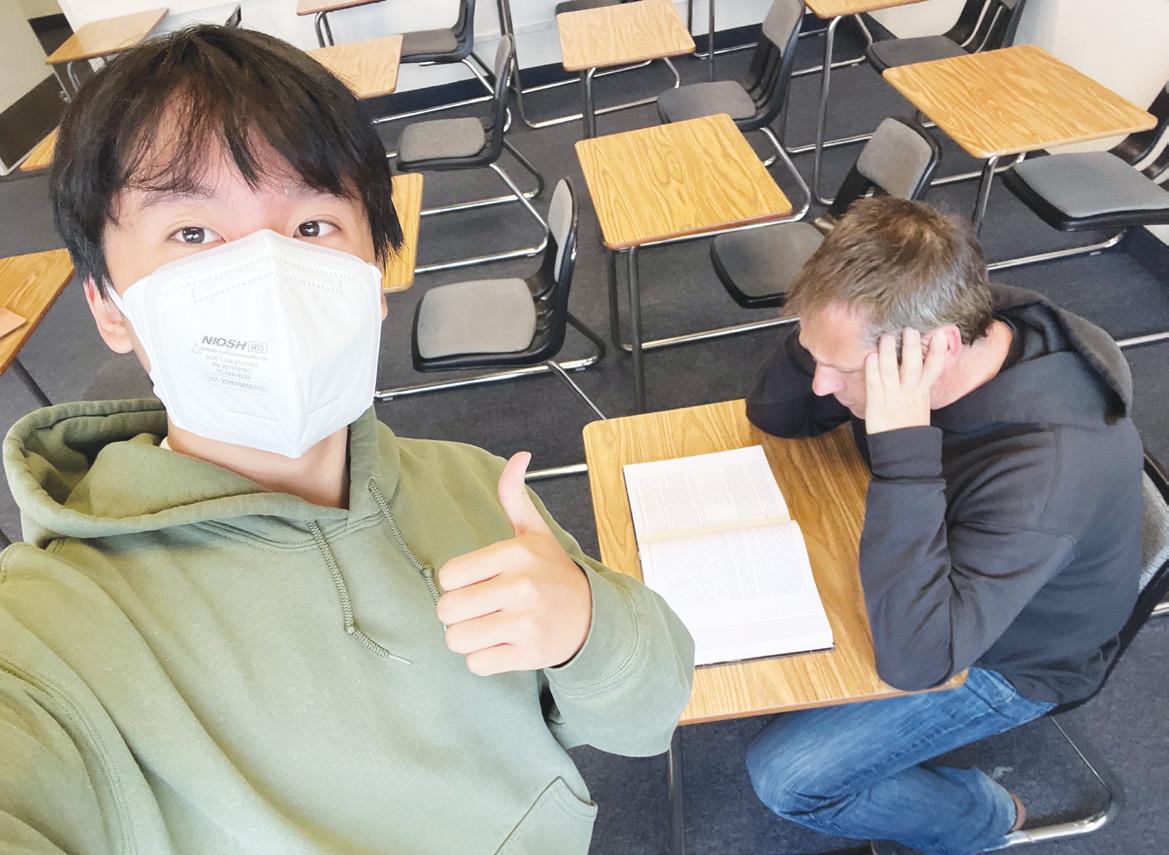
In classroom settings, some students at the school make sly comments and mock or even talk back to their teachers. When tests are announced, classes usually erupt with groans, and during lectures, students slouch in their seats, even resting their heads face-down on desks. These behaviors showcase students’ disengagement with the learning and signal to the teacher that they are bored. It is, of course, inevitable to be bored or tired during class some of the time. However, these feelings should never be shown overtly, as they look rude to a teacher. It can be easy to forget that
teachers dedicate just as much time to school as students, yet teachers do not broadcast their boredom with impolite body language. They are able to remain composed and conceal feelings of discontent, setting an example students should follow.
Good manners seem to have taken a backseat in the public’s priorities.
Furthermore, for a teacher who has dedicated years to their craft, working long hours and leaving late to finish grading tests, it is rude for students to arrive late, laze about during class, and leave without saying “thank you” or “goodbye.”
In previous generations, etiquette was more strictly enforced. 73% of people polled said that people's manners have deteriorated in the last few decades, according ABC News. Today, good manners seem to have taken a backseat in the public's priorities. A mere 7% of
Americans preface requests with “please,” according to Yahoo. Young teenagers are on social media at record numbers, which is causing us to forget how to be respectful. On apps such as TikTok, teens get a glimpse into the personal lives of strangers and comment unfiltered thoughts, often saying things that would traditionally be considered rude or judgmental in a face-to-face setting. Over time, it seems adolescents have lost a sense of what is and is not socially acceptable. Worst of all, teens are beginning to publicly exhibit these uncouth behaviors they once hid behind a screen.
The solution to this problem starts at school. Although students won’t like to hear it, teachers must become more strict about manners. Guidelines need to be established and enforcedabout what behaviors are and are not acceptable in a classroom setting. This means students should be called out by their teachers — politely, of course — when they behave in a socially unacceptable manner, despite how uncomfortable that may be.
• Continued on hwchronicle.com
cording to Masters Portal, a study abroad informational website. France and Italy are also home to noteworthy universities with tuition averaging under $10,000 per year, according to Masters Portal.
Going to school abroad will make education as well as exploration of the world considerably more accessible.
Additionally, when living abroad, traveling to neighboring countries becomes significantly easier and less expensive because of well-connected transportation networks and lower regional travel costs. Universities in the U.S often lack this luxury because of raised travel costs and a larger distance to nearby countries. Going to school abroad will make education as well as exploration of the world considerably more accessible.
Affordability is not the only benefit of applying to college overseas. The American admissions process is well known as a pressure cooker
— applicants are expected to juggle flawless GPAs, SAT scores, extracurriculars, leadership roles and capture all of it in their applications. International universities, however, often use a straightforward admissions approach: if you meet the criteria for the school — whether that be a high school diploma, minimum GPA or standardized test scores — you are in. This method eliminates the endless stream of essays or the need to trade sleep for another item on your activities list. Additionally, international schools are extremely transparent with these requirements which helps to eliminate some of the uncertainty and pressure of applying.
Countries such as the UK, Germany, and the Netherlands have institutions which are regularly ranked among the world’s best such as University College London, Imperial College London and the University of Amsterdam. These universities have rigorous academics, advanced research and plenty of opportunities for internships and global networking, according to Masters Portal. France and Italy are also home to noteworthy universities with tuition averaging under $10,000 per year, according to Masters Portal. • Continued on hwchronicle.com
TCombat holiday waste
By Eila Shokravi
he holiday season is approaching, Secret Santa is arising and the search for perfect presents has begun. This holiday spirit, however, has driven the overconsumption of food and material waste as costumers buy decorations, wrapping paper, gift bags and more. To be environmentally friendly, we should ensure we buy gifts and consume holiday products sustainably. The holiday season can still be enjoyable without feeding into the normalized overconsumption and material waste that comes with the season.
Hosting holiday events can lead to high levels of food waste. According to the Ecology Center, an organization that fights to create a healthy environment for humans and Earth, there is a 25% increase in waste between Thanksgiving and New Year’s Eve, with 21% being food waste. To ensure holiday events avoid food waste, we can consume leftovers, donate unopened canned goods to food banks, and compost. Choosing to compost would combat food waste while also being extremely environmentally friendly, as composting significantly reduces soil contamination, cuts carbon emissions and improves the health of humans and the environment. Reducing carbon emissions would create better air quality and therefore a better environment for humans and Earth. Although composting is extremely
beneficial to the environment, only 27% of Americans participate in composting programs, according to Waste Advantage Magazine, a news magazine that covers waste, sustainability and recycling. Leftovers can be an unenjoyable option for most, but there are many ways to repurpose holiday meals. In addition to composting leftovers, donating food to local food shelters not only prevents food waste but is a good way to give back to and support communities. For material goods, returns affect the environment because they require extra shipping and packaging which leads to an increase in carbon emissions and waste. According to the Civic Center, a consumer analytics platform, almost one-in-three adults in the United States plan to return or exchange gifts they received. Returns alone contribute 15 million metric tons of carbon dioxide to the atmosphere through landfill rubbish, according to The Guardian. Rather than returning unwanted gifts, regifting and swapping gifts can avoid contributing to the environmental effects of overconsumerism. Holiday cards produce a lot of trash and feed into the ongoing problem of carbon emissions. A study by United Kingdom Exeter University found that sending one card produces about 140 grams of carbon dioxide.
• Continued on hwchronicle.com
ILLUSTRATION BY SABRINA SIMEK
ILLUSTRATION BY ANNABELLE CHEUNG
ILLUSTRATION BY AMELIA CHIARELLI
DVideo games are beneficial for youth, not harmful
By Audrey Kim
uring my seventh grade life science class, my teacher was teaching us about different fine minerals. When he put up a slide that showcased a black mineral formed by rapidly cooling lava, most of the class already knew what it was: obsidian. When my science teacher asked how we already knew that, a boy explained that obsidian is a popular material that can be obtained in the video game “Minecraft”. He was surprised, as he had seen Minecraft mainly from combat-oriented playthroughs and thought it was a violent game.
Video games have gradually gained a negative reputation over time, with popular arguments against them being that they only cause aggression and attention disorders in children who play them. Task forces on violent media have put out studies that may link video games to increases in aggressive behaviors and thoughts in children, according to a study by the National Center for Health. Many parents ban their children from playing because they fear their kids developing violent tendencies such as increased
aggression towards others and attraction to weapons. Video games are also considered as addictive and a waste of time. People may think that showing an interest in video games will lead players to only focus on such, forgoing any essential daily tasks or pursuing traditional jobs and careers. However, this focus on the potential consequences violence video games might cause overshadows the many positive effects they bring.
Blaming violence and aggression in young adults on video games is a gross generalization of gaming as a whole.
Blaming violence and aggression in young adults purely on video games and using that to justify banning them is a gross generalization of gaming as a whole. Media cannot be held up as the dominant source of aggression in children and young adults. There are many other factors that can also lead to violent and destructive behaviors in people, like personal
STATS AND FACTS
Aexperiences or personality traits. Video games may make people become more aware of violence, but they are not the prime cause in influencing dangerous, violent behaviors. The main causes of violent behaviors are usually experiences in the real-world, more tangible events that have more effects on a person’s personality and lifestyle than playing a fictional game or engaging in any fictional media. Multiple studies and tests have failed to prove that video games cause violent attitudes in its players, according to the University of Oxford. In these studies, after analyzing those and those who didn’t play games, there was no direct correlation between playing video games, seeing violent imagery, and a sudden increase in violent behaviors.
Video games can teach players in unexpected ways, giving them knowledge on things they wouldn’t usually cover in a common school curriculum. Games like Minecraft, despite having violent elements, also teach kids about different plants and minerals in nature, as well as the functions and methods of different professions like farmers and blacksmiths, things that aren’t traditionally taught in a classroom. Other games like “Animal Crossing: New Horizons” can teach players how to manage debt and how to make money efficiently, and many other games have strong puzzle-solving and strategy aspects that give players incentives to sit down and methodically complete puzzles for rewards.
Video games also provide connections between people who would’ve never met each other
Do you think video games are overly criticized?
Yes: 54.0%
No: 46.0%
Reinvigorate interest in student clubs
By Ellika LeSage
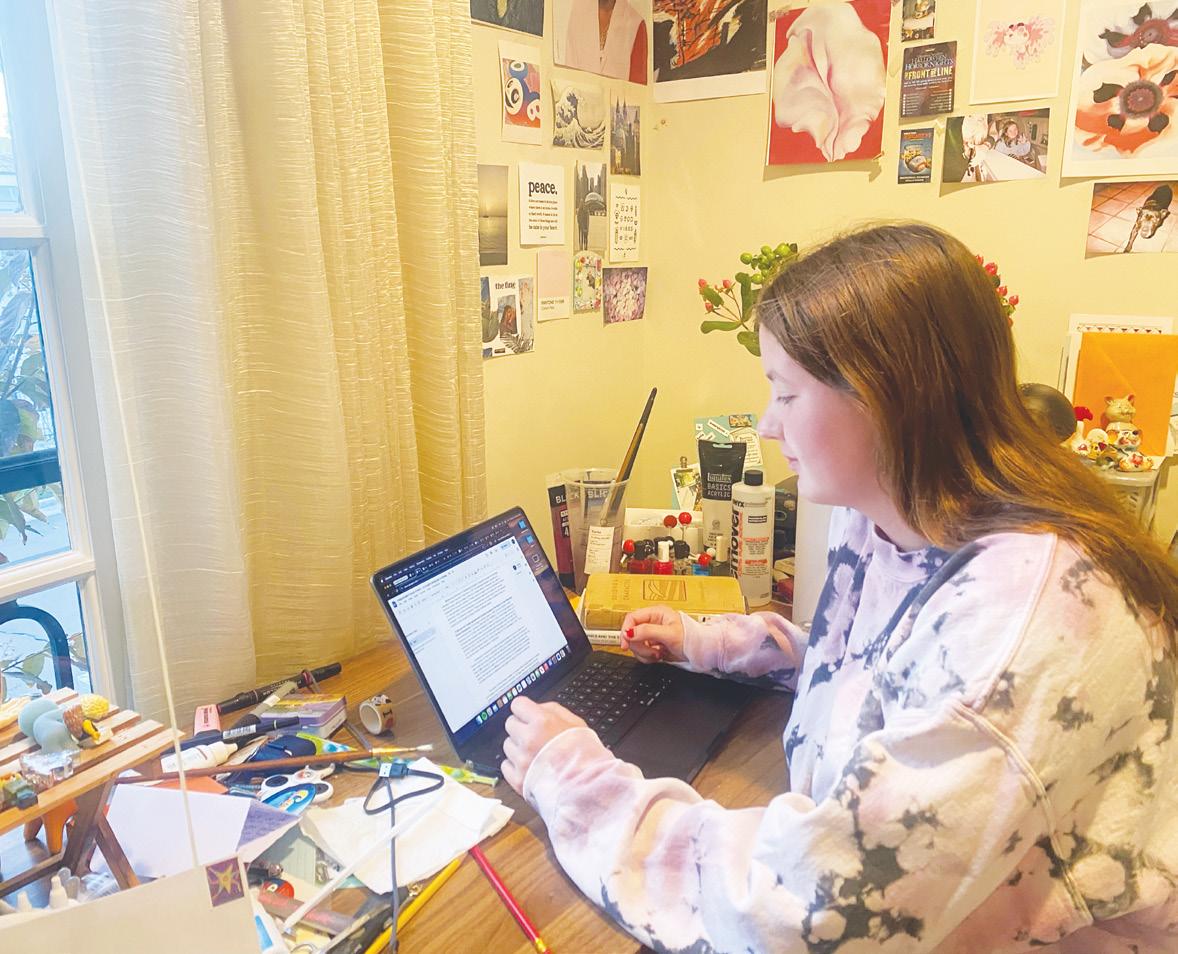
leader of Global Affairs Club, I was excited to see what the new year would bring. I hoped to continue the tradition of having a unique group of individuals who were passionate about the complexity of international relations. However, in my first few meetings, I was disheartened by the dip in attendance. My goal was to plan engaging activities that inspired people to get involved, but I quickly realized that with incentives, such as potential leadership positions, it was easier to motivate my peers to come to meetings. This story is common among student clubs: the struggle to keep members engaged without clear perks or rewards. Without meaningful participation, even the most wellled clubs are struggling to operate. Clubs play an essential role in building our school community. They offer students a chance to explore shared passions, develop relationships and often contribute to a cause greater than themselves. Yet, in an increasingly individual-
istic and outcome-driven culture, clubs have struggled to attract members who aren’t seeking leadership roles, awards or a line on their college applications. This transactional view undermines the broader purpose of clubs: to foster belonging and connection.
Some clubs, such as Investment Club and Cooking Club, have a more concrete purpose for attending, whether it’s networking, learning a skill or doing a relaxing activity with like-minded peers. Affinity groups’ missions of raising awareness and fostering discussions makes it difficult to encourage consistent involvement among members and create a sense of purpose.
As a MESA leader, I’ve spoken with fellow affinity group leaders who’ve shared similar experiences. While speaker series featuring important figures can draw in large crowds, participation often wanes when the focus shifts to less structured discussions. Furthermore, the discrepancy between student participation before and after the
in real life. Even if some of these connections could be bad, meeting people online is overall a very rewarding experience and can lead to true friendships. In this increasingly digital world, you can also meet people you never would’ve met otherwise over video games. In 2020, during the height of the COVID-19 pandemic, multiplayer games like “Among Us ” had a spike in popularity due to the connections formed during games. Even though the game had a dangerous and violent nature, there were no connections to spikes in aggression. Other supposedly violent games like “World of Warcraft” also generate mass community building, to the point where guilds and teams organize in-person meet ups and become real-life friends.
Of course, everything should be enjoyed in moderation. Even though video games don’t have a strong primary influence on violence or aggression and have many benefits, they can still be a distraction from things like homework or studying for school. Parents should not discourage and punish their kids for playing video games, but instead should just moderate the amount their kids play every day while still letting them have fun. Meanwhile, adult gamers should still strive to not waste time in playing video games, but should not feel ashamed of their hobby.
Overall, video games should thought of in a more beneficial light by the public. Video games are an important part of digital culture now, and through playing them people can connect, learn and support each other.
Do you think video games promote violence?
Yes: 36.0%
No: 64.0%
Have you learned practical things from video games?
Yes: 60.2% No: 39.8%
* 161 students polled
Assistant Opinion Editor Ellika LeSage argues that the school should encourage greater club participation to foster culture, networking and community on campus.
release of leadership decisions is another disheartening phenomenon, especially because the value of a club lies in the close ties between the people who are a part of it. This result-oriented mindset undermines the collaborative spirit clubs are meant to foster. Club attendance has declined from years past, according to Prefect Council. It’s clear that club leaders face a unique challenge in making meetings feel worthwhile: they have to strike a delicate balance between creating structured, informative events and leaving room for casual, organic interaction that fosters genuine unity.
This brings up an important question: How do we redefine what it means to belong to a club? Perhaps the answer lies in emphasizing the intangibles: the friends made over shared laughs, the insights gained from meaningful conversations, and the satisfaction of contributing to a cause larger than oneself. By placing more value on these experiences, students can find renewed
purpose in their involvement. If clubs continue to struggle, more structured solutions may be necessary. In a worst-case scenario, students could be required to attend at least one club meeting per week to rekindle a sense of involvement and shared purpose. While mandatory attendance might seem counterintuitive, it
could potentially be a last resort to reignite engagement. This would foster a sense of community by ensuring consistent engagement and shared experiences. While this may feel restrictive, it could help revitalize the culture of participation. Ideally, clubs will become successful again, organically bringing the community back together.
after a water breakage. Just like with the construction in 2023, the increased traffic and congestion has hindered
Roadwork on Coldwater Canyon to finish by 2025
By Luca Gonzalez
Construction has begun on Coldwater Canyon Avenue between Beverly Drive and Monte Cielo Drive as of Dec. 9, and will continue until November 2025. The roads being blocked span from Beverly Drive to Monte Cielo Drive, Monte Cielo Drive to Coldwater Canyon Drive and Coldwater Canyon Drive to La Fontaine Court Lane. Students shared their feelings about how their daily commute to and from school has been affected by the
street construction.
Lochlan Ripley ’26 said the traffic caused by the construction has made the commute each day more difficult and time-consuming.
“It’s been somewhat annoying, the construction has been making everything go slower,” Ripley said. “There’s less space, and it takes a lot longer to get from point A to point B on Coldwater. I’ve been late to my first-period class multiple times because of this.”
Brody Eddy ’25 said he has begun avoiding the street due to the increased construction.
“It takes me maybe 20 minutes to get down Coldwater, and that’s on a good day,” Eddy said. “Now, because of the traffic, I have to take a separate route, and don’t even get me started on the drive back.”
Troy Goodgame ’26 said he feels the new construction project is unnecessary, after closures on canyon roads caused traffic earlier this year.
“Since the water main break last year, it was pretty rough,” Goodgame said. “And then for a while, the street was fine, but it’s always been really bumpy. I’m not really
Holiday Guide in Los Angeles
By Alex Reisner
The holiday season is here, and it is the perfect time to relax, connect with friends and family and enjoy the magic of winter. Whether you are looking for a fun way to spend your time over winter break, give back to the community or simply unwind, there is something for everyone. Here is your guide to having holiday spirit and making the most of the holiday season at and around the school community.
Holiday Movie Marathon
The holiday season offers a lot of nostalgic and heartwarming movies. Gather some friends and enjoy delicious seasonal snacks such as peppermint barand hot chocolate while binging holiday classics like “Elf” and “Home Alone” to feel the holiday magic. Even better than watching movies at home, you can watch screenings of holiday classics like “The Polar Express” and “A Christmas Story” at the Regal in Sherman Oaks for only five dollars a ticket.
Winter Markets
There is no better way to participate in the season of giving than
supporting local small businesses at the Sportsmen’s Lodge Sunshine Makers Market from 11:00 a.m. to 4:00 p.m. Dec. 21. It’s the perfect opportunity to shop for unique gifts, support entrepreneurs and enjoy the cheerful spirit of the season. You can purchase the perfect holiday presents from vendors, such as artisanal bread from Loaf and Love and handcrafted jewelry from It Maeby Love.
Hot Chocolate Crawl
Nothing beats the cozy feeling of a warm hot chocolate, and what better way to beat the cold than a hot chocolate crawl through Studio City? Plan a route with your friends and family that hits the numerous cafes of Studio City and be sure to stop at local locations like Alfred Coffee and Coffee Fix to taste their delicious hot chocolate. Some cafes offer a variety of flavors like Sweet Butter, which offers peppermint hot chocolate. To take this hot chocolate crawl to the next level, share a score card with your friends and family and compare your ratings at the end.
Gingerbread House Decoration
Think you have what it takes
to craft the most creative gingerbread house? Put your creativity skills to the test and host a gingerbread house competition with your friends. You can conveniently purchase gingerbread house kits at Trader Joe’s in Studio City for $8.99. This friendly competition is the perfect outlet to forget about the stresses of school and have fun with friends.
Ice Skating
Unleash your inner ice skater this holiday season at the Los Angeles (LA) Kings Ice at Pickwick Gardens. Whether you are struggling to stay standing or are gracefully gliding on the ice, this activity is the perfect way to make memories with your friends and family.
Holiday Treats
There is no better feeling than indulging in homemade baked goods fresh out of the oven. The perfect way to embrace the holidays is to bake something delicious. Even if you are not the most skilled in the kitchen, you can still indulge in the delicious food the holiday has to offer at local bakeries like Susie Cakes, which offers a limited edition candy cane cake.
sure what they’re doing now, but it’s really annoying. It takes me probably 20 minutes extra each day it’s frustrating because there’s all the other routes are so traffic-y, so I don’t really want to take other routes either.”
Hugh Amshen ’25 said as someone who takes longer to drive to school, the traffic caused by the construction is especially irritating for him.
“I already have a long commute,” Amshen said. “It’s about 30 minutes, 40 minutes maximum, But with the construction on
Coldwater, getting home takes a lot longer. It’s a little crazy.”
Marty Minikes ’26 said he questions how successful the construction will be, but hopes that major changes will be made.
“Coldwater Canyon is one of the bumpiest roads in Los Angeles and there is always construction being done to make ‘repairs,’” Minikes said. “I’m not entirely sure what this construction is for, but it is scheduled to last until November of next year so I hope they make meaningful improvements during that time.”
CONSTRUCTION AHEAD: Coldwater Canyon Ave. is undergoing maintenance again and is set to be finished by November 2025. The street’s last roadwork project was in 2023
students’ and faculty’s commutes despite them taking alternate routes.
FESTIVE OUTINGS: Holiday shopping in Sportsmen’s Lodge offers an opportunity to browse stores, buy gifts and enjoy the wintertime ambience.
HANDS OFF
no means no
Students and faculty discuss how they define consent, the role it plays within relationships and the consequences of nonconsensual encounters.
By Lyla Kavanagh
Mary* stared uncomfortably at her phone on her bed, quickly scrolling through notifications from friends and acquaintances asking her what happened at a party the night before. Staring at the ceiling, she began to reflect anxiously about an uncomfortable, non-consensual encounter she had with someone. Confusion began to cloud her thoughts as she tried to remember whether a male peer made an unwanted advance on her, or if she accidentally gave him consent to kiss her.
“So many people after the fact worry, ‘Did I do something to lead the guy on?’ or, ‘Maybe it was my fault because I did this or that,” Mary said. “So many people go through that, but having people remind me [I said] no, or that [I] said stop was super helpful.”
Consent is defined as freely given, reversible, informed, enthusiastic and specific, according to Planned Parenthood. Consent cannot be given under the influence, because someone under the influence cannot make an informed decision. Upper School Counselor Brittany Bronson said she defines consent as verbal and always revocable, at any point and for any reason.
that everybody feels good in the moment.”
Students Against Sexual Violence (SASV) is a student-led organization which offers SAFEBae (Safe Before Anything Else) training and presentations for the student body. These presentations aim to educate students on consent and prevention against sexual violence. SASV Leader Katie Chambers ’25 said groups of friends should look out for each other, especially people who appear uncomfortable or unable to consent.
“Something that’s very important with my friends is always being with each other,” Chambers said. “[We] make sure that everyone is okay and that everyone is always in a safe situation when we’re together. Beyond your friends, as girls we need to keep our eyes on each other and make sure everyone seems like they’re in a situation where they feel safe. If not, I’ve had multiple situations where I’ve stepped in.”
“Consent means giving permission to do anything [to anyone],” Bronson said. “Consent is permission and that permission can be withdrawn whenever. No means no, there’s no explanation. No is a full sentence. [In terms of] implied consent, when it comes to anything else other than life saving measures, like CPR, that isn’t a thing to me. You need to be able to verbalize [consent].”
After her experience, Mary said individuals should not feel pressured to make decisions rergarding consent while under the influence.
“Consent is when someone’s excitedly willing to do something with another person,” Mary said. “If one person is under the influence or incapacitated, and the other person takes advantage of them knowing they’re not [sober], then that’s not [consensual] anymore. It’s somewhat fair to say that a person’s body language gave you the impression [they were consenting], but if at any point someone says, ‘stop’ or ‘don’t’, then [consent] completely goes away. People at parties are excited and looking to do things with people from school, but you still have to be careful and make sure
Victims of sexual assault are at a higher risk for developing PTSD, depression and substance abuse disorders, according to Mental Health America. Bronson said feelings associated with assault or harassment are different from person to person.
“There’s a lot of feelings that come with [non-consensual incidents] like embarrassment or fear,” Bronson said. “Some people may not want to be looked at in a certain way, or there might be a sense of denial. A lot of those feelings might prevent people from speaking up. When it comes to [non-consensual incident], know that you would not get in trouble if you were to come to a counselor, dean or trusted adult. The most important thing is to make sure that you are safe and that you are okay.”
Mary said while supporting friends is important, speculating about situations can be unhelpful to those affected.
“People obviously find out if two people hook up at a party, and even more so if they think the situation wasn’t consensual,” Mary said. “In some ways it’s good, because people check in and they are caring, but also, rumors definitely spread. [It’s important] for other people to know that what they see might not always be the full picture. If you see two people hooking up, there could be more to the story. Maybe one person wanted it more than the other, or maybe one person is super under the influence.”
While sexual violence can occur between
strangers, approximately 51.1% of female victims reported sexual assault by an intimate partner, according to the National Sexual Violence Resource Center (NSVRC). Patricia* , who was previously in a relationship in which she felt rushed by her partner to be intimate before she felt ready, said the conversation with her current partner regarding sex came up naturally.
“[Talking about sex] started out very jokingly, and while it is a very serious thing, that’s just how it first got brought up,” Patricia said. “I initiated the conversation, but I never felt rushed. I knew, given that he’s a very respectful person and always asked for consent, that he wouldn’t pressure me. It was maybe awkward for a millisecond, but I remember being taught that if the conversation is awkward, then you’re not actually ready to be intimate.”
“
Sylvia*, who felt pressured by a male peer she had been talking to engage in sexual activities, said relationship statuses do not change the conditions and requirements of consent.
“Consent is when somebody says yes, but they also absolutely have the right to change their mind,” Sylvia said. “[With relationships], I think that consent still has the same definition. Part of it should also come with respect for the other person as well, and knowing not to cross that boundary with them. Especially if you’re in a relationship, if they say no, no means a no, and you don’t question it.”
in anything she wasn’t ready for, Patricia said her experience feeling pressured by a partner taught her to trust her feelings and stand up for herself in relationships.
“I felt wrong, and I questioned myself and my instincts,” Patricia said. “The experience honestly taught me not to care. It taught me not to care about what other people like or what their timelines are. I’m on my own timeline and I shouldn’t let their timelines affect my emotions and how I feel about myself.”
I remember being taught that if the conversation was awkward, then you’re not actually ready to be intimate.”
In 2022, only 22% of rape or sexual assault cases were reported, with victims citing fears of disbelief, perceived ineffectiveness of authorities and the stigma and shame surrounding sexual violence as reasons they stayed silent, according to Bureau of Justice Statistics’ 2022 National Crime Victimization Survey. 64.3% of students said they would feel comfortable reporting sexual assault or misconduct to the school, according to a Chronicle poll. Head of Upper School Beth Slattery said that when dealing with situations in which students were non-consensually assaulted or harassed, her first priority is the safety and health of victims.
Mary*
Patricia said while some girls may find asking for verbal consent repetitive or unattractive, conversations about consent are still vital in relationships.
“Consent should be talked about even within relationships, including whether a girl wants consent to be a constant conversation, because some girls don’t,” Patricia said. “I know so many girls who really get the ick when a guy says, ‘Can I kiss you?’ and would just prefer that once you’re in a relationship, for those types of questions to stop. However, it’s still a very reversible, retractable thing and should be continually asked.”
A study done by the Kaiser Family Foundation revealed that 33% of sexually active teens reported being in a relationship where they felt pressure to escalate intimacy. While she never ended up engaging
“There can be school consequences to assault or harassment allegations. Those are things that are covered in our honor code,” Slattery said. “My priority when you’re talking about disciplinary situations where there is a victim, then the priority has to be the victim. You want to protect the rights of the alleged perpetrator, but at the same time, you also need to make sure that the victim is paramount.”
For any students who were forced into a non-consensual situation, Bronson said the counselors and teachers on campus are resources for those who may want to talk about their experiences with a trusted adult.
“I know there’s a lot of students who might hesitate coming to their counselor, but we’re here to provide support and to be non judgmental,” Bronson said. “Or, if you don’t feel comfortable coming to a counselor, any trusted adult, or your parents, there’s also the crisis hotlines, which are not just for suicidal thoughts. When reaching out for help, [students] should know that people care and love you and we just want to support you guys.”
*Names have been changed.
By Kayla Graff
Gabi*, a timid nine-year-old, steps into a warm, herbal scented room and takes a seat on a fluffy white couch. She is in her first therapy session, which her parents set up for her after they decided to get divorced. In the background, a diffuser hums softly, and the therapist begins to question Gabi about her life.
Seven years later, Gabi still finds herself in the same office. Although she started attending therapy to help process her parents’ divorce, Gabi said she continues to go because of how much it has helped her personal development.
“Therapy has not only helped me through certain problems and issues in my life, but it’s also helped me as a person,” Gabi said. “It’s definitely made me evolve and see certain situations differently. It gives you an outlet to share your emotions and a safe space to share how you feel.”
Members of the school community and mental health professionals discuss the reasons students attend therapy and its effects on mental health.
“The biggest contributor to therapy improving one’s quality of life and well-being is the relationship that you have with the therapist,” Joyner said. “It’s a relationship where you can bring whatever is going on, and you have a space to process and talk it through with a licensed clinician.”
Moses Ma ’26 said he attended therapy following the death of Trey Brown III ’25 in the summer of 2023. Ma said despite initially viewing therapy as unnecessary for himself, it has positively affected his mindset.
In the United States, 16.8% of 12-to17-year-olds have received mental health treatment, according to the Center for Dis ease Control (CDC). At the school, 31.6% of students reported that they have attend ed therapy, according to a Chronicle poll.
Counselor Emily Joyner said the fact that students at the school have more mental health issues in comparison to similar schools contributes to the prev alence of therapy.
“There were statistics that came out last year that Harvard-Westlake had slight ly higher levels of depression and anxiety compared with similar schools in the area,” Joyner said. “The main reasons [students seek therapy] are anxiety, a sense of imposter phenomenon, depression and negatively comparing themselves to others.”
Meggie Purpura is a Los Ange les-based licensed therapist who specializes in treating teen girls and young women. Purpura said there are many reasons people may choose to start at tending therapy.
“Some people choose to start therapy because they are feeling overwhelmed with school and fear ful about the future,” Purpura said. “Others are struggling with family dynamics or social anxiety. Some times, a distressing experience can create a trauma response and impact someone’s sense of self and safety in their minds and bodies. People choose therapy for many reasons, and sometimes [they] simply want a confidential space to talk and better understand themselves and their relationships.”
Joyner said therapy can help students by giving them a designated space to work through issues they may be facing.
“I never thought I needed therapy or needed to see a psychologist, but I found out that some things I thought were normal were not,” Ma said. “Going to therapy has made me become aware of a lot of things around me and the way that I deal with problems.”
Joyner said more students have turned to therapy to process the recent tragedies that have occurred at the school.
“There’s a connection between [students attending therapy] and trauma related to the deaths of students in recent years by suicide,” Joyner said. “The school is still in crisis mode around that where students can feel that in the air, even if it’s not being expressly talked about.”
Nationwide, a typical in-person therapy session costs between $100-250 before insurance, according to Healthline. Because of this, people of lower socioeconomic status are less likely to afford therapy in addition to being more prone to mental health issues, according to the National Library of Medicine.
students with short-term issues.
“Counseling is a first stop for somebody who might be feeling distressed and just needs to talk to somebody,” Joyner said. “We also can help bridge [students] to outside therapy, [which] is more focused on the specific issues that are presenting for the student. Not everybody needs to be in therapy. Sometimes there’s this idea that everybody does, but that’s not true for some people. It might not be a good fit, and there are other ways to get support.”
“The confidentiality and encouragement of a therapist often allows you to be more honest and vulnerable.”
Gabi said she feels a higher level of trust with her outside therapist than with in-school support options.
“I’ve gone to my counselor a few times, and I go to Peer Support,” Gabi said. “They’re definitely helpful outlets, however, they’re not the same as [therapy] because with a therapist, you know that you can trust them with everything.”
About 75% of people who attend therapy show some improvements in emotional and psychological well-being, according to the American Psychiatric Association. Gabi said because therapy helps a wide variety of people, it should not have negative connotations.
“Sometimes there’s a stigma around therapy where [people think] there’s something wrong with anyone [who attends therapy],” Gabi said. “I genuinely don’t think that there’s anything wrong with asking for support and help, and you don’t have to be in a dire position to want to or need to be in therapy. There’s so many different types of people in therapy, and it can help even if you don’t
Purpura said therapy helps people navigate challenges through personal exploration.
“Therapy creates a safe space to explore feelings and thoughts that feel too hard or scary to explore on your own,” Purpura said. “Sometimes we edit ourselves when talking to our friends, parents or teachers, but the confidentiality and encouragement of a therapist allows you to be more honest and vulnerable. Therapy is not a quick fix, but they can guide you through difficult feelings and life experiences. A supportive therapist will help you feel less alone and provide you with tools to manage feelings of anxiety and fear in your day-today life.”
*Name has been changed
Students and faculty discuss their views and predictions on the effects of the election results concerning reproductive rights.
By Celine Wang
On Election Day, Upper School
Math Teacher Kasia Williams sat in front of her computer, watching the electoral votes come in. As the decisive swing states turned red one by one, it seemed like the Republicans were winning the race. Seeing that her preferred
election, Williams said she was interested in Trump supporters’ positions on women’s healthcare because of her concerns about reproductive rights.
“The morning after the election, I called my father-in-law, who definitely voted for Trump three times,” Williams said. “I asked him, very respectfully, and it took me 30 seconds to get the
Williams said. “Sometimes you need abortion care because the child you wanted is not going to be okay. It’s not as they show you in some ads where you’re ripping the baby limb by limb. Technically, they’re not developed. It’s a collection of cells that is becoming a baby more and more every day. I per sonally feel like it’s better for both the mother and the fetus just to [have an abortion] and start over if you want to have babies, or [have an abortion] and go back to your life.”
After seeing the results of the
Parker Rockwell ’27 and Luke Rascoff ’27, two of the three co-hosts of the HW Media podcast “Crossing the Line: Borders and Beyond,” talk about their respective sides in the political debate. In the podcast, Rockwell and Rascoff engage in debates on the viewpoints of the right and the left, respectively, and have conflicting opinions on the impact on women’s healthcare in the future.
Taking the right stance in the podcast, Rockwell said he thinks the legality of abortion will be a state-by-state case and the Trump administration will not ban abortion federally.
even eliminate entirely Medicare or Medicaid, which he’s tried to do in the past. He could try to cause punishments for women who obtain abortions, which is something that he said in 2016 that women should be punished if they receive an abortion. Trump could just allow all of these, in my opinion, very repressive state laws, to continue on.”
Rascoff said he is concerned about the erosion of women’s rights under anti-abortion laws.
“In general, abortion is not going
“There are already states that are either attempting to implement or have implemented laws that restrict the ability of women to travel to receive abortions,” Rascoff said. “The laws
L. Wood
Parker Rockwell ’27
women’s health and abortion rights. Regardless, the fact that so many women have their health at risk, and their choice limited, in a country that
Jasmine Sorgen ’25 said that the possible abortion ban is not a big concern for her when considering ifornia, but when I was looking at thing in the south,” Sorgen said. “Not necessarily because I was worried that I would get pregnant and have to fly somewhere else, but just because of the political ecosystem in general. I have the resources to go somewhere Sorgen said she is concerned about
“We already saw an effect from turn Roe v. Wade,” said Sorgen. “In this term, we will see more restrictions on
Split the Season
Members of the school community discuss how having divorced parents can have potential positive and negative effects on holiday breaks from school.
By Sienna Dall’Olmo
A boarding call for a red-eye flight to Indonesia blares loudly over the speakers in Terminal 3 of the Los Angeles International Airport as Imogen Ramlie ’26 takes a seat at her gate. She mentally prepares herself for the 21-hour flight to her father’s home in Jakarta, Indonesia. It is the day before Thanksgiving, and Ramlie is going to see her dad during her week off from school. Ramlie will only be in Jakarta for two-and-a-half days before flying back for the start of school.
Ramlie said that she enjoys the holiday season more since her parents split up because the celebrations are less chaotic.
“I don’t get to see my dad that often, so that part is always really nice,” Ramlie said. “Also, [I like] the fact that it’s not a lot of people during Christmas and Thanksgiving [at my dad’s house]. It’s only a couple of us, which I like. When [my parents] were still together and both their families came for the holidays, it was really hectic. Something would always go wrong.”
Though many students enjoy spending time with their families over the holidays, for many teens with divorced parents, the holidays can be a stressful season.
during holidays to avoid confusion and potential conflict, according to Talking Parents, a co-parenting communication service. Families with divorced parents may choose to split their time in variety of ways. Popular ways of splitting the holiday season among divorced parents are alternating holidays every year, splitting the day in half or assigning certain holidays to certain parents.
Sasha Weinstock’s ’26 parents have been divorced for five years and live on opposite sides of town. Over the holidays, Weinstock said she typically divides individual days between her parents and feels guilty leaving one parent’s home for the other’s.
Maya Karsh ’25, whose parents are divorced, said that although she spends most holidays with her mom, she feels a pressure to keep both of her parents happy when it comes to gift-giving.
“I always feel like I’m betraying one of my parents when I get the other one a gift,” Karsh said. “There shouldn’t be any tension there, but it’s really hard to plan that sort of stuff. Obviously I want to ask one parent what to get the other since they are someone who knows them well, but I can’t do that because it becomes awkward.”
Parents should be proactive about determining their plans for dividing time
“Usually, I spend nights and big dinners with my dad’s side of the family and I do lunches and early morning stuff with my mom’s side,” Weinstock said. “They usually like to split up the day and [my siblings and I] will travel from house to house during the actual holiday. Sometimes, I feel pretty guilty because my dad’s [holiday] events are a lot bigger than my mom’s and I feel bad that she isn’t invited. If I put myself in her shoes, I’d feel left out but at the same time, it would be awkward for them to be in the same place.”
Before her parents’ divorce, Weinstock celebrated a traditional Christmas with her entire family. Weinstock said she now participates in different traditions for each household as a result of her parents’ divorce.
“My dad, being Jewish, doesn’t really want to celebrate Christmas at his house anymore so he doesn’t get a tree or anything else,” Weinstock said. “My mom does get a tree and we just have a small dinner with the two of us unless my siblings are home from college.”
41% of divorced couples with children reported having a friendly and cooperative
co-parenting relationship, according to a study surveying 400 couples in Psychology Today, a mental health and behavioral science publication. Friendly co-parenting relationships can allow for more opportunities for joint holiday celebrations.
Quinn Hamilton ’26 said that his parents choose to spend holidays together despite having been separated for many years.
“My parents are friendly enough with each other, so if there is a holiday, my dad comes over to my mom’s house,” Hamilton said. “They got divorced right after I was born, so I wouldn’t really remember a time when they were together and I’ve never experienced a holiday with them married.”
Weinstock said that despite the challenges that a split holiday can lead to, her family has come to embrace their new situation.
“I think we’ve come to an understanding that we won’t be spending the holidays together,” Weinstock said. “Maybe in the future we could be together, but not now because it’s not a situation where things can be talked out. We all understand that it’s more of a time heals all situation.”
“
Head of Upper School Counseling Michelle Bracken said students with divorced parents typically feel more burdened than other students during this time because they are faced with challenging demands for their time between both parents. Some students, she said, may try to avoid conflict with parents and feel responsible for keeping the peace between them, which can be overwhelming and a source of stress. Bracken said students with divorced parents may have more feelings of anxiety during the holidays.
Karsh said her holidays are different from her friends’ because she cannot relate to the traditional holiday experience.
“Other people tend to do larger things with their big families for [holidays],” Karsh said. “I think my family is a lot more low-key because I have a smaller and more unconventional family. Since it’s less of a nuclear family, that [dynamic] changes.” Bracken said it is normal to compare your experiences to those of other people around you.
I think we’ve come to an understanding that, for right now, we won’t be spending the holidays together.”
Sasha Weinstock ’26
80% of children with divorced parents adjust well to their non-traditional family situation and show no lasting negative effects on social performance, schoolwork or mental health, according to research by psychologist Constance Ahrons published in her book, We’re Still Family. Conversely, the holiday season can bring about stress for children of divorce, according to Psychology Today. Though it is typically a joyful time of year, many students with divorced parents feel dread around the holidays.
“I think that we all look around at what others are doing,” Bracken said. “It is difficult to hear friends talk about the holidays with family and friends that seem perfect. Most families are not perfect and are in fact doing the best that they can. I think it is fair to say that if you look hard enough you can find someone who is better off than you and someone who is worse off than you. Accepting your family situation may be far from perfect and being grateful for what we do have, allows us to be happy for our friends who seem to have the perfect family holidays and celebrate with them, even if our family situation is not ideal.”
L. Wood
Imogen Ramlie ’26
DECISIONS ON DISPLAY
Faculty and alumni discuss the pressure put on seniors by social media accounts and school traditions during college admissions.
By Andrea Ricabal and Eila Shokravi
When Eric Vartany ’24’s older sister graduated from the Upper School in 2018, she told him about the unwritten rule of college applications: don’t talk about them. Back then, most students shared their plans with only one or two close friends, fearing that oversharing might only increase the competition or lead to embarrassment if things didn’t go their way.
As a senior, Vartany said he noticed a shift from the secrecy his sister described to a culture that included those in his own class making spreadsheets of where others were applying, thus contributing to the competitive nature of the school.
“Students complain about how competitive the process is while simultaneously contributing to it by doing things like this,” Vartany said.
said the transition to email acceptances also creates stress and comparison for students, as they receive their college decisions during the school day.
“People used to only find out decisions by opening the mail, and that was obviously always something that was done at home, and now people can find out at school and experience all of that here,” Cuseo said. “Being on the West Coast, many of the East Coast colleges will release them at five [p.m.] East Coast time, which is still in our school day.”
In recent years, a trend of posting one’s own or their friends’ acceptances emerged. Platforms like Instagram and TikTok have allowed for more visibility and promotes self-comparison, with students measuring their worth against peers’ successes, according to the JED Foundation, a mental health organization. Upper School Dean Sharon Cuseo said the process is a personal decision and therefore should remain private.
“I don’t like the public nature of it,” Cuseo said. “My dream is for everybody to go about this privately. I always support people who de cide not to talk about where they’re applying and where they got in.”
Upper School Dean Adam Howard ’93 said posts that showcase students announcing their college acceptances on social media often are used to em phasize the prestige of the institution. While these posts can be celebratory, Howard said they also inadvertent ly create an environment of compar ison and pressure. Students might hesitate to share their acceptances if their chosen school isn’t consid ered prestigious, leading to feelings of inadequacy.
“What tends to happen is that some kids might be super excited about the school they got into, but they’re not putting it on Instagram because they feel it might not match up with what someone else has posted about where they’ve been accepted,” Howard said. “Unfortunately, in a commu nity that focuses so heavily on highly selective schools, there can be this feeling that where you got in isn’t good enough. That’s a real bummer because when you find the right school for yourself, you should absolutely be proud of it.”
Cuseo said when she initially be gan working as a dean, students re ceived acceptance letters by mail and in the privacy of their homes. She
Kathryn Lin ’22, who currently attends Northeastern University, said although she was not aware of the Instagram accounts when she attended the school, the accounts invite comparison in a similar way that LinkedIn, a professional networking platform, does in a college environment. “I didn’t know about Instagram accounts tracking school commitments while I was in high school, but it reminds me of LinkedIn at Northeastern, where people can see what jobs others have accepted,” Lin said. “That kind of visibility can be really stressful because it encourages constant comparison. Students can end up feeling like they’re falling behind if they haven’t secured a job or college acceptance yet. While it could serve as a motivator for some, it’s often a major stressor during the application process. It can lead students to feel disappointed about not getting into the same schools or jobs as their peers or even pressure them into making decisions like committing to a job or school they’re less interested in out of fear that they won’t get into anywhere else.”
“I had mixed feelings about Instagram accounts tracking college commitments,” Esrailian said. “While they provide transparency, they could also inadvertently turn the process into a comparison game, which isn’t always productive. I wish there had been more space for open discussions about the less tangible aspects of choosing a college, like personal growth and fit, rather than the emphasis being on the status or the prestige of the school.”
While the college commitment Instagram accounts are a popular form of announcing acceptances, many also choose to post a video of themselves reacting to the exciting news, according to Upper School Dean Sarah Miller. Miller said only posting videos of acceptances is unrealistic and damaging to other students’ mental health.
“
from what is shared online.”
Vartany said the approach of the school’s college acceptance account last year was not respectful towards those who made the choice to not post their college decision.
“I was really disappointed by the actions of Instagram accounts that announced where students decided to attend,” Vartany said. “I do love that there was an outlet for people to share their accomplishment with the rest of the Harvard-Westlake community, but the [students behind the account] needed to respect the decisions of those that didn’t feel like it was the right time to share their decision.
I always support people who decide not to talk about where they’re applying and where they got in.”
“For every kid whose video you see online, the ones where they open their college decision letters, there are so many others who don’t post theirs,” said Miller. “These are always from highly selective, if not the most selective, schools. For every acceptance video you watch, think about the graveyard of videos of countless kids who sat there with a sweatshirt, a ring light and their parents, ready for this big moment, only to open the letter and not see the words they hoped for. It’s heartbreaking because, after that, those same kids log onto social media and see all the posts from others who got in. It makes the rejection feel even harder. Plus, it creates a false impression that everyone else is getting in because no
Sharon Cuseo Upper School Dean
Many people thought that it was inappropriate to post about their acceptance given that many other students had just been denied that opportunity. I know many people that received multiple DMs pushing the recipient to share their college decision even when it was clear that they were not ready to give a response.”
Another aspect of making college decisions public is the national tradition of College Sweatshirt Day. Cuseo said although this day is designed to celebrate the accomplishments of the senior class, it also carries the same idea of comparison that social media amplifies.
“I personally don’t love Sweatshirt Day on May 1st, because I think it puts that performative pressure on the seniors,” Cuseo said. “Other people feel like people should be able to celebrate where they’re going, and people should be happy for other people, rather than just [be] wrapped up in their own feelings. I don’t happen to share that belief because they get to be happy the rest of their lives. They don’t have to do it here and potentially make other people feel bad.”
Lin said her college admissions experience at the school was vastly different to that of the collaborative Upper School culture.
“There wasn’t much open communication among my friends during the college application process, and at the time, I wasn’t sure why,” said Lin. “Looking back, I think it stemmed from a mix of fear and secrecy around the strategies and materials students were using to apply. This felt very different from Harvard-Westlake’s classroom culture, where collaboration and discussion were encouraged. I understand the reasons for this silence, but I wonder how the process might have been if we’d worked together more [and] if Harvard Westlake’s intelligent students had helped each other achieve their goals. Unfortunately, this kind of collaboration is hard to achieve because many students are so focused on getting into their one dream school.”
L. Wood Adam Howard ’93
Arts&Entertainment
By Annabelle Cheng and Analeigh Nava
Taylor Gamradt ’26 stood in front of her closet, considering her options for the day. Her eyes gloss over her vibrant collection of clothing, each piece a different bold color. She reaches for a bright red sweater — her signature color — and pairs it with flared jeans that balance comfort and style. To complete the look, she layers on her favorite accessories: a stack of intricate gold bangles, chunky rings and a pair of statement earrings. Gamradt said getting dressed is about crafting an outfit that energizes her and sets the tone for the day ahead.
Dress The Par T
Students discuss how they use fashion as a platform to display their individuality as well as how it influences their views on others.
people seem to be in sweats on a given day or if people are dressing cute, it’s a good way to read someone’s vibe. Fashion can be a way to reflect how you’re feeling without needing to say a word. It’s cool to see how everyone’s clothing choices can unconsciously sync up with each other.”
Mimi Rhee ’25 said the school’s environment and resources allow students to embrace wearing what feels comfortable, noting how the blending of gender norms has become increasingly prevalent.
“I always love wearing something fun because it helps me get through the day,” Gamradt said. “I really believe in the saying ‘l look good, feel good.’ If I have a fun outfit with a lot of color, I’ll have a happier day.”
Gamradt said colors and coordination both contribute to what makes an outfit.
“I always like to color coordinate, and I like wearing bright colors because it just feels like it gives me more energy,” Gamradt said. “I like to see things that are coordinated and playing with different silhouettes, like baggy or form-fitting.”
Lucia Plata ’25 said her passion for art helps guide her expression through clothing.
“It just kind of depends on the clothes that you buy, how you want to appear and trying to curate a look while still having fun with it,” Plata said. “I really like art, so it’s another way to do that and to make things interesting and fun when I get up in the morning.”
Sarah Anschell ’26 said the way students dress offers a glimpse into their individuality and mood.
“It’s cool seeing the different ways people like to dress or certain things everyone wears,” Anschell said. “I also love that you can tell the vibes on campus based on [outfits]. If most
“At Harvard-Westlake, it’s a lot more open and easier to wear whatever you want,” Rhee said. “ There’s not really a lot of pressure because there’s such a wide variety. A lot of people wear the Harvard- Westlake gear which [is] unisex. I think the line [between gender norms] has become a lot more blurred.”
This shift in attitude of clothing as a rigid marker of gender identity to a form of identity is seen.
Ava Hanasab ’26 said authenticity in style has evolved, particularly as traditional expectations around clothing have loosened.
“Clothing in older times used to be a marking for strict gender roles, but now it’s become a base for someone to show off their creativity,” Hanasab said. “We’re lucky to be living in an era where acceptance and diversity are celebrated. Rejecting these outdated stereotypes about men and women really emphasizes the progress we’ve made toward equality and self-expression.”
Callum MacLachlan ’26 said gender norms restricts what he wears to an extent.
“I’m not really bothered by traditional gender norms, but they still persuade away from wearing baby tees,” Maclachlan said. “They look sick but also something about the who ‘should’ wear them makes me not want to.”
Dashiell Sparks ’26 said
clothing is a tool for self-expression that transcends traditional norms of expression.
“People wear what is comfortable to them, and a lot of time, you can tell someone’s personality just based on what they’re wearing,” Sparks said. “I hope people continue doing that and don’t feel they are being limited by their gender.”
Sky Jefferson ’27 has embraced this openness by wearing unique clothing pieces and rocking a purple and blue dyed split hairstyle. Jefferson said the school provides a safe space to explore and experiment with personal style.
“This school is very open about being yourself, so I decided to try new things,” Jefferson said. “It makes me feel happier and more welcome in a way because I’m able to talk to people without having to worry about judgment. I’ve thought about coloring my hair a lot and I like wearing colorful clothes, like [my] green shoes.”
Upper School Advanced
Placement Environmental Science Teacher Nadine Eisenkolb said that students have become increasingly expressive with their style during her time teaching.
“I do think that over time, like, [since] I started working here ten years ago, that people have expressed themselves more freely in their clothing,” Eisen kolb said. “I’m not just thinking about clothing. I’m also think ing hairstyles and little things they do to express themselves.”
Eisenkolb said the pandemic played a significant role in her stu dents’ burst of expression, as people had time to explore themselves.
“We were so isolated and we couldn’t express ourselves [for anyone] to see it,” Eisenkolb said. “When we came back from the pandemic, maybe people were eager to be a bit more creative with their clothes. I was just thinking of [the pandemic] as an im petus to change.”
In past years, the school had a stricter dress code that dictated guidelines for what students could wear, but over time, these rules have
become less strictly enforced.
Ale Collins ’27 said the freedom to dress without strict limitations allows students to gain confidence in exploring their personal style.
“We don’t really have a dress code, so it gives everybody an opportunity to dress however they want and express themselves through their clothes,” Collins said. “People gain more of a sense of who they are as they get older, so they start dressing more to what they want to wear and what they identify with.”
“
HW provides a strong foundation for people to express themselves through the medium of fashion.”
Los Angeles’ fashion industry, consisting of over 3700 independent designers, attracts global interest with its variety of unique vibrancies in style, according to the California Fashion Associate. This ethos of diverse self-expression is mirrored at the school, where students are blending current trends with their individual styles.
Gian Ngo-Willis ’26 said stu
vard-Westlake has reflected general society in LA, especially with cultural expression,” Ngo-Willis said. “I feel like it ties in with pop culture and fashion. Everything has gotten more progressive and people are closely following trends, but they’re also putting their own spin on it. Students are making use of what they have in a very resourceful way through fashion and expressing themselves. People are becoming more open to showing what they like and what they do through what they wear.”
Olivia Lee ’26
Hanasab said students’ experimentation with clothing reflects their own growth and creativity.
“People can experiment with new looks, follow trends or go out of societal norms,” Hanasab said. “At this age, we’re in a place where people explore themselves more. That’s reflected in clothing and makes it so fashion isn’t all about the actual clothes, but more about a person’s identity or creativity and personality.”
L. Wood Taylor Gamradt ’26
ANNABELLE CHEUNG/CHRONICLE
Jazz ensembles hosts annual fall concert with various performers
By Erin Ryu
The Upper School Jazz Program hosted its annual fall concert in Rugby Auditorium on Dec. 12. The performance featured the Jazz Band Trio, Jazz Ensemble, Studio Jazz Band and combined Jazz Band.
Jazz Director Chris Sullivan said the performance was a learning opportunity for the younger performers.
Christine Chung ’26 said she liked playing in the concert and could tell the audience was having a good time.
“It was a really fun experience,”
“The winter concert is the first time everyone’s in the room together and performing for each other,” Sullivan said. “It’s really cool because 10th graders get to hear these seniors who, in just a couple of years, have made all this growth. It’s really inspiring for the younger students to hear the older students because everyone supports each other. No matter where you are on the journey, whether you’re in the beginning, the older students understand what it’s like to be there, because they were just there.”
Chung said. “I loved playing with all of my band members and seeing all the other members from different ensembles play as well. I could tell all the songs were really bright and groovy because the beats were making people dance.”
Sullivan said though his process in piece selection has changed over the years, his ultimate goal is to give his students exposure to as many musicians as possible.
“I try to be a little bit democratic,” Sullivan said.
“When I first got here, I would directly ask students what they wanted to play, but as I have been here for a longer period of time, I do find myself being a little bit more of an authoritarian in terms of what I decide to play. A lot of that comes from my desire to
have our students become familiar with what I would consider to be the most important composers, arrangers and improvisers in jazz.”
Yari Milkain ’27 said though combining the bands was a bit challenging, the end result was worthwhile as every band had their moment on stage.
“It’s hard to coordinate when every band gets up and onto the stage as well,” Milkain said. “However, I think this concert went exceptionally well. The highlight, of course, was that every jazz band got to share what makes each of them special and unique for a very memorable night.”
Avery Kim ’25 said he enjoyed playing in the concert as he believed the whole setup went as planned.
“Our band was really well rehearsed,” Kim said. “I don’t think I could be more pleased with how it turned out, at least from my perspective. I also liked the music set as there was more on the faster upbeat side, which is what I like more. The concert was of a very good length and was just right.”
Music teacher wins award at gala
By Anaeligh Nava
Performing
Arts Teacher
Zanaida Robles won the Shining Star Award in Education Through MusicLos Angeles’ (ETM-LA’s) 19th Annual Benefit Gala on Dec. 6. The Jazz Singers performed “Flight Attendant,” “Troubled in Troubled Times,” “Joy to the World” and “Carol of the Bells” at the event. The Shining Star Award is presented to those who have positively impacted people’s lives with their work in music pedagogy.
Robles said her main source of inspiration comes from the personal connections she has with her students.
“I’m grateful that my profession feeds my soul,” Robles said. “Making music with my students is what keeps me going when times get tough. My students and I work diligently together to cultivate an environment conducive to authentic connection, mutual
respect, creative expression and the highest level of musical excellence at this school.”
Robles said having the Jazz Singers at the event while she was receiving her award made it more special.
“[Receiving the award] was one of the greatest achievements of my teaching career,” Robles said. “What made it even sweeter was the fact that my students were right there with me. They amazed everyone with their exquisite performance, and I couldn’t be more proud.”
Ellie Liou ’26 said Robles was the perfect candidate for this award because she is someone that admires and looks up to.
“Robles is such an inspiring and supportive figure to all of us, and I can’t think of a better [person] to receive such a prestigious award,” Liou said.
Maya Ray ’25 said this was a significant event for Jazz Singers, as they had never performed with an audience of musicians and were grateful to receive encouragement
Jazz Singers perform in various locations
By Annabelle Cheung
Jazz Singers performed at a community event put on by Homeboy Industries, a rehabilitation and reentry program, Dec. 9. In addition, they performed multiple gigs throughout December, including ETM-LA’s 19th Annual Benefit Gala honoring Upper School Performing Arts Teacher Zanaida Robles on Dec. 6, and a performance in Bloomingdales on Dec. 8.
Member of Jazz Singers Alexa Chang ’25 said sharing music with the nonprofit was uplifting and motivating.
“We’ve performed for Homeboy Industries before, and we saw the way that music affected [members] last year, ” Chang said. “That was a really profound experience for us, so I was really excited to get to do that again. There are some people out there that don’t get to experience music as regularly, and I’m glad that we were able to provide that experience for them.”
Jazz Singers Co-Director Nadya Hitomi ’25 said music bridges the gap between people with different backgrounds.
“I feel like connecting to a group of people completely different from us is really powerful,” Hitomi said. “We created a real genuine connection that otherwise wouldn’t have been made if it weren’t for music.”
Hitomi said the group’s hard work paid off due to the dedication and passion of the members, despite the intial surprise regarding the time investment.
“It’s been a lot of work just because I didn’t realize initially, how much work it takes to be in an a capella group with so many technical details that you are constantly considering,” Hitomi said. “But being a leader of this group has been an honor because everyone is super great, super talented and super hardworking. Everyone’s passionate
from the listeners.
“Jazz Singers had never sung in an environment and venue like this,” Ray said. “We usually sing at schools and little gigs around the city, but I don’t think we had ever sung in a room where every single person has such a deep appreciation of music and performance. There was still an undeniable amount of support from the audience as we sang up there, which was very special.”
Diya Schievink ’26 said she felt a lot of stress to perform well due because she spent so much time practicing.
“This event felt different than others because there was more pressure to perform at our best,” Schievink said. “I was very excited about this event because it was for an amazing cause and was a great opportunity. We practiced a lot leading up to the performance, especially in the week where we met during lunches and community times to be fully prepared.”
• Continued on hwchronicle.com
about what we’re doing. It’s great to be in a group where everyone equally loves the music as much as I do, which is a really rare experience.”
Member of Jazz Singers Diya Schievink ’26 said being a part of the group allowed her to gain a deeper appreciation for music because of the enthusiasm all the students have in the group.
“It’s definitely a time commitment, but it’s really rewarding, and the group is so much fun,” Schievink said. “It’s mostly made up of seniors and they’re all very passionate about jazz and the performances that we put on. Everyone works hard to know their music and to execute it well, so I’ve learned a lot from the experience.”
Member of Jazz Singers Maya Ray ’25 said the band prepares in the final hours leading up to a show by using their intensive rehearsals for creative experimentation and taking measures to ensure they deliver a cohesive and successful performance to an audience.
“Before a show, we do countless practices,” Ray said. “We meet during our free time and start really fleshing out and making the music our own. One thing we have been working on this year is defining what Jazz Singers is. This means adding instruments to our sets, little bits of choreography and different ways to infuse joy into our performances. Before we go on stage, [Hitomi] and I make sure one of us gives a little pep talk to ensure we are going into each performance as a team.”
Ray said she enjoys her time with the group because of the passion she has for the activity despite its demanding time commitment and scheduling.
“I feel that the most challenging part of Jazz Singers, besides the repertoire, is the amount of dedication and time it takes,” Ray said. “I love singing, but it can be tough sometimes to practice so much. But in my mind, if there
MUSIC MOGULS: Performing Arts Teacher Zanaida Robles poses at the ETM-LA annual gala. Robles won the Shining Star Award in Education.
MELODIC MOMENTS: Sam Cleland 25, who is a part of Jazz Band, plays a solo on his saxophone during the annual fall concert. Cleland recently participated in a Senior Independent Study project for music.
CONNOR TANG/CHRONICLE
L. Wood Christine Chung ’26
By Erin Ryu
11 students at the school were acknowledged in the National YoungArts Foundation’s annual competition out of 11,000 students nationwide. The YoungArts competition is open to students aged 15-18 or in grades 10-12 participating in performing, visual or literary arts disciplines. The competition recognized nearly 800 students nationwide and rewarded winners $250 each.
The 2024-2025 YoungArts winners were Charlotte Appel ’25 in Voice; Charlotte Im ’27 and Presentations Managing Editor William Liu ’25 in Classical Music; Alexa Liu ’25 in Visual Arts; Manos Vourgourakis ’25 in Jazz and Samaya Sayana-Manchanda ’26, Maya Stillwell ’26, Francesca Varese-Riggen ’26, Laila Vasandani ’26, Hannah Shin ’27 and Sophia Wong ’27 in Photography.
“It felt awesome [to win],” Pacheco- Garcia said. “This is the first time I’ve had this many students being recognized at the same time on a national level. Not only are there six young women, but they’re six young women of color, many of whom are making stories about their identity, their family histories and who they are as people. That’s really a powerful thing that art can do, especially in these very fraught, conflicted times where finding humanity in one another is invaluable. All of these women had worked so hard and were such deserving candidates with strong work.”
Pacheco-Garcia said preparing a student’s submission can be difficult as it requires them to express themselves genuinely, especially if they are starting from the beginning.
The YoungArts competition consists of a board of artists and includes multiple rounds of review and adjudication for all submissions. Winners with Distinction are invited to participate in a weeklong program, working with notable artists in their respective fields. They are eligible to receive rewards up to $10,000 and be nominated for the U.S. Presidential Scholars Program.
Upper School Visual Arts Teacher Alexandra PachecoGarcia said she was proud to have her photography students gain recognition by sharing personal stories through their art.
“One of the challenges for a few students was creating all of the materials and starting from scratch,” Pacheco-Garcia said. “Figuring out their direction, what story or series they wanted to work with, and then how best to reflect their ideas and choosing work that is best suited and to represent their ideas was difficult. In addition, they had to include a written artist statement. In general, that is always a challenge for my students, because it’s one thing to express yourself visually, and all of them have that strength, but then it’s another to do that in writing, when speaking about your themes, interests
11 students received recognition in visual and performing categories in the annual YoungArts competition for high schoolers in the country.
and what you’re trying to say with your work.”
Sayana-Manchanda, who also won in the 2023-2024 YoungArts competition in Photography, said she added on to her project, “Generational Women,” a portfolio depicting the emotional disconnect between her mother and grandmother’s relationship shaped by traditional Indian culture, after learning how to put herself more into her photos and making it more intimate.
“Since last year’s win, I’ve grown as an artist by incorporating myself into my updated series, ‘Generational Women’, which I didn’t have in its earlier version,” Sayana-Manchanda said. “Adding myself to the images was challenging in its technicality and trying to be vulnerable by becoming both subject and observer. However, by doing so, it allowed me to explore my role within these generational relationships more personally as seen in the images.”
Sayana-Manchanda said she wanted to capture the intimacy of connection in her photography portfolio by using monochrome colors in her project.
“Inspired by their resilience and the lack of recognition they often receive, I began incorporating myself into the images to examine my role in our dynamic,” Sayana-Manchanda said. “Using black-and-white photography, I focus on the tension between connection and detachment, creating a window into relationships that feel both intimate and distant.”
Pacheco-Garcia said she enjoys curating a submission with
a student because it allows them to refine their work and share who they are as a person.
“I love the process of creating a portfolio and a statement,” Pacheco- Garcia said. “I love it when students get to see their work in the best form possible and see the strength in it. I love the opportunity of working one- on- one [with a student] because although we talk about work and are building a series, it’s also a chance to connect with them as individuals and have a more personal connection.”
express myself with music as my outlet is a very important part of my everyday life,” Appel said. “The YoungArts competition has helped me grow because this was a time when I pushed myself the hardest to achieve an artistic goal. It felt extremely rewarding to be recognized for my hard work.”
“ The YoungArts competiton was a time when I pushed myself the hardest to achieve an artistic goal.”
— Charlotte Appel ’25
YoungArts winner
Four students were recognized in the YoungArts performing arts discipline. Appel’s project included several adaptations of songs of her choice. She said the submission was influenced by her previous experiences and connection with music.
“My submission for the Popular Voice category included three videos of me singing songs that I selected,” Appel said. “I made my own arrangements of pop songs from different eras of music. Pop music has always inspired me because, throughout history, the genre has taken many forms, impacting me during many pivotal parts of my life.”
Appel said YoungArts provided her the chance to share her interest in music and propel her as an artist.
“As an artist, being able to
Vourgourakis, who plays the double bass, won in the jazz category with a video submission of four different jazz melodies. He said his dedication to his project was worthwhile, and that he is is thankful for the encouragement he has received from the school community.
“The hardest part was reviewing the more than 100 videos I’d taken,” Vourgourakis said. “Winning YoungArts was a gratifying experience for me. Artistically, I am honored to be recognized for all the time and effort I put into jazz, and I am grateful not just for this recognition, but especially for all of the incredible people supporting me at Harvard-Westlake.”
Vourgourakis said he appreciates the acknowledgment and is gratified for the opportunity to continue his pursuit in music.
“I’m especially grateful for the opportunity to connect with a vast network of other young, enthusiastic and equally passionate artists,” Vourgourakis said. “Being part of such an inspiring community will continue to push me to grow musically and pursue my dreams.”
PRINTED WITH PERMISSION OF SAMAYA SAYANA-MANCHANDA, SOPHIA WONG, MANOS VOURGOURAKIS AND ALEXA LIU
L. Wood Alexandra Pacheco-Garcia
A gift giving guide
By Reese Jameson
The holiday season is fast approaching, and that means one thing. Getting the perfect presents for your teachers in subjects you want good grades in, and others too, I guess. Without further ado:
For the teacher who gave you a bad grade: Chai vanilla latte from Alfred Coffee that you spat in.
For your hallway crush: An inconspicuous note you slipped into the front pocket of their backpack (p.s. I love you).
For your Peer Support Secret Santa: A dead fish.
For your frenemy: Uncooked cafeteria chicken and cold rice.
For the person who sits next to you in class that has bad breath: A 35 pack of Extra gum (if you think this isn’t about you, it probably is).
For Ari Engelberg: A break from the River Park protestors.
For the lounge kids: Vitamin D supplements. The lack of sunlight will come back to get them.
For Rohan Amin: A broadcast staff (seriously guys we need help).
For Phairot: A check for all the money he’s saved you when checking out in the cafeteria.
For the creator of the Early Decision spreadsheet: A hobby.
For your college-obsessed friend: Access to the ED spreadsheet.
For the Big Reditors-in-Chief: A woman’s insight.
For Rick Commons: The joyful pursuit of education.
For Larry Klein: A Panera Bread gift card.
For one of the Tangs: A distinctive haircut (I called Connor by the wrong name the other day).
For the try-hard: ChatGPT plus.
For the Gov teachers: A ban on using ChatGPT.
For Jeremy Michaelson: A Fitbit to count his steps as he struts along the track.
For Mr. Kochar: A later wakeup time and a shorter commute.
For Gabe Preciado: “Responsible demonstrations of cleanliness, maturity, and courtesy.”
For Sharon Cuseo: A break.
q Puzzle Solutions q
1) Ingredients for Santa's Cookies Eggs, Chocolate Chips, Butter, Sugar
2) Santa's Reindeer Comet, Dancer, Dasher, Cupid
3) Songs names ending with "Christmas" Last, Charlie Brown, White, This
4) Christmas Decorations Lights, Tree, Star, Elf
The Chronicle Official Spotify Wrapped: an end of year recap
By Hannah Shahidi and Calla Fox
It’s finally that time of the year again — the leaves are staying the same color, the weather is getting slightly colder before 9 a.m., and the slaughter that is Thanksgiving to winter break will soon be over. That means one thing and one thing only: it’s time for The Chronicle’s official Spotify Wrapped (or Apple Music Replay, if you’re different).
1. You walked up a total of 13,658 stairs.
2. You dealt with five of Mr. Yaron’s personalities.
3. Your name was forgotten by Larry Klein at least 14 times.
4. You spent 30 minutes joyfully pursuing excellence in Honors U.S. History.
5. You spent 804,000 minutes crying while in the pursuit of academic excellence.
6. You referred to yourself as “in the trenches” 416,088 times.
7. You signed up for 21 clubs.
8. You attended no club meetings.
9. You received one (fake) email about East Coast Prep day.
10. You were humbled for 90 minutes during your family dean meeting.
11. You spent 65,070,080 minutes playing Tetris during AP U.S. Government.
12. You saw 214 ring ceremony Ins tagram posts on the same day.
13. You were sick with pneu monia for four days straight and missed 50 years of class material.
16. Your name ended up on three Early Decision spreadsheets.
17. You cut in front of 16 people at the sandwich bar.
18. You received six dean updates.
19. You saved 723 dollars after checking out with Phariot in the cafeteria line.
14. You were sick for 13 non-consecutive days (and you happened to have a test and a quiz on each day you missed).
15. You spent 503 minutes gossiping with Ms. Cuseo.
20. You lied 14 times about being a senior to go off-campus for lunch.
21. You saw Mr. Yaron bleed out of his head at least seven times.
22. You saw a friend repost nine college acceptance Instagram stories about themselves.
23. You
20,000 tears at
week.
You dressed up for zero Prefect Council dress-up days.
shed
Chronicle hell
Lacrosse, volleyball and football coaches depart
By David Rothbart
As the winter season begins, the program heads of the football, girls volleyball and lacrosse teams stepped down from their positions. Program Heads Aaron Huerta, Mitch Kallick and Erik Krum left the Athletics Department within a fourteen-day span from Nov. 4 to Nov. 18. This year, football finished the season with a 4-6 record and girls volleyball finished with a record of 1315. Last year, lacrosse finished with a 4-7 record.
Defensive tackle Abraham Avalos ’26 said Huerta’s resignation will be a big loss, but he is still feeling optimistic about the upcoming season.
“Coach was the leader of the team in every way,” Avalos said. “It is [going to] be really weird for him to not be there next year because all my time on the football team, he’s been there. Even though Huerta won’t be there next year, I still think we will improve from this last year. I think we were a lot better than what the record showed because we were playing some really good teams.”
Axel* said part of the reason he quit the football team was because of Huerta’s approach to coaching.
end of the day, I felt like Huerta didn’t seem to appreciate that in ‘student athlete’, student comes first. Football was always made my first priority, and my grades suffered as a result.”
Axel said that following Huerta’s departure, he would possibly consider returning to football.
“I have definitely thought about it since learning the news, but junior year has been super challenging so far, so I also have to keep that in mind in my decision,” Axel said. “I would definitely join if the new coach would be flexible and understanding of our role as student athletes. At the end of the day, student has to come first and whoever the new coach is needs to respect that fact.”
Jim Coleman ’26, a player who left the team a year ago, said he felt Huerta showed preferential treatment to certain players and failed to connect with others.
“He was definitely a factor in my leaving the team,” Axel said. “That was hard because those guys were like my brothers. I felt like I wasn’t valued or appreciated as the player I was or could be by Huerta.”
In an incident in which he felt Huerta disrespected him, Axel said Huerta did not appreciate the fact that his players were students before athletes.
“He threw my notebook into coffee after I was taking some notes in highlighter for the simple fact that it was highlighter,” Axel said. “I was in a rush that day and it was all I had. He made me clean everything up after too. At the
“He would favor certain kids and make them do less work while the kids he disliked would have to run extra, and he would not let them in games, even when other coaches asked to put them in,” Coleman said. “He never checked in on any of us either, he never tried to connect with us. Instead, he would stop us from having fun. Any coaches that tried to connect of have fun would get fired.”
Jeremy* said Huerta made unfair agreements in order to keep players.
“There was a kid thinking about transferring,” Jeremy said. “Coach basically cut a deal with him saying that, if he stayed, he would start every game and he wouldn’t have to work for it.”
Head of Athletics Terrence Barnum said after nine seasons of leading the lacrosse program, Coach Krum has left a significant impact on the team.
“He really brought stability and organization to our lacrosse program,” Barnum said. “He was well liked by his
players. He brought an excitement to our lacrosse program that we hadn’t had previously and we had a lot of success under him.”
Rael Kreiz ’26 said Krum brought great value to the team both on an individual level and for the team as a whole.
“Coach Krum was a key motivator for the team, guiding us not only in skills but also in our mindset and teamwork.” Kreiz said. “Personally, he always pushed me to be my best and always believed in my potential.”
Banyan Kline ’25 said he is not very worried about the future of the team because of the team’s senior leaders.
““Most of us are both excited and a bit nervous about how the team will work out,” Kline said. “We have a great group of players and good senior leadership but the program is trying to work with the coaching staff and we will have to see whether they work for good or not.”
Kreiz said that with Krum gone, the expectations remain the same.
ing games and incorporated strategies that were intended to help the team succeed. On a personal level, Mitch worked with me to improve specific skills, offered feedback and pushed me to be more disciplined and focused.”
Lewis said that despite the difficulties which may come with Kallik’s departure, the team is looking forward to learning from new coaches and bringing in new perspectives next season.
[Krum] was a key motivator for the team, guiding us not only in skills but also in our mindset and teamwork.”
Rael Kreiz
’26
“Every year, the playoffs are the end goal,” Kreiz said. “Last year, we finished 4-7, and not only did we miss the playoffs, but we also had a losing record, which was the most disappointing part. This year, even with Krum gone and the uncertainty we’re facing, I believe we’re going to be better and hopefully make the playoffs.”
Despite only being the volleyball coach for two years, Kallick was a big part of the team, middle hitter Lauryn Lewis ’26 said. Lewis said Kallick worked hard to help the team succeed, including working with team members one on one.
“Mitch was responsible for creating practice plans, leading film sessions, and ensuring that we worked well together,” Lewis said. “He provided direction dur -
“While any transition can bring challenges, they can also provide opportunities for our team’s growth and improvement,” Lewis said. “New players and adjustments to the team dynamic can offer fresh perspectives and strengths, and we’re focused on adapting to those changes in a way that maximizes our potential. There may be a period of adjustment as everyone gets used to new roles and strategies from different coaches, but our goal remains to improve as a team, build on our strengths and work together toward achieving success this season.”
Barnum said the school does not have a set deadline for when the new coaches must be hired, and that their first priority finding coaches who will best support individual players as well as helping the entire team improve.
“We want someone who’s going to be able to come in, be able to recognize and evaluate the talent we have, then put our players in a position to succeed and whatever system can best achieve that is what we want,” said Barnum. “We don’t want to tie ourselves to a date but obviously we would like a replacement sooner rather than later because we already have a team ready to practice. That being said, we want it to be the right person.”
* Names have been changed.
L. Wood Jim Coleman ’26
Girls soccer improves chemistry
By Max Nam
The girls soccer team has started their season with a 4-0 overall record and secured a 1-0 lead in league play. In their season opener on Dec. 7, they defeated Downey High School 2-1. In their first league game, the team won against Marymount High School 3-1 on Dec. 12. The team played two games on Dec. 14, facing Bishop Amat High School and Peninsula High School in the Best of the West Tournament, winning 7-1 and 1-0.
Defender Elina Arteaga ’26 said the team builds strong relationships off the field which helps to strengthen the team’s connection during games.
“Having a strong connection with others on the team is essential,” Arteaga said. “Even simple things like talking or hanging out on or off campus can go a long way for the team.”
Midfielder Gemma Ozturk ’25 said the team has had to make adjustments after losing forward Vicky Pugh ’25.
“This season we have struggled with figuring out our new identity without Vicky, who was one of our key players,” Ozturk said. “But as a result, we’ve figured out alternatives and have been relying a lot on younger players in order to advance the ball forward and start scoring more goals.”
Defender Hudson Barber ’27 said she is confident in the team’s current rapport and dynamic.
“The team has a pretty good dynamic,” Barber said. “All of us are friends and love playing together.”
Barber said the role of communication and trust is crucial to the team’s success.
“In team sports, being in sync and having a good connection with your teammates plays a huge role in how well you do,” Barber said. “Soccer is no different. Without the cooperation of the whole team, we can’t perform to the best of our ability.”
The team will next face Moorpark High School Dec. 18 and Newport Harbor High School Dec. 21.
DRIVING TO THE HOOP: Boys basketball power forward Nikolas Khemenia ’25 drives to his left side and accelerates past a defender on his way to the rim in a game against Long Beach Polytechnic on Dec. 10. The team went on a large scoring run during the second half to win the game 83-51.
Boys basketball picks up first loss of season in tournament following eight consecutive wins
By Max Nam
The boys basketball team, with a record of 8-1, lost their most recent game against Timpview High School 49-61 Dec. 14. The day before, the team won against Bartlett High School 57-54 Dec. 13. Both games were played in the Salt Lake City Hoopfest Showcase. This year, the team is looking to return to the California Interscholastic Federation (CIF) State Open Division Championship after winning two straight titles. Over the summer, the team brought in new assistant coaches alongside Crespi High School transfer guard Joe Sterling ’26.
One notable adjustment this year is the shared coaching arrangement within the school’s basketball program. Coach
Alex Nailes, who was previously an assistant coach for the boys team, became the head coach for the girls team following the retirement of longtime Girls Basketball Program Head Melissa Hearlihy.
Forward Barron Linnekens ’26 said the team misses Nailes, but is still happy for him.
“We loved having him around,” Linnekens said. “He was the coach that made practices fun. He still does that when he can, but he’s mainly focused on the girls. So it sucks now not having him around as much. But we’re super happy for him that he gets his own team because that’s what we as players really love seeing for our coaches. We love setting them up to get bigger and better opportunities.”
Linnekens also said the shared coaching program has fostered
Cross Country competes in state meet
By Connor Merrihew
The boys cross country team placed tenth in the Division 4 State Championship after months of training.
Aaron Escalante ’26 said he enjoyed both the course and his team’s performance.
“It was a pretty good race,” Escalante said. “It was a beautiful course. Everyone had their highlights and lowlights during the race, but everyone did well.”
Escalante said the team’s success was a result of their strong community and fierce drive during practices.
“In terms of team chemistry, we’re all friends on the team, so we get along very well,” Escalante said. “This translates a lot during training because we like to get competitive, so we push each other during practice. This is also really good because it sets us up nicely for the state meet.”
The training started over the summer in August and continued into the school year. Franklin Wimbish ’25 said the summer training helped for meets during the season.
“This year we trained especially hard and put in a ton of work to try and achieve our goals in the powerhouse that the southern section is,” Wimbish said. “It all started over the summer where we started implementing new training tactics in order to build more fitness. We started doing some double thresholds over the summer, getting in two workouts in one day in order to improve more rapidly. It helped us a lot.”
Outside of practice, Wimbish said team events helped as well; organized or not, the extra time shared between teammates helped improve their team chemistry.
“We took part in a lot of team bonding, mostly going to get food after practice or hang-
ing out at someone’s house,” Wimbish said. “Other fun activities involved our tradition of our ugly secret Santa running shorts to keep things fun and to help remind ourselves to enjoy the competition.”
Charles Abemayor ’26 said the coaches ensured the runners were ready to perform in the state meet.
“Coach [Koolsbergen] made sure that we were well-trained and more than ready for this race,” Abemayor said.
Escalante said team practices leading up to the meet helped improve their gametime attitude.
“Our hard work during our practices helped us have a better mindset,” Escalante said. “That mindset made it easier for us to stay strong during the race and keep going. It was a great way to finish off the season.”
Several cross country runners are now in offseason, preparing for track and field in the spring.
greater unity this season.
“This season has made our program a lot more cohesive,” Linnekens said. “It used to feel like there were separate boys and girls programs, but now it feels like one big basketball program. Scheduling is much easier, and we’re more connected as a community.”
Returning players guard Amir Jones ’26, forward Dom Bentho ’26 and wing Isaiah Carroll ’25 have all earned starting positions this year. Boys basketball Program Head David Rebibo said all of these players have shown significant progress this season.
“[Jones’] growth and development has been fantastic,” Rebibo said. “Dom has shown progress in running the floor and making decisions, while Isaiah’s athleticism and shoot-
ing ability remain a key strength for him. Our willingness to share the ball and our natural progression offensively has been pleasantly surprising.”
Sterling said his time at school has been transformative on and off the court.
“[The season] has been really good so far,” Sterling said. “Coming here is honestly one of the best choices I’ve made in my life. Harvard-Westlake helped me out a lot with both school and basketball. It’s challenged me. It’s made me a better as a player in just the short amount of time I’ve been here.”
Once back from the tournament, the team will face Windward High School and Fairfax High School at home Dec. 17 and Dec. 20 before heading to JSerra Catholic High School Dec. 21.
OUT IN FRONT: Boys runner Charles Abemayor ’26 leads the way as he sprints down a straightaway at the Division 4 state meet at Woodward Park, Fresno.
Girls basketball team starts new season 7-2 amid coaching changes
By Wynne Davis
The winter season has arrived, marking the return of the school’s state championshipwinning girls basketball team. The team faces a new challenge this year as they step into the spotlight without key players Jamie Yue ’24 and Kamari McNeely ’24, who graduated from the school last year.
The team has started the season 7-2, most recently 48-36 againstCrescenta Vall High School in the Mark Keppel Tournament.
Interim Head Coach Alex Nailes, formerly an assistant coach for the boys basketball program, said he is encouraged by the strong start but remains focused on the team’s growth.
“We planned these games with the expectation of tough competition,” Nailes said. “Our top priority is always improvement. We’re continuously assessing, fine-tuning and pushing the players to challenge themselves, no matter what the score shows.”
Forward Valentina Guerrero ’26 said staying both mentally and physically healthy will be the biggest hurdle for the team as they navigate the season.
“The biggest challenge for us is maintaining consistency,”
Guerrero said. “We need to stay healthy and keep our focus, even though we know the season will have its ups and downs.”
The team will face topranked opponents such as Sierra Canyon High School on Jan. 9 and Notre Dame High School on Jan. 17. Nailes said preparation will be key as the team adjusts to travel and the elevated competition throughout the basketball season.
“Managing health and staying mentally focused is key,” Nailes said. “We’ll need to work hard, but I’m confident the players will meet the challenge head-on.”
Nailes said guard Deana Thompson ’25 has displayed leadership on and off the court this season.
“Deana and others have really stepped up,” Nailes said. “She’s versatile, dedicated and a big part of the team’s success.”
Nailes said Guerrero and Madison Gillete ’26 have also made contributions to the team’s depth and chemistry.
“They bring so much energy, focus and balance to the team,” Nailes said. “Their leadership is truly priceless.”
Gurrero said the team’s bond and eagerness to work together is their greatest strength.
“Our connection is what makes us strong,” Gurrero said. “We’re not just teammates. We’re basically like a family. That connection totally helps us on and off the court.”
Reflecting on the influence of the boys basketball program and shared coaching staff, guard Bella Spencer ’25 said the girls team has benefited from learning under coaches who emphasize skill development and a more modern style of play.
Boys wrestling builds camaraderie in Mission League tournaments
By Connor Merrihew
The boys wrestling team recently competed in the Downey 32-Way Wrestling Tournament from Dec. 6-7. In the tournament, Alec Avedissian ’25 advanced to the championship semifinals, but lost his match, dropping into the consolation bracket, where he reached the consolation semifinals before being defeated. Similarly, Adrian Drouin ’26 reached the championship semifinals in his bracket but was eliminated in the consolation quarterfinals after
dropping from the main bracket.
The team will compete in Mission League competitions and potentially advance to the California Scholastic Federation (CIF) Southern Section Championships.
Wrestler Elijah Ayeni ’26 said the team’s captains and Head Coach Junior Amazan fostered an encouraging and inclusive environment.
“The captains and Coach Amazan do a great job of including everyone,” Ayeni said. “I can ask anyone on the team for help, and they’re always happy to teach
me what they know.”
Ayeni said the intensity of practices under Amazan’s leadership had a positive impact on performance during matches.
“Coach Amazan pushes us to be great in every practice, and we all work hard to meet his expectations,” Ayeni said. “Our commitment to being the best has helped us succeed in our matches.”
Henry Margolis ’27, a newcomer to the sport, said joining the team has been a progressive and transformative experience.
“We have some plays that are similar to the boys,” Spencer said.
“The boys have been really successful over the past few years, going back-to-back in state. Learning from their coaches, especially Coach Rebibo, has helped us grow as players and adopt a faster, more athletic style of basketball.”
Spencer said the team’s new approach prioritizes a flow in gameplay, with less rigid playing structure and more emphasis on the team’s movement and
their adaptability.
“We do have sets and play,” Spencer said. “But at the end of the day, coach just wants us to play basketball and become better basketball players. We focus on motion and flow, rather than structure or being told every move to make. It’s about freedom on the court and playing like athletes, not robots.” The tournament the team will compete next in is the National Elite Prep Showcase in Texas from Jan 2-4.
Being new to wrestling, I have newfound courage and strength within myself I didn’t know I had. I’m now able to push myself both physically and mentally. ”
— Henry Margolis ’27
“Being new to wrestling, I’ve found courage and strength within myself that I didn’t know I had,” Margolis said.
“I’m now able to push myself both physically and mentally beyond what I thought was possible. The team is extremely welcoming and supportive, making me feel part of the family we’ve built.”
In addition the Downey 32Way Wreatling Tournament, the team recently played Alemany High School on Wednesday, Dec. 13 at home.
The team will play the West Coast Classic Tournament Dec. 20-21. Following the West Coast Classic, the team will play the Tournament of Champions (TOC) Jan. 3-4.
Boys soccer starts off the season 1-1
By Maximus Nam
The boys soccer team recently lost 2-0 against Santa Monica High school at home on Friday, Dec. 13. The game marks a 0-2 record in the season. Preceding the loss against Santa Monica, the team lost 2-0 against Crossroads High School on Wednesday, Dec. 11 at home in the team’s first game of the season.
After the game against Santa Monica, defender Marty Minikes ’26 said the team improved their intensity compared to their first game of the season.
“I think our mentality was much better,” Minikes said. “We came out with much more intensity than in the first game. We knew this was going to be a tough game and knew we needed to come out strong. As time goes on the team will be more comfortable playing and hopefully we can
continue to improve next week against Arlington and Crescenta Valley High School.”
Forward Micah Rossen ’25 said the team spent months preparing for the season with a mix of gym workouts and on-field training sessions and practices.
Head Coach Michael Erush said the team’s preparation leading up to the opener against Crossroads had been strong, but said the team’s performance did not meet expectations.
“The preparation I thought was above average for us, and then obviously the performance yesterday was absolutely not what we were anticipating as a group and individually,” Erush said. “I think we obviously need to learn from it and move forward and get ready for the game against [Santa Monica].”
Reflecting on the game, Erush said there were many challenges in
the team’s first outing.
“The challenges were giving up a goal early, not starting the game how we wanted,” Erush said. “A lot of individual plays instead of collective ones. We wanted to play together and work together, but it was more of an individual effort with a few people. But I’m expecting the individual efforts and the collective efforts to double if not triple the amount than before.”
Right midfielder Roen Beiley ’25 said the team’s practices in the off-season did not translate over to the first game of the season.
“Our expectations were very high,” Beiley said. We’ve been practicing all summer, and we were very excited to show what we had been practicing and all we had been working on. And just honestly, from the first whistle, that did not come to fruition. We just didn’t show any of the things that we worked on during practice.”
FOCUSED ON VICTORY: Lochlan Ripley ’26 controls the ball while he moves downfield during a match against Santa Monica High School.
DRIVING FORCE: Guard Madison Gillette ’26 maintains control as she drives past her defender during a home game. Gillette helped the team secure another season victory against Francis Parker High School.
WOLVERINES ONLY WOLVERINES ONLY
BY RACE SEROTA Race Serota
Soccer has been a defining thread in the fabric of my life. From the first time I kicked a ball as a child, the sport has been a source of joy, growth, and connection. Unlike many who pursue soccer with intense competitiveness and a drive for accolades, my relationship with the game has always been rooted in fun. That said, a spark of competitiveness naturally emerged within me, pushing me to excel without overshadowing the sheer delight of playing. Soccer has shaped my character, fostered enduring friendships and imparted invaluable lessons about teamwork and collaboration.
One of the earliest memories I have in life is playing soccer in my backyard. The ball was almost as big as I was, and my kicks were clumsy and aimless. Yet, the laughter and excitement of those moments planted a seed. My parents enrolled me in a local soccer league, not because they envisioned a future star athlete, but because they wanted me to have fun and make friends. That is exactly what happened. Every weekend game became an adventure. The camaraderie of my teammates, the cheers from the sidelines and the occasional triumphs on the field were the highlights of my childhood. From the beginning, my approach to soccer was centered on joy. While others might have been consumed with perfecting their dribbling skills or scoring the most goals, I reveled in the simple act of playing. Soccer was an escape from the pressures of school and the world. It was a place where I could run freely, laugh loudly and forget about everything else. Yet, even in the midst of this carefree attitude, a part of me couldn’t help but embrace the thrill of competition. I wanted to win, not to prove myself better than anyone else, but because the challenge was invigorating. That balance between having fun and being competitive enriched my experience, keeping me motivated without losing sight of what truly mattered. Over the years, soccer became a conduit for countless friendships. The bonds forged on the field were unlike any others. There’s something unique about sharing a goal celebration, com-
miserating over a missed opportunity, or pushing through exhaustion together during a tough match. These moments created a sense of unity that extended beyond the field. My teammates and I would hang out after practices, celebrate birthdays and even support one another during life’s challenges. Soccer wasn’t just a sport; it was a community.
Some of my favorite memories are tied to those friendships. I remember the time our team played a match in the pouring rain. The field turned into a muddy swamp, and every player was soaked to the bone. Instead of being upset, we turned it into a hilarious experience. Sliding through the mud became a sport in itself, and by the end of the game, we were unrecognizable, covered in dirt but laughing uncontrollably. Another time, during a weekend tournament, our team stayed overnight in a hotel. We spent hours in the lobby playing card games, telling stories and bonding in ways that had little to do with soccer but everything to do with the relationships it fostered.
Soccer also taught me invaluable lessons about teamwork. As an individual, you can’t win a soccer game alone. The sport demands collaboration, communication and trust. Each player has a role, whether it’s defending, attacking or supporting from the midfield. Success comes when everyone works together towards a common goal. Learning to rely on others, and in turn, being reliable myself, was a profound lesson. It wasn’t always easy. There were moments of frustration when a teammate missed a pass or failed to mark an opponent, but those moments were opportunities to grow. I learned to address issues constructively and to encourage rather than criticize.
Teamwork on the soccer field also translated into other areas of my life. In school, group projects became less daunting because I understood the importance of collaboration. I’ve been able to navigate team dynamics effectively, recognizing the value of each person’s contributions. Soccer taught me that no one’s efforts are
insignificant and that the success of the whole depends on the synergy of its parts.
Beyond teamwork, soccer instilled in me a sense of resilience. There were times when matches didn’t go our way, when we faced stronger opponents or suffered heartbreaking losses. Those moments were tough, but they taught me to keep going. I learned to shake off disappointments, analyze what went wrong and approach the next game with renewed determination. That mindset has been invaluable in life. Whether facing setbacks in academics, relationships or my future career, the lessons from soccer have helped me persevere.
As much as soccer has shaped me, it has also given me a treasure trove of memories to cherish. From the thrill of scoring my first goal to the bittersweet moments of playing my last game with a beloved team, these experiences are etched in my heart. They’re not just memories of a sport but of growth, laughter and connection. Every time I see a soccer ball or watch a match, I’m transported back to those moments, and a wave of gratitude washes over me.
Even now, as life grows busier and my opportunities to play are fewer, soccer remains a part of me. I occasionally join pick-up games or watch matches with friends, reliving the joy and camaraderie that the sport has always brought me. Soccer has been more than a pastime; it’s been a teacher, a connector and a source of endless happiness.
Looking back, I realize that soccer has shaped my life in profound ways. It taught me the importance of balance — between fun and competition and between individuality and teamwork. It gave me friendships and memories that I’ll treasure forever. Most importantly, it showed me the value of connection — to others, to myself and to something bigger. Soccer is more than just a game; it’s a celebration of life, and I’m grateful to have been a part of it.