Harvard-Westlake • Studio City • Volume 35 • Issue 3 • December 11, 2025 • hwchronicle.com
School completes self-study
Alumni attend Le Bal 2025 By Abby Ryan
By Chloe Kim
Bronwyn Vance ’24 and Ruby Kemper ’24 were presented to society at Le Bal des Débutantes in Paris on Nov. 29. Vance’s dress was made by Stéphane Rolland, a French fashion designer. Kemper’s dress was made by Chrome Hearts. Vance and Kemper were among 20 girls invited by Le Bal to be a part of this event. Kemper said she dreamed of going to Le Bal for years and was thrilled to be able to go. “The first time I went to the ball, I was ten years old,” Kemper said. “ Every year, I would see the ball and the girls who would do it in their beautiful gowns. I would just think to myself, ‘I can’t wait to do this.’ I would always dream of what my night would look like. They invited me at the beginning of the year and I was so excited.” Vance said her mom and the founder of Le Bal helped pick her designer, but she helped him design the dress. “First, we had to choose the designer, which was mainly my mom’s choice and the woman who started Le Bal’s choice,” Vance said. “We picked Stéphane Rolland. Then, I went to Paris and met with the designer who was going to make my dress. I asked him for a flowy dress, and he said it had to be big. He started drawing a dress right in front of me. He took maybe five minutes to draw. Then he came back and I saw the dress and I said, ‘This looks perfect.’ It was a white, fluffy dress with gold flowers on it.” Kemper said she chose to wear Chrome Hearts because of a personal tie to the owners. “I grew up wearing Chrome Hearts, my family and I have been close with the owners forever,” Kemper said. “Even though this was an edgier approach, I never hesitated in choosing Chrome Hearts. When I decided to wear Chrome Hearts, [the designers] were so excited. Not only was it an honor for me, but they were so excited to do it because no one had ever done it before.”
The school turned in their self-study to the California Association of Independent Schools (CAIS), a nonprofit organization that accredits independent schools across California, on Dec. 1. All private schools in California are required to spend six months creating and drafting a self-study document, evaluating themselves in 16 different CAIS-mandated categories to maintain standards of good educational practice. In early March 2026, a visiting team consisting of ten educators from around the state will come to campus for three and a half days. During that time, they will interact with students, faculty and staff to write an accreditation and recommendation document based on the self-study and their observations. President Rick Commons, who was a main contributer to the study, said the self-study helps the school reflect on past struggles faced by the school and future priorities in handling those issues. “For us, it might be even more important because we do not have a formal strategic plan,” Commons said. “Responding to things like the pandemic, which no one anticipated, and the crisis that we faced when we had student deaths by suicide [required us] to be strategic in our responses. The purpose of this is for us to be outlining what our strategies are, how we’ve addressed various things over the course of the last seven years and how we will address the most important things that we see in front of us, [such as] artificial intelligence, the opening of River Park and the cost of living in Los Angeles.” The self-study document said that the school’s financial aid is an institutional strength because it supplies support for families in need.
• Continued on A2
POSED PHOTOGRAPHY BY ILA BAKAYA
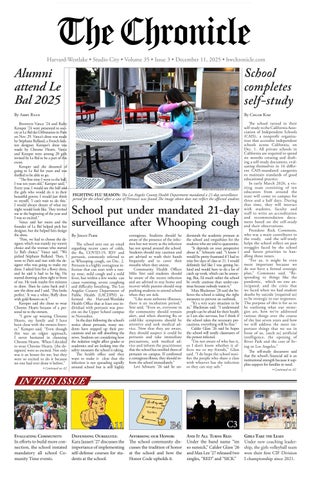
FIGHTING FLU SEASON: The Los Angeles County Health Department mandated a 21-day surveillance period for the school after a case of Pertussis was found.The image above does not relfect the affected student.
School put under mandated 21-day surveillance after Whooping cough
By Jihan Park
The school sent out an email regarding recent cases of colds, the flu, COVID-19, RSV and pertussis, commonly referred to as Whooping cough, on Dec. 2. Pertussis is a highly contagious infection that can start with a runny nose, mild cough and a mild fever, but within a few weeks can cause vomiting, severe coughing and difficulty breathing. The Los Angeles County Department of Public Health (LACDPH) informed the Harvard-Westlake Health Office that at least one individual with pertussis was present on the Upper School campus in November. In the days following the school’s notice about pertussis, many students have stepped up their precautions and are still absorbing the news. Students are considering how the isolation might affect grades or academics and are looking into the safety measures the school is taking. The health office said they want to make it clear that the infection is not spreading rapidly around school but is still highly
contagious. Students should be aware of the presence of the infection but not worry as the infection has not spread around the school. Students should stay cautious and are advised to wash their hands frequently and to cover their mouths when they sneeze. Community Health Officer Milo Sini said students should be aware of the recent infection and are advised to stay home and recover while parents should stop pushing students to attend school when they are sick. “Like most airborne illnesses, there is an incubation period,” Sini said. “Even so, everyone in the community should remain alert, and when showing flu or cold-like symptoms should be attentive and seek medical advice. Now that they are aware, they should suspect it could be pertussis and take immediate precautions, seek medical advice and inform the practitioner that the school has notified them of pertussis on campus. If confirmed a contagious illness, they should inform the school immediately.” Levi Schwartz ’26 said he un-
derstands the academic pressure at the school and empathizes for the students who are told to quarantine. “It depends on your perspective about it,” Schwartz said. “I know I would be pretty frustrated if I had to miss five days of class or 21. I would definitely feel like I was getting behind and would have to do a lot of catch up work, which can be annoying. But, I’d much rather the school be overly cautious than under-cautious because nobody wants it.” Maia Blackman ’28 said she believes the school is taking the right measures to prevent an outbreak. “It’s a very scary situation to be in,” Blackman said. “I understand people can be afraid for their health as I am also nervous, but I think if the school takes the necessary precautions, everything will be fine.” Calder Glass ’26 said he hopes the school will notify classmates of the person infected. “I’m not aware of who has it, so I don’t know whether it affects me or my friends,” Glass said. “I do hope the school notifies the people who share a class with whoever has the infection so they can stay safe.”
• Continued on A2
IN THIS ISSUE
A4
A11
B4
C3
D1
Evaluating Community: In efforts to build more connection, the school instated mandatory all school Comunity Time events.
Defending Ourselves: Kara Jazaeri ’27 discusses the importance of implementing self-defense courses for students at the school.
Affirming our Honor: The school community discusses the tradition of honor at the school and how the Honor Code upholds it.
And It All Turns Red: Under the band name “im so sunsick,” Calder Glass ’26 and Max Lee ’27 released two singles, “RED” and “SICK.”
Girls Take the Lead: Under new coaching leadership, the girls volleyball team won their first CIF Division I championship since 2021.
A2 News
Dec. 11, 2025
The Chronicle
Self-study report to be reviewed by CAIS team • Continued from A1
“HW strives to be more than a school reserved for the few in Los Angeles who can afford our tuition,” the document said. “Approximately 21% of students currently receive comprehensive financial aid, but the percentage of qualified applicants (and non-applicants) who need tuition assistance is much higher. Increasing the population of recipients to 25% would likely bring us close to meeting current demand (becoming need-blind in the near term). Pursuing this goal will require us to build our endowment with continued generosity from devoted members of the community.” Junior Prefect Jasiri Johnson ’27 said the school’s financial aid system enables students from all economic backgrounds to have the same opportunity. “The financial aid system at the school is very accessible and beneficial,” Johnson said. “As someone who is on financial aid, we are given a great opportunity to go to this school, as well as other people who are not in the tax bracket to afford to go to the school. I know a lot of my friends would not be attending the school had they not been able to get the financial aid resources.” The document said one of the school’s greatest strengths is its culture of belonging.” “In all it does, the school strives to provide every member of the community with an equal sense of belonging,” the document said. “From reimagining longstanding traditions to expanding financial aid support, HW continues to value diversity, equity and inclusion, carefully defining those terms to disconnect them from the politics of the day.” • Continued on hwchronicle.com
PRINTED WITH PERMISSION OF BRONWYN VANCE
PARIS PAIRING: Bronwyn Vance ’24 and her twin brother Slatter Vance ’24 pose together for a photo at in Paris, where Bronwyn was presented to society at Le Bal des Débutantes. She wore a gown designed by Stéphane Rolland, and her brother accompanied her as her cavalier.
Two members of the Class of 2024 make debuts at Paris Le Bal des Débutantes By Abby Ryan
Vance said she got ready with the other debutantes for press day. “We were in the Shangri-La Paris Hotel, which is right near the Eiffel Tower,” Vance said. “We had to be there by Friday because it was our press day. We just needed to get dressed and get our makeup and hair done for press and pictures. We went to a dressing room where they had robes with our names written on them. We got all of our hair and makeup done together. Then we got to get our jewelry, which was provided by the V Muse. They collect jewelry from a very long time ago, so it requires security. We had to go into the room one by one and get our jewelry put on us and they had security guards to make sure nobody's pulling an Ocean’s 11 heist.” Vance said she was most nervous about being introduced to
the other girls. night. This ball was to raise “I was a little scared to go money for charities so it’s not because I was scared to meet 19 really like coming out into sonew girls and a bunch of cava- ciety but it is giving back to a liers,” Vance said. “Honestly, all good cause as well as meeting the girls were so kind very successful girls and so amazing to who will probably be around. I’ve never be very successful in met so many princesstheir lives.” es in my life, so it was Vance said she very cool to be around chose her twin brothliteral royalty.” er Slatter Vance ’24 as Vance said she her cavalier. loved how Le Bal “For my cavalier, allowed her to exI chose my brother,” pand who she was Vance said. “I had a say friends with for a of who I wanted my good cause. L. Wood cavalier to be, but they “This was a good Bronwyn recommended I bring chance to meet Vance ’24 my brother because people and become they said it would be friends with people that you normally would not very fun if you are with somebody become friends with,” Vance that you are great friends with and said. “It’s a way for people to that you trust and love.” hold onto traditions, not in Kemper said her favorite mothe sense of girls coming out into society, but a way girls feel ment of the event was dancing special and princess-like for a with the other debutantes.
All-school winter assembly held By Emmeline Chan
The all-school assembly on Dec. 3 was planned by the Community Time Leadership Committee All community assemblies occur during Community Time on the first cycle of each month and follow the same basic structure. The assemblies start off with musical performances to spotlight different student artists and welcome the student body. The performance is followed by a short, personal story from an Upper School administrator, announcements from Student Council, an arts feature and closing remarks. The December assembly featured Julia Meyer ’27 singing and playing the guitar, Assistant Head of School for Community and Belonging Janine Jones sharing a story about her father and a performance by the Jazz Singers. Community Time Leadership Committee member Ivy Wang ’26 said planning the assemblies is a process that involves many people and a lot of effort.
“It takes a lot more effort than people see because we have to do a rehearsal from beginning to end the day before,” Wang said. “The team is doing an amazing job. Mr. Plourde is an innovative genius with so many ideas, and everyone is good at making his visions turn into a reality.” Wang said the assemblies each quarter focus on the school’s four main pillars: excellence, purpose, integrity and community. “We hope that these pillars will mesh together under the overarching theme of belonging,” Wang said. “We want to increase belonging for both students and faculty. Traditionally, the school has operated like a college where faculty only participate in teaching lessons, making it seem very isolated. Now, faculty [must] be at all the events. We also try to integrate them into student seating to increase community and connection.” Performing Arts Teacher Zanaida Robles, who led the Jazz
Singers performance during Wednesday’s assembly, said she was glad she accomplished her goal of getting the whole school engaged and entertained. “I wanted to showcase our talented Jazz Singers ensemble,” Robles said. “But mostly, I just wanted everyone in the room to try singing together. I am thrilled with how it turned out. Not only did everyone sing, but it turned out to be really fun.” Robles said she looks forward to watching other performances at future assemblies. “To me, these assemblies are less about passive performances and more about getting the community involved in doing something together,” Robles said. “I really want to see and learn from the upcoming arts features from other arts disciplines. We’re blessed with extremely talented, passionate and inspiring arts faculty. I can’t wait to learn from them during future all-school assemblies.”
• Continued on hwchronicle.com
“Dancing around and enjoying the night with my family was so special,” Kemper said. “We took so many pictures and I was so happy dancing with the girls after we did the waltz. It was the end of the night when we took off our shoes, jumped around and had the best time.” Vance said her favorite moments were those with her dad and brother. “When my brother and I walked out, we had to go between tables and just present ourselves to everybody who came to the ball,” Vance said. “When we were doing that, we were supposed to hit a pose and we did a Stanky Legg and then we did a handshake. I feel like the parents didn’t really get that, but we got it and that was all that mattered. Then I also danced with my dad. I got to Waltz with my dad, which was very special because it was just him and me on the dance floor, which was so fun.”
• Continued on hwchronicle.com
NICOLAS MONROE/CHRONICLE
SEASONAL SPOTLIGHT: Upper school students gathered for a December Assembly. In unison, the entire Upper School sang “Twelve Days of Christmas.”
Dec. 11, 2025
hwchronicle.com/news
News A3
Winter Field Day event held By Angel Song
ANGEL SONG/CHRONICLE
COOKIES AND KINDNESS: Community Council members Collin Kim ’27 (left) and Max Lee ’27 (right) converse as they prepare to bring over any students and faculty wanting to support Angel City Sports. The fundraiser was held to raise money to purchase wheelchairs for athletes.
Community Council members organize cookie sale to raise money for Angel City Sports team
By Angel Song
this fundraiser. [Community Council] and I tried our best to Community Council collab- appeal to the student body, and orated with Angel City Sports, a we were struck by surprise with nonprofit organization support- the sheer amount of enthusiasm ing disabled athletes, to host a we received in return.” Community Council memfundraiser on the Quad during lunch on Nov. 18. The profits ber Mateo Atluri ’27, who helped out at the table, from the cookie sales said the fundraiser was will be donated to Ana success because of gel City Sports to purthe thorough planning chase new wheelchairs before and noticeable for athletes. leadership presence. Community Council “We did a phenommember Collin Kim ’27 enal job,” Atluri said. said although gathering “The visuals looked students’ attention was great, the table was set challenging, he felt that L. Wood up nicely, we got the at the end of the day, Collin cookies on time and the Council was able to Kim ’27 they looked appealing. make a positive impact. “The beginning was a little Logistically speaking, it went tough in terms of drumming amazingly. On top of that, most up attention, so we really had of the Community Council to put ourselves out there us- members showed up and helped ing megaphones and all,” Kim out with the event.” Kayla Lee ’28 said she appresaid. “Still, I feel amazing that we were able to make a differ- ciated the positive energy Comence in some way by hosting munity Council brought to the
fundraiser, but wants more action in the future. “I enjoyed the fundraiser because [Community Council] was super friendly and made me feel like my contributions were actually going towards a good cause,” Lee said. “However, I did feel like [the fundraiser] could have been a bit more planned out and announced to the students in advance because I didn’t really know it was happening, but overall, it still was a good experience, and I would definitely come by again to check out the booth if something similar takes place on campus soon.” Genevieve Watson ’27 said she enjoys seeing community service opportunities like these fundraisers on campus. “Community Council has been showing up on the Quad a lot these days,” Watson said. “I appreciate how there are more opportunities for students and faculty to easily give back to
the community through these fundraisers and events. Community service is crucial to our well-being, and there is a lot for students to gain from participating in these events and being able to experience the positivity that comes with giving back.” Community Council member Michaela Press ’27 said helping out local community members is crucial to kickstarting long-term change for the betterment of society. “We can all take things for granted, so it is especially important for us to give back,” Press said. “No one person can change the world or the problems it faces, but if we all work together and contribute even a little bit, then we can accomplish fundamental change much needed in this world. [The fundraiser] was a small but still meaningful step in this long process of giving back to our immediate community in any way we can.”
Prefect Council hosted Field Day on Dec. 5. Students went to Ted Slavin Field during lunch to participate in activities including carnival games, an obstacle course and a relay race and a surfboard simulator. The winner of the relay race and their grade was able to purchase food before the other grades. This year’s food options included pizookies, pizza and tacos. Junior Prefect Charlotte Im ’27 said she hoped students would be able to de-stress by participating in Field Day and interacting with their peers. “Field Day is one of the many community building events Prefect Council plans, but I love Field Day because of the way everyone is able to root and cheer for people in their grade and spend some good time with friends on the field,” said Im. “This time in the year is just so stressful, and I’m hoping that taking the seriousness out of school for even a short period of time with relay races and food outside will help remedy this.” Kaylee Kim ’27 said she enjoyed Field Day because she could relax and enjoy the variety of activities offered. “The weeks leading up to winter break always tend to be the most stressful with a lot of homework and assessments, so it was nice to have a brief break during the school day for students to relax and recharge,” said Kim. “There were also a lot of different activities available, which made Field Day even engaging.” Community Council member Angela Ren ’26, who helped operate the surfboard simulator, said she was happy to have contributed to this fun and positive cause. “I was mostly there to help out,” Ren said. “This fundraiser was for the Jimmy Miller Memorial Foundation, which specializes in ocean therapy. I’m glad to have helped with this opportunity.”
Pie-eating contest, fundraiser hosted By Holden Kim
Community Council hosted a pie-eating competition during lunch on Dec. 1. The contest was planned to attract students to the Diddy Riese cookie sale held at a nearby table. Proceeds from the sale were used to purchase canned goods for a food drive in support of Korean American Family Services (KFAM), a downtown Los Angeles organization that provides resources and assistance to any families in need. Community Council member and host of the pie-eating competition Max Lee ’27 said the contest was inspired by a similar event which was hosted the previous year and his wish to turn it into a tradition. “I saw a pie-eating competition last year, and it felt like something that could become a Harvard-Westlake tradition,” Lee said. “The unseriousness of it all and the silliness really brightens the mood and makes people come together. That’s
how we foster community – making sure that people have something to bond over.” The competitors representing each grade were Callum MacLachlan ’26, Asher Butan ’27 and Ben Arinsburg ’28. Once the contest began, all three students instantly grabbed their pies and began to eat as fast as they could while classmates cheered them on. As the timer counted down, the contest became a two-horse race between MacLachlan and Butan. MacLachlan’s plan was to divide his pie into quarters and eat each slice one at a time. In contrast to MacLachlan’s strategy, Butan said his plan was to finish the pie filling using a spoon, saving the crust for last. “To prepare for the competition, I brought a spoon from outside,” Butan said. “My plan was to eat all the filling and then go for the crust afterwards. It was a hard challenge, but I was happy with my strategy. Everyone got a nice laugh out of it.” When the contest ended, Lee
made the announcement that MacLachlan had consumed the most pie and declared him the winner of this competition. MacLauchlan said the contest offered a joyful distraction from academic stress. “The pie-eating competition was a fun day on the Quad where you got to see me and two fellow students minorly embarrass ourselves,” MacLauchlan said. “This boosts the spirits of everyone who watches and was moment to forget about classes and just see pure food intake fury in action.” Arinsburg said the competition provided him and other students with a lighthearted and unifying moment in an otherwise stressful period of the school year. “The pie-eating competition gave the community and me something to look forward to and allowed me to take my mind off the stressfulness of school,” Arinsburg said. “The competition was a community-bonding moment where students could cheer and laugh together.”
HOLDEN KIM/CHRONICLE
PIE FOR PUBLICITY: Callum MacLachlan ’26 participates in the pieeating contest hosted to attract students to a Community Council fundraiser.
Discussing Community Time A4 News
Dec. 11, 2025
The Chronicle
Students and faculty on campus discuss the school’s new community time initiatives, focusing on their intent, execution and impact.
NIC MONROE/CHRONICLE
By Kara Jazaeri
ing as planned. “I was part of the group that Starting this year, the school was coming up with what an ashas implemented community time sembly for Community Time events during the Day 5 morning would look like,” Limerick said. activity block. The newly devel- “As a visual arts teacher, I wanted oped Community Time Commit- to make sure there was an arts featee is a group of students and facul- ture each month because I knew that it would be a great way to ty formed to craft the events. Dean of Student Life Jordan bring in different artistic mediums Church said the meetings were in student voices into our commufounded in hopes of fostering nity. I also wanted to make sure that SLIDE was featured.” more unity. Evan Kim ’27 said while she “We gather not simply to hold events, but to strengthen the enjoys the built-in opportunity to bonds that make our communi- connect with classmates, she does ty vibrant and resilient,” Church feel the events can add stress during busy times of year. said. “We believe that “The events are fun shared experiences forge and they bring the bonds, regardless of the community together,” content of the events. Kim said. “I love beWhen students, faculty ing able to see all my and staff come together, friends and spend time we create shared expewith them or other riences that build trust, people I don’t get to foster belonging and resee often. They bring mind us that education L. Wood everyone together, but extends far beyond the Jordan Church they do take up a lot of classroom walls.” free time. Personally, I Fiona Tseng ’28 said she appreciates the thought put like the events and it’s nice to have time to not think about testing, into the events. “I like the new events, par- work and other things, but there ticularly the sound bath and are times where the community therapy dogs,” Tseng said. time events are right before a test That was a great way to not or on a really busy day where I only bond with others, but also could use the free time.” Upper School Dean Sarah Millto collectively calm down from er said community time is importall the stressors around us. ” Student Leaders for Inclusion ant to create connections beyond Diversity and Equity (SLIDE) surface-level interactions. “Your sense of the people leader and Community Time around you and how you treat Committee member Reb Limeryour peers is stronger in a place ick said, so far, the events are go- where no one is unknown or
anonymous to you,” Miller said. “Maybe it feels forced to students, but when you’re not forced to have time with your entire community all the time, people can kind of be faceless or nameless.” Community Council member Hudson Lake ’26 said a main goal of the events is to create a more supportive school environment. “The primary purpose of the community time events is to strengthen the school community,” Lake said. “Part of that entails putting on events such as the past week’s community time when we [were packing food for the homeless]. We hope events like that build empathy. Typically, organizing the events consists of working with Mr. Church, Wormholdt, and other administrators to bring in organizations and sort of logistics.” Physics teacher Yanni Vourgourakis said the student body’s reaction is encouraging. “The assemblies have worked surprisingly well,” Vourgourakis said. “I’m a little surprised by how much buy in there has been. Specifically the singing was very good and people enjoyed it.” Lulu Aridi ’27 said while she admires the idea of the events, sometimes the execution is not ideal. “I support the idea of building a stronger community within the school and raising school spirit, and
NIC MONROE/CHRONICLE
NIC MONROE/CHRONICLE
while some events are really fun, for the community events would oftentimes it feels like we’re playing be to give students free time to ingames or watching videos when teract.” Daneshrad said. “Usually lots of us are worried about home- kids are on the quad talking, interwork and other things we could acting and playing games.” be doing with the free time,” Aridi Community Time commitsaid. tee leader Ivy Head of UpWang ’26 said per School Beth the events speak Your sense of the to the commitSlattery said the people around you tee’s larger and events have been and how you treat your more long term successful so far. peers is stronger when goal of fostering “Community no one is unknown or more belonging. time has taken anonymous to you.” lots of iterations “I see how and no one has community times been in charge of — Upper School Dean are going so far it until this year,” being very Sarah Miller and Slattery said. “We effective for the now have a comyears to come mittee that is planning the events once people get used to it,” Wang and I’ve been so happy with the said. “The school, historically, has way that it has gone. I do think been a place where students focus even if people grumble about it on individual paths which are fuit’s good to be together. It certain- eled by competition and isolation, ly feels like they [the events] build but I see community time rewritmore community than historically ing that. There is a bigger picture all-school speakers have done.” we are trying to achieve and I wish Evan Daneshrad ’27 said the for those with pessimism and negbest way to foster connection is to ativity to do their best to approach allow students to do so themselves. all of these new school events with “A better use of the time used an open mind.”
“
THE CHRONICLE POLL
Dec. 11, 2025
hwchronicle.com/news
News A5
Clubs hold canned food drive By Kara Jazaeri
ABBY RYAN/CHRONICLE
THANKSGIVING SPIRIT: Elise Kennedy ’27, Jasiri Johnson ’27 and Kyle Henderson ’27 enjoy the BLACC Thanksgiving potluck in the student lounge. Parents of African-American Harvard-Westlake Students (PAAHWS) brought traditional Thanksgiving dishes for everyone to eat and share.
Black Leadership and Awareness Culture Club has potluck in student lounge to celebrate Thanksgiving By Abby Ryan The Black Leadership and Awareness Culture Club (BLACC) and the Parents of African-American Harvard-Westlake Students (PAAHWS) hosted a Thanksgiving potluck in Chalmers on Nov. 19. PAAHWS Leader Roxann Mosley (Harper ’31 and Chloe ’28) said parents brought Thanksgiving dishes and helped arrange the event. “The BLACC leaders and advisors asked PAAHWS to host the potluck,” Mosley said. “Parents were asked to contribute by signing up to bring one of the many traditional Thanksgiving dishes, including turkey, macaroni and cheese, sweet potatoes and much more.” Co-Leader of BLACC Morgan McGinnis ’27 said she was
proud of how many people tures, it is meaningful to have showed up and loved the food. a meal together. Many students “This event had an excellent have said they look forward turnout and brought the com- to it. Anything we can do to munity together nicely,” Mc- help cultivate community, not Ginnis said. “My favorite mo- only for BLACC students but ment from the for all students, event was sitmakes us happy. ting with all my It’s so wonderful We look forward friends and hav- to spend some of the to continuing this ing great food.” special tradition.” Mosley said school day surrounded Kyle Hendershe enjoyed how by amazing people and son ’27 said he this event pro- eating good food.” appreciated hangmoted a great ing out with his sense of commu—Elise Kennedy ’27 friends during the nity and plans potluck event. for this event to “My favorite become a tradition. moment of the event was defi“What I like most about nitely spending time with [my] helping BLACC with this event friends, Jasiri and Elise,” Henis that it brings the students, derson said. “I love connecting faculty and staff together to with my people.” share a beautiful meal,” MosMosley said she thinks the ley said. “Within many cul- event was successful because of
“
how many people attended. “We are so proud to see the excitement of all the students when they show up for the event,” Mosley said. “We know it’s a success when students come back for seconds or when word spreads across campus.” Elise Kennedy ’27 said she is excited to continue attending this event and is thankful that BLACC helped put it together. “It is so wonderful to be able to spend some of the school day surrounded by amazing people and eating good food,” Kennedy said. “BLACC always does a wonderful job putting this event together and I am always amazed and grateful that it is organized so well. I am glad I went to it this year, and I am already looking forward to attending the Thanksgiving potluck next year.”
To kick off community service week, Community Council, the Student Mental Health Association and Joy Market club collaborated for a canned goods drive on Dec. 1. Student Mental Health Association member Alli Firtel ’27 said that the drive supported multiple organizations. “The canned food drive was organized in collaboration with the Harvard Westlake Student Mental Health Association, Joy Market and Community Council,” Firtel said. “This was an event to both raise awareness and support for the homeless in L.A., especially around Thanksgiving, when it is important to be grateful for what we have and give back to others in need.” Joy Market leader Max Lee ’27 said that Joy Market is collaborating with an outside organization to make use of the donated canned goods. “Joy Market will be taking the cans and bringing them to an organization that could benefit from them,” Lee said. “We’re partnering with an organization in K-Town called Korean American Family Services (KFAM) and what they do is provide foster family services and adoption care. We are distributing the cans to this service, and then KFAM is giving them out to foster families and other families partnered through their system. ” Reagan Shibuya said that although the drive initially was scheduled for earlier, ultimately this delay benefited those organizing the event. “The can drive was interesting because it was cancelled after it was originally scheduled to be able to donate the food in time for Thanksgiving,” Shibuya said. “Overall it ended up working out because now there’s more time for us to collect cans, but there was definitely some difficulty.” • Continued on hwchronicle.com
Students join Friends of the Los Angeles River to help preserve Sepulveda Basin By Lauren Kvamme Student volunteers gathered to participate in Habitat Restoration Day, a monthly environmental community service event hosted by Friends of the LA River (FoLAR), on Nov. 22. The event was held at the Sepulveda Basin Wildlife Reserve in partnership with the California Native Plant Society and the San Fernando Valley Audubon Society. The reserve is a 225-acre protected habitat in San Fernando Valley that serves as one of Los Angeles’ critical ecological zones, according to FoLAR. By clearing invasive mustard, volunteers helped the basin protect hundreds of native plants and wildlife species and maintain essential ecosystems in Los Angeles. Ernie Cardenas, a member of the Los Angeles Board of Public works, said the basin plays a key role in the region’s water system.
“The Tillman sanitation location handles sewage from the San Fernando Valley,” Cardenas said. “Pure Water Los Angeles is going to clean that water and put it back into the aquifer system so that we have more water to drink.” FoLAR Director of Communication Ben Orbison said the organization aims to help locals build a stronger connection with nature by engaging in hands-on restoration work. “One of our main goals of the Habitat Restoration Day is to get folks to come out, get their hands dirty and really connect with nature in Los Angeles,” Orbison said. “A lot of that looks like pulling invasive species out of the ground and making room for native species to thrive.” FoLAR CEO Candice Dickens-Russell said native plants are essential to the health of the Los Angeles Rivery ecosystem. “Native plants are specially
designed,” Dickens-Russell said. “They have evolved to attract and feed native bees, insects and other pollinators. Every bit of space you create for native species makes a big difference. We are working to restore this area to what it was and what it will be again.” Orbison said the overgrown mustard plants in the reserve pose a significant fire hazard. “All that brown on the hill is dried mustard,” Orbison said. “If you have a cigarette butt, the whole thing can go up, whereas native areas are more resilient.” FoLAR member Elise Schmidt said that removing the mustard plant directly supports regrowth and fire prevention. “The native plants don’t burn, but the mustard dries out in the summer and burns like crazy,” Schmidt said. “We can take the weeds out and put the native seeds back in.” • Continued on hwchronicle.com
LAUREN KVAMME/CHRONICLE
SERVICE RESTORATION: Students help improve Sepulveda Basin by removing invasive mustard that endangers wildlife and fuels wildfires.
News A6
hwchronicle.com/news
Dec. 11, 2025
SLAC hosts the first movie night of the year in Mudd Library By Maddy Wynholds
The Student Library Advisory Committee (SLAC) hosted their fifth annual student movie night in Mudd Library Room 100, showing The Night Before Christmas on Dec. 5. Upper School librarian Jessica Wahl said she hoped the movie night would be an entertaining space rather than a strict one. “[At movie nights] I’m not going to be like, ‘Do you want to read? Yeah. I need you to read a book,’” Wahl said. “No, just come in, watch a movie and have fun. There’s popcorn, there’s candy and it’s all free.” Wahl said she wanted this event and others to make the library a reprieve from any stress that students are experiencing at and outside of the school. “I’m trying to introduce people to the library as this third space,” Wahl said. “We’re not the classroom, and we’re not the house. We’re just another space where students come and hopefully feel comfortable.” Sophia Wong ’27, a student who attended the movie night, said she thinks these types of events are important and effective for relieving students of some of their stress. “It’s so important that we have these because if we don’t have these events, the school is still going to continue to be a really stressful place,” Wong said. “It’s important to have intentional events and activities that de-stress the student population.” Barron Linnekens ’26, a leader of SLAC and chief student organizer of the movie night, said this time of year can be tumultuous for students, but the event worked to focus on relaxation and community time.
“The holidays usually are a time when you come together in your community,” Linnekens said. “But I think that, at this school, we do a bad job of that; we don’t focus on bringing the community together. When it’s college [application] time, it can get competitive for seniors, the juniors are in their tough stretch and the sophomores are getting over the transition. December is a really tough time, so giving people opportunities to relax and enjoy other people is really important to everyone.” Linnekens said the best way for students and adults alike to relax is to tap into their inner child, and a movie night can help prompt those childhood feelings. “When it’s adults, you want to make them act like sixteen-yearolds,” Linnekens said. “When it’s high schoolers, you want to make them act like fifth graders because when they’re doing that, nobody has negative experiences. Everyone has memories of going to movies when they were little, and I think if you can tap back into those, it creates a much better community. Take time to be a kid again.” Riley Romans ’27 said she enjoyed the movie night and loved the care-free vibe that came with it, as well as hanging out with all her friends. “SLAC movie night was actually really fun,” Romans said. “Watching The Nightmare Before Christmas with everyone made the room feel chill and kind of festive. It wasn’t a big or fancy event, but it still felt special in a simple way. Nights like that just remind me how nice it is to hang out and relax with friends. Especially after a long week, being able to relax in the library was just what I needed.”
MADISON SHEN/CHRONICLE
TAKING THE INITIATIVE: The HW Parents Blood Drive Committee Chairs organized and managed the sign-up for a blood drive, which is hosted by the UCLA Blood & Platelet Center on Dec. 8.
UCLA runs biannual blood drive By Madison Shen
The school partnered with the University of California, Los Angeles (UCLA) Blood & Platelet Center to host its biannual blood drive at the upper school campus on Dec. 8. All students who are of age 16 or older were eligible to participate in the event, with the exception that all 16-year-olds must fill out a form with parental permission to bring to the event. The blood drive is run and organized by the UCLA Blood & Platelet Center, the American Red Cross Club and the HW Parents Blood Drive Committee Chairs, Savannah Eden Baril (Jackson ’28) and Sarmela Sunder (Sahana ’29). President of the American Red Cross Club Arman Tabesh ’26 said the club is helping promote the event to the entire school. “Our goal with the American Red Cross club is to get as many
sign-ups as we can and outreach [the event] to faculty and staff,” Tabesh said. “UCLA takes care of the blood and will put it to good use.” Since the Harvard-Westlake Parents Association has sent out a school-wide email on Dec. 1, the American Red Cross club leadership team has received a great response to the drive, with ample sign-ups. Outreach Officer of the American Red Cross Club, Evan Kim ’27 said the club wants to continue advertising the drive to optimize the amount of sign-ups for the event. “It’s great for whoever can come,” Kim said. “There’s such a shortage of blood supply in the United States, and anyone who decides to help even the slightest bit is making a big difference, whether they help one person or many.” In addition to planning the event, Kim said she is planning on donating blood to help out. Kim said she is a first-time blood donor, and didn’t
hesitate to sign up, knowing that it would benefit others. “I’ve been really active in the Red Cross community lately, especially setting everything up and being a big part of the communication between the parents association and the Red Cross club,” Kim said. “I thought it was vital for me to participate in [the blood drive]. Whatever fear I have, the amount of people that I could potentially be helping, even if it’s a small contribution to something, outweighs anything else.” Jackson Baril ’28 said students who are hesitating to sign up should not feel nervous about donating their blood, because it is not scary. “Once you finish your blood donation, there are snacks and drinks for you to have, and it’s not that painful, so you shouldn’t be too scared,” Baril said. “Your blood comes back, and it’s a great way to give to your community and know you’re actually making an impact.”
Student Council hosts puppies on the Quad
By Alexander Ahn
ALEXANDER AHN/CHRONICLE
PLAYTIME WITH PUPS : Community Council partnered with the California Doodle Rescue Foundation to bring puppies to the Quad, offering students the chance to make dog toys for rescued dogs on Dec. 4.
Community Council hosted Dogs Out Day, partnering with the California Doodle Rescue Foundation to bring puppies to the Quad and give students the opportunity to make dog toys for rescued dogs on Dec. 4. Students were able to rotate between petting stations, where volunteers from the rescue organization supervised the dogs, and the toy-making table, where Community Council members helped students create toys. Community Council member Collin Kim ’27 said the event was designed to reduce stress while also supporting an animal-welfare cause. “It was awesome seeing an actual [weiner] dog in person, and it made the whole event feel even more fun,” Kim said. “It was also a great way to make toys and support the rescue at the same time.” Simren Bindra ’27 said the puppies lifted her mood during a busy week. “The puppies honestly made my whole day.” Bindra said. “It felt good knowing we were helping rescued dogs while also having fun together.” The event also created a space for bonding with the school com-
munity by bringing students together in a relaxed atmosphere. CJ Jia ’28 said she found that the puppies alleviate stress from school, giving her a much-needed break during a busy week. “Events like this make school feel more fun and less stressful,” Jia said. “Hanging out with dogs helps everyone relax, and making toys shows us how small things can still help animals in shelters. It also gives students a chance to work together and feel more connected to the entirety of the school community.” Zamina Shah ’28 said she appreciated how the activity connected the school community to a meaningful cause. “I loved how the event brought people together,” Shah said. “Making the dog toys felt meaningful because we knew they would go straight to dogs who actually need them.” Lina Wu ’28 said she loved how the event has been a fun way of engaging in her community service journey. “I love how [Community Council] helped bring the community together by introducing activities that everyone can enjoy,” Wu said. “These events give students a chance to connect in a fun and meaningful way.”
Dec. 11, 2025
hwchronicle.com/news
News A7
Winter book drive hosted by SLAC By Maddy Wynholds
ANGEL SONG/CHRONICLE
MINDFUL MATCHA: MEDLIFE leaders Lina Wu ’28 (left) and Charlotte Conrad ’28 (right) prepare an oat milk matcha latte to sell in their fundraiser happening on the Quad during lunch. All profits from the matcha latte sales are to be donated to the Children’s Hospital of Los Angeles.
MEDLIFE works with Children’s Hospital of Los Angeles to organize fundraiser for patients By Riya Iyer
MEDLIFE hosted a fundraiser in support of patients at the Children’s Hospital Los Angeles (CHLA) on Dec. 3. The event featured matchas for purchase and the opportunity to write to patients. MEDLIFE is a nonprofit that partners with underserved communities in Africa and Latin America to improve access to opportunities and basic necessities. MEDLIFE hosted a summer trip to Peru and has over 300 chapters across American high schools. MEDLIFE Chapter Leader Lina Wu ’28 said the collaboration with CHLA stemmed from a desire to get students directly involved in the local community. “At the school, we mostly raise awareness and funds through events, and try to get students in-
volved in hands-on service,” Wu “Something simple like buying said. “We wanted to collaborate a drink can contribute to a bigwith CHLA beger cause, and cause they do a we want people lot of work for to feel that conI decided to many kids in LA, nection. We are purchase a matcha no matter what planning more their financial fundraisers and from the MEDLIFE situation is like. opportunities in fundraiser because I Since they are the near future was wearing a quarter that can highlight local, it’s meaningful to support zip to get the discount.” global and local a place that imhealth issues. We — Hansen Liao ’27 have a service trip pacts families in our community.” opportunity this Wu said small July, where we acts of service can have a broad- are able to go to Lima, Peru, with er impact on communities, and dozens of other chapters and expeMEDLIFE is planning similar rience hands-on learning.” events in the future. Hansen Liao ’27, who pur“We’re hoping the matcha chased a matcha from the fundfundraiser brings in money for raiser, said he enjoyed supportCHLA but and gets more people ing a good cause while being excited about helping,” Wu said. able to get a discount.
“
“I decided to purchase a matcha from the MEDLIFE fundraiser because I was wearing a quarter zip to get the discount,” Liao said. “Also, I liked how I could support a cause while getting something I enjoy. While I don’t know a lot about MEDLIFE, I know they stand for a worthwhile cause.” MEDLIFE Chapter Leader Charlotte Conrad ’28 said that the collaboration with CHLA closely aligned with MEDLIFE’s missionof helping others. “Throughout history, CHLA has aligned with MEDLIFE’s goal of providing healthcare to anyone who needs it, regardless of socioeconomic status, race, religion or background,” Conrad said. “Overall, the missions of CHLA and MEDLIFE are similar, so it felt like a great place to focus on.”
The Student Library Advisory Committee (SLAC) announced the beginning of their two-month long book drive in collaboration with The Book Truck on Nov. 21. The Book Truck is a nonprofit organization that donates books to low-income and underserved communities in Los Angeles. Sophia Wong ’27, a member of SLAC and a co-organizer of the book drive, said the drive is a meaningful way for students to contribute to their greater community and gives them the opportunity to recycle their older books. “The book drive is a really good way for Harvard-Westlake students to give back to the community,” Wong said. “You can bring in the books that you have sitting at home, dusty on your shelves, and give them a new life.” Falyn Cox ’28 said she plans on donating her spare books to the drive so that they can be put to better use. “I have a few spare books that I haven’t read in a while, and they just sit on my shelving unit, unused,” Cox said. “Someone else can make a lot more use of them than I can, and it’s a lot better than them just sitting there.” Wong said the book drive will raise awareness about the differences in opportunities between various schools and encourage students to work towards closing the gap. “At HW we have a lot of privileges,” Wong said. “We have a really amazing library, we have amazing teachers and we have an entire support system. But this is not the case for the majority of students in Los Angeles. To bridge the disparity, we should try to engage in more community service efforts and try to change the culture around giving back.”
• Continued on hwchronicle.com
Winter-Gram writing event held By Emmeline Chan
Community Council hosted a Winter-Gram station during lunch on the Quad where students wrote and read aloud notes for people they are thankful for on Dec. 2. The event originally started as turkey grams for Thanksgiving, but the rain forced Community Council to postpone it and make it holiday-themed instead. Community Council member William Lin ’26 said the event underwent several revisions prior to taking place, but he was pleasantly surprised by the turnout. “Our original plan was for [Rael Kreiz ’26] to pick a few letters at random and read them so we could film the reactions and post them on the Community Council Instagram,” Lin said. “What we did not expect was how many students would actually participate, especially since the Quad hasn’t had much foot traffic lately. However, thanks to a genius idea from [Angela Ren ’26], we
grabbed a mic and speaker and turned the whole thing into an open reading session.” Lin said every single letter was read aloud, creating a welcoming energy on the Quad. “The energy completely shifted, and everyone around us seemed to be having a genuinely good time,” Lin said. “The random readings ended up being the perfect way to lift people’s spirits, especially since some of the Grams were genuinely hilarious. I am a senior, so I will not be around to see it continue, but I really hope next year’s Community Council members will bring this tradition back.” Kreiz said he enjoyed dressing up as Santa and felt good getting lots of students to participate in the event. “It felt lighthearted, and people seemed to enjoy hearing me read the cards,” Kreiz said. “I was getting lots of requests to read specific ones and seeing people react made me feel like the event was accomplishing exactly what it was meant
to do. I think what made it so successful was that it was a silly event that encouraged kindness. Also, it had a good balance of being something people can enjoy without going too far out of their way.” Haley Romano ’27 said she wrote a note to her friend, Joanna Xia ’27, telling her that she appreciates her and is glad that Xia is in her life. “I feel like I really connected with [Xia] because usually you don’t go up to your friend and tell them you love or are grateful for them,” Romano said.“Writing this letter gave me a reason and opportunity to tell her that, and made me recognize that we should appreciate our friends more.” Nicholas Sue ’27 also wrote a letter of appreciation to his friend and said he enjoyed the event . “I really liked writing a WinterGram,” Sue said. “It was very fun and a good way to express my gratitude. I would do it again next year because I would like to shout out other people too.”
NIC MONROE/CHRONICLE
HEARTWARMING NOTES: A Community Council member hands a completed Winter-Gram to Rael Kreiz ’26 dressed up as Santa Claus.
A8 News
Dec. 11, 2025
The Chronicle
W inter Wonder land
Jessica Ferrie ’26 crafted up The Chronicle’s crossword puzzle for this issue. Use the clues to solve this holiday-themed puzzle. Have fun! DOWN:
1. Indian native bean 2. Dark purple superfruit 3. Who might all gather for the holidays, slangily 4. Airplane shelter 5. Bees store no sugar? 6. From the U.S. 7. Vector space algebra 8. “Green light” 9. Vehicle efficiency measure 10. Celestial hunter with a belt 11. Nasal passage 12. Korean supermarket chain 17. David of the Red Sox 20. Jazz legend Fitzgerald 21. Daybreak 25. “What’s ___ for me?” 26. Relinquish, as territory 27. Next in line 28. Ripening agent 29. France’s currency (abbr.) 30. “__, sweat, and tears” 34. Ukraine’s capital 35. Eye opener? 36. Quick message 38. Qatar’s capital 40. Bikini top 43. Campus military org. 45. Monday of good deals
ACROSS:
22. Possessive “we”
44. Black and white whale
65. Part of a spiral flight
1. Speed of sound
23. Backup, for short
47. Addams family cousin
66. Sandwich cookie
24. Opposed to
48. Wholesome winter
67. Belonging to us
26. “Peanuts” protagonist
film
68. __ Kleine Nacht-
31. Brain scan, for short
52. Pre-French Revolution
musik: Famous Mozart
32. Color del mar
societal divisions
quartet
53. Korea’s capital
33. Canon competitor
55. Outlaw
69. Fiery Roman emperor
54. Earth prefix
16. Indian flatbread
37. Stopped running, as a
56. Casual shirt
70. Cabbage salad
58. Comedian Carvey
17. Ominous signs
battery
57. What a Menorah or
59. Property claim
18. Actress Gershon
39. Steal from
Kinara produces
71. Blue beanie wearer in
19. Hansel and Gretel
41. Editor’s catch
63. Antler’s permanent
house material
42. 404
counterpart
5. The Golden State, slangily 9. Rock concert pit 13. Bruins sch. 14. Leave out 15. Stiffly formal
Chron-nections
46. Human rights lawyer Clooney 49. Rents 50. “Don’t you agree?” 51. Caramelized burger component 52. Guiding beliefs
60. Got bigger
South Park 72. FBI reinforcement team • Answers on C4
61. Juno’s Greek counterpart 62. Palindromic beep
Colin Ho ’26 designed this issue’s Chron-nections. Find four groups of four words that share a common category. Each word belongs to only one category. Good luck, have fun and puzzle away!
America
Shell
Ball
Globe
White
Face
Rocking
Nog
Plant
Man
All
Star
Silent
Santa
Pole
Angel • Answers on C4
Opinion The Chronicle • Dec. 11, 2025
Studio City • Vol. 35 • Issue 3 • Dec. 11, 2025 • hwchronicle.com
Editors-in-Chief: Sienna Dall’Olmo, Kayla Graff Print Managing Editors: Colin Ho, Lyla Kavanagh, Erin Ryu, Eila Shokravi
editorial
Presentation Managing Editors: Luca Gonzalez, Lydia Gugsa, Alex Reisner, David Rothbart, Celine Wang Executive Editors: Ella Jeon, Ellika LeSage, Andrea Ricabal Digital Managing Editors: Colin Ho, Eila Shokravi News Editor: Luca Gonzalez News Reporters: Emmeline Chan, Kara Jazaeri, Holden Kim, Abby Ryan, Angel Song Opinion Editor: Audrey Kim Opinion Reporters: James Corman, Jack Fener, Charlotte Fowkes, Hailey Kramar Features Editor: Lydia Gugsa Features Reporters: Mila Detmer, Donna Enayati, Tali Gurule, Hannah Hendifar, Riya Iyer, Rebecca Vitti A&E Editor: Annabelle Cheung A&E Reporters: Audrey Herrera, Sophie Lee, Nicole Um Sports Editors: Max Nam, David Rothbart Sports Reporters: Chloe Kim, Jean Park, Jacob Yoon, Jack Turetzky, Jackson Hubbard Satire Editor: Lyla Kavanagh Satire Reporter: Jack Fener Business Manager: Yuna Jeon Art Director: Annabelle Cheung Photography Director: Nicolas Monroe Directors of DEI: Andrea Ricabal, Eila Shokravi Senior Reporters: Wynne Davis, Analeigh Nava, Connor Merrihew, Max Nam Illustrators: Annabelle Cheung, Audrey Herrera, Abby Juarez, Emma Lutsky, Anika Norton, Eila Shokravi, Sabrina Simek, Nicole Um, Tehmina Malholtra, CJ Phelan Layout Assistants and Staff Writers: Leica Achacha, Alexander Ahn, Kiran Amin, Ila Bakaya, Hannah Bayat, Emma Bing, Isabella Chiang, Grace Choen, Rowan Green, Philo Hornby-Simmons, Sophia Jeon, Leela Kandavel, Halyn Kim, Katelyn Kim, Lauren Kvamme, Claire Lee, Lucas Lee, Radha Malhotra, Freddie Mandel, Violet Martin, Brendan Park, Jihan Park, Matteo Rabizadeh, Ollie Rauch, Avery Resnikoff, Birdie Reynolds, Sage Seltzer, Madison Shen, Sally Straus, Phoebe Sun, Avery Thompson, Nick Waller, Maddy Wynholds, Andrea Yu, Vicky Yu, Gyan Zinn Director of HW Media: Jen Bladen Chronicle Adviser: Billy Montgomery Publication Information: Founded in 1990, The Chronicle is the Harvard-Westlake Upper School’s student-led newspaper. Now in its 34th year, The Chronicle strives to report stories accurately and to uphold its legacy of journalistic integrity. The newspaper is published eight times per year and distributed to students, parents, faculty and staff. We are members of the California Newspaper Publishers Association and the Private School Journalism Association. Be sure to check out the HWMedia+ app for more content from our publications.
ILLUSTRATION BY EILA SHOKRAVI
Stay Connected to Human Touch
As the year continues and our calendars fill with meetings rather than plans with friends, many fall into a rhythm guided by screens rather than the people standing right beside them. We trade long conversations for quick texts, shared experiences for convenience and community for efficiency. Somewhere between the rise of self-checkout kiosks, delivery robots humming down sidewalks and Artificial Intelligence (AI) generated everything, we’ve begun to let technology speak louder than our own voices. While innovation can certainly make life easier, it shouldn’t erase the joy and humanity that come from interacting with one another face-to-face. Human connection isn’t a relic of the past but a necessity of the present, especially in a day and age driven by technology, with AI replacing therapists and human-made art. Genuine face-to-face interactions offer us something technology never truly can: empathy. There's something special in the warmth in a cashier’s “How’s your day been?” or the shared laugh with a barista who remembers your daily order. These moments may feel small, but they remind us why we live and thrive in communities, not just networks. Today, convenience often disguises itself as progress. Why talk to a store employee when a machine scans your groceries? Why chat with a neighbor when texting feels easier? But just because technology can do something doesn’t mean it should. Choosing the cashier line at the grocery store shows intention outside of efficiency. Opting to pick up your takeout rather than relying on a delivery robot is about noticing your surroundings, supporting workers and sparking connection in everyday life.
There is a growing temptation to let technology complete simple thinking for us. Writing without AI is an act of creative agency. Being able to place thoughts on a page, even if they’re messy and unfiltered, is part of a longer, special process. This grounding is also lost when hours are lost to doomscrolling, leaving us feeling more disconnected than relaxed. Communities do not exist within smartphones; they exist in classrooms, cafes, libraries and parks. Embracing human connection in a technology-driven world doesn’t require grand gestures. The shift back to community happens in small, intentional ways, whether that be casual conversation with your teachers or pausing music to greet your neighbor on your morning walk. Connection is looking up from your phone to join a conversation because it sparks joy, not because it’s tied to productivity or convenience. Communities thrive when people truly participate in them. Schools, workplaces and neighborhoods flourish when we slow down enough to acknowledge one another’s presence. Ultimately, technology can neither replace nor replicate the feeling of being seen, heard or valued. Technology will only continue to develop, but with this year, and every year that follows, efficiency shouldn’t overshadow humanity. We should choose connection, conversation and community, even if it asks a little more of us. Take the time to talk to strangers, form your own thoughts and work, look people in the eye and laugh at their jokes. Technology is something to enhance our lives, not a replacement for the parts that make us human.
About Us
LETTERS TO THE EDITOR:
DIVERSITY, EQUITY AND INCLUSION:
The Chronicle strives to be a diverse and inclusive community that welcomes all who wish to contribute. Our Diversity, Equity and Inclusion committewwe works to ensure that every member of the Harvard-Westlake community is recognized, included and given a voice. The Chronicle's publications will aim to represent this diverse community and provide a variety of perspectives on the topics that they cover.
EDITORIALS:
Unsigned editorials represent the majority opinion of staffers and are written by the Editorial Board, which is composed of the Editors-in-Chief, Managing Editors and Section Editors.
ADVERTISING:
Looking to place an advertisement in our paper? Questions pertaining to advertisements may be directed to The Chronicle's Business Manager Yuna Jeon at yjeon1@hwemail.com. Publication of an advertisement does not imply endorsement of the product or service by the newspaper or school.
Letters may be submitted to chronicle@ hw.com or mailed to 3700 Coldwater Canyon Ave., Studio City, CA 91604. Letters must be signed and may be edited to conform to Chronicle style, space and format. We are committed to uplifting the voices of marginalized or underrepresented individuals and groups in accordance with our efforts to promote diversity, equity and inclusion.
PUBLICATION AWARDS:
- NSPA Pacemaker Winner - CSPA Gold Crown Winner
UPDATES AND CORRECTIONS:
Though we always strive to be as accurate as possible, staff members identify inaccuracies and receive feedback from readers. The Chronicle publishes corrections when we discover a factual error within a piece. We will continue to uphold transparency even in the face of mistakes following the publication of each issue.
MEMBERSHIPS:
- Columbia Scholastic Press Association - National Scholastic Press Association - Quill and Scroll Honor Society
A10 Opinion
The Chronicle
Dec. 11, 2025
Stop letting AI dictate your writing style By Hailey Kramar
W
ILLUSTRATION BY AUDREY HERRERA
hile riding shotgun with my dad, we belt “Who gives a f*** about an oxford comma?" I begin to hum to the all-familiar song that always makes me laugh, Oxford Comma by Vampire Weekend. The singer satirizes the classist practice of using grammar to make snap judgments about someone’s value, shedding humorous light on the topic. With the rise of Generative Artificial Intelligence (GenAI) such as ChatGPT, embracing literary authenticity and fighting for individuality has never been more relevant. As a society, we are practicing just as the song preaches: judging people who use certain punctuation as evidence of writing lacking humanity. ChatGPT’s excessive use of the em dash led to it becoming the subject of controversy – a strange fate for a piece of punctuation. Ironically, the em dash brings a human voice – and sometimes even visual elegance – to writing. Despite this, writers are developing a growing fear of the em dash as they act as a sign of AI usage. So, writers often find ways around the punctuation – and, in doing so, forfeit their personal writing voice
to ChatGPT. Em dashes previously indicated sophisticated writing and a clever use of punctuation. They add emphasis, clarification or function as an interruption – more flexible than any other punctuation – and are perfect when a thought branches into a sub-thought. When em dashes are used in poetry, they convey a physical distance or a pause that no other punctuation can accomplish visually. While small on the page, em dashes are dramatic and depict thoughts and desires that are distinctly human. ChatGPT excessively utilizes em dashes, making them a red flag for AI usage. However, because ChatGPT has access to vast resources on the internet, it can analyze historical patterns from classic literature with em dashes, according to OpenAI. Classical literature uses em dashes to great effect – like Emily Dickinson creating witty, complex breaks or Toni Morrison conjuring up a devastating pause – such that centuries of great writers have put their stamp on this special punctuation. The AI model understands the power and punch the punctuation holds, and
how the simple symbol can transform writing into a work of art. With AI chatbots advancing, over 80% of Americans are reported to use four or more AI tools weekly, according to GPT Zero. The task of decoding AI versus authentic human writing is escalating in difficulty. Because there are few ways to catch a writer using AI, teachers are forced to employ simple tricks to catch the cheater in the act like using AI checkers. Seeing the em dash directly signals AI usage to the human eye, leading to many teachers choosing not to use AI checkers. Consequently, as students refrain from using the punctuation to avoid suspicion, their personal writing styles crumble. ChatGPT drastically reduces the valuation, strength and capability of human writing, according to the National Library of Medicine. Even if ChatGPT is used predominantly in the brainstorming process, it destroys critical thinking skills and individuality as a whole. Writers can't solely rely on ChatGPT for their writing substance, nor should they allow it to dictate their writing style. • Continued on hwchronicle.com
Resist foreign conflict bandwagoning By Jack Fener
M
odern global affairs connect people from all over the world through engagement in political issues. This fact is primarily due to modern media making coverage on issues of all kinds readily available to people worldwide. As such, many regional affairs that wouldn't usually concern those in other parts of the world are on the radar of people simply because they keep up with the international news cycle. This is an unavoidable fact of the aforementioned globalization of news media. Furthermore, the visibility of these issues has been expanded by the regular integration of world news into social media. The result of this is that people are not only aware of foreign conflicts and controversies, but often develop strong stances on them as well. In essence, there is nothing wrong with global awareness, and there is plenty of room for proper ethical and logistical opinions to be shared. However, the way that many people go about interacting with foreign issues is deeply flawed. It is common for them to engage in foreign conflict bandwagoning, meaning the tendency to adopt these strong stances on distant conflicts without
necessary knowledge. Applied to real political discussion, foreign conflict bandwagoning is harmful because it worsens the pressure people already feel to demonstrate their awareness and even supposed moral superiority by having certain strong opinions. In the modern age of information technology, access to details on these subjects has become so widespread that simply being knowledgeable about them is no longer impressive. One must translate all of the information they know into a definitive and sometimes controversial judgement on a topic in order to keep up with current discussion. If one sees important international concerns as little more than an opportunity to gain social clout or join a movement, hopping on the figurative bandwagon for an issue affords them the luxury of a strong position and community in their newfound political stance. Of course, the cost of this is that no real engagement with the substance of the issue takes place and those who participate often echo empty talking points and risk supporting something they don't truly understand. The act of bandwagoning itself often necessitates rapid switching
from one issue to another, as it is difficult to maintain a strong movement with focus fractured between multiple large concerns. An overall uptick in global conflict in recent years has made it even harder to maintain a focused view of world news. For example, the RussiaUkraine conflict is a significant event in global politics and experienced an appropriately large emphasis in international media coverage. This understandably resulted in widespread interest in the issue, which was made easier by the relatively simple good vs. evil narrative of the conflict presented by the media. However, once the latest segment of the Israeli-Palestinian conflict began on Oct. 7, 2023, both media coverage and public attention on the Ukraine war seemed to dwindle. The previous conflict did not end or cease to be important, but was abandoned in the public eye simply because it lacked novelty. This is the effect that bandwagoning has had on the public view of foreign conflicts. Shallow engagement with these issues represented in the news mean that shifts in media attention are able to completely redirect all discussion as soon as something new arises. • Continued on hwchronicle.com
ILLUSTRATION BY AUDREY HERRERA
ILLUSTRATION BY EVA PARK ILLUSTRATION BY ABBY JUAREZ
Reconsider extra time By Ellika Lesage
I
’m hunched over for an essay in Honors English IV, with just 50 minutes to start writing my rhetorical analysis of The Handmaid’s Tale. Around me, pencils scratch, fingers type and the usual tension of timed exams settles over the room. When my teacher calls time, I stand to leave with the small group of students who don’t receive testing accommodations, watching almost a third of the class settle in for their extended time. In that moment, the divide becomes impossible to ignore and raises the question of how extra time accommodations at school can possibly adhere to the idea of equity and fairness. The rationale behind extratime accommodations is rooted in compassion and support. For students genuinely hindered by processing difficulties or other neurological differences, a little more time is meant to level the playing field. When that rationale broadens to nearly every conceivable learning or attention difficulty, from mild anxiety to ADHD to occasional concentration lapses, the result is not equity. Roughly 9% of students at school have extra time accommodations, according to the Learning Center. A unique layer of financial inequality lies in the diagnostic process itself, which is often prohibitively expensive. Diagnostic tests range from $500-2500, according to the Learning Disabilities Association of America. Some stu-
dents even report paying as much as $8000 to be evaluated for extra time accommodations. Families with financial resources can pursue multiple rounds of testing, second opinions and private clinicians who are more inclined to identify a qualifying condition. Meanwhile, students without the means to pay for these assessments are effectively shut out of the system, regardless of whether they might have legitimate needs. Moreover, students with the means but parents who are not understanding of learning disabilities also face a disadvantage. This results in an accommodations structure that favors only a select few, turning what should be a support mechanism into yet another reflection of economic disparity. Though the school does provide some resources that take insurance or are willing to test for no charge, these facilities can have long wait times. Additionally, the Learning Center tries to outline a formal process to receive accommodations, but students are still able to seek out testing without following procedure. Students are supposed to go through two different rounds of questions before receiving a referral, according to the Learning Center's Process Flow Chart. However, students can bypass this process by asking a family physician for a referral and then presenting that to the Learning Center. • Continued on hwchronicle.com
hwchronicle.com/opinion
Dec. 11, 2025
To Santa Or Not To Santa
Celebrate Santa
Do not celebrate Santa
By James Corman
By Nicole Um
During December, Santa Claus is everywhere: in advertisements, films and stores. To adults, he is a symbol of holiday festivities and a figurehead of Christmas spirit. To children, however, the myth that Santa and his reindeer fly through the sky delivering gifts across the world on Christmas Eve is enchanting and exciting. It’s not just Santa. The Tooth Fairy, Hanukkah Harry and Easter Bunny allow kids to engage with whimsical fantasies, something that is both fun and a key part of brain development, according to Psychology Today. Childhood is one of the most magical stages of life because of imagination. Fantastical scenarios and playing make-believe can make mundane aspects of everyday life fascinating for children, and Santa Claus falls into this category. Imagining does not mean children are lying to themselves, nor does it necessarily mean they believe the imagined scenarios to be a reality. It falls into its own realm – a realm that adults should encourage due to its cognitive and creative benefits, according to children’s recreation company Miracle. Imagination tends to fade with age, according to the Michigan Daily, with people becoming increasingly serious as they age due to societal expectations and the burdens of adult life. These expectations should not be im-
posed on children or adults, as they stifle original thinking and innovation. Entertaining the idea of Santa Claus helps foster this spirit of imagination.
Santa Claus represents the joy of imagination that is innate to childhood, and this should be honored. Celebrating Santa Claus is a tradition that involves the entire family. Siblings can bond over their excitement and anticipation for their gifts to arrive on Christmas Eve, and parents feel their children’s joy as they open their gifts in the morning. Practicing family traditions and honoring them annually creates a sense of familial identity and connection, according to Nebraska Children's Home Society. This is especially important in a world where the holidays are becoming an increasingly divisive time for families as opposed to a time of unity due to global unrest, according to The Guardian. For those parents who fear that telling their children Santa Claus is real might lead to their children experiencing trust issues and feelings of betrayal, rest assured that such emotions will not surface. • Continued on hwchronicle.com
STATS AND FACTS
From store windows to streaming platforms to school classrooms, Santa Claus saturates our cultural landscape throughout the winter season. For many families, this myth of a jolly man delivering gifts down a chimney and riding a reindeer-pulled sleigh is considered harmless fun. However, the tradition of telling children that Santa is real does more harm than good because it undermines parent-child relationships, positioning Santa as an all-seeing authority figure, reinforcing materialistic values, and misunderstanding what children actually need in order to experience holiday magic. Telling children that Santa is real requires direct deception on the part of their parents. Trust formation in early childhood is incredibly delicate, and parents are considered the primary [cultivators] of their [children’s] cultural development, according to the National Institute of Health (NIH). When they eventually learn that Santa is a myth, many children feel embarrassed, not because Santa wasn’t real, but because the people they trusted most insisted that he was. Another issue with the Santa myth is its use as a tool to control kids’ behavior. Many parents invoke the concept of Santa primarily as a disciplinary strategy, implying that he is watching kids and that their behavior will
impact their presents. Surveillance-based discipline, essentially invasion of privacy, leads to stress, anxiety and depression, according to the Times of India. Moreover, Santa is omnipresent. When children's behavior is dictated by a figure that cannot physically interact with kids, it can obstruct children’s learning processes, as responsive care and human contact are crucial for their growth, according to science-based information organization Penn State Extension. This reliance on Santa as an enforcer can damage children’s development and create unease around the holiday time. The Santa myth also reinforces materialistic values rather than genuine holiday values of gratitude and spending time with family. Santa, especially in the modern American context, is a commercial strategy. This dynamic risks teaching children that love, morality and celebration are tied to superficial consumerism. For many families, especially those of lower socioeconomic status, the Santa pretense can create a heavy emotional burden. Children in low-income households notice differences between the gifts Santa brings them and those that their wealthier peers receive from him , leading to a misjudgment of their morality compared to their others, a heartbreaking consequence of a myth meant to bring joy, according to The Humanist. • Continued on hwchronicle.com
Does your family celebrate Santa?
Did you feel upset when you found out Santa is not
Yes: 74.0%
Yes: 38.8%
No: 26.0%
No: 61.2%
Opinion A11
ILLUSTRATION BY PHOEBE SUN
Are you going to tell your future kids about Santa?
Yes: 61.2% No: 38.8% Maybe: 23.1% * 111 students
Protect students through prevention By Kara Jazaeri In the United States, 81% of women and 41% of men have experienced some form of sexual assault or harassment in their lifetime, according to the National Sexual Violence Resource Center. In America, a person is sexually abused every 74 seconds, according to RAINN. You walk by more victims every day than you know. The waitress at your local coffee shop, the boy you babysit every few weeks or the little girl you passed by on the way to school today may have all been affected by the pervasiveness of sexual violence in our country. Over half of all sexual assault cases were committed by individuals close to the victims, such as relatives, coaches, friends or any other member of their communities. Although it is a hard truth to face, sexual assault can happen to anyone at any time. As an institution that serves hundreds of teens and young adults, there are measures the school can and should be taking to prevent instances of assault.
Safety is a multifaceted word, and if the school requires CPR classes as a graduation requirement, optional self-defense classes should also be offered to all students grades 7-12. By offering optional self-defense classes as an elective or after school activity, the school can not only work to protect its students but also inspire other Los Angeles schools to be more conscious of the risk that comes with being unprepared. Marlborough School, for example, requires all
Students who completed self-defense training became more confident navigating their lives. students to enroll in an on-campus self defense course during one of their class periods. As a former student there, after completing this course, I noticed
my classmates became more confident in doing the things they loved. From walking home from late night sports practices to going outside to check the mail, I witnessed my peers become more aware and comfortable living their everyday lives. Furthermore, at a school as large as ours, students come from all over the Los Angeles area, some commuting over an hour to attend school, others walking from surrounding areas. By offering self-defense courses, the school can provide peace of mind to its students, especially considering many may not have the time or resources to enroll in a class outside of school. While it might seem unnecessary to some, offering defense classes is crucial not just to prevent cases of sexual abuse but also to prevent all forms of violent crime. In a study of a group of adolescent girls, 25% reported being sexually abused within the past year according National Library of Medicine. The partic-
Staff writer Kara Jazaeri ’27 argues that the school must hold self-defense events as an elective or after school activity to feel more safe within the Upper School. ipants then completed a 6-week standardized self-defense course. In a follow up survey, only 9% of participants reported experiencing sexual assault, while the percentage of the control group, who did not take the class, remained unchanged. Over half of the participants reported using the defensive tactics they learned in the course in threatening situations.
There are various programs offering to partner with Los Angeles schools, including IMPACT defense, which began a chapter of their program at Marlborough School. Sexual assault may seem like it could never happen to you until it does, and the school should be doing everything in its power to prevent any more cases. • Continued on hwchronicle.com
ILLUSTRATION BY NICOLE UM
Community The Chronicle • Dec. 11, 2025
SOPHIE LEE/CHRONICLE
A SPLASH OF CHANGE FOR LA: Heavy rain impacts Los Angeles as unusually high precipitation in November brought over seven times the typical rainfall. Students at the school faced challenges with the wet weather, navigating puddled sidewalks and crowded indoor spaces. The storms, though disruptive, also helped alleviate the region’s drought conditions.
Recent precipitation reaches unusually high levels By Holden Kim
Los Angeles has experienced unseasonably cold and rainy weather in recent weeks. In November, the city received a total of 5.53 inches of rain, more than seven times the historical average for the month, making it the fifth wettest November on record. Meteorologist Adam Krueger of FOX 11 Los Angeles (KTTV) attributes the unusually high level of precipitation to a series of storms originating in the Pacific Ocean that eventually made their way to Southern Cal-
ifornia. These storms were fueled by atmospheric rivers, which are long, narrow bands of water vapor that transport moisture into the region. At the same time, a large area of low-pressure high in the atmosphere remained stationary, blocking the flow of warmer, drier air and keeping temperatures ten to fifteen degrees below normal. November’s rainfall brought benefits as well as disruption. On the one hand, the storms allowed drought-ridden areas of Southern California, including Los Angeles, to replenish previously depleted
water supplies. On the other hand, the wet weather triggered mudslides and toppled trees, creating hazardous conditions and resulting in crucial roadway closures. City authorities have reported two storm-related deaths and continue to issue public safety warnings. Noah Koo ’27 said that the high rainfall this month came as a big surprise. “At first, I was thinking it was just an ordinary rainy day, which happens in Los Angeles once in a while,” Koo said. “But when I talked to friends, they were saying that
it was pouring and almost flooding Coldwater Canyon. The weather was definitely weird this month.” Niko Ma ’27 said the rainy weather had inconvenienced him on campus and hopes that the shortage of an indoor space for students during this period will serve as strong evidence for a larger push for students to regain access to classrooms, which are prohibited without faculty supervision. “The rainy weather has generally been inconvenient, but especially on campus,” Ma said. “It would be nice if students could use class-
rooms during lunch because at the moment, the rainy weather forces everyone into the library, which is extremely crowded.” Lawrence Zhao ’28 said that while the stormy weather was disruptive, students’ support of one another helped manage its impacts and fostered a sense of unity among the school community. “Despite the inconvenience, something positive did come out of it,” Zhao said. “There was a weird sense of collective bonding among students.” • Continued on hwchronicle.com
Local housing project underway By Angel Song
Studio City’s newest affordable housing project is set to be located on Acama Street. The project was proposed in August 2025 by Haven (HVN) Development, an Irvine-based company specializing in apartment buildings and affordable housing. The project is being processed under Los Angeles’ Executive Directive (ED) 1 program created to expedite the approval process for shelters and affordable housing initiatives within the city. The plan involves the demolition of existing buildings and the construction of a five-story complex with 131 affordable units. The project was approved under Los Angeles’ Citywide Housing Initiative Program (CHIP), which was created to address the issue of a lack of affordable housing in the city. Studio City resident Nola Foran ’26 said she recognizes how California’s residents have recently been struggling with finding homes in reasonable price ranges. “Affordable housing is defi-
nitely a big issue in the Valley as well as pretty much anywhere in California,” Foran said. “Though it’s not something my family has trouble with, I have several friends whose families find it very difficult to make ends meet and view steep rent as a major struggle.” Studio City resident Mattin Tasbihgoo ’27 said he only knew about this housing project beforehand because of his parent’s involvement in the construction industry. “As a resident, I get enough notice only because my dad works in construction and is very involved with projects all over California,” said Tasbihgoo. “Otherwise, I wouldn’t. It’s also because I’m a kid. If I could vote, I would probably know more because of the propositions, but I haven’t been fed any media or ads about it, which is where I mainly get my local news these days.” Foran said she is not sure how to feel about this project due to the lack of information she has received. “I’m undecided right now since I don’t know a whole lot
about the project,” Foran said. “I honestly had not heard about it until now, but, if it’s genuinely as affordable as stated, then I’d be in support of it.” Some Studio City residents have expressed concern about a complex being built in their neighborhood due to issues involving privacy, traffic and noise during construction. Tasbihgoo said he saw other affordable housing projects negatively impact the quality of life in neighborhoods where they were implemented. “Overall, I don’t support this project,” Tasbihgoo said. “Government projects are amazing initiatives. That being said, Studio City is a high-income area and is very nice. In my experience, [through] my dad who has worked on many of these projects and [let me visit] the sites, I have seen that the people attracted to these projects often are low income. Subsequently, the value of the neighborhood has gone down. Arguably, so has the quality of living for all residents. Therefore, these projects are amazing, but just not in Studio City.”
PRINTED WITH PERMISSION OF STOCKTON ARCHITECTS
BLUEPRINT IN THE WORKS: This is an artist’s rendering of the Acama Street apartment complex. Construction will soon be underway.
Features The Chronicle • December 11, 2025
When I Grow Up...
• Continued on B2 ILLUSTRATION BY ANIKA NORTON
B2 Features
The Chronicle
Dec. 11, 2025
THE PARENT TRAP Students discuss their visions for adulthood and plans to become parents, pursue a career or find a balance between the two roles.
By Tali Gurule
want to know I raised good kids more than knowing I had a wonderful career.” Josh Massey ’26 said he wants to be a As Linden Azad ’26 rinses her measuring cup and absorbs the familiar father because children would be more rewarmth of a Persian stew simmering on warding than any other aspect of his life. “Family fulfills you in a way nothing the stove, she briefly withdraws from the conversation that has become all too else can provide,” Massey said. “I want to common as she and her mother cook see myself reflected in another soul, and dinner together each evening. When it I can’t imagine ever loving something as comes to the future, Azad’s mother has a much as a baby.” However, some choose not to have chilconcrete vision of her daughter becomdren if it would ing a young mother. Despite the limit their capressure, Azad said she will personally decide what her life will When I look back reers. Of Gen Z women who do become, including whether she on my life, I want to not want to be wants to have children, pursue a mothers, 89% career or balance both roles. know I raised good kids say they prefer “My parents say I should fomore than knowing I the flexibility cus on having kids young and had a wonderful career.” they have withstudy to be a doctor or a lawyer,” Azad said. “They think — Elise Kennedy ’27 out kids, according to Forbes. part of the reason I should go Claire O’Brien to college and graduate school is to meet someone I can marry and start a ’27 said her career might create a lifestyle family with. I trust my parents a lot, but not conducive to motherhood. “I might not want to leave or change I’m not blindly following them.” After declining for almost two de- my job to accommodate having chilcades, the United States birth rate dren,” O’Brien said. “If I work long sank to an all-time low in 2024 with hours or travel, I might not be able to less than 1.6 children being born per go on maternity leave, raise a toddler woman, according to CBS News. Gen- and then be involved in my kid’s life as eration Z, people born between 1997 they get older. Even if I were making and 2012, are approaching the age enough money to support a family, I’d when they would traditionally become be worried my lifestyle isn’t suitable to parents, but 27% do not want to have be a mom.” However, Kennedy, who has two parchildren at all, according to Forbes. At the school, 75% of students want to be ents who work full-time, said she is confiparents in the future, and 89% of those dent she can balance a career and having students who want children also want children because she has seen the dynama career, according to a Chronicle poll. ic succeed in her own childhood. “A lot of people fear having to balElise Kennedy ’27 said she wants to have a job but will prioritize motherhood. ance working full-time and raising kids, “It is more important that I get mar- but I’ve seen it happen so successfully ried and have kids by 30 years old than that I have no qualms about my ability my career advancing,” Kennedy said. to do so or the impact it will have on “If I were working and I had the choice my kids,” Kennedy said. “I’ve also seen between getting a promotion and go- people who wish they had their kids earing on maternity leave, I would go on lier but didn’t because they were afraid it maternity leave. Even if I never advance would negatively impact their career in further in my career, family is more ful- a drastic way. I know that doesn’t have to be the case, though.” filling than any promotion I could have Kennedy said having gotten. When I look a nanny allowed her back on my life, I
“
mom to pursue her career without diminishing her role as a mother. “I’ve heard people say they don’t want their kids to grow up thinking someone else is their mom or they don’t get enough face time with their parents, and that’s why women need to leave the workforce for longer,” Kennedy said. “For me, that hasn’t been true at all. My parents were able to do all the things, be in all the places, show up to all the events and also work full-time. Someone else took care of me while they were busy during the work day, but that person didn’t replace the role of my mom.” Rather than using a nanny, Azad said she wants to be available for her children all of the time to ensure they have the most valuable childhood possible. “I wouldn’t trust a nanny with my kids as much as I trust myself,” Azad said. “Children are at the point in their lives when they learn and grow the most, and I want to make sure my kids reach their full potential. There is nothing more meaningful as a mom than to watch your child take their first steps or say or read their first word, and I want to be there for all of those moments you can’t plan for.” Beyond using childcare to balance motherhood and a career, a growing number of women are waiting until their late 30s to have children, according to CBS News. At that point, many women have work schedules that allow them to raise kids while maintaining a commitment to their jobs. However, by the time a woman is 40 years old, she has a 44% chance of becoming pregnant within one year compared to an 85% chance when she is younger than 30, according to the National Library of Medicine. Kennedy said women should not disregard the risks of planning to have children at an older age. “I’ve seen a lot of women who are in their late 30s and want children, but they prioritized their career and find it difficult to start a family later in life,” Kennedy said. “It’s very hard to get everything you want. Sacrifices have to be made, and sometimes women for-
get we do have a biological clock. There is a point in our life when having children is not as safe, feasible or successful.” Advances in technology have mitigated some of the risks associated with pregnancy later in life, according to The New York Times. O’Brien said with recent developments, becoming a mother at an older age is a more viable option than it used to be. “People become more suited to caring for a child as they get older, advance in their careers and begin to settle down,” O’Brien said. “Even though pregnancy might become more complicated with age, technology is improving to allow women to have kids later. If you want a biological child, you could have a surrogate. It’s just a measure of accumulating personal risk if you wait too long to have kids, but that’s a natural consequence you know about and can prepare for.” While more families are waiting to have children, some are exploring the role each parent assumes. While mothers generally shoulder more of the childcare burden, as of 2023, almost one in five stay-at-home parents in the United States is a father, according to the Pew Research Center. Massey said there should not be set roles for either parent. “There is a new societal standard,” Massey said. “We might still find ourselves falling into certain roles as parents, but other than giving birth, there are no set jobs for either person. I’m excited to have a kid and I see myself as a caretaker.” Kennedy said Gen Z women should take advantage of the current choices they have when it comes to being a mother and pursuing a career. “Our generation of women should reevaluate,” Kennedy said. “We can go into the workforce now and be supported. There are people rooting for us to succeed in our careers, and I’m grateful I live in a time when that is true. We don’t need to lose such a valuable and rewarding part of life because we want to be these females who are doing girlboss things in this new era. We can do both. We can have kids and also have great careers.”
ILLUSTRATION BY ANIKA NORTON
Dec. 11, 2025
hwchronicle.com/features
Features B3
Memebers of the commuity discuss the effect of students and teachers who come from elite East Coast Boarding schools. By Donna Enayati
[them]. Academically, it was on par with Exeter, and it seemed like a better fit to be Nearly breathless from lugging his duffel back home.” Director of Institutional Research Danbags full of school uniforms up and down the stairs of his dorm, Daniel Baek ’26 sat iel Barker previously worked at Phillips Andover Academy for ten years on his suitcase and closed the as the Director of Academy Relast zipper before permanently search, Information and Library stepping away from the place Services. Barker said he moved he called his home for the past to Harvard-Westlake because he three years. His eyes were glossy wanted to explore life and educaas it dawned on him that this tion on the West Coast. would be his last night at Philips “I was interested to see what Academy Andover. For his julife was like on the West Coast, nior year, he would trade dinand so were my kids,” Barker ing hall food for Alfred Coffee L. Wood said. “I still wanted to work at a as he packed up to start a new Erik school with a dynamic student chapter of his life in Los AngeWade body and faculty. Harvard-Westles, where he would attend Harvard-Westlake in pursuit of becoming the lake really suited all of those and those best debater possible. Though he was sad needs matched up well. Baek said he has not personally seen to leave the place where he had made so many memories, Baek was excited for new many people transfer, but understands Harvard-Westlake’s appeal for boarding opportunities at the school. Baek said he was drawn to Har- school students. “I don’t know of that many people who vard-Westlake because he wanted to focus on debate and felt he would be more suc- have transferred from boarding schools to preparatory schools,” Baek said. “In cessful at the school. “I got into debate and wanted to com- theory, families who want elite academics pete more in Lincoln-Douglas,” Baek said. sometimes try boarding school but later “It was impossible for me because being at want to be closer with their kids and land a boarding school made it hard to travel to on Harvard-Westlake because it mirrors other states to compete. I did not have a preparatory school culture without the team to do prep or to travel with. I would boarding lifestyle.” Upper School Dean Nia Kilgore, who have to spend a lot on all that traveling. [It costs $3,000 per tournament, which Har- came from Phillips Exeter Academy, said she left Phillips Exeter Academy because of vard-Westlake now covers.”] Baek said another reason he switched the lack of diversity in the greater New Enschools was that Andover’s trimester sys- gland area as an African-American woman. “I didn’t feel like I fit in,” Kilgore said. tem would not allow him to build strong “In New Hampshire, when I went off camconnections with his teachers. “Andover has a weird trimester system, pus, into the community and other towns, so you have three sets of classes each year,” I did not see a lot of people that looked like Baek said. “An English teacher would me. I had to go into Boston to get my hair change between winter term to spring done. I had to go into Boston to find culterm. It was hard to adapt and make ac- ture, food and diversity, and that was not tual meaningful relationships. When it the life I wanted as a young, single person.” came time for letters of recommendations, I thought it would work to my detriment.” Baek is a part of the a sizeable group of current students and faculty who previously attended or worked at elite East Coast boarding schools. Upper School History Teacher Erik Wade worked at Philips Exeter Academy, Andover’s sister school, for six years as a history teacher. Wade said he was drawn to Harvard-Westlake because it is renowned for strong academics. “A colleague told me, ‘Hey, this is a really good school’,” Wade said. “I had heard about it before, saw the job requirements, and could see myself at Harvard-Westlake. I had heard about [the school’s] reputation, being a rigorous school and having students who are earnest and interested in learning.” James Faulhaber ’26 attended Philips Exeter Academy from his freshman year to his junior year before transferring to Harvard-Westlake. Faulhaber said he chose the school because of its water polo team and to be with his friends. “I have a unique situation with playing water polo,” Faulhaber said. “I wanted to be with not only one of the best teams in the country, water polo-wise, but also all my best friends go to Harvard-Westlake, and I wanted to be back with
Philips Exeter Academy is known best more of a school community vibe and for the Harkness Method, a discussion have a lot more school spirit.” based method of learning around a large Baek said that there are large differences circular table, which several teachers have in the social dynamics between students. implemented at Harvard-Westlake. Ed“At Andover, there’s no such thing as ward Harkness created it at the inception popularity,” Baek said. “There is no such of Phillips Exeter Academy to challenge the thing as a strict hierarchy of people because way of approaching education at the time. everyone’s genuinely friends with each othHe envisioned a collaborative learning en- er and likes each other. I do not know if vironment where all classes were taught this is a result of it being an Los Angeles around a circular table, as opposed to lec- preparatory school, but everyone is a little ture based learning, according to Kilgore. bit more toxic at Harvard-Westlake.” Faulhaber said the level of implementaPresident Rick Commons was Headtion of Harkness varies depending on the master at Groton School prior to comcourse at Philips Exeter Academy. ing to Harvard-Westlake. Commons “Harkness actually differs a lot between said both schools share a similar culture classes,” Faulhaber said. “For example, in and that the main difference is less time English, you’ll read whatever amount of spent together. pages for the homework, “Academically, it is and then you’ll go into quite similar at New Enclass, and you’ll start gland boarding schools,” People on [both] talking about it. ” Commons said. “[They coasts are talking about Baek said Harkness is are] places where students Harvard-Westlake. It is ideal for humanities classare especially good at the known as one of the best academic and extracurrices and favors it to standard schools out there.” English classes. ular life. The factor that is “I prefer Harkness to —Nia Kilgore significantly different is regular style English beUpper School Dean we all go home to our difcause it makes the learnferent places and our difing feel more personal,” ferent lives every evening.” Baek said. “ If I had the choice between Wade said that people should keep in Harkness and what Harvard-Westlake mind the differences in the funds between does, I would choose Harkness because the schools when comparing. The school’s it feels more empowering to have your endowment is approximately $250 milown opinion.” lion, while Philips Academy Andover has Henry Winn left Harvard-Westlake last an endowment of over $1.4 billion as of year to attend Deerfield Academy, a board- 2024, according to their annual report. ing school in Deerfield, Massachusetts. “Andover and Exeter get a lot of Winn said he has observed a better sense of props for being consistently in the top community at Deerfield. 10 [schools],” Wade said. “That is a little “In previous years that I’ve been at over-hyped and a little unfair because Harvard-Westlake, for a lot of kids, their schools like Harvard-Westlake, though ideal day would be to get to school as late they have an abundance of resources, as possible and leave as early as possible, are able to do what they’re able to do which hurts the school’s spirit,” Winn with the support of their community said. “Boarding schools definitely have are doing all that without a $2 billion endowment. That’s pretty good in the grand scheme of things. But, when we are talking about competition, we kind of forget the playing field isn’t necessarily matched evenly. ” Commons said there are a significant amount of people who come from New England boarding schools because Harvard-Westlake occupies the same role on the West Coast. “We are often associated with Andover and Exeter,” Commons said. “Those are the largest and best known of the New England boarding schools, and we are the largest and best known of schools on the West Coast that have similar cultures and place in the independent school world, so there is a natural gravitation to this place as a teacher or student.” Kilgore said Harvard-Westlake is attractive because of its high regard. “When you work in admissions, you know Harvard-Westlake,” Kilgore said. “If you have never read an application from here, you still know the reputation of the school. I would imagine that is 60% of why anybody applies for a job here. Our name goes far and wide, particularly if you’re in education. People on [both] coasts are talking about Harvard-Westlake. It is known as one of the best schools out there.”
“
ILLUSTR ATIONS BY ELLIOT MUMURPHY
The Chronicle
B4 Features
Faculty and students reflect on the history of honor at the school and the way the Honor Code guides their daily actions and values. By Hannah Hendifar
(Harvard) and The Pi (Westlake) to The Chronicle and Harvard lost its Joelle* glances up from her desk, large episcopal influence. The Honchecking to make sure her teacher is or Code was written by the Prefect helping another student. Once she Council in 1992 after Former Head has ensured the coast is clear, she Prefect and Editor-In-Chief Spenpulls out her phone and snaps a pic- cer Rascoff ’93 (Luke ’27, Sofia ’23) ture of her Spanish quiz to send to led the initiative to create one, acChatGPT. She works her way down cording to a 2024 Chronicle article. the answer list, making sure to get Rascoff said an honor code preone wrong every seven questions. sented a chance to create an ethical foundation for the newly With another 20 minformed Harvard-Westlake. utes left to pretend she’s “Creating the Honor still taking the quiz, she’s Code was a perfect opportuforced to question her own nity to create a new tradition morality: Does her cheatat this newly merged school,” ing make her a bad person? Rascoff said. “[It] would Does it make her dishonhopefully unite the school orable? And what does it around something that we mean that she signed her name under the Honor Courtesy of Spencer Rascoff thought was important, Spencer which was to create a morCode and cheated anyway? Rascoff al compass for the student Joelle said she usualbody. It was [also] an opporly doesn’t feel bad about cheating on an assignment and then tunity to bring an ethical and moral signing the Honor Code because lens into the student experience.” When the Honor Code proposthe Honor Code holds no meaning al was created, there were mixed to her. “[My guilt] depends on how far feelings about it within the school the extent of my cheating has gone,” community. The November 1996 Joelle said. “Most times, I don’t feel editorial in The Chronicle “Proposed super bad knowing I’ve turned in an Honor Code Will Deter Cheating” assignment that I used ChatGPT on represented the views of the staff at or made my tutor do. For me, sign- the time. It said the potential Honing the Honor Code is more of a for- or Code would provide a chance for mality. It’s like writing my name or students to have a role in the disciwriting the date. The Honor Code plinary process and help discourage makes me feel no type of way, good cheating. However, in a May 1996 or bad, about [myself ] just because article in The Chronicle, “Council Proposes Honor Code” by Alex it means nothing to me.” When the Harvard School for Krantz, Junior President and Head Boys and Westlake School for Girls Prefect Miriam Shapira ’97 said she merged in 1991, many traditions did not believe the Honor Code had to be reconciled. A new mascot would prevent cheating. “In theory, it’s a really good idea,” was chosen, the student newspaper was renamed from The Sentinel Shapira said. “But realistically, the
problem is that if people are going cheating. President Rick Comto cheat, they’re going to cheat any- mons, who was an assistant sophoway. I don’t think the Honor Code more dean at the time, wrote a reis a good enough deterrent.” sponse to Cramar in The Chronicle. According to a November 1996 Commons said an honor pledge can Chronicle poll, 94% of students guide students and strengthen their had copied homework assignments sense of integrity. but only 39% of them considered it “Cramer’s [article] concerns the to be cheating, despite the student value of a pledge of honor signed handbook at the time saying that at the bottom of papers and tests,” “copying from another student’s Common said. “I would oppose a classwork or homework” is strictly pledge if I thought it would become prohibited. In comparison, 39% of a perfunctory chore. I do not wish students copy homework assign- to see the concept of honor reduced ments and 73% of students consid- to a series of thoughtless and hasty er it to be cheating, according to a words. But if students can demorecent Chronicle poll. cratically agree upon a meaningful Rascoff said he believes the Honor pledge, then that statement could Code is successful in deterring cheating. become a valuable affirmation of “The Honor Code is supposed each individual’s commitment to to provide that speed bump to give honor. As a student in a college that students a moment relies upon an honto think about the or code, I found its The Honor implications of what pledge a source of they’re about to do,” Code makes me feel moral strength when Rascoff said. “I think I was under the conit has accomplished no type of way, good fusing pressure of that. I’m sure stu- or bad, about [myself] exams. A pledge that dents still cheat at just because it means students support Harvard-Westlake as would also affirm a they do everywhere, nothing to me.” collective character, but hopefully the — Joelle* one in which all of Honor Code gives us could take pride them a moment’s the same way we take pause and changes some minds pride in our individual talents.” about how students want to behave.” Joelle said the Honor Code does The tradition of writing and sign- not prevent cheating because stuing a pledge at the bottom of every dents do not take it seriously. assessment goes back to when the “The Honor Code is not a good Honor Code was first introduced. way of deterring kids from cheating In a February 1993 issue of The because the only thing that can acChronicle, Nick Cramar ’94 wrote tually deter children from cheating, an opinion piece titled “Without especially teenagers, with how AI Moral Education, Honor Code Is has been developing, is fear monUseless.” In it, Cramar criticized gering them,” Joelle said. “Teenthe pledge as not helpful to deter agers have no problem lying [and]
“
Dec. 1
11, 2025 hwchronicle.com/features
clearly they have no problem tar- “But I don’t think honor and comnishing their name. The only way petitiveness sit comfortably with you can get teenagers to cooperate each other because I suspect most is to scare them, and there’s noth- people tend to be competitive out of ing scary about the honor code.” a craving for status, and that cravIf the Honor Code means noth- ing tends to be morally probleming to students that cheat, it raises atic. Unless somebody is trying to the question of whether or not those gain status just to do a lot of good students are people of honor. Father in the world, that craving seems to Jay Young was the school Chaplain be rooted in a fear of vulnerabilifor 21 years before retiring in 2018. ty and a worry about whether their Young, who sat on many Honor life will have meant something. If Board cases, said honor can come we’re prisoner to such fear and worfrom handling your mistakes well. ry, and thus craving higher status “I often interviewed students be- than others, that makes it hard to fore they were about to go before lead a good life because a good life the Honor Board,” Young said. “I means not counting our own interremember telling them [that] as hu- ests more than anyone else’s interman beings, it’s not about not mak- ests just because they happen to be ing mistakes, because we’re natural- our own interests.” ly flawed. Honor is really how you Ella Tulloch ’27 attended the handle those mistakes once you’ve Archer School for Girls through made them and how you handle 9th grade before coming to Haryourself, admitting vard-Westlake for that you’re wrong 10th grade. Tulloch and making amends. said Harvard-WestThe Honor Code is It hurts a person to lake is a more commake dishonorable one way in which students petitive and less decisions and follow can get a reminder of the friendly environment them up by han- importance of acting compared to Archer. dling it in a dishon“Harvard-Westlake orable way. Making truthfully, honorable definitely fosters a a bad decision and and ethically.” more competitive enhandling it well acvironment,” Tulloch — Spencer Rascoff ’93 said. “At Archer, peotually creates a sense of honor in a person, ple are more friendly and that’s the beauty with each other, and of our honor code system.” talk about their Upper School History Teach- grades, and even er Chris Murphy attended Trinity college, less in College Dublin and University Col- general. People lege Dublin for their joint philoso- were less competiphy program, ultimately receiving tive with each othhis doctorate in philosophy from er [there]. It was University College Dublin. Murphy more about being competitive said being competitive for the sake with yourself and wanting to of a higher status is self absorbed do [the best] you could, rather and therefore dishonorable and det- than being better than somerimental to the attempt of being a body else. In general, there good person. was less of that pressure to “I believe it’s possible to be com- get a certain grade on aspetitive and honorable at the same signments and that type time because people often com- of thing.” pete just to see for themselves what Head of Upper they’re made of,” Murphy said. School Beth Slattery
“
Features B5
said students’ intense focus on col- facts and figures and how to devellege creates pressure that drives op an intellectual interest in learnkids to cheat. ing, but also how to develop a mor“Kids’ obsession with college is al compass,” Rascoff said. “So as the biggest barrier [to honor and Harvard-Westlake graduates go out integrity] because so much of the into the world, they can then lead stuff the honor board deals with is an ethical life that influences othinstances of cheating and academic ers positively. That, to me, is a core integrity,” Slattery said. “If people responsibility of [the school] and cared less about college, they would of all education. The Honor Code care less about their grades and is just one way in which students about having to get every sort of ad- can get a nearly daily reminder of vantage. It’s good kids making de- the importance of acting truthfully, cisions, often impulsively, because honorably and ethically.” they feel like the stakes are so high. Anschell said that most students I wish we could diminish the stakes already act with honor and respect of college.” for others. Senior Prefect Sarah Anschell “Students at [the school] believe ’26 said the school community is that they have a responsibility to overall honorable, despite one other, whether that’s the academic pressure many being a good friend or students face. having trust,” Anschell “Given all the pressure said. “People act honorthat students at [the school] ably because they think if are under, the vast majorithey act honorably, othty of the time, they do act ers will do the same, and honorably [and] true to our therefore, we [will] go school values,” Anschell said. to a school and live in a “The easy way out would community that’s kinder L. Wood be to act dishonorably way and more respectful all Sarah more than I think students around. People [underAnschell ’26 actually do.” stand] everybody is reRascoff said morals and ethics are sponsible for doing their own part an important aspect of education that if we want to go to a school that is often lacking. has integrity.” “Schools have a responsibility to educate their students, not just on *Names have been changed
ILLUSTRATIONS BY NICOLE UM
B6 Features
The Chronicle
Dec. 11, 2025
Members of the school community reflect on how participation, behavior and gender expectations shape dynamics in the classroom. By Rebecca Vitti
to achieve higher exam scores than girls with comparable academic backgrounds in Hysteric laughter echoes throughout co-ed environments, while boys show little the classroom before Upper School His- to no difference in performance between tory and Interdisciplinary Studies and all-boys and co-ed schools, according to Independent Research (ISIR) Teacher The Guardian. Spanish Teacher Margot Riemer said afLilas Lane has the chance to finish her sentence. One more joke and suddenly ter the merger of Harvard School for Boys the class is off-task, chairs rolling back on and the Westlake School for Girls, partheir hind legs with fists banging on the ents shared observations about how their desks, focus waning. Lane gently places daughters’ participation levels shifted in the Expo marker down on the whiteboard co-ed classrooms. “I came here the second year of the ledge and faces the student who sparked this disruption. Her voice remains steady merger, as I got here in 1992,” Riemer as she asks the student to step into the said. “I remember parents telling me that hallway for the class to refocus. The door their daughters had participated more clicks shut, the classroom calms and Lane when there were no boys. I never got to experience that dynamic.” returns to the history lesson. Lane said she noticed her own teaching Lane said although classroom disruptions like this have come from students habits shifting as she reflected on gender of all genders, she has noticed consistent expectations early in her career. “When I first started teaching, I was patterns in how boys tend to dominate harder on girls,” Lane said. “I was thinking the classroom. “I have this issue now with my soph- from a perspective of being a woman, like, omores where the boys are rowdy, and I ‘you need to up your game.’ So I would try have to separate them sometimes,” Lane to get them tougher [and] their confidence said. “But I won’t say that I have never up. I realized that I was doing [this] later sent a girl out of the room either; there as I did a lot of work. I [realized] I need are always those outliers, too. It also de- to stop doing that because it may be the reality of the world that pends on the maturity people are going to look level of the students.The at them differently, but younger students’ imThere’s a different I shouldn’t be perpetumaturity tends to come way of viewing your male ating that in my class. through more. But you and female teachers. If Rather, I should have have to keep [the boys] conversations with them within control, and you your male teacher is not and say, ‘this is what I see much less of that warm and paternal, it think you should do.’” with the girls. The girls doesn’t matter.” Lane said that social tend to be much more biddable and focused on — Lilas Lane dynamics between boys what they’re supposed to History and ISIR Teacher and girls can also influence how girls perceive be doing.” their own abilities and Lane said these pathow confidently they terns also show up in how students participate academically present themselves. “It’s good for girls to socialize with boys, and in who feels comfortable speaking up but often what happens is their confidence in class. “Boys tend to be more confident in gets knocked down,” Lane said. “[Girls ofraising their hands when they don’t even ten think,] ‘I don’t want to be too smart’ know the answer,” Lane said. “Girls won’t because girls are not valued for being raise their hand unless they know they’re smart. They’re valued for being pretty.” Lane said she takes an active role in reright. They’re more like, ‘I want to make sure I know what I’m saying before I say shaping the participation patterns she nosomething.’ I’m like, ‘Girls, you need to tices, building in structures that give quiettrust yourself a little bit more.’ I remem- er students space to speak and encouraging ber I was like that too. I didn’t want to more balanced discussion. “I learned within the first few years of raise my hand unless I knew I was right. A lot of that comes from society judging teaching not to call on the person who you or feeling that that’s the way that raised their hand first by waiting a few seconds [to] let people think,” Lane said. you’re being judged.” Girls who attend all-girls schools tend “One of the things that I’ve developed is
“
for students to turn and talk to the person “I have heard of situations from female next to them. They then get a chance to teachers [about negative experiences] in work through something before they raise the classroom,” Ellingson said. “But the their hand, which can make them more situations they are describing don’t hapwilling to participate. I also have conver- pen to me. It particularly comes from the sations with kids who always raise their way that teenage boys will often treat fehands, and I’ll say to them that male teachers. It tends to be that sometimes participating means male students don’t trust how listening too.” much they know, and will sort In a controlled study where of question them in ways that students interacted with the same they tend to not question male instructor but believed them to [teachers]. It’s not just the stube female in one setting and male dents. [They’re] following along in another, the female version rewhat society has taught all the ceived significantly lower ratings other men.” despite identical teaching perforRiemer said that teaching L. Wood mance, reflecting the impact of style and personality also inLilas gender perception on student evalfluence classroom atmosphere Lane uations, according to research from and student comfort, and that the Harvard Kennedy School. she strives to strike a careful Kurtis Walter ’27 said some male stu- balance in her classroom. dents feel they can push boundaries more “Maybe if I were a different kind of perwith female teachers due to a different sonality, nobody would ever speak out in perception of how women enforce expec- class, but then maybe they’d be afraid to tations in the classroom. make a mistake,” Riemer said. “So, it’s a “Guys might be more disrespectful to constant balance. I had kids tell me during female teachers than male teachers,” Wal- COVID, even on Zoom, that they enjoyed ter said. “With female teachers, you feel coming to Spanish class and that it was a like you can get away with more. I could place where they could relax. I’m happy be a little bit more late to class, because when that happens for kids too.” playing sports, I’m used to having a coach Ellingson said his understanding of being on my head like, ‘Oh, you gotta be gender bias developed gradually over time, here this time.’ As a guy, I feel like every- shaped by personal reflection and listening one’s dad is harder on you than your mom. to the experiences of others. So then you feel like you get away with “I grew up mostly in the 80s where I more stuff, because your mom doesn’t real- wouldn’t say there was a perception of men ly punish you.” and women [being] equal,” Ellingson said. Lane said that she has also noticed a dif- “In fact, I grew up in a family that had some ference in how students perceive male and traditional gender rules. Meeting lots of diffemale teachers. ferent people, becoming friends with people “Female teachers are kind of viewed that identify with some of these marginaldifferently,” Lane said. “[They] tend to ized identities and just being empathetic to be liked, if they’re warm and maternal. that situation helped me recognize how forThey’re not liked if they’re firm and dis- tunate and lucky I’ve been to receive a lot of ciplined. There’s a different way of view- the opportunities that I have.” ing your male and female teachers. If your Ellingson said these realizations motivatmale teacher is not warm and paternal, it ed him to initiate open classroom discusdoesn’t matter. Teachers who have a repu- sions about bias and lived experiences in tation of being strict but are men tend to academic spaces. be liked in a way that strict female teachers “It’s so important to have these discusdon’t tend to be liked. Often, the female sions, to name it, recognize what’s there teachers who are strict are getting good re- and then work,” Ellingson said. “I thought sults from their students, and the students it was important to have that conversation are really learning. The perception from about the experiences that people of colthe students is not as favorable towards or, women, LGBTQ and various groups those female teachers.” of people have had in the science world. Upper School Science Teacher Ryan Because a lot of students are headed there, Ellingson said the experiences female I want them to know the realities of what’s teachers describe often highlight student there and, not in a way that scares them behaviors that do not occur to the same away, but to recognize that there are imextent in his own classroom. provements that can be made.” ILLUSTRATION BY ANIKA NORTON
Dec. 11, 2025
hwchronicle.com/features
Features B7
Students and faculty discuss how having a parent that lives abroad affects their daily responsibilities and family dynamics. By Riya Iyer Filing through the stack of mail that had accumulated on her kitchen counter, Chloe Hsu ’27 stumbled upon an overdue parking ticket that her mom had forgotten to pay. She dialed the parking bureau and gave her credit card number for the $75 bill. Previously, her dad would have taken care of such tasks because her mom doesn’t speak English. Now, he is 6,500 miles away in Shanghai, and she has to take on the burden of everyday duties such as paying bills and sorting through the mail. Hsu said that since moving to America without her dad, the responsibility of household duties shifted from her sister to her. “Before I came to America [when] I was ten, my dad would always handle insurance and talk to people who would work on our house,” Hsu said. “But after moving, that responsibility fell on my sister, but now that she’s at college, it’s now on me. With my dad being gone, I’ve become more independent about certain things because I do work that I used to [believe] was for adults.” Children of migrating parents are experiencing more challenges and are exposed to emotional, behavioral, peer relation and conduct problems compared to children living with both parents, according to a study published in the International Journal of Education and Literacy Studies. Upper School Counselor Michelle Bracken said having a parent live abroad can create an imbalanced family dynamic with damaging consequences. “Sometimes young people feel closer to the parent who is living abroad, and it is difficult to find comfort without that parent living in the home,” Brack-
en said. “This can cause stress for the young person and cause tension within the family.” Luna Yang ’27, who came to America with her mom when she was six, said her mom entrusted her with additional responsibilities since her dad lives and works back in China. “I feel like there’s a lot of responsibility that I carry,” Yang said. “In a typical family dynamic, the kid relies on the mom and dad, and the mom and dad rely on each other. But, because my dad isn’t physically there, my mom has shifted that reliability to me. If she needs insight or advice about things, I feel honored because a lot of parents don’t have that respect and relationship with their kids. It’s definitely helped me develop maturity and responsibility.” Jane Zhang ’26, whose dad lives abroad in China for work, said that although other people assume having one parent live abroad would create distance, it has actually had the opposite effect for her. “People would assume we’re not that close, but he was always present for the important moments,” Zhang said. “For every month he was gone, he came back for two weeks, so even though we’re not together every single day, I feel like I cherish the time we are able to spend together more than I feel I would in a traditional father-daughter relationship.” Bracken said having a parent live abroad does not compromise a young person’s ability to have a sense of security at home. “While it is different when one parent is not consistently present, it doesn’t mean that the young person will suffer,” Bracken said. “If the parents are willing to work at doing what they can to support each other and the family, no matter where they are, a young person can form a sense of safety and home base.” The more time parents spent on activities with children, the higher the children’s well-being tends to be, according to a study conducted by the National Institutes of Health.
Felicia Duan ’27 said when her par- to regulate with my dad by checking in ents are away for work, she misses out on with him from time to time and calling shared family time, such as eating din- him or texting.” ner all together. Zhang said that while she wishes she “In my household, we eat dinner to- had more time with her father, getting gether, and food is a primary source of older has diminished her need for her connection between the family,” Duan father’s physical presence. said. “It’s a time where we get to update “I definitely wish there was more each other on the day, and there’s a cer- time for us to be together,” Zhang said. tain atmosphere that gets cultivated when “However, at the end of the day, my I come home, and my dad is preparing brother and I try to understand this food. It’s a lot quieter and feels lonely when position because he still has to provide they’re not there because the liveliness is for us. My brother and I are both unmissing. The difference is definitely palpa- derstanding of him,and we try not to ble, and I feel like I’m losfeel resentful because ing out on having a comhe has to take 14-hour munity at my home.” flights every month to With my dad being come visit us. When Hsu said cultural influences dictate the role gone, I’ve become more I was younger, and men and women play independent and had to I needed him more, within a family. he was much more take on responsibilities “Culture really plays present, but as we’ve and work I used to a big role in the kinds grown up, that need of duties that moms and has adjusted and we’re believe was for adults. dads have,” Hsu said. able to communicate — Chloe Hsu ‘27 over call every day.” “From what I’ve observed in China, fathers Data suggests that purely provide financial having a parent work support, and my dad didn’t grow up abroad is often positively associated in a supportive family environment, so with an intention to similarly emigrate, showing emotion isn’t as natural to him. according to a study published in the For my mom, she grew up in a very lov- Journal of Applied Economics. Zhang ing household, which is an exception said she would consider a similar arwithin China, so she provides more love rangement for her children when they and emotional understanding for me. I are older. feel like I should miss [my father] and “In the future, I would consider havfeel sad about him not being there, but I ing an arrangement similar to mine,” don’t because he isn’t an emotional out- Zhang said. “It’s important to be preslet for me.” ent while children are younger, but once Upper School Counselor Brittany they get to middle or high school, it’s a Bronson said cultural factors can result lot better because they are more mature in different reactions to a parent not be- and less dependent on a parent to proing actively present. vide physical presence for the child.” “Many cultures emphasize being Bronson said a parent being absent family-centered and put an emphasis on can ultimately have both positive and sacrifice and duty,” Bronson said. “So, negative long-term consequences. absence is seen as an act of love and re“One parent’s absence can even cause sponsibility. On the other hand, there a shift in family roles where the student are other cultural expectations around might be asked to help out more around the importance of a ‘two-parent house- the house and provide support for the hold’ which could cause the student to parent who is living at home with them,” feel judged and different because one of Bronson said. “A positive thing that could their parents is not physically present. come from this type of family structure Additionally, some students may not is the student developing a stronger sense feel comfortable showing their sadness of resilience, independence and a deeper or stress about their family situation, appreciation for their family’s sacrifices.” while others may encourage more open Hsu said that although she wishes to communication and the ability to ex- have her family together, she has become press how being away from their parents accustomed to not having her father presmakes them feel.” ent at home. Yang said although her relationship “Since my dad isn’t present, I don’t with her dad is not as strong as with really know what I’m missing out on,” her mom, she feels a strong sense of Hsu said. “He was present in a part of gratitude towards him. my life that I don’t remember, and now, “My mom always made sure to he’s obviously not anymore. I want to instill a sense of gratitude and try to focus on the positive aspects of respect for my dad because how I had a whole family back then, but he’s the provider,” Yang said. it’s hard to. We constantly have to make “However, there’s definitely compromises, and I don’t blame my dad an imbalance in our relation- for his choice because he provides for ship because my mom is so my family. But, I wish I knew what it present and caught up with would be like to have access to both my everything in my life, but I try mom and dad.”
“
ILLUSTRATIONS BY AUDREY HERRERA AND COLIN HO
Features B8
hwchronicle.com/features
Dec. 11, 2025
Trending Thin Members of the school community discuss the pressures of body standards in athletics and social media, and their effects on students’ mental health. By Mila Detmer
Medicine & Science. Park said comments about appearance have an effect on dancIn the middle of ballet class, Summer ers long after class ends. “I remember a dance teacher saying, ‘I Park ’27 and a few of her fellow dancers were suddenly yanked out of line and removed can see your lunch in your stomach,’” Park from their four-hour rehearsal while the rest said. “They want you to work your glutes of the young ballerinas continued prancing and abs, but it’s hard to describe that to a to the piano’s tune. Directors, teachers and first or second grader. So they say, ‘suck in parent volunteers circled the alienated girls your lunch,’ and it backfires because it can with clipboards and tape measures, recording sound terrible.” Park said comments from adults can their exact height, weight and measurements in front of their peers. Park said the traumat- shape dancers’ relationships with food and feelings of comfort in their bodies. ic experience happened before ma“[Comments] cause dancers jor auditions and quickly became to have a bad relationship with a normalized practice and an early food,” Park said. “They don’t eat lesson in how closely a young girl’s lunch, and then they’re not satisbody would be watched. fied with their body type.” Park said the expectations that 94% of teen girls feel negativemany young dancers grow up with ly about their bodies after just 10 are shaped by the close monitoring minutes on social media, accordof their bodies. ing to a research study from the “They would get rulers and L.Wood Dove Self-Esteem Project. Park measure your body in front of Summer said the disingenuous aspects of everyone,” Park said. “We had to Park ’27 social media can cause teens to openly talk about our weight. It feel they need to be perfect. was humiliating.” “The whole world is watching famous Park said, although she was able to overcome the experience, these little moments models like Adriana Lima and Kate Moss in snowballed into an uneasy atmosphere of the Victoria’s Secret shows,” Park said. “Peoconstant comparison within the dance room. ple have to realize that isn’t reality, but if girls “Fortunately for myself, throughout constantly see that on their ‘For You’ page, my life, I’ve been able to love my body and they’re going to imagine that is the reality. accept myself for who I am,” Park said. Women will start questioning their bodies “But, I do know that millions of people and be unsatisfied with what they see in the my age struggle with constant comparison mirror. I see TikToks where people comand body dysmorphia. In the dance room ment, ‘How come I can’t look like her? Life there are literally mirrors all over the walls, is not fair. God has his favorites.’ Thousands so looking at other people and comparing of teenagers see that.” Alexandra MacLennan ’02 said today’s yourself is inevitable.” Dancers report costume fittings as the number one time they feel judged for their bodies, according to a 2022 Dancer Mental Health Survey, and only 7% of ballet companies regularly purchase costumes above a size two, according to a U.S. Costuming Survey. Park said the costuming contributes to the culture of comparison in ballet. “For shows like The Nutcracker, there’s a specific role that everyone wants, like the Sugar Plum Fairy or Clara,” Park said. “The majority of ballet studios reuse costumes over and over again. You can’t really change up the sizes. It’s one specific size, a size zero.” Wrestler Nelson LaBombard ’27 said athletes face similar pressure to be a certain weight. “The ideal wrestling body is very lean during season,” LaBombard said. “Typically, 6–10% body fat is considered what my dad calls ‘fighting shape.’ Weight classes definitely affect the way that I think about my body, and there’s always stress around how much weight I have to lose.” As many as 62% of dancers experience symptoms of body dysmorphia, far higher than the national teen average, according to the National Eating Disorders Association. More than 75% of dancers report being told to lose weight by a teacher, coach or director, and 68% of dancers say they have been excluded from a role, costume or choreography because because of their body, according to the Journal of Dance
beauty expectations are unfamiliar to those she experienced in high school. “When I was in high school, high-waisted jeans would have never passed anyone’s test,” MacLennan said. “Low-rise now is what we would have called mid-rise. If you told me I could buy Levi’s with a 12-inch rise, I would’ve been ecstatic as a teenager. Now, it’s the opposite.” MacLennan said even celebrity aesthetics from the early 2000s are resurfacing. “I saw a performance where one girl had a very Britney Spears reminiscent outfit,” MacLennan said. “I remember thinking I hadn’t seen a belly button ring in a really long time. People had tongue rings and belly rings all the time at school. You just don’t see it as much with [this] generation, but it’s coming back in little ways.” Amanda Shu ’27 said she sees similar societal pressures on social media to stay lean and fit. “I’ve seen that Victoria’s Secret has been more popular again with the rise in trends like low-rise jeans,” Shu said. “Being tall and slim like a model has been more popular. Girls with flatter stomachs and very toned bodies are the ones being praised.” MacLennan said the biggest difference between her high school experience and students’ lives now is how Gen Z approaches mental health. “[This] generation is much more aware
and protective of mental health than mine was,” MacLennan said. “[They’re] more willing to set boundaries and understand media influence. We didn’t realize photos were edited. We didn’t know how manipulated everything was.” Shu said the resurrection of Y2K fashion reinforces an unrealistic body standard and normalizes negative self-talk. “Social media is influencing teenage girls to see skinnier role models with tighter, more revealing clothes,” Shu said. “It’s making a trend of skinnier people in general. I’ve noticed comments like ‘I need to stop eating,’ or ‘Why don’t I look like this?’ on viral girls’ TikTok and Instagram posts. People are starting to say, ‘I’m a big back,’ or ‘I need to stop eating.’ It’s very normalized.” LaBombard said athletes experience that same pressure online. “Seeing other people’s accomplishments online can be demoralizing,” LaBombard said. “When I see how other people do in tournaments or if they get recruited, it makes me compare myself, but I try to stay focused on my own path. Wrestling already requires so much discipline with diet, training and sleep, so stress around weight is kind of inevitable. Every wrestler deals with it.” Park said social media pressures influence unhealthy eating habits in addition to the unhealthy expectations she faces in her everyday life. “I’ve had experiences where I didn’t want to eat anything because I felt bad for the guy lifting me up,” Park said. “I definitely feel a lot of pressure because I’m not only expected to stay thin to maintain my performance, but in my social life. I’m expected to look a certain way. Having that in dance, plus my social life, is difficult. There’s no escape from it.” Shu said athletes in other sports experience similar expectations. “Tennis influences its athletes to maintain a really healthy body type,” Shu said. “A lot of people think healthy means skinny. Now that the whole early-2000s model body is coming back, you see tennis girls wanting to look more like that too. Everyone wants to be super toned and really slim. It definitely adds pressure.” Park said she hopes younger girls learn to challenge comparisons rather than accept them, and to practice self-love. “Each and every individual is different,” Park said. “If you ever compare yourself to another person, think to yourself, ‘How is this benefiting me?’ Think about it. If you compare yourself to someone, what does it do for you? I would encourage younger people to stop comparing themselves to one another and to just start loving themselves for who they already are, because everyone deserves that kind of kindness.” ILLUSTRATIONS BY ANIKA NORTON
Arts&Entertainment The Chronicle • Dec. 11, 2025
the token character
By Audrey Herrera
Upper School History Teacher Erik Wade sat cross‑legged as a child in front of the TV, eyes wide when a new epi‑ sode of “G.I. Joe” began. He was excit‑ ed when Roadblock, a black character, stepped into frame. But, as Roadblock spoke, rhyming every line while the oth‑ er characters talked normally, Wade’s ex‑ citement faded. Roadblock remained on the sidelines, eventually fading into the background. Wade said he has noticed token characters since childhood. “That [rhyming] was the only way that suburban white kids could absorb a black person speaking to them,” Wade said.“They weren’t talking. They were only there to entertain. I realized later on that Roadblock was a classic token character, and that’s why he always felt strange to me.” Tokenism refers to the practice of making only a perfunctory or symbolic effort to recruit a small number of people from underrepresented groups in order to give the appearance of sexual or racial equality within a group or workforce, ac‑ cording to the Oxford Dictionary. Token characters tend to reinforce stereotypes or reduce complex identities to a single trait or role, undermining genuine repre‑ sentation and limiting how marginalized communities are portrayed in media, ac‑ cording to Diversity.com. While token characters can provide visibility, their lack of agency or narrative significance often undermines authentic storytelling and fails to reflect the breadth of expe‑ riences within marginalized communi‑ ties, according to the National Institute of Health. The term tokenism gained popularity around the 1970s and 1980s, according to Oxford Languages. The use of the term emerged after diversity efforts
increased following the civil rights move‑ ments of the 1960s. Gender Sexuality Awareness Club Leader Hudson Phillips ’27 said tokenism often continues stereotypes and results in characters without unique storylines. “A token character is someone who is added with their primary role being to represent diversity in a novel or movie,” Philips said. “Usually, their entire char‑ acter is centered around their identity, with little to no depth, and sometimes even as the butt of a joke. They are the gay or black friend.” Wade said tokenism in media often stems from both ignorance by creators and a lack of initiative in Hollywood. “Writers take a narrow view on cer‑ tain individuals within our communi‑ ties because it’s all they know or they haven’t done the proper research,” Wade said. “Even if it’s a person who’s from those communities, sometimes they’ll kind of feed into it because, in the en‑ tertainment industry, that’s what they think will sell. Sometimes, it’s really just lazy writing.” Philips said while tokenism is not ac‑ ceptable as representation in the mod‑ ern age, it was once a first step towards a more inclusive future. “While there is harmful representa‑ tion that does come from token char‑ acters, any representation can be good,” Philips said. “Nowadays, token charac‑ ters are primarily harmful. However, sometimes that was the only represen‑ tation a show would contain. For exam‑ ple, in the 70s, a character design of Ur‑ sula from ‘The Little Mermaid’ being based on a drag queen was the most rep‑ resentation a queer kid would get at the time. They deserve more, but if they’re not going to get more, then token char‑ acters were a step up from nothing. We
should definitely be doing much more now and going forward.” Joseph Villa ’27 said sometimes to‑ ken character can give some recognition to their community. “Sometimes they’re helpful as they do give pride to people in that commu‑ nity that they’re being represented but they’re not helpful if they’re like the ste‑ reotypical ones,” Villa said. “They can feel good in the moment, but long term they still do a lot of damage, even if we don’t realize it as kids.” Tokenism often reinforces past ste‑ reotypes to stay within the comfort zones of prejudiced and outdated ideol‑ ogies. These stereotypes are continued when they are adopted by large produc‑ tion studios like Disney, according to the BBC. Disney has attempted to make their brand more inclusive by recasting old films to portray more diversity, like in “Peter Pan and Wendy,” in which Tinker Bell was recast with an African American actress. Yamile Maxile‑Go‑ mez ’27 said recent attempts at diver‑ sity by the entertainment industry feel forced and fail to portray the characters in an empowering manner. “Token characters feel so forced,” Maxile‑Gomez said. “So many new shows or movies change things in the original story to increase diversity for reviews or almost just to check it off, but it does not add anything to the story.” Wade said when studios use token characters in their stories, it harms the group they are trying to represent by continuing stereotypes. “Every character deserves to be three-dimensional, whether they’re in a film, TV show or book,” Wade said. “Otherwise, the diverse characters seem flat. They just play into a certain ex‑ pectation about an ethnic group or any
other community. It just perpetuates stereotypes like ‘this is how girls act,’ or ‘this is how nerds act.’” Maxile‑Gomez said representation should not simply be for surface-level inclusion, but for genuine storytelling. “Diversity has to be done with in‑ tent,” Maxile‑Gomez said. “The story needs to match with the character. They need to be as genuine as any other char‑ acter in the story.” Wade said tokenism can also result in lost opportunities for further story de‑ velopment and creativity. “We should be surprising our audi‑ ences more as opposed to giving them what they’re expecting, which is token characters,” Wade said. “I often think about how a story would change if a marginal token character were made the center of the story’s universe. There is so much creative potential there that is left unused and underdeveloped.” Phillips said media with genuine rep‑ resentation can help readers and viewers empathize across differences and can be a force for good. “We live in such a polarized world, but if people can learn to empathize with each other and find similarities, we can start to bridge gaps between peo‑ ple,” Philips said. “Representation done right is incredibly powerful. Studios like Disney and other production studios should be working to create positive, complex and diverse characters.” Wade said if writers are willing to take risks, there could be real diversity in media. “Part of the issue is that we, as a broader audience, may not be ready for it quite yet,” Wade said. “But, I also think there needs to be brave storytell‑ ers who pull these characters from the margins and into the spotlight.”
ILLUSTRATION BY AUDREY HERRERA
C2 Arts & Entertainment
Dec. 11, 2025
Performers showcase jazz talent and efforts at Winter Concert By Nicole Um
A heinous number of exams isn’t the only thing delivered with December’s arrival. The A&E staff tried out four iconic sweet treats of the winter season. Take a look at their unfiltered thoughts. NICOLAS MONROE/CHRONICLE
8 / 10
JAZZY TUNES: Lucas O’Connor ’27 showcases his singing abilities through a song in the winter jazz concert. His fellow musicians supplement his voice with background music that has a range of instruments, from the saxophone, trombone, trumpet and more.
By Nicole Um
Sugar Cookie Latte A sweet pick me up with flavors of vanilla, butter and almonds. Topped with a thick, sugary foam and, unfortunately, a measly amount of sprinkles, this Sugar Cookie Latte is an icon of the Christmas season that should be enjoyed once per year.
5 / 10
Mint Chocolate Cupcake This cupcake is a moist and rich chocolatey cake, but those positive attributes are overshadowed by overly minty frosting. No one besides certified mint lovers should brave this seasonal item, as its mintiness rivals that of Crest’s toothpastes.
9 / 10 Winter Bliss This beverage is refreshing and light, with rich, chocolatey notes between each sip. Complete with a slightly cinnamon aftertaste, Winter Bliss properly caffeinates you while spinning a pleasant twist to the traditional cold brew.
4 / 10 Holiday Pie A doughy, artificial mess with a sickeningly sweet custard filling, the Holiday Pie is an abomination that shames the McDonald’s name, but still opens childhood’s nostalgic floodgates. A taste that takes you along a reminiscent trip down memory lane, it is infused with a distinct chemical twang.
ILLUSTRATION BY NICOLE UM
The Upper School Jazz program hosted its winter concert in Rugby Auditorium on Dec. 5. Jazz band member and trumpet player Christian Indelicato ’27 said the process of working towards the concert was organized into multiple parts. “First, we broke into groups [based on] instruments like trumpet, saxophone and trombone,” Indelicato said. “We worked with a specific coach, and they helped us learn the music. Then, we all came together as a band and started playing music together.” Indelicato said the band’s efforts were rewarded with a satisfying concert. “We worked hard to prepare our songs, considering there was a time crunch since we only had one to two weeks to learn all of them,” Indelicato said. “When we performed, [everything] was seamless.” Jazz Band member and trumpet
player Mateo Cue ’27 said the synergy among the musicians created a compelling and beautiful performance. “All the musicians fell together perfectly,” Cue said. “We sounded [amazing] with all the sections combined.” Jazz band member and trombonist Hal Craig ’27 said while the solo portions of the concert were difficult, he felt proud of his performance. “The hardest parts were the solos,” Craig said. “You need to be able to improvise proficiently. [I’m happy] I performed well on them. ” Craig said he was glad that the concert showcased the development and improvement of the jazz musicians and department. “The jazz program has been on an upward arc for the past couple of years because of our effort, and I’m proud of how far this band has come since the start of the year,” Craig said.
Cue said he found his solo part nerve-racking, but felt anticipation throughout the performance. “I was excited to perform because I wanted to present the level of songs that we could play, but I felt nervous because I had an improvised solo on one of them,” Cue said. Cue said he recalled struggling with the preparation process because it included numerous recording assignments and tests. “We had a lot of recording tests that were graded,” Cue said. “Those were hard because we had three of them per week, which is a rate I’m not used to, but they paid off at the end.” Jazz Band member and trumpeter Kailani Yap ’26 said she was satisfied with the way the band performed. “I’m proud of my section for playing cohesively,” Yap said. “I was so excited to perform at the winter concert.”
Review: Jim Burns’ new memoir
By Analeigh Nava
Former Communications Teacher and Chronicle Advisor Jim Burns published his memoir “Just Remember the Happy Hours” on Sept. 2. The memoir showcases Burns’ resilience in living through a challenging and chaotic period of his childhood from the late 1950s to early 1970s. The book follows Burns as he suffered through parental loss and was forced to be independent for most of his childhood. Burns and his parents lived in Northfield, Illinois, a suburb near Chicago. His father co-founded Technicolor, making him a millionaire. Unfortunately, he was an alcoholic and would disappear for days at a time, leaving his wife Georgia and young Burns alone at home. Burns’ father retired and moved himself and his family to Paradise Valley, Arizona, a drastically differ-
ent place than what Burns was used to. After his father’s passing due to alcoholism, Burns and his mother moved back to Lake Forest, Illinois. Burns’ mother entered a new relationship with a man named Kirk, who abused her. It ended shortly after Kirk shoved Georgia down a flight of stairs, which caused her to suffer convulsions that required brain surgery and aphasia. Burns, feeling isolated with no parental consultation, looked to his friends for support. His close circle of friends “generally helped [him] steer the rudderless boat.” Burns’ compelling story highlights the impact of human connection. No matter how negative a situation is, people continue to seek comfort in community. He calls attention to how, in difficult circumstances, people naturally seek comfort in the relationships around them. • Continued on hwchronicle.com
PRINTED WITH PERMISSION OF JIM BURNS
Choir to showcase Fall Concert By Audrey Herrera
Chamber Singers, Bel Canto and Wolverine Chorus will perform their Fall Concert in Rugby Auditorium on Dec. 11. The concert consists of a selection of pieces chosen by Performing Arts Teacher Zanaida Robles as well as a special holiday program of “Christmas Gift” and “Silent Night.” The concert will additionally feature the song “The Summit is Nigh,” composed by Robles.
Kaylee Kim ’27 said she is looking forward to showcasing all the hard work that has gone into making the concert come to life. “I’m really looking forward to our concert because it’s a chance for all the different choirs to share what we’ve been working on over the past couple of months,” Kim said. “There are always some wonderful pieces performed, and our choir director consistently does an amazing job preparing everyone. I feel honored to be
performing with the Chamber Singers this fall, especially since we’ll be singing a piece composed by our very own Robles.” Robles said the inspiration behind her piece is the need to continue onward even when circumstances are tough. “It’s a very exuberant piece,” Robles said. “The song embodies the themes we are trying to convey in this concert, which is resilience.” • Continued on hwchronicle.com
hwchronicle.com/a&e
Dec. 11, 2025
Arts & Entertainment C3
New Student Music Four student artists work on creating their own music, refining their style and learning new things about music production throughout the process.
Calder Glass and Max Lee By Sophie Lee
PRINTED WITH PERMISSION OF CALDER GLASS AND MAX LEE
Calder Glass ’26 and Max Lee ’27 collaborated under the artist name “i’m so sunsick”to create their album “Can I learn again?” which features alternative, electronic and pop music. The album has not yet been released, but the pair have already dropped singles “RED” on Nov. 6 and “SICK” on Nov. 20. Lee said the inspiration for the album came from both Los Angeles and his personal music taste. “We wanted to make something very Los Angeles-centric and fun,” Lee said. “I am very inspired by artist groups like Crystal Castles and NEW YORK, so a lot of the sound is inspired by that sort of electronic dance music.” Glass said the songwriting process can be taxing, involving a lot of coordination and back-andforth communication. “Either [Lee] will make a beat
and send it to me, or I’ll make a beat, and then I’ll listen to it a bunch and the words will come to me,” Glass said. “We also get together a lot to help each other get inspiration, bounce around ideas and work on new tracks.” Lee said that he enjoys making his own music because it allows him to be creative. “It is pretty fun to make your own works because you have full control over everything,” Lee said. “There is no sort of music theory that goes behind my sound-making process, so all of the sound I make stems from just messing around and finding what works best. A lot of it is just having fun and being creative.” Lee said he learned valuable production skills and the art of patience from his time working on the album. “Throughout this process, I’ve learned very technical skills, such
as learning how to mix and master my own tracks, but I also have learned the art of patience,” Lee said. “From time to time I’ll have writer’s block and it’ll just prevent me from doing any sort of music-making. I hate when that happens because I always feel enthusiastic to create music. That’s why I feel patience is one of the most valuable skills an artist can have. A lot of my music I want to drop immediately, but I’ve realized that you have to give it time for people to get used to it before you can drop the next single.” Glass said the most rewarding part of making music is seeing people enjoy the final product. “I love when people sing the words to the songs,” Glass said. “It feels great to know we had a small impact on each listener’s day. Through our music, I really hope they can feel the fun, exciting vibe we want to share with them.”
Colin Ho By Nicole Um Print Managing Editor and Digital Managing Editor Colin Ho ’26 released a cover song of “My Cherie Amour” by Stevie Wonder on Oct. 17. Ho said his inspiration to cover this song stemmed from his fondness and deep appreciation for Wonder’s work. “I’ve always loved Stevie Wonder’s music, and I think he’s an amazing artist with exceptional musicality,” Ho said. “I considered a lot of his songs to cover because I listen to him all the time and sing his songs for fun. I like that his songs are [straightforward] and complicated at the same time.” In addition to being an admirer of Wonder, Ho said he chose this particular song because it gave him creative liberty and nostalgia. “I love the chord progression and melody on it,” Ho said. “The
lyrics are simple, but they carry a lot of meaning. Also, there’s a lot of room to play around and put your own flair to it. My dad always played it whenever we were in the car together.” Ho said the recording process was not completed all at once, and it was broken into sections and completed in parts. “I first worked with my voice teacher to create a rough chart for how I wanted to sing my version,” Ho said. “Then, I spent two days in the studio workshopping vocals and instrumentals. It was cool to see everything come together.” Exploring the song by incorporating his own musical details and elements, Ho said he deviated from the original sound for his cover. “I liked experimenting with adding little melismas and embellishments to the normal melody of the song to make it more musically
unique,” Ho said. “We even brought in live musicians to [play with some of them].” Ho said while he struggled with some portions of the recording process, he was satisfied with the outcome. “In the studio, you get as many takes as you want for a line or part of the song,” Ho said. “While that’s a good thing, it was also draining to sing the same phrases repeatedly to get the best take. Still, hearing the final polished version made [it worth it].” Ho said he was impressed with his experience, as it was an acknowledgment of the effort he put into the cover. “My mom and my voice teacher have both wanted me to cover a song for a long time, so I feel really proud to have finally done it,” Ho said. “It was an [amazing] experience and a testament to all the work I’ve put into singing over the past years.” PRINTED WITH PERMISSION OF COLIN HO
Mae Mae Gad By Sophie Lee
PRINTED WITH PERMISSION OF MAE MAE GAD
Mae Mae Gad ’27 is in the midst of producing an album that contains thirteen indie-folk songs she has written over the past year. Gad said her music is derived from her own life experiences. “Most of the songs I write are inspired from events in my life that I need to process ,” Gad said, “I put a lot of emphasis on my lyrics and, oftentimes, the style is derived from what I read, like poetry or novels. My lyrics are kind of a mix between real-life and literary inspiration, whereas the production and melodies are inspired by other music.”
Gad is responsible for the entirety of each song, from its inception to production. Gad said the process requires meticulous care and can be demanding. “Production gets really intricate and every little detail and decision counts towards the final product,” Gad said. “Sometimes I record a whole song on my guitar and then realize it was out of tune the whole time so I need to go back and do it all over again. I would also have to redo the song if it feels too fast or too slow. Everything needs to be balanced for a song to really sound its best, and that can get really challenging because there’s a lot to consider.”
Gad said making music is a central part of her identity. “Through this whole process, I’ve learned that I need to make time for myself to make music every day,” Gad said. “It’s a very important part of who I am, and so I get quite frustrated if I don’t make music for awhile.” Gad said she hopes her music will have a transformative cinematic quality. “I want my music to sound like something that could be in a movie or that makes you feel like you’re in a movie.” Gad said, “I want it to make people think and for it to be catchy right off the bat, but also [analyzable] if you look a little closer.”
Satire The Chronicle • Dec. 11, 2025
A discussion guide
By Jack Fener
Gift recieving is great, but what would the holidays be without a little festive discussion? When you find yourself talking to a relative who hasn’t seen you since you were in diapers, refer back to this conversational guide, perfectly suited for all individuals/career paths/ political alignments. Boy influencer cousin: What ingredients do you put into your 2 ingredient protein powder muffins?
Any prefect or dean, or Mr. Church: How do you feel about the honorboard? I promise I’m not recording! Film major sister: Would you call yourself the next Harvey Winestein? Severely indebted Aunt: Is that a repo van outside? Topics that are completely off the table for anyone, no matter how wasted: Either kind of ED.
Unemployed post grad: When do you think it’s appropriate to delete Dad’s card off Apple Pay?
Malala's wedding plans.
Vegetarian: Is it cool that I cooked everything with baby lamb blood?
Spray tans on older men.
Gay cousin: Have you heard of a polycule? Cheating Uncle: Have you heard of a polycule? Cousin who’s 9+: Want to go for a walk? Veteran Grandpa: Find the house okay? I was worried the Viet Cong got you!
The attractiveness of Governor Gavin Newsom. The wedding ring stuck in the garbage disposal. The artistic value of the lewd grafiti behind TGI Friday's. The ongoing budget controversy in Turkmenistan. The Possible presence of carcinogens in cigarettes. How to avoid early onset female pattern baldness.
ILLUSTRATION BY NICOLE UM
ILLUSTRATION BY AUDREY HERRERA
q Puzzle Solutions q 1) Things that Start with snow Ball, Man, Angel, Globe 2) Things that Start with Egg Nog, Shell, White, Plant
3) 1st Word of Famous Christmas Songs Last, Charlie Brown, White, This 4) Things that Start with North Face, Star, Pole, America
Gift giving unwrapped: The official Chronicle gift guide
By Jack Fener
semester grades.
Hello Wolverines! In the spirit of the season of giving, I’ll be providing all you generous folks out there with some great gift ideas for all of the categories of people in your life. We all know the holiday season can be a real downer if you’re not sure what to get them. So I’ll be taking the “thought” out of “thoughtful present” and saving everyone a lot of time and headache. And the best part? Most of them are cheap, free or can be made yourself! The legal and ethical cost is harder to determine.
For your aspiring actor friend: Sitting through one of their performances without laughing, sleeping or throwing up.
Disclaimer: The Harvard Westlake Chronicle and its subsidiaries are not responsible for pain, anguish or possible kicks in the teeth as a result of any of these gifts. For your hallway crush: Yet another vacant, thirsty stare. For your local trendy matcha-sipper: A new vape pen and 2hollis pit tickets. For your loving parent: A homemade raw macaroni picture frame for your disappointing
For your friend taking five honors: Adderall or therapy. Whatever’s cheaper. For your fashionable friend: A $20 Shein pleather jacket featuring advanced pre-broken zipper technology.
For your favorite librarian: Extra strength air freshener for those musty group study rooms. For your sophomore-dating senior friend: A freshly cleared hard drive. For that one weird conspiracy theorist uncle: A Truth Social premium membership. For your friend who parties a bit too hard: A 1st day AA sobriety chip and a car-start breathalyzer.
For your actual crush: A blissful season of total non-interaction.
For your favorite satire reporter on The Chronicle: 1 million dollars.
For your Jewish friend: Some Torah ornaments to hang on the Hanukkah bush.
For your mailman: A formal complaint for once again stuffing something way too big in the mailbox. The gate was literally open.
For our loyal security guards: Pumpkin spice pepper spray to use on jolly school intruders. For Phairot: A fist bump and a silent look of eternal respect. For your dedicated sports coach: A series of suggestive 15x10 glossy photos of you in your uniform.
For that one couple that can’t stay off each other: A room. For half the kids at this school: A fit that’s not a rancid Nike Tech, forces and sweats. For your college-obsessed senior friend: A completely accurate and up-to-date ED spreadsheet.
Sports The Chronicle • Dec. 11, 2025
NIC MONROE/CHRONICLE
Girls volleyball wins CIF State Championship By Chloe Kim
The entire crowd becomes quiet as libero Ashley Sakonju ’28 steps to the endline to serve for match point. Co-captain and middle blocker Lauryn Lewis ’26 grits her teeth in desperation as she watches Sakonju’s serve hit the ground in slow motion. Suddenly, she hears screams echo through the gym and feels the weight of the entire team as they fall into a hug. Emotions overflow as Lewis looks into the packed crowd, remembering the physical and mental strains she and her teammates endured to make their dream of becoming champions into a reality. Lewis said her anticipation during the last minutes of the game made her reflect on her journey as a volleyball player. “Those final minutes [of the game] felt like forever and one second at the same time,” Lewis said. “However, once we won, I felt like it had all happened in no time. The last few points were so quick that I can’t even remember them that clearly, but I do remember being extremely grateful. I was once a little girl hoping to be one of the players on the Harvard-Westlake volleyball team, and at that moment, I couldn’t believe it was about to end for me. What was once a dream was now an experienced privilege.” The girls volleyball team won the California Interscholastic Federation Southern Section (CIF-SS) State Division I Championship against Woodcreek High School at Santiago Canyon College for the first time since Nov. 21, 2021. The Wolverines defeated the Timberwolves 3-0 with the score being 25-22 for the first set, 25-14 for the second set and 2517 for the final set. Right-side hitter Sophia Cotter ’27 said she attempted to maintain focus despite her emotions knowing this would be her last game playing with the seniors. “I was trying to stay focused on finishing the game strong and staying present,” Cotter said. “Although I had a good
feeling about the outcome of the game, you never know when the momentum can shift, and the other team can come back. It was definitely a mix of emotions, though. It was sad knowing it was the last time playing with the seniors, but also so exciting realizing our hard work had paid off and we were about to become state champions. I love this team so much and am so proud of everyone.” Co-captain and middle blocker Maya Stillwell ’26 said the team thoroughly prepared for the championships and entered the final game focusing on applying what they had practiced. “Our team prepared for the tournament by watching film, working on our systems and practicing hard,” Stillwell said. “In the end, we went into the final match knowing that we deserved to be here, but also that we were so fortunate to be in this situation and that we must cherish every moment. As the game went on and we seemed to be mostly in control, all of our strategy went into making sure we fought until the end and left everything on the court until the final ball dropped.” This was the first year the team was under the guidance of Girls Volleyball Program Head Morgan Wijay. Before coming to the school, she led Alemany High School’s girls volleyball to win consecutive CIF-SS Championships and had been awarded CIF Coach of the Year in 2021 and 2022. Wijay said winning the championship trophy represented the team’s potential, trust and confidence. “Winning a state championship in my first year meant everything, but not because of the trophy,” Wijay said. “It was because of these girls. They were hungry. They wanted someone to truly see their talent and value it. I had played against Harvard-Westlake for years, so I already knew how gifted they were from across the net. I was excited to step into this program because I saw their potential, and I
wanted to help bring that out. To watch them trust me, trust each other and step fully into their confidence is what made the championship so special.” Wijay said she focused on creating a close team environment and building confidence, which led to success. “When I joined the program, my goals were centered around building a culture grounded in work ethic, connection, accountability and trust,” Wijay said. “I wanted the girls to feel seen, valued and empowered to be their best. From the very beginning, we were putting pieces together, moving lineups around and making adjustments. It wasn’t about being perfect. We were constantly problemsolving because the goal was always bigger than the problem. The season didn’t just match what I envisioned, the way the girls bought into the process and grew together [exceeded my expectations].” Defensive specialist Mattea Pisani ’27 said the coach change was difficult to adjust to, but necessary for improvement. “[Wijay] has definitely turned this program around, and although the adjustment was in no way easy, it has absolutely changed our program for the better,” Pisani said. “She has curated such a unique environment that is loving while also pushing you beyond your limits. She worked hard to establish a sisterhood within our team early on in the season, which was another key to our success.” Lewis said Wijay’s emphasis on a tough mentality ultimately helped them deepen self-confidence and win. “[Wijay] pushed a couple of the seniors, including me, to instill an aggressive attitude across the team,” Lewis said. “In doing so, we became stronger players, or ‘dogs’, as the coaches call it. Of all four years I have dedicated to this program, this was the one where I tuned in to my most zealous mindset. We all learned that tough love was a crucial part of competing and winning. All in all, [Wijay] taught us that we did not need to be any-
one other than ourselves to be successful. We just needed to believe that we were good enough and that alone set this season apart from previous years.” Sakonju said facing strong opponents helped the team learn from setbacks and develop resilience that helped during their playoffs. “As a team, we have learned just how capable we are of competing with some of the best teams in the nation,” Sakonju said. “Every game we lost, we lost against ourselves and our own mistakes, but we were able to learn and grow from those losses. Being able to play tough opponents and be the underdogs in tough matches leading into playoffs taught us how to fight and helped us to two five-set wins in playoffs.” Pisani said she struggled doing well in stressful situations, but preparation during after-school practices helped her overcome her fear. “My biggest challenge personally was learning to perform in high-pressure environments,” Pisani said. “This season, we faced many big moments as a team. Our coaches always remind us that pressure is a privilege, and something that helped me is understanding that it’s okay to be nervous. It means that you care. Rather than hyper-fixating on big moments, I’ve learned to shift my focus toward winning and finding ways to serve my team no matter what. This season has taught me so many lessons that I am excited to bring with me into next season.” Defensive specialist Kailani Yap ’26 said the team’s success will motivate underclassmen and is grateful for the relationships she has fostered over the years. “Winning the championship will inspire the younger members to contribute more to the program,” Yap said. “Looking back, my time on the team has shaped me into the person, athlete and leader I am today. I will truly miss my time in this program and know I can always call the team my family.”
Dec. 11, 2025
hwchronicle.com/sports
Sports D2
Chronicle’s Sports Takes
Sports Reporters give their thoughts on the adavantage of athletic specialization and prioritizing interviews with school publications.
Jake Yoon Sports Reporter
Jackson Hubbard Sports Reporter
Specialization gives athletes a competitive edge By Jackson Hubbard
NIC MONROE/CHRONICLE
For decades, coaches and parents have preached the same mantra: play multiple sports. The idea has adequate intentions, rooted in ideas of responsibility, fitness and well-roundedness. However, high school sports are now near the caliber of professional level play, and college recruitment is more competitive now than ever. Therefore, encouraging athletes to divide their focus across two or three sports will only serve to spread them thin and hinder future success. Specialization, or playing just one sport enables athletes to master skills that take years of commitment and dedication to perfect, as specialized athletes have much more time to work on their sport. For example, a basketball player cannot improve their shot form and footwork in a three month season as much as they could throughout the whole year. A tennis player also must expand their skill set and stay focused all year in order to reach the next level of play. Playing multiple sports causes athletes to fall behind their competitors with less opportunities to improve at
each individual sport. Some people will argue that if players spend too much time on one sport, they will burnout and lose passion and motivation for the sport. However, burnout isn’t a result of commitment, but rather toxic environments and coaching. Athletes don’t burn out because they spend too much time working on the sport they love. They burnout because of pressure to consistently perform at the highest level they can. Rather than blaming specialization, the focus should be on how to best support athletes in their journey of hard work and development. In addition, there is the reality of recruiting, which requires elite skill in their sport. Playing more than one sport might seem impressive, but at the end of the day if the athlete isn’t elite in the sport they want to play in college, their resume won’t draw the necessary attention. Coaches would rather see commitment and skill. Specialization allows athletes to strengthen the muscles and perfect the movements needed for their respective sport, developing consistency and peak performance. A soccer player who plays soccer
year-round will be better prepared for a soccer season than one who spends the fall on the football field and the spring on the baseball diamond. Lastly, focusing on one sport teaches discipline to the athletes at a young age. Committing your efforts to a single sport and showing up day after day to improve a specific skill has an inherent purpose in learning dedication. Playing multiple sports doesn’t teach athletes dedication, and it gives them an easy way out when a challenge comes about. Specialization, on the other hand, forces athletes to persevere through difficulties and come out of it a more competitive athlete. High school sports are no longer hobbies that come and go with each season. They have grown to become opportunities for otherwise unavailable education and competition for so many students. If the goal is to genuinely help young athletes be the best they can be, it must be accepted that spreading their efforts thin hurts their performance. Specialization does not limit the talents of an athlete. It raises their potential and helps them get recruited.
Athletes should be focused on school interviews By Jake Yoon In recent years, coverage of high school sports has expanded exponentially. National media outlets and organizations like the National Federation of State High School Associations (NFHS) have begun spotlighting athletes at younger ages, and platforms like MaxPreps now exist to track and promote high school teams and players. While this rise in attention shows the growing popularity of high school athletics, it also poses a challenge for schools’ internal, often student-run journalism programs. Traditionally, the responsibility of documenting and covering student athletes has belonged to on-campus publications like The Chronicle here at the school, as they can uniquely tell stories from within the community rather than from the outside looking in. As high school sports coverage becomes increasingly professionalized, it is easy to overlook the value of school journalism. The school’s programs like HW Media and The Chronicle have more authenticity, something national outlets cannot
replicate. Student journalists do not just report on the final score; but sit in class with the athletes, know the coaches and understand what it means to be part of the school. When stories are told by students, not only performances are captured, but also personality and the ever-important balance between being a student and being an athlete. By prioritizing interviews with student journalists, athletes would help maintain this authenticity. When a player chooses to speak with The Chronicle before MaxPreps, they are not turning down exposure; they are choosing accuracy and depth over quick stories. MaxPreps even uses AI to write many of its article recaps, according to the LASA Liberator, which makes stories feel even more generic. Outside companies usually focus on numbers, and while those details matter, they do not show everything. Reporters here at The Chronicle, however, try to show the person behind the stats: the kid who has late practices, deals with team chemistry and learns from defeat. This kind of reporting reflects the school’s values and strengthens its identity.
Accuracy, meaning telling the full story, not just reporting stats, is another key reason to report in school. High school journalists know the players and the context, which is why we recognize that what looks like a slump on paper is often just the result of facing top-ranked competition or that a senior captain’s leadership goes further than what is seen on the field. That level of insight can be lost in professional coverage. By talking to their school’s media first, athletes can trust that they will be represented truthfully because it’s one of their peers representing them. Ultimately, choosing to speak first with a school reporter isn’t about limiting publicity; it’s about taking ownership of the school’s story. When athletes help The Chronicle tell stories first, they help ensure that their achievements, challenges and leadership are shown with the understanding and integrity that are seen from within the school. National companies like MaxPreps will always have their place, but the base of a student’s athletic story should begin where it belongs, with the people who know it and them best.
JACKSON HUBBARD/CHRONICLE
Cross country places fifth and seventh at States By Jake Yoon
PRINTED WITH PERMISSION OF JEFF KLEEMAN
The cross country team competed in the California Interscholastic Federation (CIF) State Championships on Nov. 29th. The boys team placed fifth while the girls placed seventh after placing third and fourth at the regional finals respectively. Reflecting on the boys’ CIF finals, team captain Charles Abemayor ’26 said this CIF finish felt especially rewarding after narrowly qualifying in previous years. “For the last two years, we have finished in seventh by a few points and barely made state,” Abemayor said. “I’m happy we confidently made it this year.” Abemayor said he entered state finals with an aggressive race plan but felt that he lost momentum during the middle of the race. “My plan was to stick with the leaders and go for the win,” Abemayor said. “I executed it poorly and lost the lead-
ers during the second mile but made up some ground. If I didn’t fall asleep mentally, I would’ve been more in contention.” Abemayor said the team responded well to being ranked lower than expected going into the meet. “We were excited, yet nervous,” Abemayor said. “We came in with something to prove, and players stepped up, matching their times on a harder course on a harder course. Since they were scoring, that really helped us in the team battle. Abemayor said the team’s extreme success was a meaningful ending to the story of their season. “We ended up breaking the team record by over two minutes in the state meet,” Abemayor said. “It really meant a lot to us and perfectly capped off a very satisfactory season.” Emma Lee ’27 said the girls team relied heavily on course preparation and guidance from the coaching staff.
“Our coach gave us a packet on how to run the course, so we used that to prepare,” Lee said. “We are strong at running hills, so we were glad we could use the state course to our advantage after the flat rain course at CIF.” Lee said injuries changed much of the girls’ season, especially for her and teammate Mikaela Brabbee ’28. “Mikaela and I were both coming back from injuries, so we focused on doing the best we could with our limited capability,” Lee said. “I’m grateful for her this season. We spent a lot of time cross-training together.” Lee said the mental support she received helped her return to racing with more confidence. “My coaches helped me a lot mentally because I was [feeling] discouraged due to my injury,” Calista said. “Coach Sharpe’s preparation talks before races helped my confidence.”
Dec. 11, 2025
hwchronicle.com/sports
D3 Sports
WOLVERINES ONLY
Joe Sterling BY JOE STERLING My love for basketball started when I was four years old. I watched my older brother Nate play, and I could not wait until I was old enough to be on a team myself. Any chance I got, I was playing basketball. Whether it was jumping off my bed to dunk on the mini hoop attached to my closet door or shooting outside in our driveway until the sun went down, I always had a ball in my hands. My dad was my first coach at Barrington Recreation Center. Nate and I were on the same team, the Cougars, and I loved every minute of it. The squeaky sound your shoes make on the gym floor, the loud roar of fans cheering and the rush of competition all hooked me from the start. Even though I was young, I already felt the excitement that basketball brought into my life. I just wanted to get better, and that’s when my obsession with the sport really began. My dreams got bigger, and I set a goal of making it to the NBA. It was the last thing I thought about before I went to bed and the first thing I wished for every morning. I started working out before school in seventh grade. There is nothing like walking into an empty gym, where everything is quiet and you can visualize the greatness you could achieve if you put the work in. The stillness of those mornings always made me feel like the gym belonged to me, and me only. My routine was the same and my drills were consistent. I started off every workout in the same way, and I still do the same things to this day. The fundamentals are boring, but consistency builds champions, and that’s what I really wanted to be. Even on days when I was tired, stressed or didn’t feel motivated, I forced myself to show up. Over time, those mornings became more than just training for me. They became a reminder of the discipline and focus I needed to reach my goals. They showed me that dreams don’t mean anything if you don’t match them with work. My basketball journey has had many ups
and downs. It has not always been easy. I’ve had to overcome a lot of adversity in my career, from injuries to tough coaching to being doubted or even overlooked. There were times when I questioned myself and wondered if I was doing enough or if I was good enough. But each setback forced me to look inward and figure out what kind of player and person I wanted to be. Those moments taught me to block out all the noise and focus on what I can actually control: my work ethic, my attitude and how much I improve. No one can take those things away from me. It has been a hard lesson to learn, especially at a young age, but it’s been one that has shaped who I am today and who I will be in the future. Nothing has been handed to me on this journey. I have had to outwork, outscore and outcompete everyone to get to where I am. Basketball has given me confidence, discipline and toughness. It has taught me how to push through challenges, stay steady when things get hard and believe in myself even when the road gets rough. I rarely have free time. From early-morning to late-night workouts, long practices, weekend tournaments, travel schedules and recovery routines, my days are packed and leave little room for anything else. Many people don’t see the hours that go into this life: the shooting reps before school, the ice baths, the stretching, the film sessions, the miles traveled for tournaments. It can be overwhelming, but at the same time, it motivates me. It reminds me that chasing my big dreams isn’t supposed to be easy. What makes the grind worth it is having people around me who understand it. Harvard-Westlake has given me that. My friends know my responsibilities, but instead of making me feel guilty for missing things, they support me. They understand the sacrifices I make, and that’s something I don’t take for granted. Harvard-Westlake basketball has become a second home for me. I found purpose, struc-
NIC MONROE/CHRONICLE
ture and a winning culture, surrounded by coaches and teammates who push me and believe in me. Being part of this program has helped shape me as a person and has given me the confidence to keep dreaming bigger. It taught me what real accountability looks like and how to be a leader. I try to not just be someone who scores points, but someone who sets a standard. I know that big goals come with a cost, but I also know that I can’t rely on luck. Everything I’ve earned has come from sacrifice and hours of work that most people never see. I’m proud of that. It makes the success feel real. My next stop will be the University of Texas at Austin. I am so grateful for this opportunity; it feels like the culmination of years of discipline, sacrifice and personal growth. Choosing Texas wasn’t just about basketball, it was about finding a place that felt like home and a program that matched my mentality and aligned with my goals. The culture, the passion, the expectations and the belief they have in me meant everything. It made me feel like I was stepping into the next chapter of who I’m supposed to become. I know the competition will be tougher, the expectations will be higher and the margin for error will be smaller, but I’m ready for that. In fact, I want that. I want to be pushed. I want to keep growing. My life has been forever changed because of the orange ball I fell in love with at four years old. Basketball has made me an athlete, a leader, a teammate and a better person. It has given me lifelong friendships, unforgettable memories and opportunities I used to only dream about. Most importantly, it has given me the determination to keep moving forward until I reach my goal of playing in the NBA. I know the journey is long and challenging, but I believe in myself, and I believe in the work I put in every single day. This is just the beginning, and I’m excited for everything that’s ahead.
D4 Sports
The Chronicle
Media Coming Soon
KARA JAZAERI/CHRONICLE
Dec. 11, 2025
Wanting more HW Media? Look no further! Discover fashion, sports, relationships and community members through new publications and multimedia projects.
NIC MONROE/CHRONICLE
Chicken Shop Date
ProducedbylylaKavanagh PRINTED WITH PERMISSION OF LYLA KAVANAGH
Are you lonely and sad this winter season? Do you need publicity for an upcoming event, project or production? Look no further for an unconventional interview show! Chicken Shop Date (the HW version) is now accepting applications for potential matches. Food and second dates are not included nor guaranteed. Contact chronicle@hw.com or lkavanagh1@hwemail.com if interested. COLIN HO/CHRONICLE