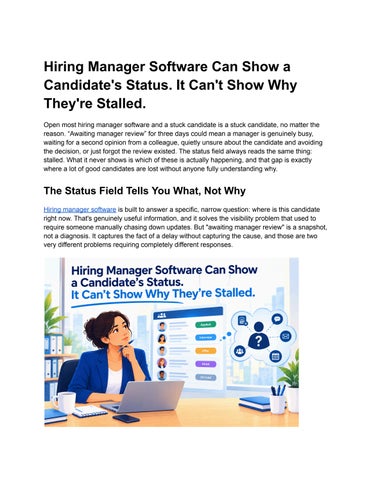
Hiring Manager Software Can Show a Candidate's Status. It Can't Show Why They're Stalled. Open most hiring manager software and a stuck candidate is a stuck candidate, no matter the reason. “Awaiting manager review” for three days could mean a manager is genuinely busy, waiting for a second opinion from a colleague, quietly unsure about the candidate and avoiding the decision, or just forgot the review existed. The status field always reads the same thing: stalled. What it never shows is which of these is actually happening, and that gap is exactly where a lot of good candidates are lost without anyone fully understanding why.
The Status Field Tells You What, Not Why Hiring manager software is built to answer a specific, narrow question: where is this candidate right now. That's genuinely useful information, and it solves the visibility problem that used to require someone manually chasing down updates. But "awaiting manager review" is a snapshot, not a diagnosis. It captures the fact of a delay without capturing the cause, and those are two very different problems requiring completely different responses.
Why This Matters More Than It Seems If the candidate is getting hung up because the manager is just too busy, patience or a gentle nudge is the answer. If the reason is that the manager has real but unspoken reservations, then the fix is a straightforward conversation about those reservations. If the cause is that the manager really forgot the remedy is a more visible reminder system. Hiring manager software treats all three of these identically — the same automated nudge goes out regardless of the actual underlying cause — which means the response is only accidentally correct some of the time.
What a Reminder Actually Accomplishes (and Doesn't) Automated hiring software sending a reminder after a candidate has sat too long in a stage assumes the primary obstacle is simply forgetting. For a genuinely busy manager, this works well — the nudge prompts action they intended to take anyway. For a manager who's hesitant about the candidate for reasons they haven't voiced, the same reminder just produces more delay, or a rushed decision made under gentle pressure rather than a resolved one made with clarity. Hiring automation software can't distinguish between these cases because the underlying data — a timestamp showing how long someone's been in a stage — looks identical either way.
The Cost of Not Knowing Why A stalled candidate who's a genuinely strong fit doesn't wait indefinitely. If the real issue is a manager's unstated hesitation, and nobody surfaces that hesitation directly, the candidate simply disappears — accepting another offer, or losing enough interest that they stop responding altogether. Hiring manager software logs this outcome the same way it logs any other closed candidate record, with no distinction between "we lost someone great because nobody addressed a real concern" and "the candidate simply wasn't a fit and moved on." Both outcomes look identical in the data, even though only one of them represents a fixable process failure.
Where EEOC Compliance Adds Another Layer This gap becomes especially important when a stalled decision eventually needs to be explained. EEOC compliance recruiting software depends on being able to document not just what happened to a candidate, but the actual reasoning behind hiring decisions. A stalled candidate whose eventual rejection is explained only by a vague, generic reason — rather than the manager's actual specific concern — leaves a weaker documentation trail than one where the real reasoning was captured directly and promptly, closer to when the decision was actually being made.
What Actually Surfaces the "Why" A required reason field, not just a status change. Hiring manager software that prompts a manager to select or briefly describe why they're pausing on a decision — even a simple dropdown of common reasons — captures information a bare timestamp never will. Not only an automated nudge, but a direct check-in after a set delay. A human, either a recruiter or HR contact, directly asking “what’s holding up this decision” after a reasonable wait period reveals the real reason far better than an automated message ever will, instead of just relying on a system-generated reminder. Normalizing hesitation as something to voice, not hide. Managers sometimes stay quiet about reservations because they're not fully certain, or because articulating a vague concern feels premature. Creating a low-pressure way to flag "I'm not sure yet, here's why" — rather than simply not acting — turns silent hesitation into something the process can actually respond to.
Why Small Teams Feel This Gap Acutely Hiring software for small business use often has fewer people involved in each hiring decision, which means a single manager's silent hesitation has an outsized effect on the whole pipeline — there's no one else picking up the slack or independently pushing the decision forward. A small team relying purely on automated status tracking, without a habit of directly checking in on stalled candidates, risks losing a disproportionate share of strong candidates simply because there was nobody available to ask the obvious follow-up question in time.
What This Doesn't Mean None of this is an argument against hiring manager software or its automation features — status tracking and automated reminders genuinely solve the visibility problem that existed before these tools were common. The point is narrower: a status field is a starting point for investigation, not a complete answer on its own, and treating "awaiting manager review" as sufficient information on its own means missing the actual reason a candidate is stuck, which is usually the more useful thing to know.
The Bottom Line Hiring manager software does an excellent job answering where a candidate stands in the process. It does a poor job, almost by design, of explaining why they're stuck there, since that requires a manager to actually articulate a reason rather than the system simply recording elapsed time. Closing this gap doesn't require more sophisticated software — it requires
building a habit of directly asking the question a timestamp can't answer, before a stalled candidate quietly becomes a lost one.
FAQs Why doesn't hiring manager software explain why a candidate is stalled? Because it's built to track status and elapsed time, not to capture the reasoning behind a delay, which requires a manager to actively articulate a reason rather than the system inferring one automatically. Does an automated reminder solve the problem of a stalled candidate? Only partially. It works well if the cause is simple forgetfulness, but it does nothing to address a manager's unstated hesitation or genuine uncertainty about a candidate. How can a company find out why a candidate is actually stalled? A required reason field for pausing decisions, or a direct check-in conversation after a reasonable delay, tends to surface the real cause far more reliably than relying on automated status tracking alone. Why does this gap matter for compliance purposes? Because documented reasoning behind hiring decisions is stronger and more defensible than a vague or generic explanation captured only after the fact, particularly if a decision is ever questioned later. Are small businesses more affected by this issue? Often yes, since fewer people are typically involved in each hiring decision, meaning a single manager's silent hesitation can stall or lose a strong candidate without anyone else noticing in time.