MARK CARNEY ADDS 3 SEATS



The Liberals won all three byelections on April 13, giving Prime Minister Mark Carney a majority government in the House of Commons.
The victories in Scarborough Southwest, University-Rosedale and Terrebonne give the Liberals 174 seats. The party now holds two more than the 172 needed for a majority, reducing the chances of an early election. The next federal election does not have to be called until 2029.
Doly Begum won Scarborough Southwest. Danielle Martin took University-Rosedale with 64 per cent of the vote after all polls were counted. In Terrebonne, Liberal candidate Tatiana Auguste defeated Bloc Québécois candidate Nathalie Sinclair-Desgagné, winning by more than 700 votes.
Nearly 48 per cent of eligible voters cast ballots in Terrebonne. Turnout was lower in the Toronto ridings, where roughly a third of voters showed up. There were 93,971 registered voters in University-Rosedale and about 30 per cent turned out to vote.
Before the byelections, five opposition MPs crossed the floor to the Liberals. Four Conservatives and one New Democrat joined the party since November, pushing the seat count from the 169 won in last April’s general election to 171 heading into byelection night.
Begum, formerly the New Democrat MPP for the same area provin-
cially, crossed to the federal Liberals after resigning on Feb. 3. The riding had been vacant since former Liberal MP Bill Blair left to become High Commissioner to the U.K.
In Scarborough Southwest, candidates included Diana Filipova of the Conservatives, Fatima Shaban of the NDP and Pooja Malhotra of the Greens.
Martin, a family physician who previously chaired the University of Toronto’s family medicine program, ran in University-Rosedale. The riding had been held by former cabinet minister Chrystia Freeland from 2013 until her resignation on Jan. 9. Freeland left to serve as an economic development adviser to Ukrainian President Volodymyr Zelensky.
election. It appears half of the Conservative voters vanished.
In Scarborough Southwest, NDP candidate Fatima Shaban got six per cent of the vote. In Terrebonne, NDP candidate Maxime Beaudoin received 0.5 per cent.
“We are going to keep fighting,” Shaban said on election night. “It’s not about the votes, it’s not about the percentage, it’s all about the people
“IT’S NOT ABOUT THE VOTES, IT’S NOT ABOUT THE PERCENTAGE, IT’S ALL ABOUT THE PEOPLE WE SPOKE TO AND THE PEOPLE WE CONNECTED WITH, ” - Fatima Shaban
we spoke to and the people we connected with.”
ridings heading into election day. Their surveys projected 62 per cent of committed voters in Scarborough Southwest supported the Liberals, with a seven per cent margin of error.
The Conservatives were expected to garner about 25 per cent of the votes.
Terrebonne was projected as closer, with the Liberals at 64 per cent probability. Surveys showed the Liberals with 40 per cent of support, while the Bloc Québécois trailed by two percentage points.
The Supreme Court of Canada had nullified the 2025 federal election result in Terrebonne, where the Liberals had won by a single vote, forcing the byelection.
Humber Et Cetera is the Humber Polytechnic journalism program laboratory newspaper. It is created by journalism students in the Advanced Diploma and Post Graduate programs. Et Cetera serves to inform the Humber community and give its readers well-rounded coverage on the things that matter to them.
Camille Snaggs
Martin garnered 17,823 votes or 64.4 per cent of the vote after 146 polls of 153 reported.
The NDP finished second in University-Rosedale. Serena Purdy, a health systems scholar at the University of Toronto, took about 19 per cent of the vote. Conservative Don Hodgson got about 12.8 per cent, down from 23.5 per cent in the last
The results are another setback for the NDP, which holds six seats and does not have official party status. The party would need four more seats to regain it. New leader Avi Lewis, elected at the party’s convention in Winnipeg on March 29, won on the first ballot with 56 per cent of the vote. Lewis received 39,734 votes, well above Heather McPherson, who received 20,899 votes.
Conservative Leader Pierre Poilievre posted on X that the Liberals won through “backroom deals.”
Aggregate polling by 338Canada had given the Liberals a 99 per cent chance of winning both Toronto
Data from the 2021 Canada Census shows more than 60 per cent of Scarborough Southwest residents identify as visible minorities. In University-Rosedale, 36 per cent hold a bachelor’s degree and 31 per cent have a postgraduate degree. About 59 per cent of the riding’s residents are renters.
Fifty-six per cent of University-Rosedale voters identify as non-visible minorities, and 46 per cent reported as visible minorities.
Story by Humber Et Cetera reporters Jacob Peacock, Sharujan Viyayasinghabagu, Christian Lanzillotto, Andrzej Wisniewski, and Grace MacInerney
Stephen Chamberlain Senior Reporter
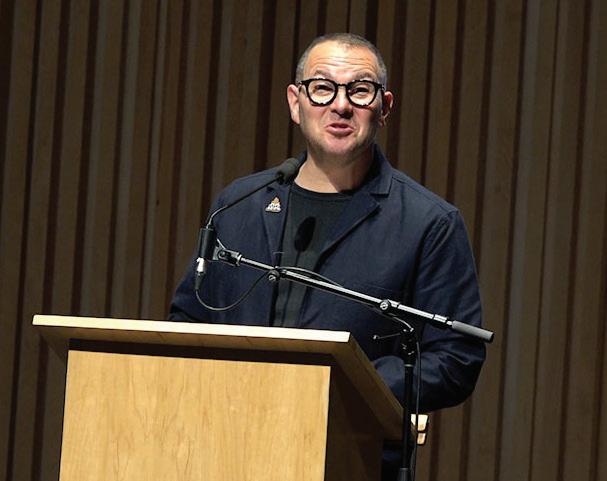
Professors and students fawned over author, activist and journalist Cory Doctorow before his President’s Lecture Series talk at Humber Polytechnic’s Lakeshore campus.
As the star lecturer was speaking with three students before his lecture, a high school teacher, along with a few students, rushed up to him, apologized for the interruption, stood in front of Doctorow with a gaping mouth, before blurting out that he was utterly star-struck, saying he never gets starstruck.
He recovered as best he could by apologizing again for the interruption and saying that he was looking forward to hearing the speech.
A few more professors came up to him and shook hands before finding their seats.
From stage right, Doctorow bounded up to the podium and was greeted with rapturous applause, only to immediately apologize, saying Canada is extremely bad at regulating American tech companies.
He gave some examples, such as when the Canadian government tried to make Facebook pay for news, the popular app just kicked news outlets off its platform, and when it asked Netflix to add CanCon, the platform just refused. He said these companies have market caps greater than Canada’s GDP. In other words, they have a lot of sway and the ability to do what they want.
He also talked about how the European Union was unable to successfully compel Apple to allow other companies to sell apps in the App Store without a slew of conditions, including Apple’s right to delete any app and its data if the consumer has been out of the EU for 21 days.
Part of the failure to regulate stems from the coercive language coming
from the Trump administration.
“Trump has made it very clear that if America’s tech companies collaborate with his regime, he will go around to other countries and intimidate them into backing off on attempts at regulation,” Doctorow said.
The failed attempts at regulation and regulation in favour of tech companies have contributed to an overall decline in the end-user experience in what Doctorow calls ‘enshitification.’
Enshitification is an app’s decay over time in what Doctorow describes as a three-stage process.
“First, the platforms are good to their end users while they try to find a way to lock those users in, and then once they know that the users can’t easily leave the platform, they make things worse for them, in order to make things better
describing some of the tech giant execs, but he didn’t lay all the blame at their feet.
“The problem is not that the wrong person runs Facebook and therefore exercises a total veto over the digital lives of four billion people,” he said. “The problem is that that job exists in the first place. We don’t need to perfect Mark Zuckerberg. We need to abolish Mark Zuckerberg.”
The real culprits, he said, are the regulators and politicians who made deliberate decisions, often under corporate and political pressure, that locked in the conditions for enshittification.
“It is these people and their terrible, deliberate misconduct that we need to remember, because it is their awful policies that we must overthrow,
“YOU CANNOT SHOP YOUR WAY OUT OF A MONOPOLY ANY MORE THAN YOU YOU ARE GOING TO RECYCLE YOUR WAY OUT OF A WILDFIRE, ” - Cory Doctorow
for business customers, and once those business customers are locked in, they harvest all the available surpluses from both end users and businesses, and they leave behind a kind of bare, mingy, homeopathic residue of value needed to keep the users locked to the platform,” he said.
“The final ideal stage of a platform is attained, the stage in which the platform is a giant pile of shit,” Doctorow said.
It’s one thing to be able to identify, describe a process and give it a name, but Doctorow probed further when he asked: “Why is this happening now?”
He said a common response to the declining quality of platforms like Facebook, Google, or Amazon is consumer self-blame, in which the issue is framed as poor product choices. Doctorow didn’t pull any punches when

to keep doing what they told you,” he said.
Doctorow said Canada needs to repeal its anti-circumvention law, allowing the freedom to build something new, such as tools, platforms and services that work around the tech giants rather than being controlled by them. He suggested that open-source cloud infrastructure could untangle governments and businesses that currently depend on American corporations.
“We can be the vanguard of a global movement of digital sovereignty grounded in universal, open, transparent software, a commons that every country in the world contributes to and relies upon, something more like science than like technology,” he said.
Doctorow warned that Canada needs to act now, as the window to effect change is closing, with several European countries already moving in that direction. There is an opportunity for incredible benefit if Canada taps into its own resources after making laws that work for Canadians.

Writers for Humber Polytechnic’s student newspaper Et Cetera won a slew of awards and honourable mentions at the Columbia Scholastic Press Awards.
The Golden Circle Awards highlight individual work by post-secondary media in North America.
otherwise the best we can hope for is replacing one monster with another,” he said.
Doctorow zeroed in on one policy in particular that is the main driver of enshitification: the anti-circumvention law. He highlighted that under these laws, it is a criminal offence to modify a device or software in ways the manufacturer did not sanction, even if the device is not their property.
“Anti-circumvention law is a way for legislatures to delegate absolute lawmaking authority to corporations,” he said. “Another way of describing anti-circumvention law is calling it felony contempt of the business model. It is a way for a corporation to threaten you with prison if you use your property in a way they don’t want you to.”
In Canada, Bill C-11, the Copyright Modernization Act, was enacted in 2012 as Canada’s version of the anti-circumvention law. Doctorow says the Harper government was coerced into pushing forward despite overwhelming opposition to it.
“The U.S. Trade Representative said that unless we had anti-circumvention laws on our books, we would no longer be able to export our goods to America without tariffs,” Doctorow said. “That was the stick the U.S. used to beat every country in the world into adopting a law that allowed American companies to extract the data and finances of people in every country.”
Canada went along with this scheme, and ironically, the deal did not protect Canada from American tariffs.
“If someone threatens to burn your house down unless you do as you’re told, and you do it, and they burn your house down anyway, you don’t have
“One of those countries will jump at this opportunity to consume the billions in rents stolen by U.S. tech giants and use them as fuel for a single-use rocket booster that launches their tech sector into a stable orbit for decades to come,” he said. “If we sleep on this, we will not get the industrial policy, the chance to launch whole sectors of new business. That will go to someone else.”
Ultimately, Doctorow said he wants the internet to be more than a consumer product driven by economics, but as a force to contend with the most pressing issues of our times.
“We need a new, good internet fit for purpose to wire up the human race and human civilization to be our nervous system as we struggle to coordinate the actions we’re going to need to take as a species to save ourselves from the climate emergency, fascism and genocide,” he said.
Mesmerized, people in the audience asked questions and got robust answers until time was up, and then Doctorow was swarmed by those wanting his autograph with a selfie.
“You cannot shop your way out of a monopoly any more than you are going to recycle your way out of a wildfire,” he said.
The appeal to individual consumer action, he said, is not a genuine solution but a strategic distraction that serves those with the most to lose from collective political action.
“The reason billionaires want you to vote with your wallets is that their wallets are so much thicker than yours,” he said. “They are, in every other regard, an irrelevant, infinitesimal minority of the population. In a vote with ballots rather than wallets, billionaires lose every time.”
Et Cetera editors excelled in the Editorial writing, winning first, third and two honourable mentions.
Harnoor Kaur received an honourable mention in News Writing for her story A Counsellor for 10,672 Students, while Asher Klaver took second place for Personal Opinion, Offcampus issues with his column, You Probably Would Have Hated Martin Luther King Jr., Too
Julia-Marie Ilano received an honourable mention in General Features for her piece Humber’s Culinary, Baking Students Cook at National Home Show.
Luis Miguel DeCastro received an honourable mention in the Single Sports Photograph category.
Liam Oliver Neilson and Reet Arora each received an honourable mention for Front Page Design.
Aislinn Millette took top prize in Cultural Feature for her story, Toronto Designer Transforms Personal Trauma into Powerful Art at Fashion Week,” while Julia Sequeira placed second with her story, Dive into the Rhythm of the 9th Annual Kensington Market Jazz Festival.”
Zainab Raza took second place in the Single Subject Feature Package for her layout of Millette’s feature story. Liam Oliver Neilson and Zainab Raza shared an honourable mention for their layout of Behind the Scenes of Pro Wrestling.
Grace MacInerney Humber ETC News
London, Ont., police warned of a “potentially toxic supply of illegal substances” distributed in the downtown core on March 11, and emergency services there responded to 39 overdose calls in 24 hours, they said.
It appears it was a new, deadly concoction that naloxone, used to combat potentially deadly opioid overdoses, fails to counter.
Hayley Thompson is the project manager at Toronto’s Drug Checking Service. She analyzes drug samples and informs users and the greater community on what is currently laced in the drugs on the illegal “unregulated” market.
Thompson said the main nonopioid drugs cut into the fentanyl supply currently are veterinary tranquillizers, medetomidine and
benzodiazepines, which do not respond to naloxone.
Matt Johnson, a supervisor at the Overdose Prevention Site at Street Health Toronto, said in the early days of fentanyl, overdoses would escalate quickly, and people would recover quickly.
They said that after administering naloxone, the most common brand of which is Narcan, people would be back to normal within about 10 to 15 minutes.
Johnson said there is no antidote to the new mixture and all they have to offer is oxygen and time.
People are out for hours when overdosing on tranquillizers, they said, and sites like theirs are not set up for long-term monitoring.
Johnson said that tranquillizers slow breathing and the person’s pulse.
“We aren’t and never will be set up to deal with cardiac issues. And so, when we get those low pulse rates, we have to call 911. So, we’ve been relying on 911 a lot more,” they said.
The withdrawal effects of tranquillizers are severe, Johnson said, the main concern being dramatically increased blood pressure.
They said their first case of naloxone not reviving a client was in 2019, and it was not until late 2025 or early 2026 that they started seeing animal tranquillizers in most of the drug supply.
Johnson said that as of late February into early March, benzodiazepines, which had been missing from the drug supply for a while, had been reintroduced.
They said “benzos” compounded with medetomidine greatly increase the odds of com-
plications in overdoses.
“Most overdoses are showing signs of veterinary tranquillizers for sure, and so it’s made our overdose response more complicated,” Johnson said.
They said they find it unfair to be the messengers telling their clients that defunding will cut lifesaving services and that no alternative is being offered.
Barbara Fornssler, an assistant professor at the School of Public Health at the University of Saskatchewan, said criminalizing substances often creates a more harmful, unregulated market.
She said the demand for substances does not go down when “we crack down on the unregulated market.”
Fornssler said she fully believes recovery is possible for severe drug addicts. Fornssler said there are many possible supports which have proven effective.
“You can absolutely recover physiologically and emotionally and socially from even what we would classify as the most deeply dependent,” she said. But the stipulation is that people have access to necessary supports, Fornssler said.
“You know, if somebody doesn’t have a safe place to sleep at night, it’s really hard to stop using a stimulant that might keep you up overnight so you can keep yourself safe, right?” she said.
Fornssler said she hopes her students are empathetic to drug users and understand that drug abuse is a public health issue, not a criminal issue.
“It’s the war on drugs that brought us here, and the war on drugs will not get us out of it,” she said.



Justin Kovnjak was a prominent youth at Our Lady Help of Christians Church, even wanting to be a priest. All of that is now in the past. It was the second-worst moment of Justin Kovnjak’s life. He had to tell his mother that he was moving out, but what followed would be more difficult. He was going to tell his religious mom that he was gay. He sat outside his home in Toronto in 2022, brooding and thinking about how to bring any of this up to his devotedly Catholic mother. He waited hours for his mother to come outside. He had no idea how to approach her.
The original plan wasn’t even to tell her about his sexuality, just that he was moving out. After telling her about signing a lease for an apartment on Jarvis Street in Toronto, he thought, “I might as well rip the bandage off,” and proceeded to tell her that he was gay.
His mother was upset, disappointed, and confused, but in the moment, it was mostly about moving. In her mind, he was abandoning her, not even considering her son’s sexuality until days later.
None of his family knew anything about his plans. Kovnjak,
25, fully realized he was gay at 18. It was something he knew would conflict with his home life and the church he often attended, Our Lady Help of Christians Church on Manning Avenue in Toronto.
Religion played a large role in his youth as his family, particularly his mother, who was dedicated to Catholicism and the Church, especially during the COVID-19 pandemic. Kovnjak tried keeping in touch with his mother after everything had happened, but he couldn’t take the mental anguish she carried with her and didn’t feel like he was truly accepted, so he cut contact with her.
religion because of what happened.
Reverend Cheri Dinovo, 75, a public speaker and previous minister for the Trinity-St. Paul’s United Church has been a very strong activist for the LGBTQ+ community in Canada. She believes that many passages in what she calls the “texts of terror” in the bible are often misread.
without judgment and that it’s very important that we never judge anyone involved. Conversion therapy was another topic Dinovo talked about.
“It never works. What it does do is result in suicide and depression,” Dinovo said. “I have seen parents grieving over the loss of their child’s life because they thought they were helping them.”
“HOW IS IT BEST FOR YOUR CHILD IF YOU ARE NO LONGER IN THEIR LIFE?”
“She was stuck in this echo chamber of social media with only people from the church,” Kovnjak said.
A study conducted by Timothy W. Jones and Jennifer Power from La Trobe University and Tiffany M. Jones from Macquarie University in Australia in May 2022 shows that many LGBTQ+ people from a religious background feel there is damage done to their faith after coming out. Kovnjak is one of them, as he has not had any desire to continue pursuing any kind of
Trinity-St. Paul’s United Church is an affirming congregation, encouraging participation from the LGBTQ+ community, she says.
-Reverend Cheri Dinovo
Dinovo’s approach to religious parents who have disowned their child because of sexuality and gender is to first listen to them, as she says what they’ve heard from their faith is a misunderstanding of teachings or science.
“I can’t imagine, as a parent myself, the absolute heartbreak and sadness of losing your child because of societal pressure,” Dinovo said.
Dinovo is a strong advocate for acceptance and understanding, saying that it all must be done
Bettsy Anderson, 73, a current member of Trinity-St. Paul’s said the church reflects their acceptance of all who identify with the LGBTQ+ community, and that God does indeed love all, no matter what. While Trinity-St. Paul’s United Church are accepting of the LGBTQ+ community, but some will still insist on heteronormativity. Noah Mengstu, a missionary for Restored Church Toronto, said that it is wrong for parents to disown their child for their sexuality and gender identity.
But he also said the Bible is very clear that God designed man and woman to be together.
“People do wrong, and they try to justify using God’s word,” Mengstu said.
All religious talk and faith are
something Kovnjak has moved on from. Kovnjak has said that he still loves his mother, and that his mother still loves him, but would constantly send bible quotes through email, trying to convince him that it’s wrong to be gay. One of her emails included other people in the church, saying that being gay was sinful. After Kovnjak replied to it, being open about his sexuality, his mother flew into a rage as everyone at the church now knew that her son was gay.
“All the heavy-hitter gossipers were in that email, so I can only imagine the wildfire,” Kovnjak said.
Kovnjak was religious in his youth, even wanting to be a priest, as he felt it was the best way to suppress his sexuality, but he began hating it in his early adulthood and now has an acceptance of it. He is not religious and has no desire to be anymore, but he has an appreciation for what accepting religious communities bring.
That being said, because of everything, he is still very sensitive to the subject as a whole.
“We can’t take this book so seriously, and I can’t take my life so seriously, cause that’s just stupid,” Kovnjak said.
Ann Camille Snaggs Senior Reporter
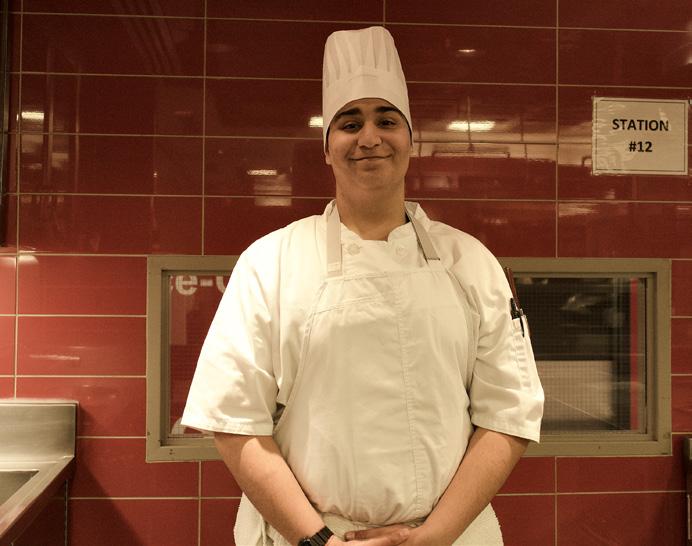
Hundreds of high school students put their expertise to the test in the Skills Ontario Qualifying Competition on April 11. The high-stakes, hands-on event took place in seven locations across Ontario, including Humber Polytechnic, propelling the winners to the provincial stage.
Competitors in welding, carpentry, culinary arts and TV-video production raced the clock to prove they have what it takes to stand out, and take the next step towards a future in skilled trades and technology careers.
At Humber, there were 70 competitors in total: eight in carpentry, 12 in culinary arts, 14 in welding, and 36 in TV/Radio. According to the Skills Ontario website, a qualifying competition is required for these four fields because they are in such high demand. Kate Belair, competitions manager at Skills Ontario, said that the winners at provincials go on to nationals. Then the winners at nationals qualify to join WorldSkills Team Canada, and will participate in the 48th WorldSkills Competition, which is set for September 2026 in
Students battle it out for a chance to get to provincials,
Shanghai, China. The WorldSkills Competition takes place every two years.
“Then it’s in Kyoto, Japan in 2028,” Belair said. “We always say it’s kind of like the Olympics.”
Guelph-Humber alum Ariel Deutschmann, communications and social media manager at Skills Ontario, said it was exciting to be a part of this event.
“It is amazing to see the passion and dedication that (the students) bring. There’s nerves, but there’s a whole lot of excitement, you can tell.” At the culinary arts competition, chicken chasseur and apple tarte tatin were on the menu.
Chef Daniel Gonzalez, who was one of the culinary arts judges, said that timing is of utmost importance. The students must have everything prepared by 2:30 pm.
Nikki Mirtorabi, her son Arvin Naziri and his best friend Kian Rufizadeh came out to support her other son, Novin Naziri, a Grade 10 student at Our Lady Queen of the World Catholic Academy, in Richmond Hill. The group showed their support by wearing custom aprons featuring a photograph of Novin.
“He has been practising for months!” Mirtorabi said.
Bryan and Lisa Bailey and their




Radio and Television Broadcasting students, Niusha Rezaei, Nhat Ha and Harold Calimag,

were on hand to judge the 18 video entries, along with Professor Karen Young and Michael Simmons, IT Specialist. TV-video competitors in groups of two, had to produce a 30-second video about what they would do if it was the end of the world. John Trentos, a Humber alum, and design, engineering and construction teacher at Richmond Green Secondary School, said it felt great to be there to support his carpentry student, Matthew.
“This is such a great experience for a grade 12 student to compete in a building project that is relevant and follows the Swift building code in Ontario,” he said. “This is just a great experience for exploring the workforce.” Chala Dincoy, who was there to support her son Logan Flajnik, said he is still deciding whether he wants to choose skilled trades as a career. He’s a quarterback for his football team at Lakeshore Collegiate Institute. Dincoy said that AI is replacing a lot of her clients’ businesses and employees. She said she is concerned about the potential impact of AI on the trades.
“So, I was asking all of the teachers, do you see (carpentry)
being replaced by AI?” Dincoy said. “And a lot of them said, this will be the last to be replaced by AI.” A Dec. 1, 2025, news release from Employment and Social Development Canada (ESDC) highlights the need for skilled workers in Canada and the government’s commitment to training and “doubling the pace of housing construction, from 250,000 a year to 500,000.” It estimates that by 2033 there will be more than 410,000 construction jobs available. The Canadian Occupational Projection System has estimated that there will be a “moderate risk of labour shortage,” of cooks over the period of 2024 to 2033.
The report said that job openings for cooks are expected to total more than 41,000, during this time period.
Deutschmann said the trades can be rewarding career pathways for a lot of young people if they have the interest or the desire to pursue them.
“Our mission is to change lives and inspire leaders through skilled trades and technologies,” she said. “That’s been our mission since 1989.”

Right now, the Caribbean nation of Cuba is facing an existential crisis due to fuel shortages, lack of medicine and electricity.
It is partly the result of a strict U.S. oil blockade since this past January’s American intervention in Venezuela.
Cuba, known for its beaches and radical socialism, has been in trouble for decades – some would even say centuries. But the recent capture of Nicholas Maduro in Venezuela has sent ripple effects across Cuba.
By blockading all foreign oil shipments to the island, the Donald Trump administration has effectively choked off its oil supply, which Cuba needs for its electricity to run hospitals, resorts, and communities.
Al Jazeera reported on how U.S. sanctions are causing hospitals
to limit surgeries. In March, the country experienced two nationwide blackouts that left 10 million Cubans without power.
This is unacceptable and inhumane. And without justification.
For their part, the White House is clearly motivated by the hope of “regime change” on the island. It is in the interests of many Cuban Americans in Florida, including Secretary of State Marco Rubio, for this to happen.
during Fidel Castro’s leadership.
However, the Cuban government deserves at least part of the blame.
Cuba is a one-party socialist state that disallows political opposition or free elections.
The United States and Canada,
of inflation and extreme poverty, according to the Universidad de Navarra, a university in Spain.
In fact, Rubio is correct that “Cubans can only be successful if they leave the country.”
But his approach is rooted in vendetta rather than conciliation.
“ALTHOUGH CUBA NEEDS REFORM AND DEMOCRACY, THE U.S CHOKEHOLD IS UNJUSTIFIED AND IN VIOLATION OF INTERNATIONAL LAW. ”
“I do believe I will have the honour of taking Cuba … I think I can do anything I want with it,”
Trump said in the Oval Office on April 3.
The U.S. sanctions are a relic of the Cold War, when the country aligned itself with the Soviet Union
on the other hand, are liberal democracies where criticizing the government is both acceptable and commonplace.
The fact that they have never had a free and fair election in their modern history is unacceptable.
And they have a centrally planned economy with high rates
His family fled the Cuban Revolution in 1959.
Although Cuba needs reform and democracy, the U.S. chokehold is unjustified and in violation of international law, and the United Nations agrees.
While there is plenty of blame to go around, action must be taken.
Canada has an opportunity here, since Ottawa has always maintained a softer foreign policy position on Havana.
Former Prime Minister Pierre
Trudeau took a famous trip to Cuba in 1976, in which Trudeau got along well with Cuban leader Fidel Castro.
Consequently, Canada’s relations with them have been above average compared to other Western countries, especially the United States.
It has been reported that Prime Minister Mark Carney has considered sending essential aid to the country.
We call on him to do it, as it would benefit both Canadians and Cubans.
The situation in Cuba is bad for everyone, especially the ordinary people on the island.
Though both Washington and Havana are to blame, the situation cannot be ignored by contemporary observers; something good needs to happen, and it needs to happen quickly.
The Ontario government continues to prioritize policies that claim to support adult taxpayers, but they leave the province’s students overlooked.
Premier Doug Ford has been introducing new policies for the coming seasons that will have significant impacts on residents across Ontario.
Starting April 30, the new Bring Your Own Booze (BYOB) policy will permit Ontario residents to bring alcohol into public spaces, a move positioned as a cost-saving measure for event-goers.
Proposed changes to High Occupancy Vehicle (HOV) lanes that allow solo drivers access during off-peak hours are intended to ease commutes and reduce time spent in traffic.
These policy changes are being introduced amidst a student crisis, distracting from urgent issues facing Ontario’s youth and ignoring student concerns.
Drastic changes to the Ontario Student Assistance Program (OSAP) have left students deeply concerned about mounting debt as grant percentages are slashed.
Beginning in fall 2026, OSAP funding will be restructured, with students receiving just 25 per cent in grants and 75 per cent as loans. A shift that will significantly increase their financial burden.
While many of the Ford government’s social policies are designed
to provide relief for adult taxpayers, students’ voices remain marginalized, and the consequences of education funding cuts are consistently ignored.
As some adult-focused policies may incidentally benefit students who are also taxpayers, they do not directly address the key issue most students face: rising educational costs and increasing reliance on loans.
Addressing OSAP concerns with the same urgency as adult-focused policies is essential for restoring
balanced priorities and fair policymaking.
Meanwhile, Ford’s government is forging ahead with questionable projects that funnel taxpayer dollars into controversial and arguably unnecessary ventures.
Plans to replace the Ontario Science Centre with a smaller facility at Ontario Place, and investments in a private Therme Group spa, raise concerns for both students and adult taxpayers.
Prioritization of commercial development over accessible edu-
cational infrastructure directly undermines opportunities for hands-on learning, contradicting Ford’s stated push for students to enter STEM fields.
Additionally, the construction of a multi-billion-dollar, threelevel tunnel beneath Highway 401 is expected to demand substantial public investment.
Significant public funds are being spent on boondoggle projects, while practical solutions that would benefit Ontario’s vast student population go unrealized.

The government’s priorities appear increasingly misaligned, favouring costly infrastructure over meaningful relief for Ontario’s students and critical educational investment, threatening vital resources for students.
Today’s students are tomorrow’s voters.
Disregarding their concerns and needs may have lasting political consequences for those in power. Amid ongoing changes to education and student support, there is a risk that policy decisions affecting young people will impact trust from the student demographic.
How can students support a government that drives them into debt for education while spending millions on projects that offer them little?
As relief for adult taxpayers is introduced, students continue to face the long-term consequences of reduced financial aid and receive disparaging remarks from the premier about “basket-weaving courses” regarding their program choices.
Ignoring their financial realities will only create economic challenges for Ontario’s future. It also calls into question whether infrastructure investments are more important than student concerns.
Students are not a temporary demographic.

Stephen Chamberlain
My girlfriend loves her chatbot more than me, and I’m cool with it. Well, love is a strong word; let’s say she enjoys her chats with her bot more than engaging with me about certain things. For example, the “do I look fat in this dress?” or the “should I fill this planter with petunias or begonias?” type of questions are no longer minefields I have to contend with.
But maybe that says more about me, like not bothering to learn the difference between a petunia and a
begonia or knowing that replacing the word “fat” with “full” is conceivably a bit insensitive and is perhaps why she finds more alignment with a chatbot.
I’ve read some of the responses she gets, like, “Oh, Samantha, that is so you!” and “I love your choice on this and here is why you are so smart.” Blah blah blah. The chatbot is 100 per cent in her corner, no matter what. I get the appeal. It’s nice to have our own personal champion, though you could prompt it to be cynical and sarcastic.
If this has happened to you, you’re not alone.
Beyond AI chatbots designed like your own personal assistant, such as ChatGPT and Claude, the AI relationship chatbot segment, including Replika, Character.AI, PolyBuzz, and Chai, has ballooned and is up 700 per cent worldwide between 2022 and mid2025, according to TechCrunch data.
TechCrunch data also show that revenue per share for relationship apps ranks in the top 10 per cent
of all apps, and MarkNtel Advisors predict that the North American market share will climb to $596.2 billion by 2032, up from $1.02 billion in 2025.
A Harvard Business Review article shows the number one reason people use generative AI is for therapy and companionship.
A recent Forbes article reported that some people are marrying their AI companion.
So, this is serious business, but are there any downsides to having chatbot buddies or soulmates?
Well, as with anything in life,
moderation is key. According to a ScienceDirect study in addition to users anthropomorphizing AI, this could lead to unrealistic expectations in human relationships. Heavy use of chatbots to replace real-life relationships showed an increase in depression, but moderate use allowed people to feel less lonely and less depressed.
Tragedies have also been reported with people taking their own lives or those of others based on influential chats, such as what happened in Tumbler Ridge, B.C.,

when a person shot up a school full of students.
AI is currently creating unoriginal responses for people, based on the published endeavours of mostly American humankind, to pass off as their own creations. Perhaps in the not-too-distant future, once we realize that we still need real-life humans to keep our species alive, our AI partners will arrange real-life but meaningless hookups with those most genetically predisposed but unappealing to each individual’s human counterpart.
What is missing that the chatbot fulfils?
The chatbots are devoid of the ability to start a fight with a look or to open their arms to invite a warm hug.
The only way to interact is to log off, go on animal instinct, and be present for your human friend in real life.
At least from time to time.
Stephen Chamberlain he/him is a senior reporter at Humber Et Cetera. He is a Journalism post-graduatestudent.
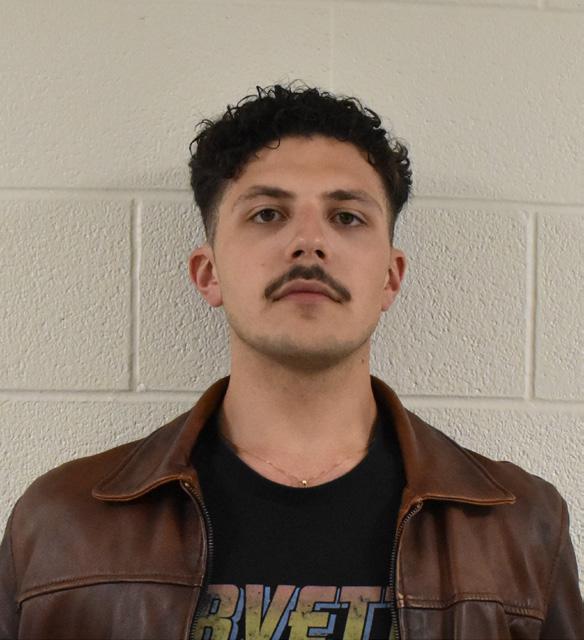
Mason Kossak
Omer Hafeez moved his family from the United Kingdom to Canada in August 2023. His wife is a health care worker. They came because the federal government said it wanted people like her.
The Hafeez family applied under the Home Care Workers pilot program on March 31, 2025. Then-immigration minister Mark Miller was clear in his press conference. He said the program would be the fastest of its kind. Done and dealt with in one year.
It is now April 2026. One year has passed.
“We have not even received
the AOR,” Hafeez said. “Work permits are expiring, and they have not given us any option to extend the work permits.”
He has four children. Two are in primary school. One is in high school. His daughter is in her first year of university. The family does not know if she can stay enrolled next semester. His wife can no longer work. The IRCC processing time for their application now reads 88 months. That is more than seven years.
Hafeez did everything right. He applied to a government program on the day it opened, based on a minister’s public promise. About 5,000 people are in the same pilot. They are all slowly reaching the end of their status, and none of them has heard anything.
Canada got what it wanted. In return, the Hafeez family got silence. More than 2.1 million temporary residents had permits expire in 2025. Another 1.9 million face the same this year. The government’s answer is a new Temporary Residency-to-Permanent Residency pathway offering 33,000 spots, with full details promised by April 2026. Those details have not
been released as of mid-April.
An IRCC spokesperson didn’t explain why details haven’t been released as promised.
“More details about the initiative will be shared in due time,” said Mary Rose Sabater, communications advisor at IRCC.
In due time. That is the government’s answer to a family watching their work permits expire.
Lijing Cao, an immigra-
tion lawyer at Bellissimo Law Group in Toronto, said workers in Hafeez’s position have no automatic legal remedy. Ministerial promises don’t create a legal right to a pathway unless they’re formalized in law or regulation.
“Foreign workers may have a fairness-based argument, but they do not automatically have a legal right to the pathway simply because ministers announced that

it was forthcoming,” Cao said. Apply to extend before the permit expires and wait for an implied status. Seek a bridging open work permit if a PR application is already in progress. Apply for restoration within 90 days if the status has already lapsed. None of those options fixes the underlying problem. The government brought these workers in, made promises it hasn’t kept, and now tells them to manage their own status.
Canada has been admitting temporary workers at a pace its permanent residency system was never built to absorb. In 2025, more than half of Canada’s 395,000 new permanent residents were already living here on temporary permits.
“Fulfill your promises,” Hafeez said. “If the minister has promised one thing, it should not be that if the minister has changed, that promise would not be fulfilled.
The government’s response was three words.
In due time is not an answer. It is an insult.
MasonKossakhe/himisasenior reporter at Humber Et Cetera. He is a Journalism post-graduate student.

As I scrolled through TikTok, a meme-style video on my For You Page caught my attention. Migos music: ‘walk it like I talk it, walk it like I talk it,’ then President Trump’s voice: “I’m gonna bomb the shit out of ‘em”.
Cut to fighter jets, missiles streaking fire, war footage aestheticized into propaganda porn.
That’s when I noticed the blue verified checkmark. This was posted by the official TikTok of the White House. Yes, the official TikTok of the United States government. My first reaction was disbelief. It did not read like government communication, more like content you would see from a troll account.
I clicked on the White House profile and went down the rabbit hole. The more I scrolled, the more outrageous it became: Iranian regime officials depicted as bowling pins, a meme of SpongeBob launching a bomb, missile strikes paired with Grand Theft Auto and Mortal Kombat references — all packaging the war as some kind of twisted entertainment.
This should scare you.
Emma Briant, a University of Notre Dame professor specializing in propaganda and information warfare, says the message is blunt: if countries like Iran don’t obey Trump, he will “bomb the shit out of them.”
She argues this message is unusual because it lacks the usual appeals to legitimacy expected from democratic governments.
Briant says the imagery and
music reinforce that message by making human life seem frivolous and violence seem fun. “It evokes a video game,” she said. “Americans are heroes and the rest of the world is worthless.”
This is new. I’ve never seen anything like this from an official government account.
I’ve never really paid attention, maybe because I’ve never had to. Government social media used to be fact-based, routine, tightly controlled and, honestly, pretty stale. I didn’t know how much comfort I found in that until now.
That kind of consistency is not accidental. Democratic governments are supposed to communicate in ways that create stability and credibility.
Official accounts should communicate facts clearly, in a way that is responsible and grounded in the seriousness of what they are addressing, not distort war and human suffering through memes and mockery. Briant believes this shift matters beyond domestic politics.
When this kind of messaging comes from an official White House account, it does not just reflect on Trump or his base. It reflects on the United States government.
She warns that this changes how the U.S. is seen by other democracies and “massively impacts trust among allies.”
The problem is not just that the content is offensive. It is that it makes the U.S. government look erratic and illegitimate.
TikTok is one of the most powerful news and information machines in the world, especially for young people. A Pew Research Center report from March 2026 found that 20% of U.S. adults regularly get news from TikTok. Among adults ages 18 to 29, that number rises to 43%.
For many viewers, especially younger ones, this may be a first point of contact with news and politics.


Zicheng Cheng, an assistant professor in the University of Arizona’s School of Journalism who researches TikTok, news and political communication, sees the White House’s approach as a platform-specific strategy.
On TikTok, content that is short and entertaining gets rewarded, and the account leans directly into that style through pop culture references, memes, viral music, video games and sports clips.
Cheng says this makes the content more shareable for younger audiences, and by adopting this entertainment-driven approach, “they meet audiences where they are.” This has consequences.
Briant warns that “new generations will have an utterly confused perspective on how democratic governments communicate, what is acceptable, and why.”
If official government communication keeps showing up in simplified, emotionally charged, entertainment-first formats, it risks teaching young people that this is what politics is supposed to look like.
Cheng said it may leave them
with a shallow understanding of policy, power and how democratic institutions actually work.
It also risks distorting how people understand war.
She warns that when war is packaged with viral sounds, humor and memes, it can blur the line between information and entertainment.
The format is designed to capture attention, but the emotional response it creates can be shallow and short-lived, reducing the gravity of what is being shown.
Briant argues the videos position viewers from the killer’s perspective, gamifying violence where “human life is reduced to exploding dehumanized targets: trucks, buildings, not people.”
The result is lost empathy, with real violence and human suffering repackaged as a video game.
Now, strip away the music, memes and edits.
A girls’ primary school at 10:45 a.m. after morning prayers. Backpacks lined up in a hallway, little plastic lunch containers tucked inside cubbies.
Then, in a second, the ceiling is gone. The windows don’t crack so
much as blow inward. The sound is so violent it doesn’t register as sound, just pressure and white tearing through the ribs and teeth of tiny bodies, stealing the air before a scream can form.
The air hangs heavy with smoke, chalk dust, and blood.
Blown clear across the rubble lies a light-up sneaker — its rainbow LEDs flickering weakly in a playground she’ll never run across again. After the dust settles and sirens begin, her mother is held back at the gate, screaming her daughter’s name at a doorway that now opens onto nothing.
On Feb. 28, 2026, Shajareh Tayyebeh girls’ school in Minab, Iran, was destroyed in a U.S. airstrike. 168 children are dead.
Thousands of innocent civilians have died and thousands are suffering as you read this. More will die.
The next time you watch one of those videos, think of them.
This is the reality behind “bomb the shit out of ‘em.
Allison Waytowich, she/her is a multimedia editor and senior reporter for Humber Et Cetera.
Adrian Peries Senior Reporter
On a late March evening, the Etobicoke Philharmonic Orchestra (EPO) filled the hall of the Martingrove Collegiate Institute with the sweeping works of Pyotr Tchaikovsky. The program, titled Dramatic Metamorphosis and conducted by Matthew Jones, also featured celebrated double-bassist Joel Quarrington.
Among the professional musicians sat two Humber students — one of them a cellist — quietly holding their own.
Nieva Cunningham, from British Columbia, is in her third year of a Bachelor of Music at Humber. She is the only string instrument player in a program focused on jazz and contemporary music.
Being the only string player in a jazz program has its challenges.
“It’s definitely pushing me to learn lots of stuff,” she said.
The EPO has no formal affiliation with Humber Polytechnic. She found the opportunity herself. Her path to the EPO winds through two distinct musical worlds. Cunningham began classically, studying cello through high school before completing a twoyear contemporary music program in British Columbia. At Humber, surrounded by jazz, she found herself moving further from the classical side of her instrument. The orchestra brought her back.
“It’s nice to get back into it and

kind of have the full education since classical is more for tech unique,” she said. “Jazz is a bit more free and like studying the improvisation side of the instrument.”
Playing her first concert surrounded by professionals was, by her own description, a revelation.
“It was really cool to just sit and listen and be like, wow, just making that kind of music with everyone is a cool experience,” she said.
The learning extended beyond the repertoire. Sitting in a section alongside experienced cellists opened up a quieter kind of mentorship. “It’s nice to sit in a section of other cellists and be able to get help with bowing,” she said.
The title of the EPO’s concert — Dramatic Metamorphosis — could describe more than just the evening’s repertoire. For students willing to step outside the class-
room and into professional spaces, the transformation is gradual and lasting. The line between student and professional, as Cunningham is discovering, does not vanish in a single concert
Matt Brubeck, professor of music at Humber and Cunningham’s teacher, said the value of orchestral training goes well beyond the notes on the page. “Orchestral training is really very important because the amount of attention that goes into intonation and phrasing — and of course, unique to strings, is coordinating with bowing,” he said.
It is a discipline that classical settings demand in a way jazz does not, and students feel the difference. “I’m a lot more in the music itself, where I have to stay focused,” Cunningham said. “You can’t really sit back and enjoy it so much. It’s more, stay on track.”
Brubeck agreed.
“In a classical musical rehearsal, I’ve never seen anyone with a phone on their music stand,” he said. “You’re just completely focused on the task at hand.”
That sustained focus, he said, has a ripple effect. The more time a student spends in an orchestral environment, the more their instincts develop — in ways that go beyond what a classroom can teach. The hours spent reading and responding to an ensemble quietly hone skills such as music arranging, Brubeck said. “If you spend time with the orchestra, you begin to get a sense of how to go about doing that,” he said.
The benefits reach beyond the music stand. Playing with professionals teaches students what a working career in music actually looks and feels like. “Professionalism is built over time,” Brubeck said. “As I always tell my students, work leads to work. Show up on time, be ready to play, know your part, and you will get other work.”
Brubeck pointed to something harder to teach than technique when explaining the drive a musician has to bring the same commitment to a community orchestra as to a major stage.
“I would hope that most people who love music and love performing will put the same amount of pride and energy into doing something, whether they’re compensated or not,” he said. “It’s professional pride. You can’t phone it in.”
For Cunningham, that commitment comes at a cost. Balancing EPO rehearsals with the demands of her third-year coursework and recital season has been taxing. “It’s too much of everything right now,” she admitted.
But she wasn’t complaining. “At least it’s fun. I enjoy everything that I’m doing. So that’s what matters,” Cunningham said. Brubeck, who has seen students overextend themselves, offered a word of caution alongside his encouragement. Students should absolutely seek out professional environments, he said — as long as they don’t get overcommitted.
“Everything you do takes time,” he said.

Television series are a widely consumed form of media, targeted at all ages, with the intention of entertaining their audiences.
However, as I’ve grown up and seen a considerable number of shows, I can only express my disdain for tropes like the “disposable Black girlfriend.”
With the intention of condi-
tioning consumers to perceive these women in a certain way, this trope is prevalent among female characters, furthering the progression of the protagonist’s storyline with their white counterparts.
They often serve as a temporary love interest and can be shown, even when not centering a nonBlack person of colour, “commonly found in canon media, as well as in fan-made transformative works,” says the site Fanlore.
To me, the trope feels like a symptom of a broader issue shown in media representation of Black people, where many can view them as “unlovable” or there for diversity.
As a Black woman myself, seeing the ongoing pattern when I was younger and growing to recognize it in adulthood made me feel an immeasurable sense of displeasure.
I know that little girls who look like me are just as deserving of love
and want positive endings in popular stories, but how can anyone think that when this is what the media continues to portray us as a means to an end?
Shows like The Summer I Turned Pretty, Invincible, Sex Education, Austin and Ally, are series that I found the trope is most prominent, where the women were sidelined. Whenever people tried to discuss it, the issue was invalidated.
I feel like it can put into perspective how things are still deeply rooted in colourism and racism regarding the beauty standard, and no matter how positive the chemistry is, people don’t root for what they see as different.
For me, even seeing various fandoms online popularize same sex relationships to avoid certain characters being with Black women has been very telling as well.
I have seen it for characters like Mel Medarda in the award-win-
ning show Arcane and High School Musical, with people wanting Chad Danforth and Ryan Evans together.
Placing Black women in this predicament, where they are written as stable to show the protagonist’s growth, only to have the protagonist eventually leave them for the “messier” or “more relatable” white characters, is exhausting.
It feels like it ultimately perpetuates the idea that womanhood in the form of Black representation is an obstacle that leads to a satisfying story. Despite its subtlety, it never treats us as a prize.
I would like the same sense of urgency for Black women as they do for their white counterparts in the media, and for directors to contrast this “placeholder” ideal with a purposeful cause.
In shows like Abbott Elementary and Bridgerton’s Queen Charlotte, they have good examples for their
female leads possessing power and prestige simultaneously that fit as a good form of embodiment that should be shown in today’s society.
As ongoing generations continue to see this in television series or films they watch, we need characters that are not tethered to the growth of a white leading castmate. Instead, we should look to seek a blueprint for success.
I think both producers and writers need to move beyond the mindset of casting these Black women as “diversity hires” and begin writing their narrative with the same complexity offered to their peers.
It is time to stop stereotyping our likeness to be used as a stepping stone for another character’s growth, and in turn, treat our stories as a destination.
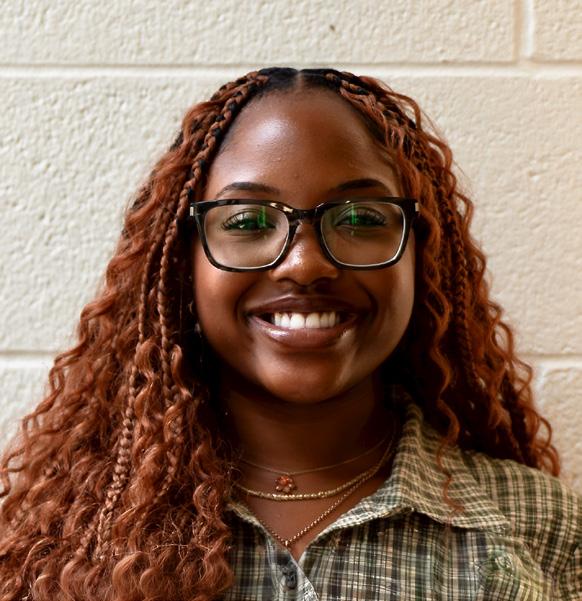
K’Leeanna Marriott, she/her, is a news reporter for Humber Et Cetera.
Parthvi Indravadan Patel Senior Reporter
Humber Polytechnic’s Film and Television Production (FMTV) program celebrated its graduating class of 2026 with a graduate premiere showcasing the creative talents and hard work of this year’s graduating class of filmmakers.
The event, held at the campus, brought together students, industry professionals, faculty, and film enthusiasts to showcase original films, public service announcements, and the next generation of storytellers ready to step into Canada’s film and television industry.
The graduate premiere featured six original short films written, directed, and produced by students, alongside ten public service announcements ranging from scripted commercial-style pieces to documentary-inspired social messages.
Event producer and FMTV student Luca Ladisa said that the premiere serves as more than just a celebration, it’s a testament to the skills and dedication of the graduating cohort.
“The main goal is to showcase the up-and-coming talent of filmmakers entering the industry,” Ladisa said. “These students come from diverse backgrounds, and that diversity, combined with impressive skills in cinematography, sound design, and storytelling, makes this year’s work truly special.”
Students took charge of every step of the film-making process, from concept development and scriptwriting to production and post-production.
Ladisa said that the only aspect not entirely student-led was funding.
“Everything from pre-production planning, finding locations, props, filming, editing, and sound design is done by the students themselves,” Ladisa said.
This year’s films featured a balance of tones, from lighthearted comedies to more serious, thought-provoking pieces.
“There’s almost an even split between comedic and more dramatic films,” Ladisa said. “Each one brings a unique voice, it’s hard to pinpoint a single trend because there’s so much variety and creativity.”
One of the films gaining buzz among peers and organizers was Mothered Nature.
Meagan King, marketing manager and production manager on Mothered Nature, talked about the challenges of working with large crews and demanding schedules.
“On Mothered Nature, we had 16-hour shooting days,” she said. “Teamwork and collaboration are essential, if one person slips, it can delay the entire shoot. But seeing it all come together has been incredibly rewarding.”
The graduate premiere also attracted attention from the film industry itself.
Ladisa said many industry guests attended, including members from the Directors Guild of Canada, representatives from Ontario Creates Green Screen, and production company professionals who have worked with the students during internships and placements.
These connections help bridge the gap between academic study and real-world opportunities, an advantage Humber’s FMTV program strives to provide.
“This program is well-known in the industry,” Ladisa said. “You’ll see Humber alumni on sets across the country. Having these strong
films in your portfolio opens doors and gives you something substantial to show future employers.”
The graduating filmmakers have a special opportunity to share their work beyond the campus community.
On April 16, 2026, all six capstone films will be screened publicly at Hot Docs Ted Rogers Cinema, a historic cinema in downtown Toronto known for celebrating independent and documentary cinema.
Tickets to the April 16 screening at Hot Docs Ted Rogers Cinema are free and currently available,
giving the public a chance to support student filmmakers and experience these original films on the big screen.
King said people should come out, meet the creators, and engage with the work that students have been developing since the start of the academic year last September. Ladisa said the audience should take away an appreciation for the class of 2026’s talent and dedication. “This class is special and one to remember,” Ladisa said. “They’re talented, committed, and ready to make their mark on the industry.”


Laura Rodgers
HumberETC Reporter
Humber vocal night student showcase concert left faculty members proud and students bittersweet.
The performances took place at Humber’s Lakeshore campus on Thursday, April 9.
Bachelor of Music student, Carson, performed lead vocals to Helpless by Neil Young as part of the pop/folk vocal ensemble.
The showcase had two groups. The Vocal Jazz Ensemble was directed by Dylan Bell and the Pop/Folk Vocal Ensemble was directed by Yvette Tollar.
Carson said he looked forward to his performance in the show most of all.
“I’m a little biased. I am singing that one,” he said.
Program coordinator for the one-year certificate Foundation in Music Performance Program, Kelsley Grant said he thought the night went successfully.
“People come out and the community is pretty supportive,” he said. “Most of them have been rehearsing since September, so they’re usually in really good shape by this time of year.”
Carson said he believed the show would go smoothly, considering how far they are into the end of the school year.
“The more you do it, the better you get at it,” he said.
Part of the Vocal Jazz Ensemble
was 33-year-old Mackenzie Kundakcioglu, a first-year Bachelor of Music program student.
They said that as a mature student who tried and failed to get their education, they are excited for all the possibilities the program will bring.
“I feel like I’m on top of everything and I’ve learned a lot,” they said.
Opening the night was barbershop-style acapella group, The Dukes of Harmony.
The group provides a scholarship for music students and is funded by the city.
One of the singers, Rob Siddall, said he did not know about the future of The Dukes of Harmony’s partnership with Humber.
“We may or may not be able to continue our scholarship, unfortunately… we get a lot of money from the city, and they control things,” he said.
Grant said the partnership was a nice way for Humber and The Dukes of Harmony to support each other.
Kundakcioglu said once they heard about the support this group offers the program and the time and musicianship they donate, they thought it was cool.
“We love to have the opportunity to present our style of music to a new audience,” Siddall said. “Of course, we’re always hoping somebody will say, hey, that sounds like
a great group. I think I might be interested in doing that.”
Despite a promising night that fulfilled Grant’s expectations, Carson said his fellow student performers did not want to be interviewed.
He said he believed this was due to a lack of interest in “promoting a program that cannot uphold its promises.”
He said he has witnessed many cuts within the Bachelor of Music program, and it does not promise a great future for the program.
He argues that the recent announcement of the cut of the Intercultural and Creative Music Fellowship was one example of many he has seen.
“Many students find themselves unsure about whether their professors will still be here to teach them, which classes will still be running, or even if the education experience they were promised when they enrolled will still be intact,” Carson said.
When asked about the student’s concerns, Grant said these feelings
might stem from changes made post-pandemic or from the many forms of entertainment coming out right now.
“I don’t want to say it [live music] is dying,” he said.
Grant said he feels it is something that can never be replaced.
He said many colleges have had to change structures just to keep up with how the industry is shifting.
“We’re still here, and we still love to support the students,” he said. “What we are seeing from our end is growth and stability.”


Marco Moretto HumberETC Sports
The Humber Hawks wrapped up another dominant season after bringing home four Ontario Colleges Athletic Association (OCAA) medals.
Between the Hawks men’s and women’s basketball and volleyball teams, three gold medals and one silver medal were won from late February to early March.
It started on Feb. 28. when both Hawks volleyball teams took home gold. The women took down St. Clair in the final in a thrilling reverse sweep and Humber taking it 3-2.
Head coach Chris Wilkins said he knew they would win as long as they stayed consistent.
Humber also received a big performance from fifth-year right side hitter Hannah Manners.
“We had the confidence and never panicked. Never once in the match did we feel like we were going to lose. We knew that if we could just get consistent on our side we could do it,” he said.
Humber is known for its winning culture and each team has its own philosophy to maintain that standard.
“Always be the hardest working team. We strive to have constant improvement each day. And we keep the phrase. Be better,” Wilkins said.
This win marks five championships in a row.
The Hawks men’s volleyball team
won its gold with a little less stress with a 3-0 win over Cambrian.
Big performances from first-year outside hitter Enzo Endres and fifth-year outside hitter Teyven Blackmore helped the men take their sixth OCAA championship.
Head coach Wayne Wilkins knew winning six in a row was tough but he kept the team locked in on the goal.
“I think right from the start the guys understood that winning six in a row was unprecedented and I think they felt the pressure of that throughout the season so by the time we got to provincials, they were so dialed in on achieving their goal,” he said.
“I think that allowed us to play freely and be as good as we were because they were already hardened throughout the regular season dealing with that pressure.”
Wilkins understands the winning culture at Humber and is grateful for all the support from the school.
“I think having a great team culture, having a school that continually supports you and ultimately understanding that the ‘standard is the standard’ allows us to attract the best talented athletes available to us and hold them accountable with these high expectations because they know that the goal for each season is the same,” Wilkins said.
In March the Hawks basketball teams took the court with the men’s team taking home the first
medal.
After a disappointing championship loss last season, the team bounced back and took down Mohawk in the final.
Fourth-year small forward Adrian Aluyi won the tournament’s MVP after multiple dominant showings.
“It was a surreal feeling, all the hard work I put in, being able to be recognized on one of the biggest stages, it’s a blessing,” he said.
Aluyi also has high praise for his team and the Humber culture.
“Just the culture around Humber. There’s high expectations every year once you put on the Humber Jersey. The coaches, the players and everyone around knows that the ultimate goal is a national championship every year, and constantly striving towards and having that standard makes the Humber men’s basketball program so great,” Aluyi said.
The women’s basketball team won silver after a loss in the finals against the Fanshawe Falcons.
The Hawks dominated the all three games in the path to the final, blowing out Durham, Algonquin and Loyalist.
Third-year small forward Beverly Omere said obviously the team was disappointed with the result but also said how great the opportunity is to play for Humber. “It really means a lot to play at Humber. The excellence that Humber has throughout the years just makes it so much more special that I get to be a part of this school,” Omere said.
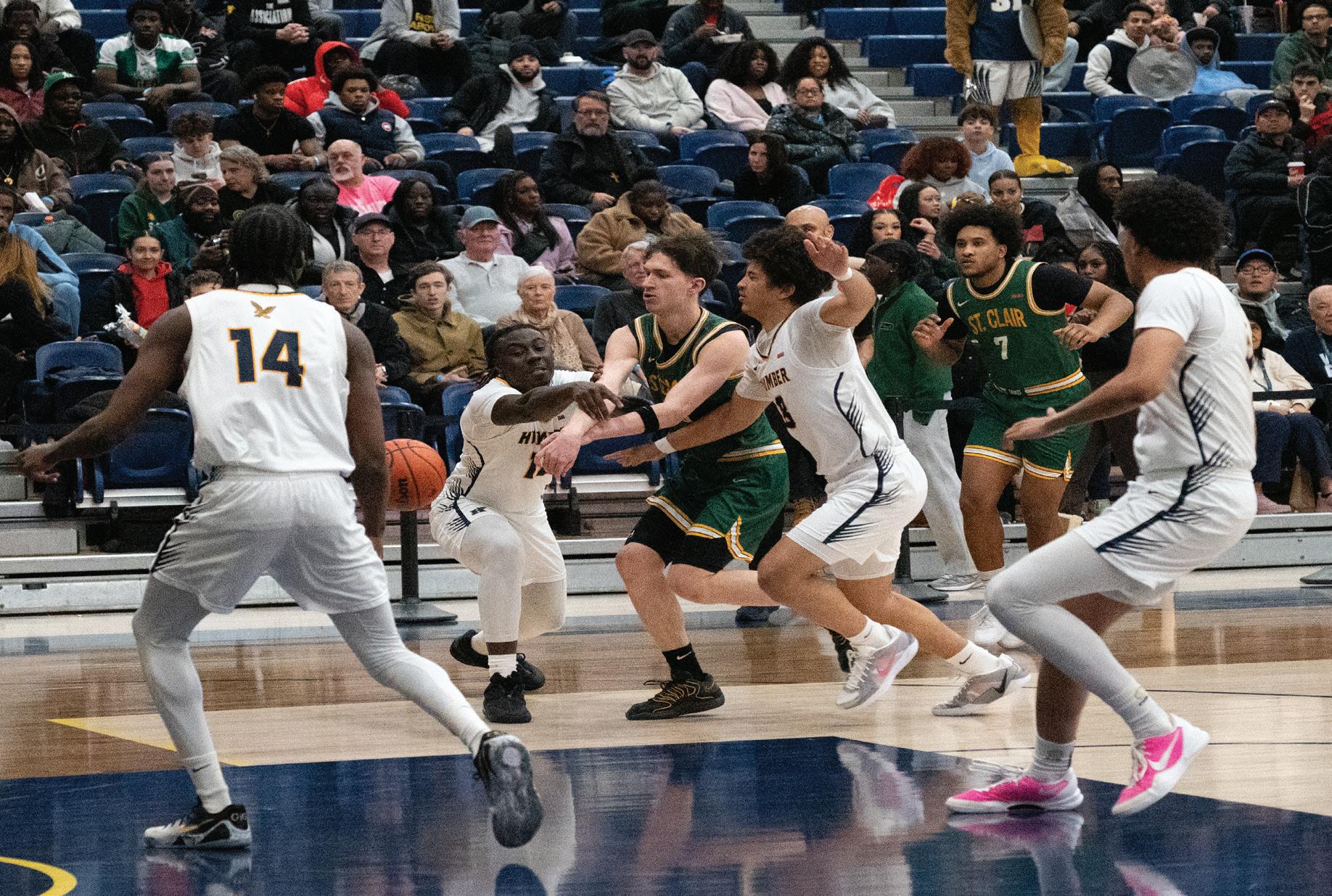
Luca Agostino HumberETC Sports
Ralph Holley’s path to becoming a defensive tackle with the Grey Cup champions, the Toronto Argonauts, has been an interesting one.
Born in Detroit, Michigan, in 1999, Holley started playing football at St. Mary Preparatory Catholic high school in West Bloomfield, Michigan.
“I was always too big to play, so I had to like sit out for like my middle school years because I was always over the weight limit
to play and everything like that thing of being a bigger guy, so, you know, it’s whatever. I actually didn’t start playing until I got to high school,” he said.
His playing career started as a running back and linebacker.
“I ended up playing. I was actually a running back and a linebacker at first. So, I played running back and linebacker for two years, and then I got moved up, actually,” he said.
Holley was a multi-sport athlete who did track and football,

and received Division Two and Division Three scholarships in track.
He graduated from high school with three state championships in football and two in track and field
But football always had his heart, and his mind was made up he was going to play Division One football for the Western Michigan Broncos; he ended up playing four seasons, while becoming a first team all-conference from his second to final season with the Broncos.
“I want to play football, so I ended up going to Western Michigan. I didn’t red shirt there. I played my first year there, which was awesome, and then my second year at Western, I ended up being first team all-conference, and then I was all-conference every year from there on,” he said.
Holley then entered the 2022 NFL Draft but was not drafted.
The Chicago Bears picked him up later, but it didn’t last as long as he expected.
Holley bounced around until his playing career took an unexpected turn.
After two seasons with the Philadelphia Stars of the United States Football League (USFL), Holley was released.
“I got a chance to be with the Chicago Bears after college, I was with them, through mini-camps. I was only with them for a couple of days, and then I went to the USFL, which was before the UFL. It was called the USFL, which is the United States Football League. It’s like a G League almost of the NFL, in grad school terms. But yeah, I went there, and then, I did really good there. My second year there, I ended up dislocating my elbow, and they
released me. They cut me from the team,” he said.
Looking for his next job, Holley became a substitute teacher and was able to keep football in his life, this time as a coach.
“I don’t have any place to work and everything, so I ended up being a substitute teacher, and I was a football coach for a middle school team,” he said.
Even though he became a substitute teacher and coach, and didn’t have very much financially.
However, the change in career did not stop him from chasing his dream.
“I was staying with my parents and I was paying for training, that’s the only with my substitute teaching cheques. So that’s the only way that I was doing it, man, and I was just staying persistent, man, and I just didn’t, I didn’t know what was gonna happen. I was like, I’m gonna give it one more go, go. Like, I’m gonna keep training,” he said.
A second chance at the game he loves with all his heart would soon come knocking, and that opportunity would be in the Canadian Football League (CFL) with the Toronto Argonauts.
“I got a call from, from the Argos saying, ‘You want to try out? You want to do a trial just for camp, like we’ll bring you in, see how you look and everything.’ I was like, one more go at football. It’s not going to hurt you. I was about to start actually getting into my career. I was just like, you know, let’s chop it up for the boys. Let’s do it,” he said.
GO TO HUMBERETC.CA FOR MORE
Grace MacInerney HumberETC Sports
Barrie Shepley said the International Olympic Committee announced in 1994 that triathlon would be added as an event for the 2000 Sydney Games. He said he had worked in high-performance triathlon for years and had been Canada’s national triathlon coach since 1991.
“So, from ‘94 on, I, you know, never stopped eating, sleeping, breathing and dreaming of going to the Olympics,” Shepley said.
To be considered for the position, he said he had to move to Victoria, away from his wife, Caron Shepley, for a year.
He said she financially supported them during this time, and they took significant financial risks and made lifestyle sacrifices for him to work in high-performance sport.
While in Victoria, he said he started a training centre with no budget and relied on families in the community to billet athletes
from across the country.
Shepley became Team Canada’s first Olympic triathlon coach for the 2000 Sydney Games and has since been to seven Olympic Games as a commentator.
He said there are usually 55 spots available per race. He said athletes not only need to be the best in their country but also among the 55 best triathletes of their sex in the world.
He said it’s possible that “even though you’re the best in your country and you made the standard, you’re not going.”
After making the games, or sometimes before, he said a bizarre set of events occurs.
Shepley said it’s common for parents of athletes to try to secure tickets to their kid’s events and get accommodations before everything sells out, and then they don’t make the team.
He said the Olympic Games are time management skills on an unimaginable level.
Shepley said rookies get distracted by hosting and trying to get
the most out of the Olympic village experience, and it has cost them.
He said his team in the 2000 Sydney Olympics experienced the highs and lows of the Games.
Shepley said he had two very different athletes: Simon Whitfield, 25, who was not expected to medal, and Carol Mongomery, 35, who was expected to take the gold.
He said he watched Montgomery flee a press conference he organized for her after a bad practice, and he had to pull Whitfield in front of disappointed reporters to save face.
Shepley said Montgomery never finished her race, breaking her arm during the event, but the next day, Whitfield won gold.
“So, it is beautiful, it is intense, it is not fair,” he said.
Isabelle Turcotte-Baird, another athlete who trained with Shepley at the Sydney Games, said she knew she likely wouldn’t medal and wanted to make the most of her experience.



P. 14