ROBOT WARS TAKE OVER HUMBER
P. 10 - 11





P. 10 - 11
Jacob Peacock
Senior Reporter
Prime Minister Mark Carney called three by-elections scheduled for April 13 in the ridings of University-Rosedale in Toronto and Scarborough Southwest and in Terrebonne, Que.
If the Liberals win two of the races, they will secure a majority government. The Liberals hold 170 seats in the House and need 172 seats for the majority.
A by-election is held whenever there is a vacancy in the House of Commons, usually after a resignation by a Member of Parliament.
In the case of the two Toronto
ridings – University-Rosedale and Scarborough Southwest –MPs Chrystia Freeland and Bill Blair both resigned their seats, resulting in by-elections.
In the riding of Scarborough Southwest, Doly Begum will run as the Liberal candidate after a shocking resignation in the same riding as a former NDP deputy leader.
“I’ve had the privilege to earn the trust and fight for the people of Scarborough Southwest for more than seven years as our MPP,” Begum said during her
Liberal Party announcement.
The other two major candidates are NDP candidate Fatima
Shaban and Diana Filipova for the Conservatives.
However, the riding is considered a safe Liberal seat as Blair won by more than 16,800 votes in the 2025 election.
In University-Rosedale, Freeland’s resignation has led the Liberals to nominate Danielle Martin, a physician and professor at the University of Toronto.
It is her first time running for public office, after making waves back in 2014 at a U.S. Senate hearing in which she defended Canada’s universal healthcare system.
“For more than 20 years, I have served the people of Universi -

Humber Et Cetera is the Humber Polytechnic journalism program laboratory newspaper. It is created by journalism students in the Advanced Diploma and Post Graduate programs. Et Cetera serves to inform the Humber community and give its readers well-rounded coverage on the things that matter to them.
ty-Rosedale as a family doctor and a hospital and university leader,” Martin said in a Liberal Party press release.
Freeland took the riding in 2025 by more than 25,200 votes.
But in recent years, the riding has had strong showings by Conservative and NDP candidates.
NDP candidate Serena Purdy, a health scientist, will give it another shot for the left-wing party this time around.
The by-election in Terrebonne, an area north-east of Montreal, features unusual circumstances.
In 2025, the Liberal candidate, Tatiana Auguste, won by only one vote over Bloc Québécois candidate Nathalie Sinclair-Desgagné.
However, since one voter’s mail-in ballot was apparently discounted, the Supreme Court of Canada nullified the vote on Feb. 13 and called for a redo.
Internal Trade Minister Dominic LeBlanc praised Auguste online.
“Tatiana is a committed young leader and the best candidate to build a better future for the people, workers, and businesses of Terrebonne,” he wrote on Instagram.
The two candidates will square off on April 13 with a majority government for Mark Carney on the line.
The Bloc Québécois, a federal Quebec separatist party with 22 seats in the House of Commons, are hoping for a victory in the French-speaking province.
Advance polls will be held on April 3 to 6 from 9 a.m. to 9 p.m.
Stephen Chamberlain Senior Reporter
In an Instagram post, Ontario Premier Doug Ford said he no longer recognizes Canada. He said he is disgusted and appalled by the open hatred and violence running rampant in our streets in the days before a planned Al-Quds protest at the U.S. consulate in Toronto
He instructed Ontario Attorney General Doug Downey to issue an injunction to stop the March 14 march.
But an Ontario court judge denied the injunction.
“The right to assemble and speak freely must be maintained in times of global conflict. Perhaps at no other time is the protection of our civil liberties more important,”
Superior Court Justice Robert Centa ruled.
Justice Centa said there was no evidence of hate speech or criminal incidents “arising out of last year’s Al-Quds rally in Toronto, or at the rallies in any of the prior 30 years.”
According to police, there were two arrests in two separate incidents, including one when a counter-protester attacked a man holding an Iranian flag.
The day was relatively peaceful, aside from two arrests, as the two opposing groups kept to their
respective sides of the street. However, people were swearing, flinging the bird at one another and playing antagonistic music.
Police lined University Avenue and had closed the street from Dundas to Queen Streets. Behind the police front lines were police on horseback, ready for any eruption of violence.
People were held back by metal barricades on the east side of University Avenue.
Those celebrating Al-Quds Day were on the south sidewalk on Armoury St, and the counter-protesters were on the north side of Armoury.
Javad Soleimani, who has come to many Al-Quds Day events over the years, said this one was significant because of the Israeli-U.S. war in Iran.
He said Al-Quds Day is celebrated on the last days of Ramadan and that it was important for all Muslims to come out to support Iran and Palestine together.
“I condemned the warmongers in the White House and Israel,” he said. People were pushed up against their respective metal barriers and yelled at each other across Armoury Street, while others turned inward toward the planned event, where they were coming together to pray, sing and chant.
It was Mohamed Aden’s first
time at Al-Quds Day. He said he decided to come out after seeing a social media post and wanted to support Palestine. He said everything seemed peaceful.
“The U.S. invasion of Iran is not right, of course, I don’t want to say anything anti-Semitic,” Aden said.
People were carrying signs depicting photos of the recently killed Supreme Leader of Iran, Ali Hosseini Khamenei.
Jason Daniel Baker wore an Israeli hockey jersey and stood near the metal barricades on the north side of Armoury Street.
“I’m here to get terrorism out of Canada, to get Muslim extremism out of Canada,” he said.
He said he supports the wars against terror, Iran, Hezbollah and Hamas while envisioning a good outcome.
“I think finally Persia, Iran, is going to realize its potential and become a world leader, just as it was before Islam took over,” Baker said.
Bliss Darush was draped in a flag that once represented the secret service during the Shah’s regime.
He said the flag with the Lion and Sun is the original Persian flag and the real Iranian flag.
He said the very foundational idea of Al-Quds Day came from Khamenei in a bid to torment Jewish people globally.
He said Iranians are tolerant and kind people, but that they allowed, to Iran’s detriment, “these Muslims to come in and make rules and change the laws one after another.”
“They just killed 50,000 of our own Iranian people inside Iran,” Darush said. “They’ve been killing people, torturing people, raping people.”
Darush said he was there to stand in front of people who represent terrorism.
“Whatever you do, you cannot stand on the wrong side of history,” he said. “Do not be complacent, Canada.”
On one side of the street, people were chanting “Free, free Palestine,” while on the other side, people were cheering and dancing to blaring electronic music with the lyric “Iran’s former Supreme Leader, Ali Hosseini Khamenei is dead, dead, dead.”
When the court denied Ford’s injunction, he posted on X that he was extremely disappointed because Al-Quds Day has long been a venue for antisemitism, hatred, intimidation and the glorification of terrorism.
Darush was optimistic as he stood among supporters of the U.S. and Israeli invasion of Iran.
“We’re going to bring freedom to Iran,” he said.


First-year international student, Sherifa Razak, loves everything about fashion.
Hoping for a time when wars are no more
Looking at Sherifa Razak, one would probably not assume she was an international student from northern Italy. She is 21 years old, wears a hijab and was born in Ghana. Her family emigrated to Italy when she was just a toddler.
Razak and her younger Italian-born siblings all speak fluent Italian, English, and Dagomba, a northern Ghanaian language.
After completing her Marketing program in high school, Razak followed her true passion and enrolled in Humber’s two-year Fashion Arts and Business diploma program last September.
“In Italy, there are a lot of fashion schools, but they’re quite expensive, so that’s the reason why I decided to, choose somewhere else.”
Razak said she was very excited to discover a new country and lifestyle and to see how people from other countries view fashion.
This is the first time Razak is spending Ramadan away from her family. Ramadan is a holy month for Muslims, focused on fasting and prayer.
The war that is currently going on in the Middle East is never far from her thoughts. Razak said she finds it distressing to see this war happening, especially during Ramadan, and hurting so many children in Muslim countries.
“I really hope that things can get fixed soon and that we can get to a point of our lives where wars are not really a thing anymore,” she said.
This report is by Ann Camille Snaggs, Environment Editor
Ethan Alcaidinho Senior Reporter
A city councillor from Toronto is proposing a pilot project where the city would open municipally operated grocery stores to help lower the cost of food and improve access to affordable food.
Anthony Perruzza, city councillor for Humber River Black Creek will introduce a motion before Toronto city council on March 25 calling for four city-run grocery stores across the city with one in each council district. This aims to address growing issues with food affordability especially in areas where people have limited access to proper grocery stores.
This pilot project would prioritize neighbourhoods with lower incomes and areas referred to as food deserts. The stores would be not for profit with a goal of getting residents the lowest possible prices. The motion also touches on
other financial aids for residents like waiving property taxes and development charges.
“Food is too expensive and has gotten to be too expensive for most people,” Perruzza said. “This is an idea which seeks a lower food cost for folks.”
Rising food costs have been a growing issue and concern across Canada for many years now. Research suggests that food costs have been on the rise but grocery chains are doubling their profits.
tems. “Having city run stores certainly is a way of kind of shifting where the profits go and running things different, so it’s not profit focused.”
lars’ worth of profits, let’s put that profit back into lowering the cost of food for people.”
Experts say that publicly operated grocers exist in other jurisdictions and could help with the rising cost of food.
“HAVING CITY RUN STORES CERTAINLY IS A WAY OF KIND OF SHIFTING WHERE THE PROFITS GO AND RUNNING THINGS DIFFERENT, SO IT’S NOT PROFIT FOCUSED, ”
- Andrew Spring
“There are lots of profits are being generated from the food system,” says Andrew Spring, Assistant Professor in Geography and Environmental Studies at Wilfrid Laurier University and Director of Laurier Centre for Sustainable Food Sys-
A report from the Canadian Centre for Policy Alternatives about how public grocers would work in Canada says that this may be because of the structure of Canada’s grocery market which is 80 per cent controlled by large chains.
“The handful of grocers that really control the grocery market and the price of foods,” said Perruzza. “They make billions of dol-
“I think there’s no other alternative right now that people are talking about,” Enza Gucciardi, a professor at Toronto Metropolitan University’s school of nutrition said. “Why not, it provides more competition to other grocery chains in the city.”
An example is the U.S. Military commissary system that has 235 markets on military bases across the world offering discounted groceries to members and their families. A public grocery system could save consumers approximately 30
to 45 per cent on their grocery bills.
However, some smaller public grocers have struggles in the past. Several states saw public grocery stores close within a matter of years facing issues competing with more popular competitors.
“We can learn from other government run institutions like the LCBO,” said Gucciardi. “It’s a hub for alcohol now to various outlets in the province.”
Public grocers can also help bring strength to local food systems guaranteeing contracts for suppliers and creating jobs in the industry. But some say that grocery stores alone cannot solve food insecurity issues.
“This is pretty much an everywhere thing because we’ve seen food insecurity kind of goes through the roof in all sorts of different communities, so we have to start doing things differently,” Spring said.


The Angus Food Bank in this town of about 7,000, about 100 kilometres north of Toronto, has nearly tripled the number of people who depend on it, to more than 250 today from 90 in 2019.
The spike in the number of those needing help reflects a broader financial trend across the country as the cost of living continues to rise.
Food Bank president Heather Morgan said the numbers have been steadily increasing since the pandemic. It’s a trend food bank vice president Pauline Saunders says hits working families especially hard.
“It’s a hard life for our people that are struggling. The struggle is also with two-income families. Even with two people working, you’re still in poverty, that’s the sad part,” Saunders said.
“We’re lucky we’re in Angus because it’s a very giving community. The community has been supporting us to keep our doors open and running,” she said. Kim McDonald, a food bank volunteer,
says government income supplements like the Ontario Disability Support Program and Employment Insurance aren’t keeping up with the cost of living.
“If someone’s receiving $750 a month, how are they supposed to live on that? If your food inflation is eight per cent and your blended rate is two per cent, well, you’re not buying much food,” McDonald said.
McDonald says food bank users are very appreciative of the help they receive.
a population of 16.1 million used a food bank, increasing for the ninth consecutive year.
The report stated 23 per cent of food bank clients are employed, while 61 per cent receive social assistance.
she said.
Macdonald said the food bank is leasing a wider space to take in more food than they otherwise would.
“It’s also people new to the system that are struggling. They don’t know there are other assistance programs, and they just use the food bank,” she said.
“WE’RE LUCKY WE’RE IN ANGUS BECAUSE IT’S A VERY GIVING COMMUNITY. THE COMMUNITY HAS BEEN SUPPORTING US TO KEEP OUR DOORS OPEN AND RUNNING, ” - Pauline Saunders
Macdonald also pointed to community-oriented alternatives to the food bank.
shame connected to that. Most of us can get there faster than we believe. We think this only happens to other people,” McCullough said.
“Our priorities can get misaligned,” she said. “When we’re under stress, we cut everything, but sometimes we take on more debt instead.”
“We buy an expensive car, or take out lines of credit to buy expensive things. We make fast financial decisions without having the full information,” McCullough said.
“A new client will come in, finally having the courage, and when we get them the food, they’re crying. They’re like, ‘I haven’t had eggs in a month.’ It’s something you and I might take for granted,” she said.
According to Statistics Canada, the unemployment rate for Central Ontario has risen to 6.8 per cent, up from 5.6 per cent at the same time last year.
A 2025 Feed Ontario report on food bank use in Ontario shows more than 1 million people out of
Essa Township Mayor Sandie Macdonald says people are struggling more because of the “never-ending list of things that are going up.
“I think the increase in food bank usage reflects the stagnant wages and rising costs,” Macdonald said.
“It’s not just the people that don’t have work, it’s now the working poor. You have two people in the same house, both working 40 hours a week, and they can barely cover the basic living expenses,”
“We have community gardens where you can take crops as you walk by, but we only ask you to do some weeding before you leave. We’re going to need more of this. It will be huge to have more community gardens,” Macdonald said.
Sara McCullough, a certified financial planner with WD Development, says the rise in food bank usage is a “clear sign” that there’s a lot of financial stress in people’s lives.
“When people get to that point, it’s really hard. There’s a lot of
McCullough says being financially literate is very important.
“You can have the knowledge, but it can still be difficult to apply to your own situation,” she said. “I have clients in my practice that are also financial planners, but they want somebody to look at their situation objectively.”
“Sometimes we can land ourselves in a worse situation by not asking questions,” she said.
The Angus Food Bank is open on Wednesdays and Fridays from 1 p.m. to 3 p.m. and is located at 8527 County Rd. 10, in Angus.
When the Twitch streamer known as QTCinderella discovered her face depicted on a nude, AI-generated body — becoming the latest victim of the “deepfake porn” phenomenon — telling her story publicly felt like the only thing she could do.
As she described in an interview for the CBC podcast Deepfake Porn Empire, she needed people to know what this kind of degradation felt like.
It’s not that she wanted to talk about what happened; it just felt like the only way to actually do something about it.
Indeed, for anyone who discovers they’ve been violated in this way, there are very few options for meaningful recourse. It’s hard to sue an anonymous user, after all. And even if the perpetrator’s identity is known,
a lawsuit is time-consuming and costly, both financially and emotionally.
But here in Ontario, the barriers are especially high.
In fact, we’re the only province in Canada without a dedicated pathway for victims of non-consensual intimate images to pursue civil litigation.
“nudify” apps, to entire websites dedicated to non-consensual deepfake porn, there’s no question that deepfakes are on the rise. And, according to the International AI Safety Report released
Justice Benoit Gagnon noted it was “impossible” to separate the real from the fake, warning that “the police have clearly entered a new era of cybercrime.”
“THE POLICE HAVE CLEARLY ENTERED A NEW ERA OF CYBERCRIME.”
So for Ontarians seeking accountability for sexualized deepfakes, their best bet is to try to piece together other statutes, like defamation law, that were never intended for this purpose in the first place.
And the problem is only growing.
From teens bullying their classmates through AI-powered
in January, the problem is almost exclusively sexual in nature, with these kinds of images accounting for about 96 per cent of deepfakes. It’s not just that the issue is becoming more prevalent. Deepfakes are also getting harder to distinguish from reality.
In a 2023 Court of Quebec criminal case involving the technology,
Although the offender in that case was sentenced to almost six years, the law around non-consensual intimate images in Canada does not currently account for deepfakes; this amendment has been proposed, however, as part of the Protecting Victims Act tabled in December.
But according to Susie Lindsay, counsel at the Law Commission of Ontario, most victims don’t want a criminal case. What they really want, she says, are practical remedies: an easy way to have their
photos removed and a way to seek damages.
Yet unlike everywhere else in Canada, this pathway simply doesn’t exist in Ontario.
This is why our first task should be creating a simple, fast-tracked strategy for dealing with non-consensual intimate images, including deepfakes.
As an example, we could look to B.C.’s online Civil Resolution Tribunal for intimate images, which accounts for both real and altered images, and links victims to a dedicated emotional support service.
A public consultation on the law around intimate images and deepfakes in Ontario is currently in the works, led by Lindsay as part of a new LCO project.
The rest of the country has long been aware of the gap. It’s time for us to get on board.

ister, the Indian-Canadian relationship reached historic lows, but under Carney, it’s on the mend.
Indeed, Canada has signed a $2.6 billion deal with India to export uranium for nuclear energy and other critical minerals.
When visiting Japan, Carney even spoke briefly in Japanese with Prime Minister Sanae Takaichi as a gesture of goodwill. In contrast, Trump spoke to South American leaders at the first summit of the
It has been a busy March for both Canada and the U.S. While PM Mark Carney is building a middle powers’ alliance, the U.S. has been busy with another possible Middle East conflict.
Canadian Prime Minister Mark Carney is having a productive March. True to his words in Davos, he visited some global middle power nations to strengthen their ties with Canada. Carney is aiming to place Canada at the forefront of a global middle powers alliance.
Meanwhile, the U.S. under President Donald Trump has also been visiting Iran, although under more explosive circumstances.
Carney’s latest visits to India, Australia and Japan have been fruitful. His visit to India is especially important, as it is a mending of a frayed relationship between the two nations. During Justin Trudeau’s tenure as prime min-
“Shield of the Americas,” aimed at disrupting criminal networks. In it, he said he wasn’t interested in learning Spanish to an audience of Spanish-speaking leaders.
Australian Prime Minister Anthony Albanese welcomed Carney in an address to the Australian Parliament. Carney became the first Canadian PM to visit Australia in 20 years.
Albanese jokingly stated that Australians always welcomed
“Canadian rebels with bold ideas.”
Chinese-Canadian relationships have also seen a sign of being repaired, as tariffs on Canadian canola oil dropped in March. This was after Carney visited Beijing, where he negotiated a deal to accept 69,000 Chinese-made electric vehicles (EVs).
However, Carney also had to show some measure of support for the U.S. attacks on Iran. Carney, in a speech in India, stated that

he supported the U.S.’s decision to bomb Iran, although he said it with “regret.”
This is not an endorsement of the war, but a statement of mollification. The last thing Carney would need right now is an irate U.S. focusing on Canada. Much like Vietnam, it is wiser for Canada to observe and not get involved with the U.S. on their brand-new venture.
Carney has since ruled out sending military support into Iran.
According to The Hub, Carney has taken at least 26 trips abroad in his quest to diversify Canadian trade and reduce U.S. dependency. Reuters has reported that the Iranian war is costing American taxpayers billions of dollars daily. Meanwhile, Carney is trying to build lucrative trade deals.
Carney now has to be more careful with Trump, who might consider these actions as a direct threat. Trump had previously threatened to punish Canada for signing a deal with China. However, Carney is being a shrewd linchpin for the middle powers, quietly working to build his alliance to secure a safe future for Canada.
Carney will definitely have his critics in Parliament, and they can accuse him of using taxpayer funds on these trips. But one thing that they cannot accuse him of is the fact that he understands better than most the art of the deal.


Stephen Chamberlain Senior Reporter
Canada’s digital infrastructure is heavily dependent on U.S. tech. Homegrown solutions may be the diversification required to keep our data sovereign.
The divorce process is highly complex, emotional and time-consuming, as it involves separating assets that once seemed inseparable. The signs leading up to a divorce involve a myriad of issues no longer acceptable to the parties.
Canada is in the process of re-evaluating some of the intolerable issues in its interconnected relationship with the U.S., specifically those in Canada’s relationships with American cloud service providers.
Ottawa can no longer tolerate the persistent issues that threaten its digital sovereignty.
The federal government defines digital sovereignty as the ability to exercise autonomy over its digital infrastructure, data and intellectual property, the capacity to operate effectively and make independent decisions about digital assets, regardless of where technologies are developed, hosted or supported.
One persistent issue is this: in a public cloud environment, even data residing in Canada may be subject to foreign laws if held by a foreign-owned provider.
Foreign agencies can compel cloud service providers to turn over government data. The risk, according to the government, is twofold: damage to the state and loss of public trust.
The government’s use of U.S.
cloud services is like being in a marriage with eyes wide shut.
Specifically, the U.S. Cloud Act allows American authorities to compel companies headquartered in the United States to produce data under their control, even if that data is stored abroad.
Canada’s digital infrastructure, from enterprise systems to AI development, is deeply integrated with American hyperscalers such as Amazon Web Services (AWS), Microsoft and Google. These firms do not merely provide optional tools. They are foundational architecture. Replacing them would require not just policy adjustment but industrial transformation.
Leaving these hyperscalers can come with additional burdens, such as exit fees, or the federal or provincial governments may be compelled to maintain relationships due to signed multi-decade contracts.
Oftentimes, in a real divorce, complete radio silence from the other partner is impossible, especially when there are kids involved. There will always be an original mom and an original dad, and in the not-so-distant future, maybe two new moms.
Metaphorically, the kids are the cloud service providers who still need structure, rules and stated expectations. One parent shouldn’t use the kids to spy on the other parent and inflict harm that undermines the other parent’s ability to parent effectively.
There are other fish in our own seas. Companies like ThinkOn and Micrologic are Canadian cloud platforms selected by the government and the banking industry to supply cloud services. These platforms offer true digital sovereignty in that they have no affiliations with other countries.
Prime Minister Mark Carney acknowledged the geopolitical stakes at the World Economic Forum in Davos. On artificial intelligence, he warned against a future in which countries are “forced to choose between hegemons and hyperscalers.”
He urged democracies to focus on reality. The so-called rules-based international order is increasingly defined by power rivalry, where economic integration itself can become a tool of coercion.
Digital dependence is a geopolitical vulnerability. When critical infrastructure is operated by firms subject to foreign legal regimes, sovereignty becomes conditional.
This is the tension at the heart of Canada’s digital sovereignty issue. We desire to be autonomous while structurally embedded in another country’s digital network.
Complete digital autonomy, Ottawa admits, is impossible in an interconnected world.
In other words, we will always have an ex-partner, and we may still have to deal with them, at least for now.
In this decoupling phase, the Canadian government should, and must, operate without fear that another state can quietly access, disrupt or manipulate its digital infrastructure.
It must ensure public institutions are not structurally vulnerable to foreign legal obligations. The public’s data must not be used as collateral in global power clashes, just as children’s mental, physical and spiritual health must not be used as collateral in a divorce.
The answer in Canada’s case may be a digital interdependence.
This would involve diversifying cloud providers, investing in domestic capacity and strengthening legal protections around public sector data.
Like relishing freedom after a failed marriage, the Minister of Artificial Intelligence and Digital Innovation, Evan Solomon, has been broadening trade alliances with global partners such as Saudi Arabia, India, and Australia and obtaining investment in Canadian infrastructure and technology.
The world goes on, maybe there is a chance at reconciliation, but in the meantime, we swipe right and new connections are made, this time with eyes wide open.

Gina Pizzurro Senior Reporter
Across North America, success is often measured by how busy you are. Being able to juggle multiple responsibilities and balance a heavy workload is often praised. The busier you are, the more successful you appear.
But burnout and the struggle to succeed should not be glorified. Being constantly stressed and overworked should not be seen as a status symbol.
The normalization of the term ‘hustle culture,’ which promotes overworking and incessant productivity, has created a negative connotation which equates rest with weakness.
At Humber, student life can feel like a relentless hustle. Many students try to balance full course loads with part-time work, commuting and additional responsibilities. There is always something to be done.
According to Universities Canada, 89 per cent of post-secondary students feel overwhelmed by their responsibilities, with 75 per cent reporting struggles with mental health.
Comparison and competition are seen as motivators to work harder and do better. Yet hustle culture leaves us feeling like we are always behind. There is always someone working harder, securing a better job and getting higher grades.
Everyone is competing in a race to the finish line, but who wins?
While success and accomplishments should be celebrated and admired, they should not come at the expense of well-being.
After spending time in Italy recently, I began to see how different life looks when things slow down.
Staying in a small town an hour north of Milan, I was able to witness the daily routines of locals. The town was calm and slow, free from tourist crowds.
In the mornings, locals lingered at café tables and sipped coffee from ceramic mugs. Those who could not sit ordered their coffee at the counter, enjoyed a few sips and were on their way. There were no plastic to-go cups or drivethroughs, and no one rushed out the door.
Elders sat at tables and read the newspaper, while younger pairs shared conversation and espresso. Everyone seemed content.
I was both fascinated and intrigued. Life felt much slower and peaceful.
After lunch, the town slowly emptied and grew quiet. In Italy, lunch breaks are often taken between 1 p.m. and 4 p.m. and can last up to two hours.
The contrast from North American life was stark.
For many Humber students, coffee is quickly snagged between classes and five-minute breaks in a to-go cup. Meals are shovelled down while emails are answered and classmates plan their next assignment. Moments that should be restful breaks are crammed into productivity sessions.
I find myself hastily rushing to reach the next major milestone, only to never be satisfied when I reach it, and quickly moving forward to chase the next.
The incessant grind and pressure of hustle culture restrict us from enjoying life and leave us with a lack of meaningful fulfilment.
But while the idea of slowing down and enjoying the present moment seems impractical and unrealistic, it can be quite simple. In Italy, I was able to appreciate the moments I would normally rush through.
Students need to understand the importance of balance, as life is not a race to success.
Working hard and accomplishing personal goals should be valued, but not at the cost of mental and physical well-being. My time in Italy allowed me to reevaluate what success and productivity mean to me. Success is about how we choose to live our lives, and we need to learn to enjoy every moment.

Harnoor Kaur Senior Reporter
Etay Beaton, a Humber Polytechnic student and content creator, says he is being unfairly blamed for recent changes to the province’s Ontario Student Assistance Program after his viral social media videos drew attention online.
Beaton, who has more than 8,000 followers on Instagram, gained popularity through videos where he discusses various topics while rubbing lotion on his hands.
In early February, he began posting videos showing items such as glasses, shoes, watches, cologne and tablets while saying, “We love you, OSAP money.”
One of the first videos in the series, posted Feb. 6, received over 12,800 views and more than 16,900 shares. Other social media creators later posted similar videos.
The Ontario government announced on Feb. 12 that OSAP grants will now make up a maximum of 25 per cent of total aid, down from the previous cap of 85 per cent. The government claims the change was needed because of financial insustainability
in the post-secondary sector.
Beaton said he began receiving online backlash after the province announced the OSAP changes.
“I’ve been used as a scapegoat,” he said. Ontario Premier Doug Ford said during a Feb. 17 press conference that he had heard “nightmare stories” about students using OSAP money to buy “fancy watches and cologne.” Ford said he has been getting “thousands” of calls from students regarding the changes.
One of Beaton’s videos was later featured in a segment by CityNews, along with other creators doing the same
trend. Beaton, in an uploaded video, asked CityNews’s Queen’s Park reporter, Tina Yazdani, about it. She told him she was not involved in producing that particular segment; the provincial govern-
ment had allegedly sent one of his videos as part of its response.
Beaton said using his videos to shift blame onto him is unfair.
“The fact that you’re using me putting my piece out there and trying to tell people that it’s my fault to take some of the blame and pressure off you is pretty ridiculous because,” he said.

“I’ve been receiving a bunch of death threats and, you know, a lot of people coming after me and my family, they feel unsafe,” Beaton says.
According to The Globe and Mail, Ontario conducted more than 900 fraud investigations into its student assistance program last year, though provincial officials did not disclose its findings.
“He’s (Doug Ford) been planning to do this since 2019,” Beaton says. Financial pressure on colleges has also been linked to earlier policy decisions.
In 2019, the Government of Ontario cut domestic tuition by 10 per cent and froze it.
A 2021 report from the Auditor General of Ontario found that public colleges became increasingly dependent on international students to remain financially sustainable.
The report said colleges collected about $1.7 billion in international student tuition in the 2020–21 academic year, representing 68 per cent of total tuition revenue, while international students made up about 30 per cent of enrolment.
The report also said Ontario has the lowest per-student funding for post-secondary education in Canada.
The federal government later introduced a cap on international student permits in 2024, affecting Ontario post-secondary institutions.


On a Thursday evening in High Park, the room was full before the event began.
Students, union leaders and opposition MPPs packed into a west-end community hall, all energized to challenge recent changes to the OSAP funding model.
The Ontario government announced on Feb. 12 changes to the post-secondary sector that include $6.4 billion in funding, yearly two per cent tuition hikes and changes to the loan-grant ratio.
It’s the latter announcement that has spurred multiple protests. The structure changes to a minimum of 75 per cent loans and a maximum of 25 per cent grants, down from the ‘good ol’ days’ of a maximum of 85 per cent grants and 15 per cent loans. Narren Sivasegaram, a Grade 12 student at C.W. Jefferys C.I., was blunt about his concerns for his future.
“No young person wants to start their adult life in the hole,” he said. Sivasegaram was clear about the benefits of OSAP under a predom-
inantly grant-based system.
“OSAP empowers students to get out there and become contributing members of Ontario’s economy and build the province up,” he said.
“So, Doug Ford, by cutting OSAP, is hurting the province, and it’s hurting the people who are going to build the province up in the future.”
The movement is growing beyond a student-led protest, with local MPPs, labour organizations, student organizations, and youth-led groups in attendance, seizing the opportunity to rally around the students and promote the possibility of government change.
of collapse due to this province’s inability to prioritize it, an inability to fund post-secondary education adequately,” Habib said.
Habib says there is an ulterior motive behind funding education.
“It’s all part of a privatized agenda to really make education
Ontario right now,” Stiles said.
She said people are “up in arms about this” across the province as families struggle with the high cost of living.
“DOUG FORD HAS SHOWN AGAIN JUST HOW OUT OF TOUCH HE IS WITH WHERE YOUNG PEOPLE AND FAMILIES ARE AT IN ONTARIO RIGHT NOW, ”
- Marit Stiles
“You know, people may not understand that if you haven’t been in school for a long time, but the truth is, tuition right now is very high, and so, you know, asking people to take on that debt means, you know, generational debt,” the opposition leader said.
even further inaccessible and make it only accessible to the particularly wealthy.”
Rawan Habib, the executive director of the Canadian Federation of Students - Ontario, said there needs to be consistent increases in post-secondary funding.
“The program is on the verge
A day before a planned rally at Queen’s Park on March 24, Marit Stiles, the leader of the Ontario NDP, said she would bring forward a motion in the legislature on March 23 to restore OSAP funding.
“Doug Ford has shown again just how out of touch he is with where young people and families are at in
Stiles said she doesn’t think the OSAP system was broken.
“I don’t buy that from Doug Ford, I think that he saw some TikTok video, maybe, and came up with this idea that there was like massive fraud,” she said.
Alex Fontanin, a finance student at TMU, who is privileged enough not to need OSAP, was there on principle.
“You should still fight these OSAP cuts, if not for you, for your
province and the people around you,” he said.
Fontanin said that there are benefits to having an educated society.
“When a society is well educated, society is safer, more wealthy and more prosperous,” he said.
These town halls, rallies, protests, and recent high school walkouts could signal the beginning of change, whether it be a walk-back by the Ford government to the previous OSAP funding model, or perhaps they will gain enough steam for a regime change.
The young people who were too young to vote were there, articulating a hope for the future, keenly aware that they would have to fight for it.
Despite many expressed grievances, the crowd was energized, at least for this night, at the prospect that their collective empowerment could facilitate real changes.
As Fontanin said, it isn’t just about the underprivileged.
“Just because you were born with a silver spoon doesn’t mean you have to be a Doug Ford,” Fontanin said. “You can still fight for a more equitable and fairer society.”
Alexandra Shank Senior Reporter
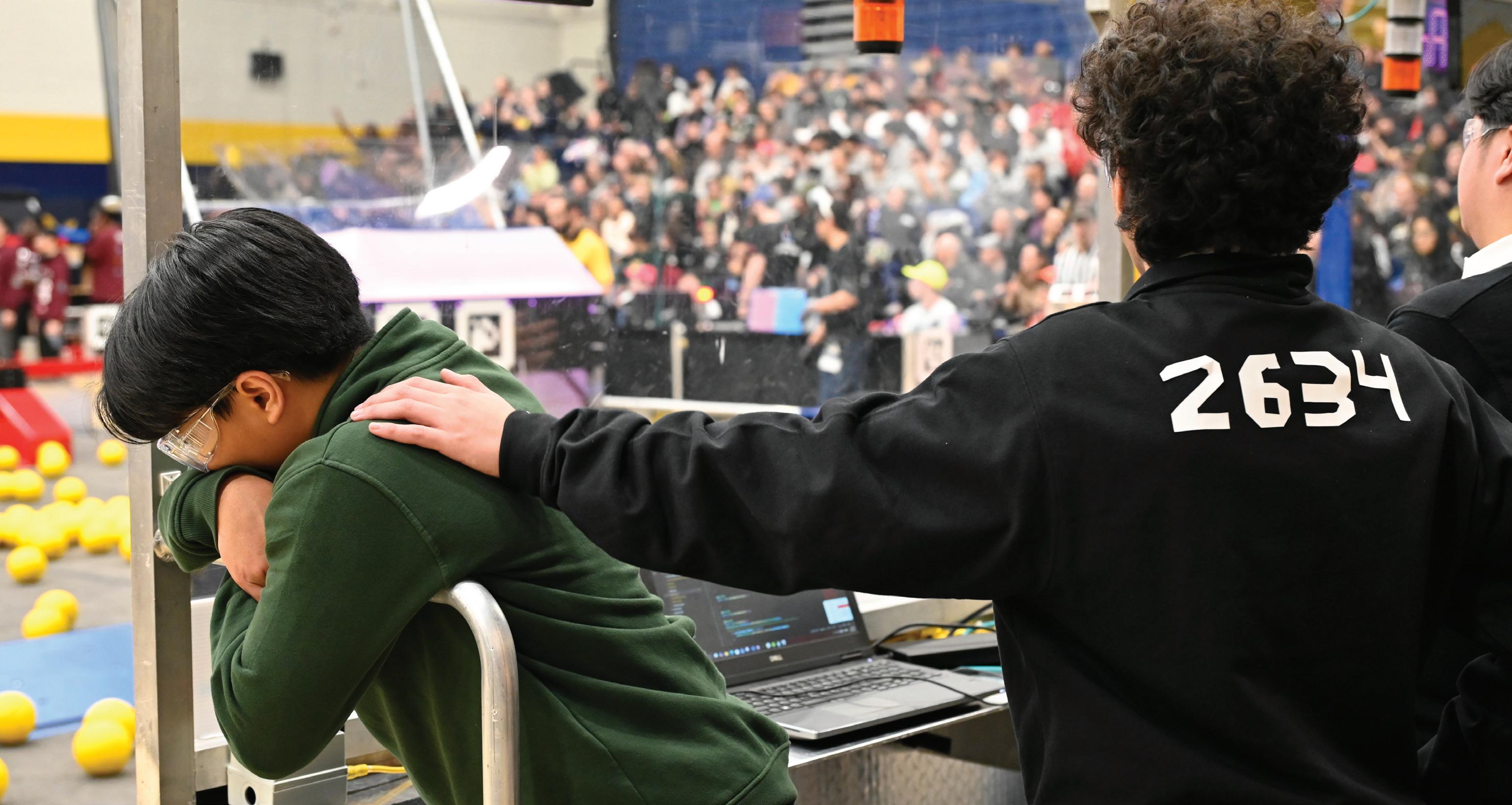
High school students put their engineering skills to the test as 29 school robotics teams gathered at Humber Polytechnic for the FIRST Robotics Competition.
The For Inspiration and Recognition of Science and Technology (FIRST) competition provides students with an opportunity to engage with Science, Technology, Engineering, and Mathematics (STEM) through hands-on experience building and designing robots.
FIRST Robotics supports experiential learning with the assistance of alumni, mentors, volunteers and teachers, allowing students to develop technical skills.
School robotics teams were given the theme and competition details two months in advance, with a strict deadline to design and program their robots.
With an archaeological theme as their inspiration, teams are encouraged to use tools and ideas from past competitions to “uncover the future.”
The three-day tournament included qualification rounds, followed by elimination playoffs, where teams work with two alliance partners to complete challenges.
This year, alliances of three compete against their opponents in fast-paced matches lasting two-minute and 40-second matches on the course.
program their robots to collect fuel and launch the fuel into the hub to score points.
The competition focuses on completing challenges to achieve goals rather than simply clashing against opponents.
Teamwork and alliances are essential, as teams work together to improve their rankings.
The program manager of FIRST Robotics Competition, William Neal, says the cooperative nature of the event emphasizes collaboration over direct competition.
“It’s not just a robotics competition, it’s not battle bots,” he said. “It is a community built around making robots, and even more important than the competition is the co-operation. We are with a team alliance sometimes, and they’re on the opposite alliance sometimes, and we celebrate everyone’s achievements.”
Team rankings are evaluated at the end based on the number of qualification rounds each team has won.
In the elimination playoffs, top-ranked teams choose other teams to form alliances, working together to compete in the final rounds of the tournament.
Neal says students who participate in the competition benefit by gaining practical experience and important life skills.
“The key feature of the FIRST Robotics competition is this human development side, which is very difficult to find any-



where else in other areas of society,” he said. Neal says education has become more focused on tests rather than hands-on learning.
“It’s all exam-based, it has no meaning aside from your marks,” he said. “You need community connection, you need teamwork, you need a purpose that you know in your heart that you’re doing something to create the betterment of the world, and school on its own doesn’t have it.”
Students on the robotics teams also have the chance to get hands-on marketing and outreach skills while competing for the FIRST Impact



Award.
“The Impact Award is another part of this human development piece. Each team is encouraged to connect with the younger children in the community, to do service in their communities, and to share the story of what their teams [are] doing to uplift their entire community with STEM education,” Neal says.
Meghan Gandhi, a Grade 11 student from Runnymede Collegiate Institute and the communication and business lead who works to partner with local orga nizations for community outreach for Team 1310, said the team collaborates
with local organizations in the York area to advocate for students to get equal hands-on opportunities to learn about STEM.
“What we do in the community is we run programs and work with different organizations such as Girl Guides, and Keys to Inclusion, which is a local group in our area, for adults with intellectual disabilities. We also run kids camps during the summer,” she said.
Gandhi says the Impact
is bigger than just robotics competitions,” Gandhi said.
“It really builds up a community, and FIRST encapsulates cooperation, communication, and working together and learning about STEM.”
The FIRST Impact Award is one of the four major awards in the competition.
Teams submit their work that tells the story of their community outreach, highlighting how they spread the mission and values of FIRST.





Kayleigh Ainsworth
Humber ETC Reporter
Tucked away on the third floor of Humber Polytechnic is a student-run clothing boutique that sells pre-loved clothing while giving students hands-on retail experience.
Rossie Kadiyska, program coordinator for the fashion management postgraduate certificate and acting coordinator for the fashion arts and business program, said Humber Boutique sells donated clothing, including jackets, T-shirts, shoes
and denim.
Prices typically range from $5 to $25, depending on the quality and brand of the item, she said.
The boutique at H344 operates Monday to Friday from 10 a.m. to 3 p.m.
Kadiyska said revenue from the boutique is reinvested into Humber fashion programs to support student events and initiatives.
She said the funds help finance activities such as the Humber fashion show and other student projects.
Anyone who donates clothing receives a 15 per cent discount on purchases, Kadiyska said. She said students in Humber’s cosmetics management program also use the boutique to sell select beauty products through a cosmetics display in the store.
Kadiyska said the boutique was created to give students practical experience outside the classroom.
“Our vision was to create a community hub for students,” she said. “Students could practice and apply their knowledge from the
programs merchandising, sales, running store operations, visual merchandising, social media and marketing.”
Kadiyska said clothing for the boutique comes from daily donations and larger collection drives organized through Humber fashion classes.
“We had a major collection drive in the fall, which is part of an event class in the fashion program,” she said. “We are also open to collecting donations every day.”
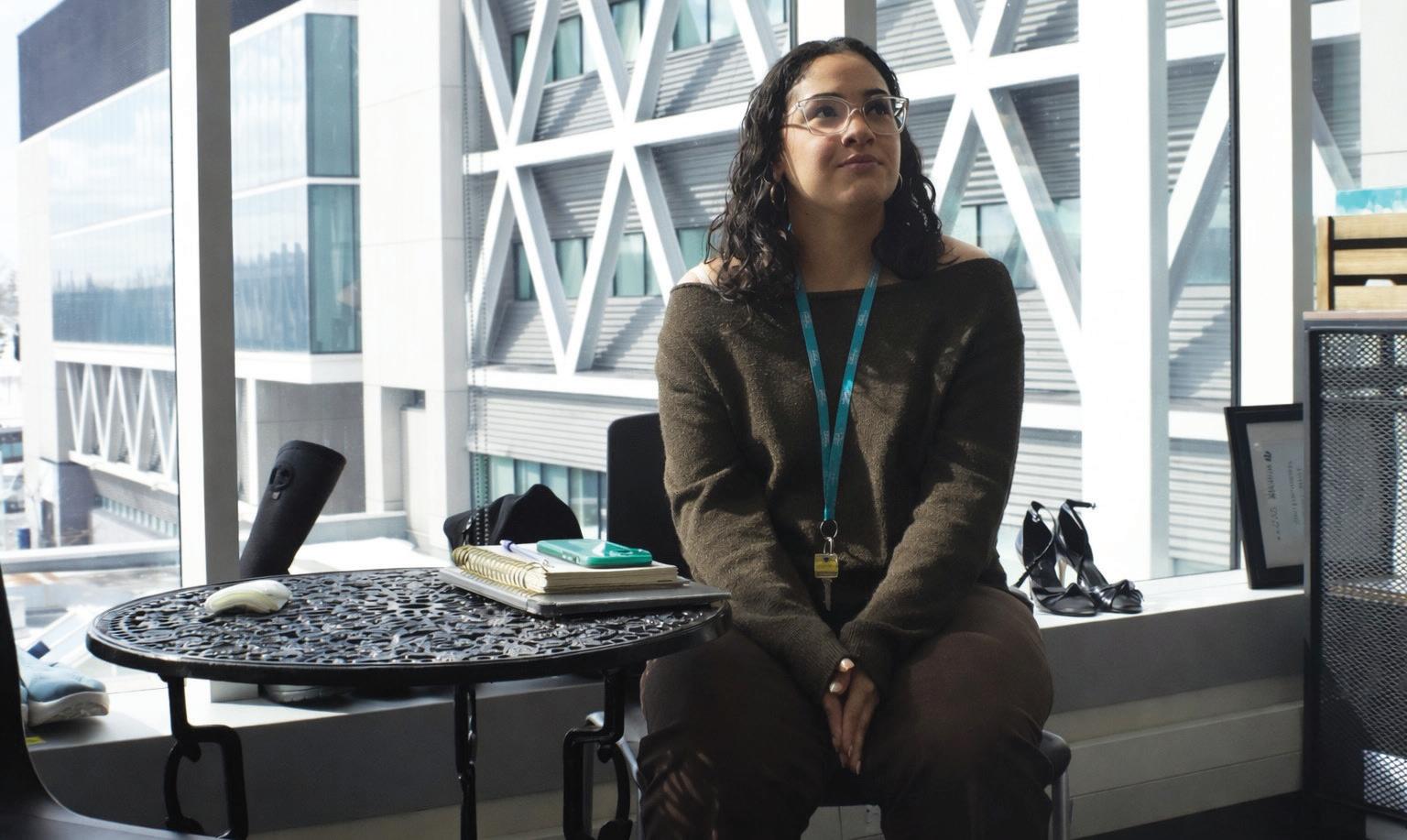
Ariana McQueen, a first-year fashion arts and business student, said she enjoys seeing how students transform donated denim into new items.
“I love seeing the different ways students transform donated denim into upcycled products,” McQueen said. “It’s inspiring to take something preloved and make it new again.”
She pointed to items created by Shawanna Charles, a first-year fashion arts and business student who turns leftover denim into bags and other accessories sold in the boutique.
Textile waste is a
growing environmental concern in Canada. About 98 per cent of plastic textile waste ends up in landfills because of limited recycling infrastructure, according to the Government of Canada.
Yanira Deyanera, a business marketing student completing a co-op placement at the boutique, said she helps promote new items through the store’s Instagram account. “I focus on promoting the outfits or new items we receive for students,” Deyanera said.
She also helps organize clothing displays and keep the boutique clean for shoppers.
Trina Troitskaya, a second-year architectural technology student, said she discovered the boutique by accident while looking for a class.
“I actually found it by accident some time ago when I got lost for one of my classes,” Troitskaya said. “I was just passing by, and the door was open.”
She said she returned to browse the boutique and was interested in clothing created by fashion students.
Kadiyska said the boutique focuses on selling higher-quality clothing that lasts longer.
“We don’t sell fast fashion items,” she said. “We rely more on quality items that have better longevity.”
Kadiyska said the boutique promotes a circular approach to fashion.
“The silver thread through the operations of the store is consume less, repair more, recycle,”
Joseph Zago
Humber ETC Reporter
Employees at Humber Polytechnic are waiting to hear about the possibility of layoffs as the school’s management evaluates the results of the voluntary employee exit program known as VEEP.
OPSEU Local 562 President Miloš Vasić says people are feeling unsettled over the undisclosed metrics Humber hopes to receive with the program.
“The last two weeks, I bet you, have been the least productive weeks in the history of Humber because this is all anyone’s been thinking about,” Vasić said. “Because the official line seems to be ‘well there are no layoffs, we hope this will avoid layoffs’ that scares the bejeebes out of me.”
Humber Polytechnic introduced VEEP to full-time staff on Feb. 25 with an email statement from the president’s office.
The original deadline to apply was March 9, but outcry from faculty and OPSEU, Humber’s faculty union, convinced the college to push the deadline to the following day.
According to an email from Vice President of People(s) & Culture Jennifer O’Brien, the payout of the VEEP packages is 20 weeks’ worth
of salary for staff with one to nine years of tenure, those with 10 to 15 years of service will get 30 weeks,
The last day of faculty taking the package will be on June 26, the email statement said. For support

and those with more than 15 years will get 45 weeks of salary.
The email said all approved employees will receive an additional 10 per cent and contingent benefits if the member is in a retirement position within 31 days of their exit.
staff and administration, the last day ranges between April 2 and June 26.
Vasić said Humber first offered a lump-sum package, but after faculty and union complaints, the payment will be split between 2026 and 2027.
Vasić said OPSEU was notified about the program hours before its official email announcement to the employees.
“Had they come to us first, we could have told them about the whole lump sum versus splitting up the payments thing. We could have let them know that that would have been an issue,” he said.
A collective agreement requires
Humber to notify OPSEU through the College Employment Stability Committee (CESC).
The agreement said CESC should be given 30 days to recommend the size of the layoffs or budgetary measures to prevent impending layoffs.
Vasić said the union would not have been opposed to the plan but would have assisted in its delivery and execution.
He said the union spoke with Humber’s administration, and its stance was that it did not need to give any notice because VEEP is not tied directly to layoffs.
“It’s a proactive plan to avoid layoffs…Even those proactive plans should go through that committee,” Vasić said.
Humber’s Associate Director of Communications, Emily Milic, said in an email the VEEP application results will be evaluated over the coming weeks, but would not comment further.
The Office of People(s) & Culture declined to comment.
In a follow-up email to employees, O’Brien urged people to consider VEEP instead of waiting for the results of the exit program. That email also advised employees to keep in mind that the future is rarely certain.

Rosemary Jaramillo Senior Reporter
Before graduation even approaches, many students are already preparing for life after school, refining resumes, curating LinkedIn profiles and attending networking events in hopes of standing out in an increasingly competitive job market.
For some, that preparation extends beyond coursework and into additional investments, from professional memberships to upgraded online tools. The question for many students isn’t just how to become “career ready,” but whether readiness now comes with added expectations and added costs. Marya Kalra, a public relations student at Humber Polytechnic, has been thinking about that balance.
She joined the Canadian Public Relations Society through a student membership, subscribed to LinkedIn Premium and built a digital portfolio to strengthen her professional presence before entering the workforce.
“Career readiness, in my view, is really about developing both professional skills and the confidence to build relationships within your industry,” Kalra said.
For Kalra, these investments are intentional rather than pressured. She describes her approach
for informational interviews.
“Networking and professional visibility can sometimes open doors that a standard application might not,” she said.
Still, she acknowledges not all students have equal access to certain opportunities.
“Some professional opportunities, like conferences, memberships, or specialized workshops, can be expensive, and that can create barriers for some students,” Kalra said. “At the same time, there are also many free or low-cost resources available.”
Among those free options, she built her portfolio using Google Sites and regularly connects with professionals through cold emails and LinkedIn messages, strategies that rely more on initiative than financial investments.
At Humber Polytechnic, structured career preparation is built into students’ programs. Joanne Sedkowski, a Career and Work-Integrated Learning Advisor at Humber, defines career readiness as a combination of technical knowledge and adaptability.
“I believe that career readiness is defined as students feeling prepared to enter the workforce by having a strong set of academic and technical skills which they can apply to their chosen career,” Sedkowski said. “Being open and willing to continue to learn and grow in a professional environment and having a strong set of soft skills, such as communication and professionalism, is

Within Humber’s professional prac tice courses, stu dents reflect on their strengths, create
career goals and complete networking exercises such as informational interviews and elevator pitches. They also receive training in workplace rights and responsibilities, health and safety awareness and professional etiquette.
Students are encouraged to attend networking events and develop their online presence, Sedkowski said, but many resources are available at no additional cost. Humber provides access to LinkedIn Learning tools, its internal job portal, CareerConnect, interview practice through the Devant platform, and ongoing advising support.
“All students, regardless of their financial backgrounds, are provided with access to the same career preparation resources,” Sedkowski said. When available, bursaries are also offered for students completing unpaid field experiences. While employers are encouraged to provide compensation during placements, there is currently no mandate requiring field placements to be paid, a reality Sedkowski said can present challenges for some students.
Despite that, she said employers primarily value skills and experience gained through coursework and internships.
“Employers value skills and experience which are gained through coursework and internships as they are looking for candidates who not only have
knowledge and skills, but for those who can also work well in a team environment,” she said. “These soft skills are often just as important.”
From an employer’s perspective, paid platforms and premium tools are not prerequisites for success. Shellee Huie, a talent acquisition specialist at Toronto Metropolitan University, said being “career ready” starts with understanding how one’s skills align with the roles they are pursuing. “A student who is careerready understands their skill set as it relates to the work they are seeking,” Huie said. “They would have done their research.”
This includes identifying industries that align with their strengths and mapping out realistic career goals.
When reviewing candidates, Huie said attention to detail stands out. “A well-written resume” is critical, she said. Candidates who tailor their resumes to reflect specific job duties are far more competitive than those who send out the same document to every employer. While platforms such as LinkedIn and online portfolios can be valuable, their influence depends on relevance. “Professional networks like LinkedIn, and personal portfolios are important as long as it’s relevant to the position you are applying for,” Huie said. “It’s another positive way to show employers you are interested and invested in the

With the job market highly
Huie acknowledged that some students may feel pressure to invest in professional development to stand out. “I am sure this is a factor for some,” she said. “With the career market in such a competitive place right now, there is definitely pressure to stand out from the crowd.”
However, she emphasized that investing in a career does not necessarily mean spending money. “It’s always a great idea to invest in a career; however, that does not always mean it cannot be done on a cost-effective basis,” Huie said, pointing to mentorship, networking groups, workshops and online learning as accessible alternatives.
Ultimately, Huie said preparation and readiness, regardless of how they are obtained, are what employers notice. With tuition and living costs already stretching many student budgets, additional career-related expenses can feel significant. Yet across student, institutional and employer perspectives, one theme remains consistent: financial investments alone do not determine readiness.
For Kalra, the most meaningful preparation comes from initiative rather than expense. “I believe personal investment, effort, and the willingness to succeed that matters far more than financial invest-ment,”


Luis Miguel S. De Castro Senior Reporter
As communities around the world mark International Women’s Day, Maria Keen’s nearly 34-year career in policing stands as a reminder of the barriers women have faced in entering male-dominated professions.
When Keen joined the Ottawa Police Service in 1992, she was only 21 years old and stepping into a workplace where she stood out immediately as a Filipina officer in a field with little representation.
“When I was a rookie on my shift, I was the only non-white female on the platoon, and they made me feel it, they made me know it,” Keen said. Keen, who retired on Jan. 30 with the Ottawa Police Service, said she quickly realized that her role carried a larger weight. As one of the few racialized women in the service at the time, she was representing the Filipino community and women more broadly.
“There was a lot of racism. There was a lot of discrimination of being a female, she said. “Remember, I’m racialized, and I’m also a female, and in a male-dominated job.”
Born in the Philippines and brought to Canada when she was
almost two years old, Keen grew up in Toronto and Scarborough before moving to Ottawa to attend Carleton University. She studied law and sociology after initially enrolling in commerce, a path she said reflected the traditional expectations in many Filipino households.
“My dad was an accountant, my mom was a nurse,” Keen said. “That was the traditional cultural Filipino thing.”
Her career path changed after an opportunity to work with the police during the summer of her final year at Carleton.
“I never wanted to be a cop,” she said. “But I really enjoyed the work in policing.” She was hired in the summer of 1992 and went on to serve in multiple roles throughout her career, including patrol, undercover work, school policing, community policing, recruiting, and later as a frontline sergeant.
During her time in recruiting, Keen helped hire what she described as the largest diverse class in the history of the Ottawa Police Service. But her early years in the job were not easy. Keen said she had to constantly prove herself in a culture where women were rare. “The adjustment was tough.
I’m not gonna lie,” she said. “They weren’t very welcoming of me.”
At the time, she said many officers questioned whether she could physically handle the job or whether she belonged in the profession. “I was also young,” she said. “They wanted to know I could handle myself in a physical situation.”
Keen also encountered moments that reflected how little awareness there was about Filipino identity at the time. In one early incident, colleagues suggested she attend a Chinese community event, despite her explaining that she was Filipino.
“That’s when I kind of realized, hmm, I really got to get involved with the Filipino community in Ottawa,” she said. From then on, Keen made it a priority to build connections between the Ottawa Police Service and the Filipino community. She regularly attended community events and worked with Filipino organizations in the city. Those efforts became even more significant when she later learned she had broken several barriers within the police service.
“I was the first Filipino in Ottawa, well, first racialized female in Ottawa but also Filipino, and first female to be hired in Canada,” she said. “I only learned that
maybe 10 years ago, and I was actually kind of shocked that there wasn’t more.”
Recognizing that milestone reinforced her desire to help others follow similar paths.
“When I was in recruiting, I really wanted to add more Filipinos and really recruit them and show them that policing was a really good choice as a profession,” she said.
Today, Keen said there are now more Filipino officers in the Ottawa Police Service, something she sees as a sign of progress.
“I used to go to the Philippine Independence Day by myself, and now there’s a bunch of us,” she said.
Throughout her career, Keen also focused on mentoring younger women in policing, something she said she wished she had when she first joined.
“My goal was always to mentor and empower these young women, because I never had that,” she said.
She said the culture within policing has changed significantly over the past three decades. Nearly half of the Ottawa Police Service is now female, and Keen says younger officers treat women in the force more as equals.
“It wasn’t like that for me,” she
said. For Keen, the most meaningful part of policing was the relationships she built with the community.
“When people come up to me and say, ‘Hey, you were my officer when I was in high school,’ and they remembered me,” she said. “You realize the impact you made on somebody’s life.”
Those moments, she said, remind her that even small actions can leave lasting impressions.
Looking back, Keen says her career evolved far beyond what she expected when she first joined the force as a young woman.
“I started off this 21 year old girl from Toronto who just went into a job that I thought was going to be exciting,” she said. “To becoming a role model, a mentor, a great representative for our Filipino community.”
Now adjusting to retirement, Keen is teaching part-time at Algonquin College and plans to spend more time travelling, including longer visits to the Philippines.
But the impact of her career continues through the communities she served and the barriers she helped break for women and Filipinos in policing.
Luis Miguel S. De Castro Senior Reporter
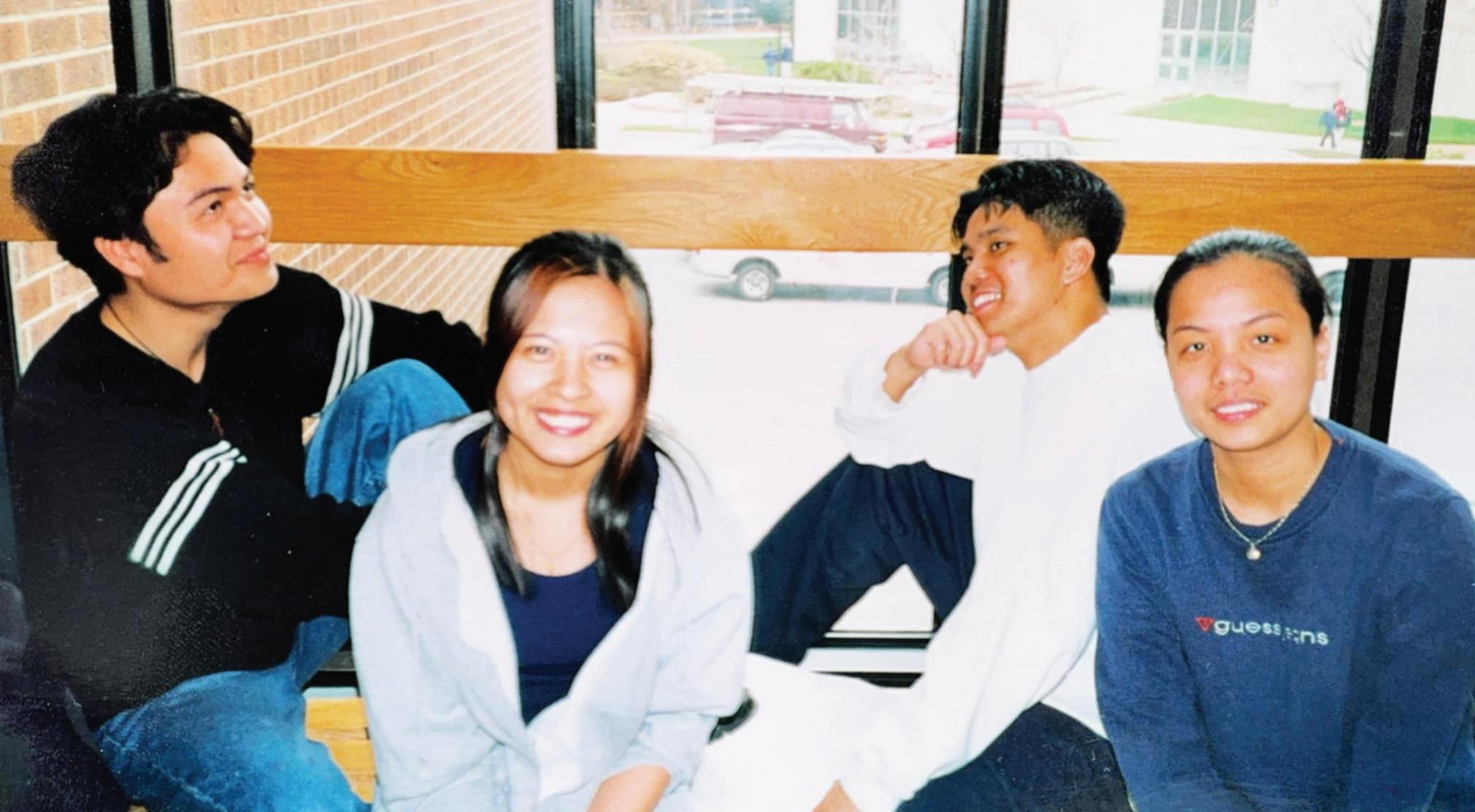
Nearly three decades ago, a long bench outside a computer lab at Humber College’s North campus became an unofficial gathering place for a group of students looking for somewhere to pass the time between classes.
None of them expected the friendships formed there would still be going strong nearly 30 years later.
For Humber alumnus Peter Mangaser, that bench located on the second floor of the H Building near room H211 became the centre of a community that has grown from classmates into lifelong friends and, eventually, extended family. Mangaser arrived at Humber in 1996 to study computer engineering technology, a program that was supposed to take three years. Like many students juggling life and school, his path stretched longer than planned. He eventually graduated in 2001. But what he remembers most from those years isn’t the coursework.
“At first it was all study, but then eventually you meet new friends and when you meet new friends, they meet new friends and then
more of you meet new friends, and then it became a big community for us here,” Mangaser said.
The group gravitated toward the bench because it was a convenient place where students from different programs could gather between classes.
“When new people were introduced, they told us to just go to the set of benches beside the room H211. They’re gonna look for that room, and then they’re gonna see the bench there, and then there’s gonna be a lot of Filipinos hanging out talking, having fun,” Mangaser said. By 1997, what started as a small group of friends had grown into something much bigger.
“It basically ballooned into like more than 50 people,” Mangaser said. The bench became a constant presence in their daily routines.
Students dropped by between lectures, waited out long gaps between classes and caught up with friends they might not otherwise see during the day.
Sometimes those meetups were productive. Other times, not so much.
“That’s where a lot of skipping happened,” Mangaser said with a laugh.
Instead of heading back to class,
a few friends might decide to walk over to a nearby mall or grab lunch at local restaurants. One favourite was Abacus, a buffet spot that offered an all-you-can-eat meal for $7.99, a deal that fit perfectly into a student budget.
For many in the group, it also became a place of support, especially for students adjusting to life in a new country.
“A lot of us were new to Canada during that time. A lot of us were looking for somebody to connect with, and then a lot of those people worked out,” Mangaser said. “It kind of makes you feel at home when you’re here. You don’t just go to school and then study and then go home.”
Over time, the group became known simply as the Bench Crew, a nickname that came quite literally from the place where they spent so much of their time.
At one point, the group even marked their territory.
“We found a block of wood where we’re sitting, and basically just to mark the occasion, we wrote down every name we could think of that hang out in that area. Not only that, it was all the jokes, all the teases, all the nicknames that we have for everybody, and that’s kind
of what made it official that this is basically our area,” Mangaser said. Back then, none of them imagined those friendships would last long after graduation.
Even after finishing school, many members of the Bench Crew stayed in touch. Weekend movie nights turned into birthday celebrations. Casual hangouts turned into holiday traditions.
“Some people find other things to do, and they went their own ways, but the ones that are tight kept that going,” Mangaser said.
Today, the group still gathers regularly, especially for their annual Bench Christmas parties, which have become a long-running tradition.
Over time, something even more unexpected happened. Their children grew up together.
Among them is Mangaser’s son, Basti Mangaser, who has grown up surrounded by the same group of friends his father met decades earlier at Humber. For Basti and the other kids, the friendships passed down from their parents feel just as natural. “They’re like family. Before they were the Bench Crew, they were friends. I consider the Bench kids, that’s what we call ourselves, like one big family,” Basti
said.
The younger generation now refers to themselves as the “Bench Kids,” carrying on the legacy of the group that started with their parents’ college days.
Family parties have become a highlight of the year, especially the Bench Christmas celebrations.
“We look forward to the Bench Christmas parties. Birthdays too. We always hope it’s Bench parties,” Basti said.
One of his favourite memories was a vacation where several Bench families travelled together on a cruise, something he says felt like the ultimate reunion.
“We had this really amazing vacation where we went on a cruise, all the people in the close, tight Bench Crew. It was one of the most memorable vacations any of us had,” Basti said.
Looking back, Mangaser says the friendships built during those years at Humber evolved into something deeper than he ever expected.
“It’s like from friends to family,” Mangaser said. “We’re that close that we don’t care what we tell each other. We’ve known everybody for so long that it’s no more of a friendship, it’s family.”



Sharujan Viyayasinghabagu
HumberETC Sports
Humber North’s extramural men’s indoor cricket team have one last shot at gold this season.
The team is set to host the Ontario Collegiate Recreation RECCup Championship tournament on March 18 at North’s Athletic Centre.
In a season of ups and downs, the squad was able to secure a spot to compete in the RECCup championship at recent tournament qualifiers.
The team has set a goal for this final round: to win a gold.
Humber North indoor cricket head coach Taqi Baig said this tournament is important for the team to win games with good margins.
facility, considering the squad won five tournaments at home.
During practices, both the North and the Lakeshore teams come together and play against each other to prepare for the challenges that the teams will face and work on areas that need improvement.
Gokul Krishnan, a second-year Interactive Media Management student and a member of the North team, said the practices are going well.
“THERE IS ONE GOAL. I TOLD THE TEAM FROM DAY ONE, WHEN WE STARTED IN SEPTEMBER, WE HAD TO WIN THIS TOURNAMENT, THE FINAL TOURNAMENT, WHICH IS THE RECCUP, ”
- Taqi Baig
it,” Krishnan said.
Humber Lakeshore’s cricket team will be participating in this tournament. They will be looking forward to a different result after only securing one win and a loss in last year’s RECCup Tournament.
“There is one goal. I told the team from day one, when we started in September, we had to win this tournament, the final tournament, which is the RECCup,” he said.
Last year, Humber North lost in the RECCup championship game against Conestoga. The team took home second-place honours, but the coaches and players are looking for a different outcome this year.
“Home advantage, we have practiced here for the last eight months,” Baig said. “This time the gym is one and a half (times larger) compared to the regular practice.
He said the team plays better in the larger
“We’ve been having so many sessions, at least, you know, two or three per week. We’re getting good with being as a whole unit and all that,” Krishnan said.
The team is looking towards improving areas of their game in their practices.
“There’s a lot of things, you know, how to bat, how to watch the ball. The line and length of bowling the ball, and improving on the basics of the game,” Krishnan said.
The team says they’ll be ready for the tournament and that they do not really feel any pressure heading to this tournament.
“We don’t want to think about the other teams much. We just think about ourselves, when the game is on, just play the ball, that’s
Udit Oza, a fourthyear accounting student and a member of the Lakeshore’s team, said the team wants to win the RECCup.

“We have not won a single tournament, so we just want to break the cold streak and win this tournament,” Oza said.
The Lakeshore team has practiced with the North team a few times this season, giving them a slight home advantage.
HUMBERETC/SHARUJAN VIYAYASINGHABAGU
“We have been practicing a lot on this ground,” Oza said.
“This is our fourth time coming here and just practicing with the North team. It has been good so far,” he said.
Luca Agostino HumberETC Sports
The University of Akron defeated Humber 4-3 in abest-of-seven Midwest A, National Esports Collegiate Conference (NECC) Rocket League Division three matchup.
Coach Eric “Rice” Buchyns said post-game he was happy with his team’s showing and some of the individual plays they made during the match.
They could give the squad a boost for future matches.
“Especially the individual plays. I saw, I got a lot of clips, honestly, from the stream. So it was pretty good to see that, and I know that boosts motivation and general morale,” Buchyns said.
The first game went to Akron after a back-and-forth battle between the two teams, being tied at one goal each at the start, but a late-game push from Akron saw them take the first game.
Humber followed up with a strike of its own, taking the next two games with back-to-back strong performances, putting
them up in the set by two to one.
Humber looked and felt impressive at how it was able to play together as a team in the match. Noah “Noah1127” Mossini said the team is working well together.
“I think we’re getting better with team plays in general and more, calling each other off the ball or calling for demolitions and stuff like that. We work it well-rounded.
I feel like it’s getting better at that thing. It’s getting impressive to me,” Mossini said
But following that strong twogame push by Humber, Akron kept pushing back, showing why

they are a challenging team to play, especially when it came to reading the play style.
“Towards the end, they were actually, like, pretty hard challenging, which became a little more difficult to read,” Buchyns said.
Akron would then go on to win the next two games to go up three to two, pushing Humber closer to staying winless in Midwest A (NECC).
But Humber crawled back to push for sudden death in the bestof-seven series.
In sudden death, Akron and Humber exchange goals early, but then Akron flipped the script, scoring two straight goals.
Humber’s attempt to get back in the game wouldn’t matter as Akron held on to win, leaving Humber winless on the season, losing four in a row.
Humber’s coach had praise for his players, who battled right to the final minute.
“But it was also good just to see, the fight was still going all the way down to game seven,” Buchyns said.

Marco Moretto HumberETC Sports
The Humber Hawks women’s soccer team took home bronze at the Ontario Colleges Athletic Association (OCAA) indoor soccer tournament at the Ontario Soccer Centre on March 12.
Humber beat St. Clair 1-0 to take the medal.
Fourth-year defender Doreen Anane-Bediakoh said it was good not to leave empty-handed.
“Leaving with bronze was bittersweet. Of course, we always want to strive for the gold, especially coming off last indoors success,” she said. “I’m glad we were able to podium nonetheless, and it was against a team that we have an unspoken rivalry with.”
Anane-Bediakoh emphasized how special this group is and how better results are expected next year.
“The girls gave me a reason to keep playing the sport I love,” she said. “The future of this team is bright as long as we keep the podium in our minds and continue moving toward it together.
The Hawks are coming into this tournament as the reigning champs and began their journey this year in Pool B in the regional round on March 3.
Humber shared Pool B with the Seneca Sting, Lambton Lions and Durham Lords. They finished second in the group with a 2-1 record, only losing to Seneca, who topped the group.
In the championship round, Humber
was placed in pool A with the Centennial Colts, Conestoga Condors, and LakeheadOrillia Thunderwolves.
The Hawks started the triple header against the Thunderwolves with a close 2-1 win. After a break, they were back in action against Centennial that resulted in a sloppy 2-0 loss. The final match of the day against Conestoga had major stakes for the Humber women, a win-and-in situation.
The match started slow but as it heated up, each team’s goalkeeper stepped up as the shots started rolling in.
Condor Skylar Morales and Hawk Isabella Bernardi traded big saves, but late in the game, first-year midfielder Mikayla Orrico put home the game’s only goal.
The intense win left the Hawks with a 2-1 record, finishing second in the group behind Centennial and sending them through to the semi-final.
Humber’s head coach, Jose Caro, was happy with the bounce-back win and ready for a shot at gold.
“The girls are resilient; they bounced back from the second game. We finished in a spot where we can go tomorrow and play for a medal,” Caro said. “I think it would be great to finish the year with gold and move on to the fall season on a high.”
Goalkeeper Isabella Bernardi, who held the Condors scoreless, said it was a huge confidence boost going into the semi-final.
“It feels great. In a win-or-go-home game, everyone stepped up defensively, and we stayed really disciplined. Getting the shutout
was huge for our confidence, and it feels good to keep our tournament run going into tomorrow,” Bernardi said.
There were many things they did well, but still had things to work on, which comes with a different style of soccer playing indoors.
“I think we did a great job communicating, staying organized defensively, and working hard for each other. We moved the ball well and stuck to our game plan, which helped us control the game,” she said. “Indoor is really fast, so we want to keep improving our quick decision-making and finishing chances.”
The semi-final match was between Humber and Seneca, which resulted in a 3-0 Seneca win.
Third-year forward Alexis Cordeiro opened the scoring in the 15th minute, followed by fifth-year midfielder Martina Pannia burying another, putting them up 2-0 going into half.
Humber couldn’t get anything going in the second half, and Seneca scored their third and the final of the game, sending the Hawks to the bronze medal match against St. Clair.
The first half of that game was a mix of both teams splitting possessions and opportunities.
It was scoreless going into halftime, and it stayed scoreless at the end of regulation. The game headed to 10 minutes of extra time, which solved nothing and sent the game to penalties.
The first penalty kick was taken by Hum-
ber’s Elisa Oliveira, who gave the Hawks a 1-0 lead with a strong strike. Brianna Kinsley-Clough equalized the score and was St. Clair’s only scorer. Hawks’ Kiara Puntillo, Mikayla Orrico and Micayla Santaguida all scored while Bernardi held down the net.
Humber took a 1-0 win by the way of penalty kicks and secured the bronze.

Sean Moniz HumberETC Sports
The Humber Hawks men’s soccer team won silver in the Ontario Colleges Athletic Association’s indoor soccer tournament at the Zanchin Automotive Soccer Centre in Vaughan on March 11 and 12.
A week before the tournament started, the Hawks played in their pool matches, attempting to qualify.
The Hawks had their opponents drawn for the round-robin phase on March 11, and the draw would see them face the host Sheridan Bruins, Centennial Colts, and an OCAA gold rematch against the Condors.
Humber would first face the Bruins. In the first half, neither team was able to find an opening and went into the break even at 0-0.
After half-time, both teams stepped up the tempo, with five total goals scored in the second half.
Humber would score first with third-year midfielder Franz Mella finding a way past Sheridan goalkeeper Nicholas Ceglarski with a shot into the bottom left corner.
The Bruins would quickly tie the game up as the home crowd erupted with the game tied at 1-1.
Mella would score again to make it 2-1 for the Hawks after he rocketed a shot past Ceglarski.
A penalty was won by first-year forward Cristiano Candelaresi after he was pushed in the back, and fourth-year defender Isaiah Noel would easily dispatch it to make it 3-1.
Sheridan scored a consolation goal late, but Humber would take the 3-2 win.
Centennial was the next opponent for the Hawks to face.
A physical match-up between two of the favourites in the tournament, especially after the Colts tied their first game against Conestoga.
A 1-1 tie going into added time saw both teams dying to find one final chance before the referee blew the whistle.
Two wins out of two for the Hawks saw them confident going into their final round-robin game against Conestoga, with the group already wrapped up.
Against the Condors, Humber dominated, but only managed to find the net twice, to go perfect in the round robin stage, eliminating
Conestoga in the process.
The Hawks would be drawn up against the St. Clair Saints in the semi-finals.
After beating Redeemer and Seneca, the Saints finished second in its group, only behind the Fanshawe Falcons, who also went a perfect three-for-three in the groups.
Humber would take an early lead just two minutes in thanks to a penalty from first-year midfielder Michael Crocco.
Second-year midfielder Tenzin Wosal found himself at the end of one of the multiple chances the Hawks had to extend the lead to two.
Following the break, St. Clair would get one back to bring the deficit to one just three minutes after halftime.
Humber would extend its lead back to two with Noel scoring five minutes from the final whistle to finish the game 3-1, advancing the Hawks to their third-straight OCAA indoor soccer gold medal game.
The final would be a rematch between Humber and Centennial after the Colts defeated Fanshawe 2-1 in the other semi-final.
Humber broke the deadlock early with a thunderstrike from Noel in what might be his last game as a Hawk.
Head coach Jason Mesa said players like Noel and captain Luca Pinto, are leaders in the team and replacing them are very big ifs.
“Those two guys have been pillars for us in the back row this year,” Mesa said. “But I’m going to work as hard as I can to see if I can get them to come back for one more.”
Just three minutes before half, the Colts would find the tie off a quick free kick while the Hawks were out of shape.
The second half would bring no goals, but many chances for both teams, as would extra time for either team to find that late goal like the first matchup.
Penalties would decide the gold medal match.
Centennial would score its first penalty, while Pinto had his saved.
The Colts would miss their next one, while Crocco tied it up, scoring his.
Both teams would make each of their next three penalties, with Centennial scoring to take a 5-4 lead.
Fourth-year midfielder Cisco Thomas rattled the ball off the crossbar, giving the Colts their first indoor soccer gold medal since the 1993-1994 season.
Mesa said it was a very good year for the team, not a great one.
“The provincial final [was] within our grasp. And unfortunately, we haven’t been able to achieve that goal,” Mesa said.
“Obviously, winning the national final in the fall was very special. It would have been nice to be able to bring home two golds this year,” he said.
Pinto said the thing with the team is always family, and although it didn’t lead to gold, they can look at the season as a good one.
“It became a bit sloppy, and I don’t think we ever should have went to penalties, but, you know, it happens.”
Mella said the team, despite the loss, is staying together and will try to run it back next season.
“They’re not leaving, man, they’re staying. One more year. All of our last years are next year. We’re all here, man. No one’s leaving,” he said.