HUMBER ET CETERA


PROTESTERS FACE OFF AT SANKOFA SQUARE, P. 2




Stephen Chamberlain Senior Reporter
Two visions of Canada clashed in a downtown protest on a cold and rainy Saturday afternoon.
Nicholas Wright was moving around the perimeter of Sankofa Square as people walked by with Canada First signs and Canadian flags. He was there to support the Canada First protest, get to know some of the folks and express his thoughts.
“When I’m speaking out with most people, they assume I’m crazy,” Wright said as he stood just beyond the police barricade. “It makes me feel forcibly isolated.”
He wants the government to impose stricter immigration controls to prevent potential crime and preserve a version of Canada he remembers from his youth. He said he blames the government for its lax immigration policy.
“I’d like to say that it feels like the Liberals want to invite more criminals when they say immigrants are welcomed,” Wright said. “I think I’m safer with, uh, certified gang bang Bloods-Crips.”
Ben Marenlensky stood on the south side of the square as part of a counter-protest. He emphasized the importance of communities organizing to challenge anti-immigrant narratives.
“I heard that fascists and bigots were rallying, and I felt that it was important to show immigrants, people of colour that, you know, we stand with them, and we’re against this,” Marenlensky said. “We’re not going to let you spread
hate in the city.”
Marenlensky said the government is already increasing deportations and says the Canada First group are upset because they’re “not doing it fast enough.”
Toronto Police warned in an Instagram post they would be at Sankofa Square to ensure public safety.
Earlier this year, on Jan. 10, protests were held at Nathan Phillips Square at an anti-immigration rally, which resulted in eight people being arrested, according to police reports.
This protest of about 100 people, echoing anti-immigration sentiment and laying blame at the feet of the federal government, was met by about 100 counter-protesters.
A Canada First protester, not wanting to give his name, is self-described and known as ‘Captain Canada’ on social media, wore a cap and half-mask emblazoned with a 51st state patch and held a superhero-style shield displaying ‘Canada First’.
He said he wants the government to change. “I want immigrants to come here. Some of my best friends were not born here, but that doesn’t mean we should let everybody in,” Captain Canada said.
“I got 51st written on my helmet,” Captain Canada said.
“Do I want Canada to be the States? No, but would I go with that other than what we have here? In a second.”
Daniela Maria Bonamico gave
voice to the counter-protest, standing with a megaphone on the south sidewalk outside the square, as megaphones are not permitted within Sankofa Square.
“So, the idea that we are having rallies in our street that are very thinly veiled racism rallies asking for mass deportation in a country built by immigrants to me is abhorrent,” Bonamico said. “It’s not the city I know, it’s not the country I know, and I will always stand up against it.”
Izabel Hojwa, who immigrated from Poland about 10 years ago, joined the Canada First protest.
“Two years ago, I noticed there is something wrong,” Hojwa said. “I noticed more and more immigrants and bad immigrants, and they are just criminals. I think they should close the border and pay attention to what is going on here. The government doesn’t want to do anything, and I’m not going to stay silent because I don’t agree with it.”
The Canadian government’s current immigration plan aims to reduce the temporary resident population to less than five per cent of the population by the end of 2027 and stabilize permanent resident admissions at less than one per cent of the population after that. Planned permanent resident admissions for 2026 are capped at 380,000, less than one per cent of Canada’s total population.
Police were behind metal barriers to the west of the square. They also formed a wall to the
Humber Et Cetera is the Humber Polytechnic journalism program laboratory newspaper. It is created by journalism students in the Advanced Diploma and Post Graduate programs. Et Cetera serves to inform the Humber community and give its readers well-rounded coverage on the things that matter to them.
south in front of a snowbank, which served as a natural barrier, as protesters on both sides engaged in yelling matches. Some of the banter was heated with verbal profanity, and some was self-propagandizing, but the event eventually ended without incident.
Other times, it seemed there was an illusion of a united front as people chanted ‘Canada first,’ which counter-protesters mimicked with ‘Yeah, Canada first.’
When asked about why these protests are popping up, Bonamico said she believes we are living through the end stages of capitalism as a workable system.
“We are seeing a lot of people in fear,” she said. “They fear about the security of their home, they fear about their future, they fear about being able to feed their children. And when you have people that are fearful, they’re willing to take any sort of propaganda that gives them a finger to point at.”

Reet Arora HumberETC News
The Ontario government’s recently announced plan to make major changes to OSAP by drastically reducing the percentage of grants to 25 per cent from 85 per cent has angered opposition parties, who say they are taking steps to try to fight the move.
After years of being accused of underfunding the post-secondary system, the Doug Ford-led government proposed changes to the Ontario Student Assistance Program (OSAP) that are the most contentious of a larger plan that includes an increase in funding to colleges and universities, as well as giving post-secondary institutions the ability to increase tuition.
The OSAP change that would cap non-repayable grants at 25 per cent marks a major cut from the previous 85 per cent grant-based funding. The new model strives to provide 75 per cent of OSAP funding as loans and will no longer offer grants to students at private career colleges.
Tyler Watt, Liberal MPP for Nepean and the party’s critic for Training, Colleges and Universities, said these changes ensure that students who use OSAP leave their post-secondary education with significant debt, as they will

need to pay this money back with interest.
Watt said he finds this deeply concerning and received more than 100 emails immediately after the announcement.
He has been in contact with folks at colleges, and many have said that they are unsure whether they will stay open after next year.
Watt agreed that this $6.4 billion funding was needed to support the 600 programs that were cut across Ontario, adding that this was a fire that this government set for themselves.
He said the alternative approach would be proper investments.
“Sure, there can be efficiencies,
there can be cost-saving measures implemented in every sector, but bringing them to a point of where it’s nearly collapsing and then giving them a little bit to survive is not how we should be operating this system,” Watt said.
Watt said the premier is “completely out of touch with reality and OSAP.”
“He can try to villainize an entire group of students, but these are people who vote, and I hope they are motivated and fired up to get better people in, because they deserve it,” Watt said.
Watt said he has written a letter to Nolan Quinn, the Ontario minister of Colleges, Universities,
Research Excellence and Security, demanding an immediate reversal of the changes made to OSAP.
Peggy Sattler, NDP MPP for London West and shadow minister for Colleges, Universities, Research Excellence and Security, said these changes are making students question whether they can afford to study next year.
Sattler said this is a very poor decision and at an even worse time, when the province is in the middle of a job crisis, especially among youth.
“Really, there is no good time. This change can’t be justified because not only is it going to harm the students whose lives will be
affected by this change, but it also hurts our local economies when employers won’t have that pipeline of graduates that they were relying on,” she said. “It’s nonsense. There is no student from a family earning $250,000 that is collecting OSAP.”
Ontario Green Party leader and Guelph MPP Mike Schreiner said that Ontario has the lowest funding for the post-secondary system, record-high youth unemployment levels of 16.5 per cent, and students will now be entering the worst housing crisis in Ontario’s history.
Schreiner said the Greens’ objective is to increase grants to 100 per cent rather than dramatically decrease them.
“The premier simply doesn’t get it. He doesn’t understand it. He doesn’t support it, and that’s exactly why he has starved the system since he has been elected,” he said.
Schreiner said the Ford government is making Ontario less competitive despite it having some of the highest-quality colleges and universities, which are unable to uphold that standard because of being severely underfunded.
“I’d love to see Ontario at the top, but at a minimum, let’s at least bring it up to the national average,” he said.

Ontario Premier Doug Ford has told students to stop taking “basket-weaving courses,” after the provincial government announced, on Feb. 12, a cut to Ontario Student Assistance Program [OSAP] grant funding.
As someone who relies heavily on OSAP, I physically cannot afford the tuition on my own, and no matter what program I am in, it is not going to help me be able to fund my tuition.
I currently have no job to be able to support myself, despite trying to find one, and have no support from my parents. If my OSAP loans increase while the grants decrease the next few years I am in school, I am going to have a difficult time paying off my loans.
The idea that I could afford my education without having to pay off any debt once I graduated is incredible.
Now that it has been ripped from me, I will be forced to depend on borrowed money if my grants are turned into loans.
Post-secondary education should be affordable. Ford has eliminated the only easily accessible source of funding that the average person can afford.
Many countries around the world offer free or affordable education. Canada is slowly moving toward unaffordable post-secondary tuition, much like its southern neighbour.
Ford’s use of “basket-weaving courses” is an inappropriate com-
ment. It is an Indigenous practice. Considering Canada’s history of hatred towards Indigenous people, I think we can stand to learn a little bit about the culture that Canada has tried to repress.
The San Jose Museum of Quilts and Textiles said in a post on basket weaving that baskets are part of the heritage of many Indigenous peoples.
Basket weaving should not be used as an argument to students who have the constitutional freedom to choose their future, including what they learn.
Ford said students should go into healthcare. Yet he has cut funding to that.
A Jan. 27 report by the Canadian Union of Public Employees stated there will be longer wait times, rushed care and overcrowded Ontario hospitals due to government cuts.
It said these cuts are expected to cause over 10,000 job losses.
The Ontario Nurses Association stated on May 15, 2025, that Ford’s
healthcare budget will increase the number of nurses in the province by 2,000.
It said at least 26,000 are needed to reach the national per-capita average.
Ford said in the speech to focus on science, technology, engineering and math [STEM], “those are where the jobs are.”
Leah Ritchie, a graduate from the University of Toronto with a Bachelor of Science in human biology, said she spent nearly two months looking for a job.
She said the job field was nearly impossible to enter because of its competitive nature, despite her extensive qualifications.
Ritchie said many people receive interviews and offers because of their network and referrals, not because of the courses taken in post-secondary.
“In my opinion, if there ever was a barrier to accessibility in the job market, this would be it,” she said.
Telling students what career they should choose is inappropriate.
He is not a parent who can’t afford to fund their children’s post-secondary education, and he is not a guidance counsellor.
Ford accused students of spending their OSAP money on “fancy watches and cologne.” This language is uncomfortably similar to the words used to demonize welfare recipients before a cut to benefits.
If he is so concerned about the misuse of OSAP funding, then perhaps the premier should think of a more suitable and empathetic solution to allow those who need the funding access to it.
Ford’s position seems to stem from ignorance. His statements on what he thinks are the realities of post-secondary students cannot be backed up by solid evidence.
My reality is not one I believe can be comprehended if his mindset is on making money for the province rather than investing in its education.
Mason Kossak Senior Reporter
A Humber College journalism student says a February vacation in Cancun turned tense and confusing after news broke that a powerful Mexican cartel leader had been killed, triggering unrest in parts of the country.
Allison Waytowich, a post-graduate journalism student, was in Cancun from Feb. 17 to Feb. 23 when Nemesio Ruben Oseguera Cervantes, known as “El Mencho” and the leader of the Jalisco New Generation Cartel, was killed during a Mexican military operation in the western state of Jalisco on Feb. 22.
Mexico’s federal security officials confirmed the killing was followed by retaliatory violence in parts of western Mexico, including vehicles set on fire and road blockades in Jalisco and nearby areas.
Waytowich said she did not initially grasp the severity of what had happened.
“It was the second-last night of my trip,” she said. “We were walking around trying to find a restaurant to go to for dinner, and we noticed it was like a ghost town outside. Nobody was on the streets, and usually it was pretty busy in the area.”
She said restaurants appeared to close early and businesses that would normally be open were
shutting down.
“I went into a restaurant to try to sit down and eat with my family. The staff couldn’t speak English and gestured that the restaurant was closed for the day. It was the middle of the evening. It shouldn’t have been closed.”
Waytowich said she and her family were initially unaware of how serious the situation was until people back home began contacting them.

“We were oblivious to it at first,” she said. “We had no idea it was happening. It was when our friends and family started texting us to see if we were OK. That was unsettling because they were obviously getting news that we weren’t getting at the time.”
Soon after, she began receiving messages about a security alert circulating in Cancun. She described it as a shelter-in-place advisory connected to unrest fol-
lowing the cartel leader’s death. Although confirmed reports of violence were concentrated in western Mexico, Waytowich said the atmosphere in Cancun shifted quickly.
“There was a visible change,” she said. “No one was outside. The streets became dead.”
She was staying outside the hotel zone rather than at a resort. She said she noticed increased patrols around her accommodation that night.
“They had security patrolling the perimeter all night,” she said. “I could hear them outside with flashlights, moving around and checking things. That’s when I started to get pretty scared.”
Waytowich said her family became increasingly anxious as rumours circulated about cars being set on fire and possible blockades near Cancun.
“We’d heard that three cars had been set on fire pretty close to us,” she said. “We didn’t know if things were going to escalate in Cancun.”
Her flight out of Cancun was delayed multiple times. She and her family went to the airport at 6 a.m., hours earlier than necessary, out of concern that roads could become unsafe.
“The biggest threat was getting from where we were staying to the airport,” she said. “We didn’t know if roads were blocked or if
cars were being set on fire.” She said anxiety was visible at the airport.
“At the airport, people were crying and visibly anxious,” she said. “All the flights out of Cancun were delayed because of this. It was just high stress.”
The Canadian government’s travel advisory for Mexico advises Canadians to “exercise a high degree of caution” due to high levels of criminal activity and notes that security operations can result in road closures and disruptions in affected regions.
Waytowich said what unsettled her most was not direct violence, but difficulty accessing reliable information.
“For some reason, CBC was blocked on my phone,” she said. “A lot of the sites I normally get news from wouldn’t open.”
She said she does not know why the sites were unavailable, suggesting it may have been related to being outside Canada or using an international eSIM while travelling. She relied heavily on social media and Spanish-language local reporting, translating posts in real time as she tried to piece together what was actually happening.
“I was awake all night refreshing Twitter, now known as X, with Cancun as a keyword before flying out,” she said. “It was mostly people saying cancel your trip,
don’t go to Mexico, the cartel will get you. Very fear-mongering.”
She said much of what she saw online warned that violence was “coming to Cancun,” even though she did not experience direct violence there.
“Honestly, nothing really dangerous happened to me,” she said. “It was mostly the fear around it and the widespread panic, especially at the airport and online.”
Waytowich said confirmed reporting showed significant unrest in western cities such as Puerto Vallarta and Guadalajara, but in Cancun, on the shores of the Caribbean Sea, the impact was largely psychological.
Nevertheless, Global Affairs Canada suggests using a high degree of caution when in Mexico and avoiding all unnecessary travel in Jalisco.
“In Puerto Vallarta, it was chaos. Buildings on fire. Cars on fire. Airports getting shot at in Guadalajara,” she said. “But where I was, it was mostly mass panic.”
She returned to Toronto on Feb. 23 without incident. She said the experience highlighted how quickly fear can spread when verified information feels limited.
“We were kind of in the dark,” she said. “It felt like watching the country unravel on my phone without knowing whether we were in its path.”


EVs led this year’s event, but AI is the industry’s next focus.
Mason Kossak Humber ETC News
Electric vehicles dominated the floor at the 65th Canadian International AutoShow this year, but artificial intelligence is emerging as the industry’s next major innovation. From expanded EV lineups to conversational AI inside the dashboard, the 2026 AutoShow reflected an industry moving beyond the transition to electric power and into a new phase defined by software, connectivity and national industrial strategy. Manufacturers filled the Metro Toronto Convention Centre and promoted expanded electric lineups, new battery technology and charging solutions during this year’s auto show. Displays offered detailed information panels on battery life, range and infrastructure, reflecting how electrification has shifted from niche to mainstream.
Benjamin Krautner, a fourthyear industrial design student at Humber Polytechnic, said electric vehicles are becoming normalized. “I think it’s now becoming more accepted and people are actually looking at electric as a viable option,” Krautner said. “Once you see the Japanese companies starting to get into the EV market, that’s when you know it’s
starting to become a big enough thing,” he said. Public acceptance of EVs appears to be reshaping how automakers compete. While battery-powered models were once the headline innovation, several manufacturers now emphasize software integration and in-car intelligence. Polestar showcased its partnership with Google that integrates Google Gemini directly into its vehicles.
Olli Nott, a partner manager at Google, demonstrated how the conversational AI system allows drivers to interact with the vehicle. Cars are built with Google in them. “We have Google Assistant, Google Maps and Google Play built into the car straight away,” Nott said. “One of the cool things with Google Gemini is we can talk to it more conversationally, we can have more of a conversation.” Nott said Gemini
has been adapted specifically for vehicles and will be rolled out to cars already equipped with Google-built-in systems. “This is going to come to all vehicles with Google built in, not just the new vehicles,” he said. The integration allows drivers to plan routes, locate charging stations and receive realtime battery planning. “It plans
through a Bluetooth app and adjust settings directly. “You can log into our Bluetooth app, connect to your vehicle, and you can actually set the speed,” he said.

all this for you,” Nott said. Not all electrification on display involved artificial intelligence. Todd Dussault, sales director of Navitas Vehicle Systems in Waterloo, Ont., said his company manufactures small electric drivetrains used in golf carts and industrial vehicles. Users can connect to the vehicle
“It’s all programmable through our app.” When asked whether the system included AI, Dussault said, “There’s not.” Project Arrow, the Automotive Parts Manufacturers’ Association’s Canadian-built zero-emission concept vehicle, remained part of the show’s broader message about domestic capability and supply chains.
During a media panel, industry leaders discussed electric vehicle adoption, tariffs and the potential import of Chinese EVs into Canada. Brian Kingston, president and CEO of the Canadian Vehicle Manufacturers’ Association, said EV sales currently sit at roughly 10 per cent of the market.
“The current government wants to
get to 75 per cent by 2035. That is impossible with the current support that we have,” Kingston said. “There is no automotive industry in Canada if we do not have access to the United States,” he said. The discussion turned to the federal government’s plan to allow a number of Chinese vehicles into Canada. Flavio Volpe, president of the Automotive Parts Manufacturers’ Association, said the issue goes beyond pricing. “There is no benefit to the Canadian auto sector for the import of tariff-free, Chinese vehicles that have no Canadian content,” Volpe said. Kingston said allowing Chinese vehicles into Canada raises security concerns. “With respect to safety, it’s really connected vehicle technology,” he said, noting the U.S. also raised concerns about software and hardware transmitting data abroad.
David Adams, president and CEO of Global Automakers of Canada, said affordability remains a central question. “Whether this transpires into a win for consumers or not remains to be seen,” Adams said.
As electrification accelerates and AI becomes embedded in vehicle systems, manufacturers are balancing technological advancement with affordability, infrastructure and geopolitical realities.
If the federal government is serious about heeding the calls to action from the Truth and Reconciliation Commission, then improving educational outcomes for Indigenous, Métis and Inuit Peoples cannot be treated as a side project — it must be a fully funded national priority.
Inuit Tapiriit Kanatami, a nonprofit organization that represents Inuit across Canada, is expected to open the Arctic’s first Inuit-led university by 2030, serving 100 students and employing 80 staff members in Arviat, Nvt.
Mostly private funding was sought for this venture: $52 million from Nunavut Tunngavik Inc., the non-profit and legal representative of Inuit, $50 million from MasterCard, $2 million from Makivvik, an Indigenous political organization representing the Inuit of Nunavik, $1 million from the Rideau Hall Foundation and $1 million from the McConnell Foundation.
The federal government confirmed only last week that it will contribute the same amount as MasterCard, just $50 million, which is a mere 25 per cent of the
estimated total needed to get the university up and running.
Currently, aspiring Inuit students must leave their home communities and travel considerable distances to pursue post-secondary education, as there is none available in Nunavut. The distance from their home and the prohibitive cost are barriers that would discourage many from pursuing higher education, even though it could lead to improved employment prospects and increased earning power that their communities need.
has not done this in Nunavut.
In addition to the physical barriers, it is important to note that the federal government has consistently underfunded Indigenous students, which has put them at a clear disadvantage. Currently, the funding being provided has been reported by Indspire as insufficient
future, while having the support and proximity of their community.
“THE FEDERAL GOVERNMENT MUST BE MORALLY COMPELLED TO FULLY FUND INDIGENOUS AND INUIT EDUCATION.”
The federal government should be the major contributor to this venture. Private donations are corporate gestures of goodwill. These should be used to fund scholarships and bursaries. The federal government is morally responsible for ensuring access to post-secondary education, and it clearly
to complete a degree.
The 2021 Census shows that only a shocking 6.2 per cent of Inuit attained bachelor’s degrees or higher compared to 33.8 per cent of non-Indigenous people.
Regardless of the size of their population and where they live, Inuit have a right to post-secondary education in their own language. They deserve to have access to a bright and prosperous
Building a university is a huge step in the right direction. This university will instill a sense of hope and pride in Inuit youth, in their culture, in their language and in their potential. Inuit youth will have the opportunity to learn the skills necessary to become future leaders, and they will be able to do this in their own language and with their support systems nearby. There is no doubt that the success rate will be high due to these factors.
Having leaders who have studied locally and who are grounded in their language, community knowledge and Inuit ways of being benefits everyone.
This will help strengthen Inuit sovereignty and self-determination and will certainly benefit Inuit for generations to come.
The federal government must be morally compelled to fully fund
Indigenous and Inuit education.
The intergenerational trauma being experienced in Inuit communities today is a direct result of highly detrimental federal government policies towards Inuit in the past. These include the 1950s High Arctic relocation, the Dundas Harbour relocations, the Nunavik dog slaughter and residential schools.
Intergenerational trauma is reflected in various social problems, such as family breakdown, physical abuse, unemployment, alcoholism, drug abuse and levels of youth suicide that are among the highest in the country.
The federal government has issued apologies for the disastrous policies mentioned above. But apologies are meaningless if they aren’t backed up by action. More must be done to reconcile with Inuit peoples and the egregious wrongdoings perpetrated against their people.
Supporting their future by investing in the education of their youth must be seen as an absolute priority.
True reconciliation requires real investment, nothing less.

Jacob Peacock Senior Reporter
Toronto City Hall appears to be delivering on Mayor Olivia Chow’s promises to fight crime and keep life affordable in a very expensive city in this year’s budget.
Chow tabled a budget that passed unanimously through the city council. However, the budget was almost certainly motivated by the upcoming 2026 municipal election.
Since the mayor kept the property tax increase at the rate of inflation and invested in the suburban communities she needs for re-election, her political prospects were
clearly top of mind when putting this together. It was clear that her critics were correct about Chow’s motivations behind the budget.
During the budget debate on the council floor last Tuesday, Councillor Brad Bradford lamented that the mayor was “effectively trying to buy Torontonians’ votes with this budget.”
The property tax increase best exemplifies this. It has been kept at 2.2 per cent this year, compared to 6.9 percent in 2025 and 9.5 percent in 2024. There is no coincidence that this comes in an election year.
The mayor needs popularity to keep her job, and higher taxes are unpopular with many Toronto residents.
Despite its expenditure of more than $1 billion, even conservative critics like Bradford approved. The criticism is more focused on tax increases, and this criticism is valid, albeit a bit flawed.
Chow is far from the first Toronto mayor to implement policy based on personal political ambitions. John Tory kept taxes at or below the rate of inflation for his nine years in office. Rob Ford did the same.
Chow’s mayoralty has largely been an improvement from both Tory’s and Ford’s. The increase in funding to everything from the TTC to public libraries has been successful for the city, even if higher taxes have been necessary.
Chow was also experiencing pressure from the Toronto Police to increase its yearly budget. Consequently, this year’s police budget included a $93 million increase,
bringing the total police budget to $1.43 billion.
This is money that would apparently go towards hiring hundreds of new police officers and improving crime prevention throughout the city.
With seven Toronto police officers recently charged as part of an investigation into tow-truck violence by York Regional Police, the move does not appear very timely.

Still, the mayor cannot be blamed for a mere coincidence in timing. Toronto Police Chief Myron Demkiw has said the increased budget focuses on frontline officers.
“It continues to support our multi-year hiring plan, ensuring more officers are on the frontline to improve responses to residents when they need us the most,” he said after the Toronto Police Services Board approved the Toronto Police’s budget request in December.
It is unusual for a left-wing progressive to be a strong supporter of the police, or at least when they’re not holding elected office.
Still, this aspect of the Budget was quite beneficial, much like the affordable housing and TTC investments also included in it. Toronto voters will decide this fall whether she will be re-elected. Still, her success with this year’s budget clearly indicates that her policies have bipartisan support within Toronto’s city council.
Jacob Peacock, he/him, is a senior reporter at Humber Et Cetera. He is a journalism post graduatestudent.



Iwas only able to attend university because of the Ontario Student Assistance Program. Without non-repayable financial aid, post-secondary education would not have been financially possible for me.
Grants did more than reduce tuition; they made higher education feel attainable instead of risky. They reduced the stress of imagining years of repayment and felt
like validation, an acknowledgement that my hard work and ambition were worth investing in.
That’s why Ontario’s recent changes to the OSAP feel significant. Starting this fall, the maximum portion of aid that eligible students can receive in the form of grants will decrease to 25 per cent from 85 per cent. A much larger share of funding will now come in the form of loans that must eventually be repaid.
The province has framed the shift as a way to ensure the longterm sustainability of the sector. And sustainability matters. Colleges and universities need stable funding to continue operating and serving students. But as funding structures change, so does the financial reality students face.
The College Student Alliance says it understands the need for sustainability, but warns that affordability cannot be sidelined.
“Students understand the need
for sustainability, but affordability must remain the priority,” said Bella Fischer, president of the College Student Alliance. “When financial aid shifts towards more loans and fewer grants, the students carry the burden for years after graduation.”
For many students across Ontario, post-secondary education is already a careful financial balancing act.
Tuition is only one cost. Rent continues to rise. Groceries are more expensive. Transit adds up. Many students work part-time or full-time while trying to maintain academic standing.
Grants are not extra spending money. For some, they are what make enrolment possible in the first place.
“The biggest impact that the students would notice is the higher debt after graduation,” Fischer said.
“For many students, especially those who come from low-income
backgrounds or mature students even, grants are what’s making post-secondary education possible.”
Higher debt can shape decisions long after graduation. It can delay saving, relocating, starting a family or pursuing further education. It can also influence whether students decide to enroll at all.
Fischer says students are already expressing concern.
Some students are going to “rethink coming to college at all,” Fischer said.
That possibility is what resonates most with me.
As someone who once hoped to pursue further education, I now find myself reconsidering what that path would look like financially.
Additional schooling would likely mean the additional burden of loans.
What once felt like a natural academic progression now feels like a
more difficult financial decision.
Students understand that systems must be sustainable. But sustainability should not come at the expense of students who are already burdened by rising living costs and economic uncertainty.
Millennials and Gen Z students are entering adulthood during a housing crisis, high youth unemployment and persistent inflation. Adding more debt to that equation does not simply make education more expensive.
This move by the Ontario government makes the future feel more precarious.
Grants opened the door for me. But as those doors close, it is worth asking who might quietly decide that the risk is simply too high, and what that means for the future of Ontario’s colleges.
Rosemary Jaramillo, she/her, is a senior reporter at Humber Et Cetera. She is a journalism post graduatestudent.

For a long time, women have been silenced in their doctor’s office.
I remember being told to “go home and take a Tylenol.” Several visits later, I was told I had a spinal fracture.
A Statistics Canada report released last
month showed while women live longer, men live a greater number of years in good health. The report looked at life expectancy trends in Canada during 2019, 2020 and 2023.
The report showed 2023 results indicated women at birth had a life expectancy of 84, and a health-adjusted life expectancy (HALE) of 68. This means as women age, their life expectancy decreases as their health issues increase. Men at birth have, had a life expectancy of 80 years and a health-adjusted life expectancy (HALE) of 65 years.
But I find the most interesting result is the decline in good health.
“By age 65 years old, the percentage of remaining years spent in good health declines to 71 per cent for females and 75 per cent for males,” Statistics Canada said.
Women should be able to advocate for themselves in the doctor’s office and not be turned away due to a difference of opinion with a health-care provider. The virtual medical platform, Maple, conducted a survey in 2025 that showed 30 per cent of the women surveyed felt their concerns were not addressed properly, which led to a decline in their physical health.
The report said 55 per cent of women surveyed felt their concerns were dismissed or
minimized by their health-care providers. Communications advisor for Ontario’s College of Physicians and Surgeons, Mickey Cirak said the College sets professional expectations that play a key role in education and training in medical schools and national certifying bodies.
When I tell a doctor something is wrong, I want them to listen to me. I do not want a pain pill to fix it.
I want examinations, testing, diagnosis, and discussions. As a patient, I want patience. Mia Badju, she/her, is a news reporter at Humber Et Cetera. She is a journalism undergraduatestudent.

Rosemary Jaramillo Senior Reporter
Humber Polytechnic’s student newsroom, Humber Et Cetera, has been named a finalist in all six college and university media categories at the Ontario Community Newspaper Association’s Better Newspaper Competition awards.
The nominations recognize excellence in feature writing, news reporting, editorial writing, photography and overall newsroom performance.
“It’s so great. I’m so proud of the students in the program,” said Lara King, the program coordinator for the Journalism Advanced Diploma program. “They work really hard to follow the best practices. We’re asking them to find multiple live sources, to tell these stories thoughtfully, and their work paid off.”
OCNA’s awards celebrate community journalism across Ontario, highlighting work that informs, reflects, and strengthens local audiences in the province.
Among the finalists is Luis Miguel S. De Castro, who was nominated in the photography category for his front-page photograph of Pascal Siakam.
De Castro said he was surprised
when he learned he had been named a finalist.
“I was genuinely shocked when I saw my name on the list,” he said.
“I didn’t even realize the Ontario Community News Awards recognized individual categories like photography.”
He said the recognition affirmed his commitment to pursuing photography professionally.
“Sometimes a photo can show emotion or a moment more clearly than words,” he said. “Which makes stories feel more real and personal.”
Harnoor Kaur is a finalist in the news category for her report on Humber counsellors.
For Kaur, she was honoured to see her story announced as a finalist.
“I felt a mix of gratitude and honour to be listed alongside other student journalists who must have put in so much hard work to produce important stories that keep their communities informed,” she said.
She said reporting the story required persistence and careful verification
“Verification and research took significant time, and writing required careful attention to fair-
ness and responsible handling of allegations,” she said.
Kaur said strong community reporting is rooted in trust.
“Trust is gained through showing up consistently, listening carefully and responsible reporting,” she said.
Asher Klaver is a finalist in the editorial category for his opinion piece on Martin Luther King Jr., which examined how King’s legacy is interpreted in modern political debate.
“My first reaction was really about the entire Et Cetera team,” Klaver said. “The fact that the whole paper was nominated meant the paper overall had done so well.”
Klaver also thanked his professor, Rob Lamberti, for his support.
He said strong editorials require clarity and conviction.
“Having a strong thesis and having a strong theory of how things work makes an editorial stand out,” he said.
Third-year journalism student Anayas Fernanda Medeiros was nominated for best photo and best feature. Both are from her coverage of the race horses returning to Woodbine.
King said the sweep across all
six categories reflects the newsroom’s emphasis on multi-sourced reporting and industry standards.
“We make sure that they are looking at multi-sourced pieces. They’re looking for experts, they’re looking for different sides of stories so that we are telling stories that don’t show bias,” she said. “And we also want to look for people who have an experience so that they can kind of connect those experiences to the bigger picture.”
She said opportunities like Humber Et Cetera help prepare students for careers in an increasingly competitive industry.
“It’s become more challenging for journalists to speak to people, to get live sources, and we still believe that that is the best way to hone your skills,” she said. “It’s really about the research and the original sourcing and learning from different people, and our students manage it on a weekly basis.”

Rosemary Jaramillo Senior Reporter
Long before the curtain rises on opening night, community theatre begins with a boardroom decision.
For volunteers behind Kempenfelt Community Players’ latest production of Cinderella, months of planning, auditions and rehearsals unfolded before audiences filled the theatre.
“Our production actually starts when the board selects a show,” said Julie Underhill, chairperson and stage manager of the organization. “We put an all-call out for interested artistic team members to apply for it, and then we interview and select that artistic team.”
Unlike the traditional fairy tale, this adaptation expands the story beyond romance, introducing political themes and new characters that shift the focus toward leadership and justice within the kingdom. The script, one of several modern revisions, provided the creative team with a more contemporary framework.
Auditions for Cinderella were held in early September, with rehearsals beginning in October. From there, the creative team, including director Dani Rito, who also served as choreographer, began shaping the production. “In order to get the job, you need a vision,” Rito said. “Then we really established it as a team, what the vision is, how we want to go, meeting with the set people and trying to get it all going.”
Rehearsals typically run two weeknights and Sundays, with additional time added as opening approaches. Cast members, who
range in age from 17 to their 70s, commit to the schedule before accepting roles.
“It was clearly laid out for additions, and people had to sign off that they understood that commitment,” Underhill said. “We really rely on everybody being there.”
While performers rehearse music and choreography, volunteers work behind the scenes building sets, sewing costumes and preparing props. Some are students completing community service hours, while others are retirees or full-time workers donating their time. As a nonprofit organization, budget decisions also shape the artistic process. Underhill said the board allocated funds, but they can be adjusted depending on production needs. For this show, hiring eight musicians required additional financial considerations.
“The board decided to make the budget a little bit bigger in certain areas so the director could present the vision that they wanted,” she said.
Creative decisions continued to evolve throughout rehearsals.
Rito said her interpretation of certain characters shifted after auditions.
“I went into it thinking you want the typical Prince Charming,” she said. “Then we had Braedan come in, and he brought this quirkiness and a sense of uncertainty that fit the story so much better. It completely changed how I viewed the prince.”
She added that cast members often shape the production in unexpected ways.
“The cast really does shape the
show, even from their auditions,” Rito said.
For Underhill, one of the most complex aspects of the production was calling nearly 400 lighting cues during performances, many timed precisely to choreography and music.
“Especially through tech runs, it’s hard because your head’s in a lot of different spaces,” she said. “But we like challenges like that.” Both women said the most rewarding part of the process is watching the cast grow.
“To see that the magic they created, like, in that whole ball scene, with the massive dance number expected of them,” Rito said. “They really rose to the occasion.”
Underhill agreed.
“For me, it’s always working with the people,” she said. “It’s a true volunteer piece. Everybody does it because they love it.”
Now in its 49th season, Kempenfelt Community Players began as a teacher’s performance group designed to help educators learn how to stage musicals. Over time, it evolved into a multi-generational organization focused on community involvement and youth development.
“We’ve had the granddaughter, the daughter, and the grandmother all involved in the production,” Underhill said. “Husbands and wives, parents and their kids come out, and we work together.”
She said community theatre offers more than entertainment.
“It’s an integral piece of our society,” Underhill said, “It changes a society or a city when
they have arts organizations that people can be part of.”
Barrie city council has approved plans for a new performing arts centre on the waterfront, reflecting what Underhill sees as growing recognition of the arts’ cultural and economic role in the city.
“I don’t know how you can live without arts and performing,” she said.
On this night, that belief was
visible in the audience as much as on stage. Families filled the theatre, and children arrived in glittering dresses, eager to see the fairy tale unfold.
Laughter followed the show’s comedic turns, and applause swelled during the ballroom scene.
By the final bow, the months of volunteer effort transformed into something shared between cast, crew and community.



As the strings began the chords of “We Shall Overcome,” the packed sanctuary of Humber Valley United Church grew noticeably still. Beneath the swell of Western orchestration, the recorded voice of Martin Luther King Jr. rang out – “Free at last, free at last, thank God almighty, we’re free at last.”
In that moment, the language of the European symphony carried the history of Black struggle and hope, fusing two different traditions on the same stage.
That fusion was thanks to Corey Butler’s Hymns to Freedom event, which happened on Feb. 1, presented by the Etobicoke Philharmonic Orchestra. Conducted by Matthew Jones, the concert launched Black History Month through Butler’s vision and production. The event aspired to build a bridge between Western classical music and African American spirituals and storytelling, rooted in generations of resilience.
Butler, a Jamaican-born musician classically trained from a young age, found the intersection of traditions deeply personal.
He had long noted the absence of Black cultural storytelling in traditional orchestral spaces. With Hymns to Freedom, he united two art forms on a stage where it has not always been visible.
“I love reggae music and calypso, and I think they’re all art forms that deserve to be heard and to be experienced,” Butler said. “It’s definitely served as a foundation on which I’ve built the rest of my musical career.”
Butler hoped the message the audience took from Hymns to Freedom was that human beings were better together. “I’m hoping that, again, just because I look different from you, just because I have a different opinion from you, doesn’t mean that we can’t thrive
in community together,” he said.
“It’s our differences when they come together that’s actually what makes the symphony of life that much more interesting,” Butler said.
For Jones, it was a reminder that even within the rigid classical framework, there is room for reinterpretation. It was a way for generational struggles to find new resonance through familiar instruments.
Under Jones’s direction, the orchestra moved from the struc-
tured precision of European strings into the emotional cadence of spirituals born in bondage. Violins and cellos, traditional instruments long associated with European concert halls, became the backdrop for stories such as Harriet Tubman and the Underground Railroad. The classical tone carried the emotional weight of a generation of storytellers and their struggle for freedom.
“There is a poignant moment for the orchestra where we perform just the strings alone, a piece
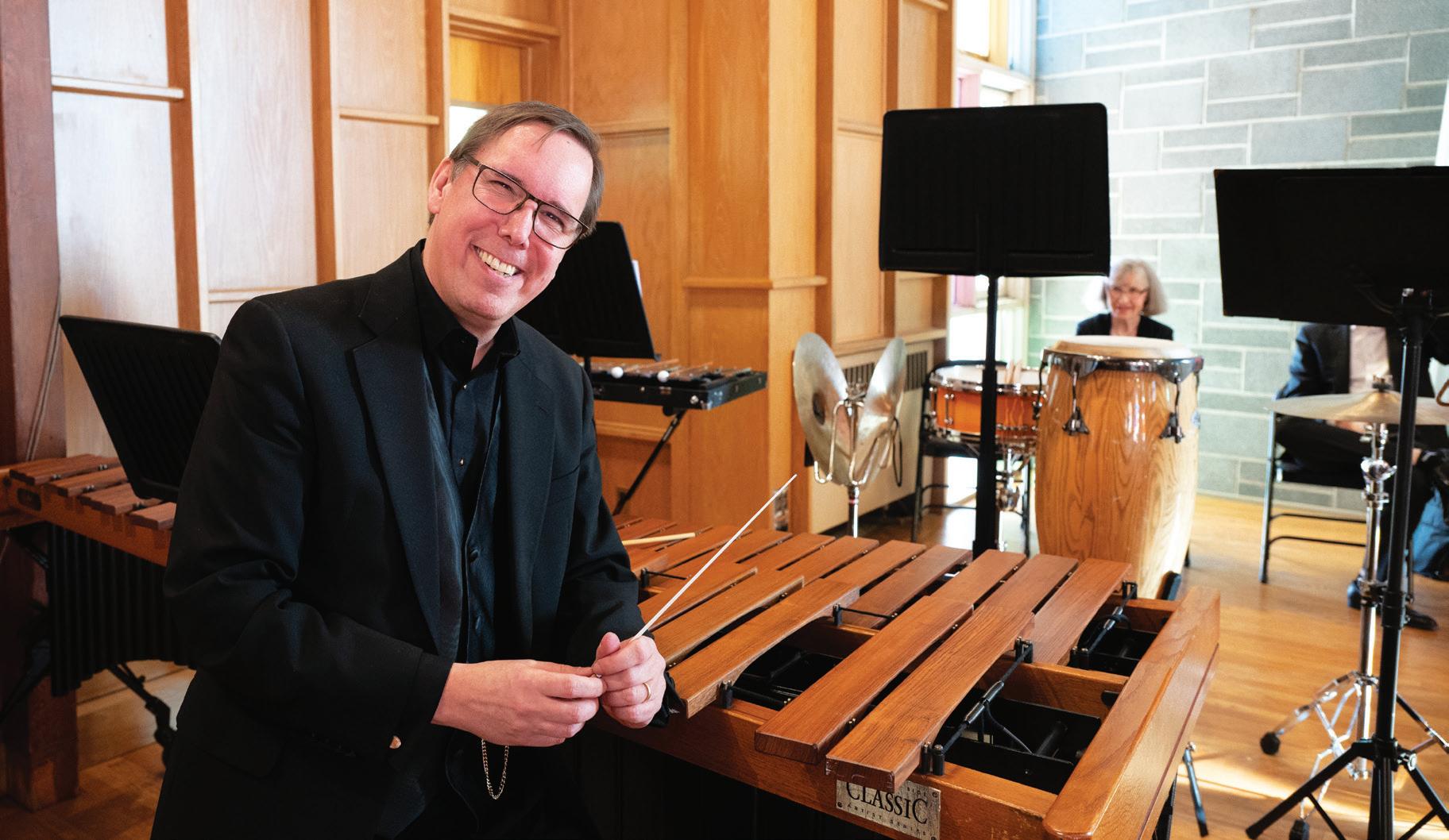
dedicated to the story of Moses,” Jones said. “For me and for the orchestra, it’s our moment to take our instrument and showcase its quality, its emotional depth.”
The performers Jackie Richardson and Shakura S’Aida recounted the stories of their youth, listening to stories similar to those of Harriet Tubman. Both singers grew up with these stories and shaped their understanding of identity and resilience. With the orchestral backdrop, their childhood memories were elevated from personal recollections to collective history.
Both performers said they were still hoping and dreaming for “A society where every person will respect the dignity and worth of humanity, a society where we’re better together.”
Spirituals born in hardship were once sung far from the formal stages of classical music. On Feb. 1, those songs found a new resonance beneath the sweep of a full orchestra in Etobicoke, reminding listeners that history is not a distant memory. It is felt, heard and carried forward.
“We’re all from different backgrounds, we all have a story to tell,” Butler said. “And it’s important that we tell that story. And so I encourage people in the audience to, regardless of where you’re from, tell your story. I’d love to hear it.”
Laura Rodgers HumberETC Culture
Humber professor Brian Hastings says telling the untold stories of Black Canadians is at the core of a new exhibit at Lakeshore campus.
“The biggest thing is that every February, for as long as I’ve been alive, I’ve heard about Martin Luther King, Malcolm X and Rosa Parks. There are others who deserve their fair shot,” Hastings says. “We are all over and doing things that deserve to be told.”
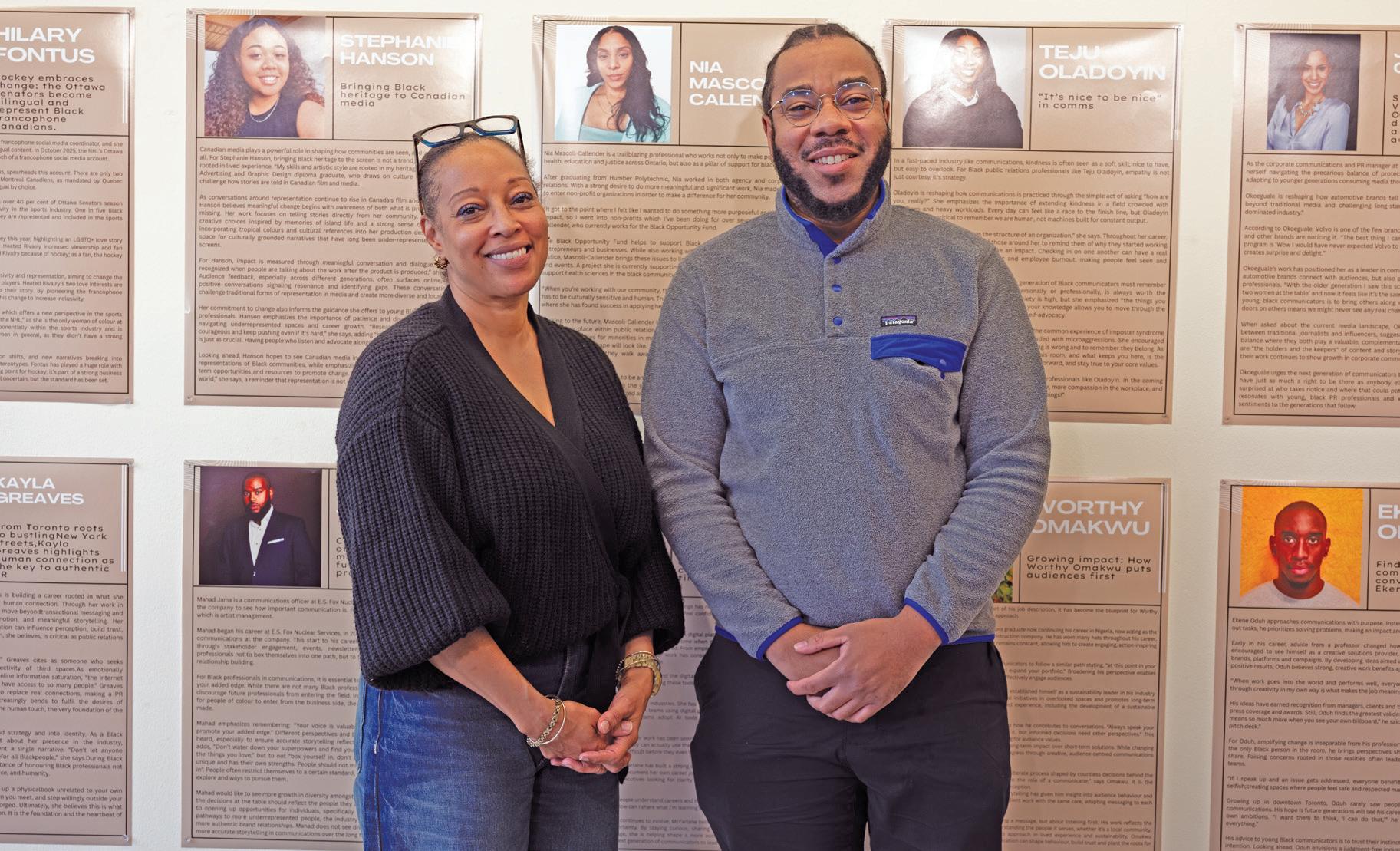
Faculty of Media, Creative Arts and Design members Hastings and Sharleen Mascoll hosted the opening of the exhibit Black Excellence in Canada: Immersive Stories that Inspire on Feb. 11.
The exhibit features student posters sharing stories of Black Canadians and alumni spotlights.
Hastings says the works will be shown in L1002 until March 20, with additional work displayed in the F building.
He says the exhibit aligns with Humber’s Black Heritage theme.
The plan was to curate strong work created by students in Humber’s media departments, emphasizing storytelling, and they ended up centring on Black History Month, Hastings says.
Black History Month’s theme, Black Brilliance: Stories that Shape Us reminds us that storytelling is a powerful source of identity, belonging and community of connection, he says.
Hastings says he thought the exhibit is a perfect opportunity to
explore how students can tell the stories of overlooked Black Canadians and share them with the public.
“Here in FMCAD, they tell stories,” he says.
Hastings says the students’ projects were integrated into their curriculum.
Mascoll says giving the students a prompt and seeing the results is inspirational.
“This is what comes out of it, it’s important to see the impact they (students) are making,” she says. “Perhaps it’s not an education for them, but the work they are doing is educating.”
Mascoll says she is filled with pride seeing alumni who had once been in her classroom now being featured.
Assistant curator at the Lakeshore Grounds Interpretive Centre, Michelle Ransom says she thinks the alumni panels and students’ projects are an effective way of incorporating Black excellence.
Hastings says his favourite piece is Sacrifice by Timi Adeniyi.
The piece uses negative space, greenery, and blood to signify excessive self-sacrifice for the benefit of others.
Hastings says he never met Adeniyi, but she reached out and wanted to showcase her work. “She answered the call.”
Mascoll says the project has received attention from students who have asked how they could be part of it next year.
“It was met with a lot of interest,”
she says.
Hastings says that is the goal, to expand beyond the FMCAD and tell these stories Humber-wide.
“We are honestly part of this broader family,” he says.
During the event, faculty members gave speeches to share the meaning of the exhibit and to thank all the faculty contributors.
Hastings was first to speak and shared what went into pulling off the event.
“A vision took shape, one focused on elevating the often-loved stories of black nations,” he said.
Associate Dean Moriba Baker, the project sponsor, said Black stories need to be told.
“Black history did not start at slavery and Black excellence did not end with civil rights and this is our opportunity to show that here today,” he said Equity, Diversity, Inclusion and Belonging Dean Kimberly Daniels said storytelling is personal to her.
She compared it to scrapbooking while growing up, through gathered memories, photographs, conversations, and stories that were passed down.
“With pride and care, our history lived in the telling, it lived in the remembering,” she said.
“What makes this project particularly powerful is its cross-dis-
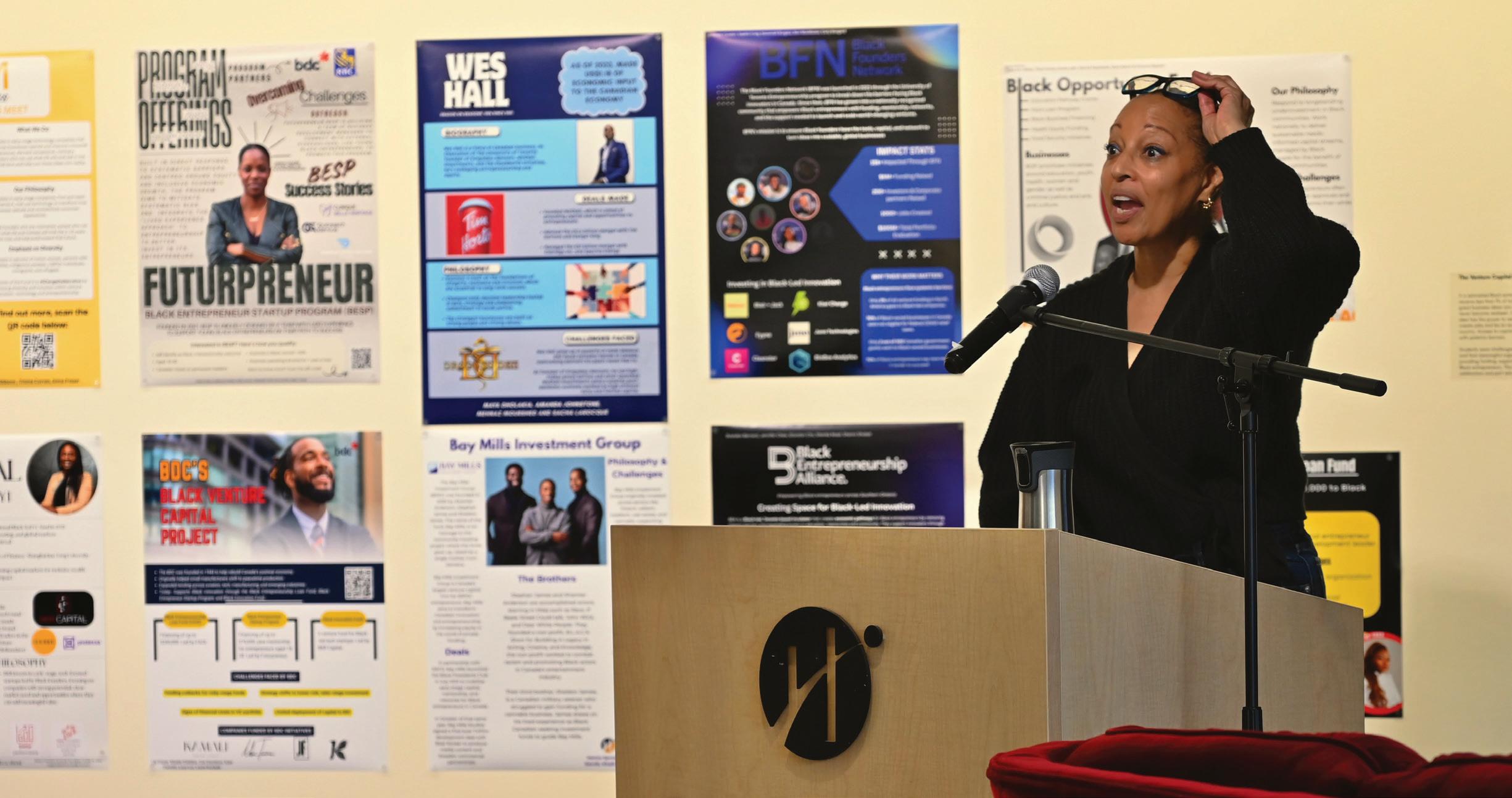
ciplinary, multimedia approach. It recognizes that storytelling is not done in one dimension. It lives in a multitude of ways, as we can see in this room today,” Daniels said.
Michelle Hamilton, a Lakeshore librarian technician, says the exhibit showed her what Humber can accomplish as a college community.
Humber alumna of 12 years, Chanele McFarlane says she was honoured to have her story told.
She says having her work shown has pushed her to continue amplifying her voice.
“The way that the stories are displayed and hearing the remark or having a chance to interact with people has been really touching for me,” McFarlane says.
McFarlane brought her daughter to the showcase.
She says it was great to have her young daughter see the work she has done and to “hopefully inspire her to do the same.”
McFarlane says although she has always believed in the power of a story, she realizes how important it is for people to see and hear others’ stories.”
“We often hear, you can’t be what you can’t see,” she says. “If we don’t have spaces and events like these, it will be hard for people to see what they can be.”
Hamilton says she liked seeing stories of leadership from the alumni who have started their own companies and initiatives.
“These are young people doing phenomenal things in the world,” she says. “There’s someone that could walk in here today, see a story, and that could encourage them and inspire them to keep going.”
Emma Randall HumberETC News
Crowds packed the Chinatown Centre to celebrate the Lunar New Year festival this past weekend, as lion dances, speeches, and performances highlighted the beginning of the year of the fire horse that symbolizes freedom and confidence.
The event was held at the Chi natown Centre at Spadina Avenue and Dundas Street, and the Lunar Festival is one of the city’s largest annual celebrations.
Attendee Gabriel Marques said the festival offers a rare chance to experience a larger-scale celebra tion.
“It was a lot of fun, the dance was fabulous, I’ve only ever been to ones in a smaller space,” he said. Marques said the holiday also carries a per sonal meaning tied to family con nections.
“It’s a nice thing for family, I don’t see my Chinese family super frequently,” he said.
Organizers and political mem bers used the event to highlight the importance of Chinatown to Toronto’s culture and economy.
CEO of the Toronto Busi ness Improvement Areas, John Kiru said Chinatown is a part of a broader net work of local business

it’s that diversity that is in fact the strength of this city, and celebrations such as the Lunar New Year, and the continuation of the traditions of the old countries, for all the ethnic groups is very, very important. To make this city the
Kiru said the performances and traditions are a key to what makes the event meaningful.
“Celebrations are made up of a number of customs, so we did have the confetti, the dotting of the eye on the dragons, the lion dances, so it’s all those sorts of things that have cultural significance out there,”
Provincial NDP leader
Marit Stiles
praised the organizers and volunteers.
“First of all, I just want to take a moment to recognize the extraordinary work the BIA does and the committee that organizes this every year, and most importantly, all the volunteers who make these amazing festivities happen,” she said.
Stiles also said the year of the fire horse represents “passion and drive and success and ambition” and encouraged people to support local businesses.
“Let’s support Chinatown. Let’s get that horse moving us forward. I wish you all good health, success, and prosperity this new year,” she said.
A lot of local leaders showed up to the event, saying that Chinatown has a major role in this city.
Deputy Mayor Ausma Malik told the crowd the neighbourhood is a key part of Toronto’s identity.
“This is Canada’s, this is Toronto’s oldest Chinatown, and I would say it’s the most energetic,” she said.
Malik said the city is working to make sure the area remains “welcoming and vibrant,” while also supporting the small businesses that make Chinatown the special place it is.
“We talk about loving local and making sure that we support our small businesses, I’m right there with you,” she said.


Olivia Masztalerz Humber ETC News
Terry Stevens says his passion for art helped him heal from a traumatic life-changing experience.
“The idea of harmony and healing came into my spirit when I had a stroke 13 years ago,’’ he says.
Doctors told him he wouldn’t be able to talk on his own, walk, breathe on his own, or eat on his own and that one of his vocal cords was paralyzed.
‘’I knew I had to identify with something higher as a part of harmony in order to heal properly,’’ Stevens says.
His art is part of The Harmony as Healing exhibition, which also includes work by Kenneth G. Mills in the Art Space Connect Gallery located in the Neilson Park Creative Centre on Neilson Drive in Etobicoke.
The two met when Stevens was 23 and Mills was 50 during a lecture in 1973. Stevens says he was impressed with his words and
presence, and he says he called Mills his mentor because he was a man ‘’whom I could ask any question and get an inspired answer.’’
Mills passed away in October 2004. In a video called The Rapture of Being: Three Days with Kenneth G. Mills, it says that his pursuits as a philosopher, poet, musician, painter, and designer have inspired thousands and that he was a modern-day Renaissance Man.
“A mentor gives from his own experience, which opens the door for another to experience a newplatform of realization,’’ and Mills is the one who opened a new experience for him, Stevens says.
Mills “had me in his art studio one day, and I was rolling out a wall, like a house painter would, and brushing, and he said, ‘Terry put down your brush and roller, come over here and see me paint this large flower.’ He said, ‘You will be able to use it in your artwork.’’’
“What artwork?” Stevens says he thought to himself. “I could just
paint a stickman, and that’s about it.
“Six months later, I started to do faux finishing, then about two years later, I said to my wife, ‘I’m going to paint on canvas for the first time, and once I start, I won’t be able to stop.’ And that was it,” he says.
Jennifer Murphy, co-curator of the show and chair of the art committee of the Kenneth G. Mills Foundation, says she was inspired by Mills’ creativity to start painting.
“He was an example of unfettered creativity, of the freedom to create without thought, and I had always wanted to paint. But I had always been afraid to,’’ Murphy says. “Because of his example and his presence, I was able to start and that made me so happy.
“We wanted to create an environment in the gallery where the audience could experience a lessening of the objective confinement. And we knew that music and art would be able to do that,’’
she says.
Stevens shares his perspective on how music is connected to art at this exhibit.
“The musical aspect is imbued into the painting because it’s still based on rhyme, harmony andmelody,” he said.
“Those three aspects are just involuntarily imbued into the artwork,’’ Stevens says.
Glen Noble, one of the co-curators working with Jennifer Murphy, explains Stevens’ painting of water lilies.
“It’s the perception of nature and the nature of perception, so presenting landscapes that appear normal, but they have magical qualities to them,’’ Noble says.
“We have two paintings by Terry Stevens featuring portals of going through the portal from landscape into water,” Noble said.
“We wanted to transition from landscapes to water,” he said. “The viewer comes and they see the beauty, and then they get a sense
of wonder, gratitude. It’s like a reciprocal movement of energy.”
Robin Eisenberg says she came to see the exhibit after hearing Stevens’ story.
“I was blown away by it … it’s otherworldly,’’ Eisenberg says. ‘’All of this art strikes emotion ineveryone. You’re giving a lot of emotions (and) that will resonate with me for a long time.’’
“It’s almost a spiritual experience,’’ she says.
Ann Marie Gonda, one of Mills’ students and Stevens’ friend, says the experience of viewing art in person helps healing.
“I’m drawn inside here, like a heart response, something is telling me, ‘Well, stay with this for a minute cause it’s just so beautiful.’ And art is so healing whether you have a major thing going on in your life or a little something, it helps you reset,’’ Gonda says.
The Harmony as Healing: A Sound-Art Experience runs until Feb. 28, opening daily at 9 a.m.
Humber Et Cetera
The Humber Library has acquired a new collection of video games to enjoy. These games include titles like Ghost of Yotei, Clair Obscur: Expedition 33 and others. The 50 game collection includes Nintendo Switch, PlayStation 4 and PlayStation 5.
The games have a lending limit of 14 days, with the option to renew if not overdue, according to the library’s borrowing policies. Currently students can pick up at the North campus, and drop off at both Lakeshore and North.
Games are not currently available for alumni and community members. There are no plans to
host a collection at the Lakeshore campus.
“We always try to take student suggestions if people are interested,” Alexander Ross, director of Humber Libraries said. Ross said the collection could also expand to the Lakeshore campus. “I feel like I need to see how this collection at North goes first,” Ross said.
The games collection grew from an idea that began with Arvind Kang and Ewan Gibson, two librarians and friends, who had a tradition of playing board games at lunch. It then grew into a gathering with their colleagues.
In those gatherings, they discussed everything from games to other library lending policies.
Usman Malik, Lindsay Bontje and Natasha Armstrong, took the idea of expanding the leisure collection to include video games.
“When we started talking about the games and how to bring them in, we started thinking about ‘What courses, what programs might these map to as learning tools?’” Kang said.
Other faculty members were all in for the idea.
“The same thing was happening at the Arboretum, and they were interested in doing board games, sort of team building exercises, ones that had a nature theme,” Gibson said.
While Kang and Gibson were the key figures to create this collection, they had both emphasized that, like any good board game, you need to play as a team.
“I mean it’s one thing for us to have this dream of a board game collection, but the reality of implementing it and making it workable,
“So I already knew that there were places out there in the college that were interested in games as a way of learning.”
that team really put a huge amount of work into making it possible. It wouldn’t exist without their hard work,” Kang said. Gibson said it’s all about connection.
“It’s also about giving people access to something that they otherwise might not be able to have access to, or even have the space to house something like that,” he said.


Alexandra Shank HumberETC Sports
The Humber Hawks, fresh off a second-place finish in the OCAA West Division, guaranteed a spot in the semifinals after sweeping all

three sets against the Canadaore Panthers in a quarter-final match. It was a match-up that hadn’t been seen since 2013, with Humber carrying a 24-0 overall record against Canadore into the clash.
The men’s team was ready to return to the OCAA semi-finals in its quest to secure its six-peat in the OCAA championship.
Fifthyear players played key roles this season, and the decision to return made by veteran starting libero Alex Segui has paid off.
The Hawks powered an impressive 14-2 regular season record, securing a second-place finish in the West Division and building strong momentum for the quarter finals.
In the first set against the Panthers, the Humber Hawks shook off nerves. Canadore kept a domi-
a last touch by second-year middle blocker Apolo Bras to secure the first set.
The Hawks came in ready to play in the second set by using their newfound momentum, launching to a strong seven-point lead, forcing the Panthers to use their two timeouts within the first eight rallies of the second set.
“SEVERAL OF US TOOK OUR SENIOR NIGHT LAST YEAR WITH THE INTENT OF NOT COMING BACK. [WE] FEEL LIKE WE WOULD HAVE REGRETTED IT IF WE DIDN’T COME BACK FOR OUR FIFTH YEAR, ” - Alex Segui
“Several of us took our senior night last year with the intent of not coming back,” Segui said after the match. “[We] feel like we would have regretted it if we didn’t come back for our fifth year.”
Fifth-year standout Teyven Blackmore once again claimed OCAA Player of the Year for the second consecutive year, and fifthyear Alex Segui earned OCAA second-team all-star recognition.
Rookie of the Year Enzo Endres had a breakout debut campaign.
nant lead for the majority of the set.
But when Hawk’s Kyle Gray-Phillips made a crucial save in the back court to keep the Hawks alive, and rallied a point to keep the scoreline tight at 21-21, the Panthers, rattled from the flow Humber found, called a timeout.
From being deadlocked from 22-22 to sharing points for eight rounds, the Hawks pushed for that two-point lead into overtime play, making the ending scoreline 32-30 at the Nest. The set needed
The Panthers, however, refused to fade despite the Hawks holding a dominant 22-15 lead, and the pressure began to show cracks in the Hawks’ defence as Canadore clawed back six crucial points.
Determined to win the set, the Hawks pushed through and stood their ground to kill the set, 25-21.
The Panthers spent the evening causing trouble for the Hawks, showing strong resilience in the quarter finals, that they were not going down without a fight.
Canadore were dogged to get back into the match in the third set, constantly leading in points and not letting the Hawks pass them.
The scoreline was making fans in the Nest cheer louder as they encouraged their team to come back and take the match.
Humber reignited the hopes of turning the set around when they won back the serve at 17-20, and followed that with two consecutive points, narrowing the gap to 19-20. A Canadore timeout did not rattle server Dante Sugarman, completing a serve to tie up the set.
With 26 kills across the three-set match, Teyven Blackmore, twotime reigning OCAA Player of the Year, once again proved why he’s one of the league’s most dominant forces.
In the crucial stretch of the third set, setter Nicolas Kozij relied on his key hitter to deliver the last three kills of the match to win the third set.
The Panthers found a way to get the one last point before the Hawks took the lead, winning the last set of the quarter finals 24-21, with a crucial block by Apolo Bras to secure the spot in the final four of the OCAA championships.
An unforgettable match by the resilient Humber Hawks pushed the team to the OCAA championships semi-finals against Seneca Sting on Feb. 27.
Alexandra Shank HumberETC Sports
The Hawks Nest rumbled in anticipation for the women’s volleyball quarterfinals, with anthemic music echoing through the gymnasium to build momentum.
The team sought and achieved its 29th consecutive season in the OCAA semi-finals by sweeping the sets against the Algonquin Wolves on Feb. 23.
The Hawks used their home advantage and kept a strong lead throughout the set in the first set. Middle blocker Amy Connelly smashed a round-winning kill to get the serve to keep a six-point lead alive at 19-13.
And it was OCAA all-rookie team and first-team all-star winner, Faith Hughes, who ended the set by spiking the ball to the sideline to win the set, 25-17.
The Hawks’ confidence in the second set was visible, although the Wolves were hungry for redemption after trailing through most of the first set. The Wolves came out with renewed intensity.
Humber head coach Chris Wilkins called for stronger communication among his players, looking to steady the pace and regain control before the gap widened.
The second set kept a tight scoreline, as the teams shared a point each round, preventing either side from building a lead. Time-outs were the crucial tactic for the teams to try to throw off the service and make the opponent lose their focus.
The timeout used by Humber when they were down by three, 19-21, helped regain control. They battled back to tie the score at 22-22, and the teams remained deadlocked for six more rallies.
The momentum shifted when left side Caitlyn Labelle and middle blocker Keyome Ellis combined for a crucial block, stopping the Wolves’ attempt to pull ahead.
In a set where it could be anyone’s game, keeping fans and players on their toes, the Hawks
The second set began with Wolves striking first, shifting the pressure onto the Hawks.
rallied to win three crucial rallies in a row to break the tie and hold onto a slim two-point advantage, securing the second set with a 27-25 victory.
Despite the Wolves being down two sets, they played the third with the knowledge that a win could keep their semi-final dreams alive.
However, the Hawks countered by trying to keep the flow they had in the first two sets.
But a five-point lead for the Wolves caused Humber to call for a rare early time-out.
That critical break allowed Humber to restore its momentum and force a deadlock at 15 points.
The Hawks then turned it up with the energy and determination to end the set.
Fifth-year Keyome Ellis had the last touch of the game, smashing the ball straight down the court to secure the Hawks’ place in the final four in the OCAA Women’s Volleyball Championship.
They will meet Seneca Sting in the semi-finals on Feb. 27 with hopes to keep the OCAA championship streak alive.


Joseph Zago HumberETC Sports
Humber Esports’ new website will create an essential, more accessible information hub for would-be fans.
“We will strive to include as much information as we can about where we stand in leagues, who we’re playing, when it’s happening and how to stay up to date,” Humber Esports Senior Administrator Bernard Mafei said, adding that the site will arrive at the start of the fall semester. However, the site may be on hold until the list of varsity video games, rosters and team photos are confirmed to have updated information ready at launch, Mafei said.
He said every other aspect of the website is finished “It just needs to be tweaked to hit the standard we want to release it at,” he said. Mafei said the site will feature news, an event calendar, match reminders an esports introduction for new viewers.
There will also be a game-divided teams page fully equipped with rosters, coaches, photos and player information cards, he said.“This (website) is completely student-built,” Mafei said. He said the site started by presenting the idea to a Humber website development class in 2024 and received tremendous feedback from the students.
More than 50 students have worked on the website across multiple programs and internships, he said. Data Insight Analyst students from the Humber International Graduate campus also worked on the website. Humber Esports have employed two web development
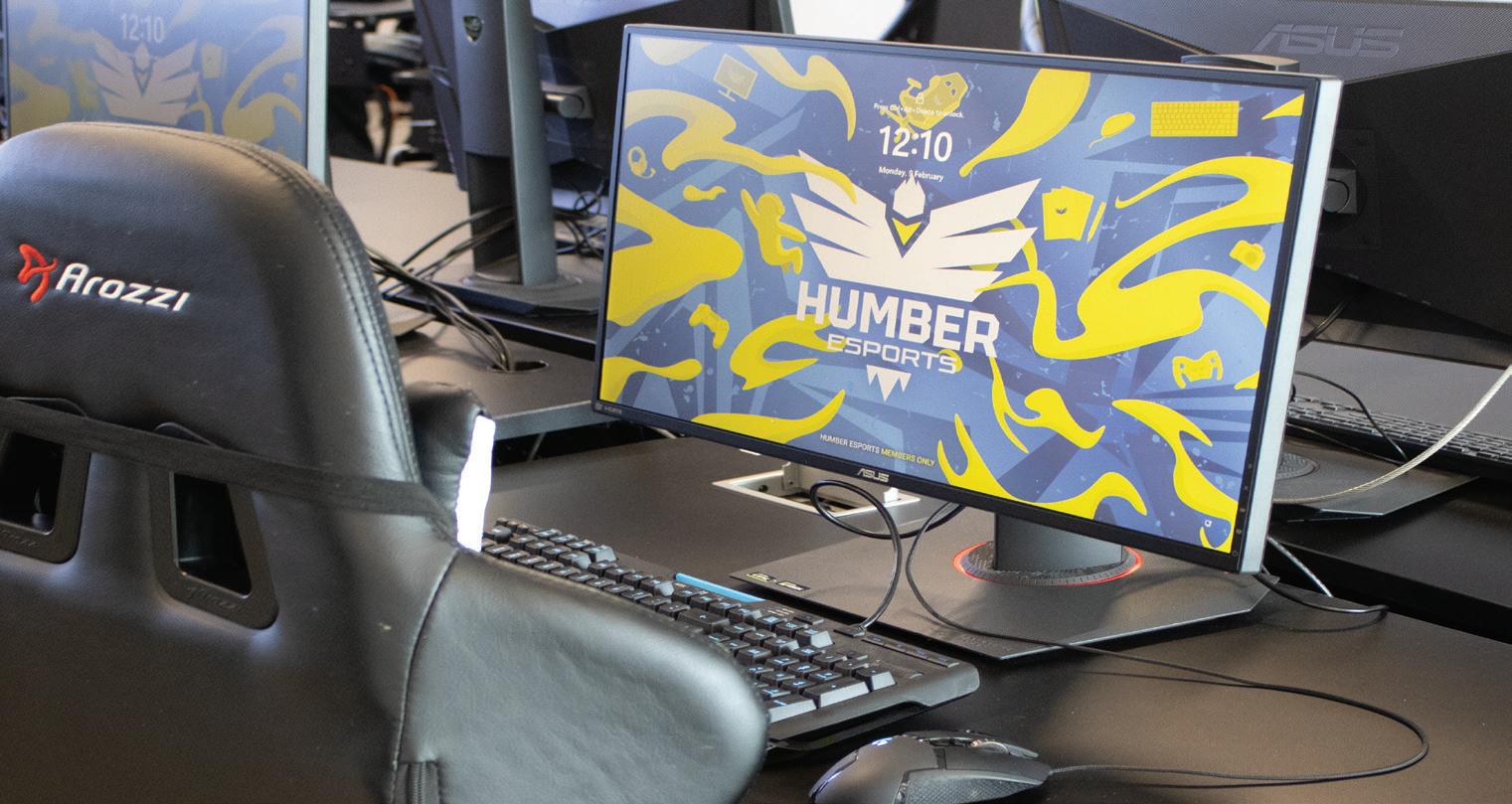
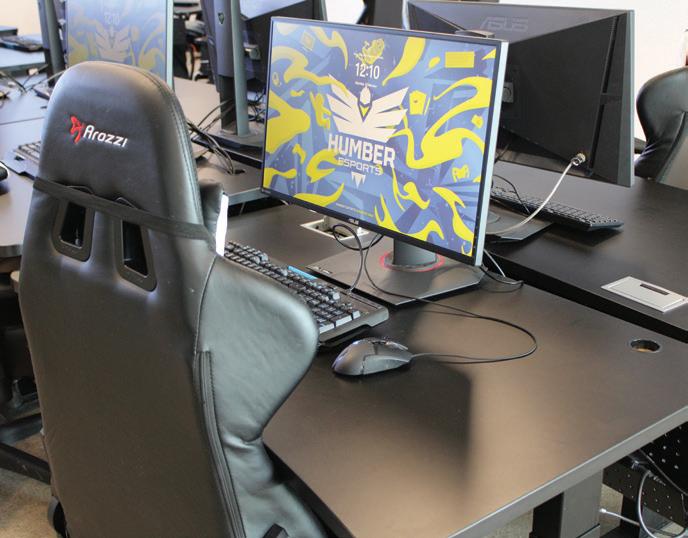
One of several computer screens at Humber Polytechnic Esport’s venue in the Barrett Tech Centre.
interns per academic year since the construction of the website started. “Now we’re at the final stages,” Mafei said. Two interns will be working over the summer this year to complete the site’s final iteration. Mafei said he will find someone to keep the website updated. “We don’t want to release it and then it gets dusty,” Mafei said.
The site is part of a five-year plan to elevate the program to their final goals, which is currently in its third year, he said. The 2025 emerging program of the year winner’s future plans include increasing stream quality, incorporating a game-changers team and club integration with full support.
Mafei said when he arrived as senior administrator in 2023 there was no staff and an incom-
plete system. He said Humber Esports had other priorities before working toward the website.
Mafei said hiring staff, branding and building relationships with other programs was the program’s focus. “We weren’t ready to announce ourselves to the world, now it’s the thing we want to do the most,” he said. This is not the first time a Humber sports organization has launched a website.
The Humber Hawks said in an email statement that their website has been active since 2014. The statement said the site receives more than 500 visits a day and it helps with community involvement and providing information.
The current methods to communicate with would-be fans for Humber Esports are the Linktree site, its Discord server, X and Insta-
gram. Esports enthusiast Joshua Jose said he would be more interested in watching Humber games if he got to know the players and had more details on the matches, which will be in the website on release.
However, he said he commends Humber Esports’ Instagram account for its informative posts including upcoming events, scores and game updates.
“Instagram is probably the easiest way to keep up,” Jose said, though it still has its challenges. Jose said stories disappear after 24 hours and there isn’t always a permanent post to accompany it. “Unlike a website, where you can keep it for as long as you want,” Jose said.
He said the alternative method, Discord, is far more time-consuming when finding the content he wants to see. “The Discord is hard to keep track of because there’s a lot of messages coming in,” Jose said. “You got to be on it all the time to know what’s happening.”
Fighting game fanatic Noah Omonzane said he did not know Humber Esports participated in collegiate fighting games despite following them on X. “I miss out on a lot of stuff,” Omonzane said.Algorithm-based platforms, like X, omit information it believes the user will not interact with.
X’s algorithm didn’t suggest Humber’s fighting game posts on his ‘for you’ page. He said if he knew about Humber’s fighting matches, he would have watched sooner. Despite only non-fighting games showing on his feed, he said he enjoys the informative posts about the other games and events.

You love to play. You push boundaries and solve problems. Now get the skills you need to design a better world. We show you how.
There is a story to be told here: mediaarts.humber.ca

Denny Luong HumberETC Sports
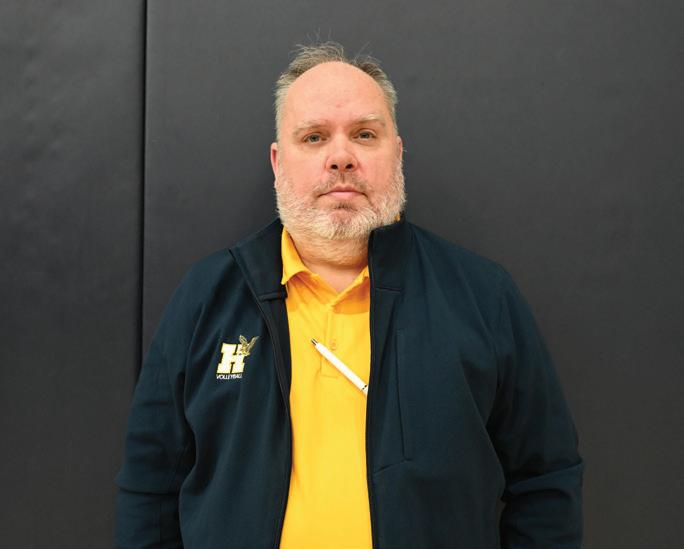
For 30 years, one man has been in charge of the Humber Hawks men’s volleyball team, and he isn’t looking to step down any time soon.
Wayne Wilkin, 57, began his coaching journey during the 1995-96 season, which he led the Hawks to an Ontario Colleges Athletic Association (OCAA) silver medal.Since then, Wilkins would change the entirety of the program that had two OCAA championships to its name to a team on par with the most in history (11).
Growing up in Blind River, Ont., he said volleyball wasn’t the first sport he started, focusing on football player in high school at Westview Centennial.
“I was actually a football player. The program kind of got strapped in high school, and coach said, ‘Hey, you’re pretty athletic, why don’t you go try and play another couple of sports?’” Wilkins said. “I made my shot at basketball, wasn’t very good and made my way to the volleyball court and coach liked me, took me on, and the journey began.”
As the story shifted in Wilkin’s life, he began his career with the Humber Hawks as a player and played for four seasons, which saw him win an OCAA silver medal and be named the Most Valuable Player during the 1993-94 season.
In that same season, Wilkin’s brother, Chris, was part of the coaching staff, who is now the women’s head coach.
When Wilkins took over the
coaching tenure, his brother became one of his setters in the 1996-’97 season.
“For me, being a young coach, [and] him being a young player, I thought we handled it pretty well,” he said. “Thirty years later, we’re still friends.”
He had the opportunity to coach his brother, but having his children play for Humber was special as well.
Wilkin’s son, Kamyn, played under him for four seasons, while his daughter, Kyla, played for five.
“I’ve had the honour of having my two children come to Humber, and they played through their eligibility years,” he said. “I’ve raised my family here [and] we’re a volleyball family at home.”
While Wilkins had the opportunity to witness his family and relatives play for the volleyball program, one person has been on his journey with him as well.
His assistant coach, Hank Ma, has been by his side for nearly three decades, helping build Humber as the program it is today.
“It’s the yin and yang, him and I,” he said. “I’m a bit more verbose. I’m out there, a little more motivator, but Hank [Ma] is our tactical guy.”
Ma said years of being sideby-side with him have created an understanding between them.
“I know how he thinks; he knows how I think. We complement each other,” he said. “He has certain skills, I have certain skill and together we are able to make this program special.”
The duo’s first special moment was leading Humber to its first
perfect season, going undefeated and winning the OCAA championship after a 30-year drought.“We ended up having to overcome some adversity at that time.
It was a bunch of guys who really didn’t play as well together at the beginning,” Ma said. “We were able to put it together at the end, and I think it was special because everyone ended up kind of pushing to get to this point.”
Wilkins has seen out many players throughout the years, with some going professional or others going into coaching.
His coaching staff also includes two assistant coaches who’ve played under him. Christopher Bowen, who played under Wilkins for five years, said the transition from player to coach was a different experience.
“It was definitely a difficult transition period, but being a part of this program and learning from these other three very experienced coaches is a pleasure. I don’t take it for granted,” he said.
For Wilkins, seeing his former players return to the sport shows that the program has built something lasting. He said people ask when he plans to retire or pass the torch to someone else.Wilkins said that he’ll know when his time in the sport is over.
“When I wake up in the morning, and I don’t want to come to practice, or I don’t want to compete, I’ll know,” he said. “We’re not anywhere close to that. I love what I do. I love helping these young men in their journey, and I love winning.”