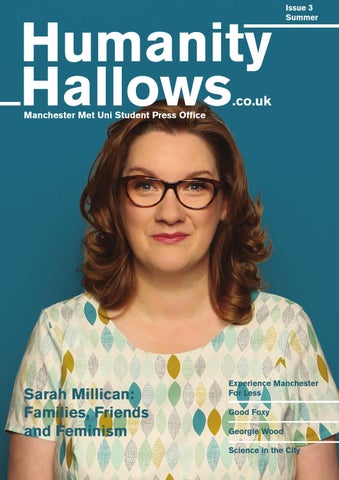
Humanity Hallows
Issue 3 Summer
.co.uk
Manchester Met Uni Student Press Office
Sarah Millican: Families, Friends and Feminism
Experience Manchester For Less Good Foxy Georgie Wood Science in the City
1
BOOK NOW: 0161 832 1111 MANchesteracademy.net AN EVENING WITH MACHINE HEAD TUESDAY 8TH MARCH
CHRIS RAMSEY: ALL GROWED UP FRIDAY 11TH MARCH
BOYCE AVENUE SUNDAY 13TH MARCH
AN EVENING WITH LULU
FORMERLY THE MDH
FORMERLY THE HOP & GRAPE
THERAPY?
DECAPITATED
FRIDAY 4TH MARCH
+ SYLOSIS SATURDAY 5TH MARCH
LAPSLEY
FORMERLY THE CELLAR
TRAGEDY: ALL METAL TRIBUTE TO THE BEE GEES AND BEYOND SATURDAY 12TH MARCH
SATURDAY 5TH MARCH
PUPPET REBELLION
THE INTERNET
SATURDAY 12TH MARCH
FRIDAY 11TH MARCH
ROACHFORD
THE RIFLES
FRIDAY 18TH MARCH
HOLLYWOOD UNDEAD
SATURDAY 12TH MARCH
REEF
SEX PISTOLS EXPERIENCE & LIZZIE & THE BANSHEES
FRIDAY 22ND APRIL
THURSDAY 17TH MARCH
SATURDAY 19TH MARCH
LIFE OF AGONY
REFUSED
VON HERTZEN BROTHERS
SATURDAY 19TH MARCH
WEDNESDAY 23RD MARCH
SUNDAY 20TH MARCH
ABSOLUTE BOWIE
CROSSFAITH
ROOM 94
FRIDAY 25TH MARCH
SATURDAY 26TH MARCH
+ AUTUMN RUIN THURSDAY 24TH MARCH
BLANCMANGE
FRIDAY 8TH APRIL
ROMEO’S DAUGHTER
UNPLUGGED FOR AUTISM
CAST
SATURDAY 2ND APRIL
THIURSDAY 31ST MARCH
SATURDAY 9TH APRIL
MATT & KIM
UDO DIRKSCHEIDER
BEN HAENOW
MONDAY 4TH APRIL
WEDNESDAY 13TH APRIL
FRIDAY 15TH APRIL
ELIZA AND THE BEAR
PATENT PENDING
AUGUSTINES
FRIDAY 15TH APRIL
SATURDAY 16TH APRIL
KYTV FESTIVAL 2016 NEDS ATOMIC DUSTBIN PLUS VERY SPECIAL GUESTS EMF
WEDNESDAY 20TH APRIL
HEY! HELLO!
KORPIKLANNI + MOONSORROW
SUNDAY 17TH APRIL
THURSDAY 21ST APRIL
+ FEROCIOUS DOG + SUPPORT & DJS SATURDAY 29TH OCTOBER
KIP MOORE
CLOUDBUSTING THE MUSIC OF KATE BUSH
RALEIGH RITCHIE
FRIDAY 22ND APRIL
LUSH
THE RAINBAND
ALIAS KID
FRIDAY 25TH NOVEMBER
SATURDAY 30TH APRIL
FRIDAY 29TH APRIL
THE SMITHS LTD SATURDAY 23RD APRIL
MARILLION
BRANTLEY GILBERT
THE LONG RYDERS SATURDAY 7TH MAY
MONDAY 28TH NOVEMBER
FRIDAY 6TH MAY
KATE VOEGELE & TYLER HILTON SATURDAY 7TH MAY
KING KING
THE SUMMER SET
BULLET FOR MY VALENTINE
HANDS LIKE HOUSES
TUESDAY 17TH MAY
SATURDAY 3RD DECEMBER
SATURDAY 26TH MARCH
WOLFMOTHER SATURDAY 9TH APRIL
ESKIMO DANCE SATURDAY 23RD APRIL
IMPERICON FESTIVAL 2016 NEDS ATOMIC DUSTBIN PLUS VERY SPECIAL GUESTS EMF HUNDREDTH MONDAY 2ND MAY
IN THIS MOMENT FRIDAY 27TH MAY
BRAINSTORM
STEVE MASON SUNDAY 24TH APRIL TUESDAY 26TH APRIL
+ DAN PATLANSKY THURSDAY 12TH MAY
DAN REED NETWORK + TYKETTO SUNDAY 13TH MARCH
MUSHROOMHEAD / AMERICAN HEAD CHARGE FRIDAY 18TH MARCH
SATURDAY 26TH MARCH
FRIDAY 29TH APRIL
WEDNESDAY 25TH MAY
THE HEAVY
KINGS KALEIDOSCOPE
TRIBUTE TO MANCHESTER VOL. 2: THE SECOND COMING
FRIDAY 13TH MAY
FRIDAY 27TH MAY
TELEVISON
ELECTRIC SIX
MANCHESTER ACADEMY PRESENTS PETER HOOK & THE LIGHT
FRIDAY 9TH DECEMBER
FRIDAY 10TH JUNE
WENESDAY 23RD NOVEMBER
FRIDAY 16TH SEPTEMBER
facebook.com/manchesteracademy
2
@mancacademy
FOR UP TO DATE LISTINGS VISIT MANChesteracademy.net
Student Photography Competition Winner: Ben Macwhinnie Welcome to Humanity Hallows magazine! This issue we are celebrating the city that we all know and love – Manchester. With its rich industrial heritage, museums, theatres and, of course, its universities, Manchester is cementing its place as one of the UK’s cultural hotspots. It only seemed right, then, that the Manchester Met Student Press Office team celebrate their home city in all its glory. We have some brilliant articles, including an interview with television personality and comedian Sarah Millican! Sarah talks about body image, the BAFTAs and, of course, her new Outsider tour. We also have a great interview with Costa First Novel Award winner and Manchester Writing School graduate Andrew Michael Hurley. Added to these interviews, we have some great comment pieces, book reviews, Manchester fashion and music features and our cooking series. Humanity Hallows is by students, for students. If you would you like to get involved with the Manchester Met Student Press Office and see your own work in print, turn to page 46 or visit humanityhallows.co.uk/work-with-us See you next time! Jacqueline Grima (Student Editor-in-Chief) The Manchester Metropolitan University Student Press Office is a Make a Difference project run by the IDEA office based in the Faculty of Humanities, Languages & Social Science. For information on upcoming features, advertising opportunities and more contact: N.Carragher@mmu.ac.uk Natalie Carragher (Student Media Officer)
Contents 4
Experience Manchester for Less
8 Quirky Places to Eat in the City 10 Science in the City 14 Manchester Reclaims the Night 16 Interview: Sarah Millican 20 Behind Beijing 22 Simply Upcycling 24 Fashion: Georgie Wood 26 Music: Good Foxy 28 Digital Re-Enchantment: Place, Writing & Technology 30 Ghostly Past of Chetham’s Library 32 Poetry Together Competition 34
Interview: Andrew Michael Hurley
35
Book Corner
36
Comment: Fashion Blogging
36
Comment: Islamaphobia
39
Creative: Manchester Poetry & Illustration Collaboration
44
Food: How To Fake A Takeaway
46
Student Press Office: Get Involved
3
3
Experience Manchester for Less Whether you’re new to Manchester or have lived here your entire life, there’s always something new to discover in the cultural capital of Great Britain. We’ve selected a handful of events, days out and things to do across the city, all with your student budget in mind. Words & Photography: Jack Holmes
4
4
Manchester Town Hall Clock Tower Tour You’ve likely walked straight past the Manchester Town Hall in your time in the city, yet you may be surprised to hear that you can actually get a tour all the way up to the top of the 288-foot clock tower. On this tour, you can see the bells you hear every day first-hand as well as witness the most impressive view you can find of the stunning Manchester skyline. At only £10 for two hours, it’s a steal when you can capture images of seven different counties, all visible from the top. Tours are now taking place every day at 2.15pm from the Lloyd Street entrance to the Town Hall. You can either book a ticket or just turn up. Tour guide Jonathan Schofield doesn’t seem to mind. Lloyd Street Entrance, Manchester Town Hall, Albert Square, M60 2LA
5
jonathanschofieldtours.com
5
Photography: Jack Kirwin
Group Therapy Comedy As London’s comedy scene grows vastly more competitive with a number of renowned venues shutting down, it seems there’s a new British capital of comedy emerging. Manchester now has dozens of comedy nights across the city, but the king is clearly Group Therapy, voted Best Comedy Club at the the CityLife Awards 2015. Finding the perfect middle ground between huge worldfamous acts for £30+, and up-and-comers growing their sets, Group Therapy offers a minimum of two events per 6 month for less than £10.
6
Recently they’ve had Josie Long, returning from her recent European tour, and Nick Thune, an American comedian destined for the big time. Group Therapy takes place at venues around the city including Gorilla and Tiger Lounge. With an average of three acts and a headliner each event, it’s a perfect night out, and let’s be honest we all need a comedic pick me up around deadline season right? Gorilla, 54-56 Whitworth Street, M1 5WW / Tiger Lounge, 5 Cooper Street, M2 2FW grouptherapycomedy.co.uk
Bongo’s Bingo “Expect mid-rave intervals with glow sticks, drunken frivolity and catwalks on the large benches. Maybe leave your nan at home for this one.” After Bongo’s Bingo’s success in Liverpool, where it now sells out weekly even with a second show added, the organisers have decided to expand to Manchester. With an entrance price of only £3 you’ll be treated to a bingo night with a twist, including rave rounds and dance offs. But don’t worry – the cash prizes are still quite the attraction. Albert Hall, 27 Peter Street, Manchester, M2 5QR alberthallmanchester.com
Ziferblat 5p a minute. That’s right 5p. Ziferblat reimagines the modern coffee shop, bringing an all-you-can-eat-and-drink element to the world of relaxation. How you spend your minutes is entirely up to you with offerings of Cards Against Humanity, Connect4, and a selection of cakes and fruit (if you’re the healthy eating type). “We would love to welcome students when the library or home doesn’t quite do it,” says Ben Davies, Head of Marketing for Ziferblat. “Come down, relax with some friends, or just get on with some work.” So check it out. We can all cough up 5p, right? 23 Edge Street, Manchester, M4 1HW ziferblat.co.uk/edgestmanchester
7 Photography: Graham Murray
77
Quirky Places to Eat in Manchester
Words: Jessica Carruthers
Are you a foodie? Love to indulge yourself in the best grub until the food coma hits? Okay, good. Keep reading and you will find out all about the best places to eat in Manchester. WARNING: this article will have you drooling over the page.
Black Milk Cereal Cafe Whether it’s for breakfast, lunch or simply a snack, cereal is never a bad idea. This isn’t just the regular old pour-in-the-bowl, addthe-milk-and-you’re-done cereal either. At Black Milk, there are huge selections of cereals from around the world to choose from. Then, to top it off, you can pick toppings, like Smarties or Oreos, to add. And, it doesn’t end there. You can then choose the flavour of milk you would like! This isn’t just cereal, this is genius. 52 Church Street, Manchester, M4 1PW
Bosu Body Bar Always bolt whenever someone mentions the word ‘healthy’? Well, think again! Bosu Body Bar combines healthy, proteinfilled food with delicious flavours in a takeaway-style box. First you choose your box size, then your base, which can consist of delicious sweet mash, brown rice or bulghar wheat and quinoa. Then, you pick your sides such as root veg or apple coleslaw, before selecting your protein. Again there is a huge array of options on offer, such as prawns, meat, halloumi and more. Finally, pick your sauce and you have a box full of flavours on flavours. And the best bit? There’s no feeling of guilt afterwards. Win/win!
8
559 Barlow Moor Road, Manchester M21 8AN & 741 / Wilmslow Road, Didsbury, Manchester, M21 8AN
Almost Famous This restaurant is all about the combination of masses. Not only masses of food, but masses of flavours combined, giving your taste-buds a field day. We’re talking sausage patties topped with egg and Cheerios. Beef patties topped with chorizo, blue cheese, jalapenos and crisps. And that’s just the mains. The sides get even better: mac balls, wings and a selection of fries topped with an array of ingredients which can all be washed down with a vast selection of cocktails, soft drinks or funky shakes. Unit 2, Great Northern Warehouse, Peter Street, M3 4EJ & 101 - 102 High Street, Northern Quarter, Manchester, M4 1HP
Home Sweet Home If you love cake then Home Sweet Home is a must. Think brightly coloured cakes decorated with sweets and chocolates, and even donuts! You’ve never seen anything quite like them before and they taste as good as they look. Don’t worry though – you won’t need seconds. Calling one of these huge slabs a ‘slice’ is an understatement! Home Sweet Home also serve amazing savoury food with an array of options from eggs benedict to tacos. It’s safe to say there will be something here for everyone. 51 Edge Street, Manchester, M4 1HW & Unit 4 Great Northern, Watson Street, Manchester, M3 4EN
9
9
Manchester: City of Science
Words: Neil Harrison
Nowhere does Science’s past, present and future collide quite so spectacularly than in Manchester. Birthplace of the Industrial Revolution, and now a hub of groundbreaking research and development, the city has been at the epicentre of scientific innovation throughout its modern history. As the attention of the global scientific community turns to Manchester in 2016 as European City Of Science and host city of one of the world’s most prestigious scientific events – the EuroScience Open Forum (ESOF), Humanity Hallows looks at some of Manchester’s greatest scientific achievements.
The Graphene Revolution In 2004, the isolation of a one-atom thick, super-versatile material – Graphene – set the scientific world alight. Predicted to revolutionise almost every aspect of modern life, Graphene was discovered by two researchers working at the University of Manchester: Professors Andre Geim and Kostya Novoselov. As the Graphene revolution gathers pace, Manchester will soon be home to both the Graphene Engineering Innovation Centre (GEIC) and the National Graphene Institute (NGI), placing the city once again at the heart of global technological innovation.
The ‘Baby’ Computer The affectionately titled ‘Baby’, (or more accurately ‘the Small-Scale Experimental Machine’, known as SSEM), was designed and built at the University of Manchester, and made its first successful run of a program in 1948. It was the first machine that had all the components now considered characteristic of a basic computer. More importantly, it was the first computer capable of storing data in electronic memory and processing it at electronic speed. From this Small-Scale Experimental Machine, the Manchester Mark 1 was designed and constructed – a full-scale computer capable of processing data for the entire university. A statue of famous World War II codebreaker and computing innovator Alan Turing, who worked on the Manchester Mark 1, now sits in Manchester’s Sackville Park.
Beyond the Galaxy One of the most important scientific landmarks on the planet, Jodrell Bank, was opened in 1945 by University of Manchester scientist and astronomer Bernard Lovell. Frustrated by background interference from Oxford Road’s trams, Lovell sought out more peaceful surroundings, in order to continue his world-changing work on cosmic rays emitting from outer space. This led to the detection of the first known extragalactic radio source from the Great Nebula in Andromeda, by the 218-foot Transit Telescope. Later, Lovell would build a 250-foot radio telescope, now known as the Lovell Telescope. This played a key role in the discovery of quasars, pulsars and other extra-terrestrial phenomena, as well as helping to track the earliest space missions and satellite launches. For anyone interested in the wonders of the 10universe, a trip to the beautiful and impressive Jodrell Bank is a must.
10
All Aboard On Manchester’s Liverpool Road you can visit the place where a global transport revolution began. Situated within the city’s Museum of Science and Industry, the Liverpool and Manchester Railway was the world’s first intercity passenger line. Here you can sit in the Grade 1 listed building, which acted as the waiting room for the first ever timetabled trains, and consider the fact that now there are now well over 850,000 miles of railway line spanning the globe. While at the museum, why not take a ride on the aptly named ‘Planet’, a faithful replica of an early Robert Stephenson steam locomotive.
When Rolls Met Royce History was made at the turn of the twentieth century when, at Manchester’s Grand Central Hotel, motor racing pioneer Charles Stewart Rolls was cajoled by a friend into meeting an electrical engineer by the name of Henry Royce who had recently set up business in the city. The two men became instant friends and eventually founded the Rolls-Royce car company in 1906. Making an instant impression for their motoring excellence, the cars produced by Rolls-Royce went on to become a symbol of the best automobile the world had to offer. During the First World War, Rolls-Royce began manufacturing aero-engines for use in fighter aircraft. Rolls-Royce PLC is now the second largest provider of defence aeroengines in the world and has been instrumental in the construction of aircraft such as Concorde, the Boeing 787 and the Airbus A380. The Sir Henry Royce Institute for Advanced Materials Research is now at the centre of an ambitious plan to create a ‘Northern powerhouse’.
Breaking Into A New Universe Quarks, gluons, neutrinos and the recent discovery of the ‘God Particle’ or Higgs Boson: Ernest Rutherford’s atomic research, which was conducted in Manchester, led to the splitting of the atom in 1917 and opened the door to a whole universe of new discoveries and possibilities. The field of nuclear physics has undoubtedly changed the world and as physicists continue to delve deeper into the subatomic world, who knows where Rutherford’s pioneering work may lead in the future? Visit the place where it all began along Manchester’s famous Oxford Road Corridor.
Coalmines and Controversy The University of Manchester’s first female academic Dr Marie Carmichael Stopes was a hugely influential figure whose significant contribution to plant palaeontology and coal classification were to be overshadowed by her outspoken advocacy for birth control and sexual equality. Her controversial book, Married Love, finally published in 1918, was an instant success and brought the issue of birth control into a wider public forum. Although scorned by the British establishment and banned by U.S. customs until 1931, the book went through 19 editions and sales of almost 750,000 copies by that same year. Stopes’ scientific research, meanwhile, took her from the mountains of Canada to the coalmines of Japan, and very nearly on Robert Falcon Scott’s ill-fated British Antarctic Expedition of 1912. The family planning clinics set up by Stopes continued to operate following her death in 1958. Now, Marie Stopes International, a non-governmental organisation working on sexual and reproductive health, has 452 clinics working in over 40 countries worldwide.
11
11
The Mancunian with an Eye for Discovery He may not have had his own TV series or played keyboards in a 90s pop group but John Dalton was undoubtedly a true Mancunian science hero. Not content with his groundbreaking work on atomic theory, Dalton also contributed to the fields of meteorology, mountain measurement, gas laws and even colour blindness (both he and his brother had the condition, which is sometimes known as Daltonism in his honour). Today, along Manchester’s Oxford Road Corridor you will find the John Dalton building, which houses Manchester Metropolitan University’s Faculty of Science and Engineering with an accompanying statue of the great man himself. Although Dalton – a Quaker – eschewed such acclaim in his lifetime, preferring to lead a simple life in a rented room on George Street, Manchester marked his death in 1844 with a full civic funeral. His body lay in state in Manchester Town Hall for four days and more than 40,000 people filed past his coffin.
Say “Cheese” Manchester In 1842 the first ever photograph depicting an area of Manchester was taken by John Benjamin Dancer. Using the cutting-edge Daguerreotype method to capture Manchester’s inaugural selfie, Dancer was an early progenitor of photographic technology. From his workshop on Cross Street, the scientific instrument maker contributed much to the exciting world of nineteenth century science, including the invention of microphotography – producing detailed photographs in microscopic scale – in 1839.
The Miracle Baby The birth of Louise Joy Brown in Oldham General Hospital on 25 July 1978 sent shockwaves around the world. Given the erroneous moniker of the first “test tube baby” by the press (her conception actually took place in a petri dish), Louise was the first child born using the process now widely known as in vitro fertilisation (IVF). Developed by Patrick Steptoe and Robert Edwards, who later won the 2010 Nobel Prize in Medicine for this work, it was announced in 2013 that over 5 million babies have since been born using IVF. Now in her thirties, Louise herself is a mother to two sons. Both were conceived naturally.
Science in the City Festival 2016 Manchester Met will be involved in helping to make make Manchester the most innovative and engaging European City of Science to-date. The university is holding numerous festival events, with highlights including The Peppered Moth Project, Robot Orchestra, Menus Made by Microbes and Science & Poetry. Volunteering opportunities will be available for students who are interested in getting involved. Keep an eye on esof.eu for more details. Staff and students will also be contributing to Manchester Day (June 19) and the European Science Open Forum (22 - 29 July). Information on all ECOS events can be found at:
www.manchestersciencecity.com 12
12
The University for World-Class Professionals
Postgraduate courses available for September 2016 entry in the Faculty of Humanities, Languages & Social Science
MA Creative Writing MA English Studies MA History MA Applied Linguistics MA Teaching English to Speakers of Other Languages (TESOL) MA International Relations and Global Communications MA European Philosophy / European Philosophy (Aesthetics) Master of Public Administration MSc Information Management MA Library and Information Management MA Multimedia Journalism MA Sociology and Global Change MSc Applied Quantitative Methods MA Criminology A range of related short courses are also recruiting now. Visit us at one of our Postgraduate Fairs in February, May, September or November. Find out more: mmu.ac.uk/hlss/postgrad
13
Manchester Reclaims the Night Words: Bridget Taylor Photography: Ruth Hudson & Daniel Spragg
“It’s a powerful idea to reclaim the streets, because we are directly challenging that fear.” Thirty-nine years since the first Reclaim the Night march took place in Leeds, thousands gathered in Manchester’s Owens Park for this annual event. The mood was relaxed and celebratory, many participants carrying homemade placards and sporting glo sticks and glitter face-paint. Of course, behind the atmosphere of joyful solidarity, were the deeply shocking reasons for coming together to protest. In England and Wales, 1 in 5 women aged 16/59 has experienced sexual violence and only 15% of those feel able to report it to the police. Of those reported cases only 5.7% end in a conviction. The first Reclaim the Night march in 1977 was a response to the attitude of the police involved in the Yorkshire Ripper murders, when Peter Sutcliffe sexually
attacked and murdered thirteen women across Yorkshire between 1975 and 1980. The police advised women at the time to not go out at night but, as many of the victims were sex workers, and, therefore, most vulnerable to attack, this was not a piece of advice they could feasibly act on. Beyond that, feminists and women’s groups at the time became angry that the onus was put on women to change their behaviour. This attitude of victimblaming is still prevalent today. As recently as this month, the Metropolitan Police Commissioner, Bernard HoganHowe, has argued for a change to the reforms brought in in 2014 that meant anyone making an allegation of rape or sexual assault would be believed in the first instance. Humanity Hallows asked Campaigns Officer for the University of Manchester Hannah McCarthy her why she was marching. She said,
14
14
“We are here to demand a society free from victim-blaming. It is a powerful idea
to reclaim the streets, because we are directly challenging that fear.” As we marched up Wilmslow Road and onto Oxford Road, making our voices heard with chants like, “Whose streets? Our streets!”, there was something empowering in a protest that not only drew attention to the issues of sexual violence in our society, but that was actively challenging the status quo, if only for a few hours.
“This year, the march is more relevant than ever in a climate of cuts and austerity, where women’s services have often been the first to go.” “Nearly half of all rape crisis centres in the UK do not have secure funding beyond March 2016.” This fact was reinforced by the demographic of the protestors, who were primarily students. One student
involved with running women’s selfdefence classes through the University of Manchester Students’ Union, highlighted the level of fear among young women: “It’s oversubscribed. We get 80 to the classes each time and 300 or 400 people interested on Facebook. Although it shouldn’t be needed, women are scared, they don’t feel safe.” Although the issues we were protesting about have not changed over the years, the nature of the protestors has. The first marches were women-only. This time there were several blocs: women, mixed and LGBTQ. One student I spoke to from the Socialist Students’ Society remarked, “I was surprised by the diversity, by the number of men, but we could see more women of colour and trans women. “In terms of issues of gender equality, and gender in modern culture, we visually think of feminism, but these issues also affect men and non-binary and trans people as well because of established gender roles. It’s all part of the same problem.” A male student told us why he was
marching: “It is widely believed that sexism is eradicated but this is a false claim. Society needs to be changed which means men also need to be involved.” The women’s movement has indeed diversified over the years, recognising the existence of intersectionality – overlapping layers of oppression – but while also understanding the complexity of inequality. We can only win gains if we unite against our common oppression. If we stereotype all men as violent, we are guilty of the same injustices that women have to cope with in a still-patriarchal society. This continued discrimination means we still have a long way to go to reach gender equality. Without a strong movement behind the march, that continues to raise these issues and build pressure beyond this annual event, it is in danger of becoming ritualised, much like Manchester’s annual Pride marches that have largely become apolitical. Another student summed this up saying, “This is a mood, not a movement.” For more information visit: reclaimthenight.co.uk
15
15
Interview: Sarah Millican Words: Lucy Madeleine Watson & Ciamh McDonnell
“I always talk about family and friends and fannies. Also quite a lot of animal-y, countryside-y stuff, and also some sprinklings of feminism every now and then.” Sarah Millican, who was crowned the Queen of Comedy in 2011 at the British Comedy Awards, is blunt, ballsy and indisputably funny. It isn’t surprising, therefore, to learn that she takes her job very seriously, a work ethic that has earned her an if.comedy Best Newcomer Award (formerly known as the Perrier Award), two BAFTA nominations and a self-titled television series on the BBC. “I’m always pro talking about how much hard work goes into things because I don’t like it when people talk about luck. I believe that, even if someone is incredibly talented, if they don’t have the work ethic then they just won’t get as far as they could. It goes hand in hand, being good at what you do but also working your arse off. You don’t get better by thinking about it – you get better by doing it.” Sarah, who has just moved to the countryside with her husband, admits that the name of her tour, Outsider, is apt. “I like it to reflect me because I’m mildly arrogant,” she laughs. “Most comics will find they weren’t in the ‘cool gang’ at school. If you’re a comic and you were in the ‘cool gang’ my theory is that you’re probably less funny.” Outsider is Sarah’s fourth sell-out tour, following on from Home Bird in 2014. She explains it is important to challenge herself with each tour, revealing that her material, and the audience’s reaction to it, is often terrifying yet cathartic. “In the last tour, I told an eight minute story that didn’t have a punch line until the end, and that terrified me. In Outsider, I talk quite a lot about body 16 image and there are bits of it that are
16
quite hard to say. If I can deal with my body stuff on stage and tell everyone how I’m dealing with it, it might make somebody realise they’re not on their own, and that’s great.” As a way of dealing with gigs that don’t go to plan, Sarah has developed a coping mechanism she calls “Millican’s Law”. “If I had a bad gig I would think about what it was I did wrong, and you carry it over to the next one the following day. If you walk in thinking ‘I’m shit at this’, then you will be shit at it. So the rule is, if you’ve had a bad gig you can only be annoyed at yourself until eleven o’clock the following morning, then you have to draw a line under it and move on.” Can Millican’s Law be applied to everyday life? “If you have a bad day, allow yourself to have that bad day. It’s fine. It’s fine to be grumpy, it’s fine to feel sad. All of these emotions are fine. Then the next morning is a bright new day: it’s eleven o’clock, line drawn under, let’s crack on and try and make today better… Am I talking too much?” It is interesting to discover stand-up comedy wasn’t always an ambition for Sarah, having completed courses in filmmaking, writing and directing after she left college. “Then I switched to theatre – because I’m fickle – and did a playwriting course and realised I wanted to write plays. It surprised me that my standup took off so quickly because I never wanted to perform. I was very much behind-the-scenes and it’s quite weird that it’s a part of my job now.” After completing her A Levels, Sarah left education and didn’t attend
university. “I’ve got my dad’s brain – not, like, in a jar… – but quite a logical brain. I have a bit of a chip on my shoulder about how ‘I’m not very clever’ because I didn’t go to university. I don’t have a lot of facts in my head, but I can make connections. I think most good comics are quick-thinking because you have to be a little bit ahead of the audience so that they don’t see the punchlines coming. But it took a while for me to realise that just because I didn’t go to university, doesn’t mean I’m not intelligent.” The reality that there are few female comics of Sarah’s stature is seemingly important, yet for her, comedy is about more than gender. Her dislike of the question ‘Are women funny?’ has become notorious. “I don’t refuse to answer it because that sounds really dramatic. If a journalist asks ‘Why aren’t there more women doing comedy?’ that’s a different question, but if they say ‘Why aren’t women funny?’ then I say, ‘I know loads of comics who don’t like cheese. Why’s that not an angle?’” It isn’t surprising that she has similar views on the gender politics of American television. “How many chats shows are there in this country where a woman is hosting? None. Zero. Yet, if you think of Oprah Winfrey and Ellen DeGeneres in the States, they are probably two of the most successful chat show hosts America has ever had. Even the evening shows, none of them are women, like, women are good in the afternoon but don’t chat to them in the evening ‘cause all they’ll do is nod off ‘cause they’ve had too much wine. It’s very odd.”
“I don’t like when people talk about luck. I believe that, even if someone is incredibly talented, if they don’t have the work ethic then they just won’t get as far 17 as they could.”
Is gender ever an issue on tour? “I don’t think an audience cares, especially now that there are so many strong female comics. With most audiences, if you’re funny then they like you and if they don’t find you funny then they don’t like you. However, if I was to do a shit gig and the audience didn’t laugh, they don’t say ‘Oh, Sarah Millican’s not very good’, they say ‘Oh, women comics’.” She adds: “I wouldn’t want to be employed because I was a woman, I would want to be employed because I was good enough.” Eager to redress her dissatisfaction with popular media aimed at women, Sarah recently launched her own women’s magazine, Standard Issue. “Standard Issue is a feminist magazine, but feminist in attitude. We cover all subjects, not just feminism. I didn’t think there was a magazine that appealed to women who were interested in loads of things. I wanted something that made me laugh, made me feel inspired and made me think. So that was the first reason - just standing in front of magazine racks for many years thinking, ‘I’m not bothered that you’ve married your parrot…I don’t need to know how to keep a man…I have a lipstick that’s working fine thanks. There’s not much here for me.’” Following her appearance at the BAFTAS, Sarah felt the subject of body image in the entertainment industry needed addressing. “I was talking to journalists and they kept asking, ‘Who is your dress by?’ and I kept saying ‘Trafford Centre’ because I thought it was really funny. I stood in front of my friend in the fitting room and we both gasped at how lovely the dress was and how lovely I looked in it, and then in the newspapers and on TV the next day they allow people to come in and pull apart women for something that is incidental – I put clothes on all the time, I don’t really consider it part of my job.” Unquestionably, the issue downcast her BAFTA experience, prompting Sarah to write an article that surely enough went viral, and led her to question the media’s view on gender roles.
18
“Why isn’t there somewhere where
18
women are shown to be diverse and interesting and fascinating and funny and smart? Why is it, ‘You’ve got the wrong colour lipstick on, or you’re too old to be wearing those kinds of clothes’? It’s bullshit.”
smashing comments after my shows.
Thus, initiating the beginnings of Standard Issue.
“Improv is a special skill that I do not have, apart from maybe when someone in the audience shouts something and I make something funny out of what they’ve said. I guess technically, that’s improv. I used to hate improv. I used to think it was for people who couldn’t be arsed to write a joke. Then my good friend suggested I come and see her in the improvised musical Showstopper and it was astonishing, it was so f**king good! It’s exhilarating to watch and be part of, but I’d never do it. I like to write, I like to prepare, I like to practice and that’s my thing. I once did an improv workshop that shall never be spoken of after today, where people threw balls at me.”
“I emailed a few close female friends in the business and laid out my plan. Pretty much every single person I asked was keen to be involved, and now it’s fifteen months since it went live. We’ve had a lot of hits, we’ve got a good team of staff that’s expanding all the time, and we get so many positive messages from people on Twitter and Facebook. It’s exactly what I wanted times a million and I love it.” Was there anything positive about her BAFTA experience? “Well, it made me start a brilliant new magazine! But as well as that, I was standing beside Imelda Staunton and she said, ‘We’re big fans of you in our house’ and I just thought: this is crazy. These are people that I watched on TV for a long time and I’m among them, I’m nominated. I demanded that Stephen Mangan introduce me to Matt LeBlanc and I stood in a queue to meet him. The photo was too dark to really see but I know that I met him and I still watch Friends every day, which is what I told him and is probably not what I should’ve said.” With over 1.8 million Twitter followers, she admits to a conflicting relationship with social media. “When my TV series first came out, there were so many horrific comments about me flying around Twitter, things like ‘c**t’…and then ‘fat’…‘ugly’… ‘wonky tits’ – that was quite a common one – ‘awful hair’ and ‘unfunny’. The way I see it, if somebody says I’m not funny it’s not offensive because I pay my bills with comedy. Saying I’m not funny and not a comedian is like somebody saying that a car’s not blue when it is. It’s just not true. It’s a fact that I am a comedian and I can only achieve that by being funny. There’s something about social media that encourages people to become dicks, but there’s a lot of really lovely, funny people too who send me messages saying ‘Morning’ and send me
Following a successful career in scripted comedy for stage and television, would Sarah ever consider trying improv? She seems hesitant.
After a landmark birthday in 2015 has Sarah considered her future prospects? “My fortieth birthday was the first birthday I’ve had in a long time where I’ve felt different on the day, because normally it could be any day, but with a bit more cake. Then turning 40, I felt like a totally different person. I feel more confident and feel like I could walk around in a pub with my skirt tucked into my knickers.” She laughs. “I think I’d quite like to write a play. I might have a book in me. I wouldn’t want to act. I’m not an actor. It’s better for everybody if I don’t act. I think I write well and I think that’s what I’d rather do - write good dialogue and give those lines to somebody who is awesome at acting.” Sarah Millican remains a distinctive voice in British comedy and it is evident that her life thus far has been hilarious and exciting, interwoven with dedication, positivity and hard work. And if there were to be a film made of it, she knows exactly what the title would be: “Yes I Millican.” Here at Humanity Hallows we think she probably can too. Standard Issue Magazine is available online at standardissuemagazine. com and tickets are on-sale for the Sarah Millican: Outsider live tour sarahmillican.seetickets.com
“Why isn’t there somewhere that women are shown to be diverse and interesting and fascinating and funny and smart? Why is it, ‘You’ve got the wrong colour lipstick on, or you’re too old to be wearing those kinds of clothes’? It’s bullshit.”
19
19 19
Behind Beijing Words: Daniel Broadley Photography: Ade Hunter
David Adesanya is a Manchester Metropolitan University architect student embarking on a once-in-a-life-time opportunity. Taking advantage of the Study China project, he will be spending time in Beijing working on an exciting creative photography series. David aims to challenge the idea that social media divides us and will look to connect the West with the Far East with honest and insightful photography of the everyday folk of Beijing. Judging by the success of Humans of New York, this is something to keep an eye out for. Humanity Hallows caught up with David to find out more... Can you tell us how the project came about? The title of the project is ‘Behind Beijing’ and that illustrates what I’m going to be doing there. I’m going to be talking to individuals who live in Beijing, learning about their experiences, their culture and their insights and world views. I find it quite interesting that we live in the West and there’s so much going on in the East. They have completely different traditions and live completely different lives to us. It’s great to discover and uncover these differences, but also to see the parallels. That’s a big thing for me. I think in terms of awareness, the lives of people in China are not as public and I’d like it to be. I feel the communication of lives in the East is less fluid than it is in the UK. I’m just 20 trying to direct my insight and share
20
my experiences with others. Why did you choose photography as a medium? Honestly, I think it’s the fact that in this day and age with social media – and so many different types of social media – it’s known for creating a division between people, between relationships and making people more isolated. I guess one of the things that made me more excited, inspired me, what made me believe in the possibilities of social media, was one of the works by the guy who does Humans of New York (HONY), which was a photography project with text, exploring the lives of people in New York. That was someone that made me say “Wow!” This guy has managed to use the platform of social media to connect people together rather than
create false identities. He’s provided a true insight into people’s lives. I thought, ‘OK, this is something I would love to be part of,’ and that’s why I’ve chosen to use photography. You’re an architecture student... How has travelling to Beijing come about? I found out about the Study China project which seemed like a great opportunity. The government covers accommodation and food and I thought ‘Why not try it out?’ I love Asian culture. I’ve been learning Mandarin since high school. I play table tennis competitively and China is number one for table tennis so, again, I’m able to develop my skills, develop my talents. Which photographers inspire you? I’m inspired by Emmanuel Hammond. I met him at a networking event and I
told him about my project and he said he’d be happy to support me and teach me skills. Emmanuel’s work is pretty deep and he’s learned the craft – you’re always continually learning. He’s shared his experiences with me and shown me how to overcome problems I haven’t reached yet. I’m also inspired by paintings – possibly even more than photos, but, again, it’s all about that visual communication.
“A picture tells a thousand words but I want to evoke more than visual communication.” By sharing pictures and telling stories, I want to evoke emotions. I want to create more of a sensual connection. I hope my work can do that for other people.
What do you hope to achieve with Behind Beijing? Interconnection between the West and the East. Just evoking a connection between individuals. If just one individual becomes conscious of the lives in China, or less ignorant of the lives of people in China, I will have achieved something.
speaking to young people, producing Facebook campaigns and engaging with prominent YouTubers, have all built a good foundation for me and for this project. What advice would you give to someone who has an idea for their own project? How can they make it happen?
In terms of community work and, in partiulcar, engaging with other cultures, my experience of working with vInspired last year has led me to this project. I was working as a leader of the North West, working in politics by engaging young people with voting, tackling local food inequality and tackling the stigma of young people who care for their siblings or their parents. This work enabled me to be more confident undertaking this project now.
I’d say – delay is not denial. Just because a project may take a while, or you may not be able to fund it straight away, or people say no – it doesn’t mean you should give up on your dreams or give up on your passion. Stay humble, keep the faith and believe in it. At times, it’s just going to be you. At times, people will be drawn to your passion, so stay confident and be able to share ideas. Also, remember criticism can be really beneficial. If I hadn’t shared my ideas, the project wouldn’t be as developed as it is now and I’m still going to continue. Just be encouraged and stay humble.
Working on previous campaigns with vInspired and speaking to politicians,
You can follow the project at: behingbeijing.org and @BehindBeijing
What previous experiences have led you to this project?
FRESHER’S WEEK A DISTANT MEMORY?... It’s time to get down to hard work, like spending some of that hard earned loan! Did you know that between Sunday and Thursday you can get 20% off food at Pizza Hut Restaurants with your student card? That’ll help you save your cash for the important things. Terms and Conditions apply. Offer valid all day. Sunday to Thursday, excluding Bank Holidays. 20% off valid at full menu price only – Dine in only. 20% discount is given on food only. Excludes buffet, Kids Birthday parties, alcoholic drinks, Happy Hour, and all other vouchers, discounts and promotions. Valid for tables of up to 4 people. Products subject to availability. Photography for illustrative purposes only. Pizza Hut reserves the right to remove or amend this offer at any time. Deal only valid at participating Pizza Hut Restaurants. A valid photographic student ID card must be shown on payment.
PZ1090_3405_MMU Student magazine advert_148x210mm.indd 1
21
19/02/2016 3:06 pm
Simply Upcycling Words: Jacqueline Grima In today’s climate of tightened belts and austerity measures, more and more people are looking for new ways of making ends meet. And, whether it be sanding down second-hand furniture, finding a new outfit at a ‘pop-swap’ event or simply turning some leftovers into a delicious meal, ‘upcycling’ is a great way of saving a few pounds as well as having a very positive impact on the environment.
have taken the ‘make-do-and-mend’ philosophy to a new level, recently launching their new business, Simply Upcycling. The project, they tell us, focusses entirely around one ethos: “In waste we see potential.” Alex, who left his job two years ago to concentrate on upcycling, met Luke when both responded to a call for action put out by Corin Bell of the Real Junk Food project.
Corin was looking for help in launching a Real Junk Food branch at Manchester’s creative wellbeing centre, The Wonder Inn, in Shudehill. Her eateries are unique in that their entire philosophy is based on an upcycling principle. All meals served at Real Junk Food restaurants are comprised entirely of food collected from supermarkets that would usually go to waste, with customers asked to pay only what they think the meal is worth.
Alex Borg Costanzi and Luke Callander “I went along imagining that I would be making recycled glasses and salt cellars,” Alex tells us. “When I got there, the place was like a bomb site.” Alex and Luke set about refurbishing the restaurant entirely with recycled materials, their resources including broken pallets, discarded tyres and glass bottles. “It was like a dream come true,” Luke says, “being given the chance to refurbish a whole restaurant from scratch.”
22
22
Much like for Alex, getting involved with upcycling meant a major career change for Luke after he was made redundant from his job as an industrial radiographer. He discovered a passion
for woodwork when he became involved with Men in Sheds, an Age UK project that supports older men, encouraging them to continue with and share manual skills. Luke had no doubt that this was what he wanted to do with his life. “In my work as a radiographer, I spent a lot of time x-raying old car parts and I could see so much potential in them. It was either get another job or move forward with something I was really passionate about.”
Alex and Luke now spend a lot of the time on the hunt for resources, scouring skips and scrapyards as well as building relationships with potential suppliers. “You don’t get without asking,” Luke explains. “We recently went to a pallet company in Manchester and asked them what they do with their waste pallets. The foreman there very kindly put us in touch with their head office and they are now a great source of free wood for us. It’s all about engaging with the community and building relationships.” The enthusiasm for what they do is infectious, the impact of waste on the environment an issue that they obviously have strong feelings about.
It’s Alex and Luke’s dream to share their skills with as many people as possible, their current plans including a YouTube channel and a series of workshops in which they will teach the basics of upcycling. Alex says, “If we can teach people new skills, just simple everyday things, then we can get a lot more people recycling.” How do the boys see the future of waste recycling? “We need to stop producing so much stuff,” Alex says determinedly. “Then we can head towards a circular economy.” When asked if upcycling is a trend or if it is a way of life that is going to last, Luke is adamant.
“Companies might have a pallet that is slightly broken,” says Alex, “and they simply throw it away. The companies pay someone to dispose of their products, but waste can so easily be recycled. So many basic kitchen products can be made from recycled glass bottles.”
“It has to last. It’s a necessary change. We can only choose how we act and move forward as individuals and hope that others follow suit.”
Luke is equally as enthusiastic: “In fact, you could create a whole kitchen from recycled materials.”
You can follow Simply Upcycled on Twitter @simplyupcycled
For more information visit: simplyupcycled.org & realjunkfoodmanchester.co.uk
23
23
Fashion Student To Max Mara Designer
Georgie Wood Having left Manchester for the design studios of Italy, aspiring fashion student Georgie Wood talks to us about her path to success. Interview: Nateisha Scott Student, womenswear designer and dream-maker, Georgie Wood, 24, is every fashion girl’s hero. Her path to success took her from endless hours in Salford University’s studio to the creative mindset of Max Mara’s collections: an intense and compelling journey. So, how did she get there? What brought about your dreams of becoming a fashion designer? The dream started when I was around 16 years old and I loved making my own outfits and altering garments that I already owned. I always loved clothes and fashion but always liked to look different from everybody else. You could say that I always knew I wanted to be a designer. That must have been a great dream to have at such a young age! Did you have any goals for yourself back then? My goal was never really cemented until University and then it was to make it into London Graduate Fashion Week and I kept working hard until I reached that goal. Talking of university and your final collection, which I loved when I went to see it by the way, what and who inspired it? The whole design process and inspiration for my final collection started with looking at the art form of 24 Tai Chi movements and
24
the whole relaxation and ambiance of its form. That’s fascinating. What was your thought process from Tai Chi to your collection? I would say it developed when I travelled to China last year. The city’s fabrics are breath-taking and incredibly inspiring. The colours, the feel and the landscape is what urged me to create a collection that was luxurious and equally relaxing. It is a trip I would recommend to anyone. What happened next? Well, initially I didn’t win the competition to join Max Mara but I was called into a room after the announcement and I was offered a job there with a fellow design student. I was in such shock that I didn’t know what to think or do! And here you are, a designer for Max Mara in Italy! Congratulations! What has been your most surreal moment? Thank you! Despite me becoming a designer for a luxury brand, I would have to say that my collection at Graduate Fashion Week (GFW) is my most surreal moment. My dreams had come true! So, GFW is here. Set the scene for us. The whole day was a massive blur, but I loved every second of it! I was lucky enough to have been selected to be in the GFW gala (the 25 best of GFW) and I was extremely happy
with my success that day. What advice would you give to student fashion designers? Assign yourself goals and stick to them! Some may seem impossible but hard work and commitment will make them attainable and achievable. Very wise words for every aspiring career! What was your hardest struggle? Being a fashion student is difficult on its own with constant deadlines, sketchbooks and endless studio hours. It can seem impossible but it all pays off in the end. What is your biggest challenge now at Max Mara as you are no longer a fashion student? No longer a fashion student! Wow, it feels weird to hear that, especially with time
going by so quickly but I would have to say the language. Why so? Living in Italy and studying Italian is such a challenge. I can’t remember the last time I learnt languages! But it is another stepping stone in my career. I am up for anything. Let’s just say I love the pressure of a challenge. I bet! What are your plans for the future? My plans for the future are to keep working hard and to be a head designer in a luxury design brand. Aim high and succeed well? That’s the mantra I’ve taken in these past few years and it has certainly helped me along the way. *** Note to self: Aim high and don’t alter your dreams!
“My collection at Graduate Fashion Week is my most surreal moment. My dreams had come true!” 25
Words: Daniel Broadley Photography: Duncan Sykora
“Good Foxy’s set was as electric as ever, taking the crowd on a musical voyage of heavy rock, psychedelic and funk.”
Music: Good Foxy “A few years ago, a few humble gents merged together to form the only solo artist in the world with five heads. Well, four, until 2015, when James ‘Robbo’ Robinson, keyboardist, made up the fifth face of Good Foxy. It was then that things began to move a lot faster.” With a loyal community of fans built from relentless gigging, nothing more than the dedication of the drummer’s dad as a manager and no record label backing, Good Foxy have been able to achieve a lot in the short time they’ve been together. Just last year, the band played the Beatherder and Cloudspotting music festivals and collaborated with Swedish band Doojie Man and the Exploders. Frontman George Banks contacted Doojie’s drummer after being impressed by a YouTube video of him and, after gigging in each other’s motherlands side by side, they formed a bond based on a love of high jinks and a mutual appreciation of each other’s musical styles. By the end of their exchange, the two bands were as thick as thieves, smiling like the cats that got the cream as pigs flew over Stockholm. 26 Not long after returning from their
26
voyage to Scandinavia, Foxy released their first full album, which was funded by fans via Kickstarter, and has been met with great admiration from fans and critics alike:
“Good Foxy are going to be something special! Their stage presence, energy and mix of musical sounds have an edge on many bands out on the circuit.” - Rosie Greer, Blues in Britain. 2016 got off to a great start for Good Foxy after playing at Joshua Brooks on
February 23rd alongside Meg Woods, Penny Nichols and Crossfire. The cold, brick basement of the venue was certainly warmed up as the night went on before the climatic explosion of Good Foxy had heads bobbing and bodies grooving. Along with some classics such as ‘High Watt’ and their infamous cover of ‘Lowrider’, the crowd were treated to a few new tracks yet to be named. Good Foxy’s set was as electric as ever, taking the crowd on a musical voyage of heavy rock, psychedelic and funk. There was a huge sense of excitement as Good Foxy took to the stage, the band’s energy unbelievable. It’s not just about the great music when you watch Good Foxy play; it’s about being absorbed in to the powerful atmosphere they create. As the band’s on-call druid Shea Jackson said, “Their live performances are beautifully flamboyant, intriguing
and exciting with a following which seems interconnected, which makes it all the more enjoyable.” So, what does the rest of 2016 hold for the five-headed beast that is Good Foxy? Well, for starters, they are set to reunite with their Swedish buddies Doojie Man and the Exploders to tour through Germany, Switzerland and Sweden. Joining them will be another friend, Chris Pate, who they have met along their path of relentless frolics in the musical pubs and venues of the North of England. Good Foxy Bassist Freddie Bruhin-Price said, “We’re really chuffed we have Chris on board. He’s pretty big in Germany – his old band The Arkanes get a lot of love from the German crowds.” So, it seems the year ahead is looking both good and foxy for this band. Follow Good Foxy on Facebook and Twitter: facebook.com/goodfoxy & Twitter @goodfoxy_ Be sure to check out their YouTube channel for their latest tracks too. 
27
27
Digital Re-Enchantment: Place, Writing, & Technology Words: Lucy Simpson In the 21st century, technological advancements influence how we live every day. Twenty years ago, for example, it would have been inconceivable that we would hold devices in the palm of our hands, capable of exploring the entire history of humanity. And, even if we mainly use that device for scrolling through Facebook, technology has changed our social lives, our working lives and our artistic lives. With this ongoing and quickening change, we need art and language to match up with our experiences. Poetry, and the language forming it, not only helps us to understand our experiences, but also to construct how we perceive and think about them. As American linguist, Edward Sapir, says “Language does not exist apart from culture.” Dr David Cooper, Senior Lecturer in English at Manchester Metropolitan University, has organised an event for Humanities in Public’s upcoming ‘World’ strand, exploring the everchanging relationship between nature, technology and poetry. Dr Cooper’s inspiration for the event came as a response to Robert Macfarlane’s latest book Landmarks. Robert Macfarlane argues that we are losing the language of nature, using the Oxford Junior Dictionary’s recent omissions as an example. The dictionary has removed the word ‘bluebell’ amongst others, and included ‘broadband’ in its place. In an article for The Guardian, Macfarlane writes, “I was dismayed by the language that had fallen (been pushed) from the dictionary. For blackberry, read Blackberry.” Macfarlane’s argument is that because of such omissions throughout language due to “the simulated screen life many of us live”, we are losing an increased appreciation for nature and our experiences within it.
28
28
This was Dr Cooper’s basis for the event. He says, “When thinking about the event, I’ve had - in the back of my mind - various comments that Robert Macfarlane makes in his most recent book on landscape, Landmarks. As with all of Macfarlane’s writing, I think that there’s much to admire in this publication but I was left wondering about his assertions that digital technologies are responsible, at least in part, for disconnecting us from the natural world and, as a result, we need to encourage our children to think about blackberries rather than Blackberries.” Dr Cooper’s project aims to combine the digital with the outdoors by moulding modern experiences and, indeed, modern technologies, to equip us with new ways of perceiving and experiencing nature. Dr Cooper wants to remind us that there is poetry within nature, and technology can help us engage with this. He says, “I am not unsympathetic to the point that Macfarlane is making but, at the same time, I can’t help but feel that it’s romantically idealistic to think that people will throw out their mobile devices. Instead, therefore, I’m interested in how digital technologies can provide nodes of connection between individual subjects and the material environment.” Part of Cooper’s project will encourage people to take photographs of the landscape, and Tweet with one word under the hashtag #EnchantThePeaks to show that technology can enhance our experiences with and in nature. He says, “I’m particularly interested in how some creative writers are self-consciously and unapologetically turning towards such technologies in their own practices.” The event, in Derbyshire, will feature an informal symposium, in which creative project co-ordinators, poets and writers will share their experiences
of using technology to explore the relationship between literature and landscape, including Brian Lewis from Longbarrow Press. Many artists have already combined use of technology with sense of place: for example, Sarah Cole, who is pioneering the app Poetic Places with the British Library, and Mark Goodwin, who uses digital recording in conjunction with his poetry. Sarah Cole will be speaking at the symposium and Mark Goodwin will be giving a collaborative poetry performance with Matthew Clegg in an evening event. The Sunday of the event will involve a guided artistic walk through Derbyshire’s countryside. Modern technology, smart phones and social media mean this is not a world where language is depleting, but a world in which anyone can use such language to become an artist. Anyone has the ability to photograph nature and share his or her experiences at the click of a button. Technology and social media sites, particularly Twitter, allow a “democratising of literary production” and the ability to “take writing back out into the landscape”, which is what Dr Cooper strives for. These technologies, then, provoke a new engagement with nature, encouraging us to think differently about both nature and the artist holding the smartphone. Instead of placing landscape, literature and technology at odds, we must “harness the potential of these technologies” to create an artistic zone with nature at the forefront, even if that means seeing it through the screens of our smartphones. You can read and listen to Mark Goodwin’s poetry here: markgoodwinsteps.wordpress.com/ Digital Re-Enchantment: Place, Writing and Technology will take place on 11th & 12th June. For more details, visit: mmu.ac.uk/hip
“I was dismayed by the language that had fallen (been pushed) from the dictionary. For blackberry, read 29 Blackberry.� 29
The Ghostly Past of Chetham’s Library
Words: Sarah Lavery Photography: Ellie Bower
Since obtaining its first book in August 1655, Chetham’s library has built an outstanding collection of over 100,000 volumes on various subject matters. Amongst other treasures it is home to a perfectly preserved seventeenth-century wooden printing press, gifted to the Library in 1900. It is proud to be the oldest public Library in the United Kingdom. The impressive sandstone building has medieval roots, originating from 1421. For around two hundred years the house had been used by the priests of the collegiate church, later to become the Manchester Cathedral. During the Civil War, the space was used as a prison and arsenal against the Royalists, as Manchester was in support of the Parliamentarians. It was around 1651 with peace being administered that Sir Humphrey Chetham became interested in the structure. A successful cotton merchant, Chetham was already on bad terms 30 with the King, having previously
30
refused a knighthood in the 1630s. Due to ill health, Chetham knew he had to do something in order to prevent the King from inheriting his fortune. He had the perfect solution: with his death in 1653, Chetham left a will which stated that the buildings were to be converted into a library. This also meant that the surrounding buildings, previously used as a charity school for underprivileged boys, were to be integrated with the library. Today, the whole structure makes up Chetham’s School of Music, still honouring its first benefactor. The Library’s Reading Room is famous for its celebrity visitors including Karl Marx and Friedrich Engels. Rumour has it that the two men put their heads together at the wooden table, found in the alcove of the window, in order to commence writing of the Communist Manifesto. In a letter to Marx, Engels remarks that ‘I am very fond of the place. The stained glass window ensures that the weather is always fine there.’ The hideaway remains intact today, the only change
occurring in the replacement of the windows due to weather damage. Moreover, the chilly, dark corridors of the Library are fancied to hide a more sinister presence in the form of the infamous ‘grey lady’. She is believed to wander through the passages leading to the Reading Room and to descend the secret stairwell down to the Minstrel’s gallery. A photograph from 1927 claims to have exposed the ghost at this entrance, though doubts have been raised to the photograph’s originality. With the original grounds having survived for nearly 600 years, it is not surprising that ‘ghosts’ have been seen roaming the halls. The uniqueness of Chetham’s Library offers visitors a ‘haven of tranquillity and learning in the heart of Manchester’. The stunning building is steeped in history and well worth a visit, as it depends on donations from the public and patrons to help preserve its collections. For more information and opening times visit chethams.org.uk
The University for World-Class Professionals
MA Multimedia Journalism Visit our Postgraduate Fair in September, November, February or May. Find out more: mmu.ac.uk/infocomms/postgrad Or email: postgradinfocomms@mmu.ac.uk
Faculty of Humanities, Languages & Social Science
31
Poetry Together Words: Jamie Stewart Photography: Ade Hunter & Neil Harrison
Poetry Together is a brand new competition which aims to bring people together and tackle loneliness in our communities. By inviting children and young people to collaborate with a parent, sibling, grandparent, carer or friend, Poetry Together hopes to make cross-generational connections and inspire creativity. Humanity Hallows spoke to Poet Laureate and head judge Carol Ann Duffy, and judge Martin Kratz, about the aims of the competition and how to get involved. Poetry Together seeks to make cross-generational connections and tap into the creativity that comes from those connections. Is there anything that you expect to find from the competition in terms of type of poetry? Carol Ann Duffy: In all sort of ways and in some ways it depends on the people. In the past I’ve collaborated with musicians and artists on larger projects, but I have also published a poem written with my daughter about a stick insect.
32
32
Martin Kratz: In a way I’m waiting to be surprised. This is the only poetry competition of its kind that I’ve come across. The people who’ve heard about it remark on the uniqueness of the cross-generational aspect of it. In some ways, I’m trying not to expect anything.
How do you feel the process of reading and writing poetry can bring people together? CAD: Poetry can contain anything and everything you would find in any relationship – agreement, disagreement, love, anger, care, fun, humor, sadness, grief, joy. I have no idea what form these will take though. What do you hope the competition will highlight? What impact do you hope the competition will have socially? CAD: I hope that people will realise how rewarding it is to write together and also how surprising it is, both in terms of your own way of doing something, but as well as what you learn about others. MK: This competition is specifically linked to the Co-op partnership and the British Red Cross to tackle loneliness. The explicit objective of Poetry Together is to draw attention to those campaigns. In terms of societal impact, the competition touches on a raw nerve of poetry, which is this famous misquote from Auden: ‘poetry makes nothing happen.’ What I see is that a surprising amount of people and a surprising number of combinations of people are entering this competition. The responses are so positive. Whether that would have always been the case, or whether that’s something to do with the climate we live in, I don’t know. It seems that the crossgenerational aspect of the competition does resonate with how we live today, and the growing extent to which we feel we are isolated from each other.
Poetry can often be a way in which to bring people together. Can you highlight any other ways in which we can use the arts, or literature, to tackle loneliness in our wider communities? MK: That is an effect of the arts in general, to bring people closer together. I think there’s a big reader network of people getting together and reading poetry, but also community arts projects who are making a huge effort to present poetry in different ways, from live performance to using the internet to make it more accessible. CAD: Hopefully the competition will raise awareness not only of the fantastic work done by the Co-Operative Charity partnership and the British Red Cross, but also cause people to reflect on their own lives and the extent to which they do or don’t already reach out to vulnerable people within their communities. What are you personally looking for in a winning poem? MK: I don’t know yet, but I am looking for it. When I find it, I’ll know. I would like to see poems in which it’s clear that there are two voices at work in the poem. That doesn’t necessarily mean that the voices have to alternate. I’d like a sense that the poem has been written together. That’s important. This notion of voice was something that Carol Ann is looking for too, stating ‘WB Yeats wrote that ‘a poem comes right with a click like a closing box’ and I suppose I am looking for something that feels like it has achieved this sense of completeness.
Having said that, the judges won’t be looking for a perfectly crafted poem written by just one person, an important factor in this particular competition is that we can hear the voices both of the child and the adult. Do you have any advice for somebody who has never thought about writing poetry before? MK: The biggest obstacle will be your own thoughts. You’ll find lots of reasons not to do it. Forget about those reasons. I tend to do free-writing exercises when those thoughts are stopping me. It doesn’t matter how bad it seems, because at some point your brain shifts a gear, and those thoughts that inhibited you aren’t there anymore. Another tip would be to find poetry that inspires you, or that you enjoy, and think of your own poetry as in conversation with that. CAD: Read and be inspired. *** Poetry Together goes against the assumption that writing poetry is a solitary act, which of course it can be. But it doesn’t have to be. The competition highlights the importance of cross-generational collaboration and reconnection. Find out how to get involved: mcbf.org.uk/get-involved/
33
33
Costa First Novel Award Winner
Andrew Michael Hurley
Words: Jamie Stewart Andrew Michael Hurley graduated from the Manchester Writing School in 2007 with an MA in Creative Writing. His writing has been published in Transmission, Libbon, and Positive Space and his short story collections Cages and Other Stories and The Unusual Death of Julie Christie have been published by Lime Tree Press. Andrew’s novel The Loney has attracted international acclaim, with Stephen King calling it, “an amazing piece of fiction.” Most recently, The Loney won the Costa First Novel Award. Humanity Hallows spoke to Andrew about his success, inspiration and how the MA impacted on his work. Congratulations on winning the Costa First Novel Award! How did it feel when you found out you had won? Thank you! Winning the award topped off what had been a very surreal but wonderful year. I honestly didn’t expect to win it at all. It was also great being able to meet the writers from the other categories. The description, particularly of the landscape, feels incredibly real. Is 34 The Loney based on a real place?
34
I find that inspiration comes from many different places, although for The Loney it was really the landscape that was the starting point. I’d been spending a lot of time in the Morecambe Bay area and fell in love with the coastline there, especially places like Silverdale and Arnside. One of the challenges I had was how to write about the natural world and I was particularly inspired by writers like Robert MacFarlane, Roger Deakin and Nan Shepherd.
wind are not evidence of God’s power and presence but wild, elemental forces that have no conception of human life at all.
There’s a real menace and sense of danger in the landscape too. Is this where you feel the horror of The Loney originates from?
There is a tradition in pastoral poetry whereby nature is used as an analogy for human life, and whereas there is a kind of comfort to be had in pretending that our individual lives are somehow part of a much bigger, purposeful cycle, it isn’t really like that at all. Gothic literature tells the truth, bleak as it is. In fact, I think Gothic literature very often asks that fundamental question about what we do with the knowledge that our lives are brief and unfathomable.
There’s a strong connection between landscape and Gothic horror. I think that part of the horror in The Loney comes from the realisation of some of the characters that the water and the
The family dynamics, the issues around Catholicism, and, as mentioned above, the setting seem very authentic. To what extent can The Loney be
considered autobiographical? What drew you to explore faith? I was brought up as a Roman Catholic and, although I lost my own faith when I was a young teenager, I’m still fascinated by the desire for faith. I understand how comforting it can be to put your trust in a divine plan but for me it’s too much of an intellectual sacrifice. I think that The Loney is partly about me trying to square the conflicting feelings I have about religion. On the one hand I can appreciate its value in people’s lives but it can also be used to permit the worst kinds of atrocities imaginable. There is a horror in the certainty held by fundamentalists. A madness in their
blindness. In the novel, Mummer and the other pilgrims are so fixated on curing Hanny that they do not realise that they are damaging him. How did the MA in Creative Writing prepare you for the publishing world? I think that the MA gave me a much better understanding of the writing process and of writing as a business. I read books that I wouldn’t ordinarily have read and the workshops were a good place to experiment with my writing. But I think the main thing that it gave me was the confidence to pursue writing as a career, so in that way it did have an impact on The Loney, certainly.
Book Corner Faceless By Alyssa B. Sheinmel
Words: Joanna Shaw
The Art of Being Normal By Lisa Williamson
Maisie’s life is completely normal. She is doing well in school and has a boyfriend that loves her. When she is burned in a terrible freak accident, however, Maisie is ‘lucky’ enough to be given a full face transplant. But how do you live the life you once had when you don’t even recognise yourself anymore? Maisie’s character is unlike any teenage stereotype I’ve read about before. She is independent, she has a natural talent for track running (which is, unfortunately, the catalyst for her accident) and she eventually learns to cope with the extreme change to her physical appearance through new experiences and meeting new people. Faceless makes the reader consider how advanced medical knowledge and technology is now. This transformation clearly is a complete shock to Maisie, who has to live with what she calls ‘a stranger’s face’. Acceptance does not come easy at first. Maisie continually brings herself down, pushes her friends and family away and hates being near any reflective surface. However, after time, she learns to like her new face and the new outlook on life that comes with it. Overall, I believe that this novel is a well written, emotive and positive example of teaching the reader to love themselves for who and what they are.
David, a secondary school pupil wanting to be a girl, and Leo, a boy trapped in a mysteriously tough life, meet by chance before certain secrets are revealed and a special friendship begins. Lovingly written, The Art of Being Normal expresses the issues of transgender bullying and discrimination within the school environment. Desperately wishing he is able to walk into school wearing a dress and make-up, David relates to those going through a similar experience within society. Struggling with the issues all teenage lives are targeted with, Leo falls in love for the first time and is victimized by heartless bullies. Additionally, when his classmates discover a secret of his, we witness his past return to haunt him… The boys’ relationship illustrates the importance of friendship and the fact although we all have our own struggles, we must be there for one another. Likely to connect with a young adult audience, I feel the book would work well on the English curriculum, enabling trans issues to be discussed more openly in schools and thus, the home environment.
35
A must-read for both teens and parents.
35
Comment The Power of Fashion Blogging Words & Photograhy: Nateisha Scott The fashion industry has certainly seen an increased presence from the blogging community in the last decade. Despite critics tearing away at influential voices, fashion blogging has definitely been beneficial to the online reader experience. The blogger’s influence makes for a powerful force within the mainstream industry, that involves diverse communities and minority voices being included alongside the traditional outlets of fashion. Traditionally, this industry would make its money and influence through print publications, celebrity-infused brand deals and luxury campaigns. The industry was often criticized for driving a gap between the marketer and consumer, creating little to no relativity among its pages and billboards. Beauty, body and racial standards were dictated to the community making the industry unattainable and unachievable for the majority of the population. Discussing the impact that fashion bloggers have upon the online reader experience is inevitably paired with the influence they have created and moulded through an authentic voice. Before bloggers had the floor, influence was limited to the designer labels, retailers and journalists and it was their job to build and develop that relationship over time. With the explosive digital age, monthly print publications and twice yearly fashion weeks were simply not quick enough for the fashion-hungry industry. The industry started to look online for quicker forms of inspiration and bloggers played by their own rulebook, snapping away at their personal style ideas and capturing their readers through punchy and witty captions on their blogs.
As more consumers relied on their opinion and trusted their commentary on trends, brands had to accept them into the fold. Aside from the influence they have through their blogs, social media has become a huge player in the online experience. It has been recently found that bloggers have a bigger following on Instagram than many world renowned print publications. Take Chiara Ferragni from The Blonde Salad curating 5.2 million followers compared to US Elle magazine collecting 1.2 million. The Fashion industry has come to rely upon visual aid and bloggers’ social media not only allows for communication, but also for a speedy, reliable and personal view into the industry. With 90% of Instagram users being under the age of 35, blogs are repeatedly being read and loved by many on social media. Statistics support this analysis, suggesting that 41% of consumers say that social media outlets are among the top three sources that influence their purchase decisions and the top two reasons why consumers follow bloggers online is to get style advice and inspiration, as well as learn about brands and trends through a trusted opinion.
36
36
As opinion leaders, bloggers represent a powerful group that spread information, influence decisions and help new ideas and trends gain traction. Fashion blogs are used as a source of information, they create trends unique and wearable and they turn runway shows into trends and inspiration for each season that we can all get involved in. The influence of fashion blogging online is intrinsic to the online reader experience.
Tackling Islamaphobia: Female, Muslim and British Words: Damilola Oladokun & Alex Tadros ‘Islamophobia’ is a term that is steadily increasing in use throughout Britain and issues such as the migrant crisis are doing little to help the stereotypes that already exist within Manchester. The Manchester Evening News recently reported that religion-based hate crimes have increased by 32% in the last year and the Greater Manchester Police force has claimed that in 2013 there was 310 religious hate crimes recorded. This figure was 423 by 2015: a 36% increase. Beliefs that Islam is directly linked to terrorism, or that women are oppressed within Muslim societies, is now very common. A group of young Muslim women at the Hideaway Youth Project in Moss Side recently collaborated with ODD Arts and the Integrated Gang Management Unit (IGMU) to create a documentary entitled Female, Muslim and British. This reports their personal experiences of growing up in an increasingly Islamophobic society. The documentary is powerful and thought-provoking showing the harassment that these young girls experience on a regular basis, simply because they choose to wear a headscarf. It also reveals the social and psychological struggles these girls face when attempting to share their ordeals with family and friends, something that shouldn’t be taken for granted. Female, Muslim and British was created to challenge the perception that Muslim women are victims and household
servants whose lives revolve around their husbands and children. The documentary aims to highlight the fact that, in reality, young Islamic women are independent. They have dreams and aspirations, just the same as every other teenager in the UK. The documentary also asks the public to think about why the entire Islamic community has to apologise for the crimes of a few fundamentalists, with particular focus on the rise of ISIS and the Paris attacks. The actors involved in the film have experienced this prejudice and some scenes focus around these harmful events, which are truly heartbreaking. Amal Omar, one of the social workers involved in the film’s production, reveals that young Muslim women often feel like they have been placed in a theoretical box by a society who dictates to them the way a person should look. She said, “There are often times when a society talks about a Muslim woman but not with a Muslim woman.” Female, Muslim and British also acknowledges that the media is a powerful tool in creating social change, while accusing it of fear mongering around the subject of Islam. It is trying to highlight that change is needed and the media must focus more on this issue. These women may be Muslim, but they are also British and love this country. To find more information about the Hideaway Youth Project visit: thehideaway.org.uk
37
The University for World-Class Professionals
Invest in your future with loans of up to ÂŁ10,000 and up to 20% discounts for our Alumni. There has never been a better time to consider Postgraduate study in the Faculty of Health, Psychology and Social Care.
www.mmu.ac.uk/pgloan
38
Creative
MANNY There are no rivers in my city it is man-made, fortified steel, cement, gravel, grit. Forged on the anvil stronger, tougher held together by the methodical outline of dead, grey veins. From Sale to The Locks, my city is tethered, calmed by the ceaseless chug of old industry. There are no rivers in my city It is edges and lines, Mirrored streets, Shallow puddles filled With the same water that becomes exploding networks which charter the course of tradea tide-less testament more steadfast than us. A living, lifeless truth, that great beauty Can be created without nature. Words by Freya Dew llustration by Jacob Phillips
39
Desire Paths II Running makes me know the city differently; it rattles up through my feet, my bones, my veins, my arteries, my heart. My muscles ache with it – the rhythm of the concrete leaves its mark, but I can leave no trace of my presence, though the city is soot-black with desire paths, illegible with scrawl, a million lines of verse written and rewritten and rewritten, the poet’s bad dream. I map intangible desire paths that lead from Tintern street, to Tintern Abbey seen from a Welsh hillside, to ‘Lines Composed a Few miles above…’, and already there are bus stops with a greasy rainbow patina of memory like mental fingerprints, body and mind and city forming and unforming in an endless, restless dance - atoms of me dissolving in the human/city soup are drowned and made anew. Here bodies are rushed up and down the arteries of a machine heart with its own rhythms – Work Now. Play Now. Buy This. Walk Here. Stop. I run, resisting, feet pushing off concrete, in an endless battle against gravity, but when I run I am at my most human, hundreds of thousands of years dripping off me like sweat and I am running for the hunt like the wolves did, for the love of it, beyond purpose, beyond meaning – just rhythm. The closest thing to flight I can achieve. Here is the beat. The life beat. The foot fall. The echo. The heart pound. The Iamb. The ‘I am’. Who needs more than ‘I am’? ‘I am’ ‘I am’ ‘I am’ – systole, diastole, foot step, breath in, breath out – At the heart of us all is this. By Bridget Taylor NB: A desire path is a path created as a consequence of erosion caused by human or animal foot-fall. The path usually represents the shortest or most easily navigated route between two points. They become shortcuts where official, constructed ways take a circuitous route, have gaps, or are non-existent.
40
41 Ha Thu Le
42
Ha Thu Le
MMU Futures is a dynamic awards scheme aimed at supporting you to develop your skills and experience! It’s designed to be fun, free and skills-boosting, offering you valuable and meaningful extra-curricular opportunities with the chance to have your achievements recognised through the MMU Futures Award.
SO, HOW CAN YOU GET AN AWARD? Steph Slater, BA (Hons) English graduate, achieved her Bronze Award last year by taking part in lots of fun and exciting activities such as: • • • • • • •
The Leadership Programme The Writing Project Italian for beginners Time 2 Change programme Volunteering at the Manchester Museum Energy Awareness Training Carbon Conversations 2014
HERE’S WHAT STEPH HAD TO SAY ABOUT HER FUTURES EXPERIENCE: “The variety of activities and experiences you can collect are worth it and so useful for enriching your CV and your personal development! The leadership programme was my favourite activity as it incorporated real life scenarios from work environments, which are invaluable to learn and experience!”
It’s never too late to start earning points! Register your interest in the Award on our website and sign up for events today: mmu.ac.uk/futures Follow us: @MMUFutures Like us: /ManMetFutures Contact us: mmufutures@mmu.ac.uk
43
Life: How to Fake A Takeaway Words: Jacqueline Grima We all know that everyone loves a takeaway and that there is no better way to unwind after a long week of lectures than curling up in front of some trashy TV with a number 52 with extra fried rice. And, of course, having a takeaway is absolutely fine every once in a while. After all, we all need a break from the kitchen every now and then.
to mention the damage they do to our wallets and to the environment with all that packaging. Additionally, takeaways almost always encourage us to eat more than we usually would in one sitting. Think large naan bread, prawn crackers, a sugar-laden chocolate milkshake, all of which can really upset the balance of a healthy diet.
Takeaway meals, however, are often loaded with added fat, sugar and salt and eating too many of them can be a real danger to our health, not
So what can we do to make sure that we have a delicious meal to look forward to at the weekend as well as making sure that our diet is healthy?
Healthy Southern Friend Chicken with Healthy Coleslaw (Serves 4)
The answer, of course, is to have a go at making our own takeaways! Copying a takeaway, while cutting down on the added sugars and fats, is really not as difficult as most people think and it will save you money. All you need to create a meal in your own kitchen, that is every bit as delicious as something you might buy on the high street, is a little bit of experimentation with flavours and some flexibility in the way you cook. Here is a recipe to start you off:
For the chicken: 4 skinless and boneless chicken thighs (or drumsticks) 4 chicken breasts cut into strips 1 tbsp sunflower oil or a low cal spray oil 2 tbsp flour 2 eggs 1 tbsp Worcestershire Sauce 125g breadcrumbs 2 tsp paprika 2 tsp onion powder or granules Pinch of salt and pepper
For the coleslaw: 1/2 white cabbage, finely shredded 1 large carrot, grated ½ red onion, finely sliced 5 tbsp low fat natural yoghurt 2 tbsp mayonnaise Salt and black pepper to taste
Method Preheat the oven to Gas 6/200c/180c fan. Put the plain flour into a bowl or plate, beat the eggs the Worcester Sauce together in another bowl and, in a third bowl (large, flattish one is best) mix together the breadcrumbs, paprika and onion powder. Dip the chicken pieces firstly into the flour, then into the egg then into the breadcrumb mixture. Make sure each piece is thoroughly coated and place on an oiled or lined baking tray. 44 each piece with a little of the sunflower oil or spray Drizzle
44
lightly with the low cal oil spray. Bake the chicken in the oven for approx 40 mins or until the juices run clear. Remember that the larger pieces will take longer and must be cooked through with no pink showing. In the meantime, mix together all the ingredients for the coleslaw and season to taste. Serve with sweet potato wedges or a large green salad and enjoy!
Your course is more than what you do in the classroom! Make a Difference to yourself and others by getting involved. We offer Humanities, Languages and Social Science students a variety of opportunities to get involved in that not only make a difference to the wider community and environment but also to themselves. Opportunities include: Volunteering / Schools Outreach Programmes / Ambassador Roles / The Student Press Office / Manchester Children’s Book Festival / Volunteering Opportunities / Work Experience / Placements To sign up to our Monthly Enrichment Newsletter, email us at makeadifference@mmu.ac.uk including your name, student ID, course, year of study and personal email.
/MMUMakeaDifference @MMUMakeaDiff
Avis
An MMU student –led journal Avis, a journal run by masters students at Manchester Metropolitan University, is looking for new and emerging writers. Whether you write poetry, prose or non-fiction we want to hear from you. We are also keen to support budding artists and publish illustration and photography. This is a great opportunity to see your work in print, especially if you’ve never submitted work for publication before. Look out for our second issue and our next call for submissions. Visit our website to find out more: avismagazineblog.wordpress.com Follow us on Twitter: @avis_magazine
45
Student Press Office How to Get Involved Working with the Manchester Met Student Press Office is the ideal way for students to get that all important work experience while at university. We aim to provide a safe and supportive space in which students can be creative and have their voices heard, while boosting their confidence – and their CV – with skills in journalism, editing, publishing, social media and much, much more. Current and previous Student Press Office members have seen their work published in local and national newspapers, magazines and websites and have worked on numerous exciting enterprises such as festivals and documentaries. We are currently recruiting for a number of roles and welcome applications and contributions from all Mancheter Met students. If you are interested in working with Humanity Hallows, and the Student Press Office, there are several ways that you can get involved and gain invaluable experience alongside your studies. Freelance Contributors All Manchester Met students are invited to send in freelance contributions to Humanity Hallows. Whether you want to review a gig or 46 a film, report on an event or just get
46
something off your chest, simply decide what you’d like to write about and refer to our Blogging Guidelines at www.humanityhallows.co.uk before sending in your work to HumanityHallows.Editor@gmail.com Editorial Team We have a number of exciting new opportunities for students to become members of the Humanity Hallows editorial team. As an editor you will ensure that our content is of the highest calibre and will be read by as many people as possible. You will source your own stories and write regular editorial articles as well working with our social media marketers to promote your own and others’ work. This is a great opportunity to gain an insight into the world of journalism, to pick up genuine employability skills and contacts and meet new people. Full training and support will be provided. Commissioned Journalists Owing to the excellent work done by Student Press Officers over the past three years, Humanity Hallows is now a trusted and respected source of news. As such, we often receive requests for Student Press Office members to report on particular events happening in and around university. These commissioned
articles represent opportunities for students to be paid to write for Humanity Hallows. In order to be considered for our pool of Commissioned Journalists, you must have submitted at least three freelance contributions, including at least one example of reportage. We will then invite students whom we believe are suitable for the role to become Commissioned Journalists and get paid to write for us! Social Media Marketers If you love Twitter, Facebook, Instagram and social media in general then this is the role for you. The vast majority of our website traffic comes directly from our social media channels, therefore it is essential that we maintain a strong and lively presence and keep those views coming in! If you are interested in any of the positions, send an email to Natalie Carragher at: N.Carragher@mmu.ac.uk stating your name, student number and year and course of study. Humanity Hallows www.humanityhallows.co.uk facebook.com/HumanityHallows @HumanityHallows
Humanity Hallows Manchester Met Uni Student Press Office Issue 3, Summer 2016 Contact: Email: HumanityHallows.Editor@gmail.com Telephone: 0161 247 1951 Address: Humanity Hallows, Manchester Metropolitan University, 123 Geoffrey Manton Building, Manchester, M15 6LL Humanity Hallows is distributing 2000 copies on Manchester Metropolitan University campus and across Manchester. A wide range of advertising packages and affordable ways to promote your business are available. Get in touch to find out more. All rights reserved. No part of this publication may be reproduced in whole or in part without the explicit permission of the publisher. The views and opinions expressed within this publication do not necessarily represent the views or opinions of Manchester Metropolitan University. Printed by MMU Print Services
.co.uk
Print Editorial
Photography
Special Thanks
Jessica Aurie Marta Bagnoli Daniel Broadley Freddie Bruhin-Price Natalie Carragher Jessica Carruthers Freya Dew Jacqueline Grima Neil Harrison Jack Holmes Darragh Kempson Nima Khorramooz Sarah Lavery Ciamh McDonnell Damilola Oladokun Rachel Rowlands Nateisha Scott Joanna Shaw Jamie Stewart Bridget Taylor Lucy Madeleine Watson
Ellie Bower Natalie Carragher Neil Harrison Jack Holmes Ruth Hudson Ade Hunter Graham Murray Daniel Spragg Duncan Sykora
Lisa Bach Rachel Bruce Natalie Carragher Angela Cole Claudia Conerney Helen Darby James Draper Dr Jess Edwards Dr Sharon Handley Samantha Harwood David Liptrot MMU Design Studio MMU Print Services Lucy Simpson Martin Robinson Kaye Tew Lisa Vincent
Illustration Jacob Phillips Ha Thu Lee Design Natalie Carragher Rachel Mcloughlin Martin Robinson
47
48