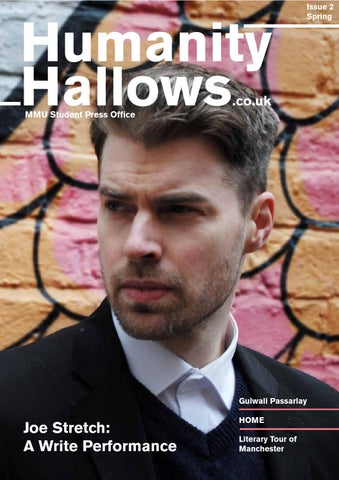
Humanity Hallows
Issue 2 Spring
.co.uk
MMU Student Press Office
Gulwali Passarlay
Joe Stretch: A Write Performance
HOME Literary Tour of Manchester
1
Welcome... …to our second print edition of Humanity Hallows magazine! Here at the Manchester Metropolitan University Student Press Office we were all very proud of our first print edition in the autumn term and we hope you all enjoyed it, too. We can guarantee that this issue is even bigger and better!
Contents 4
Celebrating Cornerhouse Theatre
This time, we are celebrating all things Number 70. As you may already know, some of our friends in Manchester Met’s Humanities, Languages & Social Sciences Faculty have moved to a new home in the Number 70 building on the corner of Oxford Road and Whitworth Street. Formerly known as Cornerhouse, the building is now home to the Manchester Writing School, the Manchester School of Theatre and the Film, Multimedia Journalism and Languages departments. With a café-bar, galleries and performance spaces, Number 70 is fast becoming one of our most exciting and vibrant university hubs as well as a space where all arts and culture can be celebrated.
6
Review: Welcome HOME
8
Interview: Joe Stretch
12
A Literary Tour of Manchester
14
Gothic Manchester Festival Highlights
16
Interview: Freda Warrington
17
Review: Asking For It
19
Theatre Review
So, following our Number 70 theme, in this edition of Humanity Hallows we have some fantastic articles, including interviews with writer and Manchester Writing School lecturer Joe Stretch, who talks about his novels and his passion for writing, political activist Gulwali Passarlay, and creator of all things vampiric and terrifying, Freda Warrington. We also have some great comment pieces, book reviews, music reviews and brilliant creative work from students at the Manchester Writing School.
20
Music: Bad Molly, Cabbage and Freakout Honey
22
Top Five Alternative Nights Out in Manchester
25
Student Press Office: How to Get Involved
26
Interview: Gulwali Passarlay
30
Comment: You Don’t Have to Justify Your Body
30
Manchester Secret History
32
RECLAIM: Striving for Working Class Equality
34
Community: SASCA News
36
The Rise of the Gentlewoman
37
Life: Cooking on a Budget
38
Creative: Celebrating Number 70
Every article in Humanity Hallows magazine, and on our website, www.humanityhallows.co.uk, is created by students for students. If you are interested in getting involved and joining the team find more information on page 27 or visit HUMANITYHALLOWS.CO.UK/WORKWITH-US
A MANCHESTER ACADEMY PRESENTATION
CHRIS RAMSEY: ALL GROWED UP FRIDAY 11TH MARCH - £17.50
BOOK NOW: 0161 832 1111 MANCHESTERACADEMY.NET 2
facebook.com/manchesteracademy
@manchesteracademy
FOR UP TO DATE LISTINGS VISIT MANChesteracademy.net
So, what are you waiting for? Grab a brew and get reading Humanity Hallows! Jacqueline Grima (Student Editor-in-Chief) The Manchester Met Student Press Office is a Make a Difference project run by Student Media Officer Natalie Carragher. For more information on upcoming features, advertising opportunities and more contact N.Carragher@mmu.ac.uk
3
3
Cornerhouse Theatre: Celebrating the Evolution of a Manchester Landmark
Words: Sarah Lavery Image: Courtesy of Manchester Libraries, Information & Archives, Manchester City Council
Sitting on the corner of Oxford Road and Whitworth Street, close to Oxford Road Station, is a landmark building: the Manchester Arthouse Cinema, previously know as ‘Cornerhouse’. Today the building now known as ‘Number 70’, and celebrated in this issue, is the new home of Manchester Metropolian University’s Writing School, School of Theatre and Multimedia and Languages departments. This building has witnessed many changes to the city of Manchester but, for those unfamiliar with it, you will find that the picturehouse’s own wavering history is much more intriguing than most people realise. This story can be traced back over 100 years to 1911, with the opening of the Manchester Electric Theatre. The theatre was perhaps one of Manchester’s first silent picture theatres, situated right in the heart of the city. Unfortunately, this early version of the theatre was short-lived with the interruption of war and the subsequent decline of the film industry. The owners were forced to close their doors in 1925 and the original building was destroyed. In 1935, during ‘The Golden Age of Hollywood’, Peter Cummings redesigned the modernist building that we see today, reinventing the space as the Tatler News Theatre with a capacity of 300. Nevertheless, with the arrival of the television in the home, the novelty and success of this redevelopment failed to retain the public’s attention. The theatre once more closed down for a brief period in 1959-1961. It was during the 1960s that the theatre experienced fluctuating success, having to re-invent itself several times. It notably became the Tatler Cinema Club in 1969, innovatively presenting its customers with the novel and erotic peep-show films. After its period of limited prosperity, the picturehouse 4 closed once more in 1981. Appearing
4
to be coming to the end of its time as a picture theatre, the building was converted into Shaw’s furniture showroom. However, this was still not to be the end of the theatre. After its brief stint in upholstery, today the space is best known under its famous alias, The Cornerhouse Theatre, re-opening in 1985 and remaining as such for a further 30 years. The history of Cornerhouse demonstrates the fluctuating demand for cinema throughout the 20th century, affected by, as mentioned previously, the disruptions of war and the invention of televisions. Despite these setbacks, however, the theatre was a very important outlet of entertainment for the population of Manchester, acting then much as it does now: as a refuge from the anxieties of home and work and a relaxing experience with friends. Over the years, Cornerhouse Theatre has had many names and many owners. However, its service as an entertainment facility has ultimately stood the test of time and is now a landmark of Manchester’s film industry.
5
5
Review: Welcome HOME Words: Jacqueline Grima Photography: Jack Holmes
In 2015, the HOME Theatre, Manchester, formerly located in the Cornerhouse building, moved to its new home in Tony Wilson Place, just off Whitworth Street. Funded by Manchester City Council and the Arts Council, the building is now set to become one of the most exciting centres for art and culture in the UK. According to their website, HOME is ‘for curiosity seekers, for lovers of the dramatic, the digital and the deeply engaging; for radicals and reciprocators’. Indeed, it seems that in the building that now houses two of Manchester’s best-loved arts organisations, Cornerhouse and the Library Theatre Company, there is something for everyone. Firstly, HOME offers not just one, but two state-of-the-art theatres, each showing a wide variety of productions, including regular performances by students from the Manchester School of Theatre. Shows already booked for 2016 include Into the Hoods: Remixed, 6 a revamped version of the award-
6
winning West End production directed by Kate Prince, Shakespeare’s Twelfth Night, directed by Sean Holmes, and winner of a Total Theatre award at the 2015 Edinburgh Fringe, The Beanfield. HOME also boasts of five cinema screens dedicated to showcasing a variety of rare and thoughtprovoking films from both national and international film-makers. Highlights of the 2016 film season include a series of Hong Kong crime thrillers, billed as some of the ‘greatest crime thrillers ever made’ and an exploration of the key works of British screenwriter, Jim Allen. HOME, however, is not simply about theatre and cinema. In fact, there are a whole host of other cultural activities in which visitors to Tony Wilson Place can partake. For example, the building features a huge gallery space that regularly hosts exhibitions and events that are free to enter and visitors can also sign up to one of the many art and culture-based courses or workshops that HOME offers. Workshops subjects
coming in 2016 include digital skills, puppetry and writing for the theatre. If that’s not enough, the building is also home to a bookshop which stocks a wide variety of contemporary art and literature from across the globe and offers a ground floor café bar and a first-floor restaurant where visitors can find a wide array of refreshments at reasonable prices. Dishes on offer include a Worker’s Lunch Deal for just £8.50 as well as a variety of pizzas, pasta and salads. There is also a licensed bar. With its striking, all-glass façade and a whole host of cultural activities all under one roof, the HOME Theatre, Manchester, much like the Beetham Tower or Central Library, is set to soon become an iconic landmark of Manchester’s city centre. For more information about film screenings, theatre productions and other events in the coming year, see www.homemcr.org
7
7
Interview: Joe Stretch Words: Jacqueline Grima Photography: Agota Juskaite
With three novels published, a record deal with Polydor and now a successful teaching career at the Manchester Writing School, Joe Stretch might be forgiven for coming across as slightly big-headed. When we meet, however, Joe is clearly much more interested in talking about his love of writing than in any attempts at self-promotion: “I don’t write for publication,” he says, humbly. “I don’t write for selfpromotion. I write for the sheer bliss of being immersed in a writing project.” Joe’s journey to publication is an interesting one, beginning with a chance meeting with novelist and Manchester Writing School lecturer Nicholas Royle. “In 2003 or 2004, I was touring with my band Performance, and it had all got a bit depressing. We were playing clubs, going on stage at about 1am and playing to people who were absolutely hammered. When we played in Glasgow, I got back to the hotel at about three in the morning and there was a voicemail from a journalist waiting for me, telling me that when we played in Liverpool the next day, a guy called Nick Royle wanted to meet and interview me about the band. When I found out that Nick was a novelist, my first thought was, ‘God, I wish I could be a novelist’.” Joe admits that although he loved writing, he was naïve about the publishing industry and had never considered that anyone would want to read his work. “I’d written a novel but had no sense that you could just ‘be’ a novelist. I had written it purely for my own enjoyment and, because the band weren’t doing much recording, I had a lot of time on my hands. When I met Nick Royle, I somehow had a sense that this was a chance. It wasn’t an opportunity that I was looking to exploit but, I just thought, what an amazing opportunity, to meet a novelist.” Although Joe describes his writing as “his private life”, the meeting led to him eventually sending a manuscript to Nick: an early draft of what would later 8 become his first novel, Friction. “Nick said that the writing was ‘pretty
8
ropey’. He said ‘you can’t spell, you can’t punctuate and you’re taking risks that don’t always work’ but he was prepared to help me find an agent. He was like my guardian angel.” It took another six months before the manuscript was ready, after which offers of publication came flooding in.
“I’d gone from having to borrow money for toilet paper to signing book deals in Italy, Germany and the UK. My life had transformed.” Again, Joe is humble about how deserving he was of publication success, admitting he found it difficult to have faith in Friction and his second novel, Wildlife. “Looking back, I felt like such a fake. I felt talentless and that the first book was deeply flawed. When I get emails from people who tell me that they’ve just read Friction or Wildlife and loved them, I don’t know what to say to them.” After his initial success, Joe took some time to reassess his relationship with his writing, spending five years on his third novel, The Adult. “I wanted to write something true. I knew The Adult wasn’t as exciting and saleable as the first two books but I did feel that it was more honest. I deliberately set out to eradicate all the false energy, to eradicate all the hype, and see what remained.” As well as marking a change in Joe’s writing style, the book moved on from
the seemingly transgressive subject matter of his earlier novels, which addressed issues such as cyber-sex, orgasm machines and abortion. “When I was young I was interested in writing naughty things. When I moved from the country to the city, I was genuinely shocked at some of the things that went on that made their way into my novels, like the concept of recreational abortion.” So did he deliberately set out to shock his readers? “No, I’m shocked myself. People still come up to me and say what a dark person I must be to write about these things but I’m not. The novels were an expression of my own shock. I was shocked, so what I wrote was written in a state of shock.” The Adult went on to win the 2012 Somerset Maugham Award, an achievement Joe almost seems to think he has to justify. “That was a prize I’d always looked up to. Lots of writers that I loved had won that prize and winning it took a lot of pressure off. Although I feel guilty saying it, as I’m not out to seek fame and fortune, winning the award did make me very happy. I don’t write to win awards but I guess everyone needs validation. It made me think that I can’t be as shit as I sometimes think I am.” Joe disagrees with the perception that The Adult, as suggested by some reviewers, is a nostalgic work. “Everyone says it’s nostalgic but I don’t agree. It features lots of the past but, for me, it’s more about how the central character’s family were mutilated by the dream of fame. It’s an archaeology of our failure to find meaning in life.”
“When I was young I was interested in writing naughty things. When I moved from the country to the city, I was genuinely shocked at some things that went on and made their way into my novels.” 9 9
Much of Joe’s writing addresses the impact social media has had on the current generation. Is the impact a positive one? “I do find it difficult to be positive sometimes and I suppose social media comes into my negative assessment of how we, as a society, seek to experience life. Social media often strikes me as quite banal but then so do lots of other things. Am I excited by social media? No. Do I see social media as a great way to experience reality? No. I like privacy. When you hold on to things instead of immediately telling the whole world about them, they feel better. Sharing our experiences is like feeding them into a paper shredder. If you have achieved something or if something nice has happened to you, you need to fight the instinct to share it and learn to enjoy it yourself. Life is more important than seeming successful.” Although seeming to be a so-called ‘Jack-of-all-trades’ and primarily describing himself as a ‘teacher’, it is clear that writing is and always will be Joe’s first passion:
“That moment when you create a separation between you and the text, that’s the heaven of writing.”
“I find it harder now than I ever have but I love it more. For me, writing is about creating sentences that don’t feel like I wrote them so that I feel moved by the words but also alien to them. That moment when you create a separation between you and the text, that’s the heaven of writing.”
10
10
11
11
A Literary Tour of Manchester
Words: Jamie Stewart Photography: Jack Holmes & Rachel Bruce
Manchester, the heart of the North West, has produced world-class artists, musicians, political activists and is the birthplace of Anthony Burgess, Jeanette Winterson and Elizabeth Gaskell. A northern powerhouse of industrial revolution, Manchester is a city embedded in both history and literature. Its literary scene is as rich and vibrant as the city itself, with both the Manchester Writing School and the University of Manchester offering English Literature and Creative Writing courses. Along with these courses, Manchester is jam-packed with live literature events from poetry to non-fiction and everything in between.
THE ART OF TEA If you fancy a nibble with your afternoon read, head on down to The Art of Tea in Didsbury. Have a sandwich, some cake and wash it down with speciality tea then head in to the back for some pretty rare and amazing finds. theartoftea.co.uk 47 Barlow Moor Rd, Didsbury M20 6TW 0161 448 9323 INTERNATIONAL ANTONY BURGESS FOUNDATION Dedicated to the great Anthony Burgess, author of A Clockwork Orange, The Complete Enderby and The Malayan Trilogy, the foundation is a great space to watch performances and go for a nibble. The impressive engine house building is also home to an extensive collection of Burgess manuscripts, correspondence and photographs. The Reading Room is open by appointment only.
BAD LANGUAGE Bad Language is one of Manchester’s most immersive and eclectic live literature nights. Here you can expect to see poetry, creative non-fiction, and short stories, and the event has won the Saboteur Award for Best Live Literature Night. Bad Language features a headline act as well as open mic performance slots available to the public. Bad Language runs on the last Wednesday of each month at the Castle Hotel.
THE JOHN RYLANDS LIBRARY If you’re looking for stunning architecture and beautiful surroundings, take your favourite book to The John Rylands Library on Deansgate and become inspired. The Victorian Gothic library is open to the public seven days a week and is host to a range of events and exhibitions. It is also home to world class treasures including the oldest known piece of the New Testament and a vast collection of medieval manuscripts.
badlanguagemcr.com 66 Oldham St, Manchester M4 1LE 12 0161 237 9485
library.manchester.ac.uk/rylands 150 Deansgate, Manchester M3 3EH 0161 306 0555
12
anthonyburgess.org 3 Cambridge St, Manchester M1 5BY 0161 235 0776 ABACUS BOOKS If you have time to step out of the city centre, take a tram to Altrincham and visit this lovely independent bookshop. They have lots of interesting and rare books and manuscripts to satisfy all interests. 24 Regent Rd, Altrincham WA14 1RP 0161 928 5108
13
13
The central symposium, entitled ‘What Lies Beneath’, explored the uncanny, the unsaid, and the unseen. In other words, the horrors that lurk in the very depths of the genre. With a massive panel with a range of specialities, the conference explored all aspects of the Gothic with many disciplines in mind, from literature, film and TV, to religion and psychogeography to show how the Gothic is still very much alive (or ‘undead’) throughout contemporary culture.
Gothic Manchester Festival Highlights Words: Lucy Simpson Additional Reporting: Rachel Rowlands & Joshua Lee Photography: Ade Hunter The Gothic Manchester Festival cast a shadow across the city as it brought to Manchester everything from the dark and deadly to the weird and wonderful. The festival promises dark delights every year. It returned this year for its third reincarnation with a theme of ‘H.P. Lovecraft and The Weird’. Manchester remains the festival’s natural home. Dr Xavier Aldana Reyes, founding member of Manchester Centre for Gothic Studies, said, “Manchester’s history, architecture and countercultural spirit make it a prime candidate for a festival designed to explore the alternative dark side of the city and to revel in its secrets. This is why I think it has resonated with Mancunians; the events consistently offer new, interesting and different windows into the city we think we know.” The festival unites lovers of horror and academics of atrocity alike in their combined passion for all things Gothic. Events are diverse, ranging from a gothic club night to an academic conference on the topic of ‘What Lies Beneath’, and made complete by an army of knitted Cthulhae to be raffled in aid of the Sophie Lancaster Foundation. Dr Aldana Reyes reflects, “The 14 festival has always meant to tread the delicate line between the
14
informative and the fun, and to bring the research we carry out at the Gothic Centre and at Manchester Metropolitan University to a wider, discerning audience.” The festival opened with the launch of ‘Crafting the Weird’, an art exhibition by Manchester Gothic Arts Group (MGAG) and John Hyatt from the Manchester School of Art. The exhibition was described as “exciting and eclectic” and featured such horrors as a pentagram, and a jar of tentacles. Darkness and Light are resounding themes of the Gothic and the title of Dr Linnie Blake, Head of the Manchester Centre for Gothic Studies, and Dr Aldana Reyes’ exhibition in the neoGothic grandeur of the John Rylands Library. The gothic pair showed guests various gothic manuscripts and novels from throughout the ages. Amongst the items on display are editions of classic gothic novels from the year they were published: The Monk from 1796, The Mysteries of Udolpho from 1794, and The Castle of Otranto from 1764. There is also a specialist anatomy case and books on galvanism, including one that inspired Mary Shelley herself prior to writing Frankenstein. The themes of classic Gothic novels
infect literature even now. Twisted Tales of the Weird brought together three writers who have taken inspiration from the Gothic literature and Weird fiction. Helen Marshall, Timothy J. Jarvis, and the incredibly influential M J Harrison treated the audience to readings, Q&A, and book signings. At a later event, Kit Cox, author of the Major Jack Union series, collected an audience of steampunks in corsets, top-hats and tailcoats. However, a different kind of outfit was needed at TentaculArA SpectaculArA. ArA is a monthly Gothic club night in Sacred Trinity Church in Salford. Glamogoth took to the stage in sparkling skeleton suits, to create a quintet of cadavers that got the audience twisting their tentacles to the music throughout the church’s gothic surroundings. Dr Blake explained how the legacy of the Gothic lives on, not simply as a literary genre or a fashion movement, but also a mode of being. Dr Blake, who described herself as “superstitious” following an incident with an astral spirit and a table with one leg shorter than the others, described the ‘gothic’ as an expression of society; a form which acts almost as a social commentary to express the fears and anxieties of contemporary society.
Many of the panel have contributed to the first edition of the Dark Arts Journal, the launch of which was marked by the cutting of a very deadly cake. The Necronomicon, a book of dark magic from H.P. Lovecraft’s fiction, was recreated in the form of red velvet and salted caramel. After the event, one guest concluded “a lot lies beneath”. This was taken more literally at the Underground Mystery and Mythos tour with Jonathan Schofield and VAGUE, the roleplaying society at Manchester Met. The tour took guests around Manchester’s subterranean spaces – and gave a few a bit more than they bargained for. David Riley, who participated in the organisation of the event with VAGUE, said, “Our aim was to show the public a taste of gothic horror. While Lovecraft’s works may not be as spine-chilling for modern audiences as they were at the time they were written, we wanted to give the audience a good feel for the ongoing horrors of the Gothic”. Guests embarked on a journey of cult magic and arcane atrocities, before being saved by the Men in Black in a modern twist. There is nowhere where the permeation of the Gothic is more obvious than in the world of cinema. The Gothic Festival met up with Grimmfest for a screening of Reanimator and From Beyond, with an exclusive Q&A with producer Brian Yuzna. Cinema was also a frequent topic in the festival’s grand finale: a Cthulhu pub quiz complete with squid ink cocktails. Richard Gough Thomas, quizmaster, greeted his “fellow cultists” in a cape and Cthulhu mask before delving into the watery depths of the Cthulhu mythos. The Manchester Gothic Festival will be stitched up and reanimated next year with events on the theme of Frankenstein. Until then, the festival will return to its watery grave.
“Manchester’s history, architecture and multicultural spirit make it a prime candidate for a festival designed to explore the alternative dark side of the city and to revel in its secrets.” 15 15
Interview: Freda Warrington
timid girl in her family’s shadow to an independent woman. Also, did I mention the gorgeous clothes? Your book Dracula the Undead is a direct sequel to Bram Stoker’s Dracula. Was it challenging to undertake such a task? Yes, quite intimidating! My thenpublisher, Penguin, asked me to write it to celebrate the 1997 centenary of Dracula first being published. I approached the project as if I had never seen a Dracula movie or read any other vampire novels, as if my only source materials were the diaries and journals of the original characters. I wrote it entirely from the viewpoint of those characters (with a couple of new ones of my own). I aimed to stick to the authentic tone of Stoker’s novel, although there is a deliberate subtext of feminism and sexuality that was rather suppressed
Words: Rachel Rowlands Freda Warrington is the author of fantasy, horror and supernatural novels including Dracula the Undead, the Blood Wine sequence (recently reissued by Titan books) and the Blackbird series. As part of Gothic Manchester, I chatted to Freda about vampires, the Gothic, and her sources of inspiration. Your Blood Wine books contain a lot of gothic elements, not in the least because of the vampires! Did you draw any inspiration from gothic literature or film? Of course! My mum let me stay up to watch Hammer Horror films when I was very small, and I was captivated by Christopher Lee. Bram Stoker’s Dracula and other 19th century stories such as Carmilla by Joseph Sheridan LeFanu had a big effect on my imagination. I loved the idea of the “mysterious stranger” – male or female – who was charismatic and dangerous, yet lonely and tragic. I was more intrigued by mystery and allure 16 than by gory elements. One thing that
16
drove me mad about vampire stories was that the vampire always ended up being hunted down and staked! I began writing my own vampire fiction because I wanted to see the vampire as a person in their own right, and I craved a different ending. I started my Blood Wine series in the early 1980s, long before the recent deluge of vampire fiction. Anne Rice was, I think, the first person to present a story from the vampire’s point of view and I loved that. However, she still showed vampires and humans to be separated by an impenetrable barrier. My own novel took shape because I wanted to explore what would happen if a human (Charlotte) could break through that barrier of predator and prey, and come to know this enigmatic, alluring stranger (Karl) on equal terms, and the transformative effect it would have on them both. Your choice of setting always struck me as particularly gothic too, especially Charlotte’s house. Did any real locations inspire you?
Oh yes. If you mean Charlotte’s family home in Cambridge, that was pretty much out of my head, although I did visit Cambridge to explore all the locations in the story. But the main setting – the grand house where her aunt lives – was based on a stately home we once stayed in that had been turned into a health spa. The gardens really were as described in the books, and absolutely stunning – the perfect place for secret trysts with your vampire lover! The only bit I made up was the “secret tunnel” leading to the derelict medieval manor house. And that manor was based on a real one, too. I’d like to add that I chose the 1920s as a setting because it was a period when the Edwardian age was turning into the modern world, and you’ve got this lovely blend of old-fashioned values and modernity, with jazz and glamour and spooky silent movies and scientific advances. It was a time of great social change, overshadowed by the First World War, which mirrors Charlotte’s journey from being a
in the original. Dracula the Undead won the Dracula Society Award for Best Gothic Novel in 1997 – although one reader described it as, “the worst vampire novel I’ve ever read.” Oh well, you can’t please everyone! I respected the original and did my best.
sex and family secrets in there, too, not just horror! When I wrote it in the early 1990s, it was long before such themes were done to death, so to speak.
You’ve also written a horror novel, Dark Cathedral. What draws you to horror, and why do you think darker themes are so appealing to readers?
I have at least five ideas floating around my head. I’ve made a start on a new fantasy novel, and I’ve written three short stories this year – all horror, coincidentally. I’ve started making my out-of-print titles available on Kindle. I’m also thinking about a psychological thriller/ghost project, and I would certainly love to write another novel in the Blood Wine series, and put together a short story collection. All I need is the time and energy to do everything!
I like psychological rather than visceral horror. A good old scare is thrilling, but feeling disgusted is just gross, in my opinion. That said, Dark Cathedral did have some fairly gory scenes! It was a tale about a conflict between Christianity and Paganism, both in the present and the past, so it was a fairly dark journey into some issues of witch-persecution and religious mania. I enjoyed writing that book – there’s a lot of philosophy, romance,
What are you working on next?
For more information about Freda Warrington and her books, visit fredawarrington.com
Review: Asking For It
Words: Joanna Shaw
Emma is a popular girl growing up in rural Ireland; she works hard in school and boys find her attractive. However, the morning after a party, Emma can’t understand why she aches all over, why she is bruised and why her friends won’t talk to her, until she turns on her computer and her life changes forever. Asking For It is the second book from Irish author Louise O’ Neill. Her writing style is described by many highprofile authors as gritty and honest and I couldn’t agree more with this description. After thoroughly enjoying O’ Neill’s first novel Only Ever Yours, I wasn’t surprised by how violent and dark Asking for It is. The book discusses the harsh topic of victim-blaming in rape cases and the cruel, unforgiving side of social media. Emma’s story is repeated throughout the local and national news, talked about on panel shows and even commented upon by the local priest. This book refuses to let you disconnect
literary drama from reality, as in Ireland only one in ten rape cases is reported to the police. Of the tiny percentage that are reported only 7% end up in a secure conviction. O’Neill writes so brutally and so honestly that it makes you fully acknowledge that rape and abuse cases need more attention, not just in Ireland, but throughout the world. One part of the book I found truly disturbing was the treatment and representation of women by men. The boys at school are constantly commenting on the ‘unattractive’ girls and the girls who sleep around, observing how they don’t all look like the models on the TV. It is an unfortunate reflection upon reality how women are encouraged to judge themselves and each other. This book is so prominent that it should be used at A-level and given to students who are studying law, social science and even gender studies. Rating: 5/5
HAVE YOUR SAY If you’d like to submit a book review17 for Humanity Hallows get in touch! Email HumanityHallows.Ents@mail.com 17
Theatre Review: Brutopia by Howard Barker
Words: Jacqueline Grima
Director: David Salter
Thomas More served as Lord High Chancellor of England from 1529 to 1532 and, despite opposing protestant reformation and King Henry VIII’s numerous divorces, acted as one of the monarch’s closest aides. In 1516, More authored his most renowned work Utopia, a fictional account of a hierarchyfree ideal nation whose inhabitants live together in perfect harmony. Hailed as a martyr, he was canonised by the Catholic Church in 1935. In October, students of the Manchester School of Theatre staged the UK premier of Brutopia at the HOME Theatre in Manchester. Written by Howard Barker and starring Jerome Dowling, the play is billed as a ‘riposte to the conventional image of Thomas More’, exploring his fictionalised relationship with his daughter, Cecilia, and her authorship of a counter text to her father’s classic. The play begins with Cecilia, More’s seemingly least-favoured child, telling the audience of the challenging nature of her relationship with her father: ‘My father did not love me so I chose to cease loving him.’ Feeling isolated and unloved, Cecilia creates, in her imagination, an antithesis
to her father’s work, the ‘unknown and terrible kingdom of Brutopia’ where ‘hope is entirely redundant’, which, in an ostentatious act of rebellion, she sets her mind on publishing. Played by the remarkable Farran Mitchell, Cecilia cuts a sad and lonely figure, the metaphorical black sheep of her family, trying to find her position in a world where so-called heretics are imprisoned for reading the bible in English and where ‘the poor are guilty of poverty.’ For Cecilia, the seemingly more honest, more straightforward kingdom of Brutopia becomes an escape route, a way of making sense of the conflicting rules that seem to govern her real-life (and her father’s fictional) surroundings: ‘In Brutopia everyone is put to death without exception.’ As the work becomes an obsession, however, the lengths to which Cecilia will go to see it in print are sometimes shocking and, often, heart wrenching. Brutopia also explores Thomas More’s love/hate relationship with King Henry VIII, portrayed in all his charismatic glory by Tyler Conti. Usually unswervingly loyal to his monarch, More objects strongly to
Henry’s actions in divorcing second wife, Anne Boleyn. This objection, in turn, leads to More’s own isolation as he becomes, much like his daughter, more and more emotionally unhinged. In a surreal twist, it is an apparent visitor from the fictional Utopia, a character known only as ‘The Doctor’, that sets More onto this slippery slope. He insists, ‘There is no Utopia. I invented it.’ With sometimes discomfiting scenes of sex and full nudity and themes of isolation, dysfunctional families and societies and mental instability, Brutopia can be a difficult play to watch. ‘Is she touched?’ asks one character of Cecilia to which she declares, ‘I am not mad, I am Thomas More’s daughter.’ Add the dark and slightly claustrophobic metal prisons that form the set and the mood is set for an emotionally demanding two-hour production. What is clear from the almost complete silence of the audience, however, is that Barker’s play is both enthralling and engaging, the occasional humorous interlude successfully lightening its intensity. All in all, a resounding success for HOME and the Manchester School of Theatre.
Unity (1918) by Kevin Kerr Director: Stefan Escreet
In 1918, during the last months of the First World War, a deadly strain of the flu virus, dubbed the ‘Spanish Flu’, killed approximately half a billion people across the globe. During this period, many communities, already ravaged by the effects of the war, found themselves quarantined and isolated. At the Home Theatre in Manchester, Unity 1918, written by Kevin Kerr and staged by students of the Manchester School of Theatre, explored the effects of the flu on one such community.
18
18
Unity 1918 tells the story of three sisters, Beatrice, Mary and Sissy who live in the small town of Unity in Canada. The play shows how they each attempt to cope with the effects, first of the war and, secondly, of the terrifying flu virus, on their beloved home. Sensible elder sister Beatrice, played by Fay Jagger, is a feisty, determined character – “Just because we can’t fight doesn’t mean we’re not part of the battle” – steadfastly knitting socks for the soldiers while fantasising
about the return of the figure from her romantic daydreams, Glen. Mary, played by Hannah Duffy, waits patiently for the post, yearning for news of her soon-tobe fiancé, Richard. Youngest sister Sissy, played wonderfully by Laura Ferries, becomes convinced, through reading the bible, that the end of the world is nigh: “the war, the weather, strange things happening all around.”
Adding to the town’s panic is the prospect of infected soldiers coming home, symbolised by the return of Sunna’s cousin, the injured and blind Hart, played by Johnny Byrom. Sheltered by Sunna, Hart soon becomes the focus of the town’s paranoia. Feeling lonely, Beatrice befriends Hart, the scenes as the townspeople begin to fall victim to the virus one by one heart-breaking to watch.
In a play laced with dark humour, the town’s inhabitants become increasingly isolated as the threat from the flu closes in. The only person in the town appearing to profit from the situation is newlyinstated undertaker, Sunna, played with a brilliant sense of dead-pan by Bryony Miller. As trains are forbidden to stop in the town and, much to Mary’s horror, letters from loved ones are burnt for fear of germs, inhabitants of the once-close community begin to turn against each other. As Beatrice emphatically states, Unity has become “wounded in the heart and mind.”
With its painful themes and sense of dark paranoia, Unity 1918 is by no means an easy or particularly uplifting play, successfully highlighting how, despite its title, this terrifying situation could manifest itself in any town, at any time. For the Manchester School of Theatre, however, and for the HOME Theatre, the play appears to be one of the most memorable of their 2015 season. For more information about upcoming events at the HOME Theatre, visit homemcr.org 19
19 19
Music: Bad Molly, Cabbage and Freakout Honey Words: Freddie Bruhin-Price Photography: Emilia Castle
“Music has always been a matter of energy to me, a question of Fuel. Sentimental people call it Inspiration, but what they really mean is Fuel. I am a serious consumer. On some nights I still believe that a car with the gas needle on empty can run about fifty more miles if you have the right music very loud on the radio.” - Hunter S. Thompson It was time for a pit-stop. The filling station was beautiful, full of glittering vessels in paisley dresses, paisley shirts and scarves: the uniform of the psych revolution. This backwards looking movement has too few innovators for me to subscribe to it fully, but every now and again a band provides the fuel I need to make it back home in one piece. Hunter Thompson’s analogy was as apt here as ever, for it rings most true when applied to good quality live music. Of course, all theories have flaws. There is the matter of taste which complicates the whole Fuel analogy, for one man’s fuel is another man’s dishwater. And everybody with half a brain knows you can’t put diesel in a petrol engine without serious repercussions. So opinions on music can be terribly subjective. However, 20 divisive though it may be, there is the
20
feeling taste should be celebrated, even exalted as the mother of musical diversity. To my taste last Saturday, the Cabbage was cabbage, and the Honey was verily sweet. This is not the Mudhoney fuzz of grunge or the Wild Honey of the sixties surf, although both can be traced in the Freakout Honey sound if you pan deep enough. No, this new Honey is fed softly and dreamily, fresh from the beehive, by the Queen Bee herself: Sofia Sourianou. Her words, drenched in reverb and delay, evoke a dreamlike state, at times propelled almost to a trance by rotating riffs and rhythms. In what proved to be a compelling version of Witch Surf the layer of auto wah guitar present on the band’s recording came to life. It is worth noting that there are three lead guitars. Three guitars allow for something akin to guitar weaving, lines overlapping
each other, in this case quite like tides rushing over your sandy feet. In an irresistibly dreamy Disneyize, during which I almost transcended my earthly body and took to the skies, the guitars seemed to cascade over one another. Very woozy. Note the song titles too; the entire package is coherently trippy. By the middle of the set it became clear that the band play as one, which compensates for the absence of individual guitar styles per se, though these may become more apparent on repeated viewings. The songs are melodic, repetitive and locomotive, and parts progress like waves rolling into the ever undulating sea. The drumming is remarkable – restless and urgent. It’s hard to tell if the beats are based on psych rock tropes or on their source. Not the Nazz, The Prunes, Beefheart
myriad copycat progenies swamping the internet today, called into action by the Tame Impalas of the musical zoo. No. None of them. Perhaps, I feel, the inspiration comes from the nameless Soul men drumming on Wilson Pickett’s Land of 1000 Dances or (on the Honey’s Witch Surf) Smokey Robinson’s Going To a Go Go. I suspect the latter, as the Freakouts’ sticksman Tom Walmsley is a musical historian and promises to be a behemoth of a musician (if he keeps off the brown acid.) At the very least, Freakout Honey are an interesting listen. Taste may be a factor in my opinion of their music, because I like it, but don’t you like honey? You’re entitled not to. The lack of meaningful SONGS (in the tradition of SONGS and SONGWRITERS) is less important to me than the vibe - something more than just songs:
a mood stemming from a carefully constructed (and rigorously adhered to) ethos. It is creative and it is convincing. The drums tumble into the Velvet Underground toybox of cool guitar sounds and create something fresh. Fresh Honey. They don’t play again till next year. I for one will be there. I missed Bad Molly on Saturday night due to what can only be described as a horrendous error on the part of the organisers, but I must have used up my fuel after the gig on Saturday, for I found myself at Gulliver’s on Monday to fill up once again. That night I saw Bad Molly ploughing through a set of original R-n-B-flavoured tunes without hesitation. I had less than a lick of a beer bottle cap before the gig but I still enjoyed it, so it must have been all right. The vocals are strong and delivered with conviction, and lyrically indebted
to the mid-1960s golden age of guitar pop. It bodes well that the singer Ty Freeman is a Liverpudlian; as Noel Gallagher once observed, “There is no band of people I would rather play with than a band of scousers. They’ve all got it. And they are all stoned from breakfast to bedtime.” The guitar player Sam is technically gifted and stands still as a statue when he isn’t playing with his tongue (though I’m sure I’ve seen that somewhere before.) There are moments of psychedelia, moments of complete abandon from Ty, shaking his red head, completely absorbed in his music. This is refreshing. Too many singers keep it (un)cool but this frontman loses himself and it’s infectious. Not to mention the robotic gyrations from the seemingly possessed bassist Lucas Berry. That said, I feel bands like these work best on weekends. In an alcoholic stupor.21 Or so I’m told. So next time may be the time.
21
Top Five Alternative Nights Out in Manchester Manchester is home to the weird, the wonderful and the surreal, and its nightlife is no different, so long as you know where to look. Here are my top 5 suggestions for something a little bit different when it comes to nights out in Manchester. Words: Jack Holmes Photography: Jack Holmes & JCA Servo Photography
Sata n’s H ol It’s dif ficult low to wr nights ite o From ut withou a guide to t men its fre Manc tio e on a F h riday drink hour ning Sata ester’s alte n’s H and S rock, on Tu rnativ oll m e e a prices etal and e turday, Sa sdays, to f ow at leas music t onc ree e tan’s veryth a r e e. ntry fo comp bring ing in and t s to etit rs ha b big nig t makes S ive with th etween, all gether po tudents patan’s e u hts ou a pre other loca nder one r punk t. tty att l main o of. T ractiv e des stream clu he tinatio b n for s those
, and ative hub e and re l c e s d r’ o te h / Rem nches more nic setting Remake rn Quarter is Ma flect the le, re p to m e a h d x rt n ts te ect e h rf e The No ig p n nse to a b lu is its c in respo odel ” re m e e c fo n R / re e e e ri k e th a in little xp at conta Brain und. Rem e indie music e th ro , rg ts e h d ig n in n u u om er a “gen die music tracks fr out to off clubs hosting in set lists contain eld at H . ie am eir Bow ic s s la c mainstre l indie music. Th d e Northe Kills an n, further into th tua to no ac Massacre, to Th e h thing a n oup Kitc ce some Jonestow uby Lounge or S walk to experien eR orth the either th it’s well w r, e rt a u ern Q rent. little diffe
22
22
Big H a Not fe nds eling g Hand oing a s. ll ed jus The hidden out with yo ur alte t dow g em o n r Oxfor d Roa the road fr f Manchest native music om th e d and ? Try r years. ’s bar eM off Big T s lights here’s even ers up alt r anchester cene is situ M o and a atc a u k s r o gem eum o ofto na or nee n d som ssortment p drinking s from the p a o e Big H ands. thing a bit f plants. If y rea with kit ast 60 schy f differe ou like a nt for a date your aesth iry etics or cat ch up , try l il w ter that Manches er, you’ll most in t e u s o o L ts ev to igh Refuse nch of n und. How ething by the u ro b a le k o n h u p w t om There’s a play you the bes nes song” and s fore. Refuse to o be to m s a e e R is m t k, m “tha pro s of ti to n e d z indie pun o te d a in e t rd tr s a e e e b b h e ly like likely t that’s laying th ls you’ve a little, p ave heard of, bu p u st up ll a Sex Pisto it h o Bar (ju ry ever to mix tr n e s ly R e im f it a o n e t fi en Los l de f eve ich you’l lace in the basem first Saturday o like h w f o t a lo the sp you n. It take IFTH) on ed up. If half the fu m Factory and F g your dates mix elf in, hit it up. fro yours gettin the road cuse for s to lose x d e n a o b n k o month, s e great new pun om finding s
Dea d Held bolt ous once eve p the U op punk ry two w e a offer K and so nd meta eks Dea s, De db me w lcore They adbo onde itch. olt scrat e l nigh ven try t brings rfully go Featurin ches th at t, a o i g DJ nigh from Ha nd incor n the cro d value s fro notorits, c p m f l w o l o o rm ds ac we ra omp meth lete en Circ te a them on ever oney dr ross ). with ink y uses e o cc or edib , le bl to Brea two into asion. ue m k eth ( ing Bad their cont t ains hemed no a ctua l
23
23
The University for World-Class Professionals
Postgraduate courses available for September 2016 entry in the Faculty of Humanities, Languages & Social Science
MA Creative Writing MA English Studies MA History MA Applied Linguistics MA Teaching English to Speakers of Other Languages (TESOL) MA International Relations and Global Communications MA European Philosophy / European Philosophy (Aesthetics) Master of Public Administration MSc Information Management MA Library and Information Management MA Multimedia Journalism MA Sociology and Global Change MSc Applied Quantitative Methods MA Criminology A range of related short courses are also recruiting now. Visit us at one of our Postgraduate Fairs in February, May, September or November. Find out more: mmu.ac.uk/hlss/postgrad
Student Press Office How to Get Involved Working with the Student Press Office is the ideal way for Manchester Met students to get that all important work experience while at university. We aim to provide a safe and supportive space in which students can be creative and have their voices heard, while boosting their confidence – and their CV – with skills in journalism, editing, publishing, social media and much, much more.
Current and previous Student Press Office members have seen their work published in local and national newspapers, magazines and websites and have worked on numerous exciting enterprises such as festivals and documentaries. We are currently recruiting for a number of roles and welcome applications and contributions from all Mancheter Met students. If you are interested in working with Humanity Hallows, and the Student Press Office, there are several ways that you can get involved and gain invaluable experience alongside your studies. Freelance Contributors
24
and refer to our Blogging Guidelines at HumanityHallows.co.uk before sending in your work to HumanityHallows.Editor@gmail.com
in and around university. These commissioned articles represent opportunities for students to be paid to write for Humanity Hallows.
Editorial Team
In order to be considered for our pool of Commissioned Journalists, you must have submitted at least three freelance contributions, including at least one example of reportage. We will then invite students whom we believe are suitable for the role to become Commissioned Journalists and get paid to write for us!
We have five online features sections – HH UniLife, HH Voices, HH Sport, HH Entertainment and HH MCR. This means we now have a number of exciting new opportunities for MMU students to become members of the Humanity Hallows editorial team. As an editor you will ensure that our content is of the highest calibre and will be read by as many people as possible. You will source your own stories and write regular editorial articles as well working with our social media marketers to promote your own and others’ work. This is a great opportunity to gain an insight into the world of journalism, to pick up genuine employability skills, contacts and meet new people. Full training and support will be provided. Commissioned Journalists
All Manchester Met students are invited to send in freelance contributions to Humanity Hallows.
Owing to the excellent work done by Student Press Officers over the past three years, Humanity Hallows is now a trusted and respected source of news.
Whether you want to review a gig or a film, report on an event or just get something off your chest, simply decide what you’d like to write about
As such, we often receive requests for Student Press Office members to report on particular events happening
Social Media Marketers If you love Twitter, Facebook, Instagram and social media in general then this is the role for you. The vast majority of our website traffic comes directly from our social media channels, therefore it is essential that we maintain a strong and lively presence and keep those views coming in! If you are interested in any of the positions, send an email to Natalie Carraragher at N.Carragher@mmu.ac.uk stating your name, student number and year and course of study. Humanity Hallows www.humanityhallows.co.uk facebook.com/HumanityHallows @HumanityHallows
25
25
“I was twelve years old when my father and grandfather were massacred. All I cared about, loved, respected and was influenced by was torn away from me in a single instant.”
“The Taliban wanted us to become fighters so we could take revenge for our family members that were killed by Americans.”
Interview: Gulwali Passarlay Words: Nima Khorramrooz
At the age of 12, Gulwali Passarlay was a shepherd boy and his life was in danger from the Taliban and the US government. Nine years later at the age of 21, he has become a political activist destined to run for the Presidency of Afghanistan. Gulwali Passarlay is an Afghan refugee, who was born in Afghanistan in 1995. He came from a wealthy and well-educated family but spent most of his childhood with his grandparents, his father a local doctor and his uncle a senior Taliban commander. His father was later killed by American Soldiers in a gun battle after the US invaded Afghanistan. In 2006, Gulwali’s mother made a lifechanging decision by sending 12-yearold Gulwali away with his brother to seek justice and freedom elsewhere. Gulwali now resides in Bolton and studies politics at the University of Manchester. Firstly, let’s start with your childhood. How would you describe your life in Afghanistan? It’s hard to say that I had a childhood 26 but in fact I did. My childhood was
26
very different in comparison to many people’s childhoods in the West. I spent most of my time with my grandparents and learnt a lot from them. However, what I can remember most is the US invasion.
“I spent my childhood in constant fear of death, trying to live through the bombs and rocket attacks...” I was really scared to see American forces’ cars, and planes overhead. It was a warzone. I grew up in a warzone. American troops believed Osama Bin Laden was hidden somewhere near your home meaning the areas surrounding your house
were bombed daily. What effect did that have on you? By that time, Osama Bin Laden was hidden in a place called “Tora Bora” which was near to where we lived. However, it wasn’t the only place that the Americans bombed. Americans in fact bombed Tora Bora most. They were bombing anywhere they believed Taliban fighters might be. It did have a tremendous effect on me. Not physically but mentally and emotionally. I still wake up sometimes at night having nightmares. It is sad that children in Afghanistan had to or still have to go through these difficulties. I think once they grow up the only thing they would remember is war. After your father’s death, your uncle wanted you to join the Taliban whereas your mother, who did not want you to fight, decided to send you away. What do you
think made her come to this decision when you and your brother were so young? I think sending me and my brother away was a very difficult decision to make for my mother and my grandmother. They knew that the journey we had to take was a difficult one but believed that it would still be better to face it rather than risking our lives in Afghanistan to fight for either Taliban or American forces. It wasn’t really my uncle who tried to persuade us to join the Taliban. The Taliban wanted us to become fighters so we could take revenge for our family members that were killed by Americans. They also looked at it as a moral duty; that every single Afghan is responsible for fighting invaders. You fled Afghanistan and travelled through eight countries including Iran, Turkey, Greece, Bulgaria, Italy, France, Germany and Belgium, taking almost a year to reach the UK. Why did your journey take a year and how did you manage to pass through all these countries? The journey was really tough. I had no idea where I was going. My life was in the hands of smugglers and
agents. When I arrived in Iran, I didn’t know what was happening. The journey continued with me crossing the borders illegally. I went from Iran to Turkey and then to Bulgaria where they deported me back to Turkey. I was then deported to Iran and started all over again. It took me almost ten months. I finally made it to Europe through Greece where I saw death with my own eyes. I was in a small boat carrying one hundred. It was about to sink, but luckily I managed to survive and make my way to Britain.
“When I see in the news that many people have drowned, I wish that one day nobody has to take this journey.” Many people are killed daily by taking this journey – refugees from Afghanistan or the Middle East in general. It must have been terrifying… It is. Afghani people used to be the largest group of refugees in the world. Recently, the Syrians have taken over.
People are leaving their homelands because they have no other choice. They are in wars and conflicts. They think the water is safer than the land. The ISIS uprising is also a reason why people have to run away from their countries. ISIS have no sense of humanity and people do what they can to survive. It is heart-breaking to see all these people coming to Europe and facing so many difficulties. You finally made it to Britain in 2007. You then claimed asylum and after a while, became a refugee. What is it like to be an asylum seeker and a refugee in the UK? Firstly, these two terms are supposed to be similar but they have their differences. Being an asylum seeker means you come to a country and claim asylum – you have legal rights. Britain has an obligation under UN convention to allow people to claim asylum. It took me five years to become a refugee. For me, the asylum process took a long time. It was such a cold and unwelcoming process. It made me feel victimised. I felt like I shouldn’t be here and that it was my fault I was an asylum seeker. They 27 didn’t seem to understand the traumas
27
carry the Olympic torch in 2012. I was one of the 8,000 people and actually the first Afghan that carried the torch. It was an unforgettable moment. Getting into university soon after I found out that my old school named an award after me also made me so proud. I didn’t know that I would write a book any time soon. When I used to talk to people about my story, and I have to say my story is not an extraordinary one but just a normal story, I realised that refugees don’t have a voice.
“Being an asylum seeker means so much uncertainty and instability. You don’t know what will happen. You’re unable to work and you don’t know if you’ll be recognised as a refugee or not.”
that I went through. As a refugee, at least you have rights. It’s not nice to be a refugee but it’s better to be recognised as one. Being an asylum seeker means so much uncertainty and instability. You don’t know what will happen. You’re unable to work and you don’t know if you’ll be recognised as a refugee or not. My first few months in the UK were the hardest time of my life. I experienced a lot more hardship than on the journey itself. You started your education soon after you settled into the UK. Tell me about any problems you had dealing with cultural differences. The first problems were the language barrier and cultural differences. I started year nine after I was sent to Starting Point Centre which was a place for international new arrivals where I became student captain and community ambassador. In year 10/11 I managed to get ten GCSEs which was not easy to do in two years as I had to catch up with all the work. I think it proves that refugees are determined. If they are given a chance they will succeed. They are very hard working people. When I was in school, I got involved with everything that was available for us. I was part of Council, student leader, student ambassador, 28 I was a member of Children in Care
28
Council, etc. Now, even after five years, the school has named an award after me, calling it ‘Gulwali Passarlay’s Award’, which is an amazing thing. So the school invite me every year to present awards and certificates. I have left a legacy. Not only have I managed to get ten GCSEs and get into sixth form college, but also I’m proud to leave a legacy that will remember me for what I’ve done at school. In 2013, you began your undergraduate studies at the University of Manchester. Following that year, the university named you “The UK’s most remarkable Student”. Why did the UK’s most remarkable student choose to do politics? I think the university made a big mistake by calling me the most remarkable student. I don’t think I am. But it’s very kind of them to do so. It was great that the university welcomed me in that way. In the last five years, I realised that politics is very important as it affects everybody whether we like it or not. We, the young people, are supposed to be the future leaders and future starts now. I thought that, regardless of whatever I become in the future, I want to contribute to my society. I also thought about being a politician with the hope that becoming
the leader of Afghanistan would ensure that people like me don’t have to leave their families. So I have a big task to do. I feel the responsibility on my shoulders because of the education and chances that I have. Of course, I will contribute to British society. I’m very grateful that Britain has given me these chances but at the same time I’d like to use my experiences and expertise to help my home country as well. I also feel that politics runs through my blood. Not only do I study politics but also I do politics in action. Have you had any contact with your family since you left Afghanistan? I have. Not for the first few years though. I do have contact with my mom and other family members. It’s hard. I haven’t seen them for nine years. I even mentioned in my book that, although my mom saved my life, she lost me completely as I am a very different person now and what I do is very hard for them to understand. You published your first book The Lightless Sky which is mainly about your journey to the UK. Why did you want to write this book? There are about four or five moments in my life that I’m so proud of. One was to
“There are very few refugees who are willing to share their stories because there is so much negativity attached to it. People don’t want to be called refugees or asylum seekers...”
desire with easy access to all countries including the western world. And everyone should be treated equally. I even mentioned it in my book that, one day, I hope people ask what a ‘refugee’ is, then someone would just introduce my book to them and say, “It doesn’t exist anymore but here in this book you may find more information about it”. Is there anything you would like say directly to our readers? I want to thank them for reading this interview. I hope they will get a chance to read The Lightless Sky as well. What we have discussed is just a
synopsis of that. One way individuals can help refugees is to do fundraising, organise workshops and write to their MPs. Students can ask their university to introduce more scholarships to help refugees and desperate people in Britain. People are already doing a fantastic job by supporting refugees but they can still do more. Students are really important. Hopefully they will do more to help refugees and asylum seekers in near future. The Lightless Sky is available from Amazon or your local book stores.
Therefore, I thought, I have a moral duty to speak up on their behalf. I have been acting as the spokesperson for refugees and asylum seekers from all over the world. In the last six months, I worked with Nadine Ghouri – a professional writer – who understood my pain fully and put my story into words. The book was published in October 2015. I had loads of interviews with national and local media. I have been touring across the country. My story is only one of the thousands. I want it to be a representation of those that are struggling for a better future. What is your biggest dream? I have lots of dreams. One of them is that I hope, one day, we will no longer have refugees in the world. I want to become the President of Afghanistan. That is not my biggest dream. It is something that will happen if I am lucky enough and work hard towards it. I will give it a try. It is not that important to me though. What is important is that I wish suffering in the world ends one day. Having no refugees means there will be stability, peace and security in the world. I hope we have a fair world system in which people can travel wherever they
HAVE YOUR SAY: If you have a story to share or an idea for an intervew get29 in touch with the Humanity Hallows team – HumanityHallows.Editor@gmail.com
29
Comment:
You Don’t Have to Justify Your Body Words: Christie Marsh I read a really nice quote one morning. It stated that we don’t have to justify our bodies and it got me thinking about my own body and how I feel about myself. I have recently joined Manchester Metropolitan University’s mental health society and shall be helping out with some of the events that they run, my first event being one that focuses on eating disorders. I’m feeling good since joining as it gives me something to focus on and the hope that maybe I can make a difference. It is so important to feel secure in our own bodies, especially in our younger years, as it can affect how we think and how we present ourselves to the public. By sharing my story in Humanity Hallows, I am hoping that others will be inspired to share their thoughts and opinions on the subject too. I have always been petite, skinny. Whatever label might be associated with being small, I have been called it. I was never really aware of my weight until I started college. It was there that it became apparent to me that people, both boys and girls, were looking at me and judging me based on my appearance. Judging a person’s appearance can often be quite a normal thing to do, as we see people we can aspire to be like or admire something
about them such as their make-up technique. However, body shaming and commenting on a person’s size or weight is not okay, not to me anyway. We have no right to comment on another person’s body. It is simply NOT OURS to comment on. Everyone has their own story and that is what we need to remember, but people often forget. My story is this: Last year I had an eating disorder. I stopped eating when I felt sad and, unfortunately, I felt sad all the time. Over a short space of time I lost so much weight I couldn’t stand up alone. I did want to get better, I just couldn’t. Issues with food still affect me today, but with each day, it gets easier. It gets easier to talk about and to deal with and that gives me hope and inspiration that others can do the same. People are ‘body-shamed’ whatever size they are. Whatever size you may be, then someone, somewhere is not going to be happy with the way you look. When I was younger I used to think that it was an age thing, which it is in some cases. However, at 21+ we should be educated enough to realise that everyone is different and that other people’s bodies are none of our
business to comment on. It is interesting and sad to note, how a large number of us only see beauty as a physical thing, rather than seeing someone as a beautiful soul, a beautiful personality, a beautiful being. Society has become so judgemental of what we view as beautiful we often forget that we can be beautiful too. We can’t see our own faces light up when we are excited about something or when we see someone that makes us happy. We can look in the mirror or at a photograph but we can’t see the actual beauty that lies within us ourselves. Being confident about our bodies and ourselves in general is so important, which is why if I can make any difference whatsoever with others, I will try. You don’t have to justify your body. If you are thin, for example, you don’t have to say, “But I eat all the time/I have a high metabolism,” and if you are a bigger size, you don’t have to say, “It’s genetic/I’m trying to lose weight.” You don’t need to explain to anybody why your body is the way that it is. Your body is YOUR body and that is all the justification you need. facebook.com/thetimetochangesociety
Manchester Secret History – 1844 Words: Neil Harrison If you’re a regular viewer of poverty porn TV shows such as Channel 4’s Benefits Street, or if you’ve ever accidentally glanced at a Daily Mail, you could be of the mistaken view that the welfare state is singly responsible for every cheat, chancer and scoundrel ever to have existed. Not so! Apparently, a sense of fair play was absent in parts of the population long before the welfare state ruined British society by making it a safer and fairer place for everyone. As this excellent Manchester Weekly Times story from February 1844 demonstrates, there has always been the odd rogue who is willing (and ingeniously able) to try to get something for nowt. “A 30youth, about 19 years of age, dressed something in the style of a fishmonger’s
30
porter, went, on Saturday evening last, to the vaults of the Higher Ship Inn, Shudehill, and asked for a pint of the best whiskey, at the same time placing a stone quart bottle on the counter to have the whiskey put in it. “This was done and handed back to him, but instead of paying for it, he asked if he could have half a pound of sugar. “On being answered in the negative, he said he would go [somewhere else] to get it, handing, as was thought at the time, the same bottle into which the whiskey was put, saying he would call [back] for it. As he did not return, the bottle was emptied, when it was found to contain just a pint of dirty water.” Perhaps this apparent lack of vigilance on the part of the Higher Ship Inn‘s
proprietors over the years could help to explain why the site of this old pub is now a Greggs. Elsewhere, it appears certain problems have an ageless quality and are sadly destined to beset society forever. I refer, of course, to haemorrhoids. Despite promising sounding adverts like the one below, which appeared in the Manchester Guardian in February, 1844, Britain has never managed to rid itself of this awful affliction, probably because of single mothers or refugees or something. “THE SOMERSET PILE REMEDY, a safe and effectual cure for that distressing complaint, is offered to the public with full confidence, arising from an experience of upwards of 20 years …” 20 years? Ouch.
Sex
Humanities in Public Festival 15/16
Spring Season January - March 2016 31 Tickets and further info at www.mmu.ac.uk/hip @mmu_hssr #HIPSEX
“Instead of highlighting the tragedy of the loss of a young life, it was all about ‘rancid, rotten gang-violence’. There’s a need to showcase there are positive messages coming out of these areas.”
RECLAIM: Striving for Working Class Equality
Words: James Skipper
On the 9th September 2006, 15-yearold Jessie James was fatally shot in a park in Moss Side, Manchester, as he cycled home late at night. This tragic event was discussed relentlessly in national media, who suggested that the city’s so-called ‘Gunchester’ epidemic was far from over. After the murder, Jessie’s former teacher, Ruth Ibegbuna, decided to leave her position at Whalley Range High School in pursuit of justice. She felt that the education system did not support some children in a way that allowed them to blossom. A year later, Ruth founded RECLAIM: a social project that offers pastoral support to young people in the most deprived and stigmatised areas of Greater Manchester, inspiring them to fight discrimination and reach their full potential. Ruth’s brother, Kwame Ibegbuna, has held the position of Activist Lead at RECLAIM for over a year now. With an undergraduate degree in History & 32Politics, an MA in Social Work and an impressive vocational history in
32
social care, housing provision and prison intervention projects, Kwame is the perfect role model to enthuse Manchester’s working class youth to stand up and break the mould. Humanity Hallows caught up with Kwame at Hulme’s Z Arts Gallery to discuss inequality, crime, the police and inspiring young people. RECLAIM’s primary mission is to end leadership inequality, Kwame insisting that working class youth are at a significant disadvantage and are often on the peripheries of society. Traditional paths to leadership in the workplace and elsewhere are often blocked to them due to institutional public perceptions of the working class, which inhibit their prospects before they have even had a chance to prove their potential. Kwame said, “We’re seeing marginalised people on a mass scale, looking at incredibly bleak futures. It’s not a question of intelligence, it’s a question of
external factors that arrest a person’s development. There are brilliant young people that wouldn’t be heard if they weren’t engaged in our programme” It is for this reason that the charity exists, as a platform for the disadvantaged, to give them a fair chance and amplify the importance of equality in an unconsciously prejudiced world. Hence RECLAIM’s motto: ‘Being seen, being heard, leading change’. Like many others, Kwame was disappointed with the media approach to the Jessie James case. He said, “Instead of highlighting the tragedy of the loss of a young life, it was all about the ‘rancid, rotten gang-violence’. There’s a need to showcase there are other positive messages coming out of these areas.” The absence of media empathy is a perpetual issue, Kwame, quick to point out that persistently maligning a particular area or culture can have a lasting impact on the individuals involved: “If you relentlessly portray a
very, very unfair description of an area, they will internalise that.” In the 1990s, Moss Side had one of the highest gun-crime rates in the country, murderous drug trafficking gangs taking precedence as a product of entrenched poverty. Since then, the borough has dropped 17 places in terms of firearm incidents, yet the media-distorted reputation still clings to it – a reputation that doesn’t accurately depict the present-day reality, but that is engrained into the minds of the uninformed. Kwame told Humanity Hallows that kids from Moss Side have admitted feeling dejected when people persistently portray their home negatively, a disposition which undoubtedly effects a child’s self-esteem and aspirational drive. He added,
“These kids in 2015 shouldn’t be suffering for the crimes committed 20 years ago. It’s important they feel they have a representative share in their future”. RECLAIM operates support schemes and leadership programmes all across Greater Manchester. Unfortunately, regardless of the wealth of potential in less-affluent districts, much of the news that circulates is often crime-related. In the last 18 months, there have been 21 reported incidents involving firearms, the majority of which are suspected to have stemmed from feuds between rival gangs involved in Greater Manchester’s drug trade. Salford has been the epicentre of the attacks in recent months, making headlines with crimes such as the infamous murder of the city’s so-called criminal kingpin, Paul ‘Mr Big’ Macey, who was shot four times in his own front drive by an unknown gunman. To combat violent crime, in 2010, Greater Manchester Police (GMP) deployed Project Gulf, which has had a huge impact in deterring organised crime networks by seizing guns, ammunition and making hundreds of arrests. GMP have been commended on their strategic efforts with such projects, and former Chief Constable, Sir Peter Fahy, who retired in October 2015, is a patron of RECLAIM. Though the police
do their best to bring safety to an area, they cannot offer the same standard of emotional support to young people as RECLAIM do, which is why the programme’s presence is so important.
moving in the right direction. However, he believes there is still more work to be done to build bridges between the police and the working class community.
Comparatively, the US comes under regular criticism for not providing enough support for its, usually multicultural, deprived communities and accusations of racism within the police have echoed throughout the country for decades. On RECLAIM’s website, there is a humbling tribute video to the late Walter Scott, who was shot multiple times as he fled, unarmed, from a state police officer.
The conversation moved on to the topic of public preconceptions of the working class, something that RECLAIM are passionately campaigning to transform. Kwame believes that much popular culture ridicules working class communities. Citing as examples, Lee Nelson and Little Britain, he argues that comedy often gives the working class a derogatory image. He stresses that class as a premise for discrimination needs to be acknowledged just as much race or gender:
I asked Kwame if there was the same level of fear of the police among the black community in the UK, and after a moment of calculated consideration, his response was shrewd,
“If being working class holds negative connotations, people will no longer want to be identified by their background out “There have been incidents of brutality of shame of their economic situation and a lack of accountability in regards to and this can affect their mental health. some cases which leave a sour taste in Language surrounding class needs to the mouth. Confidence is something that change.” is very easy to break but difficult to win The message that RECLAIM preach is back.” that change is needed in this country Kwame’s opinion on the matter was so that we can reach a fairer, more that it is more of a class distinction, progressive society. Kwame’s proudest rather than a race-related scepticism personal achievement in his time with of the police. He said, “We recently did the organisation is leading a ‘Walk a programme in Salford. We found the for Change’ through Manchester city white boys were telling a mirror image centre, where a cohort of around 200 of what was being said by a lot of the young people became a mass of over young black men. 1000 participants, all standing for the “This is why I think it is important to view principals that RECLAIM represents. Through constant campaigning and things from a class perspective, rather current projects such as the ‘Disruptive than a race one. For example, a middle class, black male would not have had the Leaders’ programme, designed to same experience of the police as some shake the status-quo of leadership, RECLAIM will continue to change the of the men in Gorton, Moss Side, etc.” lives of hundreds of working class Kwame emphasised the good young people and will remain a valued relationship RECLAIM has with the voice in Manchester’s future. Being police and was adamant things are seen, being heard, leading change.
33
33
Your course is more than what you do in the classroom! Make a Difference to yourself and others by getting involved. MMU Make a Difference offers Humanities, Languages and Social Science students a variety of opportunities to get involved in that not only makes a difference to the wider community and environment but also to themselves. Opportunities involve schools outreach programs, becoming an ambassador, the student press office, volunteering opportunities as well as variety of work experience and placements.
Community: SASCA News: Somali Newspaper Launched
Or why not create your own? We offer funding and training to make sure that your opportunity really does Make a Difference!
Words: Jacqueline Grima Staff and students from Manchester Metropolitan University’s (Man Met) Department of Journalism, Information and Communications, working alongside the Somali Adult Social Care Agency (SASCA), have launched the first edition of the Somali community newspaper, SASCA News. The launch began with a short talk by Man Met lecturer and print journalist Dave Porter, who explained how the idea for the project came about. SASCA, who support the integration of the Somali community in Manchester, discovered the need for an accessible newspaper when they realised that a large portion of Somali speakers were having difficulty following current affairs in the UK. This meant that they missed out on important news stories, such as those surrounding this year’s general election, which may directly impact on their lives. SASCA subsequently approached Man Met for help. Asked how he came to be involved with the project, Dave told Humanity Hallows, “Man Met’s Faculty of Education had had a previous 34 involvement with SASCA and had
34
hoped for further projects. When she was asked for advice about starting up a newspaper, Carol Packham, a course leader from the education department, forwarded an email to me to ask if anybody would be able to offer any help. Part of my brief this year was outreach work so I got in touch with SASCA, and we discussed what they wanted and the logistics and practicalities of setting up the newspaper. It’s been a great community project that has been very worthwhile all around.” The first edition of the newspaper, produced with help from a team of first-year Man Met journalism students, focuses on SASCA’s work in the community, addressing issues such as health, social welfare and leisure. It also features a sports section. The benefits of this project to the Somali community include the prevention of social isolation and increased independence. Dave Porter said, “The newspaper will give the Somali community a more visible presence as well as a confidence boost. The next editions will be very information-based, including information about health, welfare and jobs, all the
areas which a migrant community may not have access to. It will also help the work of SASCA become more widely known in the Manchester area.” Ahmed Mohamed, a SASCA volunteer, added, “It is a great thing for the Somali community. Reading something in their own language gives them confidence.” Accompanied by a translator, SASCA’s chairman, Mohamed Jeilani, thanked the university for their support: “Thanks to Man Met, this is the first Somali community newspaper produced in Manchester. I would like to reiterate that it would not have been possible to produce without the close cooperation between Man Met and SASCA.” SASCA News is printed in both English and Somali to make it accessible to the whole community. Its debut edition has initially been distributed throughout Moss Side, Fallowfield and Hulme and can also be found in local mosques and coffee shops. It is the hope of both SASCA and Man Met to eventually release the newspaper on a monthly basis. For more information about SASCA and SASCA News, visit sasca.org.uk
To sign up to our Monthly Enrichment Newsletter email us at makeadifference@mmu. ac.uk including your name, student ID, course, year of study and personal email.
/MMUMakeaDifference @MMUMakeaDiff
Avis An MMU student –led journal Avis, a journal run by MA students at Manchester Metropolitan University, is looking for new and emerging writers. Whether you write poetry, prose or non-fiction we want to hear from you. We are also keen to support budding artists and publish illustration and photography. This is a great opportunity to see your work in print, especially if you’ve never submitted work for publication before. Look out for our second issue this February, and our next call for submissions in the spring. Visit our website to find out more: www.avismagazineblog.wordpress.com Follow us on Twitter: @avis_magazine
35
Life: Cooking on a Student Budget Words: Jamie Oliver
The Rise of the Gentlewoman Words: Nateisha Scott For me, the term ‘gentlewoman’ captures the modernity of womanhood. The gentlewoman is the woman who can have both a powerful career and a powerful family that may include a husband and children or simply friends ... or even pets. Either way, this woman will remain the goddess and strength of her own life. She strives for the freedom, strength, hope and power in every opportunity that comes her way. The gentlewoman strives in both weakness and strength, grows with both the good and the bad. She celebrates others successes but also comforts them during set-backs. The gentlewoman is not afraid to take risks and appreciates what she has. In today’s society there have been many advocates promoting and strengthening the female voice. For example, Emma Watson and the ‘He for She’ campaign which promotes gender equality. The female advocate is in each one of us and whether that involves being your own boss, studying and achieving your goals through university or simply knowing who you are and what you want to do, we should all be proud of our voices. We all are a version of the gentlewoman, and we need to own it! With that mentality, the gentlewoman may need a wardrobe to match her attitude, and what better way to show 36 herself off than with a premium suit that has a high-street price tag? The latest
trend to take stores by storm has to be the ‘Modern Tailoring’ trend. This trend transforms the simple suit into a more wearable and environmentally-friendly outfit that can allow us to power to lectures in a smart cigarette trouser and enter meetings and interviews with the right intention in mind.
ectures in a smart cigarette trouser and enter meetings and interviews with the right intention in mind. I ... you ... we ... will succeed in dominating the female voice and becoming that timelessly classic, yet effortless, Gentlewoman.
Arriving at my halls of residence, I had to go through the charade I have always endured whenever I meet new people. Yes, my name is Jamie Oliver, and there is always one question that follows swiftly after I introduce myself: “So … can you cook?” And I suppose, to be honest, I can. So from that day in mid-September I was condemned as the flat chef. One of the greatest misconceptions that students make when arriving at university is that, under the frankly inadequate student finance budget, you cannot cook and eat well. But this is simply not true. With a bit of savvy shopping and planning, your whole flat can eat just as well as you do at home.
Learn to cook without breaking the bank: There are plenty of ways to get all the tasty and healthy ingredients you need. Buying in bulk is one way of planning your meals in advance, and supermarkets like Aldi, Lidl and even Tesco provide large packets of pasta, lentils and other dry ingredients. If you want to find an even better deal, there are plenty of speciality shops such as Asian markets that provide bulk bags of rice at an unbelievably good price. Make cooking interesting and save money: Stay away from the boring meal routine and keep things exciting at the same time as saving money. Why not try splitting the bill and doing a Come Dine With Me week with your roommates? Each day one roommate cooks a meal, and you
rate them out of ten. Then whoever wins doesn’t have to pay their share. Break away from blandness: There’s nothing worse than preparing a meal to discover it tastes like sludge. Try buying a selection of dried herbs that will keep for the year and add them to your favourite recipes. This should maximise the flavour in your recipes and blow the dreaded blandness out of the water. Rescue your bank account with reduced price foods: If you are buying food to eat that day, hold out until later on. You can pick up some amazing deals for food that would otherwise be thrown away. Here is a simple recipe to get you started:
Cheesy Mushroom Omelette (Serves 1) 1 tbsp. olive oil Handful button or chestnut mushrooms, sliced 25g cheddar / mozzarella grated Fresh parsley leaves, roughly chopped (or just buy some dried parsley like I did) 2 eggs, beaten Heat the oil in the frying pan. Chop up the mushrooms, then tip them into the pan, fry them up for 2-3 minutes, or until golden brown. Lift out of a pan into a mixing bowl, and mix with the cheese and the parsley. Put the pan back on the heat and swirl the eggs into it. Cook until set to your liking, stirring constantly with a fork. Spoon the mushroom mix over one half of the omelette. Using a spatula or palette knife, flip the omelette over to cover the mushrooms. Cook for a few moments more, lift on to a plate and serve while it’s still hot.
37
37
Creative: Celebrating Number 70 In honour of the historic move to Number 70, the Creative Writing editorial team bring you 70 lines of flash fiction in ten, seven-line stories. The concept is quite simple, but it can be quite a challenge to fit a story into so little. We hope you enjoy and encourage you to continue submitting to the Creative Writing section of our online blog by sending your work to HumanityHallows. Creative@gmail.com. And now for the 70 lines: Layla By Hannah Roddy Layla was a stylish woman who was seen drinking every night in uptown bars. One night, she met a man called Dylan outside her favourite place. He liked drinking too but was more at home in the “off the beaten track” pub scene. After breaking the ice he took her to his favourite spot, Cemetery Road pub. It was right next to a huge graveyard. The bar tender had been to many burials there. After drinking more than she could handle, Layla collapsed. The paramedics were called. Nothing could be done for Layla. They took her straight to the cemetery next door. Delusion By Molly Clarkson I look in the mirror, smile plastered on my face. I wonder if showing off legs and boobs is too much. I don’t care. I look hot. I leave the mirror smiling as I set off with my friends to the club. The club, that’s when I meet him. He’s perfect; I sigh to myself, everything about him. One look from those deep brown eyes and I’m weak at the knees. It’s so cute when he gets jealous. That sleazy guy at the bar had it coming after all. He loves me so much, everyone tells me I couldn’t ask for better. So what if I don’t get to go out with the girls as much anymore. I shouldn’t dress like such a slut anyway. He loves me so much. I look in the mirror. Quantum By Ian Peek I started dating a physicist. We’re having a quantum relationship. It died quite early on. When I’d stopped paying attention, I realised it was alive again. We’re fantastic in our undefined state, but our potential collapses whenever the relationship is identified. People wonder how I survive something so indeterminate. I’ve grown accustomed to it, even developing quantum emotions. I’m not usually a feelings guy, but I’ve never been happysadder. Writers By Thanos Kyratzis The blank page is the Enemy. They spend their lives seeing, hearing, reading, feeling. They bottle everything up and shut it all in, waiting for the right moment. When they think of facing the page, it isn’t fear; it’s desire. Not doing it would drive them crazy. The words, carrying their worlds, fly like dust. That feeling comes unasked and bold. The readers read because they want to live more. The writers write because they hold too much life in them. They pick up the pen and click the keyboard and do what they have been selected for and chose to do. They do it. They beat the war by giving life.
38
38
Teddy By Terri Wroe There is a man I know who comes to my house. In the day time, he sits with me and talks to me and strokes my hair and I think it’s nice. I don’t like him in the dark because he’s different in the dark. I hear the noise his buckle makes when it bangs on the floor and I know that it means I’ll be seasick. I don’t hurt any more but it does make me scared when I know he’s coming. He tells me to hold my bear tight and that I’ll be okay, so I do. I hate that Teddy smiles. Sand By Rachel Halsall I held his hand–always so cold that I’d push it under my shirt to warm it, making him laugh - and whispered the names of the places I’d take him to when it was over. Cairo, Hyde Park, the little beach in Anglesey where we’d paddled in the rain and made ourselves sick, the spots he’d remember; I didn’t want to leave him somewhere unfamiliar. My mother gently pulled me away, tucking the blanket over his bare arm and then, when she’d thought I’d stopped looking, up across his face. The next time I got to touch him he was sand in my fingertips, the grains of his being leaching away in the damp Welsh breeze that I’d promised him when he had still been whole. Her By Darragh Kempson A world of burning light and then a gentle creak as the door slides open. She is standing there: heavy handed; her white uniform immaculate; her lips a scarlet smile, as always. I push back in the bed, sheets slipping under my scrambling feet. “Hello sweetie, how are we doing today?” She steps towards me, needle in hand; my heart pounds. “Just let little ol’ me take care of little ol’ you.” A light giggle and I descend into oblivion. Caitlin By Paul Corry Caitlin was grandmother, elder; embodiment of stoic permanence. Her hands were gnarled like the steady growl of passing cars and buses rouse me from a I walk with purpose past the park which I will see every bark of aAgreat oak, creating ravines between protruding veins. Here and there, liver spots gathered drowsy half sleep and leave me unexpectedly on edge. I’ve day for the next academic year. People sit about on steps like lakesbeen fed from underground springs. Her face unstained and much smoother - displayed her to cities before but this one is different. The buildings and stones, laughing, talking. They seem calm, ready, at public persona. Her hands held secrets of the bloody family arguments spilt in to the cracks the are taller, the streets are longer, and the air is heavier. ease with this city thatofsurrounds us but comfortable in cold stone floor. Surprisingly enough the weather is something beautiful. In the oasis of green that the park provides. The closeness Caitlin offers a open tiny smile: mind me now. It’s just an lady in need of a song.so Who’ll sing? all the days ‘Never and pre-university discussions theold most of something similar to home both brings a smile to my mentioned thing was to have an umbrella. Now I stand at face and new heaviness to my heart. I swallow and keep Who’ll sing for me now?’ the edge of the street, umbrella in hand, wishing I hadn’t
moving.
my sunglasses. Sod’s law I guess. See Youforgotten on a Dark Night By Sara Haywood
Before long my hands have introduced me to strangers. People rush past me. Moving fast, but not running, much People I will talk to, listen to, maybe even befriend. My like the city breathing around me. Every footstep seems smile sits strong on my face as I sit amongst them to listen She wrapped her coat tighter around herself as a cold breeze blew behind her. rushed but purposely so. Maybe that’s just city life. From to a lecture of welcome. When I leave the theatre I’m too The nights were drawing in earlier and she hated the idea of walking home in the dark, it felt too what I have seen of Dublin back home some areas are very preoccupied with a stranger who has decided to talk to me daunting.similar indeed, but this feels different. This city feels like it’s to notice that I’ve left an umbrella behind. She sighed as shefaster, cut through quicklyinstead and keeping her eyes toinfloor. spinning like the the timepark, tickswalking half seconds of Soon I’m the park. I’m talking and laughing and home The violent fullrustling ones. of leaves and the creak of swings made her hurry faster. doesn’t seem a million miles away anymore. I can see it coming closer, I can feel this new life, this new city, bringing From the woods behind, branches snapped. I shut my eyesover and her shake the thought from female my head. It’s said: “Yes, with this it something I never even dreamed of having; a new A hand quickly closed mouth and a husky voice one will do nicely.” probably just nerves. I nod and smile at people in passing, home. Because as the day progresses, faces become The Garden feeling rather self-conscious about the folded umbrella people become friends and the city isn’t so lonely anymore. By Kamihanging Jagla from my wrist whilst desperately trying not to. This Maybe I am a stranger here but something tells me that if is day one on a long journey. Today I meet my future. Today I hold on, just a little longer, this city will become my own. become student on the path picked way of back when I Manchester can be myjust home. Here we Igo ‘roundathe mulberry bush atI the bottom your garden, hands tightly interwoven was tiny. Why on earth is my heart beating so quickly? like when we were kids. Memories of the innocent games we played swim, combined with thoughts
of flashing lights and crashing basslines and games with brand new potions instead of the cherryade and orangeade of then. You tug at my arm, margarita-fuelled giggles filling the quietness of the night as we run. You trip; we fall, bodies crushing together. We laugh as I shove your arm and you punch mine, rolling in a childish play fight. And then, silence. You look up at me with your glazed hazel eyes, red hair pooled around you, breath heaving hotly, and we lock together behind the mulberry bush.
32
39
39
The University for World-Class Professionals
MA Multimedia Journalism Apply now for September 2016 start. Visit us at one of our Postgraduate Fairs in February, May, September or November. Find out more: mmu.ac.uk/infocomms/postgrad Or email: postgradjournalism@mmu.ac.uk
40
Faculty of Humanities, Languages & Social Science