PHOTOGRAPHY SUBMISSION
Student Media Officer Head Editorial
by josie lamb Contributors
contact Email: aAh.editor@gmail.com Telephone: 0161 247 1951 Address: aAh! magazine, Manchester Metropolitan University, Geoffrey Manton Building, M15 6LL
Creative Director Design
aAh! is distributing 2,000 copies on Manchester Metropolitan University campus and across Manchester. A wide range of advertising packages and affordable ways to promote your business are available. Get in touch to find out more.
Illustration
All rights reserved. No part of this publication may be reproduced in whole or in part without the explicit permission of the publisher. The views and opinions expressed within this publication do not necessarily represent the views or opinions of Manchester Metropolitan University.
Photography
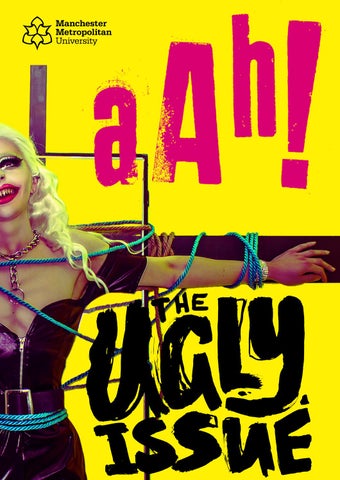
Cover Photography 02
Natalie Carragher Grace Atkinson Jessica Aurie JP Burns Pierangelly Del Rio Akash Ali Megan Bailey Emily Downes Lauren Garland Leona Hall-Shaw Helen Kay Sumaira Khalid Naseem Jay Mulholland Elisabeth Munro Jack Ramsey Bronwyn Riseley Joe Roper Rhiannon Thrush John Walsh Jonny Bowman Sophie Hanson Jane-Ann Meah Clare Nangreave Emma Nash Carl Parrott Nick Stone Thamanna Choudhury Joshua Harrison Daisy Mojave Holland Alisha Edge Josie Lamb Caleb Nelson Jack Weir @itsjackweir
EDITORIAL FIRST UP : UGLY. imagine we can all agree that there is a lot of ugliness in the world but, when it comes down to it, could we all agree on exactly where and what that ugliness is? Simple uses of the word may have it that a toad is ugly, but then what would your local herpetologist say? In this issue, we’re getting our hands dirty.
Our lovely liberal generation is also unfocused and vague. We think we know everything,
The root of the word is Middle English from the Old Norse ugglier meaning ‘to be dreaded’ from the word ugga ‘to dread’. An archaic meaning of the noun dread is interestingly ‘a sudden take-off of a flock of birds’. Birds are very suspicious animals and so, in a way, we can treat this image as central to ugliness - a shock or disturbance from the conservative status quo. So then, is what’s ugly simply what’s different?
which we kind of do, but mostly we don’t. aAh! hopes to present the opportunity for readers and writers to question their own ideas about the world we’ve fallen into. Each issue will interrogate one important contemporary notion as a theme running through
Perhaps everyone’s ugly in their own special way, like a kind of inverse talent. Perhaps everyone has their own unique slant on the theme. Perhaps everyone knows it. Some trying very hard to get around it, to hide it, chop it off or drown it in apology. Some trying to transform it, justify it by cultivating it in others. Some bathing in it open-mouthed, then gulping it down. Some ugliness becomes intolerant toward other uglinesses. Some ugliness is beautiful. Some of it floats in a vortex in the middle of the pacific like an island. Some doesn’t. We make some of it and are some of it and also aren’t – so what the hell is it?
our regular features, opinion pieces, spotlights, interviews, previews, art, poetry, flash fiction, photography and music.
03
jp burns
jack weir
josie lamb
04
THE UGLY ISSUE
18
24
AKALA
MEET THE PROLOGUE
26
ARTISTIC CENSORSHIP & THE NYMPHS
12
16
ALISHA EDGE
10
22
06
BRUTALIST ARCHITECTURE
UGLYWORLDWIDE
UGLY THOUGHTS
27
28
30
23
PARAOLYMPICS & DEHUMANISATION
ROCK MUSIC & THE CULT OF THE ABNORMAL
THE NECESSITY OF MELODDIES
FREDDIE DICKSON
34
JEREMY CORBYN
36
73
38
CHEATING, TINDER & LOW SELF-ESTEEM
43 CREATIVE SUBMISSIONS
CREATIVE WRITING
FLASH FICTION
LISTINGS
ght in s i u t y n a s ea rk f fer db o ct o can fin e’s w res e j o g u r d e p E a w fe t res, ha h i s h ow Alis ce and measu d o . l t i n a a i et nf s an me he d huma extre freckle t n e i to y of s th em c e. t take arps th e beau ach fa e w h and aling t ess of n e r e v niq u e u the
09
aAh!
words jp burns 10
feature
uring her residency at Manchester Art Gallery, artist Sonia Boyce temporarily removed John William Waterhouse’s painting Hylas and the Nymphs from display. The act was intended to stimulate debate about the purpose of art and the gallery, the central question being: are the societal judgements of today applicable to the works of the past?
fatales as has been assumed by many commenters? Are they there to seduce and capture stray men, or are they innocent figures, truly entranced by the beautiful boy? There is no malignity in their eyes, or fear in Hylas.’ The painting’s moment is calm and ambiguous, one of youthful curiosity and intrigue. There is nothing in the painting that disproves the idea that Hylas goes missing, not because he’s slaughtered by the creatures, but simply because he stays with them in a kind of idyllic Dionysian scenario.
The painting is based upon a myth and the central figure of the myth — Hylas — is Heracles’ friend, trained from a boy, into a warrior and lover. Together, they embark on a journey for the fabled Golden Fleece. Hylas is an innocent figure, swept up by the world and its divine agents. During their quest, Hylas sees nymphs bathing in a secluded pool and can’t help but go over to them. This is the moment captured within Waterhouse’s painting, and the end of Hylas’ story. We do not know what happens to him after this encounter. When we look at a religio-mythological image, instead of telling ourselves this is happening, we can ask ourselves how is this something that happens? We can take a step into the metaphorical realm; these stories remain potent because they have something to tell us about ourselves. Unlike the string of consequences that unfold in a tragedy or dramatic novel, in paintings connotations are embedded within one moment. A moment that we can imaginatively, unpick. If we see the nymphs as a manifestation of what’s possible for a human to feel - an experience embodied then these nymphs can be interpreted in multiple ways.
If we take up this idea, then the potency of the myth becomes one of sexual fluidity much in line with modern ideals of free-love and Blakean innocence. Hylas would then become a kind of selfless poetic soul, wandering through life with his senses open. Finally, he chooses a life of simple pleasure over the pragmatic questing of the Argonauts.
If instead, he is torn to pieces, then we would see a passive Hylas, akin to the tragic-innocent archetypes of Ophelia in Hamlet and Dostoyevsky’s The Idiot sensitive observers swept up in the fate of others. From this angle, the myth would tell us that those who don’t take some agency in their lives, are the prey of chance. The aim is not to say, ‘This is what the painting is actually about,’ but to outline various possibilities. When we look at the work of the past, it’s our task to try and find our way into whatever unique way of seeing things we may find, not apply our own to them. We can assume that as individuals we are capable of feeling all states of being, no matter how far flung or alien to us they may at first seem. Empathy requires imaginative effort. Sticking to what we like and don’t like, or agree with and don’t agree with, is a severe limiting of our experience. The more open-minded we are, the richer the world in our heads can become. The museum offers a chance to get out of our echochambers and tune into a completely different set of values. We don’t need to decide if we agree or not. We don’t even need to decide if we like a piece or not.
The composition ensures our eyes look directly at the nymphs, but when we do, we notice they all gaze toward the same point. Our eyes move across to Hylas, who is calm, passive, innocent. There’s something suggestively rich about that pond they’re in, full of lilies and tangled roots. The eroticism of the painting could even be seen to emerge more from this than from the nymphs themselves. In the silky pool, we see a landscape of embodied sensuality, an ecstatic, almost sexual reaction to the world itself similarly found in Molly Bloom, one of the central characters of James Joyce’s Ulysses. Taking this view would subvert the idea of the objectifying gaze as aimed at the nymphs. Now we can ask - are they really murderous femme
Our task is to find out why these things were beautiful or important to someone else in another time and to find a way of feeling it for ourselves.
11
A
kala on the internal conflicts of his success and the ugly face of modern-day society.
interview grace atkinson photography nxsh
Akala – BAFTA and MOBO award-winning rapper, writer, and political activist is best known for his songs ‘Shakespeare’ and ‘Fire In the Booth.’ He’s also widely respected for his discussions on racism and the 2013 Question Time debate he had with EDL’s Tommy Robinson. He has written for multiple news platforms including, The Guardian and The Independent. He’s also spoken on Newsnight and has given lectures at Manchester Metropolitan University and Oxford Union. In 2009, he founded the Hip-Hop Shakespeare Company.
aAh!
So, I think again it is about class and cultural contempt for the people producing particular types of music.”
Akala tells us what he considers to be the ugliest thing about society at the moment.
“Basically, being playful with language and expanding the boundaries of language and using language to convey a message in a way that is not prose, is poetry. A rapper is someone who performs poems to music. Homer was a performance poet. He was an illiterate, blind singer who’s work is the foundation of western classical poetry. So clearly it’s not that we think that illiterate people can’t be poets, otherwise Homer wasn’t a poet.”
“Anti-intellectualism; the idea that ‘My ignorance is as good as your knowledge.’ That anyone can have an opinion, which is fine, everyone's entitled to an opinion, but not everyone’s opinions are equal. My opinion on science is clearly not equal to Steven Hawkins’. It’s not equal, there is no way around it.” In his new EP ‘Visions,’ Akala refers to Aldous Huxley’s and George Orwell’s dystopian novels. He suggests that they are a lesson for how we live today. “I don’t feel that we live in complete dystopian anarchy or a mad dystopian world, but I do think that elements of Orwell’s and Huxley’s world exists. The use of popular culture to numb people, the complete lack of trust people have for popular media because they just talk bollocks so much, all of these points are in there. All of those elements that were predicted in those novels or satirised, in a way I think are there.” Akala believes that “mainstream” history is tailored to a specific perspective, a false truth that is accepted as fact. “When I was in school I was taught that Britain was the first country in the world to abolish slavery, which is just not true. I was taught that the reasons for the abolition of slavery were all moral, which is also completely not true. If we believe that the British government abolished slavery because they were just so moral, then we will believe that the British government is moral today. So, history can often be a weapon of the ruling class and I am trying to undermine some of that.”
In fact, Akala has gone through some conflicts with his own personal narrative. “I got so bored of every young brother, even if he’s got a Saturday job, thinking that he has to pretend he’s a killer. I kind of rebelled against that ideal to a certain degree. Now I feel a bit more centered, I feel like the scene has got a bit more balanced and I can be a bit more honest again. It was almost like a I was lying about my own life. I was not always a good boy, you know, as I admit in the book later, I used to carry a knife, my best friend used to steal his dad’s gun from under the mattress.” “It’s easy for people to think that I’m not ‘one of those black boys’ and it makes it much easier for people to say ‘He’s different,’ or ‘He’s so smart.’ It’s almost like the rest of the kids are instead treated like, ‘Aw, they couldn’t have been like him anyway so, whatever.’ It’s accepted as no loss when young people get killed and when they go to prison because they were bad. But, I was one of those bad boys.”
Akala has an exciting year ahead of him. He’s spoken to us about how he works through the internal contradictions of becoming successful. “It’s bittersweet. It feels like the country is getting worse. It feels like the problems with young people are getting worse, but I feel personally quite privileged. Therefore, I feel a duty to try and use that privilege to help other people in any way I can.” “My art is about the irony of someone like me getting to where I’ve gotten through doing what I do. It’s about having that weird tightrope that comes with being an artist; How do you keep your integrity while being successful?”
“No one would argue that Shakespeare’s words are not poetry,” says Akala, “I think it would be wrong to say while disagreeing with those who someone has to take a vow of claim that rap music is any different. chastity and a vow of poverty for their art to be credible. “Shakespeare's plays were written to be But, if you are lucky enough to performed and so, clearly the issue is not become successful doing what with someone using rhythm. Clearly you love, then you should try people's issue with rap is not that someone and give back. You should try is speaking it, because Shakespeare’s work and help. You should try and did that and he’s considered a great poet. use your voice where you can.” 14
hop. I’m really proud of it as a project. I think it’s different and innovative and interesting.” “For me, ‘Visions’ was something really different. It’s a comic book EP and so literally the music is a soundtrack to a comic and I don’t really think that’s been done before in hip
“Natives is another achievement I’m really proud of. It’s the first time I’ve written a book of that length, so obviously I’m really proud of that because it’s not an easy thing to do.”
NATIVES LAUNCHES THURSDAY 17TH MAY AT THE 02 ACADEMY IN BRIXTON.
15
MEET THE
PR LOGUE
O
Government cuts, child poverty and rising university fees have placed the UK’s educational system in a turbulent landscape.
he current dissatisfac tion with education is a reaction against a system that fails to provide opportunities for those who need it the most. Recent figures show education inequality starts in primary years. Over 1/3 of children entitled to free meals leave school without meeting expected maths and literacy levels. Only 21% of them go on to attend university. The Prologue — a social enterprise based in Manchester — seeks to challenge educational inequality by empowering children and giving them control over their education. The idea came from writer, educationalist and entrepreneur, Luke Swann. Over six months, his initiative gained recognition. Swann was shortlisted for the Great British Entrepreneur Award, the BQ’s Emerging Entrepreneur of the Year and was accepted on the WeWork’s Mission Possible programme. Along with Swann’s recognition, The Prologue has gained more participants; a team made up of 30 members, contributing every week to The Prologue and one of its projects, The Secret Book of I. 16
“The Secret Book of I is a personalised story about a child with hopes of discovering their destiny. The child goes on a journey to discover a hidden book which can tell the tale of one’s entire life,” Swann explains. The fantastical premise, written by him, conveys The Prologue’s educational mission to centre narrative around children. “The Prologue is a centre of support and empowerment. We are offering free resources to improve children's well-being and global development. Additionally, we provide them with opportunities to be active members of society from a very young age, creating positive change in their communities and society as a whole.” When asked why The Prologue championed personalized stories over the regular picture book, he said: “Children who have read a story in which they are the hero in an exciting tale, describe it as a magical experience. However, so far, this has only been utilised for commercial purposes; at The Prologue, we wish to harness increased attention and identification, educationally. Social learning theory demonstrates that children, like all people, learn more effectively from role-models similar to themselves. So, by writing personalised stories, children can essentially use their narrativeself as a model from which to learn.
Accessibility of resources and, our partnerships, makes it possible for The Prologue to provide other free resources and services. In celebration of World Book Day, Swann and his team visited the Flowerly Field Primary school; the positive response and engagement from children makes The Prologue more than a social enterprise, but rather, in Swann’s words, “a community for children”.
words pierangelly del rio martinez photography caleb nelson
The Secret Book Of I, follows the model of “The Prologue offers children more personalised children picture books, which than I can possibly state. The nature offer a story with customised text and of this community means we utilise illustrations based on the child’s the power of each individual child and characteristics. In 2012, the publisher adult, creating such a rich scene. When Wonderbly, launched Lost My Name, we enable children to develop their the first personalised picture book. After higher-order thinking and creativity, selling 2.7 million copies worldwide, their when we afford them the opportunities success inspired the creation of many more to start their own social enterprises personalised stories available today. Swann’s or write stories that we share with the approach to the model is to offer eight world, it’s unknown what wonderful characters of different ethnicities and make things they will conjure.” the stories more accessible, particularly for those children who don’t have the means Swann recognises the participation to purchase a physical book. of The Prologue’s team members; 20 of the participants are students “We have made our books free, using a at Manchester Met who have been donation-based model for e-books, to able to gain relevant experience maximise the impact we can have on while working towards ensuring an children, education and society. We want improvement to children’s education. to ensure that all children with access to Swann thinks about The Prologue as a computer can have their own unique an open community welcoming copy; this makes it much easier for our contributors and diverse talent. The educational partners to use them as tools community will continue expanding in the thousands of schools they already and morphing the gloomy education work with. Since physical books are panorama into a brighter possibility indispensable, we’ve also introduced the for young people. ‘Donate A Book’ initiative. Now anyone can purchase a paperback copy for a child who has had a difficult start in life.”
“Education must have purpose and value to all children, and by not offering this, many are left behind, ignored and forgotten.”
aAh!
Since changing the face of British politics last summer, Jeremy Corbyn remains a contender for the most scrutinised UK politician there has ever been. It seems like barely a week goes by without the press or members of his own party dragging him into a media storm. interview natalie carragher illustration daisy mojave holland
18
feature “We will set up a National Education Service which transfers the idea of education being a commodity to education being a right. It will be as dramatic in our social history as the establishment of the National Health Service was in the 1940s. Other countries do it, why can’t we?” It’s an attractive pledge to many students, and one that is in tune with Corbyn’s radical agenda for ending the programme of austerity that has gripped British politics for almost a decade. Describing austerity as a “political choice,” the Labour leader is adamant that a future Labour government will reverse the “damaging cuts” placed by the Conservatives. He is fresh from speaking at the launch of Labour’s local election campaign in Trafford, which holds Greater Manchester’s only tory majority and, unfortunately for Jeremy (an Arsenal fan), is right next to Old Trafford. “It’s a bit weird here being so close to Manchester United,” he confides to us jokingly. In a passionate speech he encouraged voters to send a message that “enough is enough”, accusing the Conservatives of “reckless gambling with people’s lives”. He said, “Labour councils are clearing up the Tories’ mess time and time again, and acting as a human shield against damaging Conservative cuts.” espite this, Corbyn’s popularity with the public, and younger voters in particular, appears to be as strong as ever. Many regarded the close run 2017 election result as significant victory, sending a strong message of defiance against Conservative austerity policies and rattling Teresa May’s ‘strong and stable’ vision.
As Corbyn proposes that Labour councils will “rebuild our communities and transform our country”, we ask the leader what he believed to be the ‘ugliest’ issues currently facing society. “Division and poverty. The ugliness of great wealth and shiny buildings alongside homeless people begging to try and survive, I just find that an ugly issue in our society.” Not alone among his Labour colleagues in hoping to tackle the social injustice of homelessness, does Corbyn believe Greater Manchester Mayor Andy Burnham’s pledge to eradicate homelessness in the city by the year 2020 is a realistic one?
With the local election campaign providing a backdrop to Labour’s latest assault on Tory policy, the Labour leader sits down with aAh! to discuss core issues surrounding this latest campaign and why students should take the election seriously and turn out to vote. Sporting his now customary red tie and leafing through the latest issue over a coffee, he outlines: “Voting [in the local elections] is important to elect good councils who are serious about dealing with housing issues, serious about tackling homelessness and also voting Labour who are very serious about abolishing the tuition fees so that students don’t go through university and end up deeply in debt. We made that very clear in the General Election campaign.”
Ugliness is where children need somewhere to play and the youth centre is closed and boarded up because the council can’t afford to keep it open; that’s ugly.
Indeed, Labour’s 2017 manifesto racked up plenty of student support, with the promise of abolishing fees and bringing back maintenance grants, something Jeremy remains “absolutely”
19
aAh!
“I was just talking to Andy now, briefly after the rally. He’s doing his best on it [and] has set up the charity. Essentially, the problem is he doesn’t have enough powers as metro mayor. What I want to see is the re-empowerment of local authorities and metro mayors to deal strategically with housing on a regional basis as well as on an individual local authority area basis because we have to deal with housing and we will build half a million council homes in the first parliament of the labour government.”
“As a society, we do have racists; we do have too much racism. Any racism is too much racism. We were the party that first introduced the Race Relations Act in the 1960s – that was very weak compared to what came much later which was the Human Rights Act and the Equalities Act.”
On the recent abhorrent instances of racial incidents on UK university campuses, Jeremy condemns the incidents as “disgraceful”, and explains how Labour is working towards greater community cohesion.
“Racism is vile and ugly in the way that it isolates the individual victim - sometimes silent victims. In my own community, which I’m proud to represent in Parliament, I’ve had interesting and deeply troubling conversations with a lot of Muslim women about the day-to-day abuse that they receive and how they feel powerless to do anything about it. In those cases, I’ve arranged to meet them with the police and we have managed to find some perpetrators by use of technology and following up – but it’s about giving people confidence. You cannot go around abusing people. End of.”
Division and poverty. The ugliness of great wealth and shiny buildings alongside homeless people begging to try and survive, I find that the ugly issue in our society. “The incident that happened in London recently was effectively challenged by the individual, who had suffered greatly, but also by the Students’ Union, other students and by the University.”
As our time in Trafford with Jeremy Corbyn draws to a close, the conversation turns, perhaps inevitably, back to football and we sneak in one final question: Wenger in or out?
“I think that university authorities have got to be totally aware that they will have zero tolerances of racism in any form on campus or in lectures or anywhere else and if necessary students will be removed if they commit racist acts.”
“I’m Wenger in! 68-year-old men in red ties can surprise you.”
20
14min
Afflecks
1,020 Likes Afflecks Like
42 min
Afflecks
Afflecks
Afflecks 6min
6min
811 Likes Afflecks Comment
Like
669 Likes Afflecks Comment
Like
886 Likes Afflecks Comment
21
Like
Comment
19 min
Afflecks
488 Likes Afflecks Like
Comment
BRUTALIST ARCHITECTURE aAh!
THE RAW HONESTY OF CONCRETE In a 1997 London Planning Committee dinner, Prince Charles said: “You have to give this much to the Luftwaffe. When it knocked down our buildings, it didn’t replace them with anything more offensive than rubble.” Raw concrete angular forms and imposing dimensions: those are the signature features of brutalist buildings. Reinforced concrete looks cold and aggressive at a first glance. It doesn’t age well either, crumbling, staining and harming the environment, conveying a sense of decadence. Greater Manchester is full of Brutalist gems, scattered here and there, often ignored by the inhabitants of the busy city. An example can be found in the heart of Manchester; a structure designed by Tadao Ando. Ando’s building serves as a shelter to a house café and a couple of restaurants, occupying half of Piccadilly Gardens. Just a few meters away, there’s a concrete wall, also conceived by Ando. Its abruptness cannot pass unnoticed, and the randomness of its location, has, in fact, a purpose: to separate the hustle and bustle of the trams and buses from the peacefulness of the gardens.
storey building, hence the toast rack comparison, giving it a playful, unorthodox style. A semi-circular block is attached to the west, known as “the fried egg.” Nine miles away, in Swinton, the Lancastrian Hall and Library can be found. From the outside, the fortress-like building exhibits several concrete blocks of various sizes protruding from all sides. Build in 1968, the Lancastrian Hall and Library was once a centre of arts and leisure that remains currently vacant. Grey and soulless the Lancastrian Hall crumbles with the test of time like many other Brutalists buildings. Others remain nameless and hidden from the spotlight. However, through their drastic angles and unorthodox forms, they convey the raw honesty the Brutalist movement sought to explore. It’s now up to the reader to immerse themselves in the strange kind of beauty of raw concrete.
Parallel to the plaza, stands another Brutalist structure, the City Tower Hotel. Described as “Manchester’s white beacon of modernism,” the building is a tribute to the city’s scientific achievements. A close look reveals the concrete artwork on the gambles, which resembles a giant circuit board in celebration of the technology that paved the way for contemporary computer technology. Travelling south to Fallowfield is the Toast Rack building, once part of Manchester Polytechnic, then Manchester Metropolitan University until the closure of the “Hollings Campus” in 2013. Several concrete arcs stand out from the roof of this seven
words pierangelly del rio martinez illustration joshua harrison
23
24
Instagram is no longer just an app for sharing your own personal photos; it is a platform that showcases the beauty in the everyday for the world to see... The term ‘Instagram model’ has become popular over the last few years with social media influencers gathering tens of thousands of devoted followers attracted to their individual brands of ‘beauty’. o a whole generation, social media stars define what is perceived as beautiful. Often sporting long, luscious hair, faultless makeup and a body that would make a Victoria’s Secret model weep in envy, these influencers receive numerous adoring comments from their followers, letting them know how beautiful they are and how they would love to look just like them. But there is at least one “insta-famous” model challenging this conventional notion of beauty. Jazzelle Zanaughtti is a 22-year-old model who became popular on Instagram due to her avant-garde, androgynous look. With a shaved head, no eyebrows and a set of gold grills, Zanaughtti, who’s Instagram handle is UglyWorldWide, is a gender-queer, mixed race, woman on a mission to change what we see as beautiful today. From humble beginnings in Chicago, Zanaughtti was discovered on Instagram by renowned fashion photographer, Nick Knight. Knight has worked alongside Alexander McQueen and has shot advertising campaigns for Christian Dior, Lancôme, Swarovski, Tom Ford, Calvin Klein and Yves Saint Laurent, as well as award-winning editorials for British Vogue, Paris Vogue, Dazed & Confused and i-D magazine. Knight has also directed award-winning music videos for Bjork, Lady Gaga and Kanye West and is known for challenging conventional notions of beauty through his work. Since being discovered, Zanaughtti has signed with Storm Management in London and New York Models Management and has modelled for ASOS and walked the runway for both Rihanna’s Fenty X Puma and House of Holland, just to name a few. Jazzelle is well known across the fashion circuit for her buzz cut hair style and outlandish, sense of fashion. In 2016, she described herself as “Not a boy or a girl, just a creature”. When scrolling through her Instagram page, which has over 400,000 followers,
sh ru a th ann m on a nn th ia o n h i r t a s rd str ry w o lu dhu il ou ch
hundreds of images of Zanaughtti appear with the model’s face covered in brightly coloured makeup, with her eyebrows replaced by squiggly lines, numbers, hearts and even tiny paintbrushes. Bandages and plasters are also a key accessory for the model who is often seen with at least one plaster over the bridge of her nose, usually with a heart or smiley face drawn on it. But she is not just about appearances, Zanaughtti is outspoken on her Instagram page about many topics. One of which includes her mental health. In a recent instapost, Jazzelle wrote a lengthy caption to her followers explaining: “Mental illness does not go away with money or success.” She added, “getting past or living with mental illness takes constant work and so much strength”. Signing off her post saying, “You are not alone, even in the slightest. Love y’all always.” She has also been outspoken about the breast reduction that she received last year, posting numerous photos of her bandage-covered body post-op (drainage tubes and all) and her scars, which, for one particular post, she bejewelled with rhinestones.
It is clear to see that Zanaughtti does not conform to Instagram’s image of traditional beauty. She plays with androgynous styles and bright colours to create her own kind of beauty. Sure, not everyone will be a fan of her unique style, but it’s clear she don’t really care what other people think. Due to her candid openness about her own mental health and efforts to subvert ideas of beauty through her own image, Zanaughtti is valuable within Instagram’s craze for perfection. She is a beacon of hope for all the, lovingly self-titled, weirdos and outcasts out there,
opinion
ognitive Behavioural Therapy, pioneered by psychiatrist Aaron T. Beck and psychologist Albert Ellis, has a long history and is most commonly used to treat anxiety and depression, but can be used to treat other mental and physical health problems. CBT, as it’s more commonly known, is talking therapy founded upon the belief that what we think affects how we feel, both mentally and physically, and how we act. It follows the idea that in order to change how we feel, we should change how we think. Many could attest to CBT’s efficacy, but some still question whether it is possible to think your way to mental health.
words leona hall-shaw
Beck theorised that those suffering from symptoms of depression (not only those with a diagnosis) did so because they had developed a negative schema — that is, a negative way of organising and retrieving thoughts. This schema, he reckoned, was formed as a consequence of traumatic and/ or stressful life events. Coupled with his theory of depression, Beck proposed the cognitive triad consisting of a person’s negative evaluations of themselves, the world, and the future. Someone would be likely to say, for example, “I can’t do it”, “It just isn’t working”, or “It’ll never be right”. No doubt we’re used to hearing these phrases pretty often, if not
from ourselves, then from friends and colleagues. Some of us are so used to hearing them that they become automatic; almost, if not the default response to a stressor. And if our moods are affected as a consequence of these thoughts, of what in therapy circles are known as ‘negative automatic thoughts’ (or NATs) then it’s no wonder we should wish to change them, believing they are the cause of our low moods. But what if they’re not? Some people attribute depression to a chemical imbalance, having imbibed the notion that it is caused by low serotonin levels in the brain. Many people are familiar with this theory, and may not be able to recall how or where they came about this information, but in recent years this idea has been debunked as a myth. Professor David Healy, author of the most extensively recorded history of anti-depressants to date comments that, “There wasn’t ever any evidence for it [low serotonin levels causing depression].” It’s a narrative Professor Andrew Scull of Princeton calls “deeply misleading and unscientific”. So what causes the depression? In short, theories vary without a definitive answer. Is depression always caused by ‘faulty thinking’? Though CBT posits that our emotions are caused primarily by how and what we think, one issue that arises is that this could turn the sufferer into both victim and perpetrator. The culmination of CBT practice could be seen as placing the weight upon the individual, 26
which could potentially produce unwarranted feelings of shame and guilt. Our moods also have the power to change without the intervention of thought. As babies, we lack language but are deeply emotional. Dogs have also been known to exhibit signs of depression upon their owner’s death or even their brief absence. You can feel rejuvenated after having slept well the night before and, by the same token, worse off if you haven’t. Meditation might leave you feeling more relaxed. CBT posits that it isn’t the event itself which alters our mood, but the way in which we interpret it. So how do we explain these changes of mood if not as something organic (emotional) as opposed to learned (language)? Perhaps our greatest task, then, will be in accepting that our emotions emerge not always as a consequence of something we have agency over, but by something beyond our conscious control. At first this can be uncomfortable; accepting the unknown is never easy. This process is what I call negative acceptance, that is, acceptance of a lack—in this case, a lack of knowledge. But doing exactly that, accepting our thoughts, emotions and, in time, ourselves, can lead if not to mental health, then to mental peace.
This article constitutes the opinion of the author. If you are concerned about your mental wellbeing, seek advice from your GP or a professionally qualified counsellor. mmu.ac.uk/counselling
“It’s time to stop calling disabled people inspirational,”
S
ays Frances Ryan in a recent comment video for The Guardian Ryan goes on to describe the Paraolympics as “inspirational porn”, that is when the disabled athlete is seen as symbolic of overcoming tragedy while making the viewer feel good.
This leaves us to question whether this notion takes away from the achievements of those taking part in this sport and how this affects those people who are not world class sporting figures. For Ryan, the treatment of Paralympian competitors shines a spotlight on “this timeless idea that disabled people are something other than simply human”. Like the Olympics Games, it is understandable that most people are not capable of the physical feats that we see in these games. Ryan is more concerned about the expectation that such attention brings to disabled people as being able to do anything if they “only try hard enough”. The Paralympics coverage is one example of a wider systematic treatment of disabled people in the media. Stuart Murray, literary Disability Studies scholar describes the phenomenon
of “cultural fascination” in the representation of autism in cultural narratives. The disability of these athletes and their prowess becomes a feel-good factor and the subject of fascination because the audience is at a safe distance. This programming schedule is focused on disabled people as inspirational figures but it fails to give attention to the everyday experiences of the majority. Missing are the effects of austerity and the scapegoating of disabled people as benefit scroungers. Films like I, Daniel Blake seem to bring issues like these ones in to the media sightline temporarily but the systematic barriers that disabled people face remain. Disabled people presented as burdens and the subsequent dehumanisation experience, has been taken to the extreme at times by articles such as the report about the shooting of Aurelia Castillo by her grandmother, who then committed suicide. The coverge of this tragedy did not state that the fourteen-year-old girl with Cerebral Palsy had been murdered. The piece goes as far as quoting a relative asserting that this was not murder.
Instead, the Orlando Sentinel story (also covered by the Chicago Tribune and The Washington Post) describes in agonising detail, the care giving burden and suspected reasons that led to this outcome. It seems that the perspective taken by the reporting of this case is that this was a tragedy and unfortunately happened due to the harsh circumstances that the carer had to deal with. The common thread in all of these stories about disabled people is the tragedy that needs to befall them and can be overcome.
“This programming schedule is focused on disabled people as inspirational figures but it fails to give attention to the everyday experiences of the majority.” Regardless, of the situation these people have found themselves in, they are metaphors, subjects of fascination and dehumanised because anything closer to the audience, reader and consumer of inspiration porn will bring an end to the good-natured feel of such stories. The ugly truth of what is happening to disabled people needs to confronted, rather than secret consolation keeping disability at a distance.
words sumaira khalid naseem
ock music’s roots are in Jazz’s grandad, the Blues. The tradition of weirdness started here too. The core appeal of the Blues to modern listeners was, and is, in its authenticity. This authenticity was borne of suffering; the music was from the heart, directly stemming from the performer’s life and personality as opposed to the intellectual artifice of the Classical tradition. The greats of the rock music tradition all summon their energy from a sense of alienation, whether that be rebellious and solitary, or in taking on the voice of a minority group. Rock in its broadest sense can be defined as all music which seeks individualised authenticity and as such contains some form of rebellion against the collective, or ‘mainstream’, of it’s society. This rebellion takes the form of personality, of unusuality or weirdness. This timeline will trace a few key figures that embody the tradition of abnormality.
28
The Shaggs Howlin’ Wolf A sinner’s voice and electrified blues in minor keys along with strange intimate lyrics create an aura of outsiderdom and rebellion that inspired many. Howlin’ Wolf (1962)
The original ‘outsider’ band, much loved by Zappa. A group of Sisters forced into musical slavery by their father without any musical experience. The Philosophy of the World (1969)
The Beatles Beefheart Captain Back in their early days, the Beatles were referred to in the music biz as ‘the ugly band’ - this was their USP. Their brand of rock’n’roll was odd, British, full of untamed energy both in their delivery and display of creative confidence. Rubber Soul (1965)
Rejiggles the blues into his own idiosyncratic vision. See: ‘Electricity’, ‘Tropical Hotdog Night’ & ‘Grow Fins’. Trout Mask Replica (1969)
Funkadelic The word ‘funk’ was slang for ‘tobacco smoke’ from a Dutch word meaning ‘disturbance; agitation’. Psychedelic funk. It’s all in the name. Maggot Brain (1971)
Iggy Pop / The Stooges The first true figure of the weird in popular music - a dirty, barking, dress wearing deviant - a punk before there were punks. Raw Power (1972)
Screaming Lord Sutch A Mr Hyde type figure looming in the corner of 60s Britain spooking out youngsters... Apparently also a genuine Lord. Jack the Ripper (1965)
Bowie By successively embodying various outsider personas (‘Ziggy Stardust’, ‘Aladdin Sane’, ‘The Thin White Duke’, ‘) he made an intelligent art from the tradition of the weird.
The New York Dolls Grotesque trolls full of spit, gurns, grunts and comradery. Inheritors of Iggy. New York Dolls (1973)
Patti Smith Racing at 200 miles per hour through crooked dream-narratives with her androgynous face and the look in her eyes that says ‘trust me’. I would recommend you do. Horses (1975)
Frank Zappa An important figure in the Classical, Funk, Pop, World, Experimental, Film and Rock traditions, but weird in all. Sheik Yerbouti (1979)
words jp burns
29
Research demonstrates that the number of audio files that are possible to create within a five-minute space of time is over 63 million digits that can be composed within one single octave is larger than the number of seconds old the universe is. So why then, do we tend to lean
numbers?
The psychology behind the
music we find collectively ‘pleasing’ to the ear has been a discussion for
lecturer Dr Beate Peter states that the question of pleasing music varies. She explains, “We often consider things pleasing that we are used
is used often in traditional Chinese compositions, sounds very alien to a westerner, but only because we are not exposed to this
heptatonic scale.” She adds, “There has to be a degree of familiarity with the compositional material in order for a person to release
based on the idea of anticipation, and what it is
athematician Scott Rickard suggests that music that is ‘beautiful’ must contain repetition. He has used mathematical methods to calculate a piano sonata that does not incorporate a single pattern whatsoever. He describes his creation as ‘the world’s ugliest piece of music’. Even so, the outcome of this experiment did not seem entirely void of familiarity. The characteristics of fragmentation and dissonance are common components in the modernist tradition. Composers such as Arnold Schoenberg, Karlheinz Stockhausen and Olivier Messiaen, all produced music which actively engages with irregularity in both rhythm and tonality. The modernist’s music first strikes most listeners as ‘ugly’ and unnerving. It may be that these compositions work as an objection to those who imply that music’s sole purpose is for instant enjoyment the avant-garde seeking to push the frontier of what can be considered music and happy to upset some conservative tastes along the way. Delving further, Dr Beate Peter acknowledges that an ‘ugly’ piece of music and a ‘bad’ piece of music do not go hand in hand. She explains, “Bad could be poorly composed, poorly
performed or badly produced.” But what we perceive as ‘ugly’, regardless of where the line of genre is drawn, is a matter of taste. “Sometimes, I do not have access to a certain kind of music and don’t understand why other people like it. If I wanted to call something bad, it would say more about my taste than any objective judgement.” There’s the notion that ‘ugliness’ can be used for a specific function - compositions that aim to reflect the abhorrence of the war, for example, designed to stimulate feelings of discomfort in the listener. Horror film scores too, such as Goldsmith’s soundtrack to Alien (1979), exploit certain dissonances
in order to distress the viewer. In the face of ‘ugly’ music, Dr. Beate Peter says: “Yes, yes, yes we need to experiment! We need to move away again from only listening to music that is recommended to us on the basis of what other music we just listened to or purchased and which sounds similar. We need to be challenged, and we need to learn about ourselves through consuming music. We need to be woken up and disturbed in order to think and reflect, to feel. So, yes! Let’s do ugly music!”
long. Furthermore, the number of melodies
towards particular sounds that are only a fraction of these
quite some time. Manchester Metropolitan University
to. For example, the pentatonic scale, as it
scale in the same way that we are exposed to the positive emotions. This would be an argument
words bronwyn riseley
that we anticipate and how we can be surprised.�
31
etting picked up by a major label would be any music ian’s idea of ‘making it’, and, for London-based singersongwriter Freddie Dickson, it seemed all of his prayers had been answered when he signed to Columbia Records. But where so many artist s sacrifice their creative integrity to reach target sales, Dickson found it hard to compromise, and, after two years with Sony he ended up himself cutting ties with the label. Over the next two years, Dickson made music that was authentic to who he is, unbound from the pressures of the mainstream machine. Dickson released his debut album Panic Town as an independent artist last year, a collection of modern gothic anti-anthems, these ten tracks make visible the fragility and complexity of the human mind, as well as touching on Dickson’s own experienc es with the music indus try. His lyrics are intimate, and his voice is raw and powerful. Each track is haunting, dark and contagious.
ay w in g e s t th h a d s ig c h an d e v p’, su n pa o s en e c -p tist Et t be as ”. i s m s r n h va u o a a m ‘do as Va e h ne ca s a n ’ o n m e s ro ic e en on k s jor s o t e r n c h a vo o m i s v c k e e S is s h c Di a Di r th nflu ve, . H ke to to e m of s s fo is i Ca er “li e in t h g hi k e a e in a k in n d h i c k ow e d la d p P s a r. N a t r ib a b n nc m , on C esc ed s o e r i e t h e um e s t e ks n c i b i p , l h d bb s k ,D At ex r y t a c se ja e hi s u s t e n a n m c k lo t y c o M i c i y a t d r o q u c k l b il il e i a G r o u l in t r e s in e i t h in q u e r a w h m b a a b b e o s in g n g ke s h e uln e n o l u i t h la s m nn i r hi e g i t e j o n d f v Ev C d w I e n in g , a n o il s . r o m c e b nd the t n k o n s i o va i t f l a a o c i s l p e to s U c r a e s s r e s pr e sp n i a g g in il d e t h e i s o c m p s i c hi s k s o e . g t w , n un o i y n d e n p r y i u n g i c il yo e g ll m e e f f e r n d a n i s m in i s , D t s m a ïv a th i d d a hip h p la r d e n te a t n ui i t e n u g h e . I s o e a r n s n t e d ex e c o an q o R rm a t qu ho tr u ng h ti a d a s . I t e b e i r s t r e la y w pe e m e fi e h e.” gn I w n g o p s i s s t hi a d c d u h e y t t h n . T v i d I “ ue l e h d e c t ha w r o g ho ms n s i r t do t p w e a i c e u f o ke d n ’ d r u s e m m e b r o o ul m t h e d ll y I c t o g n t u a in g si en th 32 ev me so
int e rv iew
gra ce
atk ins on
hile s on w e Dick split . in g a of the rd to im It ’s ha d the pain e c a he f time in ficult e if d y failur all like a s a re “It wa and I felt w, having e o whole my lif ime. But n t m the xac tly o e r h f t h t c e a T hou s o mu I know d so I’m gh D learnt nc e, I feel an e c ic k s o r .” om e a d ie s r r h a n’s fro ex p e rengt oing for w t s a y p m p e al m a pr i v l y r i c s s e g t e a s h o w h t i s g n i n t h e a t e p la c e m t o eli s e ir r e c hann “It ta e l ’ wa u l a t a b , t h e ir F ‘ ke s ilit y. ingle , and the s m w ’s e n r h o ite c qu Dic ks d las t Mar arkness of s om s on g s a i t e a w h e d nd o e t h in il e t o releas epic t s the pushes a n ef fe d y es c t on g ha s r e l y d o w h video n indus tr themselv . a ll y o f t im en me a a le nt h when to re -inve ec ognizab e x a c e t r y in g n d I t a k a d a n r n n o e t u t s l p er hing I w r i y h ow I w o g e t t h e a l o t om e t te an lyric into s vering o e c s f f e c t ab ou t th t the m. is I gue s on ou t d e mus ic e ps b a n is ss y m os t a g h c t n h y f o o s o l if l gia , lo h ow elly “T he e nv y e , w h e t h g i c a l e an d nderb , the er lo the u y machin in it . The T h ve u e s ual tr d si s tuf f , indus e trappe charac ter s prai nger- so .” e m h s a n o t c e gw ri d fo an d ts t w I be an d depic the ‘ then’ r is the h e r e r hi s p o t e r h a s b o e id v g te w w ith m e har a c g sentin B r i t i in i s c e s e r o n s t e n repre he female c that ’s tr yin sh d a g e, la s t u r T m y a I’ o .’ e , Sea a “ T ha ‘now - up pop s t and then fret. r ’s tour t wa r ’s sar dolled it togethe unfold. It g o e i ng t I p is o Eu ally fun to kee atching th ack at how Ge w gb elf.” s rmany. I rope, p tour. I lo s in f k o ther e o ve om e t ’s am ar s ens e t me lo w a z in g t i c u l a r l abou tely los t a h a ve h e r e m y t ur n i i le l p e p s e op le n f c om k n ow r o m h o m g up ea D ic k yo u r s mus nd o f M on s t udi ic .” ed a he h n c he s ter a t the U as n i n n i ve r s 20 0 9 ow t he b it y ,a ou e M a n g a n hi s j r e d a ll o n d t h o u g c he s ve r E o ur n h ter ’s e u b a r s y g i g g in r o p e , “I’d g a nd p i on ub s . n p lay l y ju s t s t ar t e in g l i ve i d ge b efo n tt r c o u l e , p l a y in L o n d o n in g in t o the y d fin g ev d e ea lot , T . r h e R I p l a ye d y o p e n - r an d m ub y a ic I t Tr P L b e e n a n g e a F o un g e , F o f B a r a e s tiv bac k uel C a to pl ay Th l. I’ve a afé ls He r e Ac e t ur adem o n S ou y.” nd C e d to M an c h on t r h ow o e d the b id it feel l jus t las s ter ’s t e t Dick ginning o come year, b s on ha d a f t e r e v a c k to e ex p e “It w r i e n c r y t h in g a s am ed? t ha t a z in g g . M a n i g . I l ov I r e a ll y en e c r e a ll h e s t e r a c o m in g j oye d y sta s I fe bac k el rt t im e to so ed dedic it ’s whe to ng w re a t in g r i t in a ll m I g.” It ’s c y l D i c k e ar t ha t s on h o wev ma the d e p t h y h a ve b e r l o s t ha s s e c om o f c t h i s o e r t a in l y h e in d u s e in man tr y, h wn w ag e ay o u t a g e d t o li g ht a in .
CHEATING, TINDER & LOW SELF-ESTEEM. 5 MINUTES WITH SEX THERAPIST CAROL LYONS
interview rhiannon thrush
ou would think in a world where anybody can find a date with someone whose profile states that they share the same hobbies and interests as you after just a couple of swipes, it would be much easier to find that special someone. But are these dating sites giving us too much choice, especially when we have supposedly already chosen? In a world where our self-esteem is challenged day-today by ridiculous beauty standards, aimed at both men and women, are websites like POF and apps like Tinder becoming places to gain the next confidence boost? Do they make it more difficult for us to stay faithful? To gain some more insight, Rhiannon Thrush sits down to talk with Carol Lyons, a professional and certified sex therapist who works for the relationship counselling organization, Relate. 34
As I walk through into the living room of Carol’s lavish home, based just outside of Leeds, she offers me a glass of prosecco. Over drinks Carol tells me:
“There are lots of reasons why people have affairs, but mostly it seems to be problems in communicating. So, when I counsel couples that have had affairs, we discuss techniques on how to communicate with one another about what the problem was before. This is so that they can have a different kind of relationship after the affair.”
Carol has been a counsellor for 30 years and a sex therapist for eight years, so she has had her fair share of experience counseling couples with communication issues as well as couples who have been unfaithful within the marriages or relationships.
“Some statistics state that 65% of men and 45% of women would have had an affair in their relationship. From those figures, it suggests that men find it more difficult to be faithful and I think that’s something about the way they compartmentalise things. So, for example, some men could quite easily operate with a wife and children at home and somehow compartmentalise having an affair at work or out of their home. I think for some women, it seems to come much more with a dissatisfaction about their relationship, feeling that they’re not getting what they want from that relationship. That could of course go for men as well as women. It all comes down to communication in the end, can you ask for your needs to be met in your relationship? Do you understand your own needs?”
Dissatisfaction within a relationship could seem like an obvious reason for someone to cheat, but in Carol’s experience, it is also a common reason. But I wanted to gain Carol’s insight on the rise of dating apps and how they may be affecting the couples that she counsels.
“Well Tinder is just so easy, and it costs no money. You can easily get involved in relationships without really much thought. Once you have that initial lust, which everybody knows is very powerful, that feeds our self-esteem. A new relationship, where someone is telling you how amazing, beautiful and desirable you are, is attractive. All of these things in a long-term relationship are mostly just accepted about one another and compliments aren’t shared as often. Flattery really can cause a person to cheat.”
Now with there being evidence that gaining notifications on social media can produce a dopamine high within our brains, add a flirty, complimentary comment on top of that, and you have a recipe for instant satisfaction. Everyone enjoys a good self-esteem boost now and then, but are these little highs causing us to too willingly discard faithfulness in turn for them?
35
SI S
T
A
T
E
LETTER HOME LATE MICHAELMAS
NK
s word word
la
And I can’t help but wonder how it feels to be built so long after the beauty – to be squat and new and utterly devoted to the right angle. Bike across The Backs and students sleep in
s hele
A voice on Radio 4 outlines his day ‘fleshing the bones’ of his new character. Hands planted in suds, she salivates. Yes, a full day just thinking. She could do that - sees herself on a bed of memory foam thought.
and
garl uren
n kay
staircases that loop forever up into the sky. Sandstone frames their windows. Looking out it’s cobbles and sundials, the odd cyclist rounding the bend from Trinity Street. So much right now is suspended over my saddle. Here we eat in a vast hall with the properties of an aircraft hangar; we raise a glass to the Queen and Sir Winston.
dried custard gnaws the pudding bowls creased clothes spit at her eyes washer has an asthma attack floor in-a-tantrum soils itself
We read in our rooms – the library is cast from concrete and the books numb our hands. There is a green – the common green of trees and grass, which stretches up beyond
dust doing a Greek tragedy chases her sinks into her skin as it sank into her mother’s skin into her mother’s mother’s skin
the chapel, skirting the observatory. I’ve often thought the fields are running away which is kind of special beside the grey and mothbrown bricks. Even the sculpture
Behold, the peacock voice sets out to sell his Man Booker novel. Her raw hand rises from the foam like the Toxic Avenger. She props the plate on the knockoff Franke drainer. A bubble pops. A pen slips in her hand.
is very geometric, its rectangles peer over one another. The bronze is blotched with blue like an old coin – years of exposure and four rounds are carved away which the sun floods daily on its journey to the ground. Sometimes after dinner we carry our wine across, hold our faces through the holes while somebody goes snap.
36
One of my teachers at Primary School, a terrifying woman who taught us hymns and made her own jumpers, would proudly wear a wooden crucifix that she boasted came from the Holy Land. Did that make it more powerful, more effective, is it like Top Trumps? Thinking of it now, there is probably a factory somewhere churning them out. At what point does it become Holy or a sacred object? There was even a scandal of sweatshop crucifixes, an exposition of the terrible conditions in which underpaid and mistreated workers produced holy relics. Two churches in New York had their crucifixes traced to a sweatshop in China where women as young as fourteen were working a hundred hours a week, making nine cents a day. You have to assume that the very same thing occurs in the ‘Holy Land’.
SWEATSHOP
I
was introduced to the spiritual significance of objects from a very early age. I was raised Roman Catholic. Up until I started Secondary School I didn’t know not believing in God was an option, when my friend told me he was an Atheist I thought it was some sort of disease. Bowing to the Tabernacle, reverence towards the Altar and the other holy objects of the Mass showed me how a simple an inanimate object can be endowed with meaning. I remember seeing a girl tear a page out of a Bible at school and I was shocked that nothing happened, no bolt of lightning or booming voice from Heaven, in no way was she struck down. I wasn’t raised in a strictly religious house, but the Bible was still considered a very important object that was respected, but I was seeing no repercussions. That was the first moment I had a question about religion, but obviously it was in a very quiet voice, so God couldn’t hear.
CRUCIFIX words jack ramsey
At ten years old I went to a second primary school, still Catholic, but with a little ‘c’ rather than full block capitals in a gothic font like my previous school. The hymn teacher, I don’t know why they are always the most intense, very carefully showed us her crucifix, one that she didn’t wear everyday because it was too special. It had been blessed by the Pope. We all nodded our heads and gasped, impressed. We were too young to be putting it on for the sake of her feelings, so maybe we did feel something, but I think I put it down to her showmanship. She knew how to work her audience. I looked up how much a Papallyblessed Rosary runs you - the starting price is £150. I’ve always been confused by the ‘blessing’, I never got a straight answer as to what the rules were, what can and cannot be blessed and what it does to the object, other than adds £130 apparently. I suppose it’s the feeling that I get when I buy a second hand book, or get one from the library, and there is a little note in the margin. I bought a book of Bukowski poetry on eBay and one of the pages had the corner folded, and that made the poem feel far more beautiful to me, the fact that it had significance to somebody else, I read that one far more carefully and frequently than any of the others. It has a feeling that I can’t quite put my finger on and can’t find the word for, so maybe that’s a blessing.
37
THE BLINDERS + SPECIAL GUESTS
Gorilla: 08/06/18
This three-piece alternative group from Doncaster, now based in Manchester, exudes loud and visceral political punk rock with psychedelic poetry and tones. Their infamous gigs include frenzied, sweaty in your face performances powdered by a punkadelic sound.
STRING ART
Craft Manchester: 14/06/18 This workshop will introduce the retro craft of string art and how to create unique art using a variety of templates, nails and lots of colourful string. A perfect opportunity to develop creativity by creating personal designs.
TELLING TALES INTERNATIONAL FILM & AUDIO DOC FESTIVAL
Manchester Academy: 15/06/18 Stand-up comic Doug Stanhope has been around since 1990. His material ranges from true-life graphic perversion to volatile social criticism. Vulgar, opinionated, brutally honest and shockingly uninhibited, Stanhope’s comedy style is certainly not for everybody.
Number 70 Oxford St: 8–10/06/18 8 Telling Tales welcomes documentary professionals, students and lovers from around the world to Manchester, England, for a three-day, array of films, audio and Northern hospitality. Set within the city centre, this festival aims to nurture community and conversation among documentary students, professionals, and the public.
BORN RUFFIANS
Soup Kitchen: 08/06/18 Warm acoustics, musical ease and rebelliousness are the signature of this Canada indie trio. Born Ruffian’s 2018 album Uncle, Duke & The Chief, contains tracks dealing with aging, death, life and ambition and the dissatisfaction of the human experience.
THE SHIRES
Bridgewater Hall: 06/06/18 The biggest UK country act of all time, The Shires, returns to The Bridgewater Hall this summer after the success of last year’s sold out show. The duo, formed by Crissie Rhodes and Ben Earle, took the country scene by storm embracing the American style but maintaining their British identity. Their latest album, Accidentally On Purpose, was re-released in April.
CANTER SEMPER
LENNY KRAVITZ
This harmony driven soul/folk acoustic choir from Choltron have firmly established themselves while performing live in unique spaces across Manchester. Influenced by Florence and the Machine, Eva Cassidy and The Civil Wars, Canter Semper creates original music with harmony driven, soulful vocals.
Known for singles ‘Are You Gonna Go My Way’, ‘Fly Away’, his constant sunglasses, and brief appearances in the big screen, Kravitz has been around since the early 90s. With more than ten albums, his music career is marked by a retro style with elements of soul, blues, jazz, R&B, reggae and ballads.
Manchester Academy: 16/06/18
Apollo: 19/06/18
JASON MANFORD: MUDDLE CLASS Apollo: 22–23/06/18 Following his last smash hit stand-up show, the acclaimed comedian from Salford returns with ‘Muddle Class’. With his amiable charm and captivating wit, Jason explores his working class origins and his confusing progression to a middle class life.
OPEN AIR THEATRE — HAMLET
DAMIAN ‘JR. GONG’ MARLEY
Ordsall Hall: 21/06/18
O2 Ritz: 28/06/18
Actor group The Three Inch Fools return to Ordsall Hall to perform one of Shakespeare’s most iconic plays. Open Air Theatre: Hamlet is an amazing opportunity to experience open-air theatre in in the gardens of the oldest house in Salford.
Chart topper and Grammy-Award winner Damian Jr. Gong Barley embarks on his first UK solo tour after the release of his acclaimed album Stony Hill. The youngest son of Bob Marley, he describes his music as dancehall and reggae and a celebration of Jamaican and African culture.
INCOMING FESTIVAL HOME: 29/06–08/07/18 A Younger Theatre partners with New Diorama, in association with HOME to celebrate the best of emerging British theatre companies. Programmed by codirectors David Byrne, Jake Orr and Eleanor Turner, Incoming Festival celebrates its fifth anniversary with productions such as A Heart At Sea and The Bearpit.
Heaton Park: 9–10/06/18 Parklife returns to Manchester for its 9th edition. This year, the independent festival will be headlined by the xx and Liam Gallagher. Lorde, N.E.R.D, Jessie Ware, Raye, MNEK, Skepta, Everything Everything, ASAP Rocky are set to perform across eight different stages at Heaton Park.
STEVE WINDWOOD Bridgewater Hall: 02/07/18 Over five decades, Steve Windwood has remained as a prominent rock and roll figure. He first rose to fame in 1963 with the Spencer Davis group. Ever since, his remarkable abilities as a multiinstrumentalist, composer and vocalist have led him to develop an extensive popular music catalogue.
RAG‘N’BONE MAN
Castlefield Bowl: 04/07/18 Rag’n’Bone Man, aka Rory Graham, reached stardom with his ‘Human’ and ‘Skin’ hits and distinctive bass-baritone voice. The singer-songwriter from Uckfield combines powerful vocals with his unique brand of acoustic hip-hop soul.
39
SARAH MILLICAN
Stockport Plaza: 04/07/18 Acclaimed comedian, Sarah Millican is back in the North with ‘Control Enthusiast’. Funny, frank and unapologetically filthy, Millican narrates the everyday of an ordinary woman. The comedian and writer won the If Comedy Award for Best Newcomer in 2008 and was named one of the most powerful women in the UK by BBC Radio 4.
GOO GOO DOLLS
O2 Ritz: 25/07/18 The alt-rock band known for hits such as ‘Iris’ and ‘Stay With You’ are playing three special shows in the UK this summer. Formed in Buffalo, New York back in 1986, the Goo Goo Dolls have an extensive discography of 11 albums with the most recent, Boxes, released in 2016 and the EP ‘You Should Be Happy’ in 2017.
THE FISHERMEN
HOME: 19-28/07/18 An adaptation of the Man Booker Prize shortlisted novel by Chigozie Obioma. The story follows the lives of Ben and Obeme in a small Nigerian town as they slip away to fish at a forbidden river. Unnoticed and carefree they continue until one day the prophecy of a madman changes the course of their lives forever.
Gorilla: 29/07/18 Named one of the 50 funniest people by Rolling Stone and Top 10 comics to watch by Variety, Che has been leaving his mark in the media landscape. He currently coanchors Saturday Night Live’s “Weekend Update” segment and has its own Netflix stand-up special. Che’s comedy uses blunt, laid-back humour to identify humanity in the most controversial actions.
FAZERDAZE
Soup Kitchen: 26/07/18 The music project of New Zelander Amelia Murray, Fazerdaze combines a dream-pop sound, using electric guitars and effect pedals. Murray released her debut selftitled EP in 2014, recording it entirely in her bedroom studio. Her songwriter and production skills have been branded as “elegant” by recent NME reviews.
LIVERPOOL INTERNATIONAL MUSIC FESTIVAL
Sefton Park: 21–22/07/18
Exploring the theme of Co-Exist and Connection, LIMF showcases a diverse set of global household names alongside emerging new talent. DJ Jazzy Jeff, Trevor Nelson, Toddla T, Tim Westwood, Example, DJ Wire and Haçienda Classical are this year’s main acts.
RICHIE KOTZEN
Manchester Academy: 22/07/18 With more than twenty album releases, guitarist, singer, songwriter and producer Richie Kotzen has a prolific solo career. Once member of the glam-hard rock band, Poison and currently frontman of The Winery Dogs, Kotzen describes his style as a mix of rock, blues, jazz, fusion and soul music. 40
40
BLAME IT ON BIANCA DEL RIO
Apollo: 18–23/07/18
After winning the sixth season of RuPaul’s Drag Race and captivating audiences with her wit and outrageously theatrics, Bianca Del Rio gained a firm place in popular culture. The alter ego of comedian Roy Haylock previously embarked on hit tours ‘Not Today Satan’ and ‘The Rolodex Hate’, in which she delighted audiences with saucy comedy and strong showmanship.
CROONERS
SLUM VILLAGE
CREAMFIELDS
“A truly British swingin’ affair”, Crooners is a new show that puts a British twist to a genre symbolised by the Crooner and exemplified by the music of the American Song Book and Rat Pack. The comedy musical features an outstanding and uncompromising live 9-piece band.
Legendary hip-hop group, Slum Village debuted with their 90’s album “Vol. 1.” The follow up, “Vol. 2” has been hailed as one of the most remarkable Hip Hop albums of all time featuring Busta Rhymes, Common, Q-Tip and many more. Almost three decades later, the duo brings their iconic style to the UK.
Celebrating its 21th anniversary, Creamfields 2018 promises to be the biggest to date. Dance, electronic and DJ acts will dominate the three-day festival, with performances by Major Lazer, Carl Cox, The Chainsmokers, Diplo and Martin Garrix.
LEEDS FESTIVAL
CILLA THE MUSICAL
KEVIN HART
The number one UK music festival taking place over August Bank Holiday Weekend. This year’s line up is an electric mix of hip hop, pop and alt rock with Kendrick Lamar, Kings of Leon, Panic! At the Disco and Fall Out Boy as headliners. Other acts include Dua Lipa, Papa Roach, and Skepta and Diplo.
An adaptation of the critically acclaimed ITV television series, the musical tells the story of Priscilla White, a teenage girl from Liverpool whose life changes as she becomes Britain’s number one entertainer. The heart- warming musical includes Cilla Black’s greatest hits: Anyone Who Had a Heart, Alfie and Something Tells Me and many more.
After a banner year, Kevin Hart’s massively successful and hysterical Irresponsible tour comes to Manchester. In 2017 Hart’s WHAT NOW comedy tour sold-out large venues across the world and over a dozen of Arenas in the European Marketing, with prompted many to brand him “king of the stand-up.”
Opera House: 09/08/18
Bramham Park: 24-26/08/18
Gorilla: 14/08/18
The Lowry: 28/08–01/09/18
Manchester Arena: 06/09/18 Following the release of new album Tranquility Base Hotel & Casino, the Arctic Monkeys have revealed details of a run of shows to support their first new music in five years. The tour will see the band head to Manchester, London, Birmingham, Sheffield and Newcastle this September, supported by The Lemon Twigs.
41
Daresbury Estate, Cheshire: 23–26/08/18
Manchester Arena: 31/08/18
joe roper
megan bailey
elisabeth munro
emily downes
jay Mulholland
akash ali
We are always looking for student writers, editors, social media marketers, illustrators, designers, filmmakers and photographers on an ongoing basis to help make aAh! an informed, inspiring, witty and opinionated collection of student voices and talent that make our city brilliant. Get in touch.
43
issue 1 summer 2018