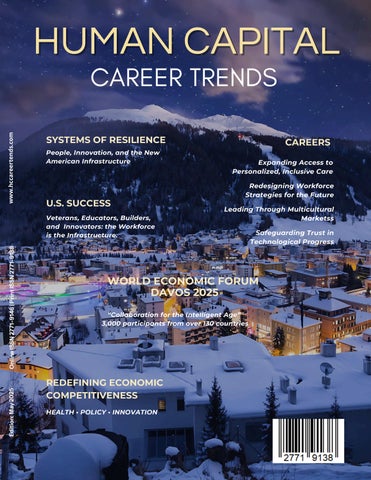
Human Capital Career Trends Magazine (Online ISSN 2771-9146 | Print ISSN 2771-9138) is an American national magazine focused on career trends, immigration, and society, published six times per year on a bi-monthly basis. It is published by Hayman-Woodward Human Capital Services.
Human Capital Magazine considers its sources reliable and verifies as much data as possible, although reporting inaccuracies can occur; consequently, readers using this information do so at theirownrisk
Human Capital Magazine is sold with the understanding that the publisher is not rendering legal services or financial advice. The views expressed in the articles reflect the authors' opinions and do not necessarily reflect the views of the publisher and editor The published material, advertisements, editorials, and all other content are published in good faith Human Capital Magazine cannot guarantee and accepts no liability for any loss or damage of any kind caused by thiswebsiteandfortheaccuracyofclaimsmadebytheadvertisers
Allrightsreserved,andnothingcanbepartiallyorwhollyreprintedorreproducedwithoutwritten consent. All rights reserved. No part of any Human Capital Magazine published work may be reproduced, stored in a retrieval system, or transmitted in any form or by any means, electronic, mechanical, photocopying, recording, or otherwise, without written permission from the publisher
Human Capital Magazine reserves the right to change any information in these articles without notice. By reading this magazine, you agree to all terms and conditions listed above. If you have anyquestionsaboutthispolicy,youmaycontactus
Ana Paula Montanha is Editor-in-Chief of Human Capital Career Trends, she serves as global Chief Human Resources Officer, a member of multiple Boards of Directors, a leading voice in workforcepolicyandeconomictransformation.
Casie Lane Millhouse is a community innovator bridging wearable AI, space tech, and healthcare workforcedevelopmentthroughimmersivelearningecosystemsanddignity-drivendesign
Carmela Tartarel Ribas is a cultural entrepreneur and sustainability strategist whose work in fashion,gastronomy,andexperientialeventsadvanceseconomic impact
CelinaPereiradosSantosisasalicensedestheticianandwellnessspecialistwithover16yearsof experience in advanced facial and body treatments Her neuro-inclusive skincare advanced treatmentssupporthealthequityforagingandneurodivergentpopulations
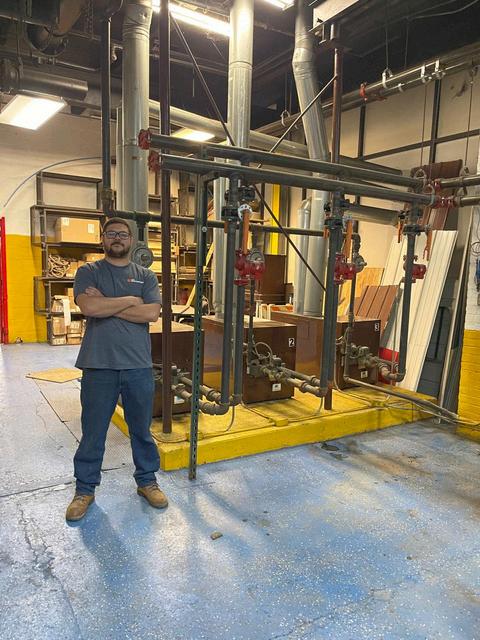
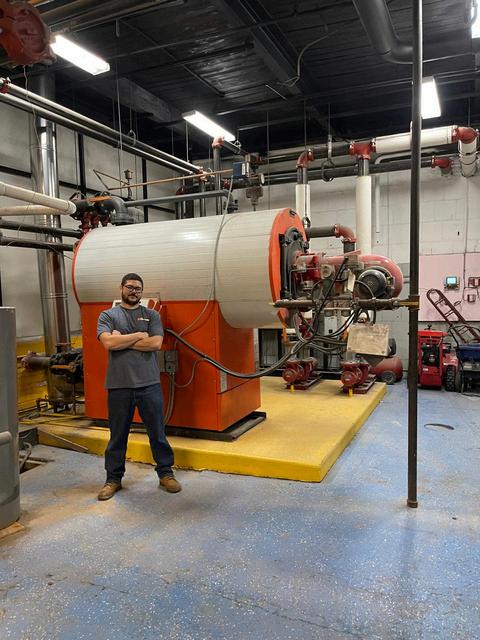
David dos Santos Oliveira is a licensed engineer and infrastructure advisor specializing in HVAC systems and veteran workforce licensure, professional licensure mobility and compliance frameworksforglobalengineersintheU S
Danilo Soares Pereira Dias is a transformation consultant and Chief Revenue Officer specializing in infrastructure modernization and AI-led commercial systems He advises multiple boards and startupsoncross-borderoperationsanddigitalalignment
Hugo Facundo de Almeida Filho is a commercial strategist with over 30 years of executive leadership in Brazil’s automotive and financial sectors, specializing in multicultural consumer marketsandadaptivesalesmodels.
Kelly Cristina da Silva is a financial systems executive with 15+ years deploying ERP financial modules, enhancing treasury operations, and driving compliance innovation across U.S. businesses.
Leonardo Freitas is a global mobility expert, entrepreneur, and CEO of HAYMAN-WOODWARD. He serves as Chairman of the Board and has shaped U.S. Immigration and economic integration frameworksthroughexecutiveadvisoryroles.
MuhammetZ.Bayer is a U S Army veteran and licensed contractor pioneering sustainable public housingdevelopmentthroughveteran-ledgreenconstructioninitiatives
RafaelaCristinaHoffmannCorreais the founder of Select Viagens Sob Medida and an inclusiondriven travel consultant designing autism-sensitive itineraries that reshape accessibility in U S family tourism She is a Certified Autism Travel Professional and the Founder of the All Inclusive Tripsinitiative
Shadab Hussain is a Generative AI and quantum computing expert, MLOps strategist, and internationalspeakeradvancingnext-generationtalentpipelinesthroughplatformslikeTEDxand DavosDigitalCouncil
Tatiana Lessa, Vice President of Operations, and an expert in efficiency-driven transformations, processoptimization,andworkforcescalabilityforglobalenterprises,andanAviationExpert
Yasser Elsheshtawy is a master tattoo artist & expert, and a cultural entrepreneur whose work bridges identity, aesthetics, and the expanding U.S. tattoo economy through health-conscious, inclusiveartistry.
We're genuinely grateful for your support, and we know that your knowledge and experience willmakeadifferenceinthelivesofourreaders.
As Editor-in-Chief and a long-standing advocate for workforce strategy, I am honored to introduce our May 2025 edition. This issue arrives at a time of heightened urgency for the United States, a time when redefining economic strength requires more than capital investment or policy reform. It demands the full engagement of the country’s most under-leveraged asset: people.
Across sectors as diverse as wellness, infrastructure, and applied technology, a central insight emerges: human capital is the engine behind long-term competitiveness. When professionals are enabled to contribute withpurposeandexpertise,theydomorethan fillroles,theybuildsystems
Health & Wellness: Rethinking Capacity and Care
Thiseditionopenswithareevaluationofthe U.S. care landscape, through the lens of practice,nottheory Fromesthetictherapyto sensory-adaptive tourism, the contributorsin this section present concrete, scalable models for extending public well-being beyond hospitals and into everyday environments.
CelinaPereiradosSantos makes the case for esthetic therapy as a critical service in aging andneuro-supportivecare,rootedinempirical studiesandclinicalprotocols.RafaelaCristina Hoffmann Correa broadens the care discussion through adaptive travel planning, revealing a growth market for serviceoriented design in hospitality Marlon do Nascimento Santos addresses the foundational role of STEM fluency in national advancement and presents a blueprint for curriculum modernization Yasser Urbina illustrates the overlooked public value of artisticentrepreneurship showinghowtattoo practitioners can be pillars of recovery, confidence,andlocalizedeconomicactivity.
Policy & Regulation: Unlocking the Potential oftheWorkforce
This section shifts the focus to strategic governance,highlightingthepowerofpolicy tobuildresilience,notbureaucracy.
Leonardo Freitas opens with a compelling argumentforprioritizingveteranreintegration as a matter of national interest. David dos Santos Oliveira addresses the often-ignored challenge of cross-state licensing, where technical professionals are delayed not by skill deficits, but by administrative bottlenecks Muhammet Z. Bayer advances a solutionfocused view on affordable housing, rooted in the capabilities of veteran builders trained in sustainable methods Hugo Facundo de Almeida Filho reinforces the macroeconomic value of U S -based multicultural consumer segments Tatiana Lessa offers a powerful perspective on academic navigation for immigrant families, showing how engagement with the educational system becomes a lever for economic advancement across generations Carmela Tartarel Ribas concludes the section by elevating the strategic diplomacy of executive leadership. Her article reveals how elite CEO gatherings function as economic infrastructure driving foreign investment, global trust, and U S brand strength Positioning business leadership as a soft power asset, she connects domestic workforce policy to international perception, illustrating how cultural capital translatesintomeasurableeconomic
Technology&Innovation:PeopleattheC ofSystems
In the final section, the role of human ins indrivingtechnicalchangeisexamined takeaway is simple but essential: techno succeeds when it elevates hu contribution—not when it attempts replaceit.
I, Ana Paula Montanha, examine AI’s im on the U S workforce and stress the need ethical boundaries in algorith management Casie Lane Millhouse expl how wearable innovation can address a needs in geriatric and hospice care, while providing training benefits to health workers Shadab Hussain calls attentio the formation of the quantum-cap workforceandtheglobalimplicationsoffa behind in applied research Kelly Cristin Silva presents the foundational importance of robust financial architecture in enabling adaptive growth. Finally, Danilo Soares PereiraDias closes the issue with an in-depth analysis of AI systems in port and airport infrastructure, drawing a powerful connection between national defense tools and civilian logisticsresilience.
Ana Paula Montanha is an international Economist and Chief Human Resources Officer specializing in executive workforce strategy She is Editor-in-Chief of Human CapitalCareerTrendsMagazineandanational advocate for aligning labor systems with innovation-driveneconomicgrowth.
What this edition underscores is that future readiness is not merely about being first to adopt, it is about aligning investment, education, and infrastructure with human intentandcapability.
The strategies outlined across these pages do not propose abstract reforms They provide tested frameworks, credible data, and practical models that organizations can use to strengthen operations, reduce inefficiency,andretaintalent.
To our contributors: thank you for your precision,yourleadership,andyourvision.
To our readers: this issue is your tool designed to help you build, refine, and lead withpurpose.
AnaPaulaMontanha
She serves as Chief Human Resources Officer (CHRO) at HAYMAN-WOODWARD and as Managing Partner and Co-founder at HAYMAN-WOODWARD Human Capital Services.MemberoftheBoardofInternational Institutions, including IPMA-Brazil and HAYMAN-WOODWARD
She holds a Master’s degree in Business Administration from the Stephen M Ross School of Business, University of Michigan, a Graduate degree in Marketing, and a Bachelor’sinEconomics.
HEALTH & WELLNESS HEALTH & WELLNESS
U.S. Care Equity, Neurodiversity, Family Inclusion, and Cultural Health Services
U.S. Care Equity, Neurodiversity, Family Inclusion, and Cultural Health Services
The mission is to expand access to personalized, inclusive, and culturally relevant care across sectors in the U.S.
OUR EXPERTS:
Celina Pereira dos Santos
Topic: Neuro-inclusive esthetic therapy
Celina introduces the clinical side of care equity, beginning with nontraditional healthcare through esthetic therapy. She anchors the discussion in licensed, sensory-informed treatment for neurodivergent and aging individuals—framing inclusion as both a wellness and public health issue, building the ethical and human-centered premise of Health & Wellness.
Rafaela Cristina Hoffmann Correa
Topic: Autism-inclusive travel
Rafaela expands inclusion from healthcare to mobility and emotional well-being. Her work shows how service design can be customized to create safety, predictability, and access for atypical families. She builds on Celina’s argument by showing that inclusion is needed beyond clinical settings, reinforcing wellness as a continuum.
Marlon do Nascimento Santos
Topic: STEM excellence and U.S. biotech
Marlon shifts the lens from individual care to systemic national strategy specifically how STEM education supports U.S. leadership in biotech and pharmaceuticals. This expands the discussion to infrastructure, regulatory strategy, and long-term workforce development in health innovation. He connects talent pipelines to health outcomes and national competitiveness.
Yasser Elsheshtawy
Topic: Tattoo artistry and the creative economy
Yasser offers a cultural and economic perspective on health and expression, linking tattoo artistry to identity, healing, and a $1.7B+ industry (Statista, 2023). He closes the section reminding readers that health equity also includes artistic, spiritual, and cultural dimensions often overlooked in policy but crucial to lived experience.
THE OVERLOOKED FRONTLINE: HOW ADVANCED ESTHETIC CARE SUPPORTS U.S. HEALTH EQUITY FOR NEURODIVERGENT AND AGING POPULATIONS
Expert Opinion: Celina Pereira dos Santos is a licensed esthetician and wellness specialist with over 16 yearsofexperienceinadvancedfacialandbodytreatments.
The American healthcare landscape is undergoing a strategic transformation, driven by the dual challenges of a rapidly aging population and the increasing recognition of neurodiversitywithinpublichealthplanning
AccordingtotheU.S.CensusBureau,by2034, older adults will outnumber children for the first time Simultaneously, the Centers for Disease Control and Prevention (CDC) estimates that 1 in 36 children in the United States has been identified with autism spectrum disorder (ASD), a figure that continues to rise. These demographic shifts demand a multidimensional approach to care that extends beyond clinical settings into integrative wellness services Advanced esthetic care, practiced by high-skill professionals, represents a critical yet underrecognized solution in addressing these publichealthimperatives.
IndustryTrendsandMarketAnalysis
The U S Bureau of Labor Statistics projects that employment in personal care and service occupations will grow by 14% from 2022 to 2032, significantly outpacing the average for all other occupations This anticipated growth reflects increased demand for cosmetic services and a broader societal shift toward preventive wellness and integrated chronic care strategies. Notably, recent data from the NationalInstitutesofHealth(NIH)emphasizes that non-pharmacological interventions including massage therapy and therapeutic touch are gaining traction in addressing symptoms associated with anxiety, chronic pain,andsensoryprocessingdisorders
A 2023 NIH-funded study published in Complementary Therapies in Clinical Practice found that regular therapeutic massage improved sleep, reduced stress biomarkers, andenhancedmoodinelderlypopulations,
and enhanced mood in elderly populations, suggesting meaningful downstream impacts on long-term healthcare utilization. Parallel studies underscore the importance of sensory-adaptive therapies for individuals with autism, where regulated touch-based interventions have decreased behavioral dysregulation and improved quality of life metrics.
Advanced estheticians who integrate rehabilitative protocols, sensory-modulated techniques, and evidence-based wellness strategies are increasingly considered essential contributors to holistic care models These professionals bridge the gap between beauty services and functional health outcomes, aligning their work with public health objectives and patient-centered care initiatives
Federal and state-level healthcare policy increasingly acknowledges the value of Complementary and Alternative Therapies (CAM). The National Center for Complementary and Integrative Health (NCCIH), an arm of the National Institutes of Health(NIH),reportedin2023thatnearly40% of adults use some form of CAM, with massage therapy ranking among the top five most utilized modalities. While these treatments remain peripheral in insurancebased health systems, their impact on reducing stress, anxiety, and physical pain is welldocumented
Integrating CAM services into federally supported healthcare frameworks is gaining traction across the United States. Modalities such as therapeutic massage, lymphatic drainage, and sensory-responsive therapies are increasingly recognized in eldercare programs, veterans’ rehabilitation initiatives, and special education Individualized Education Programs (IEPs). This shift reflects a growing consensus among public health stakeholders that non-pharmacological, lowrisk therapies can complement conventional treatments to improve overall health outcomes, reduce chronic care burdens, and enhancepatientsatisfaction.
As state Medicaid programs and veteran services explore reimbursement models for integrative therapies, the healthcare system gradually embraces a broader care definition, including preventive, sensory-modulated, and rehabilitative treatments. This evolution creates a growing demand for credentialed professionals trained in esthetic techniques and therapeutic protocols, especially those capable of addressing the nuanced needs of agingandneurodivergentpopulations
MeetourExpert-CelinaPereiradosSantos
Celina Pereira dos Santos is a licensed estheticianandwellnessspecialistwithover 16yearsofexperienceinadvancedfacialand body treatments. She is recognized for her pioneering use of Drenomodeladora massage This aesthetic treatment combines lymphatic drainage with body shaping massage and radiofrequency therapy to address inflammation, circulation, and muscular recovery issues In addition to traditional skincare, her practice emphasizes therapeutic modalities tailored for two highly vulnerable populations: neurodivergent adolescents and elderly individuals affected by seasonal musculoskeletalstiffness
Celina Pereira dos Santos’ methodologies incorporate evidence-based principles from both esthetic science and rehabilitative care. Her expertise is creating sensorymodulated environments and protocols that cater to clients with autism spectrum disorder,sensoryprocessingchallenges,and limited mobility. Her holistic approach integrates calming therapies, hypoallergenic products, and clinical-grade techniques to improve physiological outcomes and psychological comfort She bridges the gap between wellness and clinical utility through her specialized services an approach increasingly relevant to America’s aging and neurodiversepublichealthlandscape.
In a recent series of treatments at her practice, Celina introduced a modified sensory massage protocol for neurodivergent teens with aversive reactions to standard touch therapies. Utilizing low-stimulation techniques and hypoallergenic products, she observed measurable reductions in client anxiety and improved sleep quality two metrics often cited in behavioral health outcomes. Clients' parents reported higher school engagement and reduced dependency on pharmacological interventions, aligning with CDC recommendationsforintegrativeautismcare.
ExpertOpinion:CelinaPereiradosSantos
How is the aesthetic care industry evolving regardinghealthcarerelevance?
We're seeing a fusion between wellness and medical care Clients are no longer just seeking beauty they're coming in for relief from chronic stress, postural pain, or sensory overload. That changes the practitioner’s responsibility. Non-pharmacological therapies such as therapeutic massage are crucial in maintaining musculoskeletal function and mood regulation among older adults
Practitioners who understand the nuances of cold-weather stiffness and sensory decline can delay the onset of mobility-related dependency Therapeutic esthetic care particularly when designed with clinical intent can mitigate age-related muscular deterioration and emotional decline often exacerbated by isolation and environmental stressors, provide health benefits, including reduced pain incidence, improved circulation, andenhancedmobility
What strategies should professionals adopt tomeettheseevolvingneeds?
Invest in certifications beyond skincare, such as lymphatic drainage, radiofrequency therapy, and especially autism-informed care The goal is to be able to serve diverse bodies withrealphysiologicaldifferences "
How does your work contribute to communityhealth?
I treat clients whose needs are not met in traditional clinics seniors with mobility issues, teens who can’t tolerate clinical environments.
We help them build trust in care again. The distinction lies in methodology: therapeutic estheticians utilize interdisciplinary knowledge spanning anatomy, sensory science, and rehabilitative massage We apply our training to elevate esthetic practice into a supportive health modality. We contribute to public health efforts to extend independent living for seniors, lower hospitalization risks, and reduce healthcare costs through preventive touch-based interventions aligned withMedicaid-fundedprograms.
What role does government policy play in supportingthiswork? Policymatters especiallywhenitcomesto
recognition and reimbursement More professionals can provide care to underserved populations when CAM therapies are included in Medicaid or state-funded eldercare programs.
What are the biggest challenges in scaling therapeuticestheticsnationally?
Standardization and awareness. Many still perceive aesthetics as purely cosmetic. There needs to be regulatory consistency and educationtobridgethatgap.
How is technology influencing your practice andthefieldmorebroadly?
Technology, like radiofrequency therapy and diagnostic skin analysis enhances precision. Butthehumanelement,especiallyinsensory care,remainsirreplaceable.
Collaboration. Medical teams, estheticians, and mental health providers need to work together The future of healthcare is interdisciplinary, and touch-based therapies shouldbepartofthatconversation
REFERENCES
Centers for Disease Control and Prevention (2023). Autism spectrum disorder (ASD) data and statistics. U.S. Department of Health & Human Services. https://www cdc gov/ncbddd/autism/data ht ml
National Center for Complementary and Integrative Health. (2023). Use of complementary health approaches in the U.S. National Institutes of Health https://www nccih nih gov/research/statistics -and-surveys/use-of-complementaryhealth-approaches-in-the-us
National Institutes of Health. (2023). Massage therapy and older adults. Complementary Therapies in Clinical Practice, 51, 101748 https://doi org/10 1016/j ctcp 2023 101748
U S Bureau of Labor Statistics (2023) Personal care and service occupations: Occupational outlook handbook. U.S. Department of Labor. https://www bls gov/ooh/personal-care-andservice/home htm
U S Census Bureau (2023) Demographic turning points for the United States: Population projections for 2020 to 2060. https://www census gov/library/publications/ 2020/demo/p25-114 html
UNLOCKING POSSIBILITY: HOW AUTISM-INCLUSIVE TOURISM
UNLOCKING POSSIBILITY: HOW AUTISM-INCLUSIVE TOURISM
EMPOWERS FAMILIES AND REDEFINES ACCESSIBILITY IN TRAVEL
EMPOWERS FAMILIES AND REDEFINES ACCESSIBILITY IN TRAVEL
UNLOCKING POSSIBILITY: HOW AUTISMINCLUSIVE TOURISM EMPOWERS FAMILIES
AND REDEFINES ACCESSIBILITY IN
TRAVEL
Expert Opinion: Rafaela Cristina Hoffmann Correa is a Certified Autism Travel professional, and the FounderoftheAllInclusiveTripsinitiative,recognizedforpioneeringpersonalizedtravelexperiencesthat empowerfamilieswithautisticchildrentonavigatetheworldwithconfidence,dignity,andjoy.
Tourism tailored to neurodiverse children transforms family experiences, boosts the travel economy, and drives inclusive innovationinU S destinations
Theintersectionoftourismandneurodiversity is no longer a conceptual ambition it is an emerging force within accessible travel that redefines how families with autistic children explore the world With over 5.4 million adults diagnosed with autism spectrum disorder (ASD) in the United States alone (CDC, 2023), the number of neurodiverse families seeking inclusive vacation experiences is rising sharply. Historically underserved, these families often face overwhelming logistical, sensory, and emotional hurdles when planning travel However, a new movement is dismantling these barriers. Led by autism-certified destinations, specially trained travel consultants, and a growing ecosystem of accessible services, this paradigm shift is advancing equity and reshaping the future of tourismasawhole
IndustryTrends&MarketAnalysis
Inclusive tourism is rapidly emerging as a strategicgrowthsegmentwithinthe$2trillion global travel industry, increasingly driven by the needs of neurodiverse families and the growing demand for accessible experiences. According to the International Board of Credentialing and Continuing Education Standards (IBCCES), the demand for autismcertified destinations in the United States has grown by more than 200% since 2018, as families seek safer, more predictable travel environments that support sensory, cognitive, andbehavioraldifferences
The broader travel and tourism industry's economic footprint amplifies this trend's significance In the United States alone, travel and tourism contributed approximately $1 9 trilliontothenationalGDPin2022,accounting for 7.6% of total U.S. economic output, according to the U.S. Department of Commerce’s International Trade Administration (ITA, 2023) The industry directly employed 9 5 million individuals, encompassing roles in hospitality, air travel, ground transportation, recreation, and entertainment, with an additional 6.7 million indirectjobs,asreportedbytheU.S.Bureauof Economic Analysis (BEA, 2023) When inclusive travel is integrated into this economic infrastructure, its potential impact on GDP, employment, and social innovation is substantial.
Globally, the World Travel & Tourism Council (WTTC) reported that tourism supported 330 million jobs in 2023, representing roughly 10% of the global workforce. As international destinations increasinglyembraceaccessibilitystandards sensory-friendly lodging, adaptive recreation, and multilingual support the competitive advantage of inclusive tourism has moved from ethical commitment to economic strategy
The spending power of neurodiverse families is also shifting market dynamics. In 2021, familiestravelingwithchildrenwithdisabilities spent an average of 40% more per trip on tailored services, such as private accommodations, sensory-friendly excursions, and individualized concierge support,toensuresafety,comfort,androutine predictability (Open Doors Organization, 2022) Additionally, 87% of these families would travel more frequently if destinations provided consistent, autism-friendly experiences These findings indicate a compelling market incentive: a vast, underserved customer segment with aboveaverageexpenditurepotential.
The Centers for Disease Control and Prevention (CDC) estimates that 1 in 36 childrenintheU.S.isdiagnosedwithautism spectrum disorder (ASD), translating into millions of families navigating unique daily routines,communicationstyles,andsensory considerations. When tourism services fail to meet these needs, travel is often avoided, resulting in lost revenue, missed engagement opportunities, and systemic inequity However, when inclusive practices are prioritized, this population participates more actively and contributes disproportionately to economic outcomes through increased loyalty, repeat business, and high satisfaction ratings
In response, forward-thinking destinations suchasMyrtleBeach,Mesa,andOrlandohave implemented formal autism certification programs for frontline staff, reimagining everything from check-in procedures to ride queue systems to align with neurodivergent needs. As these cities illustrate, integrating inclusive tourism does not merely fulfill a social responsibility it represents a wise business decision with national economic relevance
PolicyChanges&WorkforceImpact
The federal government’s heightened focus on inclusive economic development, aligned with Section 504 of the Rehabilitation Act and theAmericanswithDisabilitiesAct(ADA),has prompted significant investment in accessibility infrastructure across state tourismagencies.
Florida, for example, has partnered with Visit Florida and the Autism Society to implement staff training and sensory-inclusive certificationsforhotelsandattractions.
From a workforce development perspective, thisinclusionwavehascreatedspecializedjob roles, such as Certified Autism Travel Professionals (CATPs), who bridge the gap between service delivery and family needs According to the Bureau of Labor Statistics (2024), travel professionals with disabilityspecific expertise are projected to grow by 13% over the next decade, outpacing general industry averages This evolution is not just about compliance it’s about developing a moreempathic,innovativeworkforce.
With over 15 years of experience in hightouch,customizedtravelplanning,particularly for Disney and Orlando destinations, Rafaela Cristina Hoffmann Correa has redefined what it means to travel with purpose. As a travel consultant and founder of Select Viagens Sob Medida, Rafaela Cristina Hoffmann Correa has dedicated her practice to supporting families with autistic children by creating personalized, inclusive travel itineraries that remove barriers and maximize joy
“My mission is to bring the same magic and confidence to atypical families that most peopletakeforgrantedwhentraveling,”she explains. “Through specialized training, accessible planning tools, and a deep understanding of sensory needs, we can transform stress into joy one trip at a time.”
Her work includes developing printed guides tailored to autistic children’s sensory profiles, securing early check-ins and quiet dining reservations, and coaching families through airport transitions and theme park pacing Her certification through Disney Destinations and upcoming CATP credential further reinforce her commitment to systemic change in travel equity
How is inclusive tourism evolving, and what arethebiggestchallenges?
The evolution of inclusive tourism, particularly for neurodiverse families, is marked by increased destination certifications, better staff training, and greater public-private partnerships However, major gaps remain in air travel accessibility, language inclusivity, and standardized sensory-friendly protocols across regions. The biggest challenge is consistency: families require a predictable experienceacrosseverytouchpoint
What strategies should executives adopt to stayaheadinthischanginglandscape?
Leaders in hospitality and tourism must prioritize universal design principles, invest in staff certification (e g , CATP, IBCCES programs), and embed sensory-inclusive policies into core operations Offering accommodations upon request is no longer sufficient accessibilitymustbeproactiveand systemic.
How does government policy impact industry growth and workforce development?
Federal ADA guidelines provide the foundation, but state-level tourism boards mustadoptenforcementandincentive frameworks that reward inclusion Workforce development funds should also be directed to training programs that upskill travel professionalsinneurodiversity.
How is inclusive tourism evolving, and what arethebiggestchallenges?
The evolution of inclusive tourism, particularly for neurodiverse families, is marked by increased destination certifications, better staff training, and greater public-private partnerships However, major gaps remain in air travel accessibility, language inclusivity, and standardized sensory-friendly protocols across regions The biggest challenge is consistency: families require a predictable experienceacrosseverytouchpoint.
What strategies should executives adopt to stayaheadinthischanginglandscape?
Leaders in hospitality and tourism must prioritize universal design principles, invest in staff certification (e.g., CATP, IBCCES programs) and embed sensory-inclusive
How does government policy impact industry growth and workforce development?
Federal ADA guidelines provide the foundation, but state-level tourism boards must adopt enforcement and incentive frameworks that reward inclusion. Workforce development funds should also be directed to training programs that upskill travel professionalsinneurodiversity
What role does technology play in shaping thefutureofinclusivetravel?
Mobileappstailoredforautistictravelers,
What role does technology play in shaping thefutureofinclusivetravel?
Mobile apps tailored for autistic travelers, wearable sensory monitors, and AI-enabled concierge services are transforming travel preparation and the in-transit experience However, their success depends on integration with human-centered design and empatheticcustomerservice
How should businesses and professionals prepare for the next decade in inclusive tourism?
Tourism stakeholders should forge alliances with autism advocacy groups, develop inclusiveproductlines,andintegratefeedback loops that allow neurodiverse travelers to inform future service models A commitment toempathy-driveninnovationwillbethemost competitivedifferentiator
What are the most difficult steps in a typical travel journey for families with autistic children,andhowdoyouassistthem?
“The greatest challenges usually begin before families even reach their destination,” explains Rafaela Cristina Hoffmann Correa. “Noisy airports, sudden announcements, unexpected delays at TSA checkpoints, or long queues during hotel check-in can be deeply destabilizing for autistic children. These moments often result in sensory overload or emotional distress, which in turn affects the entire family’sexperience.”
To address these hurdles, Correa builds fully customized itineraries with sensory-safe buffers: pre-selecting quiet flight schedules, arranging for early hotel check-ins, and requesting rooms on quieter floors. She also provides tailored checklists, visual guides, and even step-by-step airport walkthroughs that familiarizethechildwithupcomingtransitions “I work closely with families to identify stress points in advance,” she adds “ Rehearsing scenarios with the child and coordinating with travel providers, we reduce unpredictability, making the trip not onlymanageablebutenjoyable.”
How does an aging workforce impact industryoperationsintheU.S.?
As the workforce ages, generational differences in digital fluency and neurodiversity awareness pose a training challenge However, experienced staff bring invaluable customer service acumen that, when aligned with modern sensitivity training, canelevateinclusiveservicedelivery
What economic shifts should industry leadersanticipateinthenextfiveyears?
The convergence of health equity, social inclusion, and tourism will position accessibility as a standard not a differentiator As ESG (Environmental, Social, Governance) metrics become more prevalent in hospitality investing, autism-inclusion initiatives will increasingly influence funding andbrandvalue
ComparativeAnalysis&Discussion
Traditional tourism models often treated disability accommodations as optional or reactive something to be “handled” rather than integrated. In contrast, the emerging model of autism-certified destinations flips this narrative, placing inclusion at the core of service design Destinations such as Myrtle Beach(SC)andMesa(AZ)arenowrecognized leaders in autism-certified tourism, offering pre-arrival guides, sensory-sensitive event calendars, and trained staff across attractions andhospitality
Nonetheless, skepticism remains regarding thecommercialscalabilityofinclusivetourism. Critics argue that the costs associated with training and sensory-proofing may outweigh short-term revenue benefits However, recent economic analysis shows that inclusive destinations experience higher customer satisfaction scores, increased repeat travel rates, and diversified customer segments, drivinglong-termprofitability.
FutureOutlook&Recommendations
The rise of inclusive tourism for families of autisticchildrenisnotafleetingtrend,itisa transformational movement with measurable economic, ethical, and societal implications. As neurodiverse populations gain visibility and advocacy strengthens, inclusive travel will move from niche to norm Destinations that invest early in certification, accessibility technology, and trained personnel will reap economic rewards and reputationalleadershipintheindustry
The travel industry must adopt a unified nationalstrategythatincludes:
Federal funding for sensory infrastructure upgradesinpublictourismfacilities
National inclusion certification programs aretiedtotaxincentives
Integration of autism-awareness modules intoallhospitalitymanagementcurricula.
As the United States aims to lead in humancentered innovation, inclusive tourism must be a pillar of economic development and civil rights. It is not only a matter of market opportunity but also a moral and national imperative.
References
Centers for Disease Control and Prevention (2023, March 23). Data and statistics on autism spectrum disorder. U.S. Department of Health and Human Services. https://www cdc gov/ncbddd/autism/data ht ml
International Board of Credentialing and Continuing Education Standards. (2023). Certified Autism Center® designation. https://ibcces org/certified-autism-center/ Open Doors Organization (2022) 2022 Market Study: Travelers with Disabilities https://opendoorsnfp org/research/2022market-study/
U.S. Bureau of Economic Analysis. (2023). Travel and tourism satellite account for 2022 https://www bea gov/news/2023/travel-andtourism-satellite-account-2022
U.S. Bureau of Labor Statistics. (2024). Occupational Outlook Handbook: Travel agents. https://www bls gov/ooh/sales/travelagents htm
U S Department of Commerce, International Trade Administration. (2023). Travel and tourism overview. https://www trade gov/travel-and-tourismoverview
World Travel & Tourism Council (2023) Economic Impact Research: 2023 Global Trends Report. https://wttc.org/research/economic-impact
STRATEGIC STEM EDUCATION
STRATEGIC STEM EDUCATION
REFORM: ELEVATING THE U.S. THROUGH MATHEMATICAL EXCELLENCE
REFORM: ELEVATING THE U.S. THROUGH MATHEMATICAL EXCELLENCE
STRATEGIC STEM EDUCATION REFORM: ELEVATING THE U.S. THROUGH MATHEMATICAL EXCELLENCE
Expert Opinion: Marlon do Nascimento Santos, a distinguished mathematics educator and curriculum innovator, experienced in enhancing STEM education through advanced interdisciplinary learning models.
Global competitiveness in science, technology, engineering, and mathematics (STEM) is increasingly recognized as a national economic and strategic strength cornerstone. Recent policy discussions have underscored the urgent need to elevate U.S. students' performance in international rankings, a priority tied directly to the nation’s long-term innovation capacity and economic security Despiteitsleadershipinvarioushightech industries, the United States faces a pressingchallengeinmathematicseducation.
The Programme for International Student Assessment (PISA) results indicate that among 37 developed nations, the United States performs above average in reading and science but lags in mathematics. This deficiency directly and significantly threatens our economic leadership, given that mathematics is the foundation of highdemand fields such as artificial intelligence, quantum computing, engineering, and financialanalytics.
Mathematics education reform must be prioritized to address systemic shortcomings such as outdated curricula, inadequate teacher training, and a lack of student engagement These issues need to be resolved to ensure that curricula reflect the evolving demands of the modern workforce. The role of interdisciplinary learning, technological advancements, and evidencebased teaching methodologies are essential components of an effective strategy for enhancingnationalSTEMpreparedness
IndustryTrends&MarketAnalysis
Mathematics proficiency underpins technological innovation, economic stability, andworkforcecompetitiveness TheBureauof Labor Statistics (BLS) projects that STEM occupations will grow by 10.8% by 2031, outpacingoveralljobgrowthandemphasizing
the demand for quantitative skills across industries The National Science Foundation (NSF) and the Department of Education emphasizethatmathematicsproficiencyisnot merely an academic concern but a key determinant of economic leadership. Countries excelling in mathematics, such as China and Singapore, maintain a disproportionate advantage in global innovation and high-tech manufacturing Without intervention, the United States risks ceding its position as a leader in technological andscientificadvancements.
The shortage of qualified STEM educators is a significant impediment to improving mathematics performance According to the National Center for Education Statistics (NCES), more than 40% of U.S. high schools lack a full-time mathematics teacher with specialized training Therefore, the demand for expert instructors capable of equipping students with problem-solving, logical reasoning, and analytical skills is more urgent thanever.
PolicyChanges&WorkforceImpact
Recognizing the critical gap in STEM education, federal and state policymakers have launched multiple initiatives to increase the recruitment of mathematics educators, improve curriculum quality, and expand STEM accessibility
The STEM Education Strategic Plan (20232028) places mathematics at the center of national STEM objectives, emphasizing educator training and curriculum modernization investments The Department of Education has allocated substantial funding toSTEMteachertraininggrants,ensuringthat K-12 institutions have skilled professionals capableofdeliveringhigh-qualityinstruction.
In addition to these efforts, amendments to the Workforce Innovation and Opportunity Act (WIOA) have encouraged partnerships between educational institutions and technology firms to align mathematics instruction with workforce needs. Despite these policy advancements, implementation challenges persist Structural gaps in teacher training, outdated instructional models, and inconsistent mathematics curricula remain significant obstacles Without systemic solutions, national efforts to enhance mathematics education will struggle to yield measurableimprovements
While these policies provide a structural framework for improvement, their success depends on experienced educators implementing research-backed strategies that drive student engagement and comprehension Curriculum innovations and faculty training programs addressing key workforce challenges will be critical to ensuring the long-term success of these policyshifts.
Federal and state policymakers have launched multiple initiatives to increase STEM educator recruitment, improve mathematics curricula, and expand STEM accessibility Key federal strategiesinclude:
The STEM Education Strategic Plan (2023-2028) prioritizes investments in educator training and curriculum modernization
Department of Education STEM Teacher Grants aim to support STEM teacher training programs and attract skilled professionalstoeducationcareers.
WorkforceInnovationandOpportunityAct (WIOA) Amendments, encouraging partnerships between educational institutions and technology firms to align mathematics instruction with workforce needs.
CaseStudies&ExecutiveInsights
The effectiveness of pedagogical innovations is evident in the impact of curriculum development and faculty mentorship programs. In educational institutions where advanced Algebra II and Trigonometry curricula have been implemented, measurable improvements in problem-solving skills and real-world mathematical applications have beenobserved Inquiry-basedlearningmodels and interactive methodologies have contributed to a 32% increase in student mathematics proficiency scores within three academic years and a 28% improvement in student retention rates in advanced STEM courses Integrating interdisciplinary STEM education has facilitated higher placement rates in STEM-focused higher education programs.
In response to the increasing linguistic diversity in U S classrooms, bilingual STEM curricula (Portuguese-English) have provided multilingual students equitable access to mathematical education. Enhanced engagement, improved comprehension of complex mathematical principles through multilingual cognitive processing, and an increased STEM participation rate among bilingual students by 26% demonstrate the impactoflanguage-inclusiveinstruction.
ExpertOpinion:MarlondoNascimentoSantos
Marlon do Nascimento Santos is a distinguished mathematics educator and curriculum innovator with over 17 years of expertise in advancing STEM instruction, interdisciplinary learning models, and faculty mentorship His career has been defined by a steadfast commitment to pedagogical innovation,integratingevidence-based
instructional strategies that have demonstrably improved student performance in mathematics and STEM disciplines His work directly addresses national workforce priorities by bridging the gap between educational policy and classroom implementation, ensuring that students are equipped with the mathematical competencies necessary for the rapidly evolvingtechnologicallandscape
His contributions to mathematics education are most evident in his curriculum development efforts, where he has designed and implemented advanced Algebra II and Trigonometry frameworks for middle and high school students. These curricula not only enhance problem-solving skills but also serve as a foundational platform for students pursuing higher education in STEM fields By leveraging experiential learning methodologies, technology-enhanced instruction, and interdisciplinary applications, he has created a transformative approach to mathematics education that fosters cognitive development, critical thinking, and applied problem-solving
The measurable impact of his pedagogical innovations is reflected in significant improvements in student engagement and academic outcomes. At Colegio Integrado Diadema, his curriculum reforms led to a 32% increase in mathematics proficiency scores within three academic years and a 28% improvement in student retention rates in advancedSTEMcourses.Theseachievements highlight the effectiveness of inquiry-based learning models and interactive methodologies in making mathematics more accessibleandengaging
Beyond curriculum innovation, Marlon do NascimentoSantoshasplayedapivotalrolein expanding bilingual STEM instruction, recognizing the increasing linguistic diversity inU S classrooms Hispioneeringofabilingual Portuguese-English STEM curriculum has provided equitable access to mathematics education, resulting in a 26% rise in STEM participation among bilingual students. This initiative aligns with federal objectives to enhance STEM accessibility and workforce readiness by ensuring that language barriers donotimpedemathematicalproficiencyor
career advancement in high-demand technologicalfields
His extensive experience in faculty development further amplifies his impact on mathematics education By designing and implementing professional development programs for educators, he has contributed to long-term improvements in instructional quality, ensuring that mathematics educators areequippedwiththeskillstointegratedigital tools, real-world problem-solving techniques, and industry-aligned curricula into their teaching practices His work continues to serve as a model for national implementation, reinforcing the importance of scalable, research-backed solutions in strengthening STEMeducationpathways.
What strategies should policymakers and educators adopt to enhance mathematics education?
Policymakers and educators must implement strategies that align mathematics education with workforce demands and global competitiveness First, investment in professional development for mathematics educators must increase, with federal STEM education budgets expanding by 15% annually to support teacher training. Studies from the DepartmentofEducationsuggestthatschools
with well-trained STEM faculty see a 25% improvementinstudentperformance
Second, curriculum innovation should focus on interdisciplinary learning, incorporating mathematics applications in artificial intelligence, finance, and bioinformatics Third, technology-driven solutions such as adaptive learning software can personalize instruction, with research showing a 40% improvement in student comprehension rates through AI-assisted tutoring. Lastly, bilingual STEMprogramsmustbeexpandedtoaddress demographicshifts,ensuringequitableaccess to quality mathematics instruction for diverse studentpopulations
How does government policy impact workforcereadinessinSTEMfields?
Government policy shapes the STEM workforce by establishing educational funding priorities, research initiatives, and workforce developmentprograms.Federalinvestmentin STEM education reached $3.2 billion in 2023, yet reports from the National Science Board indicate that the U S still lags behind global competitors in producing mathematicsproficient graduates Policies such as the Workforce Innovation and Opportunity Act (WIOA) have driven partnerships between educational institutions and industry leaders, resulting in a 30% increase in STEM apprenticeship programs over the past five years Tax incentives for companies that fund STEM scholarships and training initiatives have also led to a 22% rise in private-sector contributions to STEM education. However, gaps persist, particularly in rural and underservedcommunitieswheremathematics educator shortages remain critical To bridge this divide, federal policies must prioritize targeted teacher incentives and infrastructure improvementstofacilitatedigitallearning.
What role does technology play in shaping thefutureofmathematicseducation?
Technology is revolutionizing mathematics education by making it more data-driven, personalized, and application-oriented. The adoption of artificial intelligence (AI) in education has increased by 60% in the past five years, with AI-driven platforms capable of identifyingstudentlearningpatternsand
adjustinginstructionalmethodsaccordingly
Research shows that students using AIassisted learning tools experience a 32% improvement in problem-solving accuracy. Gamification strategies have also gained traction, with interactive mathematics applications leading to a 25% increase in engagement Virtual and augmented reality simulations allow students to visualize complex mathematical models, with studies indicating a 45% improvement in conceptual understanding when using immersive learning technologies Despite these advancements, technology must complement expert-led instruction, as research suggests that human guidance remains essential for fostering criticalthinkingandanalyticalreasoning.
How should businesses and professionals prepare for the next decade in STEM industries?
Automation and data science acceleration necessitate businesses and professionals to adapt to an increasingly quantitative work environment Data from the World Economic Forum estimates that 50% of all employees will require reskilling by 2027 due to shifts in job requirements Businesses must prioritize workforce training in applied mathematics, statistical modeling, and machine learning. Industry-academiccollaborationshaveproven effective, with companies that co-develop STEM curricula reporting a 35% increase in employee preparedness upon hiring Additionally, professionals must embrace lifelong learning through digital certification programs, with industry-recognized credentials in data analytics, blockchain applications, and AI expected to see a 70% increase in demand over the next decade Implementing AI-driven workforce development platforms has already led to a 20% reduction in skill gaps in industries reliant onmathematicalapplications
How does an aging workforce impact STEM educationintheU.S.?
The aging STEM workforce presents a significant challenge, with 30% of STEM educators expected to retire by 2035 This demographic shift threatens to create a knowledgegapinmathematicseducation,
exacerbatingexistingshortages
Reports from the National Center for Science andEngineeringStatisticsindicatethat50%of STEM institutions are already experiencing faculty shortages, particularly in mathematics and physics To mitigate these challenges, structured mentorship and knowledgetransfer programs must be implemented, allowing senior faculty to guide early-career educators.Additionally,mid-careertransitions into STEM teaching roles should be incentivized, with tuition reimbursement programs leading to a 25% increase in STEM professionals entering academia Expanding international talent acquisition through streamlinedvisapathwayscanfurtheraddress shortages, ensuring that mathematics educationmaintainshighinstructionalquality.
What economic shifts should industry leaders anticipate, and how will they affect STEMeducation?
Economic forecasts predict that AI-driven automation, sustainability initiatives, and globalized talent markets will fundamentally reshape STEM education priorities Automating data analysis and engineering tasks is projected to replace 15% of current STEM jobs by 2030, simultaneously creating 50 million new STEM-related roles worldwide. The expansion of green technology industries will necessitate updates to STEM curricula, with renewable energy and environmental engineering courses expected to see a 40% enrollment increase. Additionally, alternative educationmodelssuchasmicro-credentialing programs are gaining traction, with industryled certifications growing by 55% since 2020 These changes require academic institutions to adopt agile curriculum frameworks emphasizing adaptability, ensuring students areequippedwithfuture-readySTEMskills.
What strategies are most effective in recruitingtop-tiermathematicseducators?
Recruiting and retaining high-caliber mathematics educators is essential to strengthening STEM education pipelines. Competitive salaries remain a primary incentive, as research indicates that STEM educators in the top quartile of pay scales demonstrate a 50% lower attrition rate than theirlower-paidcounterparts
Professional development opportunities, including industry fellowships and research grants, have led to a 30% increase in longtermeducatorretention.
Immigration policies also play a crucial role, with streamlined work visas attracting 25% of international mathematics Ph D graduates to U S institutionsannually
Additionally, public-private partnerships that provide loan forgiveness programs for STEM educators in underserved areas have resulted in a 20% rise in recruitment success rates Ensuringmathematicsinstructorshaveaccess to continuous learning opportunities, mentorship, and research funding is imperative for sustaining a high-quality educationworkforce.
FutureOutlook&Recommendations
Strengthening U S mathematics education requires continued investment in curriculum innovation, faculty training, and equitable access initiatives. Expanding funding for STEM educator development will ensure that instructional quality keeps pace with workforce demands Aligning mathematics instruction with real-world applications and industry requirements will facilitate student preparedness for STEM careers. Scaling bilingual STEM programs will support diverse student populations in developing mathematical proficiency Finally, integrating cognitive science-based learning methodologies into instructional models will enhance engagement, retention, and concept mastery. Marlon do Nascimento Santos’ work provides a blueprint for national implementation, demonstrating the effectivenessofresearch-backedstrategiesin elevatingmathematicseducationoutcomes
References
Bureau of Labor Statistics (2023) Employment Projections: STEM Occupations 2022-2032 Retrieved from https://www.bls.gov/emp/tables/stememployment.htm
National Science Foundation (2023) STEM Workforce Report Retrieved from https://www nsf gov/statistics/stem
The tattoo industry in the United States has evolved from a stigmatized subculture into a thriving sector of the creative economy In 2024, the tattoo market reached $1.5 billion in revenue, with projections indicating continued growth to $1.7 billion by 2029, according to IBISWorld (2024). This trajectory is driven by cultural normalization, technological innovation, and increasing consumer preference for customized artistic experiences Beyond its aesthetic function, tattooing has become a high-skill profession contributing to local economies, entrepreneurial ecosystems, and broader workforcedevelopmentinitiatives.
This article analyzes the tattoo industry through the lens of labor economics, cultural signaling,andentrepreneurship.
Market Trends and Industry Analysis: From StigmatoEconomicAsset
AccordingtothePewResearchCenter(2023), 32% of U.S. adults now have at least one tattoo,andamongindividualsunder50,this figure rises to 46%. The demographic expansion, especially among millennials and Gen Z, has coincided with a broader cultural shift: tattoos are no longer viewed as countercultural but as valid expressions of identity. In parallel, corporate dress codes havesoftened,allowingtattooedprofessionals to participate fully in traditional employment sectors
This shift in cultural perception has translated intorobustindustrygrowth IBISWorld(2024) reports a CAGR of 3.5% between 2024 and 2029, with nearly 38,000 individuals employed across more than 26,000 tattoo businesses.
The industry remains fragmented, with no single entity capturing more than 5% market share, indicating high entrepreneurial dynamismandcreativediversity.
Technological advancements have further transformed the sector Rotary tattoo machines, biodegradable needles, advanced ink pigments, and sterilization tools such as autoclaves have enhanced both safety and quality These innovations reduce client trauma and healing time, extending the longevity and vibrancy of body art Simultaneously, digital platforms like Instagram and TikTok have redefined artist visibility, allowing independent creators to scale nationally without traditional intermediaries
Policy Alignment and Workforce Development
Tattoo artistry occupies a unique space in the U.S. labor market. It exemplifies highskill, low-barrier entrepreneurship a model emphasized by the U.S. Small Business Administration and the Department of Labor. While the industry has modest capital requirements, it demands significant skill acquisition, often through apprenticeships rather than formal degrees Tattoo artists mustdemonstratemasteryinanatomy,design software,colortheory,andaseptictechniques
This labor profile aligns with current federal policy objectives under the Workforce Innovation and Opportunity Act (WIOA), which seeks to elevate trades that contribute to local economies and national cultural exports The role of creative professionals in economic revitalization is further affirmed by the National Endowment for the Arts and recentBLSoccupationaloutlooks.
Yasser Urbina’s studio operates at the intersection of art, commerce, and public health. Beyond producing custom tattoos, Yasser Urbina mentors junior artists, collaborateswithdermatologistsoninksafety, and offers community workshops These initiatives fulfill key national interest priorities by enhancing workforce skills, advancing industry standards, and expanding access to high-qualityservices
Case Study: Yasser Urbina – Artistic VisionaryandEconomicContributor
Yasser Urbina has cultivated a distinctive presence within the U.S. tattoo ecosystem. Based in California, Yasser Urbina’s studio services a diverse clientele seeking highly customized, narrative-driven tattoos. Each piece created by Yasser Urbina is rooted in symbolic storytelling, anatomical precision, and cultural reverence. The studio has achieved a 90% client return rate and has seen a 300% increase in digital engagement overthepastthreeyears.
Yasser Urbina’s innovations extend beyond design. The studio offers tiered pricing structures to ensure both accessibility and premium exclusivity Yasser Urbina also pioneered mobile tattoo pop-ups across the West Coast, increasing regional brand presence while maintaining rigorous safety and artistic standards. These business strategies reflect advanced knowledge of customer retention, operational scalability, and client lifecycle management, paralleling best practices in executive leadership and smallbusinessdevelopment
Social Healing Through Ink: Tattoos as RestorativeToolsforCancerSurvivors
A lesser-known but profoundly impactful dimensionofYasserUrbina’sworkliesinthe intersection of tattoo artistry and posttreatment recovery. In recent years, Yasser Urbina has become increasingly sought after for medical and paramedical tattooing services that support individuals recovering from cancer For breast cancer survivors, this includes hyper-realistic areola restoration a delicate and symbolic procedure that helps restore bodily confidence and closure after mastectomy.
Beyond clinical applications, Yasser Urbina has also collaborated with pediatric oncology units to offer “faux tattoos” to young cancer survivors. These temporary designs replicate superheroes, empowering symbols, or personal achievements, helping children visualize themselves as warriors in their healing journey. The impact is both psychological and communal: transforming fearintostrength,scarsintostories.
These services align with public health and wellness goals by addressing not only physical appearance but also mental resilience and dignity. As health systems increasingly recognize the value of integrative care, Yasser Urbina’s contributions demonstrate how tattooing can be a medium for emotional rehabilitationandself-restoration
ExpertQ&A:InsightsfromYasserUrbina
How have digital platforms influenced your growthasatattooprofessional?
Digital visibility is critical Platforms like Instagram serve as our portfolios, marketing tools, and client communication hubs They help us build credibility, attract national and even international clients, and showcase our artisticevolution.
What does it take to maintain professional excellenceinthisfield?
Beyond technical skill, it’s about ethics, hygiene, emotional intelligence, and continued learning. I attend conventions, study new techniques, and invest in mentorship That’s whatbuildslongevityandtrust
What do you see as the tattoo industry’s futureintheU.S.economy?
We’re moving into mainstream recognition As policies evolve to support small businesses and creative industries, I see tattooing becoming part of economic development strategies especially in urban communities where artistry canupliftbothcultureandcommerce.
Have you engaged in any work that intersects with healthcare or medical recovery?
Yes one of the most meaningful aspects of myworkishelpingindividualsrecoveringfrom cancer treatments I’ve had the privilege of designingrestorativetattoosforbreastcancer survivors, including realistic areola restoration and scar camouflage I’ve also created empowering faux tattoos for young children undergoingcancerrecovery,helpingthemsee their strength through superhero or symbolic imagery. It’s about emotional healing through artistry.
Comparative Analysis: Tattooing in the Age ofAutomation
As automation disrupts traditional employment sectors, artisanal fields like tattooing provide a counter-narrative. The tactile, relational, and creative aspects of tattoo artistry resist mechanization, emphasizing uniquely human skills While AI can assist in design drafting, the execution, emotional engagement, and client consultationremainirreplaceablyhuman.
This resilience echoes findings from the National Bureau of Economic Research (NBER), which identifies creative services as among the least susceptible to automation Moreover, the rise of the “experience economy ” where consumers favor personalized, meaningful encounters positions tattoo artists as essential service providers
Still, risks remain The industry is highly sensitive to fluctuations in discretionary income, cultural trends, and public health mandates Licensing inconsistency across states also creates regulatory uncertainty Addressing these challenges through federal certification programs and cross-sector collaboration could further legitimize the field andunlockgrowthcapital.
Future Outlook and Policy Recommendations
Projections for the tattoo industry are optimistic. As cultural acceptance widens and workplace inclusivity increases, tattoos will continuetothriveasamediumofexpression
and entrepreneurship. By 2029, the industry is forecast to reach $1.7 billion in annual revenue, supported by a growing adult populationandfavorableconsumertrends.
To maximize this potential, policymakers should:
Standardize licensing requirements to ensurenationalsafetybenchmarks.
Fund creative apprenticeships under workforcedevelopmentgrants
Include tattoo professionals in NEA and SBAsmallbusinessinitiatives
Recognize tattoo artistry as a skilled trade inimmigrationadjudicationframeworks.
REFERENCES
Babin,J J M (2013) JudgingaBookbyItsInk: Essays on Tattoos in an Economic Context (Honors Thesis, University of Memphis). FogelmanCollegeofBusinessandEconomics.
IBISWorld (2024) Tattoo Artists in the US –Industry Report OD4404 https://www ibisworld com/unitedstates/industry/tattoo-artists/4404/
Pew Research Center (2023) Americans and Tattoos: A Growing Trend Across Generations https://www pewresearch org/
U.S. Bureau of Labor Statistics. (2024). Occupational Outlook Handbook: Artists and RelatedWorkers.https://www.bls.gov/ooh/ U S Small Business Administration (2023) Creative Economy Report https://www sba gov/
U.S. Census Bureau. (2023). Nonemployer Statistics by Industry. https://www census gov/
National Endowment for the Arts (2024) Creative Workforce Development and CommunityImpact.https://www.arts.gov/
National Bureau of Economic Research. (2023) Which Occupations Are at Risk of BeingAutomated?https://www nber org/
POLICY & REGULATION POLICY & REGULATION
Workforce mobility, infrastructure licensing, veteran reintegration, and economic resilience through multicultural markets
Workforce mobility, infrastructure licensing, veteran reintegration, and economic resilience through multicultural markets
Harness policy as a strategic lever to mobilize talent, scale resilience, and close systemic gaps
OUR EXPERTS:
Leonardo Freitas
Topic: Veteran Workforce Reintegration and Upskilling
Leonardo opens the section with national urgency: a strategic imperative to reintegrate veterans into the workforce through upskilling and policy modernization. His article provides macro framing connecting workforce reintegration with U.S. economic competitiveness, national defense repurposing, and policy design (e.g., DoD transitions, DOL grants). He introduces veterans not just as a labor pool but as strategic national assets.
David dos Santos Oliveira
Topic: Veteran Engineers and Infrastructure Licensing
David zooms into the professional licensing barrier veterans face, especially in fields like engineering and skilled trades. His article continues Leonardo’s theme but adds compliance and credentialing insight tying the strategic vision to structural realities. David reveals that licensure and regulatory mobility (state boards, federal standards) are often underestimated bottlenecks, but crucial for tapping veteran skills into America’s crumbling infrastructure sector. This makes a seamless lead-in to construction.
Muhammet Z. Bayer
Topic: Sustainable Housing Led by Veteran Builders
Muhammet brings the previous themes into implementation: how veterans are already solving the housing crisis through green infrastructure. A former Army contractor himself, he fuses national service with climate adaptation and construction execution. This article offers a resilience lens veterans not just needing help, but actively rebuilding America, from affordable housing to disaster response. It deepens the policy angle by showing what happens when policy works and talent is empowered.
Hugo Facundo de Almeida Filho
Topic: Multicultural Consumer Strategy in Uncertain Times
Hugo expands the policy conversation to market-scale implications: how demographic shifts and consumer diversity can drive resilience during volatility. While previous articles focus on labor supply and infrastructure demand, Hugo focuses on domestic market strength. He ties in immigration, cultural fluency, and localized sales strategies as economic imperatives, showing that inclusive markets are not a moral option but a
macroeconomic necessity. This closes the section with a forward-facing strategy for growth and consumer adaptation.
Tatiana Lessa
Topic: Immigrant Families and Education Navigation
Tatiana addresses a different but equally strategic facet of human capital policy: immigrant parental engagement with the U.S. academic system. She shows how navigating the transition from high school to college becomes a workforce pipeline issue one that affects generational mobility, regional economies, and education equity. Her work supports the thesis that integration policy must begin at the school level, where family access translates into future economic participation.
Carmela Tartarel Ribas
Topic: Executive Influence and Soft Power Strategy
Carmela introduces a strategic diplomacy angle to workforce and market resilience. Her article examines how elite CEO convenings forums often seen as ceremonial—actually function as global signaling mechanisms. She links executive presence and event ecosystems to foreign investment flows, national brand strength, and bilateral confidence. This expands the policy conversation into the realm of economic statecraft and positions privatesector leadership as a catalyst for macroeconomic influence.
VETERAN WORKFORCE
VETERAN WORKFORCE
REINTEGRATION AND
UPSKILLING: A STRATEGIC
REINTEGRATION AND UPSKILLING: A STRATEGIC
IMPERATIVE FOR NATIONAL COMPETITIVENESS
IMPERATIVE FOR NATIONAL COMPETITIVENESS
VETERAN WORKFORCE REINTEGRATION
AND UPSKILLING: A STRATEGIC IMPERATIVE FOR NATIONAL COMPETITIVENESS
As the United States confronts critical labor shortages in sectors such as cybersecurity, energy, and advanced manufacturing, a significant reservoir of untapped talent remains:thenation’smilitaryveterans.With over200,000servicememberstransitioning tocivilianlifeannually,accordingtotheU.S. Department of Labor, there exists a compelling opportunity to harness their skills and experiences to bolster the civilian workforce.
Leveraging Department of Labor’s VETS Programs
The Veterans’ Employment and Training Service (VETS) under the U.S. Department of Labor offers a suite of programs designed to facilitate the seamless transition of service members into the civilian workforce These programs provide training opportunities, employment resources, and grants aimed at preparing veterans and their spouses for meaningful civilian careers. VETS also safeguards service members’ and veterans’ employment rights and recognizes employers whoactivelyrecruitandretainveterans
Among these initiatives, the Homeless Veterans’ Reintegration Program (HVRP) stands out for its targeted approach to assist veterans experiencing or at risk of homelessness HVRP offers individualized career plans encompassing employment training, professional attire, transportation assistance, and dedicated case management to support veterans in achieving financial stabilityandsustainableemployment.
DoD SkillBridge: Bridging Military and
CivilianCareers
The Department of Defense’s SkillBridge programservesasapivotalconduitfor
transitioningservicememberstogainvaluable civilian work experience during their final 180 days of military service By partnering with private sector employers, SkillBridge facilitates internships that align military skills with civilian job requirements, thereby easing thetransitionprocess.
To encourage the hiring of veterans, several federal incentives are available to employers
The Work Opportunity Tax Credit (WOTC) providesafederaltaxcredittoemployerswho hire individuals from certain targeted groups, including veterans facing significant barriers toemployment.
The Consolidated Appropriations Act, 2021, extended the WOTC through December 31, 2025, allowing employers to benefit from tax creditsforhiringeligibleveterans
Additionally, the Special Employer Incentive (SEI) program offers reimbursements to employers who hire veterans facing employment challenges This program can cover up to 50% of the veteran’s salary for a maximum of six months, along with costs associated with instruction, loss of productivity during training, and necessary suppliesandequipment
For federal agencies, the Office of Personnel Management (OPM) provides recruitment incentives that can be up to 25% of the employee’s annual rate of basic pay, with potentialincreasesupto50%basedoncritical agency needs These incentives aim to attract highly qualified candidates, including veterans,tofederalservice
Veterans in High-Demand Sectors: Cybersecurity, Energy, and Industrial Engineering
Veterans possess a unique blend of discipline, technical skills, and leadership qualities that are highly transferable to sectorsexperiencinglaborshortages.
In cybersecurity, for instance, the structured and security-conscious mindset ingrained in military training aligns well with the demands of protecting digital infrastructure Programs like the SANS Institute’s Veteran Cyber Academy have been instrumental in reskilling veterans for roles in cybersecurity, addressing both workforce gaps and veteran unemployment
In the realm of energy, veterans’ experience with complex systems and operations makes them ideal candidates for roles in renewable energy projects Initiatives like the collaboration between the North American Board of Certified Energy Practitioners (NABCEP) and the Interstate Renewable Energy Council (IREC) have streamlined industry certification processes for veterans, facilitating their entry into the clean energy workforce
Industrial engineering and advanced manufacturing sectors also benefit from veterans’ proficiency in logistics, systems management, and process optimization Their adaptability and problem-solving skills contribute to increased efficiency and innovationwithintheseindustries
Strategic Recommendations for Employers andPolicymakers
To fully leverage the potential of the veteran workforce, the following strategic actions are recommended:
1 Enhance Awareness and Accessibility of Transition Programs: Employers should actively engage with programs like VETS and SkillBridge to identify and recruit veterantalent.
2 Promote Certification and Training Opportunities: Facilitate access to industry-recognized certifications for veterans, particularly in high-demand sectors, to bridge skill gaps and validate competencies.
3 Implement Supportive Onboarding Practices: Develop onboarding processes that acknowledge the unique experiences of veterans, providing mentorship and resources to ease their transition into civilianroles.
4.Advocate for Policy Enhancements: Policymakers should consider expanding tax incentives and support programs to further encourage the hiring and training ofveterans
5.Foster Public-Private Partnerships: Collaboration between government agencies, educational institutions, and private sector employers can create comprehensive pathways for veteran employmentandcareeradvancement
Integrating veterans into the civilian workforce is not only a matter of honoring theirservicebutalsoastrategicapproachto addressing labor shortages in critical industries. Capitalizing on existing programs, offering targeted incentives, and fostering collaborative efforts, the nation can unlock the full potential of its veteran population, driving economic growth and enhancingnationalcompetitiveness.
References
U S Department of Labor (n d ) Veterans’ Employment and Training Service (VETS). Retrieved from https://www.dol.gov/agencies/vets
Internal Revenue Service (n d ) Work Opportunity Tax Credit Retrieved from https://www irs gov/businesses/smallbusinesses-self-employed/workopportunity-tax-credit
U S Department of Labor (2023, November 1) Employer Guide to Hiring Veterans [PDF] Retrieved from https://www.dol.gov/sites/dolgov/files/VETS /files/Employer-Guide-to-Hiring-Veterans20231101.pdf
U S Office of Personnel Management (n d ) Fact Sheet: Recruitment Incentives Retrieved from https://www opm gov/policy-dataoversight/pay-leave/recruitment-relocationretention-incentives/factsheets/recruitment-incentives/
U S Office of Personnel Management (n d ) Special Hiring Authorities for Veterans Retrieved from https://www.opm.gov/fedshirevets/hiringofficials/strategic-recruitment-andhiring/veterans/
Leonardo Freitas is an Entrepreneur, Chief Executive Officer, Chairman of the Board, and Global Mobility Expert With over twentyeight years of experience in business development and international trade, he stands out as an entrepreneur and founder of HAYMAN-WOODWARD IMMIGRATION LAW FIRM LLP His vision and leadership skills, together with his unique talent for identifying deceptive behaviors, were fundamental in the conception and success of the firm. Leonardo Freitas' journey illustrates the trajectory of an tirelessleader,whosefocusanddetermination were crucial to the establishment of HAYMAN-WOODWARDontheglobalstage
NATIONAL INFRASTRUCTURE
NATIONAL INFRASTRUCTURE
THROUGH SKILLED LABOR: THE
STRATEGIC ROLE OF VETERANS
THROUGH SKILLED LABOR: THE STRATEGIC ROLE OF VETERANS
IN THE U.S. MAINTENANCE AND REPAIR SECTOR
IN THE U.S. MAINTENANCE AND REPAIR SECTOR
NATIONAL INFRASTRUCTURE THROUGH SKILLED LABOR: THE STRATEGIC ROLE OF VETERANS IN THE U.S. MAINTENANCE
AND REPAIR SECTOR
ExpertOpinion:DaviddosSantosOliveira
As the United States intensifies efforts to modernize its built environment driven by climate adaptation, energy conservation, and digital infrastructure the foundation of this transformation lies not only in legislative capital or advanced technology but also in human capital. HVAC (Heating, Ventilation, and Air Conditioning) professionals serve as essential front-liners in this shift, ensuring thatthesystemscontrollingairquality,energy usage, and climate resilience operate efficiently and safely These systems are foundational to the operation of healthcare centers, schools, data centers, and other criticalinfrastructure.
In a time of rising global temperatures, evolving climate regulations, and a national push toward zero-emission buildings, HVAC systems have transitioned from optional building features to essential infrastructure. According to the U.S. Bureau of Labor Statistics (2024), employment in the HVAC sectorisexpectedtogrow6%through2032, translating into more than 37,700 new jobs, not including replacements for retiring workers—many of whom belong to the Baby Boomer generation now exiting the skilled trades. Without prompt workforce development, the country risks a stall in criticalinfrastructureprojects
Compounding this urgency is a systemic labor supply gap. A 2023 report by the National Association of Home Builders states that 83% of contractors are experiencing difficulty finding skilled HVAC workers. Several structural issues contribute to this gap: waning interest among younger workers in vocational paths, extensive timeframes for proper training and certification, and increasingly complex HVAC systems that require proficiency in both mechanical diagnosticsandsmarttechnologies
The U.S. HVAC industry generated an estimated $133.7 billion in revenue in 2024, supported by over 568,000 employees across 114,000 businesses. With a projected CAGR of 1 9% through 2029, the sector’s sustained growth is driven by climate pressures, infrastructure modernization, and consumer demand for energy-efficient solutions
At this crucial juncture, military veterans represent an untapped reservoir of technical skill, operational discipline, and leadership potential.Servicemembersoftenentercivilian life with advanced mechanical training, experience maintaining life-support systems in high-pressure environments, and a mindset honed by mission-critical operations These qualifications closely align with the technical and regulatory demands of modern HVAC roles. Moreover, veterans bring with them intangible but invaluable attributes: strategic thinking, accountability, teambased operations, and adherence to strict protocols. As the nation advances toward its infrastructure and clean energy goals, the integration of military-trained professionals into high-impact trades such as HVAC should not be viewed merely as workforce development but as a policy imperative serving national resilience and economic continuity
This article explores how veteran professionals, particularly David dos Santos Oliveira, embody the technical, ethical, and operational attributes needed to fortify the HVAC sector and by extension, the broader infrastructuremodernizationagenda
Comparative Analysis: Military Readiness andTechnicalExpertise
Despite demand growth, the industry suffers from acute labor shortages With a 5 4% average profit margin, contractors are under pressure to maintain performance despite rising wage demands and limited access to skilled workers. According to the report, high competition and labor scarcity are structural threats constraining industry profitability and capacity
In the evolving landscape of skilled labor, where precision, compliance, and innovation must coexist, veterans bring a multidimensional advantage that goes far beyondtradeproficiency ParticularlyinHVAC roles, military-trained individuals offer an operationalstandardthatdirectlysupportsthe U.S. economy ’ s infrastructure and environmentalpriorities.
Traditional HVAC training is largely focused on standardized diagnostics, maintenance routines, and customer service In contrast, military training instills readiness under pressure, cross-disciplinary mechanical awareness, and proactive maintenance in unpredictable, high-risk settings According to the U.S. Department of Defense (2023), 31% of enlisted personnel receive advanced technical instruction in systems such as refrigeration,electricalgrids,environmental controls, and tactical energy units—all of which directly correlate with HVAC requirements in commercial and governmentfacilities.
Military-trained professionals can fill a vital workforcegap.
Veterans are not only trained for mechanical executionbutalsoformissionassurance
Theirperformanceisgroundedin:
Predictive maintenance based on logistics protocols designed to prevent failureinthefield
Cross-functional technical agility, allowing seamless work across HVAC, electrical,andstructuralsystems. Mission-focused operation, where performance and compliance are inseparablefromsafetyandexecution
“Veterans can add to the U.S. economic growthbyenteringahigh-demand,highscale industry critical to economic infrastructure”.
DaviddosSantosOliveira
This proficiency is especially valuable in regulated environments. Veterans are accustomed to strict compliance mandates, including those analogous to EPA refrigerant regulations, OSHA safety protocols, and ASHRAE environmental standards. These frameworks are integrated into military technical operations and, for veterans, represent familiar territory rather than new learningcurves.
In civilian sectors, especially in critical infrastructure like hospitals, federal buildings, and data centers, these qualities translate to immediate value. Many veterans have maintained HVAC and environmental systems in barracks, command centers, and base hospitals under austere conditions, making them ideal for emergency maintenance, sustainability retrofits, and system upgrades in urbanandruralAmericaninfrastructure
Perhaps most importantly, veterans bring operational discipline, leadership capacity, and decision-making under crisis elements not taught in trade schools but earned through service They are not only skilled workers but system thinkers who improve reliability, train others and elevate safety and accountability standardsintheteamstheylead.
Currently, he serves as Maintenance Manager at a real estate firm specializing in sustainable propertyoperations
Inthisrole,Oliveirahas:
Increased energy efficiency by over 15% in majorcommercialbuildings
Reduced OSHA and EPA regulatory violationstozerounderhissupervision
Restructured preventative maintenance schedules, cutting unplanned system downtimeby30%.
His career progression from military service to technical leadership reflects the caliber of talentthatstrengthensU S infrastructureand workforceresilience.
Amidagrowingnationallaborshortagein the maintenance and repair sector, veterans are not only job-ready they are mission-readyandfuture-ready.
DaviddosSantosOliveira
Case Study: From Tactical Heroism to TechnicalLeadership
David dos Santos Oliveira served in the BrazilianArmyfrom2016to2018,specializing in field equipment maintenance, emergency response,andinfrastructureresilience.
His service was marked by a notable act of bravery in June 2017, when he rescued a civilian from a flooded vehicle during torrential rain in São Paulo. This act earned him the “Marco da Paz” Trophy from the Associação Comercial de São Paulo, a recognition covered by national military and civilianmedia.
Upon transitioning to the U S , Oliveira completedayear-longHVACMaintenanceand Basic Electricity certification at America Business College and earned EPA Universal Certification, qualifying him to handle all categoriesofHVACandrefrigerationsystems.
The HVAC industry is undergoing rapid transformation due to the convergence of climate policy, smart technology, and aging infrastructure According to the U S Department of Energy, HVAC systems accountfornearly40%oftotalenergyusein commercial buildings. Modern systems are becoming more efficient, often incorporating IoT sensors, automation, and AI-driven diagnostics to minimize energy waste However, the biggest challenge is workforce capacity The Bureau of Labor Statistics projects over 37,700 new HVAC jobs will be created by 2032, but the industry currently lacks a sufficient pipeline of certified professionals. Many technicians trained in legacy systems are retiring, and younger talent is scarce Without a rapid infusion of skilled workers especially those with regulatoryawarenessandfield-readiness the industry risks systemic delays in energy upgrades and infrastructure resilience projects
What strategies should executives adopt to stayaheadinthischanginglandscape?
Executives must treat skilled labor as a strategic asset, not just an operational necessity First, companies should invest in internal upskilling and EPA certification programs,enablingtechnicianstoworkacross allcategoriesofHVACsystems
Second, forming direct partnerships with technical colleges, military transition programs, and veteran employment pipelines offers long-term workforce stability The U.S. DepartmentofDefenseSkillBridgeprogram, for instance, allows employers to train service members before they separate from active duty a powerful tool for aligning military-trained talent with HVAC demands. Finally, sustainability should be embedded in workforce strategy: hiring technicians capable of executing retrofits and adhering to ASHRAE standards is now critical to ESG complianceandlong-termassetvaluation
How does government policy impact industry growth and workforce development?
Government policy is a decisive force Programs under the Inflation Reduction Act and the Department of Energy's Weatherization Assistance Program have allocated billions toward clean building retrofits, all of which require HVAC installation, diagnostics, and environmental compliance Yet without skilled professionals, these funds stall in execution On the workforce side, the U S Department of Veterans Affairs offers the Veteran Rapid Retraining Assistance Program (VRRAP), which supports transitioning service members into high-demand sectors like HVAC. Still, morecoordinatedeffortsareneeded
Expanding veteran-specific HVAC certifications and funding state-level trade apprenticeships would bridge the policy-topractice gap and increase participation amongthe18millionveteransintheU.S.
What role does technology play in shaping thefutureofthisindustry?
Technology is redefining HVAC at every level Predictive analytics allow technicians to anticipate system failures before they occur, while Building Automation Systems (BAS) are becoming standard in commercial environments. However, these tools require a higher level of operational literacy. A technician must understand both the mechanical components and the digital interface a skill set many veterans already possess due to their experience with militarygradecontrolsystemsandreal-timedecisionmaking.
The DoD reports that nearly a third of all enlistedservicemembersworkintechnically specialized roles. These competencies are directly transferable to smart HVAC diagnostics, especially in facilities like data centers, hospitals, and logistics hubs where uptimeiscritical
How should businesses and professionals prepareforthenextdecade?
Preparation must be proactive. For businesses, the first step is recognizing HVAC as a linchpin of operational continuity, not a backend cost center Investing in workforce modernization through veteran recruitment, cross-training, and performance-based incentives can shield firms from labor volatility and regulatory penalties. For professionals, adaptability is paramount. The HVAC field is no longer isolated to tools and repairs; it intersects with environmentalscience,digitalarchitecture,and federal compliance Veterans, particularly those with logistical or engineering roles, should leverage programs like the Post-9/11 GIBilltoearncertificationsthatvalidatetheir skills. The next decade will favor those who combine tactical readiness with technical mastery Veterans are uniquely positioned to leadthattransformation
FutureOutlook&PolicyRecommendations
To fully unlock the potential of veteran HVAC professionals in advancing U S infrastructure goals, national stakeholders should implement thefollowing:
Expand HVAC-Focused Veteran Training –Integrate HVAC into DoD SkillBridge and VAVRRAPpipelines
CredentialEquivalency–Recognizemilitary technical records toward state and EPA certificationstandards.
Support EB1-A Pathways – Recognize foreign-trained veterans with proven track records of national impact as qualifying undertheextraordinaryabilitystandard
The path to infrastructure resilience and clean energy transformation cannot be paved by technology and policy alone. It demands skilled professionals with discipline, integrity, and adaptivecapacity.
Veterans like David dos Santos Oliveira exemplify these qualities. Their integration into the U.S. maintenance and repair workforce not only strengthens economic competitiveness but fulfills a broader mission of national service through technicalexcellence.
References:
Bureau of Labor Statistics. (2024). Occupational Outlook Handbook: HVAC Technicians Retrieved from https://www bls gov/ooh
U S Department of Commerce (2023)
HVAC Market Overview Retrieved from https://www.commerce.gov
U.S. Department of Energy. (2024).
Building Technologies Office Reports. Retrievedfromhttps://www energy gov
U S Department of Veterans Affairs (2023) Veteran Employment and Training Programs Retrieved from https://www.va.gov
National Association of Home Builders. (2023). Labor Market Reports. Retrieved fromhttps://www nahb org
U S Department of Defense (2023)
Military Occupational Training and Transition Data Retrieved from https://www.defense.gov
IBISWorld. (2024). 23822A Heating & AirConditioning Contractors in the US Industry Report Retrieved from https://www ibisworld com
U S Department of Energy (2023) Inflation Reduction Act Guidebook. Retrieved from https://www.whitehouse.gov/cleanenergy
U S Small Business Administration (2024) REAP and HVAC Efficiency Grant Programs Retrieved from https://www sba gov
ENGINEERING RESILIENCE:
ENGINEERING RESILIENCE:
HOW A BATTLEFIELD-TESTED MECHANICAL ENGINEER IS SHAPING AMERICA’S SUSTAINABLE INFRASTRUCTURE FUTURE
HOW A BATTLEFIELD-TESTED
MECHANICAL ENGINEER IS SHAPING AMERICA’S SUSTAINABLE INFRASTRUCTURE FUTURE
ENGINEERING RESILIENCE: HOW A BATTLEFIELD-TESTED
MECHANICAL
ENGINEER IS SHAPING AMERICA’S SUSTAINABLE INFRASTRUCTURE FUTURE
Expert Opinion: Muhammet Zülküf Bayer is a battlefield-tested mechanical engineer redefining sustainableinfrastructurethroughresilient,self-sufficientdesign.
In an era where American infrastructure is under unprecedented stress from climate extremestoresourcescarcity engineerswith battlefield-hardened experience are rare and indispensable. Muhammet Zülküf Bayer is one such figure. A mechanical engineer who earned the U S Army Corps of Engineers’ formal recognition for his work on critical militaryprojectsinAfghanistanandIraq,Bayer is now bringing his expertise to American soil His focus is on building sustainable, selfsufficient housing infrastructure that can withstand the economic, environmental, and systemicshocksofthenextcentury
“Engineering in active war zones demanded precision under extreme pressure,” Bayer recalls. “Projects like the Afghan National Army hospital required systems to operate autonomously,withnotoleranceforfailure ”
From leading foam fire suppression system design in U S aircraft hangars to optimizing HVAC for field hospitals, Bayer’s early career defined engineering not as a technical disciplinealone butasanexerciseinsurvival, resilience,andnationalsecurity
Between 2004 and 2010, Bayer’s work spanned dozens of strategic military projects across Iraq and Afghanistan He operated under volatile conditions, often managing multidisciplinaryteamsinhigh-securityzones
“Each project had to function with military precision,” he explains. “Integrating mechanical systems with electrical and structural components from day one wasn’t optional it was the only way to deliver on time,underpressure ”
This approach yielded measurable results In Balad, Iraq, Bayer’s team developed modular foam-based fire protection systems adapted toaircrafthangars,compensatingforaltituderelated ignition risks. In remote hospitals, HVAC systems were tailored to zone-specific needs and intermittent power conditions solutions still rare in standard civilian infrastructuretoday
“We weren’t just solving engineering problems,” Bayer emphasizes. “We were protecting lives in real-time. That changes how you design, how you lead, and how you thinkaboutsystemsfailure ”
From War Zones to Smart Homes: A New VisionforU.S.Sustainability
Bayer’s transition to sustainable infrastructure design in the United States was no departure fromhispreviouswork itwasanevolution
“The fragility of centralized infrastructure became evident in every conflict zone,” he states.“Thatexperiencereinforcedtheneed for decentralized, self-sufficient systems startingatthehouseholdlevel ”
His U.S.-based model focuses on building homes that function as autonomous resource hubs. These smart residences integrate solar generation, energy storage, adaptive HVAC, and dual-loop graywater recycling all managedbypredictivecontrolsystems
“Homes must become active contributors to the energy and water ecosystems,” Bayer notes. “Graywater reuse, rainwater harvesting, and solar panels are not just environmentallysound they’reessentialfor long-termnationalresilience ”
What makes Bayer’s approach unique is the total system integration a philosophy refined under the high-stakes constraints of militaryoperations.
“The same rigor we applied to defense infrastructure can be and should be appliedtosustainablehousing,”heasserts
Veteran Workforce Development: A StrategicLaborPipeline
One of the most compelling dimensions of Bayer’s work is his commitment to labor reintegration through veteran-led construction In a sector plagued by critical shortagesinhigh-skilledtrades,hisproposalis bothtacticalandvisionary.
He advocates for structured training pipelines and veteran-led cooperatives that not only support reintegration but also scale workforce readiness in HVAC, electrical systems, fire protection, and sustainability-focused construction.
“Smart housing projects stimulate employment across multiple tiers,” Bayer continues. “And when led by veterans, they add a dimension of civic strength and nationalreliability. ”
This model, he argues, can be especially transformative in underserved or disasterprone communities, where infrastructure investmentandlaborshortagesintersect
The Multi-System Engineer: A New Industry Standard
Bayer’s core strength lies in cross-disciplinary integration. His background includes simultaneous leadership in HVAC, fire protection, plumbing, structural systems, and electrical coordination He warns against the outdated silo approach that still dominates manyU S constructionprojects
“Most failures stem from fragmented workflows,” he says “A project can be technically sound in parts and still fail because those parts don’t communicate. Unified design thinking is no longer optional —it’sthenewbaseline. ”
His advocacy aligns with growing U.S. interest in Design-Build and Integrated Project Delivery (IPD) models, which demand precisely the kind of coordination he has honed over two decades of high-impact projects.
EngineeringasaPublicMandate
For Bayer, engineering goes beyond specifications and blueprints it is a public imperative
“Engineering is no longer confined to technical problem-solving it’s a lever for social and environmental change,” he declares “Every system we design has implications for equity, sustainability, and long-termnationalstrength.”
His advice to emerging engineers is equally emphatic
“See yourself as a steward of resilience. Technicalskillwithoutethicalforesightisno longerenough. ”
When asked how he defines engineering excellence in today’s environment, his responseisstrategicandpurpose-driven:
“Excellence is the capacity to absorb disruption—climate, geopolitical, or economic—without systemic failure. Infrastructure must not only stand but also evolve.That’sthestandard ”
Strategic Alignment with U.S. Policy Priorities
Bayer’s approach dovetails with current U.S. federal initiatives, including the Bipartisan Infrastructure Law and the Department of Labor’s focus on workforce reintegration The U S Energy Information Administration reports that residential buildings account for over20%oftotalnationalenergyconsumption a number his smart home designs directly address.
Meanwhile, the National Science Foundation andDepartmentofLaborcontinuetohighlight thecriticalshortageinhigh-skilledmechanical and systems engineers. Bayer’s veteranfocused workforce strategy addresses this issue head-on, aligning engineering deploymentwithnationallaborpriorities
“The U.S. doesn’t just need more infrastructure,” Bayer affirms. “It needs infrastructure that can endure, adapt, and employ the very people who’ve already servedtodefendit.”
BuildingtheFuturewithPurpose
Muhammet Zülküf Bayer exemplifies the convergence of strategic engineering, civic impact, and sustainable design. His career spanning war zones and now U S neighborhoods offers a blueprint for how infrastructure should be conceptualized and delivered: resilient, integrated, and nationally aligned.
AsAmericalooksaheadtoanuncertainfuture marked by environmental, economic, and geopolitical challenges, Bayer’s model stands as both a warning and a solution Infrastructure, he reminds us, is not merely physical itisexistential.
“Our systems must be designed not just to serve but to survive. That’s where true engineeringbegins ”
Section: Engineering Leadership in Conflict Zones
1 What were the most significant technical and logistical challenges you faced as a mechanical engineer working on U S military infrastructureinAfghanistanandIraq?
Engineering in active war zones demanded precision under extreme pressure Infrastructure projects such as the Afghan National Army hospital in Gardez required working within security constraints, fluctuating material availability, and volatile environments Every system whether fire suppression,HVAC,orplumbing hadtomeet strict U S military codes, operate autonomously under duress, and be constructed under compressed, inflexible timelines.Theabilitytodelivermission-critical functionality in such high-risk conditions forged a level of engineering resilience few civilianprojectsrequire
2. How did your role with the U.S. Army Corps of Engineers shape your engineering approach, especially under high-security and time-sensitiveconditions?
Working alongside the U S Army Corps of Engineers cultivated a disciplined, systemsorientedmindset.Eachprojecthadtofunction with military precision, integrating seamlessly with broader defense operations. Tasks were executed with zero margin for error, requiring real-time decision-making and continuous coordination across military, civil, and contractor teams This experience redefined project management protocols and instilled a rigor that now informs all subsequent civilian infrastructureinitiatives
3 What engineering standards or innovations did you implement that made a measurable difference in those high-stakes environments?
Mechanical systems were designed with modular adaptability and structural integration from the outset In facilities such as aircraft hangars in Balad, foam-based fire suppression systems were customized to account for high-altitude ignition risks and reinforced safety parameters HVAC systems for remote military hospitals were designed to provide zone-specific climate control, compensating for inconsistent power supply and limited maintenance access. Integrating mechanical,electrical,andplumbingdesignat the inception stage significantly reduced rework, accelerated completion timelines, and ensured uninterrupted functionality in challengingconditions
Section: Transitioning from Defense to DomesticSustainability
1. After years of military engineering, what inspired your pivot toward environmentally self-sufficient housing and innovative infrastructureintheU S ?
The fragility of centralized infrastructure became evident while working in conflict zones, where disruption often meant lifethreatening consequences. That experience underscored the critical importance of autonomy and resource independence at the residential level Sustainable engineering emerged not just as a professional interest, butasamoralimperative tobuildhomesthat can operate efficiently, off-grid if necessary, while addressing emerging global challenges suchasclimatevolatilityandwaterscarcity
2 How do you envision smart homes contributing to solving America’s water and energycrisesinthenextdecade?
Innovative residential systems hold the potential to transform national resource consumption Homes that generate and store electricity through integrated solar systems reduce peak load on power grids Implementing graywater reuse and rainwater capture in residential neighborhoods helps alleviatepressureonmunicipalwatersystems, particularly in drought-prone regions Widespread adoption of these technologies could redefine the role of homes, shifting them from passive consumers to active contributors within the energy and water ecosystems.
3 What specific technologies or engineering systems are central to your model of selfsustaininghousing?
The design incorporates solar photovoltaic arrays with energy storage, adaptive HVAC systems utilizing real-time environmental data,anddual-loopwatersystemsthatrecycle household water for non-potable uses Rainwater harvesting infrastructure is integrated into landscape architecture, and all mechanicalsystemsaredigitallymonitoredfor optimal efficiency These components are not experimental they are proven technologies thatcanberapidlydeployedandscaledwithin bothnewdevelopmentsandretrofitted
structures
Section:VeteransWorkforceDevelopment
1. How can veterans address critical labor shortages or skills gaps in the U.S. mechanical engineeringandconstructionsectors?
Veterans bring mission-oriented discipline and operational readiness unmatched in most civilian sectors. Their capacity to execute under pressure, follow rigorous protocols, and adapt to technical demands positions them as ideal candidates for mechanical systems engineering, project oversight, and infrastructure maintenance With targeted training, they can transition seamlessly into critical roles within the construction and innovative infrastructure development sectors
2 Could you elaborate on projects that could stimulate job creation or support the reintegrationofveteransintotheworkforce?
Scalable innovative housing projects naturally generate multi-tiered employment opportunities across various disciplines, including electrical, HVAC, plumbing, and environmental control Structuring these initiatives around veteran-led construction teams ensures both economic and social reintegration Projects situated in rural or underservedregions,wherelaborandhousing deficits converge, offer the most immediate opportunity for impact while reinforcing community resilience and national workforce capacity.
3 How do you see your background in multidisciplinary coordination (fire, HVAC, plumbing, structural) benefiting the broader U S constructionindustry?
The ability to integrate cross-disciplinary systems engineering into a cohesive, efficient framework is increasingly vital in highperformance building design Most delays and failuresinconstructionstemfromfragmented workflows. Applying a unified design philosophy developed during military infrastructure projects streamlines project delivery, improves compliance outcomes, and reduces cost overruns This methodology is primarily aligned with the U S market’s growingembraceofDesign-Buildand
andIntegratedProjectDeliverymodels
Section:VisionfortheFuture
1. What message would you share with emerging mechanical engineers interested in public-impactprojects?
Engineering is no longer confined to technical problem-solving it is a lever for social and environmental change. Young engineers must see themselves as stewards of resilience. Every system they design, every decision they make, carries implications for equity, sustainability, and long-term national strength Technical skills must be matched with ethical foresight and a commitment to thepublicgood.
2 How do you define engineering excellence in the context of national resilience and sustainability?
Excellence is measured by the capacity to anticipate and absorb disruption whether from climate events, geopolitical instability, or economic shocks without systemic failure Mechanical engineering must prioritize modularity, resource efficiency, and lifecycle integrity The highest form of engineering leadership lies in delivering infrastructure that not only endures but evolves empowering communitiestothriveevenunderstress
MuhammetZülküfBayer is a U.S.-recognized mechanical engineer and ASME member with two decades of experience delivering infrastructuresolutionsinwarzonesandhighimpact civilian sectors A former engineering lead on U S Army Corps of Engineers projects in Iraq and Afghanistan, he now pioneers smart, self-sufficient housing models designed to address America’s energy and water resilience His work bridges military precision with sustainable innovation, while actively supporting veteran workforce developmentintheU S constructionindustry
STRATEGIC GROWTH IN
STRATEGIC GROWTH IN
UNCERTAIN TIMES: UNLOCKING THE ECONOMIC POWER OF HISPANIC AND BRAZILIAN-
UNCERTAIN TIMES: UNLOCKING THE ECONOMIC POWER OF HISPANIC AND BRAZILIAN-
AMERICAN CONSUMER MARKETS
AMERICAN CONSUMER MARKETS
STRATEGIC GROWTH IN UNCERTAIN TIMES: UNLOCKING THE ECONOMIC POWER OF HISPANIC
In an era marked by persistent economic uncertainty, inflationary pressures, and shifting global supply chains, the resilience of domestic consumer markets has never been more critical to sustaining U.S. economicgrowth.
“The Hispanic and Brazilian-American communities, with their immense economic potential, are among the most potent yet under-leverageddriversofthisresilience.“
AccordingtotheU.S.CensusBureau(2023), the Hispanic population alone contributes over $2.8 trillion annually to the U.S. economy. Combined with the rapidly expanding Brazilian-American demographic, these segments represent a formidable, yet strategically underengaged, engineofeconomicexpansion.
This article explores the macroeconomic importance of these communities, presents verifiable government data on their market power, and underscores the pivotal role of strategic leadership in integrating culturally adaptivesalesintoU.S.commercialmodels.
The analysis also highlights how professionals with deep expertise in multicultural market operations, as the expert interviewed, Hugo Facundo de Almeida Filho, offer a high-value blueprint for U.S. companies seeking market resilienceandcompetitiveadvantage.
TheHispanicpopulationintheUnitedStates surpassed 62 million in 2022, making it the nation’slargestminoritygroup.Accordingto the U S Census Bureau (2023), Hispanic Americans account for nearly 19% of the population and represent one of the most rapidlygrowingconsumerblocs.
The Bureau of Economic Analysis (2024) notes that consumer spending accounts for approximately 68% of U S GDP, making the spending behavior of such demographics essentialtonationalfiscalstability
For instance, car dealerships companies has seen a significant increase in sales after implementing a bilingual customer service system The economic footprint of Hispanic Americans has grown significantly over the last decade The U.S. Census Bureau (2023) reports that this group’s buying power exceeds $2.8 trillion, surpassing the GDP of countrieslikeBrazilandCanada.Thisscaleof consumptionextendsacrosscriticalindustries such as automotive, real estate, telecommunications,andfinancialservices
Although smaller, the Brazilian-American community is concentrated in high-growth, high-consumption states such as Florida, Massachusetts, and New Jersey. The American Community Survey (2022) estimated this population to be over 1.9 million individuals, many of whom possess dual-language fluency, technical skills, and entrepreneurial involvement in retail, finance,andlogistics.
Stability and Growth in Economic Downturns
In economic volatility, specific consumer demographics demonstrate greater market consistency due to cultural values prioritizing family spending, community support, and brand loyalty Hispanic households, in particular, have shown relatively steady expenditure patterns during pastrecessions,asdocumentedbytheBureau of Labor Statistics (2022). These patterns provide a reassuring level of insulation for firmsoperatinginhighlycyclicalsectors
Furthermore, Brazilian-American markets reflect adaptive consumption behaviors, whichrefertotheabilityofthesecommunities to adjust their spending habits and financial decisions based on changes in the economic environment Shaped by Brazil’s historically unstable economic environment, these communities tend to exhibit conservative debt management, high savings rates, and long-term purchasing cycles all of which make them strategic targets for sustainable salesstrategies
Expert Opinion: Hugo Facundo de Almeida Filho
Hugo Facundo de Almeida Filho is a senior commercial strategist with over 30 years of executive leadership experience in Brazil’s automotive and financial sectors. He has held critical roles at leading institutions, including Banco FIAT S.A., Chevrolet, Ford, and Volkswagen, where he led large-scale dealership networks across multiple Brazilian states. Mr. de Almeida Filho is recognized for driving sales performance in high-volatility environments and implementing culturally adaptive strategies that align with consumer behavior and organizationalobjectives.
Hugo Facundo de Almeida Filho offers a proven leadership framework developed over three decades in Brazil’s complex commercial environment. Serving in senior executive roles at major automotive and financial institutions, Mr. de Almeida Filho oversaw record-setting sales initiatives, dealership transformations, and the implementation of localized financing structures
His leadership across Brazil's Chevrolet, Volkswagen, and Ford dealerships integrated strategic sales planning, workforce training, and customer lifecycle management to achieve operational efficiency and topranking national performance. His approach rooted in adaptability, market segmentation, and consumer psychology has clear parallels for U S businesses seeking to penetrate multicultural markets with precision and authenticity. Mr. de Almeida Filho’s bilingual fluency and firsthand cultural knowledge of Portuguese and Spanish-speaking markets has positioned him to bridge commercial gaps and accelerate revenue generation in high-potentialU.S.regions.
What are the most important commercial lessons you’ve learned while leading operations in Brazil’s volatile economic environment?
In Brazil, we are trained by necessity to anticipate instability. The key lesson is to build agile systems—across sales, finance, and logistics—that can adapt quickly without compromising service delivery. This experience taught me to treat market planning as a dynamic, continuous process ratherthanastaticmodel
Expert Opinion: Hugo Facundo de Almeida Filho
Why are Hispanic and Brazilian-American marketscriticaltoU.S.businessestoday?
These are not niche markets they are foundational. Their economic impact is enormous and still underutilized. When businesses align with their values language, trust-based sales, and value-driven service they unlock long-term customer loyalty and sustainable revenue streams It is worth rememberingtherecentanddifficultperiodof the COVID-19 pandemic, during which a significant share of essential workers came fromtheHispaniccommunity Thesewerethe people still generating income that helped sustain national economic activity when other sectorswereshutdown.
How do you design scalable sales systems formulticulturalenvironments?
It begins with team development You must hire professionals who understand the cultural context of the client base Then you structure workflows that respect their behavioral traits longer decision-making cycles, family influence, financing preferences While automation is useful, personal trust remains central Operational standards are essential, but so is preserving empathy Theseconsumersegmentsareoften highly emotional in their purchasing behavior. Because of that emotional investment, many clientsarewillingtosupportbusinessesthat offer long-term, trustworthy relationships even allowing for slightly higher margins, providedtheyarefairandnotexploitative
What advice would you offer to U.S. executives pursuing growth during economicuncertainty?
Invest in culturally aligned leadership and decentralized decision-making. You cannot manage Miami the same way you manage Milwaukee Regional adaptation is not a luxury,itisabusinessnecessity.
How does your experience in the auto finance sector translate into broader U.S. commercialstrategy?
My work in Brazil’s auto finance market taught me how to assess risk quickly and develop flexible credit solutions. This expertise is highly applicable in the U.S., particularly in industries navigating consumer debt challenges or seeking to scale through accessiblefinancingmodels What’smore,the legal framework in the U S offers greater predictability for recovering collateral in cases of default unlike in Brazil. This legal certainty allows companies to incorporate behavioral andculturalfactorsincreditdecisionswithout necessarilyincreasingoperationalrisk
What are your strategic recommendations for U S executives?
To fully leverage the untapped potential of HispanicandBrazilian-Americanmarkets,U S executives should consider the following strategicactions:
Invest in leadership talent with a demonstrated track record in multicultural salesenvironments.
Expand commercial operations into key demographichubssuchasMiami,Orlando, Boston, and Newark regions with strong concentrationsofthesecommunities Implement bilingual systems for marketing, customer service, and administrative support These communities tend to support businesses where they can speak their native language, even when they are fluent in English. It’s about valuing the customer experience making them feel truly at home.
Adopt community-based sales strategies that reflect local consumer behaviorsandtrust-buildingpractices
Hispanic and Brazilian-American markets are not peripheral to the U.S. economy, they are central to its next phase of stable, domestically driven growth. As global uncertainty intensifies, these communities offer scale, loyalty, and resilience that American companies cannot afford to overlook Commercial leaders with deep market understanding and proven strategic frameworks can help U S businesses harness thiseconomicforcewithmeasurableimpact.
Hugo Facundo de Almeida Filho is a senior commercial strategist with over 30 years of executive leadership across Brazil’s automotive and financial sectors He has held topmanagementpositionsatBancoFIATS A , Chevrolet, Ford, and Volkswagen, leading multi-brand dealership networks and transforming commercial operations through scalable sales systems and localized financial solutions His leadership has consistently delivered top-tier performance in complex andeconomicallyunstableenvironments
Mr. de Almeida Filho holds an MBA in Value Investing and a bachelor’s degree in Business Administration with a specialization in Economic Programming His academic background complements his real-world leadership by integrating analytical rigor with operational pragmatism, particularly in highstakesmarkets.Heiswidelyrecognizedforhis abilitytotranslatemarketvolatilityinto
opportunity through adaptive strategy, datainformed decision-making, and culturally alignedcommercialmodels
He is also the author of the book Don’t Love Your Boss (Não Tenha Amor a Patrão, Portuguese Edition), published on April 10, 2025 Thebookchallengesculturallyingrained corporate loyalty norms and provides a strategic guide for professionals seeking to grow resilient careers without emotional overdependence on employers. Drawing on decades of frontline leadership, Mr de Almeida Filho offers actionable frameworks for value creation, negotiation, and long-term professional autonomy making his work a timely contribution to workforce development andexecutiveleadershipdiscourse.
REFERENCES
U S CensusBureau (2023) HispanicHeritage Month 2023. https://www.census.gov/newsroom/factsfor-features/2023/hispanic-heritagemonth html
U S Census Bureau (2022) American Community Survey: Selected Population Tables.https://data.census.gov
U.S. Bureau of Economic Analysis. (2024). Gross Domestic Product, Fourth Quarter and Year 2023
U S Bureau of Labor Statistics (2022) Consumer Expenditures in 2021 https://www bls gov/news release/cesan nr0 htm
BRIDGING BORDERS, BUILDING FUTURES: IMMIGRANT PARENTS AND THE U.S. ACADEMIC SYSTEM
BRIDGING BORDERS, BUILDING FUTURES: IMMIGRANT PARENTS AND THE U.S. ACADEMIC SYSTEM
BRIDGING BORDERS, BUILDING FUTURES: IMMIGRANT PARENTS
AND THE
U.S. ACADEMIC SYSTEM
Expert Opinion: Tatiana Lessa serves as Vice President of Operations, and is an expert in efficiencydriven transformations, process optimization, and workforce scalability for global enterprises, and an AviationExpert.
For newly arrived immigrant families, settling in the United States often means adapting to a broad spectrum of new systems, from healthcare and housing to employment and education. Among these, the U.S. academic system is one of the most complex and critical to understand, particularly during the pivotal transition from high school to college. This phase not only influences a student’s academic trajectory but also determines access to scholarships, career pathways, and socioeconomic mobility For immigrant families, whose children frequently become the first generation to navigate these institutions,thestakesareuniquelyhigh.
“Immigrant parents who are engaged and informed become strategic partners in their children’s educational journey. When parents understand how to guide their children through course selection, college application timelines, and vocational exploration, they foster a culture of preparednessandconfidence ”TatianaLessa describedduringourinterview,andsheisvery familiar with this topic as her son transitions intotheUniversitythisyear.
The American education system is layered, decentralized, and highly varied across states anddistricts Forstudents,thehighschool-tocollege transition is where their academic preparation, extracurricular engagement, and planning culminate in postsecondary opportunities. However, for children of immigrantfamilies,challengesarisenotfroma lack of ambition or talent but from a lack of familiaritywiththeeducationallandscape
Parents may not be aware of terms such as GPA (Grade Point Average), weighted versus unweighted classes, Advanced Placement (AP) programs, dual enrollment, or standardizedtestingtimelines(SAT/ACT)
They may not know the importance of FAFSA (Free Application for Federal Student Aid) deadlines, or how early college application strategies like Early Decision or Early Action can influence admissions outcomes Without this foundational understanding, families may inadvertently miss opportunities that could significantlyshapetheirchildren’sfutures.
ParentalEngagementandStudentSuccess
Decades of research show that parental involvement is one of the strongest predictors of student achievement. According to the U.S. Department of Education, students with engaged parents are more likely to earn higher grades, graduate from high school, and enroll in postsecondary education Yet, for immigrant parents, particularly those with limited English proficiency or unfamiliarity with the U.S. school system, this involvement can be daunting. This may not be a matter of disinterest but of access to culturally and linguistically appropriate information Many immigrant parents come from education systems that are structurally different from the U.S. model. In some countries, for example, the government centrally assigns college placements based on national test scores, whereas in the U S , students must navigate decentralized college applications, essays, and financial aid forms, often independently
BarriersandMisconceptions
A significant barrier immigrant families face isthemisconceptionthateducationsystems are universally comparable. A parent may assume that attending school and achieving good grades will be sufficient for college admission, not realizing the importance of strategic course selection, leadership roles, or communityservice
Othersmayfearhighcollegecostsandbelieve highereducationisfinanciallyoutofreach,not knowing about federal and state financial aid, work-study programs, or need-based scholarships. There is also a cultural dimension: in many immigrant households, children may be expected to begin earning income early to support the family Without guidance on the long-term return on investment of higher education, some may forgocollegeentirely.
The Role of Schools and Community Organizations
Public schools and community-based organizationsplayacrucialroleinbridgingthis gap. Essential resources include college readiness workshops, language-accessible counseling, and family engagement events. Schools can further support by offering parentliaisons,multilingualcommunication, and informational sessions on navigating high school graduation requirements and postsecondaryplanning.
Preparing for college is no longer a task reservedforthefinalyearofhighschool.Itis a multi-year journey that begins in ninth grade, or earlier, and requires informed planning, consistent encouragement, and strategic decision-making. When immigrant parents are equipped with the knowledge to engage in this journey, their children are more likelytoenrollin,persistthrough,andsucceed inpostsecondaryeducation
Policymakers and educators must therefore view immigrant parental engagement not as a remedialtask,butasaproactiveinvestmentin workforce development, social mobility, and educationalequity.Equally,immigrantparents should feel empowered to ask questions, attend school meetings, and seek community resourceswithoutfearorshame
“Thetransitionfromhighschooltocollegeis not just an academic milestone, it is a gatewaytolong-termopportunity.“Tatiana Lessa.
Forimmigrantfamilies,understandingtheU S education system is a foundational step toward ensuring their children’s success in college and beyond. When we empower immigrantparentswiththetoolstonavigate this system, we not only enhance individual futures but also strengthen our collective society. Bridging the cultural and informational divide in education is not just an act of support—it is an act of nationbuilding.
Here are the five most important things immigrant parents need to understand during the high school-to-college transition intheU.S.:
1.CourseSelectionandGPAWeighting Advanced courses like AP (Advanced Placement), IB (International Baccalaureate), and honors classes not only boost a student’s GPA but also strengthen college applications. Parents should understand the difference betweenweightedandunweightedGPAs
2.Standardized Testing and College Admissions
SAT and ACT scores are often required for college admissions, though some schools are now test-optional. Knowing when and how to register,prepare,andsubmitscoresiscrucial.
3.FAFSAandFinancialAid
The Free Application for Federal Student Aid (FAFSA) determines eligibility for grants, scholarships, loans, and work-study. Filing it on time (usually starting October 1 each year) isessentialforaccessingfinancialsupport
4.ExtracurricularActivitiesandLeadership
U S colleges value well-rounded students
Participation in sports, clubs, community service, and leadership roles can significantly enhancecollegeapplications.
5.College Application Timeline and Requirements
Applications often require essays, recommendation letters, transcripts, and early planning. Deadlines vary by college, so it’s criticaltostayorganizedandstartearly,ideally byjunioryear
Understanding the U S academic system is essential for immigrant parents because it directly influences their children’s ability to access college and, in turn, build successful careers College degrees open doors to competitive, high-paying fields such as technology,healthcare,andfinance,industries that typically require specific academic credentials and preparation starting in high school. When parents are informed about course selection, testing, and financial aid, they can guide their children through a strategic path that maximizes these opportunities
Moreover, college offers more than just academic knowledge, it provides access to internships, job networks, and career development services that shape long-term professional success For many immigrant families,helpingachildsucceedinthissystem means breaking cycles of economic hardship and creating the foundation for generational wealth and stability. Informed parental involvement is not only an educational investment, but a career-building strategy that defines their children’s future potential in theAmericanworkforce
Tatina Lessa serves as Vice President, Operations at HAYMAN-WOODWARD, She an accomplished and successful executive professional with overall 20 years of experienceinabroadrangeofareas,suchas immigration and global mobility, legal contract management, outsourcing management She is a seasoned executive , an Aviation Expert, with extensive experience in optimizing large-scale operations, enhancing workforce efficiency, and driving strategic growth initiatives. Her expertise in operational transformation and business process optimization provides valuable insights into the evolving landscape ofcorporateefficiency
THE CULTURAL CAPITAL OF LEADERSHIP: HOW EXCLUSIVE
THE CULTURAL CAPITAL OF LEADERSHIP: HOW EXCLUSIVE
U.S. CEO EVENTS DRIVE
U.S. CEO EVENTS DRIVE
GLOBAL INVESTMENT AND ECONOMIC SOFT POWER
GLOBAL INVESTMENT AND ECONOMIC SOFT POWER
THE CULTURAL CAPITAL OF LEADERSHIP:
HOW EXCLUSIVE U.S. CEO EVENTS DRIVE GLOBAL INVESTMENT
AND ECONOMIC
SOFT POWER
Expert Opinion: Carmela Tartarel Ribas, a visionary entrepreneur and cultural strategist whose multidisciplinaryworkinsustainableevents,fashion,luxury,andgastronomyredefineshowcommunities experiencecreativity,inclusion,andeconomicrevitalization.
In the evolving global economy, influence is nolongerdefinedsolelybyGDPorindustrial output. Today, nations compete through culture, trust, and leadership visibility, elements best showcased not in policy memos, but in high-impact, exclusive convenings. Nowhere is this more visible than in the United States, where curated CEO events have become infrastructure for soft power, investment confidence, and globalinfluence.
These events, ranging from bi-coastal innovation forums to private leadership summits in New York, Miami, or Los Angeles, are not performative spectacles They are economic generators Behind their elegance lies strategic depth: foreign investment, executive mobility, bilateral partnerships, andtheincubationofsustainableenterprise.
I have observed firsthand how fashion, hospitality, and event architecture shape perceptions of American credibility. These curated environments influence whether a venture capital fund opens a U.S. arm, whetheraEuropeanexecutiveappliesforan O-1 visa, or whether a foreign government aligns its startup diplomacy with Silicon Valley rather than Singapore. The implicationsaresignificant.
ExecutivePresenceasEconomicCatalyst
According to the U.S. Bureau of Economic Analysis (2022), the arts and creative sectors, often the hidden infrastructure behind such events, contribute over $1.1 trillion to national GDP. From sustainable eventdesigntofashioninnovationshowcases, these platforms influence how investors, governments, and thought leaders engage with the U S economy This is 21st-century economic branding, and the United States leadsit
CulturalStrategyIsPolicy
What many overlook is that executive events areaformofeconomicpolicy.TheU.S.does notjustlegislateentrepreneurship,itstages it. America shows rather than tells why it remains the most attractive destination for business,immigration,andinnovation.
SelectUSA reports confirm that FDI confidenceisnotonlytiedtotaxincentives, buttoperceptionofnationalstability,talent concentration, and market alignment. Events that spotlight these elements through speakers, sponsorships, and highvisibility brand activations, directly impact capitalflowandecosystemcredibility
I have curated events where high-net-worth executives from five continents chose to invest, partner, or relocate based on the values reflected in our cultural programming. Executive Board and CEOs panels, Prestige fashion showcases, and Conferences influence behavior at the executive level because they reflect a country'sethicalDNA.
Fashion,Space,andtheInvestmentMindset
Fashion, is one of the most underleveraged economic levers in the U S creative economy, plays a unique role. In curated executive events, fashion is both language and infrastructure. It communicates leadership alignment with innovation, sustainability, and global citizenship, concepts deeply aligned with how CEOs think about investment, longevity, and brand positioning This affirms the growing data: how we stage leadership reflects how we steward economies
If the United States wishes to remain the primary stage for global talent, capital, and entrepreneurship,itmustcontinueinvesting intheindustriesthatbuildtrustandvisibility not just highways and broadband, but creativity,culture,andconveningpower.
From the White House State Dinners to private CEO forums, what the U.S. projects through its leadership spaces becomes the subtextofitspolicy.Ittellstheworld:thisisa place where ideas become ventures, where culture is not ornamental but operational, and wheresustainabilitymeetscapitalwithdignity.
As someone who has dedicated a career to curating this intersection, I believe the future belongstoeconomiesthatknowhowtohost, how to tell their story, and how to design trust. The United States is uniquely positionedtolead.
While specific economic impact figures for theseeventsarenotpubliclydisclosed,their significanceliesinthestrategicdiscussions, networking opportunities, and policy influences they facilitate, which can have substantial long-term effects on economic developmentandbusinesspractices.
Top 5 U.S. Executive Events for CEOs & BoardMembers Accordingto2024Attendance
1.WSJCEOCouncilSummit
A premier gathering of Fortune 500 CEOs, policymakers,andglobalexecutivestodiscuss economic, technological, and geopolitical trends, high-profile participants, including Treasury Secretary Janet Yellen and executives like Michael Dell Over 2,000 senior executives attended the New York eventin2024.
2 WorldBusinessForum(WOBI)
An influential forum attracting thousands of senior executives to learn from world-class businessthoughtleaders
3.Inc.5000Conference&Gala
Celebrates America’s fastest-growing private companies, offering insights into growth strategiesandnetworkingopportunities
4.CEO2CEOLeadershipSummit
A private, high-level forum for peer-to-peer sharingamongseasonedCEOs.
5 ConcordiaAnnualSummit
A convening of business, nonprofit, and government leaders to discuss public-private partnerships and economic diplomacy. In 2004 the event featured 300 speakers from 49 countries across 106 mainstage sessions, including 9 sitting Heads of State Over 3,600 attendees from 112 countries, including 9 sittingHeadsofStatein2024
Carmela Tartarel Ribas is a strategic entrepreneur, event planning executive, and cross-sector business consultant with more than 20 years of leadership spanning Brazil’s retail, catering, and experiential industries A graduate of PUC-Rio with postgraduate credentials in management from the University of Westminster, she has successfully developed scalable business models that integrate hospitality, fashion, and event operations to foster economic activity andculturalengagementacrossLatinAmerica andtheUnitedStates
Carmela Tartarel Ribas is widely recognized for her expertise in orchestrating highimpact experiential events including fashion shows, brand launches, and themed culinary galas that advance brand visibility andlocalcommerce.
Her initiatives emphasize operational excellence, cost control, and workforce training, with proven outcomes in talent development and business expansion As a SAP-certified professional in materials management and financial control, she also brings advanced proficiency in enterprise operationsandcompliancesystems.
Her work has been celebrated through honors such as the Comenda Mulheres de Ouro and Cidadã Honorária de Brasília, and has been featured across national Brazilian media for her influence in creative industry development, women ’ s leadership, and sustainableentrepreneurship
Carmela’s continued contributions to business innovation, small business mentorship, and cultural production align closely with U.S. economic priorities around job creation, industry diversification, and inclusivemarketgrowth.
TECHNOLOGY & INNOVATION TECHNOLOGY & INNOVATION
AI-driven labor transformation, financial automation, quantum leadership, and wearable solutions for critical workforce gaps.
AI-driven labor transformation, financial automation, quantum leadership, and wearable solutions for critical workforce gaps.
Accelerate the U.S. national competitiveness by aligning human capital with responsible innovation. Our trajectory begins with ideological and regulatory framing, moves through macro-talent strategy, then into user-facing systems, and finalizes with operational execution , a flow ideal for C-suite and policy readers.
OUR EXPERTS:
Ana Paula Montanha
Topic: Workforce Integrity in the Age of AI-Powered Hiring and Surveillance
Ana Paula sets the ethical and regulatory stage. Her focus on algorithmic bias, surveillance capitalism, and the labor implications of AI establishes the philosophical and structural context. She frames AI adoption not as a technical upgrade, but as a governance and equity issue. This grounds the section in values-based innovation and introduces the key tension between acceleration and oversight.
Shadab Hussain
Topic: Quantum Workforce Strategy
Shadab follows by scaling the conversation to national innovation capacity. His article highlights the gap in AI/ML/quantum talent and the need for strategic workforce development. While Ana outlines the risks, Shadab charts a path for responsible leadership and capability building, from MLOps to TEDx thought forums. He reframes AI/quantum not just as tools, but as new economies requiring new leadership pipelines.
Casie Lane Millhouse
Topic: AI-Enabled Wearables in Healthcare and End-of-Life Workforce
Casie bridges macro policy and frontline application. Her work with wearables in healthcare and end-of-life systems shows how AI must serve human-centered goals, especially in high-burnout sectors. She translates abstract tech into tangible workforce interventions — critical at a time when the U.S. is facing massive nursing shortages (BLS, 2024). Her innovation builds on both Ana and Shadab’s insights but centers it on workforce wellbeing and system application.
Kelly Cristina da Silva
Topic: ERP Financial Systems and Business Efficiency
Kelly brings the section down to the enterprise infrastructure level showing how automation in finance, forecasting, and compliance drives strategic resilience. Her ERP focus is less headline-grabbing, but critically practical: she shows how systems integration supports executive decisions, labor performance, and financial stability. She provides the backbone that enables all prior innovation to scale inside real businesses.
Danilo Soares Pereira Dias
Topic: Naval AI Applications and Infrastructure Resilience
Danilo closes the section by connecting national defense intelligence with civilian infrastructure modernization. Drawing from U.S. Navy AI deployments, he shows how similar systems predictive maintenance, autonomous operations, biometric control can transform ports and airports into secure, adaptive infrastructure. His article reframes transportation hubs as living systems of intelligence, anchoring innovation in security, logistics, and continuity. It offers a strategic vision for federal modernization through tech transfer from military to civilian systems.
WORKFORCE INTEGRITY IN THE AGE OF AI: A STRATEGIC
WORKFORCE INTEGRITY IN THE AGE OF AI: A STRATEGIC APPROACH FOR U.S.
APPROACH FOR U.S.
ECONOMIC COMPETITIVENESS
ECONOMIC COMPETITIVENESS
WORKFORCE INTEGRITY IN THE AGE OF AI: A STRATEGIC APPROACH FOR U.S. ECONOMIC COMPETITIVENESS
In an era defined by algorithmic governance and data-centric oversight, artificial intelligence (AI) has emerged as a transformative force across employment systems. From applicant screening to workplace surveillance, AI technologies are reshaping human capital strategies at scale However, this technological acceleration raises a fundamental strategic question: How can business leaders harness AI while safeguarding institutional integrity, workforce equity,andnationalcompetitiveness?
This article reframes AI not as a compliance threatorinnovationtoolalone,butasacentral lever for sustainable talent optimization in the modern economy. As the U.S. contends with skilled labor shortages in critical sectors such as defense, semiconductors, and advanced manufacturing, AI's ethical deployment becomes a matter of economic resilience,notjustorganizationalethics.
MarketTrends&IndustryAnalysis
AI-driven hiring tools now dominate recruitment ecosystems in high-volume sectors A 2023 Phenom report indicated a 150% increase in the use of AI-powered chatbots among Fortune 500 companies over three years, underscoring the shift toward automated candidate engagement These platforms promise cost reductions and improved applicant matching but also pose operational risks if deployed without robust oversight.
Behavioral analytics, digital interview scoring, and résumé filtering technologies rely heavily on historical data. When unvetted,thesedatasourcesriskperpetuating outdated biases or excluding qualified candidates based on proxies irrelevant to actual job performance The U S Equal Employment Opportunity Commission (EEOC) has clarified that Title VII protections extend to algorithmic hiring, requiring proactiveassessmentsofdisparateimpactson protected groups (EEOC, 2022) Meanwhile, the 2024 Gartner Market Guide signals a marketpivotfromAIasanefficiencyenabler to AI as a workforce experience enhancer This reorientation demands a reframing of AI from a tool of control to a mechanism of empowerment.
PolicyShifts&WorkforceImplications
Government regulators and labor advocates are converging on one point: algorithmic accountability is non-negotiable. EEOC guidelines, FTC scrutiny of deceptive AI systems, and recent AI legislative frameworks underscore a growing regulatory consensus However, regulation alone is not sufficient Business leaders must adopt internal governance frameworks that exceed minimum compliance and emphasize ethical intent,operationalalignment,andpublictrust
The U.S. Chamber of Commerce’s 2023 Artificial Intelligence Commission Report emphasizes that AI governance must balance innovation with workforce rights. This includes algorithm transparency, explainability in decision-making, and meaningful human oversight. For CHROs and talent strategists, the imperative is clear: AI systems must be auditable,adaptive,andinclusive.
CaseStudy:AIinHigh-VolumeHiring
Consider a logistics company managing 10,000 applications per month for warehouse roles. The deployment of AI-driven résumé filters reduced recruiter workload by 40%, but inadvertently excluded 25% of qualified candidates due to overly rigid keyword matching Upon audit, it was found that the AI model favored candidates with certain educationalbackgrounds,despitenoempirical correlation to job success. After recalibration with performance-based training data and merits-based parameters, the company improved hiring yield by 18% and reduced onboardingtimeby22%
Executive Leadership & Strategic Integration
It is mandatory to clarify that AI is not a substitute for human judgment, it is a multiplier of it. High-performing organizations do not automate leadership; theyaugmentit.EthicalAIstrategyrequires C-suite engagement, cross-functional governance, and a clear value proposition alignedwithbusinessgoals.
Key performance indicators (KPIs) for ethical AIadoptionmustinclude:
Reductioninbias-relatedcomplaints
Improvement in workforce merit-bases metrics
Acceleration of internal mobility and skillmatching
Strengthening of employee engagement scores
Transparency in AI decision logic, combined with real-time performance auditing, ensures that data does not replace discernment. As McKinsey & Company notes, trust in AI correlates directly with workforce adaptability andinnovationuptake.
Comparative Analysis & Ethical Considerations
Global approaches to AI ethics vary widely. The European Union emphasizes precautionary regulation, while the U.S. private sector favors innovation-first models However, both face similar dilemmas: predictiveaccuracyversusfairness,
efficiency versus transparency, and automationversusautonomy.
These trade-offs require deliberative frameworks For example, not all data is created equal. Metrics that track keystrokes or monitor webcam activity may quantify behavior but fail to capture value. Ethical AI systems will prioritize meaningful metrics, outcomes tied to job performance, contribution,anddevelopment.
With sectors like defense, semiconductors, and advanced manufacturing facing labor shortages, qualified American workers can leverage on AI to entering, re-skilling, and advancingwithintheeconomy.
Strategicrecommendations:
Establish AI governance committees including CHRO, CTO, and General Counsel
Conduct quarterly AI bias audits using third-partytools
Align AI KPIs with human development outcomes, value added to the organization,notsurveillancemetrics
Create employee feedback loops on AI systemimpact
AIisapowerfultoolinthehandsofexecutives who see it not as a replacement for judgment, butasamultiplierforit.
Thefutureofworkdemandsbothinnovation and intentionality. Business leaders who masterthatbalancewillnotonlyoutperform the market, they will help define the ethical and economic architecture of the next decade.
Responsible innovation is not just good governance.It’sgoodbusiness!
References
Equal Employment Opportunity Commission (2022) AssessingAdverseImpactinSoftware, Algorithms, and Artificial Intelligence Used in EmploymentSelectionProceduresUnderTitle VIIoftheCivilRightsActof1964.
Phenom (2023) Fortune 500 Study Reveals: Triple-Digit Growth of Artificial Intelligence, Automation and Experience to Counteract ExtendedHiringCrisis
U.S. Chamber of Commerce. (2023). Artificial IntelligenceCommissionReport
Ana Paula Montanha is an international Economist and Chief Human Resources Officer specializing in executive workforce strategy She is Editor-in-Chief of Human CapitalCareerTrendsMagazineandanational advocate for aligning labor systems with innovation-driveneconomicgrowth.
She serves as Chief Human Resources Officer (CHRO) at HAYMAN-WOODWARD and as Managing Partner and Co-founder at HAYMAN-WOODWARD Human Capital Services.MemberoftheBoardofInternational Institutions, including IPMA-Brazil and HAYMAN-WOODWARD.
She holds a Master’s degree in Business Administration from the Stephen M Ross School of Business, University of Michigan, a Graduate degree in Marketing, and a Bachelor’sinEconomics.
STRATEGIC HUMAN CAPITAL DEVELOPMENT FOR QUANTUM INDUSTRY
STRATEGIC HUMAN CAPITAL DEVELOPMENT FOR QUANTUM INDUSTRY
LEADERSHIP
LEADERSHIP
STRATEGIC HUMAN CAPITAL DEVELOPMENT FOR QUANTUM INDUSTRY LEADERSHIP
Shadab Hussain is a global technology leader at the forefront of Artificial Intelligence, Blockchain, and Quantum Computing, known for his leadership in emerging technologies and contributions to global innovationplatformssuchasTEDxandtheDavosDigitalCouncil.
The quantum industry stands at a critical inflectionpoint transitioningfromtheoretical research to commercial implementation while facingunprecedentedchallengesinworkforce development, technology integration, and strategicpositioning Thisarticleexaminesthe current state of the quantum industry, its workforce implications, and strategic imperatives for executives navigating this transformativeperiod.
TheGlobalQuantumInvestmentLandscape
Global public and private investment in quantum technologies has surged to exceed $50 billion worldwide. Governments across major economies continue to pour substantial funding into national quantum programs with China, the United States, and European countries like Germany and France leading these efforts. China is reportedly launching a new 1 trillion yuan (~$138 billion) fund to support emerging technologies including quantum computing, cementing its long-term commitment The United States nearly doubled its federal quantum R&D spending between 2019 and 2022 to over $900 million per year under the National Quantum Initiative, while the UK unveiled a £2.5 billion ten-year quantum strategy in 2023. Even emerging players are investing significantly India approved a National Quantum Mission in 2023 with an outlay of ₹6,000 crore (about $730million)through2031
These sizable public investments reflect a global consensus that quantum technology is strategically critical However, private sector funding has experienced some shifts After peaking at approximately $2 3 billion globally in 2022, venture capital investment in quantum startups dropped by roughly 50% to about$1.2billionin2023.
This pullback influenced by economic headwinds and investors pivoting to areas like generative AI has created a more cautious fundingenvironmentforquantumventures
Despite these fluctuations, industry analysts remain optimistic about long-term growth The global quantum technologies market, valued around $5.1 billion in 2024, is projected toreach$29billionby2033(representingover 20% CAGR) While short-term investment trends have varied, the overall financial commitment to quantum R&D and commercialization continues to rise worldwide, driven by both government initiatives and the promise of transformative industryapplications
WorkforceDevelopmentandTalentTrends
The rapid expansion of the quantum industry has created an acute talent shortage, making human capital developmentatoppriority.IntheU.S.alone, there is only about one qualified candidate perthreequantumjobopenings,andstudies indicate that only approximately 50% of quantum computing jobs will be filled by 2025 given the current talent supply. This gap is echoed globally—demand for skilled quantum professionals far outstrips the availableworkforce.
Compounding the challenge, many students and existing tech workers have low awareness of quantum career opportunities and the skills needed To meet this demand, organizations are broadening their hiring and training strategies Notably, more than half of all quantum technology job postings do not requireanadvanceddegree;asof2023,about 55% of quantum job listings sought a bachelor's degree or less, while less than onethirdrequiredaPhD
This marks a shift toward hiring engineers, software developers, and technicians alongside PhD researchers, reflecting the industry's transition from pure research to practicalimplementation.
Companies are recognizing that many critical roles (e g , in quantum engineering, manufacturing, software) can be filled by candidates with strong technical skills from adjacent fields, even if they lack a quantumspecificbackground.
Tocultivatethenecessarytalent,stakeholders have initiated several talent development strategiesandhiringtrends:
1. Education Initiatives: Governments and academicinstitutionsareintegratingquantum scienceintocurriculaatalllevels Forinstance, the U S CHIPS and Science Act of 2022 mandates incorporating quantum information scienceintoSTEMeducationandestablishesa "NextGenerationQuantumLeaders"program. Universities worldwide are launching specialized quantum computing degrees, professional certificate programs, and short coursestoupskilltheexistingtechworkforce
2 IndustryTraining&Internships: Quantumfocused companies and research labs are expanding internships, apprenticeships, and on-the-job training to build skills that formal programs may not yet provide Experts note that industry-led training is crucial so that graduates gain hands-on experience with quantum hardware and software before entering full-time roles. Many firms have started partnering with academic centers to offer co-op projects and summer research opportunities, ensuring new entrants are "quantum-ready"upongraduation
3. Reskilling and Broad Hiring: Hiring managers are casting a wider net, recruiting talent from traditional software, engineering, and data science fields and then reskilling them in quantum technologies As an analysis by the Chicago Quantum Exchange found, abouttwo-thirdsofquantumindustryjobsare now open to candidates with bachelor's degrees or even high school diplomas with relevant skills, emphasizing qualities like problem-solving and curiosity over narrow quantumexpertise
This trend is making the field more accessible andattractingadiversepoolofapplicantswho canbetrainedonquantumconcepts
4. International Collaboration: Recognizing that no single country can produce all the talent it needs, governments are collaborating on workforce development Joint initiatives (for example, U S -EU talent exchanges or training programs under alliances) are being explored to share best practices and allow mobilityofresearchersandstudents.The United Nations' designation of 2025 as the International Year of Quantum Science and Technology underscores the importance of global cooperation in education and skillbuilding.
Thanks to these efforts, the quantum workforce is expected to expand significantly in the coming decade. One market report projects 250,000 new jobs in quantum by 2030, swelling to over 800,000 by2035.Thecreationofsucharobusttalent pipeline will be pivotal for sustaining the industry's growth. Organizations that invest now in human capital through training, inclusive hiring, and partnerships with academia are positioning themselves for leadershipinthequantumera.
Advancements in Quantum Hardware and Software
Quantum technology has seen rapid advancementsinbothhardwareandsoftware, which in turn influence human capital needs and strategic focus. On the hardware front, companies have raced to increase qubit countsandqubitquality,achievingmilestones in scalability and error correction In 2023 and 2024, several new quantum processors demonstrated record performance: IBM debuted its 127-qubit Eagle processor (and later a 433-qubit system), while also introducing the new Heron quantum processor architecture designed for improved stability
In late 2024, IBM announced hardware and software breakthroughs that allow certain quantum circuits with up to 5,000 two-qubit operations to run accurately on its systems a significant step toward executing more complexalgorithmsinpractice
Similarly, Google's Quantum AI team achieved amajorerror-correctionmilestone:usingtheir latest superconducting chip (e g , the Sycamore and subsequent Willow processor), they showed that adding more qubits reduced the error rate of a logical qubit, pushing it belowthethresholdforthefirsttime Thiswas the first experimental evidence that quantum errors can be suppressed by scaling up an essential precursor to building fully faulttolerantquantumcomputers.
Other hardware approaches also progressed, including ion-trap systems and quantum annealers IonQ's Aria ion-trap system achieved 25 "algorithmic qubits" of effective performance with advanced error mitigation, enabling more complex calculations on a midsize device. Meanwhile, D-Wave Systems expanded the applications of quantum annealing with over 7,000 qubits in its latest annealer, which has been applied to largescale optimization problems in logistics and traffic routing. These hardware developments collectively indicate a trend toward not just bigger quantum machines, but better-quality qubits and specialized architectures targeting real-worldusecases
Equally important are the advancements in quantum software and algorithms. Over the past two years, developers have significantly improvedquantumprogrammingframeworks, error mitigation techniques, and algorithm design for noisy intermediate-scale quantum (NISQ) devices Open-source tools like IBM's Qiskit, Google's Cirq, and others have evolved to be more user-friendly and powerful, allowing researchers and even students to experiment with quantum algorithms on cloud-based quantum processors For instance, enhancements in Qiskit's runtime and transpiler now allow much deeper circuits to run within error tolerances, as demonstrated by IBM's 5,000-gate experiment
There has also been progress in quantum algorithms for practical problems: variational algorithmsforchemistryandmaterialsscience have shown improved accuracy; quantum machine learning models are being refined for better performance on near-term hardware; and new error-corrected algorithms are being testedonsmalllogicalqubitsystems
A notable breakthrough came from the startup Alice & Bob, which pioneered a "cat qubit" design (using Schrödinger's cat states) that dramatically suppresses bit-flip errors without adding overhead to correct phase-flip errors. This innovation in qubit encoding is a software-hardware crossover, potentially reducing the cost of error correction by tacklingoneerrorchannelinherently
In another case, QuEra Computing demonstrated running algorithms on a 48qubit error-corrected quantum simulator, leveraging Rydberg atom arrays to explore quantum optimization problems with some level of error correction These examples highlight how error mitigation and algorithm design are advancing hand-in-hand with hardware.
Additionally, the industry is embracing hybrid computing architectures combining quantum and classical computation to unlock value sooner. In 2024, collaborations between quantum startups and supercomputing centers (such as Oak Ridge National Lab in the U S , CSCS in Switzerland, and the Barcelona Supercomputing Center) linked quantum processors with traditional HPC infrastructure This allows classical computerstooffloadcertaintaskstoquantum co-processors for acceleration, an approach yieldingearlybenefitsincomplexsimulations Corporate users have also started pilot projects exploring quantum solutions: companies like Volkswagen, Samsung, and BASF engaged in cross-industry trials applying quantum algorithms to optimize supply chains, design new materials, and improvemachinelearningmodels Theserealworldexperimentsarestillininitialstages,but they indicate a shift from pure research to applicationdevelopment
The net effect of these hardware and software advances is an expanding toolkit for quantum problem-solving and a growingdemandfortalentwhocanengineer systems, develop algorithms, and translate business problems into quantum solutions. Asquantumhardwareedgesclosertoerrorcorrected, large-scale devices, software breakthroughs ensure that useful algorithms will be ready to run on them, creatingavirtuouscycleofprogress.
Government Policies and Regulatory Changes
Government policy is playing a pivotal role in shaping the quantum industry's trajectory. In recent years, nations worldwide have launchedstrategicinitiativestobolstertheir quantum ecosystems, as well as introduced regulationstoprotecttheiradvances.Onthe support side, national quantum strategies have proliferated: by 2024 more than a dozen countrieshadformalquantumroadmaps.
The European Union continued its Quantum Flagship program (a 10-year, €1 billion research effort) and integrated quantum objectives into its Horizon Europe funding framework. The United Kingdom announced a National Quantum Strategy in 2023 backed by £2 5 billion to drive R&D, workforce training, andindustrialcommercializationoverthenext decade Similarly, Japan, Canada, Australia, and others have dedicated hundreds of millions of dollars to quantum technology consortiaandinnovationhubs.
In the United States, the National Quantum Initiative Act (NQIA) established in 2018 has been foundational it created research centers and nearly doubled federal QIS research funding to almost $1 billion annually. By 2023, U.S. policymakers were considering reauthorization and expansion of NQIA to maintain momentum Additional U S legislation like the CHIPS and Science Act of 2022 also included provisions to boost quantum education and infrastructure. Meanwhile, India's government approved its first National Quantum Mission in 2023, pledging roughly $0 75 billion to develop quantum computers, communications, and materialsby2030
These policy moves indicate a broad consensus on investing in quantum for longterm economic and national security gains Governments are not just funding research but also incentivizing public-private partnerships, setting up quantum incubators, and in some cases providing tax breaks for quantumtechdevelopment.
Concurrently, there is growing attention to regulatorymeasuresasquantumtechnologies inchclosertomaturity
One major concern for governments is protecting sensitive quantum innovations (which could have military or economic significance) and preventing their misuse. A landmark development occurred in September 2024, when the U.S. Commerce Department implemented new export controlsonquantumcomputingtechnologies Under these rules, certain quantum hardware components, qubit materials, cryogenic systems, and related software can no longer be exported freely; exporters must obtain licenses, especially when sending to countries of concern The controls were coordinated withalliesandaimedatmakingit"significantly more difficult" for adversarial nations to acquirecutting-edgequantumcapabilities.
Notably, while the U.S. stopped short of barring foreign researchers outright, it did introduce reporting requirements when foreign nationals from certain countries work on controlled quantum projects These moves underscore the view of quantum tech as a strategic asset. Other governments are evaluating similar measures for instance, discussions are ongoing in the EU about export screening for dual-use quantum items, and multilateral regimes like the Wassenaar Arrangement have begun to list some quantum technologies on their controlled itemslists.
Aside from export controls, policymakers are also looking at standards and ethics in the quantum domain International bodies (IEEE, ISO) have started working on quantum interoperabilitystandards,anddiscussionsare underway about cryptographic standards (e g , transitioning to quantum-safe encryption) in anticipation of quantum computers that could break current encryption Furthermore, issues of intellectual propertyandpatentlawinquantum computing are gaining attention, as countries vie to patent key algorithms and hardware designs, raising questions of global access versusproprietarycontrol
In summary, government actions in the quantum industry are two-pronged: aggressive promotion of the field through funding and strategic planning, and protective measures through regulation to securetechnologicalleadership.
Thisbalancedapproachisintendedtofoster a thriving quantum ecosystem domestically while mitigating risks (such as intellectual propertylossorstrategicdisadvantage).
As we move into 2025, we also see an emphasis on international cooperation the United Nations' proclamation of 2025 as the "International Year of Quantum Science and Technology" is a testament to the desire for collaborative progress, standardization, and inclusive dialogue on quantum's societal impacts Such policy and diplomatic efforts willshapehowthequantumrevolutionunfolds andhowwidelyitsbenefitsareshared
Economic Shifts and Global Competitive Dynamics
The quantum technology sector is evolving against a backdrop of broader economic shifts, leading companies to adapt their strategies Over the past two years, macroeconomic uncertainties and rising interest rates have tightened capital for deeptech startups, and the quantum industry felt theseeffects Asnoted,2023sawasignificant downturn in venture funding for quantum startups(aroughly50%dropyear-on-year)
This funding pullback, combined with the technical challenges of turning research into revenue, has prompted some firms to consolidate and seek more efficient paths to commercialization Industry experts have long anticipated a phase of consolidation as the sectormatures:smallerstartupsmaymergeor beacquiredtocombinestrengthsandfillgaps in capabilities. In fact, companies began joining forces for example, hardwarefocused firms partnering with software algorithm specialists to offer end-to-end solutionsandimprovetheirfinancialfooting
"We'llsaygoodbyetosomefamiliarnames…it will indicate a necessary maturation of the industry," one quantum executive predicted, suggesting that mergers will fortify the surviving players rather than signal a downturn. In line with this, late 2023 and 2024 saw some notable deals, such as quantum computing firm IonQ acquiring Qubitekk, a quantumnetworkingcompany,toexpandinto quantumcommunications
At the same time, new entrants are more strategic in targeting market niches (for instance, focusing on quantum cybersecurity or specialized quantum sensors) rather than trying to build general-purpose quantum computers from scratch. This specialization trend is part of the industry's response to economic realities by demonstrating nearerterm value in specific areas, companies can attract customers and investors even as the quest for a universal quantum computer continues.
Despite these headwinds, the economic outlook for the quantum industry remains optimistic in the long run, and competitive dynamics are intensifying globally. Governments and corporations worldwide view quantum capability as a strategic advantage for the future, akin to the space race or the semiconductor race of past decades Global competition in quantum is thereforeheatingup
China and the United States lead in total spending and patents related to quantum technologies, spurring each other to accelerate progress. China's major investments (including the new $140 billion fund and billions funneled into national quantum labs and tech parks) have positioneditasaformidableplayer—reports indicate China has built extensive quantum researchinfrastructureandispushingahead inquantumcommunicationsandcomputing hardware.TheU.S.,foritspart,leveragesits strong university system and private sector innovation,withcompanieslikeIBM,Google, Microsoft, and numerous startups driving advances.
Europe plays a strong hand with its collaborative approach: the EU's funding programs and cross-country research initiatives have kept it in the race, with countries like Germany and France making significant contributions in areas like quantum hardware and cryptography Meanwhile, other regions such as Canada, Australia, Japan, and Singapore punch above their weight through focused research excellence and startup entrepreneurship, often supported by governmentfunding
This global landscape has also led to industry alliances across borders for example, IBM and Europe's Fraunhofer Institute set up a partnership on quantum computing, and multinationals are establishing research outposts in quantum hotspots around the worldtotapintolocaltalent
Another economic dynamic is the gradual emergence of quantum value creation early signs that quantum technologies can solve real problems more efficiently than classical methods This has implications for industry leadership: those who achieve quantum advantage in high-value applications could capture significant market value Sectors like finance, pharmaceuticals, logistics, and defense are closely watching for quantum breakthroughsthattheycanleverage.
In 2024, an experimental photonic quantum computer (China's Jiuzhang system) reportedly performed a complex computation millions of times faster than a classical supercomputer could, underscoring the potential disruptive power of quantum advantage While such demonstrations are currently specialized, they fuel the competitive drive among nations and companies to be the first to harness quantum computingforpracticaluses.
This race is not purely zero-sum; it is also expanding the pie as more stakeholders invest Market analysts project the quantum industry to create hundreds of billions in economic value in the coming decades, considering not just computing but also quantum sensing, metrology, and secure communications Indeed, a report forecasted over $1 trillion in economic impact by 2035 as quantum technologies scale up These prospects have kept investor and government interest high, even if short-term market sentimentfluctuates.
Strategic Imperatives for Quantum Leadership
Thequantumindustryin2025findsitselfatan inflection point. The economic climate has pressed companies to be more lean and results-driven, leading to strategic consolidations and a sharper focus on achievablemilestones
Yet, the global momentum behind quantum innovation remains strong, propelled by competition and collaboration in equal measure. With robust funding commitments (public and private), growing talent pipelines, and steady technical progress, the sector is navigating its early challenges and moving toward a more mature phase Those organizations that successfully develop their humancapital attractingtoptalent,fostering interdisciplinary skills, and cultivating leadership adept in this fast-changing field will be best positioned to steer the emerging quantumeconomy
Investing in people as much as in technology, countries and companies alike can build the foundation for enduring leadership in the quantum era, turning scientific breakthroughs into sustainable industrysuccess.
Shadab Hussain is a global technology leader at the forefront of Artificial Intelligence, Blockchain, and Quantum Computing. As a Senior Associate at MathCo, he spearheads innovations in Engineering and Generative AI, delivering transformative solutions that shape the futureofenterprisetechnology.
He is the Co-founder of Quantum Computing India and previously served as a Developer Advocate at the London Stock Exchange Group, where he bridged advanced engineeringwithreal-worldapplicationacross globaldeveloperecosystems.Recognizedasa Google Developer Expert for AI/ML (GenAI) and an AWS Community Builder, Shadab also holds certifications in AWS Machine Learning Specialty and Google Cloud Machine Learning Engineering.
A TEDx speaker and active contributor to the Davos Digital Council, Shadab operates at the intersection of emerging technologies, policy, and innovation strategy. He has presented at premier global platforms including the Data Engineering Summit,QuantumInnovationSummit,Google
Developer Groups (GDG), and AWS events, where he actively champions AI governance, workforce development, and national innovationecosystems.
An accomplished author and researcher, Shadab is the co-author of a book on Quantum Computing in Finance, merging academic insight with practical execution. Through ongoing mentorship, technical workshops, and hackathon leadership, he plays a pivotal role in addressing the global AI & Quantum talent gap particularly in the United States and advancing the responsible deploymentoffrontiertechnologies
BRIDGING WORKFORCE GAPS:
BRIDGING WORKFORCE GAPS:
HOW AI-ENABLED WEARABLE INNOVATION IS RESHAPING HEALTHCARE AND END-OF-LIFE CARE
HOW AI-ENABLED WEARABLE INNOVATION IS RESHAPING HEALTHCARE AND END-OF-LIFE CARE
BRIDGING WORKFORCE GAPS: HOW AI-
ENABLED WEARABLE INNOVATION IS RESHAPING HEALTHCARE AND END-OF-LIFE CARE
Casie Lane Millhouse serves as Director of Sashiyu. She is a multifaceted Innovator, Entrepreneur, and Speakerwithextensiveexperienceacrosstechnology,spaceexploration,andcommunity-building.
A Personal Journey into Healthcare Innovation
When my step-father faced health challenges in his battle with lymphoma, the delicate balance between technology and empathetic human care became deeply personal During my university days, I took a two-year break to become his primary caregiver, witnessing firsthand the nuanced, compassionate attention required in end-of-life care Those momentsathisbedsidewhereIwasobserving healthcare professionals stretched thin yet striving to provide dignified care has forever changedmyprofessionaltrajectory.
This experience inspired my dedication to innovating within AI-driven wearable technologies, particularly for healthcare settings With demographic shifts rapidly accelerating workforce gaps, I founded Sashiyu, an AI-XR infrastructure venture aimed at building a next-generation of a Creative Labs ecosystem in Singapore With a strategic partner in the healthcare sector, the mission is clear: empower healthcare providers through intelligent wearable technology, starting with AI-enabled smart glasses that bridge critical workforce gaps in end-of-lifeandpalliativecare.
TheGrowingCrisisinHealthcareWorkforce
The healthcare workforce for end-of-life (EOL) care faces unprecedented challenges globally. According to recent findings, there is a critical shortage of healthcare professionals specializing in palliative care, with projections indicating it may take decades to recover without substantial policy changes (Japsen, 2019). Only 25% of healthcare professionals report having sufficient knowledge of palliative care, and just 17% feel adequately trained in advance care planning (ACP) (Sage Journals,2021)
These shortages are particularly acute in aging societies. In Japan, an aging population and declining birthrate have created severe labor shortages, with the Japanese Ministry of Health, Labor and Welfare (2024) projecting a need for an additional 2.8 million caregivers by 2030. Similarly, Singapore faces a rising elderly population, intensifying demand for skilled healthcare professionals and tech-enabled caregiving solutions (Singapore Ministry of Manpower[MOM],2024).
In the United States, the situation is equally concerning. The U.S. Bureau of Labor Statistics (2024) reports significant workforce shortages compounded by high turnover rates and burnout among healthcare professionals. This is particularly evident in EOL care, where access inequalities persist—individuals from higher educationbackgroundsaretwiceaslikelyto receive these services compared to those withlowereducationlevels(OECD,2023).
The Evolution of Intelligent Wearables for Healthcare
Globally,healthcareisexperiencingsignificant workforce transformations driven by AI wearable integration Wearable technologies like AI-powered smart glasses are becoming pivotal for workforce training, operations, and decision-making in caregiving settings (Deloitte, 2024). Through my work at Sashiyu, I've witnessed how these technologies can addresscriticalgapsinhealthcaredelivery
Our AI glasses utilize powerful, on-device edgeAIforthreecorecapabilitiesthatdirectly addressworkforcechallenges:
1 Emotion and Behavior Recognition: During my father's care, I observed how crucial it was for providers to recognize subtlesignsofdistress.Ourglassesenable caregivers to proactively respond to patient discomfort through real-time emotional recognition essential in EOL settings where communication may be limited
2 Point-of-View Training: The glasses capture expert-level care interactions from a first-person perspective, creating training modules that accelerate learning curves for new caregivers This addresses the training gaps identified in healthcare, where redeployed or returning professionals often lack confidence in providing psychological support to patientsandfamilies(NCBI,2021).
3 Routine Task Automation: Our technology captures and automates documentation of daily care tasks, reducing administrative burdens on overstretched healthcare workforces. This is particularly impactful in the U.S., where caregiver turnover significantly affects care continuity (American Hospital Association,2023)
Strategic Solutions: Addressing the EOL CareCrisis
The current workforce decline in EOL care demands innovative approaches The OECD (2023) recommends several strategies that alignwithSashiyu'smission:
Workforce Expansion Through Technology: Traditional approaches to increasing the number of trained professionals in palliative care are essential but insufficient given demographic trends Our wearable solutions create force-multiplier effects, allowing existing providers to extend their reach and effectiveness.
Enhanced Training Programs: With only 25% of healthcare professionals reporting sufficient knowledge of palliative care (Sage Journals, 2021), there's an urgent need for expanded education. Our POV-captured training modules reduce costs, accelerate learning curves, and fill immediate workforce needs by capturing the expertise of seasoned practitioners
Improved Service Coordination: Better integration of primary care teams with specialist support can enhance the availability and quality of home-based EOL services (NCBI, 2022). Our AI glasses facilitate remote consultation and guidance, enabling specialiststosupportprimarycareprovidersin real-time
EconomicandPolicyImpact
The economic implications of healthcare workforce shortages are substantial Without intervention, these shortages will increase healthcare costs, reduce access to quality care, and place unsustainable burdens on informalcaregiverslikeIoncewas.
Singapore's supportive governmental policies through the Economic Development Board (EDB) and Infocomm Media Development Authority (IMDA) provide robust infrastructureandfinancialincentives,making it an ideal hub for AI-driven healthcare innovations (Singapore Economic Development Board [EDB], 2024). These policies enable companies like Sashiyu to develop and scale solutions that address globalhealthcareworkforcechallenges
Preparing Executives and Healthcare LeadersfortheNextDecade
Based on my experience both as a caregiver and as a healthcare technology innovator, I offer the following recommendations for executivesinthehealthcaresector:
1 Invest in Integrated AI Platforms: Deploy hardware capable of local data processing through Edge AI to ensure data privacy and efficiency in sensitive environments likehospitalsandelder-carefacilities
2 Implement Workforce Upskilling Programs: Utilize POV-captured training modules for caregiver training to reduce costs and accelerate learning curves, particularly in specialized areas like palliativecare.
3 Adopt Subscription-Based Training Models: Leverage Data-as-a-Service (DaaS) models for continuous employee training, ensuring healthcare providers remaincurrentwithbestpractices.
4.Partner Strategically: Collaborate with innovators in AI and wearable technology to rapidly address market-specific workforcegapsandimprovecaredelivery
5 Advocate for Policy Reform: Engage with policymakers to strengthen funding modelsandgovernancestructuresforEOL care delivery, as recommended by the OECD(2023)
BridgingTechnologyandEmpathy
Myjourneyfromauniversitystudentcaringfor mystep-fatherwithlymphomatotheDirector of Sashiyu has taught me that technology alone cannot solve our healthcare challenges However, thoughtfully designed technology can amplify the human elements of care that mattermost
Leveraging the intersection of AI and empathy, we can meaningfully bridge the workforce challenges facing aging societies My work in healthcare, inspired by personal experiences and strengthened through global partnerships, illustrates the powerful potential of technology to redefine human care particularlyinthemostvulnerablemomentsof life
As healthcare leaders navigate the next decade, the integration of AI-enabled wearables offers a promising path forward— not to replace the human touch, but to ensure it remains accessible to all who need it,regardlessofworkforceconstraints.
References
American Hospital Association. (2023). Workforce challenges affecting healthcare delivery AHAPublications
Deloitte (2024) Smart wearables: The next wave of workforce transformation Deloitte InsightsReport.
Infocomm Media Development Authority. (2024) Tech Pass program: Facilitating global talentattraction IMDAPublications
Japsen, B (2019, June 3) A major shortage of end-of-life doctors is coming. Forbes. https://www.forbes.com/sites/brucejapsen/2 019/06/03/a-major-shortage-of-end-of-lifedoctors-is-coming/
National Center for Biotechnology Information (2021) Healthcare workforce challenges during COVID-19 pandemic. https://pmc.ncbi.nlm.nih.gov/articles/PMC81 37863/
National Center for Biotechnology Information (2022) Palliative care delivery models. https://www.ncbi.nlm.nih.gov/books/NBK558 767/
OECD (2023) Time for better care at the end of life OECD Publications https://www oecd org/en/publications/timefor-better-care-at-the-end-oflife 722b927a-en.html
PwC (2024) The future of work: Healthcare workforcesolutions PwCIndustryReport Sage Journals (2021) Healthcare provider knowledge of palliative care. https://journals.sagepub.com/doi/10.1177/104 99091211035711
Singapore Economic Development Board (2024) Tech Pass: Attracting global innovators to Singapore Retrieved from https://www.edb.gov.sg
Singapore Ministry of Manpower. (2024). Healthcare workforce trends and projections MOMPublications
U S Bureau of Labor Statistics (2024) Employment projections: Healthcare occupations 2024-2034. Retrieved from https://www bls gov
Casie Millhouse is a multifaceted innovator, entrepreneur, and speaker with extensive experience across technology, space exploration,andcommunity-building.
A former AR Product Specialist at Meta, she plays an active role in the global space ecosystem through initiatives such as the Advanced Space Life Research Institute (ASRI), specializing in space medicine and life sciences, including pioneering research on humanreproductioninspace.
Casie is also the Chair of Emerging Markets and Emerging Technologies at the 23rd Annual Investment & Venture Funding Seminar, working closely with industry leaders to strengthen ties between Asian businesses and US markets. She is an Ambassador for LivesAmplified,thelargestgatheringofworld leaders and family offices outside the United Nations, connecting global changemakers with capital, markets, and strategic partnershipstoelevatehumanity.
Casie actively leads initiatives at the intersection of technology, space exploration, and philanthropy Additionally, she is affiliated with the Advanced Space Life Research Institute (ASRI), leading efforts to fund and promotegroundbreakingprojects.
She regularly organizes impactful events that bridge innovation and philanthropy, collaborating with globally renowned organizations and individuals As the leader of Sashiyu,sheexplorestheintegrationofAIand AR technologies with robotics, focusing on innovative wearable solutions and data monetizationstrategies
Casie also plays a key role in media and outreach, having spoken at international events such as FUTR, AWEAsia, Photonics DayBerlin,andIMMERSEKL.
Casie is deeply involved in community and philanthropic endeavors through her role with Sashiyu one such project is bringing AI Glasses for the Visually Impaired in a lowcost hardware device. She is an active participant in the Classic Car Club Singapore, contributing to heritage preservation and luxury marketing initiatives.
Additionally, Casie serves as an active member of the Mission Shakthisat project, inspiring young women in technology and STEMfields.
As a global connector and thought leader, Casie Millhouse is dedicated to driving innovation, investment, and impact across diverse sectors, uniting technology and socialpurposetocreateabetterfuture.
THE STRATEGIC ROLE OF ERP
THE STRATEGIC ROLE OF ERP
FINANCIAL MODULES IN BUSINESS MANAGEMENT,
FINANCIAL EFFICIENCY, AND ECONOMIC GROWTH IN THE UNITED STATES
FINANCIAL MODULES IN BUSINESS MANAGEMENT, FINANCIAL EFFICIENCY, AND ECONOMIC GROWTH IN THE UNITED STATES
THE STRATEGIC ROLE OF ERP FINANCIAL MODULES IN BUSINESS MANAGEMENT, FINANCIAL EFFICIENCY,
AND ECONOMIC GROWTH IN THE UNITED STATES
ExpertOpinion:KellyCristinadaSilva,aleadingexpertinERPfinancialmoduledeployment,experienced inoptimizingcorporatefinancialoperations.Herworkfocusesonautomation,regulatorycompliance,and system integration, leading to significant improvements in treasury operations, electronic invoicing, and financialforecasting.
Unveiling the Profound Benefits of ERP in FinancialOperations
Enterprise Resource Planning (ERP) financial modules have revolutionized corporate financial management, offering an integrated and automated framework that optimizes operational efficiency, ensures compliance with financial regulations, and enhances fiscal governance Businesses that adopt ERP financial solutions gain a significant competitive advantage by integrating all key financial processes, eliminating inefficiencies, improving cost controls, and streamlining real-time reporting mechanisms As organizations face increasingly complex financial environments, ERP systems provide the necessary infrastructure to centralize, automate, and regulate financial workflows acrossmultipledepartments
The United States, as a global economic leader, has seen accelerated adoption of ERPdriven financial automation. This is due to the profound impact of these solutions in supporting businesses in regulatory compliance, risk management, and cost reduction The integration of ERP financial modules allows organizations to align accounts payable, accounts receivable, treasury oversight, and budget forecasting within a structured, data-driven ecosystem that ensures transactional accuracy and operationaltransparency
The evolution of ERP financial modules is not merely a response to digital transformation trendsbutastrategicnecessityforbusinesses seeking to optimize financial governance, drive workforce productivity, and ensure compliance with an increasingly demanding regulatoryenvironment
In an era where financial oversight and digital accountability define corporate success, businesses that fail to integrate ERP-driven automation risk inefficiencies, compliance failures, and economic vulnerabilities. This article examines the fundamental role of ERP financial modules in strengthening business operations within the United States, ensuring regulatory adherence, and fostering financial resilience The discussion further highlights the contributions of Kelly Cristina da Silva, an ERP financial module implementation expert, whose work has transformed business efficiency through automation, compliance alignment,anddigitalintegration
MarketTrendsandIndustryAnalysis
The increasing demand for ERP financial solutions reflects the broader industry shift toward digitalization and automation of financial management processes Market analysts project that global ERP investments will exceed $117.68 billion by 2030, underscoring the growing need for financial automation in corporate governance The widespreadadoptionofERPfinancialmodules in the United States is particularly evident in key industries such as retail, healthcare, manufacturing, and technology, where businesses require real-time financial oversight and predictive risk management toolstonavigateeconomicvolatility
The Bureau of Labor Statistics (BLS) reports that financial automation technologies have led to a 35 percent increase in operational efficiency, a development attributed to the reduction of manual financial processing errors, enhanced audit capabilities, and improved fiscal forecasting The transition from traditional financial management to ERP-drivenautomationhasreshapedfinancial reporting structures, enabling businesses to maintain compliance with federal regulations while optimizing liquidity management and investmentstrategies
The shift toward cloud-based ERP platforms has further accelerated digital transformation in financial management. Organizations that leverage cloud ERP systems benefit from enhanced scalability, heightened security measures, and cost-effective infrastructure that facilitates remote financial oversight Cloud-based ERP systems provide businesses with real-time access to financial data, empowering decision-makers with instant insights into cash flow trends, risk exposure, and long-term financial planning. The incorporation of machine learning algorithms within ERP platforms has introduced predictive financial modeling capabilities, allowing businesses to forecast economic downturns,adjustcapitalallocationstrategies, and mitigate financial risks with greater precision
Compliance automation remains a pivotal factor in ERP adoption, as businesses seek to align their financial reporting frameworks with regulatory mandates such as the Generally Accepted Accounting Principles (GAAP), the Sarbanes-Oxley Act (SOX), and the Financial Transparency Act The ability of ERP financial modules to automate compliance tracking, generate audit-ready reports, and ensure transactional integrity has positioned these systems as indispensable tools for corporate governance Businesses that integrate ERP financial compliance models report a 60 percent reduction in financial audit discrepancies and regulatory penalties, highlightingthecriticalroleofERPsolutionsin economicriskmitigation.
Policy and Workforce Impact: The Role of ERPinEconomicExpansion
ERP financial modules integrate federal economic policies into corporate financial management to strengthen business transparency, data standardization, and regulatoryaccountability Theimplementation oftheDigitalAccountabilityandTransparency Act (DATA Act) has reinforced the importance of structured financial reporting and digital disclosure requirements, compelling businesses to adopt ERP-driven financial automation to ensure compliance The Financial Transparency Act further underscores the need for standardized financial reporting, positioning ERP financial solutions as fundamental to corporate regulatory adherence and economic sustainability
Workforce studies conducted by the National Science Foundation (NSF) reveal that integrating ERP automation in financial operationshasledtoa25percentreductionin administrative overhead. The automation of core financial processes, including transaction reconciliation, audit tracking, and budget forecasting, has allowed financial professionals to shift their focus from manual data entry to high-value strategic analysis. The reallocation of financial labor toward analytics and compliance roles has significantly enhanced decision-making processes, enabling businesses to optimize financial planning, risk assessment, and liquiditymanagement.
The impact of ERP financial automation extends beyond cost reduction These systems have fundamentally transformed the workforce by fostering a new era of datadrivenfinancialmanagement Theshifttoward AI-enhanced ERP models has necessitated workforce upskilling initiatives, as businesses increasingly require financial professionals with expertise in ERP integration, predictive analytics, and regulatory compliance modeling The demand for ERP-literate professionals has surged by 80 percent in recent years, reflecting the critical need for digital proficiency in financial operations and inspiring a new generation of financial professionals
IndustryLeadership:KellyCristinadaSilva’s Contributions to ERP Financial Transformation
Kelly Cristina da Silva has emerged as a leading ERP financial module deployment expert With over 15 years of experience optimizing corporate financial operations through automation, regulatory compliance alignment, and system integration, her work has facilitated the digital transformation of financial governance structures, enabling businessestomaximizeefficiencythroughAIenhancedERPsolutions
Her expertise spans ERP customization, financialprocessreengineering,andcorporate training. She ensures that organizations fully capitalize on ERP-driven automation. Her implementations have resulted in measurable financial improvements, including accelerated treasury operations, optimized electronic invoicing processes, and enhanced cash flow forecastingaccuracy
Future Perspectives and Strategic Recommendations
The future of ERP financial modules will be characterized by a more profound integration of artificial intelligence, blockchain security protocols, and real-time risk detection mechanisms. AI-driven predictive financial modeling will empower businesses to anticipate market fluctuations, adjust liquidity strategies, and mitigate financial exposure in dynamiceconomicenvironments Blockchainenabled ERP systems will enhance transactional transparency, ensuring tamperproof financial records and secure regulatory compliancetracking
Organizations must prioritize the adoption of ERP financial solutions that integrate AIpowered analytics, cybersecurity protocols, and compliance automation. Investment in ERP training programs will be essential to equip financial professionals with the necessary expertise to navigate the evolving digitalfinanciallandscape
Businesses that strategically align ERP adoption with emerging financial intelligence models will maintain a competitive advantage in optimizing regulatory compliance, financial riskmanagement,andcorporategovernance
How iss ERP Technology evolving, and what arethebiggestchallenges?
Enterprise Resource Planning (ERP) technology is undergoing a continuous evolution, driven by advancements in artificial intelligence (AI), predictive analytics, and blockchain integration. These innovations are reshaping how financial processes are managed, offering greater automation, enhanced data accuracy, and real-time insightsintocorporatefinance
The primary challenge facing businesses is ensuring that ERP systems are effectively customized to meet specific corporate needs while overcoming internal resistance to change The transition from legacy financial management models to AI-powered ERP platforms requires not only technical integration but also organizational adaptability, necessitating comprehensive workforce training. Companies that fail to investinstructuredERPtraininginitiativesrisk underutilizing system capabilities, thereby missing opportunities to optimize financial efficiencyandregulatorycompliance
What strategies should executives adopt to navigatethisevolvinglandscape?
Executives must prioritize data-driven financial decision-making, leveraging ERP financial modules to enhance cash flow forecasting,liquidityplanning,andcompliance management As digital transformation accelerates, organizations must adopt AIpowered automation within ERP platforms to streamline financial workflows, improving the accuracy of credit risk assessments, financial reporting, and enterprise risk management The ability to integrate real-time financial intelligence into ERP models ensures that businesses remain agile and responsive to economic fluctuations, reducing exposure to market volatility and financial risk. Corporate leaders should also foster a culture of innovation, ensuring that financial teams are equipped with the necessary expertise to navigate next-generation ERP functionalities, including predictive financial modeling and automated anomaly detection in regulatory reporting.
How does Government Policy impact ERP adoptionandworkforcedevelopment?
The adoption of ERP financial modules is intrinsically linked to regulatory policies that govern corporate financial transparency and accountability Regulatoryframeworkssuchas the Generally Accepted Accounting Principles (GAAP) and the Sarbanes-Oxley Act (SOX) impose strict compliance measures that require standardized financial reporting and automated audit trails. ERP systems facilitate real-time compliance monitoring, ensuring that financial disclosures meet federal and state mandates while reducing exposure to regulatory penalties The increasing focus on digital transformation within U S legislative frameworks has accelerated ERP adoption, compelling companies to align internal financial reporting mechanisms with evolving regulatorystandards
The impact of government policy extends beyond compliance, influencing workforce development within corporate finance. As businesses integrate AI-driven ERP solutions, the demand for ERP-literate financial professionals has surged, necessitating targetedworkforceupskillinginitiatives
Organizations that proactively invest in ERP training programs benefit from a digitally proficient finance workforce, equipped to leverage AI-enhanced financial automation tools. The transition to data-centric financial management is transforming traditional accounting roles, creating new career pathways in ERP analytics, AI-integrated risk assessment, and real-time compliance monitoring
What role does technology play in defining thefutureofERPfinancialsystems?
Technology continues to reshape ERP financial systems, with predictive analytics, machine learning, and blockchain security emerging as core components of nextgeneration ERP architectures. The integration of AI-powered predictive modeling into ERP platforms enhances financial risk assessment, enabling businesses to anticipate liquidity fluctuations, forecast revenue trends, and adjust capital allocation strategies with greaterprecision.Machinelearningalgorithms will further automate financial anomaly detection, reducing fraud risks and ensuring greaterfiscalaccountability
Blockchain technology is also playing an increasingly significant role in ERP-driven financial security, providing tamper-proof transactionrecordsandimmutableaudittrails Businesses that incorporate blockchainbacked ERP frameworks gain enhanced transactional transparency, reduced reconciliation errors, and fortified financial data integrity. The evolution of ERP interfaces toward AI-assisted decision-making and realtime financial scenario analysis will further redefine corporate finance, allowing organizations to navigate economic uncertainty with unprecedented strategic insight.
How should Businesses prepare for the next decadeoffinancialinnovationinERP?
Businesses must remain agile and adaptive, continuously updating ERP configurations to align with emerging regulatory requirements andtechnologicaladvancements
The rapid development of AI-driven ERP solutions necessitates a forward-thinking approach to digital transformation, where financial leaders actively integrate automated forecasting tools, AI-enhanced risk assessments,andsmartfinancialanalytics
Organizations that fail to modernize ERP infrastructures will face growing inefficiencies in financial operations, increased regulatory exposure, and diminished market competitiveness
Investment in financial workforce upskilling will be critical, as ERP proficiency becomes an essential skill for financial professionals. Companies must implement structured ERP training programs, ensuring that finance teams are proficient in AI-powered compliance tools, blockchain-enabled financial security, and real-time regulatory reportingmechanisms Cultivatingacultureof innovationwithincorporatefinancewillenable organizations to fully leverage the capabilities of next-generation ERP systems, fostering resilient, data-driven financial management practices
The successful implementation of ERP financial modules in the United States is contingent on the availability of skilled financial professionals who possess ERP proficiency and expertise in AI-integrated financial modeling The shortage of qualified ERP specialists has emerged as a key challenge, with many organizations struggling to recruit professionals equipped with the necessarytechnicalandanalyticalcapabilities The transition toward fully automated financial ecosystems has created a significant demand for ERP-literate personnel, requiring businesses to invest in upskilling initiatives that enhance digital literacy and AI-driven financialanalysis.
Companies that fail to address ERP workforce gaps risk underutilizing financial automation tools, increasing compliance vulnerabilities, and limiting operational efficiency. The introduction of ERP-integrated AI assistants will further necessitate workforce adaptation, as businesses shift toward conversational AIbased financial interfaces that require expert human oversight The convergence of financial automation, AI, and blockchain security will reshape traditional financial roles, necessitating a new generation of professionals who can effectively manage AIpowered ERP frameworks and interpret realtimefinancialintelligence
What economic shifts should industry leadersanticipateinthenextfiveyears?
The rise of AI-enhanced financial management tools is set to reshape ERP adoption, introducing unprecedented automation in compliance tracking, financial planning, and corporate risk management As the global economic landscape continues evolving, businesses must anticipate increased reliance on AI-driven financial modeling, ensuring more accurate economic forecasting and capital allocation strategies The growing emphasis on regulatory enforcement and corporate financial transparency will compel organizations to integrate AI-driven compliance automation, minimizing the risk of non-compliance while enhancingfiscalgovernance.
The globalization of supply chains is further accelerating the need for ERP solutions capable of managing cross-border financial transactions with greater efficiency. As international trade dynamics shift, companies must implement ERP-driven global financial integration models, enabling seamless currency conversion, taxation alignment, and compliance tracking across multiple jurisdictions The intersection of AI-driven financial analytics and blockchain-enabled transaction security will redefine ERP systems as autonomous financial intelligence platforms, ensuring higher levels of corporate resilienceinthefaceofeconomicuncertainty
ERP financial modules represent the foundation of corporate financial efficiency, regulatory compliance, and long-term economicgrowth
Businesses that successfully implement ERPdriven financial automation will optimize internal operations and enhance financial resilience in an increasingly complex economiclandscape Organizationsthatfailto integrate AI-enhanced ERP frameworks risk financial inefficiencies, regulatory exposure, and diminished market competitiveness The future of corporate financial management belongs to businesses that leverage ERP financial intelligence to drive transparency, strengthen risk mitigation strategies, and ensuresustainedeconomicsuccess
References
Bureau of Labor Statistics (2023) Financial automation trends in the U.S. economy. U.S. Department of Labor. Retrieved from https://www.bls.gov
Harvard Business Review (2023) The future of ERP in financial management Harvard University Press Retrieved from https://hbr.org
MIT Sloan Management Review (2023) AIdriven ERP: Challenges and opportunities Massachusetts Institute of Technology Retrievedfromhttps://sloanreview mit edu
National Science Foundation. (2023). Workforce adaptation to digital financial technologies NSF Research Division Retrievedfromhttps://www nsf gov
U S Census Bureau (2023) Enterprise digital transformation trends. U.S. Department of Commerce. Retrieved from https://www.census.gov
STRATEGIC COMMAND: HOW
STRATEGIC COMMAND: HOW
NAVAL AI APPLICATIONS
NAVAL AI APPLICATIONS
INFORM THE FUTURE OF PORT
INFORM THE FUTURE OF PORT
AND AIRPORT INFRASTRUCTURE
AND AIRPORT INFRASTRUCTURE
STRATEGIC COMMAND: HOW NAVAL AI APPLICATIONS INFORM THE FUTURE OF PORT AND AIRPORT INFRASTRUCTURE
Expert Opinion: Danilo Dias serves as Chief Revenue Officer, Board Adviser, Start-Up Mentor, and Infrastructure Expert. He is an AI strategist and transformation consultant advising on data-driven infrastructuremodernization,andexecutivealignment.
Artificial intelligence (AI) is redefining the command architecture of the United States Navy. As detailed by Admiral Daryl Caudle and the U.S. Naval Institute, AI is now integral to advancing autonomous capabilities, operational decision-making, and intelligent command systems. These military applications, while optimized for defense, also establish a replicable framework for enhancing civilian infrastructure, particularly within ports and airports, which represent some of the most operationally intensive assets in the national economic framework.
Danilo Soares Pereira Dias, an established authority in aviation and maritime transformation, serving as Chief Revenue Officer, explains that the same AI doctrines revolutionizingmilitaryoperationsshouldbe researched, understood, and adopted to fortify the resilience, continuity, and securityofU.S.commercialtransportnodes The relevance is immediate As supply chains globalize and threats diversify, the imperative for intelligent, agile infrastructure governance growsmorepronounced.
According to the U.S. Naval Institute | U.S. Naval Research, The United States Navy has identified six domains in which AI is being actively deployed, from Naval Deployment to CivilianApplication:
Autonomous Systems and Operational SelfRegulation
The Navy’s deployment of unmanned autonomoussystemsreflectsashifttowardan infrastructure that is adaptive, selfregulating, and mission-aligned. Within U S ports, analogous systems include autonomous cargo loaders, AI-directed cranes, and aerial drones used for site surveillanceandmaintenancediagnostics.
AsDaniloDiasnotes:
“Operational autonomy in infrastructure is not a labor cost exercise. It is a capability imperative, designing systems that selfoptimize in response to dynamic logistical, security,andenvironmentalconditions.”
Illustrative examples include autonomous tarmac vehicles currently deployed at major international airports and AI-coordinated yard management systems at high-volume maritime terminals such as the Port of Long Beach These implementations are no longer pilot programs; they are early indicators of the nextstandardinglobalinfrastructure.
These domains are directly applicable to airport and seaport operations, where logistical precision, passenger volume, and risk variables demand continuous, highfidelitysystemperformance.
Decision Intelligence and Real-Time ResponseOptimization
In military operations, the speed and precision of decision-making can determine mission outcomes. Similarly, in highthroughput commercial environments, AIsupported decision frameworks reduce cognitive load and improve executive responsetime
Real-time analytics platforms can now forecast delays, reallocate staff, and simulate optimal responses to disruption scenarios These capabilities are being applied in airport control towers and seaport scheduling centers, where AI-enabled dashboards consolidate weather forecasts, cargo manifests, and human traffic data into decision matrices that are both predictive and prescriptive
Human-Machine Collaboration and StrategicWorkforceIntegration
Contrary to common assumptions, AI integration does not displace personnel but repositions them. In both military and civilian contexts, human-machine teaming enhances situational awareness and multiplies organizationaleffectiveness.
Danilo Dias advocates for an integrated model wherein infrastructure professionals are trained to co-function with AI systems This includes tower controllers operating alongside algorithmic flight schedulers and logistics supervisors managing AI-curated supply chain flows. The result is a workforce augmented by intelligence rather than replacedbyautomation.
Tactical Machine Learning for Demand and RiskForecasting
The Navy’s use of machine learning in adversarial settings highlights its adaptability to high-variability environments For civilian infrastructure,thistranslatesintopredictive
models for passenger volume, cargo route optimization, maintenance intervals, and riskexposure.
“Deploying machine learning across transport infrastructure enables us to transition from reactive planning to anticipatory governance,” It is the logical evolution for asset-intensive sectors exposedtovolatility.”
AI Decision Aids and Cognitive Efficiency in CommandCenters
AI-generated decision aids, prevalent in naval operations, are similarly applicable to airport and port operations. These platforms present real-time, multi-source intelligence to command personnel through curated dashboards, enabling fast, informed, and context-sensitivedecisions
Examples include AI-driven recommendations for aircraft gate reallocation, predictive rerouting of container traffic in response to geopolitical disruptions, and continuous emissions monitoring for compliance with environmental mandates. These are not theoretical constructs but active developmentsinforward-leaningjurisdictions.
Command and Control Reconfiguration for NationalInfrastructure
As naval doctrine evolves toward survivability and distributed resilience, its relevance to civilian infrastructure is unmistakable. The vulnerabilities exposed by climate disruptions, cyber intrusions, and global pandemics necessitate a fundamental restructuringofcontrolsystems.
Danilo Dias asserts that command functions must be decentralized, interoperable, and AIgovernedtoensurecontinuityunderstress
“Traditional infrastructure architecture, groundedincentralizedauthorityandlegacy IT systems, is antithetical to resilience. AI offers a path to modular, adaptive, and responsivecontrolenvironments. ”
Strategic Testimony, Admiral Caudle on NationalReadiness
In a nationally broadcast interview with Fox News on May 23, 2025, Admiral Daryl Caudle offered an unequivocal perspective on the centrality of AI to defense command operations:
“It’s going to control our autonomous vehicles with the programming and algorithmswecanputintothemtocarryout the missions we need them to do. We're applying large language models now to, whatIcallroutinetasks,anythingsailorsare doing into administration. We can tell softwares like ChatGPT-type capabilities to produce work product for us, seeing further like facial recognition, mapping the ocean bottom to get a baseline to see if there are any changes. We can have AI penetrate minefields and report back. We’re just really atthetipoftheiceberg.”
This testimony underscores the multidisciplinary utility of AI spanning mission automation, environmental intelligence,andadministrativestreamlining
Danilo Dias concludes, “The commercial sectorcannotaffordtoviewthisasamilitary story. It is a national playbook for infrastructuremodernization.”
Policy Recommendations and National FrameworkDevelopment
To operationalize these capabilities within civilian infrastructure, Danilo Dias proposes thefollowingpolicyimperatives:
Integrate AI as a funding criterion in FAA andDOTinfrastructureprograms
Establish dual-use pilot corridors betweenmilitaryandcommercialports
Establish an Infrastructure AI Readiness Index under the Department of Commerce
ExpandworkforceAIintegrationtraining through national apprenticeship incentives
RedefiningInfrastructureThroughCognitiveSystems
The United States Navy is not merely deploying artificial intelligence; it is reconstructing its commandparadigmthroughintelligentsystems.
For civilian infrastructure, particularly in aviation and maritime contexts, this evolution represents a mandate. The infrastructures that support the economy must no longer rely solely on scale or legacy They must think, adapt, and respond at the speed of their mission As Danilo. Diasaffirms,“AIisnotaspeculativefuture,itistheoperationalpresent.Institutionsthatlead in this transition will define the next generation of secure, scalable, and sovereign infrastructure.”
Danilo Dias is a seasoned executive, Chief Revenue Officer, and Board Adviser at HAYMAN-WOODWARD
He has accumulated extensive experience in the Ports, Airports, Transportation, Security, IT Telecom, and Energy industries Danilo is a Sloan Fellow from MIT, holds an Electrical Engineering degree, and has pursued postgraduate studies in finance, marketing, administration, and IT from esteemed institutions.
He is also a Board Member of the Brazil National Infrastructure and Logistic Efficiency Coalition
This edition reveals a decisive shift: employers and policymakers must now treat workforce systems as strategic infrastructure. The U.S. competitiveness hinges on unlocking latent workforce capacity. Veterans represent a high-skill labor pool critical to infrastructure recovery STEM talent shortages, especially in math and biotech fields, demand new educational investmentssupportedbyDOE and NSF benchmarks. As onethird of the U.S. workforce will soonbemultilingual,employers must also align service models with regional consumer realities Together,thesetrends underscore one reality: workforce policy is no longer administrative,itisadriverof national resilience, economic agility, and institutional relevance.
Shaping the Future of the Global Economy
The essays, data, and frameworks shared across this edition converge around a singular insight: the institutions that will define the next U.S. economic chapter are thosethatplacehumancapital notasaline item, but as the operating system at the centerofdecision-making.
Whetherthroughesthetictherapy,veterans in housing, ERP systems, or quantum capability, every contribution in this volume affirms a national imperative: systems resilience is people-centered. Equity is operational.Technologyisonlyasintelligent as the governance behind it. And regulation ismosteffectivewhenitclearspathways,not justsetslimits
The work ahead is not hypothetical It is practical We must now align public and private systems to move with coordinated velocity educators with employers, developers with regulators, technologists withethicists.Humancapitalcannotbe
optimized by proximity to power alone it mustbeactivatedwherefamilieslive,where small businesses operate, and where infrastructureistesteddaily
In the next edition of Human Capital Career Trends, we will continue this momentum by exploring climate-driven labor shifts, AI integrationinprofessionalcredentialing,and the global flow of academic talent. These topicsarenotonlytimely theyarecentralto how we evolve workforce strategy in a volatiledecade
We thank our contributors for leading with precision and purpose. To our readers: your leadership begins not with agreement, but withexecution.Thetoolsarehere.Thecase hasbeenmade.Theworkforceeraweneed willnotbe deliveredfromthefuture Itwillbe built intentionally startingnow
Aswepublishthiseditionduringtheweekof MemorialDay,observedonMay26,2025,we take a moment to honor the lives of those whomadetheultimatesacrificeinserviceto theUnitedStates
While Memorial Day is rooted in the remembrance of fallen military personnel, it also invites national reflection on the enduring values of duty, stewardship, and shared responsibility. In honoring these individuals, we reaffirm our commitment to the deeper promise of a nation shaped by those who gave everything to ensure its continuity.
AnaPaulaMontanha Editor-in-Chief HumanCapitalCareerTrendsMagazine Global