1
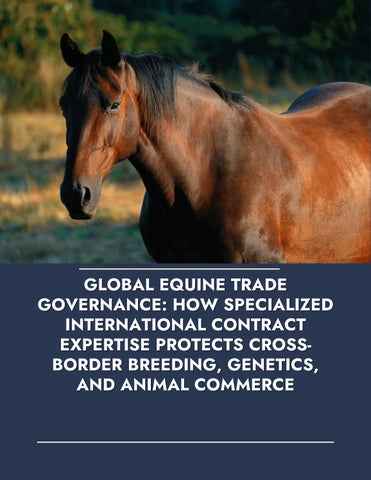
GLOBAL EQUINE TRADE GOVERNANCE: HOW SPECIALIZED INTERNATIONAL CONTRACT EXPERTISE PROTECTS CROSSBORDER BREEDING, GENETICS, AND ANIMAL COMMERCE
Issue No. October 2025 | Volume No. 0313
Expert Interview
GLOBAL EQUINE TRADE GOVERNANCE: HOW SPECIALIZED INTERNATIONAL CONTRACT EXPERTISE PROTECTS CROSS-BORDER BREEDING, GENETICS, AND ANIMAL COMMERCE Multilingual legal leadership, sanitary compliance knowledge, and cross-jurisdiction contract precision are indispensable to safeguard international horse breeding, sales, and exportation. As part of Human Capital’s ongoing series on executive leadership and industry transformation, Ana Paula Montanha, Editor-in-Chief of Human Capital Career Trends Magazine, interviewed the Expert, Natan Álvares Campos, a Brazilian Lawyer and International Agreements Specialist whose specialized work spans the entire global equine contract lifecycle. From drafting and negotiating breeding, boarding, training, sales, and exportation agreements to ensuring full sanitary compliance with MAPA, USDA/APHIS, and WOAH standards, Mr. Campos operates at the intersection of international law, animal health regulation, and cross-cultural negotiation. He manages complex documentation for ownership, reproductive status, and genetic-material export, while providing multilingual support to clients across Portuguese, Spanish, and English-speaking markets. In this conversation, Mr. Campos shares his insights on how precise legal governance, regulatory alignment, and culturally informed negotiation practices safeguard equine genetic value and advance the integrity of global animal commerce in an increasingly interconnected marketplace. INTRODUCTION — GROWING REGULATORY DEMANDS IN A GLOBALIZED EQUINE MARKET The equine industry is undergoing rapid globalization, with the international movement of horses, semen, and embryos increasing significantly across major markets. This expansion is tightly regulated by the World Organization for Animal Health (WOAH), which establishes global sanitary standards to mitigate disease risk during international animal movement (WOAH, 2024). In the United States, the U.S. Department of Agriculture’s Animal and Plant Health Inspection Service (USDA/APHIS) governs the import and export of horses, establishing requirements for quarantine, CEM testing, and veterinary health certification (USDA APHIS, 2024). Brazil has become a relevant player in exporting highvalue equine genetics, regulated by the Ministério da Agricultura e Pecuária (MAPA) under rules such as Instrução Normativa Nº 47/2018, which governs reproductive material quality, veterinary certification, and export compliance (MAPA, 2018).
By Ana Paula Montanha – Editor-in-Chief, Human Capital Career Trends Magazine
HUMAN CAPITAL CAREER TRENDS MAGAZINE
INTERNATIONAL CONTRACT EXPERTISE
Economic data reinforces this rise in international equine commerce. The U.S. Census Bureau reports continued growth in animal-related exports (U.S. Census Bureau, 2024), and the U.S. Department of Commerce identifies agricultural and genetic-material exports as significant contributors to bilateral trade (U.S. Department of Commerce, 2024). This complex environment requires legal professionals who can integrate international contract drafting, sanitary and regulatory compliance, multilingual negotiation, cultural intelligence, and 2 operational understanding of breeding, boarding, training, transport, and reproductive programs. Natan Álvares Campos has built a specialized career at this intersection. As a Brazilian lawyer and international agreements specialist, he manages the entire contract lifecycle for equine breeding, boarding, training, sales, and exportation, while ensuring compliance with MAPA, USDA/APHIS, and WOAH standards. His multilingual fluency in Portuguese, Spanish, and English positions him as a strategic resource for minimizing disputes, optimizing cross-border operations, and protecting equine genetic value. INDUSTRY TRENDS & MARKET ANALYSIS Growth in Global Equine Genetics and Live-Horse Commerce Elite breeding programs increasingly depend on international movement of genetic material, especially semen and embryos, to diversify bloodlines and strengthen competitive performance. WOAH underscores the importance of rigorous veterinary procedures and disease-control protocols governing such exchanges (WOAH, 2024). Regulatory Fragmentation Across Borders Despite WOAH efforts toward standardization, regulatory systems remain fragmented: Brazil’s MAPA requires specific veterinary examinations and reproductive-material controls under IN 47/2018 (MAPA, 2018). The U.S. USDA/APHIS mandates different timelines, veterinary tests, and documentation forms (VS 17-140, 17145) for importation into the United States (USDA APHIS, 2024).
Issue No. October 2025 | Volume No. 0313
Cultural and Legal-System Differences Equine transactions frequently involve parties from civil law systems (e.g., Brazil), where codified statutes dominate contractual interpretation, and common law systems (e.g., the U.S.), where precedent and detailed writing govern obligations. Misalignment between these systems can lead to misunderstandings in payment terms, training service expectations, liability allocation and oral vs. written commitments. This complexity reinforces the need for multilingual, culturally aware legal professionals capable of bridging normative gaps.
EXPERT Q&A SECTION — NATAN ÁLVARES CAMPOS ON INTERNATIONAL EQUINE CONTRACT GOVERNANCE 1. What makes the equine industry uniquely dependent on meticulous international contracts? Equine transactions involve high-value living assets and biosecurity-sensitive logistics. Every stage, breeding, boarding, training, transport, and genetic exchange, contains biological, financial, and legal risks. Contracts must therefore explicitly define obligations to prevent disputes and safeguard animal welfare. 2. How do sanitary regulations between Brazil and the U.S. shape export agreements? MAPA and USDA/APHIS apply different veterinary requirements, testing windows, and document formats. Contracts must clarify who pays for examinations, who handles re-tests, and who assumes responsibility for delays caused by regulatory misalignment. 3. What are the most critical risk points in equinerelated contracts? The most sensitive areas include late payments, transport liability, chain-of-custody for genetic material, reproductive guarantees, veterinary responsibilities, and boarding/training obligations. 4. How can breeders protect themselves from international payment challenges? The best protections include letters of credit, escrow accounts, phased payment schedules, late-fee penalties, and contractual rights to retain embryos or horses until payment is completed. 5. How do cultural and legal system differences create negotiation challenges? Civil-law expectations differ significantly from commonlaw frameworks. Misunderstandings occur when one party assumes that certain obligations are “implied” in the
agreement, when the other expects detailed written terms. Multilingual contract drafting reduces this gap. 6. Why is multilingual communication essential in crossborder equine transactions? Technical terms related to veterinary procedures, insurance, and transport can easily be misunderstood. Clear multilingual communication avoids disputes, improves accuracy, and protects both parties, and the animal. 7. How do you ensure accuracy in documentation of ownership, reproductive status, and genetic material? I rely on strict documentation schedules, requiring registration certificates, microchip and identification records, embryo-transfer and semen-collection reports, reproductive examinations, veterinary health certificates. This also includes pre-export confirmation that MAPA and APHIS documentation aligns with WOAH recommendations. 8. What contractual mechanisms best protect horses during international transport? Transport insurance, mortality clauses, chain-of-custody documentation, veterinary oversight requirements, and clear liability allocation help protect the animal and the owners throughout the journey. 9. How do arbitration clauses and jurisdiction definitions reduce cross-border disputes? Specifying jurisdiction and arbitration forums prevents procedural conflicts, reduces legal costs, and ensures faster resolution, an important consideration when dealing with international parties and animal-related time sensitivity. 10. What compliance challenges arise during export logistics? The biggest challenges include scheduling veterinary tests within regulatory windows, ensuring proper quarantines, coordinating transport companies, and verifying APHIS and MAPA documentation accuracy. 11. How can the U.S. equine market benefit from Brazilian expertise? Brazil has strong programs in embryo transfer, equine genetics, and reproductive technology. U.S. breeders gain access to diverse bloodlines and proven reproductive techniques through well-regulated partnerships. 12. What long-term trends will most influence global equine trade? Digitized documentation, AI-driven compliance auditing, stricter biosecurity measures, and greater international harmonization of veterinary protocols will define the next decade. Interview by Ana Paula Montanha, Editor-in-Chief
HUMAN CAPITAL CAREER TRENDS MAGAZINE
This fragmentation results in delays caused by misaligned testing windows, increased export costs, inconsistent genetic-material handling procedures, and legal disputes when responsibilities are unclear.
3
Issue No. October 2025 | Volume No. 0313
FUTURE OUTLOOK & RECOMMENDATIONS The global equine industry is poised for continued expansion in the exchange of genetic material, including semen, embryos, and high-value breeding animals. Projections from both WOAH and USDA indicate that international demand for elite bloodlines will intensify as breeding programs become increasingly globalized and dependent on advanced reproductive technologies (WOAH, 2024; USDA APHIS, 2024). This trend reinforces the need for greater regulatory coordination and heightened attention to biosecurity protocols throughout the export process.
4
Natan Álvares Campos exemplifies this emerging global specialization, uniting contract precision, sanitary compliance knowledge, multilingual negotiation, and operational experience. His work strengthens equine trade governance, safeguards genetic assets, and supports the sustainable expansion of global equine commerce.
Alongside this growth, the demand for specialized legal expertise is expected to rise. According to the Bureau of Labor Statistics, legal and compliance professionals will continue to be in steady demand, particularly in industries where global operations require precise navigation of complex regulatory landscapes (BLS, 2024). The equine sector—characterized by its combination of high financial stakes, multiple jurisdictions, and biosecurity-sensitive logistics—clearly fits within this category. As a result, legal professionals who understand international contract governance, sanitary requirements, and cross-border negotiation will become increasingly essential. Looking ahead, several policy actions could strengthen the global equine trade network. Greater harmonization between MAPA and USDA would reduce friction in the export process and help standardize veterinary and documentation requirements. Digital registries for ownership, health records, and reproductive documentation would improve traceability, transparency, and compliance reliability. Expanding training initiatives to prepare multilingual legal professionals specializing in agricultural and genetic commerce would close existing workforce gaps. Likewise, developing international arbitration frameworks specifically tailored to equine disputes would streamline conflict resolution and reduce litigation burdens. Finally, fostering knowledgeexchange programs focused on equine law, sanitary compliance, and export governance would enhance cross-border collaboration and elevate industry standards worldwide.
CONCLUSION The global equine industry operates at the nexus of biology, logistics, international law, and economic strategy. High-value horses and genetic materials require legal professionals who can navigate regulatory complexity, negotiate across cultures and languages, and implement risk-mitigation mechanisms that protect all parties.
REFERENCES Bureau of Labor Statistics. (2024). Occupational Outlook Handbook: Lawyers. U.S. Department of Labor. https://www.bls.gov/ooh/legal/lawyers.htm MAPA. (2018). Instrução Normativa Nº 47, de 28 de novembro de 2018. Ministério da Agricultura, Pecuária e Abastecimento. https://www.gov.br/agricultura/pt-br U.S. Census Bureau. (2024). U.S. International Trade Data. https://www.census.gov/foreign-trade/statistics/ U.S. Department of Commerce. (2024). International Trade Administration – Industry & Analysis Reports. https://www.trade.gov USDA APHIS. (2024). Import/Export: Horses. United States Department of Agriculture. https://www.aphis.usda.gov WOAH – World Organisation for Animal Health. (2024). Terrestrial Animal Health Code: Equine Health and Trade Standards. https://www.woah.org