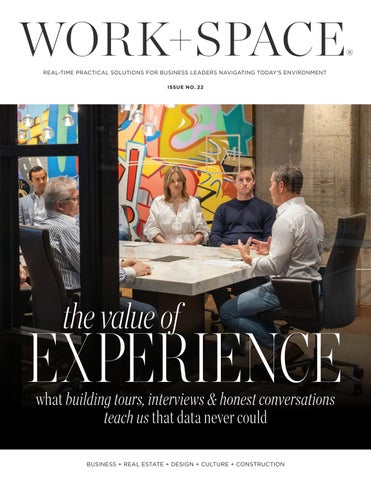
WORK+SPACE REAL-TIME PRACTICAL SOLUTIONS FOR BUSINESS LEADERS NAVIGATING TODAY’S ENVIRONMENT ISSUE NO. 22
the value of
EXPERIENCE what building tours, interviews & honest conversations teach us that data never could BUSINESS + REAL ESTATE + DESIGN + CULTURE + CONSTRUCTION
WOR K+SPACE
PUBLISHER’S NOTE
A publication of Hughes Marino
Going Beyond the Data
S
ome of the most valuable insights in business can't be found in a spreadsheet. They come from experience: from digging deeper, asking better questions, building real relationships with clients and noticing the details that matter. After more than 30 years of advising companies on their real estate decisions, we've learned that the difference between a good decision and a great one often comes down to what you notice and take the time to understand. Throughout this issue of Work+Space®, we return to a simple idea: the best thinking comes from being present, curious and fully engaged. We open with the advice we find ourselves sharing with tenants again and again, counsel that holds up in any market condition. We take you behind the scenes on what we spot in the first five minutes of a building tour, and explore what a needs assessment actually reveals about how a company works and what it genuinely needs. On page 16, you’ll read how intentional, thoughtfully designed spaces can spark connection, energy and inspiration across a team. None of this experience would matter, though, without a team of dedicated people behind it. Building a world-class company starts with hiring great talent, so we examine what interviews reveal that resumes never will, and include a candid Q&A on the lasting value of people and culture. Our goal has always been to equip business leaders with the perspective and clarity they need to make confident decisions. We hope this issue reminds you of the value of being intentional, paying attention to the people around you and trusting what experience reveals. Onward! Jason Hughes
Shay Hughes
Chairman & CEO Hughes Marino
President & COO Hughes Marino
BUSINESS + REAL ESTATE + DESIGN + CULTURE + CONSTRUCTION
About Hughes Marino Hughes Marino is a global corporate real estate firm that specializes in representing tenants and buyers—not landlords. We provide a full suite of services for occupiers of commercial real estate on an integrated and turnkey basis. Whether you need help with real estate strategy, site selection, and negotiations around renewal, expansion, relocation or subleasing, construction project management, planning and design, corporate culture, and operating expense review or lease administration, our team has the expertise. Hughes Marino can address any problem or opportunity for companies of any size, any industry and at any stage of their real estate life cycle— anywhere on the planet.
Our Locations Bellevue 425.641.3111
New York 212.864.2211
Boston 617.356.0111
Oakland/East Bay 510.930.3111
Boulder 303.914.4111
Orange County 949.333.3111
Charlotte 704.899.2111
Palo Alto 408.292.3211
Dallas 214.272.2111
Raleigh-Durham 984.204.1111
Denver 303.529.2111
Sacramento 916.562.2111
Houston 713.565.2111
Salt Lake City 801.981.2111
Inland Empire 909.988.2111
San Diego 619.238.2111
Long Beach 562.436.3211
San Francisco 415.431.3211
Los Angeles 310.277.3211
Seattle 206.624.3111
Corporate Headquarters 1450 Front Street San Diego, CA 92101 1.844.662.6635 hughesmarino.com
1 | WORK+SPACE
Vibrant blooms on the kitchen farm table bring a warm, welcoming feel to our San Diego office.
In this Issue INSIDER PERSPECTIVE: ADVICE WE FIND OURSELVES GIVING AGAIN & AGAIN................................................................. 3 INSIGHTS WITH JASON & SHAY: A CANDID Q&A ON GROWTH, CULTURE & THE COST OF BUILDING SOMETHING REAL . . .............................................................................................................................................. 7 BEHIND THE SCENES: WHAT WE NOTICE IN THE FIRST FIVE MINUTES OF A BUILDING TOUR. . ....................................... 11 WHAT A NEEDS ASSESSMENT ACTUALLY REVEALS............................................................................................................... 13 INJECTING CREATIVITY INTO THE OFFICE: THE ART OF DESIGNING SPACES THAT INSPIRE...........................................16 WHAT INTERVIEWS REVEAL THAT RESUMES NEVER WILL................................................................................................... 21
THE VA LU E O F E X P E RIE NC E
hughesmarino.com | 2
3 | WORK+SPACE
Insider Perspective:
ADVICE WE FIND OURSELVES GIVING AGAIN & AGAIN O
ur advisors have sat alongside thousands of leadership teams working through a commitment most companies face only once every five or 10 years, and one of the largest they will ever sign. After enough of those negotiations, patterns emerge. The industries may change, the buildings certainly change and the market cycles turn, but the counsel we give tends to circle back to the same handful of key truths. We sent the same set of questions to our advisors across the country, expecting the answers to split by geography and by the kind of space involved. But they barely split at all. The same lessons came back phrased a dozen different ways. These are the ones we find ourselves repeating, and the ones we wish every leadership team understood before stepping into the market.
THE VA LU E O F E X P E RIE NC E
hughesmarino.com | 4
The counsel we give tends to circle back to the same handful of key truths.
Start Earlier Than You Think If our advisors could offer a company only one piece of advice, most of them would spend it here: start earlier than you think. Companies routinely begin their real estate process four to six months before a lease expires, which is precisely when they have the least room to maneuver. Starting 12 to 18 months out changes everything. That runway is what gives a company time to tour real alternatives, gather competing proposals and let the facts, rather than the calendar, drive the decision. Time is leverage. The most common misconception we encounter is the belief that there is plenty of time to figure it out. Most companies have less than they think, because the useful part of the process happens long before anyone tours a building: defining what success actually looks like, pulling comparable transaction data and deciding what the company is willing to trade for what. Skipping that groundwork is what leaves a company negotiating on the landlord's terms.
You Have More Leverage Than You Realize Companies also routinely underestimate how much pull they have. Landlords need occupancy and net operating income, and a well-informed tenant with genuine alternatives carries real weight, particularly in a market with elevated vacancy across nearly every major office submarket. Many companies also assume their lease is static, that nothing can be done until it expires. In reality, there are often opportunities to restructure early, reduce occupancy costs, expand, contract or sublease well before the expiration date. They also tend to underestimate the value they create for their landlords, and therefore how much of that value they are entitled to share in.
5 | WORK+SPACE
Rent Is Rarely the Whole Story Ask a company what matters most in a lease and the answer is almost always the rent. Understandable, though it usually means the rest of the economics get far less scrutiny than they deserve. There’s an old notion that real estate is a company’s second-largest expense after payroll. In practice, that is rarely true. For a distribution or manufacturing company, rent can fall into the low single digits as a share of total costs. For an office tenant, it often lands somewhere between four and six percent. We’ve seen office clients whose executive travel and hotel costs for the year outran their rent. The transaction feels enormous because it arrives all at once, but as a share of annual cost it is seldom the giant it appears to be. Chasing the lowest rate can quietly cost a company far more than it saves. A poorly located building, one in weak condition or under indifferent management, or one that does nothing for recruiting or the brand, can undermine everything the savings were meant to protect. “The goal isn’t to get the lowest price,” says Senior Executive Managing Director David Marino. “The goal is to get what you want at the lowest price.” Concessions, operating expenses, taxes, parking, tenant improvements, moving costs and downtime all belong in the math.
Be Careful What You Commit To Some of the most expensive mistakes we see are made by the most sophisticated companies, and they tend to cluster around the length of the commitment. Signing a longer lease to capture a few extra months of free rent can feel like a win, but doubling a five-year commitment to 10 years for marginal gains is rarely worth it. When a space requires significant tenant improvements or capital, a longer term can make sense. Absent that, every year beyond five deserves hard scrutiny. The life science sector today is full of companies still paying for 10-year leases signed against growth plans that never materialized. Senior Managing Director Will Tober frames it as a question worth asking up front: “How long will this space meet my needs?” The answer, he notes, comes down to planning ahead. “If you’re thinking about expansion and contraction scenarios up front, you can build the appropriate flexibility and optionality into your lease.” A related habit is the reflexive exercise of renewal options. These options are defensive by nature, and negotiating as a free agent, outside their parameters, almost always produces a better outcome. A renewal option is worth exercising only when the option terms beat what you could negotiate on the open market, or if the landlord wants your space for another tenant or use.
Create Competition, Even When You Plan to Stay Companies often negotiate solely with their current landlord, even when renewing is the likely path. “Evaluating credible alternatives gives tenants leverage and almost always results in a better renewal deal,” Managing Director Austin Lashley points out. Credible means a real proposal from a competing building, priced and dated. It never has to be the space you choose, but it does have to be one you would actually sign.
These lessons are what that focus produces across three decades of negotiations. For any leadership team about to enter the market, the advantage is not any single tactic on this list. It is having an advocate in your corner whose only job is to work for you. ☐
The Advice Nobody Wants to Hear in the Moment Some of our most valued counsel is the counsel clients least want at the time. Now and then, that means telling a company we don’t think a transaction is right for them, even one they have fallen for. A beautiful, extensively built-out space might call for a seven- to 10-year commitment when the stability of the business warrants something shorter. Executive Managing Director Owen Rice has had that conversation more times than he can count. Clients who walk away and land somewhere better tend to offer some version of, “I’m glad you didn’t let me force that one.” There is one more piece almost no one wants to hear: signing the lease doesn’t mean the work is done. Someone has to track critical dates, confirm the tenant improvements are delivered on time and on budget, make sure free rent is honored and hold operating expense caps to what was negotiated. The language around operating and capital expenses, easy to gloss over during negotiations, can carry major financial consequences across the full term.
Treat Your Advisor as a Partner If there is a thread running through all of it, it’s this: the companies that get the most from the process are the ones that treat their advisor as a true partner. For Executive Managing Director Alex Musetti, it comes down to candor. “The clients who explain their thinking out loud often see the best results.” The more we understand about where a company is trying to go, the better we can advise on how to get there. What ties these lessons together is a single conviction: that a company is best served by an experienced advisor who sits on its side of the table. Hughes Marino only represents users of commercial real estate, so our advice answers to one interest alone: the company signing the lease.
THE VA LU E O F E X P E RIE NC E
hughesmarino.com | 6
INSIGHTS WITH JASON & SHAY:
A Candid Q&A on
Growth, Culture & the Cost of Building Something Real At Hughes Marino, the answer has always been simpler, yet much harder to replicate: people & culture.
A
sk most business leaders what drives growth and you’ll hear about market timing, strategy and execution. At Hughes Marino, the answer has always been simpler, yet much harder to replicate: people and culture. From day one with our first office to 15 years later and the expansion across 15+ cities nationwide, that belief has never wavered. Build the right team, protect the right culture and never compromise on your values, and everything else will follow. In part two of our Q&A series, we sat down with Chairman & CEO Jason Hughes and President & COO Shay Hughes for another candid conversation about what growth actually looks like from the inside: the decisions that looked wrong before they proved right, the costs nobody talks about and the things they’d never trade away no matter how big the company gets. 7 | WORK+SPACE
Q: What’s something that fueled your growth that most people would never see from the outside? Jason: People assume growth comes from strategy decks and market timing. The truth is quieter than that. What fueled us was a decision we made early and never walked back—that we would sit on one side of the table. We represent tenants, not landlords, and we turned down a lot of revenue over the years to protect that. From the outside, it looks like a positioning choice. From the inside, it was a values choice that compounded. Clients could feel that there was no second agenda in the room, and that feeling, more than any pitch, is what built this company. Shay: For me, it’s the unglamorous part that no one sees. We knew when we started the company that one thing would be true no matter what happens—that no one would outwork us. We also were relentless in investing in great people long before there was any proof it would pay off. We believed in people before they believed in themselves, and we kept pouring into them long before they had any success. From the outside, it can look like we simply got lucky with talent. The truth is we made a choice to invest in our team, to develop them, to champion them and to refuse to give up on anyone who shared our commitment and our values. That kind of belief compounds quietly and one day you look up and realize it built the entire company.
Q: What’s one decision that looked wrong in the moment but proved to be exactly right? Jason: When we decided to open our first expansion office in Orange County, the timing looked indefensible— the economy, the expense, the competition. Everyone who looked at us from the outside thought we were nuts. But we’ve learned that the right people and the right culture don’t wait for the perfect quarter. We went in, and for the first stretch it was hard and it was lonely and we questioned it. What we couldn’t see yet was that the people we planted there would become some of the best of the entire company. The lesson stayed with us: you don’t bet on the market, you bet on the people, and people are almost never a mistake. THE VA LU E O F E X P E RIE NC E
Shay: Saying no to revenue, and saying yes to the right people, when the spreadsheet would have told us to do the exact opposite. There were times we walked away from business that didn’t fit our values, and times we took a chance on someone who didn’t have the resume but had the talent, the hunger and the character we knew we could build around. In the moment, those choices felt unconventional—we were choosing our gut over the safe path, but we have always made decisions based on our instinct and it has served us well. Some of the most extraordinary members of our team are people we believed in before anyone else did, and I wouldn’t trade a single one of those “risky” bets we made. hughesmarino.com | 8
Q: Running a company together as a family—what does that actually look like, and is there a cost you didn’t expect? Jason: The romantic version is that we finish each other’s sentences in board meetings. The real version is that the company doesn’t stay at the office—it comes home, it sits at the dinner table, it’s there on the drive and on the vacation that was supposed to be a vacation. The cost we didn’t expect wasn’t time; we knew we’d all work extremely hard. It was learning to be partners in two different ways at once and not let the harder conversations of one bleed into the other. We’re still learning it. What we’d tell anyone doing this is that the business will always ask for more than you have—the discipline is deciding, together, what you protect. Shay: Jason is right that the company follows us home and wherever we go, but it is challenging, rewarding and fun at the same time. While there are tradeoffs, and it’s certainly not for everyone, I wouldn’t trade it for anything. It has been incredible to build a thriving company with our family, using all of our different but complementary strengths to make the company better in all aspects. And it is a huge asset that we have each other’s backs unconditionally, we value and respect each other’s opinions immensely, and we get to do something incredibly meaningful together that we are all very proud of. That is a gift I am beyond grateful for as a founder, a business leader, a wife and a mom.
Q: What’s the most common reason talented people fail to reach their potential? Jason: It’s almost never ability. The most talented people who stall do it because they’re protecting something— a perceived reputation, a comfort, an old version of themselves that was rewarded for being the smartest one in the room. Growth requires you to be a beginner again, repeatedly, and a lot of gifted people can’t tolerate that feeling. The ones who become exceptional are the ones who stay coachable long after they’ve earned the right not to be. We’ve watched people with half the raw talent pass others simply because they never stopped asking what they were missing. Shay: So often, it comes down to fear—especially the fear of failing in front of other people. I’ve watched incredibly talented people hold themselves back simply because they weren’t willing to potentially look foolish trying something new or really stepping up their game. The people I’ve 9 | WORK+SPACE
watched soar here are the ones who give themselves permission to stumble and to keep going anyway. Talent will only take you as far as your willingness to take risks and keep going if you don’t get what you want the first time. The magic is never in avoiding the fall. It’s in how quickly you choose to get back up and try again.
Q: If Hughes Marino doubled in size over the next five years, what would you be most determined not to lose? Jason: The feeling that this is still a family company and that culture is extremely important, no matter how many families are in it. Scale has a way of quietly trading warmth for efficiency, and you don’t notice the trade until the culture you spent 15 years building has thinned out into a logo. We’d be most determined to protect the thing that doesn’t show up on any growth chart—that someone’s first day here still feels like being let in on something, not processed into something. If we double and lose that, we didn’t grow. We just got bigger. Shay: That every single person feels appreciated and that no one here ever becomes a number. The thing I would protect with everything I have is our culture of championing the underdog and noticing the person who has gone quiet in the room. As you scale, it is so easy to let warmth quietly slip away without even realizing it’s happening. I never want us to grow so big that we stop celebrating each other’s wins, showing up for each other’s hard days or believing in someone’s potential before they can see it in themselves. If we double in size and every person still feels like they belong to a team that cares about them, supports them and has their back, then we will have stayed true to our roots from the beginning.
Q: What’s something the other person does exceptionally well that doesn’t get enough credit? Jason: Shay reads people in a way that can’t be taught. In a room full of numbers, she’s the one paying attention to the person who’s gone quiet, and she’s almost always right about why. People credit the company’s culture to programs and awards, but a lot of it traces back to her noticing things the rest of us miss and refusing to let them slide. It’s the least visible kind of leadership and, I’d argue, the most important. Shay: Jason’s generous spirit. Everyone sees the dealmaker and the visionary, but what doesn’t get nearly enough credit is how genuinely he supports and celebrates other people. Behind the scenes I get to see how he takes calls from anyone on our team within seconds of them calling him no matter how busy he is, how he lights up when someone on our team wins and how quick he is to give credit to everyone else long before he would ever take any for himself. I often think he wants success for others more than they want it for themselves, mostly because he knows what is possible and believes in them long before they do. Despite his immense success, he is incredibly humble and always deflects credit for the amazing team he has coached to success. ☐ Stay tuned for our next Q&A with more insightful (and fun) questions!
Shay Hughes
Shay Hughes is president and COO of Hughes Marino, a global real estate advisory firm that specializes in representing tenants and buyers. Shay writes about business leadership and company culture on her blog, Lead from Within. Contact Shay at shay.hughes@hughesmarino.com or 1-844-662-6635 to learn more.
President & COO Hughes Marino
Jason Hughes Chairman & CEO Hughes Marino
Jason Hughes founded Hughes Marino in 2011, an award-winning global real estate advisory firm that specializes in representing tenants and buyers. A pioneer in the field of tenant representation, Jason has specialized in representing tenants and buyers for more than 30 years. Contact Jason at jason@hughesmarino.com or 1-844-662-6635 to learn more.
THE VA LU E O F E X P E RIE NC E
lightning round
Behind the Scenes:
WHAT WE NOTICE...
in the First Five Minutes of a Building Tour By David Marino
A
fter touring thousands of office buildings over the course of our careers, paying attention to details becomes second nature. Long before we discuss square footage, lease terms or build-outs, we’re reading the small signs. Those details are clues to bigger things: how ownership actually operates and what you can expect over the life of the lease.
It Starts Before We Walk Through the Front Door The tour begins in the parking lot, not the lobby. Does the building project the image our client wants? Is parking convenient or congested? Is it easy for employees, clients and visitors to find their way into the building? From there, we’re paying attention to the condition of everything around us. I often compare it to the curb appeal of a home. The landscaping, exterior finishes and arrival experience all give you a sense of how much pride ownership takes in the property. We’re also looking at things that can’t easily be changed, like overgrown landscaping that blocks views or a neighboring building that permanently limits natural light. If maintenance has been deferred outside, there’s a good chance we’ll see similar patterns once we walk inside. For industrial properties, we’re looking at many of the same things, just through a different lens. Some wear and tear from truck traffic is expected, but we’re paying close attention to the condition of the yard area, asphalt and concrete. We’re also looking at whether neighboring businesses are using their parking and truck storage areas appropriately. 11 | WORK+SPACE
Who Else Occupies the Building? One thing many tenants don’t think about is who they’ll be sharing the building with. We’re always analyzing whether the other tenants are compatible with our client. Medical offices, government agencies, call centers and other hightraffic users may be perfectly appropriate in one building, but they aren’t always the right fit for a financial services firm, law office or corporate headquarters. The tenant mix affects everything from traffic patterns, both on the road and in hallways, to the overall experience employees and visitors have each day.
Some Things Can’t Be Negotiated
The Common Areas Tell the Story Before we ever enter the available space, we’re evaluating the building itself. We’re looking at the lobby, hallways, elevators, lighting, carpeting and restrooms. Are the elevators operating properly? Are the walls and common areas in good condition? Are the restrooms clean and well maintained? None of those things alone determines whether a building is the right fit. Together, though, they tell us a lot. Within the first few minutes, you start to get a sense of how the property is managed and what you can expect over the course of a long-term lease. Your visitors read the same signals, forming an impression of your company before they reach your door. Stained carpet, cracked tile, broken fixtures or deferred maintenance aren’t necessarily deal breakers, but they do tell us something. If visible maintenance has been deferred in the common areas, it’s reasonable to ask what the building will look like five or 10 years from now.
Clients sometimes ask whether issues we notice in the common areas can simply be negotiated with the landlord. Sometimes they can. More often, those spaces serve the entire building and aren’t easily changed for a single tenant. More importantly, we’re not just evaluating whether a cracked tile or worn carpet can be replaced. We’re looking at what those details tell us about how the property has been managed over time. Individually, these observations may seem minor. Together, they paint a much clearer picture of the building than the available space alone ever could. That’s why those first five minutes matter so much. A lease is one of the largest commitments a company will make, often lasting 10 years or more. Our job is to help clients understand not just the space they’re considering, but the building they’ll be occupying for years to come. At Hughes Marino, we represent occupiers of space, not landlords. When we tour a property, our only interest is what that building will mean for our client’s business over the life of the lease. That’s the benefit of decades of experience and thousands of property tours: helping clients make one of the largest commitments their company will ever make with confidence. ☐
Look Past the Cosmetics Once we step into the available space, we’re looking beyond the cosmetic finishes. Fresh paint and new carpet are relatively easy to replace. Are the ceilings and lighting current and code compliant? What condition are the plumbing fixtures, sinks and appliances in? That’s important because once you get beyond paint and carpet and start replacing lighting, ceilings, moving walls and plumbing, a build-out can easily cost three or four times more than a cosmetic update. We’re also paying close attention to the orientation of the space, which deserves more consideration than it usually gets. In warmer climates, south- and west-facing windows can generate a tremendous amount of heat throughout the day, often forcing occupants to keep the blinds closed. North- and east-facing spaces typically provide more comfortable natural light, allowing employees to enjoy the daylight without the same heat and glare. THE VA LU E O F E X P E RIE NC E
David Marino is senior executive managing director at Hughes Marino, a global corporate real estate advisory firm that specializes in representing tenants and buyers. Contact David at david@hughesmarino.com or 1-844-662-6635 to learn more.
David Marino Senior Executive Managing Director Hughes Marino
hughesmarino.com | 12
What a Needs Assessment Actually Reveals The questions you ask up front shape every decision that follows.
By Owen Rice & Gavin Curtis
O
ne of our clients in the professional services industry had spent nearly 30 years in the same building. When their lease came up, the obvious move seemed simple: renew or find another office of comparable size. Instead, we took the company through a comprehensive needs assessment, and the conversations that followed changed the entire trajectory of the project. The company ultimately relocated from 60,000 SF to 40,000 SF, yet its headcount grew. A smarter, more efficient workplace transformed roughly 20,000 SF of savings into a far better building that better supported its employees and long-term goals. In rent alone, rightsizing by 20,000 SF saved the company roughly 13 | WORK+SPACE
$13 million over the term of the lease. On paper, it looked like a downsize. In reality, it was an upgrade. We’ve seen this story countless times. Companies often begin a real estate project convinced they know exactly what they need. More often than not, they discover something they didn’t expect. A workplace needs assessment is one of the first steps in any successful commercial real estate project. It combines a structured questionnaire with thoughtful conversations designed to understand how a company works today, where it’s headed tomorrow and what its workplace needs to support along the way. Done well, it shapes every decision that follows. Done as an afterthought, it’s often where expensive mistakes begin.
The Wrong Question One of the first questions executives ask is, “How much space do we need?” Ironically, that’s an answer we don’t get fixated on. The square footage number in your head is probably wrong. It’s usually based on today’s office, yesterday’s assumptions or simply the amount of space you’ve always occupied. Our job isn’t to validate that number. Our job is to understand your business well enough to determine whether it’s actually the right one. Instead, we ask questions that lead us to the answer. How does your team actually work? What’s helping you attract and retain talent? What operational requirements could influence your real estate options? Where do you realistically expect to be in five years? Where are you investing in space that no longer delivers value? Answer those questions well, and the square footage solves itself.
The Best Discoveries Are Often Internal You know your business better than anyone. What you may not know is how that business translates into real estate. That’s where experience matters. One of the most valuable parts of a needs assessment is uncovering blind spots before they become expensive decisions. We’ve worked with companies that were convinced everyone loved the office, only to learn that commuting challenges, a lack of privacy or outdated workspace design had quietly become frustrations for much of the team. That doesn’t mean every employee makes the final decision; too many voices make consensus hard THE VA LU E O F E X P E RIE NC E
to reach. Instead, gather input from a core group that spans the business, not only executives, but the people across departments who see what leadership doesn’t. Anonymous feedback in particular can surface opportunities leadership didn’t know existed. Every company assumes a needs assessment will confirm what it already knows. The best ones don’t. They reveal something unexpected.
The Cost of Waiting The biggest mistake we see isn’t choosing the wrong building. It’s starting the process too late. When time is short, companies naturally focus on finding space instead of understanding what they actually need. The needs assessment becomes another task to complete instead of the strategic exercise it was meant to be. The cost of changing direction early is minimal. The cost of changing direction after you’ve negotiated a letter of intent, signed a lease or begun construction can be substantial. Every decision made after that point has the potential to increase project costs, delay occupancy and reduce your negotiating leverage. That’s why the planning stage matters so much. It gives you the freedom to ask difficult questions, challenge assumptions and make adjustments while they’re still easy to make.
Where a Needs Assessment Pays Off A thoughtful needs assessment doesn’t just help you find the right space. It helps you negotiate from a position of strength. Understanding your requirements before negotiating a letter of intent allows your team to identify building hughesmarino.com | 14
Because when you ask the right questions at the beginning, every decision that follows becomes smarter.
improvements, operational requirements and future flexibility up front. Knowing your requirements is leverage. Rightsizing cuts your total cost of occupancy, not just base rent: less tenant improvement to fund, less furniture and IT to buy, lower operating expenses year after year. It also helps you plan for growth realistically. Most companies have a good sense of where they’ll be in a year or two. Beyond that, nobody has a crystal ball. Rather than planning for year 10 of a lease, we encourage clients to plan around realistic growth over the next five years while building flexibility into the lease for whatever comes next. Perhaps most importantly, it saves executives both time and money. Real estate is rarely a CEO’s, CFO’s or HR leader’s primary responsibility. A thorough needs assessment filters out buildings that were never going to work, avoids unnecessary tours and minimizes costly course corrections, allowing leadership to stay focused on running the business. Sometimes the process confirms exactly what you believed from the beginning. Great. Now it’s no longer an assumption. It’s a decision backed by thoughtful analysis and made with confidence. The best needs assessments don’t simply confirm what a company already believes. They challenge assumptions before they become expensive decisions. Because when you ask the right questions at the beginning, every decision that follows becomes smarter. ☐
Owen Rice is an executive managing director at Hughes Marino, a global corporate real estate advisory firm that specializes in representing tenants and buyers. Contact Owen at owen@hughesmarino.com or 1-844-662-6635 to learn more.
Owen Rice Executive Managing Director Hughes Marino
Gavin Curtis is a senior managing director at Hughes Marino, a global corporate real estate advisory firm that specializes in representing tenants and buyers. Contact Gavin at gavin@hughesmarino.com or 1-844-662-6635 to learn more.
Gavin Curtis Senior Managing Director Hughes Marino
15 | WORK+SPACE
Creativity Office: INJECTING
into the
THE ART OF DESIGNING S P A C E S T H AT I N S P I R E By Shay Hughes
THE VA LU E O F E X P E RIE NC E
hughesmarino.com | 16
O
ver the past few years I’ve written a lot about the ways we bring color and joy into our offices, from playful artwork and polka dot murals to comfy couches in emerald green, royal blue and vibrant red. It all comes back to one simple belief: the spaces we ask our teams to spend their days in really do shape how they feel, how they connect and how they do their best work. I want to keep that conversation going with something that’s been on my mind lately, which is the wonderful link between creativity and how good we feel. When was the last time you made something simply for the joy of making it? Not because it was part of your job or because someone asked you to, but simply because it brought you joy? This year, The New York Times ran a piece in its Well section about how art and crafting are good for both our bodies and our minds. It highlighted the work of researcher Dr. Daisy Fancourt, who describes engaging in the arts as “the forgotten fifth pillar of health,” alongside diet, sleep, exercise and nature. That really resonated with me, because it put some real science behind something we’ve felt in our bones at Hughes Marino for years: being around creativity is good for us, and taking the time to create something ourselves might be even better.
17 | WORK+SPACE
When was the last time you made something simply for the joy of making it? Not because it was part of your job or because someone asked you to, but simply because it brought you joy?
We tend to treat creativity as a “nice to have,” reserved for the designers and artists among us. But more and more research says it belongs right alongside the rest of our wellness. The studies also show that engaging with art or other creative activities, even for a few minutes a day, can reduce stress, improve well-being and even support our long-term health. And when we go from looking to actually making, the benefits can be even greater. Whether it’s painting, crafting or another hands-on activity, creating gives us a chance to slow down, recharge and return to our work with a fresh perspective. That’s a big reason creativity is baked into how we take care of our team. Some of our favorite team building activities include watercolor painting and “crafternoon” sessions, where teammates pause for a bit and enjoy spending time making something around the farm table together. There’s no pressure to get it right—only color, laughter, conversation and the happy feeling of creating side by side. Afterward, everyone feels a little more connected and a little more creative when they return to their desks. One of my favorite thought leaders, Ingrid Fetell Lee (author of Joyful), likes to remind us that the ordinary things around us have real power to shape how we feel. Creativity is one of those everyday superpowers hiding in plain sight, and the best part is that inviting more of it into your office barely costs a thing. You can add it to any workplace, in any industry, a little at a time.
THE VA LU E O F E X P E RIE NC E
hughesmarino.com | 18
HERE ARE A FEW E A S Y WAY S TO S TA R T:
Curate Inspiration Beautiful art and photography give the eyes somewhere fun to wander and the brain a chance to reset. Whether it’s a statement painting, striking photography or curated pieces from local galleries, art has a way of making the workplace feel more alive. You’re not simply decorating a space; you’re creating an environment that inspires people every time they walk through the door.
Make Room to Create Tuck a few supplies into a cabinet for hands-on breaks: sketch pads, watercolors, a lump of clay to shape or a puzzle that’s always in progress (one of our favorite activities!). A few minutes of making can turn a rough afternoon around better than another cup of coffee.
Schedule Creative Time Together While the design of a workplace matters, so do the experiences that happen within it. Put an hour-long painting session or “crafternoon” on the calendar and treat it as seriously as any strategy meeting. Making things together alongside teammates you might not normally spend much time with gets everyone laughing and builds stronger relationships that carry back into the workplace.
Press Play Never underestimate what a little music can do for a room. A thoughtful playlist in your common spaces can lift the mood, ease the afternoon lull and get creative wheels turning, sparking a little conversation and camaraderie, without adding a single object to the space.
19 | WORK+SPACE
Create an Atmosphere That Inspires Sometimes the smallest details have the biggest impact. Fresh or faux flowers can be a welcoming pop of color at the reception desk, and beautifully designed books or thoughtfully chosen decor can all contribute to an environment that feels welcoming and intentional. These elements may seem simple, but together they create an atmosphere that feels alive. They remind people that their workplace was designed with intention and that the experience of being there matters. Shay Hughes
None of this takes a big budget or a design degree. What it takes is a little intentionality and a real belief that the spaces we build for our teams are genuinely worth it. Creativity isn’t a distraction from the real work. The science increasingly shows it’s part of what keeps us healthy, connected and inspired enough to do that work well. So this week, see if you can inject a little more of it into your office. Whether it’s a beautiful new piece of art, a painting afternoon with your team or simply a playlist that changes the mood of the room, my guess is you’ll notice the difference in the energy of your workplace. And more importantly, so will your team. ☐
THE VA LU E O F E X P E RIE NC E
President & COO Hughes Marino
hughesmarino.com | 20
What Interviews Reveal That Resumes Never Will By David Rubenstein
A
t Hughes Marino, we often say our culture is the one thing we can never outsource. We’ve grown across the country, but what makes the company feel the same in every office isn’t a playbook; it’s our team. That’s what makes hiring one of the most important things we do, and it’s why I care so much about getting it right. After interviewing thousands of candidates for Hughes Marino—and tens of thousands throughout my career—I’ve learned that the best hires are rarely the ones with the most polished resumes. Experience and technical skills matter, and a resume can tell me where someone has been. What it can’t tell me is how they think, how they communicate or how they approach a challenge. Those things show up off the paper: in how a candidate prepares before we meet, the questions they ask when we talk and the way they follow through afterward. As small as they seem, those moments are usually a preview of how someone will do the work, support their colleagues and take care of our clients long after the interview is over.
Ownership Starts Before Day One One of the first things I notice has nothing to do with experience. It’s whether someone takes ownership of the interview process itself, and what I love to see is initiative.
21 | WORK+SPACE
When a candidate helps coordinate scheduling, comes in with thoughtful questions ready or follows up without being prompted, it tells me they’re already invested. It’s never a mark against someone who waits for direction, but the people who take those small steps on their own tend to bring that same energy to everything they do. The same pattern shows up when I ask about projects that didn’t go as planned. The strongest candidates don’t start by explaining why someone else was responsible. They acknowledge their role, what they learned and what they’d do differently. Accountability isn’t about having a perfect track record; it’s about owning the moments that aren’t perfect. These behaviors often translate directly into the workplace. Whether someone is supporting our advisors, managing a construction project or working with clients, success comes from thinking ahead, anticipating needs and adding value before someone has to ask.
Curiosity Says More Than Confidence I’ve interviewed candidates with exceptional resumes who spent the entire interview asking about compensation, hours and benefits. While those are fair questions, the candidates who stand out to me are usually the ones already thinking about how they can contribute. They ask what training looks like, how different teams work together, what a typical day really feels like and how they can create value for our clients and our company. That curiosity doesn’t disappear once someone is hired. The people who keep asking thoughtful questions are usually the ones who keep learning and finding better ways to support teammates and clients.
A Resume Tells Me What You’ve Done, A Conversation Tells Me Who You Are Something that surprises candidates is that I don’t immediately jump into technical questions. I spend the first few minutes simply having a conversation. We might talk about the weekend, a recent vacation or something happening in the background. It’s not small talk. It’s the fastest way to see how someone actually thinks and naturally communicates. Hughes Marino is a client-facing professional services firm, and across every department, our teammates build relationships. Technical skills are the foundation of the work, but they’re only part of what makes someone successful. The ability to communicate clearly, build trust and connect with clients matters just as much. Those few minutes reveal how someone naturally engages with people in a way a resume never could. As technology reshapes hiring, those kinds of authentic conversations have become even more valuable.
THE VA LU E O F E X P E RIE NC E
Hiring Shapes More Than Your Team If I could offer one piece of advice to other business leaders, it would be to stay involved in hiring. It can be tempting to delegate hiring to HR or department managers, but those decisions shape your culture for years to come. At Hughes Marino, our leaders meet with candidates early in the process, not just at the end. Those conversations help candidates understand where we’re headed while giving our leadership team insight into what motivates each person beyond what’s written on a resume. Every formal interview also includes a conversation about our company, structure and core values. Those aren’t simply talking points; they are the principles we rely on when making decisions and solving problems.
What This Means for Our Clients We’ve built this discipline into our hiring process because our business is built on trust, and trust is not something you can evaluate after the fact. When a client chooses Hughes Marino, they are not just hiring a company; they are trusting the judgment, expertise and character of the people representing them throughout their real estate journey. Everyone who joins our team carries a responsibility that extends beyond their role. The same thoughtfulness and scrutiny we apply before bringing someone on board helps ensure our clients are supported by people who take ownership, think ahead and create value at every step. That’s why we treat every hire with such care. The strongest candidates aren’t always the ones with the most impressive credentials; they’re the ones who show ownership, curiosity and a genuine desire to create value for the people around them. Get that right, and you’re not just filling a role. You’re protecting the culture that clients feel in every interaction and the reason our team continues to do its best work. For any business leader, that is worth slowing down for. ☐
David Rubenstein is recruiting director at Hughes Marino, an award-winning commercial real estate company specializing in tenant representation and building purchases with offices across the nation. Contact David at 1-844-662-6635 or david.rubenstein@hughesmarino.com to learn more. David Rubenstein Recruiting Director Hughes Marino
hughesmarino.com | 22
Corporate Headquarters 1450 Front Street, San Diego, CA 92101 1.844.662.6635 hughesmarino.com N AT I O N A L A N D G LO B A L R E P R E S E N TAT I O N W I T H O F F I C E S AC R O S S T H E U N I T E D S TAT E S
Contact us at info@hughesmarino.com We’d love to hear from you!
A few fun photos of how our teammates have explored the great outdoors! Follow @hughesmarino to see how we #enjoythejourney all year long.