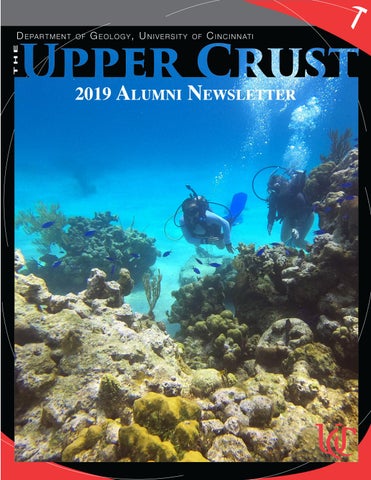
2019 Alumni Newsletter
I n s i d e
t h i s
I s s u e
Letter from the Department Head............................................................................................................................................ Pages 2-3 Faculty & Students News........................................................................................................................................................ Pages 4-22 George Rieveschl Jr. Award for Distinguished Scientific Research...............................................................................................Pages 7 Importance of Kenneth Edward Caster........................................................................................................................................Pages 8 Ocean Margins Field Trip 2019............................................................................................................................................ Pages 14-15 Geology Donor List...................................................................................................................................................................... Page 21 Alumni News......................................................................................................................................................................... Pages 23-42 In The Arts, With Gary Taylor...................................................................................................................................................Pages 32 Stained-glass artist creates business out of old hobby................................................................................................................Pages 33 Preserving The Pygmy Mammoth..............................................................................................................................................Pages 37 An Unknown Ungulate...............................................................................................................................................................Pages 39 Industrial Lightworking............................................................................................................................................................... Page 40 Department of Geology Graduates 2018 -2019..........................................................................................................................Pages 42 Call to Action............................................................................................................................................................................... Page 43
Enjoying the high life with students and colleagues on the 2018 Himalayan Field Class.
1
L e t t e r
f ro m
t h e
Hope you all had wonderful and productive year. Ours has been extremely busy with many successful classes and research projects being undertaken in our department. We hope that the Upper Crust will give you a flavor of what has been going on and help you keep up with our activities. I am extremely grateful to
D e pa rt m e n t
H e a d
Warren Huff who again this year has produced the Upper Crust and all of you who have sent us their news. As we transition into a more digital world we have made the decision to only produce the Upper Crust in digital form. This also saves us a considerable amount of money that we can use to help support students. Our extremely motivated and enthusiastic are continuing to excel. They have a strong Geology Club and have been involved in many activities including running booths at the Cincinnati GeoFair and the SW Ohio Science Fair, visits to local schools, and ar-
2
D e p e r t m e n t ranging social events. We are fortunate to have many fieldtrips with them including to the Himalaya last August and the Bahamas this past May, and numerous trips locally. We continue to have many research trips throughout the US and to distant parts of the world including Chile, China, Canary Islands, and Canada. We continue to involve our undergraduates in our research programs both in the field and our laboratories helping to make them competitive in the work place. The graduate students in our department continue to do a wonderful job as teaching and research assistants while undertaking world class research. They are very talented and enthusiastic, and are successfully obtaining numerous grants to help support their research, including support from the Geological Society of America, Sigma Xi, the Paleontological Society and hydrocarbon companies. The range of diverse topics in varied environments that they are working on for their research is impressive. Almost without exception, they present publish their research in the leading journals in their fields and present their work at national meeting. Dylan Ward’s has continued to oversee our colloquium series and does an exceptional job in arranging a mixture of talks by our students, faculty, and external
H e a d
speakers. Among the invited external speakers were Brian Romans (Virginia Tech), Chad Trexler (Ohio Wesleyan University), Kate Lyons (University of Nebraska, Lincoln), Eric Mittalstaedt (University of Idaho) and Martin Head (Brock University). We submitted an impressive number of research grant proposals this past year; many of which were funded including grants from National Science Foundation, American Chemical Society, National Earthquake Hazard Reduction Program and industry. This is helping to boost our repetition and provide invaluable resources for us to help train students for the future workforce. This past year we published well over hundred research papers in peer-reviewed international journals, with most appearing in very highly ranked journals as PNAS, Paleogeography, Nature Geoscience, Paleoecology and Paleoclimatology, Geomorphology, Quaternary Science Reviews, Journal of Geophysical Research, Lithosphere, Tectonics, Quaternary Research, and Paleobiology. Please accept my sincere thanks to all of you who have keep in touch with us and have generously supported our program throughout this and/or previous years. Your support extremely appreciated because it allows us to continue to do many exciting educational and life transforming things for our students. Please keep in touch with us and drop by the department if you are in town. If you would like to learn about our weekly activities, please check out our very informal weekly newsletter, Rolling Rocks, that is posted to the following website: http://www.artsci.uc.edu/departments/geology/news-and-events.html.
Best wishes,
3
Fa c u lt y & S ta f f News
4
U
p
p
e
Fac u lt y
r
&
C
r
u
Sta f f
s
t
Ne ws
B rooke C rowley I have had a very fulfilling year. I took over as graduate director in the fall and have enjoyed working closely
Aside from getting familiar with my new role, I have been working on wrapping up a number of unrelated projects ranging from revisiting the foraging ecology and extinction history of giant rats and lizards on Tenerife, Canary Islands to using isotope values in fecal matter to non-invasively track movement patterns of individual wild jaguars. I am also very proud of my recent MS student, Jenelle Wallace, who completed her thesis, got married, got a job, and also published her project since last April. Her thesis, which is about tracking mobility of Miocene horses in Florida using strontium isotopes, is published in P3. It’s a neat study. Here’s a nice writeup about the project if you would like to know more: www.uc.edu/news/articles/2018/12/n2057444.html.
with the students. Right now, there is a flurry of activity with the semester wrapping up and students defending before faculty disperse for the summer. It’s an exciting time of year. We have had 12 students graduate in the past year (10 MS and 2 PhD), and seven additional students (4 MS and 2 PhD) are slated to finish this summer. We will have 10 new students joining us in the Fall. For those of you who are leaving us, please keep in touch and let us know how things go as you follow the next step in your careers. If you aren’t already connected, please consider joining the departmental alumni network on LinkedIn ((https://www.linkedin.com/groups/6807518/). You can ask to join directly through LinkedIn or by writing to Dan Sturmer, who is the account administrator. Hopefully this will help alums stay connected with each other as well as faculty and current students.
My other recent grads, Stella Mosher and Jani Sparks are in the process of writing up their research and getting things published. Hopefully by the time you read this, both students will have their papers accepted.
Life has been busy, but I still found some time to do a little travel last year and this spring. Among the highlights was a fantastic adventure across Namibia last May. I was also able to enjoy an absolutely gorgeous day on Catalina Island over Spring Break this year. Summer is going to be filled with more travel. I will be spending some time in Europe for a conference and speaking at several institutions. I look forward to the break, and to escaping Cincinnati’s heat for a few weeks. I’m sure I’ll have stories to share when I get back.
5
U
p
p
e
r
Fac u lt y
&
C
r
u
Sta f f
s
t
Ne ws
W arren H uff 2018-19 has been an unprecedented year for me in many respects. As an emeritus faculty member, I am still to teach clay mineralogy. So we did the fall class with as high an enrollment as I’ve ever had in that class, and then the spring seminar where we are working on some ocean-floor sediment cores taken in the early stages of the Ocean Drilling Project in the 1980s. Some other highlights of the year included participation in the Annual Meeting of the Clay Minerals Society, which was held in Champaign, Illinois and participation in the Annual GSA meeting in Indianapolis, Indiana. Co-authored publications included a joint paper with Lewis Owen and colleagues Ken Tankersley, a former UC geology student and now Associate Professor of Anthropology at UC, Vern Scarborough in Anthropology and Nick Dunning in Geography. Our project concerns the occurrence and distribution of volcanic
6
minerals in Chaco Canyon, New Mexico and their archaeological significance. Several papers have been published and another is currently in review. I was extremely pleased to have Jeff Hannon (BA ‘10) return to UC to pursue a PhD on Cretaceous bentonites in the western US. Jeff is exploring new frontiers in bentonite study by applying stable isotopic and trace element studies to determine the magmatic and tectonic history of these widespread beds. Beyond this, I continue as an associate editor for both the American Mineralogist and Clays and Clay Minerals as well as serving as Secretary to the Clay Minerals Society. Music continues to be an important part of my life. I do bluegrass fiddle jamming just about every weekend, and am happy to step in with guitar or dobro whenever the opportunity arises. My wife, Atia, enjoys Scottish and English Country Dancing, so we are often off to events with live music plus interaction with colleagues who we normally see only at these events. I’ve attached a photograph from a 1967 4-Day Field Trip that some of you might find interesting.
GEORGE RIEVESCHL JR. AWARD FOR DISTINGUISHED SCIENTIFIC RESEARCH L ewis A. O wen M c M icken C ollege of A rts & S ciences As a 9-year-old child in South Wales, Lewis Owen became passionate about fossils and the relatively new Earth science paradigm known as plate tectonics after his first field excursion run by the local museum. Since joining UC in 2004, Owen has established two major geochronology laboratories to date geologic materials using cosmogenic nuclides and optically stimulated luminescence methods. Applying these dating methods together with geomorphology and sedimentology, Owen has become an accomplished scientific researcher on several major areas of the Earth’s geosciences. These include: the glacial history of the Himalaya, where Earth’s greatest concentration of land-based ice occurs outside of Greenland and the Antarctic; quantifying the ages and rates of landscape evolution in mountainous regions around the world; and focusing on the timing and reoccurrence of very young faults along the
southwestern margin of North America where the geohazard of major earthquakes is very real and could affect tens of millions of people. While devoting much of his work to glaciated landscapes in mountainous areas, Owen has shown a link between the internal and external surface processes in areas such as the Himalayas and their influence on long-term and rapid climate change today. Owen’s enthusiasm for interdisciplinary collaborations has also made significant contributions to several major publications and book volumes. His geology faculty colleagues all agree that Owen’s published work on the Himalayan-Tibetan region and other mountainous areas and their influence on long-term and recent changes in the Earth’s climate will be cited for decades.
7
Geoheritage (2018) 10:179–190
DOI 10.1007/s12371-017-0241-4
IMPORTANCE OF KENNETH EDWARD CASTER (1908–1992) PERSONAL CORRESPONDENCE AND FIELD NOTEBOOKS TO THE BRAZILIAN PALEONTOLOGICAL HERITAGE Joana David Caprário de Lima & Luiza Corral Martins de Oliveira Ponciano Abstract - The aim of this work is to value Kenneth E. Caster’s correspondence and field notebooks as Brazilian paleontological heritage. These data are usually underestimated in the Geosciences, although they have been used in the development of an inventory of the most valuable occurrences of Devonian fossils in NE Brazil. During his academic career, Kenneth E. Caster (1908–1992) worked in several universities, including the University of São Paulo (USP, Brazil), where he was a vis- iting professor from 1945 to 1947. We analyze more than 2000 documents of his personal correspondence (from 1937 to 1984) and three field notebooks. These documents allow the recovery of historical, educational, and scientific information. They rep- resent an important source of historical value to identify Caster’s personal and professional relationships as well as to understand his contribution to establish and improve the first Brazilian in- stitutions related to Paleontology (National Department of Mineral Production; Paranaense Museum; Cultural Center BEuclides da Cunha^; Brazilian Geological Society; Brazilian Paleontological Society; National Petroleum Council). These documents also have educational value, related to the beginning of Paleontology in the Brazilian universities (USP) and the for- mation of its teaching collections. In the same way, they are an important source of scientific value to current geological and paleontological research, resulting in the discovery of new fossil localities and additional fossiliferous levels at previously known sites from the Parnaíba and Paraná basins. Introduction - Although the use of personal correspondence is well established in social and human sciences, the association of sources like correspondence and field notebooks with current scientific data is still an unfamiliar area of study for geoscien- tists. Particularly in Paleontology, there are few studies regard- ing the potential of such documents as material with scientific, educational, and historical value. The correspondence exchanged by Kenneth E. Caster (1908– 1992) in his professional routine as geologist and pa- leontologist is a type of communication known as scientific. Restricted to members of its own community, scientific com- munication is related to the production, dissemination, and use of information from the formulation of a research idea to its results, obtained and accepted as part of the universal stock of knowledge (Targino 2000). In a broader perspective, and similar to our approach in this paper, the relevance of paleontologist Frederico W. Lange’s archive (1911–1988) as a source for several studies related to the History of Geosciences can be cited as an example. A significant fraction of Caster’s documents originates from correspondence exchanged with Frederico W. Lange, through
8
which we can perceive a network of scientists who contributed to develop knowledge on subjects related to the Brazilian Paleontology. Lange’s archive, when combined with current data, produced several studies (Bosetti et al. 2011; Peyerl et al. 2010, 2012; Peyerl 2014). Those publications corroborate the wide range of values that can be obtained from the analysis of a paleontologist’s personal archive. Moreover, it is an impor- tant theoretical reference for the development of research based on the archives of Kenneth E. Caster, even considering the friendship reflected in the correspondence exchanged between them. In the same way, research by Luna Filho (2007) and Marchesotti (2011) about the naturalist Wilhelm Lund (1801–1880) are examples of the use of personal documents in scientific and historical analysis. Regarding the articulation between the scientist’s memories and his correspondence, the authors explore the possibilities of this data beyond the mere biographical approach, emphasizing Lund’s scientific trajec- tory as well as the role he played in the local community of Lagoa Santa (State of Minas Gerais). Lopes and Podgorny (2014) also illustrate how the scientific communication be- tween peers—in this case, the publications of Hermann von Ihering (1850–1930) and the correspondence he exchanged with Florentino Ameghino (1854–1911)—is relevant to gen- erate questions, controversies, and conceptions, especially re- garding stratigraphic sequences and their chronostratigraphic correlation. The information we can derive from Kenneth E. Caster’s correspondence, especially when combined with data from the field notebooks, represents one of the small pieces of science construction. Considering that scientific heritage is all that involves science, either as a vehicle or as a result of scientific process, these documents contribute to the Brazilian scientific heritage. They are recognized as a legacy worth of being preserved and passed to the next generation. Continue Reading at: https://www.researchgate.net/publication/329197226_Preserving_the_Pygmy_Mammoth_Twenty_ years_of_Collaboration_between_Channel_Islands_National_ Park_and_the_Mammoth_Site_of_Hot_Springs_SD_Inc
U
p
p
e
r
Fac u lt y
&
C
r
u
Sta f f
s
t
Ne ws
C arl B rett This was a packed year, both in terms of University, and professional activities. I am very pleased to continue as Director of Undergraduate Studies. Not only did the undergraduate and graduate programs undergo a review but also there was much to be done regarding program assessment. I am pleased with the results of these activities and happy to report that our student numbers are growing and that we have some excellent majors, many of them engaged in research in various labs. Professionally, I have been busy with activities relating to the International Subcommissions on the Ordovician, Silurian, and Devonian systems and the North American Commission on Stratigraphic Nomenclature (NACSN). I also continued to work as a stratigraphic consultant to the Ohio Geological Survey and ran three core workshops/ field trips for that organization in addition to working on joint research on Ordovician and Silurian stratigraphy in the Tristate area, especially with Chris Waid, stratigrapher with the OGS. I will also be working with the OGS on workshops this spring and in the fall for the eastern section of AAPG. As Vice Chair of the Devonian subcommission I helped to organize and convene a large (three-day) symposium on Devonian biostratigraphy, paleoenvironments and evolution that was held at the International Paleontological Congress (IPC) in July 9-23, 2018 in Paris, France. Discussions of Devonian Stage boundaries and including the DevonianCarboniferous boundary continue, with the addition of new conodont data. In addition, I was strongly involved in International Geoscience Programme (IGP) project 653, The Great Ordovician Biodiversification Event (GOBE) dealing with Ordovician evolutionary radiations, which met in Athens, Ohio in June in an excellent meeting chaired by Dr. Alycia Stigall of that department. As a result of the meeting Kyle Hartshorn (an
independent geological researcher), and graduate students Allison Young, Cameron Schwalbach and I produced a 170 page guidebook that documents a decade of study on the sequence stratigraphy, correlation and paleoecology of the Katian (Mohawkian and Cincinnatian) on the eastern and southern flanks of the Cincinnati Arch (Brett et al., 2018a). We ran three days (mid- and post-meeting) of field trips to showcase these spectacularly exposed rocks and fossils from Maysville, Kentucky through Lexington and Frankfort and finally return north along US 127 to Owenton, Kentucky. We presently have some five papers submitted for a special volume of Palaeo-3 resulting from this meeting. As Chair of the NACSN I ran the annual meeting during the Geological Society of America’s National Meeting in Indianapolis and worked on developing the category of submembers as a formal subdivision to give a broader hierarchy of stratigraphic units: Formation-Members-SubmembersBeds-Bed. I further illustrated the use of this rank in discussing stratigraphy of the Tristates area as a Geological Society of America post-meeting field trip, which was a cooperative effort co-sponsored by the NACSN, the Ohio Geological Survey, and Indiana Geological Survey. With commissioner Marie-Pierre Aubry I am also working on formalization of the rank of subseries and the concept of biochrons. A larger initiative is the development of a study group on chemostratigraphy. We also hosted a GSA poster session on Integrated Biostratigraphy with some 20 presentations and will run an oral session on Chemostratigraphy in 2019. Subsequently, I worked in close collaboration with Kyle Hartshorn, Chris Waid (OGS), alumnus Pat McLaughlin (PhD, 2006), now with the Indiana Geological Survey, alumna Kate Bulinski (PhD 2008), now a professor of geology at Bellarmine University, and others, to produce a Geological Society of America guidebook article, on the revised stratigraphy of the western side of the Cincinnati Arch near Louisville, KY (Brett et al. 2018b). This article, likewise, documents some of our more recent studies on spectacular new highway cuts south of Louisville. On the basis of these syntheses we are now moving ahead with papers that build upon and revise the long-standing and seminal sequence stratigraphy of Steve Holland (UC BS, 1985) and Mark Patzkowsky. Ongoing
Dear UC Geology Alumni
and
Friends,
The Geological Society of America 2019 Annual Meeting will be held September 22-25 in Phoenix, AZ (http://community.geosociety.org/gsa2019/home/). I would like to invite you to attend and to join us for our alumni get-together on Monday, 23 September 2019: 6:30 PM - 9:00 PM, at the Sheraton Grand Phoenix, Maryvale A. Hope to see you in Phoenix, Warren D. Huff warren.huff@uc.edu
9
U
p
p
e
r
Fac u lt y
&
C
r
u
Sta f f
s
t
Ne ws
C arl B rett (Continued) research, will extend this revised framework into Tennessee. I continue active work with my colleague Gordon Baird (emeritus, SUNY College Fredonia) and the Paleontological Research Institution (PRI), Trumansburg, NY on our extensive collections (literally tons) of Devonian fossils and lithological samples that we have amassed over the past four decades. Both Gordon and I were recently made Research Associates of PRI. PRI has approved funding to move forward in 2019 with final renovations of a wing of a building to accommodate these collections. Once the building has been strengthened we will to organize, curate and fully document the extensive stratigraphic collections from the Devonian of New York that we obtained during some four decades of study. We will work closely with PRI to organize and document this material with the intent to produce a monograph of New York Devonian strata and fossils, edited by Chuck Ver Straeten of the NY State Geological Survey; more than 300 pages of text have been completed on this project to date. This is bringing together work of former students including Chuck Ver Straeten (1995, U. Rochester), Alex Bartholomew (PhD 2006), professor of geology at SUNY NewPaltz and Mike DeSantis (PhD, 2009), EPA in Cincinnati and James (Jay) Zambito (PhD, 2011), professor Beloit College. Additionally, we will photographically document the more critical field localities by producing videos in which the salient features of these sections and their broader implications will be discussed. These videos and a digital atlas of the fossils will be made available to all researchers through a website operated by PRI. Present and former graduate students are prospering. Allison Young anticipates completion of her dissertation on the sequence and chemostratigraphy of a synorogenic Late Ordovician platform to basin transects during 2019. She has
10
produced a comprehensive correlation of C isotope curves across eastern North America and has applied this standard to examining the detailed relationships of dark “Utica” shale facies of the Sebree trough north of Cincinnati; in so doing she is elucidating details of the formation and dynamics of this enigmatic basin. She is finalizing research on carbon isotopes, supported by a generous grant from the Ohio Geological Survey. After a brief time out, Christopher Aucoin is proceeding well with PhD studies on the nature and timing of the so-called Richmondian Invasion in the Late Ordovician of the Cincinnati Arch region. New graduate student Cole Farnam is progressing well with studies of the Ordovician-Silurian boundary in eastern North America, including a careful reconsideration of the widespread Cherokee unconformity. New data suggest that the strata overlying this unconformity may actually be late Ordovician (Hirnantian) and if so record details of the post mass extinction recovery that were previously unsuspected. Cole received the Paul Potter Scholarship for 2019, which will aid his summer research. In the fall, we will be joined by a new student Josie Chiarello also from SUNY Geneseo who intends to pursue studies of Upper Ordovician reefs in the Mississippi Valley. Past students are also pursuing many interesting things, among others, Jay Zambito has just completed his first year in a tenure track position in paleontology and stratigraphy at Beloit University after serving with the Wisconsin Survey for several years. James Thomka (PhD, 2015) has just accepted a permanent position at SUNY College in Plattsburgh, NY, and Cameron Schwalbach (MS, 2017) has been hired as collection manager at the Cincinnati Museum. Tim Paton (MS, 2017) is in a second year as PhD candidate at University of Tennessee, Knoxville and has three papers in press based upon his Masters research. Pat McLaughlin (Indiana Geological Survey), is working with me on a number of projects from Ordovician to Mississippian in the Tristate area. We are currently revising stratigraphy in the Lexington Limestone based in part on new carbon isotopic results. We continue active collaboration and Pat has served on Allison Young’s dissertation committee.
U
p
p
e
r
Fac u lt y
&
C
r
u
Sta f f
s
t
Ne ws
A ndy C zaja This has been another exciting year in my lab. I was granted tenure in August 2018 and spent Spring 2019 on sabbatical. During that time, I spent an excellent two weeks in China visiting and working with three colleagues: Prof. Yanan Shen of the University of Science and Technology of China in Hefei, Prof. Weiqiang Li of the University of Nanjing, and Prof. Xiaotong Peng of the Chinese Academy of Science Institute for Deep Sea Science and Engineering in Sanya. I look forward to future collaborations with them all. Back at home, my students and I have continued our work on studying the early evolution of life on Earth, the oxygenation of Earth’s atmosphere, and the search for ancient life on Mars. In 2018 I published a paper in the journal Chemical Geology on a 2.75 billion-year-old banded iron formation from Western Australia and what it can tell us about oxygen concentrations in Earth’s atmosphere at the time. I also began a collaboration with colleagues from four different institutions to drill sedimentary samples from the 3.2 billion-year-old Moodies Group of South Africa and look for evidence that oxygen existed (perhaps in small quantities) when these rocks were deposited. I am also continuing work studying 2.5 billion-year-old fossil bacteria from South Africa that may have been sulfur oxidizing bacteria. In early 2019, my former M.S. student, Jeff Osterhout, and I published a paper in the Canadian Journal of Earth Sciences on the thermal alteration of organic matter and its effect on carbon isotope signatures in fossil organic matter. This work was a portion of Jeff’s master’s thesis. Jeff is now a Ph.D. candidate at UCLA working with my former Ph.D. advisor, Bill Schopf.
My current Ph.D. student Andrew Gangidine passed his qualifying exam in 2018 and is now finishing his third year. He has been doing fascinating work mapping trace element distributions in microbes from hot springs in modern and recent deposits (from Yellowstone National Park) as well as from fossil deposits (the Devonian age Drummond Basin of Australia). This work has applications for searching for life in similar deposits on Mars with NASA’s upcoming Mars 2020 mission, with which Andrew and I have been involved. This work was featured in last year’s issue of the Upper Crust. Andrew has been very successful in acquiring funding for his work from the Ohio Space Grant Consortium, the NASA Astrobiology Institute Early Career Collaboration fund, the UC Chapter of Sigma Xi, the Geological Society of America, the American Philosophical Society Lewis and Clark fund for Astrobiology, the Paleontological Society, and the University of Cincinnati Graduate Student Governance Association. Andrew and I, along with colleagues from two other universities, have a paper in review in the journal Astrobiology about this work. I was very pleased to welcome a new Ph.D. student, Andrea Corpolongo, to my lab this year. Andrea is working on an exciting project studying 2.5 billion-year-old fossil microbes from South Africa (a different set than the ones I’m studying). These are intriguingly large fossil microbes that may tell us something about the rise in atmospheric oxygen that occurred just after these organisms were alive. We hope to return to South Africa this summer to collect more samples and study the depositional environment of these organisms. In semi-recent personal news, my wife Joanna and I welcomed our second child, Frederick Contorno Czaja, to the world in fall of 2017. Our daughter Ellie (who is now five years old!) is excited to be a big sister and she and Freddie love to chase each other around the house and backyard.
11
U
p
p
e
r
Fac u lt y
&
C
r
u
Sta f f
s
t
Ne ws
M ike O estreich Most of us remember an orange rock in the little cardboard box on the wooden sample tray from intro class. We can immediately recall what it looked like, felt like, and tasted like, although few of us have ever come across this limestone variety in the field unless we’ve studied Florida’s northern east coast (or a token few other coastal regions of the world). It effervesced in HCl like no other, although it was distinctive enough it didn’t really need to be acid tested. With very little cementing matrix and a ready tendency to crumble when touched, it is composed almost entirely of bivalves or other shelly material. Hopefully, at this point you’re thinking about coquina, though probably not about building a castle out of the crumbly cockles to ward off pirates. But that’s exactly what the Spanish did in St. Augustine, Florida in the early 1670s, following a devastating attack by some swashbucklers of the sea.
veneer just for looks. How could this crumbly soft rock be strong enough to sustain a military installation over three and a half centuries?
Castillo de San Marcos NHS, St. Augustine, FL in 2017
Coquina blocks and freshly repointed coquina-based mortar in the Castillo de
St. Augustine’s old wooden fort had fallen into disrepair, making the town an easy target for pirates to attack and pillage. Subsequently, the Spanish government decided a proper stone fort was in order. A search for rock along the coast yielded only coquina outcrops on nearby Anastasia Island, but masons and stonecutters were brought in to give it a shot. The coquina quarried easily and could be floated down the natural coastal waterways in dugout canoes to the construction site. Soon, St. Augustine was safe again with a new coquina fortress built to the latest four-bastioned star design. It was christened “Castillo de San Marcos.” Almost 350 battle-weary years later, the fort remains the oldest stone military structure in the US. It has served under the Spanish, the British, and United States, and is now preserved as a national historic site. As part of a National Park Service preservation workshop, I was sent to St. Augustine in December 2017 with a crew to do masonry repairs to the Castillo. We were told we’d be working with coquina. Few of my fellow trainees had ever heard of coquina, but I was excited to see this stuff in the field for the first time. I thought that the fort walls were probably earthen, with a coquina
12
The truth is, Castillo de San Marcos is built entirely of coquina. The high, bastioned walls consist of hand-hewn coquina blocks several feet thick. Lime (calcium oxide), made from baking coquina in kilns, was mixed with crushed coquina, beach sand, and water and used as mortar to cement the blocks together. Pulverized coquina, lime, and water was mixed to form a plaster for whitewashing interior walls. The real miracle in the material though was not its construction versatility, but its extraordinary ability to absorb cannonballs (a quality not listed in my Laboratory Manual in Physical Geology). The softness of the stone and the compressibility of its loosely-packed shells allowed it to survive round after
San Marcos moat wall, December 2017.
round of direct fire without shattering. Cannonballs simply disappeared into the coquina. During peacetime, soldiers even used the walls of their own fort for target practice with no apparent damage. It is unknown how many thousands of iron balls are still embedded within the fortress walls. The quarry used for the Castillo’s initial construction is now part of Florida’s Anastasia State Park. Densely overgrown and ringing a swampy green lake that was rumored to harbor alligators, massive coquina outcrops of the Anastasia Fm. can still be seen through the overhanging brush. In the course of our work on the fort’s moat wall we used coquina taken from a location very close to the original Spanish quarry, and the mortar we used was matched to existing 17th Century mortar by a quantitative mortar analysis process that uses a sieve stack, water settlement, and of course, a rather spectacular HCl reaction in the end to remove the CaCO3 component and see how much quartz sand remained. With an exact ratio of ingredients obtained from the sample analysis, we could mix fresh “mud” to match the original mortar composition.
U
p
p
e
r
Fac u lt y
&
M ike O estreich (Continued) The experiences gained in St. Augustine were invaluable to the NPS’s mission of historic preservation, but also personally rewarding to work with a unique rock type in an uncommon application that I never expected to see outside of a classroom. It is the only building stone I know of that exhibits the “invincibility” property.
C
r
u
Sta f f
s
t
Ne ws
A ttila K ilinc This has been another interesting year for me. I taught my “Environmental Volcanology”, Earthquakes and Society” and “Physical Geology” courses and continued my research on the thermodynamics of isentropic (adiabatic) uprise of magmas. I presented my poster on that topic in the Annual Meeting of the American Geophysical Union in Washington DC. I also completed my service as a member of the Executive Committee and the Press Officer of the VGP section of the American Geophysical Union.
Dry moat, drawbridge, and corner bastion of the Castillo
L ewis O wen This year has sped by again. It has been fun to continue my research and teaching that focuses on the Quaternary geology and geomorphology of tectonically active mountain belts and their forelands. This has involved fieldwork with students and colleagues in India, Iceland, Southern California and China, plus laboratory work in our geochronology laboratories. With my students and colleagues, we have published about a dozen articles in journals and books. During this period, I continued to work on the active tectonics of Walker Lane; and we got funding for two new projects in the western USA. I had fun teaching classes on natural hazards, surface processes and the geology of the Himalaya, which included a three-week field trip to northern India. I continued to work with my doctoral students Sourav Saha, Liz Orr who completed their doctorates. I also worked with postdoctoral researcher, Paulo Marques Figueiredo, on numerous tectonic projects, and we have been developing new studies the western US. My work as editor for Quaternary Research and an Associate Editor for the journal Geomorphology has again brought lots of extremely interesting manuscript my way. I was very honored to receive the Reiveschl Award for distinguished scientific research from the university this year, and am extremely thankful to my colleagues who nominated me. I am looking forward to the year ahead with plans for fieldwork in the western US and China.
13
Ocean Margins Field Trip 2019
14
U
p
p
e
r
Fac u lt y
&
C
r
u
Sta f f
s
t
Ne ws
K rista S milek I recently returned from running my fifth Ocean Margins field trip to San Salvador, Bahamas. As in the past, we stayed at Gerace Research Centre and took advantage of all that the island has to offer. We visited outcrops at Grotto Beach, Watling’s quarry, The Gulf, and Hanna Bay, climbed down into Owl’s Hole, mapped and profiled beaches, explored Cockburn Town fossil reef, crawled through Dripping Rock Cave, swam through Lighthouse Cave, snorkeled in a blue hold, visited the stromatolites and mangroves in Storr’s Lake, found lots of critters tide pooling, and snorkeled/dove as much as we could. It was two weeks packed full of carbonate geology and marine organisms of the past and present.
I had the pleasure of spending the two weeks with my friend and co-leader, Dale Kline, and a fantastic group of 13 students, which was comprised of a mix of geology majors and minors. Even though it was hot and buggy (particularly at night in the dorms) and the weather didn’t always cooperate, the students didn’t let the often-tough conditions get them down. They kept morale high and were eager to get into the field day after day. Seeing the students in action made me realize once again how resilient and hard-working geology students really are! Field trip participants this year: Jake Ashley, Jessica Bowling, Shaun Burgdorf, Davidson Garway, McKenzie Hill, Jeff Lanham, Tara Lay, Alec MacDonell, Taylor Meister, Ed Powell, Katie Schweitzer, Jenna Trout, and Tom Uhl.
15
U
p
p
e
r
Fac u lt y
&
C
r
u
Sta f f
s
t
Ne ws
D an S turmer Another exciting year has passed here at UC. The most exciting news is that our second daughter arrived in January. Her name is Eliana and she, my wife Sarah, and our older daughter Ivy are doing very well. Sarah continues to work as a lab manager for Dr. Amy Townsend-Small and she teaches online courses in the Environmental Studies program here at UC. Ivy enjoys taking care of her baby sister, going to school, playing with her grandparents, going to the zoo and museum, and all animals, insects, and especially spiders. My M.S. student Adam Jones is set to defend his project this summer. After his field work last summer, he spent much of fall point counting thin sections for provenance analysis of samples from the Oquirrh basin in Utah. This spring he travelled to the University of Kansas to complete U-Pb detrital zircon analysis on 6 Oquirrh basin samples working with Andreas MÜller (Kansas) and Tandis Bidgoli (University of Missouri). His work will be submitted for publication this summer. Adam presented his work at GSA last fall and will present a poster at AAPG in San Antonio in May. Additionally, Adam has decided to stay and begin a PhD in my lab this fall! Nick Ferry began an M.S. project this fall working on large-scale landslides in the Basin and Range. He has since converted to a PhD and will remain in my lab for several years. For Nick’s initial project he is working closely with Dylan Ward to develop a generalized landscape evolution model of a range front that experiences large-scale landsliding and the response of the landscape to the landsliding. Nick will be presenting initial results at the AAPG meeting in San Antonio in May. He will also be conducting field work on the Blue Diamond landslide near Las Vegas this fall. I had several publications that were released in the last year, including studies on the kinematic evolution of the Olinghouse Fault near Reno (Sturmer and Faulds, 2018, Journal of Structural Geology); and modeling CO2 sequestration using mafic rocks from Nevada (Sturmer et al., 2019, Computers & Geosciences). I also published a field guide in association with the 3-day field trip I organized and led in northern and central Nevada last September for the Nevada Petroleum and Geothermal Society. This trip was very special as it was in memory of my PhD advisor Jim Trexler, Jr., who lost his battle with
16
cancer in 2017. We had 40 participants from the US and Canada, and it was a very enjoyable trip, including a delicious trip dinner at a Basque restaurant in Elko. Several other manuscripts are in review or preparation (stay tuned next year for more on those next year). In addition to the student projects mentioned above, I have several projects that I will be working on in the coming year. One is to document and analyze all identified mega-landslides in Nevada. These will be added to the Nevada Bureau of Mines and Geology MyHazards web application later this year. Another project is with Wanda Taylor (University of Nevada, Las Vegas), Tandis Bidgoli (University of Missouri), and Kate Huntington (University of Washington) to evaluate provenance of Cretaceous (?) to Eocene(?) conglomerates which crop out in scattered patches in southeastern Nevada and southwestern Utah. These conglomerates record drainage from the southern margin of the Nevadaplano and/ or the evolution of topography during the Sevier Orogeny. I am also working on several projects with John Louie (University of Nevada, Reno) and Aasha Pancha (Aurecon) to use a passive-source seismic technique to identify and analyze deep shear wave velocity fields and mega-landslide deposits in several basins in Nevada. The XRF lab is up and running. I addition to the XRF, Warren Huff and I just acquired a Katanax Fluxer to make fused glass beads for XRF analysis. I am working on several projects with Mark Krekeler from Miami University and PhD candidates Jeff Hannon and Jason Cesta. I also have several projects that are in the planning stages. Look for more exciting work to come out of the XRF lab in the next year. I did not teach last fall. This spring I taught Structural Geology for the first time. I look forward to teaching this class annually in the coming years. Next fall I will be teaching Basin Dynamics (again with Paul Potter) and Careers in Geosciences. I am also developing an Applied Geophysics course which will alternate with Basin Dynamics and will first be taught in fall 2020. I am also organizing the Career Days event, which will occur early this fall. If you are interested in participating, please let me know! This summer I will be writing several manuscripts and grant proposals which I will write more about next year. I will not be at AAPG this year, but I plan to return to AAPG for ACE 2020 in Houston. If you are planning to go to AAPG this year, please go visit Adam Jones and Nick Ferry at their posters. I will be at GSA in Phoenix this fall. I am looking forward to an excellent and productive and new academic year.
U
p
p
e
r
Fac u lt y
&
C
r
u
Sta f f
s
t
Ne ws
D avid M eyer I am finding that retirement can be a very busy time with no shortage of projects to keep me occupied! Going back to last fall, I attended the GSA Annual Meeting in Indianapolis where I read the citation for the presentation of the Strimple Award of the Paleontological Society to Jack Kallmeyer, President of our Dry Dredgers. Jack is the third Dry Dredger to receive this prestigious award for contributions to paleontology by an amateur. It was great to reconnect with many of you at GSA. Lately I have been dividing my time between the Department and the Geier Collections and Research Center of the Cincinnati Museum Center. At UC we have been very busy with an inventory of all collections held by the Department, including thesis collections from many years back, active and inactive research collections of fossils, minerals, and rocks, plus equipment in Braunstein labs. One big development was the transfer of Devonian fossils collected in Brazil in the 1940s by Ken Caster. These were the basis of much research by Caster and students, so some specimens became types or thesis collections in the Cincinnati Museum collections and elsewhere. Renewed interest by researchers from Brazil prompted us to offer the unstudied specimens to the National Museum in Rio, provided they could properly curate the material and cover the shipping costs. This was all arranged through negotiations between the Department and the Rio Museum and the specimens were prepared for shipping in 2015. Barry Maynard devoted a major effort to organizing and packing the fossils, with some help from UC students, one representative from Brazil, and me, mostly with the shipping arrangements. The packed collections amounted to about 1500 kg packed into boxes stacked onto two pallets. The shipment arrived in Rio in 2016 and was in the process of accession to the Museu Nacional. As many of you probably heard, disaster struck in September 2017 when a fire destroyed the entire main building of the Museu, destroying a huge amount of the nation’s cultural and natural history heritage. In time, however, we learned that about half the fossils were being held in another building and thus were spared, but everything in the old building was reduced to ashes. Fortunately too, was the fact that specimens held by Cincinnati Museum Center and other museums were not part of the repatriated collections, and in the process of our recent inventory, we found a stack of
drawers with fossils from one of the major Devonian localities in the Parana Basin that was overlooked. These will go to CMC and the extensive field notes and records kept by Caster are now housed in the UC Archives. As of this writing, we have transferred most of the fossil collections on which many research projects of students and faculty are based to Geier for permanent curation, including 65 drawers holding the Ordovician shell pavement bearing rare edrioasteroid echinoderms that we collected shortly after I arrived in Cincinnati in 1975. There’s plenty more to do, but we have opened up a lot of storage space in the Department where current faculty can hold specimens under study, and possibly consolidate other collections of the Department. For this inventory we have been very fortunate to have a one-year post-doc, Michele Fame, serving as a collections manager, arranged by Lewis Owen. Many thanks to Michele and Lewis!! I have also been keeping up with research, including presenting a paper at GSA and recently completing two papers with my longtime colleague at OSU, Bill Ausich. I had a surprise late last year from Bill, when he presented me with the “Golden Crinoid Award”, a kind of lifetime achievement award for contributions to knowledge of echinoderms, living and fossil. This award was established through the International Echinoderms Conference that meets every four years at locations around the world. The Golden Crinoid is a metal sculpture that looks like gold and is a very accurate replica of a Recent feather star crinoid and kind of resembles bronzed baby shoes! This is a traveling award, and the recipient gets to keep it for the 4-year interval between IEC conferences (like the Stanley Cup), then determine the next recipient and deliver it (travel expenses not included!) I am most honored to receive this award, and I have the pleasure of selecting the next awardee from among many brilliant colleagues in echinoderm studies worldwide! Kani and I are enjoying “retirement”, now sharing a big house with Ross, Emily and our three grandsons, plus two dogs and a cat. Kani also volunteers at CMC in the paleontology preparation lab and collections. We spend a couple months in the summer on Swan’s Island, Maine, and if you ever visit Maine, let us know if you can visit us!
17
U
p
p
e
r
Fac u lt y
&
C
r
u
Sta f f
s
t
Ne ws
R eza S oltanian Last year was a great year for me here at UC. I began putting my group together, applied for multiple research funding, published several peerreviewed papers, organized well-attended and successful sessions for the American Geophysical Union conference, organized a successful special issue for Computer & Geosciences journal, attended several workshops, and traveled to China and the Netherlands among other things. Also, a PhD student (Reza Ershadnia) with a background in petroleum engineering joined my group. I am excited about his project, which is understanding methane fate and transport in groundwater systems through developing complex multiphase and multicomponent flow and reactive transport models. He is also helping me with research activities at the CV Theis Groundwater Observatory. I started work on several different projects. One project focuses on developing hydrogeophysical monitoring and a decision support system for environmental cleanup and energy applications funded by the US Department of Energy. My research at the CV Theis Groundwater Observatory is going well. I am working toward developing modeling, and a real-time monitoring and management system in which I will use the CV Theis Groundwater Observatory as a test bed. This system will provide an applied and scientific understanding of the hydrobiogeochemical
dynamics during the groundwater and surface water exchange. I am integrating data from the observatory into my research and teaching, and plan to promote an understanding of groundwater systems in our region and beyond. I was also fortunate to host several visiting students and scholars from China and France including Yuanhong Liu, Ali Meyal, and Zhien Zhang. Specifically Ali Meyal is working on a collaborative project between my group and the Novel Reservoir Monitoring, Modeling and Simulation (NORMS) group Geology PhD student Reza Ershadnia performat Imperial College. ing an electrical resistivity survey at the CV This is resulting in Theis Groundwater Observatory. the development of a next generation reactive transport simulator for complex subsurface multiphase multicomponent flow and transport problems. We hope our paper on this comes out in 2019. My group has two incredibly hard working undergraduate students, Jessica Bowling and Steven Ransom, who helped me with setting up my laboratory and also with ongoing research at the CV Theis Groundwater Observatory.
Undergraduate and graduate students in the Fundamentals of Groundwater in Fall 2018.
18
U
p
p
e
r
Fac u lt y
&
C
r
u
Sta f f
s
t
Ne ws
R eza S oltanian (Continued)
T om A lgeo
I began teaching in Fall 2018 my “Fundamentals of Groundwater” course. In Spring 2019, I started teaching my “Groundwater Flow and Transport Modeling” course. I am excited about these two courses and will continue improving them in the coming years.
Editor’s Note: The News Record (https://bit.ly/2GqDlJy) reported on a study of which Tom was a co-author regarding evidence that mercury buried in ancient rock provides the strongest evidence yet that volcanoes caused the biggest mass extinction in the history of the Earth. The extinction 252 million years ago was so dramatic and widespread that scientists call it “the Great Dying.” The catastrophe killed off more than 95 percent of life on Earth over the course of hundreds of thousands of years. Paleontologists with the University of Cincinnati and the China University of Geosciences said they found a spike in mercury in the geologic record at nearly a dozen sites around the world, which provides persuasive evidence that volcanic eruptions were to blame for this global cataclysm.
T imothy G. P hillips
Geology undergraduate students Jessica Bowling and Steven Ransom working at the UC Center for Field Studies to characterize extracted cores from the CV Theis Groundwater Observatory.
Visiting student Yuanhong Liu from Hohai University and Geology PhD student Reza Ershadnia at the CV Theis Groundwater Observatory.
I am looking forward to the rest of 2019. Importantly, Corey Wallace, a PhD student from the Ohio State University, obtained a NSF EAR Postdoctoral Fellowship to join my group for two years. Corey will utilize the CV Theis Groundwater Observatory to understand nitrification and denitrification processes during groundwater and surface water interactions.
For the past fifteen years our graphic artist, Timothy G. Phillips, has served as our media technical specialist. His work included not only designing the newsletter and many departmental posters and announcements, but he also provided remarkable instruction to our faculty, staff and students on all aspects of graphic design. Tim has now retired and has relocated to Florida to be near other family members and he shall forever bear the gratitude of our department for his invaluable services.
Calling All Alumni
and
Friends,
Want to stay connected to the UC geology department and your fellow alumni? Join the University of Cincinnati Geology Alumni Network on LinkedIn (https://www.linkedin.com/groups/6807518/)! This is a place to connect to fellow alumni, current students, and faculty. Contact Dan Sturmer (sturmedm@ucmail. uc.edu) with any questions.
19
U
p
p
e
r
Fac u lt y
&
C
r
u
Sta f f
s
t
Ne ws
C raig D ietsch Greetings All. I just returned from another road trip to eastern New York and western Connecticut (1,720 miles total). My bedrock mapping there continues as I return to my geological roots in the New England Appalachians...still a few things to figure out in these high-grade, polyphase rocks, yes? My partner on this trip was Andrew Michel, who will officially graduate this August with a Geology major and Mathematics minor. Andrew is scheduled to continue his mapping this coming year in the Stamford, CT 7.5 minute quadrangle, mapping started by Shannon Neale in the summer of ’17. Last summer, Shannon successfully defended her MS project, “Bedrock Geologic Map of Parts of the Stamford and Pound Ridge 7.5 Minute Quadrangles, Fairfield County, Connecticut.” She is now working as a geologist for the Army Corps of Engineers in the Sacramento District, CA. Mapping hard rock geology + thin section petrography + GIS = a good job. Andrew’s mapping will be supported by an EDMAP grant funded by the USGS. Paco Martinez came for a month-long visit last fall and we had a great time doing fieldwork together in CT and attending the NEIGC field conference in October, based in Lake George, NY. Paco is retired (in the mandatory kind of way) but still doing research in Guilleries and the other massifs of northeastern Spain. One of the outstanding problems in this part of New England is the age, origin and regional correlation of the Harrison gneiss and the Traps Falls Formation, which together form a series of ortho- and paragneisses first described in the plate tectonics era by Leo Hall. Leo was a member of my own dissertation committee and I discovered this year that he completed his M.S. degree at, of all places, UC! In 1956 he was a student of Gerald Friedman and did his research on the geology of the St. Johnsbury quadrangle in Vermont. Leo went on to do outstanding work mapping and doing structural geology in western New England as a professor at UMass. Small world, indeed. In addition to Andrew, undergraduates — now graduated! — Megan Brennan and Tyler McGarr also worked on Connecticut-related projects this year. Results were presented at GSA’s Northeastern Section meeting held in very hip Portland, ME. (Special note to Ben Johnston: “Admiral, the little red barn is alive and well.”) More small degrees of separation...I taught Petrology to 10 students this past semester. I was inspired by Josh Bergbower’s M.S. research on fluorite chemistry across the Illinois-Kentucky Fluorspar District and a visit to the KGS’ Core Library (revitalized under the leadership of Bill Haneberg, State Geologist and Director of the KGS) to learn more about lamprophyres, lamproites, and kimberlites. Through the generosity of KGS geologist Warren Anderson, I am now working on a core drilled through nearly 500 feet of a mantle-derived intrusion from southwestern KY with Tom Uhl. Tom completed his degree in
20
Classic Civilization from UC this spring (with minors in Mathematics and Physics, and a near-minor in Geology) and will be working on the core for part of his M.S. degree. BTW, the “lecture” part of Petrology was done in the new Visualization Lab in the Geology-Physics-Math Library, an exciting new classroom space where our new petrographic microscope-with cameraetc can be used to full advantage. Shout-outs to librarian specialists Richard Johansen and Amy Koshoffer for all their support. Que mas? Led by the creativity and enthusiasm of visiting post-doc Michelle Fame, our collections of minerals and rock suites is being cataloged, organized, culled, and put to good use in our teaching. The Department’s fine collection of specimens from around the world bespeaks of our legacy of Fenneman, Rich, Jenks, Sunderman, Larsen, their students, and others.
P aula F igueiredo This past year was very enjoyable, one where I accomplished several goals. Early in the year I went to Prime Laboratories in Purdue University, to learn new laboratorial techniques for the TCN Be10, Al26 and Cl36 samples preparation. Those skills were then transferred to our laboratories. I also trained and collaborated with visiting students and researchers, in the OSL and the Cosmogenic laboratories. During most of the year, I traveled frequently to California for fieldwork in the several research projects I’m involved in. This year, I was able to get a grant funded by the National Hazards Earthquakes program, to research active faults in the Eastern California Shear Zone. In the scope of that project, I took an UC undergraduate student and a visiting student from Thailand to the Mojave, for fieldwork. I also attended several conferences, focused on Active Tectonics and Earthquake Geology, where I presented some of my research from California and Portugal. Two conferences were led in Europe and a 3rd one in California, where I co-led part of a field-trip in the Cajon Pass area, which is one of the areas that I’m presently researching. I was able to publish 4 papers, one as the first author. During the entire year, I was also teaching a Capstone course from the Interdisciplinary Studies program, which was a very positive experience.
U
p
p
e
r
C
r
u
s
t
Department of Geology Donors 2018 -2019 Thank You All for Your for Contributions to the UC Geology Department’s Continued Excellence! Mr. Eugene J. Amaral
Mr. and Mrs. Jerome H. Lipsky
Mr. and Mrs. Joseph W. Breuer
Dr. and Mrs. Joshua H. Miller
Mr. Ronald F. Broadhead
Dr. and Mrs. Brian L. Nicklen
Mr. and Mrs. Leland W. Burton
Occidental Petroleum Foundation
John L. Carter, PhD
Dr. and Mrs. Lewis A. Owen
Dr. Jacek Jaminski and Dr. Marzena Cho-
Ms. Mary L. Pojeta
cyk-Jaminski
Dr. and Mrs. John K. Pope
Mrs. Valerie K. Clark
Mr. Eric M. Redder and Ms. Michon D.
Dr. Andrew D. Czaja
Woods
Dr. Craig Dietsch and Ms. Elaine L. Ward
Ms. Phyllis Reid
Mrs. Elizabeth Dunlop
Dr. Stephen P. Reidel and Ms. Mary R.
Mr. and Mrs. Michael E. Effler
Knight
Mr. and Mrs. Robert P. Elliott, Jr.
Mrs. Cornelia K. Riley
Dr. and Mrs. Frank R. Ettensohn
Mr. Edgar W. Roeser
ExxonMobil Education Foundation
Mr. Tod W. Roush
Mr. and Mrs. Robert A. Ferree
Richard B. Schultz, PhD
Mr. and Mrs. John R. Ford
Dr. Frederick C. Shaw
Linda P. Fulton, PhD
Shell Companies Foundation, Inc.
Ms. Janet G. Gasper
Dr. and Mrs. Frederick E. Simms
Mr. and Mrs. Wayne R. Goodman
Mr. and Mrs. Erwin L. Single
The Greater Cincinnati Foundation
The Stephen & Bethany Wells Family Trust
Mr. Max L. Hadley
Dr. Roy B. Van Arsdale and Mrs. Stephanie
Mr. Dominique M. Haneberg-Diggs
K. VanArsdale
Dr. and Mrs. F. D. Holland, Jr.
Dr. and Mrs. William A. Van Wie
Dr. and Mrs. Warren D. Huff
Vanguard Charitable
Mr. and Mrs. Kyle D. Jenkins
Ms. Raelyn E. Welch
Ms. Elizabeth A. Krebes
Ms. Jenea L. Woods
21
U
p
p
e
r
Fac u lt y
&
C
r
u
Sta f f
s
t
Ne ws
Y urena Y anes During the past and bringing sci2018-2019 acaence to broad audemic year I have diences. As part been gratefully of my lecture tour, productive and I have travelled accomplished a across the country plethora of reand given a total search, teaching of 11 seminar and and service goals. colloquium preI was awarded a sentations so far new National Sciat diverse private ence Foundation and public uniresearch grant as versities and high a lead-Principal Inschools. I am exvestigator to study cited to continue climate change in my lecture tour the Northwest Afnext academic rican region over year in service of the last two milthe scientific comlennia. My PhD munity and the student Wesley public. Parker and my I feel fortunate new undergradu- Yurena Yanes at the 2018 Ohio River Valley Unified Malacologists Meeting (OVUM) in the Carnegie Museum of to be part of a supNatural History. ate student Mallin portive and inspirBlaxall, who is working community of ing this summer with me through the WISE program, are both students, staff and faculty at UC and look forward to seeing involved on this recently funded project and have already genhow the coming years unfold. erated exciting novel data to be published in the near future. I was also pleased with the successful thesis defense of my graduate student Richard Javier Stephenson, who did an excellent job and earned a Masters in Geology this summer. I am also very proud of my undergraduate student Nora Soto Contreras. She just graduated and was accepted in the graduate program at the University of California, Davis starting next fall. I am also looking forward to working with upcoming graduate students Catherine Neild, Reed Sanchez and Zeke King Phillips who were accepted in our UC Geology graduate program and will conduct inspiring scientific research in our school. Working with undergraduate and graduate students continues to be one of the most rewarding parts of my job. Some of my students and myself are enthusiastic to participate in the upcoming 2019 North American Paleontological Convention this June to disseminate results and expand our scientific network. I have also been busy teaching several introductory-level classes that included lectures, labs and fieldtrips. In particular, I developed and taught a new course on Historical Geology, which resulted to be a great class with productive and engaging interactions with students of variable backgrounds. I was selected 2018-2020 Paleontological Society Distinguished Lecturer/Educator, a position that serves the Paleontological Society and the community in helping disseminate research
22
UC undergraduate students enrolled Historical Geology 1004 in the spring 2019 in a fieldtrip to the Trammel Fossil Park.
Alumni News
23
U
p
50’s
p
e
r
A lum n i B ud H olland P h D ‘58 Happy New year!
Recently, there have been so many changes, that we did not get around until now to write our Christmas letter. So, I guess we can say, we hope you had a Merry Christmas.
C
r
u
s
t
Ne ws
driving, a little after 10:00 PM. We were greeted by there by Barb, Del’s friend. The next day was exciting, as we got visits from grandsons, Jess and Jamie, who live in Iowa City and granddaughter, Melissa, who just happened to be in town from where she lives in Silver City, NM, and also Jamie’s children, Tyler, a freshman at City High School and Katie, a 7th grader.
For us, things were going along pretty much as usual, some reading, a little snoozing, some visiting and meals in the Parkwood dining room in Grand Forks until early March when Mardi had two little heart incidents that led to her being transported to the hospital in an ambulance. As it turned out, nothing serious, but Parkwood decided that they needed to be more involved in our lives and moved us into an assisted living classification from the independent living we had been in since moving there. Naturally, sons, Del and Erik were concerned. After
Our days got busy with visits to our new apartment, filling our a myriad of forms related to the move, meeting the folks in Del’s cohousing community, Prairie Hill and visiting.
some consideration, we all decided that it would be good to be closer to Del or Erik for more contact and support if needed. Since Erik is still working full time and very busy, it was decided that a move to the Iowa City, Iowa area, where Del lives (107 Prairie Hill Lane, Iowa City, IA, 52246; phone:319-594-2957), would be the best option.
Erik came down to help with the settling after this little move and to check out the new digs. The night he arrived, we were able to enjoy one of the advantages of being in Iowa City as Del organized a pizza dinner for all the extended family absent Melissa. This was a chance for us to get reacquainted with all them and particularly Del’s son, Shane and his wife, Lisa and 3 children, Kelsea a junior in high school, Keegan a sixth grader and Kenzen a 3rd grader, who all live nearby, but we’d not yet had the opportunity to visit with them.
On September 26 the process began in earnest with Del’s arrival in Grand Forks. He started packing and making arrangements for our move. Erik joined us on the the 30th and helped pack for a few days until he needed to go back to work in Bismarck. We got as much packed up as we could and rode in Del’s car to Iowa on Oct 7. The rest of our belongings were packed up by Whalen’s Moving and Storage and moved to Iowa City. We arrived at Del’s brand new house (he had moved in 2 days before he came to Grand Forks) after more than 13 hours of
We’ve had first visits to our new doctor (just happens to also be Del’s doctor), several to the audiologist to get things straightened out with our hearing aids and quite a bit of unpacking and settling. This was complicated a couple of weeks ago by a mini-move within our building downsizing to a one bedroom and bath apartment.
We are finally getting settled into our new place and wanted to share our new contact information: Bud and Mardi Holland 1275 W Forevergreen Rd., Apt. 20 North Liberty, Iowa, 52317 Phone:319- 626-2048
In Rememberance Addison Myers (MS ’53) died in hospice in Denver on 9/16/18
24
U
p
50’s
p
e
r
A lum n i M atthew T. M acleid BS ‘57 Ladies and Gentlemen,
I am delighted to receive “Upper Crust,” summer 2018. While I graduated class of ’57 from Old Tech, a building dated to the beginning of the Cenozoic, I remember Ken Caster who in one of his regular moments of humor claimed he detected in me Neanderthal characteristics. I see that progress in DNA science now verifies Dr. Caster’s observation about me as well as almost everybody else. Diversity is not a recent development. While I did not pursue a career in geology I had a chance to work under Dr. Friedman in Canada studying glacial phenomena and running a scintillation counter for uranium deposits.
C
r
u
s
t
Ne ws
In the military I participated in polar research at 8000’ on the Greenland Ice Cap at Camp Century as a science assistant. This work was in preparation for a location for a location for the first borehole into the ice cap to determine past climate. After leaving the military I pursued a career in law, but retained an interest in geology, particularly climate and glaciology reading and traveling to many locations in the U.S., Canada and many foreign locations including Iceland and Scandinavia to observe glacial phenomena. My time at Old Tech under a fine faculty has left me with an abiding interest of a lifetime. Again Thank You for “Upper Crust”. Sincerely, Matthew T. MacLeid
In Rememberance John P. McAnaw (BS ‘59) Lieutenant Colonel John P McAnaw (US Army, Retired), age 82, of Fairfax passed away on Saturday July 7, 2018 at Fairfax Nursing Center. John was the beloved husband of Mary, devoted father of Maire Weathers (Jason) & dear brother of Mary Brigg (late Michael), Margaret Borock (Donald) & Michael McAnaw. John had the Irish gift of gab, a keen sense of adventure & will be deeply missed. As a native of Cincinnati, John loved baseball & enjoyed a pitching tryout with the Reds as a teenager. He graduated from the University of Cincinnati in 1959 with a degree in Geology. John traveled the world during 26 years as a US Army Infantry Officer to include three combat tours in Vietnam. He earned numerous military decorations to include the coveted Combat Infantry Badge and six Bronze Stars (three for valor). He worked at the Pentagon & the Army War College. In 2002, John was inducted into the Ohio Military Hall of Fame. John served his community through several civic, patriotic & historic preservation endeavors. He resided in Kings Park West (KPW ) since 1982 & was a parishioner of Holy Spirit Catholic Church. He held leadership positions in the VFW. John was a board member of the Fairfax Station Railroad Museum. He served as the historian for the Ancient Order of Hibernians & the American Legion. Always curious, John had a thirst for learning. Sharon Bulova (Fairfax County Board of Supervisors Chairman) honored John with the 2015 Lord Fairfax award for his love of history, country & service. For over 20 years, John served as Chairman of Parks & Lake Committee for KPW. His efforts led to beautiful established trails around Royal Lake & along Shane’s Creek. He spearheaded park clean up events, wrote articles, educated Boy Scouts and facilitated Eagle Scout projects that helped the parkland. In 2008, John was honored in a ceremony that renamed this area the “John P McAnaw Woodlands & Recreation Area at Royal Lake” in recognition of his selfless dedication. These signs are located at both entrances to Royal Lake. John fought tirelessly to identify and preserve Civil War sites throughout Northern Virginia. He held leadership positions with the Bull Run Civil War Round Table & was a frequent speaker at events. He enlisted the support of public officials to save historic sites from developers & their bulldozers. John was well known for leading numerous educational Civil War tours, which featured his meticulous hand-drawn maps & off-trail adventures.
25
U
p
60’s p
e
r
A lum n i G ene S imms P h D ‘66
I am still going strong. I had to cut back in part because of Bonnie’s heart condition. For a long time I have been working at Service Environmental Engineering and teaching part-time at Wayne County Community College. I have enjoyed teaching the small classes where I also teach the labs and take the students on field trips. I have really got to know my students and have enjoyed that. One of my fellow teachers was one of my students at Wayne State and it has been nice having her as a partner.
The environmental business has been disheartening and I have had to say no on occasion about being involved and I am not sure how long I will continue. Several years ago the State of Michigan eliminated the certification to do geological environmental work. (I was an Underground Storage Tank Professional.) Now I hear of untrained people doing lithologic evaluation and sampling and I am not required to sign Closures and some related reports. I think there has been a downward spiral in meeting environmental standards. In Michigan there are 15,000 facilities that have storm water permits and as I hear there is one MDEQ person to do the renewal with a backlog of maybe two years in some cases. This may be the case elsewhere as indicated by the fact that the number of Certified Professional Geologists of the American Institute of Professional Geologists has dropped from about 4,700 to 2,769 according to an article in The Professional Geologist Jan.-Feb. 2019. (There are more student members than Certified Professional Geologists.) The article indicates other factors are involved. The AIPG has yet to take a real stand on Climate Change and we are not communicating to the public and being involved as much as we should about coastal, flood zone protection, infrastructure protection, as well as water supply and drought planning and other matters. I recently helped a lady who says she recognizes the importance of the environment get elected in my congressional district. We will see how she does. But we need to get trained scientists including geologists to run for public office! Getting ready to go to California to visit my two daughters and the grand kids. California is a hard place to make living it seems.
C
r
u
s
t
Ne ws
Bonnie and I own hybrid and plug-in cars, own a solar mutual fund and have signed up for total solar and wind power from Detroit Edison. Also I push solar for old landfills on the company website. Recently Bonnie and I hosted folks for a showing of the environmental film “Pittsburgh to Paris”.
R onald W ard BS ‘64, MS ‘66 I was very pleased to get your letter this week with the enclosed Christmas skit. Wow that is a blast from the past. I hope all is going well with you. I have continued to enjoy receiving the Upper Crust newsletters over the years, but notice that the 60’s section has nearly come to a close. Time marches on. My wife and I have been living in south Austin, Texas for the past eleven years. I moved around quite a bit having worked in the oil and gas industry in Oklahoma and Texas, and for the Missouri Geologic Survey in Rolla, Missouri. The latter third of my career I worked in the environment consulting field. I retired in 2007 from Cornerstone Environmental Services in Zionsville (Indianapolis suburb). We moved to Austin from Indiana to be near our oldest son and his family.
F red S haw MS ‘60 My wife and I still try to keep up the long distance biking but probably will not repeat the St Pete to Istanbul run of a few years ago. Otherwise, we travel a bit on foot- just back from viewing the Monarch butterfly winter roost near Mexico City. That is a must see- I don’t have an adequate description for it. Still recovering from the horse ride, however. By now, the kids are all over 50 (one has even retired) and I can’t even remember the Harvard 50th. I do remember fine guitar nights at Cincinnati and have wandered off into bluegrass- saw Doc Watson’s final concert on a bike ride through NC a few years ago. Good things stick in one’s memory. Wave, or better, stop by if you are passing through NYC- we live in Nyack (20 miles up the Hudson) and have plenty of space.
In Rememberance John Lyman Carter PhD ‘66, (March 14, 1934 - March 2, 2017) 84, of Mount Pleasant, SC, a retired Paleontologist with the Carnegie Institute in Pittsburgh, PA, and widower of Ruth Carter, died Thursday, March 2, 2017. https://www.palmettocremationsociety.com/obituaries/obituary-listings?obId=1394756
26
U
p
60’s p
e
r
A lum n i J erry S chaber MS ‘62, PHD ’65
E d O’D onnell MS ‘63, PHD ’67
Editor’s note: On behalf of two of our very distinguished alumni, Jerry Schaber (MS ‘62, PHD ’65) and Ed O’Donnell (MS ‘63, PHD ’67), I would like to call your attention to some recent discussion regarding the celebrated Apollo moon landing program. From Jerry: There were some interviews that Michell Miller and crew did from Flagstaff a few months ago regarding the upcoming 50th anniversary of the Apollo 11 landing (20 July)? The eight-minute CBS Flagstaff segment aired nation-wide on May 11. We all thought that It nicely highlighted Flagstaff’s important role in astronaut training and the City’s year-long program of events spotlighting Flagstaff’ Lunar Legacy, that have been taking place in-and-around town since last July 20 (2018). We were recently informed that CBS will re-air the show a day or so before the actual 50th anniversary on July 20. http://a.msn.com/09/enus/AABdLyy?ocid=se From Ed: My connection with the Apollo program was through Bill Anders, the first Chairman of NRC. I came to NRC in January 1976 and we held our first birthday party at the Naval Officers Club at Bethesda Naval Hospital three weeks after I got here. I went to the party thinking it would be a good time to meet people. At the social hour before we sat down to eat a friendly looking fellow came over and read my name tag and he said: “hello Ed, I’m Bill Anders.” It didn’t’ register on me as to who he was. We made pleasantries and then we moved on. When it came time to eat, I looked around and spotted my friend “Bill.” There was an empty space at his table so I came over and asked if I could join him which I did. During dinner I sensed something was going on at the table and that I might be out of place. It was three months later when Mike Wallace did a 60 Minute piece on a problem at NRC that I found out who my
C
r
u
s
t
Ne ws
friend “Bill” was. There is a long article on Bill Anders at http:/ airportjournals.com/bill-anders-a-love-of-afterburners/. It goes into his background and tells of him being born in China, being a mediocre H.S. student in San Diego, why he went into the USAF rather than Naval Air, him flying fighter interceptors in California and looking for something more interesting. Best of all it tells how he slipped into the astronaut program over the objection of Chuck Yeager. Along the way Anders got a degree in nuclear engineering. After Apollo 11 he figured the program would be cancelled thus ending any more chances of space flights, so he resigned from the astronaut program and came to AEC under Dixie Lee Ray. He was a consultant on the space shuttle while on a government panel. He was advocating for a small one but a big one was under consideration He was asked by one of Nixon’s men which gave the most jobs to California. The answer was the big one which is how we got the one we got. It was years later on that I found out that I’d actually seen his launch on Apollo 8 in December 1968. We lived in Tampa at the time. The launch was around 8 am and we were leaving our apartment to go to the airport to fly to NY for Christmas. The sky was crystal clear and we watched lift off on TV. As I stepped outside, I could see the white trail of Apollo 8 and I spotted the blast of light when one stage broke off of another one. Apollo 8 was significant because it was the first manned spacecraft to leave low earth orbit reach the moon, orbit it, and return. As Apollo 8 passed behind the moon it was out of radio communication with the earth and we all held our breath hoping to hear from them again. Bill Anders was the one who took the earthrise photo showing the earth appearing over the horizon of the moon. He also took the photo called the “blue marble,” the first photo taken by a human being showing the whole earth.
27
Tod Roush BS ‘74 Photos from 1973
28
U
p
70’s
p
e
r
A lum n i W ayne G oodman MS ‘76
I keep promising to send you a note, so I can share with my U.C. Geology alumni and friends a bit about some of the mischief I’ve been up to of late. I’ve had a chance to connect with you and a handful of faculty, students, and alumni on my occasional trips to the Department for the Annual Banquet and scholarship presentations, Alumni Advisory Council meetings, and special events (like your retirement fete last year, so happy I could attend!). So, at last, I get that little note off your way...
Having turned 67 just a few weeks ago, I didn’t envision that I would still be this busy, arguably productive, and stimulated by my life’s work at this point along the pathway. But that’s where I’m at today, still working around 80%+ of a full-time load. I am a partner and serve as a Geological Consultant several days a month to Core Energy LLC, a small oil and gas company based in Traverse City, MI, 65 miles west of my home in small town Gaylord, MI, where I work and office on a scenic lake in the Michigan north woods (2 miles “off the pavement”). Core is a niche company, with our primary specialty being EOR (enhanced oil recovery) by capturing industrial by-product CO2 from a gas processing complex about 3 miles from my home and re-injecting it at high pressures into abandoned Silurian Niagaran reef oil fields (my long-time specialty research play dating back to my days at Shell in Houston 40+ years ago). After a large addition to our capture/compressor complex this year, we now garner about 19 million cubic feet of CO2 daily. We have EOR operations underway in 10 formerly abandoned oil fields, all within a 20 mile radius of my Gaylord home and office. Two of those fields are still in their CO2 fill-up phase and hopefully will produce their first oil in 2019. A shot inside our Chester 10 compression facility is below.
C
r
u
s
t
Ne ws
of old oil fields, while sequestering large volumes of CO2 back in the subsurface, will help bridge the transition from fossil fuels to other energy sources more responsibly. At right is a photo taken from a drone of two wells we have recently drilled into one of the new projects this past Winter. In the foreground, a well that is now a new CO2 injector is being completed for that task. In the background, another well that will be the oil capture well for the same reef is being drilled.
The photo at right here is a aerial shot of our Dover 36 Operations facility, the place where all the produced product (oil, natural gas, salt water, and CO2 are captured and prepared for sale or re-use. The latticework of pipe in the photo connects this facility with all of our producing operations in the subsur-
face. We capture and re-inject several million cubic feet of CO2 daily in addition to the new gas that we capture. We have far above 2.5 million metric tons of CO2 back in the subsurface at present. When these projects conclude, we will have sequestered huge volumes in the subsurface, perhaps forever. Our little company (fewer than 15 employees) has used CO2 EOR to become, as of 2018, the fourth largest oil producer in Michigan, at a little more than 1000 barrels daily. We’ve already emplaced over 2.5 million metric tons of CO2 back into the Michigan subsurface that otherwise would have been released into the atmosphere. Utilizing this resource to extend the lives
All of this work in EOR and carbon capture/sequestration has made our little company important in helping to solve the broader societal issues of what to do with CO2 effluent. Core is actively engaged with Battelle Institute of Columbus and our academic partner, Western Michigan University/Michigan Geological Survey (where fellow alums Bill and Linda Harrison
29
U
p
70’s
p
e
r
A lum n i W ayne G oodman MS ‘76 (continued)
lead an active engagement) to initiate, monitor, and study this ongoing sequestration in the subsurface. We co-lead a project for the Midwest Region Carbon Sequestration Partnership (www.mrscp.org) in better understanding the long-term viability of subsurface carbon sequestration. Our work is regularly presented at international conferences, including the recently concluded GHGT-14 meeting in Melbourne, Australia. Most funding for MRCSP, and other regional carbon sequestration consortia, comes from the U.S. Department of Energy. (YES, significant funding to study this matter continues to flow through changes in Federal administrations, the desire to learn about this matter transcends who’s in charge for the moment!) With my long background of research into the Silurian of the Michigan Basin, I also consult part-time for Battelle Institute as a part of this effort. So...I’m keeping busy! And I do a little bit of additional oil & gas prospecting on the side when I get the chance.
OK, all that said, there MUST be time for other things as well. Marty and I observed our 41st anniversary this past Spring, and celebrated with a 3-week trip to Italy, Greece, and Montenegro. 50 years after taking 4 years of high school Latin, I finally got to see the Colosseum, Forum, and Pompeii. And we got to marvel
for a day at the history, art, and opulence of the Vatican. And we really enjoyed the surrealistic volcanism of the Caldera at Santorini and the amazing mountainous terrain of tiny Montenegro (see picture) ...an unexpected highlight of the trip! We wrapped up this nice adventure with three memorable days in Venice. By that time, we were “museumed-out” and spend most of our time walking the streets, hopping on and off the vaporetto, and observing the architecture, the history, and the people. On the home front, now that we are “empty nesters,” we have to find ways to escape each other once in a while. I’m just starting my 21st year as a member of the Gaylord High School Ice Hockey team staff as an off-ice coach, statistician, and scout. I also get to be the “Radio Voice” of the team, doing about a
30
C
r
u
s
t
Ne ws
dozen games annually on the local airwaves. Along the way, I’ve also done a few NCAA Division I games. Dave Meyer got to watch me ply my craft at Miami University a few years ago.
(My son Alex is now the radio color commentator for Western Michigan University hockey as part of his duties in the WMU Department of Athletics...must be in the gene pool!) Our boys are both engaged in non-geological things here in Michigan. Alex, 30, is truly enjoying campus life in his capacity at WMU. He and wife/fellow WMU alum Madeline welcomed our newest grandchild Gwendolyn to the world in June, joining 4-year old big brother Liam, who will soon have me chasing HIS hockey games, I suspect! Our older son, Sean, also a WMU alum along with wife Stacey, lives in Grand Rapids. Sean sells business-tobusiness IT systems, Stacey teaches elementary school, and the two of them preside over our granddaughters Lily (6) and Clara (3). As the father of only boys, I’m learning much about Disney princesses, tea parties, unicorns, and such from them. They will be welcoming a little brother to their world around Christmas, 2018. Fun!!
Oh, yeah... for the “Huffateria” crowd and its alumni over the years, I have a major fishing addiction, as did Harvey Sunderman and a few others who held court in Warren’s second floor office in Old Tech a few decades ago. Marty and I do at least one annual escape to a remote cabin on the Canadian Shield each Summer, and we dunk lines for pike and walleyes while
U
p
70’s
p
e
r
A lum n i W ayne G oodman MS ‘76 (continued)
observing the fracture sets and exotic minerals of our surroundings. Here’s a highlight of a 2018 trip to our northern Ontario
C
r
u
s
t
Ne ws
Lawn” in the set list and we invited him on stage and joined him on “The Last Thing on My Mind” and “I Can’t Help Wonder Where I’m Bound”. My wife Kathy joins us on upright base when we are playing locally. TC and I have a pretty busy summer of playing and we are returning to Europe for the 12th time in July. Over the years we have played in England, Ireland, the Netherlands and Poland on our European trips.
paradise. After a couple of pictures, we watched this 40-inch, 18-pound behemoth swim away to enjoy another day. Well, enough of my ramblings for now, best to all of our U.C. Geology faculty, alumni, students, and friends. Sometime soon, I hope to share with everyone some broader memories of days in Paleontology Seminar with the iconic Ken Caster and some of the shenanigans that ensued. Stay tuned!
G ary T aylor MS ‘74 Editor’s note: Gary and his musical partner TC Smythe have made a very successful career with their music (https://www. smytheandtaylor.com) and with Gary’s radio hosting at KLZR. FM (https://klzr.org/galleries/gary-taylor/). The attached news-
paper article appeared in the Custer County, CO edition of the Wet Mountain Tribune. Sharing a couple of photos from this weekend’s Smythe and Taylor gig in Carbondale, CO at the 4 Mile B&B Barb concert series. In the front row was Tom Paxton (he lives in VA, but was in town visiting. It just happened to be on this weekend, and the host of the concert knows him, etc., etc...). We had “Forest
When I was country manager in Warsaw/Krakow I visited the Auschwitz several times – a powerful experience. Hope all is well with you. TC and I just got back from shows in upper NY state and Toronto. We are going back to London in July/August to play. So we are keeping our hand in, even though not full time – to much else is going on. President of the Board of KLZR 91.7FM radio eats up the time, for one.
J ohn T haeler MS ‘79 Holy smokes, so hard to believe. After filing an earned income tax return since 1969 (Mickey D’s grill man), I will be retiring from Vitruvian Exploration IV (CEO) in July 2019. Quick math makes that 50 years or so. Not so impressive when compared to Drs. Potter and Huff, but not bad either. Can’t wait to see all the big bucks I’ve saved up in my Social Security and Medicare accounts. Expecting that will make retirement a breeze. Helen (spouse of 41 years) and I will remain in The Woodlands, TX. God bless no state taxes. We like the golf courses, tennis courts, restaurants and entertainment that are nearby, and the proximity to an international airport. Our older son just moved his family including our one-year old granddaughter to TX. Our younger son remains in Connecticut, but as an oil and gas trader, I expect he will one day be back around here. Did I mention “No State Taxes”? I plan to remain somewhat active in the oil and gas industry and look to possibly mentor/coach some young start-ups. Will most definitely continue to support, as needed, the annual UC Career Days Seminar. It’s fun to watch young careers blossom and rewarding to know that these future taxpayers will be funding my retirement!
31
Dear UC Geology Alumni
and
Friends,
The Geological Society of America 2019 Annual Meeting will be held September 22-25 in Phoenix, AZ (http://community.geosociety.org/gsa2019/home/). I would like to invite you to attend and to join us for our alumni get-together on Monday, 23 September 2019: 6:30 PM - 9:00 PM, at the Sheraton Grand Phoenix, Maryvale A. Hope to see you in Phoenix, Warren D. Huff warren.huff@uc.edu
32
Tyler Morning Telegraph
STAINED-GLASS ARTIST CREATES BUSINESS OUT OF OLD HOBBY, DRAWS INSPIRATION FROM CAREER AS GEOLOGIST By Augusta Robinson Sep 16, 2018 When the sun shines through windows at Phil Clymer’s home, floor tiles are painted with colorful images of gardens and mosaic patterns. Since retiring from a career as a petroleum geologist about six years ago, Clymer, 67, of Tyler, has been getting more practice perfecting an old hobby.
later progressed to creating windows. Although he enjoyed making a profit while exploring his creative side, Clymer cited several things, including meeting the demands of a “real job” he landed, as having led him to put selling his work on hold. After retiring, one day he was looking through his garage and found two crates of glass that inspired him to relaunch his passion. Clymer has primarily sold his work through various local art shows, where he is able to network. He also does commissioned pieces.
Clymer creates stained-glass windows, suncatchers and decorative wooden storage boxes. “In an abstract sort of way, I include geology whenever I can,” he said. “I think of myself as an artist who works in glass… “I create the design and then I work with it to push it through to a finished product,” he added.
For Clymer, each stained-glass window is special. “I hang my windows inside of another window so you can still see out around the stained glass, but it just makes a splash of color in the room,” he said. “If you’re lucky enough to have sunlight come through and catch it, it can paint an image on the floor. Clymer often experiments with the materials he includes in his stained-glass windows. Geodes, crystals, seashells and marbles are a few of the materials he’s inserted into his designs. Glass-on-glass mosaic windows are currently some of his favorite to create. “You essentially glue a piece of glass onto another piece of glass and after it’s done you grout it, just like you would a real mosaic,” he said. Clymer first became interested in creating glass art in the 1970s, after a friend taught him how to make sun-catchers. He
“It acts like a slide projector,” he said. “I find it infinitely more interesting than miniblinds.”
33
U
p
80’s
p
e
r
A lum n i S okari B raide P h D ‘82
Prof. Sokari Braide was a Rhodes Scholar at the University of Oxford. A Certified Petroleum Geologist by the Division of Professional Affairs of the American Association of Petroleum Geologists (AAPG), Sokari started his career as a Junior Field Engineer with Schlumberger in Paris in 1977. He later pursued an academic career in Nigeria, rising through the ranks to Associate Professor of Geology, before joining The Royal Dutch Shell Group in Nigeria in 1991.
C
r
u
s
t
Ne ws
ploration, shale gas, coal geology course for energy masters students at Sabancı University in Istanbul.
Sokari was utilized by Shell in various capacities which culminated in his being appointed Shell Professor of Geology and seconded to the University of Port Harcourt, in a partnership with the university to raise the standard of geoscience training. Sokari retired from the Royal Dutch Shell Group in 2008 on reaching the mandatory retirement age of 60, and lives in Port Harcourt were he consults independently. He earned his three geology degrees (B.Sc., M.Sc., Ph.D.) respectively from the Universities of Ibadan, Oxford and Cincinnati. Sokari served on the Education Committee of AAPG from 1999-2002. He was also the Editor-in-Chief of the Nigerian Association of Petroleum Explorationists (NAPE) from 1997-2000, and served as NAPE Vice-President from 2000-2001. Sokari was made a Fellow of NAPE in 2005. He was also honoured with NAPE’s Distinguished Education and Mentorship Award in 2007 in recognition of his contribution to the advancement of geoscience training in Nigeria. http://www.oilgasacademy.org/morecoursepresenters. html#Braide
S ezgin A ytuna P h D ‘84 Greetings from Istanbul. All is well here, and I am fine. I have involved several activities in 2018. In the beginning of the year, I made several professional talks for the Turkish Coal Industry known as TKI about Coal Bed Methane in Ankara. Also, I gave two lectures for unconventional exploration at Istanbul Technical Universities and Kadir Has University. In March, my wife and I visited Los Angles to see my daughter and son in law. Also, while in the States, I gave two unconventional energy talks at California States University at Bakersfield and California States University in Los Angeles. Back in April I have given a special lecture on unconventional exploration and shale gas at Middle East Technical University at the Turkish Republic of Northern Cyprus campus. Also, during the November and December time frame I taught a petroleum geology, unconventional ex-
34
During an unconventional talk at California States University at Bakersfield, CA on March 15, 2018.
B en G reenstein MS ’86, P h D ’90 Every summer I receive The Upper Crust in the mail and think “I really should submit something” and then I forget until I receive the next summer’s edition. Warren sent me a link a couple of years ago to some photos from field trips in the 1980’s sent by Almério Franca. Thanks, Almério, for the pictures – we were so young! The photos catalyzed my writing of the following note, hopefully in time for this summer’s edition. I served on the faculty of the Geology Department at Cornell College in Mount Vernon 1997-2017, the last five years as Associate Dean of the College. During that time I had the great privilege to work with wonderful students in modern tropical environments around the world. My research has focused on using the Late Pleistocene fossil record of coral reefs as a natural laboratory in which to study the effects of climate change on reef building corals. Projects related to the research had me living underwater on two saturation dives using NOAA’s Aquarius habitat, clambering up and down scaffolding we erected adjacent to marine terraces on Curaçao and enjoying six separate trips to Western Australia, where I was engaged in a project comparing modern and Late Pleistocene reefs exposed along the coast between Rottnest Island (near Perth) and Exmouth. A highlight of that project was to live in Perth as a Research Fellow at the University of Western Australia while on sabbatical in 2003-04. The boys attended a large public school in the city and all of us learned and grew a great deal during that time. I also managed to keep a yearly (in February) Geobiology course active on San Salvador, Bahamas, and celebrated recently with my wife Janet our….let’s just say >1….trip to the island.
U
p
80’s
p
e
r
A lum n i B en G reenstein MS ’86, P h D ’90 (Continued)
After 20 years in the Midwest, Janet and I moved back east in 2017, when I was appointed Founding Dean of the School of Social and Natural Sciences at Roger Williams University in Bristol, RI. I am responsible for seven academic departments, 61 tenure/tenure-track faculty, 65 adjunct faculty, a marine lab with a dozen or so scientific staff and six administrative staff. The school has a booming marine science program and I have been very busy helping to expand that enterprise, learn the culture of university and begin to work with the faculty on various initiatives.
C
r
u
s
t
Ne ws
Janet’s and my move back had been highly anticipated – though that did not stop the year-long angst generated by having to sell our home and find another as quickly as we needed to. After renting a much-too-large house in Portsmouth during our first year here, we purchased a small house in Warren, within walking distance of east side of Narragansett Bay and a 15-mile long bike path that runs from Bristol to Providence. We are thrilled to be back east and nearer to our sons Elijah who just (last week) graduated with a Ph.D. in Japanese History from Princeton, and Jonah, a filmmaker in NYC. All the best to everyone from the comparatively halcyon days of the mid-late 1980’s; my guitar got left behind in Iowa (sold to U. Iowa grad student) prior to our move.
In Rememberance Thomas More Dyehouse (BS ’85) & Thomas “Graeme” Dyehouse On December 23, 2018, a tragic scuba diving accident in Cabo San Lucas took Thomas More Dyehouse (57) and Thomas “Graeme” Dyehouse (27) to heaven. In a heroic act of a father trying to save his son, they passed away in each other’s arms. Thomas was born on August 20, 1961, in Cincinnati, Ohio to Thomas and Janice Dyehouse. Tom and his wife, Cheryl, enjoyed traveling to experience other cultures and lived in Alaska where Tom was a geologist and Japan where they taught English. The experience of Graeme’s birth sparked an interest in becoming a family physician, so at the age of 32, Tom went to medical school in Cincinnati with a residency in Milwaukee. After completing all his training, Tom started his practice where he recently became the medical director for Legacy Medical Group (360) 903-5560 Family Wellness. Dr. Dyehouse was known for taking the time to truly listen to his patients’ needs. “Adventure Daddy” was Tom’s nickname. He was an avid skier, diver, rock climber, and crabber and explored all this fun with his boys and his brother, Bob. When each of his boys turned 13, he took them on a manhood trip either diving or skiing. Tom was a devoted husband to Cheryl. They had a weekly date night, and Tom found great joy in winning his wife another rubber duck prize at the local grocery store. He made her a shadow box table to house hundreds of her collection. Planning trips with Cheryl to Thailand, Europe, Mexico, Hawaii added to their life, and hosting exchange students continued their love of other cultures. The family loved to celebrate and make many occasions a party including special friends and a yearly crabbing trip called the Water Rodeo. Thomas “Graeme” Dyehouse was born in Sitka, Alaska, on July 8, 1991. He was their sweet first born and was such a joyful child. Graeme was a born storyteller who kept you on your toes with his witty comebacks and one-liners. He was a dapper dresser who loved his fedora. Graeme had a love of literature, enjoyed creative writing, and immersed himself in history and politics. One of his favorite things were the theater productions he acted in during middle and high school. Graeme graduated with a Communications/PR degree from Western Washington University and was working on a business certification. He lived in Bellingham, WA, where he worked as a property manager and attended My Church. Graeme caught the travel bug from his parents and visited Japan and Cozumel. He also loved to cook and pair wine with the food. Tom and Graeme are survived by Cheryl, wife/mother; and sons/brothers, Keegan, Connor and Brennan; Janice, Tom’s mother; Robert, Tom’s brother, and his wife Tina; Karyn, Tom’s sister, and her husband Russall from the Cincinnati area; also Scott Applegate, Cheryl’s brother; and numerous nieces and nephews. The service will be held Saturday, January 5, 2019, at 10:30 a.m. at New Heights Church Main Campus, 8000 NE 58th Ave., Vancouver, WA 98665. In lieu of memorial, please see GoFundMeThe Dyehouse Family. Please sign the guest book @ www.columbian.com/obitsArlington, Arlington County, Virginia, USA Visti : https://www.youtube.com/watch?v=rr3n3IoLLgU
35
U
p
90’s p
e
r
C
A lum n i B en D attilo P h D ‘94
r
u
s
t
Ne ws
M att F rato BS ‘98
Ben Dattilo (PhD ‘94) is a 2019 recipient of the AAPG John W. Shelton Search and Discovery Award
The John W. Shelton Search and Discovery Award is given at the Annual Convention of the Association each year in recognition of the best contribution to the “Search and Discovery” website in the past year.
R aelyn W elch MS ‘97 Hope all in the UC Geology Department are well and in good health and cheer. This is a quick update on my recent endeavors. Still with Los Alamos Technical Associates (LATA) in Columbus, Ohio since 2009. Mostly in the office these days writing reports, Health and Safety Plans, etc.. But I do periodically get to do field work. I’m heading to Air Force Plant 4 (Lockheed Martin production plant) next week for a 2-week duration to help out sampling wells on the base. I love working on this base because I can watch the F-16 and F-35 planes take off and land every day. I especially like the Marine Corps F-35 version which can take off by going straight up and hover like a helicopter or land the same way. Will be heading to Fort Riley in a couple of months to install some monitoring wells for an in-situ treatability pilot test. We’ll be injecting one of Regenesis’ products into the subsurface and conducting performance monitoring to determine how effective the injected compound is in treating the groundwater contamination. If the injection is effective, and I’m sure it will be, then we’ll be conducting a much larger scale injection across three separate contaminant plumes on the base.
There hasn’t been too much change in my life this past year. I’ve continued to advance in my career in insurance sales management and fortunately made it back 4 times to OH to visit family on 4 different occasions, which was a record us. I still have plans in the next few years to take my boys and wife to Southwest Utah to explore Zion and the surrounding area. I enjoyed it so much during my field camp experience! Unfortunately, I haven’t been able to get back there yet, but I definitely will and look forward to sharing the special experience with my family. I still remember getting out of the car with the other students at the first rest stop near toward the more unique area of Utah after leaving Colorado on our way to Arches. We stopped and to take in the sights and lack of sound as we looked about. There was another man just sitting there on a rock taking it in and he said, “I’ve never seen anything like this”. I added, my response, “Yeah, it’s like moon!” It was simply amazing! We are planning a big trip for the summer of 2020, or I should say my wife is doing it all. She is originally from Russia but has not been there since she left 22 years ago, so we will be taking the boys who are currently 9 &11 with us to see her family there and also plan to visit Moscow and St. Petersburg. It should be quite interesting for us and we are excited about the adventure. We plan on traveling by train once we get to Russia. She is originally from an industrial city about 500 miles east of Moscow near the Ural Mountains.
I’ll also be heading out to one of the Former Schilling Atlas Missile sites this summer to do site restoration there. We had spent the last five (5) years doing remedial work there - just one of several Atlas Missile sites out west that we have remediated. Last summer I abandoned 90 EVO injection wells that we installed 5 years ago at this site. Needless to say, I’ve been doing environmental cleanup mostly on US Army Corps or Air Force sites for the past 10 years, but I’ve had my share of Superfund sites as well. Of course LATA does lots of DOE and DOD work, but that is done out of the Oak Ridge or New Mexico offices.
Calling All Alumni
and
Friends,
Want to stay connected to the UC geology department and your fellow alumni? Join the University of Cincinnati Geology Alumni Network on LinkedIn (https://www.linkedin.com/groups/6807518/)! This is a place to connect to fellow alumni, current students, and faculty. Contact Dan Sturmer (sturmedm@ucmail.uc.edu) with any questions.
36
Dakoterra Vol. 6:119–123
PRESERVING THE PYGMY MAMMOTH: TWENTY YEARS OF COLLABORATION BETWEEN CHANNEL ISLANDS NATIONAL PARK AND THE MAMMOTH SITE OF HOT SPRINGS, SD, INC. LARRY D. AGENBROAD1, MONICA M. BUGBEE1, DON P. MORRIS2, AND W. JUSTIN WILKINS1 ABSTRACT—Channel Islands National Park (CHIS) encompasses ve islands off the coast of southern Cali- fornia. Though the park has numerous paleontological deposits, there is currently no paleontologist on staff to manage this resource. In the past, the Park Archaeologist has acted as de facto paleontologist, conducting limited salvage collection and alerting interested scientists to signi cant nds. Discovery of a nearly complete pygmy mammoth (Mammuthus exilis) skeleton in 1994 on Santa Rosa Island spurred the involvement of the Mammoth Site of Hot Springs, SD, Inc. (MSHS). A twenty-year volunteer-based collaboration between MSHS and CHIS has helped to alleviate the resource management gap with regard to proboscidean remains. Since 1994, MSHS has led several salvage trips, performed surveys of Pleistocene mammoth localities, prepared many recovered specimens, and conducted research resulting in numerous publications. The latest excursion culminated with the collection of a M. exilis tusk and giant deer mouse (Peromyscus nesodytes) tibia from ~80,000 year old sediments exposed in Garañon Canyon, Santa Rosa Island. INTRODUCTION - Channel Islands National Park (CHIS) includes five islands off the southern California coast: Santa Cruz, Santa Rosa, San Miguel, Anacapa, and Santa Barbara. The Santa Barbara and Anacapa islands were originally designated Channel Islands National Monument in 1938, and other islands were later added to the park. Elephant-like bones were first reported on Santa Rosa Island by a Coast and Geodetic Survey in 1856 (Agenbroad and Morris, 1999), but did not appear in the scientific literature until 1873 (Stearns, 1873). The pygmy mammoth received species designation in 1928, when given the name Elephas exilis (Stock and Furlong, 1928), but was later reassigned to Mammuthus. Channel Islands mammoths received only intermittent attention throughout the 20th century. Phil Orr, an archaeologist with the Santa Barbara Museum of Natural History (SBMNH), collected mammoth material while simultaneously conducting significant archaeological research on Santa Rosa Island from the late 1940s through the 1960s (Orr, 1968; Agenbroad, 2002c). As archaeological and paleontological materials often occur in neighboring strata within a typical sea cliff exposure, this facilitated Orr’s joint studies. After Orr, scientific collecting of pygmy mammoth, or any other fossils, largely ceased until Santa Rosa Island was acquired from private ownership by the National Park Service (NPS) in 1987. No substantial collection or excavation of mammoth material was under-taken until 1994, with the discovery of a nearly complete adult male Mammuthus exilis skeleton on Santa Rosa Island. This specimen remains the most complete pygmy mammoth ever recovered. Continue Reading at: https://www.researchgate.net/publication/329197226_Preserving_the_Pygmy_Mammoth_Twenty_years_ of_Collaboration_between_Channel_Islands_National_Park_and_the_Mammoth_Site_of_Hot_Springs_SD_Inc
In Rememberance Amber Williams Klekamp Amber Williams Klekamp passed away April 7, 2012. She was born in New Orleans to the late John Junius Williams, Sr. and Myrtle Baker Williams and is survived by her beloved husband of 23 years, Thomas Klekamp; her daughter, Helen Chick Becker; two grandchildren, John Ransom Becker and Thomas Mitchell Becker; son-in-law, Ransom Fuess Becker; brother and sister-in-law, John Junius Williams, Jr., and Kathy Duhon Williams; sister and brother-in-law, Mary Catherine Williams Blunschi and Alton Blunschi; nieces, Megan Blunschi Walvoord, Sarah Blunschi Lopez, Susan Williams Wright and Amber Williams; nephews, Benjamin Williams Blunschi and Abel Allen Duhon. Amber graduated from Warren Easton High School and earned her Bachelor’s degree in English from Newcomb College and a Master’s degree in English from Tulane University. For thirty-three years, she was a teacher in the St. Tammany Parish School System, thirty of those at Mandeville High School where she taught on-level and honors British Literature as well as being chairman of the English Department. Some students remember her as “Mrs. Chick.” She was a member of Beau Chene Country Club and also enjoyed golf at Michigan’s Leland Country Club in the summer. An avid gardener, she recently completed the Louisiana Master Gardener Program, applying her skills to the gardens of the New Orleans Opera Association’s Guild Home in the Garden District. She was a member of the Board of Governors of the Women’s Guild of the New Orleans Opera Association. She also enjoyed being a docent and meeting worldwide visitors to the Guild Home. A private memorial service is planned at her home in May. Memorials may be made to the “Amber Williams Klekamp Scholarship Fund” at Berea College, CPO 2216 Berea, KY 40404. Arrangements by Bagnell & Son Funeral Home of Covington, LA. To view and sign the family guest book, please visit www.bagnellfuneralhome.com
37
U
p
00’s
p
e
r
A lum n i L aura G ilpin BS ‘02
Work has been a bit crazy and we are definitely in a period of change and transition.
But change management is what I’m all about. Personally and professionally. And change does not happen without some pain. I was working in the Bay Area of San Francisco California for Tesla up until June of last year. I had done all I could do there with an immoveable feast. I had been contacted by one of my former CEO’s to visit a defense company location in Southern Arkansas. This was a person who I believe in and trust their vision for building respectful, professional, developmental workplaces. I visited Arkansas and found that it was a “box of nuts” as I affably call it, a group of unique and individualist characters with whom I felt home and felt that I would be accepted to make novel and unique changes within. I have widely enjoyed my indoctrination into Arkansas living. I adopted a goat and a puppy (so I now have 3 dogs and a goat, 2 acres, a workshop and greenhouse). And at work, I’ve found that my unorthodox methods and initiatives have been accepted and embraced. I originally came down as a Production Manager, but about a month ago took on a new role as the Manager of Training and Development. Our company had an energetic incident in December of 2018, which was devastating to me and many of my coworkers. But upon reflection and study, I began to understand our culture that had created it. I wrote an 11-page white paper called “Industrial Lightworking” about understanding our workforce and providing a solution for cultural change within that context. A few months later, I began on my journey within training and development. I have been lucky enough to work with a company that has given me creative autonomy and I’ve developed training materials that use chaos theory and the butterfly effect, demonstrating these principles using simple concepts like rainbow Skittles and a painted unicorn, to show the important and value of diversity, perspectives, kindness and communication. I do believe that our company will become a textbook example of massive cultural transformation and lean manufacturing. I’m grateful to UC and to my professors who, like Dr Nash once told me, “The difference between ivy leagues and a school like UC was the bottom students. That the best students were the same.” He always lauded my writing skills and said that “your research doesn’t matter unless you are able to effectively communicate it to others.” And so it has been. And so I’ve been able to write my own destiny through my ability to communicate technical and even philosophical concepts.
38
C
r
u
s
t
Ne ws
I’ve come to believe that reality is what we make it and that we do create our own destinies. And UC was an amazing place for me to start my journey. Because with such amazing support from my professors (which I remember when I did an internship at Carnegie Institution with students from the best schools in the world, they were so envious of the support and relationships I had at UC from you, Dr. Nash, Dr. Kilinc and Dr. Dietrich) it is impossible to fail unless you choose to. I thank you and all the staff at UC for your ongoing support and the opportunity to have been involved with research at such a young age, to have been invested in and guided and to received such exceptional development through the course of my academic career. I hope you will always be valued as such and recognized as an elite department within a great institution. Please tell Dr. Nash that I am not independently wealthy yet but am working on it and will still consider the Nash Chair, should I have the chance. I hope you’re all very well. Best wishes to all the wonderful faculty at UC.
J ustin S troup MS ‘09 Caroline and I would like to introduce you to our daughter Claire Davenport Stroup. She was born in a snowstorm at 2:30 am on November 16th, 6.4 lbs and 20 inches long. We are all doing great! We are settling in at home now and learning together, between naps. We are thrilled to have a little girl. Attached are a few photos.
Proceedings of the South Dakota Academy of Science,Vol. 93 (2014)
AN UNKNOWN UNGULATE: IDENTIFYING A LATE PLEISTOCENE MAMMOTH CO-HABITANT AT THE MAMMOTH SITE OF HOT SPRINGS, SOUTH DAKOTA Wm. Justin Wilkins*, Monica M. Bugbee, and Larry D. Agenbroad The Mammoth Site documents a Late Pleistocene (26-27 Kya) megafauna in the southern Black Hills of South Dakota. is site is interpreted as a sinkhole resulting from a karstic landscape that became a behaviorally selective trap for adolescent to adult male mammoths (Mammuthus columbi and M. primigenius). Several other large mammalian taxa have been collected from this locality, including: Camelops hesternus, Hemiauchenia macrocephala, Euceratherium col- linum, Arctodus simus, and Canis lupus. However, the fauna recovered from the site is depauparate in regards to char- acteristic Rancholabrean taxa. Large predators are typically uncommon, so ab- sence of these taxa in not unexpected. Large herbivores are far more common, particularly those that herd, such as Equus and Bison. However, these taxa are conspicuously absent at the Mammoth Site. Recently, perusal of collections noted the presence of a disarticulated proximal femoral epiphysis. e speci- men, originally found on site in 1976, is far too small to be Mammuthus yet large enough to identi ed as megafauna. Visual assessment of the epiphysis has ruled out camelid, equid, ursid, and felid taxa and suggests bovid a nities, resembling Bison sp., most likely B. antiquus. e specimen is currently being compared through morphometric analyses to large artiodactyls, including a wide variety of bovids and cervids.
In Rememberance Tom Klelamp (MS ’71) In the eight plus year that I knew Tom Klelamp I can say the he was a scholar, an ar st, a good and generous man and a good friend. Tom never stopped learning and embraced knowledge with a boyish enthusiasm. In fact, on day he passed we were having a lively on- line dialogue on the geology of Lake Pontchartain. He was a kind person who tried to see people as basically good. Many mes, I heard him take a view not his own to see if the premises were understandable. Tom was a natural scien st and philosopher if he had lived in the past he would have been a Renaissance man and would have been quite comfortable conversing with the natural philosophers like Rene Descartes or Charles Lyell. His mo ves were always the joy of understanding. Tom was not a man absorbed in himself; he shared his knowledge and understanding freely. He was not boas ul of his accomplishments and was shy in pu ng them forward. He considered the opinions of others and was not cri cal in trying to understand other points of view. He was generous to a fault. Most of all Tom was a good husband, family man and friend. Tom’s character gave me the incen ve to be a be er and kinder person. In this world so full of bad actors, the loss of a good man is very hard to accept. I will deeply miss Tom’s good fellowship, kind nature, intelligent conversa on and joy of learning. Memorial composed by John Skinner. ---------------------------------------------------------------------------------------------------------------------------------------------------I first met Tom in 2014, at a lunch in order to meet the new editor, Tavia Prouhet and the editor-elect, Tom Klekamp. He was very excited to let me know that graphic design was a serious hobby of his and he “dabbled in it” (his words) for various publica ons. My rst (horri ed) thought was, “Great. Another weekend warrior whose enthusiasm outpaces his skill.” I was quite pleasantly surprised and nally impressed with his design skills. He was also an excellent photographer, and always seemed to e ortlessly get those perfect candid photos we needed for the NOGS LOG. He was a wonderful editor to work with and I’ll miss him. Memorial composed by Kristee Brown ---------------------------------------------------------------------------------------------------------------------------------------------------Tom Klekamp received a BS (1967) from Xavier University and an MS (1971) from the University of Cincinna . He began his career in 1972 as a geologist with Shell Oil Company and in 1977 served as district geologist for Energy Reserves Group. In 1981 he co- founded El-Can Explora on Inc., and since then served as director for El-Can. He was also the president of Amber Resources, L.L.C. Tom was a board member of the Pryor-Motl Geology Scholarship Fund and in 2006 he founded the Klekamp Student Travel Fund, both for the University of Cincinnati Department of Geology. Tom was an ac ve NOGS member and served as a member of the AAPG House of Delegates (2004-07), Memorial Founda on (current), president (2009-2010), editor (2015-2016), treasurer (2002 - term unful lled), and editorial commi ee for 2005 GCAGS Transac ons. Tom was a major editor for the 2010 Oil & Gas Fields of South Louisiana, NOGS last publica on. He was also the SIPES New Orleans Chapter treasurer (two terms) and is currently editor of the New Orleans Chapter Newsle er for SPE. He is a member of AAPG-DPA, SEPM, and GSA, and is a Geological Society of London fellow. He was currently the chairman of the Field Trip commi ee and was organizing a trip to Baton Rouge for a Mississippi River model exhibit. Tom was an amateur astronomer and had a passion for studying the universe via his excellent telescopes. Our friend and colleague Tom Klekamp passed away on October 4th, 2018. His dedication will be greatly missed. Memorial composed by Ed Picou and Chris McLindon.
39
INDUSTRIAL LIGHTWORKING: AN INTEGRATIVE APPROACH TO MANUFACTURING CULTURAL CHANGE WITHIN HISTORICALLY DISADVANTAGED COMMUNITIES January 5, 2019 Laura A Gilpin Slider Production Manager ARO Esterline Defense Technologies Executive Summary: The senior leadership team has identified that we have a need to shift our culture to the right as a critical aspect of achieving successful and sustainable, safe and productive operations at ARO. This need was discussed at length at the L2 planning meetings in autumn of 2018. The senior leadership is also aware that we have a trust gap between the touch labor workforce and the operations/senior leadership team. The root cause of this trust gap and difficulty in being able to shift the culture through traditional methods has remained elusive. I believe I have identified the root cause, which is both psychologically uncomfortable and complex in nature as it deals with issues of race, class and poverty, and a fundamental gap in perception and world experience between two distinct groups at ARO. And while I believe this issue is present within many manufacturing companies, I believe it is exacerbated at ARO by the severity of the socioeconomic environment within Camden, Arkansas. However, I believe there is also an achievable and executable strategy to mitigate these issues that provides us with a path towards creating a cohesive and positive culture within ARO operations. Problem Statement and History: Manufacturing industries tend to hire touch labor workforce from within the local community. In many cases, as is the case at ARO, these employees tend to be represented primarily from socioeconomically disadvantaged backgrounds. ARO is seated in Camden, Arkansas. In 2018, Arkansas was ranked as the third poorest state in the country (Suneson, 2018). Within Arkansas, Camden was ranked the poorest city (Sauter, 2018). The Production Associates at ARO are predominantly African American and female. To Read more Contact Dr. Warren Huff
In Rememberance Erwin Single (BS ’55, MS ’56) The RMAG is deeply saddened by the passing of longtime member Erwin Single who passed away on May 10, 2019. Erwin received his bachelor’s and master’s degrees in geology from the University of Cincinnati where he played college football as a Cincinnati Bearcat. Shell Oil Company brought Erwin and his family to Denver in the 1960’s. He and his wife, Ruth, had two sons, Steven and Robert. After working at Shell, Erwin worked for several independent companies here in Denver. He and a colleague started Valex Petroleum in the 1980’s. After Valex, he worked for Pendleton Land And Exploration, Inc and finally spent the rest of his career at Thomasson Partner Associates. Erwin loved football and shared his gifts and love of the game by coaching little league for many years. He was also an avid golfer and animal lover. He will be greatly missed by his family, friends and all who knew and loved him. Memorial contributions can be made to the Denver Dumb Friends League. Sincerely, The RMAG Staff
40
U
p
10’s
p
e
r
A lum n i L auren W asserstrom BA ‘12, MS ‘14
At long last, attached are two photos from AWWA’s 2019 Annual Conference & Exposition (ACE) where we were presented with two awards for our paper on Scale Formation Under Blended Phosphate Treatment for a Utility with Lead Pipes. Below are additional details associated with the photos:
C
r
u
s
t
Ne ws
J ulia W ise MS ’12, P h D ’16
I now work for NIST (National Institute of Standards and Technology) at their Los Alamos National Lab in technology transfer and commercialization. Also, I am getting married in October to the kindest and smartest man I’ve ever met. Some UC folks are making the trip to Santa Fe for the event--which is pretty great.
A lex B orell BS ‘12
Brian Skeens presenting Lauren Wasserstrom with AWWA’s Water Science and
I am now living in Austin, Texas with my fiancé. I am still working in the oilfield as an MWD Field engineer, currently for a directional drilling company called Downhole Drilling Services. I have been working mainly in the Eagle Ford in Texas near College station, Texas. I have also done some work in Oklahoma, where we drilled in the woodford formation. My fiancé and I recently took a trip to Costa Rica, where we explored the areas around the Arenal Volcano and Rincón de la Vieja volcano. Costa Rica was super awesome and utilizes the volcanoes for their geothermal energy. I believe they run almost entirely on renewable energy. It was a wonderful, beautiful place and the first time I had seen a stratovolcano up close. It was awesome.
Research Division 2018 Best Paper Award
Brenda Lennox (AWWA President) and David LaFrance (AWWA CEO) presenting Lauren Wasserstrom with AWWA’s 2018 Publications Award
Dear UC Geology Alumni
and
Friends,
The Geological Society of America 2019 Annual Meeting will be held September 22-25 in Phoenix, AZ (http:// community.geosociety.org/gsa2019/home/). I would like to invite you to attend and to join us for our alumni gettogether on Monday, 23 September 2019: 6:30 PM - 9:00 PM, at the Sheraton Grand Phoenix, Maryvale A. Hope to see you in Phoenix, Warren D. Huff warren.huff@uc.edu
41
U
p
p
e
r
C
r
u
s
t
Department of Geology Graduates 2018 -2019 Congratulations to all the Graduates of the UC Geology Department! Undergraduate degrees 2018-2019
Graduate degrees 2018-2019
Fall 2018
Summer 2018
Brendon Myers, BS
Ben Bates, MS Josh Bergbower, MS
Spring 2019
Shannon Neale, MS
Megan Brennan, BS
Evan New, MS
Megan Henry, BS
Sonia Sanchez-Lohff, MS
William Hollyday, BS
Jenelle Wallace, MS
Tyler McGarr, BS
Erika Freimuth, PhD
Hans Naake, BS Ryan Nobel, BS
Fall 2018
Anna Schartman, BS
Zoey Dodson, MS
Noro Soto, BS
Fred Santistevan, MS
Chloe Veit, BS
Sourav Saha, PhD
Antonio Votor, BS Jonathan Yellman, BS
Spring 2019 Jake Deighton, MS
Summer 2019
Rachel Thornton, MS
Jessica Bowling, BS Taylor Meister, BS
Summer 2019
Andrew Michel, BS
Nate Bootes, MS
Mitchell Mrus, BS
Stephanie Heath, PhD
Kyle Roberts, BS
Adam Jones, MS Nate Norris, MS Elizabeth Orr, PhD Richard Stephenson, MS Allison Young, PhD
42
A Your contribution to some or any of the following endowments is greatly appreciated and strengthens the Department of Geology. Gifts enable us to better serve our students, staff and faculty. They help support a wide array of programs and services, including undergraduate scholarships and graduate fellowships.
E
N
D
O
W
M
E
N
T
Bucher Walter Fund: All-purpose fund for research and teach-
$
.00
ing.
$
.00
$
.00
$
.00
sedimentolograduate students in stratigraphy and gy.
$
.00
Rawlinson George and Frances Fund: Graduate fellowships.
$
.00
$
.00
$
.00
$
.00
graduates, and for field-camp scholarships. $
.00
Fenneman Nevin H. Fund: Supports research and travel.
Student Sedimentology Research Fund: Support for
Caster Kenneth E. Fund: a summer
Support for graduate students in paleontology, including fellowship.
Cook Walter and Kathryn H. Scholarship Fund: Used for scholarship awards to under
Durrell Richard H. and Lucile Fund:
Public education, including
outside speakers.
Geology Alumni Graduate Fellowship Fund: To support graduate fellowships. Hoholick-Potter International Fieldwork
$
.00
$
.00
$
.00
http://foundation.uc.edu
43