Newsletter of the History of Art Department at the Fashion Institute of Technology
Volume 8, Spring 2026
LETTER FROM THE CHAIR As the new chair of the History of Art Department, I want to thank my colleagues for entrusting me with this awesome responsibility to support and at times provide guidance to our department, faculty, and especially to our students. I have learned from our previous chairs: Professor Rich Turnbull, Professor David Drogin, Professor Amy Werbel and most recently from Professor Justine De Young and thank them for their insights and guidance both directly and by example. From a distant view, I am struck by some numbers. Here in the History of Art Department, we teach:
• HA 114 • HA 121 • HA 131 • HA 208 • HA 236 • HA 255 • HA 382
Prehistoric Art Cities and Civilizations: The Eastern Mediterranean World Global Modern Art Earth Matters: Art & Environment in Ancient Egypt and Western Asia Queering Art History in Visual Culture of Europe and the United States Eco-Visions in Art and Design Beauty: The Human Ideal in Visual Culture
My goals for our department are: • Over 5,000 students per year • 110 different courses • 240 individual sections per year We offer the largest and most diverse selection of history of art courses taught in any college in New York City. Since January of 2026 our faculty have written four new courses: • HA/CM 326 • HA/FI 260 • HA 325 • HA 3XX
Olfactory Experience in Visual Arts: Visualizing Scents and Fragrance (Professor Kyunghee Pyun) Orientalism: Inventing the Middle East in Art, Fashion & Film (Professor Justine De Young) The Art of the Tree: Craft, Wood, Monument and Cultural Significance (honors course, Professor Alex Nagel) Masculinities in Art and Fashion (honors course, Professor José Blanco)
To further engage and immerse our faculty and students in discussions of ethical complexities of the past, present, and future, we currently offer eighteen different courses that satisfy graduation requirements for Diversity, Equity, Inclusion and Social Justice and Civic Discourse. In addition to Professor De Young and Professor Nagel’s new courses, with the tireless efforts of Professor Nagel, the HA minor coordinator, we have revised and added the seven courses below to fulfill these requirements.
1. To answer the calls of our students and the majors across campus from fashion and textile design to photography and our business school majors while remaining engaged and true to the depth and diversity of our discipline, finding ways to increase and maintain our face-to-face courses while meeting the formidable challenges of teaching blended and online courses. 2. To follow the example of Professor George T. Dorsch, who after 32 years in teaching at FIT gave his entire estate to our department to support students and our faculty in creative and scholarly immersion in the history of art. I do not have an estate to bestow, but I do have my past 26 years that I have given to FIT, and the next two and half years as chair to fully dedicate myself to our department. The history of art is a unique discipline in that it is fundamentally intradisciplinary, touching every moment of history and geography. The making and shaping and spectatorship of things and spaces links us to one another, linking us as well to all that is sentient. It is a challenge and a privilege to imagine and work together as a department to engage as fully as possible in our shared project of teaching this history of art. I am still a bit overwhelmed with all that we do here as chairs and am profoundly grateful for the support of our Department Coordinator, Jasmin Miranda in all that I am able to accomplish. I would also like to acknowledge and thank Nanja Andriananjason and Molly Schoen for the support they give to each of us throughout the year. Anna Blume, Professor and Chair, History of Art
The FIT History of Art Department acknowledges that it is located on Lenapehoking, the ancestral homelands of the Lenape people. We recognize the continued significance of these lands for Lenape nations past and present; we pay our respects to the ancestors, as well as to past, present, and emerging Lenape leaders. We also want to recognize that New York City has one of the largest urban Indigenous populations in the United States. We believe that addressing structural Indigenous exclusion and erasure is critically important and we are committed to actively working to overcome the ongoing effects and realities of settler-colonialism within the institutions where we currently work.
2
Announcing the 2025 award winners: Eana Kim, PhD, recipient of the George T. Dorsch Endowed Fellowship Alexa Bonacci, AHMP ʽ26, recipient of the George T. Dorsch Endowed Scholarship Many congratulations to Eana and Alexa!
Professor Rich Turnbull Retires The History of Art Department extends its gratitude and congratulations to Professor Richard Turnbull, who retired at the end of the Spring 2026 semester. After earning a BA in history from Cornell University, he received his MA and PhD in art history from the Institute of Fine Arts, NYU, where he focused in Islamic art and architecture. Professor Turnbull’s career at FIT began as a part-time History of Art instructor in 1994; he has worked fulltime for the department since 2001. During his thirty-two years at FIT, he has served both as assistant chair and chair of the department, and he has written or collaborated in writing eleven different courses, listed below. These range from introductory courses in Islamic and Oceanic art to Soviet Film, to upper level courses on travel narratives and art history—a field of study that echoes his many travels through the Indian and Pacific Oceans where he gathers insights and inspirations that he has brought back to our students. While he will be retiring from full-time teaching at FIT, we hope he will continue to offer courses in the years ahead. Outside of FIT, Professor Turnbull has also lectured and taught at Columbia University, the Museum of Modern Art, the Metropolitan Museum, as well as on many cruise ships across the world. In addition to his academic work, he is an active photographer and printmaker.
For more information, visit the George T. Dorsch Awards page on our website.
In This Issue 2
Letter from the Chair
4
News from the AHMP Program
6
History of Art at FIT: A Timeline
8
A Conversation with Isabella Rasch
Courses written or co-written by Richard Turnbull HA 115 — Crossroads: Global Art and Its Histories, 1450–1750 HA 121 — Cities and Civilizations: The Eastern Mediterranean World, c. 3000 BCE–1000 CE HA 126 — Islamic Art and Civilization HA 225 — Art and Civilization of India HA 228 — Oceanic Art and Civilization HA 243 — History of Photography HA 252 — History of Russian and Soviet Film HA 272 — Islamic Art and Mathematics (Interdisciplinary) HA 306 — Far From Home: Travel Narratives and Art History (Honors) HA 333 — Contemporary Photography and New Media HA 381 — The Word and the Page: A History of Writing and Books (Honors)
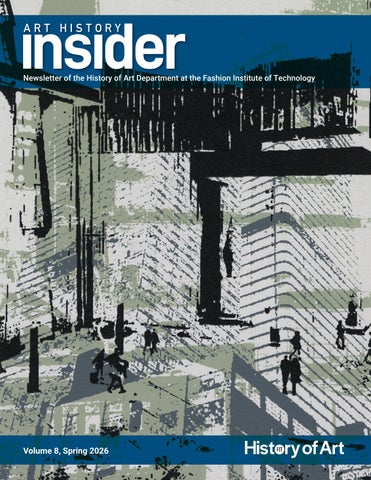
In honor of Professor Turnbull’s retirement, we’ve chosen an original artwork of his for the cover of this year’s issue.
10 Fashion History Club Revived 12 Daring to Speak Its Name: Memories from the Art Market Program 16 On Seashells and Sanctuaries and Good Gardeners, Guardians and Friends at Persepolis 19 A Semester in Paris 20 Art History Moments 2025-2026 28 About / Contact Us
Top: Nanja Andriananjason The Bull 2026 Ink and Promarkers on marker paper 8 x 8 inches Right: Richard Turnbull Cityscape III 2022 Silkscreen print 9.5 x 7.5 inches
3
NEWS FROM THE ART HISTORY AND MUSEUM PROFESSIONS PROGRAM
PROFESSOR KYUNGHEE PYUN ASSISTANT CHAIR, ART HISTORY AND MUSEUM PROFESSIONS
What a whirlwind!
Completing my first semester as assistant chair of the Art History and Museum Professions (AHMP) program has been a joy.
As I look back on the 2025–2026 academic year, I am struck by the energy, creativity, and intellectual rigor our students and faculty bring to this department every single day. Let’s thank Professor Alexander Nagel who for five years served as program chair with dedication and a sense of humor.
Back on campus, we celebrated Alexa Bonacci, the winner of the AHMP Bachelor of Science Medal from the School of Liberal Arts and Sciences. Alexa’s hard work was further recognized as she secured the 2025 George T. Dorsch Endowed Scholarship for her upcoming projects. The future of the field is bright with leaders like these at the helm!
Exhibitions and Events Undoubtedly, the highlight of our spring was the AHMP 20th Year Anniversary Symposium on April 13 [fig.1]. Organized by Isabella Rasch, it was a beautiful moment to reflect on two decades of growth while looking forward to the next twenty years of innovation.
The AHMP class of 2027, who began the program last fall, is the first to experience our refreshed curriculum. Under the guidance of Professor Nagel, the Professional Practicum for Art Museums and Galleries (MP 307) made its debut, bridging the gap between theory and the high-stakes professional world. Additionally, this spring, we launched the course Collections Management and Care (MP 363), a crucial addition that provides a foundation in art and museum collections management systems, including aspects of the care of and access to collections and storage.
Student Awards
That innovation was on full display throughout campus. Our student curators brought history to life through five exhibition projects: FIG. 1
Our students continue to win impressive awards! A huge congratulations to Isabella Rasch, who received the prestigious Museum at FIT Student Award at the David Koch Theater at Lincoln Center. Watching our own student honored during the Couture Council Luncheon—alongside Balmain’s Olivier Rousteing— was a moment of immense pride for us all. 4
FIG. 2
FIG. 3
• Faith Piñon, Isabella Rasch, and NirVana Rizvi collaborated together on Take Me On: Global Street Dress 1980–2000 at the Gladys Marcus Library [fig.2]. • NirVana Rizvi curated the evocative Objects Travel in the new Joyce F. Brown Academic Building. • Kelsey Scarlett, Samantha Steele, and Katherine Imperial helped organize the Barneys Oral Histories symposium. • Madeline (MJ) Day took us back in time with Ancient Animations: Creative Times with Ancient Seals. • Finally, Professor Andrea Vázquez de Arthur and her Senior Seminar students explored Indigenous American visual culture in the Feldman Center exhibit Art from Art History [fig.3]. In addition to curating, AHMP students led global conversations this past year. From the ongoing Globally Connected @ FIT virtual lecture series with Tianjin Normal University [fig.4] to the oral histories of Barneys New York event organized by Professor Maria Chammah [figs.5-6], our students proved they are world-class researchers. I was particularly inspired by NirVana Rizvi, Sophie
Hodges, and James Pantano, who tackled cutting-edge topics on the ethics of AI and art history at Creative Futures: The 2026 FIT Symposium on Art, Humanity & AI [fig.7]. Furthermore, FIT was well represented at the SUNY New Paltz Undergraduate Art History Symposium, where Finn Shehan, Alexa Bonacci, and Meribelle Halsema presented sophisticated FIG. 7 papers on topics ranging from American censorship to the cult of Artemis and even the costumes of Star Wars character Padmé Amidala!
Future Forward From our dedicated facilitators at the Museum at FIT, to Kelsey Scarlett’s research fellowship at the Gladys Marcus Library, the AHMP spirit is everywhere. Thank you to our faculty, students, and staff for making my first year as chair so unforgettable. AHMP is more than a program, it’s a community. ▪
Here’s to another year of making history!
P H O T OS: V I S U A L R ES O U R CES
FIG. 4
FIG. 6 FIG. 5
5
History of Art at FIT: A Timeline MOLLY SCHOEN, VISUAL RESOURCES CURATOR
In honor of the twentieth anniversary of the Art History and Museum Professions major, here’s a look back on the development of history of art curriculum at FIT. Information on these events was gathered from past course catalogs, yearbooks, and archival materials, as well as from the recollections of current faculty.
1961
A new course, Modern European and American Art, was the first distinct art history class at FIT. Two broader courses on the history of civilization, which incorporated some art history curriculum, were already part of FIT’s liberal arts course offerings from the earliest days of the college.
1977
A 35mm slide library opened in room B650, primarily serving History of Art and Graduate Division faculty. By its peak in the mid2000s, the library contained over 115,000 slides. Global in scope, the collection included images of art from the prehistoric to the contemporary era; it also featured visual resources in the subject areas of costume, textiles, and photography.
1989 2001
Professors Steven Zucker and Beth Harris taught the department’s first-ever online courses: History of European Art and Civilization: Renaissance to the Modern Era (HA 112) and Modern Art in Europe and North America (HA 231).The online sections were so popular that additional sections were added for Fall 2002.
2002
Professors Katherine Michaelsen and Steven Zucker submitted a proposal for what would become the Visual Arts Management major program, now called Art History and Museum Professions.
2004
The FIT Digital Image Library (FITDIL) website first launched, signaling a technology shift from 35mm slides to digital images in classroom projections. Twenty-two years later, the Art History Collection on FITDIL now comprises over 67,000 high-quality art images accessible to the FIT community.
2004
The department’s first annual George T. Dorsch Endowed Scholarship for students and the George T. Dorsch Endowed Fellowship for adjunct faculty were given. These awards were established with funds bequeathed to the HA Department by Professor Dorsch.
2004
The HA Department held its first annual conference, Small Tools/Big Ideas: a Conference on the Discipline-Specific Technologies Reshaping the Practice of Teaching Art and Art History. In 2005, more than 185 professionals from over 75 institutions attended the second annual conference.
2005
Beth Harris and Steven Zucker launched the web platform Smarthistory, now considered the “most-visited art history resource in the world.”
2005
The new Visual Arts Management major program began. It was the first bachelor’s degree offered within FIT’s School of Liberal Arts (now the School of Liberal Arts and Sciences). The first cohort consisted of seventeen students.
2009
Professor Andrew Weinstein initiated the lecture series ARTspeak, a collaboration between the History of Arts and Fine Arts departments, which continues to this day.
2011 2015
2016
Fall 2011: The Visual Arts Management program was renamed Art History and Museum Professions (AHMP).
Organized by Professor Kyungee Pyun, the multi-year lecture series Primary Sources in Costume/Textile History began.
2016 6
History of Art (HA) became a distinct department; previously, it was part of the Social Sciences Department. The department’s first chairperson was Professor George T. Dorsch (1936–2000), who served from 1990 to 1994.
Professors Lourdes Font and Justine De Young established the Fashion History, Theory, and Culture minor (previously known as Fashion Studies).
Justine De Young and Lourdes Font won a Digital Resources for Art History Grant for the Fashion History Timeline. In 2018, they won a second grant.
2017
Kyunghee Pyun was awarded a SUNY Innovative Instructive Technology grant (IITG), allowing AHMP students to travel to Japan as part of a research team. Grant funds also went toward Pyun’s Bamboo Canvas web platform, including a conference on the project.
2017
Spring 2017: Justine De Young founded FIT’s Fashion History Club.
2018
The website for Professor Anna Blume’s Archaic Bannerstone Project launched. The web platform is a resource for the study of the aesthetically complex lithics known as bannerstones made by Indigenous North Americans thousands of years ago.
2018
Funded by a grant from the National Endowment for the Humanities (NEH), the multi-departmental project Teaching Business and Labor History to Art and Design Students led to the creation of new curricula for art and design students on the history of working as an artist or designer. The project’s directors were Professors Daniel Levinson-Wilk (from Social Sciences) and Kyunghee Pyun.
2018
After launching internally at FIT in 2015, Professor Justine De Young's Fashion History Timeline launched its public website. The event was commemorated with a symposium.
2019
Fashion History Timeline won an SUNY Open Education Resources Grant.
2019 2020
The first issue of Art History Insider, the annual newsletter of the History of Art department, was published.
The @ahmp_fit Instagram account published its first post.
2021
Professor Alex Nagel and AHMP student John Paul Jang (‘22) start the Art History and Museum Professions Association (AHMPA) student club.
2021
The first annual AHMP x MFIT (Museum at FIT) internship was offered.
2021
The Morgan Library & Museum initiated a recurring collaboration with AHMP for the Morgan’s annual College Night event.
2021
Kyunghee Pyun was awarded a second NEH grant to FIT. The $150,000 award went toward creating interdisciplinary curricula and teaching resources in a project entitled Shop Girls to Show Girls: Teaching Resources on New York’s Working Class for Community College Students.
2022
AHMP launched a student exchange program with the University of York, UK.
2022
The Art History Insider blog was created.
2022
AHMPA won Best New FIT Student Club at the Annual Leadership and Club Awards Gala; Alex Nagel received FIT Student Leadership Award as Club Advisor of the Year.
2023
Professor Natalie Nudell’s Fashion Calendar Research Database launched. The FCRD is an ongoing collaboration between the History of Art Department and the Gladys Marcus Library’s Special Collections and College Archives, supported by a grant from the Council on Library and Information Resources.
2023
AHMP students curated Claire McCardell: Practicality, Liberation, Innovation at The Museum at FIT (MFIT). The exhibition was favorably reviewed in Women’s Wear Daily.
2023
Natalie Nudell organized the symposium Archiving Fashion: Mapping Fashion and Textile Collections.
2023
AHMP students joined forces with MFIT in a collaboration with LASALLE College of the Arts in Singapore for the Cross-Pollination series of MFIT exhibition spin-offs.
2024
The National Association of Schools of Art and Design (NASAD) accredited the AHMP program.
2025
With a second SUNY IITG award, Kyunghee Pyun organized a SUNY faculty seminar entitled Instructional Technology for Human-Centered AI: A Multidisciplinary Collaboration.
2026
Fashion History Timeline received a $100k grant from Ruth Ann Harnisch Foundation.
7
A Conversation with Isabella Rasch ASSOCIATE PROFESSOR JOSÉ BLANCO F.
I met Isabella Rasch my first week teaching at FIT; she was in my course HA 237: Global
Fashion last year. The students I met during my first weeks here were incredibly generous
sharing knowledge about the college. That is one of the many reasons I was thrilled when I heard Isabella received the 2025 Museum at FIT Student Award, which goes to a student who embodies the commitment to excellence in museum practice and public service.
I met with Isabella in February of 2026 to chat about her experience and what it meant to receive this honor.
JOSÉ: You received the 2025 Museum at FIT Student Award. Congratulations! I want to start by asking the same question people that are nominated for an Oscar get: How did you find out about getting the award? Where were you? ISABELLA: I was in Florida visiting my grandmother… she is 95 years old. I found out via email and called my mom right away. I was in another room, and I was celebrating and my grandmother got scared. She was like, “What's wrong? What's wrong?” I told her that I won this award and she did not understand, she did not get it… and I was like I won this award and it's a really big thing and she then started to understand it once I explained to her. Then she asked me: “Wow, what did you do?” JOSÉ: Well, that is one of my questions, but first I wanted to know how it felt to win the award. ISABELLA: I was really surprised, mostly because the other facilitators—your fellow facilitators—vote for each other. Some of the facilitators were very strong, so I was really surprised. But I also am very confident in my own abilities, and I wasn't completely shocked because I knew I had done a good job. JOSÉ: So… I'm jealous you got to go to that luncheon… ha ha. Seriously, I am very happy that you were recognized at the Couture Council Luncheon where Olivier Rousteing, then creative director at Balmain, was honored with the 2025 Couture Council Award for Artistry of Fashion. ISABELLA: I brought my mom with me because she’s never been to any event like this, and I haven’t, either. I searched for pictures of the event from last year when Jacquemus was there and… I’m just like… it’s going to be me there this time. I was so nervous but also, I felt really calm because Frida [Mckeon Loyola] and Tanya [Meléndez8
Escalante] and the staff from the museum were there. Tanya was really great, she’s always great. She was really a good guiding force during the event and made sure I was in pictures with Olivier Rousteing and every other person. It was awesome. I met some really great people. Ruben Toledo… oh my god… and he talked with me a lot because he’s Cuban and so am I. JOSÉ: I remember the photo where you and Ruben Toledo are seated at the same table. ISABELLA: Yes, he was on my table, and my mom was talking to Ruben so much. There were a lot of very nice people at that table. I mean, I've met some cool people in my life but that's like a different level. JOSÉ: Were you nervous? ISABELLA: No, I can talk to anybody… sometimes when you're around a crowd of people who are so much older than you, people who have all these achievements, you worry about what you are going to talk about and how you can relate to each other because you’re so young and new to this entire industry. But I wanted to make sure I was talking to everyone, that I was picking their brains enough and learning about their experience. JOSÉ: You also had to give a speech. I read on the museum’s website a quote from your speech about how museums have always been a utopia for you, but also a place that you leave feeling fulfilled, excited, and liberated. ISABELLA: In one of our first classes in the Art History and Museum Professions program, we talked about the museum as a utopia. My mom studied fine arts, so I have been interested in museums since I was a baby. But one of the things that I realized after high school here in the city was that I really liked spending time alone, and museums are one of the best places to be by yourself… granted it’s great to go with other people, but when you are alone you really think about the art through your own eyes and… it becomes this utopia for you
that also lets you be free in your own thoughts. I mean to look at artwork and see myself in it, or not see myself in it. I get emotional about art; it is fulfilling to go to a museum and leave feeling like it actually impacted me in a way that I won’t forget. For example, there are specific artists I've never seen before, like Cecily Brown. I saw Cecily Brown at the Met, and I have been obsessed with her ever since because her art made me feel something different. JOSÉ: I understand. When I go to a museum, I need more of the feeling of the whole gallery or a whole painting, but my husband loves details, and then we are each on our own thoughts, as you say, experiencing the art in different ways. ISABELLA: Yes, we all have different perspectives. Don’t get me wrong, I love going with other people and hearing other perspectives. Yes, itʼs utopia when you’re alone but it’s a utopia when you are with someone else too. JOSÉ: I teach the Art and Social Justice in New York class (HA 246), and when we are at a museum, my students are always telling me about all these things they notice that I don’t! ISABELLA: Yes, it’s amazing. And I’ve learned that because contemporary art has been especially hard for me. I’m very classically oriented, but one of my friends really likes and understands contemporary art and tells me things that I could never see on my own. JOSÉ: Can you tell me what were your duties at the museum? What did you do? ISABELLA: For me it involved greeting guests and making sure they knew where to go and what they were seeing. I would make conversation with people to make them feel welcome. It was nice being the guiding force to start off their experience. And then, asking how their experience was, what they thought. I would then give the museum staff feedback of what people had said.
JOSÉ: Okay, so I have a final question. You are about to graduate, so whatʼs going to happen now? What are your plans? ISABELLA: I donʼt really know. Well, I mean, the beauty of the Art History and Museum Professions major is that there are so many options… it’s been hard for me to pinpoint where I’m going to go. I do have an interest in galleries and auction houses. I’m hosting the Art History and Museum Professions 20th Year Anniversary Symposium, and I know that Iʼm good at planning too. JOSÉ: Like special event planning? ISABELLA: Yes, I’m really organized so I'm hoping that could maybe lead to something but… I also have an interest in collections and working as a registrar. This is what I mean like, I love all these things so it could go in any direction. JOSÉ: It's good to have all the options open. I know you work retail, which is good training too. People sometimes suffer working in retail but it forces you to… ISABELLA: …to talk to people, and I made one of my most amazing connections with someone from the field that I met working at the store. JOSÉ: I am glad to hear that you are keeping so many options open. ISABELLA: Yes, I was recently even thinking about historical preservation. I don’t even know if I want to stay in New York. I would love to leave, but I love it here so much. It’s this place I’ve grown up in for most of my life… but there is so much out there that you don’t see if you stay here. JOSÉ: But you could always come back to New York. ISABELLA: Yes, you can always come back!
JOSÉ: This is nice and it connects to your idea of the utopia and learning from other people’s experiences. Did you enjoy doing that? ISABELLA: Yes, I like to talk! JOSÉ: Me too! I like to talk but only when I know that other people want to talk! ISABELLA: Thatʼs also part of it! Itʼs like reading people because some of these people, they have their headphones on and they just say hi… or… they don’t say hi. They just want to go see the show and you have to be okay with that.
ISABELLA: Just to be confident and open, open to interactions. Make sure you are helpful and comfortable talking to people and giving them guidance, because sometimes that’s all people really want. Pay attention to the people that come in, pay attention to the people that you work with and are guiding you. It is really important to soak it all in because there is a lot to learn.
PH O T O : S MI L J A N A PE R O S / FI T
JOSÉ: What advice would you give to other students interested in this opportunity?
9
Fashion History Club Revived! LIV ELNISKI, INTERNATIONAL TRADE AND MARKETING ‘26 During the Fall 2025 semester, a dedicated group of students revived the FIT Fashion History Club after a multi-year hiatus. We collectively planned and executed seventeen fashion history-focused educational events across the fall and spring semesters. The club’s programming spanned a diverse and engaging range of guest speakers, and we are excited to share some of the highlights from this academic year!
On November 4th, in collaboration with the Black Student Union, the Fashion History Club co-hosted a presentation by fashion historian Jonathan Michael Square titled “We Can be Anything We Want: The Trailblazing Fashion of Trans Pioneer Mary Jones.” The talk discussed Jones’ commitment to her feminine self-presentation and gender expression despite criminalization and repeated imprisonment. Through Dr. Square’s scholarship, attendees were reminded that fashion history is inextricable from radical queer memory, and that Jones’ wardrobe—as well as those of others—are tangible records of resistance and self-making in the face of repression. On February 26th, the club welcomed art and dress historian Wafa Ghnaim, who presented “The Thobe as Biblical Fantasy:
The Origins of Palestinian Dress Collections in American Fashion Museums.” Members examined the Orientalist frameworks that have shaped museum collecting practices, often positioning Palestine and its people in biblical abstraction rather than in lived, contemporary reality. Centering Palestinian women’s dress, the lecture traced how these garments entered Western fashion collections and emphasized the ever-urgent need for fashion scholarship on communities that remain underrepresented in fashion studies, museums, and academia.
and Museum at FIT employee Raissa Bretaña explored the classic Hollywood costume design by Gilbert Adrian in The Women (1939). Dress historian Nico Frederick examined the rich history of sapphic vampire costuming on-screen through The Hunger (1983). Organizing these programs for our peers, Fashion History Club e-board members gained valuable experience in event planning, developed meaningful connections with scholars in the field, and deepened their commitments to engaging critically with fashion history. We look forward to seeing how the incoming e-board will continue to grow and shape the organization in the coming years!
The club’s Spring 2026 calendar also included three film screenings, introduced by two graduates and one current student from FIT’s Fashion & Textile Studies MA program. Fashion historian Lucy Postal discussed the ahistorical, fantasy costuming in the television series Bridgerton. Fashion historian
FIT Fashion History Club 2025–2026 E-Board: Liv Elniski (International Trade and Marketing ‘26), President & Director of Programming Meribelle Halsema (Art History and Museum Professions ‘26), Vice President Sophie Schreiber (Fashion Design ‘26), Secretary & Social Media Manager Anika Sud (Communication Design AAS ‘26), Treasurer & Graphic Designer Associate Professor Justine De Young, Faculty Advisor 10
In August 2025, Professor Justine De Young published her first monograph, The Art of Parisian Chic: Modern Women and Modern Artists in Impressionist Paris (Bloomsbury Academic), based on more than 15 years of research. Using artworks by Berthe Morisot, Édouard Manet, Claude Monet, Pierre-Auguste Renoir, and others, the book explores how women and artists in Impressionist Paris (1855–1885) crafted their public images to exploit and resist stereotypes. French societal expectations and beauty ideals shaped how women were seen and how they chose to present themselves in public – whether on the street, in a photograph, or in a portrait on the walls of the annual Paris Salon. Looking at a rich array of visual sources – from portraits to modern-life paintings, and from photographs to fashion plates – De Young reveals how women were seen, how they aspired to be seen, and how they navigated public life in Second Empire and Belle Époque Paris. The book considers how fashionable feminine “types” made famous in books, caricatures, and paintings created a visual lexicon and stylistic guide for women. Men and women alike relied on these types – cocotte (mistress), jeune veuve (young widow), amazone (independent equestrienne), demoiselle de magasin (shopgirl), and Parisienne (chic Parisian woman) – to judge the class, character, morality, and worth of strangers.
Library Exhibition: Part Two
PHOTOS: VISUAL RESOURCES
In early 2025, Art History and Museum Professions students taking MP 307: Professional Practicum for Art Museums and Galleries created the exhibition Social Responsibilities of Museums: Part 2 (May 19–August 24, 2025, extended to September 15, 2025). Advised by Professor Pyun and Professor Laciste, students installed the exhibition on the fourth floor of the Gladys Marcus Library. For this exhibition, students interviewed museum and gallery professionals based in New York City to discuss their respective roles and responsibilities with respect to the public and to the people, communities, and cultures they represent. Students worked in teams to select quotations from the interviews, choose relevant books reflective of the quotations, create display materials, and install the exhibition.
11
Daring to Speak Its Name: Memories from the Art Market Program ASSOCIATE PROFESSOR MARIO VALERO
Professor Mario Valero, Acting Chair of the Modern Languages and Cultures department,
reflects on his art history education here at FIT and within the greater New York City area.
The newsletter team sincerely thanks Professor Valero for sharing his time and preserving the institutional memory of some of the History of Art department’s most influential former faculty members.
To all my professors
To Richard Martin with lasting admiration
I remember few details from that spring afternoon many years ago when Professor Richard Martin (1946–1999) interviewed me as part of the admission process to FIT’s Art Market: Principles and Practices graduate program. His round golden glasses caught the light as he tilted his head, complementing the soft tone of his voice. The natural shyness that distinguished him found its counterpoint in the enthusiastic vehemence with which he expounded his ideas in the classroom. The emphasis lay not in the tone of his voice—always moderate—but in his precise gestures and the seductive cadence of his words. Each class with Professor Martin was an extraordinary performance, a tour de force in drawing connections between apparently diverse areas of knowledge. As the expression goes, he was a “true Renaissance man.” Just two or three 35mm slides sufficed to expand our imagination beyond the classroom and across the ages. The same associative intelligence that animated his lectures was at work in the several exhibitions he co-curated with Harold Koda at the Museum at FIT. I still have the exhibition brochures of three memorable ones: Giorgio Armani: Images of Men, Splash! A History of Swimwear, and the exhibition devoted to Elsa Peretti’s jewelry designs. Each show applied the same method: reading fashion and design as cultural texts; as histories of the body, of gender, of aspiration. What I do remember clearly, though, was the moment when I walked out of “E” building (Goodman) into the afternoon light, elated by the confirmation of my admission. During the interview I had committed to completing at least eight additional art history-related courses to be admitted into the program. That promise was a sort of blessing: after two years in New York consumed by my immigration status, I could finally set it aside and willfully immerse myself in a subject I had long loved—one that I, after years of dealing in the financial markets back in Caracas, Venezuela, had scarcely dared to speak aloud by name. 12
Joining FIT was instrumental in shaping both my academic journey and personal growth. Being part of the Art Market: Principles and Practices program enabled me to transition from an earlier career in banking to one in teaching. I remain deeply grateful to Professor Martin, whose guidance made it possible to transform my life. Other professors in the program further inspired me with the excellence of their courses, which encouraged me to complete my MA at FIT and later dedicate myself to my PhD at Columbia and my future role as educator. The art history-related courses I had committed to taking—besides those required by the master’s program—were without a doubt the most interesting. I had never attended art history courses in college, but my enthusiasm overcame any possible hesitation. As my dear Professor Madormo would invariably close his lectures on Degas or Gauguin: “You either get it or you don’t!” —and I was getting it! If I listen carefully enough in memory, I would listen again to Professor George Dorsch’s tender tone of voice, a kind of tenderness that clothes genuine generosity. Taken during his trips abroad, the slides he used in his classes on Egyptian or Greek-Roman art and architecture were a staple of his passionate dedication to teaching. After taking his courses, I realized how mediated my perception of ancient art was and started appreciating Egyptian funerary art as a colorful celebration of life and human experience. I don’t remember well the course that I took with Professor Justin O’Connor, it was probably one on Manet and Impressionism. Rather shy and stern, he seemed to favor a more symbolic language of gestures. Yet his expression changed the moment an artist’s name or the title of a painting came up; he then offered comments of remarkable assurance and insight. I still keep a copy of the handwritten critical
bibliography on modern European and American art that he gave me following one of our after-class conversations. Working through that reading list was its own education: the joy of reading Friedländer’s David to Delacroix—David seeing through the lens of Caravaggio!—or the density of Leo Steinberg’s essays in Other Criteria: Confrontations with Twentieth-Century Art. All of it delivered a very particular, somehow secluded joy. My professor of pre-Columbian art, a tall gentleman whose name I regrettably forgot and who developed a particular liking for me—perhaps because I usually stayed a few minutes after class to ask him questions in Spanish—recommended that I take a course on the history of Mexican mural painting at CUNY Graduate Center with Professor Eloise Quiñones-Keber. (As a student of the master’s program, I was allowed to take courses at CUNY Graduate Center.) It was an unforgettable learning experience, as we moved through twenty centuries of Mesoamerican and Mexican art. Professor Quiñones-Keber, in turn, recommended me to take a course with Professor Edward Sullivan on Modern Latin American art that ignited my lifelong passionate interest in this field. In Venezuela, I had grown up with the privilege of frequently visiting the extraordinary collection of Latin American art at the Museum of Contemporary Art of Caracas. Although some of these professors are no longer with us, their personalities and idiosyncratic ways of sharing their knowledge will always be a beacon of my academic experience and, most importantly, of the life that I built up in New York. Although less drawn to the courses on museum and gallery management, I nonetheless learned my lesson well and loved the course on public art by FIT Professor Saul Wenegrat, who at the time was also director of the art program for the Port Authority. There is so much to discover about the notion of the “public” in a city like New York, learning empirically thorough field trips to study works in situ. He reshaped my understanding of public spaces by showing how a single work of art can alter the way people perceive and relate to a park, a plaza, a building lobby, or a passage through skyscrapers. Part of the course required work on the financial and legal aspects of such projects, a perfect occasion for my background in economics to serve an unexpected purpose: getting closer to classmates who came almost entirely from the art world.
In the first course, Professor Szabo offered us a window to the world of the collections of Isabella d’Este, Caterina Sforza, the Gonzagas, the Medici and of other legendary patrons from the Italian Renaissance city-states. At the Met Museum, I discovered the studiolo or little studio from the Ducal Palace at Gubbio commissioned by Federico da Montefeltro, Duke of Urbino, for his son Guidobaldo: those walls veneered with illusionistic intarsia, a true joy to the eye. It was worth taking the challenge of researching such a work of art and master craftsmanship for my final paper. In the second course, we learned how American collecting was born through the patronage of the Havemeyers, the Mellons, the Rockefellers, and others who brought the full weight of Gilded Age capital to bear on the art market. I was particularly attracted to more obscure names who, with fervor and acquired knowledge, amassed contemporary art collections of extraordinary quality, like Herbert and Dorothy Vogel, the “proletarian art collectors” of Pop art. Professor Szabo, like his fellow countryman György Lukács, sought historical patterns and ruptures from the aristocratic collectors of the Renaissance to the most organically formed of Pop art in the 1960s and 1970s. It was from Leo Castelli, whom I had the privilege of interviewing at his gallery on 420 West Broadway, that I first heard about the Vogels. I conducted our brief interview as part of my master’s thesis on the evolution of the Latin American Art Market in New York. Castelli accepted my request probably because I mentioned a previous interview with Marisol (1930–2016), the Venezuelan-American Pop-art icon. Castelli opened our conversation by mentioning that Marisol had been the first artist exhibited at his first gallery at 4 East 77th street back in 1957. He had considered it a good omen, and the artist became his personal idol. Marisol, however, abandoned him soon after to become part of the prestigious Sidney Janis stable. Sparing with her words, Marisol barely mentioned him when I had interviewed her. She preferred instead to recall the parties at The Factory, or her disappointment with the restoration of Michelangelo’s Last Judgment at the Sistine Chapel that seemingly turned the masterpiece into a decal. There is an essential frugality in her wooden portraits whose extraordinary craftsmanship is on full display in her Last Supper at the Met.
(continued on next page)
PHOTO COURTESY OF MARIO VALERO
Two courses on the art of collecting offered an unexpected entry point into the art world through the material and symbolic weight of possession: art as an expression of power, as a display of knowledge, or as an instrument for advancing a particular vision of society and the cosmos. 13
who possess it. Artworks have served the noblest of causes and the most criminal of purposes alike. The Art & Law courses centered on the legal and, by extension, the social and political implications of possessing and transacting with objects deemed artistic. Our professor, Barbara Hoffman, was at the time a contributing editor to Art Journal and brought legal and curatorial expertise to the classroom. For me it was like attending a philosophy course, from learning the essentially humane implications of copyright to discussing censorship and pondering questions of obscenity through Mapplethorpe’s Portfolio X. At the time, the National Endowment for the Arts had revoked grants to several artists and performers. An exhibition of Mapplethorpe’s photographs at the Corcoran in DC was cancelled because of fears of public controversy. I always looked forward to Professor Hoffman entering the classroom in her impeccable greige Calvin Klein suit and ruffled blouse, carrying her leather portfolio.
Being in the Art Market program demanded constant movement— from studio visits to galleries or museums and to the auction houses where I followed the Latin American art sales. It was a time of sales records at Sotheby’s and Christie’s, with Frida Kahlo’s work setting record prices for a Mexican artist. The excitement of watching the bidding one evening was unsurpassable, as was the ceremony when a renowned Colombian artist—whom I will not name here—was compelled by an auction house to destroy an unauthorized copy of his own work, a grand gesture that evoked the more radical Fluxus performances in the 1970s. From these evenings I also learned to be wary of auction house prices—luxurious pawnshops, as someone once aptly put it. The program implicitly required accepting that art was essentially marketing. Significantly, my first job related to the art market was for a large Japanese communications corporation buying at auction works on paper from the early 20th century School of Paris period, and I must confess I was not particularly skilled at securing the best prices.
A particular contrasting memory comes from my internship at a very reputable Upper East Side gallery specializing in American art. In the early 1990s, there was a clear demarcation among the contemporary art galleries on West Broadway, in SoHo, and others scattered around Madison Avenue. I was assigned to the shipping and handling department because I was bilingual in Spanish and most workers were Hispanic. I very much enjoyed relating to my coworkers and learning basic skills on handling paintings and sculpture. Shortly after, I was assigned to update the gallery’s archives. A radiant memory comes from the time I spent reorganizing the gallery’s correspondence. The names of some of the gallery’s clients sparkled in that dusty room in letters that gave me the key to enter into their intimacy. An uneasy feeling arose along with my curiosity reading formulaic excuses written by Hollywood celebrities, socialites, and known politicians to justify a delay in a payment, to keep an artwork longer or to request lowering a price or inflating it if the objective was to sell it. To me, it showed a keen sense of their vulnerability and, above all, their humanity. ▪
I also immensely enjoyed the research projects to determine the provenance of an art work, spending hours in a secluded room on the third floor of the New York Public Library’s venerable building looking at art books or slides in those prehistoric viewing machines, their metallic noise the only contrast to the room’s otherwise perfect silence! It was in that beloved room while working on my master’s thesis that I became more interested in the ethical dimension of trading artworks, in the act of creating a commodity, one of the most ineffable human experiences. Any artifact, artistic and otherwise, is like a messenger telling and retelling stories of those who possessed and traded it. Any artwork, regardless of its artistic quality, is subject to the fate of those 14
PHOTOS COURTESY OF MARIO VALERO
In our courses on appraisals, I was more interested in how African masks revealed fascinating conceptions of time than in how to distinguish a “fake” from an original. The instructor invited scholars on photography, on graphics—the collapse of the Warhol print market being a cautionary tale about treating artworks as pure commodities—and even on American colonial furniture. Appraisals became a more challenging subject. I received some humbling grades, but it was worth learning what, for me, was a fascinating field.
Since 2015, the Council of Fashion Designers of America has independently managed the CFDA Fashion Calendar, which is the official New York Fashion Week schedule. This collaboration integrates fashion show listings and data from the CFDA Fashion Calendar from 2015 to 2025 into the FCRD, ensuring that this
Objects Travel When I was tasked with curating a vitrine for the new Joyce F. Brown Academic Building here at the Fashion Institute of Technology, I was nervous. I had no experience with curation and having to represent the Art History and Museum Professions program made my stomach drop. But I gathered my nerves and everything I learned about curation and galleries and got to work. I was told that it needed to be about art history and include art made by students. That was the first obstacle. Many AHMP students are artists, but the topics we learn in our classes are often unrelated to our personal art journeys. I pondered on the theme for a while and thought to myself, many people have been making art since childhood, and people would appreciate seeing their own work on display. What seemed to be a perfect idea became difficult when I realized that it was summer time and many students were unavailable to provide anything. It was back to the drawing board. With my brain scrambling for ideas for a theme, a lightbulb went off above my head. Many of the items on display in large institutions such as the Metropolitan Museum or even the Museum at FIT are from their own large collections. That is when I had the idea that the faculty in the History of Art Department certainly would have artwork or other
open-source research tool continues to reflect the fashion and creative communities of the United States. Users can now access over 80 years of information and over 200,000 listings relating to the American fashion and creative industries, its diverse labor communities and its global scope. This digitized information can be used to trace the activities of brands, designers, and marginalized groups; it can be used to generate data visualizations, maps and more. Principal Investigator and Project Director Natalie Nudell (History of Art) and Co-Principal Investigator and Digital Lead Joseph Anderson (Gladys Marcus Library) continue to collaborate on the project and its future phases. The project upgrades were supported by funding from the CFDA ($10,000) and an advisory committee that includes: Steven Kolb, CEO and president of CFDA; Fern Mallis, president, Fern Mallis LLC; Jeffrey Banks, fashion designer; Bridget Foley, former senior editor, Women’s Wear Daily; Amy Fine Collins, contributor, Vanity Fair; Ivan Shaw, photo archive director, Condé Nast; and James LaForce, Laforce PR.
similar items that they use in their lesson plans. The hardest part—coming up with a feasible theme for this exhibit—was finally over. I call that the hardest part because everything else was easy: obtaining, documenting, and displaying the items, especially with support from the History of Art department. I was ecstatic by everyone’s enthusiasm and willingness to share objects from their personal collections. –NirVana Rizvi, AHMP ‘26
PHOTO: VISUAL RESOURCES
In November 2025, the second phase of the Fashion Calendar Research Database (FCRD) publically launched. Originally created in 2023 by the History of Art Department in collaboration with the Gladys Marcus Library, the FCRD is a research platform comprising data from American fashion shows dating back to 1941, when Ruth Finley began publishing the Fashion Calendar, a weekly trade publication. The FCRD and the Council of Fashion Designers of America (CFDA) have partnered on an ongoing initiative to ensure the preservation and accessibility of archival resources relating to New York Fashion Week and the fashion and creative communities of the United States. The Archiving New York Fashion Week: FCRD x CFDA collaboration brings the New York Fashion Week timeline to the present.
15
On Seashells and Sanctuaries and Good Gardeners, Guardians and Friends at Persepolis ASSOCIATE PROFESSOR ALEXANDER NAGEL This past sabbatical year of research and travel reminded me that archaeology is not only about monuments, empires, and famous historical figures. It is also about plants, water, small objects, and the many people who interact with landscapes over time. Archaeological sites are not only built environments; they are also natural environments shaped by human activity, memory, and interpretation. My projects on Persepolis in Iran and on cave sanctuaries on the western Greek mainland both demonstrate how small finds and natural environments can transform the way we think about the world.
Angeles, and other locations, and I was fortunate to identify additional traces of ancient paint on several fragments. Pigments were not the only reason I needed time away from teaching to conduct research, however. Over the past few years, I became increasingly interested in other materials that had left the site of Persepolis, materials that were not monumental sculptures or architectural fragments, but smaller objects and environmental materials that might tell us different stories about ancient life.
The sabbatical year also took place during a difficult moment in global politics. As conflicts intensified in West Asia in early 2026, following sanctions which had already affected cultural exchange and research for many years, many people around the world were reminded how closely culture, history, and politics are intertwined. In such moments, it is worth asking: what does art history or archaeology have to do with the present world? For me, the answer lies in caring for the people who care both for cultural understanding and for long-term human histories that connect people across regions and time periods. During my sabbatical in 2024 and 2025, I was invited back to Tehran, a city of more than twelve million people, in many ways comparable to New York City. Tehran is a city of extraordinary culture, poetry, art, and education. It is a city shaped by migration and global connections, home to people from many regions including Afghanistan and elsewhere—it also has a way more modernized and beautiful subway system than New York City. In Tehran, I received a prestigious award for a monograph I had written, Color and Meaning in the Art of Achaemenid Persia, on modern research on color on the monuments of Persepolis and Susa. This recognition was deeply meaningful after many years of research on ancient pigments and painted surfaces. My sabbatical year included a residency at the Center for Advanced Study in the Visual Arts at the National Gallery of Art in Washington, D.C., and it also allowed me to travel to museums and collections that hold fragments from Persepolis. For more than twenty years, I have studied traces of paint on stone fragments from Persepolis and Susa, trying to reconstruct the original colors of these monuments. During this sabbatical year, I was able to study fragments in Scotland, Los 16
From fall 2024 to spring 2025, I traveled, conducted research, and visited museum collections in several countries. While much of my work over the past twenty years has focused on pigments and color on the monuments of Persepolis and Susa, this sabbatical allowed me to explore a different question: what other materials left this archaeological site, and what can they tell us about ancient life, religion, and environment? Alongside my pigment research, I began focusing on small finds and environmental materials, especially shells, plants, and landscapes. The history of Persepolis is usually told through its monumental architecture, royal inscriptions, and imperial imagery. We think of kings, palaces, reliefs, and imperial ceremonies. However, my recent research invites us to see the site differently—not just as a political and ceremonial capital of the Achaemenid Empire, but as a landscape
shaped by plants, water, animals, and the people who studied and interpreted the site over time. By examining the archives of Ernst Herzfeld, a German archaeologist who worked in Persepolis in the early twentieth century, we can understand how nature itself can be seen as an archive, preserving stories about ancient environments, religious practices, and cultural exchange. Herzfeld was not only interested in architecture and inscriptions; he was deeply fascinated by the natural environment surrounding the ruins. In his diaries and letters, he described gardens, flowers, rivers, and trees with great enthusiasm. He collected botanical specimens, photographed plants, and carefully documented the natural setting of ancient sites. One of Herzfeld’s most unusual projects was the creation of a garden at Persepolis in the early 1930s near the excavation headquarters. This garden included both local and imported plants and was designed to integrate nature with archaeology. The garden reflected Persian traditions in which gardens symbolized paradise, water, and order in the landscape. At the same time, the garden also reflected
a sanctuary area north of the Persepolis terrace. These shells were largely ignored in early excavation reports because archaeologists at the time focused mainly on monumental architecture and inscriptions. Today, however, these shells are understood to be extremely important. They may provide evidence for ritual practices, trade networks, and religious beliefs connected to water and fertility. Inscriptions found in this sanctuary mention both Greek and Persian deities, including Artemis and Anahita. This suggests a syncretic religious environment in which Greek and Persian religious traditions were blended. Both Artemis and Anahita were associated with water, fertility, and healing, and shells may have been used as ritual offerings to these deities. In many ancient cultures, shells symbolized water, fertility, abundance, and divine power. The shells found at Persepolis may therefore have been votive offerings placed at the sanctuary as part of religious rituals. The presence of shells at Persepolis also indicates long-distance trade networks, since many shells would have come from the Persian Gulf or other distant regions. This demonstrates that Persepolis was connected to wider trade and cultural networks across the Achaemenid Empire and beyond. Small objects like shells therefore provide important evidence for economic exchange, religious practices, and cultural interaction. A major conclusion of this research is that archaeology must move beyond its traditional focus on monumental architecture and spectacular objects. Small finds— such as shells, plant remains, seeds, and organic materials—are just as important for understanding ancient societies. These materials reveal how people interacted with their environment, how they understood nature, and how religion, ecology, and daily life were interconnected.
Western scientific and botanical collecting practices of the early twentieth century. Herzfeld corresponded with botanical institutions and seed collectors abroad and sent plant specimens from Persepolis to institutions in New York and Washington, D.C. These botanical collections still exist today in museum and herbarium collections. However, this scientific approach also had limitations. Early archaeological work often ignored local ecological knowledge and local understandings of the environment. Today, scholars recognize that archaeology and environmental history must also consider local knowledge systems and traditional relationships between people and nature. Another important part of this research focuses on a surprising archaeological discovery: mollusk shells found during excavations at
This approach also connects to my ongoing work in Greece. Since 2003, I have been working in the region of Aitoloakarnania, where we are studying a Classical cave sanctuary near one of the largest rivers in ancient Greece. Excavations there began in 2017. Together with colleagues from the Greek Ministry of Culture and several students, we are studying ceramics, terracotta figurines, bones, and other materials from the cave. Cave sanctuaries in Greece were often associated with water, fertility, and the underworld, and some caves were even called “Drakaina,” meaning dragon or serpent, suggesting that people believed these caves were powerful sacred places. Interestingly, there are parallels between the shells found at Persepolis and materials found in Greek sanctuaries and river sites. Around the world, people collected shells and objects from rivers and seas and used them in rituals, offerings, and symbolic practices. These materials connected water, fertility, trade, and religion across many cultures. (continued on next page) 17
Students’ involvement in this research included independent study projects that helped to analyze materials and develop illustrations of the finds and sites. These collaborations show how archaeological research is always a collective effort involving scholars, students, illustrators, and specialists in different fields. Ultimately, this research changes the way we think about famous archaeological sites like Persepolis. Persepolis is not only a site of kings and palaces, but also a landscape of gardens, rivers, plants, animals, and rituals. Its history is written not only in stone reliefs and monumental architecture, but also in seeds, shells, water, and gardens. By studying archives, landscapes, and small finds together, we can better understand ancient environments, religious practices, and cultural exchanges. Archaeology, therefore, is not only about the past; it is also about how we understand relationships between people, nature, and cultural heritage today. ▪ FIG. 1 – TEHR AN, MARCH 2026. PHOTO: A. NAGEL FIG. 2 – TEHR AN, SIDESTREET MUR AL, MARCH 2026. PHOTO: A. NAGEL FIG. 3 – DR AWING OF SELECTED SHELL SPECIMENS EXCAVATED AT PERSEPOLIS IN IR AN. PHOTO: A. NAGEL © UNIVERSIT Y OF CHICAGO, ISAC. FIG. 4 – SHELLS EXCAVATED IN THE MASTRO CAVE IN AITOLOAK ARNANIA IN GREECE. PHOTO: A. NAGEL © EPHOR ATE OF PALEOANTHROPOLOGY AND SPELEOLOGY, GREECE
18
A Semester in Paris CHLOE LABEL, AHMP ‘27
This semester, I have had the privilege to study abroad in Paris as an exchange student at École des Métiers de la Culture et du Marché de l'Art (ICART), the first European school entirely dedicated to careers in the arts. The experience has been deeply rewarding academically and personally, as I have been able to immerse myself in the rich art scene in Paris and explore the art and culture of other European cities in my spare time. Taking a semester abroad was the best decision I could have made at such a pivotal time in my life because it has shown me ways of life beyond the United States that have left me feeling inspired and excited for my future. At ICART, I have met both exchange students from around the world and native Parisians whose friendship I will treasure for the rest of my life. I will return to FIT with an international network of peers whom I plan to stay in touch with as I begin my career in the art world and hopefully continue to travel as much as possible. Prior to studying abroad, I served as the president of the Student Activities Board (SAB). I was honored to accept the Pivotal Leadership Award at the 2026 Leadership and Club Awards Gala for my involvement on campus. My experience with the SAB has enriched my time at FIT by helping me develop my skills as a program coordinator and leader and by giving me the platform to make positive changes on campus. Through the SAB, I have organized student art shows, drag shows, and other art and cultural events that I am deeply passionate about and proud to have been a part of. My involvement on campus has given me a solid foundation, and my time abroad has expanded my world view. Both experiences have been fundamental to my personal development and will help me as I embark on my career in the coming years.
View of the Eiffel Tower from my apartment
PHOTOS COURTESY OF CHLOE L ABEL
While abroad, I am keeping photo and written journals to document and absorb everything I can, so I can bring these lessons and experiences back with me to New York for my final year at FIT. I am looking forward to returning to campus with fresh inspiration and energy from my time in Paris to continue to contribute to the FIT community next year.
My photograph of Psyche Revived by Cupid's Kiss (Antonio Canova, 1787) at Le Louvre
59 Rivoli, my favorite atelier to visit in Paris
19
Art History Moments 2025–2026 JENNIFER MIYUKI BABCOCK was invited to speak at five events over the past academic year, for the FIT Writing and Speaking Studio, for FIT’s Globally Connected lecture series, for both the national and North Texas chapters of the American Research Center in Egypt (ARCE), and for the ARCE Library Book Club. In June 2026, her essay “A Feline-Hare Hybrid from Deir el-Medina” will be published by the Hellenistic Institute of Egyptology.
In 2026, two books authored or edited by JOSÉ BLANCO F. were published. He wrote Global Perspectives: Dress and Fashion in the 20th and 21st Centuries, and he co-edited The Intellect Handbook of Men’s Fashion, for which he also wrote a chapter. Additionally, he was an invited speaker for events at the Universidad de Puerto Rico en Arecibo, at the Bard Graduate Center in New York, and here at FIT. History of Art Department Chair ANNA BLUME will continue to study spider web and argonaut octopus shell aesthetics and structure as part of an invited fellowship at the Kunsthistorisches Institut in Florence, Italy, from May–June 2026. Their essay “Maya Cloud Forests and Muybridge Photographs: A Study of Root Memory and the Optical Unconscious” will be published later this year in the journal RES: Anthropology and Aesthetics. In April 2026, JUSTINE DE YOUNG received a SUNY Chancellor’s Award for Excellence in Scholarship and Creative Activities and 20
MARIANNE EGGLER led tours of the Metropolitan Museum of Art with Context Travel; she also taught two classes at SUNY Purchase College.
an FIT Faculty Excellence Award. Her book The Art of Parisian Chic was published in summer 2025, and she taught a course on the same topic for a Winter Study seminar at Williams College in Williamstown, MA. She contributed two chapters to the exhibition catalogue Amazons! Horsewomen and Fashion Icons, published by the Musée de la mode et du costume in Arles, France. In addition to being a keynote speaker at the Dallas Museum of Art, she also spoke at events hosted by the Fine Arts Museums of San Francisco, the Preservation Society of Newport County, the Fenimore Art Museum, and the Getty Research Institute. Further, she presented at the the International Nineteenth Century Studies Association biennial conference, the Feminist Art History conference, and the Nineteenth Century French Studies Association Unbound conference. Here at FIT, she co-organized a From the Rez to the Runway book talk with author Christian Allaire, and she led a conversation on The Art of Parisian Chic with Hilary Davidson, Chair of FIT’s MA in Fashion and Textile Studies program, for a Fashion Cultures event. DAVID DROGIN wrote a book review, “The Man Who Broke Michelangelo’s Nose, by Filipe Pereda,” for the Sixteenth Century Journal. He gave a presentation and moderated a session for the Sixteenth Century Society annual conference, and he organized a session sponsored by the Italian Art Society for the Renaissance Society of America annual conference.
MINJEE KIM spoke at seven scholarly events. These included the 9th International Association for the Study of Silk Road Textiles Conference at the University of California, Berkeley; the Politics of National Costumes in Asia workshop at the College of the Holy Cross in Worcester, MA; the Fashion Humanity Lecture Series at the Daegu Textile Museum in South Korea; the Reframing Heritage symposium at the Peabody Essex Museum in Salem, MA; a Fashion, Costume, & Culture course at the University of California Los Angeles; a Korean Studies Group talk at Columbia University in New York; and an invited lecture with The Korea Society in New York. At Utah State University, KRISTEN LACISTE was an invited speaker for the Communitas lecture series and gave a talk on Malian photography to a class. She also participated in a webinar series of the Arts Council of the African Studies Association with a presentation entitled “African Art in the Age of Artificial Intelligence.”
Edited by KENNA LIBES, the book Fashion’s Missing Masses: The Representation of Marginalized Populations in Collections and Exhibitions of Dress was published in January 2026. She is also the recipient of the 2025–2026 Bard Graduate Center’s Dissertation Writing Award and published the article “Plus-sized Patternmaking as Historic Dress Scholarship,” for the online Bloomsbury
Dress and Costume Library. She presented at the 3rd Annual Philly Fatcon, the 16th International Conference on the Image in Paris, and the 51st Annual Costume Society of America Symposium in Los Angeles. Additionally, she was a guest speaker for a class at Parsons School of Design. PAUL MELTON co-chaired two panels at the College Art Association conference: “Speculating on Value: Financialization in Contemporary Artistic Practice” and “Numbers in the Dark? Quantitative Aesthetics and the Future(s) of Art / History.” Additionally, he presented a paper, “El retrato del artista como reality star: Meritocracia, autenticidad, y celebridad en el mundo del arte contemporáneo” for an international conference on the art market at Nebrija University in Madrid, Spain. ALEX NAGEL, recipient of a 2026 FIT Faculty Excellence Award, published an essay on the Smithsonian Institution’s plaster cast collections of ancient West Asian monuments in the Journal of Eastern Mediterranean Archaeology and Heritage Studies. With colleagues from the Hellenic Ministry of Culture in Athens in Greece, he presented new archaeological research on caves at a conference in Frankfurt in Germany in December. Alongside English and Communication Studies Professor Amy Lemmon, he organized the event “re in refuge” with established Greek poet Adrianne Kalfopoulou in February 2026. In April, upon an invitation from the international Color Studies Working Group, he presented a talk on pigment lumps excavated at archaeological sites. With AHMP student Kriste Bernard and FIT’s Office of International Student Services, Alex organized an April 2026 event celebrating World Book Day. He and Dr. Helen Gaudette from the Office of International Affairs continued working on the Globally Connected @ FIT event series throughout the year. In early 2026, he was also invited to join the advisory
board of The Morgan Library and Museum’s Ancient Western Asian Seals and Tablets Department. NATALIE NUDELL received the 2026 Vilcek Prize for Creative Promise in Fashion & Culture. She was a curatorial consultant and peer reviewer for the Poster House exhibition Love & Fury: New York’s Fight Against AIDS. Continuing as principal investigator and director of the Fashion Calendar Research Database, she oversaw the November 2025 launch of a collaboration with the Council of Fashion Designers of America, Archiving New York Fashion Week: FCRD x CFDA. She was invited to speak at the University of Southern California, McGill University, Pratt Institute, and for multiple engagements at Parsons School of Design. In March 2026, she presented at the Barneys Oral History symposium here at FIT.
and a conference grant from the Academy of Korean Studies. In June 2025, she was a Fulbright Specialist at the Kyujanggak Institute of Korean Studies in Seoul National University. Over the past year, she presented papers at eight scholarly conferences and further chaired or organized five other conference/symposium sessions across the world. She was also a panelist for Bonhams auction house’s Asia Week Public Program. ANN SHAFER gave a talk, “What is Islamic Art? Contesting the Narrative” at Providence College in Rhode Island in April 2026. The same month, she also delivered the paper “The Shoe Doesn’t Quite Fit: Alternatives to Formal Analysis in the Realm of Islamic Art” at the New England Medieval Consortium. SANDRA SKURVIDA published the article “Labor and Anarchy in John Cageʼs First and Last Compositions” in the May 2025 issue of e-Flux Journal and gave a talk on John Cage at FIT’s Faculty Research and Creative Practice symposium in February 2026. She presented a paper, “Unmodern Modalities of Mikalojus Konstantinas Čiurlionis,” at Yale University’s Escaping with Čiurlionis symposium, and she participated in the Plurals: Feminist Voices performative talk at the Worpswede Museums in Germany. SAMUEL SNODGRASS was commissioned by The Frick Collection Shop to create a collection of made-to-order hats inspired by the special exhibition Gainsborough: The Fashion of Portraiture, with each hat referencing a portrait from the exhibition.
Art History & Museums Profession Assistant Chair KYUNGHEE PYUN’s monograph School Uniforms in East Asia: Fashioning State and Selfhood will be published later this year. She contributed chapters to Masculinities and Fashion: A Handbook of Men’s Fashion and to Pedagogical Reckoning: Decolonizing and Degendering the Art Historical Canon in the Classroom. She received multiple awards from SUNY, including an Innovative Instruction Technology Grant (IITG), a Conversations in the Discipline Grant, and a Chancellor’s Award for Excellence in Faculty Service. With the IITG, she spearheaded the project Human-Centered AI: Knowledge, Authority, and Creativity, which included organizing a SUNY symposium hosted by FIT. Additionally, she received a publication grant
In the year leading up to his retirement from full-time professorship at FIT, RICHARD TURNBULL published the article “Desire Was Present” for the Spring 2026 issue of California Printmakers Journal. His work was included in the exhibition 20 Years of Zea Mays Printmaking, which ran from September–December 2025 at the University of Massachusetts Museum of Contemporary Art in Amherst. While on sabbatical, he delivered lecture series on Japanese art and culture for the Silverseas cruise line, on Islam and Islamic visual culture for Viking cruises, and on the Metropolitan Museum of Art for the tour group Road Scholars/Explore New York.
(continued on next page) 21
ANDREA VÁZQUEZ DE ARTHUR presented the paper “High Altitude High Fashion: Appropriating the Andes in Fashion and Photography” at the 58th International Congress of Americanists in Novi Sad, Serbia. Last spring, CHARLOTTE VON HARDENBURGH became the lead archivist for Hosken Inc., which includes an extensive collection of jewelry made by architect Fran Hosken in the late 1940s. During this past Paris Fashion Week, she curated a selection of archival Hosken Inc. jewelry at the Em Archives show-
room. In December 2025, she secured the first-ever museum acquisition of Hosken’s jewelry designs for the Rhode Island School of Design Museum in Providence. Last June, ANDREW WEINSTEIN presented a paper at the Place of Memory and the Memory of Place conference at the London Centre for Interdisciplinary Research at Birkbeck, University of London. In November, he also presented a paper at the 17th World Conference in Bioethics, Medical Ethics & Health Law in Ljubljana, Slovenia.
With her project Civic Discourse for Social Media Teaching Module, AMY WERBEL was the 2024–2026 SUNY Civil Discourse and Civic Education and Engagement Fellow. She was a semi-finalist for the Fulbright Distinguished Scholar Award in the Humanities at the University of Manchester, UK. Additionally, she co-chaired sessions for the College Art Association Annual Conference as well as for the Southeastern College Art Conference.
DEPARTMENT LEADERSHIP Chair, History of Art 1990–1994 1994–2001 2001–2006 2006–2013 2013–2020 2020–2025 2022–2023 2026–
George Dorsch Marcia Wallace Steven Zucker Richard Turnbull David Drogin Justine De Young Amy Werbel (Acting Chair) Anna Blume
MINORS
More information is available on our website
22
Assistant Chair, Art History and Museum Professions 2012–2015 2016–2020 2020–2024 2024–
Anna Blume Rachel Baum Alexander Nagel Kyunghee Pyun
Why Minor in History of Art?
History of Art is the most popular minor at FIT, according to a 2018–2023 analysis conducted by the Office of Institutional Research and Effectiveness.
Hello! I am currently studying Fashion Business Management. My interest in art history was sparked during my very first semester at FIT in Professor Kyunghee Pyun’s HA 211: Asian American Art and Design class. That course was a true eye opener for me. I loved the way it connected artists, cultures, and histories. The material really stuck with me long after each lecture. Some of my favorite artists and works include Yun Gee’s Where is My Mother?, as well as the works of Martin Wong, Henry Sugimoto, and Carlos Villa. Each artist introduced me to different histories, beliefs, and cultural perspectives that expanded how I think about art and society. I even created a Pinterest board to save and revisit the images and ideas we studied in Professor Pyun’s class. Another class that strengthened my interest in art history was HA 118: Introduction to Fashion History with Professor Samuel Snodgrass. I appreciated how the course went beyond the typical European and Western narratives, tracing dress all the way back to Native American cultures. The final papers in both classes were some of my favorite assignments, and I look forward to taking more classes that deepen my understanding of art across cultures and periods. –Lisbeth Hernandez Olivo Fashion Business Management ‘27
I decided to minor in History of Art because I wanted to deepen the conceptual and cultural foundation of my design work. As a fashion design student, I am not only interested in creating garments, but also in understanding how visual language, symbolism, and historical context shape the way people perceive and experience design. Studying art history allows me to analyze how form, composition, and materials have evolved across different periods and cultures. This perspective helps me move beyond surface-level aesthetics and approach design more thoughtfully and intentionally. For example, learning about traditional East Asian painting or classical Western art has made me more aware of balance, negative space, and narrative—elements that I now actively consider in my own work. Additionally, I see fashion as part of a broader visual and cultural dialogue. By studying art history, I can position my designs within that larger context and develop a stronger point of view as a designer. Ultimately, this minor supports my goal of creating work that is not only visually compelling, but also meaningful and conceptually grounded.
Choosing to minor in art history was a practical and a personal decision for me. As an artist, I recognize that my work is constantly pulling from the past. I’ve come to learn that art nowadays is not completely original, but that is the beauty in it. Understanding the history of a motif or a style ensures that my work remains intentional and informed. Taking inspiration from the greats that came before me is inspiring, but also elevates my own work and strategies of design to the next level. My favorite class so far has got to be HA 302: Global Baroque. While I typically struggle with the three-hour lecture format, Professor Eveline Baseggio-Omiccioli made every class engaging. She created an atmosphere for conversation, and she allowed us to do a creative final project over an exam. I found myself inspired by the emotional intensity and the dynamic, high-contrast aesthetics of the Baroque period. –Lucia Notartomaso Packaging Design ‘26
Visit the History of Art minor page to learn more.
–June Yoon Fashion Design ‘27
23
PHOTOS: VISUAL RESOURCES
AHMP STUDENTS AND AHMPA ACTIVITIES
PHOTOS: KRISTEN L ACISTE
AHMP MIXER 2025
AHMPA ACTIVITIES 24
PHOTOS: K YUNGHEE PYUN
HA COURSES ON AND OFF CAMPUS
BARNEYS NEW YORK SYMPOSIUM
25
PHOTOS: AMY WERBEL
PHOTOS: BETH CL ANCY
PHOTOS: SMILJANA PEROS/FIT
AHMP 20TH ANNIVERSARY SYMPOSIUM
26
SENIOR BANQUET
PHOTOS: VISUAL RESOURCES
ART, HUMANITY, AND AI SYMPOSIUM
27
VISUAL RESOURCES The Visual Resources unit serves the image, technology, and research needs of the History of Art Department. They find, describe, and digitize images, text, and video needed by faculty for teaching and research. These images are hosted on FITDIL, FIT’s Digital Image Library, and represent all major time periods, cultures, media, and geographic regions in the art history canon. Technologist NANJA ANDRIANANJASON was the designer for a number of exhibitions across FIT’s campus, including Resistance & Resilience: The Weavers of Oaxaca, organized by Professor Praveen Chaudhry (Social Sciences) and curated by Professor Kyunghee Pyun (History of Art). He also produced graphic materials and promotional items for events including the Art History and Museum Professions 20th-Year Symposium, The Barneys Oral Histories Symposium, and Creative Futures: The 2026 FIT Symposium on Art, Humanity, & AI. In March, he was a guest speaker for the graduate course Visual Resources Management at the Pratt Institute School of Information, taught by Molly Schoen. Visual resources curator MOLLY SCHOEN served on the executive board of the Visual Resources Association, leading the planning for its 2025 conference in Portland, OR. At FIT, she continued her role as co-advisor for KWave Dance Club, and she helped organize and moderated a session for Creative Futures: The 2026 FIT Symposium on Art, Humanity & AI. She also continued her work as deputy editor for the academic journal Art Documentation and moderated a session at the Pratt Institute's InfoShow 2026.
Art History Insider The Annual Newsletter of FIT’s History of Art Department Volume 8, Spring 2026
Editorial Committee: Professor Kyunghee Pyun, Assistant Professor Andrea Vázquez De Arthur, Assistant Professor Kristen Laciste, Associate Professor José Blanco F. Editor: Molly Schoen Graphic Design: Nanja Andriananjason History of Art Department SUNY Fashion Institute of Technology 227 West 27th Street Business and Liberal Arts Center, Room B634 New York, NY 10001 (212) 217-4640 Visit the History of Art website Chair: Professor Anna Blume (2026–); Associate Professor Justine De Young (2020–2025) Assistant Chair, Art History and Museum Professions: Professor Kyunghee Pyun Department Coordinator: Jasmin Miranda Visual Resources Curator: Molly Schoen Technologist: Nanja Andriananjason
l ahmp_fit
Contact Us Whether you’re an alum with an exciting professional development to share, or a prospective student seeking more information about our Art History and Museum Professions major, we want to hear from you! Write to molly_schoen@fitnyc.edu
All of the URLs mentioned in this issue can be found on the Art History Insider Linktree. Scan the QR code with your phone or visit linktr.ee/arthistoryinsider
The views, opinions, and conclusions expressed in this newsletter are those of the authors and not necessarily those of the Fashion Institute of Technology or its officers and trustees. Authors are solely responsible for their content. Images are not for reproduction without permission of each copyright holder. Please feel free to share this newsletter with your friends and colleagues. Thank you for your support.