Design Film Kunst Forschung
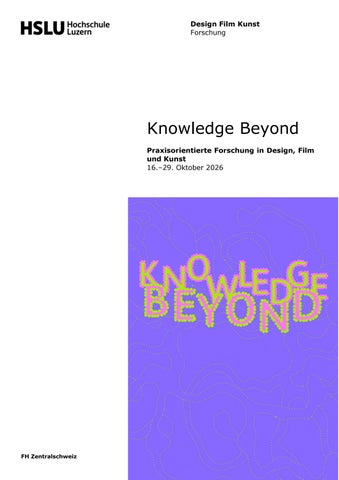
Knowledge Beyond Praxisorientierte Forschung in Design, Film und Kunst 16.–29. Oktober 2026
FH Zentralschweiz
Impressum Kuration Dr. Linda Luv, Hochschule Luzern – Design Film Kunst, lindaluv.net / @l_l_lindaluv Leitung Vicky Kiefer, Hochschule Luzern – Design Film Kunst Kommunikation Nina Meier, Hochschule Luzern – Design Film Kunst Key Visual Mia Pradal, miapradal.ch / @miapradal Mitwirkende Antonia Lea Röllin Fernando Obieta Isabelle Dechamps Lea Schmidt Linda Luv Oswald Iten Marco de Mutiis Rashmi Sathe Tina Tomovic Abbildungen S. 5 Rashmi Sathe; White is Mumbai, Mumbai is White S. 7 Elena Osmann; Portrait von Linda Luv vor ihrer Dissertation S. 9 Fernando Obieta & Cynthia Schemidt; i dropped the metal ball on the glass table and it broke. what is it? S. 11 Isabelle Dechamps; Kobe, Feldforschung Plum Village S. 13 Oswald Iten; Making-of S. 15 Lea Schmidt; Forschungsgruppe Produkt & Textil, Projekt 3D-Printing Textile Waste, 2022 S. 17 Marco de Mutiis; Screenshot der ausgestellten online Publikation S. 19 Tina Tomovic; Aufnahme aus Feldstudie, 2026 S. 21 Antonia Lea Röllin; Glitch in History Wir danken allen Beteiligten sowie Orlando Budelacci, Pablo Müller, Jlanit Schumacher, Iris Hasler, Katja Prudente, Siri Peyer, Yanick Tellini und dem gesamten Hausdienst, André Graf und dem Bibliotheksteam, Larissa Odermatt und dem Team AVAusleihe sowie dem Reinigungsteam für ihre wertvolle Unterstützung.
Hochschule Luzern – Design Film Kunst Nylsuisseplatz 1, 745 Viscosistadt, 6020 Emmenbrücke 6020 Luzern-Emmenbrücke
© 10.2026, Hochschule Luzern – Design Film Kunst
Knowledge Beyond Praxisorientierte Forschung in Design, Film und Kunst «Praxisbasierte Forschung geht über Wissen hinaus (knowledge beyond). Sie nimmt aussergewöhnliche Perspektiven ein. Erfindet stetig neue Werkzeuge. Vermittelt und forscht multisensorisch. Tritt für ein Wissensverständnis ein, welches dialogisch, situiert und selbstkritisch, kurz: in Bewegung bleibt.» Dr. Linda Luv, Künstlerin, Forscherin und Kuratorin
Die Ausstellung Knowledge Beyond nimmt praxisbasierte Forschung in den Fokus und zeigt Arbeiten von Doktorierenden und PhD-Alumni der Hochschule Luzern – Design Film Kunst. Neun Positionen eröffnen eine vielschichtige Perspektive auf research through Design, Film und Kunst – vom Forschungsprozess bis zur Dokumentation und Dissemination. Die verschiedenen Ausstellungsformate – ob künstlerisches Werk, Forschungscollage, Experiment, audiovisueller Essay oder Publikation – eröffnen einen multisensorischen Erfahrungsraum, nicht nur um einzelnen Fragestellungen und Methoden zu begegnen. Die Variation der Formate bringt ebenso den innovativen und experimentellen Umgang mit Wissensproduktion zum Ausdruck. Wo kommen wir hin, wenn wir über hegemoniale Wissensproduktion hinaus denken? Knowledge Beyond ist in diesem Sinne eine Einladung, im Dialog mit den präsentierten Arbeiten den eigenen (Wissens-)Horizont neu auszuloten.
«Das Doktorat an Kunst-, Film- und Designhochschulen betrifft die Innovations- und Zukunftsfähigkeit unserer Gesellschaft. Gesellschaftliche Transformationen entstehen zunehmend an den Schnittstellen von Gestaltung, Technologie und Wissenschaft. Wer diese Kompetenzen stärken will, muss auch Forschende in diesen Feldern nachhaltig fördern.» Prof. Dr. Orlando Budelacci, Hochschule Luzern – Design Film Kunst, Vizedirektion Forschung
Die Hochschule Luzern – Design Film Kunst schafft dafür ein eigenes Umfeld für praxisbasierte, anwendungsorientierte und kulturwissenschaftlich ausgerichtete Doktorate. Künstler:innen, Designer:innen und transdisziplinär Forschende finden hier engagierte Unterstützung, um ihre Ideen weiterzuentwickeln – in enger Zusammenarbeit mit promotionsberechtigten Partnerinstitutionen in der Schweiz und international.
Mitwirkende Doktorierende und PhD-Alumni Doktorand:in
Projektname
Partnerhochschule
Betreuung
Rashmi Sathe
Reimagining the visual image: A multisensory approach to art and design practice and pedagogy
Kunstuniversität Linz
Prof. Anna Artaker, Prof. Dr. Rachel Mader
Linda Luv
Die Andere|Mutter. Alltägliche Fürsorge als performative Praktik der VerUnordnung
Kunstuniversität Linz
Prof. Dr. Amalia Barboza, Prof. Dr. Rachel Mader
Fernando Obieta Die Kontingenz der Gestaltung – eine Kritik
Kunstuniversität Linz
Prof. Dr. Ulrike Hanstein, Prof. Dr. Rachel Mader, Carmen Weisskopf
Isabelle Dechamps
Conscious Co-Creatioin for National Institute of Eco-Social Transformation Design (NID)
Praveen Nahar, Prof. Dr. Gabriela Christen
Oswald Iten
The Sound of Experiential Subjectivity. How Nonverbal Interiority Replaced the Inner Voice
Universität Basel
Prof. Dr. Ute Holl, Prof. Dr. Johannes Binotto
Lea Schmidt
Materialkomplexität und das Designprinzip Monomaterial im Werkstoffkreislauf
Technische Universität Dresden
Prof. Dr.-Ing. Jens Krzywinski, Prof. Dr. Andrea WeberHansen
Marco de Mutiis
How to Win at Photography – ImageMaking as Play
Center for the Study of the Networked Image, London South Bank University
Prof Dr. Geoff Cox, Prof. Andrew Dewdney
Tina Tomovic
Colors in the Anthroposcene – A Study on Colors in Textile Recycling (In Order To Sort Things Out)
National Institute of Design (NID)
Dr. Amit Kumar Sinha, Dr. Jonas Leysieffer
Antonia Lea Röllin
Performance und In Findung Resonanz. Zu körperlicher und kollektiver Wissensproduktion
In Findung
1 Rashmi Sathe Reimagining the visual image: A multisensory approach to art and design practice and pedagogy
Rashmi Sathe’s research asks: What will art and design practice and pedagogy be beyond our visual concept of an image? It explores inclusive, multisensory approaches to art and design, using sensory translations by incorporating vernacular memory practices along with sound, language, taste and touch. Her practice ultimately questions the possibilities of what might happen if we move away from the notion that vision should remain the primary mode through which art and design are perceived and created. Sathe’s design industry experience seeps into her sensory art practice and her research is interdisciplinary, blurring boundaries of design and art. Her practice investigates the fluid boundaries of how images are perceived, in-between the visual and the non-visual. It further negotiates the contradictions and tension between what an image can be, when reduced to almost nothing versus a non-visual sensory overload. It includes exploring self identity and colours as concepts and experiences translated into gestures, words, taste, sound and smell. Sathe has developed an inclusive module that integrates sensory art and design inquiry. It is an attempt to replace the concept of the viewer to that of the perceiver. White is Mumbai, Mumbai is White, a collaboration with Jacqueline Egger, is a part of the project Being White, where white is reimagined by dissociating its visuals from its memories. Instead of defining it as a colour or a non-colour, white has been reinterpreted as experiences translated into gestures, words, taste, sound and smell. The hope is that by acknowledging the existence of different kinds of white, we acknowledge the existence of different ways of perceiving it. What makes Mumbai, Mumbai? Non-visually? Inspired by a collaborative exploration of Mumbai with Jacqueline Egger, this project is an interactive sound installation re-imagining the city as embodying white—a threshold of potential and endless possibilities. It features a poem, in English and Braille, an inclusive book and Jacqueline’s voice recording of her perception of Mumbai, all to be perceived simultaneously. Strip off the blue from indigo and what is left of it? In Indigofera Tinctoria Rashmi Sathe works with indigo not as a colour but as a concept—as a perceptual, sensory experience— exploring its cultural and colonial history beyond vision. The focus of this project is to investigate the colonial history of indigo in India rather than understanding the manufacturing process of the dye. As a designer and artist from India, she is awestruck by the fact that indigo is one of India’s heritage crafts. However it is seeped in years of colonial atrocities and violence. A deeper investigation, transformed her perception of the colour completely. Rashmi Sathe could not help but separate its visual beauty and perceive it as it as a symbol of violence, hopelessness, despair and death. Its hue becoming darker and darker until its visual perception was of least consequence. How could its history be archived sensorially? Rashmi Sathe is an artist, designer, researcher and educator from Mumbai, India. She is currently pursuing a PhD at the University of Art and Design Linz and at the Lucerne School of Design, Film and Art, exploring multisensory art, performance and inclusive design pedagogy.
2 Linda Luv Die Andere|Mutter. Alltägliche Fürsorge als performative Praktik der VerUnordnung
Im praxisbasierten Forschungsprojekt Die Andere|Mutter. Alltägliche Fürsorge als performative Praktik der VerUnordnung geht es um das emanzipatorische Potenzial von Performancekunst zur (Um-)Gestaltung alltäglicher Prozesse. Ausgehend von ihrer eigenen Situiertheit als Künstlerin, Mutter und queere Frau untersucht Linda Luv alltägliche Fürsorge als widerständige, performative Handlung. Im Zentrum stehen Momente der Erschöpfung, Überforderung und des in-die-Enge-getrieben-Seins, in denen gesellschaftliche Rollen und normative Erwartungen körperlich spürbar werden. Luv begegnet diesen Erfahrungen mit performativen Eingriffen, die bestehende Ordnungen verUnordnen und neue Handlungsspielräume eröffnen. Die eigene Lebensrealität wird dabei zum Ausgangspunkt einer künstlerischen Forschung. Autobiografische Erfahrungen, queer-feministische Theorie, poetisches Schreiben, Beobachtungen und Performances verbinden sich zu einer künstlerischen Forschung, in der Performance zugleich Methode und Möglichkeit der Veränderung wird. Das zentrale Ergebnis materialisiert sich in einem 35 × 35 cm grossen Holzschuber mit vier Arbeiten: einem Buch, einem bestickten Taschentuch, einem Dinkelkissen und einer Schallplatte. Damit überführt Luv die Prozesse der Forschung in eine vielschichtige, performative Form des Lesens. Der ausgestellte Schuber versteht sich als dialogisches Gefäss – erst durch das Eingreifen der Betrachter:innen entfaltet sich das Werk. Im Rahmen der Vernissage wird die Künstlerin zusammen mit Julia Meade und Regina Simon Objekte und Texte ihrer Dissertation aktivieren. Im Zentrum der Performance Becoming Cyborg steht die Transformation von der überforderten Mutter zur Cyborg – einem Subjekt, das Mutter, queere Frau und Künstlerin zugleich ist und Fürsorge feministisch neu deutet: Fürsorge verstanden als lebenslange, widerständige Performance. Ergänzend zur Dissertation zeigt Luv die Arbeit Too sad to tell you. Sie besteht aus dem gestickten Taschentuch, einem Performance Score und einem Selbstportrait. Der Titel referenziert die Videoarbeit I am too sad to tell you von Bas Jan Ader aus dem Jahr 1971. Hier weinte der Künstler mehrere Minuten lang in die Kamera. Luv setzt sich in ihrer Collage mit Weinen als emanzipatorische Emotion auseinander. Welche Möglichkeit des performativen Eingreifens im Sinne einer «fürsorglichen Geste» bleibt, wenn Traurigkeit unaussprechlich wird? Das Taschentuch existiert als Künstleredition von 25 Exemplaren – eine intime Geste, vervielfacht und geteilt. Linda Luv arbeitet an der Schnittstelle von Kunst, Forschung und Lehre. Sie schloss 2018 ihr Masterstudium an der Hochschule Luzern – Design Film Kunst ab und promovierte 2025 mit Auszeichnung an der Kunstuniversität Linz. In ihrer künstlerisch-forschenden Praxis verbindet sie queer-feministische und Crip Theory mit autotheoretischen, performativen und gemeinschaftsbasierten Methoden, die sie regelmässig in Lehr- und Diskursformaten sowie internationalen Ausstellungen und Performances vermittelt. Linda Luv lebt in Offenbach am Main.
3 Fernando Obieta Die Kontingenz der Gestaltung – eine Kritik
Wie nehmen Maschinen Menschen wahr? Und wie beobachten Menschen andere (oder sich selbst) durch Maschinen? Normativ-technische Artefakte wie Maschinen, Applikationen, Systeme, etc. sind Resultate kontingenter Bedingungen und autor:innenschaftlicher Entscheidungen. Das Abstrahieren und Definieren ist stets ein interpretativer und autor:innenschaftlicher Akt, der durch die eigenen kulturellen Ressourcen, situationsbedingte Diskurse, Moral und Ästhetik beeinflusst und geleitet wird und jederzeit intendierte und nichtintendierte Entscheidungen beinhaltet. Von ihren Gestalter:innen – die nach besten Lösungen für spezifische, wohldefinierte Probleme suchen – und den Benutzer:innen werden sie aber mehrheitlich nicht als solche wahrgenommen. Stattdessen wird an die technische Rationalität und Objektivität geglaubt. In gleichwertiger Wechselwirkung zwischen schriftlicher Theorieproduktion und künstlerischem Schaffen stellt sich Fernando Obieta die Frage, wie künstlerische Praktiken Reflexionsebenen über normativ-technische Gestaltungspraktiken eröffnen und wie die ethischen und moralischen Dimensionen dieser Praktiken verhandelt werden können. Fernando Obietas interaktive Videoinstallation messages hinterfragt die Narrative hinter technologischen Entwicklungen und wie es anders sein könnte. Dabei stellt er die Beziehung und das damit einhergehende Vertrauen zwischen Menschen und ihren Gerätschaften zur Schau – ob in der Hosentasche oder im öffentlichen Raum. Die ebenfalls ausgestellte, neunteilige fotografische Serie i dropped the metal ball on the glass table and it broke. what is it? verhandelt die Praxis des Kategorisierens von Genderperformances und -identitäten. Fernando Obieta und Cynthia Schemidt stellen diese Praxis in Bezug zu automatisierten Maschinen und künstlicher Intelligenz, die weder neutral noch objektiv sind, sondern die Perspektiven ihrer Entwickler:innen reproduzieren und den Menschen aufzwingen. Fernando Obieta (er/ihm, *1990) ist konzeptioneller Medienkünstler und künstlerischer Forscher. Nach einem Computer Science Studium mit Schwerpunkt Medientechnologien studierte er Interaction Design und Transdisziplinarität in den Künsten an der Zürcher Hochschule der Künste. Seine künstlerische Arbeit und Forschung konzentrieren sich auf die Kritik und Reflexion von (digitalen) Medien, Artefakten, Systemen, Diensten und Lösungen und darauf, wie sie kontingent und situiert sind. Er arbeitet an der Schnittstelle von Konzept, Design, Kunst und Technologie, wobei drei Methoden im Fokus stehen: Fehler oder Lücken in einem System zu finden und diese gezielt sichtbar zu machen; bestimmte Parameter eines Systems zu verschieben und neu zusammenzusetzen; ein System in andere Medialitäten zu übersetzen. Derzeit promoviert er in Medientheorien an der Kunstuniversität Linz und der Hochschule Luzern – Design Film Kunst und wird im Rahmen des Doc.CH-Programms des Schweizerischen Nationalfonds (SNF) gefördert.
4 Isabelle Dechamps Conscious Co-Creation for Eco-Social Transformation
Isabelle Dechamps’ practice-led PhD asks how mindfulness can inform conscious co-creation for eco-social transformation in times of intertwined ecological, social, and cultural crises. While participatory design is increasingly applied in transformation contexts, many processes remain insufficiently attentive to the relational conditions that shape meaningful and sustainable change. Her research explores how mindfulness can inform the ethics, methods, and facilitation of co-design by fostering awareness, care, deep listening, and collective responsibility. The inquiry unfolds through ethnographic fieldwork in eco-spiritual communities, intervention-based action research within an emerging initiative, and educational experiments in design. Through an iterative research process, these contexts inform the development of a conceptual framework, Mindful Design Principles, and an evolving Toolbox for Conscious Co-Creation to support transformative participatory practice. The Ethnographic Mappings in this exhibition represent a synthesis of ethnographic fieldwork conducted in six eco-spiritual communities: Auroville, Sadhana Forest, Plum Village, Sieben Linden, ZEGG, and Findhorn. Combining photographs, sketches, observations, reflections, and analytical mappings, they trace recurring conditions, practices, organisational structures, and relational qualities that enable conscious co-creation across diverse cultural contexts. Alongside the mappings, Dechamps presents an initial prototype of her Toolbox for Conscious Co-Creation, emerging from this research. Three accompanying workshops invite design educators to explore the toolbox and contribute insights to the ongoing inquiry. Isabelle Dechamps is a designer, educator, and practice-based PhD researcher in the EcoSocial Innovation by Design program and a member of the Research Group Transformation Design at the Lucerne University of Applied Sciences and Arts (HSLU), Switzerland. She holds a Diploma in Product Design from Berlin-Weißensee School of Art and a Foundation Diploma in Art and Design from Chelsea College of Art and Design, University of the Arts London. Since graduating in 2011, Isabelle Dechamps has worked internationally at the intersection of social innovation, participatory design, and design education. She is the founder of the non-profit design collective be able e.V., which develops inclusive design projects with and for marginalized communities, including people with disabilities, refugees, ethnic minorities, unemployed people, and prisoners. She has taught at Berlin-Weißensee School of Art, Wentworth Institute of Technology in Boston, the HPI D-School in Potsdam, Hochschule Luzern – Design Film Kunst, and the National Institute of Design in Ahmedabad, India. Her work has taken her to Europe, Asia, Africa, and Latin America, where she has facilitated participatory design projects, workshops, and educational programs.
5 Oswald Iten The Sound of Experiential Subjectivity. How Nonverbal Interiority Replaced the Inner Voice
A growing segment of contemporary narrative cinema attempts to immerse the audience in a protagonist’s immediate personal experience. This results in an affective interiority based on audiovisual impressionism rather than an articulation of thoughts, feelings, and motivations by way of an inner voice and emotionally coded music. Facilitated by technological developments and a more integrated musicalization of narrative films in the 21st century, many elements of this nonverbal audiovisual style have been touched upon in recent film sound scholarship, but not yet with a primary focus on subjectivity. The goal of Oswald Iten’s dissertation is therefore to establish and describe the auditory aesthetics instrumental in producing such an experiential subjectivity in contemporary first-person narratives. Writing about audiovisual intricacies is often hampered by the readers’ potential lack of familiarity with the sensory and experiential aspects of the objects of study. The secondary objective of his PhD project is thus to establish exploratory videography as a method for qualitative empirical research of film sound and the audio–visual relationship. This is also the topic of Oswald Iten’s video essay Sensuous and Affective. The Potential of Videography for Studying Audio-Visual Relations that can be watched in the exhibition. Oswald Iten is a film scholar and video essayist. He is particularly interested in the relationship between sound and images, editing, and colors. His audiovisual essays have been published in Filmbulletin, The Cine-Files, Necsus, Zeitschrift für Medienwissenschaft, and alphaville: Journal of Film and Screen Media. Between 2021 and 2024, Iten was a researcher in Johannes Binotto’s project «Video Essay: Futures of Audiovisual Research and Teaching». His PhD project is supervised by Ute Holl at the University of Basel. As a 2D animator and layouter, he has worked on several animated shorts and a feature film in different positions. Currently, he works at the Lucerne University of Applied Arts and Sciences (HSLU) as a part-time teacher in the Animation department and the Foundation Course in Art and Design.
6 Lea Schmidt Materialkomplexität und das Designprinzip Monomaterial im Werkstoffkreislauf
Zirkularität scheitert oft an der Materialkomplexität zeitgenössischer Produkte, die typischerweise komplexe Konglomerate heterogener Werkstoffe sind. Im Schritt des Recyclings wird diese Materialkomplexität zum zentralen Hindernis. Das Designprinzip Monomaterial begegnet dieser Herausforderung durch die Verwendung eines einzigen Werkstoffs. Lea Schmidts Arbeit zeigt, wie sich Materialkomplexität im Werkstoffkreislauf auswirkt und wie funktionale und ästhetische Varianz innerhalb des Designprinzips Monomaterial möglich sind. Eine anwendungsorientierte Machbarkeitsstudie erprobt das Prinzip am Beispiel von Polyester im Textilsektor: additiv gefertigte, solide Applikationen aus Polyester-Textilabfällen werden ausschliesslich durch Hitzeeinwirkung im FDM-Prozess mit flexiblen Polyestersubstraten verbunden. Entlang des Kontrastes zwischen solider Applikation und flexiblen Substraten eröffnet sich ein breites Spektrum zur Nutzung von funktionalen oder ästhetischen Eigenschaften. Schmidt leitete die interdisziplinäre Machbarkeitsstudie in der Forschungsgruppe Produkt & Textil der Hochschule Luzern – Design Film Kunst. Durchgeführt wurde sie in Zusammenarbeit mit dem Institut für Drucktechnologie (IDT) der Berner Fachhochschule und dem Institut für Werkstofftechnik und Kunststoffverarbeitung (IWK) der OST, finanziert von der schweizerischen Innovationsagentur Innosuisse. In der Ausstellung veranschaulicht Schmidt das Kernproblem ihrer Arbeit – die Materialkomplexität als Hindernis im Werkstoffkreislauf – anhand einer Sammlung von Alltagsgegenständen; die Machbarkeitsstudie zeigt exemplarisch einen Lösungsansatz für Polyester im Textilbereich. Lea Schmidt forscht in der Forschungsgruppe Produkt & Textil der Hochschule Luzern – Design Film Kunst an der Schnittstelle von Design, Nachhaltigkeit und Technologie, mit Fokus auf Werkstoffkreisläufe. Sie leitet Innosuisse-Projekte und entwickelt Förderanträge mit Industrie- und Forschungspartnern. Im Master Design unterrichtet sie Prototyping und verantwortet ein Fokusmodul zu Materialzirkularität. Zuvor war sie Partnerin eines Gestaltungsbüros, leitete einen gestalterischen Vorkurs und arbeitete als Creative Director. Sie studierte Visuelle Kommunikation an der Hochschule der Künste Bern und Design an der Zürcher Hochschule der Künste; als Gastforscherin an der Empa erweiterte sie ihre Perspektive um die materialwissenschaftliche Dimension. Ihr Doktorat schloss sie 2025 an der Fakultät Maschinenwesen der Technischen Universität Dresden ab.
7 Marco de Mutiis How to Win at Photography – Image-Making as Play
Marco de Mutiis’ PhD research introduces the concept of playable imaging to explain how image-making in video games reshapes photography, visual culture, and the act of play. It argues that games are not simply spaces where images are captured but environments in which players, game systems, cameras, algorithms, and interfaces collaboratively produce, circulate, and interpret images. Drawing on post-photography, game studies, and play theory, the research examines three key relationships: between the game and the photographer, the game and the image, and the game and the camera apparatus. These interactions challenge conventional photographic models and reveal new forms of visual production shaped by player agency and computational systems. Combining academic research with curatorial practice through the exhibition How to Win at Photography – ImageMaking as Play, the research positions playable imaging as both an analytical and curatorial framework for understanding how games influence contemporary visual culture, technological infrastructures, and socio-political narratives. De Mutiis received his PhD in 2025. De Mutiis’ online publication How to Win at Photography – Image-Making as Play is part of this exhibition, co-curated with Matteo Bittanti. It includes artworks and vernacular phenomena that were studied for his PhD research. The online publication was designed by Unstated International. Marco De Mutiis is Professor for Evolving Imaging and Photography at HTWG Konstanz and Digital Curator at Fotomuseum Winterthur in Switzerland. His research focuses on the digital transformations of photography including algorithmic and networked forms of image-making. His PhD research focused on the relationship between computer games as photography, and how play shapes image-making. His professional interests also encompass the role and space of the museum, expanded through online platforms and alternative modes of knowledge exchange.
8 Tina Tomovic Colors in the Anthroposcene – A Study on Colors in Textile Recycling (In Order to Sort Things Out)
The textile industry is resource-intensive and responsible for a significant proportion of global pollution emissions. The circular economy model and fiber-to-fiber recycling technologies are widely regarded as a beacon of hope for a sustainable future for the textile industry. This momentum in current developments offers chances to rethink and reinvent industries' toughest flaws, among them textile coloring. Given their ecological relevance, the colors used in textiles are being investigated as valuable resources that must be preserved for a second lifecycle or beyond. Tina Tomovic’s thesis deals with the question of how color-related practices in textile design and the industry must change in favor of textile recycling processes and a circular economy for textiles. Through this, the thesis discusses color-related practices that drive unsustainable impacts: from designers' ability to access thousands of shades at any time to strict quality requirements for color accuracy within quality control processes. The thesis aims to offer a new perspective on the environmental, economic, and cultural impacts of color in textile recycling processes and recycled textiles, bridge discussions with the dyeing industry, and inform design practitioners and those in training about best practices. Tomovic exhibits a collection of sorted fabric scraps before they enter the recycling process. The textile scraps come from a series of field studies and offer in-depth insights into current color-related practices in textile recycling. The fabric scraps were collected as data to identify a color space for textile recycling that could help develop basic guidelines for sorting used textiles. They convey the wide variety of colors found in used textiles and illustrate how these are grouped during color sorting in today’s wool recycling process. The field studies showed that textile recycling companies and sorters currently distinguish between 60 and 90 color categories. To achieve this level of sorting precision, textiles are first assigned to color families and then sorted more precisely in a second step. Workers carry out all steps by hand. In addition to the experience required, large storage capacity is particularly important to manage sorting used textiles by color. Sometimes, color shades that have gone out of style are stored in the sorters’ warehouses for decades until they return to the market. Tina Tomovic is a Research Associate and Lecturer at the Lucerne University of Applied Sciences and Arts (HSLU). She is part of the Research Group Products & Textiles, which focuses on topics of sustainability and textiles. Her research projects are practice-oriented and take place in close cooperation with stakeholders across the textile value chain, often in a transdisciplinary framework. As a PhD candidate, she is associated with the National Institute of Design in India (NID).
9 Antonia Lea Röllin Performance und Resonanz. Zu körperlicher und kollektiver Wissensproduktion
Antonia Lea Röllins Dissertation bewegt sich künstlerisch-forschend an der Schnittstelle von Performancekunst, kuratorischer Praxis und ephemerer Kunstvermittlung. Sie untersucht künstlerische Praktiken und ephemere Vermittlungsformate als eigenständige epistemische Praktiken und befragt sie hinsichtlich ihres Potenzials, nicht-propositionales, körperlich verortetes Wissen zu erzeugen. Kollektive, körperlich gebundene und ephemere Wissenspraktiken werden in Röllins Arbeit gestärkt. Mit dem Ziel, ephemere Vermittlungsprozesse methodisch und künstlerisch weiterzuentwickeln, wird aus der Perspektive der Live-Performancekunst Wissensvermittlung als Erweiterung der Kunstvermittlung verstanden. Antonia Lea Röllin ist mit einer Performance am 16. Oktober um 16 Uhr Teil der Ausstellung. In der Online-Agenda der Hochschule Luzern – Design Film Kunst sind alle Details dazu aufgeführt. Antonia Lea Rollin ist Künstlerin, Veranstalterin, Forscherin und Komplizin. In ihrer Kunst setzt sie sich auf spielerische Weise mit ihren Mitmenschen und deren Habitus und Utopien auseinander. Als Co-Kuratorin und Produzentin der Translocal Performance Art Giswil engagiert sie sich dafür, verschiedene performative Strategien und Bewegungen der Performancekunst sichtbar zu machen. Sie startete ihr Doktoratsprojekt im Sommer 2026.