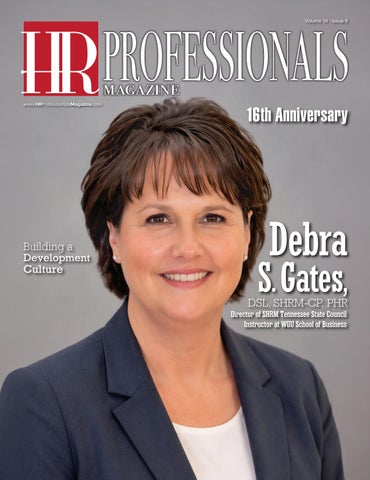
Volume 16 : Issue 9
TM
www.HRProfessionalsMagazine.com
Building a
Development
Culture
16th Anniversary
Debra
S. Gates,
DSL, SHRM-CP, PHR Director of SHRM Tennessee State Council Instructor at WGU School of Business
Are You DROWNING in Employment Compliance Updates?
ons i s i ec fend e D D y g tl Make Hirin n e fi d You Can Con Data Facts’ background screening platform integrates a powerful compliance structure directly into your hiring workflow. You can expect instant-cleared results (when possible), customizable policy templates, and easy-to-interpret single action summaries. These legally-grounded elements drive consistent, defensible decisions. Don’t SINK because of ever-evolving laws and regulations. EMPOWER your team with compliance tools built to protect your hiring decisions.
www.HRProfessionalsMagazine.com
3
so growth is intentional, measurable and sustained.
HR Professionals Magazine is recognized by SHRM to offer Professional Development Credits (PDCs) for SHRM-CP® or SHRM-SCP® recertification activities.
Bringing Human Resources & Management Expertise to You
15%
Only of employees say their manager helped them build a career plan. Employee Benefits 3 Preview ofManagement 2027 HR Performance
www.HRProfessionalsMagazine.com
Editor Cynthia Y. Thompson, MBA, SHRM-SCP, SPHR Publisher
Conference Cruises
Art Direction
Project Specialist
Liz Rogers
Webmaster
Leo Dimilo
Contributing Writers William Brown Amy Schabacker Dufrane Debra Gates Geoffrey Lindley Misty McCraw Sharon McKnight Nancy Polsky
Forward
18 5 Factors Driving Trends
8 2026 SHRM Tennessee Board of Directors
Learning ManagementTop Educational 10 Welcome to 2026 TN
Programs
Learning · Coaching · Skills · Certifications SHRM Conference for HR Instructor-led Training · Content Library Professionals 13 Congratulations to SHRM North Carolina -Newest Sponsor of the HR Conference Cruises
7 Register for our Affordable Online Ready to connect performance, pay and learning? HRCI | PHR | SPHR 17 Congratulations to Certification August 19 Gortria C.ABanksm BOOK DEMO 15 The HR Leader SHRM-CP TraineryHCM.com/book-a-demo People Trust – SHRM Certification
Talent Contact HR Professionals Magazine: TraineryHCM.com · info@traineryhcm.com 21 HRCI · +1 800.397.5215 One To submit a letter to the editor, suggest an idea for an article, notify us Management of a special event, promotion, announcement, new product or service, or obtain information on becoming a contributor, visit our website at 40 Graduate with More and Recruiting www.hrprofessionalsmagazine.com. We do not accept unsolicited
50-3334 nefits.place
manuscripts or articles. All manuscripts and photos must be submitted by email to Cynthia@hrprosmagazine.com. Editorial content does not necessarily reflect the opinions of the publisher, nor can the publisher be held responsible for errors. HR Professionals Magazine is published every month, 12 times a year by the Thompson HR Firm, LLC. Reproduction of any photographs, articles, artwork or copy prepared by the magazine or the contributors is strictly prohibited without prior written permission of the Publisher. All information is deemed to be reliable, but not guaranteed to be accurate, and subject to change without notice. HR Professionals Magazine, its contributors or advertisers within are not responsible for misinformation, misprints, omissions or typographical errors. ©2026 The Thompson HR Firm, LLC | This publication is pledged to the spirit and letter of Equal Opportunity Law. The following is general educational information only. It is not legal advice. You need to consult with legal counsel regarding all employment law matters. This information is subject to change without notice.
4
30 Rewriting Rules on NonCompete Agreements 31 Bass, Berry & Sims Listens and Responds
SHRM 2026 Conferences Update
7 SHRM Blueprint Job Architecture · JobinDescription · Job Evaluation3 SHRM Tennessee in Knoxville, September 13-16 19 The Benefits Group – Nashville November Comp Planning · Market Pricing · Pay Decisions · Rewards We do all the work! 15-18
Photographer
Charles B. Thompson
6 Profile of Debra Gates, Director of SHRM Tennessee State Council
2027 Healthcare Cost Compensation Management
Marketing and Social Media Specialist
Julie Nagem
11 NovoNordisk Works
Goals · Reviews · Calibrations · Check-ins – Support Employees 5 a note from the editor with the Weigh Development Plans · 9-Box · Analytics
The Thompson HR Firm, LLC Park Avenue Design
Features
www.HRProfessionalsMagazine.com
12 PeoplePro Solutions: Practical HR Partnership for Stronger Businesses 13 Meet Misty McCraw with PeoplePro Solutions 16 Embrace Future Forward Talent
22 SHRM Ohio HR Conference in Sandusky September 22-24
35 SHRM Skills Accelerator in Nashville November 15-18 36 Arkansas SHRM HR Conference in Hot Springs October 14-16 37 HR Southwest Conference in Dallas October 11-13 38 ALSHRM State Conference in Fairhope August 10-12 39 SHRM South Carolina Conference in Myrtle Beach September 16-18
than a Master’s at WGU
Employment Law 27 Rainey Kizer Reviere & Bell – The Strength of Experience
HR Professionals Magazine is recognized by HRCI to offer professional recertification credits for HRCI activities.
a note from the editor
2011 Cover with Judy Bell We were SO honored to have Judy Bell, with Judy Bell Consulting and HR and Executive Coach, on our premier cover, HR Professionals Magazine of Greater Memphis. We quickly outgrew that title as we have moved into 11 Southeastern states!
HR PROFESSIONALS MAGAZINE – 16TH ANNIVERSARY SPECIAL ISSUE
Dear Readers
We are thrilled to present a special issue this month as we celebrate our 16th anniversary at HR Professionals Magazine! It has been an exciting journey, and we couldn't have done it without the support of our incredible sponsors, contributors, and YOU—our loyal readers. Thank you for being a vital part of our success over the past 16 years! We dedicate this issue to our dear friend Judy Bell, who was on our first cover. We were saddened to lose Judy who was a dear friend and committed HR professional. We are proud to be the official media sponsor for many SHRM State Conferences in the U.S. It is truly an honor to collaborate with the SHRM State Councils and dedicated volunteers across the country. This year we were excited to announce a change in our distribution footprint. HR Professionals Magazine is now a national publication rather than a regional one. We are looking forward to serving many new SHRM members and HR professionals across the U.S. We extend special recognition to the extraordinary SHRM Public Affairs Team, who work tirelessly with us to bring you the latest educational opportunities, updates on SHRM Conferences, and important news within the HR community. As we kick off our 16th year, we are looking forward to covering many new SHRM conferences for you. We hope to see you at these exciting events! Looking ahead, please note that the SHRM Certification Winter Exam Testing Window opens in December. Our next Affordable Online SHRM Certification Exam Prep Class
starts on October 19 with the registration deadline on October 14. If you are not yet a certified HR professional, I encourage you to pursue certification—it can significantly advance your career in human resource management. Get certified in 2026! Additionally, we have several engaging webinars planned for September. Please keep an eye on your email for your invitation, as you can earn SHRM PDCs and HRCI business credits. A heartfelt thank you to Data Facts for sponsoring our monthly complimentary webinars for the past 16 years – and for being a loyal sponsor! You can register for our webinars on our website. We also extend a special thanks to WGU for being our back cover sponsor and providing insightful articles. I encourage you to check out their master’s in HR management that is aligned with SHRM and HRCI guidelines – and you will graduate with additional HR credentials! Thank you for being an essential part of our journey. Here’s to many more successful years ahead!
cynthia@hrprosmagazine.com Connect with me on LinkedIn:https://www.linkedin.com/ in/cynthia-thompson-mba-shrm-scp-sphr-325b8715/ Like us on Facebook.com/HRProfessionalsMagazine
www.HRProfessionalsMagazine.com
5
Debra on the cover
S. GATES
Debra S. Gates, DSL, SHRM-CP, PHR Director of SHRM Tennessee State Council Instructor at WGU School of Business
For nearly 30 years, Dr. Debra Gates has supported organizations and employees alike to become their best selves. She began dabbling in human resources activities very early in her career, when her roles expanded to include supervisory and training responsibilities. When finally able to return to school to finish her bachelor’s degree, she quickly fell in love with all things HR related. Throughout her bachelor’s program, she worked full or part-time while attending the proverbial night school. After completing her Bachelor’s degree in Business Administration with a concentration in HR, she was quickly hired and began her long professional HR career. Within a short time, she carved out her niche as a change manager from the HR perspective. After several years in HR, she realized that to stand out as the best candidate for her dream job, she needed a master's degree, so she returned to school in the Fall of 2009 and pursued a Master's in Administration with a concentration in HR. This program allowed her to work full-time while attending school on weekends. After completing her master’s degree, she landed director and VP roles where she had greater influence over how HR interacted with the organization. It was during this time that she discovered her passion for helping direct reports and others in the organization become the best they can be, so they could achieve their goals. A servant leader at heart, she continued to work with her direct reports to determine what they needed to achieve their ideal professional goals. She worked with each individual to identify goals they could work on as part of their overall development. In 2014, she was given the opportunity to teach an HR Management course at the local community college. This opportunity furthered her desire to help those coming up behind her to achieve their greatest potential. She continued working as an adjunct and working full-time in HR until 2019. At that time, after being approached by an employee at WGU during a conference, she transitioned from operational HR to working in higher education as an HR program mentor at WGU and later as an instructor. At WGU, her passion for supporting her students and fellow faculty members continued to grow. A few short months after beginning her journey at WGU, she decided to return to school once more, this time working on her doctorate. She shifted her focus slightly by focusing her research and studies on strategic leadership. She felt this would meet a need in the HR professional space by showing how strategic leadership contributes to organizational success. Her research focused on leadership support and its impact on retention. She completed her doctorate in January of 2026. Outside of her work accomplishments, Debra finds her deepest pleasure through her volunteer work with SHRM. It is through these roles that she is truly able to further the HR profession and help others in the field develop to their highest potential. She has served in volunteer leadership roles on both her local chapter board and the Tennessee State Council. Debra has held the roles of secretary on her local chapter board, state council membership chair, workforce readiness chair, secretary, director-elect, and is currently serving as the TN SHRM State Council Director. Under her leadership as state council director, Debra has helped lay the foundation for her director-elect to take the council into the next chapter. During her tenure, the council has defined its mission and purpose, identified future programs that will help HR professionals going forward, and created a new annual award to honor up-and-coming young professionals in the field. Debra remains dedicated to HR Professionals and the field of HR throughout her community, state, and the nation. Her goals going forward, as she nears another milestone in her career, are to continue identifying ways she can make a positive impact on the lives of those around her. 6
www.HRProfessionalsMagazine.com
INCLUSIVE CULTURES DON’T HAPPEN BY CHANCE. BUILD YOURS HERE. SHRM BLUEPRINT for I&D at All Things Work 2026 is where HR leaders come to stop guessing and start building: • Inclusive cultures that engage people. • Talent pipelines that reach further. • Strategies that hold up under legal and business scrutiny. Bring your toughest inclusion and diversity challenges. Leave with a plan.
REGISTER NOW Learn more at shrm.org/BP26-HRP9
CPR-260611
BOARD OF DIRECTORS
EXECUTIVE DIRECTOR Art Smith, SPHR, CCP, CAE AG Smith & Associates, LLC
STATE DIRECTOR Debra Gates, DSL, PHR, SHRM-CP Western Governors University
STATE DIRECTOR - ELECT Mary Jo Swearingen, SHRM-CP LBMC Employment Partners
PAST STATE DIRECTOR Andy Wainwright Careerminds
TREASURER Pamela Schreiner, SHRM-SCP Zoe Angling Group
SECRETARY Frances Flowers, SPHR, SHRM-SCP BCBS of Tennessee
LEGISLATIVE DIRECTOR Paige Lyle, Esq. Ford Harrison
VICE PRESIDENT, MEMBERSHIP Lauren Key, SHRM-CP Oak Ridge National Laboratory
CERTIFICATION DIRECTOR Doug Hertel, SPHR, SHRM-SCP Worldwide Equipment. Inc.
DIVERSITY DIRECTOR Akil Lloyd, SHRM-SCP LBA Hospitality 8
www.HRProfessionalsMagazine.com
SHRM FOUNDATION DIRECTOR Charlotte Welch, SHRM-CP Edgewater Technical Associates, LLC
BOARD OF DIRECTORS
WORKFORCE READINESS DIRECTOR Dr. Kathy Tuberville, Ed.D., SHRM-SCP The University of Memphis
SOCIAL MEDIA DIRECTOR Ebony Black, SHRM-CP Memphis International Airport
DISTRICT DIRECTOR - EAST Alica Shamblin, MPS-HR, PHR, SHRM-CP University of Tennessee
DISTRICT DIRECTOR - WEST Danielle Lombard-Sims, PhD, PCC, SPHR Talentergy, LLC
PROFESSIONAL DEVELOPMENT / STRATEGIC BUSINESS MANAGEMENT CHAIR Matt Gregory, MBA, GBA Lockton Companies
2026 SHRM TN CONFERENCE CO-CHAIR Joy Johnson Eargle, SHRM-SCP Newell Brands
2026 SHRM TN CONFERENCE CO-CHAIR Melissa Mitchell, SPHR, SHRM-SCP Knoxville TVA Employees Credit Union
SHRM MEMBERS AND COMMUNITIES DIRECTOR Paula Humber, MBA, SHRM-SCP SHRM
STAFF: CHIEF ADMINISTRATOR Celeste Shepherd AG Smith & Associates, LLC
STAFF: ADMINISTRATION PROFESSIONAL Emily Dyer AG Smith & Associates, LLC
STAFF: ADMINISTRATION PROFESSIONAL Ben Princehorn AG Smith & Associates, LLC www.HRProfessionalsMagazine.com
9
Hello and welcome to the TN SHRM Conference and Expo 2026. We are delighted to have you with us in Knoxville this year. As the TN SHRM State Director, it is my honor to welcome you on behalf of TVHRA and our State Council. TVHRA has put together an awesome lineup. So, sit back and relax as you peruse what is in store for you this year. Below is a short list of just a few of the highlights that you can expect this year.
SHRM Tennessee Brings HR Community Together for Its 2026 Conference & Expo The Tennessee Valley Human Resources Association (TVHRA) is gearing up for the 2026 SHRM Tennessee Conference and Exposition—a dynamic gathering where HR leaders can fuel their expertise, connect with peers, and discover game-changing ideas shaping the future of work.
Nearly 70 Years of Impact For close to seven decades, SHRM Tennessee and its nine local and regional chapters have been the trusted resource for HR professionals—delivering cutting-edge information, practical tools, robust networking opportunities, and world-class educational programs. This conference continues that legacy, giving professionals the real-world insights and connections they need to elevate their contributions and lead with confidence.
What Attendees Will Experience The 2026 conference features nearly 100 educational sessions organized across seven focused learning tracks, each designed to tackle the challenges HR professionals face today: • Total Rewards & Employee Wellbeing • Legal & Compliance: What’s Next • Talent Without Borders: The New World of Work • AI, HR Technology & Data Analytics • Employee Experience & Workplace Culture • Strategic Leadership & Business Acumen for HR Industry experts deliver the latest thinking and best practices across these tracks—ensuring attendees leave with actionable strategies they can implement immediately.
Professional Development & Continuing Education For HR professionals pursuing certifications, the conference is pre-approved for 25+ credit hours by both SHRM and HRCI, with 15+ sessions qualifying for HRCI Business Management credits. It’s a rare opportunity to advance your credentials while learning from the best.
Connect with Vendors & Innovators The Expo floor showcases nearly 100 providers offering cutting-edge solutions to real business challenges. Plus, 40 sponsors are committed to showcasing the latest ideas, products, and services available to the HR marketplace. Join the vendors for some music, fun, food, and beverages during the exhibitors’ reception on Tuesday evening. If you miss that fun time, be sure to visit with them during meal and snack breaks throughout the conference. 10
www.HRProfessionalsMagazine.com
Inspiration & Vision Four outstanding keynote presenters will inspire, challenge, and equip attendees with practical tools and visionary thinking to navigate the future of work with confidence. Our awesome keynotes will keep us inspired and energized throughout the week. We kick things off with Kelly Merbler on Sunday afternoon. She will set the pace for the next two and a half days. Monday morning, we get started early. John Gordon gets us geared up for our first full day, and all that is in store in our breakout sessions. Tuesday’s kick-off is in the hands of Morris Morrison, and Leslie Beale will close things out for us on Wednesday. In between all that fun will be awesome breakout sessions and chances to hang out with a few of your best friends. Whether you’re looking to deepen your expertise, build your professional network, or stay ahead of industry trends, the 2026 SHRM Tennessee Conference is where HR leaders connect, learn, and grow together. For me personally, the conference has become a time for me to connect with my “conference friends.” Those are the HR professionals from around the state that I have met throughout the year, and I only see them at the TN SHRM conference. We may correspond during the year, but the conference is our time to visit in person. If you are new to the conference, I hope that you, too, will find some conference friends as I did. Not only does the conference make it an exciting time professionally, as you learn about new trends in HR, but it also adds to the excitement of getting to see some people in person who genuinely understand your struggles and wins at work.
About SHRM Tennessee SHRM Tennessee is a professional association dedicated to advancing HR practice and HR professionals’ careers. Through conferences, educational programs, certifications, and community engagement, SHRM Tennessee and its nine local and regional chapters empower HR leaders to drive organizational success and positive workplace culture. This time together also gives us time to recognize some awesome professionals throughout the state for their contributions to our profession, as well as a few awesome students who will receive some much-deserved scholarships. The awards luncheon on Tuesday will inspire you to think about what you want your legacy to be and to strive to reach those goals. As you can see, we have a little bit of something for everyone. This time together is some of the most memorable of the year. I hope each of you will connect with one another and get some awesome information from each other and from all the speakers. Thank you so much for choosing to attend our conference. Welcome, we are so glad you are here.
Debra Gates,
TN SHRM State Director, The TN SHRM State Council, and TVHRA
When it comes to Obesity, support employees with The Weigh Forward EMPLOYERS PLAY AN IMPORTANT ROLE IN PROVIDING ACCESS TO TREATMENT FOR EMPLOYEES WITH OBESITY Losing weight and keeping it off is difficult because of how my body naturally responds to weight loss. Making a weight-management plan with my healthcare professional is important to me, as is having coverage for anti-obesity medication, which may help me manage my weight.
Actor portrayal.
LEARN MORE AT
NovoNordiskWorks.com Novo Nordisk is a registered trademark of Novo Nordisk A/S. © 2024 Novo Nordisk All rights reserved. US24OB00376 August 2024
By MISTY MCCRAW
For more than 20 years, Misty McCraw has worked at the intersection of people, operations, leadership, and business growth. Her career has given her a firsthand view of the challenges organizations face when managing employees: difficult conversations, compliance questions, leadership gaps, urgent employeerelations issues, and the pressure leaders feel to make the right decision quickly. That experience led her to create PeoplePro HR Solutions, a firm built to provide practical, personalized HR support and meaningful training and development for businesses, HR professionals, and people leaders. “I have always believed that people decisions are business decisions,” McCraw says. “The way an organization hires, communicates, responds to concerns, develops leaders, and handles change has a direct impact on its culture, risk, reputation, and ability to grow.” PeoplePro HR Solutions was founded on a simple but important idea: HR and leadership development should not feel overwhelming, disconnected from the business, or limited to paperwork and policies. Both should be accessible, strategic resources that help organizations make sound decisions, build stronger teams, and address issues before they become larger problems. McCraw brings a broad business perspective to her work, shaped by experience in family- and generationally owned businesses, small businesses, and the corporate world. She understands that every organization operates differently. A family-owned business may be balancing long-standing relationships and legacy with changing business needs. A small business may be managing rapid growth without a dedicated HR team. A corporate environment may require navigating more complex systems, policies, and layers of leadership. Those experiences shaped the approach she brings to every client relationship today. Regardless of an organization’s size or structure, McCraw understands that leaders need support that is practical, responsive, and tailored to the way their business actually works. A graduate of Mississippi State University with a bachelor’s degree, McCraw holds both the SHRM Certified Professional (SHRM-CP) and Professional in Human Resources (PHR) credentials. She has also been recognized as a Top 40 Under 40 Business Leader. Yet the value she brings to clients extends beyond credentials. Her work is rooted in the ability to listen carefully, understand the unique needs of an organization, and translate complex HR and leadership challenges into clear, practical next steps. PeoplePro HR Solutions provides customized support in areas such as employment compliance, employee relations, workplace investigations, recruiting, policy development, performance management, safety, benefits, and organizational development. The company also serves as a trusted resource for HR professionals and people leaders who need an experienced sounding board, additional capacity, or specialized guidance during periods of growth, change, or challenge. Just as importantly, training and development are central to the PeoplePro HR Solutions mission. McCraw believes the most effective organizations do not simply respond to workplace problems after they arise; they equip their leaders, managers, and employees to prevent many issues through stronger communication, clear expectations, and consistent leadership. PeoplePro HR Solutions offers engaging training programs, workshops, webinars, and practical leadership development designed to meet organizations where they are. Topics can include supervisor and manager development, performance management, employee relations, conflict resolution, workplace investigations, compliance, recruiting and onboarding, and HR fundamentals. 12
www.HRProfessionalsMagazine.com
Misty McCraw, SHRM-CP, PHR President | HR Advisor misty@peopleprohrsolutions.com PeoplePro HR Solutions | www.peopleprohrsolutions.com
Photo Credit: Dawn V Gilmore Photography
PeoplePro HR Solutions: Practical HR Partnership for Stronger Businesses
Rather than offering generic training that ends when the presentation does, PeoplePro HR Solutions focuses on learning that translates into action. Participants leave with practical tools, examples, scripts, templates, and strategies they can apply in their roles. The goal is to make leaders feel more prepared, not just informed. “I do not believe in handing someone a template or presentation and walking away,” McCraw explains. “My goal is to help people understand what to do, how to do it, and how to apply it consistently in real-life situations.” One area of particular focus is developing supervisors and managers. Organizations frequently promote high-performing employees into management roles without providing the training or support needed to lead others effectively. As McCraw often reminds leaders, “Promotion does not equal preparation.” PeoplePro HR Solutions helps new and experienced managers develop the skills that have the greatest impact on employees and organizational culture: communicating expectations, giving and receiving feedback, documenting performance concerns, delegating effectively, addressing conflict, managing time, conducting difficult conversations, and leading with respectful accountability. By equipping managers with practical tools and coaching, PeoplePro HR Solutions helps organizations improve consistency, strengthen employee experiences, and reduce avoidable risk. When managers understand how to respond appropriately and confidently to attendance issues, performance concerns, complaints, or interpersonal conflict, the organization is better positioned to address issues early and fairly. Rather than relying on a one-size-fits-all model, PeoplePro HR Solutions works alongside leaders to develop solutions that fit their organization’s size, culture, workforce, and goals. For one client, that may mean developing a handbook, updating policies, and creating better documentation practices. For another, it may mean delivering manager training, building a leadership-development program, improving onboarding, conducting an investigation, or helping leadership create a more strategic people plan. PeoplePro HR Solutions helps organizations move beyond reacting to problems and toward building stronger foundations. The goal is not simply to reduce risk. It is also to create workplaces where employees know what is expected, leaders feel equipped to lead, and business owners can focus more confidently on growth. The company’s work reflects McCraw’s commitment to balancing compliance with humanity. Strong HR practices are not about treating people like problems to manage. They are about creating fair, consistent processes while recognizing that every workplace issue involves real people and real consequences. “When leaders approach situations with clarity, consistency, and respect, they are in a much stronger position to protect both the organization and the people who make it successful,” McCraw says. At its core, PeoplePro HR Solutions exists to elevate businesses, HR professionals, and people leaders. Through practical HR guidance, customized training, and a people-centered approach, Misty McCraw and PeoplePro HR Solutions are helping organizations strengthen their workplaces, develop capable leaders, reduce unnecessary risk, and build the systems needed for long-term success. To connect with Misty or explore customized HR services, visit www.peopleprohrsolutions.com or follow PeoplePro HR Solutions on LinkedIn.
MISTY McCRAW
(662) 326-0941 www.peopleprohrsolutions.com
Human Resource Services Human Resources & Safety Management Workplace Investigations Policy & Procedure Development & Implementation Training & Professional Development Compliance (Unemployment, EEOC, OSHA, FMLA, Notary, etc.) Strategic Leadership & Organizational Development Risk Management
Talent Aquisition Flat 10% Fee Free Replacement Guarantee Comprehensive Screening Permanent Placement Only Placement in Any Industry
Training & Development Workforce Training Professional Development Training HR Training for Non-HR Professionals Business Coaching Leadership Training
www.HRProfessionalsMagazine.com
13
Welcome North Carolina SHRM as the New Sponsor of the HR Conference Cruises SHRM NC State Council
14
Dawna Blackburn, SPHR, SHRM-SCP President
Robert “Bob” Guy, SHRM-SCP, SPHR President Elect
Katrina Gooch, MS, SPHR, SHRM-SCP, GCDF Past President
Dawn Ponico, SHRM-SPC, SPHR Secretary
Alex Wilson, SHRM-SCP, SPHR Financial Director
Maria Hicks-Few, SHRM-SCP, SPHR Membership Director
www.HRProfessionalsMagazine.com
SHRM NC State Council
Josh Kerney, SHRM-SCP Assistant Membership Director
Melissa Mills, SPHR, SHRM-SCP District Director (SHRM Raleigh Metro)
Leslie Speas, SHRM-SCP, SPHR, CPC District Director (SHRM Greater Greensboro, Winston-Salem SHRM, SHRM High Point, Alamance County HRA)
Danielle Hunter, GBDS District Director (SHRM Central Carolina, Fayetteville Area SHRM, Triangle SHRM)
Olivia Ecker, MBA, SHRM-SCP District Director (Golden East, Lower Cape Fear, NC Coastal)
Nikki Pounds MHRD, SPHR, SHRM-CP District Director (Lake Norman, Cabarrus, Charlotte Area, Union County)
Jeff Luttrell, SHRM-SCP, SPHR District Director (Catawba Valley, Iredell County, Gaston, Western NC)
Brenda Robbins, SHRM-SCP, SPHR Conference Director 25/26
www.HRProfessionalsMagazine.com
15
Embrace Future-Forward Talent Management with SHRM Foundation Trainings SHRM Foundation offers SHRM-backed specialty credentials to equip you to embrace skills-first talent management strategies and source, hire, support, and retain a broad spectrum of untapped talent. Earn up to 46 professional development credits toward your SHRM-CP or SHRM-SCP certification by completing all four!
16
A first-of-its-kind training on how to integrate skillsfirst talent management strategies from recruitment to retirement.
Training that equips you to recruit, retain, and advance military-connected talent through focused workforce strategies.
Cost: $995 member, $1,345 non-member
Cost: $0
PDCs: 16
PDCs: 10
A fast-paced training that prepares you to build disability-inclusive workplaces through informed hiring, retention, and advancement strategies.
A flexible certificate program that equips you to confidently hire, retain, and support justice-impacted talent through inclusive and informed workplace practices.
Cost: $0
Cost: $0
PDCs: 10
PDCs: 10
www.HRProfessionalsMagazine.com
Congratulations to Gortria C. Banks, SHRM-CP
Gortria C. Banks is the Executive Director of Alzheimer’s & Dementia Services of Memphis, Inc., where she provides strategic leadership for one of the region’s premier organizations serving individuals living with Alzheimer’s disease and other dementias. She is committed to strengthening organizational performance while ensuring compassionate, high-quality care for participants and their families. With more than three decades of executive leadership experience, Banks has built a distinguished career spanning public service and nonprofit management. Prior to joining Alzheimer’s & Dementia Services, she served as Chief Operating Officer for Memphis Area Legal Services and previously retired from Shelby County Government after 31 years of service, where she held several leadership roles, including Director of Finance. Banks earned a Master of Business Management with a concentration in Human Resources Management and a Bachelor of Business Administration with a concentration in Management. She holds several professional credentials, including the most recent, SHRM Certified Professional (SHRM-CP), Certified Public Administrator, Certified County Finance Officer, Certified Nonprofit Accounting Professional (CNAP), Rule 31 Listed Mediator, and Certified Provider Investigator. A dual member of SHRM with national and her local SHRM chapter, Banks is passionate about developing people, strengthening organizations, and advancing excellence in leadership, finance, human resources, and nonprofit management. Throughout her career, she has been recognized for her commitment to operational excellence, strategic planning, sound financial stewardship, and servant leadership.
Gortria is a recent graduate of the HR Professionals Magazine Online SHRM-CP | SCP Certification Class.
www.HRProfessionalsMagazine.com
17
18
www.HRProfessionalsMagazine.com
(615)250-3334 will@benefits.place
www.HRProfessionalsMagazine.com
19
Development Plans Are Submitted, Now What? BY NANCY POLSKY
Validate the employee experience. An HRIS can confirm that a conversation was recorded, but only the employee can say whether it mattered. Use engagement survey items such as “My manager and I regularly discuss my growth and development” and “I know which skill I am working to strengthen and how it contributes to my career growth.”
Only 15% of employees say their manager helped them build a career plan during the previous six months, a five-percentage-point decline from 2024, according to the LinkedIn Learning 2025 Workplace Learning Report. That should concern any HR leader working to strengthen engagement, retention, and the organization’s future capabilities.
3. Connect Everyday Feedback to Future Career Growth
Most organizations require employees to complete individual development plans (IDPs), often during the annual performance-review process. Employees identify a skill, enter a goal into the system, and discuss it, sometimes briefly, with their manager. Then the plan may receive little attention until the following year.
That may sound like: “Here is what would make this customer sales presentation stronger, and why learning to communicate in a way that resonates with the executive buyers will prepare you for broader sales responsibilities.” This takes less than a minute, but it connects today’s work to where the employee wants to go. Employees who understand the larger purpose of feedback are more likely to act on it and remain engaged.
Uploading annual development plans is not the same as having a culture that develops people, or employees who experience the organization as invested in their growth. Development happens throughout the year through learning, meaningful conversations, everyday feedback, and opportunities to learn from others.
Managers give tactical feedback every day: clarify the expectation, adjust the approach, correct the mistake, or strengthen the work. Train them to add one important connection: why that skill or behavior also matters to the employee’s future. This is particularly important for Gen Z employees.
Validate the connection with an engagement survey item such as, “My manager helps me understand how feedback contributes to my development and career growth.”
Here are four practical ways HR leaders can make that happen.
4. Make Peer-to-Peer Learning Easy and Worthwhile
1. Make Every Formal Learning Experience End With Actionable Development Goal Setting
Employees often learn best from colleagues who have worked through the same persnickety challenges. Identify respected influencers with practical expertise and invite them to seed short, peer-led learning opportunities.
When employees participate in formal learning, don’t send them back to work intending to create a development plan at the requisite annual cycle date months later. Use the time when they are engaged, understand the personal value of the new skill or behavior, and have support available to turn learning into action. Ask your Learning & Development partner to build actionable development goal setting into the experience. Before leaving, participants should identify one or two skills or behaviors to strengthen, why those matter to their work and career, where they will practice them, and when they will talk with their manager. Keep plans specific, practical, and digital. After 30–60 days, measure whether participants discussed the plan with their manager, practiced the behavior and made progress, or encountered barriers. Then analyze aggregated IDP trends. If 68% identify conflict management as a development need, for example, let that data guide your next learning investment. 2. Make Employee Development Part of Every Manager’s Job Set the expectation that managers hold a development-focused conversation with every direct report at least quarterly. Better yet, ask them to devote approximately one-quarter of regular one-on-one time to the employee, not just the work, by discussing growth, aspirations, progress, and opportunities to practice. Train managers to lead these conversations and give them practical talking and listening points. Make the manager’s personal benefit clear: developing employees builds capability and improves performance now while strengthening engagement, retention, and the organization’s talent pipeline. 20
www.HRProfessionalsMagazine.com
Make participation low lift. HR can provide scheduling, invitations, and a few prompts while employees lead a 30-minute coffee conversation or topical sprint focused on a real workplace challenge. Make the personal benefit clear: visibility, recognition, expanded influence, professional growth, and an opportunity to solve something that matters. Celebrate contributors so others see that sharing knowledge is valued, not simply added work for capable people. Track participation and repeat attendance, then ask whether the conversation was useful and what participants will apply. Use that feedback to seed the next round.
Move Development Beyond the Form An annual development plan can document an employee’s priorities. It cannot create learning, conversations, feedback, and relationships through which development actually happens. HR leaders build a development culture by setting clear expectations, making participation worthwhile, and validating what employees actually experience. When development becomes part of learning, manager conversations, everyday feedback, and peer relationships, employees are more likely to see a future and how they can grow toward it.
Nancy Polsky
Vice President, Organizational Development nancy@nexalearning.com
One Platform. One Connected Talent Strategy. Performance, Compensation and Learning working as one system — so growth is intentional, measurable and sustained.
Performance Management
Goals · Reviews · Calibrations · Check-ins Development Plans · 9-Box · Analytics
Compensation Management
Job Architecture · Job Description · Job Evaluation Comp Planning · Market Pricing · Pay Decisions · Rewards
Learning Management
Learning · Coaching · Skills · Certifications Instructor-led Training · Content Library Ready to connect performance, pay and learning?
BOOK A DEMO
TraineryHCM.com/book-a-demo
TraineryHCM.com · info@traineryhcm.com · +1 800.397.5215
Always Indispensable By AMY SCHABACKER DUFRANE
R
HR
egardless of where you are in your career journey, it can be easy for HR professionals to feel discouraged. We deal with a wide range of issues, both internally and externally. Everyday questions might include: Is the economy shedding or adding jobs? Is it harder to recruit because the unemployment rate is low? Can we align workforce performance with business expectations? We face a daunting number of questions, a plethora of benchmarking data sources, and an evershifting labor market.
The crux of the matter is not to fear AI. From a practical standpoint, Shaun shared a structured framework that blends the use of AI and human insights. Innovation labs can be designed to solve specific organizational challenges using a phased approach. By piloting the lab within the HR department before rolling it out to the rest of the organization, HR can lead by example. The lab concept can be introduced to other departments, with HR facilitating discussions to help identify unique roadblocks. HR leaders can use the lab model to reinforce a “business-first” mindset instead of leading with an AI message.
And then came AI. It slowed down hiring while organizations determined if automation was more effective versus expanded headcount. Entry-level jobs dried up overnight as companies leaned into generative AI for basic writing, coding, and administrative tasks. Suddenly, HR was writing WARN notices instead of supporting increased recruiting and L&D budgets.
As Andre and Shaun continued their discussion, Shaun shared the value of a “two-door” mindset in decision-making. Unlike one-door decisions, which are difficult or impossible to reverse, two-door decisions allow organizations to move forward, experiment, and pivot when needed. Creating a safe environment for experimentation gives employees room to test new ideas while freeing up time for higher-value work. If an experiment doesn’t deliver the desired results, they can step back through the door, adjust their approach, and try something new.
As with every trend, major shifts are happening once more. A recent article in The Wall Street Journal confirmed that big companies are recruiting and hiring again, after 12–18 months of caution. Ironically, the impetus seems to be what stalled hiring in the first place: artificial intelligence. It turns out that more people are needed to work alongside it. Hiring is happening within and beyond whitecollar professions, organizations from tech to tool makers are adding employees to guide and augment the potential of AI. This includes organizations that previously pointed to AI as a primary driver of workforce reductions, which are now restaffing after AI failed to match the quality of human employees. This timely topic was front and center at our recent HRCI LIVE event in Chicago. There were some very exciting outcomes from a spirited conversation between HRCI’s Chief Operating Officer Andre Allen, GPHR, and Shaun Mayo, SPHR, the Chief People Officer for the Arizona Cardinals. Among the salient points discussed were:
Along with our audience of HR professionals at the event, Andre and Shaun acknowledged there’s a fear factor in AI. Shaun reminded us to focus on the possibilities and high value work that AI can enable. As with any organizational change, HR is central to communicating what is being gained. Perhaps at no other time in recent history has HR been more essential to reimagining our profession and managing enormous change. Our role—whether in a department of one or 30— remains the heartbeat of healthy companies. Join us for an upcoming HRCI LIVE:
September 17: Washington, D.C. October 12: Dallas October 25: Phoenix
§ The real race to embrace AI is more for productivity versus cost savings. § When HR embraces a forward-looking mindset that includes the use of technology to automate mundane tasks, HR itself can deliver higher-value organizational impact. § Designing balanced approaches where AI handles highvolume requirements—such as using AI in talent acquisition to screen job candidates—while leaving final decision-making to humans brings the best of both skillsets together. 22
www.HRProfessionalsMagazine.com
Amy Schabacker Dufrane, Ed.D., SPHR, CAE, is CEO of HRCI® — where she is responsible for driving and disrupting the conversations about building highperforming, strategic HR teams. An engaging thought leader at the intersection of talent strategy and continuous learning, Dr. Dufrane is an award-winning leader and celebrated keynote speaker on the human side of successful business strategy in the 21st century.
HR is complicated. You don’t have to figure it out alone.
With HRCI ENGAGE, you can connect with like-minded peers, participate in monthly live events, and instantly access exclusive resources to help you make informed decisions, stay ahead of evolving challenges, and drive greater strategic impact. Membership is free. The connections are invaluable.
Explore at hrci.org/ENGAGE.
The Best of HR Meets Here
Bottlenecks…what a pain! Some bottlenecks are obvious. Others hide behind workarounds, extra emails, repeated follow-ups, and the phrase, “That’s how we’ve always done it.” But those small inefficiencies add up. They can slow hiring times, frustrate candidates and hiring managers, create more work for HR, and can even introduce unnecessary compliance risks. The first step toward a more efficient hiring process? Find out where things are getting stuck.
• Confusion or lack of clarity about the hiring process. Team members shouldn’t have different answers about how hiring decisions are handled. Uncertainty around screening requirements, review procedures, or escalation processes can quickly create delays (and compliance issues). Employees stop to ask questions, decisions get kicked up the chain, and candidates sit waiting. If your team frequently asks, “What are we supposed to do here?” you’ve found a bottleneck.
Pinpointing the Bottlenecks
How to Eliminate Bottlenecks
A bottleneck isn’t always a dramatic breakdown. More often, it shows up as friction, looking like tasks that consistently take too long, require too much attention, or create confusion.
Once you’ve identified where your hiring process is clogging up, it’s time to fix it. Remove unnecessary friction and build a process that moves candidates forward efficiently and consistently.
In your quest to boot your bottlenecks, look for these signs:
A few strategic changes can make a big difference.
• Lots of manual processes. Look closely at repetitive tasks. How many steps require someone to manually enter information, send emails, update spreadsheets, check statuses, or move data from one system to another? Every manual touchpoint takes time and creates another opportunity for delays, inconsistencies, and human error. • Frequent errors or rework. Mistakes happen. But if your team regularly corrects inaccurate information, tracks down missing data, resubmits requests, or repeats completed work, the problem may be bigger than individual errors. Rework consumes time without moving the hiring process forward. Track where errors occur most often and determine whether the process itself is contributing to them. • Poor communication and limited transparency. “Where are we on this candidate?” If HR hears that question every day, something’s stinky. The hiring team should always know where candidates are in the process and what needs to happen next. When status information is difficult to access, the entire process may bog down. 24
www.HRProfessionalsMagazine.com
• Automate repetitive work. Automation can take routine administrative tasks off your team’s plate and keep processes moving without constant manual intervention. Look for opportunities to automate status notifications, candidate communications, screening workflows, document collection, and other repetitive steps. The right technology should reduce the number of actions HR has to take to move the process forward. • Integrate your systems. Technology works best when your systems work together. Integrating background screening with your Applicant Tracking System (ATS) or other HR technology can reduce duplicate data entry, simplify ordering, provide easier access to results, and keep more of the hiring workflow in one place. Fewer handoffs mean fewer opportunities for something to get lost, delayed, or entered incorrectly. • Establish a clear hiring policy. A streamlined process needs structure. Document which screening services are required for specific positions, who reviews results, how to handle
individualized assessments, when adverse action procedures begin, and who is responsible for each step. A clear policy helps employees make consistent decisions instead of wasting time reinventing the process with every candidate. • Train and re-train. Even the best process can break down if employees don’t understand it. Training needs to include regulations, company policies, technology, and fraud tactics. Ongoing training helps your team understand what steps to follow for every situation. • Choose vendors that solve problems. Your vendors should eliminate bottlenecks, not create new ones. Look for responsive support, useful integrations, helpful support, compliance resources, clear reporting, and experts who understand your organization’s hiring process. The right vendor can recommend solutions that make the entire process work better.
Stop Creating Time Consuming Work Arounds to Your Bottlenecks Bottlenecks have a way of becoming invisible. Teams create workarounds, add another spreadsheet, send another email, and keep going. But “we’ve always done it this way” isn’t a process strategy. Take a hard look at where your hiring process slows down, where your team spends unnecessary time, and where confusion keeps popping up. Then, invest in better technology, stronger policies, ongoing training, and the right partners to clear the path.
Sharon McKnight National Account Executive
smcknight@datafacts.com (800) 264-4110 x 4377 www.datafacts.com Advanced Technology. Experienced People. Trusted Background Screening Results.
October 14-16, 2026 Hot Springs Convention Center
Thursday Nig ht October 15 7:00 pm - 9:3 0 pm
Electric Aven ue at Bridge Str e
et LIVE! A high energ y space that reminds people of a time when th ey ca m e home from school, put a record on and listened with open ea rs and an op en heart. Best 80's outfi t contest als o!
www.HRProfessionalsMagazine.com
25
1 1 Jimmy Madeksho of AMPS taking his role of event sponsor seriously– look at the stack of free books he pulled out for attendees to take home. 2 Another angle, same energy — GMEBC members locked in on the discussion. 26
www.HRProfessionalsMagazine.com
2
3
4
3 Sam Nelson and Esha Iupe catching up and enjoying breakfast before the event begins 4 GMEBC Members with our moderator, Brian Friedenberg of HUB International
5
5 Pharmacy roundtable in full swing — full room discussing where pharmacy costs are headed.
www.HRProfessionalsMagazine.com
27
1
2
4
3
28
www.HRProfessionalsMagazine.com
5
1 Julie and George 2 Students 3 HR Royale High Rollers Social; Loretta Phillips, Brooke Meeks, Misty McCraw and Brenda Barron 4 Grab a Book & Give Back 5 MS Business Alliance
6
7
12
8
9
10
11
13
14
15 6 Jackie Mack, MSSHRM Director of Marketing 7 JoJo Adams with Jones Walker spoke on Managing Key Compliance Risks 8 Joycelyn Sargent spoke on What Your Employees Can Teach You About Your Leadership & Organization 9 Cynthia Black being recognized as Past President 10 Jackie Mack Leads Family Feud Fun 11 Connie Siggers-Parker is the HR Professional of the Year 12 Misty McCraw and Brooke Meeks, Recipient of the Spirit of HR Award 13 Paula Humber, SHRM Members and Community 14 Attendees 15 Opening Session 16 Student Aisha Williams and SHRM Golden Triangle member Sherritt Taylor
16
www.HRProfessionalsMagazine.com
29
The Covid-19 Pandemic And The Future Of Remote Work Under The ADA BY GEOFFREY A. LINDLEY
The COVID pandemic did not change the reality that in-person work is presumed to be an essential function of most jobs. Hayes v. GSTEK, Inc., 175 F.4th 603, 608 (5th Cir. 2026). Title I of the Americans with Disabilities Act (ADA) prohibits employers from discriminating against a qualified individual on the basis of a disability. 42 U.S.C. § 12112(a). Additionally, employers are required to engage in an interactive process with a qualified individual with a disability to determine whether the employer can provide a reasonable accommodation. Brumley v. UPS, 909 F.3d 834 (6th Cir. 2018). A qualified individual under the ADA is defined as “an individual who, with or without reasonable accommodation, can perform the essential functions of the employment position that such individual holds or desires.” Jakubowski v. Christ Hosp., Inc., 627 F.3d 195, 201 (6th Cir. 2010). Failure by an employer to provide a reasonable accommodation may constitute disability discrimination barred by the ADA. Cash v. Siegel-Robert, Inc., 548 F. App’x 330, 334 (6th Cir. 2013).
But What is An Essential Job Function? “The term ‘essential functions’ means ‘the fundamental job duties’ of a position.” Johnson v. Cleveland City Sch. Dist., 443 Fed. App’x 974, 985 (6th Cir. 2011). “Courts consider ‘written job description[s]’ and the ‘employer’s judgment’ in ascertaining these ‘essential functions.’” Denczak v. Ford Motor Co., 215 Fed. App’x 442, 444 (6th Cir. 2007) (alterations in original). While the ADA requires that employers make reasonable accommodations, it does not require employers to remove the essential functions of an employee’s job in making such accommodations. EEOC v. LHC Grp., Inc., 773 F.3d 688, 698 (5th Cir. 2014).
The Effect of the COVID-19 Pandemic on Remote Work Prior to the COVID-19 pandemic, courts were already starting to grapple with whether remote work may be a reasonable accommodation under the ADA. See Mosby-Meachem v. Memphis Light, Gas & Water Div., 883 F.3d 595 (6th Cir. 2018); see also EEOC v. Ford Motor Co., 782 F.3d 753 (6th Cir. 2015). And the decisions in those cases often depended on whether in-person work was an essential job function. However, the COVID-19 forced most employers to allow much of their workforce to work from home for a lengthy period of time. Therefore, some employees and their attorneys have taken the position that if a job could be done remotely for a lengthy period of time during the pandemic, then in-person attendance cannot be an essential job function of that job as a matter of law.
Does COVID-Era Remote Work Remove In-Person Attendance as an Essential Job Function? Thankfully for employers, the United States Court of Appeals for the Fifth Circuit recently addressed this question directly, and in doing so provided helpful guidance.
Return to Work Leads to Mental Disability
return to the office, Hayes became overstimulated and was diagnosed with autism, major depressive disorder, and social anxiety disorder in May 2022. Id. And in August 2022, Hayes became suicidal and required inpatient psychiatric care. Id. In October 2022, Hayes submitted paperwork from his healthcare provider along with a request that GStek allow him to work remotely as a reasonable accommodation. Id. at 606. While GStek was initially considering the request, the Army, whose contract with GStek required Army approval for such requests, determined that it “would not be in the best interest of the organization to allow full-time teleworking.” Id. Therefore, GStek tried to appease both Hayes and the Army by allowing Hayes to work remotely two to three days per week, an accommodation that remained in place from December 2022 through mid-January 2023. Id. Unfortunately, Hayes had a “mental breakdown” at work on January 16, 2023. Id. Hayes again requested full-time remote work, but GStek declined because of its Army contract. Id. GStek then terminated Hayes’ employment for attendance and other issues. Id.
Failure to Provide Full-Time Remote Work Leads to Lawsuit Thereafter, Hayes sued GStek for disability discrimination, failure-to-accommodate, and retaliation under the ADA. Id. at 607. The United States District Court for the Western District of Louisiana dismissed Hayes suit, and he appealed to the Fifth Circuit. Id. Hayes argued that in-person attendance was not an essential function of his job as proven by his ability to do his job while working remotely full time during COVID, and the fact that GStek would not provide him with the full-time remote work accommodation that he requested violated the ADA. Id. at 607-09. In analyzing Hayes’ argument, the court considered the following factors: • GStek’s judgment that Hayes’ on-site presence was necessary; • GStek’s contractual requirements with the Army and the Army’s determination that the position could not be done remotely full time; • GStek’s legitimate business interest in honoring the Army’s in-person work requirements in order to maintain its Army contract; • the difficulty for employers in supervising remote work; • the fact that none of Hayes’ co-workers received full-time remote work accommodations; and • GStek’s concern that permitting one employee to work remotely full time could “open the floodgates” to similar requests which could damage the company’s contractual relationship with the Army. Id. at 608-09.
COVID-Era Remote Work Does not Transform a Job into a Remote Position Upon reviewing the above factors, the court noted that it is not surprising that in-person attendance is an essential function of Hayes’ job. Id. at 608. “[T]here is general consensus among courts, including ours, that regular work-site attendance is an essential function of most jobs.” Id. (quoting Credeur v. La. Through Off. Of Att’y Gen., 860 F.3d 785, 793 (5th Cir. 2017)). Moreover, the court noted:
In Hayes v. GSTEK, Inc., Albert Hayes began work for GC&E in 2021 as an IT systems administrator through GC&E’s contract with the United States Army. Id. at 605. Because of the COVID pandemic, GC&E permitted Hayes to temporarily work remotely. Id. at 606. Later that year, the Army replaced GC&E with GStek, and Hayes employment transferred to GStek, though his job remained the same. Id.
The fact that an employer temporarily excused performance of one or more essential functions when it closed the workplace and enabled employees to telework for the purpose of protecting their safety from COVID-19, or otherwise chose to permit telework, does not mean that the employer permanently changed a job’s essential functions, that telework is always a feasible accommodation, or that it does not pose an undue hardship.
In February 2022, the Army and GStek required Hayes to return to in-person work as they were transitioning away from remote work. Id. at 606. However, upon his
Id. (citing Ray v. Columbia Brazoria Indep. Sch. Dist. No. 24-20227, 2025 U.S. App. LEXIS 10179 (5th Cir. 2025)).
30
www.HRProfessionalsMagazine.com
Therefore, because in-person attendance was an essential function of Hayes’ job and because he admitted that he “needed to work from home” in order to do his job, Hayes was not a qualified individual with a disability under the ADA. Id. at 609. Additionally, GStek did provide Hayes with a reasonable accommodation when it let him work remotely two to three days per week. And the ADA does not require an employer to grant an employee’s requested accommodation. Id. Thus, the court held that Hayes’ discrimination and failure-to-accommodate claims must fail. Id. Further, because he was not a qualified individual under the ADA, his retaliation claim also must be dismissed as his request for full-time remote work, a doomed request because it eliminated the essential job function of in-person attendance, cannot be the basis of a retaliation claim. Id. at 610.
Employer Takeaways 1. COVID-era remote work does not mandate future remote work. According to the court in Hayes, an employer who granted remote work to employees during the COVID pandemic was not making permanent changes to essential job functions but was instead responding to extraordinary circumstances. When employers grant temporary remote work during such situations, they should document clearly why they are granting remote work and when and why they are returning to in-person work. 2. Employees do not get the final say on reasonable accommodations. The ADA requires employers to provide a reasonable accommodation to employees with disabilities that will allow those employees to perform the essential functions of their jobs. One problem with Hayes’ lawsuit was that his preferred accommodation, full-time remote work, did not allow him to perform the essential job functions but actually negated one – in-person work. On the other hand, GStek’s accommodation of allowing Hayes to work remotely two to three days per week would have allowed him to do his job while still working in-person.
3. Employers and sometimes Employer clients determine the essential functions of a job. An employer determines what a job is and what its essential functions are, and these should be outlined in a written job description that actually documents what the employee does. Additionally, if an employer is operating under the policies of a client, those policies can reinforce an employer’s position regarding essential job functions. 4. Engaging in the interactive process is crucial. Had all of the facts of the Hayes case been the same except that GStek did not communicate with Hayes concerning his condition and potential accommodations, then this case would have likely turned out differently. The ADA requires employers to interact with employees who claim a disability in order to determine whether any reasonable accommodation exists, and employers should document all such communication. 5. Not all situations or courts are the same. In Hayes, the Fifth Circuit (which includes Louisiana, Mississippi, and Texas) has staked out a pretty clear position on remote work in light of COVID, and that position is binding in the Fifth Circuit. However, other United States district courts and circuit courts of appeals could take a different position, especially if presented with different facts. Therefore, employers should analyze each situation on its own merits while considering all factors discussed herein when determining whether remote work is a reasonable accommodation.
Geoffrey A. Lindley, Attorney glindley@raineykizer.com Rainey Kizer Revier & Bell PLC Raineykizer.com
T H E ST R E N GT H O F E X P E R I E NC E As the issues facing employers and HR professionals become more frequent, challenging, and complex each year, you need a law firm that provides advice for your specific organization. For over 50 years, Rainey Kizer Reviere & Bell has advised businesses, non-profit organizations, and governmental agencies in all aspects of employment law. To learn how we can assist your organization, please contact us at 731.423.2414. TENNESSEE MEMPHIS • JACKSON • NASHVILLE • CHATTANOOGA Tennessee does not certify specialists in the area of employment law. Attorney Advertisement
r a i n e y k i z e r. c o m www.HRProfessionalsMagazine.com
31
Mississippi SHRM Conference Connects College Students with HR Career Opportunities Biloxi, Miss. – The future of the human resources profession was on display at the 2026 Mississippi SHRM Conference as eleven (11) students from colleges and universities across the state gained firsthand exposure to HR careers, professional networking, and internship opportunities. SHRM Student chapters representing Mississippi Christian University #5807 and Mississippi State University #5382 and student attendees from University of Southern Mississippi and Jackson State University joined 300 HR professionals and business leaders at the annual conference, held at the Beau Rivage Resort & Casino in Biloxi. Hosted by Mississippi SHRM, an affiliate of the Society for Human Resource Management (SHRM), the event provided students with opportunities to engage directly with practitioners and explore pathways into the profession. While classroom instruction provides students with knowledge of employment law, talent management, organizational behavior, compensation, and employee relations, conference participation offered a valuable opportunity to see those concepts applied in real-world settings. Students attended educational sessions, met HR leaders, and developed professional connections that may help shape future careers. “We wanted students to do more than attend sessions,” said Brenda Barron, Director Mississippi SHRM State Council. “They were encouraged to network, introduce themselves to HR leaders, and have meaningful conversations about their career goals. As a result, students connected directly with HR professionals and began exploring internship opportunities during the conference.” The impact was immediate. Students met with employers, exchanged contact information, discussed internships, and explored career possibilities. In one instance, a student received an internship opportunity while attending the conference, demonstrating the value of creating intentional connections between emerging talent and employers. For organizations, these interactions represent more than recruiting opportunities. Internship programs and early engagement initiatives help employers identify and develop talent before students enter the full-time workforce. HR leaders noted that building relationships with students and universities can strengthen the profession’s talent pipeline while supporting future workforce needs. Tommy Stevenson, Jr., SHRM Golden Triangle College Relations Director, emphasized that organizations do not need formal internship programs to make an impact. “Even employers who cannot support a traditional semesterlong internship can contribute through job shadowing, mentoring, corporate visits, HR project assignments, career panels, or other experiential learning opportunities,” Stevenson said. “Students attending these events should be viewed as potential interns and future employees.” Kimberly Opiela, PHR, SHRM Pine Belt Chapter President, highlighted the importance of transforming networking opportunities into career experiences. “A conversation at an exhibitor booth, during a networking reception, or between conference sessions can mark 32
www.HRProfessionalsMagazine.com
the beginning of a mentorship, internship, or career opportunity,” Opiela said. “The objective is not only exposure but also creating pathways from exposure to experience.” Beyond employer engagement, the conference also fostered collaboration among students from institutions across Mississippi. By bringing together students from established and developing SHRM student chapters, participants were able to exchange ideas, learn from one another, and build relationships that can continue beyond the conference. SHRM Professional chapters believe peer-to-peer networking is critical to expanding SHRM student engagement throughout the state. Students can return to their campuses as ambassadors for the profession, sharing their experiences with classmates, faculty, business school leaders, and student organizations. “Imagine what could happen if more Mississippi colleges and universities developed active HR student chapters, creating a seamless path from the classroom to chapter involvement, professional conferences, employer connections, internships, professional SHRM chapters, and ultimately HR careers throughout Mississippi,” said Adrienne Morris, PHR, SHRM-CP, College Relations Director SHRM State Council. Connie Siggers-Parker, PHR, SHRM-CP, SHRM Capital Area College Relations Director believes the conference reflects Mississippi SHRM’s commitment to strengthening the future of the profession. “These students are future recruiters, HR business partners, employee relations professionals, compensation leaders, talent executives, CHROs, and perhaps future SHRM chapter and state leaders,” Siggers-Parker said. “Developing the next generation of HR leaders does not begin on their first day of employment. It begins when we open the door, make the introduction, provide the opportunity, and invite them into the profession.” The participation of students from Mississippi Christian University, Jackson State University, Mississippi State University, and The University of Southern Mississippi represents continued momentum in expanding opportunities for future HR professionals and strengthening the pipeline of talent across Mississippi. About Mississippi SHRM Mississippi SHRM is the state affiliate of the Society for Human Resource Management (SHRM), the world’s largest HR professional society. Through educational programming, professional development, networking opportunities, and student engagement initiatives, Mississippi SHRM supports HR professionals and advances the profession throughout the state. For more information about Mississippi SHRM and local or student chapters, visit the Mississippi SHRM website. Media Contact
Connie Siggers-Parker, PHR, SHRM-CP
College Relations Director SHRM Capital Area Chapter
www.HRProfessionalsMagazine.com
33
34
www.HRProfessionalsMagazine.com
www.HRProfessionalsMagazine.com
35
GRADUATE WITH MORE THAN A MASTER’S Earn your master’s in HR management in a program aligned with SHRM and HRCI guidelines—and graduate with additional HR credentials. WGU’s master’s in HR management equips you with the skills and credentials to succeed. Along with your degree, you’ll earn a certificate in HR Technology and Analytics to enhance decision-making and have the opportunity to earn a SHRM Specialty Credential, strengthening your résumé before you even graduate.
Enrolling now. Scan for more information about the MSHRM and apply today.
Learn more. wgu.edu/mshrm
866.225.5948