
March 2026 HR Professionals Magazine

Page 1


How many imposters do you hire with a fake ID?

...you don't know, do you?

Deepfakes. Synthetic identities. Stolen credentials. Candidate Fraud is costing companies BILLIONS every year.

Verifying identities early helps avoid trusting data that may never have been real. vID verifies candidates biometrically in under two minutes. How? Sophisticated, multi-factor AI processes verify IDs are genuine, valid, and government-issued. vID then matches the applicant’s real-time, liveness-detected selfie against the ID’s photo. Identity data is automatically captured in the process, eliminating erroneous information and attempts to circumvent background screening workflows with fabricated or inaccurate identity details. Fix the problem at the source. Trust Data Facts to stop fake candidates from ending up on your payroll.

AI FOR HR.

IS NOW OPEN FOR ELLA 2026!

Early Bird Rates end February 15!

Approximately 34% of HR professionals are certified.

Editor Cynthia Y. Thompson, MBA, SHRM-SCP, SPHR Publisher

2026 Hot Topics

•SHRM Legal Update

The Thompson HR Firm, LLC

Art Direction Park Avenue Design

the Doubletree Hotel and Robinson Center in Little Rock for the Arkansas SHRM Employment Law & Legislative Affairs Conference!

•Voices from the Legislature: A Bipartisan Take on Employment Law Changes

Marketing and Social Media Specialist Julie Nagem

•EEOC Hot Topics

Liz Rogers

Photographer Charles B. Thompson

Webmaster

Leo Dimilo

•Beyond Buzzwords: HR and Compliance that Encompasses Merit, Transparency, and Equity

Your ELLA 2024 committee is hard at work preparing a great conference! Please visit ella.arshrm.com for updates on speakers and topics.

•AI & HR: Transforming Talent Management with Technology

•Employment Law Hot Topics

Presenting sponsor

Contributing

Jeanne Achilles

William Brown

•Decision Point: Live Employment Law Strategy for HR Leaders

Matthew Courtner

Amy Schabacker Dufrane

•Cybersecurity-Privacy-Confidentiality

Tim K. Garrett

•General Assembly Update

Robert W. Horton

Mike Medoro

Rebecca Page

Paul Tuberville

Hunter K. Yoches

Contact HR Professionals Magazine:

Presenting Sponsor

To submit a letter to the editor, suggest an idea for an article, notify us of a special event, promotion, announcement, new product or service, or obtain information on becoming a contributor, visit our website at www.hrprofessionalsmagazine.com. We do not accept unsolicited manuscripts or articles. All manuscripts and photos must be submitted by email to Cynthia@hrprosmagazine.com. Editorial content does not necessarily reflect the opinions of the publisher, nor can the publisher be held responsible for errors.

HR Professionals Magazine is published every month, 12 times a year by the Thompson HR Firm, LLC. Reproduction of any photographs, articles, artwork or copy prepared by the magazine or the contributors is strictly prohibited without prior written permission of the Publisher. All information is deemed to be reliable, but not guaranteed to be accurate, and subject to change without notice. HR Professionals Magazine, its contributors or advertisers within are not responsible for misinformation, misprints, omissions or typographical errors.

©2026 The Thompson HR Firm, LLC This publication is pledged to the spirit and letter of Equal Opportunity Law. The following is general educational information only. It is not legal advice. You need to consult with legal counsel regarding all employment law matters. This information is subject to change without notice.

Want to position your organization in front of hundreds of Arkansas employers and HR professionals? Being a sponsor at the ELLA Conference is the perfect opportunity! Contact us at ellasponsors@arshrm.com

Want to position your hundreds of Arkansas professionals? Being Conference is the perfect Contact us at ellasponsors@arshrm.com

Register online at ella.arshrm.com or scan QR code.

Register online ELLA.ARSHRM.com or scan this QR code

a note from the editor

Exciting Highlights for Our March 2026 Issue!

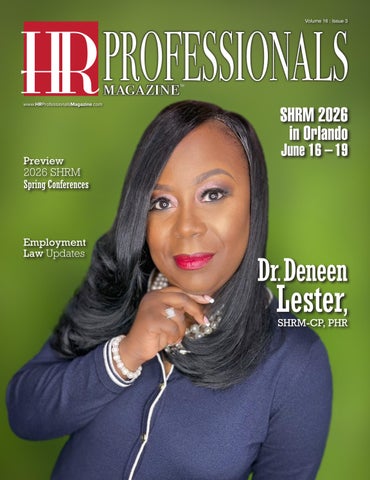
We are honored to feature Dr. Deneen Lester, PHR, SHRM-CP, on our March 2026 cover. Dr. Lester is a distinguished human resources executive, educator, media host, and community leader whose life and career reflect excellence, integrity, and a steadfast commitment to service. With more than 35 years of progressive human resources experience, Dr. Lester is a certified HR professional who has devoted her professional journey to developing people, strengthening organizations, and building systems that create lasting impact. She currently serves as Human Resources Director for The Salvation Army Memphis & Mid-South, overseeing comprehensive HR operations, including recruitment strategy, employee relations, compliance, leadership development, and organizational performance. Her work directly supports the organization’s outreach and service initiatives throughout the community.

Dr. Lester is also the creator and host of the HR television show, Let’s Talk HR with Dr. Deneen, which you can find on YouTube. She is also a prolific singer – and enjoys participating in karaoke. We invite the HR Conference Cruise attendees to join us in the karaoke lounge and vote for Dr. Lester!

This HR Conference Cruise is proudly sponsored by the SHRM State Councils, including HR Florida, Ohio SHRM, and New York State SHRM.

As the official media sponsor for the HR Conference Cruise, we’re excited about the opportunity for attendees to embark on an adventurous Caribbean journey while earning 16.25 SHRM and HRCI credits. This will be an unparalleled experience, combining meaningful networking with a “floating” educational format. We look forward to future collaborations with Mike Medoro and Aspect Marketing and Communications, Inc.

This Issue’s Focus: Labor and Employment Law

In this issue, we delve into the evolving landscape of labor and employment law, particularly considering recent administrative changes. We extend our gratitude to Rebecca Page with JER HR Group for her excellent article on Page 14, “Your HR Investigation Process is on Trial – Are You Ready?” Special thanks to Bass Berry & Sims for their insightful article on Page 18, exploring the significant alterations to the National Labor Relations Board (NLRB) and their implications for HR professionals. Additionally, we appreciate Matthew Courtner, with Rainey Kizer Reviere & Bell, PLC, for his compelling article on Page 30, which addresses the EEOC Rescinding its 2024 Harassment Guidance. Be sure to catch Paul Tuberville’s engaging article on the expected changes coming to the NLRB.
Upcoming SHRM Conferences

Don’t miss out on the upcoming SHRM Conferences coming this spring and fall! Be sure to register for the SHRM Talent Conference in Dallas, the SHRM-Atlanta SOAHR Conference, the ARSHRM ELLA Conference in Little Rock, the Tennessee SHRM Conference in Knoxville, and SHRM26 in Orlando; just to name a few. Keep an eye out for highlights in our April issue, and tune into our Facebook Live videos as we showcase SHRM leaders and speakers during these pivotal events. Details about all these conferences can be found in this issue.

Certification Opportunities

If you’re considering certification, I warmly invite you to enroll in our upcoming Online SHRM-CP | SCP Certification Exam Prep Class starting April 20. The registration deadline is April 17. We take pride in our program, boasting a remarkable 90% pass rate for our SHRM and HRCI Certification Exam Prep Classes. I am personally dedicated to your success and support you until you pass. Plus, our classes are guaranteed—you can retake the course at no extra charge if you don’t pass on your first attempt. For more information and to register, please visit our website at (http://www.hrprofessionalsmagazine.com).

Thank you for being an integral part of our HR community, and we look forward to sharing more exciting content in our upcoming issues! A special thanks to our new subscribers from across the U.S. since we moved from a regional publication to a national publication in November 2025.

cynthia@hrprosmagazine.com

Connect with me on LinkedIn:https://www.linkedin.com/ in/cynthia-thompson-mba-shrm-scp-sphr-325b8715/ Like us on Facebook.com/HRProfessionalsMagazine

Dr . Deneen LESTER Dr. Deneen Lester, SHRM-CP, PHR

Dr. Deneen Lester is a distinguished human resources executive, educator, media host, and community leader whose life and career reflect excellence, integrity, and a steadfast commitment to service. With more than 35 years of progressive human resources experience, Dr. Lester is a certified HR professional who has devoted her professional journey to developing people, strengthening organizations, and building systems that create lasting impact.

Dr. Lester retired from the City of Memphis, where she served as Talent Management Officer, providing strategic oversight of workforce planning, employee development, leadership cultivation, and organizational effectiveness initiatives. Her leadership was instrumental in advancing talent strategies, enhancing employee engagement, and fostering a culture of accountability and growth across city government.

Continuing her commitment to mission-driven leadership, she currently serves as Human Resources Director for The Salvation Army Memphis & Mid-South, overseeing comprehensive HR operations, including recruitment strategy, employee relations, compliance, leadership development, and organizational performance. Her work directly supports the organization’s outreach and service initiatives throughout the community.

Dr. Lester holds a Bachelor of Business Administration, a Master of Science in Leadership and Policy Studies, and a Doctor of Management in Organizational Leadership. Her academic accomplishments reflect her unwavering commitment to leadership excellence, organizational effectiveness, and the advancement of the human resources profession. She leverages her strong educational foundation, combined with more than 35 years of professional HR experience, to drive strategic initiatives, develop people-centered solutions, and foster healthy, high-performing workplace cultures.

Dr. Lester served as an adjunct professor at the University of Memphis, where she shared her extensive professional HR expertise with the next generation of leaders. While currently serving as the College Relations Chair for the Memphis SHRM Chapter, she continues to mentor students and emerging professionals, providing guidance, career development support, and practical insight that bridges academic preparation with real-world leadership experience.

Expanding her influence beyond corporate and academic settings, Dr. Lester is the creator and host of the HR television show, Let’s Talk HR with Dr. Deneen. Through this platform, she inspires HR leaders, emerging professionals, students, and company executives through insightful conversations with leading voices in human resources. She is also the founder and CEO of the Christian HR Network, a faith-based Human Resources Association.

Human Resources is not just her profession, but it is Deneen’s passion. Dr. Lester has dedicated more than 30 years to serving and advancing the HR profession through her active involvement with SHRM at the local and state levels. She has served and participated on the Memphis SHRM Chapter Board as well as the Tennessee State Council Board.

She has the distinct honor of being the first African American female president of the Memphis SHRM Chapter and the first African American female West Tennessee District Director for the Tennessee State Council. In these historic leadership roles, Dr. Lester helped advance the HR profession while paving the way for greater diversity, inclusion, and representation within the field

Dr. Lester’s professional credentials and accomplishments reflect her leadership and expertise in the HR field:

• Certified Professional in Human Resources (PHR) and SHRM-CP Designations, Society of Human Resources Management (SHRM)

• President, SHRM – Memphis Chapter (2010)

• Director of Diversity, Tennessee State Council of SHRM – Former Board Member

• Former West Tennessee District Director, Tennessee State Council of SHRM (2017–2022)

• Current SHRM College Relations Chair & Professional Advisor to the SHRM Student Chapter

• Instructor, SHRM Certification Prep Course

• Leadership Memphis Graduate – 2014

• New Memphis Institute Graduate – April 2017

• 2022 Human Resources Management Excellence Award Recipient, Tennessee State Council of SHRM

• 2022 SHRM Lifetime Achievement Award Recipient, SHRM – Memphis Chapter

Dr. Lester is widely respected for her wisdom, steady leadership, and dedication to faith and community development. She has served in academic and ministry settings, mentoring and equipping individuals to grow personally, professionally, and spiritually. Her leadership style is collaborative, principled, and grounded in faith, humility, and a genuine passion for helping others reach their fullest potential.

Known for her thoughtful insight and unwavering commitment to excellence, Dr. Lester continues to serve as a trusted executive leader, influential educator, media host, and pillar of strength within the communities she serves. ■

Welcome to the HR Conference Cruise®!

We’re delighted that you decided to embark on our unique HR conference at sea, and are ready to learn, network, and have fun on the EXPLORER OF THE SEAS! We have two sailings on the Explorer A huge shout out to our state council partners:

March 7-12, 2026

SHRM Florida

SHRM New York State

SHRM Ohio

Thank You!

March 16-21, 2026

SHRM Indiana

SHRM Michigan

SHRM Wisconsin

The goal of our partnership is to combine a robust Human Resource conference with an exciting cruise to tropical islands and gorgeous getawayswhile earning recertification credits and networking with our peers.

• We have a full schedule of top-notch speakers for our “surf and turf” series, including four pre-conference webinars and on-board sessions.

• Returning this year are our LEARNING DECK sessions which include industry expert/speakers presenting on a hot topic. This conference is both fun and educational!

We have amazing ports of call. Destinations that are very lovely (and warm!) with plenty of time for us to explore.

Our HR Conference Cruise schedule has been pre-approved for both SHRM Professional Development Credits (PDCs) and for an equal number of recertification credits from the HR Certification Institute. Details about recertification are in your conference program.

Additional SHOUT OUTS to SHRM Indiana, SHRM Ohio, and to HR Professionals Magazine for certifying our programs.

You will find conference information in our conference app, including copies of our speaker handouts as well as links to our four pre-conference webinars. You’ll have ON DEMAND access to the webinars for up to 60 days after the completion of the sailing.

Thank you again for attending the 2026 HR Conference Cruise. If you purchased the internet package - please remember to tweet/post about your experience! Don’t forget to use #HRCRUISE2026

Sincerely,

The HR Conference CruiseSM to Alaska is designed to deliver accredited learning, strategic insights, and meaningful HR connections.

Take the opportunity to deepen your expertise, earn recertification credits, and engage with peers—all aboard Royal Caribbean’s Voyager of the Seas

• Recertification credits • Unmatched networking at sea • 7 days of exploration

Juneau, Alaska

Discover fresh perspectives amid majestic mountains and glacial waters.

Skagway, Alaska

Take your leadership to new heights where gold rush history meets frontier spirit.

Endicott Arm & Dawes Glacier, Alaska

Reflect and recharge while witnessing nature's most powerful forces in action.

Victoria, British Columbia

Wrap up your voyage surrounded by timeless charm and forward-thinking dialogue.

Juneau, Alaska
Skagway, Alaska
Endicott Arm & Dawes Glacier, Alaska
Victoria, British Columbia

Sailing

Leaving from Port Canaveral, FL

Visiting...

Cozumel, Mexico

Puerto Costa Maya, Mexico

Sailing

Leaving from Port Canaveral, FL

Visiting...

Nassau, Bahamas

Perfect Day at Coco Cay

The NLRB: Change Is Coming, But When?

Since 1935, the National Labor Relations Board has been tasked with the interpretation and enforcement of the National Labor Relations Act, which governs the various rights and responsibilities of employers, employees, and labor organizations. While the agency celebrated its 90th anniversary in 2025, at the same time it faced existential challenges.

The NLRB consists of five Board members, each nominated by the President and confirmed by the Senate to staggered five-year terms. By long-standing tradition, when fully staffed the party occupying the White House has a majority of three members, with the other party holding the remaining two seats. The Board’s interpretation of the National Labor Relations Act often varies significantly depending upon which party holds a majority of seats, and changes in Board doctrines from administration to administration have become common.

The Biden era Board, despite its relatively brief tenure, was remarkably effective in achieving many significant changes. For example, its decisions expanded the scope of those employee actions considered “concerted” and therefore protected by the Act; made it easier to obtain a bargaining order requiring union recognition without a secret ballot election; and otherwise reversed many other long-standing rules, making it easier for employees and unions to organize.

While the Trump Board is widely expected to reverse many Biden Board decisions, its current ability to do so, over a year into the current administration, has been significantly hampered by personnel decisions within and without the agency. As a result, the Trump Board’s ability to effect change remains limited, nor is it likely to be able to do so for some time.

When the Trump administration took office in January 2025, the Board consisted of three active members (two Democrat, one Republican) with two vacancies. By statute the Board cannot function without a quorum of at least three sitting members. The Board promptly lost its quorum with the unprecedented termination of one of the sitting Democrat members, Gwynne Wilcox. (As of mid-February 2026, the legality of this action remains at issue.) Without a quorum the Board has been unable to issue decisions in any cases, or to issue new regulations impacting election procedures and other matters. The Board’s makeup further declined to a single member in August, when the term of a sitting Board member expired.

The Board’s quorum was not restored until December 2025, when two Republican Board members were confirmed by the Senate. Currently, the Board consists of two Republican and one Democratic member, with two vacancies. As of this writing, the President has not nominated anyone to fill the vacant seats.

While a quorum has been restored, this does not mean that the Board will be issuing any significant decisions any time soon. By tradition, the Board does not issue decisions that overrule existing precedent unless there are three votes to do so. The current Board has indicated that it intends to follow this practice; therefore, it is unlikely that any current precedents will be overruled until additional Board members are nominated and confirmed. In addition, the term of one sitting Board member will expire in August, and unless at least one Board member is seated before that time, the Board will once again lose its quorum.

The Board’s effectiveness over the coming months will also be challenged by its current manpower shortages. The Board reports that it has lost a significant number of employees over the last year, resulting in case backlogs and challenges to its ability to act in a timely manner. According to one analysis, the Board is currently understaffed by almost 25%. The significance of this shortage was underscored by the decision of the new General Counsel not to follow a tradition of issuing a memo focusing the Board’s regional offices on those rulings that she wants to challenge or reconsider. Rather, the General Counsel has announced that her initial efforts will be focused on reducing the backlog of cases that have accumulated over the previous year.

Accordingly, 13 months after the start of the new administration, no decisions overruling or revising actions of the Biden Board have been issued, nor are we likely to see them any time soon. At least for the time being these decisions remain in effect, and employers that choose to disregard them do so at their peril.

Despite the significant delay, it remains widely anticipated that the current Board will attempt to effect clearer rules and a significant rebalancing of employer and employee rights. While these changes will occur on a much more attenuated basis than initially expected, many of them are still considered likely to occur. Some of the most significant issues include:

Cemex Manufacturing: This 2023 decision revived a version of the Joy Silk doctrine, which had been previously abandoned over 50 years earlier. Under Cemex, an employer faces a significantly higher risk of the reversal of a favorable secret ballot election and issuance of a bargaining order if it declines a union demand for recognition and then is found to have committed a single unfair labor practice. Cemex constituted a major expansion of the use of bargaining orders, which previously were limited to more extreme situations.

American Steel Construction: This decision reinstated the “overwhelming community of interest” standard, making it easier for unions to carve out “microunits” and more difficult for employers to challenge a union’s preferred bargaining unit.

Amazon.com Services: This 2024 decision rendered most employer “captive audience meetings” unlawful, reversing over 75 years of Board precedent.

Stericycle, Inc.: This decision significantly broadened the number and type of neutral employee policies and handbook rules considered unlawful.

Thryv, Inc.: This decision broadly expanded the types and amounts of damages available beyond the Board’s traditional “make whole” relief.

Lion Elastomers, Inc.: This decision expanded protections and limited employers’ ability to address serious misconduct committed by employees while participating in otherwise protected activities.

McLaren Macomb: This Board ruling found many commonly used confidentiality and non-disparagement provisions to violate the Act.

The Atlanta Opera: This ruling expanded the definition of “employee” to include many individuals previously considered to be independent contractors.

Election rules: Board election rules and regulations imposing a significantly shorter period from petition to election are likely to be reexamined.

These and many other Biden era rulings remain likely to be reexamined by the current Board. However, that will not happen until Board vacancies, staffing shortages, and case backlogs at the agency are addressed.

Congratulations to Sandra Creswell, SPHR, SHRM-SCP

Sandra is an independent senior HR consultant with over 30 years of experience providing comprehensive HR services to organizations of up to 500+ employees. She previously worked for Chesapeake Employers Insurance Company, BoMark Electric and Atlantic Builders Group, Inc. Her expertise spans employee relations, performance management, benefits and compensation, recruitment, HRIS, safety and risk management across diverse industries with SPHR, WCP, and Gallup Global Strengths Coach certifications, providing a proven strategic impact.

Sandy passed her HRCI SPHR exam in December 2025 and passed her SHRM-SCP exam in February.

Preparing for an Extra Bi-weekly Payroll Period in 2026

Employers use one of a few standard payroll cycles. While some follow a monthly or weekly period, most have a semi-monthly (twice per month) or bi-weekly (every other week) schedule. In fact, bi-weekly is one of the more common payroll cycles, with 43% of employers following this cadence, according to a report from the Bureau of Labor Statistics (BLS).

For employers that run bi-weekly payroll, 2026 introduces a unique scheduling challenge. Because Friday, Jan. 1, 2027, is a federal holiday, many employers that typically use a Friday pay date will need to shift that payday earlier in the week—placing it in 2026. As a result, under most payroll structures, Thursday, Dec. 31, is likely to become the final payday of 2026.

The cadence of 27 payroll dates happens slightly less than one time per decade (roughly once every 11 or 12 years) due to mismatching days (365 days per year and 14-day pay cycles) and an extra day for leap year happening every four years.

This extra payroll period can impact salaried employee requirements, benefits contributions and more, creating potential compliance and operational challenges. This article provides an overview of salaries, explores the implications of an additional bi-weekly payroll period, and offers strategies to prepare for it in 2026.

FLSA Salary Basis Requirement Overview

Salaried workers are paid a predetermined amount for each pay period. Under the federal Fair Labor Standards Act (FLSA), employees who are properly classified as exempt under the executive, administrative and professional (EAP) exemptions are not entitled to overtime pay.

Specifically, to qualify for exemption, employees generally must:

Be paid on a salary basis

Be paid a salary that meets the specified minimum amount per week (currently $684) Meet certain duties tests

Some states impose higher salary thresholds or have unique exemption criteria that employers must also consider.

Being paid on a salary basis means the employee regularly receives a fixed amount of compensation each pay period, typically on a weekly or less frequent schedule. This amount cannot be reduced due to variations in the quality or quantity of work performed. With limited exceptions, exempt employees must receive their full salary for any week in which they perform any work, regardless of the number of days or hours worked.

An estimated 40%-45% of U.S. workers are salaried, according to the BLS. As a result, in 2026, an additional payroll period may have significant implications for employers— particularly regarding exempt-employee compensation, benefits calculations and overall compliance.

Impact on Payroll

A year with a potential extra pay period can create several payroll challenges, particularly for employers with salaried employees who must be paid a predetermined amount each pay period. This additional cycle can introduce both FLSA compliance issues and operational complexities.

The distinction between a 26-pay-period year and a 27-pay-period year often leads to mistakes that can affect employee compensation, benefits administration and overall payroll accuracy. Employers may inadvertently miscalculate salaries, exceed benefits contribution limits or misinterpret regulatory requirements.

Here are common mistakes, compliance requirements, and key factors employers should consider:

EAP Exemption Compliance

Under the FLSA, employees must maintain salary levels to remain exempt under EAP. In a year like 2026, where an additional pay period may occur, employers that simply divide annual salaries across 27 cycles instead of 26 may unintentionally reduce employees’ weekly pay. This reduction can place employees below the minimum salary threshold required to maintain exempt status.

For example, consider an employee earning an annual salary of $36,000. When paid bi-weekly across 26 pay periods, the employee receives $1,384.62 per paycheck, equivalent to $692.31 per week, which meets the current federal minimum salary level of $684 per week. If the same salary is divided across 27 pay periods, bi-weekly pay

drops to $1,333.33, equal to $666.67 per week—below the FLSA’s salary threshold. In this scenario, the employee would no longer qualify as exempt.

This issue can also arise under state-specific exemption rules, many of which have salary thresholds higher than the federal minimum. Employers operating in those jurisdictions face an elevated risk of inadvertently misclassifying employees during a 27-pay-period year.

Notice Requirements

Before making adjustments to payroll, employers should check federal, state and local requirements for notifying employees before adjusting pay frequency or amounts. Notably, some states have requirements on how notice for changes to payments should be handled. For example, both California and New York require advance notice before any payroll changes. In addition, states like Alaska, Maryland, Illinois and others have unique, state-specific rules.

Due to the patchwork of rules for both single-state and multistate, it’s wise for employers to seek local legal counsel.

Tax Withholdings

Whether an employer has 26 or 27 payroll cycles, correct tax withholding calculations must be maintained across all pay periods. While IRS withholding tables typically accommodate this, employers are responsible for ensuring their payroll software is updated and properly configured for the extra period to prevent under-withholding.

Overpayment

Adding an extra payroll cycle is a common approach many employers take during a 27-pay-period year. However, doing so carries the risk of unintentionally overpaying salaried employees. Notably, issuing an additional paycheck increases annual payroll expenses—potentially by up to 3.85%—before factoring in the added cost of benefits contributions and related liabilities.

For example, consider a salaried employee earning $70,200 annually. In a typical year with 26 pay periods, the employee receives $2,700 per paycheck. If an employer instead issues 27 paychecks, the employee would receive a total of $72,900, representing an unplanned increase of approximately 3.85%.

For large employers, this can translate into a substantial increase in total payroll spend. For smaller employers, even modest, unbudgeted payroll increases can create significant financial strain or disrupt annual budgeting assumptions.

Benefits Contributions

Employers make and allow for benefits contributions in cadence with their payroll. An extra payroll cycle can impact mandatory statutory deductions (taxes), health insurance, contributions to accounts like health savings accounts (HSAs) and flexible spending accounts (FSAs), voluntary benefits (e.g., dental and vision), retirement accounts (such as a 401k) and more.

Generally, even employers planning for 27 payroll cycles in 2026 complete benefits deductions for the first 26 paychecks. For example, some major employers like Microsoft have publicly stated that the last paycheck will not include benefit deductions.

This means that benefits deductions from the first 26 checks must be accurate to ensure compliance with annual obligations.

Summary

In 2026, an extra bi-weekly payroll period presents both operational and compliance challenges for employers. While many payroll vendors and platforms help your organization stay organized, it may be better to audit your payroll than make mistakes that impact employees or violate compliance requirements. Employers should consider seeking local legal counsel to ensure their payroll practices are in compliance with all applicable laws and regulations.

This HR Insights is not intended to be exhaustive nor should any discussion or opinions be construed as professional advice. © 2026 Zywave, Inc. All rights reserved.

www.thebenefits.group 615-250-3334 care@benefits.place

Please join us on April 11-12, 2024, at Doubletree Hotel and Robinson Center for the Arkansas SHRM Employment

Your ELLA 2024 committee is hard at work preparing a great conference!

Please visit ella.arshrm.com for updates on speakers and topics.

online ELLA.ARSHRM.com or scan this QR code

Want to position your organization hundreds of Arkansas employers professionals? Being a sponsor Conference is the perfect opportunity!

Contact us at ellasponsors@arshrm.com

Supervisors are often the first to hear about a leave request. Knowing what to say — and what to do next — matters.

Get FREE FMLA training resources from the J. J. Keller® LEAVE MANAGER solution to help you respond with confidence, including guidance on:

• What questions you can ask when an employee requests leave

• How to recognize situations that may qualify for FMLA protection

• What qualifies as a “serious health condition” under the law

Designed specifically for front‑line supervisors, these practical resources help you handle leave conversations correctly and avoid costly mistakes — before they become compliance issues.

Talent Is Your Strategy. Make It Your Advantage.

The Future of Work Is Built by the Leaders of Today. Are You Ready to Build It?

SHRM Talent 2026 is the essential gathering for senior leaders who understand that a sophisticated talent strategy is the ultimate competitive advantage. Join a community of your peers to explore the most pressing issues in talent management, including:

• AI-Powered Talent Transformation,

• Career Agility for the Modern Workforce,

• Skills-Based Talent and Workforce Planning,

• Data-Driven Hiring and Talent Intelligence,

• Global Workforce Ecosystems,

• Workplace Culture and Human Connection.

Shape the future with a workforce designed to deliver measurable business results.

Lead with confidence. Drive results. Register Now!

shrm.org/talent26-hrp03

Book your room in the SHRM housing block by March 27 for exclusive rates!

ONPresident Trump’s NLRB Gains Quorum and GC, Flurry of Activity Expected

January 7, James Murphy and Scott Mayer, as National Labor Relations Board (NLRB or Board) members, and Crystal Carey, as the NLRB’s General Counsel (GC), were sworn into their roles following their confirmation votes in the Senate.

These confirmations bring the NLRB to three members (two Republicans, one Democrat), giving the Board a quorum and the Trump-backed Republican control that has long been expected. The NLRB has been without a quorum and unable to issue any decisions since President Trump fired Democratic member Gwynne Wilcox shortly after taking office.

We expect the NLRB to focus on numerous areas, and we anticipate more employer-friendly decisions in contrast to the NLRB’s actions and decisions during the Biden administration. This shift may be even more dramatic given that former Trump-appointed NLRB Chairman Marvin Kaplan (who retired earlier this summer) stated that before resigning, he had completed considerable work to set the new Board up for “success” right off the bat.

Likewise, with Carey now at the helm in the GC role, she will have the power to steer the agency toward a more employer-friendly position and is expected to have an immediate impact by swiftly rescinding Memoranda issued by previous Biden-appointed GC Jennifer Abruzzo. GC Carey is also likely to issue new Memoranda that announce revised GC positions and correspondingly change initiatives and enforcement directives to the NLRB’s regional directors, who are part of the enforcement process. These changes are expected to be a dramatic shift from Abruzzo’s positions and certainly more employer-friendly.

If you have any questions about how these changes to the NLRB’s composition and priorities may impact your business, please contact the authors.

This content was originally published on January 22, 2026 on the Bass, Berry & Sims HR Law Talk Blog. Visit bassberryhrlawtalk.com for more.

Tim K. Garrett, Member tgarrett@bassberry.com

Tim Garrett helps employers solve complex issues related to all aspects of labor and employment law, providing in depth counseling and developing creative solutions to underlying business issues. He is an experienced trial lawyer, defending employers of all sizes in employment litigation claims across the country. His work has ranged from defending a major university during a significant wage and hour collective action involving thousands of employees to the successful defense of a major healthcare provider in a gender discrimination / retaliation case. In addition, Tim has served as nationwide labor and employment counsel for the largest nonprofit dialysis company in the U.S.

Robert W. Horton, Member rhorton@bassberry.com

As chair of the firm’s Labor & Employment Practice Group, Bob Horton represents management in all areas of labor and employment law. Bob’s practice consists primarily of counseling clients regarding employment issues and defending companies against all manner of employment claims throughout the U.S.

Hunter K. Yoches, Associate hunter.yoches@bassberry.com

Hunter Yoches represents management in all aspects of labor and employment law and related litigation. He regularly defends employers against various claims and counsels clients on a wide range of day-to-day employment matters. Hunter has experience litigating cases and counseling clients regarding federal and state employment laws, including collective and class action litigation, contract disputes, and compliance issues. He advises clients related to wage and hour laws, discrimination laws, unfair labor practices, and more.

Bass, Berry & Sims listens and responds with creative yet practical counsel. We stay on pace with the complex and rapidly evolving employment landscape, connecting your dynamic human resources needs to proactive strategies. Relationships, reliability, and respect – at the center of our Labor & Employment and Employee Benefits practices.

Your HR Investigation Process Is on Trial — Are You Ready?

When complaints surface, instinct isn’t enough. A clear, defensible investigation framework is what protects your people, your culture, and your organization.

When the complaint first lands on your desk, it rarely arrives with clarity.

Sometimes it’s an email marked “urgent.” Sometimes it’s a quiet knock on the door. Other times, it’s a comment made in passing that makes your stomach tighten because you know it might be more than it seems.

Workplace investigation missteps are rarely intentional. Most HR professionals and leaders genuinely want to do the right thing. But when there isn’t a clear, consistent, repeatable process to follow, even experienced leaders can hesitate, or worse, handle similar situations in dramatically different ways.

A complaint, whether formal or informal, immediately places leadership at a crossroads. The organization can respond with uncertainty and improvisation, or with discipline, structure, and credibility. And in today’s workplace, where expectations around fairness, transparency, and accountability are higher than ever, inconsistency can be costly.

Confidence in conducting workplace investigations doesn’t come from instinct. It comes from structure.

The Moment You Realize: This Requires More Than a Conversation

Not every workplace concern requires a formal investigation. Some issues can be resolved with coaching, mediation, or clarification. But certain allegations demand more.

When a concern involves harassment, discrimination, retaliation, bullying, ethics violations, safety risks, or significant policy breaches, the organization has both a moral and legal obligation to respond thoughtfully.

The first step is to recognize that the situation warrants a formal review.

Workplace investigation missteps are rarely rooted in bad intent. They occur when organizations lack a defined, repeatable framework. Without one, even experienced leaders can default to inconsistent practices, selective interviews, uneven documentation, or closing matters without clear findings.

These inconsistencies erode trust and introduce risk.

Confidence in conducting workplace investigations is not instinctive. It is procedural. It is built on preparation, neutrality, and disciplined follow-through.

Recognizing the Threshold for Investigation

Effective leaders understand that not every workplace issue requires a formal investigation, but certain allegations demand it.

Concerns involving harassment, discrimination, retaliation, ethics violations, safety risks, or serious policy breaches require a structured inquiry. The organization’s obligation is both legal and ethical. Failure to investigate appropriately can expose the organization to liability, reputational harm, and cultural deterioration.

The first leadership discipline is discernment. Ask:

• Does this allegation involve potential policy or legal violations?

• Could inaction create risk or ongoing harm?

• Would a reasonable employee expect a formal review?

When the answer indicates heightened risk or seriousness, the organization must shift from informal resolution to formal investigation without delay or hesitation.

Preparation: The Foundation of Credibility

Confidence begins long before the first interview.

Before speaking with witnesses, effective HR professionals step back and define the scope. What exactly is being alleged? Vague accusations lead to vague investigations. Clear framing leads to focused inquiry.

Who should conduct the investigation? Is there any potential bias or conflict of interest?

Neutrality is paramount. Real or perceived conflicts of interest undermine findings before they are ever issued. In particularly

sensitive cases, an external investigator may be the wisest choice.

Then comes the plan. Who needs to be interviewed? What documents might exist? What evidence - emails, text messages, performance records - should be preserved?

This preparation often happens behind the scenes, but it is what separates reactive investigations from disciplined ones. It also communicates something powerful: we are taking this seriously.

A clear definition of the allegation is critical. Vague framing produces unfocused inquiries. Precise articulation of the issue establishes scope and prevents mission drift.

A structured investigation plan should outline:

• Individuals to be interviewed

• Documents and data to be reviewed

• Evidence preservation steps

• Interim protective measures, if necessary

• A projected timeline

This planning phase signals seriousness and discipline. It also protects the integrity of the process.

Conducting Interviews with Professional Neutrality

The heart of any investigation lies in its interviews.

Interviews are the core fact-finding mechanism. They must be conducted with objectivity and precision.

For the complainant, this may be a vulnerable moment. For the accused, it may feel threatening. For witnesses, it may feel uncomfortable. The investigator’s role is not to judge or advocate, but to listen carefully and neutrally.

Effective investigators set expectations clearly. They explain the purpose of the conversation, reinforce confidentiality boundaries, and make the organization’s anti-retaliation stance explicit.

Then they ask open-ended questions:

“Tell me what happened.”

“What did you observe?”

“Who else might have information?”

Effective investigators avoid signaling belief or skepticism. The investigator’s role is not to advocate for, defend, or adjudicate emotions. It is to gather and assess facts methodically. They document accurately and comprehensively, capturing facts rather than impressions.

Importantly, fairness requires that the respondent have a full opportunity to respond to the allegations. Skipping this step undermines credibility and can damage trust on all sides. An investigation that fails to provide this opportunity is procedurally flawed.

Evaluating Evidence and Reaching Defensible Findings

Once interviews conclude and documents are gathered, the real analysis begins.

Some facts will be undisputed. Others will conflict sharply. That is normal.

Investigators must evaluate consistency, plausibility, corroboration, and credibility.

Most workplace investigations rely on the “preponderance of the evidence” standard, which determines whether it is more likely than not that the alleged conduct occurred.

Analysis requires discipline. This is rarely dramatic. It is careful, methodical work. The investigator’s responsibility is to assess credibility, consistency, corroboration, documentation, and plausibility.

Findings should be clearly structured and documented, including:

• The specific allegation

• Evidence reviewed

• Factual determinations

• The rationale supporting the conclusion

Even when the conclusion is “unsubstantiated,” a well-reasoned explanation reinforces that the process was fair and thorough. Wellreasoned findings strengthen defensibility and reinforce trust in the process, even when conclusions are difficult to reach.

Closure requires communication. Both the complainant and the respondent should be informed that the matter has concluded. Without this communication, employees may assume nothing happened. While confidentiality may limit disclosure of specific corrective actions, communication should confirm that appropriate steps were taken. Where findings warrant action, leadership must implement it consistently and in alignment with policy.

Comprehensive documentation of the investigation file is essential. In the event of regulatory review or litigation, the quality of documentation often becomes the measure of due diligence. Documentation must also be finalized and securely maintained. In many cases, months or even years later, the integrity of the organization’s response will depend on those records.

Monitoring and Preventing Retaliation

Perhaps the most underestimated phase of workplace investigations is what happens afterward. The organization’s responsibility does not end with findings.

Retaliation can be subtle. A shift in attitude. A missed opportunity. A change in tone. Retaliation, whether overt or subtle, can compromise both legal compliance and workplace culture. Leaders must proactively reinforce anti-retaliation expectations and monitor workplace dynamics following closure.

Periodic follow-up demonstrates sustained commitment to fairness. It communicates that the organization’s values are not episodic; they are operational. Follow-up builds trust in a way that policy language alone never can.

Elevating Investigations from Risk Management to Leadership Practice

Workplace investigations are often viewed as reactive risk management tools. In reality, they are a visible test of leadership credibility.

• Protect the organization legally and reputationally

• Encourage early reporting of concerns

Conversely, inconsistent or poorly executed investigations can cause long-term cultural damage.

Handled poorly, workplace investigations erode morale and damage credibility. Handled well, they do the opposite. They demonstrate that leadership listens. They show that fairness matters. They reinforce accountability. They protect both people and the organization. Most importantly, they build psychological safety, the foundation of a healthy workplace culture.

Confidence in conducting workplace investigations is not about assertiveness; it is about discipline. It is the product of a defined framework, consistent execution, and principled decision-making. It is about knowing that when concerns arise, there is a clear, structured path forward.

When HR professionals and leaders are equipped with a practical, step-by-step framework, recognizing when to investigate, planning carefully, conducting neutral interviews, evaluating evidence thoughtfully, closing appropriately, and monitoring for retaliation, they move from uncertainty to assurance. And in today’s workplace, that confidence makes all the difference. In a workplace landscape defined by heightened scrutiny and evolving expectations, that authority is not simply beneficial; it is essential.

Rebecca (Becky) Page, SPHR, SHRM-SCP

Director, HR Services - JER HR Group

Email: Becky@jerhrgroup.com

Closing with Professional Clarity

An investigation is not complete when the analysis ends; it must be officially closed.

When handled with structure and professionalism, investigations:

• Reinforce organizational values

• Strengthen psychological safety

• Demonstrate accountability

Upcoming Webinar:

March 19, 2026 | 2:00 – 3:00 ET

“Conducting Workplace Investigations with Confidence: A Practical Guide for HR & Leadership”

RSVP bit.ly/RSVP-Webinar-March19

Written Policies Don’t Mean Squat (Without These 5 Things)

“It’s in our company handbook.” Newsflash - 20 to 1 odds that nobody’s ever read beyond the vacation portion of that document.

Employee handbooks. Hiring procedures. Compliance checklists. They look great on paper. And that’s exactly the problem.

A written policy doesn’t protect your company. It doesn’t prevent lawsuits. It doesn’t stop bad hires, misconduct, or compliance failures. What it does is create the illusion that you’re covered. And illusions are expensive.

Regulators, attorneys, and courts care what your organization does, not says. If policies aren’t enforced, documented, reviewed, and applied consistently, they’re meaningless. Sometimes they’re worse than having nothing at all.

Now

Data Facts, I’ve Read Other Articles Where You Recommend Written Policies!

You’re right, we do. Written policies matter. But not because they exist They matter because they establish expectations, define standards, and create a framework for accountability.

On their own, written policies won’t protect you from bad hires, compliance violations, or legal scrutiny. But, when organizations back policies up with training, enforcement, documentation, and consistent execution, they become powerful risk-management tools.

When they aren’t, they’re just words on paper. And paper doesn’t show up when things go sideways.

Why Written Policies Don’t Mean Squat

Writing policies is easy. Living by them is not. Organizations don’t get into trouble because they lack policies, they get into trouble because their policies aren’t followed, enforced, or proven when it counts. Here’s where things usually break down.

1. The policy exists, but nobody knows it. If employees can’t find your policy (or worse, don’t know it exists) it’s useless. Policies buried in handbooks no one reads or portals no one visits don’t guide behavior. Courts and regulators expect informed, trained, and aware employees. “It was in the handbook” isn’t a defense when you can’t prove you communicated it or your employees understood it.

2. Enforcement depends on who you are. When leaders look the other way for high performers or enforce rules differently across teams, policies lose credibility. Inconsistent enforcement creates exposure to discrimination and retaliation claims that are difficult to defend.

3. No clear owner. Policies without ownership drift into irrelevance. If no one is responsible for enforcing, reviewing, and updating a policy, it can be ignored and quickly becomes outdated.

4. The policy hasn’t kept up with reality. Policies that haven’t been reviewed in years may not reflect how hiring, screening, or employee management works today. Outdated policies can actively hurt you by signaling negligence or noncompliance during audits or investigations.

Nothing says “we’re not paying attention” like a policy frozen in 2016.

5. No paper trail of follow-through. A written policy without documentation is a weak shield that won’t hold up under scrutiny. Regulators and attorneys care about evidence of action, not intent. Without proof, your policy is just a promise you can’t back up.

How to Make Written Policies Hold Water

A policy that holds up under pressure is built intentionally, with accountability baked in. If your policies are going to survive audits, lawsuits, and real-world use, here’s what must change.

1. Assign ownership. Every policy needs a clear owner. Not a committee. Not “HR in general.” A real person responsible for enforcement, updates, and follow-through. Ownership turns policies from suggestions into standards.

2. Train like you mean it. One-time onboarding training doesn’t cut it. Reinforce policies through regular training, refreshers, and acknowledgments. Employees should know what’s expected before there’s a problem.

3. Enforce it every time. Consistency is non-negotiable. Apply policies the same way, every time, regardless of role, tenure, or performance. The fastest way to kill a policy is to make exceptions and call them “judgment calls.” Courts call them something else entirely.

4. Document relentlessly. If you can’t prove it happened, it didn’t happen. Documentation is your star witness when no one wants to remember what they said. Strong records turn policies into defensible action.

5. Back hiring policies with a supportive screening partner. Choosing the right background screening partner helps you execute policies consistently and compliantly from the start. A policy that says “we screen” means nothing if you rush the screening, or if it’s incomplete or inconsistent. The right partner helps close the gap between what you say you do and what actually happens.

Written Policies Don’t Protect Organizations… Accountability Does

Written policies don’t mean squat unless they’re enforced consistently, backed by documentation, and proven through action. Without that, they become evidence of what an organization knew it should be doing and failed to do.

When regulators show up, no one cares what your policy said When attorneys get involved, no one asks what you intended And when things land in court, they ask one question: “Prove it.”

Ownership, training, enforcement, documentation, and disciplined hiring practices are what give policies weight. When scrutiny hits, what matters is what you can demonstrate.

Data Facts | www.datafacts.com

Meet the Alabama SHRM Leadership Team

Andrea Lewis Director
Joshua Bracken Business Manager
Chanell Daniel Secretary
Mallory Watkins Director-Elect

FHere and Now: The AI Employment Landscape

or the last few years, the impact of AI in the workplace has seemed to permeate every conversation, every article, and every conference session. There has been an underlying—and often overwhelming—drumbeat that AI-driven tools will disrupt HR and employment-related decisions. The time to wait and see is behind us, as state legislatures move quickly to regulate AI in the workplace, and companies grapple with establishing internal policies.

This isn’t the first time that nascent technology has opened new markets and reshaped existing ones. Ironically, many of these technologies have become commonplace, and the initial friction has dissipated. 5G, the standard for mobile communications, was a leap forward, performing (by some estimates) as much as 100 times faster than its predecessor, 4G. 3D printing has reshaped manufacturing while reducing waste and lowering costs. The familiar “As-a-Service” model deployed by so many technology offerings was once seen as disruptive, forcing rapid change and displacing jobs. Taking it a step further, Netflix and other streaming services have forever changed the way we consume movies and entertainment.

In each case, uncertainty was an early-stage hallmark. Resistance to disruption is a normal reaction that can be a short- or long-term challenge. Organizations with an appetite for innovation embrace it. Those less nimble or eager for change might hesitate or reject it entirely. With each new twist, calls for regulation increase as opaque technologies such as Black Box AI move closer to reshaping how business is conducted.

We’re already seeing a flurry of states regulating AI use. In Illinois, a new law addressing the use of AI in the workplace took effect on January 1, 2026. It applies to employers (as well as employment agencies and labor organizations) using AI for hiring, promotion, and termination decisions. And it applies to all employers, regardless of whether the company has a physical location in Illinois. The law broadly defines AI as generative AI and any machine-based system that generates outputs that influence employment decisions. The Illinois Department of Human Rights and the state’s Human Rights Commission will enforce the law.

California has also enacted new workplace laws, defining AI broadly and focusing on regulating actions versus regulating inferences. The predictive characteristics of valuable technologies have, in certain

cases, become liabilities. Unregulated workplace automation is under a microscope, potentially removing competitive advantages and adding levels of complexity that can decrease efficiency.

Complying with a patchwork of state-level regulations is no easy task. It’s a drain on precious HR resources that are already stretched. Federal policymakers continue to signal that they will standardize AI in the business sector. A similar scenario occurred with the U.S. Labor Law WARN Act and corresponding Mini-WARN Acts across a range of states. Violations result in harsh consequences, both in terms of lawsuits and the impact to brand reputation.

One example is a California lawsuit filed against an artificial intelligence hiring platform vendor that predicts an applicant’s fit for a job opening using massive amounts of data from online resumes and job listings. The suit specifically asserts that the Fair Credit Reporting Act (FCRA) was violated because the technology drew inferences about job candidates without providing required notice. Concurrently, a class action lawsuit is alleging that a vendor’s AI-driven applicant screening tools created systematic bias against older job seekers.

As HR professionals, we need to be prepared to address today’s AI realities and anticipate the progression of its effects. That said, we cannot field the brunt of it on our own. Engaging a trusted circle of advisors within your organization, as well as learning from external experts, will provide a foundation while the seismic shifts of AI continue to evolve. HRCI’s course catalog includes the HRCI Pro Series: AI for HR, as well as courses like Artificial Intelligence for HR Professionals, Artificial Intelligence and the Employee Experience, Generative AI for HR Professionals, and other relevant companion topics. We’re all on the same journey, but it’s no longer in the future. It’s unfolding quickly and requires your attention now.

Amy Schabacker Dufrane, Ed.D., SPHR, CAE, is CEO of HRCI® — where she is responsible for driving and disrupting the conversations about building high-performing, strategic HR teams. An engaging thought leader at the intersection of talent strategy and continuous learning, Dr. Dufrane is an awardwinning leader and celebrated keynote speaker on the human side of successful business strategy in the 21st century.

Say goodbye to tedious admin and hello to strategic impact. With HRCI CHAT, HR pros work smarter—every day.

Streamline what you do. Amplify what you achieve.

Built specifically for HR professionals, HRCI CHAT uses advanced AI and HRCI-curated expertise to transform everyday workflows into strategic, high-impact outcomes.

→ Workforce Data You Can Act On

Analyze compensation, engagement, turnover and other key metrics to shape retention strategies and headcount planning.

→ Elevate Strategic Decision-Making

Generate leadership-ready reports that align HR initiatives with business goals.

→ Smarter Hiring, Faster

Draft job descriptions, offer letters and onboarding checklists tailored to your roles.

→ Boost Employee Development

Build training communications, performance feedback templates and growth plans.

→ Simplify Compliance

Summarize labor laws and craft policies that meet legal standards and internal needs— with greater clarity.

HRCI CHAT frees you from admin so you can focus on people.

Whether you’re tackling talent acquisition, compliance, analytics or culture-building, your AI-driven partner is ready 24/7.

Ready for Smarter HR?

Access HRCI CHAT today at hrci.org/CHAT.

Why You Need to Meet MedicareMisty

In the complex and often overwhelming world of Medicare, Misty Bolt, the driving force behind Medicare Misty, has built a business on a simple yet powerful foundation: clarity, community, and unwavering dedication. Her journey from a young woman raised in Oklahoma by teenage parents to a respected Medicare broker and community leader is a testament to her perseverance and her deep-seated desire to help others navigate life’s challenges. For over two decades, Misty has dedicated herself to demystifying the healthcare landscape, ensuring that individuals receive the right information to make the best decisions for their health and well-being.

Misty’s career in the health industry began in 2005, where she started as a captive agent working for major insurance companies like Humana, Cigna HealthSpring, and Blue Cross. This early experience provided her with an invaluable education in the intricate workings of Medicare, giving her a comprehensive understanding of the products and policies offered by these large corporations. However, her path took a significant turn in 2011 when her department at Blue Cross was laid off. Instead of being discouraged by this setback, Misty saw it as an opportunity to forge her own path and create a business that better aligned with her core values. It was at this moment that Medicare Misty was born.

The creation of her own brokerage allowed Misty to break free from the limitations of representing just one company. As a broker, she gained

the freedom to offer a wide array of Medicare plans, ensuring her clients could access the options that best suited their individual needs. This bold move was the catalyst for the impressive growth of her business, which now boasts a team of 50 agents and serves clients in 46 states and Puerto Rico.

Education has always been a central pillar of Misty’s mission. She firmly believes that knowledge is power, especially when it comes to something as crucial as healthcare. “People need to know what options are out there,” she emphasizes. Her daily work is focused on answering fundamental questions for her clients: what Medicare plans are available, what prescription drug options exist, and whether they qualify for extra help. To maintain her expertise and ensure she provides the most accurate and up-to-date information, Misty voluntarily undergoes

approximately 30 compliance tests each year. This rigorous commitment to staying informed is a testament to her dedication to her clients. “It’s a lot, but it’s worth it to make sure I’m giving people the right information,” she says.

Misty’s dedication extends beyond her professional life, deeply embedding her in the local community of Chattanooga, TN. Her entrepreneurial spirit is reflected in her diverse ventures, which include owning a thrift shop on Dayton Blvd, managing an office and event space, operating two Airbnbs, and even owning a magazine. Her involvement is fueled by a genuine love for her community and its people. “I love how much this community cares about each other,” Misty says. “It’s something I want to be a part of”. This community-centric philosophy underscores every aspect of her life, from her business practices to her personal commitments.

MMarch is Disability Awareness Month: What Employers Should Do

arch is recognized as Disability Awareness Month, a time to promote understanding, acceptance, and inclusion of individuals with disabilities in all facets of society, including the workplace. The significance of this month extends beyond mere awareness; it serves as a call to action for employers to evaluate and enhance their practices regarding disability inclusion. With approximately one in four adults in the United States living with a disability, fostering an inclusive work environment is not only a legal obligation under the Americans with Disabilities Act (ADA) but also a moral imperative that benefits organizations and society as a whole.

Disability Awareness Month aims to highlight the challenges faced by people with disabilities and to celebrate their contributions to society. It provides an opportunity for employers to educate themselves and their employees about disabilities, dismantle stereotypes, and cultivate a culture of acceptance. This month serves as a reminder that diversity includes disability and that a truly inclusive workplace is one where everyone, regardless of their abilities, can thrive.

For employers, the first step in embracing Disability Awareness Month is to assess current workplace practices. This involves analyzing policies, hiring procedures, and workplace culture to identify potential barriers that may hinder employees with disabilities from fully participating in the workforce. Organizations should ask themselves:

• Are our hiring practices inclusive and accessible?

• Do we provide reasonable accommodations for employees with disabilities?

• Is our workplace physically accessible?

• Are employees aware of their rights and resources related to disabilities?

Employers can identify areas for improvement and take meaningful steps toward creating a more inclusive environment.

Education is a crucial component of promoting disability awareness. Employers should implement training programs that focus on disability inclusion, sensitivity, and awareness. These programs can help to dispel myths about disabilities, foster empathy, and encourage positive interactions among employees. Here are some suggestions:

Host workshops led by experts in disability rights and inclusion can provide valuable insights and foster discussions about the importance of inclusion in the workplace. Invite individuals with disabilities to share their experiences can create a powerful impact, allowing employees to understand the real-life challenges and triumphs faced by their colleagues. Your organization can provide resources—such as articles, videos, and pamphlets—can educate employees on various disabilities and the importance of inclusive practices in the workplace.

Accessibility

Create an accessible workplace is essential for enabling employees with disabilities to perform their best. Employers should strive to ensure that their facilities, technologies, and practices are accessible to all. This can involve assessing the physical workspace. Employers should ensure that entrances, exits, restrooms, and common areas are accessible for individuals with mobility challenges. This may involve installing ramps, elevators, and accessible restroom facilities.

Make technology accessibility to all. In today’s digital age, technology plays a significant role in the workplace. You should ensure that software, websites, and communication tools are accessible to individuals with visual, auditory, or cognitive disabilities. This may include incorporating screen reader compatibility or providing captioning for video content.

Provide flexible work arrangements by offering flexible work options, such as remote work or adjusted hours, can accommodate individuals with various needs. This flexibility can be especially beneficial for employees with disabilities, allowing them to balance their work and personal lives effectively.

Under the ADA, employers are required to provide reasonable accommodations to qualified employees with disabilities unless doing so would cause significant difficulty or expense. Ensure that your organization has clear policies outlining the process for requesting accommodations and ensure that employees are aware of their rights. Establish a dedicated team or point person to handle accommodation requests can streamline the process and ensure timely responses.

Train your managers on the interactive process. All organizations should engage in the interactive process with employees who request accommodations. This involves discussing the employee’s needs, potential accommodations, and any limitations that may arise. Regularly review accommodations. Accommodations may need to be adjusted over time as employees’ needs change. Regular check-ins can ensure that accommodations remain effective and relevant.

How to Foster an Inclusive Culture

Creating an inclusive culture means going beyond policies and procedures; it requires a commitment from leadership to foster an environment where all employees feel valued and respected. Organizations can take several steps to promote this culture:

Leadership Commitment: Leaders should openly communicate the importance of disability inclusion and demonstrate their commitment through actions and policies. This can include participating in training and advocacy efforts.

Employee Resource Groups (ERGs): Support the formation of ERGs for employees with disabilities can provide a platform for networking, advocacy, and support. These groups can also offer insights to management on improving workplace practices.

Human Resources can do a lot to recognize and celebrate Disability Awareness Month in their respective organization.

Strategic Workforce Planning: Navigating the Future of Work

In today’s rapidly evolving business landscape, organizations are faced with the dual challenge of meeting immediate operational needs while also preparing for future workforce demands. Strategic workforce planning is a critical process that ensures organizations can align their workforce capabilities with their long-term business goals. By forecasting future workforce needs and strategically managing talent, companies can not only enhance productivity but also gain a competitive edge in their industry. Strategic workforce planning begins in the fall for the coming year. The role of the CHRO on the strategic planning committee is to scan the environment to determine where to find employees for the coming year. As all HR professionals know, this is what keeps CEOs up at night.

Understanding Strategic Workforce Planning

Strategic workforce planning is the systematic process that identifies the workforce needs of an organization to meet its strategic objectives. It involves assessing current workforce capabilities, predicting future staffing needs, and developing strategies to bridge any gaps between the two. This process is not merely about filling positions; it’s about preparing for the future by ensuring that the right people are in the right roles at the right time. The business environment is changing at an unprecedented pace due to technological advancements, economic fluctuations, and shifting consumer preferences. Organizations must be agile in adapting to these changes, making strategic workforce planning essential for ensuring the right talent is available when needed.

Many industries face significant talent shortages, particularly in specialized fields such as technology, healthcare, and engineering. SWP helps organizations identify critical roles and develop strategies to attract, retain, and develop talent in these areas. There are demographic shifts making the workforce increasingly diverse, with varying generational values and expectations. Understanding these dynamics is crucial for creating a workforce that is not only skilled; but also engaged and aligned with the organization’s culture. By aligning workforce planning with business strategy, organizations can ensure that their talent acquisition and development efforts are directly contributing to achieving business objectives. This strategic alignment helps in prioritizing resource allocation and optimizing human capital investments.

The strategic workforce planning process typically follows several key steps:

Organizations must start by analyzing the existing workforce. This includes evaluating the skills, capabilities, demographics, and performance levels of current employees. Tools such as employee surveys, performance reviews, and skills assessments can provide valuable insights into the organization’s talent landscape.

The next step involves forecasting future workforce needs based on the organization’s strategic goals. This includes analyzing market trends, technological advancements, and potential business changes. By predicting the skills and roles that will be essential in the future, organizations can better prepare to meet those needs.

Once current capabilities and future needs are assessed, organizations can identify gaps in skills, roles, and workforce numbers. This gap analysis is crucial as it highlights where the organization is at risk of falling short in terms of talent and capability. With a clear understanding of the gaps, organizations can develop strategies to address them. This may involve:

• Talent Acquisition: Implementing targeted recruitment strategies to attract top talent.

• Talent Development: Offering training and development programs to upskill existing employees.

• Succession Planning: Preparing for future leadership needs by identifying and nurturing high-potential employees.

• Flexible Work Arrangements: Adapting to changing workforce preferences by offering remote or flexible work options.

Strategic workforce planning is not a one-time exercise but an ongoing process. Organizations must continuously monitor workforce metrics, track external market changes, and adjust their strategies as necessary. Regular reviews and updates to the strategic planning process ensures that it remains relevant and effective. There are many benefits of strategic workforce planning. Organizations that engage in strategic workforce planning can respond more quickly to changes in the market, minimizing disruptions and maintaining operational efficiency. By understanding future workforce needs, organizations can proactively manage their talent pipeline, reducing turnover and increasing employee satisfaction. Strategic workforce planning helps organizations avoid the costs associated with talent shortages, such as overtime, reliance on temporary staff, and lost productivity. By aligning workforce costs with business strategy, companies can optimize their budget allocation for human resources. Companies that effectively plan their workforce are better positioned to capitalize on new opportunities, innovate, and outperform their competitors.

In a world where change is the only constant, strategic workforce planning has emerged as a vital component of successful organizational management. By aligning workforce capabilities with business goals, organizations can navigate the complexities of the modern workforce, ensuring they have the talent necessary to thrive in the face of uncertainty. As businesses continue to evolve, those that prioritize strategic workforce planning will not only survive but thrive.

STRATEGIC GROWTH STARTS AT

Earn your SHRM-SCP® certification and lead with credibility, foresight, and influence.

The SHRM-SCP is the benchmark for HR leadership. It validates your ability to align workforce strategy with business goals, guide executive-level decision-making, and influence culture at scale.

NEED HELP PREPARING?

Study smarter, not harder — the SHRM Learning System is the most comprehensive online preparation tool for the SHRM certification exam. Master the material and gain confidence before your exam!

EEOC Rescinds its 2024 Harassment Guidance: What does it mean for Employers?

Have you heard someone use the saying, “same story, different chapter”? Or perhaps you have heard someone use the similar saying of “same song, different verse.” Either way, these sayings aptly describe the legal changes that employment practitioners expect each time there is a change in administration in the oval office. Over the last several administration changes, when a new president enters office, the president signs within his first few days, if not even first few hours, a number of executive orders intended to reverse the previous administration’s policies and actions. Even a year into President Trump’s second term, we are still seeing these changes occur— notably here with the Equal Employment Opportunity Commission (“EEOC”).

Background

In April 2024, under the Biden administration, the EEOC issued “Enforcement Guidance on Harassment in the Workplace.” In this guidance, the EEOC updated its interpretation and guidance on federal law concerning unlawful harassment. Much of the guidance was an update to the EEOC’s interpretation and position on employer liability for unlawful harassment. The guidance also provided more than seventy examples of potentially unlawful harassment. However, the guidance did address new positions on sex-based harassment against LGBTQ+ individuals. Relying on the Supreme Court’s decision in Bostock v. Clayton County, Georgia, which extended the protection of “sex” under Title VII of the Civil Rights Act of 1964 to include gender identity and sexual orientation, the EEOC offered new guidance on harassment based on sexual orientation and gender identity.

On January 20, 2025, inauguration day, President Trump signed Executive Order 14168, which was entitled, “Defending Women From Gender Ideology Extremism and Restoring Biological Truth to the Federal Government.” This Executive Order directed, among other things, agency heads to “promptly rescind all guidance documents inconsistent with the” Executive Order, and it specifically identified the EEOC’s 2024 harassment guidance as a document to be rescinded. See https://www.whitehouse.gov/presidential-actions/2025/01/defendingwomen-from-gender-ideology-extremism-and-restoring-biologicaltruth-to-the-federal-government/

However, not long after issuing this Executive Order, President Trump dismissed two EEOC commissioners, and as a result, the EEOC lacked a quorum shortly after President Trump signed Executive Order 14168. Without a quorum, the EEOC was unable to rescind its 2024 harassment guidance.

Before the EEOC had a quorum, the 2024 harassment guidance was challenged in court. In May 2025, the U.S. District Court for the Northern District of Texas held that the EEOC had exceeded its authority in issuing the guidance on sexual orientation and gender identity as the guidance “contravenes Title VII’s plain text by expanding the scope of ‘sex’ beyond the biological binary” and “by defining discriminatory harassment to include failure to accommodate a transgender employee’s bathroom, pronoun, and dress preferences.” Texas v. EEOC, 785 F. Supp.3d 170, 187-88 (N.D. Tex. 2025). Thereafter, the EEOC revised the 2024 harassment guidance to comply with this ruling.

On October 7, 2025, the U.S. Senate confirmed a third EEOC commissioner, giving the EEOC a quorum. On January 22, 2026, the EEOC voted 2-1 to rescind its 2024 harassment guidance. Therefore, the Biden administration’s 2024 harassment guidance has now been completely rescinded.

Consequences

While the EEOC’s guidance is not controlling law, its guidance does provide persuasive authority that employers and courts often rely upon for guidance and compliance. Bivens v. Zep, Inc., 147 F.4th 635, 646 (6th Cir. 2025); Kroll v. White Lake Ambulance Auth., 691 F.3d 809, 815 (6th Cir. 2012). The rescission of the 2024 harassment guidance, however, does not completely leave employers in a state of uncertainty.

The revocation of the 2024 harassment guidance does not change employers’ legal obligations under federal law. As EEOC Chair Andrea Lucas acknowledged, the EEOC’s recission of its guidance “does not give employers license to engage in unlawful harassment” because “[f]ederal employment laws against discrimination, harassment, and retaliation, and Supreme Court precedent interpreting those laws, remain firmly in place.” See https://www.eeoc.gov/newsroom/eeoccommission-votes-rescind-2024-harassment-guidance. Consequently, employers are still bound by the prohibitions of Title VII on sex discrimination, and courts can interpret Title VII regardless of the EEOC’s position.

Additionally, the recission of the 2024 harassment guidance does not mean that employers should tolerate workplace harassment or even relax enforcement against workplace harassment. Quite the opposite, employers should ensure that they follow federal employment discrimination law, such as Title VII, and remain proactive to prohibit unlawful discrimination, harassment, and retaliation. And, as confirmed by Chair Lucas’s above comment, the EEOC intends to continue enforcing the prohibitions of Title VII and other federal employment laws. Chair Lucas specifically stated that the EEOC “will continue to be dedicated to preventing and remedying unlawful workplace harassment.” Id.

Further, employers should also remember their state and local laws. The EEOC’s guidance related only to federal law. Many states and some local governments have enacted their own laws on discrimination and harassment that may prohibit discrimination based on sexual orientation and gender identity as described in the EEOC’s 2024 harassment guidance. Thus, employers must ensure that they comply with their state and local law, as those laws are unaffected by the EEOC’s recission of the 2024 harassment guidance.

As a practical step, employers should:

• Maintain anti-harassment, discrimination, and retaliation policies and training. If an employer does not have such policies, the employer should implement them and consider having training.

• Review existing anti-harassment, discrimination, and retaliation policies and training to ensure that they are consistent with current federal, state, and local law. If a policy is outdated, it should be updated to ensure compliance with current law.

• Continue prompt investigations, remediation, and, when appropriate, discipline.

• Watch for further EEOC guidance. Now that it has rescinded the 2024 guidance, the EEOC may issue new or revised guidance on harassment.

As a word of caution, the EEOC’s revocation of its 2024 harassment guidance does not mean that employers cannot face a legal claim based on the EEOC’s interpretation in the 2024 guidance. That is, an employee could potentially allege a harassment claim against an employer based on the EEOC’s interpretation from the 2024 harassment guidance. It would be up to the court to interpret and apply the current law. The court may agree with the EEOC’s interpretation from the now rescinded 2024 harassment guidance, or it may reject that interpretation.

gie B B usiness

DOWN TO FINDING THE HR RHYTHM

April 22 & 23, 2026

Lafayette Cajun Dome & Convention Center

RE GISTRATION

Chapter/SHRM

Member

FULL 2-day $440 | Early bird $405

Early-bird available through 2/15/2026

C ONFERENCE T

Talent Acquisition & Talent M

Stayin’ Alive with Ta

Keeping the groove strong by attracting the right people to keep your organ

Total Rewards & HR Tec

Disco Inferno: Rewards & T

Leadership & Strategy

Groovin’ with Leadership: Choreographing vision, culture, and strategy

SHIFTING INTO HIRING GEAR: New SHRM Foundation Research Shows Skills-First

Talent Strategies Are Accelerating

The SHRM Foundation, with funding from Walmart, announced the launch of a comprehensive new research report, The SkillsFirst Movement: Redefining How Organizations Hire and Grow. This pivotal study analyzes the current state of skills-first practices, revealing a sizeable shift where organizations prioritize demonstrable competencies over traditional degrees to expand opportunities and widen talent pools.

Building upon data collected in 2021, the new report highlights how skills-first talent management, an approach focusing on people’s skills regardless where they were acquired, has evolved from an emerging trend to a strategic advantage. The research indicates human resource professionals and supervisors now rank relevant work experience and demonstrated skills as the primary factors in hiring decisions, surpassing educational background. This transition empowers workers by recognizing diverse pathways to employment and enables organizations to tap into wider talent pools.

“As organizations navigate an increasingly dynamic labor market, we are witnessing a fundamental transformation in how talent is identified and nurtured,” said  Wendi Safstrom, President of SHRM Foundation. “By championing evidence-based,  skillsfirst  strategies, supported by partners like Walmart, SHRM Foundation is committed to advancing inclusive hiring practices, unlocking opportunity, driving organizational growth, and shaping a future of work where everyone can thrive.”

Additional key findings include:

• Skills-First Hiring Is Gaining Momentum: 34% of organizations reported often or almost always using skills-first strategies in their hiring processes.

0 Among those who never or rarely use them, more than half (55%) expressed interest in adopting these strategies.

• AI is Reshaping Skills Demands: More than 80% of HR professionals, HR executives, supervisors, and workers agreed artificial intelligence will change which skills are valued.

0 80% of HR professionals said they expect companies to prioritize hiring workers with AI-related competencies in the next three years.

• Upskilling Drives Better Employee Experience: Workers who said their organizations promote upskilling opportunities throughout the year were significantly more likely than workers who said their organizations do not promote such opportunities to feel engaged at work (59% versus 31%).

0 They also report feeling more satisfied with their jobs (59% vs. 37%) and committed to their organizations (61% vs. 47%).

Some organizations face barriers to adopting the skills-first strategy, such as a lack of tools to support effective skills assessment and pressure to hire quickly. However, the data shows about two-thirds of HR professionals leveraging skills-first strategies receive a higher number of qualified applicants for open roles. The findings underscore a clear correlation between skills-first strategies and organizational success. By focusing on skills, leaders can drive transformative change and optimize their talent pipeline for superior business outcomes.

About SHRM Foundation

SHRM Foundation empowers Human Resources as a force for social good. As the nonprofit arm of SHRM, the world’s largest HR professional society, the Foundation believes that HR holds a unique position to lead change in the face of complex challenges within the world of work. The organization mobilizes and equips HR to ensure the prosperity and thriving of talent and workplaces. The Foundation works by widening pathways to work for more skills-first candidates and more kinds of talent; tackling societal challenges, with a current focus on workplace mental health and wellness; and strengthening the HR field with even more diversity, growth, and readiness to address these needs. SHRM Foundation works with SHRM, courageous partners, and bold investors to generate awareness, action, and impact to build a world of work that works for all. Discover more at SHRMFoundation.org

Hiring for skills means seeing potential beyond resumes and degrees, creating a fairer and faster pathway for growth.

What it means to hire skills-first:

Build career paths that are fair, clear, and growth-focused.

See potential where others see only inexperience. Keep your best people by investing in what they can do. When you lead with skills, you lead with impact.

Created by HR, for HR, the SHRM Skills First Specialty Credential gives you the road map and confidence to move your own career forward.

SHRM Appoints Carolynn Johnson as President of CEO Action for Inclusion & Diversity

SHRM has appointed  Carolynn Johnson as the president of CEO Action for Inclusion & Diversity, the largest business-led coalition dedicated to advancing inclusion and diversity in the workplace.

Johnson joins SHRM at a moment when employers are navigating heightened legal scrutiny, workforce polarization, reputational risk, and increasing pressure to tie workplace inclusion and diversity initiatives directly to measurable business outcomes.

“I am excited to join SHRM at this key moment, because this work must be built to last,” said Johnson. “In today’s climate of legal uncertainty, fragile trust, and rising incivility, inclusion cannot be treated as optional—it must be legally compliant, workplace unifying, and business accretive. The future of work is being decided in real time— not by perfect language, but by disciplined execution. My goal is to help build an inclusion agenda that is durable, measurable, and economically consequential, because that is what this moment demands and what the workforce deserves.”

With more than two decades of experience at the intersection of talent strategy, data analytics, governance, and executive operations, Johnson is widely regarded as a builder and operator. She most recently served as CEO of Fair360 (formerly DiversityInc), where she led a multiyear transformation of the organization’s research, analytics, and commercial platform. Under her leadership, Fair360 strengthened its predictive workforce analytics capabilities and established a first-ofits-kind partnership with Nasdaq to broaden access to benchmarking data. Johnson also testified before the U.S. House Financial Services Committee on board diversity and disclosure legislation, reinforcing her credibility at the intersection of corporate governance and public policy.

“Carolynn’s deep expertise and a strong commitment to advancing inclusive cultures ideally positions her to lead CEO Action for Inclusion & Diversity. Her strategic vision will empower executives to drive meaningful transformation across the business landscape,” said Johnny C. Taylor, Jr., SHRM-SCP, President and CEO of SHRM. “She joins us at a pivotal moment, when inclusion, trust, and civility are essential for organizational success. Welcoming a leader of her caliber strengthens

our mission to elevate inclusion and diversity as catalysts for exceptional performance throughout the global workforce.”

Johnson’s career reflects a consistent focus on quantifiable business outcomes. She has advised global organizations across financial services, healthcare, technology, hospitality, and professional services on compliance-ready, data-driven workforce strategy. She has also held academic and governance roles, including co-directing the Relationships Across Differences roundtable at the Wharton School.

In 2019, shortly after becoming CEO of Fair360, Johnson became a signatory to CEO Action and worked alongside senior leaders to expand the coalition’s reach among enterprise leaders.

“On behalf of the SHRM Board, I am thrilled to welcome Carolynn as the new President of CEO Action for Inclusion & Diversity,” said Betty Thompson, SHRM-SCP, Chair, SHRM Board of Directors. “Carolynn’s leadership and passion for advancing workplace belonging and positive change are a perfect fit for SHRM’s mission. We look forward to collaborating with Carolynn to create lasting impact and ensure every employee feels valued and empowered.”

Johnson holds an MBA from Rutgers Business School and completed an executive management fellowship at the Tuck School of Business at Dartmouth College. She also earned certifications from MIT in Artificial Intelligence in Business Strategy and Machine Learning and Data Systems.

About CEO Action for Inclusion & Diversity:

CEO Action for Inclusion & Diversity is the largest business-led coalition dedicated to workplace inclusion and diversity. Diversity drives innovation and enhances performance; but there is no sense in achieving diversity if organizations aren’t being inclusive. CEO Action for Inclusion & Diversity offers unique access to tools, resources and experts equipped to counsel CEOs on how to effectively foster a culture of belonging. Creating inclusive workplaces isn’t just a moral imperative; it is a strategic business advantage. Learn more about the coalition at SHRM.org/ceo-action

HR Professionals Magazine is recognized by SHRM to offer Professional Development Credits (PDCs) for SHRM-CP® or SHRM-SCP® recertification activities.

Affordable Online SHRM-CP® | SHRM-SCP® Certification Exam Prep Class

Online classes begin April 20, 2026 and will meet twice per week for 12 weeks on Monday and Wednesday evenings from 6:00 PM to 7:00 PM.

SHRM Learning System® Participant Materials

The total cost of the SHRM-CP® | SHRM-SCP® Online Certification Exam Prep Class is $1025 (plus $25.00 shipping)

You may pay by PayPal, credit card or check. 2026 Spring Exam Window May 1, 2026 – July 15, 2026

For more information visit shrmcertification.org

Guarantee

If you do not pass, you can retake the class at no additional charge if you meet these two requirements: – Attend 80% of the scheduled online classes – Score 80% on all practice quizzes

Deadline to register is April 15, 2026

Contact cynthia@hrprosmagazine.com OR visit our website at www.hrprofessionalsmagazine.com

About the instructor:

Cynthia Y. Thompson is Principal and Founder of The Thompson HR Firm, a human resources consulting company in Memphis. She is a senior human resources executive with more than twenty years of human resources experience concentrated in publicly traded companies. She is the Editor | Publisher of HR Professionals Magazine, an HR publication distributed to HR Professionals and SHRM members in the contentinental U.S.

Cynthia has an MBA and is certified as a Senior Professional in Human Resources (SPHR) by the Human Resource Certification Institute and is also certified as a Senior Certified Professional by the Society for Human Resource Management. She is a faculty member of Christian Brothers University. Cynthia was appointed to serve on the Tennessee DOHR Board of Appeals by Gov. Bill Haslam in 2014.

www.hrsouthwest.com

TXSHRM and SHRM Members receive discounted rates! The HRSouthwest Conference is one of the nation's largest regional education & networking events for HR professionals and proudly serves as the official State of Texas SHRM Conference!

Turn static files into dynamic content formats.

Create a flipbook