Not screening your applicant’s social media? It could cost you.
In today’s digital-centric world, risk often shows up online first.
Data Facts’ AI-powered social media screening reviews activity across 50+ platforms, analyzing posts, comments, likes, images, and even memes to identify behavior that could signal workplace risk. Our process helps surface indicators of violence and threats, discriminatory language, harassment, illegal activity…issues that can quickly turn into legal headaches. Since our screening is fully FCRA and EEOC compliant, you gain valuable insights without crossing legal boundaries. Avoid getting sued for negligent hiring. Get the whole picture with Data Facts background screening combined with social media screening.
JUNE 16 – 19, 2026
ALIGN TALENT WITH TOMORROW’S GOALS
Transform how you plan, optimize, and grow your workforce in an era of change.
Join the world’s largest community of leaders driving HR forward. All in Orlando.
May, 12, 2026, Tues.
Editor Cynthia Y.
8:00 a.m. to 4:30 p.m. at Grant Event Center
1050 Union University Dr. Jackson, TN 38305
To
Contact
HR Professionals
South Carolina Conference in Myrtle Beach September 16-18
Staying in Your Lane: ADA Accommodations
16 SHRM HR Florida in Orlando August 30 –September 2
17 SHRM Talent 2026 in Dallas, April 19-22
Employees
Join us as we put HR in the driver’s seat shaping today’s organizations. Through and HR professionals, participants will organizations forward.
Learn when ADA accommodations are required and how to properly document include mental health accommodations, pregnancy and ADA overlap, remote documentation practices that help HR professionals stay on the right path
19 ARSHRM ELLA Conference in Little Rock April 30 –May 1
23 SHRM Alabama Conference in Fairhope, August 10-12
Online: Navigating Social Media and Free Speech
Learn how employers can address employee social media activity while avoiding review issues involving political speech, off -duty conduct, and protected Relations Act, along with practical guidance on when discipline may be legally The Genes of the Generations!
26 WTSHRM Conference in Jackson, May 12
32 SHRM Tennessee in Knoxville, September 13-16
Today’s workplace brings together multiple generations, each with unique interactive session explores how HR professionals can better understand communication, and strengthen collaboration to build more effective teams.
33 SHRM Louisiana Conference in Lafayette, April 22-23
In the HR Driver’s Seat: Lessons from Employment Law Case
34 SHRM -Atlanta SOAHR Conference April 22-23
Take the wheel as we examine real-world employment law cases and workplace discuss possible responses and learn how courts evaluate employer actions, HR decisions and keep organizations moving in the right direction.
Cruising Through HR: Interactive Compliance Challenge
35 SHRM-Memphis Legal Conference – April 14 39 HR Southwest Conference in Dallas October 11-13
Shift into high gear for an engaging session that reinforces key HR and employment interactive questions, scenarios, and activities led by our legal experts, participants gain practical takeaways to help drive HR forward.
Lunch is provided. Explore our showcase of HR-related exhibitors.
Registration Fee: $200 for WTSHRM Members $250 for non-WTSHRM Join WTSHRM for only $25 at: wtshrm
AT: WTSHRM.ORG DEADLINE: MAY 1, 2026.
This program has been approved for 6 recertification credit hours through 17th Annual
a note from the editor
Hello HR Professionals,
April presents a wonderful opportunity to engage with your current HR peers and network with new HR friends at the SHRM spring conferences - and here are a few of the conferences that will be available in April. We recommend that you kick off the season in Dallas at the SHRM Talent2026 Conference on April 19-22. The Louisiana SHRM State Conference will take place in Lafayette on April 22 -23. The SHRM-Atlanta SOAHR Conference also kicks off April 22-23. The ARSHRM ELLA Conference in Little Rock will be held on April 30 – May 1. Additionally, we will convene in Memphis on April 14 with the annual SHRM-Memphis Legal Conference. I will be conducting Facebook “live” interviews from some of these events. Please follow us on Facebook at HRProfessionalsMagazine.com for notifications of these live sessions. The videos will also be available on LinkedIn.
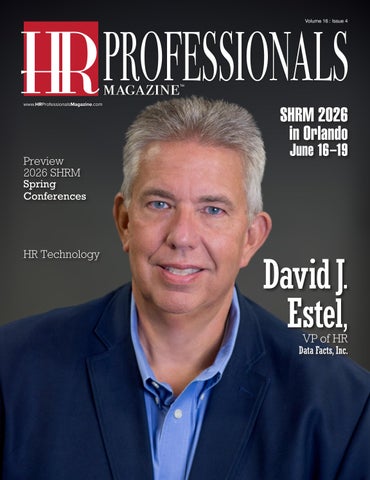
Our focus this issue is HR technology. We are honored to feature David Estel, VP of HR with Data Facts, Inc., on our April cover. Read about David’s exciting career progression on Page 6. Data Facts has been a key sponsor since we launched the magazine 15 years ago. Data Facts currently has employees based in 20 different states. David’s dedication to the human resources profession is reflected in his numerous awards and recognitions including the 2023 Human Resources Management Excellence Award from Tennessee SHRM and the Human Resources Impact Award from the Memphis Business Journal. In 2025 he was honored by SHRM-Memphis with the prestigious George Mabon HR Executive Award. David is also a passionate volunteer serving as Treasurer on the SHRM-Memphis Executive Board. Check out his many accolades and accomplishments on Page 6.
We are excited to share the highlights from the March 2026 HR Conference Cruise to Cozumel and Puerto Costa Maya, Mexico, aboard the Royal Caribbean “Exployer of the Seas.” A detailed recap of this “floating” conference can be found on Pages 12-13. We are delighted to serve as the official media sponsor for the HR Conference Cruises. Congratulations to Mike Medoro, SHRM SCP,
and founder of the HR Conference Cruises, on achieving a significant increase in attendance this year! Be sure to check out the upcoming conference cruise to Alaska May 15-22 on Page 8. We extend special thanks to the SHRM State Councils of Florida, New York State, and Ohio, Indiana, Michigan, and Wisconsin for sponsoring the HR Conference Cruises. It’s not too late to register for the Alaska cruise! Use code FRIENDOFCYNTHIA FOR $50 OFF your registration! www.HRCRUISE.com. See page 8 for details.
Be sure to register for our April webinars that offer SHRM and HRCI Business credits. We hope you find them beneficial. This April, we have scheduled two complimentary webinars addressing key topics for HR professionals. We extend our gratitude to Data Facts and Nexa Learning for sponsoring our April webinars. Please check your email for your invitation to these events.
My monthly webinar sponsored by Data Facts will tentatively be held on April 17 at 10 AM CT/11 AM ET. Please mark your calendar and join us! As always, this webinar is pre-approved for 1 SHRM PDC and 1 HRCI Business credit. If you are not currently receiving invitations, we encourage you to subscribe to our digital issue through our website, www.hrprofessionalsmagazine.com
Happy Spring!
cynthia@hrprosmagazine.com
Connect with me on LinkedIn:https://www.linkedin.com/ in/cynthia-thompson-mba-shrm-scp-sphr-325b8715/ Like us on Facebook.com/HRProfessionalsMagazine
David J. ESTEL
Vice President of Human Resources Data Facts Inc.
David J. Estel is a distinguished leader in Human Resources whose career exemplifies dedication, innovation, and service. David currently serves as Vice President of Human Resources at Data Facts Inc, where he has been instrumental in shaping a culture of excellence and integrity since 2014.
Throughout his tenure at Data Facts, David has held other progressive leadership roles, including Director of Human Resources, Human Relations Manager, and Strategic Alliance Manager. Data Facts is a nationally accredited provider of background and drug screening services, recognized as one of the top workplaces in the Memphis region. David has worked with Data Facts during a merger / acquisition and the transition of selling one of the business units.
Data Facts currently has employees based in 20 different states.
David’s commitment to the HR profession is reflected in his numerous accolades, such as the 2023 Human Resources Management Excellence Award from Tennessee SHRM and the Human Resources Impact Award from the Memphis Business Journal. In 2025 he was honored by SHRM-Memphis with the George Mabon HR Executive Award, a testament to his dedication, outstanding contributions to the HR Profession, and the meaningful impact made both to his organization and the broader community. He was also honored with the Data Facts Diamond Award for Employee of the Year (2020) and the inaugural Rookie of the Year Award (2015).
Beyond his professional achievements, David is a passionate volunteer, having served as Treasurer on the SHRM-Memphis Executive Board and contributing to planning committees for the Tennessee SHRM State Conference. His dedication extends to youth and community organizations, where he has received recognition for his consistent engagement and leadership.
David started working with Human Resources departments as an Executive Recruiter in the 1990’s, working regionally and nationally with Management level candidates in the Home Health Care, Hospital, and Pharmacy industries. During this time, David earned the Certified Personnel Consultant (CPC) certification from NAPS (National Association of Personnel Services).
David has been an industry speaker at Regional and National Conferences.
David’s career is a testament to the transformative power of HR leadership, and his unwavering commitment to people and community makes him a true HR Leader.
What it means to hire skills-first:
Build career paths that are fair, clear, and growth-focused. See potential where others see only inexperience. Keep your best people by investing in what they can do. When you lead with skills, you lead with impact.
Hiring for skills means seeing potential beyond resumes and degrees, creating a fairer and faster pathway for growth. Created by HR, for HR, the SHRM Skills First Specialty Credential gives you the road map and confidence to move your own career forward.
The HR Conference CruiseSM to Alaska is designed to deliver accredited learning, strategic insights, and meaningful HR connections.
Take the opportunity to deepen your expertise, earn recertification credits, and engage with peers—all aboard Royal Caribbean’s Voyager of the Seas
• Recertification credits • Unmatched networking at sea • 7 days of exploration
Juneau, Alaska
Discover fresh perspectives amid majestic mountains and glacial waters.
Skagway, Alaska
Take your leadership to new heights where gold rush history meets frontier spirit.
Endicott Arm & Dawes Glacier, Alaska
Reflect and recharge while witnessing nature's most powerful forces in action.
Victoria, British Columbia
Wrap up your voyage surrounded by timeless charm and forward-thinking dialogue.
Juneau, Alaska
Skagway, Alaska
Endicott Arm & Dawes Glacier, Alaska
Victoria, British Columbia
Creating Psychologically Safe Workplaces: A Joint Mission for HR and Security Teams
By DAVID LENGEFELD MS, LPC-S
Workplace safety is often defined by physical controls — badge access, cameras, emergency procedures. Those tools matter. But they are downstream protections. The upstream driver of safety is biological.
Human beings are neurologically wired to assess threat. Even in calm moments, the brain is scanning the environment for danger, often outside conscious awareness. This internal security system evolved for survival — to protect family units and ensure continuation of the species. Safety is not a preference. It is hardwired.
That wiring does not turn off at work.
When employees perceive instability, hostility, unpredictability, or dismissal, their nervous system reacts before their logic does. Silence, withdrawal, irritability, defensiveness, or overreaction are often threat responses — not personality flaws. When people feel safe, however, they communicate earlier, collaborate more effectively, and regulate emotions under pressure.
A proactive safety culture begins with understanding this biological reality and designing systems that align with it.
Safety as a Foundational Need
In 1943, Abraham Maslow introduced the Hierarchy of Needs, placing safety just above physiological survival. The model endures because it reflects human biology: when safety is compromised, higher-order functioning deteriorates.
Thousands of years ago, safety centered on physical survival. In 2026, employees spend as much — or more — time at work as they do at home. If safety is biologically required in one environment, it is equally required in the other.
Organizations that fail to account for this pay for it through turnover, disengagement, underreporting, and preventable escalation.
What a Proactive Safety Culture Actually Means
A proactive safety culture is not defined by the absence of incidents. It is defined by the presence of early detection, trusted reporting, and consistent leadership behavior.
It includes:
Employees reporting concerns without fear
· Leaders modeling calm, accountable responses
· Clear and enforceable policies
Learning from near misses
Prevention valued as much as response
Safety becomes embedded when it is part of daily operations — not an annual training requirement.
HR’s
Responsibility: Culture With Credibility
HR sits at the center of cultural influence. Through policy development, onboarding, conflict resolution frameworks, and accountability systems, HR shapes the behavioral expectations of the organization.
But policies alone are insufficient.
If HR is charged with creating security through culture and guidance, then HR leaders must personally model emotional regulation, professionalism, and accountability. You cannot teach what you do not embody. Encouraging composure while demonstrating reactivity erodes trust. Promoting transparency while avoiding difficult conversations creates cultural inconsistency.
This is demanding work. Yet culture mirrors leadership behavior. The most effective interventions often begin with self-discipline at the top.
HR’s structural contributions include:
Workplace violence prevention policies
Clear reporting and escalation pathways
Training that integrates behavioral awareness
Consistent performance accountability
Policies must be reinforced through behavior, not simply documented in handbooks.
Security’s Responsibility: Behavioral Risk and Operational Alignment
Security brings expertise in threat recognition, behavioral indicators, and incident response. When Security and HR collaborate rather than operate in parallel, organizations gain critical advantages:
Earlier identification of concerning behaviors
Integrated escalation protocols
Proportionate and legally sound interventions
· Clear communication between cultural and operational functions
At SafeHaven Security Group, we consistently observe that serious incidents are rarely spontaneous. They are often preceded by observable changes — interpersonal friction, behavioral deterioration, disengagement, or policy violations. The failure is not in the absence of warning signs; it is in the failure to interpret and address them appropriately.
Prevention requires shared visibility.
Trusting Intuition — With Discernment
Employees should understand that recognizing unsafe situations is natural. Intuition — often described as a “gut feeling” — is the body’s threat detection system signaling attention. However, discernment matters.
When individuals are emotionally dysregulated, their internal alarm may become hypervigilant — perceiving danger everywhere — or muted
— ignoring legitimate risk. A simple self-check can improve awareness:
Do I frequently overreact?
· Do others describe me as overreaching?
Is there recurring drama in my life?
How consistent is my self-care?
Self-regulation improves the accuracy of threat perception. Organizations that promote wellness, boundaries, and emotional health are strengthening the reliability of their workforce’s internal detection systems.
Recognizing Early Behavioral Indicators
Physical presentation often provides the earliest visible signs that someone is struggling. These are observations, not accusations.
Indicators may include:
· Persistent fatigue or dark circles
· Reports of chronic sleep disruption
Noticeable decline in grooming
Significant weight changes
Sudden excessive caffeine use
Uncharacteristic distraction or withdrawal
A simple, respectful outreach — asking how someone is doing — can interrupt isolation before escalation.
From a best-practice perspective, organizations should evaluate whether access to a licensed mental health professional — on staff or on retainer — is appropriate. Behavioral evaluation requires focused attention and calibrated questioning. HR leaders often carry multiple priorities; complex assessments benefit from specialized expertise.
Early support is always less costly than late intervention.
Data and Continuous Reinforcement
A proactive culture is reinforced through repetition and informed by data. HR and Security should regularly review:
Near-miss reports
Behavioral trends
Employee feedback
Exit interview patterns
· Training participation
Patterns matter more than isolated incidents. Joint review strengthens predictive capability and ensures policies evolve alongside organizational realities.
Conclusion
Building a proactive safety culture is not a one-time initiative. It is an ongoing alignment between biology, leadership behavior, and operational systems.
HR shapes culture and accountability. Security manages risk and response. Behavioral expertise strengthens early intervention.
When these elements align, organizations shift from reacting to incidents to preventing them.
Safety is not merely procedural. It is biological. And in modern workplaces, meeting that need is both a moral responsibility and a strategic advantage.
David Lengefeld MS, LPC-S
FAQs about Wellness Programs
Wellness programs are generally health promotion and disease prevention programs and activities offered to employees as part of an employer-sponsored group health plan. There are three main types of wellness programs:
Participatory wellness programs, which are generally available without regard to an individual’s health status and do not offer any reward based on satisfying a health-related standard.
Activity-only wellness programs, which require an individual to perform or complete a health-related activity to obtain a reward.
Outcome-based wellness programs, which require an individual to attain or maintain a specific health outcome in order to obtain a reward.
Wellness programs are subject to certain federal requirements. General compliance information for these different types of wellness programs appears below. It is important for you to know and understand these guidelines since a “simple” wellness program could offer unexpected liability.
Participatory Wellness Programs
Participatory wellness programs offered as part of a group health plan generally must:
1 Be made available to all “similarly situated individuals.” However, the following employees can be treated as different groups of similarly situated individuals: part-time and full-time employees, employees working in different geographic locations, and employees with different dates of hire or lengths of service.
2. Not bar individuals from participating based on a health factor, including disability.
3. In accordance with HIPAA, generally protect from disclosure any individually identifiable health information collected from or created about participants in the program.
4. If sponsored by an employer with 15 or more employees, offer reasonable accommodations that allow employees with disabilities to participate.
5. If collecting employee health information and sponsored by an employer with 15 or more employees, distribute an ADA Notice Regarding Wellness Program to all individuals eligible to participate.
6. If sponsored by an employer with 15 or more employees, ensure that the employer does not receive any information about program participants except where necessary for plan administration.
Activity-Only Wellness Programs
Activity-only wellness programs offered as part of a group health plan generally must:
1. Not bar individuals from participating based on a health factor, including disability.
2. Allow participants to obtain a reward at least once per year, and generally limit such
rewards to 30% of the cost of coverage under the health plan (50% for wellness programs designed to prevent or reduce tobacco use).
3. Offer a reasonable alternative standard to individuals who, due to a medical condition, are unable to satisfy the standard necessary to obtain the reward.
4. Distribute a Wellness Program Disclosure in all plan materials that describe the program.
5. In accordance with HIPAA, generally protect from disclosure any individually identifiable health information collected from or created about participants in the wellness program.
6. If sponsored by an employer with 15 or more employees, offer reasonable accommodations that allow employees with disabilities to participate.
7. If collecting employee health information and sponsored by an employer with 15 or more employees, distribute an ADA Notice Regarding Wellness Program to all individuals eligible to participate.
8. If sponsored by an employer with 15 or more employees, ensure that the employer does not receive any information about program participants except where necessary for plan administration.
Outcome-Based Wellness Programs
Outcome-based wellness programs offered as part of a group health plan generally must:
1. Not bar individuals from participating based on a health factor, including disability.
2. Allow participants to obtain a reward at least once per year, and generally limit such rewards to 30% of the cost
of coverage under the health plan (50% for wellness programs designed to prevent or reduce tobacco use).
3. Offer a reasonable alternative standard to individuals who do not meet the program’s initial standard based on a measurement, test, or screening.
4. Distribute a Wellness Program Disclosure in all plan materials that describe the program. This notice must also be furnished to any individual that fails to satisfy an outcome-based standard necessary to obtain a reward. Click here for a model Wellness Program Disclosure.
5. In accordance with HIPAA, generally protect from disclosure any individually identifiable health information collected from or created about participants in the wellness program.
6. If collecting employee health information and sponsored by an employer with 15 or more employees, distribute an ADA Notice Regarding Wellness Program to all individuals eligible to participate.
7. If sponsored by an employer with 15 or more employees, offer reasonable accommodations that allow employees with disabilities to participate.
8. If sponsored by an employer with 15 or more employees, ensure that the employer does not receive any information about program participants except where necessary for plan administration.
Additional requirements and exceptions may apply to your wellness program. Here to help!
THE BENEFITS GROUP https://thebenefits.group 615-250-3334 care@benefits.place
Talent Is Your Strategy. NOW MAKE IT YOUR ADVANTAGE.
The future of work is built by the leaders of today. Join the conversation — from wherever you are.
Time is running out to secure your spot at SHRM Talent 2026, the premier virtual event for leaders who know that talent strategy is the ultimate competitive edge. From the comfort of your home or office, join a global community of forward-thinking leaders to tackle the most critical challenges in talent management. Gain actionable insights from expert-led sessions across six cutting-edge tracks, including:
• AI-Powered Talent Transformation.
• Career Agility for the Modern Workforce.
• Skills-Based Talent and Workforce Planning.
• Data-Driven Hiring and Talent Intelligence.
• Global Workforce Ecosystems.
• Workplace Culture and Human Connection.
Discover how to build a workforce that doesn’t just adapt to the future but defines it. Learn how to create a talent ecosystem that drives measurable business outcomes — all without the hassle of travel.
EEOC Guidance on Using AI in Recruitment
The advent of artificial intelligence (AI) in the workplace, specifically in recruiting, has transformed the hiring landscape. As organizations increasingly turn to AI tools to streamline their recruitment processes, the U.S. Equal Employment Opportunity Commission (EEOC) has recognized the need for clear guidance on the responsible use of these technologies. The EEOC's guidance emphasizes the importance of ensuring that AI-driven recruitment practices comply with federal antidiscrimination laws, promoting fairness and equality in hiring. At the core of their guidance is the principle of non-discrimination. Employers are required to adhere to federal laws that prohibit discrimination based on race, color, religion, sex, national origin, age, disability, and genetic information. As AI tools are integrated into recruitment processes, there is a heightened risk that these technologies may inadvertently increase existing biases. For instance, algorithms trained on historical hiring data may reflect the biases of the past, leading to discriminatory outcomes against certain demographic groups. Employers should be vigilant in evaluating the impact of AI tools on their recruitment processes to ensure that they do not disproportionately impact individuals from protected classes.
One of the key recommendations from the EEOC is for employers to conduct thorough assessments of AI tools before their implementation. This requires a careful examination of the algorithms and data sets used in these systems. HR professionals should understand how the AI makes decisions, what data it relies on, and whether the outcomes are fair and equitable across different demographic groups. Use of these assessments can assist HR in identifying potential biases in the AI decision-making process and take corrective actions to correct them. This approach is required to ensure a fair recruitment environment for all.
Validation and testing of AI recruitment tools are critical components of the EEOC's guidance. Human Resources must validate the effectiveness of the AI tools in relation to actual job performance and ensure that they are consistent with business necessity. Validation includes collecting data that demonstrate that the AI tools used in recruiting are directly related to the skills and competencies necessary for the position. This process helps ensure that AI tools are effective and provide a defense against claims of discrimination by showing that the tools are based on objective criteria.
Transparency is another vital component of the EEOC's guidance. Employers should be transparent about how AI is utilized in their recruitment processes. This includes advising candidates about the role AI plays in their evaluations and decisions made about candidates. Transparency builds trust with candidates and helps them understand
how their qualifications are being assessed. In addition, it provides candidates with opportunities to inquire about concerns they have regarding the AI systems being used, which encourages a more open and equitable hiring process.
Human Resource professionals must be accountable for decisions reached by using AI tools. The EEOC emphasizes that the using AI does not release employers of their responsibility to comply with antidiscrimination laws. Employers must be prepared to explain and justify the outcomes reached by using AI systems, ensuring that the decisions regarding hiring choices is fair and non-discriminatory. This accountability is necessary to maintain compliance with legal standards and to ensure a workplace culture that values diversity and inclusion.
In addition to accountability, the EEOC maintains the importance of providing reasonable accommodations for individuals with disabilities. As AI tools become more prevalent in recruitment, it is important to ensure that these new AI technologies do not interfere with the ability of candidates with disabilities to participate in the hiring process. Human Resources is responsible for ensuring that their AI systems effectively accommodate those who require adjustments or alternative methods of assessment. This commitment to inclusivity aligns human resources with legal obligations and enhances diversity in your workforce.
Continuous monitoring and evaluation of AI systems are required to ensure that fairness and effectiveness are ongoing. The EEOC advises organizations to establish routines that regularly review the performance of AI in their recruitment procedures. This includes analyzing data to detect any emerging biases or discrimination that may arise. By remaining consistent and responsive to possible issues, human resources professionals can adapt their AI tools and practices to align with ongoing standards of fairness and equity.
In conclusion, the EEOC's guidance on using AI in recruitment underscores the need for a considerate and responsible approach to technology in your recruitment process. While AI has the potential to enhance efficiency and streamline your recruitment processes, it can also increase challenges regarding fairness and discrimination. Human Resources must ensure non-discrimination, transparency, accountability, and inclusivity as they enable AI tools in their hiring process. By following the EEOC's recommendations, organizations can take advantage of the benefits of AI while ensuring there are no potential biases, fostering a more equitable workforce. As the landscape of recruitment continues to grow, the principles set forth by the EEOC will serve as an important framework for responsible use of AI in recruitment.
Please join us on April 11-12, 2024, at Doubletree Hotel and Robinson Center for the Arkansas SHRM Employment
Your ELLA 2024 committee is hard at work preparing a great conference!
Please visit ella.arshrm.com for updates on speakers and topics.
online ELLA.ARSHRM.com or scan this QR code
Want to position your organization hundreds of Arkansas employers professionals? Being a sponsor Conference is the perfect opportunity!
Contact us at ellasponsors@arshrm.com
The Missing Link Between HR Tech and Talent Growth
By SATISH KUMAR
HR technology wasn’t supposed to feel this complicated.
For years, the promise was simple: better systems would streamline people management, connect workflows, and give organizations clearer insight into their workforce. And in many ways, that promise was delivered, especially for large enterprises. Many platforms have brought structure and consistency to HR and payroll at a global scale.
But as these systems evolved, they optimized for a specific kind of organization: large, complex, and resource-rich. In doing so, they left behind a different reality: small to mid-sized, fast-growing companies that needed flexibility more than scale.
To fill that gap, a new generation of “all-in-one” platforms emerged. They were easier to deploy, more affordable, and simpler to use. For a time, they worked. They gave growing companies a foundation.
But growth changes everything.
As organizations matured, their needs became more nuanced. Performance management needed to drive development, not just documentation. Learning had to build real capability, not just offer content. Compensation had to reflect contributions in ways employees trusted.
That’s where the cracks began to show.
The systems that once felt unified started to feel rigid. Companies adapted. They added a performance tool. Then a learning platform. Then something for compensation.
Each decision made sense on its own. Together, they created something else entirely: a fragmented ecosystem where data lived in silos and workflows no longer connected.
What emerged wasn’t a system. It was a stack.
The real issue in HR tech isn’t a lack of tools. It’s that those tools rarely work together in meaningful ways.
Performance reviews are completed, but nothing follows. Feedback is captured, then forgotten. Learning programs are launched without clear ties to performance. Compensation decisions are made without shared context.
Individually, each process functions. Collectively, they fail.
Employees feel it first: feedback without follow-through, recognition without opportunity. Managers feel it next, lacking a clear picture of their teams. HR feels it last, reacting to disengagement and turnover rather than preventing it. At the center of all of this is a simple issue: disconnection.
What makes this more challenging is that many organizations believe they’ve already solved it.
They have an HCM system. They’ve invested in integrations. On paper, everything is connected.
In reality, it’s not.
As needs evolve, layers get added. Learning teams outgrow basic modules. Performance teams adopt specialized tools. Compensation processes demand their own systems. Each addition improves capability but increases complexity.
What was meant to be unified becomes a web of dependencies. Data must be synced and reconciled across systems. Teams spend more time managing integrations than improving outcomes. The idea of a single source of truth becomes harder to maintain.
Ironically, the pursuit of integration often leads to deeper fragmentation.
This fragmentation is most evident in decision-making. When data is scattered, visibility suffers. HR teams rely on outdated information. Managers miss strong internal candidates because their skills aren’t visible. Learning efforts fail to translate into growth because they aren’t tied to real needs.
Decisions made without a complete view of people aren’t just inefficient, they’re often wrong. Repeated over time, they erode trust, slow development, and weaken the organization’s ability to compete.
The most effective HR teams don’t start with tools. They start with systems.
They understand that performance, learning, and compensation are not separate processes, but parts of a continuous cycle. In these environments, a performance review isn’t an endpoint; it’s a trigger. It identifies gaps, informs development, and feeds directly into compensation and career progression.
Learning is embedded in the flow of work and aligned with real performance data. Compensation reflects structured, transparent insights rather than guesswork.
What connects all of this is intentional design. Each part of the system reinforces the next. Feedback leads to development. Development leads to growth. Growth leads to recognition. And that recognition informs the next cycle. It’s not a collection of processes. It’s a loop.
Fixing HR tech doesn’t require starting over, but it does require a shift in perspective.
Instead of asking what tools to add, organizations need to ask how their systems connect. Instead of focusing on features, they need to focus on flow: how information moves and how decisions are made.
HR technology is at a turning point. More features won’t define the next wave, but better-connected systems where performance, learning, and compensation are part of the same story will.
Organizations that get this right won’t just have better tools. They’ll make better decisions, develop talent faster, and build cultures where growth isn’t an initiative, it’s how the system works. That’s the difference between simply having HR technology and actively using it to advance people forward.
Changing Your Hiring Mindset in a Post-AI Workplace
Hiring has always carried risk. But today, the biggest threat to organizations may not be malicious candidates or regulatory complexity. It may be outdated thinking.
Many organizations are still relying on their tried-and-true hiring systems, manual workflows, and fragmented technology platforms built for a different era of employment. These outdated processes slow hiring, reduce accuracy, and create significant legal exposure.
In 2026, compliance expectations, privacy regulations, and candidate transparency requirements are evolving rapidly. Organizations that continue operating with “old style” hiring systems may unintentionally expose themselves to legal risks that modern technology and smarter screening strategies could prevent.
Why the “If It Ain’t Broke” Philosophy Won’t Work
Older hiring platforms worked great…when they were first developed. While these systems may feel familiar, they frequently lack the features and safeguards required to keep up with modern compliance expectations.
The consequences can be significant. Poor hiring practices can lead to lawsuits, regulatory fines, reputational damage, and operational disruption. In many cases, the legal risk isn’t caused by intentional wrongdoing, but by manual errors, inconsistent processes, or clunky platform connections.
Key legal risks of outdated processes are:
· Negligent hiring liability. Inadequate background checks or incomplete verification processes can expose organizations to major financial damages.
· Compliance and regulatory violations. Failure to follow proper disclosure, consent, and adverse action procedures can expose organizations to class-action lawsuits and significant financial penalties. Older platforms often lack built-in compliance safeguards, leaving HR teams to manually manage documentation.
· Discrimination and bias. Automated screening tools and resume filters may violate anti-discrimination laws if they disproportionately exclude protected groups without a valid job-related reason. This risk has become especially relevant as organizations adopt AI-driven hiring tools. Algorithms can unintentionally replicate historical bias embedded in training data, potentially leading to discriminatory outcomes if not carefully audited. Employers remain responsible for the outcomes of the technology they use, even when the tool is provided by a third-party vendor.
· Data Privacy and information security risks. Outdated systems often lack modern security protocols and encryption standards. This can expose organizations to data breaches or privacy violations. Improperly handling applicant data during screening or social media checks can also violate privacy regulations and the Fair Credit Reporting Act. A single breach involving applicant records can lead to stiff legal penalties, reputational damage, and loss of candidate trust.
· Documentation and audit risk. If an employment decision is challenged, employers must demonstrate that their screening and evaluation processes were consistent, fair, and compliant. Poor recordkeeping (often because of outdated or manual processes)
can make it difficult for organizations to defend themselves in legal disputes related to hiring practices. Without clear documentation, even well-intentioned hiring decisions can become difficult to defend.
Strategy Moves for Hiring in 2026 and Beyond
Avoiding these risks requires a pivot in the organizational mindset, from reactive hiring processes to proactive risk management. Forwardthinking organizations are taking advantage of new tools and making several strategic moves to stay ahead of today’s challenges.
Availing Themselves of Hiring Technology
It’s not 2004, or even 2024, anymore. Organizations should evaluate if their current hiring systems are built to handle today’s regulatory and technological environment.
Modern platforms provide:
· AI assistance to increase efficiency and reduce manual processes and errors
· Secure candidate data handling and protect private information
· Real-time status tracking
· Clear audit trails
· Seamless integrations with other hiring tools
· Mobile capability as an integral component, not an afterthought
Prioritizing Accuracy Over Speed
Yes, speed is important in hiring. But accuracy must come first. Incomplete background checks, rushed verification processes, or inconsistent screening practices create major liability risks. Organizations must start with identity verification, check multiple data points, and perform quality control on the final product.
Implementing Vendor Accountability
Organizational leaders must understand how their technology tools function, especially when AI or automated decision systems are involved. Best practices include conducting regular vendor compliance reviews, requesting platform transparency from vendors, and validating screening tools for fairness and accuracy.
Today’s Successful Hiring Requires a New Mindset
Artificial intelligence is rapidly transforming how organizations recruit, evaluate, and hire talent. But while technology is evolving at lightning speed, legal accountability has not changed. Employers remain responsible for the decisions they make and the processes they use to make them.
Organizations that approach hiring with yesterday’s mindset will struggle to keep up with today’s regulatory expectations and tomorrow’s workforce realities. Outdated systems and fragmented tools cannot provide the accuracy, transparency, and documentation required in a modern hiring environment.
The good news is that efficiency and compliance isn’t a “choose only one” proposition. With the right technology, thoughtful oversight of AI tools, and a commitment to accurate screening practices, employers can build hiring processes that are faster, smarter, and more defensible.
Data Facts | www.datafacts.com
Meet the Alabama SHRM Leadership Team
Andrea Lewis Director
Joshua Bracken Business Manager
Chanell Daniel Secretary
Mallory Watkins Director-Elect
I’ve just returned from an extended visit to Delhi, India, where our strategic partner Blue Ocean and HRCI hosted the India debut of the International Human Resource Conference (IHRC). The conference brought together 500 senior HR leaders, global certification authorities, corporate decision-makers, and policymakers, resulting in one of the largest international HR gatherings hosted in India to date. I had the pleasure of delivering the opening keynote address on the findings from the State of HR 2026 report and participating in a fireside chat with Dr. Sathya Menon, CEO of Blue Ocean Corporation, on increasing HR’s global impact. Even more important, I had the opportunity to learn so much about India’s role in the global talent economy—and to reflect on the durability of leadership best practices.
Perhaps there is no more readily recognizable symbol of India than the Taj Mahal. Construction of the ivory-white marble building—a UNESCO World Heritage site and one of the New Seven Wonders of the world—took more than 20 years and thousands of artisans to complete. In its current state, it’s considered one of the finest examples of Mughal architecture, blending Indian, Persian, and Islamic styles.
The Taj Mahal gives us a lot to lean into: the vision of its finished state, the patience involved in a 20-year project plan, a multi-cultural design approach, and a massive workforce. It really is emblematic of the issues leaders face today.
Leadership Drives Results
When we consider the foundational factors behind the Taj Mahal, we can see why leadership is so important. During my fireside conversation with Dr. Sathya Menon, we reflected on how enduring organizations begin with a clear vision paired with disciplined execution. Our colleagues at Blue Ocean started as a small organization with a vision and a four-year timeline. As they noted, you can put anything on paper to be your vision; however, a clearly defined vision is only successful when there is a solid plan of action as well. In the case of Blue Ocean, they set achievable milestones coupled with hiring the right people who shared the same confidence in the vision.
“The technology can come and go,” said Dr. Menon, chairman and managing director of Blue Ocean Corporation, “…but it can never replace our people…all of us have capabilities beyond our imagination.”
In this current environment where the AI tail seems to be wagging the workforce dog, is it possible to adhere to a fundamental approach to building something enduring and magnificent? In my opinion, and in the context of what we’re dealing with today, leaders must be extremely adaptable. They have to be almost entrepreneurial and willing to innovate. Letting people operate in their zone of genius facilitates the creation of a better organization. This makes it an exciting time to be a leader, and there’s so much more to learn and make happen when teams are trained to be collaborative and agile.
The Enduring Impact of Leadership
By AMY SCHABACKER DUFRANE
The Importance of Skills
Something all of us need to pay close attention to is which skills are needed now, in five years, in 10 years, and beyond. This is key for every organization to consider, especially in occupations that involve people management. Many organizations are already suffering from a disintegrating leadership pipeline. To successfully transition from where we are today, HR needs to help guide the process—and AI isn’t the right response to every question. Yes, it can automate and streamline complexities and even deliver coaching at scale. The deeper and more urgent discussion is about the competencies an individual needs to contribute to growing the business.
Using the Taj Mahal as our example of a desired outcome, we need to pay close attention to workforce planning. How do we train the workforce of the future? From where do we source the talent that will ensure organizational success? What societal skills are needed to create cultures of cooperation and belonging? How will you reward performance?
Are You Building Your Legacy?
Before its lengthy construction journey began, no one had envisioned the Taj Mahal. Perhaps no one knew it would take over 20 years to complete. And, I’ll bet, no one who worked on it during the 1600s thought it would endure into the 21st century and beyond. The leaders guiding the process lacked the technology we enjoy today. They probably also followed the old commandand-control leadership model that is now obsolete. With today’s advancements in leadership, workforce planning, and technology, the project could have been completed in two years rather than 20.
There is one thing for certain: HR is at the epicenter of any organization built for long-term success. I urge you to step back periodically and admire your accomplishments. HR’s leadership can be long-lasting, and our contributions long-lived.
Amy Schabacker Dufrane, Ed.D., SPHR, CAE, is CEO of HRCI® — where she is responsible for driving and disrupting the conversations about building high-performing, strategic HR teams. An engaging thought leader at the intersection of talent strategy and continuous learning, Dr. Dufrane is an awardwinning leader and celebrated keynote speaker on the human side of successful business strategy in the 21st century.
An annual trends and insights report by HRCI
Backed by insights from 4,500+ HR professionals worldwide, this year’s report reveals how prepared, pressured, and evolving today’s HR leaders are—across roles, industries, and experience levels.
Key Findings
80% of HR professionals agree they are well prepared to carry out their job
recommend HR as a career
52% say implementing HR technology is the area where they feel least prepared
HRCI’s largest-ever global survey reveals a profession that is confident and resilient—yet navigating rapid change and rising expectations.
Download the full report: hrci.org/state-of-hr
40% report high or extreme stress levels
May, 12, 2026, Tues.
8:00 a.m. to 4:30 p.m. at
Grant Event Center
1050 Union University Dr. Jackson, TN 38305
17th Annual
Human Resources & Spring Conference
Presented by:
THE WEST TENNESSEE SOCIETY FOR HR MANAGEMENT
In coordination with : THE LAW FIRM OF RAINEY, KIZER, REVIERE & BELL, P.L.C.
Join us as we put HR in the driver’s seat and explore the legal and workplace issues shaping today’s organizations. Through practical sessions led by experienced attorneys and HR professionals, participants will gain insights and strategies to help drive t heir organizations forward.
Staying in Your Lane: ADA Accommodations
Learn when ADA accommodations are required and how to properly document the interactive process. Topics include mental health accommodations, pregnancy and ADA overlap, remote work considerations, and documentation practices that help HR professionals stay on the right path to compliance.
Employees
Online: Navigating Social Media and Free Speech
Learn how employers can address employee social media activity while avoiding legal hazards. This session will review issues involving political speech, off -duty conduct, and protected activity under the National Labor Relations Act, along with practical guidance on when discipline may be legally appropriate.
The Genes of the Generations!
Today’s workplace brings together multiple generations, each with unique perspectives and expectations. This interactive session explores how HR professionals can better understand generational differences, improve communication, and strengthen collaboration to build more effective teams.
In the HR Driver’s Seat: Lessons from Employment Law Case Studies
Take the wheel as we examine real-world employment law cases and workplace scenarios. Participants will discuss possible responses and learn how courts evaluate employer actions, gaining practical insights to help guide HR decisions and keep organizations moving in the right direction.
Cruising Through HR: Interactive Compliance Challenge
Shift into high gear for an engaging session that reinforces key HR and employment law concepts. Through interactive questions, scenarios, and activities led by our legal experts, participants will test their knowledge and gain practical takeaways to help drive HR forward.
Lunch is provided. Explore our showcase of HR-related exhibitors. Great door prizes!
Registration Fee: $200 for WTSHRM Members $250 for non-WTSHRM Members Join WTSHRM for only $25 at: wtshrm.org
REGISTER AT: WTSHRM.ORG DEADLINE: MAY 1, 2026. REGISTER EARLY AS SEATING IS LIMITED.
This program has been approved for 6 recertification credit hours through HRCI and SHRM.
T HE S TREN G T H OF EXPER I E N C E
As the issues facing employers and HR professionals become more frequent, challenging, and complex each year, you need a law firm that provides advice for your specific organization.
For over 50 years, Rainey Kizer Reviere & Bell has advised businesses, non-profit organizations, and governmental agencies in all aspects of employment law.
To learn how we can assist your organization, please contact us.
STRATEGIC GROWTH STARTS AT
Earn your SHRM-SCP® certification and lead with credibility, foresight, and influence.
The SHRM-SCP is the benchmark for HR leadership. It validates your ability to align workforce strategy with business goals, guide executive-level decision-making, and influence culture at scale.
NEED HELP PREPARING?
Study smarter, not harder — the SHRM Learning System is the most comprehensive online preparation tool for the SHRM certification exam. Master the material and gain confidence before your exam!
Federal Appeals Court Invalidates NLRB’s Cemex Standard
By TIM K. GARRETT & HUNTER K. YOCHES
The United States Circuit Court of Appeals for the Sixth Circuit (Sixth Circuit) recently ruled that the National Labor Relations Board (NLRB) exceeded its authority when it issued its decision in Cemex Construction Materials Pacific LLC. As a result, at least within the Sixth Circuit’s jurisdiction (Tennessee, Kentucky, Ohio, and Michigan), the Cemex decision has been invalidated, and its onerous remedies will not be available for the NLRB to impose upon employers in those states.
As readers may recall, and as detailed here, in 2023, the NLRB made several monumental, pro-union holdings, including a relaxed standard for bargaining orders, in Cemex Construction Materials Pacific LLC. Traditionally, under prior precedent, the NLRB issued a bargaining order as a remedy for serious and material employer misconduct during a union organizing campaign. In these instances, the NLRB would determine whether its traditional remedy – ordering a new election – was sufficient or whether the employer’s unfair labor practices were so serious that they destroyed chances for a fair election. Cemex dramatically relaxed the standard used by the NLRB to issue a bargaining order; in essence, under Cemex, the NLRB could issue a bargaining order based on less significant unfair labor practices by the employer during the election period before a union vote.
In the case at hand, an administrative law judge (ALJ) determined that the employer had committed unfair labor practices during the election period by giving $4-per-hour wage increases and free bottles of bourbon, making it easier for new employees to qualify for annual pay boosts, and rescinding a policy requiring workers to use vacation days during an annual end-of-the-year shutdown. The ALJ recommended issuing a bargaining order under both Cemex and Gissel (the former standard from a 1969 Supreme Court decision authorizing a bargaining order only if the employer engaged in egregious unfair labor practices). The NLRB adopted the ALJ’s factual findings and recommended remedy, but the NLRB modified the reasoning. Rather than consider whether a new election could be held by applying the more relaxed Gissel standard, the NLRB relied solely on the standard articulated in Cemex. The employer appealed.
On appeal, the Sixth Circuit held that while the employer committed unfair labor practices, the NLRB’s remedy under Cemex was invalid. Specifically, the Sixth Circuit held that the Cemex standard was created through an unlawful exercise of adjudicatory authority, meaning that the NLRB acted outside of its authority by engaging in rulemaking through a case decision rather than following the statutory rulemaking process. “[The NLRB] created a new standard for issuing future bargaining orders that was neither derived from the case-specific facts nor in furtherance of fashioning a remedy that resolved the parties’ dispute.” The Sixth Circuit then sent the case back to the NLRB to reconsider its ruling in light of the court’s decision.
It is not clear whether the NLRB will appeal the decision of the appellate court. Notably, the Cemex decision is currently on appeal, pending before the Ninth Circuit Court of Appeals. However, the current NLRB, with a Republican majority, is expected to overrule Cemex sometime soon, so it would certainly be a surprise if the NLRB were to appeal the decision.
If you have any questions about how this decision may impact your business, please contact the authors.
This content was originally published on March 13, 2026 on the Bass, Berry & Sims HR Law Talk Blog. Visit bassberryhrlawtalk.com for more.
Tim K. Garrett, Member tgarrett@bassberry.com
Tim Garrett helps employers solve complex issues related to all aspects of labor and employment law, providing in depth counseling and developing creative solutions to underlying business issues. He is an experienced trial lawyer, defending employers of all sizes in employment litigation claims across the country. His work has ranged from defending a major university during a significant wage and hour collective action involving thousands of employees to the successful defense of a major healthcare provider in a gender discrimination / retaliation case. In addition, Tim has served as nationwide labor and employment counsel for the largest nonprofit dialysis company in the U.S.
Hunter K. Yoches, Associate hunter.yoches@bassberry.com
Hunter Yoches represents management in all aspects of labor and employment law and related litigation. He regularly defends employers against various claims and counsels clients on a wide range of day-to-day employment matters. Hunter has experience litigating cases and counseling clients regarding federal and state employment laws, including collective and class action litigation, contract disputes, and compliance issues. He advises clients related to wage and hour laws, discrimination laws, unfair labor practices, and more.
Bass, Berry & Sims listens and responds with creative yet practical counsel. We stay on pace with the complex and rapidly evolving employment landscape, connecting your dynamic human resources needs to proactive strategies. Relationships, reliability, and respect – at the center of our Labor & Employment and Employee Benefits practices.
gie B B usiness
DOWN TO FINDING THE HR RHYTHM
April 22 & 23, 2026
Lafayette Cajun Dome & Convention Center
RE GISTRATION
Chapter/SHRM Member
FULL 2-day $440
Organization Bundles Available
C ONFERENCE T
Talent Acquisition & Talent M
Stayin’ Alive with Ta
Keeping the groove strong by attracting the right people to keep your organ
Total Rewards & HR Tec
Disco Inferno: Rewards & T
Leadership & Strategy
Groovin’ with Leadership: Choreographing vision, culture, and strategy
SHRM University of Memphis Student Chapter
PROFESSIONAL ENGAGEMENT NIGHT
February 26
The University of Memphis Student SHRM Chapter hosted their Professional Engagement Night on February 26 where students met employers and learned about career paths in HR. Employers from First Horizon, FedEx, Hamilton Beach and Cintas served as table leaders for the interactive event.
Student Chapter leaders include Nicole Graham, Donea Sykes, Rosina Panin, Laila Rogers, and Tarik Wilkins.
The PEN event was supported by the SHRM-Memphis College Relations team, led by Dr. Deneen Lester, Senior HR Director, Salvation Army.
Congratulations to these students who recently passed their SHRM-CP exam!
If you’d like to connect with the Student Chapter, contact K.Tuberville@mempihs.edu.
The Benefits Gap: Building a Culture-First Benefits
Strategy by Brad Federman
Brad Federman. Culture & Leadership Expert, international speaker and 4 x author was the luncheon speaker for the GMEBC meet at Chickasaw Country Club February 26.
HR Professionals Magazine is recognized by SHRM to offer Professional Development Credits (PDCs) for SHRM-CP® or SHRM-SCP® recertification activities.
Affordable Online SHRM-CP® | SHRM-SCP® Certification Exam Prep Class
Online classes begin April 20, 2026 and will meet twice per week for 12 weeks on Monday and Wednesday evenings from 6:00 PM to 7:00 PM.
SHRM Learning System® Participant Materials
The total cost of the SHRM-CP® | SHRM-SCP® Online Certification Exam Prep Class is $1025 (plus $25.00 shipping)
You may pay by PayPal, credit card or check. 2026 Spring Exam Window May 1, 2026 – July 15, 2026
For more information visit shrmcertification.org
Guarantee
If you do not pass, you can retake the class at no additional charge if you meet these two requirements: – Attend 80% of the scheduled online classes – Score 80% on all practice quizzes
Deadline to register is April 15, 2026
Contact cynthia@hrprosmagazine.com OR visit our website at www.hrprofessionalsmagazine.com
About the instructor:
Cynthia Y. Thompson is Principal and Founder of The Thompson HR Firm, a human resources consulting company in Memphis. She is a senior human resources executive with more than twenty years of human resources experience concentrated in publicly traded companies. She is the Editor | Publisher of HR Professionals Magazine, an HR publication distributed to HR Professionals and SHRM members in the contentinental U.S.
Cynthia has an MBA and is certified as a Senior Professional in Human Resources (SPHR) by the Human Resource Certification Institute and is also certified as a Senior Certified Professional by the Society for Human Resource Management. She is a faculty member of Christian Brothers University. Cynthia was appointed to serve on the Tennessee DOHR Board of Appeals by Gov. Bill Haslam in 2014.
www.hrsouthwest.com
The HRSouthwest Conference is one of the nation's largest regional education & networking events for HR professionals and proudly serves as the official State of Texas SHRM Conference!