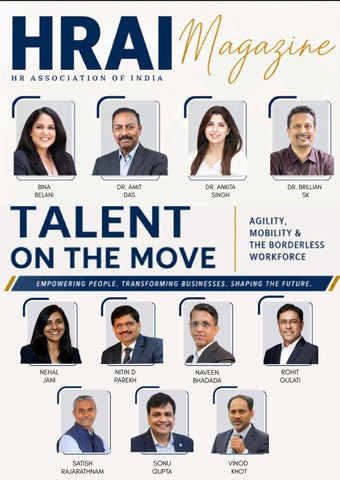
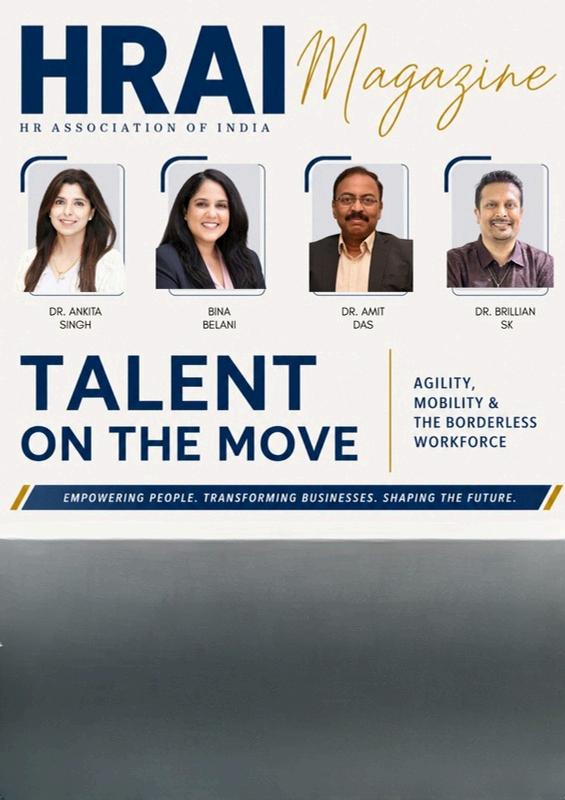
Talent on the Move – Agility, Mobility & the Borderless Workforce
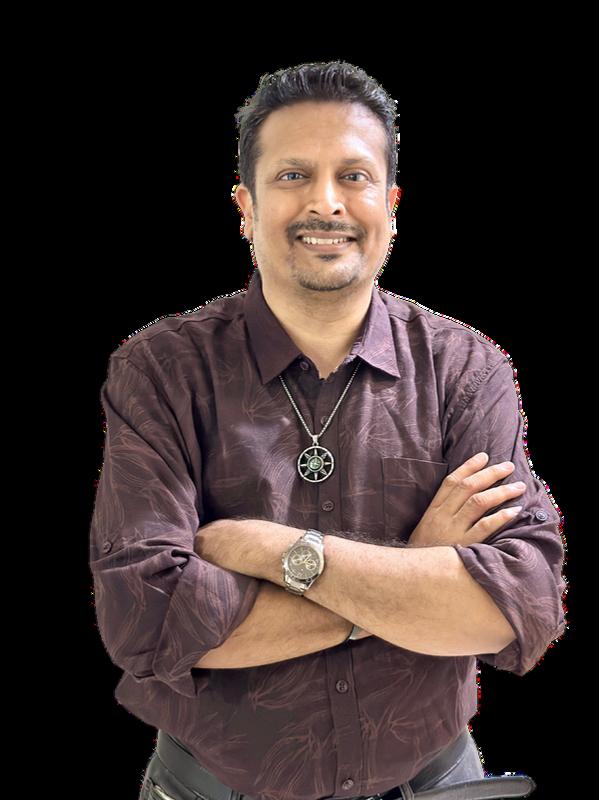
NEHAL JANI
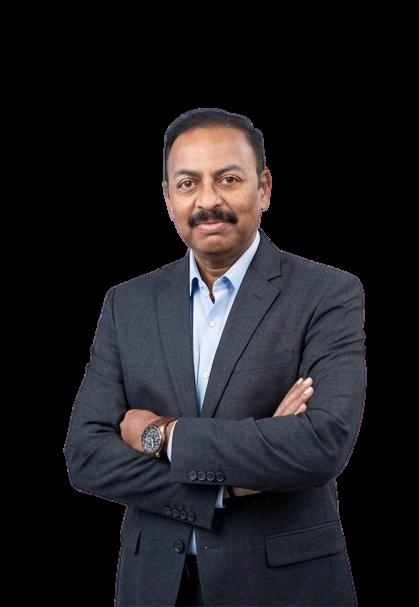
ROHIT GULATI
At HRAI, we believe that the bridge between academia and industry is the foundation for building a future-ready workforce. By fostering collaboration between educational institutions and the corporate world, we can empower students with the skills, mindset, and resilience needed to thrive in a rapidly evolving workplace.
In a world where change is constant and business moves faster than ever, talent is no longer limited by geography, roles, or traditional career paths. The future belongs to organizations that create agile, mobile, and opportunity-rich workplaces
This edition, Talent on the Move – Agility, Mobility & the Borderless Workforce, explores how companies are embracing internal mobility, global talent access, flexible work models, and cross-functional growth to stay ahead
We spotlight how agility drives resilience, how mobility unlocks potential, and how borderless workforces are reshaping the future of careers.
Across these pages, one truth stands clear:
Talent is no longer tied to place.
It’s adaptable.
It’s connected.
It’s the force behind growth.
1,00,000+ FOLLOWERS ON LINKEDIN
A GROWING COMMUNITY OF PROFESSIONALS ENGAGING WITH HRAI’S INSIGHTS, INITIATIVES, AND INDUSTRY CONVERSATIONS.
About HRAI
Founded by Dr. Ankita Singh, the HR Association of India (HRAI) drives industry-led initiatives and curates prestigious recognitions for organizations, emerging professionals, and trailblazing women across the business ecosystem. HRAI serves as a platform for learning, collaboration, and recognition, bringing together professionals and subject-matter experts from across industries.
What We Do
Industry initiatives and professional forums
Awards, recognitions, and curated listings
Knowledge-sharing through talk shows, panels, and articles
Community-building for HR and business professionals
Organizations We’ve Engaged With Lenovo, Hindustan Unilever, Biocon Biologics, IHG Hotels, L&T, CBRE, Sutherland, Capgemini, EY, and more.
KNOWLEDGE & THOUGHT LEADERSHIP
Elite voices such as Dr. TV Rao, Harjeet Khanduja, and Prasenjit Bhattacharya have been featured in HRAI’s one-on-one talk shows, contributing practical insights and real-world perspectives for professionals.
HRAI MAGAZINE INITIATIVE
HRAI publishes thought-provoking articles authored by senior professionals from organizations such as Reliance Jio, Times of India, KPMG, Eveready, Volvo, and more.
HRAI LIST FEATURES
HRAI curates an annual list of features recognizing exceptional professionals and changemakers aligned with a central theme each year. 23 of 2023 | 24 of 2024 | 25 of 2025 . Notable organizations featured include: Adani, Amazon, Flipkart, Samsung, Myntra, Uber, Raymond, and more.
EXCLUSIVELY FEATURED SHARK TANK JURY IN THE VISIONARY CEOS LIST:
For HR professionals in India, HRAI offers unparalleled opportunities to connect with like-minded peers, learn from experts, and gain recognition for their hard work and achievements. By joining HRAI, HR professionals can stay updated on the latest trends, best practices, and strategies that can help them take their careers to the next level.
NAVEEN BHADADA CFO, VELLVETTE LIFESTYLE PVT LTD
ROHIT GULATI
DIRECTOR MARKETING – INDIA & SOUTH ASIA, JOHNSON & JOHNSON
SATISH RAJARATHNAM ENTERPRISE VISIONARY, AGRIPRENEUR AND AUTHOR
SONU GUPTA FOUNDER-CHRO, CODERSBRAIN
VINOD KHOT
MANAGING PARTNER- PUNE AND GUJARAT, DALE CARNEGIE TRAINING INDIA
CHIEF PEOPLE OFFICER, ASCEND TELECOM INFRASTRUCTURE
For years, organizations have spoken about agility Very few have truly designed for it. Today, the question is no longer whether work will change It already has.
The real question is: Have our talent systems kept up?
While business models have become fluid, most organizations are still operating with rigid workforce structures: fixed roles, static org charts, linear career paths, fixed timings, lack of cross functional assignments and lack of payment structures to support this assignment-based contribution. That mismatch is beginning to show up in the important places that matter: speed of execution, lack of willingness to take up work that is seemingly ‘out of scope ’ , flat increases that satisfy the non-worker and demotivate the overachiever, losing out on the opportunity of utilising a globally available workforce to get the exact piece of work that you need, long waits till individuals upskill, lack of exciting work once upskilling happens, or lack of acknowledgement of the upskilling effort, as against someone who repeats what he/she has been doing since the past two decades
Traditional workforce planning was built for predictability, where we hired for roles, optimised for stability and rewarded tenure. That model is slowly breaking in a world of hybrid work, projectbased delivery expectations, skill obsolescence and AI-led augmentation
Organizations that want to grow, need talent that can move - quickly, seamlessly and meaningfully This is where workforce fluidity becomes critical. Workforce fluidity is not about flexibility as a perk It is about designing systems where skills and timely delivery, not roles, drive deployment.
This shift requires us three fundamental mindset changes:
1.Organizations that map and tag skills dynamically will always move faster than those relying on static job descriptions
2.Internal talent marketplaces are no longer experimental They are becoming essential This is the way to unlock capacity and engagement.
3 The biggest pie of struggle - Talent is no longer ‘owned’ by some function head, it is accessed by the enterprise
The future workforce is not just hybrid in where people work It is hybrid in who does the work Forward-looking organizations are already building blended workforce models: Full-time employees for continuity and culture
Gig talent for speed and specialization
AI for scale and augmentation
The real capability is in orchestrating them together. And this is where HR must step upfrom policy makers to system architects
Despite the urgency, what continues to hold companies back? Internal mobility is often reactive - backfills, transfers or promotions. True mobility is proactive deployment aligned to business priorities.
Additionally, if mobility systems are not intuitive and fast, they fail. Lastly, the biggest barrier to workforce fluidity is not systems It is manager mindset. Managers still optimize for stability and delivery while compromising on enterprise outcomes, collaboration and long-term capability. All of these need to change, if we don’t want Talent Fluidity to remain theoretical Workforce fluidity is not an HR initiative.
It is a leadership capability. Leaders must start asking, how quickly can they redeploy talent when strategy shifts, and do their people have visibility beyond their current roles In the end, agility is not created by strategy decks, but by decisions made every day on talent deployment.
Organizations that get this right will see clear outcomes in terms of speed while responding to market shifts, cost efficiency while utilising internal talent, and capability building developed through real meaningful work They will thus build a workforce that is not just engaged but energized by opportunity
The future of work is not about where people sit. It is about how work flows Organizations that continue to anchor talent to roles will struggle. Those that enable talent to move with purpose and precision will lead. In a borderless world, the most competitive organizations will not be the ones with the best talent. They will be the ones with the most fluid talent systems.
ABOUT THE AUTHOR
Integrity is not self- Integrity is not selfproclaimed—it is proclaimed—it is earned through earned through consistent, consistent, observable behavior. observable behavior.
In an era where the pace of technology often outstrips the rhythm of human connection, Bina Belani stands out as a leader who bridges both worlds with grace and intent. As the Chief Human Resources Officer at Ascend Telecom Infrastructure, she has reimagined the role of HR from a function to a force - one that drives transformation, nurtures purpose and amplifies performance. With over two decades of rich experience spanning Reliance Jio, Vedanta Resources, Wipro and SLK Software, Bina’s journey has been one of bold reinvention and unwavering commitment to people and culture What sets Bina apart is her human-centered philosophy - a belief that transformation succeeds not through processes, but through people who feel seen, heard, and inspired. Whether introducing AI-powered learning journeys or pioneering engagement models for talent, she leads with empathy, clarity and courage. Her initiatives have consistently translated into measurable business outcomesstronger engagement, enhanced capability and a culture that thrives on collaboration and curiosity A recognized voice in India’s HR community, Bina has earned a reputation as a strategic advisor, culture shaper and change architect Her thought leadership extends beyond boardrooms, As a published author and speaker, she continues to inspire professionals to build workplaces where learning is continuous and success is shared. For Bina, leadership isn’t about titles or transformations alone, it’s about building futures. And through her work, she continues to illuminate what’s possible when business strategy and human spirit move in unison.
BINA BELANI
DIRECTOR-HR & CHRO
THE TIMES OF INDIA GROUP
The Borderless Workforce and the New Logic
of Talent
There was a time when organizations treated talent like capital something to acquire, optimise and retain within defined boundaries. Job descriptions were contracts Careers were ladders. Geography was destiny. The ideal employee was one who fit neatly into a role, stayed long enough to justify investment, and climbed in a predictable direction.
That mental model is now breaking down.
In today’s enterprise, talent is no longer static; it is kinetic. It moves across roles, projects, teams, cities, time zones and, increasingly, across organisations. Skills travel faster than job titles. Careers are assembled in arcs, not ladders Work is being reorganised around outcomes rather than hierarchy. The question for business leaders is no longer simply, “How do we retain talent?” It is fast becoming, “How do we stay relevant to talent that refuses to stay still?”
This is not just a workforce shift. It is a philosophical shift.
And as with all structural shifts, the challenge is not merely to adapt faster It is to unlearn old assumptions before building new systems. For decades, companies saw talent as an asset on the balance sheet of organisational capability. Today, talent looks less like an asset and more like a flow dynamic, mobile, constantly reconfigured by technology, aspiration and access
That change is visible everywhere. Employees want careers that feel expansive, not enclosed Managers are discovering that the best people do not always want promotion in the traditional sense; often, they want exposure, stretch and relevance.
Organisations, meanwhile, are realising that agility is not just an attribute of strategy. It is now an attribute of talent
The old workplace rewarded stability. The emerging workplace rewards movement. This is why talent mobility has become one of the defining management ideas of our time And mobility here must be understood in its broadest sense It is not just about overseas assignments or relocation policies. It is about internal mobility, lateral movement, projectbased work, remote collaboration, crossfunctional deployment, global hiring, portfolio careers and the ability to move across adjacent skill clusters. In other words, it is about creating a workforce that can respond to change without waiting for structure to catch up
That is easier said than done, because most organizations were not designed for fluidity. They were designed for control.
For years, leadership logic was built around ownership: own the role, own the team, own the expertise, own the career path. The new logic is closer to orchestration. The job of leadership is no longer just to allocate people to boxes; it is to continuously align capabilities to opportunity. Talent strategy, therefore, is shifting from fixed roles to fluid capabilities, from hierarchy to networks, from retention at all costs to mobility with purpose
This has major implications for talent development. For a long time, learning was seen as a support function useful, necessary, but secondary to the real business of execution That too is changing. In a world where the halflife of skills is shrinking and AI is redrawing task boundaries almost in real time, talent development is no longer a side programme.
It is the operating bridge between workforce volatility and business resilience.
The companies that will lead in the next decade are unlikely to be those with the most static expertise They will be those with the strongest systems for reinvention.
That means learning architectures that are modular, continuous and closely linked to actual work It means internal talent marketplaces that let employees move across projects rather than wait for formal vacancies It means role adjacency maps, stretch assignments, career experiments and visible pathways into emerging domains. Most of all, it means recognising a new truth: if employees cannot see movement inside the organisation, they will create movement outside it.
This is especially relevant to younger professionals. Their ambition is often less about title and more about traction They are not always asking, “When do I become manager?” but “What am I being exposed to?” That subtle shift matters. It suggests that engagement is no longer anchored primarily in tenure or designation It is anchored in growth velocity
In that sense, mobility is not a perk. It is the new architecture of engagement.
The rise of the borderless workforce takes this argument even further Remote work may have been the trigger, but borderless talent is the long-term outcome Geography is no longer the constraint it once was. A product team can now have engineers in Bengaluru, designers in Warsaw, marketers in Singapore and freelancers in Manila, all working on the same brief in the same week Companies are widening their access to talent; talent is widening its access to opportunity. This changes the very economics of work
Scarcity does not disappear, but it shifts. The constraint is no longer simply people. It is the right skills, available at the right time, with the right context. Compensation models are being rewritten Role value is increasingly beginning to matter as much as, or more than, location value. Teams are becoming more distributed, more interdisciplinary and more temporary in how they form around problems.
But there is a catch.
Work may have become borderless. Belonging has not This is the hidden management challenge of the new age. When people do not share physical space, organizations cannot rely on proximity to produce cohesion. Culture becomes the only durable glue. In a borderless workforce, culture is not office décor or corporate messaging. It is clarity of purpose, fairness of opportunity, trust in systems and the experience of being seen. Companies that succeed in this environment will not just distribute work globally They will create a sense of identity strong enough to hold dispersed talent together
That is where India enters the story in a particularly powerful way.
India is no longer merely a large labour market. It is increasingly a strategic talent hub in a world searching for digital, analytical, creative and managerial capability at scale. The country’s demographic profile, technology depth and expanding digital infrastructure have created a rare advantage Indian professionals are now participating in global work not only by moving abroad, but by contributing to international teams from within India The rise of global capability centres has sharpened this shift What began as cost arbitrage has steadily evolved into higher-value work in product development, analytics, engineering, operations and innovation
This is an important distinction India’s role in the global talent story is moving from support to influence
But scale alone will not be enough. A borderless workforce rewards capability, not just availability. India’s opportunity lies in converting its talent pool into a continuously renewable talent engine. That means deeper skilling, stronger industry-academia alignment, more modular learning models and better pathways for mid-career reinvention. It also means broadening the geography of opportunity within India itself. Talent mobility is not only about India and the world. It is also about movement from one Indian city to another, from tier-II to tier-I ecosystems, from legacy sectors to new-age ones, from informal expertise to formal recognition.
The map of Indian talent is being redrawn. Cities are emerging as specialised magnets. Hybrid work has widened access Professionals are making location choices based not only on salary, but on ecosystem strength, liveability and long-term relevance. This redistribution of opportunity could become one of the most important labour market stories of the decade
The gig economy adds yet another layer to this transformation.
For years, organisations made a sharp distinction between “ core talent” and “external talent”. Those on the payroll were seen as strategic Those outside it were viewed as supplementary. That line is fading. Skilled freelance work, independent consulting, project-based contribution and creator-led careers are pushing companies to rethink what talent even means Increasingly, talent is being defined not by employment status, but by contribution. This is a profound shift.
The gig economy has changed the nature of talent definition itself. It has expanded the idea of who counts as a knowledge worker It has made expertise more modular and more accessible It has allowed professionals to build portfolio careers across multiple clients, sectors and platforms. But it has also introduced a paradox: more freedom can mean more fragility. Flexibility is attractive, but it can come with insecurity, weak affiliation and uneven access to growth pathways.
That is why the future of work cannot be reduced to a simple celebration of flexibility. The workforce of tomorrow may be freer, but it is not necessarily more secure. Many professionals now seek autonomy, meaning and learning over permanence Yet they also need continuity, financial stability and psychological safety The organisations that understand this tension will be the ones that build trust.
And then there is AI — perhaps the greatest mobility accelerator of all.
AI is not just changing work It is changing who can do the work. Tools powered by generative AI are lowering entry barriers across functions. Non-coders can build prototypes Marketers can scale first drafts. Analysts can uncover patterns faster Designers, editors, engineers and managers are all seeing parts of their work become more augmented. This can increase mobility because more people can move into adjacent roles with the help of technology.
But AI also creates a new pressure As some technical barriers fall, differentiation moves upward. What becomes more valuable are the deeply human capabilities: judgment, creativity, resilience, ethical reasoning, communication and the ability to frame the right problems AI does not eliminate the need for talent. It raises the standard for what makes talent distinctive.
That is why the future org chart will look less like a pyramid and more like a network of capabilities. In such a world, the most important workforce question may no longer be, “Who holds this title?” but “Who can solve this problem now?” That is a different mindset altogether. It favours visibility of skill over rigidity of role It rewards latent potential. It gives organisations a way to discover talent that traditional structures often overlook.
For India, this is where the larger national argument begins. We have a chance to define the next chapter of talent mobility, but only if it thinks beyond volume. The next decade will not be won by the largest workforce alone. It will be won by the most agile one A country that wants to lead in a borderless talent economy must invest not only in education, but in employability; not only in credentials, but in capability; not only in first jobs, but in lifelong learning.
The enterprise, too, must rethink what it wants to be.
There was a time when organisations were destinations. Today, the best of them are becoming platforms places where talent comes to learn, contribute, evolve and sometimes leave, only to return in new forms That can feel unsettling to institutions built on continuity. But the most enduring institutions have always found a way to absorb change without losing coherence.
Talent will move. That part is no longer in question.
The real question is whether organisations will remain places talent passes through, or become platforms talent chooses to move with Because in the end, agility is not merely about speed. Mobility is not merely about movement. And a borderless workforce is not merely about geography. It is about relevance.
ABOUT THE AUTHOR
DR. Amit Das is the Director-HR & CHRO at The Times of India Group, where he leads Human Capital function for one of India’s most influential media conglomerate With over 36 years of experience across reputed organizations such as Britannia Industries, Vodafone, RPG Group, CESC Ltd., and Taj Group of Hotels, he has led large-scale organizational transformation initiatives and seamlessly integrated HR with business strategy to drive sustainable growth across diverse industries. Beyond the corporate world, Amit has played strategic Advisory roles with Government institutions and contributes actively to leading Academic Institutions as a thought leader and industry mentor.
SUMIT AGARWAL
SDG AMBASSADOR FOR DEI, ICON OF THE ELECTION COMMISSION OF INDIA AND MOC NITI AAYOG
A few months ago, I was on a call with a CHRO at a mid-sized technology firm. She had just lost her third high-performer in six weeks All three had left Not for more money. Not for a better title. They left because they couldn’t move.
They had skills that the organisation needed desperately in other teams, in other functions, in adjacent roles that were going unfilled. But the system didn’t see them that way. The system saw them as headcount in a box Fixed Categorised Immovable.
She told me: “We hired them for what they were. We lost them because we couldn’t imagine what they could become ”
That line has stayed with me
Because it isn’t just a talent story. It is an organisational design story. And increasingly, it is India’s story
The Map Has Changed. Most Leaders Are Still Using the Old One.
Here is what most organisations still believe about talent: that it flows in one direction from outside to inside, through a structured hiring funnel, into a defined role, where it stays until it either burns out or walks away.
That mental model is broken. And it has been broken for a while
The workforce has moved on. The talent especially in India has moved on What hasn’t moved, in many cases, is the thinking in the boardroom and the design of HR systems
We are living through a simultaneous shift across three axes First, people are moving across geographies more fluidly than ever before and
sometimes, not moving physically at all, because geography no longer determines access to work. Second, people are moving across roles, functions, and even industries within the same organisation or they want to, but the doors are locked. Third, the very nature of employment is shifting, with a growing section of the workforce choosing to operate outside traditional employment structures entirely
These three shifts are not independent They are one system. And if you only manage one of them, you are managing symptoms, not the source
India Is Not Just a Talent Pool. India Is a Talent Ecosystem.
Let me say something that I think gets underestimated in the HR conversation India is not simply a country that produces talent for the world India is becoming a global architecture for how talent flows, compounds, and creates value often without physically leaving its borders
Consider what is actually happening
Over 1,700 Global Capability Centers now operate on Indian soil, employing nearly two million professionals These are not back-office operations anymore. These are innovation hubs for some of the most ambitious companies in the world. The world’s talent shortage is real BCG projects a deficit of 45 to 50 million workers in high-income economies by 2030 India is, quietly and deliberately, offering itself as the answer
And yet, within this extraordinary macro story, there is a micro crisis that most Indian CHROs are living with every day. Attrition has come down from a peak of over 21% in 2022 to
around 17% in 2024 But the pressure underneath has not disappeared. It has just gone quieter. People aren’t quitting as loudly They are quietly disengaging instead.
Gallup’s latest data shows that only 21% of employees globally are engaged at work. South Asia recorded one of the sharpest declines in manager engagement in 2025. The number is jarring. Four in five people sitting at their desks in offices, in hybrid arrangements, in remote setups are not fully present. That is not a motivation problem That is a design problem
The Real Meaning of Mobility
When HR leaders talk about mobility, the conversation often defaults to two things: international assignments or job transfers Both are real. Both matter. But both miss the deeper point.
Mobility, in its truest sense, is about whether talent can move across roles, across skills, across hierarchies, across geographies at the speed that the organisation and the individual both need. Right now, that speed is too slow almost everywhere
Organisations that invest in internal mobility see employees stay nearly twice as long that is not a small finding. That is a structural advantage. And yet, most organisations are still filling roles by looking outside before they look inside. They spend weeks on external searches for skills that are sitting two floors above them.
I have seen this pattern repeatedly in my work with organisations across India. A mid-level manager who has been quietly building a data literacy that her team doesn’t know about. A young professional who has moved cities three times, accumulated lived knowledge of three different markets, and is still being managed as a single-function resource. A person with a disability who has spent years
navigating systems that weren’t built for them which is, incidentally, one of the most powerful forms of problem-solving there is and yet is never consulted when the organisation needs adaptive thinking
Mobility is not just about who moves It is about who we allow to move. And that question quickly becomes a question of inclusion.
The Tier-2 Signal That Most Leaders Are Missing Here is something I find genuinely exciting and strategically important. The emergence of Tier-2 and Tier-3 cities as serious talent markets is not a future trend It is a present reality that many large organisations are still treating as an experiment
Hiring in smaller Indian cities is growing at roughly double the pace of metro hiring The retention numbers are better. The cost structures are better And increasingly, the digital infrastructure is there over 95% of India’s villages now have 3G or 4G connectivity. The government’s Digital India push has been real, sustained, and measurable in outcome.
What this means for workforce design is significant. The question is no longer whether talent exists outside Mumbai, Bengaluru, and Delhi. It clearly does. The question is whether organisations have the architecture to access it, develop it, and allow it to move.
Most don’t Their mobility systems internal job postings, career pathing tools, mentoring access, learning and development infrastructure are still built for the metro employee. The person in Coimbatore or Bhubaneswar or Nagpur is technically in the system but functionally invisible to it.
That is a design failure with real human
consequence
The Government Is Building the Foundation Are Organisations Ready to Build on It?
I say this with genuine admiration: the Indian government has been doing serious, sustained work on workforce mobility infrastructure.
The four Labour Codes, which came into effect in late 2025, consolidate decades of fragmented legislation into a framework that actually acknowledges how work has changed. Gig workers a category that barely existed in formal policy language a decade ago are now formally recognised, with social security protections extending to them The National Career Service Portal has registered over 60 million jobseekers. Skill India has certified over 16 million youth under PMKVY. The PM Gati Shakti initiative is creating physical infrastructure that will materially reduce the friction of geographic mobility
These are not cosmetic interventions They are foundation-layer work.
But foundations only matter if something is built on them. The policy environment is ahead of the organisational response in many cases CHROs who are waiting for perfect clarity before acting are, in effect, ceding ground.
The question for every HR leader reading this is not: has the government done enough? The question is: what are we building on top of what has been built?
The Gig Architecture Is Not a Threat. It Is a Mirror.
There is still significant anxiety in large organisations about the growth of the gig workforce By 2030, India’s gig workforce is projected to exceed 23 million workers nearly three times its current size
The anxiety is understandable The interpretation, however, is often wrong. People are not choosing gig work because they have rejected commitment. Many are choosing it because traditional employment structures have rejected their desire to grow, move, and contribute on their own terms. The gig economy is, in part, a market signal that the traditional employment model has failed to meet certain human needs.
The smartest organisations are not fighting this. They are learning from it They are asking: what does it mean that highly skilled professionals are choosing project-based work over permanent roles? What does it tell us about what permanent roles are failing to offer? The answer, usually, involves some combination of autonomy, variety, and the sense of visible impact. These are not unreasonable things to want They are, in fact, what high performance requires.
What Agility Actually Looks Like in Practice
I want to resist the temptation to close with a framework Because frameworks, in this context, can become a way of making the urgent feel manageable when it is actually more pressing than that.
What I will offer instead is a set of diagnostic questions the kind I bring into rooms with leadership teams
When did you last audit your internal job posting reach? Not just whether postings exist but whether the person in your Tier-2 location sees them, understands them, and feels invited to apply.
When a role is vacated, what is the default? Is the first instinct to look inside, or to open an
external search? And if the answer is external, why?
How many of your high performers have moved functions in the last three years? If the number is close to zero, that is not a sign of stability It is a sign of stagnation dressed as stability.
What does your career architecture look like for someone in a non-traditional role a gig worker, a contractor, a person hired on a fixed-term basis? Is there a path? Or is there just a project?
These questions do not have clean answers But the act of asking them, seriously and at the right level, is where mobility strategy actually begins.
The Deathbed Question for Organisations
There is a belief I carry personally, one that has shaped everything I do: on your deathbed, all you will remember are the people you have touched and helped inspire I think organisations have a version of this too. The ones that endure are not the ones that extracted the most from their people. They are the ones that gave their people room to grow, to move, to become something larger than the role they were originally hired into.
Talent mobility is not an HR initiative It is an organisational philosophy. It answers a fundamental question about what you believe people are fixed assets to be deployed, or dynamic human beings to be invested in.
.The borderless workforce is not coming. It is already here. The talent is already moving internally, externally, across geographies, across platforms, across the boundaries of traditional employment
The only real question left is whether your organisation is designed to move with it. Because the ones that aren’t will not lose talent gradually. They will lose it all at once and wonder, far too late, where it all went
ABOUT THE AUTHOR
Sumit Agarwal is a celebrated SDG DEI Ambassador, motivational speaker, and LinkedIn Top Voice recognized for reshaping the DEI narrative in India and beyond As an Icon of the Election Commission of India and a Mentor of Change for NITI Aayog, he has built a thriving ecosystem for professionals to connect, learn, and grow anchored in empathy and equity With 350+ keynotes and a mission to help 1 million persons with disabilities thrive, Sumit is a powerful voice for inclusive transformation
FOUNDER, HRAI
Talent on the Move – Agility, Mobility & the Borderless Workforce
Work is no no longer characterized by a place, a pin code, or a permanent role. It is defined by movement of skills, expectations, aspirations, and opportunity. Talent today is fluid, adaptive, and less limited by established borders. Organizations that design talent strategies for a static workforce are being outpaced.
The workforce is on the move not just physically, but structurally and psychologically. Blended work models, global mobility, and the rise of gig ecosystems are changing how people engage with work, where value is created, and why individuals choose one organization over another. According to global workforce studies, over 70% of employees now expect flexible or hybrid work models to be the standard, not a benefit This shift is no longer a reaction it is a reset.
From Fixed Roles to Fluid Capability
For decades, talent strategies were built around stability Roles were fixed, locations defined, and career paths followed predictable ladders. Today, that model feels increasingly disconnected from reality
The World Economic Forum estimates that nearly half of core job skills will change within five years, driven by technology, automation, and changing business models As a result, talent is valued not just for what it does today, but for how quickly it can learn, adapt, and apply skills in new contexts.
Agility has become the new currency of employability. Employees are contributing across projects, functions, and business units
Careers are becoming portfolios of experiences rather than linear progressions. Organizations that shift from role-based planning to capability-based thinking prioritizing skills, learning agility, and potential are more equipped to respond to disruption
“Work is no longer about fitting people into roles; it is about allowing roles to evolve around people.”
Hybrid Work: From Experiment to Expectation
Hybrid work is no longer an experiment; it is a baseline expectation. Global surveys show more than 60% of employees would reconsider staying with an employer that removes flexibility. Flexibility now signals trust, autonomy, and modern leadership
Blended work arrangements have changed how productivity is perceived. Output has replaced presence, and accountability has replaced visibility Yet, organizations that treat hybrid work as only a policy change commonly find it difficult Without intentional design, flexibility may result in to detachment, inequity, and joint effort gaps.
The real challenge for leaders is not where people work, but how to create belonging when teams are distributed. Successful organizations invest in clear communication norms, inclusive meeting practices, and purposeful face-to-face interactions designed for connection, not attendance
Global Mobility in a Borderless Talent Market
Global talent markets have expanded dramatically
Organizations are no longer constrained by local hiring pools. Remote global hiring, shortterm international assignments, and crossborder project teams are now common strategies.
Research indicates that more than one-third of organizations now hire talent across borders without relocation, tapping into global skill pools to address shortages faster and more cost-effectively At the same time, employees value global exposure not necessarily through relocation, but through meaningful global work. This evolution brings complexity Compliance, taxation, labor laws, and cultural alignment now intersect with talent strategy in new ways Global mobility has shifted from a specialist HR function to a strategic business capability.
“Mobility is no longer about moving people to work it is about moving work to people ”
The Gig Ecosystem and the Redefinition of Employment
Alongside conventional employment models, gig and project-based ecosystems are becoming increasingly essential to how work gets done. Independent professionals, freelancers, and consultants now make up a significant portion of the global workforce. Estimates suggest that over 40% of the global workforce engages in some form of independent or gig work, full-time or alongside traditional roles, driven by niche skills, speed, and flexibility. For individuals, it offers autonomy and choice The difficulty resides not in access, but in integration.
Gig talent treated as transactional often delivers transactional outcomes.
Organizations that integrate gig workers into teams, culture, and communication unlock greater engagement, innovation, and accountability
The future workforce will not be defined by permanent versus temporary labels, but by how effectively diverse talent models collaborate toward mutual aims.
Why Talent Moves: Beyond Flexibility
While flexibility and opportunity are important, talent movement is driven by fundamental motivations. Employees are reassessing their relationship with work
Surveys show that career growth, meaningful work, and trust in leadership outrank compensation as reasons people stay or leave. People are asking different questions:
Will this role help me stay relevant? Does this organization trust me? Can my work coexist with my life? Agility in talent strategy is not just operational; it is emotional. Organizations that listen, adapt, and respond thoughtfully to these evolving expectations retain trust even during periods of change.
Retention today is less about control and more about choice
Leadership in a Mobile, Distributed World
Leading a borderless, hybrid, and multi-model workforce demands a change in leadership mindset Control-based leadership breaks down when teams are distributed across locations, time zones, and contracts.
Leaders have to prioritize clarity over control, outcomes over observation, and trust over
proximity. Communication becomes more deliberate Expectations become more explicit Empathy becomes more visible.
Studies show teams with high trust levels are more productive and resilient, especially in distributed environments Leadership presence is less about physical visibility and more about consistency, accessibility, and intent.
“Leadership today is evaluated not by how closely you manage, but by how confidently your teams operate without you ”
Designing Talent Strategies for What Comes Next
Organizations that thrive in this changing environment design talent strategies that assume movement rather than permanence. They invest in persistent skill development, internal mobility, and reskilling at scale They build systems that let people move across roles and geographies without leaving the organization.
They also rethink policies around location, performance, and mobility with equity and openness, recognizing that agility without structure leads to confusion, while structure without flexibility leads to attrition. lity is not chaos It is intentional design
The Road Ahead
The future of work is not stationary. It is dynamic, distributed, and intrinsically human. Talent will continue to move across roles, borders, and work models. Organizations that try to restrict this movement through inflexible frameworks will struggle to retain relevance. Those that design for movement, embracing agility, enabling mobility, and respecting choice, will attract talent that is not simply skilled, but committed
In a borderless workforce, success will not be defined by where people sit, but by how well they are trusted, enabled, and connected.
“Work will continue to change Talent will continue to move. The organizations that succeed will be those that move with it intentionally, inclusively, and with foresight.”
ABOUT THE AUTHOR
Dr. Ankita Singh is the CPO & Board Director, CIGNEX & Relevance Lab. With 22+ years in HR, primarily in the ITES sector, Ankita has driven transformation through performance-driven practices and inclusive culture At CIGNEX, her leadership helped the company earn multiple “Great Place to Work” certifications (2017–2021). She has been recognized as “Woman Leader of the Year” by The Times of India Group and featured in Forbes India’s “Top 100 Managers ” Ankita holds an MBA in HR+IT, an Executive MBA from SCMHRD, and a Ph D in Management A respected voice in the industry, Ankita blends strategic insight with a passion for people development and culture building
“Let’s go fully remote” and another says “ everyone must come back to office.” Let me be honest, I have sat in meetings where I heard these statements. None of them are right, none of them wrong. The real world is a lot more messier than a binary response We have sales COE’s, factories, retail stores, data centres, and client-facing teams that cannot work from a coffee shop or from mountains and beaches. Then we have coders, designers, analysts, and writers who can work from almost anywhere with WIFI
So here is the brutal truth, not every role can be borderless. But every role could be more mobile than it is today.
It is best to think in three layers Core, Hub, and Spoke
Core: Roles that must be onsite. Machine operators, lab technicians, security, hands-on managers. No compromise.
Hub: Roles that work best from a company location but with flexibility. Sales teams, HR business partners, product managers. They could get flexibility to operate hybrid, this is based on size, stage and phase of the company
Spoke: Roles that could work from anywhere, anytime. Developers, data analysts, remote customer support
The borderless workforce is not about everyone becoming a spoke. It is about building agility and letting people move between these layers over time, and letting talent from anywhere fill the spoke and hub roles.
Imagine this in the context of three key pillars: People, Process, Purpose.
Pillar 1: People
People in core roles often feel left out when they
hear “borderless workforce.” They think, “Why does the developer work from Goa while I come to office in peak Mumbai traffic every day?”
That resentment is real and if you ignore it, you break your culture. Being realistic in this situation would need us to:
Be transparent: Explain why some roles are core Do not pretend everyone can be remote.
Offer flexibility: Give core role employees other forms of flexibility, shift swapping, compressed work weeks, extra time off.
Create mobility paths: A core employee can train to move into a hub or spoke role over time “Kal ki soch aaj” , think of tomorrow today.
And for hub and spoke roles, trust them and track outcomes. A simple rule, if you would not hire someone from another country for this role, do not force the person sitting next to you to come to office.
Pillar 2: Processes
Your processes need to treat these three layers differently one size fits none.
Hiring process:
Core roles – hire locally for in office roles. Hub roles – hire regionally for potential hybrid.
Spoke roles – hire globally to solve for time zone coverage
Hub – measure collaboration, availability for key hours, plus output.
Spoke – measure only output and responsiveness, nothing else.
Mobility process (moving between layers):
A spoke employee wants to move to hub? Let them They may need to relocate or come to office twice a week.
A core employee wants to become spoke? Give them a clear upskilling path Do not block them. “Rasta niklega” – a way will be found.
Pay for the role and flexibility offered. But yes, adjust for extreme differences transparently and have a clear policy
Make sure to automate the boring and routine stuff. If your spoke employee in another location waits 45 days for reimbursement, you have failed. A few years ago when we were writing out vision, mission, values, I coined a term for HR, Faster, Farther, Together, which by all logic seemed impossible. However in today’s context this is what is needed. Swift, effective and collaborative.
Pillar 3: Purpose
Purpose is the glue that holds core, hub, and spoke together. If a sales advisor in Jaipur and a remote coder in Uttarakhand do not feel they are on the same team, the purpose needs to be reviewed It has to be intentional and not just a set of documents created by consultants! (no offence to any consultants.)
Way forward
It would be ideal to bring spoke staff to core locations once a year for team catchup Caution, make sure that you factor these in your budgets and are realistic in nature. I know facetime matters and the energy buildup in person is contagious Create engagement programs for spoke teams to make them feel seen Celebrate wins from across A spoke employee solving a critical bug by staying late night, recognise it publicly. A core employee catching a safety risk recognise that too Make sure recognition is timely and not delayed! Make
them feel “Hum saath saath hain” we are together That is not just a movie title It is the entire point of a borderless workforce. Physical distance should not mean emotional disconnect
Look at M.O.V.E. differently, same four letters now with a core-hub-spoke lens.
M – Map your roles
Not every role is borderless. Map each role as Core, Hub, or Spoke Be honest Review every six months.
O – Open mobility paths
Let people move between layers. A core employee becomes hub after training A spoke becomes hub after relocating.
V – Value output, not presence
For hub and spoke, judge by what gets done. For core, judge by what gets done safely Same principle, different measures.
E – Enable with tools and trust
Have clear operating guidelines and trust the spoke staff to follow For core and hub, give them the tools to collaborate with spoke colleagues, video conferencing, shared dashboards, no “ you are not in the room ” bias If you plan to pilot this, my suggestion is to start small, start with one team Pick one hub or spoke role. Test mobility for three months. Learn. Then scale. Do not try to boil the ocean. “Thoda, thoda, phir zyada” – a little, and then some more.
A borderless workforce does not mean no office. It means no unnecessary walls. Keep your core where you need it Build your hub smartly. Open your spoke to the world. And treat every person whether they sit next to you
or 12 time zones away as part of the same team
At the end of the day, people do not leave companies They leave managers who do not understand that talent moves Your job is not to stop the move, it is to build a system where moving does not mean leaving.
Now go map your roles. And yes, chai is still on me – virtual or real
ABOUT THE AUTHOR
Dr Brillian Sk is the EVP & Chief People Officer at TimesPro, where he champions a performance-driven culture with a strong focus on learner-centric approaches. With expertise in talent development, recognition programs, and executive leadership coaching, he has been instrumental in building high-performing teams and driving operational excellence. His strategic leadership supports TimesPro’s expanding business landscape, empowering the workforce through impactful initiatives.
It began with a simple question But it quietly challenged everything I believed about organisations.
A long time ago, the CEO of my company asked me, “How many people do we have in this office?” I responded with confidence. 313 employees. He looked around, paused for a moment, and then asked, “Then why do I not see a single empty seat in a 500-seater office?”
Invisible Workforce
In that instant, I realised something I had completely overlooked. I had counted employees but I had not counted people
There were consultants working alongside us, partner staff delivering on critical projects, and off-roll employees contributing every single day. They sat on the same chairs, worked on the same systems, ate in the same cafeteria, and solved the same problems. Yet, in my definition of “ our people,” they did not exist Not because they were invisible, but because my mindset had made them so
This is not unique to me. Traditional organisations have always drawn a clear line On-roll employees are “ ours, ” and everyone else exists outside that boundary. In many ways, this thinking comes from the roots of HR itself The function evolved from Industrial Relations, where compliance, contracts and control were essential. Over time, this created a deeply embedded habit of defining people through the lens of employment status It built strong systems, but it also built invisible borders.
Borderless Behaviour
The idea of a borderless workforce is not new. Consider Life Insurance Corporation of India. Its agents were never employees in the traditional sense They operated independently, without being on payroll and yet they were the face of the organisation. They built trust, drove business and carried the brand forward The organisation embraced them as its own. That was borderless behaviour long before we had a term for it.
Over time, this thinking started becoming more visible. IT and consulting companies began sharing talent across organisations, collaborating across boundaries to deliver outcomes. Work started flowing beyond organisational walls, even if our definitions of workforce hadn’t fully caught up yet
Then the new economy accelerated this shift dramatically Companies like Uber, Swiggy, and Urban Company did not just introduce new business models, they redefined the very idea of who constitutes an organisation Their ecosystems are built on people who are not traditional employees and yet they are central to the customer experience and the brand itself.
Borderless is a Mindset
One moment that captured this shift beautifully was a campaign by Swiggy that urged customers not to refer to delivery partners as “Swiggy,” but to call them by their names. It was a small message with a powerful implication It reminded us that behind every transaction is a human being, not a contract, not a category, but a person.
That is when it becomes clear that being borderless is not about structures or policies. It is a mindset It is about whether we choose to see people as “ resources ” defined by contracts, or as individuals contributing to a shared purpose. It is about extending respect, belonging and recognition irrespective of how someone is engaged with the organisation.
A few years later, I moved to another organisation We were planning an office party, and once again, the business head asked me, “How many people do we have?” This time, I counted everyone Employees, consultants, partners and every individual who showed up each day to create value.
I had embraced the Borderless mindset.
“The question is no longer how do we retain employees it is how do we stay relevant to talent that has infinite choices.”
The future of work is no longer a forecast it is the operating reality of every organisation competing for talent today. Yet a striking disconnect persists: most enterprises continue to govern their workforces with frameworks designed for stability, permanence, and geography In a world that is fundamentally fluid, fast, and borderless, that misalignment is not merely inefficient it is existential. Talent no longer belongs to organisations It flows towards opportunity, purpose, and flexibility
Leaders who acknowledge this shift early and reconfigure their talent architecture accordingly will define the competitive landscape for the decade ahead
AGILITY IS NOT SPEED IT IS ACCESS
Leadership teams frequently conflate organisational agility with the pace of execution Speed is a derivative benefit; the root capability is access access to the right skills, at the right moment, regardless of geography or employment classification This distinction fundamentally redefines workforce strategy
Static job architectures and annual headcount plans are obsolete instruments in a dynamic labour market. The organisations that are winning today are not necessarily the largest;
they are the most adaptive. They have replaced rigid staffing models with living talent ecosystems networked, modular, and perpetually responsive to business demand
HYBRID WORK: A LEADERSHIP CAPABILITY TEST
Hybrid work continues to be positioned as a flexibility benefit or a cost-optimisation lever This framing is dangerously reductive. Hybrid work is, above all, a leadership capability test and many organisations are failing it.
Organisations with hybrid models that depend on physical visibility to measure productivity, or whose collaborative culture erodes the moment employees go remote, do not possess a hybrid model in any meaningful sense They possess a broken one. The genuine transformation is not spatial it is cultural and structural:
Replacing presence-based accountability with outcomes-driven performance frameworks
Building psychological safety and trust across distributed environments
Designing collaboration rituals that transcend physical proximity
GLOBAL MOBILITY: OPPORTUNITY DEMANDS GOVERNANCE
The promise of a borderless workforce is genuine access to deeper talent pools, greater diversity of thought, and continuous operations across time zones. However, romanticising global hiring without investing in global readiness converts a strategic advantage into an operational liability
Cross-border talent engagement introduces compounding complexity across four dimensions that demand deliberate governance:
Compliance: Navigating tax nexus, permanent establishment risk, and employment law across jurisdictions
Culture: Bridging communication norms, decision-making styles, and professional expectations across regions
Leadership: Equipping managers with the cultural intelligence to lead effectively across difference
Experience: Ensuring equitable access to development, recognition, and advancement regardless of location
Organisations must evolve their thinking from talent acquisition to talent governance a systemic capability that treats compliance, culture, and employee experience as interdependent pillars of global workforce strategy.
THE GIG ECONOMY: FROM PERIPHERAL TO STRATEGIC
The gig economy is not an emerging phenomenon. It is already reshaping how work is structured, delivered, and valued. And yet, a significant number of organisations continue to treat independent contributors as supplementary resources external, temporary, and non-core. This is a material strategic error. The most forward-thinking enterprises are not building teams they are building blended talent models that integrate full-time employees, freelancers, specialist consultants, and AI-augmented workflows into a unified value-creation engine. The operative question shifts from 'Who is on our payroll?' to 'Who can deliver the outcomes we need?'
they are the most adaptive. They have replaced rigid staffing models with living talent ecosystems networked, modular, and perpetually responsive to business demand.
HYBRID WORK: A LEADERSHIP CAPABILITY TEST
Hybrid work continues to be positioned as a flexibility benefit or a cost-optimisation lever. This framing is dangerously reductive. Hybrid work is, above all, a leadership capability test and many organisations are failing it.
Organisations with hybrid models that depend on physical visibility to measure productivity, or whose collaborative culture erodes the moment employees go remote, do not possess a hybrid model in any meaningful sense They possess a broken one. The genuine transformation is not spatial it is cultural and structural:
Replacing presence-based accountability with outcomes-driven performance frameworks
Building psychological safety and trust across distributed environments Designing collaboration rituals that transcend physical proximity
GLOBAL MOBILITY: OPPORTUNITY DEMANDS GOVERNANCE
The promise of a borderless workforce is genuine access to deeper talent pools, greater diversity of thought, and continuous operations across time zones. However, romanticising global hiring without investing in global readiness converts a strategic advantage into an operational liability
TECHNOLOGY AS ENABLER, NOT ANSWER
Artificial intelligence, automation, and workforce analytics are not optional investments they are table stakes for competitive talent management. However, the critical distinction lies in how intelligently these tools are deployed
Technology applied without intentionality does not solve workforce challenges; it accelerates existing inefficiencies at scale.
The organisations that will differentiate are those that combine data with human judgement, automation with empathy, and scale with personalisation.
This requires HR leaders who can operate at the intersection of people science and digital capability translating technological potential into human outcomes.
THE
MANDATE FOR HR: ARCHITECT, NOT
ADMINISTRATOR
This moment represents a defining inflection point for the HR profession Functions that remain anchored to policy administration, process compliance, and transactional support will find themselves increasingly peripheral to business strategy. The new mandate is unambiguous:
Design fluid workforce models that can flex with business velocity
Enable continuous capability development aligned to evolving organisational needs
Build leadership competencies for distributed, cross-cultural team environments
Ensure compliant, equitable, and legally sound global workforce operations
Position HR as a critical driver of competitive advantage not a support cost
CONCLUSION: ORCHESTRATION IS THE NEW LEADERSHIP IMPERATIVE
The borderless, blended, and technologyaugmented workforce is not an abstraction it is the environment in which every leader must now operate Organisations that will lead the next decade are not distinguished by the size of their offices, the rigidity of their structures, or the scale of their permanent headcount. They are distinguished by their capacity to move with speed without losing direction; to scale talent without eroding culture; and to harness technology without diminishing the humanity at the core of every workforce decision. In this new world, success will not be determined by how many people you manage It will be determined by how effectively you orchestrate talent in motion
ABOUT THE AUTHOR
Nehal Jani is a seasoned HR leader who has dedicated over a decade to Space-O Technologies, driving strategic HR transformations, leadership development, and business-aligned workforce solutions Her journey from HR Manager to Chief People Officer within the same organization showcases her unwavering commitment, deep expertise, and longterm impact on organizational growth
A trailblazer in AI-powered HR solutions, workforce engagement, and diversity leadership, Nehal has successfully launched initiatives that increased employee engagement by 15%, enhanced leadership pipelines, and optimized recruitment strategies through data-driven decisionmaking. Recognized as Women Achiever of the Year, she is a firm advocate for women in leadership and has mentored over 50+ professionals in their career journeys. Her commitment to HR excellence, mentorship, and technological innovation continues to shape the future of work She actively contributes to HR forums, industry events, and strategic consulting, driving sustainable growth in people management
Today, talent is on the move at an unprecedented pace, across the roles, functions, organisations and geographies Static jobs, fixed career paths, periodic or rule-based promotions, working for the same company for lifetime are fast becoming past glory stories for present Zen Z population
According to Deloitte’s 2024 Global Workforce Trends, “organizations are operating in a fluid and boundaryless talent market, where the ability to rapidly access and redeploy skills is becoming a primary source of competitive advantage. This shift is not merely about remote work or global hiring-it represents a deeper transformation in how work is structured, how careers are built, and how value is created ”
Which factors have contributed to Talent on the move?
A number of factors have contributed to make a fundamental shift in the talent moves Some of these areas are as under:
1 Artificial intelligence drawing many IT and other BFSI executives to more promising and interesting futuristic career jobs
2 Increasingly higher adoption of automation and digital technologies
3 Demographic shifts
4.Philosophical shifts and changing dynamics of loyalty premium in the organisations
5 Cut-throat competition and peer comparisons of careers in terms of pay, promotion and prestige of the jobs
What is workforce agility and why it is important?
Workforce agility refers to an organization’s capacity and capability to sense impending change, respond quickly, and continuously reconfigure, reskill and readapt the talent to meet
emerging and evolving business needs of the organization Workforce agility is very important for the organization in today’s BANI world, characterized by hyperactive digital transformation, consistent and persistent shortages of global talent and much complex, fast changing shorter business and product life cycles.
Agile organizations have a task on hand and they are seriously moving away from rigidly set fixed job descriptions to skilled based and task based flexible workforce models to meet everchanging needs of the customers and other stakeholders. This agility will only allow the most optimum workforce utilization, faster reskilling and thus much needed resilience in combating negative consequences of unforeseen and nonpredictable variables.
What is Talent Mobility (TM) and why it is important?
In simple words, Talent mobility refers to putting the right people in the right roles at the right time-using internal talent first. Talent mobility refers to an organization’s ability to move people to different roles, projects, teams, or locations based on employees’ knowledge, skills, experience, potential, and business needs. These moves can be vertical (promotions), lateral (role changes at the same level), temporary (projects, stretch assignments), or geographical (relocation to different place including country or remote assignments).
Talent mobility is important because it helps organizations grow faster while helping employees to grow smarter In Zydus group, we very proudly say that “We build people to build our businesses.” No wonder, not only Zydus is finding its place of prominence in ‘Great Places to Work’ for several years but it is ranked
recently at No.1 position in the list of ‘Future Ready Organisations’ by Fortune India Talent Mobility is important for the organisations because of one or more of the following reasons:
1. TM improves employee retention: It has been my experience that when employees see clear growth and movement opportunities, they are less likely to leave. People often quit due to lack of development and career progression opportunities and not for getting only higher salary package
2.TM creates job enrichment and builds skills faster: Talent mobility allows employees to learn new skills through real work, not just training programs, which paves the way for job enrichment for the employees
3. Faster comfort for new jobs: As it would be clear, internal employees already understand the company ’ s culture, systems, processes, management style and customers, thereby making them job-ready much faster than external hires. This also results in reduced time and cost for filling the positions or replacement
4.Enhances workforce agility: We are all aware about the disruptions created by Covid-19 and recent geopolitical tensions. For one reason or the other, businesses change rapidly. In such situations, Talent mobility helps organizations respond quickly to new priorities, markets, or technologies For example, in ERP implementation, digital transformation, or cost reduction programs, the companies can redeploy existing employees into newer project-based roles instead of hiring from scratch
6.Fair and inclusive growth: A well formulated transparent talent mobility programs in the organisations can certainly reduce bias and give equal access to growth opportunities, thereby leading to fair and inclusive growth
6.Creates strong Leadership pipelines: It is no wonder that the Leaders who have worked across functions and roles develop better decision-making and business understanding. This in turn results into better succession planning and also stronger future leadership.
How to implement Talent Mobility?
Here are some important steps for implementing Talent Mobility:
1 Identify critical skills needed for growth initiatives, digital transformation and succession planning
2 Map roles that frequently face skill shortages, high attrition and long hiring times
3 Build skills inventory by capturing employee skills beyond current roles, in terms of technical skills, functional knowledge, soft skills and certifications and past experience
4. Define career pathways showing required knowledge, skills, attitude, typical timeframes and sample role journeys
5. Create an Internal Talent Marketplace. This is the heart of modern talent mobility in progressive organisations. In Zydus we have Job postings for all existing or new vacancies for different positions and the employees are encouraged to apply for the positions.
6 Enable Managers to not only apply but look forward to exciting new opportunities in the organisation
Talent mobility often fails due to leader’s resistance It is quite common to hear some of these statements: “I’ll lose my best performer,” “Who will do the work?” and “It will affect my business targets.” We need to train managers to develop talent and not restrain their team members from applying As a positive step, we can also incentivize them for talent development and internal movement
success.
7.Support Employees with training and development In Zydus, we have very structured development journey programs, which expose the employees to upskilling programs aligned to mobility paths, mentoring and coaching and allowing exposure to real life projects
What is borderless workforce and why it is important?
A borderless workforce refers to a work model where organizations hire, manage, and collaborate with employees without having restrictions of any geographic boundaries. In a borderless world, Talent can work from different cities or countries, often remotely, enabled by digital tools, cloud technology, and global HR systems Mr Ritesh Tiwari who was CFO of Hindustan Unilever in India has recently moved to London as a Global Head- M&A, Treasury & Ventures for Unilever Group. Global Fintech like Revolut (having valuation of $75 billion) works completely on work from home model.
The borderless workforce is important due to following reasons:
1.Choice: The organisations can recruit the best talent worldwide, fill skill gaps faster, especially in areas like AI, cybersecurity, or data science and build more capable and diverse teams
2.Cost: A borderless workforce helps reduce costs by lowering office infrastructure expenses, hiring from regions with competitive labour costs and reducing relocation, visa and other costs
3. Flexibility and Scalability: The companies can scale teams up or down quickly, work across time zones for 24/7 productivity and adapt faster to market changes
faster to market changes Even employees stand to benefit from flexible working hours and better work-life balance.
4.Diversity and Inclusion: Global teams bring diverse cultural perspectives, different problem-solving approaches and increased creativity and innovation.
5.Business continuity: Geographically distributed teams reduce risk of any local disruptions (natural disasters, political issues), don’t halt business operations and thereby business continues even if one or some regions are affected.
Conclusion
Talent on the move is not a fashion, fade or an emerging trend but it is the operating reality of the modern workforce or Zen Z population philosophy Agility, mobility, and borderless work models are redefining how organizations function and compete and how individuals aspire to build and advance their careers. India’s workforce is no longer defined solely by scale-it is increasingly defined by horizontal and vertical movement, adaptability, and skill fluidity.
Real world evidence from organizations like Tata group, Unilever, IBM, Infosys, ITC, Zydus, Marico and many others demonstrates that when movement is designed, enabled, and supported, it becomes a powerful driver of resilience, innovation, and growth.
In the future of work, the ability to mobilize talent quickly and meaningfully will matter more than the ability to simply acquire it Organizations that embrace movement as a strength-rather than a risk-will shape the next era of work.
ABOUT THE AUTHOR
Nitin D Parekh has brilliant academic track with 6 qualifications including CA, CFA and MBA from IIM, Ahmedabad. He is serving as a President (Special Projects), Zydus Lifesciences Limited, having annual turnover of more than Rs. 22000 crores. He possesses 4 decades of post-qualification experience in finance, legal and IT functions
Nitin is recipient of more than 20 awards in the decade, including Best CFO-Healthcare & Pharma from Assocham (2025) and India’s Best CFO-Large Enterprises by Businessworld in 2021
Nitin is a regular speaker at several forums It is interesting to note that this finance expert is having a great passion for literature and music and is a good poet His three books of poems are published in the last 3 years and ‘Aasman’ music album based on his Gazals is released by renowned Playback singer Manhar Udhas.
A recent interaction with a young professional offered a telling glimpse into how careers are being redefined today In a span of four years, he had moved across three roles each in a different function. At first glance, it seemed unconventional Yet, as he explained his journey, a clear pattern emerged. Each transition was deliberate: one role to build analytical capability, another to understand customer experience, and a third to work under a leader he admired. What appeared as frequent movement was, in reality, a thoughtfully curated path of growth.
This is not an isolated case. It reflects a broader shift in the world of work. Talent today is no longer static or confined to predefined trajectories. It is fluid, intentional, and increasingly self-directed The conventional model of linear career progression is giving way to dynamic, non-linear journeys where individuals actively seek experiences that enhance their relevance and broaden their perspective.
At the core of this transformation is agility. In the current context, agility extends beyond responsiveness or speed; it represents the ability to adapt meaningfully in the face of continuous change Professionals are increasingly required to step into unfamiliar roles, navigate ambiguity, and deliver outcomes without the comfort of complete information What enables this is not merely technical competence, but a mindset anchored in learning, unlearning, and reinvention Agility, therefore, is no longer a differentiator it is a baseline expectation for sustained professional relevance
As one global CEO aptly remarked, “In today’s environment, the ability to learn faster than the pace of change is the only sustainable competitive advantage.” This observation captures the essence of the shift where adaptability is not just desirable, but essential.
Alongside agility, the concept of mobility has evolved significantly Traditionally associated with hierarchical advancement or geographic relocation, mobility is now far more expansive. It encompasses movement across functions, industries, and even career identities. Such transitions, once perceived as instability, are now recognized as indicators of adaptability and breadth of experience. A diverse career journey often reflects an individual’s ability to operate across contexts, manage complexity, and continuously acquire new capabilities
A senior HR leader I recently interacted with summarized this well: “We have moved from designing career paths for employees to enabling career journeys with them ” This shift from control to collaboration is subtle, but powerful. It acknowledges that careers today are co-created, not prescribed
This evolution has been further accelerated by the emergence of a borderless workforce. Advances in technology, coupled with changing organizational mindsets, have fundamentally altered where and how work is performed. Physical location is no longer the primary determinant of contribution. Teams collaborate across geographies, roles are increasingly designed around outcomes rather than presence, and professionals are able to engage with opportunities beyond traditional boundaries. The result is a workforce that is not constrained by location, but defined by capability and value creation However, while the structural aspects of work have become more fluid, the human dimension has become more pronounced. Increased mobility and flexibility have brought with them a heightened need for purpose and belonging Professionals today are not merely seeking opportunities they are seeking meaning
They are evaluating roles not just on functional fit, but on alignment with their personal aspirations and values. This underscores an important reality: movement, in itself, does not drive engagement Meaningful movement does
As one industry veteran reflected in a recent discussion, “People don’t leave organizations because of movement they leave when that movement lacks meaning ” This insight is particularly relevant in today’s context, where opportunities are abundant but engagement is selective.
For organizations, this presents both a challenge and an opportunity. The challenge lies in adapting traditional talent frameworks to accommodate non-linear growth and evolving expectations. The opportunity lies in creating environments that enable continuous learning, internal mobility, and purposeful engagement. Organizations that position themselves as platforms for growth rather than static employment structures will be better equipped to attract and retain talent in this new paradigm.
Leadership, in this context, assumes a critical role. The expectations from leaders have shifted from directing outcomes to enabling potential. Effective leadership today is characterized by the ability to create clarity amidst ambiguity, foster trust in distributed environments, and support individuals in navigating their unique career journeys It requires a balance between providing direction and allowing flexibility, between maintaining alignment and encouraging exploration. As this landscape continues to evolve, it is evident that the movement of talent is not a transient phenomenon. It is a structural shift that is redefining the future of work Stability, as traditionally understood,
is being replaced by relevance. Career success is increasingly measured not by tenure or position, but by the ability to adapt, contribute, and grow in a changing environment
The professional I referred to earlier continues to navigate his journey with intent. His focus is not on titles or timelines, but on building capabilities and seeking meaningful experiences. In many ways, his approach reflects the mindset of a new generation of professionals one that values growth over comfort and purpose over predictability. For organizations and leaders alike, the message is clear. Talent will continue to move. The imperative is not to contain this movement, but to channel it constructively. Because in an era defined by agility, mobility, and a borderless workforce, talent does not stay where it is constrained it stays where it is enabled to grow with purpose
ABOUT THE AUTHOR
DIRECTOR MARKETING – INDIA & SOUTH ASIA, JOHNSON & JOHNSON
Across India and the Asia Pacific region, the world of work is transforming at an unprecedented pace Rapid digital adoption, demographic shifts, and global talent shortages are redefining how organizations attract, develop, and deploy talent In this context, talent on the move is not a trend it is a strategic necessity
Harvard Business Review research consistently shows that organizations with high workforce agility and internal mobility outperform peers on growth, innovation, and retention Nowhere is this more visible than in India and APAC regions that have become central to the global talent ecosystem
India & APAC: From Talent Supply to Talent Strategy
India has moved decisively from being seen as a low cost talent hub to becoming a global source of strategic capability across digital, engineering, healthcare, and leadership roles HBR Analytic Services highlights that Asia‑Pacific companies are increasingly building flexible, skills based mobility models to respond to growth, new markets, and evolving customer needs. Academic literature on internal labor markets reinforces this shift. Organizations that enable lateral roles, project based assignments, and cross border exposure demonstrate greater adaptability and workforce resilience (Ray, Journal of Management, 2024)
Agility in Action: India Based Examples
Several India headquartered and APAC focused organizations illustrate how agility and mobility translate into real impact: Infosys and TCS have made internal mobility a cornerstone of their talent strategy using large scale reskilling, project marketplaces, and global role rotations to redeploy talent rapidly across client needs This aligns closely
with HBR’s research on internal talent marketplaces and global role rotations to redeploy talent rapidly across client needs. This aligns closely with HBR’s research on internal talent markets as a driver of engagement and speed
Reliance Industries has leveraged internal movement across digital, retail, and energy businesses, allowing leaders and specialists to rotate across vastly different sectors building agility through exposure and learning rather than linear progression.
These organizations demonstrate a core HBR insight: Agility grows when skills move faster than structure.
Internal Mobility: A Retention Advantage in APAC
India and Southeast Asia are among the world’s youngest and fastest‑growing talent markets. Employees increasingly seek career pathways, learning velocity, and cross functional exposure, rather than fixed roles. Journal research shows that internal mobility significantly improves engagement and reduces attrition, particularly in high growth markets.
Leading examples include: Unilever (India & ASEAN), long recognized for its internal talent marketplace, enables employees to take on “stretch” assignments and gigs across geographies and functions explicitly supported by leadership sponsorship, a factor identified by both HBR and academic studies as critical to success. DBS Bank (Singapore) has restructured careers around skills rather than roles, allowing employees to move across digital, analytics, and customer experience functions. HBR has cited DBS as an example
of how internal mobility fuels organizational speed and innovation
The Borderless Workforce: India at the Center India today sits at the heart of the borderless workforce.
Global organizations increasingly run capability hubs, global business services, and remote leadership roles out of India, supported by digital collaboration tools and evolving mobility frameworks
HBR Analytic Services notes that companies adopting flexible global mobility models beyond traditional expatriation achieve better access to scarce skills and faster leadership development. In APAC, this has translated into: Microsoft India and Amazon India hosting global product, AI, and platform teams whose impact extends well beyond local markets
Grab (Southeast Asia) building distributed teams across Singapore, India, and Indonesia, enabling round the clock innovation and faster scaling.
Academic research supports this, showing that borderless work models enhance diversity of thought and problem solving provided leaders actively invest in inclusion, trust, and clarity of purpose
Leadership: From Talent Control to Talent Flow
The shift toward agile, mobile, and borderless talent requires leaders in India and APAC to adopt a new mindset. HBR highlights that high performing organizations reward leaders who export talent, not hoard it.
Journal literature echoes this finding: internal mobility thrives where leaders act as talent stewards, encouraging movement, learning, and cross boundary collaboration (Ray, 2024). In practical terms, this means:
Measuring leaders on talent development, not just delivery
Normalizing lateral and cross border moves
Valuing skills and potential as much as past experience
Looking Ahead
For India and APAC organizations, Talent on the Move is both an opportunity and a responsibility. As global competition for skills intensifies, the winners will be those who combine agility, internal mobility, and borderless thinking into a coherent talent strategy
HBR and academic research are unequivocal: when talent moves with purpose, organizations move with confidence.
India’s next advantage will not just be the scale of its talent but the speed at which that talent can learn, move, and create impact across boundaries.
ABOUT THE AUTHOR
Rohit Gulati is a seasoned healthcare and MedTech leader with over 20 years of experience driving business growth, transformation, and innovation across India and the APAC region. Currently serving as a Board Member at Johnson & Johnson, he brings deep expertise in P&L leadership, commercial strategy, portfolio turnaround, and crossfunctional enterprise leadership
Throughout his career, Rohit has led $100M+ business portfolios, delivered consistent double-digit growth, improved margins, and launched global and India-first healthcare innovations. He is recognized for combining commercial excellence with people-first leadership, building high-performing teams, and translating strategy into disciplined execution while maintaining strong ethical standards.
Beyond business, Rohit is a TEDx Speaker, mentor, and advisor passionate about developing future leaders and advancing healthcare entrepreneurship. His leadership philosophy is rooted in servant leadership, empathy, and empowering people to scale impact.
ROHIT GULATI
ENTERPRISE VISIONARY, AGRIPRENEUR
AND AUTHOR
The way work is structured is being reshaped in a fundamental way. What was once tied to physical offices and fixed locations is now evolving into a borderless, fluid model where talent can operate from anywhere. Organizations are no longer limited by geography; instead, access to skills has become global, immediate, and highly competitive. It has been observed that nearly 28% of professionals experience some form of crossborder or remote mobility, contributing to higher levels of collaboration, productivity, and innovation. However, the shift is not just about moving people across locations it is about creating ecosystems where skills flow seamlessly across roles, teams, and geographies.
Agility as the New Talent Currency
Agility is increasingly being seen as a core organizational capability. Traditional job structures are gradually being replaced by skill-based frameworks, where talent is aligned dynamically based on business needs rather than static roles. In this evolving model, outcomes are being measured differently. The focus is shifting toward:
Time to upskill and bill – how quickly talent can be trained and deployed into revenuegenerating work
Build vs Buy vs Borrow velocity – the speed at which organizations can develop internal talent, hire externally, or leverage contingent/gig talent
Organizations that are able to reduce the time between learning and deployment are seeing stronger business impact Similarly, those that can make faster decisions on whether to build capability internally, buy from the market, or borrow through flexible workforce models are gaining a competitive edge. Structured approaches are being implemented to
map skills, define job families, and enable continuous learning pathways As a result, several outcomes have been achieved:
Hiring cycles have been significantly reduced, in some cases by up to 80%
Offer-to-joining ratios have improved noticeably
Candidate experience scores have reached high satisfaction levels
Agility, in this context, is not just about speed It is defined by the ability to anticipate change, redeploy talent quickly, and align capabilities with evolving priorities
Mobility Beyond Geography
Mobility has moved far beyond traditional expatriate assignments. It is now being shaped in multiple forms:
Project-based mobility, where talent is deployed for short-term needs
Skill-based mobility, enabling crossfunctional movement
Virtual mobility, allowing global collaboration without relocation
AI-driven hiring models and global talent sourcing strategies have been widely adopted, making it possible for organizations to identify and engage talent irrespective of location At the same time, internal talent marketplaces have been introduced, allowing employees to move across projects and roles more fluidly This has contributed to higher engagement and improved retention
A notable example can be seen in the rise of Global Capability Centers (GCCs), particularly in regions like India and Southeast Asia. These
centers enable organizations to access specialized skills at scale without the need for physical relocation, reinforcing the concept of distributed talent.
The Borderless Workforce Reality
The concept of a borderless workforce is no longer theoretical it is actively being practiced. Teams are being built across countries and time zones, supported by digital collaboration tools and cloud-based infrastructure
To sustain this model effectively, several elements are being prioritized: Robust digital ecosystems to enable seamless collaboration
Greater emphasis on cultural awareness and inclusive practices
A shift toward outcome-based performance rather than presence-based evaluation
In such an environment, work is defined less by where it is done and more by the value it delivers
The Leadership Imperative
This transformation brings forward important considerations:
Should talent be organized around roles or skills?
Should performance be measured by visibility or outcomes?
Should teams be built locally or as part of a global ecosystem?
These questions are increasingly shaping how organizations design their workforce strategies. Talent is no longer confined to a place it is defined by capability and access. Organizations that are able to build agile structures, enable
seamless mobility, and adopt a borderless mindset are better positioned to adapt and grow. As work continues to evolve, one reality becomes clear:
It is not talent that needs to adapt to Organizations-Organizations must adapt to the movement of talent.
Satish is a dynamic HR leader with over 26 years of global experience across multiple industries. He specializes in Human Capital Strategy, Organizational Transformation, leadership development, and talent management, helping organizations drive growth, agility, and cultural change
A strong advocate of HR technology and digital transformation, Satish has successfully led enterprise-wide HR tech re-engineering programs that deliver measurable business impact. He is actively associated with leading professional bodies such as the National HRD Network (NHRD) and Society for Human Resource Management (SHRM), among others.
Satish is also a mentalist, author, and TEDx keynote speaker As an academician, he teaches at management schools and serves on boards of studies representing the IT industry
Beyond work, he is an avid farmer and lifelong learner who believes in creativity, growth, and continuous transformation
FOUNDER-CHRO, CODERSBRAIN
Talent on the Move – Agility, Mobility & the BorderlessWorkforce
Work no longer lives inside office walls It moves across cities, countries, and time zones. Today’s workforce is more mobile, more flexible, and more connected than ever before Talent is on the move, and organizations that embrace this shift are discovering faster innovation, better collaboration, and access to skills that were once out of reach.
The Rise of Agility
Agility in the workplace means being able to adapt quickly to market changes, new technologies, and evolving customer needs. Instead of rigid job roles and long decision chains, agile organizations empower people to move between projects, learn new skills, and contribute where they create the most value Employees are no longer defined by a single title. A developer may help with product design. A marketer may contribute to data insights. This flexibility allows teams to respond quickly and keeps work dynamic and engaging.
Mobility as the New Normal Mobility isn’t just about working remotely. It’s about talent flowing freely within and across organizations. Internal mobility shifting employees between teams or roles helps companies retain talent and build stronger capabilities. External mobility hiring globally opens doors to diverse perspectives and specialized expertise For employees, mobility creates opportunity. People can grow without changing companies, explore new roles, and build broader careers. For employers, it reduces hiring gaps and strengthens adaptability
The Borderless Workforce Technology has erased many geographic limits. Teams now collaborate across continents using shared tools, cloud platforms, and real-time communication. The best person for a role might
be in another country and that’s no longer a barrier A borderless workforce brings diverse ideas and innovation,24/7 productivity across timezones access to niche skills worldwide, and greater resilience during disruptions But it also requires trust, clear communication, and inclusive leadership Organizations must focus on outcomes, not location.
What This Means for the Future
Talent on the move is reshaping how we think about careers and companies Skills matter more than job titles. Flexibility matters more than hierarchy. And opportunity is no longer limited by geography Companies must build flexible structures, leaders must support movement and growth, and employees must continuously learn and adapt. The borderless workforce isn’t a trend it’s the new foundation of work Talent will keep moving, and the organizations that move with it will lead the future
ABOUT THE AUTHOR
Sonu Gupta, Founder & CHRO of CodersBrain and an IIT Guwahati alumnus, is a distinguished HR-tech innovator blending technical expertise with people-centric leadership With over 15 years of experience spanning aerospace, engineering, and HR leadership including roles at Boeing, Airbus, Honeywell, and L&T he has scaled CodersBrain into a fully bootstrapped, 100+ crore revenue enterprise operating across the USA, UK, Australia, Singapore, and beyond. Under his leadership, the company has empowered over 10,000 developers, built a 200+ strong team, and championed inclusive hiring from Tier 2/3 cities and career returnees An author of Sustainable Human Resource Management and AI and founder of HR Adda, India’s peer-led HR community, Sonu is recognized with accolades such as Best CHRO of the Year 2025 and HR Trailblazer of the Year. He is committed to democratizing opportunity, amplifying human potential, and creating systems where innovation is guided by empathy, fairness, and transparency
The Gig Worker!
-Vinod Khot,Managing Partner, Reset Learning LLP
“Koi dhandha chhota nahi hota… aur dhandhe se bada koi dharm nahi hota.” from Raees, delivered by Shah Rukh Khan
It’s a powerful line And today, it feels less like a movie dialogue and more like a description of how the world of work actually functions
Because the definition of “work” has quietly but fundamentally changed.
From “Side Hustle” to Center Stage
There was a time when gig workers, freelancers, or part-timers were looked at with a certain bias.
“Stable job nahi mila hoga.”
“Yeh toh bas temporary kar raha hoga.”
“Abhi life figure out kar raha hai.”
Let’s be honest that’s how many of us saw it.
But that lens doesn’t hold anymore
Today, gig workers are not the fallback option. In many cases, they are the first choice for both individuals and organizations.
A Story That Says It All
Someone I know recently hired a Hindi teacher based in Kanpur to teach their child in Boston online. Another hired an Indian Math teacher and third person has hired a Indian music teacher ( Talk about Indian Jugaad – Saving money on Foreign tutor by paying in INR)
Pause and think about that
The teacher never leaves Kanpur forget India
The student has never been to India
The classroom is a laptop screen
The value exchange is global Ten years ago, this would have sounded unusual Today, it’s just… normal.
THE BIG SHIFT: FROM SURVIVAL TO CHOICE
To really understand this shift, you have to look at it through a generational lens
Our parents’ generation worked towards stability.
They came from a place where:
“Roti, Kapda aur Makaan” were aspirations
Job security was everything
Risk was something to avoid
And they delivered on that dream.
BUT HERE’S THE TWIST:
Because they secured the basics, the next generation Gen Z starts from a very different place.
They’re not chasing survival
They’re chasing:
Flexibility – “Where can I work from?”
Meaning – “Does this work excite me?”
Growth – “What am I learning?”
And the gig ecosystem fits perfectly into this mindset.
A Quick Reality Check
Let’s cut through the theory:
Freelancers are no longer “extra help” they’re core to delivery
Some companies today run heavily on contractors rather than full-time employees
Here’s a real example:
My digital marketing partner is a Gen Z freelancer. She handles multiple clients simultaneously and earns more than she likely would in a traditional corporate role. This is not rare anymore
This is the new normal.
The Accidental Freelancer
During COVID, a finance professional I worked with lost her job during restructuring What started as a short-term consulting assignment turned into something bigger
A Shift in Mindset (Including Mine)
I’ll be honest I was skeptical earlier Gig workers felt like a risk:
Would they be committed?
Would they stick to timelines?
Would they deliver consistently?
But over the last couple of years, that view has changed.
In many cases, gig workers have been:
More professional
More accountable
More outcome-driven
Why?
Because their reputation is their currency. They don’t get paid for showing up They get paid for delivering.
The Three Pillars: Why Gen Z is Choosing the Gig Route
If you simplify it, the gig ecosystem works because it aligns with three core drivers:
1. Flexibility
Work on your terms time, location, pace.
2. Freedom
Choose projects, clients, and even breaks.
3. Finance
Higher earning potential if you play it right That combination is hard to ignore.
Organizations are leaning into gig talent because it allows them to:
Scale quickly
Access specialized skills
Stay cost-efficient
And individuals are choosing it because it gives them:
Control over time
Variety in work
Financial upside
The Flip Side (Let’s Not Ignore It)
This isn’t a perfect system.
Gig work also brings:
Income uncertainty
Lack of long-term security
No traditional benefits
So, it’s not for everyone
But for those who can navigate it well, it’s incredibly rewarding
So, What Does This Mean Going Forward?
For organizations:
Stop thinking only in terms of full-time hiring
Build ecosystems, not just teams
Focus on outcomes, not attendance
For individuals:
Build skills that travel
Develop a strong personal brand
Stay adaptable
Because the rules are changing
That line from Raees hits differently now “Koi dhandha chhota nahi hota…”
In today’s world, no work is small.
But more importantly
No way of working is “lesser” anymore.
Whether you ’ re a full-time employee, a freelancer, a consultant, or a creator
You’re part of the same evolving ecosystem And in this new world, the real question is not:
“Is this a stable job?”
It’s: “Does this way of working work for me?”
ABOUT THE AUTHOR
Vinod Khot is a seasoned business leader with over two decades of experience in corporate banking, trade and supply chain finance, data analytics, and digital transformation He has held senior leadership roles at Yes Bank, HSBC, and ICICI Bank, where he spearheaded largescale initiatives that drove measurable growth and innovation.
Today Vinod is an Independent Director, Executive coach as well as Managing Partner at Reset Learning LLP, the Dale Carnegie Training franchise for Pune and Rest of Maharashtra Vinod has transitioned to creating a broader and lasting impact by empowering organizations and individuals through soft skills and leadership development.
Known for his growth mindset and ability to bridge business with technology, he is also an avid endurance athlete reflecting his belief in discipline, resilience, and continuous learning