At HRAI, we believe that the bridge between academia and industry is the foundation for building a future-ready workforce. By fostering collaboration between educational institutions and the corporate world, we can empower students with the skills, mindset, and resilience needed to thrive in a rapidly evolving workplace.
n today's rapidly evolving world of work, the role of a manager has never been more significant. Beyond driving performance, managers influence engagement, wellbeing, collaboration, learning, and retention A supportive manager can inspire confidence, unlock potential, and foster a culture where individuals and teams thrive
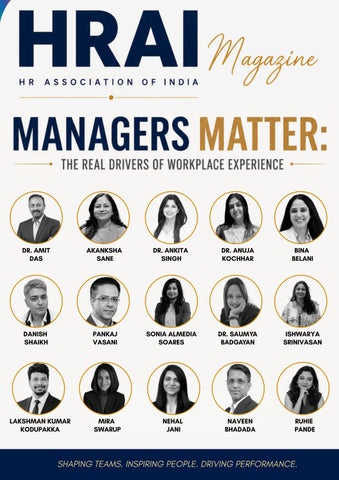
This edition, Managers Matter: The Real Drivers of Workplace Experience, explores the profound impact people managers have on organizational success. Through expert insights, leadership perspectives, and real-world experiences, we examine how effective managers build resilient teams, navigate change with empathy, develop future leaders, and create environments where people feel valued and empowered.
As you turn these pages, we invite you to reflect on the managers who have influenced your own journey and on the kind of manager today's workplace needs. Investing in managers is not just an investment in leadership it is an investment in culture, employee experience, and long-term organizational success.
1,11,111+ FOLLOWERS ON LINKEDIN
A GROWING COMMUNITY OF PROFESSIONALS ENGAGING WITH HRAI’S INSIGHTS, INITIATIVES, AND INDUSTRY CONVERSATIONS.
About HRAI
Founded by Dr. Ankita Singh, the HR Association of India (HRAI) drives industry-led initiatives and curates prestigious recognitions for organizations, emerging professionals, and trailblazing women across the business ecosystem. HRAI serves as a platform for learning, collaboration, and recognition, bringing together professionals and subject-matter experts from across industries.
What We Do
Industry initiatives and professional forums
Awards, recognitions, and curated listings
Knowledge-sharing through talk shows, panels, and articles
Community-building for HR and business professionals
Organizations We’ve Engaged With Lenovo, Hindustan Unilever, Biocon Biologics, IHG Hotels, L&T, CBRE, Sutherland, Capgemini, EY, and more.
KNOWLEDGE & THOUGHT LEADERSHIP
Elite voices such as Dr. TV Rao, Harjeet Khanduja, and Prasenjit Bhattacharya have been featured in HRAI’s one-on-one talk shows, contributing practical insights and real-world perspectives for professionals.
HRAI MAGAZINE INITIATIVE
HRAI publishes thought-provoking articles authored by senior professionals from organizations such as Reliance Jio, Times of India, KPMG, Eveready, Volvo, and more.
HRAI LIST FEATURES
HRAI curates an annual list of features recognizing exceptional professionals and changemakers aligned with a central theme each year. 23 of 2023 | 24 of 2024 | 25 of 2025 . Notable organizations featured include: Adani, Amazon, Flipkart, Samsung, Myntra, Uber, Raymond, and more.
EXCLUSIVELY FEATURED SHARK TANK JURY IN THE VISIONARY CEOS LIST:
For HR professionals in India, HRAI offers unparalleled opportunities to connect with like-minded peers, learn from experts, and gain recognition for their hard work and achievements. By joining HRAI, HR professionals can stay updated on the latest trends, best practices, and strategies that can help them take their careers to the next level.
LAKSHMAN KUMAR KODUPAKA
SENIOR DIRECTOR-TALENT ACQUISITION,SUTHERLAND
MIRA SWARUP
COACH & SPEAKER:IMPACT COMMUNICATION & EXECUTIVE PRESENCE
GROUP CHRO & CMO, SERENTICA RENEWABLES,RESONIA & STERLITE ELECTRIC
DIRECTOR & CHRO, “BENNETT COLEMAN & CO. LTD.(THE TIMES OF INDIA)”
Organisations have spent the last decade building the architecture of employee experience: listening platforms, flexible benefits, culture decks, DE&I programmes, wellbeing initiatives. Most of it has been well intentioned
And yet, when I look at the data across engagement surveys, attrition patterns and exit interviews, the same truth keeps surfacing. The most powerful variable in an employee's experience is not the organisation's brand, its benefits stack, or its leadership vision statement It is the manager they report to on a Tuesday morning. Not the CHRO, not the CEO. The manager
This is the insight most organisations understand intellectually but fail to act on structurally.
Culture is not communicated. It is conducted.
We spend considerable energy designing culture at the enterprise level: articulating values, crafting purpose statements, running town halls. These matter. But they are not where culture is actually decided
Culture is decided in two timeframes
The first is daily and ambient. It shows up in whether a stretch assignment goes to the confident performer or the quieter one who needs the chance, in whether a team member raising a concern feels heard or managed, in the moments after a difficult appraisal when the manager either builds clarity or leaves anxiety behind.
These small decisions accumulate into the lived experience of the team, and most managers do not fully realise how visible they are.
The second is the defining moment: a missed promotion, a personal crisis, a high stakes project, a conversation where someone expected honesty and received performance instead I have seen talented people leave because of how a single conversation was handled Employees remember whether the manager had the courage, under pressure, to be honest rather than likeable.
Popularity and effectiveness are not the same thing A manager who wants to be liked avoids the truth; one who wants control erodes trust. The manager who creates genuine commitment does neither, and that balance must be built
The transition nobody prepares people for
There is a structural problem worth naming. We promote people for individual excellence and then expect them to lead by default.
The best journalist, the sharpest analyst, the highest billing salesperson have mastered personal delivery We reward that mastery with a team, and then are surprised the results disappoint
The transition from individual contributor to people leader is one of the most underestimated pivots in organisational life. It requires a different capability set altogether: coaching rather than instructing, listening before responding, giving feedback with directness and care More fundamentally, it requires a shift in identity.
You are no longer the one doing the work; your job is to make other people better at doing theirs.
That shift is harder than it sounds, and most organisations offer a workshop spread over two afternoons in exchange for it.
The relevance question managers can no longer avoid
As AI moves deeper into the workplace, much of what middle management historically did is being absorbed by software, and quickly
Status updates, work allocation, scheduling, performance tracking: the administrative architecture of management is shifting from people to code.
Many organisations are quietly thinning that layer This is sometimes read as a vote of no confidence in managers as a category. It is not. It is a vote of no confidence in a particular kind of manager, the one whose value sat in coordinating tasks, moving information up and down, and producing reports
The manager who becomes more central is the one who has moved up the value stack, from coordination to coaching, from task allocation to judgement, from status reporting to context setting, from process management to people development.
These are the things AI cannot do: read the room when a team member is quietly disengaging, tell whether someone is ready for a stretch role or still building confidence, hold a difficult conversation with the right balance of honesty and care, or build the kind of trust that carries a team through a difficult quarter
The work that distinguished a manager twenty years ago is being commoditised. The work that will distinguish a manager twenty years from now is what most managers currently do least well: developing people, exercising judgement in ambiguous situations, and creating belonging in tight talent markets.
Managers who shift how they spend their time will become more important to their organisations Those who do not will become harder to defend.
Managing at the speed of AI
There is another shift happening alongside the one to managers, and it is reshaping the day to day work itself.
A team member who would have taken three days to draft a market analysis now produces one in twenty minutes. Polished output arrives at speeds that would have seemed unreasonable a year ago
This is good for the business and harder for management. The familiar signals have weakened. Time spent on a task no longer reflects how much thought went into it, polish no longer proves care, volume no longer guarantees value Managers now have to look at the thinking behind the output: the questions asked of the tool, the choices made about what to keep, the judgement applied at the edges where AI stops being useful.
There is a development problem worth taking seriously here too. Junior team members traditionally built judgement by doing the work themselves, badly at first and then better. If AI now does the work, the manager has to
deliberately design learning opportunities that the workflow no longer provides.
The role is becoming more demanding, in ways conventional managerial training has not caught up with
The bet that compounds
As organisations navigate AI adoption, hybrid work and disruption, the instinct is to reach for new org designs, technology platforms, and enterprise wide transformation programs. These have a role But the most consequential investment is a simpler and harder one: managers who grow people and adapt to their changing role in this AI-enabled world.
The message of any organisation is delivered by its managers. Make sure it is worth hearing.
As AI transforms work, the value of leadership only increases. The tools may evolve, but the ability to inspire, develop and guide people remains the ultimate competitive advantage.
ABOUT THE AUTHOR
Dr Amit Das is a Global Thought Leader & HR Visionary with a career spanning 37+ years, shaping future-ready organizations across diverse industries through leadership transformation, cultural coherence, agile workforce capability, and tech-enabled people architecture. Over the years, he has held leadership roles with marquee organizations including Tata Motors, CESC Ltd, Britannia Industries, Vodafone, RPG Group and Reliance Group, bringing deep expertise in building scalable people systems and resilient performance cultures He currently holds the position of Director & CHRO, Bennett Coleman & Company Ltd (The Times of India), India’s largest media conglomerate with multiple power brands across print & publishing like The Times of India, The Economic Times, Navbharat Times, Maharashtra Times to name a few.
CHIEF
PEOPLE OFFICER, SG ANALYTICS
When people talk about workplace experience, they often refer to aspects such as policies, benefits, flexibility, technology, and culture programs However, for most employees, workplace experience is shaped by more ordinary moments: a first conversation, a check-in after a difficult week, a feedback discussion, a missed deadline, a request for flexibility, or a question about career growth
In each of these moments, the manager matters.
Managers have the most impact on how employees experience an organization. While leadership establishes the organization's culture, human resources creates policies, and the organization acquires tools to facilitate work, employees often form their impression of the organization through their direct manager. For instance, a supportive manager will alleviate many workplace stresses, whereas an unavailable manager will cause employees to view their organization as distant, even if the organization's culture is perceived as positive.
The manager is the first experience of culture.
An employee's cultural experience usually begins before they fully understand what it means to work for that organization. The majority of cultural experiences for a new hire occur during their first few months with the organization, when they are still learning how work gets done, who to contact for assistance, what success looks like, and whether they fit in.
Companies with a strong onboarding process can provide new hires with a positive start to their employee experience
A manager determines whether onboarding becomes belonging. Clear priorities, regular check-ins, introductions to the right people, and space for questions can help a new employee feel guided. Without that support, the same onboarding process can feel confusing and isolating.
In this way, managers help turn onboarding into belonging. They create clarity in a complex organization and help employees connect their role to the bigger picture. A new employee begins to feel valued and connected to the organization before becoming overwhelmed by performance expectations.
The manager is the translator of change.
Organizations are constantly addressing workplace change (e.g., hybrid work, AI, restructuring, changing performance standards, changing workplace priorities, and customer demands). Most employees will not rely solely on news releases or announcements regarding change; they will rely heavily on their manager ' s explanation to interpret and understand changes and how they affect the employee.
After a major communication from an executive, employees often ask their managers:
What does this mean for me? Do I need to change my priorities? Is what I'm doing valued? What new skills should I work on?
While some employees may not openly express these questions, they will determine how employees deal with change
Good managers do not pretend to know all the answers to the above questions. Good managers create situational calmness, context, and focus by communicating what is known, what is not, and what the team can control. Therefore, managers should not be seen only as messengers of change in the work environment. Rather, they should be viewed as sense-makers who help employees navigate uncertainty
One way to understand a manager ’ s impact is to look at the “moments that matter” in an employee’s journey. These are not always formal milestones They are the moments of entry, when a person is trying to belong; moments of uncertainty, when the organization is changing, and people need direction; and moments of strain, when an employee is under pressure, facing a personal challenge, or struggling to perform at their best.
In these moments, employees rarely remember the policy in detail. They remember how the conversation made them feel Did their manager listen?
Did they explain the context?
Did they respond with fairness?
Did they help the employee find a way forward?
These small interactions become emotional proof of the organization’s culture
That is why manager behavior has such a lasting influence A manager may not design the culture statement, but they make it believable or unbelievable in daily practice
The manager is the keeper of trust.
Employees build trust in their managers over time, especially in good and difficult moments
When employees ask their manager for work flexibility due to a personal issue, the response shows whether the word “trust” holds value in the relationship
When employees miss deadlines, the response shows whether accountability is based on learning or blame.
When high-performing employees exhibit signs of burnout, the manager can either notice the signal and guide the employee toward support or ignore it.
The examples above illustrate how small events can linger with employees and shape the degree of safety they feel in speaking freely, asking for assistance, taking ownership of their jobs, and remaining committed to the organization.
Consequently, the need to develop manager capabilities cannot be a one-time training approach Organizations that want higher levels of employee engagement, retention, performance, and trust must focus on manager development as an ongoing and continuous journey. Organizations need to develop coaching, feedback, listening, empathy, accountability, and decision-making capabilities into how they approach manager development.
Managers do not just serve as a point of contact between company leadership and employees, they also amplify their employees' workplace experiences. When an organization invests in and supports managers, the workplace culture becomes clearer, kinder, and more consistently positive for all employees.
Workplace experience is created through practice, not policy And most often, that practice begins with managers.
“A manager may not create the organization's vision, values, or culture
statement,
but they bring them
to life every
day. Through conversations, decisions, feedback, and support, managers transform workplace culture from words on paper into experiences that employees can see, feel, and believe.”
ABOUT THE AUTHOR
Akanksha Sane is the Chief People Officer at SG Analytics, where she leads the People & Culture function and also serves as the Site Head for Pune
With over 24 years of experience in human resources across organizations such as PTC Software, Flex Technologies, Tech Mahindra Business Services, and WNS, Akanksha brings deep expertise in strategic HR management, employee engagement, talent acquisition, learning and development, organizational development, and HR transformation.
At SG Analytics (a Straive Company), she plays a pivotal role in shaping a peoplecentric, inclusive, and high-performance culture As Pune Site Head, she oversees the site’s overall management, strategic direction, and operational excellence, ensuring seamless collaboration across facilities, administration, HR, and employee engagement She also represents the organization at the site level, strengthening alignment between business priorities and employee experience.
A postgraduate in Personnel Management from the University of Pune, Akanksha has led initiatives across performance management, HR process transformation, shared services consolidation, and diversity, equity, and inclusion. She is passionate about building workplaces where culture, trust, capability, and business outcomes come together to create lasting organizational impact.
SANE
FOUNDER, HRAI
Culture
Has a Face. It's Your Manager.
Every organisation talks about culture.
It appears in annual reports, recruitment campaigns, leadership presentations and employer branding videos. Companies define values, invest in learning platforms, redesign offices, introduce wellness programmes and launch engagement initiatives, all with the intention of creating a workplace where people feel motivated to do their best work.
Yet if you ask employees what culture actually feels like, the conversation rarely begins with any of those
It begins with a person.
Almost everyone can recall a manager who changed the way they looked at work For some, it was someone who trusted them with responsibilities they weren't sure they were ready for For others, it was a manager who stood by them when a mistake could easily have become a reason to assign blame Unfortunately, many can also remember a manager who made every Monday feel heavier than it needed to be
That is the paradox organisations often overlook. Culture may be designed at the top, but it is experienced at the point where people interact with their managers every single day
This explains why two teams working in the same organisation can describe two completely different workplaces.
They follow the same policies, work under the same leadership, receive similar benefits and operate within the same business environment, yet one team speaks about growth, trust and collaboration while another talks about stress, politics and exhaustion The difference is rarely found in strategy or policy. More often than not, it lies in the quality of management.
Research reinforces what employees have known for years Gallup has consistently found that managers account for nearly 70 per cent of the variance in employee engagement, and almost half of employees who voluntarily leave an organisation say their manager significantly influenced that decision These are not merely HR statistics. They represent lost innovation, declining productivity, delayed customer outcomes and the considerable cost of replacing capable people who might have stayed under different leadership
Organisations frequently invest in solving symptoms while overlooking one of the biggest causes. They improve benefits, introduce new technologies, redesign performance management systems and strengthen employer branding, expecting these initiatives to transform employee experience While each of these investments has value, none can compensate for the relationship employees have with the person who leads them every day. A generous policy implemented by a poor manager often feels restrictive A demanding assignment given by a trusted manager often feels like an opportunity
The manager, therefore, becomes the organisation's most powerful translator
Strategy is communicated through presentations, but purpose is understood through conversations. Values may be displayed across office walls, yet employees judge those values by observing how decisions are made within their own teams During periods of uncertainty, people pay far less attention to organisational announcements than they do to the behaviour of their immediate manager. Confidence, after all, is built much closer to home than the boardroom
Perhaps this is why the role of a manager has changed more dramatically than almost any other leadership position over the past decade. Earlier generations associated management with planning work, monitoring performance and ensuring operational discipline. Those responsibilities still exist, but they no longer define the role. Today's manager is expected to navigate hybrid work, lead multiple generations, embrace artificial intelligence, build psychological safety, resolve conflicts, coach careers and deliver business outcomes, often simultaneously. Managing work has become only one part of the job; managing human potential has become the larger challenge.
Interestingly, the word MANAGER itself offers a useful reminder of what the role demands today. Great managers Mentor before they measure. They Align people with purpose rather than merely allocating tasks They Nurture trust because accountability cannot flourish without it They Adapt their leadership to individuals instead of expecting everyone to respond in the same way. They Grow capability rather than creating dependence, Empower ownership instead of encouraging compliance, and Recognise that every performance metric
represents a person with ambitions, insecurities and untapped potential. Read this way, manager stops being a title and starts becoming a responsibility
One of the biggest mistakes organisations continue to make is assuming that exceptional individual contributors naturally become exceptional managers Technical excellence and people leadership are entirely different disciplines Someone may consistently exceed business targets and still struggle to coach others, build trust or handle difficult conversations with empathy Promotions reward performance; leadership demands perspective. Unless organisations deliberately develop managers as leaders of people rather than supervisors of work, they risk creating highperforming specialists who unintentionally weaken the very culture they are expected to strengthen
The conversation becomes even more relevant as artificial intelligence reshapes the workplace. AI can already automate routine decisions, personalise learning, analyse workforce data and generate insights that once required hours of manual effort. As technology becomes increasingly capable, some predict that the importance of managers will diminish. The opposite is more likely to happen Technology can process information faster than people ever will, but it cannot replace judgement, courage, empathy or trust A dashboard may identify declining performance, but it cannot understand the anxiety behind it An algorithm may recommend a development programme, but it cannot inspire someone to believe they are capable of more than they imagined. The future of management will depend less on controlling work and more on unlocking human potential something no technology has yet mastered.
Years from now, professionals are unlikely to remember the wording of every value statement their organisation published or the objectives discussed in every quarterly business review. Those details naturally fade with time. What remains are the people who influenced the way they saw themselves. They remember the manager who challenged them without diminishing their confidence, who recognised potential before it became obvious, who created opportunities instead of simply assigning work and who cared enough to have honest conversations when they mattered most. They also remember the managers who did the opposite. Leadership leaves an imprint that extends well beyond business results because it shapes confidence, ambition and, often, the direction of an entire career.
“Peter Drucker famously “Peter Drucker famously observed that culture eats observed that culture eats strategy for breakfast”. strategy for breakfast”.
The quote has been repeated so often that it risks becoming a cliché, yet its relevance has perhaps never been greater Strategies can be copied. Technologies become obsolete. Business models evolve
What remains difficult to replicate is a culture where people consistently bring their best thinking, challenge each other respectfully and feel trusted enough to take ownership That culture is not built through slogans or posters. It is built one conversation, one decision and one manager at a time
Every organisation has managers Not every organisation has managers who consciously recognise the influence they carry. The most effective ones understand that they are doing far more than allocating work or reviewing performance They are shaping confidence, creating future leaders and quietly defining what the organisation feels like to every person on their team
Perhaps that is why culture has never truly lived inside a policy document.
It lives in the conversations managers choose to have, the trust they choose to build, and the confidence they leave behind
"In the end, culture is not a "In the end, culture is not a statement of intent—it is a statement of intent—it is a collection of everyday collection of everyday choices. It is
built through choices. It is built through conversations that foster conversations that foster trust, decisions that reflect trust, decisions that reflect values, and leaders who values, and leaders who inspire confidence. These inspire confidence. These are the moments that shape are the moments that shape organizations long after organizations long after strategies have changed strategies have changed and technologies have and technologies have evolved." evolved."
Dr. Ankita Singh is the CPO & Board Director, CIGNEX & Relevance Lab. With 22+ years in HR, primarily in the ITES sector, Ankita has driven transformation through performance-driven practices and inclusive culture. At CIGNEX, her leadership helped the company earn multiple “Great Place to Work” certifications (2017–2021). She has been recognized as “Woman Leader of the Year” by The Times of India Group and featured in Forbes India’s “Top 100 Managers.” Ankita holds an MBA in HR+IT, an Executive MBA from SCMHRD, and a Ph.D. in Management. A respected voice in the industry, Ankita blends strategic insight with a passion for people development and culture building.
“Leadership is the capacity to translate vision into reality..”
Over the years, working in Human Resources across diverse industries, one lesson has become increasingly clear to me organizations can design workplace experiences, but people bring them to life..
Policies, processes, technology, and engagement programs are important enablers, but the real experience of an employee is shaped every day by the person they interact with the most their manager
An employee may not remember every policy introduced by an organization, but they will always remember how their manager made them feel whether they were trusted, supported, heard, encouraged, or valued.
In my 18+ years of HR leadership journey, I have seen that managers are not just responsible for business outcomes; they are the strongest culture carriers of an organization. The way they communicate, handle challenges, recognize efforts, and develop their teams determines the emotional connection employees build with the organization
As a human resource professional, my approach has always been to enable managers to become better people leaders leaders who can balance performance with empathy, accountability with understanding, and business priorities with human connection.
Creating a Culture of Conversations
One of my strongest beliefs has always been that communication is the foundation of trust.
Many employee concerns are not about policies; they are about not having a platform where they can openly express themselves.
To create a culture of openness, we introduced “Coffee with HR” a simple yet powerful initiative where employees could connect informally, share feedback, discuss challenges, and exchange ideas.
These conversations gave us insights that formal surveys sometimes cannot capture. They helped leadership understand the real employee pulse and allowed us to address concerns before they became bigger challenges
For me, this reinforced a valuable learning sometimes the most impactful HR initiatives are not the most complicated ones; they are the ones that create genuine human connections
Making HR Available When Employees Need It
As organizations grow, accessibility becomes critical.
With a large and diverse workforce, we wanted employees to have an easier way to reach HR support without uncertainty or delay This led to the introduction of an IVR-based HR support system, where employees could connect immediately for specific requirements and receive prompt assistance.
The idea was simple HR should not feel distant.
By creating a structured support mechanism, we improved response time, transparency, and employee confidence. Technology helped us make HR more human by ensuring employees received timely support when they needed it
Designing Employee Experiences Beyond the Workplace
Employee experience is not limited to work processes. It is also about showing employees that the organization genuinely cares about their overall well-being.
Through initiatives like FitClub, we encouraged employees to focus on health and wellness. The initiative created opportunities for teams to engage beyond daily work responsibilities and reinforced the importance of physical and mental well-being
I believe managers play a crucial role here When leaders actively participate and encourage such initiatives, wellness becomes part of the culture rather than just another program.
Building Trust Through Thoughtful Practices
During my HR journey, I have learned that small operational improvements can create a big impact on employee trust
One such initiative was the 10-20-30 payout model:
·10th of the month – Reimbursements
·20th of the month – Incentives
·30th of the month – Salary
For many employees, predictable cash flow creates confidence and reduces unnecessary stress. This initiative was designed with a simple thought if we expect employees to give their best every day, we must also create systems that support their needs.
This is where managers become important. A manager who understands employee realities can build stronger engagement and loyalty.
Inclusion as
a
Leadership Responsibility
A workplace culture is truly successful only when every employee feels they have an equal opportunity to grow.
The “One Woman per Branch” initiative was created with this belief that diversity should not remain a discussion, it should become visible in everyday organizational practices.
By encouraging women representation across branches and creating leadership opportunities, we moved towards building more inclusive teams.
For me, inclusion is not only an HR initiative; it is a leadership responsibility. Managers have the ability to create environments where every individual feels respected and empowered.
Redefining the Role of Managers
The role of a manager has changed significantly.
Earlier, managers were often measured only by productivity and targets. Today, the best managers are those who build capability, coach their teams, provide meaningful feedback, and create confidence
We have focused on strengthening performance conversations, leadership capability, and people practices so that managers understand that developing people is equally important as delivering results.
A manager ’ s impact is not limited to what happens during working hours. Their leadership influences employee confidence, career growth, engagement, and the decision to stay with an organization.
My Reflection
Among the many learnings my HR journey has given me, one belief has become very clear HR can design frameworks, processes, and cultural foundations, but it is managers who bring that culture alive through their everyday actions.
The future of workplaces will not be defined only by technology, policies, or processes It will be defined by leaders who understand that people are not resources to be managed; they are individuals to be supported, developed, and inspired.
A great manager does not simply drive performance they create confidence, build belonging, and shape the relationship employees have with the organization.
Because ultimately, workplace culture is not what is written on walls or shared in presentations It is what employees experience every single day.
And that experience begins with managers.
“A GREAT MANAGER DOES NOT SIMPLY DRIVE PERFORMANCETHEY CREATE CONFIDENCE,BUILD BELONGING AND SHAPE THE RELATIONSHIP EMPLOYEES HAVE WITH THE ORGANIZATION.”
ABOUT THE AUTHOR
Anuja Kochhar is a seasoned HR leader with nearly two decades of experience in strategic human resource management, organizational transformation, and business growth Currently serving as the Chief Human Resource Officer at Tipsons Group, she is driving HR excellence and organizational development initiatives. Anuja has worked across diverse sectors, including microfinance, construction, and academia, and is recognized for her expertise in aligning people strategies with business objectives. A recipient of prestigious industry awards, she is also a co-author, researcher, and respected thought leader in the HR fraternity.
DR. ANUJA KOCHHAR
Why Workplace
Experience is Built One Conversation at a Time
Ask employees what shapes their experience at work, and most won't mention policies, benefits or technology. They'll talk about their manager.
The manager who trusted them with a challenging assignment. The manager who listened during a difficult phase The manager who provided clarity when priorities were shifting. Or unfortunately, the manager who didn't
In my experience, culture is not created in boardrooms. It is experienced in everyday interactions between managers and their teams While organizations invest heavily in employee engagement programs, wellness initiatives, learning platforms and recognition frameworks, the single most influential factor in an employee's workplace experience continues to be their immediate manager
Managers are the translators of organizational culture.
They convert strategy into action, values into behaviours, and aspirations into experiences. Employees may join organizations for opportunities, but they often stay or leave because of their managers.
The Expanding Role of the Manager
The role of managers has evolved significantly over the last few years. Traditionally, managers were expected to drive productivity, allocate work and monitor performance. Today, they are expected to do much more
Modern managers are coaches, communicators, mentors, culture carriers and change leaders They are expected to balance business outcomes with employee wellbeing, performance with empathy and speed with sustainability.
This evolution has happened against the backdrop of unprecedented change. Organizations are navigating technological disruption, evolving workforce expectations, multigenerational teams and increasing demands for flexibility and inclusion. In such an environment, employees look to their managers not just for direction but also for confidence, context and connection.
The challenge is that many organizations continue to promote strong individual contributors into management roles without adequately preparing them for the people responsibilities that come with leadership
Technical excellence does not automatically translate into people leadership capability.
The Manager Capability Imperative
Organizations that want to improve employee experience must invest in manager effectiveness with the same rigor they apply to business performance
The most successful organizations recognize that manager capability is not a one-time training intervention; it is a strategic business priority
At Ascend Telecom Infrastructure, we have learned that sustainable culture transformation happens when managers are equipped with practical tools, clear expectations and continuous development opportunities. Rather than treating leadership development as a BINA BELANI
a periodic event, we focus on embedding leadership behaviours into everyday management practices.
Three capabilities have become particularly critical:
1.Coaching Over Commanding
Employees today want ownership, growth and meaningful conversations Managers who ask better questions often create more engagement than those who provide all the answers
Coaching builds capability, confidence and accountability simultaneously.
2.Clarity Over Complexity
In a rapidly changing environment, one of the greatest gifts a manager can provide is clarity. Employees perform at their best when expectations, priorities and success measures are clearly understood.
Trust has become a critical workplace currency. Managers who create psychological safety, encourage dialogue and genuinely understand their teams are more likely to build resilient and high-performing teams
Employees want to feel valued as contributors, not managed as resources.
4.Measuring What Matters
Organizations often ask whether culture can be measured. The answer is yes, but not through a single metric.
The impact of managers can be seen across engagement scores, retention rates, internal mobility, productivity indicators, learning adoption and leadership pipeline strength. More importantly, it can be observed in everyday behaviours.
Do employees speak up?
Do teams collaborate effectively?
Do managers provide regular feedback? Are high-potential employees choosing to stay and grow within the organization?
The answers to these questions reveal the health of a culture more accurately than any poster on the wall.
Building the Managers of the Future
As organizations prepare for the future of work, manager development must move from being an HR initiative to a business imperative
Future-ready managers will need to combine digital fluency with human capability They will need to leverage technology while preserving connection They will need to drive performance while nurturing wellbeing. Most importantly, they will need to lead through influence rather than authority
Organizations that succeed will be those that deliberately invest in helping managers navigate this shift.
Because while strategies can be copied and technologies can be acquired, a strong leadership culture remains a unique competitive advantage.
Final Thought
Workplace experience is ultimately the sum of thousands of daily interactions Managers sit at the centre of those moments.
The quality of a conversation, the fairness of a decision, the recognition of effort, the coaching provided during a challenge - these seemingly small interactions shape how employees feel about their work and their organization.
Managers do not just manage performance. They shape culture
And in doing so, they shape the future of the organization itself.
Having said this, it would be unfair to suggest that the responsibility for creating a successful workforce rests solely with managers. The most impactful manager-employee relationships are reciprocal. While managers provide direction, coaching and support, employees must demonstrate curiosity, ownership, agility and a willingness to learn. High performance emerges when both sides are committed to raising the bar - managers through leadership and employees through accountability. When that partnership exists, teams move faster, learn quicker and deliver stronger outcomes for the organization
ABOUT THE AUTHOR
A manager's greatest A manager's greatest achievement is not the success achievement is not the success they deliver, but the people they deliver, but the people they develop, inspire, and they develop, inspire, and empower along the way. empower along the way.
BINA BELANI
Bina Belani is the Chief People Officer at Ascend Telecom Infrastructure and an awardwinning HR leader with over two decades of experience across telecom, technology, mining and global organizations. She has held leadership roles with Reliance Jio, Vedanta Resources, Wipro, and SLK Software, driving transformation across talent, culture, learning and organizational effectiveness. Recognized as CHRO of the Year and among India's Top HR Icons, Bina is passionate about building high-performance, humancentred workplaces. A published author of Lighthouse Chronicles, she is a sought-after speaker on leadership, future skills, AI in HR and the future of work. Her leadership philosophy is centred on creating cultures where people and performance thrive together.
Why associate experience is built one interaction at a time
A manager says, “My door is always open. ”
The associate wonders, “Sure But what happens after I walk through it?”
This question sums up much of what associate experience really means.
Organizations spend a considerable amount of time defining values, drafting policies, conducting engagement surveys and launching culture initiatives. All of these matter. But for most associates, the organization is experienced through one person they interact with almost every day: their manager
The manager decides whether a question is welcomed or dismissed, whether a mistake becomes a learning conversation or a public spectacle, whether leave is approved with empathy or accompanied by enough guilt to ruin the break, and whether “speak up ” is a genuine invitation or simply another campaign slogan
For many associates, the manager does not merely represent the workplace - the manager is the workplace.
Research supports this. Gallup has found that managers account for at least 70 per cent of the variation in associate engagement across teams. CIPD research has also linked the quality of line management with associate wellbeing, job satisfaction and performance. The message is quite clear: a manager can become a multiplier of confidence, ownership and energy - or a very expensive reason why good people slowly stop trying
DANISH SHAIKH
I have seen this in several conversations with associates and managers When managers are asked why people disengage, the first responses often point to compensation, work pressure, career growth, HR policies or even “the younger generation.” These factors can certainly matter But associates usually describe something far more personal.
“My manager only speaks to me when something goes wrong. ”
“I was asked to be honest, but my feedback was later held against me. ”
“I never knew what was expected until I was told I had failed.”
“The work was manageable. The daily behaviour was not.”
That last statement stays with me because it captures a reality we often miss. People can handle pressure when there is clarity. They can handle difficult feedback when there is respect They can handle demanding targets when there is fairness What becomes difficult to sustain is humiliation, inconsistency, favouritism and silence.
I once observed a manager respond to an associate who was dealing with a serious personal situation while also trying to keep up with work. There were deadlines, pending tasks and genuine delivery concerns The manager could have focused entirely on output. Instead, he said, “Take care of what you need to. Let us work out what can be redistributed.”
There was no grand gesture The work was rearranged, the associate returned, and life moved on But the team remembered
That is what we often underestimate about managerial behaviour. It rarely affects only the person in front of the manager Everyone else is watching too. When one associate is humiliated, the rest learn to stay quiet. When one associate is treated with dignity, the rest learn that it may be safe to speak.
Culture is built in these small moments. It is revealed when someone makes a mistake, disagrees in a meeting, asks for flexibility, raises an inconvenient concern or admits that they do not know something
An organization may say it believes in psychological safety, but associates watch what happens to the first person who brings bad news It may say it supports development, but associates notice whether their manager discusses their future or only their current output. It may say it values inclusion, but people see who gets heard, who gets visibility and who repeatedly receives the benefit of doubt.
The organization may write the values. The manager decides whether those values survive contact with everyday work
We must also be honest about how organizations create managers. We promote people because they are technically strong, reliable and good at delivering results Then, almost overnight, we expect them to know how to coach, delegate, motivate, manage conflict, give feedback, support wellbeing and develop careers.
That is a very large assumption.
Being excellent at the work does not automatically prepare someone to manage the people doing the work Yet manager development is still often reduced to a one-time programme on leadership styles, followed by the hope that something will stick.
Managers need more than training They need practice, feedback, tools, coaching and strong role models They need help with the real questions:
How do I give tough feedback without damaging someone ’ s dignity?
How do I support an associate without removing accountability?
How do I handle a high performer who creates fear in the team?
How do I respond when someone tells me something I do not want to hear?
These are the moments that define a manager
The strongest managers do not choose between empathy and accountability They hold both They set clear expectations without creating fear They challenge people without humiliating them. They listen without avoiding difficult decisions. They care about the individual while continuing to expect performance
That is not softness It is managerial maturity
Associate experience is often discussed through benefits, platforms, surveys and large-scale initiatives.
But associates are asking much simpler questions every day:
Can I trust my manager?
Can I speak honestly?
Will I be treated fairly?
Will my mistakes define me forever?
Does my manager care about my growth, or only my output?
The answers are rarely found in a policy document They are found in meetings, messages, feedback conversations and moments of pressure
So yes, organizations must improve systems, strengthen policies, conduct surveys and invest in culture. But they must invest just as seriously in managers, because managers are the people who convert all of that intent into daily reality.
The workplace has a tone. It has a response. It has a memory
And for most associates, that workplace has the face of their manager.
ABOUT THE AUTHOR
Danish Shaikh is an HR and Organizational Development leader with 16+ years of experience in building highperforming,future-ready organizations. He currently heads the HR Centre of Excellence at ACG Capsules and is pursuing a PhD focused on psychological safety, allyship, and inclusive leadership.
The organization may write The organization may write the values. The manager the values. The manager decides whether those values decides whether those values survive contact with survive contact with everyday work. everyday work.
With an MBA in HR and a foundation in Physics, he has led enterprise-wide HR transformations, designed talent systems, and built Centres of Excellence aligned with business outcomes. An award-winning professional, Danish has been recognized as Asia HR Director of the Year and a 40 Under 40 honoree. He is also an ICF-certified coach and published researcher, with work presented at global forums including Oxford and published in Scopus and Web of Science Journals.
DANISH SHAIKH
Organizations spend millions designing employee experience. They invest in modern offices, wellness programs, recognition platforms, AI-powered HR systems and attractive benefits Yet employees rarely wake up thinking about any of these
They wake up thinking about one person. Their manager
The workplace experience is not created in the HR department It is created in daily conversations between a manager and an employee
This is not merely an opinion Research confirms it Gallup has consistently found that managers account for at least 70% of the variance in employee engagement. In other words, the quality of a manager has a greater impact on engagement than policies, perks or even the company brand.
Then why are Managers seen in a poor light?
Many of us remember Hari Sadu, the manager made famous by a television commercial. His subordinate decoded his name as H for Hitler, A for Arrogant, R for Rascal.
That advertisement had a personal impact on me because my name is Harjeet But it had an even bigger impact on managers across the country. It reinforced the stereotype that managers are villains
The branding stuck. But is it fair?
Managers are not born managers. They begin their careers as employees, just like everyone else. Their job is to improve the productivity of their teams while balancing business goals, customer expectations and organizational pressures. Sometimes the way they execute this responsibility makes them appear insensitive
So, aren't the managers bad?
Most of us have worked in organizations with excellent policies but poor managers We have also worked with inspiring managers who made even difficult jobs meaningful. We may forget the cafeteria menu or the office interiors, but we never forget the manager who believed in us or the one who made every Monday feel like a punishment.
A recent Uber ride reminded me of this reality
The driver was wearing stylish designer glasses I complimented him "Your glasses look great "
He smiled and said, "Thank you. Actually, I am a fashion designer "
Curious, I asked, "Then why are you driving an Uber?"
He replied, "I don't want a regular job anymore. I want some calm and peace in my life. Managers today don't know how to talk to people "
This is reality. There are bad managers. But perhaps we are asking the wrong question
Instead of asking, "Are managers bad?", shouldn't we ask, Are all managers bad? or even, Are managers bad all the time? More importantly, have we ever trained them to become good managers?
Have we ever trained managers?
For decades, Indian organizations have unknowingly followed the philosophy of "Kyonki Saas Bhi Kabhi Bahu Thi."Every new manager learns management from the manager they worked for The cycle simply continues Good habits are copied. Bad habits are inherited.
Today's workplace, however, is very different
Hybrid work, AI adoption, leaner organizations and growing expectations have expanded the manager ' s role dramatically Managers are required to cope up with all these changes on their own. Yet very few organizations prepare them adequately for these responsibilities
The consequences are visible. Gallup's latest workplace research found that only 27% of managers worldwide were engaged at work in 2024. When managers themselves are overwhelmed, employee engagement inevitably declines, creating a ripple effect throughout the organization
Fortunately, there are organizations that are changing this narrative
Microsoft under Satya Nadella is one of the best examples While technology and strategy attracted headlines, the real transformation happened because managers were encouraged to move from being "know-it-alls" to "learn-it-alls". The result was not only a healthier culture but also one of the greatest corporate turnarounds in recent history.
Make Managers Matter
If you truly want to make employee experience your competitive advantage, start by making managers matter Invest less in cosmetic initiatives and more in managerial capability. Teach managers how to coach instead of control. Help them conduct meaningful one-on-one conversations Equip them to recognize effort, handle difficult conversations and create psychological safety.
Participating in initiatives such as the Great People Managers Study by the Great Manager Institute can also provide organizations with a structured framework to assess, benchmark and strengthen managerial capability.
Because employees don't leave organizations More often than not, they leave managers.
And when managers grow, organizations grow with them “Employee experience is shaped “Employee experience is shaped less by workplace perks and less by workplace perks and more by everyday interactions more by everyday interactions with managers. A single with managers. A single conversation, timely feedback, or conversation, timely feedback, or genuine appreciation can have a genuine appreciation can have a lasting impact on motivation, lasting impact on motivation, engagement, and trust.” engagement, and trust.”
ABOUT THE AUTHOR
Harjeet Khanduja is an international speaker, author, poet, influencer, inventor and an HR leader. He is also known as RK Laxman of Business He is currently working as the Senior Vice President HR at Reliance Jio. He has 4 published patents and authored 9 bestseller books. Harjeet has been a LinkedIn Power Profile, TEDx speaker, Guest Faculty at IIM Ahmedabad and XLRI, Board Member of Federation of World Academics, Global Thought Leader, Global Digital Ambassador. Harjeet features in Top 200 Global Leadership Voices and ET Top 20 HR Influencers.
"The best executive is the one who has sense enough to pick good people to do what he wants done."
PANKAJ VASANI
“People do not leave organisations; they “People do not leave organisations; they leave experiences. And more often than not, leave experiences. And more often than not, those experiences have a manager ’ s those experiences have a manager ’ s signature on them.” signature on them.”
By every measurable metric, organisations invest heavily in strategy, technology, compensation and infrastructure Yet, the single greatest determinant of whether an employee thrives, survives or decides to leave often comes down to one seemingly ordinary variable - their manager.
Culture is not built in boardrooms alone. It is created in thousands of everyday conversations between managers and their teams. It is reflected in how feedback is delivered, how mistakes are treated, how success is recognised and how people feel when they leave a meeting
As the legendary management thinker Peter Drucker observed,
An organisation’s values may be framed on the wall, but employees experience those values through the conduct of their immediate manager
The neuroscience of leadership
Modern neuroscience confirms what effective leaders have intuitively understood for decades.
The human brain is wired to constantly answer two questions:
“Am I safe?”
“Do I matter?”
A manager answers these questions every day - not through speeches, but through behaviour
When employees feel psychologically safe, the brain reduces cortisol, the stress hormone, and allows greater activation of the prefrontal cortex the centre responsible for creativity, judgement, learning and innovation.
Conversely, constant criticism, unpredictability and distrust activate the brain’s threat response. The result is simple:
People stop taking initiative. They avoid difficult conversations. Innovation declines Engagement erodes.
In essence,
People cannot perform at their cognitive best when they are emotionally defending themselves
The quality of leadership, therefore, is not merely a behavioural issue - it is a biological performance multiplier.
Managers shape moments not just metrics
Business leaders frequently monitor financial KPIs, operational KPIs and customer KPIs
Far fewer monitor what may be the most important KPI of all:
How do people feel after interacting with their manager?
Every interaction leaves an emotional residue.
A manager who listens builds confidence
A manager who interrupts builds hesitation.
A manager who coaches builds capability
A manager who controls builds dependency.
As Maya Angelou beautifully reminded us,
“People will forget what you said, people will forget what you did, but people will never forget how you made them feel.”
This applies as much to workplaces as it does to life itself.
This applies as much to workplaces as it does to life itself.
The mirror analogy
Imagine standing before a mirror.
If the reflection appears tired, frustrated or disengaged, we do not polish the reflection - we polish the mirror.
Managers are organisational mirrors.
Employees often reflect the emotional climate created by their leaders
An anxious manager produces anxious teams.
A calm manager produces resilient teams
A learning-oriented manager produces curious teams.
Leadership is contagious
So is fear.
From supervision to stewardship
Historically, managers supervised work.
Today, they steward potential.
The distinction is profound
Supervision asks,
“Did you finish the task?”
Stewardship asks,
“Did you grow while completing it?”
Exceptional managers understand that performance and development are not competing priorities - they are mutually reinforcing.
As Simon Sinek rightly observed,
“Leadership is not about being in charge. It is about taking care of those in your charge.”
That philosophy has never been more relevant.
Coaching: the new competitive advantage
The best managers no longer see themselves as problem-solvers
They see themselves as capability builders. Instead of immediately providing answers, they ask better questions
Instead of rescuing employees, they develop them
Instead of creating followers, they create future leaders.
PANKAJ VASANI
One practical illustration comes from parenting.
A parent who always ties a child’s shoelaces may save two minutes today but delays independence tomorrow
A parent who patiently teaches the child creates capability for life.
Managers face the same choice every day
Fix today’s problem - or build tomorrow’s leader.
The economics of empathy
Empathy is often misunderstood as softness. In reality, empathy is commercially intelligent.
An empathetic manager understands circumstances without compromising standards.
They balance accountability with compassion.
High-performing organisations increasingly recognise that emotional intelligence is no longer merely an HR competency it is an economic asset
Higher engagement improves productivity.
Greater trust accelerates decision-making
Lower attrition reduces replacement costs.
Better coaching strengthens succession pipelines
In other words, Compassion and commercial performance are not opposites. They are partners. The leadership multiplier
A remarkable leader does not create dependence They create confidence.
Their success is measured not by how indispensable they become, but by how many others become capable because of them.
John Quincy Adams famously wrote,
Managers influence this transformation daily - often without realising its magnitude.
A single encouraging conversation can change a career
A thoughtful piece of feedback can alter someone ’ s confidence forever
Equally, a careless remark can leave scars that endure long after performance reviews are forgotten
Leadership therefore demands intentionality
Building organisations where managers matter
Organisations serious about employee experience must elevate manager capability with the same discipline used to improve financial performance.
That means investing not only in leadership programmes but in continuous coaching, behavioural feedback, emotional intelligence, mentoring, reverse mentoring and reflective learning
Technical competence earns someone a managerial title.
Human competence earns them followership.
As organisations increasingly embrace artificial intelligence, automation and digital transformation, one truth remains unchanged:
Technology may optimise processes. Only managers humanise work.
And therefore, The workplace of the future will not be defined by smarter technology alone. It will be defined by wiser managers.
At the end of every employee journey lies a simple question:
“Did someone believe in me enough to help me become better?”
The organisations that consistently answer “ yes ” through their managers will not merely retain talent - they will inspire it
Perhaps the true measure of leadership is this:
ABOUT THE AUTHOR
Pankaj Vasani is a senior finance and business leader with over two decades of experience in executive roles and as a board and audit committee member. Currently serving as Group Chief Financial Officer at Cube Highways Trust. He brings extensive expertise across finance, operations, legal, tax, treasury, and business strategy, with leadership experience spanning diverse sectors including infrastructure, telecom, FMCG, automotive, media, and technology, having worked with organizations such as Publicis Groupe, Vodafone, Coca-Cola, and Subros.
A multi-award-winning professional, he has been honored with accolades such as CFO of the Year (ICAI, 2023 & 2018) and the Professional Achiever Award. He also holds an honorary doctorate for Excellence in Management.
His academic credentials include CA (India & England & Wales), CPA (Australia), executive education from IIM Bangalore, a law degree (Gold Medalist) from Delhi University, and international tax studies from Leiden University.
Because strategies may win markets. Products may win customers. But it is managers who ultimately win hearts, minds and the future.
PANKAJ VASANI
"Treat employees like they make a difference, and they will."
The Space Between Power and Leadership
It is a quote that has become almost clichéd in leadership circles over the decades. Yet, if there is one workplace truth that continues to stand the test of time, it is this While organizations continue to invest heavily in culture, employee experience, and engagement, and rightly so - employees ultimately experience all of these through one person more than any other: their manager.
When an individual steps into a managerial position, they are entrusted with far more than targets, timelines, and business outcomes. It is both a privilege and a responsibility to make a difference in the lives of others: to shape careers, develop talent, influence mindsets, foster belonging, and create an environment where people can thrive.
Yet, some get consumed by the power that comes with the role, while others embrace it as a responsibility of the highest order.
As managers, we are accountable for delivering business outcomes the WHAT. But do we pay equal attention to the HOW? How we achieve outcomes is often just as important as the outcomes themselves
With authority comes responsibility. The misuse of power happens when managers believe that being in charge gives them the license to treat people however they choose.
Such individuals may continue to hold managerial positions, but they rarely make the transition to true leadership While such managers may be more prevalent in organizations that pay little attention to culture, elements of this behavior can be found even in companies known for strong workplace cultures
To become a leader requires the opposite approach using influence instead of authority to drive commitment rather than mere compliance, demonstrating humility and empathy instead of ego to bring out the best in others, and creating an environment where people feel respected, valued, and empowered to do their best work while maintaining high standards
The transition from manager to leader is not defined by position, but by the impact one has on people.
In today's world, where employee experience has emerged as a critical differentiator, the role of the manager has never been more important. Managers are often the most direct representation of the organization for employees. They have the power to shape how people feel about their work, their teams, and ultimately, the organization itself The quality of workplace experience, therefore, is not determined solely by policies or programs, but by the everyday actions, decisions, and behaviors of managers.
The importance of managers is not merely anecdotal; it is backed by data. Gallup's latest State of the Global Workplace report found that global employee engagement
declined from 23% to 21% in 2024, with the primary cause being a drop in manager engagement rather than employee engagement. The report also estimates that managers account for as much as 70% of team engagement, reinforcing the critical role they play in shaping workplace experience
At the same time, managers themselves are under unprecedented pressure Gallup highlights that managers today are navigating restructuring, talent shortages, hybrid work, AI adoption, evolving employee expectations, shrinking budgets, and increasing business demands. Deloitte's research adds that nearly 40% of a manager ' s time is spent on administrative tasks and firefighting day-to-day issues, while 36% feel inadequately prepared for the people-management aspects of their role.
The message is clear:
if managers are expected to drive if managers are expected to drive culture, engagement, and culture, engagement, and performance, organizations must performance, organizations must invest equally in developing and invest equally in developing and supporting them. supporting them.
Why Does This Remain a Blind Spot?
Unfortunately, for many managers, these behaviours often remain a blind spot for a variety of reasons:
Team members may fear repercussions, leaving no one willing or courageous enough to provide honest feedback or call out problematic behaviours.
Senior leadership may be unaware of, or inadvertently overlook, behaviours that are detrimental to individuals, teams, and culture
Strong business performance can sometimes mask poor people leadership, allowing problematic behaviours to persist unchecked.
As a result, managers may genuinely believe they are leading effectively, while the experience of those around them tells a very different story.
What Can Managers Do?
The answer is neither complicated nor new.
Seek genuine feedback from team members, peers, and other stakeholders, and create regular opportunities for open dialogue. More importantly, be prepared to hear what you may not want to hear without any repercussions for those who speak up.
Invest continuously in your own development, particularly in skills such as coaching, listening, empathy and self-awareness.
Be authentic and lead with integrity, building trust through transparency, consistency, fairness, and inclusion. While personal preferences are human, great leaders consciously avoid favoritism and create a sense of belonging where every individual feels valued, heard, and given equal opportunity to grow and succeed.
SONIA SOARES
Take a genuine interest in the growth and development of others. Great leaders are measured not only by their own success, but by the success of the people they help develop.
Give honest feedback. Don't play the "nice" card; be kind instead Kindness often requires difficult conversations that help people learn, grow, and perform at their best
None of these principles are revolutionary In fact, most managers would readily agree that they already practice them. The challenge lies not in knowing them, but in living them consistently and authentically. Leadership is often found in the small, everyday choices we make, the conversations we have, the decisions we take, and the way we make people feel. The difference between managing and leading lies not in understanding these principles, but in practicing them in their truest sense.
As the workplace becomes increasingly complex and AI takes over more transactional and administrative tasks, the defining capability of future leaders may not be expertise, but judgment Deloitte identifies judgment - the ability to make difficult decisions amid ambiguity while balancing context, empathy, experience, and organizational needs, as a critical capability for future managers In many ways, leadership has always been less about having the right answers and more about making the right decisions when there are no easy answers.
Culture is not sustained through values posters or annual town halls
It is sustained through thousands of everyday interactions between managers and their teams Managers are the translators of culture, turning organizational values into lived experiences.
Perhaps the most powerful question a manager can ask themselves is this: if my team had complete freedom of choice, with no constraints or other influencing factors, would they still choose me as their manager?
Leadership is not bestowed by title or authority. It is earned through trust, respect, and the positive impact we have on others. At the end of the day, people may remember our targets, achievements, and business results, but they will never forget how we made them feel
The space between power and The space between power and leadership is ultimately defined by leadership is ultimately defined by the impact we have on the people the impact we have on the people entrusted to us. entrusted to us.
ABOUT THE AUTHOR
SONIA SOARES
SUMIT AGARWAL
SDG AMBASSADOR FOR DEI, ICON OF THE ELCECTION COMMISSION OF INDIA, AND MOC NITI AAYOG, COVT. OF INDIA
The Manager Is Not a Middleman
We have spent years building better HR policies, stronger DEI frameworks, and more sophisticated engagement surveys. And yet, the single most consistent predictor of whether any of it lands is the person sitting between strategy and the employee
The manager.
Not the CHRO. Not the culture deck. Not the town hall with the CEO
The manager.
This is not a new insight. What is new is how long we have continued to treat it as one acknowledging it in theory, underinvesting in it in practice.
What Managers Actually Control
When we talk about employee experience, we talk about it as if it lives in the organisation. It doesn’t. It lives in the team And the team is shaped, almost entirely, by the person leading it.
A manager controls the quality of feedback an employee receives or doesn’t. They control whether a high-potential person gets stretch opportunities or stays invisible. They control whether someone who discloses a disability, a mental health challenge, or a caregiving responsibility is accommodated or quietly sidelined They control the psychological safety of the room before any policy gets a chance to work.
In that sense, the manager is not implementing culture. The manager is the culture at the point where culture meets a real human being
The Accountability Gap
Here is the uncomfortable truth most organisations avoid: managers are held accountable for outputs, not for how those outputs were produced
Revenue numbers Delivery timelines Headcount utilisation. These get measured. But the conditions under which the team produced those numbers? Largely invisible until they collapse in the form of attrition, burnout, an escalation, or a POSH complaint
This is a structural design failure, not a people failure.
When we reward managers for results without examining the cost at which those results arrived, we create a system that tolerates and sometimes incentivises poor people practices. The metrics that matter most to the business don’t capture what it costs the employee.
Until that changes, manager development is just a training programme. It is not a governance mechanism
Capability Is Not the Only Problem
We tend to respond to poor management by sending people to workshops That assumes the problem is knowledge. Often, it isn’t.
The real barriers are structural:
Managers are promoted for technical excellence and given no transition architecture.
They carry spans of control that make meaningful 1:1 attention impossible.
They operate in cultures where admitting uncertainty or seeking support reads as weakness They are evaluated on individual metrics, not on team health.
You can train empathy all you want. If the system punishes the manager who takes time to support a struggling team member because it shows up as underperformance on a dashboard the training will not hold
Capability development matters But it has to be embedded in a structure that makes good management rewarding, not just right.
What Boards and Senior Leadership Need to See
Manager effectiveness is a governance issue not just an HR issue.
Attrition cost, inclusion failure, grievance patterns, and psychological safety breakdowns all trace back, disproportionately, to manager behaviour. When these show up as business risk in talent pipelines, in ESG disclosures, in regulatory exposure boards need to be able to ask:
Q what does our organisation do to hold managers accountable for the conditions they create?
The answer cannot be: "We have a leadership programme." It has to be: "We measure it. We reward it. We enforce it."
The Shift That Actually Matters
Stop treating manager development as a learning and development function. Start treating it as a risk management function.
Define what good management looks like in your organisation not as a values statement, but as observable, measurable behaviour. Tie performance evaluation to team health metrics, not just output metrics Create feedback loops that give managers real signal, not just annual review scores
And invest in manager selection as rigorously as you invest in senior leadership selection because the impact per person managed is often higher than the impact of the leader two levels above.
The employee experience conversation will keep going in circles until we are honest about where it actually gets made or broken It gets made or broken in a Tuesday morning check-in. In whether a manager noticed. In whether they said something.
THE MANAGER SITS AT THE POINT WHERE STRATEGY MEETS PEOPLE, WHERE VALUES BECOME ACTIONS, AND WHERE CULTURE BECOMES REALITY. EVERY DAY, THROUGH COUNTLESS DECISIONS AND CONVERSATIONS, MANAGERS SHAPE HOW EMPLOYEES EXPERIENCE THEIR WORKPLACE. THE TRUE STRENGTH OF AN ORGANIZATION LIES NOT ONLY IN ITS VISION OR POLICIES, BUT IN THE MANAGERS WHO BRING THEM TO LIFE. WHEN ORGANIZATIONS INVEST IN GREAT MANAGERS, THEY INVEST IN THE FOUNDATION OF TRUST, ENGAGEMENT, INCLUSION, AND LONG-TERM SUCCESS
ABOUT THE AUTHOR
Sumit Agarwal is a DEI advisor and systems thinker whose work sits at the intersection of inclusion, ESG, and corporate governance. He helps organisations across India build the practice that India's policy framework has already mandated moving beyond awareness and into accountable, measurable change
His DEI scope covers the full spectrum: disability, gender, LGBT+ inclusion, generational diversity, ageism, and intersectionality. He is also a LEGO® SERIOUS PLAY® certified facilitator and applies Liberating Structures and design thinking to every engagement.
Sumit has spoken on over 350 platforms including TEDx, IIT Kharagpur, IIM Calcutta, Amazon, and Reliance and has been featured in Forbes, Fortune India, and Business Standard. He serves as Mentor of Change at NITI Aayog, SDG Ambassador for DEI, and Icon of the Election Commission of India.
He was born with cerebral palsy and has undergone four major surgeries. His mission: to help one million persons with disabilities thrive
DR. SAUMYA BADGAYAN
VICE PRESIDENT - HR BUSINESS STRATEGY
GOLD STAR JEWELLERY PVT LTD
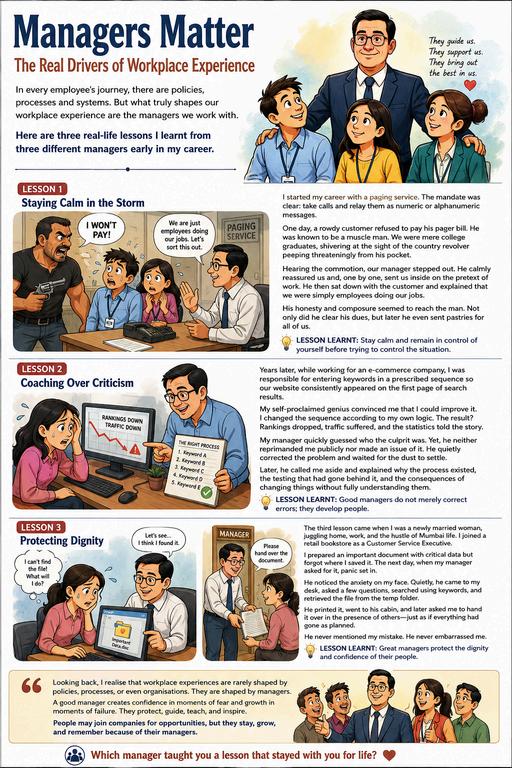
When people reflect on their careers, they often remember the organizations they worked for, the designations they held, or the targets they achieved Yet, when we dig deeper, the memories that truly endure are usually about people particularly managers
Looking back across my own professional journey, I realize that some of the most valuable leadership lessons I learnt did not come from classrooms, management books, or corporate training programs. They came from managers who demonstrated leadership through simple actions at critical moments
Composing Under Pressure
The first lesson came early in my career when I worked for a paging service. Our role was straightforward: receive calls and relay them as numeric or alphanumeric messages.
One day, a customer walked into the office refusing to pay his pager bill. He was known locally as a muscle man We were a group of young college graduates, inexperienced and intimidated The sight of a country-made revolver peeping from his pocket was enough to leave us visibly shaken.
One day, a customer walked into the office refusing to pay his pager bill He was known locally as a muscle man
We were a group of young college graduates, inexperienced and intimidated. The sight of a country-made revolver peeping from his pocket was enough to leave us visibly shaken
Sensing the tension, our manager stepped out of his cabin. He calmly reassured us and quietly sent us back to our desks one by one. He then sat down with the customer and spoke to him with honesty and respect. He explained that we were merely employees performing our duties and had no personal stake in the matter.
Something about his composure changed the atmosphere. The confrontation dissolved. The customer not only paid the outstanding amount but later sent pastries for the entire team.
The lesson was unforgettable: before controlling a situation, learn to control yourself. Calmness is not weakness; it is leadership in action
Coaching over criticism
The second Lesson, Years later, I joined an ecommerce company My responsibility was to enter keywords in a prescribed sequence so that our website consistently appeared on the first page of search engine results.
The process had been carefully designed and tested. However, youthful confidence often masquerades as expertise Convinced that I had found a better approach, I altered the sequence according to my own logic.
The results were immediate Rankings dropped Traffic declined. The data told the story.
My manager quickly figured out who was responsible. Yet he did not publicly reprimand me He did not send a harsh email He did not make me an example.
Instead, he quietly corrected the issue and waited until the crisis had passed. Later, he called me aside and patiently explained why the original process existed. He walked me through the reasoning, the testing, and the consequences of making changes without understanding the entire system.
What stayed with me was not the mistake I made.
It was the way he handled it.
He chose coaching over criticism and learning over blame.
From him I learnt that good managers do not merely correct errors; they develop people The objective of leadership is not to prove who is right. The objective is to ensure that people grow wiser from their mistakes
Protecting Dignity
The third lesson arrived during a completely different phase of my life
I was newly married, adjusting to a new city, balancing home and work, and learning to navigate the relentless pace of Mumbai. Around that time, I joined a retail bookstore as a Customer Service Executive.
Although I held an MBA, computers and technology still felt intimidating. One day I worked hard on an important document containing critical business data. I saved it carefully or so I thought
The next morning my manager asked for the document I searched everywhere. Folder after folder Drive after drive. Nothing.
My confidence evaporated. I could feel panic rising I was convinced that I had lost an important file and with it perhaps my credibility.
My manager noticed the anxiety on my face
Without creating a scene, he walked over to my desk, sat beside me, and asked a few questions. After typing a few keywords and navigating through the system, he located the missing document sitting quietly in a temporary folder.
Problem solved.
But the real lesson came afterward
He printed the document and carried it to his cabin. Later, in the presence of colleagues, he casually asked me to bring the document to him
There was no mention of my mistake
No public correction
No embarrassment.
No unnecessary lesson delivered before an audience
In that moment, he saved more than a document.
He saved my face.
He protected my position
He preserved my confidence.
Years later, I still remember that act of kindness.
Great managers do not merely solve problems. They protect the dignity of the people who make them.
As an HR professional today, I often hear discussions about employee engagement, workplace culture, retention strategies, and employer branding. These are important. Yet culture is rarely experienced through policy documents It is experienced through everyday interactions with managers.
Managers are the translators of organizational values.
They determine whether feedback becomes growth or humiliation
Whether mistakes become learning opportunities or career setbacks
Whether fear dominates a workplace or trust flourishes within it.
The three managers in my journey taught me three different lessons. One taught me composure under pressure. Another taught me the value of coaching over criticism The third taught me the importance of preserving a person ’ s dignity
None of them delivered grand speeches. None of them spoke about leadership theories They simply demonstrated leadership through their actions
“That is why managers matter.”
People may join organizations because of their brand, compensation, or opportunities But their day-to-day experience is shaped largely by their managers. Long after targets are forgotten and projects are completed, employees remember how their managers made them feel.
And perhaps that is the true measure of leadership not authority, not hierarchy, not titles, but the ability to bring out the best in people while helping them preserve the best in themselves
“Long after performance “Long after performance reviews are forgotten, reviews are forgotten, people remember how they people remember how they were treated. The true were treated. The true legacy of a manager is not legacy of a manager is not measured by targets measured by targets achieved, but by the achieved, but by the confidence built, the
careers confidence built, the careers shaped, and the lives shaped, and the lives positively influenced along positively influenced along the way.” the way.”
ABOUT THE AUTHOR
Dr. Saumya Badgayan Dutta is a distinguished HR strategist and senior management leader with over two decades of experience driving transformation in the luxury manufacturing sector. As Vice President –HR Business Strategy at Gold Star Jewellery Pvt Ltd , she partners with CEOs and boards to align business vision with people and operational excellence. Holding dual PhDs in E-Commerce and Psychology, Dr. Saumya blends digital acumen with behavioral insight to build future-ready, high-performance cultures A TEDx Speaker, World Record holder, and 10x LinkedIn Top Voice, she is recognized for pioneering data-driven, human-centric HR models that accelerate organizational growth. Her work spans leadership development, inclusion, and large-scale digital transformation, making her a respected voice in shaping the next era of workplace evolution.
"Leadership is not about being in charge. It is about taking care of those in your charge."
ISHWARYA
DEI LEADER, HR LEADER - PRODUCTION,
SUPPLY CHAIN - INDIA, DECATHLON SPORTS
Managers – The Foundation, the Framework, and the Architects of
Every team mate Journey
At Decathlon, we often say:
“Managers are the first HR of the team.”
While People Teams may be the first face a team mate encounters during recruitment, it is ultimately the manager who shapes how that team mate experiences the organization every day
The quality of the workplace experience, the pace of growth, the sense of belonging, and often the decision to stay or leave are profoundly influenced by one individual: the manager
Every team mate beginning a professional journey hopes for a manager who can inspire them, challenge them, support them, and help them unlock their potential
Many of us can still recall our first manager Long after projects, targets, and presentations fade from memory, we remember the leaders who believed in us, coached us through setbacks, and helped us discover strengths we did not know we possessed Their influence often extends beyond the workplace and becomes part of our personal growth story.
The Power of Perspective: Turning Intent into Impact
Organizations invest significant effort in defining their purpose, values, and culture Yet these aspirations only become meaningful when they are translated into everyday experiences.
Managers are the bridge between organizational intent and team mate impact
A company may communicate a compelling purpose, but it is the manager who helps team mates understand how their work contributes to that purpose A company may promote values such as trust, collaboration, and responsibility, but it is the manager who demonstrates what those values look like in practice
This becomes particularly important during moments of change. When managers approach challenges with transparency, dialogue, and empathy, team mates experience trust They feel included in the journey and become active contributors to the solution
Conversely, when change is communicated purely through processes, emails, and directives, team mates often experience compliance rather than commitment
The best managers understand that leadership is not about distributing information it is about creating understanding. They connect business priorities with human emotions and transform strategy into meaningful action.
Managers Drive the Mechanics of Growth
A team mate’s journey is marked by several important milestones onboarding, probation, performance reviews, development opportunities, promotions, and career transitions.
At every stage, managers play a defining role. The most effective managers recognize that growth is personal. Not every team mate learns in the same way, nor do they share the same ambitions.
Some thrive through stretch assignments Others develop through coaching, mentoring, or exposure to new challenges Great managers take the time to understand individual aspirations and create development opportunities that align with them.
“Be Kind but Be Demanding” - A mantra we believe at Decathlon in the way of management
This mantra enables us to provide feedback not as criticism, but as fuel for improvement
It helps us to challenge team mates while simultaneously supporting them. It helps to act less like supervisors and more like coaches
When team mates feel their manager is genuinely invested in their development, something powerful happens. Work stops feeling transactional and starts feeling transformational
A job becomes a career
A role becomes a pathway for growth. This intentional investment not only drives individual success but also strengthens the organization’s leadership pipeline and future readiness.
Managers
Are the Builders of Psychological Safety
High-performing organizations are not defined solely by results They are defined by their ability to create environments where people feel safe enough to contribute their best thinking.
Psychological safety is the belief that individuals can speak up, challenge ideas, admit mistakes, ask questions, and take calculated risks without fear of embarrassment or punishment.
Managers are the primary architects of this environment
A manager driven by fear often creates a culture of caution team mates become hesitant to innovate, reluctant to share ideas, and focused on avoiding mistakes rather than pursuing opportunities.
On the other hand, managers who encourage learning create teams that adapt faster and perform better
There is a significant difference between saying:
“You made a mistake, “You made a mistake, therefore you are not ready therefore you are not ready for more responsibility.” for more responsibility.”
and and
““You made a mistake. What You made a mistake. What did you learn, and how can we did you learn, and how can we grow from it?” grow from it?”
The second approach creates confidence, ownership, and resilience
Progressive leaders help team mates reframe setbacks as learning opportunities rather than career limitations. When managers create psychological safety, team mates become more willing to take initiative, challenge assumptions, and innovate. They dare more because they know their growth matters as much as the outcome.
And that is where true intrapreneurship begins.
The Hidden Driver of Retention : Emotional Intelligence
There is a well-known saying:
“Team mates don’t leave companies. They leave managers. ”
While compensation, career opportunities, and market dynamics certainly influence attrition, the immediate trigger for many exits is often the quality of the relationship between an team mate and their manager
Team mates remember how managers show up during defining moments
Moments of success
Moments of failure.
Moments of uncertainty. And especially moments of personal hardship
I still remember receiving a message from a leader when my mother passed away. It was a simple note expressing condolences and encouraging me to take the time I needed before returning to work
The message itself was brief, but its impact was lasting.
It gave me the space to grieve, feel supported, and eventually return with renewed commitment and gratitude.
That experience reinforced a simple truth: people rarely forget how leaders make them feel during their most vulnerable moments.
Emotional intelligence is not a soft skill It is a business skill.
It strengthens trust, engagement, loyalty, and ultimately retention.
The Manager’s Mandate for the Future
Organizations do not transform because of corporate presentations, policies, or mission statements.
They transform because managers change the way people experience work
As organizations navigate increasing complexity, technological disruption, and changing workforce expectations, the mandate for managers has never been clearer.
We must cultivate leaders who are not merely operational overseers, but strategic people advocates
Managers who combine business acumen with emotional intelligence.
Managers who coach rather than control Managers who build trust before demanding performance
Because at the end of the day, people may join organizations for the brand, the role, or the opportunity
But they stay, grow, and thrive because of great managers
ABOUT THE AUTHOR
Ishwarya Srinivasan, responsible for the HRManufacturing & Supply Chain team and the Gender Balance Project at Decathlon India
I navigated through different roles of the HR gamut, in the last 17 years. I am passionate about building inclusive, high-performing workplaces where people can thrive and grow Through the last 17 years i have built transformative initiatives in talent development, employee engagement, leadership development and gender inclusion
Outside my profession, I am an avid yoga practitioner, a cyclist and a Mandala artist I really love to work around the spaces of healing and well being of people through art.
In today's rapidly evolving business landscape, organizations are investing heavily in digital transformation, artificial intelligence, employee well-being programs, and workplace culture initiatives. While these investments are important and often necessary for long-term success, one factor continues to influence employee experience more profoundly than almost any other organizational intervention: the quality of people managers.
As a Global Talent Acquisition leader, I have had the opportunity to interact with professionals across industries, geographies, and career stages. Through hiring discussions, employee engagement conversations, exit interviews, and market intelligence, one recurring theme consistently emerges Employees may join an organization because of its brand, compensation, technology, or career opportunities, but they often stay, grow, and perform because of their manager
Managers serve as the most visible representation of an organization's culture. They translate corporate values into daily actions and transform business strategies into meaningful employee experiences. Every interaction between a manager and an employee contributes to how the employee perceives the workplace. Whether it involves setting expectations, providing feedback, recognizing achievements, resolving challenges, or supporting professional growth, managers significantly shape the employee journey
The nature of leadership itself has changed dramatically over the last decade Traditional command-and-control approaches are becoming increasingly ineffective in a workforce that values transparency, flexibility, inclusivity, and purpose. Today's employees expect more than direction and supervision They seek leaders who listen, coach, mentor, and inspire.
This shift has elevated managers from operational supervisors to architects of workplace experience.
One of the most important contributions managers make is creating an environment of psychological safety Employees perform at their best when they feel comfortable expressing ideas, asking questions, challenging assumptions, and learning from mistakes without fear of judgment. Teams that operate within psychologically safe environments are generally more innovative, collaborative, and resilient.
Managers play a central role in establishing this culture By encouraging open communication, demonstrating empathy, and valuing diverse perspectives, they foster an atmosphere where employees feel respected and empowered In an age where innovation drives competitive advantage, the ability of managers to create psychological safety is no longer optional it is essential.
Employee engagement is another area where manager effectiveness has a direct impact Organizations invest significant resources in engagement surveys, recognition programs, and employee experience initiatives Yet engagement levels often vary considerably across teams within the same organization More often than not, the difference lies in managerial leadership.
Employees who receive regular feedback, clear direction, meaningful recognition, and opportunities for development tend to be more engaged and committed. They understand how their work contributes to broader organizational goals and feel motivated to deliver results.
Conversely, employees who experience poor communication, inconsistent expectations, or lack of support often become disengaged regardless of the organization's overall reputation.
Recognition remains one of the simplest yet most powerful tools available to managers. Employees want their contributions to be noticed and appreciated. Recognition does not always require financial rewards; often, timely appreciation, public acknowledgment, or constructive feedback can significantly improve morale and motivation. Effective managers understand that recognition strengthens trust, reinforces desired behaviors, and creates a sense of belonging.
Trust is, in fact, the cornerstone of effective leadership Employees must trust that their managers will treat them fairly, support their development, and make decisions with integrity. Trust cannot be mandated through policies or processes. It is built through consistency, transparency, accountability, and genuine concern for employee success.
Managers who communicate openly, follow through on commitments, and demonstrate fairness create stronger relationships with their teams These relationships become particularly important during periods of uncertainty, organizational change, or business transformation Employees are more likely to embrace change when they trust the leaders guiding them through it
From a talent acquisition perspective, the influence of managers begins even before an employee joins an organization. Today's candidates conduct extensive research before accepting an offer Beyond compensation and benefits, they seek insights into leadership quality, team dynamics, career growth opportunities, and workplace culture.
Employer branding is increasingly shaped by employee experiences shared through professional networks, social media platforms, and employer review sites. Candidates want to know what it is like to work with a particular team and manager. As a result, managers have become critical ambassadors of the employer brand.
Their influence continues during onboarding
The first few months of employment are often decisive in determining long-term success and retention. Employees who receive guidance, support, regular check-ins, and clear expectations from their managers are more likely to integrate successfully and become productive members of the organization Effective onboarding is not simply an HR responsibility it is a managerial responsibility.
Retention provides perhaps the strongest evidence of the importance of managers While compensation remains an important consideration, employees rarely leave organizations solely because of salary More frequently, they leave because of poor leadership experiences, lack of growth opportunities, insufficient recognition, micromanagement, or ineffective communication
The phrase "employees leave managers, not companies" has endured because it often reflects reality. In today's highly competitive talent market, retaining skilled professionals is a strategic necessity. Managers therefore play a direct role in protecting organizational capability, maintaining continuity, and sustaining business performance.
The rise of hybrid and remote work has further expanded managerial responsibilities
Managing distributed teams requires a different set of competencies than managing employees in traditional office environments Managers must foster collaboration, maintain engagement, ensure inclusion, and support well-being despite physical distance
Success in this environment requires strong communication, emotional intelligence, adaptability, and trust-based leadership. Managers who focus on outcomes rather than activity monitoring create environments where employees feel empowered while remaining accountable for results.
Artificial intelligence is also transforming the workplace and redefining leadership expectations. AI can automate routine administrative activities, provide workforce insights, and support datadriven decision-making. However, technology cannot replace the human aspects of leadership Empathy, coaching, mentorship, conflict resolution, and relationship-building remain uniquely human capabilities.
The managers who will thrive in the future are those who combine technological awareness with strong people leadership skills They will leverage AI to improve efficiency while maintaining the human connections that drive engagement and performance
Given the strategic importance of managers, organizations must invest intentionally in leadership development. Too often, high-performing individual contributors are promoted into managerial positions without adequate preparation for leading people Technical expertise alone does not guarantee leadership effectiveness.
Organizations must equip managers with skills
in coaching, communication, emotional intelligence, inclusion, conflict resolution, change management, and employee development. Structured leadership programs, mentoring initiatives, coaching interventions, and continuous learning opportunities can significantly strengthen managerial capability
Organizations should also rethink how managerial success is measured Traditional performance indicators often focus on operational outcomes and business results While important, these measures alone provide an incomplete picture. Metrics such as employee engagement, retention, team development, internal mobility, diversity outcomes, and employee feedback offer a more comprehensive view of managerial effectiveness.
As the future of work continues to evolve, organizations will face increasing complexity, technological disruption, and shifting workforce expectations. Yet one reality is unlikely to change: employees will continue to seek meaningful work, supportive leadership, and opportunities for growth
Managers sit at the center of these expectations They influence how employees experience culture, navigate change, build relationships, and achieve success Their actions shape workplace reality far more than policies, processes, or corporate statements.
The organizations that excel in the future will be those that recognize managers as strategic drivers of employee experience and invest accordingly. Building exceptional managers is not merely a leadership initiative or an HR objective it is a business imperative.
Ultimately, workplace experience is created through everyday interactions: conversations, feedback, coaching, recognition, and support. These moments define how employees feel about their organization, and they are delivered primarily through managers Simply put, managers matter because they are the human connection between organizational ambition and employee success. They remain the real drivers of workplace experience
ABOUT THE AUTHOR
Dr. Lakshman Kumar Kodupaka is a seasoned Talent Acquisition leader with over two decades of experience in global recruitment, workforce strategy, and talent transformation. He currently serves as Senior Director – Talent Acquisition at Sutherland, leading hiring initiatives for Digital Engineering Services across multiple geographies.
Known for building high-performing talent acquisition teams, Dr. Lakshman has successfully driven large-scale hiring programs, leadership recruitment, Global Capability Center (GCC) expansion, and workforce planning initiatives. He is passionate about leveraging AI, data analytics, and digital innovation to transform talent acquisition and create future-ready organizations.
Beyond his corporate role, he is a frequent speaker at industry forums, universities, and leadership summits, sharing insights on Generative AI, Industry 5.0, workforce transformation, and the future of work. He is also an avid long-distance runner, halfmarathon finisher, and advocate for continuous learning, leadership development, and community engagement, inspiring professionals to embrace change and innovation in an evolving business landscape.
“The growth and development of people is the highest calling of leadership”.
MIRA SWARUP
COACH & SPEAKER: IMPACT
COMMUNICATION & EXECUTIVE PRESENCE
In my years as an executive coach, I have sat across from hundreds of leaders, and one question comes up more often than any other: “How do I get my team to actually engage?” The question is almost always framed as a problem of the team. In most cases, though, the answer begins not with the team but with the manager asking it.
Managers occupy a unique position in any organisation. They are the living bridge between strategic intent and daily reality, between the vision articulated in the boardroom and the experience felt at every desk, every screen, every 9 a m standup And yet, for too long, organisations have underinvested in them equipping them with targets and tools, but rarely with the capabilities they need to lead with genuine impact
The data is unambiguous Across industries and geographies, a single variable consistently predicts whether an employee feels motivated, whether they stay or leave, whether they grow or stagnate: the quality of their relationship with their direct manager Not the brand Not the benefits package. Not even the salary. The manager.
Managers as Culture Carriers
Culture is not what is written in a values statement on the intranet. Culture is what your manager does when things go wrong It is whether they credit the team in front of leadership, or quietly take ownership of someone else’s idea. It is the tone they set on a Monday morning, the questions they ask in oneon-ones, and the behaviours they choose to call out or let pass.
Managers, whether they know it or not, are the most powerful culture architects in any organisation. Every interaction they have reinforces or erodes the culture the organisation aspires to build. This is why culture transformation programmes that bypass the manager layer almost always stall You cannot sustainably shift culture from the top if the middle is not on board and genuinely capable of modelling the change.
Trust Is Built in the Small Moments
One of the most consistent findings in my coaching work is that trust is not built through grand gestures. It is built and eroded in the smallest moments Does the manager listen, or merely wait to speak?
Do they follow through on what they say? Do they create a space where a team member can flag a mistake without fear of humiliation?
When trust is present, people take ownership They raise their hand for the stretch assignment. They are honest about capacity constraints before a deadline becomes a crisis They bring discretionary effort that quality of going beyond the job description not because it is required, but because they genuinely care about the outcome.
When trust breaks down, the exact opposite happens People disengage quietly They do enough to avoid scrutiny, and nothing more. Exit interviews are full of language about “limited growth” and “culture fit” but dig deeper, and almost always, the departure traces back to a breakdown in the relationship with a manager. Retention, in this sense, is not an HR problem. It is a manager capability problem
Performance Is Personal
In my conversations with the leaders I partner with, we often discuss that managing performance is not about setting KPIs and waiting for the numbers. It is about understanding what motivates each individual on your team, what obstacles are quietly getting in their way, and what kind of support would actually help them move forward
This requires managers to develop a genuine curiosity about the people they lead. It requires them to move from a command-and-control model to one that is coaching-oriented: asking rather than telling, creating accountability without micromanaging, and holding the balance between challenge and support.
Organisations that have made this shift report not only higher performance, but higher engagement and dramatically lower voluntary attrition. The manager who sees themselves as a coach not just a supervisor consistently gets more from their team, and gives more to them in return.
Investing in Manager Capability: The Biggest Lever We Are Not Pulling Hard Enough
Despite everything we know about the disproportionate impact managers have on every business and people outcome, most organisations still underinvest in their development. Leadership development budgets flow disproportionately to the C-suite Highpotential programmes target a select few. And the manager in the middle often the firsttime people leader juggling individual contribution with people responsibility is largely left to figure things out on their own
This is where HR and L&D teams have a significant opportunity Building a structured, ongoing approach to manager development one that combines coaching, peer learning, and real-time feedback is one of the highestreturn investments an organisation can make. The capability to have a meaningful development conversation, to give feedback without defensiveness, to navigate team conflict with composure: these are skills. They can be learned. And they must be taught.
Equally important is how we define ‘good’ management If our promotion criteria still reward only technical expertise and individual output, we will keep producing managers who are brilliant at their jobs but ill-equipped to lead others. Organisations that have begun to measure manager effectiveness through team health scores, engagement indices, and 360degree feedback are seeing a meaningful shift not just in manager behaviour, but in the culture and performance of the teams beneath them
The Manager Is the Message
In communications coaching, we often say: the medium is the message. In organisational life, the manager is the message. Whatever values, priorities, and aspirations an organisation holds dear, it is the manager who translates or fails to translate those into lived experience for every employee.
The good news is that this is not a fixed equation. Managers can grow. With the right investment, the right structures, and the right culture of accountability and support, organisations can build a layer of leadership
that does not just manage people, but genuinely elevates them And when that happens, everything else performance, engagement, retention, innovation follows.
Mira Swarup is a Coach, Speaker, and invited Tedx Speaker, specialising in Executive Presence and Impact Communication. With over 13 years of experience, she has partnered with 30+ leading organisations including Deloitte, BCG, DBS Tech, BlackRock, and Razorpay training over 3,000 professionals and coaching 500+ individuals to communicate with clarity, confidence, and conviction Her corporate programmes span impact communication, executive presence, business storytelling, difficult conversations, and personal branding. Mira’s journey from clinical research to personal development shapes her distinctive, transformationfocused coaching approach, moving beyond instruction to drive genuine behavioural change. She is also the Host of the Candid With Mira Podcast Series Mira is based in India and can be reached at mira@miraswarup.com
A few years ago, during an exit interview, an employee said something that has stayed with me ever since:
“I'm not leaving the company. I'm leaving my manager. "
The compensation was competitive. The role was challenging The organisation offered genuine growth opportunities. And yet, the employee had chosen to move on not because of the company, but because of the day-to-day experience shaped by a single individual: their manager.
That conversation reinforced a truth many organisations recognise but consistently underestimate Employees may join an organisation for its brand, but they experience that organisation through their managers
In an era where organisations invest heavily in engagement surveys, wellness programmes, and culture-building initiatives, the manager remains the single most powerful influence on the employee experience.
THE MANAGER AS THE FACE OF THE ORGANISATION.
For most employees, the CEO is a distant figure. HR is a support function. Policies and processes provide structure. Managers, however, are the people employees interact with every day.
Managers shape how employees feel about their work, their growth, their recognition, their challenges, and their sense of belonging. A supportive manager can make a demanding role feel deeply rewarding. Conversely, even the most generous benefits package cannot offset a poor managerial relationship NEHAL JANI
Research consistently confirms that managers significantly influence engagement, retention, and performance. Yet beneath the statistics lies a simple human reality: people want to feel valued, heard, and supported
EXPERIENCE
IS BUILT IN EVERYDAY MOMENTS.
Many organisations concentrate on largescale experience initiatives. In practice, however, workplace experience is most often shaped by small, everyday interactions.
It is built when a manager takes time to listen during a difficult week, offers constructive feedback rather than criticism, recognises effort and not merely outcomes, creates the psychological safety for employees to ask questions and make mistakes, and supports growth even when immediate results are not yet visible.
Employees may forget a quarterly town hall, but they rarely forget how a manager made them feel during a challenging moment. In my experience, the strongest employee memories are seldom linked to policies or incentives They are linked to leaders who showed empathy when it mattered most
TRUST: THE FOUNDATION OF EVERY GREAT TEAM
One of a manager ' s most important responsibilities is building trust. Trust is not created through authority; it is earned through consistency.
Employees place their trust in managers who communicate transparently, follow through on
commitments, address difficulties honestly, treat everyone fairly, and admit their own mistakes when necessary A team grounded in trust can navigate uncertainty, change, and pressure far more effectively than one operating in fear.
Today's workforce, particularly its younger generations, values authenticity over hierarchy Increasingly, employees seek leaders who are approachable, human, and genuine.
DEVELOPING MANAGERS
BEYOND TECHNICAL SKILLS
Organisations frequently promote highperforming individual contributors into managerial roles. While technical expertise matters, effective people management demands an entirely different set of capabilities. Great managers are not born; they are developed.
Organisations that prioritise managerial effectiveness invest in leadership development, coaching and mentoring, emotional intelligence, communication skills, conflict resolution, and the art of meaningful performance conversations The modern manager must be equipped not only to manage work, but also to manage relationships, expectations, and team dynamics
In many cases, the difference between engagement and disengagement is not organisational strategy it is managerial capability.
MANAGERS AS CULTURE CARRIERS
Culture is often expressed through mission statements, values, and vision documents. Employees, however, experience culture through behaviour and managers are responsible for translating organisational values into everyday action.
If an organisation champions collaboration, managers must actively encourage teamwork. If it values innovation, managers must create space for experimentation. If it emphasises inclusion, managers must ensure that every voice is heard. Employees observe what leaders do far more closely than what organisations say, which makes managers the most visible carriers of culture.
THE FUTURE OF WORKPLACE EXPERIENCE
As workplaces continue to evolve, managers will remain central to the employee experience. Technology can automate processes. Artificial intelligence can improve efficiency. Policies can provide consistency. But none of these can replace a manager who genuinely cares about their people.
The workplace of the future will require managers who balance performance with empathy, accountability with support, and business objectives with human connection. Because, ultimately, workplace experience is not built through systems alone It is built through relationships.
ABOUT THE AUTHOR
Final ThEmployees may forget policies. They may forget presentations. They may even forget specific projects. But they rarely forget the managers who believed in them, supported them, challenged them to grow, and helped them succeed.
Managers do not simply manage work. They shape experiences. And in many ways, they shape the stories employees carry with them long after they leave an organisation.
THAT IS WHY MANAGERS TRULY MATTER.
ABOUT THE AUTHOR
MANAGERS DON'T JUST MANAGE WORK THEY SHAPE EXPERIENCES, BUILD TRUST, AND CREATE THE STORIES EMPLOYEES CARRY WITH THEM LONG AFTER THEY LEAVE.
Nehal Jani is a Chief People Officer and Human Resources leader with over 15 years of experience in talent management, employee experience, organizational development, and people strategy across high-growth, technology-driven organizations She is passionate about creating people-centric workplaces where business goals and employee well-being go hand in hand Known for her storytelling approach to leadership and workplace insights, Nehal regularly writes about life, leadership, workplace culture, employee experience, and personal growth. Through her newsletter, Lessons Between Year, she believes meaningful workplaces are built through trust, empathy, strong leadership, and authentic human connections the Lines, she shares reflections and practical lessons drawn from everyday professional and personal experiences. A recognized Top LinkedIn Voice (India 2025) and Women Achiever of the helping organizations create environments where both people and performance can thrive
Most people don't remember a company. They remember a manager.
Years after leaving an organization, employees may struggle to recall the details of a business strategy or the objectives of a particular financial year. What they do remember is how they were treated. They remember the manager who trusted them with a challenging assignment when they were still finding their feet. They remember the leader who stood by them when things went wrong. Equally, they remember the manager who never had time for them, who withheld feedback, or who made work harder than it needed to be
That is perhaps why, despite all the conversations around workplace transformation, employee experience, and organizational culture, one fact remains remarkably consistent: managers continue to have a disproportionate influence on how employees experience work
Organizations often invest significant effort in defining culture They articulate values, launch engagement initiatives, and create policies designed to improve the employee experience Yet culture is rarely experienced through these mechanisms alone. It is experienced in the everyday moments that make up working life It is reflected in the quality of conversations, the level of trust within teams, the way feedback is delivered, and the support employees receive when facing challenges. In almost every one of these moments, a manager plays a central role
Where Culture Really Lives
There is a tendency in organizations to think of culture as something that can be designed from the top. In reality, culture is shaped far more by
daily behavior than by corporate messaging
An organization may proudly speak about innovation, but employees will form their own conclusions based on whether their manager encourages new ideas or shuts them down A company may place inclusion at the heart of its values, but employees will judge its sincerity by observing whose voices are heard during meetings and whose opinions influence decisions Similarly, commitments to wellbeing are tested not during annual campaigns but during busy periods when workloads increase and priorities compete.
This is where managers become so important They act as translators between organizational intent and employee reality They determine whether values remain words on a slide or become part of the lived experience of the workforce
The strongest cultures are rarely created through large initiatives alone. More often, they are built through thousands of small interactions that take place every day across teams. A conversation after a difficult meeting. A word of encouragement before a major presentation. A manager taking the time to explain not just what needs to be done, but why it matters These moments may seem insignificant in isolation, but collectively they define the employee experience
The Human Side of Engagement
For years, organizations have tried to understand what drives employee engagement Survey methodologies have become more sophisticated, and data analytics more advanced
Yet the answer remains surprisingly human. People want to feel that their work matters They want clarity about expectations. They want opportunities to learn and grow. They want to know that their contribution is recognized and that somebody genuinely cares about their development None of these expectations are unreasonable, and none can be fulfilled through systems alone.
The managers who create highly engaged teams are not necessarily the most charismatic leaders. In many cases, they are simply consistent. They provide clarity when priorities shift They offer constructive feedback instead of waiting for annual reviews. They create an environment where people feel comfortable raising concerns or sharing ideas. Most importantly, they make employees feel seen.
In today's fast-paced work environment, that last point is often underestimated Employees may not expect constant praise, but they do expect acknowledgment. They want to know that their effort is noticed and that their contribution has meaning. Managers who provide that sense of connection often unlock levels of commitment and discretionary effort that no engagement program can replicate.
Trust Is Built in Small Moments
If engagement is the outcome organizations seek, trust is the foundation on which it is built. Trust rarely emerges from a single event Instead, it develops through repeated interactions over time Employees trust managers who do what they say they will do. They trust leaders who communicate honestly, especially when the news is not positive They trust managers who treat people fairly and who demonstrate the same standards of accountability they expect from others.
What is particularly interesting is that trust and performance are often viewed as competing priorities when, in reality, they reinforce one another. High-performing teams are usually built on strong relationships, not fear or excessive control. Employees perform at their best when they know what is expected of them and when they believe their manager has confidence in their abilities.
The most effective managers understand that empathy and accountability are not opposing concepts. They know how to support people without lowering standards and how to challenge people without diminishing trust Striking this balance is one of the most difficult aspects of leadership, but it is also one of the most valuable.
Why Good Managers Keep Good People
The phrase "people leave managers, not companies" has become something of a workplace cliché. Like many clichés, however, it contains an element of truth
When talented employees leave, the reasons are often more nuanced than compensation or job titles. Many departures can be traced back to a gradual erosion of connection Employees stop seeing opportunities for growth They feel their contributions are not valued. They lose confidence that anyone is invested in their development. Managers have significant influence over each of these experiences.
A manager who regularly discusses career aspirations can help employees see a future within the organization A manager who creates learning opportunities can keep ambitious talent engaged
A manager who takes the time to recognize progress can strengthen an employee's sense of belonging. Retention is ultimately a human issue before it becomes a business metric. Organizations that understand this tend to focus as much on the quality of management as they do on compensation structures or talent acquisition strategies.
Supporting the Managers Who Carry the Culture
There is, however, another side to this conversation. While organizations expect managers to drive engagement, retention, wellbeing, performance, and culture, they do not always provide the support necessary to fulfil those expectations. Today's managers are under considerable pressure. They are expected to deliver results while coaching employees, navigating change, managing hybrid teams, and maintaining morale during periods of uncertainty. Many find themselves squeezed between executive expectations and employee needs
Not surprisingly, technical expertise alone is no longer sufficient. Managing people requires a different set of capabilities altogether. Communication, coaching, emotional intelligence, and conflict management are skills that must be learned and continuously developed. The organizations making the greatest progress in employee experience are often those that recognize this reality Rather than treating management as a position, they treat it as a capability They invest in leadership development, provide coaching support, create opportunities for peer learning, and equip managers with the tools they need to succeed
The strongest workplace The strongest workplace cultures are not built by cultures are not built by policies alone—they are policies alone—they are shaped every day by shaped every day by managers who are managers who are empowered, supported, and empowered, supported, and equipped to lead. equipped to lead.
The Lasting Competitive Advantage
ABOUT THE AUTHOR
As technology reshapes the workplace, many aspects of work will continue to evolve. Processes will become faster Data will become richer. Artificial intelligence will increasingly support decision-making and productivity What is unlikely to change, however, is the importance of human leadership Employees will continue to look for trust, guidance, recognition, and support. They will continue to evaluate organizations through the quality of their day-to-day experiences And those experiences will continue to be shaped largely by managers
Perhaps that is why the conversation about workplace culture inevitably comes back to the same place. Organizations do not create great employee experiences through policies alone. They create them through people. More specifically, through managers who bring values to life, build trust, develop talent, and help employees do their best work.
In the end, workplace culture is not experienced at the organizational level.
It is experienced team by team, manager by manager, conversation by conversation That is why managers remain the real drivers of workplace experience and why investing in them may be one of the smartest investments any organization can make.
ABOUT THE AUTHOR
Workplace culture is not
Workplace culture is not experienced at the experienced at the organizational level—it is organizational level—it is experienced team by team, experienced team by team, manager by manager, manager by manager, conversation by conversation. conversation by conversation. Every interaction, decision, Every interaction, decision, and moment of support and moment of support contributes to shaping how contributes to shaping how employees feel, perform, and employees feel, perform, and grow within an organization. grow within an organization.
Naveen Bhadada is a finance leader who believes the true role of finance lies beyond numbers. With more than 2 decades of experience and currently serving as CFO at SUGAR Cosmetics, he has helped build financially resilient, growth-oriented organizations in fastmoving consumer environments. His work focuses on aligning strategy with disciplined execution, strengthening decision-making, and building futureready finance teams. Known for his clarity of thought and people-centric leadership, Naveen is also a mentor and speaker, passionate about shaping the next generation of finance leaders.
“A good leader inspires people to have confidence in the leader; a great leader inspires people to have confidence in themselves”.
The Human Advantage in an Age of Intelligent Machines
Business has become remarkably sophisticated at managing complexity Organizations can model future demand, monitor performance in real time, automate routine decisions, and process volumes of information that would have seemed unimaginable a generation ago. Artificial intelligence is pushing those capabilities even further, redefining how work is performed and how knowledge is accessed
What remains striking, however, is how many critical business outcomes continue to depend on factors that resist measurement. A strategy can be rigorously designed and still fail to gain traction A transformation programme can be funded, planned, and technically sound, yet struggle to build momentum A team can possess exceptional talent and still fall short of its potential.
Many of the defining challenges facing organizations today are questions of belief, trust, judgment, and alignment They revolve around how people respond to change, how they interpret decisions, how they build confidence in one another, and how they find meaning in the work they do. The growing importance of these questions signals a significant change Competitive advantage is decoupling from absolute intellectual property and shifting entirely toward behavioral intelligence.
The Strategic Imperative of Emotional Intelligence
For many years, emotional intelligence occupied an unusual position in leadership discussions. It was widely acknowledged, frequently discussed, and often treated as secondary to technical expertise or strategic capability
Current business realities make that distinction increasingly difficult to defend. Modern leadership is no longer about managing straightforward execution; it is about navigating competing trade-offs. They require balancing performance with well-being, speed with inclusion, innovation with stability, and organizational priorities with individual aspirations These situations demand more than analytical ability. They require an understanding of how people experience change, uncertainty, recognition, disappointment, and opportunity.
Emotional intelligence is often described as a soft skill. There is absolutely nothing soft about its commercial impact It shapes the quality of decisions, the strength of relationships, and the level of trust people place in leadership. It influences whether difficult conversations become productive conversations and whether organizational change generates commitment or resistance.
Trust as an Execution Capability
Trust is a hard financial accelerator that dictates the velocity of an enterprise. It affects whether concerns are raised early or hidden until they become problems It shapes collaboration across teams, functions, and leadership levels It determines whether people contribute their best ideas or reserve their judgment. The 2026 Edelman Trust Barometer highlighted growing hesitation among people to trust those with different beliefs, values, and perspectives The implications extend directly into the workplace, where organizations increasingly depend upon collaboration among individuals who bring very different experiences and viewpoints.
This operational baseline becomes starkly visible in heavy engineering sectors like renewable energy and transmission infrastructure. Projects of this scale are often viewed through the lens of engineering, technology, and execution The reality on the ground is that capital deployment and commission timelines are won or lost long before construction begins. Progress depends on relationships with communities, regulators, landowners, local stakeholders, and project teams Technical excellence remains essential, but it cannot execute in a behavioral vacuum
Leadership Beyond Expertise
For decades, influence was closely linked to expertise Leaders were expected to possess answers because information was difficult to access and experience was concentrated among a relatively small group of people Artificial intelligence is reshaping that equation. Information is becoming abundant Knowledge is increasingly accessible. Technical expertise remains important, but expertise alone no longer creates distinction.
Contextual judgment creates distinction. The ability to interpret context, weigh competing priorities, recognise unintended consequences, and understand the human dimensions of business decisions is becoming increasingly valuable A dashboard can identify a trend. It cannot always explain its cause Data can reveal behaviour Understanding behaviour remains a more demanding task. This is why leadership development requires a broader lens than functional capability alone.
The World Economic Forum continues to identify adaptability, resilience, analytical thinking, leadership, and lifelong learning among the capabilities expected to grow in importance over the coming years
Only 25% of Gen Z and 21% of Millennials prefer rapid promotions. Most favour gradual growth, skill-building, and sustainable career progression What connects many of these attributes is their fundamentally human nature. They are built through experience, reflection, curiosity, and engagement with others.
The Real Human Advantage
Every period of economic and technological progress changes the source of competitive advantage. Scale defined one era. Knowledge defined another The modern frontier is proving far more complex to quantify. It can be seen in leaders who create trust across differences In organizations that maintain cohesion amid uncertainty. In teams that continue learning while circumstances evolve around them In cultures where people understand not only what they are building, but why it matters
Technology will continue transforming business. Few would argue otherwise The critical strategic question is identifying what commands a premium when technology becomes a commoditized utility. History suggests that whenever one capability becomes abundant, another becomes scarce
Information is becoming abundant. Human understanding is becoming scarce and structural scarcity is precisely where business value resides
Whenever one capability becomes Whenever one capability becomes abundant, another becomes scarce abundant, another becomes scarce —and that scarcity defines the next —and that scarcity defines the next source of value. source of value.
Ruhie Pande is the Group CHRO & CMO for Serentica, Resonia, and Sterlite Electric, leading HR, talent, culture, communications, and marketing across the group. With over 20 years of experience across financial services, real estate, retail, IT, and FMCG, she has built highperforming, people-first organizations. Known for her empathy-driven leadership, Ruhie is an active mentor, serves as Chairperson of the HRM Committee at BCCI, and has received several prestigious recognitions, including BW's Most Influential Women (2024 & 2025), CHRO Asia's 100 Most Influential HR Leaders, and HRAI's 25 of 2025 – Trailblazing Women.