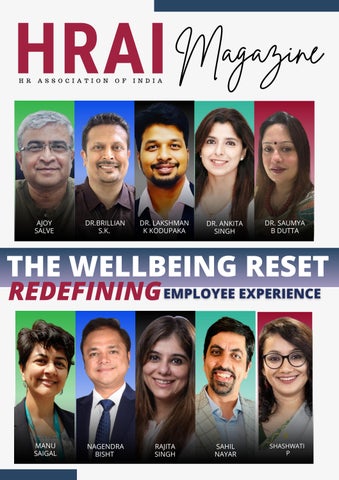
HRAI H R
A S S O C I A T I O N
AJOY SALVE
O F
DR.BRILLIAN S.K.
Magazine
I N D I A
DR. LAKSHMAN K KODUPAKA
DR. ANKITA SINGH
DR. SAUMYA B DUTTA
THE WELLBEING RESET REDEFINING EMPLOYEE EXPERIENCE
MANU SAIGAL
NAGENDRA BISHT
RAJITA SINGH
SAHIL NAYAR
SHASHWATI P
WELCOME TO THE LATEST EDITION OF
HRAIMagazine THE WELLBEING RESET PREVIOUS EDITIONS:
READ NOW
READ NOW
READ NOW
READ NOW
READ NOW
READ NOW
READ NOW
READ NOW
READ NOW
READ NOW
CHECK OUT ALL THE EDITIONS READ NOW
READ NOW
2
EDITOR'S HRAI TEAM'S NOTE Wellbeing at work is no longer a program or a policy — it is a mindset. As organizations navigate constant change, employee experience is being reshaped by how people feel, connect, and find meaning in their work. This edition reflects a growing shift from managing employees to understanding them. Psychological safety, flexibility, inclusion, belonging, and humane leadership are no longer optional — they are essential to building trust and sustaining performance. At HRAI, we believe redefining employee experience is not about doing more, but about doing what matters most, with intention and care. When wellbeing becomes embedded in culture and leadership, workplaces move beyond productivity to become spaces where people truly thrive. As you explore these pages, we invite you to reflect: Are our workplaces designed only for output, or for people to flourish? Because the future of work will be shaped not just by results, but by care, clarity, and conscious choices.
3
83,000+ FOLLOWERS ON LINKEDIN A GROWING COMMUNITY OF PROFESSIONALS ENGAGING WITH HRAI’S INSIGHTS, INITIATIVES, AND INDUSTRY CONVERSATIONS.
About HRAI Founded by Dr. Ankita Singh, the HR Association of India (HRAI) drives industry-led initiatives and curates prestigious recognitions for organizations, emerging professionals, and trailblazing women across the business ecosystem. HRAI serves as a platform for learning, collaboration, and recognition, bringing together professionals and subject-matter experts from across industries. What We Do Industry initiatives and professional forums Awards, recognitions, and curated listings Knowledge-sharing through talk shows, panels, and articles Community-building for HR and business professionals Organizations We’ve Engaged With Lenovo, Hindustan Unilever, Biocon Biologics, IHG Hotels, L&T, CBRE, Sutherland, Capgemini, EY, and more.
HIGHLIGHTS: KNOWLEDGE & THOUGHT LEADERSHIP Elite voices such as Dr. TV Rao, Harjeet Khanduja, and Prasenjit Bhattacharya have been featured in HRAI’s one-on-one talk shows, contributing practical insights and real-world perspectives for professionals. HRAI MAGAZINE INITIATIVE HRAI publishes thought-provoking articles authored by senior professionals from organizations such as Reliance Jio, Times of India, KPMG, Eveready, Volvo, and more. HRAI LIST FEATURES HRAI curates an annual list of features recognizing exceptional professionals and changemakers aligned with a central theme each year. 23 of 2023 | 24 of 2024 | 25 of 2025 . Notable organizations featured include: Adani, Amazon, Flipkart, Samsung, Myntra, Uber, Raymond, and more.
EXCLUSIVELY FEATURED SHARK TANK JURY IN THE VISIONARY CEOS LIST: AMIT JAIN, DEEPINDER GOYAL, GHAZAL ALAGH, RITESH AGARWAL,VINEETA SINGH
For HR professionals in India, HRAI offers unparalleled opportunities to connect with like-minded peers, learn from experts, and gain recognition for their hard work and achievements. By joining HRAI, HR professionals can stay updated on the latest trends, best practices, and strategies that can help them take their careers to the next level.
TABLE 08
22
AJOY SALVE
MANU SAIGAL
CHIEF HUMAN RESOURCE AND ADMINISTRATION OFFICERC, XPRESSBEES PVT. LTD.
12
COUNTRY MANAGERINDIA, HAYS
26 DR. ANKITA SINGH
DR.BRILLIAN S.K. CHIEF CHIEF PEOPLE OFFICER, TIMESPRO
FOUNDER, HR ASSOCIATION OF INDIA
30
16 DR. LAKSHMAN KUMAR KODUPAKA GLOBAL TALENT ACQUISITION LEADER AT SUTHERLAND
NAGENDRA BISHT LEADERSHIP AND GROWTH PARTNER WITH THE AUSTRALIAN PROFESSIONAL OF MULTICULTURAL COMMUNITY.
CONTENTS
TABLE 34
COLUMNS
RAJITA SINGH CHIEF PEOPLE OFFICER INDIA, KYNDRYL
38
25
SAHIL NAYAR
HARJEET KHANDUJA SVP- HR, JIO
HR LEADER AND INFLUENCER
42 DR. SAUMYA BADGAYAN DUTTA VICE PRESIDENT – HR BUSINESS STRATEGY, GOLD STAR JEWELLERY PVT. LTD.
46
33 SUMIT AGARWAL LINKEDIN TOP VOICES
SHASHWATI P HR PROFESSIONAL
CONTENTS
AJOY SALVE CHIEF HUMAN RESOURCE AND ADMINISTRATION OFFICERC, XPRESSBEES PVT. LTD.
Ajoy brings close to 3 decades of HR, strategy, and operations leadership across industries including manufacturing, IT/ITES, and logistics. He has held senior roles in both start-ups and multinationals, notably as HR Head – India at L&T Infotech and Steria. Currently, he is the Chief Human Resource and Administration Officer at logistics startup Xpressbees Pvt. Ltd., driving strategic alignment and operational excellence. Ajoy has deep expertise in performance management, organization design, HR analytics, compliance, and employee engagement. He has pioneered metricdriven HR processes and led initiatives in leadership hiring, change management, and M&A integration. His contributions have earned recognition including 50 Most Influential HR Tech Leaders (2016), Most Talented Global HR Leaders in Asia (2013–14), and the Lokmat HR Leadership Award (2014). Ajoy is a regular keynote speaker at forums like the World HRD Congress and NHRDN.
In recent years, the concept of wellbeing in the workplace has evolved from a "nice-to-have" to a business imperative. As the global workforce undergoes a profound transformation, organizations are being called to not only prioritize employee wellbeing but to fundamentally redefine the employee experience around it. This shift — often referred to as The Wellbeing Reset — reflects a broader understanding of what it means to support employees holistically, across mental, emotional, social, and financial dimensions. Beyond Perks: A Holistic Approach to Wellbeing Traditional wellness programs often focused narrowly on physical health — gym memberships, step challenges, and fruit in the break room. But today's employees are looking for more. The pandemic, the rise of hybrid work, and generational shifts in the workforce have driven demand for a deeper, more holistic approach to wellbeing. Employees now expect support for: Mental health: Access to therapy, mindfulness programs, and psychological safety in the workplace. Emotional wellbeing: Opportunities for meaningful connection, empathy from leadership, and safe spaces for vulnerability. Social wellbeing: Inclusion, belonging, and the ability to build relationships across virtual and physical spaces. Financial wellbeing: Fair pay, financial literacy resources, and benefits that reduce economic anxiety. AJOY SALVE
Wellbeing is no longer a standalone initiative. It is a foundational element of the employee experience, influencing how people perceive their value, purpose, and future in an organization. Leadership: The Front Line of Wellbeing Organizations are increasingly recognizing that wellbeing begins at the top. Leaders and managers are no longer just performance drivers — they are culture carriers and wellbeing champions. Empathetic leadership is becoming a key differentiator. This involves: Modeling vulnerability and openness about stress and boundaries. Actively checking in on teams beyond task updates. Creating environments where asking for help is seen as a strength, not a weakness. Training and equipping managers to support wellbeing is critical. Companies like Microsoft and Deloitte, for example, have implemented manager development programs focused on emotional intelligence, inclusive leadership, and mental health literacy — ensuring that wellbeing becomes embedded in day-to-day management, not relegated to HR. Culture as Wellbeing
the
Engine
of
Sustainable
While policies and programs are important, culture is the engine that drives real change. A culture of wellbeing is one where people feel seen, supported, and psychologically safe — not just during crises, but every day. Organizations building these cultures focus on:
Psychological safety: Encouraging open dialogue without fear of retaliation or judgment. Flexibility and autonomy: Trusting employees to manage their time and energy in ways that work for them. Recognition and purpose: Connecting people’s work to larger missions and regularly celebrating their contributions. Equity and inclusion: Ensuring that all employees — regardless of background — have access to support and feel like they belong. Importantly, this culture shift requires intentionality. It’s not about launching more wellness initiatives; it’s about weaving wellbeing into how work gets done — from performance reviews to team norms and even how meetings are run. Everyday Integration: From Programs to Practices To truly redefine the employee experience, wellbeing must move from the sidelines to the core of work design. This means integrating wellness into: Workflows: Designing workloads that are sustainable and allow time for recovery. Technology: Using digital tools to monitor engagement and prevent burnout, not just track productivity. Spaces: Rethinking physical and digital workspaces to promote connection, focus, and rest. AJOY SALVE
Policies: Offering benefits that reflect modern needs — from mental health days and caregiver support to financial planning tools. Forward-thinking companies are even embedding wellbeing metrics into performance and engagement dashboards, making it a shared responsibility across the organization. The Future of Work is Well The Wellbeing Reset is not a trend — it's a transformation. Organizations that fail to respond risk higher turnover, lower engagement, and a weaker employer brand. On the other hand, those that lead with empathy, equity, and a deep commitment to holistic wellbeing will unlock higher performance, resilience, and loyalty. In a world where work and life are more intertwined than ever, the future of work depends on how well we care for the people doing the work. Redefining the employee experience through the lens of wellbeing is not just the right thing to do — it's the smart thing to do.
Wellbeing is no longer a perk—it is the foundation of the employee experience.
WELLBEING AS A CORE CAPABILITY
From support to skill: Wellbeing is developed through resilience, adaptability, and emotional intelligence—not just benefits. Performance enabler: Healthy employees are more engaged, innovative, and productive. Leadership-driven: Managers play a critical role in modeling and reinforcing wellbeing behaviors. Built into work design: Wellbeing is embedded in how work is structured, not added on later. Sustainable advantage: Organizations that build wellbeing capability are better equipped to manage change and uncertainty.
DR.BRILLIAN S.K. S.K.
CHIEF PEOPLE OFFICER, TIMESPRO
Dr. Brillian Sk is the EVP & Chief People Officer at TimesPro, where he champions a performance-driven culture with a strong focus on learner-centric approaches. With expertise in talent development, recognition programs, and executive leadership coaching, he has been instrumental in building highperforming teams and driving operational excellence. His strategic leadership supports TimesPro’s expanding business landscape, empowering the workforce through impactful initiatives.
For a long time now, the way we have been working feels like a very tiring movie. You know that scene from The Fugitive where Harrison Ford is just running and running, jumping from trains, with no time to even breathe? That is what many of our workdays feel like. One URGENT task after another, one deadline chasing us like that policeman. It is an exhausting script, and we are all tired of acting in it.
impact on outcomes of this. We have realised that while this is in its nascent stage, the policy's clarity has already yielded measurable benefits, approximately an 80% reduction in uninformed absenteeism in my team, as people feel empowered to take proper breaks without fear of after-hours disruption.
This non-stop pressure makes us ask a big question, just like Tom Cruise does in Jerry Maguire late at night. We start to wonder, "What is the point of all this running?" Our people are not looking for just another job. They are looking for a better life within their job. They want their wellbeing to be part of the main story, not just a small footnote.
The future of work is not about running the longest—it’s about knowing when to stop and refuel.
The message is clear. It is time for a Wellbeing Reset. We must move beyond just having a yoga day once in a while or having random fun breaks. We have to build a culture where feeling good and working well are two sides of the same coin. It is about moving from just managing to truly thriving. Big change starts with small, practical steps. One very strong idea that any company can try is implementing a clear and structured Do Not Disturb (DND) time after work hours. The idea is simple but powerful, I have setup a rule for my teams at work, each day no one can be in office beyond 7:30 P.M., unless explicitly permitted for managing exigencies. No team member is expected or encouraged to stay late. Beyond 8:00 P.M., a DND window begins. This means no new work messages, no emails requiring immediate response, and no nonurgent calls. Even my CEO follows this rule strictly. I am sure everyone wants to know the DR.BRILLIAN S.K.
This is our collective commitment to protect personal time for what actually refreshes you: having dinner with family, unwinding with a web-series, going for a walk, or simply sleeping. The core principle is message first, confirm, and then call only if absolutely necessary with clear exceptions made for genuine, predefined emergencies. This isn't about restricting work, it’s about respecting life beyond it. By drawing this clear line between ‘office time’ and ‘personal time’, we don’t just reduce burnout we rebuild the sustainable rhythm of a balanced life. This makes a big difference as: 1. It stops the "non-stop running": Like giving
Harrison Ford's character a safe hiding place, this slot provides a regular, official break from the chase. It tells people it is okay to take a break. 2. It answers that big question: Actions speak louder than words. It proves that the company actually cares about the person, not just the work output. It directly answers Tom Cruise's question about finding more meaning. 3. It is fair for all: Unlike gym memberships or evening classes, this time is given to everyone during office hours. The busiest parent and the newest fresher get the same benefit. 4. It builds trust: By giving this time, leaders show they trust their teams to manage their work and outcomes. It is a move towards a results-focused culture, not a time-logging culture. 5. It gives us results: We can easily measure if this is working. Simple feedback mechanism can tell us if team members feel less stressed, more focused, and happier with their job. With multiple generations at work, the asks are different. There is no “one-size- fits-all” solution. However, what is universally important is making every individual in the organisation feel seen, heard, and valued. This begins with small, relevant, and impactful steps. For a learning organisation like TimesPro, this is not just an HR initiative. It is walking the talk. We help professionals to build better careers. What better way to show we mean it than by building a better, more humane work culture right here first? This commitment is reflected in our practices from assessing wellness from the day of joining, to providing forums for mental DR.BRILLIAN S.K.
wellbeing, and now, by implementing simple and practical policies like the Do Not Disturb hour. The future of work is not about who can run the longest without a break. It is about who can run the smartest, with regular stops to refuel. Small things make a big impact. By starting with steps like these, we change our story. Together, we can shift the narrative from a stressful action thriller to a more balanced and sustainable success story. The onus is on you as much as it is on me. It is our responsibility to make this reset happen. Our people, and our performance will thank us for it.
The future of work is not about who can run the longest without a break, but about who can sustain performance by protecting time to rest, refuel, and reconnect.
DESIGNING WORK FOR SUSTAINABLE PERFORMANCE
Human-centric job design: Balance productivity with energy, focus, and recovery. Flexible work models: Enable autonomy through hybrid, remote, and flexible schedules. Smart use of technology: Use AI and automation to reduce overload, not increase it. Clear priorities: Prevent burnout by minimizing unnecessary work and constant urgency. Sustainable pace culture: Shift from short-term output to long-term performance and wellbeing.
DR. LAKSHMAN KUMAR KUMAR KODUPAKA G L O B A L TA L E N T ACQUISITION LEADER AT S U T H E R L A N D
Dr. Lakshman Kumar Kodupaka is a strategic and results-driven global talent acquisition leader with over two decades of experience in shaping endto-end hiring strategies, workforce planning, and talent transformation for digital engineering and technology services organizations across India, the USA, and APAC. He currently leads Talent Acquisition for Digital Engineering Services at Sutherland, where he focuses on building scalable, future-ready talent ecosystems and delivering data-driven, compliance-first hiring solutions aligned with businesscritical objectives.
On a typical Monday morning, calendars fill faster than inboxes. Meetings start before coffee is finished, notifications compete for attention, and the boundary between work and life quietly blurs. For many organizations, this pace has become routine — yet increasingly unsustainable. Behind stable business metrics and wellcrafted strategy decks lies a growing reality: employee energy is under strain, expectations have fundamentally shifted, and the traditional employee experience no longer reflects how work is lived. This moment has triggered a necessary pause. Organizations are reassessing how work is designed, how performance is sustained, and what employees now expect in return for their contribution. The result of this reflection is what many now describe as the Wellbeing Reset — a deliberate shift from treating wellbeing as a peripheral benefit to recognising it as a core pillar of employee experience (EX) and long-term organizational performance.
meaningful work, and trust in leadership. Market evidence consistently shows these dimensions are no longer separate from performance — they are foundational to it. Globally, only around one-third of employees describe themselves as thriving at work, while the majority report stress, fatigue, or disengagement. At the same time, employee expectations of employer-led wellbeing support have risen sharply. Wellbeing has also become a decisive factor in career choices, with professionals increasingly evaluating opportunities based on flexibility, leadership behaviors, and long-term sustainability — not compensation alone. From a business perspective, the implications are clear. Organizations that invest in holistic wellbeing experience lower absenteeism, higher engagement, stronger retention, and improved productivity. Conversely, burnout and disengagement carry significant hidden costs — reduced innovation, higher attrition among critical talent, and declining employer brand credibility.
Rather than asking, “How do we drive more output?”, progressive organizations are asking a more strategic question: “How do we enable people to perform sustainably over time?”
The Wellbeing Reset, therefore, is not simply a cultural initiative; it is a business imperative.
Why Wellbeing Has Become a Strategic Priority
Several macro trends are accelerating this shift:
Employee wellbeing today extends far beyond physical health programs or isolated wellness initiatives. It encompasses mental and emotional resilience, psychological safety, financial security, social connection, DR. LAKSHMAN KUMAR KODUPAKA
Key Market Trends Driving the Wellbeing Reset
Burnout and Work Intensity: Prolonged periods of high workload, constant connectivity, and ongoing uncertainty have resulted in widespread burnout. Many organisations now recognise that sustained
overperformance without recovery is neither scalable nor responsible. Hybrid and Flexible Work Models: Hybrid work has emerged as a major enabler of wellbeing by offering autonomy and balance. However, without clarity, manager capability, and trust-based leadership, flexibility can quickly turn into fragmentation. Wellbeing in hybrid models must therefore be intentionally designed. Holistic Wellbeing Approaches: Organizations are moving away from fragmented wellness benefits toward integrated wellbeing strategies that address physical, mental, financial, and social dimensions together — reinforced by policy, leadership behavior, and culture. Data-Driven Workforce Decisions: HR analytics and employee listening tools are increasingly used to track wellbeing indicators, engagement levels, attrition risk, and workload patterns, enabling proactive rather than reactive interventions. Wellbeing as a Talent Differentiator:
principle embedded across the employee lifecycle. Key characteristics include: Psychological safety that enables employees to speak up, challenge ideas, and innovate without fear Clarity of role and purpose, with realistic expectations and outcome-based performance measures Supportive leadership, particularly at the people-manager level Flexible and inclusive policies aligned to diverse life stages and needs Accessible wellbeing resources, including mental health and financial wellbeing support Strong social connection and belonging, especially in distributed teams Delivering this experience requires coordinated ownership — particularly between Talent Acquisition (TA) and Human Resources (HR). The Role of Talent Acquisition: Setting the Foundation Talent Acquisition plays a pivotal role in the Wellbeing Reset because hiring is the first true moment of employee experience. It is where expectations are formed, trust is established, and cultural signals are sent.
In competitive talent markets, wellbeing has become a core component of the employer value proposition (EVP), influencing attraction, offer acceptance, and long-term commitment.
Key TA contributions include:
What a Wellbeing-Centric Experience Looks Like
TA shapes how wellbeing is communicated externally. Transparent and credible messaging around flexibility, leadership expectations, and support systems attracts aligned candidates and reduces early misalignment.
Employee
A wellbeing-centric employee experience is not a one-time program; it is an end-to-end design DR. LAKSHMAN KUMAR KODUPAKA
Employer Branding:
Value
Proposition
and
Sustainable Role Design: By partnering with business leaders, TA helps ensure roles are clearly defined, workloads are realistic, and success measures are achievable — reducing the risk of early burnout. Candidate Experience: A respectful and transparent hiring process, with clear timelines, timely feedback, and honest conversations, signals organisational maturity and care. Selection Beyond Skills: Assessing adaptability, emotional intelligence, collaboration, and resilience alongside technical capability improves long-term fit in evolving environments. Onboarding as a Wellbeing Signal:
needs. Manager Enablement: Equipping leaders with skills in empathy, psychological safety, workload management, and sustainable performance conversations. Performance Governance:
and
Workload
Balancing accountability with sustainability by discouraging chronic overwork while maintaining high standards. Measurement and Insight: Using surveys, wellbeing indices, attrition analysis, and listening mechanisms to track impact and identify systemic risks early. Culture and Change Enablement:
TA-led onboarding introduces wellbeing resources early, establishes manager check-ins, and sets expectations around pace, priorities, and support — improving early engagement and retention.
Reinforcing wellbeing through leadership messaging, recognition systems, and consistent communication.
The Role of HR: Embedding and Sustaining Wellbeing While TA sets expectations, HR ensures wellbeing is embedded into everyday organizational reality.
The Wellbeing Reset cannot sit with HR or TA alone. Leadership behavior ultimately determines whether wellbeing is experienced as real or rhetorical. When TA, HR, and business leaders are aligned, wellbeing shifts from intent to lived experience.
Key HR responsibilities include:
Conclusion
Policy and Program Design: Designing inclusive, accessible wellbeing policies and frameworks aligned with workforce DR. LAKSHMAN KUMAR KODUPAKA
Shared Accountability and Leadership Role
The Wellbeing Reset represents a fundamental redefinition of employee experience — from transactional employment to a sustainable partnership between organizations and their
people. Market evidence is clear: wellbeing directly influences engagement, productivity, retention, and employer brand strength. Talent Acquisition and HR together play a decisive role in translating wellbeing strategy into reality, starting from hiring and extending across the entire employee lifecycle. Organizations that embed wellbeing as a core design principle, rather than a peripheral benefit, are better positioned to build resilient, highperforming, and future-ready workforces.
Wellbeing is no longer a peripheral benefit—it is the foundation of a sustainable employee experience and long-term organizational performance. DR. LAKSHMAN KUMAR KODUPAKA
LEADERSHIP SHAPES THE WELLBEING CULTURE
Role-modeling matters: Leaders’ behaviors set the tone for healthy work norms and boundaries. Psychological safety: Empathetic leadership enables open conversations around stress and mental health. Inclusive decision-making: Leaders who listen build trust and a sense of belonging. Wellbeing-driven performance: Supportive engagement, retention, and productivity.
leadership
improves
Accountability at the top: When leaders own wellbeing outcomes, culture change becomes sustainable.
MANU SAIGAL COUNTRY MANAGERINDIA, HAYS
Manu is the Country Manager – India at Hays, with over 20 years of experience in business transformation, P&L leadership, and strategic workforce solutions. Known for her inclusive leadership and client-centric approach, she has led high-impact teams, managed complex stakeholder relationships, and driven innovative growth strategies across sectors. A certified ITIL Foundation V3 and CoBit professional, Manu holds a degree in Electronics & Communications from Mysore University and a PGPMax from ISB Hyderabad.
A quiet but undeniable shift has taken place in the way people think about work. It wasn’t a single moment that triggered it, but a long stretch of uncertainty, disruption, and selfreflection. At some point - individually and collectively - we began asking different questions: What do I need to feel healthy? What does balance actually look like for me? What kind of workplace helps me thrive instead of merely survive? These questions, once whispered in private, are now shaping the future of organisations. This is the essence of the Wellbeing Reset - a reimagining of the employee experience that is more human, more empathetic, and far more aligned with the reality of people’s lives. For years, wellbeing was treated as a “nice to have” - something organisations attended to once the “real work” was done. But the last few years revealed a truth we can no longer ignore - when people are drained, anxious, or overwhelmed, no corporate strategy can succeed. Wellbeing isn’t an add-on; it’s the foundation. And when organisations truly invest in their people’s holistic health - mental, physical, emotional, social, financial - the energy shifts. People show up with more clarity, more creativity, and more heart. One of the most significant changes in this reset is the way we now expect leaders to show up. Many employees today remember clearly the managers who checked in not just with “What’s the status?” but “How are you doing?” - and meant it. We also remember the leaders who didn’t ask. The difference between the two shaped trust in ways no policy ever could. Human-centred leadership has become the new norm not because of trends or training modules, but because people have realised MANU SAIGAL
that empathy and performance are not opposites. In fact, they enable each other. Employees want leaders who listen, who recognise stress before it becomes burnout, and who create cultures where it’s safe to say, “I need help.” Flexibility is another pillar of this new experience. It’s not just about remote work; it’s about feeling trusted to manage one’s life. Many of us have had moments when we needed to log off early for a child’s school program, take an afternoon break to care for a parent, or step away to recharge after a demanding week. These are human needs, not exceptions. The workplaces that acknowledge this reality without guilt, judgment, or bureaucracy - are the ones earning loyalty that no salary spike can buy. Flexibility has become less about location and more about autonomy, respect, and trust. But wellbeing isn’t only emotional - it’s structural. People can’t meditate their way out of chronically unsustainable workloads. No wellness app offsets a calendar full of back-to-back meetings. The Wellbeing Reset is forcing organisations to look more deeply at how work itself is designed. It’s about creating systems where people can succeed without sacrificing themselves. It’s about acknowledging that recovery is part of productivity, not an interruption to it. In many workplaces, the most powerful wellbeing intervention isn’t a workshop - it’s cancelling unnecessary meetings or giving teams permission to breathe. Technology, too, is playing a more thoughtful role. Rather than overwhelming employees with more tools, forward-looking organisations are turning to AI and digital systems to remove friction and make work feel lighter. When used well, technology helps people focus on
meaningful work instead of repetitive tasks. But there’s a growing awareness that technology must serve humans - not the other way around. The next evolution of employee experience will be built around tech that enables clarity, efficiency, and calm. The conversation around wellbeing has also become inseparable from inclusion. People feel well when they feel they belong - when their identities, challenges, and life circumstances are seen and respected. Whether it’s supporting caregivers, acknowledging mental health openly, or creating safe spaces for vulnerable conversations, organisations are recognising that wellbeing deepens when inclusion is real. Belonging is no longer just about culture—it’s about emotional health. Looking ahead, the employee experience is becoming more life-centric. The boundaries between personal and professional life have blurred, not because employees are “always online,” but because people no longer want to compartmentalise who they are. The future of work will support the whole person: their ambitions, their anxieties, their commitments outside work, and their evolving needs at different life stages. Workplaces that help employees grow - not just in skill but in identity, purpose, and confidence - will shape the next era of talent. Ultimately, the Wellbeing Reset is an invitation to rethink what we owe each other in the workplace. It’s a reminder that performance and compassion can co-exist, that people do their best work when they feel safe and supported, and that the strongest organisations are those built on humanity, not just efficiency. For leaders and organisations, this is an opportunity - perhaps the most meaningful one MANU SAIGAL
in decades. The companies that embrace wellbeing not as a programme but as a philosophy will find themselves with teams that are not just productive but energised; not just engaged, but inspired; not just employed, but genuinely fulfilled. And that is the true competitive edge of the future.
Wellbeing is not an add-on to work; it is the foundation that allows people to perform, grow, and feel genuinely fulfilled.
COLUMN
HARJEET KHANDUJA SVP-HR, JIO
Well Being Reset Congratulations on entering the second quarter of this century. Every transition like this invites reflection and rethinking. The last quarter ended with a loud and polarising debate around the idea of a seventy hour work week. The underlying belief was simple. If we work longer and harder, maybe we will achieve more. What followed was an equally strong outcry pointing out that such thinking ignores the human cost and the long term impact on wellbeing. This debate brings us to a fundamental question. Is wellbeing separate from business outcomes or deeply connected to them. Wellbeing and business are not opposites History gives us a clear answer. Long ago a visionary businessman named Robert Owen observed that wellbeing directly impacts quality and productivity. In the early eighteen hundreds he introduced the idea of the eight eight eight workday with eight hours of work eight hours of recreation and eight hours of rest. This idea was later embraced and popularised by leaders like Henry Ford and the Tata Group in the early nineteen hundreds. Their belief was straightforward. Balanced lives lead to better business. What changed in the first quarter of this century As this century progressed more organisations began openly acknowledging that wellbeing is not a peripheral initiative. It sits at the core of sustainable performance. At the same time the definition of wellbeing expanded. It moved beyond physical health to include emotional, intellectual, social and even spiritual wellbeing. Companies slowly started seeing people as complete human beings who seek meaning not just paychecks. For example Adobe broadened its wellbeing approach to include community connection, extended time off and strong mental health support. This thinking also paved the way for the five day work week longer parental leaves, remote work and hybrid models with the pandemic acting as a powerful accelerator.
Why the next quarter will be fundamentally different. This quarter of the century will be shaped by Artificial Intelligence and robotics. AI today is what Excel once was. A productivity tool that permanently changed how people work. AI is now transforming speed, scale and quality. Presentations that once took days are created in minutes. Applications that took months can be built in days. The most important implication is this. The productivity that people expected from extremely long work weeks can now be achieved without exhausting hours. That is a rare win for both business and people. The real meaning of the wellbeing reset AI is resetting productivity norms and that brings two new pressures. Businesses will expect more output and employees will carry the anxiety that AI may replace them. Both pressures must be addressed early. Along with traditional wellbeing practices there is a new and critical addition. Making people comfortable and confident with Artificial Intelligence. When employees understand and use AI their speed increases, their confidence grows and anxiety reduces. Productivity improves without burnout and business expectations are met sustainably. That is the wellbeing reset for the new quarter of the century. Work smarter. Protect human energy. And let technology serve people not scare them.
DR. ANKITA SINGH SINGH FOUNDER, HR ASSOCIATION OF INDIA
Dr. Ankita Singh is the CPO & Board Director, CIGNEX & Relevance Lab. With 22+ years in HR, primarily in the ITES sector, Ankita has driven transformation through performancedriven practices and inclusive culture. At CIGNEX, her leadership helped the company earn multiple “Great Place to Work” certifications (2017–2021). She has been recognized as “Woman Leader of the Year” by The Times of India Group and featured in Forbes India’s “Top 100 Managers.” Ankita holds an MBA in HR+IT, an Executive MBA from SCMHRD, and a Ph.D. in Management. A respected voice in the industry, Ankita blends strategic insight with a passion for people development and culture building.
Wellbeing has always been part of the workplace conversation—but often at the margins. For years, it lived in policies, wellness days, posters, and programs, separate from how work was actually designed and experienced. Today, that separation no longer works. Employee experience is not built through initiatives alone. It is shaped every single day— by how work feels, how leaders show up, how pressure is handled, and how people are treated when things don’t go as planned. The wellbeing reset is not about doing more. It is about doing things differently. In the story of work, wellbeing is no longer a “nice to have” or a support function running in parallel. It has become central to performance, trust, and sustainability. And as we move closer to 2026, organizations will be forced to confront a simple truth: you cannot build highperforming workplaces on exhausted people.
about redesigning how work fits into life.” Leaders often underestimate how much their everyday behavior shapes employee experience. Not policies, not toolkits—but tone, timing, empathy, and intent. A delayed response. A rushed decision. An unclear expectation. These small moments compound, either building trust or quietly eroding it. The Shift Ahead: From Programs to Practice By 2026, wellbeing will no longer be defined by yoga sessions or mental health webinars alone. Those will still matter—but they will not be enough. The real reset will come from embedding wellbeing into how organizations operate: How goals are set How performance is measured How flexibility is offered How failure is treated How leaders respond under pressure
Wellbeing Is Not Uniform—It Is Personal One of the biggest mistakes organizations have made is trying to standardize wellbeing. But wellbeing is deeply individual. What energizes one person may overwhelm another. What feels flexible to one team may feel chaotic to another. Employee experience, therefore, cannot be designed as a single journey. It must be understood as a collection of lived moments— meetings, deadlines, feedback conversations, late evenings, family responsibilities, growth aspirations, and personal boundaries. “Wellbeing is not about reducing work—it is DR. ANKITA SINGH
The employee experience of the future will be less about perks and more about psychological safety, fairness, predictability, and respect. In a world where work is faster, more digital, and increasingly AI-enabled, the human experience of work must be intentionally protected. “Technology may scale productivity, wellbeing sustains performance.”
but
The REAL Wellbeing Framework for 2026 To redefine employee experience meaningfully, wellbeing must be REAL—practical, grounded,
and lived. Not aspirational words, but everyday leadership choices. Relevance Wellbeing initiatives must reflect real challenges —not ideal scenarios. Generic programs disconnected from actual workload, role complexity, or business pressure quickly lose credibility. Relevance means understanding what truly drains and energizes people in their specific context—and responding accordingly.
people perform at this pace for the long term? If the answer is no, the system—not the individual—needs rethinking. “Wellbeing is not a break from work; it is what makes work possible.” Redefining Employee Adjustment Over Perfection
Experience:
The employee experience of 2026 will not be perfect—and that is okay. What will matter is responsiveness.
Empathy will be the cornerstone of employee experience. As boundaries blur and work-life integration deepens, leaders will need to listen more carefully and respond more thoughtfully.
Rigid frameworks will give way to adaptive approaches. Leaders will stop chasing the illusion of balance and instead focus on combination, adjustment, and intent. Some phases will demand intensity. Others will require recovery. The maturity lies in knowing when to push and when to pause.
Empathy is not about lowering standards. It is about recognizing human limits while still enabling accountability.
Wellbeing-led organizations will not avoid hard conversations—but they will have them with honesty, respect, and care.
Autonomy
Performance will still matter. Results will still be expected. But the path to those results will become just as important as the outcome itself.
Empathy
Control is a silent stressor. The future of wellbeing will be rooted in trust—giving people autonomy over how they work, where they work, and how they deliver outcomes. Autonomy, when paired with clarity, becomes a powerful driver of engagement and ownership. Longevity Wellbeing is not about surviving a quarter or a project. It is about building careers that are sustainable over years. Organizations will increasingly ask: Can our DR. ANKITA SINGH
The Experience That Truly Matters At its core, employee experience is about one question: How does it feel to work here—especially on difficult days? In 2026, employees will remember less about what organizations promised and more about how they were treated during change, pressure, and uncertainty. The wellbeing reset is not about creating
comfort zones. It is about creating humancentered systems where people can perform, grow, and stay well—together. “Great employee experience is not built by avoiding stress, but by ensuring no one carries it alone.” The future of work will move fast. Expectations will rise. Technology will accelerate everything. But wellbeing will remain the anchor. Redefining employee experience is not a one-time reset—it is a continuous commitment. A promise that as work evolves, humanity will not be left behind. As we step into 2026, the organizations that thrive will not be those with the most policies —but those with the deepest understanding of their people. Because in the end, wellbeing is not an initiative. It is the experience.
DR. ANKITA SINGH
You cannot build highperforming workplaces on exhausted people.
NAGENDRA BISHT BISHT LEADERSHIP AND GROWTH PARTNER WITH THE AUSTRALIAN PROFESSIONAL OF MULTICULTURAL COMMUNITY.
Nagendra Bisht is a senior HR leader, researcher, and educator with over two decades of experience spanning the IT/ITES industry, education, engineering services, and multicultural workplaces across India, the Philippines, and Australia. He holds a master’s degree in Personnel Management (MBA), and a Law degree (LL. B), and is a Fellow Certified Practitioner of Human Resources (FCPHR) with the Australian HR Institute. Nagendra is a doctoral researcher in employee engagement, work-life balance, and work-related stress. Currently, he serves as a Leadership and Growth Partner with the Australian Professional of Multicultural Community, advising organisations on people strategy, culture transformation, and sustainable performance. He is also an Industry Faculty with multiple Australian higher education institutions, bridging academic insight with real-world practice. Nagendra is widely recognised for designing holistic, human-centred wellbeing and engagement frameworks aligned to the future of work.
January has always symbolised new beginnings. In the modern workplace, however, January 2025 represents something far more significant — a wellbeing reset. It is a moment to pause, reflect, and redesign how organisations experience work, people, and performance in an environment that is rapidly evolving.
inclusion, and purpose. At the same time, experienced employees are grappling with burnout, caregiving responsibilities, and rapid skill obsolescence.
Having spent over two decades working across diverse industries in India and globally — from service-intensive operations to technologydriven enterprises — I have witnessed vastly different business models, leadership styles, and workforce expectations. Yet one aspiration has remained constant across organisations: a genuine desire to improve employee wellbeing. What differed was not intent, but maturity. Every organisation was at a different stage of its wellbeing journey, and each presented an opportunity to do something better, more meaningful, and more sustainable.
A true reset begins by redefining wellbeing not as a program, but as an experience. In my experience, the most effective wellbeing transformations occurred when organisations shifted their focus from introducing more initiatives to rethinking how work itself was designed. The critical question changed from “What wellness benefits do we offer?” to “How does it feel to work here every day?”
Traditionally, employee wellbeing was always viewed through a narrow lens. It often focused on physical health initiatives, annual medical check-ups, wellness days, or festival celebrations. While these initiatives had value, they rarely addressed deeper concerns such as emotional fatigue, job insecurity, work-life imbalance, or psychological safety. In highgrowth environments, wellbeing was frequently positioned as a benefit rather than a business imperative. Today’s workforce challenges that thinking. Today’s modern employee is navigating intense performance pressure, constant digital connectivity, and blurred personal boundaries. Hybrid work has changed how teams connect and collaborate. Younger professionals are entering the workforce with strong expectations around flexibility, mental health, NAGENDRA BISHT
This changing reality makes a wellbeing reset unavoidable.
Holistic wellbeing encompasses physical, mental, emotional, social, and financial dimensions. However, it only becomes real when embedded into daily organisational practices. This includes realistic workloads, supportive managers, fair performance systems, transparent communication, and inclusive leadership. Employees disengage quickly when wellbeing messages conflict with lived experiences. Now, organisations face several wellbeingrelated challenges. Burnout is often mistaken for resilience. Managers are promoted for technical excellence but remain underprepared for people leadership. Wellbeing solutions are frequently uniform, despite today’s diverse workforce spanning generations, regions, and socio-economic backgrounds. Moreover, organisations collect engagement data but struggle to translate insights into visible action. Yet, these challenges also present powerful opportunities.
Leadership accountability is the first lever. When senior leader’s role-model balance, empathy, and vulnerability, wellbeing becomes culturally acceptable rather than quietly discouraged. Second, investing in manager capability has disproportionate impact. Managers shape everyday employee experience and equipping them with skills in emotional intelligence and psychological safety is essential. Third, wellbeing strategies must be contextual and inclusive. What works for a young urban professional may not work for a frontline employee or a working parent. Flexibility, learning opportunities, career mobility, and financial security must be thoughtfully tailored. Finally, listening must lead to action. Trust is built when employees see their feedback reflected in meaningful change. As the organizations prepares for a future workforce that is digital, diverse, and deeply values dignity at work, employee wellbeing can no longer remain episodic. It must become foundational. A genuine wellbeing reset requires courage — to challenge outdated norms, redesign work sustainably, and place people at the centre of performance. Organisations that do this well will not only attract and retain talent but will build resilient, engaged, and future-ready workplaces. Wellbeing, ultimately, is not about doing more for employees. It is about doing work differently — and doing it better.
NAGENDRA BISHT
The true measure of wellbeing is not the benefits an organisation offers, but how it feels to work there.
COLUMN
SUMIT AGARWAL SDG AMBASSADOR FOR DEI, ICON OF THE ELECTION COMMISSION OF INDIA AND MOC NITI AAYOG Why Wellbeing Needs a Reset For a long time, workplace wellbeing has been treated as a benefit rather than a foundation. Organizations added wellness initiatives as side programs—yoga sessions, mindfulness apps, or annual mental health talks—without questioning whether the workplace itself was humane. My life experience has taught me that wellbeing is not an extra. It is the base on which everything else stands. I was born with cerebral palsy, with severe physical restrictions. There were moments when survival itself was uncertain. Growing up, I learned early that wellbeing is not about comfort or convenience—it is about dignity, agency, and the ability to function without constantly proving your worth. That lens has shaped how I look at employee experience. Wellbeing Is Not Perks, It Is Design True wellbeing is not created by activities layered on top of broken systems. It is created when work itself is designed to support human realities. In many organizations, the unspoken expectation is: perform first, cope later. This approach silently rewards burnout, punishes vulnerability, and excludes anyone whose body, mind, or life circumstances do not fit a narrow definition of “normal.” From lived experience, I can say this clearly: When systems don’t adapt, people don’t fail—people break. A wellbeing reset means shifting the question from “How do we motivate employees?” to “What conditions do people need to do their best work sustainably?” Redefining Employee Experience Through Inclusion Employee experience is often discussed in terms of engagement scores, productivity metrics, and employer branding. But real experience is felt in everyday moments. For a person with a disability, wellbeing might mean flexibility without guilt. For a working parent or caregiver, it might mean predictability without punishment. For someone early in their career, it might mean psychological safety without labels. For senior employees, it might mean respect without being sidelined. Wellbeing becomes real when inclusion is embedded into how work happens—how meetings are run, how performance is measured, how feedback is given, and how trust is built. In my own journey, the most impactful moments were not grand
gestures. They were simple human decisions: a leader who listened without trying to “fix” me, a team that adjusted processes without making it feel like charity, an organization that valued outcomes over appearances. That is what belonging looks like in practice. From Burnout Culture to Sustainable Performance Many workplaces still equate long hours with commitment and exhaustion with ambition. This mindset is not only outdated—it is dangerous. A wellbeing reset challenges this belief system. It recognizes that energy, not time, drives performance. That rest is not a reward; it is a requirement. That people perform better when they feel safe, trusted, and respected. When organizations normalize rest, flexibility, and honest conversations, they don’t lose productivity—they gain resilience. They create environments where people can contribute over the long term, not just survive short-term pressure. The Leadership Role in the Wellbeing Reset Wellbeing does not fail because of lack of intent. It fails because of lack of courage. Courage to redesign work instead of romanticizing struggle. Courage to question systems that reward burnout. Courage to accept that inclusion is wellbeing—not a separate agenda. Leaders play a critical role here. Not by becoming therapists, but by becoming more human. By setting boundaries themselves. By modeling vulnerability. By creating cultures where asking for support is seen as responsibility, not weakness. A Final Reflection The Wellbeing Reset asks one fundamental question: Are we building workplaces where people merely survive—or where they are allowed to thrive as they are? Until employee experience is rooted in dignity, inclusion, and sustainability, no wellness program will ever be enough. Wellbeing is not something we add to work. It is something we redesign work around.
RAJITA SINGH CHIEF PEOPLE OFFICER INDIA, KYNDRYL
Rajita Singh is the Chief People Officer at Kyndryl India, overseeing HR operations. Formerly leading HR at Broadridge Financial Solutions India, she played a pivotal role in enhancing the company's brand as an employer of choice. Rajita is the youngest Convenor of the CII HR-IR Panel for the State and is actively engaged in NASSCOM. Beyond work, she enjoys car racing, Bharatnatyam dancing, counseling, meditation, doodling, and reading.
For a long time, workplace wellbeing lived on the margins.
In other words, breathing exercises don’t help much if the workload is still unrealistic.
It showed up as perks, programmes, or policies—often well-meaning, occasionally useful, but rarely transformative. A mindfulness app. A mental health day. A reminder to “take care of yourself.”
Consider a team that prides itself on high performance. Deadlines are tight, meetings are constant, and responsiveness is praised. When engagement drops, the solution is a resilience workshop.
And yet, burnout kept rising.
Nothing changes—except employees now feel responsible for not coping well enough.
Which raises an uncomfortable question: what if wellbeing isn’t something we add to work—but something shaped by how work is designed in the first place?*
That question sits at the heart of the wellbeing reset.
That’s not wellbeing. That’s deflection. ### Wellbeing is the employee experience The reset happens when organisations shift the question from “What wellbeing benefits should we offer?” to “What does it actually feel like to work here?”
### When coping replaces fixing Traditional wellbeing strategies have focused heavily on the individual. If people are stressed, we teach them to be more resilient. If they’re overwhelmed, we offer tools to manage anxiety. But research increasingly tells us what employees already know intuitively: you cannot individualise a systemic problem. Recent studies on workplace mental health highlight that stress and burnout are most effectively addressed upstream—by redesigning workflows, expectations, and leadership behaviours, rather than relying solely on after-the-fact interventions. When organisations detect strain early and adjust how work is structured, wellbeing improves more sustainably than when employees are simply asked to cope better. RAJITA SINGH
Employee experience isn’t defined policies—it’s defined by moments:
by
How safe it feels to say “I’m struggling” Whether flexibility is trusted or quietly penalised How managers respond when capacity is stretched Whether performance is measured by presence or impact One company introduced quarterly mental health days. On paper, it looked progressive. In practice, workloads didn’t pause, deadlines didn’t move, and managers rarely role-modelled taking time off. Employees either worked anyway or returned to a backlog of guilt. Another organisation did something less glamorous. They audited how work flowed.
They cut unnecessary meetings, clarified priorities, and trained managers to talk about capacity—not just results. There was no big wellbeing campaign. But absenteeism fell. Engagement rose. Same intent. Very different experience. ### The manager effect (and why it matters) If wellbeing is the lived experience of work, managers are its strongest signal. Seth Godin often talks about how most workplaces are still designed like factories— optimised for control, efficiency, and output —while expecting people to show up as creative, motivated humans. That tension, he argues, is at the root of disengagement. Research backs this up. Studies consistently show that the quality of the manageremployee relationship has a greater impact on wellbeing than most formal benefits.
Often, small adjustments early prevent bigger breakdowns later. ### Meaning beats perks Seth Godin’s work offers a powerful lens here. In his research and writing, he consistently finds that what people value most at work isn’t free lunches or wellness apps—it’s significance. People want to: * Do work that matters * Be trusted with autonomy * Be part of something meaningful * Be treated with respect In The Song of Significance, Godin challenges leaders to stop managing people like replaceable parts and start creating environments where individuals can contribute with purpose. That’s wellbeing—without ever using the word.
A wellbeing reset equips managers to: * Notice changes in energy, not just performance * Reward effort and learning, not only outcomes * Create psychological safety, not silent pressure Imagine a high performer who starts missing small deadlines and withdrawing in meetings. A traditional approach waits for results to dip. A wellbeing-centred approach starts with curiosity: What’s changed? What’s taking up more energy than it should? RAJITA SINGH
This idea is echoed in academic research on meaningful work, which shows that when people feel connected to purpose, values, and community, wellbeing improves even in high-pressure environments. Meaning acts as a buffer—not against hard work, but against emptiness. ### Culture decides whether wellbeing is real Policies don’t create wellbeing. Culture does. Two organisations can offer the same
flexibility policy. In one, employees worry that working from home signals disengagement. In the other, outcomes matter more than hours logged. Same policy. Different behaviour. Completely different experience. A wellbeing reset requires leaders to look honestly at what’s rewarded, praised, and modelled. If overwork is celebrated and boundaries are quietly dismissed, no wellbeing initiative will land. ### The real reset So what experience mean?
does redefining employee through wellbeing actually
It means shifting from:
→
Wellbeing as a programme wellbeing as a design principle Fixing people fixing systems Optics lived reality
→
→
It’s not softer. It’s smarter. Organisations that get this right don’t just reduce burnout. They build trust. They retain talent. They create workplaces where people can do meaningful work without burning themselves out to prove their worth. And perhaps that’s the true wellbeing reset— not asking people to bring their whole selves to work, but creating work that doesn’t cost them their whole selves in return.
RAJITA SINGH
Wellbeing isn’t something we add to work— it’s something shaped by how work is designed in the first place.
SAHIL NAYAR HR LEADER AND INFLUENCER
Sahil Nayar is an HR disruptor, who loves blending data with intuition, strategy with storytelling, and innovation with impact. Whether he’s shaping talent strategies, mentoring future leaders, or challenging the status quo, he does it with wit, wisdom, and a relentless drive to transform the way we experience work. An award-winning HR professional, an author, a podcast host, and a Certified Happiness Coach, he’s been recognized over 50 times for his contributions to the field. When he’s not decoding workforce dynamics, you’ll find him on a mountain trail or cruising through Mumbai on his Royal Enfield.
For decades, Employee Experience was defined by three things: a decent salary, a decent boss, and an indecent number of meetings. Then 2020 happened. And suddenly, “How are you?” stopped being a greeting and became a diagnostic question. Welcome to the era of The Wellbeing Reset, where organisations are finally realising that humans don’t leave their mental health at the reception desk, neatly folded next to their ID cards. Wellbeing: From Fruit Bowls to Feelings
“I’m not okay today” “I need help” “This pace is unsustainable” “I am more than my deliverables” That’s the reset. The Silent Crisis We Don’t Talk About in Townhalls Here’s the paradox of modern work: People are more connected than ever, yet feel deeply alone. We have flexibility, yet no boundaries. We talk about wellness, yet reward burnout with applause. Somewhere between “Let’s do a quick call” and “Just one last slide,” we forgot that employees are also:
Let’s get one thing out of the way. Wellbeing is not: Free yoga on Wednesdays An app no one opens after week one A counsellor whose number is shared after someone burns out If wellbeing were that easy, Google Sheets would have fixed anxiety by now. True wellbeing is messy. It’s emotional. It’s uncomfortable. And it forces leaders to look beyond dashboards and into diaries. Employee Experience is no longer about perks. It’s about permission. Permission to say: SAHIL NAYAR
caregivers parents single people navigating loneliness professionals questioning purpose at 2 a.m. The new Employee Experience must answer a fundamental question: “Do I feel safe being human here?” Not productive. Not perfect. Human. Wellbeing Is Not an HR Initiative. It’s a Leadership Habit. Here’s a slightly uncomfortable truth. You can roll out the best wellbeing strategy in the world, but one toxic manager can
undo it before lunch.
it’s a resignation letter waiting to be written.
Wellbeing doesn’t scale through policies. It scales through behaviour.
The Wellbeing Reset means redesigning work with empathy at the core:
It shows up when leaders: take mental health days without guilt don’t glorify 14-hour workdays listen without interrupting ask “How are you really doing?” and wait for the answer Culture is what people feel on a Sunday evening. If your wellbeing strategy doesn’t reduce that Sunday anxiety, it’s just a beautifully worded PDF. The New Employee Experience Emotional, Not Transactional Earlier, Employee transaction:
Experience
was
Workloads that respect recovery Performance conversations that include wellbeing Growth paths that don’t require selfdestruction Wellbeing Across Generations: Same Need, Different Language Gen Z talks about mental health openly. Millennials joke about therapy. Gen X silently powers through. Boomers call it “tough times” and move on.
Is
Different generations. Same exhaustion.
a
A reset means designing wellbeing that’s inclusive, not trendy:
You work. We pay. We promote. Repeat. Today, it’s a relationship.
Not everyone wants meditation Not everyone wants to talk Some want flexibility Some want structure All want dignity
Employees are asking deeper questions: Do I belong here? Do I matter beyond my output? Will this organisation stand by me when life happens?
The future of Employee Experience lies in choice, not prescription. What the Demands
Wellbeing
Reset
Really
And life will happen.
Let’s be honest.
Careers are long. Energy is finite. And burnout is no longer a badge of honour,
This reset is not easy because it demands:
SAHIL NAYAR
Courage from leaders
Vulnerability from organisations Consistency over campaigns
Years from remember:
It asks companies to stop asking:
And start asking:
won’t
They will remember:
“What do our employees need to sustain, not just survive?” not
employees
your engagement survey score your wellbeing microsite or your mental health webinar slides
“What more can employees give?”
Wellbeing is comfortable.
now,
about
making
work
It’s about making work conscious.
how they were treated when they struggled whether someone listened whether work respected their humanity The true Employee Experience is not designed in boardrooms. It’s lived in everyday moments.
The Soul of Work Is Returning The most powerful shift I’m seeing? People no longer want “work-life balance.” They want work-life honesty.
And the organisations that get this right won’t just win talent. They’ll earn loyalty, love, and longevity. That is the Wellbeing Reset. And frankly, it’s long overdue.
They want leaders who say: “I don’t have all the answers” “I’m learning too” “Let’s figure this out together” The Wellbeing Reset is not soft. It’s strategic. Because organisations that care deeply: retain longer perform better innovate faster and earn trust—not demand it In Closing: The Experience People Will Remember SAHIL NAYAR
The new Employee Experience must answer a fundamental question: Do I feel safe being human here?
DR. SAUMYA BADGAYAN BADGAYAN DUTTA VICE PRESIDENT – HR BUSINESS STRATEGY, GOLD STAR JEWELLERY PVT. LTD.
Dr. Saumya Badgayan Dutta is a distinguished HR strategist and senior management leader with over two decades of experience driving transformation in the luxury manufacturing sector. As Vice President – HR Business Strategy at Gold Star Jewellery Pvt. Ltd., she partners with CEOs and boards to align business vision with people and operational excellence. Holding dual PhDs in ECommerce and Psychology, Dr. Saumya blends digital acumen with behavioral insight to build future-ready, highperformance cultures. A TEDx Speaker, World Record holder, and 10x LinkedIn Top Voice, she is recognized for pioneering data-driven, human-centric HR models that accelerate organizational growth. Her work spans leadership development, inclusion, and large-scale digital transformation, making her a respected voice in shaping the next era of workplace evolution.
I remember who I was when I first arrived in Mumbai.
There was no accusation in his voice, only concern.
A newly married, small-town girl navigating a big city, new relationships, and unfamiliar expectations. Within twenty-four hours of marriage, my identity shifted. I was no longer just a daughter; I was suddenly expected to be a partner—emotionally, socially, and practically. There was no orientation, no grace period, and certainly no conversation about transition. Life simply moved on, and I was expected to keep pace.
He asked everything:
That was my first lesson in adult life: change does not ask for readiness.
I had not disengaged from work.
Years later, life fast-forwarded again. I found myself as an expectant mother, working ten-hour days in a role that demanded constant overseas customer interactions. Different time zones dictated my sleep. Calendars ruled my personal life. Performance targets showed no mercy to physical exhaustion or emotional change. I carried life within me while meeting deadlines around me. Then motherhood arrived. Demanding. All-consuming.
Beautiful.
With an infant at home and a career that refused to slow down, I entered a phase many professionals silently endure— functioning without feeling, performing without pausing, and succeeding without self-awareness. One evening, my husband sat me down. DR. SAUMYA BADGAYAN DUTTA
a
question
that
changed
Where is my Saumya?” That moment forced a reckoning. The Silent Workplace
Disappearance
in
the
I had not failed professionally.
I had not stopped delivering results. Yet somewhere along the way, I had disappeared as a person. Yet somewhere along the way, I had disappeared as a person. This is a phenomenon many organizations fail to recognize. Employees don’t always burn out loudly. Most do it quietly. The World Health Organization recognizes burnout as an occupational phenomenon. Gallup reports that only Only 23% of employees worldwide are engaged Nearly 44% experience daily stress Burnout costs the global economy approximately $8.8 trillion annually
Corporate
policies and perks. It lives in everyday interactions:
Modern organizations often reward endurance more than sustainability.
How leaders respond to vulnerability How performance is measured How flexibility is practiced, not promised How human transitions—parenthood, caregiving, health, loss—are accommodated
When Coping Culture
Becomes
We celebrate employees who are always available, never complain, and “manage everything.” Coping becomes a badge of honor. Exhaustion becomes normalized. Silence becomes compliance. Employee Experience initiatives frequently focus on engagement surveys, wellness programs, and digital tools. While these are important, they often miss the core issue: wellbeing is not an initiative, it is a lived experience. For working magnified.
women,
the
impact
is
According to McKinsey’s Women in the Workplace report: Women are 1.5 times more likely to experience burnout than men Working mothers face a persistent “double shift”—professional responsibilities by day and emotional labor by night Many women step off leadership tracks not due to lack of ambition, but due to unsustainable systems The problem is not individual resilience. The problem is organizational design. Rethinking Employee Experience True employee experience goes beyond DR. SAUMYA BADGAYAN DUTTA
Organizations that understand this are already shifting: From measuring hours worked to outcomes delivered From valuing presence to enabling purpose From treating wellbeing as a benefit to embedding it as a leadership capability Research supports this evolution: Harvard Business Review reports that organizations investing in employee wellbeing see up to 21% higher profitability Deloitte’s studies show 41% lower absenteeism in companies with strong wellbeing cultures Teams with psychological safety outperform peers by up to 27% But beyond metrics, the true return on wellbeing is human sustainability. Finding the Human Again That question—“Where is my Saumya?”—did not push me away from ambition. It brought me closer to meaningful leadership. I did not choose between career and family.
I chose consciousness over autopilot. I learned that sustainable success demands self-presence, not self-sacrifice. Today, when I engage with leaders and organizations, I no longer ask how much more employees can give. Instead, I ask: Who are your people becoming in the process of delivering results? What identities are being suppressed in the name of performance? Are your systems designed for productivity—or for longevity? Because when employees lose themselves, organizations lose innovation, creativity, trust, and eventually talent.
Where is the designation?
human
behind
the
Until organizations answer this honestly, no engagement score or retention metric will ever tell the full story. Because wellbeing is not a soft conversation —it is a strategic one. And the organizations that recognize this will not just retain talent; they will earn loyalty, trust, and sustained performance. “Wellbeing is not a perk or a program. It is the daily experience of being human in a system designed for performance.”
The Wellbeing Reset The future of work does not require superhuman employees. It requires humancentric systems . The wellbeing reset begins when leaders dare to ask uncomfortable but necessary questions: Are we designing workplaces where people can thrive—not just survive? Do our expectations respect human limits? Are we listening to what is not being said? The question my husband asked years ago now echoes in boardrooms and leadership discussions: Where is the employee?
DR. SAUMYA BADGAYAN DUTTA
Wellbeing is not a perk or a program; it is the daily experience of being human in a system designed for performance.
SHASHWATI P HR PROFESSIONAL
Shashwati aims to create impact on people and culture in the workplace. Her career journey has been marked by a commitment to creating workplaces that celebrate diversity, ensuring equal opportunities for all and creating spaces that are inclusive and psychologically safe. An alumnus from FMS, Delhi, Shashwati is passionate about inclusion in the workplace and conversations around bias & identity. She was awarded the prestigious NCPEDP-Mindtree Helen Keller Award 2021 and features in LinkedIn Top Voices and LinkedIn Creators In India.
The Wellbeing Reset: Development Imperative
A
Talent
“Employee wellbeing is not a benefit it’s a capability. When organizations invest in developing resilient, adaptive, and emotionally intelligent people, they don’t just protect health; they unlock performance and innovation.” Employee wellbeing has moved from the margins of HR policy to the center of organizational strategy. According to KPMG, wellbeing is now a top C-suite agenda item, reshaping how success is measured across industries. This reset is not about perks or wellness apps, it’s about embedding wellbeing into the employee experience architecture.
This reset is not about perks or wellness apps, it’s about embedding wellbeing into the employee experience architecture. Why Talent Development Must Lead Capability building: Wellbeing is tied to resilience, adaptability, and continuous learning. Cross-generation enablement: With Gen Z entering the workforce and Baby Boomers extending careers, talent leaders must bridge values, communication styles, and digital fluency. Political and demographic shifts: Global instability, aging populations, and migration patterns demand inclusive, future-ready strategies.
Industry
Case
Data Point
Technology
Microsoft,BCG highlight “radical employee centricity” in AI adoption, ensuring employees feel supported and empowered
70% of employees report higher engagement when AI tools are paired with wellbeing initiatives
Financial Services
KPMG notes hybrid work and digital transformation have made wellbeing central to employee mobility programs
62% of banks now include wellbeing metrics in talent scorecards
Healthcare
Hospitals in India and the US are piloting wellbeing resets to reduce burnout
WHO estimates burnout costs $1 trillion annually in lost productivity
Retail
Walmart invests in crossgenerational mentorship to retain talent
45% of Gen Z employees say mentorship is key to wellbeing and career growth
SHASHWATI P
Capacity Building as a Wellbeing Strategy Capacity building is the engine of resilience in the wellbeing reset. It goes beyond individual skill development to strengthen organizational systems and collective capability. Resilience training: Equip employees to manage stress, uncertainty, and change. Digital fluency: Build confidence across generations in using AI, automation, and emerging technologies. Community capacity: Encourage peer learning, cross-functional collaboration, and employee resource groups, ERGs, that sustain wellbeing. Organisations must ensure that wellbeing is not just supported by policies, but actively reinforced through skills, behaviors, and organizational systems.
enablement. Talent development strategies must integrate reverse mentoring, flexible career paths, and digital literacy programs to ensure all generations thrive together. Global Political and Demographic Dynamics Geopolitical uncertainty: Trade wars, climate policies, and regional conflicts reshape workforce priorities. Demographic shifts: Aging populations in Europe and Japan contrast with youthful workforces in India and Africa. Migration patterns: Talent mobility is increasingly influenced by political stability and wellbeing infrastructure. Organizations that align wellbeing with these dynamics would be better positioned to attract and retain diverse talent pools. The Path Forward The Wellbeing Reset is about embedding wellbeing into the DNA of talent development:
Cross-Generational Enablement The reset requires intentional design of intergenerational collaboration: Gen Z: Seek purpose, flexibility, and mental health support. Millennials: Value career progression and inclusive leadership. Gen X: Prioritize stability, autonomy, and recognition. Boomers: Bring institutional knowledge but may need digital SHASHWATI P
Build data + empathy cultures that balance analytics with human connection. Redesign leadership programs to model inclusive wellbeing behaviors. Measure success not just in productivity, but in employee thriving. In redefining employee experience, the Wellbeing Reset is not just a response to change - it is a blueprint for thriving in it. Organizations that invest in capability
building, cross‑generation enablement, and global awareness will unlock a workforce that is resilient, engaged, and future‑ready.
Employee wellbeing is not a benefit — it’s a capability that unlocks resilience, performance, and innovation.
SHASHWATI P
THANK YOU FOR READING
STAY TUNED FOR MORE INSIGHTFUL CONTENT!
FOLLOW US NOW!
50