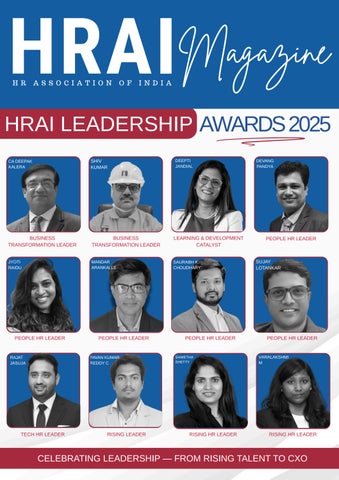
HRAI H R
A S S O C I A T I O N
O F
Magazine
I N D I A
HRAI LEADERSHIP AWARDS 2025 CA DEEPAK KALERA
SHIV KUMAR
DEEPTI JANDIAL
BUSINESS TRANSFORMATION LEADER
BUSINESS TRANSFORMATION LEADER
LEARNING & DEVELOPMENT CATALYST
JYOTI RAIDU
MANDAR ARANKALLE
SAURABH K. CHOUDHARY
PEOPLE HR LEADER
RAJAT JASUJA
PEOPLE HR LEADER
PAVAN KUMAR REDDY C
TECH HR LEADER
RISING LEADER
PEOPLE HR LEADER
SHWETHA SHETTY
RISING HR LEADER
DEVANG PANDYA
PEOPLE HR LEADER
SUJAY LOTANKAR
PEOPLE HR LEADER
VARALAKSHMI M
RISING HR LEADER
CELEBRATING LEADERSHIP — FROM RISING TALENT TO CXO
WELCOME TO THE LATEST EDITION OF
HRAIMagazine HRAI LEADERSHIP AWARDS 2025 PREVIOUS EDITIONS:
READ NOW
READ NOW
READ NOW
READ NOW
READ NOW
READ NOW
READ NOW
READ NOW
READ NOW
READ NOW
CHECK OUT ALL THE EDITIONS READ NOW
READ NOW
2
EDITOR'S HRAI TEAM'S NOTE At HRAI, we believe that the bridge between academia and industry is the foundation for building a future-ready workforce. By fostering collaboration between educational institutions and the corporate world, we can empower students with the skills, mindset, and resilience needed to thrive in a rapidly evolving workplace. Leadership today is less about position and more about presence—how decisions are made, how people are influenced, and how impact is sustained over time. In a world marked by constant change, true leadership shows up in moments of clarity, courage, and conscious choice. The HRAI Leadership Awards 2025 recognize leaders who consistently demonstrate this mindset. The individuals featured in this edition have shaped direction, inspired trust, and driven meaningful progress through their actions and values. Their influence extends beyond roles and functions, leaving a lasting imprint on people, teams, and outcomes. This recognition is a celebration of leaders who think long-term, act with integrity, and lead with intent. Their journeys reflect a deep understanding that leadership is not about visibility or authority, but about responsibility and impact. At the HR Association of India, we believe that acknowledging such leadership helps set benchmarks for the future. It encourages reflection, learning, and a renewed commitment to lead with purpose in an increasingly complex world of work. We congratulate the HRAI Leadership Awardees of 2025 and thank them for exemplifying leadership that truly matters.
3
83,000+ FOLLOWERS ON LINKEDIN A GROWING COMMUNITY OF PROFESSIONALS ENGAGING WITH HRAI’S INSIGHTS, INITIATIVES, AND INDUSTRY CONVERSATIONS.
About HRAI Founded by Dr. Ankita Singh, the HR Association of India (HRAI) drives industry-led initiatives and curates prestigious recognitions for organizations, emerging professionals, and trailblazing women across the business ecosystem. HRAI serves as a platform for learning, collaboration, and recognition, bringing together professionals and subject-matter experts from across industries. What We Do Industry initiatives and professional forums Awards, recognitions, and curated listings Knowledge-sharing through talk shows, panels, and articles Community-building for HR and business professionals Organizations We’ve Engaged With Lenovo, Hindustan Unilever, Biocon Biologics, IHG Hotels, L&T, CBRE, Sutherland, Capgemini, EY, and more.
HIGHLIGHTS: KNOWLEDGE & THOUGHT LEADERSHIP Elite voices such as Dr. TV Rao, Harjeet Khanduja, and Prasenjit Bhattacharya have been featured in HRAI’s one-on-one talk shows, contributing practical insights and real-world perspectives for professionals. HRAI MAGAZINE INITIATIVE HRAI publishes thought-provoking articles authored by senior professionals from organizations such as Reliance Jio, Times of India, KPMG, Eveready, Volvo, and more. HRAI LIST FEATURES HRAI curates an annual list of features recognizing exceptional professionals and changemakers aligned with a central theme each year. 23 of 2023 | 24 of 2024 | 25 of 2025 . Notable organizations featured include: Adani, Amazon, Flipkart, Samsung, Myntra, Uber, Raymond, and more.
EXCLUSIVELY FEATURED SHARK TANK JURY IN THE VISIONARY CEOS LIST: AMIT JAIN, DEEPINDER GOYAL, GHAZAL ALAGH, RITESH AGARWAL,VINEETA SINGH
For HR professionals in India, HRAI offers unparalleled opportunities to connect with like-minded peers, learn from experts, and gain recognition for their hard work and achievements. By joining HRAI, HR professionals can stay updated on the latest trends, best practices, and strategies that can help them take their careers to the next level.
CONTENTS
TABLE OF
08
CA DEEPAK KALERA
11
DEVANG PANDYA
14
Chief Financial Officer, Oriano Clean Energy
Associate Director - HR, Proclink / ProcStat
DEEPTI JANDIAL Behavioural Skills Facilitator, Psychometric Assessor, Transformational Life Coach and Mentor
18
JYOTI RAIDU
23
MANDAR ARANKALLE
26
PAVAN KUMAR REDDY C
Senior Manager, Zensar Technologies
Strategic HR Leader
Assistant Manager, Innovative Foods Co.
INTERVIEWS
EXCLUSIVE
30
RAJAT JASUJA
33
SHIV KUMAR
37
SAURABH K. CHOUDHARY
40
SUJAY LOTANKAR
43
SHWETHA SHETTY
47
VARALAKSHMI M
Manager – People Business Partner, SentinelOne
General Manager (HR), ONGC
Head HR – South Asia, KEC International Ltd.
People Lead: Talent, Smollan India
HR – L&d Officer, Al Ghazal Transport, Abu Dhabi
Chief Manager – Lead TA, BSS Sonata Microcredit Ltd.
CA DEEPAK KALERA CHIEF FINANCIAL OFFICER, ORIANO CLEAN ENERGY
BUSINESS TRANSFORMATION LEADER
As CFO of Oriano Clean Energy Pvt. Ltd., with prior experience across renewable energy, IT, and manufacturing sectors, I lead end-to-end finance transformation aligned with strategic, compliance, and capital-market goals. My current work involves strengthening financial systems for a multi--location solar and infrastructure business facing challenges such as high upfront investments, limited low-cost funding, fragmented reporting, and weak internal controls. To realign finance with organizational priorities, I spearheaded key initiatives including securing economical debt through investor representations, forming a Compliance Acceleration Taskforce, designing integrated frameworks for finance, SCM, taxation, and project management, and establishing quarterly internal audits with a finance risk register. I optimized SAP processes, built board-ready financial dashboards, and supported IPO readiness through strong IFC, legal, and secretarial systems. Innovationdriven improvements include a digital risk register, centralized audit workflows, standardized board communication templates, and a robust review mechanism for financial and operational performance. These efforts transformed the finance function into a strategic enabler—driving compliance, transparency, operational efficiency, and 8 longterm organizational value.
Q: What does this recognition as a Business Transformation Leader signify for you?
I believe transformation succeeds when innovation is practical, people feel empowered, and business outcomes are measurable. I balance these by:
This recognition is a validation of my efforts to make organizations stronger, more transparent, and future-ready. It signifies trust in my ability to simplify complex challenges, align people with clear goals, and deliver sustainable outcomes. For me, it is not just an award—it is encouragement to continue driving meaningful change.
Introducing new processes only when they add real value. Ensuring teams understand their roles through clear KRAs and accountability. Measuring results with transparent metrics so progress is visible to all.
Q: What has transformation recently?
been the initiative
most pivotal you’ve led
Recently, I led a compliance and governance transformation that cleared & streamlined statutory filings, introduced a professional way of conducting Board meetings for quality and collective decisions, develop risk registers for board-level oversight. Alongside this, I drove SAP process audits that improved efficiency and scalability. These initiatives created clarity, reduced risks, and gave leadership confidence in decision-making. Further I was successful in developing multiple level security ecosystems by starting with Project audits, Internal Audits by one of the big renowned and expert Accounting firms the Statutory Audits. This helped to navigate through the possible flaws in the system and plug them asap and ensure that we strengthen the Audits , Governance and Compliance procedures and safeguard company objectives Q: How do you balance innovation, people, and business outcomes during large-scale transformations?
CA DEEPAK KALERA
This way, innovation is not just change—it becomes progress that benefits both people and the business.
Transformation isn’t about speed—it’s about clarity, resilience, and building systems that empower people to create sustainable change.
Q: What leadership principles shape your approach to driving organizational change? My leadership is shaped by four principles: Clarity: Simplify complex issues so everyone understands. Accountability: Ensure responsibilities are clear and outcomes are tracked. Encouragement: Motivate teams by recognizing their contributions. Transparency: Communicate openly with boards, executives, and teams to build trust. These principles help me lead change with confidence and inclusiveness. Q: What message do you wish to leave with leaders steering transformation in today’s environment? Transformation is not about speed—it is about sustainability. Leaders should focus on building systems that empower people, strengthen governance, and prepare organizations for the future. In today’s environment, clarity and resilience matter more than ever. My message is simple: lead with transparency, align innovation with purpose, be resilient to the upcoming situations, be agile to the change and always keep people at the centre of change.
CA DEEPAK KALERA
SHIV KUMAR GENERAL MANAGER (HR), ONGC
BUSINESS TRANSFORMATION LEADER
Shiv Kumar is General Manager (HR) at ONGC Dahej Plant, where he leads the full spectrum of human resources functions to - foster a safe, inclusive, and high-performing workplace He oversees HR operations, onboarding, capability development, performance management, and employee relations, ensuring policies are pragmatic and aligned with organizational goals. As a recognized Business Transformation Leader, Shiv drives strategic change, process optimization, and digital HR initiatives that enhance operational agility. He collaborates closely with plant leadership to strengthen workforce capability, improve efficiency, and embed a culture of continuous learning. Committed to employee development, he advances coaching, career progression, and psychological safety. Shiv champions transparent communication and participative engagement, encouraging employees to contribute to ongoing improvements. Beyond the workplace, he actively supports community outreach initiatives linked to the plant, reinforcing ONGC’s social responsibility. His leadership is defined by clarity, consistency, and a people-centric approach that aligns human capital with business excellence.
Q: What does this recognition as a Business Transformation Leader signify for you? This recognition as a Business Transformation Leader affirms my strategic impact beyond routine HR responsibilities. It signals trust in my ability to lead complex change, align people practices with business goals, and guide digital and process improvements that enhance plant performance. The award highlights my capacity to build consensus, manage resistance, and deliver measurable outcomes while keeping employee welfare and safety at the core. Being named a transformation leader elevates my credibility with senior management and frontline teams. It strengthens my influence when proposing new initiatives, supports talent attraction and retention, and fosters a culture of continuous learning and innovation. The recognition positions me as a role model capable of coaching managers, driving cross- functional collaboration, and sustaining momentum during transitions. Industry perspectives increasingly view HR’s role in transformation as strategic and essential. Formal recognition boosts employee engagement and reinforces recognition as a business strategy— enhancing morale and performance across the plant. It also opens opportunities to represent the ONGC Dahej Plant in industry forums, mentor emerging leaders, and secure resources for long-term people initiatives. Q: What has been the most pivotal transformation initiative you’ve led recently? I led a major initiative to redesign workforce SHIV KUMAR
planning and talent mobility across the ONGC Dahej Plant. I introduced a strategic workforce planning framework that aligned future business needs with required skills, roles, and staffing levels. The program identified critical positions,mapped internal capabilities, and established clear talent pipelines. I implemented rotational assignments and stretch projects to broaden employee experience and prepare them for higher responsibilities. Additionally, I launched a talent mobility platform that increased visibility of internal job openings, simplified transfers, and encouraged cross-functional movement.
True transformation happens when innovation is balanced with empathy—where people feel valued, business goals stay clear, and every change strengthens both performance and trust.
The platform featured transparent criteria, streamlined application steps, and manager support to ensure fairness. I complemented it with mentorship circles, leadership sprints, and targeted training to prepare highpotential employees for expanded roles. Collaborating with operations and technical teams, I addressed skill gaps through on-thejob learning and focused short courses. The initiative reduced external hiring, shortened time-to- fill for critical roles, improved retention, strengthened succession planning, and lowered recruitment costs. It earned strong support from plant leadership. Q: How do you balance innovation, people, and business outcomes during large-scale transformations? I balance innovation, people, and business outcomes by combining clear strategy, inclusive leadership, and measurable goals. I begin by aligning transformation plans with the plant’s operational priorities so that innovations address real business challenges. I involve frontline managers and employees early, gathering practical input and fostering ownership. To support people through change, I phase rollouts, offer targeted training, and provide coaching and mentoring to help staff adapt their skills and roles. I use data and KPIs to track progress, linking people metrics—such as engagement, retention, and skill readiness—to business indicators like productivity, safety, and cost. When pilots show promise, I scale solutions while maintaining open feedback loops to refine processes. I balance risk and speed by prioritizing high-impact, low-disruption initiatives and ensuring compliance and safety standards are upheld. I communicate
SHIV KUMAR
transparently about goals, timelines, and expected benefits to reduce uncertainty and build trust. By combining empathy with discipline, I drive sustainable performance, strengthen employee capability, and deliver measurable value. I foster cross-functional teams, celebrate quick wins to sustain momentum, and secure leadership sponsorship and resources to keep transformation initiatives funded, visible, and aligned with long-term strategic success. Q: What leadership principles shape your approach to driving organizational change? I follow clear leadership principles that guide my approach to organizational change. I start with a vision-driven strategy, defining outcomes that link people initiatives to plant performance. I practice inclusive leadership by involving frontline staff and managers early to build ownership and reduce resistance. I value data-informed decisions, using people metricsto measure impact and adjust course.I balance empathy with accountability—supporting employees through training and coaching while setting clear expectations and timelines. I champion continuous learning, creating pathways for reskilling and internal mobility so the workforce can adapt to evolving demands. I emphasize transparent communication, sharing goals, progress, and setbacks to maintain trust. I foster cross-functional collaboration by forming teams that integrate HR, operations, and technical expertise to design practical solutions. I prioritize safety and compliance, ensuring innovations never compromise standards. I adopt a pilot-and-scale mindset, testing
ideas in small pockets, learning quickly, and expanding what works. I also practice visible sponsorship, securing leadership buy-in and resources to sustain change. Finally, I model humble stewardship—celebrating quick wins, acknowledging challenges, and mentoring future leaders to embed change as a lasting capability. I measure success through improved safety records, higher engagement scores, reduced turnover, and sustained operational gains and stakeholder confidence. Q: What message do you wish to leave with leaders steering transformation in today’s environment. My message to leaders steering transformation is simple and practical. I urge them to start with a clear purpose that ties every change to safety, operational goals, and people outcomes. I encourage leaders to listen more than they speak, involve frontline teams early, and treat employees as partners in design rather than subjects of change. I stress the need to balance speed with care: pilot quickly, learn fast, and scale only when the solution protects people and improves performance.I emphasize investing in skills and coaching so staff can grow into new roles, and I recommend transparent communication to reduce fear and build trust. I remind leaders to use data to guide decisions—but to temper numbers with empathy. I promote visible sponsorship, cross- functional collaboration, and fair processes that reward contribution and learning.Finally, I call for humility and persistence: expect setbacks, celebrate small wins, and keep the long view. By putting people at the center while holding , SHIV KUMAR
teams accountable for measurable results leaders can deliver sustainable transformation that strengthens the organization, safeguards employees, and creates lasting value for stakeholders. I urge leaders to measure impact, share learning openly, and mentor the next generation of change champions
Leadership in transformation is not about authority; it’s about listening deeply, acting with clarity, and guiding people through change with purpose and respect.
DEEPTI JANDIAL BEHAVIOURAL SKILLS FACILITATOR, PSYCHOMETRIC ASSESSOR, TRANSFORMATIONAL LIFE COACH AND MENTOR
LEARNING & DEVELOPMENT CATALYST
I am a Consultant, Behavioural Skills Facilitator, Transformational Life Coach, and Psychometric Assessor—roles I bring together with one purpose: helping people grow. My fascination with human behaviour and my commitment to continuous learning have shaped my 28-year journey in consulting, training, and coaching.A three-time State Awardee in Coaching and Learning & Development, I design meaningful programs that help individuals overcome personal roadblocks and realize their potential. People have always been at the heart of my work, and I find deep fulfilment in guiding others toward clarity, confidence, and transformation. While not a self-proclaimed feminist, I am strongly committed to supporting women and the girl child, dedicating my time to uplift and empower the sisterhood. I am also a passionate animal lover, and working with animal shelters is where I feel most grounded and recharged. Everything I do is driven by a genuine desire to empower, inspire, and make a difference—one person and one animal at a time.
Q: What does this recognition as a Learning & Development Catalyst mean to you at this stage of your professional journey? Being recognized as a Learning & Development Catalyst at this stage of my 28-year professional journey is both an affirmation and an inflection point. It validates decades of commitment to enabling growth, shaping capability, and creating environments where people can thrive. More than an award, it symbolizes the impact of every program designed, every individual coached, and every transformation supported along the way. After nearly three decades in the field, this recognition also serves as a reminder that learning is a continuous, evolving practice. It reinforces my belief that influence is not measured only by expertise, but by the ability to inspire curiosity, spark change, and empower others to achieve more than they imagined. It re-energizes my purpose—to remain a catalyst who bridges strategy and people, insight and action, aspiration and performance. At this stage in my career, the accolade also deepens my responsibility. It motivates me to keep elevating standards, mentoring the next generation of L&D professionals, and championing learning as a strategic driver of organizational success. Ultimately, this recognition is a milestone that honours the past, enriches the present, and inspires me to keep shaping the future of learning with passion, humility, and renewed momentum. Q: What is one L&D intervention or initiative you’ve led that created meaningful and measurable impact? To ensure learning experiences remain relevant, engaging, and aligned with evolving workplace
DEEPTI JANDIAL
needs, I take a strategic, data-driven, and human-centred approach: 1. Start with Deep Business Alignment I partner closely with business leaders to understand evolving priorities, capability gaps, and performance challenges. This includes analysing workforce data, talent strategies, and future-skills requirements so learning solutions directly support organisational goals rather than operate in isolation. 2. Use Continuous Needs Analysis, Not One-Off Assessments Workplace needs shift quickly, so I embed ongoing pulse checks— surveys, performance data, workflow observation, and learner feedback - to ensure learning remains current. This allows me to refine programs in real time rather than wait for an annual review. 3. Design with Evidence-Based Learning Methodologies I incorporate proven instructional strategies such as spaced learning, microlearning, experiential practice, and scenario-based learning. This ensures training is not only engaging but translates into application on the job. 4. Integrate Technology and Emerging Trends Thoughtfully I explore and selectively adopt modern tools —AI coaching, digital learning platforms, AR/VR simulations, and social learning communities —when they enhance learning outcomes. The aim is not novelty, but meaningful performance improvement. 5. Co-Create with Learners and Leaders
Engagement increases when learners have a voice. I use design thinking workshops and stakeholder collaboration to co-develop programs, ensuring relevance and ownership from day one. 6. Focus on Application and Behaviour Change I embed practice, coaching, reflection, and workplace reinforcement into programs. Learning effectiveness is measured not by completion rates but by actual improvements in performance, confidence, and capability. 7. Leverage Data and Evaluation for Continuous Improvement Using frameworks like Kirkpatrick and real-time learning analytics, I measure impact and iterate. This ensures every learning solution stays aligned with changing business needs and delivers measurable value. Q: How do you ensure learning experiences remain relevant, engaging, and aligned with evolving workplace needs? My approach to coaching, facilitation, and leadership development is grounded in a few core principles that have shaped my 28-year journey in L&D:
Whether in a workshop or leadership program, I design experiences that allow people to practise, reflect, experiment, and learn through doing. Engagement follows naturally when learning is personal, practical, and relevant. 3. Psychological Safety Is the Foundation for Growth People take risks, share openly, and stretch themselves only when they feel safe. I work intentionally to build trust, openness, and respect— because transformational learning cannot happen in fear-based environments. 4. Leadership Development Must Be Anchored in Real Work I believe leadership capability grows fastest when tied to real business challenges. My programs integrate coaching, reflection, and workplace application so leaders can immediately translate learning into performance. 5. Every Person’s Journey Is Unique I honour individual differences— backgrounds, strengths, cultures, and aspirations. Effective facilitation means meeting people where they are, adapting my approach, and enabling personalised pathways to success.
1. People Already Have Enormous Potential— My Role Is to Unlock It I believe great development is not about giving people answers, but creating the conditions for insight, confidence, and growth. Coaching is about enabling self-discovery and helping individuals tap into strengths they may not yet recognise.
6. Diversity of Thought Makes Teams and Leaders Stronger I intentionally cultivate inclusive learning spaces where different perspectives can be voiced and valued. Inclusion isn’t a module— it’s embedded in how we learn and lead.
2. Learning Happens Through Experience, Not Just Information
7. Growth Is a Continuous Process I model lifelong learning myself. I stay
DEEPTI JANDIAL
curious, embrace feedback, and evolve my practice with new research, technologies, and workplace trends. I expect the same growth mindset from the leaders and learners I support.
5. Lead with purpose and passion. Your passion for learning becomes the catalyst that inspires others to learn. When you bring energy, authenticity, and empathy, you elevate every person in the room.
Q: What principles or beliefs guide your approach to coaching, facilitation, and leadership development?
6. Remember that L&D is a privilege. We get to help people discover their best selves. That is an extraordinary responsibility —treat it with care, humility, and heart.
To future L&D professionals: remember that your work has the power to shape people’s lives, not just their skills. My message to you is this: 1. Stay curious and never stop learning. The world of work is evolving faster than ever. Your relevance depends on your willingness to grow, experiment, and adapt. 2. Build deep relationships with the business. L&D is not about delivering courses—it's about solving real problems and enabling performance. Partner with leaders, understand their challenges, and align learning to what truly matters. 3. Focus on impact, not activity. Completion rates and slide decks don’t create value—behaviour change does. Design experiences that shift mindsets, strengthen capability, and drive measurable results. 4. Honour the human side of learning. Skills matter, but people matter more. Create spaces of safety, inclusion, and encouragement where individuals feel seen, supported, and empowered to grow.
DEEPTI JANDIAL
Learning is not just a skill-building exercise — it is the practice of unlocking human potential, shaping possibility, and empowering people to become more than they imagined.
DEVANG PANDYA ASSOCIATE DIRECTOR - HR, PROCLINK / PROCSTAT
PEOPLE HR LEADER
Devang Pandya is currently serving as Associate Director - HR at Proclink / ProcStat, Ahmedabad, where he leads teams in Talent Acquisition, HR Business Partnering (HRBP), Payroll, and Compliance. With 18+ years of experience across diverse industries such as Information Technology, Manufacturing, and Pharmaceuticals, he has worked with leading MNCs and Indian companies. Throughout his career, Devang has been instrumental in managing missioncritical projects and providing strategic insights to drive business success. His passion for continuous learning, along with his dedication to developing and coaching teams, sets him apart as a leader. His expertise spans across HR Analytics, Organizational Development & Talent Management, Employee Engagement, Learning & Development, Leadership Development, and Coaching & Mentoring. He has served as Professor of Practice to Management institutes like, Adani Institute of Digital Technology Management, GLS – IMBA, Navarachna University, LJ University on HR related subjects. He holds an MBA with a specialization in Human Resources and is currently pursuing a Ph.D. focused on HR Analytics. Additionally, Devang has completed a certification in HR Analytics from IIM Rohtak and holds a Diploma in Training and Development from ISTD, Delhi.
Q: What does this recognition mean to you at this stage of your journey as a people professional? Receiving the People HR Leader Award from HRAI is a truly humbling milestone. At this stage of my journey, it feels like a reaffirmation of everything I have believed in throughout my career, that when you stay committed to people, purpose, and continuous learning, the results naturally follow. This recognition reminds me that the role of an HR leader goes far beyond processes, it is about shaping lives, strengthening cultures, and helping organizations grow through their people. It energizes me to continue contributing with even greater responsibility and passion. Q: What has been your most meaningful people initiative in the last year and why? The initiative that stands out for me this year is strengthening a holistic employee lifecycle framework, from hiring and onboarding to capability building, career pathways, and engagement. What made it meaningful was the visible transformation it brought. Teams became more connected, young talent grew with confidence, and decisions were made with more clarity and fairness. For me, seeing employees feel valued, supported, and empowered is the true measure of success, because that is when an organization truly becomes people driven. Q: How do you ensure people practices stay human-centric while balancing organizational priorities? I strongly believe that people priorities and business priorities are not competing forces, they are deeply aligned. I ensure human DEVANG PANDYA
centricity by keeping conversations open, listening genuinely, and making decisions rooted in respect and fairness. At the same time, I work closely with leaders to translate business needs into clear, realistic people strategies. When employees understand the purpose behind decisions and feel included in the journey, even challenging transitions become smoother. The goal is always to maintain compassion without compromising on clarity.
People priorities and business priorities are not competing forces — when we lead with empathy, clarity, and purpose, organizations grow because their people do.
Q: What philosophy or approach guides the way you build culture and employee experience? My approach is built on three pillars: consistency, care, and clarity. Culture is created in everyday actions, how leaders communicate, how teams collaborate, and how decisions are made. I try to cultivate an environment where employees know what they can expect, feel supported in moments that matter, and see a path for growth. When people feel respected and trusted, they bring their best selves to work. That, in turn, shapes a culture that is strong, authentic, and aligned with the organization’s purpose. Q: What message would you like to share with HR professionals aspiring to create lasting impact? Stay committed to learning, stay close to your people, and stay true to your values. HR has the unique privilege of influencing both individuals and organizations, and that influence becomes meaningful when it is grounded in empathy, courage, and integrity. Don’t focus only on quick wins, focus on building foundations that help people grow and businesses evolve sustainably. If you can create environments where individuals feel seen, heard, and inspired, your impact will naturally be long-lasting and far-reaching.
DEVANG PANDYA
JYOTI RAIDU SENIOR MANAGER, ZENSAR TECHNOLOGIES
PEOPLE HR LEADER
An ambitious HR leader with nearly two decades of experience, she currently serves as Senior Manager at Zensar Technologies. Her trailblazing career spans IT services across diverse verticals, including BFSI, Healthcare & Life Sciences, High Tech Manufacturing, and Retail—reflecting her adaptability and excellence in guiding organizations through various stages of growth.Recognized as a passionate, inspiring, and innovative Subject Matter Expert, she is known for bringing fresh perspectives, objectivity, and bold thinking to every challenge. She consistently drives strategic HR initiatives that cultivate positive, healthy, and high-performing work cultures. Her belief in setting ambitious goals, taking thoughtful risks, and working with unwavering dedication has enabled her to transform teams and empower individuals. She champions the idea that success is achievable when we believe in our potential and commit to pursuing it with purpose and resilience.
Q: What does this recognition mean to you at this stage of your journey as a people professional? This recognition represents an important milestone in my development as a people professional. At this stage of my journey, it serves as both validation and motivation. It validates the effort I have invested in building my capability— developing my understanding of people practices, applying professional principles, and growing my confidence in influencing and supporting others. It also reinforces that I am progressing in the right direction and that my contributions are making a meaningful difference. At the same time, this recognition motivates me to continue stretching myself. It highlights the responsibility that comes with being part of the profession and encourages me to keep learning, seeking feedback, and refining how I work. It reminds me that professional growth is ongoing—not something that ends with a certificate or achievement, but something that develops through curiosity, reflection, and practice. Ultimately, this recognition marks not an endpoint but a point of momentum—a signal that my skills, values, and commitment are aligned with the expectations of the profession, and that I am ready to take on greater challenges and opportunities as I continue to evolve. Q: What has been your most meaningful people initiative in the last year and why? My initiatives span across talent development, engagement, workforce planning, well-being, and leadership enablement. I focus on building skills visibility, creating growth pathways, optimizing resource allocation, and shaping a culture of fairness, transparency, and a JYOTI RAIDU
continuous development. These initiatives not only improve business delivery but also create a more motivated, supported, and future-ready workforce. One of the initiatives I am most proud of is identifying and nurturing hidden talent within the team. Sometimes the most meaningful impact we create isn’t through big projects or major milestones… it’s through people. Recently, I had the privilege of mentoring a team member who came from a BPO background and had never worked in HR before. What he did have was curiosity, humility, and a genuine desire to help others. I saw potential in him that he couldn’t yet see in himself. With consistent coaching, exposure, and encouragement, he slowly began building confidence in handling HR interactions, understanding people dynamics, and becoming a trusted support for employees. The turning point came when appreciation messages started pouring in from employees who felt motivated, heard, and uplifted by him — a true reflection of his growth. Watching him evolve from an inexperienced HR beginner to someone who now inspires others has been one of the proudest moments of my leadership journey. It reinforced a simple but powerful truth: Talent is everywhere. Opportunity is not. When we create that opportunity, guide with patience, and believe in people before they believe in themselves — incredible transformations happen. As leaders and HR professionals, our greatest contribution is not just solving problems… It’s shaping careers, building confidence, and unlocking potential that might otherwise remain hidden. Feeling grateful, proud, and more motivated than ever to continue developing the next wave of talent.
Talent is everywhere— opportunity is not. When we choose to believe in people before they believe in themselves, we create transformations that shape careers, cultures, and futures. Q: How do you ensure people practices stay human-centric while balancing organizational priorities? I focus on balancing wellbeing, capability, and business priorities through thoughtful, consistent practices. 1. I build genuine relationships and stay close to my people. Regular 1:1s, informal check-ins, and open conversations help me understand personal circumstances, strengths, motivations, and stress points. When I know my team well, I can make decisions that feel both fair and supportive—even when the organisation has urgent needs. 2. I ensure transparency around decisions and expectations. JYOTI RAIDU
Whether it's project allocations, workload changes, or performance expectations, I communicate the reasoning clearly. This builds trust and helps the team feel respected rather than “instructed.” 3. I balance workload with wellbeing. Before assigning work, I review current capacity, recent workloads, and morale. If someone is overloaded, I advocate for redistribution, alternative timelines, or prioritisation. This ensures the business gets sustainable productivity, not burnout. 4. I involve team members in planning their development. I align stretch assignments, certifications, training, and project rotations with both organisational skills needs and individual career goals. This keeps work meaningful while building capability for the business. 5. I always consider the human impact of operational decisions. When the organisation needs rapid changes— tight deadlines, shifting priorities, or urgent escalations—I communicate early, set realistic expectations, and provide the support needed to navigate the pressure. 6. I work closely with cross-functional leaders to protect my team. I collaborate with delivery managers, product owners, and resource planning teams to ensure workload forecasts are realistic. If something jeopardises wellbeing or quality, I speak up and offer solutions rather than simply escalating pressure onto the team.
7. I use data, but I don’t let it replace judgement. Utilisation, performance metrics, and delivery KPIs guide decisions, but I balance them with human insight—feedback, behaviour changes, team mood, and individual circumstances. Q: What philosophy or approach guides the way you build culture and employee experience? My approach to building culture and employee experience is guided by a “people-first, performance-supported” philosophy. I believe that when employees feel respected, empowered, and understood, they naturally contribute their best work—creating a culture where both people and the organisation thrive. 1. Lead with empathy and psychological safety I prioritise creating an environment where people feel safe to voice ideas, raise concerns, and ask for help without fear of judgement. This is especially important in IT, where innovation and problem-solving depend on openness and trust. 2. Build clarity and purpose into daily work People do their best when they understand the “why.” I make sure individuals know how their work connects to our goals, customers, and long-term direction. Clarity reduces stress and increases engagement. 3. Foster continuous learning and growth Tech evolves quickly, so I promote a culture of JYOTI RAIDU
learning—encouraging training, certifications, knowledge sharing, and stretch opportunities. This not only improves capability but also helps people feel valued and future-ready. 4. Design experiences, not just processes Whether it’s onboarding, performance reviews, or team interactions, I focus on how each experience feels to the employee. If an experience is unclear, overly complex, or misaligned with our values, I work to redesign it. 5. Encourage collaboration and inclusion I create spaces where diverse perspectives are heard—across teams, roles, and seniority. Inclusive culture leads to stronger solutions and a healthier team dynamic. 6. Balance autonomy with support In an IT environment, skilled professionals want ownership of their work. I give people the autonomy to make decisions, while still being available to guide, unblock, and coach when needed. 7. Model the behaviours I want to see Culture is shaped by what leaders do consistently. I demonstrate openness, fairness, accountability, and respect in my own actions to set the tone for the team. Overall, my guiding philosophy is simple: Create a culture where people feel valued, supported, and trusted—and the employee experience naturally becomes positive, engaging, and aligned with organisational success.
Remember that your influence goes far beyond policies and processes—you shape the human experience at work. Focus on people first, systems second. When you deeply understand the people behind the roles—their aspirations, challenges, and strengths—you make decisions that truly move an organisation forward. Stay curious. Keep learning. HR is evolving faster than ever, and the most impactful professionals are those who embrace change, listen actively, and challenge the status quo with empathy. Don’t underestimate the power of small, consistent actions. Culture is not built in one big initiative —it’s built in the everyday moments where you advocate for fairness, guide leaders, support someone through a tough time, or improve an experience that makes someone’s work life better. Be courageous. Sometimes creating impact means having difficult conversations, questioning outdated practices, or standing up for what’s right even when it’s not easy. That courage is what earns trust and drives real change. Most importantly, remember that your work matters. When people feel valued, heard, and supported, they do their best work—and you have the privilege of enabling that. Keep being the voice of people, the steady partner to leaders, and the champion of a workplace where everyone can thrive. Your impact is deeper than you realise. Q: What message would you like to share with HR professionals aspiring to create lasting impact? “HR’s power lies in shaping experiences, not just processes. If you want to create lasting impact, lead with empathy, think like a business partner, and act like a change-maker. Know your people deeply, understand the business JYOTI RAIDU
boldly, and never underestimate the influence of a meaningful conversation. Build trust, simplify what’s complex, and design solutions that elevate both people and performance. Above all, stay curious, stay human, and let your work create environments where people can grow, feel valued, and do the best work of their lives.”
Lasting impact in HR is created when empathy meets business understanding— when we design experiences that elevate both people and performance, one meaningful action at a time.
MANDAR ARANKALLE STRATEGIC HR LEADER
PEOPLE HR LEADER
Credible and Influential HR leader with diversified progressive experience in HR Operations, Talent Acquisition, Learning Development, HR Strategy and Change Management with strong track record of driving organizational success through people management. Expertise in fostering a culture of collaboration, innovation & employee development to enhance overall business performance. Showcased strategic leadership skills by managing & conceptualizing recruitment techniques, costeffective training & development, compensation strategies and so on; leading organization development that addresses issues such as succession planning, superior workforce development, key employee retention, organization design & change mgmt. People Manager, effectively managing cultural & organizational diversity, enthusiastically meeting deadlines with innate skills in building high performing teams that excel in delivering business value with high morale & low attrition. Cultural Driver to correlate the organizational culture to new initiatives in order to keep the culture continually evolving with modern concepts in line with the changes in the talent landscape and compliment business strategy. Recipient of multiple HR awards in HR domain function , the work which got recognized from Business Unit Leaders in the organization.
Q: What does this recognition mean to you at this stage of your journey as a people professional? A The recognition which is received from HRAI means a lot to me. This is in terms of contribution as a HR Leader in employee experience, people development, talent management employee rewards , and other initiatives which had led to success and created positive people culture environment. Such recognitions really motivates an individual to contribute more in HR function in terms of achieving excellence at work. Q: What has been your most meaningful people initiative in the last year and why? A Designed reward and recognition initiative process with guideline metric for the organisation which had been one of the successful initiatives done for employees. Categories of awards were decided along with eligibility criteria and parameter metrics for each award category. Employees were rewarded in townhall and leadership forum events. This was a great recognition moment for employees to get rewarded in front of leaders and their managers in the organisation. Recognition initiative has helped HR team to retain top talent employees in the organisation. Q: How do you ensure people practices stay human-centric while balancing organizational priorities? A It is important for HR professionals to be connected with employees in the organisation (what is the pulse of employees on the floor, what are employees’ issues, concerns, whether they are being heard and addressed on time by MANDAR ARANKALLE
HR team). Periodic HR skip meetings with employees, focussed group discussions, leadership connects, timely recognition of employees, coming up with employee developmental initiatives, retaining and engaging top talent folks in the organisation are some of the people centric practices to be followed by HR in collaboration with business units. To align HR strategies with business goals.
HR makes its greatest impact by staying connected to people—listening, understanding, and creating practices that balance organizational goals with human needs. Q: What philosophy or approach guides the way you build culture and employee experience? A To ensure that all HR processes are periodically reviewed as required. In terms of career architecture, succession planning,
(creating second line leadership pipeline), to review orgn structure for business units and for the organisation fortnightly. To work on the action points which has come from employee satisfaction survey, the feedback shared by employees are some of the important aspects to build culture and employee experience. Secondly, in terms of branding - GPTW certification is important for the company to get it certified. Lastly, to build more robust training program for employees in terms of enhancement of their skills and learnings. Q: What message would you like to share with HR professionals aspiring to create lasting impact? A To understand the business, culture and people of the organisation which is most important for HR’s . HR should be grounded and reachable for employees as and when required. HR should be looked as a trusted advisor in front of employees and leaders in the organisation. HR should come up with innovative HR practices and solutions for employees at work in the organisation.
MANDAR ARANKALLE
SAURABH K. CHOUDHARY HEAD HR – SOUTH ASIA, KEC INTERNATIONAL LTD.
PEOPLE HR LEADER
Saurabh Kumar Choudhary is the HR Head for the South Asia Transmission & Distribution (T&D) Business, at KEC International Ltd. With extensive experience in HR strategy, workforce productivity, and people operations across large-scale, project-led environments, he has been instrumental in shaping a highperformance culture within one of KEC’s most complex and people-intensive business verticals. Saurabh has led several transformative initiatives that strengthened workforce deployment, improved productivity, enhanced capability building, and elevated employee experience across geographically dispersed project sites. He is known for his balanced leadership style —combining empathy, governance, and business acumen. A strong advocate of data-driven HR, Saurabh champions the integration of analytics, digital tools, and structured governance frameworks to build a resilient and future-ready workforce. He is widely recognized for developing talent, driving organizational alignment, and ensuring HR plays a strategic role in business outcomes.
Q: What does this recognition mean to you at this stage of your journey as a people professional? This recognition is a deeply meaningful milestone in my journey as an HR leader. Working in a project-driven industry like T&D (Transmission & Distribution), where the environment is dynamic and challenging, HR’s impact is often behind the scenes. To be acknowledged at a national platform reinforces the belief that HR is a powerful business enabler, capable of driving real transformation when embedded strategically. At this stage of my career, this award is both a validation and a responsibility. It validates the work we have done as a team—strengthening workforce deployment, enhancing productivity, and improving employee experience across complex operating environments. And it reinforces my responsibility to continue building a culture where HR leads with purpose, transparency, and integrity. This recognition inspires me to keep developing the next generation of HR leaders, to continue elevating HR’s strategic influence, and to ensure that people practices remain at the heart of business success. Q: What has been your most meaningful people initiative in the last year and why? One of the most meaningful initiatives I led this year was the Strategic Workforce Optimization and Productivity Enhancement program for the T&D South Asia business. The initiative fundamentally reshaped how we approached manpower planning, deployment, and capability alignment across projects.The reason this SAURABH K. CHOUDHARY
stands out is its dual impact—business value and people value. With a more structured and analytics-driven deployment model, we strengthened workforce stability, minimized overstaffing, and enhanced manpower productivity across regions. At the same time, we improved employee clarity, reduced redeployment gaps, and ensured individuals were placed where their skills were best leveraged. This initiative was meaningful because it was not just a cost or productivity exercise—it was a holistic redesign of how HR can contribute to business continuity in a highly dynamic project-driven environment. It brought HR, business leaders, and field teams onto a unified platform, creating a governance rhythm that is now part of our operating DNA.
Real HR leadership emerges when we balance data with empathy—bridging business priorities and people needs with clarity, courage, and purpose.
Q: What philosophy or approach guides the way you build culture and employee experience? My approach to culture-building is anchored in the belief that culture is shaped by behaviour, not by policy. In a large and dispersed business like ours, culture comes alive through daily interactions, leadership role-modelling, and the experience employees have at project sites. I rely on three guiding principles: 1. listen consistently. Culture cannot be shaped without understanding what employees feel, need, and experience. Structured listening mechanisms, such as field interactions and employee forums, give us real insights. 2. enable leaders. Culture is strengthened when leaders demonstrate accountability, empathy, and integrity. We invest in developing their capability to lead diverse teams with clarity and compassion. 3. make HR accessible and responsive. When employees feel heard, supported, and respected, the culture becomes inclusive and trusting. Ultimately, culture is not built through one large initiative—it is built through hundreds of everyday actions that reinforce who we are and what we stand for. Q: What message would you like to share with HR professionals aspiring to create lasting impact? My message is simple: first - understand the business need, second - understand the SAURABH K. CHOUDHARY
people needs, and then bridge the two with courage and purpose. HR today has the opportunity to lead the business productivity, people capability, leadership, and culture. To create lasting impact, HR professionals must stay curious, develop a strong commercial mindset, and build credibility through consistent delivery. Equally important is empathy—understanding people’s motivations, challenges, and aspirations. Real HR leadership happens at the intersection of data and compassion. Use analytics to make informed decisions but use empathy to make the right decisions. Most importantly, don’t wait for a title to lead. Lead through influence, through problem-solving, and through integrity. When HR sees itself as a business partner and not just a policy custodian, it becomes a transformative force. Create experiences that people remember for the right reasons— and your impact will endure long beyond your role.
Culture is not built through policies but through everyday behaviours rooted in fairness, transparency, and genuine respect for people.
SUJAY LOTANKAR PEOPLE LEAD: TALENT, SMOLLAN INDIA
PEOPLE HR LEADER
Sujay Lotankar is a highly experienced Human Resources professional who currently serves as the People Lead : Talent for Smollan (Middle East & South Asia). Described as a dedicated gogetter who loves to take challenges head-on, he has successfully handled various assignments across critical HR functions. His core areas of expertise include Talent Management, Talent Acquisition, HR Operations and People Development. Sujay has built a substantial career trajectory, holding key HR management roles at multiple organizations including Reliance Retail, Travel Food Services, Hicare Services and ISS Integrated Facility Services, showcasing a consistent track record of organizational and talent development. Committed to continuous learning, he holds a Master of Human Resources Development & Management from K.J.Somaiya Institute of Management Studies & Research and has completed Leadership Excellence Program from the Indian Institute of Management (IIM), Kozhikode.
Q: What does this HRAI People HR Leader recognition mean to you at this stage of your journey as a people professional? The HRAI People HR Leader recognition validates my approach as the Talent Management Leader for Smollan India, which focuses on executing the overarching "Winning with People" strategy. At this stage, it signifies that our efforts to build a robust, diverse, and high-performing workforce are creating tangible differentiation and measurable operational impact. This award confirms that talent practices can be strategic value drivers, delivering quantifiable organizational stability and financial results. It affirms the success of our data-driven methods, such as achieving a high retention rate for identified Top Talent employees and realizing significant cost savings by prioritizing internal hiring. Ultimately, this recognition shows that we are not just managing people processes, but actively shaping a sustainable, high-impact workforce. Q: What has been your most meaningful people initiative in the last year and why? The most meaningful initiative was the strategic focus on High-Impact Talent Acquisition and Financial Prudence through aggressive internal talent optimization. We focused on internal job postings and recruitment, successfully filling 75% of our mid management hiring requirements through internal sources. This was highly meaningful because it resulted in a direct, quantifiable financial impact, yielding considerable cost savings— SUJAY LOTANKAR
both explicit and implicit—by leveraging internal capabilities instead of external sources. Beyond the financial prudence, this focus on internal mobility directly supported leadership pipeline growth, leading to next level promotions from the identified Top Talent pool. This commitment to internal utilization ensures business continuity—by successfully mapping emergency cover for all mid and senior management roles—and strengthens employee trust, which contributed to us securing the prestigious GPTW certification and featuring in top 100 Best companies to work for (Rank #76) in our 1st year of participation.
HR creates lasting impact when people practices are anchored in data, driven by purpose, and designed to deliver measurable business value.
Q: How do you ensure people practices stay human-centric while balancing organizational priorities?
We balance human-centricity and organizational priorities by linking a well-defined Employee Value Proposition (EVP) directly to strategic governance and measurable results. Humancentricity is driven through a focus on employee experience, and actively promoting a culture of wellness through dedicated monthly wellbeing programs covering physical, emotional, and financial health. Conversely, we meet organizational priorities through strong governance and adherence to strategic goals. This includes maintaining 100% adherence to critical processes like background verification, and ensuring zero-error delivery of sensitive documents during the performance cycle. All talent strategies are underpinned by a datadriven approach, guaranteeing that our actions, such as achieving a 97% Top Talent retention rate, directly contribute to organizational stability and measurable business impact.
sense of belonging and recognition through active wellness programs and consistent delivery of engagement events. Structurally, culture is supported by change management initiatives, one such being the employee grade alignment project, which simplifies people processes and ensures global structural alignment. Q: What message would you like to share with HR professionals aspiring to create lasting impact?
Q: What philosophy or approach guides the way you build culture and employee experience?
My message is simple: Be strategic, be data-driven, and relentlessly focus on quantifiable impact. Aspiring HR professionals must ensure their talent practices are not just best in class, but also create tangible differentiation at the point of purchase. You must move beyond operational tasks and become a strategic value driver. Use data to prove your value. Focus on building sustainable, scalable processes that guarantee continuity and compliance. Finally, embrace future-fit capabilities, such as utilizing AI applications in Talent Management, to maximize efficiency and ensure you are actively shaping the future of work, not just responding to it.
My philosophy is that a high-impact culture must be unified, externally validated, and structurally aligned to the business. We build culture through a relentless commitment to the employee experience, which was externally recognized by successfully securing the GPTW certification along with accreditation as one of India’s Top 100 Best Companies (Rank #76). Central to our approach is Driving Diversity, Equity, and Inclusion (EDI). We ensure tangible commitment to pipeline diversity. We also foster a strong
Internal talent growth drives trust, continuity, and leadership strength.
SUJAY LOTANKAR
RAJAT JASUJA MANAGER – PEOPLE BUSINESS PARTNER, SENTINELONE
TECH HR LEADER
Rajat Jasuja, a seasoned HR professional from Bhiwani, Haryana, brings over nine years of experience in Business Partnering, People Operations, and Employee Engagement. Currently serving as People Business Partner Manager for APAC at a leading global technology company, he has driven business integrations, built HR frameworks, and led cultural transformation initiatives across markets. Recognized with honors such as ETHR’s Employee Experience Champion, Rising Star, and inclusion in HRAI’s 30 Under 30 and 40 Under 40, Rajat blends strategic HR expertise with a people-first philosophy. Passionate about CSR, he actively champions student awareness on cybersecurity alongside continuous professional learning.
Q: How has your role as a Tech HR Leader evolved with the rapid pace of digital transformation, and what does this recognition mean for you at this point in your career? Over the past few years, my role as a Tech HR Leader has evolved from being an enabler of people processes to becoming a strategic architect of digitally driven workforce ecosystems. With organizations rapidly embracing automation, data intelligence, and agile ways of working, HR has shifted from traditional operations to outcomes that directly influence business scalability. My role today centers on implementing systems that enhance decision-making, designing adaptable frameworks that support growth across geographies, and ensuring that people remain at the core of every technological advancement. This recognition is meaningful because it validates a journey of continuous reinvention—where curiosity, adaptability, and resilience have been essential. It reinforces my commitment to building futureready HR models and cultivating environments where technology and humanity strengthen one another rather than compete. Q: What is the most impactful techenabled people initiative you have championed in the past year, andhow has it transformed workforce efficiency or employee experience? The most impactful initiative I led this year was the end-to-end automation of our core HR processes using an integrated HRIS and predictive analytics framework. This included RAJAT JASUJA
streamlining talent acquisition workflows, digitizing onboarding experiences, implementing AI-driven workforce dashboards, and automating employee lifecycle transactions. The impact has been multi-dimensional: • Efficiency Gains: Reduced manual effort by over 40%, allowing HR teams to focus on strategic priorities. • Experience Enhancement: New employees now receive a seamless, personalized onboarding journey supported by digital tools. • Data-driven Culture: Leaders now rely on real-time insights for workforce planning, retention prediction, and capability building. Most importantly, this initiative transformed HR from an administrative function into a strategic partner delivering measurable business value.
Technology should elevate human connection, not replace it—when it frees people to think, collaborate, and innovate, empathy doesn’t diminish, it thrives.
Q: In an era where AI and automation are reshaping roles, how do you balance technology adoption with the need to preserve human connection and empathy in HR practices? Balancing technology with humanity begins with a simple principle: technology should elevate human connection, not replace it. AI and automation handle scale, efficiency, and prediction, but empathy, trust, and psychological safety remain uniquely human capabilities. My approach is grounded in three pillars: 1. Designing people-first systems – ensuring tools are intuitive, accessible, and genuinely solve employee problems. 2. Humanizing digital interactions – backed by coaching, check-ins, and personalized support to maintain emotional connection. 3. Creating safe learning environments – encouraging employees to take risks, embrace change, and voice ideas without fear. When technology removes administrative load and gives people more time to think, collaborate, and innovate, empathy thrives—not diminishes. Q: What core philosophy drives your approach to building a digitally ready culture—one that encourages innovation, continuous learning, and cross-functional collaboration? My core philosophy is anchored in “adaptive curiosity”—a mindset where learning, experimentation, and agility are embedded into daily work. A digitally ready culture is built not through tools, but through people who are empowered to: • Ask questions • Challenge assumptions • Learn new skills • Collaborate across boundaries • Innovate RAJAT JASUJA
without fear of failure To cultivate this culture, I focus on creating systems that reward continuous learning, democratize information, enable experimentation, and promote cross-functional partnerships. When employees feel psychologically safe, supported, and equipped with the right tools, innovation becomes a natural outcome rather than an imposed expectation. Q: What guidance would you offer to upcoming HR professionals who aspire to lead in the tech-driven HR landscape and create sustainable, future-focused impact? My advice is rooted in authenticity, agility, and purposeful growth: • Invest in relationships: Technology succeeds only when people trust the systems and leaders behind it. • Embrace challenges beyond your comfort zone: The most transformative opportunities often begin where experience ends. • Stay relentlessly curious: Equip yourself with knowledge in HR tech, analytics, and emerging trends. • Build a strong personal brand around consistency and credibility: Value is recognized when impact is visible and repeatable. • Give back to the community: Mentorship, CSR initiatives, and knowledge-sharing shape well-rounded leaders. Ultimately, success in the tech-driven HR world is not about chasing recognition—it is about creating meaningful value for people, solving real organizational challenges, and shaping a future where technology and humanity coexist harmoniously.
PAVAN KUMAR REDDY C ASSISTANT MANAGER, INNOVATIVE FOODS CO.
RISING LEADER
Twenty-six years old and shaped by the noise, rhythm, and reality of factory floors, Pavan Kumar Reddy Chintakunta sees manufacturing not as a job but as a system to be understood, improved, and respected. His experience across meat, dairy, and sauce processing is grounded in core principles of industrial operations — process control, equipment capability, line balancing, and production reliability. He focuses on creating stable, efficient systems by strengthening workflow discipline, standardizing parameters, enhancing traceability, and integrating practical digital tools that support day-to-day decision-making. With a strong academic base in Dairy Technology, Pavan approaches operations with a structured, analytical mindset, emphasizing system clarity, repeatability, and continuous improvement. His further learning through IGMPI, IIM Visakhapatnam, and ongoing doctoral research enables him to connect technical concepts with real manufacturing scenarios, ensuring robust, scalable, and sustainable operations.
Q: You’ve achieved so much at a young age — across countries, teams, and diverse product categories. When you look back, what moment or experience made you feel, “Yes, I’m truly growing as a rising leader”? When I look back, the moment that made me feel I was truly growing as a rising leader came during a phase when I was asked to stabilize a process that had been fluctuating despite several technical interventions. I was responsible for both the flow and the outcomes on the line, and this challenge demanded more than routine monitoring. Everything appeared within limits, equipment, settings, schedules, yet the behavior of the system didn’t match expectations. What accelerated my growth was how I adapted my approach. Instead of treating it as a single-point issue, I began looking at it as a system-wide engineering challenge. I traced the entire workflow, observed subtle variations in process rhythm, analyzed data patterns, and validated assumptions through targeted trials. This shift from symptomatic corrections to rootpattern understanding triggered the real breakthrough. At the same time, I clarified priorities, aligned expectations, and ensured that everyone involved understood the logic behind each intervention. Once the system gained coherence, the stability returned naturally and sustainably. Seeing a complex manufacturing line respond to structured thinking, adaptability, and technical clarity made me realize I wasn’t just progressing in manufacturing; I was evolving into a leader capable of influencing systems, decisions, and people with purpose.
PAVAN KUMAR REDDY C
Q: Your journey blends continuous learning, curiosity, and resilience. What personal mindset or habit has helped you stay grounded and keep moving forward, even in challenging phases? The mindset that has shaped my journey is something I call “progress with humility.” I believe every role, every failure, and every challenge is a classroom — and the moment we think we already know enough, our growth stops. Continuous learning has been my anchor. Whether it was pursuing a PG Diploma while working full- time, completing executive education, or entering a Doctoral program, my goal was never collecting qualifications — it was staying relevant, adaptable, and mentally sharp. Another habit that keeps me grounded is reflection. I maintain a personal practice of reviewing each day — what went well, what didn’t, and what I could have done better. This habit helps me stay honest with myself and maintain emotional balance even during high-pressure phases. And finally, resilience comes from having a long-term vision. I’ve learned that challenges aren’t roadblocks; they are signals that the next stage of growth is approaching. When I remind myself why I started, the temporary difficulties lose their power. Together, these habits: learning, reflection, and long-term thinking, help me stay grounded, focused, and committed to improving as both a professional and a leader. Q: You’ve often led teams much older or more experienced than you. What has this taught you about people, collaboration, and earning trust on the shop floor?
Leading teams with decades of experience taught me one fundamental truth: people don’t care about your age — they care about your respect for their experience and your sincerity in solving real problems. In my early roles, I realized very quickly that attempting to “prove myself” through authority would never work. Instead, I chose to lead by listening first. I would ask operators and technicians to explain their reasoning, demonstrate their methods, and share what had historically worked or failed. This approach changed everything. When senior team members feel valued, they become your strongest allies. Collaboration improves naturally when people sense that their expertise is respected and acknowledged. Trust, I learned, is built through consistency — showing up every day, doing what you say you will do, and ensuring that decisions are based on logic and fairness, not hierarchy. Over time, these teams not only supported me but actively championed new ideas, whether it was digital dashboards, process redesigns, or maintenance frameworks. The biggest lesson? Leadership is not about being the most experienced person in the room. It is about creating an environment where everyone’s experience becomes part of the solution. Q: You believe in ‘Innovation with Purpose and People.’ Can you share an instance where uplifting your team or mentoring someone created a meaningful difference — for them or for you? My belief in “Innovation with Purpose and People” strengthened during a phase when our operations required both technical improvement and mindset alignment. PAVAN KUMAR REDDY C
True leadership begins when you stop trying to prove yourself and start empowering others to rise with you. We had a situation where a few team members were skilled but hesitant to take responsibility for decisions that affected line efficiency and process stability. Instead of focusing only on the technical gaps, I focused on enabling them to think with more clarity and confidence. I started by breaking down complex production challenges into simple, logic-based frameworks — how to read trends, how to interpret deviations, how to prioritize actions, and how to communicate risks early. This shifted their approach from reacting to issues toward preventing them. I also ensured they were trusted with real decision-making opportunities, not just routine tasks. The impact was significant: individuals who were previously passive became more structured, more assertive, and more solution-oriented. They began identifying risks before they escalated, challenging assumptions with data, and coordinating with other teams without waiting for instructions. The most meaningful outcome for me was seeing how small shifts in guidance and empowerment can lift the overall intelligence and confidence of a team. It reaffirmed that true innovation is not only about systems or equipment — it is also about enabling people to operate at a higher level.
Q: For young professionals looking up to leaders like you, what guidance would you share about building a career with purpose, confidence, and long-term impact? My first advice is simple: become exceptional at the fundamentals. Whether you work in operations, manufacturing, IT, or any other domain, strong basics are what truly differentiate you. Next, develop the habit of continuous learning. Industries evolve, processes mature, and new practices emerge every year, and those who keep upgrading themselves stay relevant, confident, and future-ready. Another important principle is to choose growth over comfort. Many people hesitate to take on challenging tasks, especially taking responsibilities normally handled by their managers due to self-doubt. But stepping into those situations is exactly what prepares you for the next level. When you can handle the work your boss trusts you with, especially the complex or highstakes tasks ,you are already signalling readiness for bigger roles. Equally important is to learn from mistakes. Repeating the same mistake means you’re not paying attention. But making new mistakes is a sign that you are experimenting, stretching, and learning. And if a mistake blocks your performance, sit down, analyze it, and build your own system or method to prevent it. That process itself builds new skills and sharper thinking. Finally, value people as much as performance, and think long-term. Careers grow through capability, character, contribution — and the courage to keep evolving. PAVAN KUMAR REDDY C
SHWETHA SHETTY HR – L&D OFFICER, AL GHAZAL TRANSPORT, ABU DHABI
RISING HR LEADER
Shwetha Shetty is a Strategic HR Leader and Certified Corporate Trainer with over 11 years of progressive experience in Human Resources, Learning & Development, and Talent Transformation. She currently serves as HR- L&D Officer at Al Ghazal Transport, Abu Dhabi. Shwetha has previously contributed to leading organizations in India, including Nestlé, Cummins–Meritor, Diageo- USL, and Infosys, driving strategic people transformation through HR business partnering, talent management, and leadership development initiatives. She has designed and implemented competency frameworks, succession planning, employee engagement strategies, and internal trainer programs, resulting in measurable improvements in workforce capability, performance, and organizational effectiveness A University Rank Holder and MBA in HR & Finance, she holds certifications such as CHRM (Top Scorer 91%), CHRP, Train-the-Trainer, and Internal Auditor. Shwetha’s people-first approach, anchored in coaching, collaboration, and continuous learning, positions her as a Rising HR Leader, committed to developing people to drive organizational excellence.
Q: How does it feel to be recognized as a Rising HR Leader at this point in your career? Being recognized as a Rising HR Leader is both humbling and motivating. Over the past 11 years, my journey has been one of learning, transformation, and creating meaningful impact across organizations in India and now in Abu Dhabi. This recognition validates not just my efforts but also the collective impact of the teams I have worked with, who have trusted me to design and execute learning, engagement, and talent development initiatives. It reinforces my belief that HR is not just about processes, but about strategically influencing people, culture, and organizational capability. As an HR Business Partner and Talent Management specialist, I have designed and implemented people development initiatives, competency frameworks, succession planning, and internal trainer programs that empowered employees. I have witnessed firsthand how structured learning, talent development, and engagement initiatives drive both individual growth and measurable business impact. Receiving this recognition at this stage encourages me to continue innovating, mentoring, and shaping future-ready talent. It also strengthens my commitment to drive strategic HR initiatives that are measurable, people-centric, and sustainable, and inspires me to serve as a role model for other emerging HR professionals. Q: What has been the most significant learning that has shaped your growth in recent ? The most significant learning in my journey has been the power of capability-driven HR interventions and the importance of aligning people development with business outcomes.
SHWETHA SHETTY
outcomes. While working across organizations like Nestlé, Cummins–Meritor, and Diageo, I realized that HR impact is maximized when learning initiatives are strategic, measurable, and inclusive. One critical insight was the effectiveness of internal trainer and coach development programs, where subject matter experts are empowered to become trainers. This not only builds internal capability but also fosters ownership, engagement, and sustainable learning culture. During my tenure, over 120 employees were trained as in-house trainers, reducing dependency on external vendors by 40% while improving workforce competency. Another pivotal learning was turning challenges into opportunities. For instance, during my four-year maternity career break, I founded Yuvisservices, developing 40+ training modules and coaching hundreds of professionals. This experience reinforced resilience, innovation, and a growth mindset, shaping me into a leader who thrives on transforming people, processes, and organizational outcomes. Q: What emerging HR trends excite you the most as you evolve in your role? The HR trends that excite me most include digital learning ecosystems, competencybased talent management, and people analytics-driven decision-making. In today’s fast-paced business environment, organizations require agile talent strategies that integrate data insights with employee development. Digital learning platforms and microlearning tools allow employees to upskill continuously, while AI-driven analytics helps identify skills gaps, measure engagement, and improve retention. I am particularly excited about integrating competency frameworks 44
with performance management, ensuring that employee development directly contributes to business outcomes. Additionally, internal coaching and mentoring programs are gaining prominence, fostering leadership pipelines, cross-functional collaboration, and knowledge continuity. As someone who has implemented internal trainer programs and competency-based initiatives, I am passionate about leveraging these trends to enhance workforce capability and organizational resilience. Finally, the focus on inclusive culture, well-being, and employee experience aligns with my belief that HR is not just an enabler but a strategic driver of sustainable business transformation, making work meaningful and people future ready.
HR creates its greatest impact when capability building, empathy, and business alignment work together to shape a future-ready workforce.
SHWETHA SHETTY
Q: What values or habits help you stay grounded and future-ready in your professional journey? Integrity, continuous learning, empathy, and accountability are values that guide my professional journey. I firmly believe in leading by example and fostering a culture of trust and collaboration. Being grounded requires self-reflection, seeking feedback, and adapting to evolving business and employee needs. Continuous learning is central to my approach. I stay updated with HR best practices, emerging Talent Management and L&D technologies, and global HR trends. Certifications like CHRM, CHRP, and UAE Labour Law, combined help me stay future- ready and informed. I also cultivate habits such as structured goal setting, regular reflection on achievements, and mentoring young professionals. Coaching and sharing knowledge not only reinforce my learning but also create ripple effects across the organization. Balancing work with personal life, nurturing my family, and maintaining well-being ensures I can lead effectively while staying resilient, empathetic, and prepared for new challenges in HR and organizational transformation. Q: What advice would you give to peers looking to accelerate their growth in HR? To accelerate growth in HR, I advise peers to adopt a strategic mindset, focus on measurable impact, and embrace continuous learning. HR professionals must see beyond operational tasks, understanding how talent strategies align with organizational objectives. Developing capabilities in L&D, people analytics, and organizational -
development is key to driving business impact. Strategic initiatives such as talent frameworks, internal coach programs, and structured onboarding strengthen workforce capability while demonstrating HR leadership and business partnership. Mentorship and networking are critical— learning from experienced HR leaders and sharing knowledge with peers accelerates growth. Taking ownership of projects, being proactive in problem-solving, and demonstrating measurable results strengthens credibility and visibility. Finally, resilience, adaptability, and a people-first approach are key. Challenges, career breaks, or transitions should be reframed as opportunities to innovate, learn, and create value. By combining strategy, empathy, and execution excellence, HR professionals can rapidly evolve into future-ready leaders, making a meaningful impact on people and organizations alike.
HR creates real impact when people, capability, and business goals move together.
SHWETHA SHETTY
VARALAKSHMI M CHIEF MANAGER – LEAD TA, BSS SONATA MICROCREDIT LTD.
RISING HR LEADER
Varalakshmi is Chief Manager – Lead Talent Acquisition & Employee Engagement at BSS Sonata Microcredit Ltd, a Business Correspondent of Kotak Mahindra Bank. She is known for making HR strategies simple and effective for diverse teams. A proactive and empathetic leader, she promotes inclusive workplaces and drives initiatives that connect business goals with employee well-being. Her approach focuses on continuous improvement through feedback and collaboration. Passionate about learning and sharing knowledge, she actively mentors young professionals and supports workplace readiness programs, reflecting her commitment to empowering talent. Recognized as a Rising HR Leader, Varalakshmi stands for authenticity, adaptability, and strategic thinking. She HRAI Leadership Awards 2025 – Rising HR Leader believes HR is about creating meaningful impact in people’s lives and continues to inspire peers through her values of compassion, resilience, and future-readiness.
Q: How does it feel to be recognized as a Rising HR Leader at this point in your career? Being recognized as a Rising HR Leader is both humbling and motivating. This recognition shows that the effort I’ve put into creating inclusive workplaces and improving employee engagement has made a difference. For me, this award is not just about personal success—it reflects the support of my team and mentors who guided me. It reminds me that HR is not only about processes but about making a real impact on people’s lives. At this stage, it inspires me to keep innovating and ensure HR continues to play a key role in business growth. Q: What has been the most significant learning that has shaped your growth in recent years? The biggest learning has been the need to stay adaptable. HR has changed quickly with digital tools, hybrid work, and new employee expectations. I’ve learned that being flexible and open to change is essential. Listening to employees, using technology, and balancing empathy with business needs have helped me grow. This taught me that HR leaders need to be both strategic and people-focused. Q: What emerging HR trends excite you the most as you evolve in your role? I’m excited about how AI and data analytics are shaping HR decisions. These tools help us make smarter choices in hiring, engagement, and retention. I also find the focus on employee well-being and mental health very encouraging —it’s now seen as a business priority. Another trend I love is skills-based hiring and continuous learning, which helps employees stay ready for the future and keeps organizations competitive. VARALAKSHMI M
Being recognized is an honour, but creating meaningful impact in people’s lives is the real achievement. Q: What values or habits help you stay grounded and future-ready in your professional journey? Authenticity and continuous learning keep me grounded. Staying true to my values ensures that every decision puts people first. I also make time for reflection and feedback— looking at what worked and what can improve. Reading, connecting with professionals, and mentoring young talent help me stay prepared for the future. These habits keep me humble while pushing me to grow. Q: What advice would you give to peers looking to accelerate their growth in HR? My advice would be to embrace curiosity and courage. HR is no longer about compliance alone—it is about shaping culture and driving transformation. Peers should invest in building digital fluency, nurturing empathy, and developing strategic thinking. Networking with industry leaders, seeking mentorship, and staying updated on global HR practices can accelerate growth. Most importantly, remember that HR is about people—so lead with compassion, authenticity, and resilience. Growth comes not from chasing titles but from creating impact.
49
THANK YOU FOR READING
STAY TUNED FOR MORE INSIGHTFUL CONTENT!
FOLLOW US NOW!
50