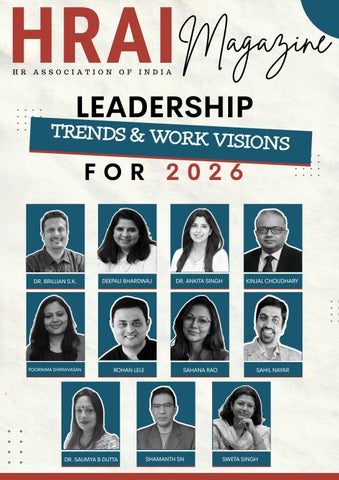
HRAI H R
A S S O C I A T I O N
O F
Magazine
I N D I A
LEADERSHIP
TRENDS & WORK VISION S FOR 2026
DR. BRILLIAN S.K.
DEEPALI BHARDWAJ
DR. ANKITA SINGH
KINJAL CHOUDHARY
POORNIMA SHRINIVASAN
ROHAN LELE
SAHANA RAO
SAHIL NAYAR
DR. SAUMYA B DUTTA
SHAMANTH SN
SWETA SINGH
WELCOME
HRAIMagazine LEADERSHIP TRENDS & WORK VISIONS FOR 2026 PREVIOUS EDITIONS:
READ NOW
READ NOW
READ NOW
READ NOW
READ NOW
READ NOW
READ NOW
READ NOW
READ NOW
READ NOW
CHECK OUT ALL THE EDITIONS READ NOW
READ NOW
2
EDITOR'S HRAI TEAM'S NOTE HRAI firmly believes in the power of teamwork and the value it brings. When diverse talents and perspectives come together, something extraordinary happens. The collective synergy we create goes beyond what any individual can achieve alone and together we see the potential to make a lasting impact on the world. As we step into 2026, leadership is being redefined—not by scale or speed, but by judgment, empathy, and intent. The coming year will challenge leaders to navigate ambiguity with calm, balance performance with people, and make decisions that hold up not just today, but over time. This edition explores how leaders are reimagining work, influence, and accountability in a world shaped by rapid technological shifts, evolving workforce expectations, and a renewed emphasis on trust. The conversations captured here reflect a shared understanding: the future of work will belong to leaders who listen deeply, adapt thoughtfully, and lead with clarity rather than control. What emerges across these perspectives is a move away from rigid models toward more human, flexible, and purpose-driven ways of working. Leadership in 2026 will not be about having all the answers, but about asking better questions, creating space for diverse thinking, and enabling others to do their best work. At the HR Association of India, we see this moment as an opportunity—one where leadership is not just about managing change, but shaping it with responsibility and foresight. We hope this edition serves as both a reflection of where leadership stands today and a lens into what lies ahead.
WWW.HRASSOCIATIONOFINDIA.COM
3
83,000+ FOLLOWERS ON LINKEDIN A GROWING COMMUNITY OF PROFESSIONALS ENGAGING WITH HRAI’S INSIGHTS, INITIATIVES, AND INDUSTRY CONVERSATIONS.
About HRAI Founded by Dr. Ankita Singh, the HR Association of India (HRAI) drives industry-led initiatives and curates prestigious recognitions for organizations, emerging professionals, and trailblazing women across the business ecosystem. HRAI serves as a platform for learning, collaboration, and recognition, bringing together professionals and subject-matter experts from across industries. What We Do Industry initiatives and professional forums Awards, recognitions, and curated listings Knowledge-sharing through talk shows, panels, and articles Community-building for HR and business professionals Organizations We’ve Engaged With Lenovo, Hindustan Unilever, Biocon Biologics, IHG Hotels, L&T, CBRE, Sutherland, Capgemini, EY, and more.
HIGHLIGHTS: KNOWLEDGE & THOUGHT LEADERSHIP Elite voices such as Dr. TV Rao, Harjeet Khanduja, and Prasenjit Bhattacharya have been featured in HRAI’s one-on-one talk shows, contributing practical insights and real-world perspectives for professionals. HRAI MAGAZINE INITIATIVE HRAI publishes thought-provoking articles authored by senior professionals from organizations such as Reliance Jio, Times of India, KPMG, Eveready, Volvo, and more. HRAI LIST FEATURES HRAI curates an annual list of features recognizing exceptional professionals and changemakers aligned with a central theme each year. 23 of 2023 | 24 of 2024 | 25 of 2025 . Notable organizations featured include: Adani, Amazon, Flipkart, Samsung, Myntra, Uber, Raymond, and more.
EXCLUSIVELY FEATURED SHARK TANK JURY IN THE VISIONARY CEOS LIST: AMIT JAIN, DEEPINDER GOYAL, GHAZAL ALAGH, RITESH AGARWAL,VINEETA SINGH
For HR professionals in India, HRAI offers unparalleled opportunities to connect with like-minded peers, learn from experts, and gain recognition for their hard work and achievements. By joining HRAI, HR professionals can stay updated on the latest trends, best practices, and strategies that can help them take their careers to the next level.
TABLE OF CONTENT 08 12
DR. BRILLIAN S.K.,
CHIEF PEOPLE OFFICER, TIMESPRO
DEEPALI BHARDWAJ
REGIONAL HUMAN RESOURCES DIRECTOR , SOUTH WEST ASIA IHG HOTELS & RESORTS
16
KINJAL CHOUDHARY
24
POORNIMA SHRINIVASAN VICE PRESIDENT - HR TESTVAGRANT TECHNOLOGIES
28
DR. ANKITA SINGH
32
GLOBAL PRESIDENT - HUMAN RESOURCES, CADILA PHARMACEUTICALS LMT.
FOUNDER , HR ASSOCIATION OF INDIA ROHAN LELE
FOUNDER & PRINCIPAL CONSULTANT, AMALTAS CONSULTING
38 44
SAHANA RAO GLOBAL HUMAN RESOURCES SPECIALIST, PATEAM SOFTWARE CONSULTING SAHIL NAYAR
HR LEADER AND INFLUENCER
48
SHAMANTH SN DIRECTOR, RAKUTEN INDIA ENTERPRISES PVT LTD.
54
DR. SAUMYA BADGAYAN DUTTA
58
VICE PRESIDENT – HR BUSINESS STRATEGY, GOLD STAR JEWELLERY PVT. LTD SWETA SINGH
DIRECTOR – TALENT ACQUISITION, APAC, MATERIAL+
COLUMNS HARJEET KHANDUJA SVP- HR, JIO
23
SUMIT AGARWAL LINKEDIN TOP VOICES
43
DR. BRILLIAN S.K. CHIEF PEOPLE OFFICER, TIMESPRO
The ‘Angry Young Man’ meets the algorithm - Leadership Trends & Work Visions for 2026 In the iconic film Deewar, Amitabh Bachchan’s
In an age saturated with data and AI-generated
character asked, “Aaj mere paas building hai,
reports, the human brain remains uniquely wired
property hai, bank balance hai… tumhare paas
for narrative. Data points inform, but stories
kya hai?” (Today I have assets, bank balance, what
inspire. They provide context, build culture, and
do you have?). For decades, this defined success
give meaning to mundane tasks. A leader in
tangible assets, clear hierarchies, and command-and-
2026 must be the Chief Storyteller.
control leadership. But as we zoom toward 2026, the very foundation of this question is being upended. The
Imagine an AI provides a dashboard glowing with
leader of the future understands that the ultimate
red
answer to 'tumhare paas kya hai?' is no longer
demand, “Fix these numbers.” A 2026 leader will
about tangible assets, but intangible human capital.
frame the challenge within a story. They might
It’s the modern 'Mere paas Maa hai' the profound
channel
strength found in empathy, trust, and the potential of
declaring, “Yeh aakhri faisla hai, aur iske
their people. In my experience, I have seen how a
baad mahaul bilkul badal jaayega.” (This is
data-driven recommendation to streamline a process,
the final decision, and after this, the environment
when implemented without the 'story' for the team,
will completely change). They will articulate not
leads to resistance, not results.
just what is wrong, but why fixing it matters for
metrics.
A
the
traditional
determined
manager
spirit
of
might
‘Vijay’
the customer, for the team’s mission, and for the The most valuable assets won’t be on the balance
company’s legacy. They transform a data point
sheet, they will be the human potential, empathy, and
into a shared mission, making every team
creativity within their teams. The pivotal shift for 2026
member feel like the protagonist of their own
is the move from a leader as the solitary ‘Vijay’ from
workplace epic.
Deewar, battling the system alone, to a leader as ‘Auro’ from Paa a beacon of innocence, curiosity,
2. Emotional engagement: Empathy as the
and unexpected wisdom who connects people on a
ultimate KRA
deeply human level. This transformation will be built on three foundational pillars: Storytelling, Emotional
The second pillar is moving beyond employee
Engagement, and Tech Mastery. SET.
engagement
surveys
to
genuine
emotional
connection. As AI automates technical tasks, the 1.
Storytelling:
The
anonymity:
DR. BRILLIAN S.K.
antidote
to
algorithmic
core of leadership becomes unequivocally
human. This is where the ‘Touch’ in ‘Tech and Touch’
knowledge are we losing? Is this a short- term
becomes non-negotiable. Think of the gruff but
gain for a long-term disaster? They must have
deeply
from
the courage to look at the AI and say, “Aal izz
Mohabbatein. He rules his Gurukul with an iron fist,
not well” not as a blind mantra, but as a critical
until a new teacher ‘Raj Malhotra’ shows him that
check on technological determinism. Their role is
fear cannot inspire true excellence. The leader of
to be the bridge between the cold logic of the
2026 must learn this lesson faster than he did. It’s
machine and the warm, complex reality of human
about moving from a culture of “Mere paas rule
beings.
caring
‘Narayan
Shankar’
book hai” (I have the rule book) to one of “Hum ko jeene ka sahara, koi toh de de…” (Someone, please
The 2026 vision: A symphony of touch and
give me a reason to live). A leader must be able to
tech
look at a disengaged team and not just see a productivity problem, but a human one. They must
So, what does the workplace of 2026 look like
connect, understand individual motivations, fears, and
under such leadership?
aspirations, and create psychological safety. This isn’t a “soft skill”; it is the strategic advantage that
It’s an environment where a leader uses a
prevents burnout, fosters innovation, and retains top
people-analytics platform (Tech) to identify that
talent in a competitive landscape.
an employee is at high risk of burnout, and then uses their storytelling and empathy (Touch) to
3. Tech Mastery: The art of asking ‘Aal izz Well?’
have a supportive conversation, redefining their role and reigniting their passion.
Finally, Tech Mastery is not about being the best coder in the room. It is about being the most
It’s an organisation that uses AI to handle
discerning consumer of technology. It is the wisdom to
repetitive recruitment screening, freeing leaders
use AI as a powerful tool, not a crutch. The leader in
to focus on the final rounds, where they assess
2026 must possess the judgment to know when to
for curiosity, resilience, and cultural add the true
trust the algorithm and, more importantly, when to
drivers of long-term success. The ultimate vision
override it with human intuition and ethics. This is
for 2026 is not a sterile, fully automated office. It
perfectly
Amitabh
is a vibrant, human- centric ecosystem where
archetype the wise mentor in ‘Piku’ who, amidst
technology handles the predictable, freeing
chaos, provides grounded perspective. When a
people to tackle the ambiguous. It’s where
predictive analytics model suggests shedding 15% of
leaders are not feared for their authority but
the workforce to boost quarterly profits, the 2026
followed for their wisdom and humanity.
encapsulated
by
a
modern
leader must pause. They need to use the data, but they should also ask the human-centric questions:
In the climax of Anand, the titular character,
What is the cost to our culture? What institutional
facing his own mortality, says, “Babumoshai,
DR. BRILLIAN S.K.
zindagi badi honi chahiye, lambi nahi.” (Life should be big, not long). The mandate for the 2026 leader is to create workplaces that are badi - rich with purpose, connection, and innovation. The race will be won not by the organisations
with
the
most
advanced
technology, but by those who can best integrate that technology with the timeless, irreplaceable power of the human touch. The future belongs to those who can lead not just with the brain of a strategist, but with the heart of a storyteller.
About the Author: Dr. Brillian Sk is the EVP & Chief People Officer at TimesPro, where he champions a performance-driven culture with a strong
focus
on
learner-centric
approaches. With expertise in talent development, recognition programs, and executive leadership coaching, he has been
instrumental
in
building
high-
performing teams and driving operational excellence.
His
strategic
leadership
supports TimesPro’s expanding business landscape, empowering the workforce through impactful initiatives.
The future of leadership will be won not by those with the most advanced technology, but by those who can weave together tech, empathy, and storytelling to create workplaces that truly thrive.
DR. BRILLIAN S.K.
DEEPALI BHARDWAJ REGIONAL HUMAN RESOURCES DIRECTOR, SOUTH WEST ASIA, IHG HOTELS & RESORTS
As a people leader, I am privileged to sit at the
For decades, leadership has been anchored in
center of a uniquely human equation—one that
control, efficiency, and predictable outcomes.
balances organizational ambition with the everyday
Even
realities of how people experience work. It is a
wellbeing, purpose, and culture—have often been
perspective that brings both clarity and unease.
framed as tactics to drive performance rather
And as we move toward 2026, that sense of
than outcomes worth prioritizing for their own
unease
with
sake. Regenerative leadership turns that logic
confidence about the “leadership of the future.” We
around. It challenges leaders to ask whether their
publish frameworks, design capability models, and
decisions leave teams more capable, more
integrate increasingly sophisticated AI tools into our
resilient, and more connected, rather than simply
workflows. On paper, it looks as though we are
more productive. And this is not an abstract
becoming more capable, more equipped, and more
philosophical idea. It is intensely practical. It
prepared than ever. Yet, many organizations feel
forces leaders to look at how workloads are
more fragile now than they did five years ago. Our
structured, how decisions are communicated, how
people are stretched thin. Leadership pipelines feel
psychological safety is nurtured, and how talent is
precarious
grown. It asks us whether we design work in a way
has
been
and
growing.
despite
We
rapid
speak
technological
our
most
supports
human
recovery,
conversations—about
advancement, decision-making is slowing down at
that
whether
we
build
the very moment agility is becoming essential. This
succession through experiences rather than just
contradiction has prompted a deeper, more urgent
assessments, and whether we lead in ways that
question—one I believe more leaders must be willing
nurture trust rather than erode it. Ignoring this
to ask: What if the issue is not how we execute
shift comes with consequences that are subtle yet
leadership, but the way we define it?
severe. Leadership failure in 2026 will not appear as dramatic missteps or high-profile errors. It will
At the Thinkers50 conference earlier this year, a
reveal itself quietly through burnout masked by
concept emerged that echoed what I’ve observed
strong
across multiple industries. Leadership is shifting
prepared on paper but crumble under pressure,
away from models designed to extract performance
and organizations unable to absorb change
and toward models that regenerate capability,
without splintering. In other words, the warning
trust, and organizational resilience. This idea of
signs will be detectable only to leaders who are
regenerative leadership is far from a passing trend.
willing to look deeper.
performance,
successors
who
seem
It reflects a profound truth: organizations are no longer
mechanical
for
The rise of AI adds another layer of complexity.
systems
We often assume AI is challenging our technical
composed of relationships, energy, expertise, and
capability, but in truth it is challenging leadership
increasingly, intelligent technology. And the way we
authority itself. When AI can analyze faster,
lead either strengthens or depletes these systems
forecast more accurately, and automate tasks
every single day.
that once defined expertise, leaders can no
efficiency;
they
structures
are
DEEPALI BHARDWAJ
complex,
optimized living
longer rely on information access or tenure as their
Yet perhaps the most significant shift emerging
foundation of influence. Authority is shifting toward
beneath the surface is a renegotiation of trust.
qualities that AI cannot emulate—judgement under
Engagement scores, quiet quitting, and turnover
uncertainty, ethical decision-making, contextual
patterns are all symptoms of a deeper, more
understanding,
and
for
personal question employees are asking: Can I
consequences.
These
be
trust this organization to invest in my future, to tell
automated; they must be cultivated. And they
me the truth, and to make decisions with
demand a different kind of courage. In my
transparency and fairness? People are no longer
conversations with leaders, the hardest questions
satisfied
now are not about what AI can do, but rather when
charismatic communication. They want honesty—
a human must remain accountable. It requires
especially when the truth is uncomfortable. Trust
leaders willing to resist hiding behind dashboards
is becoming an organization’s most valuable
and instead own decisions that affect people’s lives
currency, and it is rebuilt through the everyday
and careers.
actions of leaders who show consistency, fairness,
accountability qualities
cannot
with
inspirational
messages
or
and the courage to take responsibility. At the Alongside technology, another major shift is
same time, the structure of work is moving away
reshaping leadership: the move toward a skills-
from hierarchy and toward networks. Even with
based workplace. Work has already become fluid.
flatter organizational designs, many companies
Skills
are
still rely on hierarchical instincts—escalating
increasingly nonlinear, shaped by experiences
decisions, centralizing accountability. But modern
rather than ladders. And yet many leaders still
work no longer behaves that way, it demands
manage talent as though roles are fixed, and
cross-functional teams, fluid leadership roles, and
succession follows a predictable path. They protect
influence that emerges from expertise rather than
headcount instead of enabling mobility; they worry
title. Some of the most effective leaders I see
about losing talent instead of growing it. This
today are those who can step forward to lead
mindset,
stifles
when needed and step back just as quickly,
capability. In the organizations that adapt quickly,
allowing others to take the lead without feeling
leaders view talent as a living system rather than a
threatened. This adaptability is becoming a
collection of individuals tied to boxes on a chart.
hallmark of the leaders who thrive in uncertain
They don’t ask, “How do I keep my best people?”
environments.
have
shorter
while
lifespans.
understandable,
Careers
quietly
but rather “How do I amplify and move capability across the organization?” In this new era, a leader’s
Looking toward 2026 and beyond, three visions of
true strength lies not in the size of their team, but in
work are gaining momentum: organizations where
the depth of talent they develop and the culture of
humans and AI collaborate seamlessly; talent
mobility they encourage. The movement of people
systems that evolve through movement and
is no longer disruptive—it is strategic.
shared capability; and workplaces where success
DEEPALI BHARDWAJ
is measured not only by results delivered but by
About the Author:
what is renewed—skills, trust, wellbeing, and community. Ultimately, the future of leadership
Deepali
is
a
seasoned
will not be defined by new models or emerging
resource professional, boasting over 20
technologies. It will be defined by choices—
years of diverse operational and change
choices about what we optimize for, what we
management
hold ourselves accountable to, and what kind of
organizations and startups. Her track record
organization we are building through our
spans industries such as Consumer Durables,
everyday actions. The leaders who thrive will be
Retail, and Not-for-Profit. She excels in
those who combine strategic clarity with human
designing and restructuring, post-merger
depth, who lead with both courage and
integration,
compassion, and who recognize that real
systems, and driving impactful change
leadership is no longer about being the hero, but
initiatives. With a unique blend of strategic
about enabling the system to thrive.
insight and hands-on execution, Deepali has
expertise
senior
in
both
performance
human
large
management
led exponential revenue growth and positive And perhaps that is where leadership, in its most
bottom-line impacts alongside HR roles. Her
meaningful form, truly begins.
ability
to
envision,
inspire,
and
build
organizations and teams from scratch is noteworthy, while her broad experience allows
her
to
provide
comprehensive
solutions across industries, geographies, and
The future of leadership will be defined not by control or expertise, but by the courage to regenerate trust, capability, and humanity in the systems we lead.
DEEPALI BHARDWAJ
cultures. Outside of work, Deepali is an adventurous,
fun-loving
individual
with
interests ranging from travel to art and nature. Her personal aspiration is to create an inclusive environment that enables the success of all members of society.
KINJAL
CHOUDHARY GLOBAL PRESIDENT - HUMAN RESOURCES, CADILA PHARMACEUTICALS LMT.
Leadership, Collegiality, Vision and the HR Renaissance: A Charter for Professional Excellence in 2026 The
corporate
its
when they do, they unite, invest and thrive. What
decision-makers to be trailblazers, builders of
exactly propels leaders aside from motivating
credibility, and contractors of ethos in a period
individuals
of perpetual change and growing complexity. In
foreseeable future that ignites conviction and
such
complementary
pursuit of knowledge. Emotional intelligence and
bedrock
of
compassion. Emotional intelligence (EI) is a basic
organisational dynamism, namely, realistic and
leadership wisdom, as demonstrated by current
agile
studies.
a
environment
backdrop,
parameters
three
surface
directorship,
demands
as the
the onset
of
notable
is
their
Executives
knack
that
interaction
for
explaining
exhibit
mindfulness,
connections within the work setting, and a
compassion,
compelling work ideology that coincides with
conduct
2026, galvanising relevance, attainment, and
engagement, and team performance. Socialising
career progression.
and penmanship serve as vital to leadership, not
generate
skills,
a
higher
and
levels
righteous of
trust,
simply extraneous. "Infrequent communication from The Quintessence of Leadership in the 2026
the top provides more oxygen for conspiracy
Era
theories and rumours to thrive," a combined evaluation argues. To phrase it bluntly, mastery of
At the optimum level, leadership transcends into
language,
particularly
mere bureaucratic supremacy. Its evolution has
managerial boost. The environment moulds, and
long been emphasised by theorists: behaviour
intent is rendered readily apparent by an overseer
modification and contextual models supplanted
who
ancient
characteristics
theories,
and
more
centred
and
paradigmatic
interacts
in
seamlessly,
drafting,
is
a
periodically,
key
and
and
"great-man"
persuasively.The power of positive workplace
recently,
competency-
camaraderie is directly set to either upgrade or
mechanisms.
A
constrain the quality of scripts. While helmship
thorough literature analysis, for instance, has
styles usually set the stage to instil optimistic
outlined how a variety of leadership theories—
emotions among employees, developing polite,
such as trait, behavioural style, transactional,
sincere foundations with coworkers is not optional
and
individually
or insignificant; rather, it is strategic. In addition to
advanced our knowledge. Within that lineage, a
helping people combat work-related stress and
contemporary leader must exhibit three intrinsic
depression, social interaction at work is a crucial
virtues: strategic thinking, attunement and stellar
component in combating workplace bullying and
interpersonal
is
related aggressions; nonetheless, it takes a few
established by an exemplar. Organisations
grounds and approaches to instil this mindset in
meander when they lack an intriguing objective;
employees because friendships at work are not
transformational—have
skills.
The
KINJAL CHOUDHARY
distant
future
very
sporadic.Fellowship
in
adherence
to
methods
by
embracing
natural
language
leadership: if leaders actively engage in and
processing, behavioural analytics, and cognitive
endorse relationships with others, they establish a
modelling.
climate of psychological confidentiality, which is necessary to promote creativity, taking calculated
2. Skills-Based Talent Architecture
risks, and group resilience. Essentially, friendships at
work
serve
as
deliberate
facilitators
of
By the year 2026, organisations will have made
organisational agility and human capital strength
an enormous move from conventional hiring
rather than as unofficial benefits.
criteria to a bustling human capital habitat that revolves around competencies. Assessments
The HR Megatrends Reshaping 2026
about the workforce are growing increasingly
The world of work in 2026 is being fundamentally
dependent on empirical expertise, recognised
reshaped by technology, demographics, and new
micro-credentials, and a person's ability to
expectations from employees. While these forces
acquire
are global, India is positioned to experience them
paradigm encourages "skill compression", in
with unusual intensity due to its rapid digital
which employees rapidly pick up niche abilities
growth,
that enable them to effortlessly shift between
expanding
workforce,
and
evolving
economic landscape.
new
knowledge
effortlessly.
This
roles with simplicity. Personnel fluidity prioritises skill and capability above level of experience
1.
AI-Driven
Recruitment
and
Automated
Selection Artificial intelligence is now a vital component of India's modern talent-acquisition infrastructure, revolutionising the way businesses find, assess, and hire top people. Recruitment procedures that beforehand centred on peer review and arbitrary assessment now possess a murky, data-driven apparatus
optimised
for
robustness
and
extensibility. Cutting-edge procurement systems autonomously
search
infinite
human
capital
arsenals, precisely matching personas against multidimensional screening
skill
engines
taxonomies. scrutinise
AI-powered candidatures,
engaging indications that are and psychometric benchmarks in ways that eclipse normative analysis
KINJAL CHOUDHARY
and becomes more meritocratic.
3. eHyper-Automated HR Operations
handle both the technology transition and the emotional aspects that come with this significant
As industries progressively integrate automation of
change as AI becomes deeply ingrained in
robotic procedures, neural sequences, and AI-
everyday activities.
enabled
organisational
structures,
hyper-
automation has revolutionised HR operations. Onboarding, payroll, compliance, paperwork, and employee case oversight are among the regularity procedures that are carried out with formerly unprecedented velocity, precision, and coherence. By releasing HR from operational burden, this change enables the department to recast itself as a proactive pioneer of competence and ethos. Significant improvements in data fidelity allow for proactive
workforce
planning
and
predictive
insights. HR transforms from a transactional service hub
into
a
high-value,
analytically
driven
powerhouse that precisely and nimbly shapes organisational
transformation
as
automation
advances 4. AI-Human Collaboration as the New Normal
5. Personalised Learning Ecosystems
Human and artificial intelligence partnerships will
Propelled by robust, aimed educational networks
be an integral part of business operational
that adapt to a particular individual's momentum,
efficiency by 2026. By navigating intricately
skill level, and vocational objectives, continuous
analytical data and monotonous tasks, AI optimises
learning is going to become the tactical
intellectual ability rather than substituting human
commodity of 2026. AI-driven learning engines
behaviours, enabling employees to fixate on nifty,
accelerate skill mastering by creating customised
prejudicial and personal duties. In order to create a
development
workforce that is both technologically proficient
feedback, and simulating real-world problem-
and strategically empowered, organisations must
solving
rethink roles to balance human intuition with
personnel, organisations use generative learning
machine intelligence. This cooperative ecosystem
assistants, experiential simulations, microlearning,
improves decision-making, speeds up problem-
and predictive skill-gap analytics. By transforming
solving, and raises output quality. Leaders must
learning from a generic training
KINJAL CHOUDHARY
routes,
scenarios.
To
providing develop
real-time future-ready
activity into a highly tailored, strategically
evident in the ultimate goal: Prominent
aligned capability-building engine, this data-
businesses will set broader ethical, ecological,
driven,
personalised
ecosystem
ensures
or societal objectives. Teams experience
agility,
creativity,
and
long-term
engagement, loyalty, and innovation when
organisational competitiveness.
they link their work to a greater purpose. As a result, leaders need to transform their purpose
6. The Boom of the Indian HR Sector
into concrete goals and actions.
An extraordinary HR renaissance is poised to
Constituencies must be at the forefront of a
set up in India. With an overwhelming young
2026 ambition, not just procedures. This
professional demographic, fast digitalisation,
consists of developing ambiances which
and a fledgling business and enterprise
cultivate associations, stimulate teamwork,
ecosystem, HR is becoming one of the most
and
essential positions of importance in the
strategic
nation. Digital HR platforms, automated
should widely be focused on beginning with —
talent systems, AI-driven people analytics,
Clarity of Narrative: Organisational vision
and capability- building architectures are
must be written and communicated by
being adopted at a rate never seen before.
leaders in a way that inspires, motivates, and
Indian companies are making significant
instructs. Writing is a crucial leadership talent,
investments in organisational psychology,
as was previously said.
endorse
progressive
imperatives
for
growth.
Five
implementation
cultural engineering, employee experience design, and hybrid workplace management.
Relational Infrastructure: The HR architecture
HR specialists with expertise in data science,
ought to encompass explicit efforts to foster
behavioural insights, AI ethics, workforce
interactions at work, such as network building,
planning, and human-machine integration
cross-
are in high demand at the same time. The
Leadership
industry is becoming a centre for innovation
investments
that
and thought leadership as multinational firms
competence,
emotional
increasingly outsource strategic HR functions
adaptable
to India.
Embedding: Incorporate customs, narratives,
functional
clusters,
and
advising.
Development:
Make
training
leadership
improve
relational
intelligence, abilities.
and
Cultural
and measurements that represent the vision, Crafting a Vision for Work in 2026
camaraderie, and leadership principles into
Organisations that combine mutual respect,
daily tasks. Feedback and Iteration: Keep an
charisma, and vision into a cohesive strategy
eyes
architecture will reap the rewards in the year
outcomes, such as employee engagement,
2026. Three interwoven hallmarks must be
creativity, retention, and well-being.
KINJAL CHOUDHARY
on
relational
and
performance
Integrative Reflection: The Blueprint for 2026 Excellence HR
change,
leadership,
and
In 2026, leadership will belong to those who combine clarity with compassion, technology with humanity, and vision with the courage to elevate people—not processes.
workplace
camaraderie are not independent endeavours; rather, they support one another. Without genuine connections, leadership is shallow; without direction, camaraderie is ineffective; and
without
both,
vision
is
meaningless
language. Imagine a 2026 leader starting a digital transformation project: she creates cross-functional pods, links it to a larger social goal, employs AI-driven hiring to put together a team with a variety of abilities, and fosters psychological safety through organised "friendchecks". They assess success using relationship health, team cohesion, and creativity in addition to delivery measures. Conclusion Organisations that embrace the triangle of leadership,
camaraderie,
and
creative
HR
strategy— amplified by clever automation and the human spirit—will be at the forefront of the global economy as 2026 approaches. Leaders that
write
clearly,
lead
with
empathy,
intentionally build friendships, and use AI responsibly will rule the future. These leaders will create
innovative,
inspiring,
and
uplifting
cultures that can flourish in unpredictability while influencing the next phase of business excellence. This triangle serves as both a sail and an anchor in an unpredictable environment. Acknowledgement will come because it is earned via coherence, humanism, and vision rather than because it is sought.
KINJAL CHOUDHARY
About the Author : Kinjal Choudhary has nearly 3 decades of experience in all aspects of Human Capital across some of the leading MNCs as well as Indian
companies
Commerce,
in
FMCG,
Automobile,
ITES,
e-
Fintech,
Pharmaceuticals industries. He has worked in companies
like
ITC,
Unilever,
PepsiCo,
Amazon, Volvo – Eicher, Paytm having expertise in partnering with business in strategizing & executing people processes to deliver business results. Currently, he is the Global
President
Pharmaceuticals Ltd.
HR
for
Cadila
He has consulted large Indian conglomerates
Kinjal has done Leadership assessment and
as
in
coaching
for
Medical
Executives
across
well
as
start-up
companies
Manufacturing,
Mining,
Retail,
equipment,
Senior
organizations
through
and
for both evaluation of external candidates as
developing human capital. Some of the
well as internal talent potential identification
companies he has consulted include Aditya
and development.
business
aligning
200
Hogan Assessments as well as DISC profiling
with
in
than
HR
strategy
Diagnostics
more
strategy
Birla Group, Kama Ayurveda, Coloplast, DFPL Group.
Kinjal Choudhary is a Graduate in Economics (Hons.) from St. Stephen’s College, Delhi,
Kinjal has led HR teams across organizations
Post- Graduate in Economics from JNU, New
for building speed & efficiency in delivering
Delhi and Masters in Management from XLRI,
results for HR to enable business growth. He
Jamshedpur.
has focused on talent management, talent acquisition, succession planning and career management, compensation & benefits, sales incentives, retention of employees, SAP Success Factors. He has enabled building culture of organizations to make them futureready from talent perspective. He introduced leadership competencies in line with future leadership requirements, socialized the same and has designed & created Leadership development programs. Kinjal has been instrumental in preparing the organization structure to be agile & efficient. He has brought in concepts of Talent Review, Succession
Planning,
Career
Planning,
revamping performance management system, mentoring process which have all made distinctive changes in the culture of the organization which needed a lot more focus on people orientation.
KINJAL CHOUDHARY
The leaders who thrive in 2026 aren’t the ones who know the most, but the ones who learn the fastest, trust the deepest, and lead with humanity at the center.
COLUMN
HARJEET KHANDUJA SVP-HR, JIO Vision 2026 | Standing on the Shoulders of Today If you want to see the future, you don't need a crystal ball. You just need to stand firmly on the shoulders of today and look straight ahead. Consider the 1968 masterpiece, 2001 A Space Odyssey. In the film, astronauts used flat, iPad-like tablets, spoke with families via video calls, and collaborated with a conversational AI. These were not just lucky guesses by director Stanley Kubrick. They were the result of rigorous research. Kubrick did not just imagine the future. He engineered it. He hired a team of fifty professionals and consulted with major
replaced by a "grey-collar" boom. As the "Quick India" ecosystem
corporations like NASA, AT&T, Whirlpool, and IBM. He asked them
expands, vast, previously unorganized sectors are getting
to share what their products will look like after 30 years. He asked
organized. We will see a massive formalization of the informal
for not just ideas. He asked for prototypes. He built his vision of
economy. The leaders of 2026 would not just be managing
the future based on the concrete realities of his present.
software engineers. They will be managing distributed fleets of
Today, predicting the leadership trends and work visions for 2026
service professionals, powered by apps and algorithms. The
is even simpler. We do not need fifty consultants. We just need to
growth is in the services that keep the "Quick Economy" moving.
observe the "Current Reality" of late 2025. The signals are louder, the changes are faster, and the future is already here. It’s just
2. The Flexibility Contract
unevenly distributed.
Flexibility is no longer a perk. It is a currency. But in 2026, the definition changes. It is not just about where you work (WFH vs.
The Current Reality
Office), but what you work on. Talent will demand the flexibility to
The operating system of the world quietly reset in 2025. While
log in and out of gigs. In exchange, employers will demand "Skill
global trade hit a record $35 trillion, teaching organizations that
Flexibility." Talent must be willing to pivot into these new, rising
supply chains are strategic assets rather than back-office
sectors that have not been in the limelight. The rigid job
functions, the real story is happening on the ground in India.
description is dying. The fluid "project-based" career is the new
India has cemented its place as the world’s fourth-largest
standard.
economy with a $4 trillion GDP, growing at a robust 8.2%. But the macro numbers hide the micro revolution. We are living in the era
3. From AI Hype to AI Hygiene
of the "Quick India Movement."
Finally, the noise around AI will settle. In 2026, AI stops being a
With quick commerce growing at 75% to 100% year-on-year, our
"special project" and becomes a daily coworker. The novelty has
collective patience has evaporated. Waiting now feels like
worn off. We know AI is powerful, but we also know it changes
inefficiency. Delay feels like disrespect. This speed has bled into
power equations. The competitive advantage in 2026 would not
the labor market. The "Uberization" of work has moved beyond
come from having AI, but from the wisdom of how it is used.
cabs to carpenters, beauticians, and caregivers. Platforms have
Leaders will stop asking "What can AI do?" and start asking "What
successfully turned vague skills into specific, purchasable services.
should AI do?" The focus shifts from capability to governance and
Work has become deeply transactional yet deeply personal.
"AI Hygiene."
So, standing on this high-speed platform of 2025, what does 2026 look like?
Bottom Line If 2025 was the year of speed, 2026 will be the year of structure.
Three Defining Trends for 2026
It is a year where the chaotic growth of new sectors finds stability, and where flexibility finds a framework. The opportunities
1. The Rise of the "Unlikely" Sector
are vast, but they favor the observant.
The first trend is counter-intuitive. There will be more work, but not
2026 is a year of hope. But hope, like the future, is not a strategy.
where you expect it. The "white-collar" slowdown is being
It is a result of understanding today.
POORNIMA SHRINIVASAN VICE PRESIDENT HR, TESTVAGRANT TECHNOLOGIES
It feels like we just wrapped our heads around the
shine. In times of adversity, it’s not the
seismic shifts of the early 2020s, yet here we are,
technically brilliant manager who stands out, but
already already poised to enter 2026. If the last
the leader who is prepared to stand up for their
few years taught us anything, it’s that "business as
people, back them up without question, and
usual" is officially a relic. The old industrial-age
guide the team through the storm.
models of leadership—the top-down, commandand-control
structures—are
rapidly
dissolving,
The Trust Imperative:
replaced by something far more complex, more
With the permanent shift to hybrid and fluid work
human, and frankly, more demanding. For me, the
models, trust is the new currency. Leaders can’t
most compelling trends aren't about a new tech
micromanage people they rarely see. The focus
gadget or a slick methodology. They're about a
shifts entirely from hours logged to outcomes
profound re-evaluation of what a leader is and
delivered. This requires radical transparency.
what work means to a globally connected, anxiety-
When a difficult decision is made, the leader's
ridden, and deeply purpose-seeking workforce.
job is not just to announce what happened, but
The leaders who thrive in 2026 won’t be the ones
to clearly and authentically explain the why
with the longest resumes, but the ones most ready
behind the strategy. This honest, purpose-driven
to adapt, connect, and learn—in real-time.
communication rebuilds the trust gap that years of corporate opacity have created. The AI Co-
The New Leadership Equation: Humanity +
Pilot : Mastering Human-Technology Partnership
Agility
Let's be real: AI is no longer on the horizon; it’s
The Rise of Human-Centric Leadership In a world
at the desk next to us. The 2026 leader doesn't
where AI can automate analysis and optimize
need to be a coder, but they absolutely must be
efficiency, the true value of a leader is their unique
AI-fluent. Integrating Technology with Integrity
human capacity.
The challenge of the next few years is mastering the art of the augmented workforce.
Empathy and Compassion as a Strategic Lever: We’re moving beyond just feeling for our employees.
The Decision-Making Hybrid:
In 2026, empathy will be a strategic tool used to
AI will inevitably take over a significant portion
design better work environments, anticipate burnout
of data analysis, risk assessment, and process
before it happens, and understand the cultural
optimization, effectively acting as a powerful
nuances of a distributed team.A leader who builds
co-pilot. The leader's role is to ensure they are
a culture of psychological safety—where people
asking the right ethical questions of the data
feel safe to speak up, challenge ideas, and admit
and automation. They must be the final human
mistakes—will be the one whose teams consistently
judgment call, balancing algorithmic efficiency
outperform.Compassion is no longer a soft skill—it’s
with human impact, bias, and fairness.
the defining quality needed for leadership to truly
POORNIMA SHRINIVASAN
and learning journeys tailored to the individual's
Upskilling the Whole Organization:
role, generation, and well-being needs. Benefits A leader’s job now includes being a Chief Learning
designed to cater to individual employee need.
Officer. With middle management roles and entry-
Promotion to fulfil individual aspirations. Gone
level tasks facing automation, the focus must shift
are the days where once size fits all career
to continuous upskilling and reskilling. This is about
paths were followed in organizations. Hyper -
helping people transition from doing repetitive tasks
personalising every bit of employee experience
to problem-solving, innovating, and collaborating—
is on every Leader’s plate.
the things AI still can’t touch. The best companies "skill-count,"
A Focus on Well-being: Employee well-being is
prioritizing a growth mindset across all levels.
no longer a separate wellness perk; it’s a
Creative efficiency at all levels and at all roles is
performance indicator. Leaders must proactively
the focus for every Leader in the coming year.
address the invisible challenges of the digital
will
pivot
from
"headcount"
to
world, such as technostress and the fear of The New Vision of Work: Fluid, Purposeful, and
being left behind (FOBO).Furthermore, focusing
Skills-Based The workplace of 2026 is no longer a
on the holistic well being of the employees is the
fixed location with fixed hours. It's a highly fluid
non-negotiable priority for the years ahead.
ecosystem designed for maximum flexibility and
Including the environment employee is working
connection. Hybrid work is here to stay, but the
in, the family influence, inclusivity and creating
conversation is shifting from where we work to how
belongigness is the strategic trajectory for the
we maintain culture and connection across the
next decade.
distance. The 2026 Leadership Mandate : Intentional In-Person Collaboration: Offices will
Ultimately, the mandate for the leader in 2026
transform from places of mandatory attendance to
boils down to a few critical, non-negotiable
destinations for intentional connection. Leaders will
points:
need to be architects of experience, designing inoffice time specifically for team building, creative
Clarity is your Superpower: In a chaotic
brainstorming, and high-stakes collaboration that
world,
truly benefits from being in the same room.
consistent, purpose-driven communication is
the
ability
to
provide
clear,
a superpower. Cut the corporate jargon and The Hyper-Personalized Experience: Employee
tell your people the simple, honest truth.
experience will become as critical as customer
Be a Master of Agility: Treat every plan as
experience. Driven by people-analytics and AI, HR
a strong suggestion, not an unbreakable
will move toward hyper-personalization. This means
law. Empower your decentralized teams to
customized career paths, flexible benefit packages,
make fast decisions and pivot quickly without fear of retribution.
POORNIMA SHRINIVASAN
Be a Champion of Humanity: Connect the
About the Author:
mission to the person. Your people are your greatest competitive advantage, and their
Poornima Srinivasan, with 20 years in HR,
emotional and mental well-being is directly
has shaped inclusive and innovative
tied to the organization’s long-term success.
workplaces across technology, design, and urban development. At TestVagrant
The future of work isn't about working harder; it's
Technologies,
about leading smarter, with more heart, more
[24]7.ai,
data, and a greater commitment to the journey
recruitment,
of continuous learning—for ourselves and for our
performance
teams. It’s an exciting, terrifying, and profoundly
advocate for mentorship, she empowers
human challenge. This is our moment to redefine
women in HR through tailored programs.
leadership, lets genuinely be excited and build
Academically accomplished, she holds
this together.
three Master’s degrees and is pursuing
she
Bonito has
Designs, led
impactful
engagement, strategies.
and
A
and strong
an MSc in Psychology. Her contributions have earned her numerous accolades, including the Global HR Transformation Excellence Award (2024), Future CHRO (2024), Women Achiever Award (2025),
The leaders who will thrive in 2026 aren’t the ones with the most power, but the ones with the most humanity.
POORNIMA SHRINIVASAN
Emerging HR Leader and Emerging D&I Leader by Transformance (2022), 22 of 2022 by HRAI (2022), Women Achievers Award (2022), Leadership Circle Award (2015), Best HR Award (2014), and Best Employee Award (2002).
DR. ANKITA SINGH FOUNDER, HR ASSOCIATION OF INDIA
Leadership Without a Playbook: Preparing for Work in 2026 Leadership
has
always
carried
an
aura
of
respond when outcomes are unclear. This is
complexity, yet at its heart, it remains strikingly
why no single leadership style can last forever.
simple. It is simple because leadership is ultimately
What works in one phase can fail in another.
about people. And it is complex because people,
What inspires today may feel outdated
contexts, and moments are never the same.
tomorrow.
In the story of a team, leadership is perhaps the
Leadership and vision are not destinations to
most difficult yet the most natural role to play.
be reached; they are journeys without a final
Some define it as managing teams, structures, and
stop. Every step along the way must be
outcomes. Others see it as leading boldly from the
relevant, timely, and rooted in the situation at
front—setting direction and pace. A few believe
hand. And as we look ahead to 2026, this
leadership is about being part of the game itself,
adaptability will no longer be optional—it will
standing alongside the team, sharing wins, losses,
be essential.
and learning. The truth lies somewhere in between. Leadership is not one definition; it is a response to a
2026: Opportunity in an AI-Infused World.
moment. 2026 will be a year of opportunity, much like No leader can be the same hero every day. Some
every year before it—but with a distinct shift in
days demand conviction and visibility—leading from
context. It will be a world far more deeply
the front with clarity and confidence. Other days
infused with artificial intelligence across
call for restraint—stepping back, creating space,
culture, processes, and people decisions. AI
letting others rise. And then there are days when
will no longer sit on the sidelines as a tool or
leadership simply means walking alongside the
experiment. It will be embedded into hiring,
team, listening more than speaking, observing more
learning,
than directing.
management, and strategic decision-making.
“Leadership is not about being consistent every
The defining challenge for leaders will not be
day; it is about being conscious in every
whether to adopt AI, but how to do so
moment.”
responsibly and meaningfully.
The story of leadership is written not in annual plans
The focus will shift from chasing work-life
or leadership frameworks alone, but in everyday
balance to discovering the right combination—
decisions—how leaders react under pressure, how
between machine efficiency and human
they show up during uncertainty, and how they
judgment, automation and empathy, speed
DR. ANKITA SINGH
productivity,
performance
and sustainability. Organizations will strive to
leadership imperative. As AI takes over
design people-centric yet business-oriented visions,
repetitive tasks, the human side of work—
where technology enhances human potential rather
emotions, aspirations, anxieties—will become
than replaces it.
more visible. Leaders will be required to listen deeply, respond thoughtfully, and lead with
In this evolving workplace, leaders will need to
emotional awareness.
remember a simple truth: “AI will accelerate
Empathy
decisions, but only empathy will earn trust.”
Instead, it strengthens trust and long-term
does
not
dilute
accountability.
engagement. As algorithms become faster and smarter, trust, context, and emotional intelligence will become the
Automation
true differentiators. Employees will not just look to
Automation will be inevitable, but leadership
leaders for answers—they will look for reassurance,
will lie in thoughtful implementation. Leaders
fairness, and understanding in a rapidly changing
will
world.
automated, what must remain human-led, and
need
to
decide
what
should
be
how people can be reskilled rather than The REAL Leadership Approach for 2026
displaced.
Automation-led
leadership
will
To navigate this future effectively, leadership must
demand
transparency,
foresight,
and
be REAL—grounded, human, and practical. REAL is
responsibility.
not just a philosophy; it is a mindset that will define effective leadership in 2026.
Learning Agility The pace of change in 2026 will reward those
Relevance
who can unlearn and relearn quickly. Leaders
Relevance will be the new leadership currency.
will no longer be expected to have all the
Titles, tenure, and past achievements will no longer
answers—but they will be expected to ask
guarantee influence. Leaders will need to stay
better questions, remain curious, and create
relevant by continuously learning, understanding
cultures where learning is continuous.
emerging
“Relevance in leadership is earned daily,
technologies,
evolving
workforce
expectations, and shifting business realities.
not inherited from past success.”
Relevance is also about understanding the present— what
teams
are
experiencing
now.
Leaders
Work Vision: Adjustment Over Perfection
disconnected from day-to-day realities will struggle
The work vision of 2026 will not be about rigid
to inspire confidence or commitment.
models or perfect structures. It will be about adjustment,
consideration,
and
realism.
Empathy
Organizations will move away from one-size-
Empathy will move from being a “soft skill” to a
fits-all approaches toward flexible, situational
DR. ANKITA SINGH
frameworks that respect diverse needs and realities.
same every day, but being right for the
Being
moment.
future-ready
will
not
mean
predicting
everything correctly. It will mean building resilient systems and adaptable mindsets—where leaders
“As we look toward 2026, leadership will
and teams can respond quickly without losing
no longer be defined by control or
direction or values.
certainty—but by clarity, courage, and the
Human-centric leadership will coexist with data-
ability to stay human while everything else
driven decision-making. Performance will remain
accelerates.”
critical, but how performance is achieved will matter just as much. Respect, transparency, and fairness will no longer be optional—they will be foundational. The Leadership Game Ahead: Clarity, Value, Respect Ultimately, leadership in 2026 will revolve around three timeless principles:
Leadership in 2026 will not be defined by fixed playbooks or certainty, but by relevance, empathy, and the courage to stay human in an AI-accelerated world.
Clarity: Clear expectations, communication, and purpose in an increasingly noisy world. Value: Delivering meaningful impact to people, customers, and the business. Respect: For individuals, diversity of thought, boundaries, and the evolving nature of work. Trust will become the most valuable organizational asset—and leaders will be its primary custodians. Looking Forward Leadership in 2026 will not be about heroic postures or fixed playbooks. It will be about awareness, adaptability, and presence. Sometimes leading from the front, sometimes supporting from behind, and sometimes simply walking alongside— fully aware that leadership is not about being the
About the Author: Dr. Ankita Singh is the CPO & Board Director, CIGNEX & Relevance Lab. With 22+ years in HR, primarily in the ITES sector, Ankita has driven transformation
through
performance-driven
practices and inclusive culture. At CIGNEX, her leadership helped the company earn multiple “Great Place to Work” certifications (2017–2021). She has been recognized as “Woman Leader of the Year” by The Times of India Group and featured in Forbes India’s “Top 100 Managers.” Ankita holds an MBA in HR+IT, an Executive MBA from SCMHRD, and a Ph.D. in Management. A respected voice in the industry, Ankita blends strategic insight with a passion for people development and culture building.
DR. ANKITA SINGH
ROHAN LELE FOUNDER & PRINCIPAL CONSULTANT, AMALTAS CONSULTING
4 Timeless Leadership Mantra’s! There is a lot spoken and written about Leadership. Having said that it is still often misunderstood and not well absorbed! I say this because Leadership is often attached with position that one holds in the hierarchy! We often hear professionals saying that one can’t lead effectively, unless he/she is in a position of power. After having spent more than 2 decades in the industry I can say this with some bit of authority that Leadership isn’t about being in the position of power, rather it is about empowering and inspiring others. Different surveys around the world have
I am reminded of a quote from Simon
clearly stated the relationship between Leadership
Senek – “Profit isn’t a purpose, it’s a
and
and
result. To have purpose means the
profitability. It is proven beyond doubt that leadership
things we do are of real value to
can make or break an organization and can impact
others” Let me put a disclaimer here,
its growth prospects significantly.I am reminded of
profitability is important, so do not get me
what Robin Sharma said – ‘Leadership is not about
wrong! However, just focusing on the
title or designation. It’s about impact, influence
short-term or the profitability targets for
and inspiration’. In the last two decades, I have had
the year will not really build sustainable
an opportunity to work with several leaders working
enterprise. Have you ever wondered what
for
/
makes TATA one of the most endearing
Founders of family run businesses as well. Some of
organizations even after being in business
them have been truly great leaders who have led the
for 157 years! It is not just a profitable
organization very well – not just in terms of
company, but one of the most trusted
profitability, but a vision to take the organization to
business houses in the country. It is the
the next level.
unflinching focus on the larger purpose of
its
impact
on
Multinational
culture,
companies
engagement
and
Promoters
nation building putting ethics ahead of Here are the 4 Leadership Mantra’s I am sharing with
profitability is what has made them not
you all which I believe are timeless and apply
just a profitable company, but one of the
universally to any kind of business or sector that a
most credible and respected institutions!
Leader is working in! Leadership Lesson: As leaders we must
1) Putting Purpose over Profit ROHAN LELE
focus on profitability, however it is important that we do not loose our focus
on the larger organizational purpose. If we haven’t
of properties in his name. The world remembered
defined one, we must define the ‘WHY’ for our
him for his humility!
company and make sure that we align our short-term and long- term goals with our ‘Larger Purpose’.
Leadership Lesson: We get what we reap! Mr. Ratan Tata is one of the few who never really had haters. When we speak of him – we speak with the highest respect and credibility. As a leader you won’t be remembered for the wealth you created or the profitability you achieved, but for the humility and respect that you demonstrated for others. That is how one builds a legacy!
3)
Do
not
direct,
rather
Inspire! Leadership is often seen as an act of directing people to work towards a goal. This is one of the most misunderstood aspects of leadership. This is true for a manager, but certainly not for a Leader! I am reminded of the famous quote from John
Mr. Ratan Tata
Quincy Adams – “If your actions inspire others to dream more, learn more, do more and become more, you are a Leader!” The question
2) Practice Humility Humility is one of the most under-rated Leadership qualities. When we talk about Humility, one name that comes to our mind is Mr. Ratan Tata. We lost Mr. Ratan Tata at the age of 86 years in October 2024. His passing away has left a huge void as he continues to be one of the most respected and inspiring people in our country! When Mr. Tata passed away on 9th October 2024, the people and media were not talking about how wealthy or rich he was. No one spoke about his individual net worth and the number
ROHAN LELE
is how does one inspire? We only get inspired by those who lead from the front and demonstrate the behaviours and actions that they expect from their team members. When Leaders do so, members in their team voluntarily follow them and are inspired to walk an extra mile and go out of their comfort zone to see their Leader succeed! Taking a leaf out of our history, here’s an example of how Chatrapati Shivaji Maharaj inspired his army to fight the mighty Adil Shahi Empire. When Afzal Khan was sent to crush Shivaji Maharaj, he decided to take Afzal Khan head on and tore him apart with the ‘Wagh Nakh’ that he was wearing.
certain way to succeed is always to try just one more time.
Howard Schultz
Chatrapati Shivaji Maharaj
This is about Howard Schultz the man who built Starbucks! Howard grew up in poverty in Brooklyn, USA. His father lost his employment
Leadership Lesson: This act of Chatrapati
due to an accident on job and there was no
Shivaji Maharaj inspired many generations to
medical insurance too. Hence his family went
come, and the Mughals were never able to
through a lot of struggles to make ends meet.
conquer the Marathas. Leadership is never about
This shaped his dream ‘One day I will build a
coercion or use of power, rather it is one’s ability
company that treats its employees with dignity”
to inspire and empower others to do more.
Howard started working at the tender age of 12, he distributed newspapers, later became a bar
4) Never Give-up! This is the most important quality for a Leader to have. This is non-negotiable as success and failures are both part of life! In business no two days are the same. While we see great days, we often come across challenges we feel are impossible to overcome. These challenges test us as Leaders. As Thomas Edison said – “Our greatest weakness lies in giving up. The most
tender and also worked in a factory. He was the first from his family to attend college and after graduating
he
joined
a
coffee
machine
company. That was the time he visited a small coffee shop by the name Starbucks and later went on to join them. At a later stage the company was up for sale and he acquired it. He believed that it could be scaled up in a huge business. He went on to become the CEO of Starbucks and the rest is history. He built Starbucks out of purpose and perseverance. Today the company operates in more than 80
ROHAN LELE
countries with over 35,000 stores. Leadership
Lesson:
Your
character
is
defined by how you respond to challenges. A Leader is one who never gives up inspite of the most challenging circumstances.
About the Author: Rohan
Lele,
Founder
and
Principal
Consultant, brings over two decades of diverse
industry
petrochemicals,
experience automotive,
spanning chemicals,
specialty chemicals, power transmission, and engineering sectors. Holding senior HR leadership roles across Indian and global conglomerates, as well as family-owned, B2B, and B2C organizations across India, the APAC, and the Middle East regions. An alumnus of M.S. University of Baroda
(BBA,
MHRM),
with
executive
programs
in
Strategic
HRM
from
IIM
Ahmedabad and Leadership & Change Management from XLRI Jamshedpur. A Certified Coach, Leadership Trainer, and NLP Practitioner (ABNLP, USA; ANLP, UK), additionally certified by Dale Carnegie, Talogy International, and in Enneagram. Serving as past Director and Chair of the Baroda
Management
Association,
and
recipient of multiple accolades including Best HR Professional 2017, 101 Super HR Achievers 2019, and 101 Most Fabulous HR Tech Leaders by the World HRD Congress and CHRO Asia.
ROHAN LELE
Leadership is not the power to direct—it is the courage to inspire, the humility to serve, and the resilience to rise every time challenges try to stop you.
HUMAN-CENTRIC LEADERSHIPLEADING WITH EMPATHY, PURPOSE, AND TRUST
Empathy as a Leadership Strength: Understanding employee needs, mental well-being, and emotional resilience Purpose-Driven Leadership: Aligning organizational goals with meaningful work Psychological Safety: Creating environments where employees feel safe to speak, innovate, and fail Authenticity & Transparency: Building trust through honest communication and ethical decision-making
SAHANA RAO
GLOBAL HUMAN RESOURCES SPECIALIST, PATEAM SOFTWARE CONSULTING
Let’s be honest, if someone had told us back in
It’s the shift from “KPIs” to “KPIs + EQs.”
2019 that AI would be our co-pilot, half our meetings would be on holographic screens, and
Leaders are becoming storytellers of data,
“quiet quitting” would be followed by “loud leaving”
translating insights from AI dashboards into
and “conscious staying,” we’d have laughed it off.
meaningful human narratives. Imagine a CEO
Yet, here we are, 2026 knocking on our slack and
saying, “Our AI found a 15% engagement dip in
teams channels, bringing a leadership evolution
the hybrid team, but let’s decode why people
that’s rewriting the DNA of how we work, lead, and
are feeling disconnected.” That’s not leadership
thrive. So grab your coffee (or your matcha, if
2.0. That’s leadership reimagined.
you’re Gen Z), because this isn’t your typical leadership forecast. This is a real talk about how Gen Alpha is coming in hot, Gen Z is redefining
🤖 2. AI-Upskilling: From Fear to Flex
work-life codes, and Millennials are finally saying,
Remember when AI used to sound like the villain
“Let’s get smarter, not just busier as leaders”
of a sci-fi movie? Fast forward to now, AI is your
🌍 1. The Era of “Fluid Leadership”, from
brainstorming buddy, your resume whisperer,
Command to Collaboration Gone
are
the
days
of
and your on-demand career coach. In 2026, the buzzword isn’t AI adoption, it’s AI upskilling.
the
“corner
office
The best leaders aren’t those who “know AI.”
commander.” Leadership in 2026 isn’t about
They’re the ones who grow with AI. They
hierarchy, it is about hybridity. The most admired
understand prompt engineering like it’s a second
leaders are those who can blend empathy with
language, use virtual mentors for decision
analytics, intuition with data, and authority with
modeling, and even co-create strategy decks
accessibility.
with generative tools.
We’re seeing the rise of “Fluid Leaders”, those who
Gen Z and Millennials have embraced AI as their
don’t just manage teams but flow with them. They
power-up skill. But the twist? Gen Alpha is being
understand that Gen Z doesn’t want a boss, they
born into AI fluency. They don’t “learn” AI, they
want a coach. Millennials crave growth, not titles.
think AI.
And Gen Alpha? They’ll probably follow the AI that gives them better feedback than a human ever
Leadership Lesson:
could.
AI upskilling isn’t just a training module anymore, it’s a leadership mindset.
Real Talk:
The question isn’t, “Will AI replace us?” It’s, “Who
In 2026, leadership isn’t about “Do as I say.” It’s
will learn to lead alongside AI?”
“Let’s experiment together.”
Companies are now running “AI for Humans”
SAHANA RAO
programs, cross-learning pods where employees
Employees no longer ask, “Where do I work
teach each other how to use AI ethically, creatively,
best?” but “Why do I work this way?” Workspaces
and
just
are evolving into “experience ecosystems.”
facilitating learning, we’re curating digital curiosity.
Physical offices feel like innovation cafés, say
productively.
And
HR?
We’re
not
casual, creative, collaborative. Virtual spaces are personalized, your AI avatar remembers your
🌈 3. The Multi-Gen Workforce Remix
focus patterns and even schedules your deep work sprints.
Here’s where it gets spicy. By 2026, workplaces officially have four generations working side by
By 2026, flexibility has matured into fluidity.
side, Boomers, Millennials, Gen Z, and early Gen
Leaders trust employees to design their own
Alpha interns. And instead of culture clashes,
rhythms, and HR is moving from enforcing
forward-thinking
policies to architecting experiences.
organizations
are
designing
culture collabs. Imagine this: Example: A Gen Z data analyst uses ChatGPT to build
An employee could choose a 4-day week with
insights.
AI-assisted deliverables or opt for a creative 6-
A Millennial manager coaches her on storytelling
hour “flow day” system where productivity peaks
and impact.
define work hours, not clocks. This shift demands
A Gen Alpha intern gamifies the presentation for
leaders who are comfortable with ambiguity.
engagement.
Those who can say, “I don’t have all the answers,
A Boomer director adds context from past market
but let’s co-create the playbook.”
cycles. That’s not chaos, that’s intergenerational chemistry.
💬 5. The Rise of “Human Tech Trust”
Leaders now play the role of culture DJs, mixing
Here’s
beats from every generation to produce a rhythm
omnipresent, human connection becomes the
of collaboration. The key is empathy and reverse
new currency.
mentoring,
where
Gen
Z
teaches
the
twist:
as
AI
becomes
more
digital
adaptability, and Boomers teach resilience and
Leaders of 2026 are learning to balance
patience.
automation with authenticity. They’re using AI to
💡 4. Work Visions: The Great Redesign
scale empathy, not replace it. Picture this - a manager using sentiment analysis tools to sense team burnout before it spikes. Or HR bots
The future of work isn’t hybrid or remote, it’s
sending personalized growth nudges like, “Hey,
“intentional.”
you haven’t taken a learning break in 12 days, try
SAHANA RAO
this 10-minute upskill capsule.” Technology may
Gen Z, with their meme fluency and digital
drive the work engine, but trust fuels it. We’re
empathy, are teaching leaders that connection
entering the age of “Techmanity”, where leadership
doesn’t need to be face-to-face, it just needs to
isn’t about being more digital, but about being
be real.
digitally human.
⚡ 8. The New North Star: Purpose + Play
🔮 6. The “Skill Shift” Economy
Work in 2026 isn’t just about performance, it’s The shelf life of a skill is officially shorter than a
about playfulness with purpose.
Gen Z trend on TikTok. By 2026, micro-upskilling is the new MBA.
The new-age workforce doesn’t just want to hit targets, they want to feel something while doing
Employees now learn in “skill sprints”, bite-sized
it. They want leaders who can laugh, experiment,
bursts of knowledge consumed in 20- minute
and fail out loud.
digital
modules
or
even
through
interactive
podcasts. AI curates these pathways, tailoring
We’re
learning to your role, ambition, and even mood.
festivals,” gamified brainstorming days, and even
seeing
organizations
host
“failure
“AI-off” weeks where teams unplug to rediscover And leaders? They’re not just sponsors of learning,
human creativity.
they’re students in progress. Imagine your CEO publicly sharing their “AI learning journey” on
Purpose is the new paycheck. And the most
LinkedIn, encouraging everyone to join the ride.
magnetic leaders are those who create cultures
That’s vulnerability meeting visionary.
where curiosity is celebrated, not controlled.
💫 7. Emotional Intelligence Meets Digital
✨
Fluency
Closing Thought: Leadership as an
Ongoing Beta
The hottest leadership trend? The fusion of EQ +
If there’s one takeaway for 2026, it’s this:
DQ (Digital Quotient).
Leadership is no longer a destination, it’s a live beta version.
Empathy, adaptability, and curiosity are no longer soft skills, they’re survival skills.
We’re iterating as we go, co-creating futures with machines, and learning to lead not from the
Leaders who can navigate an AI dashboard and
top down, but from the inside out.
read emotional cues in a virtual meeting are the real unicorns. The best part? Younger generations
The leaders of tomorrow won’t be the ones who
are naturally wired for this blend.
know it all.
SAHANA RAO
They’ll be the ones who learn it all, share it
About the Author:
all, and unlearn fast enough to lead again. So here’s to the 2026 vision, where
Sahana Rao is a dynamic HR leader,
leadership is fluid, AI is your wingman, and
tech-driven
curiosity remains the ultimate superpower.
entrepreneur with over 15 years of
people
strategist,
and
experience
in
global
Because the future of work isn’t coming, it’s
management,
HR
technology,
already in the chat window, waiting for your
business
next prompt.
Human Resources Specialist at PAteam
💬🤝
leadership.
As
talent
the
and Global
Software Consulting, she drives AIpowered
workforce
solutions,
recruitment, and training across multiple geographies.
In 2026, leadership isn’t about having all the answers — it’s about learning fast, adapting faster, and cocreating the future with both humans and AI.
Her
career
includes
impactful
HR
transformations
Reliance
Retail
and
HDFC
at Life,
influencing over 27,000 employees. As a freelance consultant, she has advised 45+ organizations, including Amazon, Godrej, and ITC. Beyond HR, she cofounded
Ideas4Energy
solutions)
and
(experiential
(sustainable
Skippity
learning
for
Jumppity children).
Actively engaged in social causes, she volunteers with Vidya NGO and Lions International. Recognized as a thought leader, she has been featured on Selecthub USA, Business Manager HR Tech, and LinkedIn Top Voice HR, and is a recipient of the Women Achievers Award 2025 by HRAI.
SAHANA RAO
COLUMN
SUMIT AGARWAL LINKEDIN TOP VOICES
Have you ever walked into a room and felt the future shifting —not because of technology, but because of people? I felt that recently while facilitating a session with a group of young professionals. One of them said,c“Sir, the world is changing faster than we can even adjust our expectations.”cI smiled and replied, “The world will never slow down. But leadership can catch up.”cAs we step into 2026, leaders will not be judged by how loudly they speak, but by how deeply they listen. Not by how much power they have, but by how much power they share. And not by what they know, but by how fast they can unlearn, relearn and adapt. This is the shift that will define the future of work. From Authority to Humanity: 2026 will reward leaders who embrace humanness as a core competency. People don’t want perfect leaders anymore—they want present ones. In my own journey with disability and DEI work, I’ve noticed one truth: When leaders show vulnerability, teams show trust. This means leaders will: Share—not hide—their imperfect stories Admit when they don’t know Make space for emotions without labelling them as “weak” Prioritize mental health and boundaries Encourage real conversations, even when they feel uncomfortable Humane leadership will become the biggest differentiator in workplaces worldwide. Inclusion as a Performance Indicator, Not a Feel-Good Concept In India alone, our economy loses over 11 lakh crore annually because we exclude marginalized communities—from persons with disabilities to LGBTQIA+ talent to generational and socio- economic diversity. In 2026, inclusion will no longer be a CSR line item. It will be a business strategy, measured like revenue or retention. Companies will move from:
❌ DEI as training to✔️ DEI as business infrastructure This means: Accessibility budgets will become mandatory Cross-generational teams will be encouraged Inclusive hiring will be tied to manager KPIs Employee resource groups will influence decision-making Assistive technologies will become mainstream tools
The world is realizing: Inclusion isn’t charity. It’s economics. It’s strategy. It’s survival. The Rise of Purpose-Driven Workplaces : Young talent today doesn’t want to work “for a salary.” They want meaningful work, psychological safety, and leaders who genuinely care. 2026 will see the
acceleration
of
Purpose-oriented
leadership development,
roles,
Impact-driven
ESG-aligned career pathways,
Hybrid
culture built on trust, not tracking People will choose companies not by the size of the office, but by the size of the organization’s values. Neurodiversity Will Redefine Innovation : For years, we have trained everyone to think the same. But uniformity doesn’t create innovation—diversity does. In 2026, neurodivergent talent (ADHD, autism, dyslexia, OCD, etc.) will get rightful recognition as crucial innovation drivers. Companies will: Build sensory-friendly workplaces, Offer flexible schedules,
Redesign hiring assessments,
Train
managers in neuroinclusive communication The world is finally acknowledging: Different minds aren’t challenges. They’re superpowers. AI + Human Intelligence = The New Leadership Skillset: AI is no longer “the future.” It is the coworker we must learn to partner with—ethically, responsibly, intelligently. But in 2026, the winners won’t be those who master AI tools. They will be those who master AI + empathy. Leaders who can: Use AI for efficiency, Use humanity for connection, Use data for insight, Use intuition for judgment Technology will amplify human potential—but only if leaders balance speed with wisdom. Storytelling Will Become a Leadership Necessity: In uncertain times, the most powerful tool a leader has is not data. It is story. Stories build trust. Stories inspire action. Stories connect purpose to performance. This is why formats like “Hero’s Wound,” “Two Truths,” and
“Reckoning–Rumble–Revolution”
will
shape
how
leaders
communicate in boardrooms, universities, and global platforms. In 2026, leaders who cannot tell their story will struggle to lead their teams.
SAHIL NAYAR HR LEADER AND INFLUENCER
The year is 2026. The workplace looks familiar, but
We all loved hybrid work until our Wi-Fi
everything feels different. The coffee still brews at
became our worst enemy. The pandemic
9, meetings still run over time, and someone still
rewired how we function, but 2026 will be
forgets to unmute on Teams but leadership, as we
about rebalancing how we connect Gartner
knew it, has undergone a major software update.
predicts that by 2026, 80% of companies will
Gone are the days when leadership meant corner
redesign their workplace policies to drive
cabins, annual town halls, and a LinkedIn post on
more intentional collaboration not more
gratitude every December. The new-age leader
physical
doesn’t need a cabin. They need credibility. They
intentional. Leaders will need to ask, “Does this
don’t run town halls; they run conversations. And
meeting need a room, or just respect?”Remote
their LinkedIn posts? Let’s just say authenticity now
work proved that productivity can survive
gets more engagement than adjectives. Welcome
distance. But what we lost in translation was
to Leadership 2026; where being “future-ready”
connection, camaraderie, and chai breaks, the
doesn’t mean mastering ChatGPT prompts but
birthplace of great ideas. Leadership in 2026
mastering yourself.
will blend flexibility with familiarity. Think of it
attendance.
The
keyword
is
as the “Masala Chai” model of work, balanced, From Command to Connection
flavourful, and made for real conversations. The Rise of the “Learn-It-All” Leader
Let’s start with the obvious, leaders today are
Microsoft’s Satya Nadella once said, “Don’t be
expected
a know-it-all; be a learn-it-all.” And that line
to
be
emotionally
intelligent,
not
emotionally unavailable. A 2025 Deloitte Human
has aged better than fine wine.
Capital Trends study found that 72% of employees
The leaders of tomorrow are students in
value empathy over efficiency when assessing
disguise. They’ll ask questions, seek feedback,
leadership effectiveness. Think about that. We’ve
and learn from interns without feeling insecure
moved from “Can you deliver results?” to “Can you
about it. The shelf life of skills is shrinking, but
understand my reality?” In 2026, the best leaders
the hunger to learn is expanding. In 2024, the
won’t be those who bark orders, but those who build
World Economic Forum reported that 44% of
bridges. They’ll replace instructions with intention,
skills needed for jobs would change within
hierarchy with humanity, and performance reviews
five years. That five-year horizon now ends in
with
Real-life
2029, which means leaders have barely four
analogy? Remember that one teacher in school who
years to reinvent themselves, again.So if 2020
made you believe you were good at math (even
was the year of “resilience,” 2026 will be the
though you weren’t)? That’s 2026 leadership. It’s
year of “reinvention.” Leaders who treat
about unlocking belief before unlocking targets.
learning as a luxury will soon find themselves
purpose-driven
conversations.
leading ghosts, because their teams will have The Hybrid Hangover and the Return of Real Conversations
SAHIL NAYAR
outgrown them.In short: stop attending
webinars just to tick a box. Start learning to unlock
empathy, inclusion, and energy renewal.
a box.
After all, you can’t pour from an empty cup or lead with an empty tank.
AI + EQ = The New IQ Culture Will Eat Technology for Breakfast Artificial Intelligence is here to stay and no, it’s not coming for your job (unless your job description
Peter Drucker said culture eats strategy for breakfast. In 2026, it will probably eat
says “doesn’t adapt”). But AI alone can’t lead. That’s
technology too, because even the best AI
where emotional intelligence (EQ) takes centre
tools are useless in a toxic environment.
stage. A Harvard Business Review study from 2025
Culture will be the invisible glue that binds
found that organizations integrating AI tools with
global teams together. And leaders will be
human-centered leadership practices saw 25%
its chief architects. In GCCs and large
higher employee engagement scores. Translation:
organizations,
when
handle
evolve from “what people know” to “how
relationships. The leaders of 2026 will need to strike
people think.”Leaders will need to balance
a balance between analytics and empathy. The
speed with soul, metrics with meaning.
question isn’t Will AI replace leaders? It’s Will
Because let’s face it, no one remembers
leaders know how to work alongside AI without
the dashboard you shared, but everyone
losing their humanity? Think of AI as your brutally
remembers how you made them feel.
bots
handle
routine,
humans
capability-building
will
honest colleague, it gives you data, but not Leadership Will Be Less about Position,
discernment. That’s your job.
More about Permission Well-being is No Longer a Workshop Here’s the truth: Leadership is no longer Remember when well-being meant a one-hour yoga
given by hierarchy. It’s granted by people
session on International Yoga Day followed by
who choose to follow you. The corporate
samosas? Not anymore. By 2026, well-being will be
world is slowly realizing that influence now
business strategy. McKinsey’s 2025 “Workplace
matters more than instruction. Your title
Well-being
might get you a meeting invite. But your
Index”
showed
that
organizations
investing in holistic well-being programs saw a 21%
mindset
increase in productivity and a 30% drop in attrition.
listens. The best leaders of 2026 will be
The leaders of the future will talk about burnout as
those who are approachable, adaptable,
comfortably as they talk about balance sheets.
and accountable— people who don’t need
They’ll understand that rest is not laziness; it’s
to shout to be heard, and don’t need
longevity. In 2026, leadership KPIs might include
authority to create impact.
SAHIL NAYAR
will
decide
whether
anyone
Looking Ahead: The Human Reset
About the Author:
As I look at the horizon of 2026, I don’t see robots taking over. I see humans waking up. I see workplaces that prioritize dialogue over deadlines, growth over grades, and meaning over metrics. Leadership is becoming less about being in charge and more about being of service. The leader of 2026 will be equal parts philosopher, psychologist, and performer, someone who can manage P&L and still remember people’s birthdays. Because let’s be honest, no one leaves a company for lack of strategy. They leave for lack of sensitivity. So if you’re leading today, here’s your memo from the future. Unlearn what made you successful. Learn what will keep you relevant. And above all, stay human,
because
efficiency,
but
algorithms only
empathy
can can
optimize inspire
excellence. After all, 2026 won’t reward those who are powerful. It will reward those who are purposeful.
Leadership is no longer about being in charge; it’s about being in tune—with people, with purpose, and with the changing pulse of the workplace. SAHIL NAYAR
Sahil Nayar is an HR disruptor, who loves blending data with intuition, strategy with storytelling, and innovation with impact. Whether he’s shaping talent strategies, mentoring future leaders, or challenging the status quo, he does it with wit, wisdom,
and
a
relentless
drive
to
transform the way we experience work. An award-winning HR professional, an author, a podcast host, and a Certified Happiness Coach, he’s been recognized over 50 times for his contributions to the field. When he’s not decoding workforce dynamics, you’ll find him on a mountain trail or cruising through Mumbai on his Royal Enfield.
SHAMANTH
SN
DIRECTOR, RAKUTEN INDIA
ENTERPRISES PVT LTD.
Navigating Transformation at the Intersection
technological capability and human values rather
of Tradition and Innovation
than viewing them as competing forces. The Japanese AI market, valued at 8.9 𝑏𝑖𝑙𝑙𝑖𝑜𝑛𝑖𝑛 2024
As we stand at the threshold of 2026, global
𝑎𝑛𝑑 𝑝𝑟𝑜𝑗𝑒𝑐𝑡𝑒𝑑 𝑡𝑜 𝑟𝑒𝑎𝑐ℎ 27.9 billion by 2029,
business
demonstrates
leaders
face
an
unprecedented
this
balanced
approach.
With
convergence
of
technological
disruption,
government investment of approximately $65
demographic
shifts,
and
workforce
billion
evolving
through
2030
and
the
recent
expectations. Nowhere is this transformation more
implementation of the Act on the Promotion of
pronounced—or more instructive—than in Japan,
Research and Development and Utilization of AI-
where centuries- old corporate traditions are
Related Technologies, Japan is positioning itself
colliding with the urgent imperatives of digital
not as a fast follower but as a thoughtful
transformation and demographic reality. The
integrator of AI across manufacturing, healthcare,
Japanese experience offers critical insights for
and telecommunications sectors.
leaders
worldwide
as
they
navigate
the
complexities of tomorrow's workplace.
The Demographic Imperative: Lessons from Japan's Labor Market Perhaps no nation confronts the
The AI-Human Leadership Paradigm
future of work more acutely than Japan, where by 2026, one- third of the population will be over 65.
The
most
defining
2026
This demographic reality has forced Japanese
leadership will be the seamless integration of
industry to pioneer solutions that other aging
artificial
judgment.
economies will soon require. Labor shortages are
Leaders must develop what experts term "AI
projected to reduce Japan's annual growth by
fluency"—not
0.9% post-2025, creating an existential pressure
intelligence merely
characteristic with the
of
human ability
to
deploy
technology, but the wisdom to question AI outputs,
for innovation.
identify algorithmic bias, and blend machine efficiency
with
distinctly
human
capabilities:
The Japanese response has been multifaceted and
empathy, contextual understanding, and ethical
instructive. Rather than viewing automation as a
reasoning.
threat to employment, Japanese manufacturers have embraced AI-driven predictive maintenance,
Japan's approach to this challenge reflects its
quality control, and process optimization as
unique
essential tools for maintaining competitiveness
cultural
philosophy.
While
Western
leadership often emphasizes individual charisma,
with
Japanese leaders are embracing ningenryoku— a
decomposing traditional jobs into narrower, more
concept prioritizing collective well-being and
flexible tasks—enabling older workers to remain
long-term stability over short-term gains. This
productive while accommodating their changing
philosophy proves remarkably well-suited to AI
capabilities.
integration, as it emphasizes harmony between
SHAMANTH SN
a
shrinking
workforce.
Companies
are
This approach challenges the Western narrative of
constantly reconfiguring teams.
AI-driven job displacement. In Japan's context, automation becomes an enabler of human potential
Purpose-Driven Leadership in an Age of
rather than its replacement. For global leaders, this
Uncertainty
reframes the 2026 question from "How do we protect jobs from AI?" to "How do we redesign work
Economic
volatility
has
to leverage both human wisdom and machine
researchers
call
capability?"
clinging to current roles rather than pursuing
"job
created
what
hugging"—employees
advancement. Sixty percent of HR leaders cite The Evolution of Corporate Culture: From
economic uncertainty as their primary business
Hierarchy to Agility
concern, while 71% of leaders report increased stress levels, with 40% considering departure
The era of the distant, authoritative CEO is fading
from their roles. in this environment, purpose-
in Japan, replaced by leaders who engage directly
driven
with production floors, share vulnerabilities, and
aspirational but essential.
leadership
becomes
not
merely
energize teams through authentic connection. This shift from rigid hierarchy to collaborative networks
Japanese companies are pioneering approaches
represents one of the most significant cultural
that balance stakeholder capitalism with
transformations in Japanese business history.
performance governance
accountability. reforms
have
Corporate raised
listing
Digital Natives and New Age organizations are
standards and improved capital efficiency while
dismantling lifetime employment models in favor of
maintaining Japan's traditional emphasis on
talent mastery systems that reward international
long-term stakeholder relationships over short-
experience and continuous learning. This represents
term shareholder returns.
a fundamental rethinking of the social contract between employer and employee—one that global
This model offers a compelling alternative to
organizations are watching closely.
purely profit-driven leadership. As Gen Z and Gen Alpha enter the workforce demanding
The implications for 2026 leadership are profound.
authenticity,
Flatter organizational structures require leaders
Japanese emphasis on collective purpose and
comfortable with fluid team compositions, where
societal contribution provides a framework for
authority derives from expertise and alignment
engagement
rather
employment relationships.
than
position.
This
demands
new
autonomy,
that
and
transcends
meaning,
transactional
competencies: the ability to lead without rigid control,
to
provide
clarity
without
The Mental Health Imperative
micromanagement, and to build trust across Perhaps the most striking cultural shift in
SHAMANTH SN
the
Japanese business is the emergence of workplace mental health and well-being programs—counseling services, meditation rooms, and wellness initiatives that would have been unimaginable in traditional corporate culture. This transformation acknowledges a fundamental truth: sustainable performance requires sustainable people.
from viewing employees as resources to be optimized toward recognizing them as whole human beings whose well-being directly impacts organizational resilience. The Japanese experience demonstrates that even deeply traditional cultures can evolve when existential pressures demand it. Strategic Imperatives for 2026 As we look toward 2026, several imperatives emerge for leaders across industries and geographies:
capabilities. Technology should amplify rather than replace human judgment, empathy, and ethical reasoning. Redesign work for demographic reality. require
flexible
task
structures, continuous learning systems, and automation that enables rather than displaces human contribution. Build cultures of authentic purpose. In an era of uncertainty, meaning and collective mission
become
powerful
retention
and
engagement tools. Prioritize
leader
well-being.
Stressed,
burned-out leaders cannot guide organizations through transformation. Sustainable leadership requires sustainable leaders.
SHAMANTH SN
with
transformation. Japan's experience shows that cultural heritage and radical
innovation
need
not
be
opposing forces.
The Japanese market's transformation offers
a
challenges
compelling and
preview
opportunities
of
facing
global leaders in 2026. By confronting demographic disruption,
pressure, and
simultaneously, pioneering
technological
cultural
Japanese
leadership
evolution industry
models
is that
balance machine capability with human wisdom,
individual
performance
with
collective purpose, and rapid change
Develop AI fluency while deepening human
workforces
tradition
Conclusion
For 2026 leaders, this represents a critical evolution
Aging
Balance
with cultural continuity. The leaders who will thrive in 2026 are those who recognize that the future of work is not about choosing between human
and
artificial
intelligence,
between tradition and innovation, or between performance and purpose. It is about
integrating
these
apparent
opposites into coherent strategies that honor human dignity while embracing technological possibility. In this endeavor, we would do well to learn from Japan's quiet revolution—one that may yet define the future of global leadership.
closely
with
government
bodies
and
enterprises in India and Japan to drive
The future of leadership isn’t a choice between tradition and innovation—it’s the wisdom to integrate human dignity with technological possibility.
social infrastructure projects. Currently, as the Director of New & Emerging Business at Rakuten India, he leads innovation and business
growth,
collaborating
with
multicultural teams across Japan, APAC, and the US to advance emerging business areas. Shamanth’s leadership has been recognized by several prestigious awards, including India's Top 50 Great Manager by Economic Times (2020), India's Top 100 Great People Manager by Great Manager Institute & NHRDN (2023), and the Top 50 Under 50 Outstanding Trailblazer Leader by HRAI (2023/25). He has also received the Corporate Titan Award (2024) for Social Innovation Excellence and Visionary
About the Author:
Leadership, as well as the Globex Business Award (2024) for Sustainability Leadership
Shamanth SN is a distinguished bilingual
and Leadership in Education. In addition to
leader with proficiency in Japanese and
his extensive professional accomplishments
over 26 years of expertise in Digital
with
Transformation
Business
Rakuten, Hitachi, Mitsubishi Electric Nagoya
Development, specializing in the Japan,
Works, Toyota Motor Corp Japan, NDR
Israel, and APAC regions. His diverse
Japan, Larsen & Toubro Medical, and NAL,
experience spans industrial automation
Shamanth
and social infrastructure, with a proven
Practitioner and life coach. He is deeply
track record across sectors such as
committed to fostering industry-academia
Intelligent Transportation Systems, power,
collaboration and has a passion for
water,
mentoring and teaching.
mining,
and
gas,
agriculture,
and
geospatial decision sciences. At Hitachi, Shamanth excelled in managing largescale
bids
and
complex
commercial engagements, working
SHAMANTH SN
techno
leading
is
organizations
a
certified
such
NLP
as
Master
TECHNOLOGY-ENABLED LEADERSHIP- BALANCING AI, DATA, AND HUMAN JUDGMENT
AI as an Enabler, Not a Replacement: Using technology to enhance productivity and insights Data-Driven Decision Making: Leveraging analytics while applying human context and ethics Digital Fluency for Leaders: Understanding emerging tools and guiding teams through tech adoption Ethical Leadership in Tech: Ensuring fairness, transparency, and accountability in automated systems
DR. SAUMYA
BADGAYAN DUTTA VICE PRESIDENT – HR BUSINESS STRATEGY, GOLD STAR JEWELLERY PVT. LTD
Leading the Herd: A (Mostly Sane) Guide to Leadership in 2026's Multigenerational Zoo. If you thought keeping track of your phone, keys,
Today, we’re in the era of Human-Centric
passwords, water bottle, and intermittent will to live
Leadership, which sounds warm and fuzzy until
was hard, try managing the modern workforce. As we
you realize it also means:
skid-slide into 2026, the professional landscape is experiencing what demographers politely call “peak
Profit to Impact: Because “saving the
overlap.” Translation: your office now resembles a
planet” now sits between “check emails”
five-generation
and “review budget.”
joint
family
group,
complete with unsolicited advice, unexplained emojis,
Command
to
Collaboration:
More
and someone always on mute.
committees. More chats. More channels. More chaos.
Baby Boomers are delaying retirement long enough to
Control to Evolution: Replace your 5-year
qualify for a second farewell party.
plan with a “let’s just see vibes” strategy. Expectation
to
Wholeness:
Bring
your
Gen X is quietly running everything while pretending
authentic self—yes, even the weird parts.
they’re “just surviving.”
Competition to Co-creation: Everyone wins. Mostly. Sometimes. Hopefully. Job titles are
Millennials are busy searching for purpose, feedback,
also getting a glow-up.
and the perfect oat-milk latte. “Manager” is becoming “Visionary.” Gen Z is re-writing corporate rules at the speed of a
“Director” is now “Catalyst.”
trending TikTok sound.
“Controller” is rebranding as “Coach,” though some still coach like 1990s gym teachers.
And Gen Alpha? They’ll be onboarding via hologram before they even lose their baby teeth.
A Generational Crash Course:
Leadership vocab is evolving faster than your
Gen X – The Pragmatic Operators
company’s 27 versions of the logo. The old
They quietly do 70% of the work while rolling
“command-and-control”
leaders
their eyes so hard they need physiotherapy. They
supposedly descended from the heavens armed with
don’t want praise; they want peace, functioning
superior genes and mahogany desks—is now about as
printers, and one meeting—just one— that ends
useful as a landline phone in a Gen Z apartment.
early.
ROHAN LELE
style—where
Millennials – The Purpose-Driven Peacekeepers They want meaning, transparency, psychological safety, and maybe a raise. They’re natural transformational leaders because they’ve spent their whole lives transforming: dial-up to fiber, Nokia to smartphones, and now themselves from financially hopeful to financially… flexible. Gen Z – The Digital Realists They can smell inauthenticity like dogs smell fear. They don’t care about titles; they care about impact, mental health, and Wi-Fi speeds. Also, their average tenure is 1– 3 years. Sometimes less if the office coffee is bad. Gen Alpha – The Incoming Tech Tornado Not here yet, but already judging us. They will expect onboarding through AR, feedback through AI, and snacks delivered by drones.
Research shows most generational differences are basically exaggerated marketing gimmicks. A Gen Z employee and a Gen X employee have a lot in common —they’re just struggling in different fonts. EmpathyDriven Leadership is the real secret. Situational and Adaptive Leadership make a comeback because they remind us the best leadership style is simply: “It depends.”
Dr. Saumya Badgayan Dutta is a distinguished HR strategist and senior management leader transformation in the luxury manufacturing sector. As Vice President – HR Business Strategy at Gold Star Jewellery Pvt. Ltd., she partners with CEOs and boards to align business vision with people and operational excellence. Holding dual PhDs in E-Commerce and Psychology, Dr. Saumya blends digital acumen with behavioral insight to build future-ready, high-performance cultures. A TEDx Speaker, World Record holder, and 10x LinkedIn Top Voice, she is recognized for pioneering data-driven, human-centric HR
The Grand Finale: Let's Dance will
About the Author:
with over two decades of experience driving
The Plot Twist: Generations Aren’t the Real Problem
2026
The leaders who will thrive in 2026 are the ones who can get every generation to dance together—even when each one is moving to a different rhythm.
be
chaotic,
messy,
and
wonderfully
collaborative—like a potluck where no one coordinated dishes. But the leaders who thrive will be the ones who get everyone to dance together, even if each generation knows different steps.
ROHAN LELE
models
that
accelerate
growth.
Her
work
spans
leadership
inclusion,
and
large-scale
development,
organizational
digital transformation, making her a respected voice in shaping the next era of workplace evolution
THE FUTURE OF WORKFLEXIBILITY, INCLUSION, AND CONTINUOUS GROWTH
Hybrid & Flexible Work Models: Shifting focus from hours worked to outcomes achieved Inclusive Leadership & Diverse Teams: Valuing diverse perspectives as a competitive advantage Lifelong Learning Culture: Encouraging upskilling, reskilling, and adaptability Employee Well-Being & Work-Life Integration: Supporting balance to sustain long-term productivity
SWETA SINGH
DIRECTOR – TALENT ACQUISITION, APAC, MATERIAL+
The year ahead will not reward incrementalism. It
Organisations
will demand a fundamental reimagining of how
organisational transformation mandate —
we lead, how we build organisations, and how we
not just a technology investment — will
enable human potential. Leadership is shifting
outpace those who merely automate tasks. AI
from managing people and profit to engineering
will reshape roles, redesign talent models, and
integrated
ecosystems,
redefine how decisions are made. Leaders who
protecting institutional trust, and designing
anticipate this and lead with strategy will own
work that fuels—not drains—human capability.
the competitive advantage.
As we step into 2026, the leaders who will shape
2. Skills-First Organisations: Retiring the
the future are not operators; they are architects.
Job-First Playbook
human–machine
that
recognise
AI
as
an
They will rebuild systems, redesign talent flows, and realign culture with purpose. They will
By 2026, the organisations that thrive will
understand that the future of work is not arriving
abandon
someday — it is unfolding now, in every decision
descriptions
we make. Few of the most critical leadership
outcomes economy. The pace of automation
trends shaping 2026 are as follows:
means roles will evolve faster than job titles can
the
rigidity
and
of
traditional
to
a
shift
job
skills-and-
keep up — but skills can. 1. AI-Native Leadership: Strategy First, Tools Forward-looking employers are already building
Next
transparent, in
dynamic reskilling,
career
pathways
AI is no longer a future experiment; it is becoming
anchored
internal
talent
the core architecture of how organisations
marketplaces, and “skill passports” that follow
operate, compete, and make decisions. In 2026,
employees across teams and growth cycles. This
leadership maturity will be defined not by the
is not an HR trend; it is an organisational
number of tools adopted but by the clarity of the
survival strategy. Companies that invest in
enterprise-level AI strategy behind them.
precision reskilling and skill mobility will absorb disruption with agility, redeploy talent at scale,
This means moving beyond scattered, vendor-led
and keep innovation alive even in volatile
pilots and intentionally identifying the few, high-
markets.
value
workflows
exponential
impact.
where It
AI
means
can
deliver
building
the
A
skills-first
model
transforms
workforce
technical depth, governance discipline, and
planning from reactive to regenerative —
ethical guardrails that make AI not just
unlocking hidden potential, reducing attrition,
powerful, but trusted, explainable, and deeply
and creating a culture where learning becomes
human- centered.
the currency of growth.
SWETA SINGH
3. Hybrid Work Evolved: Flexibility With
business risks that hit productivity, retention and
Intentional Design
innovation. In 2026, wellbeing moves from checkbox benefits to embedded workplace
The simplistic remote vs. office debate is over.
design:
The future of work is not about choosing sides — it
mental health support, and measurement that
is
ties
about
designing
flexibility
and
environments
productivity
where
coexist
by
workload
wellbeing
engineering,
interventions
to
continuous outcomes.
Leaders who normalize boundaries, model recovery, and fund proactive care will have
intention, not by accident.
healthier, more creative teams. In 2026, hybrid work matures into a system of zone-based
Action: Institute workload reviews (quarterly),
schedules, and collaboration rituals crafted to
invest in continuous care partnerships, and add
honour
wellbeing indicators to leadership dashboards.
precision
design:
micro-shifts,
deep-focus
time,
asynchronous
productivity, and the real- world demands of commuting, caregiving, and global teams.
5. Ethical governance & trust become boardroom business
More organisations will structure purposeful inperson
moments
mandates,
but
as
not
as
attendance
As AI and data decisions scale, trust is now a
catalysts
for
innovation,
board-level asset. Expect a rise in formal AI
—
problem-solving, and culture. This shift requires
governance,
data
ethics
boards,
and
leaders to architect
transparent
communication
about
how
norms that make presence meaningful: time-
decisions are made and what trade-offs were
boxed meetings, mandatory agenda discipline,
considered. Leaders who embed ethical checks
asynchronous documentation, and role-based
into product and people decisions protect
onsite rhythms.
reputation and unlock customer and regulator trust — a differentiator in tight markets.
High-performing organisations won’t force people into buildings — they will design hybrid models
Action: Establish a cross-functional ethics
where human connection, output quality, and
review for major AI deployments and publish a
wellbeing all rise together. Productivity will not
short “our AI decisions” summary for customers
be measured by proximity, but by progress.
and employees.
4. Human wellbeing is a strategic lever, not a
6.
perk
Sustainability as a Strategic Anchor
Mental health and burnout are escalating
In an era defined by volatility, sustainability has
SWETA SINGH
Leading
Through
Ambiguity:
moved far beyond compliance—it has become a
aligned and resilient.
stabilising force in organisational decisionmaking.
As
expectations
from
investors,
customers, and talent rise, leaders must navigate
Putting it together — a leadership playbook for 2026
uncertainty by embedding sustainability into the core operating system of the business, not
1. Three-spot focus: Pick three strategic
treating it as a peripheral initiative.
priorities (e.g., one AI workflow, one skills pathway,
In 2026, sustainability leadership is fundamentally
one
sustainability
target).
Concentrated effort wins over scatter.
about managing ambiguity with clarity. It social
2. Rewire for learning: Treat reskilling as an
commitments directly to operational levers—
organizational change program — marketing it,
procurement choices, product design principles,
measuring
supply-chain decisions, workforce strategy—so
lateral moves.
requires
that
linking
ESG
environmental
becomes
a
and
mechanism
redeployment,
and
celebrating
for
organisational alignment in times of rapid
3. Design work, don’t mandate it: Create
change.
norms, not edicts — meeting rules, collaboration days, and async rituals that make hybrid
Leaders who treat sustainability as a lens for decision-making
during
ambiguity
will
sustainable.
build
resilience, attract trust, and create long- term
4. Measure human outcomes: Add wellbeing,
value. They will empower teams to make choices
skill mobility, and trust as board-level KPIs
that are both commercially sound and socially
alongside revenue and margin.
responsible, even when the path ahead is not fully 5. Operationalize ethics: Make ethical review
defined.
simple, fast, and visible — and link it to customer 7.
Agile
decision-making:
speed
with
communications.
guardrails Final word — leadership as design Complexity requires decentralized, fast decision-
Leaders who will define 2026 don’t simply react
making
The
to disruption; they redesign the conditions of
leadership job becomes designing decision rights,
work so humans and machines thrive together.
escalation paths, and feedback loops. Leaders
This requires ruthless prioritization, a relentless
that create guardrails (clear constraints, risk
focus on skills and wellbeing, and an ethic of
thresholds, and shared KPIs) empower teams to
transparency.
—
but
without
accountability.
move fast while keeping the organization
SWETA SINGH
About the Author: Sweta Singh is a seasoned Talent Acquisition leader shaping high-performing hiring ecosystems across India and the APAC region. Known for building agile, high-impact talent organizations, she currently leads Talent Acquisition for Material Plus in APAC, where she drives strategic workforce planning, talent intelligence, and scalable hiring architecture for a rapidly growing business. With a deep belief that great companies are built through
great
transforming
people,
TA
Sweta
functions
specializes
through
in
data-driven
decision-making, process excellence, AI- enabled talent practices, and human-centered leadership. She has led and mentored teams of talent acquisition professionals and positioned TA as a true business partner in complex, fast-moving environments. Beyond her corporate leadership, Sweta is a writer and thought leader—authoring a leadership blog series on Substack and currently working on multiple novels that blend emotion, intensity, suspense, and human psychology. Her work explores themes of resilience, identity, and the evolving relationship between people and technology. Widely
recognized
for
her
strategic
clarity,
empathetic approach, and ability to lead through ambiguity,
Sweta
brings
together
the
rare
combination of operational depth, storytelling, and visionary thinking. She is passionate about building workplaces where talent thrives, leaders grow, and organizational purpose truly comes alive.
SWETA SINGH
The leaders who will define 2026 aren’t managing the future — they are designing it, reshaping work where human potential and intelligent technology rise together.
THANK YOU FOR READING
STAY TUNED FOR MORE INSIGHTFUL CONTENT!
FOLLOW US NOW!
64