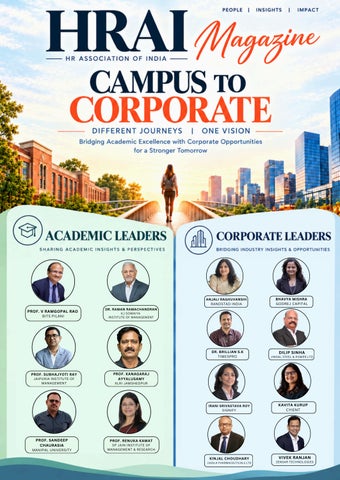
PROF. V RAMGOPAL RAO BITS PILANI
PROF. SUBHAJYOTI RAY JAIPURIA INSTITUTE OF MANAGEMENT
PROF. SANDEEP CHAURASIA
MANIPAL UNIVERSITY
ANJALI RAGHUVANSHI RANDSTAD INDIA
BHAVYA MISHRA GODREJ CAPITAL
DR. BRILLIAN S.K TIMESPRO
JINDAL STEEL & POWER LTD
IRANI SRIVASTAVA ROY SIGNIFY
KAVITA KURUP CYIENT
DR. RAMAN RAMACHANDRAN KJ SOMAIYA INSTITUTE OF MANAGEMENT
DILIP SINHA
PROF. KANAGARAJ AYYALUSAMY XLRI JAMSHEDPUR
PROF. RENUKA KAMAT
SP JAIN INSTITUTE OF MANAGEMENT & RESEARCH
KINJAL CHOUDHARY CADILA PHARMACEUTICALS LTD
VIVEK RANJAN
ZENSAR TECHNOLOGIES
About the Founder: Ankita holds the position of Chief People Officer. With a career spanning over 25 years, Ankita has consistently demonstrated her proficiency in managing and directing various aspects of Human Resources, primarily within the fast-paced ITES sector. While at CIGNEX Datamatics, she excelled in implementing new and competitive initiatives and institutionalizing a strong performance-driven culture, resulting in the company being certified as a "Great Place to Work 2017-18, 2018-19, 201920, and 2020-21." Ankita's achievements have earned her industry-wide recognition. The Times of India group honored her as "Woman Leader of the Year," recognizing her exceptional leadership abilities and groundbreaking achievements. She was also named a "Top 100 Manager" by Forbes India and the Great Manager Institute. Ankita's educational background is equally impressive. She completed her MBA in HR+IT from Bharati Vidyapeeth University College of Engineering, Pune, an Executive MBA from Symbiosis Centre for Management and Human Resource Development, and a Doctor of Philosophy (Ph.D.) in Management from Bhopal University. Ankita's exceptional achievements, honours, and educational journey reflect her remarkable leadership abilities, commitment to personal growth, and profound impact on human resources.
4
HRAI DIALOGUE: ACADEMIA × INDUSTRY In an era defined by constant transformation, the divide between campuses and corporates is no longer just operational—it is emotional, intellectual, and structural. Students are striving to prepare for a world they have not yet experienced. Educators are shaping minds amidst shifting expectations. Employers are seeking talent that is ready for roles that evolve faster than curricula. And somewhere between these three worlds, silence has grown wider than dialogue. At the HR Association of India (HRAI), we believe this gap is not a failure—it is a call to action. A call for understanding, alignment, and shared responsibility. Education and employability must not evolve in isolation. They must advance together, with intention and empathy. This special edition, HRAI Horizons: Campus Corporate, was created with that purpose.
↔
In these pages, you will hear from distinguished academic leaders—individuals who shoulder the responsibility of preparing India’s talent for tomorrow. Their reflections offer not just opinions but lived wisdom: insights shaped by experience, challenges witnessed firsthand, and a deep commitment to shaping capable, confident, and compassionate professionals.
CAMPUS
↔ CORPORATE SECOND EDITION
↔️
When we launched the first edition of HRAI Horizons: Campus Corporate, we focused heavily on a single, pressing truth: education and employability cannot run on separate tracks. They have to move together, built intentionally and with real empathy. In those initial pages, we turned to academic leaders, the deans and professors managing India’s classrooms, to map out the challenges students face when stepping into a world they haven't yet experienced. Their insights gave us a foundation. But as anyone in construction knows, a bridge built from only one side never actually reaches the opposite bank. That is why this second edition shifts the entire dynamic. We invited corporate leaders into the room to sit alongside our academic pioneers. By bringing the people who shape the curricula together with the executives navigating the front lines of business, we are actively replacing a long structural silence with an open, multi-dimensional conversation.The articles in this issue target the disconnect directly. What we found is that the breakdown between campus and corporate isn't a lack of talent or capability. It is almost always a breakdown in communication. By looking at the transition from both sides of the table, our contributors offer a practical blueprint for raising a generation of young professionals who are agile, deeply grounded, and ready to handle roles that change faster than a syllabus can keep up.To every academic leader protecting the spark of curiosity, and to every corporate executive creating the space for that talent to grow—thank you. Your willingness to listen and work together gives this magazine its true direction.The future of work is too big for any single institution or company to build in isolation. We have to do it together.
5
DR. ANKITA SINGH FOUNDER, HR ASSOCIATION OF INDIA
“Academia plants the seed, but industry must prepare the soil. True talent isn’t just manufactured at graduation; it is sustained when the classroom and the corporation finally learn to speak the same language.”
PROF. V RAMGOPAL RAO VICE-CHANCELLOR, BITS PILANI
8
DR. RAMAN RAMACHANDRAN, DIRECTOR & DEAN, KJ SOMAIYA INSTITUTE OF MANAGEMENT, MUMBAI
16
PROF. SUBHAJYOTI RAY, DIRECTOR, JAIPURIA INSTITUTE OF MANAGEMENT, NOIDA
24
PROF. KANAGARAJ AYYALUSAMY CONVENOR, CORPORATE RELATIONS & PLACEMENT, XLRI JAMSHEDPUR
30
PROF. SANDEEP CHAURASIA, DIRECTOR OF THE DIRECTORATE OF CORPORATE RELATIONS & PLACEMENTS, MANIPAL UNIVERSITY, JAIPUR (MUJ)
36
PROF. RENUKA KAMAT, MARKETING ASSOCIATE DEAN, S. P. JAIN INSTITUTE OF MANAGEMENT AND RESEARCH
42
EVENT CHRONICLE
62
MOST PREFERRED WORKPLACE FOR WOMEN 2026–27
TABLE OF CONTENT
FEATURED CAMPUS & ACADEMIC LEADERS INTERVIEW
TABLE OF CONTENT
EXCLUSIVE CORPORATE LEADERS INTERVIEWS
50
ANJALI RAGHUVANSHI
54
BHAVYA MISHRA
60 68
CHIEF PEOPLE OFFICER, RANDSTAD INDIA & GCC
CHRO, GODREJ CAPITAL
DR.BRILLIAN S.K
EXECUTIVE VICE PRESIDENT & CPO, TIMESPRO
DILIP SINHA PRESIDENT & CHRO ANGUL, JINDAL STEEL & POWER LIMITED
72
IRANI SRIVASTAVA ROY
76
KAVITA KURUP
84
KINJAL CHOUDHARY
94
HEAD OF HR-EMERING MARKETS & GREATER INDIA, SIGNIFY
SENIOR VICE PRESIDENT & CPO, CYIENT
GLOBAL PRESIDENT - HUMAN RESOURCES, CADILA PHARMACEUTICALS LIMITED
VIVEK RANJAN EVP & CHRO, ZENSAR TECHNOLOGIES
PROF. V RAMGOPAL RAO BITS Pilani Pilani | Club | Goa | Hyderabad | Mumbai
Vice-Chancellor, BITS Pilani
ABOUT THE
LEADER:
9
Prof. V. Ramgopal Rao is the Group Vice-Chancellor of BITS Pilani, overseeing its campuses in Pilani, Hyderabad, Goa, Dubai, and Mumbai. Before joining BITS in 2023, he served as Director of IIT Delhi (2016-2021) and was a Chair Professor at both IIT Delhi and IIT Bombay. An internationally recognized Nanoelectronics researcher, Prof. Rao has over 500 research papers and 50 patents, including 20 US patents, with 15 licensed for commercialization. His IP on CMOS-SoC applications is used in hundreds of millions of ICs worldwide. He co-founded two deep-tech startups, Nanosniff and Soilsens, with successful commercial products. Prof. Rao played a key role in establishing India’s major Nanoelectronics programs. He is a Fellow of IEEE, TWAS, INAE and all the three Indian science academies. He has supervised 52 Ph.D. graduates who are working in leading academic and industry roles globally. Recognized with over 40 awards, including the Shanti Swarup Bhatnagar Prize, Infosys Prize, and IEEE EDS Education Award, he also holds three honorary doctorates. Prof. Rao serves on editorial boards of leading international journals and chairs national committees on education, research, and innovation, including the Boards of JNCASR and NIFTEM. He has delivered over 200 Plenary/Keynote talks worldwide.
CAMPUS
↔ CORPORATE SPECIAL EDITION
Featured Institute
Institution Overview
VISION
BITS aims to advance knowledge, nurture future-ready talent, and inspire students to apply learning, innovation, and creativity to address global challenges and contribute to the betterment of society.
MISSION
Our commitment to transparency, merit, and equal opportunity, supported by a continuously evolving, industry-aligned curriculum, enables students to gain strong academic foundations, practical exposure, and the confidence to address real-world challenges.
EXCLUSIVE INTERVIEW
Q: As we begin 2026, where do you see the most promising opportunities to strengthen alignment between academic learning and the rapidly evolving expectations of the industry? The most promising opportunity lies in integrating industry engagement directly into the learning process rather than treating it as something that happens only after graduation. Technologies are evolving rapidly and knowledge cycles are shrinking. Universities therefore need models where students interact with real problems while they are still studying. At BITS Pilani this philosophy has existed for decades through the Practice School programme, where students spend a full semester working in industry as part of their academic curriculum. During this period they work on real assignments in companies under joint supervision of faculty and industry mentors. It is not a short internship but an immersive professional experience. Such sustained engagement exposes students to real engineering challenges, organizational decision making and team dynamics. When universities combine strong fundamentals with meaningful industry exposure, graduates enter the workforce with both conceptual understanding and practical confidence. Q: In the year ahead, what initiatives, interventions, developmental approaches can best support students in making a confident and smooth transition from campus to corporate life?
Universities must therefore create opportunities where students engage with complex, open ended challenges rather than narrowly defined academic exercises. At BITS Pilani we encourage such exposure through initiatives like SOLVE- Student Program for Advancing Research, KnowLedge, and Entrepreneurship, where students work in multidisciplinary teams to address real societal or industrial problems and attempt to design practical solutions. These projects often involve interaction with companies, startups or community partners. Experiences like these help students develop important professional capabilities. They learn how to structure problems, collaborate with people from different backgrounds and communicate ideas clearly. Perhaps most importantly, they learn to deal with uncertainty, which is a defining feature of most real world challenges. When graduates have already navigated such environments, their transition from campus to corporate life becomes far more natural and confident.
Students transition into professional environments far more smoothly when they have already experienced real problem solving during their education.
11
CAMPUS
↔ CORPORATE SPECIAL EDITION
Q: Amid continuous change, how do you ensure that your programs, people practices, or academic frameworks remain relevant to emerging industry trends and future workforce needs?
Such models ensure that research remains academically rigorous while also addressing real industrial challenges. They also enable a steady flow of ideas between academia and industry.
Universities must remain closely connected to developments in technology, industry and society if they are to remain relevant. This requires continuous dialogue with industry leaders, entrepreneurs and researchers who can provide feedback on emerging skill requirements and technological directions.
When universities design programmes that encourage collaboration and applied research, academic frameworks naturally evolve alongside technological and economic change.
Doctoral education offers an especially powerful mechanism for strengthening this connection. At BITS Pilani we run PhD IMPACT, which stands for Industry Mentored PhD. In this programme, working professionals from industry pursue doctoral research on problems that arise directly from their workplaces, while being jointly supervised by industry experts and BITS faculty.
Stay ahead of change by connecting academia with industry, applied research, and emerging technologies— creating learning frameworks that evolve with tomorrow’s skills and workforce needs. At BITS Pilani one such initiative is SPARKLE, which stands for Student Program for Advancing Research, KnowLedge, and Entrepreneurship. In this programme, student teams from different years collaborate on ambitious research or innovation problems under the guidance of faculty members. Many of these projects span multiple semesters and involve experimentation, design, and prototype development. Some eventually lead to research publications, patents or startup ideas.
12
Q: With experiential learning gaining greater significance in 2026, how would you further enhance practical exposure through internships, live projects, simulations, or industry partnerships? Experiential learning becomes truly meaningful when students work on challenging problems over sustained periods of time. Universities must therefore provide platforms where students can explore ideas, experiment and develop solutions rather than simply complete assignments.
Turn learning into realworld impact through sustained projects, innovation challenges, industry exposure, and hands-on experiences that build technical depth, creativity, and confidence.
Such long term engagement allows students to experience the entire process of innovation from problem definition to solution development. When students graduate after working on complex projects, they develop both technical depth and the confidence to tackle real world challenges.
CAMPUS
↔ CORPORATE SPECIAL EDITION
Q: Which future critical skills do you believe will define successful professionals in the coming years, and how can institutions and organizations consciously nurture these capabilities? The professionals who will thrive in the coming decades will combine strong disciplinary foundations with the ability to work across domains. Analytical thinking, creativity, communication and adaptability will become increasingly important in a world shaped by rapid technological change. Equally important will be the ability to translate knowledge into practical solutions. Many of the most impactful innovations emerge at the intersection of fields such as engineering, data science, design and business. Universities therefore need to create environments where curiosity and experimentation are encouraged. Exposure to research, innovation challenges and interdisciplinary collaboration helps students develop resilience and intellectual confidence. Organizations also play a role by creating workplaces that encourage learning and exploration rather than rigid specialization.
EXPERIENTAL LEARNING
Ultimately, the most valuable capability will be the ability to keep learning. Professionals who remain curious and adaptable will be best positioned to navigate the evolving technological and economic landscape. Q: What focused efforts do you consider essential this year to strengthen core competencies such as communication, problem solving, adaptability, and professional ethics? Competencies such as communication, adaptability and ethical judgement cannot be developed through lectures alone. They emerge when students work collaboratively on meaningful challenges. Group projects, research initiatives and innovation programs require students to discuss ideas, defend their reasoning and present solutions clearly. These experiences naturally strengthen communication and 13 teamwork.
CAMPUS
↔ CORPORATE SPECIAL EDITION
Adaptability develops when students encounter unfamiliar problems and must learn quickly to navigate them. Exposure to internships, research environments and multidisciplinary collaborations helps students become comfortable with uncertainty. Professional ethics must also remain a central pillar of education. As technologies become more powerful and pervasive, the consequences of decisions made by professionals become more significant. Universities therefore have a responsibility to nurture integrity, responsibility and social awareness alongside technical competence. These qualities ensure that future professionals not only solve problems effectively but also consider the broader impact of their work on society.
Q: As we work toward a stronger talent ecosystem in 2026, how can academic institutions and corporate leaders collaborate more closely to create a seamless education to employment pathway? A strong talent ecosystem emerges when academia and industry view themselves as partners in a shared mission rather than operating as separate worlds. Collaboration must extend beyond recruitment and include education, research and innovation. Industry can contribute by mentoring student projects, offering structured internships and collaborating on research challenges. Universities in turn must remain open to feedback and adapt their programs when new skills or technologies become important. Doctoral programs can also play an important role in strengthening this partnership. At BITS Pilani we have launched PhD DRIVE, which encourages doctoral researchers to translate deep scientific discoveries into technologies and startups that can address real industrial or societal needs.
14
When such pathways exist, research moves more quickly from laboratories to applications. This strengthens the innovation ecosystem while simultaneously preparing students for meaningful professional careers.
Q: With job roles and career trajectories continuing to evolve, how would you reimagine learning models, training programs, or curricula to prepare talent for emerging opportunities? Learning models must evolve from rigid disciplinary structures toward more flexible and interdisciplinary systems. Many of the most exciting opportunities today lie at the intersection of fields such as engineering, data science, biology and design. Universities should therefore allow students to explore multiple domains while maintaining strong foundations in their core disciplines. Modular courses, interdisciplinary projects and research based learning experiences can support this approach. Another important dimension is entrepreneurship. Increasingly, students aspire not only to join organizations but also to create new ones. Exposure to innovation ecosystems, prototyping facilities and startup mentorship can help them translate ideas into viable ventures. Education must therefore move from a model that prepares students for a single predefined role toward one that prepares them for a lifetime of evolving opportunities. Q: From your perspective, what does an impactful mentoring ecosystem look like in 2026? An effective mentoring ecosystem is one where students receive guidance from multiple sources throughout their educational journey. Faculty mentors provide intellectual direction and help students develop deep understanding in their chosen fields. Alumni and industry professionals bring a different perspective by sharing insights about career paths, professional expectations and emerging opportunities. These interactions often help students clarify their goals and make informed decisions. Structured mentoring programs can create regular opportunities for such engagement. CAMPUS
↔ CORPORATE SPECIAL EDITION
Conversations about projects, research ideas and career possibilities help students develop confidence and clarity.
Q: As this new year unfolds with a focus on shaping future ready talent, what message or vision would you like to share with academia and industry?
Equally important is creating an environment where students feel comfortable asking questions and learning from mistakes.
The challenges and opportunities of the coming decades will require far stronger collaboration between academia and industry. Universities create knowledge and nurture talent, while industry has the capacity to translate ideas into technologies, products and services.
Mentorship should not simply guide academic progress but support the overall development of young professionals. When students feel supported by a strong network of mentors, they are more likely to take initiative and pursue ambitious ideas.
Q: What key indicators or assessment approaches do you find most meaningful today when evaluating an individual’s readiness for real world responsibilities? Traditional examinations provide only a partial picture of readiness for real world responsibilities. A more meaningful assessment must consider how effectively students apply knowledge in practical contexts. Students who have worked on research projects, internships or innovation initiatives often demonstrate stronger problem solving abilities. Their ability to collaborate in teams, communicate ideas clearly and manage uncertainty provides valuable insights into their professional readiness. Another important indicator is initiative. Students who explore new domains, pursue independent projects or take leadership roles in collaborative work often display strong potential for impact. Universities should therefore evaluate students through a combination of academic performance, project outcomes, teamwork and professional conduct. Such a holistic approach provides a far more accurate understanding of a graduate’s ability to contribute effectively in complex real world environments.
15
When these two worlds operate in isolation, progress remains slow. But when they work together closely, innovation accelerates. Students gain exposure to real problems, researchers see their discoveries translated into practical applications and organizations benefit from fresh ideas. Building such partnerships requires trust and long term commitment. Industry must engage with universities not only as recruiters but also as partners in education and research. If we create such collaborative ecosystems, we will not only prepare future ready professionals but also generate the innovations and enterprises needed to address some of the most important challenges facing society.
“Academia and industry must build stronger, long-term partnerships to shape futureready talent, connecting education with real-world challenges, innovation, research, practical learning, and opportunities that create meaningful impact for society.”
CAMPUS
↔ CORPORATE SPECIAL EDITION
DR. RAMAN RAMACHANDRAN DIRECTOR & DEAN, K J SOMAIYA INSTITUTE OF MANAGEMENT, MUMBAI
16
ABOUT THE LEADER Dr. Raman Ramachandran retired as Chairman & Managing Director of BASF India Ltd (https://www.india.basf.com/), Head of BASF group companies in South Asia and subsequently lead PI Industries Ltd (https://www.piindustries.com/) as its Managing Director and CEO. During his stint of nearly three decades with global chemicals major (BASF), Raman held many positions of responsibility across Research, Regulatory, Marketing and Business leadership. He has global experience having worked for 11 years based in Singapore with Asia Pacific regional responsibilities. He was a member of BASF’s Asia Pacific Business Board and Executive Management Team of Agricultural Products Division of BASF; Vice-President, Crop Life Asia and Chairman of Confederation of Indian Industries, Chemicals and Petrochemicals industry group. He has a PhD from University of Adelaide, South Australia and subsequently pursued his research interests with International Organizations in Kenya, Philippines and at University of Wisconsin, Madison, USA. Raman was Robert S McNamara Fellow of the Economic Development Institute of World Bank in the year 1990. He was awarded FICCI's Chemical and Petrochemical sector's "Lifetime Achievement Award for contribution to Agrochemical Industry” in November 2021. He is currently non-executive Chairman on board of Calibre Chemical Pvt Ltd (https://www.calibrechem.com/) and Independent Director of Proklean Technologies (https://proklean.in/) and Godavari Biorefineries. He is certified coach from Newfield Certified Executive Coach and Coaching Federation of India (CFI) and coaches several senior level executives in Corporate and non profit sector. Raman is passionate about Management Education particularly in the context of helping practising managers to be successful by combining his years of corporate experience with academic experts at K J Somaiya Institute of Management. He plays competitive Table Tennis and is an amateur bird photographer.
17
CAMPUS
↔ CORPORATE SPECIAL EDITION
Featured Institute
Institution Overview
VISION
Our dream is to build a world-class institution that inspires minds, advances knowledge, and creates ideas that transcend borders—serving society and shaping a better future for all.
MISSION
To spark inquiry, create opportunities, drive innovation, and inspire responsible citizens to build a brighter, better future.
EXCLUSIVE INTERVIEW
Q: As we begin 2026, where do you see the most promising opportunities to strengthen alignment between academic learning and the rapidly evolving expectations of the industry? With the rapid proliferation of AI, the foremost challenge will be evaluating the skills and competencies that are likely to become redundant, and subsequently understanding what skills and competencies will be needed for the upcoming workforce. This shift will be one of the first avenues of collaboration for academia and industry, as it will require regular and close dialogue. Furthermore, with willingness and openness, this can open pathways for meaningful collaboration and give academia a chance to continuously evaluate and update the curriculum while adopting technology that will enhance students’ learning outcomes. Another significant line of collaboration will be through experiential learning. With the growing need for skillbased learning, capstone projects will be a popular way to cultivate industry-readiness and skills - an endeavour only possible with the synergetic cooperation of industry and academia. Q: In the year ahead, what initiatives, interventions, or developmental approaches can best support students in making a confident and smooth transition from campus to corporate life? AND With experiential learning gaining greater significance in 2026, how would you further enhance practical exposure—through internships, live projects, simulations, or industry partnerships—to improve real-world readiness? At KJSIM, we believe that experiential learning is going to be central to management education going forward. Institutions must deepen industry integration by expanding structured live projects and long-duration internships that are embedded within the curriculum, rather than treated as add-ons. Given the popularity and use of AI, we must also scale the use of simulations, AIenabled tools and consulting-style capstones to mirror real-world decision-making. The focus should be on creating a true value-exchange between the students and industry. A strengthening partnership with corporates, startups and social enterprises will also look at co-creating problem statements, using real datasets, enabling students to be mentored by faculties and industry practitioners.
19
We must also move beyond exposure-based learning to outcome-driven partnerships, where internships, live projects and capstones are co-designed with the industry to solve real, forward-looking challenges. This enables organisations to pilot ideas, access analytical and digital talent, and generate actionable insights, while students gain hands-on experience in innovation, data-driven decision making, and leadership in uncertainty. This will create a cycle, where industry and society benefit from actionable solutions, students gain real-world exposure, and future cohorts learn from contemporary, glocal cases grounded in actual managerial challenges. The objective would be to ensure that every student graduates with hands-on experience, industry exposure and the confidence to create impact from day one.
"Institutions are no longer knowledge transmitters; they are career architects."
Q: Amid continuous change, how do you ensure that your programs, people practices, or academic frameworks remain relevant to emerging industry trends and future workforce needs? AND With job roles and career trajectories continuing to evolve, how would you re-imagine learning models, training programs, or curricula to prepare talent for emerging opportunities? Management education in India is at the cusp of change. Given emerging technology, evolving skillsets and the globalised nature of business education, we have the chance to redefine management education as we know it. To start with, we will have to enhance our pedagogical methods, perhaps even evolving to andragogical means of imparting education, given the age range of our cohorts. There is also the need to initiate cross-industry collaboration to drive meaningful output and change. While Indian Bschools have grown significantly in scale, our research output still lags behind; we have to identify thrust areas for research and work with the industry to create impactful outcomes. Faculty exchanges and industry collaborations will be crucial in driving this change as they not only enhance research but also our pedagogy and overall academic environment. As mentioned earlier, experiential learning will remain relevant if not more popular, given that most of our students are freshers, it provides them with the necessary skills for industry readiness. Industry linkages should be leveraged to ensure that business school curriculum, research and placements are in concurrence with the industry to ensure that students can be prepared for the workforce.
“From traditional classrooms to industryconnected learning, management education must evolve with technology, skills, research, and emerging career pathways.”
20
CAMPUS
↔ CORPORATE SPECIAL EDITION
Campus to Corporate Q: Which future-critical skills do you believe will define successful professionals in the coming years, and how can institutions and organizations consciously nurture these capabilities? AND What focused efforts do you consider essential this year to strengthen core competencies such as communication, problem-solving, adaptability, and professional ethics? Parivartan, KJSIM’s transformational initiative, also focuses on similar competencies. We’ve identified seven core competencies, after extensive research, that organisations seek across sectors; they are more or less similar to the ones you outlined. In Parivartan, these competencies make up one of the two pillars – that is, Nurturing Potential (NP). The NP is aided by the Student Progression Index (SPI) a framework that recognises that student development is not restricted to academics and their transformation happens beyond the classroom as well.
21
While the cumulative CGPA holds a majority weightage in this framework, to enable the cultivation of aforementioned competencies, we also place emphasis on Deep Reflective Learning, facilitated through The Ken and The Economist, enforcing the cultivation of critical thinking and analytical skills. Participating in competitions also enhances their problem-solving skills and teamwork. We encourage industry-led certifications as research has shown evidence of better employability in evident skills, also promoting selflearning and refining their attitude towards continuous learning. There are more parameters, but the focus overall is on cultivating skills that will enable them to be industry-ready and make meaningful impacts. We have also started Leadership Labs for our HR and OB courses, this intervention looks at helping students develop mindsets, values and capabilities that underpin selfleadership. CAMPUS
↔ CORPORATE SPECIAL EDITION
The course has received positive feedback and is actively helping students to connect with and influence others, act with values and purpose, and navigate change effectively. In addition to this, as I mentioned we do need to reevaluate certain skills and competencies that might become obsolete given the proliferation of AI across industries, ideally a joint effort of both academia and industry. Q: As we work toward a stronger talent ecosystem in 2026, how can academic institutions and corporate leaders collaborate more closely to create a seamless and sustainable education-to-employment pathway?
b) Co-creating educational programs where students work and learn: We launched an MBA Marketing Communications course, where students spend three days in the classroom at KJSIM and two days at Jio Creative Labs, India’s leading media production enterprise c) Active and continuous communication where the industry is involved in designing the curriculum and providing practitioners’ perspectives on concepts and theories d) Supporting research: Industry contribution to research has been woefully low in India and must be enhanced.
The predicament of how work will evolve due to rapid technology disruption is a good basis for industry and academic institutions to collaborate and move beyond the current transactional relationship based on entry-level hiring and executive education. I see this in 4 broad areas: a) Experiential learning involving Capstone projects and internships: We have 49 partnering companies that facilitate around 60 projects. There is an opportunity to expand this further. As part of capstone projects, we have launched New Venture Investment, where students learn to assess business ideas and value start-ups. We partner with RIIDL, Somaiya Vidyavihar University’s start-up incubation lab, in this novel initiative, with a corpus of 1cr to invest in identifying start-ups.
22
Q: From your perspective, what does an impactful mentoring ecosystem look like in 2026 — one that builds confidence, career clarity, and long-term resilience among young professionals? Mentors are an inherent part of a student’s transformation journey at KJSIM. In Parivartan, the students are assigned faculty mentors who will help them at each step and guide them through their transformation journey. For their deep reflective learning session, the dialogue is facilitated by the mentor who invites them to look at situations from a different perspective, initiate conversations and enhance their learning experience.
CAMPUS
↔ CORPORATE SPECIAL EDITION
We also encourage students to look for mentors outside of the institutions; they can look to people at their internships and capstone projects for advice and insights into the industry. For placements, we usually have alumni come in for mock group discussion sessions, wherein they can provide practical feedback to the students and give them an idea of the interview process and how they can prepare themselves and path in the industry.
Q: What key indicators or assessment approaches do you find most meaningful today when evaluating an individual’s readiness for real-world responsibilities? Many of our initiatives at KJSIM are underscored by psychometric testing. It is the bedrock of Parivartan, helping us and the students understand their strengths and areas of improvement. Apart from that, basic measurements when considering industry and real-world readiness, in my opinion is enthusiasm and willingness in the individual for their work. An eagerness to participate and also play a role, along with a sense of curiosity – which is imperative to any aspect of life. Without these qualities, they will find things remain very much at a transactional level for them in the real world.
23
Q: As this new year unfolds with a focus on shaping future-ready talent, what message or vision would you like to share with academia and industry to inspire deeper collaboration and lasting impact? Academia must strive to adapt curriculum, course content and pedagogy to prepare students to be industry and future-ready. This calls for processes where we take active feedback from stakeholders and a willingness to understand what the industry needs, and from that, we learn and evolve. The industry must recognise that without their involvement, academia risks being irrelevant, and they also have a responsibility to contribute to raising academic impact. I hope mutual respect and seamless communication will be the foundation of a mutually beneficial relationship.
CAMPUS
↔ CORPORATE SPECIAL EDITION
Prof. Subhajyoti Ray
Director, Jaipuria Institute of Management, Noida
RAI
HR ASSOCIATION OF INDIA
ABOUT THE leader Subhajyoti Ray is an accomplished academic leader with global exposure and extensive experience in higher education strategy, institutional growth, and regulatory leadership across India and the UAE. Currently Director at Jaipuria Institute of Management, Noida, he has previously served as Director/CEO of IMT Business School Dubai, Pro Vice Chancellor at NMIMS University, and Dean at Xavier Institute of Management. A doctorate from IIM Ahmedabad and an M.Stat from the Indian Statistical Institute, he brings deep expertise in statistics, analytics, and data-driven decision-making. His career spans academia and public service, including a decade at the Reserve Bank of India. He has led multi-campus institutions, driven accreditation and rankings, scaled program portfolios, and strengthened industry engagement.
25
CAMPUS
↔ CORPORATE SPECIAL EDITION
Featured Institute
Institution Overview
VISION
To inspire lifelong learning, empower every individual, and foster a thriving community dedicated to human well-being and continuous growth.
MISSION
To nurture AI-ready, agile, ethical, and socially conscious management professionals through learner-centric education, continuous innovation, impactful research, and meaningful stakeholder engagement.
EXCLUSIVE INTERVIEW Q: As we begin 2026, where do you see the most promising opportunities to strengthen alignment between academic learning and rapidly evolving industry expectations? The biggest opportunity lies in co-creating curriculum with industry rather than merely consulting them. Industry must move from “guest lecturer” to “co-designer.” Three focus areas stand out: Embedding AI, analytics, and digital decision-making across disciplines Integrating live industry problems into core courses Continuous faculty immersion in industry practice At Jaipuria institute we initiate a deep and wide consultation with industry every year before we design the curriculum for next year. Individua course level feedback on scope and pedagogy from industry and alumni find their way into the curriculum. Co-creation is pursued in both letter and spirit.
Q: In the year ahead, what initiatives can best support students in making a confident and smooth transition from campus to corporate life?
27
Mentorship by faculty and industry experts is perhaps the most powerful initiative to support students in their transition from campus to corporate life. While acquiring knowledge and technical skills remains essential, what truly determines early success in the workplace is confidence—confidence in decision-making, communication, professional conduct, and ownership of responsibility.
Our Vision is To bridge the gap between academic learning and industry expectations by nurturing futureready professionals through industryintegrated learning, continuous mentorship, practical exposure, and strong ethical values— empowering students to transition confidently from Campus to Corporate.
That confidence does not emerge automatically at the time of joining; it must be cultivated deliberately and well in advance. Faculty mentors play a crucial role in shaping intellectual discipline, ethical grounding, and structured thinking. They help students connect theory to context, refine their analytical abilities, and develop professional maturity. Industry mentors, on the other hand, translate expectations into reality. They demystify workplace dynamics, clarify performance standards, and provide practical insights into stakeholder management, corporate culture, and navigating ambiguity. An effective mentoring ecosystem should begin early in the academic journey, not in the final semester a practice that we follow religiously at our campus.
CAMPUS
↔ CORPORATE SPECIAL EDITION
Q: Amid continuous change, how do you ensure programs and academic frameworks remain relevant to emerging trends? Other than that, what is mentioned in point 1, we continuously strive to update our faculty members by creating opportunities for upskilling and research. We also invite industry speakers in every course to ensure the connected ness of class to the real world.
Institutions like us provide ample opportunities to students both in and out side of class to hone these skills. Course like design thinking trigger a curious mind, while live projects, gen AI like course enable students to vibe code their way to interesting solutions and simultaneously deal with real life like challenges. Many course have field visits and field based studies that make students interact with real business owners, customers, and others so as to understand the ground realities of business and become of confident of tackling them. Q: What focused efforts are essential to strengthen core competencies like communication, problemsolving, adaptability, and ethics? These competencies are built over a period of time and multiple reinforcements. We ensure these get reemphasized across our curriculum so that by the time a student goes to the corporate world, she/he is well equipped
Q: With experiential learning gaining greater significance in 2026, how would you enhance practical exposure? We promote experiential learning through structured internships, community-based social projects, industry-linked live projects, and modular teaching methodologies. Our pedagogical approach emphasizes collaborative learning, where students work in teams to analyze real-world challenges, apply interdisciplinary knowledge, and develop practical, solution-oriented outcomes. This integrated framework ensures that learners not only acquire conceptual understanding but also build critical thinking, teamwork, and problemsolving competencies essential for professional excellence. Q: Which future-critical skills will define successful professionals, and how can institutions nurture them? Ability to collaborate with AI, action orientation that is getting things done and taking initiative, innovating mindset and resilience will standout as the most important attributes that young people must posses in the rapidly changing business world and society.
28
Q: How can academic institutions and corporate leaders collaborate more closely to create a seamless education-to-employment pathway? This point is already addressed in some of the points above. – reiterating again mentorship by industry and faculty, live projects, industry certification in specialized areas are areas where industry and academia collaborate at an operational level. At a strategic level the industry leaders are on academic board and board of governors helping in providing deep and practical insights to the changing corporate world and how must students prepare for it.
Future employability will depend on how closely education connects with the evolving world of work.
Q: With job roles evolving, how would you reimagine learning models or curricula? The key areas of evolution are likely to be AI as a partner in learning and assessments, multiple assessments opportunities with hyper personalization both in assessment and pedagogy, personalized and interactive textbooks and AI as a coworker through the learning journey are most likely next steps in my view. Q: What does an impactful mentoring ecosystem look like in 2026? An impactful mentoring ecosystem is multilayered with three important dimensions that we practice at our campus: Faculty mentors for intellectual growth Industry mentors for career navigation AI-assisted career mapping tools Mentoring is therefore designed to build not only employability but clarity, confidence, and resilience.
29
Q: What key indicators are most meaningful when evaluating readiness for real-world responsibilities? While CGPA will continue to play a vital role in, must one look beyond CGPA as well. The ability to make sound decisions under ambiguity, accountability in teambased projects ethical reasoning in complex situations and ability to have open and persuasive conversations are areas of equal importance that need to measure for assessing student progress.
“True readiness goes beyond CGPA—measuring how students navigate ambiguity, take accountability, make ethical decisions, collaborate, and communicate persuasively.”
PROF. KANAGARAJ AYYALUSAMY
Convenor, Corporate Relations & Placement, XLRI Jamshedpur
ABOUT THE LEADER Prof. Kanagaraj Ayyalusamy is a Professor in the area of Finance. Prior to joining XLRI in June 2012, he has worked with IIM Indore. His teaching and research interest includes Corporate finance, Capital market investments, Financial reporting and analysis, Investment management, International finance, Corporate risk management, Alternative investments, Corporate frauds and governance. He has presented number of papers in various National and International Conferences. He was part of training team for training executives of Fidelity Investments, Oracle India, DC Bank, NTPC, ONGC, Alstom India, L&T, Sundaram BNP Paribas, MMFSL, Impetus India, Ashok Leyland, Tata Steel, SAIL, Power Grid, and Exide Industries Ltd. His popular management training programmes include Financial Statement Analysis, Fixed Income Analysis, Advance Corporate Finance, Derivatives and Risk Management. He visited BEM Management School, Bordeaux, France to teach a course for management participants. He was an invited member of Auditing & Assurance Standards Board, The Institute of Chartered Accountants, New Delhi. He was also an invited member of Accounting Standards Board, The Institute of Chartered Accountants, New Delhi. He has served as visiting faculty in IIM Raipur, IIM Ranchi, IIM Shillong, Goa Institute of Management and many more institute. He also currently serves as Convenor, Corporate Relations and Placement in XLRI Jamshedpur.
XLRI
31
CAMPUS
↔ CORPORATE SPECIAL EDITION
Q: As we begin 2026, where do you see the most promising opportunities to strengthen alignment between academic learning and the rapidly evolving expectations of the industry?
Simulations involving conflict, ethical dilemmas and failed projects prepare students far better than orientation programs. A smooth transition is not about comfort, it is about emotional resilience, humility and learning agility under pressure.
The opportunity does not lie in reinventing management education but in closing the last-mile relevance gap. Most institutions already possess strong conceptual rigor; what needs strengthening is speed, specificity and application. Industry today expects graduates who can step into roles with clarity on tools, trade-offs and decision consequences— not only familiarity with frameworks. The most promising opportunity lies in co-owning curriculum outcomes with industry, rather than limiting engagement to advisory inputs. Practitioners should actively shape course objectives, assessments and live evaluations. Real-time curriculum updating is equally critical—emerging areas such as AI in HR, ESG-linked finance and platform-based operations cannot wait for textbook maturity. Institutions must also institutionalize faculty immersion in industry and reward it. When faculty engage with live organizational challenges, classroom discourse naturally shifts from theoretical elegance to managerial relevance. Alignment does not dilute academic depth; it ensures that depth translates into credible judgment and execution capability from Day One.
Q: In the year ahead, what initiatives, interventions or developmental approaches can best support students in making a confident and smooth transition from campus to corporate life? A confident campus-to-corporate transition begins when institutions stop overprotecting students. Productive discomfort before graduation is essential. Students must experience ambiguity, rejection, power dynamics and accountability while still within the academic ecosystem.
“The goal is not to make students corporate-ready overnight, but to help them become workplaceready—adaptable, accountable and confident enough to learn from challenges.”
Effective interventions include corporate-style performance reviews, high-stakes group deliverables and exposure to unscripted feedback from senior leaders. Confidence is built not through reassurance but through repeated engagement with reality. Career services should evolve beyond placement coordination to career realism, helping students understand slow early growth, political navigation and managerial frustration. Structured unlearning is equally critical. Institutions must communicate clearly that academic excellence does not automatically translate into organizational effectiveness.
32
CAMPUS
↔ CORPORATE SPECIAL EDITION
Q: Amid continuous change, how do you ensure that academic frameworks remain relevant to emerging industry trends and future workforce needs? Relevance requires institutional humility. Continuous curriculum audits, faculty upskilling, alumni feedback loops and the willingness to sunset outdated courses are essential. Relevance is sustained by building systems that adapt naturally to change, rather than periodic cosmetic updates. Q: With experiential learning gaining greater significance in 2026, how would you further enhance practical exposure to improve real-world readiness? Experiential learning must evolve from participation-based to consequence-based design. Live projects should carry real stakes, tight timelines, imperfect data and demanding stakeholders. Learning becomes meaningful only when outcomes genuinely matter. Internships should be evaluated not merely through reports but through impact created, conflicts handled and decisions taken. Crisis simulations such as industrial relations breakdowns, compliance failures or ethical trade-offs should become central, especially in institutions that emphasize leadership and values-based management. Industry partnerships must mature into multi-year problem pipelines, rather than one-off engagements. Faculty-led consulting or problem-solving labs can powerfully bridge theory and practice. Experiential exposure should also be selectively challenging; not every student requires identical experiences. Real-world readiness emerges when students stop asking for the “right answer” and start asking, “What decision can I defend with limited information?” Q: Which future-critical skills do you believe will define successful professionals in the coming years, and how can institutions and organizations consciously nurture these capabilities? Future professionals will be defined less by technical mastery and more by judgment, learning velocity and ethical courage. The most critical skills include structured thinking under uncertainty, data-informed intuition and ownership of decisions. Institutions must teach thinking before tools. Platforms will change; problem-framing capabilities endure. Classrooms should encourage debate, dissent and intellectual rigor rather than polished agreement. Diversity must translate into cognitive conflict, not polite consensus. Ethical resilience will be a defining capability. Professionals must be trained to say “no” when incentives say “yes.” Ethics should be embedded across courses as a recurring decision filter not as moral instruction. Organizations must complement this by hiring for coachability and integrity, not just immediate productivity. Together, institutions and employers can shape 33 professionals who are capable, credible and morally grounded.
CAMPUS
↔ CORPORATE SPECIAL EDITION
Q: What focused efforts do you consider essential this year to strengthen core competencies such as communication, problem-solving, adaptability, and professional ethics? These are not soft skills; they are career accelerators or career limiters. Communication must be assessed in high-stakes settings—executive briefings, conflict conversations and bad-news delivery not limited to classroom presentations. Problem-solving should rely on messy, unstructured problems with no model answers. Adaptability can only be built by pushing students into unfamiliar roles, disciplines and constraints. Ethics must be taught through dilemmas, not sermons—students should be required to defend decisions involving real trade-offs before critical panels.
A sustainable pathway requires shared accountability for outcomes. Industry must invest time in curriculum design, not only recruitment. Academia must open classrooms to practitioners as coeducators. Faculty residencies in industry and executive residencies on campus can significantly enhance relevance. Early engagement with students well before placements reduces mismatch and shorttermism. A resilient education-to-employment ecosystem emerges when both sides stop acting as distant evaluators and begin functioning as co-architects of the talent pipeline.
Faculty role-modeling is essential. Students learn behaviors more than content. When rigor, fairness and intellectual humility are consistently demonstrated, competencies develop organically. Skill development must be deliberate, assessed and non-negotiable.
Q: With job roles and career trajectories continuing to evolve, how would you reimagine learning models, training programs, or curricula to prepare talent for emerging opportunities? Learning models must shift from time-bound to capability-bound structures. Modular pathways, interdisciplinary integration and continuous assessment should coexist with traditional degree programs.
Q: As we work toward a stronger talent ecosystem in 2026, how can academic institutions and corporate leaders collaborate more closely to create a seamless and sustainable education-to-employment pathway? Collaboration often fails when it remains transactional.
34
Institutions should prioritize transferable problemsolving frameworks over narrow job-role training. Exams must give way to performance-based evaluation. Academic rigor should be redefined as depth plus relevance, not tradition for its own sake.
Q: From your perspective, what does an impactful mentoring ecosystem look like in 2026? An impactful mentoring ecosystem is structured, accountable and outcome driven. Mentoring should build clarity, resilience and self-authorship —not dependence. Mentors must be trained, evaluated and encouraged to share failure narratives. When mentoring is honest, demanding and reflective, it produces professionals with strong internal compasses rather than borrowed confidence. Q: What key indicators or assessment approaches do you find most meaningful today when evaluating an individual’s readiness for real-world responsibilities? Readiness is visible in behavior under pressure— decision quality, response to feedback, ethical consistency and collaboration during conflict. Learning agility and emotional maturity matter more than grades. Assessment frameworks must increasingly mirror workplace evaluation rather than academic convenience. Q: As this new year unfolds with a focus on shaping future-ready talent, what message or vision would you like to share with academia and industry to inspire deeper collaboration and lasting impact? The future of talent depends on shared responsibility, not isolated excellence. When academia and industry align values and invest together, they can create not just employable graduates but ethical, resilient leaders capable of navigating complex organizations and societal challenges.
PROF. SANDEEP CHAURASIA DIRECTOR OF THE DIRECTORATE OF CORPORATE RELATIONS & PLACEMENTS AT MANIPAL UNIVERSITY JAIPUR (MUJ).
ABOUT THE
LEADER:
37
Dr. Sandeep Chaurasia is a Professor of Computer Science & Engineering and the Director of the Directorate of Corporate Relations & Placements at Manipal University Jaipur (MUJ). With over 17 years of experience spanning academia, research, institutional leadership, and industry engagement, he plays a strategic role in strengthening MUJ’s interface with leading corporations and building a future-ready talent ecosystem. As Director, Dr. Chaurasia leads the University’s corporate relations, placements, internships, industry partnerships, and employability initiatives, with a strong focus on creating sustainable and high-impact opportunities for students. His leadership is centred on developing longterm partnerships with leading organisations, enabling industry-driven learning, facilitating live and capstone projects, and positioning MUJ talent for opportunities across diverse sectors. An accomplished academic and researcher, Dr. Chaurasia holds a Ph.D. in Computer Science, with research expertise in Artificial Intelligence, Machine Learning, Natural Language Processing, Deep Learning, and Algorithms. He has authored 70+ research publications and actively contributes to technology-driven academic and industry initiatives. His professional journey reflects a strong blend of academic excellence, strategic leadership, innovation, and industry connect. Through his leadership at the Directorate of Corporate Relations & Placements, Dr. Chaurasia is committed to building meaningful academia– industry partnerships, strengthening corporate engagement, and creating transformative career opportunities for students, thereby contributing to MUJ’s vision of becoming a globally connected and industry-responsive institution.
CAMPUS
↔ CORPORATE SPECIAL EDITION
EXCLUSIVE INTERVIEW
Q.As we begin 2026, where do you see the most promising opportunities to strengthen alignment between academic learning and the rapidly evolving expectations of the industry? As we step into 2026, I see the strongest opportunity in deepening structured industry integration within academics, rather than treating placements as an outcome. As Director – Corporate Relations at Manipal University Jaipur, my focus is on three key areas: 1.Curriculum Co-Creation - Regular industry review boards to ensure programmes reflect real-time skills in AI, data analytics, cybersecurity, sustainability, and digital transformation. Industry must move from advisory role to active academic partner. 2.Long-Term Industry Immersion - Beyond short internships, structured semester-long industry projects, live problem statements, and embedded certifications will help students graduate job-ready from day one. 3. Innovation & Applied Research Collaboration - Codeveloping Centres of Excellence or Capacity Building with corporate partners, where students work on real business challenges will bridge theory and execution. MUJ already provides a strong foundation for this alignment: • A multidisciplinary university offering UG, PG, and doctoral programs across engineering, management, law, design, sciences, and humanities. • Emphasis on internships, industry projects, and experiential learning.
Q.In the year ahead, what initiatives, interventions or developmental approaches can best support students in making a confident and smooth transition from campus to corporate life? At Manipal University Jaipur, I believe three key interventions can make this transition smoother and more confident: 1.Industry-Embedded Learning – Semesterlong live projects, structured internships, and corporate mentorship to ensure students experience real workplace expectations before graduation. 2.Professional Readiness Programs – Training in business communication, workplace ethics, problem-solving, and corporate culture to bridge the behavioural and mindset gap.
• A robust placement track record with consistent recruiter participation.
3.Leadership & Career Mentorship – Alumni and industry leaders guiding students through sector insights, role clarity, and career planning.
In 2026, alignment will not be about adding more subjects — it will be about integrating industry inside the academic journey itself. At MUJ, we are committed to making that integration structured, scalable, and outcome-driven.
A smooth transition happens when students don’t just earn a degree — they build confidence, clarity, and corporate readiness alongside it.
38
EXCLUSIVE INTERVIEW
Q.Amid continuous change, how do you ensure that academic frameworks remain relevant to emerging industry trends and future workforce needs? Amid continuous change, we ensure relevance by keeping industry at the center of our academic ecosystem at Manipal University Jaipur. We regularly review curriculum with industry experts, embed certifications and live projects, strengthen long-term internships, and maintain continuous dialogue with recruiters and alumni. This agile, feedback-driven approach helps our programs evolve in line with emerging technologies, business models, and future workforce expectations. Q.With experiential learning gaining greater significance in 2026, how would you further enhance practical exposure to improve real-world readiness? With experiential learning becoming central in 2026, we would strengthen a structured Project-Based Learning (PBL) pathway from second year to final year at Manipal University Jaipur. From second year, students would engage in guided mini-projects aligned to industry problem statements to build application skills early. In the third year, this would scale to live industry projects, simulations, certifications, and structured internships with defined outcomes and corporate mentorship. By the final year, every student would complete a capstone project comentored by industry, solving a real business or technology challenge — making the transition from classroom to corporate seamless and confidence-driven. This progressive PBL model ensures students don’t just learn concepts, but apply, build, and deliver solutions before they graduate. Q.Which future-critical skills do you believe will define successful professionals in the coming years, and how can institutions and organizations consciously nurture these capabilities? In the coming years, successful professionals will be defined by a blend of digital fluency, analytical thinking, adaptability, problem-solving, business acumen, and strong communication skills — along with the ability to work across technologies and teams.
39
At Manipal University Jaipur, one effective way to nurture these future-critical skills is through Industry Electives in the pre-final year. These electives, co-designed and co-delivered with industry experts, would focus on: • Emerging technologies (AI, Data Analytics, Cybersecurity, ESG, Digital Strategy) • Real business case discussions • Tool-based hands-on learning • Corporate mentorship and evaluation By introducing industry-led electives before the final year, students gain clarity on roles, expectations, and required competencies — enabling them to enter internships and placements with stronger confidence and practical insight. Q.What focused efforts do you consider essential this year to strengthen core competencies such as communication, problemsolving, adaptability, and professional ethics? This year, our focus must be on imparting lifelong skills, not just academic knowledge. At Manipal University Jaipur, we aim to strengthen core competencies through structured communication labs, case-based problem-solving pedagogy, interdisciplinary projects, corporate mentorship, and ethicsintegrated coursework.
EXCLUSIVE INTERVIEW
By embedding communication, adaptability, critical thinking, and professional ethics into everyday academic practice, we prepare students not only for their first job — but for sustained career growth in a dynamic world. Q.As we work toward a stronger talent ecosystem in 2026, how can academic institutions and corporate leaders collaborate more closely to create a seamless and sustainable education-to-employment pathway? As we work toward a stronger talent ecosystem in 2026, deeper and structured industry integration is essential.At Manipal University Jaipur, we believe collaboration must go beyond placements and extend into curriculum design, Faculty Development Programs (FDPs), and co-delivery of select course components. Industry leaders can contribute by: • Co-designing curriculum aligned with emerging skills and role requirements • Participating in FDPs to upskill faculty on current tools, technologies, and business practices • Co-teaching specific modules, live cases, or simulationbased sessions • Offering structured internships and problem statements for academic projects Such integrated engagement ensures that learning outcomes reflect real workforce expectations, creating a seamless, sustainable pathway from education to employment. Q.With job roles and career trajectories continuing to evolve, how would you reimagine learning models, training programs, or curricula to prepare talent for emerging opportunities? With job roles evolving rapidly, we must reimagine learning as a continuous, lifelong journey rather than a one-time degree. At Manipal University Jaipur, this means designing flexible curricula that blend foundational knowledge with emerging technologies, interdisciplinary exposure, and modular certifications. Equally important is nurturing a positive attitude, adaptability, and growth mindset through experiential learning, mentorship, and reflective practice.
40
By embedding lifelong learning habits and resilience into the academic framework, we prepare students not just for current roles — but for careers that will continuously transform. Q.From your perspective, what does an impactful mentoring ecosystem look like in 2026? From my perspective, an impactful mentoring ecosystem in 2026 is one that goes beyond placement guidance and builds lifelong learning, confidence, and a positive growth mindset. At Manipal University Jaipur, this means structured industry and alumni mentorship, early career exposure, industryintegrated learning, and continuous skill development aligned with evolving roles. Such an ecosystem provides career clarity, strengthens adaptability, and nurtures longterm resilience — preparing young professionals not just for their first job, but for sustained success in a dynamic world. Q.What key indicators or assessment approaches do you find most meaningful today when evaluating an individual’s readiness for real-world responsibilities? Key indicators of real-world readiness include performance in projects and internships, problem-solving and communication skills, adaptability, teamwork, ethical decisionmaking, and feedback from mentors and peers. These together show a student’s ability to succeed in professional environments.
Q.As this new year unfolds with a focus on shaping futureready talent, what message or vision would you like to share with academia and industry to inspire deeper collaboration and lasting impact? As we step into the new year, my vision is clear: education and industry must co-create the future of talent. At Manipal University Jaipur, I encourage academia and industry to collaborate closely—through curriculum design, experiential learning, mentorship, and skill codevelopment—to build professionals who are not just jobready, but resilient, adaptable, and lifelong learners. Together, we can create a talent ecosystem that drives innovation, career success, and lasting societal impact.
41
RENUKA KAMAT Professor, Marketing Associate Dean, Fulltime Programmes
42
ABOUT THE LEADER: Renuka Kamath holds a Ph.D. from the University of Mumbai. She earned her bachelor’s (BSc) from Hansraj College and master’s (MSc Prev) degree in Chemistry from Delhi University, and a postgraduate diploma in management from T.A. Pai Management Institute, Manipal. With over three decades of professional experience, she spent 15 years in industry, leading marketing and sales responsibilities across the education and technology sectors, across India. Prof. Kamath began her academic career in 2005 and has since taught a wide range of courses, including Foundations of Marketing, Marketing Management, Sales and Distribution, Design Thinking, Strategic Marketing, and Marketing Simulations. Her scholarly work has been published and presented in leading journals, case publications, conferences, and professional periodicals. Her research interests span B2C and B2B sales, women in sales, service ecosystem, e-commerce, channel management, and design thinking. Prof. Kamath’s contributions to research and teaching have been widely recognised. She is a recipient of the Ivey ‘Best Seller Case’ Award more than once and the Higher Education Forum’s ‘Outstanding Contribution to Academics’ award. She has also held several academic leadership positions, including Area Head, Programme Head, and Chairperson. She is a member of SPJIMR’s Governing Council and also serves as an Independent Director on the Board of Sundaram Asset Management Company. 43
Q: As we begin 2026, where do you see the most promising opportunities to strengthen alignment between academic learning and the rapidly evolving expectations of the industry?
Q.Amid continuous change, how do you ensure that your programs, people practices, or academic frameworks remain relevant to emerging industry trends and future workforce needs?
In 2026, the traditional model of curriculum relevance must evolve into a deeper concept of capability cocreation. At SPJIMR, we believe alignment is not merely about updating syllabi but about fostering learning agility, contextual intelligence, and valuesbased education. As AI and agentic systems become more prevalent, students must, in addition to technical proficiency, master the art of questioning assumptions and collaborating with intelligent machines. We advocate curricula that are continuously shaped by real-time industry signals and shared problem statements.
Maintaining relevance in an era of continuous change requires fostering institutional and individual agility rather than attempting to predict specific skill sets. We ensure our programmes remain current by integrating insights from industry advisory boards, alumni, and faculty immersions.
By co-designing curricula and assessments with practitioners, we ensure that job readiness is defined by the ability to adapt and remain purpose-driven in a volatile, uncertain market. This collaborative, cocreation approach ensures that graduates possess the ethical grounding necessary to lead effectively. Q: In the year ahead, what initiatives, interventions, or developmental approaches can best support students in making a confident and smooth transition from campus to corporate life? A successful move from campus to corporate life requires a shift in focus from placement preparation to identity and mindset development. We must ensure that students are equipped to handle high levels of ambiguity and are supported by rapid feedback loops. At SPJIMR, we use pedagogic tools such as role plays, business simulations and adaptive coaching bots to create safe, realistic environments where students can practise complex decision-making. In parallel, we also prioritise emotional resilience, ethical judgement, and professional presence through leadership labs and reflective practices. When students learn to navigate organisational tensions and articulate their core values, they enter the workforce with a grounded sense of selfawareness. This ensures they are not merely functional employees but confident contributors who can collaborate effectively across corporate hierarchies.
44
At SPJIMR, we view AI and GenAI as thinking partners that challenge managerial intuition and help generate complex counterfactuals. Our academic frameworks consistently prioritise societal impact and sustainability alongside technological shifts. Educators must also evolve into what I call ‘learning designers’, capable of facilitating adaptive pedagogy. By merging rigorous theoretical foundations with ethical grounding, our faculty prepare students for a future in which professional roles and organisational contexts are constantly evolving.
AGILITY AND ADAPTABILITY Q.With experiential learning gaining greater significance in 2026, how would you further enhance practical exposure—through internships, live projects, simulations, or industry partnerships—to improve real-world readiness? Experiential learning must move from being a check-the-box requirement to a journey of deep, iterative engagement. We have long partnered with organisations across sectors to address complex business challenges, ensuring students are prepared for the multifaceted realities of modern organisational life and are ready to contribute
from day one. We also offer a involving administrative responsibilities within the institute, which functions as an in-house laboratory for leadership and decisionmaking. The rural internship component of the curriculum further reinforces the importance of human-centred decision-making. We are also enhancing real-world readiness through AI-powered simulations and digital twins of organisations. These tools allow students to interact with agentic scenarios and live data while navigating real-world constraints and ethical dilemmas. Reflection is a critical component of this process, enabling students to analyse their decision-making processes rather than focusing solely on the final outcomes.This immersive approach builds judgement, accountability, and confidence. Q.Which future-critical skills do you believe will define successful professionals in the coming years, and how can institutions and organizations consciously nurture these capabilities? Successful professionals in the coming years will be defined by learning agility, systems thinking, and capacity for human-AI collaboration. Beyond domain expertise, the ability to ask the right questions and responsibly interpret AI-generated insights is paramount. At SPJIMR, we nurture these capabilities through interdisciplinary learning and a multiple-intelligencesbased pedagogy. It is essential for institutions and organisations to create safe spaces for all types of learners, where curiosity and experimentation are encouraged and failure is viewed as a learning asset. By combining technical competence with character and a sense of purpose, often fostered through mentoring and exposure to societal challenges, we prepare individuals to lead with empathy. This holistic development enables our students to navigate and thrive in uncertain, complex, and evolving global contexts.
45
Q.What focused efforts do you consider essential this year to strengthen core competencies such as communication, problem-solving, adaptability, and professional ethics? I firmly believe that these core competencies should never be taught in isolation. Ideally, they must be embedded across all learning experiences. We consistently emphasise practical application through writing, debates, and real-time problemsolving exercises. Faculty are encouraged to leverage AI tools to provide immediate feedback on reasoning quality, communication clarity, and the detection of hidden biases, enabling a personalised improvement process. Ethical reasoning is strengthened by presenting students with actual industry dilemmas that require navigating difficult trade-offs rather than idealised solutions.This integrated approach ensures that adaptability and ethical judgement are internalised and become second nature. Q.As we work toward a stronger talent ecosystem in 2026, how can academic institutions and corporate leaders collaborate more closely to create a seamless and sustainable education-to-employment pathway? Creating a seamless talent ecosystem in 2026 requires a firm move away from transactional engagement towards long-term partnerships. Academic institutions and corporate leaders must collaborate on co-created curricula and shared faculty-industry roles. At SPJIMR, we have long benefitted from strong industry partnerships that help shape live project problem statements, mentor students, and participate in assessments. Many of these partners are alumni who are keen to give back. Conversely, faculty contribute critical perspectives on leadership, ethics, and long-term capability building through our Management Development Programmes (MDPs). When talent development is viewed as a shared responsibility, the transition from education to employment becomes more sustainable and aligned with broader societal objectives. We have a distinct advantage at SPJIMR through our multiple Executive Education programmes.
Cross-programme interactions and involvement enable richer inputs, and these synergies ensure that the talent pipeline is not just efficient but also robust and capable to meet the complex needs of the future. Q. With job roles and career trajectories continuing to evolve, how would you reimagine learning models, training programs, or curricula to prepare talent for emerging opportunities? As job roles evolve, education must be reimagined as a modular, lifelong, and adaptive system rather than a linear degree pathway. Careers will increasingly span multiple industries and functions, requiring a curricula that support continuous growth. We are integrating micro-credentials and AI-enabled, personalised pathways to help learners identify and fill skill gaps in real time. Agentic AI serves as a guide, suggesting specific learning experiences and simulating future roles. The focus has shifted from rote knowledge to sense-making, ethical judgement, and contextual understanding. By designing education as a continuous journey, we ensure that talent is equipped to seize opportunities that may not yet be fully defined. Q.From your perspective, what does an impactful mentoring ecosystem look like in 2026—one that builds confidence, career clarity, and long-term resilience among young professionals? An impactful mentoring ecosystem in 2026 must be multi-layered, inclusive, and focused on holistic development. It should integrate the wisdom of faculty, alumni, and industry practitioners with the efficiency of AI-enabled tools. At SPJIMR, mentoring goes beyond career advice to encompass identity formation, values clarification, and the development of long-term resilience. While AI can provide timely feedback and track progress, human mentors remain indispensable for emotional support and complex sense-making. We also actively encourage peer mentoring to foster community, confidence, and shared learning. This comprehensive ecosystem provides young professionals with the clarity and self-belief needed to navigate career uncertainty.
46
Q.What key indicators or assessment approaches do you find most meaningful today when evaluating an individual’s readiness for real-world responsibilities? Meaningful assessment must increasingly focus on behavioural indicators and reflective capacity. We have to move towards prioritising evaluating how students approach ambiguity, collaborate under pressure, and integrate ethical considerations into their decisions. In some cases, we use AI-supported portfolio-based evaluations and scenario analysis to gain deeper insights into applied competence. Feedback from live projects, internships, and peer interactions also serves as a crucial signal of readiness. I believe, ultimately, true readiness is demonstrated by an individual's ability to take ownership, learn from criticism and failure, and act responsibly in complex, real-world situations. “Readiness is reflected in adaptability, accountability, collaboration, ethical judgment, problem-solving, resilience, and the confidence to learn continuously.”
Q. As this new year unfolds with a focus on shaping future-ready talent, what message or vision would you like to share with academia and industry to inspire deeper collaboration and lasting impact? As we look ahead, my vision for academia and industry is what I call ‘shared stewardship’. Shaping future-ready talent is a collective endeavour that requires alignment with purpose, ethics, and innovation. At SPJIMR, we believe management education must serve a dual purpose: advancing business success and societal well-being. We invite corporate leaders to move beyond recruitment and engage deeply as co-educators and thought partners. Together, we can build a talent ecosystem that is not only resilient and inclusive but also capable of creating lasting positive impact in an increasingly complex world.
Q: What opportunities colleges leverage to make their students more industry ready?
Q: What are your expectations from students to succeed in the corporate world?
Colleges can enhance students’ industry readiness through multiple avenues. Engaging professors of practice—faculty with significant industry experience—brings practical insights into the classroom. Alumni outreach allows experienced graduates to mentor students, share industry trends, and guide career development.
Students must cultivate a holistic blend of skills and attitudes to succeed in the corporate environment. They should be well-read, curious, and passionate about continuous learning, staying updated on developments in their chosen fields. Awareness of emerging trends, technologies, and best practices enables meaningful contributions from day one.
Organizing colloquiums, workshops, and collaborative forums with peer institutions and industry partners creates platforms for experiential learning, networking, and exposure to real business challenges. By leveraging these opportunities, colleges integrate practical learning, mentorship, and industry insights into their programs, equipping students with the knowledge, adaptability, and confidence required to thrive in the corporate world.
Equally important is an all-round personality— strong communication, adaptability, teamwork, and critical thinking are essential for navigating complex workplace challenges. By combining knowledge, learning agility, and personal growth, students can excel professionally, contribute effectively, and adapt to the evolving demands of their careers.
Q: What are your expectations from corporates when it comes to engaging with campuses? While I cannot speak on behalf of corporates, it is clear that professionals often face significant time constraints due to demanding schedules. To facilitate engagement, campuses must design initiatives that are concise, meaningful, and wellstructured. Virtual sessions, focused workshops, guest lectures, and short-term mentorship programs can provide students with industry exposure while respecting professionals’ time. Efficiently planned engagement opportunities maximize the value of corporate interaction, offering insights and practical learning for students while enabling busy industry experts to contribute effectively.
47
By combining knowledge, learning agility, and personal growth, students can excel professionally, contribute effectively, and adapt to the evolving demands of their careers.
48
49
ANJALI
RAGHUVANSHI CHIEF PEOPLE OFFICERRANDSTAD INDIA & GLOBAL CAPABILITY CENTRE
INTERVIEW
Q: What do you see as the biggest opportunities for strengthening collaboration between academia and industry to build a future-ready workforce?
Q: With industries evolving at an unprecedented pace, what qualities and capabilities do you expect graduates to possess on their first day at work?
The greatest opportunity lies in moving from transactional campus recruitment to integrated talent co-curation. Industryacademia partnerships must center on realtime curriculum agility, joint AI-driven research labs, and dual-track faculty exchange programs. By bringing industry practitioners directly into classrooms to teach applied digital competencies, while students spend time solving live corporate challenges bridges the capability gap before students graduate. This ensures institutional learning evolves in lockstep with dynamic market realities.
On day one, graduates must bring strong learning agility, digital fluency, and a proactive mindset. Technical skills decay rapidly, but the ability to learn, unlearn, and leverage emerging technologies for critical inquiry remains enduring. We look for foundational business literacy: understanding how organizations create value, coupled with emotional intelligence and active listening. Graduates who demonstrate cognitive flexibility, ask sharp questions, and take ownership of their professional development integrate faster and deliver immediate value in dynamic workplace environments.
Q: From an employer's perspective, what can educational institutions do differently to help students transition more confidently and effectively into the corporate world?
Q: Experiential learning is becoming increasingly important. How can organizations contribute to providing students with meaningful real-world exposure before they graduate?
Institutions must shift from memorizing heavy models to problem-based learning. Rather than evaluating students strictly on individual theoretical outputs, academia should simulate matrixed corporate environments where cross-functional teamwork, business acumen, and agility under pressure are tested. Embedding microinternships, cross-disciplinary capstone projects, and executive feedback into core coursework builds organizational stamina. When students learn to manage real project risk and ambiguous briefs early, corporate integration becomes a natural progression rather than a culture shock.
Organizations must evolve beyond passive summer internships toward outcome-driven, year-round experiential engagements. Industry can offer structured co-op programs, live hackathons, and corporate-sponsored incubation labs where students work on real organizational datasets and business challenges under senior mentorship. Furthermore, executive shadowing provides invaluable visibility into strategic decisionmaking. By treating students as project contributors rather than observers, organizations provide true accountability and build a pre-assessed pipeline of talent long before placement cycles begin.
51
INTERVIEW
Q: Looking ahead, which future-critical skills will be the biggest differentiators for professionals, and how can organizations support their continuous development? The ultimate differentiators will be critical thinking, complex system design, and AI collaboration, specifically the ability to orchestrate digital tools while applying human judgment. To support this, organizations must shift from ad-hoc training to continuous learning ecosystems. This involves providing personalized, AI-driven learning pathways, dedicated upskilling hours, and internal talent marketplaces where employees apply new skills to live projects. When companies democratize upskilling and link skill acquisition directly to mobility, they build a resilient workforce capable of navigating continuous disruption. Q: Beyond technical expertise, which core competencies—such as communication, problem-solving, adaptability, collaboration, and ethical decision-making—are most critical for long-term career success?
In an automated world, human competencies remain the ultimate competitive advantage. Ethical decision-making and cognitive adaptability top the list. Professionals must navigate governance and integrity as technology scales across operations. Strong contextual communication, translating complex data into strategic narratives, and collaborative problem-solving across distributed teams are non-negotiable. Technical capability secures the entry point, but ethical clarity, emotional resilience, and cross-functional leadership determine an individual's long-term trajectory toward executive responsibility.
Q: What role should corporate leaders play in shaping academic curricula and creating a stronger education-to-employment ecosystem? Corporate leaders must step up as coarchitects of higher education, moving from advisory roles to active curriculum cocreation. Leaders should advocate for agile accreditation frameworks that allow universities to update syllabi dynamically as industry requirements shift. By committing executive time to advisory boards, codesigning specialized modules, and investing in academic infrastructure, corporate leaders ensure educational content reflects real-world shifts. Building a sustainable education-toemployment ecosystem requires viewing academic engagement as a core talent pipeline strategy rather than a secondary initiative.
Q: As job roles continue to evolve with AI and digital transformation, what changes would you like to see in the way students are educated and prepared for the workplace? Education must pivot from teaching task execution to fostering synthesis, prompt craft, and critical evaluation. As entry-level roles evolve with automation, students should be trained to use AI as an intelligent thought partner rather than a shortcut. Academics should integrate technology ethics, data literacy, and human-in-the-loop validation into every discipline. Teaching students how to frame complex business problems, validate algorithm outputs, and apply ethical guardrails ensures they enter the workplace as value-add strategists.
52
INTERVIEW
Q: What does an effective mentoring ecosystem look like from an industry perspective, and how can organizations and educational institutions work together to make it more impactful? An impactful mentoring ecosystem must be bi-directional, structured, and long-term, moving beyond episodic guest lectures. Industry and academia should establish joint mentorship networks that match corporate leaders with students for multi-year advisory tracks. Incorporating reverse mentorship where students share emerging digital perspectives with senior executives adds mutual value. Standardizing mentoring frameworks with clear developmental milestones and feedback loops ensures accountability. When mentoring is institutionalized, it bridges the gap between academic theory and executive mindset, accelerating workforce readiness. Q: When evaluating young talent, what indicators or attributes best demonstrate that a candidate is truly ready to succeed in today's dynamic workplace? We look for 'growth mindset in action', demonstrated curiosity, resilience through setbacks, and self-directed project experience. Readiness isn't measured by academic performance alone, but by how a candidate approaches unfamiliar problems, articulates their thought process, and responds to constructive feedback. Indicators like active open-source contributions, entrepreneurial side-projects, or leadership in campus initiatives reveal true initiative and ownership. Candidates who display high self-awareness, emotional poise under ambiguity, and a commitment to continuous learning will consistently thrive.
ABOUT THE LEADER Anjali Raghuvanshi is the Chief People Officer at Randstad India and Global Capability Centre, with over two decades of experience across HR, consulting, IT and automotive sectors. A strategic people leader, she brings expertise in organisation design, talent management, leadership development, people analytics and employee experience. Anjali has been instrumental in shaping high-performing, inclusive and futureready organisations through strategic workforce initiatives, performance culture, talent development and organisational transformation. She is also passionate about building leadership capabilities and nurturing talent for the future of work.
53
BHAVYA
MISHRA CHRO-GODREJ CAPITAL
INTERVIEW
Q: As we begin 2026, what do you see as the biggest opportunities for strengthening collaboration between academia and industry to build a future-ready workforce? The pace of change today demands a much stronger partnership between academia and industry. Educational institutions provide foundational knowledge, while organizations bring real-world context, emerging technologies and evolving business challenges. When these strengths come together through curriculum co-creation, live projects, internships and industry interactions, students develop both confidence and practical skills before entering the workforce. Equally important is fostering a mindset of continuous learning rather than preparing students for a single role. The jobs of tomorrow will continue to evolve, so our collective responsibility is to equip learners with the ability to adapt, stay curious and keep building new capabilities throughout their careers. That is what will truly make the workforce future ready. Q: From an employer's perspective, what can educational institutions do differently to help students transition more confidently and effectively into the corporate world? Academic excellence is important, but success at work also depends on applying knowledge in dynamic environments. Institutions can bridge this gap by increasing experiential learning through internships, case studies, simulations and interdisciplinary projects that mirror workplace realities. Greater interaction with industry professionals can also help students understand evolving business expectations much earlier. Alongside technical knowledge, students should be encouraged to develop communication, collaboration, problem-solving and professional etiquette.
Equally important is preparing students to work in diverse and inclusive teams. The ability to respect different perspectives, collaborate across backgrounds and foster a sense of belonging is becoming just as valuable as technical expertise. When students graduate with both technical competence and practical exposure, they are better prepared to navigate the transition into the workplace with confidence and contribute meaningfully from the outset. Q: With industries evolving at an unprecedented pace, what qualities and capabilities do you expect graduates to possess on their first day at work? No graduate is expected to know everything on day one. What stands out is the ability to learn quickly, ask thoughtful questions and adapt to change. Curiosity, accountability and a growth mindset are often stronger predictors of long-term success than technical expertise alone. We also value individuals who collaborate effectively, communicate clearly and approach challenges with a problem-solving mindset. Digital literacy has become essential, and graduates should be comfortable working alongside emerging technologies, including AI. Ultimately, organizations can teach processes and domain knowledge, but qualities such as integrity, ownership, adaptability and an eagerness to continuously learn are what help young professionals build meaningful and lasting careers. Q: Experiential learning is becoming increasingly important. How can organizations contribute to providing students with meaningful real-world exposure before they graduate? Organizations have an important role to play in making learning more practical and relevant.
55
INTERVIEW
Beyond internships, students benefit from working on live business projects, case competitions, mentorship programmes, job shadowing opportunities and interactions with business leaders. Exposure to real challenges helps students connect classroom concepts with workplace realities while developing confidence and critical thinking. Creating these opportunities for students from diverse backgrounds also helps build a stronger and more inclusive talent pipeline, benefiting both academia and industry. We have seen first-hand that when interns are trusted with meaningful work rather than observational assignments, they develop confidence much faster. It also gives organizations an opportunity to engage with emerging talent early and understand fresh perspectives. The most impactful experiences are those where students actively contribute rather than simply observe. Such partnerships create value for both academia and industry while helping students make a smoother and more informed transition into professional careers. Q: Looking ahead, which future-critical skills will be the biggest differentiators for professionals, and how can organizations support their continuous development? The ability to continuously learn will be the defining skill of the future. While digital fluency, AI literacy and analytical thinking are becoming increasingly important, they must be complemented by creativity, emotional intelligence and sound judgment. As technology evolves, uniquely human capabilities such as collaboration, empathy and ethical decision-making will become even more valuable. Organizations must create environments where learning is embedded into everyday work rather than treated as a separate activity.
Providing access to diverse learning opportunities, encouraging cross-functional experiences and supporting internal mobility can help employees build new capabilities continuously. Investing in lifelong learning benefits both individuals and organizations in an ever-changing business landscape. Q: Beyond technical expertise, which core competencies —such as communication, problem-solving, adaptability, collaboration, and ethical decision-making are most critical for long-term career success? Technical skills may open doors, but longterm success is built on human capabilities that remain relevant across roles and industries. Effective communication enables collaboration, while adaptability allows individuals to thrive amid constant change. Strong problem-solving skills help employees navigate ambiguity with confidence, and ethical decision-making builds trust with colleagues, customers and stakeholders alike. Equally important is the willingness to listen, embrace diverse perspectives and contribute to an inclusive workplace where every individual feels respected and empowered to succeed. Careers today are rarely linear, so professionals who remain resilient, curious and open to continuous growth are better equipped to seize new opportunities. These competencies create lasting value regardless of how technology or business models continue to evolve. Q: What role should corporate leaders play in shaping academic curricula and creating a stronger education-to-employment ecosystem? Corporate leaders have valuable insights into emerging industry trends and evolving skill
56
INTERVIEW
requirements, making them important partners in shaping education. Their role is not to replace academic expertise but to complement it by sharing practical perspectives that keep learning relevant. Through curriculum inputs, guest lectures, mentorship, research collaborations and live industry projects, leaders can help bridge the gap between theory and practice. Equally important is maintaining an ongoing dialogue with educational institutions so curricula evolve alongside changing business needs. Building a stronger education-to-employment ecosystem requires shared ownership, where academia and industry work together to prepare graduates not just for today's jobs but for lifelong careers. Q: As job roles continue to evolve with AI and digital transformation, what changes would you like to see in the way students are educated and prepared for the workplace? AI is changing how work gets done, but it also reinforces the importance of human potential. Students should develop a strong understanding of digital technologies and learn how to use AI responsibly as a tool that enhances productivity and innovation. At the same time, education must place equal emphasis on critical thinking, creativity, ethical reasoning and collaboration, skills that technology cannot easily replace. Learning should become more interdisciplinary, project-based and adaptable to changing industry needs. Preparing students for the future is less about teaching specific tools and more about building the confidence and agility to learn, unlearn and continuously evolve throughout their professional journeys.
Q: What does an effective mentoring ecosystem look like from an industry perspective, and how can organizations and educational institutions work together to make it more impactful? Mentoring is built on meaningful relationships, continuous dialogue and shared learning. The best mentors do more than provide career advice: they help individuals build confidence, navigate challenges and discover their strengths. Organizations and educational institutions can work together by creating structured mentorship programmes that connect students with professionals across different functions and career stages. Regular interactions, practical guidance and exposure to real workplace experiences make these relationships far more impactful than one-time engagements. The most effective mentoring relationships are those where both mentor and mentee learn from each other. It should also encourage reverse learning, where organizations gain fresh perspectives from young talent. When approached as a longterm partnership, mentoring benefits students, institutions and employers alike. Q: When evaluating young talent, what indicators or attributes best demonstrate that a candidate is truly ready to succeed in today's dynamic workplace? Academic achievements provide an important foundation, but they are only one part of the picture. We look for individuals who demonstrate curiosity, ownership and a willingness to continuously learn. Candidates who ask insightful questions, communicate effectively, collaborate well and show resilience in unfamiliar situations often stand out.
57
INTERVIEW
Practical experiences, whether through internships, projects, volunteering or extracurricular activities, also reflect initiative and adaptability. Most importantly, we value integrity and a genuine desire to contribute. In today's rapidly evolving workplace, readiness is less about knowing all the answers and more about having the mindset to embrace change, learn continuously and create value as part of a team.
ABOUT THE LEADER
Bhavya Misra, CHRO at Godrej Capital, brings nearly 20 years of HR experience across Technology, FMCG, and Retail, with leadership roles at PepsiCo, Bharti Walmart, and Lenovo. She specializes in Talent Management, Organizational Transformation, and Business Partnering.At Godrej Capital, she champions DEI initiatives, focusing on LGBTQIA+ and PWD inclusion, and drives gender balance in the workplace. Known for her empathetic and pragmatic approach, Bhavya ensures employee well-being remains central to business decisions.An alumna of MDI Gurgaon and St. Stephen’s College, Delhi, she continues to shape a diverse, inclusive, and high-performing culture.
58
GET YOUR COLLEGE FEATURED! IF YOUR COLLEGE IS DRIVING MEANINGFUL IMPACT THROUGH LEADERSHIP, INNOVATION, AND STUDENT EXCELLENCE, THIS IS YOUR OPPORTUNITY TO BE FEATURED.
WE HIGHLIGHT INSTITUTIONS THAT ARE SHAPING FUTURE LEADERS, EMPOWERING FACULTY VOICES, AND
9257244264
CREATING PLATFORMS WHERE STUDENT
team@hrassociationofindia.com
STORIES MATTER. 59
Get In Touch
DR. BRILLIAN SK EXECUTIVE VICE PRESIDENT & CHIEF PEOPLE OFFICER,TIMESPRO
INTERVIEW
Q: As we begin 2026, what do you see as the biggest opportunities for strengthening collaboration between academia and industry to build a future-ready workforce? I may sound a bit radical here, but the biggest mistake institutes make is treating industryacademia partnerships like an annual placement mela: show up, hire, and vanish. That mindset has to go. Real collaboration starts with small, consistent steps, not a onetime recruitment rush. The truth is, all three stakeholders, students, academia, and industry must own this process to build a future-ready workforce. It’s about co-creating value, not just chasing a 100% Placement Percentage on a marketing poster. To move beyond tokenism and drive real outcomes, we need to focus on three core shifts: Building capability labs: Ditch the dummy internships and checklist certifications. Set up labs on campus that simulate real corporate setups where students solve actual business problems for academic credits. This gives them credible, skillbacked validation. Faculty immersion: Faculties need real corporate exposure to understand how modern matrix organisations actually function. Theory is great, but practical context adds true credibility in the classroom. On the flip side, bring in corporate SMEs as genuine 'Professors of Practice' to teach beyond the syllabus. Dono taraf se taali bajni chahiye. Skill certifications: Fast-track co-certified, industry-recognised modules (like AI ethics or cloud architecture) that plug directly into standard degree programs, keeping learning aligned with rapid market shifts.
We have to stop treating industry integration as a seasonal event; it needs to be an everyday ecosystem. Q: From an employer's perspective, what can educational institutions do differently to help students transition more confidently and effectively into the corporate world? Right now, students spend years memorising textbooks, only to face a massive culture shock on Day 1 at work. They enter offices with great GPAs but zero idea of how real corporate teams operate. To bridge this gap from reel to real, institutions need to make three fundamental shifts: Capstone projects: Move away from pure 'chal yaar rattamaar' theory papers and end-of-semester memorisation. Grade students on cross-disciplinary group projects with strict deadlines, incomplete data, and messy, real-world ambiguity. Corporate literacy: Don't assume students will automatically learn workplace dynamics. Explicitly train them on asynchronous communication, Slack and Teams etiquette, basic project management, and how to present ideas to leadership without freezing up. Normalise failing: Create safe spaces where students can build, fail, iterate, and take sharp feedback without getting defensive. In the real world, pehle attempt mein perfect kuch nahi hota; learning to bounce back quickly is a core workplace skill. If we stop treating higher education like an extended school environment and start treating it like a pre-corporate launchpad, our freshers won't just survive Day 1, they will thrive.
61
INTERVIEW
Q: With industries evolving at an unprecedented pace, what qualities and capabilities do you expect graduates to possess on their first day at work? First things first, let me break one myth: on day one, nobody expects a fresh graduate to know every process or have all the answers. But, yes, we do expect them to bring the right energy, strong ownership, and baseline execution capabilities. When evaluating fresh talent on their first day, these three capabilities make all the difference: Curiosity: Don't just execute mindlessly like a robot. Ask the right questions to understand why a project matters to the business. Knowing the bigger picture helps them deliver better results. Agility: Be comfortable using modern tools and AI naturally, not just for quick copy-pasting, but context. Move beyond using GPTs to write lengthy emails and focus on utilising them as a genuine productivity lever to work smarter and faster. Ownership: If a project gets stuck, raise a hand early. Missing a deadline silently is a huge red flag; proactive communication is non-negotiable. Galti ho sakti hai, par chhupana mat. At the end of the day, domain knowledge can always be taught on the job, but ownership, curiosity, and communication must be brought in from day one.
Q: Experiential learning is becoming increasingly important. How can organizations contribute to providing students with meaningful real-world exposure before they graduate? Kadwa sachh! Standard internships often end up with students just making PowerPoint decks, doing basic documentation, or running errands for two months. That is not real learning. If we want a future-ready workforce, we need to make real-world corporate exposure actually count. Organisations can move beyond superficial internships through three practical interventions: Gig projects: Give students micro / bytesized live business tasks to solve during weekends / breaks. Extend the flexibility to a reasonable time that gives students sharp, outcome-focused experience without disrupting their academic calendar. Case studies: Thappad se darr nahi lagta saaheb, purane case study se darr lagta hai, because the context, environment, and people have all changed. Provide universities anonymised business challenges, actual operational bottlenecks, and historical datasets for classroom analysis. Let them work on what corporates are struggling to solve today, not decades-old textbook scenarios. Extend internship: Structure academic programs where students spend half their week on campus and the other half working inside a real corporate team. When companies give students real skin in the game before they graduate, the transition from classroom to cubicle becomes seamless. 62
INTERVIEW
Q: Looking ahead, which future-critical skills will be the biggest differentiators for professionals, and how can organizations support their continuous development? With AI automating basic coding, routine drafting, and standard research, domain syntax is no longer a superpower. The real differentiators won't be operational tasks they will be high-order human capabilities that AI cannot easily replicate. Degrees will be your foot in the door, but to thrive, stay relevant, and stand out, students and professionals need to build and sharpen these core capabilities: Power skills: Invest and focus on building systems thinking, architectural design, ethical judgment, and data storytelling. Knowing how to connect dots, ask the right strategic questions, and translate complex insights into clear business decisions will set them apart. Corporate engagement: Organisations must invest in continuous learning. Give new hires dedicated learning opportunities, build internal gig platforms where they can shadow different crossfunctional teams, and measure them on actual business impact created, not just hours logged at a desk. Bas degree lene se kaam nahi chalega, constantly learn and adapt. When professionals focus on deep human skills and companies back them with a true culture of growth, both win in the long run. Q: Beyond technical expertise, which core competencies—such as communication, problem-solving, adaptability, collaboration, and ethical decision-making—are most critical for long-term career success?
Hard skills might open the door and get you through the initial interview, but it is your soft skills and core mindsets that dictate your actual career graph over the long term. Beyond functional / technical expertise, longterm success comes down to how well you adapt, collaborate, and hold yourself accountable. To build a career that stands the test of time, students must sharpen three non-negotiable competencies: Unlearning: The tools, frameworks, and software you master today will become obsolete tomorrow. You need the humility and speed to drop old habits and learn new ways of working. As the iconic line goes, "Picture abhi baaki hai, mere dost", you have to constantly upgrade yourself to stay in the game. Cross-functional collaboration: Real work happens at the intersection of different teams. You must be able to collaborate seamlessly across remote, multicultural, and matrix environments without hiding behind hierarchy or throwing around titles to get things done. Ethics as a foundation: With tech evolving so fast, students will need to constantly navigate grey areas in data privacy, AI usage, and corporate governance. Having a strong moral compass and taking total accountability is critical. Know that there is a thin line between what’s right and what’s popular; focus on being on the right side of things. In an era where technical knowledge decays rapidly, your ability to adapt fast, work well with people, and maintain integrity will remain your biggest competitive advantage.
63
INTERVIEW
Q: What role should corporate leaders play in shaping academic curricula and creating a stronger education-to-employment ecosystem? Industry leaders often complain about the "employability gap" and how freshers aren't industry-ready, but sitting on the sidelines won't change anything. If companies want job-ready talent, corporate leaders have to step up and actively help build an EEE (education-to-employment ecosystem). To create real impact, corporate leaders must drive three key actions: Curriculum audits: Leaders must be active members of advisory boards and ruthlessly trim outdated syllabus modules every single year. Challenge academicians to go beyond the checklist Board of Studies model. Theory needs to be aligned with what the market actually demands today. Leadership levers: Executives cannot remain distant figureheads. They need to show up on campus regularly to conduct workshops, masterclasses, mentor highpotential talent, and evaluate capstone presentations with practical feedback. Research collaborations: Instead of keeping research isolated inside corporate walls, companies should participate in R&D with students and faculties. Giving students real, immediate industry problems to solve turns academic institutions into active hubs of innovation. Stop complaining and start solving. When corporate leadership takes genuine ownership of academic inputs, the bridge between education and employment becomes rock solid.
Q: As job roles continue to evolve with AI and digital transformation, what changes would you like to see in the way students are educated and prepared for the workplace? In an era where AI can generate code, draft reports, and analyse data in seconds, the traditional approach to education needs a complete overhaul. Memorising steps or creating basic content from scratch is no longer enough; the way we prepare students for the future workplace has to pivot radically. To build workforce-ready graduates, educational preparation must shift toward three core focus areas: From generation to orchestration: Stop teaching students to just produce basic outputs manually. Instead, train them on how to critically evaluate, refine, prompt, and connect AI-generated outputs. Problem contextualising: The superpower of the future isn't just knowing the answer or memorising syntax, it is framing the exact right problem in context. Once a business problem is clearly defined and structured, machines can handle the execution. Interdisciplinary exposure: Break down current rigid academic silos. Blend technology with business logic, humanities, and design thinking. We need business-aware engineers and tech-savvy managers, not isolated specialists who work in closed rooms. In my opinion, when education evolves from teaching passive execution to building critical thinking and orchestration skills, AI stops being a threat to jobs and becomes a powerful multiplier for human talent. 64
INTERVIEW
Q: What does an effective mentoring ecosystem look like from an industry perspective, and how can organizations and educational institutions work together to make it more impactful?
Q: When evaluating young talent, what indicators or attributes best demonstrate that a candidate is truly ready to succeed in today's dynamic workplace?
I never had a mentor, and I regret that no one was available to mentor me when I needed it the most. I strongly believe mentoring is nonnegotiable for everyone today, and mentorship shouldn't just be an informal "coffee chat" over a quick catch-up that leads nowhere. For an ecosystem to work, it needs real structure, clear expectations, and mutual value for both the mentor and the mentee.
When evaluating talent today, pure pedigree, big institute names, or high GPAs no longer tell the whole story. A top-tier degree might get an application noticed, but it doesn’t guarantee real-world performance. In today’s dynamic workplace, we need to look for practical indicators that demonstrate true readiness. To identify talent that can actually deliver on the ground, focus on these three core attributes: Proof of skills over degree or pedigree: Look at what the candidate has actually built or executed a side project, a GitHub repository, a campus event managed under pressure, or an online community built from scratch. Action speaks louder than a fancy, highly paid, and decorated degree. Resourcefulness: When faced with an unfamiliar problem, do they take the initiative, ask around, and figure out a way forward, or do they sit around waiting to be hand-held? The best candidates bring solutions, not just questions. Handling critique: How a candidate handles constructive criticism dictates their growth trajectory. If someone takes feedback as a personal attack, they will struggle to adapt. But if they take it in stride, adjust quickly, and iterate, baazi aapke haath mein hai.
To make mentoring genuinely impactful, organisations and academic institutions should focus on three practical pillars: Goal-driven: Map mentorship directly around specific transition milestones. Whether it is navigating the first 90 days in a corporate job, handling tough workplace feedback, or moving from tactical task-execution to strategic thinking, keep the objectives crystal clear. Reverse mentoring: It was my MBA project as well, so it's very close to my heart. Learning is not a one-sided affair. Pair senior leaders with digital-native freshers. Senior leaders bring business experience and strategic wisdom, while freshers bring a fresh perspective, digital tools, and emerging tech hacks. Tracking: Set up simple, transparent frameworks between the university, corporate mentor, and student to track actual progress. What gets measured gets done! When academic institutions and companies collaborate on structured, outcome-based mentorship, it stops being a mere checkbox activity and becomes a powerful engine for long-term career growth.
Degrees can open doors, but true capability is proven when the pressure is on. As Amitabh Bachchan powerfully delivered in Kaalia, "Hum jahan khade ho jaate hain, line wahi se shuru hoti hai!" Real talent doesn't rely on titles or marks—their confidence, initiative, and ownership set the standard from day one.
65
ABOUT THE LEADER Dr. Brillian S. K. Executive Vice President & Chief People Officer | C-Suite People Strategy Leader | Culture Architect | Leadership Advisor | Human-Centered Experience Curator A transformational HR leader With over 27 years of experience, Dr. Brillian S. K. is a transformational HR leader known for shaping high-performing, people-centric organisations. His unique transition from engineering to human resources has enabled him to drive impactful people strategies across IT, BFSI, Education, and Logistics, with leadership roles at TimesPro, Aptech, BNP Paribas, CRISIL, and SP Jain Global. A respected thought leader, author, speaker, and Gallup-Certified Strengths Coach, he is passionate about leadership, workplace culture, employee well-being, and future-ready organisations.
DR.BRILLIAN S.K
66
ABOUT THE AUTHOR Beyond the corporate world, Dr. Brillian actively mentors emerging HR professionals and is a strong advocate for diversity, inclusion, and leadership development. Through initiatives such as the #LeaderSlip podcast and #BrillianTips, he continues to inspire leaders to build workplaces where people and organisations thrive together. His contributions have earned him prestigious recognitions, including Maharashtra's Top HR Visionary Leader 2025, the Top 10 Global CXO Excellence Award 2024, and the REX Karamveer Gold Fellowship 2024.
START YOUR JOURNEY AS AN HRAI STUDENT MEMBER HRAI STUDENT MEMBERSHIP JOIN OUR COMMUNITY TODAY!”
ESSENTIAL PLAN
PLUS PLAN
LinkedIn Spotlight, WhatsApp Group Access, Digital Badge, Magazine Article
Includes Essential + Speaking Opportunities, Magazine Column access
PREMIER PLAN Includes Plus + Mentorship Program, Unlimited Career Updates spotlight
Get In Touch:
67
JOIN AS JOIN AS AA STUDENT STUDENT MEMBER && START MEMBER START BUILDING YOUR BUILDING YOUR FUTURE FUTURE
9257244264 team@hrassociationofindia.com hrassociationofindia.com
DILIP SINHA PRESIDENT & CHRO ANGUL AT JSPL, JINDAL STEEL & POWER LIMITED
INTERVIEW
The future belongs to those who can learn faster than change itself—blending AI fluency with human judgment, thinking across systems, and adapting with curiosity and resilience. Technical skills will get you in, but learning agility and mindset will keep you relevant. Organizations will no longer hire for roles— they will hire for potential, adaptability, and impact. The expectation is clear: talent must be ready to contribute from Day One, navigate ambiguity, and continuously evolve alongside technology. The shift is from training people to building living learning ecosystems—where academia and industry co-create talent, experiential learning becomes core, and careers are shaped through skills, mentorship, and lifelong development journeys, penultimately, “Its rewiring of Human Capability with following Belief” We are not facing a talent shortage. We are facing a talent relevance crisis. Degrees are no longer passports to jobs— skills, adaptability, and mindset are. The real disruption is not AI. It is the speed at which skills are becoming obsolete. Redesigning Talent for a Future That Is Already Here 1.The Big Shift: From Degrees to Dynamic Skills Ecosystems Future Skills Required · AI fluency with human judgment actually AI Orchastraters · Systems thinking over siloed expertise · Learning agility as a core capability · Data Analysts & Scientists · Machine Sensor Comprehenders
Industry Expectation · Hire for potential and adaptability, not just credentials · Talent that can learn, unlearn, and relearn at scale Talent Development · Build skill-based organizations, not rolebased hierarchies · Move from training programs continuous learning ecosystems
→
2. The Academia–Industry Disconnect (And the Opportunity) Future Skills Required ·Application-oriented, problem-solving mindset · Cross-disciplinary thinking (tech + business + human sciences) Industry Expectation · “Day-1 ready” talent with real-world / Industry exposure · Graduates who understand business context, not just theory Talent Development · Co-create curriculum with academia · Institutionalize apprenticeships, live projects, industry labs “Hence, Companies can no longer be consumers of talent—they must become cocreators of talent.” 3. Redefining Day-1 Readiness Future Skills Required · Digital dexterity · Collaboration in hybrid, diverse teams · Ownership mindset
69
INTERVIEW
Industry Expectation · Execution-ready, not observation-ready · Ability to operate in ambiguity and speed Talent Development · Pre-joining bootcamps · Project-based hiring models Certification-led readiness
6. Beyond Technical Skills: The Human Edge Future Skills Required · Emotional intelligence · Ethical decision-making · Communication & influence Industry Expectation · Leaders at every level
4.Experiential Learning is the New Curriculum Future Skills Required · Decision-making under constraints · Practical exposure to tools and systems Industry Expectation · Talent that has seen the real world before entering it Talent Development · Micro-internships · Gig projects · Industry hackathons & simulations “Hence, We don’t need more classrooms. We need more real-world classrooms.” 5. The New Skill Currency: What Will Differentiate Talent Future Skills Required · AI + Human collaboration · Critical thinking & innovation · Resilience and adaptability Industry Expectation · Continuous learners vs static performers Talent Development · Internal talent marketplaces · Personalized, on-demand learning · Skill-based career progression
Talent Development · Coaching culture · Feedback-rich organizations · Leadership labs & simulations 7. CHRO as Ecosystem Architect Future Skills Required · Strategic workforce planning · Talent ecosystem thinking Industry Expectation · Alignment between business strategy & talent pipeline Talent Development · Industry-academia councils · Faculty immersion in corporates · “Professors of Practice” model “Hence, The CHRO is no longer a function leader—the CHRO is a nation builder of talent & an Orchestrator” 8. AI & The Reinvention of Education and Work Future Skills Required · Prompt thinking · Data interpretation · Working alongside intelligent systems Industry Expectation · Human + AI productivity · Faster decision-making cycles
70
INTERVIEW
Talent Development · AI-integrated learning models · Interdisciplinary education 9. Mentoring: The Multiplier of Talent Future Skills Required · Career navigation · Leadership maturity Industry Expectation · Faster readiness for leadership roles Talent Development · Structured mentoring ecosystems · Reverse mentoring · Alumni + industry networks 10. Redefining Talent Assessment Future Skills Required · Curiosity, adaptability, execution Industry Expectation · “Can this person scale?” vs “Can this person fit?” Talent Development · Skill portfolios over CVs · Project-based hiring · Real-world simulations My Closing Thought are: · “The future will not belong to the most qualified. It will belong to the most adaptable.” · “Organizations that invest in building talent ecosystems—not just hiring talent—will define the next decade.” · “The CHRO agenda is clear: From managing people to engineering capability at scale.”
ABOUT THE LEADER Dilip Sinha is a seasoned HR and transformation leader with 28+ years of experience across Steel, Power, Mining, Manufacturing and Retail. He currently serves as President & CHRO at Super Smelters Limited and has previously held senior leadership positions with Jindal Steel, Vedanta Aluminium Metal, JSW Steel, Reliance Retail, Future Group, ASTARC Group and Rajan Raheja Group. He has also contributed as a Senior Advisor with KPMG, Independent Director and Board Member, including associations with the Steel Council. His expertise spans people transformation, organisational development, M&A integration, digital HR, leadership development and productivity enhancement. Recognised among Asia’s Top 100 Most Talented CHROs, he is known for aligning people strategy with business transformation and organisational growth.
→
71
IRANI SRIVASTAVA ROY HEAD OF HR-EMERING MARKETS & GREATER INDIA,SIGNIFY
INTERVIEW
Q: As we begin 2026, what do you see as the biggest opportunities for strengthening collaboration between academia and industry to build a future-ready workforce? The strongest opportunity lies in building a sustained partnership between academia and industry, rather than engaging only during recruitment. Academic institutions provide the foundation, while organisations bring insight into evolving technologies, business expectations, and workplace realities. Collaborating on internships, live projects, guest lectures, mentorship opportunities and curriculum input creates learning that is both relevant and future focused. Ultimately, the goal is not only to prepare students for their first role, but to build the learning agility that helps them grow throughout their careers. Q: From an employer's perspective, what can educational institutions do differently to help students transition more confidently and effectively into the corporate world? Institutions can complement academic excellence with greater practical exposure. Students should regularly solve real business problems, collaborate across disciplines, and present ideas in professional settings. Equally important is nurturing curiosity, resilience and a growth mindset. Graduates who are comfortable learning, seeking feedback and adapting to change are better equipped for long-term success than those who rely only on technical knowledge. Q: With industries evolving at an unprecedented pace, what qualities and capabilities do you expect graduates to possess on their first day at work? We do not expect graduates to know everything on day one. What differentiates them is a willingness to learn, take ownership and work collaboratively.
A solid academic foundation remains important, but it should be complemented by critical thinking, communication, and adaptability and willing to contribute beyond the obvious. Graduates who are curious, open to feedback, and committed to continuous learning create value much faster in today's dynamic workplace. Q: Experiential learning is becoming increasingly important. How can organizations contribute to providing students with meaningful real-world exposure before they graduate? Organisations can create meaningful impact by involving students in authentic business challenges rather than observational internships. Live projects, mentoring, innovation challenges and cross-functional exposure help students connect classroom concepts with business outcomes. Such experiences also help organisations engage with emerging talent early while giving students confidence and clarity about their career aspirations. Q: Looking ahead, which future-critical skills will be the biggest differentiators for professionals, and how can organizations support their continuous development? Technical expertise will remain important, but the real differentiators will be adaptability, critical thinking, collaboration, and continuous learning. As AI becomes part of everyday work, human capabilities such as judgement, creativity, and ethical decisionmaking become even more valuable. Organisations should embed learning into everyday work through mentoring, digital learning, and cross-functional experiences.
73
INTERVIEW
Q: Beyond technical expertise, which core competencies are most critical for long-term career success? Long-term success depends on how effectively people work with others, navigate ambiguity, and make thoughtful decisions. Communication, collaboration, problemsolving, adaptability and integrity remain in timeless capabilities. Professionals who combine these qualities with technical excellence are better prepared to lead teams, build trust, and create sustainable business impact. Q: What role should corporate leaders play in shaping academic curricula and creating a stronger education-to-employment ecosystem? Corporate leaders should actively contribute their perspectives on emerging technologies, customer expectations, and future skill requirements. Their role is not to replace academia but to complement it by codesigning learning experiences, participating in curriculum reviews, and creating opportunities for students to engage with real industry challenges. Shared ownership leads to better outcomes for students and employers alike. Q: As job roles continue to evolve with AI and digital transformation, what changes would you like to see in the way students are educated and prepared for the workplace? Students should be encouraged to think critically, work across disciplines, and become comfortable using AI responsibly rather than fearing it. Education should focus on developing analytical thinking, ethical decision-making, and lifelong learning alongside technical capabilities. These attributes will help graduates remain relevant as roles continue to evolve.
Q: What does an effective mentoring ecosystem look like from an industry perspective, and how can organizations and educational institutions work together to make it more impactful? An effective mentoring ecosystem creates opportunities for continuous dialogue rather than one-time interactions. Experienced professionals can help students understand workplace expectations, career possibilities, and practical problem-solving. Institutions and organisations should work together to build structured mentoring programmes that support learning before and after graduation. Q: When evaluating young talent, what indicators or attributes best demonstrate that a candidate is truly ready to succeed in today's dynamic workplace?
Readiness is reflected less by perfect answers and more by mindset. Curiosity, accountability, collaboration, learning agility, and the confidence to take initiative are strong indicators of future potential. Candidates who demonstrate self-awareness, embrace feedback, and show genuine enthusiasm for learning are often the ones who grow into high-performing professionals.
Workplace readiness is shaped by curiosity, accountability, collaboration, learning agility, initiative, selfawareness, and the ability to embrace feedback and continuous learning.
74
ABOUT THE LEADER Irani Srivastava Roy is the Head of HR – Greater India & Emerging Markets at Signify, formerly serving as CHRO – India Subcontinent. With over two decades of experience across HR leadership, strategic business partnering, talent management, organizational transformation, and DE&I, she has held senior roles with Signify, Max Life Insurance, Accenture, IMGC, RBS, HDFC Bank, PwC, and Indian Hotels. Her diverse experience spans multiple industries and global markets, with a strong focus on people strategy, leadership development, and building future-ready organizations.
DR.BRILLIAN S.K
75
ABOUT THE AUTHOR
KAVITA KURUP SENIOR VICE-PRESIDENT & CHIEF PEOPLE OFFICER, CYIENT
INTERVIEW
Q: As we begin 2026, what do you see as the biggest opportunities for strengthening collaboration between academia and industry to build a future-ready workforce?
I've always believed that the future of work doesn't begin on an employee's first day. It begins the first time a student is trusted with a real problem.
I've often wondered why we speak about the journey from campus to corporate as though it is a leap across two entirely different worlds. It shouldn't be. The best graduates I've met over the years weren't necessarily the ones with the highest grades; they were the ones who had already experienced the ambiguity of real life. They had worked on projects where there wasn't a prescribed answer, collaborated with people who challenged their thinking, and learnt that progress often comes through experimentation rather than perfection.
Q: From an employer's perspective, what can educational institutions do differently to help students transition more confidently and effectively into the corporate world?
That's why I believe the relationship between academia and industry needs to move beyond recruitment. Hiring should be the outcome of a partnership, not the partnership itself. Industry has both the privilege and the responsibility to engage much earlier, through curriculum design, live business challenges, internships with real accountability, faculty immersion programmes and sustained dialogue with educational institutions. Equally, academia has an opportunity to expose students not just to knowledge, but to the context in which that knowledge is applied. The pace of change today makes this collaboration more important than ever. Technologies will evolve, industries will transform and entirely new roles will emerge. What will remain constant is the need for people who are curious, adaptable and comfortable navigating uncertainty. Preparing students for that future cannot be the responsibility of educational institutions alone.
A conversation I had with a young graduate several years ago has stayed with me ever since. She had an outstanding academic record and answered every technical question with confidence. Then, halfway through the interview, she paused and said, "I know the answer, but I'm not sure it's the answer you're looking for." That moment was revealing. Somewhere along the way, we had taught bright young people to search for the "correct" answer instead of trusting their own thinking. The workplace doesn't operate that way. Most business decisions are made with incomplete information, competing priorities and multiple perspectives. Success comes not from knowing everything, but from asking thoughtful questions, listening deeply, collaborating with others and being willing to change your mind when new evidence emerges. If I had one wish for our education system, it would be to create more opportunities for students to think independently. Encourage debate over memorisation, curiosity over compliance and experimentation over perfection. Give students projects that cross disciplines because that's exactly how organisations solve problems. And perhaps most importantly, make failure an accepted part of learning rather than something to be feared.
77
INTERVIEW
Confidence isn't built by never making mistakes. It is built by discovering that you can recover from them. Degrees may open the first door, but it is curiosity, resilience and the ability to keep learning that will open every door thereafter.
Skills will continue to evolve throughout a career. Mindset is what determines how far that career can go. In a world where technology keeps getting smarter, our greatest advantage will always be our willingness to keep learning.
Q: With industries evolving at an unprecedented pace, what qualities and capabilities do you expect graduates to possess on their first day at work?
Q: Experiential learning is becoming increasingly important. How can organizations contribute to providing students with meaningful real-world exposure before they graduate?
Whenever I'm asked what I expect from a graduate on their first day, people are often surprised by my answer. I don't expect them to know everything. In fact, if someone believes they already do, I worry that they've stopped learning before they've even begun. What I look for is something far more enduring than technical expertise. I look for curiosity. I look for humility. I look for someone who is comfortable saying, "I don't know, but I'd love to learn." Early in my own career, I thought success came from demonstrating what I knew. Experience has taught me that real growth begins when you're willing to acknowledge what you don't know and remain open to learning from everyone around you. The rise of AI has only strengthened that belief. Today, information is available to all of us in seconds. Knowledge, by itself, is no longer a differentiator. Judgment is. Context is. Empathy is. The ability to ask better questions has become more valuable than the ability to memorise better answers. Alongside these qualities, I also look for ownership. The people who consistently grow are the ones who approach unfamiliar situations with the mindset of "I'll figure it out."
Some of the most valuable lessons in my career were never taught in a classroom. They came from being trusted with responsibilities that felt just a little beyond my comfort zone. At the time, those experiences were intimidating. Looking back, they were the moments that accelerated my learning more than any formal programme ever could. That's exactly what meaningful experiential learning should offer students. An internship shouldn't be about shadowing meetings or completing administrative tasks before collecting a certificate. It should be about solving a real problem, contributing to a genuine business challenge and experiencing both the excitement and the uncertainty that come with meaningful work. Organisations have an enormous opportunity to create these experiences. Invite students into innovation projects, customer engagements, design workshops, sustainability initiatives or cross-functional teams. Let them see how decisions are made, how disagreements are resolved and how ideas evolve. Equally important, give them ownership. Young people don't expect perfection from organisations, they expect authenticity. They want to know that their work matters.
78
INTERVIEW
Interestingly, the learning doesn't flow in only one direction. Every new generation brings fresh perspectives, different questions, and the courage to challenge long-held assumptions. The smartest organisations recognise that while they are helping shape future talent, they are also learning from it. After all, experience isn't something that begins after education. In many ways, it is education itself. Q: Looking ahead, which future-critical skills will be the biggest differentiators for professionals, and how can organizations support their continuous development? People often ask me what skills will matter most five or ten years from now. It's an understandable question, but I think it's the wrong one. The better question is this: how do we help people become exceptional learners? Because if the last few years have taught us anything, it's that the half life of skills is shrinking while the need to learn continuously is growing. AI will undoubtedly reshape work in ways we are only beginning to imagine. Some roles will disappear, many will evolve and entirely new ones will emerge. In that environment, technical capability will always matter, but learning agility will matter even more. The professionals who thrive won't necessarily be the ones with the deepest expertise today. They'll be the ones who can learn, unlearn and relearn with confidence and humility. That places an important responsibility on organisations. Learning cannot remain an activity that happens a few times a year through formal programmes. It needs to become part of everyday work—through stretch assignments, mentoring, peer learning, cross-functional experiences, AI-enabled coaching, and opportunities to move across roles. When learning is embedded into the rhythm of work, growth becomes continuous rather than episodic.
I've always thought of careers as marathons rather than sprints. Success rarely belongs to the person who starts fastest. More often, it belongs to the one who keeps adapting to every new terrain. In the age of AI, learning agility may well become the greatest competitive advantage any professional can possess. Q: Beyond technical expertise, which core competencies—such as communication, problem-solving, adaptability, collaboration, and ethical decision-making—are most critical for long-term career success? If there's one thing I've learnt after nearly three decades of working with leaders across industries, it's this: technical excellence may earn you a seat at the table, but it is your human qualities that determine how long you stay there. I've seen exceptionally talented individuals whose careers plateaued because they struggled to build trust, and I've watched people with average technical skills become extraordinary leaders because they inspired confidence, brought people together and helped others succeed. For me, communication has never been about speaking eloquently. It is about listening with genuine intent. Collaboration isn't about avoiding disagreement; it's about being able to disagree respectfully while remaining committed to a common goal. Adaptability isn't simply responding to change when it arrives. It is cultivating the curiosity to anticipate it and the resilience to embrace it. These are qualities that cannot be developed overnight, but they become increasingly valuable as careers progress. Perhaps the most important competency of all is judgment.
79
INTERVIEW
We are entering an era where AI can analyse data, generate recommendations and automate many routine decisions. Yet questions of fairness, ethics, empathy and responsibility remain profoundly human. Technology can tell us what can be done; only people can decide what should be done. I've always believed that careers are built on competence but sustained by character. As our workplaces become more intelligent, our success will depend even more on the qualities that make us deeply human. Q: What role should corporate leaders play in shaping academic curricula and creating a stronger education-to-employment ecosystem? Every year I hear organisations say that graduates are not ready for the workplace. Every year I find myself asking a different question: Ready for what? If industry has not articulated how work is changing, how can we expect educational institutions to prepare students for it? I believe corporate leaders have a far greater role to play than occasionally delivering a guest lecture or participating in campus recruitment. We have a responsibility to help shape the future of education itself. Imagine the impact if every senior leader actively partnered with a university, not simply as a recruiter, but as a mentor, advisor and collaborator. We could bring real business challenges into classrooms, expose faculty to emerging industry practices and create learning experiences that reflect the complexity of today's workplace. Some of the most refreshing ideas I've encountered haven't emerged from boardrooms; they've come from young people who aren't constrained by legacy thinking.
That is why this relationship has to be reciprocal. Industry has expertise to share, but it also has much to learn from the creativity, optimism and fresh perspectives that students bring. The strongest talent pipelines are never built at the point of hiring. They are nurtured over years through trust, collaboration and a shared commitment to developing the next generation. Talent is not produced by one institution and consumed by another. It is cocreated. Q: As job roles continue to evolve with AI and digital transformation, what changes would you like to see in the way students are educated and prepared for the workplace? When I was a student, success often meant having the right answers. Today, I believe success depends far more on asking the right questions. That, perhaps, is the biggest shift AI has brought into our lives. Information has become abundant. What has become scarce is judgment. Students no longer need to memorise everything because technology can retrieve information instantly. Instead, they need to learn how to interpret it, challenge it, connect seemingly unrelated ideas and apply it responsibly. In many ways, education is moving from teaching people what to think towards teaching them how to think. I would love to see classrooms where students work alongside AI rather than compete against it. Let them use it to test ideas, explore possibilities and accelerate learning, but never allow it to replace critical thinking. At the same time, we must invest just as deeply in qualities that no technology can replicate: empathy, resilience, ethical judgment, creativity and the ability to build meaningful80 relationships.
INTERVIEW
Ironically, the more intelligent our technology becomes, the more valuable these distinctly human capabilities will be. I've said this often because I believe it wholeheartedly: AI will undoubtedly make work more intelligent. But only human beings can make work meaningful. The future belongs to those who are equally comfortable working with technology and connecting with people. Q: What does an effective mentoring ecosystem look like from an industry perspective, and how can organizations and educational institutions work together to make it more impactful? When I look back on my own career, I don't remember every workshop I attended or every training programme I completed. What I remember are the people. The manager who trusted me before I felt ready. The colleague who challenged my assumptions. The leader whose belief in me gave me the confidence to believe in myself. Those moments shaped my career far more than any formal curriculum.
careers, but to talk about resilience, failure, leadership, ethical dilemmas and life itself. Those conversations would prepare them for the realities of work in ways no textbook ever could. Every one of us is where we are today because someone opened a door for us. Leadership, to me, is about making sure we hold that door open for someone else. Q: When evaluating young talent, what indicators or attributes best demonstrate that a candidate is truly ready to succeed in today's dynamic workplace?\ People often assume that interviews are designed to assess what candidates know. For me, they've always been about understanding how people think. Qualifications and technical knowledge matter, of course, but they're only part of the picture. What interests me even more is curiosity. Humility. Ownership. The willingness to learn. Those qualities tell me far more about someone's future than their résumé ever can.
That is why I have always believed mentoring is less about giving advice and more about creating belief. The best mentors don't provide all the answers. They ask questions, share experiences and create the confidence for someone else to discover their own path. Unfortunately, we've sometimes reduced mentoring to a structured process with assigned mentors, scheduled meetings and completion metrics. The most meaningful mentoring relationships rarely emerge from a process; they grow through trust, curiosity and genuine human connection.
One of my favourite questions in an interview is, "Tell me about something that didn't go according to plan."
Imagine the difference it would make if students were connected with industry mentors from the very beginning of their academic journey, not simply to discuss
I also pay close attention to kindness. That may sound unusual in a hiring conversation, but I've come to believe that respect, empathy and generosity are not "soft" qualities at all. 81
The answers are incredibly revealing. Some candidates spend their time explaining why the outcome wasn't their fault. Others reflect on what they learnt, what they would do differently and how the experience changed them. Almost invariably, it is the second group that leaves a lasting impression. Selfawareness is a far stronger predictor of future success than perfection.
INTERVIEW
They are the foundation of strong teams, healthy cultures and sustainable leadership. Skills can always be developed; character is much harder to teach. Ultimately, I am never hiring someone only for the role they will perform today. I am hiring them for the leader they have the potential to become tomorrow. In a world that is changing faster than ever before, that potential matters more than ever.
ABOUT THE LEADER Kavita Kurup is the Senior Vice President and Chief People Officer (CPO) at Cyient. With over 25 years of experience, she brings global expertise across industries including FMCG, Media, Notfor-Profit, BFSI, Technology, and entrepreneurship. Kavita is a skilled leader in driving organizational agility, shaping talent strategies, and leading complex transformations such as M&As. Her expertise spans General Management, Finance, Sales, Customer Experience, and People Practices, with a focus on leveraging human capital to fuel business success. At Cyient, Kavita is responsible for strengthening people, talent strategies and driving initiatives that enhance associate experience. Outside of work, Kavita is a passionate traveller with an interest in cinema, books, and music, and she is deeply curious about culture, leadership, and storytelling.
82
THE NEW LANGUAGE OF EMPLOYABILITY What makes a graduate workplace-ready?
Employers are looking beyond qualifications toward demonstrable skills and capabilities. Problem-solving and critical thinking help professionals navigate complex workplace situations. Communication determines how effectively ideas, concerns, and solutions are understood and acted upon. Collaboration is essential as modern work increasingly happens through cross-functional teams. Learning agility enables professionals to quickly acquire and apply new skills. Employability is becoming a combination of knowledge, behaviour, adaptability, and impact.
83
KINJAL
CHOUDHARY GLOBAL PRESIDENT-HUMAN RESOURCE, CADILA PHARMACEUTICALS LIMITED
INTERVIEW
Q: As we begin 2026, what do you see as the biggest opportunities for strengthening collaboration between academia and industry to build a future-ready workforce? As we begin 2026, I see a significant opportunity to move beyond the traditional model of academia preparing students and industry hiring them. The future requires a much more integrated partnership, where both sides continuously co-create skills, curricula, experiences, and solutions. One of the biggest opportunities lies in making industry-academia collaboration more dynamic and future-focused. Industry can provide universities with real-time insights into emerging technologies, evolving job roles, and the capabilities that organisations will need tomorrow. Academia, in turn, can bring research, critical thinking, innovation, and a longer-term perspective. We need to see more co-created curricula, industry-led projects, internships, apprenticeships, live business challenges, and faculty exposure to industry. Learning should increasingly move beyond the classroom and become connected to real-world problemsolving. Equally important is the development of skills such as adaptability, collaboration, critical thinking, digital fluency, and the ability to learn continuously. I also believe that the partnership must extend beyond technical skills. As AI reshapes jobs and organisations, the human capabilities that machines cannot easily replicate—judgment, empathy, creativity, ethical reasoning, and leadership—will become even more important.
The future-ready workforce will not be built by academia or industry working independently. It will be built through a continuous talent ecosystem where students, educators, employers, and policymakers learn from one another. The opportunity before us in 2026 is to make this collaboration more structured, measurable, and continuous—so that education does not merely prepare people for the jobs of today, but equips them to create and lead the work of tomorrow. Q: From an employer's perspective, what can educational institutions do differently to help students transition more confidently and effectively into the corporate world? From an employer’s perspective, the transition from education to the corporate world can be made far more effective if educational institutions focus not only on what students know, but also on how they apply that knowledge in real-world situations. The first priority should be greater exposure to the world of work. Students need more opportunities to engage with live business projects, internships, apprenticeships, industry interactions, simulations, and problem-solving assignments based on actual organisational challenges. This helps them understand that the workplace is not just about individual expertise—it is about collaboration, accountability, communication, deadlines, and delivering outcomes. Educational institutions should also place greater emphasis on employability skills. Communication, critical thinking, teamwork, adaptability, digital fluency, and the ability to learn continuously are increasingly important across every function and industry.
85
INTERVIEW
Students should also be encouraged to develop comfort with ambiguity and the confidence to ask questions, seek feedback, and learn from failure. Another important area is career readiness. Students need a realistic understanding of different industries, roles, organisational cultures, and workplace expectations. Interaction with industry professionals, mentoring programmes, career conversations, and exposure to diverse career pathways can significantly improve their confidence. At the same time, I believe employers also have a responsibility to engage earlier with educational institutions rather than waiting until the recruitment stage. The strongest transition happens when academia and industry jointly prepare students over time. Ultimately, educational institutions should help students develop not just a degree, but a mindset: the curiosity to keep learning, the resilience to adapt, the ability to work with others, and the confidence to contribute from day one while continuing to grow. That is what makes a young professional truly futureready.
Q: With industries evolving at an unprecedented pace, what qualities and capabilities do you expect graduates to possess on their first day at work? On their first day at work, I do not expect graduates to know everything. What I do expect is the ability and willingness to learn quickly. The most important capability is a learning mindset. Industries are changing so rapidly that knowledge acquired in college can become outdated quickly.
Graduates must therefore be curious, adaptable, and comfortable with continuous learning and unlearning. I would also expect strong communication and collaboration skills. The workplace is highly interconnected, and success depends not only on individual expertise but on the ability to listen, express ideas clearly, work with diverse teams, and contribute constructively. Digital fluency is another essential capability. This does not mean that every graduate needs to be a technology expert, but they should be comfortable using digital tools, understanding the impact of AI and emerging technologies, and exploring how technology can improve the way work is done. Equally important are problem-solving and critical-thinking skills. Graduates should be willing to ask questions, understand the context behind a problem, analyse information, and take ownership rather than waiting for instructions at every step. Finally, I value qualities such as integrity, resilience, humility, and accountability. Technical skills can be developed through training, but attitude determines how effectively a young professional grows. So, on day one, I do not expect a finished product. I expect a strong foundation: curiosity to learn, courage to ask questions, discipline to deliver, openness to feedback, and the adaptability to evolve. In a rapidly changing world, these qualities often matter more than having all the answers on the first day.
86
INTERVIEW
Q: Experiential learning is becoming increasingly important. How can organizations contribute to providing students with meaningful real-world exposure before they graduate? Organizations have a significant role to play in making learning more experiential and relevant. The most effective approach is to move beyond the traditional model of shortterm internships and create sustained, meaningful engagement with students throughout their academic journey.
Organizations can also collaborate with educational institutions to co-create curricula and projects aligned with emerging industry needs. This creates a two-way learning ecosystem where students gain exposure to real-world challenges, while organizations benefit from fresh perspectives and new ideas. At Cadila, for example, exposure to a complex and highly regulated industry can help students appreciate the importance of quality, compliance, innovation, collaboration, and patient-centric thinking.
Organizations can provide students with exposure to real business challenges through live projects, case studies, problem-solving assignments, simulations, and industry-led competitions. These experiences allow students to understand how theoretical concepts are applied in situations involving ambiguity, competing priorities, deadlines, and real consequences.
Ultimately, meaningful experiential learning should not be viewed merely as a recruitment strategy. It is an investment in developing the future workforce. When organizations open their doors to students, provide them with authentic challenges, and create opportunities to learn from professionals, they help bridge the gap between education and employment in a far more meaningful way.
Internships and apprenticeships can also be made more meaningful by ensuring that students are given structured learning objectives, opportunities to work with experienced professionals, and regular feedback. The focus should be on learning and contribution rather than simply completing a period of attachment.
Q: Looking ahead, which future-critical skills will be the biggest differentiators for professionals, and how can organizations support their continuous development?
Another valuable contribution is mentorship. Employees can engage with students through mentoring programmes, guest lectures, career conversations, campus projects, and opportunities to observe different functions and roles. Such interactions help students develop a realistic understanding of the workplace and the capabilities required to succeed.
Looking ahead, I believe the biggest differentiators will not be a single technical skill, but the ability to combine technology with distinctly human capabilities. AI and digital fluency will certainly be essential. Professionals will need to understand how to work with AI, interpret data, use digital tools effectively, and continuously adapt as technology evolves. However, the real differentiator will be the ability to apply these technologies with sound judgment and business understanding.
87
INTERVIEW
Critical thinking, problem-solving, creativity, and the ability to work with ambiguity will become increasingly important. As routine tasks become more automated, professionals will be expected to ask better questions, connect diverse ideas, make decisions in uncertain situations, and solve problems that do not have straightforward answers. Human capabilities will be equally critical— communication, collaboration, empathy, influence, resilience, and ethical judgment. The future workplace will require people who can work effectively across functions, cultures, generations, and increasingly, with intelligent technologies. I also believe that learning agility will be one of the most important capabilities of all. The half-life of skills is becoming shorter, and professionals cannot rely only on what they learned at the beginning of their careers. Organizations have a vital role to play in enabling this continuous development. Learning must become more accessible, personalised, and embedded in the flow of work through digital learning platforms, internal mobility, stretch assignments, mentoring, coaching, cross-functional exposure, and opportunities to work on new technologies and business challenges. At Cadila, this is particularly relevant because the future of the pharmaceutical industry will require professionals who can combine scientific and technical expertise with digital thinking, innovation, business understanding, and strong human skills. Ultimately, organizations must move from a model where learning is an occasional event to one where learning is part of everyday work.
The most future-ready organizations will be those that create an environment where people are encouraged—and enabled—to continuously learn, experiment, adapt, and grow. Q: Beyond technical expertise, which core competencies—such as communication, problem-solving, adaptability, collaboration, and ethical decision-making—are most critical for long-term career success? Beyond technical expertise, I believe longterm career success is built on a combination of human capabilities that determine how effectively a professional applies knowledge, works with others, and navigates change. If I had to identify the most critical competencies, I would begin with adaptability and learning agility. The ability to learn, unlearn, and relearn will be essential as roles, technologies, and business models continue to evolve. Communication and collaboration are equally important. No individual succeeds in isolation. Professionals must be able to listen actively, communicate with clarity, work across functions, and build trust with diverse stakeholders. Problem-solving and critical thinking are also fundamental. The ability to understand the larger context, ask the right questions, analyse situations, and make sound decisions is what transforms knowledge into impact. I would place ethical decision-making and integrity at the heart of long-term success. In an increasingly complex and technologydriven world, professionals will often face
88
INTERVIEW
situations where the right decision is not necessarily the easiest or most commercially attractive one. Trust, accountability, and ethical judgment are therefore essential to building sustainable careers and organizations. Finally, resilience and self-awareness matter greatly. Careers rarely follow a straight line. The ability to handle setbacks, accept feedback, reflect, and continue moving forward is a powerful differentiator. These competencies are interconnected. A technically brilliant professional who cannot collaborate may struggle to create impact; a highly adaptable professional without integrity may not build trust. Long-term success comes from the combination of competence and character. Organizations also have a responsibility to develop these capabilities through coaching, mentoring, feedback, stretch assignments, cross-functional exposure, and leadership development. The goal should be to develop not just high performers, but well-rounded professionals who can create value responsibly and sustainably. Q: What role should corporate leaders play in shaping academic curricula and creating a stronger education-to-employment ecosystem? Corporate leaders have an important role to play in shaping the education-to-employment ecosystem, but that role should be one of partnership rather than prescription. Academic institutions must continue to preserve the depth, rigour, and broader purpose of education, while industry can help ensure that learning remains relevant to the realities of a changing workplace.
One of the most valuable contributions corporate leaders can make is to share insights on emerging technologies, evolving job roles, future skills, and the capabilities that organizations will increasingly need. This can help academic institutions continuously review and update curricula so that students are exposed to contemporary challenges and opportunities. Corporate leaders can also contribute through curriculum advisory boards, guest lectures, faculty development, live business projects, internships, apprenticeships, and joint research. Importantly, this engagement should begin well before the recruitment stage. The objective should be to create sustained exposure and learning, rather than simply building a talent pipeline. There is also significant value in bringing industry and academia together to co-create programmes around emerging areas such as artificial intelligence, digital transformation, data analytics, sustainability, innovation, and future leadership. This can create a more agile and responsive education system. Leaders also have a responsibility to make the corporate world more accessible to students. By sharing their experiences, challenges, failures, and career journeys, they can help students develop a more realistic understanding of professional life and the capabilities required to succeed. At Cadila, operating in a highly complex and knowledge-intensive sector, the partnership between industry and academia is particularly important. The future workforce will need to combine scientific knowledge with technology, innovation, business understanding, ethics, and strong human capabilities.
89
INTERVIEW
Ultimately, corporate leaders should help build bridges—not create boundaries— between education and employment. The strongest ecosystem will be one where universities and organizations continuously learn from one another, co-create opportunities, and collectively prepare young people not just for their first job, but for a lifetime of learning and contribution. Q: As job roles continue to evolve with AI and digital transformation, what changes would you like to see in the way students are educated and prepared for the workplace? As AI and digital transformation reshape the nature of work, I believe the biggest change required is a shift from preparing students for specific jobs to preparing them for continuous evolution. Education must become more future-oriented and less focused on memorising information that can increasingly be accessed through technology. Students should learn how to think critically, ask the right questions, solve complex problems, interpret information, and apply knowledge in new situations. Digital and AI literacy should become an essential part of every discipline, not just technology programmes. Students should understand how AI works at a practical level, how to use digital tools productively, and equally importantly, how to evaluate AIgenerated information, recognise limitations, and consider issues of ethics, privacy, bias, and responsible use. At the same time, we must not lose sight of the uniquely human capabilities that will become even more valuable in an AI-enabled workplace.
Communication, creativity, empathy, collaboration, leadership, ethical judgment, and the ability to navigate ambiguity will be critical differentiators. I would also like to see a greater shift towards experiential and interdisciplinary learning. The problems organizations face today rarely fit neatly within one academic subject. Students should therefore have opportunities to work on real-world challenges that require them to combine knowledge from different disciplines, collaborate with diverse teams, and develop practical solutions. Assessment methods may also need to evolve. Instead of focusing primarily on what students can remember, we should increasingly evaluate how they think, create, collaborate, solve problems, and apply technology responsibly. Finally, students must develop a mindset of lifelong learning. No degree can prepare someone for an entire career anymore. The real goal of education should be to build the confidence and capability to keep learning throughout one's professional life. The future-ready graduate will not necessarily be the person who knows the most on day one, but the person who can learn quickly, adapt continuously, work effectively with technology and people, and remain curious about what comes next. Q: What does an effective mentoring ecosystem look like from an industry perspective, and how can organizations and educational institutions work together to make it more impactful? From an industry perspective, an effective mentoring ecosystem should be structured, purposeful, and built around genuine
90
INTERVIEW
relationships interactions.
rather
than
occasional
The first element is continuity. Mentoring should begin before a student enters the workplace and ideally continue through important transition points in their academic and early professional journey. A single guest lecture is valuable, but sustained engagement creates far greater impact. The second is the quality and diversity of mentors. Students should have access to professionals from different functions, levels, backgrounds, and career paths. This helps them understand that there is no single definition of success and exposes them to a wider range of perspectives and possibilities.
However, technology should support—not replace—the human relationship at the heart of mentoring. I believe organizations must also invest in preparing and supporting their mentors. Not every successful professional automatically becomes an effective mentor. Mentors need clarity on their role, time to engage, and support in developing coaching and listening skills. Ultimately, the goal of mentoring should not be to create replicas of existing professionals. It should be to help young people discover their strengths, build confidence, broaden their perspectives, and develop the ability to make thoughtful career decisions.
An effective mentoring relationship should also go beyond technical guidance. Mentors can help students understand workplace expectations, develop communication and interpersonal skills, navigate career choices, build confidence, and learn from both successes and failures. The best mentors do not simply provide answers; they help young people ask better questions and think independently.
When academia provides the foundation and industry provides context, experience, and guidance, mentoring can become one of the strongest bridges between education and employment.
For this ecosystem to be impactful, educational institutions and organizations must work together with clear objectives. Universities can identify student needs and provide the academic context, while organizations can bring real-world experience, industry challenges, and professional mentors. Structured programmes, regular interactions, live projects, career conversations, and feedback mechanisms can make the relationship more meaningful.
When evaluating young talent, I look beyond academic performance or technical knowledge. These are important foundations, but they do not by themselves indicate whether someone is ready to succeed in a dynamic workplace.
Technology can also enable mentoring at scale, connecting students with mentors across locations and creating communities of learning.
Q: When evaluating young talent, what indicators or attributes best demonstrate that a candidate is truly ready to succeed in today's dynamic workplace?
One of the strongest indicators is learning agility. I look for candidates who are curious, ask thoughtful questions, are open to feedback, and demonstrate the ability to learn from new situations. In a rapidly changing environment, the willingness and ability to learn can be more valuable than what someone already knows. 91
INTERVIEW
I also look for problem-solving ability. How does a candidate approach an unfamiliar problem? Can they break it down, identify the relevant information, ask the right questions, and develop a thoughtful solution? The answer is often more revealing than whether they have encountered the exact problem before. Communication and collaboration are equally important. A candidate may have excellent individual capabilities, but long-term success depends on the ability to work with others, listen, communicate clearly, and contribute to a team. I also pay close attention to ownership and accountability. Candidates who take responsibility for their work, follow through on commitments, and are willing to acknowledge mistakes demonstrate the foundation for professional maturity. Adaptability and resilience are increasingly important indicators. I want to understand how candidates have responded to setbacks, change, or situations where things did not go according to plan. Their response can reveal a great deal about their potential. Finally, integrity and self-awareness are fundamental. Skills can be developed, but trust is earned through consistent behaviour. In my view, a truly workplace-ready young professional is not necessarily the person who has all the answers. It is the person who is curious enough to learn, humble enough to listen, confident enough to contribute, resilient enough to handle setbacks, and responsible enough to do the right thing. The most promising young talent combines competence with character—and potential with the mindset to keep growing.
ABOUT THE LEADER Kinjal Choudhary is a senior Human Capital leader with over 30 years of experience in shaping workforce strategy, organizational transformation, and leadership development across global enterprises. Currently serving as Global President – Human Resources at Cadila Pharmaceuticals, he leads the company's global people strategy, focusing on leadership capability, organizational agility, culture transformation, and HR modernization. An alumnus of St. Stephen's College, JNU, and XLRI Jamshedpur, Kinjal has held senior leadership positions at ITC Limited, Hindustan Unilever, PepsiCo, Amazon, Volvo Eicher Commercial Vehicles, and Paytm. Throughout his career, he has partnered closely with CEOs and Boards to align human capital strategy with business growth, while driving leadership succession, workforce productivity, industrial relations, and HR digital transformation. Widely respected for building highperforming, people-centric organizations, Kinjal continues to guide enterprises in strengthening leadership capability, governance, and sustainable organizational excellence.
92
BECOME A HRAI MEMBER HRAI CORE MEMBERSHIP JOIN OUR COMMUNITY TODAY!”
ESSENTIAL PLAN
PLUS PLAN
LinkedIn Spotlight, WhatsApp Group Access, Digital Badge
Includes Essential + Contributor Certificates, Speaking Opportunities
PREMIER PLAN
PARTNER PLAN (CORPORATE)
Includes Plus + Mentorship Program, Unlimited Job Updates
Includes Premier + Organization Awards, Exclusive Roundtables
Get In Touch:
93
9257244264 team@hrassociationofindia.com hrassociationofindia.com
VIVEK RANJAN EVP & CHIEF HUMAN RESOURCE OFFICER, ZENSAR TECHNOLOGIES
INTERVIEW
Q: As we begin 2026, what do you see as the biggest opportunities for strengthening collaboration between academia and industry to build a future-ready workforce? I believe the biggest opportunity is not purely technological; it is collaborative, as we immerse ourselves in an era where technology is leading to greater individuation. For years, we viewed academia and industry as two separate ecosystems: one creates talent, and the other hires it. That model served us well for a different era. Today, with AI reshaping how businesses operate and how work itself is evolving, we need a far more connected approach. The strongest talent ecosystems must be built long before recruitment begins, with educators and employers coming together to prepare students for careers that will continually evolve, irrespective of the industry they eventually join. This partnership already exists in parts, but it must deepen through curriculum co-creation, ongoing industry projects, faculty immersion, longer internships, new mentoring approaches, and greater exposure to real business challenges. Our recent MoU with SRM Institute, Chennai, reflects this belief. Academia brings curiosity, research freedom, and bold questions, while industry brings scale, data, and real-world challenges. Together, these strengths can drive cutting-edge innovation, enable high-impact research, mentor and train students, and build future-ready technology leaders. Zensar, as an AI-native organization with a long-term belief in investing in people, partners, and communities, sees such
as an important part of shaping experiences for better futures, beginning with the next generation of talent. Q: From an employer's perspective, what can educational institutions do differently to help students transition more confidently and effectively into the corporate world? The transition from campus to the workplace is about preparing students for the realities of the times. It may require a significant rethinking of how institutions approach skill development, behavioural development, and the building of practical intelligence. One of the most important steps would be to ensure that curricula evolve at the same pace as the technology landscape. We often see fresh graduates requiring extensive training after joining an organization before they can be deployed on live assignments. This is not because they lack ability, but because the gap between what is taught and what is required in the workplace has widened considerably. Institutions must therefore work more closely with industry to embed AI, next-generation technologies, and practical problem-solving into the curriculum. This collaboration should be continuous, rather than limited to occasional guest lectures or placement-season interactions. I consider today’s students very fortunate. They have ample opportunities to learn through social communities, technology forums, open tools, and access to some of the best experts in the world. My personal experience with this generation has been very positive. I see them brimming with confidence and ready to bring new ways of thinking into the workplace.
95
INTERVIEW
We should reinforce their ability to collaborate across teams and generations, articulate their ideas clearly, and have the conviction to see those ideas through. They should be encouraged to challenge outdated norms while understanding how to combine the strengths of the past with the possibilities of the future. Educational institutions have a wonderful opportunity to create environments where students question, experiment, and think independently. With the rise of AI and increasingly entrepreneurial ways of working, every student must develop the mindset of a thinker, innovator, and responsible changemaker. Institutions have a foundational role to play in cultivating that mindset alongside technological capability. Q: With industries evolving at an unprecedented pace, what qualities and capabilities do you expect graduates to possess on their first day at work? The line between campus and the corporate world has become so blurred that it is increasingly difficult to define a separate “first day at work” mindset. The world is deeply connected, and students today are often exposed to workplace conversations, technologies, and challenges well before they formally begin their careers. As mentioned earlier, I see the present generation as well-informed and ready to take on the world with confidence and poise. However, what will differentiate them is not simply what they already know. It is their ability to learn, unlearn, and relearn as circumstances change. Learning agility, curiosity, adaptability, and the ability to deal with ambiguity will be essential.
Graduates must be comfortable entering situations where the answers are not immediately available, asking thoughtful questions, experimenting responsibly, and adjusting their approach as they gain new information. They must also remain ahead of the curve in the technology areas relevant to their chosen profession. However, keeping pace with technology should go hand in hand with critical thinking, interpersonal skills, and the ability to connect ideas across disciplines. Our experience at Zensar has reinforced something we often remind ourselves of: skills may open doors, but the ability to connect the dots, add value, and contribute to the collective while retaining one’s individuality is what truly stands out. Q: Experiential learning is becoming increasingly important. How can organizations contribute to providing students with meaningful real-world exposure before they graduate? This is a very interesting intersection for us because, as an organization, we believe in the philosophy of being experience-led in everything we do. I have come to believe that the proverb “Experience is the best teacher” holds true across ages and generations. Students benefit enormously when they are trusted with real business challenges, encouraged to solve problems alongside experienced professionals, and given opportunities to understand how organizations create value. Such participation builds confidence, practical judgment, and the ability to respond to real-life situations where there may not be one prescribed solution.
96
INTERVIEW
Our recruitment journey begins well before we plan a college drive. There have been occasions where we have conducted campus training and interactions, invested in developing students, and eventually seen them join other organizations. To us, this is not a lost opportunity. It is an opportunity created for another organization to onboard a workplace-ready professional. When we think holistically, we are, after all, one industry. We share a responsibility to strengthen the talent ecosystem and create meaningful value for students, irrespective of where they eventually begin their careers.
Q: Looking ahead, which future-critical skills will be the biggest differentiators for professionals, and how can organizations support their continuous development? Conversations around future skills often begin with technology, and rightly so. AI fluency will be important irrespective of the industry a person is in or wishes to join. AI is automating tasks, redefining roles, and creating entirely new ways of working. However, fluency cannot simply mean knowing how to use a tool. It must include the ability to collaborate effectively with AI, apply human judgment, question outputs, and understand where human responsibility remains essential. Alongside AI fluency and human-AI collaboration, analytical thinking and judgment will become increasingly important. Professionals will need to make sense of large volumes of information, distinguish insight from noise, and take responsible decisions in situations where the answer may not be obvious.
Learning agility and adaptability will also be defining capabilities. Skills are evolving too quickly for learning to remain confined to formal training programs. Professionals must be able to learn while working, apply new knowledge immediately, seek feedback, and continuously adapt their approach. The ability to navigate change will matter just as much. This includes remaining composed through uncertainty, helping others adjust, and finding opportunities even when familiar roles, tools, and processes are being redefined. At Zensar, we have worked to create a learning ecosystem where knowledge is exchanged through experts, internal communities, knowledge-management systems, fireside conversations, cross-training, and large-scale learning interventions. To us, learning is interwoven into everyday work. It happens when employees solve a new client problem, learn from a colleague, experiment with an emerging technology, reflect on a project outcome, or share an insight with the wider organization. This learning in the flow of work allows people to build capability while contributing, rather than viewing development as something separate from their day-to-day responsibilities. Every technological shift in history has increased the value of distinctly human capabilities. Critical thinking, innovation, discernment, resilience, collaboration, communication, ethical decision-making, and a strong sense of purpose will continue to matter across roles, bands, and generations. These are no longer good-to-have qualities. They are foundational to long-term success, both personally and professionally.
97
INTERVIEW
Q: What role should corporate leaders play in shaping academic curricula and creating a stronger education-to-employment ecosystem? Industry has an important voice in education, and collaboration with academia must begin well before the recruitment journey. A think tank comprising industry leaders who understand the direction in which their sectors are moving could be a meaningful step. This could be followed by a structured assessment of existing curricula across streams to identify areas that require greater alignment with emerging technologies, business needs, and workplace realities. Government bodies also have an important role to play. Wherever required, policies and systems should evolve to make education more responsive to its end beneficiaries, which in this case are the large student community and the industries they will eventually serve. Alongside this, a formalized industry-wide program of subject-matter expert interactions at the beginning, middle, and end of every course or semester could serve as a live connection to industry trends. It would allow institutions to regularly reassess whether students are being prepared for current and emerging needs. Institutes should also work closely with industry to embed AI and next-generation technologies within the curriculum, rather than treating them as optional or standalone subjects. Live projects, internships, faculty immersion, leader-shadowing programs, and practical assessments can further strengthen this connection. Such involvement demands significant time and commitment from industry experts. Their contribution should therefore be formally recognized and encouraged by organizations
and, where appropriate, by government bodies. Looking back, some of the most meaningful partnerships have been driven by a shared belief that preparing students for life matters just as much as preparing them for work. Q: As job roles continue to evolve amid AI and digital transformation, what changes would you like to see in how students are educated and prepared for the workplace? The post-COVID world was marked by intense digitization, and as we move deeper into the AI era, the biggest challenge is the speed of adaptation. Human beings have been ushered into a world of change at breakneck speed. We must learn to understand the present, adapt to it, and remain ready for what comes next. The first change I would like to see is for curricula to evolve far more quickly alongside the technology landscape. Students should not complete their education with knowledge that requires extensive rebuilding before they can contribute in the workplace. Institutions and industry must work together to keep learning relevant, practical, and aligned with emerging roles. AI and next-generation technologies should be embedded across disciplines, rather than being treated as the responsibility of technology departments alone. Students in every field will need to understand how AI affects their profession, how to collaborate with intelligent systems, and how to apply human judgment responsibly. Education must also move beyond teaching fixed answers. Students should be prepared to work with ambiguity, adapt rapidly, learn continuously, and solve problems that may98 not have existed when their course began.
INTERVIEW
I would describe this through the AAAI model: Agile, Align, Adapt, and Implement. Professionals must remain agile in how they think, align their work with changing needs, adapt as new information emerges, and implement what they learn. They must then be ready to begin that cycle again. At Zensar, AI has been an extraordinary enabler, multiplying our ability to solve problems faster and at scale while keeping the human experience at the center. To me, this is one of the most exciting times to be alive, to learn, innovate, and contribute as humanity shapes a new world with AI. Q: What does an effective mentoring ecosystem look like from an industry perspective, and how can organizations and educational institutions work together to make it more impactful? Effective mentoring is about helping build a capable professional, a responsible citizen, and a well-rounded human being who can add value regardless of which company they join, where they live, or what role they choose. The traditional model of mentoring must be fine-tuned to suit the present environment. Skills, technologies, and workplace expectations are evolving too rapidly for mentoring to be a one-time conversation, a short program, or an interaction limited to the beginning of someone’s career. Mentoring must be continuous. It should accompany young professionals as they encounter new technologies, unfamiliar situations, career transitions, and changing expectations. The mentor should help them reflect, ask better questions, build confidence, and make sense of the choices before them.
The ideal ecosystem could foster what I like to call a lifelong “Friendtor” rather than only a mentor. It is a more expansive and personal role in which an experienced professional provides guidance while also creating the trust and openness associated with friendship. Such a relationship allows young talent to seek counsel more freely and develop as wholesome human beings, rather than focusing only on immediate career outcomes. Mentoring is also one of the most reciprocal experiences in leadership. Experienced professionals share context, judgment, and perspective, while younger generations bring fresh ideas, new expectations, and different ways of thinking. They often challenge leaders to question their own assumptions and remain connected to how technology, culture, and ambition are evolving. It is therefore a win-win relationship. Young talent gains guidance and confidence, while leaders gain new learning and insights that help them evolve. Organizations and educational institutions can strengthen this ecosystem by creating long-term mentoring structures, setting clear expectations, enabling regular interactions, and giving both mentors and mentees opportunities to learn from the experience. At Zensar, we have found that the most successful mentoring relationships help people discover possibilities beyond what they initially imagined for themselves. Q: When evaluating young talent, what indicators or attributes best demonstrate that a candidate is truly ready to succeed in today’s dynamic workplace?
99
INTERVIEW
What often stands out is how individuals think and approach unfamiliar situations, how they collaborate, and whether they demonstrate humility alongside confidence. I pay close attention to curiosity and the willingness to ask thoughtful questions, seek different perspectives, and remain open to learning. Emotional intelligence also stands out strongly for me, as it influences how individuals understand others, respond to feedback, and build trusted relationships. Critical thinking, fair judgment, learning agility, and the ability to see the larger picture are equally essential. A candidate should be able to understand how everyday responsibilities connect with broader organizational objectives. I also look for indications of leadership capacity, even when the individual has not yet held a formal leadership position. This could be visible in how they take ownership, support others, respond to setbacks, influence a group, or step forward when a situation requires initiative.
ABOUT THE LEADER Vivek Ranjan is the Chief Human Resources Officer (CHRO) and Executive Vice President at Zensar Technologies, with 26+ years of experience in HR leadership. Previously, he served as Head of HR at Ericsson India Global Services, where he led HR for a workforce of around 22,000 employees. His expertise spans people strategy, talent management, organisational culture, employee experience, workforce transformation, and building futureready, AI-native organisations. He is recognised for driving people-centric transformation and creating inclusive, high-performance workplaces through continuous learning and innovation.
Culture alignment is another important consideration. This does not mean looking for people who think or behave in identical ways. It means understanding whether the individual’s values, working style, and aspirations can align with the organization’s purpose and ways of working while still allowing them to bring their own perspective. I like to project a candidate’s professional journey five years into the future and consider whether they have the potential to scale, take on greater responsibilities, and contribute more broadly. Much of this can be gauged through their energy, enthusiasm, drive to contribute, and willingness to remain AAAI: Agile, Aligned, Adaptable, and ready to Implement.
100
THE MINDSET SHIFT: FROM QUALIFIED TO WORKPLACE-READY Moving from academic credentials to measurable professional capability.
Organisations increasingly value capability, ownership, and business-oriented problem-solving alongside qualifications. Workplace readiness requires professionals to translate knowledge into practical outcomes. Effective communication and collaboration are critical to cross-functional execution and team performance. Adaptability enables employees to respond effectively to changing priorities, technologies, and business needs. Feedback, accountability, and continuous upskilling accelerate professional development and performance.
The campus-to-corporate transition is complete when potential translates into consistent contribution and measurable impact. 101
THANK YOU FOR READING
STAY TUNED FOR MORE INSIGHTFUL CONTENT!
FOLLOW US NOW!
102