ISSUE 24: JANUARY 2026
AI in housing: ‘It’s here and all around us’
HQM investigates: The rise of for-profit providers
Housing predictions for 2026

AI in housing: ‘It’s here and all around us’
HQM investigates: The rise of for-profit providers
Housing predictions for 2026
The Crisis CEO on the move to become a social landlord

3 - 26 March

Comms Fest is back –and it’s bigger, bolder and more relevant than ever!
Comms Fest 2026 is your opportunity to step off the treadmill and recharge. Across March, we’ll be hosting a programme of inspiring, practical sessions designed to help you learn, reflect and refresh. Invest a few hours each week and leave with ideas that could transform the way you work.
Visit hqnetwork.co.uk/comms-fest-2026 to find out more.

January 2026

6 AI in housing
Neil Merrick explores how AI can be rolled out in a way that’s safe, accurate and ethical
10 HQM investigates: The rise of for-profit providers
Keith Cooper investigates the rapid rise of for-profit housing providers
14 Matt Downie interview
Jon Land talks to the Crisis CEO
20 Housing predictions for 2026
Housing’s leading lights predict what’s in store for the sector in the next 12 months
The latest research and analysis – in plain English
In this special edition, we highlight recent research by HQN into how social landlords are faring with gaining access to residents’ homes and how they’re preparing for Awaab’s Law.
Editorial:
Design:
Published four times a year. All rights reserved. Reproduction in whole or in part without written permission is strictly prohibited.

This month’s HQM interview with Matt Downie shines a light on the difficulties the government faces when it comes to doing anything meaningful to address the country’s entrenched housing problems.
The Crisis CEO is very much on the frontline of the housing crisis and sees every day the reallife impact of decades of failed policies. But he’s increasingly frustrated at the government’s apparent inability to properly get to grips with some incredibly complex issues and he’s tired of money being thrown at sticking-plaster solutions instead of joined-up, long-term plans.
There’s no doubt that when Labour came into power back in July 2024, housing was one of its top priorities. A policy area where it had the potential to do great things after 14 years of Tory neglect. But 18 months on, despite many noble pledges and dozens of hyperbolic press releases, the pace of change has been glacial, and any positive impact has been miniscule at best.
The headline plan to build 1.5 million new homes by the end of the current parliament is miles off track but that may always have been a touch optimistic given the fact that private developers will only build what suits them. Meanwhile, local authorities and housing associations are nowhere near equipped to fill the void – with the new money for affordable homes only becoming available this year. You can add to this the fact the construction industry faces a major skills shortage that hasn’t yet been adequately addressed.
Equally worrying is the fact that housing policy is starting to move down the pecking order in terms of government priorities. Yes, global issues are dominating the agenda and maybe the momentum has waned following the departure of Angela Rayner but what we’re seeing currently is a series of delayed housing announcements while those that do see the light of day are distinctly underwhelming or watered down from their original intentions.
There’s also an element of confusion in the government’s approach. The Renters’ Rights Act has been hailed by Generation Rent and others as a piece of landmark legislation, but it will do nothing to address affordability issues in the private rented sector while the freeze on Local Housing Allowance continues.
The long-awaited Leasehold and Commonhold Reform Bill was finally published after months of delay but it’s likely to be years before any of the measures are ever properly implemented. Meanwhile, the new homelessness strategy has left Crisis, and others, feeling let down because it continues to focus on short-term solutions, in much the same way as the government’s response to the temporary accommodation crisis.
The concern for the housing sector and the millions of people who rely on it, is that if a Labour government is unable to make headway in addressing these complex problems, what hope do we have when they are kicked out in three years’ time?

Jon Land Editor, HQM
After work last Friday, I went to the Pier Head Tavern. Upon arrival I ordered two pints in the style of Jack and Victor from Still Game. That’s because there were only two of us in the, normally bustling, bar. Why was it so quiet? Yet again the ferries to Arran were off. Waiting for the boat is like waiting for Keir Starmer’s new homes. The powers that be want to do good things but something always trips them up.
The Tories sold off the ports to companies that haven’t looked after them properly. So, it can be tough for the boats to get in and out. In much the same way the Right to Buy ploughs on in England. So, we have fewer homes.
On top of that Mrs Thatcher shut shipyards. The Scottish government has made a heroic attempt to get the industry started again. Many of you will be familiar with the delays and spiralling costs of new ferries. No doubt some of that’s incompetence. But you try starting an industry from scratch all over again. It won’t be plain sailing.
There’s also lots of moaning about the speed of housebuilding in England. Yes, I’m frustrated too. But you can’t just flick a switch. And there are risks with being too gung-ho. You can spend many unhappy hours on TikTok watching videos of dismal new build homes, and we see the rotten satisfaction figures for shared owners in new flats. The adage about walking before you can run springs to mind.
At one time factory homes were the answer. But the production lines seem to be shutting down left, right and centre. Ironically, I stay in a 1970s factory home in Scotland. Trust me, if they can withstand the wind and rain here, they can survive anywhere.
force we united behind. We might need to return to that mindset. Of course, foreign policy will be front of mind for the government. It’s got to be. But don’t ignore the home front. That’s where opponents will pounce. And we know that changing leaders or parties brings one thing – more delay.
Young people can’t get homes. Families are stuck in temporary accommodation for years, miles from where they are from. So much for the new world we were going to get after Covid! You can’t pull the nation together with a ‘homes for heroes afterwards’ line.
Yet, as Ms Rachel says to my grandson about 20 times a day – you can do hard things. Look at the Thames Tideway. We built a 25km sewage tunnel under London more or less on time and to budget. Only a defeatist would say we cannot build more homes.
I may be the person that wanders around the most social housing in the UK. It’s depressing. I’m looking at estates that needed refurbishment 30 years ago and they still do. As the RSH forces landlords to do surveys, we know more about these homes than ever. But identifying an issue isn’t the same thing as solving it. Similarly, strategies sound grand but do not butter any parsnips.
“I may be the person that wanders around the most social housing in the UK. It’s depressing. I’m looking at estates that needed refurbishment 30 years ago and they still do”
A latter-day Beaverbrook must quickly pore over the data to identify the cash required to fix estates. Then the government should cough-up. Yes, the density will need to intensify. That means we must sort out the cost and quality problems of complex flats. And find ways to gain the trust of residents.
Sooner or later the right people with the right techniques will sort out the ferries and homes shortage. That’s the lesson of history. Lord Beaverbrook transformed Spitfire production. As Austin Gray puts it, Beaverbrook’s trademark was: “Find a mess, smash through the polite obstacles, and will results into being. To bureaucrats he was reckless; to production workers he was a saviour. And to the RAF pilots he was…the difference between life and death.”
Beaverbrook himself diced with death. Only a last-minute change of plan kept him off a flight that crashed on Arran in 1941 killing all on board. Back then, war was the galvanising
A Beaverbrook-type would have to pick winners. How would you go about that? Inspectors can tell you what management teams are up to scratch. Start with them and help the others to get better. Inspectors have interpreted the world; the point is to change it. Housing is key to bringing the country together. We must fix it or face the consequences.

Alistair McIntosh,
Chief Executive,
HQN

The use of AI in housing has reached a tipping point during the last 12 months. From a niche tool used primarily by the sector for machine learning and predictive analytics, it’s now become a part of everyday life for thousands of housing professionals. But how can we ensure the technology is rolled out in a way that’s safe, accurate and ethical at a time when regulation of AI in the UK is virtually nonexistent? Neil Merrick investigates.

In some ways, housing associations stumbled across AI by accident. For the past few years, a small number have used predictive analytics to flag up tenants on the brink of serious rent arrears and prioritise where they offer support.
The results are impressive, with landlords that successfully help tenants overcome financial problems reporting fewer tenancy failures and less money lost through properties sitting vacant.
But when it comes to AI, predictive analytics is only scratching the surface and, in some people’s eyes, no more than advanced machine learning.
Those more serious about artificial intelligence are inviting bots or AI tools to check policy documents, compose letters and even analyse complaints. This can include assessing how angry tenants are when they contact a customer services centre.
For the past two years, Thirteen Group has used an AI bot developed by its own employees to verify rent rises for tenants on the national universal credit landlord portal. Its use of Robotic Process Automation (RPA), a Microsoft tool, was backed by the Department for Work and Pensions, which invited other landlords to follow suit.
The bot saves thousands of working hours while allowing staff to focus on supporting customers, says Hassan Bahrani, Thirteen’s director of IT, cyber and data security.
More recently, the association began using Voicescape, an AI-empowered caseload manager, to contact tenants about rent issues. Since 2023, Thirteen’s year-end debt has fallen from 3.24% to 2.55%. “We’re shifting away from tactical adoption of AI to becoming more strategic,” says Bahrani.
‘Guardrails’
Nearly one third of Magenta Living’s office-based staff are trained to use Copilot, Microsoft’s best known AI tool or large language model (LLM). This includes 55 employees who studied at the Wirral AI Academy, set up by Wirral Chamber of Commerce to upskill local businesses and help ensure AI is used ethically.
The important thing, says Ian Cresswell, Magenta’s director of technology, is that housing providers understand and grasp the potential of AI while recognising its limitations and risks. “AI is here and all around us,” says Cresswell. “We’re embracing it while acknowledging the need for guardrails.”
Nowadays, most excitement surrounds the use of generative AI, which can check policy documents comply with government legislation, and ‘agentic AI’, which is able to draft letters and produce other materials.
Among those embracing AI is Hayley Ward,
Magenta Living’s marketing and brand director. The association’s Words Open Doors Agent (WODA) helps staff, she says, to create messages that reflect Magenta’s tone of voice and values, saving time and reducing complexity in the process.
“AI doesn’t replace people. It supports them,” says Ward. “WODA helps us to write letters that feel clear, warm and human, but the real magic comes from colleagues. It means we see the person, not the property.”
Across the sector, most social landlords have adopted a more cautious approach, dipping their toes in the water and seeing what others are doing as the clamour to become more AI-savvy becomes difficult to ignore.
According to Guy Marshall, an AI consultant and board member at One Manchester Housing, AI has only appeared on most landlords’ radar during the past year.
“AI has it uses but, whatever the tech bros may say, there are things that I don’t see it doing in the future”
Mark Shephard, head of data, Yorkshire Housing
The idea of automating decisions is superficially appealing, says Marshall, especially if it cuts costs. But if you’re going to throw data at an LLM, you must be sure all the data is accurate and fit for purpose.
The danger is seeing AI as a ‘magic bullet’ without preparing properly, making the sector vulnerable to pressure from suppliers and vendors of AI. “A lot of providers would love a quick win,” says Marshall, director at data and technology consultants Fuza. “If you automate decisions based on rubbish data, you will simply get bad outcomes faster.”
‘Wild west’
Another problem is that, just as people are getting to grips with AI, the technology changes and throws up new challenges. “It’s like the wild west,” says Ian Wright, founder and chief executive of the Disruptive Innovators Network.
Wright doubts whether, at present, most of the sector knows how to make the most of AI without handing power over to chatbots and other automated tools. “People fundamentally misunderstand what AI is there to do,” he says. “Leaders don’t know the questions to ask,” he adds.
There’s also the problem of AI fakes, exemplified by a barrister who last year relied on
fictitious case histories generated by AI to make his clients’ case during a court hearing. “Most of your role is going to be that of an auditor,” says Wright. “You’re going to have to check AI because it lies.”
Regulation of AI in the UK is almost nonexistent, increasing pressure on housing association boards and local authority landlords while at the same time giving them more freedom to explore and test the potential of AI.
In November, as part of its latest risk profile of the sector, the Regulator of Social Housing said: “It’s important that landlords manage their data in accordance with all relevant laws and regulations and understand the implications for data protection of adoption of new technologies such as AI.”
For the past six years, a predicting tenancy failure model created by Together Housing has been 84% successful in forecasting when tenants are in danger of losing their home due to rent arrears.
Since 2023/24, the housing group calculates that it’s saved more than £3m by correctly identifying tenancies that are at risk, making targeted interventions, and providing residents with wraparound support rather than needing to relet homes.
Together owns more than 38,000 properties, mostly in northern England, and employs 1,600 staff. Eight years ago, Stephen Batley, its assistant director of business development, was appointed to improve the way the group compiles and uses data, and subsequently ensure AI did not “run amok”.
Eight years on, Batley says the success of the tenancy failure model shows how a combination of effective data science and personalised skills shown by Together’s staff can help tenants to remain in their homes.
In addition to achieving 84% accuracy in forecasting tenancy failure, the model is 81% successful in identifying preventable terminations and classifying reasons for a tenancy being terminated.
Data scientists experimented with various models and techniques to come up with the model, while consulting frontline staff who understand residents as individuals, adds Batley. “This project is the perfect example of marrying the technical with the human to make a positive difference to people’s lives,” he says.
The savings made since 2023/24 coincide with turnover of properties falling from 15% to 6%. Among the factors taken into account are the age of tenants and the type of property they live in, with staff focusing on the most vulnerable households.
According to Batley, it’s important not to become too dependent on AI and recognise how predictive models are complemented by human endeavour. “We’re trying to take a balanced approach and use AI in a pragmatic way while ensuring there are checks and guard rails,” he adds.
This isn’t the case in wider Europe. From next month [Feb], housing providers in the EU must comply with the AI Act. Staff will need at least a basic level of AI literacy if they use AI for allocations, risk assessment (including rent arrears and antisocial behaviour), fraud detection or customer contact (such as chatbots).
“Employees who work with AI must understand what the system does, what the risks are, and how human oversight is exercised,” says Henk Korevaar, ambassador at CorpoNet, a Netherlands-based network for housing associations.
“Having a minimum level of AI competency doesn’t mean that everyone needs to become a data scientist or programmer,” he adds. “It means that organisations must ensure that employees who work with AI understand what they are doing and where their responsibilities lie.”
While the UK largely relies on self-regulation, social landlords have it within their powers to ensure things don’t go badly awry. AI may be crying out for data, but it can also help organisations to improve its quality.
At Magenta Living, Ian Cresswell points to their data platform Microsoft Fabric as an effective way to rationalise data. The association also uses Microsoft Purview, a governance and compliance platform, to monitor exactly how far AI reaches into the organisation and ensure AI is kept in check. “There’s always a human in the loop,” he says. “AI should support decisions, not make them alone.”
There are also signs of social landlords working in tandem. Thirteen was keen not to commercialise its use of the RPA tool for verifying UC claims and recommended it to Platform Housing Group.
“It’s important that we’re sharing as a sector,” says Hassan Bahrani. “Ultimately, the customer is going to win.”
Bahrani stresses that staff continuously check the accuracy and validity of decisions made by the bot, while an AI ethics committee is under consideration. “If you use AI with colleagues or customers then you should be transparent
“People fundamentally misunderstand what AI is there to do. Leaders don’t know the questions to ask”
Ian Wright, chief executive, Disruptive Innovators Networks
about how AI is part of that process,” he says.
In addition to using RPA for universal credit claims, Platform introduced the ‘silent tenant’, a tool for checking on the welfare of elderly and more vulnerable tenants who haven’t been in contact with the association for long periods.
Each tenant receives an automated call and, if they fail to respond via their phone keypad, an officer visits their home. “The machine is thinking for you to provide a better outcome,” says Jon Cocker, Platform’s chief information officer.
Since early December, residents calling Bromford Housing Association’s customer service centre in Wolverhampton have initially been welcomed by an AI-supported interactive voice response (IVR) system. The call is then put through to a member of the customer services team, who’s aware of the caller and why they contacted the association.
Colin Goodbody, head of customer operations at Bromford, says the association isn’t only providing a better service but can collect data revealing typical problems, as well as ‘customer sentiment’. This is used to support training and improvements to services.
Later this year the service will be expanded so, rather than callers being put on hold, AI provides staff with articles and other information that can be quickly relayed to callers. “It’s not about creating agents that are robots and taking away personality,” says Goodbody. “It’s about enabling our colleagues to help customers more efficiently.”
Yorkshire Housing is in the throes of testing how AI can analyse notes made by call centre staff during discussions with tenants who make complaints, including the sentiment expressed by complainants.
Mark Shephard, the association’s head of data, performance and information security, stresses that it’s early days, but believes AI has the potential to help staff understand the root causes of complaints faster and prioritise improvements.
AI, explains Shephard, can examine large volumes of text in ways people find tricky, if only due to the time involved. But there’s also a level of bias in judgements made by an AI tool or app that staff and organisations must take into account.
Ultimately, AI is here to stay. As
AI dos and don’ts DO
• Ensure staff using AI are fully trained and understand what they’re trying to achieve
• Require staff to check decisions made by AI, including negative judgements that affect tenants
• Check data used to generate decisions via AI is accurate and fit for purpose.
• Be afraid to explore the full potential of AI for housing
• Use AI for communication or making major decisions without informing tenants and other customers
• Allow AI to run wild and take over operations or decisionmaking.
“If you automate decisions based on rubbish data, you will simply get bad outcomes faster”
Guy Marshall, director, Fuza
LLMs build up case histories, they should become more knowledgeable and hopefully proficient. AI also has the potential to take the drudgery out of day-to-day tasks, including checking guidance or reports.
All this doesn’t mean social landlords need fear AI or should allow it to call the tune. “AI has its uses but, whatever the tech bros may say, there are things that I don’t see it doing in the future,” adds Shephard. “While it may help us identify efficiencies in our business processes, I don’t think AI is going to be removing people’s day jobs.”


Since 2017, the number of homes owned by forprofit registered housing providers has shot up more than 50-fold. But can they be considered a force for good in the sector or something to be feared? Either way, as Keith Cooper discovers, they are here to stay – and likely to get bigger.
There are some big claims circulating about so-called forprofit registered providers and their multi-billion-pound investors.
For-profits will triple in size from around 43,000 homes to 150,000 by 2030, the consultancy Savills claimed in its report, A Growing and Diversifying Sector, last year. “There’s a clear ambition from investors to scale up their portfolios,” it adds.
The investors themselves have offered “to unlock” £100bn of affordable housing funding by taking housing associations’ homes off their hands, wholesale. So says Sir John Kingman, the former Treasury minister and Legal & General Group chair, in an advice column to government, entitled “We’re going to need a bigger Bazooka”. “Insurers and pension funds would lap these [homes] up,” he says. “This would leave housing associations with huge new cash reserves…[and] unlock a large increase in social housebuilding,” he adds.
Even the US president appears to have given the growing band of for-profits in England a bump. Donald Trump’s planned ban on big US corporate investors buying up single family homes across the pond could prompt an acceleration of interest from investors, HQM has been told.
So, what exactly are for-profit providers? Where have they come from and where are they going? And are their plans for expansion something to be celebrated or feared?
To find out HQM, has spoken to the three largest forprofit providers, scoured official figures, and spoken to their advisers as well as the Regulator of Social Housing (RSH) which oversees both the centuries-old housing association sector and these for-profit newcomers.
For-profit registered providers were introduced by the Housing and Regeneration Act in 2008 with the first registrations allowed two years later. RSH figures show registrations dribbled in initially by two or so a year and that many of these first for-profit providers grew slowly, if at all. Most of the early adopters had fewer than 100 homes, according to an RSH stock take in 2020.
Investors showed more interest in for-profit providers in 2017 after the RSH lost its power to block them from selling their social homes as part of a deregulation drive by the
“We feel that what we do as a business is of great social value. There’s a significant housing crisis in this country, and we’re proud that we’re able to play a small part in providing much-needed homes”
Heylo
then Conservative government. “This meant for-profits could trade more freely in social housing assets”, RSH deputy chief executive Jonathan Walters told HQM.
“Registered providers do have to tell us when they are selling homes and we can launch a regulatory investigation or follow up if we need to. But we don’t have any formal blocking power,” Mr Walters adds.
The RSH soon showed it would act on social housing trades which fell short of its remaining regulatory rules. In 2018, it downgraded the governance rating of non-profit association Moat Homes for “insufficiently robust” due diligence in its sale of 26 occupied homes for older people to a small for-profit provider.
Board approval for the sale had been considered “solely on financial criteria” the RSH judgement states. “Due diligence of the proposed purchaser was insufficiently robust to demonstrate accountability to tenants and obligations to protect social housing assets,” it adds. Moat Homes was approached for comment.
This early baring of what regulatory teeth it had left didn’t deter investors from backing for-profit providers. Instead, the number of for-profit registrations began to rise. Legal & General had its first for-profit provider granted registered provider status in late 2018 and has registered several more since then.
Around this same time, a small trade began to develop in the for-profits organisations which had already registered. These could now be bought off the shelf by investors instead of them registering their own organisations, a lengthier process involving more stringent checks by the RSH. This trade has recently become highly lucrative with registered for-profits changing hands for six-figure sums, despite some being no more than shell companies with no homes and no staff, HQM understands.
Heylo and Sage
Two of the biggest for-profit providers today, Helyo and Sage Housing, began by purchasing existing providers.
Heylo, was established in 2017 by purchasing Three Conditions, a for-profit which had registered with the RSH five years beforehand. The company’s 2017 accounts described Three Conditions as an “intending provider of affordable housing but hadn’t acquired any properties”.
Heylo says it has since attracted more than £2bn of “global capital” to invest in affordable homes through this previously redundant organisation. It’s gone from zero to 10,000 shared ownership homes in nine years and has plans to expand over the coming years. “We feel that what we do as a business is of great social value,” a spokeswoman told HQM. “There’s a significant housing crisis in this country, and we’re proud that we’re able to play a small part in providing much-needed homes,” she added.
“Regardless of how a provider is acquired, they must meet all our standards and we’ll use a range of tools to check they’re doing so”
Jonathan Walters, deputy chief executive, Regulator of Social Housing
Sage Housing also joined the for-profit sector by purchasing a provider formerly known as ‘180 Housing’ in 2017, according to Companies House records. By the end of that calendar year, this entity owned just four homes. But backed by billions of pounds from investment industry titans Regis and Blackstone, it claims to have delivered 20,000 homes over the past five years and is now England’s “largest provider of new affordable homes”. Sage Housing has the RSH’s highest rating for governance (G1) and ranks highly in tenant satisfaction measures with 86% of its rental customers satisfied in 2024/25, it says.
‘Real problem’
Mr Walters says the ability of for-profits to buy and insert a registered provider in a wider company structure was a “real problem”. “If they’re coming through the normal registration process we’ll ensure that what ends up on our register is something we regard as a proper organisation that’s able to manage its stock,” he adds. “Otherwise, the registered body can end up in a very odd structure where the RP is essentially a pass-through vehicle. But regardless of how a provider is acquired, they must meet all our standards and we’ll use a range of tools to check they’re
doing so.”
While Mr Walters doesn’t name Heylo the RSH linked “serious regulatory concerns” about its financial viability and governance to its business model, in its first regulator judgement of the for-profit in 2022.
Under Heylo’s business model, the judgement alleges its registered provider has “nominal ownership” of its properties, derives “no economic interest” from them, and has “effectively ceded control of its social housing assets” to a series of companies connected to the provider, called ‘investment pods’. “All income is passed through to the investment pods via a managing agent, also connected to the Heylo group,” it adds. Heylo told HQM: “Work continues to restructure the business, and we meet regularly with the regulator to review progress.”
After the early sluggish growth in for-profit portfolios, the number of homes that they own has shot up more than 50fold since 2017, from 873 to 46,555 in 2025. Sage Housing, L&G, and Heylo hold most of the for-profit stock, according to Savills.
‘Big
Consultants and advisers to for-profits say they expect this sub-sector to expand further this year as investors “with big pockets” enter market, interest from those in the US is likely to “accelerate”, and housing associations put “large portfolios” of homes on the market which only for-profits can afford. L&G has reaffirmed its “unashamed” offer to free up capital “trapped” on housing associations’ balance sheets by buying them up.
“‘We’re still getting interest from both investors and housebuilders in establishing new for-profit registered providers,” says Rob Beiley, a partner at law firm Trowers

“They [for-profit providers] are looking at different ways of raising capital such as through local government pension schemes and US hedge funds; there are some people with really big pockets looking to enter the market”
Steve Partridge, director, Savills
& Hamlins. “Even before Trump’s pronouncement, a number of north American investors have been speaking to us and this is likely to accelerate,” he adds. “‘The for-profit sector is one which is still growing.”
Steve Partridge, director of housing consultancy Savills, says he expects to see several key trends for for-profits this year and beyond. “They’re more likely to do more social rent. They’re looking at different ways of raising capital such as through local government pension schemes and US hedge funds; there are some people with really big pockets looking to enter the market,” he adds. “We’re also going to see more housing associations set up their own for-profits or enter into joint ventures with them or equity investors.”

Mr Partridge says he also expects to see housing associations seek to raise capital funding by selling off their occupied homes. “There are a number of large portfolios of homes coming onto the market and realistically it’s only going to be for-profits or investors which can buy them.” He points to housing associations’ latest financial health check, the RSH’s Global Accounts, which shows a further deterioration in their financial health on several key measures, including their capacity to service their own debt.
L&G Group managing director of public investment Pete Gladwell reiterates Sir John’s suggestion that housing association sell-offs could “unlock” huge amounts of housing supply while helping them pay down their debt. He stresses that L&G does a “huge amount of its new delivery” but says there’s a “fundamental point” that should be considered by the sector.
“There’s a lot of capital value and grant that’s trapped within housing associations at the moment,” Mr Gladwell adds.” If they [associations] move their existing homes to the right type of equity they can unlock huge amounts of additional supply, additional subsidy and economic growth and reuse those proceeds to pay down debt and deliver new homes,” he told HQM. “We’re totally unashamed that we think that more of this should be going on because there isn’t enough grant to go around and there’s huge amounts of trapped subsidy and capital within the existing registered provider sector.”
But is this all for the good?
Alan Green, a former development director for several major housing associations, is concerned that the level of
“We’re totally unashamed that we think that more of this should be going on because there isn’t enough grant to go around and there’s huge amounts of trapped subsidy and capital within the existing registered provider sector”
Pete Gladwell, managing director of public investment, L&G Group
indebtedness now borne by non-profits leaves them open to being “eviscerated as an investment opportunity”.
“Private sector investors make very positive noises about getting involved in low-cost housing but ultimately for them it comes down to value extraction as a simple investment asset” he adds. “Affordable housing is an essential service and so comparisons can be drawn to past privatisations of public services/utilities – what they promised, what they look like now and how happy are people with them.”
But Mr Beiley says the thinking “in some parts of the sector” that not-for-profits are good and for-profits are bad was “hugely damaging”. “The reality is, there are good and bad landlords in all parts of the sector.”
And Mr Partridge points out that the government plans to invest just £4bn of the £19bn needed annually to build the 90,000 social-rented homes a year England requires. “And people still ask why we need them,” he adds.
The question of whether for-profits and their deeppocketed investors are a force for good or bad for tenants is unlikely to be settled anytime soon. Meanwhile, they look set to become a much-needed source of funding and a permanent fixture on the affordable housing landscape.

“WE’RE NOW IN A SITUATION
POOR FOR SOCIAL HOUSING”
Matt Downie has been at Crisis for over a decade and its CEO since 2022. In that time the homelessness crisis has got worse, despite successive governments throwing millions of pounds at it.
With unwanted records being broken with every statistical release, Crisis has had enough of stickingplaster, short-term solutions and the failure of housing associations to play their part in addressing homelessness. It feels direct action is needed so it’s becoming a landlord in its own right.
In this wide-ranging interview, Downie discusses the charity’s long-term plan to become a registered provider, his disappointment at the government’s new strategy to end homelessness, and why allocations schemes and affordability checks mean social housing is no longer available to the poorest in society. HQM editor Jon Land asks the questions.

Jon Land: You’ve been providing hotel accommodation for homeless people in London as part of the latest Crisis at Christmas campaign. How’s that been going? How do you decide who gets to stay in the hotels?
Matt Downie: Yes. So, the Crisis at Christmas operation these days is quite unrecognisable to when I first started. It’s a mixture of things, not just in London but around the country, but the hotel bit is London-centric. What we do is take over as many hotels as we can get hold of, which is a difficult business. But what happens is that we’re effectively booking space for people who are on a referral list from the local councils and the GLA. We’re looking for specific cohorts of rough sleepers particularly those with high needs, but not so high that we can’t safely accommodate them. We’re not talking about people who are new to the streets. It’s people who are longer-term homeless but not necessarily engaging with other services.
We provide a volunteer-led, hugely welcoming service which is all about generosity and the fact that people (when they’re with us, we refer to them as guests) have a pampered experience as well as the housing casework that goes along with it. It’s all to do with having good relationships with the local councils, particularly Westminster and others who have high rough sleeping populations.
JL: Crisis is very much on the frontline when it comes to tackling homelessness. Just how bad is it out there currently?
“I remember meeting a guy in Liverpool who had been in the same hostel for 10 years. And I said to him, what was the issue when he first got here? And he said rent arrears. He just needed some help paying off his rent. Ten years later, the state had spent
a fortune institutionalising him”
MD: Homelessness is very bad everywhere and pretty much every record is broken every time there’s a new statistical return. We’re in a situation where all of the different causes are converging at once, so you’ve got a situation where it’s not just an increase in rough sleeping, it’s an increase in temporary accommodation, in different forms of hidden homelessness, in different demographics. So, at any one time you could put out a report about the rise of homelessness in young people or older people or people who are disabled or people who are neurodivergent or whatever it might be. Care leavers, prison leavers. It’s a sort of everything moment, really. All our services are seeing an increase in demand year-on-year. We’re also seeing the withdrawal of the safety net. I remember years ago doing mystery shopping of housing option services that now don’t even exist. The whole situation has changed. I could give you some horror stories from recent years. It’s really quite grim.
This year we had our first women’s service for female rough sleepers and that itself is a kind of a new venture where we’re working with female rough sleepers who will quite often be some of the most terrified, abused and disgraceful cases of institutional and social neglect you’ll ever see. So, we’re proud to have done that too.
For the people who are the most difficult cases, where we haven’t found housing options for them, we’re taking longer to do it by extending the service to the end of January. We have a case management team for that, and we also work in partnership with Saint Mungo’s. It’s about throwing everything at the situation to make sure that people don’t go back to the streets. Last year, 60% of those people didn’t, which for a fairly short-term intervention is pretty remarkable.
JL: We know that the homelessness sector has been frustrated by the lack of action and funding from successive governments. Do you see this changing under the new National Plan to End Homelessness? What more do you think the government should be doing?
MD: In terms of ongoing frustrations with government, it’s not really to do with spending on homelessness. It’s to do with the right spending to prevent it or to stop it. Actually, I think successive governments have spent a huge amount on servicing the problem. I think it’s over £3 billion now that’s been spent on temporary accommodation. You’ve probably heard all these statistics before, but £5 million a day is spent on temporary accommodation in London alone.
This is to do with both a complete inability or lack of willingness to tackle the genuine causes of homelessness and throwing money at short-term management solutions rather than
“I did say to the senior civil servants, when they got in touch to say that the homelessness strategy was out, how gutted I was by it. We saw it as a failure of not persuading them that a different approach was needed”
sustainable solutions. I think the strategy that’s been published is a valiant effort to continue that sort of frame of thought and does include some good things. But it really isn’t getting at the long-term solution or changing the dialogue of how we approach this issue, beyond just sticking plasters.
The document is fascinating because it’s far more honest about where homelessness comes from than any government document I’ve ever seen. It’s really clear that there are structural and welfare and immigration and housing supply policy-based causes. But the actual measures in the strategy to tackle the problem don’t include those things.
If this was a prime minister-led thing, like the New Labour targets on homelessness in the late ‘90s, you would see other departments being told to lift their weight on local housing allowance, the move-on period for newly granted refugees, the throughput of care leavers or prison leavers. There are some green shoots in some of those things, but it’s not enough. We’ve been waiting for years for this. I’m more gutted than I’d normally be because I think a lot of the aspirations were raised and, particularly when Angela Rayner was around, we were expecting something a bit bigger than what we got.
I don’t know what happened within the machinery of government, but if you think back to the weeks leading up to the general election and the manifesto pledges around homelessness, about a cross government approach and having a deputy prime minister that was leading on ending homelessness and not just the housing secretary, all of those things pointed to finally having enough political capital within government for the sustainable solutions to be on the table.
Fast forward and what we’ve got is a version of the political capital that homelessness has always had, which is “the numbers are high and we’ve got to do something”. In every government press release, they will say “we’re spending £2 million or X billion on this” and can rightly claim that there are good things happening. But what they can’t credibly claim is that every lever has been pulled to stop the causes of homelessness.
JL: There’s no doubt that the temporary accommodation crisis has snowballed in recent years, putting pressure on homeless services and local authority finances, while at
the same time forcing some families to live in really poor conditions. Do you have thoughts on what can be done to address the situation beyond what’s currently being mooted by government?
MD: The macro picture of this is that, as a country, we’ve become addicted to spending all of the available money on temporary solutions. When you look at the sheer scale of [the temporary accommodation crisis] and the fact that it threatens local authority finances, what you realise is that we need to switch to a housing-led solution where there’s sufficient stock for everyone to live in a proper home and a future where there’s enough new delivery coming through.
What I’d love to see is a focus on how truly affordable and social housing is the way to get off the hamster wheel of temporary accommodation, both for the costs that it accrues and the sorts of conditions people are being forced to live in. We need to stop grinding down our expectations for what standards we deem acceptable for people to live in.
Until there’s enough social stock to go round, the critical thing is to allow affordability back into the private rented sector. But [the government]


is not doing that. And they’ve expressly said they won’t. I think that’s just a critical mistake. Of course, the Treasury will always say it’s just money down the drain, giving money to landlords, portfolio landlords and all the rest of it, but until you do that, what you’re actually doing is increasing the number of people who are going to need some form of subsidised housing, so council waiting lists are going to get longer.
JL: That brings me on to the recent research Crisis commissioned that shone a light on social housing allocations. It demonstrated that those in most housing need, such as homeless people, aren’t necessarily at the top of the priority list. Are you able to share your thoughts on some of those findings?
MD: The first thing to say is that we’re in a situation in England where, particularly compared to Scotland, the ability to use the

social rented sector via housing associations for resolving homelessness is far smaller and the powers to make that happen are far weaker. That sort of deregulation has meant it’s really hard for an organisation like ours, which is trying to get access to social housing. It all has to be done based on local relationships. And that’s not just for charities. It’s often the same for local authorities.
The research shows that we’re in a situation where, according to a number of housing providers, you can be too poor for social housing. I’m not sure anyone expected to see that coming. I suppose it’s just symptomatic if you build everything around affordability checks.
There’s a reason why we’ve fought for and got what’s called the Homelessness and Social Housing Allocations Bill in Wales. There’s a reason why we’ve fought for and got something in the homelessness strategy, about increasing social housing and allocations to homeless households. There’s a reason why Crisis is having to think about starting to deliver its own stock. And it’s simply because the housing stock that’s meant to be for people who have nowhere to live is no longer available.
JL: Can we be specific about this? We’re talking about housing associations essentially opting out of local waiting lists and not having a statutory duty to do anything about homelessness. So, they can pick and choose who they house.
MD: Yes, totally that. It’s really hard to label a whole sector. And I must say, we work with lots of very good housing associations, particularly through the Homes for Cathy group that’s specifically dedicated to tackling homelessness. But it’s now so commonplace to say either they can simply opt out or that if these are households with support needs, where’s the money coming from to pay for that support? So, they are opting out of ever providing housing to those people.
We then enter a sort of death spiral where the
“There’s a reason why Crisis is having to think about starting to deliver its own stock. And it’s simply because the housing stock that’s meant to be for people who have nowhere to live is no longer available”
percentage of homeless households goes up with nowhere to go. I remember talking to the [social housing] regulator a couple of years ago about whether they could do some monitoring of the percentage of allocations to homeless households by registered providers and the percentage of households who are evicted into homelessness so we can start bringing into the light what the reality of this is. They absolutely refused that and didn’t want to go anywhere near it. That’s why we ended up doing the research because we were seeing it on the frontline every day.

JL: I suppose the mitigation is that with the affordable rent regime becoming the only game in town for any sort of grant funding, social rented housing has been off the table for a long time. Would you accept that?
MD: Absolutely. And I think it’s completely naive to just say we need the housing association sector to suddenly rediscover its 1960s roots. The changes made by the coalition government to what affordability is, and the changes to section 106s, that’s definitely all in there. But I totally refute the idea organisations, particularly big organisations, can do nothing to help. I won’t name them, but I could tell you about some large organisations who won’t even give us two or three units to tackle homelessness.
Some of these organisations will have foundations they have set up to deal with social issues and I’m thinking to myself – hang on a second, just put a little bit into the subsidy you need to make this tenancy work or for it not to break down. I think it’s sometimes about large organisations rediscovering the reasons why they were set up in the first place and what their purpose really is.
I think there’s a genuine opportunity for a partnership going forward where we can join forces to get people’s situations improved. Everyone is facing pressure. Whether you’re a private landlord, social landlord or a council trying to build or retain its own stock, all of that stuff is hard. But we can make a collective case for a better grant regime or for sorting out local housing allowance or whatever it might be.
JL: You’ve already alluded to it, but is this one of the driving factors for Crisis going down the housing landlord route? Can you tell us about that and where things are currently?
MD: There are two reasons for doing this. First and foremost, we’re helping 10,000 people in our year-round services and at the moment we get about 40% of those people sustainably out of homelessness a year. That’s not enough. The number one thing standing in the way is access to homes. The second reason is that the revolution that’s happened elsewhere in the way in which homelessness is dealt with, and that it requires a housing-led solution – rather than just something that should be managed – hasn’t reached these shores.
If you go to a vast array of countries, across Europe and the wider western world, you see now that the modern approach to homelessness is nothing to do with providing temporary accommodation and tinkering with short-term solutions. It’s saying we’re going to systematically close down our old institutions – our big hostels, our big shelters – because they don’t work anywhere near as well as giving people a home of their own and the support if they need it. We need a housing first principle that runs through the whole system.
Things are just getting more and more urgent. So, from a standing start, the plan is to directly raise the money as a charity for the acquisition of our first hundred homes, and then to look at the different finance options once we’ve developed a credible track record in tenancy
support and housing management. We’ve got to this conclusion because we’ve run out of other options. We also think we can prove a point by doing it.
The ultimate ambition is that we can provide a housing option for all the 10,000 people that we see. We also want to provide the evidence base to show that you can completely cut out the need for temporary and emergency accommodation.
JL: Do you have any homes currently? If so, where are they and what’s the plan?
MD: So, the first phase is us becoming a landlord and we’ll do that in London and Newcastle to start with. That’ll just see us buying one or twobedroom flats on the open market. But we have it in mind to act from day one as if we’re preparing to become a registered provider.
We expect to exceed all of the quality standards and all the rest of it, but we’ll have to have in mind where we want to go in the future. That second phase of [ramping up] the amount of stock will have to involve financing of a nature that we can’t access now because we’re not a registered provider. I’m currently recruiting the person that’s going to lead this housing company. So, the company’s set up, we’ll start the purchasing in April and May.
In London, we’re also setting up our own lettings agency, which will do a lot of the housing management side of this as well.
“I [talked] to the [social housing] regulator a couple of years ago about whether they could do some monitoring of the percentage of allocations to homeless households by registered providers and the percentage of households who are evicted into homelessness. They absolutely refused that and didn’t want to go anywhere near it”
replicate housing for people who would get it otherwise. We’re going to be providing housing to people who get nothing, who are routinely told they’re not a priority or who would never get access to social housing.
What I really want to do above all else is demonstrate that, even in the hardest cases of homelessness, we shouldn’t be consigning people to a life of temporary accommodation or emergency housing.
JL: Am I right in saying that you’re aiming for 1,000 homes within the next decade?
MD: Yes, that’s what’s written down. But I have to say, Jon, I would be gutted if it’s just 1,000.
JL: I want to finish by asking you about Matt Downie the person. What motivates you to do the job you do? And what do you do to unwind?
MD: In terms of motivation, I often think that if you’ve become cynical and fatalistic about homelessness, you need to get out of the way and let somebody else take over who’s got the fire in their belly for long-term solutions.
I’m constantly motivated by wonderful organisations in this country and other places, but I did say to the senior civil servants, when they got in touch to say that the homelessness strategy was out, how gutted I was by it. We saw it as a failure of not persuading them that a different approach was needed. That’s how I felt about it personally.
I don’t think they’d ever heard a sentence like that. I’ll try and organise a meeting to have a genuine conversation because I think that the evidence is so compelling.
I guess tied to that is the fact that I do have the privilege of seeing cases where the most extreme kind of entrenched or complex homelessness has been overcome.
JL: And presumably there will be a support element to the housing you provide?
MD: Yes, exactly that. The absolute gift to the local authorities that’ll work alongside us, as well as all the other support services, is that crisis –through its own charitable funds, which we raise from the generous British public – will provide the tenancy support offer to people What we’re not doing here is seeking to
I remember meeting a guy in Liverpool who had been in the same hostel for 10 years. And I said to him, what was the issue when he first got here? And he said rent arrears. He just needed some help paying off his rent. Ten years later, the state had spent a fortune institutionalising him. That’s the sort of thing I find so frustrating but motivating at the same time.
To get away from work, I try and do things that force a bit of mindfulness. I’ve taken up some fairly extreme challenges, like going cycling from London to Edinburgh and walking across the Sahara and stuff. Things like that force you to totally forget everything else. But the honest answer is that I don’t switch off enough and I probably need to sort that out.
As 2026 gets underway, we have invited some of housing’s leading lights to predict what’s in store for the sector over the next 12 months (and beyond). AI (obviously), cybersecurity, geopolitics, housing delivery and homelessness are just a few of the issues on the radar.
Amanda Newton, Chief Executive of Rochdale Boroughwide Housing
Housing is one of the clearest ways for government to demonstrate that the decisions it’s making are tangibly improving people’s lives and strengthening communities. That means landlords will need to show not only that we can build, but that we can lead long-term, place-based renewal that creates pride, opportunity and growth.

Hassan Bahrani, Director of IT, Cyber and Data Security, Thirteen Group

Looking ahead to 2026, we can expect the social housing sector to shift into a delivery phase and most providers are shoring up for that now, alongside partners including mayoral combined authorities and Homes England.
The pressing issue of the need to regenerate homes that are at end of life to create places where today’s and future generations can thrive will remain front and centre for many providers. Having an open dialogue about how this goes way beyond retrofit will need to be a conversation that’s given serious focus.
The drive for service reform will continue. Artificial intelligence and better use of data and new technology will play an important role in improving efficiency, predicting risk and helping us target resources where they can have the greatest impact. However, we must learn from the past. Innovation cannot come at the expense of genuine customer engagement with the voices of the people we serve heard loud and clear in the business and the boardroom. Housing is a people business and this means we simply cannot lose the human connection between landlords and the people who live behind our doors.
The challenge for 2026 will be balancing technological progress with trust, transparency and strong relationships, ensuring transformation ultimately delivers better outcomes for residents.
By 2026, social housing should be defined by smarter and more automated operations with stronger compliance. Artificial intelligence will become a practical tool rather than a buzzword by helping landlords predict repairs, automate routine tasks and improve customer service without adding cost. Combined with cloud platforms and integrated data, this will enable real-time insights for asset management and tenancy support to name a few.
Governance and regulation will tighten as technology adoption accelerates. I expect clearer regulation and legislation on data ethics and data quality, cybersecurity and transparency. Digital tools will support a range of business operations, but success will depend on robust controls and skilled people – good brakes make you go faster!!
Ultimately, the ones who gain the most will be those who balance innovation with trust and security, using automation and analytics responsibly while keeping the ‘human-in-the-loop’. Technology will help us deliver better homes and experiences, but governance and culture will ensure we do it the right way.
Helen Barnard, Director of Policy and Research, Trussell
My prediction for 2026: maintaining the Local Housing Allowance freeze will become untenable. Unaffordable private sector rents force people into impossible situations – having to go without food and other essentials, building up debt and into homelessness. After being frozen for several years, in 2024 the government relinked LHA to the bottom 30% of rents, but then froze it again. The Resolution Foundation estimates that since then the gap between rents and LHA has grown to 14%, a shortfall of around £104 a month. That gap is predicted to reach 25%, £180 a month, by 2028/29. This will drive up hardship and undermine positive action to tackle poverty and ease the cost of living. It’ll also continue to increase the cost for councils of paying for temporary accommodation, which has more than doubled over 10 years, reaching £2.8 billion in 2024/5. The government is banking on being able to raise living standards over the next few years, but with LHA frozen, rents will keep dragging real incomes down. Surely 2026 will be the year they bite the bullet – relink LHA to rents and adjust the public finances so that this becomes the default position in future years?

Nick Atkin, Chief Executive of Yorkshire Housing
As we move into 2026, the big question is whether this will be the year ambition finally turns into delivery. A huge amount depends on the economic climate. If the Bank of England’s Monetary Policy Committee reduces interest rates further and faster, this should boost confidence in the housing market, which is currently flatlined – helping to restart stalled schemes and allowing development programmes to pick up pace. Without these reductions, our ambitions for the year will be much harder to deliver.

“Will this be the year we see the first AI board member? On a human level will this be the year of the first housing provider to appoint a chief AI officer”
Ian Wright, Disruptive Innovators Network
Political frailty will remain part of the operating environment. The local elections in May are predicted to bring changes in control across many councils. We’ll need to stay focused on our core aims and purpose, adapting to shifting political priorities to ensure housing stays high on the agenda. Where devolution is working well and partnerships are strong, we’re already seeing more joined-up approaches making a tangible difference.
Regeneration will become even more important, as we know building new homes alone isn’t enough to address the challenges many communities face. But there are genuine reasons to be optimistic about 2026. Long-term commitments like the Social and Affordable Homes Programme and the 10-year rent settlement are giving the sector much-needed stability and confidence. At the same time, digital transformation and AI-led change are starting to translate into real-world improvements for customers and communities. If 2025 was about laying the foundations, then 2026 has the potential to be the year we start seeing those plans delivered.
Samantha Grix, Partner, Regulation and Governance, Devonshires

In the autumn budget the chancellor didn’t announce the much anticipated decision on rent convergence. The official word was that it would be announced in January 2026 before the Affordable Homes Programme guidance. By this time, RPs will be well into their preparations for implementing April increases which may mean that even if rent convergence is approved to commence from April 2026, RPs won’t actually be able to implement it due to the short timeframe to work in. I wonder if this is a way of delaying implementation without having to officially say that convergence is going to be delayed a year. Whether formally or due to operation challenges, my prediction is that rent convergence will be delayed until 2027.
“Maintaining the Local Housing Allowance freeze will become untenable”
Helen Barnard, Trussell
Rob Gershon, Associate, HQN
Sheron Carter, Chief Executive, Hexagon Housing Association
2026 looks set to be dominated by geopolitics with profound effects on financial markets.

A topic that I’ve been following on social media is global decoupling from the dollar, which looks likely to gather momentum in the year ahead. Since 1944 the dollar has been the international currency for cross border trade, investment and foreign reserves.
A growing number of countries are looking at alternative currencies to reduce their dependency on the dollar for international trade and financial transactions.
So, why is this important? Well, apart from increasing global tensions, these changes can impact market confidence, investor confidence, exchange rates and inflation.
Rent convergence, the Planning and Infrastructure Bill and the Warm Homes Plan are all positive measures to boost housebuilding and the housing market that the government will roll out in 2026. But delivery relies on an economy that’s stable and growing and geopolitical players with cool heads and common sense.
The UK government will need to be bold to strengthen sterling as an alternative currency and seek parity in economic partnerships that work for mutual good.

Making predictions in such an uncertain world feels like a fool’s errand but we’re fortunate that in and around the housing bubble some of the things that need to happen are concrete. It feels predictable that pursuing major changes to planning will continue through 2026 and the government’s slightly authoritarian views on immigration and state surveillance will continue to make sourcing and employing a skilled workforce more difficult. With three different groups angling for a national tenant body – a union, an alliance and a federation – and finding listening ears in government, the way that power is unevenly distributed between landlords and tenants has the potential for some much-needed change. With the chief executive of the regulator standing down there’s scope – perhaps hope – for a slightly more proactive regime on consumer standards. For tenants and residents, 2026 is a critical year. With the Regulation of Social Housing Act still bedding in, TSMs still scoring below average, and lessons on consumer standards and maladministration seemingly not learned, there’s an opportunity to shape how this ecosystem works. Many of the promises of the act remain unfulfilled for tenants, promising a year that should prompt more changes in governance priorities.
Paula Heatley, Director of Development and Sales, Platform Housing Group

As the sector prepares bids for the Social and Affordable Homes Programme, organisations are refining their development strategies and long-term financial plans to support growth. With financial and regulatory pressures intensifying, providers are watching government announcements closely, particularly on rent convergence and the availability of low-cost, government-backed finance. Progress in these areas could give organisations the confidence to pursue more ambitious development plans and increase investment in their existing portfolios. Without such support, however, many will see their capital stretched as they work to meet the demands of a more robust regulatory environment.
Looking ahead to 2026, there’s hope that both local and national government will do more to remove barriers to delivering new homes. While improving the planning process has been a long-standing priority, the focus must now shift to enabling essential infrastructure, such as roads, power and drainage, and addressing inefficiencies within the statutory bodies responsible for it.
Ian Wright, Founder and CEO, Disruptive Innovators Network
Will this be the year we see the first AI board member?
It’s an interesting idea, one which I explored recently by asking AI to develop a business case and a strategy to build an AI board member. I have posted the 22 page report on my LinkedIn account if you want to read what it came up with. What I found interesting was less the concept of whether we should or could build an AI board member but the questions to ask of it that I’d never have thought of if I hadn’t run the experiment.

On a human level will this be the year of the first housing provider to appoint a chief AI officer? Someone to take the lead and manage the organisations full adoption and scaling of AI?
Finally, will someone pick up the genius idea of Louis Timpany, founder of Fix Radio, and set up social housing’s own radio station? Who would the sector wake up to as the equivalent of the Bald Builders Breakfast or dive deep into the world of all things plaster? Who wouldn’t want to drive home to the sounds of the housing solicitor? The possibilities are endless!
“Technology will help us deliver better homes and experiences, but governance and culture will ensure we do it the right way”
Hassan Bahrani, Thirteen Group
Fuad Mahamed, Founder and Chief Executive of refugee and migrant housing provider ACH
The year ahead is likely to be a challenging one for the refugee and asylum seeker housing sector. The policy and public discourse context remain difficult, with limited indication of a shift away from deterrence-led approaches towards long-term, sustainable accommodation solutions. Persistent negative media narratives continue to shape public debate, influencing both policy direction and local delivery. While the use of hotel accommodation for those in the asylum system is expected to reduce, this is unlikely to ease overall system pressures. Increased dispersal into the private rented sector will place greater regulatory and operational demands on landlords and local authorities, alongside heightened scrutiny of accommodation standards within an already constrained market.

At the same time, the risk of street homelessness is expected to increase as pressure intensifies on councils and voluntary sector provision. The reduction of the move-on period will significantly limit the time available for people granted status to settle. Looking ahead to 2026, structural challenges in the housing system are expected to deepen. The ongoing shortage of genuinely affordable homes, combined with the widening gap between Local Housing Allowance rates and market rents, will make independent living increasingly difficult, particularly for families and younger refugees.

Sponsored by


The pressure on social landlords to perform well is intense. Scrutinised by the regulator, government, the ombudsman, campaign groups, lenders and above all their own residents, organisations must step up to the challenge. But what if they can’t get into people’s homes to complete the necessary work?
In this special edition we highlight recent research by HQN, commissioned by five leading housing bodies*. They wanted to know how social landlords are faring with gaining access to residents’ homes and how they are preparing for Awaab’s Law – which, of course, requires access as part of the task.
Our report Opening the Door: Changes to support necessary access to tenants’ homes finds landlords taking a range of actions to increase the likelihood that tenants will allow access when needed. In many cases it amounts to an imaginative rethink about what works.
Our other report, Preparing for Awaab’s Law: Progress by housing providers, took a snapshot from August to October last year of landlords’ preparations for the 27 October first phase implementation date. Again we found changed attitudes and, for many, new approaches to try to ensure
full compliance.
Here we summarise our findings, with the emphasis on good practice. We also showcase two case studies from the reports that offer more on the nitty gritty of how organisations are changing their systems and practices.
On a personal note, this is my final issue of Evidence as editor. After 13 years of bringing the latest housing research from the UK and around the world to our readers I’ll be passing on the baton for the next issue in April. Qualitative research in particular tries to reach the ‘why’ of events, offering valuable insights into the way people think. The quantitative side can pick up on trends, problems and change over time. We’ve tried to bring you a selection of each that should help inform decision making. It’s been an ever-fascinating journey for me and I hope you’ll continue to catch up on research in future editions.
Janis Bright Editor, Evidence
*National Federation of ALMOs (NFA), Councils with ALMOs Group (CWAG), Local Government Association (LGA), Chartered Institute of Housing (CIH) and Association of Retained Council Housing (ARCH).
Awaab’s Law (Hazards in Social Housing (Prescribed Requirements) (England) Regulations 2025) came into effect on 27 October 2025, in the first of three phases. Our research report Preparing for Awaab’s Law: Progress by housing providers provides a snapshot of how landlords were preparing for the new law, just ahead of its implementation.
We found that most organisations have stepped up to meet the challenge and deadlines on Awaab’s Law for this first year of implementation, including revamped systems and response times. Some have been highly proactive on damp and mould and haven’t waited for national legislation and regulations to come into force. Many have involved residents in the planning and run awareness campaigns.
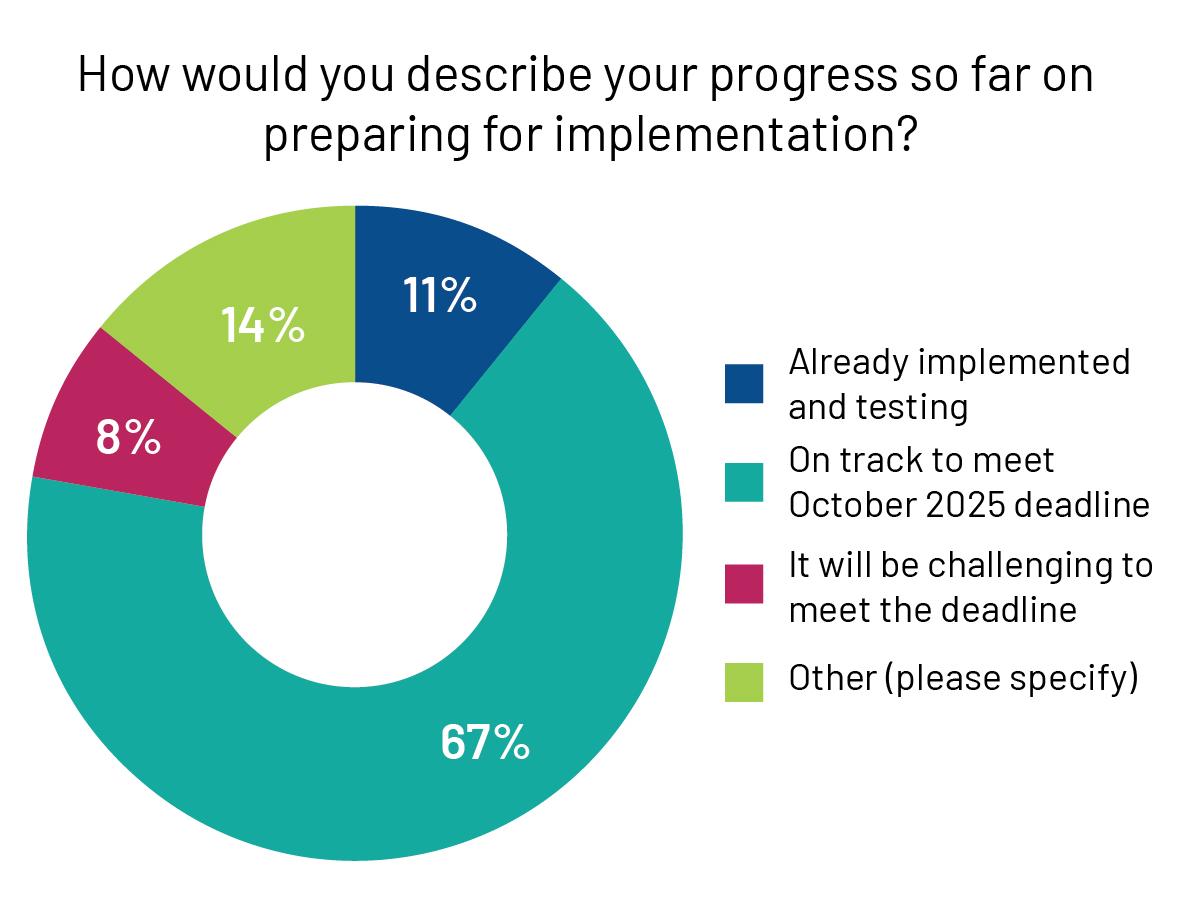
Two thirds of respondents in our survey were on track to
meet the 2025 deadline, while less than 10% reported that they would struggle to meet it. Problems remain, however. Among the difficulties are:
• Data systems, especially systems that connect across the organisation
• Resources are limited
• Staffing, particularly lack of qualified technical people such as surveyors
• Gaining access to survey or complete repairs (and see our linked report on this topic)
• Some aspects of the new law and guidance are unclear
• Achieving culture change across the organisation may be challenging
• Challenges around moving people out and finding suitable accommodation quickly.

On governance, we found organisations setting up specific reporting systems for Awaab’s Law compliance. This includes upward reporting and escalation to governing body level, complete with metrics and KPIs. Reporting to senior staff, governing bodies and in some cases tenant panels is designed to embed reporting into the existing structures of responsibility. Some organisations specifically mentioned integrating Awaab’s Law data reporting into existing systems on risk, damp and mould and health and safety.
Responding quickly and accurately to the first report of a potential hazard under Awaab’s Law was seen as crucial. Providers were upskilling call centre staff and encouraging residents to use photos/video to enable accurate assessment. In our research, around two thirds of tenants said they were willing to do this. Triage arrangements were in place at the majority of organisations.
Many organisations reported, however, that they were struggling to recruit enough trained specialists, such as building surveyors or contractors with HHSRS experience, who could establish the severity of cases.
Ensuring compliance across a local authority was seen as a major challenge. Most organisations had reviewed their policies and most were trying to bring together housing management, asset management and other teams for seamless working – something that’s long been both a goal and a challenge.
However, the complexities multiply with other council departments. All staff who might visit tenants need to be made aware of Awaab’s Law requirements, so they can help with spotting problems and potentially supporting housing staff to gain access to the homes of tenants with particular needs. These staff and local councillors also need to know where to report any issues and to do so promptly.
Measures taken specifically to meet the new Awaab’s Law duties included:
• Staff training – eg, on HHSRS and vulnerability
• Drawing in other departments and alerting their staff to the new requirements
• Toolbox talks
• Triage arrangements – using the existing call centre or a newly formed centralised team
• More use of photos and video
• Damp and mould first aid kits made available to clean small areas
• Summary proformas
• Summary emailed (where possible) or given to tenant whilst surveyor still on site
• Ability for surveyor to book appointments to complete the work while at the tenant’s home – allows mutually convenient appointments.
Our study suggests that providers are striving to bring about a culture of respect for residents and that many are investing in training to support an approach and behaviours that foster trust. We found a distinct shift toward an approach that’s based more in understanding individual residents’ needs and wishes. This was mainly around building relationships with people who are known to have a vulnerability or who have come to the provider’s attention
for a particular reason, such as complaints or not allowing access.
Most are using all their normal channels – tenant newsletters, leaflets, social media, rent accounts, etc – to alert and inform residents about Awaab’s Law. About two thirds of survey respondents had a full communications strategy. Some are taking the opportunity to do widespread consultation with residents, which can both inform them and seek their views. Some have involved resident scrutiny panels or resident groups to share progress and garner ideas. Some were engaging with tenants to develop plain English summaries of communications and advice.
Providers are moving toward a recognition that they must offer highly responsive systems that work for tenants, coupled with empathy and personal service. There’s a new willingness to seek views from residents who may not have previously reported problems, especially with DMC. Similarly, organisations were no longer assuming that problems were resolved if there was no further report: some are actively returning to ask tenants what’s happened since.
Technology was seen as crucial to delivering results, but also a key factor in problems with meeting the new demands. Many are struggling to integrate information technology (IT) systems across the whole organisation and to share appropriately with contractors. There are problems in keeping data on resident vulnerabilities up to date and appropriately shared. There were many calls for a dedicated IT system for reporting, tracking and monitoring both individual cases and the organisation’s overall compliance.
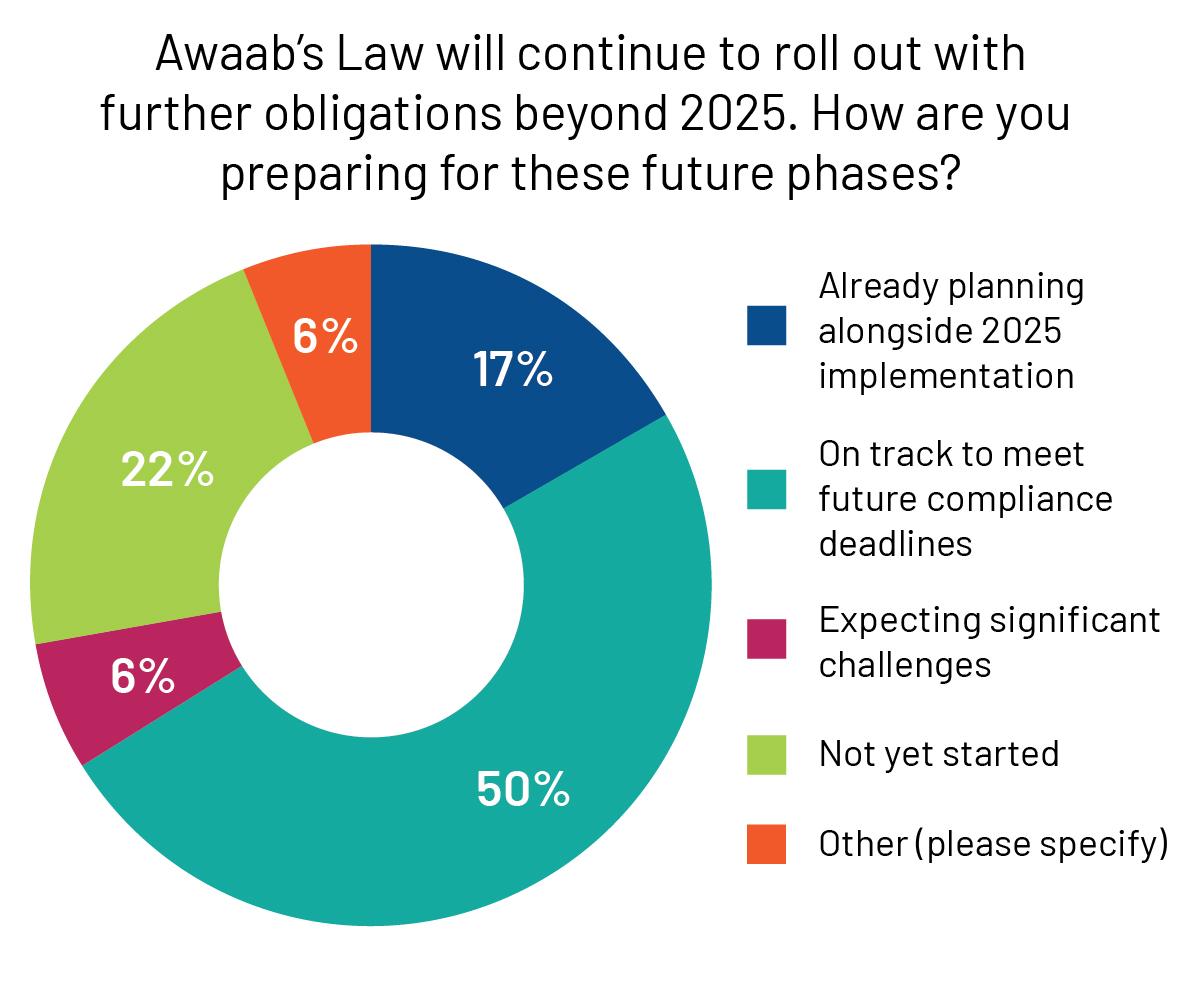
Quite a number of providers have made the link between Awaab’s Law compliance, stock condition and customer satisfaction for the longer term. Some are using the first year of implementation to embed new policies and practice, so that they will be better prepared for the next phases.
Some organisations noted the lack of clarity on aspects of the detail in the government’s draft guidance, particularly over the maximum timeframes, the meaning of certain terms and any exemptions. Two terms in particular with interpretable meaning were cited: ‘emergency’ versus ‘significant’ and ‘all best endeavours’. Participants felt that this added to an already complex and sometimes unclear legal framework.
There’s considerable uncertainty simply because the legislation is new and untested. Organisations had many concerns about a potential rise in disrepair cases and ‘claims farming’. However, some had taken positive action to deal with complaints and disrepair claims quickly and thoroughly, with new protocols and timescales1. Data recording was seen as crucial.
There was no hint of outdated attitudes around residents and ‘lifestyle’ in relation to DMC. Instead there’s a widespread concern that residents’ circumstances can exacerbate complex problems. There’s sensitivity around this, of course, but especially with damp, mould and condensation issues, providers report that people are suffering through the cost-of-living crisis, cannot afford to
turn their heating on or want to keep the windows shut to conserve warmth. Others are having to live in overcrowded conditions above the design tolerance of the building, that can worsen humidity.
A number of organisations are offering support to residents, as part of a general shift towards being more empathetic and responsive. Some are trialling damp and mould or environmental sensors to help pick up problems earlier. Some are fitting ventilators and dehumidifiers. Most are signposting residents to help with maximising finance and meeting bills.
There were particular concerns around finding suitable alternative accommodation when needed, within Awaab’s Law timeframes. A few organisations planned to hold properties vacant, but given extreme demand pressures, this was likely to be difficult, especially for smaller organisations. Finding accommodation in the private rented sector at short notice could also be difficult.
Future challenges mentioned most frequently are:
• Timeframes
• Integration
• Legal and access
• Resources including specialists, contractors, admin capacity, staff knowledge
• Concerns over disrepair claims, no win no fee claims firms
• Challenges over moving people out at short notice.
Many participants in the study felt more could be done at government level to facilitate the transition to full implementation of Awaab’s Law. There were repeated calls for clarity on legal action with a clear route to gaining access, action on claims firms, increased funding and capacity, and new IT systems.
1 Birketts solicitors have produced a useful set of flow charts to help providers stay legally compliant in responding to Awaab’s Law
A rise in reports of damp, mould and condensation (DMC) two years ago led Stoke-on-Trent City Council to take action with a public campaign. The ‘zero tolerance’ initiative encouraged tenants to report DMC problems, stressing the danger to their health. People reporting issues were visited, given advice and any necessary works completed.
That work has put the council in a good position of readiness for Awaab’s Law implementation. The department had already geared up, employing surveyors trained in HHSRS requirements and other appropriate tradespeople.
Next, a task force began overseeing work on Awaab’s Law and tracking response and compliance during the implementation phase. As part of this, it led a full end-toend run through of its systems with role play for staff. The test included a range of scenarios – mostly around DMC, but also other HHSRS hazards. It allowed ‘fine tuning’: while
managers are confident they have the big picture in hand, refinements are always possible.
The department brought its repairs service fully inhouse as part of a culture shift to putting the housing officer at the centre of relationships with the tenant, with the repairs service working in support. Patch officers directly manage the process of moving people temporarily or where access becomes difficult, also working with social services and other council teams where needed, to ensure the service is built around the tenant.
Every tenant is called at least once a year, to build relationships and find out if they are having any problems they haven’t reported. As a unitary authority, Stoke Council has been able to run education across other departments, so that any officer visiting a tenant knows they can report anything amiss and who to contact. The Awaab’s Law timeframes can make this challenging – so it’s been
important to alert staff about the need for fast reporting.
The mantra in the department is ‘evidence, evidence, evidence’. Whatever the situation, it’s essential to have the data, photos, logs and all other details to hand, organised and dated, both to ensure nothing is missed and in case of challenge.
The council admits IT systems can be problematic. The department is anticipating a large scale upgrade, as software firms create new bespoke systems. The aim will be to embed ‘one version of the truth’ – consistent and reliable data across the organisation.
Good-quality data is, of course, essential in cases
where the organisation hasn’t been able to gain access to a tenant’s home. Recently letters to tenants about access have included a clause on recharges. These warn that where DMC has spread and caused damage, that could’ve been tackled sooner if access was allowed, the tenant may be charged for the extra cost of remedial works.
For the longer term, the council believes government support for stock investment will be essential. Much of the council stock is outdated and there are problematic tower blocks too. Rent convergence will bring in a little more funding but fundamental problems remain and requirements are set to increase.
Gaining access for safety checks, repairs, improvements and tenancy audits is part of the routine work of social housing providers. But there’s increasing concern about cases where access hasn’t been possible. These cases are highly problematic because they involve risk: the tenant could be in danger; their neighbours could also be at risk; the provider has legal and regulatory obligations to meet; and the cost of failed visits is very high. The risk of programme slippage is also significant.
The Association of Safety and Compliance Professionals’ (ASCP) White Paper estimates that in social renting, the cost of failed access attempts for gas servicing alone is £49-£65m a year. It believes the total cost of failed access for all reasons could reach £1bn over the next decade. That’s despite the great majority of tenants complying with landlord requests.
Our research report Opening the door: Changes to support necessary access to social tenants’ homes found that only about 40% of organisations in our survey had adopted a formal definition of ‘no access’. The most cited definition was that a case would be recorded as ‘no access’ after three attempts to gain access had failed. Most said these would be pre-booked attempts in writing (pre-arrangement is necessary to substantiate legal action). Some made calls or sent messages in addition to this.
Most organisations (about four in five) did have a policy and procedure for dealing with ‘no access’ cases, or were developing one. Quite a number of landlords have either set up a specialist team to focus on complex cases, or have developed the capacity of local housing officers to deal with these cases (including, for example, by reducing patch sizes).
The organisational changes reflect a change of culture underway in the sector. Many providers have recognised that they need to get to the bottom of why a tenant might not, or might not be able to, allow access. Then they can tailor the service accordingly, giving an increased chance of a successful outcome. We found that those reporting some success had commonalities that we summarise here.
A focus on modern, effective services
A number of organisations examined their own
performance, especially around appointments, and found problems:
• Appointment slots for too long a time period (all day/half day)
• Technology that made it easy to book an appointment, but not for the tenant to change or cancel
• Lack of automated reminders
• ‘Visit fatigue’: too many appointments
• Staff not knocking loudly enough or taking enough steps to make their presence known.
Tenants at a meeting for our research also reported problems:
• Failures of the landlord in organising visits – too little notice, difficult to rebook, contractors fail to attend or attend unannounced
• Too many single purpose visits
• Threatening legalistic letters from the landlord after one failed visit
• Little attention to people with disabilities, language issues, hearing impediments, etc
• People attending with no identity badges.
The remedies, therefore, could amount to making the best of technology to create more streamlined services coupled with effective communications.
• Where access is only needed for a short time (eg, 15 minutes) very short appointment slots could be offered
• Operatives should be able to give texted updates on their arrival in similar ways to delivery firms. An ALMO said one of its major contractors has an online tracking system that customers can use to see when the operative is likely to arrive.
There was a growing awareness that tenants may be asked to allow access too many times, by different teams (which is only likely to grow as new legislation comes into force). Providers were trying to streamline visits, including for a single ‘home safety check’ each year. The logistics of this were proving difficult for some and there was a recognition that ‘silo working’ needed to be overcome. There are budget implications. It also requires flexibility and careful planning.
Some participants mentioned a ‘make every visit count’ approach where operatives going into a home for any reason would be asked to look out for damp or other repair issues. Some had set up easy reporting systems for operatives to feed back information. Longstanding problems of contractors working smoothly with the housing service remained but providers were paying attention to this.
In support of this type of approach, IT that works smoothly across the organisation and possibly with external contractors as well was important but difficult to achieve. This was acknowledged as an area of weakness that requires ongoing focus.
The importance of involving and asking residents was highlighted by the insights and improvements some organisations had gained as a result. One said the repairs focus group had helped shape the wording on cards put through doors. Another asked residents to comment on all of its access letters and had made adjustments. One organisation had gained insights from listening to a tenant directly affected by ‘no access’.
A focus on complex and persistent cases
Here again we found evidence of culture change underway. Many organisations were asking housing and specialist officers to try to form an empathetic relationship with tenants. Crucially, this would involve listening to the tenant’s concerns, taking them seriously and negotiating for operatives to be allowed access.
Some reasons for not gaining access, and potential remedies, included:
• Some residents have no phone or calendar to record a scheduled visit. Multiple reminders, including a local officer calling the day before if wanted, can help
• Some residents may not be able to predict whether they or their family will be well enough to accept a future visit. Others may have a complexity of health and/or social services appointments that they understandably prioritise. Some organisations try to make it easier for the tenant to change their appointment, even at short notice
• Anecdotally many providers report more cases of hoarding behaviour, partly through increased surveys and campaigns encouraging people with problems to come forward. Providers that have successfully built personal relationships with tenants report some success in supporting people to allow access, within a wider empathetic approach that treats hoarding as a mental health issue requiring multi-disciplinary and traumainformed support
• Housing organisations and local authorities must work within the Domestic Abuse Act 2021 and providers must comply with the RSH Neighbourhood and Community Standard requirements on domestic abuse. Some organisations have responded to sensitivities of this type by asking the tenant what arrangements they would find appropriate
• In a smaller number of cases, there’s criminal activity at the property (drugs, illegal sub-letting, etc), the tenant has undertaken unauthorised DIY or the home has been abandoned. Organisations should also be alert
to possible ‘cuckooing’ of a vulnerable tenant (where someone takes control of a person’s home and uses it for criminal purposes).
There was acute awareness that legal remedies should be a last resort when all other attempts to gain access have failed. Legal action is highly resource intensive and therefore costly. It carries risk: the outcome is not guaranteed. So, providers
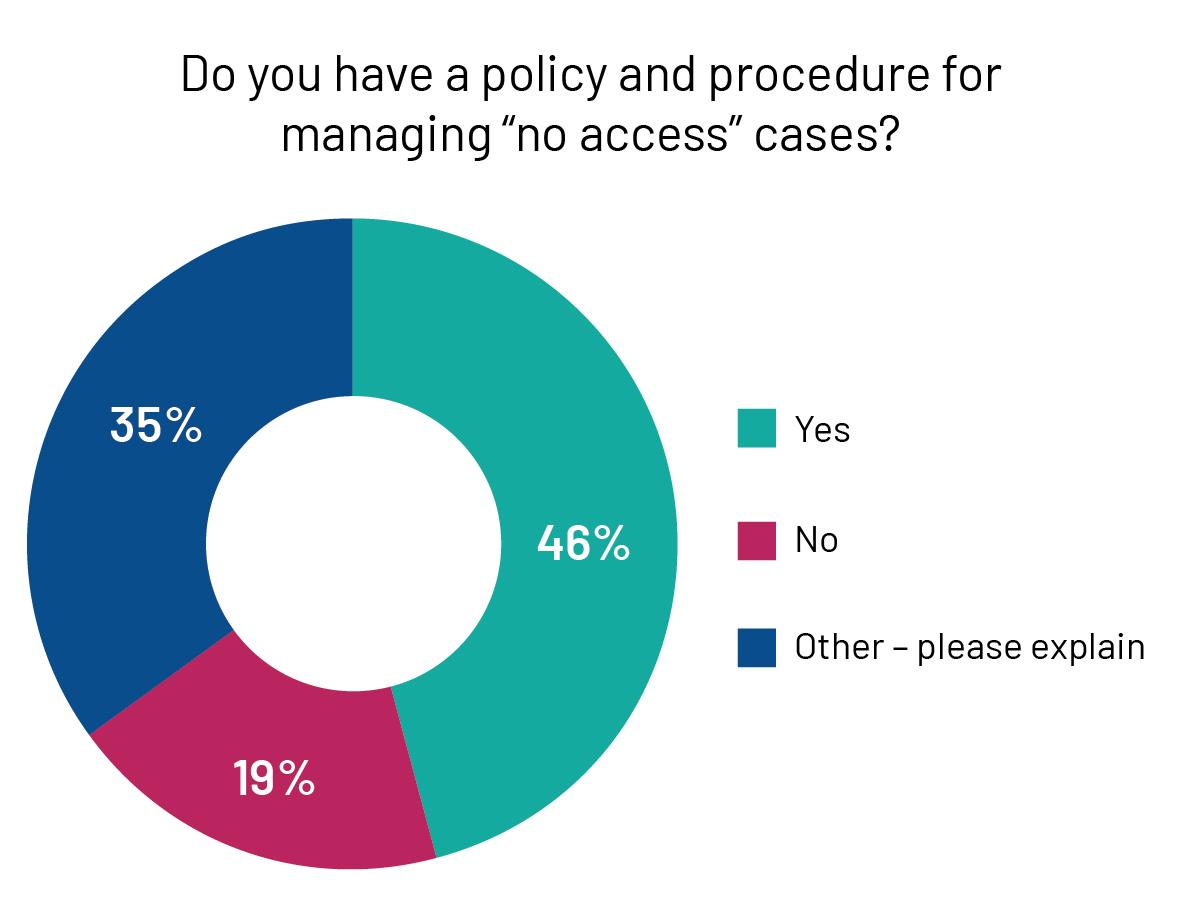
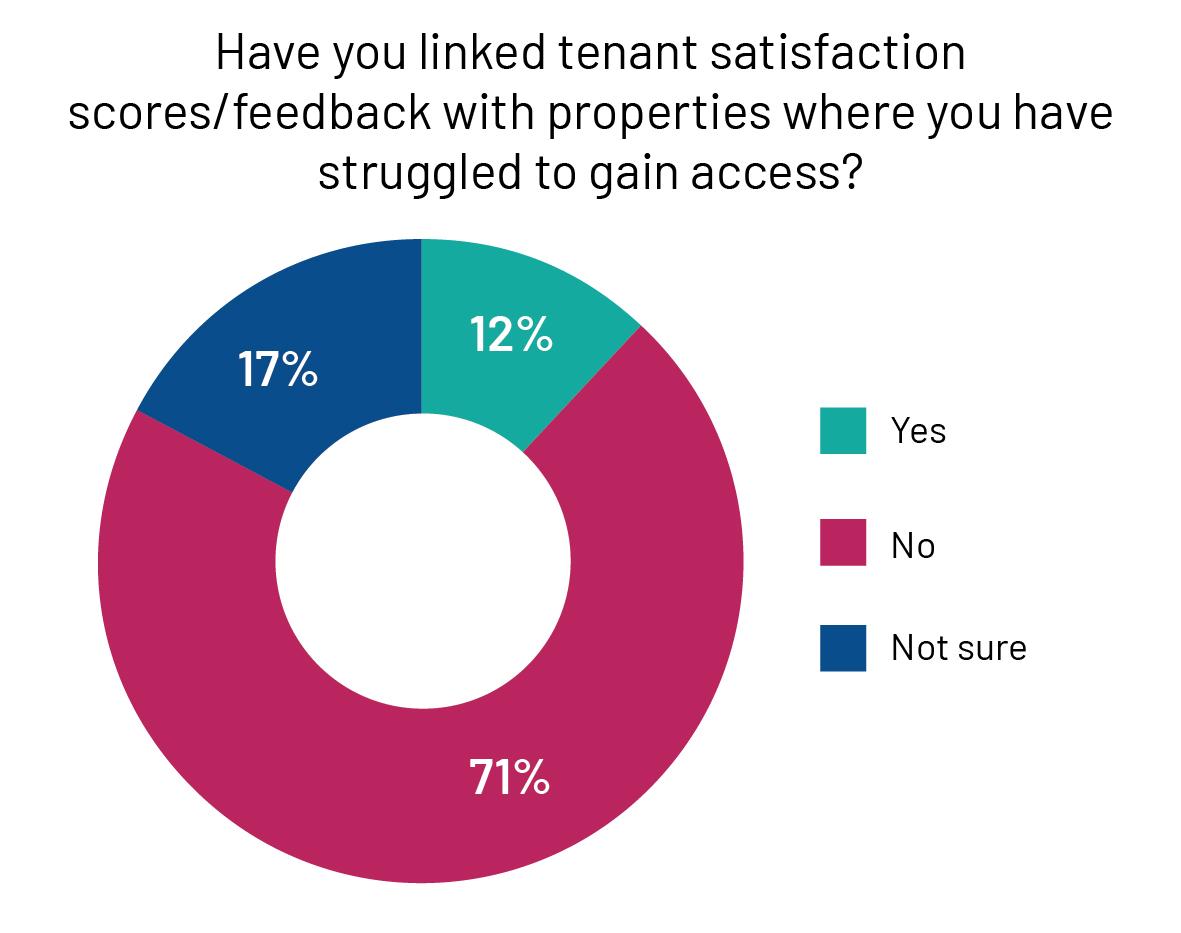
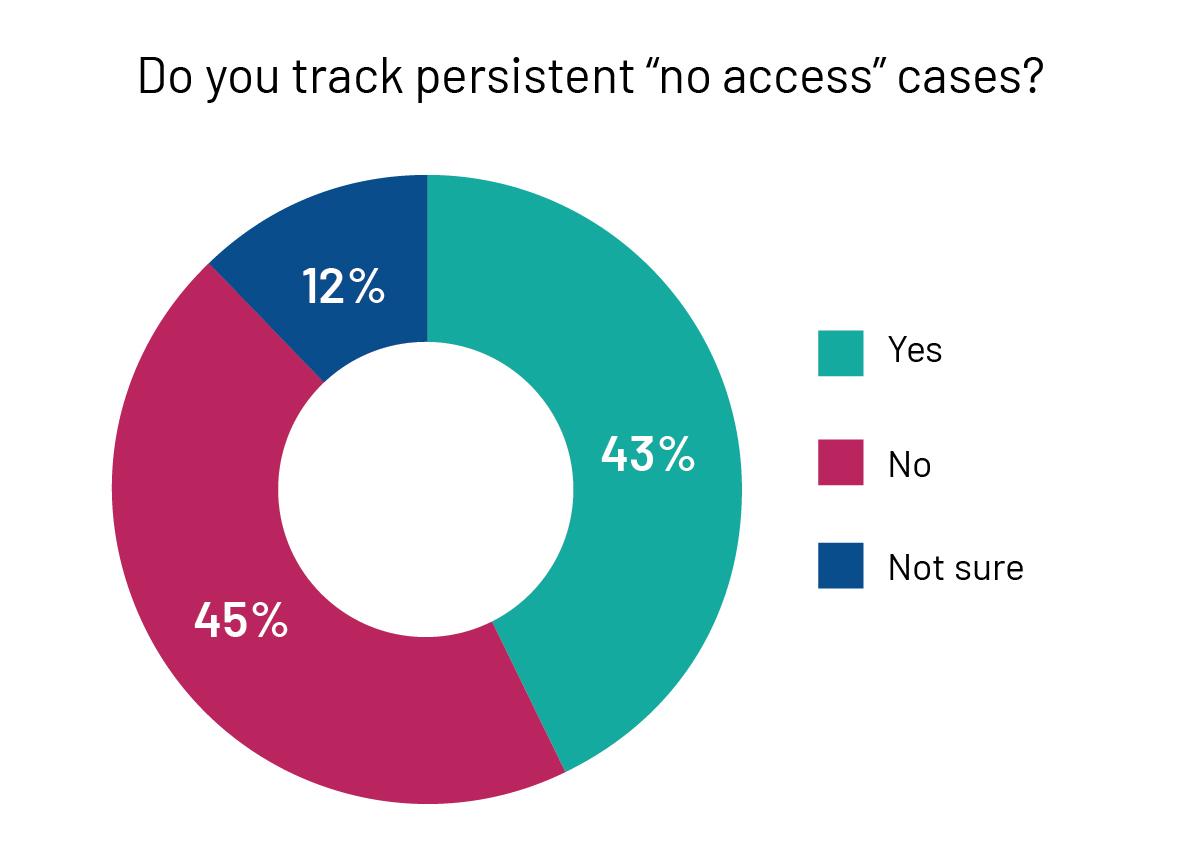
are doing all they can to minimise the number of cases and most take action on legal or regulatory requirements only. They must keep careful and comprehensive records, including photos/video where needed, to ensure they can evidence every action.
A large majority in our research wanted a clearer and more straightforward route to gaining access. They wanted a fasttrack legal process for access on safety critical issues, and a public campaign by government to stress the importance of allowing access.
Our report includes 16 recommendations for providers to improve rates of necessary access to tenants’ homes. They include:
• Create a culture of support and empathy toward tenants that seeks to understand individual circumstances
• Adopt a definition of and term for ‘no access’ that’s blame-free in tone, that residents, staff and contractors alike can work to
• Create policies and procedures derived from the definition. Monitor their use in practice
• Test out and refine approaches by involving tenants at an early stage. Reflect on the reasons for failed visits and in particular any areas in systems or processes that may be causing or exacerbating the problems
• Be clear with tenants about their responsibilities to grant access and the consequences of not doing so
• Use all available technology to create a modern, fit for purpose system for booking, changing and cancelling appointments.
St Leger Homes manages around 20,000 council homes on behalf of Doncaster Council.
The first stage of the ALMO’s work around ‘no access’ has been to develop a better evidence base around the barriers to access. The organisation has set up an access team consisting of a team leader and three officers based in the tenancy support team. This was a conscious decision to focus the intervention on building a relationship with the tenant. The team picks up cases after the third failed attempt.
Coming at ‘no access’ from a supportive point of view allows the team to focus on other ‘hooks’ for the landlord and tenant to develop a relationship; linking it to help with finances, benefits, writing a CV or finding work, helping with energy bills and support around language barriers, hoarding, etc. It recognises that there’s often something else going on behind the failed attempts to access, with many tenants living in increasingly complex circumstances.
The access team takes a global look at the tenancy to identify any barriers and where they might be able to offer support. They also look at who else from the organisation is involved with the tenants and whether they can coordinate visits. Sometimes tenants are anxious about letting the landlord in (for example, because of fear of losing their tenancy or issues with hoarding), so a supportive approach can encourage the tenant to permit access in future.
Alongside this, the organisation is looking at communications from contractors to make it clear they are working for St Leger Homes and updating letters so that tenants know which company will visit. They’ve also looked at terminology within letters to make it very clear what the visit relates to and minimise the ambiguity around phrases such as ‘stock condition survey’.
St Leger Homes is triangulating the information it holds: for example, do other teams have any knowledge about the tenancy, have they had a ‘keeping in touch’ visit recently? This information will identify and help prioritise those properties of real concern. The increasing number of
compliance visits is also driving work around scheduling and combining visits to minimise disruption.
Taking enforcement action is seen as a last resort. However, St Leger Homes has strengthened the tenancy agreement to make it more explicit about the tenant responsibilities around access for compliance checks and safety, carefully balancing this with the tenant’s right to a peaceful home. It recognises the line between cases where the landlord needs to push for access and where the tenant can choose to not let the landlord in.

Evidence editor: Dr Janis Bright
www.hqnetwork.co.uk
email: evidence@hqnetwork.co.uk


In the latest in our Housing in Practice series, Neil Merrick reports on a local authority that places design at the heart of its housebuilding programme.
tenant’s story
When Glenda moved into her new council home about two years ago, she vowed that she would stay there for the rest of her life.
“It’s so spacious inside and so peaceful around here,” says Glenda, one of seven council tenants in Chowdhury Walk, a multi-award winning development of just 11 homes near Hackney Marshes in east London.
Having moved from a street just a short walk away, she’s particularly impressed by the community spirit. “If it was a bigger estate it wouldn’t be so inviting,” she adds.
Since being completed in late 2022, Chowdhury Walk has won or been shortlisted for a range of awards, recognising its innovative design and the comfort it provides for residents. The other four properties in the terraced street were quickly snapped up by private owners.
Part of its appeal stems from the fact the homes sit at an angle, avoiding the feel of a monolithic block. “I assumed the plans would be scaled back,” says Karen, who lives in a neighbouring street. “I was really happy that it was true to the plan.”
What’s so special about Chowdhury Walk?
Chowdhury Walk was built by Hackney Council in a quiet cul-de-sac that was once the site of lock-up garages.
The development is named after Abdul Mabud Chowdhury, a consultant urological surgeon who worked at nearby Homerton Hospital but died of Covid in April 2020 at the start of the pandemic.
Built from low-carbon cross laminated timber and clad in brick on the outside, the homes are well insulated with triple-glazed windows. Solar heating and their location in relation to the predominant wind also keep energy bills down, while reducing over-heating during the summer.
A new pathway in front of the homes may be used by the public as well as residents. “It’s a healthy environment to live in,” says Ken Rorrison, head of Hackney Council’s eightstrong regeneration strategic design team. “We’re using less toxic materials and they are attractive houses to look at.”
The fact the homes are ‘twisted’ and face the
“With more than 8,500 households on the housing waiting list, it’s important Hackney builds wherever it can”
pathway and wider area at an angle also helps to protect the privacy of neighbouring properties. The front bedroom in each home overhangs the ground floor, creating an outside porch area. “It was a tricky site to develop,” explains Rorrison. “It’s backed by other homes and wasn’t accessible as such.”
Since Hackney Council began building homes again more than a decade ago, it has sought to ensure they are of a high quality.
To some extent, says Ken Rorrison, they are all special in the sense they meet the same design standards. “We follow the same aspiration in all our work,” he adds.
The council not only employs leading designers but allows them to get on with their work. “We try not to be prescriptive,” says Rorrison. “It’s just as important what the building does as what it looks like. Chowdhury Walk introduced a new route to the neighbourhood. It’s very gratifying to see school kids and other people using it day to day.”
Chowdhury Walk was designed by architects Al-Jawad Pike. “We knew whatever we put here was going to have to be modest in scale,” says founding partner Jessam Al-Jawad. “Twisting the houses broke up what would otherwise have

been a long block of repetitive windows and doors.”
Richard Heath, director at structural engineers Momentum, says the ‘twist’ not only adds character to the terrace but means that most homes receive light from two directions. “It creates a corner that means you can get light coming in from the side elevations,” he explains.
The location of windows also increases security, with residents able to survey the neighbourhood from their homes. According to Heath, other London councils are looking for this type of innovation when commissioning homes, though nationally these represent the exception rather than the rule.
In many cases it’s a question of making the best use of small infill sites. Momentum is currently working with Hackney on five other schemes involving land that used to be the location of garages.
While most local authorities only started building again towards the end of the last decade, Hackney moved faster and therefore found it a little easier to recruit people with the required skills. “We slightly stole a march on others,” adds Ken Rorrison.
Initially, the design team focussed on estate regeneration, but attention has now switched to smaller-scale schemes on infill sites across the borough. “The principle of placing design at the centre of things was established early on,” he says. “We’re the professional voice with the ability to critique and review.”
How can Hackney afford schemes such as Chowdhury Walk?
Hackney owns more than 30,000 council homes. Since 2011 it’s built or supported housing associations to complete 4,100 homes, including Chowdhury Walk. A further 972 homes for social rent are in the process of being built, part of a target of 1,000 new social rented homes set by the council four years ago.
Money comes from the Mayor of London’s affordable homes programme, and cross subsidised from the sale of four of the homes in the terrace.
The council works to the same ‘standard build cost’ for all developments, says Ken Rorrison. By adopting a portfolio approach, the cost of projects with fewer homes (such as Chowdhury Walk) can partly be covered by larger developments.
With more than 8,500 households on the housing waiting list, it’s important Hackney builds wherever it can. About 30 developments are ongoing, including one for just nine houses.
“Some sites are more expensive than others,” says Rorrison. “Things have to stack up across the whole programme but the portfolio approach allows us to bring in less viable sites.”
Do schemes such as Chowdhury Walk represent the future of social housing?
It would be nice to think so. Since 2024, the development has been shortlisted for the Royal Institute of British Architects (RIBA) Stirling Prize and won both the Neave Brown Award for Housing and the Wood Awards, which celebrate timber design.
It was also among the winners at Hackney Council’s 2024 design awards, which take place every two years.
According to Ken Rorrison, councils shouldn’t only be trying to bring down waiting lists but providing homes that people are proud to live in, showing social landlords can outshine the private sector when it comes to design and construction.
An attractive, comfortable, low-carbon home brings pride to more than just residents. “Architecturally, you need to respond to the neighbourhood,” he says. “When you finish, the neighbourhood should be better than it was before.”


Stronger skills, stronger services, better outcomes.
HQN’s Sky’s the limit in 2026 programme is a focused run of training across February and March to help you get ahead of new regulation, step up on safety and complaints, and support teams to perform at their best.
February focuses on the fundamentals of safe, decent homes and sustainable income – the bedrock of every successful landlord.
March is about joining the dots between consumer standards, complaints, customer experience and culture.
From frontline housing management to asset compliance, complaints, income and leadership, our expert-led sessions are designed to turn regulation into real-world practice – so you can deliver better outcomes for residents, regulators and your organisation.
Visit hqnetwork.co.uk/the-skys-the-limit-in-2026 to find out more
All of our training comes with professional development hours and a certificate.

Fay Yeomans looks at how East Riding of Yorkshire Council is overcoming political and economic obstacles to ramp up the delivery of new homes.
Over the past seven years, East Riding of Yorkshire Council has been rethinking how it delivers affordable homes across one of England’s largest unitary authorities.
Covering around 950 square miles, much of it rural, the council has had to navigate changes to national policy, rising costs and shifting political priorities. The story is one not just of building houses, but also of dealing with land shortages and finding new ways to serve existing and future tenants. What emerges is a picture of a landlord balancing ambition, realism and long-term planning as it works to provide highquality, sustainable homes for its communities.
Between 2019 and 2025, the council added 570 homes to its housing revenue account (HRA) through a mix of newbuilds and acquisitions. Yet overall numbers still fell, with total rented stock down by 29 properties.
The biggest pressure has come from the right to buy, which accounted for 465 sales during this period. A further 159 homes left the HRA as part of a major modernisation programme for sheltered housing schemes in Hornsea, Anlaby, Driffield and Bridlington. These properties are
being demolished and rebuilt, or undergoing major refurbishment, as part of a 10-year investment plan.
Across these schemes, the council aims to create fit for purpose, more desirable homes that better meet the needs of older and vulnerable residents. In the long term, the ambition is clear: to provide accessible homes that not only improve quality of life but also reduce pressure on adult social care and the NHS.
From ‘Target 1,000’ to a flexible housing delivery programme
In 2021, the council unveiled an ambitious headline goal of 1,000 additional affordable homes by 2026. But, with Covid-19 disrupting supply chains, no pipeline in place at the time and construction costs rising sharply, the target quickly proved unrealistic.

As reality set in the council made a strategic decision, rebranding the programme from ‘Target 1,000’ to simply calling it ‘Council Housing Delivery’, removing rigid deadlines and creating space for a more pragmatic, longterm approach to investment and development.
Since launching its Affordable Homes Programme (2021–2026), the council has delivered 385 new homes, sourced through a diverse mix of routes:
• 45 acquisition and works purchases
• 91 off-the-shelf acquisitions from private developers
• 75 council-led new builds
• 174 Section 106 purchases.
Two council-led schemes were completed in 2024–25, providing 16 rented properties in Withernsea and four more in Beverley.
Looking ahead, 127 new homes, identified for delivery this financial year, are at various stages from fully purchased to early-stage business plan approval.
The search for land: A constant challenge
Finding viable land remains one of the most significant barriers to delivery. Over the last four years, the council has assessed more than 100 sites that ultimately proved unviable. Had they progressed they could have delivered more than 1,000 homes.
The challenges will be familiar to local authorities across the country:
• Limited supply of developable HRA land
• Poor ground conditions and high remediation costs
• High land values for privately owned sites
• Competition from housing associations for Section 106 and off-the-shelf homes
• Limited contractor availability for small council-led projects.
Despite these hurdles, the council continues to explore opportunities with developers and to assess land proactively to maintain a future pipeline.
East Riding’s decision to introduce shared ownership in 2018 marked a significant step in broadening access to homeownership in a challenging market. Alongside its 11,275 rented properties, the council now manages 137 shared ownership homes, with shares sold between 10% and 75%.
This choice has proved sound, despite initial problems. Its first scheme for 10 homes in South Cave, developed with Homes England funding, faced early opposition. However, after strong engagement from the Rural Housing Enabler, the parish council got behind the scheme. Properties sold quickly, demonstrating the demand for low-cost homeownership.
Importantly, introducing shared ownership allowed the council to compete for Section 106 homes previously only being offered to housing associations, because developers preferred selling both rented and low-cost properties to a single provider. This mixed tenure approach on council-
“Changes in national housing policy, particularly the shift from ‘affordable’ to ‘social’ rent for most new developments, have affected scheme viability.
To bridge income gaps, the council uses its flexibility to increase social rents by 5-10%
on new builds”
led developments has also brought forward sites that otherwise would have been unviable, by using shared ownership receipts to cross-subsidise rented homes.
One of East Riding’s most noteworthy moments came in 2020, when it acquired 145 affordable homes from Your Housing Group. Believed to be one of the largest stock transfers from a housing association to a local authority at the time, the move brought in properties that were previously overseen from the northwest.
With more than 11,500 tenants and leaseholders already in its care, the council was well placed to bring these homes under local management. For residents, the benefit was straightforward: a landlord with a strong local presence and established repairs and management networks.
Like all social landlords, the council has weathered immense financial pressure in recent years. Construction inflation, higher energy costs, rising interest rates and a postpandemic repairs backlog all affected its ability to deliver.
Some schemes were paused or cancelled; budgets had to be rebalanced. Even so, investment in existing stock increased to maintain the Decent Homes Standard. Internal procedures were strengthened in readiness for the 2025 implementation of Awaab’s Law.
At the same time, changes in national housing policy, particularly the shift from ‘affordable’ to ‘social’ rent for most new developments, have affected scheme viability. To bridge income gaps, the council uses its flexibility to increase social rents by 5-10% on new builds.
At the same time, grant funding can be difficult to secure. Schemes that once required 30% grant support to be viable often now need closer to 50% but typical allocations still hover around 30%.
East Riding also continues to manage the long-term legacy of the 2012 self-financing settlement, when £208m was borrowed to buy out of the centralised subsidy system. Of this, £31.5m has already been repaid, with the next instalment due in 2027.
A turning point: £39 billion and right to buy reform
The 2024 spending review marked a major shift in national housing policy. The announcement of £39 billion for new
affordable housing and the introduction of a 10-year rent settlement provides some rare long-term stability for social housing providers.
Crucially, it also reformed the right to buy. From November 2024, discounts to tenants were cut back to pre-2012 levels, falling from £102,400 to a regional cap of £24,000. After a brief spike in RTB applications before the deadline, the council expects sales to fall to around 30 a year.
East Riding was among more than 100 other local authorities that lobbied for reforms through the ‘Securing the Future of Council Housing’ campaign.
Building the pipeline: 1,547 more homes by 2034
Looking ahead, East Riding aims to deliver 1,547 additional homes between 2025-26 and 2033-34. This longterm pipeline depends on viability, grant funding and partnerships. Ridings Homes, the council’s housing delivery company, is expected to play a key role in unlocking smaller or more complex infill sites.
A major scheme, currently progressing through RIBA Stage 3 design work, will bring around 150 new affordable homes to Bridlington, built in phases with completion expected in 2028-2029. These include accessible bungalows and a mix of flats and houses, with almost a third being for shared ownership.
Four homes in Beverley have already been built to the Future Homes Standard with a fabric-first approach. Another 87 energy efficient properties are in the pipeline for the East Riding over the next two years incorporating:
• Air-source heat pumps
• Triple glazing
• Solar panels
• EV charging points
• Water-efficient systems.
These measures mark a significant step towards the council’s carbon-reduction ambitions.
Unlocking sites through strategic partnerships
Partnership working is increasingly essential to delivery. The council is working with developers to unlock larger sites where multiple providers will deliver different types of homes, from general needs housing to extra-care and accessible, one-level living for older people.
Collaboration has also deepened with the new Hull and East Yorkshire Combined Authority (HEYCA) which aims to create a robust pipeline of development opportunities for both market and affordable housing. Working together the partners hope to:
• Unlock deliverable residential sites
• Increase overall housing delivery
• Scale up affordable housing provision
• Attract more private developers and bring investment to the area
• Support growth and regeneration priorities.
More than £1.2 million in coastal and brownfield funding has already been secured, supporting 104 new affordable homes currently under construction in East Yorkshire.
Given the council’s predominantly rural geography, supporting smaller communities remains a priority. East Riding continues to champion rural housing delivery via a Defra-funded partnership with North Lincolnshire Council. This has allowed the continuation of the post of Rural Housing Enabler, an important role that helps ensure that small, rural areas, where local people can be forced to move away due to the lack of affordable housing, aren’t left behind.


By Richard Blakeway, the Housing Ombudsman
Compensation is an emotive topic. It’s also a cultural issue. When times are hard and budgets tight this can drive the wrong behaviours. It can result in residents expecting unrealistic redress for failings. Or organisations being reluctant to compensate. Compensation can also be hard to calculate. How do you monetise someone’s distress?
Most of our orders are non-financial and other remedies, like apologies, matter greatly. But getting compensation right could go a way towards restoring trust amongst residents and prevent complaints escalating to us.
But some landlords have some way to go on this. We’ve seen internal communication where a landlord acknowledges it should pay more compensation but offers less. Last year I heard at a public meeting how a resident had lost belongings because of failings the landlord accepted. But when presented with the receipts for new clothes, it apparently asked the resident why they hadn’t gone to a cheaper shop.
Such behaviours can derive from adopted practice. At least one landlord we encountered had taken a stance of not paying compensation. Another’s policy said it would compensate for incorrect service charges only from the point the resident complained, not from when it overcharged.
Central to compensation is fairness. There should be a single vision of fair compensation.
To help embed a fairer culture for compensation, we’ve updated our guidance. This is still based on these core principles:
• Recognition that compensation isn’t punitive but seeks to put the resident back in the position they would’ve been had the service failings not happened
• In righting those wrongs, compensation ought to distinguish between loss of service and impact. This means accounting for distress and inconvenience, time and trouble, as well as transactional costs
• Impact requires recognition of individual circumstances, both aggravating factors, such as physical or mental needs or the
presence of children. This could increase compensation. Mitigating factors which could reduce it, such as unreasonably refusing access to the property, should also be considered
• These differences mean caution should be exercised when comparing cases
• Nor is compensation always the most appropriate remedy; an apology, repair or learning may be more effective.
Our updated guidance is another step towards a ‘compensation calculator’ to foster a shared understanding both within the sector and with us. It’s also another step towards the complaints procedure offering a genuine alternative to legal claims, with 100% of compensation going to the resident without the need for legal costs for either landlord or resident. I know many landlords have proactively sought to align their approach to redress with ours, which is positive.
Embedding this culture will see more complaints resolved locally, and earlier. We sometimes see compensation paid very late in the process. Inevitably, where opportunities are missed or time lapses taking action, compensation can increase.
This shift should also see us making more findings of ‘reasonable redress’, where landlords put right service failings. We’ve seen progress here and I’d like to see fewer cases where small additional payments are being awarded by us.
Every pound spent on compensating for service failings is unavailable for service improvements.
I know some landlords are concerned about a ‘compensation culture’.
Overall, we’ve seen little evidence of it in our casework. That 40% of our compensation in 2024-25 relates to leaks, damp and mould underscores the systemic failings in this area. This shows how important it is for landlords to improve complaint handling and proactively learn to prevent complaints and reduce compensation.
‘It’s easy to see housing as a merry-go-round of policy’

As Janis Bright calls it a day as HQN’s lead researcher, she reflects on some of the key housing moments over the past 40 years and the lessons that can be learned.
At the end of riotous film Burn After Reading a nonplussed CIA director asks: “What did we learn?” Of course, there’s no answer.
It feels that way in the housing world sometimes. About 40 years ago, most social housing was still owned by councils. The Conservative government had plans, though. Right to buy was already nibbling away, housing action trusts (HATs) and stock transfers were starting up. Soon housing associations, much in political favour, would be expected to leap into the City to finance their new-build programmes.
New Labour took power amid much relief. The IFS confirms that from 1997 to 2010 government tax and benefit policy was “highly progressive”, taking from richer households and benefitting poorer ones. Devolution allowed Scotland and Wales to make their own policy choices.
But back in 1997 any illusions about a change of tone in the housing sector were quickly dispelled. ‘Shopping incentives’ in the benefits system would help tenants make ‘choices’. Best value replaced compulsory competitive tendering. New social housing was in very short supply.
That’s not to say everything stayed the same. New Labour did place high value on standards, and quickly established that the bill for bringing all social housing up to scratch was enormous. This being the government of the third way, it was receptive to a new idea: arm’s length management
organisations. The hybrid would help drive up standards while avoiding the anger of councils faced with losing their stock. But there could only be so many of them. The pace of stock transfers quickened.
New Labour did finally get around to building more. But all too soon, austerity was the name of the game with the coalition and Conservative governments. Housing associations became the bad guys too, accused of building empires not communities. Today we’re back to pressing for more ‘affordable’ homes while the government target for any kind of new build seems very far off. Once again there are problems with standards – and once again a Labour government is bringing in inspection to try to improve things.
“Bicycling baronet Sir George Young did manage to build an unlikely rapport with tenants, in one case over shared Elvis Presley fandom. Less so Brandon Lewis, who steered the ill-judged 2016 Housing Act into law, forcing secretary of state James Brokenshire to disown the dafter measures two years later”
Back in the late 1980s when I first began reporting on housing, the Duke of Edinburgh inquiry was in full swing. It was by no means the first housing inquiry – in fact, this was part two of that same investigation – and it certainly wasn’t the last. One of its conclusions was especially striking: that social rents must rise to cover repair costs, mainly covered by housing benefit. The idea of rising welfare costs makes ministers of any description jumpy; deliberately raising them would be a bold move. So, before the ink was even dry on the report, trouble was brewing.
The Tories reported in 1996 that “The government continues to be concerned about the level of growth in HB expenditure...HB expenditure is forecast to rise to £12.03 billion in the next financial year”. More cuts were planned. And afraid of spooking the finance markets, New Labour pledged to stick to them.
By the early 2000s, the government was worrying again about HB costs. It brought in the local housing allowance (LHA) in the private rented sector, letting tenants who moved somewhere cheaper keep some of the difference. That was short lived though. As the IFS reported, “the cost of the policy greatly exceeded previous estimates”, capping came in and the incentive money ended.
Since then, we’ve had one initiative after another to limit housing-related welfare spending but according to UK Housing Review it remains pretty much the same as a percentage of all benefits spending. Imposing ever stronger limits has had visible consequences both for tenants, sometimes shunted hundreds of miles to cheaper areas, and for councils and providers trying to balance their books.
Memorable coups
Tenants have staged some memorable coups to upset the power balance with landlords and government. Walterton and Elgin residents’ dramatic use of new legislation to reject Tory flagship Westminster Council was surely the most audacious. On the Gipton estate in Leeds, tenants made their points forcefully in person to housing minister David Trippier when he tried to impose a HAT on them.
Ministers also felt the heat from Runcorn new town tenants whose homes were about to be flattened. The Southgate estate, designed by James Stirling, lasted only 20 years and residents wanted to see the back of it. But they had spent many hours planning for a new estate only to be told that wasn’t happening. This time the outrage prompted Merseyside Improved Houses to step in and rebuild. Today tenants regularly use social media to dob in their landlords for sometimes shocking failures.
Bicycling baronet Sir George Young did manage to build an unlikely rapport with tenants, in one case over shared Elvis Presley fandom. Less so Brandon Lewis, who steered

the ill-judged 2016 Housing Act into law, forcing secretary of state James Brokenshire to disown the dafter measures two years later. In the interval, the tragedy that changed everything had happened: Grenfell.
It’s easy to see housing as a merry-go-round of policy, with ministers climbing aboard only to drop off soon after looking queasy, and similar ideas coming into view then retreating. But since Grenfell we can’t do that. Some things we can – must – learn. The first is that regulation and law for safety are not ‘red tape’ to be cut and discarded like parcel wrapping. The second is that whether at national or hyperlocal level, someone will always try to game the system. So, the rules have to be enforced. And the third thing, so clear it hardly needs saying yet it’s fundamental, is that nothing in housing comes cheap. Quality matters and investment works.
HQN’s annual competition designed to showcase and celebrate the brightest young talent working in housing.

With this year’s competition launching in a few weeks, it’s never too early to get involved.
We’re looking for young housing professionals who:
• Show leadership potential
• Are passionate about delivering excellent service to residents
• Have a commitment to diversity, equality and inclusion
• Want to make improvements to the social housing sector
• Are ready to take the next step in their careers.
Nominations officially open in February but if you have someone in mind, let us know by emailing hqn@hqnetwork.co.uk.
Find out more about the competition at hqnetwork.co.uk/housings-next-generation.

Rob Gershon, Associate, HQN
Fresh from my ad-hoc, alphabetical Social Housing Advent Calendar and its critical friendship and quiet annoyance about Christmas at the end of last year, I find myself stood on the cusp of yet another ‘New’ Year. I’m not making any resolutions. It’s 2026 and I’m still wondering why people invest so much importance into some days on the calendar and not others.
Yet for the housing sector there’s much to be done. Resolutions aren’t firm enough commitments for the work ahead – we can’t afford to fall off the wagon during the first couple of weeks. The work is too important and we should be planning to get some things done this year. Some of this takes the form of evolving policy, with the new Decent Homes Standard in the pipeline and all the other areas it touches on: furniture and flooring poverty; the ongoing challenges of damp, mould and safety issues being added to Awaab’s Law; and plenty more.
embed long-term returns on serious housing investment for landlords and the Treasury and wider economy. Calling the government-approved tenant information service “4 million homes” belies a lack of ambition for this number changing any time soon, but we should be aspiring to print new stationery for them by 2035.
“The expectations in the new Decent Home Standard will be one thing, but, as ever, it’s the outcomes that need to change”
The expectations in the new Decent Home Standard will be one thing, but, as ever, it’s the outcomes that need to change. With no apparent sign of a step-change in the delivery of new social rent homes, allocations policies will remain both crucial and likely inadequate. Some things need immediate attention – with victims of domestic abuse still being moved into temporary accommodation or bare properties without consideration of amenities or longerterm security, the very tenets underpinning who needs homes and when remain paramount.
For all the stable-sounding news in the shiny new Regulator of Social Housing’s Global Accounts report, the sector is still not in a position to deliver the wider ask most understand is necessary to change the supply landscape. Somewhere between 90,000 and 100,000 social rent homes delivered each year are necessary not just to provide homes but to
On the subject of tenant-related groups, the change in government has meant there’s now a door that’s been opened, just a crack, with the potential for an independent, tenant-led group to get their foot in. There are no shortage of potential candidates to be wearing the shoe: the Social Housing Action Campaign’s ‘Tenant Union’ and the independent National Tenant Federation have both had meetings with the government’s housing minister in the House of Lords. The National Tenant Alliance have funding from the Longleigh Foundation and Health Creation Alliance and are already in the recruitment phase beyond their steering group, looking to design a leadership programme to train prospective tenants to head up the alliance.
Three might seem like a crowd but the groups all have some common goals in mind, underpinned by ensuring tenant voices aren’t filtered through any other organisations and putting rebalancing power between landlords and tenants at the centre of their purpose. From the Social Housing Green Paper to the Regulation of Social Housing Act, various governments have claimed that they are going to empower tenants to hold their landlords to account, but in no way has any of the new legislation actually achieved this yet.
Landlords will have to continue with the administration and data tasks inherent in consumer regulation changes, current and upcoming, but one way or another change is coming to bring tenant power that hasn’t asked for approval and won’t be constrained by having to be quite so polite.


By Charlotte Sawyer and Elad Yasdi, partners in the Real Estate and Projects Team at Devonshires
A ‘perfect storm’ of economic and compliance challenges for the social housing sector has resulted in a high volume of stock rationalisation activity and registered providers (RPs) are continuing to rebalance portfolios. Yet from this surge of activity, deals are now often getting longer, pricier and more contingent. So, what’s changed and what does the landscape look like for the new year?
Compliance is now, more than ever, centre-stage, and important for all organisations from not-forprofit and for-profit providers, to local authorities and other operators.
Five years ago, stock transfer diligence meant gas safety checks, fire risk assessment (FRA) actions and rent accuracy reviews. Today, these items don’t just matter – they drive pricing, timing and even deal viability. Building safety requirements, Awaab’s Law and greater tenant visibility across landlord performance have pushed safety, repairs and damp/mould compliance to the very top of the data room.
Sellers often come to market because of historic under investment but squaring that with a buyer’s need for a clean and future-proofed compliance position can feel like walking a tightrope.
Most activity in the market still occurs between not-forprofits, in terms of transaction size and value. In some quarters, the dynamic between for-profit providers and not-for-profits is viewed as a ‘divide’, though more and more traditional RP groups are now contemplating forprofit subsidiaries and/or also transacting with (thirdparty) for-profit providers. It’s also true to say that the increased interest from for-profit providers has made the stock transfer market more buoyant – this is the case notwithstanding that there are significant hurdles for such entities, which we unpack further below.
The compliance, rent setting and consultation challenges apply to both types of provider. However, deal architecture often diverges in three key areas. The first point of divergence is in regard to grants and consents. Where social housing grant (SHG) liabilities transfer, formal consent is required. For-profit buyers contend with a higher bar: typically, full valuations are needed and grant liability carries an uplift payment that sits on the balance sheet, crystallising if the asset leaves the sector.
“Five years ago, stock transfer diligence meant gas safety checks, fire risk assessment (FRA) actions and rent accuracy reviews. Today, these items don’t just matter –they drive pricing, timing and even deal viability”
Where portfolios are occupied (which is almost always), everything becomes material: the certification position, ‘no access’ records, completion of C1/C2 electrical actions, and high risk FRA actions in both common parts and any ancillary commercial premises.
Add the basics that never went away – correct rent setting, statutory Section 20 major works consultations, and robust tenant/leaseholder consultation under regulatory standards – and it’s clear why transfers are slower and costlier, despite all parties working on efficiencies, including technology-driven transaction solutions.
There are also significant challenges presented by the planning process and Section 106 obligations. Many portfolios include homes that were secured under s.106 obligations that were drafted when for-profit RPs weren’t envisaged. Some local planning authorities remain cautious about forprofits serving as affordable housing owners and operators. There are also hard constraints, such as nomination agreements blocking sales of void units out of the sector, recycling clauses for shared ownership capital receipts that don’t match investor models or planning agreements naming a specific type (or group of RPs).
Ensuring local planning authorities (LPAs) and strategic partners are more comfortable is possible, but that might require time, clear management, and early consultation. This constellation of issues has come to the fore as a result of the increased for-profit trading activity – which is a positive thing – and, in practice, LPAs are now developing
a wider knowledge of for-profits and how they operate, together with pathways through the issues identified on a case-by-case basis.
While stamp duty is typically straightforward for notfor-profit providers, because of the reliefs available, for for-profit providers the SDLT position has to be modelled carefully, as the available reliefs will be more limited. In particular, where there’s no social housing grant (or other public subsidy) involved. Relief can be available where a grant is present and conditions are met, but the analysis is technical and fact-sensitive – especially for mixed portfolios with different completion tranches.
A recurring friction point is management. There are few private or third-party managers with the scale and depth to take on large, complex portfolios at pace. Where a forprofit registered provider owns the asset, but a third-party manages in practice, sellers will often hardwire conditions requiring the incoming RP to appoint a specified manager for continuity and reputational reasons. All of this is likely to be of benefit to residents, but it can constrain the buyer’s operating model.
The sector is embracing new deal structures like never before. Developers and RPs increasingly collaborate on a multi site (not just multi-phased) basis, and RPs deliberately exit portfolios as part of their corporate strategy.
In the s106 context we’re seeing transactions, and disposals, happening earlier in the development life cycle, with forward funding on the rise and organisations having to manage different transactional risk profiles. Careful stewardship of such matters, from knowledgeable client teams and their advisors, is therefore essential.
EPC expectations (commonly B or better) and broader ESG filters are now front of house. Buyers are increasingly selective, triaging portfolios to mitigate balance sheet impact. Conversely, a portfolio sitting squarely in an established organisation’s patch may justify a heavier lift.
From the perspective of for-profit providers, the focus is often on achieving sustainable returns within the regulatory framework, while also highlighting the positive impact of delivering social outcomes. For notfor-profits, the outlook post transaction typically spans a longer horizon, with decisions framed by long-term stewardship and missions.
for the wider property industry?
Stock transfers represent a small slice of the overall market, but the ripple effects are real. Longer or abortive transactions delay capital receipts for sellers, pushing some to borrow instead of dispose – reducing capacity to invest in existing homes.
For-profits are now bringing in new capital, but, where traditional affordable housing portfolios don’t clear compliance and other hurdles at viable pricing, some organisations may pivot away towards PRS or temporary accommodation.
Stock trading continues to be on the up, but the bar has also risen. Where sellers invest in compliance and data readiness, and where buyers are realistic on price, programme and management expectations, deals progress at pace.
For all those involved, therefore, a remaining constant is how fast they can undertake the relevant transaction legwork whilst crafting a deal that balances, robustly, commercial aspects, regulation and compliance.
This must all be done in a way that meets with the continued delivery of a social purpose. Deals approached in this manner usually deliver success, meeting the needs of residents and other key stakeholders, as well as the transaction parties and their investors/funders.

1. What do you do for fun?
Socialising with friends, travel, theatre, concerts and regular kitchen discos!
2. You have the power to change one thing about social housing: what would it be?
Find a way to make sure every home has cheap and effective heating – that could remove the need for Awaab’s Law and significantly reduce the public health bill.
3. What advice would you give to someone starting out in housing? Go for it! There’s so much variety, and progression is really based on talent –everyone’s welcome!
4. Who’s your favourite author, and why?
Jodi Picoult – her books are well researched, eclectic and really make you think.
5. What’s the strangest thing you’ve ever experienced? Once had a cuppa on the boat of an

old lady I was assessing for sheltered housing – I later found out she had got the water by putting a bucket in the river.
6. What are your three favourite albums?
Hotel California by The Eagles, Rumours by Fleetwood Mac, Harry’s House by Harry Styles.
7. Proudest achievement? My talented daughter, Molly, aged 23.
8. A world without music or a world without literature – and why? Music – I can always hum for myself but I always need something to read.

9. Favourite place in the world? Barbados – any beach.
10. You can resurrect anyone from history and talk to them for an hour: who, and why?
Amelia Earhart – I would love to know what motivated her and how she would advise other young women to be fearless.
11. Favourite film or TV series? Out of Africa and Squid Games.
12. Favourite food? Bacon and avocado on brown.
13. Most embarrassing moment? Getting thrown out of Wetherspoons!
14. If you didn’t work in housing, what would you do? Be the Lilt Van driver! (You have to be over a certain age to get the reference!)
15. What makes for a good life? Family, friends, wine and not taking yourself too seriously.

1. What do you do for fun?
Are you implying that working in housing isn’t fun in itself?
I love cycling, and have done since I was 11. I used to do a lot of mountain biking until I broke my collarbone and shoulder blade in 2024, at which point I thought it might be best to calm down a bit. Now I’m really enjoying bikepacking where I’ll take a tent and stay away for a couple of days.
2. You have the power to change one thing about the social housing sector: what would it be?
Building new homes should not be the responsibility of housing associations and local authorities – it’s a distraction both strategically and financially. However, if they don’t build then it seems like no one else will.
My change would be the formation of a national housebuilder that’s centrally funded and properly resourced, allowing councils and housing associations to focus solely on housing management.
3. What advice would you give to someone starting out in housing?
Housing is a big web of different sectors, and with that comes different skills, cultures and viewpoints, but we often end up working in silos. Try to understand how these all interact, and you’ll have a much better understanding of housing. I’d recommend reading up on systems thinking and how you can apply this.
4. Who’s your favourite author, and why?
In the past 20 years, I’ve only read one novel, The Curious Incident of the Dog in the Night-Time. So, by default, my favourite fiction author is Mark Haddon. My new year’s resolution is to start reading fiction, and I’ve picked

up Never Let Me Go by Kazuo Ishiguro, and so far I’m really enjoying it.
Before that I read mostly articles or the occasional non-fiction book, and always liked Steven Levitt and Stephen Dubner of the Freakonomics series.
5. What is the strangest thing you’ve ever experienced?
A gravity hill in Tehachapi, California. You put your car in neutral and then it rolls up the hill, supposedly pushed by ghosts from the local Indian burial ground. The logical part of me knows it’s just an optical illusion, but it’s nice to think a bunch of disgruntled ghosts are spending their eternity pushing cars about.
A close second would be blue ketchup. My eyes and my tastebuds were in complete disagreement.
6. What are your three favourite albums?
Because the year is 2026, I, like most other people, tend to listen to playlists on Spotify these days. But if I had to pick three albums for the rest of my life they would be:
Wish You Were Here – Pink Floyd Station – Russian Circles Bicep – Bicep.
7. Proudest achievement?
My children – both very different, but never fail to both impress and infuriate me. I did also once play the trombone at the Royal Albert Hall which was quite a fancy experience.
8. A world without music or a world without literature – and why?
I can’t imagine having no music so it has to be literature, but does that mean every song now has no lyrics?!
9. Favourite place in the world?
Either my house, or somewhere mountainous. I spent a couple of winters in the French alps, so if I had to choose then it would be the Galibier region in France.
10. You can resurrect anyone from history and talk to them for an hour: who, and why?
My grandad – went to war aged 16 in 1939 followed by peacekeeping in India and Japan in the following years. Staunchly trade unionist, Labour, atheist, and anti-war. Passed away before I was politically engaged enough to make the most of his experiences.
11. Favourite film or TV series? Slow Horses.
12. Favourite food?
I would quite happily eat a good quality pizza for three meals a day.
13. Most embarrassing moment?
Accidentally hitting ‘reply all’ to an email that should definitely not have been sent to all. I will not go into any further detail.
14. If you didn’t work in housing, what would you do?
I originally trained as a Youth Worker, and if the austerity drive in 2010 hadn’t decimated the youth service then I would almost certainly still be doing that.
15. What makes for a good life? Coffee, cat and a log burner.
Name: April Hart
Job title: Resident Liaison Officer Company: Seddon
Employee since: September 2025
Location, location, location: Sheffield
Previous employment: United Infrastructure
Property Services
My week usually starts with checking emails and messages from residents and project teams, making sure I’m up to date with anything that’s come in since the end of the previous week.
As a Resident Liaison Officer, I act as the main point of contact for residents throughout refurbishment works, so it’s important that queries and concerns are picked up early.
I often spend Mondays carrying out pre-entry surveys and inductions with tenants. This involves explaining the scope of works, outlining expected timescales, and talking residents through what to expect before, during and after the works are completed. These conversations are essential in helping residents feel informed and prepared.
During these visits, I also identify and record any tenant vulnerabilities, additional needs or accessibility requirements. This makes sure that works are delivered safely, considerately and in a way that supports individual circumstances from the outset.

Much of my role involves close, daily liaison with site teams, subcontractors, project managers and client representatives. On Tuesdays, I’ll often be coordinating access arrangements and relaying information between residents and the delivery team to make sure everyone is aligned.
I manage a range of tenant communications throughout the day, including letters, phone calls, welfare visits and face-to-face meetings on site. Clear and consistent communication is key, particularly when residents are living in their homes while works are ongoing.

I also attend properties while works are in progress to monitor housekeeping standards and check in on resident wellbeing. This helps to address any issues early on and ensures the site environment remains safe and respectful.
Midweek is often focused on supporting residents through the more disruptive aspects of refurbishment works. This can include responding to concerns around access, health needs or safeguarding, and working with site teams to make sure we’re responding to people’s needs.
If issues arise, I work to resolve them
early. Acting as a bridge between residents and delivery teams is a crucial part of my role, helping to ensure concerns are understood and addressed promptly.
I also spend time keeping detailed contact logs, photographic records of works done and reports. This documentation is important for compliance, transparency and meeting client and resident requirements, as well as maintaining a clear audit trail.
Thursdays often involve follow-up visits and ongoing welfare checks, particularly where works are nearing completion or where residents may need additional support. Being consistently visible and having a friendly, familiar face on site helps to build trust and reassures residents that their experience is being taken seriously.
I continue liaising with project managers and subcontractors to flag any resident feedback or emerging issues as works come to an end, ensuring these are factored into the programme of works.
Good communication and organisation are vital in this role, so I’ll also review records and reports to make sure everything is up to date and accurately reflects what’s happening on site.

Towards the end of the week, I may support handovers, snagging and post-completion visits. This is an important stage, as it gives residents the opportunity to raise any final queries and ensures they’re satisfied with the completed works.

I’ll check back in with residents to confirm that any outstanding issues have been addressed and that they understand next steps, including aftercare where relevant.
Before finishing for the week, I make sure all communications, logs and records are up to date. While refurbishment works can be disruptive, my role is about making sure residents feel listened to, supported and respected throughout the process – and that makes a real difference to how projects are experienced on the ground.

Winter warmer Orbit
The social landlord has launched ‘Cosy Corners’ at some of its community hubs as part of its annual Winter Wellbeing campaign which offers tenants extra support to stay warm over the cold winter months.
New beginning Wheatley Group
A new home in Pollokshaws has brought a fresh start for the family of a young girl who has won her battle with cancer.


The Blunt Truth MSV
A housing association is at the centre of a major project to tackle the prevention of knife crime in Moss Side and other areas of South Manchester.

Night in, gals? whg
The regeneration of one of Wolverhampton’s most important gateway sites has reached another major milestone, with the final 10 apartments at Nightingale House nearing completion.

Sofa so good Glasgow City Mission
The charity has been running an overnight welcome centre in a Glasgow hotel for people facing homelessness and those currently living in temporary accommodation. Following their stay, a team of housing settlement officers moves the hotel guests into a home of their own.

Round the houses Stonewater
London-based artist and sustainability specialist Amy Jackson has won the public art Blunden Prize 2025 with her design ‘Circular’, which will now be commissioned for a Stonewater housing scheme in Northamptonshire.
If you’d like to be featured In the Frame, please email your pictures to max.salsbury@hqnetwork.co.uk

In today’s fast-paced digital world, AI is rapidly transforming the business landscape. Businesses that embrace AI now are positioning themselves ahead of the curve, leveraging technology that was once exclusive to large corporations.
Join us to explore how AI can work for you, today and tomorrow.
Tuesday 3 February
Tuesday 17 March
This course is also available in-house, get in touch to discuss your options by calling 01904 557150 or email training@hqnetwork.co.uk
For more information and to book your place visit www.hqnetwork.co.uk/public-training


By Hannah Fearn, freelance journalist specialising in social affairs
Social media is in decline – it’s time for HAs to step up in the digital sphere
“[X is] owned and controlled by the extremely rightwing billionaire tycoon Elon Musk who’s used it to forcibly undermine British democracy and promote disinformation”
Have you stopped using social media? People everywhere are breaking up with their smartphones and falling out of love with social networks. From apps that block access to protect your focus during work hours to meditation podcasts that help you break an evening addiction to the doomscroll, it feels like we’re coming to the end of a digital era.
The rollout of AI is hastening the process. We’re all sick of seeing nothing but slop as we scroll on by, and the ‘dead internet’ theory is taking hold: what if all we’re doing is watching bots producing content to be liked by other bots? Nothing is real and everything is possible.
According to digital marketing consultant Humera Sikanda, social media engagement has dropped by an estimated 30% across all major platforms in the last year. Sikanda cites shifts in the algorithms favouring paid content and media saturation as important factors in this decline, but they’re not the only ones. People are also just bored. Users of social channels are now passive, digesting huge amounts of content, in particular short-form video, without even stopping to ‘like’ it, let alone engage more meaningfully. We’re experiencing digital burnout.
The more fed up we get, the more we tune out, and while this might be great for our mental health, what does it mean for your relationship with tenants? Over the last two decades social networks became a great way to stay in touch with communities, to share information and news and offer support. It’s not an easy decision to walk away.
However, even hosting a profile on some channels is now becoming more difficult for landlords to justify. X (formerly Twitter) is the site most housing organisations still use to reach out to their communities. It’s owned and controlled by the extremely right-wing billionaire tycoon Elon Musk who’s used it to forcibly undermine British democracy and promote disinformation. Its algorithm amplifies content that can lead to community discord in our local areas. That the government is still using it is contemptible; housing associations should take some moral leadership and migrate elsewhere with immediate effect.
This isn’t a scream into the void: there are alternatives. Bluesky – a copy of the original Twitter but with an ethical code – is growing in size and popularity. LinkedIn has moved on from being solely a professional networking site and is growing in reach. While the main Facebook feed has become an orgy of consumerism and influencer culture, it has one tool that’s definitely worth using – Facebook Groups.
Since 2020 the network has put a lot of energy into building this part of the site and it seems that’s paying off. A very unscientific poll of my own behaviour echoes this wider pattern; like many friends, I now rarely use Facebook to keep up with family and friends but use it daily for its group offerings (everything from professional communities to children’s health advice groups). Local government communications expert Dan Slee carried out a more useful analysis in his local area of Braintree, Essex and found Facebook group membership had risen by 40% in a year. Most members were using these sites to help keep on top of local news.
Here’s a great opportunity for housing associations. Adding to the endless AIgenerated content on X won’t help you reach tenants, but discovering which hyperlocal Facebook groups they’re using might. And if they don’t exist, you can create them. Even better, you can monitor which content engages people most effectively and learn from it to tweak your own creative comms. Social media may be in flux, but leadership in the digital sphere is still crucial. There’s still a chance to step up.

New regulations, increased pressure, political scrutiny – explore how housing leaders can deliver more for communities, stay accountable, and adapt practices to meet the sector’s evolving future.

Day one – Tuesday 14 April
Policy: changing expectations and the regulatory landscape
Day two – Thursday 16 April
Delivery: practicalities on the ground For more information and to book your place visit www.hqnetwork.co.uk/events