


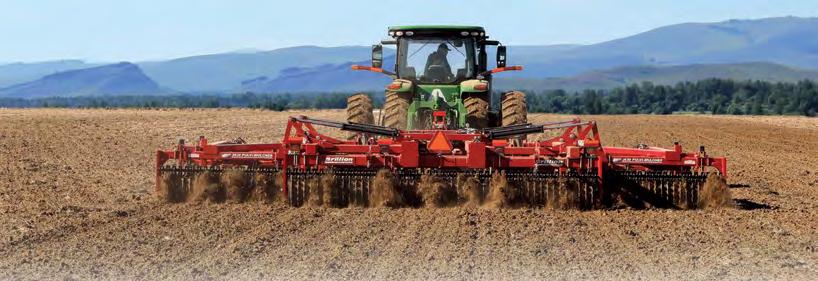
The 3600 Series Pulvi-Mulcher from Brillion features wider working widths, increased trash clearance and reduced downtime in the field.
The series is available in 21’, 25’, 30’ and 36’ working widths. The 30’ model weighs 80% more than the popular WL360 for more clod crushing power. The 36’ unit is the widest PulviMulcher offered by Brillion.
All 3600 Series models feature 8” roller axles with heavy-duty bearings that improve reliability and reduce maintenance interruptions in the field. The design includes three rows of two-piece edge bent s-tines on overall 6” spacing. 25” of under frame clearance improves trash flow through the machine. A leveling harrow in front of the rear roller helps level ridges left by the shanks.






















CHOOSE THE SEED PART NER WHO SHARES YOUR PRIORITIES.
Like you, we never settle. As a result, there’s more sugar in every seed we sell. For more than a century, we’ve put innovation to work in t he service o f growers who p lant C rystal B rand Sugarbeet Seed. With unique hybrids and varieties developed for exactly where you grow, you can be confident your success is always ou r top priority, this season and for seasons to come.

G OOD THINGS COME FROM COMMON GROUND. ™
NO SUGARCOATING OF ISSUES FACING BEET INDUSTRY
ASGA meeting speakers address issues at annual convention
CALENDAR
NEW PRODUCTS
Latest and greatest
OFF THE TOP News, people and updates
20
BUYER’S GUIDE Fertilizers
25 FROM THE AMERICAN SUGAR ALLIANCE
Timely Assistance A Needed Lifeline For Rural America
26
FROM THE SUGAR ASSOCIATION
Ensuring The Facts Get Into The Hands Of The Messengers
28 FROM THE ASGA
Working To Find Relief For Beet Growers
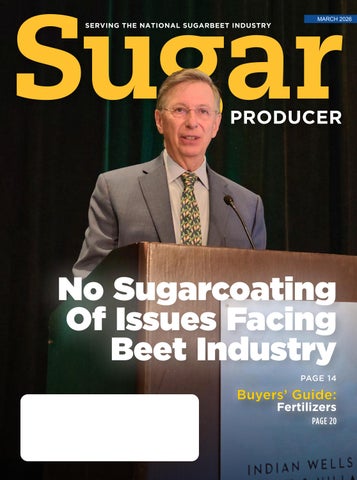
COVER: ASGA Executive VIce President and CEO Luther Markwart discusses trade issues at the 50th annual American Sugarbeet Growers Association conference in January.
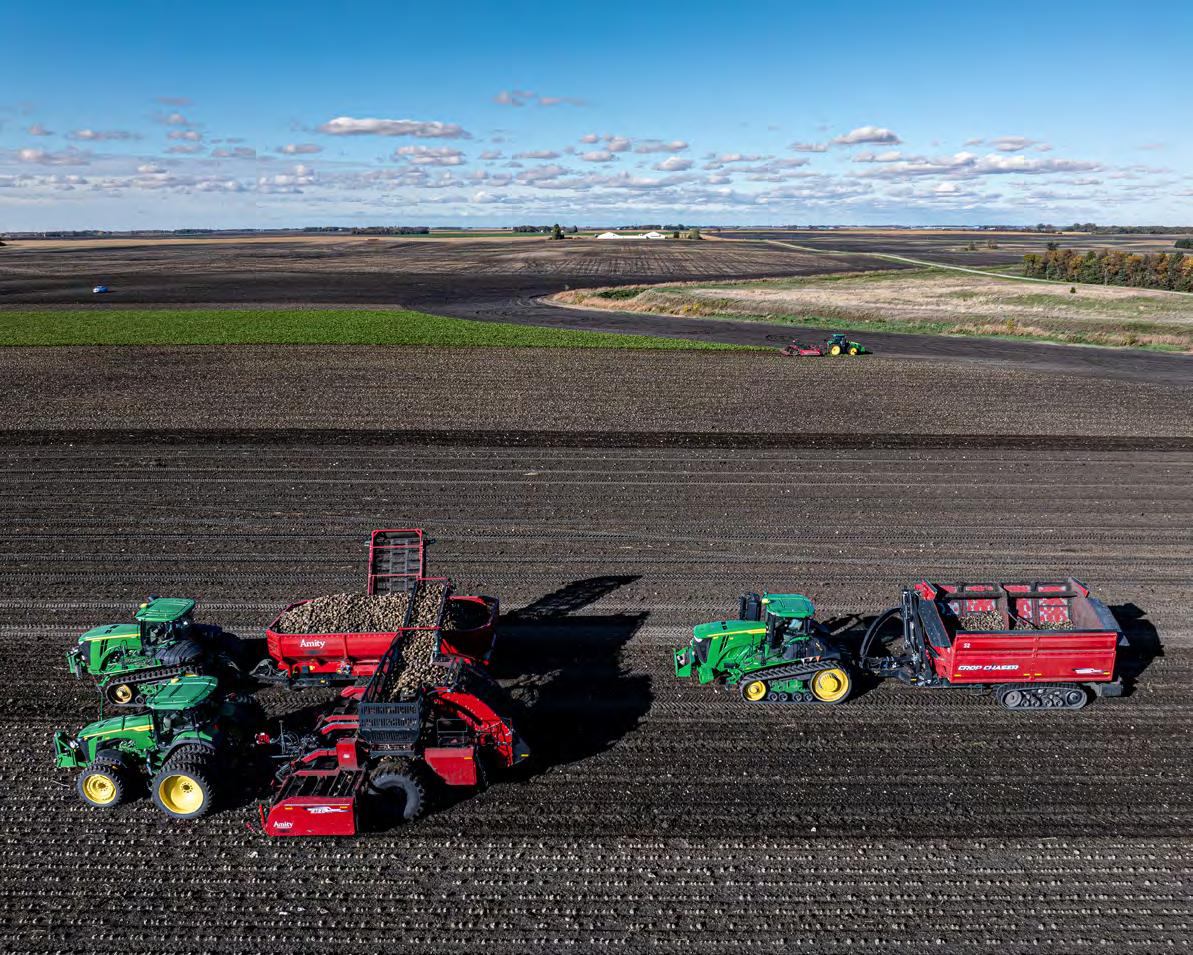
Amity Technology has the solution for you!
Amity Technology’s line-up is field-proven to deliver high-quality, properly defoliated sugar beets in any field condition.
Amity’s 50 Series Defoliators are engineered to properly defoliate sugar beets while matching harvester speed. Our exclusive shrouded front drum lifts and finely sizes leaves, then places them between the rows.
Amity harvesters are the gold standard in the industry. With features like Active Depth Control, High Profile Chain, Dynamic Chain Management, and an ultra-cleaning scrub tower, Amity harvesters can be configured to fit your operation. Plus, with Amity’s field-proven lifter wheels, you will harvest all the tap root and leave extra tare behind.
Amity’s Sugar Beet Cart and Crop Chaser™ provide efficient transport in all field conditions. These high-capacity tanks keep harvesters moving in the field.
MARCH 19-21
NORTH AMERICA FARM & POWER SHOW
Four Seasons Centre Owatonna, MN www.tradexpos.com
APRIL 15-17
AGRI-MARKETING CONFERENCE
Marriott St. Louis Grand St. Louis, Missouri www.nama.org
MAY 11-14
FOOD SAFETY CONFERENCE
Donald E. Stephens Convention Center Rosemont, IL www.food-safety.com
JUNE 2 AND 4
13TH ANNUAL AG WORLD GOLF CLASSIC
June 2 – Canyon Lakes Golf Course, Kennewick, WA
June 4 – The Links at Moses Pointe, Moses Lake, WA https://agworldgolf.com
JULY 31-AUGUST 5
INTERNATIONAL SWEETENER SYMPOSIUM
The Hythe Vail Vail, CO https://sugaralliance.org
AUGUST 4-6
MINNESOTA FARMFEST Redwood County, MN farmfest.com
AUGUST 18-20
DAKOTAFEST Mitchell, SD farmfest.com
SEPTEMBER 1-3
FARM PROGRESS SHOW Boone, IA www.farmprogressshow.com
SEPTEMBER 15-17
HUSKER HARVEST DAYS
Grand Island, NE huskerharvestdays.com
SEPTEMBER 15-17
BIG IRON FARM SHOW
Red River Valley Fairgrounds West Fargo, North Dakota www.bigironfarmshow.com
SEPTEMBER 15-17
CANADA’S OUTDOOR FARM SHOW
Woodstock, Ontario www.outdoorfarmshow.com
DECEMBER 7-10
IRRIGATION SHOW AND EDUCATION WEEK
Las Vegas, NV irrigation.org
JANUARY 8-13, 2027
AMERICAN FARM BUREAU FEDERATION CONVENTION Charlotte, North Carolina annualconvention.fb.org
FEBRUARY 22-25, 2027
44TH BIENNIAL ASSBT MEETING Austin, TX assbt.org
PUBLISHER Jason Harris
EDITOR Lane Lindstrom lane@sugarproducer.com
ADVERTISING DIRECTOR Rob Erickson rob.erickson@sugarproducer.com
CIRCULATION DIRECTOR Chuck Harris
DESIGNERS Ellie Napoli Laci Thompson
IT DIRECTOR Chuck Harris
CONTROLLER Clayton Ward
PRESIDENT Jason Harris VICE PRESIDENT Chuck Harris TREASURER Clayton Ward
Basic subscription rates are: U.S., 1 year-$20, nine issues; Canada/International 1 year, $90 U.S., nine issues. All subscriptions are U.S. funds only. Limited back issues available for $10 U.S. each.
Sugar Producer Magazine is published nine times yearly. 2026, Harris Publishing, Inc. All rights reserved. Reproduction in whole or in part without permission is strictly prohibited. Publisher not responsible for content of submitted materials.
Back copies or subscriptions: (208) 524-7000
AMERICAN SUGARBEET GROWERS ASSOCIATION (202) 833-2398 www.americansugarbeet.org
U.S. BEET SUGAR ASSOCIATION (202) 296-4820
AMERICAN SUGAR ALLIANCE (703) 351-5055 | www.sugaralliance.org
BEET SUGAR DEVELOPMENT FOUNDATION (303) 832-4460
SUGAR ASSOCIATION, INC. (202) 785-1122 | www.sugar.org
PUBLISHING, INC. 190 1ST Street Idaho Falls, ID 83401 (208) 524-7000 FOUNDER Darryl W. Harris





Case IH launched its all-new Puma series tractor, available in 155, 165 and 185 horsepower models, with a full vehicle redesign, configured for unmatched performance, reliability and efficiency.
The Puma series boasts superior maneuverability as well as a smoother ride. The reimagined tractor also equips operators with access to the latest precision technology and Case IH FieldOps.
Operators can choose between the advanced CVXDrive continuously variable transmission for power, improved traction and long service intervals, or the innovative ActiveDrive 8 dual-clutch transmission for uninterrupted torque, fast shuttle shifts and smart automations. Both options boost productivity and reduce operator fatigue, helping operators work more efficiently every day.
The Puma design is compact and powerful, providing excellent maneuverability with a 20 percent tighter turn. The tractor features a new front axle suspension for greater highspeed transport safety and roll control. Enhanced braking responsiveness, updated linkage/hitch and a new transmission improve the tractor’s drivability and implement control.
The Puma features advanced precision technology, offering optional ISOBUS and Tractor Implement Management (TIM) for compatibility with modern implements, along with expandable electronic architecture—built with the hardware, software and connectivity foundation to add new technologies as they become available. Operators can manage tractor machine and agronomic data and unlock the power of Connected Services with FieldOps.
The updated cab design of the Puma enhances productivity and ease of use, featuring improved styling, Pro 1200 display, a new cab suspension, a semi-active seat option and an upgraded MultiController Armrest to maximize operator comfort during extended use.
The new Puma series tractor is the latest offering as part of the robust Case IH livestock portfolio, following the launch of the RB6 series variable chamber round baler.
For more information, visit https://www.caseih.com.

Long days are about to get more productive — and enjoyable. The smooth, quiet power of the 88 hp engine and brand-new OmniDrive continuously variable transmission is a utility vehicle game-changer.
Flip between “Normal” and “Work” drive modes as easily as you switch from doer to adventurer. Enjoy the comfort of the plush 3-person bench seat.
The 1000-lb. capacity electronic/hydraulic tilting cargo box makes hauling and unloading effortless. The NFC key, standard audio system, tilt steering and a crystal-clear 8-inch CFMOTO RideSync touch screen make this vehicle the ultimate utility companion.
HIGHLIGHTS AND FEATURES
• 998cc 3-cylinder Engine The 998cc inline triple features eight valves and a dual overhead camshaft (DOHC). With electronic fuel injection (EFI) and efficient liquid cooling, this engine packs a punch, delivering an impressive 88 hp and exceptional medium and low-speed torque. It gives you a towing capacity of over 2500 lbs.
• Electronic Power Steering With Tilt Wheel Variableassist power steering automatically adjusts the amount of steering assistance based on riding conditions for greater stability at higher speeds and greater maneuverability at lower speeds.
• 1000-lb. Capacity Cargo Box With Electronic Tilt Button In addition to its 1000-lb. capacity, the cargo bed is equipped with an electric/hydraulic tilting cargo box, which makes it easy to unload heavy loads quickly and efficiently.
• 8-Inch CFMOTO RideSync Touch Screen And TFT Display This user-friendly interface provides real-
time information at your fingertips: access maps, vehicle diagnostics and entertainment options with just a tap, ensuring you stay informed and entertained on every adventure.
• Aluminum Alloy Wheels Lightweight aluminum machined-polished rims wrapped with hardwearing CST performance tires defy the laws of traction.
• Hardtop Roof The hardtop roof shields you from rain, sun and debris, ensuring you can ride in all conditions without compromising comfort. Its robust construction provides reliable protection.
• Push-button Shifting This gear changer is a game changer. Push-button shifting lets you switch gears smoothly and efficiently. It’s one more piece of technology that you’d expect to find on a machine far more expensive.
• Audio Package It’s unheard of to get a sound system as standard equipment. But you’re hearing now. Transform your rides with crystal-clear audio and powerful bass. Whether you’re exploring trails or working through a long day, enjoy your favorite tunes with exceptional clarity.
• 4,500-lb. Winch With Synthetic Rope This heavyduty winch features synthetic rope, a lighter, stronger, safer alternative to steel cable. What’s more, it’s far easier to handle, especially when you’re working fast.
• Comfort For Three Passengers The ergonomic bench seat delivers a plush ride. The deluxe front seat includes a center console featuring two cupholders. Fold it up to create room for three adults.
• 1-Year Factory Warranty
MSRP - $16,999/$17,449 Camo Model (plus freight and setup) For
Corteva announced the future availability of Verpixo fungicide with Adavelt active to protect the quality and yield potential of sugarbeets. The new fungicide — with anticipated registration by the U.S. Environmental Protection Agency (EPA) later this year — will help provide effective control of the sugarbeet industry’s most economically damaging fungal disease: cercospora leaf spot.
Fungicides are integral to food production, and the potential loss of important crop disease protection tools impacts us all. Corteva supports Global Fungicide Resistance Action Committee (FRAC) recomamendations to delay the development of fungicide resistance through strategies such as crop rotation, planting resistant varieties and using multiple modes of action, among others.
Verpixo fungicide will be the first Group 21 picolinamide fungicide in the United States, introducing a new mode of action that offers important resistance management benefits against ascomycete diseases like cercospora leaf spot. Based on a naturally occurring compound found in soil bacteria, Verpixo fungicide controls a broad spectrum of diseases and offers flexibility in application timing.
Identified by brown circular spots on the plant’s leaves, cercospora leaf spot restricts a sugarbeet plant’s ability to recover sucrose as the plant diverts energy to regrow foliage damaged by the disease. Bringing preventive control through translaminar activity, Verpixo fungicide disrupts the fungal pathogen’s germination on both the top and the bottom of leaf surfaces.
Extensive testing with Verpixo fungicide with Adavelt active shows it is tank-mix-compatible with many other commonly used crop protection products, helping growers maximize application efficiency and resistance management.
Verpixo fungicide is the first solution in the Corteva Agriscience U.S. portfolio featuring Adavelt active. It will help growers manage diseases, mitigate resistance and protect their sugarbeet crop investments.
To strengthen farmers’ disease control options following the registration of Verpixo, Verpixo AYR will bring another fungicide powered by Adavelt active in the near future. A convenient premix of Adavelt active and ADEPIDYN technology, Verpixo AYR will provide a powerful rotational tool designed to maximize yield and crop marketability potential by maintaining production quality across specialty and vegetable crops.
For more information, visit Corteva.com/us/Verpixo.
Clint Hagen of Ubly, Michigan, has been unanimously elected president of the American Sugarbeet Growers Association (ASGA) Board of Directors with Brent Baldwin, St. Thomas, North Dakota, elected as vice president.
“I am honored to be elected to this position,” Hagen said. “My time as vice president has taught me the importance of this position and the grower power that can be channeled through our association to advance the needs of our farms.”


Hagen, who along with his brother Brad and their 20 employees, runs Atwater Farms Inc. in the Huron County community of Ubly, continued, “The sugarbeet industry continually amazes me; our crop, our markets, and everything that goes on in Washington, D.C., is constantly changing. Keeping up with these changes is what our association prides itself on.”
Hagen, a fifth-generation farmer, has been growing sugarbeets since 1986 when he was just 10 years old. Today, Atwater Farms includes 4,100 acres of sugarbeets plus edible beans and white wheat. The Hagen brothers also have a trucking business and recently expanded into livestock with cattle.
Hagen has been a member of the ASGA board since 2019 and previously served as vice president. Back home, Hagen serves as vice president of Michigan Sugar Company’s Central District Board of Directors and maintains memberships with the Huron County Corn Growers and Huron County Junior Livestock Association. He also serves as president of the Ubly Community Schools Board of Education.
Hagen and his wife Melissa have been married for 27 years and have five children – Dylan, Cole, Addison, and twins Beckett, and Waverly, as well as one grandchild – Lochlan Rhett. Dylan works on the farm and lives nearby with his wife Ashley. They are parents to Lochlan. Cole studies agricultural business at Michigan State University and graduates in the spring. Addison also attends MSU where she is majoring in agricultural business and sustainable agriculture. Twins Beckett and Waverly are juniors at Ubly High School. Clint and Melissa enjoy watching their kids play sports and cheering on the Detroit Red Wings.
Baldwin said, “I am honored to be elected to this position, and I
look forward to supporting President Hagen as we work to advance the needs of American sugarbeet growers across the country.”
Baldwin is a fourth-generation farmer and proudly farms with his dad William “Buzz” Baldwin, and his son Hunter, who is the farm’s fifth generation. The farm operation grows sugarbeets, soybeans, edible beans and wheat.
He said, “I’ve been privileged to serve my fellow growers in several capacities in recent years including serving as president of the Red River Valley Sugarbeet Growers Association and also serving on American Crystal Sugar Company’s board or directors. Through those positions I’ve advocated for grower needs. There are a lot of very significant challenges that are negatively impacting sugarbeet growers. I look forward to contributing, through the grower’s association, for the advancement of policies that strengthen the farm and sugarbeet economy.”
Baldwin also serves on the St. Thomas Booster Club, St. Thomas Fire District Board of Directors and acts as the St. Thomas Piling Site Chairman.
He and his wife Stephanie have been married for 30 years. They have three children – Samantha, Hunter and Braylon, and three grandchildren – Brynn, Leo, and Kinley. In their spare time, Brent and Stephanie enjoy spending time at the lake and traveling.
Tessenderlo Kerley Inc. has announced the acquisition of Eastman’s United States and Canadian Crop Protection Metam Sodium (CLR 42%) and Metam Potassium (KLR 54%) product labels, marking a purposeful expansion of our soil fumigation portfolio and reinforcing its commitment to delivering innovative, grower-focused solutions.
U.S. and Canadian growers will benefit from Tessenderlo Kerley’s robust distribution network and dedicated field support teams, ensuring timely access to Metam products and expert guidance on application best practices. Tessenderlo Kerley will enhance its stewardship and training and launch updated stewardship programs focused on safe handling, regulatory compliance, and integrated pest management.
The company is working closely with regulatory agencies to ensure a smooth transition of product registrations and label continuity. The priority is to maintain the high standards growers expect while enhancing service and support.
For more information, visit Tessenderlokerley.com.
In keeping with our strong tradition of building America, John Deere has announced plans to open two new U.S.-based facilities: a state-of-the-art distribution center near Hebron, Indiana, and a cutting-edge excavator factory in Kernersville,
North Carolina, both set to open in the next year.
“Our investment in these new facilities underscores John Deere’s dedication to strengthening the backbone of American industry and supporting local economies,” said John May, chairman and chief executive officer of John Deere. “We believe in building America, and these projects represent our intent to continue driving innovation and job creation in the United States.”
John Deere recently broke ground on a new distribution center near Hebron, Indiana, strategically located to enhance its supply chain capabilities nationwide. This facility will be designed to streamline operations and ensure timely delivery of equipment and parts. The Indiana project is anticipated to generate significant employment opportunities with approximately 150 jobs, contributing to the state’s economic growth.
John Deere will continue to maintain its primary North American Parts Distribution Center in Milan, Illinois, which has been in operation since 1973 and employs about 1,200 people.
The new $70M factory in Kernersville, North Carolina, will bolster John Deere’s manufacturing capabilities, leveraging advanced technologies to produce industry leading excavators for the construction market. The North Carolina factory will assume production of future generation excavators previously produced in Japan.
This facility will employ over 150 people and will help meet equipment demand and strengthen our commitment to U.S. manufacturing innovation.
With the opening of these two facilities, John Deere will create hundreds of new U.S. jobs, further supporting local communities and advancing our mission to build a stronger America.
Global agriculture technology leader Corteva announced that its board of directors has unanimously approved a plan to separate the company into two independent, publicly traded companies, one comprising its current crop protection business (“New Corteva”) and the other comprising its current seed business (“SpinCo”).
The separation will unleash two distinct market leaders, both farmer-centric, both with technology and innovation at their core and both with operating models and capital allocation priorities tailored to support their respective growth outlooks, strategic directions and value propositions.
Upon separation, current Corteva Chair Greg Page will become chair of New Corteva; current Corteva CEO Chuck Magro will become CEO of SpinCo. Full board and management teams of both companies will be announced at a later date, followed by other key information.
Each business is expected to benefit from the separation through the following:
• A stronger strategic and operational focus for its next phase of growth
• Tailored capital allocation strategy with the flexibility to invest in distinct organic and inorganic growth opportunities, backed by a targeted, investment-grade credit rating
• Improved ability to adapt quickly to leverage evolving market dynamics to deliver consistent returns
• Distinct investment profile that unlocks greater value for shareholders over time
Over the past few years, with its focus on efficiency and differentiation, the business that will become New Corteva has been a strong performer in an industry experiencing intensifying competition.
Today, while the industry is well supplied – not only in production and capacity, but also with market participants – the market continues to value effective, differentiated technology, and this focus will help the company continue to stand apart from its peers.
New Corteva will nonetheless operate in an industry that will need to compete differently in the future. As such, it will continue its progress towards an optimized supply chain and have a laser focus on maximizing shareholder returns, operational excellence and the next generation of sustainable, differentiated innovation –including biologicals, the industry’s fastest growing market segment.
SpinCo will deploy advanced genetics to discover and develop groundbreaking solutions that help farmers around the world improve yield, enhance sustainability and strengthen crop health. As home to the Pioneer brand, it will launch from a position of strength: Pioneer’s century-long track record of advanced breeding, market leadership and financial strength is unmatched in the industry. SpinCo, a classic growth compounder, will also leverage other opportunities, including the strength of its regional anchor brands, such as Dairyland Seed; its partnership with retailers through brands like Brevant; and growing presence in the out-licensing market.
For more information, visit www.corteva.com.
Bayer announced that Dr. Mike Graham will become the new head of Research & Development (R&D) for Bayer’s Crop Science division and serve as member of the leadership team. He will succeed Dr. Robert Reiter who has decided to retire after 27 years with the company and 34 years in the industry.

Dr. Mike Graham
In his current role, Graham is leading the company’s Plant Breeding organization and has profound expertise in R&D and agriculture. The change became effective April 15, 2025.

BY LANE LINDSTROM
If there was a consistent theme among the speakers and presenters at this year’s American Sugarbeet Growers Association (ASGA) annual meeting it was that none of them tried to sugarcoat any of the present challenges sugarbeet (and other commodity) growers are facing right now.
There was a wide range of speakers at this year’s meeting – the ASGA’s 50th – which included sugar industry leaders, sugarbeet seed suppliers, federal government officials, political insiders, researchers and other ag commodity specialists but the message was consistent: sugarbeet growers are facing an uphill battle and need some assistance.
While there was once again a tremendous amount of information presented at the annual meeting, held this year in Palm Springs, CA, we are focusing on just two presentations: those of Zack Clark and Luther Markwart. Clark is the ASGA vice president of government affairs while Markwart is executive vice president and CEO of ASGA. We chose those two presentations because, as growers know very well, sugar is subject to numerous regulations in the U.S. and, to some degree, at the mercy of a lot of outside influences both in and out of the government.
Clark handled the domestic (U.S.) side of the sugarbeet industry while Markwart talked about U.S. trade and other international issues.
Clark’s message was simple: growers have to show up and be present when it comes to representing and advocating for the sugar industry. When growers do that, Clark said, it really does make a difference and usually results in good things for the industry.
“You show up at the local level, at the co-op level and at the federal level,” Clark said. “And your presence is so important. It is central to our activities.”
Before diving into the sugar issues of the day, Clark said, “I know it’s difficult on your operations right now. And while I might not understand the extent of that difficulty, do know that we feel that, and the pressure that comes with that in Washington. We are working day and night on your behalf.”
Clark addressed some of the issues sugar (and ag in general) faces in Washington, D.C., and why things tend to move so slow, or at least slower than growers would like, or need for that matter.
He said, “Washington doesn’t move nearly fast enough, and it doesn’t move in a straight line. I thought that we could examine some metrics to begin to understand why that is. The best way we could do that, I think, is productivity. I find productivity is a good barometer to understand the arc of the possible and create a baseline rooted in reality of what can be done legislatively.
“Now I showed you this slide (Figure 1) last year. This is the 119th Congress which we currently operate in. As I mentioned last year, it is the narrowest House margin in 100 years: 219 Republicans, 215 Democrats. The House majority for Republicans has waffled this past year between razor thin and whatever is more thin than razor thin due to resignations due to joining the administration, due to people running for other offices, due to people being fed up and just leaving Congress and quitting and there’s been some deaths as well. And so currently Republicans in the House have a two-seat margin. Now when you’re trying to get things done, margins impact productivity. I think the caucus, the Republican caucus, is fairly active but it is tough to get them all rowing in the same direction.”
He continued, “And when you have a two vote-margin, you take a lot of time getting them into the same place so that you can advance legislation. So the tighter the margin, the tougher the legislating, which absolutely impacts productivity. The same story is true in the Senate, where there are 53 Republicans, 47 Democrats, but there is that 60-vote threshold that certainly slows down legislative activity.”
To illustrate the thin majority margins in both the House and Senate, Clark shared some numbers. He pointed out that in the current legislature, 12,486 bills were introduced in the first year of the 119th Congress. “That’s activity, that is not accomplishment,” Clark pointed out. Of all those bills, 68 bills became law with 45 as bills and 23 as joint resolutions. Let’s measure that 68 against another time in the past where Republicans enjoyed unified Republican control. That would be in the first year of the first Trump administration in which they passed 443 bills into law, 97 bills into law the first year. So they are slightly off the pace as you can see.”
But, again, Clark said he focuses on productivity, saying, “We want to see higher productivity because the more legislative success occurs in Congress, the better the chances are for ag and sugar to see their priorities and what they need out of the federal government become a reality. The simple analogy would be the more trains leaving the station, the more ride opportunities you have to get where you’re trying to go. But of course, with the modest productivity that we’ve seen, there are still opportunities to get things done and as we look at the challenges that we’re facing, there are still legislative opportunities to advance our industry.”
After echoing what was said earlier in the ASGA meeting by a political strategist – that Democrats have a chance to return to the majority in the House of Representatives this election cycle – that there is some uncertainty in the future, Clark said, “With that uncertainty, how are we going to navigate this fairly dynamic space? I always find that education is always the best solution because, at the end of the day, we don’t know who the players are who are going to step out on the field. We don’t know the timing of the game and we don’t know necessarily all that will snap into focus, but if we educate all of our champions and they know our





issues and know the solutions that are required, whenever they do step out onto the field, we have a good chance of getting what we need.
“Thankfully, as I’ve said time and again, we benefit from strong grower engagement from the field to the factory to Congress and the Administration, and that’s due, again, to you all because you show up time and again.”
To illustrate that he showed a slide (see Figure 2) reflecting this grower engagement and its results.
Clark then pointed to some successes sugar has had recently, thanks, in part, to Representative Glenn GT Thompson and Representative John Boozman. Those include:
• A 29 percent increase in the beet loan rate from 25.38 up to 32.77 cents per pound.
• Storage payment rates that now reflect real costs of storing sugar. Those increase from 10 cents to 34 cents per pound per month, a 240 percent increase.
• Beet sugar reallocation allotment in January and February, rather than May, avoiding any block stock early in the year.
• A report and potential action around refined sugar to ensure that refined imports do not require further processing.
• Tariff rate quota shortfalls will be reallocated before April 1 of the fiscal year.
Clark also pointed to some successes in the tax space, such as estate tax relief where there is an increase to $15 million per individual and $30 million per couple, indexed for inflation and made permanent.
Even with that handful of successes, Clark said there is still plenty to focus and work on, including getting growers the financial help they need as the Farmer Bridge is not sufficient enough to cover the losses. The $1 billion tagged for specialty crops, of which sugarbeets are included, “obviously will not be enough,” he said. “We have demonstrated to USDA that the industry has lost $507 million in 2025. That’s what we need. We have been advocating ferociously for assistance as much as we can get, as soon as we can get it.”
Still another issue on ASGA’s radar is sugar program management, more specifically the stocks to use ratio. He explained, We like the stocks to use ratio to sit around 13.5 to 15.5. Much of the last year it was hovering in the 17, 18, 19 percent range with the expectation that that was a low number. And so we’ve been advocating since the spring time with USDA to begin to fix the problems with the WASDE because if we do not solve some of the problems with WASDE, this is going to continue. And the short version of it is the USDA keeps overestimating demand and underestimating supply and so that’s why we’re getting into those higher stocks to use ratio … so we’ve been advocating again for WASDE changes.”
And finally, he said, “We’ll be advocating for the utilization of tools to reduce sugar in the marketplace but that will take time but know that we are active in that space.”
In introducing ASGA’s Markwart, past ASGA President Neil Rockstad referred to him as, “Our senior statesman of sugar.” Markwart, who announced earlier this year that he is retiring after leading the ASGA for 44 years, isn’t slowing down as he enters the final stretch of his career with the association.
During his presentation, Markwart tried to show that while most in the audience are focused on the issues surrounding sugar – and rightfully so – the issues go much deeper and the long-term goals by President Donald Trump touch on a lot of different things like immigration, drugs, oil and tariffs. And Markwart touched on all those issues in an effort to provide a deeper understanding on how they are affecting the current state of things in the U.S.
He stated, “What I want you to do is understand where we are in all of these trade issues. It is not just sugar, it is across agriculture. If you could fix trade issues, a lot of the problems we are facing in agriculture would be minimized and much of it would simply go away, but there’s a lot of work to be done.”
He continued, “When the President was elected, he had America first reform priorities. He said we have, as a nation, to deal with the trade crisis, the trade deficit crisis, the immigration and drug crisis, the debt and deficit crisis and we’re going to have to do this on an international platform and a domestic platform. And he’s been doing that all across the board. But when you do that, you have to disrupt the status quo. And I have always said – and I learned this from a mentor, actually on church work – he said you cannot solve problems or grow without change and you cannot have change without conflict.”
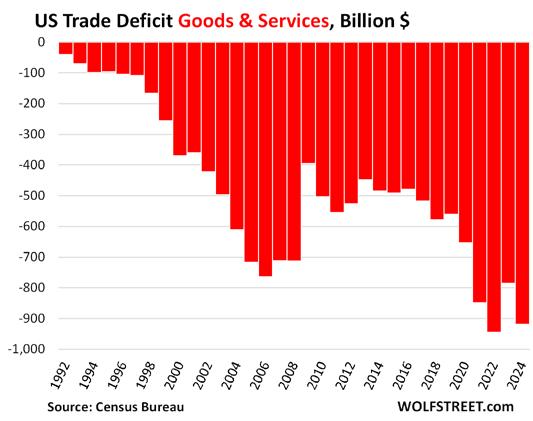
Markwart then zeroed in on the trade deficit, which has not been in the U.S.’s favor for years and years. “Here’s the trade deficit (see Figure 3) that he was looking at when he came into office and said,

‘That is a national emergency. We have got to turn that around.’
“That is not sustainable for this country long term. And because of that, we’ve got large and persistent annual U.S. good trade deficits. That has led to a hollowing out of our manufacturing base. That’s middle class jobs. When you see that talking point, and these are their talking points, think about the domestic sugar industry. We have hollowed out this industry in many ways. In the last couple of years, we’ve hollowed it out some more. We’ve lost Hawaii. We’ve lost Texas. We’ve lost California. We’re hollowing it out. It’s a result of a lack of incentive to increase advanced domestic manufacturing capacity.”
And when that happens, Markwart pointed out, that has an effect on the supply chain, something that became painfully obvious during the Covid pandemic. That includes sugar, which the United States is the third largest importer of in the world. “What about disruptions in supply chains?,” Markwart asked. “Do you see the correlations of our industry in these points that the president is talking about?”
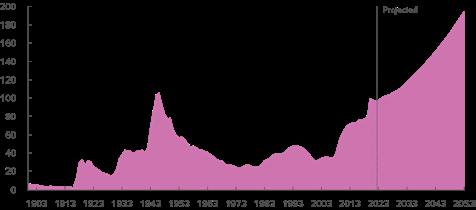
Pivoting to the federal debt, Markwart showed this slide (see Figure 4). He then commented, “Here’s a federal projected federal debt. If you look at that, compare it all the way back to the beginning of the 1900s. That’s what we’re facing and that is not sustainable. That is a crisis.” The federal debt is exacerbated by illegal immigration, Markwart pointed out, saying. “It costs almost $151 billion a year net cost to the American taxpayer at the federal, state and local levels. That is a burden that had to be stopped, and seldom did you ever hear how much that costs you and I as taxpayers. But that’s the bill for it, and that had to change.”
In addition to the immigration issue, Markwart touched on illegal drugs, specifically fentanyl. “I did some calculations. In the last 14 years, we’ve lost over 507,000 people to fentanyl. I went back and said, ‘Well, how would you compare that?’ I looked at the military deaths that we had since the beginning of World War II.
So think of all the service people we’ve lost beginning with World War II all the way through our wars.
We’ve lost more to fentanyl than we have in all those wars (506,900). Not one bullet when you’re doing it the drug way. That’s why the President has been chasing this.”
What has that got to do with sugar, national security and the economy and how is President Trump tackling these issues?
Markwart explained, “So what does the President do? He goes to the International Emergency Economic Powers Act (IEEPA). We understand the President has no authority to put tariffs on that the Congress doesn’t give him. So he has lots of different authorities and this is the one he uses. It authorizes the president to regulate international commerce after declaring a national emergency in response to any unusual or extraordinary threat to the United States, which has its source in whole or in part outside the United States. That’s why I said the trade deficit, the budget deficit, drugs and immigration. ‘Those are all crises which justifies me to be able to use this authority,’ is the President’s thinking. So he said we’ve got to rebuild the economy, restore national and economic security. He’s doing it through tariff reciprocity.”
Markwart explained that when the president does this country by country rather than as a blanket deal, it’s faster and he can customize the leverage, which includes going after non-tariff barriers such as sanitary and phytosanitary claims.
Along with all these issues and concerns, growers are saddled with high input costs and processing costs. Then there’s an oversupplied domestic market.
“We’ve got an oversupplied sugar market,” he said. “Why is that? Well, you’ve got dumped foreign supplies. You’ve got failed trade policies, a lack of adequate tariff protection, circumvention schemes that Zack touched on, and when you’ve got surplus protein in this country and other commodity prices are down, it depresses beet pulp prices.”

Markwart then showed a list of failures in the trade system (Figure 5), and he pointed out that these agreements were made 30 years ago and are coming up short these days. Referring to some of the points he made on the slide, he said, “Inflation was never figured into it. They didn’t fix dumping where countries are selling products into global markets below what they sell in their own country or what their cost of production is. They devalue their currency. Much of the sugar that is imported into this country comes from countries that still have child and forced labor in the fields.
“There was special and differential treatment for developing countries. Seventy percent of the sugar produced in the world is from cane. Most of those are in developing countries, and they get to play by a different set of rules, and when these agreements were put in place, they said, ‘Well, over time, these developing countries are going to graduate, and they’ll play by the same rules that you play by.’ In the last 30 years, I’ve never been to a commencement exercise for any country graduating into having to play by the same rules that we do. We’ve got circumvention schemes that are unaddressed, like the molasses issue.
“There’s no compensation for unfair trade practices. Remember when Mexico was dumping sugar in here? That cost this industry, the beet and cane industry, $4 billion, and we never got compensated for the pain that we went through.”
One of the most important points Markwart made in talking about the trade failures came under the market contraction segment. He said, “When these agreements were written, you were always looking at an expanding market. And what we see today with MAHA and GLP-1 drugs and all those things along
with now we’re getting a flat and perhaps pulling back market, but you still have commitments requiring sugar imports. And in some of these agreements, they get little increases each year; built-in increases. So that’s a problem.”
There are solutions to these issues, Markwart pointed out. One solution is reciprocal trade negotiations, using tariffs as a leveraging tool because of speed, just as the President is doing. Another solution is meaningful market access for ag.
One recent success in the sugar arena is the suspension agreement with Mexico, which has been expanded another five years.
Along with that, Markwart pointed out:
• There is a good sugar policy in place.
• ASGA is working on the bridge assistance to get that finished.
• The suspension agreements are in place for another five years “and we want to improve those.”
• “We’re working to solve the oversupply in the market problems,” he said.
• ASGA is working with the companies and the courts to keep effective crop production tools.
• ASGA is working to get revenue crop insurance.
• “You’ve got a great organization and effective leaders,” he said.
• “We’ve got great congressional champions to help us through,” he said.
He finished, saying, “I think we’re positioned very well on a lot of fronts to try to get us out of the ditch that we’re in. It’s going to take a little time, and I can tell you it can’t come fast enough.”
Inflation: Fixed tariffs were not adjusted for inflation.
Dumping
Currency Devaluation
Cross Commodity Subsidies
Low Labor Standards
Low Environmental Standards
State owned enterprises/industries
Special & Differential Treatment for Developing Countries
Dispute Settlement is dysfunctional
Safeguards: Completely ineffective
Circumvention Schemes: unaddressed
Compensation for unfair trade practices
Jones Act: Should not put domestic producers at a disadvantage for higher freight rates on interstate shipments via water.
Market Contraction: WTO (fixed) and FTA agreements (some have annual automatic increases) do not have provisions for adjustments to markets that contract. This is a foreigners-first policy.
AD Valorem Duties: Ad Valorem duties give you the most protection when you least need it and least protection when you most need it. Figure 5
In addition to electing a new president, vice president and treasurer for the American Sugarbeet Growers Association, the ASGA recognized retiring board members as well as the incoming board members.
Retiring ASGA Board of Director members are:
• Ryan Carlson
• Brian Ryberg
• Bryant Hagrud
• Jeff Olson
• Wade Hanson
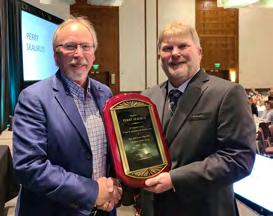
Retiring ASGA board member Perry Skaurud (l) is recognized by past president Neil Rockstad.
• Chad Larson
• Jim Nelson
• Perry Skaurud
• Tim Deal
• Curt Rutherford
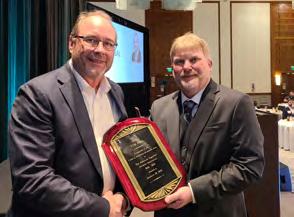
New board members include:
• Rodd Beyer
• Wayne Formo
• Nathan Green
• Matt Harsbargen
• Ben Larson
• Austin Lessard
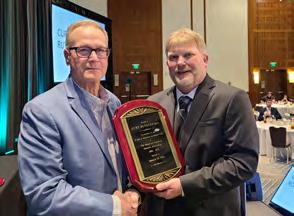
Tim Deal (l) retired from the ASGA board this year and is given a plaque by past president Neil Rockstad for his years of service to the ASGA.
Longtime ASGA board member Curt Rutherford (l) is recognized for several years of service by past president Neil Rockstad.
Hilleshög delivers the vital contrast your elds need — hybrids engineered to steady your stands, sharpen disease defenses, and drive higher sugar content. Make your operation Generations Strong through genetic diversication.



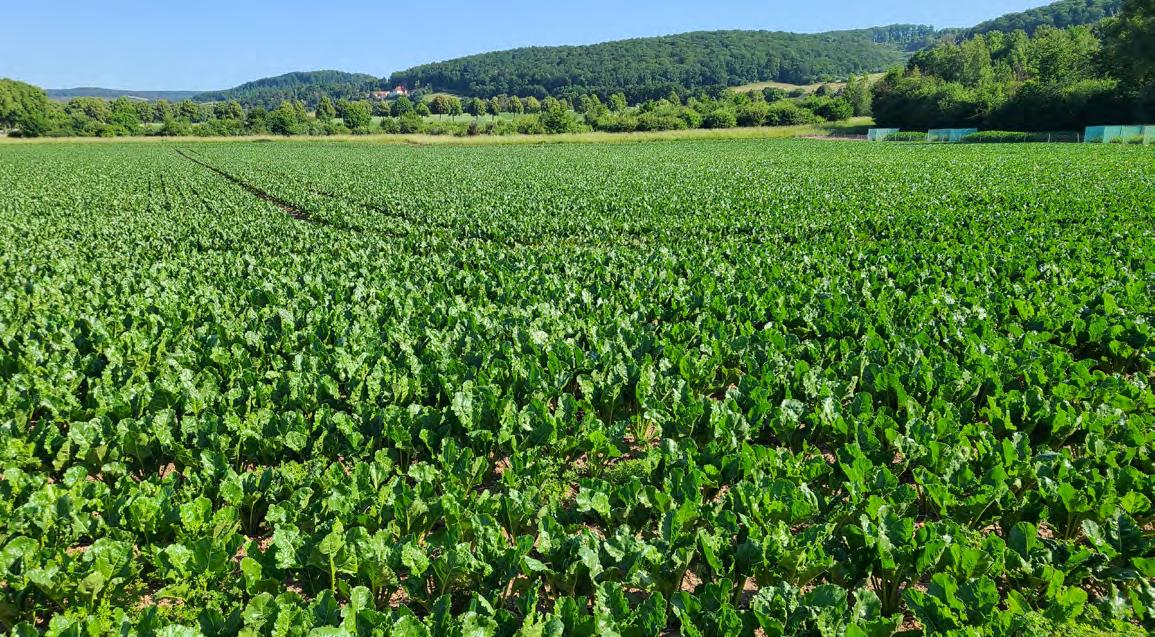
Locus Agricultural Solution’s (Locus AG’s) Pantego product line showcases the industry’s only free-living yeast soil amendment. This phosphate solubilizing yeast not only increases the availability of phosphate, but also supports extensive root growth, which is important for root vegetables such as potatoes and sugarbeets. The agronomic benefit is two-fold: increased nutrient availability and a larger root system to transport nutrients and water to the plant tissue. Through extensive research at contract research organizations (CROs) across the country, Locus AG products are proven to increase yield and ROI in 11 crops.
Locus Agricultural Solutions (888) 331-5008
www.locusag.com
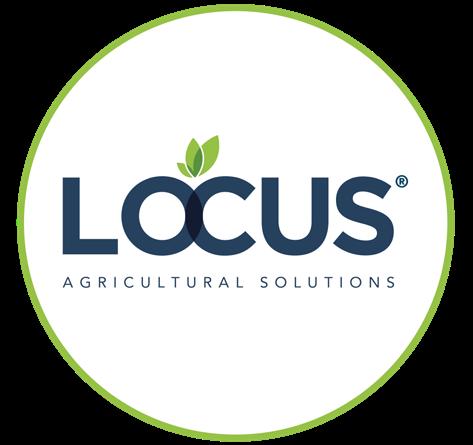

Korrect is a highly available mild form of potassium which is particularly well suited for foliar feeding for all types of crops and may be soil applied. Since the pH is 7.3 and the salt index is 26, there is little danger of burn to plant leaves and foliage. Korrect is a clear, true solution with no particulate matter, which mixes readily in water. The natural organic carrier enhances its receptivity by plants. This product contains no chlorides or ammonium (NH4) forms of nitrogen.
The Andersons, Inc (800) 831-4815
Andersonsplantnutrient.com/agriculture
Zeba is an innovation that helps plants produce more by holding water and nutrients in the root zone and releasing them to plants throughout the growing season. Zeba is a natural, starch-based water absorbent. It absorbs up to 400 times its weight in water, forming hydrogels around the roots in the rhizosphere.
Zeba’s activity in the soil reduces irrigation inconsistencies, increases water and nutrient availability, improves overall soil conditioning properties, supports soil microbes, and ultimately results in reduced plant stress.
UPL North America
(610) 491-2800
www.upl-ltd.com


SLYCE Ca8% is derived from calcium components act to greatly increase soil-available fertility, especially when applied after granular fertilizers, by reacting with those materials to release their components for a faster and more efficient effect. SLYCE increases the organic matter of soil and improves soil structure; accordingly, it promotes the buffering power and nutrient capacity of soil.
SLYCE Ca8% also helps regulate pH of soil. The humus in it helps stabilize nitrogen storage and free up phosphorus and micronutrients to make them more easily available to plants. It makes more beneficial fungi and increases soil fertility and permeability.
Omex USA
(559) 661-6138
www.omexusa.com

Highest Quality Defoliating Increased Productivity Per Hour
• Increased Ground Speed
• Decreased PTO RPM Speed
• Increase flexibility in difficult defoliatin conditions
• Minimal Damage To Beet
• Available for all defoliator models
• Available in 4, 6 and the new 8 bar unit
• Available in 12” (6 flail), 14” (7 flail), 16” (8 flail) depending on row width
• Balanced unit for minimized vibration
• 50% thicker flail mounting bracket
• Hardened 3/4” diameter flail rod for the best wearability in the industry
• Designed to eliminate side to side flail movement
• Eliminates the need for steel units allowing for increased adjustability of front & middle drum.

• Available in Standard Duty & Heavy Duty high quality flails.
• Units can be installed 1 drum at a time
• Easily shipped UPS or Freight in US & Canada - Visa
WOLF TRAX DDP micronutrients are specially formulated to simplify nutrient management, boost crop performance and maximize farmers’ fertilizer investment. Uniquely designed to evenly coat every granule in a dry fertilizer blend through the patented EvenCoat Technology, WOLF TRAX delivers highly available nutrition through better distribution in the field when compared to traditional granular micronutrients, resulting in more granules per square foot compared to other nutrient sources. Growers can have confidence that their crops are receiving the right amount of micronutrients close to growing roots during the critical growth stages to improve micronutrient use efficiency, address deficiencies and promote crop performance.

Koch Agronomic Services (316) 828-5500 www.kochagronomicservices.com

Huma Gro Max Pak is a liquid micronutrient formulation containing a carbon-complexed, highly stable source of many important micronutrients. Max Pak is leaf-friendly, saltbuffered, and formulated with Micro Carbon Technology to ensure maximum uptake and translocation of nutrients.
Huma Gro (480) 970-7525 www.humagro.com
Vitol stimulates the natural production of gibberellins within the plant for vegetative development and fruit sizing. It increases the energy output of the plant, which helps move it smoothly through its growth stages. It also improves plant recovery from environmental stresses during peak crop demand periods. When soil applied, Vitol acts as a root stimulant, elongating root growth that is critical in taproot crops.
Huma Gro (480) 970-7525 www.humagro.com




PIC: Polysulfate.jpg OR Polysulfate.eps
Polysulfate is a natural fit for high-quality potatoes. Low-chloride Polysulfate is a sulfur-based source of soluble potassium, magnesium and calcium. Its unique release rate supplies balanced nutrients on demand to ensure a healthier and more productive crop.
• Balanced nutrients – Featuring a blend of K and Mg, plus a season-long source of Ca for improved potato quality.
• Natural soil amendment – Calcium sulfate helps improve nutrient efficiency, soil structure, root development, water infiltration and seed emergence.
• Prolonged nutrient release – Reduced risk of early season sulfur and potassium loss through leaching.
• Safe – Low chloride, very low salinity index, neutral pH, no limiting effect.
• Naturally mined – Natural mined mineral (polyhalite), low carbon footprint.
www.polysulphate.com
Levesol Zn is a zinc solution chelated with ortho-ortho EDDHA chelate. Levesol Zn is designed to significantly enhance the nutrient availability when applied with liquid starter fertilizers, leveling up in-furrow applications.
It increases the length of time zinc is available to the plant while simultaneously boosting the availability of zinc, phosphorus and other micronutrients already present in the soil. The enhanced nutrient availability increases speed of emergence, overall plant health and, ultimately, yield.
Levesol Zn can be blended with most primary, secondary or micronutrients as well as crop protection products. It acts as a compatibility aid, improving the longevity of compatibility with a wider range of starter fertilizer options.
Levesol works to unlock nutrients in the soil, allowing nutrients to become more available, and mobilizing within the plant for season-long activity. Levesol is powered by CHS’s patented ortho-ortho EDDHA chelate, designed to significantly enhance nutrient availability when applied with liquid starter fertilizers, taking in-furrow applications to a whole new level.
The concentration of Levesol’s patented ortho-ortho EDDHA chelate is so strong and pure that it also makes other micronutrients in the soil soluble for update. It boosts availability of phosphorus, zinc and other key micronutrients in the plant. Enhanced nutrient availability increases early growth, overall plant health and, ultimately, yield. Levesol can be blended with most primary, secondary or micronutrients as well as crop protection products.
CHS Agronomy www.chsagronomy.com
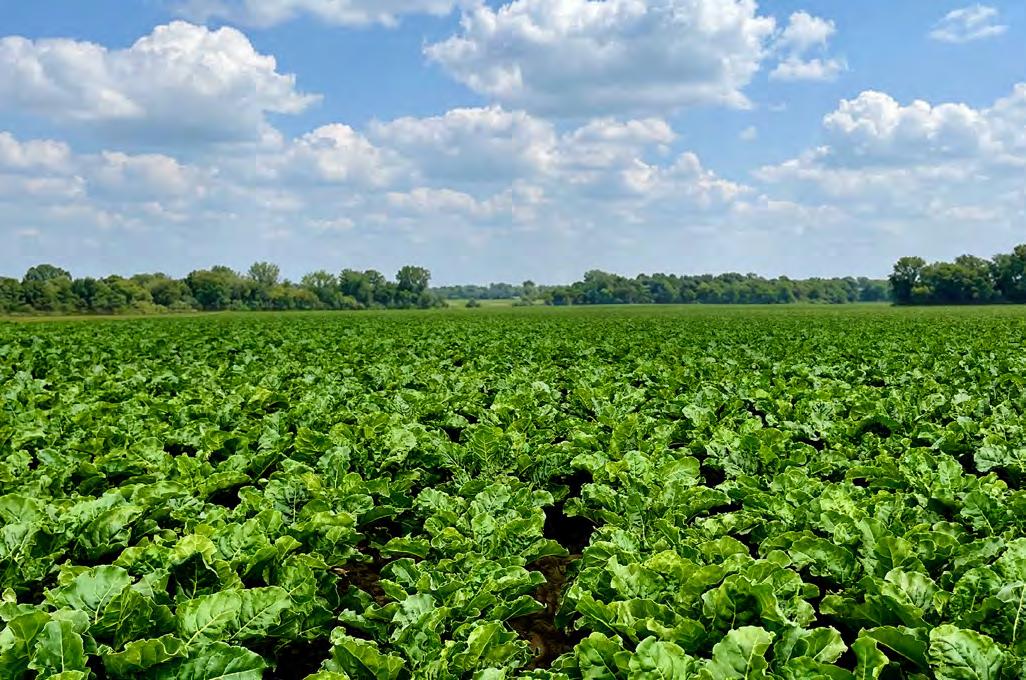
Plant-available phosphorus is important for producing a healthy crop. Pro-Germinator, through proprietary manufacturing technology, contains both ortho-phosphate and carbon-protected polymer phosphate to provide both readily available and controlled-release phosphorus with minimal danger of tie-up in the soil. This controlled release of nutrients provides needed nutrients at planting and throughout the growing season. Pro-Germinator is used primarily for the application of phosphorus but also includes nitrogen, potassium and micronutrients for maximum performance.

AgroLiquid (800) 678-9029 www.agroliquid.com

AgroLiquid (800) 678-9029 www.agroliquid.com
Potassium is required for nutrient movement in the plant, is essential for the makeup of over 40 different enzymes, and is involved in more than 60 different enzyme systems in plants. Potassium is also important in the formation of sugars and starches in plants. Kalibrate is a highly efficient carbon-chelated liquid potassium that, when applied at planting or side-dress, is taken up from the soil along the length of young, fibrous roots. Potassium is transported in all directions among plant organs in response to metabolic demand. Kalibrate also contains 6 percent sulfur.


By Rob Johansson, Director Of Economics & Policy Analysis
High costs of production, low commodity prices and bad foreign trade actors – the years-long perfect storm – continue plaguing the U.S. farm economy, threatening the livelihood of many family farmers.
Across agriculture, costs remain high. According to USDA data, in the past two years, labor costs are up 11 percent, interest expenses are up 16 percent and property taxes and fees are up 10 percent. Net farm income for many farmers remains incredibly tight and banks are reporting increased liquidation of assets and a greater reliance on operating loans to finance operations, threatening the economic viability of multigenerational operations.
At the same time, U.S. demand for sugar has decreased by 3.5 percent over the past four years. That,
The American Sugar Alliance also continues to emphasize to DC policymakers that real sugar is an essential food ingredient, critical to our national food supply.
We appreciate the hard work and dedication of congressional leadership and the Trump Administration to advance the most significant update to U.S. sugar policy in 40 years.
While incredibly important to help farmers weather the current economic storm, the U.S. Department of Agriculture’s (USDA) Farmer Bridge Assistance (FBA) provisions for sugar have yet to be announced, and for many other producers, FBA only covered a small portion of the losses incurred in 2025.
Many farmers – including some sugar producers – will need additional assistance to help them get through another growing season. In January, the American Sugar Alliance co-signed a letter to House and Senate leadership highlighting the alarming situation in farm country and asking Congress to “provide immediate economic support to fill in the gap of remaining losses.” The letter, led by the American Farm Bureau Federation, made it clear that the current situation on our farms “represent[s] an economic crisis in rural America.”
We know that this is a timely and critical issue, as farmers are trying to secure operating loans and to make decisions about spring planting. There is no time to waste.
when combined with low world sugar prices and the high levels of subsidized foreign sugar entering our market, above and beyond what is required by our trade agreements, has caused the price of sugar to fall precipitously. In short, costs are up, our farmers are receiving less for the sugar they are producing and the U.S. is currently oversupplied with sugar limiting the potential for relief.
The much-needed improvements to the commodity title that were just enacted into law as part of the One Big Beautiful Bill Act bolstered the safety net that Congress designed to keep sugar producers afloat.
The American Sugar Alliance also continues to emphasize to DC policymakers that real sugar is an essential food ingredient, critical to our national food supply. To keep a viable domestic industry for this key ingredient, we must address the underlying issues driving an oversupply of our market and capping U.S. sugar prices at levels below or at the cost of production.
America cannot offshore more U.S. sugar production to foreign countries. That not only puts our food security at significant risk, but it also guts an industry that supports more than 151,000 jobs and generates more than $23 billion in economic activity, supporting many rural and urban communities.
The American Sugar Alliance is working on those issues, and many other fronts, to ensure that our family farms and American factories have a sustainable path forward.

Courtney Gaine, PhD, RD, President & CEO
Education is key to telling the story of sugar


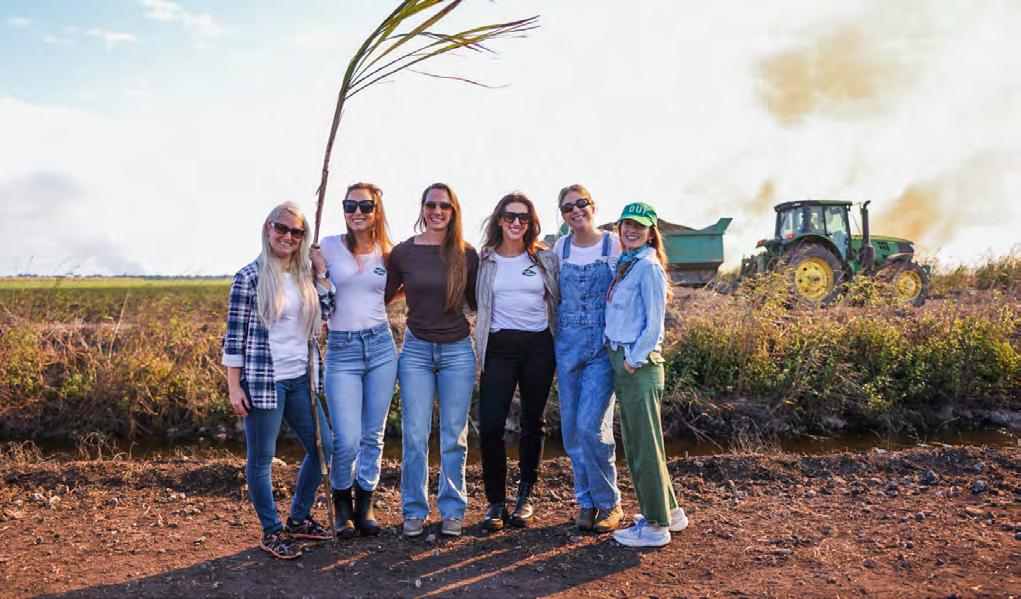
March is National Nutrition Month -- a time to recognize the registered dietitians (RDs) who help us make sense of what’s on our plates. RDs are the experts and trusted voices in food and nutrition science.
That’s why we engage RDs — to understand what information and materials they are looking for and to provide accurate, science-based facts and data about real sugar, including its plant origins and many roles in foods, so they can share with the people who count on their guidance.
We connect with them in a variety of ways: through farm and factory tours, conferences, educational materials, webinars and newsletters.
SEEING IS BELIEVING
Our favorite way to engage with RDs and help them build a deeper understanding is to show them exactly where real
sugar begins: on the farm. Our Farm-to-Table influencer tours provide nutrition professionals an up-close look at how sugarbeets and sugarcane and are grown, harvested and processed. Seeing the process with their own eyes — from the field to the familiar bag on the grocery shelf — helps them address common questions with clarity and confidence.
Building on our successful tour to Bay City with Michigan Sugar in October 2024, this January we visited some sugarcane with U.S. Sugar in Clewiston, Florida, for our fifth Farm-to-Table influencer tour. We welcomed RDs for two days of hands-on, boots-on-the-ground learning about how sugarcane is cultivated and transformed into the real sugar consumers know.
Participants explored sugarcane fields, observed harvesting equipment in action and met growers and agronomists who steward the crop from planting to cutting. At the mill, they followed the step-by-step process — watching raw juice become crystallized sugar — and had the opportunity to ask
technical questions directly to the engineers and scientists who oversee production.
Many RDs told us that physically seeing the refining steps demystified a process that is often misunderstood or misrepresented online.
The dietitians spent two days learning directly from the farmers and experts who grow and process real sugar. We shared highlights on our social channels (@moretosugar), and participants shared their own insights with their audiences.
The feedback was overwhelmingly positive. One RD told her followers, “I wish I could take you all on the tour with me!” Another participant noted, “Seeing how many people are involved and how passionate they are was so inspiring.” And perhaps the most powerful indicator of impact came from the RD who said, “Now that I’ve seen the process, it will be so much easier to educate my community … and really explain what refining means.”
These tours help nutrition professionals cut through confusion and better communicate real sugar’s simple, plantbased origins. They also spark conversations that ripple outward — ultimately helping consumers better understand what real sugar truly is (and isn’t).
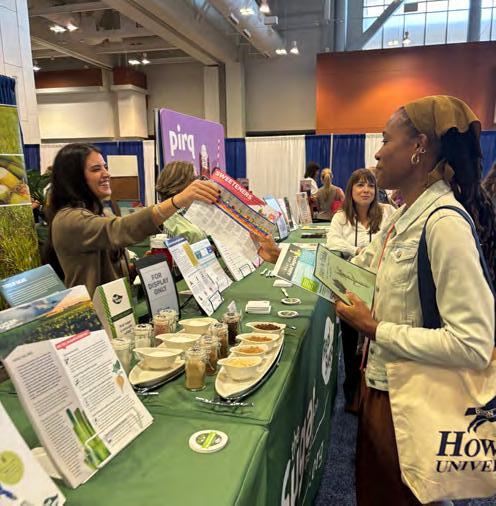
Our engagement doesn’t stop on the farm. Each year, we exhibit at major nutrition conferences across the country to connect directly with nutrition professionals, share sciencebased resources and listen to what’s on their minds.
In 2025, we participated in three key conferences, including the Food & Nutrition Conference & Expo (FNCE) in Nashville — one of the largest gatherings of nutrition professionals in the world. At these events, we introduce RDs to resources created in collaboration with nutrition experts, such as our RD Toolkit and other educational materials that explain sugar, added sugars and sweeteners in clear, practical ways.
But the real value of these conferences lies in the

conversations. Hearing what RDs are curious about helps us stay plugged into emerging trends — whether it’s questions about non-nutritive sweeteners, changes in dietary guidance or how best to communicate about sugar in the context of overall eating patterns. These discussions also lead to lasting relationships with professionals who help enhance our materials, host webinars, and support our broader educational efforts.
Nutrition guidance doesn’t pause between conferences — and neither do we. Clients and patients ask questions, new research emerges and misinformation spreads on social media. That’s why our engagement doesn’t stop at in-person events. Throughout the year, we reach thousands of RDs through continuing education webinars, newsletters, sponsored e-mail placements, and digital resources on our site www.sugar.org, designed to keep the latest science at their fingertips.
Empowering Trusted Voices To Share The Real Story Of Sugar
We’ll continue to engage with RDs because they are the credible messengers consumers rely on for nutrition information. Real sugar is real food – one that plays important roles in cooking, preservation and enjoyment across many nutritious, everyday foods. As we celebrate National Nutrition Month, we’re committed to supporting the dietitians and nutrition professionals who help Americans make informed, balanced choices every day.
Our educational resources are available at: https://www. sugar.org/resources.

Luther
Markwart | EXECUTIVE VICE PRESIDENT
When grower leaders met in late January for ASGA’s annual meeting, we focused on the various pathways to solving the economic hardship that growers are facing.
In the short term, we need the federal government to provide economic assistance for the enormous losses in crop year 2025. Such aid will help secure financing for those on the edge for the 2026 crop. While the higher support levels for raw and refined sugar passed last July as part of the One Big Beautiful Bill are helpful, returns from the marketplace are the outcome that is best for growers and the government.
Low prices in the U.S. are due mostly to world sugar prices being so low. Our market is oversupplied with large volumes of dumped world market sugar. U.S. sugar policy is designed to supply domestic needs with American-made sugar and limited imported sugar at low or no tariffs, while restricting world dumped sugar entries through a prohibitive “tier two” tariff.
But the tier two tariff is no longer restrictive as a result of inflation. The tariff was initially established 32 years ago, followed by a 15 percent reduction over six years. The same tariff rate has been in place for 26 years. Over the last three decades exporters have continued to dump their surpluses on the global market.
We see exporters produce raw cane sugar, devalue their currencies, maintain low labor and environmental standards, play by “special and differential” rules and benefit by domestic cross commodity subsidies. These practices will certainly continue for the foreseeable future. Industry leaders fully understand this issue and are laser focused on finding a solution to it.
It is neither simple nor easy and government actions often move at a glacial pace which is challenging for those of us who are impatient.
We continue to wait for a decision by the Supreme Court on the President’s authority to use reciprocal tariffs. These are incredibly important for many industries including ours. It will have several implications, but it serves no purpose to speculate on those until the Court rules. Remaining in the judicial


welcomed the U.S. Supreme Court’s announcement that it will hear the Durnell v. Monsanto case. The case seeks to resolve whether manufacturers of glyphosate or other pesticides are liable under state law for “failure to warn” of alleged health risks after federal regulators have thoroughly evaluated the safety of the products and set safe usage standards. This is a landmark case and we, along with other commodities, intend to file a joint Amicus brief with the court.
It is neither simple nor easy and government actions often move at a glacial pace which is challenging for those of us who are impatient.
Beet grower leaders along with Louisiana cane growers will head to Capitol Hill once again in late February and early March to thank Congress for the increase in our loan rate, press them to pass the remaining portions of the Farm Bill, and make it clear we need additional economic assistance given the financial stress in our industry.
These growers are your voices to the legislators and the administrators of sugar policy. We thank them for taking the time to do this very important work on your behalf.
We want to congratulate Clint Hagen (Michigan) for being elected president of the ASGA, Brent Baldwin (Red River Valley) for being elected vice president and Kevin Etzler (Minn-Dak Farmers Cooperative) for being elected treasurer. They are a terrific team and will serve our growers well.
Once again, we thank outgoing president Neil Rockstad (Red River Valley) and treasurer LaMar Isaak (Snake River) for their outstanding work and dedication to the association.
With all the heavy topics discussed during the two-day American Sugarbeet Growers Association meeting in January, not much was said about this being the 50th Anniversary of the ASGA.
But that is a significant milestone for the association, and ASGA Executive Vice President and CEO Luther Markwart highlighted the accomplishment during his presentation on the conference’s second day.
He said, “We haven’t talked about that much at this meeting because of all the other issues, but I want to give you just a little historical perspective on this.”
Markwart then detailed what the pre-ASGA looked like and how things changed after it was established on Oct. 30, 1975.
• The ASGA was preceded by the National Sugar Beet Growers Federation. It was based in Denver, CO. The membership then consisted of the mountain states and the Pacific Northwest. It did not include the Red River Valley, the Great Lakes, California or Texas at that time.
• All the growers were (except for American Crystal that was a little bit before that) essentially subcontractors for beet companies. “So a big theme was contract negotiations,” Markwart pointed out.
• Sugar cooperatives were just beginning.
• The industry had the highest historical price at that time in 1973.
• The high fructose corn syrup (HFCS) industry hardly existed at the time.
• Markwart explained that there were no free trade agreements and no formal sugar users group.
• “The only thing that organization focused on was sugar policy and we weren’t even in the Farm Bill at that time,” he said. “Another issue was access to hand labor to hoe beets. That was pretty much it.”
The next phase Markwart focused on was from the establishment of the ASGA on Oct. 30 to January and February 1982.
• “The ASGA was established and we pushed to expand membership, but the groups remained divided,” he said.
• The group established an office in Washington, DC. Markwart explained, “My predecessor was Richard Blake, who was from Colorado. He was a World War II pilot, a captain and a very, very nice gentleman, but they played by different rules [back then]. It was a very sociable time. Essentially, he had a golf membership at a congressional country club and you could take members of Congress out and play golf all the time. And when the fourth year came around and you needed farm legislation, well, then you did that.”
• The organization lacked structure, discipline, education and training, and, as Markwart pointed out, the association
didn’t have computers, fax machines, there was no internet and no cell phones.
• At the annual meeting in San Diego in 1982 Markwart was hired. “At that point, all of the organizations in the United States came together and we put a structure in place to balance and integrate the various growing regions, a structure we still use today,” he said. “We balance the chairman and vice chairman of committees to make sure that the east and the west have good balance.”
• The association has also made a concerted effort to educate its membership. Markwart said, “We’ve done a lot in education and teaching because I say, if you’re going to go to the Hill and make your case, you need to be able to walk in those offices and be able to answer all the questions as best you can. You need to be competent about all the stuff politically and what’s going on in terms of our adversaries and all of our issues. So we have to train to do that, and we’ll be doing that again because our message changes a little bit with each fly-in, but we have to have the ability to tell our story.”
Still on the topic of educating and training growers on how to explain their growing operations, Markwart added, “The power of your voice coming from you is incredible. Zach and I and others – your Washington reps – we can do the technical stuff, we can talk to people, but when a member of Congress steps in and talks to that individual grower, it makes a huge, huge impact.”
The final phase of years Markwart talked about at the ASGA conference spans 1982 to 2025.
• Since 1982 the industry has transformed completely to cooperatives.
• HFCS is significantly expanded.
• There was a beet, cane and corn coalition. Corn was part of the big sweetener coalition.
• More co-ops were added. Every co-op has a Washington representative or is connected to a Washington representative.
• Sugar users and cane refiners worked very aggressively against sugar policy.
• The cane industry also integrated vertically.
• There has been a consolidation of factories, including in California, Kansas, Ohio, Texas and Washington state. There was a big consolidation in the domestic beet industry.
• Cane lost Hawaii and Texas and most of the East Coast refiners went out of business because of HFCS.
• There were challenges of the marketing allotments. Those negotiations were difficult and still have a little scar tissue over that.
Markwart then presented a list of issues the industry now contends with and tries to address on a consistent basis. This is not a complete list but it includes a lot of issues.
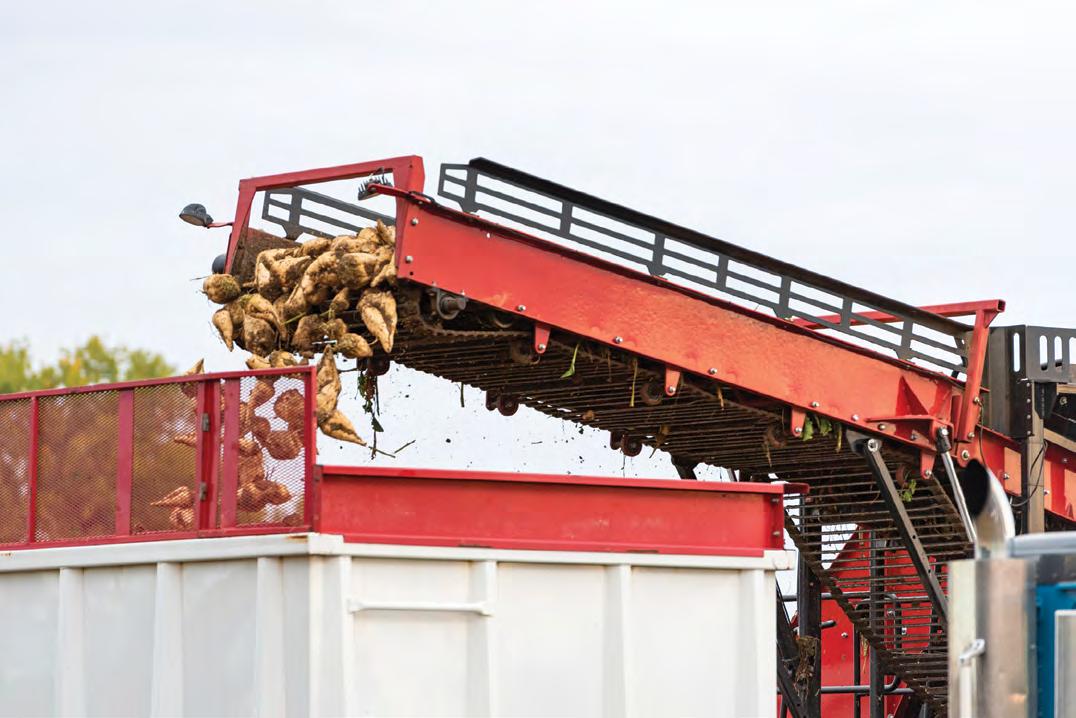


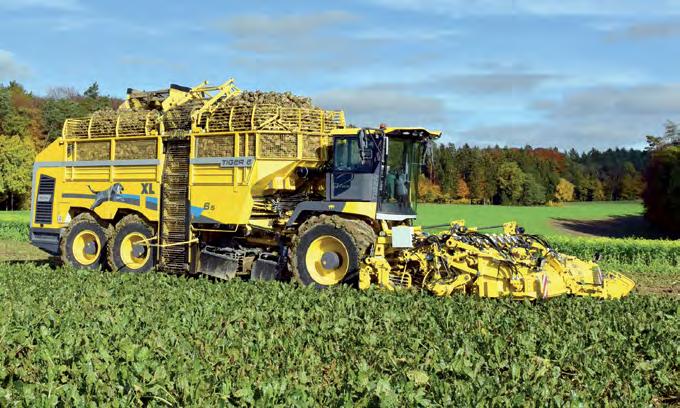




• The Farm Bill (sugar policy) plus appropriations. He said, “Appropriations is an every year task. They can take a hit at you every year or we need money every year. That’s why we have a fly-in every year, just to keep this issue in front of people. You saw how many retirements there are going to be in this election. I think the number is like 51 or 52. And we’re not even through the election. So think of all of those new members who will come in and don’t know anything about our industry, our policy and our issues. So you have to keep pounding on that.”
• Crop insurance changes and expansion.
• Disaster and emergency aid.
• Ag tax issues.
• Climate-based regulations.
• Political Action Committee activities.
• Annual fly-ins.
• Pesticide litigation.
• Introduction and defense of sugar biotechnology (litigation and labeling).
• Multilateral, plurilateral and bilateral trade negotiations.
• Anti-dumping and countervailing cases. “We had them against Europe at one time, but now Europe has become a big importer. And also against Mexico,” he said.
• Circumvention of import restrictions.
• Nutrition policies. About that, Markwart said, “We’ve had highs and lows in that area and right now we’re going into another dip.”
Looking to the future, post 2025, Markwart said, “As I said, you have a very, very strong board of directors working together along with producers in the cane industry under the American Sugar Alliance. I said this a long time ago, and I believe it; this is why this group and our industry are such a success.”
He said the association needs to address the oversupplied sugar market as well as embrace innovation, such as gene editing, AI and nanotechnology. He also stressed the importance of PACs and how critical they are these days with sugar having such a small geographic footprint.
Markwart also addressed his retirement after 44 years with the ASGA. He will retire at the end of 2026 when the association will transition to a new CEO.
He simply said, “As we transition to a new CEO, give all the support you can give.”











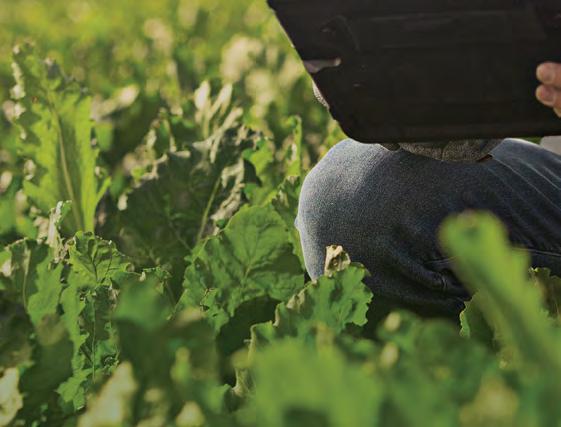














Innovation is transforming sugarbeet farming. At Betaseed, we’re using advances in science to optimize the potential of every seed you plant. Our state-of-the-art breeding and testing process takes up to ten years. It’s the only way to ensure the hybrid your Betaseed rep recommends has the best traits to manage disease and drive yields for this region, and your farm. It’s what we call next-gen breeding for next-gen confidence. Learn more at betaseed.com

www.betaseed.com