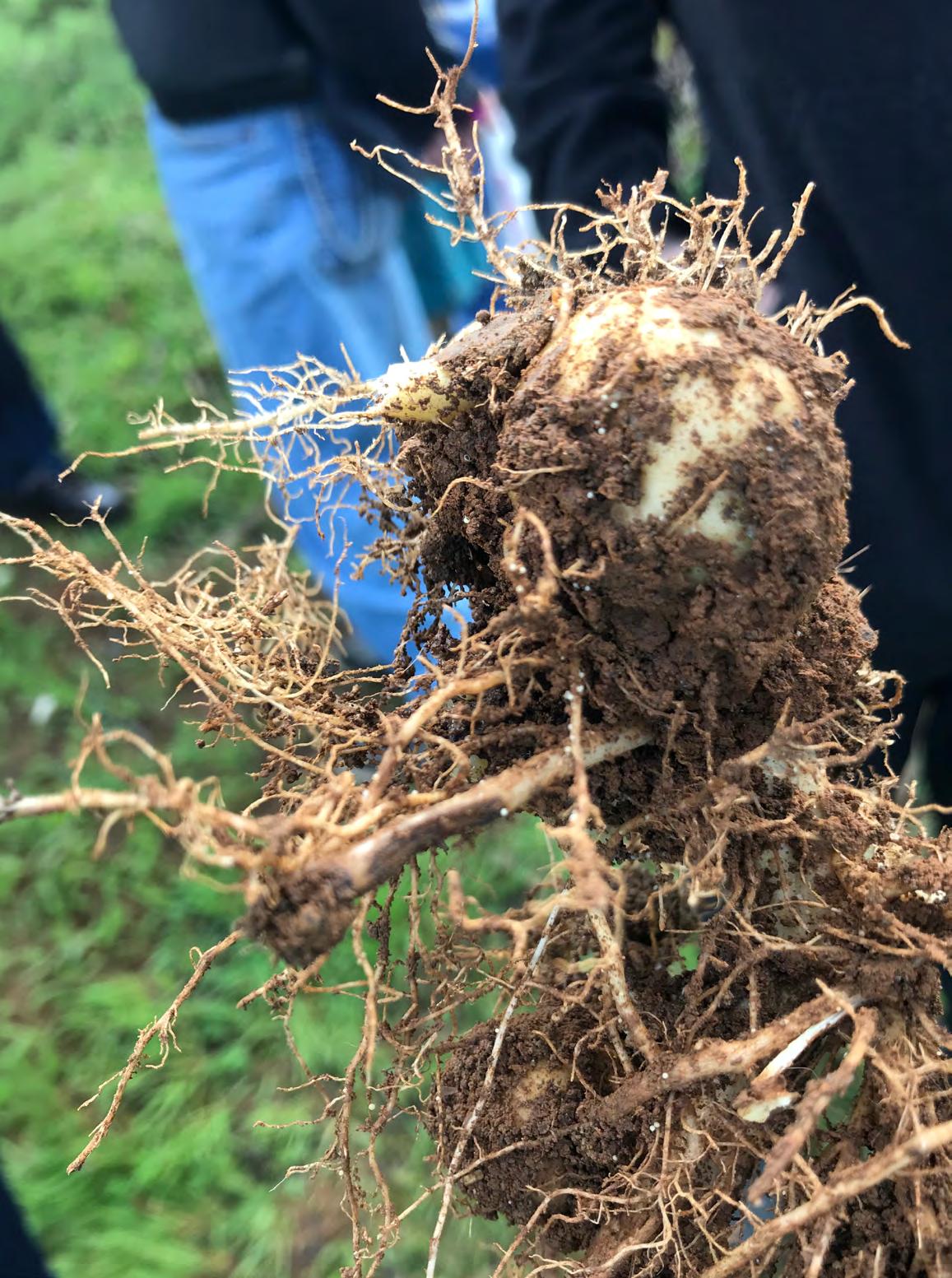
PHOTO BY: Rocio Silvestre Casas, University of Idaho
CALENDAR
May
Published 13 times a year by Harris Publishing Inc.
SUBSCRIPTIONS:
U.S. and Possessions
$24.00 per year, International $120.00 per year. To subscribe call (800) 638-0135
Copyright 2026 Harris Publishing Inc. All rights reserved.
Reproduction in whole or in part without permission is prohibited. Back issues available at $5 per copy. Limited quantities. Publisher not responsible for content of materials submitted.
PRESIDENT Jason Harris
VICE PRESIDENT
Chuck Harris
TREASURER
Clayton Ward
Canadian Publisher’s reement No. 40606038, Customer No. 7004671.
Mailed under a standard rate mailing permit at Idaho Falls, Idaho, and at additional mailing offices.
Also Publishers of SugarProducer
PUBLISHER
Jason Harris
EDITOR
Lane Lindstrom lane@potatogrower.com
ADVERTISING DIRECTOR
Rob Erickson rob.erickson@potatogrower.com
PRODUCTION
Sandon Wixom
GRAPHIC ARTIST
Laci Thompson
CIRCULATION
Chuck Harris
IT DEPARTMENT
Chuck Harris
ACCOUNTING
Clayton Ward
NATIONAL POTATO COUNCIL (202) 682-9456 www.nationalpotatocouncil.org
FOUNDED BY Darryl Harris
CORPORATE OFFICES:
HARRIS PUBLISHING INC. 190 E 1st Street Idaho Falls, ID 83401 208-523-1500 www.potatogrower.com
POTATOES USA (303) 369-7783 www.potatoesusa.com
UNITED POTATO GROWERS OF AMERICA (801) 266-5050 www.unitedpotatousa.com
ALLIANCE FOR POTATO RESEARCH & EDUCATION www.apre.org
POTATO ASSOCIATION OF AMERICA (734) 239-8022 www.potatoassociation.org
MAY 11-14
Food Safety Conference
Donald E. Stephens Convention Center Rosemont, Illinois www.food-safety.com
MAY 15-17
North Carolina Potato Festival
Elizabeth City, North Carolina ncpotatofestival.com
JUNE 2 AND 4
13th Annual Ag World Golf Classic
June 2 – Canyon Lake Golf Course, Kennewick, Washington
June 4 – The Links at Moses Pointe, Moses Lake, Washington https://agworldgolf.com
JUNE 21-23
Washington Potato & Onion Association Convention
Marcus Whitman Walla Walla, Washington http://wapotatoonion.com
JUNE 24
Oregon State University Potato Field Day
Hermiston Agricultural Research and Extension Center Hermiston, Oregon https://agsci.oregonstate.edu/harec/ hermiston-agricultural-research-andextension-center
JUNE 25
Washington State University Potato Field Day
WSU Agricultural Research and Extension Center
Othello, Washington https://potatoes.wsu.edu/
JULY 11-19
Maine Potato Blossom Festival
Fort Fairfield, Maine www.mainepotatoblossomfestival.com/
Soil & Water Conservation Society Annual Conference
Hilton St. Louis at the Ballpark St. Louis, Missouri www.swcs.org/events
AUGUST 4-6
Minnesota Farmfest
Morgan, Minnesota www.farmfest.com
AUGUST 5-6
Idaho Irrigation Equipment Association Summer Meeting
Twin Falls, Idaho idahoirrigationequipmentassociation.org
SEPTEMBER 2-4
IGSA 98th Annual Convention
Sun Valley Resort
Sun Valley, Idaho www.idahoshippers.org
SEPTEMBER 15-17
Husker Harvest Days
Grand Island, Nebraska huskerharvestdays.com
Idaho Falls, ID by Falls Printing rob.erickson@fallsprinting.com
INTERNATIONAL POTATO CENTER www.cipotato.org
THE EYES HAVE IT
Lane Lindstrom, Editor
Do Dollar Figures Mean Anything Anymore?
CONFRONTING PAINFUL REALITIES
I miss penny candy.
There may be some of you who are like me in that we awould take the few pennies we either earned or that our parents gave us (or were lucky enough to find) and run (or ride our bikes) down to the corner store to buy as much penny candy as we had pennies for. Sometimes it was just a couple of pieces, sometimes a handful.
Root beer barrels (my favorite), wax bottles (I had forgotten about these until I was doing some research for this column), Tootsie Rolls, Bit-o-Honey and bubble gum were just a few of what we could buy back then for a penny.
Not so much any more. One cent back when I was a kid is worth 8-9 cents today meaning penny candy is pretty much a thing of the past. And with the federal government phasing out the penny, well, I guess there’s no going back.
You can still find most of that candy but it’s not anywhere near a penny anymore.
And that is par for the course I guess. Everything is more expensive these days.
The culprit? The cost of progress? Some folks are being greedy? Inflation? Scammers and fraudsters are prevalent? Much of today’s technology is expensive?
Yes.
The current state of the potato industry is what got me thinking about penny candy. It’s not as much a stretch as you might think.
And no, I’m not going down that road of “Oh, things were much simpler back then” (although many things were) or “Things were better then than now.” Progress and (positive) change are good. There are some things I have and can experience today that I would not trade for what we had when I was a kid.
But when it comes to dollars and cents, well, some things don’t make too much sense to me. Can you imagine the general state of farming if growers ran their farms like some local and state governments and
much of the federal government do?
There are a lot of frustrating things going on these days, not the least of which is how growers are being bandied about (think: trade, tariffs, global instability, etc.). When I hear some say, “Oh, growers don’t have it that bad,” or “They are just waiting for a government handout,” that really gets my dander up.
It is estimated that potato growers have lost $717 million this past growing season. That is according to the American Farm Bureau Federation (https://www.fb.org/ market-intel/specialty-cropsneed-economic-aid-case-studiesalmonds-apples-blueberries-lettucepotatoes-and-strawberries). That’s a lot of penny candy.
I guess when you consider that
the federal government is trillions of dollars in debt, to some government officials, $717 million is really a drop in the bucket. Because to some in government it’s just a number but that number represents thousands of farmers who are struggling. I’m sure that some on the outside of the ag industry look at the trillions of dollars this country is in debt and look at that potato industry number and say, “That’s it?”
Millions, billions and trillions just flow off the tongues of some people who throw those numbers around like they’re meaningless. Even I tend to brush over some of those outsized numbers, probably because I can hardly wrap my head around the enormity of it all.
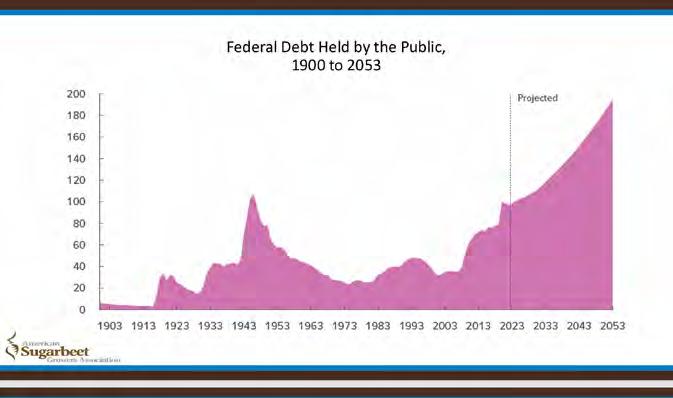
At the annual American Sugarbeet Growers Association meeting earlier this year, ASGA Executive Vice President and CEO Luther Markwart displayed a chart during his comments to the growers and sugar industry people in attendance showing the U.S. federal government’s current debt (see Figure 1). According to the U.S. Treasury, as of March 2026, the total U.S. gross national debt is approximately $39 trillion. This debt, which represents money borrowed by the federal government to cover expenses, has risen significantly, with debt held by the public exceeding $31 trillion and increasing by more than $2 trillion annually.
These are numbers we can hardly fathom so we just kind of shake our heads and try move on. But as Markwart pointedly stated, “That debt trend is not sustainable.”
Then, in what I find incredibly ironic (and extremely sad), according to the U.S. Bureau of Labor Statistics, the price of potatoes in 1970, when I was just a kid, was 18 cents per pound. This past winter, I went to one of the local packing sheds near me and bought a couple of 50-pound boxes and several 5-pound bags of really nice russets for … 20 cents per pound.
I know there are many factors that are contributing to this and of course, most all of you are well aware of this. And I’m not trying to
rub salt into an open wound. I’m just frustrated that the message seems to be falling on deaf ears. What’s even sadder is that I’m afraid if that $717 million figure were, say, in the billions, more powers to be would take notice. But because it’s less than a billion dollars, it seems to me they just brush it off.
Since I’m talking big numbers, here’s one final set of statistics as per the Consumer Price Index (CPI). Based on CPI inflation data, $1 trillion today (2026) has the purchasing power of
approximately $118.7 billion to $134.7 billion in 1970. Due to significant cumulative inflation over the past 56 years — roughly 742 percent — a dollar in 1970 bought roughly 7.4 times more goods and services than it does today
I hope and pray that as you finish up your planting this spring there are better days ahead for you and your farm.
Just know that I will enjoy the fruits of your labor come this fall. And I’ll encourage everyone I know to do the same.
NEW PRODUCTS
Case IH Launches
Nutri-Tiller 1000
Series To Boost Long-
Term Soil Health
Case IH is now offering farmers a new strip-till solution built on the proven agronomic performance of Case IH tillage equipment, delivering enhanced soil conservation while maintaining strong yield potential.
The Nutri-Tiller 1000 series strip-till tool offers farmers the best of no-till and conventional tillage benefits with fewer field passes needed, reduced costs and integrated precision technology.
The Nutri-Tiller 1000 series strip-till tool helps farmers promote strong, early emergence and boost yield potential by creating a uniform strip with an ideal berm shape. The uniform soil environment provides earlier soil temperature warming and more consistent moisture at planting to promote fast, uniform emergence.
Operators can maintain consistent strip quality with full in-cab control of residue managers, row unit down pressure, strip keepers and berm conditioning through the independent down pressure control. This guarantees precise tuning without field stops or manual adjustments, saving time and helping operators stay productive throughout the day. Operators can store guidance lines within Case IH FieldOps™ and seamlessly send
AGRIMAX V-FLECTO: The BKT Tire Designed For Rotary Tilling In Spring
Balkrishna Industries Ltd. (BKT) highlights the importance of rotary tilling when preparing the soil for spring planting. This mechanical operation breaks up clods, mixes the soil and creates a uniform, soft and well-draining seedbed — ideal for receiving seeds and seedlings for the upcoming season.
BKT has designed a reliable solution that is highly performing in every field work stage, including rotary tilling. With AGRIMAX V-FLECTO, the company offers a latestgeneration VF tire that guarantees maximum traction, soil protection and operational efficiency, thereby addressing the challenges that rotary tilling operations pose to tires — and consequently to the tractors — used in such applications. Freshly tilled soil becomes soft and unstable, leading to an increased risk of slipping and a potential loss of traction. Moreover, it is important to use equipment that minimizes soil compaction, which would undermine the previously performed soil refinement. Another factor to consider is unpredictability of weather conditions typical
them to all connected machines.
The Nutri-Tiller 1000 series utilizes FieldOps to simplify guidance line management and prescription creation, while Active Implement Guidance ensures accurate planting within the striptill passes — all managed through the Pro 1200 display, enabling operators to minimize overlap, optimize input use and achieve more precise placement on every pass.
For more information, visit caseih.com.
of the spring season. All these challenges are addressed by a single tire: AGRIMAX V-FLECTO, the BKT product that marks a major evolution in soil cultivation technology, resulting from a unique combination of outstanding field performance and the versatility required for road travel.
One of this tire’s distinctive features is the innovative VF technology, which enables the transport of 40 percent heavier loads compared to a standard tire at the same inflation pressure. For more information, visit www.bkt-tires. com/.
NEW PRODUCTS
2026 Kawasaki RIDGE, Ridge Crew Side-by-Sides
Kawasaki RIDGE side-by-sides deliver premium solutions for hardworking people who need dependable performance, versatility and exceptional comfort on the move. Full-cab versions with HVAC highlight everything that sets the RIDGE apart, offering true all-season comfort.
The Kawasaki-built 999cc liquid-cooled, 4-stroke in-line 4-cylinder engine delivers precise, powerful performance. Whether you’re transporting friends and family to a special getaway, working your property or conquering trails, the RIDGE offers seamless power delivery and responsive acceleration. Paired with a continuously variable transmission (CVT), the engine ensures a smooth, confident ride for the driver and engaging comfort for everyone onboard—so the fun starts the moment you hit the trail.
With or without their signature full cab, RIDGE and RIDGE CREW models project an automotivelike refinement that sets them apart from typical utility or recreation side-by-sides. The moment you sink into the thoughtfully designed ergonomic seat, the care Kawasaki engineers put into achieving toptier comfort and quality becomes clear. Whatever the task, time spent in a RIDGE makes you eager for the workday ahead.
Created with comfort in mind, the RIDGE chassis delivers a stable, composed feel – enhanced by long-travel suspension and high ground clearance – designed to minimize the effect of rough terrain in the cabin. The in-line 4-cylinder engine’s smooth operation adds to the premium ride comfort, making even long workdays feel effortless. Spacious cabins create an open, inviting feel from the moment you step inside. Two-door models
seat up to three passengers side by side, while the RIDGE CREW four-door versions offer room for up to six. Flip-up seats and generous storage options provide versatile solutions for transporting cargo. On the job, the RIDGE demonstrates its capability with the toughness of Kawasaki’s proven sideby-sides, up to 1,000 lb. cargo capacity, and an impressive 2,500 lb. towing capacity. The engine’s high power, high torque and smooth power delivery provide dependable performance in demanding conditions. Available in eight variations — including non-HVAC and rugged, camouflage models — the RIDGE Series combines work-ready capability, functional versatility and class-leading comfort, setting the standard for premium off-road performance.
The vehicles are covered by the Kawasaki STRONG 3-Year Limited Warranty.
• Long-travel double wishbone suspension and high ground clearance
• 7-inch full-color Tft instrumentation with smartphone connectivity via Rideology the App Powersports
For more information, visit https://www. kawasaki.com/en-us/.
PROVEN PROTECTION IN POTATOES
Potato production doesn’t leave room for gaps and neither should your crop protection program. Gowan delivers a proven portfolio designed to help you stay ahead of weeds, disease, and insect pressure at every stage.
Start clean with proven solutions like Vida ® for quick burndown of emerged broadleaf weeds. Follow with Sonalan ® HFP and Eptam ® 7E as pre-plant applications. Then extend control with Eptam ® 7E applied PPI or at layby to manage grasses and broadleaf weeds before they compete.
From early-season protection with Zing! ® and Reason ® , to trusted late-season defense with Gavel ® and copper solutions like Badge ® SC and Badge ® X2, you’re covered when it matters most.
Manage spider mites with Onager ® Optek, and protect your field from Colorado potato beetle with Imidan. All working together in a program built for performance, flexibility, and reliability.
Fungicide/Bactericide
AROUND THE VINE
University Of Idaho “Ag Talk Tuesday” Returns for Summer 2026 Offering Fresh Insights For Idaho Agriculture
University of Idaho Extension is gearing up for another season of “Ag Talk Tuesday,” the popular online series returning May through August 2026.
Sessions will take place on the 1st and 3rd Tuesdays of each month at 11 a.m. (MDT). These sessions will offer growers, crop consultants and ag professionals timely updates and expert insights throughout the growing season.
Each session follows a twopart format designed to keep participants informed and engaged.
Crop Status Snapshot
• Wheat and other cereals
• Onions
• Sugarbeets
• Forage crops
• Additional specialty and row crops
These “roundtable” briefings, where everyone can contribute, help attendees stay ahead of emerging issues from pest pressures to weather-driven challenges.
The program opens with an overview of current conditions across Idaho’s major cropping systems. Extension specialists and educators and other experts share real-time observations and management updates for:
• Potatoes
LOCKWOOD Manufacturing Now Directly Importing Struik Equipment
LOCKWOOD Manufacturing recognizes and celebrates its longstanding partnership with Struik, a Holland-based equipment manufacturer and internationally recognized market leader in rotary cultivator technology.
LOCKWOOD is now importing directly from Struik to reduce freight costs and save customers money.
For more than 25 years, LOCKWOOD Manufacturing has partnered with Struik to bring industry-leading rotary cultivators and hillers to growers in the northern valley area.
Struik has built a global reputation for precision engineering, durability, and performance in cultivation equipment and potato hilling machines. As a market leader in rotary cultivators, the company continues to set the standard for efficiency and agronomic
Featured Topics With Special Guests
The second half of each “Ag Talk Tuesday” session features guest experts who take a deeper dive into timely, rotating featured topics. These sessions explore everything from crop protection and soil health to irrigation technology to sustainable practices and region-specific agronomic challenges.
“Ag Talk Tuesday” continues to be a go-to resource for practical, research-based information delivered in a convenient virtual format.
For more information and the link to register (free but required), visit https://www.uidaho.edu/ extension/events/ag-talk or scan the QR code.
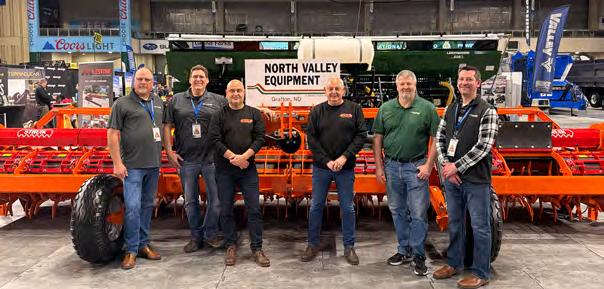
LOCKWOOD’s North Valley Equipment and executive team with Struik’s third-generation leaders. (l to r) Brent Huper, Darren Demers, Wichard Struik, Harry Struik, Dan Birrenkott, Tim Martin.
excellence.
“Over the past quarter century, our partnership with Struik has delivered tremendous value to our customers,” said Tim Martin, director of LOCKWOOD Manufacturing.
“Their commitment to quality and innovation aligns perfectly with our mission to provide growers with reliable, highperformance potato equipment that drives productivity and profitability in the field. And now that we are importing directly from Struik, we can save our growers money.”
The collaboration reflects a shared commitment to advancing agricultural technology and supporting producers with dependable equipment solutions.
LOCKWOOD looks forward to continuing its strong relationship with Struik and delivering best-in-class rotary cultivator and potato hiller solutions to customers for many years to come.
For more information, visit lockwoodmfg.com/north-valleyequipment/.
FITS TO A
The Perfect Fit for CPB Control
With Torac ® Insecticide, you get control of Colorado Potato Beetle and a broad spectrum of other troublesome pests including aphids, psyllids, leafhoppers, and thrips. Torac works quickly, causing rapid feeding cessation, and it is effective on all life stages of target pests. Additionally, the unique mode of action of Torac makes it an excellent rotational option to manage pest resistance in potato, onion, and vegetable crops. With all this, you’ll want to fit Torac in your CPB spray program this season. To learn more, contact your distributor or local Nichino America sales representative.
AROUND THE VINE
MPIC Honors Morgan Composting, Rob Schafer Of Mid-Michigan Agronomy With Awards
During its annual Winter Potato Conference, the Michigan Potato Industry Commission (MPIC) recognized the work and dedication of Morgan Composting and Rob Schafer of Mid-Michigan Agronomy.
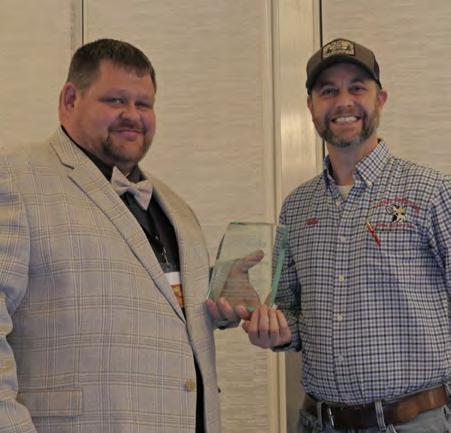
On Jan. 28 at the Grand Rapids Sheraton Airport Hotel in Grand Rapids, Morgan Composting was presented with MPIC’s Outstanding Industry Partner Award, while Rob Schafer was honored with the Distinguished Service to Agriculture Award.
The Outstanding Industry Partner Award recognizes organizations that demonstrate exceptional partnership, innovation and commitment to the long-term success of Michigan agriculture.
For 2025, MPIC honored Morgan Composting for its deep investment in soil health, agricultural sustainability, and industry leadership.
Led by President and CEO Brad Morgan, Morgan Composting has grown from a family-run dairy farm operation into a nationally recognized leader in composting and soil health solutions. Brad Morgan and his father, Dale Morgan, founded the business in 1996 after turning a manure management challenge on their dairy farm into an opportunity. That innovation ultimately became the company’s Dairy Doo compost brand, which focuses on improving soil health, recovering valuable resources and supporting sustainable agriculture.
Beyond its business operations, Morgan Composting has invested in the broader agricultural community through initiatives such as the MI Ag CORE Leadership Program, where the company provides financial support and encourages employee participation to develop the next generation of agricultural leaders. The company has also supported research infrastructure at Michigan State University, helping maintain research fields that advance potato production practices and sustainability for growers.
MPIC also honored Rob Schafer with the Distinguished Service to Agriculture Award, recognizing more than two decades of service, research, and agronomic leadership supporting potato growers.
A graduate of Michigan State University with a degree in crop and soil science, Schafer spent 18 years working in the university’s potato and sugarbeet pathology laboratory, where he built extensive expertise in plant disease management, pest risk assessment, and applied research.
In 2005, Schafer began consulting directly with potato growers, marking the beginning of MidMichigan Agronomy’s formal engagement in potato production consulting. Today, the company advises
Distinguished Service to Agriculture Award winner Rob Schafer of Mid-Michigan Agronomy during the 2026 Winter Potato Conference.
growers managing more than 23,000 acres of potatoes across Michigan and several other states, helping producers optimize nutrient management, pest scouting, and field-level decision-making.
Schafer has also led research trial programs — including nutrient, variety and disease trials at sites such as the Marshall Research Farm — that provide growers with practical, data-driven insights for improving production practices. His responsiveness and technical expertise have earned him widespread respect among growers and industry partners.
“These awards recognize individuals and organizations whose work strengthens Michigan’s potato industry for the long term,” said current MPIC Chair Ryan Pelletier during the presentation. “Both Morgan Composting and Rob Schafer exemplify the leadership, innovation, and partnership that help Michigan agriculture thrive.”
MPIC’s Winter Potato Conference will return to the Sheraton Grand Rapids Airport Hotel in 2027. It’s scheduled for Feb. 2-4, 2027. A full agenda and registration information will be available this fall.
Chair Ryan Pelletier, left, awards Brad Morgan of Morgan Composting with the Outstanding Industry Partner Award.
Learning From PAPAS LESSONS ON NEMATODES:
There probably isn’t a potato grower out there who has heard about nematodes. If you haven’t experienced a problem with nematodes (count yourself fortunate), then you know they can be a devastating pest to potato growers in various areas of the country.
Nematodes are the subject of intense research with hundreds of thousands of dollars being spent to figure out how to minimize the impact of these pests, which can ruin a potato crop and decrease its value.
One group laser focused on the nematode issue is Potatoes & Pests -- Actionable Science Against Nematodes (PAPAS). PAPAS is a group of researchers and scientists from across the country whose work is supported by the USDA National Institute of Food and Agriculture (NIFA).
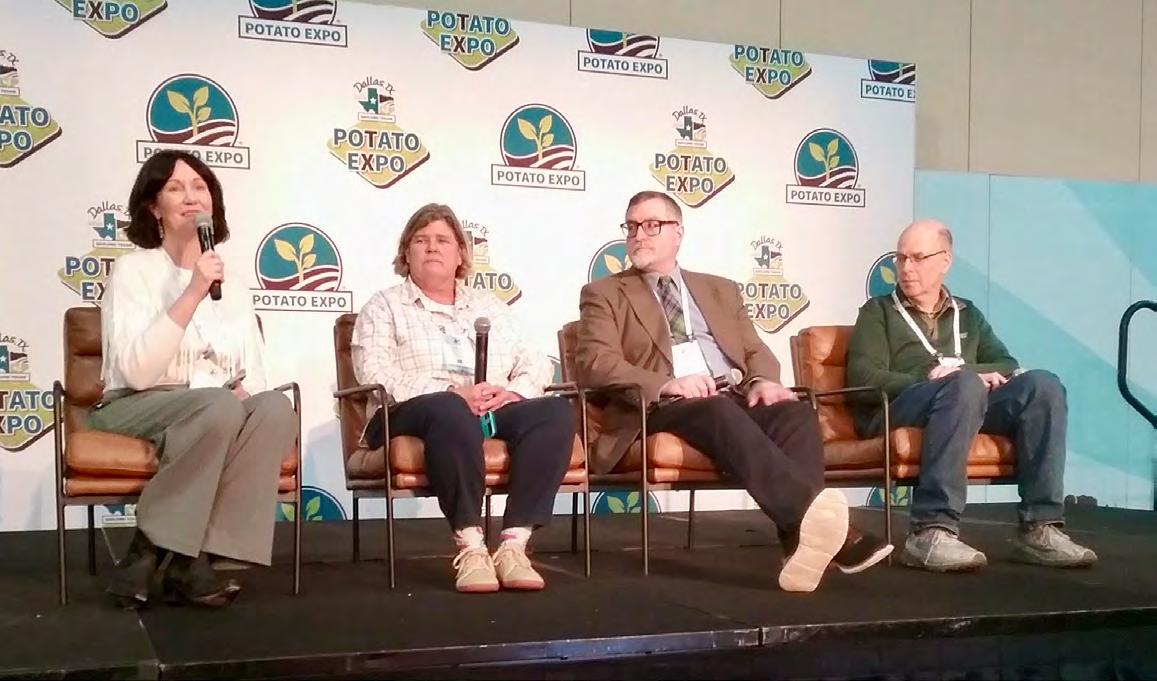
In an effort to share the latest information about nematode research and possible options to minimize the damage to potatoes, a handful of members of PAPAS took to the stage at this year’s Potato Expo in Dallas for a panel discussion titled, “Management Of Invasive Potato Nematodes.”
On the panel was Dr. Cynthia Gleason, associate professor in the Department of Plant Pathology at Washington State University, who was the moderator; Dr. Inga Zasada, a nematologist with NemaSolutions and
formally with the USDA; Dr. Phil Watson, an agricultural economist with the University of Idaho; and Dr. Walter DeJong, a potato geneticist and breeder from Cornell University.
The four panelists used the game of Kahoot to present their information, inviting their audience to answer a series of questions, which led to explanations about several areas of nematode research. So we’ll present the questions, along with the answers and a brief explanation where offered.
As was pointed out by PAPAS, “Most potato varieties grown in the United States are susceptible to potato nematodes. Recognition of the signs and symptoms of invasive nematodes such as root lesion, root knot and potato cyst are the first steps to preventing economic damage from these pests. Field sampling, understanding lab results and applying damage thresholds are all important to implementing successful management strategies that can prevent spread, reduce costs, and minimize their impact.”
In Kahoot, players are given multiple answers to a question and have to choose the correct one(s). With that said, here are the questions and answers.
PAPAS panelists during their presentation at this year’s Potato Expo. (l to r) Dr. Cynthia Gleason, Dr. Inga Zasada, Dr. Phil Watson and Dr. Walter DeJong.
Q: WHICH NEMATODES IMPACT POTATO PRODUCTION?
A: There were four correct answers: cyst nematodes, root lesion, root knot and stubby root. It was explained, “The top two are root knot nematodes. Temperant, what we call northern root knots (Meloidogyne chitwoodi), the Columbia root knot nematode which you’re probably very well aware of causes severe tuber damage. We also have the northern root knot nematode. Neither of them impact yield but impact quality. The root lesion nematodes (Pratylenchus penetrans and neglectus); if you’re from the Midwest, you’re certainly familiar with early potato die, which this nematode contributes to.
Stubby root nematodes are all across the country. Probably the most important thing here is that they transmit tobacco rattle virus, which causes corky ring spot. And then finally, the cyst nematodes which are very limited in distribution in the United States but are widespread in Europe.”
Q: WHY BOTHER TRYING TO CONTROL FOR NEMATODES?
A: The panel offered four reasons:
• Nematodes can negatively affect the quality of potatoes and therefore the price received by producers and the enjoyment of consumers.
• Nematodes can negatively affect the yield of potatoes.
• Nematodes can increase the cost of production to potato producers.
• Nematodes can shut down any potato production on fields where they have been detected.
Q: WHAT ARE WAYS YOU CAN MANAGE POTATO NEMATODES?
A: Crop rotation, soil fumigation and cover crops. It was pointed out, “Every management practice you choose has positives and negatives. With crop rotation often times you can get rid of a nematodes once it’s in a field. So crop rotations often have to be very long. Fumigation is very effective when done correctly but it’s expensive. Then there are cover crops. Nematodes tend to have wide host ranges. So sometimes you’ll plant a cover crop that will just make your problem worse. On the other hand, from a soil health perspective, it’s probably the right thing to do.”
Q: HOW MUCH ON AVERAGE DOES NEMATODE CONTROL COST A FARMER?
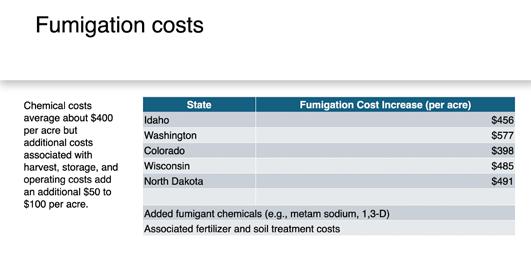
A: The answer is about $500 per acre, but it can be up to $700 per acre. Dr. Watson showed a slide (see Figure 1) detailing the results of some of the studies done looking at this from across different parts of the U.S., showing there is some variation in how much it costs to control nematodes. That $500 figure boils down to about $400 in additional chemical costs and another $50 to $100 in costs that increase because of storage and applications.
Q: HOW MUCH DO NEMATODE OUTBREAKS COST THE BROADER ECONOMY?
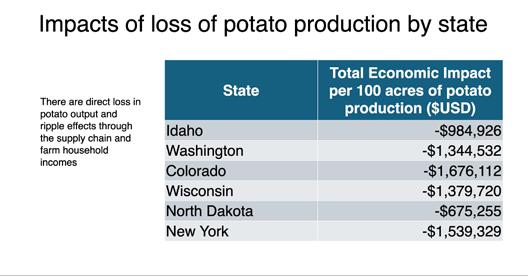
A: The answer is about $1 million per 100 acres. Dr. Watson explained that’s because growers may have to take a field out of production due to nematodes. Figure 2 shows the breakdown across different states. Dr. Watson said, “When you take potatoes out of production it’s the whole supply chain that gets disrupted, including a loss of income to the farmers themselves and then that hurts all the way down to waiters and waitresses at restaurants who are going to get less income. So when you put all those impacts together, that’s what we’re looking at here.”
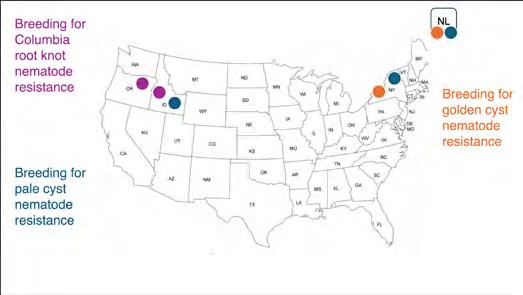
Q: FOR WHICH POTATO NEMATODES ARE U.S./CANADA BREEDERS CURRENTLY TRYING TO DEVELOP RESISTANT VARIETIES?
A: There were actually six options as answers to this question from Dr. DeJong but there were only three correct answers. He commented, “So which three are we trying to develop resistance for is really a good question.
Figure 1
Figure 2
Figure 3
POTATO GROWER GOLF SCRAMBLE
The Potato Industry's Most "Rewarding" Day!
GROWERS PLAY FREE
All skill levels welcome
One free player per family/farm/operation
Each team must have a combined handicap exceeding 60
The two best players’ combined handicap must be 15 or more
Field is limited to the first 144 paid entries
Sponsored by:
U Of I Researcher Finds Overestimation In Potato Farmers’ Water Consumption Estimates
By John O’Connell
Idaho potato fields consume far less water during peak irrigation season than models available to farmers and water managers would suggest, according to a University of Idaho scientist’s recent findings.
Meetpal Kukal, an assistant professor of hydrologic science and water management in the Department of Soil and Water Systems, has finished the first of several years of field monitoring intended to improve the accuracy of consumptive water use estimates that are important to agriculture. Water deemed to be consumed is removed from the system, either by being stored in plant tissue or being emitted as vapor from soil or foliage, through a process known as evapotranspiration (ET).
In a report he presented to farmers attending the 58th annual Idaho Potato Conference, hosted Jan. 21-22
in Pocatello, Kukal’s observations from a southwest Idaho field show that current models used by Idahoans are overestimating water consumption in potato fields during peak irrigation season by as much as 40 percent.
“ET on irrigated crop land is the largest outflux in the system, but ET is also the most uncertain one. Even a little bit of uncertainty in ET results in a lot of unaccounted water,” Kukal said. “We are severely overestimating water needs in the peak season, and that’s the time when our irrigation systems are the most challenged.”
Early in the irrigation season, however, models currently used by water managers appear to be slightly underestimating water consumption in potato fields. Regional irrigators have told Kukal his observations mirror their own experiences.
Kukal studies ET using a network of monitoring stations, called eddy covariance towers, located in fields
Meetpal Kukal, an assistant professor of hydrologic science and water management in the Department of Soil and Water Systems at the University of Idaho.
from Wilder through Declo. He drew potato data from a Clearwater Russet field in Wilder. One of Kukal’s graduate students intends to make additional calculations specific to other crops.
Idaho law administers water rights to users based on the volume of water they divert into canals or pump from wells, granting priority to older water rights. However, much of that water seeps back into the aquifer, where it can be reused downstream. Water managers may track consumptive use in addition to diversions for a fuller picture of how much water is available in the system at any given time.
The Idaho Department of Water Resources (IDWR) predicts how various scenarios might affect the water supply, and it calculates water consumption based on crop coefficients — or ET estimates specific to each crop. These crop coefficients were established in the 1970s using lysimeters, which weigh soil to measure changes in moisture levels. But those coefficients don’t represent differences in potato varieties, soil type and crop management, and it is not well understood how these factors may influence consumption.
Kukal’s approach indirectly calculates ET by tracking radiant and wind energy in the field and determining the precise volume of water that energy would evaporate from plant tissue and soil.
“To evaporate one gram of water, we know exactly how much energy is being used,” Kukal said. Sensors in the eddy covariance towers measure water
vapor concentrations and wind speeds in three directions 10 times per second.
“The crop coefficients have their place,” Kukal said. “They’re a useful resource that we have had historically and will continue to serve us, but it’s important to start revisiting and fine-tuning those to include newer crop varieties and cultivars, and the best technique we have available to us today is the eddy covariance measurements.”
Placing towers in every field would be impractical. Rather, Kukal hopes to use data from his network of monitoring stations to refine and calibrate ET estimates from satellites operated by NASA’s Landsat program. Landsat satellites pass by a given location every eight days and record the temperature and crop canopy progression. Kukal also envisions using his monitoring-station data to create updated crop coefficients covering many more production and management scenarios.
Kukal plans to continue collecting ET data from eddy covariance stations for several more years. He anticipates resulting modeling improvements will help IDWR with management decisions and farmers with better irrigation scheduling.
“These measurements need to be long term because there are so many combinations of all of these factors that ideally you need to keep improving our understanding of ET,” Kukal said.
For more information, contact Meetpal Kukal (402) 219-3969 and mkukal@uidaho.edu.
PESTICIDES
BUYERS’ GUIDE
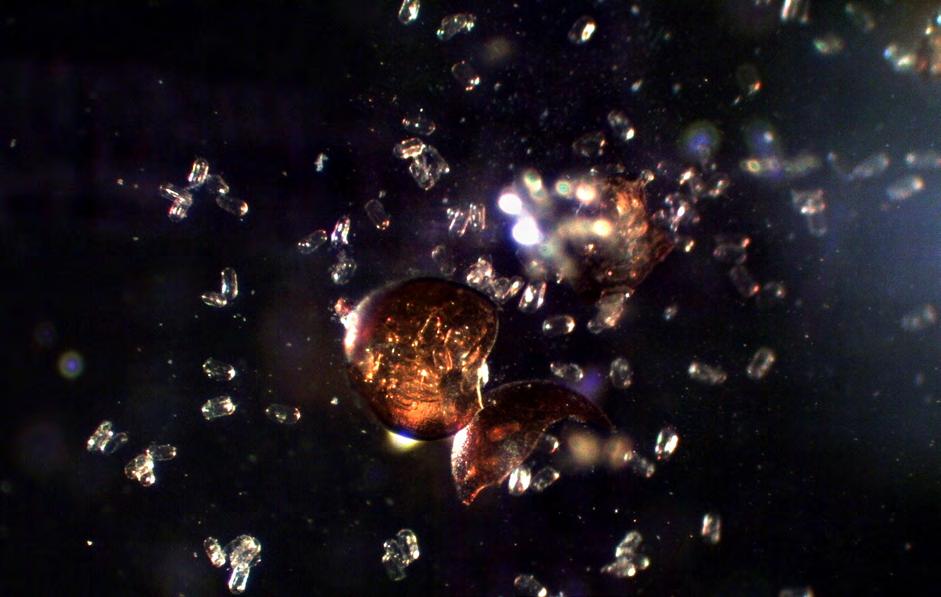
Microscope image of potato cyst nematode eggs spilling out of a ruptured cyst. ARS scientists are testing trap crops to find ones that can make the pest hatch from these cysts and then starve for lack of a host. Photo by Potato Cyst Nematode Research Group/ARS/APHIS.
Always read and follow label instructions. Some products may not be registered for sale or use in all states or counties. Please check with your state or local extension service to ensure registration status.
It’s a long road to harvest, but Zivalgo insecticide is here to help potato growers go the distance. Powered by PLINAZOLIN technology, an innovative Group 30 mode of action, Zivalgo controls tough foliar insect pests such as Colorado potato beetle, potato leafhopper and more, helping crops remain clean and productive. With a formulation that delivers high efficacy, rugged durability and impressive residual control, Zivalgo protects potato crops until the finish line,
preserving marketable yield potential for a winning end to the season.
Miravis Prime
Miravis Prime fungicide combines two powerful active ingredients — ADEPIDYN technology (FRAC group 7) and fludioxonil (FRAC group 12) to help potato growers protect their yield potential. Boasting the most advanced chemistry in its class, Miravis Prime helps to prevent and provide excellent control against key potato diseases such as early blight and white mold for up to three weeks. Miravis Prime recharges and complements integrated pest management spray programs and helps increase marketable yield potential, even under intense disease pressure. Miravis Prime is available to potato growers in the fresh, processor and export markets.
TELONE™ II by Teleos soil fumigant is the gold standard for defense against destructive plant parasitic nematodes, including root-knot, root-lesion, and stubby-root. Prepping the soil with TELONE™ before planting supports healthier roots, higher yields, and improved quality. A custom blend of TELONE™ (to combat nematodes) and chloropicrin (to target soil-borne diseases like fusarium wilt and scab) is an effective one-two punch.
BUYERS’ GUIDE
AMVAC (888) 462-6822
www.amvac.com
Ecozin Plus 1.2% ME
Ecozin Plus 1.2% ME, a product from AMVAC’s Green Solutions portfolio, effectively targets a wide range of insects that can be detrimental to potato growth, with low use rates and whole-plant protection in organic and non-organic operations. Treated plants exhibit reduced feeding damage or egg-laying by insect pests through a repellant action of the product. Ecozin Plus 1.2% ME utilizes a botanical insect growth regulator (IGR) to control insects in the larval/nymphal and pupal stages by interfering with the molting process.
AbbA Ultra
AbbA Ultra miticide/insecticide is a foundational tool for potato growers to control Colorado potato beetle, Liriomyza leafminers, potato psyllids and spider mites. Growers see exceptional efficacy with AbbA Ultra’s advanced formulation technology. The product contains twice the concentration of abamectin than some other formulations, which creates an easy conversion rate. Plus, using half of the standard abamectin product containing 0.15 pounds of active ingredient per gallon allows users to save time and money with half the storage, transportation and container disposal.
Gowan USA (800) 883-1844
https://www.gowanco.com/
Potato Portfolio
Since 1962, beginning as a crop consultancy, Gowan Company has been rooted in agriculture, providing trusted expertise and innovative
solutions for growers. This family-owned, American business works to understand growers’ challenges and is committed to delivering products and services that maximize yield and quality. Gowan provides solutions for the unique needs of potato producers.
Gowan USA’s dedicated sales representatives and development teams regularly work with potato growers and researchers to ensure that each product performs optimally in the field.
INNVOXIA EC is an indoxacarb-containing insecticide recently registered for potatoes. This new brand provides control of challenging pests like Colorado potato beetle and potato tuberworm. With minimal impact on beneficials, it is a great part of an IPM program.
fungicide effective at controlling tough potato diseases like early blight, brown spot and black dot with preventative and curative activity. Innliven Elite also provides stress tolerance and promotes plant growth.
FMC Corporation
(208) 705-3999
(509) 770-0302
www.ag.fmc.com
Vantacor
Vantacor insect control powered by Rynaxypyr active delivers the industry standard active ingredient for long residual control of Lepidopteran pests. This highly concentrated formulation of Rynaxypyr active uses a low use rate to target key insects like Colorado potato beetle, cabbage looper, armyworm and grasshoppers that can diminish profitability in potatoes. Vantacor is applied at a rate of 0.7 to 2.5 fluid ounces per acre for improved mixing, less packaging, and minimal impact on many important beneficial insects.
Carbine 50WG
To help stop aphid and psyllid damage within 30 minutes to one hour of ingestion, growers can use Carbine 50WG insecticide from FMC. It works by affecting the potassium channels in the pests’ nervous systems, permanently and irreversibly putting a stop to feeding. Carbine 50WG helps protect both sides of the leaf from disease-transmitting insects due to its translaminar activity. Controlling these pests can halt the spread of potato virus Y and zebra chip disease, which can cause substantial internal damage to potato crops and, eventually, substantial economic losses.
AZterknot fungicide is designed to help potatoes grow stronger, healthier and more resilient throughout the season. It supports improved photosynthesis, leading to greener plants that better tolerate stress from heat, drought and other environmental pressures.
With a dual mode of action (azoxystrobin + Reynoutria sachalinensis extract), AZterknot provides broadspectrum disease control against key threats like powdery mildew, early blight and brown spot. Applied early, it helps protect plants from diseases that can impact tuber quality and yield.
AZterknot can be used in-furrow at planting and as a foliar application at row closure, offering flexibility in your program. The result is improved plant vigor, better standability and more consistent performance under stress, helping maximize yield potential and return on investment.
Averland SM
Averland SM is a next-generation nematicide designed to deliver protection where it matters most, throughout the root and tuber zone. Powered by Vive’s Soil Mobile (SM) Technology, the abamectin moves with water through the soil profile, reaching optimal depths where nematodes are most active, rather than remaining concentrated at the surface. This targeted movement creates a larger, more consistent zone of protection, helping reduce nematode pressure and protect against damage such as tuber stings and infection. Applied through chemigation and irrigation, Averland SM offers a simplified, cost-effective alternative in traditional spray programs, delivering longer-lasting control while lowering overall program complexity.
Summit Agro USA (984) 260-0407 summitagro-usa.com
HARVANTA 50SL
BUYERS’ GUIDE
insect problems, especially Colorado potato beetle. Colorado potato beetle is the target of a 2(ee) recommendation for HARVANTA, which means growers in many states* can apply HARVANTA at lower rates to control this devastating pest — as low as 5.5 fl oz / A. HARVANTA delivers many advantages, including:
• Proven broad-spectrum insect control
• Utilizes less active ingredient per acre than most other diamide insecticides
• Fast-acting on ingestion, with long residual control
• Excellent efficacy against Colorado potato beetle and lepidopteran pests
• Effective against chewing and sucking insects, in both adults and larvae
• Controls many insects resistant to organophosphates, pyrethroids and carbamates
• Excellent component for Integrated Pest Management (IPM) programs
• Valuable tool for Insect Resistance Management (IRM) programs
* CA, CO, FL, ID, ME, MA, MI, MN, NE, NY, NC, ND, OR, PA, RI, TX, VA, WA, WI
Certis Biologicals has launched NemaClean 10% WP, a new innovative bionematicide with the active ingredient Purpureocillium lilacinum strain PL11. The product formulation offers:
• Efficacy against harmful nematodes
• Flexible use rates
• Easy applications
• Integration with other nematode management tactics
• Compatibility with a range of agricultural practices
Potato growers can expect field-tested performance. NemaClean’s beneficial fungus targets all life stages of plant-parasitic nematodes through direct parasitism, protecting the root systems of your crops. This mode of action attacks harmful nematodes, leaving beneficial nematodes alone.
NemaClean has shown high efficacy compared to chemical nematicides, which also have limited applications allowed per year per acre. NemaClean gives growers the flexibility of multiple in-season
applications, plus the ability to apply at pre-plant, at plant, or post-planting.
NemaClean offers a convenient tool to manage plant-parasitic nematodes throughout the growing cycle. To get the most out of your application, consider using NemaClean as part of an integrated nematode management plan.
NemaClean 10% WP has shown strong field performance in potato crops across multiple regions in the U.S., giving organic and conventional growers a powerful new tool to help protect the value of their crops.
BASF www.basf.com/us/en
Provysol
Provysol fungicide, powered by Revysol fungicide active ingredient, is the first and only isopropanol azole chemistry that is a truly unique solution for disease control. With an innovative molecular structure, Provysol fungicide provides better and longer lasting control of potato early blight than the industry standard early blight fungicides. Engineered with a flexible molecule, Provysol fungicide quickly penetrates plants for fast, longlasting control. Designed for low-growing plants that can be excellent hosts for diseases, Provysol fungicide can be a foundational application in a fungicide spray program, delivering early protection for long-lasting control and success.
SAN Agrow (800) 876-2767 www.san-agrow.com
Earthtrend Soil & Earthtrend Foliar PGRs
Earthtrend Soil and Earthtrend Foliar Plant
Growth Regulators help to maximize potato production by accompanying you throughout the growing season, from seed piece treatment to chemigation. The components in Earthtrend PGR products work in combination to produce activity
NemaClean
greater than the sum of its parts. These products are designed to stimulate root and tuber growth and improve overall potato quality, thus increasing the number of marketable potatoes. Use as part of an effective crop management program to enhance the efficacy of starter and pre-plant fertilizers, promote robust root development and tuber initiation, control tuber size and improve uniformity, and boost the activation of disease defense-genes.
Earthtrend Soil improves germination, seedling vigor, uniformity and growth, and overall crop quality. It also reduces transplant shock in new plantings.
Earthtrend Foliar stimulates leaf initiation, regulates flowering and improves crop growth, uniformity and quality.
Earthtrend products can be used together or as standalone products. They are easy to use and are compatible as a tank mix with herbicides, insecticides, fungicides, nematicides and fertilizers.
Bayer (866) 99-BAYER
www.bayerpotato75dayipm.com
75-Day IPM Program
The Bayer family of products is powerful, especially when used together. Combined, they create an agronomic force field around your crops, providing protection during the first 75 days, when potatoes are most susceptible to pests and disease. Safeguard your potatoes with the Bayer 75-Day Integrated Pest Management program.
Admire Pro is a soil- and foliar-applied systemic insecticide that provides economical and enduring control of damaging insects in potatoes.
Emesto Silver seed treatment fungicide provides
excellent protection against seed-borne Rhizoctonia and Fusarium (including resistant strains), and good activity on silver scurf. Emesto Silver-treated seed pieces withstand natural infection after being held for 61 days versus untreated.
Minuet is a soil-applied biological fungicide. It forms a symbiosis with the plant and triggers activation of root and plant growth to support healthy plants, increase crop quality, and enhance yield potential.
Movento HL insecticide features powerful, two-way movement throughout the plant to protect it from a broad range of insects, mites and nematodes.
Sivanto Prime insecticide precisely targets key damaging pests with minimal impact on beneficial insects.
Velum Prime nematicide moves from the plant’s roots to the leaves, suppressing nematodes below ground while helping to protect root health.
UPL (610) 491-2800
www.upl-ltd.com/us
Assail
Assail insecticide (IRAC 4A) provides broad-spectrum insect control in potatoes. Whether the concern is aphid, Colorado potato beetle, leafhopper or whitefly, Assail can help take the worry away. With its translaminar activity, Assail performs more like a systemic insecticide, providing weeks of control. Assail has also been recognized as a bee-friendly product when good application stewardship is followed.
Rimon
Rimon insecticide (IRAC 15) is a broad-spectrum larvicide and ovicide that provides excellent control of key pests in potatoes, including Colorado potato beetle and European corn borer. An insect growth regulator, Rimon goes after eggs, larvae and nymphs. Its unique mode of action makes it an excellent resistance management tool.
DIGGIN’ IN
Age And “Little Tuber” Formation In Storage
Potato tubers have three main types of dormancy: endodormancy, paradormancy and ecodormancy, and each influence how and when tubers sprout.
Endodormancy is controlled by the potato’s genetics which essentially tell the tuber how long to “stay asleep” as part of the natural rest period after harvest, regardless of external influences like warm temperatures.
Paradormancy refers to the interactions of the eyes where one dominant eye can suppress sprouting in the other eyes.
Ecodormancy is influenced by external factors such as the storage temperature – specifically, even after endodormancy ends, sprouting will be limited if the conditions are not favorable for growth (e.g. cold storage).
Together, these three dormancy types interact to determine the sprouting behavior and dormancy potential of your crop. In prolonged storage, endurance is typically completed within a few weeks to a few months depending on the cultivar, after which tuber age and storage conditions become the primary factors controlling sprout development and growth.
When sprouting begins, potato tubers go through multiple stages as a tuber ages. These stages can include a single sprout which then evolves into multiple sprouts and/or branched sprouts.
Extreme Conditions
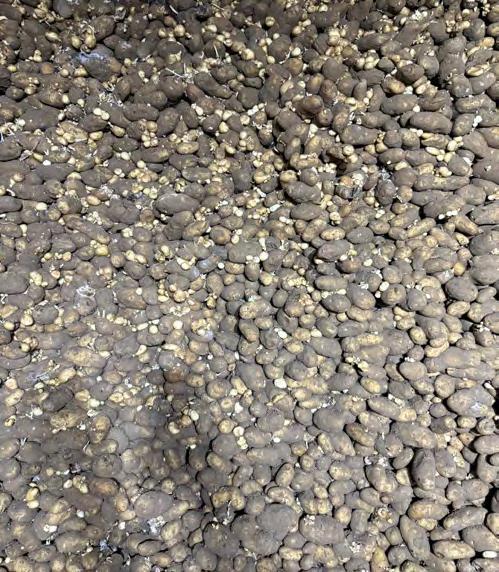
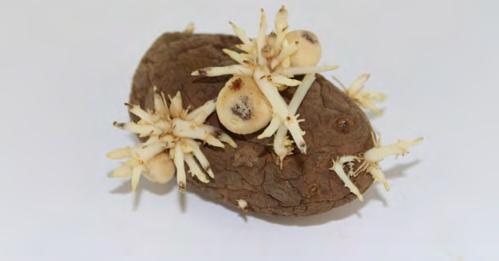
In extreme conditions, “kinder tuber” or “little tuber” formation is the final sprouting stage where instead of sprouts developing, small tubers form directly on the tuber. Visually from a distance, these little tubers may look like mushrooms growing on the pile of potatoes (as illustrated in the attached photos), but little tubers are a physiological response to advanced aging and storage conditions.
Tuber aging is controlled by tuber maturity at harvest, storage condition(s) and tuber hormonal balance. All three interact to manipulate the dormancy period and sprout development in a tuber. As tubers age, hormone levels change and apical dominance decreases, which first allows main sprout growth and then later lateral growth (e.g. additional eye sprouting). At that same time, changes in cell strength and metabolism makes the potato tissue weaker and just … old.
Between the aging response and the storage
conditions, little tuber formation can occur, although not a common disorder to see. Generally, little tubers are a great indicator of aged potatoes and possible storage issues. Interestingly, little tubers can even form on potatoes treated with sprout inhibitors. Additionally, aging is not just associated with seed; it is universal to all stored potatoes.
There are two ways in which potatoes age: chronologically and physiologically. Chronological age is simply how old the potatoes are in days. Some people may start the chronological clock when the tuber is newly initiated after tuberization, and some start the clock at vine death or harvest.
Regardless of how it is calculated, potatoes that are still in storage as of today (May) are about 9 to 12 months old and the storage season still has several more months left.
So, what is physiological age? Field, pre-harvest and post-harvest conditions can stress a crop, which contributes to its relative age.
Temperature during the post-harvest period is
This pile of Ranger Russet potatoes has “little tubers” that have formed on the individual tubers.
generally the strongest factor impacting physiological age. For example, the understated period in which elevated temperatures can significantly age the crop is between vine death and harvest and the early storage period.
In warm harvest years, the crop is harvested warm and often lacks available cooling air in storage. This directly ages the potatoes physiologically. While you will not necessarily see sprout development at this time (because they are in the endodormancy period), the warmer temperatures are still altering physiological processes in the tubers. Warmer temperatures increase tuber respiration rates, which is “remembered” by the tuber and ultimately alters tuber sprouting patterns. So what happens if a tuber is aged, but environmental conditions are not conducive to sprout
PILERS
growth? In warm storage conditions (greater than 45 degrees F) sprouts will elongate if not controlled by sprout regulators/suppressors. In colder storage temperatures, sprout elongation will be suppressed, but growth still occurs though at a much lower rate.
Depending upon age of the tubers, tuber hormonal balance, storage air exchange and humidity, cold storage conditions can stimulate the tubers to essentially “panic” and work to again preserve itself. When this happens, the sprouts will stop elongating and swelling will instead occur as carbohydrates are mobilized to the developing tissues. This results in little tuber formation.
Given that cultivars age at different rates, have varying sprouting behaviors and can reach the little tuber formation stage at contrasting times, it is important that good tuber conditions begin at vine-kill through final use of the crop.
Overall, creating a greater understanding of aging as a complex phenomenon, which unfortunately has no straightforward way to measure or quantify, will help improve quality and operational efficiency.
Keep an eye out for conditions that may promote advanced aging to avoid “little tuber” formation and to maintain the targeted quality of the crop.
(Olsen is a potato specialist with the University of Idaho and can be reached at norao@uidaho.edu. Blauer is a potato physiologist with Washington State University and can be reached at jblauer@wsu.edu.)
CROSSOVERS/WINDROWERS
CONVEYORS -TELESCOPIC
2009 Spudnik 1255 36”/42”/85’ 3ph
2001 Spudnik 1255 30’’/36’’/85’ 3ph
1997 Spudnik 1255
ROCK/CLOD/AIR
DAMMER DIKERS
HARVESTERS
SURGE HOPPER/
COLLECTORS
Logan Telescope Stinger 36”/46”x12ft, 4ft of telescope, 230v 3ph
SIZER 2019 Spudnik 990 -96” Acorns, 240v 3ph
Spudnik 925 -84” Acorns, 240 Volt 3ph 2000 Spudnik 925 -72” Acorns, 240 volt 3ph
Severely aged and dehydrated potato tuber with sprouts and “little tubers.”
DIGGIN’ IN
A Hidden, Bottom-Line Boosting, Microbiome
Efficiency and yield are what separate a profitable season from a frustrating one. But there’s one part of your crop working for you every single day that goes almost entirely unnoticed.
Yet, with the right support, it could deliver a serious return on a very small investment.
The phyllosphere is a microscopic community of bacteria and fungi that lives on the surface of your potato crops’ foliage. It’s not a new product or a chemical treatment. It’s a living system that already exists on your crop. But without your support, it’s just surviving rather than thriving.
What Is The Phyllosphere?
The leaf surface of your potato plants looks unremarkable to the naked eye but every square centimeter of that foliage is home to between 1 and 10 million bacteria and fungi. This community of microorganisms is your crop’s phyllosphere, and it plays a vital role in keeping your plants healthy and productive from emergence through harvest. (3,4,5)
These microbes live in one of the harshest environments on the farm and must endure intense sun, drying winds and temperature swings from cool mornings to scorching afternoons. Microbial communities like these exist in what researchers call “hot spots and hot moments” of biological activity, where nutrient availability determines whether they thrive or lie dormant. (1)
When the phyllosphere is well-fed and active, it delivers meaningful benefits such as: improving your crop’s ability to handle heat and drought stress, cycling nutrients more efficiently, suppressing invading pathogens and producing natural growth-promoting compounds. (3,4,5) When it’s starving, those benefits disappear, and your crop is left more vulnerable at exactly the moments it needs the most support.
Most farmers are familiar with the rhizosphere — the zone of microbial activity around plant roots — but the phyllosphere is one of several other important microbial spheres influencing crop performance. Other spheres include the spermosphere (seed-soil interface) and detritusphere (residue-soil interface). (2) Of all these spheres, the phyllosphere is perhaps the least understood and the least managed. Naturally, it represents one of the greatest untapped opportunities in potato production.
A well-balanced microbial food source that includes carbohydrates (preferred by bacteria) as well as proteins
and lipids (preferred by fungi) gives this community what it needs to thrive. PhycoTerra FX was developed specifically for this purpose, designed as a foliar microbial food that feeds the full spectrum of phyllosphere biology.
What We Know About The Potato Phyllosphere
Research specific to potato crops has identified a range of beneficial functions that phyllosphere microbes contribute, including nutrient cycling, plant growth promotion, pathogen suppression and abiotic stress tolerance. (6,7,8) Studies have also shown that different potato cultivars interact with their microbiome in distinct ways, with some varieties better positioned to leverage phyllosphere biology for sustainable production. (7)
Particularly promising is recent work identifying Bacillus and Actinomycetes species in the phyllosphere with strong biocontrol and plant growth-promoting activity, which are microbes that, given a reliable food source, can help protect and boost your crop naturally. (8)
Research on phyllosphere bacteria isolated from potato plants has also demonstrated direct yield benefits when these microbes are active and well-supported, including improvements in marketable tuber yield of the kind that translate directly to farmer income. (6)
What The Numbers Say: Trial Results Across North America
PhycoTerra FX has been put to the test across diverse growing regions in both the United States and Canada. It’s been trialed in different soils, different climates and across different varieties. Through these trials we have determined that 1 pint (or 480ml)/Ac applied at midbulking is our recommended application.
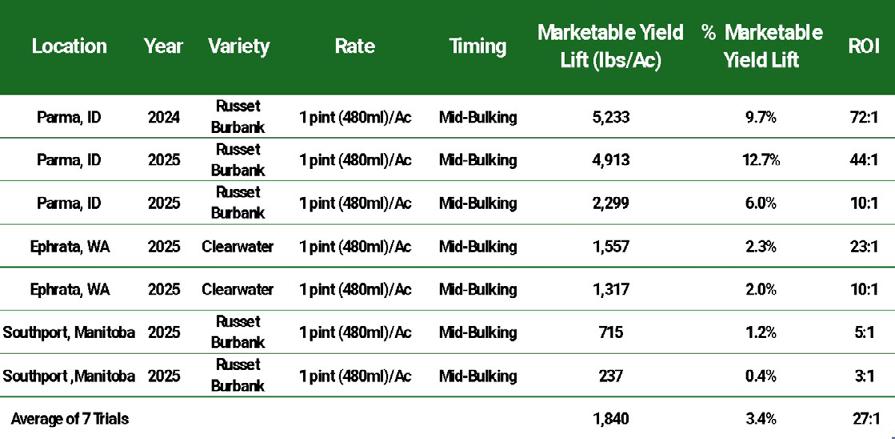
Here’s what some of our independent third party trials found using this application.
What This Means For Potato Farmers
Feeding your potato crops’ phyllosphere will add to your bottom line this season. An average of marketable yield boost of 1,840lbs/Ac with an average return on investment (ROI) of 27:1 was obtained in seven independent research trials over 2024 and 2025 seasons. This means that for every dollar spent an average of $27 was returned to the farmer.
Supporting beneficial bacteria and fungi on the leaf and stem is also a low risk investment. PhycoTerra FX
All trials conducted by independent CRO. ROI calculated at local market price at time of harvest. Error bars represent one standard deviation from the mean; significance tested using Fisher’s t-test.
delivered positive ROIs in 100 percent (7 of 7) of trials over the past two seasons. Even with the low end of observed yield increases, a significant ROI of 3:1 was still generated.
The Parma, Idaho, trials are particularly compelling because they were repeated across two growing seasons on the same variety (Russet Burbank) in the same silt loam soils. In 2024, a 1 pint per acre delivered a +10 percent marketable yield increase and a 72:1 return on investment. For every dollar invested, the farmer got $72 back. In 2025, that same 1 pint delivered a +13 percent yield increase and a 44:1 ROI.
This serves as an excellent example of what feeding your phyllosphere can do for your potato crop, season after season.
How To Think About This Investment
At 1 pint per acre applied, the cost of entry is low. The ROI data from the trials above is calculated at local market prices at time of harvest. Even in the most conservative scenario tested, you’re getting back significantly more than you put in.
PhycoTerra FX isn’t a replacement for your existing fertility or crop protection program. It works alongside what you’re already doing, activating a part of your crop’s natural biology that most programs never address. It’s not a substitution, but rather an opportunity to unlock previously untapped, crop potential.
Reach Your Full Yield Potential In 2026
The rhizosphere gets a lot of attention from agronomists and farmers, and rightly so. But the biology living on your potato plants’ leaves is just as real, just as active, and just as capable of contributing
to a profitable crop if it’s given what it needs to thrive.
This growing season, consider adding an application of PhycoTerra FX to your program. The microbes are already there. They’re already working. Give them a meal and let the ROI speak for itself.
Scan the QR code to learn more.
References
1. Kuzyakov, Y. & Blagodatskaya, E. (2015). Microbial hotspots and hot moments in soil: Concept & review. Soil Biology and Biochemistry, 83. doi:10.1016/j. soilbio.2015.01.025
2. Miller, M. Four Microbial Spheres of Impact on Your Farm. Potato Grower.
3. Vorholt, J.A. et al. (2022). Phyllosphere microbiome: Diversity and functions. Microbiology Research, 254.
4. Bashir, I. et al. (2018). Prospecting the characteristics and significance of the phyllosphere microbiome. Annals of Microbiology, 68(5), 229-245.
5. Ghosh, D. et al. (2023). Phyllosphere Microbiome in Plant Health and Disease. Plants (Basel), 12(19):3481. doi:10.3390/plants12193481
6. Suresh, A. et al. (2018). Exploring Phyllosphere Bacteria for Growth Promotion and Yield of Potato (Solanum tuberosum L.). Int. J. Curr. Microbiol. App. Sci, 7(4): 1065-1071.
7. Hannula, S.E. et al. (2025). Unveiling Potato Cultivars With Microbiome Interactive Traits for Sustainable Agricultural Production. Plant Cell Environ. Jul 1.
8. Condori-Pacsi, S.J. et al. (2026). Biocontrol and Plant Growth-Promoting Potential of Bacillus and Actinomycetes Isolated from the Rhizosphere and Phyllosphere of Potato (Solanum tuberosum L.) from Different Agroecological Zones of Peru. Appl. Microbiol., 6, 2.
(Miller is senior agronomy manager, specialty crops, at PhycoTerra.)
IDAHO POTATO COMMISSION
Jamey Higham, President and CEO
14 Years On The Road:
HOW THE BIG IDAHO POTATO TRUCK BECAME ONE OF THE MOST RECOGNIZED COMMODITY CAMPAIGNS IN AMERICA
Fourteen years ago, the Idaho Potato Commission launched the Big Idaho Potato Truck as part of our 75th anniversary celebration. What was originally planned as a one-year promotion quickly proved to have far greater potential, and instead of retiring the truck at the end of the campaign, we kept it on the road.
Over the years, the tour has grown into one of the most recognized programs in commodity marketing. What began as a single anniversary activation evolved into a long-term national effort that continues to deliver results for Idaho’s potato growers.
The truck has appeared everywhere from small-town festivals and grocery store parking lots to national television broadcasts, major sporting events, and even a barge floating into New York City. It has traveled hundreds of thousands of miles, visited all 50 states, and created billions of impressions along the way.
Each season, the tour reaches millions of consumers both in person and through broadcast, print and digital media. For a commodity organization, that kind of sustained visibility is unusual, and it’s one of the reasons the program has lasted as long as it has.
The Truck gives us a way to put Idaho potatoes directly in front of consumers, not just through advertising, but in person. Throughout the tour, dedicated brand ambassadors meet with consumers, retailers and media firsthand, reinforcing the value behind the Grown in Idaho seal faceto-face.
Giving back has also become an important part of the program. Through our charitable initiative, A Big Helping, the Big Idaho Potato Truck has donated more than $150,000 to hundreds of nonprofit organizations nationwide. At nearly every stop, the tour supports local charities, food banks and community programs, which has helped the truck become something many communities look forward to seeing each year.
The tour has also proven to be one of the most reliable ways for us to stay visible with consumers and media. In fiscal year 2025 alone, broadcast coverage increased by 63
percent, with total earned media reaching approximately 145 million viewers. The truck’s ability to generate coverage year after year allows the commission to maintain a national presence without relying entirely on paid advertising, and it continues to be one of the most effective ways we have to represent Idaho agriculture on a national stage.
This year’s tour began at home in Boise with a kickoff event at Micron Technology’s campus, where Micron Vice President of Expansion Scott Gatzemeier joined us for a “chip-to-chip” exchange between a microchip and a potato chip, recognizing the long history between Idaho agriculture and the technology industry that helped shape our state.
From there, the truck will once again travel nationwide, with stops this season including Tour de Cure events with the American Diabetes Association, a Memorial Day parade recognizing America’s 250th anniversary and participation in the commissioning events for the USS Idaho submarine in Groton, Connecticut.
After 14 years, the Big Idaho Potato Truck continues to do exactly what we hoped it would do — keep Idaho potatoes visible, keep our growers top of mind and remind consumers where America’s most famous potatoes come from. What started as a one-year celebration has become a rolling symbol of Idaho potatoes, Idaho farmers, and the pride behind the Grown in Idaho name.
And after all these miles, we’re still finding new places to take it.
NATIONAL POTATO COUNCIL
Kam Quarles, CEO
LEARNING FROM THE PAST AND LOOKING FORWARD Changing The Economic Equation For Potato Growers
If you look at the 2018 Farm Bill today, it feels like it’s from a different lifetime. In competitive terms, many parts of it are. For specialty crops, the world has changed substantially since the writing of that bill, which began nearly a decade ago.
As the National Potato Council works with Congress and the Trump Administration to advocate for the passage of legislation that reflects the business conditions in 2026, our goals are twofold: deliver near-term economic relief and address long-term stability through a new Farm Bill.
This mission reflects the reality our growers are facing. Released during the NPC Washington Summit in February, our 2026 Spud Sector Survey painted a vivid picture of an industry at a crossroads. While growers are focused on the future, they’re also being squeezed by skyrocketing input costs, labor costs and shortages, and the constant threat of market volatility.
We hear you loud and clear, and we’re pushing for tools that provide a real safety net and trade opportunities that actually move the needle.
A Handbook For Relief That Actually Works
For too long, specialty crops were an afterthought in U.S. farm policy and certainly in economic relief. We learned the hard way during the first round of COVID pandemic relief (CFAP 1) that when the USDA relies on data it doesn’t have, growers lose. Because there’s no futures market for potatoes to track price drops in real-time, the government essentially told us we weren’t hurting while mountains of unmarketable potatoes were piling up across the country.
We fixed that. Programs like CFAP 2 and the Marketing Assistance for Specialty Crops (MASC) program, both launched under the first Trump Administration, finally got the math right. They allowed you to apply based on your actual farm revenue and history, proving your loss rather
than begging a data-deficient agency to notice it.
Now, we’re urging Congress to take the House Agriculture Committee’s Farm Bill framework and make this the permanent “handbook” for future relief. We shouldn’t have to reinvent the wheel every time a crisis hits. By pairing this model with an increased $900,000 payment limit, we can ensure that high-value, high-cost operations like yours aren’t kicked out of an economic relief program the moment you need it most.
Breaking The 30-Year Deadlock In Japan
Safety nets are vital, but a real tailwind for this industry comes from expanding where we can sell our products. For three decades, we’ve been trying to get U.S. fresh table stock potatoes into Japan. After 30 years of talk and technical excuses, the market remains closed.
The stakes are massive. We estimate that opening Japan would create a $150 million annual market for U.S. fresh exports. That’s a roughly 15 percent jump in our global exports overnight.
With the Japanese Prime Minister visiting Washington, D.C. in late March, we are doing everything in our power to ensure fresh potato access is a top priority for President Trump. The current administration has a unique kind of leverage, and we want to see it used to benefit growers from Maine to Washington state.
Investing In The Future Of Your Farm
NPC’s advocacy is an investment in the future of our family farms and rural communities. Whether through the Farm Bill or trade diplomacy, we are committed to ensuring our industry has the tools to remain competitive. Our goal is a proactive system where common-sense policies and expanded markets allow farms to thrive despite the economic challenges highlighted in this year’s survey.
To learn about the Spud Sector Survey, visit spudman. com/spudsector.
Products that Profit
Take Control of your ROI with BRANDT® Smart Quatro® Plus
BRANDT Smart Quatro Plus isn’t just a foliar solution – it’s an investment in maximizing crop performance. With a complete package including B, Mn, Mo and Zn, it provides crops with the nutrients they need to thrive. The result? Healthier crops and better yields. Take Control with BRANDT Smart Quatro Plus and watch your profits grow.
POTATOES USA
Steve Elfering, Immediate Past Chairman of the Board
Reflections, Thanks And Looking Forward
With the recent Potatoes USA annual meeting in Denver, my term as chairman of the board will come to a close. In my last address, I wanted to take the time to reflect, say thank you and share a few of my key takeaways.
I’ve said this before, but it’s worth reiterating: it’s a privilege to serve as chairman of this board. And, in my opinion, the benefits far outweigh the responsibilities that come with the role. I’ve been a proud member of the potato industry for 34 years, and a board member for 13.
Serving as chairman gave me an even deeper understanding of all the moving parts that support the industry, and I got to be involved in a way I haven’t before. I’d like to think that I contributed valuable insight and direction over the last year. But I know without a doubt I’ve gained new learnings and perspectives that I can apply in my region and business.
For those of you already on the board, I urge you to be active and make your voices heard. Being involved and engaged means you make a greater impact, but also that you get even more out of it.
For industry members who haven’t served on the board, I highly recommend you consider it; look out for nominations when they open this summer.
By many measures, this has been a challenging year for our industry. Blair and the team, alongside other industry partners, are doing everything they can on our behalf to identify and further strengthen the demand for potatoes, while also supporting expanded marketing opportunities around the globe. They get into the right rooms and pursue opportunities from every angle to give us the best possible chance at industry growth.
Stateside, the team is coming up with creative ways to inspire new use cases for potatoes, like making them a staple for Halloween and, recently, promoting global-inspired dishes to enjoy as the world’s athletes competed in Milan. While Potatoes USA is designed to strengthen long-term demand, they constantly use
the information gathered in real time to inspire the activities that will continue to drive that demand.
Speaking of looking toward the future, that’s probably the biggest takeaway from my experience as chairman: Potatoes USA’s relentless focus on how they can help ensure and support a thriving industry for generations to come. Just as the record numbers of consumers understand the health benefits of potatoes due to decades of work, the work being done this year is building even more momentum that will continue to reap benefits in years to come.
With our future in mind, I encourage you all to become familiar with the Seed to Table initiative that the board is beginning to explore. In January, we approved a feasibility study to look at the potential for Potatoes USA to help the industry accelerate the great work being done in early-stage variety research, and expand the educational opportunities across the industry to ensure the products we develop, grow, and distribute meet evolving consumer preferences and appear on more plates in the years to come.
I’m proud to have been on the leadership team that initiated this foundational thinking that is designed to ensure the U.S. potato industry is well-positioned for the future.
Fortunately, after a year as chairman, I get to serve for a year as chair emeritus, so this isn’t goodbye by any stretch. I look forward to working with the new board members who will be joining soon. To you, my advice is: show up to meetings, engage with your fellow board members, share your valuable perspective and experience, and bring learnings back to your region. Being on the board is a two-way street, and contributing in both directions strengthens the entire industry.
I’m proud of the work I’ve been part of over the last year and the position the board is in now. I’m excited to pass the torch while staying involved to support our new chair and the unending work of the board.
I mean all these nematodes are so important but only a few are currently developing resistant varieties.” The correct answers are the golden cyst nematode, the pale cyst nematode and the Columbia root knot. He added, “One of the things that’s unusual about this answer is that the golden and cyst nematodes are very localized in New York and Idaho, and the Columbia root knot is on the West Coast. So although the root lesions are all across the country, there are no breeding programs currently trying to develop resistance to the root lesion nematodes.” (see Figure 3)
Q: FOR WHICH NEMATODES ARE RESISTANT VARIETIES AVAILABLE IN THE USA/CANADA?
A: Again there were six options as answers but only two were correct: golden cyst nematode and pale cyst nematode. Dr. DeJong explained for the golden nematode there are dozens of varieties that are resistant. “So there’s no shortage of gold nematode resistant varieties in the U.S.,” he said. “For pale cysts right now there’s a grand total of one and it wasn’t developed in North America for the King Russet. It was bred in Europe and you could only get it, I believe, if you’re McCain’s grower. For the other nematodes we don’t have resistant varieties yet.”
Dr. DeJong followed this up with a comment that the difficulty of breeding potatoes against nematodes isn’t
as difficult as breeding a potato that someone wants to grow. He explained, “Breeding a potato that someone wants to grow is really hard. We look at 100,000 or more individuals to find something that someone really wants to grow. It turns out that breeding a potato that’s resistant to nematodes is actually kind of easy. But of course, no one wants to grow a potato just because it’s resistant to nematodes. It has to have everything else as well. That combination is the really challenging part: creating a potato that someone wants to grow and is nematode resistant.”
Q: WHO BENEFITS FROM POTATO NEMATODE RESEARCH?
A: Both potato producers and consumers. Dr. Watson said, “I think for a lot of people maybe the conventional wisdom is that this is mostly for producers, but I think ultimately the benefit of this nematode research will end with consumers having higher quality potatoes, better access and ultimately better prices they’ll get for the potatoes. Certainly it helps producers, especially in the in the short run to bring their costs down of production and reduce some of the risk of crop failures. But then over time those benefits are transferred to consumers in the form of lower prices and better quality. Then, ultimately, there’s also a benefit to the environment where we have resistant varieties that will require fewer chemicals.”
For more information, visit https://potatonematodes. org/.