Churches in the Pacific impacting the world
June 2014
Vol. 44, No. 3
Baptist
Unconditional
in this issue
LOVE
Diversity on display The churches of the HPBC demonstrate the diversity amongst the church of Jesus Christ. Page 2 SBC duties Vince Tabudio and Michael Landry to represent Hawaii Pacific as members of the SBC’s Committee on Committees at next week’s annual meeting. Page 5
Missionary couple’s autistic son extends ministry reach in Japan
25 years of evangelism Thousands of lives have been transformed over a quarter-century of pre-SBC Crossover evangelistic events. Page 7
By Maria Elena Baseler
Fuji, Japan—It’s Sunday morning at Life Baptist Church in Fuji, Japan, and the sounds of lively praise music fill the small worship center. Worshippers, most of them Brazilian immigrants of Japanese descent, sing a popular praise chorus, accompanied by an amplified acoustic guitar. “I want to know You. I want to hear Your voice. I want to know You more,” they sing in Portuguese, clapping enthusiastically to the beat. Near the back of the room, 21-year-old Filipe Koji Kakumu sits with his eyes closed, a frown wrinkling his brow. As the music grows louder, he plugs his ears with his index fingers. Filipe’s parents, Japanese-Brazilian Luís Carlos Kakumu and Margarete Kakumu, are Brazilian Baptist missionaries in Japan. Luís Carlos pastors the congregation; Margarete leads the praise team. During the song Luís Carlos strolls to the back of the worship center and stands behind his son Filipe, gently placing a hand on his shoulder. Filipe keeps his ears plugged, looking like
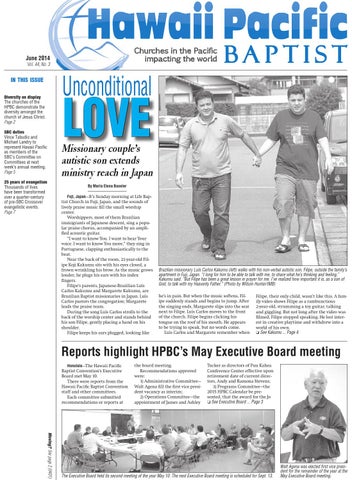
Brazilian missionary Luís Carlos Kakumu (left) walks with his non-verbal autistic son, Filipe, outside the family’s apartment in Fuji, Japan. “I long for him to be able to talk with me, to share what he’s thinking and feeling,” Kakumu said. “But Filipe has been a great lesson in prayer for me. I’ve realized how important it is, as a son of God, to talk with my Heavenly Father.” (Photo by Wilson Hunter/IMB)
he’s in pain. But when the music softens, Filipe suddenly stands and begins to jump. After the singing ends, Margarete slips into the seat next to Filipe. Luís Carlos moves to the front of the church. Filipe begins clicking his tongue on the roof of his mouth. He appears to be trying to speak, but no words come. Luís Carlos and Margarete remember when
Filipe, their only child, wasn’t like this. A family video shows Filipe as a rambunctious 2-year-old, strumming a toy guitar, talking and giggling. But not long after the video was filmed, Filipe stopped speaking. He lost interest in creative playtime and withdrew into a world of his own.
See Kakumu ... Page 4
Reports highlight HPBC’s May Executive Board meeting Honolulu—The Hawaii Pacific Baptist Convention’s Executive Board met May 10. There were reports from the Hawaii Pacific Baptist Convention staff and other committees. Each committee submitted recommendations or reports at
the board meeting. Recommendations approved were: 1) Administrative Committee— Walt Agena fill the first vice president vacancy as interim; 2) Operations Committee—the appointment of James and Ashley
Tucker as directors of Puu Kahea Conference Center effective upon retirement date of current directors, Andy and Ramona Stevens; 3) Programs Committee—the 2015 HPBC Calendar be presented, that the award for the Jo See Executive Board ... Page 3
Moving? See page 2 (0401)
The Executive Board held its second meeting of the year May 10. The next Executive Board meeting is scheduled for Sept. 13.
Walt Agena was elected first vice president for the remainder of the year at the May Executive Board meeting.
2
HAWAII PACIFIC
HAWAII PACIFIC BAPTIST 2042 Vancouver Drive Honolulu, Hawaii 96822 (USPS 237-540)
CHRISTOPHER MARTIN Editor FAITH McFATRIDGE Associate Editor The Hawaii Pacific Baptist is published bi-monthly by the Hawaii Pacific Baptist Convention. For general information, call (808) 946-9581. Periodicals postage paid at Honolulu, Hawaii, and additional mailing office. To subscribe: Send request to the Hawaii Pacific Baptist at the above address. Subscriptions for nonresident members of the HPBC are $12 annually. To register a change of address: Send the mailing label from page 1, along with your new address, to The Hawaii Pacific Baptist at the above address. POSTMASTER: Send address changes to HAWAII Pacific BAPTIST, 2042 Vancouver Dr., Honolulu, HI 96822-2491 To give news tips: Call the editor at (808) 9469581. To submit a letter: Letters on any subject will be considered for publication if sent to the above address, provided they do not make a personal attack on anyone. Letters are limited to 250 words and may be edited for length. Publishing services provided by Western Recorder Inc., Box 43969, Louisville, KY 40253.
Join us on Facebook Be part of the Hawaii Pacific Baptist Convention via Facebook. Already have an account? Simply type “Hawaii Pacific Baptist Convention” in the search box. Then click the “Like” box on the right side of the Hawaii Pacific Baptist Convention header. It’s that easy. Followers of HPBC will receive all the updates and be current with the events and activities as they are posted. Let’s keep connected. For more information, contact Faith McFatridge at faith@hpbaptist.net.
JUNE 2014
Diversity of the Body of Christ on display in Hawaii Mahalo from Martin
By Chris Martin
T
he church is an amazing concept of God’s design! Historically, mankind has attempted to redefine it, but theologically, it is still true to God’s original idea. The church is still a body of people of all different backgrounds and nationaliChris Martin ties with one uniting factor: being born again in Jesus Christ. This body is constantly increasing and being transformed at the same time. Some
are stronger, yet others are wiser; some are learning each moment, while others are mentoring and leading in every action. Still more are engaging and encouraging their communities and spheres of influence with a passionate intentionality. But all of them willingly submit to the Lordship of Jesus Christ and the guiding of the Holy Spirit to accomplish this incredible life of faith, which is simply a combination of trust and obedience. Across the Hawaii Pacific Baptist Convention, the church of Jesus Christ, in all of its diversity, is on display. Of our 150 congregations, we speak more than a dozen different languages, of a
Your input is needed The Communications Committee of the Executive Board approved a recommendation that the “Hawaii Pacific Baptist” go to being primarily an online version. The print paper will only be mailed to those who indicate that they want to receive the hard copy. The plan is to be begin in 2015.
By Diana Davis
in the fire; and after the fire a still small voice.” And then there is this verse: Isaiah 30:15 ”For thus says the Lord GOD, the Holy One of Israel: ‘In returning and rest you shall be saved; In quietness and confidence shall be your strength.’ But you would not.” The final words of this verse are intriguing and challenging: “But you would not.” Why would one not want to follow the Lord in obedience? Extrapolating from the immediate context of Isaiah 30, why would one not want spend time alone with the Lord? Why would one be so caught up with busyness that spending time with the “Holy One of Israel” was not even part of his or her schedule? And, more personally, why do I allow myself to get so caught up with the demands of everything else that I dismiss my time with the Lord as of little utilitarian value in light of all the “important” things I must get done? Christian singer Larnelle Harris recorded a song titled “I Miss My Time with You.” The song was written from the Lord’s perspective, lamenting that Christ-followers seem to be too busy serving the Lord to actually spend quality time with the Lord: “You’re too busy, busy trying to serve Me; but how can you serve Me when the spirit’s empty?!” Our schedules reflect our values. How highly do we value our relationship with the Lord? Do we cultivate a relationship with Him through solitude and prayer? Do we actually untether from our devices— smartphones, iPads, laptops, televisions, digital readers—long enough to hear the still small voice of our Savior? O, that His righteousness were our hunger and thirst (Matthew 5:6)! The promise of being filled is profound: “The work of righteousness will be peace, and the effect of righteousness, quietness and assurance forever.” Roger Oldham is vice president for convention communications and relations with the Southern Baptist Convention’s Executive Committee.
Diana Davis is the author of “Fresh Ideas” and “Deacon Wives” and wife of North American Mission Board Vice President for the South Region Steve Davis.
Churches or individuals can send their lists requesting a copy mailed to their address to hpbcnews@gmail.com. Your comments are very valuable. Please contact Andrew Large, chair of the Communications Committee, with your comments at pastor@waikikibaptist.com.
Call to Prayer: Daily prayer & solitude At a time management seminar I attended some years ago, the leader made a plea that every busy executive must begin each day with what he called “planning and solitude.” His premise was that those who disciplined themselves to have a daily quiet time away from the din of the daily bustle were far and away more productive than those who just rushed headlong into each day’s activities. The phrase stuck: “planning and solitude.” How very similar to a phrase I had heard from numerous pastors and Bible teachers: “prayer and solitude.” As I read Scripture, I am struck again and again at how frequently the ideas of prayer and solitude are joined. For example: Mark 1:35 ”Now in the morning, having risen a long while before daylight, He went out and departed to a solitary place; and there He prayed.” Matthew 6:6 ”But you, when you pray, go into your room, and when you have shut your door, pray to your Father who is in the secret place; and your Father who sees in secret will reward you openly.” Other passages draw attention to the effect of quietness, stillness and solitude. Isaiah 32:17 ”The work of righteousness will be peace, And the effect of righteousness, quietness and assurance forever.” Psalm 46:10 ”Be still, and know that I am God; I will be exalted among the nations, I will be exalted in the earth!” 1 Kings 19:11-12 ”And behold, the Lord passed by, and a great and strong wind tore into the mountains and broke the rocks in pieces before the Lord, but the Lord was not in the wind; and after the wind an earthquake, but the Lord was not in the earthquake; and after the earthquake a fire, but the Lord was not
The nearly-wed class It’s that time of year—weddings, weddings everywhere!If your church is serious about ministering to young adults, here’s a fresh idea: Plan a seminar spanning six to eight weeks titled “It Takes Three” for engaged or newlywed couples every FRESH IDEAS spring and fall. The class meets during the Sunday School or small group hour in an attractive, easy-tofind room of the church. A consistent leadership team hosts, mentors, promotes and plans the seminar, but the Bible teacher changes weekly. Prayerfully select several Diana Davis church members to prepare and present a relevant Bible class about an assigned topic, such as communication, intimacy, commitment, parenting and praying together. Instructors are respected couples or individuals. Their purpose is to teach God’s principles for marriage, using the Bible, handouts and visuals, current technology and personal testimonies. Get the word out. Announce dates at least six months ahead, and preregister church members and attendees who are engaged or newly married. Challenge all church members to invite potential participants. Publicize with a printed brochure, e-invitations, Facebook event page and Twitter, and offer online registration. Place brochures in local florists, bakeries and wedding shops. Research engagement announcements and mail a personal invitation. Rent a booth at your local bridal fair to invite brides and grooms. Personalize the class. Use nametags and be intentional about learning names and needs. Help participants make friends by displaying a photo of each couple. Plan cookouts and ball games. View each person as God sees them. Most importantly, give them Jesus. Help each person know God personally. Teachers and church members can share their personal God story. Encourage couples to attend worship together. If a class member accepts Christ, the entire group can attend the baptism. Assure that each person gains a clear understanding of God’s eternal plan of salvation and His purpose for their life and marriage. At the seminar’s conclusion, present a certificate and promote the graduates into a current or new small group for young couples. During big life changes, like marriage, many lost people think about eternal things. Amid the wedding planning, consider how your church can share Jesus with nearly-weds.
The “Hawaii Pacific Baptist” is currently sent free to active church members of every HPBCcooperating church. Your Cooperative Program offerings help to sustain the cost of editing and printing the paper.
By Roger Oldham
multitude of ages, in a variety of locations and contexts, covering the economic spectrum—and each one is unique. But that is the beauty of God’s design for His church. The Bride of Christ, no matter how diverse we are, we are all united. As Paul wrote to the church in Ephesus, “There is one body and one Spirit just as you were called to one hope at your calling one Lord, one faith, one baptism, one God and Father of all, who is above all and through all and in all” (Ephesians 4:4-6). It is great to be a part of the church! Mahalo for allowing me the opportunity to serve you. I’m proud that we’re in this together. Mahalo and God bless you!
HAWAII PACIFIC
JUNE 2014
3
Church planter training
Above: Andy and Ramona Stevens will be retiring in June as directors of Puu Kahea Conference Center and relocating back to the mainland. James and Ashley Tucker were approved as the new directors of the conference center effective June 1. Pictured are (from left): Andy and Ramona Stevens, Executive Director Chris Martin and James and Ashley Tucker.
Church planter training was held April 28-30 at Puu Kahea Conference Center. Featured speakers were Rick Curtis, Western Region Mobilizer for the North American Mission Board, and Bob Burton, NAMB’s National Mobilizer.
Right: Robert Miller presented a brief report of the Oahu Baptist Network as the OBN’s new Facilitator of Missions.
Executive Board Continued from page 1
Evans Music Scholarship be awarded to Taylor Ishida (member of Olivet Baptist Church and senior at Hawaii Baptist Academy), the Sue Nishikawa offering allocations for 2014 collection, requests from Kona Baptist Church, Big Island, from Ongoing Evangelism Ministries and two requests from Lighthouse Church, Guam, for new ministry starts, requests from the Church Planting Fund (University Avenue Baptist Church for
Hamama Baptist Church on Oahu, Waikiki Baptist Church for the Honolulu Seafarer’s Church Planting Ministry, Kihei Baptist Church for the Crossviews Community Ministry in Keanae, Maui). 4) Communications Committee presented a report concerning the HPBC website, a community listing for churches and church leaders and a recommendation to having the “Hawaii Pacific Baptist” primarily an online version with requests from individuals for the print version. The next Executive Board meeting is scheduled for Sept. 13.
The Baptist Collegiate Ministries on the campus of the University of Hawaii-Hilo was awarded the Ka Lama Ku Student Leadership’s Laulima Group Award. This award recognizes the BCM for the outstanding ministry to the school and community as an independent service organization on campus. Congratulations to Anita Bice, BCM-Hilo Director, the BIBA support team and churches and to the fantastic students at the UH-Hilo BCM.
4
HAWAII PACIFIC
JUNE 2014
Kakumu Continued from page 1
“The change was drastic,” Margarete recalls. “We couldn’t understand what was wrong with him.” Doctors in Japan diagnosed him with autism, a developmental brain disorder causing problems in communication, behavior and social interaction. “It was a shock to us,” Margarete says. She and Luís Carlos share their story with missionaries during a trip to Japan’s Mount Fuji, about an hour’s drive from their home. Filipe sits in the back seat of the family’s van, listening to a music CD and making non-verbal, vocal sounds. He appears to be in a world all his own. When the Kakumus stop at a visitors’ center, Filipe interacts with his parents, walking hand-in-hand with his father, touching his mother’s face, allowing both parents to put their arms around him. Standing at an observation deck at Mount Fuji, the group tries to get a good view of Japan’s highest peak. But the weather is too foggy to see the peak. Gazing toward the horizon, Filipe touches his father’s face with his left index finger, seemingly wanting to express himself. “I long for him to be able to talk with me, to share what he’s thinking and feeling,” Luís Carlos said later, his wife sharing the same desire. “But Filipe has been a great lesson in prayer for me,” Luís Carlos said. “I’ve realized how important it is, as a son of God, to talk with my Heavenly Father.” Luís Carlos prays two hours daily, an hour in the morning and another hour at night.
Filipe Koji Kakumu, the autistic son of Brazilian Baptist missionaries Luís Carlos (second from left) and Margarete Kakumu, plugs his ears to block the sound of the praise music during a worship service at Life Baptist Church in Fuji, Japan. Some people with autism are hypersensitive to sounds, according to experts in autism. (Photo by Wilson Hunter/IMB)
“Everything begins with prayer,” he said. At night when Filipe is sleeping, sometimes Luís Carlos and Margarete slip into his bedroom and pray over him. Often, they’ve asked God to heal him. So far, that hasn’t happened. But Filipe, unable to say “I love you,” teaches his parents valuable lessons about love. Because of Filipe’s level of disability, Margarete says, “Filipe depends on us for just about everything. He’s with us all the time. Being his parents has taught us a lot about unconditional love, God’s love.” Their interaction with Filipe has also
shown others—whether believers the missionaries are discipling or lost people they’re trying to reach—a tangible picture of God’s love in action. That “picture” can even be seen on the Kakumus’ Facebook pages, where they often post expressions of their deep love for Filipe and behind-the-scenes photos of their close-knit family of three. In a post called “Unconditional Love,” a series of photos shows Luís Carlos and Filipe walking side-by-side down a treelined path. “I will always be beside you, my son,” Luís Carlos says in the message. “Let’s walk together through life. I will love you and care for you for all my days.”
On a Facebook page Margarete created to give Filipe a “voice,” photos show him hugging church members, kissing his mother’s cheek and cuddling with his father. Many autistic people don’t like to show affection, but Filipe is unique. A photo of Filipe with his arm around his mother is accompanied by the post, “My world is without borders, lies or deception. As it should be for everyone. Autistic or not.—Filipe.” When Filipe was diagnosed with autism, his family’s world changed forever. But God used the crisis for good. Although the Kakumus were Christians, they weren’t serving in Japan as missionaries when the diagnosis came. They had emigrated from Brazil to Japan four years earlier to work in a Japanese automobile plant. When they learned Filipe had autism, they returned to Brazil to be near family and to get help for him from Portuguese-speaking professionals. During those seven years back in Brazil, God called the Kakumus to global missions. “God really used Filipe’s autism to direct our lives and ministry. It’s because of Filipe that we’re here as missionaries in Japan,” said Luís Carlos, who serves in a country where only about 1 percent of the people are evangelical Christians. “My great dream is that God will do here in Japan what He did in Korea,” said Luís Carlos, referencing the rapid church growth, fueled by prayer, that began there several decades ago. “Our prayer is that many, many people in Japan come to know the Lord as Savior and that there will be many strong churches all over Japan.” “We know God can do this,” Luís Carlos said. “Nothing is impossible for Him.” (BP)
HAWAII PACIFIC
New ministry ‘H.I.S. Women’ emerges at Kona Baptist In recognition of the need for encouragement, fellowship and ministry among our Kona Baptist Church women, several ladies met last year to discuss women’s ministry needs. Out of that discussion and subsequent meetings and projects, a new ministry called “H.I.S. Women” (H.I.S. stands for Hands in Service) has emerged. The mission of this ministry is varied and includes, but is not limited to, quality Christian fellowship, prayer, Bible study, encouragement, spiritual growth, work projects and just having fun in general. There are many activities for ladies of all ages to enjoy together. “H.I.S. Women” is not simply a social club. It is a ministry that helps to meet the various needs of our church family and our community. Ladies are encouraged to use their talents and abilities for the Lord by getting involved. This year “H.I.S. Women” have two ongoing community projects in addition to varied fellowship activities and Bible studies. Our ladies meet monthly at the local domestic violence shelter to minister to the residents and children with a healthy salad bar luncheon and games, songs or craft activities for the children. Gift bags for each resident are prepared to help provide essentials that they may not get in the shelter environment (i.e. make-up, nail and hair accessories, note cards, pens, and gift cards). “H.I.S. Women” also meets one Saturday each month at the Hualalai Elderly Housing complex to assist “Auntie’s Angels” (a small nonprofit) serve a soup lunch and distribute canned goods to the lowincome residents. The church collects canned soup and paper goods to support this effort. Our ladies prepare crockpots of soup and serve the seniors. This is a time of food and fellowship with impact that lasts the whole month long. Other activities have included work days at the church, lunches with the home-bound, outings, work projects for one another, potlucks, and a clothing swap. A recent survey of our members shows a growing interest in exercise activities and crafts, so we are sure to see those activities in the future. For further information, contact Linda Allen at (808) 987-4127.
JUNE 2014
5
Pair of Hawaii Baptists appointed to SBC committee Baltimore—Appointments to the Southern Baptist Convention’s Committee on Committees have been announced by SBC President Fred Luter, pastor of Franklin Avenue Baptist Church in New Orleans. He announced the appointments in accordance with SBC Bylaw 19, which calls for providing notice of appointees well in advance of each year’s convention.
The Committee on Committees will assemble in Baltimore prior to the SBC’s June 10-11 annual meeting to nominate members of the Committee on Nominations who, in turn, nominate trustees for the boards of SBC entities. SBC Bylaw 19 also provides that the Committee on Committees “shall nominate all special committees authorized during the sessions of the con-
vention not otherwise provided for.” The Committee on Committees has 68 members, two from each of the 34 states and regions qualified for representation on boards of SBC entities. Hawaii’s two representatives are: Vince Tabudlo, All Nations Fellowship, Honolulu; Michael Landry, Oceanview Baptist Church, Oceanview. (BP)
Why are
baptisms on the decline in the SBC? North American Mission Board church planter Patrick Coats (center right) baptizes Andrew Fellas, a new member of Kingdom Covenant Baptist Church in Miami, where Coats is pastor. A task force consisting primarily of pastors convened to address the issue of declining baptisms in the Southern Baptist Convention. (Photo by Ted Wilcox/NAMB)
Task force report calls for ‘fervent’ prayer, prioritize evangelism, discipling By Joe Conway
Alpharetta, Ga.—A task force designed to address declining baptisms among Southern Baptist churches released its full report last week. An urgent, immediate call for spiritual renewal and personal commitment to evangelism and discipleship are the common threads among five recommendations made by the Pastors’ Task Force on Evangelistic Impact and Declining Baptisms. The national task force, aimed at addressing the continued decrease in baptisms among Southern Baptist churches, was convened last year by the North American Mission Board. Most task force members are pastors. “Southern Baptists’ downward spiral in baptisms is the fruit of our spiritual lukewarmness,” said task force member Ted Traylor, pastor of Olive Baptist Church in Pensacola, Fla. “I am greatly encouraged by the stirring I see among us toward spiritual awakening and the need for the resurgence of the Great Commission. This task force work and report gives me hope.” The group was formed, in part, because the 2012 Annual Church Profile reported a drop of 5.52 percent in the number of baptisms in Southern Baptist churches, continuing a two-decade downward trend. Al Gilbert, NAMB’s vice president for evangelism, facilitated the group’s meetings. LifeWay Research President Ed Stetzer assisted the task force with research
support. “Recognition and ownership of the issue are keys to reversing the decline,” Gilbert said. The task force identified five key areas, described as problems, that pastors and churches must address to reverse the baptism decline: Spiritual: “With urgency, we must join together in fervent and effective prayer for spiritual awakening in our churches and our nation.” Leadership: “As pastors, we must intentionally model and prioritize personal evangelism while providing clear pathways for our congregations to follow.” Disciple-making: “As pastors, we must create a disciple-making culture—focusing on multiplying disciples who know how to grow in Christ and lead others to Christ.” Next generation: “As pastors, we must leverage our influence, activity and resources to reach and make disciples of the next generation.” Celebration: “As pastors, we must celebrate new life in Christ as people publicly profess their faith through baptism. We must establish an ethos of joy that celebrates the practice of personal evangelism and its fruit.” Task force member Dennis Kim, pastor of Global Mission Church in Silver Spring, Md., said, “I am grateful for this endeavor’s commitment to renew the passion for evangelism that ultimately begs the question, ‘How then should we proceed?’”
Task force member Roger Spradlin, pastor of Valley Baptist Church in Bakersfield, Calif., summed up the group’s conviction. “I think all Southern Baptists were aware that our baptisms were declining, but seeing the actual stats was both shocking and heartbreaking,” he said. “Continuing as we are, yet expecting a different result, is not an option. We must address this issue now.” From 1950-2011 Southern Baptists baptized an average of 379,711 people annually. Only twice during that time did the numbers dip more than 10 percent below that average. But in 2012, the decline was 13 percent off the average, the worst drop in 62 years. The task force’s report itself takes an even more sobering view of the issue. It states: “SBC baptisms reached a plateau in the 1950s, peaked in the 1970s, and have stayed fairly constant since that time. ... The problem is even greater than these numbers indicate. Considering how the North American population has increased substantially between the 1950s› baptism peak and today, these figures indicate how much ground we have lost and are losing.” “The recommendations are unanimous,” Gilbert said, “but more than that, these men have made this a personal statement of action, and they are hopeful that every pastor will review the list and see if they can identify with it. To see the report and a summary of recommendations, visit www.NAMB.net. (BP)
6
HAWAII PACIFIC
JUNE 2014
Southern Baptist Convention 2014: BALTIMORE
Luter ready for restoration & revival through prayer thought went so well that we wanted to do that again,” he added. “We just come for worship and the word. That’s it. No business will be conducted.” Luter selected the theme verse, Psalm 80:18-19: “Then we will not turn away from You; revive us, and we will call on Your name. Restore us, Yahweh, the God of Hosts; look on us with favor, and we will be saved.” As the first-ever African American to lead the convention when he was elected in 2012, Luter will deliver his final message to the convention as president June 10. Luter also will address Southern Baptist associational leaders June 6.
By Shawn Hendricks
Baltimore—With a desire to keep the focus on the power of revival and prayer, Southern Baptist Convention President Fred Luter expressed excitement about this year’s annual meeting June 10-11 in Baltimore. Messengers also will elect a new president as Luter concludes his second term. Pointing to the annual meeting theme of “Restoration and Revival through Prayer,” Luter noted the return of a Tuesday evening revival service, similar in style to last year’s, that has drawn positive feedback from participants. “I wanted to again stay with the theme (of) revival, but let’s undergird it with prayer,” said Luter, pastor of Franklin Avenue Baptist Church in New Orleans. “Last year in Houston, ... it was phenomenally successful. It was standing room only. ... All we had was music and preaching. “That was something that we
Officer elections Arkansas pastor Ronnie Floyd will be nominated for SBC president by Southern Baptist Theological Seminary President Albert Mohler. Floyd’s nomination for president is the only one announced thus far. Floyd has led Cross Church in northwest Arkansas—with campuses in Springdale, Rogers and Fayetteville—for 27 years. Floyd led the SBC’s Great Commission Resurgence Task Force in 2009-10. The group’s report called for international missions to receive 51 percent of all Cooperative Program gifts. Last year, Cross Church contributed more than $700,000 to the Cooperative Program, Mohler noted in a letter announcing Floyd’s nomination. Floyd is a former chairman of the SBC Executive Committee and was a member of the SBC’s Program and Structure Task Force during the mid1990s. In recent months, Floyd has helped spearhead two pastor/leader prayer gatherings.
In addition to serving as general editor for LifeWay’s updated “Bible Studies for Life,” Floyd has authored 10 books. His latest, released in 2011, is “Our Last Great Hope: Awakening the Great Commission.” Two other nominees for SBC offices have been announced: Clint Pressley, pastor of Hickory Grove Baptist Church in Charlotte, N.C., will be nominated by Ted Traylor, pastor of Olive Baptist Church in Pensacola, Fla., for the office of first vice president. Pressley serves as vice president of the SBC Pastors’ Conference and is a former vice chairman of the trustees for Southern Seminary. Hance Dilbeck, pastor of Quail Springs Baptist Church in Oklahoma City, will be nominated for the office of second vice president by former SBC president Johnny Hunt. Dilbeck has led the 4,600-member church since 2003 and has been a pastor for more than 20 years. Constitutional revision The SBC Executive Committee will consider a proposal June 9 to update the convention’s constitution regarding qualifications for churches sending messengers to the annual meeting. The proposal to amend Article III came as a motion from the floor at last year’s SBC annual meeting. It currently states that churches in friendly cooperation with the convention can send one additional messenger for every 250 members or for each $250 per year “paid to the work of the Convention,” an amount dating back to 1888. Under the proposal, each cooperating church that contributed to convention causes during the preceding fiscal year would automatically qualify for
two messengers. Additional messengers would be recognized from a cooperating church by one of two options, whichever allows the greater number of messengers: n One additional messenger for each full percent of the church’s undesignated receipts through any combination of gifts through the Cooperative Program, designated gifts through the Executive Committee for convention causes, or to any SBC entity. n One additional messenger for every $6,000 the church contributes in the preceding year through the same combination of the Cooperative Program, designated gifts through the Executive Committee for convention causes, or to any SBC entity. The $6,000 figure was arrived at by adjusting for inflation and other factors since 1888. It is meant to be comparable to the $250 figure adopted 126 years ago. During its Feb. 17-18 meeting, the Executive Committee decided to place the item on its June 9 agenda in order to allow Southern Baptists time to discuss the proposed change and provide feedback. The committee’s deliberations, then, will determine whether the proposed revision will be presented to messengers at the annual meeting. Resolutions Messengers planning to propose resolutions must submit them no later than 15 days prior to the annual meeting. Detailed guidelines on submitting resolutions are available at www. SBCAnnualMeeting.net under the “Messengers” tab. Resolutions may be submitted online but must be followed up by a letter of credentials from the submitter’s church.
SBC: Pre-convention conference designed to ‘pour into pastors’ Baltimore—Through hearing a diverse array of speakers—both in terms of race and age—Southern Baptist Pastors’ Conference President Bruce Frank said he hopes pastors will attain a clearer vision of God’s glory. Hence the theme of this year’s gathering: “Show Us Your Glory!” “You don’t want to miss any of it,” said Frank, pastor of Biltmore Baptist Church in Asheville, N.C. “By going and getting coffee or skipping a speaker, you very well could miss exactly what God wants to say to you right then.” The June 8-9 Pastors’ Conference
will feature preaching, worship and prayer to undergird the ministry of pastors and their wives. The sessions at the Baltimore Convention Center will be held prior to the Southern Baptist Convention’s June 10-11 annual meeting there. “What I did as I thought about the speakers and the theme was to have guys that have a heart to pour into pastors,” Frank said. Speakers for Sunday evening, June 8, at the Pastors’ Conference will include Johnny Hunt, pastor of First Baptist Church of Woodstock, Ga.; H.B. Charles, pastor of Shiloh Metropolitan
Baptist Church in Jacksonville, Fla.; and David Platt, pastor of The Church at Brook Hills in Birmingham, Ala. Monday morning, June 9, will feature messages from Ronnie Floyd, pastor of Cross Church in Northwest Arkansas; Clayton King, evangelist and founder of Crossroads Worldwide in Shelby, N.C.; and Eric Mason, pastor of Epiphany Fellowship in Philadelphia. Monday afternoon speakers will include J.D. Greear, pastor of The Summit Church in Durham, N.C.; and Tony Evans, pastor of Oak Cliff Bible Fellowship in Dallas. Monday evening speakers will
include Rick Warren, pastor of Saddleback Church in Lake Forest, Calif.; James MacDonald, pastor of Harvest Bible Chapel in Rolling Meadows, Ill.; and Francis Chan, founder of Eternity Bible College in Simi Valley, Calif. The Pastors’ Conference offering will go to Mission:Dignity, a program administered by GuideStone Financial Resources that provides financial assistance to retired pastors, Christian workers and their widows who are struggling to make ends meet. The conference is free and requires no registration. To learn more, visit sbcpc.net.
HAWAII PACIFIC
JUNE 2014
7
By Rebecca Wolford
Nashville, Tenn.—For the past 25 years, Southern Baptists have begun each annual meeting by celebrating hundreds— sometimes thousands—of new souls won for Christ. This celebration is the result of Crossover, the evangelistic outreach initiative preceding the annual meeting of the Southern Baptist Convention. Each year, the North American Mission Board partners with state conventions, associations and local churches to saturate the host city of the convention with evangelistic events. Volunteers from across the country arrive in the city a few days prior to the annual meeting to participate alongside local church members. Last year, Crossover Houston marked the 25th year of outreach. In 1983, when messengers approved Las Vegas as the 1989 SBC annual meeting site, they adopted a recommendation to add “a strong evangelistic emphasis” in connection with the meeting. The week prior to the annual meeting in Las Vegas, more than 2,000 volunteers participated in door-to-door witnessing campaigns and revival services. They visited more than 100,000 homes and led approximately 470 people to Christ. The following year, the SBC Home Mission Board (now NAMB) planned a second evangelistic event to coincide with the SBC. The yearly evangelism initiative became known as Crossover in 1991, when thenSBC president Morris Chapman worked with the HMB to expand the one-day outreach into a full week. Crossover Atlanta, that year, included door-to-door witnessing, serving meals to the homeless, street evangelism and prayer throughout the city. The event saw 333 decisions for Christ. The name “Crossover” was inspired by an evangelism conference in Australia where Chapman spoke in 1987. The theme of the conference was “Crossover Australia.” Chapman’s original vision for “Crossover America” focused on church planting, but the name ultimately found its home with the pre-convention evangelistic thrust Southern Baptists know today.
Leaders equipped Participating in Crossover equips believers to share their faith more effectively, including that of the next generation of pastors and ministers who are in seminary. Preston Nix, director of the Leavell Center for Evangelism and Church Health at New Orleans Baptist Theological
A new believer is baptized during Crossover Indianapolis in 2004. (File photo)
Crossover at 25 Thousands of lives transformed through pre-SBC evangelism
Seminary, said he has seen Crossover transform the lives of his students, some of whom were already serving as pastors. “It changes students’ lives, and it affects and impacts their ministry.” Since Crossover Louisville in 2009, seminaries have offered personal evangelism training courses that coincide with Crossover outreach. Students partner with Intentional Community Evangelism teams or local church members to participate in door-to-door and street evangelism the week leading up to the SBC annual meeting. “We’re intentional about verbally communicating our faith to the lost so they can come to faith in Jesus Christ,” Nix said. Crossover Louisville resulted in 1,035 recorded salvations. Some seminary students, including those who are active ministers, have never shared their faith outside a church setting, Nix pointed out. Crossover allows the students to lead people to Christ one on one rather than from behind a pulpit, he added. Nix said he has had many students who were skeptical about spending a week practicing intentional evangelism,
but their lives and ministries were ultimately changed by the experience. Churches planted Crossover efforts, in partnership with local associational initiatives, have also made an impact on communities through church plants. Larry Doyle, director of missions for Piedmont Baptist Association in Greensboro, N.C., said his community was hugely impacted by Crossover and church planting efforts in 2006. Fifteen new churches were started that year, due in part to Crossover and a church planting initiative called Operation Reach. Twelve of those churches are still active today, he said. “As a result of both Crossover and Operation Reach, church planting became a passionate priority for the Baptist family,” Doyle said. “I believe it was the intentional focus on our community that did it. It helped us turn our focus outward and enabled us to see people and needs we had not seen before.” Keith Hall, pastor of The Journey Church in High Point, N.C., was already burdened to reach his community by early
2006. He, another pastor and others began meeting as a church that summer. Hall said he learned a lot from Crossover Greensboro and other related training events. He saw people from diverse backgrounds and various levels of training all working together to reach the community. Seeing all the volunteers on the “same missional page,” he said, “inspired me to believe in the mission.” Communities encouraged When Crossover volunteers serve alongside local churches, those churches come out of the experience encouraged. From a practical standpoint, Crossover teams can assist churches with projects or events that they may not have the manpower to complete on their own. The teams also advertise church events doorto-door, which increases the church’s visibility in the community and creates new opportunities for church members to develop relationships. Nix said he sees an opportunity to encourage churches in SBC host cities located outside the Bible Belt. Nix participated in the first outreach in Las Vegas,
and recalled the effect the event had on the local churches there. “It was an emotional spiritual boost to them that Southern Baptists were coming in and helping them in a very nonSouthern Baptist, very secular, worldly setting,” he said. Souls saved Since 1989, NAMB has reported more than 30,000 professions of faith in Jesus Christ as a direct result of Crossover activities. Thousands more have been put in contact with local Southern Baptist churches. When a person is saved, Chapman said, there is incredible joy both for the one who accepts Christ and for the ones who are able to witness their spiritual transformation. “Salvation is a miracle when it happens and Christ has given us the opportunity to experience the joy of a miracle taking place right in front of our eyes,” he said. “What a joy it is for the believer to return to his or her home church and testify that upon witnessing to an unsaved person, the person confessed his or her sin and trusted Jesus Christ as Savior,” Chapman said.
8
HAWAII PACIFIC
JUNE 2014
WMU annual meeting focus: Annie Armstrong’s challenge Baltimore—With the theme of “Go Forward,” Woman’s Missionary Union will hold its Missions Celebration and annual meeting June 8-9 in Baltimore. “What better place to wrap up a yearlong celebration of the 125th anniversary of WMU than the home of Annie Armstrong,” Debby Akerman, president of national WMU, said of the Baltimore woman who was instrumental in the missions organization’s founding in 1888 and was its first corresponding secretary. “We will embrace Annie’s challenge to ‘go forward’ with missions,” Akerman said of the June meeting, “as we celebrate how God is working around the world and through WMU, and renew our commitment to advancing missions education and involvement.” This year’s celebration will feature a rare opportunity to experience a joint commissioning service of up to 100 new field personnel representing
the International and North American mission boards, along with messages from Southern Baptist Convention Executive Committee President Frank Page, as well as mission board presidents Tom Elliff of the IMB and Kevin Ezell of NAMB. “Commissioning missionaries for special service is a great privilege,” said Wanda Lee, executive director of national WMU. “It is a time to celebrate their calling, voice our affirmation and prayers as we hear their testimonies and commit ourselves to ‘hold the ropes’ prayerfully and financially as they go. There also will be a special bus tour through Baltimore to see significant historical sites related to Annie Armstrong. The tour is free but advance registration is required. To register, visit WMU.com/AnnieTour. Registration is open through May 15. Visit WMU.com/Baltimore for more information.
Florida pastor announced as SBC Pastors’ Conf. presidential nominee recognized as one of the leaders in missions giving and baptisms in the pastor of Calvary Baptist Church in state of Florida. Outreach magazine Clearwater, Fla., will be nominated has listed Calvary as one of the for president of the Southern 100 fastest growing churches Baptist Pastors’ Conference, acin America.” cording to an announcement Scroggins said Rice “unby fellow Florida pastor Jimmy derstands and rejoices in the Scroggins. rich history of the SBC, but Scroggins, pastor at First Willy pastors in a major metBaptist Church of West Palm ropolitan area, and his church Beach, Fla., stated in a May embodies the racial and socio5 announcement to Baptist Willy Rice economic diversity required Press: “It will be my great privifor Southern Baptists to be a lege to nominate my friend, gospel force in the future.” Dr. Willy Rice, as president of the PasRice, 50, led Calvary Baptist Church tors’ Conference of the Southern Bapthrough a complete relocation from tist Convention. Willy has served as its historic campus in downtown the pastor of Calvary Baptist Church Clearwater, Fla., to its current location in Clearwater, Fla., since 2004. in the east area of the city. The church “Under his leadership this historic has a second campus in East Lake, Fla., congregation has experienced rejust to the north. newed health and significant growth Rice served previously at Hillcrest in every area,” Scroggins wrote. Baptist Church in Pensacola, Fla., and “Calvary averages more than 3,500 was president of the Florida Baptist people attending multiple services Convention from 2006-08. on two campuses. Calvary is annually West Palm Beach, Fla.—Willy Rice,
BGR 2013 report: 1.3 million helped Nashville, Tenn.—Labby cried loudly as her parents left her on the first day of preschool. The 3-year-old was overly thin. Her brittle hair and small, black teeth were signs of poor health and poor hygiene. The day was full of firsts: nutritious food, clean water, a toothbrush, washing hands—and the first toilet Labby had ever seen. Nearly a year later, Labby looks healthier and is doing well in her class. She and her friends are getting the nutrition they need to be healthy, and the life skills they need. Labby and her friends are just a few of more than 1.3 million people in need
worldwide who received help from Southern Baptists during 2013 through Baptist Global Response. The 1,385,030 individuals helped in 2013 lived in 4,359 communities in 53 countries, according to BGR’s annual report, released April 17. The organization’s 297 projects addressed issues of clean water, hunger relief, disaster response, livelihood training, health care and assistance for widows and orphans, among other things. Baptist Global Response provides regular updates on new and ongoing projects at its website, www.GoBGR. org. The 2013 BGR annual report can be found at www.GoBGR.org/Annual.
A powerful tornado leveled Grace Falls Baptist Church in Fayetteville, Tenn., and destroyed the pastor’s home next door. The tornado was part of a storm system that hit 10 states since April 26. Southern Baptist Disaster Relief volunteers have been serving in response in each of the affected states. (Photo courtesy of the Tennessee Baptist Convention)
Tornado stirs Tenn. pastor to reach out, serve neighbors By Joe Conway
Fayetteville, Tenn.—Pastor Darrell Haney said he had been praying for a way to reach his neighbors. He found his answer in a storm. “God could not have answered our prayer more clearly,” said Haney, pastor of Grace Falls Baptist Church in Fayetteville, Tenn., as he described the powerful tornado that leveled the church building and destroyed his home next door. Haney was sifting through the rubble that was his home the morning following the storm. The tornado was part of a recent storm system that claimed more than a dozen lives in Arkansas and Mississippi April 27 and 28, and two lives in Lincoln, Haney’s home county in Tennessee. In all, 10 states were hit by damaging tornadoes since April 26. Southern Baptist Disaster Relief volunteers have been serving in response in every affected state. “We are collecting what belongings we can,” said Haney, himself an SBDR volunteer. “The church building was wiped out. Our property is adjacent to the church. It came across and took everything.” Haney was home with his wife, Tammy, son Matt, daughter-in-law Christi and their children Carson, 4, and Elyse, 2, when the storm hit late in the evening. They had just enough warning to seek shelter in an interior bathroom. “Elyse was asleep in the bedroom,” Haney said. “Matt had just returned from their trailer that was also on our property. The first series of storms had come through, and we thought the worst was over. The news broke on TV that a tornado was on the ground near us. We had just enough time to get Elyse and everyone into the bathroom and then it hit out of nowhere.” After leveling the Grace Falls sanctuary, the storm toppled oak trees and threw vehicles like toys, Haney said.
A tree fell on the house, the roof was ripped off, and then another tree fell across the house. “There was not a scratch on either of our grandchildren,” said Haney, who has pastored Grace Falls for seven years. “We are still looking for Matt’s trailer.” Haney made sure his family was OK, helped secure his property as best he could, then he and associate pastor Ryan Tate headed into the subdivision near the church to offer help. “We were able to pray with several of our neighbors,” the pastor said. North American Mission Board Disaster Relief Executive Director Fritz Wilson said he has seen God’s hand in SBDR ministry. “That is the beauty of the SBDR volunteer network,” Wilson said. “In 10 states, we have volunteers bringing help, healing and hope to people who are suffering. It is why we do this.” The Home Depot Foundation contacted SBDR and were able to deliver 175 Rubbermaid storage containers they donated to Arkansas for survivors to recover belongings, Wilson said. ‘Where Was God?’ In related outreach, the Baptist General Convention of Oklahoma, churches and various faith-based groups have partnered to produce a documentary focusing on God’s compassion in the face of natural disasters. “Where Was God?: Stories of Hope After the Storm,” will premiere May 16 in Moore, Okla. The documentary will eventually be made available for viewing through the film’s website, WhereWasGod.com. Those who wish to donate to Southern Baptist storm relief can contact the Minnesota-Wisconsin Baptist Convention or visit Donations.NAMB.net/DR-Donations. To make donations by phone, call (866) 407-NAMB or mail checks to NAMB, P.O. Box 116543, Atlanta, GA 30368-6543. Designate checks for “Disaster Relief.”
HAWAII PACIFIC
JUNE 2014
Elliff: New paths for missionary sending must be considered By Don Graham
IMB appointment: 59 answer God’s call By Erich Bridges
Spartanburg, S.C.—Jessica Wolfe’s life changed forever on her first international mission trip nearly a decade ago. “I had the opportunity to share Jesus with a college student in Asia who asked me, ‘Who is Jesus?’” Wolfe recalled. “After being asked that question, the Lord began to tug on my heart to reach out to those in the world who had never heard His name. It broke my heart, and continues to do so after all these years.” But at 28, Wolfe is not just shedding tears over the world’s lostness—she’s doing something about it. Along with her husband, Taylor, she’s going to subSaharan Africa to share with others who haven’t heard the name of Jesus. The Wolfes were among 59 new international missionaries appointed May 14 by International Mission Board trustees at First Baptist Church of Spartanburg, S.C. The new workers come from a dizzying variety of personal and professional backgrounds: a firefighter, a state trooper, a financial planner, a surgeon, a scientist, a senior pastor, a photographer, a writer, a petroleum engineer, a pediatric nurse, a college teacher, a software developer—even a would-be comedian. “We’re here before you tonight because God called an atheist and a Buddhist to be his missionaries to East Asia,” one new missionary couple announced together. “I went from someone who did not know God to someone whose life is telling others about God,” he said. “I left a life of wealth to store up treasures in heaven.” His wife added: “I went from someone who worshipped many gods to someone who teaches others about the one true God. I left Eastern religion to follow the Savior of the world.” What unites them all? A desire to
Above: New International Mission Board missionaries Mike and Tisha Jones (right & center), seen visiting with a friend after their appointment May 14, both sensed God’s call to missions while on a mountaintop. “I was in tears as I was leaving a city high in the Andes Mountains” (during her first overseas mission trip), Tisha said. “God whispered, ‘It’s OK. You’ll be back.’” Top: Many came forward to pray for 59 new international missionaries during an IMB missionary appointment service May 14 at First Baptist Church of Spartanburg, S.C. (Photos by Thomas Graham/IMB)
obey Jesus Christ and a deep burden for peoples across the world searching for Him. “As a 10-year-old girl, I thought missionaries must be superhuman to go across the world and leave their families,” said a new worker—one of several who cannot be identified for their safety. “But now I stand before you as a single lady who simply desires to obediently follow God’s call to serve among Muslim women in Asia. I’m not superhuman.” Another new missionary headed to Asia with his wife and children put it this way: “We’re humbled that our extraordinary God has called our very ordinary family to fall in love with (lost people) so that they might come to know Him.”
For some, God’s call has been bubbling below the surface for a long time. “When I was in high school, God instilled in me two desires: to preach His word where it has never been heard and to pursue a career in medicine,” said a 39-year-old physician headed for North Africa. “After many years of training and preparation, now is the time. I’m excited to be ‘His hands,’ bringing physical healing and spreading seeds of the gospel.” For others, the Lord’s leading overseas seemingly came out of nowhere. “Most of my life, missions was not even on my radar,” another new missionary going to Asia said. “But as God opened doors and we began going on short-term trips, the seed was planted.” (BP)
Spartanburg, S.C.—Sparked by the disconnect between burgeoning spiritual lostness and flatlined missions giving, the International Mission Board’s president is urging Southern Baptists to break from tradition and embrace new opportunities to send and support their global misTom Elliff sionary force. Speaking to trustees last week, Tom Elliff warned the IMB “must come to grips” with the unsustainable demand placed on the organization’s resources from years of declining Cooperative Program receipts and sluggish Lottie Moon giving—revenue streams that provide the bulk of the IMB’s budget. But even if CP and Lottie Moon giving remained steady or saw modest gains, Elliff said, the IMB would still be hard-pressed to continue supporting the 4,900 missionaries serving today, much less meet multiple field requests for hundreds of new personnel. “We have not substantively addressed the issue of missionary support for 89 years. For all practical purposes, IMB’s only answer has been to encourage Southern Baptists to increase their giving. (It has been) the same message—only louder—again and again,” he said. Elliff said that’s why he believes the IMB must make significant changes—and soon. The issue isn’t about money, he told trustees, but about the billions of people who do not know Jesus. “The world is not waiting for Southern Baptists to ‘catch on and catch up,’” Elliff stressed. “The world is moving on while the ranks of hell are rapidly swelling with men and women, boys and girls, and their only hope is that their lives might be intercepted by people who are chasing the darkness.” While Elliff stopped short of suggesting specific changes, deferring that responsibility to the next president, he chose instead to highlight areas where change is most critical. “I have heard individuals say that the beauty of working with IMB is that our missionaries don’t have to raise their own financial support, ... (allowing them) to fully focus on the tasks of evangelism, discipleship and the planting of healthy, reproducing churches,” Elliff said. “But our strength will become our weakness if, at any time, our support is taken for granted, or when it breeds an air of ingratitude.” (BP)
9
10
HAWAII PACIFIC
JUNE 2014
Deaf Theological Center launches for missions task By Erin Roach
Brentwood, Tenn.—An estimated 35 million people in the world are deaf, and each day 750 of them die without knowing Jesus. With no deaf-centric theological education available, some deaf Southern Baptists called to reach those who share their heart language have been unable to meet International Mission Board requirements for career missionary status. The launch of a Deaf Theological Center near Nashville, Tenn., earlier this spring marked a historic moment for reaching the deaf globally. Through a partnership between IMB, Union University in Jackson, Tenn., the Southern Baptist Conference for the Deaf, Brentwood (Tenn.) Baptist Church and Brentwood Baptist Deaf Church, deaf believers can receive customized seminary-level training for missions and ministry. From April to August, three IMB couples who already have been working with the deaf in Southeast and South Asia will receive the training they need to meet IMB requirements and continue their service. Through the partnership, the IMB provides instructors, customized course delivery and financial support for missionaries and their families; Union provides a customized academic program, academic oversight and credit hours at a special rate; and Brentwood Baptist and its deaf church provide meeting space, instructors, housing and other services. The six students are enrolled in five classes taught in American Sign
Members of Brentwood (Tenn.) Baptist Church use the American Sign Language sign for applause—waving both hands—to celebrate the launch a deaf-centric theological training center. The International Mission Board, Union University and Brentwood Baptist are among the partners making the center possible. (Photos by Morris Abernathy)
Language by fluent ASL signers: Old Testament, New Testament, biblical doctrine, biblical hermeneutics and missions and church planting. For years, Brentwood Baptist’s vision
has been to become a global equipping hub for deaf missionaries, church planters, pastors and other men and women who want to receive deaf-centric theological training for missions and ministry. During a special service at Brentwood Baptist Deaf Church April 13, representatives of the “That’s my goal, partnering institutions my dream, my gathered to sign a formal passion, for agreement and celebrate the deaf people launch of the center. Mark Sauter, who with to receive the his wife, Vesta, serves with training they the IMB as an affinity global need, that they strategy leader among deaf could be church peoples, said the center is planters. They not just about helping deaf believers meet the requirecould be pastors ments IMB trustees have set (and) leaders for theological education Aric Randolph among missionaries. “This is an opportunity, I believe, to prepare personnel for effective, practical church planting, evangelism and the reproduction of indigenous leaders,” Sauter said. “I really don’t know how much better it gets than where we are today, and I’m very excited about the opportunity to help launch this.”
Aric Randolph, pastor of Brentwood Baptist Deaf Church near Nashville, Tenn., gives a testimony about God leading him to the church with a vision for training deaf believers as pastors, church planters and missionaries. Brentwood Baptist Deaf Church is hosting three IMB couples who will receive the training they need to continue serving.
Part of a ‘deaf culture’ Vesta Sauter said she had waited for the day for 47 years. She recalled how, as a teenager, she watched her deaf father go forward after a worship service to tell the pastor he felt called to full-time ministry. The family returned home dejected after the pastor told him deaf people could not serve in formal roles because there was no theological training available to them. Vesta decided then that she would stand in the gap between the
hearing and the deaf and work toward solving the problem. The Sauters helped IMB staff “realize that deaf people are part of a deaf culture that is unique and distinctive,” said Grant Lovejoy, IMB’s director of storying strategies. “You really need teachers who understand deaf culture well (and) teach in the way that deaf people learn best: through stories and through lots of interaction and dialogue, through role play and through active learning—learning by doing,” Lovejoy said. Carla Sanderson, Union University’s provost and executive vice president for strategic initiatives, said she believes God will use the center “to reach those millions of people that we’ve heard about today who need to hear the gospel story.” Aric Randolph, pastor of Brentwood Baptist Deaf Church, said through an interpreter, “To be totally honest, we’re starting with five classes, but my vision is that we could become a four-year college.” “That’s my goal, my dream, my passion, for deaf people to have the opportunity to receive the training they need, that they could be church planters. They could be pastors (and) leaders,” Randolph said. Conversations are underway with the North American Mission Board to add a deaf church planting residency next year so that deaf church planters can receive training at the center and then extend their time at Brentwood Baptist for additional church planting instruction. Visit DeafPeoples.IMB.org for more information. The website encourages and empowers deaf Christians to participate in deaf missions efforts. (BP)
HAWAII PACIFIC
JUNE 2014
11
‘What did I learn at seminary?’ Baltimore pastor draws on seminary education for urban ministry By Keith Collier
Baltimore—Ronjour Locke would meet
his girlfriend Annie at McDonald’s for a breakfast date every Monday morning during college. He would grab a napkin as they talked to scribble down their brainstorm sessions filled with dreams and “what-ifs” for the future. “We discussed if we were ever going to do ministry somewhere, where would it be?” Locke said of the morning conversations when they talked about where they might live and minister after they married and completed their studies at Washington Bible College near Washington, D.C. Having gone on their first date and gotten engaged in Baltimore, they thought it would be a “pretty cool” place to settle. “We knew the need was there,” Locke said, “and the diversity was something we were passionate about— being some place where people from different walks of life and different backgrounds could worship the Lord together.” In January 2012, the Lockes, their dreams and their four children made their way to one of Baltimore’s southernmost neighborhoods, Brooklyn, where Ronjour, a graduate of Southwestern Baptist Theological Seminary in Fort Worth, Texas, became pastor of the neighborhood’s First Baptist Church, the only Southern Baptist church in the area. Diverse neighborhoods Baltimore encompasses more than 200 individual neighborhoods. Whether it is the trendy, up-and-coming Federal Hill filled with young urban professionals or the iconic Inner Harbor with its waterfront shops and restaurants, each neighborhood reflects a distinct history, culture and personality. Brooklyn is an ethnically diverse, mostly low-income and lower-middleclass neighborhood. “I initially thought that this was an older neighborhood based on how many folks in our church lived in the area,” Ronjour said, “but I was wrong. It’s actually a lot more generationally diverse than I thought.”
Ronjour Locke has carried a readiness for gospel transformation to one of Baltimore’s urban neighborhoods, while drawing from his training at Southwestern Baptist Theological Seminary in Fort Worth, Texas. (Photo by Matt Miller/SWBTS)
“I think it’s a cultural shift,” RonOver the past few decades, governjour added. “The churches that are ment-constructed Section 8 housing left a densely populated neighborhood. closing their doors peaked around the 1970s or ’80s. They all had kids “They put houses everywhere, squeezbut didn’t have intentions of reaching ing them in all kinds of places,” Locke their kids or their kids’ friends. It’s that noted. “And, of course, within them whole cultural battle of, ‘We’re not are people.” First Baptist, Brooklyn, encompasses going to adapt.’ Now they’re shutting their doors. The church dies with their “people who are making good money, generation.” and we have people who are struggling,” Locke explained. “The gospel Seminary influence “We’ve got some folks who that saves us is Amid the challenges, have lost their jobs over the the gospel that the Lockes feel their time last couple of years (and) at Southwestern Seminary who cannot find a job for the changes us. prepared them to serve and life of them. We’ve got some And the gospel revitalize the church in folks that are homeless, and forms this Brooklyn. we’re trying to help them.” church, so that Ronjour had taught As with many urban when we gather school for a while in communities, Brooklyn suftogether, we Maryland after graduatfers from crime, drugs and ing from college and then broken homes. worship God served on staff at a church “You’ll have homes where through Jesus in Hanover, Pa., where he the mom is there and you by the power of and Annie began to explore have, say, five or six kids, the Holy Spirit." seminary options. and each kid has a different “Annie and I flew down dad. That’s not uncommon Ronjour Locke to Texas (to visit Southwestaround here,” Locke said. ern), and while we were While the streets immedithere,” Ronjour recalled, ately surrounding the church “there was something about the are quiet, Locke said, “you go down (a culture that (said), ‘We’re about the nacouple streets) and you’re going to see a lot more drugs, a lot more violence—a tions,’ which was much of a continuation from college for me. Southwestern lot more stuff going on.” was about getting the gospel to every “It’s really sad,” Annie Locke said of neighborhood and to every nation.” the area’s troubles. “It’s a lot of theft, Once on campus, Ronjour said the but it’s usually a family member to a seminary helped shape and solidify his family member because of their addicunderstanding of the gospel’s impact tions.” on the church, particularly “in terms “It’s sort of the personality of Brookof the primacy of the word, the insislyn that we are the forgottens,” Ronjour added. “We’re not the cool Federal tence on making disciples and shaping disciples with the very gospel that was Hill. We’re not the Inner Harbor.” used to save them. Many of Brooklyn’s churches have “The gospel that saves us is the gosclosed in recent years, leaving an even pel that changes us,” he added. “And greater need for gospel-centered lights the gospel forms this church, so that in the community. when we gather together, we worship “You have a community that changGod through Jesus by the power of the es around you, whether it be ethnic Holy Spirit. All of that is by means of or generational diversity that comes the gospel, by means of what God has in—and those (former) churches met it accomplished for us. That affects the with resistance,” Annie pointed out.
way that I parent, the way that I live with Annie, the way that I pastor.” This gospel-shaping influence has played a key role in the Lockes’ ministry in Brooklyn. Once he arrived, Locke said he began asking himself, “What are my priorities as a pastor? … Do I have to be the coolest guy in town? Or am I here to shepherd, to continue to say over and over and over again, ‘This is the gospel. This is the one true living God—and this is where life happens, in Him’— constantly pointing people and shepherding people toward Him.” While he didn’t take a class on shepherding people with drug issues whose kids have been taken from them, Ronjour realizes Southwestern helped equip him with the answer. “With all the violence and things I’ve encountered—people knocking on my door at 1 a.m. and saying they don’t have a place to live—I think, ‘What did I learn at seminary?’ “I learned that the gospel is the power of God unto salvation. “So, how do I address these things with the gospel? How do I address addictions with the gospel? Love them, give them the help they need, and share the gospel. With broken families and poverty and all these things that we have over here, it’s the gospel that changes lives. So, ground zero for us is, ‘Let’s be a church that’s about the gospel.’” Locke said he has been stirred by “watching people learn (about the gospel) for the first time.” “Nothing has been drastic in terms of change and transformation,” he said. “It’s just slowly but surely. It’s a systematic walking through the Bible and seeing how God is changing and shaping us.” Annie agreed, adding that she never grows tired of “seeing Christ become more than enough for people,” more than their addictions, more than their broken relationships or sin-stained lives.
12
HAWAII PACIFIC
JUNE 2014
AROUND THESE ISLANDS
Church planting funds available for churches The Church Planting Fund Request is available for churches planting churches in the Hawaii/Pacific region that includes the state of Hawaii, American Samoa, Guam and Saipan. HPBC affiliated churches are eligible to utilize the CPF for sponsorship to a new church planting work. The churches currently receiving
the CPF may apply for renewal of assistance for the following year from January through December 2015. The application deadline is Apr. 15, Aug. 15, and Dec. 15 every year. The next deadline is Aug 15. For further information, contact Steven Kang, steven@hpbaptist.net or (808) 946-9581.
Jobs available at Wayland’s Hawaii campus Wayland Baptist University— Hawaii campus has several job openings: 1) Academic Advisor n Work with students to understand and complete baccalaureate educational programs n Interact with military education personnel and representatives of other institutions to coordinate use of facilities n Participate in graduation ceremonies and other campuswide events n Participate in education fairs and other recruiting opportunities n Interact with the Registrar’s office on the main campus (Texas) 2) Senior Academic Advisor n Supervise academic advi-
sors on the Hawaii campus n Conduct training and participate in annual training workshop (Texas) n Work with organizations to promote Wayland’s baccalaureate educational programs n Interact with military education personnel and representatives of other institutions to coordinate programs n Participate in graduation ceremonies and other campuswide events n Participate in education fairs and other recruiting opportunities n Interact with the Registrar’s office on the main campus (Texas) For further information, please contact Dr. David Howle, (808) 564-3348
HPBC associational conference Aug. 5 designed to maximize missions efforts A “Dialogue across HPBC Associations with HPBC Staff” will be held at 2 p.m. on Tuesday, Aug. 5 (Hawaii Time). The purpose is to maximize the synergy of all the missions efforts that HPBC churches commit for His Kingdom expansion throughout the Hawaii Pacific Islands. The Dialogue contains: 1) Celebratory On Missions Report; 2) Issues for Discussion; 3) Discussion for Solution or Improvement for ongoing missions. Hopefully, HPBC Associational leaders will mark their calendars and participate at the conference. The detailed info will be released throughout email or phone call to the Associational Officers representing each association. Please contact Steven Kang, steven@hpbaptist.net or (808) 946-9581 if you need more information.
hpbc calendar HPBC-sponsored events in bold JUNE 7 Crossover-SBC 10-11 Southern Baptist Convention 11 King Kamehameha 1 Day 15 Baptist Men’s Emphasis 22 Mission: Dignity Sunday 23-28 Children’s Creative Arts Camp – P. Harbor 29 Citizenship and Religious Liberty Sunday JULY 4 Independence Day 15-18 Centrifuge 20 LoveLoud Sunday 24-25 Acteens Retreat 29-8/3 Youth Creative Arts Camp – MBC
Simple Investment Options for Churches Jim and Nancy Worth, Mission Service Corps volunteers with HPBC, have been leading the ministry at Hawaii Kai Senior Center the past three years, but are relocating to the Mainland at the end of May for a new assignment. They ask that you would pray with them that God would lead someone to assume this important ministry. If you know of someone who might be interested in leading this ministry or if you yourself would be interested, please contact Jim Worth at (570) 452-0529 or email at lmmpbc@hotmail.com.
prayer calendar JUNE 1 Irene Honjo – Retired, Oahu 3 Frances Poppe – Marianas, Guam 5 Laura Newall – Pukalani, Maui 6 Anita Choy – Chinese Msn., Oahu 6 Lilly Sumida – Waialae, Oahu 9 John Aoki – Retired, Oahu 9 Ray Viliamu – Retired, Oahu 10 Daniel lee – New Covenant, Oahu 12 Steve Reagan – Waipahu, Oahu 13 Chang Hee “Daniel” Nam – Saipan Good, Saipan 14 Lisa Hale – Eleele, Kauai 14 Doreen Yafuso – Aina Haina, Oahu 16 Sherri Armistead – Seoul Intl BC, Korea 16 June Kaneshiro – Pukalani, Maui 17 Mike Inouye – Kaunakakai, Molokai 17 Lani Sarmiento – Valley Isle, Maui 18 Bruce Pratt – Cornerstone, Big Island 19 Becky Elliff – Makakilo, Oahu 20 Alethia Baker – Retired, Big Island
20 Brandy Kelley – Chaplaincy, Oahu 21 Vince Tabudlo – All Nations, Oahu 24 Carlye Lawrence – Intl Fellowship, Oahu 24 Carol Suesz – Waialae, Oahu 25 Gail Inamine – Kinoole, Big Island 28 Curtis Marshall – Hilo, Big Island 28 Kats Taura – Retired, Oahu 29 Stephen Kaneshiro – Valley Isle, Maui 29 Connie Landry – Ocean View, Big Island 29 Michael Wagner – Hawaii Bhansok, Oahu JULY 2 Jerry Saludez – Waipio Comm., Oahu 2 Aisa Vaoga – Faleniu, Am. Samoa 6 Kiyo Itokazu – Retired, Oahu 8 Steve Irvin – Pali View, Oahu 13 Teresa Galacia – Palolo, Oahu 13 Larry Kelley – Halawa Heights, Oahu
13 Nicole Marburger – Pukalani BC, Maui 14 Norman Choy – Chinese Msn, Oahu 14 Teresa Lathrop – HPBC, Oahu 14 Chang Kyoo Park – Hawaii Hope, Oahu 16 Mike Landry – Ocean View, Big Island 17 Glenn Harada – Retired, Oahu 18 Debbie Van Alstine – Retired, Oahu 19 Lena Viliamu – Retired, Oahu 24 Johnny Hom – Nuuanu, Oahu 25 Ken Lara – Waikoloa, Big Island 25 Jeanine Sowers – Central, Oahu 26 Pearl Maeda – Retired, Kauai 26 Leanne Teves – Chaplaincy, Oahu 26 Russell Uehara – Nuuanu, Oahu 28 David Pak – Bethel Korean, Oahu 29 Eric Hasha – University Ave., Oahu 29 Rob Gray – Makaha Valley, Oahu 29 Wendy Martin – HPBC, Oahu 31 David Garza – Hamakua, BI 31 Edward Kim – Pearl Harbor Kor, Oahu 31 Mark Tagami – Kaumana Dr., Big Island
The Hawaii Baptist Foundation recently simplified the investment options it offers to churches that sometimes have funds they should be investing. Under the oversight of its board of directors, the Investment Committee of the board, with the advice of an investment consultant, has structured two simple options. One invests only in fixed income instruments, and is expected to produce returns that at least match the appropriate index of fixed income investments. The other invests only in equity securities (common stock), and is expected to have returns at least equal to the S&P 500 Index. Both options do not invest in companies known for their involvement with alcoholic beverages, tobacco, gambling, or pornography. Churches are advised to invest varying amounts in each option, depending on their short term risk tolerance. Usually, earnings and the value of fixed income securities are more stable than those of investments in equity securities. Equity securities usually provide higher returns in the longer run. The Foundation currently assists several Hawaii Baptist churches and institutions achieve significantly higher returns than are available from FDIC insured investments at banks. The Foundation welcomes opportunities to assist more churches. They are available to meet with committees to discuss various investment options the committees may be considering. Please call them at 973-1111 or visit their website at www.hawaiibaptistfoundation.com.