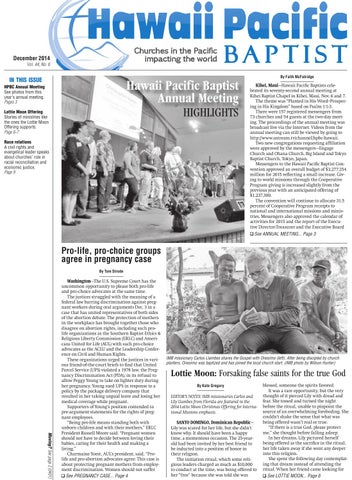
Churches in the Pacific impacting the world
December 2014
Vol. 44, No. 6
in this issue
BAPTIST
Hawaii Pacific Baptist Annual Meeting
HPBC Annual Meeting See photos from this year’s annual meeting. Pages 3
HIGHLIGHTS
Lottie Moon Offering Stories of ministries like the ones the Lottie Moon Offering supports. Page 6-7 Race relations A civil rights and evangelical leader speaks about churches’ role in racial reconciliation and economic justice. Page 9
By Faith McFatridge
Kihei, Maui—Hawaii Pacific Baptists celebrated its seventy-second annual meeting at Kihei Baptist Chapel in Kihei, Maui, Nov. 6 and 7. The theme was “Planted in His Word–Prospering in His Kingdom” based on Psalm 1:1-3. There were 157 registered messengers from 73 churches and 54 guests at the two-day meeting. The proceedings of the annual meeting was broadcast live via the Internet. Videos from the annual meeting can still be viewed by going to http://www.ustream.tv/channel/hpbc-hawaii. Two new congregations requesting affiliation were approved by the messengers—Engage Church and Ohana Church, Big Island and Tokyo Baptist Church, Tokyo, Japan. Messengers to the Hawaii Pacific Baptist Convention approved an overall budget of $3,277.254 million for 2015 reflecting a small increase. Giving to world missions through the Cooperative Program giving is increased slightly from the previous year with an anticipated offering of $1,237,300. The convention will continue to allocate 31.5 percent of Cooperative Program receipts to national and international missions and ministries. Messengers also approved the calendar of activities for 2015 and the report of the Executive Director-Treasurer and the Executive Board See ANNUAL MEETING... Page 3
Pro-life, pro-choice groups agree in pregnancy case By Tom Strode
Moving? See page 2 (0401)
Washington—The U.S. Supreme Court has the uncommon opportunity to please both pro-life and pro-choice advocates at the same time. The justices struggled with the meaning of a federal law barring discrimination against pregnant workers during oral arguments Dec. 3 in a case that has united representatives of both sides of the abortion debate. The protection of mothers in the workplace has brought together those who disagree on abortion rights, including such prolife organizations as the Southern Baptist Ethics & Religious Liberty Commission (ERLC) and Americans United for Life (AUL) with such pro-choice advocates as the ACLU and the Leadership Conference on Civil and Human Rights. These organizations urged the justices in various friend-of-the-court briefs to find that United Parcel Service (UPS) violated a 1978 law, the Pregnancy Discrimination Act (PDA), in its refusal to allow Peggy Young to take on lighter duty during her pregnancy. Young sued UPS in response to a policy by the package delivery company that resulted in her taking unpaid leave and losing her medical coverage while pregnant. Supporters of Young’s position contended in pre-argument statements for the rights of pregnant employees. “Being pro-life means standing both with unborn children and with their mothers,” ERLC President Russell Moore said. “Pregnant women should not have to decide between loving their babies, caring for their health and making a living.” Charmaine Yoest, AUL’s president, said, “Prolife and pro-abortion advocates agree: This case is about protecting pregnant mothers from employment discrimination. Women should not suffer See PREGNANCY CASE... Page 4
IMB missionary Carlos Llambes shares the Gospel with Onesimo (left). After being discipled by church planters, Onesimo was baptized and has joined the local church start. (IMB photo by Wilson Hunter)
Lottie Moon: Forsaking false saints for the true God By Kate Gregory
EDITOR’S NOTES: IMB missionaries Carlos and Lily Llambes from Florida are featured in the 2014 Lottie Moon Christmas Offering for International Missions emphasis. SANTO DOMINGO, Dominican Republic— Lily was scared for her life, but she didn’t know why. It should have been a happy time, a momentous occasion. The 25-yearold had been invited by her best friend to be inducted into a position of honor in their religion. The initiation ritual, which some religious leaders charged as much as $10,000 to conduct at the time, was being offered to her “free” because she was told she was
blessed, someone the spirits favored. It was a rare opportunity, but the very thought of it pierced Lily with dread and fear. She tossed and turned the night before the ritual, unable to pinpoint the source of an overwhelming foreboding. She couldn’t shake the sense that what was being offered wasn’t real or true. “If there is a true God, please protect me,” she thought before falling asleep. In her dreams, Lily pictured herself being offered as the sacrifice in the ritual, her life taken away if she went any deeper into this religion. She spent the following day contemplating that dream instead of attending the ritual. When her friend came looking for See LOTTIE MOON... Page 6
2
HAWAII PACIFIC
HAWAII PACIFIC BAPTIST 2042 Vancouver Drive Honolulu, Hawaii 96822 (USPS 237-540)
CHRISTOPHER MARTIN Editor FAITH McFATRIDGE Associate Editor The Hawaii Pacific Baptist is published bi-monthly by the Hawaii Pacific Baptist Convention. For general information, call (808) 946-9581. Periodicals postage paid at Honolulu, Hawaii, and additional mailing office. To subscribe: Send request to the Hawaii Pacific Baptist at the above address. Subscriptions for nonresident members of the HPBC are $12 annually. To register a change of address: Send the mailing label from page 1, along with your new address, to The Hawaii Pacific Baptist at the above address. POSTMASTER: Send address changes to HAWAII Pacific BAPTIST, 2042 Vancouver Dr., Honolulu, HI 96822-2491 To give news tips: Call the editor at (808) 9469581. To submit a letter: Letters on any subject will be considered for publication if sent to the above address, provided they do not make a personal attack on anyone. Letters are limited to 250 words and may be edited for length. Publishing services provided by Western Recorder Inc., Box 43969, Louisville, KY 40253.
Join us on Facebook Be part of the Hawaii Pacific Baptist Convention via Facebook. Already have an account? Simply type “Hawaii Pacific Baptist Convention” in the search box. Then click the “Like” box on the right side of the Hawaii Pacific Baptist Convention header. It’s that easy. Followers of HPBC will receive all the updates and be current with the events and activities as they are posted. Let’s keep connected. For more information, contact Faith McFatridge at faith@hpbaptist.net.
DECEMBER 2014
Christmas always about Jesus’ sacrifice By Chris Martin
As we enter this Christmas season, I want to thank you for allowing me the privilege of serving you as Executive Director of the Hawaii Pacific Baptist Convention in 2014. I truly celebrate your partnership in the work of our convention of churches. In preparing for 2015, I believe we have a great opportunity Chris Martin to see God do more incredible works through us than ever before. During this Christmas season, search for ways that God can use you to share the transforming Gospel with your friends and family. A simple conversation can rise from everyday activities and be directed to share Christ. An offer to assist in a time of need can translate
into a relationship that will produce fruit for the Kingdom of God. A selfless act for the “spirit of the season” can open opportunities for the love of God through Christ to be explained. Each and every life is very important—to God and to us. So important, in fact, that God chose the only way to salvation for everyone to be in His plan of the Gospel. The Gospel reminds us that it never has been, nor ever will be about us regarding how we are deserving of any grace, but it’s always about Jesus and how He chose to be the sacrifice for us to salvation. And this is what Christmas is about. I pray that your Christmas Season is blessed by special times of fellowship and gathering, but also by special times of sharing Christ. Mahalo and God bless you! Christopher Martin is the Hawaii Pacific Baptist Convention executive director.
Your input is needed The Communications Committee of the Executive Board approved a recommendation that the “Hawaii Pacific Baptist” go to being primarily an online version. The print paper will only be mailed to those who indicate that they want to receive the hard copy. The plan is to be begin in 2015. The “Hawaii Pacific Baptist” is currently sent free to active church members of every HPBC-cooperating church. Your Cooperative Program offerings help to sustain the cost of editing and printing the paper. Churches or individuals can send their lists requesting a copy mailed to their address to hpbcnews@gmail.com. Your comments are very valuable. Please contact Andrew Large, chair of the Communications Committee, with your comments at pastor@waikikibaptist.com.
Analysis: Southern Baptists and racial healing in the wake of events in Ferguson By David Roach
Nashville, Tenn.—Southern Baptists have a unique role to play in America’s race relations following a grand jury’s decision not to indict a white police officer in the shooting death of an 18-year-old African American in Ferguson, Mo. A key reason: Southern Baptists have firsthand experience of the only lasting solution to racial tension: the Gospel of Jesus Christ. Of course, many other groups believe and preach the Gospel as well, and it has the same reconciling power among all Christian denominations. But Southern Baptists have witnessed a unique transformation -- from a convention that began out of a desire to defend slavery and later was known for upholding legalized racial segregation to what church growth expert C. Peter Wagner called in a 1970 book the most diverse religious denomination in America. The Gospel’s transformative work in the Southern Baptist Convention lends credence to Christians’ claim that believing and obeying the message of Jesus can bring healing in communities where racial minorities feel oppressed by police, where certain ethnic groups feel they cannot receive justice and where blacks are incarcerated at alarmingly high rates compared with whites. Consider some of the ways God has worked among Southern Baptists: l In 1995 the SBC adopted a resolution apologizing for its racist past, asking African Americans for forgiveness. The resolution “lament[ed] and repudiate[d] historic acts of evil such as slavery from which we continue to reap a bitter harvest.” It went on to say, “We apologize to all African-Americans for condoning and/or perpetuating
individual and systemic racism in diversity of racial and ethnic our lifetime; and we genuinely members. repent of racism of which we About 15 percent of presidenhave been tial appointments guilty, whether “...Southern Baptists to committees consciously or were from nonunconsciously.” have witnessed a unique Anglo ethnic and Some black transformation— racial groups over Baptists the past two from a convention that expressed “a years, and nearly began out of a desire sense of sur100 members of to defend slavery and prise at the racial and ethnic frankness of the later was known for minority groups verbiage in the upholding legalized have served in resolution,” Bap- racial segregation to SBC leadership tist Press positions as what church growth reported in elected officers, expert C. Peter Wagner 1995. entity trustees l In 2011 the called in a 1970 book the and staff memconvention bers and semimost diverse religious adopted a denomination in America.” nary faculty, 10-part recomaccording to data mendation compiled by the from an Ethnic Study Committee Southern Baptists of Texas that sought to help ethnic Convention. churches and leaders better partAbout 400 North American ner with fellow Southern Baptists Mission Board missionaries idenin missions and ministry. tify themselves as non-Anglo. Convention messengers asked Approximately half of SBC entities annually to provide “a church plants are classified as descriptive report of participanon-Anglo, and nearly 15 percent tion of ethnic churches and of churches registered to assist in church leaders in the life and the Send North America church ministry of the respective SBC planting emphasis are from varientity;” the SBC president to “give ous racial and ethnic subsets of special attention to appointing American culture. individuals who represent the l SBC presidents like W.A. diversity within the Convention” Criswell, pastor of First Baptist to committees under his purChurch in Dallas, and Owen Cooview; and a subcommittee of the per, a layman from Mississippi, SBC Executive Committee to proexperienced remarkable episodes vide a report each year in Februof personal repentance from racary with an update on how each ist beliefs during the latter half of of the recommendations has the 20th century. been addressed. l All six SBC seminaries l In 2012 the convention accepted black students before elected by acclamation Fred Luter doing so was required by law. of New Orleans as its first black Southern Baptist Theological president to a standing ovation. Seminary in Louisville, Ky., and l As of November 2014, at Southwestern Baptist Theological least 24 state Baptist conventions Seminary in Fort Worth, Texas, that cooperate with the SBC had both admitted black students in elected non-Anglos as their the 1940s, with Garland Offutt presidents. becoming the first black graduate l More than 10,000 of the of any SBC seminary in 1944 SBC’s 50,500 churches and when Southern awarded him a church-type missions are nonmaster of theology degree. Anglo, comprised of a broad Martin Luther King Jr.
preached in Southern Seminary chapel in 1961 to a warm reception by faculty and students -despite objections from some Southern Baptists that elicited an apology from trustees at the time for “any offense caused by the visit of the Reverend Martin Luther King, Jr., to the campus of the Seminary.” In 1965, Golden Gate Baptist Theological Seminary students and faculty donated funds to help a student travel from the seminary’s California campus to a civil rights march in Selma, Ala. The student body also sent procivil rights telegrams to King and Alabama Gov. George Wallace. There have been missteps along the way, as when an SBC president in the 1980s said without accompanying theological clarification that God does not hear the prayers of Jews and when a convention leader apologized for comments that harmed “specific individuals, the cause of racial reconciliation, and the gospel of Jesus Christ” following the shooting death of Trayvon Martin in 2012. Still, Southern Baptists’ record of repentance, change and inclusion over the past several decades is undeniable evidence that “through the cross,” Jesus Christ has killed “the hostility” between races and “broken down in his flesh the dividing wall of hostility” (Ephesians 2:14-16). With this record buttressing their preaching, Southern Baptists are in a unique position to tell hurting Americans in Ferguson and elsewhere that trusting Christ as Lord and Savior will allow them to be reconciled not only to God but to one another as well. (BP) David Roach is chief national correspondent for Baptist Press, the Southern Baptist Convention’s news service. Baptist Press editor Art Toalston contributed to this article.
HAWAII PACIFIC
DECEMBER 2014
3
Bob Duffer Receives Hawaii Baptist Foundation’s Pono Award By Hawaii Baptist Foundation Staff
At the HPBC Annual Meeting at Kihei Baptist Chapel on Maui, the Hawaii Baptist Foundation gave its 2014 Pono Award to Rev. Bob Duffer. “Pono” is a Hawaiian word that can be interpreted as proper, correct, right, and excellent. The award is given annually for excellence in ministry. Paul Oyer, HBF President, read the resolution by the Foundation’s board and presented Rev. Duffer with a framed copy of the resolution and handed June Duffer a check from the Foundation which was part of the award. The resolution reads as follows: WHEREAS, Bobby R. Duffer has served our Lord faithfully in Hawaii for over 45 years as a minister of the gospel; WHEREAS, Rev. Duffer participated in leading several new works to become churches in the Hawaii Pacific Baptist Convention; WHEREAS, he served as an officer of the Convention for several years, including serving as its interim Executive Director/Treasurer while he was President of the Convention; WHEREAS, Dr. Duffer served as the first Director of Missions for the Neighbor Island Baptist Associations, and continued as the leader of neighbor island
Annual Meeting Continued from page 1
containing information on administrative services and division programs. Alberto Camacho, pastor of Filipino International Baptist Church, Oahu, was elected president. Daniel Tomita, pastor of Kinoole Baptist Church, Big Island, was elected 1st vice president. John Endriss, pastor of Engage Church, Big Island, was elected second vice president. Nancy Whitehead, a member of Ocean View Baptist Church, Big Island, was elected as recording secretary.
associations for a number of years until his retirement; WHEREAS, in retirement Bob has served as Interim Pastor of several key churches on the islands of Maui and Hawaii, has established and maintained the Hawaii E-Prayer Request service, and has continued his long service as a Parliamentarian at the Convention’s Annual Meeting; And WHEREAS, in the numerous leadership roles in which he has served, Bob Duffer has always been a stabilizing influence within our Convention; NOW, THEREFORE, BE IT RESOLVED by the Board of Directors of the Hawaii Baptist Foundation that Dr. Bobby R. Duffer be awarded its Pono Award for EXCELLENCE IN MINISTRY. BE IT FURTHER RESOLVED, that the Hawaii Baptist Foundation Board of Directors hereby expresses its sincere appreciation to Dr. Duffer for his tireless and unselfish service to Hawaii Baptists. On behalf of all Hawaii Pacific Baptists, we wish Bob and his wife, June, continued good health and much ALOHA. Bob and June Duffer received a warm standing ovation as they came to the stage to receive the award. It was also noted that Rev. Duffer had been the founding pastor of the church in Kihei where the award was given.
Bob Duffer, center, was honored by the Hawaii Baptist Foundation with the Pono Award at the HPBC annual meeting in Kihei, Maui. With Bob is his wife, June, and on the right is Paul Oyer, president of the Hawaii Baptist Foundation.
A resolution was approved thanking the volunteer leadership of those ending their terms of service to the Executive Board and Convention Committees. A resolution recognizing the Southern Baptist Convention agencies was approved. The annual message was given by a worker from East Asia who encouraged the churches to adopt an unreached and unengaged people group. He spoke about his work in East Asia and the need to reach the lost. Next year’s annual meeting will be held November 5 and 6 on Oahu. Top: A group of Oahu ministers got together to present special music during one of the sessions. They were so good that they were invited to sing again at the next session. The group included Bong Abagon, Makito Watanabe, Bob Gierhart, Steve Gray and David Howle. Left: During the HPBC annual meeting, pastors and spouses of the Asia-Pacific churches were able to meet with Executive Director Chris Martin and begin dialogue about forming an Asian-Pacific association of churches. Represented were Koza Baptist Church, Seoul International Baptist Church, Yokohama Baptist Church, Tokyo Baptist Church and Songtan Baptist Church. Bottom left: The New Workers Orientation was held at the Makena Beach Resort prior to the HPBC annual meeting. HPBC staff and national representatives spoke about their roles and how they could help to support and resource the churches. Officers elected at the HPBC 72nd annual meeting were (left to right) Alberto Camacho, president; Daniel Tomita, first vice president; and John Endriss, second president.
4
HAWAII PACIFIC
DECEMBER 2014
PEOPLE & PLACES Hawaii Baptist Academy hosts Legacy Awards Night Honolulu—Hawaii Baptist Academy hosted its inaugural Legacy Awards Nov. 8 at the Dan Liu Gymnasium. The awards ceremony, dinner and silent auction helped raise funds for HBA’s scholarship programs and recognized individuals who have made lasting contributions to God’s work in Hawaii. “We wanted to create a new event that would welcome our alumni back to our campus and recognize our outstanding teachers, alumni, and other key members in our `ohana who have paved Photo by Derrek Miyahara for Island Digital Imaging. the way to make HBA the exceptional Col. Stan Sagert, who passed away in Jan- continues to encourage others to live school that it is today,”said Carole uary at the age of 93. (Nakama) Masaki, development officer. each day passionately for God. “It just seems with every passing day, I The most esteemed award is the Life“We all have a block of time and we am more amazed by my Dad. He did so time Legacy Award, which is given to don’t know if it’s short or if it’s long, so those who have made a lasting impact on much with his life, at HBA, in the miliwe have to make the best of the time we tary and in his church. Along with my HBA’s history through extraordinary have. Willie Nelson has a song that says, service. That award was presented to H.P. mom, he really changed many lives,” ‘Gee, ain’t it funny how time slips away?’ Obermeyer said via email. and Mary McCormick, Col. Stan Sagert Thirty-six years slipped by really fast, but Sagert retired from the military in and Joyce Wong. I felt the call, I felt the urgency to make 1970 to become president of HBA. Under The McCormicks were Southern Bapthat time count. I feel very satisfied in his leadership, the school made remarktist missionaries in Nigeria for 20 years retirement, and God has affirmed that able advances in campus expansion, cur- tonight,”Wong said. before they were transferred to the U.S. riculum offerings, enrollment, and Territory of Hawaii in 1947 to start a Eight other individuals were also recdonor support, while maintaining its Christian school. The school opened in ognized. Kiyo Itokazu and Stanley Togievangelical mission. 1949 with 36 students in grades seven kawa received the Distinguished Service “My father was so sincere in his love and eight. HBA now has more than 1,000 to the Community award. for Christ and his love for HBA, but he students in kindergarten through high Itokazu was a member of HBA’s first was also very humble. This award comes school. graduating class. He served as a pastor, from the people who were his friends On behalf of the McCormicks, grandarmy chaplain and chaplain for Kuakini and loved him and worked with him for son Martin Daughtry accepted the Medical Center. Currently, he teaches many years through the lean times and award. Adult Sunday School at Waialae Baptist the good times—that is what makes this “This award is evidence that my Church, leads the senior adult ministries grandparents’ work was not in vain. It’s a award so special to my family,” said with his wife, Laura, and ministers to Obermeyer, a middle school teacher in really humbling thing for me to come bereaved families. and see what wonderful things have hap- Marble, Texas. Togikawa was a minister at Olivet The fourth recipient of the Lifetime pened from the labor that they put in so Baptist Church for 18 years and assisted Legacy Award was Joyce Wong, a retired many years ago,” Daughtry said. in HBA’s business office. He is the presifaculty member who taught at HBA for Daughtry, an associate professor of dent of the Shiraki Memorial FoundaEthnomusicology at New York University, 36 years beginning in 1960. In 1975, Mrs. tion, which has provided scholarships to Wong and her sociology class put into visited HBA’s campuses for the first time more than a thousand Hawaii seminary practice Christ’s love by sponsoring a in November. During his acceptance students since 1973. The Shiraki FoundaVietnamese refugee family and helping speech, he recalled his mother’s stories tion is also the largest local benefactor of them transition to life in Hawaii. In the about HBA’s humble beginnings in army Hawaii Baptist Academy. late 1980s she began teaching Bible barracks. Mori Hiratani and Carl Kinoshita classes, where her students learned how Kristin (Sagert) Obermeyer accepted accepted the Distinguished Service to the Lifetime Legacy Award for her father, to apply God’s word to their lives. Wong God award, which honors those who
Pregnancy case Continued from page 1
physical hardship at work or lose their jobs because they are having a baby.” Lenora Lapidus, director of the ACLU’s Women’s Rights Project, said, “Employers and courts nationwide still aren’t getting the message that the same temporary accommodations provided to injured workers must be provided to pregnant workers. The Supreme Court must make it clear that this type of discrimination is unlawful.” Ovide Lamontagne, AUL’s general counsel, told Baptist Press it is important to understand “the policy behind the Pregnancy Discrimination Act isn’t just the workplace but it’s also a public statement to support women so they make the decision to keep their children, not to have an abortion.” “If women aren’t given the kind of protection in the workplace that the Pregnancy Discrimination Act gives them, they’re more likely to feel like they have no other choice in order to keep their jobs, in order to preserve their economic status than to seek an abortion,” said Lamontagne. The question of disparate treatment of Young as compared to other
UPS workers with physical limitations comprised much of the discussion by justices and lawyers during the oral arguments. After she became pregnant, Young, a delivery driver in Maryland, provided UPS with notes from a doctor and midwife saying she should not lift more than 20 pounds. A manager told Young this would prevent her from performing the basic actions of her job for UPS, which had a 70-pound lifting requirement. The manager also said Young was ineligible for light-duty work. As opposed to its policy for pregnant employees, UPS provided light-duty work to workers injured on the job or disabled as well as those who lost their commercial drivers’ licenses from the Department of Transportation. Caitlin Halligan, a New York City lawyer representing UPS, told the justices there is “no dispute at all” that UPS did not provide accommodations to people with off-the-job injuries. Samuel Bagenstos, a University of Michigan law professor representing Young, said, however, there are examples on record “of people with off-the-job injuries or illnesses who were DOT decertified who were given accommodations, and not just accommodations that remove them from
driving but also remove them from heavy lifting. That’s a factual dispute that has to go to trial.” The case did not go to trial in federal court. Instead, a judge ruled for UPS in a summary judgment. A three-judge panel of the Fourth Circuit Court of Appeals in Richmond, Va., unanimously upheld the lower court’s decision, ruling that UPS had devised “a pregnancy-blind policy.” The portion of the PDA discussed the most in oral arguments says, “[W]omen affected by pregnancy, childbirth, or related medical conditions shall be treated the same for all employmentrelated purposes ... as other persons not so affected but similar in their ability or inability to work.” The law, Bagenstos told the justices, says, “[E]mployers have to treat pregnancy-related conditions as favorably as they treat non-pregnancy-related conditions.” The Department of Justice also argued on behalf of Young. Donald Verrilli, solicitor general, said the point of the law “is to reduce the number of women who are driven from the workforce or forced to go months without an income as a result of becoming pregnant. ... [Employers] can’t draw distinctions that treat pregnancy-related
fulfill the vision of HBA through their service in full- or part-time ministry. Hiratani served as chair of the HBA board for two terms and was appointed to a special Committee of Three with Allen Au and Sagert to oversee the development and financing of the Pali Campus. The committee served for nearly three decades. Kinoshita served on the HBA Board of Directors and is a member of The Aloha Council. He established the Carl and Hatsue Kinoshita Scholarship Endowment Fund at HBA. Dr. Rebecca “Ruby” Sanchez Ovitt and Maurine King received the Distinguished Service to HBA award. Ovitt served 41 years as principal of HBA’s elementary school. In 2005, she oversaw the accreditation of the elementary campus by the Western Association of Schools and Colleges. King also taught at HBA’s high school for 52 years. The Distinguished Alumni award was presented to Rick Tsujimura and Winona (Au) White. Tsujimura is a lawyer for Ashford & Wriston, LLLP. He has worked in multiple government offices, including Deputy Attorney General. Currently, he is the chair of the Board of Governors at the East West Center and the U.S. Board of Global Hope Network International. He participates on the advisory board of the Geneva Institute for Leadership and Public Policy. White is a Human Resources Executive with more than 25 years of experience. In February she was named Vice President of Human Resources for Kamehameha Schools. White serves on the HBA Alumni Association board and volunteers for the Athletic Booster Club. Last year, her family established the White Ohana Scholarship Endowment Fund at HBA. Her daughters, Taylor, 11th grade, and Emily, 8th grade, attend HBA. Is there someone who has impacted your life at HBA? Nominate him/her for the 2015 Legacy Awards starting Dec. 15 at www.hba.net/legacy. medical conditions worse than other conditions with comparable effects on ability to work.” Associate Justices Elena Kagan and Ruth Bader Ginsburg challenged Halligan’s arguments for UPS. PDA “was supposed to be about removing stereotypes of pregnant women as marginal workers,” Kagan said. “...what you are saying is that there’s a policy that accommodates some workers, but puts all pregnant women on one side of the line. And what you are further saying is that the employer doesn’t even have to justify” such a policy. AUL’s Lamontagne was hopeful about Young’s chances of winning after observing the arguments. Because of the factual dispute, the high court could remand the case to the federal court for a trial, Lamontagne told BP, but he thinks the justices may simply rule in Young’s favor. UPS has announced it will put into effect Jan. 1 a more favorable policy for pregnant employees. An opinion in the case, Young v. UPS, is expected to be announced before the court adjourns early next summer. (BP) Tom Strode is the Washington bureau chief for Baptist Press.
HAWAII PACIFIC
DECEMBER 2014
Remembrances
Josefina Saludez Josefina Saludez, wife of David Saludez who retired as pastor of the former First Baptist Church of Waipahu, passed away Dec. 2 in Tarlac, Philippines at the age of 82. She and her husband, Pastor David Saludez, served together at FBC Waipahu for 28 years. Josefina and David arrived in Honolulu from the Philippines in 1969 as language missionaries serving at Kalihi Baptist Church. In 1980 David was called to serve in Waipahu as pastor. Josefina was a teacher who taught primary, intermediate through high school levels, as well as college courses. Those who knew Josefina will recall her love for cooking and gift of hospitality. She was an avid reader, appreciated classical music, and enjoyed plants, flower arranging and gardening. Josefina was active for many years with the Hawaii WMU, and served as leader for Mission Friends in the ‘80s, was involved with Acteens in the ‘90s, and was friend to many fellow pastors wives throughout Hawaii. Most of all, she was a devoted wife to David, mother of 6, grandmother of 13, and great grandmother of one. Cards and letters can be sent to David Saludez, 3587 Ligtasan, Tarlac City, Tarlac, Philippines 2300 email: davidsaludez@yahoo.com.
Gertrude Tharpe Dr. Gertrude A. Tharpe, a pioneer in developing grief support services in the Birmingham area, died on Thursday, Nov. 6. Trudy, as everyone called her, was born May 6, 1918, in Walhalla, South Carolina. After graduating high school, she attended Columbia Bible College in South Carolina and graduated from Tift College in Forsyth, Georgia. She continued her studies at New Orleans Baptist Seminary, earning an MRE degree. Later in life she resumed her studies earning an MA degree at Furman University and a doctorate in Educational Psychology at Vanderbilt University. She began her work career as a minister of education in several churches in Oklahoma. She married the Rev. Edgar J. Tharpe, of Macon, Georgia, in June 1941. In 1947 they moved to Hawaii where they worked on the islands of Kauai, Maui, and Oahu. They started churches and Trudy served as director of Bible and young adult study groups. In 1960, they moved to Hong Kong where Rev. Tharpe was pastor of Kowloon International Baptist Church and mission business manager.
Trudy organized Bible and young adult study groups, taught at Hong Kong Baptist College, and directed the counseling program there. They worked in Hong Kong for the next 17 years before moving to Nashville, Tennessee, and then Birmingham, Alabama. Dr. Trudy Tharpe was caring and compassionate as well as thoughtful with a superb intellect and broad vision, She was a committed Christian who sought to “make things a little better in my corner of the world.” She was ahead of her time in so many ways as a woman leader and a senior still contributing to society well into her 90’s. She was a person of courage and conviction, who would stand up for people. Dr. Tharpe was, in fact, a thoroughly modern woman: tough, independent, open minded, committed, compassionate, and visionary. Dr. Tharpe is survived by two sons and a daughter and their families. A memorial service for Dr. Tharpe was held Nov. 11 at Dawson Memorial Baptist Church. Donations can be made to the Gertrude A. Tharpe Fund for Grief Support, 2350 Montevallo Road, Birmingham, AL 35223.
5
the time, they gave him six months to live. After enduring various treatments, he received a liver transplant in 2002. Norman viewed that time after the liver transplant as “bonus” time. He was able to witness his two sons get married and even became a grandfather with two granddaughters. Norman’s main goal however, was to use this “extra” time to spread the word about Jesus Christ. He shared about his liver transplant experience to people all around the world. Above all, Norman loved and served God more than anything. He served as pastor of Chinese Baptist Church until his passing Oct. 7. A memorial service was held at Waialae Baptist Church Nov. 1, 2014.
Grace Efurd
Norman Choy The Rev. Norman Choy was born July 14, 1948, in Chung Shan City, Canton Province, China. After moving to Hawaii, he graduated high school from Maryknoll and attended University of Hawaii. In college, he joined the Baptist Student Union where he met his future wife, Yuen Wah Choy, and began learning about the Lord Jesus Christ. In 1975, he received the Lord Jesus Christ into his heart. In 1976, he attended a conference in Hong Kong where he felt the calling to become a pastor. Shortly after coming back to Honolulu, he told friends and family he was going to quit his job at NCR and enroll at Southwestern Baptist Theological Seminary in Fort Worth, Texas. He graduated in 1987 with a Masters of Divinity and a Doctorate in Ministry. During his time in seminary, he married Yuen Wah “Anita” Choy and had two sons, Nathan and Nicolas. They returned to Honolulu to start a Chinese speaking ministry. He started Chinese Baptist Church in 1990 meeting at Hawaii Kai Baptist Church with just four members of his family. They met in a Sunday School room, which they eventually grew out of. In 1994, Chinese Baptist Church moved to its current location and became a Chinese speaking mission of Waialae Baptist Church. In 2001, Norman was diagnosed with liver cancer. At
PINEWOOD DERBY The first annual Pinewood Derby was held at University Avenue Baptist Church on November 29. There were 17 racers participating with their church leaders. The event was sponsored by the Hawaii WMU led by Darrell McCain, state Royal Ambassador director. Trophies and gift certificates were given to the top three in Grades 1-3 category, Grades 4-6 category and Youth/ Leaders category. Also trophies for Best Paint and Best Design were given. A drawing was held for three participants for free registration to the 2015 Mission Adventure Camp or Centrifuge. Next year’s Pinewood Derby will be on August 8.
Grace Agena Efurd passed away surrounded by her family on Oct. 13 after a courageous year of fighting colon cancer. She was the wife of O.W. “Dub” Efurd who retired as the HPBC Executive Director in 2003 and passed away in 2005. Grace was born in Kekaha, Kauai Nov. 15, 1935. Her family moved to Honolulu in 1941 and a neighbor took her to Olivet Baptist Church which became the center of Grace’s life. She dedicated her life to serving the Lord at a very young age. Grace graduated from Farrington High School in 1953 and received scholarships to study at Southwest Baptist College in Bolivar, Missouri, and later at Ouachita Baptist College in Arkadelphia, Arkansas. She then attended Southwestern Baptist Theological Seminary in Fort Worth, Texas, where she met Dub. They were married in 1960. In 1963, they were appointed by the Home Mission Board to begin the Kona Baptist Mission on the Big Island where they served for 9 years. In 1972, Dub was called as pastor of the Mililani Baptist Mission. When Dub became the director of missions for the Oahu churches in 1986, Grace supported him with women’s ministries and her craft ministry grew. For 21 years she held an annual craft sale, which raised thousands of dollars for Lottie Moon Christmas Offering. Grace also had a 36-year teaching career in Hawaii’s public schools. She continued her ministries and support when Dub became the HPBC executive director. She enjoyed traveling with Dub and hosting staff functions. A memorial service was held at Olivet Baptist Church on Nov. 15. Grace is survived by her daughter Laura who moved back to Mililani to be Grace’s caregiver, son Steve and his wife Nikki and their three sons Tyler, Trevor and Bryce.
Welcome, Micah!
Micah Camarata installed as pastor of Ewa Beach Baptist Church on November 30. Guest speakers included Bryan Wittekind, pastor of Waianae Baptist Church, and Robert Miller, Oahu Baptist Network’s Facilitator of Missions. Pictured here are Bryan Wittekind and Micah Camarata.
6
HAWAII PACIFIC
DECEMBER 2014
Lottie Moon Continued from page 1
her that night, Lily told her she couldn’t go through with it. Her friend said that bad luck and misfortune would befall her. Yet Lily stuck by her decision, and the friends parted ways. That marked the end of Lily’s participation in Santeria, whose practices are similar to voodoo. Calling on Spirits to Called bt the Spirit Lily didn’t experience the Latin American sect in her native country. The Colombian-born American became involved while living in Miami, Fla. Santeria mixes tribal-based spirit worship from West Africa, South America or the Caribbean with Roman Catholicism, calling on saints to divine the future and to provide healing and good luck. “I wanted to know what the future held,” Lily recounts. “I didn’t have peace in my life, so I was looking for something to provide that. “I now know I was spiritually blind.” Since becoming a Christian, Lily Llambes has experienced the true God at work, no more so than during her and her husband, Carlos,’ decade-long service as Southern Baptist missionaries in the Dominican Republic. Lily’s experience with Santeria has given her insight while counseling Haitians — as well as Dominicans — who are moving from a belief in the spirits of voodoo into an exclusive relationship with Jesus Christ. “It has given me a good perspective of where the people are [spiritually],” Lily says, “how they are in bondage. “At the same time it has given me compassion for them and made me more aware that they need the Gospel, that we need to get the Gospel to them. And … it has made me fearless [in the face of voodoo] because I have Jesus and I am saved and I should not fear …” Christ Conquers Fear Felicia, a Haitian witch doctor’s wife living in the Dominican Republic, says she and her husband “contact the saints for the benefit of the people. We don’t use demonic forces. We help people — with their debts, with their problems. When people don’t have good luck, they come here looking for good luck.” But their fellow Haitian neighbors aren’t so sure. They question whether “the saints” to whom the couple prays are who they say they are. “That place is from the devil,” says a neighbor as she points to Felicia’s house. Haitian pastor Ilme Frasier’s reaction to hearing that Felicia’s family as well as another witch doctor had settled into the community was to form an evangelical church there. Ilme is a student in a church-planting institute that Lily’s husband, fellow IMB missionary Carlos Llambes, began as ethnic ministries director for the Dominican Baptist Convention. Carlos started it to ground church leaders in the faith, teach them theology and doctrine, as well as to encourage and equip them to start new churches in neighborhoods without an evangelical presence. Ilme started the church under a tree. The congregation now meets in a oneroom building. The building shows a sense of permanency and “sticking power” in the community, Carlos says. Most homes there are too small for groups to meet in, he adds. In one year, the congregation has
Baptist pastor Ilme Frasier talks with IMB missionary Carlos Llambes in the community where In this house of voodoo, Felicia helps her witch Ilme’s church is located in the Dominican Republic. Carlos has mobilized, trained and mentored doctor husband conduct rituals for good luck and local Baptists, including Ilme, to continue to start churches in communities with no evangelical healing. (IMB photo by Wilson Hunter) presence. (IMB photo by Wilson Hunter)
grown to 60 adults and 20 children. And Felicia’s husband is now the only witch doctor living in the community; the other left town. But it hasn’t been easy. “There were times when I was afraid” while sharing the Gospel in the neighborhood fraught with witchcraft and voodoo, Ilme says, “but God has strengthened me. “When problems come, I tell my congregation how the Lord can handle them. Nothing is too small or too big for the Lord.” Partnering churches from the United States — including First Baptist Church, Pompano Beach, Fla. — help pastors such as Ilme start churches. Teams prayerwalk and invite residents to the Bible studies and worship services the institute’s church planters form in the communities. “Over the course of our partnership these past five years, we’ve been able to see the progress being made with churches started where we prayerwalked in previous years,” says Beverly Cooley, a Pompano church member who turns 81 on Christmas Day. What Does the Cross Mean to You? When prayerwalking or doing street evangelism alongside U.S. partnering churches and local church planters, Carlos is like a heat-seeking missile at the sight of someone wearing a cross. He’ll usually make a beeline to them and ask why they are wearing it and what it means to them. Near the Dominican Republic’s border with Haiti, Carlos spotted a man wearing a beaded necklace with a crucifix dangling from it, a type often used in voodoo healing rituals. “Why are you wearing that cross?” Carlos asks him in Creole. “For good luck. I don’t feel well,” replies the man named Onesimo, holding a handful of herbs. “Maybe you don’t feel well because you have a dead Christ hanging from your neck, weighing you down,” Carlos responds. “He isn’t dead on a cross now. He’s risen from that, for you. How do you think He feels about you depicting Him as dead when He’s alive?” Carlos gives Onesimo an audio recorder containing Bible stories in Creole, along with a booklet, Bon Nouvel Pou Ou (Good News for You).
“If you have the real Christ in your heart, you don’t need to trust in a manmade thing of wood hanging around your neck,” Carlos tells Onesimo. “You want the real thing. “Can I take this thing from your neck and throw it away?” Carlos asks Onesimo. “Go, do it,” Onesimo responds. “Start your walk with Christ,” Carlos urges Onesimo. “Go to Bible studies. As you start your walk with Him, it isn’t going to be easy, but start.” Eight months later, Carlos received word that Onesimo, having been discipled by the Haitian and Dominican church planters, was baptized and has joined the local church plant. After about a decade of planting churches in the Dominican Republic among both Haitians and Dominicans, the Llambes family relocated to Mexico City in March 2014 to start churches. Of the capital city’s more than 4,200 neighborhoods, more than 3,300 of them do not have an evangelical church, Carlos says. Neighborhoods can contain as many as 20,000 people in the city of 28 million. Within the past seven years, 100 churches have been started as part of the Dominican Baptist Convention’s ethnic ministries and church-planting institute. Now, many of the graduates are teaching the same courses they took via the institute throughout the country and are mentoring their students to start new congregations, just like Carlos
did with them. “All the church planters, the pastormissionaries, they have a passion for church starting,” Carlos says. “And, once they form one, they don’t stop. They look for another community without an evangelical church and start another one.” Even though he’s relocated to another area to start churches, Carlos knows “… there’s going to be a continuation of that here,” as evidenced by the church planters’ discipleship of Onesimo. Find Your Place in God’s Story At imb.org/offering and hispanos.imb. org/lottie (Spanish language), there are resources for churches to raise awareness for and to contribute to the Lottie Moon Christmas Offering for International Missions. The Lottie Moon offering and the Cooperative Program provide the financial support for the Llambes family to serve on the missions field, as well as approximately 4,800 other Southern Baptist missionaries overseas. Give to the Cooperative Program and Lottie Moon offering through a Southern Baptist church. There also is a Donate Now button for online Lottie Moon giving at imb.org/offering. Join the Author of all history in “One Sacred Effort — Find your place in God’s story” and give so more people will hear about His saving grace. Kate Gregory writes for IMB.
HAWAII PACIFIC
DECEMBER 2014
7
Believers in trailer park ‘give everything they have’ By Margaret Colson
Monroe, Ga.—They are the forgotten
people. The individuals you might not even notice if you passed them on the street. They are in every community. On the fringes of neighborhoods dotted with white picket fences. At the end of gravel roads that seem to go nowhere. The people who wash your dishes at the chain restaurant. Change your car’s oil. Scramble your eggs at the local diner. They are the forgotten people to almost everyone except Pam Whitehead, who affectionately refers to them as “my people.” Her people live in Conestoga Mobile Home Park in Monroe, Ga., where a singlewide trailer serves as home base for the Southern Baptist missionary to minister to the real needs of her people as she shares about Jesus. With children playing noisily at her feet, Pam Whitehead leads a Bible study for teens and adults, many Desperation and darkness of whom cannot read. As a life-sized cardboard cutout of renowned missionary Lottie Moon looks When it comes to housing options, on, Pam urges the Conestoga residents to look beyond their own circumstances to pray and give Conestoga, for many, is the last step before sacrificially so that others throughout the world may hear about Jesus. (Photo by Mark Sandlin) homelessness. There, the potholed community road, party, drug program, Easter egg hunt and of commitment,” said Allen Hill, interim knee-high weeds and household family fall festival. director of missions for Appalachee Baptist belongings tossed aside with every eviction It didn’t take long for John, who had Association and a former International seem to reflect the desperation and once described the park as the “doorstep to Mission Board missionary to the darkness that most park residents have hell,” to say he was in over his heart with Philippines. known. the ministry. The Just a few years couple continued to Not for the faint of heart It didn’t take long for John, who ago, the mobile minister to the Slowly, with the ministry presence in had once described the park as home community— people in the park, the park, conditions began improving. sitting just a few offering church “Probably everybody thinks the people the “doorstep to hell,” to say he miles from a services for the first in Conestoga are nothing but a bunch of was in over his heart with the charming and time in April 2005. thieves, drunks and drug addicts,” ministry. picturesque Everything Barbara, who lived in the park for several downtown—was seemed to be going months with her husband, said. notorious for violence, drug trafficking, smoothly until five days before Christmas “And they’re not. There are a lot of good transience, even satanic rituals. in 2010, when John Whitehead Christian people that live there who are Still, Pam, a preschool teacher, and her unexpectedly passed away. trying their best just to pay their bills and husband John, a juvenile probation officer, Tears of sorrow would flow, only to be put food on the table, just like everybody were unexpectedly drawn to the park. replaced with tears of joy, as the nowelse.” The couple, along with prayer teams, widowed mother of four young adults, Still, this ministry is not for the faint of began praying over the park and its including her youngest son with heart. Since her husband died, Pam has residents in 2002. Asperger’s syndrome, sensed God’s call to faced many challenges and frustrations. “The Father opened the doors wide continue the ministry. Undaunted, she smiles and calls each through two-and-a-half years of Local pastors began taking turns experience “another adventure.” prayerwalking,” Pam said. preaching at the mission on Sunday When the roof collapsed on the The Whiteheads began slowly building mornings; when they’re unavailable, Pam doublewide trailer where the ministry was relationships with the residents and by leads a group Bible study. housed, Pam simply moved the 2004 were planning a yard sale, block “Pam is a person of vision and a person congregation elsewhere. For seven months, the Conestoga believers intermittently met either outside or in the home of a member, before being given a fixer-upper singlewide for the ministry—dubbed The Lighthouse at Conestoga Mission. The day Pam was bitten by a resident’s pit bull, she seized the opportunity to share God’s word with the dog’s owner, Linda. It was a small open window for the intrepid missionary because Linda moved a few weeks later, with no forwarding address. That’s the way it is in the park. People come. People go. No explanations. No forwarding addresses. “I never get to tell my people, ‘Bye.’ They are just gone,” Pam said. She has learned to make the most of any time she has with the residents.
This year’s Week of Prayer for International Missions in the Southern Baptist Convention was Nov. 30-Dec. 7 with the theme of “One Sacred Effort—Find your place in God’s story” from Matthew 28:19-20 (HCSB). The Lottie Moon Christmas Offering for International Missions in tandem with Cooperative Program gifts from Southern Baptist churches support approximately 4,800 international missionaries in seeking to fulfill the Great Commission. Gifts to the Lottie Moon offering are received through local Southern Baptist churches or online at imb.org/offering. This year’s goal is $175 million. In the past 10 years of the mission’s existence, many Conestoga residents have become Christians. Still others have recommitted to a faith that had grown cold through too many of life’s harsh winters. The Conestoga Christians are learning to take the little that they have—what might be considered nothing by many standards—and do something for God. With Pam’s encouragement, the believers have “adopted” a family serving in South Asia with IMB. They pray specifically for each family member as well as the people group the family is trying to reach with the gospel. Giving from nothing “It doesn’t matter what your circumstances are,” Pam said. “You can still have a heart for the lost and the nations, and you can act on that, following the Father.” Since 2007, The Lighthouse at Conestoga Mission, through Pam’s persistent leadership, has set an annual goal of raising $100 for the Lottie Moon Christmas Offering for International Missions. For these residents, that’s huge, Pam says. “I wanted the goal to be one they could reach, but challenging at the same time,” she explained. Although it usually takes the group six months to meet the goal, in 2014 they collected $100 in about two-and-a-half months; and the sacrificial gifts, usually given in the form of loose coins, continued rolling in for a few more weeks. “One of the little boys in the park came running in one day, screaming and hollering and waving his hand, saying, ‘Miss Pam, I have 50 cents! I have 50 cents, and the people over the ocean can hear about Jesus!’” recalled the missionary. “Little is much in the Father’s hands,” she said. By the end of April, the pennies, nickels, dimes and quarters given by the Conestoga Christians totaled $128, an all-time high. Hill, who now serves as an IMB trustee, compared the sacrificial gifts to “the widow’s mite in the New Testament.” “So often we just give what is ‘left over,’ but these people give everything they have,” he said. (BP)
8
HAWAII PACIFIC
DECEMBER 2014
Volunteers from Lake Hills Church in Austin, Texas, are part of the citywide Mobile Loaves and Fishes ministry to feed the hungry.
Survey: Food ministries aid 1 in 4 families By Bob Smietana
Nashville—As the holidays approach, food pantries across the country will collect donations to help those in need. Chances are some of the folks who donate also know what it’s like to go to bed hungry. Nearly one in four Americans (22 percent) say their family has turned to a church-run food pantry in the past for help, according to a new survey from LifeWay Research. “Churches may have the reputation for serving donuts, coffee and potluck dinners to their members,” said Scott McConnell, vice president of LifeWay Research. “But they also are supplying food for many people in need.”
The online survey of 1,158 Americans was conducted in September. They were asked to respond to the statement: “My family has received food from a churchrun food pantry in the past.” Americans from a wide range of backgrounds said yes. That includes one in four churchgoers (26 percent) along with one in five (18 percent) of those who never attend services. One in three African Americans (37 percent) and evangelicals (35 percent) say their family has received help. So do nearly three in 10 (28 percent) of those without a college degree. About one in four Hispanic Americans (25 percent) and one in five (19 percent) of whites say they had turned to a church-run food pantry.
Those in the West (28 percent) were more likely to say they’d received help than those in the Northeast (17 percent) or South (20 percent). Older Americans (11 percent) and those with college degrees (13 percent) were among the least likely to say yes. Some 50 million Americans have trouble putting food on the table, according to Feeding America, a national network of food banks. A similar number of people received food stamps in 2013, according to the USDA. “There is an abundance of food in the U.S. but plenty of people still go hungry,” McConnell said. “Many churches respond by faithfully following the biblical principle of being open-handed to the poor and needy by maintaining well-stocked food pantries to share.” (BP)
Green’s Bible museum construction to begin in Washington D.C. By Diana Chandler
Washington—Construction on the Museum of the Bible begins this month as the final tenants leave the site that will house the building just three blocks from the U.S. Capitol, museum board Chairman Steve Green said. Presenting the archeological evidence of the people, places and events of the Bible in a non-evangelistic way will hopefully prove the truth of the book, but leave people to decide for themselves whether to accept Jesus as Lord, Green told Baptist Press. “Evangelism would not be a direct result. The museum would be nonsectarian,” Green said. “Our role is just to present the information. But I think that, and our hope is that, it would change peoples’ lives, that they would realize that this book is something for them to consider and would embrace its principles and live accordingly.” General contractor Clark Construction is demolishing the interior of the former Washington Design Center that will house the museum. The eightstory, 430,000-square-foot museum is slated to open in 2017 with $800 million in assets. “We want to invite all people to engage with this book,” Green said. “We think education is the first goal, for people to realize how this book has impacted their lives, and then consider the principles and apply them to their own lives because of the benefits that it brings.”
The eight-story, 430,000-squarefoot museum is slated to open in 2017 with $800 million in assets. The museum will house the Green Collection, the world’s largest private collection of rare biblical texts and artifacts.
The museum will house the Green Collection, the world’s largest private collection of rare biblical texts and artifacts, but will also feature additional exhibits designed to immerse visitors of all ages into interactive, biblically-based settings. The Green family, owners of the Hobby Lobby retail chain, amassed the collection over the past five years and has presented it to the public in a travelling exhibit that Green said has changed the lives of its viewers. “We’ve had many that have indicated—and they’ve gone through our traveling exhibit—it has strengthened their faith for example,” Green said of his collection. “They are encouraged by the fact that they can actually see the evidence that shows that what they have been taught is accurate. We believe that many will be encouraged and their faith will be strengthened because of the evidence that is presented.”
“There have been many atheists, for example, when they are willing to just let the evidence lead to its natural conclusion” Green said, “I think it leads them to realize that this book is accurate in what it claims to be.” The Bible’s history, impact and narrative will comprise the main focus of the museum, Green said, showing the reliability of Scripture as a historical document. “I think the evidence shows that the Bible is accurate,” Green said. “But we won’t say it’s accurate; we just present the information and we will let the visitor make their own decision.” The museum will present the history of the Bible’s narrative and show its impact on society, Green said. “The evidence will show that when we’ve applied (the biblical narrative) to principles, it has been good for society and again, that judgment we leave up to
the visitor,” he said. “(People) just need to know the story of the Bible. What is the narrative from Genesis to Revelation? (We aim) for the person that has never read it, that knows nothing, to have a basic understanding of what the Bible’s message is, what its narrative is.” The museum will allow visitors to explore the Bible’s impact on world culture and modern civilization, including literature, fine arts, architecture, education, science, film, music, family, government, law, human rights and social justice. Archaeological and historic treasures, including the Dead Sea Scrolls, ancient Torah scrolls, early New Testament texts, rare biblical manuscripts and firstedition Bibles will be included, said Cary Summers, the museum’s chief operating officer. “We’ve assembled,” Summers said in a press release, “the best in architectural, interior and environmental design to provide Museum of the Bible guests with an experience that is unique, innovative, customizable to each visitor’s level of interest and, most of all, memorable.” Exhibits will allow visitors to walk through a replica of first-century Nazareth; witness the preservation, translation and transmission of the Bible over time, from clay tablets revealing the earliest writings to today’s digital Bible. Visitors will take a high-definition, sensory ride through history, offering dynamic encounters with historical people, places and events that changed the world. (BP)
HAWAII PACIFIC
DECEMBER 2014
John Perkins: Historic time for race relations By Craig Sanders
Louisville—John Perkins, an 84-year-old evangelical pioneer in race relations, sees “a pivot place in history” among churches in racial reconciliation and economic justice. “This is the first generation of people who are beginning to understand that.” It’s a generation that “values diversity,” Perkins said at Southern Baptist Theological Seminary in this year’s Julius Brown Gay Lecture on Christian Ethics. “There’s an underlying movement today that now people are wanting to do missions with people, and they want to learn from people,” Perkins said, and they see the diversity of human beings as “a value in life.” Perkins, a Mississippi native, fled to California as a teenager when his brother was murdered by a town marshal. After he professed faith in Christ in 1957, Perkins returned with his wife and children to Mendenhall, Miss., where he established a ministry to provide both Bible training and community development programs such as health clinics, thrift stores and housing cooperatives. He is the founder and president of the John and Vera Mae Perkins Foundation. In 1989, Perkins was among the founders of the Christian Community Development Association to spread this philosophy of rebuilding poor neighborhoods with biblical principles. He also is the author of several books, including “Let Justice Roll Down” and “A Quiet Revolution.” Southern Seminary’s Julius Brown Gay Lectures are among its most prestigious lectureships, dating back to 1895. The lectures have brought some of Christianity’s most significant figures to the seminary campus, most notably Martin Luther King Jr. in 1961. The opportunity to deliver the lecture at Southern Seminary, Perkins said, was “one of the honors of my life” in his longstanding work in biblical reconciliation.
Civil rights leader John Perkins delivers the Julius Brown Gay Lecture on Christian Ethics at Southern Seminary Oct. 27. (SBTS photo)
Perkins lectured on “Theology and Race in American Christianity” to a standing room-only crowd of Southern Seminary students and African American pastors with the Kentucky Baptist Convention who attended an afternoon pastors’ conference. (See related story.) Racial reconciliation and justice are fundamental aspects of Christ’s redemptive work, Perkins said in his lecture. Anything outside of developing a church that is intentionally multicultural is “a disgrace to the gospel,” Perkins said. “It belittles the gospel to have a church based on race. It’s a slap in the face of a God who created from one human being all the nations that reside upon this earth and a gospel that its intention was to reconcile people to God and to each other.” The solution to racial divisions, Perkins suggested, is to “come back to the Bible and totally believe it.” He emphasized the need to understand the reconciling work of Christ in the incarnation with a sense of economic justice rooted in the creation.
Expository preaching commended to African American pastors Louisville—Christ-centered expositional preaching is cross-cultural, speakers Thabiti Anyabwile, Victor Sholar, H.B. Charles and Curtis Woods noted at an African American pastors’ conference sponsored by Southern Baptist Theological Seminary. “We want to preach in such a way that opens the understanding of our people so that their rejoicing is really in the truth,” said Anyabwile, church planting pastor at Capitol Hill Baptist Church in Washington, D.C. Anyabwile, opening the conference with a cultural and biblical defense for expositional preaching, addressed four topics: popular objections to expositional preaching in many cultural contexts; Nehemiah 8 as a biblical text that models and calls pastors to expositional preaching; the result of the ministry of expository preaching; and how expository
preaching answers objections that are often raised. Objections, Anyabwile said, include the idea that expository preaching is culturally inappropriate or too intellectual. But expository preaching engages culture, and “all of God’s word is for all of God’s people. And we may only enjoy God rightly when we understand His word rightly,” he said. Expository preaching, or true biblical preaching, is book-centered, for the people, and “true biblical preaching has not happened until the people understand the Bible,” he said. Expository preaching means a pastor explains the text until the congregation understands it, he said. “We get to celebrate from every text the work of Jesus Christ on our behalf in ways that are natural to the text,” he said. “So we haven’t actually … done
“The big issue is an economic issue. Justice is how we manage the earth’s resources,” Perkins said. “There is no biblical trace that God gives us ownership. The earth is the Lord’s, and He gives it to us as a stewardship.” In a panel discussion, Perkins added to his comments that racial justice is an economic issue, noting that “all resources come from God” in creation, with mankind called to steward those resources. “Work is the best welfare program in the world,” Perkins said. “People need more than charity. What do they need? They need a job. It provides you the greatest affirmation—you earned it.” Perkins also shared insight into the “three R’s” of his philosophy for community development: relocation (into communities of need), reconciliation and redistribution, which he said is not spreading the wealth but in calling to biblical action those who control the means of production. “God’s love for humanity is the motivation for redemption,” Perkins said. “It’s His love, it’s His justice, His expository preaching until we have understood and helped our people understand how that text relates to Jesus Christ and His finished work on our behalf, because that’s how we go from weeping over our sins to rejoicing in our Savior.” Victor Sholar, senior pastor of Main Street Baptist Church in Lexington, spoke about various elements of expository preaching and pastoral ministry. Preaching from James 3, he urged pastors to remember they are judged with a stricter judgment as teachers. He noted that “the instrument of our vocation is our tongue” as pastors. The ability or lack thereof to control one’s tongue, he said, is a good way to determine a pastoral calling. Sholar also discussed how preaching is both doctrinal and devotional, and expository preaching challenges how pastors preach because “Christ has a holy passion about how your sermon
9
tender care, His land from which we get the food to live.” Joining Perkins in the panel discussion on racial reconciliation were Vaughn Walker, WMU Professor of Christian Ministries and professor of black church studies; Jarvis Williams, associate professor of New Testament interpretation; and Curtis Woods, the Kentucky Baptist Convention’s associate executive director for convention relations. Walker, who became the first African American faculty member at any of the six SBC seminaries in 1986, said racial reconciliation in Southern Baptist churches today remains a difficult issue because of the changing cultural landscape. “This is a multicultural world. If we’re still playing the black-and-white game, we’re going to be far behind where the real game is,” Walker said. Williams, whose research in the New Testament includes a focus on gospelcentered racial reconciliation, emphasized the importance of defining terms when discussing the issue. “When we start talking about what’s the foundation underneath the problem of injustice, the problem of racism, I think it’s Adam’s transgression,” Williams said regarding the universal power of sin. “The greatest hope I think every single human being needs is to be transformed by the supernatural power of the bloody gospel that focuses on a Jewish Messiah who died and resurrected for Jews and Gentiles to make them one new man in Christ.” Woods spoke on behalf of the Kentucky Baptist Convention, which organized a conference for African American pastors following the lecture and panel discussion. He noted the efforts of KBC leaders to preach in a diversity of churches if they are invited to preach God’s word. “We believe in gospel-centered racial reconciliation,” Woods said. “We are sincerely wanting to see the church to look like heaven before we get there.” (BP)
affects people.” He said that most people want to gain more self-esteem through sermons, but the pastor’s job is to esteem his sheep in Christ. H.B. Charles, pastor of Shiloh Metropolitan Baptist Church in Jacksonville, Fla., preached an expository sermon on Psalm 113. True worship, like what the psalmist exhorts God’s people, inevitably involves praise and is always about God. In the psalm, Charles pointed out that the call to worship appears three times in the first verse. He offered three points about worship: worship is a universal call, Christians should worship God at all times and they should worship Him in all places. “The believing heart finds many reasons to praise the Lord,” Charles said. The pastors’ conference also featured a panel discussion of sermon preparation, influential pastors and authors, and other areas of pastoral ministry. (BP)
10
HAWAII PACIFIC
DECEMBER 2014
Singing on the same page: choir or praise band? Churches are opting for the latter, but some Christian musicians say abandoning choirs is a bad idea By Jeff Brumley
Recognition that church choirs are in rapid decline has been a feature of the decades-long debate over worship in American Christianity. But the trend troubles some Baptists, a number of whom took to Facebook recently to post evidence that choral music has—or at least should have—a continuing place in American congregations. One was Kevin Glenn, senior pastor at Memorial Baptist Church in Columbia, Mo., who says his main objection to a recent Religion News Service article was a source’s claim that churches must choose between keeping their choirs or appealing to younger generations. “I always get antsy when presented with either-or options,” says Glenn, who served several years as a music minister. “I fear that some will read that and some small church … will say ‘it’s vanishing, so let’s not try.’” The source is James Merritt, a former Georgia megachurch pastor who went on to plant a smaller congregation intentionally devoid of a choir. As the RNS story pointed out, that put Merritt’s church right in the middle of a trend away from choral music in churches. “The bottom line is that choirs Citing statistics from can still draw people to Christ a National through their leadership in wor- Congregations Study, ship—though praise and worthe article reported that choirs are declining ship bands and other contemamong white Protestant porary forms of music clearly churches. Only 40 do that, too. percent of white conservative evangelicals report choirs in their worship services—a 63 percent decrease in the last 14 years. The only groups seeming to withstand the trend are African American Protestants and Catholics. About 90 percent of blacks report choirs in their churches, as do 76 percent of Catholics. Music leaders and church consultants who track the issue say Baptist congregations are no exception to the trends. But they diverge over the severity of the movement or whether it’s good or bad news. They also disagree on whether anything can be done to stem the tide—especially since choral music has become less popular in American culture as a whole, says David Keith, dean of the Townsend School of Music at Mercer University. “You’ve seen a change in the school systems—in
arts education—and a somewhat dumbing down of that curriculum.” While there are exceptions, Keith said many more are succumbing to the tug they are feeling to cater their music to appeal exclusively to younger Christians. Sometimes that might be the right thing to do—but it’s the wrong way to go if the elimination of a choir is an attempt to be hip, Keith says. “The trouble comes when we try to change the DNA of the church, when we’re trying to make a church something that it’s not.” It’s also understandable if churches don’t want to shoot for the “top shelf” of music, which can be represented by choirs and the extra practice and skill they require, Keith says. “It’s easier to have a bass player and a drummer and a keyboard player. My question is, am I doing it because it’s easier? Whoever said the Christian life is easy?” The bottom line is that choirs can still draw people to Christ through their leadership in worship—though praise and worship bands and other contemporary forms of music clearly do that, too. “You have to be happy that there is a multiplicity of styles available,” Keith says. But the worship blog site Ponder Anew posted a response to the RNS article saying it failed to tell “the whole story.” While many churches have ditched choir, the post overlooks that “there are many churches in which the choral art still grows and flourishes.” Churches should keep their choirs, according to the post, because, among other reasons, they encourage good singing throughout congregations and can be avenues into the faith for some outsiders who participate. They can also enhance the experience of worship. “When we look up and see a mini-congregation of faces looking back at us, we’re reminded that we’re not alone, that we’re there to be part of a very special communion.” Despite benefits, many churches wonder if choirs are still relevant, notes Eddie Hammett0, author, consultant and president of Transforming Solutions. Whether through Skype or face-to-face meetings, Hammett says he interacts with at least 15 different churches around the nation every month. The choir question “comes up just about everywhere I go.” Hammett advises churches to consider their
reluctantace to let go of choir. “It’s almost like some of them worship the form and the traditions and the rituals more than they do Jesus.” Hammett reminds them that “choirs are man-made, not God-ordained.” He reminds them also that ministry has become so contextualized today that it forces congregations to determine how best to reach the communities living around them. And in some cases, the answer may be choral music as the core of worship, he says. “Some can do the choir and do very well; then there are other contexts where the demographics have shifted and preferences have changed.” One context where choirs continue to thrive is multisite churches, Hammett says. In those situations, the church can designate one location for praise and worship and another for choral or other musical styles. “Or it might be different styles at different times, on a different day or in a different building.” Hammett thinks the debate over the relevancy and future of church-based choral music is mostly an American issue. But it’s an intense one that has many congregations scratching their heads. “They want to preserve it and they like choral music,” says Hammett. “But they’re also trying to reach the younger generation—and they are really struggling with ‘how do we do both?’” A better answer Glenn said he’s witnessing that same debate around the nation and concedes that most are choosing to jettison the choir. But a better answer for many of them may be to pursue multiple musical forms instead of just one. At Memorial, choir, praise band and orchestra now provide outreach opportunities for young and old worshipers interested in varied different musical forms. “We do a both-and approach where the choir will do a classical piece in a service where we also sing (contemporary) numbers, and mix it in with hymns and spirituals.” The approach at Memorial, where attendance ranges from 400 to 500 on Sundays, may not be feasible for smaller congregations. But Glenn says he served as the music minister at several smaller churches where he discovered low-cost ways to fill a choir loft on Sundays. He has seen churches with less than 300 in attendance reliably field choirs of 12 to 15 people. “I have been in megachurches, too, that have a good choral ministry, and small churches will not hold a candle to that,” Glenn says. But with the right music and direction the smaller choirs can still lead worship—and still thrill the family members and friends of those singing. “You just have to adjust your expectations based on your context.” (BNG)
HAWAII PACIFIC
DECEMBER 2014
11
Pastoral termination common but often avoidable, experts say By David Roach
Pendley also recommends to pastors: n Don’t panic. You rarely need to make an instant decision. Don’t let your critics force you to do so. n Don’t be intimidated. n Don’t let the matter come to the church for a vote unless you’re reasonably sure you will be sustained. n Do conduct a discreet poll of as many of the significant congregational leaders as you can identify.
Nashville—As many as four in 10 pastors will be forced to leave a church— either by firing or pressured resignation— at least once during their ministry careers, according to researchers. But experts in pastoral ministry say many forced terminations can be prevented by wise leadership, and very few terminations disqualify a pastor from future ministry. “Sometimes the best pastors are still going to be in bad situations, and they have to know how to handle it when it comes and still walk with the Lord,” Hershael York, a preaching professor at Southern Baptist Theological Seminary and pastor of Buck Run Baptist Church in Frankfort, told Baptist Press. “The main thing a guy has to realize is that even when we go through this, it just cannot affect our faith and trust in Christ.”
Preventing terminations Between 23 and 41 percent of pastors York said, though he cautioned pastors to experience “forced termination” at least use social media appropriately. once, according to an article published last year in the Journal of Religion and When conflict comes Health. Even when a pastor has good people Some 452 Southern Baptist pastors and skills, a faction in the church may staff were forcibly terminated in 2012, pressure him to resign. In such instances, according to a report compiled by state Baptist convention workers who deal with Jeff Iorg urged the pastor to seek outside help and pursue dialogue rather than church conflict. Common causes of forced termination conflict. Baptist associations, state conventions among Southern Baptists are “control and independent issues,” “pastor’s leadership mediation ministries all style” and “poor people skills Sometimes it’s hard offer assistance to pastors on the part of the pastor,” for pastors to admit and congregations according to the report. experiencing conflict, Iorg, Among the top 15 causes that they’re wrong, president of Golden Gate of forced terminations, only that they need to adBaptist Theological two are related to sin by the just or that church Seminary, told BP. pastor—”ethical misconduct” members are perSometimes it’s hard for ranks eighth and “sexual haps correct in their pastors to admit that misconduct” ranks 10th. perception of probthey’re wrong, that they The main cause of need to adjust or that terminations “is almost lems. church members are always personality conflict,” perhaps correct in their York said. Church members “buy on emotion and perception of problems, Iorg said. An outsider can help pastors see their justify with facts. If a pastor does mistakes and adjust, Iorg said. “There are something that emotionally ticks someone off, what they’ll often do is start people who are so entrenched in their opposition or so angry or so bitter or so looking for a justification of why they difficult that won’t solve the problem,” he don’t like that guy.” said. If they can’t say the trivial thing that Confrontational meetings and votes upsets them, they’ll “look for the thing are rarely the best forum to settle they can use” to force the pastor out, he disputes between congregation and said. pastor, Iorg said. Developing good people skills is a key “Pastors—unless there’s a clear facet of establishing a pastor’s ministry and guarding against forced termination, doctrinal or moral issue in play—don’t need to force division into a church, if at York said, noting that ministers must all possible,” he said. “So they need to be “think on the perceptual level” and as patient as possible to bring about a determine how they can speak the truth solution that doesn’t involve that kind of without being “unnecessarily offensive.” public confrontation.” Among the most self-defeating Roger Oldham, vice president for statements a pastor can make are convention communications and possessive references like “my church” relations with the Southern Baptist and “my pulpit,” York said. He advises Convention Executive Committee, said a pastors to express love for the church 1986 article in The Quarterly Review frequently. “A pastor really needs to tell his church publication proved helpful to him in counseling pastors facing pressure. The he’s grateful to be there, he’s thankful to article advised pastors not to be be their pastor, he loves them,” York said. intimidated into a resignation at the first “It’s just hard for people to dislike signs of conflict. somebody who’s always being grateful “Differences of opinion about vision and expressing his affection for them.” and leadership within a local church are Social media and text messages make inevitable,” Oldham, a longtime pastor it easier than ever to stay in touch with before assuming his current role at the church members and express affection,
EC, told BP. “Though powerful personalities can make it seem the easier way out, uprooting one’s family, with all the upheaval that entails, is seldom the best way to deal with those differences.” The article, “Forced Termination?” by Howard V. Pendley III, summarized common arguments for a pastor’s resignation, including “it’s better for your family.” “It is seldom ‘better’ for one’s family to abruptly sever their friendship networks, move to a new location and face economic uncertainty merely because a few members may be dissatisfied with the pastor’s vision for the church,” Oldham said. Church members who use this line of reasoning “hope the pastor will meekly acquiesce to their wishes,” he said. Other arguments discussed include: n “A large number of the members are dissatisfied with your ministry.” Is the supposedly dissatisfied group “a fringe group of perennial malcontents; or does it represent the most highly respected, mainstream leadership of the church?” Pendley wrote. “As long as he maintains the support of the latter group, it’s not going to be easy to terminate him forcibly.” n “Please don’t force us to take this to the church. If you do ... the congregation will probably split.” Pendley said churches do split; sometimes it’s better for everyone concerned if they do. But a church rarely splits over a dispute concerning its pastor. Unless the minister leaves, taking with him a substantial number of the church members, it’s not likely that the church will split. When the smoke clears, however the vote comes out, the composition of the church will usually be almost exactly what it was before the vote was taken.” n “Pastor, everyone knows that it’s easier to find a job when you’ve got a job. ...We’ll give you up to 30 days (or more) to relocate. Your next church doesn’t have to know about all this trouble.” While it’s true that finding a job is easier when a person is employed, it’s unrealistic to believe a prospective church won’t investigate the circumstances under which a pastor left, Pendley wrote.
When a ministry ends A pastor who is forced to resign or voted out is not necessarily disqualified from future ministry unless he leaves because of personal immorality, Iorg said. After a period of emotional and spiritual healing, a terminated minister may serve fruitfully once again. “There are two classes of mistakes that leaders make,” Iorg said. “One is the mistakes that disqualify us from future service. “But the other one is the mistakes that only disqualify us from our current position, and those happen to many people in life, where you simply for whatever reason are no longer suited for a position and it’s time to move on to another one and to learn from the past and be better in the future.” Sylvan Knobloch, director of church health and staff development at the Illinois Baptist State Association, said terminated pastors should tend quickly to their families’ emotional health. “Recognize the emotional trauma and its effects on the family,” Knobloch told BP in written comments. “Inquire of your insurance carrier if your health insurance policy includes mental health services. Ask your state convention what services are available to help the family through this time. “Often we assume termination only affects the pastor. However, in reality the wife loses her friends both inside and outside the church. She may be forced to leave a job or career she finds fulfilling. The children leave their friends through no fault of their own. .... It is imperative that churches, pastors and denominational leaders understand this emotional stress and provide counseling services to the pastor and his family,” Knobloch said. Terminated pastors should participate in retreats hosted by independent ministries and state conventions, Knobloch said, noting that the Illinois state association hosts such a retreat twice a year. Knobloch cautioned against hurrying into a new ministry assignment. He advises terminated pastors to consider: “What are my gifts, talents, experiences and abilities? In what ministry or church has God used my gifts and abilities, allowing me to flourish? Where have I been most successful in ministry? Why?” Based on this knowledge, Knobloch said, “you will be able to determine the kind of church environment where you will be able to flourish in the ministry.” (BP)
12
AROUND THESE ISLANDS
HAWAII PACIFIC
Fellowship Baptist Church has moved to a new location at Kalihi Baptist Church.
prayer calendar DECEMBER 1 Caroline Kitagawa - Chaplaincy 1 Khristine Pratt - Cornerstone, Big Island 5 Dan Van Alstine Retired, Oahu 6 Guy Lashlee Kohala, Big Island 6 Michelle Metcalf Lihue, Kauai 7 Alan Krobert, Mililani, Oahu 7 Sarah Young Retired, Kauai 8 Dlorah Puckett Calvary, Guam 10 Joyce Wheeler - Retired, Oahu 13 Catherine Inouye - Kaunakakai, Molokai 16 Mi Ok Chang - Emmanuel, Oahu 16 Karen Hazlett - HPBC, Oahu 17 Yumi Hedlund Kohala, Big Island 18 Chang Sik Lee Samoa Korean, Samoa 18 Ju Seong Suh - Retired, Maui 19 Tara Gruspe Pawa’a Community, Oahu 19 Pia Pak - Bethel Korean 20 Emory Gaskins - University Ave., Oahu 20 Chris Martin - HPBC, Oahu 21 Carl Kinoshita - Retired, Oahu 22 Mark Haley - Chaplaincy, Oahu 23 Lola Irvin - Pali View, Oahu 24 Vera Tong Hawaii Chinese, Oahu 25 Muoi Nguyen Bui Dong Tam, Oahu 27 Trisha Lashlee Kohala, Big Island 28 Jung Ku Suh - Retired, Maui 29 Pong Suk Beaucond - Pearl Harbor, Oahu 30 Brad Barshaw - Faith BC, Oahu 31 Ian Sakai Waiakea Uka, Big Island
JANUARY 1 Christina Abagon - HPBC, Oahu 1 Debbie Copeland - Waikoloa, Big Island 1 Hong Ly Khuy - Khemaras, Oahu 2 Gary Yafuso - Aina Haina, Oahu 4 Robert Gross - Mountain View Com, Oahu 5 James Merritt - Waimea, Kauai 7 Mori Hiratani - Retired, Oahu 8 Phillip Kim - Guam FBC, Guam 8 Soon Gap Kim - Guam FBC, Guam 9 George Watanabe - Retired, Oahu 10 George Maeda - Retired, Kauai 10 Hannah Nam - Saipan Good, Saipan 11 Laura Itokazu - Retired, Oahu 13 Veryl Henderson - Retired, Oahu 14 Paula Martinez - Iglesia Bautista, Big Island 14 Faith McFatridge - HPBC, Oahu 14 Stella Saludez - Waipio Community, Oahu 14 Sherry Reimer - Koza BC, Okinawa, Japan 15 Samuel Choi - Hawaii Bhansok, Oahu 15 Bo Russell - Retired, Okinawa 16 Darren Sarmiento - Valley Isle, Maui 22 Barbara Gross - Mountain View Com, Oahu 24 Sungho “Steven” Kang - HPBC, Oahu 25 Yong Kang - Retired, Oahu 30 Amy Watanabe - Retired, Oahu 31 Raye Bosi - Lighthouse, Guam
calendar HPBC-sponsored events in bold ECEMBER D Nov. 30-Dec. 7 Week of Prayer & Mission Study for International Missions & Lottie Moon Christmas Offering 25 Christmas Holiday JANUARY 1 New Year’s Day 1-31 Call to Prayer Month 4-11 January Bible Study 18 Sanctity of Human Life Sunday 19 Dr. Martin Luther King, Jr. Day 24 Convention Committees Orientation 24 Executive Board FEBRUARY 1-28 “True Love Waits” Emphasis
Month 2-5 Continuing Education Conference-Hilo 6-7 WMU Annual Meeting 7 Evangelism Conference Oahu 8 Racial Reconciliation Sunday 9-15 Focus on WMU 14 Children’s Ministry Day 16 President’s Day 20-22 The Gathering, Big Island 21 Evangelism Conference Kauai 22 Connect 28 Evangelism Conference – Big Island (Kona) 28 Chaplains & Church Planters Family Picnic
sympathy David Whitehead, Big Island Director of Missions/ Church Planter Catalyst, on the passing of his dad, R.G. Whitehead, on November 2. He was diagnosed 16 days earlier with Stage IV Non Hodgkin’s Lymphoma cancer. According to David, “He was 85 years old and ready to meet Jesus. “He was a pastor, DOM, and church planter. “He was a godly man of faith that personally led many, many people to Jesus. “I have been blessed with such a great heritage.” Funeral service was held in New Mexico November 7. You can contact David Whitehead at: davidwru@yahoo.com or 808-557-1133.
Clarice Kaneshiro, wife of Pastor Steve Kaneshiro of Valley Isle Baptist Fellowship, on death of her mother, Chiyoko Yagi, Oct. 31, 2014. Mrs. Yagi was a retired state Department of Taxation auditor. She is survived by sons Alan and Calvin; daughters Janice Sheldon and Clarice Kaneshiro; brother Paul Oshiro; sisters Kikue Shimabukuro, Natsuko Aoki, Yoshino Chung and Doris Onishi; seven grandchildren; and two great grandchildren. Service was held at Kinoole Baptist Church November 7. Cards and notes can be sent to Clarice Kaneshiro at PO Box 886, Wailuku, HI 96793.
DECEMBER 2014
Sunday School is at 1:30 pm with worship at 2:30 pm. To kick-off their new location, the church members held a Block Party and invited the community. Pastor Harlan Nakasone reported that there were 15 decisions for Christ that day. Photo by Clyde Kakiuchi
Waialae Baptist seeking pastor Waialae Baptist is seeking a Senior Pastor. Interested parties send inquiries to Pastor Search Committee c/o Waialae Baptist Church, 1047 21st Ave., Honolulu 96816.
Cornerstone seeking part-time music minister David Florence resigned as music minister at Cornerstone Fellowship at Mililani Mauka effective December 7. The church is seeking a part time worship leader with singing and guitar experience. Contact Earl Yamashita, CFMM Personnel Team in care of the Church Office, 808-626-7719.
Nuuanu Baptist seeking administrative assistant Nuuanu Baptist Church is looking for a full-time (or part-time) Administrative Assistant. Salary to commensurate with experience. Contact Pauline or Dale at 537-3334, or by e mail at nuuanu@hawaii.rr.com for further information or questions.