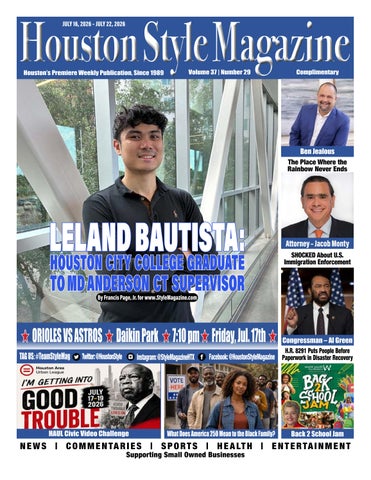
Houston Style Magazine JULY 16, 2026 – JULY 22, 2026
Houston’s Premiere Weekly Publication, Since 1989
Volume 37 | Number 29
Complimentary
Ben Jealous The Place Where the Rainbow Never Ends
LELAND BAUTISTA: HOUSTON CITY COLLEGE GRADUATE
Attorney – Jacob Monty SHOCKED About U.S. Immigration Enforcement
TO MD ANDERSON CT SUPERVISOR By Francis Page, Jr. for www.StyleMagazine.com
H ORIOLES VS ASTROS H Daikin Park H 7:10 pm H Friday, Jul. 17th H Congressman – Al Green TAG US: #TeamStyleMag
Twitter: @HoustonStyle
Instagram: @StyleMagazineHTX
HAUL Civic Video Challenge
Facebook: @HoustonStyleMagazine
What Does America 250 Mean to the Black Family?
H.R. 8291 Puts People Before Paperwork in Disaster Recovery
Back 2 School Jam
N E W S | C O M M E N TA R I E S | S P O R T S | H E A LT H | E N T E R TA I N M E N T Supporting Small Owned Businesses
2
July 16, 2026 – July 22, 2026
www.StyleMagazine.com
Publisher Francis Page, Jr. fpagejr@stylemagazine.com Associate Publisher Lisa Valadez lisa@stylemagazine.com Social Media Editor/Videographer Reginald Dominique reggiedominique@me.com Graphic Design /Layout Editor Cameron C. Lee thisiscam6@gmail.com Political Editor Burt Levine texascampaigns@gmail.com Sports Editor Brian Barefield brian_barefield@yahoo.com Food & Wine Writer Monica Jones alexandriajack1991@gmail.com Entertainment Writer D'Nesha Bell / TotallyRandie Totallyrandie@gmail.com Career Columnist Nikki Miles ailormaderesumes2576@gmail.com NATIONAL WRITERS Ben Jealous info@benjealous.com PHOTOGRAPHERS Vicky Pink vhpink@gmail.com ADVERTISING/SALES advertising@stylemagazine.com Got community news? We want to hear from you! editorial@stylemagazine.com
MINORITY PRINT MEDIA, LLC, D.B.A. Houston Style Magazine & www.StyleMagazine.com Phone: (713) 748-6300 • Fax: (713) 748-6320 Mail: P.O. Box 14035, Houston, TX 77221-4035 ©2026 Houston Style Magazine, a Minority Print Media, L.L.C. Company. All Right Reserved. Reproduction in whole or within part without permission is prohibited. Houston Style Magazine has a 2021 Audit by Circulation Verification Council (CVC). Houston Style Magazine is a member of the Texas Publishers Association (TPA), Texas Community Newspaper Association (TCNA), National Newspaper Publishers Association (NNPA), Independent Free Paper of America (IFPA), Association of Free Community Papers (AFCP) and Members of Greater Houston Partnership(GHP). National Association of Hispanic Publications, Inc. (NAHP, Inc.), Houston Hispanic Chamber of Commerce (HHCC), League of United Latin American Citizens (LULAC), Latin Women’s Initiative (LWI), National Association of Black Journalists (NABJ), Houston Association of Hispanic Media Professionals (HAHMP), National Association of Hispanic Journalists (NAHJ), and Supporters of Greater Houston Partnership(GHP)
www.StyleMagazine.com
July 16, 2026 – July 22, 2026
3
COMMENTARY
THE PLACE WHERE THE RAINBOW NEVER ENDS A brick, a beach, and a lesson that never stopped moving By Ben Jealous, National Political Commentator
T
here is an old man in the movement who still brims with the courage and love forged on a Chicago beach. His eyes do not work well anymore. It seems to bother him less than you would think. Norman Hill has always seen more with his head and his heart than most of us ever see with our eyes. I met Norman in the summer of 1993, at the convention of the A. Philip Randolph Institute. He was its president. He and the labor leaders Bill Lucy, Richard Womack and Clayola Brown gathered two dozen young Black organizers who shared their vision. Lucy had helped lead the sanitation workers’ strike in Memphis the week King was killed. Stacey Abrams was one of us. Derrick Johnson was one. Jena Roscoe was one. I was one. They passed down what A. Philip Randolph and Bayard Rustin had taught them. Civil rights and workers’ rights are one fight. Racism splits working people apart. Economic injustice profits from that division. Our answer has to take on both. Norman learned that from those two men. He also learned it on a Chicago beach. In 1960, Rainbow Beach was public by law and White by custom. Velma Murphy was 21 years old and president of the South Side NAACP Youth Council. She decided to test it. If students in the South could sit down at a lunch counter, young people in Chicago could wade into Lake Michigan. Norman helped her build a group, Black and White together. Some wanted an all-Black action. Norman and Velma said no. Black leadership and Black and White people standing side by side were not rival ideas. Together they were the plan. In late August 1960, they walked onto Rainbow Beach. They spread blankets. They read books. They played checkers. They walked into the water.
4
A White mob gathered. Rocks and bricks flew. A brick hit Velma in the head and knocked her out cold. Norman picked her up and carried her off that beach. It took 17 stitches to close the wound. They went back anyway. Again and again, through the next summer, they claimed their beach. The papers carried Velma’s story, and the crowds that came to stand with them grew. The city was forced to protect them. Rainbow Beach became a beach for everybody. That victory was a blueprint. Black-led. Black and White together. Built on working people standing as one. Brave enough to take a beating. Disciplined enough to come back. The lesson did not stay on the beach. Soon after that summer, Stacey, Derrick, Jena and I went to Mississippi. Governor Kirk Fordice wanted to be rid of the state’s three Black public universities. He had already threatened to call out the National Guard rather than spend another dollar on them. Now he wanted to shut down Mississippi Valley State and put a prison on the campus.
July 16, 2026 – July 22, 2026
He wanted Alcorn State gone. He wanted Jackson State made over into something else. Alcorn is where Medgar Evers met Myrlie Beasley. They married on Christmas Eve. They worked side by side in the Mississippi NAACP office until the night Medgar was shot dead in his own driveway. Saving Alcorn meant saving the ground where that love began. We organized. We pulled in White Mississippians who understood that a state that shuts down its Black colleges will not stop there. Norman’s theory, tested again, 700 miles from the lake. The plan died. All three schools are open today. Derrick stayed in Mississippi and went deeper into the place where labor, civil rights and politics meet. Today he is president and CEO of the NAACP. One of his early mentors down there was Charlie Horhn. Charlie brought Black and White workers at a Jackson factory into one union. He started the state’s first Randolph Institute chapter. In 1993 he ran the campaign that sent Bennie Thompson to Congress. Charlie is 91 now. His son John is the mayor of Jackson. Clayola Brown is the president of the A. Philip Randolph Institute now. She sits in Norman’s chair. She was there in that room too, already carrying the same lesson forward. The women and men Norman trained across the decades will gather in Chicago at the end of this week. Legions from labor. Leaders in civil rights and politics as well. Our titles have changed. The bond has not. The late Rev. Jesse Jackson built the Rainbow Coalition into a national force. In Chicago’s moral history, there is no Rainbow Coalition without Rainbow Beach.
www.StyleMagazine.com
And then there is the love story. Velma Murphy became Velma Hill. They married the year after the brick. More than six decades of love, labor and civil rights. But the marriage was never the point. It was the workshop. Two dozen of us sat in that room in 1993 because Norman and Velma had spent thirty years building something strong enough to hold us. That is what a movement marriage does. Medgar and Myrlie did it in Mississippi. Myrlie carried the work for decades after they killed him, and went on to lead the NAACP herself. The love did not end in that driveway. It went out into the world and made leaders. It is what Derrick and Letitia do now, pouring into the organizers coming up behind them the way Norman poured into us. I once asked Norman how he and Velma lasted so long. “Find a woman who is as much of a warrior as you are,” he told me, “and marry her.” What he built with her raised us. Stacey. Derrick. Jena. Me. Legions more across the decades. We came to them as students and they sent us out as leaders, and every one of us is proud to count ourselves among Norman and Velma’s children in the movement. The rainbow did not stop at the water’s edge. It ran through Randolph and Rustin. It ran through Medgar and Myrlie. It ran through Norman and Velma. It reached two dozen students in 1993. It runs through Derrick and Letitia. And it runs all through the NAACP family. Norman’s eyesight has dimmed. His vision has not. At Rainbow Beach, and in every life it still touches, the rainbow never ends. Ben Jealous is a professor of practice at the University of Pennsylvania and former president and CEO of the NAACP.
ATTORNEY JACOB MONTY IS SHOCKED BY SALGADO’S SHOOTING
F
or more than three decades, Houston attorney Jacob “Jake” Monty has worked where immigration law, employment law and the American promise often collide. Yet the fatal shooting of Lorenzo Salgado Araujo by a U.S. Immigration and Customs Enforcement officer has left even this experienced attorney stunned. “This is tragic for Houston, for Texas and for America,” Monty said. Salgado Araujo, 52, reportedly lived in the United States for approximately 35 years, raised three sons and worked in home construction. On the morning he was killed near Canal Street and Wayside Drive in Houston’s historic Magnolia Park neighborhood, he was reportedly picking up members of his construction crew. According to his family, Salgado Araujo had no criminal record and had spent years attempting to resolve his immigration status legally. “He was a husband and father to three sons who lived all their lives in Houston,” Monty said. “He was working, supporting his family and helping build homes in this community.” Federal authorities later acknowledged that Salgado Araujo was not the person ICE officers initially intended to apprehend. What happened during the final moments of his life remains disputed. The Department of Homeland Security has maintained that Salgado Araujo struck a government vehicle and threatened an officer with his van. Attorneys representing passengers who were
HOUSTON TRAGEDY RAISES QUESTIONS ABOUT IMMIGRATION ENFORCEMENT, TRANSPARENCY and AMERICAN DEMOCRACY By Burt Levine, Political Editor for www.StyleMagazine.com riding with him have challenged that account. No body-camera footage exists, leaving investigators, witnesses and the public to sort through sharply different versions of the confrontation. That absence of video evidence has transformed one family’s tragedy into a broader question about federal law-enforcement transparency. Monty argues that immigration enforcement must still follow the constitutional standards Americans expect from every law-enforcement agency. Officers should be identifiable, properly trained and equipped with body cameras. The use of force should be proportional, documented and subject to independent review. A badge does not eliminate accountability. It increases the responsibility to provide it. Houston Mayor John Whitmire and Houston Police Chief Noe Diaz have called for a timely, transparent and thorough investigation. Harris County District Attorney Sean Teare has also opened an independent inquiry, while the Department of Homeland Security Office of Inspector General is conducting a separate review.
These investigations matter because democracy is not measured only at the ballot box. It is also measured by what government does when its own actions are questioned. Monty also rejects political rhetoric that portrays undocumented immigrants as one large criminal population. “These are neighbors taking their families to church, putting their children through school and contributing to our city as workers and taxpayers,” Monty said. National tax studies estimate that undocumented immigrants contribute billions of dollars each year through federal income taxes, sales taxes, excise taxes and property taxes. Their labor supports construction, hospitality, agriculture, health care and many of the industries that keep Houston moving. Making immigrant families convenient political enemies, Monty warns, does nothing to repair a legal immigration system that Congress has failed to modernize for decades. His perspective is rooted in personal experience.
www.StyleMagazine.com
One of seven children raised in a working-class El Paso family, Monty earned his bachelor’s degree from the University of Texas at Arlington. A $500 scholarship helped bring him to the University of Houston Law Center. After working for a local firm, he established his own East End practice in 1998. Today, Monty & Ramirez LLP is recognized as one of the region’s leading Hispanic-owned employment and immigration law firms. Monty has also advised presidents, governors, employers and community leaders. Still, his greatest concern remains the families caught between outdated laws and aggressive enforcement. Salgado Araujo’s death should not become another headline that disappears when public attention moves elsewhere. It should produce answers, accountability, better training, body cameras and renewed movement toward comprehensive immigration reform. Houston has always been a city that builds homes, businesses, families and second chances. Honoring Lorenzo Salgado Araujo means building something equally important: a justice system strong enough to enforce the law and courageous enough to answer for how that power is used. For Houston Style Magazine, that is not merely an immigration issue. It is a democracy issue.
www.MontyRamirezLaw.com/
July 16, 2026 – July 22, 2026
5
AL GREEN’S H.R. 8291 PUTS PEOPLE BEFORE PAPERWORK IN AMERICA’S DISASTER RECOVERY By Francis Page Jr. for www.StyleMagazine.com
H
ouston knows the weather can turn a bluesky afternoon into a history lesson before dinner. From Hurricane Harvey and the Memorial Day floods to Winter Storm Uri, the 2024 derecho and Hurricane Beryl, our region has learned that surviving the storm is only chapter one. The harder chapter is rebuilding homes, restoring neighborhoods and making sure working families are not left navigating a federal maze while mold, bills and uncertainty move in rent-free. That is why Congressman Al Green’s H.R. 8291, the Reforming Disaster Recovery Act, deserves serious applause. Introduced April 15, 2026, the measure seeks to transform the U.S. Department of Housing and Urban Development’s Community Development Block Grant–Disaster Recovery program from an improvised, disaster-by-disaster response into a more dependable national system. The bill was incorporated as Section 504 of the bipartisan 21st Century ROAD to Housing Act, which passed Congress and, as of July 10, was expected to become law without the president’s signature. That journey matters. Democracy is not merely the drama of Election Day; it is the daily work of turning public pain into public policy. H.R. 8291 does exactly that. It reflects years of hard lessons from communities where federal assistance arrived too slowly, rules shifted from one disaster to the next, and local governments had to build recovery programs while residents were
6
U.S. Congressman – Al Green already waiting at the door. That is the cross-aisle governing voters want: durable solutions before the next emergency tests the system. The reform authorizes CDBG-DR for three years and creates a Long-Term Disaster Recovery Fund, giving HUD a clearer structure for directing resources after catastrophic disasters. It also establishes an Office of Disaster Management and Resiliency within HUD to coordinate long-term recovery, housing restoration, and mitigation. In plain Houston English: fewer agencies stepping on one another’s boots, more coordination, and a better chance that help
July 16, 2026 – July 22, 2026
reaches the block before the next storm reaches the Gulf. Speed is one of the bill’s strongest features. HUD would generally have 90 days after a presidential disaster declaration to determine whether an event qualifies as catastrophic, with a 120-day outer limit when data is insufficient. The legislation also permits preliminary grants of up to $5 million to help affected local governments assess needs, build capacity and prepare responsible recovery plans. That early money may sound administrative, but good administration is what turns promises into repaired roofs, reopened businesses, and families returning home. Equity is built into the framework rather than sprinkled on afterward. At least 70 percent of a grant would ordinarily support activities benefiting low- and moderate-income residents. The measure prioritizes vulnerable households, affordable rental housing, resilient infrastructure, economic revitalization and protections against repeated losses. For Houston’s Black and Brown neighborhoods, seniors, renters and small-business owners—communities too often hit first and restored last—that focus is not charity. It is fairness with a timetable. Accountability also gets a welcome upgrade. Grantees must develop recovery plans, consult the public and explain how dollars will address housing, infrastructure, mitigation, and unmet needs. Residents would receive at least 14 days to comment on proposed plans, while
www.StyleMagazine.com
HUD would publish annual information on a public-facing dashboard showing where funds are allocated, how much has been spent, and whether low- and moderate-income communities are benefiting. Sunshine may not dry drywall, but it can keep public dollars from disappearing into bureaucratic fog. The Houston and Harris County stakes are enormous. Harris County has managed federal disaster-recovery programs involving home repair, reconstruction, buyouts, affordable rental housing, and infrastructure improvements. Following Harvey, HUD allocated more than $5 billion in CDBG-DR funding to Texas, including a direct allocation of more than $1.1 billion to Harris County through the state’s action plan. Those numbers are large because the need is large—and because recovery delayed can become recovery denied. Congressman Green’s victory is therefore more than a legislative line item. It is a reminder that representation matters, persistence matters and democracy works best when lawmakers carry the lived experiences of their districts into the halls of Congress. H.R. 8291 says disaster survivors should not have to become federal-policy experts to rebuild their lives. Houston has always known how to rise. With the Reforming Disaster Recovery Act, Washington may finally be learning how to rise with us.
www.StyleMagazine.com
H
ouston has never been a city that looks away when hard questions arrive at its doorstep. Following the fatal July 7, 2026, shooting involving an on-duty U.S. Immigration and Customs Enforcement agent in the 6800 block of Canal Street, Mayor John Whitmire and Houston Police Chief J. Noe Diaz Jr. moved to make the City’s position unmistakably clear: Houston wants facts, accountability and a thorough investigation—not a jurisdictional wrestling match. On Friday, July 10, Chief Diaz sent formal letters to FBI Houston Special Agent in Charge Jason Hudson and Department of Homeland Security Inspector General Joseph V. Cuffari. The letters pledged that HPD would make all appropriate resources available to support the FBI and the DHS Office of Inspector General as they investigate the shooting. Diaz said the work should be “timely, transparent, and thorough,” language that speaks directly to a community seeking answers. That response matters. The man killed, Lorenzo Salgado Araujo, was a 52-year-old Mexican national and longtime Houston-area worker whose family described him as a devoted provider. Federal officials said an ICE agent fired after Salgado allegedly used his vehicle in a threatening manner. Attorneys and surviving witnesses have disputed portions of that account, making independent evidence, witness protection and careful fact-finding especially important. The evidentiary stakes are even higher because DHS acknowledged that the ICE personnel involved were not wearing body cameras. Surveillance
Mayor Whitmire and Chief Diaz Choose Transparency and Cooperation After Canal Street ICE Shooting By Francis Page Jr. for www.StyleMagazine.com
video from nearby properties may help establish the sequence of events, but it cannot replace a complete review of forensic evidence, communications, witness statements and agency procedures. Mayor Whitmire called the shooting a tragedy, expressed condolences to the family and emphasized that Houston police officers were not involved. He also publicly pressed for a transparent investigation while acknowledging the legal limits confronting a municipal police department when federal personnel are acting within their official duties. Some may mistake jurisdictional discipline for inaction. It is not. Good policing is not measured by who grabs the microphone first or who plants a flag at the crime scene. It is measured by whether evidence is preserved, witnesses are heard, agencies cooperate and conclusions are based on facts rather than political heat. In this case, Whitmire and Diaz are choosing cooperation over competition—and that is the grown-up lane. Chief Diaz’s letters also protect HPD’s credibility. By formally placing the FBI and DHS-OIG on notice that Houston expects a serious investigation, the City created a clear public record. It also offered local expertise, personnel and resources without muddying lines of authority or giving federal investigators an excuse to blame delays on interagency confusion. Houston’s Latino community, civil-rights advocates, elected officials and the Salgado family deserve answers. They deserve to know what happened before, during and after the encounter. They deserve confidence that available surveillance footage, foren-
Houston Mayor – John Whitmire sic evidence, dispatch records and firsthand accounts will be reviewed with care. Transparency should not be treated as a favor; it is the foundation of public trust. Mayor Whitmire and Chief Diaz are not declaring a verdict. They are demanding a process worthy of Houston. That distinction is important. Leadership sometimes means stepping forward; other times it means making certain the right investigators step up, while the City stands ready with every lawful resource available. In a moment filled with grief, anger and competing narratives, Houston’s message is steady: investigate thoroughly, report honestly and let the evidence speak. That is not retreat. That is responsible
www.StyleMagazine.com
leadership—and HPD’s badge is strengthened, not diminished, when it insists that accountability follow the facts wherever they lead. More HPD info, go to: https://www.houstontx. gov/police/ More DHS-Houston info, go to: https://www. houstontx.gov/publicsafety/ More FBI-Houston info, go to: https://www.fbi. gov/contact-us/field-offices/houston/about
www.StyleMagazine.com
July 16, 2026 – July 22, 2026
7
Leland Bautista: From HCC Coleman Graduate to MD Anderson CAT Supervisor
HBy Francis Page Jr. for www.StyleMagazine.com emotional discipline and enough determination to keep Informatics, at the UT MD Anderson School of Health
Leland Bautista
S
ome success stories are measured in diplomas. Others are measured in doors opened, patients comforted and students inspired. For Leland Bautista, a 2019 graduate of Houston City College’s Coleman College for Health Sciences, success includes all three—and perhaps a few remarkably detailed CT images along the way. Bautista’s journey began in Cavite, Philippines, where he completed his initial radiography education before relocating to Houston. He arrived with healthcare experience, ambition and a clear goal: build upon his professional foundation and practice
8
radiography in the United States. HCC Coleman College provided the bridge. “I have always known that I would work in healthcare,” Bautista explained. He entered Coleman’s Radiography program as an advanced-placement student, allowing him to strengthen his previous training while learning the standards, technologies and patient-care practices required in the American healthcare system. Founded in 2004, HCC Coleman College offers degrees and certificates in more than 20 health-science fields. As a member institution of the Texas Medical Center, the college connects students with educational resources and healthcare environments that can turn classroom preparation into real-world opportunity. Its two-year Radiography program combines lectures, laboratory instruction and clinical experience, while its Computed Tomography Enhanced Skills Certificate offers additional preparation in advanced medical imaging. For Bautista, Coleman’s appeal extended beyond equipment, laboratories and course catalogs. What impressed him most was the human touch. He remembers receiving accessible information, timely responses and reassuring support throughout the enrollment process. Once classes began, Coleman staff members and Radiography instructors remained committed to helping students succeed. That support mattered because healthcare education is not exactly a leisurely stroll with a stethoscope. It requires long hours, technical precision,
July 16, 2026 – July 22, 2026
going when the coffee has stopped cooperating. Bautista’s motivation came from remembering his starting point. “When I am tired, I always look back to where I started and see how far I’ve come,” he said. That perseverance has produced an impressive career. Today, Bautista serves as a Diagnostic Imaging CT Supervisor at MD Anderson Cancer Center. He has also returned to HCC Coleman as an adjunct instructor of Computed Tomography, helping prepare students for the profession that changed his own life. His journey is continuing academically as well. Bautista is pursuing a Master of Science in Radiologic Sciences, specializing in Medical Imaging
www.StyleMagazine.com
Professions, with an expected graduation date in 2027. The graduate program includes tracks in medical imaging informatics, administrative leadership and educational leadership—areas that reflect the expanding relationship between imaging technology, healthcare data, management and instruction. Yet Bautista’s greatest satisfaction is not found in a title alone. He values helping patients during moments when answers, compassion and accurate imaging matter deeply.
Read More at:
www.HCCS.edu
T
he Houston Area Urban League is calling on Greater Houston to turn smartphones into instruments of civic purpose through its “I’m Getting Into Good Trouble” Video Challenge, a community-wide digital campaign honoring the enduring legacy of Congressman John Lewis. The challenge leads into the national Good Trouble Lives On Weekend of Action, July 17–19, 2026, when communities across America will promote voting-rights awareness, civic education and peaceful, nonpartisan participation. The national initiative is built around three energetic words—Teach, Reach and Preach—and emphasizes lawful, nonviolent action rather than support for any candidate or ballot measure. To participate, Houstonians should record a 10- to 20-second vertical video beginning: “I’m [Your Name], and I’m getting into Good Trouble with the Houston Area Urban League…” Participants can then explain why voting rights, informed citizenship, neighborhood involvement or community leadership matter to them. Videos must be emailed to events@haul.org by July 14. Selected submissions will appear across HAUL’s Facebook, Instagram, LinkedIn and X platforms throughout Good Trouble Weekend, united by the hashtag #GoodTroubleLivesOn. That is democracy with good lighting— and preferably no shaky camera. The challenge is especially fitting in Houston, a city built by people who understand that progress rarely arrives with its sleeves clean. Found-
HOUSTON GETS INTO “GOOD TROUBLE” AS HOUSTON AREA URBAN LEAGUE LAUNCHES CIVIC VIDEO CHALLENGE By Francis Page Jr. for www.StyleMagazine.com
ed in 1968, the Houston Area Urban League has spent more than five decades expanding opportunity through workforce development, housing, education, entrepreneurship, health programs and civil-rights advocacy. In 2021, HAUL deepened that work by opening its Center for Social Justice & Education, creating a year-round home for civic engagement, advocacy, literacy and public education. “Congressman John Lewis taught us that democracy is not something we inherit, it is something we must actively protect,” said Judson
W. Robinson III, HAUL President and CEO. Robinson has led the organization since 2008, carrying forward a Houston tradition of service that connects economic opportunity with civic power. Lewis understood that connection better than most. Born to Alabama sharecroppers in 1940, he became chairman of the Student Nonviolent Coordinating Committee, participated in the Freedom Rides and helped organize the 1963 March on Washington. On March 7, 1965—Bloody Sunday—Lewis and
www.StyleMagazine.com
fellow marchers were assaulted by Alabama state troopers while crossing Selma’s Edmund Pettus Bridge to demand voting rights. The televised violence helped build national momentum for passage of the Voting Rights Act of 1965. Lewis later served in the U.S. House of Representatives from 1987 until his death on July 17, 2020. Yet even after more than three decades in Congress, he never traded movement for monument. He continued urging Americans to speak up, organize peacefully and create what he famously called “good trouble”—necessary trouble in the service of justice. HAUL’s challenge brings that history directly into the digital age. No bus ticket to Selma is required. No podium is necessary. A student, pastor, business owner, neighborhood leader, retiree or firsttime voter can use a phone, a clear message and a few honest seconds to remind others that citizenship is a verb. Houston residents are encouraged to learn about voting requirements, verify their voter registration, encourage relatives and neighbors to become informed and discuss civic issues respectfully. Most importantly, the challenge asks people to see themselves not as spectators of democracy, but as its daily caretakers. Good trouble does not always begin on a bridge. Sometimes, it begins in portrait mode.
www.HAUL.org
July 16, 2026 – July 22, 2026
9
Texas Southern University’s Economic Impact Reaches $1.6 Billion, Strengthening Houston’s Workforce and Economy By Lisa Valadez for www.StyleMagazine.com
T
exas Southern University is contributing $1.6 billion annually to the regional economy while supporting 15,676 jobs across its institutional service area, according to a new economic impact report that underscores the university's growing role in strengthening Houston's workforce, businesses, and long-term economic prosperity. The report, based on 2023-2024 data, measures the combined economic contributions generated through university operations, student and visitor spending, research activity, construction projects, and the long-term success of Texas Southern University graduates. During the reporting period, the university enrolled 9,529 students, employed 1,790 faculty and staff members, and awarded 2,012 degrees, further demonstrating its impact on the region's educational and economic landscape. The findings show that alumni are the university's greatest economic asset, accounting for more than 80 percent of TSU's total economic impact. Graduates working throughout the region contribute approximately $1.3 billion in added income, reflecting the long-term value of a Texas Southern education and its role in preparing professionals for careers across a wide range of industries. President J.W. Crawford III said
10
July 16, 2026 – July 22, 2026
the report demonstrates that Texas Southern's influence extends well beyond the classroom, with graduates, research, and partnerships strengthening the regional workforce while helping build a more competitive Texas economy. According to the report, six primary areas drive the university's annual economic impact: Alumni workforce participation: $1.3 billion University operations: $174 million Student spending: $61.6 million Research activity: $20.7 million Visitor spending: $18.7 million Construction spending: $2 million The report also notes that the university's $1.6 billion in added income is equivalent to supporting one out of every 196 jobs in the institutional service area, illustrating the significant role Texas Southern plays in the regional economy. Beyond measuring economic activity, the study highlights the financial return on investment generated by a Texas Southern education. Students are projected to receive $6.90 in higher lifetime earnings for every dollar invested in their education. Taxpayers also benefit, receiving an estimated $2.10 in returns for every public dollar invested through increased tax revenues and reduced demand for pub-
www.StyleMagazine.com
lic services. Society as a whole realizes an estimated $12.80 in benefits for every dollar invested, driven by higher earnings, increased business productivity, and broader social gains associated with a more educated workforce. University leaders said the findings align with Ascend 2030, Texas Southern University's strategic plan focused on student success, workforce alignment, research excellence, and expanding the institution's impact throughout Houston and beyond. The university also announced plans to strengthen its data collection efforts to provide an even more comprehensive picture of its contributions to economic growth throughout its service area. Located in one of the nation's fastest-growing metropolitan regions, Texas Southern University continues preparing graduates for careers in high-demand fields while expanding its role as an economic engine for Houston. As the university approaches its 100th anniversary in 2027, the report points to continued growth, measurable outcomes, and increasing contributions to the city's economic future.
www.TSU.edu
THE PEOPLE’S CLERK OPENS THE DOOR TO THE WORLD: BEVERLEY MCGREW WALKER HOSTS FORT BEND COUNTY PASSPORT FAIR
F
ort Bend County families, business travelers, students, dreamers, cruisers, mission-trip planners, wedding guests, and everybody who suddenly remembered that “international getaway” requires more than matching luggage—mark your calendars. Beverley McGrew Walker, Fort Bend County District Clerk affectionately known as “The People’s Clerk,” is hosting a special Passport Fair on Saturday, July 25, 2026, from 10:00 a.m. to 2:00 p.m. at The Cottage House in the Veranda Community, 23323 Pearl Glen Dr., Richmond, TX 77469. This community-centered event is designed to make applying for a U.S. passport easier, more convenient, and less intimidating for residents across one of Texas’ fastest-growing and most beautifully diverse counties. In other words, before you can say “bonjour,” “hola,” “ciao,” or “where is my boarding pass?” Walker’s office is making sure Fort Bend County is ready for the runway. “The Fort Bend County District Clerk’s Office continues to offer passport application services to the greater Fort Bend County community,” said District Clerk Walker. “As the Fort Bend County District Clerk for the last seven years, making it easier to obtain a passport and improving the jury selection process has always been a labor of love.” That labor of love is more than a slogan. It reflects the kind of public service that meets people where they are—especially working parents, busy professionals, seniors, students, and families who may not have time during the traditional workweek to navigate passport paperwork. A Saturday Passport
By Francis Page Jr. for www.StyleMagazine.com
Fair is government with its sleeves rolled up, clipboard ready, and community first. Walker’s leadership carries historic weight. A licensed Texas attorney and longtime public servant, she is serving her second term as Fort Bend County District Clerk. Her background includes public education, law, civic leadership, community outreach, and a trailblazing chapter as the first African American woman to serve on the Houston City Council. She has also been recognized for a lifetime commitment to volunteer service—proof that public service is not just what she does, it is who she is. Fort Bend County itself is a powerful back-
drop for this passport push. With an estimated 975,191 residents as of July 1, 2025, and a population that has grown more than 18 percent since 2020, Fort Bend is not simply expanding—it is connecting. Its families, entrepreneurs, students, veterans, professionals, and first-generation Americans represent a global community with local roots. A passport, then, is not just a document. It is a bridge to family, commerce, education, culture, opportunity, and sometimes a much-needed beach chair. Appointments for the Passport Fair are limited and can be made by visiting www.fbctx. gov/passports. Residents are encouraged to schedule
www.StyleMagazine.com
quickly and check back periodically if appointment slots are filled, as cancellations may open additional times. Applicants should come prepared. All applicants must appear in person, including minors. Children under age 16 must appear with both parents. If one parent is unavailable, the applicant must bring a completed DS-3053 Statement of Consent form or a notarized authorization letter from the absent parent, along with a copy of that parent’s identification, front and back. Current U.S. passport processing times listed by Fort Bend County are 4–6 weeks for routine service and 2–3 weeks for expedited service, which requires an additional $60. Passport photos will be available on-site for $15. Applicants should also note that payments are separated: passport application fees must be paid by check or money order to the U.S. Department of State, while acceptance fees are paid to the local acceptance facility. Cash will not be accepted at this fair. For first-time adult applicants age 16 and older, the U.S. Department of State currently lists the passport book fee at $130, passport card at $30, and book-and-card combination at $160, plus the $35 facility acceptance fee. For children under 16, the passport book is listed at $100, the card at $15, and book-and-card combination at $115, plus the $35 acceptance fee.
Read More At:
www.Stylemagazine.com
July 16, 2026 – July 22, 2026
11
WORLD YOUTH FOUNDATION PLANTS SEEDS OF SUCCESS DURING INSPIRING WEEKEND OF YOUTH ACHIEVEMENT AND GRATITUDE By Francis Page, Jr. for www.StyleMagazine.com
H
ouston's future leaders are not waiting for someone to hand them the keys to tomorrow—they are already building the door, programming the lock and preparing the business pitch. The World Youth Foundation, Inc. will spotlight that youthful determination during a powerful two-day celebration of education, entrepreneurship, community service and achievement on Saturday, August 1, and Sunday, August 2, 2026. The weekend begins Saturday with the World Youth Foundation Back-to-School Jam from 10 a.m. to 2 p.m. at the Sunnyside Health and Multi-Service Center, 4410 Reed Road, Houston, Texas 77051. Students and families will be welcomed into a lively community environment featuring educational resources, school-readiness information, food, music, games, entertainment, giveaways and
prizes.
It is part school-supply celebration, part community resource fair and completely focused on helping young Houstonians enter the 2026–2027 school year prepared, encouraged and confident. Families will have opportunities to connect with community organizations and programs addressing education, health, workforce development and family support. For parents balancing growing school-supply lists with growing household expenses, the event represents more than a festive Saturday outing. It is a reminder that Houston’s community institutions are willing to stand beside families and help students cross the starting line ready to learn. The celebration moves downtown on Sunday, August 2, for the Jewel McGowan Seeds of Gratitude Awards Celebration and
World Youth Foundation Annual Fundraiser at the Cullen Theater inside the Wortham Theater Center, 501 Texas Avenue. The VIP reception begins at 2 p.m., followed by the main program at 3 p.m. The Wortham Theater Center has served as one of Houston’s premier cultural landmarks since opening in 1987, making it a fitting stage for honoring the city’s next generation of innovators. This year ’s theme, “GRIT • GROWTH • GREATNESS,” captures the journey of young people who have turned challenges into motivation and ideas into action. Guests will see presentations, exhibits and demonstrations from students participating in the Youth Innovative Incubator Program, STEM Innovation Incubator Pathways, workforce-readiness programs and leadership-development initiatives. WYF’s programming combines emerging technology, STEAM education, literacy, entrepreneurship, civic engagement and career preparation to help young people develop practical skills beyond the traditional classroom. One of the afternoon’s most anticipated attractions will be the Youth Market. Young entrepreneurs will display and sell original products, explain their marketing strategies and deliver business pitches to guests. In other words, do not be surprised if Sunday’s student vendor becomes Monday’s chief executive. The Jewel McGowan Seeds of Gratitude Awards will also recognize six distinguished community leaders for excellence in education, workforce development and training, entrepreneurship, leadership, men-
12
July 16, 2026 – July 22, 2026
www.StyleMagazine.com
toring, creativity and innovation. “Our purpose is simple yet profound—we work to remove barriers to success so every young person has the opportunity to reach their fullest potential,” said Karen Levingston-Franklin, chairman and CEO of the World Youth Foundation. Founded in April 1991, WYF has spent more than 35 years creating pathways for youth and families. The organization reports serving more than 85,000 people through educational enrichment, mentoring, leadership training, workforce preparation and entrepreneurship programs. Its current initiatives serve young people ages 4 to 24 while expanding opportunities in artificial intelligence, STEAM, literacy and civic engagement. Sponsors and partners supporting the weekend include the City of Houston, Houston First Corporation, H-E-B, PPG Global LLC, Harris County Department of Education: CASE for Kids, TXPOST/OST CARES and numerous community organizations. Houston Style Magazine is proud to serve as an Official Media Sponsor of the World Youth Foundation’s inspiring weekend of youth achievement, education, entrepreneurship, and community celebration. Through this partnership, Houston Style Magazine continues its longstanding commitment to spotlighting organizations that strengthen families, expand opportunities, and invest in the next generation of Houston leaders, innovators, and changemakers.
More Information:
https://worldyouthfoundation.org/
BACK-TO-SCHOOL HEALTH STARTS BEFORE THE FIRST BELL: WHY VACCINES, WELLNESS VISITS, AND PREVENTIVE CARE MATTER
F
resh notebooks, new shoes and a carefully negotiated bedtime may signal that school is near, but the smartest back-to-school purchase cannot be placed in a shopping cart: good health. Before Houston-area students race toward classrooms, band halls, football fields and college dormitories, families should make preventive care part of the preparation. That means reviewing immunization records, scheduling a well-child visit, managing asthma and allergies, addressing emotional or developmental concerns, and completing sports or marching-band physical forms. Legacy Community Health’s message is refreshingly practical: school readiness begins with the whole child, not simply the school-supply list. Its “Health Beyond Care” approach connects pediatric care, family medicine, behavioral health, pharmacy and specialty services so families can address multiple needs before the first bell rings. History has already shown what prevention can accomplish. Measles was declared eliminated in the United States in 2000 after widespread use of the measles, mumps and rubella (MMR) vaccine. Yet elimination did not mean extinction. As of July 9, 2026, the Centers for Disease Control and Prevention reported 2,231 confirmed measles cases across the country, with 93 percent linked to outbreaks. CDC also reported that MMR coverage among U.S. kindergarteners fell from 95.2 percent in 2019–2020 to 92.5 percent in 2024–2025. In public health, a few percentage points can become a very loud alarm bell. “Vaccines don’t just protect one person at a time — they strengthen the health of everyone around
By Francis Page, Jr. for www.StyleMagazine.com
us,” said Dr. Rubina Khan, Medical Director of Pediatrics at Legacy Community Health. She added that Legacy is committed to making preventive care accessible and affordable “so no one falls through the cracks.” That community protection matters in classrooms, where children learn, eat, play and share nearly everything except personal space. Texas school requirements vary by grade, but the state currently lists vaccines including DTaP or Tdap, polio, MMR, hepatitis B, varicella, meningococcal and hepatitis A among K–12 requirements. Because requirements can change, the Texas Department of State Health Services advises parents to confirm that students have the proper immunizations for the coming school year. A wellness visit does far more than check a box. It gives families time to discuss sleep, nutrition,
growth, school performance, mental health, medications and chronic conditions. Catching a concern early is usually easier—and far less dramatic—than meeting it later in an emergency room. Parents can also ask a clinician which vaccines are recommended for their child’s age, health history and activities. Student-athletes and marching-band participants should not wait until the first practice to discover that paperwork is missing. The University Interscholastic League has approved its Athletic and Marching Band Pre-participation Physical Evaluation for the 2026–2027 school year. A physical can help identify issues that may affect safe participation while giving young people a healthier start to the season. Teenagers and college-bound students deserve equal attention. Families should review Tdap, HPV and meningococcal protection with a trusted healthcare provider, particularly before dormitory liv-
www.StyleMagazine.com
ing, travel or other close-contact settings. Texas requires many entering college students to show proof of a recent meningococcal vaccination, generally administered within the previous five years and at least 10 days before the semester begins. Dr. Tamisha Jones, Chief Medical Officer at Legacy Community Health, cautions against assuming yesterday’s public-health victories guarantee tomorrow’s protection. “Despite the fact that vaccines have reduced and eliminated deadly diseases, outbreaks still occur,” she said, emphasizing the continued importance of vaccination and informed conversations with healthcare professionals. For working parents, access can be the hardest part of prevention. Legacy’s School-Based Health Care Clinics bring wellness visits, vaccinations, sports physicals, acute care, chronic-disease management and behavioral-health services closer to students. The organization reports 39 school-based clinics across Greater Houston, helping reduce transportation barriers, missed work and lost classroom time. The takeaway is simple: sharpen the pencils, label the backpacks—and schedule the appointment. A healthier student is better positioned to attend, participate, concentrate and thrive. Back-to-school health is not extra credit. It is the foundation for a successful year.
More Information:
https://www.legacycommunityhealth.org/
July 16, 2026 – July 22, 2026
13
WHAT DOES AMERICA 250 MEAN TO THE BLACK FAMILY? By Frederick Nickens and Coretta Graham Texas Democratic Black Caucus
A
merica turned 250 on July 4, 2026, marking two and a half centuries since the signing of the Declaration of Independence. The official America250 observance invited the country to reflect on its past, honor the contributions of all Americans and imagine a stronger future. For Black families, however, this anniversary cannot be reduced to fireworks, flags and a birthday cake large enough for 50 states. It must also become an honest family meeting about the promise, progress and unfinished business of American democracy. The Declaration proclaimed equality in 1776, but millions of Black people were denied liberty, citizenship and legal protection for generations. In August 1619, the White Lion brought captive Africans to Point Comfort in English-occupied Virginia—one of the defining beginnings of the Black experience in what became the United States. They arrived with names, families, skills, faith, intelligence and dreams, even as an emerging system attempted to reduce human beings to property. Yet Black history is not simply a record of what America did to Black people. It is also the record of what Black people did for America. Black labor helped build the nation’s wealth. Black soldiers defended American freedom, even when freedom did not fully defend them. Black churches sheltered movements, Black teachers opened minds, Black entrepreneurs created opportunity, and Black families
14
turned survival into strategy. During Reconstruction, newly freed citizens demanded a broader democracy grounded in racial equality. The 15th Amendment extended voting rights to Black men in 1870, although poll taxes, literacy tests, intimidation and Jim Crow later stripped that promise from millions. The Voting Rights Act of 1965 became a landmark federal response to that long betrayal. That history answers the central question: America 250 means Black families have earned more than an invitation to the celebration. We are co-authors of the American story. Houston knows that truth. From neighborhood churches and family businesses to Texas Southern University and Barbara Jordan—the Fifth Ward daughter who carried her commanding constitutional voice into Congress—Black leadership has continually strengthened both community and country. But authorship carries responsibility.
July 16, 2026 – July 22, 2026
The next chapter must be written through education, voting, entrepreneurship, home and land ownership, mentorship, family stability and informed civic participation. Democracy is not a spectator sport, and progress does not arrive by same-day delivery. Communities gain influence when they organize, attend public meetings, study policy, support responsible institutions, question elected officials and prepare young people to lead. This is the peaceful revolution America 250 should inspire: a revolution of reading, building, investing, voting and remembering. It should include serious discussion of the lasting economic consequences of slavery and discrimination, along with practical policies that expand opportunity, protect civil rights and help families create generational wealth. Accountability must apply to government, corporations, schools, political parties— and to us. Not every Black family will interpret America 250 in exactly the same way. That diversity of thought is itself part of democracy.
www.StyleMagazine.com
Still, common ground remains: our history deserves truth, our children deserve preparation, our communities deserve investment, and our votes deserve protection. For Black America, the 250th anniversary should be both celebration and summons. We may honor the nation without pretending its history was perfect. Honest patriotism loves America enough to tell the truth, and courageous democracy believes America can still improve. Our ancestors survived conditions designed to erase their future. The task before this generation is not merely to inherit their resilience, but to convert it into lasting power and shared prosperity. America 250 asks what kind of nation enters its next 250 years. Black families should answer clearly: one where our history is taught, our voices are heard, our businesses are supported, our children are prepared and our humanity is never negotiable. The previous chapters were too often written about us. This next one must be written by us.
www.StyleMagazine.com
HPL Welcomes Author Curtis Chin to Summer Reading Program Celebrated memoirist brings Detroit history, family wisdom and a literary feast to Alief By Lisa Valadez for www.StyleMagazine.com
HPL Welcomes Author Curtis Chin to Summer Reading Program
D
emocratic summer heat may be re-
urban redevelopment displaced the district
director, helping build a platform that would
library roots reach back to the Houston Ly-
lentless, but Houston Public Library
and remained part of the city until 2000. Its
support generations of writers.
ceum established in 1854, when a collection
is offering a refreshing change of
customers crossed boundaries of race, class,
His creative journey did not stop
of fewer than 100 books helped create a
menu: one celebrated author, one unforget-
profession and identity, giving young Chin a
on the printed page. Chin wrote comedy for
civic space for lectures, debates and learn-
table memoir and an hour of conversation
front-row education in how a city survives,
network and cable television before transi-
ing.
designed to feed both the mind and the spirit.
argues, laughs and keeps showing up. The
tioning into social-justice documentaries.
More than 170 years later, HPL
On Saturday, July 18, 2026, from
memoir arranges memories like a restaurant
His films have screened at more than 600
continues expanding that idea: the library
2 to 3 p.m., author, filmmaker and cultural
menu, serving family history and social
venues in 20 countries, while his writing has
is not simply where stories are stored, but
advocate Curtis Chin will appear at the
commentary in portions that are humorous,
appeared in CNN, Bon Appétit, the Detroit
where people gather to hear one another
Alief-David M. Henington Regional Li-
candid and deeply human.
Free Press and The Emancipator/Boston
more clearly.
brary, 11903 Bellaire Boulevard, as part
That history carries special weight.
Globe. His short documentary Dear Corky
For readers, aspiring writers, film-
of HPL’s Summer Reading Program. The
Chin grew up during the era surrounding the
premiered through PBS’s American Mas-
makers, history lovers and anyone raised
in-person program is intended for adults,
1982 killing of Vincent Chin, a watershed
ters, and Warren King: King of Cardboard,
in a family business, Chin’s visit promises
and advance registration is required through
moment in Asian American civil-rights
produced by Chin and Adam Wolman,
humor, reflection and honest conversation.
HPL’s official event page. Seating is limited,
activism. Curtis Chin has explained that
premiered on PBS in May 2026.
His memoir proves that some of life’s
making this one Saturday reservation Hous-
the tragedy helped shape his commitment
Houston is an especially fitting
biggest lessons arrive without a syllabus—
tonians should secure before the literary
to opening doors for Asian Americans and
stop for this conversation. The Bayou City
sometimes they come with a takeout menu,
table fills up.
other people of color to tell their stories.
understands what happens when cultures
a crowded dining room and parents wise
Chin arrives with a title as inviting
His work reminds readers that storytelling
meet around a table. Alief, one of Houston’s
enough to tell their children to listen.
as the aroma drifting from a neighborhood
is not decoration around history; it is one
most internationally flavored communi-
“I love making connections with
kitchen: Everything I Learned, I Learned in
way communities protect themselves from
ties, speaks in countless accents, shops in
audiences and seeing how universal our
a Chinese Restaurant. Published in 2023,
erasure.
multiple languages and knows that food
stories can be,” Chin said of his Houston
often becomes the first handshake between
visit.
the award-winning memoir follows his
Chin also helped establish the
coming of age as a gay Chinese American
Asian American Writers’ Workshop after
in working-class Detroit, where his family’s
its founders began gathering in New York
Chin’s story begins in Detroit, but
room. Curtis Chin will bring the stories.
Chung’s Cantonese Cuisine became far
City in 1991, seeking a supportive literary
its questions—Who belongs? Who gets re-
Houston only needs to bring its curiosity—
more than a place to eat. It was a classroom,
community for writers of color. The organi-
membered? What do families teach without
and perhaps an appetite for a second helping.
community center, observation deck and
zation became a nonprofit in 1992 and has
ever writing it down? — will feel right at
unofficial city hall—with egg rolls.
spent more than three decades publishing,
home on Bellaire Boulevard.
On July 18, HPL will provide the
neighbors.
The restaurant opened in Detroit’s
mentoring and amplifying Asian diasporic
The appearance also continues a
original Chinatown in 1940, relocated after
voices. Chin served as its first executive
proud public-library tradition. Houston’s
www.StyleMagazine.com
More information:
https://houstonlibrary.org/home
July 16, 2026 – July 22, 2026
15
WITH 16
July 16, 2026 – July 22, 2026
www.StyleMagazine.com