Voting rights is back in the news because some people are still trying to decide whose votes deserve trust. In Georgia, the Justice Department and FBI under President Donald Trump have reopened questions around Fulton County’s 2020 election records after agents seized hundreds of boxes of ballots. The Associated Press reports the FBI has assigned 260 analysts and operations staff to review them.
Fulton County includes most of Atlanta and sits at the heart of Georgia’s transformation. It has a large Black electorate, growing Latino and Asian American communities, and many newer residents drawn by the Atlanta region’s jobs and universities. It voted against President Trump. Yet Georgia’s 2020 result was not some partisan rumor. Local officials counted the ballots. The state counted them three times, including once by hand. Republican officials certified the result. Each count confirmed the same outcome. That matters because vote suppression has often followed the same pattern: discredit the voters, divide the people, deprive enough citizens of the ballot, and move power upward.
The country has largely forgotten one of its earliest broad voting rights victories: the campaign to end property qualifications for white men. In many states, a man could be white, free, taxed, armed and called to defend the Revolution — and still be denied the vote because he did not own enough property.
Those men did not suffer as long as Black men, women, Native people or others shut out of democracy. Their exclusion still reveals the old fault line. Power rightfully belongs to the people. Yet wealthy interests have often tried to keep too much of it for themselves.
Some people profit from our forgetting. If we forget that landless white men once had to fight for the vote, we can
COMMENTARY
A NATION THAT FORGETS ITS HISTORY IS BOUND
When we forget the first fights over voting rights, we forget who profits when the many are divided.
By Ben Jealous, National Political Commentator
miss the pattern when it returns in new clothes.
Benjamin Franklin saw the absurdity. He told the story of a man whose vote depended on owning a jackass worth enough money to qualify him. When the animal died, the man lost the vote. Franklin asked the obvious question: “In whom is the right of suffrage? In the man or in the jackass?”
Thomas Paine gave the moral answer. “Man did not enter into society to become worse than he was before, nor to have fewer rights than he had before, but to have those rights better secured.” There is irony in President Trump’s love of President Andrew Jackson. Jackson and his allies built the Democratic Party with a founding promise: government should answer to the landless many, not merely the propertied few.
Jackson’s democracy was badly bounded. It excluded Black people, women and Native people. His politics also embraced slaveholding white supremacy. Still, he saw one danger clearly. In his veto of the national bank, he warned that “the rich and powerful too often bend the acts of government to their selfish purposes.”
That warning fits this moment. Vote suppression has often worked by discrediting voters, dividing working people against one another, and depriving
the many of their full voice so some rich and powerful people can bend government toward themselves.
That was much of the logic of monarchy: divide and conquer. It was much of the logic of Jim Crow: tell poor white people their enemy is Black freedom. It was true in the 1820s. It was true in the 1920s, when immigrants from predominantly Catholic countries like Ireland and Italy were cast as threats to real America. It is true today, when immigrants from predominantly Catholic countries like Haiti and Mexico are made into scapegoats again. Tell rural voters their enemy is city voters. Tell Election Day voters their enemy is mail voters.
The tools change. The purpose often does not. Property requirements became poll taxes. Poll taxes became literacy tests. Literacy tests gave way to purges, ID rules, closed polling places and attacks on early voting, same-day registration and mail ballots.
The burden comes as paperwork, deadlines, long lines, missing names and ballots questioned after the people have spoken. A poll tax charged money. A long line charges time. Cutting early voting can tax people who do not control their schedules. Restricting mail ballots can tax seniors, disabled voters, rural voters and caregivers.
The Rev. Jesse Jackson spent his life widening the meaning of the many. He urged young people to hold “a diploma in one hand” and “a voter registration card in that other hand.” Education and the ballot. Knowledge and power.
I come to this history as a son of the Revolution, the abolitionist movement, and the Southern populist tradition that rose in the decades after the Civil War and united working men across color lines. My great-great-grandfather, Edward David Bland, was born enslaved and died a Virginia legislator.
He helped build the Readjuster Party, a post-Civil War, multiracial voting rights movement that brought together Black men who had been enslaved and white men who had fought for the Confederacy. Their cause was schools, fairer taxes, debt relief, voting rights and democracy. When they gained power, they abolished Virginia’s poll tax.
After they were broken, Virginia’s ruling Democrats wrote a new constitution in 1902 that brought the poll tax back with literacy tests and other barriers. Black voters were almost wiped out as a political force. White voting was cut roughly in half. The old ruling class knew whose coalition it was trying to prevent from rising again.
Imagine if every schoolchild learned that the poll tax was not only an attack on Black voting power but also on poor white voting power. We might see the trick more clearly when it returns in new clothes.
The Democratic donkey did not come from Franklin’s parable. It came from Jackson’s enemies calling him a jackass, an insult he embraced and cartoonists later made stick. Still, the echo is hard to miss.
If Democrats keep the jackass, they should remember Franklin’s question. The right was never in the jackass. It was never in the deed, the poll tax, the ID card, the Tuesday work schedule, the mailbox or the database.
The right is in the people. Every generation that won more democracy ultimately did so by resisting efforts by the few to divide the many. That is our work now: remember the history, reject the division, and defend the vote for every one of us.
Ben Jealous is a professor of practice at the University of Pennsylvania and former president and CEO of the NAACP.
In Texas’ newly redrawn Congressional District 9, Leticia Gutierrez is running the kind of campaign that feels less like a political rollout and more like a homecoming with walking shoes.
Gutierrez, the Democratic nominee for the new CD 9, emerged from the March 3, 2026 Democratic Primary with 54 percent of the vote in a six-candidate field, avoiding a runoff and proving that roots still matter in a district reshaped by political mapmaking. The newly drawn seat is anchored in east Harris County and includes major industrial and working-class communities, with parts of Liberty County also folded into the new political geography. The Texas Tribune has described the seat as newly drawn and red-leaning, one of several districts altered by Texas Republicans in the last redistricting fight. As reported by the Texas Tribune .
Now, with the Tuesday, November 3, 2026, General Election approaching, Gutierrez is set to face Republican Alex Mealer, the former Harris County Judge candidate who won the GOP nomination after a primary runoff. As reported by the Texas Tribune .
For Gutierrez, this race is personal before it is political.
“I grew up going to Southmayd Elementary, Deady Junior High and Milby High,” Gutierrez said, proudly naming the east Houston schools that shaped her. She later attended HCC Southeast, earned finance and economics degrees from the University of St. Thomas, and began en-
LETICIA GUTIERREZ GAINS GROUND IN NEW CD 9 CONGRESS RACE
By Burt Levine, Political Editor for www.StyleMagazine.com
vironmental graduate studies at Rice University.
That biography matters because CD 9 is not just a line on a map. It is neighborhoods, schoolyards, church pews, Ship Channel workers, small business owners, military families, and parents who know the price of groceries long before they know the language of campaign finance reports.
Gutierrez speaks that language, too.
As the daughter of farm workers and the mother of a U.S. Army soldier deployed overseas, she
frames her campaign around service, sacrifice, and the everyday dignity of working families.
She has spent more than 45 years in east Houston, raising children, building community, advocating for clean air and water, and pushing for economic development that does not leave longtime residents coughing in the shadows of industry.
Her environmental work began, she says, when her son developed asthma. That family crisis became civic purpose. What started as a mother’s concern became a public mission:
cleaner air, healthier neighborhoods, and a government that sees east Harris County as more than a sacrifice zone.
Gutierrez also brings a finance and economics background to a race where kitchen-table issues are front and center. She argues that Washington must stop rewarding corporations with public subsidies while families struggle to pay bills, rent, insurance, and medical costs. It is a message with edge, but also with hope: government should work for people who work.
The politics of CD 9 may be challenging, but democracy has never promised easy terrain. The district was redrawn in a way that transformed familiar communities into a new congressional battleground. Still, Gutierrez’s primary victory suggests that voters are listening for something more grounded than national talking points. They are listening for a neighbor.
Early voting for the November 3 General Election begins Monday, October 19 and runs through Friday, October 30, according to Harris County election officials. Election Day voting will take place Tuesday, November 3, from 7 a.m. to 7 p.m. Harris Votes
Houston Style Magazine encourages every eligible reader to get registered, get informed, and get to the polls. Because in CD 9, the map may be new, but the power of the people is as old as democracy itself.
Leticia Gutierrez - Democratic Nominee For The New CD-9
Texas Southern University (TSU) is not simply planning buildings. It is planning a future worthy of its past.
On July 7, 2026, TSU launched a comprehensive Campus Master Plan outlining approximately $1.7 billion in long-term capital priorities and more than 20 phased projects over the next decade. For a university preparing for its Centennial, this is not just brick, glass, concrete, and campus maps. This is a declaration: the Tigers are not tiptoeing into the next century. They are marching, drumline ready.
The plan supports TSU’s Ascend 2030 strategy, aligning campus growth with student success, workforce preparation, research expansion, community engagement, and institutional effectiveness. TSU’s strategic plan is built around “Renew, Enhance, and Expand,” with core focus areas including student achievement, academic research, operational excellence, and technology and artificial intelligence, according to the university’s Ascend 2030 framework. President J. W. Crawford III framed the Master Plan as a disciplined, flexible guide for growth. “As Texas Southern University moves forward, it is important that investments in facilities and infrastructure support projected outcomes,” Crawford said. “The Master Plan aligns physical development with institutional strategic priorities, providing a stable framework that can be expanded over time.”
TEXAS SOUTHERN UNIVERSITY’S $1.7 BILLION VISION TURNS HISTORY INTO A BLUEPRINT FOR TOMORROW
By Lisa Valadez, for www.StyleMagazine.com
For Houston, that matters. TSU sits in the heart of Third Ward, but its impact has never been confined to campus boundaries. Founded in 1927 as Houston Colored Junior College, TSU grew from a segregated education system into one of America’s essential historically Black universities. Its evolution includes Houston College for Negroes, Texas State University for Negroes, and, after students petitioned the Legislature, Texas Southern University in 1951, according to TSU’s official history and legacy page. That is not just history. That is testimony.
Center, and the Health and Wellness Center, are expected to begin construction later this year. Supported by more than $95 million in state funding, all three are expected to open during TSU’s Centennial year.
Also advancing is planning and design for a proposed new Thurgood Marshall Law Center, supported by a $10 million legislative allocation in collaboration with the Texas Facilities Commission.
For a law school whose history is tied to Heman Sweatt’s fight against segregation in Texas legal education, that investment carries a special kind of weight. Some buildings house classrooms. Others carry a movement.
The Master Plan also prioritizes student-centered facilities, academic and research infrastructure, residential and recreational amenities, and spaces that better connect TSU with the broader Houston community. Translation: the future campus is being designed not only to look better, but to work better.
Now, nearly 100 years later, the university is preparing to build for the students who will lead Houston, Texas, and the nation through the next 100.
Several projects are already moving from vision board to construction reality. Three new academic and research facilities, the interconnected Catalyst for Urban Transformation, the Nabrit Science
“Houston and Texas continue to grow, and Texas Southern must leap ahead of that growth,” Crawford said. That is the right spirit. Because when TSU grows, Houston gains more than square footage. It gains nurses, lawyers, researchers, entrepreneurs, public servants, educators, scientists, artists, and civic leaders.
For nearly a century, Texas Southern University has turned obstacles into opportunity and students into history-makers. With this Master Plan, TSU is making clear that its Centennial will not be a finish line. It will be a launchpad.
Houston Style Magazine is shining a proud community spotlight on two young athletes whose dreams are now larger than life — literally.
For 9-year-old soccer standout Sophia Miranda, seeing herself towering above one of Houston’s busiest highways was not just exciting; it was the kind of moment that makes a young athlete stand a little taller, smile a little wider, and believe a little deeper.
“It’s so big, and I can’t believe everyone can see me up there!” Miranda said after being featured in a new billboard campaign for TDECU and HTX Soccer. “I’m really thankful for this chance. Wow, I never imagined I’d be on a billboard. I love playing soccer, learning new things, and having fun with my coaches and teammates.”
The billboard, located along the northbound lanes of I-45 near the University of Houston, also features Bryana Molina, a junior at Conroe High School and fellow HTX Soccer athlete. Together, the two young players represent more than a marketing campaign. They represent Houston’s growing soccer culture, the power of youth sports, and the beautiful truth that big dreams often begin on neighborhood fields.
The campaign is part of an ongoing partnership between TDECU, Houston’s largest credit union, and HTX Soccer, one of the region’s leading youth soccer organizations. TDECU has announced its role as HTX Soccer’s official banking partner through the 2027 season, with support that includes jersey branding on thousands of HTX Soccer uniforms and sponsorship of recreational programming. HTX
Larger Than Life: Young Athletes Score Feature in TDECU + HTX Soccer Billboard
By Francis Page Jr. for www.StyleMagazine.com
Soccer describes its mission as providing youth soccer opportunities for all ability levels across the Greater Houston community.
For Molina, the moment carries special meaning.
“I’m honored to represent HTX Soccer and TDECU in this campaign, and proud to share this experience with Sophia,” Molina said. “Being a role model for younger players is something I never take for granted.”
Now that is the kind of leadership Houston loves to celebrate: young, humble, driven, and already passing the ball forward.
The billboard debuted in early June, just as Houston welcomed an energetic wave of soccer excitement tied to major international competition and the city’s broader momentum as a soccer destination. That timing could not have been better. Houston is preparing for a major soccer moment as the 2026 FIFA World Cup brings global attention to the region,
including scheduled matches at NRG Stadium and community investments aimed at expanding access to the sport.
With the message “Make Life Goals Happen,” the TDECU + HTX Soccer campaign scores on and off the field. It reminds families that success is not built overnight. It is built through practice, encouragement, coaching, teamwork, and institutions that invest in young people before the world knows their names.
Crystal Harris, Vice President of Community Development & Partnerships at TDECU, said the initiative reflects a deeper commitment to community empowerment.
“Our partnership with HTX Soccer is about more than just financial support. It’s about empowerment,” Harris said. “By supporting youth programs, TDECU is helping athletes build teamwork, discipline, and leadership skills that will serve them long beyond the game.”
That message lands powerfully in Houston, a city where diversity, determination, and opportunity have always played on the same team. HTX Soccer serves thousands of boys and girls across the region, helping players from early childhood through elite levels grow in skill, character, and confidence.
As the billboard remains on display throughout the summer, Sophia Miranda and Bryana Molina are giving Houston drivers more than a reason to look up. They are giving families a reason to dream bigger.
And somewhere, a young soccer player sitting in the backseat may look out the window and say, “That could be me.”
In Houston, it just might be.
For more information, go to: https://www.tdecu.org/
In Harris County politics, a headline with a dollar sign can move faster than a summer thunderstorm rolling across I-10. Add a familiar last name, a powerful county position, and the phrase “hundreds applied,” and suddenly the public is invited to lean in, squint hard, and wonder whether something does not smell quite right.
That is the atmosphere surrounding recent scrutiny of Erica Lee Carter, Harris County’s newly appointed County Administrator. ABC13’s 13 Investigates reported that roughly 401 people applied for the position, that Carter’s salary is about $411,000, and that she is the daughter of the late Congresswoman Sheila Jackson Lee. Those facts are fair game. Public salaries deserve public review. High-level appointments deserve questions. Taxpayers deserve transparency.
But journalism also owes the public something more valuable than suspicion: context
And in this case, context is not a footnote. It is the story.
Harris County Commissioners Court appointed Erica Lee Carter on February 12, 2026, with her tenure beginning March 9. She became the first African American woman to serve as Harris County Administrator, stepping into a role created in June 2021 as part of a larger effort to professionalize county government. The office was designed to help oversee the day-to-day operations of one of the largest county governments in America, coordinate major departments, improve accountability, and execute the policy direction of Commissioners Court.
This is not a ribbon-cutting position. It is not a ceremonial desk with a nice view. The Harris County Administrator functions much like a chief operating officer for a county of nearly five million residents, with responsibilities touching budgeting, departmental coordination, strategic planning, performance management, and public service delivery.
So yes, the salary is large. But the job is also large. Very large.
What the public deserved from ABC13’s report was a clearer explanation that this compensation level did not begin with Erica Lee Carter. The County Administrator’s salary has been high before her appointment. Previous administrators and interim leadership were also paid at executive levels because the county built the position as a professional management role. If the salary is the issue, then the honest question is not simply, “Why is Erica Lee Carter paid $411,000?” The better question
When Scrutiny Needs Context: Erica Lee Carter, Harris County and the $411K Story
ABC13 Didn't Fully Tell
By Francis Page Jr. for www.StyleMagazine.com
is, “How has Harris County historically valued this office, and has that value been consistent across administrations?”
That distinction matters.
It also matters that Carter was not slipped quietly into the position by one faction in a smoke-filled back room. Commissioners Court unanimously approved her appointment. That includes Republican Commissioner Tom Ramsey, who publicly praised her understanding of Harris County during the appointment discussion. In today’s political climate, unanimous agreement on Commissioners Court is not exactly an everyday coffee order. When Democrats and a Republican commissioner support the same administrative appointment, that deserves to be reported with the same volume as the salary figure.
Carter’s background also deserves fuller treatment. Before becoming County Administrator, she served as Policy Director for Harris County Precinct One, where she worked on county priorities and led policy operations. She also served briefly in Congress, completing the term of her late mother, Congresswoman Sheila Jackson Lee, after winning a special election. Before that, she built a record in education, public policy, and civic service, including service on the Harris County Department of Education Board of Trustees. She holds a bachelor’s degree from the University of North Carolina at Chapel Hill and a Master of Public Policy from Duke University.
None of that makes her beyond scrutiny. No public official is. But it does make her more than a famous last name.
And that is where ABC13’s framing becomes troubling. By emphasizing her connection to Sheila Jackson Lee while not giving equal weight to the history of the position, the prior salary structure, the unanimous vote, and Carter’s county policy experience, the story risks creating an impression before readers have received the full record.
There is a difference between investigation and insinuation.
To be clear, the public should ask how the hiring process worked. If 401 people applied, residents have a right to know how finalists were evaluated, what criteria mattered most, and how Commissioners Court weighed internal experience against outside executive credentials. Those questions are legitimate. They are not attacks. They are the normal business of accountable government.
But fair journalism should not stop at the most clickable facts. It should also answer the obvious follow-up questions: What did previous administrators earn? When was the office created? What departments does the role oversee? Who voted for Carter? What did supporters say about her qualifications? Was the salary already attached to the office before her name entered the conversation?
Those missing pieces change the public’s understanding.
Harris County residents do not need soft coverage. They need complete coverage. They do not need public officials protected from questions. They need those questions asked in a way that informs rather
than inflames.
Erica Lee Carter now carries a serious responsibility. She must help lead county operations at a time when Harris County is facing budget pressure, infrastructure needs, public safety concerns, economic equity debates, and a tense political environment. Her performance should be measured. Her decisions should be watched. Her office should be transparent. But scrutiny should be applied evenly, not selectively. If the salary was newsworthy under Carter, it was newsworthy under the administrators before her. If the structure of the office is worth questioning now, it was worth questioning when the office was created. If taxpayers deserve answers, they deserve the full timeline, not just the part that makes the loudest headline.
EDITOR NOTE: ABC13 may not owe Erica Lee Carter silence from scrutiny, but it does owe Harris County viewers the full context. And if its reporting created an unfair impression, then a public clarification, and yes, perhaps even an apology, would be appropriate. That is not asking the press to back away from accountability. It is asking the press to practice it fully. Newsrooms are not weakened when they add context, issue clarifications, or revisit a story with greater precision. They are strengthened. Trust is not built by pretending every first draft is perfect. Trust is built when journalists show the public that fairness matters as much as speed.
At Houston Style Magazine, we believe accountability and fairness can stand in the same room. In fact, they must. Harris County deserves a press corps that asks hard questions, but also respects the intelligence of readers enough to provide the whole picture.
Erica Lee Carter should be judged by her work, her transparency, her leadership, and her results. Not reduced to a salary figure. Not reduced to her mother’s legacy. And not reduced to a headline that leaves too much unsaid.
FACT-CHECK SUPPORT: ABC13 reported the salary, applicant count, ranking, and Ramsey quote; Harris County confirmed Carter’s appointment and historic role; Houston Chronicle reporting supports the office timeline, prior administrators, and salary context.
https://OCA.HarrisCountyTX.gov/
Erica Lee Carter – Harris County Administrator
Harris County Precinct One students did not just board a bus Monday, July 6. They stepped into a rolling classroom of courage.
Commissioner Rodney Ellis greeted 15 high school students and their families before they departed for the Expose Excellence Youth Program’s Freedom Tour 2026, a multi-state educational journey through some of the South’s most sacred Civil Rights landmarks. With approximately $37,500 in support from the Office of Commissioner Ellis, these students are traveling beyond textbooks and into the living geography of America’s long march toward justice. The tour includes stops in Selma, Tuskegee, Memphis, and New Orleans, cities where the fight for voting rights, equal access, dignity, and democracy was not theory. It was sacrifice. It was strategy. It was people, often young people, deciding that silence was too expensive.
For Commissioner Ellis, a longtime civil rights leader whose public service spans more than four decades, the send-off fits a larger mission: connecting today’s youth with the history that shaped their rights and the responsibility that comes with them. Precinct One describes Ellis’ office as focused on opportunity, equity, justice, and quality of life for more than 1.2 million residents across a 365-squaremile region of Harris County.
And let’s be honest: a good history lesson can hit different when it comes with bus snacks, new friends, and the realization that Selma is not just a chapter title. It is a place. Memphis is not just where Dr. King’s final chapter unfolded. It is a reminder that
Commissioner Ellis Sends Precinct One Students on Freedom Tour 2026: A JOURNEY
THROUGH HISTORY, HOPE, AND HOUSTON’S NEXT GENERATION
By Francis Page Jr. for www.StyleMagazine.com
moral leadership often comes with a cost. Tuskegee is not only an institution of Black excellence. It is proof that education has always been one of freedom’s sharpest tools. New Orleans, with its layered Black history, culture, resilience, and civic complexity, reminds students that justice work is never one-sizefits-all.
The Freedom Tour gives students what every young leader deserves: context. It asks them to see themselves not as spectators of history, but as heirs
to it. The students will walk through places where ordinary citizens became extraordinary because the moment demanded it. They will see how organizing, voting, marching, studying, preaching, writing, and refusing to move from one’s principles helped bend America closer to its promise. That kind of education matters now. In a time when voting rights, fair representation, civic trust, and historical truth remain national flashpoints, sending Houston-area students to Civil Rights land-
marks is more than a field trip. It is a democracy investment.
Commissioner Ellis has consistently used Precinct One’s platform to elevate civil rights history and public memory, including through initiatives such as Moving Monuments, which highlights social justice leaders and the role of buses in movements from the Montgomery Bus Boycott to the Freedom Riders. As see on Precinct One Moving Monuments project. The symbolism of this student departure is hard to miss. Young people from Harris County are boarding a bus not to escape history, but to meet it face-to-face. They are being invited to ask sharper questions: Who fought for my rights? What did they risk? What does leadership look like in my generation? And when the next hard moral moment arrives, will I recognize it?
That is the beauty of Freedom Tour 2026. It does not merely honor the past. It recruits the future. As these 15 students journey through the South, they carry Houston with them: its diversity, its grit, its ambition, and its deep tradition of civic leadership. They return not just with photos, but with perspective. And perspective, in the hands of young people, can become power.
More info on the Precinct One – Moving Moments Program: https://www.hcp1.net/Moving-Monuments
www.hcp1.net/CommissionerEllis
High School Students Begin 2026 Freedom Tour
Hinojosa Proposes $1,500 Payment for Texas Housholds, Calls For Using Texas Rainy Day Fund
By Lisa Valadez for www.StyleMagazine.com
Democratic gubernatorial candidate
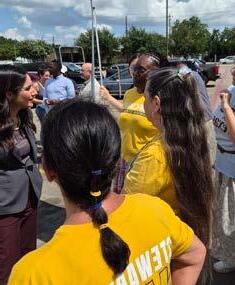
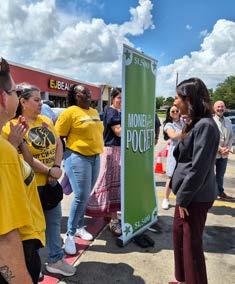
Gina Hinojosa unveiled an economic proposal in Houston on Tuesday that would provide $1,500 payments to every Texas household, arguing the state should use a portion of its multibillion-dollar Rainy Day Fund to help families struggling with the rising cost of living.
Hinojosa announced the proposal during a campaign stop at Pyburn’s Farm Fresh Foods on Scott Street in Houston, a grocery store that opened in 2018 in an area that had long been considered a food desert. The location highlighted one of the campaign’s key issues: expanding access to affordable groceries while addressing the financial pressures facing families across Texas.
During the event, Hinojosa acknowledged the rising cost of groceries and the growing challenge of food access in both urban and rural communities. While inflation has driven food prices higher, many rural communities have also lost locally owned grocery stores because of increasing operating costs, shrinking profit margins and reductions in federal Supplemental Nutrition Assistance Program (SNAP) benefits that affect purchasing power in many small towns.
The closure of neighborhood grocery stores has forced many Texans to travel
farther for basic necessities, increasing transportation costs and making access to fresh food more difficult.
Hinojosa said her proposal would provide immediate relief by putting $1,500 directly into the hands of every Texas household. The funding, she said, would come from the Texas Economic Stabilization Fund, commonly known as the Rainy Day Fund . The Economic Stabilization Fund was created after Texas voters approved a constitutional amendment in November 1988 following the severe oil price collapse and recession of the mid-1980s. The fund became effective Sept. 1, 1989, and was designed to help the state weather economic downturns and unexpected budget shortfalls by saving excess revenue generated largely from oil and gas production. With a balance of approximately $27 billion, the Rainy Day Fund is the largest state reserve account in the nation. Hinojosa argued that the reserve has grown well beyond what is necessary while many Texans continue to struggle with paying for groceries, utilities and other household expenses.
She said money that could have been invested in public education remains in the Rainy Day Fund because additional school funding was not approved during the 2023 legislative session. Hinojosa argued
Plan For Texas Families. (Phots
that Governor Greg Abbott withheld education funding while pushing lawmakers to approve a private school voucher program.
During Tuesday’s press event, Hinojosa criticized what she described as a broken state government, saying Texans work harder than the national average, yet continue to struggle to afford basic necessities. She pointed to electricity shutoffs, rising household costs and food insecurity as evidence that many families are being left behind despite the state’s strong financial position.
She also pointed to Abbott’s awarding of no-bid state contracts to political donors, referring to what she called a “Greg Abbott corruption tax,” which she argued has contributed to higher costs for Texans.
The debate over public education funding and school vouchers has remained one of the defining political issues in Texas over the past several years. Abbott made passage of an education voucher program one of his top legislative priorities after voucher legislation failed during the 2023 regular session. The effort received significant financial backing from national donors, including Pennsylvania investor Jeff Yass, a Republican megadonor whose contributions supporting Abbott and pro-voucher
By Lisa Valadez)
candidates have been reported as the largest individual political donations in Texas history. Campaign finance records show Yass contributed millions to Abbott and political committees supporting candidates who favored education savings accounts. After the voucher proposal failed in 2023, Yass continued investing in Texas races during the 2024 election cycle, supporting efforts to unseat Republican House members who opposed the legislation. The voucher program was ultimately approved by the Legislature in 2025.
Critics of the legislation have argued that wealthy out-of-state donors gained outsized influence over Texas education policy and that billions of dollars in additional public school funding were delayed while lawmakers debated the voucher proposal. Supporters of the program have maintained that education savings accounts expand educational opportunities by giving parents more choices for their children’s education. Hinojosa’s proposal to distribute $1,500 to every Texas household is expected to become a centerpiece of her economic platform as she campaigns across Texas ahead of the November general election.
To learn more about Gina Hinojosa, visit www.ginafortexas.com
Gina Hinojosa Campaign Stop In Houston at Pyburn Farm Fresh Foods on Scott Street to announce her $1,500 Boost
In the Houston Port Region, leadership is not merely discussed—it is built, mentored, strengthened, sponsored, and sometimes, very stylishly, dressed in pink.
On Wednesday, July 29, 2026, Women In Alliance, an initiative of the Economic Alliance Houston Port Region, will host the Women’s Leadership Summit & Luncheon from 9:00 AM to 1:00 PM at San Jacinto College’s LyondellBasell Center for Petrochemical, Energy & Technology, located at 7901 Fairmont Parkway in Pasadena. The highly anticipated gathering is designed for women across industry, business, public service, education, and community leadership who are ready to sharpen their skills, expand their networks, and step boldly into greater influence.
As proud media sponsor, Houston Style Magazine celebrates this summit as more than another luncheon on the calendar. It is a power table. A professional development moment. A confidence booster. And yes, with a purse raffle, selfie station, vendors, complimentary valet, and a pink dress code, it also understands that serious leadership can still have personality.
Women In Alliance’s mission is rooted in empowerment: helping women of all ages become exceptional leaders in the Port Region and beyond.
The organization is especially committed to passing wisdom, strength, and professional courage to young women growing up in and around the Port of Houston region, while reminding women already working in industry to stay strong, keep climbing,
WOMEN IN ALLIANCE WOMEN’S LEADERSHIP SUMMIT & LUNCHEON: PORT REGION POWER, PINK STYLE, AND PURPOSEFUL LEADERSHIP
By Francis Page Jr. for www.StyleMagazine.com
and never stop reaching for higher positions in the business world.
The morning begins with registration and networking from 9:00 to 9:30 AM, followed by breakout sessions from 9:30 to 10:45 AM. Attendees may select one of two focused sessions, and seating is limited. Translation: do not wait until your coffee gets cold to register.
The first breakout, “Communication & Negotiation,” will offer practical strategies for negotiating salary, navigating difficult conversations, and communicating with confidence from the frontline to the executive suite. Featured voices include Nellie Baktashi Macaluso, MBA, of Houston Methodist; Linda Fields of Meador Staffing Services, an Openwork company; and moderator Heather Betancourth of the Gulf Coast Protection District.
The second breakout, “Networking & Relationships: Your Voice Is Your Brand,” led by Samantha Varner, will help attendees strengthen their personal brand, speak with confidence, approach new contacts with ease, and build professional relationships that are both strategic and authentic. In a region powered by partnerships, that kind of skill is not optional—it is leadership currency.
The luncheon portion begins with networking and registration at 11:00 AM, followed by the program and lunch at 11:30 AM. The featured panel, “Women Driving Industry Forward,” will bring together an impressive lineup of leaders: Amy Caldwell of LyondellBasell; Lydia Boek of Shell Deer Park Chemicals; Cydney Schwarzlose of BGE,
Inc.; and Elizabeth Fazio Hale, JD, LLM, of Gulf Coast Authority. Together, they represent the kind of cross-sector leadership shaping the future of energy, infrastructure, environmental stewardship, engineering, and economic development in Southeast Texas.
Current sponsors include Harris County Precinct 2, Harris County Precinct 3 Commissioner Tom S. Ramsey, P.E., San Jacinto College, Gulf Coast Limestone, Houston Style Magazine, and Bayside Printing. Additional sponsorship opportunities remain available for companies and organizations seeking meaningful visibility among influential women and decision-makers across the Port Region.
Guests are encouraged to purchase purse raffle tickets in advance, enjoy onsite vendors, capture memories at the selfie station or event backdrop,
and take advantage of complimentary valet parking. Gratuities, of course, are appreciated.
Registration and sponsorship information is available through the Economic Alliance Houston Port Region at allianceportregion.com or by calling 281-476-9176. Event contact Marisela Ramirez may also be reached at marisela@allianceportregion.com.
For Houston-area women ready to lead louder, connect smarter, and rise higher, this summit is a must-attend. Wear your pink. Bring your business cards. And come prepared to leave with more than inspiration—come ready to leave with momentum.
MORE INFORMATION, GO TO: https://allianceportregion.com/
In Harris County, big change does not arrive quietly. It comes with neighborhood voices, crowded rooms, practical ideas, and sometimes, thank goodness, refreshments. On Wednesday, July 1, 2026, supporters of Dr. Letitia Plummer gathered for a fundraiser reception at 2555 N. MacGregor Way, bringing together civic-minded Houstonians, business leaders, legal advocates, grassroots donors, and believers in a county government that works better for working families.
Hosted by Sean Roberts, Clive Markland, Farouk Plummer, Trey Stone, Vanessa Gilmore, Troy Pradia, Johnathan Cox, and Thomas Jones, the reception carried the energy of a campaign entering its next chapter with purpose. The invitation was clear: large donors and small donors alike were welcomed to hear Plummer’s platform and invest in what supporters are calling the future of Harris County leadership.
Houston Style Magazine was also on site for this momentous upscale fundraiser, with Mark McDonald, Jr. representing HSM to cover the evening’s energy, elegance, and growing countywide
H Dr. Letitia PLUMMER Fundraiser H
BUSINESS & POLITICAL LEADERS SHOWED UP FOR ROBERT MARKLAND, LLP
Plummer’s MacGregor Moment: A Fundraiser With Countywide Energy
Dr. Letitia Plummer Builds Momentum For Harris County Judge
enthusiasm surrounding Dr. Plummer’s campaign. His presence reflected the importance of documenting not only the politics of the moment, but the people, partnerships, and power circles helping shape Harris County’s next chapter.
And the setting mattered. Roberts Markland, known in Houston legal circles for telling clients’ stories with preparation, precision, and persistence, offered a fitting backdrop for a candidate whose own message is rooted in listening first and leading with evidence. After all, county government is not a slogan machine. It is where flood control, public health, emergency response, roads, libraries, economic opportunity, and public safety all meet the everyday realities of families trying to live, work, raise children, and build something lasting.
Dr. Plummer’s candidacy arrives at a defining moment. Harris County is not just big; it is consequential. With roughly 5 million residents, it is the largest county in Texas and the third largest in America. If unincorporated Harris County were its own city, it would rank among the largest in the nation. That means the next Harris County Judge will not simply preside over
By Francis Page, Jr.
meetings. The role demands judgment in emergencies, steadiness in budgets, and a countywide view broad enough to see Acres Homes, Alief, Baytown, Kashmere Gardens, Third Ward, Katy, Pasadena, Sunnyside, and every community in between.
Plummer, a dentist, small business owner, mother, and former Houston City Council member, brings a biography that blends professional care with public service. Her campaign’s policy priorities speak directly to kitchen-table concerns: expanding and improving Harris Health, supporting youth mental health partnerships, strengthening chronic illness prevention, accelerating flood control projects, expanding broadband access, upgrading emergency services, growing small business support, opening more doors to county contracts, and building stronger apprenticeship pipelines.
That is not pie-in-the-sky politics. That is pothole-and-prescription politics. That is the kind of leadership Harris County residents understand because it meets them where they are.
Fresh from winning the Democratic nomination in a closely watched
runoff, Plummer now heads toward the November general election with momentum and history hovering nearby. If elected, she would become Harris County’s first African American County Judge—a milestone worthy of applause, but not the whole story. Her campaign’s deeper argument is that representation must come with readiness, and symbolism must be matched by service.
For Houston Style Magazine readers, Dr. Letitia Plummer’s campaign is one to watch closely—not only because of what it could mean politically, but because of what it says about this moment. Harris County is asking for leadership that can hear the community before crisis hits, build partnerships before headlines break, and move with both compassion and competence.
On MacGregor Way, the message was simple: Plummer is not just running for an office. She is running toward the work.
Dr. Letitia Plummer
https://www.drletitiaplummer.com/
Dr. Leticia Plummer, Clive Markland, and Sean Roberts
Dr. Leticia Plummer – Future Harris County Judge
Photos By Mark McDonald, Jr.
H Sean Roberts, Clive Markland, Vanessa Gilmore, Thomas Jones, Trey Stone, Troy Pradia, Farouk Plummer & Jonathan Cox – Hosts H
Summer in Houston may not scream “fresh powder,” but for the Ski Jammers, the season of planning, reconnecting, and dreaming big is already in full glide. As the second half of 2026 comes into focus, the beloved Houston-based snow sports and social club is inviting members, friends, and future adventurers to help shape its next exciting chapter.
The Ski Jammers Leadership Team has announced a fresh slate of activities designed to energize the club, deepen community bonds, and prepare members for a winter season filled with travel, friendship, and mountain-sized memories. At the heart of this renewed momentum is a simple but powerful message: Ski Jammers is moving forward — together.
First up is the Ski Jammers Town Hall Meeting, scheduled for Saturday, July 11, 2026, from 10:00 a.m. to 11:30 a.m. via Microsoft Teams. The virtual gathering will give members an opportunity to discuss the club’s future direction, offer ideas for local and regional activities, explore volunteer and leadership opportunities, and learn more about upcoming ski season plans. In true Ski Jammers fashion, everyone’s voice has a seat at the table — even if that table is online and someone is probably sipping coffee in their slippers.
The meeting also marks an important moment for NextGen engagement. Several younger members have already stepped forward with ideas, enthusiasm, and fresh energy, signaling a bright
SKI JAMMERS UPDATE: TOWN HALL, UPCOMING EVENTS & VOLUNTEER OPPORTUNITIES
By Francis Page, Jr. for www.StyleMagazine.com
future for the organization. Whether participants are lifelong skiers, casual travelers, snowboarders, social butterflies, or simply snow-curious Houstonians, Ski Jammers is building space for all generations to connect, learn, travel, and have fun.
The club is also preparing for the Texas Ski Council Bid Fest 2026, taking place July 31 through August 2 in San Antonio. This annual gathering brings together club leaders, delegates, industry partners, resorts, and tour operators as destinations compete for future ski trips and expeditions. Delegates will vote on destinations for the 2027 Summer and Fall Expeditions, as well as the
2028 Traditional and Final Showdown ski trips.
For Ski Jammers, Bid Fest is more than a calendar item — it is a chance to scout bucket-list adventures, strengthen partnerships, and discover new travel experiences that appeal to members across skill levels and interests.
Adding to the excitement, friends from the Texas Ski Rangers in Dallas and Alamo Joe in San Antonio are expected to join the weekend, making Bid Fest a lively opportunity to network, laugh, learn, and celebrate the wider Texas ski community. Yes, Texas has ski clubs — and yes, they are serious about fun.
Looking ahead, Ski Jammers is also building anticipation for the NBS Rocky Mountain Region Homecoming in Utah, set for January 6–10, 2027. With access to some of North America’s most celebrated skiing and snowboarding terrain, Utah offers a winning combination of legendary powder, scenic beauty, and convenience. Salt Lake City International Airport sits close to downtown Salt Lake City and within easy reach of premier mountain resorts, giving travelers the chance to land and hit the slopes the same day.
As the club grows its programming, volunteers are needed to support social activities, membership engagement, travel planning, communications, NextGen initiatives, and event coordination. Members who can offer a little time — or a lot — are encouraged to step forward. Incentives are on the way, but the real reward is helping build a vibrant, welcoming community rooted in adventure and friendship.
For more than four decades, Ski Jammers has helped make snow sports more accessible, social, and memorable for Houston-area enthusiasts. Now, with new ideas, new leaders, and new adventures on the horizon, the club is calling its community back to the mountain spirit.
Great people. Great friendships. Great memories. Ski Jammers Strong.
For more information, go to: https:// www.skijammers.com/
Sunday July 5, 2026, is not just another Sunday on Virginia Street. It is the “last-last” day, the final curtain call for Five Central Houston at the location that helped turn dinners into reunions, happy hours into networking rooms, birthdays into productions, and ordinary weekends into H-Town folklore.
For seven unforgettable years, Five Central has lived up to its promise as a dining, entertainment, and events venue built around “one location” and “countless experiences,” offering Houstonians a place to eat, celebrate, connect, and be seen. The venue’s own site highlights its role as a Houston destination for dining, entertainment, weekly happenings, and private events, and those words have been more than marketing.
They have been a lived experience for professionals, entrepreneurs, celebrities, athletes, elected officials, Divine Nine organizations, social clubs, and everyday Houstonians who simply wanted a place with flavor, music, energy, and heart. Five Central Houston
This final weekend on Virginia Street is being celebrated with the kind of love only Houston can produce: part family reunion, part business mixer, part Sunday funday, and part thank-you note written in bass, brunch, and beautiful memories.
Five Central’s leadership, including Joycelyn LG Williams and the Houston Hotspots
Five Cental HOUSTON TAKES ITS LAST BOW ON VIRGINIA STREET:
SEVEN YEARS, COUNTLESS MEMORIES, ONE H-TOWN LOVE STORY
By Francis Page, Jr. for
family, has offered heartfelt gratitude to every customer who supported the venue with love and with many events. They have also extended deep appreciation to the employees whose professionalism, commitment, and loyalty helped make the operation successful. In a city where hospitality is often measured by the plate, Five Central reminded Houston that true hospitality is also measured by the welcome.
And then there are the DJs.
The last-day lineup is a tribute to the sound architects who helped define the venue’s rhythm from the beginning. Legendary Supa Neil kicks things off from 12 p.m. to 2 p.m., followed by DJ Halfpint from 2 p.m. to 4 p.m., DJ Scotty from 4 p.m. to 6 p.m., and DJ Flatline from 6
p.m. to 8 p.m. That is not just a schedule.
That is a soundtrack for seven years of laughter, dancing, business cards exchanged, selfies taken, birthdays toasted, and “we need to do this again” promises made.
Five Central became more than a hotspot. It became a platform. It hosted local and national business leader forums, D9 legacy events, conferences, all-day happy hour moments, dining specials, global-style engagements, and gatherings for exceptional business owners who understood that community and commerce do not have to sit at separate tables.
That is what made Five Central special. It gave Houston professionals a place to loosen the tie without lowering the standard. It gave
entrepreneurs a room where networking felt natural. It gave families a place to celebrate milestones. It gave culture a microphone, a menu, and a dance floor.
As questions swirl online about whether Five Central is closing for good or preparing for its next chapter, the message for this weekend is clear: celebrate the Virginia Street era. Honor what was built. Thank the people who built it. And get ready for what may come next.
Because in Houston, endings rarely arrive empty-handed. Sometimes they come dressed as transition, carrying lessons, relationships, and a bigger vision.
So thank you, Five Central, for seven years of exceptional H-Town accomplishments.
Thank you for serving executives, business owners, community leaders, creatives, partygoers, professionals, and families with style. Thank you for giving Houston a place where the room always felt alive.
Sunday, July 5, is the last-last day at this location. But if the love in the room is any indication, Five Central’s story is not fading out. It is simply changing addresses in the hearts of Houstonians.
Stay in touch for the new location: https://www.fivecentralhouston.com/
For five decades, The Ensemble Theatre has been a cornerstone of Houston's cultural landscape, using the power of storytelling to inspire audiences, preserve African American artistic expression, and strengthen the community. As the organization prepares to celebrate its landmark 50th Season, the theater is marking the occasion with an ambitious lineup of productions, expanded educational programming, and a yearlong series of special events honoring its remarkable legacy.
Founded in 1976 by the late George Hawkins, The Ensemble Theatre has grown into the oldest and largest professional African American theater in the Southwest. It is also one of the nation's largest African American theaters that owns and operates its own facility with a full in-house production team. Today, the institution continues its mission to enlighten, entertain, and enrich audiences while serving as one of Houston's most treasured cultural institutions.
"This season is more than a celebration of our history," the theater notes. "It is a celebration of the stories that connect us, the artists who inspire us, and the community that has supported us for 50 years."
A Season Filled with Powerful Stories
The milestone season opens in September 2026 with the regional premiere of Purpose, the acclaimed drama by Tony Award-winning play-
wright Branden Jacobs-Jenkins.
THE ENSEMBLE THEATRE CELEBRATES 50 YEARS OF EXCELLENCE
By Lisa Valadez for www.StyleMagazine.com
Directed by Eileen J. Morris, the production explores family, identity, faith, and legacy through the lives of the Jenkins family. Purpose runs September 18 through October 11, following preview performances September 12, 13, 16, and 17.
The holiday season brings back a Houston favorite with the return of A Motown Christmas, revived by popular demand. Written by Nate Jacobs and directed and choreographed by Monica Josette, with musical direction by Melanie Bivens, the family-friendly musical combines beloved Motown classics with timeless Christmas songs. Performances run November 13 through December 20, 2026.
The new year begins with the regional premiere of The Wash, written by Kelundra Smith and directed by Morris. Inspired by the historic Atlanta Washerwomen's Strike of 1881, the drama tells the story of courageous women who united to demand fair wages, dignity, and respect. The production runs January 22 through February 21, 2027.
Spring welcomes the return of one of American theater's greatest classics, A Raisin in the Sun by
Lorraine Hansberry. Directed by Morris, the timeless drama follows three generations of the Younger family as they pursue dreams
of a better future while confronting racial and economic barriers. The production runs March 19 through April 11, 2027.
Next comes The Colored Museum, the groundbreaking satire by George C. Wolfe, directed by Rachel H. Dickson. Through a series of provocative and humorous sketches, the play examines stereotypes, history, and identity while challenging audiences to reflect on the Black experience in America. Performances run May 7 through May 30, 2027.
Closing the anniversary season is Jubilee, the uplifting a cappella musical by Tazewell Thompson. Directed and choreographed by Patdro Harris, with musical direction by Phillip Hall, the production tells the inspiring story of the renowned Fisk Jubilee Singers through more than 40 spirituals celebrating resilience, hope, and perseverance. Jubilee runs June 25 through July 25, 2027.
Celebrating 50 Years Beyond the Stage
The anniversary season extends well beyond the
mainstage. Throughout the year, The Ensemble Theatre will host a series of signature events commemorating its golden milestone, including its Celebrity Gala, the Giorgee Awards, a Charity Golf Tournament, and other high-profile celebrations highlighting the organization's artistic excellence, rich history, enduring legacy, and contributions to African American culture. The theater's Education Department will also continue expanding opportunities for youth and families through workshops, Artist-in-Residence experiences, student matinees, and community programming. Its Young Performers Program, which serves children ages 6 through 17, combines theater arts education with STEM-centered learning, helping develop the next generation of performers, creators, and leaders.
As The Ensemble Theatre enters its 50th season, the organization remains firmly committed to producing compelling contemporary and classic works that celebrate the African American experience while continuing to serve audiences across Houston and beyond.
For generations of Houstonians, The Ensemble Theatre has been more than a stage—it has been a place where stories come alive, voices are amplified, and community is built. Its golden anniversary promises to honor that extraordinary legacy while setting the stage for the next 50 years.