
RESILIENT INFRASTRUCTURE Designing Communities that Last

WHY RESILIENCE MATTERS
No person or place is immune from disasters or disaster-related losses. Infectious disease outbreaks, acts of terrorism, social unrest, or financial disasters in addition to natural hazards can all lead to large-scale consequences for the nation and its communities. Organizations face difficult fiscal, social, cultural, and environmental choices about the best ways to ensure basic security and quality of life against these disasters.
One way to reduce the impacts of disasters on communities is to invest in enhancing resilience— the ability to prepare and plan for, absorb, recover from, and more successfully adapt to adverse events.
Enhanced resilience allows for better anticipation of disasters and better
planning to reduce disaster losses, rather than waiting for an event to occur and paying for it afterward. According to the National Oceanic and Atmospheric Administration, by 2050, "moderate" (typically damaging) flooding is expected to occur, on average, more than 10 times as often as it does today1. This flooding can be intensified by local factors. As disasters continue to occur, communities are taking action now to enhance resilience. Rather than waiting for a disaster to strike—which can lead to destroyed homes and businesses, ultimately uprooting thousands of people in a moment—proactive actions will reduce many of the broad societal and economic burdens.

The prevalence of disaster declarations and recovery costs over the last decade, which are in the billions per year, demonstrate the need for local communities to improve their preparedness for predictable natural events2. Building more resilient communities and investing in mitigation measures are the best ways to reduce risks to local communities such as from the loss of life, economic disruption, and infrastructure restoration.
1https://bit.ly/3znKvdH


2https://on.natgeo.com/3znzF7h
FUNDING VS. FLOODING
The US Department of Homeland Security and the State of Minnesota are supporting communities to encourage self-sufficiency long before disasters arise by emphasizing pre-disaster mitigation efforts. These efforts strengthen infrastructure and reinforce existing structures, which can save lives and exponentially decrease postdisaster recovery costs. Additionally, this will enable communities impacted by natural disasters to rebuild better, stronger, and more resilient infrastructure to protect taxpayer investments and adequately prepare for future disasters.
Throughout the past few decades, the Upper Midwest has faced devastating flooding events that caused incalculable damage. Cities, water management organizations, non-profits, tribal councils, and state and federal agencies are working

We are excited to begin this work to enhance Moorhead’s resilience to large rainfall events. This grant will enable us to identify vulnerable areas and seek solutions to mitigate risks to critical infrastructure, private property, and disadvantaged members of our community. This grant represents another step on a path to becoming a resilient, sustainable city.


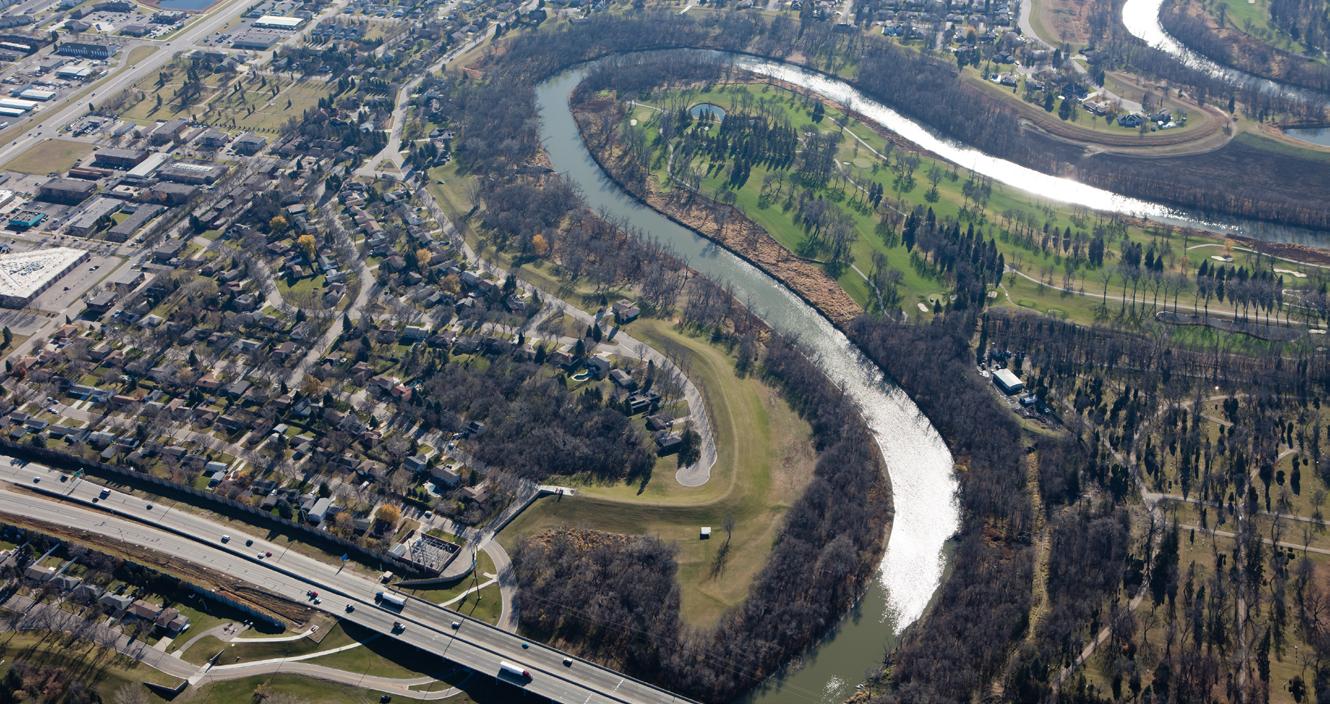
hard to combat this threat. For instance, the Minnesota Pollution Control Agency’s (MPCA) Resilience Grant Program is calling for cities, water resources managers, watershed districts, and others to use projections from available climate hydrology models to identify critical areas or infrastructure that are at risk due to large rain events. With this valuable data, the cities can develop targeted projects to increase their infrastructure's resilience to large rain events.
INFRASTRUCTURE BUILT FOR THE COMMUNITY
At HEI, we look beyond the obvious pain points of an issue to bring sustainable resilience, environmental benefits, and community amenities to the projects we design. Whether this means creating a removable floodwall that gives pedestrians access to a waterbody or designing a water quality project that blends into the natural landscape, we have innovative ideas for green infrastructure in any location.
Street/Downtown Fargo project boasts flood protection with greenspace access through removable, decorative floodwalls, several plaza areas, and the Spirit of the Sandbagger art installation dedicated to the sandbagging volunteers who worked to protect the city from the Red River floods.

Our transportation projects for the City of Minneapolis don't only create better corridors for travelers. Our team updated precipitation and hydrology models during these projects to ensure the corridors are more resilient to large rain events as well as improve downstream water quality.
