OFFICIAL TRADE JOURNAL OF THE MICHIGAN CANNABIS INDUSTRY ASSOCIATION
The Jackson-based company maintains success by staying the course
10 COVER STORY
FINDING TRUE NORTH
The Jackson-based company maintains success through clear focus and key partnerships By
Wensdy Von Buskirk
16 SIMPLY AMAZING
Proprietary products and stellar customer service set Adrian’s Amazing Budz apart By
Lauren Wethington
20 A PERSONAL TOUCH
Grow facility Lake State Canna boasts decorated strains thanks to its hands-on approach By Paris Giles
The fed has now drawn the line on intoxicating hemp-derived products By Chris Lindsey
CRA Lab Director Claire Patterson speaks on the reference lab’s progress and goals By Mike
Lerchenfeldt
My Green Michigan helps Lansing-area cultivators dispose of cannabis waste sustainably By Paris Giles
Focused on terps, SC Labs is leading a cannabis quality revolution By Wensdy Von
Buskirk
The industry united at the Capitol in late September to protest the 24% wholesale tax
Changes Ahead
ISSUE 4
Tthe federal level — continues to experi- Budz differentiates itself in the crowded Adrian
ence seismic shifts. Here at the MiCIA, we’re deep into our appeal of the Michigan Court of Claims’ ruling that declined to block the 24% wholesale tax on cannabis from going into effect on Jan. 1. The fight is far from over, and we’re prepared to take our lawsuit challenging this unconstitutional tax all the way to the Michigan Supreme Court.
Thank you to everyone who has supported our efforts through the MiCIA Constitutional Defense Fund. Donating to the fund helps protect the cannabis businesses and workers in the state who operate within the rules and serve their communities.
Nationally, there are big changes on the horizon as well. This fall, Congress adopted a revised federal definition of hemp, excluding intoxicating hemp-derived products. When the new definition takes effect on Nov. 12, 2026, the loophole will officially close. In light of this development, we turned to Chris Lindsey of the American Trade Association for Cannabis and Hemp for his expertise; he writes about the change and its effect on Michigan’s industry (spoiler: Licensees can continue business as usual) on page 23.
businesses highlighted in this issue. Amazing Budz differentiates itself in the crowded Adrian cannabis scene through its proprietary Thunder Canna line, which offers unique products that customers love (page 16). Lansing grow Lake State Canna also remains afloat because of its attention to detail and excellent flower. The tiny staff — with just four regular employees, including owners Frank and Fawn Kiester — attentively cares for the plants by hand, which has resulted in award-winning cannabis (page 20).
We continue the conversation about what makes quality cannabis on page 30 with SC Labs, which places strong emphasis on terpenes and terpenoids. Its chemometric reports identify dominant terps, aromas, flavors, and potential effects to help give brands a leg up on retail shelves.
The Cannabis Regulatory Agency’s reference lab is also preparing to open. Once running, the lab will help ensure fairness for cannabis operators and weed out bad actors in the industry. Lab Director Claire Patterson weighs in on the lab’s progress and goals on page 24.
MICHIGAN CANNABIS INDUSTRY ASSOCIATION
216 N. Chestnut St. Lansing, MI 48933 micia.org
FOLLOW US AND LIKE US
MiCIA STAFF
ROBIN SCHNEIDER Executive Director robin@micia.org
MICHAEL J. PATTWELL Corporation Legal Counsel mpattwell@clarkhill.com
KEVIN A. MCKINNEY Lobbyist kevin@mckinneyandassociates.net For membership inquiries, email info@micia.org
PUBLISHING PARTNER
5750 New King Drive, Ste. 100 Troy, MI 48098
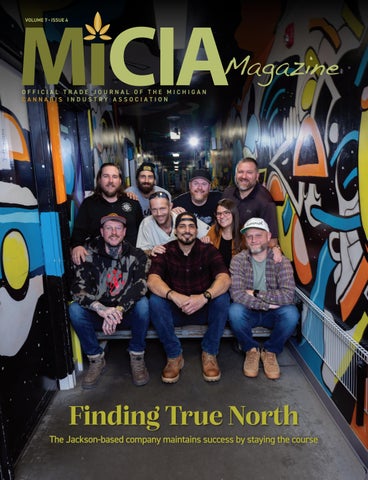
In this issue, we also shine a spotlight on a few of our members who are thriving despite tough industry conditions. Our cover story features True North Collective, a family-owned company based in Jackson that has assembled an all-star team creating top-quality gummies and extracts. Read more about their philosophy and products on page 10.
A focus on quality is a theme among the
As our industry undergoes big changes, the MiCIA is here to advocate for you and support you. Please support us in return — not just with donations, but with your time and energy — to help us continue our fight. We’re only as strong as our members, and we appreciate each and every one of you. I hope you all have a happy and healthy new year!
Robin Schneider, Executive Director
GENERAL MANAGER
Ed Peabody
MANAGING EDITOR
Olivia Sedlacek
ART DIRECTOR
Mike Wagester
PRODUCTION MANAGER
Crystal Nelson
PRODUCTION ASSISTANT
Alessandra Taranta
ADVERTISING ACCOUNT EXECUTIVES
Cynthia Barnhart, Karli Brown, Donna Kassab, Mary Pantely
CONTRIBUTORS
Mark Bialek, Paris Giles, Kevin A. McKinney, Mike Lerchenfeldt, Chris Lindsey, Kenzie Terpstra, Wensdy Von Buskirk, Lauren Wethington
Growth takes more than a seed. It takes a strategy.
Michigan’s cannabis market is evolving fast — we help you stay ahead. Oversupply. Shrinking margins. Shifting regulations. In Michigan’s competitive cannabis landscape, success isn’t just about producing great product — it’s about running a smarter business.
At Maner Costerisan, we specialize in helping cultivators, processors, dispensaries, and vertically integrated operators navigate growth, restructuring, and compliance with confidence. As longtime members of the MiCIA, we understand Michigan’s unique market challenges — and how to turn them into opportunities.
Whether you’re preparing for expansion, considering a sale, or trying to tighten operations, our team delivers:
• CFO-level guidance for multi-entity structures
• Accounting Techology and Integration with seed-to-sale and other operational software
• Cash flow forecasting and margin analysis to improve profitability
• FASB-compliant lease accounting and real-time reporting
• Support with audits
We don’t just help you grow — we help you grow wisely.
The Year Ahead
In 2026, the MiCIA and its PAC are more committed than ever to strengthening the industry — with your help
By Kevin A. McKinney
Despite the holiday spirit and strong sales, the cannabis industry ended 2025 on a somber note with the 24% wholesale tax moving forward and effective Jan. 1, 2026. Despite the political odds of defeating the governor, speaker of the House, and Senate majority leader, all of whom cut the deal for the tax to cobble up a very flawed $1.8 billion road funding package, the response from the industry has been noteworthy. The dedicated reset, passion, and commitment from the industry leaders remains remarkable. As we now start the second year of this legislative session, there is more determination to position the cannabis industry boldly and aggressively and to place the MiCIA specifically in a much better position moving forward.
The commitment to building up the political action committee so that it is relevant and reflects the economic significance of the cannabis community is most encouraging. There is no reason that the MiCIA State PAC cannot become one of the largest PACs in Michigan. Timing is everything in politics, and we must take the opportunity to educate and motivate members to support our political efforts as we head right into the 2026 election cycle.
All statewide elected offices (governor, secretary of state, and attorney general) are open and extremely competitive. Both chambers in the Legislature are up for reelection, giving all four caucuses the opportunity to retain or retake the majority. All have pathways to do so, and most prognostications point to coin-flip odds, even heading into the midterm elections. Not to mention the open U.S. Senate seat and that all of our congressional delegation is running, although the MiCIA State PAC is not a federally registered PAC and cannot make contributions to federal races. However, the MiCIA must have a robust and nimble PAC strategy heading into the midterm elections and beyond. Smart
and strategic PAC investments are needed to best leverage influence and grow relationships with cannabis-friendly candidates. Additionally, besides generous support to the PAC, personal giving serves as critical engagement with local policymakers, as it builds trusted relationships. But primarily giving to your PAC can help insulate you from the growing and annoying requests for support from candidates. To be effective, all of this should be coordinated to maximize the ability for the MiCIA to remain the face of the industry in the legislative and political arena.
The MiCIA has already started to analyze targeted races and meet with caucus campaign leadership to consider our level of involvement. Also, we have reached out to top-tier candidates running for statewide office. Early money and support are more impactful, as everyone is expected to participate in postelection debt-burning efforts for candidates and leadership PACs.
There is a unique opportunity for the association to coordinate volunteers for targeted races. Whether they are door-todoor canvassing, completing in-office work, or helping with phone banks, volunteers are the lifeblood of campaigns. I see the MiCIA offering significant volunteer resources, which will be invaluable and most appreciated by
Kevin A. McKinney
the candidates. Look for more information on this opportunity as strategic planning begins. Finally, the fact that it is a midterm election year and we have competitive and targeted primaries and general elections will quickly begin to impact the legislative session and the number of bills that may be taken up. Getting the new fiscal year 2026-27 budget adopted in late June and not repeating what happened last year will be an accomplishment. State budgets will be tighter, and both majority caucuses will have their own budgetary priorities to negotiate.
The MiCIA continues to push for its legislative priorities, including placing a statewide cap on most adult-use and medical marihuana licenses (Senate Bills 597 and 598) and passing a similar package to limit licenses (House Bills 5441-5444) that was introduced on Dec. 23, 2025. The Senate’s passage of a ban on intoxicating hemp products (SBs 599-602) in late December was a well-earned legislative success, and we will need to work even harder in the House to garner support and movement. HB 4501, which gives the state reference lab statutory authority to manage cannabis, should be moving through the House in January and should receive quick legislative approval once it comes over to the Senate. There are other cannabis-related bills, such as a roadside oral-testing package (HBs 4390 and 4391) and a payment-on-delivery bill (HB 4963), which are more likely one-chamber bills unless there is compromise.
Stay engaged and active, support the MiCIA, and continue to reach out to your local legislators and/or candidates running for office. Building strong relationships with policymakers is a key business investment you cannot afford to dismiss.
Kevin A. McKinney is the lead lobbyist for the MiCIA.
COURTESY PHOTO
Continuing Education: Help Your Employees Grow
Keep your workforce up to date with
Programs include: Cannabis Human
Business
Hospitality
To become a partner and search programs visit CE.baker.edu
Recruiting Handled
Employee
Trained
TrueFindingNorth
The Jackson-based company maintains success through clear focus and key partnerships
BY WENSDY VON BUSKIRK
BY
PHOTO
MARK BIALEK
In geographic terms, “true north” refers to the direction of the Earth’s North Pole, a fixed point used for navigation. Symbolically, it speaks to deeply held values and a steady sense of direction. It’s a fitting name for one of Michigan’s OG cannabis companies, which has remained anchored to its mission: to serve patients and consumers the “thoughtfully crafted, high quality products they deserve.”
around: not going crazy when the times were really good,” he says. “We invested our money pretty wisely, scaling the operation up [over time].”
Griffis’s career path began when he got his medical card at 18 and moved to Colorado, where he immersed himself in that state’s nascent cannabis industry. He eventually brought that experience home to help build True North from the ground up.
Founded in 2018 by the late David Gaylor, True North Collective has stayed in the family, run by Gaylor’s wife, Sandy; his son-in-law Joey Stutz; and a tight-knit crew united by their passion for the plant.
With caregiver roots, the company was among the first to enter Michigan’s legalized market. It now operates nine state licenses covering adult-use and medical processing and cultivation, supplying more than 500 dispensaries statewide. Its brands — Five Star Extracts, True North Concentrates, Quasi Farms, and True North Confections — offer something for every consumer and price point.
But what really sets the company apart, says President Jonny Griffis, isn’t just the product; it’s the people and the philosophy behind it.
“We’re very authentic — like, shamefully us,” he says. “We try to personify that in the product and think we do a good job.”
NAVIGATING GROWTH
When I arrive for my tour of the company’s Jackson headquarters on a sunny fall day, Griffis greets me in the gravel parking lot.
The facility is unpretentious, a reflection of the company’s grounded approach. As Griffis explains, keeping costs low and operating within its means has been key to longevity.
“That’s the reason why we are still
Today, the company employs about 65 people during peak harvest season, a testament to steady growth and careful navigation through Michigan’s turbulent market.
CHARTING THE COURSE
Griffis introduces me to Gino Venti, True North’s processing director. The two met at Native Roots in Colorado, and Griffis later recruited Venti to bring his expertise to Michigan.
“He makes amazing edibles,” Griffis says.
Originally from Hawaii, Venti started his journey into the cannabis industry after an ACL tear during his MMA fighting days.
“I was in pain and didn’t want to be on pharmaceuticals,” he says, adding that it led him to learn about the potential healing properties of different strains. “From there on, the light bulb came on.”
Starting as True North’s kitchen director, Venti worked his way up to oversee extraction, distillation, and kitchen operations. Under his leadership, True North became an early and enduring player in Michigan’s gummies market.
“We strategize every meeting how to make better products and give consumers what they want,” Venti says. “You’ve got to be passionate about what you do, have the right team members, and meet the right needs based on market demand.”
A tight-knit crew makes everything happen at True North Collective. Front row, left to right: Jonny Griffis, Gino Venti, and Brad Zvonek. Back row, left to right: Joey Stutz, Justin Jehnzen, Kyle Trowbridge, Brett Booth, Julia Zvonek, and John Olivier.
SCALING SMART
Griffis and Venti take me through a hallway wrapped in a psychedelic mural and offer me a peek into one of three flower rooms. Head Grower Kyle Trowbridge oversees the Jackson facility’s indoor cultivation; the company also owns a 37.5acre farm in Hesperia, which includes two greenhouses and an outdoor grow. The dual-grow setup lets True North balance small-batch craft cultivation with steady biomass supply.
“We used to grow more than 10,000 plants a year,” Griffis says. “Now, we’re scaling smarter, quality over quantity.”
Cultivation feeds into extraction labs where True North’s award-winning concentrates are made. Controlling production from seed to sale ensures consistency, a key element to the brand’s reputation.
EXTRACTING EXCELLENCE
The Jackson facility houses both butane and ethanol extraction systems. Butane captures the full range of terpenes and cannabinoids for the company’s toptier Five Star Extracts and True North Concentrates lines. Ethanol supports high-volume distillate production, capable of processing up to 300 pounds per day.
Sales and Marketing Director Brett Booth explains the three product tiers,
In addition to its headquarters in Jackson, which houses both indoor cultivation and extraction, True North has a 37.5-acre Hesperia farm with an outdoor grow and greenhouses.
“We strategize every meeting how to make better products and give consumers what they want. You’ve got to be passionate about what you do, have the right team members, and meet the right needs based on market demand.”
—Gino
director
Venti, processing
at True North Collective
Clockwise from top: This Five Star Extracts branded vehicle advertises True North Collective’s premium brand of concentrates. True North has racked up an impressive collection of awards. True North’s One Hitters pack 200 milligrams of THC into a single gummy. True North has recently partnered with Wojo Co. on rosin gummies.
designed to meet the needs of every kind of consumer.
Five Star Extracts is the company’s premium, indoor-only line prized for flavor and terpene content.
“You can always tell when people are huge Five Star fans,” Booth says. “Their fridges are usually covered in our strain stickers.”
True North Concentrates is the midtier line, offering high quality at accessible prices. “It’s a really solid value across the board … with flavorful carts competing with a lot of the staple brands out there,” Booth says.
Quasi Farms is the entry-level sungrown line named for the farm’s mascot, a St. Bernard-ish mutt featured in the logo.
True North’s gummies, ranging from four-packs to its new live resin 200milligram One Hitters, have become a signature product. The company has swept Michigan’s Top Shelf Showdown two years
running, winning best overall gummy for Blueberry Lemon Sorbet rosin gummies (2024) and Five Star’s Blueberry Lemon Haze full-spectrum gummies (2025).
True North doesn’t produce rosin inhouse, but collaborations fill that gap. Its partnerships with LightSky Farms and Ice Kream Hash Co., as well as its newest with Wojo Co., have strengthened community ties.
“We have a lot of other companies that want to be part of what we developed here,” Venti says. “We seem to have master-crafted our edibles side, so it’s all about helping the community.”
STAYING TRUE
At a time when Michigan’s cannabis prices have plummeted, Griffis and his crew are steering True North with care.
“It’s a balancing act,” Griffis says. “We have to produce enough to meet demand without overstock sitting on shelves.”
Like many operators, they’re facing thinner margins and rising taxes, but Griffis remains optimistic.
“I think we would be well positioned as a craft cannabis company for interstate commerce,” he says. “Michigan is oversupplied, so we could pivot to being the country’s provider because we’re set up to do that. … We have all the facilities, and we have a lot of talent we’ve grabbed from all over the country.”
Federal legalization may someday expand their reach, but for now, True North remains firmly focused on Michigan, refining its processes, strengthening retail partnerships, and holding fast to its founding principles.
As my tour wraps up, it’s clear that True North’s compass points toward a future shaped by authenticity, craftsmanship, and a clear sense of direction.
“Just treat the weed with respect,” Griffin says, “and you’re good.”
Simply Amazing
Proprietary products and stellar customer service set Adrian’s Amazing Budz apart from the crowd
By Lauren Wethington
Amazing Budz's proprietary cannabis brand, Thunder Canna, developed these innovative packs of 14 pre-rolls, which come protected in a biodegradable tube for transport and storage.
Cannabis connoisseurs in the Adrian area have no shortage of retail options from which to choose. The small city is home to about a dozen dispensaries, which range from glossy chains to smaller, locally owned boutiques. In the middle of all that variety stands Amazing Budz, which opened its doors seven years ago as the area’s first medical dispensary, according to Adrian’s Daily Telegram, adding adultuse sales in 2020. Despite all the competition, operations manager Joe Lewis says business is booming. “We are literally so busy that we can’t keep up with the demand,” he admits.
Lewis, a Las Vegas native with experience launching legal cannabis businesses all over the country, helped owner Marie McPhail get the business off the ground in 2018. A few years later, he recruited his longtime friend Aaron Jackson to join the company. The pair now work on everything from packaging design to accounting. Both point to the dispensary’s proprietary cannabis brand, Thunder Canna, as integral to the success of the business.
Once available only at Amazing Budz, Thunder Canna is now carried at hundreds of retailers around the state. “Not only do we have one of the best-value products price-point-wise, but our products taste really, really good,” Jackson says. “We have high-quality ingredients in all our products. … People like ours because of the actual taste and consistency.”
The pair have also worked to develop innovative products to keep Thunder Canna fresh. One of their most popular creations, a pack of 14 1-gram pre-rolled joints, comes in a portable, biodegradable tube especially designed to protect each joint.
“Aaron and I designed that whole entire thing,” Lewis says of the multipack, which was intended to displace the plastic sandwich baggie as the go-to joint storage solution. “It really blew up in the summer, when people go to concerts or out on their boat. Then, even when they smoke all the joints, they’ll reuse those tubes and refill them with other joints that they roll up with our flower.”
The company sells roughly 40,000 of
“Not only do we have one of the best-value products price-point-wise, but our products taste really, really good. We have highquality ingredients in all our products. … People like ours because of the actual taste and consistency.”
Aaron Jackson, operations manager at Amazing Budz
Operations managers Aaron Jackson (left) and Joe Lewis have had a hand in everything from product design to accounting at Amazing Budz.
“We are not corporate at all. That’s not what weed has ever been about. You’ve always gone to somebody’s house, someone’s garage. … It has a very warm feel to it. You walk in [to Amazing Budz], and you kind of feel that energy. You feel the hug.”
Aaron Jackson, operations manager at Amazing Budz
these multipacks per month, according to Lewis, which he says is just one example of the brand’s runaway success. In fact, Thunder Canna is so popular that Lewis and Jackson are pursuing automation strategies in order to keep up with escalating demand.
“We want to do whatever we have to do to be able to fulfill the sheer volume of orders that we’ve been getting,” Jackson says. “Because at the end of the day, we’re not a next-day shipping company — we’re mom-and-pop. We don’t have a ton of investors. We manage everything internally.”
Lewis and Jackson both say the momand-pop feel is the other pillar of Amazing Budz’s success. Whereas many large dispensaries feel cold and impersonal (they “make it look like Apple,” Jackson quips), Amazing Budz aims for warm vibes and friendly service. Lewis says that personal touch is what keeps the same customers returning for years.
“We are not corporate at all,” Jackson adds. “That’s not what weed has ever been about. You’ve always gone to somebody’s house, someone’s garage. … It has a very warm feel to it. You walk in [to Amazing Budz], and you kind of feel that energy. You feel the hug.
“We stay competitive on pricing, but we don’t have the best prices all day, every day.” The fact that Amazing Budz is still bustling, he says, “shows [that] service and our vibes really separate us from everybody else.”
Maintaining that high level of customer
service hasn’t always been easy. Jackson notes that staffing can be tricky in a college town, where a significant proportion of the population is under the age of 21. The shutdowns that occurred during the COVID-19 pandemic also threw the burgeoning business a few curveballs, but Amazing Budz responded by adding delivery service as well as curbside pickup — a feature that became such a success, the company still offers it today.
“It opened up some additional avenues for revenue that we weren’t doing prior,” Lewis says of the pandemic.
Despite the pervasive pessimism in the industry, the Amazing Budz team isn’t slowing down — they’re ramping up. At press time, a second Amazing Budz dispensary was slated to open near Lansing in 2026.
“We have so much traffic that comes to us from all angles,” Lewis says. “I’m sure a lot of people from [the Lansing area] that travel all this way to get our deals and our products are going to be thrilled to hear about that.”
The new dispensary will be similar in size and style to the existing Amazing Budz store and carry the full range of Thunder Canna products. The new storefront will also be accompanied by a brand-new cannabis line called Sin City. Inspired by Lewis’s and Jackson’s roots in the Entertainment Capital of the World, the line will target the industry’s most discerning customers with upscale ingredients, flavors, and packaging.
“This will be a little bit of a higher-end, retro brand,” Jackson explains. “Instead of just distillate gummies, we’re going to have live resin and stuff like that. … We really want to kind of re-create what we did with Thunder Canna over here at this Amazing Budz with Sin City at the next Amazing Budz.”
Amazing Budz operations manager Joe Lewis speaks into a mic in Thunder Canna's grow room.
Thunder Canna's 14-packs of pre-rolls fly off the shelves at Amazing Budz, according to operations manager Joe Lewis. The company sells about 40,000 per month, Lewis says.
A Personal Touch
Grow facility Lake State Canna boasts decorated strains thanks to its hands-on approach to cannabis cultivation
BY PARIS GILES
“Me and my wife are in the shop every day. We have a few employees that really care about what’s going on, and they see our goal of trying to make the product the best it can be. That’s what it’s taken to survive right now: to put out the best product.”
—Frank Kiester, co-owner of Lake State Canna
Bigger doesn’t always mean better. Case in point: Lake State Canna credits staying small for its exceptional quality. Opened in 2020 under the tutelage of husband and wife Frank and Fawn Kiester, the Lansing operation holds a 500-plant license and boasts a small team of just four regular employees (including Frank and Fawn); a handful more will pop in when it’s time to harvest and trim.
“Being a small facility, we are able to pay attention to every little detail and not cut corners,” Frank says.
Like many others who’ve carved out space for themselves in the state’s everevolving cannabis industry, Frank says he was first introduced to the plant back before it was legalized for adult use. You know the story: He was a personal consumer, and that eventually led to a small caregiver and home grow operation.
“I wanted to make a better life for our family,” Frank says. He and Fawn have two children, ages 9 and 11. “I didn’t want to do it quasi-legal anymore as a caregiver. And so we decided that we were either going to have to get licensed or quit.”
So that’s what they did. They acquired a medical license (then later swapped over to a recreational license) and set up operations in a 3,200-square-foot warehouse.
Many cultivation facilities use some sort
of automated drip irrigation system, but Lake State Canna hand-waters its plants, and Frank says that’s part of what sets it apart from some other larger enterprises, along with hand-trimming, slow drying, and proper curing.
“Our hand-watering brings the best flavor out of each plant and ensures that every plant in the harvest is of the same quality,” he says.
His team also takes pride in their phenotype hunting. Rather than growing just one or two seeds of a strain, they may pop, say, 30 to compare before selecting the stars of the family.
“I always say that you could find a better seed than what the breeder cut was, … and then it’s always something unique by pheno-hunting,” Frank says.
Dedication to quality comes first for Lake State Canna.
“Me and my wife are in the shop every day,” Frank says. “We have a few employees that really care about what’s going on, and they see our goal of trying to make the product the best it can be. That’s what it’s taken to survive right now: to put out the best product.”
Lake State Canna partners with about 10 to 15 dispensaries that order from the grow. One is Pharmhouse Wellness in Grand Rapids; general manager Matt Sanders says the dispensary cycles through
Frank and Fawn Kiester (above) opened their Lansing grow, Lake State Canna, in 2020. They and their small staff tend to the plants by hand.
“[Lake State Canna’s] flowers are always really top tier, top quality.”
—Matt Sanders, general manager at Pharmhouse Wellness
Lake State’s entire suite of flowers and pre-rolls, “whatever [they] have available.” Pharmhouse Wellness has its own grow, but Sanders says the team is always on the lookout for high-quality, affordable products that their customers can’t always find elsewhere, which is what attracted them to Lake State.
“If [a product is] in a ton of these bigger dispensaries, we would tend to probably shy away,” Sanders says. “We really try to cultivate a unique experience here. … We love to find smaller grows before they’re big, help them take off.” About Lake State’s menu, he adds, “Their flowers are always really top tier, top quality. … It looks great, it smells great, and it usually tests pretty well.”
both high-THC hybrids known for their fruity flavor and tropical citrus notes. In fact, its Runtz strain won first place in the “Blind Sesh” category of the Great Lakes Expungement Network’s 2024 Top Shelf Showdown. As the name suggests, the Great Lakes Expungement Network is a nonprofit that offers free expungement services for those burdened by cannabisrelated convictions in an effort to help remove barriers to employment, housing, and community participation. Erasing the stigma about cannabis and its users is an issue that’s close to Frank’s heart. “I’ve tried to promote cannabis through the community,” Frank says. “It’s accepted; it’s legal now. I try to break the stigmas with people.”
Malibu Marker and Runtz are among Lake State Canna’s most popular strains,
And as Lake State has shown, even small teams can make a big impact.
Left: Malibu Marker is one of Lake State Canna's most popular strains. Below: Lake State Canna's Runtz won first place for "Blind Sesh" flower in the 2024 Top Shelf Showdown.
SYNTHETIC THC AND THE NEXT FRAMEWORK:
The Fed Has Now Drawn the Line
By Chris Lindsey
For the past five years, intoxicating hemp-derived products have circulated through U.S. commerce because of a structural flaw in the 2018 Farm Bill. By defining hemp solely through delta-9 THC concentration and exempting “hemp derivatives” from the Controlled Substances Act, Congress created space for synthetic and semisynthetic intoxicants to enter the market under the guise of “hemp.” The result was a nationwide shadow intoxicants sector that placed consumers at risk, distorted state-regulated cannabis markets, and strained enforcement resources.
Congress has now acted. With the adoption of a revised federal definition of hemp, the law is (or at least will be) clear: Hemp is nonintoxicating, and any intoxicating form of THC, regardless of source or conversion method, is no longer within the federal hemp category. The new definition takes effect 365 days after enactment, which is Nov. 12, 2026. Congress provided a one-year transition period for manufacturers and retailers to bring operations into compliance — or exit the industry.
This change restores regulatory parity and closes the pathway that allowed synthetic THC to be sold outside licensed systems. It also ends the misconception that intoxicating hemp products can operate beyond the reach of state cannabis laws. That clarity is a necessary foundation for any future federal framework that may address cannabinoid products more comprehensively.
MICHIGAN’S ADVANTAGE
Michigan is better positioned than most states to navigate this realignment. The state already regulates intoxicating hemp-derived products through the Cannabis Regulatory Agency, integrating them into its licensed marijuana program rather than leaving them on the open market. This unified approach places Michigan far ahead of states that still
lack jurisdictional clarity, testing standards, or funding for enforcement.
For Michigan’s licensed cannabis operators, very little changes. Any company producing THC under a state license will continue to operate under the same rules that have governed the cannabis program since its inception. What does change is the legal terrain around the licensees. The fed-
For Michigan’s licensed cannabis operators, very little changes. Any company producing THC under a state license will continue to operate under the same rules that have governed the cannabis program since its inception.
eral action confirms that products containing intoxicating THC cannot bypass Michigan’s established cannabis framework by calling themselves “hemp,” and it reinforces the legitimacy of the actions of states that have already brought these products under regulated control.
THE TRANSITION YEAR
The next 12 months will be critical. Congress’s one-year transition period provides time for businesses to comply, but it also creates an opening for bad actors to try to move unregulated intoxicants into states that lack enforcement clarity. Michigan’s strong statutory structure and existing oversight place it at a significant advantage, but it will be a crazy year.
State leadership should take this moment to consider how Michigan will apply the revised federal definition within its existing laws, and when. Clear guidance ensures that law enforcement, local governments, and retailers understand the rules during this transition.
The federal change marks the end of an era built on ambiguity. By drawing a firm line between nonintoxicating hemp and regulated THC, Congress has created the conditions for a more stable and accountable marketplace. Michigan’s early action has already placed the state on the right side of that line.
Chris Lindsey is vice president of policy and state advocacy at the American Trade Association for Cannabis and Hemp (or ATACH), where he leads national and state efforts to modernize cannabis and hemp regulation and develop consistent, science-based standards for intoxicating hemp products.
Inside the CRA’s
New Reference Lab
Lab Director Claire Patterson speaks on developing the space, raising testing standards, and ensuring consumer trust in the regulated market
By Mike Lerchenfeldt
The rapid expansion of the regulated cannabis industry has created an equally rapid demand for scientific rigor. At the heart of consumer protection sits the testing laboratory — the final arbiter of product safety and potency. But who ensures the arbiters are correct?
Enter the Cannabis Regulatory Agency’s reference lab. Led by Director Claire Patterson, this facility will support and monitor the commercial labs and confirm their results, helping to weed out bad actors in the industry and ensure fairness for upstanding cannabis operators. We sat down with Patterson in October to discuss the lab’s mission, its current progress, and how its data-driven findings will shape the future of regulatory enforcement and enhance the industry’s credibility.
This interview has been edited for length and clarity.
CAN YOU START BY DEFINING THE PRIMARY MISSION OF THE CRA’S REFERENCE LAB?
Our reference lab’s mission is to raise the standard for cannabis testing not just here in Michigan but across the board. Our primary goal is to protect public health and safety. We want to help revitalize and reinvigorate the economic status of cannabis in Michigan.
WHERE IS THE REFERENCE LAB IN ITS DEVELOPMENT TIMELINE?
It has been a long road coming. We have brought in all our instrumentation. I do have one staff member right now who has the blessed job of trying to get all that stuff up and running. So right now, we are working with our instrument equipment vendors to get our machines not just set up but set up and tuned, making sure that they are running properly [and] analyzing properly. We are in the middle of hiring — I just had interviews this week. We will have a total of five staff members.
HOW WILL THE REFERENCE LAB TAKE PART IN REGULATORY OVERSIGHT?
Our goal is to first get the labs in order and set that benchmark of scientific ethics, accuracy, and integrity. As part of that, we will be taking part in what we call laboratory audits.
A lab, for example, has evaluated something; we go in, take that same sample, take it back to the lab, and evaluate it, make sure there’s agreement there, and that helps us support one another’s results. Then, aside from that, we will also be going in and doing technical audits with the labs, making sure that the details of day-to-day operation are working as they should be.
WHAT TESTS WILL THE LAB FOCUS ON?
When it comes to prioritization, we are looking at getting the most critical tests up and running first, and those critical tests are going to be the tests that are important for public health and safety. The biggest concerns that we have are pesticides and chemical residues — that’s going to be first
on our validation list. We will have conversion testing on that list. We will be doing all the testing eventually but [are] really prioritizing those things, as well as microbials, just to make sure that we are keeping any potentially contaminated product out of the market. We will be doing metals and residual solvents, too.
WHAT DO YOU SEE AS THE BIGGEST SCIENTIFIC HURDLE YOU WILL HAVE TO OVERCOME IN CONFIRMING YOUR TESTING METHODS?
It is matrix uncertainty. The cannabis plant itself is a tricky matrix because of all the stuff that is in there. This makes it complicated to parse out from the other things we might be looking for. Our validation must be broad enough in scope that we are looking at all
“Our reference lab’s mission is to raise the standard for cannabis testing not just here in Michigan but across the board. … We want to help revitalize and reinvigorate the economic status of cannabis in Michigan.”
these different product types. When you start getting into infused products, there is everything from Cheetos to Funyuns and brownies and cookies and candies and cakes, and they are all fundamentally different just based on their ingredients. You must put those things in separate buckets.
HOW IS THE REFERENCE LAB PROMOTING CONSISTENCY AND QUALITY CONTROL AMONG ALL LICENSED COMMERCIAL LABS?
While we’re getting the lab set up for testing, I’ve been working on laboratory engagement and reaching out to the laboratories that are operating in the state right now and just asking if we can come to the table together to discuss the current state of the industry [and] pain points that they might be experiencing. Talking about good science, ethics, integrity, and how the reference lab will help in that. Discussing our plans for doing package audits: We will be coming to their lab evaluating the same samples they have evaluated, and our results should agree.
SETTING UP A LAB LIKE THIS REQUIRES A VERY SPECIALIZED TEAM. WHAT KIND OF ABILITY ARE YOU LOOKING FOR IN YOUR TEAM, AND WHAT IS THE CURRENT STAFF COMPOSITION?
It is hard to find a good team that is going to be able to take a task like this under their belts together, because we are still developing. We need a team that is going to work well together, that is going to communicate and to be open to growth and to be open to catching one another. Right now, we have, obviously, me as the director. I have a laboratory manager, a specialist for quality control, and then I have two lab scientists. My expectation is that they will all be working in the lab.
LOOKING SPECIFICALLY AT CONTAMINANTS, WHICH CLASS OF COMPOUNDS — PESTICIDES, HEAVY METALS, OR MYCOTOXINS — CURRENTLY POSES THE GREATEST ANALYTICAL CHALLENGE FOR REGULATORY TESTING?
Pesticides have the most analytes that we must look at and is the most difficult [category]. I want to say we have upwards of 60 pesticide analytes on our list right now, and that is in and of itself challenging. You must make sure that you can correctly find and quantify all those different things, which is tough. There are pesticide methods that exist — people have been running pesticide methods in this space for at least a decade now.
WILL THE CRA’S REFERENCE LAB ENGAGE IN ANY RESEARCH AND DEVELOPMENT BEYOND STRICT COMPLIANCE TESTING, SUCH AS FINDING NOVEL CONTAMINANTS OR INVESTIGATING NEW MEASUREMENT TECHNIQUES?
We will plan to do that. We have seen instances in the past where we certainly could have used our own R&D space because the cannabis industry and cannabis science are so comparatively new. We must evaluate these methods for rigor and robustness. Sometimes, a method will come out, and it is good enough for right now, but that could change. We would like to be able to use the space for R&D.
“I want our labs to be pushing the leading envelope of science in this space as a community.”
ULTIMATELY, HOW DOES THE EXISTENCE AND OPERATION OF THE REFERENCE LAB DIRECTLY TRANSLATE INTO IMPROVED PUBLIC AND CONSUMER SAFETY?
Our daily mission is to make sure that the labs are putting out correct results. I am sure it is no surprise or no secret to anyone right now that there are complaints of pay-to-play or pay-to-pass. That behavior must stop. We will really encourage the labs to consistently put out satisfactory results. The laboratories know that we can support their results; I think this will encourage everyone to be honest, correct, and precise in their test results.
WHAT IS YOUR FIVE-YEAR VISION FOR THE REFERENCE LAB?
I want to see Michigan as a space [where] folks know that they can get safe, quality medication or consumable products, if that is their route, and know that they can buy those in confidence. I want our labs to be pushing the leading envelope of science in this space as a community. I want to see that cannabis science is growing in a measured way. I think that we will end up evolving and growing our operations.
Conifer Insurance Services
The cannabis industry continues to evolve, and many operators are feeling both the growth and the pressure. Competition is rising, prices have tightened, and exposures are changing faster than many businesses expect. Insurance becomes a critical part of staying stable in this environment. Many operators still struggle to find reliable coverage that reflects real risks and state requirements. That’s where Conifer Insurance Services helps.
Conifer provides cannabis-focused insurance coverage backed by AM Best A-rated carriers. It also offers an admitted option in Michigan for many operators. That combination gives you financial strength, stable pricing, and protection that stands up when you need it.
You work hard to build your business. Strong insurance helps keep it moving forward.
Why Cannabis Businesses Need Specialized Insurance
Cannabis operations face exposures that don’t fit standard insurance products. You deal with high-value inventory, strict regulations, and complex property and liability risks.
Common challenges you may recognize:
• Break-ins and theft.
• Equipment failure that disrupts production.
• Slips, trips, and falls.
Coverage should match the realities of your operation. That’s where the right program makes a difference.
Conifer’s Tiered Programs: Flexibility for Every Operator
Conifer offers two distinct programs designed to meet the needs of cannabis businesses of all sizes:
• Cannabis Essentials — Perfect for smaller operations, this program provides affordable, streamlined coverage without sacrificing protection.
• Cannabis Select — Built for multistate operators and larger enterprises, this program offers higher limits, broader endorsements, and comprehensive risk-management solutions. Both programs give you access to specialty underwriting support and cannabis-focused claims handling.
Supporting Business Growth Through Risk Management
Insurance does more than meet a requirement. It protects your investment and keeps your operation moving when something goes wrong. Conifer supports its agency partners with guidance on coverage, state rules, and common risk exposures so they can help you make informed decisions. This approach reduces avoidable losses and supports long-term stability for your business.
A Partner for the Cannabis Industry
As the cannabis industry grows and insurance needs change, having a trusted partner becomes crucial. Conifer combines decades of experience with innovative programs to help cannabis businesses succeed in a tough environment.
Ready to Protect your Business?
Contact Conifer Insurance Services today to learn more about Cannabis Essentials and Cannabis Select and discover how Conifer can help you stay ahead.
MATT WEBBER
Keeping It Green
My Green Michigan helps Lansing-area cultivators dispose of cannabis waste sustainably
By Paris Giles
Organic material accounts for more than half the waste that ends up in landfills. In the U.S., that means millions of tons of plant and food waste left to decay and leak powerful greenhouse gases into the atmosphere every year. And since the legalization of cannabis in Michigan and elsewhere, we can add waste from cannabis cultivation to that list. Luckily for those who aim to run sustainable grows, we can also add it to the list of compostable organic scraps. It is a plant, after all.
My Green Michigan is an organic waste collection service that’s committed to helping keep waste, cannabis and otherwise, out of landfills. Founded in 2014 with just a pickup truck and a trailer, the company works with composters Spurt in Wixom and Hammond Farms in Dimondale and partners with various municipalities and organizations across lower Michigan.
After being gathered, the waste is composted, then sold to individuals or larger entities for specific projects — say, for a
city’s green space revamp or a business’s new campus. My Green also donates some of its compost to certain schools and community gardens.
My Green Michigan started working with cannabis farms and growers in the Lansing area in October 2020.
“[Compost is] a great product that can be redistributed and used by the general public in a clean form. [Cannabis] being a green industry, … it just makes a ton of sense.”
—Lee Hammond Jr., My Green co-founder and partner
“When cannabis cultivation became legalized for recreational use, the state obviously saw an influx of producers, and then there’s also an influx of waste,” says Lee Hammond Jr., My Green co-founder and partner overseeing operations in central and west Michigan. (As his name might give away, Hammond is also the majority shareholder and general operations manager at Hammond Farms.)
Following guidelines put forth by the Michigan Department of Environment, Great Lakes, and Energy, which considers composting to be an acceptable alternative to landfilling, My Green added cannabis waste to the mix.
While My Green does some marketing to get the word out, Hammond says, most of its cannabis business has come from cultivators reaching out, wanting a responsible and environmentally friendly way to dispose of their facility’s cannabis waste. And most are as knowledgeable as My Green about regulations and best practices.
PHOTOS COURTESY OF MY GREEN MICHIGAN
As of this writing, the company has a handful of cannabis industry partners; some arrange pickup on a set schedule, while others prefer a “We’ll call you” agreement.
“We drop off our 20-cubic-yard roll-off cans,” Hammond explains. “They’re very similar to a Dumpster painted a different color, and they are liquid-sealed as well as lock-secured.”
Grow facility operators are given the key; they fill the containers; and then My Green collects the waste and transports it back to the Dimondale location. Some key regulations govern the disposal of cannabis waste in particular.
Michigan law requires any facility that wants to sell compost that includes cannabis waste to obtain a compost facility registration and be approved through EGLE’s Composting Program. Additionally, all cannabis waste must be mixed with at least 50% other organic materials before composting so that it is “unusable and unrecognizable.”
Hammond says cannabis waste is “very comparable to yard waste, grass
clippings, or leaf and brush debris; it’s quite high in nitrogen,” one of the crucial building blocks of plants and of all life.
“It’s a very clean waste stream — obviously, it has to be clean coming out of a grow facility — so it’s a really nice product. When we get it in, it mixes into our stream very well.”
He notes that cannabis waste is a small portion of My Green’s overall take, but it all comes together and works in harmony toward the finished compost. Which is what, exactly?
We know the term — maybe you’ve even got a composter on your kitchen counter or underneath the sink — but how scraps actually become a nutrient-rich soil amendment is a science lover’s dream.
Basically, composting is controlled, concentrated decomposition, the act of orchestrating an environment in which microorganisms can feed on decaying organic material. As those microorganisms feed, they quickly break down waste. What you’re left with is fertile compost
that enriches and improves the structure of soil and aids in healthy plant growth.
Conversely, when organic waste winds up in landfills, it’s suffocated beneath mounds of trash and decomposes anaerobically, or without oxygen, and releases methane, a greenhouse gas that’s at least 28 times as potent as carbon dioxide when it comes to trapping heat in the atmosphere.
Whether cannabis trim or coffee grounds, My Green has held steadfast in its mission to help keep waste out of landfills while educating and engaging the community.
“It’s no secret that Michigan landfills are filling up quite rapidly, and there’s a push for more recycling within the state,” Hammond says. “[Compost is] a great product that can be redistributed and used by the general public in a clean form. Being a green industry — I’m going to call it the ‘hippie culture’ that kind of revolves around marijuana and being sustainable — it just makes a ton of sense.”
Above: My Green Michigan collects waste from its clients on either a set schedule or an as-needed basis. Inset: My Green Michigan partners Cliff Walkington (left) and Lee Hammond Jr. helped found the organic waste collection service. Below left: Cannabis operators collect their waste in liquid-sealed, lock-secured containers.
The Rise of Terps
SC Labs is leading a cannabis quality revolution
By Wensdy Von Buskirk
As Michigan’s cannabis market matures and consumers become more sophisticated, terpenes are becoming ever more important in setting brands apart. According to Alec Dixon, co-founder of SC Labs, terpenes are the “soul” of the plant, giving cannabis cultivars their unique flavors and effects.
“The whole market has had this hyperfocus on THC when people closest to the plant know that THC really has very little to do with what really defines quality,” Dixon says.
Instead, terpenes — and terpenoids — are understood to be crucial to the “entourage effect,” the proposed phenomenon in which cannabinoids and other compounds interact synergistically to shape a user’s overall experience.
Testing facilities like SC Labs are leading the way in helping cannabis companies identify what’s special about each strain. The lab’s full chemometric reports identify flavors, aromas, effects, and terpene profiles in a highly visual way, giving brands actionable information that can help products shine on dispensary shelves.
TERPENES VS. TERPENOIDS
Terpenes are naturally occurring aromatic compounds found in cannabis and many other plants. They play a central role in the fragrance and flavor of live plants. Once the plants are harvested and dried, those compounds oxidize and transform into terpenoids, still aromatic but chemically altered through exposure to air.
In Michigan, SC Labs analyzes 43 key terpenoids to help producers and consumers better understand the chemistry behind each strain.
According to the company, terpenoid analysis benefits everyone in the supply chain — from cultivators and breeders to manufacturers, distributors, retailers, consumers, and patients.
Breeders can use terpenoid data to selectively modulate strain characteristics, optimizing for aroma, flavor, or therapeutic benefit. Retailers can leverage terp profiles to guide customers toward the right product for their desired effects. And consumers gain a valuable tool to help identify quality cannabis.
FROM CALIFORNIA ROOTS TO MICHIGAN’S MARKET
After a history in California’s medical program, Dixon helped found SC Labs in Santa Cruz, California, in 2010 with CEO Jeff Gray and other partners.
“We saw testing as a critical component
for the future of cannabis,” Dixon says. “Now, we’ve been 15 years deep in the chemistry side of the plant.”
SC Labs expanded into Michigan in 2022 when Can-Lab, based in Warren, joined the SC Labs network.
“Since then, we’ve been doing a lot to level up that laboratory to be on the level of SC Labs in California, in the West Coast, where we really pride ourselves in being the leaders in our space,” Dixon says.
He envisions a future where cannabis is appreciated much like wine, with connoisseurs evaluating cultivars for their flavor profile rather than simply their potency.
As the lead flower judge of the prestigious Emerald Cup cannabis competition, Dixon has firsthand experience with this kind of sensory evaluation.
“We started testing cannabis for terpenes back in 2013, and that’s when we started testing all the entries in the Emerald Cup every year, and we just learned a tremendous amount,” he says.
VISUALIZING CHEMICAL MAKEUP
In 2021, SC Labs launched its PhytoFacts chemometric reports, a groundbreaking tool that visually profiles each strain’s chemical makeup. The reports aim to move the conversation beyond simple labels like “indica” or “sativa,” instead focusing on the complex interplay of cannabinoids and terps.
Colorful horizontal bar charts display terps detected in the plant by percentage, while radar charts visualize aroma and flavor categories — from sweet and tropical to piney and earthy — as well as entourage effect groupings like “focus,” “energy,” “calm,” and “relaxation.”
Left: SC Labs' PhytoFacts chemometric reports help operators understand a strain's chemical makeup, covering cannabinoids, terps, aromas and flavors, and potential effects. Below: SC Labs co-founder Alec Dixon.
Top Terps
There are thousands of terpenes in the natural world, but according to Alec Dixon of SC Labs, fewer than 10 define 90% of a cannabis strain’s terp profile. Here are a few:
The tool is backed by SC Labs’ proprietary testing protocol and data collected through more than 100,000 terp tests, allowing cultivators, manufacturers, and marketers to identify trends, make breeding decisions, and craft consumer-facing messaging that goes beyond THC percentages.
PRESERVING QUALITY FROM HARVEST TO SHELF
Even with detailed chemical analysis, maintaining terp content requires meticulous care during and after harvest. These compounds are highly volatile and easily lost.
“People treat cabbage better than they treat cannabis,” Dixon says. “When you treat [cannabis] like cabbage, it's kind of mind-blowing how good it stays and how sticky and resinous.”
On average, dried flower contains about 1.4% terps, according to SC Labs’ testing data. But when flower is perfectly dried, cured, and preserved — ideally kept below 60 degrees Fahrenheit from harvest through retail — terp content can reach as high as 5%.
well below 1%.
To achieve cannabis quality on par with Emerald Cup winners, Dixon recommends harvesting in the middle of the night and carefully managing conditions throughout the curing process.
Consumers can even detect the difference themselves by checking for the telltale “terp ring” on pre-rolls.
“That essential oil halo is really indication of whether or not the herb you’re smoking has terps,” Dixon says. “It’s almost like an at-home way to be able to judge quality.”
THE FUTURE OF TERP DATA
If handled poorly, that number can dip
As Michigan’s cannabis scene continues to evolve, brands that understand and communicate their terp data stand to differentiate themselves in a marketplace still dominated by THC numbers. For Dixon, the mission is clear: to reframe cannabis quality through chemistry, aroma, and experience, allowing craft cannabis brands to rise to the top of a competitive market.
“[We want] to empower other lovers of this plant with better tools.”
MYRCENE: This is the most prevalent terpene found in cannabis. Earthy, musky, and herbal in aroma, myrcene is associated with calming, sedative effects and may enhance the absorption of cannabinoids.
ß-CARYOPHYLLENE: Spicy and peppery, this terp is unique because it can interact directly with the body’s endocannabinoid system. It’s often linked with anti-inflammatory and stress-relieving properties.
LIMONENE: Recognized by its bright citrus scent, limonene is commonly found in uplifting cultivars. It’s associated with improved mood and focus as well as stress reduction.
TERPINOLENE: A complex terp with floral, herbal, and earthy notes, it’s linked with sedative effects and antioxidant properties.
OCIMENE: Sweet, floral, and sometimes woody, ocimene is typically associated with energizing, uplifting effects and contributes to a strain’s pleasant aromatic profile.
Source: SC Labs
Ask the Experts
YEO & YEO CPAS & ADVISORS
5
QUESTIONS WITH Michael
Rolka, CPA, CGFM, Principal at Yeo & Yeo CPAs & Advisors
A trusted advisor specializing in governmental accounting and cannabis, Michael Rolka provides annual financial statement preparation to ensure compliance with complex Cannabis Regulatory Agency reporting requirements.
1. HOW DO CANNABIS BUSINESSES DETERMINE IF THEY’RE REQUIRED TO SUBMIT AN ANNUAL FINANCIAL STATEMENT AFS REPORT?
Cannabis businesses can verify their next AFS due date through the Accela Citizens Access Portal. The CRA sends email reminders from CRA-AFS@michigan.gov six months before the report is due, specifying the due date, reporting period, and licenses to be included. Generally, medical marijuana and adult-use licensees must file a financial statement every three years, or a shorter time period as determined by the CRA.
2. WHAT ARE THE KEY REQUIREMENTS FOR PREPARING AN AFS REPORT, AND HOW CAN YEO & YEO HELP?
The AFS report must be conducted by an independent certified public accountant licensed in Michigan, performed according to attestation engagement standards, and submitted as an Excel document using the official CRA form. The CPA and CPA firm must be actively licensed and registered in Peer Review before completing the AFS report. Yeo & Yeo meets all CRA requirements for performing AFS reports, making them an ideal partner for navigating the complexities of AFS reporting and ensuring full compliance.
3. WHAT ARE THE PENALTIES FOR NON COMPLIANCE WITH AFS REPORTING REQUIREMENTS?
The CRA disciplinary guidelines (updated July 1, 2025) outline a $5,000 penalty for violations under rules 20 and 27701, which concern the failure to transmit financial statements to the agency. However, the guidelines emphasize that the CRA makes each determination on a case-by-case basis and that the final resolution “may deviate from that referenced in the guidelines,” potentially involving measures beyond fines such as “the suspension, revocation, restriction, or refusal to renew a license; and/or other terms to address the violation.”
4. HOW CAN A WELLPREPARED AFS REPORT BENEFIT MY BUSINESS BEYOND CRA COMPLIANCE?
A well-prepared AFS offers benefits beyond compliance. It may provide the company with confidence that its recordkeeping and policies are appropriate. This information serves as a foundation for strategic planning, allowing you to identify areas for cost reduction, revenue growth opportunities, and operational efficiencies. Alternatively, the process of preparing for an AFS can also uncover operational inefficiencies, leading to better overall business management. This can help reduce the risk of fraud and identify potential financial irregularities early on.
5. HOW CAN I GET ADDITIONAL VALUE FROM MY REQUIRED AFS REPORT BY LEVERAGING IT FOR INVESTOR AND LENDER RELATIONS?
A comprehensive AFS report, while required for compliance, can be a powerful tool for enhancing investor and lender relations. By sharing this detailed financial statement, you demonstrate transparency and professionalism, which are crucial when seeking investments or loans. The AFS provides potential investors or lenders with a clear, CRA-compliant picture of your business’s financial position, potentially improving your access to capital. You can use the AFS report to showcase your commitment to regulatory compliance and financial best practices, building trust with stakeholders. During negotiations with potential investors or lenders, you can reference specific data points from your AFS report to support your business case, growth projections, and financial stability. This can strengthen your position and potentially lead to more favorable terms or increased funding opportunities.
MICHAEL ROLKA, CPA, CGFM
PRINCIPAL
YEO & YEO CPAS & ADVISORS
248-239-0900
yeoandyeo.com michael.rolka@yeoandyeo.com
Thomas O’Sullivan, CPA, CFE
We remove obstacles so you can unleash potential.
Strict regulations. Tax implications. Security procedures. Surging competition. It all requires a trusted partner with wide capabilities and a personal, customized approach. Our Cannabis Services Group brings a wealth of experience in cannabis, agribusiness, manufacturing and retail, making us uniquely qualified to help you navigate the complexities. Let us help you thrive.
CONSULTING | TAX | TECHNOLOGY |
AUDIT
Alex Wilson, CPA
PLUNKETT COONEY Ask the Experts
5
1. WHAT WAS MICHIGAN HOUSE BILL 4951?
QUESTIONS WITH Sydney M. Jackson, Attorney at Plunkett Cooney
Sydney M. Jackson, an associate at Plunkett Cooney, weighs in on what Public Act 23 means for cannabis users.
Signed into law as Public Act 23 of 2025, House Bill 4951 creates the Comprehensive Road Funding Tax Act, a new law that adds a 24% excise tax on the wholesale price of adult-use cannabis on top of taxes already charged.
The goal, according to state officials, is to create a steady, long-term funding stream for local roads and bridges by using a portion of Michigan’s growing cannabis market revenue.
The Michigan Cannabis Industry Association has filed a lawsuit seeking to have the law declared unconstitutional, in part because of its likely impact on an already-uncertain market.
2. HOW WILL THIS NEW CANNABIS TAX WORK?
Starting Jan. 1, 2026, every time cannabis moves from a grower or processor into the retail market, a 24% tax will be charged at the wholesale level. This tax will apply to the first transfer from a wholesaler or a dispensary growing its own product and transfers from medical provisioning centers to adult-use retailers.
3. WHERE WILL THE MONEY GO?
Revenue will be split between two new road funds:
(1) The Comprehensive Road Funding Fund will receive $3 million in fiscal year 2025-26 and $500,000 annually after that.
(2) The Neighborhood Road Fund will receive the remaining balance each year.
Starting in 2027-28, the $500,000 figure will increase annually with inflation. Analysts at the Michigan Senate Fiscal Agency estimate the tax will raise about $420.7 million per year for road projects — mostly for county and city streets rather than state highways.
4. WILL CANNABIS CONSUMERS SEE HIGHER PRICES?
Unfortunately, this is the likely result, without a corresponding profit to businesses. Since the tax applies at the beginning of the supply chain, it’s likely to be passed along through every level. State fiscal analysts have predicted that this could reduce consumption by approximately 14% in an already-challenging market, despite being applied to a broader wholesale tax base.
5. WHAT DOES THIS MEAN FOR CANNABIS USERS AND COMMUNITIES?
Consumers may expect to see higher dispensary prices to offset the tax burden, with the hope of better local road maintenance.
Cities and counties that maintain roads could see a big boost, while cannabis businesses will face new reporting requirements and quarterly filings with the Michigan Department of Treasury.
So you’ll want to buckle up for 2026. While Michigan’s roads may get smoother, the state’s cannabis market could get very bumpy.
Get the Plunkett Cooney Perspective™
Business leaders in the cannabis industry say they trust the attorneys of Plunkett Cooney to help them secure and renew licenses, anticipate legal pitfalls and win in court. Grow your cannabis business with confidence. Get the Plunkett Cooney perspective.
n Business Transactions & Planning n Cannabis Law n Commercial Litigation
n Employment Law n Environmental & Energy Law n Government Relations
n License Applications & Renewals n Mergers & Acquisitions n Real Estate Transactions
n Regulatory Compliance n Trust & Estate Planning n Tax Law
ATTORNEYS & COUNSELORS ORNEYS AT LAW
J Jeffreffrey M. Sc y Schroder
Direct: (248) 594-2796
jschroder@plunkettcooney.com
47,000 Jobs on the Line
On Tuesday, Sept. 30, hundreds of cannabis business owners and employees, consumers, and advocates gathered at the Capitol to protest the proposed 24% wholesale tax that, at the time, was about to be voted on by the Michigan Senate after passing the House the week before.
State Rep. Joey Andrews, D-St. Joseph, spoke to protestors from the east Capitol steps.
State Rep. Emily Dievendorf, D-Lansing, took to the east Capitol steps to speak to protestors.
Employees from JARS Cannabis and Mitten Extracts kept the energy up while waiting to enter the Capitol on Thursday, Oct. 2, as the Senate prepared to finalize the state budget, including the 24% wholesale tax.
The billboard truck showed various messages throughout the day.
From left to right: Aaron Petersen, Harbor Farmz; Taylor Hottenstein, Harbor Farmz; and Tom Weber, Fluresh.
Hundreds of business owners, employees, and industry advocates lined the sidewalk between the Senate Office Building and Capitol on the morning of Sept. 30.
A digital billboard truck was parked outside the Senate Binsfeld Office Building near the sidewalk leading to the Capitol, where hundreds of protesters lined up.
George Lynch (center), CEO of Green Stem in Niles, and employees from Green Stem holding protest signs.
State Reps. Mike McFall, D-Hazel Park, (left) and Donavan McKinney, D-Detroit, (right) stood together on the Capitol steps to speak to protestors.
Take $500 off your first appointment with us. We’ll send an experienced crew to your facility to handle your harvest, bucking, trimming, or defoliating needs—no strings attached. Discover firsthand the quality, reliability, speed, and dedication that set us apart.
Contact us today and let’s discuss how our team can elevate your efficiency and profitability.