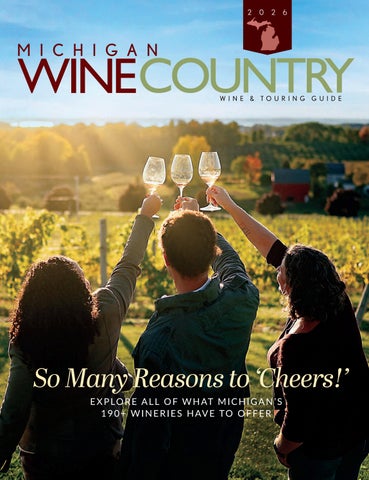
EXPLORE ALL OF WHAT MICHIGAN’S 190+ WINERIES HAVE TO OFFER
Features
TRAVEL
21 15 Reasons to Visit Michigan Wine Country
From 45th-parallel Rieslings to cherry wines and panoramic views to farm-totable feasts, Michigan pairs cool-climate craft with freshwater beauty.
NA DRINKS
28 On the (Band)Wagon
Michigan wineries respond to the demand for nonalcoholic options.
RED WINE
Visit michiganwinecountry.com for the latest news and information about Michigan wineries and tasting rooms. You can also sign up for our e-newsletter under the CONTACT tab.
30 The Red
Secret
The Great Lakes State embarks on a bold new chapter in viticulture.
LOVE STORIES
32 Perfect Pairings
These local couples have found love in Michigan’s wine scene.
CHEFS
34
Wining and Dining
Michigan wineries showcase their bounty through culinary experiences curated by in-house chefs.
PAIRINGS
47 Cool and Unusual
Oak & Reel’s wine director shares some of her favorite unconventional food pairings.
Departments
7 GRAPEVINE
Award-winning wines; stages of grape growth; Traverse City Food & Wine fest; PIWI grapes; Michigan by the Bottle; wine trails; Michigan wine by the numbers; Taste Michigan; festivals and events; tasting tips; and Wine Folly’s Michigan guide.
37 MAPS AND LISTINGS
Michigan’s wineries and tasting rooms.
48 THE FINISH
Master sommelier Madeline Triffon discusses what she knows best.
views of the Old Mission Peninsula from Chateau Chantal’s vineyard. Photo by Tom Balazs at Two Twisted Trees Photography.
Special thanks to:
Jenelle Jagmin, Michigan Craft Beverage Council
Emily Dockery, Michigan Wine Collaborative
STAFF
(And their picks for some Michigan wines )
Associate Publisher Ed Peabody / epeabody@hour-media.com Auxerrois
Art Director Kevin Martin Bel Lago’s 2016 Pinot Noir
Special Projects Editor Morgan Brown
Production Manager Crystal Nelson Drew Ryan Wines’ 2024 Rosé
Production Assistant Alessandra Taranta
Advertising Director Jason Hosko / jhosko@hour-media.com
Chateau Chantal’s Cerise Noir
Media Advisors
Cynthia Barnhart cbarnhart@hour-media.com
Brys Estate’s Pinot Grigio
Hannah Brown hbrown@hour-media.com
Cathleen Francois cfrancois@hour-media.com
Shady Lane Cellars’ Sparkling Riesling
Maddy Gill mgill@hour-media.com
Aurora Cellars’ Brut Rosé
Contributors Emily Dockery, Kathy Gibbons, Becky Kalajian, Will Reaume, Greg Tasker, Wensdy Von Buskirk, Lauren Wethington
To sign up for our e-newsletter, please visit: michiganwinecountry.com/e-newsletter-signup
CEO Stefan Wanczyk / President John Balardo
Explore 10 distinct wineries just minutes from Traverse City, each offering unique wine and culinary experiences, all surrounded by the breathtaking beauty of Old Mission Peninsula.
DOWNTOWN TRAVERSE CITY
Wine Tasting
Rudbeckia
Spare
Raise a Glass to ese Award-Winning Wines
MICHIGAN WINERIES ARE MAKING WAVES ON THE COMPETITION CIRCUIT
BY LAUREN WETHINGTON
Michigan wines can hang with the finest pours from Napa, New York, and even Europe — just ask the judges. Wineries from across the state made strong showings at national and international competitions over the past year, earning top accolades for white, red, and sparkling varieties. Here are some of this year’s biggest winners.
2025 Finger Lakes International Wine and Spirits Competition
Best of Class winner: 2023 sparkling wine, Cody Kresta Vineyard & Winery
Double gold medal winner: La Crescent, Fox and Hen Winery
2025 New York International Wine Competition
Gold medal winners: Cabernet Franc, Boathouse Vineyards
Chardonnay, Boathouse Vineyards
Syrah, Boathouse Vineyards
2026 San Francisco Chronicle Wine Competition
Best of Class winners:
2024 Sauvignon Blanc, Aurora Cellars
Cranberry Moscato, Farm Fresh Wine Co.
2023 Gewürztraminer, Rove Winery at the Gallagher Estate
As Michigan’s only statewide, industrydriven wine competition, the Taste Michigan Governor’s Cup uses professional blind taste tests to select the state’s best offerings. Judges sampled more than 150 wines from 33 wineries before awarding the 2025 cup to Cherry Creek Cellars for its 2023 Charamar Collection Pinot Noir. Along with Cherry Creek, eight other wineries took home Best of Category awards:
Vinifera red: 2023 Charamar Collection Pinot Noir, Cherry Creek Cellars
Vinifera white: 2023 Nadar Chardonnay, Golden Muse Winery
Hybrid red: Dune Shadow red blend, White Pine Winery
Hybrid white: 2023 Vignoles, French Valley Vineyard
Sparkling: Grace brut rosé, Mawby
Rosé: 2024 Cabernet Franc rosé, Verterra Winery
Fortified: Solera cream sherry, St. Julian Winery & Distillery
Sweet/dessert: 2023 late-harvest Riesling, Bel Lago
Cider: Harrison cider, Two K Farms Cidery & Winery
Cherry Creek Cellars’ 2023 Charamar Collection Pinot Noir
One Step at a Time
HERE’S HOW GRAPEVINES GROW FRUIT READY FOR WINEMAKING
BY KATHY GIBBONS
EVER WONDERED WHAT HAPPENS IN THE VINEYARD BEFORE HARVEST? While the timing can vary depending on the region, the stages of grape growth are pretty predictable. Here, Esmaeil Nasrollahiazar, a viticulture extension educator with Michigan State University Extension, explains the phases that take grapes from a glint in the grower’s eye to a drop in a consumer’s glass.
Dormancy
Buds are visible, but you can’t see evidence of growth. “Some people think dormancy is sleeping,” Nasrollahiazar says. “This is not accurate. Many physiological things are happening.”
Bud Swell
When temperatures rise in spring, roots begin taking up water and sending it — along with other signals — to the buds. That causes bud swell, meaning buds become larger as they hydrate. As development continues, green or pink tissue becomes visible in healthy buds, which move from bud swell to bud break.
Bud break is when things get more visually interesting, as pink and green colorations — unique to each variety — are more noticeable. “From bud break to harvest, everything is happening back-toback,” Nasrollahiazar says. “It’s very fast, based on heat — how much they get from the sun or radiation from the soil.”
An example of just how fast this process can move: On May 31, 2025, shoots were around 3 inches in the Grand Traverse region. By June 5, they were 15 inches.
Fruit Set and Growth
Grapes start out very small and firm. They continue to grow and eventually reach bunch closure. That’s when they are touching one another, forming a cluster.
Now, it’s time for ripening. The grapes begin to soften and change color as sugar accumulation accelerates.
Ready for Harvest
Growers choose when to pick the grapes based on the variety and the type of wine to be made. “The winemaker does a fruit analysis [for] the quality in terms of sugar, acid, tannins,” Nasrollahiazar says. Sugar content should be high, and the grapes will be soft.
Prebloom/Bloom
Shoots grow in stages now. At 4 to 8 inches, the grower thins the shoots — “Not overcropping, not undercropping, ... just removing the excessive shoots to open up the canopy,” Nasrollahiazar says.
At 10 to 16 inches, flower clusters are clearly visible. “After 10 to 16 inches, the lengths of the shoots don’t matter,” Nasrollahiazar says. “Our focus is to see how the clusters are developing.”
Finally, buds don’t bloom the way you might think. There’s a cap that separates from the leaf, exposing the flower’s reproductive parts.
As for how long the whole process takes, Nasrollahiazar says it varies based on heat accumulation. In general, it can take from roughly April to September or October for plants to go from bud swell to harvest, depending on the grapes and the region within Michigan.
Veraison
Bud Break
Celebrate Northwest Michigan’s Bounty
THE TRAVERSE CITY FOOD & WINE FESTIVAL RETURNS IN 2026 AFTER A STELLAR INAUGURAL
BY EMILY DOCKERY
In 2025, Traverse City Tourism launched an annual celebration of all things local, flavorful, and distinctly northern Michigan.
The inaugural Traverse City Food & Wine festival brought together wineries and culinary talent for a five-day showcase that blended agriculture, craft, and community.
Beyond wine tastings and pairing events, the festival wove together elevated dining experiences, aquatic excursions, and celebrity chef appearances — offering guests the chance to connect with personalities like Antoni Porowski of Queer Eye and Food Network’s Tyler Florence. The festivities culminated with the Grand Tasting at the Open Space park.
According to Whitney Waara, chief operating officer of Traverse City Tourism, the essence of the event is community.
“Our weeklong experience is rooted in what’s locally grown, locally made, and thoughtfully curated; we’re just really lucky and have access to so much that is in season at that time of year,” Waara says. “But also [key is] the access to over 50 wineries and distillers using local grapes and grains and folks that are really very thoughtful and intentional about including what is available here as a part of what they are putting forth to the world.”
Planning the inaugural festival was a labor of
YEAR
love, Waara says, but the reward was crafting an experience that united local businesses while inviting visitors to feel like participants — not just spectators.
2025’s offerings included a range of activities and programs:
Wine Experiences
Wine anchored the festival, with events ranging from curated pairing dinners and vineyard barbecues to immersive educational experiences.
At Dune Bird Winery, guests joined the resident “ducks on duty,” who serve as pest-control “allies,” to walk vineyard rows while learning about regenerative farming practices and sustainable viticulture. The program served as a reminder that wine growing is as much about stewardship of the land as it is about what ends up in the glass.
Bay Cruises
Traverse City’s relationship with water took center stage during sailboat excursions on Grand Traverse Bay. Guests who secured passage on these cruises enjoyed sweeping views of the peninsulas while sampling Michigan wines and thoughtfully paired cuisine. The experiences highlighted the influence of terroir — and especially the Great Lakes — on the region’s wines.
Celebrity Chef Programming
Chefs including Food Network’s Tyler Florence, Top Chef winner Mei Lin, and James Beard Award winner Celina Tio hosted demonstrations, dinners, and discussions that offered attendees both inspiration and insight, pairing national culinary talent with the region’s bounty.
The Grand Tasting
The festival’s crescendo unfolded at the Open Space park, where wineries, breweries, restaurants, and other establishments gathered to present their signature offerings. Attendees enjoyed live cooking demonstrations along with chef interviews on the main stage, hosted by national celebrities Carter Oosterhouse and Amy Smart Oosterhouse, co-owners of Bonobo Winery on the Old Mission Peninsula.
Festival organizers promise upgrades for the 2026 event, taking place Aug. 19-23. Waara shares that this year’s programming will increase budgetfriendly offerings, highlight farmers market producers, and expand chef demonstrations at Open Space.
“I think you’ll see a lot of the partners coming back that were involved in 2025 with a couple of new ones and lots of new content,” she says. “We’re going to have people’s stories be at the center of this. Storytelling is such a key component.”
For Michigan’s wine community, this festival represents more than a celebratory weekend. It is a platform to educate visitors and residents about the region’s vineyards, winemakers, and agricultural partners. And it’s an opportunity for wine lovers to raise a glass to the lands and lakes that make it all possible.
Guests enjoyed food, wine, and good company at the 2025 Traverse City Food & Wine festival’s opening party and Chef’s Table dinner.
PIWI Grapes, Big Results
NEW DISEASE-RESISTANT VARIETIES HOLD PROMISE FOR A SUSTAINABLE WAY FORWARD
BY KATHY GIBBONS
Innovative grape varieties called PIWIs being tested on a small scale in Michigan could have a big impact on sustainability and yield here.
Over two-thirds of Michigan wine grapes are currently Vitis vinifera European varieties suited to Michigan’s climate, such as Riesling, Pinot Noir, Chardonnay, Pinot Gris, and Cabernet Franc. Most, if not all, are susceptible to fungal diseases like powdery and downy mildew, both of which can hamper yield and fruit quality.
Short for the German pilzwiderstandsfähig, meaning “fungus resistant,” PIWIs are hybrids that have been developed in Germany and a few other European countries for decades and bred to be resistant to those fungal diseases. They require a fraction of the pesticides other varieties do, reducing costs and impact on the environment.
Chateau Chantal on the Old Mission Peninsula is among a few Michigan wineries testing out the newly imported PIWIs, with about a half-acre planted so far. Head Winemaker Brian Hosmer explains that his predecessor, the late Mark Johnson, originally obtained funding to spearhead research into cold-hardy and diseaseresistant European grapes because he saw their potential for Michigan.
“We have been somewhat stagnant for hundreds of years in that the top five varieties haven’t changed that much,” Hosmer says. “Europe has gone on this track to try and develop disease-resistant varieties.”
Johnson worked with two local partners plus Amberg Grapevines in New York’s Finger Lakes region to introduce PIWI grape varieties from Europe to the U.S. He chose the first four types that were ultimately imported from Germany: whites Johanniter, Helios, and
Muscaris, along with a red, Monarch. The plants first had to be quarantined for a couple of years to ensure they were healthy before going into the ground at Chateau Chantal about six years ago, Hosmer says.
Andrew Backlin, president and sustainability chair at the Michigan Wine Collaborative and winemaker and proprietor at Modales Wines in Fennville, says Modales planted about 2 acres of Regent — another red PIWI variety — in 2019.
“We’ve been very impressed with the results,” he says. “We’ve sprayed about half as much as with Vitis vinifera.”
Derrick Vogel and Izabela Babinska, husband-and-wife owners of Folklor Wine & Cider south of Charlevoix, have planted about 800 Muscaris vines. They did a light harvest in 2025 and are using the grapes in an estate blend. In 2026, they’re planning to make a stand-alone batch to “really see what it can do,” Vogel says.
“We’ve done a really small batch two years ago,” he says. “I loved it. It has pretty unique aromatic profiles.”
Small batches made from the Old Missiongrown PIWIs were offered for tastings at the 2026 Northwest Michigan Orchard and Vineyard Show.
“They tasted pretty good,” Hosmer notes. “They’re very different varieties. Flavor-wise, they’re all pretty interesting.”
Backlin says Modales began making wines with Regent grapes in 2022, using them for its annual Nouveau last year and blending them
into rosé. “We’ve played around with it,” he says. “It’s been very versatile. It’s just getting to know a new grape.”
Backlin says Michigan State University has been a collaborator on “newer generations” of PIWIs. “There are many new hybrids that are much better than Regent,” he says. “It’s just what nurseries had when we planted it.”
Even as PIWIs spread on a wider scale, Hosmer notes that the public will need to be educated about them. “People aren’t familiar with the varieties and the names,” he says. “You might suggest they try this Muscaris and they [say], ‘What’s that?’”
But Backlin says consumers will want to get to know them.
“PIWIs bridge the gap” between FrenchAmerican hybrids and vinifera, he says. “They make great wines and are better for the environment.”
Advanced sommelier Amanda Danielson, who owns Trattoria Stella in Traverse City, has been working with MSU viticulture professor Paolo Sabbatini to seek grants that could advance PIWI grape growing in Michigan.
“I don’t think PIWIs are going to replace vinifera — nor should they — but what they can do is offer an alternative to grape varieties that have historically been difficult to grow or cause crop loss,” she says, adding, “We’re talking about farming PIWIs with the intention of making wines that are world class.”
A PIWI grapevine planting takes place at Chateau Chantal in May 2021.
Michigan by the Bottle Grows Under New Leadership
THE CHAIN’S NEW LOCATION AND UPDATED TASTING ROOMS BRING MICHIGAN WINE TO MORE PEOPLE
BY LAUREN WETHINGTON
New life is being breathed into Michigan by the Bottle, a beloved chain of metro
Detroit tasting rooms serving exclusively
Michigan-made wines. Purchased by new owners — siblings Taylor and Sam Simpson of Simpson Family Estates and father-son duo Paul and Geoff Hamelin of Verterra Winery — in June 2025, the brand launched its fourth location in Lake Orion earlier this year. In addition, the locations in Auburn Hills, Royal Oak, and Shelby Township received fresh coats of paint, new soft seating, and updated retail areas.
“We have amazing longtime customers who love Michigan by the Bottle,” says co-owner Taylor Simpson, who also owns Good Harbor Vineyards and Aurora Cellars with her brother, Sam Simpson. “And we’re
starting to see a beautiful marriage of longtime advocates and the excitement of new customers who are just discovering it for the first time.”
Less than a month after the grand opening of the Lake Orion tasting room, Simpson and company were already eyeing potential sites for the next Michigan by the Bottle location.
“From the beginning, our vision was to open more locations to be able to bring this concept to more people in Greater Detroit and then hopefully around the state,” Simpson says. “We’re just taking it step by step because there’s a lot involved with it.”
MICHIGAN WINERIES BY THE BOTTLE
Find offerings from these Michigan wineries at Michigan by the Bottle tasting rooms:
Aurora Cellars
Brys Estate Vineyard & Winery
Bonobo Winery
Blustone Vineyards
Chateau Chantal
Dablon Vineyards & Winery
Domaine Berrien Cellars
Good Harbor Vineyards
Mackinaw Trail Winery
Modales Wines
Peninsula Cellars
Rove Winery at the Gallagher Estate
Verterra Winery
Check with Michigan by the Bottle for the most up-to-date information.
Follow the Trail
EXPLORE SEVERAL TASTING ROOMS IN ONE REGION ALONG THESE SEVEN WINE TRAILS
Michigan’s wine trails make it easy to visit multiple tasting rooms in one trip and get a well-rounded sampling of what an individual region has to offer.
During your next visit to Michigan wine country, check out one of these seven trails around the state.
Lake Michigan Shore Wine Trail
Located in the southwest corner of the state right by Lake Michigan, this wine trail includes 14 wineries and three additional tasting rooms that weave through two American Viticultural Areas: Lake Michigan Shore and Fennville. miwinetrail.com
Winery on this trail that offers lodging: Fenn Valley Vineyards
Leelanau Peninsula Wine Trail
e Leelanau Peninsula Wine Trail, part of the Leelanau Peninsula AVA in scenic northern Michigan, boasts 22 member wineries. lpwines.com
Wineries on this trail that offer lodging: Aurora Cellars, Bel Lago, Black Star Farms, Dune Bird Winery, Green Bird Cellars, and Silver Leaf Vineyard & Winery
Makers Trail
Numerous wineries — as well as cideries, breweries, and distilleries — are included in this trail, which celebrates the great beverage makers of southwest Michigan. makerstrail.org
Wine business on this trail that offers lodging: Moersch Hospitality Group, parent company of Round Barn and Tabor Hill
Old Mission Peninsula Wine Trail
Ten wineries participate in this wine trail, whose peninsular home north of downtown Traverse City constitutes its own AVA and
is surrounded by water, making for stunning views. ompwinetrail.com
Wineries on this trail that offer lodging: Brys Estate Vineyard & Winery, Chateau Chantal, and Chateau Grand Traverse
Petoskey Wine Region
is wine trail is home to 14 unique stops — ranging from rustic to trendy — serving a variety of wines in the Tip of the Mitt AVA. petoskey.wine
Wineries on this trail that offer lodging: Cellar 1914 and Mackinaw Trail Winery/ Resort Pike Cidery & Winery
River Raisin Wine Trail
e River Raisin Wine Trail unites four wineries in southeastern Michigan: Cherry Creek Cellars in Brooklyn, Chateau Aeronautique Winery in Onsted, Flying Otter Winery in Adrian, and Pentamere Winery in Tecumseh. visitlenawee.com/ plan-your-visit/trip-ideas/wine-tour
U.P. Wine Trail
Gear up for an epic road trip and “uncork the north” on the U.P. Wine Trail, which connects seven wineries spread throughout the Upper Peninsula. winetrailup.com
• May 15-17
Wine with a Twist lpwines.com/wine-with-a-twist
• May 29-June 7
Spring into Summer! lpwines.com/spring-into-summer
• August 19-23
Traverse City Food & Wine Festival traversecity.com/food-wine
Michigan’s wine trails — and their members — change from time to time. Please contact the individual trails and/or member wineries for the most up-to-date information.
Keep tabs on the Leelanau Peninsula Wine Trail’s events page at lpwines.com/ upcoming-events for more coming later in the year!
wish you were here.
It’s not just a destination – it’s the destination. Sip, savor, and see why Travel + Leisure calls Traverse City the “Napa of the Midwest.”
Downtown Traverse City
Nine elegant guest rooms with period furnishings and private baths
Two-bedroom carriage house suites
Walk two blocks to downtown shops, restaurants, theatre and beaches
Located midway between the Wineries of Old Mission and Leelanau Peninsulas
230 Wellington Street, Traverse City, MI 231-922-9200 www. WellingtonInn.com
2026 Festivals and Events
MAY
Petoskey Uncorked (May 16)
Sample wines — and enjoy hors d’oeuvres and live music — from the Petoskey Wine Region’s 14 different wineries. petoskey.wine/upcoming-events
Spring into Summer! (May 29-June 7, Leelanau Peninsula Wine Trail)
Try soon-to-be-released wines before anyone else at this event on the Leelanau Peninsula Wine Trail. lpwines.com/spring-into-summer
JUNE
Art, Beer, and Wine Festival (June 6, Jackson)
Southeast Michigan’s Wine Trail!
Ella Sharp Museum’s 21st annual festival will feature Michigan wineries, cideries, and breweries; food vendors; local artists; and live music. ellasharpmuseum.org/classes-and-events/artbeerwine
e Michigan Wine Collaborative is bringing the state’s wineries back to Detroit for another iteration of its “Taste Michigan Invades …” event series. michiganwinecollaborative.com/category/events
Fenn Valley Wine Festival (June 27, Fennville)
Join Fenn Valley Vineyards for a celebration of local wine. is annual event features tastings in the vineyards, local food, live music, and more. fennvalley.com/wine-festival-and-open-house
Michigan Wine Festival (June 27, Ypsilanti)
e Michigan Firehouse Museum is partnering with the Michigan Wine Collaborative to launch this festival showcasing wines and winemakers from across the state.
michiganwinecollaborative.com/category/events
JULY
Summer Wine & Wool Festival (July 18, Jackson) is annual event at Sandhill Crane Vineyards combines the textile arts with — what else? — wine. sandhillcranevineyards.com/events
AUGUST
Tawas Uncork’d (Aug. 1)
Enjoy wine, ale, and food at this festival at Harbor Park in East Tawas. facebook.com/TawasUncorkd
Suds on the Shore Craft Beer + Wine Festival (Aug. 15, Ludington)
Head to the beach town of Ludington to sip on Michigan craft beverages at this annual festival. sudsontheshore.com
Traverse City Food & Wine Festival (Aug. 19-23)
At this second annual festival, renowned chefs and Michigan winemakers will come together to celebrate the region’s flavors. traversecity.com/food-wine
Enjoy wine tastings and small bites to commemorate the harvest at participating wineries along the Petoskey Wine Region trail. petoskey.wine/upcoming-events
Wine and Harvest Festival (Sept. 11-13, Paw Paw)
Celebrate the harvest season with wine tasting, grape stomping, a vineyard bike tour, an arts and crafts show, a parade, and much more at this bustling festival in Paw Paw. wineandharvestfestival.com
OCTOBER
The Vine Wine’d (Oct. 3, Fennville)
Work up a sweat and enjoy the sights and smells of the harvest season at Fenn Valley Vineyards’ 14th annual race day featuring 5K and 1-mile courses winding through scenic vineyards. fennvalley.com/vine-wined
NOVEMBER
Soups, Stews and Chili (Nov. 7, Petoskey Wine Region)
As the weather turns brisk, warm up with soup, stew, or chili — along with wine — at participating tasting rooms. petoskey.wine/upcoming-events
DECEMBER
Nouveau Festival (Dec. 5, Fennville)
Commemorate the first wine of the new vintage — a dry, fruity red with a smooth finish — at Fenn Valley Vineyards’ 36th annual Nouveau Festival.
Event information is subject to change. Confirm the details before you attend.
Good Taste
FOLLOWING THESE TIPS WILL HELP YOU ENJOY YOUR MICHIGAN WINE TASTING TO THE UTMOST
BY GREG TASKER
In Michigan, wine tasting isn’t an Olympic sport; it’s a casual celebration of the country’s “ ird Coast.” Rather than demanding a suit and tie and respectable silence, Michigan’s tasting rooms prefer you bring a sense of curiosity and a comfortable pair of boots. Even so, knowing the right etiquette will help you make the most of your tasting experience.
Keep an Open Mind
Every producer has a unique way of showcasing familiar grapes. A Michigan Chardonnay will naturally taste different than one from California or France. “You wouldn’t go to an Italian winery and tell them how their wine should taste,” says Kasey Wierzba, executive winemaker and general manager at Shady Lane Cellars in Suttons Bay. “Be open to the local expression of the fruit.”
Being open also extends to sampling wines outside your wheelhouse. If a winery doesn’t pour sweet wines or another style you like, let the staff offer other choices. “It’s fun to go on a journey, and you may find things you never knew
Read
All About It!
WINE FOLLY’S MICHIGAN REGION GUIDE SERVES AS AN EDUCATIONAL RESOURCE ON THE INDUSTRY
you liked,” Wierzba adds. “Our taste buds and preferences change.”
Don’t Be Afraid to Ask (or Discard)
A tasting is an opportunity to learn, not a test. Ask questions about the soil, the vintage, food pairings, or the aging process. And if a particular pour isn’t to your taste? Don’t feel obligated to finish it.
“It’s not an insult,” says Matthew Dodson, tasting room manager at Amoritas Vineyards on the Leelanau Peninsula. “It’s not rude to swish and spit. A lot of guests think they have to finish every sample, even if they don’t like it.”
Check Before You Go
Every estate has different policies regarding pets, children, and outside food. “Before you pack the
Want to learn more about Michigan wine?
car with a picnic basket and the dog, check the winery’s specific rules,” suggests Sarah Carlson, tasting room manager at Modales Wines in Fennville. “While we may allow pets on a leash, others might not. If you have kids in tow, giving the winery a heads-up helps us ensure the experience is enjoyable for everyone.”
Make Reservations
Many wineries shifted to reservation-based models a few years ago, and the trend has stuck because it improves the guest experience. “We want you to have a great visit,” Carlson explains. “Calling ahead ensures we have the proper staffing and space available to make your time with us special.”
Read the Room
Regardless of the size of your group, be mindful of the environment. A tasting room is a shared space. “Your experience should be guided by the staff,” Shady Lane’s Wierzba says. “Be willing to learn instead of simply plowing through samples and creating a ruckus.”
On a similar note, avoid wearing perfume or cologne. Not only will it diminish your ability to smell and taste the wine, but it will also have the same effect on those around you.
Don’t Forget to Tip
Gratuity is standard practice at tasting rooms across Michigan. Remember: You aren’t tipping on the retail price of the bottles you buy, but on the expertise and hospitality provided by the staff who guided you through the flight.
e educational platform Wine Folly has released a Michigan wine region guide to help curious readers explore the state’s industry. e guide joins 15 others covering regions such as Bordeaux, Chianti Classico, and Napa Valley. With these dynamic guides, which are updated over time, Wine Folly aims to “remove the barriers of entry to wine discovery by providing tools to learn about and explore the
world’s wines, wineries, and regions.”
In the Michigan guide, you’ll find sections on Michigan’s grape varieties, wineries, American Viticultural Areas, terroir, and industry history, as well as travel information and tips. At the bottom of each page, sources are linked for easy access to additional reading (spot Michigan Wine Country listed among them!).
Check out the guide at michigan.guides. winefolly.com.
15REASONS TO VISIT MICHIGAN WINE COUNTRY
BY WENSDY VON BUSKIRK
From 45th-parallel Rieslings to cherry wines and panoramic views to farm-to-table feasts, Michigan wine country pairs cool-climate craft with freshwater beauty
Savor the wine and the stunning views at Bonobo Winery on the Old Mission Peninsula.
“There aren’t a ton of wine regions where you have these beauti ful wineries that are overlooking these panoramic views of water and rolling hills and sunsets.”
—Trevor Tkach, president and CEO of Traverse City Tourism
1.
MICHIGAN’S ABUNDANT WATER, ROLLING HILLS, AND COOL CLIMATE make for not only prime grape growing but beautiful getaways. e state’s wine regions are framed by dunes and bays and stitched together by two-lane roads and tasting rooms where winemakers often pour their own vintages. It’s a place where agriculture meets artistry and where the sunsets can rival those anywhere in the country. Here are 15 reasons to plan a trip to the “Napa of the Midwest.”
Five AVAs, Five Distinct Vibes
“Everyone has their own unique identity,” Dockery says.
2.
Short Trips to Great Sips
Beyond the official AVAs, emerging areas like River Raisin and segments of the Upper Peninsula are expanding Michigan’s wine map. e result? Easy access.
Michigan is home to five federally recognized American Viticultural Areas: Fennville, Lake Michigan Shore, Leelanau Peninsula, Old Mission Peninsula, and Tip of the Mitt. Each reflects its own combination of soil, climate, elevation, and proximity to water, key elements that shape a wine’s terroir.
According to Emily Dockery, executive director of the Michigan Wine Collaborative, each area has its own personality. Southwest Michigan’s Fennville and Lake Michigan Shore AVAs lean agricultural and community driven. e Old Mission and Leelanau peninsulas are defined by panoramic bay views and scenic routes. e Tip of the Mitt is innovative, embracing cold-hardy hybrids and new frontiers.
“I don’t think there’s anywhere in Michigan, except maybe some corners of the U.P., where you’re more than an hour from a winery,” Dockery says.
Michigan wine country is also just a short road trip from neighboring states. For Illinois or Indiana residents, that might mean a drive to the Lake Michigan Shore. For visitors from Wisconsin, it’s a U.P. adventure. Ohioans can
The sun sets over Chateau Grand Traverse on the Old Mission Peninsula.
3.
It’s a weekend habit waiting to happen.
The Sweet Spot
choose from wineries on the eastern side of the state or make their way west to an AVA.
4.
e Leelanau and Old Mission peninsulas sit along the 45th parallel, the same latitude as Bordeaux, France, and Piedmont, Italy. Southwest Michigan, including the Fennville and Lake Michigan Shore AVAs, benefits from similarly favorable cool-climate conditions but a longer growing season.
6.
en there’s the Great Lake effect, which regulates temperatures, protecting vines from the harshest weather in winter and extending the growing season in fall.
“ e proximity to the water, the rolling hills, the sandier soil — all of it really lends itself to being proficient in growing grapes,” says Trevor Tkach, president and CEO of Traverse City Tourism.
Rock-Star Rieslings
Riesling was one of the first European wine grapes to be planted in Michigan, and the variety continues to be exceptionally well suited to the region. Pinot Gris, Gewürztraminer, and cool-climate Chardonnay also shine.
5.
Rosé All Day
“It started with whites,” Tkach says. “ ose are probably what we’re most well known for.”
Rosé has become a Michigan summer staple, and for good reason. e signature pink-hued wine can be crafted from a range of grapes that can handle Michigan’s unpredictable weather.
“ ose weird, funky, cool hybrid varieties make beautiful rosés,” Dockery says. “ at is something that every single wine producer can make.”
Crisp, fruit-forward, and picnic-ready, rosé feels tailor-made for lakeside afternoons.
Fruity Favorites
Michigan is one of the nation’s top fruit-growing states, and vintners make the most of it. From blueberry and strawberry to peach and apple, fruit wines reflect the agricultural abundance beyond grapes.
Cherry wine in particular is a northern Michigan icon, thanks to the region’s tart cherry orchards (Traverse City isn’t known as the Cherry Capital of the World for nothing!).
7. Award-Winning Vintages
Michigan wines are no longer under the radar. ey’re earning national and international acclaim. Leelanau and Old Mission Peninsula wineries recently captured dozens of gold and double gold medals at the 2026 San Francisco Chronicle Wine Competition, including multiple Best of Class awards.
Producers from the Lake Michigan Shore and beyond consistently score high at competitions across the country — bringing home additional double gold medals from the San Francisco Chronicle Wine Competition and others — which underscores the state’s growing reputation. What was once a regional secret is now drawing attention from serious wine enthusiasts.
(Find more award-winning Michigan wines on page 7.)
Toast to Michigan’s bountiful agriculture at Shady Lane Cellars in Suttons Bay.
Enjoy outdoor seating and live music at Round Barn Estate in Baroda.
8.
Unparalleled Views
Few places pair world-class pours with freshwater vistas quite like Michigan. On the Old Mission Peninsula, wineries boast views of both East and West Grand Traverse Bay. Brys Estate Vineyard & Winery’s expansive deck overlooks neatly planted vines cascading toward East Bay — just one example of the many Michigan vineyards surrounded by breathtaking scenery.
“ ere aren’t a ton of wine regions where you have these beautiful wineries that are overlooking these panoramic views of water and rolling hills and sunsets,” Tkach says.
9.
Wonderful Wine Trails
—Emily Dockery, executive director of the Michigan Wine Collaborative
10.
Self-guided wine trails make exploration easy and immersive. Pick up a passport (for select trails), follow a mapped route, and taste your way through a region. Some trails also offer events and special deals. Options include the Lake Michigan Shore Wine Trail, Leelanau Peninsula Wine Trail, Makers Trail, Old Mission Peninsula Wine Trail, Petoskey Wine Region, River Raisin Wine Trail, and even the U.P. Wine Trail. (Read more about the trails on page 12.) Whether you’re traveling with friends or plotting a romantic escape, wine trails
Four-Season Fun
“Those weird, funky, cool hybrid varieties make beautiful rosés. That is something that every single wine producer [in Michigan] can make.”
Wine country adventures run all year long. Beach days and water activities define the warm months, and fall foliage transforms vineyard backdrops into blazing canvases of red and gold
11.
of activities, including arts and crafts, game nights, book clubs and fairs, themed bingo, and karaoke. Agritourism experiences like goat yoga and lavender tours deepen the connection between land and table.
Delectable Dining
Michigan wineries understand the art of pairing. From estate restaurants sourcing local produce to chef-driven tasting dinners inspired by surrounding land and water, culinary experiences elevate the visit.
Tabor Hill Winery & Restaurant in Buchanan is known for using locally sourced ingredients designed to complement its wines (read more about Tabor Hill’s and other wineries’ chefs on page 34). French Valley Vineyard on the Leelanau Peninsula offers family-style raclette dinners using Leelanau cheese, while Coriander Kitchen & Farm in Detroit features Michigan wines to match with its produce grown on-site.
12.
Amazing Accommodations
Winter brings downhill and cross-country skiing as well as snowshoeing. Indoors, cozy tasting rooms with fireplaces and mulled wine greet visitors during the quieter seasons.
Many wineries host live music, hiking and biking trails, and seasonal festivals (find more events on page 16). In every season, winery visitors can partake in all manner
Why rush home when you can stay among the vines? Wine country accommodations range from vineyard inns to waterfront luxury hotels. Chateau Chantal’s bed-and-breakfast and the Inn at Black Star Farms consistently rank among travelers’ favorites, offering vineyard views and immersive tasting experiences. Along Grand
consistently
From left: Soak in the sunshine at Modales Wines in Fennville. You’re rarely far from the lakeshore (in this case Sleeping Bear Dunes National Lakeshore) in Michigan wine country. Fragrant lavender blooms in the Secret Garden at Brys Estate.
Michigan is home to 5 AVAs
The Leelanau and Old Mission peninsulas share the same latitude as Bordeaux and Piedmont
Michigan has 7 wine trails throughout the state
Traverse Bay, waterfront hotels like the Delamar provide refined comfort near town.
Elsewhere in Michigan, select wineries and nearby inns offer cozy, vineyard-adjacent stays that turn a tasting into a full escape. For the more adventurous, several wineries across the state partner with Harvest Hosts, a program where members can camp in their RVs at sites for no fee (besides a purchase from the winery).
13.Slow Travel Done Right
Slow travel — taking longer, more-intentional trips rooted in local culture — is on the rise. Rather than racing from stop to stop, travelers are choosing to linger, learn, and connect. Michigan wine country rewards that approach. Stay in one area. Talk to the winemaker. Walk the vineyard rows. Eat seasonally. Repeat.
It’s less about checking boxes and more about savoring moments.
14.Community and Craft
Behind every bottle is a family, a farmer, a dreamer. Many of the state’s wineries are multigenerational operations or passion projects turned thriving businesses.
You’re likely to meet the person who pruned the vines or crafted the vintage. at accessibility helps make every visit feel personal.
15.
Sparkling Souvenirs
When in doubt, bring bubbles home.
“Everybody likes sparkling wine,” Dockery says. “If I’m getting a bottle for somebody and I don’t know anything about what they like, usually it’s going to be a sparkling.”
Michigan’s climate lends itself well to sparkling production. Whether you prefer brut, rosé, or another style, sparkling wine makes a fitting souvenir. Bring it home as a gift to share or a memento to tide you over until your next trip to Michigan wine country.
Grand Traverse Pie Company
Grand Traverse Pie Company is celebrating three delicious decades, and we’re proud to share the “power of pie” across Michigan. Our pies begin with incredible ingredients from our agricultural partners, including the Sayler and Amos families who grow our cherries and apples, True Blue Farms for our blueberries, and Michigan Sugar and King Milling Company for the sugar and flour used in every handcrafted pie.
Our individually crafted pies are perfect for any day — holidays, special occasions, or a cozy night at home with Michigan ice cream or local wine. But we’re more than pie. Visit us for breakfast, lunch, or supper and enjoy homemade quiche, soups, sandwiches, salads, and our beloved chicken pot pie.
We’re passionate about supporting children and families, with founders Mike and Denise Busley championing advocacy organizations. Visit any of our 11 pie shops or find our pies in supermarkets and shipped nationwide, always handcrafted with love. Visit gtpie.com to learn more.
Grand Traverse Pie Company info@gtpie.com gtpie.com
On the (Band)Wagon
MICHIGAN WINERIES RESPOND TO THE DEMAND FOR NONALCOHOLIC OPTIONS
BY KATHY GIBBONS
Talk to Michigan winemakers about nonalcoholic wine, and you’ll get nearly universal feedback.
Yes, there’s a market for it.
A record-low 54% of adults report that they consume alcohol, according to a 2025 Gallup poll; for those ages 18 to 34, it’s 50%.
However, the equipment needed to produce nonalcoholic wine entails a substantial investment, easily in the hundreds of thousands of dollars.
Making it requires careful execution. Alcohol adds depth to a wine; removing it can affect taste and texture.
And nonalcoholic wine is not cheaper for consumers. It costs more to produce — after the wine is made, the alcohol (using that expensive equipment) is removed. Winemakers employ two main methods: vacuum distillation, in which wine is placed in a vacuum to lower the boiling point so that alcohol can be removed
at lower temperatures, which helps to preserve the flavors, and reverse osmosis, in which a membrane is used to separate alcohol from the rest of the wine’s components.
Despite the expense and difficulty, nonalcoholic wine is on Michigan wineries’ radar. Among those wineries is Mawby on the Leelanau Peninsula, which rolled out a nonalcoholic version of its bestselling Sex sparkling brut rosé in late 2024. e team called it Safe Sex, making it with Chardonnay grapes. “ e growth of that [nonalcoholic wine] category drove it — and the fact that we really want to be a brand that is delivering sparkling beverages to everyone, and not everyone drinks alcohol, or not everyone at any given time,” says Mawby co-owner Mike Laing. “We thought we should get into the space and put our own spin on it.”
Mawby found partners in California who had a low-temperature, low-pressure vacuum filtration system used to extract alcohol from wine. Even then, it was a process of trial and error and seeking feedback from customers. Selling at $19 — the same price as Sex — Safe Sex has been successful and represented 6% of Mawby’s total volume of wine sold in 2025, according to Laing.
Jenn Wozniak is the director of marketing for Moersch Hospitality Group, which operates Round Barn and Tabor Hill in southwest Michigan. She says the company is producing a nonalcoholic sangria that has struck a chord with tasting room visitors who are sober, designated drivers, or pregnant, among others.
“ ey don’t just want to have water, pop, or lemonade,” Wozniak says, noting that any cocktails on the menu can also be made into mocktails. “When they find out we have these types of offerings, it does make them happy.”
Moersch didn’t invest in extra equipment to make it happen, she notes. It was “just a great recipe development team.”
Black Star Farms on the Leelanau Peninsula offers a sparkling grape juice in a wine bottle, but it’s not wine, says managing
Michigan wineries have answered the call for nonalcoholic beverages in various ways, including a nonalcoholic counterpart to Mawby’s Sex rosé (above), alcohol-removed wines in several styles (below left), and a line of bottled mocktails (above right).
owner Sherri Campbell Fenton. She says it’s ideal for celebrations.
Additionally, the winery’s cocktail program includes other nonalcoholic options. “Many of our guests come after visiting other wineries and
would like to share a drink with their friends but don’t want more alcohol,” adds Christopher Lopez, retail sales manager.
While Paw Paw-based St. Julian Winery & Distillery has also been making sparkling nonalcoholic juices for decades, Nancie Oxley, vice president of winemaking, says the winery isn’t producing nonalcoholic wines because of the prohibitive cost of equipment and the challenge of getting the wine to balance as it should after alcohol is extracted.
Instead, St. Julian has invested in a line of juice-based bottled mocktails. ose came out at the start of 2026 and are available in the winery’s tasting rooms and at retail outlets.
Chateau Chantal on the Old Mission Peninsula
outsources the dealcoholization of the four nonalcoholic wines it’s producing, using two companies that apply different processes to see how results might differ. All were going into distribution at Meijer stores by May. So far, President and CEO Marie-Chantal Dalese says, Chateau Chantal’s 0% sparkling brut has been the most popular, and it also took home a judges’ selection award at the 2025 TEXSOM International Wine Awards.
Dalese says Chateau Chantal has considered investing in the equipment to complete the process on-site but is taking a wait-and-see approach.
“Is it a trend or here to stay?” she says. “It’s probably for the long haul as consumers decrease alcohol consumption for a variety of reasons.”
If any wines can succeed in this category, she believes Michigan’s likely can. “Michigan wines are a good starting point given the higher aromatics from our whites,” she says. “ ey seem to produce a more wine-tasting end product than some of the others we’ve comparison-tasted from the shelf.”
Family recipe Michigan fruit pies and desserts • Homemade sandwiches, salads and soups Fresh pressed cider from Crane’s apples • Fresh fruit in season • Local preserves, honey, maple syrup and more! • Small-batch hard cider and fruit wine • Premium Red and White Wine • Tasting bar with samples, bottles and growlers to take home with you!
www.cranespiepantry.com
e Red Secret
MICHIGAN EMBARKS ON A BOLD NEW CHAPTER IN VITICULTURE
BY GREG TASKER
There is a persistent myth that Michigan winemaking begins and ends with crisp, vibrant whites.
However, the state’s vineyards are harboring a “red-hot” reality. While critics and consumers once dismissed Michigan as too cold for world-class reds, the national wine scene is finally taking notice.
Recently, Forbes shined a spotlight on the Leelanau Peninsula, awarding stellar 93-point scores to red wines from Verterra Winery, Black Star Farms, and Boathouse Vineyards. From elegant Pinot Noirs to aromatic Syrahs, these bottles prove that Michigan reds have stepped out of the cellar’s shadow.
is momentum was further solidified by the 2025 Taste Michigan Governor’s Cup, where a red wine — Cherry Creek Cellars’ 2023 Charamar Collection Pinot Noir — took home the grand prize (see page 7 for more).
Distinct Regions, Distinct Wines
Because Michigan’s geography spans a vast north-to-south distance, the state’s viticulture can be defined by several distinct microclimates —
and five American Viticultural Areas. Success in these regions is no longer a matter of luck but of precisely matching the grape to the “dirt.”
“ ose regions have now settled into a set of really wonderful reds that thrive in those specific climates,” says Paul Hamelin, co-owner of Verterra Winery and a Michigan Wine Collaborative board member.
Hamelin notes that the industry has matured past its infancy. “We’ve moved past the experimental phase. We’ve finally identified the right grapes for the right soil, and the focus has shifted from simply surviving the winter to mastering the craft of winemaking itself.”
The South: Sun and Spice
In southwestern Michigan, the growing season gets a head start. Bud break typically begins in late April — two to three weeks earlier than in the north. While this early start leaves vines vulnerable to unpredictable spring frosts, the cumulative heat allows bolder varieties to reach full maturity.
According to Amy Birk, winemaker and operations manager at Domaine Berrien Cellars in Berrien Springs, the stars of the south are Cabernet Franc and Merlot. “Cabernet Franc is beautifully suited to Michigan,” Birk explains. “In our sunnier environment, those raw green pepper notes ripen into roasted pepper, black pepper, and even a hint of licorice.”
is “not the easiest grape to grow” and not common in Michigan. It may be the most dramatic grape in Domaine Berrien’s vineyards, but “the wines are absolutely gorgeous,” she says.
The North: Elegance and Resilience
Farther north, on the Leelanau and Old Mission peninsulas, the focus shifts toward complexity. Here, varieties such as Cabernet Franc, Pinot Noir, Merlot, and Gamay Noir thrive. Even farther north, at the “Tip of the Mitt,” which is its own AVA, vintners often rely on Marquette — a coldhardy hybrid and distant relative of Pinot Noir designed to withstand the harshest arctic blasts Michigan can deliver.
Gold Standard
e era of thin, overly acidic Michigan reds is in the past: “Fifteen years ago, it was almost unheard of for a red from northern Michigan to score a 90,” Hamelin says. “Now, it’s a regular occurrence. We aren’t just wishing for quality anymore; we’re producing it.”
She also notes that Michigan Merlot often possesses a foodfriendly balance that eludes its California cousins, maintaining a lower pH and bright acidity that keeps the wine refreshing rather than heavy.
Dave Bos, co-owner and winemaker at BOS Wine Garden in Elk Rapids, is an advocate for the power of the blend. His signature Shipwreck — a marriage of Pinot Noir, Blaufränkisch, and Lagrein — is pleasing palates across the region, Bos says. By blending varieties, Michigan winemakers are crafting a compelling new profile that offers complexity and consistency, regardless of the vintage.
As growers continue to experiment with varieties like Malbec and Blaufränkisch, one thing is fairly certain: Michigan’s red wines will continue to surprise the world — one bottle at a time.
“I find more and more people nowadays are surprised by the quality of Michigan reds,” says Birk, who is passionate about Syrah, which
Greg Tasker works part time as a wine educator on the Leelanau Peninsula. He has written about Michigan’s wine industry for e Detroit News, Michigan Blue, and other publications.
Pinot Noir
Merlot grapes
Perfect Pairings
THESE LOCAL COUPLES HAVE FOUND LOVE IN MICHIGAN’S WINE SCENE
BY BECKY KALAJIAN
In love and wine, there’s a certain kind of alchemy that just can’t be denied: You know perfection when you see it. The Michigan wine industry, defined by dreams, hard work, and long hours, is a ripe field for budding romance. Here, four couples share the story of how their love grew among the vines.
Cristin and Brian Hosmer
Interviewed on the day of their 18th anniversary, Cristin and Brian Hosmer say they met long before either imagined a life shaped by harvest schedules and cellar work.
The two were classmates together at Michigan State University, where they were paired for a group project in an environmental economics class. For three years, they were just friends.
Who eventually pursued?
“Oh, it was me,” Cristin says. “He was totally oblivious. He’s still oblivious.”
Post-undergrad, Brian says visiting wine regions in Europe nudged him toward graduate work in horticulture, and Cristin studied agricultural economics.
“Brian is the scientist,” Cristin says. “I’m more business minded.”
That balance has anchored their careers in northern Michigan’s wine industry. Brian has spent more than 18 years as a winemaker at Chateau Chantal on the Old Mission Peninsula, while Cristin has worked in production, consulting, and education.
As for being married and staying in the wine industry, Brian says it can be a true test.
“[The industry] will definitely test your relationship, so if you’re meant to be together and you’re willing to work things out, you’re going to be … on relationship steroids,” he says.
At their winery wed-
When they’re asked how they’ll celebrate their anniversary, the answer checks out: Brian suggests a 2012 Chateau Chantal Pinot Grigio.
“It’s very elegant,” he says, “unexpectedly ageworthy, and full of longevity.
“It reminds me of Cristin.”
Amy Birk and David Cockell
Amy Birk and David Cockell were working in different corners of Michigan’s beverage world, but their shared curiosity about fermentation, flavor, and community worked its magic to bring them together.
Birk is the winemaker and operations manager at Berrien Springs’ Domaine Berrien Cellars, where she has worked off and on for nearly a decade. Cockell, a former chemist, is co-founder and owner of the 10-year-old Watermark Brewing Co. in nearby Stevensville.
Their paths crossed about 10 years ago.
“I started noticing this young winemaker come into [Watermark], and she’d sit there reading about wine,” Cockell says.
Conversation naturally flowed from there — Cockell was interested in adding wine choices for non-beer drinkers.
“I began my wine education at the hands of Amy,” he says.
Birk’s take on their meeting is a little less cerebral.
“One night at the bar, I was like, ‘Oh, that guy’s pretty cute,’” she says, admitting that she was the first to recognize their chemistry.
Their relationship shifted into high gear after they attended a fellow beverage producer’s soft opening.
“We had a great conversation, had a couple drinks, and then he asked me out for dinner,” Birk says about the early days that eventually led to their 2024 wedding at the winery.
These days, their shared vision for southwest Michigan’s evolving beverage landscape is always top of mind, with future collaborations on the docket.
“We’ve got some fun stuff cooking up,” Birk says.
Holly and Kirk Peterson
Family is at the heart of Sandhill Crane Vineyards, both in its roots and in its leadership.
Owner Holly Peterson says the winery began 22 years ago through her father’s basement winemaking hobby, eventually leading to a
ding ceremony, Britta Dennis and Matt Killman each drank a wine the other had made to symbolize their union.
vineyard and full-fledged winery near Jackson.
“I loved wine [so] I became the winemaker pretty much from the beginning,” she says.
Years later, it was a winery worker who insisted her father meet Holly, calling her a “really cool lady.”
The father in question — Kirk Peterson, a machinist — made quick work of the suggestion, taking Holly to a Detroit Tigers game for a lowpressure test run.
“We had a lot of fun,” he says. “It just took off from there.”
When they first started dating, Holly says she was up-front about the realities of harvest season.
“I [told him], ‘You’re not going to see me in the fall — I’m here all the time,’” she says.
So Kirk did what any sensible man in love would do: He showed up and helped wherever he was needed, learning the ropes as he went.
When Sandhill Crane needed a vineyard manager a few years later, Holly says the decision to hire Kirk felt right.
“I told him, ‘If you want to quit your machining job and take a pay cut, there’s an opportunity,’” she says.
Kirk says the choice changed his life.
“I wish I would have done it 20 years earlier,” he says.
Holly says their roles now fit naturally: “Where one of us leaves off, the other picks up.”
Regarding what fosters romance in Michigan wine country, Holly says it’s “the whole package.”
Kirk adds that watching people enjoy something nurtured from grape to bottle is deeply fulfilling.
“It’s love in a glass,” Holly says.
Britta Dennis and Matt Killman
At Walloon Lake Winery, the partnership between Britta Dennis and Matt Killman has been defined by a deep understanding of what it means to work — and love — inside Michigan’s wine industry.
Killman says he moved to the Petoskey area for a job as an assistant winemaker at Mackinaw Trail Winery & Brewery just as Dennis’s family was opening Walloon Lake Winery.
“[Wine] brings people together. ... There’s a lot of love in this industry.”
—Britta Dennis, Walloon Lake Winery
Above: Amy Birk and David Cockell inhabit different areas of the beverage industry, but they collaborate in business and in life.
Right: Holly and Kirk Peterson were brought together by Holly’s family winery and now make natural partners.
Dennis, a Petoskey native, noticed a spark with the newcomer after they met at a local wine competition. Killman admits he was completely unaware.
“I thought we were just going to be friends,” he says, recalling a moment when a mutual friend had to spell it out. “He said to me, ‘Britta Dennis doesn’t need any new friends [in her hometown] — it’s a date.’”
At work, their roles reflect their personalities.
“I’m way more outgoing and talkative,” Dennis says, explaining why she thrives working in the tasting room, managing the wine club, and building guest relationships.
Killman says he prefers the cellar.
“I like my dark cave where I don’t have to talk to people,” he jokes.
But their palates align almost perfectly, they say.
Brian and Cristin Hosmer met as college students and have spent the past two decades supporting each other and building careers in the wine industry.
“Chardonnay is gross,” she says.
“We agree on about 98% of wine,” Dennis says, quickly adding the one exception: oaky Chardonnay, which Killman loves.
At their wedding, they sealed their vows with wines that they had each made that year.
“Instead of burning a candle, we drank each other’s wine,” Dennis says. (It was not an oaky Chardonnay.)
Now parents of two young children, including a newborn, the couple say wine continues to be the great unifier.
“[Wine] brings people together,” Dennis says. “Romantically or platonically — it’s really easy to make a connection based on that. There’s a lot of love in this industry.”
WINING DINING &
MICHIGAN WINERIES SHOWCASE THEIR BOUNTY THROUGH CULINARY EXPERIENCES CURATED BY IN-HOUSE CHEFS
BY BECKY KALAJIAN
Michigan’s wine story is no longer just about what’s in the glass — it’s also about what’s on the plate.
While many wineries offer dining ranging from pizza and small bites to wine dinners, some take it a step further with in-house chefs dedicated to serving culinary masterpieces. These wineries have become dining destinations, satisfying palates through food as well as drink — and creating a whole that’s greater than the sum of its parts.
A Perfect Complement
At Chateau Chantal in Traverse City, Executive Chef Randy Minish says pairing food and wine is about more than matching flavors.
“A good pairing is something you can only have with food,” Minish says. “It’s not the food; it’s not the wine. It’s both. It’s an experience that neither one can give you on their own.”
Chef Sam Williams agrees.
“I spent a lot of time cooking on the line, …
[and pairings] bring out a lot of great experiences,” says Williams, culinary director for Moersch Hospitality Group, which owns Tabor Hill Winery & Restaurant in Buchanan.
Dining can also elevate and complete a winery visit. Black Star Farms’ kitchens, inn, and event spaces make in-house culinary programming a natural fit to round out its offerings in its Leelanau County location.
“It allows us to provide a well-balanced experience for our guests — from breakfast to classes to dinner,” says Event Chef Leah Moerdyk, who is one of five culinary team members at the estate.
Beyond Cheese and Crackers
Black Star Farms’ culinary philosophy extends to inventive pairings and collaborative experimentation. Moerdyk says Black Star’s breadth of wines gives her the freedom to explore unexpected combinations.
“Unless there’s something really specific that [the tasting room manager] wants to pair a wine with, I’m able to have fun with it and then tweak anything [as needed],” she says.
That creativity came to life at a recent wine club dinner, which featured two of Black Star’s sparkling whites. Moerdyk created a mosaic tuna and salmon carpaccio bound with seaweed powder — a dish she says was “bright and fresh and looked gorgeous.”
Food not only complements but can also shine as “dinnertainment,” drawing the culinarily adventurous types.
“You come to taste the wine and enjoy southwest Michigan, but at the same time, you’re needing experience,” Williams says of visitors to Moersch Hospitality’s properties.
At Tabor Hill, that might mean a Hispanicinspired fine-dining dinner, a Farm to Tabor event spotlighting local growers, or a Chilean sea bass with pistachio crust paired with the winery’s Albariño.
Creating New Favorites
Food pairings can also help showcase and increase appreciation of certain wines. Minish points to a recent eight-course Fire & Ice dinner that featured the winery’s entire ice wine portfolio.
Ice wine, he says, is one of northern Michigan’s calling cards. Rather than reserving it just for dessert, he pairs it with savory courses, too.
“We’re really able to take that part of the product catalog for a walk [with a range of dishes],” he says.
Creative pairings can even help win over guests who might be skeptical of a certain wine, Williams says.
“All of a sudden, it becomes one of their favorites.”
Minish says he loves inspiring people new to Michigan wine through his menu, including combinations like wild mushrooms paired with Pinot Noir — “Classic, classic, classic.”
From the Land
Some wineries grow or forage their own produce for their chefs, focusing on both health and sustainability.
Wellness has taken top billing at Gilchrist Farm Winery. Owners Marc and Elizabeth Huntoon, physicians by training, opened the Leelanau County winery and restaurant in 2023 with a farmto-table focus from day one.
“We wanted to pair our wines with healthy food that’s approachable,” Marc says.
The couple grow produce in a three-quarteracre market garden tailored to their chef’s needs.
Executive Chef Joshua Sisco is “especially good at crafting dishes using our farm-fresh produce from our market garden,” Marc says.
At Veritas Estate Winery in South Haven, chef and co-owner Tim Schultz approaches food and wine as a partnership rooted in southwestern Michigan agriculture.
Schultz practices what he preaches. After harvest, he handpicks leftover clusters, transforming rescued wine grapes into small-batch jams and jellies.
He also forages mushrooms and pawpaw fruit, incorporating them into seasonal dishes and pairings, such as a white Cabernet Franc served with a specialty tiramisu featuring mushroom ice cream.
“It’s a lot of hard work,” he says of gathering plants from the property, “but we compost, and that includes grape products, so those grape skins and stems will be put back into the earth, which will help us produce our food, so it really does come full circle.”
It All Comes Back to Wine
Wine and winemaking byproducts themselves are sometimes used in the cuisine.
For a fall harvest dinner, Marc Huntoon says, the chef marinated beef short ribs in Red Deer, Gilchrist’s red table wine, then paired the dish with the same wine.
Minish borrows from the cellar in a creative way, using malic acid from the winemaking process to adjust acidity in desserts.
Black Star’s Moerdyk also incorporates winery byproducts, using dried barrel staves for smoking and verjus, which is created from pressing unripe grapes, for vinaigrettes, cocktails, and mocktails.
She also leans into hyperlocal ingredients, including those found right on the estate.
“We’re blessed to have tons of wild ramps on property,” Moerdyk says. “We pickle them, make pesto, grill them — I’m excited for the upcoming ramp season.”
For Moerdyk, those ingredients help tell a broader story about Michigan wine.
“What grows together goes together,” she says. “When you’re serving local wines with local produce, you get that locality and seasonality — and it elevates the flavor so much more.”
Schultz shares that viewpoint. “Great food and great wine separately are wonderful,” he says. “When you pair them together, it completes everything.”
This page: A farm greens salad from Black Star Farms and tiramisu with mushroom ice cream from Veritas Estate.
Opposite page: Wild rice crisps from Chateau Chantal and a smorgasbord of bread options from Gilchrist Farm Winery.
Chef Randy Minish
Chef Tim Schultz
Chef Leah Moerdyk
WINE COUNTRY
WINE & TOURING GUIDE
1 | 12 Corners Vineyards
2 | 468 Urban Winery
3 | The 707 Winery and Brewery
4 | Baroda Founders Wine Cellar
5 | Chateau Henderson, operated by West Main Hill winery
6 | Chill Hill Winery
7 | Cody Kresta Vineyard & Winery
8 | Cogdal Vineyards - Home of Little Man Winery
9 | Contessa Wine Cellars
10 | Corey Lake Orchards
11 | Country Mill Orchard & Winery
12 | Crane’s Winery
13 | Dablon Vineyards, Winery & Tasting Room
14 | Diamond Lake Orchard
15 | Domaine Berrien Cellars
16 | Dreihart Winery
17 | Fenn Valley Vineyards
18 | Filkins Vineyards
19 | Fox and Hen Winery
20 | Free Run Cellars
21 | Glass Creek Winery
22 | Golden Muse Winery
23 | Gravity
24 | Heronmark
25 | Hickory Creek Winery
26 | Hudsonville Winery
27 | Lake Michigan Vintners
28 | Lawton Ridge Winery
29 | Lazy Ballerina Winery
30 | Lehman’s Orchard
31 | Lemon Creek Winery
32 | Michigan Wine Co.
33 | Modales Wines
34 | Moonrise Winery
35 | Native Species Winery
36 | Pink Barrel Cellars
37 | Red Top Winery
38 | Robinette’s Apple Haus & Winery
39 | Round Barn Estate
40 | Sit and Stay Winery
41 | Solasta Winery
42 | St. Julian Winery & Distillery
43| Stoney Ridge Winery & Vineyards
44 | Stranger Wine Co.
45 | Tabor Hill Winery & Restaurant
46 | Tanglewood Winery
47 | Twine Urban Winery
48 | Vander Mill
49 | Veritas Estate Winery
50 | Vineyard 2121
51 | Warner Vineyards
52 | White Pine Winery
53 | Wyncroft
Southeast & Thumb
54 | 3 North Vines
55 | Barely There Winery
56 | B&B Wines
57 | Bella Vista Winery
58 | Belle River Winery
59 | Blake’s Hard Cider Co.
60 | Bløm Meadworks
61 | B. Nektar Mead, Cider, Beer
62 | Burgdorf’s Winery
63 | Cellar 104
64 | Chalice Craft Wine as well as additional tasting rooms around the state.
65 | Chateau Aeronautique Winery - Airpark
66 | Chateau Aeronautique Winery - Irish Hills
67 | Cherry Creek Cellars
68 | Dizzy Daisy Winery and Vineyard
69 | Fenton Winery & Brewery
70 | Filipo Marc Winery
71 | Flying Otter Vineyard and Winery
72 | Graham Vineyard & Winery
73 | Green Barn Winery
74 | Hoffman Farms Winery & Tasting Room
75 | Howell’s MainStreet Winery
76 | Maria’s Uncorked
77 | Meckley’s Cidery
78 | Northville Winery and Brewing Co.
79 | Pentamere Winery
80 | Russell B. Gregory Winery
81 | Sage Creek Winery
82 | Sandhill Crane Vineyards
83 | Shiny Apple Wines
84 | Sleepwalker
85 | Social Vines
86 | Spicer’s Winery
87 | Superior Lakes Mead, Wine, and Cider
88 | Tennerra Winery
89 | Twisted Cork Winery
90 | Uncle John’s Fruit House Winery
91 | Unwined Winery
92 | Vine-N-Berry
93 | Vinomondo Winery
94 | Vintner’s Canton Winery
95 | Washington Street Wine House
96 | WaterStreet Winery and Brewing Co.
97 | Westers Family Winery
98 | Westview Orchards & Winery
99 | Whole Hearted Winery
100| Wilson Estate Vineyards
101| The Winery North of 12
102| Youngblood Vineyard Northwest
103 | 2 Lads Winery
104 | 45 North Vineyard & Winery
105 | Amoritas Vineyards
106 | Annabelle Acres Vineyard & Winery
107 | Aurora Cellars
108 | Bel Lago
109 | Black Star Farms - Leelanau
110 | Black Star Farms - Old Mission
111 | Blu Dot Farm & Vineyard
112 | Blustone Vineyards
113 | Boathouse Vineyards
114 | Bonobo Winery
115 | BOS Wine Garden
116 | Bowers Harbor Vineyards
117 | Boyne Valley Vineyards
118 | Brengman Family Wines
119 | Brys Estate Vineyard & Winery
120 | Cadillac Winery
121 | Cellar 1914
122 | The Cellars of Royal Farms
123 | Chateau Chantal
124 | Chateau Fontaine
125 | Chateau Grand Traverse
126 | Cherry Republic
127 | Ciccone Vineyard & Winery
128 | Crooked Vine Vineyard & Winery
129 | Dune Bird Winery
130 | FarmHouse Vineyards
131 | Folklor Wine & Cider
132 | The Fox Barn Marketplace & Winery
133 | French Valley Vineyard
134 | Gabriel Farms & Winery
135 | Gilchrist Farm Winery
136 | Good Harbor Vineyards
137 | Green Bird Organic Cellars & Farm
138 | Gwin Girls Winery and Tasting Room
139 | Hawthorne Vineyards
140 | Heavenly Vineyards
141 | Jomagrha Vineyards & Winery
142 | Laurentide Winery
143 | Leelanau Cellars
144 | Left Foot Charley
145 | Lost Cellars
146 | Love Wines
147 | Mackinaw Trail Winery & Brewery
148 | Maple Moon Sugarbush and Winery
149 | Mari Vineyards
150 | Mawby/Big Little Wines
151 | North Branch Winery
152 | Northern Natural Cider House & Winery
153 | OBrien Vineyards
154 | Oceana Winery & Vineyard
155 | Peninsula Cellars
156 | Pere Marquette Winery
157 | Petoskey Farms Vineyard & Winery
158 | Pleasant Valley Farm and Vineyard
159 | Pond Hill Farm
160 | Resort Pike Cidery & Winery
161 | Rove Winery at the Gallagher Estate
162 | Rudbeckia Farm and Winery
163 | Seasons of the North Winery
164 | Shady Lane Cellars
165 | Silver Leaf Vineyard & Winery
166 | Soul Squeeze Cellars
167 | Spare Key Winery
168 | St. Ambrose Cellars
169 | Stone House Vinyards
170 | Tabone Vineyards
171 | Three Trees Vineyard
172 | Torch Lake Cellars
173 | Townline Ciderworks
174 | Two K Farms Cidery & Winery
175 | Verterra Winery
176 | Vista Ridge Vineyards
177 | Walloon Lake Winery
178 | WaterFire Vineyards
179 | Willow Winery - A Faulkner Family Vineyard
180 | The Winery @ Young Farms
Northeast
181 | Burrone Family Vineyards & Winery
182 | The Cellars at Zettel Farms
183 | Country Corner Winery
184 | Crazy Vines Winery
185 | Modern Craft
186 | Nicholas’s Black River Vineyard & Winery
187 | Rose Valley Winery
188 | Thunder Bay Winery
Upper Peninsula
189 | 1668 Winery and Soo Brewing Co.
190 | End of the Road Winery
191 | Leigh’s Garden Winery
192 | Northern Sun Winery
193 | Threefold Vine Winery & Meadery
194 | Yooper Winery
Indicates estate-grown wines are included on wine list as reported by the wineries.
MUSKEGON
GRAND RAPIDS
1 | 12 Corners Vineyards 12corners.com / 269-927-1512 1201 N. Benton Center Road Benton Harbor 49022
90 | Uncle John’s Fruit House Winery ujcidermill.com / 989-224-3686 8614 N. U.S. 127 / St. Johns 48879
SOUTHEAST & THUMB ADDITIONAL TASTING ROOMS
Q | Black Star Farms blackstarfarms.com
989-652-2483
925 S. Main St., B-6 Frankenmuth 48734
R | Cherry Republic cherryrepublic.com 734-585-5231
223 S. Main St. Ann Arbor 48104
S | Cherry Republic cherryrepublic.com 231-226-3039
925 S. Main St., H-2 Frankenmuth 48734
T | The Coop at Damouni Orchards damouniorchards.com 810-241-8950 2391 W. Reid Road Flint 48507
U | Dizzy Daisy WineryTiny Tasting Room on the Village Green dizzydaisywinery.com 8650 Line St. Port Austin 48467 (Open Friday and Saturday starting after Memorial Day)
V | Michigan by the Bottle Tasting Room michiganbythebottle.com 947-226-2889
3384 Auburn Road Auburn Hills 48326
W | Michigan by the Bottle Tasting Room michiganbythebottle.com 248-690-7125
146 S. Broadway Lake Orion 48362
X | Michigan by the Bottle Tasting Room michiganbythebottle.com 248-850-3324
29932 Woodward Ave. Royal Oak 48073
Y | Michigan by the Bottle Tasting Room michiganbythebottle.com 586-788-7715
45645 Hayes Road Shelby Township 48315
Z | Michigan Wine and Beer Portal michiganwineand beerportal.com 734-682-3547
8 N. Monroe St. Monroe 48162
AA | Modern Craft moderncraftwine.com 989-652-3566
925 S. Main St., E-1 Frankenmuth 48734
BB | St. Julian Winery stjulian.com 734-529-3700
700 Freedom Court Dundee 48131
CC | St. Julian Winery stjulian.com 989-652-3281
127 S. Main St. Frankenmuth 48734
DD | St. Julian Winery stjulian.com 248-951-2113
518 W. 14 Mile Road Troy 48083
EE | Twisted Cork Winery twistedcorkwinery.com 248-428-3968
179 | Willow Winery - A Faulkner Family Vineyard willowvineyardwine.com 231-271-4810
10702 E. Hilltop Road Suttons Bay 49682 (Call ahead for hours)
180 | The Winery @ Young Farms thewineryatyoungfarms.com 989-506-5142 8396 70th Ave. / Mecosta 49332
Pinot Grigio
HOW TO READ A WINE LABEL
1. Winery Name or Brand
2. Bottle Capacity
3. Grape Variety/Wine Name Wines are often named after the grape variety from which they are made. Sometimes, especially with blends, wines are given “proprietary” names — created, registered, and solely used by the winery.
4. Vintage Date The year grapes were grown. A vintage date on the label means 95% of the grapes are from the stated vintage.
5. Grape-Growing Region/Appellation If a label says “Michigan,” or names a county, at least 75% of the wine grapes must have been grown there. If the label lists an American Viticultural Area (or AVA, for short), 85% of the wine grapes must have come from that area.
6. Description of Wine Descriptions that help identify a style — such as dry, semidry, barrel fermented, oak aged, and others.
7. Alcohol Content Alcohol content can vary from year to year. Federal standards allow 1.5% latitude either way, so many wineries give an average. Other labels may say “Table Wine,” which means that the wine is between 7% and 14% alcohol; it is not an indication of quality.
8. Estate Bottled This wine is 100% from the stated area and is grown, made, and bottled by the winery.
PENINSULA
189 | 1668 Winery and Soo Brewing Co. soobrew.com / 906-259-5035 100 W. Portage Ave. Sault Ste. Marie 49783
190 | End of the Road Winery endoftheroadwinerymi.com 906-450-1541 or 906-450-1549 6917 Burns Road Germfask 49836
“The big thing that I preach constantly is red wine with fish, but it’s specific red wines with fish.”
—Kariann Fifer, wine director at Oak & Reel
Cool and Unusual
OAK & REEL’S WINE DIRECTOR SHARES SOME OF HER FAVORITE UNCONVENTIONAL FOOD AND WINE PAIRINGS
BY WILL REAUME
Pairing crisp white wines with fish and rich red wines with beef has been the conventional wisdom for generations. Although these are tried-and-true combinations for a reason, the world of wine is expanding, and with its evolution comes more openness to experimental food pairings. Michigan Wine Country sat down with Kariann Fifer, the wine director at Detroit restaurant Oak & Reel, to talk about her less-conventional takes on wine-pairing curation. Here are a few of her suggestions to try.
Pair red wine with fish.
“ e big thing that I preach constantly is red wine with fish, but it’s specific red wines with fish,” Fifer says.
For this pairing, Fifer recommends a low-tannin red wine and a fatty fish. One of her favorite combinations is Pinot Noir with salmon, especially when prepared with plenty of herbs. Since Pinot Noir has light tannins, it lacks astringency, but it also carries the right amount of acidity to complement the fish.
Pair Chardonnay with corn.
Everyone knows butter and corn are the perfect combination, but what about buttery wines and corn? In Fifer’s mind, this makes total sense, which is why she recommends pairing Chardonnays with corn dishes. Much of this pairing relies on how the corn is prepared, but as long as butter is involved, this combination will play well together.
sweet corn with richer styles of Chardonnay from the southern parts of Michigan.”
Pair Austrian varietals with game meats.
Michigan is known for its Rieslings, but more recently, growers have had great success producing other Austrian and German varietals in the state. One of the best examples is Blaufränkisch, a tannin-rich Austrian varietal that grows well in cool to moderate climates.
Michigan is also home to an abundance of wild game, specifically venison, which Fifer believes pairs well with Austrian varietals like Blaufränkisch and Zweigelt.
“Corn and Chardonnay are besties,” Fifer says. “It’s not something you’d necessarily think about:
“ ose wines are cool because they have some tannin, but they’re still really light,” Fifer says, “so I would pair that with venison.”
Kariann Fifer
On the Rise
MASTER SOMMELIER AND MICHIGAN NATIVE MADELINE TRIFFON SAT DOWN WITH MICHIGAN WINE COUNTRY FOR A CHAT ABOUT WHAT SHE KNOWS BEST
BY WILL REAUME
When Madeline Triffon passed the exam to become a master sommelier in 1987, Michigan’s wine scene was a much different place. Now, almost 40 years since becoming the first American woman to earn the distinction, Triffon — Plum Market’s in-house master sommelier since 2011 — reflects on Michigan’s wine evolution and the current landscape.
Editor’s note: This interview has been edited for length and clarity.
Michigan Wine Country: How did you get your start in the world of wine?
Madeline Triffon: I really tripped into it. I went to the University of Michigan, and I was dragging my feet going to law school or medical school. I applied to the Renaissance Center when it was being built, and I got hired as a sommelier before I even knew what the word meant. They offered me a position as a sommelier in their French dining room. I was 21, and I spent the next few years committed to trying to live up to that professional designation. Then, I went to the original London Chop House and later worked for Jimmy Schmidt at the Rattlesnake Club.
What are the biggest changes you’ve seen in Michigan wine through the years?
Michigan wines are being entered in international competitions. I routinely participate in TEXSOM — a judging in Dallas — and Michigan has been getting national attention at competitions like that. Several years ago, Sean O’Keefe, who used to be the winemaker at Mari
“A lot of consumers … may have an impression of Michigan wine born out of their tasting room experience a decade or two ago, and it’s a barrier to them being receptive to how good Michigan wine is at its best.”
—Madeline Triffon, master sommelier
Vineyards, won international acclaim for his Riesling. It’s not uncommon for the wineries to see their wines on lists in Chicago or New York.
How has the perception of Michigan wine changed from a consumer standpoint?
A lot of consumers, and I’m generalizing, may have an impression of Michigan wine born out of their tasting room experience a decade or two ago, and it’s a barrier to them being receptive to how good Michigan wine is at its best. Until someone like me, with a smile on my face, says, “Taste this.”
What are some of your favorite Michigan wineries?
I’d include Black Star Farms, Shady Lane Cellars, Mari Vineyards, and Left Foot Charley — without hesitating. If people wanted to check out wineries, these are the
ones where you can try anything they make and it’ll be good. And in the southwest, too: Modales is really a wonderful winery worth paying attention to, and Wyncroft’s been doing it a long time in Fennville.
What are a few tips you would offer consumers for buying wine?
This applies to the world of wine, not just in Michigan, but raise the bar a little. You don’t have to spend $40, but $15 to $25 will get you something good at retail. I would encourage Michigan consumers to go on wine tours in Leelanau, Old Mission, Traverse City, or the southwest. When they go to wineries, ask whoever is doing the tasting, “Can you show me one that you’re most proud of?” Approach it that way because it’s a lot easier to have a tasting portion as opposed to committing to a bottle with your fingers crossed.