
Laches | May 2026

Page 1


LACHES

OAKLAND COUNTY BAR ASSOCIATION

1760 S. Telegraph Road, Suite 100

Bloomfield Hills, Michigan 48302-0181

(248) 334-3400 • FAX (248) 334-7757 www.ocba.org

2025-2026 BOARD OF DIRECTORS

PRESIDENT

Sarah E. Kuchon

PRESIDENT-ELECT

Aaron V. Burrell

VICE PRESIDENT

Kari L. Melkonian

TREASURER

Victoria B. King

SECRETARY

Syeda F. Davidson

EXECUTIVE DIRECTOR

Jennifer Quick

LACHES EDITORIAL BOARD

Victoria B. King

Syeda F. Davidson

Coryelle E. Christie

Lanita L. Carter

DIRECTORS

Julie L. Kosovec

Emily E. Long

Jennifer L. Lord

Moheeb H. Murray

Kimberley Ann Ward

Layne A. Sakwa

Silvia A. Mansoor

Stephen T. McKenney

James A. Martone

Jennifer J. Henderson

DELEGATE

James W. Low

Thamara E. Sordo-Vieira

Xavier J. Donajkowski

Vincent C. Sallan

THE MISSION OF THE OAKLAND COUNTY BAR ASSOCIATION IS TO SERVE THE PROFESSIONAL NEEDS OF OUR MEMBERS, IMPROVE THE JUSTICE SYSTEM AND ENSURE THE DELIVERY OF QUALITY LEGAL SERVICES TO THE PUBLIC.

Articles and letters that appear in LACHES do not necessarily reflect the official position of the Oakland County Bar Association, and their publication does not constitute an endorsement of views that may be expressed. Readers are invited to address their own comments and opinions to:

LACHES | Oakland County Bar Association 1760 S. Telegraph Rd., Ste. 100 Bloomfield Hills, MI 48302-0181

Publicationandeditingareatthediscretionoftheeditor.

FEATURES

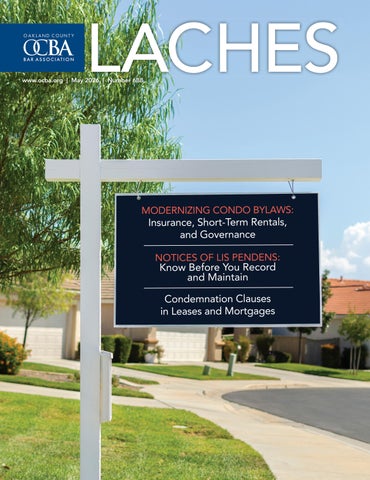
Modernizing Condo Bylaws: Insurance, Short-Term Rentals, and Governance

Amid economic, market, and technological shifts, bylaws become risk-management tools requiring modernization.

ByJohnD.Gwyn 10

Notices of Lis Pendens: Know Before You Record and Maintain

Explore the origins, purposes, and modern statutory framework of NLPs — and how to utilize them properly.

ByHenryW.LongleyandMichelleC.Harrell 12

Condemnation Clauses in Leases and Mortgages
Don’t underestimate the importance of these clauses in reducing disputes and recovering just compensation.

ByRonaldE.ReynoldsandPeterH.Webster 16

Competitors enjoyed networking and cheering on their teammates while waiting for their turn to

to Oakland County Bar Association, 1760 S. Telegraph, Ste. 100, Bloomfield Hills, MI 48302-0181.

May is Mental Health Awareness Month. This monthlong campaign aims to raise awareness about mental health, fight stigma, educate the public, and advocate for policies that prioritize mental health. It also encourages open and honest conversations about mental health. By normalizing these conversations, we move toward empathy and understanding rather than stigma and judgment. These efforts help create an environment in which people feel more confident seeking help and support for their mental health needs.

In the legal profession, these conversations carry particular significance. Research conducted by the American Bar Association and the Hazelden Betty Ford Foundation drew attention to the mental health challenges facing lawyers. The 2016 study found that roughly 1 in 3 attorneys struggle with problems related

Walking in Our Shoes

to alcohol use, more than a quarter experience symptoms of depression, and nearly 20% report symptoms of anxiety. These findings have contributed to a growing conversation about lawyer well-being and the need to address mental health within our profession.

OUR SHARED EXPERIENCE

There is a shared understanding among those who practice law. We understand the pressure of deadlines, the demands of billable hours, and the weight of decisions that affect other people’s lives. The profession often asks us to be sharp, composed, and decisive, even when we may not feel up to the task. That shared understanding can create a sense of connection. The nature of our profession also tends to attract individuals who are ambitious, driven, and highly self-reliant. Those traits serve our profession well, but they can also make it

difficult for us to acknowledge strain or ask for help. There is an emotional and psychological toll that accompanies the role, and the pressures accumulate. Strength and composure are often valued in adversarial environments, and vulnerability can feel risky in a profession built on competition and credibility. These realities are part of why conversations about mental health in our profession matter.

Even within these shared pressures, the experience of practicing law is not the same for everyone. We may appear in the same courtrooms and navigate the same professional demands, but each person carries their own lived experiences into that space. The shared experience of practicing law can make it easy to assume we understand one another, but the truth is that much of what shapes a colleague’s day or their capacity to carry the demands of the profession remains unseen. In many ways, we get each other. And yet, in other ways, we don’t.

BEYOND OUR SHARED EXPERIENCE

Each of us brings our lived experience into our practice. We may carry burdens and responsibilities that others cannot see. We may be grieving a loss, facing financial strain, managing health concerns, or navigating challenges at home. Some of us are balancing the demands of the profession while caring for young children, aging parents, or sometimes both. Others may be navigating illness, loss, or struggles that remain largely invisible to the people around them. Those realities do not disappear simply because we are at work.

Much of what shapes how someone shows up on a given day is not visible to those around them. We meet one another in professional roles, across conference tables, in courtrooms, and through emails, often seeing only a small part of the person in front of us. As lawyers and advocates, we have a job to do. But we are also human

Strength and composure are often valued in adversarial environments, and vulnerability can feel risky in a profession built on competition and credibility. These realities are part of why conversations about mental health in our profession matter.

beings whose lives extend far beyond the roles we occupy in the practice of law.

TRY WALKING IN MY SHOES

Most of us have had that moment when we felt misunderstood or judged and said to ourselves, “ ey should try walking in my shoes.” e phrase is often an expression of frustration, but beneath it lies something deeper: a desire to be seen, heard, and understood — one of our most basic human needs.

Depeche Mode captured this idea in the song “Walking in My Shoes.” e song suggests that if we tried walking in someone else’s shoes, we might stumble in their footsteps. Its message is simple but powerful: Before we judge another person’s struggles, we should pause and consider how little we may truly know about what they are carrying.

At its core, the song is a plea for empathy, a reminder of how easy it is to judge another person’s struggles without fully understanding what they are experiencing. For some, empathy comes naturally. For others, it is a skill that must be intentionally cultivated. Empathy asks us to feel with someone rather than feel for them. It di ers from sympathy. It requires perspective-taking, nonjudgmental listening, emotional awareness, and a willingness to communicate understanding.

Empathy also requires vulnerability. In her book Dare to Lead, Brené Brown explains that empathy is not about connecting to someone’s experience but rather connecting to the emotions that underpin that experience. In truth, none of us can fully walk in another person’s shoes, but we can lean in with curiosity and compassion. ere is real power in sitting with someone in their dark moments without trying to x the problem or o er a silver lining. As the song reminds

us, “Before you come to any conclusions, try walking in my shoes.”

WALKING TOGETHER

Practicing law is only one part of our lives. We each have roles and responsibilities beyond the profession, and those experiences shape the lives we bring with us into our work. While we may share a professional role and the pressures that come with it, we do not share the same lived experiences. at is why it is possible to sit in a room full of colleagues who “get it” and still feel alone, appearing self-assured while quietly wondering whether you truly belong.

Mental health a ects all of us. Mental Health Awareness Month o ers an opportunity to re ect on the realities within our profession. It reminds us to care for our own well-being, challenge the stigma that still surrounds mental health struggles, and look out for one another with greater awareness and compassion. At the same time, mental health struggles are not always visible. People may su er quietly, and the signs may be subtle — or not apparent at all. For those who have lost someone to mental illness, it can be easy to look back and wonder whether something more should have been seen or done. Hindsight often makes things appear clearer than they ever were in the moment.

Practicing law does not remove us from the human experience. Rather, it simply unfolds within it. Remembering that makes room for empathy and quiets our impulse to judge. While we each walk in our own shoes, we are still walking this journey together.

Sarah E. Kuchon is the president of the Oakland County Bar Association.

Thank You to Our 2025-26 Committee and Program Leaders

As the 2025-26 bar year nears its end, I want to take a moment to express my heartfelt gratitude to a remarkable group of individuals who have provided exceptional leadership throughout the year — our OCBA committee chairs and vice chairs; the chancellor, vice chancellor, and team leaders of our award-winning Inns of Court program; and the co-chairs of the 2026 District Court Bench/Bar Conference.

OCBA COMMITTEE LEADERS

Our 30 OCBA committees are led by dedicated volunteers who generously contribute their time and expertise to keeping our members informed on the latest developments in their respective practice areas. They help shape association policy on key professional issues, develop impactful programming for our members, and organize initiatives that benefit the community. OCBA committees are one of the most valued benefits of membership, and our committee chairs and vice chairs play a pivotal role in ensuring their success.

Membership in any of our committees is free of charge and offers countless professional advantages. Participating allows members to deepen their knowledge, advance their careers, and forge meaningful professional connections. We encourage you to explore the full range of opportunities at ocba.org/committees and discover how you can get involved in this vibrant membership benefit, supported by OCBA staff liaisons and led by our members, for our members.

Business Court and Counsel

Circuit Court

Circuit Court Case Evaluation

Criminal Law

Debtor/Creditor

District Court Case Evaluation

Diversity, Equity and Inclusion

Employee Benefits

Employment Law

Energy, Sustainability and Environmental Law

Family Court

Golf Outing

Juvenile Law

Law Related Education

Lawyer Well-Being

Legislative

LOCA (Lawyers of a Certain Age)

Medical/Legal

Membership

Municipal Law

New Lawyers

PALS (Providing Access to Legal Services)

Paralegal

Probate, Estate and Trust

Professional Development

Real Estate

Solo/Small Firm

Tax Law

Veterans Law

Douglas Toering

Matthew Allen

Matthew Enright

Mark Rossman Dani Liblang

Steven Brock

Paul Stablein

Jacob Kahn

Marcia Ross

Shane Kolo

Nicholas Nahat

John Freeman

Brandi Blasses

Barry Brickner

Darnell Smith

Gary Remer

Richard Lynch Dandridge Floyd

Carla Valdes Claire Glenn

Alexander Sheldon-Smith

Russell Carniak

Aaron Boey

Richard Rassel III

Lanita Carter Eric Wisniewski

Alec D’Annunzio

Mark Berke

Kristina Bilowus and Vanessa Bailey

Katharine Smith

Klint Kesto and Sheldon Larky

Judith Cunningham

Jordan Fields Dr. Joseph Zajchowski

Syeda Davidson Ryan Plecha

Nicole MacMillan

Jacob Simon

Heather Herbert

Alda Gojcaj

Julie McCowan

Linda Kennedy

Gary Kravitz

Paul Shkreli

Eric Gould

Justin Gonzales

Michael Knoblock

Robert Goldman

Sara Zwickl

Sara Bowman

Wanda Roberts

Nicole Smithson

Christopher Martella

Elliot Lannon Rattner

Christine Zarycky

James Cunningham

COMMITTEE NAME CHAIR
VICE CHAIR
Alternative Dispute Resolution Michael O’Malley and Sheldon Larky

INN OF COURT

e OCBA’s chapter of the American Inns of Court is a distinctive community of lawyers, judges, and law students dedicated to fostering meaningful mentoring relationships. rough monthly meetings, members have the opportunity to build and strengthen professional connections, engage in thoughtful discussions on core issues of professionalism, and address pressing legal challenges of the day. e program provides a platform for sharing experiences and advice, inspiring passion and dedication to the law, and promoting mentoring opportunities. Above all, it strives to uphold the highest standards of integrity, ethics, and civility in the legal profession. To learn more about this invaluable program, visit ocba.org/inns. ank you to our Inn leaders for guiding our Inn members through another successful year.

Chancellor: Hon. Cynthia Stephens (ret.)

Vice Chancellor: Hon. Kameshia Gant

Team 1 Leader: Hon. Cynthia Stephens (ret.)

Team 2 Leader: Hon. Laura Polizzi

Team 3 Leaders: Hon. Kameshia Gant and Hon. Sheila Johnson

Team 4 Leader: Hon. Jeremy Bowie

Team 5 Leader: Hon. Cynthia Arvant

Team 6 Leader: Hon. Brian Hartwell

2026 DISTRICT COURT BENCH/BAR CONFERENCE

e biennial District Court Bench/Bar Conference was held on Friday, March 20, at e Kingsley in Bloom eld Hills. Organized by our four co-chairs, the half-day event featured an exceptional program designed to expand attendees’ knowledge, sharpen their skills, and keep them ahead of the curve as district court practitioners. From mastering the essentials to exploring best practices for cutting-edge tools like AI, the conference o ered practical, actionable insights that could be applied immediately. Sessions covered civil practice strategies, landlord-tenant case guidance, competency hearings, mental health referrals, e ective advocacy in criminal cases, and valuable legal aid resources to help support clients. ank you to the following people:

Co-Chairs

Hon. Jaimie Powell Horowitz

Hon. Jeremy Bowie

Syeda Davidson

Judith Gracey

Jennifer Quick is the executive director of the Oakland County Bar Association.

CALENDAR OF EVENTS

Please Note: The dates listed below were sent to the publisher on March 2, 2026. It is possible that some of the events listed below have since been altered. Please check ocba.org/events for the most up-to-date schedule of events.

MAY

OAKLAND COUNTY BAR FOUNDATION’S 27TH ANNUAL SIGNATURE EVENT

The 27th annual Signature Event, a highlight of the season for many members of the association and foundation, will return to the beautiful Orchard Lake Country Club. With exceptional food, a stunning lakeside setting, and the opportunity to connect with colleagues, this event promises an unforgettable networking experience. Best of all, the proceeds will support the Oakland County Bar Foundation, helping fund vital programs for numerous deserving organizations. Tickets are limited, so be sure to secure yours today. Sponsorship opportunities are also available for those wishing to show their support for the OCBF. For more information, contact Katie Tillinger at ktillinger@ocba.org or (248) 334-3400. To learn more, visit ocba.org/signature-event

BAR NIGHT OUT

Spring into great conversations at our quarterly Bar Night Out mixer at Smokehaus BBQ in Ferndale, happening from 5:30 to 7:30 p.m. Connect with fellow OCBA members, grow your professional network, and enjoy a selection of delicious hors d’oeuvres in a relaxed social setting. This event is free for OCBA members, but space is limited. Secure your spot today at ocba.org/events.

JUNE

92ND ANNUAL MEETING & AWARDS CEREMONY

Join the OCBA as we salute outstanding leaders in law and celebrate another amazing year. Spend time with judges, OCBA leadership, and other OCBA members at this annual celebration.

During the event, we will recognize the 2026 OCBA award recipients, members celebrating 40 years of legal practice in Michigan, and those who have been members of the OCBA for 50 years. Plus, outgoing OCBA President Sarah E. Kuchon will pass the gavel to incoming President Aaron V. Burrell, who will be sworn in as the bar’s 94th president. The ceremony will be followed by a strolling reception on the beautiful terrace of the Community House in Birmingham. Tickets are now on sale at ocba.org/annual-meeting

NEW LAWYER BOOT CAMP

Join the OCBA and Oakland County Circuit and Probate courts for an extensive full-day boot camp covering everything new Oakland County attorneys need to know to get a jump start on their practice. Breakfast and lunch will be provided. The boot camp is open to attorneys who have been practicing for five years or less, as well as law students. To learn more or register, visit ocba.org/bootcamp

OFFICE CLOSED IN OBSERVANCE OF MEMORIAL DAY OCBA OFFICE CLOSED IN OBSERVANCE

HEA LTH CA RE

LA W FI RM

Wachler & Associates represents healthcare providers, suppliers, and other entities and individuals in Michigan and nationwide in all areas of health law including, but not limited to:

•Healthcare Corporate and Transactional Matters, including Contracts, Corporate For mation, Mergers, Sales/Acquisitions, and Joint Ventures

•Healthcare Corporate and Transactional Matters, including Contracts, Corporate For mation, Mergers, Sales/Acquisitions, and Joint Ventures

•Medicare, Medicaid, and Other Third-Party Payor Audits and Claim Denials

•Medicare, Medicaid, and Other Third-Party Payor Audits and Claim Denials

•Licensure, Staff Privilege, and Credentialing Matters

•Provider Contracts

•Licensure, Staff Privilege, and Credentialing Matters

•Billing and Reimbursement Issues

•Provider Contracts

•Billing and Reimbursement Issues

•Stark Law, Anti-Kickback Statute (AKS), and Fraud & Abuse Law Compliance

•Physician and Physician Group Issues

•Stark Law, Anti-Kickback Statute (AKS), and Fraud & Abuse Law Compliance

• Regulatory Compliance

•Physician and Physician Group Issues

•Corporate Practice of Medicine Issues

• Regulatory Compliance

•Provider Participation/Ter mination Matters

•Corporate Practice of Medicine Issues

•Provider Participation/Ter mination Matters

• Healthcare Litigation

• Healthcare Investigations

• Healthcare Litigation

•Civil and Criminal Healthcare Fraud

• Healthcare Investigations

•Civil and Criminal Healthcare Fraud

•Medicare and Medicaid Suspensions, Revocations, and Exclusions

•Medicare and Medicaid Suspensions, Revocations, and Exclusions

•HIPAA, HITECH, 42 CFR Part 2, and Other Privacy Law Compliance

•HIPAA, HITECH, 42

Part 2, and Other Privacy Law Compliance

Expand Your Knowledge with These Great Seminars!

MAY

Time Off Done Right: Recharging Without Sacrificing Client Service (Noon – 1 p.m.)

A seminar from the Professional Development Committee

Presenter: Savanna Polimeni, Practice Management Counsel, State Bar of Michigan

This virtual seminar will explore how attorneys can intentionally use their time off to recharge without sacrificing client service. Participants will learn strategies for reframing time away from the office as a benefit to both their well-being and their clients, along with practical tips for planning ahead, managing workloads, and fully unplugging during leave. The program will also address how thoughtful preparation can make time off more restorative and productive.

9 25 8 19

Misdemeanor Sentencing: The Rebuttable Presumption for Nonserious Misdemeanors and Other

Practical Considerations (Noon – 1:30 p.m.)

A seminar for criminal defense appointed counsel

Presenter: William S. Nahikian, Will Defend You, PLLC

This informative Zoom seminar tailored to criminal-appointed attorneys will explore the complex and continually evolving landscape of misdemeanor sentencing. Experienced practitioner Will Nahikian will provide practical insights into sentencing trends, strategic considerations, and the important rebuttable presumption against jail or probation for nonserious misdemeanors. Attendees will gain valuable knowledge to better advocate for their clients and navigate sentencing challenges with confidence.

Worth 1.5 hours of criminal training credit for appointed counsel

JUNE

2026 Employment Law Year in Review (9 – 11:30 a.m.)

A seminar from the Employment Law Committee

Presenters: Craig S. Schwartz, Butzel Long, P.C., and TBA

Moderator: Richard M. Lynch, Esq., Court Administrator, Sixth Judicial Circuit Court

This annual Zoom seminar will spotlight the most significant new developments in employment law, equipping attorneys with timely insights to better advise and protect their clients. This year’s program will focus on recent developments under the NLRA; an exploration of AI’s impact on business operations, plus productivity tips and real-world use cases; and a panel dicussion on general employment law updates — delivering practical guidance you can put to use right away.

Update on the State of Criminal Law — Midyear 2026 (11:30 a.m. – 1 p.m.)

A seminar for criminal defense appointed counsel

Presenter: Alona Sharon, Alona Sharon PC

This Zoom seminar will deliver a timely overview of the most recently published Michigan Court of Appeals decisions, with a focused look at key sentencing rulings. Gain practical insight into how these opinions are shaping criminal practice and walk away with concrete strategies, emerging trends, and real-world practice pointers you can apply immediately. Worth 1.5 hours of criminal training credit for appointed counsel

MODERNIZING CONDO BYLAWS: Insurance, Short-Term Rentals, and Governance

In the past five years, the landscape of community association law in southeast Michigan has shifted dramatically. For attorneys representing condominium associations and co-owners in Oakland County, it has become evident that governing documents drafted 20 or 30 years ago are increasingly inadequate to address the realities of modern ownership.

Condominium boards are now grappling with unforeseen pressures that threaten the stability of their associations. This includes the rapid expansion of the sharing economy, a hardening insurance market, and the post-pandemic necessity of digital governance. These converging factors have created a crisis that older documents just can’t resolve. It’s no longer sufficient for legal counsel to view bylaws as static documents. Instead, we have to look at them as active risk-management tools that require modernization to ensure the financial and social viability of these communities.

THE INSURANCE CRISIS: WHO PAYS THE BILL?

Currently, condominium associations are facing a budget-breaker in the form of skyrocketing insurance costs related to coverage for common elements in their communities. In southeast Michigan, we are witnessing a market in which premiums are rising aggressively. To make matters worse, carriers are demanding much higher deductibles just to write a policy. It’s now common to see per-occurrence deductibles jump from a manageable $5,000 to a budget-shattering $25,000 or even $50,000.

The legal conflict arises when bylaws drafted in the 1980s or ’90s fail to say who is responsible for these high deductibles. Older documents often contain vague provisions that simply state that the association acts as the primary insurer for the buildings. They rarely address who pays the deductible when a claim is made on the master policy for damage inside a specific unit. Without a specific insurance deductible provision, the association — and, by extension, all of the residents — absorbs the cost as a general expense.

Consider this scenario: A toilet overflows in a third-floor unit, causing $40,000 in damage to the units below. If the deductible is $25,000, a traditional bylaw might force all co-owners to subsidize that deductible through their monthly assessment or, if necessary, special assessment dues. This creates immediate friction and finger-pointing. Why should the responsible owner on the first floor pay for the negligence of the owner on the third floor? These types of matters come up often in my practice and a lot of times end up in litigation, which may include competing insurance carriers quibbling over the details.

Attorneys should advise clients to amend out-of-date bylaws to clearly define negligence versus strict liability when it comes to these issues. Condo bylaws have to be carefully rewritten to outline financial responsibility clearly. A modern insurance deductible bylaw ensures that the party responsible for the maintenance of the thing that broke (like the toilet) is responsible for the insurance deductible. This protects the association’s operating budget from being decimated by repeated claims and keeps the peace between neighbors.

THE SHORT-TERM RENTAL DILEMMA: ZONING, USE, AND LIVABILITY

In my practice, I have seen community association clients struggle to enforce residential restrictions against the rapid rise of short-term rentals (STRs). Platforms like Airbnb and Vrbo have turned residential units into de facto hotels. While this may be lucrative for one owner, it often falls upon the association board, its attorneys,

and managing agents to deal with the fallout.

Socially speaking, this certainly hits close to home. It a ects how neighbors connect, how safe they feel, and the pride they take in where they live. When transient guests replace longterm neighbors, the complex web of relationships that holds a community together begins to fray. Residents often report increased noise, security concerns regarding door codes, and a general loss of community cohesion. Some older bylaws that I have reviewed restrict usage to residential purposes only. However, co-owners sometimes argue that their Airbnb guests are using the unit for a residential purpose (i.e., sleeping and eating) even if they are staying for only two nights. To avoid ambiguity and expensive litigation, modern bylaws need to be explicit to address these situations.

If an association wants to restrict STRs, the governing documents should de ne the minimum lease term — for example, requiring that no leasehold relationships be created for a period of less than 30 days. e association should require that all leases be in writing and provided to the board for review. A total ban is not always the answer. Some communities may prefer a cap on the number of rentals to preserve nancing eligibility while allowing some exibility for owners. Legal counsel serves as a strategic adviser by helping clients anticipate potential pitfalls and crafting exible provisions that protect the residential character of the community without infringing excessively on property rights.

GOVERNANCE IN THE DIGITAL AGE

e COVID-19 pandemic presented huge challenges for everyone, as we know all too well. For community associations, it exposed just how old-fashioned many governance provisions were, speci cally those requiring in-person meetings and paper ballots. During the height of the pandemic, many boards were stuck. ey were unable to hold elections or pass budgets because their bylaws didn’t allow for electronic voting or virtual meetings. While the Michigan Nonpro t Corporation Act (MCL 450.2101 et seq.) generally allows for remote communication, speci c bylaw amendments are usually needed to override con icting, restrictive language found in older condominium documents. Modern governance provisions should explicitly authorize the following:

• Virtual board and association meetings via videoconference.

• Electronic notice delivery to reduce signicant postage and printing costs.

• Online voting systems to ensure a quorum is achieved.

Adopting these technologies is about more

than just convenience. ink of digital voting as a virtual “green space,” as it encourages the same level of community involvement by tearing down the barriers that keep co-owners from participating. It opens the door for everyone — whether they are traveling for work or just can’t make it in person — to have a say in how their biggest investment is run. is way, more owners get a seat at the table.

THE ROLE OF COUNSEL: FROM DRAFTER TO STRATEGIC ADVISER

Condo law practitioners have to be creative problem-solvers these days and move beyond merely reviewing documents for compliance. ey should advise boards on resiliency and draft documents that can withstand the test of time and changing technology. Basically, we need to assume that high insurance rates are here to stay, the rental market will keep changing, and digital communication is simply how business gets done now.

By getting a handle on why things are changing — whether it’s money, social shifts, or tech — we can help communities stay a oat. It comes down to simple math. Pay to update the documents now or pay a fortune to defend a bad

lawsuit later. We have a chance to x the root of the problem here. If we help boards modernize their documents, we save them from future legal battles. It’s about setting clear ground rules for insurance, STRs, and digital meetings so these communities can stand on their own two feet rather than getting bogged down in court.

John D. Gwyn is an attorney at Cummings, McClorey, Davis & Acho, P.L.C. He focuses his practice on real estate law, community association law, commercial litigation, and municipal law. He represents developers and condominium and homeowners’ associations in matters involving real estate, contract, and construction issues. He currently serves as a member of the Oakland County Bar Association’s Real Estate Committee. Gwyn is a contributor to the Institute of Continuing Legal Education and presented an on-demand seminar on short-term rentals. He may be reached at (734) 261-2400 or jgwyn@cmda-law.com.

NOTICES OF LIS PENDENS: Know Before You Record and Maintain

Many practitioners have a general idea of the notice of lis pendens (NLP), but those ideas are often incomplete or only intuitively understood. Properly used, an NLP is a recorded notice that pending litigation may affect title to or an interest in the real property against which it is recorded and that later purchasers or encumbrancers take subject to the outcome. Because it operates as constructive notice in the land records, an NLP can affect the marketability of title, influence lending and leasing decisions, and preserve the practical value of any eventual judgment. At the same time, Michigan’s statutory framework imposes specific content, recording, and service requirements and authorizes courts to cancel NLPs that do not fit within those limits or are not maintained in good faith. This article focuses on how NLPs are designed to work when used properly — their origins, purposes, and modern statutory framework — and briefly notes the principal consequences when a notice strays outside of those bounds.

LIS PENDENS: MEANING, ORIGINS, AND MICHIGAN FRAMEWORK

Lis pendens literally means “a pending suit.”

An NLP is a recorded warning in the land records that a lawsuit may change who owns, controls, or can use a particular piece of real estate. The NLP gives notice to anyone dealing with the property that they may be impacted by the litigation and take subject to whatever judgment the court ultimately enters. Michigan courts describe an NLP as a device designed to warn persons who deal with property while it is in litigation that they are charged with notice of the rights of their vendor’s antagonist.

Lis pendens has its roots in equity’s concern that parties could undermine pending litigation by transferring the affected land before the court could act, a problem courts addressed by treating the lawsuit itself as notice to those who later dealt with the property. Michigan picked up that equitable idea early on and codified the concept by statute. By 1838, Michigan law provided that to make the filing of a bill in chancery constructive notice to a purchaser of real estate, the complainant had to file with the register of deeds a notice of pendency “setting forth the title of the cause and general object thereof, together with a description of the land to be affected thereby,” and later 19th-century codifications preserved the same basic structure. In one early decision, the Michigan Supreme Court held that an NLP, once properly filed in a suit to correct a mistaken deed, operated as a warning “to the whole world” that the defendant’s claimed title could be divested so that anyone later taking a mortgage did so with constructive notice of that risk, even though the court had lost the notice from its own files.1 In another, the court made clear that a purchaser who takes with actual knowledge of pending foreclosure litigation is bound by the decree even if no NLP was ever recorded, emphasizing that a recorded notice is needed to supply constructive notice but “is not necessary … to bind one who has actual notice.”2

Equitable heritage still matters and directly informs the modern statutory scheme. Contemporary Michigan cases recognize that the lis pendens statutes sit on top of, not in place of, equity, and today’s framework marries that tradition to specific procedural requirements, including recording a notice in the land records and timely serving the property owner under the statute. Courts retain power to cancel even technically proper notices when the practical harm to ongoing or potential transactions outweighs any legitimate need to keep the notice in place, and decisions have used that authority to strike NLPs that exceed the underlying claims or are maintained after the claims that justified them have been dismissed.

Since 1838, Michigan has used statutes to

structure how NLPs give notice of litigation affecting real property. Early Michigan codes in the 19th century — and later compiled versions of those codes — carried forward the requirement that, in suits affecting land, a party file a notice with the local register of deeds identifying the case, its general object, and the land to be affected. The Revised Judicature Act of 1961, now MCL §600.2701–§600.2735, preserves that operative language and collects the modern provisions governing notice by plaintiffs and defendants, duration and extension, indexing, and cancellation procedures, including the court’s authority to cancel or condition continuation of an NLP. This codified framework reflects an ongoing legislative effort to protect legitimate real-property claims while limiting

stale, overbroad, or improper use of NLPs.

PURPOSE AND POLICY RATIONALE UNDERLYING THE NLP

As its historical background shows, the NLP was developed to serve two core protective functions in Michigan’s recording and litigation system. First, it protects a party’s ability to litigate disputes involving real property while preserving the status quo of the property’s title, possession, use, or enjoyment pending a decision on the claimed right. Second, it protects prospective purchasers, lenders, lessees, and others who rely on the public record by warning them that the property is the subject of pending litigation and that any interest acquired during that litigation will be taken subject to the eventual judgment. The policy premise

is straightforward: The public land records should reflect not only recorded instruments affecting title but also properly noticed lawsuits that could change that title.

Michigan courts explain that “the effect of the filing of a notice of lis pendens is to cause after-acquired interests in the property to be taken subject to the outcome of the litigation” so that a purchaser “may not … defeat the object of the suit” by taking during the pendency of the action.3 For the notice to serve that function, however, it must satisfy the statutory prerequisites. Michigan’s recording statute, MCL §565.25, and the lis pendens statute, MCL §600.2701, work together to define those prerequisites. The NLP must be recorded as an “instrument of encumbrance” and be accompanied by “a full and fair accounting of the facts that support recording of the instrument of encumbrance and supporting documentation, as available,”4 along with proof that actual notice has been given to the owner of record, subject to limited exceptions. It must also “[set] forth the title of the cause, and the general object thereof, together with a description of the lands to be affected,”5 ensuring that the notice is tied to a pending lawsuit and to specific property. Fundamentally, the statutory requirement that the land be “affected by” the action means the underlying litigation must directly seek an affirmative judgment affecting title to — or

the possession, use, or enjoyment of — the real property, such as claims involving conveyances, mortgages, the property’s transfer, or any “interest”6 in the land.7 Claims that seek only monetary damages and do not request relief altering real-property rights fall outside of that core function and will not support a valid NLP, even though they may arise out of a transaction that happens to involve land.8 When an NLP tracks the statutes — by accurately describing the action, the property, and the real-property interest at stake — it performs its intended role: informing third parties and preserving the property’s status quo while the court determines the claimant’s rights.

The timing of recording also matters. An NLP is typically recorded and served when the complaint (or counterclaim) is filed so that the constructive notice function begins as soon as the litigation commences. The statute also permits recording at the time of filing with service to follow but requires that personal or substituted service be made within 60 days of recording or that service by publication be commenced within that period to keep the notice effective.9 Together with the content requirements, these timing and service rules help ensure that NLPs operate as transparent, not “secret,” encumbrances, and Michigan law accordingly treats perfection and notice to the owner as integral to proper use of the device.

PRACTICAL EFFECT OF AN

NLP

There are several practical consequences of a properly recorded NLP. The NLP appears in the land records as notice that the property is involved in litigation, which can prompt a prudent purchaser, lender, or tenant to evaluate the risk, adjust terms, or defer action until the dispute is resolved. A buyer might walk away, a lender might deny or restructure a loan, and a tenant might decline to lease, depending on how the dispute is addressed or secured. Title insurers may decline to issue a policy that disregards the NLP, require that it be released or bonded around, or list it as an exception in the commitment, all of which reinforce the notice function but can slow or reshape pending transactions. In most scenarios, these consequences are exactly what the statutes contemplate: They keep the property in essentially the same posture during litigation while the court determines whether the claimant has a legitimate interest affecting the property. Because an NLP can have significant transactional effects, Michigan law also recognizes that its reach must correspond to the nature and status of the underlying claims. If a notice is recorded in an action that does not truly “affect” the property, fails to meet the statutory content and perfection requirements, or is not prosecuted in good faith, courts can cancel it under MCL

600.2725 or through their equitable authority. Likewise, Michigan decisions explain that an NLP is not a free-standing monetary lien: Its function is to give notice of litigation that may alter real property rights, not to secure payment of a judgment in a purely personal or contractual dispute. Practitioners who keep those limits in view — by aligning the notice with speci c real-property relief, keeping its description accurate, and releasing it when the property-based claims are resolved — will generally nd that the tool works as intended without crossing into the territory of misuse or overreach.

FINAL COURT RULING AND DISCHARGE OF THE NLP

An NLP that was once proper when recorded can become improper if the underlying claims that support it are dismissed, resolved on the merits, or otherwise no longer threaten the property’s title or use. At that point, the same statutes that justify recording an NLP in the rst instance point toward prompt discharge, and courts have treated the continued maintenance of a notice after its real-property basis has disappeared as inconsistent with its limited, protective purpose. In a recent case, the Michigan Court of Appeals held that the failure to release a lis pendens after the reversionary claims supporting it were dismissed could satisfy the malice element of a slander-of-title claim, even though the original ling itself was not deemed malicious.10

For practitioners, the lesson is practical: Review the status of any recorded NLP at key points in the litigation — after dispositive motions, trial, settlement, or appeal — to determine whether it still rests on a live claim that “a ects” the property. When the court has nally rejected the property-based claim or the parties have resolved the dispute in a way that eliminates any threat to title, the NLP should be released so that the public record once again re ects the property’s true legal status. Doing so not only avoids exposure to slander-of-title or statutory-damages claims but also aligns day-to-day practice with the basic purpose of an NLP: to provide accurate, time-limited notice of real litigation risks a ecting real property.

PRACTICAL GUIDANCE FOR USING AN NLP IN MICHIGAN

When you are thinking about ling an NLP in Michigan, start with the claim, not the form. Make sure the lawsuit “a ect[s] the title to, or the possession, use or enjoyment of” identi ed real property; if the dispute is about money and not a concrete real-estate interest, consider alternatives such as a recorded claim of interest under the Marketable Record Title Act, MCL §565.101 et seq. Once a qualifying complaint (or counterclaim) is on le, promptly record an NLP with the register of deeds in the county where the land lies, attach or cross-reference the pleading, pay

the required fee, and serve the defendant within 60 days of recording to keep the notice e ective under MCL §600.2701–.2701(3), §600.1605, and §565.25.

ink of the NLP as a time-limited warning that must be maintained, not a one-and-done ling. A Michigan NLP generally lasts three years or until it is canceled under MCL §600.2715, §600.2725, or §600.2731 — whichever comes rst — so docket a reminder several months before expiration if the case may still be pending and an extension is needed. Because Michigan’s recording statutes penalize unsupported encumbrances, treat perfection seriously. Except for commercial lenders and other statutory exceptions stated in MCL §565.25(2), be prepared to show a full and fair accounting of the facts supporting the claimed encumbrance, supporting documentation, and proof that the owner of record received actual notice before or at the time of recording. Misusing a notice of lis pendens — by recording it without lawful cause or with an intent to harass or by keeping it in place after the real-property claims have failed — can expose the ler to statutory damages, attorney fees, potential criminal liability under MCL §600.2907a and §565.25(3), and common-law claims such as slander of title.

CONCLUSION

Practitioners should exercise care when preparing, recording, maintaining, and discharging an NLP. Michigan’s statutory requirements — content, timing, service, and good-faith prosecution — are designed to ensure that NLPs function as accurate, temporary notice of real-property litigation rather than as generalized leverage in unrelated disputes. By tying notices closely to claims that truly a ect title, possession, use, or enjoyment of speci c land, and by promptly releasing those notices once the supporting claims are resolved with nality, practitioners can use NLPs for their intended purposes while minimizing the risk of collateral exposure.

Henry W. Longley is a business and real estate litigator at Taft, Stettinius & Hollister LLP (Litigation). Longley represents clients in complex commercial, trust, and real estate disputes, as well as Delaware transactional planning. He earned his J.D., cum laude, from Temple University James E. Beasley School of Law and his bachelor’s degree from the College of William & Mary. Longley joined Taft after practicing in Delaware and served as a law clerk to Justice Traynor of the Delaware Supreme Court.

Michelle Harrell is an equity partner at Taft, Stettinius & Hollister LLP (Litigation) and serves as a courtappointed and private arbitrator and mediator. Her experience ranges from multi-million-dollar disputes to neighbor boundary-line disputes. She holds a B.S. in accounting, summa cum laude, from the University of Detroit and a J.D., cum laude, from Wayne State University Law School. She also participates in several professional associations and is currently the treasurer of the State Bar of Michigan ADR Committee.

Footnotes:

1. Heim v. Ellis, 49 Mich. 241, 243, 13 N.W. 582 (1882).

2. Baker v. Pierson, 5 Mich. 456, 461 (1858).

3. MCL §565.25; Provident Mutual Life Ins. Co. v. Vinton Co., 282 Mich. 84, 85-87; 275 NW 776 (1937); Hedler v. Manning, 252 Mich. 195, 196-197; 233 NW 223 (1930); Richards v. Tibaldi, 272 Mich. App. 522, 536; 726 NW2d 770 (2006).

4. MCL §565.25(1)(a).

5. MCL §600.2701(1).

6. Black‘s Law Dictionary (8th ed.), p. 828: defining “interest” in pertinent part as “[a] legal share in something; all or part of a legal or equitable claim to or right in property.”

7. See G C Timmis & Co. v. Guardian Alarm Co., 468 Mich. 416, 420; 662 NW2d 710 (2003) (plain language is enforced as written).

8. Patten Corp. v. Canadian Lakes Dev. Corp., 788 F. Supp. 975, 978 (WD Mich., 1991) (concluding that under MCL §600.2701, the “statutory authority” is lacking to “file a notice of lis pendens” where the action “does not affect land” but is for purely “money damages”).

9. MCL §600.2701(2).

10. Shenandoah Ridge Condominium Association v. Bodary, ___ Mich. App. ____; ___ NW3d ___ (2025) [1/13/25; Docket No. 364972].

Condemnation Clauses in Leases and Mortgages

Casualty clauses for a loss — from a fire, for example — are very common in leases and mortgages. While parties draft leases and mortgages that address such casualties, many do not focus on the need for a “condemnation clause.” There are several important issues to consider when drafting a condemnation clause and as a landlord, tenant, mortgagee, or mortgagor who is the subject of an eminent domain action by a condemning agency.

ALL REAL PROPERTY IS SUBJECT TO TAKING BY EMINENT DOMAIN

Eminent domain (also referred to as condemnation) is the power of the government (or appropriate condemning agency) to take private property for a public purpose upon payment of just compensation to the owner of the property taken. Such power is by virtue of the superior dominion of the sovereign power over all lands within its jurisdiction. The Michigan Constitution does not grant such power; rather it is a “natural” attribute of a sovereign. The “power arises from the sovereign power of the state and is of ancient provenance.” Silver Creek Drain District v. Extrusions Div., Inc., 468 Mich. 367, 373 (2003). The Michigan Constitution does, however, require the payment of just compensation for the use of the power.

Under the constitution and laws of Michigan, all private property, real and personal, and any interest therein is held subject to this right of eminent domain. Const. 1963, art. 10, §2; M Civ. JI 90.02. Mortgage interests in real property are thus subject to being taken by eminent domain. The Uniform Condemnation Procedures Act, PA 87 of 1980, as amended, being MCL 213.51 et seq. (the UCPA), provides certain processes and procedures but not the substantive authority to exercise the powers of eminent domain for all condemnation actions. MCL 213.75.

The UCPA extends protections not only to fee interest real-property owners but also to individuals and entities that hold non-fee interests in the property. This article discusses certain condemnation rights involving leasehold and mortgage interests. The rights and obligations of landlords and tenants, as well as mortgagees and mortgagors, in a condemnation action turn on the application of the UCPA, the common law, and the underlying agreements (i.e., lease or mortgage) creating the non-fee property interest.

LEASEHOLDER AND MORTGAGE HOLDERS ARE

“OWNERS”

OF PROPERTY

The definition of property under the UCPA includes leaseholds, mortgage interests, and real property as traditionally defined. “Property” means “land, buildings, structures, tenements, hereditaments, easements, tangible and intangible property, and property rights whether real, personal, or mixed, including fluid mineral and gas rights.” MCL 213.51(i). “Owner” means a person, fiduciary, partnership, association, corporation, or a governmental unit or agency having an estate, title, or interest — including beneficial, possessory, and security interest — in a property sought to be condemned. MCL 213.51(f). In re John C. Lodge Highway, 340 Mich. 254 (1954). A tenant or any other person in possession at the

time of a taking is an owner under the act. In re Widening Woodward Ave., 265 Mich. 87 (1933). A mortgagee has a right to a condemnation award for mortgaged land taken for public use “to preserve Mortgagee’s security against evident or established impairment on theory that award equitably stands in place of land taken.” In re Dillman, 276 Mich. 252 (1936).

OWNERS ARE ENTITLED TO JUST COMPENSATION

Owners of property impacted by condemnation are entitled to “just compensation,” meaning the amount of money that will put the owner in as good of a position as they would have been in had the taking not occurred. The owner must not be forced to sacrifice or suffer by receiving less than full and fair value for the property. Just compensation should enrich neither the individual at the expense of the public nor the public at the expense of the individual. State Highway Commissioner v. Eilender, 362 Mich. 697 (1961); M Civ. JI 90.05.

WRITTEN GOOD FAITH OFFERS

The UCPA requires the condemning agency to submit a written good faith offer (GFO) to property owners before the initiation of condemnation proceedings. MCL 213.55(1). The provision of the GFO provides notice of the condemning agencies’ interest to acquire the property through eminent domain. Condemning agencies in Michigan most often make a unitary GFO to all interest-holders in a property — in other words, one offer for the just compensation attributed to all of the property and property interests being acquired. GFOs are typically based

on appraisals, which are prepared by qualified and independent appraisers who consider the highest and best use of the property. Condemning agencies should document and be prepared to explain the valuation methodologies. Secured interests are entitled to receive the GFO. Board of County Road Commissioners for County of Washtenaw v. Shankle, 327 Mich. App. 407, 417, n8 (2019). (“We note that at least one of the omitted owners, MERS, held a security interest in the entire Nevaux property and was thus explicitly the type of ‘owner’ to which the UCPA requires that notice be given.”) At a minimum, GFOs are to be made to property interests that are a matter of public record. However, the obligation to make a GFO is not limited to matters of public record but may also include owners who are disclosed through operation of law, including MCL 213.55(2). Michigan Gas Utilities Corp. v. Midlam, 2025 WL 1275640 at *6 (May 1, 2025).

NOTICE BETWEEN LANDLORD AND TENANT AND MORTGAGEE AND MORTGAGOR

In addition to notice provided by a GFO, lease and mortgage provisions typically require additional notification between the parties to ensure that landlord and tenant and mortgagee and mortgagor are made aware of a potential project or pending condemnation and can act to protect their rights.

Mortgagees need to be alert to condemning agencies’ interest and notice of a taking to protect their interests and security. Mortgage documents should include a requirement that the mortgagor provide notice to the mortgagee of the interest in

an acquisition by eminent domain. Upon being provided notice, a mortgagee should immediately contact the condemning agency to preserve its interests and rights under the mortgage lien. A common issue is that notice to a mortgagee is lost in a bureaucracy and not taken seriously. There could be a resolution between a condemning agency and the landowner or borrower, precluding the mortgagee from timely addressing the scope of the taking and the distribution of just compensation. If there is no resolution before the filing of a condemnation action, the mortgagees will be named as a defendant to the action, which is filed in the circuit court where the real property is located. MCL 213.55(1).

TOTAL

TAKING: THE ENTIRE REAL PROPERTY PARCEL IS TAKEN

Where all the real property is taken, the lessee and mortgagee are entitled to just compensation of the value of the leasehold or mortgage. This may be less than, equal to, or more than all of the fair market value of the underlying real property. Importantly, the exercise of eminent domain that results in the lessee’s eviction does not constitute a breach of the covenant of quiet enjoyment under common law. The lessee’s remedy for ending the tenancy, if any, is against the condemning agency, not the lessor. Tucker v Gvoic, 344 Mich. 319, 323-24 (1955).

For mortgage holders, in addition to the right to receive just compensation from the condemning authority, a mortgagee may have the right under the mortgage documents with the mortgagor (and presumably the corresponding note that the mortgage secured) to receive the benefit of the mortgage agreement. Thus, where the whole of the mortgaged land is taken in the proceedings, the mortgagee is entitled to the entire award or at least to so much of it as is necessary to satisfy the mortgage indebtedness. City of Detroit v. Fidelity Realty Co., 213 Mich. 448, 459 (1921); in re Dillman, 276 Mich. 252, 258 (1936). Moreover, if the entire award is insufficient, the mortgagee will still have rights under the corresponding note against the borrower.

PARTIAL TAKING: ONLY A PORTION OF REAL PROPERTY PARCEL IS TAKEN AND THERE IS A REMAINDER

An important factor in mortgage documentation is the effect of a partial taking — that is, to what extent the partial taking impairs the security (value of the real property) of the mortgagee’s interest. For mortgages, there are three primary ways a condemnation clause deals with a partial taking:

1. “Take all” provision: The mortgagee has the right to all of the just compensation necessary to pay off the mortgage, no matter how inconsequential the taking may be. Such amounts are applied against the outstanding principal mortgage amount and any other unpaid charges.

2. “Limited” provision: The mortgagee has the right to just compensation only to the extent that the security of the mortgage is impaired. This typically results in a complex calculation to determine how the partial taking has impacted the value of the remaining property. Note that this assessment process is often similar to the valuation methodology used by the condemning agency to develop the GFO.

3. “No proceeds” provision: The mortgagee has no right to just compensation.

There can be variants of these approaches such as a “take all” provision in the event that the taking destroys more than 50% of the value and a “limited” provision in which the taking impacts less than 50% of the value. Further, the documents typically provide the mortgagee with the right to exercise discretion to make the decision whether a partial taking is so impactful as to

allow it to accelerate full payment of the note obligation secured by the mortgage.

APPORTIONMENT OF JUST COMPENSATION

How just compensation is divided (apportioned) among property owners is decided by stipulation, court determination, or jury award. Where there are multiple ownership interests involved in a parcel taken by condemnation, each owner has a right to share in the award apportioned in accordance with their respective interest. In re Widening Woodward Ave., 265 Mich. 87 (1933). In Michigan, the condemning agency must escrow the “estimated” just compensation at or before filing the condemnation complaint. If there is no challenge filed against the condemnation, the escrowed funds must be paid within 30 days of the end of the challenge period. Typically, the condemning agency does not apportion the estimated just compensation between multiple parties unless the parties have stipulated to their respective amounts. Under the UCPA, the court must apportion the funds upon a motion by a party. MCL 213.58(1). The UCPA also states that any dispute as to the apportionment of funds “shall be resolved at an apportionment hearing held before physical dispossession.” MCL 213.59(6).

Without a lease provision regarding the

apportionment of just compensation, the tenant generally has the right to compensation for the value of its leasehold interest. In re Gratiot Ave., 294 Mich. 569, 574-575 (1940). For example, a tenant with only a month-to-month lease possesses a leasehold interest in a property, but that interest may have no value because it can be terminated or expire easily. Michigan State Hwy. Comm’n v. L&L Concession Co., 31 Mich. App. 222, 228 n8 (1971). On the other hand, a tenant with a long-term lease would be entitled to signi cant just compensation in light of the term duration and rent. If the rent is less than the prevailing market rent rate (at the time of the taking and as reasonably projected), the present value of the di erence between the market and contract rent would be a means of calculating the value of the leasehold interest.

Pierson v. HR Leonard Furniture Co., 268 Mich. 507, 521 (1934). Alternatively, if the contract rent is more than the market rent, the leasehold may not have any value. As such, the tenant would not be entitled to just compensation for its leasehold interest. In some circumstances, the lessee may also seek compensation for trade xtures, business interruption, going concern, and other damages caused by the taking. Michigan State Hwy. Comm’n v. L&L Concession Co., 31 Mich. App. at 235.

LEASES

A lease should likewise address contingencies for both total and partial takings. Typical condemnation clauses provide for automatic, unilateral, or mutual lease termination. If a lease provides for termination under a condemnation provision, such language should provide for an equitable apportionment of compensation, such as the tenant’s receiving the leasehold value and the landlord’s receiving the premises value. Absent a clause to the contrary, the lessee is generally entitled to the fair market value of the leasehold interest. Muskegon v. Berglund Food Stores, Inc., 50 Mich. App. 305 (1973). Other advisable provisions include those emphasizing that neither the landlord nor the tenant are liable to each other because of the premises taken. City of Muskegon v. Lipman Inv. Corp., 66 Mich. App. 378, 381 (1976). Condemnation clauses may also address rent reduction or abatement and restoration of premises in the case of a partial taking. Absent a condemnation clause addressing these and other valuation considerations unique to a particular lessor-lessee relationship, the trier of fact will be left with the discretion to equitably apportion any award of just compensation.

REAL ESTATE APPRAISALS, INCLUDING THOSE FOR FINANCING PURPOSES, ARE TYPICALLY NOT ADMISSIBLE IN EMINENT DOMAIN PROCEEDINGS

Admissibility of a bank mortgage appraisal in eminent domain proceedings is unlikely. Typically, such appraisals do not meet evidentiary standards for relevance and reliability because the valuations were prepared for a di erent purpose and under a di erent methodology. A bank appraisal typically focuses on the “probable” use, which evaluates the property’s fair market value based on its current use or the most likely use in the immediate future. is does not fully account for reasonably possible or potential uses that require signi cant changes, such as the reasonable possibility of rezoning or the likelihood of assemblage with other parcels. Moreover, valuation for ad valorem tax purposes that failed to parallel the likely valuation estimate derived for other purposes such as a sales price, nancing, insurance, calculated net worth in a nancial statement, or federal income tax purposes was evidence that the valuation approach was awed. In Meadowlanes Ltd. Dividend Housing Ass’n v. City of Holland, 437 Mich. 473 (1991).

A key factor in distinguishing between an eminent domain appraisal and a nancing appraisal is that the former uses the de nition of highest and best use, which re ects the most pro table, most advantageous use. Mortgage appraisals, while typically prepared by licensed appraisers, are designed to protect the lender’s security interest rather than determine fair market value for just compensation purposes, which may a ect their reliability and admissibility in condemnation proceedings. “Highest and best use” means “the most pro table and advantageous use the owner may make of the property even if the property is presently used for a di erent purpose or is vacant, so long as there is a market demand for such use.” St. Clair Shores v. Conley, 350 Mich. 458 (1957); M Civ. JI 90.09.

TAKING EXTINGUISHES PROPERTY INTERESTS

Condemning agencies that acquire property as a “total take” through eminent domain proceedings will take the property with clear title and extinguish all other interests, including mortgage and leasehold interest. e real property interests that are extinguished are converted under the UCPA to a right to receive just compensation. MCL 213.57(1). (“If a motion to review necessity is not led under section 6, the title to the property described in the petition shall vest in the Agency as of the date on which the complaint was led. e right to just compensation shall then vest in the persons entitled to the compensation and be secured as provided in this act.”)

e mortgage security no longer exists, and the property would be then owned by the condemning agency. No rights of possession or enjoyment of the property remain for the mortgagor, and no issues of foreclosure or redemption exist. e mortgagor’s fee interest in the premises and the mortgagee’s lien thereon are extinguished, and by operation of law, both interests are transmuted to a present right to receive just compensation from the condemning agency. All that remains for the owners is a right to just compensation to be apportioned between the defendants.

GIVE CAREFUL THOUGHT TO A CONDEMNATION CLAUSE

While the likelihood of condemnation impacting your lease or mortgage may be remote, your failure to pay attention to a condemnation clause at the time of drafting or entering into the transaction may have a signi cant impact on your ability to recover just compensation. When a re casualty burns down a building, the negotiated casualty clause clari es the parties’ rights and responsibilities. Similarly, a proactive approach to drafting a condemnation clause in a lease or mortgage can help reduce disputes between lessors and lessees and mortgagors and mortgagees in condemnation proceedings.

Peter Webster is a member of Dickinson Wright PLLC. Webster represents landowners, developers, governmental authorities, and utility, transmission, and pipeline companies in acquisitions, permits, easements, and condemnation. He is an Oakland County Bar Foundation Fellow, chairperson of the Oakland County Brown eld Redevelopment Authority, and co-chair of the State Bar Real Property Law Section Condemnation & Eminent Domain Committee. He is an adjunct professor at the Wayne State University Graduate School of Urban Planning and a former chairperson of the State Board of Ethics.

Ron Reynolds is a shareholder at Hilger Hammond PC. Reynolds has a diverse litigation practice that includes litigating real property, land use, and eminent domain matters. He has served as chair of the State Bar Real Property Law Section and is currently co-chair of its Condemnation & Eminent Domain Committee. He was admitted as a Fellow of the American College of Real Estate Lawyers in 2022.

Most of the venerable institutions we encounter and admire need constant replenishing — universities need a new crop of freshmen every fall, law rms bene t from new bright and energetic associates, sports teams need rookies to pan out, and midsize and large businesses must boost their ranks with fresh, younger talent to succeed in the long term. Our Michigan Legislature even requires a fresh crop of new

MISSION

The Oakland County Bar Foundation’s mission is to ensure access to justice and an understanding of the law in our community. It is dedicated to:

— Improving and facilitating the administration of justice in Oakland County and throughout the state of Michigan;

— Ensuring to the fullest extent possible that legal services are made available to all members of the public;

— Promoting legal research and the study of law as well as the diffusion of legal knowledge;

— Promoting the continuing legal education of lawyers and judges; and

— Educating the public as to their legal rights and obligations, and fostering and maintaining the honor and integrity of the legal profession.

If you know an organization that could use assistance to pursue these goals within Oakland County, please refer them to ocba.org/ocbfgrants, where they can find information about applying for a grant from the foundation.

For They Are Jolly Good Fellows

legislators via our state constitution, with a combined term limit of 14 years applying to our state Senate and House of Representatives.1 Quite simply, a failure to include youth or new members within an organization increases the risk that the organization will become outdated, out of touch, or irrelevant, in turn negatively a ecting its longevity. e best institutions evolve appropriately with changing circumstances and allow new voices to shape the mission and culture for the future.

e Oakland County Bar Foundation is no di erent in its need to think ahead. Not only do our leadership positions on the board of directors change on an annual basis, but we also look to add to our esteemed list of Fellows every year. What are the Fellows and the Fellows Program, you may ask? It is nice of you to give me the opportunity to explain this esteemed group!

e Fellows Program provides critical nancial support for the OCBF’s mission (which is to improve support, access to, and understanding of the legal system). Additionally, the Fellows Program is a setting for dedicated individuals to come together and develop professional camaraderie in support of an admirable cause. Additional bene ts include (a) having your name etched into a newly installed plaque at the Oakland County Circuit Court (pro led in a prior L ACHES article), (b) an invitation to the annual Fellows’ Reception (held the last two years at the Iroquois Club), and (c) a beautiful commemorative Pewabic tile to illustrate each Fellow’s commitment.

To become a Fellow, one must be nominated by a current OCBF Fellow. Depending upon each Fellow’s nancial commitment, they will be a baseline Fellow, Patron Fellow, Charter Fellow, or Philanthropist Fellow.2

Each year, current Fellows are met with the task of extending invitations to those whom they think would be valuable additions to the program. In 2026, the existing Fellows nominated 79 individuals, and 44 have already accepted. is comes to a very high accep-

tance rate of 56%, a remarkable 15% increase compared to last year (all the more remarkable given the general decline in members within professional organizations). Moreover, the entire Fellows group donated a total of $52,500, an increase of 27.6%, representing a signi cant portion of the OCBF’s annual revenue. e OCBF’s growth and excitement is not limited to new members of the program. For example, this year included several members who achieved “Life” status (meaning they ful lled their nancial contributions) who decided to repledge their support, resulting in an additional (and unexpected) $24,000. I am eager use this space to share the names of these Fellows who went above and beyond their commitments:

• Michael Clawson

• Marc Jerabek

• Tom Kirvan

• Donna Marie Medine

• Jennifer Quick

• Henry Winthrop

Domestic and international news today carries no shortage of content that may limit our sense of hope or weaken our spirits, thereby making it harder for optimism or idealism to shine. e OCBF, however, is a shining light away from cynicism about the legal profession and society as a whole. It is full of professionals eager to use their talent, time, and money for others. is sense of community and goodness through the OCBF is decades old, with a bright future buoyed by our recent success in sustaining and recruiting our Fellows. I am con dent this positive trajectory within the OCBF will continue. If you are interested in becoming a Fellow, please contact Katie Tillinger at ktillinger@ocba.org

Andrew M. Harris is a shareholder with Maddin, Hauser, Roth & Heller P.C. in South eld, where his practice includes business litigation, commercial real estate, estate planning, probate work, and property tax services. Harris is also a licensed civil mediator. He lives in Birmingham (where he was once mayor) with his wife (Ti any), two teenage sons (Roger and Russell), and two dogs (Maizey and Blue).

Footnotes:

1. Mich. Const., art. IV § 54.

2. The commitments for these levels are as follows: Fellow ($1,000), Patron Fellow ($2,500), Charter Fellow ($5,000), and Philanthropist Fellow ($10,000). Contributions toward these amounts are typically paid in installments. Once a Fellow satisfi es these obligations, their contribution is elevated to “Life” status. For a current list of Fellows, please see ocba.org/fellows

OCBA AT WORK

The mission of the Oakland County Bar Association is to serve the professional needs of our members, enhance the justice system, and ensure the delivery of quality legal services to the public. We fulfill our mission through our 30 committees, regular networking events, and numerous educational programs for both OCBA members and the public. We work hand in hand with the OCBA volunteer board directors and members, and we partner closely with the courts.

Below are recent examples of the OCBA at work in service to the bar and to the community.

First Official New Solo/Small Firm Committee Meeting

The OCBA’s New Solo/Small Firm Committee officially launched on February 12 after a robust January exploratory meeting and board approval of the new committee on February 4. Seventeen members attended and were welcomed by volunteer leaders, Chair Paul Shkreli, and Vice Chair Elliott Rattner. The committee’s aim is to support and advance solo practitioners and small-firm attorneys by fostering peer-to-peer exchange of law firm management best practices, encourage attorney-to-attorney referrals and business development opportunities, and provide practical, high-quality educational programming. The committee meets at noon on the second Tuesday of each month via Zoom, with quarterly in-person meetings at 4 p.m. on the second Friday of the month at rotating locations. The first meeting focused on practice management software. Any OCBA solo or small-firm member is invited to join this committee. Contact Jennifer Quick at jquick@ocba.org to sign up.

OCBA February Seminars

The Oakland County Bar Association’s Professional Development Committee presented two seminars in February.

The first, “Beyond Billable Hours: Growing Your Client Base,” was held in person on February 5 and drew 19 attendees. John Reed, founder and chief relationship officer of Rain BDM, led the program. He discussed strategies for turning online connections into meaningful, in-person relationships, maximizing networking opportunities, and expanding attorneys’ client footprints.

On February 17, the OCBA hosted “Bridging Divides: Maintaining Inclusive Legal Workplaces Amid Polarization.” Creadell Webb, chief diversity, equity, and inclusion officer for the First Judicial District of Pennsylvania, and Zenell Brown, fairness and accountability administrator for the Michigan Supreme Court’s State Court Administrative Office, shared strategies for addressing divisions that affect workplaces and public trust in the legal profession. Richard Lynch, court administrator for the Sixth Judicial Circuit of Michigan, moderated the discussion.

February Business Court and Counsel Committee Meeting

On February 3, the Business Court and Counsel Committee hosted an in-person meeting featuring member and speaker John Mohyi of Mohyi Law, who presented on artificial intelligence and its impact on his litigation practice. Mohyi shared practical insights into what is working — and what is not — when using AI in real-world litigation. He described the evolving role of the lawyer as strategist and verifier, guiding an “AI co-counsel” to quickly synthesize records, test legal theories, build timelines, and accelerate motion practice.

THE OCBA WELLNESS CHALLENGE: Taking Attorney Wellness from Concept to Reality

The May OCBA Wellness Challenge, organized by the OCBA Lawyer Well-Being Committee, is fun and doesn’t require meetings, commitments, or legal work — that’s the whole point! The challenge is about attorneys doing small but impactful things to tend to themselves, which contributes to more well-balanced lifestyles and, in turn, better legal careers. Join us in taking a break and help show LinkedIn that attorneys aren’t all business all the time.

THE PURPOSE OF THE CHALLENGE

The purpose of the challenge is twofold.

First, we want to give attorneys an incentive and a fun, easy way to put themselves first. If you need an excuse to care for yourself, we are happy to give you one. Join us and reap the benefits of a healthier and happier month.

Second, and just as importantly, we want to create a way for attorneys and potential attorneys to see that being an attorney doesn’t mean giving up fun, self-care, or happiness. It is important to normalize those things and help change the perception that if you’re not working, you’re not prioritizing being a good lawyer. This challenge will create photographic evidence that real lawyers are on board with the concept that humanity and professional success do not need to be mutually exclusive.

HOW TO PARTICIPATE

Throughout May, we are leaning into Mental Health Awareness Month and using LinkedIn to reach our OCBA members and members of the Michigan legal community at large, encouraging them to step away from their desks and make time for little joys in life. We call this initiative the Well-Being Challenge because attorneys find maintaining and prioritizing our well-being to be, well, a challenge.

The OCBA will post on LinkedIn every Monday in May, and each post will focus on a derivative of wellness. Your challenge each week is to pick at least one activity on the list,

The OCBA will post on LinkedIn every Monday in May, and each post will focus on a derivative of wellness. Your challenge each week is to pick at least one activity on the list, do it, and post a photo of yourself doing the activity in the comments of the OCBA’s post for others to see.

do it, and post a photo of yourself doing the activity in the comments of the OCBA’s post for others to see. That’s it! Each photo of a different activity counts as one entry.

THE TYPES OF ACTIVITIES YOU CAN EXPECT

First, we will focus on social connections Making time for others, both inside and outside of the legal profession, is an essential part of wellness and happiness. Practicing law can be isolating, especially in our postCOVID world. Challenges will encourage you to reach out, get together, or meet someone new. Connecting is a crucial part of the human experience, and we love to see lawyers prioritizing personal and professional relationships outside of the courtroom.

Second, you will be challenged to explore something new. This is important because as attorneys, we find ourselves sitting for a large portion of our day, reading cases, attending Zoom hearings, and writing motions. It is easy for a day to go by when the only time you get up during the workday is to go to the bathroom or refill your coffee. Challenges in the second week will require you to go out and interact with the world outside of the law. New experiences can inspire new ideas, recharge your batteries, and get some much-needed movement into your week.

Next, we will focus on doing something for yourself. This centers on rest, expression, and personal enjoyment. We are in a helping profession and dedicate our days to serving others. The third week’s challenge is to put yourself first, just for a little bit of your day. Prioritizing self-care and integrating small joys into your week make for a happier day, a happier you, and a happier career.

The final challenge is all about grounding and reflection. You will be challenged to quiet your mind and give yourself a moment of peace and quiet. Some challenges revolve around going into nature, while others can be done on your couch. As attorneys, our minds are always buzzing with critical tasks, strategizing, and problem-solving. Giving yourself time to decompress and move through your thoughts is a powerful wellness tool that can alleviate some anxiety and help bring clarity.

THE INSPIRATION BEHIND THE CHALLENGE

Attorney well-being has been a hot topic in the legal community in recent years. After a comprehensive study1 was done on attorney wellness and the Michigan Supreme Court formed the Commission on Well-Being in the Law2, long-ignored issues of astronomically higher rates of depression, anxiety, unhealthy substance use, and other mental health

problems plaguing the legal community have moved into the spotlight.

ese issues are scaring people away from entering or remaining in our profession, and we are seeing an alarming decline in the number of Michigan attorneys. We want people to join the profession and enjoy their careers. Meeting attorneys who are bogged down, irritable, or tied to their desks on nights and weekends is a deterrent for those who are considering law. Young people are seeking a happy life and career, not a three-year exhausting legal education and $100,000-plus student loan debt just to end up on the other side, feeling defeated and wondering if they made a huge mistake in entering an unhealthy career path. e legal community clearly desires a shift in the legal culture to embrace the humanity of attorneys. Achieving that shift requires us to feed our own human needs. A rm, a client, a spouse, and a friend are not going to get the best version of you unless you make the time to care for your well-being. As such, it is time we reframe self-care not as sel sh but as a

service to both oneself and one’s community. is challenge will show aspiring and new attorneys that having a healthy lifestyle in our profession is not only possible but normal. e more participants we have, the more happy attorneys people will see. It will assure others that they don’t have to sacri ce their well-being to join or thrive in the legal community. When you take an old friend to co ee and post a photo of your smiling faces for the challenge, there will be a young attorney on the other side of LinkedIn sharing in your spark of joy, suddenly feeling that it’s OK for them to create their own. Maybe that younger attorney will think, “If John from my rm makes time to enjoy co ee with his friend, and he’s a partner, maybe I can manage to take my mom for co ee once a month and make partner, too.”

THE INCENTIVE

As a bonus, we are incentivizing participation by giving out ve custom-engraved Yeti travel mugs. If you don’t want to do the challenge for your well-being alone, do it for the Yeti. Yetis are

awesome. Better yet, participate to do something tangible to help inspire the legal landscape to embrace wellness not as a break from a legal profession but as a valued part of it.

Savanna Polimeni is the practice management resource counsel for the State Bar of Michigan, where she creates resources for members, runs the member helpline, co-hosts the State Bar podcast, presents on legal topics, conducts consultations, and authors articles for the Michigan Bar Journal. She is an OCBA Fellow and a member of the OCBA Lawyer Well-Being Committee. You can contact her for practice management help at (800) 3419715 or pmrchelpline@michbar.org. Note: e author contributed this article in an individual capacity, not on behalf of the State Bar.

Footnotes:

1. courts.michigan.gov/4a46c9/siteassets/committeesboards-special-initiatves/lawyer-well-being/wbtf-finalreport-.pdf

2. courts.michigan.gov/administration/special-initiatives/ well-being-in-the-law

Hurt

During college in Cleveland, my brother and I would track the club scene for cool bands. e Exotic Birds regularly played throughout the area, and we may have seen them play once or twice. I mention this because while the band name remained a constant, the cast of musicians frequently changed. One of the musicians who played in the Exotic Birds was Trent Reznor, who later went on to much greater fame in Nine Inch Nails (NIN). Unlike the Exotic Birds, NIN hit the charts with its rst studio album and went on to become a very popular industrial rock band. Reznor struggled with the fame and what came with it. is led to the song “Hurt,” which appeared on NIN’s second studio album.1

Johnny Cash’s gravelly version of “Hurt” came to me recently, as I sat in court observing proceedings during a miscellaneous criminal call, waiting to meet with the judge. roughout the late morning, I observed the impact of addiction on the three cases that appeared before the court. At one point, the gentleman who sat across the aisle from me commented on the judge, indicating that the judge was tough but fair. We spoke a bit more, and he asked whether I was an attorney and what I did. I replied that I serve as the court

administrator. is led to a brief explanation of my duties. He asked me about the toughest part of my job, and I replied that often it seems that while we work to bring justice to the community, we deal with some type of pain on a daily basis.

I hurt myself today

To see if I still feel I focus on the pain e only thing that’s real e needle tears a hole e old familiar sting

Try to kill it all away But I remember everything

—“Hurt” by Trent Reznor, performed by Nine Inch Nails and Johnny Cash

Somehow, I doubt that my experience is unique. As attorneys and counselors at law, we regularly address matters involving pain. I don’t intend to tell you how to address the challenges that this brings to us personally and professionally. I leave that to competent professionals, including our outgoing OCBA president, Sarah Kuchon, who has touched upon issues of emotional health and self-care throughout

this OCBA bar year. My goal in this article is to highlight the challenges that we confront, regardless of whether we wish to acknowledge their presence in our lives.

Are you unsure about my thesis? Go to a bookstore or library or look at various bestseller lists for books. What do you nd in the nonction sections? Perhaps it is my universe, but I suspect you will nd a broad range of self-help books designed to assist you in addressing various aspects of pain or the results of that pain in your life. Do you think the books are targeted to a select audience — or that this topic is limited to books? Look at general interest magazines, websites, or podcasts. Emotional well-being and self-care are very popular topics and seem to draw audiences from across the spectrum.

A recent opinion piece in e New York Times opinion section reminded me of this point. P.G. Sittenfeld wrote about how, shortly after he began serving his prison sentence, he attended a Bible study and began to cry as he shared the pain he felt because he had not received privileges to the prison phone room and could not speak with his wife.

From the guys in the circle, there were no insults, no admonishments to toughen up or be a man. ey o ered encouragement, comforted me and said that we were all navigating a di cult stretch of life together.

—P.G. Sittenfeld, “Finding Community in Prison,” e New York Times, Sunday March 1, 2026, Sunday Opinion, p. 8.

Sittenfeld went on to write the following:

I did not fully understand it then, but the place where I was least free in my life would also become a place where I felt deeply connected to those around me and where I got to experience a level of camaraderie and solidarity that so many on the outside go without. Unlike in the version of prison conjured on TV and in the movies, where

shot callers control subordinates, I found a community quick to be generous and much less inclined to try to assert superiority over one another.

—Id.

Our experience rarely equates to incarceration. Even those among us who practice criminal defense know that at the end of the day, they will return home. Still, how we manage emotional pain is important. A recent article in Psychology Today identi ed six ways to manage the pain.

1. Track your emotions.

2. Know your triggers.

3. Have techniques handy to shift from your emotional brain to your rational one.

4. Solve your problems.

5. Build up your con dence and resilience by challenging yourself.

6. Give yourself credit.2

For solutions like this to work, one has to acknowledge that the pain exists and be willing to address it rather than ignore it or pave over it with work, play, alcohol, or something else. I o er no answers on these issues. e best that I can o er is that I, like many of you, remain a work in progress. Ideally, we will move beyond the point Reznor was at when he wrote the second stanza of “Hurt”:

I wear this crown of thorns

Upon my liar’s chair

Full of broken thoughts I cannot repair

Beneath the stains of time e feelings disappear

You are someone else I am still right here

For now, as we proceed into summer, I encourage you to take some time to take care of yourself. Go for a run or a ride. Have a picnic. Spend time with family and friends. Walk and

pet your dog. Play a round of golf. Garden. See a show or a concert. Go for a hike or go shing. Read a book. e list is endless, but the rewards of self-care are important.

Richard Lynch is the court administrator for the Oakland County Circuit Court.

Footnotes:

1. “The Story Behind the Song: Understanding Nine Inch Nails’ classic ‘Hurt,’” Reuben Cross, Far Out Magazine, January 12, 2025, faroutmagazine.co.uk/the-story-behind-the-song-understanding-nine-inch-nails-classichurt, last accessed March 1, 2026.

2. “6 Ways to Manage Your Emotional Pain,” Psychology Today, Robert Taibbi, LCSW, psychologytoday.com/ us/blog/fixing-families/202602/6-ways-to-manageyour-emotional-pain?msockid=154f8ddba26569a615878026a3cd68f8, last accessed March 1, 2026.

JURY TRIALS & UTILIZATION

February 2026

Cohen

2/9/2026

Cunningham

2/26/2026

1/22/2026

2/24/2026

2/9/2026

2/26/2026

2/23/2026

2/2/2026

2/5/2026

O'Brien

Poles

Poles

Warren

AlexanderVisiting Judge

AlexanderVisiting Judge

2024-291946-FC

People v. Leal

2024-205315-NH

Phillip Kendrick v.

James Relle

2025-294537-FH

People v. Kachal

2023-283209-FC

People v. Amerson

224-208611-NH

David Legrone v. Family

Foot & Ankle Specialists

2024-287528-FH

People v. Montalvo

2025-292584-FH

People v. Bradford

2024-206344-CB

Oleg Shoykhet v. Yevgeny Muchnik

2025-293633-FH

People v. Jameson

2025-295175-FH

People v. Page

Gabrielle Meyer

Wright Blake

Emily Peacock

Paul Dwaihy

Kyle Heika

Gregory Sheena

Christopher George

Lindsay Abramson

Brian McKeen

Jared Trust

Rebecca Kelley

Paul Stablein

Endrit Topalli

Robert Higbee

Gerald Evelyn

Michael Nedelmen

Steven Matta

Gabrielle Meyer

Edward Hess

Zachary Houchin

Belem Morales

*Case still in progress

Plunkett Cooney appellate attorney Courtney A. Lavender was recently selected as a member of the 2026 class of Fellows by the Lawyers for Civil Justice (LCJ). The LCJ executive committee voted to include Lavender in the three-year program aimed at civil litigation rule reform, which is overseen by LCJ’s Diversity and Young Lawyers Committee. LCJ Fellows are rising defense bar leaders who bring outstanding credentials, diverse backgrounds, and fresh perspectives to LCJ’s civil litigation rules advocacy program.

A member of Plunkett Cooney’s Appellate Law practice group, Lavender focuses her practice primarily in the area of appellate law, with expertise in first- and third-party motor vehicle negligence, commercial litigation, governmental law, and insurance coverage disputes. She also has litigation experience defending no-fault and third-party claims, as well as premises liability, pet liability, and defamation matters.

Lavender received her law degree, cum laude, from Wayne State University Law School in 2021. While there, she served as an extern at the school’s Office of General Counsel. Following law school, she worked as a research attorney at the Michigan Court of Appeals. Lavender received her undergraduate degree in 2017 from the University of Michigan.

Cts. 1, 2, 3 CSC 1st Degree, Cts. 4, 5 Child Abuse 3rd Degree

Police Officer - Flee & Elude 3rd Degree, OWI

Homicide - Murder 1st Degree, Child Abuse 1st Degree

Cts. 1, 2 C/S Del/Manf. (Narc) 450 - 999 Grams

Felonious Assault, Weapons - Felony Firearm

Abuse 2nd Degree Medical Malpractice

1 Capture Image of Unclothed Person, Ct. 2 Dissemination of Explicit Material

During its February board meeting, the Plunkett Cooney Board of Directors elected partner Jeffrey S. Hengeveld to a board leadership position as senior vice president for a one-year term.

A member of Plunkett Cooney’s board of directors since 2016 and co-leader of the Professional Liability practice group, Hengeveld has a diverse law practice. He primarily represents attorneys and accountants in complex litigation and ethics matters. Hengeveld also handles class-action lawsuits and a variety of commercial litigation in both state and federal courts.

Hengeveld, a partner in the firm’s Bloomfield Hills office, received both his law and undergraduate degrees from Michigan State University in 2003 and 1999, respectively. Hengeveld is a member of the Oakland County, American, and Federal bar associations, as well as the State Bar of Michigan, ALFA International, and the members’ attorney program of the Association of Credit and Collection Professionals.

ASSOCIATION STAFF

Executive Director

Jennifer Quick (jquick@ocba.org)

Deputy Director

Katie Tillinger (ktillinger@ocba.org)

Finance Director

Susan Maczko (smaczko@ocba.org)

Programs Manager

Cristin Doble (cdoble@ocba.org)

Court and Public Services Manager

Janise Thies (jthies@ocba.org)

Marketing Communications Specialist

MB Cairns (mcairns@ocba.org)

Marketing Associate

Alexa Enders (aenders@ocba.org)

Bookkeeper

Mayly McRae (mmcrae@ocba.org)

Laches and Foundation Administrator

Lori Dec (ldec@ocba.org)

Court and Public Services Administrator

Melak Mardo (mmardo@ocba.org)

Administrative Assistant

Beatriz Rivard (brivard@ocba.org)

Unless otherwise indicated, please call (248) 334-3400 for assistance.

Address Changes

Billing

Board of Directors

Case Evaluator Applications

Committees

District Court Case Evaluation

Event Photos

Finance

Inns of Court

Judicial Candidate Fora

Laches Magazine

Lawyer Referral Service – (248) 338-2100

Member Illness & Death Notification

Membership

New Lawyer Admissions

Mayly McRae

Mayly McRae

Jennifer Quick

Janise Thies

Katie Tillinger

Janise Thies

MB Cairns

Susan Maczko

Cristin Doble

Janise Thies

Jennifer Quick

Melak Mardo

Katie Tillinger

Katie Tillinger

Katie Tillinger

News Releases .................................................................

MB Cairns

Oakland County Bar Foundation ................................Katie Tillinger

OCBA Mediation Service

OCBA Policies

Pro Bono Mentor Match Program

Professional Development/CLE

Room Rental Reservations

Speakers Bureau

Volunteer Opportunities

Website

Janise Thies

Jennifer Quick

Janise Thies

Cristin Doble

Mayly McRae

Janise Thies

Janise Thies

Jennifer Quick

Professional O ce Space Available – Birmingham Law O ce

Lippitt O’Keefe, PLLC has private o ce space available for lease within its professional suite.

Rent includes dedicated receptionist to greet clients and manage calls, full access to multiple furnished conference rooms for client meetings and presentations, o ce supplies and a professional environment in a prime Birmingham location.

This space o ers the benefits of a fully equipped o ce without the burden of managing overhead.

For additional information or to schedule a tour, please contact Vanessa Kari at tel: 248-646-8292 or email: vkari@lippittokeefe.com

NEW MEMBERS in February

Reem S. Aburukba

Edward N. Ajlouny

Kyle Michael Bird

Ella M. Bully-Cummings

Rachel Caloia

Gina T. Danetti

Nathan J. Edmonds

Rachel Elizabeth Fadler

Jessica E. Fleetham

Stuart A. Fraser V

Courtney A. Gabbara Agrusa

Laura M. Hallahan

Eugene Robert Hamlin

David Christopher Helm

Farah R. Israel

Larry Johnson

Barry S. Kaufman

Michael Kwarcinski

Jay Long

Jonathan B. Merel

Maria Mourad

John Ottenwess

Tyra Page

Geoffrey David Patrishkoff

Anne Loridas Randall

Landon D. Reid

Michele Robinson

Dana Sobh

Edward Souweidane

Dana Lee VanDrew

David Brian Wakefield

Cynthia Williams

New Lawyers vs. The Board Challenge

On February 25, the New Lawyers Committee once again faced off against the OCBA Board of Directors in the 21st annual challenge. This year’s evening social was held at Bowlero Lanes & Lounge. Members enjoyed food and joined one of the teams in the bowling competition, while others came out to cheer them on. The atmosphere was lively and lighthearted, with plenty of playful banter and friendly rivalry adding to the fun.

After two competitive rounds, the board emerged victorious, reclaiming the trophy from the new lawyers — and earning bragging rights until next year’s rematch.

Below: Attendees pose for a group photo before the competition begins.

Left to right: Dan Quick, Jennifer Quick, and Jim Parks.
Left to right: Kaveh Kashef, Jim Parks, and Julie Kosovec.
Members of the winning board team.
Left to right: Sadhna Ramanathan, Randen Hanna, and Ayila Arshad.
Left to right: Sean Murphy, Danielle Paglia, Robert Goldman, and Alex Sheldon-Smith.
Left to right: Stephanie Simon, Jacob Simon, and Tanya Cripps-Serra.
OCBA Past President Jim Parks shows off his turkey in the 10th frame.
OCBA President Sarah Kuchon holds up the trophy after the board earns the win.

Turn static files into dynamic content formats.

Create a flipbook