VOLUME 66 NUMBER 03 BUTLER STUDIO 2026


YOUR GUIDE TO OF MICE AND MEN PG. 12



APR 24 - MAY 10
TICKETS STARTING AT $25
VOLUME 66 NUMBER 03 BUTLER STUDIO 2026
YOUR GUIDE TO OF MICE AND MEN PG. 12
APR 24 - MAY 10
TICKETS STARTING AT $25
Welcome to the Wortham Theater, and our Sarah and Ernest Butler Houston Grand Opera Studio production of Of Mice and Men
This year marks the centennial of the birth of Carlisle Floyd—the great American composer, storyteller, and educator who was a towering figure in opera until his death in 2021 at age 95. This presentation of Of Mice and Men, one of his most cherished works, is part of the Carlisle Floyd Centennial celebrations taking place around the country. With it, we join a host of institutions to pay tribute to the man known as the Dean of American Opera, whose vision—and singular understanding of the human heart—redefined our art form.
But for us at HGO, that legacy goes even further. This company was special to Floyd: he cared about it, and watched over it, throughout his lifetime. Five of his operas made their world premieres here—no other company can claim such a relationship. And in 1977, Floyd joined forces with HGO’s then-General Director David Gockley to found our Butler Studio for emerging artists, a program to which he remained devoted for the rest of his life.
Carrying that history forward is this stunning new production of Of Mice and Men, whose score and libretto, both by Floyd, share the moving story of two itinerant laborers trying to find their place in a harsh world. Directed by Kristine McIntyre and performed by an all-Butler Studio cast, the opera is led by tenor Demetrious Sampson, Jr. as Lennie, with bass-baritone Sam Dhobhany as George.
We could not be prouder of our brilliant Butler Studio artists, and the vast network of program alumni who have gone on to lead our international industry—a testament to what Floyd built here. And we are thrilled to revive HGO’s tradition of entrusting our current Studio class with a major Cullen Theater production as principal cast.
For decades, Carlisle Floyd enjoyed a dear friendship with HGO’s beloved Artistic and Music Director, Patrick Summers, himself a mentor to generations of artists and a champion of new work. As Patrick prepares to become our Music Director

Emeritus at the end of the season, this production honors both men who have given HGO, and Houston, so much.


We are delighted you are here with us, both for this historic moment, and this extraordinary opera. And if you find yourself wanting more Floyd—stay tuned for our 2026-27 season announcement, coming March 25!

Khori Dastoor General Director and CEO
Margaret
Alkek Williams Chair



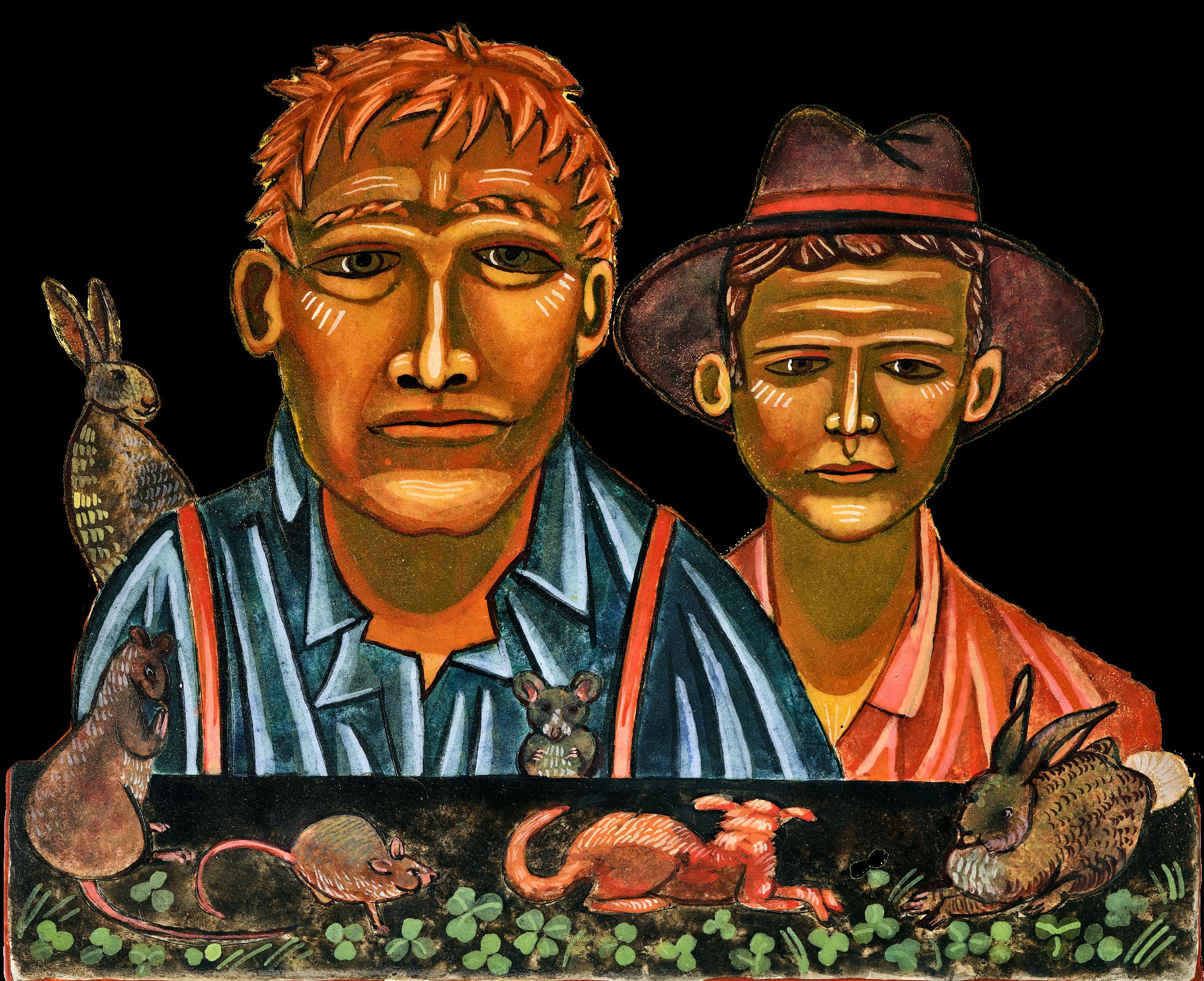
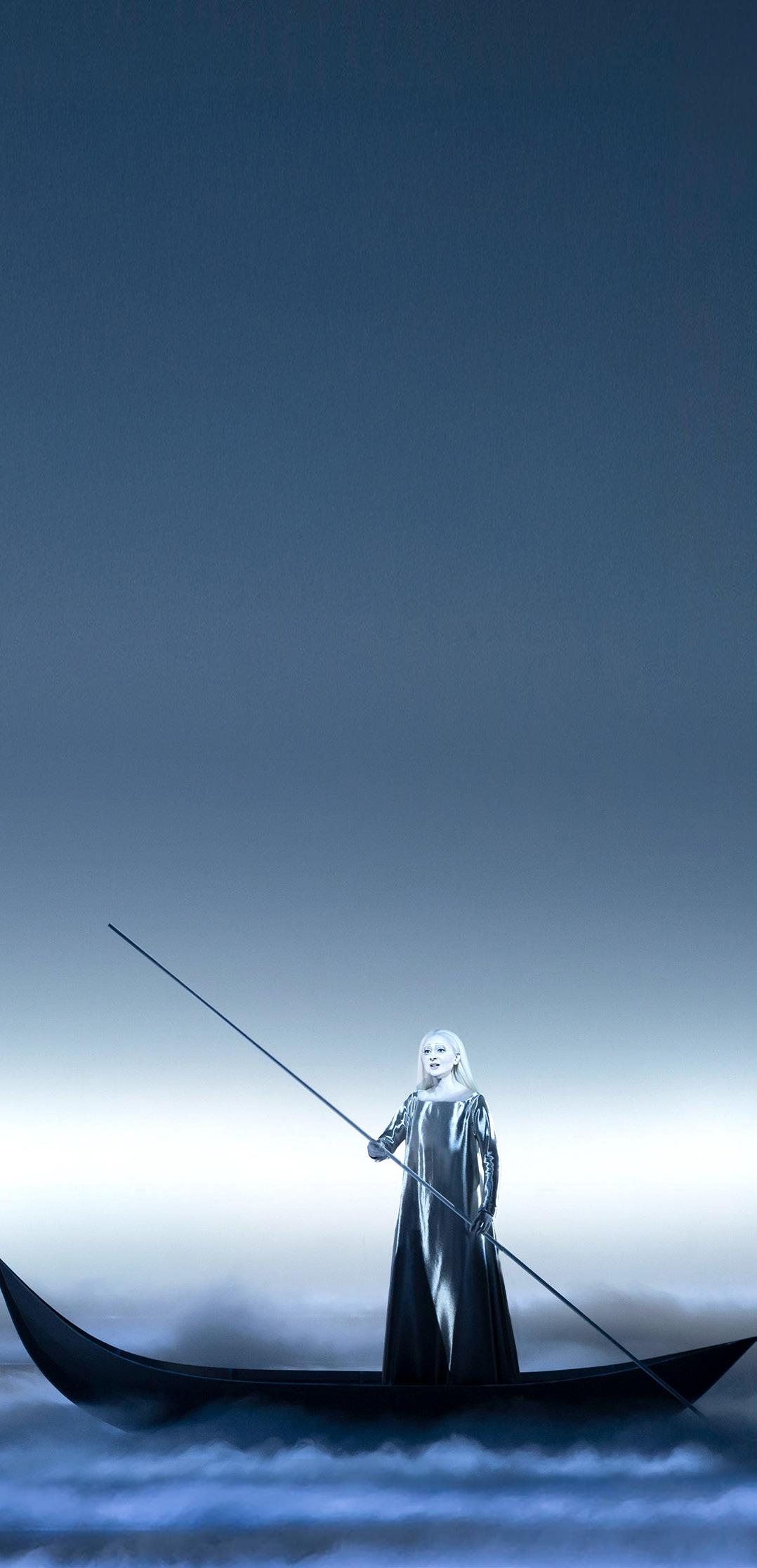
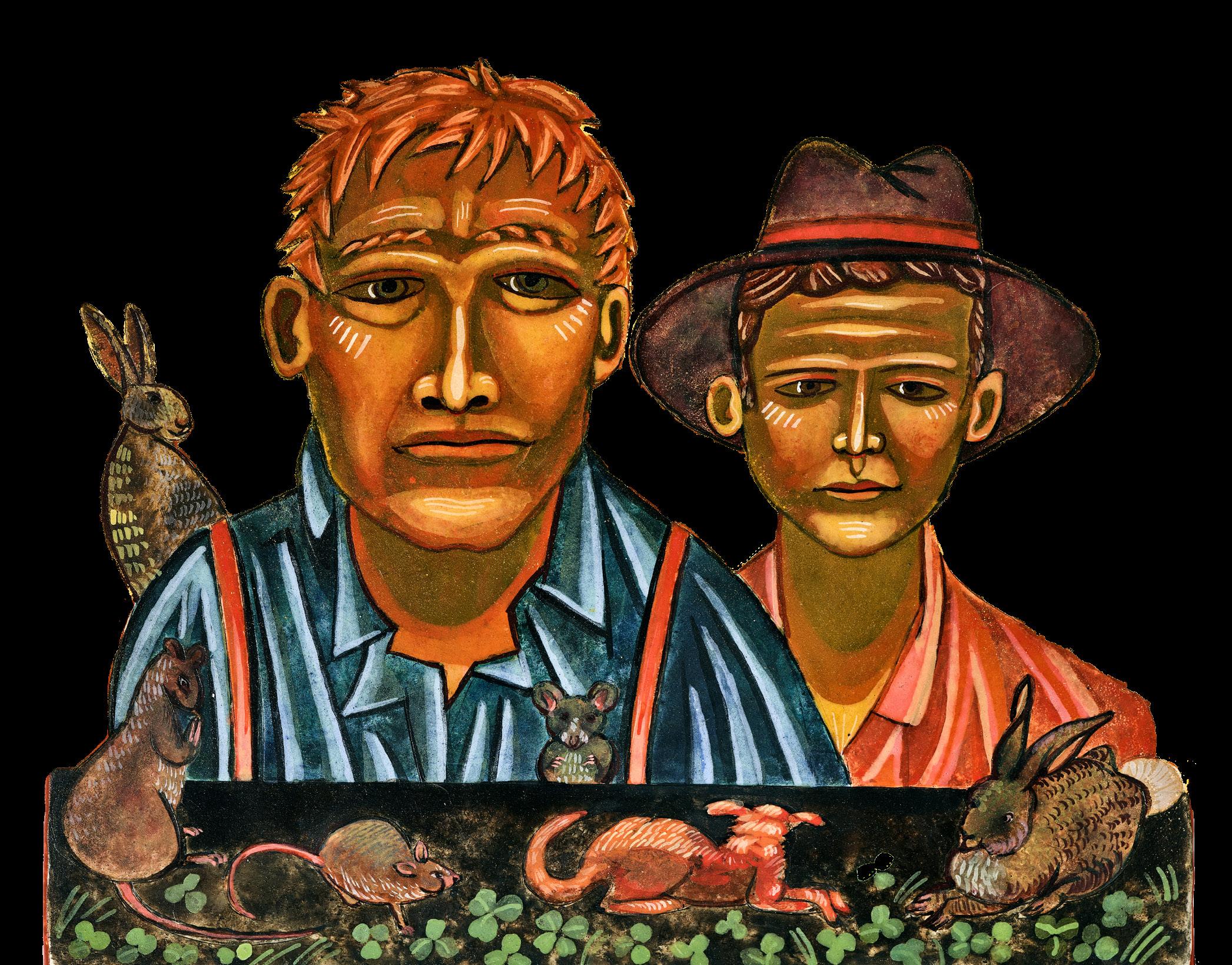
Houston artist Nestor Topchy has created a series of artworks representing each of HGO's operas from the 2025-26 season. For more on this special collaboration, head to our Backstage Pass blog!


Opera Cues is published by Houston Grand Opera Association; all rights reserved. Opera Cues is produced under the direction of Chief Marketing and Experience Officer Jennifer Davenport and Director of Communications Catherine Matusow, by Houston Grand Opera’s Audiences Department.
Editor
Catherine Matusow
Designers
Chelsea Crouse
Rita Jia
Contributors
Joe Cadagin
Gavin Jones
Kristine McIntyre
Patrick Summers
Advertising Matt Ross/Ventures Marketing 713-417-6857
For information on all Houston Grand Opera productions and events, or for a complimentary season brochure, please email the Customer Care Center at customercare@HGO.org or telephone 713-228-6737.
Houston Grand Opera is a member of OPERA America, Inc., and the Theater District Association, Inc.
4 Seeing George and Lennie
Edge of Enormity
21 Relief on a Lonely Road Demetrious Sampson, Jr. and Sam Dhobhany on their biggest roles yet.
24 Matters of the Heart Bringing John Steinbeck’s novel into a realm of pure emotion.
A DIRECTOR’S VISION FOR A STRIKING NEW PRODUCTION.
BY KRISTINE MCINTYRE
Many people, myself included, consider Of Mice and Men to be Carlisle Floyd’s best opera. It’s based on the brilliant 1937 novella by John Steinbeck, and Floyd crafted the libretto himself from Steinbeck’s own stage play of the book. It tells the story of two migrant farm workers, George and Lennie, who are in search of their little piece of the American dream, but who encounter nothing but difficulty, and ultimately tragedy, along the way.
Like the book, the opera rings with truth and authenticity. Floyd doesn’t romanticize the story, nor does he pull any punches. The tragedy hits hard, and at times it feels unrelenting. But it’s also an opera filled with joy and hope, and at the end of Act II, we really feel as though Lennie and George’s dream might be within reach. The opera celebrates friendship and commitment to our fellow human beings, and it has what I think is one of the central qualities of American opera: it depicts the lives of ordinary people, made extraordinary by the quality of the music Floyd gave them to sing.
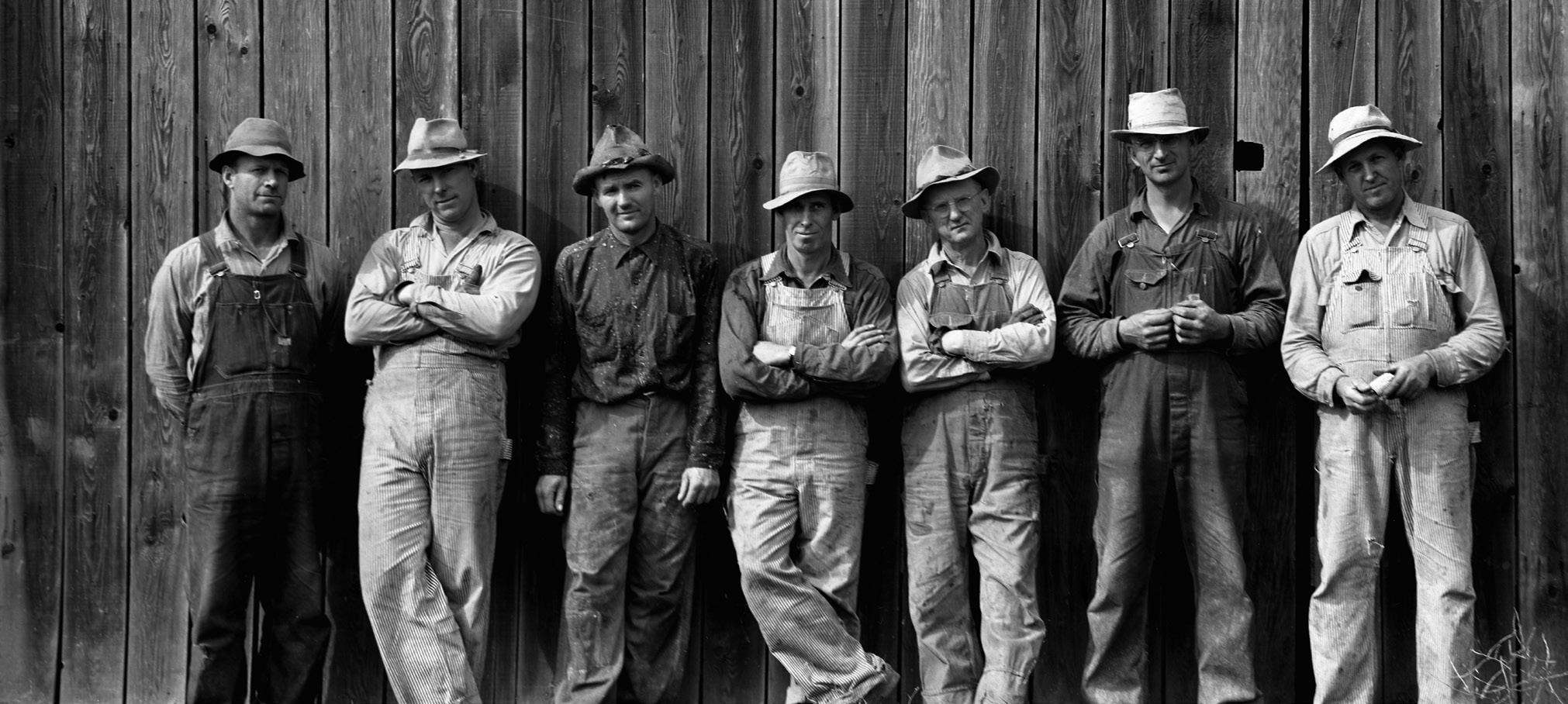
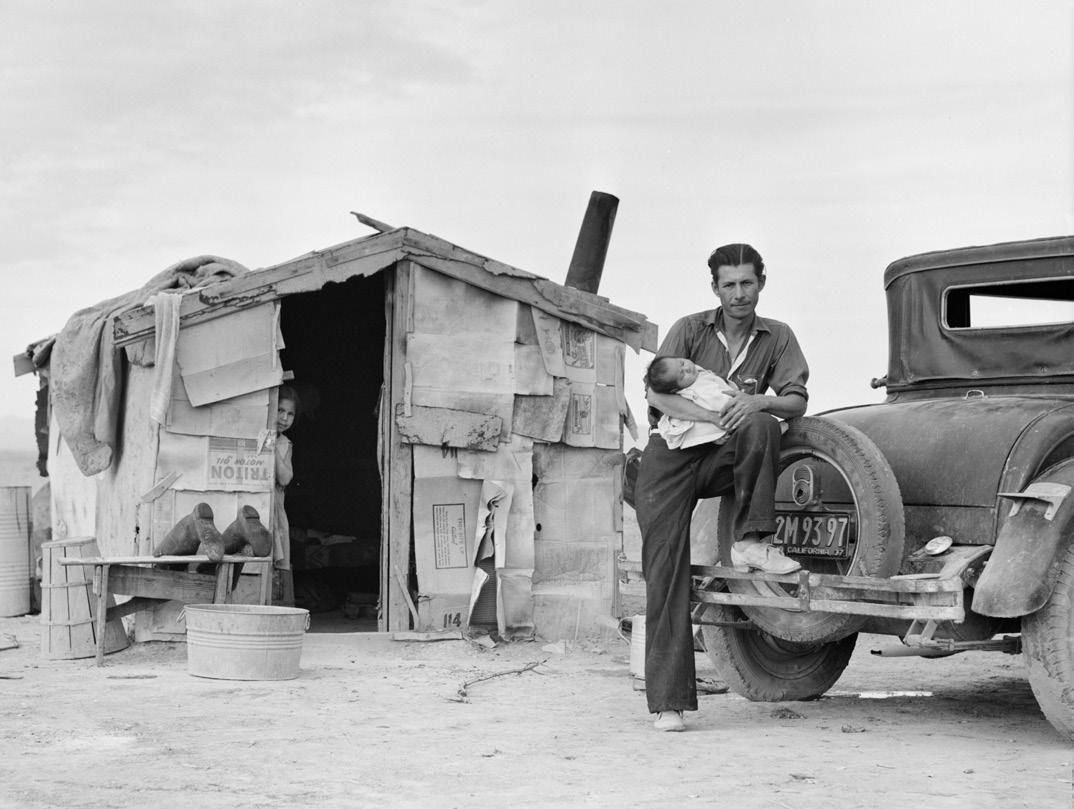
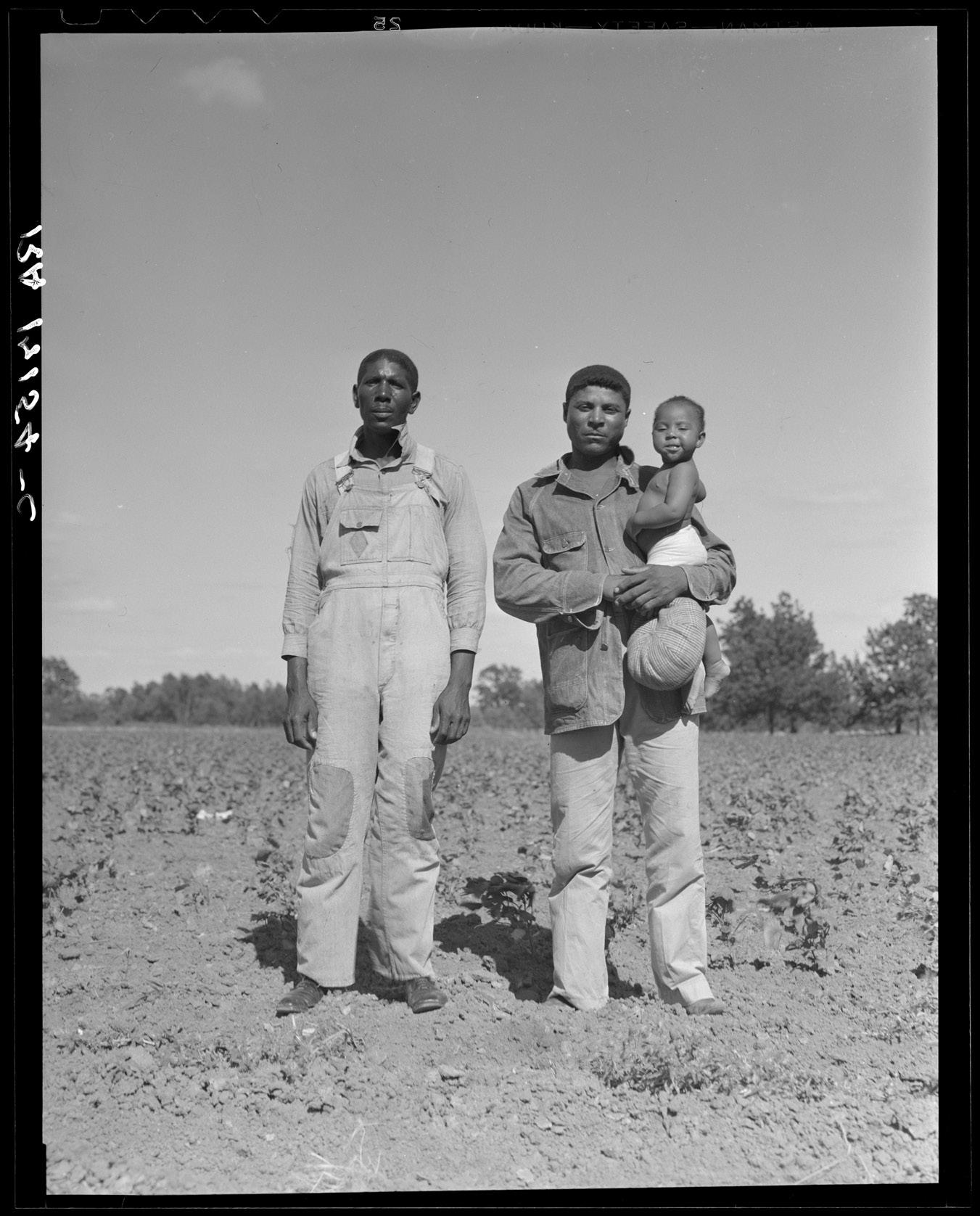
"The breadth and diversity of this story is captured in an extraordinary photographic record."
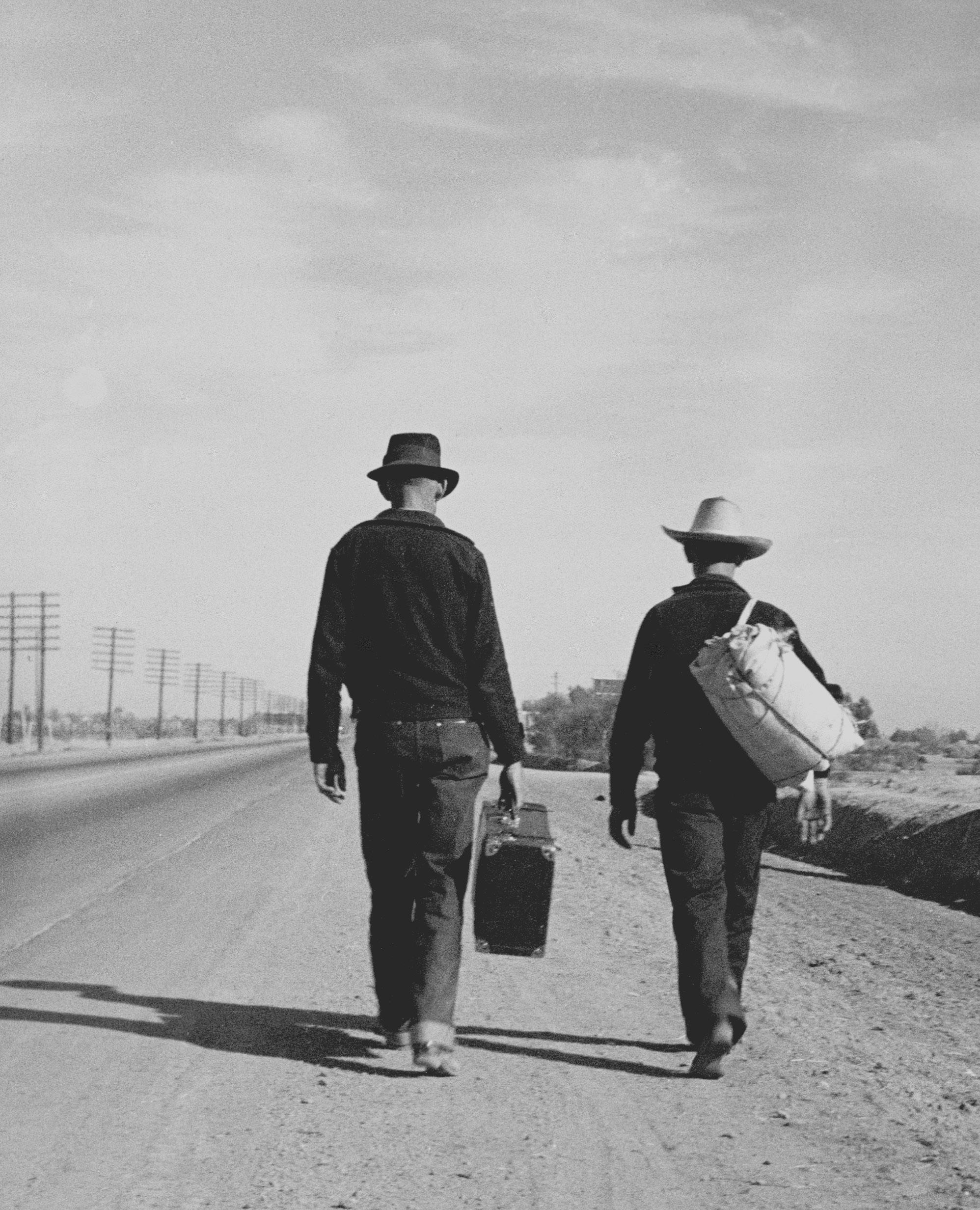
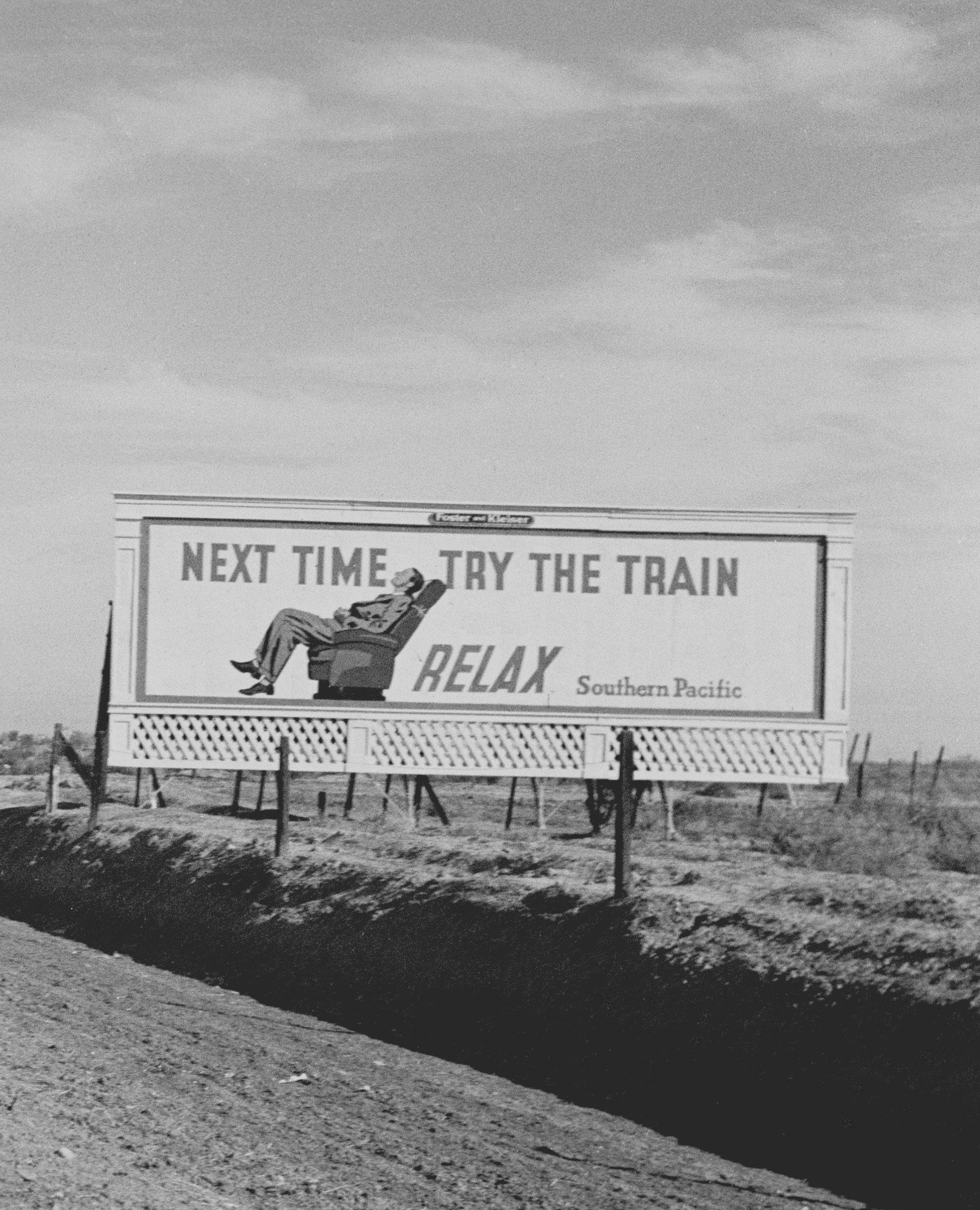
It’s a beautiful and challenging work, and I was thrilled to finally have the chance to create a new production of it. I knew that I wanted to make something that felt as authentic as the book, but that also pushed forward and told the story from a more universal perspective. For George and Lennie’s story is not unique—they are part of a long line of migrant and immigrant workers who make up California’s agricultural history, beginning with Chinese immigrants in the late 19th century and continuing with Japanese and Filipino workers, White tenant farmers escaping the Dust Bowl and the Great Depression, Black sharecroppers escaping Jim Crow laws as part of the Great Migration, and Mexican braceros who came to fill the labor shortages of World War II. Fortunately for us, the breadth and diversity of this story is captured in an extraordinary photographic record that spans generations. And so, to begin our work on this production, we started at the beginning of that history with the pioneering work of documentary photographer Dorothea Lange.
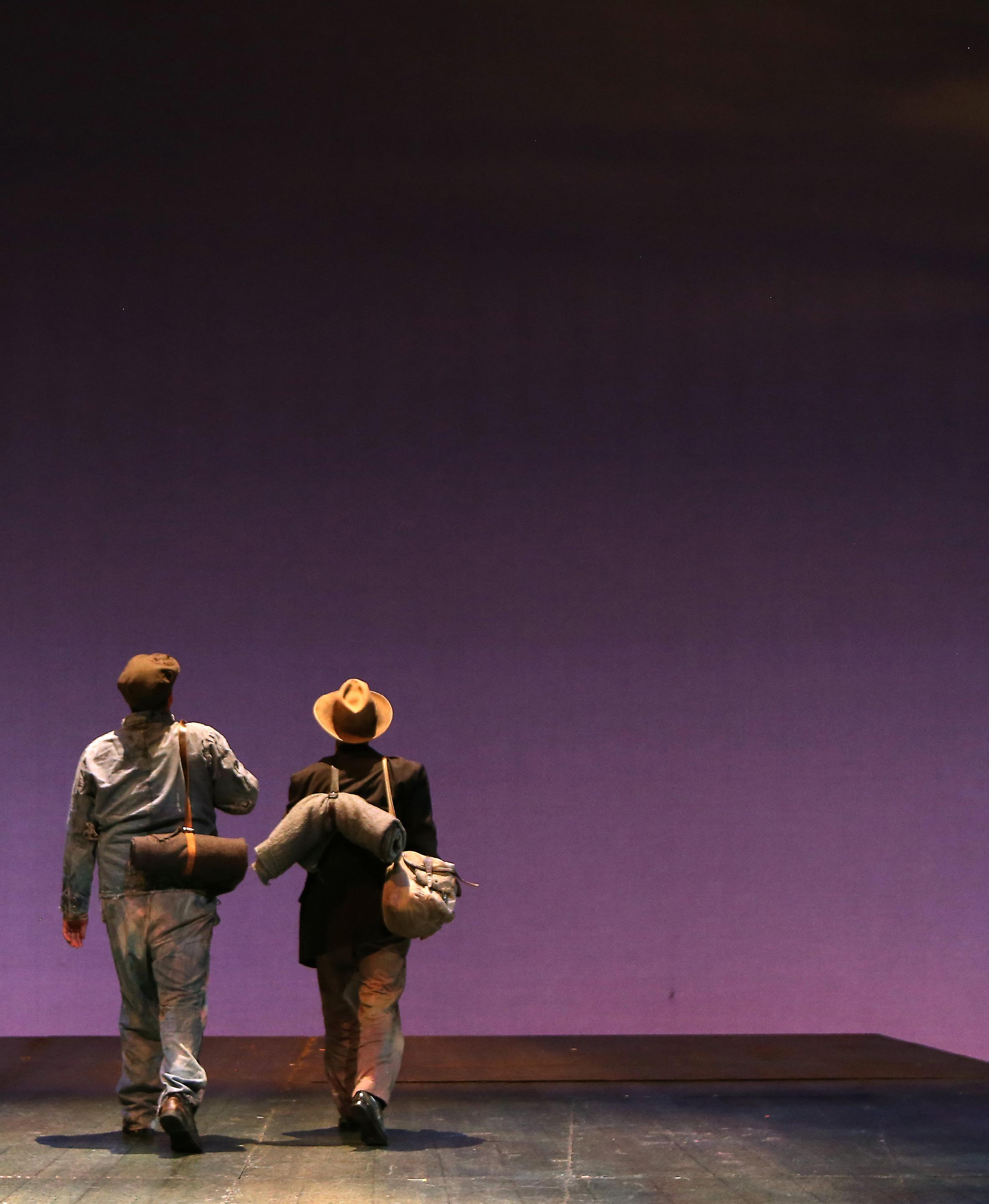
Lange is one of my favorite artists. She captured the upheaval of American agricultural life and humanized the Great Depression through her powerful, intimate, and stunning photographs. Working originally for the Farm Security Administration, she traveled through California, the Southwest, and the South, documenting the effects of the Depression, the Dust Bowl, and of the plight of migrant workers and later residents of internment camps while taking some of the most important photographs of the 20th century. She helped the viewer to really see her subjects, and I have found her images to be both inspiring and indispensable. For me, her photo of two migrant workers, or bindlestiffs, walking up the open road practically is George and Lennie—and so, imagine my delight when I encountered an homage to it made in 1961 by documentarian Ernest Lowe, who, it turns out, is one of Lange’s disciples.
Ernie Lowe was still a photography student when Lange came to guest-lecture in one of his classes. Unlike Lange, who moved from assignment to assignment, Lowe spent a great deal of time photographing in the same places—mostly notably Teviston, a rural farm community founded by former Black sharecroppers in the San Joaquin Valley of California. Lowe came to know the people there, and they let him into their houses and into their lives—and so we now have this extraordinary visual history.
Inspired by the work of Lange, Lowe, Marion Post Wolcott, and Sid Avery, our scenery and projections designer, Luke Cantarella, has created a world
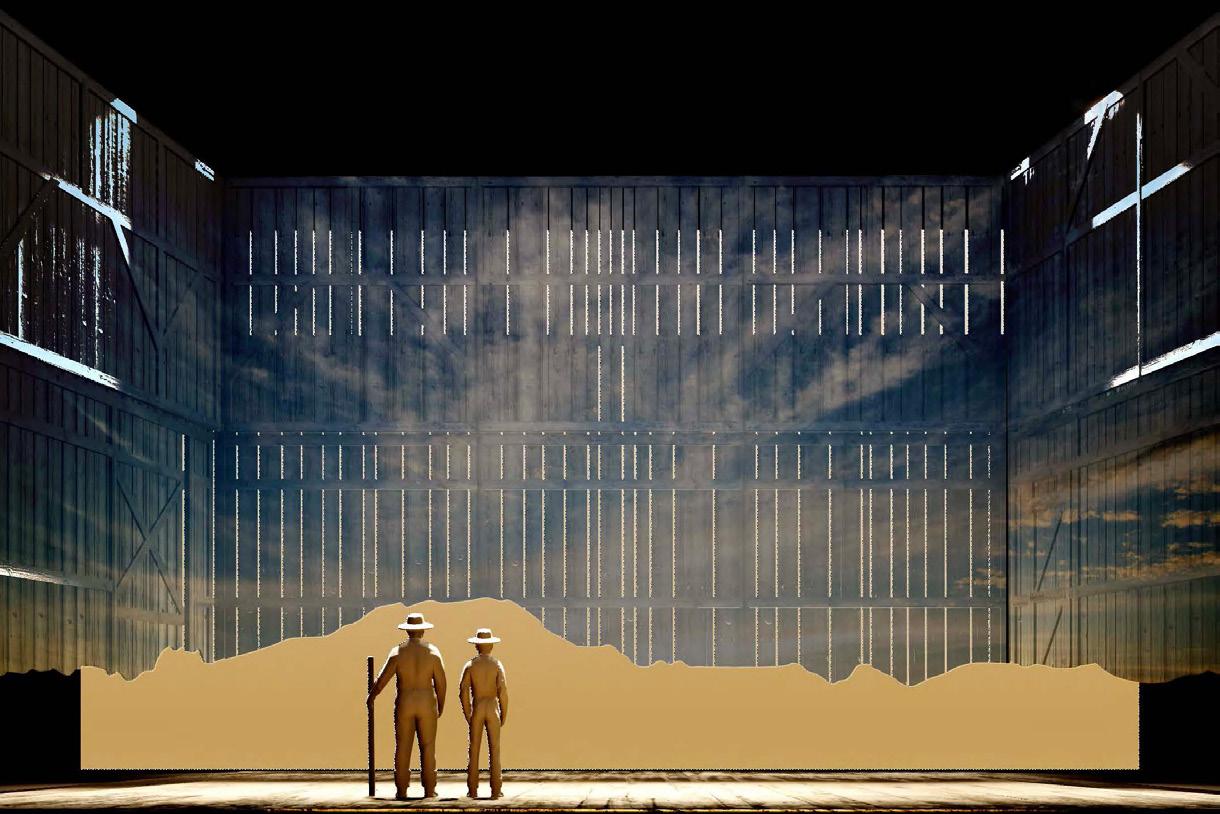
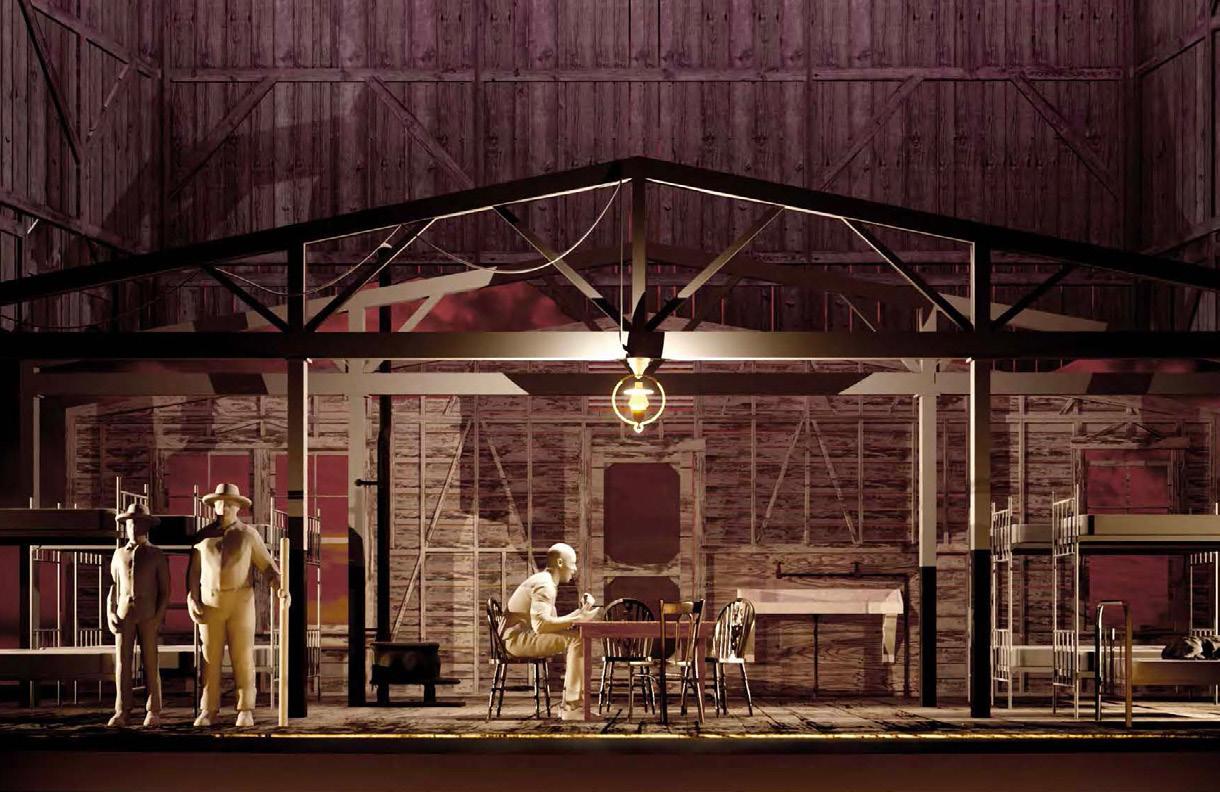
grounded in the details of California agricultural life but with a timelessness and slightly contemporary edge that helps us bring the storytelling forward. The river gulley where George and Lennie hide, the Bunkhouse, and the Barn are brought to life in a stark, beautiful, and modern way. Panels that move up and down create not only a projection surface but a moveable horizon that evokes the California landscape. Luke traveled to Steinbeck country to film original content for the projections, which capture the cinematic breadth of the countryside. They also allow us to tell a more intimate, personal story—specifically to explore Lennie’s psychology and try to see the world through his eyes. Lennie’s perspective is rarely centered, and yet I think there is great beauty and import in trying to see the world as he does. He is, after all, the emotional heart of this extraordinary opera.
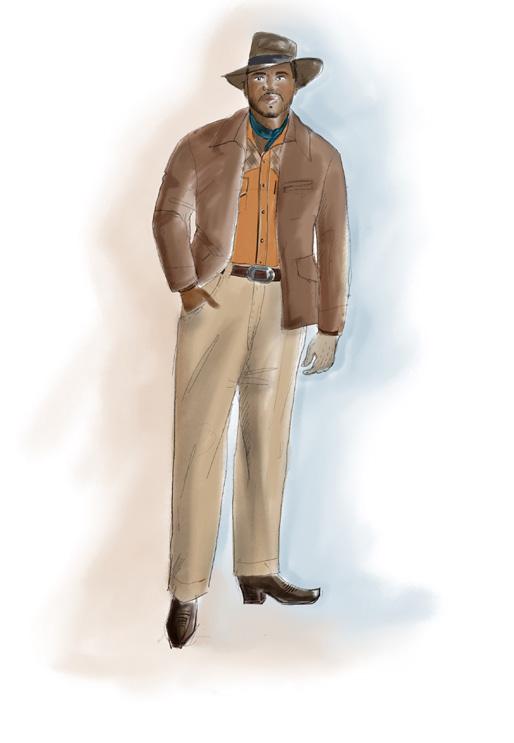
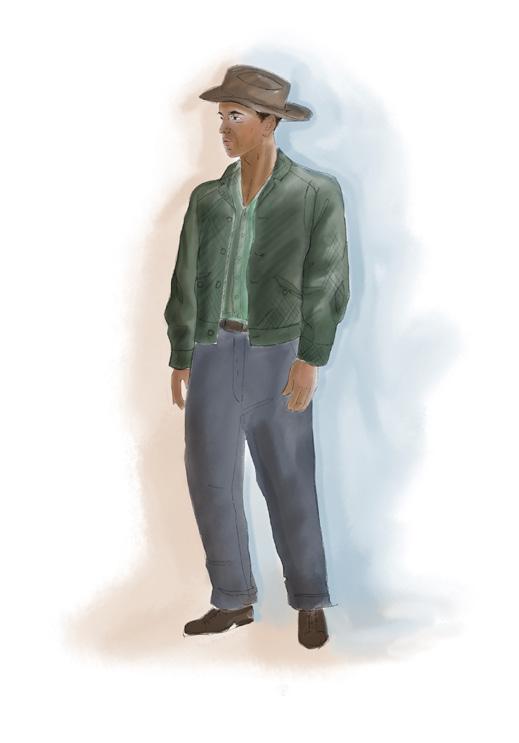
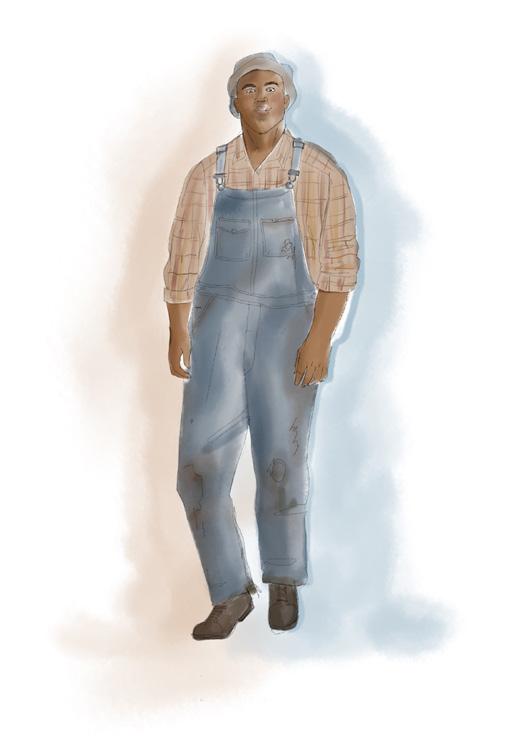
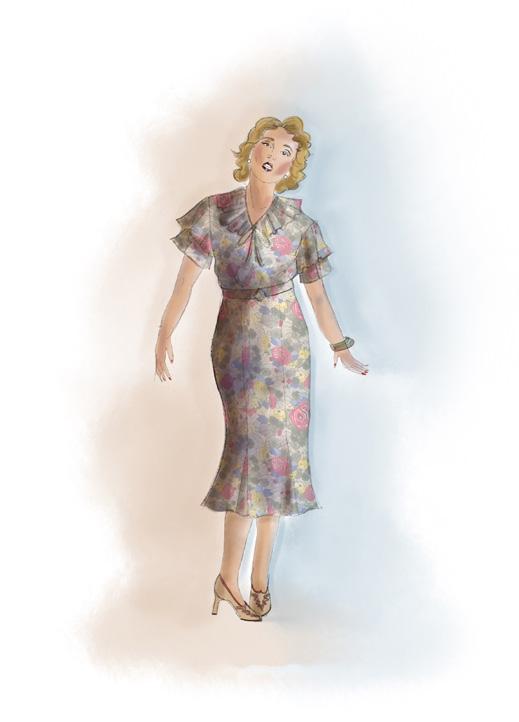
Kara Harmon’s costumes are equally grounded in authentic details. Months of painstaking research have yielded looks that echo the 1930s but are also an homage to the generations of farm workers who have followed, which are revealed in items like the types of hats they wear or the layering of their clothes—subtle but unmistakable clues to their backstories and regional origins. I grew up in California and know it is a great melting pot, nowhere so visibly as in its agricultural communities, and Kara’s clothes tell this story beautifully.
Of Mice and Men is a moving and intimate story of friendship and hope set against a cinematic backdrop—one in which the beauty of the farm and the dream that Lennie and George share are in sharp contrast to
the challenges they face and the tragedy that unfolds. The title of the recent retrospective of Lange’s work at the National Gallery— Seeing People —is a perfect description for what Floyd’s opera does. For if photographers like Lange and Lowe asked us to truly see our fellow human beings—and if Steinbeck, as he said, gave voice to the “inarticulate and powerful yearning of all men”—then it was Carlisle Floyd who elevated that yearning into song.
By Patrick Summers, Artistic and Music Director
The ideas of great artists are so expansive, while the rest of us mortals are individually so small, like mice and men. There is an oppressive feeling of being a young artist, though it brings comfort in later years: that you are hovering constantly on the edge of enormity. This doesn’t mean the enormity of fame or success, but something deeper, the wealth of ideas contained within art. We first feel this when we encounter elder artists we revered but never imagined knowing. My professional life as Houston Grand Opera’s Music Director for nearly three decades has been privileged and enriched by wonderful mentors, and the composer Carlisle Floyd (1926–2021) was very high among them. It is joyous to remember him again as we prepare for his centenary, as well as our country’s quarter millennium in 2026, with performances of a new production of his opera Of Mice and Men, based on John Steinbeck’s acclaimed novel. This production will shed new light on Carlisle’s biggest operatic problem child, as he often called Of Mice and Men, the work he most revised, and the one he most loved.
Carlisle had a small public imprint for such a renowned person, largely because of his nature. He was an elegant and gracious gentleman, unfailingly polite, slow to anger. He always felt to me like a character created by a great Southern writer, the sort of person we sadly no longer have. He changed the face of an art that had barely existed when he was young, American Opera, a
pair of words that prior to Carlisle would have been thought oxymoronic. He was so perfectly suited to the aesthetic of the novelist John Steinbeck, 24 years his senior, that one could easily imagine Carlisle composing large-scale operas on the epic Steinbeck novels The Grapes of Wrath and East of Eden. But he kept gravitating toward Of Mice and Men, the author’s rhapsodically tragic 1937 novella, a paean to the striving lives of migrant farm workers in what is still known as Steinbeck country, that beautiful stretch of central California along the Monterey coast.
Carlisle Floyd composed against the grain of his contemporaries. He was the same age as the enfant terrible German composer Hans Werner Henze, both of them born in 1926, a year filled with births of the renowned: Jerry Lewis, Marilyn Monroe, Mel Brooks, David Attenborough, Fidel Castro, and Queen Elizabeth II. Another contemporary of Carlisle’s was the French composer/ conductor Pierre Boulez, also an avant-gardist with a taste for revolution akin to Wagner’s, and whose music was, like Henze’s, as far from Carlisle’s aesthetic as music could get. It isn’t just that these three composers occupied different countries; they seemed to be on different musical planets.
Musical composition splintered after the Second Viennese School, which was both a delayed reaction to Wagner, and an attempt to hold on to the cultural lines WWI had severed. Post-WWI
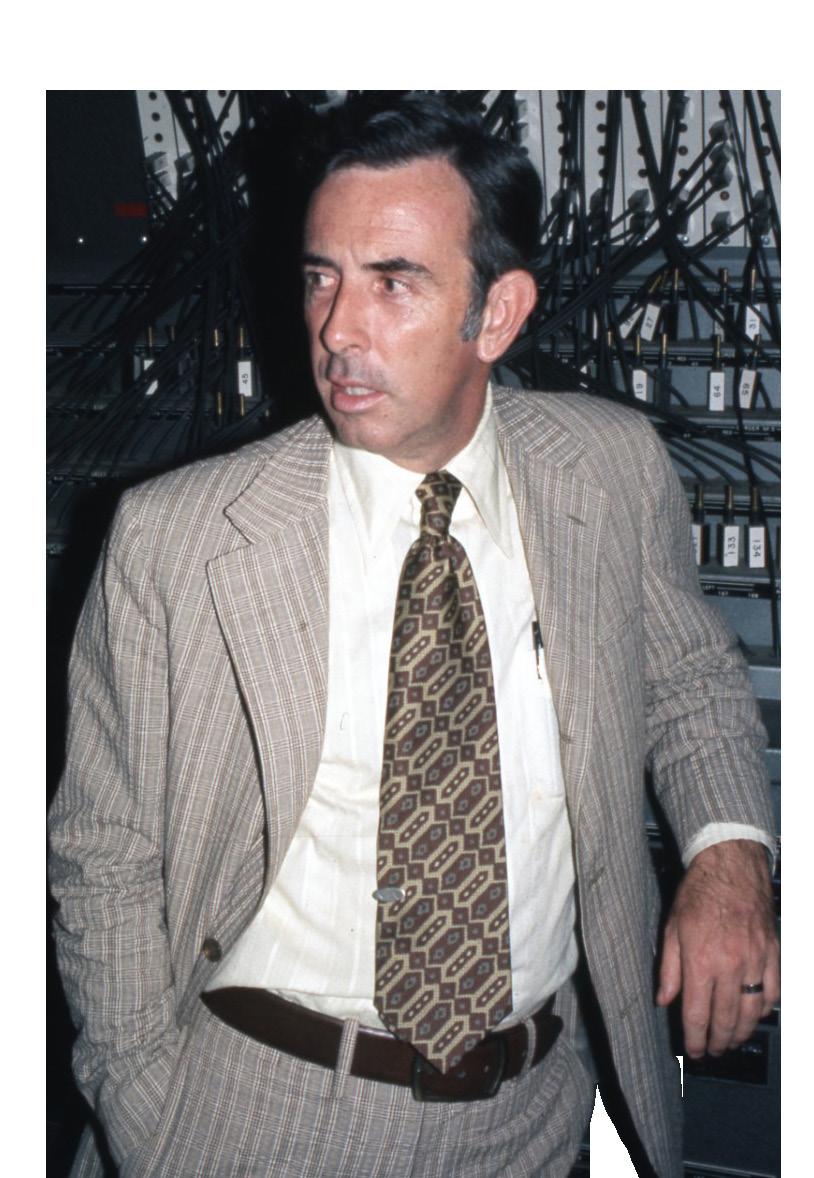
Above: Patrick Summers, Carlisle Floyd, and director Bruce Beresford in rehearsal for Cold Sassy Tree at HGO (2000). Below: The company's 2002 production of Of Mice and Men.

composition created an “establishment” based in, or endorsed by, musical academia all over the world—Henze, Copland, and Boulez—as well as an anti-establishment, very much represented in the United States by Carlisle and his older contemporary Gian Carlo Menotti. Sitting between the established and the non was Leonard Bernstein, eight years older than Carlisle, whose most cherished compositions were for the commercial theater—West Side Story, On the Town, and Candide —but whose deepest desire was to be a symphonic and opera composer who honored both the Second Viennese School and what came before it: Mahler and Wagner.
Into this melee of theory and practice, the South Carolinian Carlisle began to compose operas, and Susannah, while not his first opera, was the first that landed with a large public, having played to enormous audience success at New York City Opera in 1956, soon after premiering at Florida State University. All eyes and ears leaned toward Carlisle as a new direction, much as they had to Puccini a half-a-century before. Carlisle began thinking of an opera based on Of Mice and Men as early as 1963, envisioning it as a vehicle for
superstar bass-baritone Norman Treigle as George and heldentenor Richard Cassilly—later the leading Tannhäuser of his era—as Lennie.
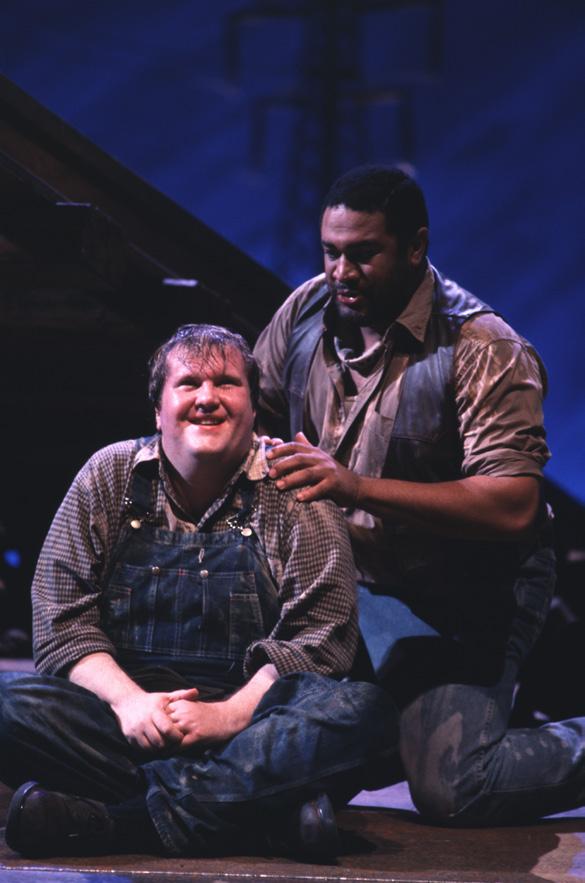
The lodestar of American opera was composed 20 years before Susannah, Gershwin’s Porgy and Bess, but in the 1950s, Porgy and Bess was not widely considered to even be an opera, and if it was, it was felt that whatever Gershwin created could never be replicated. Floyd’s Susannah, though, portended something else: a new American operatic language that welcomed vernacular stories with vernacular music, far from the reach of academia. Porgy and Bess will always be interrogated because its creators were putting words into characters far from their own cultures and races, but Susannah had no such appropriation—it came right from Carlisle’s own world, and so did Of Mice and Men. Had Gershwin lived, he would have contributed mightily to the operatic world that Carlisle so influenced.
One has to harken back to the long 19th-century career of composer Giuseppe Verdi and his association with the major Italian companies to find a
precedent, but even in that light, Carlisle’s HGO association was unique. Verdi’s career encompassed 54 years between his inaugural Oberto and his final glorious Falstaff. Carlisle composed his own quasi-Falstaff for HGO—the joyously autumnal Cold Sassy Tree, which we premiered in 2000. Carlisle’s association with HGO ultimately spanned more than 60 years, which at the time of his death was 85 percent of our entire history, by far the longest artistic influence over our company.
Working as a young reporter in California, John Steinbeck heard a tale of a ranch hand killing a landowner for firing a friend, and out of that Steinbeck conceived the story that propels Of Mice and Men, that of two friends Lennie and George, protectors of each other, looking for a home, an allegory of Depression-era America. The novel was immediately adapted into a hit Broadway play and quickly became a powerful 1939 film. Carlisle Floyd had Steinbeck’s blessing to compose an opera on Of Mice and Men, a commission from San Francisco Opera that ultimately fell apart—the opera premiered in Seattle, a complicated saga, but typical of how new operas were treated in the 1960s. As Carlisle did on all of his operas, he wrote the libretto for Of Mice and Men himself, which gives it and each of his operas a rare unity. Carlisle often joked that when the librettist and the composer fight, as they inevitably do, he always let the composer win—but of course, he was fighting with himself.
Of Mice and Men is Carlisle’s masterpiece, an epically moving opera that places the audience at the center of an impossible moral dilemma, but with deep humanity. There is no character in Of Mice and Men to whom we cannot relate, and we are swept along like a tide into this story because of Carlisle’s
incredible score. The soaring music that brings Of Mice and Men to a close, the moment when the childlike Lennie imagines he has finally found his long-sought home, remains among the most moving in the operatic repertoire. In Steinbeck, the ending is shocking and provokes anger in the reader; in Floyd, it overwhelmingly cracks the heart. I will never forget the performances of the opera which I conducted at the 2001 Bregenz Festival in Austria (Von Mäusen und Menschen, as it was on our posters in German), and the audible tears I could hear behind me at opera’s end.
If you were lucky enough to know Carlisle Floyd, or luckier still to work with him, you found yourself understanding loyalty, kindness, and mastery, and the rarity of an artist being both spiritually gifted and full of practical craft. Though not a conductor himself, he knew exactly how to unlock a phrase of music as a conductor must, so he was an incredible mentor. He was of a generation who believed that if you had to profess a value, it was probably because you were lacking it. As proud as he was of his operas, his co-founding of the Butler Studio at Houston Grand Opera with David Gockley was one of his proudest achievements.
One felt the edge of enormity in Carlisle’s presence; his mind was expansive, lyrical, and gentle. There is a moment of supreme tenderness in his opera, Cold Sassy Tree, a short aria sung by Will Tweedy in innocent admiration of a young girl, Lightfoot, who protects him. This was always my most treasured place in this beautiful opera, with music that sits in my heart always, especially as we prepare to honor Carlisle in this year of his centenary.
“So there you were, my guardian angel. Just like you’d been sent to me… Guardian angels hover overhead just out of sight. Then when you’re in need of them they appear and spread their wings… That’s what guardian angels do.”
– Carlisle Floyd , “Guardian Angel” from Cold Sassy Tree

The Brown Foundation, Inc.
Albert and Anne Chao
Claire Liu and Joe Greenberg
Houston Grand Opera Endowment, Inc.
Dian and Harlan Stai
The Wortham Foundation, Inc.
GUARANTOR
Carolyn J. Levy
UNDERWRITERS
Drs. Ian and Patricia Butler
Mr. and Mrs. Charles G. Nickson
SPONSOR
Ms. Susan Bloome

March 13 & 15m
AN OPERA IN THREE ACTS
MUSIC AND LIBRETTO BY Carlisle Floyd
A Co-Production of Houston Grand Opera, Des Moines Metro Opera, Florida State University, and Lyric Opera of Kansas City
By arrangement with Boosey & Hawkes, publisher and copyright owner
Sung in English with Projected English text
Cullen Theater, Wortham Theater Center

ARRANGED BY Jim Medvitz
The performance lasts approximately 2 hours and 20 minutes, with one intermission.
The activities of Houston Grand Opera are supported in part by funds provided by the City of Houston through Houston Arts Alliance and by a grant from the Texas Commission on the Arts.
Content advisory: This production contains gunshot effects.

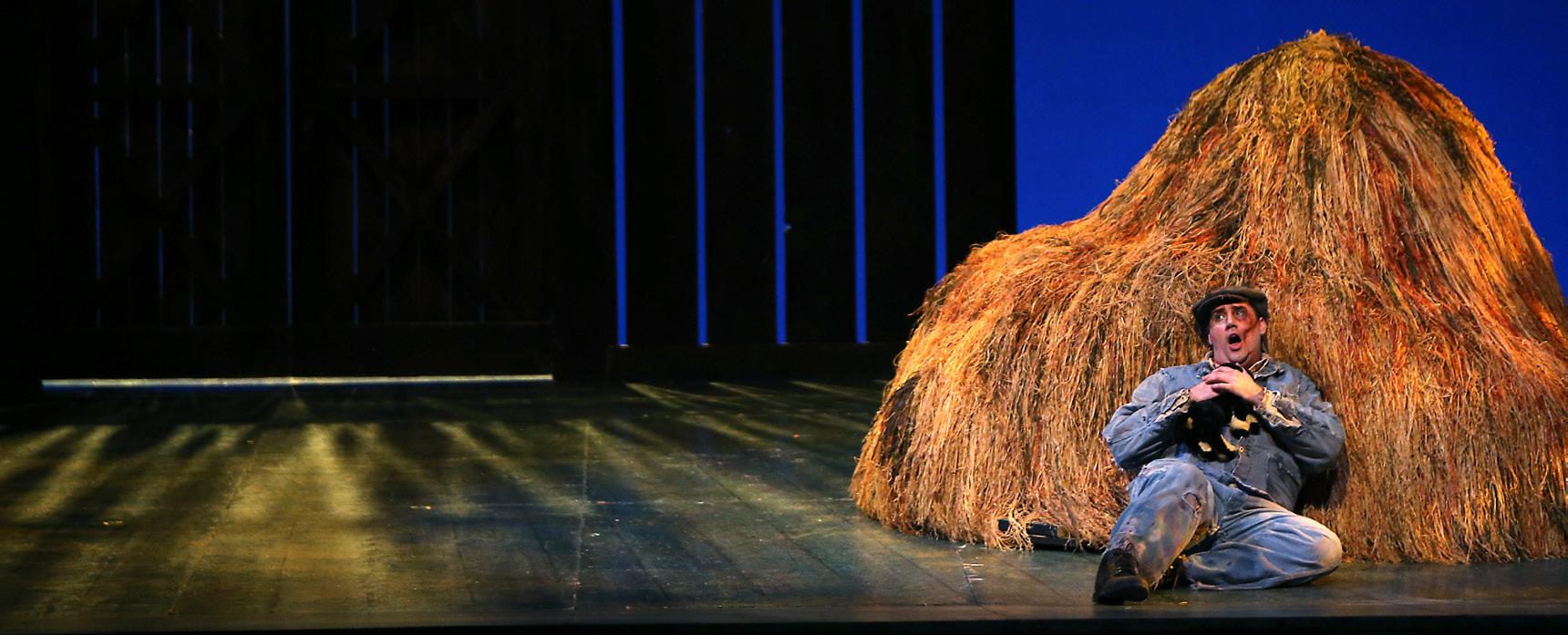
George and Lennie, a pair of ranch hands in Depression-era California, dream of owning a farm of their own, but their hopes are thwarted after a fatal accident.
Following the Stock Market Crash of 1929, the United States was plunged into the decade-long Great Depression. Many Americans suddenly found themselves jobless and were forced to move in search of employment. In his 1937 novella Of Mice and Men, author John Steinbeck chronicled the plights of agricultural migrant laborers in California, who traveled from farm to farm and worked in poor conditions for little pay. The book was an experiment in what Steinbeck called “Is” Thinking—representing a story objectively, without trying to impose any judgment or meaning on the events.
Having witnessed the effects of the Depression during his childhood in South Carolina, composer/librettist Carlisle Floyd was drawn to Steinbeck’s novella, which he called “a study of human attachment in an environment of harsh personal isolation and despair.” When he began adapting the book into an opera, Floyd sought the input of Steinbeck, who approved his
libretto. However, the project proved an immense challenge—Floyd spent seven years revising the opera until its Seattle Opera premiere in 1970. It remains one of his most popular and enduring works, second only to his masterpiece Susannah
The opera opens with blaring trumpet and dissonant strings that represent George and Lennie running from the police. Following this chase music, George vents his frustration at having to look after Lennie in his aria “My life would be so simple by myself.” Listen for its back-and-forth melody that suggests George is trying to make up his mind whether to stick with him. Lennie responds with “It was somethin’ I could stroke,” about the furry mouse he killed. Its tender main theme conveys the character’s childlike innocence. George reassures his friend in “One day soon,” describing their dream farm in a comforting tune inspired by American folk music. Once they reach the ranch, the companions encounter the harmonica-playing Ballad Singer, who croons his mournful tune “Movin’ on.”
In his Act II aria “I ain’t gonna buck grain the rest of my life,” George vows that he and Lennie will break free of their existence as wandering ranch hands. Listen for the climax on the words “I’ll never

settle for this life,” which he sings on a hopeful, soaring theme. In the humorous trio “Just think of owning a place of our own,” George, Lennie, and Candy picture the laidback life they’ll lead on their farm. Listen for its unusual meter that alternates between a measure of seven beats and a measure of five.
In Act III, Lennie and Curley’s Wife share a duet about their dreams, but they don’t seem to truly hear each other. Their separate lines “weave in and out while they remain independent,” as Floyd put it—a musical technique known as counterpoint. In the final scene of the opera, listen for the tragic reprise of George’s “One day soon” as he prepares to shoot Lennie.
The title of Steinbeck’s novella comes from Robert Burns’s 1785 poem “To a Mouse,” about a mouse whose nest is destroyed by a plow. In its most famous line, Burns writes, “The bestlaid schemes of Mice and Men go oft awry”—or, in other words, things usually don’t go as we anticipate, whether we’re human or rodent.
Lennie Small
Demetrious Sampson, Jr. †
Dr. Dina Alsowayel and Mr. Anthony R. Chase/ Dr. Eric McLaughlin and Mr. Elliot Castillo/ Alejandra and Héctor
Torres/ Mr. Trey Yates Fellow
George Milton
Curley
Sam Dhobhany †
Dian and Harlan Stai Fellow
Shawn Roth †
Melinda and Bill Brunger/ Drs. Liz
Grimm and Jack Roth/ Drs. Rachel and Warren A. Ellsworth IV/ Kathleen Moore and Steven Homer/ Sharon Ley Lietzow and Robert Lietzow Fellow
Candy Ziniu Zhao †
Carolyn J. Levy/ Jill and Allyn Risley/ Dr. Peter Chang and Hon. Theresa Chang and Friends Fellow
Curley’s Wife
Alissa Goretsky †
Gloria M. Portela/ Susan Bloome/ James M. Trimble and Sylvia Barnes Fellow
Carlson Michael McDermott †
Michelle Beale and Dick Anderson/ Dr. Ellen R. Gritz and Mr. Milton D. Rosenau Jr. Fellow
Conductor Benjamin Manis
Director Kristine McIntyre *
Claire Liu and Joe Greenberg Director Chair
Scenery and Projections Luke Cantarella *
Designer
Costume Designer Kara Harmon *
Lighting Designer Kate Ashton *
Fight/Intimacy Director Adam Noble
Music Preparation
Stage Manager
Jenny Choo †
Dr. Laura E. Sulak and Dr. Richard W. Brown Fellow
Nicholas Roehler
Tzu Kuang Tan †
Shelley Cyprus Fellow
Maureen Zoltek
Annie Wheeler
Assistant Director Janine Morita Colletti *
* HGO production debut † Butler Studio artist
Ballad Singer
Luka Tsevelidze *†
Donna and Ken Barrow/ Barbara and Pat McCelvey/ Irina and Andrey Polunin/ Ms. Rita Leader/ Jill A. Schaar and George Caflisch Fellow
Slim Geonho Lee †
Mr. and Mrs. James W. Crownover/ Dr. and Mrs. Miguel Miro-Quesada / Dr. John Serpe and Tracy Maddox Fellow
Supertitles by Alexa Lietzow. Supertitles called by Jeffrey Ragsdale.
The role of Candy's dog is performed by Pepe, with Loki as Lennie's puppy. Training by Believe in Dog.
Performing artists, stage directors, and choreographers are represented by the American Guild of Musical Artists, AFL-CIO, the union for opera professionals in the United States.
Scenic, costume, and lighting designers and assistant designers are represented by United Scenic Artists, IATSE Local USA-829.
Orchestral musicians are represented by the Houston Professional Musicians Association, Local #65-699, American Federation of Musicians.
Stage crew personnel provided by IATSE, Local #51.
Wardrobe personnel provided by Theatrical Wardrobe Union, Local #896.
Usher personnel provided by IATSE, Local B-184.
This production is being recorded for archival purposes.


Setting: An agricultural valley in northern California, 1930s
George and Lennie, a pair of migrant workers, are on the run from the police. Lennie, who has an intellectual disability, landed the pair in hot water when he tried to feel a girl’s soft dress. George expresses his frustration—his life would be much easier if he didn’t have to look after Lennie. He notices that his companion is hiding something and discovers it’s a mouse that Lennie accidentally petted to death. To comfort Lennie, George tells him about the farm they hope to buy one day—a place where George can keep Lennie out of trouble.
The following evening, hotheaded ranch owner Curley waits impatiently in the bunkhouse where his employees live. George and Lennie were supposed to start work that day but never showed up. Curley’s Wife, starved for attention, enters and begs her husband to take her out. George and Lennie finally arrive and are greeted by the ranch hands, including the elderly Candy. Curley’s Wife returns and tries to flirt with the men, who refuse to take the bait. Suddenly, everyone smells the stink of Candy’s old dog. The ranch hands insist Candy put the poor beast out of its misery, and the assistant foreman Carlson takes the dog out and shoots him.
Several days later, George is in the bunkhouse and finds a newspaper ad for a farm that fits what he and Lennie are looking for. Candy overhears their excitement and offers to go in with them on purchasing the property. As the three imagine their bright future together, Curley’s Wife interrupts them. When Curley discovers his wife in the bunkhouse, he jealously tries to pick a fight with Lennie, who breaks Curley’s hand. Slim the foreman suggests a deal—if Curley doesn’t fire George and Lennie, they promise not to tell anyone how he was injured.
The following afternoon, Lennie is hiding in the ranch’s barn—he accidentally killed the puppy Slim gave him and doesn’t want George to know. Curley’s Wife enters carrying a suitcase, ready to run off to Hollywood. She shares her dream of becoming a film star, and Lennie relates his plans for the farm. He tells Curley’s Wife about his love for soft things, and she lets him feel her hair. But when his stroking becomes too rough, she tries to free herself, and he accidentally snaps her neck. Realizing he’s done something awful, Lennie slips away. The ranch hands discover the dead body of Curley’s Wife, and Slim urges George to act fast—he has to steal a pistol and get to Lennie before Curley does.
George finds Lennie in the woods as Curley and a lynch mob are heard approaching. Distracting Lennie with a description of their farm that will never be, George puts a gun to his friend’s head and pulls the trigger.
HGO previously performed Of Mice and Men during the 1972-73, summer 1977, and 2001-02 seasons.
Patrick Summers, Artistic and Music Director
VIOLIN
Denise Tarrant †, Concertmaster
Chloe Kim *, Acting Concertmaster
Melissa Williams *, Acting Assistant Concertmaster
Natalie Gaynor *, Principal Second Violin
Carrie Kauk *, Assistant Principal Second Violin
Miriam Belyatsky *
Rasa Kalesnykaite †
Hae-a Lee Barnes *
Chavdar Parashkevov †
Anabel Ramirez *
Mary Reed †
Erica Robinson *
Linda Sanders *
Oleg Sulyga †
Sylvia VerMeulen †
Emily Zelaya
VIOLA
Eliseo Rene Salazar †, Principal
Lorento Golofeev †, Assistant Principal
Suzanne LeFevre *, Acting Principal
Gayle Garcia-Shepard †
Erika C. Lawson *, Acting Assistant Principal
Matthew Weathers †
Nicholas Lindell
CELLO
Barrett Sills *, Principal
Erika Johnson †, Assistant Principal
Dana Rath *, Acting Assistant Principal
Wendy Smith-Butler *
Chennie Sung †
DOUBLE BASS
Dennis Whittaker †, Principal
Erik Gronfor *, Acting Principal
Carla Clark *, Acting Assistant Principal
FLUTE
Henry Williford *, Principal
Tyler Martin †
PICCOLO
Henry Williford *, Principal
OBOE
Elizabeth Priestly Gehrke *, Principal
Mayu Isom †
ENGLISH HORN
Elizabeth Priestly Gehrke *, Principal
CLARINET
Eric Chi †, Principal
Justin Best, Acting Principal
BASS CLARINET
Justin Best, Acting Principal
BASSOON
Amanda Swain *, Principal
Quincey Trojanowski †
HORN
Sarah Cranston *, Principal
Kimberly Penrod Minson *
Spencer Park †
TRUMPET
Tetsuya Lawson †, Principal
Randal Adams †
Kyle Koronka, Acting Principal
TROMBONE
Thomas Hultén †, Principal
Mark Holley †
Jordan Milek Johnson †
Brian Logan
TUBA
Mark Barton *, Principal
TIMPANI
Alison Chang *, Principal
PERCUSSION
Craig Hauschildt, Acting Principal
Terry McKinney
HARP
Caitlin Mehrtens *, Principal
CELESTE
Jenny Choo
* HGO Orchestra core musician † HGO Orchestra core musician on leave this production
Broderick Tyrone Davis
Zach Keen
Raul Pardo, Jr.
Seth Carter Ramsey
DeVonte' Rogers
Elijah Strader
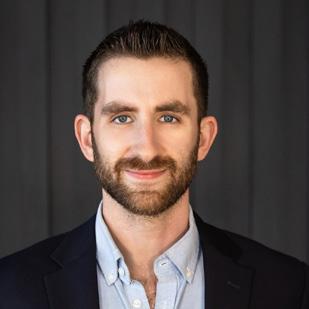
BENJAMIN MANIS (UNITED STATES)
CONDUCTOR
Benjamin Manis last appeared at HGO conducting the mainstage production of Tosca (2023). As a member of the company’s music staff from 2019-22, Manis conducted El Milagro del Recuerdo (2022, 2019 world premiere); outdoor performances of Romeo and Juliet (2022); The Snowy Day (2021 world premiere); Carmen (2021); Rigoletto (2019); the world premiere of Marian’s Song (2020); and the subsequent HGO Digital filmed version and Miller Outdoor Theatre performances of the same work. Elsewhere during the 2025-26 season, Manis returns to San Francisco Opera to conduct The Barber of Seville and debuts with the Savannah Philharmonic and Richmond Symphony. In the 2024-25 season, Manis made his San Francisco Opera debut conducting Carmen; led the SFO Orchestra and SFO’s Adler Fellows in a concert of arias; and returned to Utah Opera for Madame Butterfly and Rice University for John Corigliano’s The Ghosts of Versailles. Other recent debuts include the Rhode Island Philharmonic and the Grand Teton Music Festival, where Manis was appointed Resident Conductor by Music Director Donald Runnicles. In 2023, he was named associate conductor of Utah Symphony. Manis has served as cover conductor for the St. Louis and Dallas Symphonies, working with conductors David Robertson and Stéphane Denève, and is a four-time winner of the Solti Foundation U.S. Career Assistance Award, in 2019, 2022, 2023, and 2024.
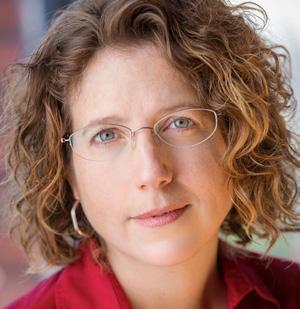
KRISTINE MCINTYRE (UNITED STATES) DIRECTOR
Claire Liu and Joe Greenberg Director Chair
Kristine McIntyre directed HGO’s annual Butler Studio Showcase in 2020, 2021, and 2023. Elsewhere during the 2025-26 season, McIntyre will direct this production of Of Mice and Men with Lyric Opera of Kansas City and Des Moines Metro Opera and La bohème with Pittsburgh Opera. Projects during the 2024-25 season included a revival of her film-noir-inspired Don Giovanni, the world premiere of Woman With Eyes Closed by Jennifer Higdon and Jerre Dye, and La bohème at Opera Colorado. McIntyre’s credits include directing the world premieres of Laura Kaminsky and Kimberly Reed’s Hometown to the World at the Santa Fe Opera; Kristin Kuster and Mark Campbell’s A Thousand Acres for Des Moines Metro Opera; and Galaxies in Her Eyes by Mark Lanz Weiser and Amy Punt. She recently directed her first opera film, Unknown, for UrbanArias, based on the song cycle by Shawn Okpebholo and Marcus Amaker. She also directed the premieres of Louis Karchin’s
Jane Eyre for the Center for Contemporary Opera; Kirke Mechem’s John Brown for Lyric Opera of Kansas City; The Place Where You Started by Mark Lanz Weiser and Amy Punt at Art Share LA; and Mirror Game by Celka Ojakangas and Amy Punt. In collaboration with visual composer Oyoram, she created an acclaimed, technologicallyinnovative, immersive production of Bluebeard’s Castle, as well as a new production of The Cunning Little Vixen which premiered at Des Moines Metro Opera in the summer of 2025, the first in a multi-year series of planned collaborative works.
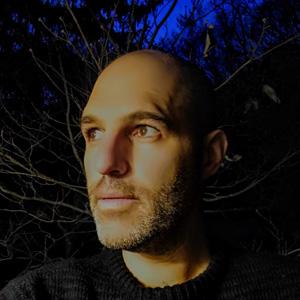
SCENERY AND PROJECTIONS DESIGNER
Luke Cantarella is making his HGO debut. Cantarella is a designer of scenery and spaces for performance and Chair of Film and Screen Studies at Pace University. He has designed scenery and video for over 150 productions around the country and internationally. Recent opera credits include the world premiere of Jennifer Higdon and Jerry Dye’s Women with Eyes Closed at Pittsburgh Opera, the world premiere of Kristin Kuster and Mark Campbell’s A Thousand Acres for Des Moines Metro Opera, and the world premiere of Laura Kaminsky and Kimberly Reed’s Hometown to the World for the Santa Fe Opera. Additional credits include projects at the American Repertory Theater, Goodspeed Musicals, the MUNY, Westport Country Playhouse, Repertory Theatre of St. Louis, Cleveland Playhouse, Pittsburgh Public Theater, Yale Repertory Theater, TheaterWorks (Hartford), Berkshire Theater Festival, Asolo Repertory Theater, People’s Light, Wolf Trap Opera, Baltimore Opera/Peabody Institute, and many others.
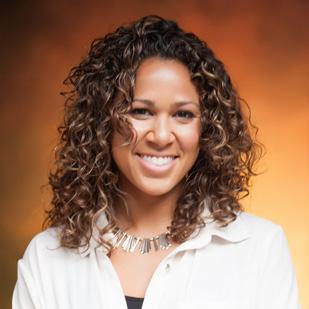
KARA HARMON (UNITED STATES) COSTUME DESIGNER
Kara Harmon is making her HGO debut. Harmon’s costume designs for opera include Dialogues of the Carmelites (The Juilliard School); Così fan tutte (Arizona Opera); Blue (New Orleans Opera); and Hometown to the World (Santa Fe Opera). Her Off-Broadway design credits include The Great Privation (Soho Repertory Theatre); Watch Night (Perelman PAC); Cullud Wattah (Public Theater); The Niceties (Manhattan Theatre Club); and Dot (Vineyard Theatre). Select regional credits include The Other Americans (Arena Stage); The Penelopiad (Goodman Theater); The Three Musketeers (Oregon Shakespeare Festival); Choir Boy (Steppenwolf);
Diary of a Wimpy Kid (The Children’s Theatre Company); Shutter Sister (Old Globe); Darlin’ Cory (The Alliance Theater); Guys & Dolls (Guthrie Theater); The Purists (Huntington Theatre); and The Color Purple (Portland Center Stage). Harmon was awarded the 2019 Helen Hayes Award for Outstanding Costume Design for The Wiz (Ford’s Theatre), the 2017 NAACP Theatre Award for Best Costume Design for Barbecue (Geffen Playhouse), and the 2023 Connecticut Critics Circle Outstanding Costume Design Award for 42nd Street at Goodspeed Musicals, a worldrenowned theater company in Connecticut.
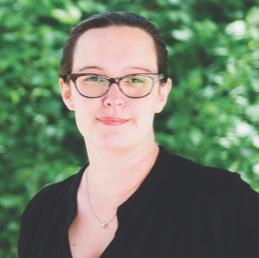
KATE ASHTON (UNITED STATES) LIGHTING DESIGNER
Kate Ashton is making her HGO debut. Ashton’s recent work includes A Thousand Acres and Wozzeck (Des Moines Metro Opera); Elizabeth Cree (Glimmerglass); Hometown to the World (Santa Fe Opera); Cinderella and Swan Lake (Ballet West); The Sleeping Beauty (The Washington Ballet); Josephine and I (The Public Theater); The Tales of Hoffmann (Aspen Music Festival); Tango Song & Dance (Kennedy Center); Death of a Salesman (Theatre Mitu / BAM); and more than 30 productions at Juilliard, including The Turn of the Screw and La clemenza di Tito. Ashton is the lighting director for the Fall for Dance Festival at New York City Center, where she has designed pieces including Christopher Wheeldon’s The Two of Us. Ashton received her Bachelor of Arts degree from the College of William & Mary and her Master of Fine Arts degree from New York University. She is a member of United Scenic Artists.
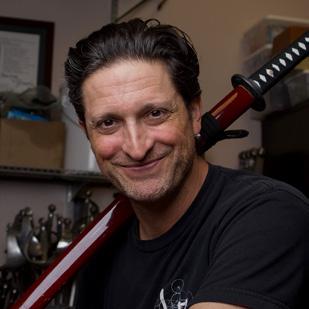
ADAM NOBLE (UNITED STATES) FIGHT/INTIMACY DIRECTOR
Adam Noble is a movement specialist with over 25 years of experience in theater, opera, and film. He is the former movement instructor for the Butler Studio, and during the 2024-25 season served as fight director for Tannhaüser and Breaking the Waves. In the 2023-24 season, he served as fight director and intimacy director for Parsifal, Madame Butterfly, and Don Giovanni. Additional HGO engagements include serving as the company’s fight director and intimacy director for The Wreckers, La traviata, and Romeo and Juliet (2022); Werther, The Marriage of Figaro, Salome, and Tosca (2023); Carmen (2021); and Don Giovanni (2019). He also served as fight director for Rigoletto (2019) and Julius Caesar (2018). Notable credits include The Kennedy Center for the Performing Arts, The Alley Theatre, Opera Carolina, Lincoln Center Director’s Lab, Dayton Opera, the Public Theatre, and more. Noble is the co-founder and artistic director of the Dynamic Presence Project, a theater company focused on the revitalization and proliferation of movement theater and embodied physical storytelling. He
teaches movement both nationally and internationally, and has choreographed the physicality, violence, and intimacy for well over 200 productions. As the Associate Professor of Acting & Movement at the University of Houston, he serves as Head of the MFA acting program. He is also the resident Fight Director & Intimacy Specialist for The Alley Theatre.

SAM DHOBHANY (UNITED STATES)
BASS-BARITONE—GEORGE MILTON Dian and Harlan Stai Fellow
A second-year Butler Studio artist from Brooklyn, New York, Sam Dhobhany received the Ana María Martínez Encouragement Award at HGO’s 2024 Eleanor McCollum Competition Concert of Arias. He is a 2022 alumnus of HGO’s Young Artist Vocal Academy. In HGO’s 2025-26 season, Dhobhany’s other roles include Undertaker in Porgy and Bess, Notary in Gianni Schicchi (Il trittico), British Major in Silent Night, and Officer in The Barber of Seville. In HGO’s 2024-25 season, he made his company debut as Alidoro in Family Day Cinderella and sang the role of Terry in Breaking the Waves. In the summer of 2025, Dhobhany performed the roles of Zuniga in Carmen and Bartolo in The Marriage of Figaro at Wolf Trap Opera. In 2024, Dhobhany sang the role of Angelotti in Tosca with Dayton Opera. He was an apprentice artist with Santa Fe Opera in 2023 and 2024, performing roles including Un Médecin in Pelléas et Mélisande and Marchese d’Obigny in La traviata. Dhobhany was the second-place winner of the 2024 Rocky Mountain Region and the winner of the 2025 Arizona District of The Metropolitan Opera Laffont Competition. He holds a Bachelor of Music degree in Vocal Performance from the University of Cincinnati College-Conservatory of Music.
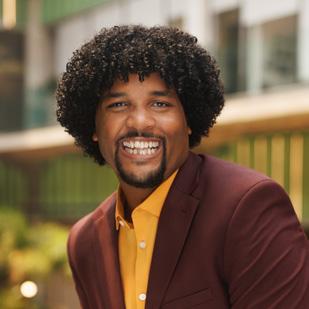
DEMETRIOUS SAMPSON, JR. (UNITED STATES)
TENOR—LENNIE SMALL
Dr. Dina Alsowayel and Mr. Anthony R. Chase/ Dr. Eric McLaughlin and Mr. Elliot Castillo/ Alejandra and Héctor Torres/ Mr. Trey Yates Fellow
A third-year Butler Studio artist from Albany, Georgia, Demetrious Sampson, Jr. also performed the roles of Sportin’ Life in Porgy and Bess and The Witch in Family Day Hansel and Gretel during HGO’s 2025-26 season. In 2025, Sampson performed Malcolm in Macbeth at Atlanta Opera and Steuermann in The Flying Dutchman at Des Moines Metro Opera. For HGO’s 2024-25 season, he performed the roles of Ruiz in Il trovatore and Parpignol in La bohème. In HGO’s 2023-24 season, Sampson made his HGO debut as 3rd Esquire in Parsifal. He made his professional debut with Atlanta Opera at the age of 20 as Crab Man in Porgy and Bess, a role he reprised at Des Moines Metro Opera in 2022 as an apprentice artist. In 2023, Sampson joined the Merola Opera Program in San Francisco, and in 2024, he made company and role debuts with Cincinnati Opera as Gastone in La traviata and with
Wolf Trap Opera as the Kronprinz in Kevin Puts’s Silent Night. A previous Encouragement Award winner, he was named a National Finalist in the 2024 Metropolitan Opera Laffont Competition. The second place and Audience Choice Winner in HGO’s 2023 Eleanor McCollum Competition Concert of Arias, Sampson is a 2022 alumnus of HGO’s Young Artists Vocal Academy. He received his bachelor’s degree from Georgia State University.
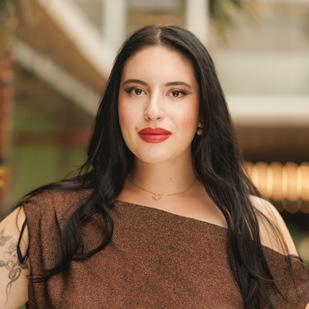
ALISSA GORETSKY
(UNITED STATES)
SOPRANO—CURLEY’S WIFE
Gloria M. Portela / Susan Bloome / James M. Trimble and Sylvia Barnes Fellow
A second-year Butler Studio artist from Los Angeles, Alissa Goretsky was the third-place winner of HGO’s 2024 Eleanor McCollum Competition Concert of Arias. In HGO’s 2025-26 season, her other roles include Young Lover in Il tabarro and as Nursing Sister in Suor Angelica (Il trittico); Dew Fairy in Hansel and Gretel; Gretel in Family Day Hansel and Gretel; and Berta in The Barber of Seville. Goretsky was a 2025 Apprentice Singer for the Santa Fe Opera, where she covered the role of Mimì in La bohème and Helmwige in Die Walküre. During the 2024-25 season, she made her HGO debut as Clorinda in Cinderella and performed the role again for the company’s Family Day production. She made her operatic debut as Gismonda in Ottone at Caroline H. Hume Concert Hall under the baton of Corey Jameson in 2019. In March 2024 she performed the role of Ma Zegner in Missy Mazzoli’s Proving Up, also at Caroline Hume Hall. Goretsky is a National Winner of the 2025 Metropolitan Opera Laffont Competition. She holds both Bachelor of Music and Master of Music degrees from the San Francisco Conservatory of Music.
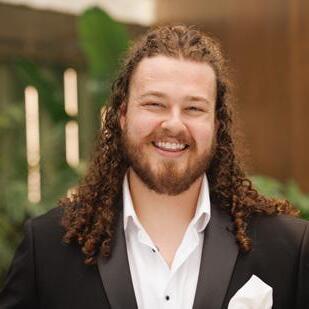
SHAWN ROTH (UNITED STATES)
TENOR—CURLEY
Melinda and Bill Brunger/ Drs. Liz Grimm and Jack Roth/ Drs. Rachel and Warren A. Ellsworth IV/ Kathleen Moore and Steven Homer/ Sharon Ley Lietzow and Robert Lietzow Fellow
Second-year Butler Studio artist Shawn Roth, from Johnstown, Pennsylvania, made his HGO debut in the 2024-25 season as Heinrich der Schreiber in Tannhäuser. During HGO’s 2025-26 season, Roth also performed the role of the Song Seller in Il tabarro, part of Puccini’s Il trittico. In the 2024-25 season, he competed in the final round of the Neue Stimmen competition in Gütersloh, Germany, and won third prize in the Houston Saengerbund Awards. Other 2024-25 engagements included his debut with the Corpus Christi Symphony Orchestra as Don José in Carmen, and his return to Des Moines Metro Opera to perform Pásek in The Cunning Little Vixen and cover Erik in The Flying Dutchman In the 2023-24 season, Roth won the Pittsburgh District of the Metropolitan Opera Laffont Competition, covered the role of Narraboth in Salome at Des Moines Metro Opera, and
took the top prize in the Wagner Society of New York’s 2024 Grant Awards. In 2024, he earned his artist diploma from the Academy of Vocal Arts, where he performed the roles of Male Chorus in The Rape of Lucretia and Don Ottavio in Don Giovanni. Roth holds a Bachelor of Music degree from Oberlin Conservatory, and is a three-time fellow of Music Academy of the West, where he won the Marilyn Horne Song Competition in 2021.
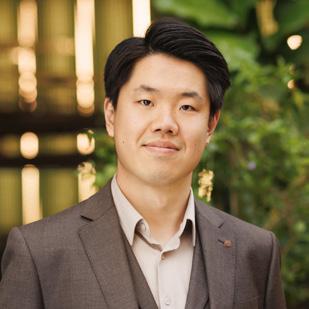
Carolyn J. Levy/ Jill and Allyn Risley/ Dr. Peter Chang and Hon. Theresa Chang and Friends Fellow
A second-year Butler Studio artist from Shandong, China, Ziniu Zhao was the second-place winner at HGO’s 2024 Eleanor McCollum Competition Concert of Arias and a winner of the San Francisco District in the 2025 Metropolitan Opera Laffont Competition. In HGO’s 2025-26 season, his other engagements included Maestro Spinellocchio in Gianni Schicchi (Il trittico) and the French General in Silent Night. In the summer of 2025, Zhao sang Leporello in a concert version of Don Giovanni at the National Centre for Performing Arts in Beijing. During the 2024-25 season, he made his HGO debut as Don Magnifico in the company’s Family Day production of Cinderella and performed the role of Reinmar von Zweter in Tannhäuser. Zhao was a member of the Opera Talent Training Program of the China National Arts Foundation and has won several prestigious awards, including first prize at the Colorado International Music Competition, the Rossini Singing Award at the Fiorenza Cedolins Opera Competition in Italy, and the Maria Callas Award at the Vincerò International Opera Competition, also in Italy. In 2023, he performed a solo concert in Shandong. He holds a bachelor’s degree from the Central Conservatory of Music in Beijing.

GEONHO LEE (SOUTH KOREA)
BARITONE—SLIM
Mr. and Mrs. James W. Crownover/ Dr. and Mrs. Miguel Miro-Quesada/ Dr. John Serpe and Tracy Maddox Fellow
A first-year Butler Studio artist from Busan, South Korea, Geonho Lee won first place and the Audience Choice Award at HGO’s 2025 Eleanor McCollum Competition Concert of Arias. Lee made his HGO debut in the 2025-26 season as Marco in Puccini’s Gianni Schicchi (Il trittico). Other HGO roles this season include Peter in Family Day Hansel and Gretel and Fiorello in The Barber of Seville. Lee was a 2024 semifinalist in the renowned Operalia Competition. He was a student of advanced studies at the University of Music and Theatre Munich, where he participated in frequent performances and productions. He has been an active member of the August Everding Academy and holds a prestigious scholarship from the Bühnenverein. He earned his bachelor’s degree in Vocal Performance from Seoul National University, where he won several prestigious competitions.
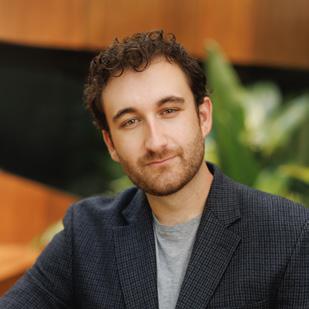
MICHAEL MCDERMOTT (UNITED STATES)
TENOR—CARLSON
Michelle Beale and Dick Anderson/ Dr. Ellen R. Gritz and Mr. Milton D. Rosenau Jr. Fellow
A third-year Butler Studio artist from Huntington Beach, California, Michael McDermott was the third-place winner in HGO’s 2023 Eleanor McCollum Competition Concert of Arias Earlier in the season, he performed as Young Lover in Il tabarro (Il trittico) and Nikolaus Sprink in Silent Night. In 2025, McDermott sang the role of Nicias in Thaïs at the Spoleto Festival, and served as an Apprentice Artist for the Santa Fe Opera, where he covered the role of Peter Quint in The Turn of the Screw. During HGO’s 2024-25 season, he performed as Messenger in Il trovatore, Don Ramiro in student and Family Day performances of Cinderella, and Rodolfo in La bohème. During HGO’s 2023-24 season, he performed the roles of Bardolph in Falstaff and 4th Esquire in Parsifal. In 2023, he performed the role of Arbace in Idomeneo at Aspen Music Festival, and in 2024, he sang the role of Camille de Rosillon in The Merry Widow at the Glyndebourne Festival. His recent competition wins include first prize in the 2024 Grand Concours Vocal Competition, first prize in the Schmidt Vocal Competition, and first prize in the Scholarship Division of the National Opera Association’s Carolyn Bailey Argento Competition.
McDermott received his Bachelor of Music degree from The Juilliard School and pursued his master’s degree at Rice University. He is a 2021 alumnus of HGO’s Young Artists Vocal Academy.

LUKA TSEVELIDZE (GEORGIA)
TENOR—BALLAD SINGER
Donna and Ken Barrow/ Barbara and Pat McCelvey/ Irina and Andrey Polunin/ Ms. Rita Leader/ Jill A. Schaar and George Caflisch Fellow
A first-year Butler Studio artist from Tbilisi, Georgia, Luka Tsevelidze is making his HGO debut. He won second place at HGO’s 2025 Eleanor McCollum Competition Concert of Arias. He made his operatic debut as Tamino in The Magic Flute with the Tbilisi State Conservatoire Opera Studio. He also performed as Alfredo (Act III) in La traviata at the Tbilisi Opera and Ballet Theater, as Nemorino in scenes from The Elixir of Love, and as Malkhaz in Daisi. In 2024, Tsevelidze performed in a concert in Kassel, Germany, and in 2023 he performed in a Laureate Concert in Prague. Tsevelidze pursued his Bachelor of Music from Tbilisi State Conservatoire.

SUPPORT A BUTLER STUDIO ARTIST
If you’re interested in helping to support the artists of the Sarah and Ernest Butler Houston Grand Opera Studio through underwriting or financial support, please contact Stephen Beaudoin at SBeaudoin@HGO.org or 713-546-0213
Carlisle Floyd’s opera brings John Steinbeck’s novel into a realm of pure emotion.
BY GAVIN JONES
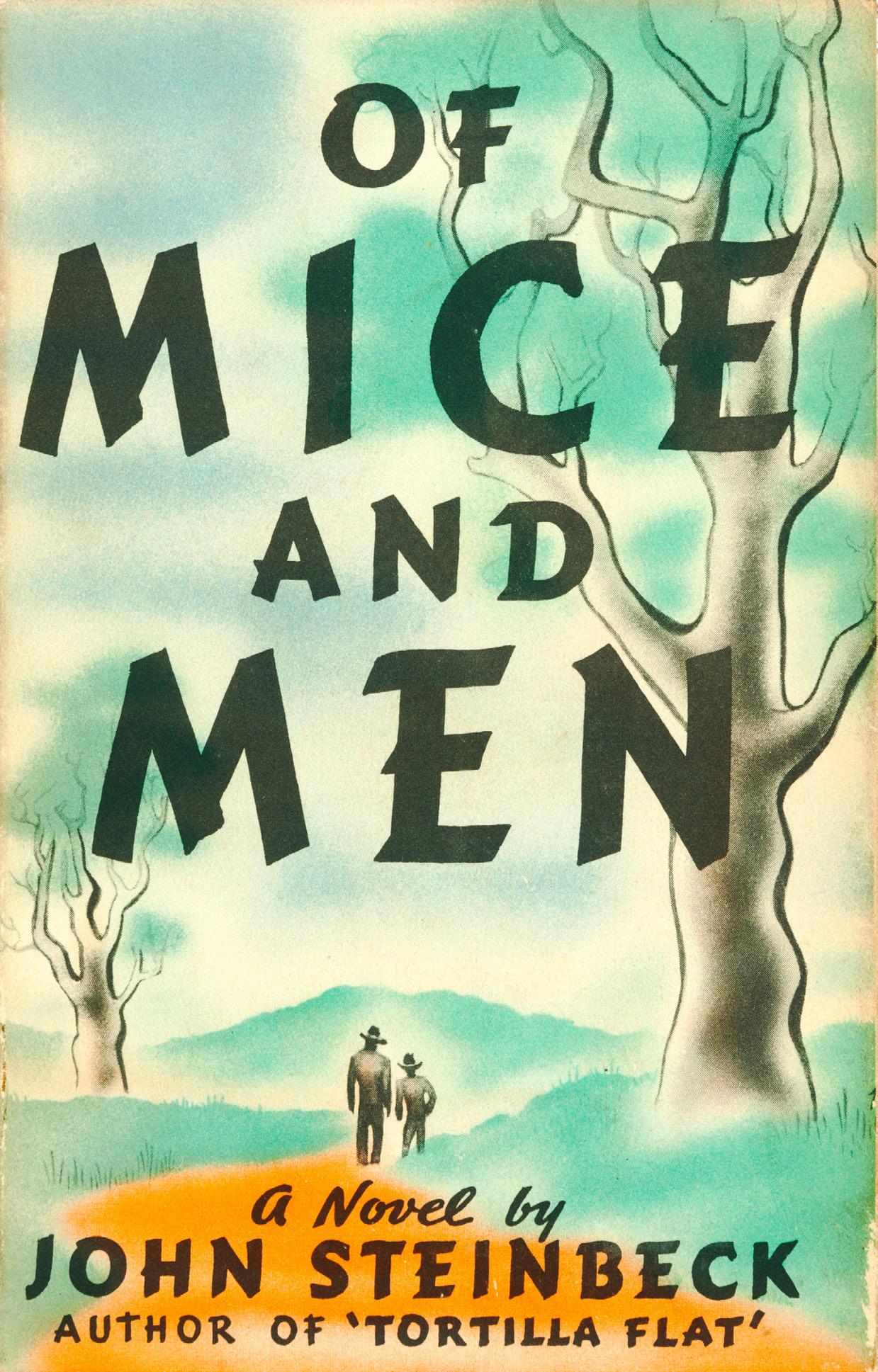
ublished in the depths of the Great Depression, John Steinbeck’s Of Mice and Men (1937) is a novel that both embodies and transcends its historical moment. This story of two itinerant agricultural laborers, George Milton and his mentally disabled friend Lennie Small, is one that Steinbeck knew well. He took frequent breaks while studying at Stanford University in the early 1920s to gain experience working in agricultural industries around his hometown of Salinas, California.
That experience filtered into Steinbeck’s humanitarian concern with the plight of the working poor. Labor conditions in California’s agricultural sector were already deteriorating in the early years of the 20th century with the emergence of a massive itinerant labor force that spread from the Midwestern Corn Belt to Western states to harvest seasonal crops. Unionization efforts by the Industrial Workers of the World (or “Wobblies”) could not prevent the dire conditions that Steinbeck depicts in Of Mice and Men—irregular work, low wages, constant movement, and individual powerlessness, all of which worsened during the Great Depression.
These concerns would come to a head in Steinbeck’s most famous Depressionera novel, The Grapes of Wrath (1939), which builds on themes in Of Mice and Men with its representation of the impoverished conditions facing Oklahoman farmers and their
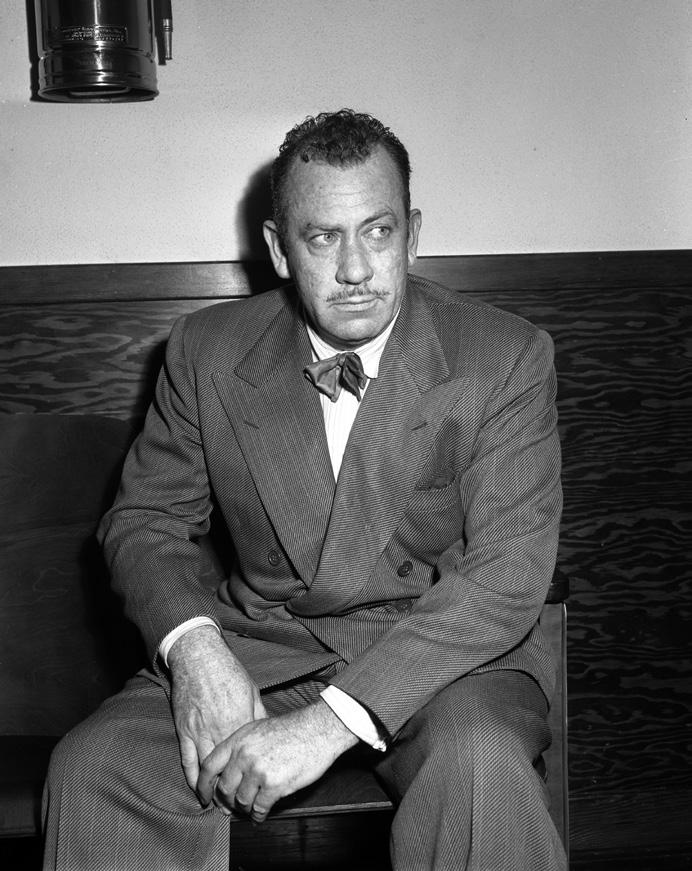
"Floyd's opera resonates with something elemental in the novel: the emotional conditions of human existence."
families forced to migrate west during the Dust Bowl. The when and the where of Of Mice and Men, however, are far less distinct—simply a ranch somewhere near the Salinas River sometime in the early decades of the 20th century. Contemporary reviews of the novel likewise pointed to its general and universal themes. For Eleanor Roosevelt, writing in her daily syndicated newspaper column, the novel was thus a “picture of the tragedy of loneliness.”
Such basic themes gave Steinbeck’s novel a broad appeal, a portability beyond its historical moment that saw it selected for the Book of the Month Club, immediately adapted (by Steinbeck himself) into a three-act Broadway play, and, two years later, turned into a Hollywood film. Today the novel continues to be widely taught in American high schools. For several years in the early 21st century, the State of Texas even turned to the novel to derive its so-called “Lennie Standard,” which determined whether individuals with mental disabilities should be exempt from the death penalty.
Part of the appeal of Of Mice and Men, then, was its ease of adaptation, and its usefulness toward different ends. It is little wonder that Steinbeck’s novel caught the attention of Carlisle Floyd, whose libretto and musical score display an uncanny ability to intuit so much about Steinbeck’s complex intentions in his deceptively simple book. Floyd’s stated desire to emphasize the childishness of Steinbeck’s characters, particularly Lennie, resonated with one of Steinbeck’s more subtle experiments in Of Mice and Men—to write it as a book for children, an experiment in representing the purity and simplicity of a child’s world.
Steinbeck similarly theorized his novel as an experiment in “is-thinking” or “non-teleological thinking,” whereby events are presented as they are,
without taking sides or suggesting causes (Steinbeck’s original title for the novel was “Something That Happened”). This may be another source of the novel’s enduring popularity, the curious way its dramatic events do not quite add up to some greater meaning, leaving the story open to multiple interpretations.
However you read the novel, Floyd’s opera resonates with something elemental in it: the emotional conditions of human existence. The composer thought that he detected in Steinbeck’s novel certain “act-endings and scenes that built to curtains.” In this way, he had in fact again intuited one of Steinbeck’s greatest experiments in Of Mice and Men. He intended it not as a novel at all but as “a play in the form of the novel”—a formal innovation that grew from the author’s belief that certain themes are best understood by groups of people in almost physical contact with one another. Steinbeck’s conception of Of Mice and Men as a play-in-novel form creates an uncanny effect on us as readers, whereby we encounter not a represented social world but instructions toward a future stage production; not dialogue between characters but lines for actors; not fictionalized places but set descriptions; not objects but would-be props.
When we combine all of the waiting in the story—all of the repetition and rehearsal of empty linguistic formulas centered on Lennie and George’s dream of living off “the fatta the lan”— with the novel’s themes of poverty, loss, failure, and exile, we seem to verge on an existentialist literary world, an empty environment of human loneliness. We approach even a theater of the absurd not unlike Samuel Beckett’s 1953 play, Waiting for Godot, which likewise features two tramp-like characters in a codependent and repetitive relationship, staged in a barren landscape.
Like the Broadway play, the opera realizes the novel’s formal desires to be performed on the stage. When we add to this the other experiment that Floyd recognized in Steinbeck’s story—its “childish” representation of a purer world of intense colors, sounds, and feelings—then we understand the nature of Floyd’s interpretation of Steinbeck. The opera emphasizes the childishness of the characters—Curley’s Wife, for example, carries a doll in the original libretto. Floyd further compresses Steinbeck’s already minimalist story into one that explores intensely basic, even childlike emotional states, brought to life by the pure sound and the heightened visuality that Steinbeck associated with the humble world of children.
Floyd’s opera brings to light (and sound) the novel’s existentialist theme of human loneliness and its understanding of the self as a fragile construct governed by negative emotions. Lennie’s disability lies at the extreme end of a spectrum of maladies of the self, or what the opera calls the “heart.” When Lennie and George sing of their dream together early in the opera, Lennie knows the words “by heart,” not just in the sense of memorization, but in the deeper way that all the characters in the opera are essentially singing from their hearts, from their core emotional selves.
The dynamic between Curley and Curley’s Wife is a particularly fraught emotional tangle at the center of the opera, not least because her power increases. For example, she physically blocks Lennie from leaving the bunkhouse to force his fight with Curley, and in other ways she physically disrupts the activities of the men. Curley lives under a cloud of shame, the most
Kara Harmon's costume designs for HGO's 2026 production
destructive of emotions; his virility is openly questioned, his inability to control the desires of his wife constantly displayed. Curley’s Wife is a bitter, threatening presence, but then also a figure of loneliness, someone who wants to be cared for, to have attention paid to her, to be loved and adored. Her habit of stroking her own hair—something she can’t control—is a sign both of her vanity and her anxiety. All the major characters seem to be internally divided in similar ways. Lennie likewise cannot control his actions, split as he is between tenderness and violence.
In Floyd’s sparse opera, matters of the heart boil down to a relationship between tenderness and trouble. The desire for human intimacy that transcends existential loneliness meets the tragic recognition that we cannot truly connect with selves beyond our own, and that we are barely in control of our own emotions and actions. Floyd observed that suspense lies at the heart of his opera, but anxiety might be a better word for its dominant mood. In the words of the Ballad Singer—a role Floyd adds to Steinbeck’s story, in part for the musical variety it brings—we live in a perpetual state of “movin’ on,” a transcendental homelessness, a loneliness and instability that seem fundamental conditions of human existence.
When we recall that Steinbeck conceived Of Mice and Men as a play in the form of the novel because certain things are best appreciated in groups, we might too wonder—as we sit in the audience watching Floyd’s opera—whether we feel our togetherness as a group looking down on these lonely characters, or whether we feel our own individual isolation shared with these figures who strut and fret upon the stage.
Gavin Jones is the Frederick P. Rehmus Family Professor of the Humanities and current Chair of the English Department at Stanford University. He has published four books on American literature, including his 2021 Reclaiming John Steinbeck: Writing for the Future of Humanity
By Joe Cadagin, Audience Education and Communications Manager
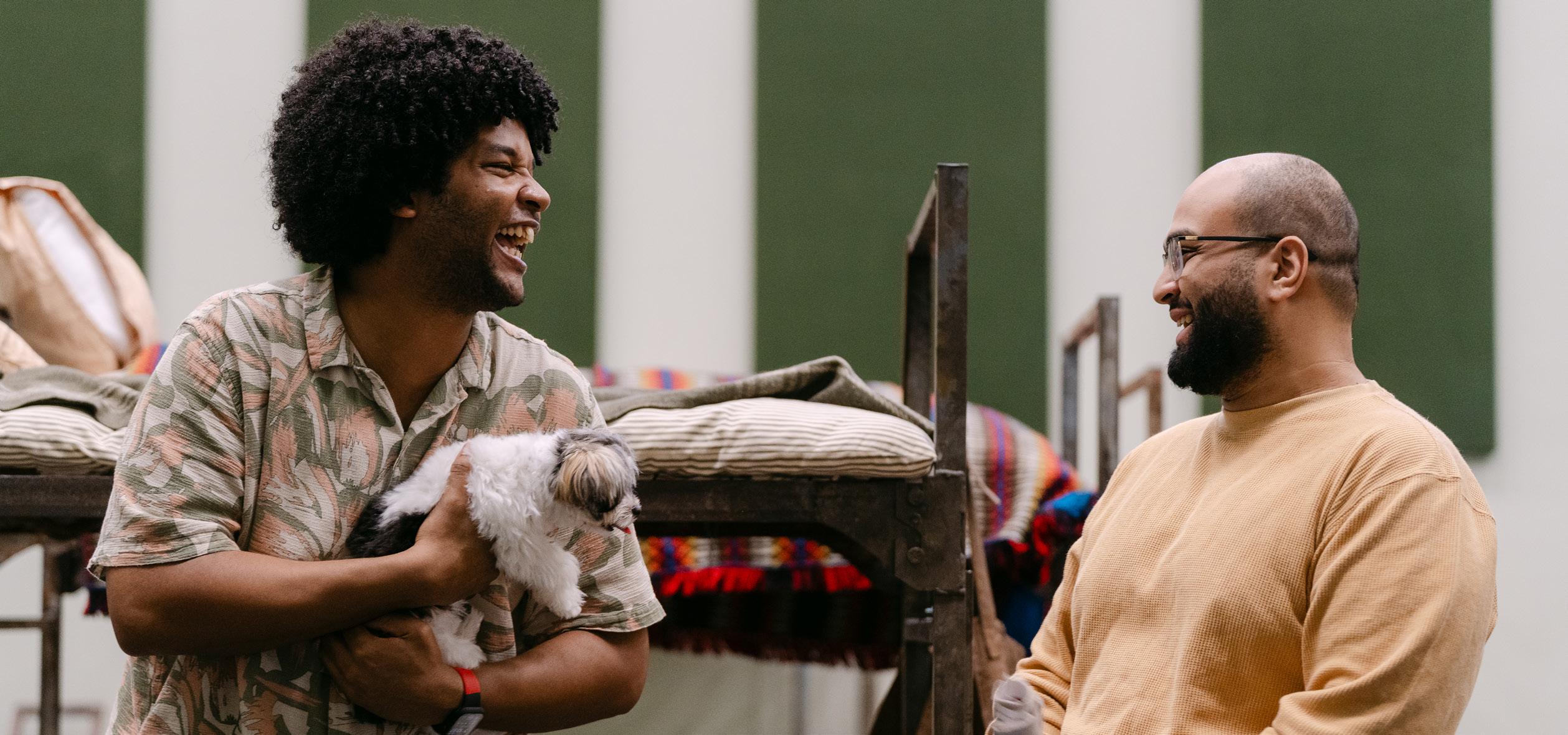
When I speak to tenor Demetrious Sampson, Jr. and bass-baritone Sam Dhobhany, they’ve both recently come off of a nineperformance run of Porgy and Bess at Houston Grand Opera. Sampson, who played the drug dealer Sportin’ Life, and Dhobhany, who played the Undertaker, are young artists in the Sarah and Ernest Butler Houston Grand Opera Studio. The Butler Studio offers Sampson and Dhobhany opportunities to perform in mainstage productions like Porgy alongside the stars of the industry.
But this season’s production of Of Mice and Men—composed by Carlisle Floyd,

co-founder of the Studio—is on a whole different level for the two young artists. “It will be the biggest thing that I will have done in my career,” admits Sampson, who plays Lennie. “Most definitely,” adds Dhobhany, who plays George. “This is my first time doing a role where I feel like I have to carry an evening.” As the protagonists of Floyd’s 1970 opera, they appear in every scene of the nearly two-hour show—a work that places great technical demands on singers.
But they won’t be alone in this endeavor. Just as their characters George and Lennie find mutual support in one another, Sampson and Dhobhany are backed by a community of coaches and mentors in the Butler Studio, not to mention their fellow young artists who will take the stage with them. Ahead of Of Mice and Men, Sampson and Dhobhany met to discuss their characters’ search for companionship in a lonely world, as well as the family these two rising stars have found at HGO.
Opera Cues: How does the Butler Studio help prepare you for this huge undertaking?
Sam Dhobhany: We’ve got a really helpful music staff. They’re open to hearing us at any time. And they’re always willing to meet us where we’re at—whether it’s just speaking over the text or plunking out notes. I’ve also been enjoying the acting sessions with the Alley Theatre.
Demetrious Sampson, Jr.: I have to agree—we have coaches who are willing to push us, and who know how to get us there, too. Also, Colin Michael Brush, the director of the Studio, has been very intentional about who we work with to build our acting capabilities. I think what I’ve been learning so well in the Studio is how to concentrate a character and really make the edges of that character neat.
OC: How have you started to flesh out your characters?
SD: I’ve thought about George for quite some time. He takes on that role of this older brother to Lennie, this fatherly sort of figure. He’s an honest man just trying to get out of what he calls a “stingy life.” And he wants the best for Lennie and him. He would go to the end of the earth to be able to achieve that dream for them and to call a place their home.
George is searching for solitude, he’s searching for peace—all the things in his life that he probably didn’t grow up with. He has a negative outlook on life. But I think he’s so close to Lennie because he’s all the things that George wants to be. He yearns for this peace that Lennie gets from soft things, from animals. So I think that’s why he likes spending time—he likes the way he feels when he’s around Lennie.
DSJ: Everybody else has these worries in the world, and the only thing Lennie’s worried about is being a good person, living with George on their own land, and soft things. Every time Lennie talks
about something soft, and every time he talks about how he’s not going to do nothing bad, it really chokes me up. Like when he sings this aria, “It was something I could pet,” we finally get respite from the incessant atonality in the opening of Act I.
You see this man with the hope of a child and how it makes things lighter for him. Perhaps, if we had the hope of children, how much lighter could things be for us? That doesn’t mean we have to intellectualize things like a child. But what if we carried hope or light in us like a child?
OC: Demetrious, how do you approach portraying an intellectually disabled character like Lennie?
DSJ: A lot of research. I don’t want to make a caricature of anyone. So I’ve gone on the websites of the National Center for Learning Disabilities, The Arc of the United States, and SPEDTex to do research on what it means to be mentally disabled, autistic, or neurodivergent. But also, I’m really looking for what disabled people desire when it comes to seeing themselves portrayed in media by people who are not of their community. I do want to at least shine a light—and a nuanced light—on disabilities at large. So it’ll be a lot of research, a lot of conversations, a lot of praying, and just internalizing.
OC: This opera also poses some daunting musical challenges—it’s not an easy piece to sing.
SD: At first glance, it can look like rocket science. definitely harmonically and rhythmically complex. There are all these changing meters that Floyd has in the score. But I think after enough repetition and coaching, it strangely makes sense. Floyd is the pioneer of American opera, and you can really hear that—not only musically, but textually as well. And, of course, he wrote the libretto himself.
DSJ: I think the setting of the text is organic to our American speech patterns. My family is from West Georgia—in the trees, chile. And being Southern, we have that quintes sential American speech meter. So I think that the text-setting feels very intuitive. It works into a groove, you know?
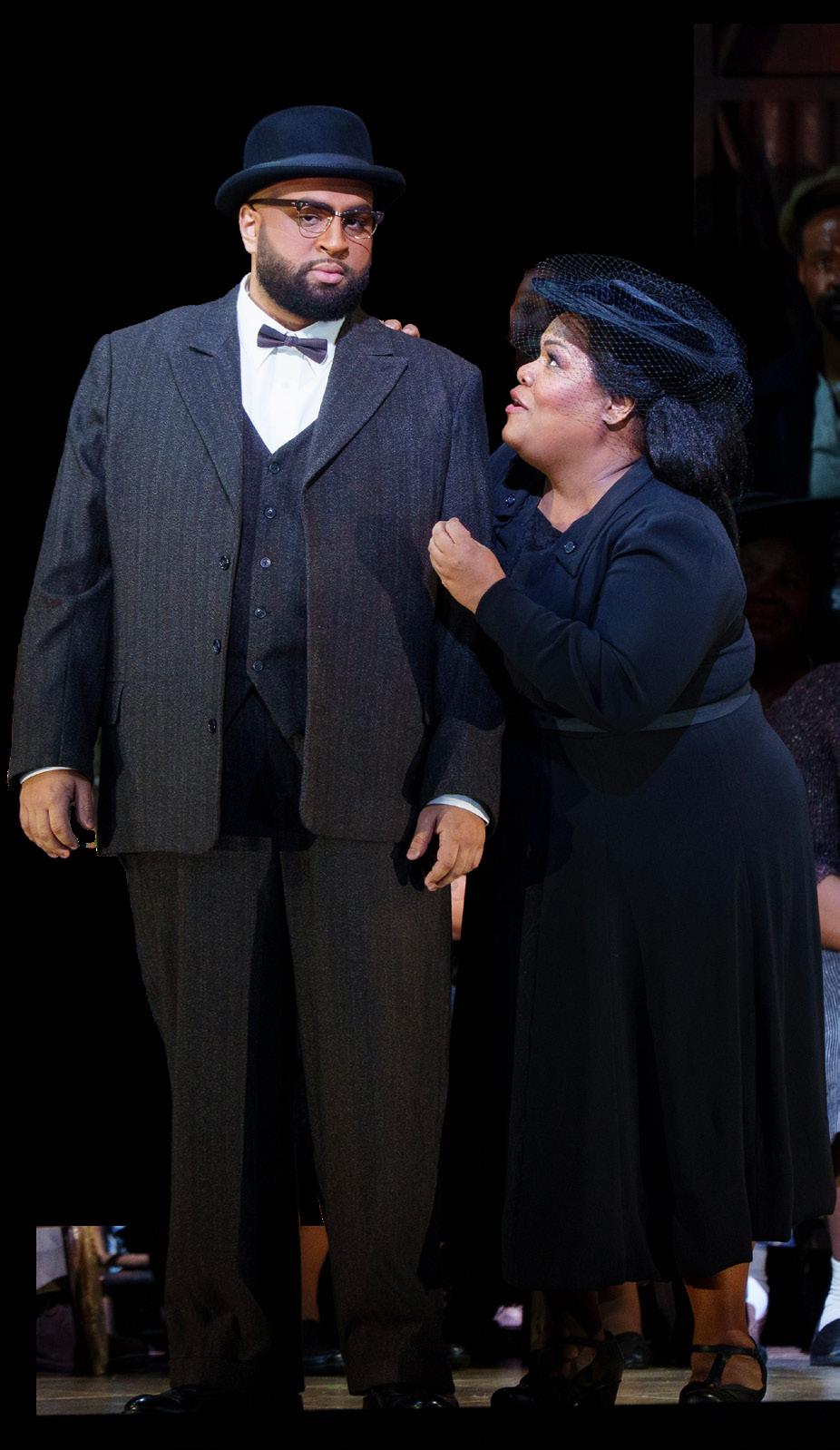
Sam Dhobhany (with Latonia Moore) in Porgy and Bess at HGO (2025).
OC: What are some scenes in Of Mice and Men that stand out to you?
SD: I find the finale to Act I so powerful and almost spooky. They shoot Candy’s dog, and everyone just treats it like it’s nothing. Then the Ballad Singer comes and sings, “I’m moving on. Got no home, address unknown.” And it’s the truth—this is what they’re used to.
DSJ: But also, if they can kill my dog, how much longer is it going to take when I’m no good and they kill me? And I think that is kind of the theme: When loneliness comes around, you lose compassion, and you lose your sense of humanity.
The point that always sticks out to me is when Lennie has just broken Curley’s hand, and the ranch hands are like, “We won’t tell how your hand got broken if you don’t fire him.” They have not known this man for that long, and they’re already sticking up for him. I just wish that we did that
the person you don’t know because the person on top of them is oppressing them so harshly.
OC: As singers, you have to lead itinerant lives as you travel from gig to gig. Do you find yourself relating to the loneliness of wandering ranch hands?
DSJ: This year, I lost two people that I called my chosen family. They didn’t die—I’m just no longer close with them. When I was traveling on contracts, these were the people I could depend on to call. And so to lose two of them—it broke my heart. But it forced me to create community elsewhere. And I think that’s so important, especially in this industry.
SD: I mean, it’s like the saying: “As singers, we’re paid to be away from our family.” So I can say that I can relate on one level. At the same time, we’re not working at ranches. When we’re dealing with loneliness, we’re at least doing what we love to do: singing. So we have some sort of relief on our lonely road.
OC: And it sounds like you have a family of colleagues to come home to in the Butler Studio.
DSJ: I remember in the beginning of the season, we were hanging out almost every weekend. We know each other, and we know our strengths and weaknesses, so we’ll be able to push each other and also help each other when we fall.
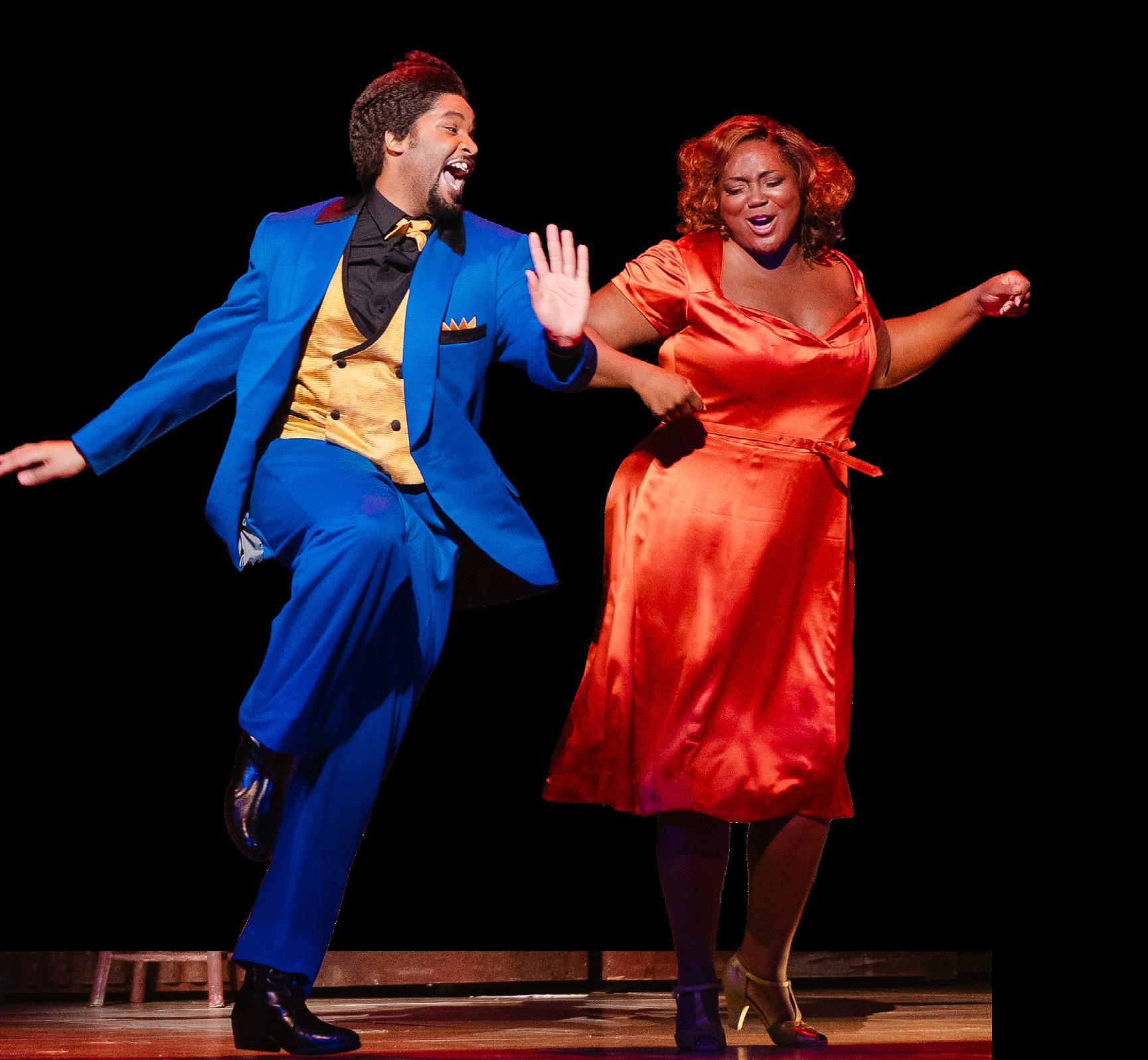
We just all get along really well. I think that adds chemistry onstage. It’s really nice to be singing with the Studio in a production, because it’s been a while since they’ve done a Studio production. And I think it’s quite full Of Mice and Men, because Carlisle Floyd helped to launch the Studio.
: Why do you think Of Mice and Men remains relevant today?
I think it will do well for Houston to have a piece like this that shows the condition of people who work in our agricultural sector, especially immigrants—undocumented and documented alike. And I think our production will show, especially in our cast, how different these people can look. We have two Asian workers on this ranch, two Black people, two white men, and then a man from the nation of Georgia.
So I think it’s important to show, not only the diversity of what it could look like to work in agriculture, but the parallels of the conditions in the 1930s and the conditions now. Also, how they stuck together and how human they were. I mean, these are all such human things.
Khori Dastoor
General Director and CEO
Margaret Alkek Williams Chair
Patrick Summers
Artistic and Music Director *
EXECUTIVE LEADERSHIP GROUP
Richard Bado, Chief Artistic Officer/ Chorus Director *
Kristen E. Burke, Director of Production *
Jennifer Davenport, Chief Marketing and Experience Officer
Darcy Douglas, Chief Philanthropy Officer
Elizabeth Greer, Chief Financial Officer
OFFICE OF THE GENERAL
DIRECTOR
Mary Elsey, Associate Director of Board Relations and Executive Hospitality
Audrey Hurley, Executive Assistant to the General Director and CEO
Monica Thakkar, Director of Strategic Initiatives
Joel Thompson, Composer-in-Residence
ARTISTIC
Colin Michael Brush, Director of the Butler Studio
Nico Chona, Music Administrator and Orchestra Personnel Manager
Jonathan Friend, Casting Consultant
Joel Goodloe, Director of Artistic Operations
Matthew Kalmans, Rehearsal Coordinator
Kiera Krieg, Butler Studio Manager
Mark C. Lear, Associate Artistic Administrator *
Alexa Lietzow, Artistic & Music Coordinator
Nadya Mercado, Butler Studio Intern
Reagan Nattinger, Artist Services Coordinator
Lucas Nguyen, Music Librarian
Peter Pasztor, Principal Coach *
Karen Reeves, Children’s Chorus Director *
Nicholas Roehler, Assistant Conductor
Jack Ruffer, Rehearsal Planning Administrator
Madeline Slettedahl, Assistant Conductor
Lisa Vickers, Bauer Family High School Voice Studio Manager
William Woodard, Assistant Conductor
Maureen Zoltek, Head of Music Staff and Butler Studio Music Director
Mr. & Mrs. Albert B. Alkek Chair
AUDIENCES
Carlos Angel, Box Office
Representative
Vince Balkcom, Jr., Box Office Representative
Fernando Barajas, Administrative Manager
Ellen Bergener, Box Office Representative
Steve Butler, Video Producer
Joe Cadagin, Audience Education and Communications Manager
Alexandra Campbell, Marketing Coordinator
Nicholas Chavez, Group Sales Coordinator
Chelsea Crouse, Sr. Creative Manager
Joy Germany, Box Office Representative
Jessica Gonzalez, Associate Director of Marketing
Sofia Heggem, Sr. Guest Experience Coordinator
Mary Hierholzer, Content Manager
Scott Ipsen, Sr. Director of Ticketing and Experience *
Rudy Avelar Chair
Rita Jia, Graphic Designer
Latrinita Johnson, Customer Sales and Service Specialist
Ashlyn Killian, Communications Coordinator
Tory Lieberman, Director of Marketing
Colton Marek, Box Office Manager
Aaron Marsh, Guest Experience Manager
Sam Mathis, Patron Services Manager
Catherine Matusow, Director of Communications
Matt McKee, Associate Director of Sales and Service
Brian Mitchell, Archivist and Content Adminstrator, The Genevieve P. Demme Archives and Resource Center *
Michelle Russell, Ticketing & Marketing Data Manager
Dr. Kiana Day Williams, Associate Director of Community & Learning
FINANCE AND OPERATIONS
Amanda Burton, Accounts Payable Administrator
Christian Davis, Associate Director of Human Resources
Ariel Ehrman, Business Intelligence Manager
Luis Franco, Office Services Coordinator *
Matt Gonzales, Associate Director of Information Systems *
George Heathco, Operations Projects Manager
Chasity Hopkins, Accounting Manager
Elia Medina, Payroll Administrator
Jeremy Patfield, Director of Finance
Sarah Saulsbery, Accounts Payable Clerk
Denise Simon, Human Resources Coordinator *
Christopher Staub, Director of Operations & Institutional Projects *
Grace Tsai, Manager of Data and Analytics
Ahna Walker, Human Resources Generalist
Chaedron Wright, Information Technology Assistant
Joy Zhou, Director of Information Services
PHILANTHROPY
Stephen Beaudoin, Director of Individual Giving
Brooke Caballero, Philanthropy Coordinator
Katherine Cunningham, Associate
Director of Signature Events
Ross S. Griffey, Director of Institutional Partnerships
Deborah Hirsch, Senior Advisor to the Chief Philanthropy Officer *
Jenna Hyatt, Philanthropy Officer
David Krohn, Sr. Director of Philanthropy
Tessa Larson, Associate Director of Individual Giving
Olivia Lerwick, Philanthropy Writer
Ana Llamas, Prospect Researcher and Manager
Claire Padien-Havens, Sr. Director of Institutional Partnerships
Patrick Long-Quian, Philanthropy Operations Manager
Meredith Morse, Assistant Director of Institutional Giving
Amanda Neiter, Director of Legacy Giving
Allison Reeves, Director of Signature Events
Martalisa Tsai, Philanthropy Officer
Sarah Wahrmund, Associate Director of Philanthropy
Gabriella Wise Smith, Assistant Director of Institutional Partnerships
Noe Aparicio, Costume Technician
Philip Alfano, Lighting Associate & Principal Draftsman *
Brian August, Stage Manager
Kathleen Belcher, Assistant Director
Maya Bowers, Assistant Technical Director
Dung Bui, Junior Stitcher
Isabella Cabrera, Costume Coordinator
Michael James Clark, Head of Lighting & Production Media *
Andrew Cloud, Properties Manager *
Janine Colletti, Assistant Director
Norma Cortez, Costume Director *
Eboni Bell Darcy, Assistant Director
Meg Edwards, Assistant Stage Manager *
Heather Rose Ervin, Wig and Makeup Assistant
Caitlin Farley, Assistant Stage Manager
Joseph B. Farley, Production Manager
David Feheley, Technical Director
Vince Ferraro, Head Electrician *
Jamie Flowers, Props Shopper
Bridget Green, Wig and Makeup Assistant
David Heckman,
Costume Coordinator Assistant
John Howard, Head Carpenter *
Esmeralda De Leon, Costume Coordinator *
Nara Lesser, Costume Production Assistant *
Jae Liburd, Operations Driver
Beth Mathis, Assistant Stage Manager
Melissa McClung, Technical and Production Administrator
Tatyana Miller, Junior Draper
Amanda Mitchell, Wig & Makeup Design Director
Cam Nguyen, Costume Technician
Emma Rocheleau, Assistant Stage Manager
Colter Schoenfish, Assistant Director
Ian Silverman, Assistant Director
Rachel Smith, Assistant Head Electrician and Board Operator
Stephanie Smith, Assistant Director
Meghan Spear, Assistant Stage Manager
Dotti Staker, Principal Wig Maker and Wig Shop Manager *
Bryan Stinnet, Assistant Carpenter/Head Flyperson
Paully Tran, Sr. First Hand *
Phillip Tyler, Head of Sound
Myrna Vallejo, Costume Shop Supervisor *
Sean Waldron, Head of Props *
Annie Wheeler, Production Stage Manager *
Eric Wirfel, Associate Technical Director
*denotes 10 or more years of service
Jenny Choo, Pianist/Coach
Dr. Laura E. Sulak and Dr. Richard W. Brown Fellow
Sam Dhobhany, Bass-Baritone Dian and Harlan Stai Fellow
Alissa Goretsky, Soprano
Gloria M. Portela/ Susan Bloome/ James M. Trimble and Sylvia Barnes Fellow
Elizabeth Hanje, Soprano
Ms. Marty Dudley/ Amy and Mark Melton/ Diane Marcinek/ Jeff Stocks and Juan Lopez Fellow
Geonho Lee, Baritone
Mr. and Mrs. James W. Crownover/ Dr. and Mrs. Miguel Miro-Quesada/ Dr. John Serpe and Tracy Maddox Fellow
Michael McDermott, Tenor
Michelle Beale and Dick Anderson/ Dr. Ellen R. Gritz and Mr. Milton D. Rosenau Jr. Fellow
Shawn Roth, Tenor
Melinda and Bill Brunger/ Drs. Liz Grimm and Jack Roth/ Drs. Rachel and Warren A. Ellsworth IV/ Kathleen Moore and Steven Homer/ Sharon Ley Lietzow and Robert Lietzow Fellow
Demetrious Sampson, Jr., Tenor
Dr. Dina Alsowayel and Mr. Anthony R. Chase/ Dr. Eric McLaughlin and Mr. Elliot Castillo/ Alejandra and Héctor Torres/ Mr. Trey Yates Fellow
Tzu Kuang Tan, Pianist/Coach
Shelly Cyprus Fellow
BUTLER STUDIO FACULTY & STAFF
Colin Michael Brush, Director
Sponsored by Christopher Bacon and Craig Miller, Mr. Jack Bell, Lynn Gissel, and Lynn Des Prez
Maureen Zoltek, Music Director
Mr. and Mrs. Albert B. Alkek Chair
Kiera Krieg, Butler Studio Manager
Stephen King, Director of Vocal Instruction
Sponsored by Jill and Allyn Risley, Janet Sims, and the James J. Drach Endowment Fund
Peter Pasztor, Principal Coach
Sponsored by the Mr. and Mrs. James A. Elkins Jr. Endowment Fund
Nicholas Roehler, Assistant Conductor
BUTLER STUDIO COMMITTEE
Robin Angly
Michelle Beale, Vice Chair
Melinda Brunger
Patrick Carfizzi
Molly Crownover
Lynn Des Prez
Dr. Warren A. Ellsworth IV, Chair
Lynn Gissel
Sandy Godfrey
Dr. Ellen R. Gritz
Brenda Harvey-Traylor
Steve Homer
Luka Tsevelidze, Tenor
Donna and Ken Barrow/ Barbara and Pat McCelvey/ Irina and Andrey Polunin/ Ms. Rita Leader/ Jill A. Schaar and George Caflisch Fellow
Ziniu Zhao, Bass
Carolyn J. Levy/ Jill and Allyn Risley/ Dr. Peter Chang and Hon. Theresa Chang and Friends Fellow
Madeline Slettedahl, Assistant Conductor
William Woodard, Assistant Conductor
Nadya Mercado, Butler Studio Intern
Christa Gaug, German Instructor
Enrica Vagliani Gray, Italian Instructor Sponsored by Marsha Montemayor
Neda Zafaranian, English Instructor
Patrick Summers, Coach and Conducting Instructor
Brian Connelly, Piano Instructor
Mo Zhou, Showcase Director and Guest Acting Faculty
Alley Theatre, Acting Instruction
Paul Curran, Guest Drama Coach
Stephen Neely, Dalcroze Eurhythmics Instructor
Tiffany Soricelli, Finance Instructor
Nino Sanikidze, Russian Diction Coach
Margo Garrett, Guest Coach
Warren Jones, Guest Coach
Hemdi Kfir, Guest Coach
Thomas Lausmann, Guest Coach
Marianne Kah
Stephanie Larsen
Rita Leader
Richard Leibman
Carolyn J. Levy
Tracy Maddox
Beth Madison
Amy Melton
Miguel Miro-Quesada
Valerie Miro-Quesada
Kathy Moore
Charlene Nickson
Gloria Portela
Allyn Risley
Jill Risley
Dr. Jack A. Roth
John Serpe
Janet Sims
Dian Stai
Harlan Stai
John G. Turner
Bob Wakefield
Trey Yates

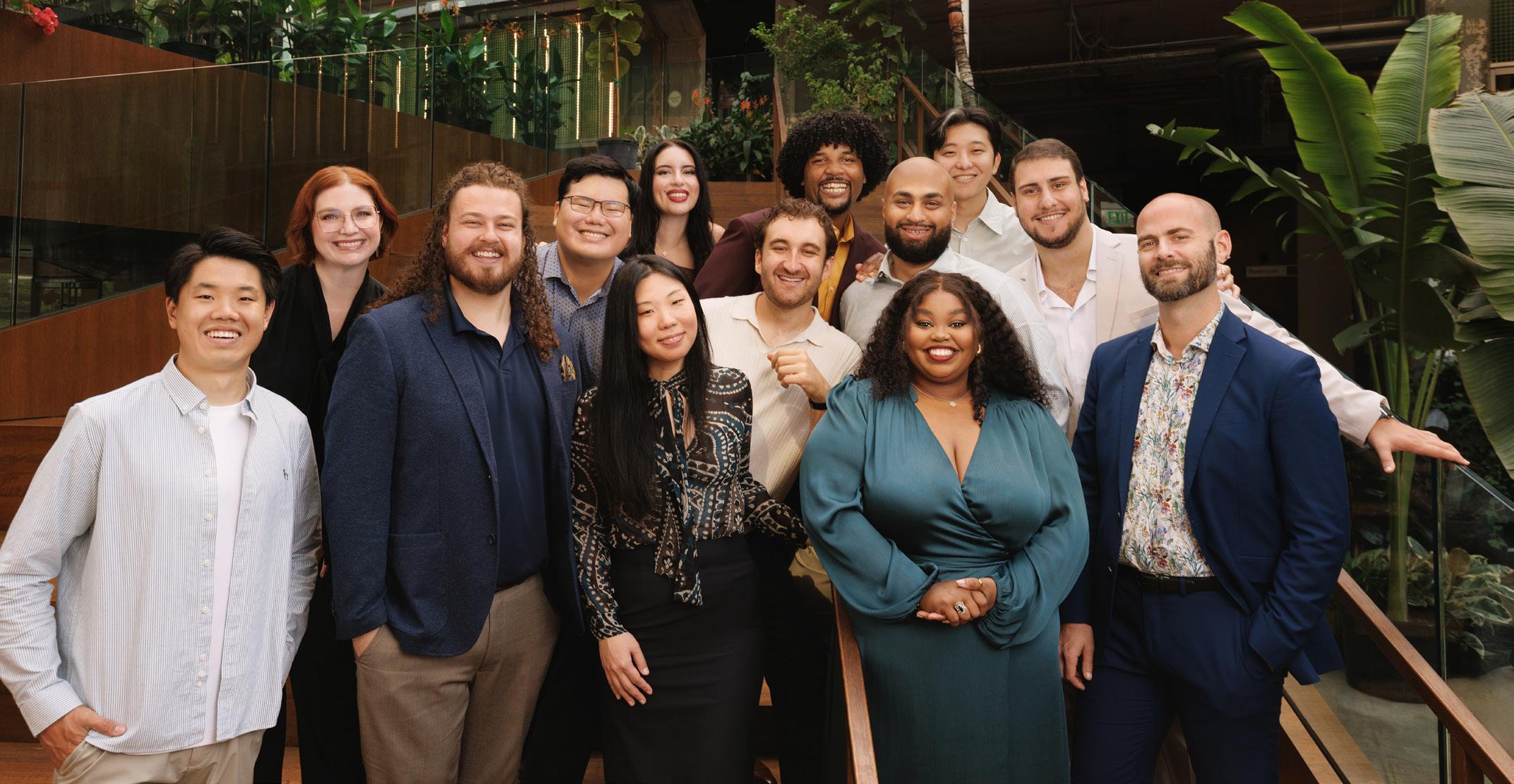
Founded in 1977 by composer Carlisle Floyd and HGO's then-General Director David Gockley, the Sarah and Ernest Butler Houston Grand Opera Studio is one of the most highly respected and prestigious young artist programs in the world. The program provides comprehensive career development to young singers and pianist/coaches who have completed their academic training and are preparing to embark on full-fledged operatic careers. Each year after an exhaustive international search, a hand-selected group of the most exceptionally talented individuals is brought here to Houston to work on the mainstage and in recital alongside the best in the business at Houston Grand Opera.
The Sarah and Ernest Butler Houston Grand Opera Studio is grateful for the underwriting support of Mrs. Estela Hollin-Avery, Ms. Marty Dudley, Ms. Stephanie Larsen, and Mr. and Mrs. Richard J. Langenstein. The Butler Studio is also thankful for the in-kind support of the Texas Voice Center and for the outstanding support of the Magnolia Houston hotel.
Additional support for the Butler Studio is provided by the following funds within the Houston Grand Opera Endowment, Inc.:

During a residency of up to three years, each performer collaborates with an expert team while gaining invaluable experience at the highest professional level. Alumni of the Butler Studio perform at the best opera houses around the world—and internationally renowned artists such as Joyce DiDonato, Jamie Barton, Ana María Martínez, Ryan McKinny, and Tamara Wilson still regularly return to their home stage at HGO. For many, the Butler Studio is just the beginning of a lifelong relationship with the company.
The Gordon and Mary Cain Foundation Endowment Fund
Marjorie and Thomas Capshaw Endowment Fund
James J. Drach Endowment Fund
The Evans and Portela Family Fund
Carol Lynn Lay Fletcher Endowment Fund
William Randolph Hearst Endowed Scholarship Fund
Jackson D. Hicks Endowment Fund
Charlotte Howe Memorial Scholarship Fund
Elva Lobit Opera Endowment Fund
Marian and Speros Martel Foundation Endowment Fund
Erin Gregory Neale Endowment Fund
Dr. Mary Joan Nish and Patricia Bratsas Endowed Fund
John M. O’Quinn Foundation Endowed Fund
Shell Lubricants State Company Fund
Mary C. Gayler Snook Endowment Fund
Tenneco, Inc., Endowment Fund
Weston-Cargill Endowed Fund


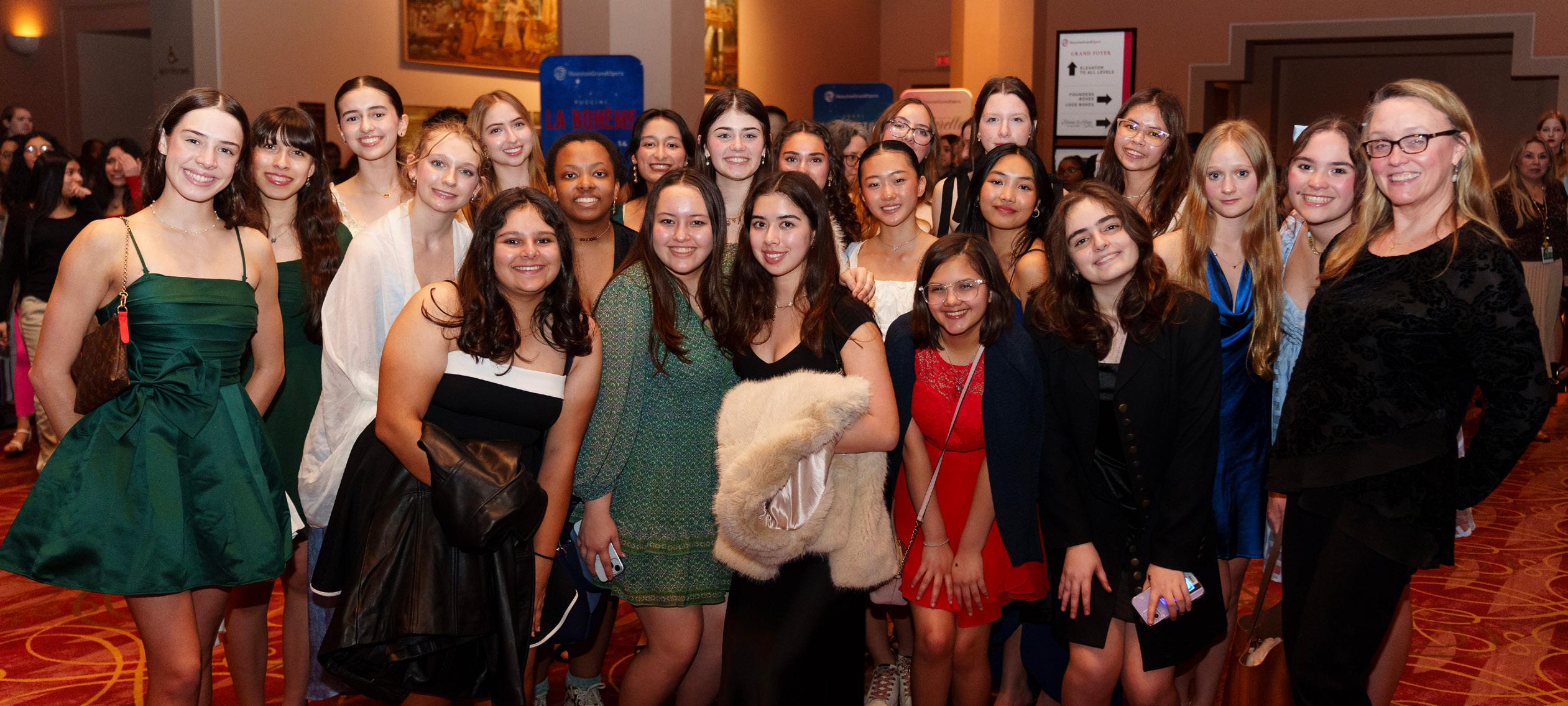


Each season, HGO invites Houston-area students to our mainstage productions at the Wortham Theater Center through subsidized and discounted tickets. More than 1,000 Houston-area students join us at the opera for just $25 every year, and you can too! Secure your student tickets today— visit the Discounted Tickets section at HGO.org/Tickets . THANK YOU FOR YOUR PARTNERSHIP