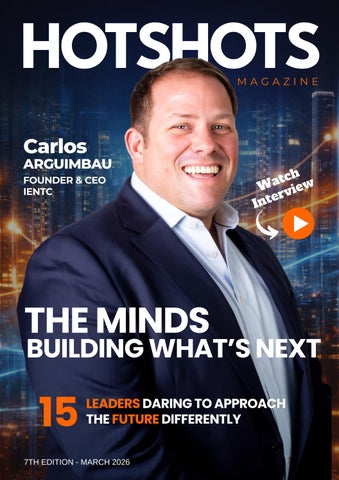
THE MINDS BUILDING


LEADERS DARING TO APPROACH THE FUTURE DIFFERENTLY 15

HOTSHOTS Magazine - The seventh edition
Welcome to the 7th edition of HOTShots Magazine, the only watchable telecom magazine!
In this issue, we explore the minds building what’s next: from global expansion and network transformation to launching new services and rethinking how the industry envisions tomorrow. Discover how AI and automation are driving innovation across subsea and terrestrial networks while ensuring security for critical infrastructure.
Meet 15 leaders daring to approach the future differently, safeguarding the longevity and resilience of the telecom industry.
HOTShots isn’t just a magazine, it’s your front-row seat to telecom’s future. Enjoy!
Shelley Wright Head of Content and Marketing, HOT TELECOM


Powering Mexico’s global future
Carlos Arguimbau highlights IENTC’s fast, reliable connectivity, strategic hub role, and global expansion vision.
Carlos Arguimbau, CEO of IENTC, explains how his company is positioning Mexico as a strategic hub connecting Latin America, the US and Europe. Based in Querétaro, Carlos highlights how the city has become a central data center ecosystem, home to more than 36 facilities and significant investments from AWS and Microsoft.
He emphasizes that IENTC provides European carriers with fast, reliable, crossborder connectivity, including last mile access, backup services and managed IT support. By controlling network operations in-house and maintaining bilingual NOC teams, IENTC ensures rapid delivery, minimal downtime and exceptional customer service.


Differentiation, he explains, comes from speed, efficiency and responsiveness. IENTC’s streamlined processes and proactive maintenance set the company apart in a crowded market, enabling customers to scale globally with confidence. Looking ahead, Carlos envisions IENTC growing into a tier-one operator with presence across Europe, Asia and the Americas, continuing to connect international carriers and support the digital economy.
Watch this interview to find out how IENTC is transforming connectivity in Mexico and building a bridge to the global internet.
CARLOS ARGUIMBAU FOUNDER & CEO OF IENTC
“We help international carriers connect Mexico, Europe, and the US with fast, reliable service.”
Transforming networks with new leadership
Valérie Cussac highlights Orange Wholesale International’s transition, launching 5G core services and AI-ready networks
Traditional wholesale voice and messaging business is in decline
Watch Valérie Cussac, CEO of Orange Wholesale International during her Telecom Stars in Cars interview, as she shares how she is shaping the company’s transition in a rapidly evolving wholesale market.
Since taking the role, Valérie has focused on listening to customers to understand their changing needs, particularly from hyperscalers and operators seeking scalable, flexible solutions.

Valérie explains that the traditional voice and messaging services are declining, while new expectations demand cloudlike, on-demand network services. Orange is responding with innovative offerings that combine submarine, terrestrial and satellite infrastructure to deliver AI-ready, high-capacity networks.
A highlight of her vision is the launch of 5G core network as a service, enabling mobile operators and MVNOs to focus on customer needs while Orange manages and secures the network.
This approach allows operators to offer private networks, IoT services and sliced 5G deployments efficiently, demonstrating the company’s expertise in network operations and management.
Don’t miss this exciting interview. Watch Valérie explain how Orange Wholesale International is delivering the next generation of scalable, flexible network solutions for the future of connectivity.
“We are launching 5G core network as a service, enabling operators to focus on customers and business growth.”
VALÉRIE CUSSAC CEO AT ORANGE WHOLESALE INTERNATIONAL


Bob Victor shares is leveraging AI customers, products, scalable intelligent

Rethinking networks AI
shares how Comcast Business AI to enhance employees, products, and build globally intelligent networks.

BOB VICTOR CHIEF SOLUTIONS AND PRODUCT OFFICER AT COMCAST BUSINESS
Bob Victor, Chief Solutions and Product Officer at Comcast Business, shares his vision for AI in 2025. He identifies three key areas where AI adds value: enhancing employee capabilities, improving the customer experience, and enabling AIpowered products like contact centers and security solutions.
He highlights interoperability as the biggest barrier to scaling AI globally. Even when AI tools are in place, differences in processes, SLAs, and business rules across carriers make seamless collaboration challenging.
Aligning these systems, standards, and automation is critical for global AI adoption. Looking ahead, Bob offers a five-year crystal ball view: a connected “fabric of AI” across Comcast Business.
Employees, customers, and systems will draw from shared AI tools and processes, creating a unified, efficient, and intelligent operational ecosystem.
Watch this interview to hear Bob explain how Comcast Business is integrating AI internally, enhancing customer solutions, and building the foundation for globally scalable, AI-powered networks- an essential roadmap for the future of NaaS and enterprise services.

PAUL GAMPE, CTO AT CONSOLE CONNECT
Transforming the future of networking
Paul Gampe discusses Console Connect automation, self-service billing, deterministic AI connectivity, and future AI agents programming networks live.
Paul Gampe, CTO of Console Connect, shares insights from managing the Console Connect platform.
Paul emphasizes that automation is essential and not just for service turn-up and tear-down, but for flexible billing and subscription management. Enterprises now expect a self-service experience for upgrades, downgrades, and discounts, without relying on email requests to a BDM.
Paul also highlights the importance of transmission on demand. AI workloads require deterministic connectivity with guaranteed latency, and Console Connect leverages its subsea and transmission heritage to deliver exactly that. This combination of on-demand
automation and legacy infrastructure expertise positions the platform to meet the growing demands of the AI era.
Looking ahead to 2026, Paul offers a sneak peek: an AI agent programming a network live via the Amplify LSA API - a proof-ofconcept showcasing how generative AI can operate network automation.
Watch this interview to hear Paul explain how Console Connect is redefining platform automation, billing, and AIready connectivity, bringing the future of networks to enterprises today.

“AI
workloads require deterministic, guaranteed latency connectivity; networks must perform flawlessly on demand for the AI era.”

“Subsea cables are booming in the energy sector, powering offshore wind farms and solar interconnects.”
ANDERS LJUNG, BUSINESS MANAGER SUBSEA
CABLE SOLUTIONS AT HEXATRONIC
Anders Ljung talks about how Hexatronic innovates in subsea cables, enhances energy, telecom connectivity, resilience, and empowers rapid deployment for a stronger, reliable global network.

The energy revolution
In his latest HOTShot interview, Anders Ljung, Business Manager Subsea Cable Solutions at Hexatronic, shares how fast the subsea cable industry is evolving.
While subsea cables are well known in telecom, Anders highlights a booming trend in the energy sector, powering offshore wind farms and solar interconnects, all relying on fiber optics for control and connectivity.
Despite transporting 95% of the world’s international internet traffic, subsea infrastructure remains surprisingly vulnerable.
Anders explains that protecting these networks requires more than heavy armouring. Route diversity, deeper burial and additional cables are critical to
ensure resilience against cable breaks, anchors and other risks.
Hexatronic’s approach combines flexibility, rapid deployment of spare cables and armoured protection, while exploring advanced sensing technology to detect threats in real time.
By staying agile and collaborating across the industry and governments, Anders says subsea networks can be made stronger, faster and more reliable than ever.
Don’t miss this insightful interview. Watch Anders explain how Hexatronic is innovating to safeguard the future of subsea connectivity.
Africa’s digital revolution
Alpheus Mangale highlights Seacom’s transformative subsea, terrestrial, and satellite connectivity, expanding Africa’s digital infrastructure and global network
Alpheus Mangale, Group CEO of Seacom, reflects on how the company has helped transform connectivity across Africa.
Since launching 16 years ago, Seacom has played a defining role in reshaping the continent’s digital landscape. Delivering the first private subsea cable to connect Eastern and Southern Africa to the world and dramatically reducing the cost of connectivity.

Alpheus explains that while subsea capacity around Africa has grown rapidly, the real challenge lies inland. Connecting east to west, north to south, and linking landing stations to cities, towns and communities is critical. Seacom’s focus spans subsea, terrestrial fiber and middle mile infrastructure, ensuring capacity reaches people where they live and work.
He also highlights the growing role of satellite connectivity as a complementary force, helping bridge the last mile and extend reach even further. Looking ahead, Alpheus shares Seacom’s ambitious vision with a new trailblazing project designed to connect the Indian Ocean basin, Africa, the Middle East and Asia using cutting edge subsea technology.
Watch the full interview to hear Alpheus share how Seacom is shaping the future of global connectivity and expanding access across Africa and beyond.
ALPHEUS MANGALE, GROUP CEO AT SEACOM
revolution

“We are connecting Africa with subsea, terrestrial fiber, and satellite networks, bringing internet access to every community.”
Powering innovation through partnerships
Patrick George highlights iBASIS’ AsiaPacific expansion, strategic acquisitions, strong talent, partnerships, and reliable, high-quality wholesale connectivity

“Talent is critical; industry experts bring energy, vision, and leadership, enabling iBASIS to grow, deliver, and innovate globally.”
He also underscores the importance of partnerships, working with tier-one operators to extend reach and deliver strategic deals across the region. For Patrick, trust, responsiveness and quality of service define iBASIS’s approach, allowing the company to differentiate itself in a competitive market.
Don’t miss this insightful interview. Watch Patrick share how iBASIS is driving growth, strengthening networks and shaping the future of wholesale connectivity in Asia and beyond.
Patrick George, CEO of iBASIS, discusses how his company is expanding its footprint across the Asia-Pacific region.
He highlights recent strategic moves, including the acquisition of Telstra International’s voice and messaging wholesale business, which strengthens iBASIS’s position and accelerates growth in voice, messaging and IPX services.
Patrick emphasizes that talent is central to success. By bringing in industry experts and nurturing strong teams, iBASIS ensures leadership, vision and operational excellence. These investments in people complement the company’s technology and network capabilities, enabling fast, reliable service for international carriers and global customers.
PATRICK GEORGE CEO OF IBASIS

The AI ecosystem
Jeff Hulse explains Verizon’s AIfocused strategy, investing in fiber, edge computing, and high-capacity connectivity for enterprises globally.


JEFF HULSE, PRESIDENT AT VERIZON PARTNER
SOLUTIONS GLOBAL WHOLESALE
Jeff Hulse, President at Verizon Partner Solutions Global Wholesale, shares how Verizon is preparing for the AI-driven future.
Jeff highlights that hyperscalers are heavily investing in data centers, long-haul networks, dark fiber, and subsea cables. He explains that by 2030, about 60% of AI inferencing will need to happen in real time at the edge, creating massive demand for high-capacity connectivity.
Telecom players, Jeff notes, are well positioned to capture this growth. Verizon has been investing heavily over the past seven years, with more than US$200 billion in fiber infrastructure, wireless capabilities, and data centers. This includes ultra-longhaul fiber, dark fiber, and co-location facilities with power and cooling to support AI workloads.
He also emphasizes that Verizon’s strategy focuses on delivering unconstrained bandwidth and end-to-end solutions - from private 5G networks to high-capacity data center connectivity, ensuring enterprises can fully leverage AI.
Watch this interview to hear Jeff explain how Verizon is shaping the telecom landscape to meet the surging demand of AI and edge computing.
When Voice Learns to Think: Why AI Voice Could Redefine Wholesale MEF Market Insight
MEF Programme Lead for Connectivity & Wholesale, Isabelle Paradis, discusses how AI is beginning to reshape longestablished assumptions in international voice. As intelligence moves closer to the network layer, familiar models around value, trust, and control are quietly being questioned—signalling potential change for wholesalers watching voice evolve once again.

Wholesale voice has survived far longer than most people expected. Even as margins fell and volumes shifted to IP, the basic framework remained unchanged: route the call, terminate it, reconcile it, and bill it. Voice became a background service that worked reliably, quietly, and without much strategic attention.
AI voice changes that equation. Not because it improves call handling, but because it reshapes what a voice call is, how value is created during that call, and who controls the trust behind it. This is a shift that reaches deep into the wholesale layer.
What AI Voice Really Means for Wholesale
In an international wholesale context, AI voice refers to intelligence applied inside the call while traffic moves across borders and between carriers. Instead of treating voice as an audio stream to route
ISABELLE PARADIS
DIRECTOR, CONNECTIVITY & WHOLESALE INTEREST GROUP

and terminate, AI analyses signalling, behaviour, routing patterns, and call characteristics in real time. This allows the network to understand whether the traffic is genuine, safe, and consistent with expected global behaviour.
Once intelligence enters the call path, voice stops being a minute to deliver and becomes an outcome to enable. What matters is no longer duration, but whether the interaction is trusted, compliant, and appropriate to complete.
This shift places international wholesalers at the centre of the interaction, because they see the cross-border signals, global routing patterns, and behavioural fingerprints that no enterprise layer can access.
AI voice also increasingly behaves like software. Many interactions are now short, structured, and machine-initiated, especially when voice is used as a verification layer between automated systems. In these cases, the “call” is not
a conversation between people, but an exchange between AI agents operating across networks.
A simple example makes this clear:
• An AI agent initiates a brief voice exchange with another automated system.
• As the exchange begins, the wholesale network evaluates call setup behaviour, signalling patterns, and routing history to determine whether the traffic behaves like a legitimate interaction or resembles a synthetic or manipulated flow.
• Real-time signals such as unusual geography, inconsistent hop patterns, or sudden behavioural shifts feed into the trust score generated during the interaction.
• The “call” ends not with a conversation, but with a decision: proceed, reroute, restrict, or block that traffic path.
This type of interaction does not fit the traditional international wholesale model. There is no meaningful notion of minutes, no human endpoint, and no rate structure designed for it. Instead, the network is enabling or preventing a trusted crossborder transaction using intelligence only the wholesale layer possesses.
Commercially, this represents a major shift. Value moves away from transporting voice toward delivering trust, verification, and behavioural assurance as services. It opens the door to per-interaction charging, riskweighted routing, and outcome-based pricing that reflect how AI-driven traffic will actually operate in global networks.
AI Voice and the Decline of Trust
AI voice introduces powerful new capabilities, but it also exposes a growing weakness in the voice ecosystem: trust is eroding. Voice cloning, synthetic impersonation, adaptive fraud flows, and automated social-engineering attacks are rising sharply.
What once behaved like predictable fraud patterns is now dynamic, personalised, and able to scale across borders at a pace that legacy controls cannot match.
As AI-generated callers become harder to distinguish from real people and can respond intelligently and instantly, enterprises lose confidence in voice as a reliable channel.
And when trust collapses, voice can no longer support the high-value interactions
that international wholesale relies on: authentication, financial verification, customer engagement, regulatory compliance, and cross-border service delivery.
For international wholesalers, this is a structural risk to the relevance of the wholesale voice business. If they do not step into the trust gap, others will. The device, the platform, or the identity wallet will become the arbiter of truth, while the network becomes just a conduit.
To
remain central, wholesalers must take ownership of the part of trust only they can provide:
• real-time visibility across borders
• signalling and routing intelligence that enterprises cannot access
• behavioural patterns that reveal anomalies before they become fraud
• the ability to intervene in the call path, not just report on it afterwards
This is the moment for international wholesalers to redefine their role from carriers of voice to custodians of trust. Without that shift, AI voice will evolve above them rather than with them, and the strategic value of wholesale networks will continue to weaken.
The Specific Opportunities AI Voice Opens for Wholesalers
As calls become intelligent, outcomedriven interactions rather than minutes in transit, wholesalers are in a unique
position to provide something enterprises and platforms cannot: network-derived trust, cross-border visibility, and real-time behavioural intelligence. These capabilities sit naturally in wholesale networks and cannot be replicated from the application layer.
This shift creates several clear opportunities for international wholesalers to evolve their business model and play a central role in the future of AI-enabled communications:
• Network-Level Trust Services: Monetising the intelligence wholesalers already see by offering real-time risk scoring, agent validation, and anomaly detection across borders.
• Transaction-Based Voice Models: Shifting from duration billing toward per-interaction or outcome-based pricing that reflects how agent-driven calls actually work.
• Verification and Authentication Services: Providing the networkbased verification signals enterprises, banks, and digital platforms need to secure AI-mediated interactions.
• Enterprise-Grade Fraud Prevention: Delivering real-time blocking of emerging AI-generated fraud patterns using insights only crossborder networks can observe.
• A Role in Machine and Agent Ecosystems: Supporting trusted identities, behaviour validation, and secure negotiation channels for machine-to-machine and agent-toagent communications.
• Reinventing the Wholesale Value Proposition: Evolving from transport to intelligence, trust, and automation enablement, positioning wholesalers at the core of the next-generation voice ecosystem.
Conclusion
Voice survived the move to IP by becoming cheaper and more efficient. AI voice demands a different strategy. It requires wholesale to participate in the intelligence and trust behind each interaction, not simply deliver it.
Voice is becoming intelligent again. The question is whether wholesalers will claim a role in shaping that intelligence, or allow others to define the future of voice while wholesale continues to carry the traffic without influencing its value.
Wholesalers that act now can lead this shift. Those that wait may find themselves supporting a voice ecosystem they no longer control.
“AI voice demands a different strategy. It requires wholesale to participate in the intelligence and trust behind each interaction, not simply deliver it.”

TERESA MONTEIRO, DIRECTOR OF PRODUCT MARKETING AT NOKIA
Reimagining connectivity
Watch Teresa Monteiro, Director of Product Marketing at Nokia, as she explains how the industry is shifting toward integrated, endto-end networks.
Hyperscalers now demand data center to data center connectivity, requiring seamless integration of subsea and terrestrial networks. Teresa emphasizes that this approach gives operators full visibility and enables traffic to flow efficiently from cable landing stations to cities and data centers.


Automation, once seen as a cost-saving luxury, has become essential. Teresa explains that modern networks, driven by AI and rising bandwidth needs, are too complex to operate manually. Automated operations reduce human error, optimize network resources and prepare operators for future demands that may not even exist today.
Nokia’s portfolio is designed for this new landscape, with high-capacity transponders, open line systems, coherent pluggables and professional services to support end-to-end network management. These innovations make high-speed, efficient subsea and terrestrial connectivity possible, even for transatlantic routes.
Watch Teresa explain how Nokia is enabling the next generation of automated, end-to-end global connectivity.
“It’s about time to look at networks from an end- to - end perspective, integrating terrestrial and subsea connectivity.”
The rise of a connectivity
Samuel Carvalho talks about TelCables Europe’s launch, EuropeanAfrica connectivity hub, partnerships, submarine network expansion, and strategic growth for corporate customers.

TelCables Europe launches Lisbon connectivity hub

connectivity hub


Watch Samuel Carvalho, CEO of TelCables Europe during his Telecom Stars in Cars interview as he shares the vision behind the newly launched company by Angola Cables.
Samuel explains that TelCables Europe was created to serve the growing demand from European, US and African customers, positioning Lisbon as a strategic connectivity hub for Western Europe and Africa.
Samuel highlights that the company’s focus is on enabling corporate clients, data centers and start-up campuses with robust, high-capacity connections. By partnering with Tier-1 operators and expanding PoPs across Europe, TelCables Europe provides seamless, reliable connectivity between Europe, Africa and Latin America.
SAMUEL CARVALHO CEO OF TELCABLES EUROPE
He also emphasizes the broader impact of their initiatives, supporting emerging tech hubs, new data campuses and future GPU deployments, while strengthening Europe’s role in global digital infrastructure.
His vision combines strategic partnerships, regional expansion and customer-centric services to build a “bridge to the Atlantic,” connecting key markets with efficiency and scale.
Watch Samuel explain how TelCables Europe is redefining connectivity across Europe, Africa and beyond, and creating a new hub for global networks.
Reframing internet security
Will Amores explains how AT&T is leveraging AI, automation, and SASE to strengthen network security and protect critical infrastructure.
Will Amores, Director of Network Security Products at AT&T, discusses the evolving landscape of network security in an era of intelligent networks. He explains that as threats become smarter, distributed, and more complex, network security must evolve through AI, machine learning, and automation to prevent risks and protect critical infrastructure.
He emphasizes the role of SASE (Secure Access Service Edge) in helping carriers deliver stronger, more resilient protection. By unifying security across expanding perimeters and multiple endpoints, SASE enables “always-on” security that shields organizations from malicious actors.
Will also highlights AT&T’s approach: embedding security directly into the network. This transforms the internet from a potential threat vector into a protective tool, offering customers a consistent, unified security layer while supporting zero-trust adoption.
Watch this interview to listen to Will’s insights on how carriers can leverage AI, automation, and SASE to strengthen network security and provide smarter, more resilient protection for businesses in an increasingly connected world.
WILL AMORES DIRECTOR OF NETWORK SECURITY PRODUCTS AT AT&T


“We should leverage AI, machine learning, and automation within our network to prevent cybersecurity risks and threats.”
Red Sea recovery
Paul Abfalter highlights Flag’s global transformation, rapid connectivity restoration, multi-path network expansion, and strategic investments strengthening resilience and future growth.

During his latest HOTShot interview, Paul Abfalter, Chief Strategy and Revenue Officer at Flag, shares how the company has rebranded and reinvented itself for the next stage of growth.
Since being acquired by a UK private equity firm, Flag has invested heavily in leadership and infrastructure, transforming from a single-path provider to a multi-path operator with global reach.
Paul highlights the company’s rapid response when more than 90% of connectivity between Asia and Europe was cut in the Red Sea. Flag restored capacity in record time, leveraging terrestrial alternatives and its Falcon cable network. “What’s hard
PAUL ABFALTER CHIEF STRATEGY AND REVENUE OFFICER AT FLAG

gives us a competitive advantage,” Paul says, pointing to the company’s ability to deliver weeks ahead of industry standard timelines.
Looking ahead, Flag is investing at scale across the Middle East, India, Singapore and transpacific routes. New cables and expansions promise faster connectivity, greater resilience and solutions for critical capacity shortages.
Watch Paul explain how Flag is innovating to strengthen global networks and redefine the future of connectivity.
“What’s hard gives us a competitive advantage, enabling Flag to restore capacity faster than expected.”

“We are all about location intelligence. If you need to
find connectivity anywhere, our platform helps you locate it.”
Fiber data transforming global connectivity
Mike Iapalucci discusses FiberLocator transforming global fiber connectivity intelligence and expansion worldwide.

MIKE IAPALUCCI VICE PRESIDENT AT FIBERLOCATOR
Mike Iapalucci, Vice President of FiberLocator, reveals how the company is transforming connectivity intelligence worldwide. FiberLocator provides location intelligence, allowing users to find local operators, off-net connectivity, and pricing anywhere in the world. He explains that this is crucial for businesses, citing an example of helping a global retailer locate fiber connections for a factory in Kazakhstan.
He describes fiber as the “new digital gold,” essential alongside power and cooling for data centers. FiberLocator’s platform gives operators, enterprises, and data center developers the tools to plan and expand efficiently, making connectivity more accessible and transparent.
Over the past 18 months, FiberLocator has added more than three dozen carriers across Europe and Latin America, while expanding its team in London and Rio de Janeiro. Mike shares that the company plans to continue its growth across Asia, including Singapore and Hawaii, connecting more regions to the digital world.
Don’t miss this interview. Watch Mike explain how FiberLocator is turning fiber data into a critical resource for global connectivity and future-ready networks.
Rethinking subsea
Cynthia Mehboob explains most subsea cable damage stems from human activity, not malicious attacks.
At Submarine Networks World 2025 in Singapore, Cynthia Mehboob, PhD Scholar, challenges some of the most common assumptions surrounding subsea cables and global security. She explains that while cables are often framed as fragile and under constant threat, the evidence does not support claims of widespread malicious attacks. Most damage, she notes, still comes from human activity such as fishing and anchoring.

Cynthia raises concerns about how governments increasingly frame cable vulnerability without sufficient forensic proof, warning that speculation risks distracting attention from real and immediate issues. These include delays in permits, repair bottlenecks and emerging threats such as seabed mining, which she identifies as one of the most serious long term risks to subsea infrastructure.
She also highlights a growing disconnect between policymakers and industry experts. Technical knowledge, Cynthia argues, is often locked in silos, allowing security narratives to be shaped without engineering voices at the table.
Her research calls for stronger collaboration, independent translators between sectors and greater inclusion of young scholars to balance the public conversation.
Watch the full interview to hear Cynthia’s perspective on subsea resilience, security narratives and why collaboration is critical for the future of global connectivity.
CYNTHIA MEHBOOB PHD SCHOLAR
subsea cables

“Technical knowledge about subsea cables is often trapped in silos, limiting public understanding and informed policy decisions.”
Smarter global connectivity
Andrew Miller explains how Indigo delivers unified, agile subsea network management, transparency, and real-time insights for global connectivity.

Watch Andrew Miller during his Submarine Networks World 2025 HOTShot interview, as he shares how the subsea industry is evolving at speed. He explains that hyperscalers and consortia are demanding transparency, control and seamless management across both terrestrial and subsea networks.
Legacy models no longer cut it. Customers want unified governance, fast reporting and clear visibility across entire systems. Indigo’s Systems Operator service delivers
ANDREW MILLER GLOBAL ACCOUNT DIRECTOR SUBSEA
“AI will enhance engineers, delivering quicker, more transparent service and stronger frameworks across subsea networks.”
exactly that, removing fragmentation, providing agility, and giving customers confidence at scale.
The push comes from growing global demand for capacity, low latency, and connectivity to hard-to-reach locations. Indigo’s operations, backed by its own digital command systems, provide real-time insight, ensuring network performance, maintenance and readiness for the next wave of innovation.
Hyperscalers
demand Indigo manage both terrestrial and subsea networks efficiently
Looking ahead, Andrew sees AI as a gamechanger. Not replacing engineers, but enhancing their work, speeding up service, strengthening frameworks and improving transparency across increasingly complex networks.
Don’t miss this exciting interview, watch Andrew Miller share how the industry is shaping the future of subsea networks and preparing global connectivity for what comes next.