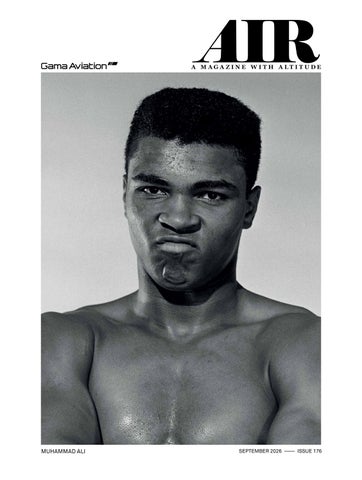
MUHAMMAD ALI
SEPTEMBER 2026 –––– ISSUE 176
Brand Licensing Notice: Four Seasons Private Residences Abu Dhabi at Saadiyat Beach are not owned, developed or sold by Four Seasons Hotels Limited or its affi liates (Four Seasons). The developer, Al Ain Asset Management LLC SPC or its affi liates, uses the Four Seasons trademarks and tradenames under a license from Four Seasons Hotels Limited. The marks “FOUR SEASONS,” “FOUR SEASONS HOTELS AND RESORTS,” any combination thereof and the Tree Design are registered trademarks of Four Seasons Hotels Limited in Canada and U.S.A. and of Four Seasons Hotels (Netherlands) B.V. elsewhere.
Saadiyat’s Shore, an Address Beyond Compare
+971 800 1144 ׀alainam.com
Showrooms:
Contacts:
Social Media:
The Dubai Mall
+971 4 2262277
mahallatiJewellery
Dubai Marina Mall
retail@mahallatijewellery.ae
mahallatiJewellery
Mall of the Emirates
www.mahallatijewellery.ae
Mrs.Mahallati
Gold Souk
WHERE DIVERSITY UNITES WHERE DIVERSITY UNITES A O R IMNEAI H M RE II ON RT SE .RCI OO M R S . C O M M A R I NM A H NO T E
SEPTEMBER 2026 –––– CONTENTS –––– ISSUE 176
AIR –––– 9
FEATURES Forty Six
Ten years on from Muhammad Ali’s passing, what legacy did the self-proclaimed GOAT leave behind?
How the creatives at Range Rover Bespoke ensure a customised car is now the ultimate luxury.
Beyond A Lifetime
52
Making It Personal
Fifty Two
The Show Must Go On
From chic Parisian salons to industrial robots; how the catwalk show has evolved into a multisensory experience.
Credit: Grant Anderson
Forty
The Maldives’ Largest 3 Bedroom Residence Set within untouched jungle and fronted by a private stretch of beach, this is the most expansive 3-bedroom residence in the Maldives — a private world of its own within JA Manafaru. Three generously proportioned bedrooms open onto a private pool and sundeck, surrounded by lush greenery, with direct beach access just steps away. Designed for families and groups seeking space, privacy, and total exclusivity, it’s a residence built for moments that matter. For reservations, please contact us at +960 6500 456 or email: reservations.manafaru@jaresorts.com A MEMBER OF
SCAN HERE TO LEARN MORE
SEPTEMBER 2026 –––– CONTENTS –––– ISSUE 176
AIR –––– 11
REGULARS
18
36
Eighteen
RADAR
Louis Vuitton and Singer team up to reimagine the ultimate 911.
Twenty
OBJETCS OF DESIRE The latest luxury items we’re currently coveting.
Twenty Two
ART & DESIGN
58
Multidisciplinary artist Wallace Chan is staging his most ambitious – and biggest – project to date.
Twenty Six
JEWELLERY
Hermès harnesses its equestrian heritage with its latest high jewellery collection; Gucci reinterprets its signature codes.
62
Thirty Six
TIMEPIECES
Hublot CEO Julien Tornare on why innovation needs strong foundations.
20
Fifty Eight
MOTORING
The Vision BMW ALPINA points the way for the brand’s bright future.
Sixty Two
GASTRONOMY
How Santiago Lastra’s creative and bold interpretations of traditional Mexican recipes propelled his restaurant to Michelin-star status.
22
66
EDITORIAL Editor-in-Chief & Co-owner
John Thatcher
john@hotmedia.me
COMMERCIAL Managing Director & Co-owner
Victoria Thatcher victoria@hotmedia.me
Sixty Six
TRAVEL
JA Manafaru goes large in the Maldives and Aman debuts on Mexico’s east coast.
PRODUCTION Digital Media Manager
Muthu Kumar
muthu@hotmedia.me
Sixty Eight
WHAT I KNOW NOW 26
Rav Matharu, Founder and Creative Director of clothsurgeon.
Reproduction in whole or in part without written permission from HOT Media is strictly prohibited. HOT Media does not accept liability for any omissions or errors in AIR. Published in Dubai, UAE.
SEPTEMBER 2026 –––– WELCOME –––– ISSUE 176
AIR –––– 13
WELCOME ON BOARD In private aviation, freedom is often understood in terms of where and when we travel. Yet one of its greatest advantages lies in something less obvious: the ability to decide how a journey should unfold. Airport selection can easily become habitual. A familiar destination leads to a familiar airport, often without considering whether it remains the best choice for the journey ahead. Yet proximity on a map tells only part of the story. The time spent taxiing, the pace of the arrival, the privacy of the environment and the ease of the onward journey all shape the experience long after the aircraft has landed. For experienced travellers, operators and crews, the most effective gateway is not necessarily the most familiar. It is the one that provides greater certainty, fewer unnecessary interruptions and a clearer path between the aircraft and the final destination. This is particularly relevant when travelling to Dubai and the Northern Emirates. The region offers several points of arrival, each with its own characteristics. Understanding those differences allows travellers to make a more informed choice, based not simply on an airport’s name, but on how well it serves the complete journey. Since becoming operational in February, the new Gama Aviation Business Aviation Centre at Sharjah International Airport has introduced a different way to approach that choice. Located approximately nine nautical miles from Dubai International Airport, it provides convenient access to Dubai while also serving Sharjah and the wider Northern Emirates. Its value, however, is not defined by geography alone. The centre has been designed around the pace and priorities of private aviation, providing a discreet environment, direct access and the operational capability required to help passengers and crews move with confidence. Opening a major new facility during a period of heightened regional complexity has demanded calm decision-making, adaptability, and close coordination. It has also demonstrated why experience matters. Buildings and facilities may shape first impressions, but it is the people behind them who provide reassurance when circumstances change. At Gama Aviation, we believe that a business aviation centre should do more than mark the beginning or end of a flight. It should give travellers greater control over their journey. Sometimes, that begins by looking beyond the familiar route.
Tom Murphy
Managing Director, FBO Services, Gama Aviation About Tom Murphy Tom Murphy is Managing Director, FBO Services at Gama Aviation, with responsibility for the development and performance of the company’s FBO network across the UK, Channel Islands and Middle East. With extensive experience in aviation operations and leadership, Tom works with teams across the network to deliver safe, efficient and consistently client-centred experiences for passengers, operators, and crews.
gamaaviation.com
Cover: Muhammad Ali/Alamy
SEPTEMBER 2026 –––– WELCOME –––– ISSUE 176
AIR –––– 14
THE JOURNEY TO DUBAI, RECONSIDERED
Why a more considered arrival in Dubai and the Northern Emirates may begin in Sharjah
Private aviation offers travellers an unusual degree of choice. Aircraft, schedules, and routes can all be shaped around individual priorities, allowing the journey to respond to the traveller rather than the other way around. Yet when it comes to selecting an airport, familiarity can still influence the decision. A flight to Dubai naturally suggests an arrival in Dubai. It is an understandable assumption, but one that overlooks an important consideration: the airport closest in name is not always the gateway best suited to the complete journey. For those travelling privately, the experience is measured by more than flying time or distance from the runway to the final destination. Taxi times, airport congestion, privacy, ground handling, and the predictability of the onward journey can be equally important. A few miles on a map may matter less than the ability to arrive, move through the airport and continue without unnecessary delay.
Located at Sharjah International Airport, the Gama Aviation Business Aviation Centre offers a different way to approach Dubai and the Northern Emirates. Situated approximately nine nautical miles from Dubai International Airport, Sharjah is more closely connected to Dubai than many international travellers may realise. The commercial districts, hospitality, culture, and coastline of Dubai remain within practical travelling distance, while Sharjah and the Northern Emirates are placed directly within reach. For travellers whose itineraries extend beyond central Dubai, this location can offer an especially considered starting point. The distinction begins on arrival. After landing, aircraft can reach the BAC from the runway in as little as 90 seconds. A 36,000 square metre self-manoeuvring apron supports efficient aircraft movements, while an in-house handling team coordinates the details required around each arrival and departure.
This combination gives passengers, operators, and crews greater control over the pace of the experience. It is not about rushing a journey. It is about removing the unnecessary pauses that can make even private travel feel less private. Inside, the 3,000 square metre terminal has been designed to create an immediate sense of calm. Expansive views across the apron connect the interior to the movement of the airfield, while the scale and arrangement of the passenger areas allow journeys to remain discreet and personal.
Whatever your mission – fly, manage, maintain, or arrive – Gama Aviation is your trusted partner in Business Aviation.
Your mission, our passion. gamaaviation.com
SEPTEMBER 2026 –––– WELCOME –––– ISSUE 176
The architecture is contemporary, but the experience is not intended to feel anonymous. Regional influences, carefully selected materials and warm, considered interiors give the centre a distinct identity. It is a space shaped by its location, with an atmosphere that feels composed without becoming formal or restrictive. This balance is particularly important in business aviation. Some passengers may wish to continue their journey almost immediately. Others may need time to meet, work, or pause before leaving the airport. The role of the BAC is not to impose a single definition of luxury, but to allow each traveller to move at the pace that suits them. Privacy is treated with the same consideration. The ability to pass through an airport discreetly is not an additional indulgence for many private aviation travellers. It is an essential part of the journey. The layout, direct apron access and attentive service allow each arrival or departure to be managed around the individual rather than through a standardised process. Behind the passenger experience sits a substantial operational infrastructure. Dedicated fuelling resources and an inhouse team provide greater coordination around aircraft requirements. A
12,000 square metre air-conditioned hangar offers space for aircraft away from the region’s heat, supported by the wider technical and aviation capabilities of Gama Aviation. For crews, dedicated lounges and three sleep rooms overlooking the apron recognise that the quality of a journey depends on everyone responsible for delivering it. The ability to rest, prepare and remain close to the aircraft is a practical detail, but one that can have a meaningful effect on longer or more complex operations. The BAC became operational in February 2026, moving the proposition from architectural vision to a working part of the region’s business aviation infrastructure. Since then, its teams have welcomed aircraft, passengers and crews while navigating a period of considerable complexity across the Middle East. Opening in such circumstances has required experience, preparedness and the ability to respond calmly as conditions evolve. It has reinforced a simple principle: impressive facilities may define the setting, but confidence comes from knowing that the people behind them are ready to act. That experience is supported by Gama Aviation’s long-established presence in the region and its wider
AIR –––– 16
FBO network in the UK and Channel Islands. The Red Thread Academy, Gama Aviation’s client experience programme, connects teams across these locations through a shared approach to service, leadership, and attention to detail. At Sharjah, this is reflected in the small moments that shape the experience: a welcome that feels personal rather than procedural, an onward journey anticipated before the aircraft arrives and a crew request handled without unnecessary complication. None of these moments is intended to draw attention to itself. Their purpose is to allow the journey to continue naturally. For travellers accustomed to arriving through the same airport, Sharjah presents an invitation to reconsider the route. Not because the familiar choice is necessarily wrong, but because private aviation creates the freedom to choose more deliberately. The most suitable airport is the one that understands where the passenger is going, what matters along the way and how they wish to arrive. For Dubai, Sharjah and the Northern Emirates, that journey may begin at the Gama Aviation Business Aviation Centre. Sometimes, a different gateway changes more than the route. It changes the rhythm of the entire journey.
©2022 Marriott International, Inc. All Rights Reserved. All names, marks and logos are the trademarks of Marriott International, Inc., or its affiliates.
WHERE STILLNESS SETS T H E PAC E
In the heart of the Dubai Desert Conservation Reserve, Al Maha rises quietly from the dunes — a retreat shaped by space, silence and connection to the land. Tented villas, private pools and instinctive service create a sense of ease rather than excess. Days unfold in harmony with nature, from dawn light on the sand to evenings beneath star-filled skies. This is quiet luxury, guided by heritage, where the desert leads and everything else follows.
EXPLORE THE DESTINATION AT AL-MAHA.COM
SEPTEMBER 2026 –––– RADAR –––– ISSUE 176
W
hat began as a request by Singer for a dashboard clock created by La Fabrique du Temps Louis Vuitton swiftly turned into a deeper collaboration between the brands. The result? A duo of Porsche 911s Reimagined by Singer, for which Louis Vuitton has personalised every functional element of the vehicles – one a Classic clad in Vuitton’s signature colours of saffron, cobalt blue and yellow; the other a Classic Turbo finished in Calcaire Lutétien white, as conceived by Nicolas Ghesquière. “With the creation of both cars, Louis Vuitton has, for the first time, drawn upon the full breadth of its savoir-faire, bringing together the expertise of every House métier in a unique and exclusive automotive project,” said Jean Arnault, Louis Vuitton Watch Director. The collaboration also includes a capsule of accessories, including luggage that’s customfitted to the car.
AIR –––– 18
objects of
desire Set the tone as a true tastemaker with these coveted items
BOUCHERON
HUMAN BEING The more avant-garde of Claire Choisne’s two annual high jewellery collections for Boucheron, ‘Carte Blanche’ grants Choisne an opportunity to reflect anew on what is considered precious, deemed this year to be humanity. Totalling 14,000 hours of work, Human Being spans five
20-21 AIR_OOD_Supplement_SEP26.indd 1
sets, each containing a necklace and ring and a level of technical know-how and artistry that sets Choisne’s designs apart. The crafting of this flower ring employed the use of a painter of micro-miniatures and features diamonds and pink quartz totalling 141 carats.
27/08/2026 9:46 AM
RICHARD MILLE
RM 64-01 TOURBILLON COLNAGO Richard Mille has steadily built a strong bond with the world of cycling, an everexpanding universe of collaborations that includes the likes of record Tour de France stage winner Mark Cavendish and UAE Team Emirates. The latest spoke sees Mille team up with the
20-21 AIR_OOD_Supplement_SEP26.indd 2
legendary Italian manufacturer Colnago, whose design team was involved in the creation of this limitedto-50 timepiece – the bike builder’s cycle frames the inspiration for the calibre and the hands specially designed to echo the cranks of a bicycle bracket.
27/08/2026 9:46 AM
BERLUTI
LE PETIT PRINCE Antoine de Saint-Exupéry’s much-loved Le Petit Prince has sold an estimated 140 million copies worldwide and has been adapted to numerous art forms and media, from film through to ballet. Berluti is the latest to draw inspiration from the timeless tale, utilising laser engraving, tattooing,
20-21 AIR_OOD_Supplement_SEP26.indd 3
patination, watercolour and marquetry to translate the story onto a range of pieces that includes wallets, scarves and multiple bags, this limited edition version depicting one of the book’s most recognisable illustrations of a mountaintop that points to the great beyond.
27/08/2026 9:46 AM
MESSIK A
TERRES DE CONTR ASTES “In my mind, three words rule this collection: power, colour, life,” says Valérie Messika of her latest spellbinding high jewellery offering, which owes its inventiveness to the broad, contrasting landscape in Botswana. It’s a landscape that’s dominated by the vast Kalahari
Desert, where Valérie’s safari adventures created the memory of a graceful cheetah on the prowl, its footprints and spots creatively depicted on this bold necklace that’s anchored by a stunning stone, its warming hue echoing the sundrenched earth.
MANISH MALHOTR A
H A U T E C O U T U R E FA L L / W I N T E R 2 0 2 6 / 2 7 To mark his debut at Paris Haute Couture Week, Manish Malhotra chose to celebrate the powerful relationship between a mother and her child, expressed through the language of couture. From rounded, sculptural silhouettes that evoke
20-21 AIR_OOD_Supplement_SEP26.indd 6
the earliest stages of life through to monumental gowns, dramatic proportions and richly embellished surfaces that celebrate the notion of legacy, each step of the relationship is marked by precision tailoring and expert craftsmanship.
27/08/2026 9:46 AM
CHANEL
J12 SUPERLEGGER A Despite recently celebrating 20 years since its launch, the J12 Superleggera maintains a freshness to its design, its latest iteration the sportiest yet. Crafted from matte black ceramic and steel, the dial is lacquered black and adorned with a double finish – brushed
20-21 AIR_OOD_Supplement_SEP26.indd 7
at the centre and azured on the borders – while the ring of the bezel is formed from satin-finished hardened steel. Notable design elements include a red arrow that indicates the date, and the clear case back that showcases the calibre.
27/08/2026 9:46 AM
BV LGA R I
ECLET TICA Bvlgari has extended its acclaimed Eclettica collection with a capsule composed of 26 high jewellery pieces – rings, earrings and stunning necklaces – each an artistic interpretation of lace expressed in shimmering diamonds. The art of macramé lace is charmingly evoked
20-21 AIR_OOD_Supplement_SEP26.indd 8
in the Mélange Précieux necklace, at the heart of which sits a rare 6.20-carat, flawless-clarity stone – classified as Type IIA, a category representing less than 2% of the world’s diamonds – while other prized pieces include these beautifully crafted earrings.
27/08/2026 9:46 AM
SEPTEMBER 2026 –––– ART & DESIGN –––– ISSUE 176
AIR –––– 22
The Scale of Imagination Multidisciplinary artist Wallace Chan is staging his most ambitious – and biggest – project to date WORDS: JOHN THATCHER
SEPTEMBER 2026 –––– ART & DESIGN –––– ISSUE 176
AIR –––– 24
Previous page: Wallace Chan, photographed by Tian Fangfang These pages, from left to right: Vessels of Other Worlds - Rebirth, photographed by Tian Fangfang
W
hether working at a miniature or monumental scale, Wallace Chan tends to produce the extraordinary. In a career that spans more than half a century, the self-trained Chinese artist has practised jewellery art, carving, sculpture and installation, excelling at each to the extent that he has six major inventions to his name. They include 1987’s The Wallace Cut, an illusionary carving technique that sees light reflect through a stone to produce multiple images and, more recently, Wallace Chan Porcelain, an entirely new material five times stronger than steel. His latest project, Vessels of Other Worlds, is one of his most ambitious to date. Simultaneously staged in two cites, Venice and Shanghai, it features titanium sculptures that reach as high as ten metres, exploring themes of transformation, memory and spirituality. “When a work enters a different cultural and architectural
context, it naturally takes on a different life,” says Chan. “In an intimate chapel in Venice, visitors encounter smaller oil-vessel sculptures alongside a video installation. In Shanghai, they stand face to face with monumental sculptures reaching seven, eight, or even ten metres high. Through a live video transmission, each audience is simultaneously present in the other city. Entering the Long Museum in Shanghai is, in a sense, also entering the Venetian chapel; standing in Venice also means stepping into Shanghai. Vessels of Other Worlds is about being aware of the presence of other worlds.” Chan talks of building the monumental from the microscopic, of his latest work fulfilling an ambition. “I see the world within the microcosm, and I often imagine myself as small as an ant, wandering about in that micro-realm. Now, I am transforming that kaleidoscopic world seen under the microscope into monumental sculptures. This fulfils a long‑held desire
of mine: to step inside the work. Now that the scale of the work has changed, this imagination can finally be realised.”
T
he scale may have changed, but not Chan’s philosophy. “In nature, everything vast begins from something almost invisible. Stars are formed from particles; mountains and rivers are shaped by the accumulation of dust and time; life itself begins from microscopic cells. My sculptures follow a similar logic. They are not created by expanding a single form, but by allowing countless small elements to gradually become a larger existence. “So the movement from the microscopic to the monumental is not a change in my way of thinking – it is a continuation of the same philosophy. Whether in a jewel or a large-scale sculpture, I am exploring how the smallest details can contain infinite possibilities and how the invisible can eventually reveal itself as something monumental.”
Each of Chan’s colossal sculptures, his vessels, is constructed from more than 5,500 titanium components and over 22,000 screws, each an “act of craftsmanship” that manipulates a tough material Chan has come to understand. “Titanium is a stubborn, rigid metal with a melting point of 1700°C and an exceptionally strong memory. So the process is not about conquering it, but about gradually understanding it, working with it, and ultimately finding a rhythm together. My relationship with titanium is more like a tango: we yield to each other, chase and are chased in turn.” The complexity of working with titanium is why it is so rarely used in the arts and why Chan believes its artistic potential remains largely unexplored. “Every artist has their own ideal. For me, my lifelong aspiration has been to create works that can stand the test of time. This belief is reflected in the materials I choose. Titanium is the material closest to eternity;
it can be so small that it goes inside the human body and so large that it becomes a rocket and travels into space. It carries endurance but, at the same time, through form, light, and surface, it can also express softness, movement and transformation.” The surfaces of Chan’s sculptures are populated with the likes of human figures, mythical creatures and motifs. “They are not intended to represent specific individuals or narratives. They are manifestations of an inner being, a state of existence that exists somewhere between the human, the spiritual and the material world.”
T
he recurring figures are deliberately androgynous. “They are neither male nor female, neither child nor elder. For me, there is something sacred in this state of ambiguity, because it suggests a condition beyond ordinary identity. The figures represent a kind of inner consciousness rather than an external portrait.”
Look closely at these figures and you’ll see that their eyes aren’t fully open. “This small opening looks outward toward the human world, toward material existence and everything visible,” explains Chan. “The remaining twothirds of the eye turn inward, toward the invisible realm of thought, spirit, and imagination. The face becomes not simply a representation of a person but a reflection of an interior landscape. “Toddlers and babies are another recurring element in my work. They are not only figures but symbols of curiosity, openness and the beginning of perception. Their number also carries different possibilities of meaning: one child may suggest solitude or contemplation; two may represent dialogue and connection; three may introduce exchange, tension, or debate; four may evoke cycles in nature, such as the four seasons. Numbers create another layer of storytelling within the sculpture. “Ultimately, these figures, creatures, and motifs are ways of exploring the relationship between the visible and the invisible. Through the language of light, reflection, material and symbolism, I hope to create works that reveal multiple worlds at once.” He also hopes to create works that live beyond him. “My practice is devoted to slow art. Depending on scale and complexity, a work may take months, years, or even more than a decade to complete. I often imagine that one day, when none of us is still here, these works may continue to exist. Perhaps they will one day answer questions posed by other forms of intelligent life and become witnesses to who we were, what we believed and how we understood existence. To create something that can last for a thousand years is, of course, costly. But if a work truly lives for a thousand years, then its cost becomes less than a cup of coffee a day. What feels truly expensive to me is fast art: art that consumes time, material and labour, only to disappear after one year, ten years, or fifty years. “If I am to devote myself fully to a work, then it must be able to travel beyond me. I imagine the life of each sculpture extending far into the future and, in that sense, they truly become vessels of other worlds.” Wallace Chan: Vessels of Other Worlds at Pieta Chapel, Venice until October 18, 2026 and at Long Museum, Shanghai until October 25, 2026
SEPTEMBER 2026 –––– JEWELLERY –––– ISSUE 176
AIR –––– 26
Rein Supreme Hermès harnesses its equestrian heritage with its latest high jewellery collection WORDS: JOHN THATCHER
SEPTEMBER 2026 –––– JEWELLERY –––– ISSUE 176
AIR –––– 28
Hermès' relationship with the equestrian world set the foundations for the house, its birthplace in 1837 the Paris workshop from where Thierry Hermès expertly crafted harnesses and made-to-measure saddles for European aristocracy. It’s a relationship that remains at the very heart of the maison – Hermès continues to handcraft saddles – and one that is an enduring source of inspiration. “Into the Horsescape is a metonymical collection,” says Pierre Hardy, Creative Director of Hermès Jewellery of his equine-inspired high jewellery chapter, its story unfolding over 90 novelties and 42 heritage pieces. “The horse itself is barely seen, but its symbolism lives within each piece, sometimes even taking on a metaphorical quality.” From horse bits and stirrups to lassos and blacksmith’s nails, Hardy takes regular equestrian elements and transforms them into extraordinary sculptural jewels. “There is a piece of body jewellery, a bib necklace and a horse's head revisited as a ring with a black hood,” says Hardy. “Then the collection broadens its scope to encompass other eras, stories and tones. We take mundane items and turn them into something sublime, whether by creating pieces inspired by boots and lassoes, or by finishing a blacksmith's nail in gold and diamond, transforming it into a sun that illuminates one's face.”
By doing so, Hardy has been able to tell the Hermès' story; “its relationship with time and materials, before drawing on the imagination. This collection journeys between the abstract and the narrative.” Asked for an example piece that best conveys this intention and Hardy picks out Sellette, a beautiful bracelet that reinterprets the saddle as a jewel, translating an 18th-century equestrian object from the Émile Hermès Collection into a sculptural composition of black titanium, chiselled gold and diamonds. “A symbolic object that has been miniaturised into a new version of itself that, paradoxically, intensifies its preciousness.”
I
t’s not just objects that inspired Hardy; this is a collection formed from multiple influences. Chevauchée evokes the Great Plains of the Americas, the line playing with different types of jewellery chains – twisted, braided, column, semipavé-set or pavé-set – and featuring a wide variety of stones: tourmaline, chrysoprase, quartz and moonstone. Galop Hermès centres on the sculptural beauty of a horse’s profile; a rose gold double ring set with diamonds in shades of brown and white and baguettecut white diamonds, and a bracelet comprising white gold, white diamonds and diamonds in shades of brown.
“Yes. Geographically and chronologically,” Hardy says of the wide nature of his influences. “The horse has always been one of the greatest and most inspiring animals in mythology. Think of Mars and Neptune's horses, Hercules' chariot... The legends that range from the Amazons of Asia Minor to the Great Plains. I didn't want to choose between these influences. They coexist within the same space because every one of them embodies a sense of freedom.” As Chevauchée alludes to, gemstones are a feature of the collection; intense emeralds in the Étreintes line, moonstones, tiger’s eye and opals in Étriers. How does Hardy approach suit such stones? “This is a question of the utmost importance, but what really interests me is the effect they can bring to a piece. At Hermès, we unite form with function. This in fact began with silver, not gold or diamonds. I have a great respect for gemstones. Imbued with history, they reach us after thousands of years of transformation. Their rarity and their preciousness are what make them so valuable, even before they are cut. I use them in a rather pictorial way, like painting with colours. There are also semiprecious stones in this collection. What matters is how they are combined, what surrounds them and how they interact with one another. In high jewellery, we also work to reveal the beauty in what can at first appear to be simple.”
SEPTEMBER 2026 –––– JEWELLERY –––– ISSUE 176
‘We work to reveal the beauty in what can at first appear to be simple’
AIR –––– 30
Such beauty is typically revealed once a piece is worn, the relationship between jewellery and the body one of paramount importance to Hardy. “It took me a long time to fully understand how integral this interaction was to me. How does a piece of jewellery interact with the body? Does it improve us? Does it constrain us? Does it elevate us? In concrete terms, but also in the metaphorical sense. A
piece of jewellery speaks intimately to personal questions specific to the individual. I strive to interpret them without distorting their meaning.” In this collection, some pieces are very symmetrical and others less so. “When working with the body, symmetry becomes an axis, a backbone that creates order,” explains Hardy. “And then there is the face, whose beauty lies in its asymmetry. We need both
symmetry and asymmetry; following the axis whilst also going against it.” “Jewellery is not just an adornment. It conveys a message of love, power, connection, sometimes even allegiance. It is very often a secret conversation within one's own head, or between two people.” And like all the conversations sparked by Hardy, Into the Horsescape, his ninth high jewellery collection for Hermès, is instantly engaging.
SEPTEMBER 2026 –––– JEWELLERY –––– ISSUE 176
AIR –––– 32
CODES OF HONOUR Gucci signatures run through its latest high jewellery collection
WORDS: JOHN THATCHER
SEPTEMBER 2026 –––– JEWELLERY –––– ISSUE 176
Though Gucci had long incorporated jewellery into its collections – fine or typically fashion pieces that leaned on the house’s signature codes for design inspiration – it wasn’t until 2019 that then-creative director Alessandro Michele unveiled the brand’s first high jewellery creations, a bold, 200-piece collection inspired by mediaeval gardens, mythology and Renaissance symbolism. Since then, Gucci’s high jewellery universe has continued to expand, its latest collection further proof of its ability to translate the house's aesthetic into exceptional jewellery. Spanning four chapters, the story begins in the Gucci garden, the beauty of flowers a signature source of inspiration since illustrator Vittorio Accornero created the Gucci Flora motif in 1966 for a silk scarf commissioned as a gift for Grace Kelly. Expressed in high jewellery, pink Madagascan sapphires and sparkling diamonds become orchids; poppies are crafted from rubellite tourmalines, their petals sculpted from titanium; blue sapphires and diamonds form lilies and white diamonds are fashioned into perfect peonies. Gucci Nodo showcases the versatility of Gucci’s storied nautical rope design, which dates to the 1960s. An aquamarine set features a necklace in two rows of white pavé diamonds, offset with a light blue aquamarine gemstone pendant and accented with green emeralds. Black ruthenium and
black diamonds form the bedrock of a necklace, rope bracelet and ring set that’s further decorated with yellow sapphires from Sri Lanka and canary zimmi diamonds. While a stunning pearcut Santa Maria aquamarine of 25.79ct is one of two pendants – the other a cushion-cut Lagoon tourmaline – that define a necklace from a set designed to showcase the harmony between blue aquamarine and tourmaline. Another particularly striking piece places an emerald at the heart of a choker necklace wrapped in diamonds. For the Everlasting G set, Gucci’s ‘G’ logo is painstakingly reworked into slender baguette-cut diamonds and enhanced with the likes of green tourmaline and blush-red spinels. Perhaps the most enduring signatures of the house, the Horsebit and the Marina Chain, comprise the Iconic Signatures chapter. The former features multiple ensembles: diamonds and vibrant green tsavorites embellish a necklace, earrings and a multi-finger ring; a double-motif necklace, earrings, bracelet and ring pair white diamonds and blue tanzanites; while a white gold and diamond offering conveys purity. Equally beautiful, the Marina Chain parure is a bold expression of the nautical motif and its curved forms, including a pendant necklace formed of a double Marina Chain enlivened by golden beryls and yellow sapphires, curved earrings, and a matching gemstone-studded bracelet.
AIR –––– 34
‘The story begins in the Gucci garden, the
beauty of flowers a signature source of inspiration since illustrator Vittorio Accornero created the Gucci Flora motif in 1966’
THE GAME CHANGER SEPTEMBER 2026 –––– TIMEPIECES –––– ISSUE 176
Hublot CEO Julien Tornare on why innovation needs strong foundations and how lasting value does not come from making headlines WORDS: JOHN THATCHER
AIR –––– 36
SEPTEMBER 2026 –––– TIMEPIECES –––– ISSUE 176
W
atches & Wonders is a time for both reflection and reinvention in the watch world. For Hublot, this meant it was also the right time to unveil the Big Bang Reloaded, a comprehensive reworking of the Big Bang Unico which, in 2010, marked the debut of Hublot’s first in-house chronograph. “The intention was to reaffirm the Big Bang’s significance today and its technical relevance,” says Julien Tornare, the brand’s CEO. “We wanted to celebrate this emblematic design while showcasing our manufacturer’s savoir faire and ability to evolve an icon without losing its essence by highlighting the key elements of the Unico movement and its five patents.” The wish to highlight those patents – a backlash-compensating oscillating clutch, an anti-shaking chronograph hand system, ‘zero friction’ ratchet wheel blocker, a watch rate fine-adjustment system, and a highly shock-resistant time-setting – ensures that the movement takes centre stage in the design of the Big Bang Reloaded. But the new 5-piece 44m collection also celebrates materials that have helped craft Hublot’s identity, its language of disruption. This year marks 15 years since Magic Gold – the world’s first scratch-resistant 18K gold – was introduced after four years of research and development. “Innovation needs strong foundations,” states Tornare. “Magic Gold exemplifies our approach: reinventing traditional materials through advanced engineering. It’s a stable pillar that grounds our broader language of disruption. We are working on a lot of new materials – our R&D department has many ongoing projects – but we do not forget about Magic Gold and in-houseproduced sapphire, which are key for Hublot and very successful.” Another area in which Hublot has found continued success is via collaborations. Whether through art, fashion, food,
motoring, music or sport, Hublot has excelled at identifying talents who embody creativity, innovation and high performance, while being unafraid to chart its own commercial pathway. This saw Hublot become the first luxury watch brand to invest in football at a time when the game held little of its current lustre, a move that led to the signing of Kylian Mbappé as a brand ambassador in 2018 and now the launch of the first watch built side by side with the French superstar: the Big Bang Reloaded Kylian Mbappé. Issued as a 200-piece limited edition, it combines polished white ceramic and 18K King Gold (its deep warm red colour the result of a fusion of 75% gold with copper and a higher platinum content), which highlights Mbappé’s shirt number 10 on the dial. Engraved at 6 o’clock is the imperative ‘Trust Yourself’, written as “a reminder of how I’ve always played, with confidence, freedom and passion,” says Mbappé.
A
lso released as a 200-piece edition is the Big Bang Reloaded Usain Bolt. “Usain changed the way people look at track and field. In 2009, in 9.58 seconds, he changed history. In 2026, Hublot captures it forever,” says Tornare of a watch that, like Mbappé’s, features distinctive details. The chronograph’s second hand is lightning bolt-shaped; the polished 18K yellow gold bezel bears the words, ‘Anything is Possible. Don’t Think Limits’; the numerals are arranged to place 6-5-8 together, so that when the watch is flipped it reads 9-5-8, referencing Bolt’s 100m world record time of 9.58 seconds; while, remarkably, the caseback contains actual soil from his childhood training ground in Jamaica. “Not many manufactures would be willing to go this far!” states Tornare. “A true Hublot partnership is based on shared values: boldness, innovation, and excellence. It must create something meaningful, bringing together different
AIR –––– 38
worlds in an authentic, unexpected fusion of talents and ideas. The latest examples with Kylian Mbappé and Usain Bolt demonstrate that we haven’t just made minor adjustments to a watch to create a limited edition. We really pushed the boundaries of what we could do in house, by integrating our ambassadors’ stories within each timepiece.” Adding to its own story, Hublot also unveiled the Spirit of Big Bang Impact, three limited edition pieces – all-black ceramic, sapphire and osmium, and diamond-set sapphire – which, for the first time in the brand’s history, see it set diamonds directly into sapphire, a fact that formed headlines. “Making headlines isn’t the main goal; advancing watchmaking and material innovation is. This is what our clients expect from Hublot,” says Tornare. “The Spirit of Big Bang Impact is a genuine technical achievement. If it creates headlines, it’s because the innovation itself is truly meaningful and it is very Hublot.” Striking a balance between technical credibility and pure spectacle is “crucial,” states Tornare. “Pure spectacle draws attention, but lasting value comes from technical credibility and substance. For me it’s important that our timepieces combine both emotional impact and the highest standards of watchmaking. “It’s important for Hublot to stand out from the crowd and do things differently. At times, this may involve taking creative risks – some of our marketing campaigns lately have shown this. However, it’s important to stay close to the commercial reality and our markets, listening to their recommendations and the feel of what the consumer is seeking. The best advice often comes from them.” It’s advice that has put Hublot in a strong position, one that’s “defined by clear identity, innovative design and proven watchmaking savoir faire. We’re reinforcing our horological credibility while staying true to our creative spirit.”
‘We’re reinforcing our horological credibility while staying true to our creative spirit’
Opening pages: Kylian Mbappé wearing the Big Bang Reloaded Kylian Mbappé This page, from top to bottom, left to right: Usain Bolt wearing the Big Bang Reloaded Usain Bolt; Spirit of Big Bang Impact Sapphire Jewellery; Spirit of Big Bang Impact All Black; Spirit of Big Bang Impact Sapphire
AIR
SEPTEMBER 2026 –––– MUHAMMAD ALI –––– ISSUE 176
AIR –––– 40
The Legacy of the Greatest Ten years on from Muhammad Ali’s passing, what did the self-proclaimed GOAT leave behind, not just in the ring but as a man, activist and cultural figure? WORDS: GARETH A DAVIES
SEPTEMBER 2026 –––– MUHAMMAD ALI –––– ISSUE 176
AIR –––– 42
T
Ten years have passed since the boxing world and beyond stood still for Muhammad Ali: for a special man, a special fighter, the consummate showman and the free-spirited activist. It was June 3, 2016, when the heart of the ultimate sporting icon finally ceased to beat in a Phoenix hospital, ending a decades-long battle with Parkinson’s syndrome that had cruelly muted the most famous voice on earth. To look back a decade on is to view a legacy that has not dimmed, but rather crystallised. In 2026, the ghost of Muhammad Ali does not merely linger over the sport of boxing; it dominates the entire sporting and cultural landscape, cast in permanent bronze. Step into any sweaty, blood-stained gym from Bethnal Green to Detroit, and you will find Ali’s kinetic DNA. Ali – with his record of 56 wins and five losses, world championship reigns, Olympic gold medal in Rome in 1960 – fundamentally changed the physics of heavyweight boxing. Before him, heavyweights were lumbering clubbers; Ali turned the division into ballet, with the movement of a featherweight, speed of a middleweight, and power of a heavyweight. Yes, Ali went on too long, but the level of fights and dance partners was immense. Fighters, coaches and fans do not just look at his fights for inspiration, many modern fighters actively try to replicate the geometry of his movement. Ali ripped up and rewrote the manual on psychological warfare and spatial dominance. When you watch Tyson Fury use lateral movement and feints that defy his massive frame, or when you see modern speed-merchants drop their hands to bait an opponent, you are watching the grandchildren of Ali’s style. For example,
the ‘rope-a-dope’ at the ‘Rumble In The Jungle’ against George Foreman remains the ultimate masterclass in tactical endurance, studied by every trainer trying to teach a fighter how to survive a storm. His wars were legendary, too – with Joe Frazier, and several others. No question that Ali remains the yardstick. And think of this: every single heavyweight champion who has held a belt over the last 10 years, if not 30, has had to answer one question at some point: how do you compare to Ali? There was a fear that as the decades rolled on, the memory of Ali’s actual ring prowess would be swallowed whole by his cultural capital. Ten years after his passing, that fear has been realised, but not to his detriment. Ali’s showmanship has achieved a form of digital immortality. His quick-witted banter with Howard Cosell, in the US, or with Harry Carpenter in the UK, with his rhythmic poetry and his television chat show appearances with the likes of Sir David Frost and Michael Parkinson are now heavily consumed online. To a generation that never saw him throw a jab, Ali is a viral icon of supreme confidence.
A
li’s brand has transformed into a corporate empire. While his domestic life was chaotic, his financial legacy became a masterclass in modern corporate estate planning. Long gone are the days when heavyweights retired to find their fortunes pilfered by parasitic lawyers, managers, erstwhile promoters and bad investments. Before his death, Ali’s core intellectual property and image rights had been consolidated under GOAT LLC. That entity was subsequently acquired by Authentic Brands Group (ABG), the corporate behemoth that manages the posthumous empires of Elvis
SEPTEMBER 2026 –––– MUHAMMAD ALI –––– ISSUE 176
Presley and Marilyn Monroe. The Ali family retained a vital 20 per cent stake. A decade after his passing, Brand Ali is as lucrative as ever. His silhouette and poetry continue to anchor multimillionpound global licensing deals, from highend athletic apparel lines with Under Armour to luxury lifestyle collaborations. Today, the iconic imagery of his towering stance over a defeated Sonny Liston in Lewiston, over a fallen Foreman in Zaire, the underwater training photos, and so many more images, has been monopolised by ABG. His likeness shares shelf space with many other icons, such as martial arts great Bruce Lee, plastered across high-end fashion lines and streetwear collaborations. So is the showman stronger than the fight legacy now? Yes. The cultural iconography has eclipsed the boxing record. He has shifted from being a legendary sports figure to a universal symbol of human charisma. What remains of his radical activism today? It has undergone a profound corporate softening, yet its structural blueprint remains entirely intact. When Ali refused induction into the US Army’s Vietnam War draft in 1967, it cost him his prime boxing years from age 25 to 28, his world championship title, his gladiatorial freedom, and huge earning potential. At the time, it was a
raw, polarising, and deeply unpopular act of defiance. Today, that radical edge has been institutionalised into a view of Ali as a global humanitarian.
W
e might recall that in the 1960s and 1970s, Ali (then Cassius Clay) had been a tectonic force, disliked by conservative white America for that draft evasion and conversion to Islam, yet revered as he was by the counterculture and the global oppressed. By the time a slowed Ali lit the Olympic flame in Atlanta in 1996, he had been affected by his illness and was then transformed into a universal symbol of courage. Now, the perspective has shifted once more. The focal point since his death is the Muhammad Ali Center in his hometown of Louisville, Kentucky, which now serves as a massive repository for social justice programmes and youth leadership training. The true monument to his activism is being part of the blueprint of the modern athlete-advocate. Every time a Premier League footballer takes a knee, or a global superstar speaks out on political policy, they are walking through a door that Ali kicked off its hinges. He proved that an athlete’s voice could carry more weight than a government decree. Today, Ali has been forgiven by the establishment
AIR –––– 44
that once tried to jail him. He has been awarded the ultimate stamp of cultural acceptance: quite literally, as the US Postal Service officially issues the Muhammad Ali Forever Stamp. Dissecting the aftermath for his estate could have been a much more complex process. There was an atmosphere surrounding the Ali clan that was heavy with the scent of an impending civil war after his passing. Ali was a patriarch who had traversed four marriages, fathering seven daughters and two sons, creating a family tree as sprawling and complex as his ring record. His private life was as turbulent as a 15-round war, but over the last decade the family has become a blended dynasty. The central figure of friction was Yolanda Ali (known as Lonnie), his fourth wife and childhood friend who had assumed the mantle of gatekeeper during those twilight, Parkinson’s-ravaged years. Disgruntled heirs included his sole biological son Muhammad Ali Jnr, who had spent years living in threadbare conditions in Chicago and openly lamented being isolated from his father. However, when the final bell did toll, the public bloodbath many predicted failed to materialise. Lonnie, acting as the executor of the Muhammad Ali Trust, held the reins with an iron, protective grip. While the children reportedly resented that Lonnie received a larger, doubleshare of the fortune (roughly $12m compared to nine heirs receiving $6m apiece), a structured truce was brokered. With an estate valued somewhere between $50m and $80m, cynics anticipated a courtroom war between his children and his fourth wife that would be more brutal than the ‘Thrilla in Manila’. Yet the great battle never quite materialised. Ali left behind a two-inch-thick dossier detailing his final arrangements, and a tightly structured trust. Ten years on, the family presents a dignified and unified – if detached – front, perhaps bound by the realisation that fracturing the Ali name would only diminish the global currency of their
‘He has shifted from being a legendary
sports figure to a universal symbol of human charisma’
father’s memory. Today, the family legacy is split between the boardroom and the squared circle. Daughter Laila Ali commands a multi-million-dollar fitness and lifestyle empire, completely independent of her father’s shadow. Meanwhile, the fighting lineage has been continued through his grandsons. Nico Ali Walsh carries the Ali name in the ring as a middleweight under the intense, sometimes blinding glare of global expectation. Another grandson, Biaggio Ali Walsh, fights in Mixed Martial Arts (MMA).
Credit: © Gareth A Davies / Telegraph Media Group Holdings Limited 2026
W
e no longer view Ali merely as a tragic, sidelined warrior, nor just a saintly humanitarian. We view him as the architect of modern sports culture. Every fighter who negotiates their own purse, every athlete who takes a political stand on social media, and every trash-talking champion who commands a microphone is a direct descendant of the ‘Louisville Lip.’ In his hometown in Kentucky, the annual ‘Ali Fest’ and the newly minted global ‘Day of Compassion’ ensure his humanitarian pillars retain strong foundations. But for those of us who work ringside his legacy is simpler: Ali remains the yardstick against which every heavyweight, every dynamic mover, and every transcendent personality will be judged until the end of time. Muhammad Ali, as a man, fighter, showman and activist, remains exactly what he said he was: The Greatest. Period.
SEPTEMBER 2026 –––– RANGE ROVER –––– ISSUE 176
Making It Personal How Range Rover ensures a bespoke car is now the ultimate luxury
WORDS: JOHN THATCHER
AIR –––– 46
SEPTEMBER 2026 –––– RANGE ROVER –––– ISSUE 176
R
Regular visitors to Milan Design Week are accustomed to having their heads turned by the visually spectacular, but there was something particularly arresting at Galleria Meravigli, where illuminated in the third and final room of Range Rover’s Traces exhibition, the Pearl of Tay dazzled. Inspired by the rare freshwater pearls historically found in Scotland’s River Tay, the vehicle featured intricate bespoke embroidery designed to capture the movement of flowing water and the natural beauty of the surrounding landscape; 24-carat gold-plated badging; and bespoke, painstakingly developed ‘duo-tone’ paintwork that reflected the iridescent qualities of the gemstones that inspired the Range Rover Bespoke team to create this one-of-a-kind vehicle. It’s not the first time the team has created a masterpiece designed to inspire, and it certainly won’t be the
last – with personalisation now such an important luxury, Range Rover Bespoke is an increasingly in-demand service. And the scope of the service available to those clients who wish to own something unique is also increasingly expansive. “We can curate virtually every visible aspect of a vehicle, from exclusive exterior paint finishes and unique material combinations to personalised embroidery, bespoke veneers, metal detailing and commissioned artwork,” outlines Swati Dhanda, Materiality Manager at Range Rover. “Every bespoke commission begins with the client’s story. We work closely with them to translate personal inspirations, cultural references, emotions and lifestyle cues into tangible design expressions.” What makes the service unique is that it goes far beyond traditional automotive customisation. “Bespoke is the pinnacle of modern luxury at Range Rover, where personal expression, craftsmanship and innovation come together in a truly one-of-one creation,” says Swati. “We draw inspiration from the worlds of haute couture, fine jewellery, architecture and collectible design, creating commissions that feel deeply personal while remaining unmistakably Range Rover. The possibilities are vast, but every creation is guided by
AIR –––– 48
our design principles of modernity, authenticity and crafted harmony.”
S
tudio 5, the dedicated bespokedesign and commissioning studio at the company’s Gaydon headquarters in Warwickshire, is the creative epicentre of Range Rover Bespoke. It’s home to a diverse group of designers, engineers, material specialists and artisans and operates as a multidisciplinary atelier, where ideas are explored, prototyped and refined, and traditional craftsmanship is combined with cutting-edge innovation to bring bespoke visions to life. “In the Materiality team, we work closely with Studio 5 throughout the creative process, exploring new materials, finishes and techniques and ensuring every detail delivers aesthetic, tactile and technical harmony,” says Swati. “It is this collaborative approach, drawing inspiration from craftsmanship, emerging materials and the wider luxury landscape, that enables us to create highly sophisticated and emotionally engaging designs that feel both contemporary and timeless.” Such emerging materials reveal the growing influence of sustainability. “It is increasingly important and is central to how we think about materiality,” says Swati. “We prioritise responsibly sourced
SEPTEMBER 2026 –––– RANGE ROVER –––– ISSUE 176
materials, circular design principles and low-impact manufacturing processes wherever possible. Our curated offering already includes innovative alternatives such as Kvadrat textiles, 3D knitted materials and Ultrafabrics, allowing clients to make choices that align with both luxury and responsibility. For us, sustainability and desirability are not opposing ideas; they work hand in hand.” The Bespoke team also works hand in hand with each client, leaning on their experiences, passions and individual perspectives, creating an emotional connection. “As luxury becomes increasingly experiential, clients value the opportunity to participate in the creative process. A bespoke vehicle becomes an extension of their identity and a reflection of their world. Every commission tells a personal story that goes beyond ownership.” Swati explains how Range Rover’s younger clients tend to be highly informed and design conscious, often bringing inspiration from
across the wider luxury landscape – fashion, interiors, art, hospitality or contemporary culture – and a clear vision of how they want to express their individuality. Long-standing Range Rover owners are equally discerning but are, perhaps, more focused on evolving a relationship with the brand they already know and love. “What unites both groups is a desire for authenticity and originality. Regardless of age, our clients are looking for something that feels deeply personal and meaningful.”
C
ultural influences also aid design originality. “Every region brings its own cultural influences, aesthetic preferences and stories, which is one of the most fascinating aspects of bespoke design.” To showcase their creativity, market-led curations motivated the Range Rover Bespoke team to craft models like the Masara edition for India, inspired by the highly rare and alluring Kashmir sapphires, and the Born of the Sand edition, for which Middle Eastern desert landscapes and hues were a key
AIR –––– 50
component. “Whether through local landscapes or locally relevant luxury and craft stories, we create emotional resonance through design for our discerning Bespoke customers.” While some clients are drawn to bold expressions of individuality through colour, materials or artistic detailing, others pursue a more understated form of luxury focused on exquisite craftsmanship and subtle sophistication – the challenge of the Bespoke team is to balance a client’s request with the brand’s principles. “It is a balance, but it’s one that often leads to the most exciting outcomes,” says Swati. “Our role is to help clients translate ambitious ideas into designs that feel authentic to them while remaining true to the essence of Range Rover. “We actively welcome creative challenges. Our clients often bring perspectives and inspirations from across the wider luxury world, which can open entirely new creative conversations. Some of our most rewarding projects have begun with
a request that initially seemed highly ambitious. Whether translating a complex family insignia into embroidery or exploring new decorative techniques, these challenges encourage us to innovate and continually expand what is possible. We see every commission as an opportunity to learn, evolve and deliver something truly extraordinary.”
W
hat’s of paramount importance, says Swati, is that every detail must feel intentional and purposeful. “We apply a disciplined design approach to ensure the final result embodies the elegance, sophistication and modernity that define the brand. The best commissions are those where the client’s vision and our design expertise come together seamlessly.” Once they do, the client reveal is often memorable. “It’s a very special moment because it is often the first time a client sees their bespoke Range Rover exactly as they imagined, or better.” The reveal sees clients introduced to their vehicle through a curated moment that fuses lighting, sound and storytelling to bring the essence of their Bespoke creation to life. “The anticipation builds until they are finally united with the vehicle they helped shape, seeing every colour, material and personalised detail come together for the first time,” says Swati. “The most memorable part is always seeing a client’s reaction. There is often a real sense of emotion when they recognise personal details that have been crafted specifically for them, making the experience feel much more like the unveiling of a one-of-one design piece than the collection of a new vehicle.” Which, in almost every respect, it is. The new pinnacle of personal luxury. These pages: Range Rover Pearl of Tay
‘We see every commission as an opportunity to learn, evolve and deliver something truly extraordinary’
AIR
SEPTEMBER 2026 –––– CATWALK –––– ISSUE 176
The Show Must G o On From chic Parisian salons in the 1900s through to Alexander McQueen’s industrial robots, how the catwalk show has evolved into a multi-sensory experience WORDS: JOHN THATCHER
AIR –––– 52
SEPTEMBER 2026 –––– CATWALK –––– ISSUE 176
AIR –––– 54
If the fashion shows of yesteryear were all about selling clothes, designers presenting their new looks on mannequins to existing customers in their own salons, today’s shows are multi-sensory experiences: extravagant, experimental, fantastical.
They are also “total works of art that sometimes only last as briefly as 15 minutes,” says Svetlana Panova, the co-curator of an exhibition that celebrates the imagination, ambition and skills of the many creative people involved. “We wanted to celebrate all the different disciplines that make a fashion show a success and shine a light on the design process that audiences rarely get to experience.” Staged at the V&A Dundee, Scotland, Catwalk: The Art of the Fashion Show displays over 300 objects, fusing fashion looks with show footage through the decades, alongside rarely seen film and photography, illustrations and invitations, plus archival treasures, among them the 70cm dolls created in 1945 for Théâtre de la Mode, an initiative that saw 40 Parisian designers create a fashion show in miniature that was shown at the Louvre. Additionally, a raised catwalk shows runway looks from the likes of Martin Margiela, John Galliano for Dior, Karl Lagerfeld for Chanel, Pam Hogg and Alexander McQueen. Heading behind the scenes, the exhibition also shines a light on
the unseen creative talent behind a runway show. “Many of our visitors [to the exhibition] probably don’t know how many people it takes to make a fashion show happen,” suggests Svetlana. “For fashion industry hair and make-up professionals like Sam McKnight and Val Garland, they work closely with fashion designers to understand their vision and find the best way to amplify it. Their teams have very limited time to execute in the chaos of the backstage, which is then perfectly captured by photographers like Robert Fairer, who is well known for documenting the energy before and during the fashion show. Then there are architect studios like OMA (Office for Metropolitan Architecture) that experiment with materials – reusing whenever possible – and structures to create new and inventive fashion show spaces.”
A
iding invention is technology, which has also fundamentally changed the relationship between fashion shows and their audiences. While the prediction that the pandemic would precipitate the demise of the physical fashion proved
Opening pages: still from Who Are You, Polly Maggoo? 1966 Opposite page: Alexander McQueen Spring/Summer 1999, No.13, from Robert Fairer Archive
SEPTEMBER 2026 –––– CATWALK –––– ISSUE 176
unfounded – “In my opinion, there is something very human about wanting to be in a space with others, see the garments up close and experience the excitement of the event element” – it did force brands to think about how they were communicating. As a result, Svetlana talks of how fashion shows are now tailored to the audiences behind their screens as much as they are, if not more so, to the audience in the room. “This involves designing space and capacity for live streaming technology, considering vantage points and the way a fashion show is captured through a mobile phone,” she says. “Images of fashion travel the world in a split second and, in that sense, there is no room for editing or error. Technology also makes the multimedia spectacles of today possible from a design perspective.” More than artistic extravaganzas, however, fashion shows have often reflected broader societal trends. The rise of youth culture in the 1950s and 1960s saw a new generation of fashion designers, the likes of Mary Quant, take their shows out of the salon and
“into the streets, small shops and cafes of Paris and London,” says Svetlana. “Models broke out of the rigid style of walking and began dancing and having fun strutting down the runway. Similarly, in the 80s the Punk and the New Romantics subcultures, with their distinct spirit of rebellion and disobedience, moved from the streets to the runway in the work of Vivienne Westwood and John Galliano.”
B
y the 1970s, fashion shows had become regular events in New York, London, Milan and Paris, with designers and models flying in from afar to take part. Japanese designers brought fresh perspectives to Paris, challenging Western ideas of style and beauty, while Black models such as America’s Pat Cleveland, who walked in the famous Battle of Versailles, signalled social change. “At the end of the 80s and beginning of the 90s, fashion TV and press played a key role in the merging of fashion and popular culture, bringing in huge new audiences and turning models into celebrities,” says Svetlana. “In
AIR –––– 56
addition to this, luxury conglomerates like LVMH and Kerring began to invest bigger budgets into fashion shows in a push to promote the overall image of the fashion house as it branched out into products beyond the clothes. Disruptors like Alexander McQueen and Martin Margiela challenged what we perceived as beautiful and proved that fashion can exist in response to bigger cultural ideas.” The birth of the ‘supermodel’ was the result of fashion’s global push. “Prior to this, only a few models, such as Twiggy and Pat Cleveland, were known outside of fashion circuits. The supermodels became celebrities in their own right; people wanted to look like them and know everything about them, on and off the runway. Some fashion designers, like Azzedine Alaia and Gianni Versace, really understood that star power and used it to amplify their work. When the ‘big four’ supermodels (Naomi Campbell, Linda Evangelista, Christy Turlington and Cindy Crawford) walked the finale of Versace’s Fall 1991 show to George Michael’s ‘Freedom’, the whole world knew about it.”
Opposite page: Chanel, Spring-Summer, 2015 This page: Versace, Autumn-Winter, 1991
‘When the supermodels walked the finale of
Versace’s Fall 1991 show to George Michael’s ‘Freedom’ the whole world knew about it’
I
t’s one of several runway moments now lodged in our collective memory, partly because of saturated media coverage but also on account of shows “creating fantasy worlds of desire, escapism and critique of the world that we live in, which are likely to leave a lasting impression.” But ask Svetlana to select just one from the many catwalk shows that feature in the exhibition and her answer is
unequivocal. “I would love to be able to go back to one of Alexander McQueen’s spectacular presentations of the late 90s and early 00s. In the exhibition we look at Spring/Summer 1999, No.13, which in popular culture remains one of the most memorable and unexpected fashion show moments. For the finale, model Shalom Harlow walked onto a platform in the centre of the wooden stage wearing a white
skirt dress. As she slowly began to rotate, the two robotic arms that until this point had been a part of the set came to life, violently spraying her with black and acid-green paint. The captivating and poetic dance between human and machine left the audience in awe. It was something no one had even thought of doing until then.” Catwalk: The Art of the Fashion Show at V&A Dundee till January 17, 2027
SEPTEMBER 2026 –––– MOTORING –––– ISSUE 176
AIR –––– 58
VISION INT The Vision BMW ALPINA points the way for the brand’s bright future WORDS: JOHN THATCHER
TO REALITY
SEPTEMBER 2026 –––– MOTORING –––– ISSUE 176
AIR –––– 60
Burkard Bovensiepen’s approach was different from the very beginning. While other tuners of his era sought only to develop the most powerful engine, Bovensiepen cared more for perfecting the complete car. “We designed the cars to be used all year round as daily drivers, but to still have the performance of a weekend sports car.” It meant that his Alpina brand, which he founded at the age of 29, carved out its own niche; BMW so impressed by its enhancments that, in an unusual step, it honoured its factory warranty on cars fitted with Alpina's upgrades, thus beginning a close relationship that soon saw Alpina take BMW-assembled base vehicles and turn them into highspeed luxury grand tourers. Decades later, Bovensiepen has passed but the Alpina story continues, with a new chapter about to be written – BMW formally integrating the brand into the BMW Group as BMW Alpina at the beginning of this year and, in May, unveiling the Vision BMW ALPINA, a concept that whets the appetite ahead of a first production car next year. “The key is not to absorb Alpina into BMW, but to preserve and elevate what has always made the brand distinct: speed, comfort and sophistication,” enthuses Oliver Viellechner, Vice President of BMW Alpina. “As custodians, our role is to carry forward its core philosophy with discipline and modernity, while giving it access to the engineering, quality and production capabilities of the BMW Group.” The Vision BMW ALPINA emphasises the clarity of this direction. “The new brand emblem, the refined design language and details such as the 20-spoke wheels, deco-lines and heritage colours all show that continuity is being treated with great care,” says Viellechner. Are there aspects of Bovensiepen's
philosophy that are deemed essential to continue? “The non-negotiable part of Burkard Bovensiepen’s philosophy is the idea that speed and comfort are complementary ambitions, not competing ones,” says Viellechner. “He understood very early that a comfortable driver is a faster driver, and that belief remains central to BMW Alpina today. It is why our cars must combine exceptional high-speed performance with outstanding levels of comfort, composure and sophistication over long distances. Equally important is the balance of restraint and power: performance without overstatement and luxury without excess.” Viellechner says that the brand will be positioned between BMW and RollsRoyce, which means a strong emphasis will be placed on personalisation. “Customers will be able to create personal and distinctive automobiles, supported by an extraordinary range of individualisation options. Superior quality leather will come as standard in all interiors and will be available in a comprehensive range of colours, complemented by a selection of desirable materials. The idea is to give future owners the opportunity to curate everything from small details to more expressive statements, while keeping the car unmistakably BMW Alpina.” In the Vision BMW ALPINA, which was unveiled at the Concorso d’Eleganza Villa d’Este, the luxurious details – including hand-stitching – are plentiful, with watchmaking a defined source of inspiration for the design team. “Its influence can be seen in the precise finishing of metal components, where satin and polished surfaces create a refined sense of depth and craftsmanship. Glass and crystal craftsmanship also play an
important role, reflected in details such as engraved deco-lines, carefully shaped profiles, concealed magnets and soft lighting. These references help translate the idea of precision, tactility and quiet luxury into the automotive interior,” outlines Viellechner. There will be nothing quiet about the V8 powertrain that the first Alpina production car will be fitted with, which will produce “the characteristic notes of the Alpina exhaust: rich and deep at low speed, sonorous at high revs,” enthuses Viellechner, who is clear on the single element of the Vision BMW ALPINA that best encapsulates the design direction of the brand. “The speed feature line is one of the clearest expressions of the direction. It starts at the lower front corners, rises at a six-degree angle, runs along the side of the body and continues around the rear. The line suggests movement and performance but does so in a controlled and refined way. Because it also continues into the interior, it becomes more than an exterior detail; it acts as a connecting design idea for the whole car.” The first BMW Alpina production model will be inspired by the BMW 7 Series – at 5.2m long, the Vision is just 16cm shy of the new 7 Series – while being unquestionably an Alpina. “The Vision BMW ALPINA demonstrates how the brand can reinterpret its heritage with contemporary purpose, aesthetics and technology,” says Viellechner, who further outlines how such technology will be “designed with restraint, precision and a clear sense of purpose so that it supports comfort, long-distance composure and the distinctive Alpina driving experience.” Just as Bovensiepen intended.
‘Customers will be supported by an extraordinary range of individualisation options’
SEPTEMBER 2026 –––– GASTRONOMY –––– ISSUE 176
a fresh take on tradition How Santiago Lastra’s creative and bold interpretations of traditional Mexican recipes propelled his restaurant to Michelin-star status
WORDS: JOHN THATCHER
AIR –––– 62
SEPTEMBER 2026 –––– GASTRONOMY –––– ISSUE 176
W
hen opportunity knocked for Santiago Lastra, it did so loudly. It was 2016, and the co-founder of the world-renowned Noma, René Redzepi, was looking for someone to project-manage a short-term Noma residency in Tulum, Mexico. In Santiago, a young, curious and creative chef with a fondness for meticulous research, Redzepi found a kindred spirit. The role required Santiago to undertake a research trip across Mexico, the journey through his homeland proving inspirational as Santiago discovered that in its use of a vast range of ingredients, Mexico offered something unique, something he was keen to share with the wider world. Before long, London was calling, a city that offered a gateway to a vibrant mix of nationalities, and in 2020 he opened Kol. If Kol quickly changed people’s perceptions of Mexican cuisine, it was just as swift to gain industry acclaim – within 16 months it had gained a Michelin star and is now a fixture in the list of The World’s 50 Best Restaurants. Did such early success place additional pressure on Santiago at a time when he was still establishing himself and the restaurant? “There was already far too much pressure because I put so much on myself before we even opened,” he remembers. “Winning the Michelin star was obviously an incredible honour but,
in many ways, it actually relieved some of that pressure. It confirmed that what we were building had world-class value, and to be able to prove that to my team and guests was – and still is – amazing. It was recognition for the consistency and quality of the whole team, and I also see it as a tribute to Mexican cuisine. “It has always been my dream to showcase the quality of Mexican food and culture. That’s why I moved to London. I didn’t know anyone there and had no other reason to come, except to show what Mexican cuisine could be. Mexican food has always been world-class – we’re simply offering our own artistic interpretation of it.”
K
ol’s interpretation of Mexican cuisine is indeed artistic; each dish of its tasting menu beautifully presented and a canvas on which Santiago has expressed his masterful understanding of flavour – a staple of the otherwise ever-evolving menu is a langoustine taco that is served ready to roll and accompanied by the langoustine’s head, the savoury-sweet paste it contains to be squeezed onto the taco. Another dish is served with a superb salsa that contains crushed crickets, the edible insects commonly used in parts of Mexico. The menu hasn’t evolved alone. “We’ve grown enormously,” says Santiago. “The restaurant we opened in 2020 is very different from the one we have today. We’ve been through
AIR –––– 64
a pandemic, economic challenges, and many difficult moments. These experiences have made us more resilient. “We’ve constantly refined every part of the experience, from the food and service to the downstairs bar and the overall journey for our guests.” That journey includes leaving your table in the main restaurant for one in Kol Mezcaleria, a cosy, candle-lit downstairs bar where dessert – preceded by a lolly-on-a-stick palate cleanser – is served. “We’ve found a sweet spot where the menu, the atmosphere and the people all work together in a really meaningful way.” Santiago was aged just 17 when he had his first taste of life in a Michelin-starred kitchen, undertaking an internship at Europa Restaurante in Pamplona, Spain. “It taught me tradition, consistency, and the foundations of cooking through traditional Northern Spanish cuisine. Those lessons are still with me today. Every time I make a stock or think about how to cook something delicious, I go back to those fundamentals. I still love cooking Spanish food at home, and chef Pilar [head chef and owner of Europa] was, and still is, like a second mother to me. She really taught me how to cook.” Also fundamental to his culinary development was a 15-month stint at the legendary Mugaritz. “Mugaritz was a completely different experience. I joined after culinary school when I was 23. It was the first World’s 50 Best Restaurant
I had worked in, and at the time it was ranked number three in the world. It taught me discipline at the highest level, but above all it taught me how to think. It made me question textures, creativity, and the ideas behind a dish. The biggest lesson I took from Mugaritz is that almost anything is possible if you approach it with curiosity and enough dedication. “The philosophy of Mugaritz has stayed with me ever since. It’s in the way you fold a kitchen towel, the way you hold your tweezers, the respect you show every ingredient and every detail. It was the hub of creativity, and it’s no surprise that so many great chefs have come through its kitchens. Andoni [Aduriz] has been one of the biggest mentors in my life.”
F
rom there, Santiago travelled the world on a mission. “I wanted to understand the relationship between food, culture, and people. I wanted to learn about the world, to be inspired and to grow, not only as a chef but also as a person. “Those experiences helped me develop a global perspective, even though today I cook almost exclusively with British ingredients (one of Kol’s mandates is that while the cuisine is Mexican, the ingredients, bar those exclusive to Mexico, are drawn from seasonal British produce, a self-imposed limitation that Santiago believes makes him more creative) I also learnt what I didn’t want to do, which is just as important. Travelling helped
me find an honest style of cooking that feels true to who I am and something I can genuinely share with people.” Now Santiago is also sharing recipes. Last month saw the release of Mexican Soul, a book with a purpose that took three years to compile. “It was probably the most challenging project I’ve ever worked on. But the inspiration was simple: I wanted more people to cook Mexican food at home. That meant learning to think like a home cook rather
than a fine dining chef. I had to create recipes that were accessible, delicious, and truly Mexican, using ingredients people could find almost anywhere in the world. That process completely changed the way I think about food.” Just as dining at Kol will completely change your perception of Mexican cuisine. “Of course the expectations remain high and the pressure is still on, but that’s part of the journey, and we’re excited to keep pushing.”
JULY/AUGUST2026 SEPTEMBER 2026 –––– –––– TRAVEL TRAVEL –––– –––– ISSUE ISSUE176 175
Bigger Is Better
JA Manafaru unveils the largest beachfront residence of its kind in the Maldives Be it suites submerged below sea level or 30-foot-long slides that curve from your villa into the ocean, the Maldives is rife with the extraordinary. But going one better – and most definitely bigger – than all the rest is JA Manafaru, the idyllic home to an extraordinary new Three Bedroom Residence that’s the largest in the Maldives. A fully private slice of paradise that can comfortably accommodate up to six adults, three children and two infants, the expansive residence sits aside a glorious stretch of sun-kissed sand that’s exclusively yours, the sound of the ocean serenading your stay. Indoor and outdoor spaces meld harmoniously, with an upstairs lounge bestowing soul-stirring island views and a spectacular master suite opening onto a secluded terrace, gazebo and one of two pools that the residence boasts – the second lined by sunbeds and stretched across a garden that also features cabanas, a bar area, and a volleyball net for entertainment. Elsewhere in the vast residence, your wellness requirements are catered to by a spa pavilion that’s home to a sauna and steam room, while your every need is answered by a dedicated butler. Welcome to paradise.
AIR –––– 66
CONCIERGE
Must Sea
Amanvari has opened its doors on the shores of Baja’s East Cape
Just 18 standalone casitas, each positioned at the water’s edge, make up the tranquil Amanvari, which has just opened on Baja’s East Cape in Mexico, where it sits in the shadow of the Sierra de la Laguna mountains. As such, privacy is assured and service highly personalised. Double-storey in height, those casitas, constructed from wood, stone and hand-applied white concrete, overlook the Sea of Cortés and house a pool and fireplace for seasonal comfort. The coastal setting informs menus at the resort’s multiple restaurant options, highlights of which are the Mexican Luma for its open-fire cooking and Sesui, which features a 10-seat omakase counter, while Aman’s famed wellness perks include a first of its kind for the brand – a contemporary interpretation of a temazcal, a ‘house of heat’ derived from indigenous Mesoamerican cultures.
SEPTEMBER 2026 –––– WHAT I KNOW NOW –––– ISSUE 176
AIR –––– 68
WHAT I KNOW NOW
RAV MATHARU
FOUNDER AND CREATIVE DIRECTOR OF CLOTHSURGEON
The best advice I have ever received is not so much advice but a quote by Vincent van Gogh that helps me challenge myself and overcome things I find daunting: ‘What would life be if we had no courage to attempt anything?’ Whenever I feel overwhelmed, I revert to this philosophy. There have been some incredible achievements for the brand over the past 15 years, but opening a store on Savile Row would probably be one of the most iconic moments for me and for the brand. It was not only about realising the brand vision, which took 10 years, but challenging the perception of streetwear and the idea of what British bespoke luxury menswear can be. It was also a proud feeling to be the first South Asian designer to open a store on the historic street. Recently receiving an MBE for services to fashion and tailoring was also an incredibly proud achievement, particularly as the first South Asian male to receive one in this category. Having my craft appreciated by musicians, athletes, actors – people
who I regard as incredible craftsmen in their industries – is truly special to me. There have been so many lessons and learnings along the way; I think it’s about patience and understanding that things can take time and don’t always work out how you planned, especially when it’s not in your own hands. Things can go wrong, and I’ve learnt not to dwell but to figure out a solution that can make it right. Also, I learnt to be resilient. When I left professional football at 21, I had to pick myself up to go again in a different industry. The best compliment I’ve ever received was from my tutor at university. I would cut my paper patterns with a scalpel, rather than scissors, and he’d say I was like a surgeon. That’s how I landed on the brand name. I would not change anything about myself, in the least narcissistic way possible. I’m grateful for who I am and where I have got to and everything I have overcome and continue to
overcome. Trying to balance work and family is the biggest challenge; being present in each moment is something I’m aiming to get better at, as time is something we can’t get back. My perfect idea of happiness is being surrounded by my beautiful daughters, Mia & Saachi, my wife Parv, and close family and friends, enjoying food and drink, listening to music and enjoying each other’s company. That, for me, is ultimate peace and pleasure. I’d advise my younger self to keep going; it will all work out. Continue striving, working hard, and everything will fall into place the way it is meant to for you. To have a passion and work hard to realise it is a true blessing. My greatest extravagance is food. I love trying new restaurants, and being located where we are [on Savile Row in London’s Mayfair] can be quite an extravagance. Also, shoes. I have come to the realisation that I’m just unable to stop buying shoes.
RM 037 In-house skeletonised automatic winding calibre 50-hour power reserve (±10%) Baseplate and bridges in grade 5 titanium Oversize date and function selector Variable-geometry rotor Case in ATZ white ceramic and white gold
A Racing Machine On The Wrist