


One invention at a time

A.-L. Breguet redefined the art of horology with his inventions. His pursuit of perfection continues to inspire those shaping the future. The new Tradition 7037 celebrates this extraordinary legacy.
One invention at a time
A.-L. Breguet redefined the art of horology with his inventions. His pursuit of perfection continues to inspire those shaping the future. The new Tradition 7037 celebrates this extraordinary legacy.
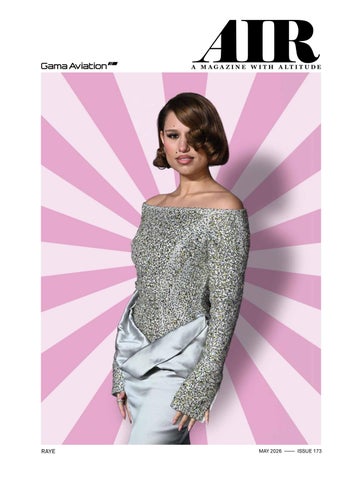
Freed from a stifling contract, Raye is finally making music her way. Now all she needs is love…
The new generation sharing Marrakesh’s creative energy with the wider world.
How Loro Piana challenges its supply farms to produce bales of extraordinarily fine wool.


Set at the tip of Dubai’s exclusive golden peninsula, D-Marin Marsa Al Arab Marina is the city’s definitive superyacht address, offering 82 exclusive berths for yachts up to 61 metres, framed by the iconic Jumeirah Burj Al Arab and Marsa Al Arab.
Here, the superyacht experience extends far beyond the dock. More than a marina, it is an ultra-luxury lifestyle destination, offering exclusive member privileges and access to beach, pool, leisure, wellness, and dining experiences across Jumeirah’s beachfront hotel portfolio in Dubai.


Fourteen RADAR
Chanel’s Watchmaking Creation Studio celebrate the queen.
Sixteen
OBJETCS OF DESIRE
The latest luxury items we’re currently coveting.
Eighteen
A founding father of ‘hype culture’, NIGO is now set for his very first retrospective.
Twenty Two
How designer Lucy Delius celebrates timeless design by crafting distinctly modern pieces.
Twenty Six
Richard Mille’s Coloured Ceramics collection shows the brand at its brilliant best.
Fifty
Kimera Automobili and Martini renew their partnership with a unique collection of exclusive cars.
Fifty Four
The multi-sensory charity dinner boasting six chefs, multiple Michelin stars, and the award-winning music of a boundary-pushing electronic duo.
Fifty Eight
Ultra-private North Island regularly attracts the A-list, but does it have the power to part a teenager from their phone?
Sixty Four
Valérie Messika, Founder and Artistic Director of Maison Messika.


Editor-in-Chief & Co-owner John Thatcher john@hotmedia.me COMMERCIAL
Managing Director & Co-owner

Ages 8 - 16 Coastal


In business aviation, the aircraft may carry you across continents, but the experience of the journey begins long before you take your seat.
My role at Gama Aviation centres on the moments that surround the flight itself. The welcome you receive on arrival at an FBO, the clarity and responsiveness of a charter team planning your journey, or the reassurance that comes from an aircraft management team who understands exactly how you prefer to travel.
For our clients, these interactions should never feel separate. They should form a single, seamless experience.
Across Gama Aviation we are placing renewed focus on building a strong client experience culture, one that connects our FBO, Charter and Aircraft Management teams with the many specialist functions working behind the scenes. Wherever our clients encounter Gama Aviation – whether arranging a charter, managing an aircraft or arriving at one of our FBO locations – the experience should feel unmistakably familiar: composed, thoughtful and delivered with the same quiet attention to detail at every stage of the journey.
This philosophy sits at the heart of the Red Thread Academy, our client experience programme designed to embed a clear and consistent approach to service across the entire Gama Aviation Group.
Through the Red Thread Academy, we invest deeply in our people, helping them understand what truly matters to those who travel with us and empowering them to deliver service that feels instinctive, attentive, and genuinely personal.
We also believe that exceptional client experience evolves through listening.
Across all Gama Aviation locations, you will find QR codes inviting you to share feedback on your journey with us. Those insights come directly to my team and me, helping us understand what works well, where we can improve, and how we continue to refine the experience we provide.
Every journey in business aviation carries its own purpose, whether travelling for business, for family or simply for the pleasure of reaching somewhere extraordinary. Our responsibility is to ensure that the experience surrounding that journey feels calm, thoughtful and worthy of the trust our clients place in us.
Evie Freeman Group Director of Client Experience
About Evie Freeman
Evie Freeman is Group Director of Client Experience at Gama Aviation, responsible for defining how client experience is designed, delivered, and measured across the organisation. With a private aviation career spanning more than three decades, Evie has held senior leadership roles across FBO, charter and management, including FBO ownership, Managing Director EMEA at Signature Aviation and leading client experience at Jet Aviation. Since joining Gama Aviation in 2025, she has established the group’s client-centric strategy and launched the Red Thread Academy, embedding leadership, consistency, and service excellence across the business.


There is a particular moment, familiar to those who travel privately, when the pace of the world seems to change.
It may come while stepping directly from a waiting car onto the aircraft apron as the sun rises over the runway. Or perhaps later, settled quietly into the cabin with a favourite meal prepared exactly as requested, knowing that the journey ahead will unfold entirely on your own terms.
For many who charter regularly, this is the true luxury of private aviation. Not simply exclusivity or comfort, but freedom. Freedom from rigid schedules, crowded terminals and the sense of being moved through a system designed for everyone at once. Instead, the experience becomes personal.
At Gama Aviation, the charter team spends much of its time shaping journeys around exactly that idea. Some are uncomplicated: a short flight between meetings, a family escape for the weekend or a seamless connection between homes, yachts and seasonal destinations.
Others become far more individual. A couple flying to the Amalfi Coast with their dog and a carefully selected wine list already on board. A family travelling with children whose favourite meals have been
prepared in advance. Ski equipment loaded for a winter departure to the Alps before the first snowfall arrives. Or a multi-stop European itinerary quietly reorganised overnight so a client can attend an unexpected engagement without disrupting the rest of the journey.These details rarely appear in photographs of private aviation, yet they are often the moments clients remember most. Because the real craft of charter lies not in the aircraft itself, but in the understanding behind the journey. For the team arranging these flights, the process begins less with logistics and more with lifestyle. How does the client prefer to travel? Do they want the journey to feel calm and understated, or social and celebratory? Will the cabin become a workspace, a family environment or simply a place to disconnect from the pace of everyday life for a few hours? The answers shape everything that follows. Aircraft are selected not only for performance, but for atmosphere and suitability. Catering becomes more than a menu choice. Arrival times are coordinated around personal schedules rather than airport timetables. Even the smallest details – from preferred newspapers to cabin fragrance or


onward transport – are considered as part of a much wider experience.
For clients new to private aviation, this level of personalisation can feel unexpectedly revealing. The journey adapts to them, rather than the other way around.
And while the experience may appear effortless from the cabin, behind the scenes it often involves remarkable coordination. Routes shift with weather systems, permissions are secured across multiple jurisdictions, and schedules evolve in real time around changing priorities. Yet the role of the charter team is to absorb that complexity quietly, allowing the experience itself to remain calm and uninterrupted. That calm becomes especially important when journeys carry emotional weight.
In recent years, Gama Aviation’s charter specialists have coordinated urgent medical repatriations, discreet family travel during periods of personal difficulty, and time-sensitive international journeys where reassurance mattered just as much as logistics. In those moments, private aviation becomes something more profound than convenience or luxury. It becomes certainty, privacy and care when they are needed most. Yet, just as often, charter exists to make life feel richer and more expansive.
A long weekend in the Highlands of Scotland, reached directly rather than through multiple commercial connections. Lunch in the south of France before returning home the same evening. A summer journey shaped entirely around family, friends and spontaneity rather than fixed departure gates and delayed boarding calls.
For many clients, this is ultimately what private aviation changes most: the relationship with time itself. At Gama Aviation, the charter experience is built around protecting that feeling. Not through excess or spectacle, but through attention, intuition and an understanding that every journey carries its own purpose. Because while aircraft may connect destinations, the most memorable journeys are rarely defined by where they begin or end. They are defined by how they make you feel along the way.

‘True luxury is not simply comfort or exclusivity, but freedom to shape travel plans’


An extraordinary singular creation that showcases both the design ingenuity and wide-ranging skills housed within Chanel’s Watchmaking Creation Studio, The Chessboard sees symbols from the Chanel universe replace the game’s traditional pieces: the bishop becomes a couture bust, the rook is represented by the Vendôme column, and the queen, naturally, is Mademoiselle Chanel, her figure resplendent in an 842-diamond tweed suit that’s bordered with blackened gold. Beneath the base she stands on is a dial displaying the time, the whole piece also designed to be worn on a necklace composed of white gold, 268 brilliant-cut diamonds and 40 onyx beads. chanel.com


Set the tone as a true tastemaker with these coveted items

ROLLS-ROYCE
PROJECT NIGHTINGALE
The first model from Rolls-Royce’s new Coachbuild Collection may well take its name from a tiny bird that can produce over 1,000 different sounds, but this is a nearsilent, all-electric beast of a motor car – at a length of 5.76 metres, it’s almost identical to
the Phantom, yet Project Nightingale has only two seats. That means there was plenty of room left for the designers to make hay, sculpting a torpedo-style tail that adds a sporty edge. Just 100 will be produced, each one tailored individually for the owner.


The beautiful blue cornflower is the inspiration for Mouawad’s latest high jewellery set, which comprises a stunning necklace, bracelet, and ring. Sapphires were selected to evoke the soft natural blue of the cornflower, while diamonds were tasked with adding brilliance and a sense of movement, their sparkle reflecting the ever-changing light as though they were delicate petals. In all, the set features 38.79 carats of blue sapphires and 32.49 carats of diamonds, the setting of which required 200 hours of work to perfect.

A. LANGE & SÖHNE
The inherent design of the Lange 1 may make it instantly identifiable, but its latest iteration comes packed with surprises, not least a newly developed, highly complex calibre that drives two grand complications: a tourbillon with stop seconds as well as a perpetual
calendar with a peripheral month ring and instantaneously switching displays. Then there’s the fact that all of its displays are luminous, meaning that, for the first time, a moon-phase display with an integrated day/ night indication can be viewed in the dark.

Opposites attract for Valérie Messika, whose Moderniste creations are a daring fusion of shadow and light, circle and square, simplicity and sophistication. “The result is a jewel that belongs to no single era. Universally powerful. That was always my ambition,” outlines
Messika. It’s also the jewel that attracted Julianne Moore, the maison’s new global brand ambassador. “What strikes me about the shapes Valérie designs is how they interact with the body. They don’t feel separate from you. They feel like they belong.”


Damiani’s Margherita collection has a storied past; its first designs created by the brand’s founder, Enrico Grassi Damiani, in honour of Margherita of Savoy, Italy’s first queen. The latest addition to what’s now a long line of dazzling creations, Margherita Bloom
comprises rings, necklaces, earrings, mini-brooches, bracelets and watches, their style gleaned from Damiani’s most recent high jewellery collection and their striking colours derived from the likes of diamonds, aquamarine, pink tourmaline, peridot, and citrine quartz.

Karl-Friedrich Scheufele, co-president of Chopard, founded Chopard Manufacture with the aim to preserve traditional Swiss watchmaking knowhow while integrating major innovations. It’s fair to say he’s overachieved; Chopard also producing timepieces of exceptional craftsmanship. The latest
example is the L.U.C Quattro Spirit 25, which showcases the rare craft of straw marquetry, for which individual strands of rye straw are split with a fingernail. This 18-carat ethical yellow gold version, one of two eight-piece limited editions, also features the brand’s jumping hour movement.
29/04/2026 2:55 PM

A little over a century ago, Mario Maserati – the only Maserati brother who wasn’t an engineer but an artist – designed the company’s Trident emblem. To celebrate its long history, Maserati has partnered with Swiss watchmaker Bianchet to create the UltraFino Maserati, a flying tourbillon
timepiece that takes design cues from the Maserati MCPURA supercar – the open-worked skeleton dial is adopted from the car’s birdcage-design wheel. Limited to just 100 pieces, it’s offered with two straps: one carbon fibre, the other vulcanised rubber.
WORDS: JOHN THATCHER
A founding father of ‘hype culture’, NIGO is now set for his very first retrospective


When NIGO finds something fascinating it tends to stay with him, whether as a memory or, more likely, in the form of a physical object. Some 700 of such objects – 600 from NIGO’s own personal archive – form the basis of a new exhibition opening this month at London’s Design Museum that charts NIGO’s career progression from the back streets of Harajuku to the runways of Paris, a bridge between the worlds of streetwear and luxury fashion.
The first Japanese artistic director of Paris fashion house KENZO since its founder Kenzo Takada, NIGO has also applied his creative mind to some of the world’s most recognisable brands and cultural icons, as well as pioneering his own streetwear and luxury fashion labels, rising to prominence with A Bathing Ape in the 90s before going on to launch Billionaire Boys Club with Pharrell Williams in 2003 and HUMAN MADE in 2010.
Over the course of a 30-year career, NIGO has also impacted everything from music and architecture to interior design and even a supermarket – last year he was appointed as the creative director of Japanese convenience store chain FamilyMart. How, then, does he tailor his approach when there are such huge disparities in audience, branding and identity? “Through many different experiences I have been fortunate to learn a lot. Creative work for limited items and
creative work for the mass market are quite different. What matters is how much of your own identity you can bring into them.”
It helps that NIGO’s identity has been shaped by a similarly broad range of influences, spanning vintage Americana, streetwear, hip-hop, traditional Japanese craft and growing up in 1980s Tokyo.
“Even now, I still carry the spirit of the 1980s – my youth – and I hope to keep moving forward with it.”
The Design Museum’s exhibition is split into four sections – The Future is in the Past, Evolution, The NIGO Effect, and New Traditions – and begins with a replica of NIGO’s teenage bedroom. In it are objects collected and preserved from his youth that shaped his creative influences. As elements of American culture trickled into Japanese fashion and music following the postSecond World War military occupation, NIGO’s collection of childhood ephemera represents a meeting of two worlds.
Fascinated by Americana, he started collecting objects as a teen and developed a signature style, donning 1950s Levi’s denim jackets, vintage baseball caps and varsity jackets, several of which will be exhibited. Then there are his cherished figurines and toys, including Donald Duck, Felix the Cat and Star Wars characters, alongside a vintage film poster of Tom Hank’s coming-of-age classic BIG, translated into Japanese, depicting how the cultures merged.
The second section, Evolution, leads from NIGO’s early career with his first store, NOWHERE, co-founded with fashion designer Jun Takahashi in 1993 and part of the ‘Ura-Hara’ scene that grew around the backstreets of Harajuku in 90s Tokyo. In the same year, NIGO launched his clothing line A Bathing Ape, and on show are early design drawings from his time at fashion college, as well as rare early-era BAPE clothing items.
Somewhat of a marketing maverick, NIGO soon developed the model of limitededition runs, novel packaging and exciting collaborations that fuelled collecting and hype culture. T-shirt packaging that looks like spray cans, membership cards that resemble credit cards and collaborations with the likes of KAWS, MAC, Pepsi, Disney and Nintendo are just some of the ingenious creations that also feature.
The NIGO Effect continues to explore the designer’s brand tie-ups. An ensemble from his very recent collaboration with Pharell Williams for the Louis Vuitton menswear Fall-Winter 2025-2026 show will be displayed in conjunction with earlier collaborations with Virgil Abloh for the brand, while an ongoing partnership with Nike sees limited edition t-shirts and a signature varsity-style jacket featuring the NIGO x Nike swoosh emblem on show.
The final section, New Traditions, is a study of NIGO’s personal explorations into Japanese craft and rituals, finding new creative practices in traditional techniques.
Following his own motto, ‘The Future is in the Past’, NIGO finds inspiration in heritage and aims to translate this into his contemporary practice. “The history of American vintage is about 130 years, but Japanese tea ceremony and ceramics have around 450 years of history. It would be impossible to fully understand them in one lifetime, but I believe they will continue to influence me in the future,” he says.
“Respecting the past is important. There is a big difference between thinking you understand something from photos you find online and actually holding the object in your hands. With vintage pieces, what’s inside can be more important than what you see on the surface. For me, everything I have held over the years has been a kind of teacher.”
What he’s learnt from those years makes for a fascinating exhibition.
NIGO: From Japan with Love, May 1-October 4, the Design Museum, London


How Lucy Delius celebrates timeless design by crafting distinctly modern pieces
WORDS: JOHN THATCHER


For those invested in curating a unique style, vintage jewellery shops are replete with treasures, as much joy derived from the hunt for something special as in the reward of finding it. For Lucy Delius, such shops are also brimming with possibility.
“I take huge inspiration from what I find at vintage markets all over the world. My designs tend to start from a longing for something that I feel is missing from my own collection,” says Lucy. “I'm also influenced by vintage pieces – perhaps a vintage piece I've seen with the most amazing finish on it, an ingenious clasp or an unusual chain silhouette that I've never come across before. I'm always in search of the unusual and original and then try to apply that to how I develop a collection. I often meld together several different reference points to find what I feel is the 'perfect' piece.”
This fusion is where the magic happens, Lucy a master at creating pieces that look every bit as vintage as they do modern, but also different: fine jewellery in recycled gold with diamonds and precious gemstones that’s designed to fit seamlessly into a collection of inherited, collected or other beloved pieces.
“I always want to create pieces with meaning. Sometimes I've designed pieces based on what sparks from my conversations with clients or seeing how they wear their jewellery and what other pieces they wear it with. But I like to think of it as I'm giving someone the tools to mark a story or emotion in their own way – the emotion is imbued into the piece once it leaves my possession.
“Jewellery is almost always a significant purchase both financially and sentimentally, so the responsibility is always there to craft something that tells a beautiful story and also upholds a standard of craftsmanship and quality.”
Those standards are inherent in vintage pieces, Lucy attracted to the eras that best reveal them. “I love Art Deco and personally collect a lot of these pieces for myself. But the Victorian era was such an incredible period for innovation in design and discovery. With Victorian artistry, everything had a meaning and function. For example, the clasp was often made a feature of, which is
something I have carried through within my own designs and my connectors.”
Her latest collection, Nyx, is a case in point, the highlight of which are handstrung necklaces, coloured silk knotted between black baroque pearls in a variety of lengths, with the 150cm necklace able to be looped multiple times or left longer, connected by two Albert clips. “I am obsessed with our new Nyx baroque pearl necklace and tassel – it feels so modern but so Art Deco at the same time. It's fine jewellery, but it's also fun,” enthuses Lucy. “I think the inky black tones are a more edgy twist on pearls.
A nd her favourite piece of all?
“I'll always and forever be devoted to our trombone link chain with a diamond connector and T-bar. It was the first piece I designed and the core of our collections.”
That trombone link chain was based on a piece from Lucy’s personal collection. And it was the collections of her mother and grandmother that captivated her as a child, igniting a passion. “My grandmother had a 5-stone Victorian opal cabochon ring that I thought was magical. And my mother had an amazing collection of silver bangles that she had collected since she was 16. She also had an amazing Victorian charm bracelet, to which she would add something every time she travelled, and some gorgeous 9ct Victorian guard chains – it's really hard to find ones that haven't been shortened. I loved going through her jewellery box when I was younger.”
Is there currently a treasured possession in Lucy’s own jewellery box that she would consider creating a contemporary version of? “I bought myself a 1940s belt buckle bracelet at the Couture Show in Las Vegas and I would say that's up there as one of my most treasured items. I'd love to be able to make a contemporary version of it. But I've tried and there is no way to make something so beautiful, due to the patina of the gold and the fact that all the links are handmade. It's just so beautiful and I fear that any modern iteration wouldn't do it justice. Some things are best left in the past, and that's ok!”
‘The Victorian era was such an incredible period for innovation in design and discovery ’
Particularly so when Lucy Delius is able to weave a magical thread between the past and the present, taking the essence of the old and making it new, piece by beautiful piece.
Richard Mille’s Coloured Ceramics collection shows the brand at its brilliant best
WORDS: JOHN THATCHER

The 1980s were in many ways blockbuster. Big, bold and unapologetic, it was a decade when image was everything. When MTV turned music into a visual feast and fashion favoured shoulder pads, power suits and voluminous hair. A decade when, aesthetically at least, everything was in-your-face bright.
It’s to that era of excess that Richard Mille returns for its 2026 RM 07-01 Coloured Ceramics collection, the conclusion of an exploration that the brand began in 2021 to determine how audacious design could harmoniously merge with watchmaking tradition.
The final instalment of this creative study consists of three pieces, each limited to 50, and is celebrated with the addition of painstaking gem setting – stones of myriad colours supplying sparkle.
“These watches play on the juxtaposition of vibrant colours and contrasting textures, asserting a singular and disruptive graphic identity,” says Cécile Guenat, Richard Mille’s Creative and Development Director.
While the colours reflect the 80s’ fondness of neon – one in powder blue, another in lavender pink and the third in blush pink – the grey PVDtreated red gold dial serves as a canvas for rich artistic expression, the look part Bauhaus, part pinball machine. This bold identity comes courtesy of guillochage, a decorative technique
which calls for an expert hand to meticulously engrave magnificent, very fine striated curves with a rose engine. Absolute precision is demanded to ensure the same amount of material is removed from every gold piece.
“This secular decorative technique reaffirms our commitment to making no compromises on either aesthetic or technical grounds,” hails Guenat. The decoration of each dial is further enhanced via coloured ceramic details, laser-cut rubber appliqués and diamond-set components.
Another complex undertaking was the gem-setting of the bezel, given the extreme hardness of the TZP (Tetragonal Zirconia Polycrystal) ceramic, a material selected as much for its rigorous performance standards – which will ensure the colour will retain its brilliance over time – as for its submicron grain size allowing for a perfect matt-effect finish. Colour pops elsewhere too; the polished white gold caseband illuminated by a variety of stones. The RM 07-01 Blush Pink combines diamonds with yellow and blue sapphires, the RM 07-01 Powder Blue marries diamonds to pink sapphires and tsavorites, while the RM 0701 Lavender Pink showcases an extravagant interplay of diamonds, orange sapphires and rubies. Fortune favours the bold.
‘These watches play on the juxtaposition of vibrant colours and contrasting textures’


Freed from a stifling contract, Raye is finally making music her way. Now her new album has hit the top spot, all she needs is love…


RRaye – the 28-year-old south Londoner who put her name in lights with songs about heartbreak, loss and longing – has an announcement to make. “My third album, I think I’ve named it already,” she says. “It’s going to be called And Then She Fell in Love. And I’m not writing a single song – be it one year, five years, ten years – until that chapter of my life begins.” Fans may be forced to matchmake. More than 56 million people stream Raye’s music on Spotify every month – her 2023 single Escapism has been played more than a billion times. Her second album, ‘This Music May Contain Hope’, was released in March and is at the time of writing No 1. Collaborators have included Al Green, Mark Ronson and the Oscarwinning composer Hans Zimmer. Earlier this year she won her first Grammy, for her song Ice Cream Man She was texting a man for a bit, but it was the 68-year-old Zimmer (“in May last year, casually, I sent a text to Hans and said, ‘Hey, I have this song I’ve been working on, and I just think it needs you to be part of it,’ ” she says). Given that she is midway through a continent-spanning 51-date tour, which started in Poland in January and ends in May at the O2 in London, when’s a girl to hit Hinge? Perhaps a career hiatus in the name of love may be required, even if it breaks a lot of hearts. “That’s my silent protest,” she says, giggling. Love is fickle but it’s not as fickle as the music industry, which is something Raye may know better than most artists. In 2014, aged 17, she signed a four-album deal with Polydor Records off the strength of her self-released
2014 EP, ‘Welcome to the Winter’. But by 2021 she still hadn’t put out an album. She had been working – writing songs for artists such as Beyoncé and Charli XCX, providing vocals for dance musicians including David Guetta and Jax Jones, and releasing dance-based singles with Polydor –but the label wasn’t backing her to put out an album in her own name. By 2021 the golden handcuffs arrangement had taken her to breaking point: she was self-medicating with drugs and alcohol, obsessing that her career was over before it had begun. In June 2021 she decided to press the nuclear button. “I have been on a 4 ALBUM RECORD DEAL since 2014. And haven’t been allowed to put out one album,” she tweeted to her then 50,000 followers. “I’m done being a polite pop star. I want to make my album now, please that is all that I want.” The post went viral as other musicians weighed in with their own stories of record label mismanagement. Polydor released her, calling the split “amicable”, and in 2023 Raye put out her debut album, ‘My 21st Century Blues’. It went to No 2 and was nominated for the Mercury prize. The big swing paid off. On Instagram (4.7 million followers), celebrities such as Naomi Campbell, Reese Witherspoon and Shawn Mendes leave emojis under her posts; Taylor Swift, whom Raye supported on the Eras tour two summers ago, goes to her gigs. In 2024 she won six Brit awards, the most Brits any artist has won in a single ceremony, and last year she played Glastonbury’s Pyramid Stage. Raye’s biggest song of 2025 was Where Is My Husband! It features on the new album, as do two songs about toxic boys: Beware The South London Lover Boy, which has a brio reminiscent of early Lily Allen, and The WhatsApp Shakespeare “I have pushed myself as hard as I can and could have in the last two years,” she says. “If I’m not on stage, I’ve been working on this album. I think we’re in an age where you can feel like if you stop then no one’s going to care, or it’s all going to be over. And because I have worked so bloody hard to get to this point, part of you is, like, ‘Feed the machine. Feed the beast.’ ” She now works as an independent artist with a tiny team. “We meet in my living room.”
Rachel Agatha Keen was born in Tooting, southwest London, in 1997 –Raye is a nickname, a riff on the first syllable of Rachel and a stage name she started using when she became a musician. She grew up nearby in Croydon. Her mother, Sarah, is a Ghanaian-Swiss former NHS mental health worker and her dad, Paul, a songwriter and producer from Yorkshire. On her wrist Raye has tattooed three flags: Ghana, Switzerland and the Union Jack. Her first taste of music was in her local Pentecostal church choir, where Sarah sang and Paul was the musical director – he used to teach Raye to play songs of worship on the piano after Sunday services.
She wrote her first songs at primary school and aged 13 started noodling around on Apple’s GarageBand software, which is around the time her parents started to twig they might have a talent on their hands. The following year she won a place at the Brit School, the pop star talent factory that has produced Adele, Amy Winehouse, Lola Young and Olivia Dean, but after two years dropped out, feeling confined by the prescriptive lessons in songwriting. Instead, after getting her record deal, she started spending weekends in studios and on songwriting camps with stars including Rihanna, learning how to write on the job.
Raye’s shows are gloriously theatrical – a big band, a bevy of backing singers, the singer dressed like a golden-age Hollywood starlet. Off stage she is undimmed. When we speak it is the week of her album release and she’s deep in rehearsals for a gig in California, the first date of her North America tour, but there’s no weariness to talk shop. She answers questions in low, throaty south London tones and tells stories that often end in a giggle. Her preferred curse word is “flipping” (at least when she’s speaking to a journalist). She is steeped in the rubric of music, talking bridges and outros and round choruses. After briefly outlining the mechanics of Click Clack Symphony, her new song with Zimmer, she becomes animated. “I can’t even believe he’s on my album. It’s ridiculous. Life, right? Life is wild.” Gen Z is drawn to her music because it plumbs the lows, scales the highs, meets the tough stuff eye-to-eye: addiction,

body dysmorphia, bad experiences from her early youth when she was a child in the music industry’s adult world. Her 2023 song Ice Cream Man, which won the Grammy, recounts her own experiences of being sexually assaulted, including by a music producer. But she also writes catchy songs about messy nights out: Escapism, her first No 1 single, is an R&B, electro-pop mash-up about a late-night mission to get over someone by getting under someone else.
The new album skips between R&B, soul, pop and soaring symphonies; from music to weep quietly to, to witty earworms that make you want to sing along.
“There was a thing I saw on Twitter the other day,” she says. “Someone was, like, ‘Raye loves to put out a hit and then release a flipping jazz song that no one cares about.’ And it was so funny because I was, like, this is so accurate.”
A decade in, two albums under her belt, “I think if anything is shifting, it’s The Man has less power – not needing a gatekeeper or a CEO to tell you yes or no, someone you have to suck up to or be on the good side of,” she says. “Nowadays you could spend a
million pounds trying to push a single, but if people don’t like it, they don’t like it. You can’t force-feed things down people’s throats any more.”
Notwithstanding the droves of bucket-hatted, gently run-to-seed millennials who turned out to see Oasis last year, for most music fans these days, boys (or men) in bands are not the story right now. Raye, Charli XCX, Chappell Roan, Olivia Rodrigo, Olivia Dean … it is young women writing the soundtracks to lives. “I think women have always been doing that,” she says.
“When I look back through history, my favourite artists are women – Nina Simone, Ella Fitzgerald, Etta James, Dinah Washington – women killing it in the 1960s.” But women dominating the charts does not mean music is now “fixed.” There’s “a long way to go. We like to feel like we’ve changed, but the same old stuff is happening behind the scenes, the same power imbalances, women wanting to be taken as seriously as men. We know that.”
Her three younger sisters, Abby, Lauren and Katelyn, are musicians too (Abby and Lauren are supporting her on tour, under the stage names Absolutely and Amma). The difference
from Raye’s earliest days is that all of them are managed by her parents. It sounds quaintly old-school, like a travelling family band. “It just works,” she says. “They work really hard and believe in us. It would be really flipping hard without my parents. My dad is so good at a pep talk.” Does she ever feel tempted to … rebel? “No. I love it that way. I need it that way.”
This might be partly because, like a lot of stars who grew up online, Raye is attuned to criticism. Several times she refers, obliquely, to a line from a review of her album that landed hours before we speak. “I’m terrified of people picking me apart and eating me alive. At the end of the day not everyone’s going to love it but I know somebody out there will.”
She stays off the internet as much as she can and looks for answers in a Bible app, not cruising Instagram. During her darkest days at Polydor, she credited her Christian faith with getting her through. “I think since I’ve come offline it’s been much better. Ignorance is bliss. If someone said I look awful in a dress, it’d make me sad. If I don’t know someone said I look awful in
a dress …” She is laughing now. “So I’m really [big] on being offline.” I wonder how she guards her privacy in real life. “It’s taken me so long to get here, I’d be terrified to jeopardise all of that by giving someone a bad impression of me,” she says. “So I’ll always say hello.” Accidentally skipping a family in the queue at a Nando’s inspired a mild meltdown. “I didn’t say, ‘I’m really sorry,’ ” she says. “And for the next 48 hours it was all I could think about. That’s the kind of brain I have. It will eat me alive if I make someone even a tiny bit upset.”
She is sending herself up, but this sounds exhausting. “Potentially that impacts how often I leave the house. Because my brain cannot reckon with leaving a bad impression – I just can’t handle it. I need to talk to my therapist about it, maybe.”
Raye has a home in London, where she lives with Abby and Lauren, and a six-bedroom mansion in Los Angeles. She has worn Fendi to the Met Gala and attended shows at Paris Fashion Week (she Lime-bikes between front rows). She spent her first pay cheque on a gold Volkswagen Beetle. But she doesn’t seem to have much time to play with the trappings of pop stardom. She’s on the road a lot, or writing, or in the studio. “I’m so excited for the shows but it is also a lot of hard work, so I’m really excited to hopefully get to a place where maybe I can implement a little balance, because I’m craving just being a human for a little bit. D’you know what I mean?” Perhaps a week on a beach? “Do you know what I’d like to do? Go backpacking for a month.” There will be no disappearing act quite yet (be it to interrail across Europe or find the romantic muse for album three). With ‘This Music May Contain Hope’, “I still have things I want to change, things that I wish I could edit, things that I’m still not actually a thousand per cent happy with, but you just have to let it go.” It’s all in the name of the long career she feared was slipping away when she was a faceless vocalist for hire, writing hits for other people to sing. “These are the songs I’m going to be performing on stage for the rest of my life. And I wanted to create music that I wanted to perform on stage for the rest of my life.”

‘It will eat me alive if I make someone even a tiny bit upset’
Writers, designers and haute hippies of all stripes have long fallen in love with the sensory overload of Marrakech. Now a new generation is sharing its mystical charms and creative energy with the wider world

son of the late Sir Terence, got to know the rhythms of donkey life well during the renovation of his six-suite riad.

This 19th-century confection of airy balconies and swaying palms is deep within Marrakech’s labyrinthine medina. “I bought the building, and then to extend it I ended up buying the one next door, which in turn we had to demolish and rebuild as it was completely unsafe,” he says of buying this ramshackle pile in 2016. It is now L’Hôtel Marrakech, an oasis in the thrum of the city. “I didn’t realise that that would entail taking everything out, brick by brick, by donkey, and then every item – from taps to tiles – back in via donkey, only operating at the cooler points of the day. It took three and a half years.”
The alleyways are too narrow for cars, the maze a bewilderment to anyone but locals (which makes finding it as a guest an adventure). Do spare a thought for those long-suffering beasts as you sip your mint tea in the courtyard, won’t you?
The result of their trundling labour, as well as Conran’s curatorial eye, is a haven within the maelstrom of Marrakech: a central courtyard fountain inlaid with mother-of-pearl, bougainvillea creeping up the walls by the pool, and terrapins making their gradual way across gleaming turquoise tiles. “I’d been visiting the city since 1984 and had developed a great love for the place,” says Conran. “The saint on my shoulder said, ‘Buying a house here is so impractical and illogical,’ but the devil on the other whispered, ‘You could turn it into a hotel.’ The devil won,” says Conran, who recently added Villa Mabrouka, Yves Saint Laurent’s former home in Tangier, to his Moroccan real-estate empire. Beelzebub may have got his way, but up on the dusky rosecoloured rooftop, as the call to prayer

echoes across the city and monkeys eye the za’atar fekka biscuits alongside your gin and tonic, it feels rather heavenly.
Edith Wharton called Morocco ‘a land of mists and mysteries,’ but perhaps former resident Yves Saint Laurent captured it most evocatively: “This city taught me colour, and I embraced its light, its insolent mixes and ardent inventions. It was when I discovered Morocco that I realised my own chromatism was that of Moroccan caftans, zelliges, zouaucs and jellabas.” It’s an intoxicating world of sensory extremes; colourful spices and coral sunsets, the coiled serpents in Jemaa el-Fnaa, the city’s central square, and the frenetic traffic beyond. Chaos and calm, mayhem and magic.
Conran is the latest in a long line of aesthetes and tastemakers to decamp to the Red City since Saint Laurent, the Rolling Stones, Marianne Faithfull, the Beatles, Bill Willis and John Paul Jr and Talitha Getty descended in the 1960s to envelop themselves in its sensory overload and enjoy life after dark in their ‘Pleasure Palace’. Saint Laurent
found sanctuary in his Villa Oasis, set in his version of a tropical paradise, Jardin Majorelle, now a museum. The Gettys sought oblivion, while interior designer Willis found a distinctive design language that still survives today in Dar Yacout, a medina restaurant.
That was then. Now, a new breed of fashion designers and craftspeople are redefining Marrakech style. “It’s a place that inspires people, which is where this energy comes from,” says Vanessa Branson. “There’s a natural sense of design that flows in the blood here, a respect for craft.” In 2016 Branson founded El Fenn with friend and business partner Howell James. The venture began as a private home and turned into one of the city’s most dynamic hotels and – true stamp of international fame – hosted Madonna’s 60th birthday in 2018. “It’s the quality of the light, the plaster of the buildings that soaks it up so beautifully, the fact the air pressure is so high. Moroccan people are very curious, which means that they’re keen


to explore possibilities,” says Branson of the process of transforming three adjoining riads into the 41-room El Fenn, which she and James sold, choosing a local family-owned hotel group over conglomerates to ensure its authenticity.
Bransonwill stay on as an advisor and has a riad of her own in the city. “Two million artisans underpin the country, and it’s an ‘anything is possible’ attitude; when we were creating El Fenn, we’d be able to have metalwork made in three days, fabrics woven to the highest standards so swiftly. We insisted that everything would be made in Morocco, and that we’d support artisans in the regions,” she says. Such was her commitment that the King of Morocco awarded her the Order of Ouissam Alaouite for services to the realm.
One effect of Covid is that young Moroccan creatives, from design to fashion, moved back home and realised they could operate much more efficiently than in Europe. “There’s a younger generation here now, and a general feeling of ‘right place, right time’ that reminds me of London in the 1980s,” says Branson. “The energy in the city right now is palpable.” The presence of a local community of artisanal excellence led American photographer Randall Bachner and his husband, Nicholas Minucciani, to set up their fashion label Marrakshi Life in Marrakech in 2015. “We relocated from New York because we loved the idea of craftsmanship and creating something new with the incredible skills here,” says Minucciani from their villa at the foot of the Atlas Mountains. The genesis of the brand sounds like something from The Arabian Nights: Bachner, meandering through the souks, one day happened to meet “a really cool weaver called Mohammed, who was this hippyish surfer, working on traditional zerbiya looms. We became mesmerised by the textiles.” What began with one weaver is now a brand with 95 employees, all locals. “We’ve built a tight-knit community,” says Minucciani. The result of that expertise is vivid, boldly patterned kaftans, dresses, loose shirts and soft-fit trousers that splice electric colours against each other in intricate motifs. “We took the shapes from the old-school pyjamas that the locals wear under their djellaba, and the colours come from the richness of the
country,” says Minucciani; the sandtones of Imsouane architecture and the rich saffrons and ochres of Fez. The allure of Marrakech was in Artsi Ifrach’s blood; the founder of creative hub Maison Artc was born in Jerusalem to Moroccan parents. After stints in Tel Aviv, Amsterdam and Paris, he relocated to the city in 2011, harnessing local skills to create his lavishly decorative pieces. Just don’t call it a ‘brand’: “I’m not a fashion label but rather a culture house,” says 57-year-old Ifrach. “It’s about preserving the heritage of this country and making it relevant for the future. It’s not created as a product but a piece of art.” A sweeping men’s coat dappled with floral prints, a delicate lace kaftan with a giant bow unfurling on the back, and capes of embroidered serpents (very André Leon Talley) underline that point. Each is a one-off creation; a particularly intricate piece will cost upwards of €4,000. ($4,600). Maison Artc works only with local artisans, sourcing vintage fabrics and rendering them anew. “My seamstress is a tailor who worked for Saint Laurent, others have been crafting for generations, and we work and learn from each other,” says Ifrach, whose photography has been on show at the V&A. “They give me ideas. We’re like a small kitchen that puts together unexpected ingredients and creates beautiful things,” he adds. “It’s not fast like other places, here you can take time to create and enjoy the process. I think it’s magical.” This despite the whir of mopeds, buses and tourists that zip through the chaotic, dusty streets.
It’s a sentiment echoed by Trino Verkade, chief executive of London’s Sarabande Foundation, the charity set up by the late Alexander McQueen, describing the process of renovating her riad, Birdcage Marrakech, in the city. “Was it daunting? Not really, I relished the idea of slowly bringing this place to life,” she says of her decision to purchase (yet another) crumbling riad near the medina. “So every step of the way was a pleasure really, because keeping craft alive is very real and you must respect that it takes time.” Verkade is no stranger to meticulous design processes; she was Alexander McQueen’s first employee and his right-hand woman until his death in 2010. Verkade worked with a local builder to source zellige tiles, as
well as the bejmat clay varieties with their matt texture, and the distinctive tadelakt plaster for the walls. “Because mass production still isn’t prevalent here, everything can be unique,” she says. Verkade, who splits her time between London and Marrakech, first “felt the city calling” in the 1990s. “I think it speaks to certain people, and those tend to be in creative communities,” she says. “It’s not a static city, it’s so full of life, but at the same time it’s also not a digital city – quite literally, if you’re in a warren of alleyways your GPS won’t work.” What does work is “that hazy, golden light,” she says of the magic hour of dusk at what she terms her courtyard “cocktail pool.”
Astone’s throw from Verkade’s haven is the new Hotel Izza, which opened last year as a paean to Willis’s sorcery. A mercurial figure who created houses for Saint Laurent and his partner in business and life, Pierre Bergé, as well as for the Getty dynasty, Willis’s signature style was Moorish maximalism; techniques from North Africa amplified with a sense of scale and drama. Willis, a devilishly handsome American from Memphis who landed in Marrakech in the 1960s on the peacock tail feathers of the Gettys (and didn’t hold back on the hedonism), lived in a riad overlooking the Mogador Christian Cemetery and died in 2009, but his raffish spirit is alive and well at the Izza. The hotel pays tribute to him via letters, trinkets and artefacts on display and a decor that riffs on his signature style. The courtyard pool, for instance, sits beneath a Moorish arch, while the rooftop is a warren of fairy-light-strewn terraces.
“It started as a way to tell these wonderful stories about Bill Willis visually,” says the hotel’s creative director, Aicha Benazzouz, “and that really starts with celebrating Moroccan handcraft. He was a pioneer of tadelakt plastering, known for its pared-back purity, which Saint Laurent and Pierre Bergé employed in their homes, and we looked to that in the design of the Izza,” she says. “This city acts as an escape and a haven – Willis said he was reborn here – and you have to remember that in the design; people want to feel enveloped into another world.” That’s achieved here in the dinanderie brass hammering on walls and the ceramic tiles local to Taghazout Village; another more contemporary enterprise is the hotel’s
Previous pages: L’Hôtel
This page: Maison


‘It’s one of the few places where mystery still exists’


Associate Artists Programme, curating in-house exhibitions by local creatives.
Even the most monolithic luxury hotel chains turn to local crafts here, to nurture a feeling of authenticity and local flavour, never mind their high net worth clients toting Hermès handbags.
The Amanjena, a sprawling site in the Palmeraie outside the city (at which David Beckham celebrated his 40th birthday), is designed to mirror a medieval Moorish fort. And while the high rollers can of course sample the sushi – a prerequisite at any Aman, although perhaps jarring in the desert – other experiences speak to the local culture, such as its Medina Through the Ages tour and traditional pottery classes for guests. Recently refurbished, the re-opening in 2025 incorporated design touches that spoke to its locale with hand-cut white zellige tiles and tadelakt plastering in its hammams. Woven leathers throughout were also hand stitched by local craftspeople.
“I think more than anywhere, the city and the country have a deep respect for the talent of the people,” says Joshua Moore, an American who, with his partner Odini Gogo, set up the Res Ipsa fashion label, taking antique kilim rugs and materials and transforming them into elegant slippers and flowing jackets. Since they launched in 2019, their team of local makers has expanded threefold. “There was this feeling of a kinetic energy, and at the end of a vacation here we both just felt we had unfinished business with the city. There was more to be done here.”
“It’s one of the few places where mystery still exists,” says Conran of the city’s bewitching appeal. “Every corner you turn, in every maze of alleyways, there’s a delicious surprise to uncover.”


‘There’s a natural sense of design that flows in the blood here’

For close on 30 years, Loro Piana has challenged farms in Australia and New Zealand to produce bales of extraordinarily fine wool. Pier Luigi Loro Piana outlines how the results have proved ever more remarkable
WORDS: JOHN THATCHER

IImagine a fibre as fine as a single strand of human hair. Now imagine something almost seven times finer and that it’s your task to produce wool this thin. You’re now thinking like one of the world’s most accomplished wool breeders, farmers who challenge themselves to cultivate ever finer Merino wool for Loro Piana, whose pursuit of the exceptional never ceases.
For farms like Pyrenees Park in Australia and Earnscleugh in New Zealand, it is also about the Loro Piana Record Bale Award, an annual prize that awards the top farmers in those two countries for their exceptional work.
It was an idea birthed from a meeting between Pier Luigi Loro Piana, Deputy Chairman of the house, and Donald Burnett, one of New Zealand’s oldest wool breeders and a man whose determination to constantly improve the fineness of his fibre inspired Pier Luigi to establish the award in 1997, Burnett its inaugural recipient.
And that’s the thing about the Record Bale Award. It’s not so much the record that Loro Piana is looking to reward, more the pursuit of it, the dedication to find ways to produce ever-finer and better-performing wool. “The Record Bale Award was primarily established to showcase to our clients the great commitment and professionalism of our breeders and producers and to provide tangible recognition of their passion and dedication,” says Pier Luigi, who spoke to us the day after the ceremony for
the 27th edition of the award was held at Tokyo’s National Museum.
“This edition of the Record Bale Award represents an important long-term milestone. More than 27 years of studies and research have led to remarkable results and great satisfaction, both for me personally and for our producers.”
But the prize isn’t open to all. In fact, few are the farms that meet the requirements to participate in the Record Bale Award, entry limited to those able to produce a minimum 90kg of wool that’s strong enough to be spun into yarns and woven into fabrics or knitted into garments.
The wool is measured in microns, a unit of length equal to one-millionth of a metre. That aforementioned single strand of human hair typically measures 70 microns. In comparison, Donald Burnett’s Record Bale measured just 13.8 microns. But that was decades ago. Now the best bales are even finer.
“There are many types of wool with different fibre fineness levels. All of them can be considered high quality when the sheep is well cared for and its fibres are fine, strong and consistently resistant, without weak points,” says Pier Luigi. “Nevertheless, wools below 16 microns represent such a small percentage of global production that they can all be considered exceptional, while wools below 12 microns are even more so.”
The New Zealand 2025 Loro Piana Record Bale Award was earned by


Earnscleugh with a count of 11.2 microns. Their Australian counterparts at Pyrenees Park farm went one better, producing a 92kg bale of Merino wool fibre measuring just 10.4 microns to claim the Australian 2025 Loro Piana Record Bale Award. In 2023, the same farm produced a wool measuring 10.2 microns, a world record. Did Pier Luigi anticipate how dramatically fibre fineness would evolve? “I did not expect that such improvements could be achieved in a natural fibre whose quality depends on so many factors. On several occasions we believed we had reached the limit of fineness, but the methodology and professionalism of certain breeders have shown that every limit can be surpassed.”
It’s the connections Loro Piana has fostered with those breeders that Pier Luigi hails as not just important but vital. “The relationships we established with farmers over 30 years ago have been the key to the success of the Record Bale programme. The direct human relationship with these breeders, whom I consider to be highly skilled researchers and great enthusiasts of their work, has evolved over time into relationships of mutual respect and personal friendship.
“For me, being able to bring these breeders into direct contact with our best customers – perhaps through the Record Bale Award event – has been a great satisfaction, as this connection would never have taken place without this particular initiative.”
All Merino wool bales participating in the Record Bale competition are acquired by Loro Piana and used to craft The Gift of Kings ® garments, a name derived from the Spanish royal family’s practice of gifting pairs of Merino sheep to fellow European monarchs. But before this, Pier Luigi has another important use for the bales. “The best way to explain the quality and this level of fineness to our consumers is to let them physically touch the raw material, this record bale, and compare it with the tactile sensation of the finished product.
“The pursuit of the highest quality has always been the challenge Loro Piana has set for itself, convinced that it can produce successive generations of everbetter products. These uncompromising standards represent the very essence of our luxury products because, for us, luxury means uncompromising quality.”
It’s a commitment that ensures Loro Piana stands alone as the finest.

‘On several occasions we believed we had reached the limit of fineness, but what’s been shown is that every limit can be surpassed’

Opening pages: a specialist examines newly shorn Merino wool
Previous pages, clockwise from top: the award-winning Pyrenees Park farm in Australia; Loro Piana craftspeople work with the fine fibre
Opposite page: New Zealand wool measuring 11.7 microns
This page: Pier Luigi Loro Piana, Deputy Chairman of Loro Piana
Kimera Automobili and Martini renew their partnership with a unique collection of exclusive cars
WORDS: PAUL JAMES


There are many ways to keep love alive, to keep the flame flickering. For former rally driver Luca Betti, doing so meant launching his own company, Kimera Automobili, a niche automotive brand derived from Kimera Motorsport but mostly from Betti’s burning passion and a question he asked himself: what would classic rally cars look like if their design kept evolving?
The answer was 2021’s EV037, a restomod of the legendary Lancia Rally 037 (the last rear-wheel-drive car to win the World Rally Championship) and a car developed with original Lancia engineers. Designed to match the look, layout, and driving feel of the original 037, it was, however, an all-new car underneath the nostalgia. One limited to 37 examples. Two years later came the EVO37 Martini7, a 10-car tribute to Martini Racing heritage developed alongside rally legend Miki Biasion. Then in 2024, at the Geneva Motor Show, Kimera followed up with the EV038, its number limited to 37 examples. A theme was developing.
“In just a few years, we have achieved extraordinary milestones,” hails Betti, whose company operates from a beautiful villa in the Italian countryside. “The 37 EVO37 units were sold out within 18 months; the Martini 7 version was announced and sold out even before its release; the EVO38 was launched and, once again, sold out in 18 months.”
Which means that if you see yourself behind the wheel of Kimera’s latest launch, which shed its wraps last month, you’ll need to be quicker than the car itself.
The EVO38 Collezione Martini extends Kimera’s partnership with Martini. But while the Martini 7 edition of the EVO37 was designed with a single celebratory livery, the EVO38 Collezione Martini is a more ambitious project, “a more personal one”, with a collection of different coloured interpretations of the EVO38, each inspired by the visual language of the Martini brand and each “with its own soul, its own character, its own light.”
‘In just a few years we have achieved extraordinary milestones’
A trio of colours makes up the launch cars – the legendary Pearl White, Vermouth Red and Dry Green – but others are on the way. “They are merely the first colours Kimera is revealing from a micro-series produced in vanishingly limited numbers – almost unique for certain shades – that will continue to be unveiled over the coming months. The names and details of each livery will be revealed progressively, with the care that every chapter of this story deserves. It’s a collection of iconic pieces that celebrate the marriage of style and passion between Kimera and Martini.”
The car’s platform is that of the EVO38, but every component has been the subject of focused development and refinement. The engine – deliberately left exposed and visible at the rear – reaches a record output of 640 horsepower via a Flex Fuel system that permits the use of biofuels, including E85 ethanol, with which it achieves both maximum power and maximum torque. Throttle response is ferociously more immediate and power delivery fuller. Torque increases by 22%, approaching 700 Nm, while the rev ceiling extends all the way to 8,200 rpm. Numbers at the very edge of what’s possible for a 2.1-litre fourcylinder with twin forced induction. The design follows a functional logic. New air intakes on the front bonnet improve cooling of the front compartment and, in particular, of the dampers, now visible from outside, which
contribute to defining a front end that is sharper and more decisive than ever. The exhaust system, finished in ceramic, is engineered to manage extreme temperatures without compromising performance or efficiency, even under intensive use.
Exposed carbon fibre, paired with the carbon-Kevlar so characteristic of the legendary cars of the 1980s, runs the entire length of the bodywork, enriching its line with unmistakable depth. Centrelock wheels speak directly to the world of competition, while the auxiliary driving lights evoke a precise rally iconography, that of cars genuinely used in all conditions, including the night stages.
“The EVO38 Collezione Martini represents a further evolution within the Kimera range, inspired by the protagonists that defined a defining era of rallying, and makes even clearer the concept of integral evolution: every dimension is considered, nothing left to chance, nothing left at rest. Of the extremely limited units making up the Collezione Martini, only a handful remain available. For those who recognise the moment, the time to act is now,” suggest the team at Kimera. Though perhaps not. Because you may well fancy something else that Kimera has been busy working on – the K39, the brand’s debut hypercar, which will be shown at this month’s Concorso d'Eleganza di Villa d'Este. Wallets at the ready.
As head chef of two-Michelin-starred Da Terra, Mark Tuttiett knows how to dazzle diners. This month sees him head up a multi-sensory charity dinner boasting six chefs, multiple Michelin stars, and the award-winning music of a boundary-pushing electronic duo
WORDS: JOHN THATCHER


Sink or swim. For the then 18-yearold Mark Tuttiett that was the choice, having dived into the deep end of the culinary world at The Dorchester Grill. “It was intense. You go from college thinking you understand cooking and that you know everything to realising very quickly that you’re just at the beginning. The standards, the pace, the attention to detail: you’re not there at all! It forces you to grow up quickly and develop discipline from day one.”
Not that Tuttiett sought respite on his days off – those were spent learning from the legendary Alain Ducasse, whose restaurant in the same hotel has three of the 21 Michelin stars the French maestro has earned across his career, the most of any living chef. “Working around the Alain Ducasse team teaches you that everything must have intent,” states Tuttiett. “There is a purpose to every element and a restraint to his cooking that really stays with you. It’s not about adding more; it’s about knowing what’s essential. And that there’s time to watch and learn and time to focus.”
Tuttiett followed his nose into the industry. “My earliest food memory is not about a specific dish. It’s the smell that transformed the house and how just that moment could change your mood instantly.” And after three years rising through the ranks at The Dorchester, he decided to test himself again, helping to launch a restaurant from scratch in London’s Hyde Park, inside a converted gunpowder factory designed by Zaha Hadid.
“It was challenging because you’re building everything at once – a team, culture, systems and identity. And you have to find an idea that suits everyone. For me, it was an opportunity to learn how to develop dishes with an idea in

place that suits the surrounding area and the dreams of everyone involved in making the project come together.”
Is there a lesson from the kitchen that he had to learn the hard way? “Consistency. It took me a long time at the start of my cooking journey to understand service is not like a game of sports; you can’t just turn up on the weekend and play. You can’t rely on moments of brilliance. You need to deliver the same level every single day. That only comes through repetition, focus, and learning from mistakes.”
Now as head chef of the two Michelinstarred Da Terra in London, where he cooks masterful dishes that tap into the Brazilian and Italian roots of chef patron Rafael Cagali, he is putting it all into practice –and pushing for more. “Maintaining two stars is already a significant responsibility. It’s about constant evolvement across everything. We’re not chasing a third star directly, but naturally you’re always pushing to improve and to fulfil your aspirations as a chef. Staying curious is key. You never really stop learning in this industry and that is the joy of it.”
This month Tuttiett serves up something completely different, a multi-sensory fundraising dinner called Sensora, which sees the Bristol-born chef team up with five of the UK’s hottest culinary talents – the likes of Mark Donald from The Glenturret and Cal Byerly of Restaurant Pine – to bring a combined six Michelin stars to the table. In aid of The Brain Tumour Charity, each of the six chefs has created a course dedicated to one of the senses; Tom Brown of one-Michelinstarred The Capital will serve oyster ice cream to represent ‘taste,’ while Tuttiett’s dessert of yoghurt, pine, walnut and gooseberry will signify ‘memory.’
“Unfortunately, at a young age my brother and I lost both of our parents to glioblastoma [an aggressive type of brain cancer] and it’s always been a dream of mine and my family’s to be able to create a legacy for them – and to raise as much money as possible to help a fantastic cause. Brain tumours are the biggest cancer killer of children and adults under 40 in the UK. There are no lifestyle links, and 34 families every day are told someone they love has a brain tumour. We want to help provide support and awareness.”
Providing the soundtrack for the event, by way of a specially curated set that ties in with each course, is famed electronic duo Bicep. “Food and music both have the power to transform how people feel in a space, so bringing them together felt like a natural step,” says Tuttiett. “With Sensora, we’re trying to create something immersive, something that stays with people, and working with Bicep aligned perfectly with that vision. It adds a different dimension, which makes the experience even more meaningful.”
Matt McBriar, one half of Bicep and formerly of AIR magazine, has come through his own brain tumour diagnosis and the successful surgery that followed. “Matt’s openness in sharing that journey has helped connect a global audience to the reality of brain tumours in a very human way,” says Tuttiett. “His involvement in Sensora comes from a deeply personal place. That’s why everything has come together so naturally. There’s a shared intention behind it all to make a difference, to raise awareness, and to keep that conversation going.”
Sensora, Here at Outernet, Charing Cross Rd, London, May 5 uk.emma-live.com/tbtc


‘You can’t rely on moments of brilliance. You need to deliver the same level every day ’


Ultra-private North Island regularly attracts the A-list, but does it have the power to part a teenager from their phone?
WORDS:


It was with a grunt-like sound, a guttural note of indifference, that my eldest teenager begrudgingly – and finally, after weeks of saying she wanted to stay home – accepted an invitation to paradise on earth, doing so with her phone pressed to her face throughout the brief exchange. And there her phone stayed, throughout the flight to the Seychelles and then the boat ride to North Island; the unfolding scenery of cobalt blue sky and dazzling, sundappled ocean evidently not as alluring as a dancing cat on TikTok. But then something remarkable happened as North Island came into view, a haven of granitic peaks ringed by the foam from the rushing surf. The phone remained in hand, naturally, but my daughter’s face emerged from behind it, her look startled, disbelieving, as if struggling to grasp the fact that there really was another world beyond her phone screen. One that looked as though Mother Nature had used AI to
Ienhance her own handiwork. Seconds later, my daughter even smiled.
To be fair, North Island, jawdroppingly beautiful, would likely draw a smile – and take the breath –from the most seasoned of travellers. Even the clouds were in awe of its beauty, seemingly content to hang menacingly over the neighbouring islands, leaving North bathed in sunshine for the duration of our stay.
It’s the kind of place that instantly relaxes you, your shoulders slumping as your feet sink into the sand and your butler pops the cork on a bottle of chilled champagne. And though I’ve visited countless hotels that tell of how you’ll have a butler on hand 24/7, few are the places that deliver on that promise. In fact, few are the butlers I’ve actually seen in person.
Kiki was different. The story goes that Kiki was so popular with guests during his first stint at North Island that he was enticed back at the behest of the
regulars (once you’ve been to North Island, you’ll want to return) and I know why. He has this almost magical ability to be there whenever you need him, be it when hunger hits, your thirst needs quenching, or first thing every morning, a double espresso at the ready to kickstart another lazy day in paradise. Not that any day has to be lazy. Mine tended to begin with a lame attempt at sunrise yoga – sound healing courtesy of the ocean – followed by snorkelling at one of the many spots that are no more than seven or so metres off the island. The fact these spots have names like Aquarium and Coral Gardens tells you you’re in for a treat. But on another day I hiked (lame during and afterwards) the shortest of three cross-peak trails with one of North Island’s Environmental Rangers; him bouncing from rock to rock in flip-flops, me no less steady on my feet than had I been wearing roller skates to climb. But my reward for making it to the top was a genuine soul-stirring view.


My reward when fishing one late afternoon was a half-decent haul of bonito, barracuda and, by order of the island’s chef, red snapper. Next evening it was served to us sashimi style, waves lapping the shoreline steps away. You can eat at multiple alluring spots across the island, which is roughly two kilometres in length and one kilometre wide, including at the sun-kissed Honeymoon Beach, the entirety of which you can reserve for the whole day. And you can do so at whatever time of day best suits you. Such flexibility extends to the food itself. Here, menus are designed as a mere suggestion. If there’s something you want and the ingredients are on the island, then it will be made for you. On the night of my youngest daughter’s birthday, we devised our own off-menu meal, enjoyed at a table on a private beach and under a canopy of stars. A few hours earlier and the gift she received from Mother Nature was extraordinary. An environment team on North Island has been monitoring sea turtles for over thirty years, tagging, marking nests and relocating those that are vulnerable, and it’s since become a vital nesting site for hawksbill and green turtles, both endangered species. Visit the island at the right time of the year, typically between December and April, and you’ll likely get to see as many as 200-plus eggs hatch at any one time, the little hatchlings scurrying from their shells to make a beeline for the ocean. It’s a beautiful, heart-tugging spectacle as the final hatchling gets washed away with the surf. Those that make it to maturity in the great blue yonder – sadly, as little as 1% – will return to the same spot to lay their own eggs several decades later. One creature that has no intention of ever leaving is Brutus. North Island has
hosted several celebrities, but no star is as big as Brutus, a 200kg, 200-yearold Aldabra giant tortoise, a species endemic to the Seychelles. A creep of 170 of these gentle giants roam freely around the island and Brutus – who’s identified by a white reflective strip on his shell so that he can be seen at night by passing golf carts – is quite the character. Happy to have his neck stroked but happier still to visit the garden of your villa each morning in search of breakfast. Having been fed an apple on the first morning of our stay, he returned with a friend the following day. There was certainly enough room in our beachfront villa for Brutus and his pal to make themselves at home. One of just 11 on the island – the duplex Villa North is roughly twice the size of the others – all are sunrise-facing and fashioned from natural materials reclaimed during the island’s rehabilitation, trees upturned so that their roots support a cluster of thatched-roof buildings that house a master bedroom, study, kitchen, an open bathroom, and living and dining areas. Luxury, certainly, but at North Island luxury isn’t measured in the likes of marble or gold, more in the island’s feeling of exclusivity, in its exceptional service, and in the unfailing hospitality of its people. But also in the bounty of gifts bestowed on it by nature.
I’ve travelled the world but have never seen a sunset so breathtakingly beautiful as that which closed out our final day. Splashes of soft peach, coral pink, fiery orange and burnt amber, then dusky rose and lavender grey, the scene developing like a live painting, as though Jackson Pollock had been given the whole sky as a canvas. It was so spectacular that months after leaving North Island my teenage daughter is still smiling.
‘I’ve travelled the world but have never seen sunsets so breathtakingly beautiful’


The best piece of advice I’ve ever received is to follow your instincts and find your own path. It’s the kind of advice that sounds simple but takes time to truly apply. There are always external expectations and noise, but I’ve learnt that when you stay true to your own vision, things become much clearer and more meaningful.
Building a maison with my family and friends is something I hold very close to my heart. It has always been a very instinctive journey, surrounded by people I trust, where each step has felt quite natural. Alongside that, I would say redefining the way we wear diamonds is also a real achievement for me, taking them away from something reserved for special occasions and making them part of everyday life. These are the kinds of achievements I hold dear, because they are deeply personal as much as they are creative.
I learnt the hard way that sometimes you have to break the rules, question the codes, and trust the strength of your own vision, even when it doesn’t
WHAT I KNOW NOW
FOUNDER AND ARTISTIC DIRECTOR OF MAISON MESSIKA
fit within what’s already known. When I decided to do our first runway show, it was a new thing for high jewellery. But I wanted to see the pieces come to life, to move on the body. It was a real challenge, but also a turning point for me. Since then, I’ve continued to learn from it every year.
The best compliment I’ve received is that wearing Messika makes people feel like themselves. I’ve always wanted the pieces to be lived with – not put on for a role or just for a special occasion. If jewellery disappears into the person wearing it and feels natural, then I think it has fulfilled its purpose. That’s what makes this compliment so meaningful.
If I could change something about myself, I’d probably try to slow down and disconnect a bit more – although I also know that my intensity is what drives me. I’m very connected, both professionally and personally, and I’d like to spend a bit less time on screens.
A simple moment surrounded by the people I love, my family and my friends,
growing and learning together. For me, that’s the idea of perfect happiness. It really is about those everyday moments when nothing is being performed or expected; it’s just shared time and connection. I often go to the countryside with my family to spend time together, to slow down and disconnect from everything. Those are the moments I cherish the most.
If I could advise my younger self, I’d say not to overthink things and to trust myself more. I realise now how much energy I used to spend questioning decisions that were often instinctively right. Confidence really does come with experience, but I would have liked a bit more of it earlier on.
I wouldn’t say I’m very extravagant, but I always wear jewellery – diamonds and gold. It’s something I rarely take off; it’s part of me. I suppose that’s my kind of extravagance: something very personal, but always present. I often dress very simply, in jeans and a T-shirt, and layering jewellery instantly elevates the look and makes it feel more considered.


COLLECTION N°5
THE 55.55 NECKLACE IN WHITE GOLD, DIAMONDS AND A 55.55-CARAT EMERALD-CUT DFL TYPE IIA DIAMOND.