
AIR Magazine - ExecuJet - April'26

Page 1


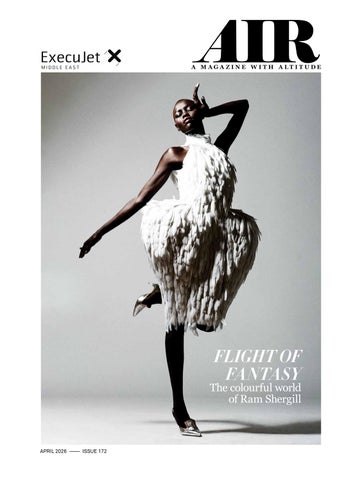
FLIGHT OF FANTASY

The colourful world of Ram Shergill

10X UNVEILING

It’s here. With more space, more comfort, more versatility and more technological innovations than any other ultra long-range, purpose-built business jet. Brighter, quieter. Designed for your total wellbeing. A perfect 10.

FEATURES

Twenty Eight Calling The Shots

Kerry Washington on how she took full control of her career.

Thirty Two Shock Wave

A new exhibition reveals how Elsa Schiaparelli’s designs came laced with surprise.

Forty In Living Colour

From fashion titans to film stars, Ram Shergill has captured them all at their vibrant best.

REGULARS

Twelve RADAR

Brioni’s La Donna Atelier brings bespoke tailoring to women.

Fourteen OBJETCS OF DESIRE

The latest luxury items we’re currently coveting.

Sixteen

ART & DESIGN

As M.A.D.Gallery celebrates 15 years, founder Maximilian Büsser looks back on its evolution.

Twenty JEWELLERY

How Rachel Boston’s contemporary designs champion individuality.

Twenty Four TIMEPIECES

The celestial and the earthly are parallel inspirations for Mauron Musy’s latest architectural timepieces.

Forty Eight

MOTORING

How a trio of acclaimed female musicians came together to orchestrate the design of a unique Continental GTC.

Fifty Two GASTRONOMY

Sushi master Shogo Amamoto opens his first restaurant outside of Taiwan, where limited seating is an essential ingredient.

Fifty Six WHAT I KNOW NOW

Legendary chef, restaurateur and hotelier, Nobu Matsuhisa.

EDITORIAL

Editor-in-Chief & Co-owner

John Thatcher john@hotmedia.me

COMMERCIAL

Managing Director & Co-owner Victoria Thatcher victoria@hotmedia.me

PRODUCTION

Digital Media Manager Muthu Kumar muthu@hotmedia.me

WELCOME ON BOARD

At ExecuJet, we redefine the experience of private travel into an art of unparalleled luxury. From the moment you arrive, we are dedicated to perfecting every detail, anticipating every need, and elevating every moment from takeoff to touchdown, ensuring a journey as effortless as it is extraordinary.

Since we established ourselves in the Middle East in 1999, we’ve had the privilege of seeing travel redefined – one journey, one client, and one tailored experience at a time. Now part of the prestigious Luxaviation Group, we’ve earned a reputation for innovation, precision, and the kind of personal care that truly sets us apart.

Stepping into our world-class facilities is an experience that speaks for itself, with every element carefully designed to enrich your journey. It’s in the discreet checkins and the ease of immigration. It’s the luxurious private suites, where every element has been curated with your comfort in mind. It’s the rejuvenating wellness spaces and the bespoke cocktail and cigar lounge that invite you to unwind. These aren’t amenities – they are reflections of detail and care, designed with you in mind.

Our services – whether bespoke charter flights, meticulous aircraft management, or state-of-the-art hangarage – reflect our commitment to connection. To your time, your needs, and your expectations.

We don’t just deliver luxury. We live and breathe it.

Cover:

Photography: Ram Shergill

Fashion Director: Margherita Gardella

Dress: Jay Briggs

Shoes: Manolo Blahnik

Make up: Sara Sorrenti

Model: Grace Bol

AHEAD OF THE CURVE

As Dubai evolves into a global hub for private aviation, ExecuJet Middle East’s twin presence at DXB and DWC is giving it a strategic edge in a changing market

The private aviation sector in the Middle East is evolving fast. Once defined by exclusivity and convenience, it is now being shaped by infrastructure strategy, fleet modernisation, and the geographic realignment of air travel. Nowhere is that transformation more evident than in Dubai, and ExecuJet Middle East is playing a key role in fuelling this change.

In 2023, the company unveiled its state-of-the-art private jet terminal at the Mohammed bin Rashid Aerospace Hub (DWC), complementing its fullservice base at Dubai International Airport (DXB). With over 40% market share and facilities at both international airports, ExecuJet has created one of the region’s most strategically positioned FBO networks.

Few operators have the scale to operate across two major airports in the same city. For ExecuJet Middle East, this dual presence is a long-term plan designed to capture both DXB’s legacy traffic and DWC’s future expansion.

The DXB base caters to clients prioritising immediate city access, while DWC serves those seeking speed, space, and connectivity. This two-hub model enables clients to choose between convenience and capacity without compromise.

ExecuJet’s terminal at DWC stands as a defining statement of intent.

The 15,000 m² facility, with its 7,000 m² climate-controlled hangar, reduces taxiing time and protects jets from the Gulf climate. Inside,

‘ExecuJet Middle East has continued to expand its managed fleet, reflecting a shift toward ownership-based aviation rather than pure charter demand’

the terminal offers private lounges, a Majlis, spa experiences, a cigar and cocktail room, and meeting spaces.

Since opening the DWC terminal, ExecuJet has continued to expand its managed fleet, including the Bombardier Global 7500, Gulfstream G650ER, Dassault Falcon 8X and Boeing Business Jet (BBJ).

With Al Maktoum International Airport set for major expansion, DWC will become the city’s core aviation hub. By operating at full capacity in both airports, ExecuJet is positioned to capture shifting traffic flows while maintaining premium city access, a strategy which creates a unified service network that elevates operational continuity, flexibility, and resilience.

As Dubai’s private aviation landscape accelerates, this dual-airport model sets a new benchmark for what futureready business aviation looks like.

In the heart of the Dubai Desert Conservation Reserve, Al Maha rises quietly from the dunes — a retreat shaped by space, silence and connection to the land. Tented villas, private pools and instinctive service create a sense of ease rather than excess. Days unfold in harmony with nature, from dawn light on the sand to evenings beneath star-filled skies. This is quiet luxury, guided by heritage, where the desert leads and everything else follows.

EXPLORE THE DESTINATION AT AL-MAHA.COM

While men have for centuries been able to readily call on the services of a bespoke tailor to custom fit and personalise their clothes, the options for women have been sparse. Launched to fill that space, Brioni’s La Donna Atelier allows for its entire Women’s FW 2026-27 collection to be personalised, with customers at select boutiques globally now able to choose from a wide-spanning selection of special fabrics, including solids, checks, stripes and the signature double wools, along with details, linings, buttons and monogrammed touches. It’s a collection that builds on Brioni’s fine legacy of tailoring and includes the signature tuxedo coat, reimagined as a double-breasted silk satin version. brioni.com

objects of desire

Set the tone as a true tastemaker with these coveted items

There was much fanfare around Demna’s first full men’s and womenswear show at the creative helm of Gucci, the audience expectant and soon enraptured once a rare runway appearance by Kate Moss brought an eye-popping end to looks that referenced Gucci’s glory eras – most

notably the seductiveness of Tom Ford, via the likes of ultra-low-rise waistbands – and those (see floral dresses) that made Demna’s name a big one in his previous role. Gucci’s best eras have been its boldest; Demna has kickstarted another one.

GUCCI PRIMAVERA

Milan’s historic grand opera house, La Scala, was the starting point for the design of Pomellato’s latest high jewellery collection, which looked to La Scala’s construction for inspiration. The finest result is the radiant assembly of 13 diamonds in varying cuts – pear,

princess and baguette – that form a central motif of this necklace, an engaging, light-reflecting break from the clean line of 266 brilliant-cut diamonds that form the upper part of the necklace, the contrasting sections linked by diamond hoops.

POMELLATO SCALA DI LUCE

BOUCHERON QUATRE XS

Few pieces in jewellery’s expansive universe showcase a brand’s history quite as creatively as Boucheron’s Quatre, a harmonious marriage of four distinct codes precious to the house that date to the 1800s. Since it debuted in 2004, it has come to

define the brand, with multiple iterations adding to its allure. The newest is its slimmest ring to date, one a traditional mix of diamonds, yellow gold, white gold, pink gold and brown PVD, and the other in white gold and black PVD.

RAMI AL ALI AUTUMN/WINTER 2026/2027

To unearth inspiration for his latest collection, Rami Al Ali tuned into the artistic oeuvres of portrait painters such as John Singer Sargent and Jean-AugusteDominique Ingres and the writer Henry James, whose classic novel The Portrait of a Lady lends its name to what are

beautifully constructed looks. Billed as a modern reflection on timeless femininity, key looks include a burnt orange off-shoulder gown with an asymmetrically draped satin overlay and sheer beaded lace inset, and a decorative mustard strapless tea-length dress.

Everywhere you looked trench coats were all over the catwalk this season and Magda Butrym was in on the act, the brand’s signature high-necked trench returning in an oversized proportion, crafted in lightweight, seasonless Japanese gabardine. But the standout pieces in this collection

are leather based: highlights include a cinched-waist biker jacket, an hourglassshaped blazer, and a black, boxy, doublebreasted leather coat with a deliberately lived-in finish. Not to be overshadowed, a notable little black dress was introduced with a billowy proportion.

MAGDA BUTRYM PRE-FALL 2026

Fresh from showing her latest couture collection in Paris, Tamara Ralph has unveiled a limited-piece eyewear collection in collaboration with Japanese brand T Henri, renowned for handcrafting its directional pieces. The rimless design comes in three colourways, with jewelled versions limited

to 10 pieces globally. “Collaborating with Tamara Ralph was an extraordinary experience, defined by shared values of finesse and meticulous elegance. Our creative dialogue was rooted in couture values with precision, proportion and an uncompromising respect for craftsmanship,” said Tyler Henri.

T HENRI X TAMARA RALPH MOONBEAM

LORO PIANA FALL/WINTER 2026–2027

For its always warmly embraced Fall/Winter collection, Loro Piana revived the golden age of rail travel, the alluring idea of beautifully attired guests in highly decorative carriages that roll gracefully through ever-evolving vistas. Following that journey, colours and textures change accordingly, from silk to

tweed, gold to midnight blue. The centuriesold pattern of paisley – which debuted in the house’s historical textile archives in the 1960s and 1970s – is a recurring presence throughout, printed via various techniques that convey the expert craftsmanship that defines the brand.

RISE OF THE MACHINES

WORDS: JOHN THATCHER

As M.A.D.Gallery celebrates 15 years, founder Maximilian Büsser looks back on its evolution

‘Did I ever imagine it would expand to several countries? Absolutely not’

The problem with thinking outside of the box is that there’s often no one to share your thoughts. No one tuned to the same wavelength. So when Maximilian Büsser was looking to retail his unconventional MB&F timepieces, he faced a problem. “Our retail partners often struggled to explain our threedimensional Horological Machines,” remembers Büsser. “They are not traditional watches – they are mechanical sculptures for the wrist – and needed the right environment to make sense.”

One of the many potential solutions Büsser turned to was art galleries, arguing that his creations were mechanical art. “But their reaction was often: ‘But these aren’t art; they’re watches!’”

The answer to the conundrum was to create his own place, the sort of place that didn’t yet exist. Somewhere that was part retail space, part gallery. And so The M.A.D.Gallery (short for Mechanical Art Devices) was born, debuting in Geneva’s Old Town. “The idea was to create a space where these machines could be experienced properly, surrounded by other forms of mechanical art. Like a decoding system,” outlines Büsser. “It was simply a place that made sense to us: a space where MB&F Machines could live alongside the kind of mechanical art we love.”

The story goes that the first gallery didn’t even have a credit card machine to facilitate payments. “It was completely experimental. None of us had ever opened a gallery or a retail space before. We simply created a place filled with objects we loved and hoped people would connect with it. There was no real business plan behind it. So, in a way, it was a gamble. But it was much more a creative experiment than a calculated move.”

Regardless, the move paid dividends,

and M.A.D.Gallery celebrates its fifteenth anniversary with an offshoot in Dubai and MB&F Labs in Taipei, Singapore, Paris, Beverly Hills, and Silicon Valley in San Francisco. “Over the years it became something way more important – a place that expressed the entire creative universe around MB&F. That’s important because it shows that we are not just about watches. It reveals the wider creative world that inspires us. Did I ever imagine it would expand to several countries? Absolutely not. Like most things at MB&F, it was born thanks to a crazy idea we thought made more or less sense and then grew organically, step by step.”

As it grew, so too did Büsser’s network of artists, whose mechanical creations he would showcase in his galleries. To mark the anniversary, Büsser has asked several of the artists who helped shape the gallery to create special anniversary editions of their artworks. The results will be unveiled throughout the year, but the first to show is designer and manufacturer Frank Buchwald, a man whom Büsser hails as being one of the first people who believed in his M.A.D.Gallery project. Buchwald makes retro-futuristic ‘Machine Lights’ from his workshop in Berlin, an old industrial building filled with brass, steel, sketches and his machines. He grew up a fan of science fiction, a fondness he still shares with Büsser. “Science fiction shaped my imagination when I was a kid. I was Luke Skywalker, Han Solo or Grendizer every day of my youth,” recalls Büsser fondly.

“Frank’s lights look like they could come from a futuristic laboratory or an industrial world from a science fiction film. His imagination allowed him to create lamps which were much more than lamps. Each one is a world in itself. Shedding light is not the main

function; creating an object of beauty and artisanship which generates strong emotions is. They are raw, powerful and full of character, exactly the kind of objects that resonate with our universe.”

Büsser remembers the first time he saw one, a moment that led to him placing an order for 15 pieces for his nascent gallery. “I felt a big jolt of adrenaline. Something that, in this world of prepackaged, übermarketed goods, does not happen very often to me.”

Buchwald’s anniversary piece is the ML15 Helios, a light imagined as a mechanical sun. Limited to 15 pieces, an oversized spherical bulb sits at its centre, surrounded by a luminous ring reminiscent of a solar corona. Two transparent blue rings frame the sphere, giving it the presence of something between an eye and a measuring instrument. Like all of Frank’s creations, Helios is entirely handcrafted, right the way down to the laser-cut elements that are manually reworked and refined.

“Handcrafted mechanical objects carry humanity within them. You can feel the time, the patience, the hands and the touch of madness that created them. Technology can achieve incredible precision, but mechanical objects carry emotion and soul, and we need so much more of that these days,” says Büsser.

The artists that will follow Buchwald in this celebratory series have, according to Büsser, one thing in common.

“Authenticity. We are drawn to creators who build their own world and who create because they believe something should exist, not because a market study told them to do it. In that sense, they share the same philosophy as MB&F.”

It’s a philosophy that continues to position Büsser outside of the box, where all the best thinkers reside.

Strength of Character

WORDS: JOHN THATCHER

How Rachel Boston’s contemporary designs champion individuality

Sometimes it pays to be the bothersome little sibling. “I loved rummaging through my older sister's jewellery box,” confesses Rachel Boston. “It was a wonderfully eclectic mix of inexpensive pieces from trips to India and Morocco, things picked up at London markets, and the odd find from Claire's or the Disney Store. There was no rhyme or reason to it, which was exactly the appeal of it. And occasionally, as an annoying little sister, I’d take pieces apart and reassemble them into something new: very DIY, slightly punky charm bracelets and necklaces.”

It’s fair to say Boston’s work is now far more refined; beautiful fine and bridal pieces – often bespoke – that look vintage, modern and unique all at once.

Based in East London, Boston launched her eponymous brand in 2012 after studying jewellery design at Central Saint Martins. “My process has evolved a lot. When I first started my business, I was handmaking everything myself, mostly working in silver. Today, I design in the highest quality fine jewellery materials and collaborate with incredibly skilled craftspeople to bring the pieces to life.

“Having that early making experience is still very important to me because it informs how I design structurally, even though the execution now sits with people far more skilled than I am at the bench.”

The ideas, however, remain resolutely with Boston. “I tend to sit with concepts for quite a long time before I start drawing. I’ll often think about a collection for months before putting pencil to paper. During that time ideas naturally evolve, reject themselves, or transform into something else. Once

the theme feels clear in my mind, the design stage is actually quite quick. I can often design an entire collection in a few days once that creative flow begins.”

Although Art Deco is a recurring influence – Boston is drawn to its clean lines and ornate design details –another is museums. “I recently visited the Samurai exhibition at the British Museum. I was fascinated by many of the objects, but I’m not going to design a samurai-inspired collection. Instead, it’s the small details that stay with me, like the way armour plates are linked together or the subtle indentation in the blade of a sword. Those kinds of structural or textural details often find their way into my work in much quieter ways.”

That fascination with structural or textural details presents itself in Boston’s choice of stones, her eye drawn to those with ‘character’, as opposed to those with uniform brilliance. Personality and individuality are of far more importance than perfection. “That might be an unusual cut, an unexpected colour, or a diamond with history like an antique stone. Those kinds of diamonds feel unique in a way that more uniform stones sometimes don’t, and that individuality is something I find very inspiring when designing a piece.”

Designing a bridal piece comes with pressure, not just for its symbolism and its emotional worth to the wearer but also its sense of permanence. “One that is so memorable to me was actually the very first engagement ring I designed,” recalls Boston. “It was for a friend of a friend and was a very Art Decoinspired piece. It was a huge learning experience because I had never worked on something of this value before. It was also my first time designing with CAD,

sourcing stones properly, and trying to price something as a business owner.

I’m fairly certain I lost money on the project because I spent so long on it, but the pride I felt when delivering the ring was enormous. It was the moment I really felt like a jewellery designer, and that pivoted my business to focus on bespoke and bridal, which has been the foundation of my success and passion.”

Another passion is provenance.

“There is definitely much greater scrutiny on the jewellery industry today, which is a positive step,” says Boston. “However, I think there is still quite a lot of greenwashing within the space, and we try to be careful not to get blinded by what a supplier says they are doing rather than their actual output. We are extremely selective about the suppliers we work with and are currently in the process of applying for B Corp certification, which has been a really valuable opportunity to reflect on our own practices and ensure we are holding both ourselves and our supply chain to a high standard.”

While bridal jewellery will remain a staple, Boston is all set to expand her offering. “We’re about to launch a new fine jewellery collection that I’m incredibly excited about. It focuses on diamond pieces designed for everyday wear. Alongside that, we’re also developing our first men’s collection, which will include ten engagement and wedding ring designs as well as some Rachel Boston signature pieces adapted for men’s sizing and proportions.

It’s been exciting to explore how our design language translates into a new category, and I feel like it will open our work to a whole new audience.” And doubtless make her big sister proud.

‘Individuality in a stone is something I find very inspiring’

LINES OF POWER

The celestial and the earthly are parallel inspirations for Mauron Musy’s latest architectural timepieces

WORDS: JOHN THATCHER

“Originality and inspiration often need to be sought outside the boundaries of a discipline, otherwise there is always the risk of simply repeating what already exists.” The Italian computational architect Arturo Tedeschi is talking about his second collaboration with independent Swiss watch brand Mauron Musy, with whom he designed last year’s sold-out Architect, a watch that was more miniature architectural structure than traditional timepiece.

The architectural framework of that watch remains the basis for two new –and final – additions to the Architect line, Architect of Golden Cosmos and Architect of Golden Oasis, the former limited to 27 pieces, the latter to 10. “In this case, the references were intentionally symbolic and apparently distant from traditional watchmaking,” continues Tedeschi. “Yet they immediately translated into something very concrete: matter. This is where the project found its direction.”

While the Golden Oasis looks to life on earth – a deep blue sunburst dial evoking water and light – the Golden

Cosmos goes extraterrestrial, each of its dials formed from a 4.5-billionyear-old meteorite, so that no one dial is the same. “Cosmos expresses something vast and raw. Oasis is more grounded and tactile, inspired by mineral and terrestrial textures. Together they create a dialogue between the universe and the earth,” says Christophe Musy, who hails his collaboration with Tedeschi as one that allowed him to unite his twin passions of watchmaking and architecture.

What challenges did working with a material like meteorite present during the manufacturing process? “Meteorite is visually extraordinary but technically demanding,” says Musy. “Each slice behaves differently during machining, and it must be carefully stabilised.

Another challenge is preserving the pattern, which can easily be damaged if the finishing is too aggressive. So the real work is controlling the material without altering its natural structure.”

It was not the sole challenge.

“Architectural thinking naturally embraces sharp transitions, complex volumes and unconventional

proportions,” outlines Tedeschi. “Translating these qualities into a wearable object required pushing 3D modelling, machining, finishing and tolerances beyond what is typical in traditional watch case design. One of the most demanding aspects was the construction of the skeletonised dial. Its design is conceived as a true threedimensional geometry. Achieving this required an extremely precise approach both in the conceptual phase and during fabrication, developing specific methods to maintain tolerances and structural clarity without compromising the integrity of the design.”

The watch industry often celebrates heritage and tradition. How difficult is it to challenge those traditions while still being taken seriously?

“In the case of the Mauron Musy Architect, it is really the meeting point between curiosity and respect. Curiosity to explore technological limits and new frontiers in the creation of forms that are still rooted in a traditional discipline but also respect for what I would call the ‘virtuous limits’ of an industry, the boundaries that prevent design

from becoming a purely gratuitous gesture. It requires balance,” suggests Tedeschi. “Innovation cannot simply reject tradition; it must reinterpret it. In this project the goal was not to oppose watchmaking heritage but to introduce a different language while maintaining technical rigour, mechanical quality, and deep respect for craftsmanship.

“Just as architecture acts as a shell that hosts and protects human functions and interactions, the architecture of the watch becomes a shell for the mechanical movement. The mechanics remain the true heart of the project, and the open geometries are designed precisely to celebrate it, allowing the movement to emerge as the protagonist within this small architectural structure.”

Musy is of a similar mindset. “Tradition matters, but it should not prevent

progress. In watchmaking, credibility comes from technical substance. If innovation is real and engineeringdriven, the industry usually respects it.”

‘Swiss Made’ is a common marking on timepieces. At Mauron Musy, it is ‘Swiss Crafted’. Why the distinction? “For us, it’s about not making compromises. ‘Swiss Made’ follows legal criteria, but those criteria still allow a significant part of the value chain to happen outside Switzerland. We have a more purist vision of what Swiss watchmaking should represent,” states Musy. “With ‘Swiss Crafted’ we wanted to express a stronger commitment. It means preserving local know-how, working with regional craftsmen and keeping the real substance of the watch here in Switzerland. It’s about responsibility, respecting the people, the skills and

the industrial culture that make Swiss watchmaking what it is.”

Production at Mauron Musy is limited to around 300 pieces per year, a scale essential to preserving the brand’s integrity. “Our watches involve complex engineering, especially with the level of finishing we require and technologies like nO Ring® [Mauron Musy’s patented mechanical technology that ensures water resistance to 300 metres and negates the need for polymer gaskets, glue or screws]. Producing at a much larger scale would inevitably change the way we work. Limiting production allows us to stay extremely demanding with materials, assembly and quality control. For us, growth is not about volume. It is about maintaining coherence between the technical ambition of the watch and the way it is actually made.”

‘For us, it’s about not making compromises’

TheCallingShots

Kerry Washington on how she took control of her career

WORDS: VICKY JESSOP

Kerry Washington wrote at one point that she almost quit acting five times. “I love being an actor. I love the research and the rehearsal, but I don’t always love the business around it,” she says thoughtfully.

“The business of show is sometimes exhausting to me, and I think it was really hard for me before I became a producer, to just feel like I was at the mercy of other people’s tastes. To just be waiting to be invited to the party. And then so I started throwing my own parties. I think I felt like a victim a lot of the time, and I didn’t want to walk through life feeling that way.”

She’s certainly the one calling the shots now. Washington, now 49, has been working in Hollywood for decades, but rose to widespread fame in 2012 when she took on the lead role of Olivia Pope in the ABC drama Scandal – for which she was twice nominated for an Emmy and once for a Golden Globe. In it, she played a morally murky crisis management expert in the vein of Tony Soprano – and the show was a smash hit, spawning seven seasons and finally wrapping up in 2018, the same year Washington was named the eight-highest paid actress in television by Forbes. Now, she runs Simpson Street – her own production company – and is now the of the new Apple TV show Imperfect Women, which tells the story of three best friends whose lives are torn apart after a terrible crime.

“I feel like for so long, women were the accessory, you know?” Washington says. “You’re the wife or the sister, or the mother to a central character. It’s really exciting to live in a time when women are the central

characters, where we are centring women’s lives and women’s stories.

“I do see some backlash to that happening, both around women’s stories and stories about people of colour, in kind of the current political climate. But I still do think that… despite that, and maybe even at times because of that, there’s really important storytelling happening from women and people of colour right now.”

Washington has dedicated much of her career to telling those stories. Born in 1977 to a professor and educational consultant mother and real estate broker father, Washington grew up in the Bronx district of New York City. She studied anthropology and sociology at George Washington University before going on to carve out a career in TV (she played Chelina Hall on the ABC television series Boston Legal) and film, where she appeared in Quentin Tarantino’s Django Unchained in 2012 as Broomhilda von Schaft.

The roles that Washington started her career being offered eventually became a spur to help drive her forwards. “I talk about in my memoir how I got to a certain point in my career where I was like, ‘I think I’m done playing the best friend to white girls.’ I think maybe I could be the lead character,” she says.

“And then, of course, the next level up was to be the wife of famous black men. I was Idi Amin’s wife [in The Last King of Scotland ] and Ray Charles’s wife [in Ray]. You’re always the accessory. It’s been a real journey to learn how to be at the centre, to help create opportunities for myself.”

We meet the day after the Bafta Awards – Washington’s first, which was understandably challenging given the storm that exploded around

Tourette’s sufferer John Davidson and his verbal tics. Washington remains diplomatic about the incident, tactfully calling it “complicated”.

That said, she’s been light on the awards season this year. She’s staying out of the spotlight, or trying to. “I knew I was going to be doing a lot of press for Imperfect Women,” explains Washington. “So, I also don’t want audiences to have Kerry fatigue.”

It’s hard to see how that would be possible. In Imperfect Women, Washington plays Eleanor, one of a trio of friends alongside Nancy (Kate Mara) and Mary (Elisabeth Moss). Besides a horrific crime, the plot involves deep secrets, affairs and a man whose identity remains a mystery. It’s a compelling premise, so when Washington heard about the role, she didn’t hesitate.

“The first thing that drew me to Imperfect Women was, honestly, Elisabeth Moss, because she reached out,” she says. “I’m such a fan of hers… and we had not had the opportunity to work together a lot of times. When you become a woman who’s number one on the call sheet, then you don’t get to work with other women who are number one on the call sheet, because you’re all holding up your own shows.”

Originally, the book upon which the show is based, by Araminta Hall, was set in London, but fairly early on it was moved to Los Angeles – Washington’s own home town where she lives with her husband, former American footballer Nnamdi Asomugha, and their two children.

“I will say moving the show to LA has become a real source of pride, because it’s been very hard since the strikes and the fires,” she says.

‘I felt like a victim a lot of the time and didn’t want to walk through life feeling that way ’

“A lot of productions have left Los Angeles, so to be able to bring work back to that city was so special.”

It’s also a refreshing change to see a show that’s purely about the relationship between three women. Coming on the heels of The White Lotus’s third season – which featured a storyline about a very toxic female friendship – it finally feels as though women’s stories are being given the airtime they deserve.

Part of that, surely, dates back to Washington’s involvement in Scandal, which paved the way for other smashhit TV shows, many of which featured black women as the lead character.

“There were definitely shows, like Damages, that came before Scandal But in terms of network television, it was a real seismic shift, both in having a black woman as the lead of a network drama and also

this anti-hero idea,” she says.

“When people talk about the historic nature of Scandal and how it transformed culture, I think in many ways it did, but… audiences were hungry for it. Audiences showed up for it.” She pauses. “That allowed the show to be a success and to lead to other shows like Quantico and How to Get Away with Murder and centring more women of colour.”

She’s also helped create change through Simpson Street, which she founded in 2016 with the intention of celebrating and championing diverse voices. These days, the role of executive producer fits well: she’s listed as one for Imperfect Women, Little Fires Everywhere and 2023 show Unprisoned – as well as recent Oscarnominated movie The Six Triple Eight

about an all-black, all-female battalion during the Second World War, in which she also lead the ensemble cast.

That said, the hustle never stops – something Washington seems acutely aware of.

“This is gonna sound so bad, but someone once said to me, if there’s anything else that you’d rather do, go do that instead,” she laughs.

“Because it’s so hard, this business. It’s such a miracle that I’m able to do what I love, to do it for a living, being one of the handful of women on the planet who’s invited to be on the cover of a magazine. It’s insane.”

The view must look good from the top, I tell her. “I didn’t ever consider myself at the top,” she replies as the interview winds up. “I like to think I’m at summits along the way, but I have a lot of climbing to do.”

Shock Wave

A new blockbuster exhibition dedicated to Elsa Schiaparelli reveals how her creative designs came laced with surprise

WORDS: JOHN THATCHER

Elsa Schiaparelli dared to be different. While her contemporaries defined the era’s style, Schiaparelli defied it, challenging typical notions of dress by weaving in a potent mix of the surreal and the shocking, blurring the boundaries between fashion and art, sparking a reaction. “I like to amuse myself through some of my creations. If I didn’t, I should die.”

Schiaparelli’s groundbreaking body of work, her paradigm-shifting garments, are now the subject of a major exhibition at London’s V&A, Schiaparelli: Fashion Becomes Art.

“She certainly wished to associate herself with the word ‘shocking’,” says the exhibition’s curator Sonnet Stanfill.

“She named her bestselling perfume Shocking, became associated with the colour shocking pink and titled her 1954 autobiography Shocking Life. I do think her design approach was about confronting people’s preconceptions about what defined elegance and what it meant to be well dressed. But though her clothes were surprising

and made people look twice, they were nonetheless haute couture creations designed for and purchased by some of the best-dressed women in the world.”

Born in Rome, Elsa moved to Paris as a divorced single mother, an untrained outsider who, through a mix of grit and determination, became a celebrated couturier in the city and certainly its most feted during the interwar years.

“To put this achievement in context, she achieved this before French women gained the vote,” says Stanfill.

Schiaparelli created her first designs in her own name in 1927. “She first became known for sportswear, and her trompe l’oeil bow-knot sweater of 1927 was her first fashion hit. From 1935 onwards, she often created collections around themes taken from unusual sources.

Her Modern Comedy, Circus, Zodiac, Music, and Cash and Carry collections all featured motifs and silhouettes which connected to these themes, whether it was circus elephants prancing across an evening jacket or music notes stitched onto a delicate silk gown.

‘Schiaparelli worked at the centre of a constellation of the most important artists of the day’

“Schiaparelli’s designs demonstrated rigour, couture techniques and technical skill. At the same time, she often included elements of wit or the unexpected: a hat like an upside-down shoe, an evening gown with a skeleton form stitched onto its surface or a dinner dress with a bright red lobster printed onto its skirt.”

This avant-garde approach was shaped by Elsa’s social circle and design philosophy. “She worked at the centre of a constellation of the most important artists of the day, including Jean Cocteau, Salvador Dalí, Alberto Giacometti and Man Ray.

“In Paris in the late 1920s and 30s, she found affinity with the surrealists who embraced the absurd, erotic and subversive – qualities they often found in clothing. Both at her invitation and on their own initiative, artists created designs for Schiaparelli garments, accessories, perfume bottles and jewellery.

“Schiaparelli did not consider herself an artist, but fellow designers begged to differ. Gabrielle ‘Coco’ Chanel called her ‘that Italian artist who’s making clothes’ (a phrase intended as dismissive, but which Schiaparelli would likely have taken as a compliment) and Cristóbal Balenciaga called her ‘the only real artist in couture’. With an artist’s response to dressing the body, Schiaparelli created a striking spectacle out of little more than fabric.”

It is Schiaparelli’s collaborative relationships with artists that the V&A’s exhibition explores in rich detail, her radical creations displayed in dialogue with paintings, sculpture, photographs and prints from the 20th century’s most significant names. “Two artists stand out for their fantastical collaborations with Elsa Schiaparelli over multiple seasons,” says Stanfill. “Salvador Dalí was a leading proponent of Surrealism, known for precisely painted dreamlike images, and Jean Cocteau was a French avant-garde writer, artist and intellectual who blurred modernity and classicism, fantasy and reality. Working with these two creative talents, Schiaparelli created some of her most memorable fashions, which are on show in the exhibition. These include the only known surviving example of her so-called Skeleton dress as well as her Torn dress, both designed in collaboration with Dalí.

Opening pages: Evening coat, designed by Elsa Schiaparelli and Jean Cocteau, 1937, London, England © 2025 ADAGP DACS Comite Cocteau, Paris. Photograph © Emil Larsson

Previous pages: Elsa Schiaparelli in her boutique at 21 Place Vendôme, Harper’s Bazaar, October 1935. Photograph by François Kollar © GrandPalaisRmn

Opposite page, clockwise from top: Skeleton Dress, designed by Elsa Schiaparelli and Salvador Dalí, 1938. V&A © 2025; Tears dress with veil, designed by Elsa Schiaparelli and Salvador Dal í. Summer 1938. Photograph © Emil Larsson; Lobster Dress by Elsa Schiaparelli, designed in collaboration with Salvador Dal í. Paris, Summer 1937. organza © 2025 Salvador Dal í, Fundació Gala-Salvador Dal í, DACS. Photo, Philadelphia Museum of Art

This page: Vogue 1936; two models wearing dresses by Schiaparelli (Photo by Cecil Beaton, Condé Nast via Getty Images)

‘With an artist’s response to dressing the body, Schiaparelli created a striking spectacle out of little more than fabric’

“When a client bought a Schiaparelli Lobster dress, which she also created in collaboration with Dalí and which featured a lobster motif drawn by him and printed on its skirt, that client was also buying a Dalí artwork.”

A career constant was Schiaparelli’s enthusiasm for design innovation. “An early example was the new zip fastening, or zipper, which she started incorporating into fashionable sportswear and outerwear around 1928, at a time when it was used for utilitarian items rather than high fashion. She embraced new and experimental materials and became known for working closely with textile manufacturers who brought her innovative and experimental fabrics. She was an enthusiastic proponent of novel materials like shimmery, luminescent cellophane and its sibling, rhodophane, rayon and even woven glass. She promoted these unusual textile choices, knowing that they boosted her reputation as a forward-thinking designer.

“Like some of her competitors, she created a modern wardrobe for the modern woman that included sportswear, day suits and evening attire. But within these categories she became known for things like elegant evening suits that included a heavily beaded and embroidered jacket. These evening suits

became a stylish and practical wardrobe staple for many clients, including women like the actress Marlene Dietrich, one of Schiaparelli’s best clients.”

Schiaparelli passed peacefully aged 83 at her home in Paris in 1973, her eponymous house having already closed in 1954. It was revived several decades later, returning to its couture roots in 2013. But it was the 2019 appointment of current artistic director Daniel Roseberry, an Elsa Schiaparelli loyalist, that propelled the name into the spotlight once again. “Roseberry continues to create spectacularly crafted garments that challenge perceptions and incorporate wit and the unexpected,” says Stanfill. “On today’s red carpet, it remains one of the leading choices for prominent personalities and daring tastemakers. And I do think that Elsa Schiaparelli would recognise a kindred spirit in Daniel Roseberry. Both went from being outsiders in Paris to finding themselves at the helm of a thriving, successful French couture house. Both could be described as consummate communicators, connecting with and capturing the imagination of a wide public to an extraordinary degree.”

Schiaparelli: Fashion Becomes Art is at London’s V&A until November 1, 2026 vam.ac.uk

Opposite page: Schiaparelli Haute Couture Fall/Winter 2024, Look 26. Photo © Giovanni Giannoni. Photo courtesy Patrimoine Schiaparelli

InColourLiving

From fashion titans to film stars, acclaimed fashion and portrait photographer Ram Shergill has captured them all at their vibrant best

WORDS: JOHN THATCHER

RRam Shergill’s world has always been bathed in colour. As a child he was fascinated by his parents’ photo albums, his eye drawn to images that captured the “kaleidoscopic beauty and glory of family life.” He’d see his father, mother, uncle and aunts radiant in their finery, while an ongoing love affair with Indian cinema and its vivid, varicoloured landscape sparked fantasies of being part of the glossy world depicted on screen and in movie posters, the young Shergill alive to the possibility of new, spectacular visions.

“Roland Barthes discusses the photographic print as ‘death.’ I saw it as an extension of life,” states Shergill. “The person or people in the image become ‘immortal’ through the kaleidoscope of a camera. I then started experimenting with what could be achievable with photography, posing and performing for the camera, testing the limits of how one can enact a way of communicating with the viewer, and what implications this would have. In one picture I would dress as a cowboy, in another a clown, and in another a Punjabi folk dancer. Dress enabled me to act and become other personalities. I subsequently practised with friends. When taking their pictures, I wanted them to be the best version of themselves. I would dress them up but also make their images thought-provoking, whether they were in a particular mood or provoking a suggestion through their posture. This was the foundation of my introduction into fashioning the photograph and in turn led me to fashion photography.”

It’s within that industry that Shergill made his name, his awardwinning images becoming a fixture of leading magazines, comprising books and forming exhibitions at institutions including Sotheby’s and the V&A Museum. A selection of his work has been acquired by London’s National Portrait Gallery for its permanent collection.

It was during ‘Cool Britannia’ – a period of cultural confidence in the UK that had a global influence in the mid-to-late 90s, for which Shergill is considered as one of its key imagists – that Shergill’s colourful world was populated by colourful people, the likes of Philip Treacy, Isabella Blow and Alexander McQueen. “I learnt a lot from this team, especially as they were beginning to make waves in fashion,” recalls Shergill. “At the time, they all shared a studio on Elizabeth Street in London. It was an exciting period when Isabella was discovering new designers such as Owen Gaster and Andrew Groves, taking them under her wing. Her main ‘projects’ were Alexander McQueen and Philip Treacy, whom she found and nurtured into the iconic designers they became. For me, being there felt like being in a fairytale castle, with McQueen and Treacy as the protagonists and Issy as the Mad Hatter. I felt like I was in Alice in Wonderland. The house was full of hats, mystery, aristocracy, luxury, design, beauty and, above all, a unique London eccentricity. Lee McQueen directed and guided me with his love of the macabre and introduced me to artists such as Joel-Peter Witkin, whose work gave me nightmares! Isabella and Lee mentored me to establish a unique vision for my photography and image-making.”

Why does Shergill believe this period was so creatively explosive? “It was the culture itself, a club culture, a social movement translated into print. It was the underground and emerging creativity brought to the masses, creating new cultural capitals through becoming otherworldly using fashion, accessories and props.”

Fashion still captivates him. “What fascinates me about fashion is the fact that you can become who you want to be, and how through dress you can transform into a new character or being. There used to be a UK television show for children called Mr Benn. It’s a classic

‘What fascinates me about fashion is the fact that you can become who you want to be’

1970s British animated series about a man in a bowler hat who lives at 52 Festive Road. In each episode, he pops into a mysterious costume shop, where a fez-wearing shopkeeper helps him pick out an outfit. Once he puts it on, a magic door opens and he steps into a fantasy world, suddenly off on an adventure, becoming a pirate, an astronaut, a wizard, or something equally unexpected. This idea really resonated with me: how you can play a different role each time you change fashion.

“I find fashion fascinating, especially couture. The detail, quality and originality of these luxury pieces can make you feel well. For example, on a day when your mood is low, putting on a Savile Row suit or a tie from Hermès can instantly lift your spirits and improve your outlook. Equally, ready-to-wear can make you feel fantastic, whether it’s an organic pair of jeans or a white t-shirt; it all has the power to make you feel special.”

Shergill speaks a lot of transformation, of a metamorphosis taking place in front of his lens. It has certainly shaped his visual narrative. “I would say I create a new ‘post-human becoming.’ There are many facets to my work, but in my personal work I would describe it as finding the essence of a subject in ‘becoming other’ and developing an interactive process to enable this. I am especially drawn to working with actors and talent, as I find them fluid and malleable for the camera. They can adapt their persona to any vision I ask of them. The greats do not only play a role, they also truly ‘become’ that role, and I capture it in a sophisticated way.

Below: Ram Shergill. All images courtesy of the artist
‘I suggested Amy elongate her eyeliner. It became her signature look’

“The language of my work has developed through a layering of moments and encounters I have experienced over the years. All these collective moments have been scaffolded iteratively. I reflectively and diffractively pass on that lifeworld onto my subject. Using my camera, I collect my subjects’ memories, their personalities, their enactments, and their performance for my lens.”

Those who have performed for Shergill include heavyweights of both film and fashion. The likes of Dame Judi Dench, Cillian Murphy, Eddie Redmayne, Diane Kruger, Naomi Campbell and Kate Moss.

“They have enabled me to get lost in their being and capture their becoming. For me, it is a luxury to work with such talent, and it becomes a critical interplay of the sitter’s performance. To bring out the best in my subject I have conversations with them, truly get to know them on a personal level, make eye contact, and ask them how they are, how their day was and how they feel. This

all helps; it’s the art of humble inquiry. It also pays to make them feel very special, and I have adopted unique ways to do this over the years. What I give to my subject is a culmination of my past experiences, and together we create a new vision of the sitter through a shared and lived experience. This process is what informs my visual language, in terms of bringing out the best in people.”

Shergill’s most memorable subject remains the late Amy Winehouse.

“I worked with Amy just after the release of her album, Frank, and it was a supercharged shoot with a lot happening. On the day, she didn’t really like the clothes or styling and was about to walk off set, so I suggested that she become the stylist for the shoot, which she loved. We listened to Martha Reeves and the Vandellas, and there was a bit of a ’60s vibe going on. We were dancing and singing, and I suggested she elongate her eyeliner, which she did. It became her signature look. While taking one particular picture

I told her she was Elvis. She looked at me oddly at first, not sure what I meant. Then she looked again, sang loudly, and said, ‘I get you.’ It felt that moment on set was a premonition of what she would eventually become.”

Images from that shoot are now in the permanent collection of London’s National Portrait Gallery and will be shown as part of its exhibition, Frameless: Amy Winehouse, next month.

Fashion photography has changed dramatically with digital technology and social media; Shergill now uses many techniques while enjoying playing with both old and new technologies to achieve a vision. “Now, with AI, there are even more possibilities. But I prefer human-to-human interaction. Capturing a real connection with a real person through image-making and their persona is something I feel that technology cannot fully replace.” His exceptional body of work is permanent proof of that.

THE RULE

How a trio of acclaimed female musicians came together to orchestrate the design of a unique Continental GTC

WORDS: JOHN THATCHER

OF THREE

It’s not unusual for a bespoke Bentley to strike a chord with its new owner, but the latest model crafted by the marque’s Mulliner division was also a hit with its designers – three celebrated female musicians.

“There was always the desire to work with three exceptional women with a shared passion, and music was a great field to choose,” says Mike Sayer, Head of Product Communications at Bentley Motors. And so Grammynominated virtuoso cellist Tina Guo, organist and MBE-honoured Anna Lapwood, and dance music icon Sister Bliss were the trio chosen to design a unique Continental GTC.

“Bentley has had a long-standing relationship with Tina, and we were keen to work with Anna and Sister Bliss based on their extraordinary careers. Our designers love working with creative people, especially when their creativity is applied in a totally new way – like musicians designing a car.”

Working with two fellow female Mulliner Design Consultants, the musicians were tasked with arriving at a common consensus regarding the car’s colour. A rich Peacock Satin was selected for the exterior, with a contrasting accent fine line in Tornado Red applied to the gloss black front bumper lower edge and rear diffuser, the bright hue also appearing on the wing mirrors and brake callipers. The Peacock Satin paint was carried from the body to the wheels, though it was almost a different story. “The first creative concept had yellow wheels, which we decided were too polarising,” concedes Sayer.

Inside, the musicians drew from a palette of Imperial Blue, Pillar Box Red and Gold, used as an accent. They were then invited to each design one bespoke element themed around their personal careers. For Sister Bliss, the pioneering female DJ who has sold over 20 million records as a founding member of Faithless, it was a soundwave embroidery design – reminiscent of the waveforms Sister Bliss uses across Faithless’ music – which was stitched into the seats and doors in ‘blind’ Imperial Blue thread and to the tonneau cover of the convertible roof in contrasting Pillar Box Red thread. “Waveforms are a fundamental part of music. As artists,

‘The first creative concept had yellow wheels, which we decided were too polarising’

we’re always listening for that balance of how the music ebbs and flows and how treble, bass, instruments and vocals come together,” says Bliss. “It’s often that harmony that makes the difference between a good song and a great one. We wanted to bring that idea into the design, and I’m so pleased with how clearly the waveform is expressed, especially as it’s a first for Bentley.”

Tina Guo, one of the most recorded solo cellists of all time, who has also contributed to film scores including Top Gun: Maverick and Sherlock Holmes, conceived the idea of using Copper Stone veneer on the car’s fascia, real stone that’s just 0.6 mm thick. "It reminded me of some of my recent work inspired by tribal music, where natural textures and rhythm play such an important role,” says Tina. “What’s remarkable is the advanced engineering behind it – transforming a material that’s normally heavy and difficult to work with into something that feels so tactile and beautifully natural, while still featuring so prominently in the design. It also reflects something I’ve noticed culturally, with a renewed appreciation for classical music and the way modern technology can amplify it while creating something entirely new. We are constantly reinventing ourselves and that’s what makes this all feel so special."

‘Special’ is a word that neatly describes Anna Lapwood’s bespoke contribution: ‘Organ Stops’ – the controls for the air vents, which serve the same purpose as the stops on a pipe organ – finished in 24k gold. “Every decision we made reflects our individual journeys and careers in the industry,” says Lapwood. “It’s been a real privilege to collaborate with such an inspiring group of women to bring this design to life, each bringing something unique to the process. The designers have done an incredible job of weaving those perspectives together in the Continental GTC in a way that feels truly symbolic.”

“It was incredibly creative, with the women each bringing amazing ideas. The biggest challenge was keeping them in the realm of the possible!” says Sayer.

From Bentley’s perspective, the process also offers scope for expression in future commissions.

“The Soundwave embroidery is totally unique and very beautiful. It opens up the possibility of new embroidery patterns for more Bentley customers.

“As Mulliner introduces new options and new ways to be creative, our customers respond. We then leave it up to our talented Mulliner Designers to guide customers through the process, to produce cars that are true reflections of a client's personality whilst remaining a Bentley.”

Counter

Culture

Sushi master Shogo Amamoto opens his first restaurant outside of Taiwan, where limited seating is an essential ingredient

WORDS: JOHN THATCHER

Eyebrows were raised, chopsticks downed and salmon set to one side when Taipei’s Sushi Amamoto didn’t make it into the Michelin guide. This a restaurant so popular that the wait to snag one of its 14, $2,000-per-head seats stretched to a year, and its reservation list became so overwhelming to manage that its owner, Shogo Amamoto, turned it into a private members’ club. Of course, the reason it didn’t win a Michelin star was simple to explain – the inspectors, like almost everyone, couldn’t get a booking. When they did so, Sushi Amamoto was instantly awarded two stars.

Since then, Amamoto has opened a second sushi counter in Taipei. But it’s his first European launch, his first anywhere outside of Taiwan, that we were keen to discuss with the Japan-born chef.

Sushi Amamoto London, the latest high-end addition to Mayfair’s culinaryrich Albemarle Street, takes over from Taku, itself Michelin-starred (secured just four months after opening) and whose head chef and general manager remain in situ. Shogo Amamoto thus takes the title of executive chef patron, his name carrying considerable weight.

“I have long believed that Edomae sushi is not simply Japanese cuisine but a culinary culture that can be appreciated anywhere in the world,” says Shogo. “London is one of the most exciting dining cities today, with guests who are curious about craftsmanship and tradition. For me, it felt like the right place to share my approach to Edomae sushi with a broader international audience. While the philosophy of the menu remains exactly the same as in Taipei, sourcing ingredients in London naturally brings new perspectives. The balance between rice, fish, temperature and timing remains the foundation of my sushi, and I work closely with suppliers to source the best seafood

Epossible, occasionally incorporating excellent local ingredients when they complement Edomae techniques.”

Edomae sushi dates to the nineteenth century during Japan’s Edo period, its name meaning ‘in front of Edo’ in reference to the seafood used having been caught in Tokyo Bay, Edo being Tokyo’s former name. Then, as it is now, this seafood was subject to careful preparation to enhance particular flavours.

“Traditionally, seafood was treated through methods such as curing, marinating or ageing to enhance flavour and texture,” says Shogo. “Balance is essential – the rice, seasoning, temperature and size must all work together so that each piece feels like a complete dish. It is sushi defined by preparation and technique.”

Born in Fukuoka, a region with a strong seafood heritage, Shogo began his culinary career at the tender age of fifteen. “My early training in Japan had the greatest influence on me. The discipline and respect for ingredients I learned during my apprenticeship still guide everything I do today. At the same time, living in Taiwan for many years broadened my perspective and helped me develop my own style.”

That style has seen him become one of the world’s leading proponents of traditional Edomae sushi, hence the stars, the price tag and the big move to London.

That hefty price tag hasn’t travelled with him to London, where the highestpriced omakase menu is £380 ($508) for twenty-two courses, but everything else about Shogo Amamoto’s intimate offering has, notably his preference for a long oak wood counter, at which just sixteen guests can perch to see the master in action. “For me, sushi is a direct dialogue between the chef and the guest,”

he explains. “The timing of each piece, the temperature of the rice, and even the atmosphere of the room influence the experience. A small counter allows me to understand the rhythm of each guest and serve sushi at its best possible moment.

“After the final piece, I hope guests feel satisfied, relaxed and quietly happy. Sushi should not feel intimidating or overly formal. Ideally the meal should feel natural, comfortable and memorable.”

As his first restaurant outside of Taiwan, there is pressure on Shogo to uphold his hard-earned reputation in London, a city in which he’ll face fierce competition for customers. Shogo isn’t fazed. “One of the greatest challenges is maintaining a restaurant that stays true to your philosophy. Every day you must balance tradition, creativity, team leadership, and the expectations of guests.

“The most important lesson I share with young sushi chefs is to respect the ingredients and be patient. Sushi cannot be mastered quickly. Technique is important, but understanding balance, flavour and humility in the craft is even more important.”

And how important are Michelin stars? Given that Taku recently maintained its Michelin star before its name change, would retaining it as Sushi Amamoto London constitute success for Shogo, or is he aiming higher? “Receiving a Michelin star would certainly be an honour, but it is not the reason I cook. My focus has always been on the guest sitting in front of me and making each piece of sushi as complete and balanced as possible. If guests leave with a memorable experience, that is success for me. Awards may follow, but they are never the starting point.”

Shogo Amamoto has learnt the importance of patience.

WHAT I KNOW NOW NOBU MATSUHISA

CHEF AND CO-FOUNDER OF NOBU RESTAURANTS AND NOBU HOSPITALITY

The best piece of advice I’ve ever received is to cook from the heart. This is a philosophy I always stick to. When we cook in a restaurant, it is for guests who are coming for a memorable experience. A chef cooks their best food when they cook from the heart. A guest can feel that on the plate.

I cannot say I would change anything about myself, because I am only here today because of who I am and the experiences I have had – good and bad. But one thing I did learn when I was younger was to be more patient and take things slowly. I learnt to appreciate the people around me and that the people I love are the most important things in life.

If I could adopt another talent, I would like to be an artist. I really enjoy art and the way artists use colours. I like

to think of my food the same way they think about their creations. They start with a white canvas and add colour –that is why my plates are white and I add my food.

A lesson I learnt the hard way was resilience, to keep going. After my first restaurant in Alaska burnt down, I didn’t think I could do it again. It was a very difficult time. But with the love and support of my family I was encouraged to try again, and I am so happy that I did. I have had many challenges since then, but I always try to keep going forwards, to try more, to challenge myself more.

I travel ten months of the year, so when I get time off I like to go to my house in Japan and completely switch off. That is where I find peace, my idea of perfect happiness.

I would tell my younger self to always keep going, keep exploring and try new things. When I left Japan for the first time it was a very big step and not something many people did then. Getting to Peru really opened my eyes. I saw things I hadn’t seen before and tried different food and ingredients for the first time. It taught me a lot and opened my way of thinking to do things differently.

Creating dishes that people still love more than 30 years later is my greatest achievement. Some of my signature dishes, like black cod miso and yellowtail jalapeño, had never been seen before I started serving them. It was a new and different way of cooking. My goal as a chef is to make people happy with my food, and I am very proud that Nobu restaurants around the world have regulars that keep coming back for these dishes – it means they are enjoying it.

RM 41-01 SOCCER

Manual winding tourbillon movement

70-hour power reserve (± 10%)

Baseplate and bridges in grade 5 titanium

Power-reserve and function indicators

Patented flyback chronograph with match-time indicator

Mechanical goal counters

Case in dark blue Quartz TPT® & Carbon TPT®

Limited edition of 30 pieces

A Racing Machine On The Wrist

Turn static files into dynamic content formats.
Create a flipbook